Grime Off the Glass · Batteries That Still Hold · Footage That Is Still There When Someone Asks
A Bronx camera system rarely dies on the day it is installed. It wears out — a dome slowly fogged by truck exhaust near the Major Deegan, a mount shaken loose on a facade facing the elevated train, a battery cooked in a cellar during a heat wave, a lobby camera someone pushed to stare at the ceiling. Then a detective, an insurer or a state inspector asks for last Tuesday's video and the gap shows. Our maintenance visits are scheduled around what each of your cameras actually faces, and every visit ends with a dated record of what was checked.
Reviewed and updated October 18, 2026 · Abstract Enterprises Security Systems, owner, NYS license #12000287431 · Bronx office: 460 E Fordham Rd, Bronx, NY 10458
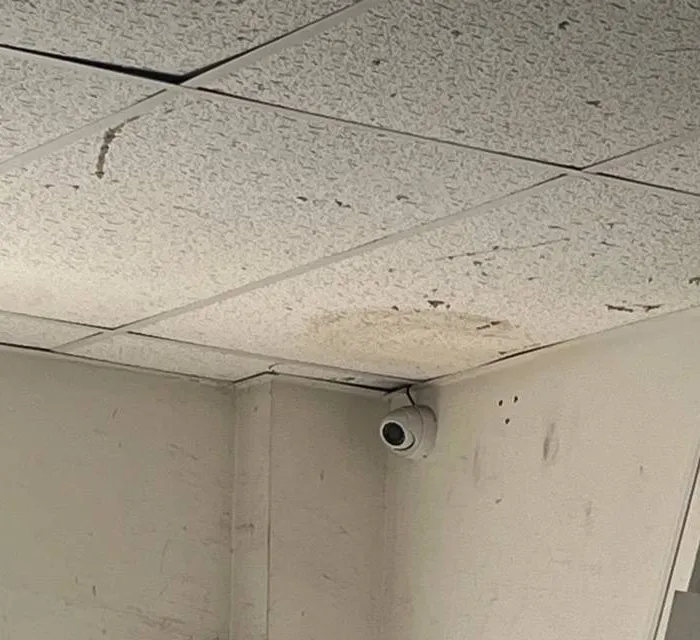
Example photo from another AESS job (not a Bronx property): a dome camera tucked into a corner directly below a water-stained ceiling tile. A ring like that means water reached the tile at least once — and the camera's cable joint sits right above it.
Bronx Camera Maintenance Quote
Camera count, what they look at, what's acting up — and a written number comes back today
✅
Request Sent!
Watch your phone — we ring back about your Bronx cameras before the business day ends.
25+
Years Experience
✓
Same-Day Estimates
100%
Licensed & Insured
4.6★
390+ Google Reviews
Two numbers tell us what your Bronx system needs. How many cameras you have, and how many of them look out at a street with trucks, buses or an elevated line. Indoor cameras in a quiet office age slowly; a camera over a Westchester Avenue storefront or a Hunts Point dock does not. Text the count and a photo of the worst-looking picture to (646) 490-0629 and we will tell you how often it should be seen.
One-time Bronx tune-ups run $150–$350 for a home or small system; scheduled plans start at $200 a year
Every visit leaves a dated log of what was cleaned, tested and replaced
Same-day written estimates, under NYS license #12000287431
Why Bronx Properties Need Security Camera Maintenance
Most camera systems in the borough were bought once and then left alone. The installer mounted the cameras, showed someone the phone app and drove off, and for the first few months everything looked fine. What happens after that depends almost entirely on where the cameras are. A dome inside a quiet clinic waiting room can run for years with nothing more than a dusting. A bullet camera bolted to the front of a Jerome Avenue tire shop, a turret over a Fordham Road gate, a camera on a Hunts Point cold-storage dock — those live in some of the hardest conditions a camera can face in New York City, and they degrade on a schedule you can almost predict.
The Bronx has more of those conditions packed together than most places. The 4 train runs elevated over River Avenue and Jerome Avenue all the way to Woodlawn. The White Plains Road line rides a viaduct over Westchester Avenue, Southern Boulevard, Boston Road and White Plains Road, and the 6 runs above Whitlock and Westchester Avenues toward Pelham Bay. Underneath and alongside them run the Major Deegan, the Cross Bronx and the Bruckner, and the Hunts Point Food Distribution Center moves billions of pounds of food a year, most of it by diesel truck. When South Bronx Unite and Columbia University's Mailman School put 19 air monitors across the South Bronx, the biggest jump in fine particles after congestion pricing began was measured outside their Mott Haven office, between the Third Avenue Bridge and the Major Deegan. We do not have a study that weighs the grime on a camera dome — but we do know what we wipe off domes on those blocks, and it is why cameras there go on a shorter schedule.
Then there is the human side. Cameras in the Bronx get attacked on purpose. In 2015 police released video of men walking through several apartment buildings on Davidson Avenue in Morris Heights and damaging numerous surveillance cameras inside and outside them. Far more common is the quieter version: a hallway camera turned a few degrees at a time until it looks at a wall, a lobby dome smeared with something, a cable yanked from behind a cellar door. On r/AskNYC, residents describe managers who "simply say the cameras arent working properly" when footage is asked for. Whether that is true or an excuse, the cure is the same — a record showing the cameras were checked, working and recording on known dates.
Finally, footage in the Bronx is asked for, and on a clock. A Bronx law firm's guide to preserving evidence warns that many store cameras overwrite in seven to ten days. NYCHA's newer cameras keep 21 days. A licensed cannabis dispensary must keep 60 days and test its equipment at least every 30. Maintenance is what makes sure the number of days the recorder actually holds matches the number of days you think it holds. Owners who keep their cameras serviced often pair the visits with a check of the building's access control or the lobby intercom, since the same technician is already on the ladder.
Bronx facts that decide how often a camera needs attention
Three elevated subway lines cross the borough. The Jerome Avenue line (4) is elevated from just south of East 157th Street to Woodlawn; the White Plains Road line runs on viaducts first opened in 1904 and 1917; the Pelham line (6) is elevated over Westchester Avenue. Storefront and apartment cameras along those streets face the structure all day.
The South Bronx air is measurably dirtier near the highways. In a two-year study reported by the Bronx Times in May 2026, 13 of 19 South Bronx monitors recorded higher fine-particle readings after congestion pricing began.
Food moves by truck. Inside Climate News reported in July 2026 that the Hunts Point Food Distribution Center distributes about 4.5 billion pounds of food a year, mostly by diesel truck.
Heat hits the South Bronx hardest. On the city's Heat Vulnerability Index, Mott Haven, Melrose, Morrisania and Hunts Point score 5, the highest risk, News 12 reported; Riverdale scores 1.
Summer power is fragile. During the July 2026 heat wave about 5,000 Bronx Con Edison customers lost power and Con Edison cut voltage by 8% in parts of the northwest Bronx; outages lingered in Riverdale, Wakefield and Morris Heights the next day.
Buildings are old. The median Bronx multifamily apartment building is 87 years old, according to the University Neighborhood Housing Program — cellars, leaks and steam pipes sit close to recorders and cable runs.
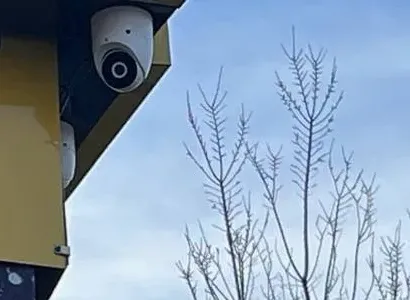
Example photo from another AESS job (not a Bronx property): an exterior dome under a painted fascia, open to sky and weather. Outdoor domes like this collect road film and webs between visits; on a Bronx avenue the bubble is the first thing we clean.
Need Camera Repair in the Bronx Today
If cameras are showing black tiles, the playback bar has gaps, or the recorder is beeping, that is a repair before it is maintenance. Call (646) 490-0629; we book the earliest same-day slot we can, and most faults are fixed within one to two hours of arrival. While you wait, do not reformat anything.
What to note before the technician arrives
Which cameras, and since when. Scroll back on the playback bar to find the last good minute for each dark camera — that time usually points straight at the cause.
Whether the power blinked. A Con Edison outage or a tripped breaker in the cellar explains a lot of overnight failures.
Whether anything looks moved. A camera pointing somewhere new, tape or paint on a lens, or a cable hanging loose is tampering, and we photograph it before touching it.
Whether you need a clip. If an incident is under investigation, tell us first; we export before we repair.
Repairs on cameras, recorders and wiring are handled through our Bronx security camera repair team, and damaged camera lines through Bronx network cable repair. Once the system is working again, a maintenance schedule keeps it that way.
What We Install
Security Camera Maintenance Services in the Bronx
Maintenance is a set of separate jobs, and a good plan only buys the ones your cameras need. These are the nine we do most across the borough, from a two-camera bodega on Tremont Avenue to a warehouse yard on the Hunts Point peninsula.
Dome, Lens and Housing Cleaning
Road film, soot and pollen come off with the right cloth and cleaner for each surface. Coated dome bubbles and plastic lens covers scratch easily, so they never see paper towels or household glass spray.
Night-Picture Check
We look at every camera after dark, not just in daylight. Webs, a dirty bubble or a nearby wall can bounce the infrared light back into the lens and turn a sharp night view into a white haze.
Mount and Aim Inspection
Brackets on facades facing an elevated line or a busy truck route get checked for loose anchors and drift. Each camera is compared against a reference snapshot taken on the first visit so a slow creep in the view is caught.
Recorder and Drive Health
We read each drive's health data, confirm the recorder is writing every channel, and compare the oldest recording on the drive against the retention you were promised. Drives showing early warning signs are replaced before they fail.
Battery Backup Testing
The UPS that keeps the recorder alive in an outage is load-tested and its battery date is logged. Batteries in warm cellars and closets are the first to fade, and nobody notices until the lights go out.
Time and Date Accuracy
Every recorder and camera clock is checked against network time, especially after a power event. A clip stamped with the wrong day or hour is much harder to use in court or with an insurer.
Firmware and Password Hygiene
Firmware is updated from the manufacturer's own sources where an update fixes a known security hole, default passwords are removed, and the admin login is confirmed to be in the owner's hands.
Alerts That Actually Arrive
Video-loss, tamper and drive-error notifications are tested end to end — we unplug a camera and watch the alert land on the right phone, not just switch the setting on.
Dated Visit Log
Each visit ends with a written record: which cameras were cleaned, what the drives reported, how many days the recorder holds, what was replaced. It is the paper trail regulators, insurers and boards ask for.
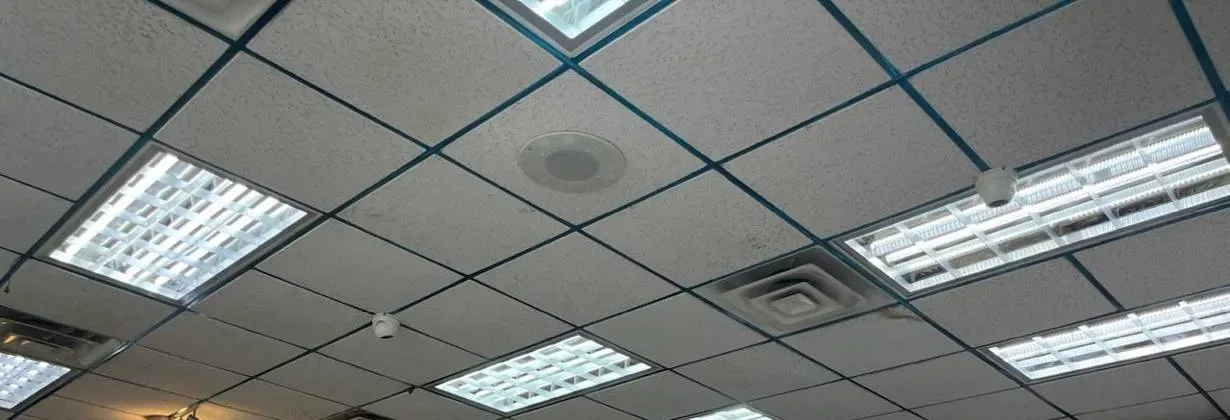
Example photo from another AESS job (not a Bronx property): small dome cameras spaced across a store ceiling, sharing the grid with light panels and air diffusers. Every one of them needs its own wipe and aim check on a visit.
Building Specialists
Camera Maintenance for the Bronx's Architecture
The building decides what wears out first. We have not found any city housing rule that obliges a private Bronx landlord to keep cameras working, and real-estate press reports agree there is none — so in most buildings, upkeep happens only because an owner, a board or a manager decides it should. These are the building types we service most and what each one does to a camera system.
Pre-War Walk-Ups
Five- and six-storey buildings with steam heat, plaster halls and a recorder somewhere in the cellar. The usual failures are a recorder baking near the boiler, a hallway camera nudged off aim, and a cable cracked where it passes through an old door frame. In buildings where management has told tenants to remove their own door cameras — as one Mott Haven building did in 2024 — the building's system is the only video left, and it has to work.
Grand Concourse Elevator Buildings
Larger apartment houses along the Concourse, with courtyards, long cellar corridors and cameras at the entrance, mailroom and elevator. More cameras means more chances for one to go dark without anyone noticing. We sort them by risk so the entrance and package room get the most attention.
Co-op and Condo Complexes
Large complexes such as Co-op City — 15,372 apartments in 35 high-rise buildings and seven townhouse clusters — spread cameras across garages, lobbies and grounds. Maintenance there is a rotation, with a written report the board can read and the managing agent can file.
New Rental Buildings
The Bronx added 63,066 units in buildings of four or more apartments between 2010 and 2025. Their cameras sit in drop ceilings and telecom closets, which are cleaner but hotter, and many systems were handed over by a developer with nobody named to look after them.
One- and Two-Family Houses
Neighborhoods such as Throgs Neck, Pelham Bay, City Island, Country Club, Riverdale and Wakefield have whole streets of houses. There it is the driveway and yard cameras: salt air near the water on City Island and Edgewater Park, leaves and webs in the back, and Wi-Fi cameras whose batteries no one remembers to charge.
Buildings Next to Public Housing
NYCHA's newer cameras run on the same video management system as the NYPD and keep 21 days of footage. Private buildings across the street often keep less, and when something happens on the block, theirs is the footage that has gone. We help neighbors set retention so their recordings overlap with the window detectives work in.
What changes in the work from one building to the next
Plaster and brick: anchors in old masonry loosen over time, especially on facades that shake. We check them by hand and re-set loose ones in fresh holes rather than reusing a crumbling one.
Cellar recorders: a recorder within reach of water or steam is moved up onto a shelf or bracket, and the space around it is checked for heat each visit.
Courtyards and light wells: cameras facing open sky collect webs, pigeon mess and leaves faster than street cameras, and they get a night check every visit.
Drop ceilings in newer buildings: cameras near supply-air diffusers gather dust on the lens edge, and a lens that looks clean from the floor can be ringed with it.
Garages: exhaust and winter salt spray reach every camera on a ramp; housings are wiped and connectors checked for corrosion.
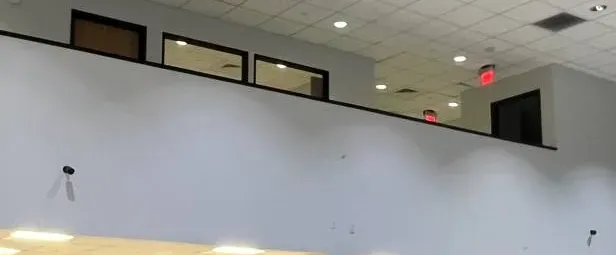
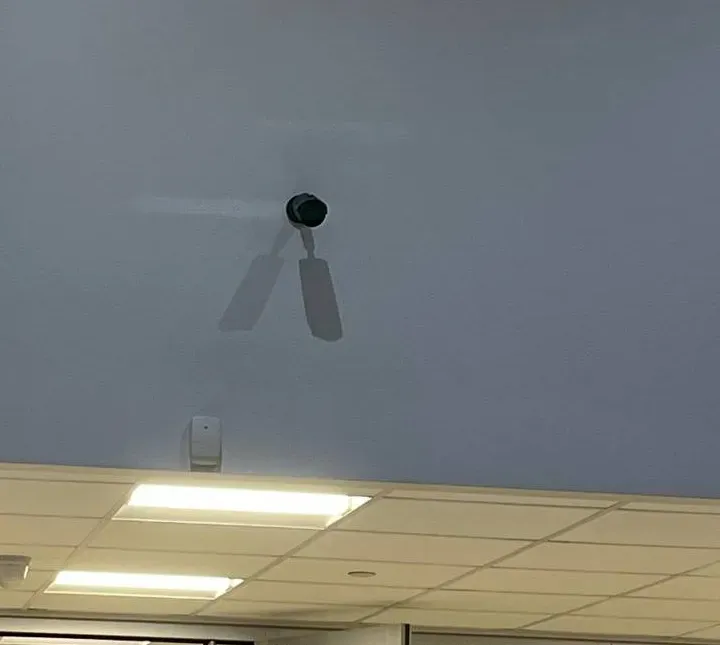
Example photo from another AESS job (not a Bronx property): two cameras mounted high on a tall wall below mezzanine windows. Height is what decides whether a maintenance visit needs a step ladder, an extension ladder or a lift.
Commercial Security Camera Maintenance
Business Camera Maintenance in the Bronx
For a Bronx business, cameras are evidence equipment. They have to be clean enough to show a face, recording when it matters, and holding footage long enough for whoever comes asking. These are the corridors where we service the most commercial systems, and what each one is hard on.
Jerome Avenue Under the 4
Auto shops occupy long stretches of Jerome Avenue beneath the elevated line; News 12 reported in June 2026 that Mount Eden residents were pressing for action over late-night noise from them. Late hours and body work mean the cameras on those shopfronts collect dust and overspray quickly.
Westchester Avenue and White Plains Road
Stores under the 6 and the White Plains Road viaduct from Hunts Point and Parkchester to Westchester Square and up White Plains Road through Williamsbridge and Wakefield. Facades here are shaded by the structure, so cameras run in infrared longer each day and lean hard on clean domes.
Fordham Road
The Fordham Road BID covers 35 block faces and 333 ground-floor shops near our office at 460 E Fordham Rd. Rolling gates, awnings and bus traffic mean a lot of cameras sit low and get bumped; aim checks matter more here than anywhere.
The Hub and Third Avenue
The shopping crossroads at 149th Street and Third Avenue, where the Third Avenue BID added 18 cameras at ten locations in October 2026. Corridor businesses there can also be part of the Bronx DA's camera-mapping program, which works only if their own cameras are recording.
Hunts Point Peninsula
The Hunts Point Cooperative Market alone covers about 60 acres with more than 50 wholesale food businesses and runs 24 hours a day. Docks, yards and freezer doors mean diesel film, condensation on cameras that move between cold and warm air, and recorders that never stop writing.
Arthur Avenue, Allerton and the Dispensaries
The Bronx Times counted nine licensed cannabis dispensaries opening in the borough in 2024, on top of two in 2023, including stores on Arthur Avenue and Williamsbridge Road. Every one of them works under a state rule that sets retention, backup power and testing intervals.
Rules that make maintenance a compliance job
Licensed cannabis businesses (9 NYCRR §125.3): recordings kept at least 60 days; continuous recording during operating hours; the system must stay up for at least eight hours in a power outage; a failure alert must reach the licensee within five minutes; equipment kept "in full operating order", tested and inspected at intervals of no more than 30 calendar days, with test records kept five years.
Who does the work: New York's Department of State licenses security and fire alarm installers, and that licence covers video surveillance systems. We work under NYS license #12000287431.
Face recognition and audio: a store that collects customers' biometric data must post a sign at its customer entrances under NYC Administrative Code §22-1202, and recording conversations without a participant's consent is eavesdropping under New York Penal Law Article 250. A maintenance visit confirms features you did not intend to use are still switched off after an update.
Pending, not yet law: Assembly bill A.9470-B (introduced January 2026) would make businesses release footage of an on-site felony on written request and take reasonable steps not to record over it; Senate bill S.1659 would require cabarets to keep 30 days of entrance video. Neither has passed as of this update.
Bank ATMs: New York's banking rules require ATM video to be kept at least 30 days before reuse. That applies to banks' ATM facilities, not to a store that rents counter space to a cash machine.
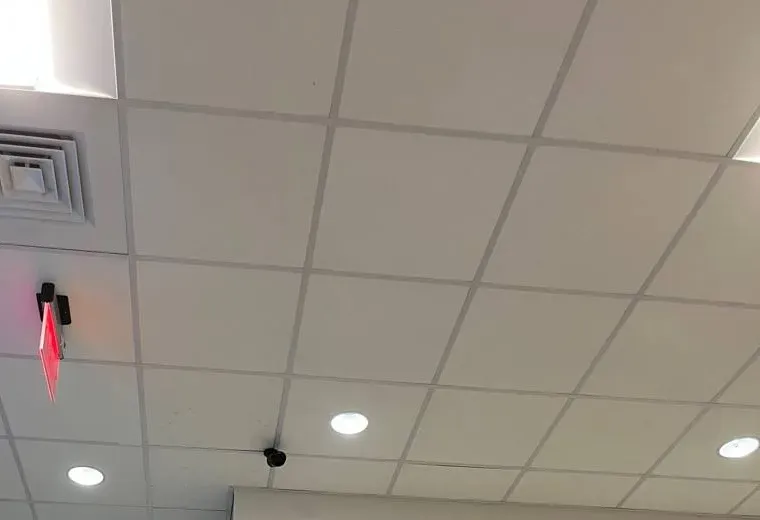
Example photo from another AESS job (not a Bronx property): a small ceiling camera in a commercial space, a few feet from an air vent and an exit sign. Moving air carries dust to the lens edge, and a lit sign nearby can cause glare at night.
Your Questions Answered
Security Camera Maintenance in the Bronx: Questions Answered
These are the problems Bronx owners, supers, store managers and boards bring to us about systems that already exist — grouped by what is wearing the system down. Prices are in the pricing section further on; the shorter practical questions about visit days are in the FAQ near the end.
Grime, Dust and the Elevated Lines
Our cameras look straight at the 4 train over Jerome Avenue — why does that view go soft long before the ones on the side street?
Because those cameras live in a different environment from the ones twenty feet around the corner. A camera facing an elevated structure sits in a channel of traffic under the tracks, takes on whatever settles out of the air along a busy avenue, and spends much of the day in the shade of the steel, which pushes it into infrared mode earlier in the afternoon and keeps it there later in the morning. A thin film on the dome that would hardly matter in sunlight becomes a glowing haze once the camera's own infrared light bounces off it.
There is also the steel itself. The Jerome Avenue line has carried trains over Jerome Avenue since 1917 and 1918, and buildings along it feel each train go by. We have no study to quote on how much that loosens a camera bracket, so we treat it as something to check rather than something to assume: on every visit, cameras facing the el are tested by hand at the mount, compared against their reference snapshot, and re-tightened if the view has crept.
In practice, cameras on blocks like this go on a shorter cleaning cycle than the rest of the building — often every three months instead of every six — and get their dome wiped at the same visit as their aim is checked. The side-street cameras stay on the longer schedule, which keeps the overall cost down. The point is to spend effort where the wear actually is.
The store sits a few blocks from the Major Deegan — what is the grey film on the dome, and what takes it off without ruining the plastic?
The film is a mix of road dust, soot and whatever else settles from the air near a truck corridor, bound together by rain and humidity until it no longer blows off. It is the same thing that greys a window sill near the highway. The air monitors South Bronx Unite and Columbia ran between 2024 and 2025 measured the largest rise in fine particles in their network right by the Major Deegan in Mott Haven, and Inside Climate News reported in 2026 that most of the food moving through Hunts Point travels by diesel truck. We cannot tell you what share of that ends up on your camera, only that cameras on these routes need cleaning more often than cameras inland.
What takes it off safely is boring: a blower first to lift loose grit, then a clean microfiber cloth with plain water or a lens-safe cleaner, worked gently, then a dry cloth. Dome bubbles are usually polycarbonate, often with a coating, and paper towels, rough rags and household sprays with ammonia or alcohol will scratch or cloud them. Once a dome is scratched, no amount of cleaning brings the night picture back, and the bubble has to be replaced.
If a dome has been wiped with the wrong thing for years, we will tell you on the first visit, show you the scratches under a flashlight, and price a replacement bubble or housing separately. Many dome models take a replacement bubble, which costs far less than a new camera.
Spider webs keep setting off motion alerts on the courtyard camera every night — is there a fix that lasts longer than a week?
Webs are one of the most common complaints on camera forums, and the reason is simple: the camera's infrared light attracts insects at night, the insects attract spiders, and a single strand in front of the lens lights up white in infrared and waves in the breeze. To the camera's motion detection that looks like constant movement, which buries your real alerts under false ones and fills the recorder with useless clips.
Cleaning alone buys a few days. What lasts longer is changing the conditions: removing the web and egg sacs from the camera and the bracket, clearing the wall around the mount, and where the camera allows it, turning off its built-in infrared and lighting the courtyard another way so the lens is not the brightest thing out there. Some owners also add a small hood or move the camera a few inches away from a corner where spiders anchor.
Courtyards and light wells in Bronx apartment buildings are particularly prone to this, because they are sheltered, damp and lit at night. On a maintenance plan, those cameras get a night-time check every visit and a note on the log if the webs have come back, so you can decide whether a lighting change is worth it.
Example photo from another AESS job (not a Bronx property): a bullet camera mounted next to a return-air grille. Air pulled past the camera all day leaves a ring of dust on the lens that is easy to miss from the floor.
Heat, Power and Water
After the July 2026 heat-wave outages, two cameras came back with the wrong date — what should be checked once Con Edison restores power?
Power events are hard on camera systems even when nothing visibly breaks. In early July 2026 about 5,000 Bronx customers lost power during the heat wave, Con Edison reduced voltage by 8% in parts of the northwest Bronx, and the next day outages were still being tracked in Riverdale, Wakefield and Morris Heights. Cameras and recorders that lose power without a battery behind them can come back with their clocks reset, with a drive that needs a check, or stuck on a startup screen.
After an outage, five things are worth checking: that every camera is back on the recorder's grid; that the recorder's date and time match real time and the cameras' overlays match the recorder; that the playback bar shows recording resuming on every channel; that the drive shows no new errors; and that the battery backup, if there is one, actually carried the load and has recharged. A camera that comes back with the wrong date will keep stamping every clip wrongly until someone notices.
On a maintenance plan, we set the recorder to take its time from an internet time server and its cameras from the recorder, so a clock reset corrects itself once the network returns. We also set an alert for video loss, so if a camera fails to come back after the power does, your phone says so the same day.
Our battery backup is four years old and lives in a warm cellar — is it still protecting anything?
Possibly not much. APC, one of the most common UPS brands, says most of its batteries should last three to five years — and that every 8°C (15°F) rise in temperature cuts battery life in half. Its own example: a battery expected to last four years at 25°C would last about two at 33°C. A cellar room next to a boiler, or a closet in one of the Bronx neighborhoods that ranks highest on the city's heat vulnerability index, can sit well above 25°C for months.
The trouble is that a weak battery looks fine. The UPS still shows a green light and the recorder still runs on wall power. The battery only gets asked to work during an outage, which is exactly when you find out it can carry the recorder for ninety seconds instead of an hour. Many units will report a failed self-test, but only to someone who looks at them or has set up notifications.
On each visit we run the unit's self-test, check its runtime estimate against the actual load of the recorder and PoE switch, and write the battery's install date on the case and in the log. Batteries that test weak, or are past the age where heat has likely worn them out, get a replacement quote before the summer, not after the first outage.
There is a brown water ring on the ceiling tile right above a camera — how worried should we be?
Worried enough to look this week. A stain means water has reached that tile at least once, and cameras, junction boxes and the cable joints above a drop ceiling are not built to sit in drips. Outdoor-rated cameras survive rain from the outside, but water running down a cable from above can reach the connector and the back of the camera, where it causes corrosion, flickering video and eventually a dead channel.
Bronx buildings give water plenty of routes: roof leaks in old walk-ups, steam pipes that sweat, and flash storms like the one in July 2025 that brought a flash-flood warning to the Bronx and sent floodwater into the Longwood Avenue subway station. A cellar recorder sitting on the floor or a low shelf is only one storm away from a ruined drive.
On a visit, we lift the tile, check the camera's connector and junction box for rust and moisture, reseal or replace what needs it, and note the leak in the log so the super or the landlord can fix its source. If the recorder is in a room that has taken water before, we recommend moving it up and away, because no maintenance schedule beats a flood.
Footage on a Clock
We hold a cannabis retail licence in the Bronx — what does the state expect us to test, and how often?
The Office of Cannabis Management's security rule, 9 NYCRR §125.3, is specific. Recordings must be kept at least 60 days, and longer if they relate to an open investigation. Cameras must record continuously during operating hours and on motion at other times. The alarm and video systems must keep running for at least eight hours in a power outage. A failure notification must reach your designated representative within five minutes, and a power-related failure expected to last more than eight hours has to be reported to the Office within 24 hours.
On upkeep, the rule says security equipment must be kept "in full operating order", tested and inspected at intervals of no more than 30 calendar days, with test records kept for five years. That is a monthly obligation, and it is easy to slip in a busy store. The parts most likely to fail an inspection are the ones that only matter in an emergency — the backup power, the failure alert, and the oldest day on the drive.
We set up a monthly visit or remote-and-visit routine for licensed stores that covers exactly those points: run the backup, trigger the failure alert, read the oldest recording, confirm continuous mode during hours, clean the cameras that cover the sales floor and the vault, and sign a dated test record. This is general information about the rule, not legal advice; your compliance plan is yours and your attorney's to approve.
A detective asked for video from nine days earlier and the recorder had already written over it — how do we stop that happening again?
This is the most common way a Bronx system fails without anything breaking. A Bronx law firm's guide to preserving evidence notes that many store cameras overwrite in seven to ten days, and in our experience owners are usually surprised by their own number. Retention shrinks quietly: a camera is upgraded to higher resolution, a few more are added, a drive starts failing and the recorder drops it, and the same recorder that held a month now holds a week.
The fix starts with knowing the real number. On every maintenance visit we open the recorder's playback and find the oldest recording on the drive, and write that date in the log. If it is shorter than you need, we look at the cheapest ways to stretch it: recording some cameras on motion instead of continuously, lowering the bitrate on views that do not need full detail, switching on a more efficient compression setting where the cameras support it, or adding a drive.
The second half is speed. Corridor businesses in the Bronx that joined the District Attorney's camera-mapping program, which listed nearly 1,000 cameras in its first stage, get asked for footage because their location is known. We leave a short written routine for exporting a clip to a USB stick, and the person who will do it practises once while we are there, so a request on day three is answered on day three.
Is a Bronx deli or bodega legally required to keep its footage for a set number of days?
As of this update, we have not found a New York City or New York State rule that sets a general retention period for an ordinary deli, bodega or grocery's cameras. Specific businesses do have rules — licensed cannabis retailers must keep 60 days, banks must keep ATM video at least 30 days before reusing it — but a corner store's cameras are generally up to the owner.
That may change. Assembly bill A.9470-B, introduced in January 2026, would require businesses to release footage of a felony on their premises when police make a formal written request, and to take reasonable steps not to record over it once they know or should expect a crime happened. It sets fines of up to $100,000 per incident but no fixed number of days. It has not passed. Senate bill S.1659 would require cabarets to keep 30 days of entrance video; it has not passed either.
Even without a rule, a store that cannot produce footage loses arguments with insurers and in court. Most owners we work with aim for at least 30 days on the cameras covering the door and the register, and we size the drive and recording settings to hold it. If a bill does pass, a maintained system with a known retention figure is the easiest one to bring into line.
Tampering and Vandalism
Someone keeps pushing the lobby camera to face the ceiling — how do you make a camera harder to knock off its view?
Turret and bullet cameras on simple ball-joint mounts can be swung by hand, and in a lobby or stairwell there is always someone who knows where the camera is. The first fix is mechanical: lock the joint with the set screw or a tamper-resistant screw, mount the camera higher and further from anything that can be stood on, and where the view allows it, swap a bullet for a vandal-resistant dome whose lens adjusts only from inside the housing.
The second fix is attention. Many current cameras and recorders can raise a tamper alert when the view suddenly changes, goes dark or loses focus, and those alerts can go to the owner's or the super's phone. We set them up, test them by moving the camera, and tune the sensitivity so a passing truck's headlights do not trigger it every night.
Cameras in the Bronx do get deliberately attacked — in 2015 police released video of men damaging numerous cameras inside and outside apartment buildings on Davidson Avenue in Morris Heights. A camera that has been turned or covered also has value as evidence of that, so when we find one, we photograph it before correcting it and note it in the log.
How would we find out the same morning that a camera was sprayed or covered overnight?
By having the system tell you rather than waiting for someone to look. A painted or taped lens still sends video — just a black or blurred picture — so the camera never "goes offline" and a basic system raises no alarm. What catches it is a video tamper or scene-change alert, which compares the current picture with the normal one and flags a sudden loss of detail.
Owners can also add a simple daily habit: a glance at the live grid in the app each morning. A black or smeared tile stands out in two seconds. For buildings, we suggest the super or porter does this as part of the morning walk-through, with a phone number to call when a tile looks wrong.
When we service a system, we test the tamper alert by covering each important camera for a moment and confirming the notification arrives. If your cameras or recorder do not support tamper detection, we say so in the log and price the cameras where it matters most — usually the entrance and the package room.
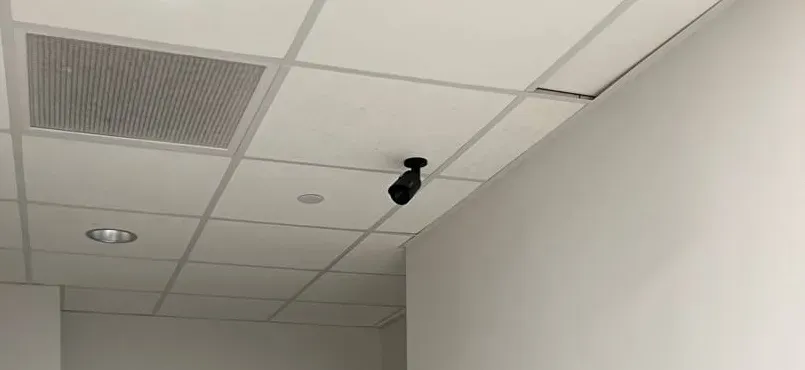
Example photo from another AESS job (not a Bronx property): a small camera on a short arm high on a wall, with a motion sensor below. A short arm like this is easy to knock off aim; we compare its view against a reference snapshot on every visit.
Older Systems, Firmware and Access
Our recorder is an older Hikvision — do firmware updates still matter, and can we still get them after the 2026 FCC order?
They matter. A command-injection flaw in many Hikvision cameras, CVE-2021-36260, was fixed by a firmware update in September 2021, and in January 2022 the US Cybersecurity and Infrastructure Security Agency listed it among actively exploited bugs. In August 2022 researchers still found roughly 80,000 vulnerable devices among about 285,000 internet-facing Hikvision web servers they sampled. Plenty of Bronx stores and buildings run this kind of equipment, and many have never been updated.
The FCC's order that took effect on July 16, 2026 bars importing and marketing certain previously authorized covered equipment, but it does not require owners to stop using what they already have. Hikvision's US arm has said the import limits could affect access to replacement parts, warranty service and technical support. So updates and parts may become harder to get over time, which is a reason to keep what you have patched now and plan replacements on your own schedule rather than after a failure.
On a visit we check the firmware version against the manufacturer's own release notes, update from the manufacturer's sources when an update closes a known hole, make sure the recorder is not exposed to the internet through an open port, and change default passwords. If a model is past updates entirely, the log says so and we price a replacement. Our Bronx Hikvision page covers keep-or-replace decisions in more depth.
The last managing agent left without handing over the recorder password — can access be recovered without erasing the footage?
Usually, yes, but it depends on the brand and model. Most major manufacturers have a password-reset process that goes through the owner: a code tied to the recorder's serial number, an export file sent to the manufacturer's support, or a reset via a registered email or phone. Those methods reset the login without wiping the recordings. A factory reset by the button on the back is the last resort, and on some models it does more than reset the password.
Before trying anything, we photograph the recorder's label, note what is recording and how far back the drive goes, and if there is an incident on the drive that matters, we talk through whether to preserve it first. Proof of ownership or authority helps; manufacturers increasingly ask for it before issuing a reset.
Once access is back, we set up separate logins — one admin held by the owner or board, others for the agent, the super and anyone else who needs to view — so the next change of managing agent does not lock the building out again. The admin credentials go to the owner in a sealed envelope, and the log notes who holds which account.
In a co-op, who should receive the maintenance report — the board, the managing agent or the super?
All three, each for a different reason. The board is responsible for the building's equipment and needs to know whether the system it paid for is doing its job. The managing agent handles budgets, contractors and insurance and needs the record on file. The super is the one who will notice a dark tile tomorrow and needs to know which items on the report are his to watch.
We write the report so each reader can find their part: a one-paragraph summary at the top (working, partly working, or needs work, and what it will cost), a camera-by-camera table with what was done, and a short list of items for the super, like a door camera that keeps getting knocked or a leak above the garage camera. For big complexes, we split the report by building or garage.
Boards in large Bronx complexes sometimes ask for the report in a fixed format for their own records or their insurer. Tell us at the start and we will use it. The point is that the report survives a change of board or agent, which is when knowledge about the camera system tends to disappear.
Our Hunts Point cold-storage unit records around the clock — does nonstop recording wear the drives out faster?
It works them harder, which is why the type of drive matters. Surveillance drives are built for it: Western Digital rates its WD Purple drives for workloads of up to 180 TB a year, roughly three times a desktop drive. A recorder in a 24-hour wholesale operation — the Hunts Point Cooperative Market runs around the clock — writes every minute of every day, so a desktop drive slipped in during a cheap repair is a weak link.
Drives also fail on their own schedule. Backblaze, which publishes failure statistics for its fleet of hundreds of thousands of drives, reported an annualized failure rate of 1.36% for the second quarter of 2025. That is low for any single drive, but across a building's recorders over several years, a failure is a matter of when. The question is whether you find out from a warning or from a missing week.
On each visit we read each drive's health data and the recorder's own error log. Drives showing reallocated sectors or growing error counts are replaced while they still work, and in cold-storage operations we also check the cameras that move between freezer and loading-dock air, because condensation inside a housing fogs the picture long before it kills the camera.
Equipment
Types of Security Cameras We Maintain
Every kind of camera ages in its own way. Here is what each type in a typical Bronx system needs from a maintenance visit.
Vandal-Resistant Domes
Common in lobbies, halls and over store counters. The bubble is the weak point: scratches and haze. We clean it with lens-safe materials, check the seal, and replace bubbles that have been scratched or clouded.
Turret Cameras
No bubble, so less glare at night, but the ball joint can be turned by hand. We check the lock screw, the aim against the reference snapshot, and the infrared illuminators around the lens.
Bullet Cameras
Long-range views of sidewalks, yards and docks. The sunshield collects webs and nests. Mounts on facades facing an elevated line get the closest look for loosening.
PTZ Cameras
Pan-tilt-zoom cameras on corners and yards have moving parts. We run the presets and patrol tours, check that they return home, and look for slipping or noisy motors.
Recorders and Drives
NVRs and DVRs: fans, vents, drive health, error logs, firmware, retention and time sync. Dust-packed vents are cleaned and failing drives replaced with surveillance-rated ones.
PoE Switches and Cabling
Every camera's power and data run through these. We check port status, power draw, connectors at exterior cameras and outdoor junction boxes for corrosion.
Battery Backup (UPS)
Self-test, runtime against load, battery age label. Heat in cellars and closets shortens battery life sharply.
Wi-Fi and Battery Cameras
Doorbells and plug-in cameras common on Bronx houses. We check signal, charge, cloud subscription status and that the account is still in the owner's name.
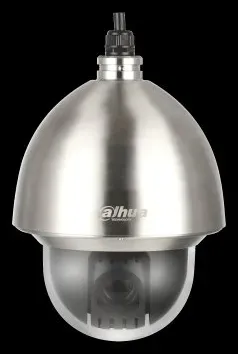
Stainless and Corrosion-Resistant Housings
For docks, garages and wash bays where salt, fuel or cleaning chemicals reach the camera. Seals, gaskets and cable glands are inspected each visit.
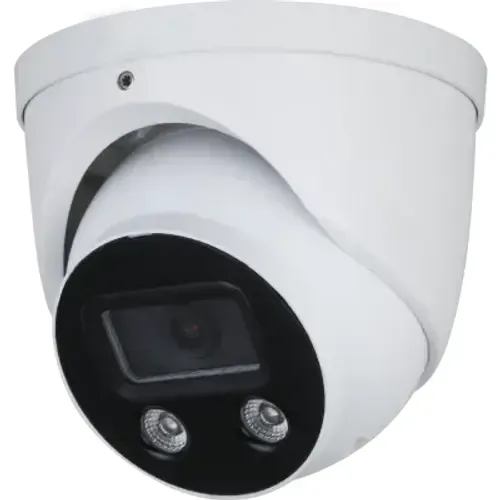
Manufacturer product photo: a white turret camera with two illuminators beside the lens. With no dome bubble in front of the lens, turrets suffer less night glare, but the ball joint still needs its lock screw checked.
National brands versus a local maintenance plan
Many Bronx homes and small shops start with a do-it-yourself or monitored system from a national brand. Those are useful, but their service models are built around their own devices and apps. Here is how they compare with a local maintenance plan for a wired system, based on what each typically offers rather than any company's exact current terms.
Question
ADT, Ring or SimpliSafe-style service
AESS Bronx maintenance
Who cleans the cameras?
Usually the owner; the service centres on the app, monitoring and device replacement.
A technician on site, on a schedule set by how exposed each camera is.
Mixed brands and older wired cameras
Typically supports only the company's own devices.
Works on whatever is on the wall — Hikvision, Dahua, Lorex, Uniview, Axis and others.
Recorder and drive health
Cloud recording on a subscription; no local drive to check.
Local drives read, logged and replaced before they fail; no monthly fee for local recording.
Written proof of testing
App history and account records.
A dated, signed visit log for regulators, insurers and boards.
Night picture in a shaded, el-side facade
Depends on device placement chosen by the owner.
Checked after dark, with glare, webs and aim corrected on site.
Manufacturer product photo: a stainless steel pan-tilt-zoom dome. Housings like this are made for docks, garages and wash bays; their seals, gaskets and moving parts are what a maintenance visit checks.
AI Overview Reality Check
What AI Gets Wrong About Security Camera Maintenance in the Bronx
We could not capture Google's AI Overview for this topic from our research environment, so we have not quoted it. Instead, here are seven claims that turn up again and again in the maintenance guides, cost articles and forum answers such summaries draw on, checked against what Bronx systems actually go through.
Claim 1: "Check your cameras once a year"
Guides disagree wildly. Reolink's maintenance article recommends checking for faults once a year. Axis suggests breaking the work into weekly, monthly and quarterly tasks, starting with cleaning lenses and housings weekly. Another integrator's checklist says commercial systems should be checked weekly and maintained monthly; a third says most integrators recommend a full inspection every six months. All of them can be right — for different cameras.
One number for a whole building is the mistake. A camera in a dry office hallway in Riverdale and a camera facing the Westchester Avenue el in Parkchester do not age at the same rate. An annual check would let the second one spend most of the year recording haze.
What works in the Bronx is splitting a system into groups by exposure: cameras near highways, elevated lines, docks and courtyards on a three-month cycle; sheltered indoor cameras on six; a quick monthly look at the live grid by whoever is on site. Licensed cannabis stores are on 30 days because the state says so.
Claim 2: "A blurry picture means the camera is failing"
Axis puts it better than most: a blurry image is often just a dirty lens. In the Bronx, a soft picture is far more often film on the dome, a web across the lens, condensation inside the housing or a camera knocked slightly out of focus than a failed sensor. Cameras near the Major Deegan or the Bruckner can go soft between visits simply from road grime.
The opposite mistake also happens: owners replace a camera, and the new one goes blurry too, because the problem was infrared light bouncing off a nearby wall or soffit. Moving a camera a few inches or turning off its infrared can fix what a new camera never would.
So before anyone buys anything, we clean, check focus and look at the camera at night. Only if the picture stays soft after all three is the camera itself the suspect.
Claim 3: "Surveillance drives last for years, so you can ignore them"
Surveillance drives are tough — Western Digital rates WD Purple drives for up to 180 TB of writes a year — but tough is not immortal. Backblaze's fleet showed an annualized failure rate of 1.36% in the second quarter of 2025, and heat in a cramped closet or cellar makes things worse, not better.
The bigger danger is not a sudden failure but a silent one. A recorder that drops a failing drive often keeps running on the remaining space, which quietly shortens retention. Nobody notices until someone asks for footage from twelve days ago.
Reading drive health and checking the oldest recording on every visit turns an invisible problem into a line on a report — and a drive replaced on your schedule instead of after an incident.
Claim 4: "Maintenance costs are easy to look up online"
National cost sites like HomeAdvisor publish guides to repairing alarm and security systems, and integrator forums such as IPVM debate how to price service packages, but we did not find a reliable national figure for scheduled camera maintenance itself. Many published "maintenance" prices are really repair prices.
In the Bronx, what drives the cost of upkeep is not the number of cameras alone. It is how many are outside, how high they are, whether a lift or a tall ladder is needed on a facade, how many face roads or el structures, and whether someone has to meet us with keys to the roof and the cellar.
That is why our pricing section shows ranges and worked examples rather than a single per-camera number, and why we give a fixed written price after seeing the system.
Claim 5: "Battery backup is a one-time purchase"
The UPS box may last a long time, but its battery does not. APC says most of its batteries should last three to five years, and that every 8°C (15°F) above about 25°C halves battery life. A battery cooking in a Morrisania cellar in August is on the short end of that range.
Summer outages in the Bronx are real — about 5,000 customers lost power during the July 2026 heat wave — and a recorder backed by a dead battery shuts down just as hard as one with no backup at all.
Testing the battery under load and labelling its age is a two-minute job on a maintenance visit. Skipping it is how a building discovers its backup was decorative.
Claim 6: "Firmware updates are optional"
For cameras that never touch the internet, updates matter less. But many Bronx systems are reachable from phones through the recorder's network connection, and some are exposed directly. CISA listed a Hikvision command-injection flaw, CVE-2021-36260, among actively exploited bugs in 2022, months after the fix was released, and researchers still found tens of thousands of unpatched devices online that August.
Updating carelessly has its own risks: firmware from unofficial sites, updates that switch on features you did not want, or an update that fails halfway on an old recorder. That is why updates belong in a maintenance visit where someone checks the release notes and has a way back.
With the FCC's July 2026 order limiting imports of covered equipment, owners of Hikvision and Dahua systems may find parts and support harder to get. Patching now and planning replacements deliberately is safer than waiting.
Claim 7: "Cloud cameras don't need maintenance"
Cloud recording removes the hard drive from your premises, not the camera from the weather. The lens still collects grime, webs still form, batteries in wireless cameras still need charging or replacing, and Wi-Fi signals in brick Bronx buildings still drop.
Cloud plans also depend on the subscription and the account. When the person who set up the account moves out, sells the house or leaves the business, the footage can go with them.
For Bronx houses and small shops with cloud cameras, a maintenance visit cleans and checks the cameras, confirms the subscription is active and that the account and recovery email belong to the current owner.
Not Sure Which Cameras Need the Shorter Schedule?
Send a photo of each outdoor camera's view to (646) 490-0629. We will tell you which ones face an el, a truck route or a dock and should be seen every three months.
Describe the system as it is today: camera count, what the outdoor ones look at, and anything that has failed or gone missing. Same business day, a licensed technician phones back with either a written Bronx price for a tune-up or a schedule, or a time to come and see it first. Nothing is booked until you agree.
Thanks — It's With Us
Expect a call about your Bronx camera system before the end of the business day. In a hurry? Ring (646) 490-0629.
How It Works
Our Maintenance Process
Seven steps, whether it is a three-camera house in Throgs Neck or a hundred cameras across a complex. The first visit takes longest because it sets the baseline every later visit is measured against.
1. Photos and a phone call
You send a photo of each outdoor camera's view and tell us where the recorder lives. We ask what has gone wrong before and whether anyone needs footage kept for a set number of days.
2. Baseline walk-through
On the first visit we list every camera, recorder, switch and battery, note models and firmware, and take a reference snapshot of each view by day and, where possible, after dark.
3. Sort cameras by exposure
Cameras facing an elevated line, a highway, a dock or a courtyard go on a shorter cycle; sheltered indoor cameras on a longer one; licensed stores on the 30-day cycle the state requires.
4. Written schedule and price
You get a written Bronx price for the visits, what each one covers, and the terms in the service agreement, before anything is booked.
5. Clean, test and correct
Domes and lenses cleaned with lens-safe materials, mounts checked by hand, aim compared with the reference snapshot, drives and battery backup tested, clocks synced, alerts triggered.
6. Fix or quote what failed
Small fixes are done on the spot. Failing drives, weak batteries, scratched domes and dead cameras are photographed and quoted as parts before they are replaced.
7. Dated log and next visit
You receive a dated record of every check, the oldest recording on the drive and anything the super or owner should watch, and the next visit goes on the calendar.
Coverage Area
Security Camera Maintenance Near the Bronx's Landmarks
Every corner of the borough is in our service area. The six places below are listed because of the conditions around them — el steel, truck traffic, round-the-clock docks — and none of them is presented as a customer.
Jerome Avenue El to Woodlawn
The 4 train runs elevated over River Avenue and Jerome Avenue from 161st Street–Yankee Stadium north to Woodlawn, past Mount Eden, Burnside, Fordham Road and Bedford Park — storefronts and apartments facing the steel the whole way.
Westchester Avenue Viaducts
The Pelham line carries the 6 over Whitlock and Westchester Avenues toward Pelham Bay, and the White Plains Road line rides its own viaduct over Westchester Avenue, Southern Boulevard and Boston Road.
Hunts Point Food Distribution Center
Around 329 acres and more than 155 wholesalers on the peninsula, including the 24-hour Hunts Point Cooperative Market — docks, freezers and trucks that keep cameras and recorders working nonstop.
Mott Haven by the Major Deegan
Where a South Bronx Unite and Columbia University monitor between the Third Avenue Bridge and the Major Deegan recorded the network's largest rise in fine particles in 2024–2025.
Fordham Road
The Fordham Road BID's 35 block faces and 333 ground-floor shops, around our Bronx office at 460 E Fordham Rd.
Co-op City
15,372 apartments in 35 high-rise buildings and seven townhouse clusters by the Hutchinson River Parkway and I-95, where camera upkeep runs as a rotation across buildings and garages.
Scheduled visits also run north and east to Woodlawn, Wakefield, Eastchester, Baychester, Williamsbridge, Allerton, Pelham Parkway, Morris Park, City Island, Country Club, Pelham Bay, Throgs Neck, Westchester Square, Parkchester, Unionport, Castle Hill and Soundview; west and central to Riverdale, Spuyten Duyvil, Kingsbridge, Kingsbridge Heights, Norwood, Bedford Park, Belmont, Tremont, West Farms, University Heights, Morris Heights, Highbridge and Concourse; and south to Morrisania, Longwood, Melrose and Port Morris. Other boroughs are covered from our NYC security camera maintenance hub.
Pricing
Security Camera Maintenance Cost in the Bronx
The Bronx carries a 1.00 area factor in our pricing, the same as Brooklyn, so these are our New York City base rates with nothing added for the borough. Parts — replacement drives, batteries, dome bubbles, cameras — are priced separately on your written quote.
Bronx maintenance work
Price
What it covers
One-time tune-up, home or small system
$150–$350
One visit: domes and lenses cleaned, night picture and aim checked, drive health and the oldest recording read, battery backup tested, a dated log left behind
Scheduled plan, home or small building
$200–$500 per year
Exposed cameras seen every three months, sheltered ones every six, and a faster booking if something drops between visits; in practice $50–$150 a camera a year, set by how many cameras there are and how hard they are to reach
Commercial plan, monthly or quarterly
$1,000–$5,000+ per year
Stores, warehouses, complexes and licensed businesses; priced after a walkthrough, including monthly compliance testing where required
Same-day repair visit
$190–$900
System down, not recording or remote viewing dead — same-day diagnosis and fix, quoted per job
Service after an AESS installation
$195/hr, 3-hr minimum ($585)
Our hourly rate when we come back to change or add to a system we put in; the installation itself is never billed this way
What pushes a Bronx maintenance price up or down is mostly access and exposure. Cameras reachable from a step ladder in a hallway are quick. Cameras two or three storeys up a facade, over a sidewalk or a busy avenue, take longer and sometimes need a lift. Cameras facing an el or a truck route go on a shorter cycle, which means more visits a year. And buildings where nobody can meet us with keys to the roof and cellar end up paying for a second trip.
Two worked examples on the published prices
A six-camera bodega near Westchester Avenue. Four cameras inside, two over the sidewalk facing the el. The owner wants the outside cameras seen every three months and the inside ones twice a year. That fits the scheduled plan range of $200–$500 a year, with the exact figure set after we see how high the outside cameras sit. If the first visit finds a failing drive, the replacement drive is quoted as a part before it is fitted.
A 40-camera elevator building on the Concourse. Lobby, mailroom, elevators, stairwells, courtyard and roof. The board wants quarterly visits and a written report for each. This is a commercial-scale plan in the $1,000–$5,000+ range, priced after a walkthrough because the roof and courtyard access and the number of cameras on each floor decide the hours. If the board only wants a single deep clean and health check first, that is quoted as a one-off at the same rates.
Every quote also states the payment terms. Full terms — including 50% deposit, the 30-day warranty and optional paid extended warranty, and the late-fee schedule — are set out in the service agreement.
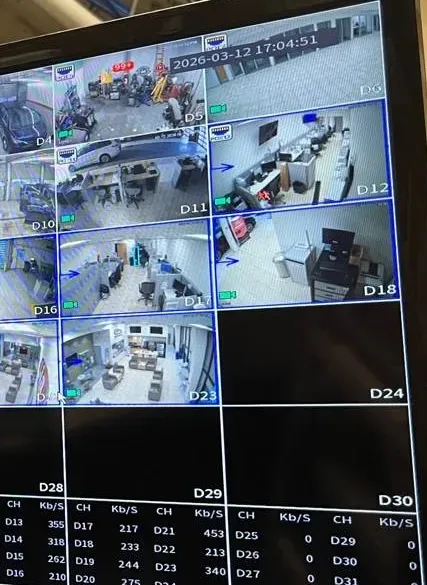
Example photo from another AESS job (not a Bronx property): a recorder's live grid with empty tiles and a per-channel bitrate table. A channel reading zero is either unused or a camera that has dropped off — the first thing we read on a health check.
Shop Our Systems
Security Camera Maintenance Packages & Pricing
Most Bronx customers land in one of these three. Your written quote moves the figure up or down for camera count, mounting height and exposure, and recording to your own drives never carries a monthly charge.
Bronx Tune-Up
$150–$350
A single visit for a house or small store: every camera cleaned and checked by day and by night, aim corrected, drive health and retention read, battery backup tested, time synced, passwords checked, and a written log you keep.
Building or Home Plan
$200–$500 / year
Quarterly or twice-yearly visits, with exposed cameras on the shorter cycle, priority booking if something fails between visits, tested alerts, and a report for the owner, super or board after each one.
Commercial and Compliance Plan
$1,000–$5,000+ / year
Monthly or quarterly service for stores, warehouses, complexes and licensed businesses: dated test records, backup-power and failure-alert tests, retention checks and a log formatted for your regulator or insurer.
Bought your own cameras? We maintain them at the same rates
If your system came from a big-box store, an online seller, a previous tenant or another installer, it can go on the same schedule. On the first visit we identify every camera and recorder, record their models and firmware, and tell you plainly which ones are worth maintaining and which are close to the end of their useful life. If you later want us to add or replace equipment, our bring-your-own-equipment calculator shows the labor-only line items.
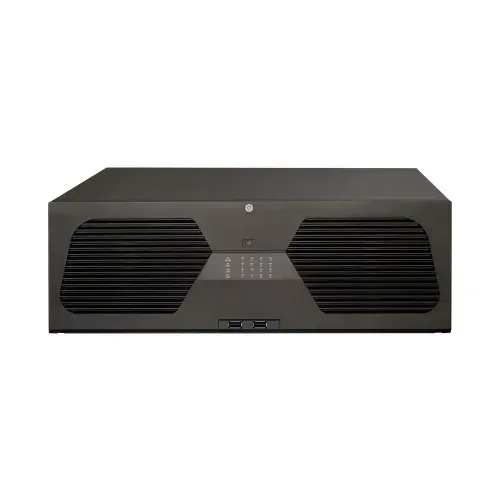
Manufacturer product photo: a large rack-mount recorder with vented front panels. Those vents pull in whatever dust is in the room; on a cellar or closet recorder they are cleaned on every visit.
Speak to a Bronx Camera Technician
Ask about a monthly testing log for a dispensary, a quarterly rotation for a co-op, or one deep clean for a house — the person who answers plans the visit.
Every Security Camera Maintenance Service in the Bronx
A tune-up regularly uncovers a job for a different crew — a dead recorder, a crushed cable, an intercom on its last legs. Each of those has its own Bronx page.
The single most useful thing on a Bronx maintenance visit happens after sunset. In daylight, nearly every camera looks acceptable: the sun hides a filmed dome, a strand of web, a lens a little out of focus. Turn the lights off and switch the cameras into infrared, and the problems jump out — a haze across the picture from road grime, a white streak where a web catches the light, a bright glare where the camera sees its own illuminators bouncing off a sign or a soffit.
So on a first visit I like to see the system at night, or at least in a dark room with the shutters down. I write down which cameras are clean at night and which are not, and that list usually lines up with the map: the ones facing the avenue, the el or the loading area are on it; the ones in the back hall are not. That list becomes the schedule.
The second thing I check is the oldest recording on the drive. Owners are almost always sure they have a month. Often they have less. Those two checks — the night picture and the oldest date — tell me more about a system than anything else I can do in an hour.
— Owner, NYS license #12000287431
FAQ
Bronx Security Camera Maintenance FAQ
Short answers on scheduling, keys, downtime and paperwork that the sections above leave out.
How early in the morning can your technician start in a building where tenants leave for work before seven?
+
We can usually start from early morning on weekdays, and for apartment buildings we often prefer it, because lobbies and halls are quieter once the morning rush has passed and the super is already on site. Tell us when the building is busiest and we schedule ladder work in the lobby, mailroom and stairwells around it, working one area at a time so nobody's route out of the building is blocked.
Do you need someone with keys to the roof, the cellar and the recorder cabinet on a maintenance day?
+
Yes, and it is the single thing that most often turns one visit into two. Bronx camera systems usually have cameras on the roof or a rear yard, a recorder in the cellar or a locked cabinet, and sometimes a switch in a separate closet. If the super, porter or manager can meet us with those keys, or leave them in a lockbox, the whole system gets done in one trip.
Will the cameras stop recording while you are working on them?
+
Only briefly, and only the camera or device we are working on. Cleaning a dome or checking a mount does not interrupt recording. Replacing a drive, updating firmware or swapping a battery can take a recorder or camera offline for a few minutes, and we tell whoever is on site before we do it and note the time in the log, so the gap is explained if anyone asks later.
Can a visit to a store on Fordham Road or Southern Boulevard be done before the shutters go up?
+
Usually, yes. Many corridor stores prefer us before opening, when the sidewalk is quiet enough to set up a ladder under the awning and nobody is at the register. Give us your opening time and we book the outside cameras first and the indoor ones after, so we are out of the way by the time customers arrive.
What happens to the hard drives you take out — does the old footage leave the building?
+
Not unless you want it to. A drive we replace is handed to the owner or manager by default, because it may hold footage you still need. If you would rather we dispose of it, we wipe or physically destroy it and note that in the log. If something on the old drive matters for a claim or a case, we export the relevant clips before the drive is retired.
Do you bring a lift or tall ladder for cameras two or three storeys up a facade?
+
We bring extension ladders for most facade cameras. Cameras that are too high or too exposed over a sidewalk for a ladder to be safe may need a lift, which we arrange and price on the quote after seeing them. On a first visit we note every camera that needs special access, so later visits are planned and priced correctly.
Can you give us a dated log of each check that we can show a regulator or an insurer?
+
Yes. Every visit produces a dated, signed record listing each camera and device, what was cleaned or tested, results of the backup-power and alert tests, the oldest recording found on the drive and any parts replaced. For licensed cannabis stores we format the record around the testing points the state security rule lists, and you keep it for your own files.
Will you send a certificate of insurance to our managing agent before the first visit?
+
We do, free of charge. Agents and boards in the Bronx almost always want it on file before a contractor walks in, so email over the holder's legal name and address plus any additional-insured language they require, and it reaches them ahead of the first appointment.
How is payment handled for maintenance in the Bronx?
+
Your quote lists every visit, its scope and its due date, so a plan is billed in predictable steps rather than surprises. Full terms — including 50% deposit, the 30-day warranty and optional paid extended warranty, and the late-fee schedule — are set out in the service agreement. Parts you supply yourself carry their own manufacturer warranty.
All Areas Served
Security Camera Maintenance Across New York City, Long Island and the Hudson Valley
Looking after cameras outside the Bronx? Start at the New York City security camera maintenance hub, or jump straight to the borough, Long Island county or Hudson Valley county below.
Where the Bronx Camera Maintenance Facts Come From
Every statistic, regulation and news event mentioned above is drawn from one of the links in this list; forum posts were read only as search snippets. The maintenance routines we describe — cleaning cycles, night checks, battery labels — are our own way of working rather than something these sources prescribe, and the prices are our city base rates with the Bronx factor of 1.00 applied.
This page is general information about maintaining camera systems, not legal advice. For a question about a licence condition, a lease, recording audio or biometric data, speak to a lawyer.
Footage Missing or Cameras Dark — Call the Bronx Line
Drive gone missing in the recorder menu, half the grid still black since the last blackout, an adjuster waiting on a clip — ring (646) 490-0629. Existing recordings get copied off before anything is touched, and in most cases the system is writing video again within one to two hours of the technician walking in.
Bronx Camera Upkeep From a Licensed, Insured Crew
Bronx line (646) 490-0629 · Abstract Enterprises Security Systems, 460 E Fordham Rd, Bronx, NY 10458 · messages by WhatsApp (718) 679-0359
Licensed in New York State (#12000287431) · fully insured · same-day estimates · rated 4.6★ from 390+ Google reviews
Replacement drives, batteries and cameras carry their manufacturers' warranties. Full terms — including 50% deposit, the 30-day warranty and optional paid extended warranty, and the late-fee schedule — are set out in the service agreement. See our warranty page.
Page reviewed and updated October 18, 2026. Changelog: Bronx camera maintenance page rebuilt from new research on the borough's elevated lines and truck corridors, the 2024–2025 South Bronx air study, heat vulnerability and the July 2026 Con Edison outages, camera vandalism, footage retention (9 NYCRR §125.3, NYCHA, pending state bills), firmware exposure and the FCC's July 2026 order, on the NYC maintenance base prices at the Bronx area factor.