Estates · Farms · Office Parks · Campuses · Main Streets
Security Camera Maintenance in Dutchess County
Systems That Report Their Own Health · Checked After Every Storm · Visits Planned Around the Seasons
In Dutchess, the cameras are usually far from whoever owns them. A barn camera at the end of a long gravel drive in Union Vale, a weekend house above the river in Rhinebeck, a lobby turret in a former IBM building off Route 52 — and the nearest person who could notice a dark picture may be an hour away. Add thunderstorms that knock out tens of thousands of Central Hudson and NYSEG customers at once, February ice on the domes and lightning across open fields, and maintenance here has to start with one idea: the system should tell you when it is in trouble, and our visits should be timed to the weather that causes it.
Storm, power and county sources last checked October 18, 2026 · Written by Abstract Enterprises Security Systems, NYS low-voltage license #12000287431 · Dutchess visits are booked through our Bronx office at 460 E Fordham Rd and the county line (845) 640-3835
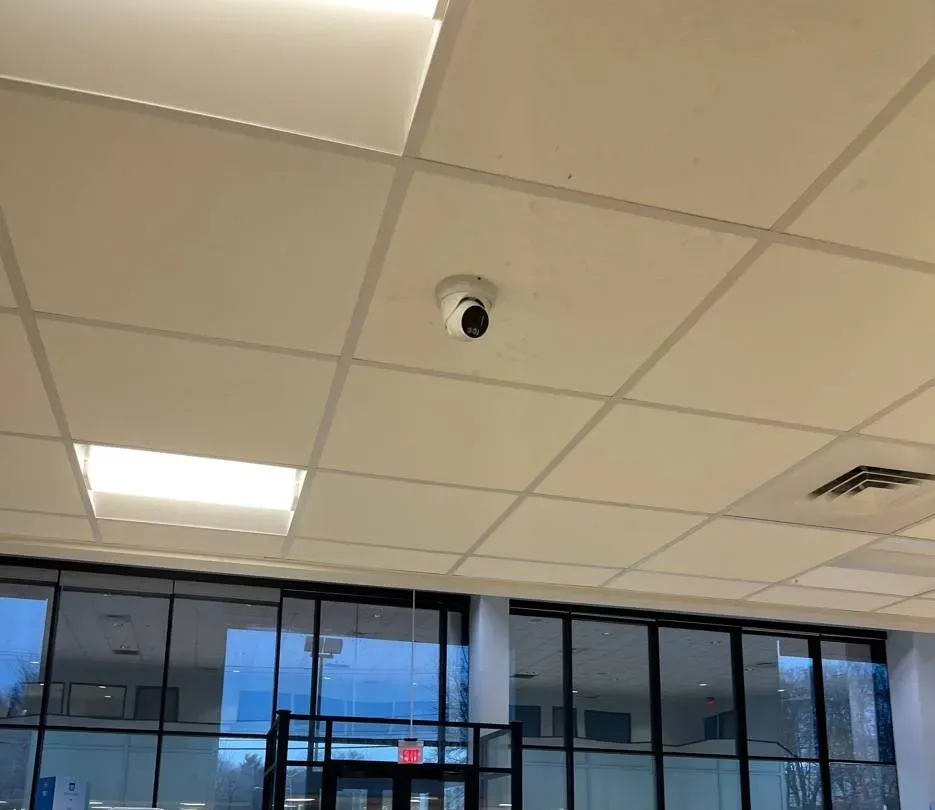
Example photo from another AESS job (not a Dutchess County property): a turret camera on a ceiling tile looking over a glass entrance. A lobby camera facing bright windows has to cope with glare by day and reflections at night, so its picture is checked at both times.
Dutchess Camera Maintenance Quote
Camera count, how many buildings, what failed last storm — a written number comes back today
✅
Request Sent!
Watch your phone — we ring back about your Dutchess cameras before the business day ends.
25+
Years Experience
✓
Same-Day Estimates
100%
Licensed & Insured
4.6★
390+ Google Reviews
Start with a screenshot, not a site visit. Open your camera app, take one screenshot of the live grid and one of the recorder's storage or health page, and send both to (845) 640-3835. From those two pictures we can usually tell which cameras need a ladder, which need a setting changed from a laptop, and whether your Dutchess system is ready for the next storm season.
One-time Dutchess tune-ups run $230–$536; scheduled plans start at $306 a year
Health alerts, outage checks and remote reviews are set up before anyone climbs a ladder
Estimates in writing the same day; the work is done under NYS license #12000287431
Why Dutchess County Properties Need Security Camera Maintenance
Dutchess is a long county, running from the Beacon waterfront up to Millerton and the Columbia County line. Between the river towns on Route 9 and the farms toward the Connecticut line sit horse barns, orchards, estates behind stone walls, and houses that are lived in only on weekends. A camera system there is rarely a cluster of domes in one building. It is a turret on the house, a bullet on the barn, a floodlight camera over the garage, maybe a camera at the gate a quarter-mile down the drive, all feeding one recorder in a basement closet. When one of those cameras fails, nobody walks past it. The owner finds out when they open the app — or when they need a clip and it is not there.
The weather is the second reason. On July 4, 2026 a severe thunderstorm cut power to about 50,000 Central Hudson customers at its height, more than 32,000 of them in central and southern Dutchess, and the county reported the worst damage in the City and Town of Poughkeepsie, East Fishkill, Hyde Park, LaGrange, Beekman, Union Vale and Pawling. Four months earlier, a St. Patrick's Day windstorm with gusts to 55 mph interrupted service to roughly 14,748 Central Hudson customers, with Dutchess and Ulster hit hardest. In the eastern towns served by NYSEG, Tropical Storm Isaias in 2020 left 2,317 of 2,321 NYSEG customers in Amenia without power two days after it passed. Every one of those events is a test of a camera system: does it ride through, does it come back by itself, and does anyone know if it did not?
The third reason is what has changed around private cameras. Dutchess County had built a network of license-plate cameras for its Analysis and Real-Time Crime Intelligence Center, but in September 2026, after a packed public forum at Pleasant Valley Town Hall, the District Attorney asked the vendor to shut down and remove all of its county-operated cameras. Whatever one thinks of that decision, it means the footage that answers a question about a break-in, a theft from a barn or a car in a lot is more likely than before to come from a homeowner's or a business's own recorder. A Poughkeepsie shop that shared its own video of a tip-jar theft in June 2026 is a small example of how often that happens. A recorder only helps if it was recording, clean and on the right clock the night it mattered.
So maintenance in Dutchess is built the other way round from a city plan. Instead of frequent visits to wipe grime off domes, we set the system up to watch itself — health alerts, offline alerts, a scheduled check of the oldest recording — and then time the hands-on visits to the seasons: a pre-winter visit before ice, snow and short days, and a check after any storm that took power or the internet down for long. Owners with a camera at the gate often pair the visit with a look at their gate and door access control, since the same technician is already at the end of the drive.
Dutchess facts that shape a maintenance schedule
Big storms reach most of the county. The July 4, 2026 thunderstorm interrupted service to more than 32,000 Central Hudson customers in central and southern Dutchess; two days later the county still counted more than 19,000 Central Hudson and over 3,400 NYSEG customers out.
Two utilities, two outage maps. Most of the county is Central Hudson territory, but NYSEG serves parts of the east — in August 2020 it had 15,860 Dutchess customers, including Amenia, Dover and Pawling, where most of them lost power after Isaias.
Winter is real. The county's Natural Resources Inventory puts average snowfall at 47.1 inches a year, more at higher elevations in the northeast, with temperatures falling below zero five to ten times a winter and three major ice storms since 2008.
Lightning is common. Earth Networks counted 166,641 lightning pulses in Dutchess in its 2020 New York report; the NRI also logs about one to two large-hail events a year since 1971.
Farms and open land. The USDA's 2022 Census of Agriculture counted 620 farms in Dutchess averaging 161 acres — the kind of property where cameras sit on several buildings with separate power.
Most homes are on broadband, not all. Census QuickFacts puts Dutchess households with a broadband subscription at 93.5%, which leaves a share of rural addresses relying on slower links for remote viewing and alerts.
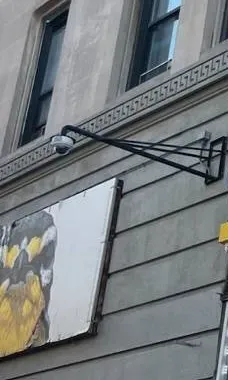
Example photo from another AESS job (not a Dutchess County property): an outdoor dome held out from a stone wall on a long steel arm. On old masonry, the anchors at the wall are what a maintenance visit checks after a winter of freezing and thawing.
A Dutchess Camera Down Right Now?
If the app shows every camera offline, a recorder is beeping, or the playback bar stops at the moment the storm hit, call (845) 640-3835. We book the earliest same-day slot the route allows, many problems can be narrowed down remotely before the van leaves, and most faults are fixed within one to two hours of arrival.
Three things to find out before anyone drives out
Is it power, internet or the recorder? If the house lights are on but the app says offline, check the modem and router first — a Dutchess "camera outage" is often an internet outage.
When did recording stop? Scroll the timeline back to the last good minute and note the time. If it matches a storm or a utility outage, that points straight at power or surge damage.
Is anything physically wrong outside? A limb on a cable, a camera pointing at the ground after wind, ice on a dome — a phone photo from the ground saves a lot of guessing.
Security Camera Maintenance Services in Dutchess County
These are the jobs that make up camera upkeep in the county, from a two-camera cottage in Tivoli to a hundred cameras spread across an office park in Fishkill. A plan buys only the ones your property needs.
Remote Health Monitoring
Video-loss, drive-error and recorder-offline notifications set up and tested, so a dead camera at a house you visit monthly announces itself the same day instead of on your next trip up.
Pre-Winter Visit
Before the first hard freeze: housings and seals checked, sun shields cleared of nests, heaters and fans on outdoor housings tested, and aim reset so snow piles and plow banks will not fill the view.
Post-Storm Check
After a long Central Hudson or NYSEG outage or a lightning storm, every channel is confirmed recording again, surge devices are inspected and any gap in the footage is logged with its cause.
Outbuilding and Drive Cameras
Barns, pool houses, pump houses and gate posts: cable entries resealed, wireless bridges re-aimed, power supplies and surge protectors at each building looked at.
Recorder and Storage Review
Drive health read, the oldest recording found and compared with what you expect, recording schedules for seasonal houses checked, and failing drives replaced before they take a month of video with them.
Backup Power Planning
Recorder, modem and PoE switch put on battery backup sized for the ride-through you actually need, and the hand-off to a standby generator tested so the cameras do not reboot when it starts.
Lens, Dome and View Care
Pollen, road dust from gravel drives, insect webs and hard-water spots from irrigation cleaned with lens-safe materials, and branches that have grown into the view noted for trimming.
Firmware and Remote Access
Firmware updated from manufacturer sources, unused cloud and port-forwarding features switched off, and remote access confirmed to belong to the owner, not a past installer or caretaker.
Visit Report With Photos
A dated report with a snapshot from every camera, the storage figures and what was fixed — easy to forward to an insurer, a property manager or a partner who was not there.
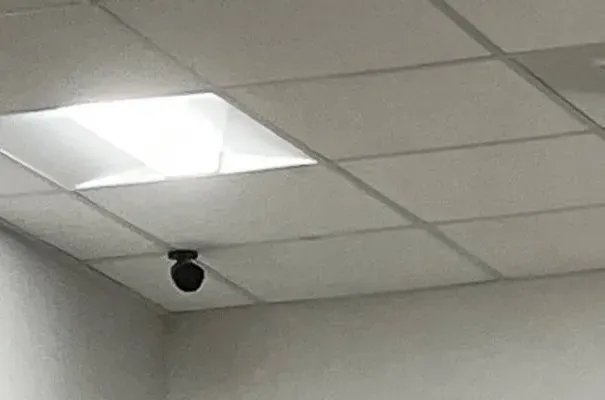
Example photo from another AESS job (not a Dutchess County property): a small black dome near a ceiling corner, next to a light panel. Indoor cameras like this need little cleaning, but their recording schedule and storage still need checking every visit.
Building Specialists
Camera Maintenance for Dutchess County's Architecture
The county's building stock is unusually mixed. Its median home was built around 1971, yet about 18% of homes date from 1939 or earlier; riverfront mills sit a few miles from 1960s corporate campuses and new warehouses. Each kind of building wears a camera system out differently.
Estates and Country Houses
Large houses along the river in Hyde Park, Staatsburg and Rhinebeck, and behind stone walls around Millbrook, often with a gatehouse, a long drive and a caretaker's cottage. Cameras end up far from the recorder, often on separate power, and the person who knows the system may be a property manager rather than the owner.
Working Farms and Horse Barns
Barns, run-in sheds and equipment buildings across the eastern towns. Dust, hay, birds and humidity reach every camera, cables cross open ground, and the barn's electric panel may be a long way from the house. Maintenance there is as much about the cable and power as the cameras.
Weekend and Seasonal Houses
Houses near the Taconic and in the northern towns that sit empty for days or months. The camera system is often the only thing watching, so remote alerts, recording schedules and backup power matter more than a weekly wipe of the lens.
Riverfront Mill Conversions
Brick mill buildings in Beacon along Fishkill Creek and similar conversions in Wappingers Falls, now lofts, studios and offices. Thick masonry, high ceilings, damp lower floors and many tenants sharing one system make access and ownership the hard part.
Former IBM-Era Office Parks
Large campuses built from the 1960s on, such as the former IBM East Fishkill site now known as iPark 84, with about 300 acres and more than two million square feet of buildings. Hundreds of cameras of different ages and brands, installed by different tenants over decades.
Village Main Streets
Two- and three-storey mixed-use buildings in Rhinebeck, Red Hook, Millbrook, Pawling and Beacon, with a shop downstairs and apartments above. One recorder often serves the store and the stairwell, and the camera over the sidewalk is the one police ask about.
How the work changes with the building
Stone and brick walls: exterior cameras on long steel arms are checked for creep at the anchor every visit; freeze-thaw cycles open mortar joints and loosen fixings more than wind does.
Outbuildings on their own service: each building with its own panel gets its surge protection and grounding looked at, because a cable between two buildings is a path for lightning energy.
Unheated spaces: recorders and switches in barns, garages or pool houses are moved into a conditioned space where possible; drives and batteries do not like a winter at single digits.
Office-park ceilings: cameras above drop ceilings in old corporate buildings are matched against a camera list every visit, because tenant fit-outs move tiles and cut cables without telling anyone.
Seasonal houses: heat may be set low while the house is closed, so the recorder closet is checked for cold and condensation when it is reopened.
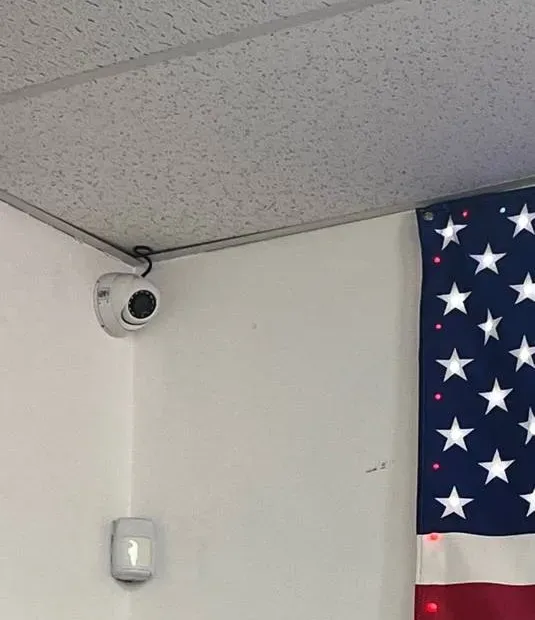
Example photo from another AESS job (not a Dutchess County property): a turret camera tucked into a ceiling corner, with a flag hanging beside it and a wall sensor below. Anything hung near a camera after installation can creep into its view; reference snapshots catch that.
Commercial Security Camera Maintenance
Business Camera Maintenance in Dutchess County
Commercial systems in the county are spread along a handful of corridors, each with its own mix of buildings and its own way of wearing cameras out. None of the places below is presented as a customer; they are the settings we plan around.
Route 9 Through Poughkeepsie and Wappingers
The county's main retail strip, including the Poughkeepsie Galleria, which describes itself as the largest enclosed shopping center in Dutchess with about 110 stores. Plazas, outparcels and car lots mean long parking-lot views, pole cameras and late-night traffic.
Route 52 and I-84 in East Fishkill and Fishkill
Office parks, labs and warehouses near the interstate, including the onsemi fab that the company calls its largest US manufacturing site and the iPark campus where Amazon took over 124 acres of the former plant. Large camera counts, mixed generations of equipment and strict access rules.
South Road and the Hospital Corridor
Institutional and corporate buildings in the Town of Poughkeepsie, from IBM's South Road site to Vassar Brothers Medical Center's 752,000-square-foot patient pavilion. Systems here answer to a security department that wants proof every camera was working.
Main Street, Beacon
Shops, galleries, restaurants and studios in old factory and mill buildings, plus the visitors drawn by Dia:Beacon in a former 1929 Nabisco box-printing plant. Small businesses with one or two recorders, often shared with apartments above.
Route 9 North: Hyde Park to Red Hook
Restaurants, inns, farm stands and the Culinary Institute of America's 170-acre campus in Hyde Park. Seasonal swings in business mean cameras sit through quiet winters and then have to be ready for spring.
Route 22 and Route 44 Towns
Farm businesses, hardware and feed stores, small offices and service stations in Pawling, Dover, Amenia, Millbrook and Pine Plains — where the nearest utility may be NYSEG and the internet connection is not always fast.
What Dutchess businesses are held to
Cannabis licensees (9 NYCRR §125.3): the state rule asks for at least eight hours of operation through a power cut — the line that matters most in a county where July and March storms kept thousands dark for a day or more. The same section sets 60-day retention, continuous recording while open, a failure notice inside five minutes, and testing at least every 30 days with five years of test records.
Licensing: camera systems fall under the state's security and fire alarm installer licence, issued by the Department of State; ours is NYS license #12000287431. Our search turned up no separate county licence in Dutchess, and permit rules are set town by town.
Local permits: the Town of Poughkeepsie publishes an electric and low-voltage permit application, and the county's building department refers permit questions to the local municipality. Routine cleaning and testing does not usually involve a permit; new wiring or new devices can — ask the town before the work, not after.
Audio and biometrics: recording conversations without a participant's consent is eavesdropping under New York Penal Law Article 250. After a firmware update we confirm microphones and face-matching features you did not choose are still off.
Plate readers: the county's own plate-reader program is being removed after the September 2026 decision, and the Town of Milan in Dutchess, like New Lebanon across the line in Columbia County, has banned Flock cameras on town property. If a business owns plate-reading cameras, check how the footage is kept and shared before the next visit — we only maintain the cameras; the policy is yours.
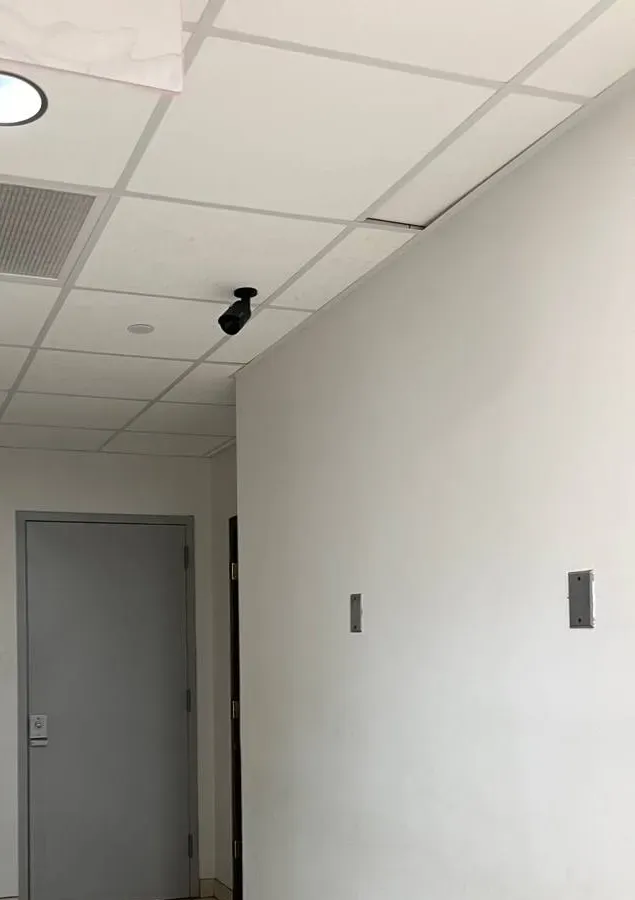
Example photo from another AESS job (not a Dutchess County property): a bullet camera high in a corridor, looking down its length at a grey door. In office buildings, a camera like this is matched against the camera list each visit, since tenant work can move ceilings and cut cables.
Your Questions Answered
Security Camera Maintenance in Dutchess County: Questions Answered
These are the questions Dutchess owners, caretakers and facility managers ask about camera systems that are already on the wall — grouped by what tends to go wrong in the county. Prices are further down the page; short scheduling and access questions are in the FAQ near the end.
Distance, Alerts and Remote Checks
We live in Millbrook and your office is in the Bronx — how much of the upkeep can be handled without a truck in our driveway?
More than most people expect, and in Dutchess that is the point. Roughly half of what a maintenance visit checks lives inside the recorder, not on the ladder: whether every channel is recording, how far back the oldest footage goes, what the drive's health readings say, whether the firmware is current, whether the clock is right and whether alerts are reaching the right phone. With your permission and a secure remote session, those can be reviewed from a laptop, and the result tells us whether a trip is needed at all.
What cannot be done remotely is anything physical. A dome hazed with pollen, a sun shield packed with a wasp nest, a bracket loosened by a winter of frost, a cable a deer or a mower has pulled at, a surge protector that has quietly done its job and died — all of that needs eyes and hands. So a typical Dutchess plan mixes the two: remote reviews between visits, and one or two hands-on visits a year timed to the seasons that do the damage.
Remote access is set up so it is yours, not ours. We use the manufacturer's own secure connection or a temporary account you can switch off, we never leave a router port open to the internet for convenience, and every remote session is written into the visit log with the date and what was checked.
When the internet at our Red Hook farmhouse drops, the app just says "offline" — how can we tell an internet outage from a dead recorder?
From the app alone, you often cannot. "Offline" means the phone could not reach the recorder; it does not say whether the recorder is off, the modem is down, the router has hung or the provider has an outage on the road. That is why a remote property needs a second, independent signal. The simplest is to check whether anything else at the house is reachable — a thermostat, a smart plug, a Wi-Fi printer — because if they are all offline together, the problem is the connection, not the cameras.
A better answer is to make sure the recorder keeps recording when the internet is gone, which a wired system with local drives does by default, and to have something that can tell you power is still on. Many owners add a small cellular-connected power or temperature monitor, or ask a neighbour or caretaker to glance at the recorder screen on the next pass. Wide internet cuts do happen: in October 2019 a cut fiber line in the Poughkeepsie area took out Verizon internet and phone service for customers across parts of the county, including Hyde Park and Wappingers Falls.
On a maintenance visit we label the modem, router and recorder so a caretaker can restart them in the right order, plug the networking gear into battery backup alongside the recorder, and set the recorder to send an alert when it comes back online after an outage — a "back up" message is as useful as a "down" one when you are an hour away.
Our only internet past Amenia is a fixed-wireless link with a data cap — will remote viewing and health checks eat through it?
Live viewing can, health checks do not. A remote health check sends a few kilobytes — a status, an error count, a list of channels. Watching a 4K camera live, or letting an app pull high-resolution clips every time motion triggers, sends megabytes per minute, and a few cameras set to upload to a cloud service around the clock can use more data in a month than the rest of the household. With 93.5% of Dutchess households on a broadband subscription, the county is well connected overall, but the farms and back roads of the eastern towns are where the exceptions sit.
The fix is in the settings. Recorders and cameras usually have two video streams: a full-quality main stream that goes to the local drive and a smaller sub-stream meant for phones. We make sure the app uses the sub-stream by default, switch off continuous cloud upload you did not ask for, limit push notifications to the cameras and zones that matter, and record everything at full quality locally where it costs nothing to keep.
On a visit we also measure what the system actually sends in a normal day, so you can compare it with the plan's cap. If the numbers are tight, a smaller change — fewer snapshots attached to alerts, a lower sub-stream bitrate on one busy camera — is usually enough without giving up anything you would miss.
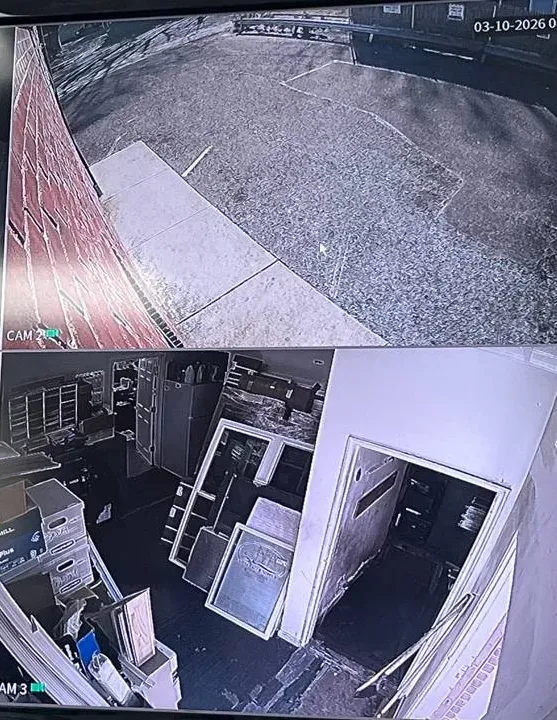
Example photo from another AESS job (not a Dutchess County property): a recorder screen showing an outdoor lot along a brick wall, with the date stamped in the corner, above a storeroom view. Reading the time stamp against real time is part of every check.
Storms, Ice and Lightning
The July storm cut power in Pawling and our generator started within a minute — so why is there a gap in the recording?
Because a minute is long enough for a recorder to shut off. A standby generator does not start the instant the grid fails: it senses the loss, starts the engine, lets it settle, and then the transfer switch moves the house over. Between those steps the recorder, the PoE switch that powers the cameras and the modem all lose power, and when it returns they boot up one by one. A recorder can take a couple of minutes to finish booting and start writing again, and cameras take their own time on top of that. The result is a gap of several minutes at exactly the moment something may have happened.
The cure is a small battery backup between the generator circuit and the camera equipment, sized to carry the recorder, switch and modem through the hand-off with room to spare. The battery covers the seconds or minutes until the generator is stable, and the cameras never notice the change. The July 4, 2026 storm, which the county said hit Pawling, Beekman, Union Vale and the Poughkeepsie area hardest, is a good reason to test this before the next one.
On a maintenance visit we test it for real: switch off the utility feed or simulate the outage, watch the generator take over, and check the timeline afterwards for any missing minutes. If the battery is too small, too old or not on the right circuit, the log says so and the fix is priced as a part.
After a lightning storm two barn cameras still work but the one at the end of the drive is dead — what usually fails, and what should be checked on the others?
The camera furthest away on the longest cable is often the one that takes the hit. Lightning does not need to strike a camera to damage it: a nearby strike induces a surge in any long conductor, and a cable running hundreds of feet across a field or down a drive is exactly that. Earth Networks counted 166,641 lightning pulses over Dutchess in its 2020 New York report, so on a farm or estate this is not a rare event. The usual casualties are the camera itself, the port on the PoE switch it plugs into, a surge protector that sacrificed itself, or the network port on a wireless bridge.
The cameras that still show a picture are not necessarily healthy. A surge can damage a switch port so it works intermittently, cut a camera's infrared so it goes black at night, or weaken a power supply so it fails in the next cold snap. After a strike we check every channel by day and by night, read the switch's port errors, test the surge protectors with a meter or replace those with a status light that has gone out, and look at the grounding where cables enter each building.
For the camera at the end of the drive, the lasting fix is protection at both ends of the long run and a solid ground at the building entry, or replacing that copper run with fiber or a wireless link that cannot carry a surge back to the house. We price the options after looking at the run; this is general practice rather than an engineering design for your site.
Ice built up on the dome over our driveway every February — does that hurt the camera, and what keeps the view clear?
Ice is rarely what kills a camera; it is what blinds it. Most outdoor cameras are rated to keep working well below freezing — datasheets we have checked list operating ranges down to −35 °C or −40 °C — but a dome coated in freezing rain shows a white blur, and an infrared camera at night bounces its own light off the ice. The county's Natural Resources Inventory counts three major ice storms in Dutchess since 2008, and nights below zero five to ten times a winter, so a camera that matters in February needs a plan for it.
The practical fixes are placement and shelter. A dome mounted under an eave or a small hood collects far less ice than one on an open wall. Cameras with a built-in heater or a housing heater clear faster, but only if the heater is working and the power supply can carry it — a PoE switch that powers a dozen cameras in summer may not have budget left for heaters in winter. Turret-style cameras, with no bubble over the lens, shed ice better than domes in exposed spots.
Our pre-winter visit checks heaters and power budget, cleans and treats the domes, re-aims cameras so a plow bank or roof slide will not fill the frame, and moves the worst offenders under cover where it can be done without losing the view you need. Scraping a frozen dome is not one of those fixes; it scratches the plastic for good.
The oaks along our drive in LaGrange have grown into the camera's view since it went up — is pruning part of maintenance?
Noticing it is; cutting it usually is not. Views in Dutchess change with the seasons more than in a city: a driveway camera that sees the road clearly in March can be looking at a wall of leaves by June, and branches that sway in the wind trigger motion alerts all night and fill the drive with useless clips. Because most cameras were installed and aimed in one season, they are often wrong for the other half of the year.
On each visit we compare every camera's view against its reference snapshot and note any growth, then give you the choice: re-aim or re-zoom the camera, move it a few feet, mask the swaying branches out of motion detection, or have the branches cut. For anything beyond a hand-pruner at the camera itself, we recommend your landscaper or an arborist — limbs near the overhead service line belong to the utility.
It is worth fixing before a storm rather than after. The same limbs that block a view are the ones that come down on a camera cable or the pole it is mounted to. The July 4, 2026 storm in Dutchess was described by the county as bringing down power lines and trees, and a camera aimed through a tree line is often the first casualty.
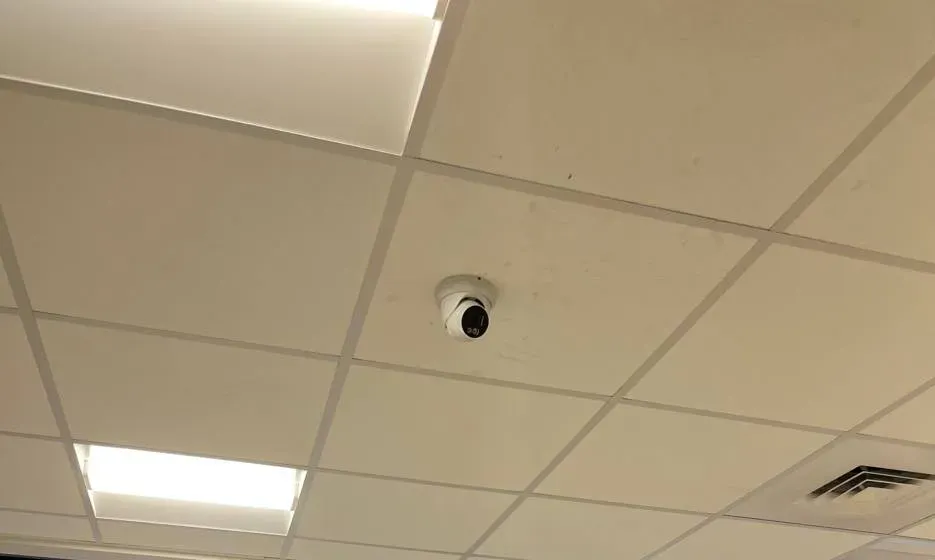
Example photo from another AESS job (not a Dutchess County property): a dome camera on a ceiling tile between a light panel and an air vent. Indoors the worry is less ice and more dust carried by moving air onto the dome.
Spread-Out Properties and Outbuildings
The barn camera reaches the house over a wireless bridge — why does it drop out every spring, and how do you keep it aligned?
Point-to-point wireless bridges are a common way to reach a barn or gatehouse without trenching, and they work well when the two radios can see each other clearly. In spring that changes: leaves come out on the trees between them, and wet foliage absorbs the signal. A link that was strong across bare branches in winter can weaken or drop when the canopy fills in, which is why the complaint so often arrives in May.
Bridges also drift. They are usually mounted on poles, eaves or barn walls, and wind, frost heave and a winter of snow sliding off a roof can turn one a few degrees — enough to cut the signal on a long link. On a maintenance visit we read the signal strength and error rate from the bridge's own software, compare them with the last visit, re-aim the radios if they have moved and tighten the mounts.
If leaves are the problem, the cure is either a clearer path — higher mounts or a different route around the trees — or a different link. Where the run is short enough, buried conduit with fiber is the most reliable answer, and it also stops a lightning surge from travelling between buildings. We price those options separately; maintenance is where we spot that a link is failing slowly before it fails outright.
Our house, barn and pool house each have their own electric panel — what does maintenance check on a system like that that a one-building system doesn't need?
Mostly the connections between buildings. When cameras on one building are powered from another building's equipment, the copper network cable between them links two separate electrical systems. During a storm or a fault, those systems can sit at different voltages for a moment, and the camera cable becomes the path for the difference. That is how one storm can take out a camera, a switch port and the recorder's network card in a single event.
On these properties we check that each building where a cable enters or leaves has a surge protector on that line, that it is properly grounded to that building's ground, and that the protector still works — many have a status light, and once it goes out the device has done its job and is no longer protecting anything. We also confirm which panel and breaker feeds each camera power supply and label them, so a caretaker resetting a tripped breaker in the barn knows which one runs the cameras.
Finally, each outbuilding's equipment gets looked at for heat, cold and pests. A PoE switch on a barn shelf is exposed to dust, damp and winter cold in a way a switch in a house closet is not, and it often outlives its welcome long before anyone notices.
Mice have moved into the pump house where a camera switch lives — what does a visit look for in outbuildings like that?
Chewed cable is the obvious risk. Rodents gnaw on cable jackets, and an unheated outbuilding full of feed, hay or insulation is exactly where they settle in for the winter. A nicked jacket may still pass video for weeks before moisture gets in and the camera starts dropping in and out, especially in cold, damp weather. Nests in warm equipment are the other risk: a switch or power supply makes a little heat, and a nest packed around its vents makes it run hotter and fail sooner.
On a visit we open the enclosures, look along every visible run for chew marks, clean out nests and droppings from around the equipment with the power off, and check that the cable entries into the building are sealed. Where cable runs through open framing at mouse height, we recommend moving it into conduit or up out of reach.
If an outbuilding is a constant problem, the better long-term fix is moving the networking gear into a sealed enclosure or into the main house and running a single protected cable out to the cameras. Rodent control itself is a job for your pest service; our part is making sure the camera system is not the most inviting thing in the building.
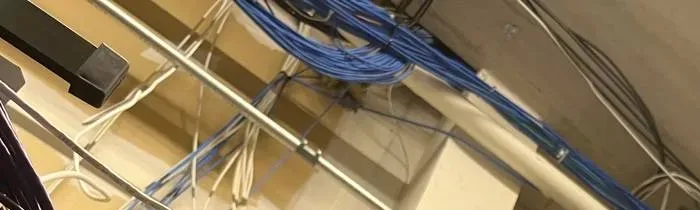
Example photo from another AESS job (not a Dutchess County property): blue and white network cables bundled along a pipe in an open ceiling. In barns and pump houses the same kind of run is inspected for chew marks and damp.
Seasonal Houses, Office Parks and Local Rules
We close our Hyde Park house from November to April — what should be done to the camera system before we leave and when we open it again?
Before closing, the aim is that the system can run unattended for months and tell you if it stops. That means confirming every camera records to the local drive, checking that the oldest recording will cover the whole time you are away or that you are happy with what it overwrites, setting alerts for video loss, drive errors and recorder offline, putting the recorder, switch and modem on battery backup, and making sure the heat left on in the house keeps the recorder closet above freezing. If the internet bill is paused for the winter, the cameras still record — but nobody will see an alert, which is worth knowing before you go.
While you are away, a quick look at the app once a week costs nothing and catches most problems. Watch for a camera that has gone black at night, a drive warning, or the recorder clock being wrong after a storm. Owners with caretakers can ask them to check the recorder screen during their normal rounds.
When you reopen, check for what winter did: ice damage on domes, cameras knocked by snow sliding off the roof, a recorder that restarted after an outage with the wrong time, a drive that filled and started overwriting. Our opening visit runs through all of it in one trip and leaves a report of anything that happened while the house was closed.
Half the cameras in our Fishkill office-park buildings are past manufacturer support — how do you decide which to keep maintaining and which to budget to replace?
By sorting them on three questions rather than replacing everything at once. First, does the camera still do its job — is the picture usable by day and by night for what it is pointed at? Second, can it still be kept secure — is the firmware still updated, can default passwords be removed, and is it isolated from the rest of the network? Third, can it be repaired — are replacement parts or an identical model still available? A camera that fails on all three goes to the top of the replacement list; one that passes the first two can often run for years.
Parts are the wild card. Since July 16, 2026, an FCC order has stopped new imports and marketing of some covered camera equipment that was previously authorized; equipment already installed can stay in service. Hikvision's US business has warned that this could reach spare parts, warranty repairs and support. A campus with forty of one discontinued model should therefore hold a few identical spares now and schedule its swap-outs, rather than discover the shortage the week a lobby camera dies.
We build the list into the maintenance report: every camera, its model and firmware, its condition and a replace-by year. Facilities teams in office parks along Route 52 and I-84 usually use it to spread replacement over several budget years, starting with entrances, docks and server rooms, and leaving quiet interior corridors for last.
Since Dutchess pulled its county plate-reader cameras in September 2026, will police lean more on our business cameras — and does that change how we maintain them?
It may change how often you are asked. On September 25, 2026, the Times Union reported that the District Attorney had asked Flock to shut down and remove all of the county-operated cameras — 65 by that report; Mid-Hudson News had counted 64 deployed in July. Whatever replaces them, an investigator looking for a car or a person on a particular road will often start by asking the businesses and homes along it whether their cameras caught anything.
Being useful when asked comes down to three things maintenance controls: the camera covering your entrance, lot or roadside is clean and aimed where you think it is; the recorder actually holds as many days as you believe; and the time stamp is right, so a clip from 10:42 p.m. really is from 10:42 p.m. A recorder whose clock drifted by twenty minutes after the last outage makes every clip harder to use.
Whether and how you share footage is your decision and, for some businesses, a legal question; we do not hand footage to anyone without your instruction. What we can do is make sure that when you decide to share, the export works, the clip plays on someone else's computer, and the person on your staff who will do it has practised once.
Does a camera service visit in the Town of Poughkeepsie need a low-voltage permit?
For routine maintenance, usually not, but the town decides. The Town of Poughkeepsie publishes an electric and low-voltage permit application among its building permit forms, and Dutchess County's own building department tells property owners to contact their local municipality about permits. Cleaning cameras, replacing a drive, updating firmware or swapping a camera for a similar one on the same cable is maintenance; adding new cable runs, new devices on new circuits or anything that touches line-voltage wiring is more likely to need a permit.
Each of the county's towns, villages and two cities sets its own process, and they are not identical. If a visit turns up work that looks like new installation — a new camera on a new run, a new power supply on a new circuit, a recorder moved to a new room — we tell you before we do it and check with the building department where the property is.
On licensing, New York's Department of State license for security system installers covers camera work, and we hold NYS license #12000287431. We did not find a separate Dutchess County licence for this work; if your town or your landlord asks for something specific, such as a certificate of insurance, we provide it.
Equipment
Types of Security Cameras We Maintain
A Dutchess system usually mixes several kinds of equipment, often bought years apart. Here is what each one needs from upkeep in a county of long drives, cold winters and summer storms.
Domes Under Eaves and Porches
The bubble collects pollen, webs and, in exposed spots, ice. Cleaned with lens-safe cloths, seals checked for winter leaks, and moved under cover where freezing rain keeps blinding them.
Turrets on Houses and Barns
No bubble, so they shed ice and glare better outdoors. The ball joint is checked for drift after frost and wind, and infrared rings for dead LEDs after a surge.
Long-Range Bullets on Drives and Lots
Aimed down driveways, along fence lines and across parking lots. Sun shields hold nests and snow; zoom and focus are re-checked each season because a view sharp in winter can be leaves by summer.
Floodlight Cameras
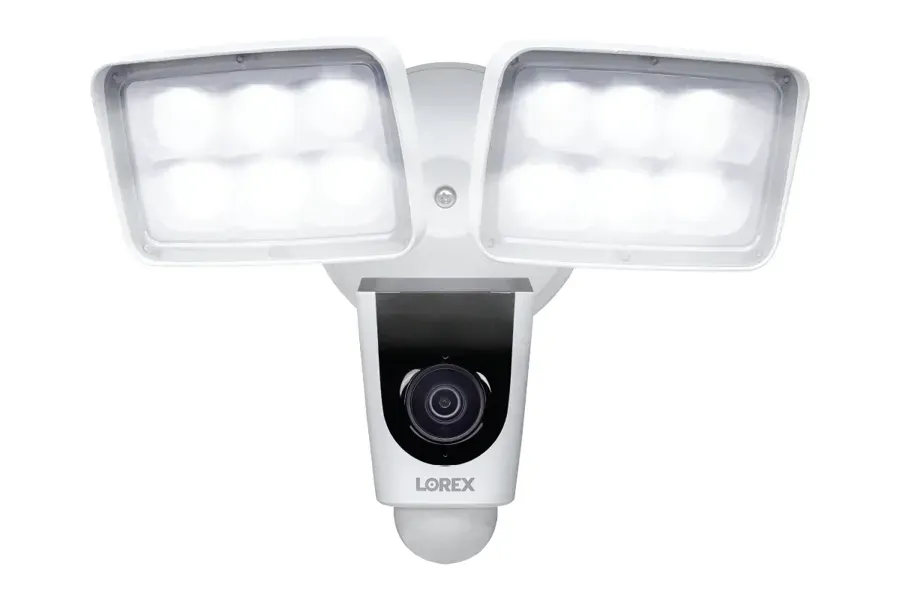
Popular over garages and barn doors. Lamps, motion sensors and the camera share one fixture and one circuit, so we test all three, and check that the light does not wash out the picture at night.
Wireless Bridges
Radios linking a barn, gatehouse or pool house to the main recorder. Signal strength and errors are read from their software, mounts tightened and alignment restored after wind and frost.
Recorders and Drives
NVRs and DVRs in basements, closets and server rooms: drive health, error logs, retention, firmware and time sync, plus fan and vent cleaning where the room is dusty or unheated.
PoE Switches and Surge Protection
Port status, power budget for heaters in winter, and the condition of surge protectors at every building entry — the parts that take the hit when lightning finds a long cable.
Battery Backup and Generator Hand-Off
The UPS that carries recorder, switch and modem through an outage, and the transfer to a standby generator. Tested under load so the cameras ride through instead of rebooting.
Battery and Wi-Fi Cameras
Common on rentals and weekend houses. Charge levels drop fast in the cold, Wi-Fi reach shrinks when trees leaf out, and the account they report to must still belong to the owner.
Manufacturer product photo: a floodlight camera with two lamp panels and a motion sensor. Over a garage or barn door, the lamps, sensor and camera are tested together on a visit.
National home-security brands versus a local maintenance plan
Plenty of Dutchess homes start with a monitored or do-it-yourself system from a national brand, and those suit many people. Their service is built around their own devices, apps and monitoring centres. Here is how that compares with a local maintenance plan for a wired or mixed system — a general comparison of the way those services usually work, not a statement of any company's current terms.
What you need
ADT, Ring or SimpliSafe-style service
AESS Dutchess maintenance
Cameras on a barn, gate or pool house
Usually Wi-Fi or battery devices placed by the owner, limited by Wi-Fi reach.
Wired, bridged or fiber-linked cameras inspected building by building, including the links between them.
Recording when the internet is down
Cloud-first; recording and alerts depend on the home connection.
Local drives keep recording; alerts and battery backup planned for rural outages.
Storm and lightning readiness
Device replacement under the plan's terms.
Surge protectors, grounding and generator hand-off tested before and after storm season.
Mixed brands bought over the years
Typically the company's own devices only.
Hikvision, Dahua, Lorex, Uniview, Axis, Ubiquiti and others serviced side by side.
Someone on site in winter
The owner or a neighbour.
A pre-winter visit for ice, heaters and aim, and an opening visit for seasonal houses.
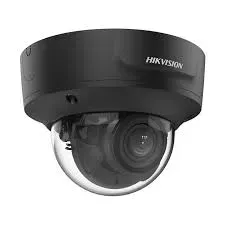
Manufacturer product photo: a black varifocal dome. The clear bubble is what collects pollen and ice outdoors, and the zoom lens is what gets re-focused when a view changes with the seasons.
AI Overview Reality Check
What AI Gets Wrong About Security Camera Maintenance in Dutchess County
Our research environment could not capture Google's AI Overview for this search, so nothing below quotes it. These are seven claims that appear again and again in the general advice, product pages and cost guides that such summaries are built from — set against what Dutchess systems actually go through.
Claim 1: "Outdoor cameras are weatherproof, so winter is not a concern"
A weatherproof rating describes how well a housing keeps out dust and water. It says nothing about whether the picture is usable under a glaze of freezing rain, whether a heater can run on the power budget left on the switch, or whether a bracket survives a season of freeze and thaw in a stone wall.
Dutchess winters test all of those. The county's Natural Resources Inventory records three major ice storms since 2008, average snowfall of 47.1 inches, and nights below zero several times most winters. Cameras survive that; their views often do not.
That is why our plans put the hands-on visit in autumn, not spring. Heaters, seals, mounts and aim are checked while there is still time to fix them, and the worst-placed cameras are moved under cover before the first ice rather than after a month of white screens.
Claim 2: "With a standby generator, your cameras never go down"
Generators keep the house running; they do not make the switch-over seamless. Between the moment the grid drops and the moment the transfer switch moves the load, the recorder and cameras lose power, and then spend minutes rebooting.
In a county where one July storm took out power to more than 32,000 Central Hudson customers in central and southern Dutchess, those minutes come around often. They are also the minutes when a storm-damaged gate, a downed tree across the drive or an opportunist is most likely to appear on camera.
The answer is a battery backup that bridges the gap, tested with the generator rather than assumed. We run that test on visits and write down how long the ride-through lasted.
Claim 3: "Wireless cameras are the easy answer for barns and long driveways"
They are easy to put up. Keeping them working across a farm is another matter. Battery cameras lose charge quickly in cold weather, Wi-Fi coverage that reached the barn in March can fade when the trees between leaf out, and a camera that drops off the network stops recording unless it has its own storage.
On properties with several buildings, we see the same cycle: a wireless camera works for a season, then becomes the one the owner stops trusting. The fix is often a proper link to the outbuilding — a point-to-point bridge, or fiber in conduit — so the camera itself can be wired.
Wireless and battery cameras have their place, and we maintain them. The maintenance just looks different: charge levels, signal strength by season and the account they report to, rather than drives and cables.
Claim 4: "A surge protector at the wall outlet protects the whole system"
A plug-in surge strip protects against surges arriving through that outlet. It does nothing for a surge that arrives through a long camera cable from a barn, a gate post or a pole in a field — which is the path lightning usually takes into a spread-out camera system.
Earth Networks counted 166,641 lightning pulses over Dutchess in 2020. A cable that runs hundreds of feet across open ground is an antenna for nearby strikes, and the energy it picks up goes straight to the camera at one end and the switch and recorder at the other.
Protection for these systems sits on the data lines where they enter each building, bonded to that building's ground, and it wears out as it works. We test or replace it after storm season and after any strike that took out equipment nearby.
Claim 5: "If the app shows a live picture, the system is recording"
Live view and recording are separate jobs. A recorder can show you a perfect live picture on your phone while its drive has failed, filled up and stopped, or dropped one camera from its recording schedule after a firmware update or a power loss.
For owners who check in from the city or from another state, this is the most dangerous gap, because the app looks healthy. The first sign is often an empty timeline on the night something happened.
The check that matters is the playback timeline and the oldest recording on the drive, not the live grid. We read both on every visit and every remote review, and we set the recorder to send a drive-error alert so you hear about a failed disk the day it fails.
Claim 6: "Remote monitoring makes site visits unnecessary"
Remote checks have made upkeep in a county like Dutchess far cheaper and quicker — we rely on them. But they can only see what the recorder reports. They cannot see a dome scratched by a careless cleaning, a wasp nest behind a sun shield, a cable chewed in a pump house or a surge protector whose light has gone out.
They also cannot see slow changes in the world around the camera: the oak that has grown into the driveway view, the barn door that now blocks a corner, the plow bank that buries a low camera every February.
So our Dutchess plans combine both. Remote reviews catch most failures between visits and tell us whether a trip is needed; one or two physical visits a year, timed to winter and to storm season, catch everything the recorder cannot report.
Claim 7: "Camera maintenance costs the same wherever you live"
National cost guides, such as HomeAdvisor's guide to security system repair, are built around repair visits rather than ongoing upkeep, and they cannot account for distance. In Dutchess the drive to a property in Amenia or Pine Plains, the number of separate buildings and the need to time visits to the seasons all change what a plan costs.
Our prices carry a Dutchess area factor of 1.53 on our New York City base, which is set out openly in the pricing section below rather than hidden in a travel charge. A plan that leans on remote reviews and groups visits by area is how we keep that number down.
If an online figure looks lower than ours, check what it covers: a single repair call at a house in a suburb, or a year of storm checks, winter preparation and health monitoring across a farm with three buildings.
Not Sure Your System Will Ride Through the Next Storm?
Send a screenshot of your recorder's storage page and tell us whether you have a generator. We will tell you where the gaps are likely to be before the next Central Hudson or NYSEG outage finds them.
Give us the outline of the place — camera count, the buildings they hang on, generator or not, and what misbehaved after the last outage. If you can, attach nothing yet — we will ask for screenshots by text. You hear back the same working day with a Dutchess price, a suggested season for the first visit, or a request for a short remote look before quoting. No date is fixed without your go-ahead.
Thanks — It's With Us
A technician will phone about your Dutchess property today. For anything urgent, the county line is (845) 640-3835.
How It Works
Our Maintenance Process
Seven steps, built so that as much as possible is done before the trip and every trip counts. The first round takes longest because it creates the baseline — camera list, reference views and storage figures — that later checks are measured against.
1. Screenshots and a sketch
You send screenshots of the camera grid and the recorder storage page, and a rough sketch of which buildings have cameras. We ask about generators, caretakers and how you would currently find out about a failure.
2. Remote review, with your permission
Through the manufacturer’s secure connection or a temporary login, we read drive health, retention, firmware, clock and alert settings before anyone drives out, so the visit is planned around what is actually wrong.
3. Walk the property building by building
The first trip maps the whole site: each building, the panel that powers it, the bridges and surge devices between them, and a day and night reference picture from every camera for later comparison.
4. Seasonal schedule and Dutchess price
You get a written plan that sets the hands-on visits around winter and storm season, the remote reviews in between, the Dutchess price for each, and the terms in the service agreement.
5. Storm-readiness tests
Battery backup is run under load, the generator hand-off is tested, surge protectors are checked at each building entry, and offline, video-loss and drive alerts are triggered to prove they arrive.
6. Clean, re-aim, fix or quote
Domes and lenses cleaned with lens-safe materials, views re-aimed or masked, heaters and seals checked, small faults fixed on the spot; failing drives, batteries and cameras photographed and quoted as parts first.
7. Report and next season’s date
You receive a dated report with a snapshot from every camera, storage figures and anything for the caretaker to watch, and the next visit or remote review goes on the calendar.
Coverage Area
Security Camera Maintenance Near Dutchess County's Landmarks
We maintain systems in every town and village in the county. The six places below are listed as reference points for the areas we cover and the conditions around them — none is presented as a customer.
Walkway Over the Hudson
The former railroad bridge between Poughkeepsie and Highland, 212 feet above the river and 1.28 miles long, opened to walkers in October 2009. Homes and businesses on both approaches face open river weather and wind.
Vassar and Marist Campuses
Vassar's grounds, about 1,000 acres, and Marist's 180-acre campus on Route 9 bracket the city of Poughkeepsie — along with the student rentals, shops and offices around them.
Bard College, Annandale-on-Hudson
More than 70 buildings across a campus of about 1,260 acres in the north of the county, near Red Hook and Tivoli, where many properties sit on long rural roads.
Dutchess County Fairgrounds, Rhinebeck
Home of the six-day Dutchess County Fair and events through the year, with exhibition buildings and livestock barns — the kind of seasonal site whose cameras sit idle and then have to work.
Fishkill Creek Mills, Beacon
The Groveville carpet mill, which employed over 700 people in the 1880s, and the Roundhouse buildings that were part of the Matteawan Manufacturing Company, now converted for living, work and dining near Main Street.
James Baird State Park, LaGrange
The park and its golf course closed after the July 4, 2026 storm left the area without power — a reminder of how widely that storm reached across the central towns.
Scheduled visits also cover the City and Town of Poughkeepsie, Arlington, Spackenkill, Wappingers Falls, Hughsonville, Fishkill, East Fishkill, Hopewell Junction, Beekman, Poughquag, LaGrange, Pleasant Valley, Hyde Park, Staatsburg, Rhinebeck, Red Hook, Tivoli, Milan, Clinton, Stanford, Millbrook, Washington, Union Vale, Dover Plains, Pawling, Amenia, Pine Plains, North East and Millerton. We also serve the neighbouring counties: Ulster across the river, Putnam to the south and Orange over the Newburgh–Beacon Bridge.
Pricing
Security Camera Maintenance Cost in Dutchess County
Dutchess carries a 1.53 area factor in our pricing, the highest in our service area alongside Ulster, applied to our New York City base rates. It reflects driving distance and the spread of most properties across several buildings. The figures below are those base rates multiplied by 1.53 and rounded to the dollar. Parts — drives, batteries, surge protectors, replacement cameras — are priced separately on the written quote.
Dutchess maintenance work
Price
What it covers
Single season-ready visit
$230–$536
One visit: cameras cleaned and checked by day and night, views compared and re-aimed, drive health and the oldest recording read, battery backup and generator hand-off tested, alerts set up, a dated report with snapshots
Scheduled plan, home, estate or small building
$306–$765 per year
Remote reviews between visits plus a pre-winter visit and, where needed, a post-storm-season visit; works out at roughly $77–$230 a camera a year depending on camera count, buildings and distance
Commercial or campus plan
$1,530–$7,650+ per year
Route 52 and Route 9 office parks, plazas, campuses and licensed stores — the visit count and hours are fixed after we have walked the site, with 30-day testing built in for cannabis licensees
Same-day repair visit
$291–$1,377
System down, not recording or offline — diagnosed remotely where possible, then fixed on site, quoted per job
Service after an AESS installation
$195/hr, 3-hr minimum ($585)
Charged only when we come back to alter or extend a system AESS put in — never applied to the original installation
What moves a Dutchess price within those ranges is mostly geography and layout. A six-camera house in the Town of Poughkeepsie with every camera on one building is quick. The same six cameras spread over a house, a barn and a gate a quarter-mile apart, with a wireless bridge in the middle, take longer to inspect and test. Distance from the river corridor matters too, which is why we group visits by area — a plan for a property in Pine Plains is cheaper when its visit falls on the same day as others nearby.
Two worked examples on the published prices
An eight-camera horse farm near Millbrook. Three cameras on the house, three in and around the barn, one on the equipment shed and one at the gate, linked by a wireless bridge. The owners want monthly remote reviews, a pre-winter visit and a check after summer storm season. That fits the scheduled plan range of $306–$765 a year, with the exact figure set after the first walkthrough confirms access and the state of the bridge. If the first visit finds a dead surge protector or a failing drive, those are quoted as parts before anything is replaced.
A 60-camera office building off Route 52. Lobby, loading dock, parking lots, corridors on three floors, a server room, two generations of cameras from two brands. Facilities wants quarterly visits, a replacement plan for unsupported cameras and a report after each visit. This is a commercial plan in the $1,530–$7,650+ range, priced after a walkthrough because ceiling access, lift needs for the lot cameras and the number of cameras per floor decide the hours.
On a yearly plan, the quote spells out which visit each payment belongs to, so an autumn visit and a spring check are billed separately rather than in one lump. Full terms — including 50% deposit, the 30-day warranty and optional paid extended warranty, and the late-fee schedule — are set out in the service agreement.
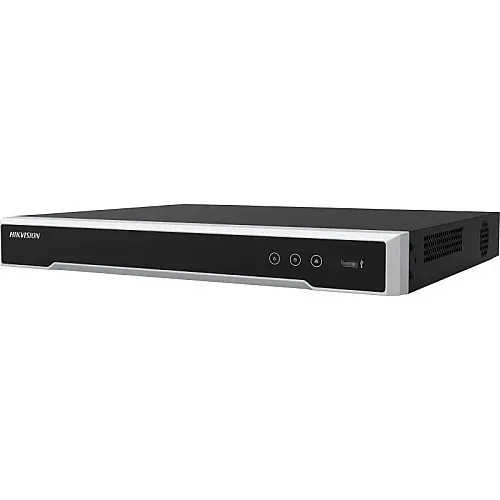
Manufacturer product photo: a 16-channel network video recorder. Its drives, clock and alert settings are what remote reviews read between visits.
Shop Our Systems
Security Camera Maintenance Packages & Pricing
Three starting points cover nearly every property we see in the county. Where yours lands inside the range depends on cameras, buildings, how high they are mounted and how far up the county you are; keeping footage on your own drives costs nothing per month.
Dutchess Season-Ready Visit
$230–$536
One trip for a home or small business: every camera cleaned and checked by day and night, views re-aimed, storage and drive health read, battery and generator hand-off tested, alerts set up and proven, and a report with a snapshot from every camera.
Estate and Farm Plan
$306–$765 / year
Remote health reviews between visits, a pre-winter visit, a storm-season check where needed, wireless-bridge and outbuilding inspections, and opening and closing checks for seasonal houses.
Campus and Commercial Plan
$1,530–$7,650+ / year
Quarterly or monthly service for office parks, plazas, multi-building sites and licensed businesses, with a camera inventory, replace-by dates for unsupported models, backup-power tests and compliance-ready records.
Cameras someone else supplied go on the same plan
It makes no difference to us whether the equipment came with the house, from a hardware store, from a website or from a different contractor. The first visit records each device's model and firmware and gives you a straight answer on which ones deserve upkeep and which are close to retirement. If you later want equipment added or replaced, our Dutchess NVR installation and residential camera installation pages cover that work, and owners who prefer to buy their own hardware can use our bring-your-own-equipment option.
Speak to a Dutchess Camera Technician
Ask about a pre-winter visit for a weekend house, a storm check for a farm, or a quarterly plan for an office park — the person who answers plans the route.
Every Security Camera Maintenance Service in Dutchess County
A maintenance visit often turns up a job for another crew — a dead recorder, a damaged long run, a gate intercom that has stopped answering. Each has its own Dutchess page.
Up the river, I think about camera maintenance in seasons rather than months. A system that runs perfectly through a Dutchess summer can come out of February with three cameras that see nothing but white, a recorder that rebooted twice during outages and a wireless link to the barn that never quite recovered. None of that shows on a sunny day in June.
So the visit I care most about is the one before winter. I want to see every camera's heater and seal before the ice, every surge protector before the next storm season, and the generator hand-off tested while the owner is still around to watch it. If a camera has to move under an eave, October is when to do it.
The second thing I ask every owner is how they would find out if the system stopped. If the answer is "next time I'm up", we fix that first — with alerts that reach their phone, before we touch a single lens.
— Owner, NYS license #12000287431 (a description of how we plan Dutchess visits, not an account of one particular job)
FAQ
Dutchess County Security Camera Maintenance FAQ
Short answers on access, weather, privacy and booking that the sections above do not cover.
We are only up on weekends — can visits happen midweek with our caretaker letting you in?
+
Yes, and many Dutchess visits work that way. Tell us who will meet us, give them the gate or alarm code arrangements you are comfortable with, and make sure they can open the room where the recorder lives. We call you before we start and again before we leave, and the report with photos reaches you the same day, so you see what was done without being there.
What happens if a maintenance visit is booked and a snowstorm or ice storm arrives that day?
+
We move it. Ladder work on icy eaves and long rural drives is not worth the risk, and a camera inspected under fresh snow tells us little. We rebook at the first clear slot on the same route and, where possible, run the remote part of the check on the original day so nothing waits on the weather.
After you finish a remote review, how is your access to our recorder shut off?
+
Remote access is set up as a separate account or a temporary sharing link, never by using your own admin login. At the end of a review we disable the account or end the share unless your plan calls for ongoing reviews, and the log notes the date and method. You can switch it off yourself at any time from the recorder or the app.
Can you work around horses and livestock when cameras are inside a barn?
+
Yes. We ask when the barn is quietest, whether any animals should be moved before a ladder goes up, and who on the farm should be with us. Battery tools and hand cleaning keep noise down, and we work aisle by aisle rather than setting up near stalls with nervous animals.
Do your technicians photograph our property during a visit, and who sees those photos?
+
We take photos of the equipment and of each camera’s view, because the report depends on them, but not of the inside of your home beyond where the equipment sits. The photos go into your report and our job file only. We do not post them online or use them in marketing without your written permission.
Can you leave a spare drive or a spare camera on site so a failure is fixed faster next time?
+
For properties far up the county, we often suggest it. A spare drive or a spare of your most common camera model, labelled and stored next to the recorder, means a failure can be handled in one trip instead of two. You buy the spare, it is listed in the report, and we use it only with your approval.
We own property on both sides of the Columbia or Connecticut line — can one plan cover both?
+
For Columbia County addresses close to the Dutchess line we can often fit the visit into the same route; tell us the address and we will confirm. Work in Connecticut is outside our New York State licence, so we do not take it on; we can still review a system remotely and advise on what to ask a local installer there.
Can the gate keypad, intercom and alarm sensors be checked on the same maintenance trip?
+
Yes. On many Dutchess estates and farms the gate camera, keypad and intercom share a cable or a power supply, so it makes sense to test them together. Tell us what is out there when you book, and the visit is scheduled long enough to cover it; anything that needs repair is quoted separately.
Does the barn or outbuilding need power on and the house heated on the day of the visit?
+
Yes, as far as possible. We test every camera, switch and bridge under normal power, so breakers for outbuildings should be on and any generator ready to run if you want the hand-off tested. In winter, a closed house with the heat turned right down makes recorders and batteries read differently than in normal use, so raising the thermostat a day ahead gives truer results.
All Areas Served
Security Camera Maintenance Across the Hudson Valley, New York City and Long Island
Where the Dutchess Camera Maintenance Facts Come From
Each storm figure, climate number, county decision and building fact above comes from one of the links below. The way we plan visits — pre-winter timing, remote reviews, generator tests, surge checks — is our own practice rather than something these sources prescribe, and the prices are our New York City base rates multiplied by the Dutchess factor of 1.53.
Nothing here is legal or engineering advice. Questions about permits belong with your town's building department; questions about licence conditions, handing over footage or recording sound belong with an attorney.
Cameras Dark After the Storm? Call the Dutchess Line
Grid black since the power came back, a barn camera silent after the lightning, a drive warning on the recorder screen — ring (845) 640-3835. We check what we can remotely first, copy off any footage you may need, and in most cases have the system writing video again within one to two hours of the technician arriving.
Dutchess Camera Upkeep From a Licensed, Insured Crew
Dutchess County line (845) 640-3835 · Photos of recorder screens, storage pages and camera views can be sent by WhatsApp · Abstract Enterprises Security Systems, 460 E Fordham Rd, Bronx, NY 10458
4.6★ across 390+ Google reviews · NYS license #12000287431 · insured · written estimates the same day
Parts we fit after a storm season — drives, batteries, cameras, the surge protectors that sit between your buildings — also come with whatever cover their makers give, and each report records battery install dates and the state of every surge device so you can see what is ageing before it fails. Full terms — including 50% deposit, the 30-day warranty and optional paid extended warranty, and the late-fee schedule — are set out in the service agreement. See our warranty page.
Page reviewed and updated October 18, 2026. Changelog: Dutchess County camera maintenance page rebuilt from new research on the July 4, 2026 and March 17, 2026 storm outages, Isaias outages in NYSEG's eastern towns, the county's climate and ice-storm record, lightning counts, the September 2026 removal of county plate-reader cameras, building stock from estates and farms to former IBM campuses, and local permit practice — priced at the Dutchess area factor of 1.53.