Carmel · Mahopac · Brewster · Kent · Patterson · Putnam Valley · Philipstown
NVR Recorders Installed in Putnam County
Footage Kept on Your Property · Built for NYSEG Nights · Lake Lots, Ledge and Private Roads
In September 2026 Putnam's Sheriff told the county legislature that the county's own plate-reader cameras deliberately stay off commercial camera networks, with their data held on a government server under local control. A network video recorder is the same decision made for one house or one shop: the video stays in a box you own, in a room you choose, instead of in someone else's cloud. In Putnam that box also has to survive storms that have left nearly nine in ten NYSEG customers dark, sit in houses that may stand empty all week, and collect cameras from lake lots, ledge-rock yards and the bottom of long private drives. We plan those first, then choose the recorder.
Page checked and brought up to date on October 18, 2026 by the owner (New York State license #12000287431). Putnam County calls go to (845) 640-3835; the business address is 460 E Fordham Rd, Bronx, NY 10458.
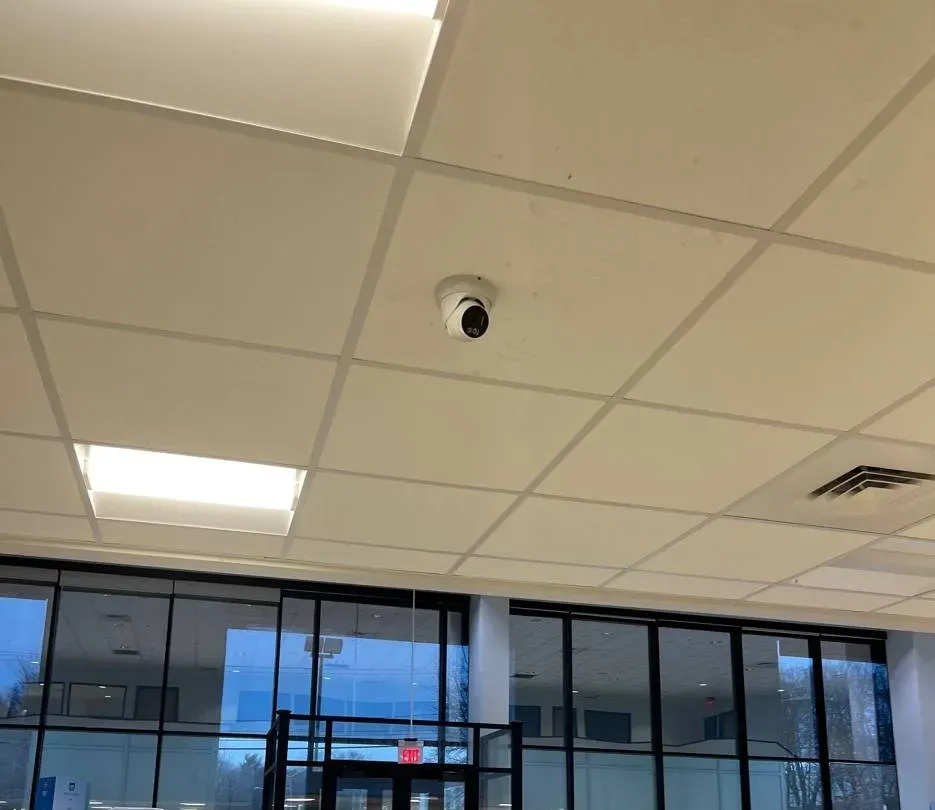
Example photo from another AESS job (not a Putnam County property): a turret camera set into the ceiling grid above a glass entrance, cabled back to the recorder. Glass fronts like this are where we check how the camera copes with bright daylight behind people walking in.
Putnam County NVR Quote
Tell us the town, the room the recorder could live in and how far the farthest camera is — a written price follows the same business day
✅
Request Sent!
An installer will call you back about the Putnam County recorder the same business day.
25+
Years Experience
✓
Same-Day Estimates
100%
Licensed & Insured
4.6★
390+ Google Reviews
Three answers get a Putnam recorder quote started. Is the house lived in every night or only some weekends? What kind of internet reaches it — cable, fibre, DSL, fixed wireless, satellite or a phone hotspot? And how far from the house is the farthest thing you want watched: the dock, the garage, the mailbox at the road? Text those, with a photo of the room you would give the recorder, to (845) 640-3835 and we will tell you what the job involves before anyone drives up.
Putnam prices: from $943 for a new eight-channel NVR with PoE and its drive, plus $254 per new camera line
The video lives on hardware you own; local recording carries no subscription
Estimates in writing on the day you ask, from a team licensed by New York State (#12000287431)
Why Putnam County Properties Need NVR Installation
A network video recorder — an NVR — takes the stream from every camera on a property, writes it to its own hard drives and plays it back when you need it. It is the opposite of a subscription camera that uploads each clip to a company's servers. That difference became a county argument in 2026. As license-plate-reader networks drew criticism across the Hudson Valley, Putnam's Sheriff told legislators that the county had kept its readers off commercial cloud platforms, with the data stored locally and never sold or shared with private companies. Neighbouring Dutchess went the other way: Mid-Hudson News reported in October 2026 that its sheriff and district attorney had taken the county's 64 Flock readers offline on September 25 and demanded their removal. Whatever you think of plate readers, the principle Putnam's officials described — your video, your storage, your rules for who looks — is exactly what a recorder installed in your own house gives you.
Keeping footage local only works if the recorder keeps recording, and Putnam is hard on recorders in particular ways. Power arrives on long overhead lines through woods; when Isaias came through, roughly 88% of NYSEG's Putnam customers were out the next morning and Carmel alone had more than twelve thousand customers dark. Internet varies from road to road: the state's September 2025 broadband awards set aside money for fibre to 390 unserved Putnam locations, and in Philipstown Optimum fibre only arrived in 2023 while Verizon was still reviewing a Cold Spring build. Many houses are empty midweek or shut for the winter. And a lot of the property worth watching — the dock, the boathouse, the shared beach, the gate at a private road — is a long way from the room where the recorder can live.
So an NVR job in Putnam is decided by four questions before it is decided by a brand. Which room in the house stays dry, ventilated and above freezing even when nobody is home? What keeps that room's recorder, switch and modem alive when NYSEG or Central Hudson is out for a day or more? How does each camera's cable get back to it across ledge rock, wet ground and long distances? And how will you find out, from the city, that something has gone wrong? Get those right and almost any good recorder works. Get them wrong and the recorder is the first thing to fail on the night you needed it.
The theft pattern the Sheriff described matters too. Crews that drive in from elsewhere tend to work quickly and at night: the Mahopac car break-ins in August 2026 happened in about ninety minutes before dawn, State Police reported ten vehicle break-ins across Carmel, Patterson and Southeast over one October 2020 weekend, and in January 2025 State Police warned residents of Dutchess, Westchester and Putnam about targeted residential burglaries. A recorder that captures a clear face at the door and a clear car at the end of the drive, keeps accurate time and lets you export a clip quickly is what turns that kind of night into evidence.
The county keeps its own camera data local. Mid-Hudson News reported on September 10, 2026 that Sheriff Brian Hess told the legislature's Protective Services Committee the county "deliberately chose not to join any commercial camera network"; its plate-reader data sits on a government server in Westchester controlled by regional law enforcement and is searched only in an active criminal investigation.
Crews travel in. From January 1 to mid-August 2026, the Sheriff reported, Putnam's 21 fixed plate-reader sites flagged 27 known burglary-crew vehicles tied to residential burglaries across the region, many connected to New York City, and 22 vehicles linked to organized retail theft rings that travel to Putnam to steal from local stores.
Most of it is woods and water. The county's hazard-mitigation profile describes more than 240 square miles in six towns and three villages, roughly three-quarters of it inside the New York City watershed, two-thirds forest (66.9% in 2011) and nine-tenths underlain by Hudson Highlands gneiss and granite.
Owners, not tenants, and some only part-time. The Census Bureau counts 38,713 housing units, 83.8% owner-occupied; the American Community Survey lists 1,757 of them as seasonal, recreational or occasional-use homes.
Outages are counted in towns, not blocks. The morning after Tropical Storm Isaias in August 2020, Daily Voice reported 34,150 of NYSEG's 38,693 Putnam customers out — 12,717 of them in Carmel and 5,815 in Kent — and 3,621 of Central Hudson's 5,160 Putnam customers, mostly in Philipstown and Cold Spring.
Overnight break-ins are reported by street. Mahopac News reported on August 7, 2026 that Carmel police were investigating seven unlocked vehicles entered on four streets between about 3:37 and 5:05 a.m., and asked residents with driveway or doorbell cameras to review their overnight footage.
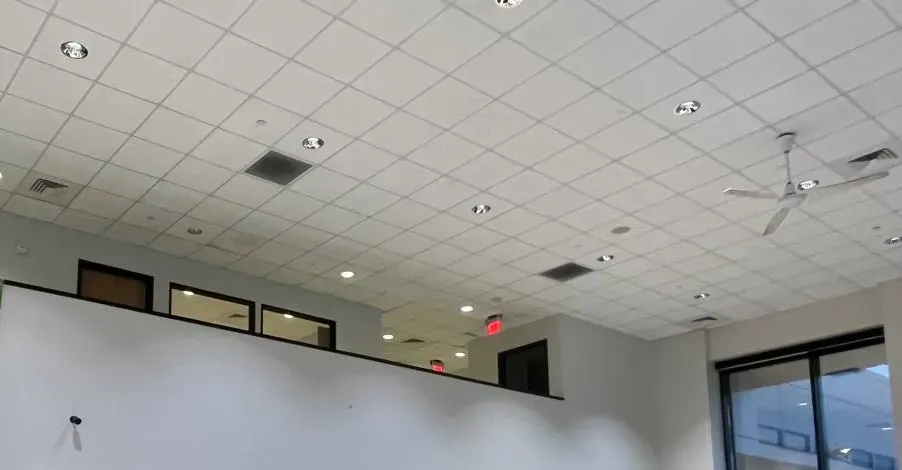
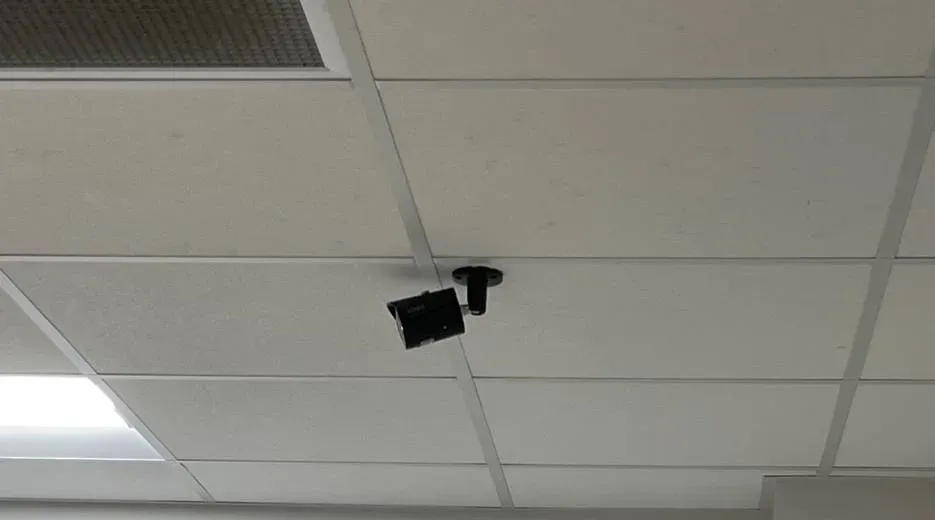
Example photo from another AESS job (not a Putnam County building): one small camera on a tall plain wall, its cable running up into the ceiling and back to the recorder. The higher and longer the run, the more the route matters to the price.
Putnam Recorder Off Your Phone, or Missing the Storm Night?
Black camera tiles, a "No HDD" warning, a clock showing the wrong year, or a night missing from playback right where the storm hit? Call (845) 640-3835. We book the earliest open slot the same day where we can, and most recorder faults are back recording within one to two hours of arrival. Until we get there, do not reformat or reset anything.
Four things worth checking first
Did the house lose power, or only the internet? If the app says "offline" but the lights never went out, the recorder may be recording perfectly and only the modem or router is down. Someone at the house can look at the recorder's monitor or its front lights.
Are the dark cameras all on one side of the property? Several cameras failing together after a thunderstorm usually points to a PoE switch, a surge-damaged port or one damaged cable, not the recorder.
Is the date on the screen right? A recorder that rebooted without a working time source can start stamping footage with a factory date; the video may still be there under the wrong date.
Is there a clip from before the storm you must keep? Say so on the phone. Saving that footage comes before any repair, restart or drive swap.
Plenty of "recorder" calls end at a cracked camera housing or a cable a branch pulled loose. When that is the fault, the same visit covers it through our Putnam County camera repair and network cable repair work.
Town by Town
Six Putnam Towns, Six Different Recorder Problems
Putnam is varied enough that a recorder plan for Mahopac would be wrong in Garrison. The table uses Daily Voice's town-by-town count of customers without power at 10:15 a.m. on August 5, 2020, the morning after Isaias, because it shows which utility serves each place and how widely one storm reached. The last column is what we look for on a walkthrough there, not a statistic.
Town or village
Electric utility
Customers out the morning after Isaias (Aug 5, 2020)
What we usually find there
Carmel and Mahopac
NYSEG
12,717
Lake Mahopac houses, Lake Casse and Lake Drive streets, Route 6 shops, the county seat at Carmel
Kent
NYSEG
5,815
Lake Carmel colony lots, wooded roads around the West Branch Reservoir, many private drives
Southeast and Brewster
NYSEG
5,220 (town) · 818 (village)
Village storefronts, Route 22 and Route 312 commercial strips, I-84 offices, Tilly Foster Farm area
Putnam Valley
NYSEG
5,088
Lake Peekskill and other lake communities, steep hollows, private roads with road associations
Patterson
NYSEG
4,422
Putnam Lake colony lots, farms and horse properties, Route 22 and Route 311
Philipstown, Cold Spring, Nelsonville
Central Hudson
2,475 · 992 · 154
Cold Spring's historic district, Garrison estates, Route 9 and Route 301 corridors near Fahnestock
Carmel and Mahopac
The town where outages run widest — Carmel had more customers out after Isaias than any other Putnam town. Around Lake Mahopac, a lake of roughly 587 acres, houses face the water and the road at once, so the cameras that matter are often at both ends of the property. In March 2021 WAMC reported NYSEG upgrading circuits on Horsepound and Stebbins roads in Carmel with rock drilling, a reminder of what lies under the lawns. The August 2026 car break-ins were in the Lake Casse, Lake Drive and Ridge Road neighbourhoods of Mahopac. Recorders here usually go in a finished basement or a ground-floor closet, with a battery backup sized for the recorder, the switch and the modem together.
Kent
Wooded, hilly and full of private drives, with the Lake Carmel colony at its eastern edge and the West Branch Reservoir — which New York City's Department of Environmental Protection puts in Kent and Carmel, in service since 1895 — to the west. Kent's own website says the town does not issue electrical permits and sends residents to Putnam County Consumer Affairs, which matters if the recorder needs a new outlet. Cable routes here are long and often cross slopes, so we measure them with a wheel before quoting.
Southeast and the Village of Brewster
The county's commercial end: the village's storefronts, Route 22, and the Route 312 interchange with I-84, where the county profile places office and commercial space. Shops and offices here want recorders that capture faces at the door and plates in the lot, and the Town of Southeast is where the Putnam District Attorney described investigators reviewing surveillance video to identify a crew that stole all-terrain vehicles and a motorcycle from a garage. Business recorders here sit in back offices or telecom closets, often in buildings with other tenants.
Putnam Valley
Steep hollows, lake communities such as Lake Peekskill, and roads maintained by their residents. On July 29, 2026 the town declared a state of emergency for flash flooding and restricted travel on roads including Cimarron, Horton Hollow and Canopus Hollow. For a recorder that means two things: the basement may not be the safe room it looks like, and a road that closes can keep anyone from reaching the house for a day. A third-party broadband listing reports cable available to most Putnam Valley addresses but fibre to only about half, so we check the actual service at each house.
Patterson and Putnam Lake
Patterson mixes farms and horse properties with Putnam Lake, one of the lake colonies that the Smadbeck brothers' firm began selling in 1928; Historic Patterson records 11,000 lots mapped there, twenty by one hundred feet, sold for $50 each. Many of those summer bungalows are year-round homes now, small, close together and built without a basement or a spare closet. Patterson's own filing instructions name the third-party agencies that inspect electrical work in town, which is who we coordinate with when a recorder needs a dedicated circuit.
Philipstown, Cold Spring and Nelsonville
The river side of the county, on Central Hudson rather than NYSEG. Cold Spring's historic district — 691 acres on the National Register since 1982 — has a Historic District Review Board that has reviewed visible exterior changes since 1976. Garrison and the roads toward Fahnestock State Park have long drives and big lots, and in September 2024 The Highlands Current reported break-ins along Old Albany Post Road and Indian Brook Road. Recorders here are often in old houses with stone foundations, which changes where cable can travel.
Example photo from another AESS job (not a Putnam County house): a mini bullet camera mounted beside an alarm sensor. Where a house already has an alarm, we plan the recorder so the two systems share power backup and a quiet spot on the network.
What We Install
NVR Installation Services in Putnam County
Nine kinds of work make up most of our Putnam recorder jobs. A lake bungalow might need two of them; a horse property with a barn, a long drive and a weekend-only schedule might need six.
Local-Only Recording
A recorder set up so the video never leaves the property unless you send it: no cloud account, remote viewing through the maker's relay or a VPN only if you want it, and nothing uploaded by default.
New Recorder Systems
A fresh NVR with enough channels for today's cameras plus the dock, garage or road camera you will want next year, fitted with drives made for nonstop recording.
Recorders for Cameras You Already Own
When the cameras on the eaves are sound and only the box behind them is dying, out of space or a make you would rather not keep, a replacement recorder takes over those cameras and, where the old drive still reads, the old video comes across too.
Outage Planning
A battery backup sized to the recorder, the PoE switch, the modem and the router together, and — if you have a generator — the recorder's outlet on the circuit the transfer switch carries.
Long and Difficult Cable Runs
Camera lines across ledge, along walls, through conduit or overhead to a garage, boathouse or road gate, measured with a wheel before the quote and tested end to end after.
Alerts That Reach You in the City
Recorder health, camera-offline and person alerts sent to your phone, with a cellular backup path where the home internet drops in storms.
Association and Shared-Road Cameras
A recorder for a lake association's beach or a private road's entrance, owned by the association, with view-only logins for members and a written rule for who exports footage.
Covered-Brand Replacements
Moving cameras off a Hikvision or Dahua recorder onto a non-covered model when a business, association or public buyer wants out after the FCC's 2026 order.
Shop and Office Recorders
Recorders for Route 6, Route 22 and Route 312 businesses: door and register coverage, plate capture in the lot, tenant-separate networks and fast export.
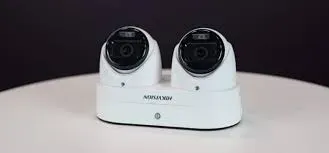
Manufacturer product photo: a pair of turret cameras sharing one mounting base. Even when two cameras share a mount, each one takes its own channel on the recorder, which is why channel count is planned before the cameras are chosen.
Building Specialists
NVR Systems for Putnam County's Houses
The recorder is the same box in a Putnam Lake bungalow and a Garrison estate. Everything around it changes: where it can sit, how cable reaches it, and what can go wrong in the room. These are the property types we plan for most often in the county.
Lake-Colony Bungalows
Putnam Lake, Lake Carmel and Lake Peekskill cottages on narrow lots, many winterised and lived in year-round. Little or no basement, small closets, neighbours close on both sides — the recorder needs a quiet, ventilated corner and cameras aimed carefully.
Lakefront Houses
Houses on Lake Mahopac and the smaller lakes, with the road on one side and the water on the other. The cameras that matter are at the drive and at the dock, so the recorder is usually central and the long runs go in conduit.
Hillside Houses on Rock
Houses set into the Hudson Highlands, where ledge sits under thin soil. Trenching is expensive or impossible, so cable follows the house, goes overhead to outbuildings on a messenger wire, or crosses on a wireless or fibre link.
Village Houses in Cold Spring and Brewster
Nineteenth-century houses on small lots, often with stone foundations and plaster walls. Cameras visible from the street in Cold Spring's historic district may need review; cable inside follows old chases and the cellar.
Newer Colonials and Subdivisions
Houses from the last few decades with attics, unfinished basements and sometimes a structured-wiring panel. The easiest Putnam installs, provided the attic is not where the recorder ends up.
Estates and Horse Properties
Garrison, Kent and Patterson properties with barns, studios and gates hundreds of feet from the house. The recorder stays in the main house; the outbuildings reach it by fibre or wireless, never by a cable that leaves the building on its own power.
How the plan changes from one property to the next
Property
Where the recorder usually goes
What threatens it there
What we add
Lake-colony bungalow
Ventilated cabinet in a hall or utility closet, raised off the floor
Small rooms with no airflow, damp crawlspaces, a single shared circuit
Low-noise recorder, small UPS, interior cameras limited to entries
Lakefront house
Finished basement or ground-floor closet, central to drive and dock
Lake humidity, long run to the dock, basement water in heavy rain
Conduit to the dock, raised shelf, leak-proof cable entries
Hillside house on rock
Interior closet on the main floor
No trench possible, lightning on long runs, ice on overhead lines
Messenger-wire aerial run or wireless bridge, surge protection at both ends
Village house
Cellar room or rear closet with a lock
Old wiring, plaster and stone, review-board limits on street-facing cameras
Discreet camera positions, labelled runs through existing chases
Newer colonial
Basement utility area or office closet
Hot attic, unconditioned garage
Recorder kept out of the attic, structured panel used where present
Estate or horse property
Main house utility room or office
Outbuildings on separate electric services, distance beyond Ethernet limits
Fibre or wireless links, PoE switch in the barn on its own backup
Two rules apply in all six. The recorder goes in heated, dry, ventilated space — never an attic, a crawlspace or an unheated garage — because a surveillance drive is rated to run between 0°C and 65°C and a closed attic in July or a garage in February can leave that range. And the recorder gets a camera of its own, pointed at the room it is in, so if anyone reaches it the recording shows who.
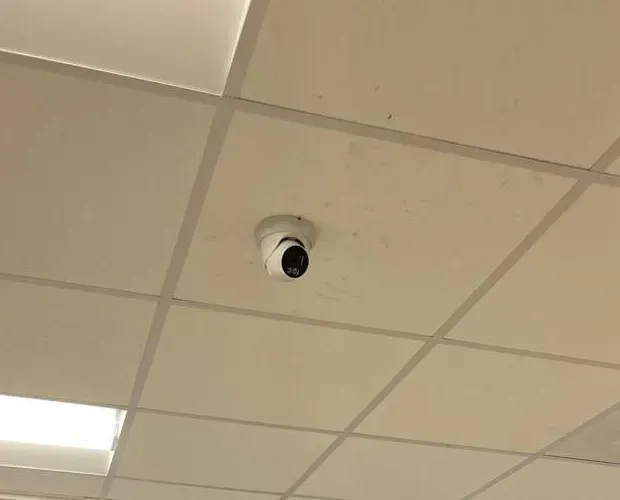
Example photo from another AESS job (not a Putnam County home): a turret camera in a ceiling tile. Inside a cottage or lake house we keep interior cameras to entries and garages, and never in rooms guests or tenants sleep in.
Commercial NVR Installation
Business NVR Installation in Putnam County
The county's hazard-mitigation profile places most of Putnam's commercial activity along Routes 6, 9, 22 and 52 and around the I-84 interchanges. These six corridors are where most of our business recorder work happens; they are reference points, not client lists.
Route 6, Carmel and Mahopac
The county's main shopping road, with plazas, restaurants and service businesses between Mahopac and Brewster. Recorders here need door, register and parking-lot coverage, and quick export when the Sheriff's office or Carmel police ask.
Route 52 and Gleneida Avenue, Carmel
The county seat, around the 1814 courthouse on Lake Gleneida — offices, professional practices and small shops in older buildings where cable follows existing paths.
Main Street, Brewster
Village storefronts set close together, where a shop can share walls, utilities and sometimes a building with its neighbours, so recorders and networks are kept separate.
Route 22, Brewster and Patterson
Plazas, service businesses and yards along the road north from Brewster, where the parking lot or the yard matters as much as the shop floor.
Route 312 and I-84, Southeast
Office and medical space near the interchange, including the Mount Ebo area, in multi-tenant buildings with shared telecom rooms.
Route 9 and Main Street, Philipstown
Cold Spring's Main Street shops and restaurants and the Route 9 businesses toward Garrison, on Central Hudson power and with historic-district rules on the village street.
What Putnam businesses ask a recorder to do is shaped by what the Sheriff told legislators in September 2026: 22 vehicles linked to organized retail theft rings, "typically out-of-state criminal organizations that travel to Putnam specifically to steal from local stores", flagged by county readers in under eight months. Those crews know where the cameras usually are. We plan for a usable face at each entrance at the height people walk in, a camera on the back door where goods leave, a view of the lot that catches the car, and a recorder in a locked back room with its own camera on the door.
Rules business owners in Putnam should know
Putnam licenses low-voltage technicians. Chapter 145 of the Putnam County Code, the county's Electrical Licensing Law, covers a low-voltage or limited-data communications technician's work on "video surveillance systems" operating at 90 volts or less and five amperes, starting at an outlet installed by a licensed electrician, and says no one may engage in that trade in the county unless licensed. Consumer Affairs publishes the list of licensed low-voltage technicians.
Home-improvement contractors register with the county. Chapter 135 requires home-improvement contractor registration with Putnam Consumer Affairs, and the county page describes registration as mandatory, with insurance, bonding and workers' compensation.
New York State licenses the security trade. The Department of State's security and fire alarm installer licence (Article 6-D) covers closed-circuit and video surveillance work.
Audio is a separate legal question. New York's eavesdropping law treats recording a conversation without at least one party's consent as a felony, so we leave microphones off unless you decide otherwise with advice.
Cameras aimed at a neighbour's back yard. Civil Rights Law §52-a gives a private right of action against video recording of a neighbour's residential back yard without consent, which is why we set privacy masks on any camera that can see one.
The FCC's July 2026 order on covered equipment. It stops new imports and marketing of previously authorised Hikvision and Dahua video gear, does not require anyone to remove equipment they already own, and restricts covered uses such as public safety and government facilities — relevant to town buildings, fire districts and associations that take public money.
A state credit can offset part of a shop's system. Retailers with no more than 50 employees can claim New York's Commercial Security Tax Credit, worth up to $3,000 for each retail location, and security cameras count toward it.
Cold Spring's historic district. Exterior changes visible from the street need the Historic District Review Board's approval; work not visible from the street is not reviewed.
Example photo from another AESS job (not a Putnam County business): a bullet camera on a pendant mount aimed at a counter area. Shops on Route 6 and Route 22 usually want one camera like this per door and one over the register.
Your Questions Answered
NVR Installation in Putnam County: Questions Answered
These are the recorder questions Putnam owners and businesses ask that our other pages do not already answer — about keeping footage local, lake and road associations, lightning and flooding, the county licence, the historic district and the theft patterns the county itself has described. Each answer comes first; the reasoning follows.
Keeping Putnam footage in Putnam
The Sheriff told the county legislature that Putnam keeps its plate-reader data on a local server, not a vendor's cloud — can our cameras be set up the same way?
Yes, and on a recorder that is the default rather than the exception. Every camera streams to the NVR in your house over your own cable, the recorder writes that video to its own drives, and nothing goes anywhere else unless you choose to send it. You can watch it on a monitor in the house with no internet at all.
Where owners lose that control is usually in the setup, not the hardware. Many recorders offer to create a cloud account during first boot, some cameras phone home to their maker by default, and some apps copy event clips off-site. We go through those settings with you and switch off what you have not asked for. If you want to watch from the city, there are two ways to do it: the maker's relay service, which passes live video through its servers without storing your recordings there, or a VPN to your own home router, which keeps everything between your phone and your house. The second takes a little more setup and works on most cable and fibre connections in the county.
The trade-off is the one the county accepted: if the recorder is destroyed or stolen, the footage on it goes with it. That is why we put the recorder somewhere hard to find, give it a camera of its own, and — if you want — set it to send a copy of selected clips to storage you control, such as a small network drive hidden elsewhere in the house.
Lake colonies, lake houses and associations
From ice-out to freeze-up the dock is where things go missing — can a recorder get usable night video of a boat tied up 150 feet from the house?
It can, but not from a camera on the house aimed into the dark. Water is the hardest thing to record at night: a camera's built-in infrared light reflects off the surface, fades long before 150 feet, and leaves a boat as a grey shape. The usual answer is a camera at the dock itself, or on the boathouse, close enough that its own light reaches what it watches, with a narrower lens pointed along the dock rather than out over the lake.
Getting that camera's video back to the recorder is the second half of the job. A cable in conduit up the bank works if the ground allows it; where it does not, a pair of small point-to-point wireless radios links the dock to the house without a trench, and a PoE switch or injector at the dock powers the camera from a protected outlet there. On the recorder we set the dock camera to record continuously at night, because a slow approach by boat often does not trigger motion until someone is already aboard.
Low lighting at the dock helps the camera more than anything else, and it does not have to be bright. A shielded fixture on a timer or motion sensor, aimed down at the boards rather than out over the water, gives the camera enough to see colour and detail without lighting up the cove for the neighbours.
The lake association wants cameras on its beach and dock — should they record to one member's house or to a recorder of their own?
To their own. When an association's cameras record on a member's recorder, that member ends up holding the association's footage, deciding who sees it, and paying for the power — and when the house is sold or the member falls out with the board, the arrangement falls apart. A small recorder owned by the association, in its clubhouse, pump house or a locked weatherproof cabinet with power, avoids all of that.
The association then decides, in writing, who holds the admin login (usually two officers), who gets view-only access, how long footage is kept and who may export a clip and for whom. We set the recorder to match that policy. Members can be given live view of the beach without any ability to play back or delete.
If there is no building at the beach, the cameras can still record at the association's recorder somewhere else, over a wireless link, or — for one or two cameras — on a small recorder in the cabinet itself. We price both on the walkthrough.
Our dock camera can see a neighbour's yard across the cove — what does New York law say about that view?
New York's Civil Rights Law §52-a lets a property owner sue a neighbour who video-records their residential back yard without consent. That is the main state rule on the subject, and it is the reason we do not leave a neighbour's yard in any camera's view if we can help it.
On a lake that usually means aiming the dock camera along your own shoreline rather than across the water, and using the recorder's privacy masks — black boxes drawn over parts of the image so they are never recorded — to cover a neighbour's deck or lawn that cannot be cut out by aiming alone. Masks are set in the recorder or the camera and stay in place when the camera is rebooted.
This page is not legal advice, and §52-a has its own details and exceptions; if a neighbour has already complained, talk to a lawyer before changing anything. What we can do is show you, on the screen, exactly what each camera records once the masks are in.
Private roads, lightning and wet ground
Who should own, power and keep the footage for a camera where our private road meets the town road?
Whoever is going to answer for it — and that is usually the road association, not the household nearest the corner. A camera at a shared entrance records every resident, every visitor and every delivery. If it records to one family's recorder, that family is the custodian of everyone's comings and goings, and the first time there is a dispute about a fence, a plow or a visitor, the footage becomes a neighbour problem.
The simplest arrangement we install is a camera at the entrance powered from the nearest house that agrees to host it, with its own small recorder in a locked cabinet in that house or at the entrance, owned by the association. If no house is close enough, a solar-and-battery camera with its own storage is an alternative, though it holds fewer days and is harder to keep running through a Putnam winter.
Agree three things before the camera goes up: who pays the electricity, who holds the admin password, and who may export footage and for what. Write them into the association's minutes. We set the recorder to match, including view-only logins for each household.
Putnam took tens of thousands of lightning pulses in a single year — can a strike near a camera at the far edge of the lot reach the recorder through the cable?
Yes. Earth Networks counted 75,093 lightning pulses and 35 thunder days in Putnam in 2020. A strike does not have to hit the camera: a nearby strike can induce a surge in a long copper cable, especially one run along a fence, up a tree or across wet ground, and that surge travels straight to the recorder or PoE switch at the other end.
The protection is to keep long outdoor runs off copper where we can, and to protect them where we cannot. For a dock, gate or outbuilding a long way out, fibre or a wireless link breaks the copper path altogether. For outdoor copper runs we fit Ethernet surge protectors at the building entry and at the camera end where practical, bond them to a proper ground, and keep camera cable out of trees and away from the electric service.
None of that makes a recorder lightning-proof. It makes it much more likely that a strike costs you one camera and one port rather than the recorder, the switch and the router together.
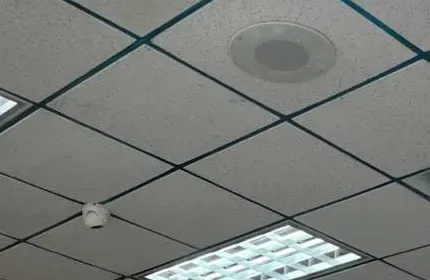
Example photo from another AESS job (not a Putnam County site): a mini dome sharing a ceiling with a speaker and lights. In a shop the camera over the counter has to be planned around everything else already in the ceiling.
When the power and the internet fail together
When the power and the internet both go down at the empty lake house, how do we even find out?
Most owners find out the slow way: the app says "offline" and they cannot tell whether the house lost power, the internet failed or something worse happened. A recorder cannot send a message once its own connection is gone, so the warning has to come from somewhere that notices the silence. Several recorder and camera apps can alert you when the device stops checking in; we switch that on and test it by unplugging the modem while you watch your phone.
To keep the recorder reachable through a cable, DSL or fibre outage, we add a router with a cellular backup — an LTE modem with a data plan that takes over when the wired line drops. It is not fast enough for hours of live video, but it is enough for alerts and short live checks. It needs to be on the same battery backup as the recorder, or it will go down with the power anyway.
In the parts of the county where mobile signal is weak — Senator Schumer complained in 2015 that northern Westchester and Putnam had more cell dead zones than the carriers' maps admitted — we check signal at the router's location with the carrier you choose before recommending it, and sometimes move the router or add an outside antenna.
Licences and the review board
Does Putnam's Chapter 145 cover the network cable between the recorder and each camera, or only the outlet the recorder plugs into?
Both, but in different ways. Chapter 145, the county's Electrical Licensing Law, describes the low-voltage or limited-data communications technician's trade as installing cabling for "video surveillance systems" and other systems operating at 90 volts or less and five amperes, where the work starts at an outlet or connection installed by a properly licensed electrician. It says no one may engage in that trade in Putnam unless licensed or registered. So the camera cabling is low-voltage work under the chapter.
The outlet itself is line-voltage electrical work for a Putnam-licensed electrician. If the recorder needs a new dedicated circuit, or an outlet in the barn or at the dock, an electrician installs it and the inspection follows the town's process; Kent, for example, says it issues no electrical permits and sends residents to Putnam County Consumer Affairs.
Putnam Consumer Affairs publishes downloadable lists of licensed master electricians and licensed low-voltage technicians. Ask any installer, including us, which licence covers their work in the county, and check the name on the list before anyone runs cable.
Which camera positions on a house in Cold Spring's historic district can go up without a review-board application?
Cold Spring's Historic District Review Board reviews exterior changes visible from the street; work that is not visible from the street is not subject to its review. For cameras, that splits a typical village house neatly. A camera under the rear eaves, in the back porch ceiling, inside a garage or on a side wall hidden by a fence is usually out of the board's scope. A camera on the front facade, above the front door or on a street-facing porch post is the kind of change the board looks at.
Most owners want the front door covered, so we look for positions that see it without being seen from the street: inside the porch ceiling looking out, a small camera in a recessed corner, or a doorbell camera that replaces an existing fixture. Cable runs inside the house to the recorder, so nothing new crosses the facade.
If a street-visible camera is the only way to cover what you need, we provide the product details and a photo mock-up for an application. Check with the village before installation; this page does not replace the board's own guidance.
Shops, offices and the crews the Sheriff described
The Sheriff says organized retail-theft crews travel to Putnam to target local stores — what should a shop's recorder capture so a clip is worth handing over?
Four views, recorded continuously at full resolution: a face-height view of every entrance, a view of the register or counter from behind the customer, a view of the back door or loading door, and a view of the lot that shows the car and its direction of travel. Crews that move between towns are identified by matching faces and vehicles across stores, so the face and the car matter more than a wide shot of the whole floor.
On the recorder we set those cameras to record all the time rather than only on motion, check that each one keeps detail at night under the lot lights, and make sure the recorder's clock is right so a clip from your store lines up with the next store's. We also set up export so the manager can save a few minutes of video to a USB stick or send a clip from the app without stopping the recording.
Finally, keep the recorder out of reach. Put it in a locked back room or a locked cabinet, give it a camera of its own, and never leave the monitor that shows the cameras where a customer can watch it.
Our office near I-84 and Route 312 has to keep its recorder in the building's shared telecom room — how is it kept out of other tenants' reach?
With a lock, its own network and a written agreement with the building. In a multi-tenant building the telecom room and sometimes the network switches belong to the landlord, and a camera system plugged into a shared network can be seen, or interfered with, by people outside your company. We put your recorder and cameras on their own switch, or on a separate network segment on your own equipment, with no path from the landlord's or other tenants' devices.
Physically, we install it in a locked, ventilated enclosure on its own outlet, label it as yours, and agree with building management who may open that enclosure. If the landlord has a building camera system, your cameras can stay independent of it; any sharing of footage with the landlord is then a decision you make case by case.
Before we start, we ask the building for permission to run cable through common areas, the route they prefer, and any certificate of insurance they require.
The Mahopac car break-ins happened between about 3:30 and 5 a.m. — can the recorder wake us for a person in the driveway at that hour without calling us for every deer?
Most current recorders can tell a person or a vehicle from other movement, and that is what makes a night alert usable in Putnam, where deer, foxes and the odd bear cross driveways every night. We set the driveway camera to alert only on a person or a vehicle, only inside a zone drawn over the drive and the cars, and only during the hours you choose — midnight to six, for example — with everything else recorded silently.
We then tune it over the first week. Headlights on a curving road, a flag moving in the wind or branches in a camera's view can still produce false alerts; the cure is usually a tighter zone or a small change of angle rather than turning sensitivity down until nothing triggers at all.
An alert is only useful if someone does something with it. Decide in advance what you will do: turn on the lights through the app, look at the live view, or call 911. The recorder keeps the clip either way, with the right time on it, for the police report.
Equipment
Types of NVR Equipment We Install
We install recorders from several makers and pick by the property, not by habit. In Putnam the parts around the recorder — the battery, the cellular backup, the surge protection and the links to outbuildings — decide as much as the recorder does.
Recorders with built-in PoE
The camera sockets are on the recorder itself, and each one sends power up the same cable that brings the picture down. Tidy and simple when every camera on the house can be cabled back to a single closet.
Recorders with a separate PoE switch
For properties where cameras gather in two places — the house and the boathouse, say — a switch near each group keeps cable runs short and lets the recorder sit where it is safest.
Multi-bay and business recorders
Two or more drive bays for longer retention or mirrored drives, and enough channels for a shop, an office or a large property with outbuildings.
Surveillance-rated drives
Drives built for constant writing. Western Digital rates its WD Purple line at up to 180 TB a year of workload and an operating range of 0°C to 65°C — one more reason the recorder lives indoors.
Battery backups
A line-interactive or online UPS sized to the recorder, PoE switch, modem and router together, with a signal cable for a clean shutdown where the recorder supports it.
Cellular backup routers
An LTE router that takes over when the home line drops, so alerts and short live checks still reach you from the city during an outage.
Fibre and wireless links
For a dock, barn, gate or road entrance beyond the reach of Ethernet, or across ground where copper would carry lightning back to the house.
Surge protection and grounding
Ethernet surge protectors at the building entry and at long outdoor runs, bonded to ground, so a nearby strike costs a port rather than the recorder.
A recorder in the house compared with monitored packages and cloud cameras
National alarm brands and cloud camera makers sell good products. The question for a Putnam property is where the video lives when the power and the internet go, which is the comparison below. It describes how these kinds of systems typically work; individual plans and models differ, so check the details of any offer you are considering.
NVR installed by AESS
ADT-style monitored package
Ring or SimpliSafe cloud cameras
Where the video is kept
On drives in your house, under your control
Usually in the provider's cloud, with a monitoring contract
In the maker's cloud, by subscription
When the internet is down
Keeps recording; you can watch on a monitor at the house
Depends on the package; cloud recording stops
Cloud recording stops; some models keep a local card copy
When the power is down
Records for as long as the battery backup lasts
Panel has its own battery; cameras vary
Battery cameras continue; uploads wait for internet
Long runs to a dock or barn
Cable, fibre or a wireless link to the recorder
Usually Wi-Fi cameras within range
Wi-Fi range from the router decides
Monthly cost for recording
None for local storage
Monitoring contract
Per-camera or per-home subscription
Manufacturer product photo: a camera in a stainless-steel housing of the kind made for wet, corrosive spots. A dock or boathouse camera like this still sends its video back to the recorder in the house.
AI Overview Reality Check
What AI Gets Wrong About NVR Installation in Putnam County
Google's AI-generated summaries were not available to us when this page was researched, so nothing here is quoted from one. These are seven things people are routinely told about recorders — by product listings, cost articles and forum threads — set against the records Putnam itself has published: police statements, utility counts, county law and broadband awards.
"A cloud camera is safer than a recorder in the house, because nobody can steal the footage"
It is true that a thief cannot carry off a cloud server. But a cloud camera can only upload when the house has power and internet, and in Putnam those are exactly what a storm or a determined burglar takes away. After Isaias, nine in ten NYSEG customers in the county were dark the next morning; a camera that cannot reach the cloud during an outage records nothing there.
Cloud storage also moves the question of who can see your video to a company's terms of service. That was the concern residents raised about commercial plate-reader networks, and it is why Putnam's Sheriff stressed in September 2026 that the county's reader data sits on a server under regional law-enforcement control and is not searchable through a nationwide network.
A recorder answers the theft risk differently: it is hidden, locked and on camera itself, and it can copy selected clips to a second device you control. You keep the video, and you keep the decision about who sees it.
"Putnam is quiet — a recorder is overkill for a house up here"
Quiet is not the same as untouched. The Sheriff told legislators that between January and mid-August 2026 the county's readers flagged 27 known burglary-crew vehicles tied to residential burglaries across the region, many connected to New York City. In January 2025 State Police warned residents of Dutchess, Westchester and Putnam about targeted residential burglaries.
Smaller incidents are reported street by street: seven cars entered in about ninety minutes before dawn in Mahopac in August 2026, ten vehicle break-ins over one weekend in Carmel, Patterson and Southeast in October 2020, break-ins along two Philipstown roads in September 2024. In each case police asked residents for camera footage.
A recorder is not about expecting crime. It is about having a clear, correctly timed record when something does happen on a road where the nearest neighbour is out of sight — which is most roads in the county.
"A couple of Wi-Fi cameras do the same job without any wiring"
On a small lot near the router, they can. On a typical Putnam property they run into three problems. Wi-Fi does not travel well through stone foundations, across a slope to a garage or down to a dock; the camera that matters most is often the one with the weakest signal. Battery Wi-Fi cameras wake only on motion and can miss the first seconds of an approach. And every one of them depends on the home router staying up.
Wired cameras on a recorder get power and video over one cable, record continuously if you want them to, and keep recording to the drive when the internet is down. Where a camera really is too far for cable, we link it with a point-to-point wireless bridge or fibre rather than relying on household Wi-Fi.
Mixed systems are fine. Many Putnam houses end up with wired cameras on the recorder for the drive, doors and garage, plus a doorbell camera — but the recorder is what holds the evidence.
"Lightning only matters if it hits the house"
Most surge damage we see on camera systems comes from strikes that hit nothing of the owner's at all. A strike nearby induces a surge in long cables, and camera cable is often the longest copper on the property — out to the road, along a fence, down to the water.
Putnam gets plenty of chances: Earth Networks counted 75,093 lightning pulses and 35 thunder days in the county in 2020. When a surge comes in on a camera cable, the first things it meets are the PoE port, the switch and the recorder.
Fibre or wireless for the longest outdoor runs, surge protectors bonded to ground where copper leaves the building, and cable kept out of trees reduce the damage. A battery backup with surge protection on its outlets protects the power side. None of it is a guarantee, but it changes most strikes from a new system to a single replacement part.
"Your town's building department signs off on camera work"
In Putnam the licence that matters for camera cabling is county-level. Chapter 145 of the county code licenses low-voltage and limited-data communications technicians, names video surveillance systems among the work they do, and bars anyone from engaging in that trade in the county without a licence. Putnam Consumer Affairs keeps the list of licensed technicians.
Towns still matter for electrical inspections and for zoning — Kent, for example, says it issues no electrical permits and points residents to Consumer Affairs, while Patterson names the independent agencies that inspect electrical work there. And the county separately requires home-improvement contractors to register under Chapter 135.
The practical upshot: ask any installer which county licence covers their low-voltage work, which electrician will do any new outlet, and who calls for the inspection. If the answers are vague, keep asking.
"Fast internet is everywhere in the county by now"
Census figures put broadband subscriptions in Putnam high, at 94.8% of households, but subscription is not the same as a fast, reliable line at the end of every private road. The state's September 2025 broadband awards included money for Comcast to bring fibre to 390 unserved Putnam locations, and the same list included satellite service for addresses in Putnam.
In Philipstown, The Highlands Current reported in May 2023 that Optimum fibre was coming through the town while Verizon was still reviewing a Cold Spring build with no timeframe. A third-party listing for Putnam Valley shows cable widely available but fibre to only about half of addresses. Satellite and cellular services often use shared public addresses that block the inbound connections older recorder setups relied on.
So we check the actual connection at each house — the upload speed especially, because watching the recorder from the city depends on what the house can send, not what it can receive — and set remote viewing to suit it.
"Motion-only recording saves the drive and you lose nothing"
Motion recording does save space, and for some indoor cameras it is the right setting. But on a dark rural drive it can cost the moment you need: a car with its lights off rolling slowly, a person walking at the edge of the frame, or the second before the motion trigger catches up. Recorders add a pre-event buffer to help, but the buffer only works if the motion is detected at all.
Putnam nights are long and quiet, and wildlife triggers constantly, so owners often turn sensitivity down until real events are missed. The better approach on the cameras that matter — the drive, the doors, the road entrance — is continuous recording at a sensible bitrate, with person and vehicle detection used for alerts and searching rather than for deciding what gets saved.
That uses more drive space, so we size the drive for it and tell you in writing how many days each camera keeps. For a weekend house, that number has to cover the whole week you are away.
Want the Footage to Stay on Your Property?
Tell us the town, the internet you have and the room you would give the recorder. Call or text (845) 640-3835 and you will speak with the person who plans the job.
Fill in what you know — town, kind of property, internet, how far out the cameras go. Gaps are fine. One of our licensed installers phones you back within the business day with either a written Putnam figure or a proposed time to walk the land, and nothing is scheduled until you agree to it.
We Got Your Request!
Thanks — your Putnam County details are with our scheduling desk, and an installer will phone you within the business day. In a hurry? Ring (845) 640-3835.
How It Works
Our Installation Process
Seven steps, on a two-camera cottage or a twenty-camera estate. On a large Putnam property step two takes the longest.
1. Start at the panel and the router
You send photos of the electric panel, the modem or router, and each room the recorder could use. We ask whether you have a generator, what internet you have and when the house is occupied.
2. Walk the property, not just the house
On site we walk to every camera position — the drive, the road, the dock, the garage — and measure each route with a wheel, noting rock, wet ground, trees and existing conduit.
3. Settle power and the safe room
We choose the room, size the battery backup for the recorder, switch, modem and router together, and agree with your electrician if a new outlet or generator circuit is needed.
4. Put the plan and price in writing
You receive a written Putnam price listing the recorder, drives, every camera line and its route, the backup, any links to outbuildings, the days of retention and who gets which login.
5. Pull cable, set links and mount
Camera lines go in along the agreed routes with surge protection where they leave the building; fibre or wireless links go to distant buildings; the recorder and UPS go on their shelf or bracket.
6. Configure for an empty house
Local-only settings, time sync, continuous or event recording by camera, person and vehicle alerts on a schedule, offline alerts, privacy masks, view-only logins and the sealed admin login.
7. Pull the plug and check from the road
We switch off the main breaker to prove the backup carries the system, unplug the modem to prove the offline alert reaches you, and watch the cameras on your phone over mobile data before we leave.
Coverage Area
NVR Installation Near Putnam County's Landmarks
Every town and village in the county is in our service area. The six places below are simply familiar markers for the kinds of land and houses we work around — none of them is a customer.
Lake Mahopac
A lake of about 587 acres with three private islands, a nineteenth-century resort that became a year-round community. Lakefront houses here put the recorder between a road camera and a dock camera.
Putnam County Courthouse, Carmel
Built in 1814 on Gleneida Avenue beside Lake Gleneida and one of the oldest courthouses still in use in New York; the centre of the county seat's offices and shops.
West Branch Reservoir
A New York City reservoir in Kent and Carmel, in service since 1895, holding about eight billion gallons in two basins separated by Route 301. City watershed land borders many lots around it.
Cold Spring Historic District
Some 691 acres and more than two hundred buildings, most from before the Civil War, listed on the National Register in 1982. Street-visible changes go to the village review board.
Tilly Foster Farm, Southeast
A county-owned farm of about 199 acres in the Town of Southeast, once a dairy and horse-breeding farm, bought by the county in 2002.
Fahnestock State Park
About 15,000 acres across Putnam and Dutchess along Route 301 — the wooded backdrop to many Kent and Philipstown properties with long drives.
We also install in Mahopac Falls, Lake Carmel, Lake Peekskill, Putnam Lake, Peach Lake, Ludingtonville, Farmers Mills, Tompkins Corners, Garrison, Continental Village, Nelsonville, North Highlands and the Village of Brewster — and next door across the county lines in northern Westchester and southern Dutchess, where our Westchester and Dutchess pages apply.
Pricing
NVR Installation Cost in Putnam County
Every figure here is the New York City base rate multiplied by 1.45, the factor our pricing uses for Putnam County, and rounded to whole dollars. They match the Putnam line on our Hudson Valley NVR page. Recorders, drives and cameras are itemised at equipment cost on your written quote; the figures below are installed and labor prices.
Putnam NVR work
Price
What it covers
Your own NVR and cameras, installed and set up
$319–$696
Recorder placed and wired in, each camera added and named, how long video is kept, logins, cloud features off unless wanted, phone viewing, written handover
Eight-channel NVR, supplied new
$943–$2,175
The recorder with PoE (built in or a separate switch) and a surveillance drive big enough for the days you are away; camera lines and cameras are separate items
Sixteen to thirty-two channels, extra drive bays or RAID
$2,320–$7,975+
Estates with outbuildings, associations, shops and offices; figure given after we walk the site
Change recorders, add channels or fix an existing one
$276–$1,305
Cameras moved from an old or Hikvision/Dahua unit, more channels, a failed drive swapped
One new camera cable run
$254
Cat6 to 100 feet through an open basement, attic or ceiling, plus mounting, ends fitted and the run tested into the recorder
Run hidden inside a hollow interior wall
$290 per line
Fieldstone, plaster and outside walls get a price after we see them
Raceway indoors / conduit outdoors
$145 / $290 per line
Paintable raceway along interior trim; conduit for runs along a foundation, to a garage or toward the water
Junction box for an outdoor camera
$36 per camera
Weather-sealed base for cameras on siding, soffits, posts and outbuildings
Configure equipment you supply (labor only)
from $218
Settings, camera connections and phone access on hardware you already have
Take away old gear
$73
Retired recorders, brackets and cameras removed
Return visit after the job is finished
$195/hr, 3-hr minimum ($585)
Later changes or callbacks once the installation is signed off; never added to the original install
Six things that move a Putnam recorder price
Distance to the farthest camera. A camera on the house is one line; a camera at the road or the dock may need conduit, a remote switch, fibre or a wireless link.
What is under the lawn. Soil can be trenched; ledge, wetland buffers and watershed land usually mean an overhead or wireless route instead.
How long the system must ride out an outage. A battery for the recorder alone is small; one that carries the switch, modem, router and outdoor cameras is larger.
How many days of recording. A weekend house that must hold a full week of continuous video from several cameras needs more drive than a house checked every evening.
The internet. A cellular backup router, or a VPN in place of the maker's relay, adds equipment and setup time.
The walls. Fieldstone foundations and plaster take longer than drywall and an open basement.
A worked example on the published prices
A Lake Mahopac house wants five cameras — the front door, the drive, the garage, the back deck and the dock — on a new eight-channel recorder in a finished basement. The recorder build is $943–$2,175 depending on the model and drive. Five camera lines at $254 each add $1,270. The dock and garage lines run outside in conduit, adding 2 × $290 = $580. Before the cameras themselves, the battery backup and any cellular backup router, that is $2,793–$4,025. If the dock were too far for cable, a wireless link would replace that line and be itemised on the quote.
How and when you pay is written on the quote before you sign anything, along with what happens if the dock line turns out to need a wireless link instead of cable, or the ledge forces a different route once we start. Full terms — including 50% deposit, the 30-day warranty and optional paid extended warranty, and the late-fee schedule — are set out in the service agreement.
Manufacturer product photo: a sixteen-channel class recorder in a rack-width case. The recorder itself is one line on a Putnam quote; the cable routes and power around it are most of the rest.
Shop Our Systems
NVR Installation Packages & Pricing for Putnam County
Most Putnam jobs begin from one of these three, then get tailored on paper to the land and the house. Local recording never adds a subscription.
Keep It Local
$319–$696
For cameras and a recorder you already have: the recorder moved to a dry, ventilated room, cloud uploads switched off unless you want them, every camera re-added, offline and person alerts set, logins by role and a power-off test with you.
House, Drive and Garage
$943–$2,175 + $254 per camera line
An eight-port PoE recorder, new, with a drive that holds every day you are away; cable to the front and side doors, the driveway and the garage; a plan for keeping it powered in an outage; phone alerts; and a walk-through at the end. Cameras are listed separately on the quote.
Estate, Lake Association or Shop
$2,320–$7,975+
For the big properties: up to thirty-two cameras, extra or mirrored drives, a switch in each outbuilding with fibre or radio links back, around-the-clock recording where it counts, and a written rule for who may see what. We price it once we have walked the land.
Already have the equipment? Pay for the labor and nothing else
A recorder still in its box from an online order, one that came with the house, or a make you are loyal to — we put it in at the labor-only Putnam rates: configuration from $218, camera runs at $254 each to 100 feet, and $195 an hour (three-hour minimum) for work outside those lines. Before we start we look the model up against the FCC's covered-equipment list and say plainly if it is a weak long-term bet. Our bring-your-own-equipment calculator shows the line items before you call.
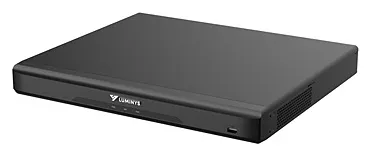
Manufacturer product photo: a slim desktop recorder of the size that fits on a shelf in a cottage utility closet.
Speak to a Putnam Recorder Tech
Ask about a cellular backup for the lake house, a recorder for your road association, or moving off a Hikvision or Dahua box — the person who plans the job answers (845) 640-3835.
Keyless entry and gate control for houses that stand empty.
Field Notes
Field Notes: Start at the Breaker Panel, Finish at the Road
On a Putnam walkthrough the first thing I look at is not a camera position. It is the electric panel and the modem. I want to know which circuit the recorder will share, whether a generator transfer switch is there or planned, where the internet comes into the house, and whether the modem and the recorder can sit on the same battery. If those three things are in different corners of a fieldstone basement, that changes the whole plan.
Then I walk the property with a measuring wheel. Every camera the owner wants gets a route — along the foundation, up into the attic and across, overhead to the garage, in conduit down to the dock. I note where the ledge breaks the surface, where the ground stays wet in spring, where a tree has been half the camera's view for years. A route that sounds simple from the kitchen is often the one that needs a wireless link.
The last thing I do before leaving is stand at the road and ask the owner a plain question: if something happens here at four in the morning while you are in the city, what do you want to see, and how fast? The answer decides which cameras record all the time, which ones alert, and where the battery has to carry them. The recorder is chosen after that, and it is usually the easiest part.
— Owner, NYS license #12000287431
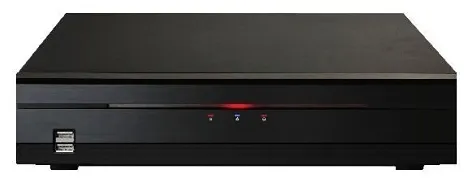
Manufacturer product photo: a desktop recorder with its status lights on the front. On handover we show you what each light means, so a glance tells you whether it is recording.
FAQ
Putnam County NVR Installation FAQ
Scheduling, guests, storms, old drives and running costs: the everyday questions owners raise once the big decisions are made.
We have a place in the city and the house in Putnam — can both recorders show up in one app?
+
Usually, yes, if both recorders are from the same maker or support the same viewing app. Most recorder apps let one login hold several sites, so the city apartment and the Putnam house appear as two locations with their own cameras, alerts and playback. Each recorder still keeps its own video locally, and each site's internet decides how well its cameras stream. If the city system is a different brand, we can often still add both to one app that supports common camera standards, or set up the Putnam recorder so it sits beside the other in your phone with clear names. We check this before choosing the Putnam recorder, so a brand decision now does not leave you juggling two apps later.
If the router has to move into the recorder's closet, will the Wi-Fi in the rest of the house suffer?
+
It can, which is why we rarely move the router just to be near the recorder. Wi-Fi from a router shut in a closet, behind a stone wall or down in a basement often gets weaker in the rooms you actually use. The recorder only needs a single network cable to the router, so the usual answer is to leave the router where the Wi-Fi works and run one cable between the two. If both really must share a closet, a separate wireless access point on the main floor, fed by a cable from the closet, keeps the house covered. Either way the modem, router and recorder go on the same battery backup.
Can you work with the electrician installing our generator transfer switch so the recorder circuit is on the backed-up panel?
+
Yes, and it is worth doing at the same time. We tell your electrician which outlet the recorder, PoE switch, modem and router will use, and ask for it to be on a circuit the transfer switch carries. The battery backup then covers the gap between the power failing and the generator starting, and the generator carries the system for as long as it runs. The new outlet and the transfer switch are electrical work for a Putnam-licensed electrician; we handle the low-voltage side and test the whole chain together.
We rent the house to weekend guests — how do we keep them away from the recorder, and what should they be told about the cameras?
+
Put the recorder in a locked closet or a locked cabinet with ventilation, on an outlet that is not in a guest room, and give it a camera that watches the cabinet door. Guests should never be able to unplug it by accident or switch it off on purpose. Tell guests in the listing and in the house exactly where every camera is, keep cameras outside or at entrances only, and never put a camera in a bedroom, bathroom or any room guests use privately. Rental platforms have their own camera rules, so check the current rules for the one you use before guests arrive.
What happens to the hard drive inside the old recorder you take away?
+
You decide. Before we remove an old recorder we ask whether it holds footage you still need; if it does, we export it or leave the drive with you. If you want it gone, we can wipe the drive, or remove it and hand it to you to keep or destroy, so the old recordings cannot be read by whoever ends up with the box. Old recorder removal is $73 on the Putnam price list.
If someone steals the recorder, can they play back what is on it?
+
A password stops someone using the recorder's own menus, but a determined thief who takes the drive out can sometimes read it with the maker's software. That is why the defence is mostly about the recorder not leaving: hide it, lock it, put a camera on it, and copy the clips that matter to a second device elsewhere in the house or to storage you control. We also change every default password and turn off features you do not use, which makes the recorder harder to get into over the network as well.
How often does the recorder's battery backup need a new battery?
+
Every few years, depending on the model, the heat in the room and how many outages it has carried. Most battery backups run a self-test and show a warning light or sound an alarm when the battery is weak, and many can send that warning to the recorder or your phone if they are connected to the network. We note the battery model and the install date on your handover sheet, and if your system includes a maintenance visit we test the backup under load rather than trusting the light. In a county where long outages are common, a tired battery is the part most likely to let the recorder down.
Do you cover the whole county — Garrison and Continental Village as well as Brewster and Putnam Lake?
+
Yes. We install recorders in all six Putnam towns and the villages of Brewster, Cold Spring and Nelsonville, from Garrison and Continental Village on the Hudson side to Putnam Lake and Peach Lake on the Connecticut side. The same prices apply across the county. If your property sits on the Westchester or Dutchess line, tell us the address and we will confirm which county page and price apply.
What should we do to get the house ready for install day?
+
Very little. Clear a path to the electric panel, the modem or router and the room where the recorder will live, and to the attic hatch or basement areas where cable will run. Move cars away from the walls and the garage door where outdoor cameras will mount. Keep pets in a room we will not need. If the house is a weekend place, make sure the heat and power are on and someone can let us in. Have your Wi-Fi name and password ready, and the phone you want the app on. We bring ladders, drop cloths and everything else.
How much electricity does a recorder and its cameras use running all year?
+
Less than most people expect, though it varies by model. A small eight-channel recorder can be rated at only a few watts — one popular model lists six watts or less, before drives and cameras — and each PoE camera adds its own draw, which is higher at night when its infrared lights are on. We add up the figures from each spec sheet when we size the battery backup, and we can give you that total in writing so you know what the system costs to run.
All Areas Served
NVR Installation Across the Hudson Valley, New York City and Long Island
Putnam is one of six counties covered by our Hudson Valley NVR installation hub, where the counties are compared side by side. The links below go to each recorder page we keep for the valley, the five boroughs and Long Island.
Each figure, rule, product rating and news report above traces to one of these links. Our own prices apply the blueprint's 1.45 Putnam factor to the New York City base. Where the page says what we do, that is house practice, not a legal requirement.
Nothing here is legal advice. Questions about what you may record, a neighbour's complaint, licensing or renting the house belong with an attorney or the county or town office concerned.
Recorder Silent Since the Lights Came Back? Call the Putnam Line
An empty weekend house that has dropped off your phone, a grid of blank cameras after the wind, a "No HDD" message — ring (845) 640-3835. Footage on the drive is copied off before anything is touched; most recorders are recording again within one to two hours of arrival.
Putnam Recorders From a Licensed, Insured Team
Abstract Enterprises Security Systems — call or text Putnam jobs on (845) 640-3835; WhatsApp (718) 679-0359; office and mailing address 460 E Fordham Rd, Bronx, NY 10458
Customers rate us 4.6★ across 390+ Google reviews. New York State low-voltage license #12000287431, full insurance on each Putnam installation, and estimates the day you ask.
Makers stand behind their own recorders, drives and cameras as well, and we register that cover in your name where the manufacturer allows it, so a failed drive two winters from now is a warranty claim rather than a surprise bill. Full terms — including 50% deposit, the 30-day warranty and optional paid extended warranty, and the late-fee schedule — are set out in the service agreement. Read our warranty page.
Page reviewed and updated October 18, 2026. Changelog: Putnam County NVR page rebuilt from new research on the county's local-control plate-reader policy, theft-crew and break-in reports, Isaias outages by town, lightning, flooding, broadband, Chapter 145 licensing and Cold Spring's review board, on the NYC NVR base prices at the Putnam area factor.