Sized for the Building · Built to a Written Spec · Footage Someone Else Can Trust
A Westchester recorder rarely answers only to the person who paid for it. In a new Yonkers or New Rochelle rental tower it answers to a management company and its auditors. In a Central Avenue store it answers to a district manager, an insurer and whichever of the county’s police agencies takes the report. In a licensed dispensary it answers to a state regulator who can ask to see the cameras at any hour. We design the NVR around the people who will judge it — how many cameras and floors it must hold, how long it must keep video, what it must log, and who must be able to rely on a clip — and then choose the box, the drives and the cable to meet that spec.
Reviewed and updated October 18, 2026 · Abstract Enterprises Security Systems, owner, NYS license #12000287431 · Westchester work dispatched from 460 E Fordham Rd, Bronx, NY 10458
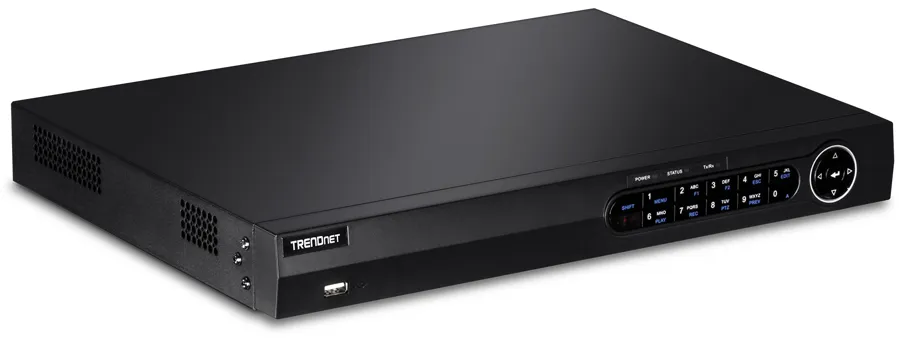
Manufacturer product photo: the front of a sixteen-channel 4K network video recorder, with playback keys and a USB port for exports. Sixteen channels is where many Westchester store and small-building systems start.
Westchester NVR Quote
Tell us the property, the town and roughly how many cameras — a written price follows the same business day
✅
Request Sent!
An installer will call you back about the Westchester recorder the same business day.
25+
Years Experience
✓
Same-Day Estimates
100%
Licensed & Insured
4.6★
390+ Google Reviews
A Westchester recorder quote starts with one question: who has to be satisfied by the footage? A building manager, a franchise owner, an insurer, the Office of Cannabis Management or just your family each set a different number of days, a different clock standard and a different list of who may log in. Tell us that, the town, and a camera count, at (914) 877-2578, and we can tell you on the first call which size of recorder the job needs.
Westchester eight-channel recorder builds start at $813 with the PoE and drive; each new camera line is $219
Video kept on drives at your property, so there is no storage subscription to pay each month
Written estimates the day you ask, from a crew licensed by New York State (#12000287431)
A network video recorder is the box at the end of every camera cable: it takes each stream, writes it to surveillance drives, lets you search and play it back, and hands a clip to whoever needs it. In most places the hard part of an NVR job is the camera wiring. In Westchester the hard part is usually the specification — because so many of the county’s recorders are bought by one party and judged by another.
Start with housing. The Census Bureau’s 2023 five-year survey counts 391,861 homes in Westchester, and 66,378 of them sit in buildings of fifty or more units — a large share for a suburban county. That figure is still climbing. New Rochelle’s downtown rezoning of December 2015 has, by Governing’s 2025 count, put more than 4,500 new units online with another 6,500 on the way, and the magazine quotes the city’s leadership saying 11,000 units have been authorised downtown. On the Yonkers waterfront, News 12 reported in June 2025 that the first two of six rental buildings at Hudson Piers — described by officials as the final and largest piece of the downtown waterfront revitalisation — had opened. Those buildings arrive with telecom rooms on every floor, fob-controlled doors, parking decks, package rooms and amenity floors, and a management company that will want one coherent recording system rather than a box per lobby. Sizing that recorder, deciding where it lives in the building’s network, and tying it to the door system are the decisions that make or break it.
Then the corridors. Central Park Avenue runs about eight and a half miles from Yonkers through Greenburgh toward White Plains; the Boston Post Road carries U.S. Route 1 through New Rochelle, Larchmont, Mamaroneck, Rye and Port Chester; Mamaroneck Avenue and Main Street hold downtown White Plains together. The stores, restaurants and medical offices along them are where Westchester recorders get tested. In July 2026 News 12 reported that security video showed two people breaking through the front doors of a family-owned restaurant on Huguenot Street in New Rochelle at about 3:30 in the morning, heading straight to the office and emptying the safe of more than $30,000. In September 2026 Yonkers police said surveillance video from a parking garage on Warburton Avenue and from nearby stores linked two people to a string of car break-ins. In both stories the video existed; what matters to an owner is whether their own recorder would have kept it, timed it correctly and produced it quickly. With forty-five separate local police agencies in the county, plus the county police and its Real Time Crime Center in Hawthorne, the clip also has to play on whatever laptop the investigating officer carries.
The newest test is regulatory. Adult-use cannabis dispensaries now trade in several Westchester cities — on Central Avenue in White Plains, Yonkers Avenue in Yonkers and North Avenue in New Rochelle among them — and New York’s rule for them, 9 NYCRR §125.3, reads like a recorder specification: continuous recording during business hours, at least sixty days kept, time stamps synchronised to the national time standard, remote access for the state on request, an alert within five minutes of any failure, and at least eight hours of operation through a power cut. A recorder that would be fine in a deli fails that rule on day one. And at the other end of the county, the estates of Bedford, Pound Ridge, Scarsdale and Rye bring household staff, wine rooms and long driveways — and New York’s limits on where an employer may record.
Most Westchester owners who add a recorder also review access control on the building’s doors, because the NVR and the fob system are most useful when one can search the other. We plan both on the same walkthrough when it saves a second visit.
Westchester facts that shape a recorder job
Big buildings are a big share of the stock. Of 391,861 Westchester housing units in the Census Bureau’s 2023 ACS five-year estimates, 66,378 are in buildings of 50 or more units, and the median home was built in 1958.
New towers keep coming.Governing (October 2025) reports more than 4,500 new downtown New Rochelle units online and 6,500 more on the way since the 2015 rezoning; Hudson Piers in Yonkers opened its first two of six rental buildings in June 2025.
Many police agencies, one county crime center. Westchester has forty-five local police agencies; the Westchester–Putnam Real Time Crime Center, run by the county police, uses surveillance cameras and licence-plate readers to monitor criminal activity in real time.
Dispensaries have a written camera rule. 9 NYCRR §125.3 requires sixty-day retention, NIST-synchronised time stamps, a five-minute failure alert and eight hours of power-outage operation.
The Sound Shore floods. During Ida in September 2021, ABC7 reported up to 14 feet of water in parts of Mamaroneck and Mamaroneck Avenue completely covered; the Army Corps of Engineers describes a severe, recurring flood risk along the Mamaroneck and Sheldrake Rivers.
Contractors are licensed by the county. Westchester’s Department of Consumer Protection licenses home improvement contractors and keeps online search tools for them and for licensed plumbers and electricians.
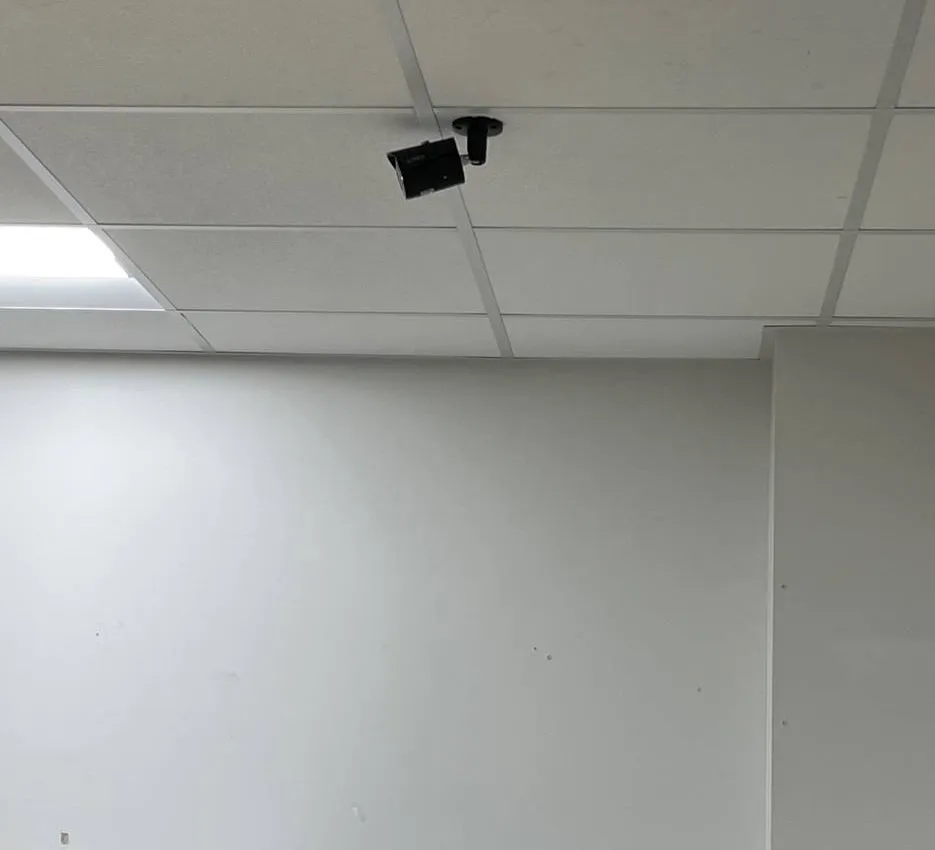
Photo from an AESS job outside Westchester, shown as an example: a bullet camera dropped from the ceiling grid on a short pendant. Every camera like this is one channel and one cable back to the recorder, which is why the camera count sets the recorder size.
Same-Day Help When a Westchester Recorder Stops Recording or Loses Time
If the recorder is beeping, a tile has gone black, playback has gaps, or the clock on the screen is wrong, call (914) 877-2578. We book the earliest window the same day where we can, and most recorder faults are writing video again within one to two hours of arrival. The first job on site is always to protect what is already recorded.
What to do in the meantime
Do not reformat or factory-reset anything. If something happened in the last few days, tell us; we export it before any repair.
Write down the time the screen shows and the real time. If they differ, every clip since the last outage is off by the same amount, and we can document the offset for a claim or a police report.
Check whether the dark cameras share a floor or a closet. In a tower, a group of cameras dropping together usually means one floor’s switch, not the recorder.
For a dispensary, follow your security plan’s failure steps. The state rule expects a failure alert within five minutes; keep the alert and note what you did.
These are the pieces of work that make up most Westchester recorder jobs. A single store needs two or three of them; a new tower can need all nine.
Recording Design for New Buildings
For towers in Yonkers, New Rochelle and White Plains: camera schedule, channel count, central or per-floor recording, rack space and power in the telecom rooms, worked out from the low-voltage drawings before the ceilings close.
Recorders Sized to a Written Retention Target
We start from how many days you must keep and at what quality, then calculate drives. A 60-day dispensary, a 30-day store and a 14-day family home get very different boxes.
Door-Event and Fob Integration
Where the access-control system supports it, the recorder bookmarks video on door events, so a manager can jump from “fob 214 opened the garage at 2:10 a.m.” to the clip.
Register and POS Text Overlay
For corridor stores and restaurants, the sale or void from the register printed over the counter camera’s video, searchable by amount or keyword where the recorder supports it.
Multi-Site Recording for Store Groups
Several Westchester locations on one viewing station or app, each recorder keeping its own video on site, with regional managers seeing only their stores.
Dispensary Recording to 9 NYCRR §125.3
Continuous recording in business hours, sixty-day storage, NIST time sync, five-minute failure alerts, eight-hour outage runtime and a locked surveillance room, documented for your security plan.
Flood-Aware Placement on the Sound Shore
In Mamaroneck, Larchmont, Rye and Port Chester ground floors, the recorder goes above the last flood line and the UPS with it, not under the counter.
Estate and Household-Staff Recording Plans
For larger homes in Bedford, Pound Ridge, Scarsdale and Rye: which interior cameras record, which do not, audio off, and staff areas kept out of frame.
Locked-Out Recorder Recovery
A recorder inherited with a house or a business and nobody’s password: we try the maker’s owner-reset route, save what can be saved, and replace the box when it cannot be trusted.
Retail product photo of a packaged system: one recorder, four bullet cameras and a monitor. Packages like this fit a small shop; a Westchester tower or dispensary is designed camera by camera instead.
Building Specialists
NVR Systems for Westchester County’s Architecture
Westchester has almost every building type in the region inside one county line: glass rental towers by the train stations, mid-century elevator co-ops, garden complexes, strip centres and old main-street storefronts, and houses on several acres. The recorder that suits one is wrong for the next. These are the types we plan for most often.
New Rental and Condo Towers
Downtown New Rochelle, the Yonkers waterfront and central White Plains. Telecom rooms (IDFs) on each floor feed a main room (MDF); the recorder belongs in the MDF rack on its own circuit, fed by camera switches on each floor, with door events from the fob system.
Mid-Century Elevator Co-ops
The county’s median home dates from 1958, and many of its larger co-ops along Central Avenue, in Hartsdale, Bronxville, White Plains and Yonkers are of that era: masonry, a basement with a super’s office, and decades of abandoned coax. A boardroom-friendly retention policy matters as much as the box.
Garden Apartment Complexes
Two- and three-storey buildings spread across a lawn, with separate basements and no shared ceiling. Distance between buildings, not camera count, decides whether one recorder works or each building keeps its own.
Strip Centres and Pad Sites
Central Park Avenue and the Boston Post Road are lined with them. Each tenant’s recorder usually sits in a back office or electrical room shared with the landlord’s gear, and the parking lot belongs to someone else.
Main-Street Storefronts
Mamaroneck Avenue, Main Street in White Plains, North Avenue in New Rochelle, Warburton and Yonkers Avenues: narrow shops with a basement below, sometimes a flood-prone one, and an office where the safe and the recorder too often share a shelf.
Estates and Large Houses
Bedford, Pound Ridge, North Salem, Armonk, Chappaqua, Scarsdale and Rye: a mechanical room or an integrator’s AV rack, household staff, wine and art rooms, and the owner away for long stretches.
How the recorder plan changes by building
Building
Where the recorder usually goes
What decides the size
What we add
New tower
Main telecom room (MDF), in the rack, on a dedicated circuit
Total cameras across lobby, garage, amenity floors and roof; retention the manager sets
Per-floor PoE switches, door-event links, a second drive set or failover recorder for large counts
Elevator co-op
Basement office or the building’s small network closet
Common-area cameras and the board’s retention policy
Removal of dead coax, labelled home runs, written viewing rules
Garden complex
Management office, with small switches in each building basement
Distance between buildings
Fibre or wireless links between buildings where cable cannot reach
Strip-centre tenant
Back office or tenant electrical room, in a locked cabinet
Store cameras plus any lot cameras the lease lets you add
Register overlay, multi-site viewing
Main-street shop
Upstairs office or a raised shelf, never the flooded basement
Counter, door, stock room and street
UPS above flood height, a camera on the recorder’s door
Estate
Mechanical room or AV rack with ventilation
Gate, drive, outbuildings and the rooms the family wants covered
Interior recording rules for staff, separate family and estate-manager logins
Method details by building type
Towers: we ask for the riser diagram and the IDF/MDF plan first. Camera switches go in the floor closets; only one uplink per floor travels the riser to the recorder, which keeps the riser sleeves free for the building’s other systems.
Co-ops: abandoned coax is identified and labelled before any new pull, because many 1950s and 1960s buildings already have their chases full of it.
Garden complexes: where buildings are more than one cable run apart, we use fibre or point-to-point wireless between them and keep each building’s cameras on a local switch.
Strip centres: we get the landlord’s written permission for anything mounted on the façade or in shared rooms before the job is priced.
Sound Shore shops: the recorder and the UPS are mounted above the highest water line the owner or the building remembers, with the cable coming down to it rather than up from the floor.
Estates: the recorder goes in a ventilated cabinet or rack slot with a temperature alert, and interior cameras are agreed room by room before anything is mounted.
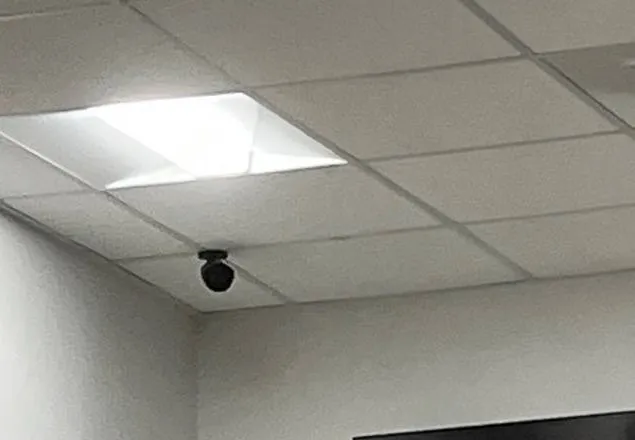
Photo from an AESS job outside Westchester, shown as an example: a dome camera at the edge of a high drop ceiling. Tall lobby walls like this are common in new Westchester rental buildings, and each one adds a channel to the recorder plan.
Commercial NVR Installation
Business NVR Installation in Westchester County
Business recorders in Westchester sit along a handful of corridors. Each has its own mix of tenants and its own reasons for wanting video, and that mix sets the recorder spec.
Central Park Avenue
About eight and a half miles from Yonkers through Greenburgh toward White Plains, lined with shopping centres, car dealers, restaurants and chain stores. Multi-site viewing and register overlay are the common asks.
Boston Post Road (U.S. 1)
Through New Rochelle, Larchmont, Mamaroneck, Harrison, Rye and Port Chester to the Connecticut line. Restaurants, car washes, medical offices and family businesses with a safe in the back office.
Downtown White Plains
Main Street and Mamaroneck Avenue, the courthouses and the office towers around them. Recorders here often sit inside a building’s network managed by an IT company or the landlord.
The Platinum Mile
The I-287 stretch of Westchester Avenue from White Plains to Rye Brook, where office parks are being converted to medical use. Suites need their own recorder or a clear agreement about the landlord’s.
Yonkers Shopping Districts
Cross County Center, which opened in 1954 as one of the country’s first open-air shopping centres, Ridge Hill, and the Getty Square and Yonkers Avenue main streets. Store groups and food businesses with long hours.
Licensed Dispensaries
Shops on Central Avenue in White Plains, Yonkers Avenue in Yonkers, North Avenue in New Rochelle and elsewhere, recording to the state’s written security rule and inspected against it.
Across all six, the same three questions decide the recorder: how many days must be kept, who needs to see video from somewhere other than the store, and where the box can sit so that a burglar heading for the office or a flooded basement cannot take the evidence with it.
The July 2026 burglary News 12 reported on Huguenot Street is a useful planning case. The video showed the pair breaking through the front doors and going straight to the office where the safe was kept. In plenty of corridor restaurants and shops the recorder sits on a shelf in that same office, sometimes on top of the safe. Had the burglars pulled the box instead of the cash, the owner would have lost both. For a business that keeps cash on site, we put the recorder somewhere other than the safe room — a locked cabinet in a stock room, a high bracket in a utility closet, a ceiling-height enclosure — give it a camera of its own, and send the owner a phone alert when the recorder goes offline outside business hours. A recorder disappearing at 3:30 a.m. is itself an alarm, and the clips already viewed live on the owner’s phone in those minutes are the ones that survive.
Medical and professional suites along the Platinum Mile and in downtown White Plains add a different constraint: reception and waiting-room cameras must not take in screens, files or treatment rooms. There we set privacy masks on the recorder before the system goes live and agree in writing which areas are recorded at all.
Compliance callouts for Westchester businesses
State installer licence. Installing and servicing CCTV for intrusion and theft is licensed work in New York under the Department of State’s security and fire alarm installer rules (Article 6-D; 19 NYCRR §195.2). AESS works under NYS license #12000287431.
County licensing. Westchester’s Department of Consumer Protection licenses home improvement contractors for work on homes of up to three units (County Code Chapter 863, Article XVI), licenses plumbers and electricians separately, and publishes search tools for both. Any new outlet or circuit for a recorder is an electrician’s job.
Dispensary security rule. 9 NYCRR §125.3 sets out the video requirements for licensed cannabis businesses, including sixty-day retention, NIST-synchronised date and time stamps, a five-minute failure alert, eight hours of outage operation and locked surveillance rooms.
Employee privacy. New York Labor Law §203-c bars an employer from video recording employees in a restroom, locker room or changing room except by court order.
Audio. New York Penal Law Article 250 makes recording a conversation without at least one party’s consent a felony; we leave camera microphones off unless you decide otherwise in writing.
Covered brands. The FCC’s order effective July 16, 2026 stops continued import and marketing of previously authorised covered equipment; it does not require private owners to remove recorders they already use. We tell you before quoting if a recorder model is affected.
Tax credit. New York’s Commercial Security Tax Credit can cover up to $3,000 per retail location for qualifying small retailers with 50 or fewer employees; ask your accountant whether you qualify.
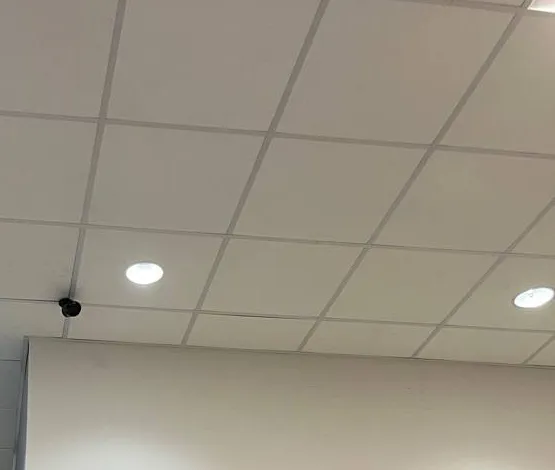
Photo from an AESS job outside Westchester, shown as an example: a compact camera set into a store’s ceiling grid between recessed lights. Small cameras like this are easy to miss, which is why a store’s channel map on the recorder matters.
Your Questions Answered
NVR Installation in Westchester County: Questions Answered
These are the recorder questions Westchester property managers, store owners, dispensary operators and homeowners bring to us, grouped by the situation behind them. Prices are in the pricing section further down, and the equipment section explains the types of recorder.
New Towers in Yonkers, New Rochelle and White Plains
Our new New Rochelle tower has a telecom closet on every floor — should each floor get its own recorder, or should everything record in one place?
In almost every building we see, one place. A recorder per floor sounds tidy on a drawing, but it multiplies the things that fail and the things someone must check: eighteen sets of drives, eighteen admin passwords, eighteen firmware versions and eighteen boxes to search when an incident crosses the lobby, the elevator and the garage. Building staff end up searching floor by floor, and the one recorder nobody looked at for a year is the one that stopped writing.
The arrangement that works is to put the camera switches in the floor closets and the recording in the main telecom room. Each floor’s cameras plug into a PoE switch in its own closet, which powers them and gathers their streams onto a single uplink. That uplink travels the riser to the main room, where one recorder — or for a large count, a pair of recorders or a server with a failover unit — writes everything. The building gets one timeline, one search, one set of logins and one place to check drive health.
There are exceptions. A separate retail or medical tenant on the ground floor usually wants its own recorder in its own space, because its video is its business, not the landlord’s. And a parking deck under a separate structure, with no conduit to the main room, may justify a small recorder of its own until a link can be built. We draw those boundaries on the riser diagram before anyone orders hardware.
The building’s fob system logs every door swipe — can the recorder line those swipes up with the video?
Often, yes, and in a new building it is one of the most useful things a recorder can do. Many access-control platforms can send door events — a fob granted, a fob denied, a door held open, a door forced — to a recorder or video system that supports the same integration. The recorder then marks the video at that moment, so a manager can open an event list, click “door forced, garage stair, 2:14 a.m.” and see the clip instead of scrolling through a night of footage.
Whether it works depends on the two products, not on the building. Some door systems and recorders from the same maker link out of the box; others talk through a published integration or a small connector license; some do not talk at all, and the only link possible is a contact closure that tells the recorder “something happened on input 3.” We check the exact models during design, before the door contractor and the camera contractor each assume the other will make it work.
Where they cannot integrate, two habits get most of the value: the recorder and the door controller take their time from the same internet time source, so a swipe at 2:14:07 on one matches 2:14:07 on the other, and each door with a reader gets a camera positioned to see the face of whoever presents a fob. Then a manual search is quick even without the link.
Our management company already runs a video management platform at its other buildings — should this one get a standalone NVR or join that system?
If the company has a real platform — a video management system that its security or operations team actually logs into across properties — joining it is usually right, because the value is in one interface and one set of policies. In that case the “recorder” at this building may be a server running the company’s software, or an NVR that the platform can enrol, and we install and configure to that company’s standards rather than ours.
What changes is licensing and support. Video management software is commonly licensed per camera, so a 120-camera tower carries a software cost a standalone NVR does not, and someone at the management company has to own updates and user accounts. A standalone NVR is simpler and cheaper but leaves that building as an island: separate app, separate passwords, and no portfolio-wide search.
We ask three questions before recommending either: who will search video at this building day to day, does the company’s platform support the camera models specified, and who pays and renews the licences. If the answers are “the on-site staff,” “not yet” and “nobody has decided,” a standalone recorder that can later be enrolled in the platform is the safer start.
Can the cameras inside our tower’s elevator cabs record to the same NVR as the lobby?
Yes, but the hard part is getting the signal off a moving car, not the recorder. An elevator cab has no fixed cable to the building; anything that reaches it travels in the elevator’s own travelling cable, which belongs to the elevator contractor and is often already full, or crosses the shaft by a small wireless bridge designed for the purpose. Either way the elevator maintenance company has to be involved, because work in the hoistway and on the car is theirs to approve and usually theirs to do.
Once a link exists, the cab camera is just another channel. We give it its own name and position on the channel map, include it in the retention calculation, and line its clock up with the door system so a fob swipe in the lobby and the ride upstairs can be followed in order. Many managers also want the cab view on the concierge monitor alongside the lobby and garage.
For a building still under construction, ask the elevator contractor now whether a spare pair or a camera-ready travelling cable is included. Adding one after the cars are in service costs far more than specifying it on the drawings.
Residents say parcels keep disappearing from our Yonkers building’s package room — what should the recorder be set to capture there?
Faces at the door and hands at the shelves. A single wide camera in the corner of a package room shows that someone was there, but rarely who or what they took. The pattern that works is one camera inside the entry door at head height, so everyone who comes in is seen face-on, and one or two cameras looking down the shelf rows, so you can see which shelf was touched. If the room has a fob reader, its door events should mark the video, so a search for “who entered between 1 and 3 p.m.” starts from a list instead of a scroll.
On the recorder, package-room cameras usually record continuously during the day, when deliveries and pickups happen, because the moment someone lifts a box is short and easy to miss on motion settings. Retention should cover the time it takes a resident to notice and report a missing parcel — which is often longer than a week — and the management office needs a login that can lock and export without being able to delete.
Keep the cameras on the room, not the hallway beyond the door or any apartment entrance. A package room camera that looks into a resident’s doorway causes more trouble than the parcels it protects.
Corridor Stores and Restaurants
A slip-and-fall claim letter reached our Central Avenue store six weeks after the fall — why was the clip already gone, and how do we keep the next one?
Because the recorder did exactly what it was set to do: keep video until the drives filled and then write over the oldest days. Many small-store recorders hold two to four weeks, sometimes less once cameras are upgraded to higher resolution, and claim letters, lawyers’ preservation requests and insurance adjusters routinely arrive after that window has closed. Unless someone saved the clip on the day, it is gone.
Two changes fix most of it. First, we size the drives to a written target that reflects how late your claims tend to arrive — for many Westchester stores that means longer than a month on the cameras over the entrance, the floor and the counter, even if back-room cameras keep less. Second, staff are shown how to lock a clip: most recorders let you mark a segment as protected, or export it the same day, so it survives the loop. An incident report form that includes “camera clip locked: yes/no” makes that a habit rather than an afterthought.
Where a store has frequent claims, we also give the manager a login that can lock and export but cannot delete or change settings. If a dispute ever turns on whether video was preserved, a log showing who locked what, and when, is worth more than the clip alone.
Can the recorder show the register transaction on top of the video at our Boston Post Road store?
Usually, with the right pieces. Many NVRs accept text from a point-of-sale system — items, totals, voids, no-sales, refunds — and lay it over the camera aimed at that register, synchronised to the moment it happened. Some can then search the text, so a manager can find every void over a set amount or every “no sale” at register 2 last week and jump straight to the video of each one.
How the text gets to the recorder depends on the register. Older systems send a receipt-printer stream that a small interface box can copy; newer ones send data over the network if the recorder supports that format; some cloud-based registers offer no output the recorder can read, in which case the match is made by time instead. We check the register model and the recorder model together before promising the overlay.
Two practical points. Customer card numbers should never appear in the overlay, so we filter or mask them at the interface. And the counter camera needs to see hands, cash drawer and screen, not just faces — so it is usually mounted higher and further back than people expect, with a second camera on the customer side.
Our district manager oversees six Westchester stores — can one screen show all six recorders without six separate apps?
Yes, if the recorders are chosen for it. Most recorder makers offer a central viewing program or app that can hold many sites, and enterprise platforms go further with alarms, health dashboards and user groups across locations. The rule that makes it work is to use one recorder line across the stores, so every site appears in the same tool with the same menus, the same export steps and the same user model.
Each store still records locally. Its recorder keeps its own days on its own drives, so a bad internet day at the Yonkers store does not stop the Port Chester store recording. The central screen pulls live view and playback when someone asks for it; we set each site’s remote stream to a lighter profile so six stores can be viewed on a normal office connection.
Permissions matter more than the screen. The district manager sees all six; each store manager sees only their own store; the owner holds the admin account; and the installer’s account is removed or disabled at handover unless you ask us to keep one for support. When a store is sold or closes, its recorder is removed from the group in one step rather than living on in someone’s app.
The landlord of our Central Park Avenue strip centre records the parking lot — how do we make sure we can get that video when a customer’s car is hit?
Settle it before you need it, because the lot cameras belong to the landlord and so does the recorder they feed. When a customer comes in saying their car was dented in the lot, the tenant usually discovers that the landlord’s managing agent answers requests slowly, keeps footage for only a short time, or will release it only to police. By the time anyone looks, the loop has written over the afternoon in question.
Three things help. Ask, in writing, how long the landlord’s recorder keeps lot video and who handles requests; if the lease is being negotiated or renewed, ask for a clause that sets a request process and a minimum retention. Ask whether the landlord will give tenants a view-only login limited to the cameras facing their storefront and parking rows — many recorders can do that without exposing anything else. And put your own camera at your door, recorded on your own NVR, looking out at the nearest parking rows from inside the glass, so the moments closest to your business are always yours.
Do not run your cameras onto the landlord’s recorder, or theirs onto yours, without a written agreement about who owns the video and who may export it. Shared recorders blur responsibility at exactly the moment a claim or a police request makes responsibility matter.
Manufacturer product photo: an eight-channel network video recorder with built-in PoE, so each camera is powered from the recorder over its own cable. A size that suits a single corridor store or restaurant.
Licensed Dispensaries
Our White Plains dispensary opens next quarter — what has to be finished on the recorder before the state inspects the shop?
The whole video side of your security plan, working and provable, because the rule leaves little to interpret. Under 9 NYCRR §125.3, video cameras must record continuously during hours of operation and whenever cannabis is handled, and on motion at all other times; recordings must be kept for at least sixty days; every recording must carry a date and time stamp synchronised to the National Institute of Standards and Technology standard without obscuring the picture; the licensee must make recordings available by remote access or login for immediate viewing by the Office of Cannabis Management on request, and provide unaltered copies when asked; recordings relevant to a known investigation or proceeding must be kept until it closes; and the storage device must be secured against tampering and theft.
The same section adds a failure notification system that alerts your designated representatives within five minutes of any failure, at least eight hours of operation for the alarm and video system during a power outage, and locked, limited-access surveillance rooms. In recorder terms that means: drives sized for sixty days of continuous video at the quality you need, not motion-only estimates; network time sync with the time zone and daylight rules set; a dedicated, locked room or cabinet for the recorder; email or app alerts for video loss, drive faults and recorder offline, tested; a power plan that holds eight hours; and a separate view-only login you can hand the Office on request.
Before an inspection we walk through each of those items with your manager, show a recording from the night before, trigger a test alert and log in with the view-only account. We document all of it — camera list, recorder model, drive capacity calculation, retention setting, alert recipients, UPS and generator runtime — in a form you can attach to your security plan. We are not your compliance counsel; read the current rule and your licence conditions, and have your consultant check the plan. What we make sure of is that the hardware does what the plan says.
The dispensary rule says the system must keep running for eight hours in a power cut — what does that take for the recorder and cameras?
Usually more than a single battery box under the desk. Eight hours is a long time for a recorder, a PoE switch powering every camera, the network equipment the alerts depend on, and the alarm panel. A battery sized for that whole load for eight hours is large and heavy; for many shops the realistic answer is a UPS that carries everything for the first stretch and a generator, or a building generator circuit, that takes over well before the batteries run down.
We start by measuring the actual load: the recorder’s draw, the PoE budget the cameras consume (more at night when infrared lights are on), the switch, router and modem, and anything else on the same circuit. From that we size the battery runtime and decide whether a generator transfer is needed, and we coordinate with your licensed electrician for any new circuit or transfer switch — that part is electrical work, not low-voltage work.
Then we test it. With the shop closed, we cut power at the breaker for the system and watch: cameras stay up, recording continues without gaps, the failure alert arrives, and the generator, if there is one, picks up. The test date and result go into your documentation. A runtime figure on a spec sheet is not evidence; a timed test is.
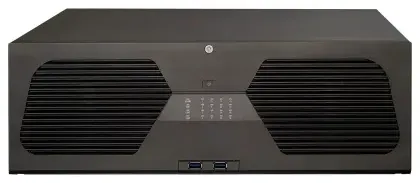
Manufacturer product photo: a larger recorder chassis built for many drives, with big front vents. Sixty days of continuous video from a full dispensary camera list needs this class of storage, and it needs that airflow kept clear.
Estates and Larger Homes
We have a housekeeper and a nanny at our Scarsdale house — which indoor cameras can the recorder keep, and where must there never be one?
Start with the hard line. New York Labor Law §203-c says no employer may cause a video recording to be made of an employee in a restroom, locker room or a room the employer designates for employees to change clothes, except by court order. If you employ household staff, that applies to you: no camera in a bathroom, and none in a room where staff change or sleep. We will not install one there, whatever the camera is for.
Beyond that, the decisions are yours, but we help you make them deliberately. Common areas — entrances, hallways, the kitchen, the playroom — are where most families choose to record. Audio is a separate matter: New York’s eavesdropping law makes recording a conversation you are not part of without consent a crime, so we leave camera microphones switched off in the recorder unless you decide otherwise with legal advice. Many families also tell staff in writing which areas are recorded; it is fairer, and it prevents disputes later.
On the recorder itself we set interior cameras to a shorter retention than exterior ones if you prefer, give the household manager a login that sees only outdoor cameras, and keep the interior channels on the family’s own accounts. Privacy masks can black out any part of a frame — a staff bedroom door left open, a neighbour’s window — so it is never recorded at all.
We bought a house in Scarsdale and the previous owner’s recorder is locked — can anyone get into it, or does it have to go?
Sometimes it can be recovered, and sometimes it should go even if it can. Most recorder makers have an owner-reset route: a code generated from the serial number and date, a reset through the maker’s app with the recorder on the network, or a reset key file. Some of those routes require the original owner’s account or email; some go through the maker’s support line with proof of ownership. We try the legitimate route for that brand first and never use unofficial firmware or “unlock” tools.
Even when we get in, we treat the box as untrusted. We check the firmware age, look for user accounts and remote-access services we did not set up, see which cloud account it is still tied to, and check whether it is a model affected by the 2026 FCC import rules. If the previous owner can still see your cameras from their phone, the recorder is unbound from their account or replaced.
If it cannot be recovered or cannot be trusted, the cameras often can be kept: a new recorder adopts working IP cameras and the house keeps its wiring. The old drives are wiped or physically destroyed, at your choice, so the previous owner’s video does not travel with the junk.
Licences, Police Requests and Plate Readers
How do we check that a camera company is properly licensed in Westchester before it opens our recorder?
Use the public lookups. For the state licence that covers CCTV installation, ask the company for its New York Department of State security and fire alarm installer licence number — ours is #12000287431 — and check it with the Department of State. For home work, Westchester’s Department of Consumer Protection keeps an online search of licensed home improvement contractors, and a separate search for licensed plumbers and electricians, with a helpline at (914) 995-2155 on the county’s licensing page.
Which county licence applies depends on the job. The county’s home improvement law covers homes of up to three units and exempts alarm work done by a county-licensed alarm business; a new outlet or circuit for the recorder needs a county-licensed electrician; commercial and large multifamily buildings fall outside the home improvement definition entirely. If a company cannot tell you which licence covers your specific job, that tells you something too.
Also ask for a certificate of insurance naming you or your building, and check whether the county clerk shows judgments or liens against the business — the Consumer Protection site links to that search. None of this takes long, and it filters out most of the problems we are later called to fix.
Should exported clips be MP4 files or the recorder’s own format when a Westchester police department or an insurer asks for them?
Often both. An MP4 plays on almost any laptop, which matters when the request comes from one of forty-five local police agencies or an adjuster who will not install software. But converting to MP4 can drop the recorder’s embedded time data and its watermark, the features that let someone check the clip has not been altered. The state’s dispensary rule, for example, refers to a proprietary format that ensures authentication and guarantees no alteration has taken place.
Our default handover routine is: export the native file with the recorder’s player included, and an MP4 copy of the same minutes; note the camera name, recorder serial, start and end times and who exported it; and keep the original on the recorder locked until the request is closed. The person receiving it can watch the MP4 straight away and rely on the native file if authenticity is questioned.
Before handing anything over, confirm who is asking and what they need. A police request for a time window, a lawyer’s preservation letter and an insurer’s request are different things, and for anything beyond a routine police request it is worth a call to your own lawyer about what to provide.
Licence-plate readers are going up around our village — does our building still need its own camera on the parking entrance?
Yes, if you want the video to be yours. Westchester residents on Reddit have been debating the spread of Flock plate-reading cameras around the county, and the county police describe their Real Time Crime Center as monitoring criminal activity through surveillance cameras and fixed and mobile licence-plate recognition. Those systems belong to police and the municipalities that contract for them. You do not control what they capture, how long it is kept, or whether anyone will search it for your incident.
Your own entrance camera answers a different question: what happened on your property, at your gate or garage door, at a time you choose to search. It also catches what a road camera cannot — the person on foot, the car that tailgated in, the delivery left at the door. If plates matter to you, a dedicated plate camera on the entrance, aimed narrow and set for fast shutter at night, records them far more reliably than a wide overview camera.
Keep your camera on your own property line. We aim entrance cameras at your drive and doors, not across the street, and we mask neighbouring windows. That keeps the recorder useful and keeps you out of the privacy disputes that plate-reader debates tend to start.
Equipment
Types of NVR Equipment We Install
The recorder is one part of a chain. In Westchester we fit these categories most often, chosen per job for channel count, retention, integration and who has to use them.
Eight- and Sixteen-Channel PoE Recorders
Single stores, restaurants, houses and small co-ops. Cameras plug straight into the back of the recorder for power and video; simple to own and to hand over.
Thirty-Two to Sixty-Four Channel Recorders
Towers, larger co-ops and dispensaries, fed by separate PoE switches. Several drive bays, with mirrored or RAID storage where losing a drive must not lose video.
Video Management Servers
For management companies and store groups that run one software platform across many sites, licensed per camera, with central alarms and audit logs.
Floor and Building PoE Switches
In telecom closets on each floor of a tower or in each basement of a garden complex, so only one uplink per floor runs back to the recorder.
Surveillance-Rated Drives
Drives built for continuous writing, sized from each camera’s bitrate and the retention target — sixty days for a dispensary, a written number for everyone else.
UPS and Generator Interfaces
Battery backup for the recorder, switches and network gear, and where eight hours or more is required, a plan with your electrician for generator transfer.
POS Text Interfaces
Small boxes or recorder licences that take register data and lay it over the counter camera, with card numbers filtered out.
Access-Control Event Links
Integrations or input wiring that let door events bookmark the video, so a fob swipe and its clip are one click apart.
Plate-Reading and Overview Cameras
Narrow, fast-shutter cameras for garage and gate entrances beside wide cameras for the scene, both recorded on the same NVR.
A recorder you own compared with ADT, Ring and SimpliSafe
Question
AESS-installed NVR
ADT, Ring or SimpliSafe style service
Where video is stored
On drives in a recorder at your property, with optional off-site copies
Mostly in the provider’s cloud under a subscription plan, depending on the product
Retention you can set
Whatever the drives are sized for, in writing — sixty days or more where a rule requires it
Set by the plan you buy
Cameras per site
Eight to sixty-four or more on one recorder or server
Usually suited to houses and small shops
Integration with doors and registers
Planned per product: door events, POS overlay, plate cameras
Limited to that provider’s own ecosystem
Monthly fee for local recording
None
Typically a monthly plan for recording and monitoring features
Monitoring services have their place, and many Westchester homes run both an alarm contract and a recorder. The comparison above is about where the video lives and who decides how long it stays.
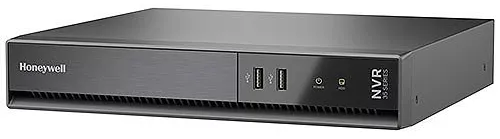
Manufacturer product photo: a compact desktop recorder with front USB ports. The front port is where most same-day exports for a claim or a police request are made.
AI Overview Reality Check
What AI Gets Wrong About NVR Installation in Westchester County
Google’s AI-generated answers were not reachable from the tools we research with, so nothing here is a quotation of them. What follows are seven ideas that keep appearing in consumer cost guides on Angi, HomeAdvisor and Fixr, in forum threads and in sales talk — each one checked against the rules and the building stock of this county.
1. “Motion-only recording is always the smart way to save drive space”
Motion recording saves space on a quiet camera in a quiet house. It is the wrong default in three common Westchester situations. A licensed dispensary is required by 9 NYCRR §125.3 to record continuously during hours of operation and whenever cannabis is handled, so motion-only settings during business hours would breach the rule.
A tower’s parking deck triggers motion all night — headlights, shadows, fans — so a motion setting saves little and can create gaps at the start of each event. And a store counter or entrance camera, where a claim might turn on the seconds before something happened, is better recorded continuously with motion events marked for search.
The sensible approach is per camera: continuous where a rule, a dispute or a busy scene makes it worth it, motion or smart detection elsewhere, and drives sized to the result rather than to a guess.
2. “Exporting an MP4 is all a court, insurer or regulator needs”
An MP4 is convenient, and often it is all anyone asks for. But the recorder’s native export typically carries its own time data and a watermark that lets the file be checked for alteration, and some conversions strip that away.
New York’s dispensary rule refers to recordings in a proprietary format that ensures authentication and guarantees no alteration has taken place. That is a regulator telling you, in effect, that a plain re-encoded copy is not the whole story.
Hand over both: a native export with its player for authenticity, an MP4 for convenience, and a short note of camera, times, recorder serial and who exported it. Keep the original locked on the recorder until the matter is closed.
3. “A bigger building just needs a bigger NVR”
Size matters, but structure matters more. A hundred-camera Westchester tower does not want one box with a hundred ports beside the camera that is furthest away; it wants switches in each floor’s telecom closet, one uplink per floor up the riser, and recording in the main room.
At that scale the questions become failover (what keeps recording if the recorder fails), storage protection (mirrored or RAID drives), and whether the owner’s portfolio already runs a video management platform the building should join.
The answer is a design drawn on the building’s riser diagram, not a larger model number. We start from the drawings and the management company’s standards before choosing hardware.
4. “Police plate readers make private cameras pointless”
Plate-reader networks are spreading in Westchester — residents have been arguing about Flock cameras on the county’s subreddit — and the county police’s Real Time Crime Center describes using fixed and mobile licence-plate recognition alongside surveillance cameras.
Those systems serve police. They do not record your lobby, your loading door or your driveway, you cannot search them, and you have no say in how long they keep anything. When the question is what happened at your property, the only video you control is your own.
Public plate readers and a private recorder answer different questions. Plan your own cameras for your own entrances, and if plates matter, add a dedicated plate camera rather than relying on someone else’s.
5. “Inside your own home you can put a camera anywhere”
Not if you employ anyone there. New York Labor Law §203-c forbids an employer from video recording employees in restrooms, locker rooms or rooms designated for changing clothes, except by court order. For Westchester households with a housekeeper, nanny or caretaker, the home is also a workplace.
Sound is a second limit. New York’s eavesdropping law (Penal Law Article 250) makes it a felony to record a conversation without the consent of at least one party to it. A camera microphone in a kitchen where staff talk on the phone can cross that line.
We plan interior cameras room by room, keep microphones off by default, and suggest families tell staff in writing which areas are recorded. This is general information, not legal advice; for a specific arrangement, ask a lawyer.
6. “Smart analytics on the recorder will catch shoplifters for you”
Current recorders do offer person and vehicle detection, line crossing and attribute search, and they are genuinely useful for finding a moment in a long day. What they do not do is decide that a customer slipped an item into a coat, or that a refund at the register was fake. Those calls still need a person looking at the right camera at the right time.
In a Central Avenue or Boston Post Road store, the tools that actually shorten that search are a counter camera that sees hands and the cash drawer, register text laid over the video so voids and no-sales can be listed, and a manager login that can lock a clip the moment something looks wrong.
Treat analytics as a search aid, set it up on the cameras where it works well — entrances, stock-room doors, the parking lot — and budget the review time. A recorder never replaces someone who knows what the shop should look like.
7. “Any recorder’s clock is good enough”
A recorder left on its own drifts, and one that loses power without backup can come back with a factory date. In a county with dozens of police agencies, insurers and, for dispensaries, a state rule requiring time stamps synchronised to the NIST standard, a clip that is minutes off invites argument.
The fix is simple but has to be done: network time sync from a reliable server, the correct time zone and daylight-saving setting, cameras taking time from the recorder, and the door system on the same source so events line up.
We check the recorder’s time against a reference at handover and note it in the documentation. If the recorder cannot reach the internet, we set it by hand and tell you to check it after every outage.
Tell Us Who Relies on the Footage — We’ll Size the Recorder
Tell us who will rely on the footage — a manager, an insurer, the state — and we will turn that into a drive size and a recorder before anyone drills a hole.
Four details let us price a Westchester recorder without guessing: what kind of property it is, which municipality, about how many cameras, and the number of days the video has to survive. You hear back from a licensed installer that business day with either a written figure or a proposed walkthrough time.
Thanks — Request Received
Expect a call from a licensed installer about your Westchester recorder today. For something urgent, ring (914) 877-2578.
How It Works
Our Installation Process
Seven steps, whether the job is one Mamaroneck shop or a new tower in Yonkers. What changes is how much of step 2 happens on paper before anyone visits.
1. Set the spec
We agree who relies on the footage, how many days it must be kept, which cameras record continuously, and what the recorder must connect to: doors, registers, other sites or a management platform.
2. Read the drawings and walk the site
For new buildings we review the riser and telecom-room plans; for existing ones we walk the cable routes, find the recorder room, check flood history, power and the internet entry.
3. Size storage and power
From camera bitrates and the retention target we calculate drives; from the measured load we size the UPS and, where eight hours or more is needed, plan generator support with your electrician.
4. Written plan and price
The quote is itemised: recorder make and model, how many terabytes and therefore how many days, each camera, every integration, and the service-agreement terms that govern payment.
5. Cable, switches and mounting
Camera lines and floor switches go in, labelled at both ends; the recorder is mounted in its rack, cabinet or bracket with its UPS, above any flood line.
6. Configure and integrate
Time sync, retention, alerts for video loss and drive faults, user roles, privacy masks, audio off by default, door-event and register links tested end to end.
7. Prove it and hand over
A timed power-cut test where required, an export in both formats, a check of every channel, and a handover file with model, firmware, drive calculation, accounts and the channel map.
Coverage Area
NVR Installation Near Westchester County’s Landmarks
We install recorders in every Westchester city, town and village. These six places are reference points for the kinds of buildings and businesses around them; they are not client sites.
Hudson Piers and the Yonkers Waterfront
Officials called Hudson Piers the final and largest piece of the Yonkers downtown waterfront revitalisation; its first two of six rental buildings opened in June 2025. New towers by the river and the Metro-North station.
Downtown New Rochelle
Rezoned in December 2015 for transit-oriented growth, with more than 4,500 new units online by 2025. Huguenot Street and the streets around the station mix new towers with long-standing restaurants and shops.
Cross County Center, Yonkers
Opened in 1954 as one of the country’s first open-air shopping centres, its parking lot built over a former peat bog. A busy retail anchor where store recorders work long days.
Central Park Avenue
About eight and a half miles of shopping centres, dealerships and restaurants from Yonkers through Greenburgh toward White Plains — the county’s longest retail corridor.
Mamaroneck Avenue and the Two Rivers
The village’s main street, covered by water during Ida in 2021, beside the Mamaroneck and Sheldrake Rivers whose flood risk the Army Corps of Engineers calls severe and recurring.
Real Time Crime Center, Hawthorne
Run by the county police from their Hawthorne headquarters since 2017, connecting more than 100 local, state and federal agencies and using cameras and plate readers in real time.
We also serve Yonkers, Mount Vernon, New Rochelle, White Plains, Peekskill and Rye; Greenburgh, Hartsdale, Ardsley, Elmsford, Scarsdale, Eastchester, Tuckahoe, Bronxville and Pelham; Larchmont, Mamaroneck, Harrison, Purchase, Rye Brook and Port Chester; Valhalla, Hawthorne, Pleasantville, Chappaqua, Armonk and Mount Kisco; Bedford, Katonah, Pound Ridge, Lewisboro, North Salem, Somers and Yorktown; and along the Hudson, Hastings-on-Hudson, Dobbs Ferry, Irvington, Tarrytown, Sleepy Hollow, Briarcliff Manor, Ossining, Croton-on-Hudson and Cortlandt. The rest of the region is covered from our Hudson Valley NVR installation hub.
Pricing
NVR Installation Cost in Westchester County
Westchester prices are our New York City base rates multiplied by the county’s published area factor of 1.25 and rounded to the dollar. Recorders, drives and cameras are itemised at equipment cost on your written quote; the figures below are installed and labour prices.
Westchester NVR work
Price
What it covers
Your recorder and cameras, configured by us
$275–$600
Recorder mounted and wired, each camera enrolled, retention set to the written target, logins by role, app access and a channel map
New 8-channel recorder build
$813–$1,875
The NVR with its PoE ports or a switch, plus a surveillance drive matched to your day count; cameras and cable runs are listed as separate lines
Larger recorder: 16 to 32 channels, several drives or RAID
$2,000–$6,875+
Towers, co-ops, store groups and dispensaries; priced after the drawings or a walkthrough
Recorder swap, added channels or repair
$238–$1,125
Cameras moved off an old, failing or locked box; more channels; a dead drive replaced and the loop restarted
Each new camera line
$219
One Cat6 run of up to 100 feet in open ceiling or exposed, the camera mounted, both ends terminated and patched to a floor switch or the NVR
Concealed in a hollow drywall wall
$250 per line
Block, plaster or outside walls get a site price instead
Surface raceway / conduit
$125 / $250 per line
Paintable raceway on finished walls; EMT pipe in parking decks and anywhere cable can be hit
Weatherproof junction box
$31 per camera
For exterior cameras on façades, garages and gates
Recorder setup only, your equipment
from $188
Labour only: your box configured, your cameras attached and phone viewing working
Old equipment removal
$63
The retired recorder, brackets and non-working cameras taken off site
Certificate of insurance for the building
$0
Issued to your management company, board or landlord
Service visit after installation
$195/hr, 3-hr minimum ($585)
Return visits and later changes once the installation is signed off; the original install is never billed this way
What moves a Westchester recorder price
Retention. Sixty days of continuous video needs several times the drive space of two weeks on motion.
The route to the recorder room. Riser sleeves, masonry and long garage runs cost more than open drop ceilings.
Integration. Door-event links, register overlays and multi-site setup are planned and priced per product.
Power. A UPS for a small store is modest; eight hours for a dispensary may need generator work by an electrician.
Access. Occupied towers with elevator bookings and after-hours windows take longer than an empty fit-out floor.
A worked example on the published prices
A restaurant on the Boston Post Road wants eight cameras — front door, rear door, two dining-room views, the bar register, the kitchen pass, the office and the parking lot — on a new eight-channel recorder mounted on a high bracket in the upstairs office. The recorder build is $813–$1,875 depending on the model and the drive needed for its retention target. Eight camera lines at $219 add $1,752. Three of those lines run through finished dining-room walls in raceway at $125 each, adding $375. Before cameras, a UPS and the register overlay, that is $2,940–$4,002. If the restaurant already had eight working IP cameras and only needed a trustworthy recorder, the $275–$600 setup line would apply instead of new camera lines.
Payment is spelled out on each written quote. Full terms — including 50% deposit, the 30-day warranty and optional paid extended warranty, and the late-fee schedule — are set out in the service agreement.
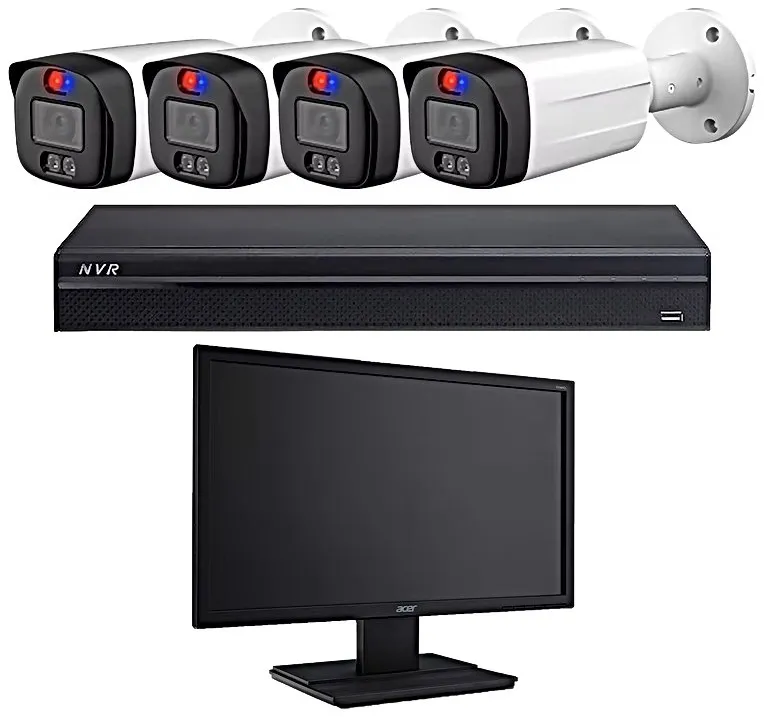
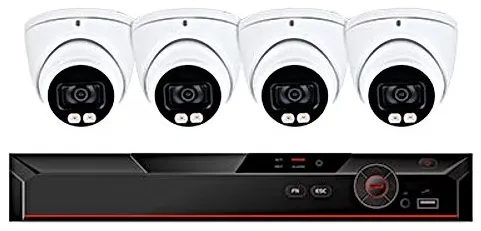
Retail product photo: four turret cameras and a recorder sold together. On a written Westchester quote the recorder, drives and each camera are listed separately so you can see what you are paying for.
Shop Our Systems
NVR Packages & Pricing in Westchester
Most Westchester jobs start from one of these three. The written quote then adjusts each one to the actual site, and none of them adds a subscription for video stored on site.
Recorder Reset
$275–$600
For cameras that already work: a recorder you own set up properly, or an inherited one recovered and cleaned — time sync, retention to a written target, alerts, user roles, clip-locking shown to staff, and an export test in both formats.
Corridor Store or Restaurant
$813–$1,875 + $219 per camera line
A new eight-channel NVR with PoE and a surveillance drive sized to your claims window, cameras on doors, counter and floor, mounted above any flood line, with multi-store viewing ready if you add locations.
Tower, Store Group or Dispensary
$2,000–$6,875+
Sixteen to thirty-two channels and beyond, multi-drive or RAID storage, floor switches, door-event or register integration, a power plan and written documentation. Priced from the drawings or a walkthrough.
Already have the hardware? Pay for our hands only
Plenty of Westchester owners arrive with equipment already in boxes: a developer’s specified recorder, a kit from an online order, or cameras a previous tenant left. We fit that equipment at our Westchester labour-only rates: recorder setup from $188, $219 per camera line up to 100 feet, and $195 an hour with a three-hour minimum for anything beyond that. We check the model against the FCC’s covered-equipment rules first, and for a dispensary we check it can actually hold sixty days at your camera count. Our bring-your-own-equipment calculator lists the line items.
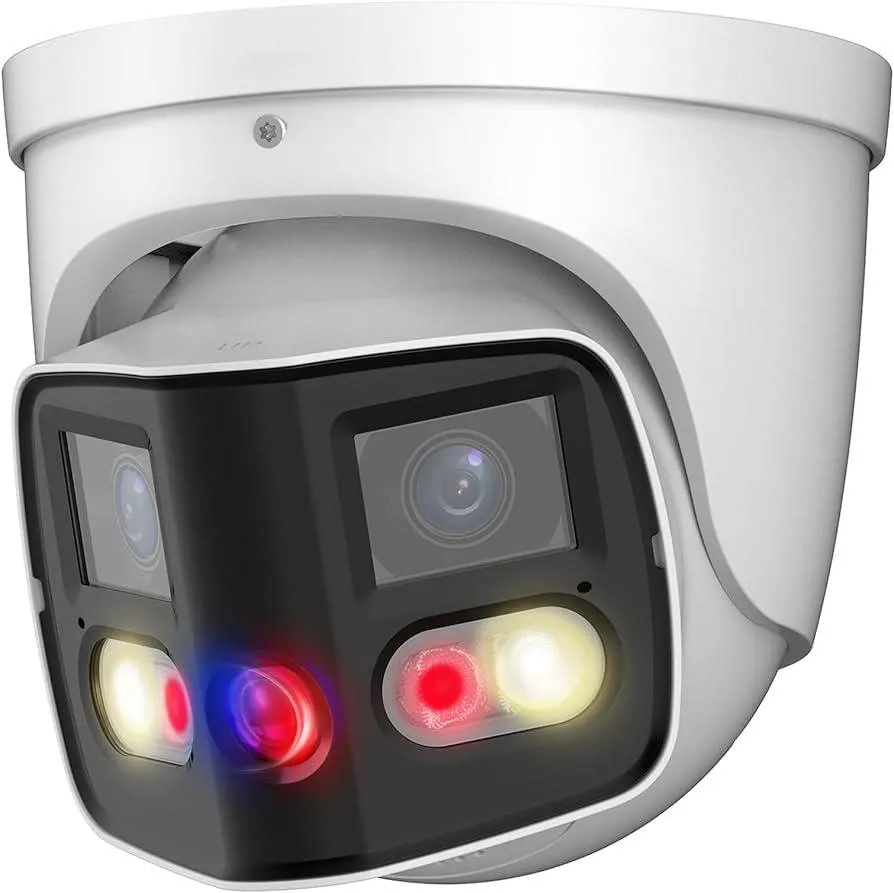
Manufacturer product photo: a dual-lens turret camera with red, blue and white deterrence lights. Two lenses can mean two streams on the recorder, which counts against its channel total.
Speak to a Westchester Recorder Tech
Ask about a tower’s recording design, a dispensary’s sixty-day spec, a store group on one screen or a locked recorder that came with the house — the person who plans the job answers.
Houses and estates, from a driveway camera to a full property plan.
Field Notes
Field Notes: Write the Retention Number Down First
The first thing I ask on a Westchester recorder job is not how many cameras. It is how many days, and who said so. A manager will tell me “a month”; the insurer’s claim letters arrive at six weeks; the lease says nothing; the state rule for a dispensary says sixty. Until that number is written on the plan with a name next to it, nobody can size the drives honestly, and the recorder ends up chosen by price.
The second thing I check is the clock. I stand at the recorder with my phone’s time on screen and compare. If the old box is minutes off, every clip it ever exported was off too, and the owner needs to know that before the next request arrives.
The third is where the box would go if the worst night happened — water in the basement, someone heading for the office with a crowbar, the power out on the block. Then I pick the room, the shelf height and the battery. Only after that do we talk about the camera list.
The last thing I do before leaving is hand the person who will actually answer the next request — the porter, the store manager, the dispensary’s security lead — the export routine to run themselves while I watch. If they can lock a clip and copy it in both formats without me, the system will hold up on the day it is needed.
— Owner, NYS license #12000287431
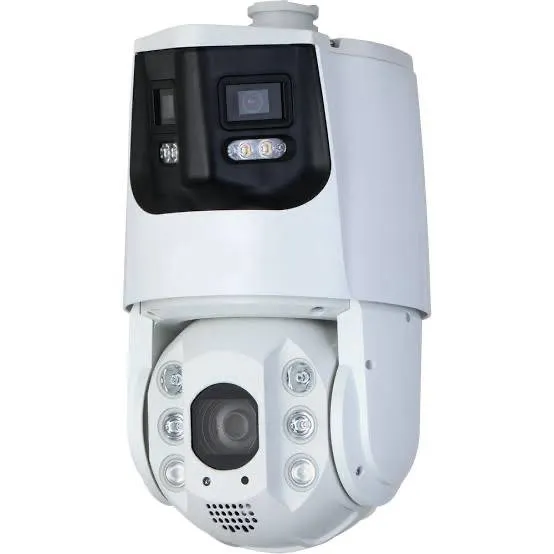
Manufacturer product photo: a camera pairing a fixed overview lens with a pan-tilt-zoom lens. Cameras like this send more than one stream to the recorder, and both count when the retention number is turned into drives.
FAQ
Westchester County NVR Installation FAQ
Smaller, practical points that come up while a Westchester job is being priced, booked and handed over, which the sections above did not cover.
Can you price a new tower’s recording system from the low-voltage drawings before the building is finished?
+
Yes. Send the security and low-voltage drawings, the riser diagram and the camera schedule if one exists, and we price the recorder, storage, floor switches and camera lines from them, with any assumptions listed. We then walk the floors once the telecom rooms are framed to confirm rack space and power before the ceilings close, and update the price only if the drawings changed.
Can you give us the camera, storage and power details in a form our dispensary security plan can use?
+
Yes. At handover we supply a written summary with the camera list and locations, recorder model and serial, drive capacity and the calculation behind sixty days, recording schedule, time-sync source, alert recipients, the timed power-cut test result and the location of the locked surveillance room or cabinet. Your compliance consultant decides how it goes into the plan; we make sure the numbers match the hardware.
Can you come back twice a year to check the drives, clock and firmware?
+
Yes. A check visit covers drive health and remaining days, the recorder clock against a reference, firmware against the maker’s current release, every channel’s picture and bitrate, user accounts that should have been removed, and the UPS battery. Visits after installation are billed at $195 an hour with a three-hour minimum ($585), and a written note of what was found is left each time.
How far into northern Westchester do you travel, and does the price change?
+
We cover the whole county, from Yonkers and Mount Vernon up to Peekskill, Yorktown, Somers, North Salem and Pound Ridge. The Westchester prices on this page already include the county’s 1.25 area factor, and there is no separate trip line on the published price sheet; anything unusual about access is stated on the written quote before you agree to it.
Which recorder brands do you install in Westchester?
+
We choose per job from mainstream recorder lines, including Lorex, Uniview, Hanwha, Dahua and Hikvision, and we install video management platforms when a management company already runs one. For buildings and businesses where the 2026 FCC rules or a grant condition matter, we quote a non-covered brand. If you have a standard across other properties, we follow it.
What happens to the data on our old recorder’s drives when you take it away?
+
You choose. We can hand the drives back to you, wipe them before disposal, or physically destroy them on site so the old video cannot be recovered. Before any of that, we ask whether there is footage you still need and export it first. The choice is written on the work order so there is a record of what happened to the data.
Will the written quote name the recorder model and drive size so we can compare it against another bid?
+
Yes. Our Westchester quotes name the recorder make and model, channel count, drive capacity and how many days it is expected to hold at the agreed settings, the camera models, the cable count and any switches or UPS. Comparing bids on those lines, rather than on a total, shows quickly whether two quotes would actually record the same thing.
Do you need our internet login to set up the recorder?
+
No. We need a network connection for the recorder, which your IT provider or building manager can give us as a port and an address on the right network. Remote viewing goes through the recorder maker’s app or your platform rather than changes to your router. If no one can provide a connection on the day, we configure the recorder locally and connect it when they can.
Our store lease says no drilling into the storefront — how do the cameras and recorder go in?
+
Inside the store, mostly. Cameras can be mounted on the ceiling grid or interior walls looking out through the glass, cable can run above the ceiling, and the recorder sits in your back office. For anything on the façade or in a shared room, we need the landlord’s written consent first, and we can send the landlord a short description of the work to speed that up.
Can you work around a tower’s move-in schedule and elevator bookings?
+
Yes. Occupied towers usually book the service elevator by the hour and keep move-ins on set days. Tell us the building’s rules and the managing agent’s contact, and the written plan will show which floors we work on which days, when the elevator is booked, and when telecom rooms need to be open, so residents and movers are not held up.
All Areas Served
NVR Installation Across the Hudson Valley, New York City and Long Island
Westchester is one of six counties grouped under the Hudson Valley NVR installation hub; the city boroughs and Long Island have their own recorder pages as well.
Each statistic, regulation and news item above traces to one of the links below. The r/Westchester thread was seen only as a search-result excerpt. Our own prices are company rates multiplied by 1.25 for Westchester.
Nothing here is legal advice. Questions about filming staff, recording sound, cannabis licence conditions or what a lease allows belong with a lawyer.
Footage Gone or Recorder Offline? Call the Westchester Line
Playback calendar empty, an adjuster waiting on video, or a failure alert at the dispensary that will not clear — ring (914) 877-2578. We save what is on the drives first, then fix the fault, and most recorders are writing video again within one to two hours of arrival.
Westchester Recorders From a Licensed, Insured Crew
Westchester line (914) 877-2578 · Abstract Enterprises Security Systems, 460 E Fordham Rd, Bronx, NY 10458 · messages by WhatsApp (718) 679-0359
Working under NYS license #12000287431, insured on every Westchester job, with same-day estimates · 4.6★ average across 390+ Google reviews
Recorders, drives and cameras carry their manufacturers' warranties. Full terms — including 50% deposit, the 30-day warranty and optional paid extended warranty, and the late-fee schedule — are set out in the service agreement. See our warranty page.
Page reviewed and updated October 18, 2026. Changelog: Westchester NVR page rebuilt from new research on the county’s tower construction in New Rochelle and Yonkers, corridor retail, the state’s dispensary video rule (9 NYCRR §125.3), Sound Shore flooding, household-staff recording limits, county contractor licensing and police plate-reader networks, priced on our base rates at the Westchester area factor of 1.25.