Board-Ready Paperwork · Your Side of the Door · Audio and Face Features Set Legally
A Lorex kit assumes you own the walls. In Manhattan you usually own the inside of an apartment, a share in a co-op, a lease on a storefront or a townhouse in a historic district — and someone else has a say over the hallway, the façade, the ceiling and the hours we can work. So a Manhattan Lorex job starts with permission and boundaries: what the board or landlord will approve, where your camera may look and where it must not, whether face or audio features can legally be switched on, and how the recorder joins an internet connection the building may control. We sort that out on paper, then install the Lorex cameras and recorder neatly, inside the rules.
Reviewed and updated October 18, 2026 by Anwar Timothy (NYS license #12000287431) · Manhattan visits are booked from our office at 460 East Fordham Road in the Bronx
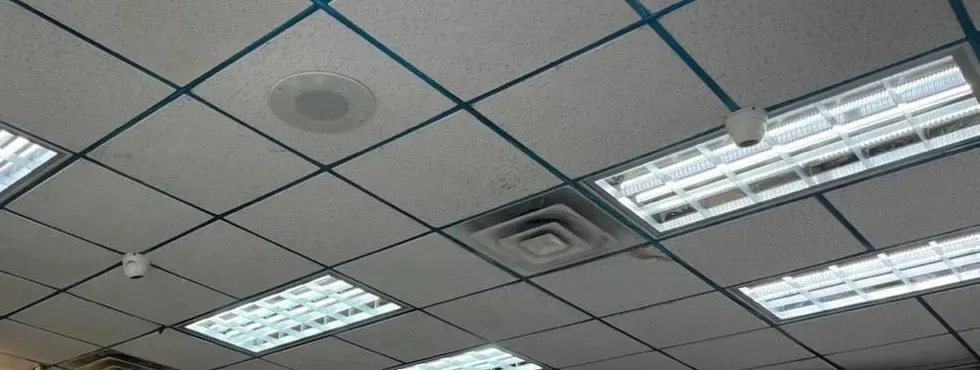
Example photo from another AESS job (not a Manhattan customer): two small white domes fixed to a drop ceiling between the light fittings, a round speaker and a vent. In a Manhattan deli, salon or café the ceiling grid is usually the tenant’s own space, which is why store cameras go up faster than anything on a building’s façade.
Manhattan Lorex Camera Quote
Tell us the building type, who manages it and which door or room matters — a written Lorex price follows the same business day
✅
Request Sent!
A Lorex installer will call you back about the Manhattan job the same business day.
25+
Years Experience
✓
Same-Day Estimates
100%
Licensed & Insured
4.7★
201 Google Reviews
Four details get a Manhattan Lorex quote moving. Whether the property is a co-op, a condo, a rental, a townhouse or a store; who manages the building; which door or space matters most; and whether you already own Lorex equipment. Send them, with a photo of the area, to (929) 560-0737 and we will tell you what paperwork the building is likely to want before anyone books a visit.
$2,033 buys a four-camera Lorex system fully installed in Manhattan — recorder, cameras, a fortnight of storage and the phone app included
Insurance certificates worded the way your managing agent asks, free of charge
Visits booked in two-hour slots that respect your building’s contractor hours; licensed under NYS #12000287431
Why Manhattan Properties Need Lorex Camera Installation
Manhattan is a borough of shared buildings. The Census Bureau’s 2023 five-year survey counts 918,806 homes in New York County, and 522,823 of them sit in buildings of fifty or more units; another 201,967 are in buildings of twenty to forty-nine. Detached houses number 10,012 and attached single-family houses — the townhouses and brownstones — just 6,713. Roughly three households in four rent: 583,733 renter-occupied homes against 191,643 owner-occupied. The median Manhattan home was built in 1951, and some 392,000 are in buildings from 1939 or earlier. Put plainly, almost every Lorex camera we install in Manhattan goes into a space that someone else also has rights over.
That changes the order of work. In a suburban house the first question is where the cameras go. In a Manhattan co-op or condo it is who must approve them: most buildings want a request to the managing agent, a certificate of insurance naming the building, and work done inside set hours. Renovation guides for New York co-ops and condos describe board approvals that take “anywhere from a few weeks to a couple of months” for real alterations, working hours along the lines of 9 a.m. to 5 p.m. on weekdays, and weekend work usually banned. A few cameras inside one apartment rarely trigger a full alteration agreement, but a doorbell on the hallway side of the door, a camera on a terrace or a hole through an exterior wall usually will. Residents ask about this constantly on r/AskNYC, where one commenter answering a question about door cameras put it bluntly: “You may not be allowed to install a camera in the hallway.”
What people want covered is usually a door, a package or a store. In June 2026 NYPD Crime Stoppers posted surveillance stills of a man who kicked the door of a storefront at 349 West 48th Street in the Midtown North precinct at about 3 a.m. on May 10, and asked the public for door-camera and phone footage from those early hours. The Upper East Side’s 19th Precinct has publicly warned residents about thieves taking unattended packages from building vestibules and lobbies, reporting three separate arrests. Older cases show the limits of a warning sign: in 2017 a thief hit the basement mailroom of a building at Central Park West and Manhattan Avenue three times in a week, shouldering open a door that carried a “Warning: Security cameras in use” notice. The camera’s value was the footage police released afterwards; the fix that stopped it was a latch protector and a steel door.
Lorex suits this borough when it is used for what it does well: a self-contained recorder you own, cameras powered over one network cable each, recordings kept inside your apartment, store or townhouse, and no monthly fee to record. It is not a substitute for the building’s own lobby system, and in a fifty-unit co-op the board’s cameras are a separate project with a separate budget. Our job is to fit a Lorex system to the part of Manhattan that is genuinely yours, keep it out of the parts that are not, and leave the paperwork tidy enough that the managing agent signs off the first time. Owners who cover their own door often ask about the building’s intercom next; a camera on the inside of the door pairs well with a working Manhattan intercom.
Manhattan facts that shape a Lorex install
522,823 of Manhattan’s 918,806 homes are in buildings of 50 or more units (Census ACS 2023 five-year, New York County) — so most Lorex jobs here are inside one apartment or one store, not across a whole property.
About three in four Manhattan households rent (583,733 renter-occupied against 191,643 owner-occupied, same survey), which is why lease terms and landlord consent come up on nearly every call.
Only 16,725 homes are single-family houses — 10,012 detached and 6,713 attached — the townhouses and brownstones where an owner controls the front, the areaway and the yard.
New York City’s Housing Maintenance Code already requires the owner to provide a peephole in every apartment entrance door (§27-2041) and, in class A multiple dwellings, a chain door guard (§27-2043) — the baseline any door camera adds to.
NYC Local Law 3 of 2021 requires retail stores, food and drink establishments and places of entertainment that collect customers’ biometric identifier information to post a sign near every customer entrance; the city’s sign rule took effect January 15, 2022.
A managing-agent survey of practice for NYC co-ops and condos (FirstService Residential, September 2024) puts typical building footage retention at 30 to 90 days, with hallway cameras placed so they do not capture the inside of any apartment.
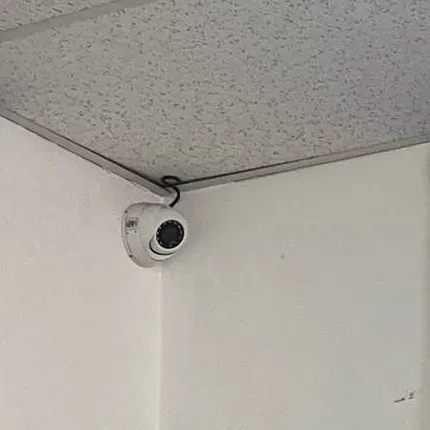
Example photo from another AESS job (not a Manhattan apartment), cropped to the corner: a white dome sitting in the angle of the ceiling and two walls, its cable looped in above. Inside a Manhattan apartment a corner like this, looking back at your own entry door, is the spot most boards never need to hear about.
Manhattan Lorex Recorder Offline or App Gone Blank?
Four checks before you call
Before you book a visit, check four things. Is the recorder’s light on, and does the monitor or app show the camera list at all? Has the building changed internet provider, replaced the router in your apartment or moved you onto a building-wide network — that alone strands many Lorex systems? Did a contractor or the super switch off a circuit, unplug a power strip or move furniture in the closet where the recorder lives? And does the Lorex app on your phone still sign in, or has it been replaced by a different Lorex app? If the answer to all four is “nothing changed,” the fault is usually a camera, a cable or the drive.
Call (929) 560-0737 with the recorder model if you can see it. We book the next two-hour window the building allows, bring a spare Lorex camera, a drive and a network tester, and most systems are recording and viewable again within one to two hours of arrival. Repairs after installation are billed at $195 an hour with a three-hour minimum ($585).
Every Manhattan Lorex job is one of a handful of types. These are the services we provide, each fitted to the way Manhattan buildings are owned and managed.
📝
Board and Landlord Paperwork
A plain-language camera plan with photos, product sheets and our certificate of insurance, made for a managing agent, a co-op board or a commercial landlord to approve.
🚪
Apartment Door and Foyer
A camera inside your apartment looking at your own entry door and foyer, so you see who comes in without putting anything in the shared hallway.
🏠
Townhouse Front, Areaway and Yard
Stoop, areaway, service door and rear-yard cameras on single-family and owner-occupied townhouses, fixed so they meet the Landmarks rules where they apply.
🍽
Restaurants and Cafés
Register, entrance, dining room, back door and cellar coverage, with staff-only rooms left alone and audio and face features decided before they are switched on.
🛍
Shops and Showrooms
Counter, aisle and stockroom cameras on a recorder locked away from the sales floor, with a monitor the customers can see.
🏭
Lofts and Studios
High ceilings, long open floors and freight-elevator access in SoHo, Tribeca, Chelsea and the Garment District, with cable run in painted raceway or conduit.
📶
Building-Network Hookups
Connecting the Lorex recorder to your apartment router, a building-supplied internet port or a separate line, and testing remote viewing on cellular data.
📱
Lorex App and Shared Users
The correct Lorex app for your recorder, accounts for each household member or manager, and nobody given more access than they need.
🔧
Takeovers and Move-Outs
Systems left by a previous tenant or owner reset properly, and your own system taken down and the walls patched when your lease ends.
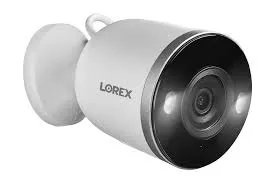
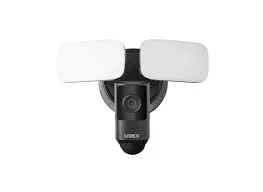
Manufacturer product photo (not an installed camera): a white Lorex bullet whose lens sits between two small spotlights. On a Manhattan townhouse it belongs in a rear yard or an areaway, aimed at your own ground, with the lights turned down so they stay off the neighbours’ windows.
Building Specialists
Lorex Systems for Manhattan's Architecture
Manhattan’s housing ranges from 1880s tenements to glass towers finished last year, and who controls the walls varies as much as what they are made of. Six building types cover nearly every Lorex call we get.
Pre-War Co-ops
Upper West Side, Upper East Side, Morningside Heights, Washington Heights. Plaster walls, deep window sills and a board that approves anything outside your door. Lorex cameras stay inside the apartment, cable runs in painted raceway or behind trim, and the paperwork goes to the managing agent first.
Post-War and New Condos
Murray Hill, Kips Bay, Battery Park City, Hudson Yards and the newer towers along the avenues. Drywall, dropped ceilings in closets and often a building-wide internet network. The question is less the walls than how the recorder connects and who is allowed to see the cameras.
Walk-Ups and Tenements
Lower East Side, East Village, Hell’s Kitchen, Inwood, East Harlem. Five- and six-storey buildings with narrow stairs, a shared front door and often a store on the ground floor. Tenants need the landlord’s consent for anything fixed outside the apartment; owners of the whole building can design a proper entrance system.
Townhouses and Brownstones
Harlem, the West Village, Chelsea, the Upper East and Upper West Sides. One family, one front door, an areaway under the stoop and a rear yard, often inside a historic district. These are the Manhattan jobs closest to a classic Lorex install.
Lofts and Cast-Iron Buildings
SoHo, Tribeca, NoHo, Chelsea, the Flatiron and the Garment District. Ceilings of twelve feet and more, brick and timber, and a freight elevator that has to be booked. Cameras go lower than you would think, and cable travels in conduit.
Office-to-Residential Conversions
The Financial District, Midtown South and around Water Street. New apartments inside old office floors, with modern drywall but building-controlled networks and strict rules on anything attached to the windows or corridors.
How the method changes from building to building
Pre-war co-ops. Lath-and-plaster and old masonry partitions eat Wi-Fi and resist new holes, so we pick one short wired route from the router’s location to each camera and run it in raceway painted to match the wall, or tucked along a baseboard or door casing. We drill into plaster with a sharp masonry bit at low speed and use anchors rated for the wall, never into an ornamental cornice. Anything that would cross into the public hall stops at your door frame.
Condos and conversions. Hollow drywall makes concealed runs easy inside your unit, but the building’s network room, riser and corridor ceilings are off-limits without the managing agent’s sign-off. We plan the Lorex recorder to sit beside your own router and keep every camera on your side of the door, so the job is an apartment alteration rather than a building one.
Walk-ups. In a tenement the shared entrance and stairs belong to the building owner. A tenant’s Lorex cameras stay inside the apartment; an owner’s system for the whole walk-up is designed separately, with the hallway cameras placed so they do not look into any open apartment door, and the store tenant’s cameras on their own recorder.
Townhouses. These get the full treatment: a recorder in a basement utility room or a closet, cable down through the basement ceiling to the areaway and the rear wall, and cameras fixed at mortar joints rather than carved stone or cast iron. In a historic district the exterior positions follow the Landmarks Preservation Commission’s staff-level guidance on discreet, well-spaced cameras.
Lofts. Exposed brick, timber beams and cast-iron columns mean cable runs in conduit or raceway on the surface, which is quick and honest. The hard part is height: in a fourteen-foot room we bring cameras down to eight or nine feet at the entrance so they catch faces, and save the high positions for wide overview shots.
Who signs off, by property type
Property
Cameras inside your space
Anything outside your door, on a terrace or on the façade
Co-op apartment
Usually no approval; check the proprietary lease and house rules
Board approval via the managing agent; often an alteration agreement
Condo apartment
Usually no approval; check the bylaws and rules
Board approval; common elements belong to all owners
Rental apartment
Check the lease for drilling and alterations
Landlord’s written consent
Townhouse you own
Your decision
Your decision, plus a Landmarks permit for the front in a historic district
Store or restaurant
Your decision within the lease
Landlord’s consent; Landmarks permit on a designated building
This is a practical guide from our installations, not legal advice. When the documents and the managing agent disagree, the managing agent’s written answer is what lets the work go ahead.
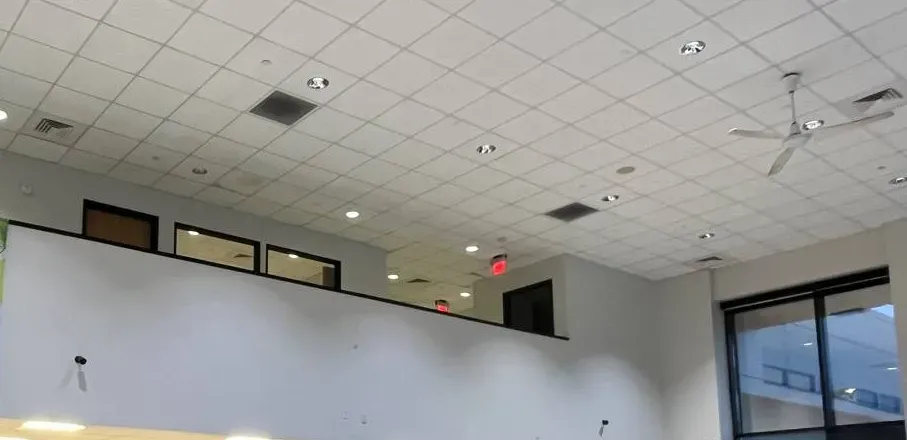
Example photo from another AESS job (not a Manhattan loft): two small cameras set into a long white wall under a mezzanine, in a room tall enough for a ceiling fan. Double-height Manhattan lofts in SoHo, Tribeca and Chelsea raise the same question: how high a camera can go before faces turn into the tops of heads.
Commercial Lorex Cameras
Business Lorex Camera Installation in Manhattan
Most Manhattan businesses that choose Lorex are small: a restaurant, a deli, a boutique, a salon, a gallery or a studio, usually leasing the ground floor of a building someone else owns. These are the corridors where we work most, and what they ask of a camera system.
125th Street, Harlem
In May 2024 the city invited businesses along 125th Street to share real-time camera video with the NYPD, voluntarily, through a box supplied by Fusus by Axon — a pilot the city said stayed “at the behest or the control of the business owner.” Stores here ask us whether a Lorex recorder can take part; the answer depends on the program’s current terms, which we check with you rather than assume.
West 40s, Midtown North
Restaurants, bars and small shops under walk-ups between Eighth and Tenth Avenues. The May 2026 attempted break-in at West 48th Street, released by NYPD Crime Stoppers in June, is the typical pattern: a door at 3 a.m., and police asking for door-camera video afterwards. A camera inside the door, looking out through the glass at face height, is the one that matters.
SoHo and NoHo
Boutiques and showrooms in cast-iron buildings, many inside the SoHo–Cast Iron Historic District designated in 1973. The storefront itself is the tenant’s; the façade is the landlord’s and, on a landmark, the Commission’s. Cameras inside the display window avoid most of that.
Financial District and Water Street
Ground-floor shops, cafés and new residential lobbies in converted office towers. Building management controls corridors and networks, so a tenant’s Lorex system stays within the leased space and on the tenant’s own internet.
Upper East Side Avenues
Lexington, Third, Second and First Avenues: dry cleaners, pharmacies, wine shops and restaurants under co-ops. The 19th Precinct’s warnings about package thefts from vestibules and lobbies are a reminder that the building’s cameras and the store’s cameras answer different questions.
Chinatown and the Lower East Side
Narrow, deep shops and restaurants with cellar storage reached through a sidewalk hatch or a back stair. One camera on the register, one looking back at the door, one in the cellar — and the recorder somewhere a thief would not think to look.
Rules a Manhattan business should know before a Lorex camera goes up
Biometric signs. Under NYC Local Law 3 of 2021, a retail store, food or drink establishment or place of entertainment that collects, retains, converts, stores or shares customers’ biometric identifier information must post a sign near every customer entrance, and may never sell or profit from that information. People can sue: $500 per violation for a missing sign if it is not fixed within 30 days of written notice, and $500 or $5,000 per violation for selling or sharing the data. Ordinary video that is not analysed by biometric software is outside the law. If your Lorex recorder offers face detection, we leave it off in a store unless you have decided, with advice, to use it and post the sign.
Staff areas. New York Labor Law §203-c bars employers from video recording employees in restrooms, locker rooms and changing rooms. Restaurant and shop cameras cover sales floors, registers, doors and stockrooms, never those rooms.
Sound. New York’s eavesdropping law (Penal Law §250.05) makes it a felony to mechanically overhear a conversation without the consent of at least one party. A camera microphone recording customers’ conversations at a table is exactly the risk. We install Lorex cameras with audio switched off in businesses.
Landmarks. On a designated building or in a historic district, the Landmarks Preservation Commission’s permit guidebook treats discreet, well-spaced security cameras attached at mortar joints or plain masonry, with minimal painted conduit, as staff-level work — but it is still a permit. Cameras inside the shop window need none.
Electrical permits. Camera and data cabling counts as low-voltage under the city’s 2024 electrical code changes (Local Law 128 of 2024: circuits under 50 volts for signaling, communication, alarm and data), which a qualified installer can run without a DOB electrical permit. If your shop needs a new outlet for the recorder, that part goes to a licensed electrician.
Tax credit. New York State’s Commercial Security Tax Credit, as summarised by NYC Business, offers up to $3,000 per retail location to businesses with 50 or fewer employees for qualifying security equipment, cameras included. Ask your accountant before you rely on it.
Businesses that cover the shop floor with Lorex cameras usually want the alarm to match; we install Manhattan alarm systems on the same doors, and card or fob entry for staff-only rooms.
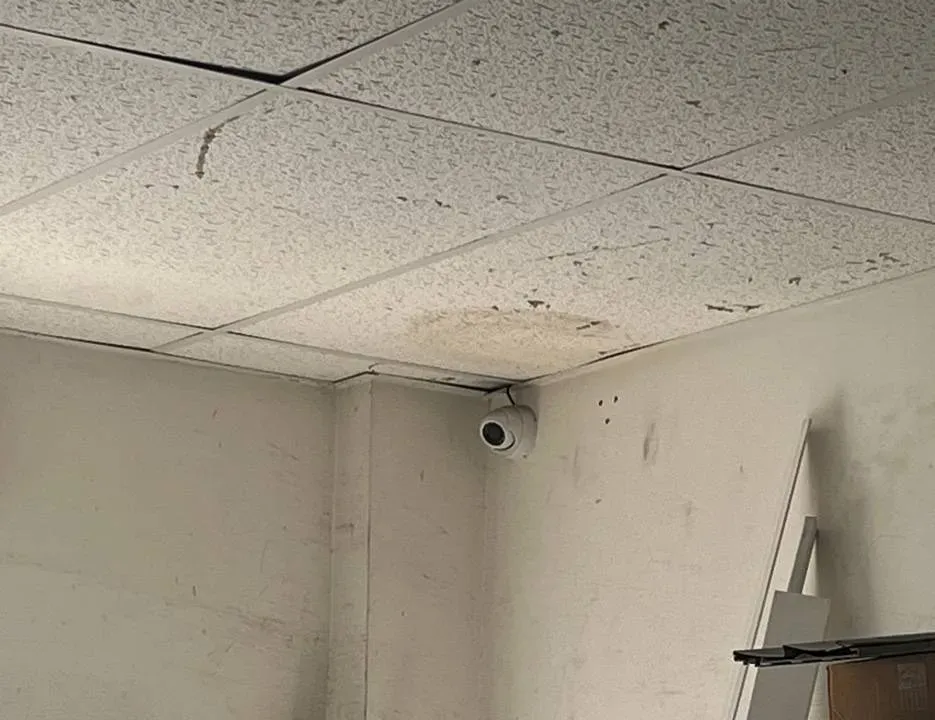
Example photo from another AESS job (not a Manhattan restaurant): a white dome in a back-room corner under a stained drop ceiling. Restaurant stockrooms and cellar prep areas in Manhattan look like this, and they are where the recorder and a back-door camera usually end up.
Your Questions Answered
Lorex Camera Installation in Manhattan: Questions Answered
These are the questions Manhattan owners, renters, boards and shopkeepers actually put to us about Lorex, grouped by the decision they belong to. Each one is answered for Manhattan buildings specifically; general Lorex questions that apply anywhere are covered on our other Lorex pages.
Boards, Managing Agents and Building Paperwork
What will a Manhattan managing agent want from us before a Lorex installer is allowed upstairs?
Usually three things, sometimes five. The near-universal ones are a short description of the work, the installer’s certificate of insurance naming the building, its owner or co-op corporation and the managing agent as additional insureds, and a booked date inside the building’s working hours. Many buildings also want the product sheet for each camera and a sketch or photos showing where each one goes, and a few ask for a refundable deposit or a signed alteration agreement even for small low-voltage work.
We prepare the certificate of insurance with the exact wording the agent sends us, at no charge, and a one-page camera plan with photos and the Lorex model numbers. If the work stays entirely inside your apartment and needs no new hole through an exterior or corridor wall, most agents treat it as minor work and approve it by email; if anything touches the hallway, a terrace or the façade, expect a board review that can take weeks. Asking the agent which category your job falls into, before you buy equipment, saves the most time.
Do a handful of Lorex cameras that never leave our apartment still need the board's sign-off?
Often not, but check two documents before assuming. The proprietary lease or condo bylaws usually require consent for “alterations,” and some buildings define that broadly enough to include drilling and cable runs. The house rules may also say something specific about cameras, and co-op and condo publications have reported boards adding rules about video doorbells and cameras facing the hallway.
In practice, a Lorex camera on a shelf or on an interior wall of your own apartment, cabled to a recorder beside your router, is the kind of work most Manhattan boards never ask about. What changes the answer is any camera that can see outside your unit — through the door, onto a terrace you share, or across an air shaft into a neighbour’s window — and any work in the walls that might disturb lead paint in a pre-1960 building, which brings its own rules for the contractor. When in doubt we send the agent a two-line note and a photo, which costs nothing and avoids an awkward letter later.
How do a building's permitted hours and the elevator booking change the day of the install?
They set its length. A Lorex job that would take five hours in a house can stretch over two short days in a co-op that allows work only from 9 a.m. to 5 p.m. on weekdays, requires the service elevator to be reserved, and wants equipment carried through the service entrance rather than the lobby. Loft buildings may limit the freight elevator to set windows; doorman buildings often need our names on a list the day before.
We plan around it rather than fight it. Cable runs and drilling are scheduled first, inside the permitted hours, and the quiet work — configuring the recorder, setting motion zones and testing the app — fills the rest of the day. Tell us the building’s rules when you book, and if the agent has a contractor information sheet, forward it; we would rather read it before the visit than meet it at the front desk.
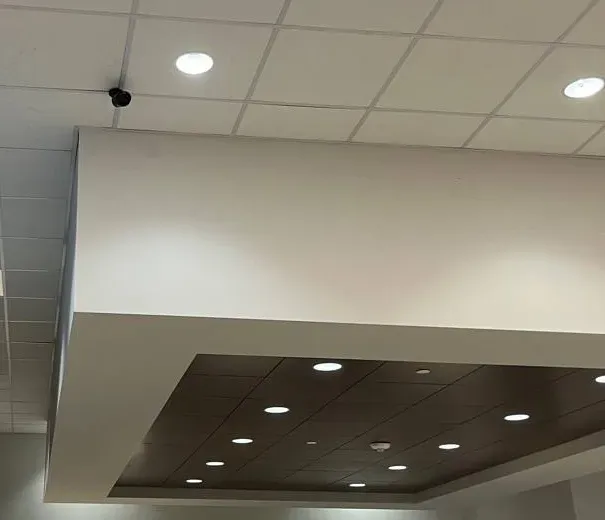
Example photo from another AESS job (not a Manhattan building): a small black camera at the very edge of a ceiling grid, above a lit soffit. A camera like this in a Manhattan lobby belongs to the building, not to any one apartment, and the board decides where it goes and who sees it.
Your Door, the Hallway and the Neighbours
Can a Lorex camera watch the hallway outside our apartment door?
Only with the building’s permission, and usually only if it cannot see into anyone else’s apartment. The corridor is a common area controlled by the landlord, the co-op board or the condo board. Lawyers writing for New York co-op owners have said a board can restrict cameras in common areas by a house rule, and that a camera angled into a neighbour’s open doorway, especially with sound, invites a privacy claim. A managing agent’s guide to building cameras recommends that hallway cameras never capture the inside of a unit.
Residents on r/AskNYC say much the same thing in plainer words: one commenter wrote that the one thing “not allowed is if camera can film into someone’s apartment.” So if the board agrees to a corridor camera at all, we set it to look along the hall at your own door, mask out every other door with Lorex privacy zones, and switch audio off. If the board says no, the alternative is the next answer.
Is there a way to see who comes to our door using a camera that stays inside the apartment?
Yes, and it is the setup we install most often for Manhattan renters and shareholders. A small Lorex camera inside the apartment, high in the foyer or on the wall facing the entry door, records everyone who comes through the door and the moment it opens. It cannot see the hallway when the door is closed, which is exactly why it rarely needs anyone’s approval.
It works alongside the peephole the city’s Housing Maintenance Code already requires your landlord to provide in every apartment entrance door. The peephole lets you look before you open; the camera keeps a record of what happened when you were out. People sometimes ask about replacing the peephole with a digital viewer; in a rental or co-op that is a change to the building’s door, so it goes through the landlord or the board like any other alteration.
A neighbour's video doorbell points straight at our door — what can we reasonably ask for?
Start with the building, not the neighbour. In a co-op or condo the hallway is a common area, and many boards now have, or are willing to adopt, a rule that a resident’s camera may not face another unit’s door. A short written note to the managing agent describing what the camera can see is the usual first step. Boards are also told to apply any camera rule equally to every resident, which helps you if the neighbour argues they are being singled out.
If the doorbell records sound, mention it: New York’s eavesdropping law makes it a crime to record a conversation without at least one participant’s consent, and a doorbell catching your conversations at your own door is a fair concern to raise. We are not lawyers and cannot advise on a dispute, but we can tell your board, in writing, what a given camera position can see, and suggest privacy masking or a different angle that would end the problem.
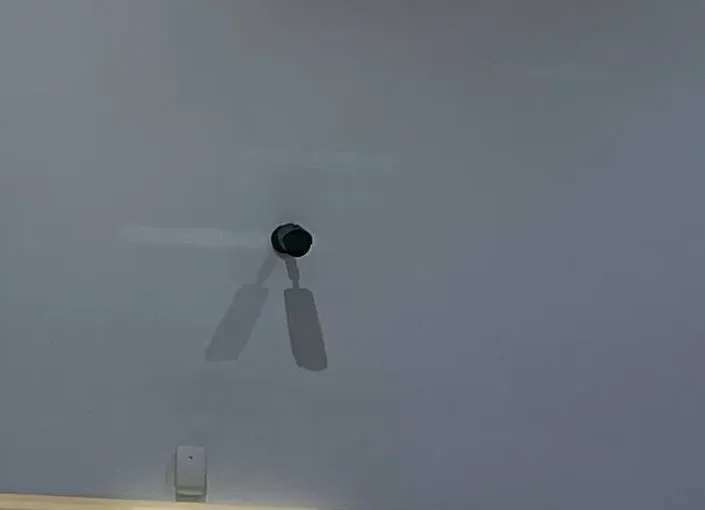
Example photo from another AESS job (not a Manhattan apartment): a small black camera on a plain white wall, its shadow thrown down by a light, a motion sensor near the floor. Inside an apartment a camera like this watches your own foyer; turned to a shared hallway it becomes a question for the board.
Connecting a Lorex Recorder Inside a Manhattan Building
Our building supplies internet to every apartment — will a Lorex recorder work on it?
Usually, but find out how before you buy. Some Manhattan buildings, especially new condos and rental towers, deliver internet through a building-wide network: a port in the wall or a router the building owns, sometimes with rules about what you may connect. A Lorex recorder needs a wired connection to that network and an outbound internet connection for the app; it does not need a public address or open ports. Where the network blocks devices from talking to each other, the recorder still records, but setup and viewing at home can be awkward.
We ask for the building’s internet provider and whether you have your own router before the visit. If the shared network is restrictive, the simplest fix is often a small router of your own behind the building’s port, with the Lorex recorder plugged into it; the other is a separate internet line for the recorder alone. Lorex lists a minimum upload speed of about 6 Mbps for remote viewing on its Fusion systems, which almost every Manhattan connection meets.
With dozens of neighbours' Wi-Fi networks around us, will a Lorex Wi-Fi camera keep dropping off?
It can, and in a Manhattan high-rise it is the most common reason a Wi-Fi camera “works for a week and then doesn’t.” Every apartment above, below and beside you has a router, and the 2.4 GHz band many cameras use has only a few channels that do not overlap. People asking about unreliable home internet in NYC buildings describe exactly this suspicion — too many signals in the building. Lorex itself tells owners of its Wi-Fi spotlight camera to place it as close to the router as possible and reduce obstructions between them.
So in apartments we use wired Lorex cameras wherever a cable can reach, which inside one unit is nearly everywhere. Where Wi-Fi is the only option — a camera on a terrace door, say — we measure the signal at the mounting point, use the 5 GHz band where the camera supports it and the distance is short, and put the camera on your own router, not a range extender. A wired camera does not care how many networks your neighbours run.
Will a co-op accept camera cable run on the surface of a pre-war wall, or does it have to go inside?
Most boards care about two things: that nothing is cut into a structural, fire-rated or common wall without approval, and that the result looks tidy. Painted surface raceway inside your apartment, along a baseboard, a door casing or a picture rail, satisfies both and needs no plaster opened. Fishing cable inside old plaster walls is possible but slow, riskier, and in buildings built before 1960 any disturbance of painted surfaces may bring lead-safe work rules into play.
For a typical Manhattan apartment with two to four Lorex cameras we plan routes of a few metres each from a recorder beside the router, using raceway painted to the wall colour and existing openings such as the gap above a closet door. Concealed runs are priced separately, at $250 per camera, and we only suggest them where a run would cross a prominent wall. If you are renovating, tell us: cable pulled while the walls are open costs far less than any other way.
Restaurants, Shops and Face or Sound Features
Does New York City's biometric law apply if our restaurant switches on Lorex face detection?
It can. Local Law 3 of 2021 covers food and drink establishments, retail stores and places of entertainment that collect, retain, convert, store or share customers’ biometric identifier information, which includes face geometry used to identify someone. Some Lorex recorders offer face detection or face recognition features; Lorex’s own help article warns that “facial recording without consent is illegal in certain jurisdictions.” Ordinary recorded video that is not run through biometric software is outside the city law.
Our practice is simple. In a Manhattan restaurant, bar or shop we leave face features off and use person and vehicle detection only. If you decide, with your own legal advice, that you want face features, the city requires a sign near every customer entrance in the form set by the Department of Consumer and Worker Protection, and you may never sell or profit from the data. We will help with where the sign goes; we will not switch the feature on without it.
Our store lease says the landlord must approve anything on the storefront — what about a camera over our own door?
Read the lease’s alterations and signage clauses; the outside of the building is almost always the landlord’s, and on a landmark the Landmarks Preservation Commission has a say too. A camera on the façade, the awning or the sidewalk side of the door frame is an exterior alteration. A camera inside the shop, behind the glass, looking out at the door and the sidewalk in front of it, generally is not.
Inside-the-glass positions have a cost: glare and reflections at night, when the shop lights bounce off the window. We counter it by keeping the camera close to the glass, using a lens hood or a dome with a dark liner, and switching off the camera’s own infrared light so it does not reflect straight back. If you need a true exterior camera, we write the request for your landlord and, where needed, the permit details for the Commission.
Where should cameras stop in a Manhattan restaurant so staff are not recorded where the law forbids?
At the doors of the restrooms, locker rooms and changing areas. New York Labor Law §203-c prohibits employers from video recording employees in those rooms, and that applies whatever the camera brand. Kitchens, prep areas, the pass, the bar, the register, stockrooms, the delivery door and the cellar stairs are normal camera positions, and each one should be aimed at the work or the door, not at a bench where staff change shoes.
We also suggest telling staff in writing which areas are recorded and who can view the footage, and keeping audio off throughout. It avoids arguments, and it makes the footage more useful if something does happen. On a Lorex system we give the owner and one manager playback rights, and anyone else live view only.
Can our shop share live Lorex video with the NYPD the way some 125th Street businesses do?
Possibly, but it depends on the program, not the camera brand. The pilot announced in May 2024 for 125th Street let businesses volunteer to share real-time video with the NYPD through a device supplied by Fusus by Axon, with the city describing the sharing as staying under the business owner’s control. Whether a Lorex recorder can feed such a device, and whether the program is open in your area today, are questions for the program and the precinct.
What we can do on our side is make the system ready: a recorder with a fixed address on your network, a camera list named by location, correct time, and clear export of clips. Most stores never need live sharing; they need a clean, time-stamped clip on a USB stick when a detective asks. Lorex has also said its products are not for public-safety or government surveillance uses under the FCC rule that took effect on July 16, 2026, which is worth reading before you connect any Lorex system to a police program.
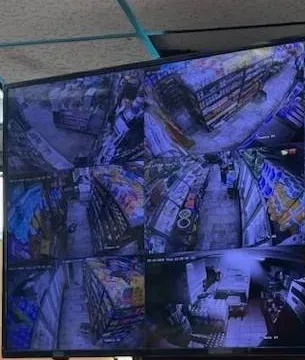
Example photo from another AESS job (not a Manhattan store), cropped to the aisle views: a monitor split into tiles of narrow, packed shop aisles. That is the picture most Manhattan shopkeepers want on the wall behind the counter, with the recorder itself kept out of reach.
Townhouses, Lofts and Historic Districts
Can a Lorex camera go on the front of a townhouse in a historic district without a Landmarks permit?
Not on the façade. Exterior work on a designated building or in a historic district needs a permit from the Landmarks Preservation Commission, though the Commission’s permit guidebook treats well-spaced, discreet security cameras as staff-level work. The guidance asks for cameras placed out of the way, attached at mortar joints or plain masonry rather than carved stone, cast iron or decorative surfaces, and with as little conduit as possible, painted to match.
In practice that points to positions under the stoop, inside the areaway, in the vestibule behind the outer door, or tucked under a band course. Most Manhattan townhouse owners find that a camera inside the vestibule and one in the areaway cover what matters without touching the front at all. Rear yards are rarely visible from a public street and are usually simpler. We prepare the drawings and photos for the application if you need one.
In a loft with fourteen-foot ceilings, how high should the Lorex cameras go?
Lower than instinct suggests. A camera at the ceiling of a tall loft sees the tops of heads at the entrance. For the door, we mount at about eight to nine feet and aim slightly down, so the face of anyone coming in fills a useful part of the frame. High positions near the ceiling are kept for overview cameras covering the whole floor, where the job is to show movement, not identify a face.
Lofts also have long distances. A cable from a recorder at one end of a hundred-foot floor to a camera at the freight door is well inside Lorex’s 328-foot limit for an Ethernet run, but it means conduit or raceway along a wall or across exposed beams. We run it on the surface, neatly and in straight lines, which most loft owners and their landlords prefer to holes in brick or timber.
Federal Rules, Contractors and Which Lorex Kit to Avoid
Our company does federal contract work from a Manhattan office — can we use Lorex there?
Probably not, and Lorex says so itself. Its frequently asked questions state that its products are designed for consumer and business use and “not for US federal governments, federally-funded projects or contractors subject to NDAA.” Lorex has also published a notice explaining that, under FCC rules effective July 16, 2026, some Lorex products cannot be sold or marketed for public-safety, government-facility or other national-security uses, while existing equipment can still be used and supported.
If your firm is a federal contractor, or your office is in a building or project funded by federal money, ask your compliance team before buying any camera, and expect them to require a different brand. For a private Manhattan apartment, townhouse, restaurant or store with no such obligations, those rules do not stop you choosing Lorex. We will install whichever brand fits; for NDAA-bound offices we quote commercial camera systems in Manhattan instead.
We run two Manhattan shops — can both Lorex systems be watched in one app?
Yes, as long as each shop has its own recorder on its own internet connection. The Lorex app lets one account hold several recorders, so an owner can switch between the Chelsea shop and the Upper West Side shop on the same phone. Lorex’s business app, Lorex Pro, works with wired systems and shows up to sixteen cameras on one screen, with a computer client for the back office.
What we avoid is stretching one recorder across two addresses; a cable or a wireless link between buildings brings landlords, permits and failure points that two small recorders do not. We set up each site with the same naming pattern, give managers access only to their own shop, and keep the owner’s account as the only one that sees everything. If the shops use different Lorex product lines, we check app compatibility first, because Lorex says its apps and recorders are not always interchangeable.
Equipment
Types of Lorex Cameras We Install
Lorex makes far more products than a Manhattan apartment needs. These are the categories we actually install here, and where each one fits.
💾
Compact Lorex Recorders
Small network video recorders with built-in PoE ports that sit on a closet shelf beside your router. Lorex Connect models power up to eight cameras, each over a single cable, and record to a drive inside the recorder.
🟢
Turret Cameras
Our default inside apartments and at shop doors: compact, easy to aim at face height, and less likely than a bullet to look like it is pointed at a neighbour.
🏢
Indoor Cameras
Shelf or wall cameras for an entry foyer, a living room or a manager’s office; never in bedrooms, bathrooms or staff changing areas.
🔵
Dome Cameras
Ceiling-mounted for dining rooms and sales floors: hard to knock, and customers cannot easily tell which way the lens faces.
🔔
Video Doorbells
For townhouse and storefront doors, and apartment doors where the building allows them. Wired Lorex doorbells need a 16–24 volt AC supply; battery models suit doors with no bell wiring.
💡
Spotlight and Floodlight Cameras
For townhouse rear yards, areaways and courtyards, with the light set low because in Manhattan someone’s window is always facing it.
📶
Fusion Wi-Fi Cameras
Fusion recorders accept a few wireless cameras alongside the cabled ones; we keep them for a terrace or roof door and measure the signal on the spot first.
💻
Lorex Pro for Small Businesses
Lorex’s business app for wired systems, with up to sixteen cameras on one screen and a computer client, suited to a restaurant owner who watches from an office.
Lorex installed locally versus ADT, Ring and SimpliSafe
What a Manhattan buyer asks
Lorex wired system, installed by AESS
ADT
Ring
SimpliSafe
Where the recordings are kept
On a recorder inside your apartment, store or townhouse
Depends on the package
Mostly in the cloud with a paid plan
Mostly in the cloud with a paid plan
Anything fixed in the shared hallway
Nothing, unless the board approves it
Depends on the equipment chosen
Doorbell models usually go on the hallway side of the door
Doorbell models usually go on the hallway side of the door
Behaviour in a crowded Wi-Fi building
Unaffected — each camera is cabled
Varies
Mostly Wi-Fi, so affected by congestion
Wi-Fi, so affected by congestion
Monthly fee to keep recordings
None required for local recording
Usually part of a monitoring contract
Plan needed for saved video history
Plan needed for saved video history
Paperwork for the managing agent
Prepared by us, including our insurance certificate
Arranged by the company
Usually up to you
Usually up to you
The table describes how each kind of system is built, not which brand is better. For a one-year lease a plug-in cloud camera may be all you need; shareholders, condo owners, long-stay renters and restaurants usually prefer recordings that never leave the premises. Plans and prices at ADT, Ring and SimpliSafe change, so check them directly.
Lorex catalog image, not a photo of our work: a dark floodlight model with a pair of lamp panels above its round lens. Manhattan courtyards and townhouse yards are overlooked on three sides, so the lamps get a low brightness and a short timer.
AI Overview Reality Check
What AI Gets Wrong About Lorex Camera Installation in Manhattan
Google’s AI Overview and the People Also Ask boxes could not be opened from our research environment, so instead of quoting them we tested seven claims that turn up again and again in cost guides, product listings and forum advice about Lorex cameras, against Manhattan conditions and against Lorex’s own documentation.
1. “Professional camera installation costs $100–$200 per camera”
That figure comes from national cost guides; Angi’s 2026 article, for example, quotes $100 to $200 per camera for installation on top of the price of the cameras, and a total of $590 to $2,040 for a professionally installed system. As a national average it is reasonable.
Manhattan adds costs that a national average cannot see: certificates of insurance with a building’s exact wording, work squeezed into a 9-to-5 weekday window, service-elevator bookings, parking, painted raceway in finished pre-war rooms, and the time it takes to keep plaster dust off a co-op hallway. Those are why our published Manhattan labour rates are 1.25 times our Brooklyn base.
What we can promise is that the number is written down before we start. Our Manhattan figures — $250 of labour per wired camera, $188 to set up the recorder, four-camera systems from $2,033 including the Lorex equipment — are on this page, and the quote names every camera, every route and every extra.
2. “Just stick a video doorbell on your apartment door”
Plenty of product listings and forum posts suggest a battery doorbell as the quick fix for apartment dwellers. In a Manhattan co-op, condo or rental, the outside face of your apartment door and the corridor beyond it are usually controlled by the board or landlord.
New York co-op lawyers have told owners that a board can ban video doorbells in common areas with a house rule, and residents on r/AskNYC regularly report being asked to take one down. A doorbell that records a neighbour’s open doorway, especially with sound, is the case that ends up before the board.
The alternative that rarely needs anyone’s approval is a small Lorex camera inside the apartment, facing your own door. If you want a doorbell, ask the managing agent first, choose a position that sees only your door, and turn the microphone off unless you are present for the conversation.
3. “Wi-Fi cameras are the easy option in an apartment”
Easy to mount, yes. Reliable, not always. Lorex’s own help article for its Wi-Fi spotlight camera tells owners to place the camera as close to the router as possible and reduce the obstructions between them; in a pre-war apartment those obstructions are plaster, masonry and steel.
Then add every neighbour’s router. In a tall building the 2.4 GHz band is crowded on every floor, and a camera that tested fine at 2 p.m. can drop off at 9 p.m. when everyone is streaming. NYC renters complain about this on Reddit about their laptops; cameras suffer the same way.
Inside one apartment the distances are short, so cable is cheap and quick. We use wired Lorex cameras by default and keep Wi-Fi for the rare spot a cable cannot reach, after measuring the signal where the camera will actually sit.
4. “Turn on face recognition and your store is safer”
Face features are advertised on some Lorex recorders, and articles on “best facial recognition cameras” treat them as a pure upgrade. In New York City, a store, restaurant, bar or entertainment venue that collects customers’ biometric identifiers has legal duties under Local Law 3 of 2021.
The law requires a sign near every customer entrance and bans selling or profiting from the data, and it gives customers a right to sue: $500 per violation for an uncured missing sign, and up to $5,000 for intentional or reckless misuse of the data. Lorex itself cautions that facial recording without consent is illegal in some places.
For most Manhattan shops the useful features are person and vehicle detection, motion zones and good placement at the door, none of which involve biometric data. We leave face features off by default in businesses.
5. “Record audio so you have more evidence”
Cameras with microphones are sold as if sound were free extra evidence. Lorex’s own FAQ says audio monitoring is not always legal in all areas, and a managing agent’s guide for New York co-ops and condos warns that audio captured by building cameras could be treated as unlawful eavesdropping.
New York’s Penal Law makes it a felony to mechanically overhear a conversation without the consent of at least one party. A restaurant camera above the tables, a lobby camera, or a doorbell catching neighbours talking in the hall all risk exactly that.
We install Lorex systems in Manhattan with audio off, and we only enable a two-way talk feature where the owner will be one party to the conversation — speaking to a courier at a townhouse door, for instance.
6. “Lorex is banned in the US now”
Not for private buyers. What happened on July 16, 2026, according to Lorex’s own published notice, is narrower: because some Lorex-branded products are made by a company on the FCC’s Covered List, they can no longer be sold or marketed for public-safety, government-facility or national-security uses. Lorex stresses that this is not a blanket ban, and that cameras already in service keep working and keep getting support.
Separately, Lorex states that its products are not for federal government use, federally funded projects or contractors subject to the NDAA, and several state attorneys general, including Nebraska’s and Texas’s, have sued Lorex over its past ties to Dahua. Those suits contain allegations, not findings.
For a Manhattan family, a private store or a restaurant, Lorex remains legal to buy and use. For a firm with federal contracts, a building funded by federal money or anyone who plans to share live video with police, the brand is worth discussing before purchase.
7. “One Lorex kit can cover a whole apartment building”
Boxed kits with eight or sixteen cameras invite the idea that a co-op could cover its lobby, mailroom, laundry and roof door for the price of a weekend. Lorex sells systems up to sixteen channels and more, and they can work in a small building.
But in a Manhattan co-op or condo the building system is the board’s, with its own questions: who can see footage, how long it is kept — 30 to 90 days is typical according to one large managing agent — how requests from residents are logged, and what happens when the super leaves. Those decisions matter more than the camera brand.
We install Lorex inside apartments, townhouses and businesses, and we design building-wide systems separately, on whatever platform the board chooses. For walk-ups and larger buildings, see our Manhattan apartment building camera systems.
Ask the Building Before You Buy the Kit
Send us the managing agent’s contractor rules and a photo of the space, and we will tell you which Lorex setup the building is likely to approve — before you spend anything.
For a Manhattan Lorex quote we need the neighborhood and property type, who manages the building, which door, rooms or shop areas to cover, and whether you own any Lorex equipment already. Photos help; the managing agent’s contractor rules help even more.
✅
We Got Your Request!
Received. One of our installers will go through the building details you sent and phone you later today with a camera plan and a figure. Urgent? Use (929) 560-0737.
How It Works
Our Installation Process
Seven steps, in the order a Manhattan building needs them — permission first, drilling later.
1. Ask the building what it needs
Before any visit we find out whether the property is a co-op, condo, rental, townhouse or store, who manages it, and what the managing agent or landlord requires for minor work.
2. Plan the cameras from photos
From photos of your door, foyer, rooms or shop, and the location of your router, we sketch where each Lorex camera and the recorder can go without touching shared space.
3. Prepare the paperwork
You receive a written price and a one-page camera plan with Lorex model numbers; the managing agent receives our certificate of insurance with the building’s exact wording.
4. Book inside the building's hours
We schedule the visit within the permitted working hours, reserve the service elevator if needed, and give the front desk our names in advance.
5. Run cable and mount cameras
Short cable runs go in painted raceway or behind trim from the recorder to each camera; anchors suit plaster, drywall, brick or timber, and dust is contained and cleaned.
6. Set privacy, sound and access
We update firmware, set unique passwords, draw motion zones and privacy masks, switch audio and face features off unless you decide otherwise, and add users with only the rights they need.
7. Test and hand over
We look at each picture with the lights on and again with them off, save a sample clip to a USB stick, open the app over mobile data rather than your Wi-Fi, and leave a single printed page naming the recorder, the app and how to log in.
Coverage Area
Lorex Cameras Near Manhattan's Landmarks
125th Street, Harlem
The commercial spine of Harlem, where the city invited businesses in May 2024 to share live camera video with the NYPD voluntarily — a reminder that a shop’s own recorder and its decisions stay with the shop.
Central Park West and Manhattan Avenue
Where, in 2017, a thief got into a building’s basement mailroom three times in a week past a door marked “Warning: Security cameras in use”; a better door stopped him, and the footage identified him.
West 48th Street, Midtown North
Site of the May 2026 attempted storefront break-in for which NYPD Crime Stoppers asked neighbours for door-camera and phone video.
SoHo–Cast Iron Historic District
Designated in 1973 and covering roughly 26 blocks and nearly 500 buildings, where shop cameras inside the window avoid Landmarks permits that façade cameras need.
Water Street, Financial District
Home to some of Manhattan’s largest office-to-residential conversions, including 25 Water Street’s 1,320 apartments, where building networks and corridors are run by management.
East 86th Street and the Upper East Side avenues
Co-op blocks and storefronts within the 19th Precinct, which has publicly warned about package thieves working building vestibules and lobbies.
We install Lorex from Inwood and Washington Heights to Battery Park City, and we also serve the boroughs next door: the Bronx, Queens and Brooklyn.
Pricing
Lorex Camera Installation Cost in Manhattan
Manhattan prices use our Brooklyn Lorex installed prices as the base and apply our Manhattan factor of 1.25 to the labour. The Lorex equipment itself is priced the same in every borough, so only the installation part changes. Every price includes mounting, cable up to 100 feet per camera, a drive holding at least two weeks of recording, the correct Lorex app on your phones and a hand-over sheet.
Item
Manhattan price
What moves it
Labour per wired Lorex camera
$250
Includes the cable line and connection box; Brooklyn base $200
Recorder setup
$188
Configuration, drive, users, app and remote viewing; Brooklyn base $150
Lorex camera added, installed
from $328
Model: turret, dome, bullet, doorbell or a camera with lights
Lorex recorder with setup
from $508
Channel count, built-in PoE ports and drive size
Two-camera Lorex kit, installed
from $1,218
Which kit; the U-series 2K+ kits start lowest
Four-camera Lorex system, installed
from $2,033
Camera series and how hard the four routes are
Six- or eight-camera Fusion system, installed
from $2,612 (six) / from $3,388 (eight)
Fusion recorder, mix of wired and Wi-Fi cameras
Concealed in-wall cable
$250 per camera
Only where raceway is not acceptable
Your own Lorex equipment installed
$219 per camera line
One run of up to 100 ft per camera, fixings and connectors, wired into the recorder you already own
Four Manhattan factors move a quote more than the choice of camera. The first is the building’s rules: a co-op that limits work to weekday business hours and demands the service elevator can turn a one-day job into two short visits. The second is finish: a pre-war apartment with plaster walls and picture rails needs careful raceway, while a loft or a restaurant stockroom can take conduit quickly. The third is distance and floors: a townhouse recorder in the basement with cameras on four levels needs longer routes than an apartment where everything is within twenty feet. The fourth is what you already own; a working Lorex recorder saves its price and its setup.
None of those turns into a surprise on the day. The quote lists each camera, each route and its method, the recorder and drive size, and anything the building has asked for — insurance wording, hours, elevator booking. If the managing agent adds a requirement after we quote, we tell you what it changes before we come.
A worked example on the published Manhattan prices
A two-bedroom co-op on the Upper West Side wants one camera inside the foyer facing the front door and one covering the living room and terrace door, recorded on a Lorex recorder in the hall closet beside the router. On the published Manhattan figures that is a two-camera Lorex U-series kit installed from $1,218: the kit at its Lorex price plus two camera lines at $250 each and recorder setup at $188. If the board insists that the terrace camera’s cable be concealed inside the wall, add $250. If the owners already bought the kit, the work is two camera lines at $219 each plus the setup visit, and any later visit to add a user or move a camera is billed at $195 an hour with the three-hour minimum.
Shop Our Systems
Lorex Camera Packages & Pricing
Apartment Door and Foyer
from $1,218
Two Lorex PoE cameras on an 8-channel recorder. One inside the apartment facing your own entry door, one covering the main room or a terrace door, recorder beside your router, raceway painted to the wall, app on your phones and our insurance certificate for the managing agent. Room to add six more cameras later. Suits co-op and condo owners and long-term renters.
Townhouse or Small Store
from $2,033
Four 4K Lorex PoE cameras and recorder. For a townhouse: vestibule, areaway, rear yard and a hall. For a shop: door, register, sales floor and stockroom. At least two weeks of recording and up to 100 feet of cable per camera, with audio off and privacy masks set.
Restaurant, Loft or Larger Townhouse
from $3,388
Eight-camera Lorex Fusion system. Dining room, bar, register, kitchen pass, delivery door, cellar stairs and office for a restaurant, or every floor and the yard of a larger townhouse, with Wi-Fi channels free for a terrace or roof door.
Own the Lorex equipment already? Labour-only installation
If you bought a Lorex system yourself — from Lorex, Costco, Best Buy or anywhere else — we install it at $219 per camera line in Manhattan. Each line is one camera: up to 100 feet of new cable, the fixing, the connectors and the hook-up to the recorder you own. Setting up that recorder is $188, and concealed in-wall cable is $250 per camera where raceway will not do. We check the kit against the space first: outdoor bullets bought for a house may not suit an apartment, and we will say so before drilling. Equipment you supply is covered by its manufacturer’s warranty, not ours; the terms for anything AESS supplies are in the service agreement. See also installing your own camera system.
Get the Manhattan Lorex Price in Writing
One page for you, one for the managing agent: the cameras, the routes, the price and our insurance certificate.
New network cabling for offices, lofts and renovations.
Field Notes
Field Notes: The Managing Agent's Email Comes First
When a Manhattan Lorex job comes in, the first thing I ask for is not a floor plan but the managing agent’s email address. A two-camera apartment job can be finished in an afternoon; the same job can sit for two weeks if the insurance certificate names the wrong company or the building only allows contractors on Tuesdays and Thursdays. So the paperwork goes first, and it goes exactly as the agent asks for it.
Inside the apartment I stand at the front door and look back into the foyer, because that view decides where the most important camera goes. Then I find the router — often in a hall closet or behind a television — since the Lorex recorder will sit next to it and every cable starts there. I check the walls with a knock and a magnet: plaster, drywall, brick or a steel column all take different anchors. Before I leave, every camera is checked in the dark, with the room lights off, because that is when glare from a window or a lamp shows up.
That is the routine on every Manhattan Lorex visit, written as a method; no individual customer or address is being described.
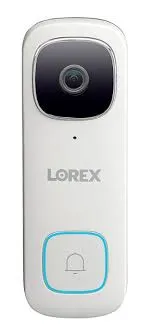
Manufacturer product photo (not an installed doorbell): a white Lorex video doorbell. On a Manhattan townhouse or a store with its own street door it can replace the old bell button; on an apartment door inside a co-op it usually needs the board’s written approval first.
FAQ
Manhattan Lorex Camera Installation FAQ
Shorter answers on scheduling, rentals, restaurants, footage requests and recording schedules — none of them repeated from the sections above.
How much notice should we give before a Manhattan Lorex installation?
+
For a store, a townhouse or a rental where nobody else needs to approve the work, a few days is usually enough to order equipment and book a two-hour window. In a co-op or condo, allow for the managing agent: we can issue the certificate of insurance the same day you send us the building’s wording, but some agents take a week or more to confirm, and a board review for anything outside your door can take longer. Tell us the building’s rules when you first call and we will plan the date around them.
Do you carry the equipment up through the lobby or the service entrance?
+
Whichever the building tells us to use. Most doorman buildings in Manhattan want contractors to use the service entrance and the service elevator, with floor and wall protection in the elevator and the hallway. Our equipment for a typical Lorex job fits in a few cases and a ladder, and we bring drop cloths for inside the apartment. If the building has a loading dock or set delivery hours, we follow them.
Will a Lorex camera mounted behind window glass give a usable picture at night?
+
It can, but glass causes problems at night: the camera’s own infrared light reflects straight back, and the picture fills with the room’s reflection. Placing the camera right against the glass, switching its infrared off and relying on street light helps. Point it at the street, your own terrace or the sidewalk in front of your shop, not across an air shaft into a neighbour’s window, which is the kind of view that causes complaints and, under New York’s privacy laws, potential liability.
What happens if the managing agent turns down the camera plan after we have bought the equipment?
+
That is the reason we send the plan before anything is ordered. If an agent or board refuses a position, we redesign around it — usually by moving a camera from the hallway side of the door to the inside, or from the façade to behind the shop window — and resubmit. Equipment we supply is not ordered until you approve the quote, and Lorex lists a 30-day return period for products bought from it directly. If you bought a kit elsewhere, check that seller’s return terms before the board meets.
Can Lorex cameras go up in a rental without drilling at all?
+
Some can. A small indoor Lorex camera can sit on a shelf, a bookcase or the top of a kitchen cabinet facing the door, with its cable run along the baseboard in adhesive raceway that peels off at move-out. Wired cameras still need a cable back to the recorder, but inside one apartment that route can usually avoid screws entirely. Cameras on exterior walls, terraces or ceilings do need fixings, so for those we ask you to check your lease first.
If a package disappears from our building's lobby, can our own Lorex camera help?
+
Only if it can see the lobby, and a camera inside your apartment cannot. What helps is acting quickly: report it to the managing agent and the police the same day and ask the building to preserve its own lobby and mailroom footage, since buildings typically keep recordings for 30 to 90 days and then overwrite them. A camera facing your own door will show whether a courier reached your floor at all, which is often the question the delivery company asks.
We see clients in a small Manhattan office suite — where can Lorex cameras sensibly go?
+
At the edges, not in the rooms where the work happens. The suite entrance, the reception counter seen from the staff side, the corridor to the fire stair and any back door are reasonable positions. Consulting, treatment and therapy rooms, restrooms and anywhere a client might change are not, and audio stays off everywhere. If your profession has its own client-privacy rules, ask your compliance adviser before the cameras go up, and remember the office building’s management will usually want to approve anything in the shared corridor.
Do Lorex cameras cope with steam and grease in a restaurant kitchen?
+
Not if they hang over the stove. Steam and cooking grease coat the lens and dome in days, and heat shortens the life of any camera. In a Manhattan kitchen we place the camera at the pass or the kitchen door, looking in across the work area rather than over the range, choose a dome or turret that can be wiped, and add lens cleaning to the closing checklist. Cellar storerooms and walk-in doors are easier and stay clean far longer.
Can a camera in our apartment keep an eye on the nanny or dog walker while we are out?
+
Video of the shared rooms of your own home — the living room, the kitchen, the entry — is something many New York families set up, but there are hard limits. Never put a camera anywhere a person may reasonably expect to undress, such as a bathroom or a bedroom they use, which New York’s unlawful-surveillance laws protect. Keep the microphone off, because recording a conversation you are not part of raises eavesdropping problems. And tell the person working in your home that cameras are in use; it is fairer, and it avoids a damaged relationship if they find one.
Our townhouse has a garden-floor rental unit — can one Lorex system cover both?
+
One recorder can, as long as the tenant’s private space stays out of it. Owner-occupied Manhattan townhouses often rent the garden or parlor floor, and the shared parts — the front door, the stoop, the areaway and the hall — can sit on the owner’s Lorex recorder. Cameras never point into the rental unit or its private entrance from the inside, and the lease should say which shared areas are recorded. If the tenant wants a camera of their own inside the unit, it goes on a separate account they control.
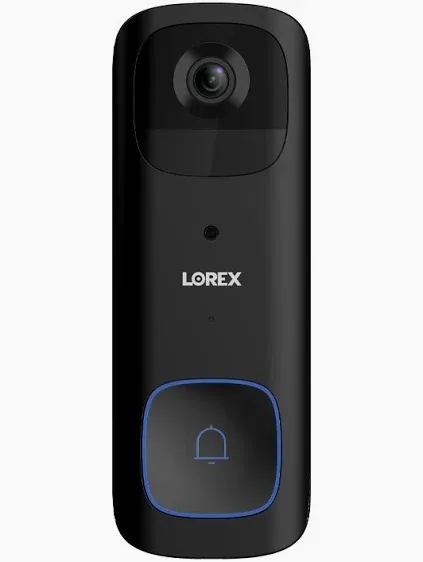
Manufacturer product photo (not an installed doorbell): a black Lorex video doorbell. Lorex sells wired and battery doorbells; which one suits a Manhattan door depends on whether there is bell wiring at all, and on what the building allows outside your door.
All Areas Served
Lorex Camera Installation Across New York City, Long Island and the Hudson Valley
Manhattan is one of five borough pages beneath our New York City Lorex camera installation hub; the suburban counties to the east and north each get a page written for their own housing.
Plenty of Manhattan calls start with Lorex and end with a second job: a walk-up’s failing door entry, a restaurant alarm, network cable for a loft. The Abstract Enterprises Security Systems home page lists them all, and our about page explains who we are and how we are licensed.
Sources
Where the Manhattan Lorex Facts Come From
Every number, rule, quotation and news item above can be traced to one of the links in this list. We read the Reddit threads only as search-result excerpts, not in full. Our own Manhattan prices are arithmetic: the Brooklyn Lorex installed prices with the 1.25 Manhattan factor applied to labour.
Nothing here is legal advice. Leases, board disputes, sound recording and biometric data are all questions for a New York lawyer once they become contentious; we can only tell you what a camera sees.
Need a Lorex Repair in Manhattan Today?
When the building swaps its internet provider, a super unplugs the wrong power strip or the Lorex app stops seeing the recorder, ring (929) 560-0737. The visit is booked into the first two-hour slot your building permits, and most Lorex faults are cleared and the system recording again within one to two hours of our arrival.
Manhattan Lorex Systems From a Licensed, Insured Crew
Manhattan line (929) 560-0737 · Abstract Enterprises Security Systems, 460 E Fordham Rd, Bronx, NY 10458 · messages by WhatsApp (718) 679-0359
4.7★ from 201 Google reviews · NYS low-voltage license #12000287431 · general liability cover, with a certificate drawn up for any Manhattan building that asks · same-day written estimates
Lorex cameras and recorders carry Lorex's manufacturer warranty. Full terms — including 50% deposit, one-year parts-only warranty on AESS-supplied products, and the late-fee schedule — are set out in the service agreement. See our warranty page.
Page reviewed and updated October 18, 2026. Changelog: Manhattan Lorex page rebuilt from new research on co-op and condo approvals, hallway and doorbell camera rules, the city’s biometric identifier law, audio and staff-area limits, building internet networks, Landmarks camera guidance, and recent Manhattan burglary and package-theft reports, with prices set at the Manhattan factor on our Brooklyn Lorex base.