What are you looking for?
About Us Contact Us Careers Get a Free Quote (800) 486-0943
Pick a service
✅ Got Your Own System?
🎬 Home TheatreQuote 🎶 AV SoundQuote 🔑 Access ControlQuote
Now pick your area
Pick your area
Long Island
Hudson Valley
Services available
Pricing & Tools
Pick a service for pricing
🚪 Intercom Pricing 🔔 Buzzer Repair Pricing
Calculators
📹 Camera System Calculator 🚨 Alarm Calculator ⚡ Cabling Quote Builder ✅ Got Your Own System?
Select your area
Home › Cat6 Repair NYC › Cat6 Repair Queens › Flushing
NYS Licensed Low-Voltage Contractor · Main Street, Roosevelt Avenue, 39th Avenue, Prince Street, Union Street & College Point Boulevard

Cat6
Repair in
Flushing

Food-Court Stalls · Mall Kiosks · Upper-Floor Clinics & Offices · Podium Towers & Garages · Flash-Flooded Basements

Downtown Flushing never really closes, and almost none of its space stays with one tenant for long. A noodle stall turns into a bubble-tea counter, a travel agency on the third floor becomes a dental suite, a parking lot becomes a podium of shops, offices and condos stacked over a garage. Every change leaves Cat6 behind — spliced, re-patched, relabelled or forgotten — and that is where most links here fail. We find the fault, work out which tenant’s run it is, repair it to Category 6 and leave a record the next occupant can read.

Reviewed and updated October 17, 2026 · Written by Anwar Timothy, NYS low-voltage license #12000287431

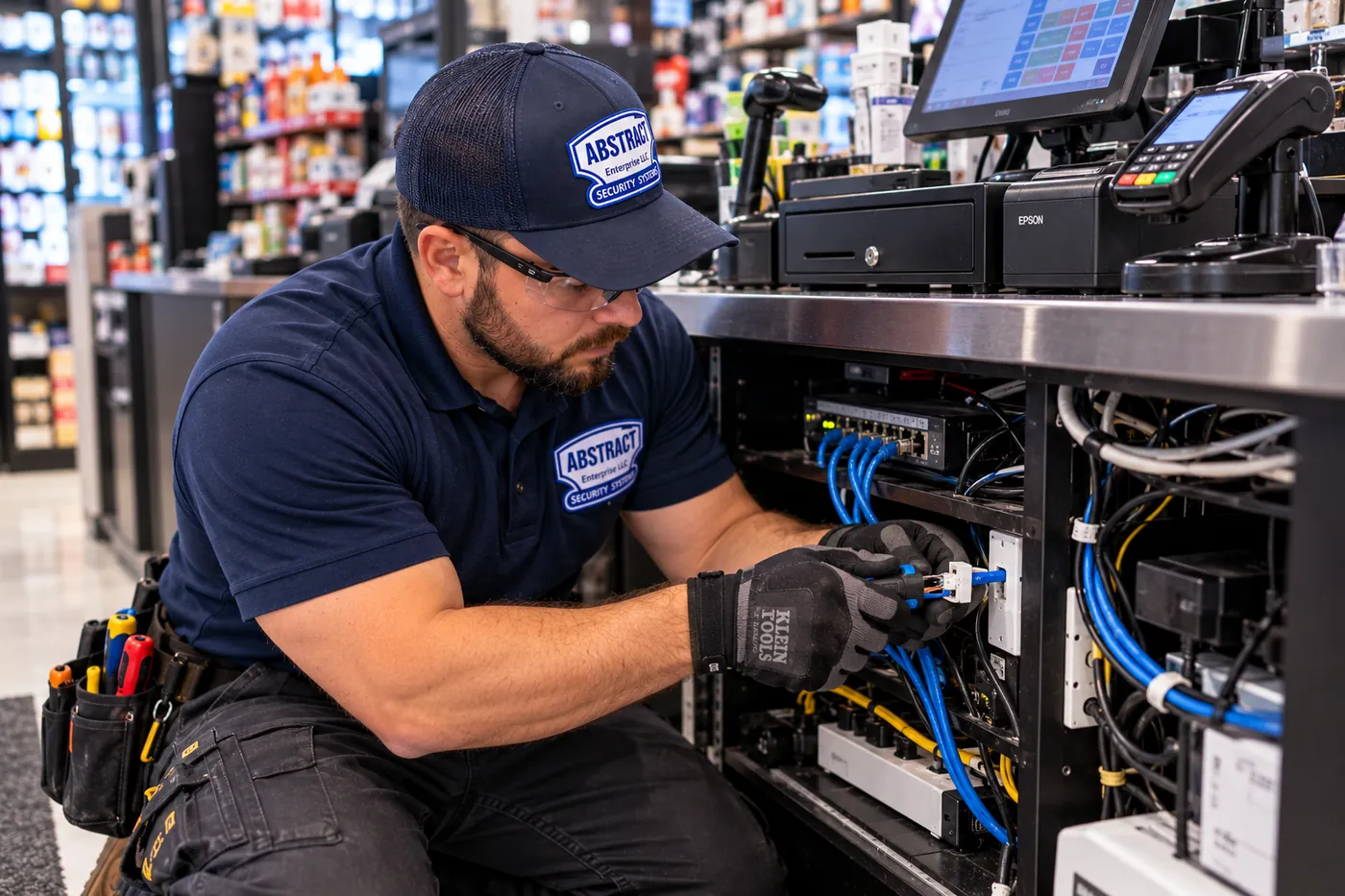
Technician in an AESS cap and safety glasses kneeling at a checkout counter, working on blue Cat6 cords at a network switch inside the open counter cabinet beneath a POS screen, cash drawer and card terminal, Cat6 repair Flushing, Queens
Under the register: the counter cabinet stands open on a small switch and a wall plate, a blue cord in the technician’s gloved hand, while the touch screen, cash drawer, Epson printer and card terminal wait on the steel top.
Flushing Cat6 Repair Quote
Tell us the building, the floor and what dropped — a technician replies the same business day

✅
Request Sent!
We will call back about your Flushing link the same business day.
25+
Years Experience
✓
Same-Day Estimates
100%
Licensed & Insured
4.7★
201 Google Reviews

Card reader in your stall refusing payments, a clinic workstation on the fourth floor that lost the scheduling system, a garage camera that went blank over the weekend? Ring (347) 434-6392 or fill in the short form. A licensed technician — not a call centre — reads it and tells you whether the fault sounds like a cord, a jack, a run in the ceiling or something that is not cabling at all.

  • Each repaired link tested against the Category 6 limits and the result saved for you
  • Ownership worked out before anything is cut: your run, the neighbour’s, or the building’s
  • New York State low-voltage license #12000287431, full insurance, one direct line for Flushing calls
The Neighborhood

Why Flushing Properties Need Cat6 Repair Built Around Tenant Turnover

Flushing packs a small city’s worth of business into a few blocks around the 7 train’s last stop. When the city’s Department of Small Business Services studied Downtown Flushing with the local chamber and the business improvement district, it described an active, twenty-four-hour district of mid-rise and new high-rise buildings holding Asian restaurants, professional services, offices, apartments and light industry. It counted 68,902 residents in the neighbourhood tabulation area at a density of 50,663 people per square mile, 71 percent of them born outside the United States, and more than sixty commercial banks across the district. It also found storefront occupancy running at nearly 100 percent, with busy upper floors full of healthcare and professional offices. That is the setting for every Cat6 repair we do here: a building where every floor is occupied, every ceiling is shared and somebody is always open.

Full occupancy does not mean stable occupancy. The same study recorded that 85 percent of the merchants it surveyed rent their space, and that many family businesses move from storefront to storefront within the district as new shopping centres and spaces open, so a shop that has traded in Flushing for twenty years may have been at its current address for less than one. Each move strips one space and fits out another. The departing tenant takes the register and the switch; the cable stays. The incoming tenant’s installer adds new runs beside the old ones, reuses whatever happens to light up, and labels the result in whatever language the crew speaks. After three or four turnovers, a ceiling above a Main Street shop can hold more abandoned Cat6 than working cable, and nobody on site knows which is which.

The second force is the way Flushing has grown upward and inward. Food courts fill basements and second floors — the Golden Mall’s basement court on Main Street opened in 1990, closed in 2019 and has since reopened renovated, and the New World Mall food court lists 32 vendor brands under one roof. Over the last fifteen years developers have replaced parking lots with podium complexes that put retail, offices, hotel rooms, condos and multi-level garages in one structure: One Fulton Square with its 168-room hotel and 299-car garage, the four-building Tangram project on the block between College Point Boulevard and Prince Street, the Sky View Parc condominium towers above the Shops at SkyView, and Flushing Commons, whose second phase broke ground in September 2026. In those buildings a single Cat6 run can pass through a tenant’s fit-out, a shared corridor ceiling and a garage before it reaches the device it serves.

The third is water. Flushing sits off Flushing Creek, and the low ground around it floods from the streets up and from the drains up. NY1 reported in July 2026 that a Saturday flash flood left basements and garages in parts of Flushing under water, that residents watched water rise through their toilets and bathtubs, and that the same area had seen deadly flooding during Hurricane Ida in 2021; the city’s emergency management commissioner put it down to the topography. A building whose network closet, router or storage room sits below grade has a real chance of losing it in a summer storm, and the cable that survives is not always cable you want to keep.

Flushing figures that shape a Cat6 repair

  • Nearly 100 percent storefront occupancy: the finding of the city’s Commercial District Needs Assessment for Downtown Flushing, alongside “active upper floor uses with a wealth of healthcare and professional services” — full buildings where every repair happens next to somebody’s open business.
  • 85 percent of surveyed merchants rent: from the same assessment, which also notes merchants relocating within the district as new centres open. Cable outlives tenants here, and each tenant inherits the last one’s.
  • 60,226 riders on an average weekday: the 2015 subway figure for the Flushing–Main Street station in that report, with 3,485 pedestrians counted in a weekday morning window on Main Street between 37th and 38th avenues. Repairs are planned around crowds, not around empty streets.
  • 32 brands in one food court: the count the New World Mall gives for its food court — thirty-odd counters, each with a register, a printer or a card reader, sharing ceilings, closets and sometimes switches.
  • 82,588 Chinese speakers: the Asian American Federation’s count for Queens Community District 7 (Flushing, Murray Hill and Whitestone), the largest Chinese-speaking population of any district in the city. Labels, port maps and handover notes have to work for the people who will actually read them.
  • Basements and garages under water in July 2026: as NY1 reported from Flushing, in an area that also flooded during Ida. Below-grade network gear here is a flood question, not just a cabling one.

None of this makes an individual repair exotic. Most failed links still come down to a crushed section, a tired termination, a damaged cord or a jack that was never punched down properly. What Flushing changes is everything around the fix: proving which run belongs to which tenant before touching it, getting into a ceiling above people who are eating or being treated, and leaving labels that survive the next turnover. We plan the visit around those three things first.

A food court or office floor with a dead Cat6 link usually has older cable of uncertain category running beside it. For that mixed cabling, and for faults that trace into the building’s shared pathways, see our network cable repair service across Queens; when a stall or suite needs new drops rather than rescued ones, the Abstract Enterprises Cat6 installation team for Queens takes it on.

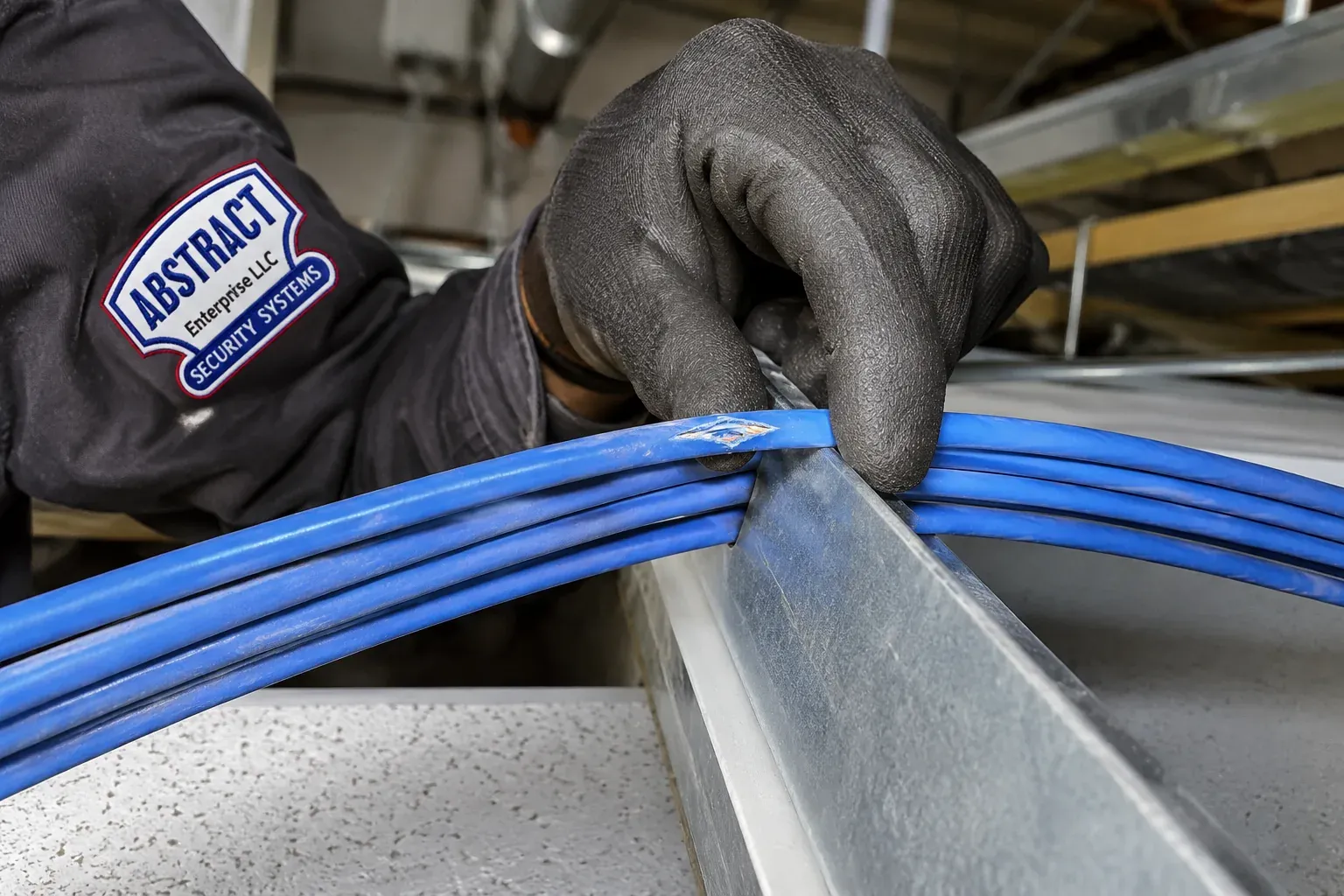
Gloved hand lifting four blue Cat6 cables off a galvanized ceiling grid rail where one jacket is scuffed open, Flushing, Queens Cat6 repair
Four blue runs draped over a galvanized ceiling member, raised by a grey glove; the uppermost jacket is worn through in a small scuffed patch exactly where it has been resting on the metal.
Repair Capture

Need Repair in Flushing Before the Dinner Crowd Arrives?

When the outage is costing money by the minute — a food-court card reader declining every tap, a practice that cannot pull up the day’s appointments, a hotel desk unable to check guests in — tell the dispatcher, and the job takes the first open two-hour arrival slot, which on weekdays is frequently that afternoon. Expect the technician to bring a certifier, a toner, matched Cat6 and Cat6A hardware, plenum- and riser-rated cable, raceway and a label printer; Flushing faults sit above concourse ceilings as often as in closets. A failed termination or cord is usually sorted within an hour or two of arrival. Time is charged at $195 an hour with a three-hour minimum ($585), exactly as on our Queens network cable repair page. Ring (347) 434-6392 and mention Flushing; if the recorder or the camera seems to be the culprit rather than its cable, our camera repair service for Queens is the place to start.

What We Repair

Cat6 Repair Services in Flushing

These are the kinds of Flushing jobs we are called for, grouped by the space the cable lives in. Each one ends the same way: every link we touched is certified, labelled at both ends and written up so the next person can find it.

Food-Court Stalls

Registers, ticket printers, card readers and order screens at counters a few metres wide, fed from a closet the stall does not control. We trace the stall’s own run through the shared ceiling, repair it and tag it with the stall number at both ends.

Mall Kiosks and Concourse Counters

Island counters with no wall behind them, fed through the floor or down from the ceiling. We repair the feed where it rises, protect the exposed section from carts and feet, and re-route it when the mall moves the kiosk.

Upper-Floor Clinics and Practices

Front desks, exam-room PCs, imaging stations and phones in the medical and dental suites above Main Street and in the newer office condos. Repairs are scheduled around appointments and planned so no patient screen is touched.

Professional Offices

Accountants, travel agents, insurance brokers, lawyers and money-transfer counters in subdivided suites. We map which desk lands on which port, fix the failed ones and leave the map taped inside the closet.

Podium Buildings and Office Condos

Mixed-use complexes where retail, offices and condos share a structure. We keep the repair inside the unit or tenant space unless the managing agent approves more, and document anything we find on the building’s side.

Garage and Loading-Dock Links

Cameras, gate readers and pay stations in the multi-level garages under the podiums, where exhaust, winter salt, sprinkler pipes and vehicle traffic all reach the cable. Repairs go into conduit or metal raceway.

Basements After a Storm

Storage rooms, back offices and network shelves below grade in shops, houses and walk-ups that took flash-flood water or a drain backup. Every affected link is certified; wet terminations and contaminated sections are replaced.

Turnover Audits

Testing everything a departed tenant left in a stall, suite or storefront and sorting it into keep, repair and remove — so the new fit-out reuses what works and the ceiling sheds what doesn’t.

Houses and Apartments

Detached and attached houses toward Murray Hill, Broadway and Kissena Park, and apartments in the walk-ups and co-ops around downtown: dead jacks, renovation damage and runs that never reached the router.

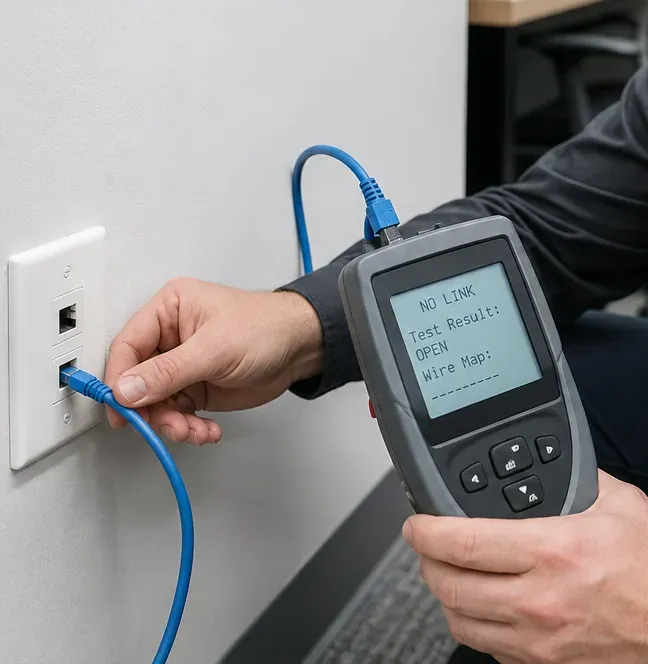
Handheld tester reading No Link, Test Result Open, with a blue patch cord plugged into the lower port of a white two-port wall plate, Flushing, Queens Cat6 jack test
Lower port of a two-port white faceplate with a blue cord in it, and beside it a grey handheld unit whose display says No Link, Test Result: Open, with the wire map left as a dashed line.
Building Specialists

Cat6 Repair for Flushing’s Architecture

Flushing’s buildings are layered rather than lined up, so the first question on any call is which layer the cable runs through. These are the structures we meet most between the creek and Kissena Boulevard, with what each does to Cat6 and how each lets us reach it.

Basement and Upper-Level Food Courts

Dozens of counters in one hall, a low ceiling packed with exhaust ducts, sprinkler pipe and every vendor’s cable, and a single network closet or a few landlord switches. Heat and grease rise into the ceiling; mop water reaches the floor; turnover is constant.

Multi-Level Indoor Malls

Shopping centres with stores, services and food on several floors, as the city’s assessment of Downtown Flushing noted. Cable crosses tenant ceilings to reach shared closets, and island kiosks are fed through the slab.

Podium Mixed-Use Complexes

Retail at street level, offices and community space above, condos or hotel rooms in the towers, and parking below: One Fulton Square, Tangram, Sky View Parc and Flushing Commons are the large examples. Concrete slabs, rated shafts and managed telecom rooms define what a repair may touch.

Office and Medical Condominiums

Floors divided into individually owned suites — Flushing Commons’ first phase alone includes 90 office condominiums — and, as with Flushing’s upper floors generally, many of them in healthcare use. Each owner controls the cable inside the suite; the association controls corridors, risers and the main closet.

Mid-Rise Walk-Up Commercial Buildings

The older mid-rise buildings along Main Street, Roosevelt Avenue, 40th and 41st roads and Prince Street, with shops below and offices, agencies and clinics above, linked by narrow stairs and shared cellars. Cable climbs the stairwell or a converted chase.

Warehouses and Showrooms by the Creek

Home-furnishing wholesalers and storage along College Point Boulevard, which the assessment describes as a corridor of wholesalers and warehouses among newer shopping centres. Long runs on steel, loading doors and forklifts.

Houses East and North of Downtown

Detached and attached houses in Murray Hill, the Broadway area and around Kissena Park, many with finished basements. Cable runs through joists and closets, and the faults follow renovations and basement water.

How each layer changes the repair

In food courts and malls, ownership comes before testing. A landlord’s switch, a vendor’s cable and a neighbouring stall’s cable can all sit in the same few metres of ceiling. Before we cut or re-terminate anything, we tone the run from your device to the closet, confirm the port it lands on with whoever controls the closet, and put a temporary tag on it. Only then does the repair start. Doing it in that order is slower by a few minutes and avoids the one mistake that turns a single outage into three.

In podium buildings, the slab decides the route. Concrete floors and rated shafts mean a damaged run is replaced along the pathway that already exists — a sleeve, a tray, a conduit — rather than through a new hole. Where the old pathway is full or blocked, we write up the alternative for the managing agent instead of drilling. Any new penetration of a rated floor or wall gets a listed firestop system, and we say so on the paperwork.

In older walk-ups, the stairwell is the riser. Cat6 to upper-floor offices in Flushing’s older commercial buildings often climbs the stair hall in raceway, shares a cellar with the shop below and enters each floor through whatever opening was easiest. Repairs keep the run in protected raceway along the stair stringer or the ceiling line, out of the way of deliveries and the next tenant’s renovation.

In garages and warehouses, protection is the repair. A camera run that failed in a parking level or by a loading door failed because something reached it. Re-terminating it without moving it into conduit, metal raceway or a higher path just schedules the next failure.

Card readers on suite doors and garage gates often hang off the same pathways as the data runs. Our tests tell you whether their cable is sound; the readers, strikes and controllers themselves are looked after by our access control installers in Queens.

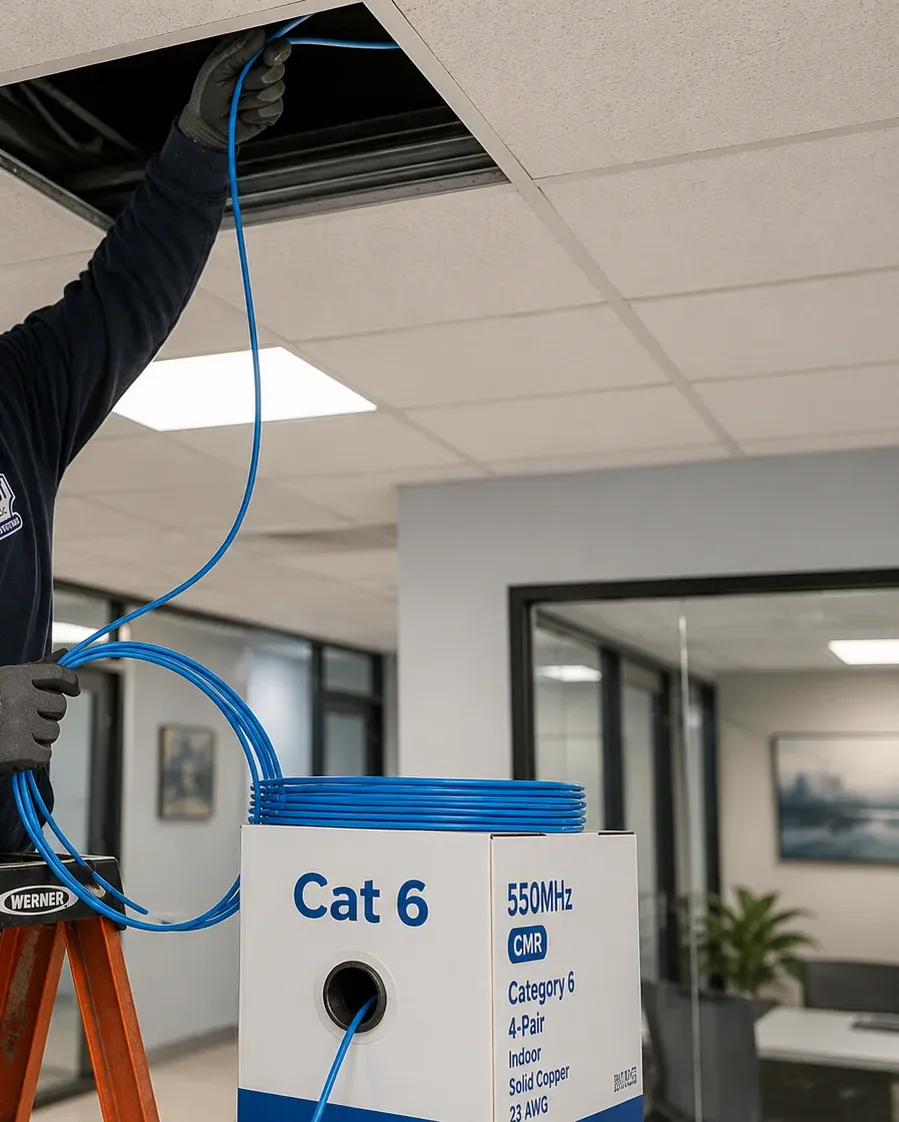
Technician on an orange stepladder feeding blue cable up through an open ceiling tile from a carton marked Cat 6 CMR solid copper in an office, Flushing, Queens Cat6 replacement run
From box to ceiling: blue cable pays out of a white Cat 6 CMR solid-copper carton, loops past an orange Werner ladder and disappears through a lifted tile in an office with glass-fronted rooms.
Commercial Cat6 Repair

Business Cat6 Repair in Flushing

The city’s 2016 assessment of Downtown Flushing studied six commercial corridors, and between them they cover almost every kind of Cat6 trouble the neighbourhood produces. The descriptions below are of the streets and their buildings, not a list of our customers.

Main Street

The district’s spine and its busiest sidewalk, lined with banks, supermarkets, bakeries, pharmacies and the doors to basement and upper-floor food courts, clinics and agencies. Short runs in crowded ceilings, upper floors reached by stairs, and almost no quiet hour.

Roosevelt Avenue

The other half of the crossroads, under and beside the station, with shops, restaurants and mall entrances. Narrow frontages running deep into the block mean long runs from the street-side counter back to a closet at the rear or in the cellar.

39th Avenue and Prince Street

The newer face of downtown: One Fulton Square’s hotel, retail and medical space and the Tangram towers, plus garages beneath. Managed buildings with telecom rooms, condominium boards and fit-outs that keep changing at street level.

Union Street and Northern Boulevard

Identified in the assessment as the traditional centre of the Korean American business community, which has spread east along Northern Boulevard. Restaurants, offices and karaoke lounges that stay open into the small hours.

College Point Boulevard

Home-furnishing wholesalers, warehouses and newer shopping centres, including the Shops at SkyView with Sky View Parc’s condo towers above. Large floors, long runs, loading areas and garages.

37th Avenue and 138th Street

The Flushing Commons site, where the first phase brought condos, office condominiums, retail and 982 parking spaces, and the second phase now under construction adds offices, retail and a YMCA. New-building cabling in occupied space beside an active site.

The links each kind of Flushing business depends on

BusinessLinks that cannot dropWhere they usually fail here
Food-court stall or bubble-tea counterRegister, card reader, ticket printer, order screenShared ceiling above the stall, the drop to the counter, a landlord switch port
Restaurant or bakery on a corridorRegisters, kitchen printers, delivery tablets, camerasThe deep run from the front counter to the rear closet, the cellar crossing
Medical or dental suiteFront desk, exam-room PCs, imaging stations, phonesChair and exam-room boxes, renovated partitions, a closet shared with the next suite
Accounting, travel or insurance officeDesk PCs, printers, phones, a scannerUnder-desk cords and floor-level jacks, runs added by successive tenants
Bank branch or money-transfer counterTeller terminals, cameras, cash recyclersBehind counters and partitions, where cords are pinched by fixtures
Karaoke lounge or entertainment venueRoom song systems, ordering tablets, cameras, point of saleRuns to each private room along long corridors, late-night wear
Hotel in a podium complexFront desk, back office, key encoders, camerasBack-of-house ceilings, the run from the desk to the building’s telecom room
Wholesaler or showroomOffice PCs, label printers, scanners, camerasLong runs on steel, loading doors, cable crossing aisles

We test the links the business cannot trade without first, so the register, the front desk or the teller window is working again before we look at anything that can wait until tomorrow.

Code and building callouts for Flushing Cat6 repairs

  • Which code applies. Since December 21, 2025, according to the Department of Buildings, the city’s Electrical Code — the 2020 National Electrical Code with New York City amendments — has been fully in force. Its communications chapter decides which cable types belong in a riser, a return-air ceiling or a fire-rated wall, so every replacement section we install is chosen to match it.
  • Plenum ceilings in malls and offices. Where the space above a ceiling carries return air, communications cable in it must be plenum-rated (type CMP). Many Flushing malls and podium offices use their ceilings that way. We repair with cable rated for the space it is in, and tell you if the run we found is not.
  • Dead runs left in ceilings. Under the National Electrical Code, communications cable that has been abandoned and can be reached should come out, unless someone marks it as reserved for later. Flushing ceilings that have seen several tenants are full of it, so we remove what is accessible while we are up there.
  • Firestopping between uses. Podium floors separate garages, shops, offices and homes. A replacement run through a rated floor or wall is sealed with a listed firestop system, and existing open penetrations we notice are reported to the managing agent.
  • Water first, power second, cable last. Guidance the Department of Buildings issued after Ida warned people off breakers while standing in water and pointed out that bigger post-flood repairs might involve registered contractors and permits. Our technicians stay out of a flooded basement until an electrician or the utility has made the power side safe, and our work there is low-voltage only.
  • Landmarked buildings. Flushing Town Hall has been a New York City Landmark since 1968, and the neighbourhood keeps other historic buildings such as the Old Quaker Meeting House and the Bowne House. Exterior changes to a designated building can need Landmarks Preservation Commission approval, so we keep any repair route inside wherever possible.

When the failed run feeds a stall or storefront camera, the camera and recorder side is handled by our commercial camera installation team for Queens once the cable passes.

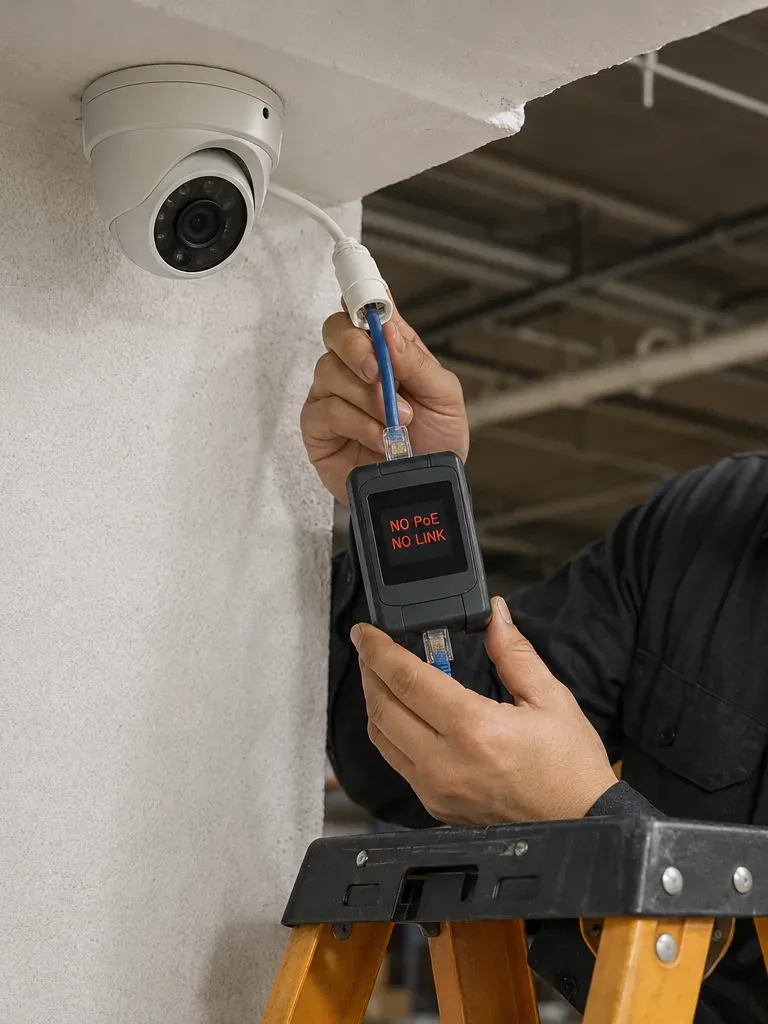
Inline tester reading No PoE No Link held under a white dome camera on a textured pillar, with a technician on a stepladder, Flushing, Queens Cat6 camera link
At the top of a textured pillar, a white dome camera’s lead meets a blue cable through a pocket tester whose red display reads No PoE, No Link; a stepladder and an open ceiling are behind.
Your Questions Answered

Cat6 Repair in Flushing: Questions Answered

These are the questions that come from stall operators, mall and building managers, clinic administrators, office-condo owners and householders in Flushing once a Cat6 link starts failing. They are grouped by the kind of space involved. Shorter practical points sit in the FAQ further down the page.

Food courts, malls and kiosks

Does opening the ceiling above our food-court stall put our health inspection at risk?

It should not, provided the work is planned like food-safety work rather than ordinary cabling. The city’s Health Department inspects and grades every food service establishment, and loose debris, dust or ceiling material over food and prep surfaces is the kind of thing an inspector notices. Lifting a ceiling tile above a counter can drop decades of dust from a mall ceiling.

So we treat the stall as a food area. Wherever we can, we reach the run from outside the stall — from the corridor, the seating area or the neighbouring back-of-house — and pull or test it from there. When the tile directly above food has to come out, we ask you to cover or remove open food, utensils and prep surfaces first, we put down a drop sheet, we vacuum as we go and we put the tile back the way it was. The best time is the hour before you open or right after you close, when nothing is out.

Public safety matters as much as hygiene. In a food court with open seating below, we cordon off the area under the ladder, keep tools on a belt rather than on the ceiling grid and never leave an open tile unattended. If the mall office has its own rules for overhead work during trading hours, we follow them and tell you before the visit what they are.

The mall wants to move our island kiosk further along the concourse — can the existing Cat6 follow it, or does a new run have to come from the closet?

It depends on how the kiosk is fed today and how far it is moving. Island kiosks in indoor malls are usually fed one of two ways: up through a floor box or core-drilled opening in the slab, or down from the ceiling inside a pole or along a column. Neither kind of cable can simply be stretched. Cat6 has a fixed maximum channel length, and an extension spliced in under a kiosk is a fault waiting to happen.

If the kiosk moves a short distance and the existing run has enough spare length coiled at the closet end, we can sometimes pull the cable back toward the new position, re-terminate it in a new floor box or pole and certify it. If the move is longer, or the old run has no slack, the reliable answer is a new run from the closet to the new position, with the old one removed or tagged as abandoned. Either way we test before and after, so you can see the new link is as good as the old one.

Two practical points. The mall controls the floor and ceiling, so it usually decides where the new box or pole goes and whether the slab may be opened. And the move is the moment to fix anything that was wrong with the old feed — a cable lying loose in a cart path, an unprotected drop, a printer cord taped to the floor.

Does the cable above a mall’s drop ceiling have to be plenum-rated, and what happens if our old run isn’t?

If the space above the ceiling is used to return air to the building’s heating and cooling system, yes. Communications cable in that kind of space has to carry a plenum rating (CMP on the jacket), which limits how fast it burns and how much smoke it gives off. Riser-rated (CMR) and general-purpose (CM) cable belong elsewhere. Many shopping centres and office floors use their ceiling voids as return-air plenums, and the building engineer or the mall’s drawings will say whether yours does.

When we repair a run in a plenum ceiling, any replacement section is plenum-rated. If testing or a look at the jacket shows that the existing cable is not, we tell you and the building management in writing. We do not quietly leave a non-compliant run in place after replacing part of it, and we do not rip out a working run without your agreement either; the choice and the price come first.

The print on the jacket answers most of this in seconds. If you can safely see the cable near your device or in the closet, a photo of the printing along the jacket tells us its category, its rating and often its maker before we arrive.

Podium buildings, garages and clinics

Our Cat6 runs through the underground garage beneath the building — what does garage air and traffic do to it?

More than most people expect. Several of Flushing’s newer complexes sit on multi-level garages — 299 spaces under One Fulton Square, 377 planned under Tangram, 982 in the first phase of Flushing Commons — and cable for cameras, pay stations, gate readers and sometimes the floors above runs across their ceilings. A garage is closer to outdoors than indoors: it is cold in winter, damp in summer, full of exhaust, and every car that drives in during a snowstorm brings salt and slush with it.

The usual failures are corroded terminations at cameras and readers, jackets damaged where cable passes along beams that delivery trucks or tall vehicles touch, and runs disturbed when sprinkler or drainage pipes overhead are worked on. Indoor cable strapped to the underside of a garage slab without protection will not last as long as the same cable in a dry ceiling.

When we repair garage runs we put them in conduit or metal raceway, use terminations and boxes suited to a damp location, keep them above the clearance line marked for vehicles, and seal the point where the cable leaves the garage into the building. The garage belongs to the building, so we agree the route with the managing agent before we start.

Shielded X-ray rooms in Flushing dental offices: mending the imaging-computer run without a new penetration

Yes, but the shielding sets the rules, not the cable. Rooms where dental or medical X-rays are taken are often built with lead-lined drywall or other shielding to a plan prepared for the practice. A new hole through that wall, or a box cut into it, can open a gap in the shielding. That is not a decision a cabling contractor should make on the day.

Our approach is to repair the run without new penetrations of the shielded wall. Most imaging rooms already have a way for cable to get in — a sleeve, a ceiling entry above the shielded height, or a box installed with backing when the room was built. We test the run, find the fault by distance and repair it through that existing path: re-terminating the jack, replacing a section above the ceiling or swapping the cord. If the only fix involves cutting into the shielded wall, we stop, explain why, and leave it for the practice and whoever is responsible for its shielding plan to decide.

The imaging sensor, its software and the X-ray unit stay with the equipment vendor. Our part is the cable from the switch to the jack beside the chair or the processing computer, proven by a certification test, so the vendor is not left blaming the network.

Counters behind bullet-resistant partitions: reaching the window terminal’s Cat6 while the panels stay untouched

Teller-style partitions at money-transfer counters, check-cashing windows, pharmacies and some ticket counters are usually built as a sealed assembly: rated glazing in a frame, a solid counter below and a deal tray or pass-through in between. Cable reaches the terminal on the staff side through the counter, up from the floor or down a frame member, never through the glass. That is good news for a repair, because the partition itself almost never needs to be touched.

We work entirely on the staff side. The fault is usually one of three things: a cord crushed by a drawer or a cash recycler, a jack mounted low inside the counter where feet and boxes reach it, or a run pinched where it passes a frame. We test the link, replace what has failed and re-route the cord so the drawer and the recycler cannot catch it again. If a repair would need the partition frame opened, we tell you first; that is a job for whoever installed and certified the partition.

Because these counters handle money, we arrange the visit with the manager in advance, work only while a staff member is present and keep the till and safe areas closed while we are there.

Labels, languages and water

Our patch panel was labelled in Chinese by the last installer and our new office manager reads only English — can the labels be redone in both languages?

Yes. Labels are only useful if the person standing in front of the closet on a bad day can read them, and in a district where many businesses run in Chinese, Korean or English — or all three — that is not always the person who installed them. We do not throw away existing labels that someone can still use; we add to them.

Every port we test gets a printed label with a short number at both ends, the panel port and the wall jack or device. The port map we leave lists those numbers against a description of where each one goes. You or your staff give us the wording — in English, Chinese, Korean or another language — and we print it as given, so the map says “front register” or its equivalent in the words your team uses. We do not translate for you; we make sure the numbers match so any version of the map points to the same cable.

The number is what matters most. When the register drops on a Saturday, a manager who can tell us “port 14, jack 14” over the phone saves both of us a lot of guessing.

Sewer water backed up into our basement during the storm — should the cleanup company or the cabling contractor go in first?

The cleanup company, almost always. Water that comes up through floor drains, toilets or tubs during a flash flood — which is what NY1 described Flushing households dealing with in July 2026 — is treated by restoration firms as contaminated black water. Their standard practice is to remove porous materials it touched, such as drywall, insulation and carpet, rather than clean them. Cable often runs through exactly those materials.

If we test first, we may be testing runs that are about to be cut out with the wall around them. So we suggest this order: power made safe, cleanup and removal of contaminated materials, drying, then a full test of every link that passed through the space. At that point we can see which runs survived, which were cut during the cleanup, and which sat in the water and should be replaced rather than trusted. Jacks, plugs and boxes that were submerged in sewage are replaced, not cleaned.

There is one exception. If a business needs one link back the same day — a register, a camera, a clinic’s front desk — we can run a temporary cable along a dry, safe path above the waterline while the remediation goes on, and make the permanent repair once the space is clean.
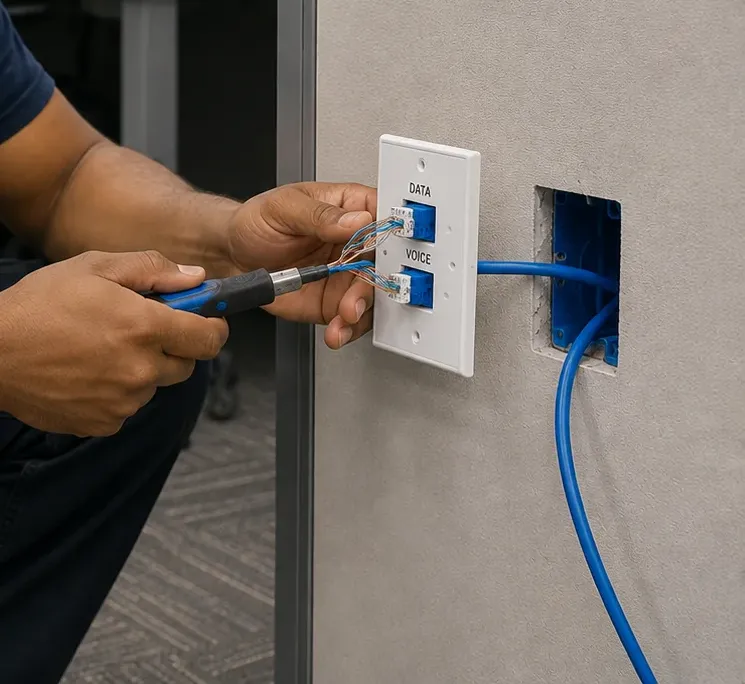
Hands punching down blue Cat6 into the keystones of a wall plate labelled Data and Voice beside an open blue box in a grey partition, Flushing, Queens Cat6 re-termination
A blue-handled punch tool seating colored pairs into the blue keystones of a faceplate marked Data and Voice, held just out from a blue box let into a grey fabric partition.
Equipment

Test Gear and Parts We Bring to a Flushing Cat6 Repair

The van is packed for shared ceilings, occupied food courts and managed buildings, because those are where Flushing faults hide. Everything below comes on the first visit.

Certification Tester

Measures each link against the Category 6 or 6A limits and saves the result. In a building with three generations of cable, it is also the fastest way to tell which runs are worth keeping.

Fault Distance Readings

Tells us how many metres from the jack a break, short or crush sits, so the one tile we lift in a food court or the one panel we open in a clinic is the right one.

Toner, Probe and Temporary Tags

Proves which cable in a crowded ceiling or closet belongs to your stall, suite or desk, and marks it before anything is unplugged or cut.

PoE Load Tester

Checks the power reaching garage and corridor cameras, phones and access points under load, not just the voltage at an idle port.

Plenum and Riser Cable

Cat6 rated CMP for return-air ceilings and CMR for risers, so a replacement section always suits the space it goes into.

Matched Keystones and Modules

Keystones, modules, plates and moulded cords in both Cat6 and Cat6A, kept separate on the van so the category of the repair always matches the link.

Conduit and Metal Raceway

For garage levels, loading areas, kiosk drops and anywhere carts, vehicles or rodents would reach an exposed cable.

Label Printer

Prints port numbers and the descriptions you give us, in the words your staff use, for both ends of every link we touch.

Drop Sheets and Vacuum

For work above counters, seating and treatment rooms, so the ceiling dust ends up in the bag rather than on food or patients.

Repair, re-route or replace: how the choice is made in Flushing buildings

What the test and the walk showUsual repair
Fault at a jack or plug, cable sound, termination somewhere dry and protectedNew termination on matched parts and a factory cord, then a certification test
Fault at a kiosk or counter drop that carts, feet or drawers keep hittingRe-terminate and move the drop into a protected box or raceway
One damaged point in a run across a shared ceilingReplace the run, or the damaged section where a full pull is impractical, with cable rated for that ceiling
Run crosses a garage or loading area unprotectedReplace into conduit or metal raceway, with damp-location terminations
Cable sat in flood or drain-backup waterReplace the affected run and every submerged jack or box after cleanup
Run belongs to a previous tenant and tests poorlyRemove it or tag it abandoned; repair or replace your own run instead
Non-plenum cable found in a return-air ceilingReport it in writing; replace with plenum-rated cable on approval
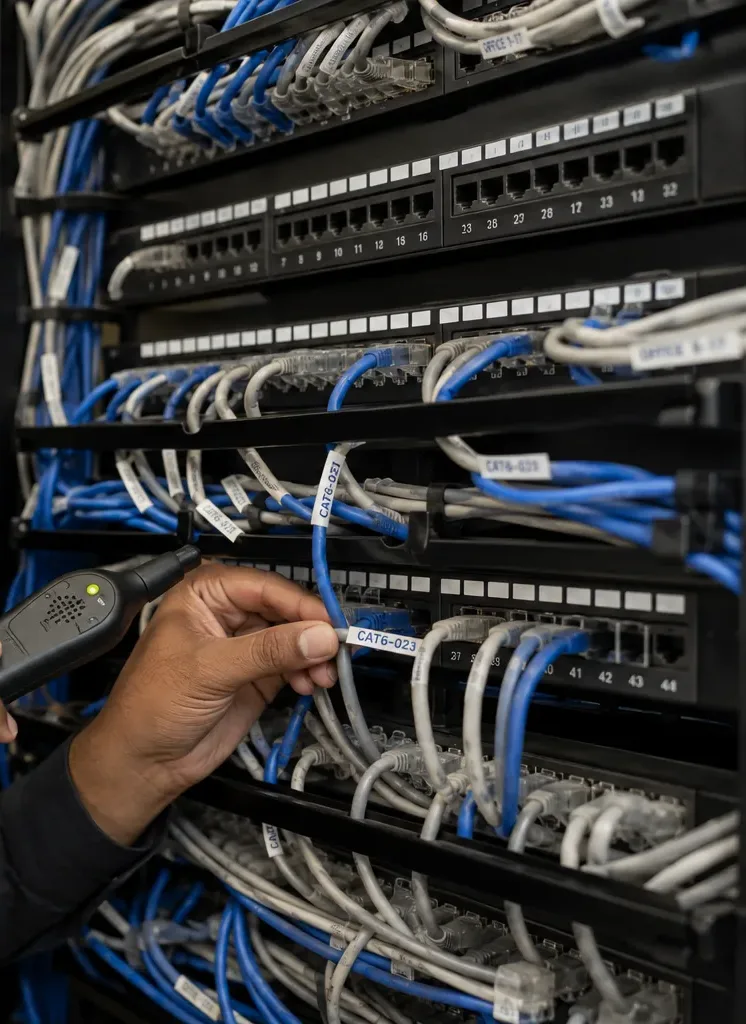
Tone probe held to a blue patch cord labelled CAT6-023 among labelled grey and blue cords in a patch panel rack, Flushing, Queens Cat6 tracing
Green light on the probe: a hand isolates the blue cord tagged CAT6-023 in a rack crowded with numbered panels and printed-label grey and blue cords.
AI Overview Reality Check

What AI Gets Wrong About Cat6 Repair in Flushing

We could not view Google’s AI Overview while preparing this page, so nothing here is quoted from it. These are seven assumptions that turn up again and again in AI-written answers, cost guides like Angi, HomeAdvisor and Fixr, and forum threads, set against what we actually find in Flushing buildings.

“In a mall or food court, the landlord’s network covers your stall”

General answers tend to treat a shopping centre as one network: the landlord provides internet, so the landlord fixes it.

In practice ownership is split, and the split varies from building to building. The landlord may own the closet and a switch, the vendor may own the cable from the closet to the stall, and the point-of-sale company owns the terminal and its settings. When the link fails, each party can honestly say the fault is someone else’s, and the stall stays offline while they decide.

A test settles it. A certification result from the switch port to the stall’s jack shows whether the cable passes or fails, and where; a port check shows whether the landlord’s switch is answering. We give that result to the stall and, if you agree, to the mall office, so the conversation is about a measurement rather than an opinion.

“Brand-new buildings don’t need cable repairs”

It is easy to assume that the glass towers along 39th Avenue and College Point Boulevard have cabling problems only in the distant future.

New podium buildings have their own failure points. Retail floors at the bottom are re-fitted every time a tenant changes, often while the offices and homes above are occupied; garage levels expose cable to vehicles and weather; and suites in office condominiums are customised by each owner’s contractor. Flushing Commons’ second phase, which broke ground in September 2026 and is expected to finish in 2029, will add more of exactly that mix.

New cable also gets damaged by the next trade. Drywall screws, ceiling installers, sprinkler fitters and sign hangers all work in spaces that already carry live Cat6. A failed link in a two-year-old building is more often damage than age, and a fault reading by distance usually shows where the other trade was working.

“Only waterfront properties need to worry about flooding”

Flood advice online leans on flood-zone maps, and buildings outside the shaded areas are often told they are safe.

The city’s own analysis of Hurricane Ida found that only 6.9 percent of the buildings it damaged were in the 100-year floodplain. The damage came from rain that overwhelmed streets and sewers, not from rising rivers. NY1’s July 2026 report from Flushing described exactly that: drains blocked by leaves and rubbish, water rising in the street and coming back up through basement fixtures, and residents who now expect it with every heavy storm.

For a network, the practical question is not whether the building is on a flood map but what sits below grade. A router, switch or patch panel on a basement shelf, and cable lying on a basement floor, are at risk anywhere in low-lying Flushing. Repairs after a flood are the right time to lift them.

“A busy, fully leased building has its cabling under control”

A building with no empty storefronts sounds well run, and AI answers tend to equate occupancy with good maintenance.

Full occupancy in Flushing usually means fast turnover rather than long leases. The city’s assessment found storefront occupancy near 100 percent, most merchants renting, and businesses moving between spaces in the district as new centres open. Each move adds cable and rarely removes any. The result is ceilings and closets where nobody can say which runs are alive.

The cure is unglamorous: test what is there, label what works, tag or remove what does not. We do it as part of any repair in a turnover-heavy building, and as a stand-alone audit when a new tenant takes a space.

“A food stall can run its register on the mall’s Wi-Fi”

Wireless is the first suggestion in most troubleshooting guides, and it is tempting when the cable is dead and the queue is long.

As a stop-gap it can get a stall through an afternoon. As a permanent arrangement it runs against what POS makers themselves advise. Toast’s support pages recommend Ethernet for stationary devices because a cable is more stable than Wi-Fi and is not affected by wireless interference — and in a food court with thirty-odd vendors, shoppers’ phones and the mall’s own access points, interference is constant.

Repair the cable and keep wireless as the backup. Once the link is certified, your POS provider can confirm the terminal is actually using the cable rather than flipping between connections.

“Labels and documentation are optional extras”

Cost-saving advice often treats labelling as a luxury: the cable works, so why pay to mark it?

The city’s assessment noted that Flushing merchants face language and cultural barriers when dealing with business services and regulations. The same barriers apply in a network closet: the installer, the owner, the manager and the next technician may not share a language, and unlabelled cable becomes unknowable within one turnover.

Labels with plain numbers at both ends, and a port map in the words your staff use, are the cheapest part of a repair and the part that saves the most time later. We include them on every link we touch.

“Clinics have medical IT vendors who handle the cabling”

Medical and dental offices usually have a practice-management vendor, an imaging vendor and an IT provider, and it is natural to assume one of them owns the wiring.

Usually none does. Each vendor supports its own devices and software; the cable inside the walls is part of the building or the suite. Flushing’s upper floors are dense with healthcare offices, as the city’s assessment recorded, and many of them occupy suites fitted out by earlier tenants for other uses, with cable that was never documented.

When a clinic link fails, a certification result is what lets the vendors get back to work: it shows the cable is sound, or shows exactly where it is not. We test, repair and hand the result to whoever the practice nominates.

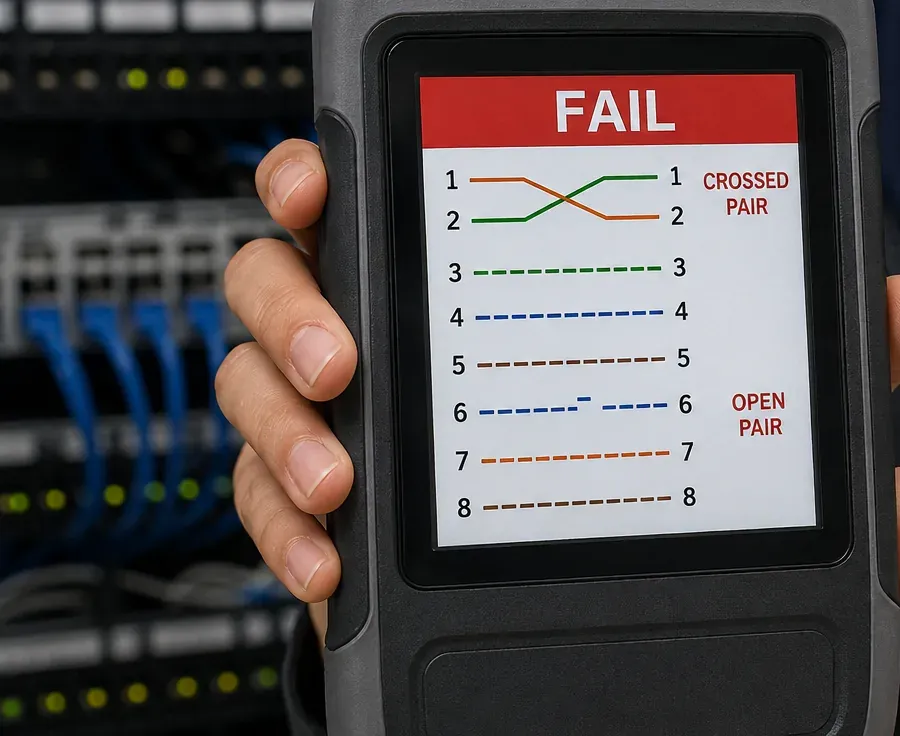
Tester screen headed Fail showing pairs 1 and 2 crossed and pair 6 open, held in front of a network rack, Flushing, Queens Cat6 certification
Fail, in white on red, over a wire map in which pairs 1 and 2 swap places (Crossed Pair) and pair 6 breaks (Open Pair), the tester held up in front of an out-of-focus rack.

Find Out Whose Cable It Is Before Anyone Cuts It

Most mistakes in a shared building happen when someone unplugs the wrong cable. One call with the address, the stall or suite and the device that dropped is enough for us to say what probably failed, who controls the closet and what the first three hours would cover.

Get In Touch

Request a Free Quote

One dead jack in a Murray Hill house or half a food court offline on Main Street — the form reaches a technician who knows Flushing buildings. Give us the building, the floor or stall and what the cable feeds, and you will have a written reply the same business day. Rather talk? Call (347) 434-6392.

✅

We Got Your Request!

Received. Expect a call from a technician about your Flushing building later today, during business hours; for a stall or desk that is offline at this moment, the faster route is (347) 434-6392.

How It Works

Our Flushing Cat6 Repair Process

Seven steps, whether the job is one stall in a basement food court or every desk on an office-condo floor.

1. The call and the photos

We ask what dropped, since when, and who controls the closet. A photo of the device ports, the wall jack and the cable jacket printing tells us what to load before anyone drives over.

2. Access agreed with the building

We book a two-hour arrival window around your trading or patient hours and settle access with the mall office, managing agent or condo association, including insurance certificates if they want them.

3. Tone, tag and confirm ownership

Your run is traced from the device to the closet and tagged at both ends, and the port is confirmed with whoever controls the switch, before anything is unplugged or cut.

4. Certify and locate the fault

Each affected link is certified, the fault is placed by distance, and the route is checked for the cause: a cart path, a garage beam, a renovated partition, a wet floor or a previous tenant’s splice.

5. Repair plan approved

We explain link by link what failed and what we propose, with prices for anything beyond the time block. Nothing is pulled, re-routed or removed until you say yes.

6. Repair, protect and clean up

The approved work only: fresh terminations on parts of the same category, CMP or CMR cable wherever a section is replaced, raceway over any drop that carts or feet can reach, firestop at rated floors and walls, abandoned cable taken out where we can reach it, tiles back in place and dust vacuumed.

7. Final test, labels and handover

A second certification run on each repaired link, labels on jack and panel, and an email with the saved results, the port map in your own wording and two or three lines on why it failed.

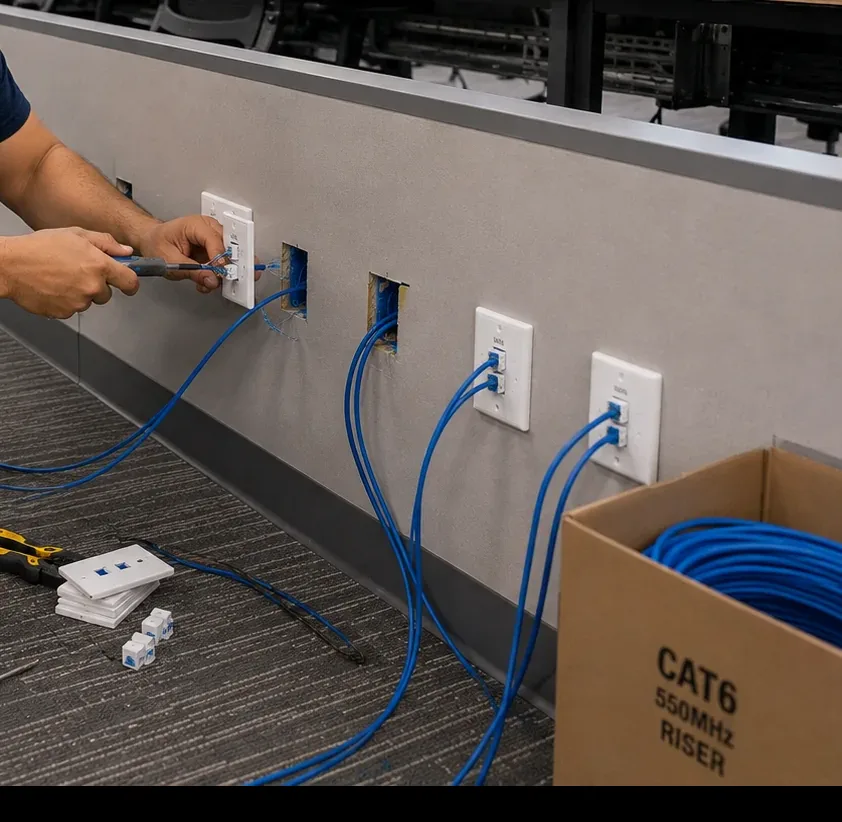
Hands re-terminating a jack at the first of a row of wall plates along a grey partition, with blue Cat6 tails, spare plates and keystones on the carpet and a Cat6 riser carton, Flushing, Queens office
Work in progress on a grey office partition: the left-hand plate is off its box and being re-terminated, two cut-in openings trail blue tails, loose plates and keystones sit on the carpet, and an open CAT6 Riser carton holds the spool.
Coverage Area

Cat6 Repair Near Flushing’s Landmarks

Six places that help place a Flushing address, from a seventeenth-century meeting house to a phased development still under construction. They are reference points for the blocks around them, not claims that we have worked inside them.

Flushing Town Hall

Built in 1862 on Northern Boulevard at Linden Place, listed as a city landmark in 1968, and restored over nine years from 1990 into an arts centre with a 308-seat theatre. The anchor of the Union Street and Northern Boulevard end of downtown.

Old Quaker Meeting House

Built in 1694 by John Bowne and other early Quakers on Northern Boulevard, and described by the Flushing Meeting as the oldest house of worship in New York State. Neighbour to the offices and shops along the boulevard.

Bowne House

At 37-01 Bowne Street, where Flushing’s Quakers met for about thirty years before the meeting house was built. The edge of the residential blocks that run east from downtown toward Murray Hill.

Queens Public Library, Flushing

At 41-17 Main Street, in the middle of the commercial core; the library announced a roughly five-week closure from April 27, 2026 for safety improvements. Surrounded by food courts, banks and upper-floor offices.

NewYork-Presbyterian Queens

The hospital at 56-45 Main Street, south of downtown. Its presence helps explain the density of medical and dental practices in the office buildings and condominiums nearby.

Flushing Commons

At 37-10 138th Street on the site of a former municipal parking lot: a first phase completed in 2017 with condos, 90 office condominiums and retail, and a second phase of two buildings, offices, retail and a YMCA that broke ground in September 2026.

We also repair Cat6 in Murray Hill, Broadway–Flushing, Auburndale, Kissena Park, Queensboro Hill, Pomonok, Kew Gardens Hills, Fresh Meadows, College Point, Whitestone, Bayside, Corona and Willets Point, across the rest of Queens, and in the other four boroughs, Long Island and the Hudson Valley.

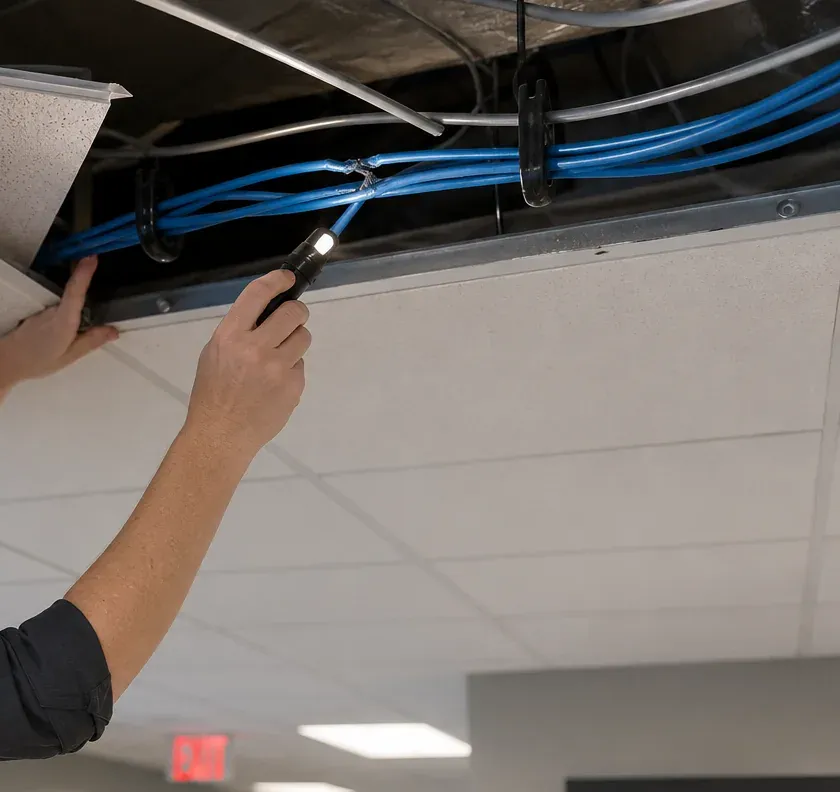
Hand holding a flashlight to a bundle of blue Cat6 cables in black hangers above a lifted ceiling tile, with an exit sign below, Flushing, Queens ceiling inspection
Torch beam on the bundle: a tile is held up with one hand while the other lights blue cables hanging in black supports beside grey conduit, a red exit sign showing on the ceiling beneath.
Pricing

Cat6 Repair Cost in Flushing

Flushing jobs are priced from the same published Queens figures as everywhere else in the borough; this page adds no new numbers. The bill separates the time spent testing and repairing from any cable that has to be replaced, and the right-hand column says where each figure is published.

ItemPriceScope and source
Repair time on Cat6 or Cat6A: toning and tagging, testing, fault location, re-termination, relocating drops, labels and final certification$195/hr, 3-hour minimum ($585)Identical to the borough rate; hours four onward are charged only for the time actually spent on site
Replacement run where a cable cannot be recoveredFrom $175 per dropQueens replacement-drop figure; cable, faceplate, punch-down, test, labels and cord all included
Cable entry from outside or from a garage made good, sealed and bondedFrom $194 per penetrationAs published on our Queens Cat6 repair page
Plenum-rated replacement, conduit or metal raceway, firestopping, protected kiosk dropsQuoted with the repairListed item by item in the written estimate before any work starts
For comparison only: one new Cat6 data drop up to 100 feet$272 per dropQueens Cat6 installation pricing, which lists Cat5e at $233 and Cat6A at $388
National guide, for context$125–$250 per drop; $45–$75/hr labourFixr, updated January 2025 — national averages for new drops, not repairs in occupied Flushing buildings

What three hours usually covers in Flushing

The minimum buys a licensed technician with certification gear for a block of time, not a single fix. In a food-court stall or storefront it usually covers tracing and tagging the stall’s runs, testing them, finding the fault, re-terminating or relocating the failed drop and certifying it, with time left over to test the next most important link. In a clinic or office suite it usually covers testing every desk and room the practice depends on, repairing one or two failed terminations and producing the port map. Anything that needs new cable is priced before it is pulled.

What moves a Flushing Cat6 repair bill

  • How many tenants share the pathway: tracing one stall’s cable through a ceiling shared by thirty vendors takes longer than following a run in a private office.
  • Access rules: buildings that allow overhead work only before opening, or require an escort, shape how the time is used.
  • The space the cable is in: return-air ceilings need plenum-rated cable; garages need conduit or raceway; both add parts.
  • What the last tenants left: abandoned runs, splices and undocumented couplers add tracing time, and removing dead cable is worth doing while the ceiling is open.
  • Water: after a flood or a drain backup, submerged jacks and contaminated sections are replaced rather than re-terminated.

A note on area pricing. Our repair rate is the same $195 an hour across New York, and the Queens replacement-run figure is $175. Flushing is priced exactly as the rest of Queens; we do not add a neighbourhood premium or invent a second price list.

Full terms — including 50% deposit, one-year parts-only warranty on AESS-supplied products, and the late-fee schedule — are set out in the service agreement.

Shop Our Systems

Flushing Cat6 Repair Packages & Pricing

Three bundles cover nearly every Flushing call we take. Nothing in them is a new number: each is built from the published rates in the cost table, arranged by the size of the space involved.

Starter — One Stall, Counter or Desk

$585

Three hours at $195. We trace and tag the link that is costing you sales or appointments — a register, a card reader, a front desk, an imaging PC — find what failed, repair or relocate it and prove it with a certification test. Spare time goes to the next link you name.

Standard — Whole Stall, Suite or Floor

$195/hr after the first 3 hours

For a stall with several devices, a clinic floor or an office suite: we trace every run in the space back to its port, certify the lot, fix whatever fails, shield the drops people keep kicking and point out the dead cable that can go. After the first round of tests you get a written estimate of the remaining hours.

Premium — Repair Plus Replacement Runs

Repair time + from $175 per run

When water, vehicles or several tenancies have left some runs beyond saving: the recoverable links are repaired on the hourly rate, the rest are pulled new at from $175 per drop in plenum, riser or conduit as the space demands, and the old cable and the paperwork are cleared up together.

Bring Your Own Parts — Labour Only

Malls sometimes insist on their own faceplates, POS companies ship branded cords and IT providers hand over a panel they have already bought. We are happy to install any of them for labour alone. Our conditions are simple: the part has to be the same category as the link, use solid copper and suit the space it goes into. Its warranty comes from whoever made it, and if a test shows it will drag the link below Category 6 we say so before fitting it.

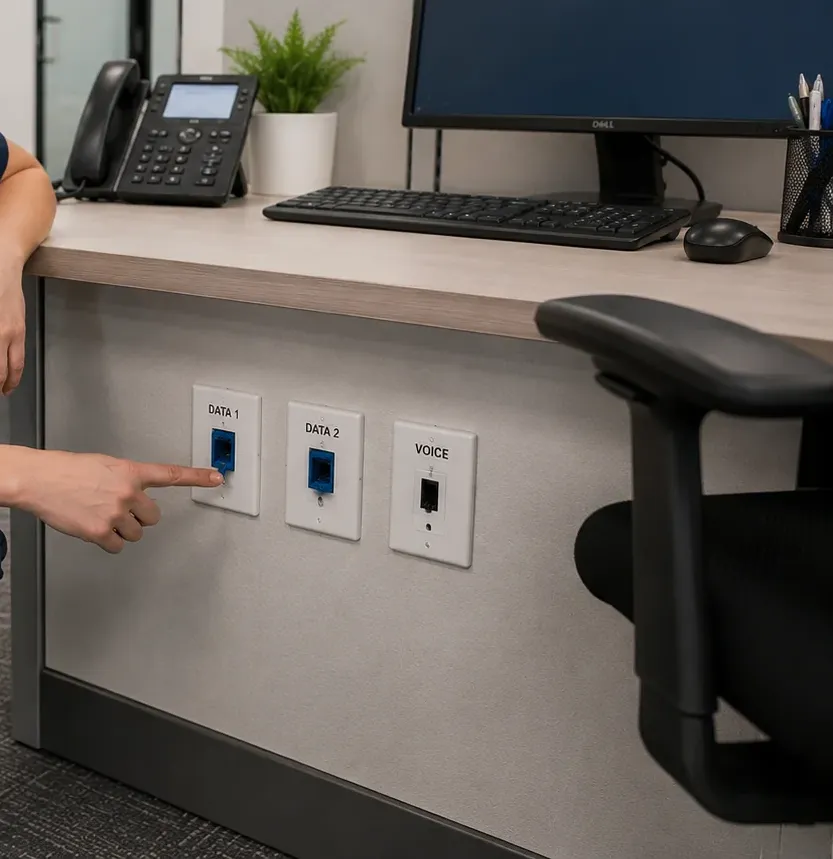
Finger pointing at the blue port of a Data 1 wall plate beside Data 2 and Voice plates under an office desk with a desk phone and monitor, Flushing, Queens Cat6 port identification
Beneath an office desk with a phone, keyboard, mouse and monitor, a fingertip rests on the blue port of the plate labelled Data 1, next to plates labelled Data 2 and Voice and a black task chair.

Book the Repair Before the Weekend Crowds

Intermittent drops are a warning, not a quirk: the link that hiccups on a Tuesday is the one that dies on a Saturday. Pick a slow morning, your closed day or the hour before doors open, and the price will be agreed before the van leaves.

Block by Block

How Cat6 Trouble Changes Across Flushing

Flushing covers a lot of ground between the creek and Kissena Park, and the cable problems shift as you walk east or south from the station. Knowing the block tells us a good deal before we arrive.

Main Street and Roosevelt Avenue: the crossroads

The densest few blocks, where the assessment counted thousands of pedestrians in a single morning window. Food courts sit in basements and on upper floors, banks and supermarkets hold the corners, and offices, agencies and clinics fill the floors above. Calls here are about stall and counter links in shared ceilings, upper-floor suites reached by narrow stairs, and runs that have passed through three or four tenants. Access is planned around crowds, deliveries and short trading lulls.

39th Avenue, Prince Street and the podium blocks

One Fulton Square, the Tangram buildings and the newer mixed-use projects around them put hotels, retail, offices and condos over garages. Repairs happen inside managed buildings with telecom rooms, boards and building engineers, and the most common calls are from retail and office tenants whose fit-outs keep changing, from condo-office owners, and from garage cameras and readers.

Union Street and Northern Boulevard

The Korean American business centre the assessment describes, stretching east along the boulevard, with restaurants, offices, karaoke lounges and churches alongside Flushing Town Hall and the Old Quaker Meeting House. Older commercial buildings with upper-floor tenants, long late-night trading hours and the occasional historic neighbour that rules out an exterior route.

College Point Boulevard and the creek

Wholesalers, warehouses and big-box retail along the creek, with the Shops at SkyView and Sky View Parc’s towers above. Long runs on steel, loading doors, garages and large retail floors. This is also the low ground most exposed when Flushing Creek’s neighbourhood floods, so basement and ground-level equipment comes up in conversation early.

Murray Hill, Broadway and the houses to the north and east

Detached and attached houses, small apartment buildings and a quieter commercial strip. Calls are residential: jacks dead after a renovation, basements that took water, home offices whose runs were never finished. The pace is different, but the same rule applies — find the cause before fixing the jack.

Kissena Boulevard, the hospital and Queensboro Hill

South of downtown, around NewYork-Presbyterian Queens and along Kissena Boulevard, medical and dental offices, apartment buildings and houses mix. Clinic links that must not drop during appointments, imaging rooms with shielded walls and apartment jacks in older buildings make up most of the work.

Stalls & Suites

Taking Over a Stall or Suite in Flushing: A Cable Checklist

Turnover is the Flushing constant, and the first week in a new space decides whether its cable becomes an asset or a mystery. These are the steps that save the most trouble later. Most of them cost nothing; the rest are cheaper now than after the walls and counters are finished.

  • Find out who controls the closet. Ask the landlord, mall office or managing agent where your space’s cable lands, who holds the key and whether the switch there belongs to the building or to you. Write the answer down with a name and a phone number.
  • Photograph what the last tenant left. Jacks, floor boxes, loose cable ends, labels in any language, the closet ports that seem to be yours. Photos taken before the fit-out starts are the best record of the starting point.
  • Test before you build. A certification test of every run in the space tells you which ones pass and can be reused, which fail and are worth repairing, and which are dead ends to remove. That list shapes the fit-out.
  • Keep your fit-out crew off the live cable. Tell the contractor where the runs you are keeping go, especially above the ceiling and inside partitions. Screws, ceiling hangers and sign brackets are how new cable gets damaged in week one.
  • Put critical devices on dedicated, labelled runs. The register, card reader, front-desk PC and imaging station each deserve their own labelled cable to a known port, not a shared switch hidden under a counter.
  • Label in the language your staff use. Numbers on both ends, plus a map in the words your team understands, so a manager can read it on the night something drops.
  • Keep the results with the lease. Saved test results and the port map belong with your lease papers. They settle disputes with the landlord, the next contractor or the tenant who takes over from you.
After the Storm

A Flushing Basement Network Check After a Flash Flood

When a summer storm sends water down the street and up through the drains, these are the checks worth making once the water has gone and the electrical side has been declared safe. They take minutes and tell you whether to call us now, after the cleanup or not at all.

  • Decide what kind of water it was. Rain that ran in under a door is different from water that came up through a toilet, tub or floor drain. If it came from the drains, assume anything it touched is contaminated and let the cleanup crew go first.
  • Mark the waterline. Note how high the water reached on the walls. Every jack, box, switch or router below that line needs testing or replacing, even if it still lights up.
  • Do not power equipment that sat in water. A switch or modem that was submerged should stay off until it has been checked or replaced; a short inside it can do more damage than the flood.
  • Check which upstairs rooms or stalls lost their connection. If several went down together, the fault is probably at the basement end where their runs start.
  • Pull one cord and inspect the metal. Gold contacts should be bright. A green, white or brown deposit means the plug and the socket it lived in have both corroded, and both need attention.
  • Keep damaged parts and photographs. For an insurance claim, the damaged cords, photos of the waterline and our test results together document what was lost.
  • Plan to move things up. When we repair, we lift switches and panels onto walls or shelves above the waterline, raise terminations and take cable off the floor, so the next storm is a cleanup rather than an outage.

If your building is one of the many in low-lying Flushing that now expects water with every heavy storm, it is worth doing this before the next one: ask us to look at where the network equipment sits and what it would take to get it off the floor.

Complete Services

Every Cat6 Repair Service in Flushing

Flushing owners who call about Cat6 frequently need one of these at the same time; each link goes to the Queens page for that service.

Cat6 Repair Across Queens

The borough-wide page this neighbourhood page sits under.

Queens Network Cable Repair

For Cat5e, unknown cable and faults inside a building’s shared pathways.

AESS Cat6 Installation in Queens

New drops for a stall, suite or floor fit-out.

Structured Cabling

Closets, panels and documented cabling for whole floors and buildings.

Fiber Optic Installation

Backbones between closets in podium buildings and malls.

Low-Voltage Installation

Intercom, alarm and other wiring that shares ceilings with the network.

Security Camera Repair

The camera and recorder end of garage, corridor and storefront runs.

All Services

Everything Abstract Enterprises installs and repairs.

Request a Quote

One form for any combination of services.

Field Notes

Field Notes for Cat6 Work in Flushing Buildings

Working habits for Flushing jobs — how we approach them, not stories about particular customers

We ask who owns the closet before we ask what failed. In a mall, a podium or an office condominium, that one answer decides who we call for access, who sees the results and whose permission we need before touching a cable that is not obviously yours.

We tag before we cut. A temporary tag on both ends of a traced run takes seconds and is the difference between repairing your link and disconnecting the neighbour’s.

We read the dates as well as the distances. A fault a few metres from the jack, in a ceiling that a neighbour’s contractor opened last week, has an obvious suspect.

We work clean above food and patients. Drop sheets, a vacuum and a tile put back properly are part of the job, not an extra.

And we label for the next person, whoever they are and whatever language they read. In Flushing, the next person is coming sooner than anyone expects.

FAQ

Flushing Cat6 Repair FAQ

Can you repair the Cat6 that feeds a self-order kiosk or a table-ordering screen?
+

Yes. Self-order kiosks and fixed ordering screens are stationary devices on a cable like any register, but they are often mounted on a stand or a column with the cable hidden inside, which is where it gets pinched or pulled. We test the run from the closet to the kiosk, repair the termination or the damaged section, make sure the cable inside the stand is strain-relieved and confirm a stable link. The kiosk’s software and menu stay with its supplier.

Payroll shows missed punches from one Flushing time clock — could its network cable be the cause?
+

It can be. Wall-mounted time clocks and attendance terminals usually sit by a staff entrance or a back corridor, on a run that nobody thinks about until payroll goes wrong. When one terminal drops or delays punches while the others behave, its link or the power it draws over the cable is a likely suspect. We test the link, fix the jack or the cable and confirm the terminal is powered over the cable, so the repair covers both data and power. If the clock itself has failed, we tell you so you can contact its supplier.

Can the test results go to both our business and the mall or building management?
+

Yes, with your agreement. The results are yours, but in a mall or managed building it often helps for the landlord to see them too, especially when the fault was on a section they control or when they need to know a run has been replaced or removed. We send the same saved results and port map to each address you give us, so nobody is working from a different version.

Do you repair the Cat6 behind a hotel front desk?
+

Yes. Front desks in hotels like those in Flushing’s mixed-use buildings depend on a handful of links: the property-management workstation, key-card encoders, phones and cameras. Those runs usually go through a back office to the building’s telecom room. We test each one, repair what has failed and work with the hotel’s engineer on access to the telecom room, scheduling around check-in and check-out peaks.

Do you repair the Cat6 that feeds supermarket checkout lanes and scales?
+

Yes. Supermarket lanes depend on several cabled devices at once — the register, the scanner-scale, the card reader and sometimes a lane camera — and their cables usually run through the lane fixtures or come up from floor boxes where carts and cleaning machines pass. We test each lane’s links from the closet, repair the jacks or sections that fail, protect the drops inside the fixtures and label each lane’s ports so a manager can tell them apart. The devices themselves stay with your POS and scale suppliers.

Do you repair the Cat6 in a karaoke lounge’s private rooms?
+

Yes. In karaoke lounges each private room usually has its own cabled song-request system, an ordering tablet or screen and sometimes a camera, all running back along a corridor to an equipment room. A single room going dark while its neighbours work points to that room’s run or jack rather than the main system. We test room by room, repair the failed runs and label each one with its room number, and we can work during the daytime hours when the lounge is closed.

Do you need floor plans or building drawings before a repair?
+

They help but are not required. In a podium building or a mall, the management office may have drawings showing closets, risers and return-air ceilings, and a quick look saves tracing time. If there are none, which is common after many tenancies, we trace the runs with a toner and the tester and build our own map. Either way you end up with a port map of the links we worked on.

How can we confirm that the technician who arrives is licensed?
+

Our New York State low-voltage licence number is 12000287431. It appears on this page, on our estimate and on the invoice, and you can check it with the state before the visit. When you book, we tell you who is coming; if your building keeps a contractor log, give the security desk that name and our company name so the technician can be matched at the door.

Can you repair the Cat6 at a pharmacy counter without holding up prescriptions?
+

Usually, yes. A pharmacy counter depends on a few cabled devices — the dispensing workstation, the label printer, the register and the card reader — and the pharmacist needs at least one terminal working at all times. We test first to find which link has failed, then repair one station at a time so the others keep running, and we work on the customer side of the counter wherever we can. Prescription software and records stay with your pharmacy system provider; we never need access to them.

Will a cable repair change our network settings or IP addresses?
+

No. The cable carries the signal; it does not hold settings. Re-terminating a jack or replacing a run does not change your router, switch or device configuration, and devices normally come back with the same addresses they had. The only exception is if we move a device to a different switch port at your request, in which case we note the change on the port map so your IT person knows.

All Areas Served

Cat6 Repair Across Queens, New York City and Beyond

Flushing sits under our Cat6 repair service for all of Queens, which in turn sits under the AESS New York City Cat6 repair hub. Below, grouped by region, are the county and neighbourhood pages that each describe their own building stock.

More of our work: the Abstract Enterprises Security Systems home page and our about page.

A Flushing Stall, Desk or Camera Offline Right Now?

Card reader refusing payments, clinic desk off the network, garage camera dark or an office jack that never worked: call (347) 434-6392. You get the next open two-hour window, often the same day, and a failed termination or cord is normally fixed within an hour or two of the technician arriving.

Cat6 Repair Flushing — Licensed, Insured, Certified to Category

Abstract Enterprises Security Systems · 460 E Fordham Rd, Bronx, NY 10458

Queens line (347) 434-6392 · WhatsApp (718) 679-0359 via wa.me

NYS Low-Voltage License #12000287431 · 100% Licensed & Insured · Same-Day Estimates · Rated 4.7★ from 201 Google Reviews

Parts you supply carry their maker’s warranty. See our warranty page and the service agreement for full terms.

Sources used on this page

Written from our experience of Cat6 faults in Flushing’s food courts, malls, podium buildings, clinics and houses. Where it mentions the city Electrical Code, plenum and firestop rules, landmark approvals or flood guidance, treat it as a plain summary — not legal advice. Page reviewed and updated October 17, 2026. Changelog: Flushing Cat6 repair page first published, covering food courts, malls, podium buildings, clinics, garages and flash-flooded basements.