NYS Licensed Low-Voltage Contractor · Spuyten Duyvil to North Riverdale · Co-op Towers, Fieldston Houses, Johnson & Riverdale Avenue Shops
Cat6 Repair in Riverdale
Shareholder-Owned Runs · Combined & Duplex Apartments · Terrace and Balcony Cameras · House-to-Garage Links on the Ridge · Home-Automation Panels · Recertification
Most of the Cat6 in Riverdale was not put in by a developer. It was added later, by the people who own the apartment or the house: a shareholder wiring a home office in a 1960s co-op on the Henry Hudson Parkway, a Fieldston family running cable from a 1920s house to the garage, an integrator threading a lighting system through plaster. When that cable fails, the owner pays for the repair — and somebody else usually sets the rules for it. We find the fault, work within the co-op's alteration terms or the ridge's protected ground, and hand back a link that tests to Category 6 again.
Reviewed and updated October 17, 2026 · Written by Anwar Timothy, NYS low-voltage license #12000287431
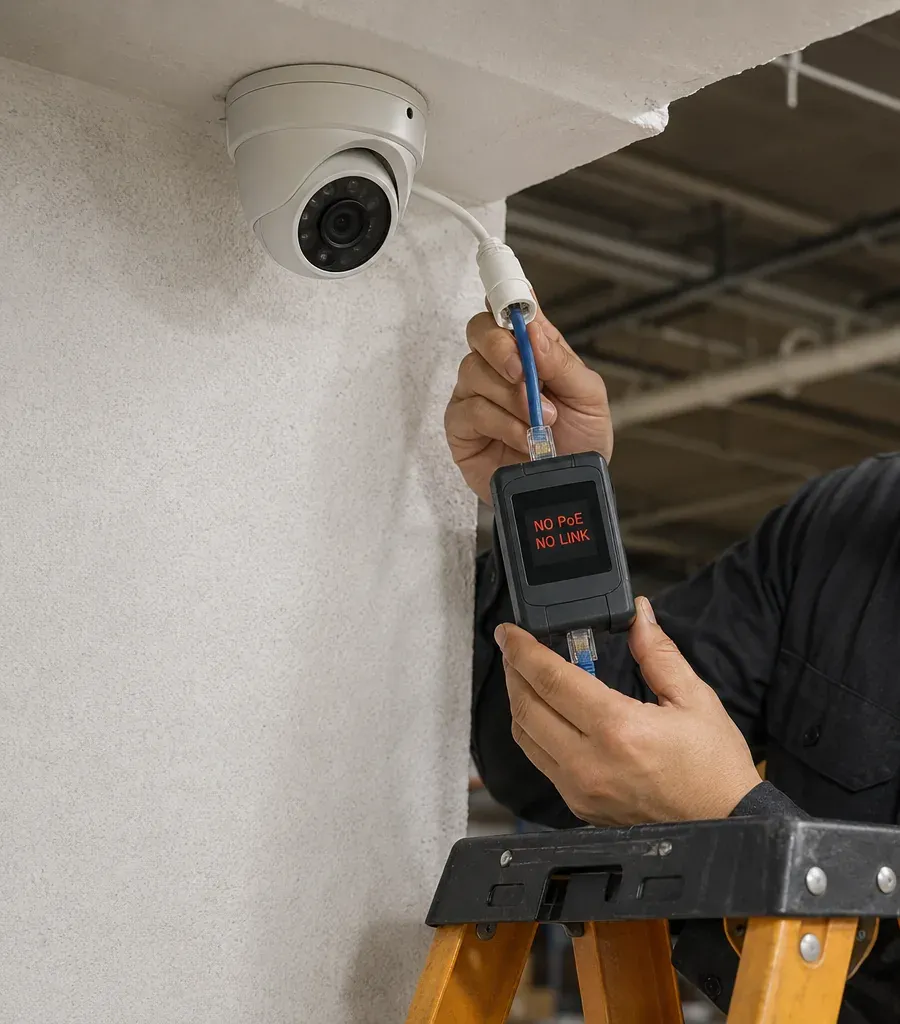
A small black tester sits between a dome camera's pigtail and the blue cable feeding it; its red screen reads NO PoE, NO LINK. The camera hangs under a textured concrete soffit and the technician works from an orange stepladder.
Riverdale Cat6 Repair Quote
Tell us the building or the street and what the dead link feeds — a licensed technician replies the same business day
✅
Request Sent!
A licensed technician will call you back before the business day is out.
25+
Years Experience
✓
Same-Day Estimates
100%
Licensed & Insured
4.7★
201 Google Reviews
Start with two facts: who owns the cable, and whose rules cover the wall it is in. Ring (646) 490-0629 or use the short form. Say whether you are a shareholder, a homeowner or a shop tenant, and attach a photo of the jack, the closet or the router if you can. A licensed technician reads it and tells you, before anything is booked, whether it sounds like a bad termination, a damaged run, a device or no cabling fault at all — and what paperwork your co-op or managing agent is likely to want first.
Faults located by distance along the run before any plaster, paneling or soil is disturbed
Insurance certificate prepared for your co-op or managing agent at no charge
NYS license #12000287431 · insured · dispatched from 460 East Fordham Road
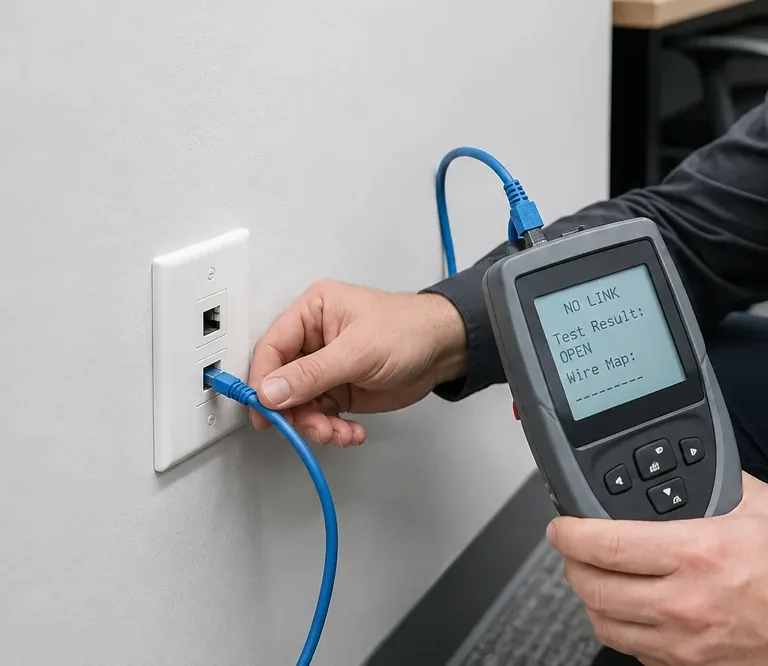
Plugged into the bottom socket of a white two-port plate, a blue cord leads to a grey tester held at chest height; its display says NO LINK and OPEN, and the wire-map line is empty.
Why Riverdale Properties Need Cat6 Repair Planned Around the Owner
Riverdale is the part of the Bronx where the person at the dead jack usually owns the wall it is in. The NYU Furman Center put the 2024 homeownership rate for Riverdale/Fieldston — Community District 8, which also takes in Kingsbridge, Marble Hill and Spuyten Duyvil — at 38.4 percent, above the city's 32.7 percent and nearly double the borough's 19.7. Most of those owners hold shares rather than deeds. The Cooperator described how the post-war building boom filled Riverdale with large apartment buildings, "many of which eventually became co-ops," and quoted local brokers saying co-ops still predominate, from prewar walk-ups east of the Henry Hudson Parkway to doorman towers with river views. Around and between them sit the houses: the Riverdale Historic District's surviving 19th-century estates, Fieldston's 1910s-to-1930s Tudor, Colonial and Medieval Revival homes, and mid-century houses tucked into the slope.
That changes who wires a home. Very little of Riverdale's housing is new — Furman counts 2,087 units built in buildings of four or more apartments here between 2010 and 2025, against 63,066 across the Bronx — so the Cat6 inside most apartments and houses was retrofitted. A shareholder who started working from home ran a line from the router to the second bedroom. A buyer who combined two apartments had the electrician pull data along with power. A homeowner had a camera company wire the garage and the gate, and a home-automation integrator thread a rack's worth of Cat6 through plaster for keypads, speakers and access points. None of that was designed by the building, documented for the next owner or tested to a standard when it went in.
And each kind of home puts somebody else's rules around the repair. In a co-op, the corporation owns the building and the shareholder holds a proprietary lease; work inside the apartment is governed by the house rules and, for anything beyond the trivial, an alteration agreement, an insurance certificate naming the co-op, and hours set by the board. In Fieldston, the streets, the trees along them and the security patrol belong to the Fieldston Property Owners' Association, and most houses sit inside a landmarked historic district. Across the ridge, the city's Special Natural Area District protects steep slopes, rock outcrops and mature trees. A repair that ignores those layers can be technically perfect and still cause trouble with the board, the neighbours or the city.
The failures follow the way the cable was added. Owner-run Cat6 takes the shortest route, so it gets pinched under terrace doors, fed through air-conditioner sleeves and laid under rugs. Runs across a combination or between the floors of a duplex were joined in a hurry where two old layouts met. Outdoor runs on a sloping lot are buried shallow over rock and crossed by roots, and inside the period houses the cable was fished through plaster and stone and terminated by whoever was there that day.
So the first thing we do in Riverdale is not test the cable. It is ask who put it in, who owns it now and whose permission covers the route. The answers decide whether we can fix the fault at the jack in an hour, whether the repair needs the managing agent's sign-off first, or whether the right answer is a new run along a different path that nobody has to approve.
Most of these repairs sit next to other systems in the same home. When the dead link feeds a camera on a terrace or a garage, our security camera installation team for Riverdale handles the camera and recorder while we certify the cable. When a building's door-entry system is involved, the Riverdale intercom installation service deals with the stations. And where a whole apartment or house needs a proper backbone rather than a patched one, our structured cabling work in Riverdale takes over.
Riverdale facts that shape a Cat6 repair
38.4 percent: the homeownership rate in Riverdale/Fieldston in 2024, against 32.7 percent citywide (NYU Furman Center, neighborhood profile last updated May 6, 2026). The Bronx as a whole is 19.7 percent.
2,087 units: new homes in buildings of four or more units in Riverdale/Fieldston between 2010 and 2025, per Furman — a small fraction of the borough's 63,066, which is why most Cat6 here is a retrofit.
More than 100 co-ops and condominiums: the membership of the Association of Riverdale Cooperatives and Condominiums, according to the Riverdale Press; the association says it represents the co-ops and condos in the 10463 and 10471 ZIP codes.
252 houses and related structures: the Fieldston Historic District designated by the Landmarks Preservation Commission on January 10, 2006, inside a neighborhood whose streets are owned and maintained by its property owners' association.
1990 and 1975: the years the Riverdale Historic District was designated (October 16, 1990, around estates laid out after an 1852 land purchase) and the Special Natural Area District–2 rules for the Riverdale ridge were last amended (May 21, 1975).
About 1,000 customers: Riverdale homes and businesses without power on July 3, 2026 during the heat wave, while Con Edison reduced voltage by 8 percent across the northwest Bronx, according to News 12 — a reminder that PoE switches and cameras fail for reasons that have nothing to do with the cable.
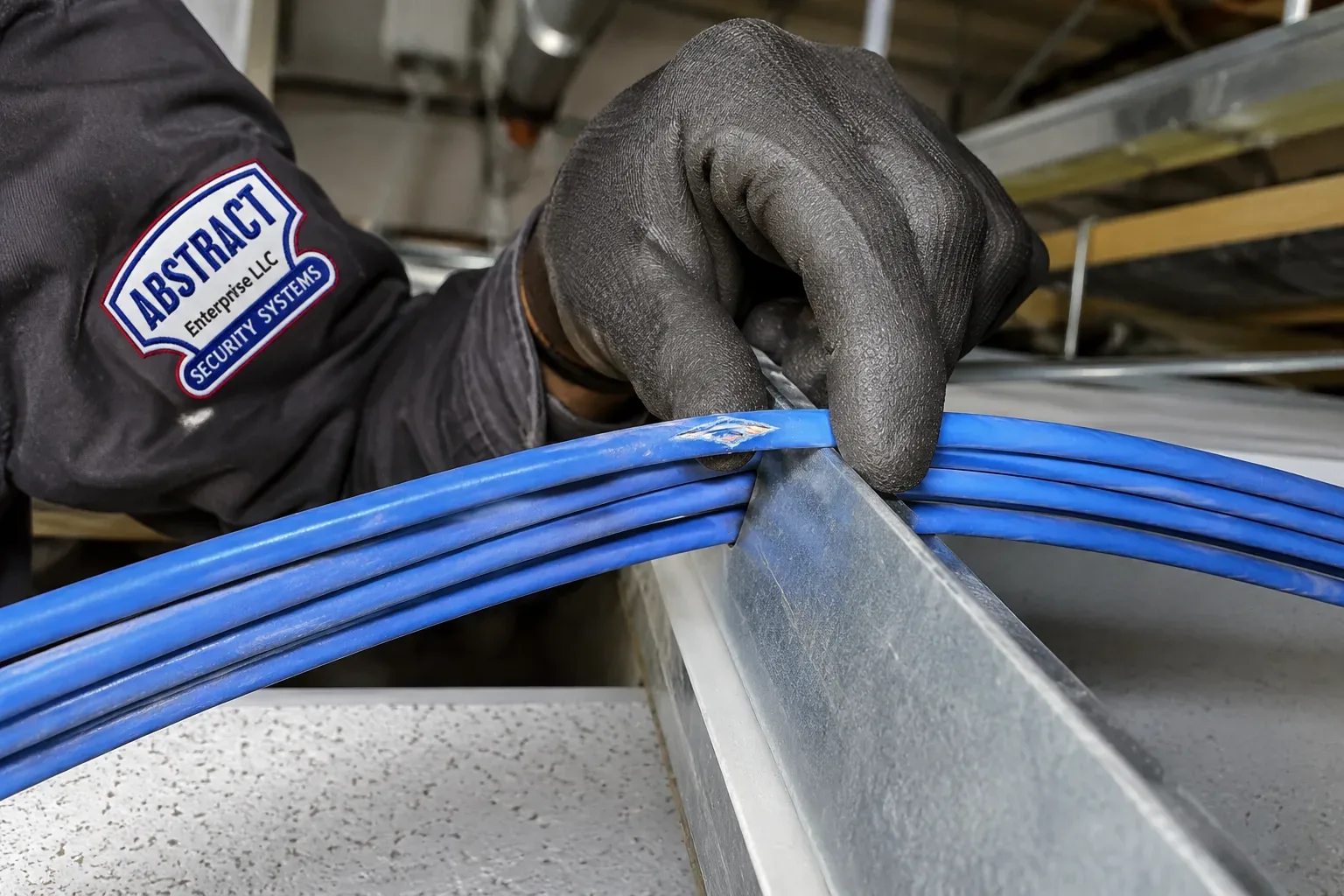
Above the tiles, a technician in a black glove and a jacket with the Abstract Enterprises Security Systems badge raises a run of blue Cat6 from a zinc-coated steel ledge — and the uppermost jacket shows a raw, worn patch where the steel has been chafing it.
Repair Capture
Wired Link Gone Dark Between Spuyten Duyvil and the Yonkers Line?
Some Riverdale faults cannot wait for a quote cycle: the study that has to be online for a nine o’clock call, the terrace camera missing from last night’s recording, the Johnson Avenue register refusing cards at lunchtime, the Fieldston hallway touch panel gone blank. Those we book as service calls, from our base on East Fordham Road, in the next free two-hour arrival window — frequently today. A single failed termination, plug or panel port is typically diagnosed and put right within an hour or two of arrival. Repair time is $195 an hour with a three-hour minimum ($585). Call (646) 490-0629 and say it is a Cat6 fault. If the trouble turns out to be older Cat5e or the network equipment rather than the cable, our Bronx network cable repair service takes it from there.
What We Repair
Cat6 Repair Services in Riverdale
Here are the repairs Riverdale owners book most, organised by how the cable got into the home in the first place. Every job ends with a category test, a saved result and a short written explanation for the owner, copied to the managing agent on request.
Home-Office Link Repair in Co-op Apartments
The run from the router or the closet to a study or spare bedroom: re-terminated at both ends, retested, and moved off the floor or out of the door frame if that is where it was being crushed. Usually done inside the board's normal contractor hours.
Combination and Duplex Tie-Ins
Where two apartments became one, or two floors were joined by a stair, the data often stops at the old boundary. We trace each side, find the joins and couplers, and bring every jack back to one panel and one switch.
Terrace, Balcony and Window Camera Runs
Cable flattened under sliders, pushed through window frames or left in the sun. We test it, replace the outdoor section with cable rated for the job, and bring it through the wall the right way where the board allows it.
House-to-Garage and Outbuilding Links
The runs that cross a sloping lot to a detached garage, studio, pool house or gate: buried shallow over rock, crossed by roots, cut by gardeners. We locate the break by distance before anyone lifts a stone.
Home-Automation and AV Cabling
Keypads, touch panels, ceiling access points and AV racks that went in with an integrator who is no longer answering. We prove whether the cable is good, repair what is not and leave a port map the next technician can follow.
Plaster-Wall Jack and Plate Repair
Jacks in 1920s houses and prewar apartments, fished through plaster on lath or set in shallow boxes. Re-terminated on matched Cat6 or Cat6A parts, with any plaster disturbance kept to the opening the fault needs.
Panel, Closet and Rack Re-Termination
The small wall panel in a coat closet, or the full rack in a basement, where a previous contractor's punch-downs are the weak point. Re-punched, labelled and certified so the whole home is on one standard.
Shop and Office Repairs on the Avenues
Registers, printers, phones and cameras along Johnson Avenue, Riverdale Avenue and West 231st Street, in spaces that have changed hands several times. Booked around opening hours.
Recertification for a Sale, a Board or an Insurer
Testing every Cat6 link in an apartment or house against TIA permanent-link limits — before a sale, after a renovation or when a board asks — with failures repaired and each result saved.
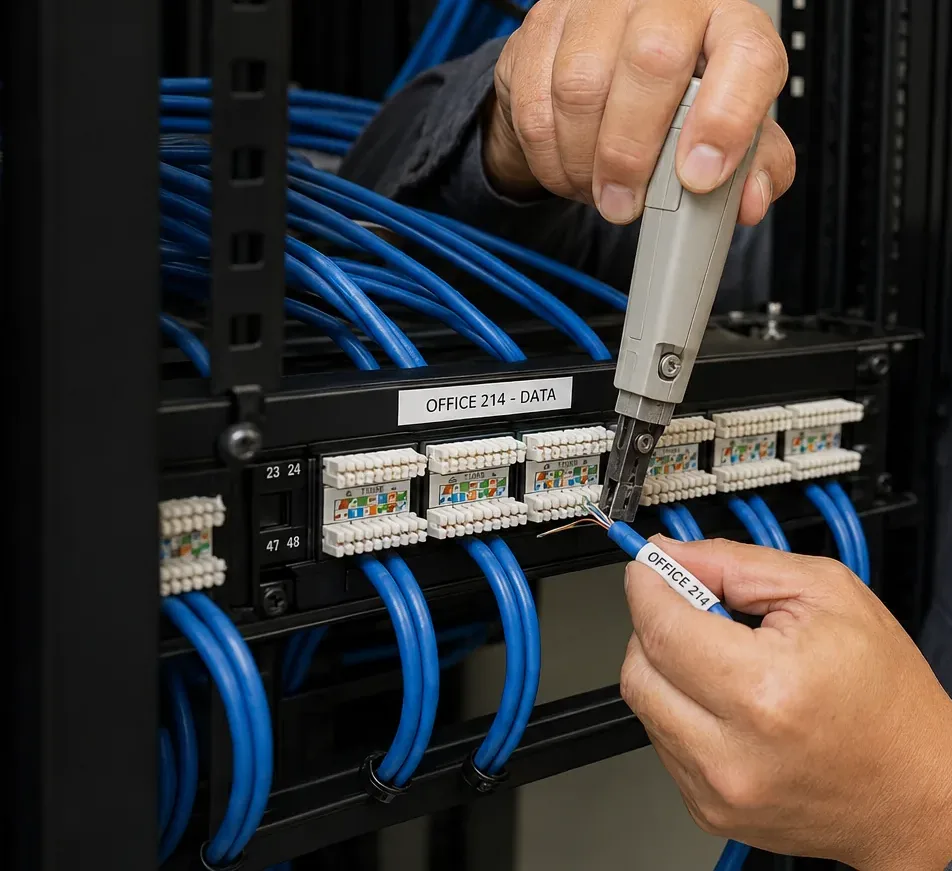
Close up at a black rack: one hand steadies a run marked OFFICE 214 while the other presses its pairs home with a grey impact tool, just below a panel strip printed OFFICE 214 – DATA. Neat loops of blue cable hang beneath.
Building Specialists
Cat6 Repair for Riverdale's Architecture
Six kinds of building make up most of Riverdale, and Cat6 hides differently in each. These are the ones we plan around.
🏢
Postwar elevator co-ops along the parkway
The towers built after the war on and near the Henry Hudson Parkway service roads — listings describe, for example, a 133-unit elevator co-op at 4901 Henry Hudson Parkway West completed in 1961. Concrete slabs, plaster or block partitions, through-wall air-conditioner sleeves, balconies and terraces on the river side. Owner-added Cat6 runs along baseboards, behind built-ins and out through doors and sleeves.
🏛
Prewar co-ops east of the highway
Smaller elevator and walk-up co-ops in Central Riverdale and toward Kingsbridge, described by local brokers as prewar buildings east of the highway. Thick plaster, shallow boxes, old telephone wiring still in the walls, and Cat6 fished down closets or run in surface raceway.
🏡
Fieldston period houses
Many of the 252 houses and related structures in the Fieldston Historic District date from the 1910s to the 1930s — Dwight James Baum alone designed 62 of them — in Tudor, Colonial, Medieval and Mediterranean Revival styles, often with stone bases and tile or slate roofs. Cat6 was added decades later through plaster on lath, stone foundation walls and attic eaves.
🌳
Estates and villas of the Riverdale Historic District
The district designated in 1990 grew from a 100-acre parcel bought in 1852 and split into seven estates, five of whose original houses survive. Long distances between the main house, carriage houses and garages, and landscaped grounds that owners do not want dug up.
🏠
Mid-century and modern houses on the slope
Houses set into the ridge, some reached by bridges or steps, with lower levels cut into rock. Fieldston's district includes examples from the 1960s and 1970s. The network usually sits in a lower-level utility room, and runs climb through framed walls that later renovations have closed.
🎓
Campuses and schools
Horace Mann, Riverdale Country and Ethical Culture Fieldston — the “Hill Schools” — plus Manhattan University, the University of Mount Saint Vincent and the neighborhood's day schools. Buildings of many ages joined by outdoor and tunnel runs, where a small office or a single classroom often relies on one link.
What changes in the repair, building by building
Building type
Where the Cat6 usually fails
How the repair is approached
Postwar co-op tower
Under terrace and balcony sliders; inside AC sleeves; at baseboard staples; at joins where two apartments were combined
Locate by distance from the jack; replace the damaged section along a protected route inside the apartment; outdoor sections in cable rated for sun and wet; no new hole through the facade without the managing agent's written consent
Prewar co-op
At shallow wall boxes; where cable shares a closet with old telephone blocks; in surface raceway along hallways inside the unit
Re-terminate first where the test points to an end; replace in the same path only if the path is clean; keep plaster openings to the size of a jack box
Fieldston house
In the basement where cable crosses stone; at attic eaves under slate; at old integrator splices behind panels
Map the house from the rack outwards; repair from basement and attic where possible so finished rooms stay closed; label every run
Historic estate or carriage house
On long outdoor or tunnel runs between buildings; at entries into old masonry
Test end to end; consider whether copper is still the right medium for the distance; seal and bond each entry, our published figure starting at $185 per penetration
Ridge house
Where buried runs climb out of the ground at the garage or studio; where roots or rock moved them
Fault located before any digging; route chosen to avoid protected trees and slopes; exposed sections supported and sleeved
Campus building
At closet patch panels changed by many vendors; on runs between wings
Work under the facilities office's rules and schedule; certify the repaired link and leave results with IT
Many Riverdale owners pair a repair with tighter control over who comes in. Where the trouble is a reader or an electric strike on a side door, our Riverdale access control installers look after the hardware, and the door buzzer repair service in Riverdale handles older buzzer and intercom wiring.
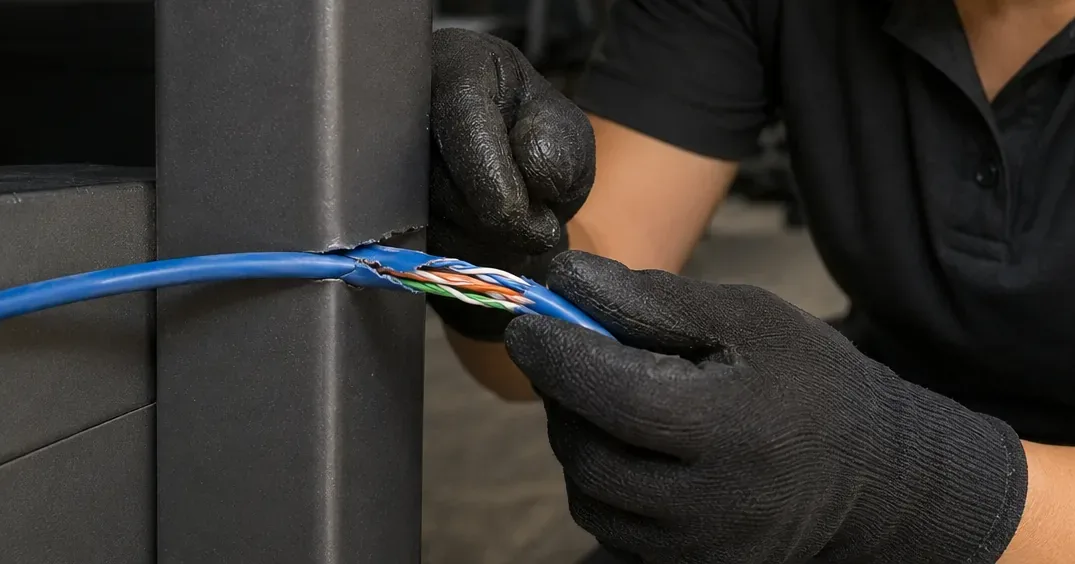
Black work gloves grip a blue run where it wraps a sharp-edged charcoal steel upright; at the bend the sheath has torn lengthwise, leaving coloured twisted pairs exposed.
House Rules
The Shareholder's Side of the Wall
In a Riverdale co-op, a Cat6 repair is a small alteration in somebody else's building. The corporation owns the walls, the floors, the risers and the facade; the shareholder has the right to occupy the apartment under a proprietary lease and the house rules. Most boards treat a like-for-like repair inside the apartment as routine, but they still expect the contractor to show up with the right paperwork, at the right time, and to leave nothing that touches the building's own systems.
The paperwork is predictable. The model alteration agreement published by the New York City Bar Association, which many boards adapt, requires each contractor to carry insurance and to deliver certificates naming the corporation before work begins. Managing agents usually ask for the certificate to name the managing agent too, and some ask for the contractor's license number. We prepare the certificate for your building at no charge and send it straight to the agent or the super, so you are not the go-between.
The timing is predictable too. House rules typically limit contractor work to weekday hours and keep noisy work to a narrower window. A Cat6 repair is quiet — the loudest part is a drill for a new box — but we still book inside the building's hours and tell the doorman or super in advance. If the run has to be traced through the hallway ceiling, a neighbour's closet or the building's riser, that is a conversation for the managing agent first, and we will not open anything outside your apartment without written consent.
Then there is the boundary itself. The Cat6 inside your apartment that you, or a previous owner, paid to install is generally treated as part of your alterations. The building's own systems — the lobby intercom, the hallway cameras, the elevator, the shared internet riser a provider installed — belong to the corporation or its vendors. Our test results say exactly where a fault sits, so if it turns out to be on the building's side of the line, you have something precise to give the agent rather than a guess.
Before a co-op repair visit
Tell us the building's managing agent and whether the board asks for an alteration agreement for small electrical or low-voltage work. Some do, many do not.
Ask the super or the agent about hours. We fit a repair into the board's contractor window and avoid weekends unless the building allows them.
Clear the path to the jack, the closet and the router. If the run goes to a terrace, clear the door track and the area outside it.
Find any paperwork from the last renovation. Combination and kitchen drawings often show where data was run, even when the cable is not labelled.
Say whether the building has a shared internet riser — the Riverdale Press reported in 2014 that co-ops were among the first Riverdale buildings to take Verizon's fiber, which reaches each building by a lateral from the street.
Where the line usually falls: cable inside the apartment walls from your router to your jacks — yours to repair. The provider's equipment, the building's riser to your door, and anything serving more than one apartment — the building's or the provider's. We test both sides of that line and put the result in writing so nobody pays for somebody else's fault.
Rock, Trees & Private Streets
Outdoor Cat6 on the Riverdale Ridge
Riverdale's houses sit on a ridge the city has protected since the 1970s. The Zoning Resolution describes Special Natural Area District–2, covering Riverdale, Spuyten Duyvil and Fieldston, as a ridge that "contains steep slopes, rock outcrops, ponds, brooks, swampy areas and mature trees." Within the district, a steep slope is an incline of 25 percent or more, site plans have to show every tree of six-inch caliper or larger, and the regulations for protecting natural features require filling, excavating and grading to avoid creating steep slopes or erosion. The Riverdale Nature Preservancy summarizes the protected features as mature trees, steep slopes and natural topography, rock outcrops and erratic boulders, wetlands and water features, and certain plant communities.
That matters whenever cable leaves the house. Runs to a garage, a studio, a gate or a garden camera were usually buried shallow over rock, laid along a stone wall or stapled to fences. They fail in ways indoor cable never does: roots lift them, frost moves the stones beside them, edging tools find them, and water collects where they come back out of the ground.
We plan an outdoor repair the same way every time. First the tester finds the fault by distance, so we know whether the problem is at an end, at a junction or somewhere in the ground. If it is at an end, the repair is a termination and a weatherproof entry. If it is mid-run, we look for a route that avoids disturbing protected trees, slopes and outcrops — along an existing path, through an existing sleeve, or above ground in protective conduit where that is permitted. Whether a particular excavation needs approval under the district's rules is a question for your architect or the Department of City Planning, and if a repair would need more than a hand-dug trench in disturbed ground, we stop and say so before any work starts.
Fieldston adds a private layer. Its streets and common areas are owned by the Fieldston Property Owners' Association, which plows the roads, looks after roughly a thousand street trees and runs a security patrol; parking is restricted to residents and their guests. Anything we do stays on your lot. And because most of Fieldston, and the core of old Riverdale, are landmarked historic districts, visible exterior changes — a new conduit up a facade, a camera bracket on a stone wall — may need a Landmarks Preservation Commission permit, which is why we prefer interior and underground routes that leave the outside of the house as it was.
Outdoor run
Typical failure
Repair approach
House to detached garage
Water in the garage-end box; jacket cut where it rises out of the ground
Re-terminate in a sealed enclosure; sleeve the riser; seal and bond the entry
Garden studio or pool house down the slope
Mid-run damage from roots, edging tools or settling stones
Locate by distance; replace the damaged section in conduit along an existing path
Gate, driveway or garden camera
UV-cracked jacket; corroded plug at the camera; staples through the cable
Outdoor-rated cable, proper weatherproof plug or pigtail, supports instead of staples
Link between two houses or buildings on one estate
Length close to the 100-metre channel limit; lightning-induced damage
Certify the length; discuss fiber for the long leg; bonding and protection at each building
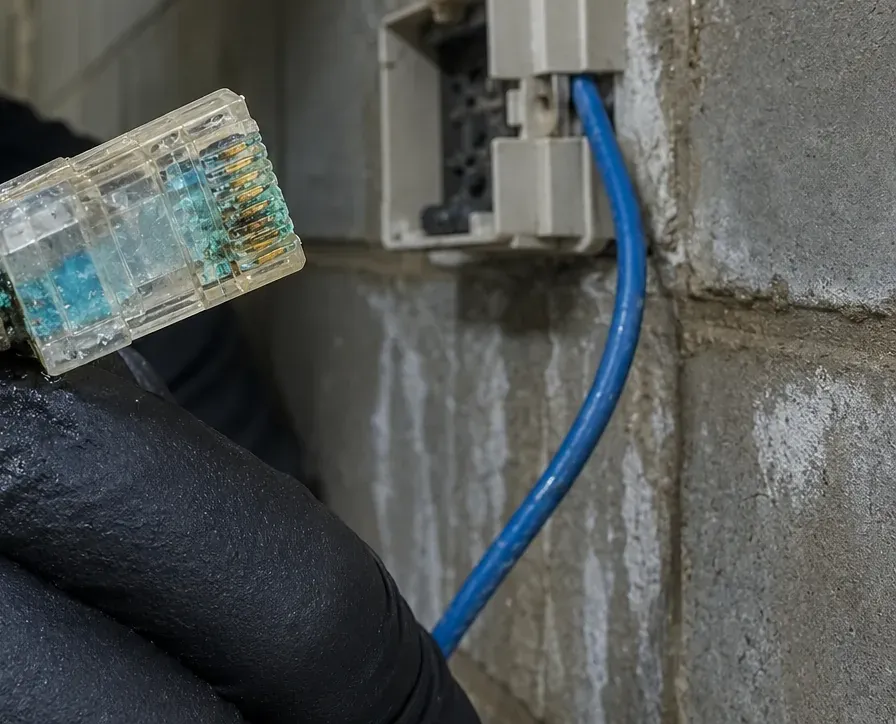
Held up to the camera in a black glove, a transparent plug shows verdigris across its contacts. In the background, water-streaked cinder block and an aged beige junction box with a blue lead dropping out of it.
Commercial Cat6 Repair
Business Cat6 Repair in Riverdale
Riverdale's businesses are small, close to home and mostly in spaces that have changed hands more than once. That last part is what matters for cabling. A storefront that was a bank, then a pharmacy, then a café has three generations of data wiring in its ceiling, and the current tenant usually knows nothing about any of it. When the card terminal or the back-office printer drops off, the first job is working out which cable actually serves it.
🛍
Johnson Avenue
Described in a 2010 Riverdale Press column as the heart of the shopping area: about four blocks holding some 35 stores, four banks, a supermarket, pharmacies, restaurants, a kosher butcher and a shoemaker. Registers, scales, pharmacy terminals and cameras on short runs that cross busy back rooms.
🍽
Riverdale Avenue
The neighborhood's main north–south road. In May 2026 a Riverdale Press report on a Community Board 8 study quoted a local broker calling it one of the strongest retail corridors in the district, with new restaurants drawing residents who used to eat elsewhere. Kitchens, order screens, Wi-Fi access points and music systems all ride on Cat6.
💈
North Riverdale and Mosholu Avenue
The same report noted eateries, salons and specialty businesses opening in previously vacant storefronts around Mosholu Avenue and Riverdale Avenue. Fit-outs on a budget often reuse whatever cable the last tenant left.
🚏
West 231st Street and Broadway
The business district at the south-east edge, where Riverdale meets Kingsbridge. Busier, older retail space with deep basements and shared utility rooms.
🏫
Schools, colleges and houses of worship
The Hill Schools, Manhattan University, the University of Mount Saint Vincent, day schools and the neighborhood's many synagogues and churches. Offices, classrooms and livestream cameras that each depend on a few links, usually managed by a small facilities team.
🩺
Ground-floor offices in residential buildings
Professional suites at the base of apartment buildings, where the office's cable shares closets and ceilings with the building's own systems and any repair runs under the building's rules as well as the tenant's lease.
Across Community District 8 the same study measured a storefront vacancy rate of about 6.9 percent, so tenants do turn over, and with every change of tenant a little more cable is abandoned in place. Our approach on a commercial call is to identify and certify the links the business actually uses, repair those, label them, and mark the dead ones so the next tenant does not inherit the same confusion.
Compliance notes for Riverdale commercial and institutional repairs
NYC Electrical Code: since December 21, 2025 the Department of Buildings has enforced a local edition built on the 2020 NEC plus city amendments. For a Riverdale riser, plenum or wall cavity, that means the replacement jacket must carry the listing that space calls for.
Old tenants' cable: under the NEC communications rules, reachable cable that no longer serves anything should come out unless someone tags it for reuse. On the avenues, where several tenants have come and gone, we say which runs are live and mark anything left in place.
Fire-rated walls and floors: where a replacement run passes through a rated assembly, the penetration is firestopped with a listed system before we leave.
Landmarks: in the Riverdale and Fieldston historic districts, exterior work that changes the appearance of a building may need a Landmarks Preservation Commission permit. We keep repairs inside wherever we can.
Your Questions Answered
Cat6 Repair in Riverdale: Questions Answered
These are the questions Riverdale owners actually face, grouped by where they live and work. Each one is answered in full here rather than in the FAQ further down.
Inside co-op and condo apartments
We combined two apartments into one — why do the jacks on the side that used to be the other unit never join our network?
Because, as far as the cable is concerned, they are still in the other apartment. When two units are joined, the renovation usually moves the kitchen, the bathrooms and the electrical panel, but the data wiring from each original apartment keeps running back to wherever that apartment's phone or cable service used to come in. One half of your home is cabled to your current router; the other half ends in a closet, a junction box or a wall plate on the far side that nobody connected to anything. Sometimes the renovation contractor joined the two halves with an inline coupler inside a wall or above a ceiling, and that coupler is the fault.
The repair starts by toning out every jack on the old side to find where its cable actually ends. We then test each run from that end. If the runs are healthy, the fix is to bring them together: either extend them to your main panel with a properly terminated tie cable, or install a small switch at the old termination point and feed it with one good link from your router. If a coupler or a splice is buried in a wall, we locate it by distance on the tester and open only the spot where it sits.
The result is one network, one panel and a labelled map. If the shortest route would pass through the public hall or into a neighbour's space, we plan around it.
The Cat6 to our terrace camera was run under the sliding door and has gone dead — what replaces a cable pinched in a door track?
A cable that has been closed in a slider hundreds of times is almost never worth splicing. The door track crushes the jacket and flattens the pairs inside, which changes their geometry and ruins the link's crosstalk and return-loss performance long before the copper breaks. You may have seen it get slower and less reliable for months before it finally dropped. The section that went under the door, and usually a few feet either side where it was bent sharply, has to come out.
What replaces it depends on what the building allows. Inside the apartment, we bring the run to the wall beside the door in protected raceway. To get outside, the cleanest options are an existing penetration the building already approved, such as an outdoor outlet box or an old antenna or cable entry, or a flat weatherproof pass-through designed to sit under a door seal without being crushed. A new hole through the facade or the window frame is a building matter, and in most Riverdale co-ops it needs the managing agent's written consent, and the board's in some.
On the terrace, the replacement is outdoor- and sunlight-rated cable, supported off the deck and weatherproofed at the camera, and the whole link is tested before the camera goes back up.
A previous owner pushed our Cat6 through the through-wall air-conditioner sleeve — is that why the link fails every summer?
Very likely. Through-wall sleeves in postwar towers are an easy way to get a cable from one room to the outside or to a balcony without drilling, which is why owners and handymen use them. But a sleeve is a hostile place for data cable. The jacket rests on sheet-metal edges, the unit's vibration rubs it, condensation drips and pools in the sleeve, and in summer the area around the compressor runs hot. Cable resistance rises with temperature, so a link that was marginal in winter can fall over once the air conditioner runs all afternoon.
The test usually confirms it: the fault sits at a distance that matches the sleeve, the jacket there is worn or damp, and the termination nearest the sleeve may show corrosion. A cable that was nicked by the sleeve edge can pass a simple continuity check and still fail on crosstalk or return loss, which is why a proper certification test matters here.
The repair takes the cable out of the sleeve altogether. Inside the apartment we re-route it along a protected path; if it must reach the outside, we use an approved entry rather than the AC opening. The air-conditioner sleeve is part of the building's exterior, so nothing new is cut there without the managing agent's agreement.
Where does the Cat6 linking the two floors of a duplex apartment usually fail?
At the places where the run changes direction between floors. In a duplex, the data link between the upper and lower levels usually follows the internal stair — up a wall cavity beside the stringer, under a tread, or through the floor at the top landing — because that is the only place the two apartments' framing or slabs were opened when they were joined. Those are tight bends, often made around metal or through holes drilled for something else, and they are where a cable gets kinked during installation or squeezed later when trim or carpet is fitted.
The tester tells us how far from each end the fault sits, and on a short stair run that usually narrows it to one turn or one floor crossing. Where the cable is still in good condition but the termination at the upper floor's jack or panel was rushed, a re-termination is enough. Where it was kinked or crushed at a bend, we replace the run, and we look for a better path: a closet stacked above a closet, a chase beside the stair, or a short exposed section in raceway that is easy to service later.
Any opening near the old slab penetration is cleared with the managing agent first, because its firestopping is part of the building's fire separation.
Under a co-op proprietary lease, is the Cat6 inside our apartment walls the shareholder's to repair or the corporation's?
In most Riverdale co-ops, cable that a shareholder or a previous shareholder installed inside the apartment is treated as part of the apartment's alterations, and repairing it is the shareholder's job and expense. The corporation's responsibility usually covers the building's own systems: the risers, the lobby door entry and intercom wiring, common-area cameras, and whatever the building's internet provider installed to bring service to each apartment door. Your own proprietary lease and house rules decide the details, and they vary from building to building, so read yours or ask the managing agent if you are unsure.
In practice the question is often settled by the test. If the fault is between your router and your jacks, it is in your cabling. If the link from the building's riser or the provider's equipment to your door is dead, that is for the building or the provider. We test both sides and write down exactly where the fault is, so the agent has evidence rather than an opinion.
Houses on the ridge
Our house is inside the Special Natural Area District — does that change how a failed buried Cat6 run can be replaced?
It can. The Special Natural Area District rules that cover Riverdale, Spuyten Duyvil and Fieldston protect steep slopes, rock outcrops, natural topography and trees of six-inch caliper and up, and they govern excavation, grading and site alteration on the lot. Many cable repairs never come near those rules: the fault is at an end, or the old run can be pulled out of an existing conduit and a new one pulled in. But if a replacement would need a new trench across a slope, under a protected tree's roots or through an outcrop, that is exactly the kind of work the district was created to control.
That is why we locate the fault first. If it is in the house, at the garage end or in a box, no digging is needed. If it is in the ground, we look for routes that reuse what is already there: the old conduit, a sleeve under a path, the line of an existing walkway or driveway, or an above-ground route in protective conduit along a wall or fence where that is allowed. Hand work in already-disturbed ground near a path is very different from cutting a new line across a wooded slope.
If the only practical route is a new excavation in protected ground, we stop and say so before any work starts, and suggest you check with your architect or the Department of City Planning. Sometimes the better answer is a different medium altogether, such as a point-to-point wireless bridge for a distant studio, and we will tell you if that is the case.
Roots from a mature tree have lifted the path over our buried Cat6 — is the cable underneath likely to be damaged?
Possibly, and it is worth testing before you or your landscaper lift the stones. Roots that are strong enough to raise a path can also squeeze a shallow cable against rock, stretch it where it runs between two fixed points, or crack an old plastic conduit and let water in. The damage is usually gradual: the link gets slower or drops in wet weather long before it fails completely. Other times the cable is fine, and only the path moved.
A certification test tells you which. The tester measures the length to any fault, and if that distance lines up with the lifted section, you know where the problem is. If the link passes cleanly, you can repair the path without touching the cable — though we would mark its route so whoever relays the stones does not cut it.
If the cable is damaged, we do not cut into the roots of a protected tree to reach it. We replace the affected section along a route that avoids the root zone, or pull a new cable through the existing conduit if that conduit is still intact on either side. On a lot inside the Special Natural Area District, that is also the route least likely to raise questions with the city.
Fieldston's streets are privately owned — does a repair that has to cross the curb or the roadway involve the property owners' association?
Yes. The streets and common areas in Fieldston belong to the Fieldston Property Owners' Association, which maintains the roads, the street trees and the security patrol. Anything that would affect the road, the curb or the planting strip is the association's business, not a matter between you and a contractor. In practice, very few Cat6 repairs need to go there: data cable usually stays on your own lot, between the house, the garage and any outbuildings.
Where it does come up is when two properties share a link, when a camera or gate controller sits at the edge of the street, or when an earlier owner ran cable along the verge. In those cases we test and locate the fault first, keep any work on your side of the line, and if the only fix would involve the association's property, we stop so you can ask them.
Separately, because most of Fieldston is a landmarked historic district, any visible exterior change to the house — new conduit on a facade, a camera bracket on stone, a new opening in a wall — may need a Landmarks Preservation Commission permit. We keep repairs inside and underground where possible, so the outside of the house looks the same when we leave.
A wall touch panel for our home-automation system has gone blank — could the Cat6 behind it be the cause?
It could be, and it is one of the easiest things to rule in or out. Many touch panels, keypads and in-wall controllers are powered and connected over a single Cat6 run from the equipment rack, often through PoE. If that run is damaged, badly terminated, or plugged into a switch port that has stopped supplying power, the panel goes dark even though nothing is wrong with the panel itself.
We test the run from the rack to the panel location. If the link and power both arrive, the cable is fine and the problem is the panel or its programming, which belongs to your integrator. If either fails, the tester tells us where: at the rack's patch panel, at the wall box, or somewhere along the run. In Riverdale's older houses, these runs were usually fished through plaster and terminated in shallow boxes, and the termination at the wall is the most common weak point.
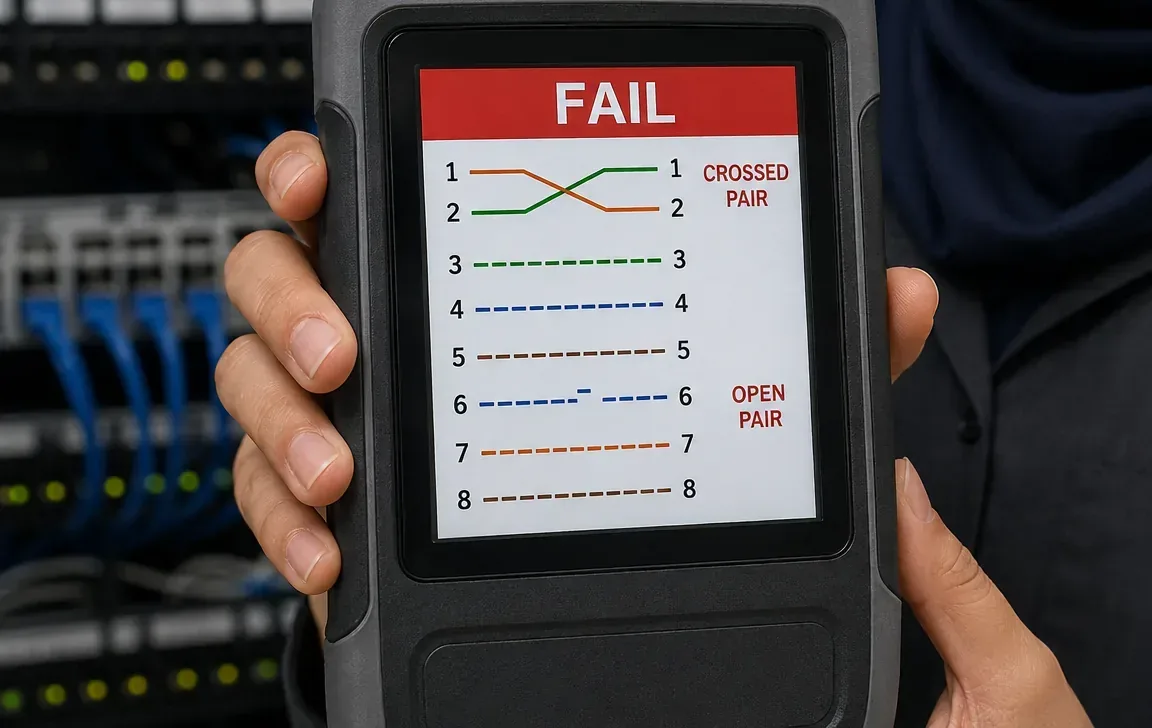
Two fingers and a thumb steady a grey handset whose banner shouts FAIL in white on red. Its diagram draws conductors one and two swapping places and conductor six with a gap, captioned CROSSED PAIR and OPEN PAIR; switch lights and blue cords blur behind.
Equipment
Types of Cat6 Repair Equipment and Parts We Bring to Riverdale
A Riverdale repair van carries the same core kit as anywhere else, plus a few things the neighborhood's homes ask for more often.
Certification Tester with Fault Location
Tests a link against Cat6 or Cat6A permanent-link or channel limits and shows, in metres from the tester, where crosstalk, return loss or a break is happening. In a co-op that means opening one spot, not a wall.
Tone Generator and Probe
Identifies which unlabelled cable in a closet, rack or ceiling goes to which room. Essential in combined apartments and in houses wired by several contractors over the years.
PoE Tester
Confirms whether power is actually reaching a camera, touch panel or access point at the far end, and how much, so a cable fault is not confused with a switch or power-supply fault.
Matched Cat6 and Cat6A Terminations
Keystones, panel modules and field-terminated plugs for both categories. A repaired Cat6A link stays Cat6A; a shielded run gets shielded parts and its bond kept.
Outdoor and Riser-Rated Cable
Solid-copper Cat6 for interior runs in the listing the space requires, and outdoor-rated, sunlight-resistant cable for terraces, gates, garages and garden runs.
Raceway, Pass-Throughs and Sleeves
Low-profile raceway for co-op baseboards, flat weatherproof door pass-throughs, and conduit and sleeves for outdoor sections and wall entries.
Weatherproof Enclosures and Sealant
Sealed boxes for the garage or outbuilding end of a run, plus sealant and bonding hardware for entries through masonry and stone.
Labels and a Port Map
Durable labels at both ends of every link we touch and a written map of which jack goes to which port, given to the owner and, if wanted, the managing agent.
One thing we do not bring is copper-clad aluminum cable. Several online sellers offer it cheaply as “Cat6,” but the TIA standards call for solid copper conductors, and a vendor analysis published in 2026 put CCA's resistance at roughly 58 percent above copper, which matters on long PoE runs to a garage or a gate. If a test shows a previous owner used it, we will tell you.
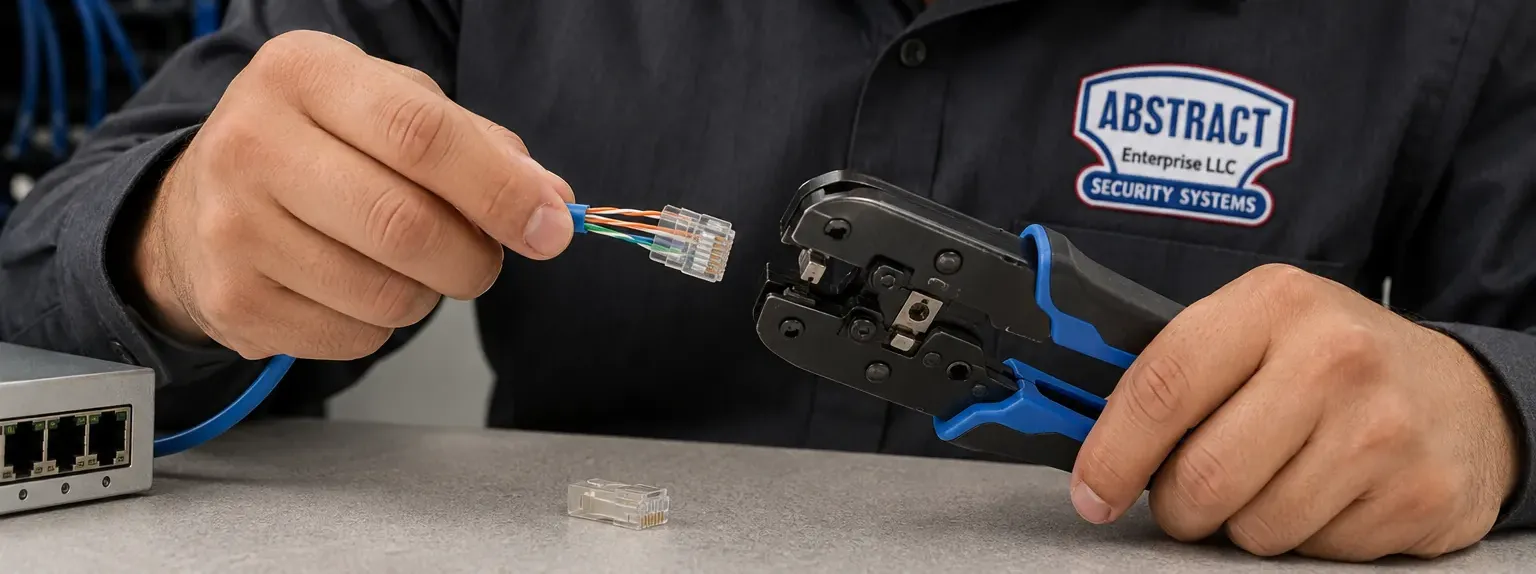
One hand holds a clear RJ45 plug with the colour-coded conductors pushed fully in; the other holds a blue-and-black crimping tool. A spare plug lies on the grey bench beside a small switch, and an Abstract Enterprises Security Systems logo is on the shirt.
AI Overview Reality Check
What AI Gets Wrong About Cat6 Repair in Riverdale
Google's AI summary was not visible to us when this page was written, so nothing here quotes it. What follows are the claims that keep surfacing in price guides, chatbot replies, forum posts and how-to videos about mending a network cable — and, under each, how that claim holds up inside a Riverdale co-op tower, a Fieldston house or a shop on Riverdale Avenue.
1. “Cat6 repairs cost about $125–$250 per drop”
Answer engines repeat this range because it is published and tidy. It comes from national guides such as Fixr's January 2025 edition, and it prices a new drop in an open, easy building, not a repair.
A Riverdale repair is a different job. Before any cable is touched, the technician has to find out which of several undocumented runs is the right one, test it from both ends, and in a co-op work inside the board's contractor hours with an insurance certificate already filed. In a Fieldston house the run may cross stone, plaster on lath and a basement before it reaches the rack.
Our published repair rate is $195 an hour with a three-hour minimum ($585), and a replacement run where the old one cannot be saved starts at $175. Those are our own Bronx figures, not a national average, and they include the testing and the written result.
2. “Just re-crimp the end and it will work”
Re-crimping is the first fix most how-to videos offer, and on a patch cord with a broken latch or a half-crimped plug it is sometimes right.
But much of the Cat6 inside Riverdale homes does not end in a plug at all. It ends at a keystone in a wall plate or a port on a patch panel, and those are punched down, not crimped. Re-crimping a plug onto cable that comes out of the wall turns a structured link into a fragile one. And if the cable itself was crushed under a terrace door or nicked in an air-conditioner sleeve, a new plug on the end will not change anything.
That is why we test first. If the tester says the fault is at the end, we re-terminate on matched parts. If it says the fault is in the middle of the run, we repair or replace the run instead.
3. “Mesh Wi-Fi makes wired Ethernet unnecessary”
For phones and laptops moving around an apartment, mesh Wi-Fi is often enough. Chatbots tend to recommend it as a replacement for a broken wired link because it avoids opening walls.
Riverdale's buildings make that advice less reliable than it sounds. Postwar towers have concrete slabs and masonry partitions, and period houses have thick plaster, stone and long distances to a garage or studio. Mesh nodes still need to talk to each other, and through those materials they lose speed with every hop. Cameras, touch panels and access points also need power, which Wi-Fi cannot deliver.
Mesh systems themselves work best with a wired Cat6 backhaul between nodes, so the real question is which links must stay wired.
4. “Any electrician or handyman can fix network cable”
General answers often treat data cabling as something any handy person can do, and plenty of Riverdale's existing Cat6 was installed that way: by the electrician on a renovation, the handyman who mounted the TV, or the camera installer who ran a line to the garage.
The result is what we find on repair calls: cable crushed under staples, splices made with couplers inside walls, pairs untwisted by an inch at the jack, and runs that pass a simple continuity check but fail certification. A licensed low-voltage contractor brings the test equipment and the standards knowledge to prove a link meets its category, and the documentation a co-op board or an insurer may ask for.
When a link matters — a home office, a camera, a register — it should end up tested, labelled and documented, whoever did the work.
5. “Indoor Cat6 is fine outdoors if you keep it out of the rain”
Forum answers often suggest running ordinary indoor cable outside “temporarily,” under an eave or a terrace rail, because it is cheaper.
Indoor jackets are not made for sunlight or for sitting wet. Ultraviolet light breaks them down, water wicks into the cable, and terminations corrode. We see the results on repair calls: cracked jackets, green contacts and links that fail every time it rains. Outdoor-rated, sunlight-resistant cable and sealed connections cost little more and last far longer.
The repair for a run like this is not to patch the cracked section; it is to replace the outdoor part with the right cable, support it properly, and seal and bond the point where it enters the building.
6. “If the link light is on, the cable is fine”
A link light means the two ends found each other. It does not say at what speed, how many errors are getting through, or whether the link will hold up when the air conditioner warms the sleeve it runs through. Chatbots and support scripts often use the light as a pass/fail test because it is the only thing a customer can see.
Gigabit Ethernet needs all four pairs. A damaged blue or brown pair can leave the link light on while the connection quietly falls back to 100 Mbps, and a crushed cable can show a light while dropping packets under load. In a Riverdale home office that looks like frozen video calls on the wired desk.
A certification test measures what the light cannot: crosstalk, return loss, insertion loss and length, against the Cat6 limits. That is the test we use before and after every repair.
7. “A co-op repair inside your own apartment needs no one's permission”
General answers assume a house you own outright. In a co-op, the walls, floors and facade belong to the corporation, and the lease and house rules set the conditions. Many boards treat a small like-for-like data repair as routine, but most still want an insurance certificate, a contractor who follows the building's hours, and nothing done outside the apartment without written consent.
The model alteration agreement published by the New York City Bar Association, which many boards adapt, requires contractors' insurance certificates naming the corporation. Managing agents usually want them before the visit, not after.
We handle that paperwork, book inside the building's contractor hours, and keep the repair inside the apartment unless the agent agrees otherwise. That way the repair does not become a dispute with the board.
Know Who Owns the Cable Before Anyone Opens a Wall
Send the building or street, the floor, what the dead link feeds and who installed it if you know. We will tell you what the fault most likely is, whether your co-op will want paperwork first, and how the visit is billed.
Use this form whether you own the apartment, the house or the shop, or look after the building. Describe which link died and where it runs, and a written reply follows the same business day. To talk it through instead, call (646) 490-0629.
✅
We Got Your Request!
Received — a Riverdale technician is reading it now. For anything urgent, call (646) 490-0629 rather than waiting.
How It Works
Our Cat6 Repair Process in Riverdale
Seven steps, whether it is one home-office jack in a parkway co-op or a run to a garage at the bottom of a Fieldston garden.
1. Who owns it, and whose rules apply
On the first call we ask who installed the cable, whether you own the apartment or the house, and whether a co-op board, a managing agent or a historic district has a say. Photos of the jack and the closet help.
2. Paperwork and access
For a co-op we send the insurance certificate to the agent and book inside the building's contractor hours. For a house we agree access to the basement, the rack, the garage and any outbuilding.
3. Trace and identify
With a toner and probe we match each unlabelled cable to its room, find old couplers and dead runs, and note anything that touches the building's systems or protected ground outside.
4. Certify from both ends
A certifier goes on the near end and a remote unit on the far end of every doubtful run. The pass/fail verdict comes against the right category, and the trace shows how many metres along the cable the trouble sits.
5. Your decision, in writing
For each failed link you get the cause, the proposed cure and the price. If the fault is on the building's side or would need protected ground opened, we say so and stop there until you decide.
6. Repair along a protected route
Ends are re-terminated on matched parts; damaged sections are replaced with solid-copper cable rated for the space, routed away from doors, sleeves, roots and sharp edges, and entries are sealed.
7. Retest, label and hand over
Nothing is signed off until it passes a second certification. Labels go on at the plate and the panel, and the owner receives the stored results plus a jack-to-port list — with copies for the agent or integrator if requested.
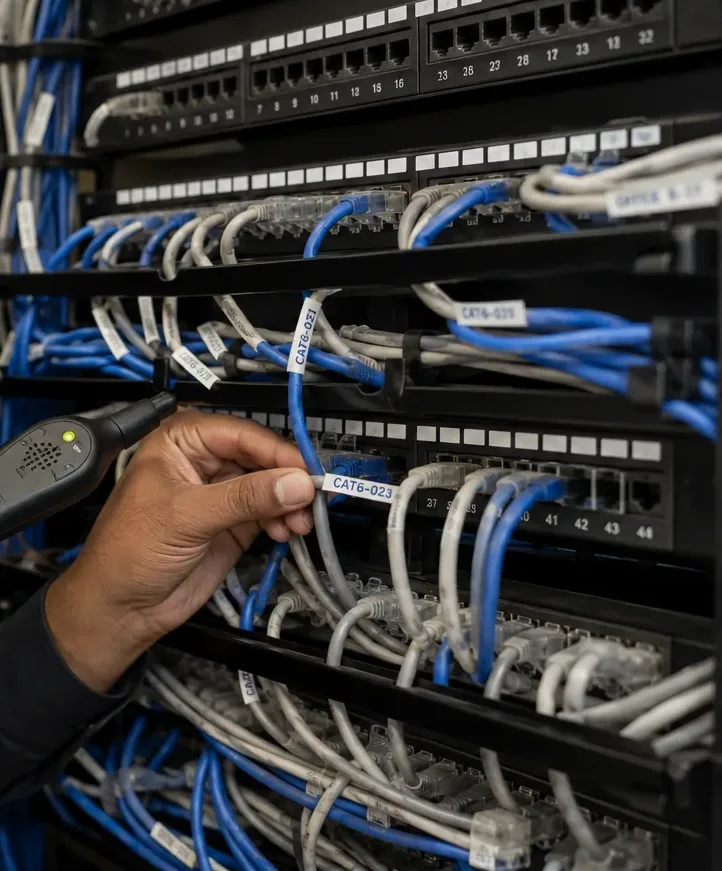
A hand pinches a blue patch cord tagged CAT6-023 at a crowded patch panel while a black tone probe with a green light is held beside it; other cords carry labels such as CAT6-021 and CAT6-039.
Coverage Area
Cat6 Repair Near Riverdale's Landmarks
Riverdale's streets follow the ridge rather than a grid — Fieldston's were laid out to the natural contours on purpose — so we describe the area by the places people use to give directions. These are landmarks, not customers or projects — they simply mark the parts of the neighborhood we cover.
Wave Hill and Hudson Hill
The 28-acre public garden on the slope above the Hudson, given to the city in 1960, with its 1843 fieldstone house and about 65,000 visitors a year. Around it, large houses and long driveways.
The Riverdale Historic District
Designated on October 16, 1990, around estates created after an 1852 purchase of 100 acres, five of whose original houses survive; NYPAP calls it the earliest known railroad suburb of New York City. Repairs here stay inside wherever possible, because exterior changes may need Landmarks approval.
Fieldston
A privately owned neighborhood whose streets belong to the Fieldston Property Owners' Association, bounded by Manhattan College Parkway, the Henry Hudson Parkway, West 250th Street and Broadway. Most of it is the historic district designated in 2006. Period houses, private roads and resident-only parking.
The Hill Schools and Manhattan University
Horace Mann and Ethical Culture Fieldston in Fieldston, Riverdale Country School just to the north, and Manhattan University on Manhattan College Parkway. Campus buildings of many ages, plus the apartment buildings and houses around them.
Johnson Avenue and Central Riverdale
The shopping streets of the “downtown” between Manhattan College Parkway and West 232nd Street, ringed by co-op buildings.
Spuyten Duyvil and the Parkway Towers
The southern end of Riverdale above the meeting of the Harlem and Hudson rivers, and the postwar towers along the Henry Hudson Parkway service roads, where balconies and terraces face the river.
We also repair Cat6 next door in Kingsbridge, Marble Hill, Van Cortlandt Village and Norwood, and across the city line in Yonkers through our Westchester County Cat6 repair service. For the rest of the borough, the Cat6 repair page for the whole Bronx covers everything from new towers on the Harlem River to the apartment houses of the Concourse.
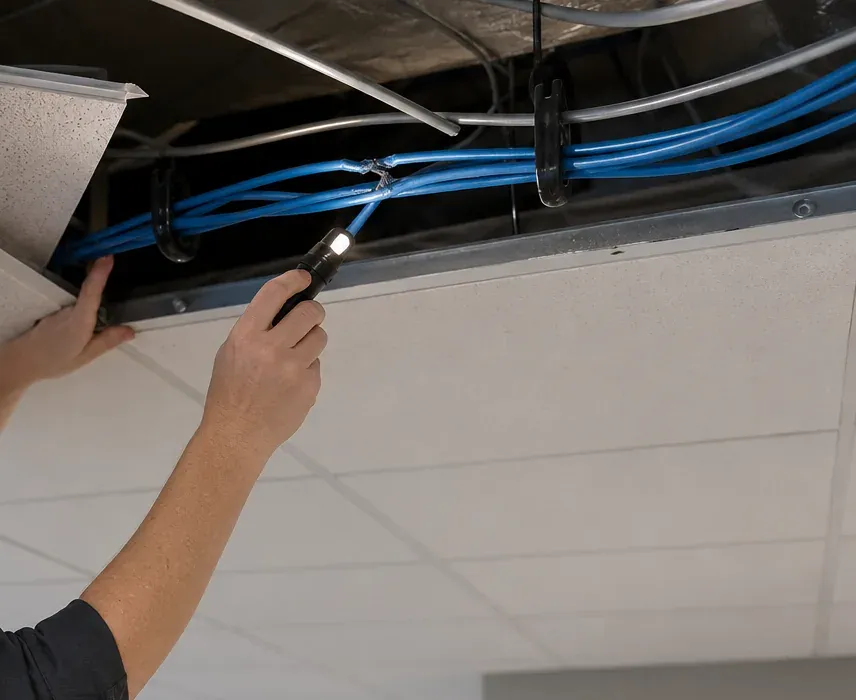
Torch in hand and a tile pushed up out of the grid, the technician inspects blue Cat6 resting in black hangers; toward the left end, a single strand bends sharply away from the group with its sheath torn.
Pricing
Cat6 Repair Cost in Riverdale
Riverdale is priced exactly like the rest of the Bronx, because the Bronx sits at parity with our Brooklyn base. Every figure below comes from our published Bronx pricing. What changes the total in Riverdale is not the rate, it is the job: how many undocumented runs have to be traced, whether a co-op's hours split the work across two visits, and whether an outdoor run has to be replaced rather than re-terminated.
Item
Price
Notes
Repair time on site — tracing, testing both ends, re-terminating, certifying and writing up
$195/hr, 3-hour minimum ($585)
The same hourly rate as our Bronx network cable repair work. One block usually clears a single apartment jack, a terrace run that only needs new ends, or a touch-panel link.
Additional time beyond the minimum
$195/hr
For combined apartments, houses with many unlabelled runs, or several links in one visit.
Replacement run where the old cable cannot be saved
From $175 per drop
Arrives terminated at both ends, tested and labelled. Long outdoor runs or difficult routes are quoted in writing before work starts.
Exterior entry made good — sealed and bonded
From $185 per penetration
For garage, outbuilding, terrace or facade entries that were never sealed or bonded. In a co-op, only at an entry the building has approved.
For comparison: a brand-new Cat6 outlet (runs to 100 ft)
$272 per drop
From our Bronx installation pricing, where Cat5e is $233 and Cat6A $388. Useful when a repair turns into “add a jack in another room.”
Insurance certificate for your co-op or managing agent
No charge
Prepared and sent before the visit.
Online cost figures are usually national averages for new work. Fixr's guide, updated January 2025, quotes $125–$250 for each new Cat6 drop and $45–$75 per labor hour nationwide — a third party's numbers for installing cable in ordinary buildings, which say nothing about finding a fault in cabling somebody else left behind.
Full terms — including 50% deposit, one-year parts-only warranty on AESS-supplied products, and the late-fee schedule — are set out in the service agreement.
Riverdale-specific things that move the total
Combination apartments: tracing two original layouts takes longer than one, so budget for some time beyond the three-hour block.
Co-op contractor hours: a narrow daily window can mean two shorter visits instead of one long one. We plan the work so the minimum applies once wherever we can.
Outdoor runs on a sloping lot: if the fault is at an end, it is ordinary repair time; if the run has to be replaced, it is quoted separately once the route is agreed.
Shop Our Systems
Cat6 Repair Packages & Pricing for Riverdale
Three ways Riverdale repairs are usually booked. Each is built from the same published Bronx figures above — no separate Riverdale rate.
ESSENTIAL — ONE LINK BACK
$585
A single three-hour block. Typical use: the home-office jack in a co-op apartment, a terrace camera run that needs new ends and a proper entry, or a blank touch panel's cable. Traced, tested from both ends, re-terminated and certified, with the result emailed to you.
COMPLETE — WHOLE-HOME TRACE AND REPAIR
$585 + $195/hr after 3 hours
For a combined or duplex apartment, or a house wired by several contractors: every run identified and mapped, every failing link repaired on matched parts, everything labelled, and a full set of saved results for you and your managing agent or integrator.
EXTENDED — REPAIR PLUS NEW RUNS
Repair time + from $175 per run
For homes where testing shows a few runs are past saving — crushed under a door, worn through in a sleeve, damaged underground. Those are replaced from $175 each along a protected route, the rest are repaired at the hourly rate, and outdoor entries are sealed from $185.
Bring your own equipment (BYOE): if you already have the switch, the access points, the cameras or the touch panels, we repair and certify only the cabling at the same labor rates. Parts you supply carry their manufacturer's warranty, not ours.
A Price Before Anyone Picks Up a Tool
After the test you get each failing link, its cause and its cure in writing, with the price, before any repair begins. Nothing changes without your say-so.
Riverdale's boundaries are argued over, but most people recognise these sections. Each tends toward certain building types.
Spuyten Duyvil and South Riverdale
The southern end, below West 232nd Street by most definitions, including the business district at West 231st Street and Broadway. Postwar towers with river-facing balconies, older walk-up co-ops, and storefronts with deep basements. Calls here are often balcony cameras and home offices.
Central Riverdale
The “downtown” between Manhattan College Parkway and West 232nd Street, from the Henry Hudson Parkway to Riverdale and Waldo Avenues. The densest cluster of co-ops and the Johnson Avenue shops. Combined apartments and small offices.
Fieldston
South of West 250th Street and east of the Henry Hudson Parkway, with private streets and period houses. Plaster-walled jacks, basement racks, integrator wiring and runs to detached garages.
Hudson Hill
Above West 246th Street and west of the parkway, around Wave Hill and the Riverdale Historic District. Large houses on big, sloping lots; long outdoor runs and links between buildings.
North Riverdale and Villanova Heights
Above West 254th Street, and the pocket bounded by Fieldston Road, West 250th Street and the parkway. Houses and smaller apartment buildings near the Yonkers line, and the new restaurants and salons on Riverdale and Mosholu Avenues.
Mosholu
East of Fieldston Road above West 254th Street, out toward Broadway and Van Cortlandt Park. A mix of houses, apartment buildings and institutional campuses.
Riverdale falls in two ZIP codes: 10471 north of Manhattan College Parkway and West 239th Street, and 10463 to the south, which it shares with Kingsbridge and Marble Hill. Either way, it is the same Bronx line and the same prices.
Complete Services
Every Cat6 Repair Service in Riverdale
Cat6 rarely fails on its own: there is a camera, a panel or a register on one end of it. These Riverdale and borough-wide services are the ones most often booked alongside a repair.
Several of these at once? Describe the home and we will scope it together.
Field Notes
Field Notes on Riverdale Cat6
How our technicians approach Riverdale calls — a description of method, not a story about one particular job
We ask who put the cable in before we ask what is wrong with it. A run installed by a previous shareholder's electrician, a camera company or an integrator each has its own habits, and knowing which one did the work tells us where to look first.
We look at the door, the sleeve and the baseboard before the closet. In owner-added cable, the damage is usually where the cable took a shortcut the building never intended.
Outside, we find the fault before anyone digs. On a lot with rock, roots and protected slopes, a measured distance on the tester is worth more than an afternoon with a spade.
And we leave the paperwork where it will be needed: the results and port map with the owner, a copy with the managing agent or integrator if the owner wants, and labels on both ends of every link we touched.
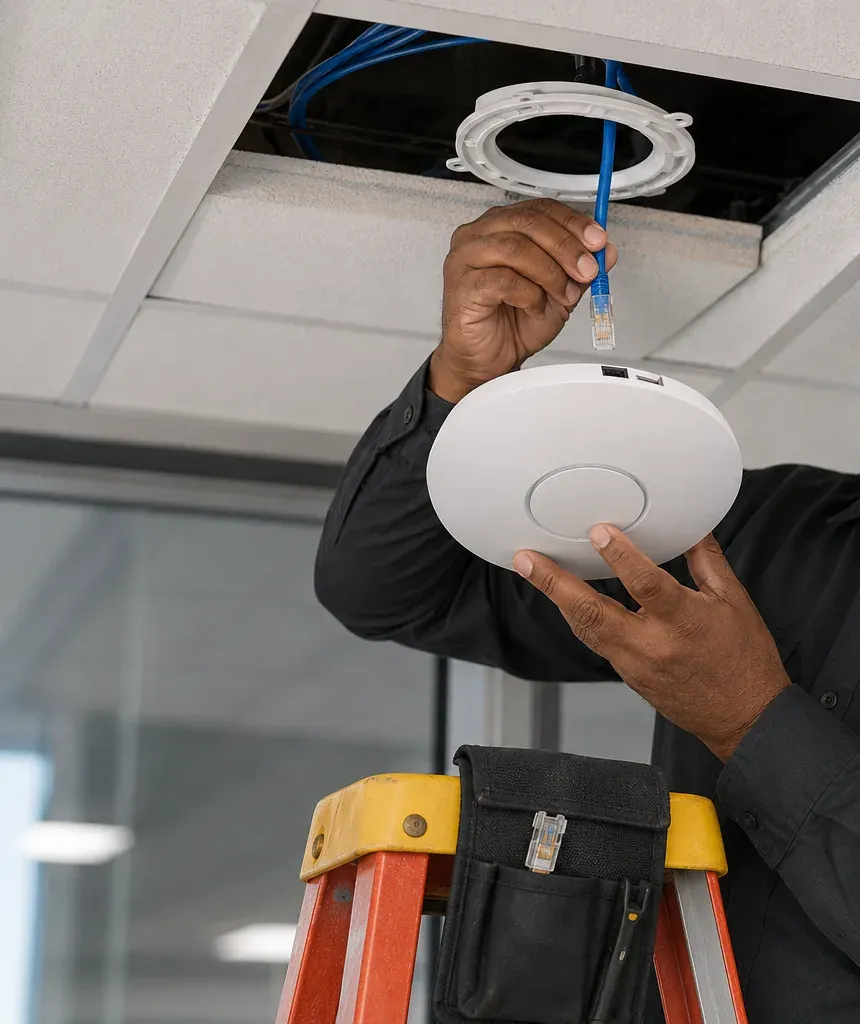
From an orange ladder with a tool pouch hung on it, a technician holds a white round access point in one hand and, in the other, a blue cable with a fresh RJ45 plug coming down through the access point's mounting ring in an open ceiling tile.
FAQ
Riverdale Cat6 Repair FAQ
What will one dead jack in a Riverdale co-op apartment cost to put right?
+
Usually $585. That is our three-hour minimum at $195 an hour, and one block normally covers tracing the run, testing it from both ends, re-terminating the failed end on matched parts, certifying the link and sending you the result. If the test shows the cable itself is crushed or worn through and has to be replaced, a replacement run starts at $175 on top of the time. You get that in writing before any replacement begins.
Our managing agent wants a certificate of insurance naming the co-op before any work — can you send it the same day?
+
Yes, normally within the business day and at no charge. Send us the exact names the agent wants on the certificate — usually the cooperative corporation and the managing agent — and the agent's email address, and we send it straight to them. Some buildings also ask for our license number, which is NYS #12000287431. Having the certificate on file before the visit means the doorman or super can let the technician straight up.
During a heat wave Con Edison lowered the voltage in Riverdale — can that harm our Cat6 or the cameras on it?
+
Not the cable. Cat6 is passive copper and a voltage reduction does nothing to it. What can misbehave is the equipment: a PoE switch or power supply running on reduced or interrupted power may reboot, drop power to cameras or lose its settings. News 12 reported an 8 percent voltage reduction across the northwest Bronx, including Riverdale, on July 3, 2026, alongside outages for about 1,000 Riverdale customers. If devices did not come back afterwards, we test the cable and the PoE separately so you know which one needs attention.
Can you repair the Cat6 that feeds livestream cameras in a synagogue or church sanctuary?
+
Yes. Livestream and recording cameras in a sanctuary usually run on long Cat6 links back to a booth or an office, often through a balcony, a gallery or a ceiling that is hard to reach. We schedule around services and events, test each camera link from the booth end first so we know where the fault is before any ladder goes up, and keep the repair as discreet as the original run. If the camera or encoder is the problem rather than the cable, we say so and leave that to your AV provider.
Do you also repair Cat6 in Spuyten Duyvil, Kingsbridge and Marble Hill?
+
Yes. Spuyten Duyvil is the southern end of Riverdale itself, and Kingsbridge and Marble Hill share Riverdale's 10463 ZIP code and Community District 8. Kingsbridge and Marble Hill buildings are served on the same Bronx line, (646) 490-0629, at the same prices; Marble Hill is legally part of Manhattan but sits on the Bronx side of the river, and we treat it the same way.
The integrator who wired our house has closed — can you look after the cabling from now on?
+
For the cabling, yes. On the first visit we trace and label the runs that matter, test them and keep the port map and results on file, so later calls start from a known picture instead of a mystery. Each visit is billed at our published rate of $195 an hour with a three-hour minimum. The programming of the automation system itself, such as scenes, schedules and device settings, belongs to whichever integrator takes over that side.
Can a Cat6 repair be finished inside the hours a co-op allows for contractor work?
+
In almost every case. Most single-link repairs take an hour or two once the technician is at the fault, which fits comfortably inside a weekday contractor window. For bigger jobs, such as tracing a combined apartment, we plan the work so the noisy parts, like drilling a new box, happen first, and the testing and labelling, which are silent, can run later. If the building's hours are very tight, we split the work across two visits and tell you in advance.
How far is Riverdale from your base, and how soon can a technician arrive?
+
We work out of 460 East Fordham Road in the Bronx, and Riverdale is one of the closer neighborhoods we cover. When you call, we offer the next open two-hour arrival window, which is often the same day, and once the technician is at the fault most single-link problems at a jack, plug or panel port are found and fixed within an hour or two.
No Link at a Riverdale Jack? Book the Repair Below
A home office that has to be working by morning, a garage camera that went dark at dusk, a register that will not connect before tomorrow's opening: call (646) 490-0629 from anywhere between Spuyten Duyvil and the Yonkers line. You get the next open two-hour window, and a fault at a jack, a plug or a panel port rarely takes more than an hour or two to put right once the technician is standing at it.
Riverdale repairs are booked, scheduled and dispatched by Abstract Enterprises Security Systems from our office at 460 E Fordham Rd, Bronx, NY 10458 — one licensed team for co-op apartments, ridge houses and avenue shops alike. Phone (646) 490-0629, or send photos of the jack or closet by WhatsApp to (718) 679-0359 using wa.me.
NYS Low-Voltage License #12000287431 · 100% Licensed & Insured · Same-Day Estimates · Rated 4.7★ from 201 Google Reviews
Parts you supply carry their manufacturer's warranty. See our warranty page and the service agreement for full terms.
This page was prepared for people who live and work in Riverdale. Its references to codes, zoning, landmarks rules and published figures summarise the sources listed above; for legal, zoning or engineering decisions, rely on a qualified professional. Last reviewed October 17, 2026. Changelog: October 2026 — Riverdale Cat6 repair page first published.