Shuls · Churches · Campuses · Training Rooms · Route 59 Stores · Homes
Video Wall Installation in Rockland County
Programmed Before It Is Needed · Nobody Has to Touch It · Inspected Under Chapter 250 · Rockland Price List
Most display walls in Rockland are not watched over by a technician. They hang in a shul lobby that must show the right zmanim from Friday afternoon to Saturday night with no one touching a button, in a college hall that runs to an academic calendar, in a Route 59 store whose seasons change faster than its staff, and in public-safety rooms like the Pomona wall the county put out to bid in 2019 with the brand and model fixed. So a Rockland wall is planned around its calendar first: what it shows, when it changes, who may change it and what happens if nobody is there. Then it is wired the Rockland way, with the new circuit run by a county-licensed master electrician and signed off by a licensed electrical inspection agency before Orange & Rockland is told the connection is approved.
Reviewed and updated October 18, 2026: Census QuickFacts, the county’s 2019 video wall bid, Laws of Rockland County Chapters 250 and 286, Palisades Center and Nanuet reporting, college pages and the Nyack and Haverstraw grant announcements · Anwar Timothy, NYS license #12000287431 · Rockland visits dispatched from our office on East Fordham Road in the Bronx
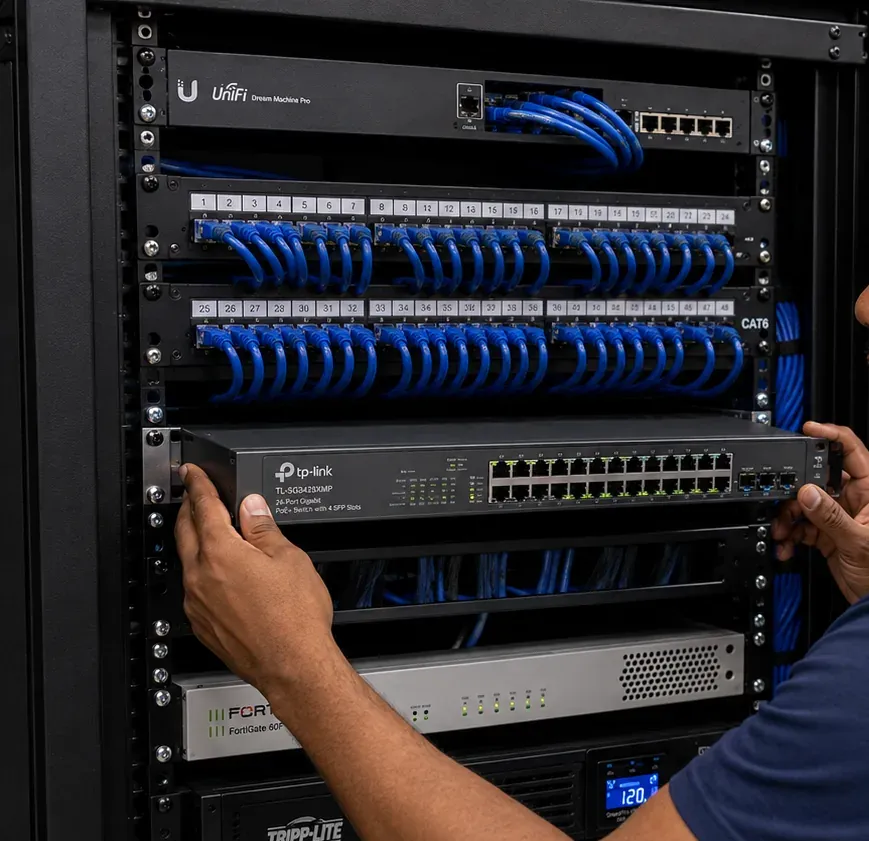
Hands guide a 24-port switch onto its rack rails below two numbered patch panels. The players and controller of a scheduled wall sit on a switch like this one.
Rockland Video Wall Request
Town or village, the building and its calendar — we call back the same business day
✅
Request Sent!
A technician will call you back about the Rockland building the same business day.
25+
Years Experience
✓
Same-Day Estimates
100%
Licensed & Insured
4.7★
201 Google Reviews
Quote in sixty seconds of typing. Text (845) 640-3835 one photo of the wall, one of the room from the farthest seat, and one line saying when the wall must change by itself — “Shabbat and Yom Tov”, “school terms”, “store hours” or “never off”. With that and the town or village we can usually tell you which configuration fits, roughly what it costs from the Rockland table below, and whether the electrician will need a new circuit.
Same-day written pricing, taken line by line from the Rockland list in the Pricing section below
Visits planned around Shabbat, Yom Tov, exam weeks and store trading hours, not around our convenience
Licence: New York State #12000287431, issued under General Business Law §69-m for security and fire alarm installers; any line-voltage work goes to a Rockland-licensed master electrician and is inspected the county’s way
The Neighborhood
Why Rockland County Properties Need Video Wall Installation
Rockland is a small county with a lot of people in it. The Census Bureau’s estimate for July 1, 2025 is 357,397 residents, up 5.6 percent from the 2020 count, and the county’s households are large: 3.22 people on average, with 31.1 percent of residents under eighteen and 9.6 percent under five. Some 44.2 percent of residents aged five and over speak a language other than English at home. Those numbers describe a county of busy shared rooms — synagogues and study halls, churches and parish halls, schools and three colleges, catering halls, and the stores along Route 59 — more than a county of corporate lobbies.
Rockland also holds one of the largest Jewish communities in the United States relative to its size. The Jewish Virtual Library puts it at about 92,000 people, and press reports have described it as roughly 31 percent of the county, the highest share of any U.S. county. In Monsey, a hamlet of the Town of Ramapo, more residents speak Yiddish at home than any language other than English. For display work that means a great many shuls, batei midrash and schools where a screen is a working tool: a zmanim board with the day’s prayer times, a minyan schedule, the parsha and community notices, running all week and changing on its own before Shabbat and Yom Tov, when nobody in the building will operate it.
Public rooms in Rockland use display walls too, and the county’s own purchasing record shows how carefully. In December 2019 the County of Rockland issued request for quotes RFQ-RC-2019-167 for a 2x2 video wall bundle, LG 55VH7EAW panels with 0.9mm bezels and a Peerless SmartMount Supreme full-service mount, for delivery to Pomona, home of the county’s Fire Training Center at 35 Firemen’s Memorial Drive; the notice lists the owning department only as “FTC”. It said that the brand and item specified were required and that an alternate brand would be rejected. The Clarkstown Police Department has also shown off a new video wall in its dispatch center on its own social media. Rooms like these run around the clock or on training rosters, and they are bought through procurement rules that leave little room for improvisation.
Then there is retail. Rockland’s 2022 retail sales came to about $6.7 billion, or $19,652 per resident, according to the Census Bureau, and much of that money is spent along Route 59 between Nyack, Nanuet, Spring Valley, Monsey and Suffern. In February 2026 the Palisades Center in West Nyack, at the junction of Routes 59 and 303, was sold at a foreclosure auction for $175 million to BD Palisades Holdings, a group that includes Black Diamond and that had been the plaintiff in the foreclosure case. A few miles west, the owners of the former Shops at Nanuet, now Nanuet Town Centre, have described plans that could add about 280 apartments along with services and community space. Store walls in a corridor that is changing owners need to be easy to reprogram, easy to take down, and installed under whatever contractor rules the current landlord sets.
Add the campuses — Rockland Community College in Suffern, St. Thomas Aquinas College in Sparkill, Dominican University New York in Orangeburg, and the Hudson Valley iCampus in Pearl River, the former pharmaceutical site of about two million square feet where Pfizer still runs research — and the pattern is the same. In Rockland, the hard part of a video wall is rarely the hanging. It is making sure the wall does the right thing on the right day without anyone standing beside it, and that the power behind it has been licensed and inspected the way this county does it.
Rockland facts behind a video wall job
357,397 residents (July 2025 estimate) in 103,879 households averaging 3.22 people; 31.1% under 18 (Census QuickFacts)
44.2% of residents five and older speak a language other than English at home (Census QuickFacts, 2020–2024)
About 92,000 Jewish residents, by the Jewish Virtual Library’s estimate, roughly 31% of the county by press reports
RFQ-RC-2019-167: the county’s own 2x2 LG video wall bundle for Pomona, brand and item required, alternates rejected
$175 million: the Palisades Center foreclosure auction price on February 4, 2026
About 300,000 electric customers served by Orange & Rockland and its New Jersey subsidiary, the utility a Rockland inspection agency notifies before a new connection
Congregations and schools adding a display wall often pair it with the cabling for the rest of the building, and with access control for the doors and cameras for the halls, so one survey covers all three.
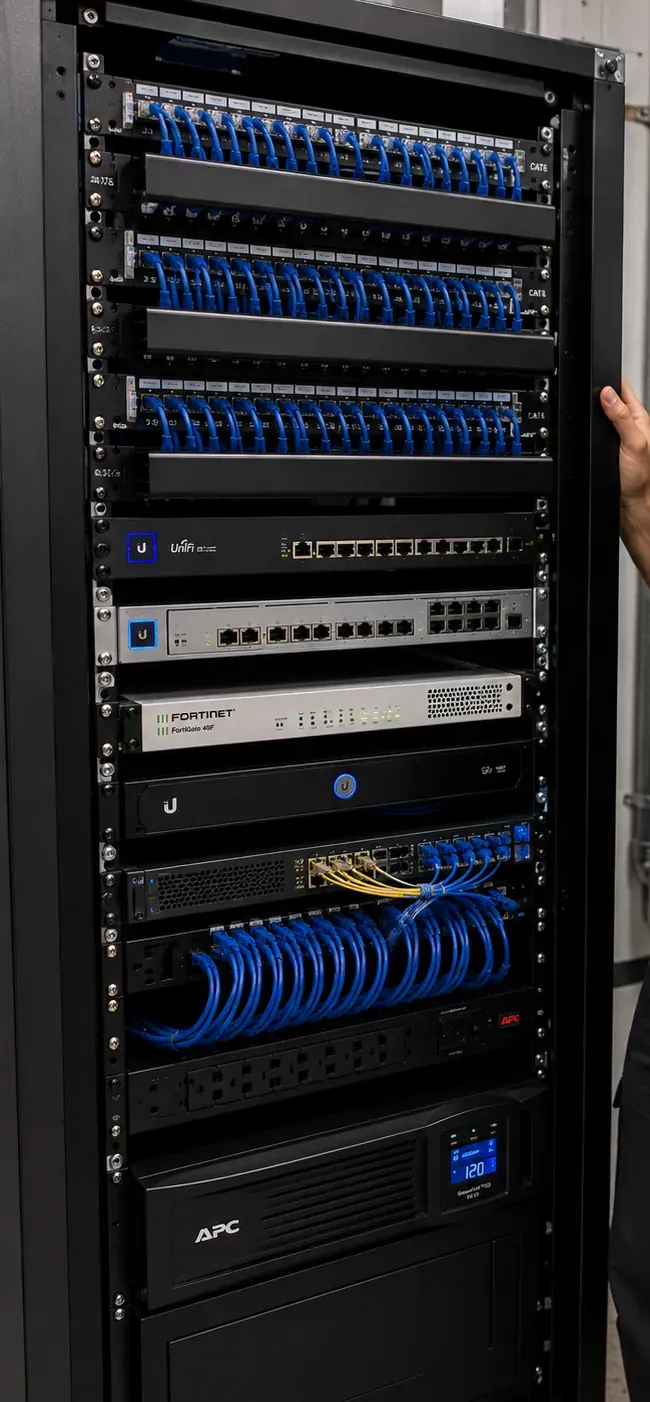
A finished rack with patch panels and switches above and a battery backup unit at the base. A wall that must keep its Friday schedule needs its player and controller on one.
Repair & Same-Day Help
Same-Day Video Wall Repair in Rockland County
A wall that shows last week’s times on a Friday morning, a store wall that came back from a power cut with one panel black, or a training-room wall that has lost its saved layouts all need the same thing: a quick look at what failed before the next service, opening or class. Call or text (845) 640-3835 with a photo of the wall and a photo of the equipment behind it. We book the next open window, and most single faults are fixed within one to two hours of arrival.
What usually goes wrong
The player lost its clock. A signage player that cannot reach its time server drifts, and a zmanim board that is even a few minutes out is worse than none. We set a reliable time source and a fallback.
One tile will not wake. Often a loose power lead or a failed power supply in that one panel, not the whole wall. We test the tile before anyone orders a replacement.
The layout is wrong after a power cut. The controller did not save its settings, or restarted before the panels did. We fix the start-up order and save the layout so it comes back on its own.
Content stopped updating. A changed Wi-Fi password, an expired software licence or a firewall change at the office. We trace it and write the fix on the handover sheet.
Repair and service visits are billed at $195 an hour with a three-hour minimum ($585). Walls we installed are logged with their panel models, serial numbers, network settings and schedule, so we arrive knowing what is on the wall.
What We Install
Video Wall Installation Services in Rockland County
Each service below starts from the same question: what must this wall do on a day when nobody who understands it is in the building? In Rockland that day comes every week for a shul, every summer for a campus and every holiday season for a store.
Shul zmanim and announcement walls
One screen or a tiled wall in a lobby or beis medrash showing the day’s zmanim, minyan times, the Hebrew date, the parsha and community notices, with weekday, Shabbat and Yom Tov modes programmed in advance.
Sanctuary and hall walls
LCD or direct-view LED walls for churches, catering halls and community rooms: lyrics and readings, speakers’ slides, a feed of the chuppah or the stage to the back rows, with sound sent to the hall’s own speakers.
Campus walls
Lobby, admissions and student-centre walls for colleges and schools, planned around the academic year, with fiber or HDBaseT runs from a closet that may be a building away.
Training and operations walls
Multi-source walls for training classrooms, dispatch and operations rooms, built to the buyer’s specification and installed without taking the room out of service.
Store and restaurant walls
Window-facing and in-store walls for the Route 59 corridor and village main streets, with seasonal layouts loaded ahead and mounts that come off cleanly at the end of a lease.
Home media walls
Family-room and basement walls in Rockland houses, planned around children, carpentry and the rest of the home’s audio and video.
Scheduling and remote content
Setting up the content system, the calendar and the user accounts, so a gabbai, a registrar or a store manager can change the screen without calling anyone.
Repair, re-programming and take-over
Fixing walls that have drifted, gone dark or lost their schedules, and documenting walls whose installer is no longer around.
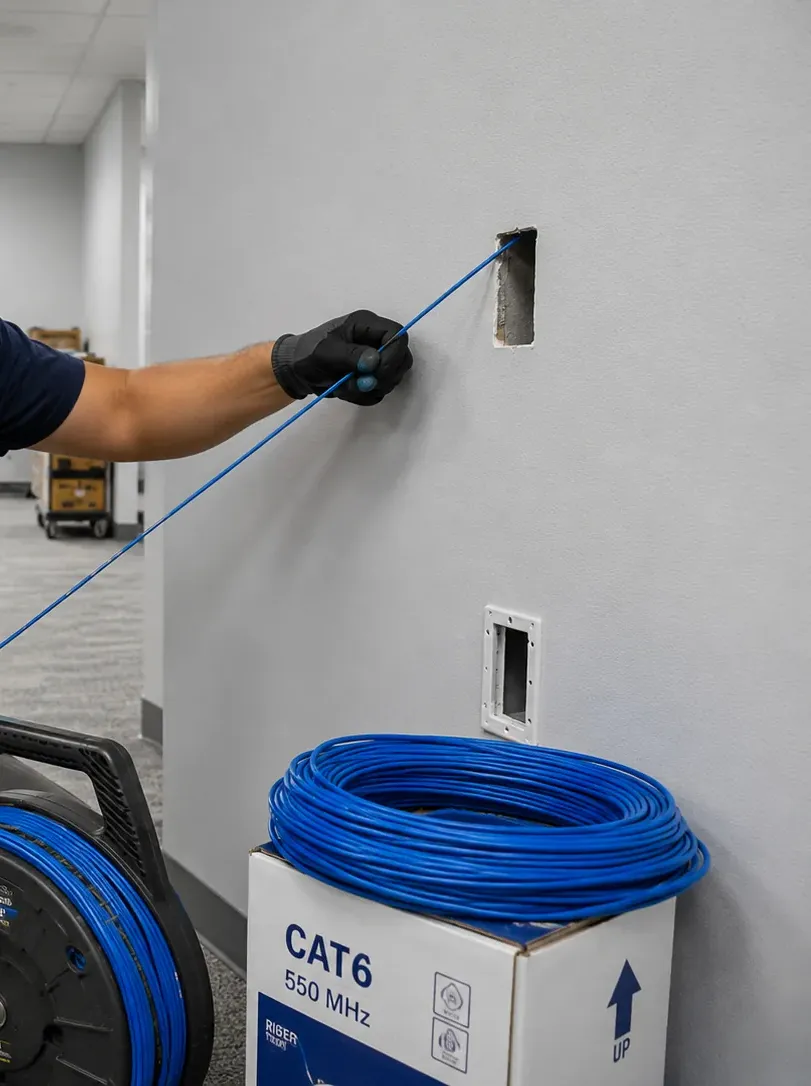
A gloved hand pushes blue cable into a small opening high in a painted wall, fed from a reel and a Cat6 box below. Closed walls in houses and shuls are wired this way.
The Calendar Comes First
Five Calendars a Rockland Wall Has to Keep
Before we talk about panel sizes we ask which calendar the wall belongs to, because in Rockland that decides the controller, the content system, the network and even where the off switch goes. Almost every wall we plan here follows one of five.
Shabbat and Yom Tov
A shul or a Jewish school wall changes mode before candle lighting and must hold that mode until after havdalah, or across a two- or three-day Yom Tov, without anyone in the building pressing a button or changing what it shows. Everything that the screen does on those days has to be decided and loaded before they begin, and the hardware has to be chosen so that nothing reacts to people in the room. Shul signage services calculate zmanim from the building’s exact map coordinates rather than from a town name, which is why the address and the location pin matter at the survey.
Whether a screen may run at all on Shabbat, and what it may show, is a halachic question, and it is not ours to answer. Halachic reference works note that setting a timer before Shabbat to switch lights or appliances on or off is permitted, while some leading authorities, among them Rabbi Moshe Feinstein, are cited as generally opposing timers that run machines to do work on Shabbat. Communities follow their own rav. We build the wall so that whichever rule the congregation follows is easy to keep: a dark screen from candle lighting, a static Shabbat board, or a schedule that runs untouched.
The academic year
Rockland Community College’s main campus is in Suffern, with centers in Nyack and Orangeburg; the college says more than 5,300 people are enrolled in credit and non-credit courses and over 200,000 visit the campus each year for cultural, recreational and commercial events. St. Thomas Aquinas College sits on Route 340 in Sparkill, and Dominican University New York on Western Highway in Orangeburg, which became a university in May 2022. A campus wall follows terms, breaks, exam weeks and commencement, and is managed by whichever office owns the building. We set it to fall back to a holding page when a term’s content runs out, so a summer lobby never shows September’s welcome in July.
The retail year
A Route 59 store wall lives by opening hours, sale dates and holiday seasons, and by a landlord’s rules on when contractors may work. Content for a season is loaded weeks ahead and switches on by date; the wall turns off after closing so panels are not burning through the night for an empty store; and the mounts are chosen so the whole wall can come down cleanly if the store moves.
The duty roster
A dispatch or operations wall never switches off, and a training classroom wall follows the course schedule. Panels for those rooms must be rated for long daily hours, and the controller needs saved layouts that come back by themselves after a power interruption. Installation is planned in sections so the room stays usable.
The household
With an average of 3.22 people per Rockland household and nearly a third of residents under eighteen, a family-room wall is used by everyone. It needs to be safe at child height, simple to switch between a game, a film and a slideshow of a family simcha, and quiet about what it shows when guests are over.
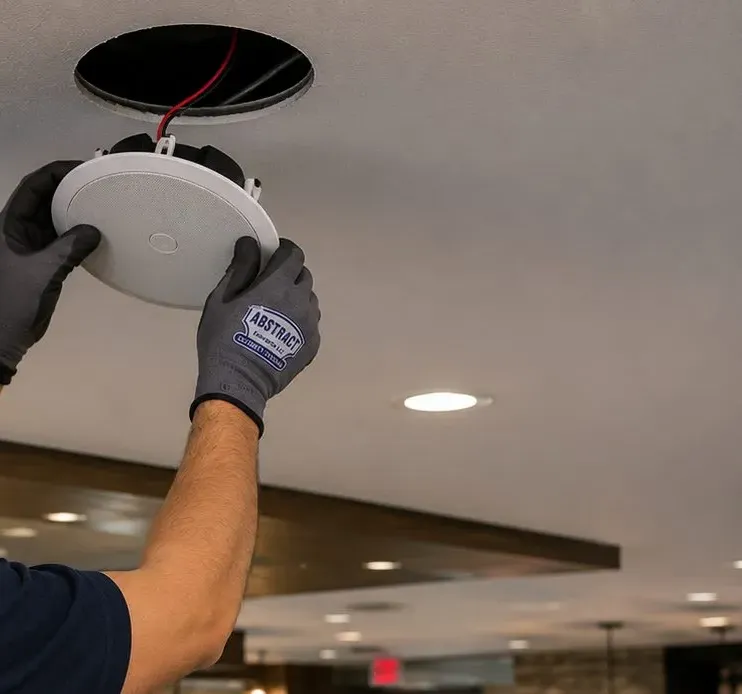
Gloved hands seat a round speaker in a ceiling cut-out above a dining room with pendant lights and a stone wall. In a hall, the wall’s sound usually goes to ceiling speakers like this.
Building Specialists
Video Wall Installation for Rockland County’s Architecture
Rockland’s walls hang in buildings of every age, from village storefronts on Main Street in Nyack to block-walled training buildings and big-box stores on Route 59. The building decides the mount, the cable path and sometimes whether a fixed wall is possible at all.
Shuls and batei midrash
Often converted houses or purpose-built halls with a lobby, a sanctuary and a study hall; walls go where people pass and where they wait, never where they will distract from prayer. Mechitza sightlines decide placement.
Churches and parish halls
Sanctuaries with high ceilings, stained glass and old plaster, and parish halls used for everything from bingo to wakes. Floor-supported frames or masonry anchors are common, and power is rarely where the screen should go.
Catering and simcha halls
Large open rooms with dance floors, stages and changing layouts. Walls are planned for a projected picture of the chuppah or a speech, an overflow room, and sound through the hall’s own system.
College and school buildings
Block-walled classrooms, glass-fronted lobbies and older brick halls on campuses such as Suffern, Sparkill and Orangeburg, with closets and network rooms that may be in another building.
Route 59 stores and mall units
Big-box stores with open steel roofs, in-line mall units with landlord-controlled ceilings, and pad sites with glass fronts facing the highway. Each landlord sets its own contractor hours and insurance rules.
Office, lab and industrial parks
Pearl River, Orangeburg and Blauvelt offices and labs, including the multi-tenant Hudson Valley iCampus, where a wall in one tenant’s space may run on another party’s power and network.
Public-safety and training buildings
Dispatch floors, emergency-operations rooms and training classrooms built from block, with raised floors or cable trays and strict rules on who may enter and when.
Rockland houses
Family rooms and finished basements where walls are finished and cannot be opened freely, and where a wall shares space with toys, bookshelves and the rest of the home’s whole-home audio.
How the building changes the method
Converted houses used as shuls. Framed walls of uncertain age, sometimes with plaster over lath. We find the studs, add blocking or a full-width rail where the wall will carry several panels, and fish cable through closed walls rather than opening them, because a congregation using the building every day cannot live with a repair in progress.
Block-walled schools, halls and training buildings. Cable runs on the surface in conduit or raceway, and passes through block in a cored, sleeved hole. Mount anchors go into solid block or grout-filled cells, not into hollow cores, and the anchor pattern is set out before drilling so every anchor lands well.
Open-ceiling stores and halls. Long cable runs hang in J-hooks or trays from the roof structure, at heights that need a lift. Landlords usually want the route approved and labelled, and fire-stopping restored wherever a cable crosses a rated wall.
Older sanctuaries and brick buildings. When nothing may be fixed to a historic interior, the wall stands on a floor-supported frame. When masonry can take anchors, we drill into the brick rather than the mortar joints that are easier to drill and weaker to hold.
Multi-tenant parks. Before the first box goes in, we confirm whose electrical panel and whose network the wall will use, and get that in writing from the building owner and the tenant.
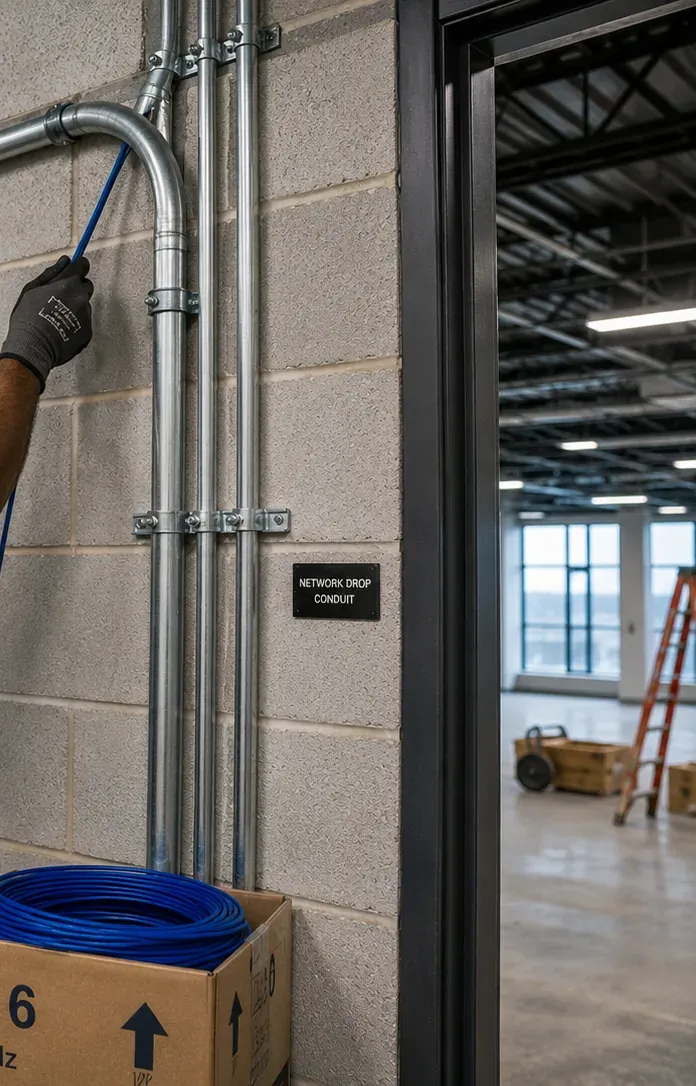
Metal conduits climb a painted block wall beside a doorway, with a box of blue Cat6 cable on the floor. Block-walled schools and halls take display cabling in surface conduit like this.
Commercial Video Walls
Business Video Wall Installation in Rockland County
There is no single downtown in Rockland; business is strung out along Route 59, Route 303 and the river villages. Below are the stretches where store, office and public display walls are concentrated, with the building type typical of each.
Route 59, West Nyack to Suffern
The county’s retail spine: the Palisades Center at Routes 59 and 303 in West Nyack, Nanuet Town Centre, and the strips through Spring Valley, Monsey and Airmont to Suffern. Store walls, menu walls and showroom walls, often installed after closing.
Palisades Center, West Nyack
Opened in 1998 and sold at foreclosure auction for $175 million in February 2026 to BD Palisades Holdings, which includes Black Diamond. Tenants installing displays work under mall management’s contractor rules, and those may be revised under the new owner.
Pearl River and Orangeburg
Office, lab and industrial space, including the roughly 200-acre Hudson Valley iCampus, about two million square feet of lab, pharmaceutical manufacturing and office buildings, with Pfizer keeping about 507,000 square feet for research. Lobby, briefing-room and operations walls.
New City and Pomona
The county seat and county offices in New City, and the county Fire Training Center on Firemen’s Memorial Drive in Pomona, the hamlet named as the delivery point in the county’s 2019 video wall bid. Public-sector walls bought through formal procurement.
Nyack and Haverstraw
Two river villages with state Downtown Revitalization Initiative money in play: $4.5 million of Nyack projects announced in May 2026, and Haverstraw’s $13 million Village Square, which broke ground in October 2026 with a café and community space. Restaurants, galleries, offices and community rooms.
Suffern and Monsey
Rockland Community College’s main campus in Suffern, and the dense mix of shuls, schools, catering halls and stores along Route 59 in and around Monsey. Zmanim boards, school walls and hall walls.
Rockland rules that touch a video wall
Licensed electrical work. Laws of Rockland County Chapter 250, Article I, requires anyone in the business of installing wiring and equipment for light, heat or power, or for signaling systems operating at 50 volts or more, to be licensed, under the supervision of a master electrician. The new outlet or circuit behind a wall is that kind of work.
Inspection by a licensed agency. Chapter 250, Article II, licenses electrical inspection businesses. When an inspector finds an installation conforms to the National Electrical Code, local rules and Orange & Rockland specifications, the inspector issues a certificate of approval, gives the owner a copy, and notifies the utility in writing that the connection is authorized.
Town and village building departments. Clarkstown, Haverstraw, Orangetown, Ramapo and Stony Point each run their own building department, as do the incorporated villages, and their permit policies for electrical work differ. In the Village of Spring Valley the county’s Office of Buildings and Codes administers the state building code.
Home improvement licensing. Chapter 286, the county’s rewritten home-improvement law, took effect on May 14, 2026; the county says all individuals performing home improvement work must hold a Home Improvement License. It matters for walls installed in homes.
Protrusion into walkways. Under the 2010 ADA Standards, a wall-mounted object with its leading edge between 27 and 80 inches above the floor may stick out no more than 4 inches into a circulation path. A wall in a corridor or a busy lobby is mounted with that in mind.
Landlord and procurement rules. Mall management, park owners and public buyers each set their own insurance, scheduling and specification terms. The county’s 2019 bid, for example, required evidence of insurance within five days of award and a certificate of experience for the past three years.
None of this is legal advice; it is the checklist we work through on every Rockland job, and the building department or inspection agency has the final word.
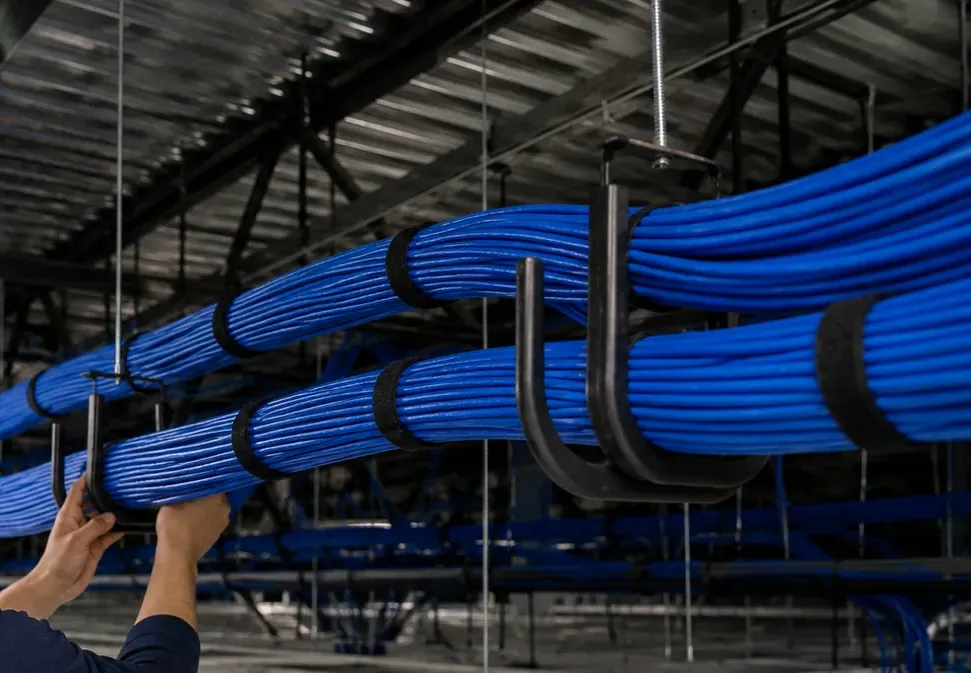
Bundles of blue cable lie in black J-hooks hung from an open steel roof, strapped at intervals. Big stores and halls carry long runs to a display wall on supports like these.
Your Questions Answered
Video Wall Installation in Rockland County: Questions Answered
Grouped by the kind of building asking. Congregations, colleges, store managers, public buyers and homeowners put these to us while a Rockland wall is still on paper; none of them is repeated in the FAQ further down.
Walls That Run Through Shabbat and Yom Tov
Can a shul board switch from weekday times to the Shabbat schedule on its own before candle lighting?
Yes. The board holds two or more schedules — weekday, Erev Shabbat, Shabbat, Yom Tov — and the player moves between them at times calculated from the zmanim for your building, for example a set number of minutes before candle lighting. Once the week’s content is in, nobody needs to touch the screen from Friday afternoon until after havdalah.
What the Shabbat mode looks like is the congregation’s decision: some want a static page with the Shabbat times and no movement, some want the screen dark, some leave a rotating schedule running as it was set before Shabbat. We set it up the way the rav directs, and we test the changeover on a weekday by moving the player’s clock forward to a Friday afternoon, so you see it happen before the first real Shabbat.
How does the screen know the zmanim for our building rather than for the county as a whole?
Sunrise, sunset and the times derived from them shift with longitude and latitude, so a shul in Suffern and one in Nyack, at opposite ends of Route 59, see slightly different times. Shul signage services calculate them from the building’s precise map coordinates and its time zone rather than from a town name. At set-up we enter the exact location of the building and pick the calculation method the congregation uses, then check a week of times against the luach it already trusts before the board goes live.
What happens to a programmed Shabbat schedule on the weekends the clocks change?
If the player takes its time from the internet and its time zone is set correctly, it moves to daylight saving time and back by itself, and every zman moves with it. Trouble comes from players with a manually set clock, or from a schedule built with fixed clock times instead of times tied to zmanim. We avoid both: the player syncs to a reliable time source with a second one as backup, and each changeover is tied to a zman rather than to a clock time. Before the first change after installation, we check the following Friday’s schedule in the software.
Can a two- or three-day Yom Tov be loaded in advance as one block?
Yes, and this is where planning pays. When Yom Tov runs into Shabbat, the screen may need to hold its mode for three days. We build Yom Tov schedules for the whole year at once from the Jewish calendar, so the gabbai only reviews them, and we check that the player has enough storage and does not need the internet for any of those days. If the congregation wants different content on Chol Hamoed, that goes in as its own schedule.
Our sanctuary has a mechitza. How do both sides get a clear view of the screens?
We survey sightlines from both sections, standing and seated, before choosing a position. A mechitza, a balcony rail or a bimah in the middle of the room can hide a screen that looks perfect from the doorway. Often the answer is two smaller displays showing the same thing, one facing each section, rather than one larger wall; sometimes it is a higher mounting position that clears the partition. We mark positions on the wall with tape and ask someone to sit on each side before anything is drilled.
Will Hebrew and Yiddish text come out right-to-left on a signage player, or reversed?
Most current signage software handles right-to-left text correctly, but older players, some free apps and some fonts still reverse words or break lines in the wrong place, especially when Hebrew and English share a line. We test the actual content on the actual player before handover: names, parsha titles, mixed Hebrew-English notices, numbers inside Hebrew text. If the congregation already has a template in a word processor, we check that its fonts are installed on the player, since a missing font is the most common cause of garbled lettering.
Will your technicians schedule around Shabbat, Yom Tov and the chagim?
Yes. We do not book work in a shul, a Jewish school or a Jewish-owned business on Shabbat or Yom Tov, and we avoid Friday afternoons in winter, when Shabbat begins early. Before the Yamim Noraim and Pesach, congregations are busiest, so we suggest booking a new wall well ahead of those weeks and keeping the last visit before them to programming and checks rather than drilling.
Campus, Training and Dispatch Rooms
Can a campus wall follow the academic calendar without being reprogrammed every term?
Yes. We load the college’s published calendar into the content system as a set of dated schedules: term content, exam-week notices, breaks with a reduced holding page, and one-off days such as open houses and commencement. Each schedule has an end date, and when a schedule ends without a replacement the wall falls back to a neutral page rather than old news. Each term, the office that owns the wall uploads new content into a slot that already exists; nobody rebuilds the schedule.
Can a training-room wall keep a record of what was on screen during a drill, for the review afterwards?
Yes. The controller’s output, or any single source on the wall, can be fed to a recorder at the same time as it is shown, so the instructor can replay the maps, camera views and slides in the order they appeared. We size storage for the length of the exercises and how long recordings are kept, and put the recorder where only the people responsible can reach it.
Two cautions. If live camera feeds or caller details appear on the wall, the recording carries them too, so the department’s own rules on retention and access apply to it. And a recording of the wall is not a substitute for the dispatch system’s own logs; it shows what people saw, not what the system did.
Can a wall be built in a room that has to stay staffed around the clock?
Yes, by working in sections. We agree the order with the shift supervisor: rough-in and anchors along one part of the wall while the room works on the other, temporary screens on carts if a position must be vacated, and the cut-over from old displays to the new wall during the quietest hours. Dust and noise are kept away from consoles, and no one disconnects anything on the room’s own network without the person responsible standing next to us.
Route 59 Stores and a Changing Mall
Our store is in the Palisades Center. Does the 2026 change of owner change who approves our display work?
Your lease and the mall’s tenant rules still govern it, and the people who apply them are mall management. What can change after a sale is the paperwork: a new insurance certificate format, new contacts for scheduling contractor access, revised rules for after-hours work. Before we book a date we ask management for its current contractor requirements and send the certificate it asks for. If your store has its own landlord approval process for alterations, we prepare the drawings and the equipment list for it.
Can a holiday-season layout be loaded weeks ahead and switch itself on by date?
Yes. Seasonal content goes into the content system as its own schedule with start and end dates, so the wall changes from regular content to the season’s campaign at opening on the first day and back again afterwards. Staff can still push an urgent change, such as a sold-out item, without breaking the schedule. We also set the wall to switch off after closing, which saves the panels and the electricity on nights the store is empty.
Our Nanuet unit is part of a center being redeveloped. Should we hold off on a wall?
Not necessarily, but plan it to move. We use mounts that come off a wall cleanly and leave anchor holes that are easy to patch, run the cable on paths that can be removed without opening ceilings, and keep the controller and player in a portable rack or a cabinet rather than built into the building. If the redevelopment moves your store, most of the wall moves with you. Ask your landlord about the timetable before you sign the quote; if the move is months away, a smaller single display may be the better spend.
Licensing, Inspection and Paperwork in Rockland
What is an electrical inspection agency, and why does Orange & Rockland care about it?
Rockland licenses private businesses to inspect electrical work under Chapter 250, Article II of the county’s laws, and their inspectors must be certified by a nationally recognized program. When the inspector finds a new installation conforms to the National Electrical Code, local rules and Orange & Rockland’s own specifications, the inspector issues a certificate of approval, with a copy for the owner, and notifies the utility in writing that the connection is authorized.
For a video wall that matters when the job needs a new circuit or a new service connection. The master electrician arranges the inspection; we make sure the outlets and boxes behind the wall are in place before the inspector comes, and we keep a copy of the certificate with the wall’s handover papers.
Do Rockland’s five towns treat a new display circuit the same way?
No, and the difference is worth a phone call before the job starts. One inspection agency that works across Rockland publishes a table of how each municipality handles permits: it lists Orangetown as requiring a building permit only, the Town of Haverstraw as requiring an electrical permit for electrical work, Ramapo as requiring an electrical permit with a building permit depending on the job, Stony Point as requiring building and electrical permits for new work, and Clarkstown as requiring a building permit with electrical permits varying. Incorporated villages have their own departments. We treat that table as a starting point and confirm with the building department for the address.
Our building is in the Village of Spring Valley. Who enforces the building code there?
The county does. Rockland County’s Office of Buildings and Codes administers and enforces the New York State Uniform Fire Prevention and Building Code and the Energy Code within the Village of Spring Valley, rather than a village building department. If the work needs a permit, the application goes to that county office. We check the address against the right authority at the survey, because a wall a few streets away in Monsey answers to the Town of Ramapo instead.
What did Rockland’s 2026 rewrite of its home-improvement law actually change?
Chapter 286, the rewritten law, took effect on May 14, 2026. The county’s licensing page still says that all individuals performing home improvement work must hold a Home Improvement License, and it now offers three routes to one: qualifying experience in the trade, at least five years of licensure in another jurisdiction with no complaints, or a surety bond. News 12 reported tempers flaring at the April 2026 Legislature meeting where the rules were scaled back, and noted that home improvement contractors in Rockland have had to be licensed since 1986.
For a homeowner the practical point is that a licence alone says less about skill than it may once have; one Rockland Reddit user wrote that it now seemed possible to register “without any training”. The licence also does not cover connecting anything to the house wiring, which stays with a licensed electrician under Chapter 250. Ask for both, plus a written contract and proof of insurance.
Homes and Families
Is a wall-mounted screen in a family room safe around young children?
It can be made safe, and in a Rockland house with small children it has to be. The panels are fixed to a rail anchored into studs or blocking, so they cannot be pulled down; edges are kept above head height for a running child, or protected; cables are inside the wall or in covered raceway, never looped where little hands reach; and the equipment cabinet is ventilated but closable. We also avoid glass shelves under the wall and anything a child could climb to reach it.
Nyack, Haverstraw and the River Villages
Does Nyack’s downtown grant program cover display equipment?
Possibly. Of the $4.5 million in Downtown Revitalization Initiative projects announced for Nyack in May 2026, $540,000 is for a Small Project Fund that the village describes as revitalizing building facades, upgrading building interiors, purchasing permanent equipment or installing public art. Whether a particular display qualifies is decided by the program, not by us. If you are applying, we can give you a written equipment list and price in the form the application asks for.
Does an older Nyack or Haverstraw storefront have enough electrical capacity for a video wall?
Usually for an LCD wall, sometimes not for LED. Commercial LCD tiles draw modest power: LG’s specification for one 55-inch video-wall panel gives a typical 160 watts, so a 2x2 wall is in the region of 650 watts. A direct-view LED wall is a different load; LG lists one 136-inch all-in-one LED display at 650 watts on average and up to 1,300 watts. In an old building with a small or full electrical panel, that can mean a new circuit or a panel upgrade.
We give the electrician the exact model and its maximum draw before the survey ends, and the electrician checks the panel and the service. If the building cannot carry the wall, it is better to find out on paper than on opening night.
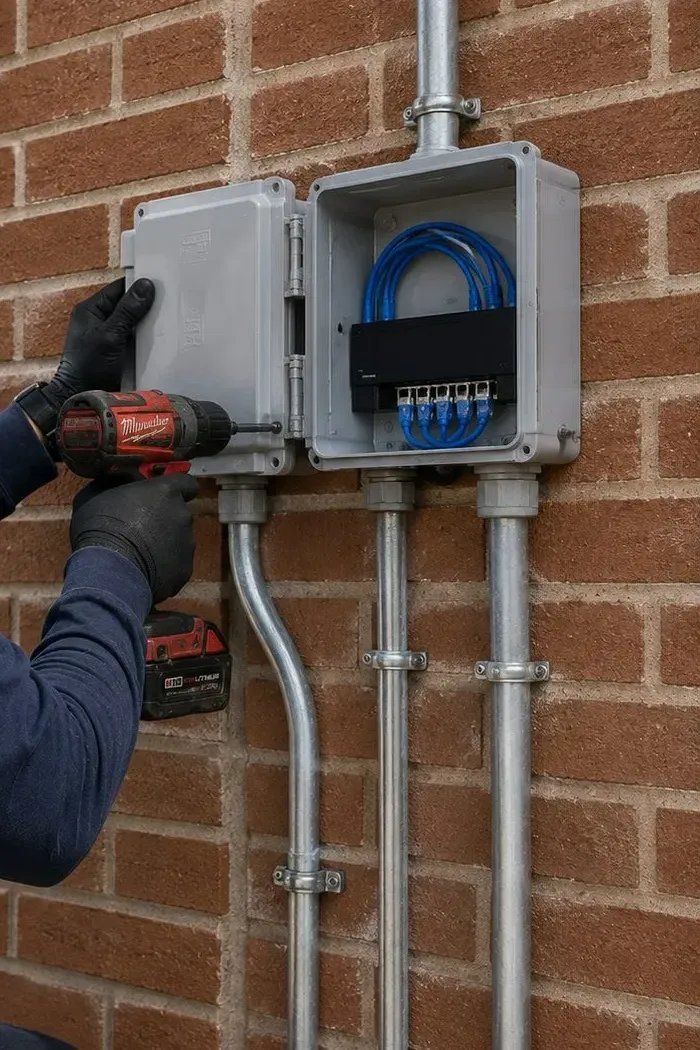
Gloved hands fix a grey weatherproof box holding a small switch to a brick wall, with three metal conduits below. An outdoor screen is fed from a box like this, not through a window frame.
Equipment
Types of Video Wall Installation We Install
No single display maker gets our default. We pick panels, players and controllers for the room, for the calendar the wall has to keep, for how easily spares can be had and for any specification the buyer already follows, and we put the alternatives in writing.
Narrow-bezel LCD tiles
The workhorse for lobbies, classrooms and training rooms. The county’s own 2019 bid named the LG 55VH7E: a 55-inch, 1920×1080 panel with a 0.9mm bezel, 700-nit brightness, VESA 600×400 mounting, 86.5mm depth, and RS232C, LAN and IR control. Other makers offer close equivalents.
Direct-view LED
No seams at all, and brighter, for sanctuaries, halls and big stores. Chosen by pixel pitch, the spacing between LEDs; the finer the pitch, the closer people can stand and the higher the price.
Single large displays
For a shul lobby or a small classroom, a single 75- to 98-inch commercial display is sometimes the better answer than a wall, with no seams, one power lead and one input. We say so when it is.
Signage players and zmanim services
Small computers that store and play the content on a schedule, from shul signage services that calculate zmanim to general commercial content systems. Chosen for storage, reliable timekeeping and right-to-left text support.
Controllers and matrix switches
Hardware that splits one picture across many panels, or puts several sources on the wall at once, with saved layouts that return after a power cut. Training rooms and dispatch floors need them; most zmanim boards do not.
Mounts and frames
Wall rails with pop-out mounts that let a single panel come forward for service, such as the Peerless full-service video-wall mount named in the county’s bid, and floor-supported frames where walls cannot take anchors.
Power protection
Battery backup for the player, controller and network switch so the schedule survives a flicker, and surge protection on power and long data runs.
Signal transport
HDBaseT over category cable for runs within a building, and fiber between buildings or over long distances, with every run labelled and tested.
Pixel pitch and viewing distance, in plain terms
For direct-view LED, the usual starting point is a manufacturer’s rule of thumb: Planar suggests the pixel pitch in millimetres times ten gives an approximate comfortable viewing distance in feet, so a 2.5mm wall reads well from about 25 feet. Other makers state the rule differently, and text-heavy content such as zmanim and Hebrew lettering needs a finer pitch than video does. For LCD tiles the question is the seams instead: from very close, the lines between panels show; from across a hall, they fade.
Kit, chain or one local crew. A boxed LED kit bought online arrives as hardware and nothing else, and a national AV chain may hand the Rockland install to a subcontractor. We design the wall, hang it, program its calendar and service it ourselves, price it from a published Rockland list, and bring in a Rockland-licensed master electrician for the line-voltage work.
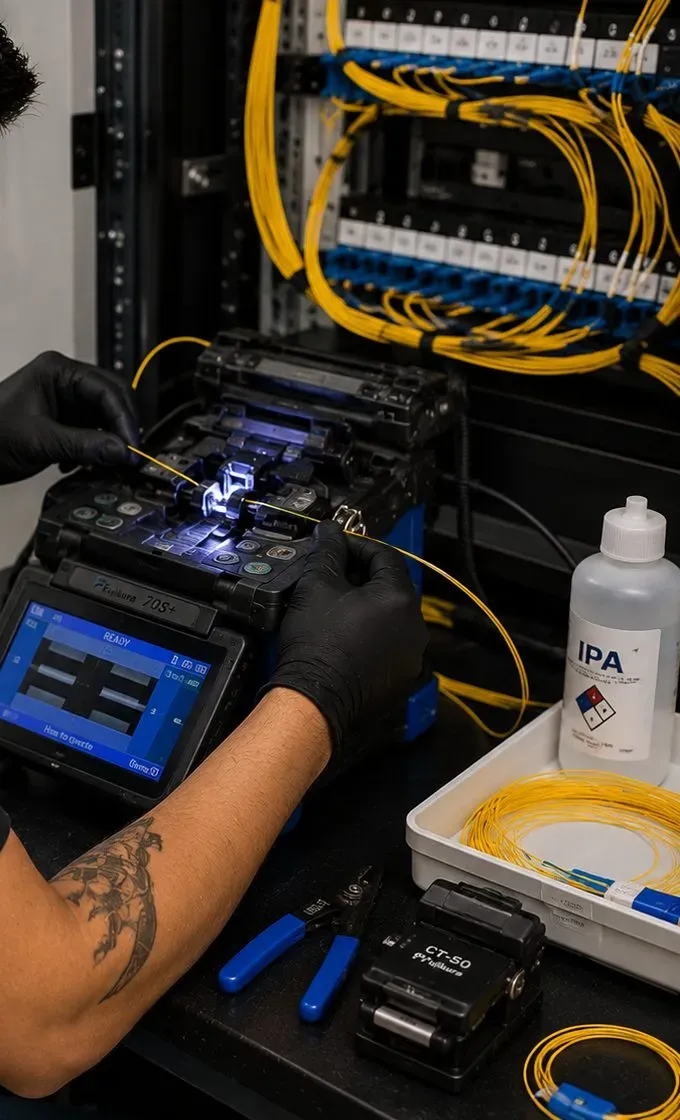
A fusion splicer on a bench in front of a fiber patch panel, with a cleaver and cleaning alcohol nearby. Between campus buildings, a wall’s picture often travels on fiber joined this way.
AI Overview Reality Check
What AI Gets Wrong About Video Wall Installation in Rockland County
Google’s AI Overview and People Also Ask boxes could not be retrieved from our research tools for this edition, so this section tests the claims made by the vendor pages and cost guides that rank for the same searches, and says where a Rockland job differs.
“A zmanim screen costs $250 and nothing after that”
One shul signage service advertises exactly that: a $250 set-up fee for a small computer that plugs into the shul’s television, plus shipping, and nothing monthly, with zmanim calculated from the building’s coordinates. For a single existing TV in a small shul, that can be a sensible answer, and we are happy to mount and wire the screen it runs on.
It is not a video wall, though. The $250 buys the player and its service, not the commercial display, the mount, the outlet behind the screen or the network connection. A tiled wall adds a controller, commercial panels rated for long hours and a rail that carries them. On our Rockland price list a 2x2 wall of 55-inch panels is $15,600 to $23,400 installed.
For a lobby board read in passing, one large display and a player may be enough; we price both.
“Set a timer and the screen will take care of Shabbat”
Vendor pages for shul screens stress that everything runs on its own once installed, and the timing part is true: the software can switch modes at the right zman. But whether a screen may run on Shabbat, what it may display, and whether a timer may be used to change it, are questions on which halachic authorities differ. Halachipedia records that setting a timer before Shabbat for lights and appliances is permitted; Torah Musings notes Rabbi Moshe Feinstein’s view that using timers to run machines to do forbidden work on Shabbat is generally forbidden.
So the installation question comes second. First the congregation decides, with its rav, how the screen should behave from candle lighting to havdalah. Then we make the hardware do exactly that and nothing more: no motion sensors, no touch screens left active, no automatic updates scheduled for Shabbat afternoon.
The practical failure we see is not halachic but technical: a player whose clock drifts, so the board shows the wrong times. That is solved with a good time source and a test, not with a different screen.
“Any brand of commercial panel will do”
Cost guides tend to treat video-wall panels as interchangeable. Rockland’s own purchasing office does not: its 2019 request for quotes for a video wall delivered to Pomona named a specific LG panel bundle and mount, said the brand and item specified were required, and stated that an alternate brand would be rejected.
There are good reasons a buyer does that. Matching existing equipment, a control system that already speaks to one maker’s panels, a known warranty process and spare parts that fit all argue for sticking with a model. When a public buyer, a campus or a chain has a standard, we install to it.
When there is no standard, the choice still matters: bezel width, brightness, how the panel reports faults, and whether the same model will still be sold when a spare is needed. We put the alternatives and their trade-offs in the proposal.
“A low-voltage installer can hook up the power”
Some installation guides treat the outlet behind the wall as a minor detail. In Rockland it is licensed work. Chapter 250 of the county’s laws covers anyone in the business of installing wiring for light, heat or power, or signaling systems at 50 volts or more, and requires a licence held by a master electrician.
Our side of the job is the low-voltage part: data, video and control cabling, players, controllers and the mounting. The new circuit or outlet is run by a Rockland-licensed master electrician, written as its own line in our quote, and inspected the way the county requires.
Ask anyone offering a wall who will connect it to the house wiring, and ask to see that licence.
“The town permit is the only sign-off you need”
Guides written for other states often say the building permit is the whole story. In Rockland, new electrical work is also inspected by a county-licensed electrical inspection agency, which issues a certificate of approval and tells Orange & Rockland that the connection is authorized.
Which permits a town or village wants for the same job also varies. An inspection agency’s published coverage table lists different policies for Clarkstown, Haverstraw, Orangetown, Ramapo and Stony Point, and the Village of Spring Valley’s building code is enforced by the county.
We find out which path applies at the survey and show it in the proposal, so the electrician, the inspector and the building department are lined up before the first anchor is drilled.
“An online LED kit is all you need”
Cost guides quote LED kits in the region of $11,000 to $15,000 for a 10-by-5-foot P2.9 wall, and note that the price is hardware only. It leaves out the structure that holds the cabinets flat, the circuits that power them, the processor set-up and the calibration that makes the cabinets match.
Those exclusions are the expensive part in Rockland buildings: a block wall that needs a frame, a hall that needs a circuit from a panel at the other end of the building, a store whose landlord wants a drawing first. On our list a 2.5mm LED wall with a 110-inch-equivalent picture is $45,500 to $71,500 installed, including mounting, processor set-up and calibration; the electrician’s circuit and any custom structural frame are separate lines.
A kit you already own can still be installed, priced after the survey.
“Once it is installed, a video wall runs itself”
This claim is nearly true for a Rockland wall that was planned well, and that is the point of everything above. A wall runs itself when its schedule is built for the whole year, its player keeps time, its controller restores its layout after a power cut and its content has an owner.
It is false for a wall that was only hung. Content runs out at the end of a term, a holiday falls on a day nobody planned for, a password changes and the screen stops updating. An installer thread on Reddit puts the other half bluntly: one panel can always be replaced, but how different it looks depends on the owner’s tolerance.
That is why our handover includes the calendar for the coming year, a spare-panel recommendation, the logins in the owner’s name and a test of every schedule on a moved clock.
Planning a Wall Before the Yamim Noraim, a New Term or the Holiday Season?
Call before the busy weeks rather than during them. Ten minutes on the phone tells us the calendar the wall must keep, and you get a written figure from the Rockland list the same day.
Fill in the Rockland town or village and the building, roughly how wide the wall is and the distance to the farthest viewer, plus the calendar it has to follow. The written figure arrives the same business day; if you would rather talk it through, call (845) 640-3835.
✅
We Got Your Request!
Got it. A Rockland technician will look over what you sent and phone back today; urgent jobs can go straight to (845) 640-3835.
How It Works
Our Installation Process
Seven steps, in the same order for a single zmanim board and a nine-panel training wall. The calendar comes first because it decides the equipment; the inspection path comes before the rough-in because in Rockland the electrician’s work and ours meet in the same boxes.
1. Calendar call
We ask what the wall must show and when: weekday, Shabbat and Yom Tov modes, the academic or retail calendar, or round-the-clock duty. Who sets the content, and who decides the rules, is written down first.
2. Survey of the room and the building
Measure the wall and the farthest seat, check sightlines from every section, find the studs or block, and trace the route to the equipment closet and the panel the electrician will use.
3. Written proposal and the inspection path
Screens and controller from the published Rockland table, the master electrician’s circuit as its own line, and the inspection route for that circuit, town building department, electrical inspection agency or both.
4. Rough-in
Recessed boxes, labelled data runs, conduit on block walls and the rail or blocking in the wall, coordinated with the licensed electrician so the outlets the wall uses are inspected with the circuit.
5. Mount, hang and align
Rails levelled to the floor that people will actually see from, panels hung and seams aligned, controller, player and battery backup installed and connected.
6. Program the calendar
Every mode in the schedule is built and then run on a test clock: a Friday into Shabbat, a holiday week, a closing time. Colour and brightness are matched across tiles while the room is lit as it will be in use.
7. Handover with the people who run it
The gabbai, office manager, instructor or store manager changes a slide, adds a date and restarts the wall while we watch, and keeps a one-page guide, the drawings and the electrician’s certificate.
Coverage Area
Video Wall Installation Near Rockland County’s Landmarks
Clarkstown, Haverstraw, Orangetown, Ramapo and Stony Point, and every village inside them, are in our service area. The six places below turned up again and again in the research for this page; each represents a different type of Rockland building with a job for a display wall.
Palisades Center, West Nyack
The mall at Routes 59 and 303 that opened in 1998 and was sold at a $175 million foreclosure auction in February 2026; tenant display work runs through mall management.
Rockland County Fire Training Center, Pomona
At 35 Firemen’s Memorial Drive in Pomona, the hamlet the county named as the delivery point in its December 2019 request for quotes for a 2x2 LG video wall bundle.
Rockland Community College, Suffern
SUNY’s Rockland campus, with centers in Nyack and Orangeburg, more than 5,300 people enrolled and over 200,000 campus visitors a year for events.
St. Thomas Aquinas College, Sparkill
On Route 340, a campus that has been adding athletic and outdoor facilities in recent years.
Dominican University New York, Orangeburg
On Western Highway, renamed from Dominican College when the New York State Board of Regents granted university status in May 2022.
Hudson Valley iCampus, Pearl River
About 200 acres and two million square feet of lab, pharmaceutical manufacturing and office buildings, planned by its owner as a mixed-use, multi-tenant campus, with Pfizer still operating its research space.
We also serve New City, Nanuet, Congers, Valley Cottage, Bardonia, Blauvelt, Tappan, Piermont, Airmont, Hillburn, Sloatsburg, Pomona, Garnerville, Thiells and Tomkins Cove, and the neighbouring counties of Westchester across the Hudson and Orange County to the north and west.
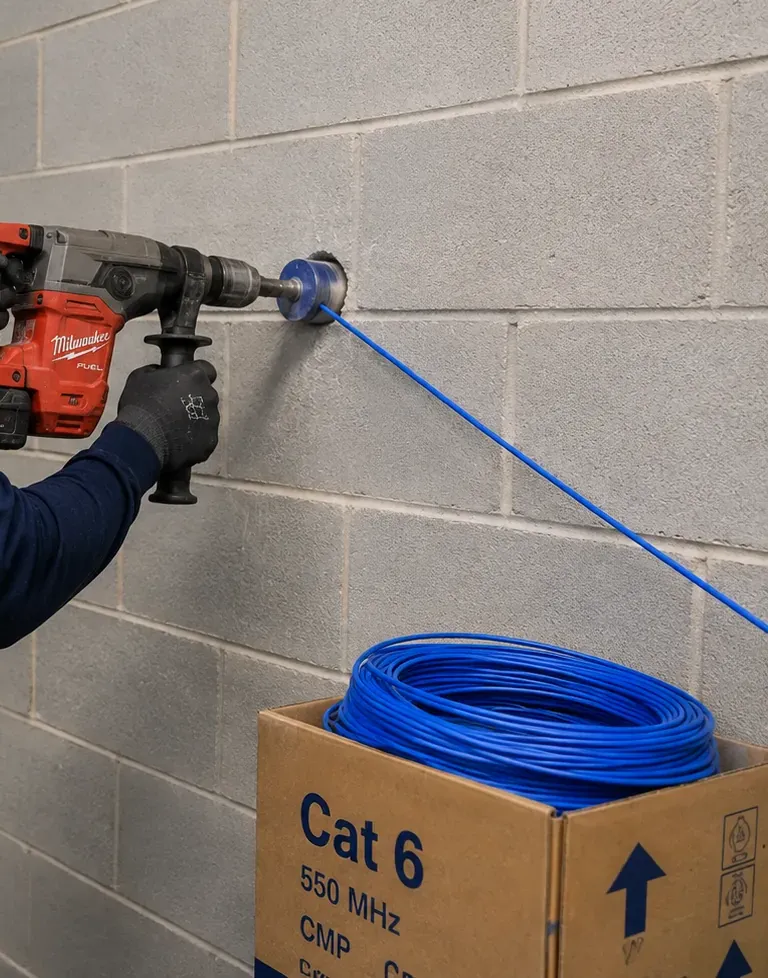
A red rotary hammer bores through a block wall while a blue cable runs from a finished hole to an open Cat6 box. A sleeved hole keeps cable off the floor of the next room.
Town by Town
Video Walls Across Rockland’s Five Towns
Rockland has five towns. Each runs its own building department, and the incorporated villages inside them run theirs, so the first question on any job is which one the address answers to.
Clarkstown
New City, the county seat, with county offices; Nanuet and its redeveloping Town Centre; West Nyack and the Palisades Center; Congers, Valley Cottage and Bardonia. The Clarkstown Police Department’s dispatch center has its own video wall. Walls here range from county and police rooms to mall stores and family rooms. The inspection agency table we use lists Clarkstown as requiring a building permit, with electrical permits varying by job.
Ramapo
Suffern and Rockland Community College, Monsey, Airmont, Hillburn, Sloatsburg and many of the county’s villages, including Spring Valley, where the county enforces the building code. Monsey and the villages around it are where many of the county’s shuls, yeshivas and catering halls are, alongside the Route 59 stores. The table lists Ramapo as requiring an electrical permit, with a building permit depending on the job.
Orangetown
Pearl River and the iCampus, Orangeburg and Dominican University, Blauvelt, Tappan, Sparkill and St. Thomas Aquinas College, Piermont and the Village of Nyack. Office, lab, campus and village storefront walls. Orangetown is listed as requiring a building permit only.
Haverstraw
The Village of Haverstraw, with its Downtown Revitalization Initiative projects — the 61-unit Village Square with a café and community space, an expanded Haverstraw Brick Museum, murals on Main Street and a waterfront trail — plus West Haverstraw, Garnerville and Thiells. Community rooms, restaurants and new mixed-use buildings. The town is listed as requiring an electrical permit for electrical work and a building permit for additions and structural work.
Stony Point
The northern edge of the county, with Tomkins Cove and the river communities. Walls here are most likely to go into churches, community halls, restaurants and homes. Stony Point is listed as requiring building and electrical permits for new work.
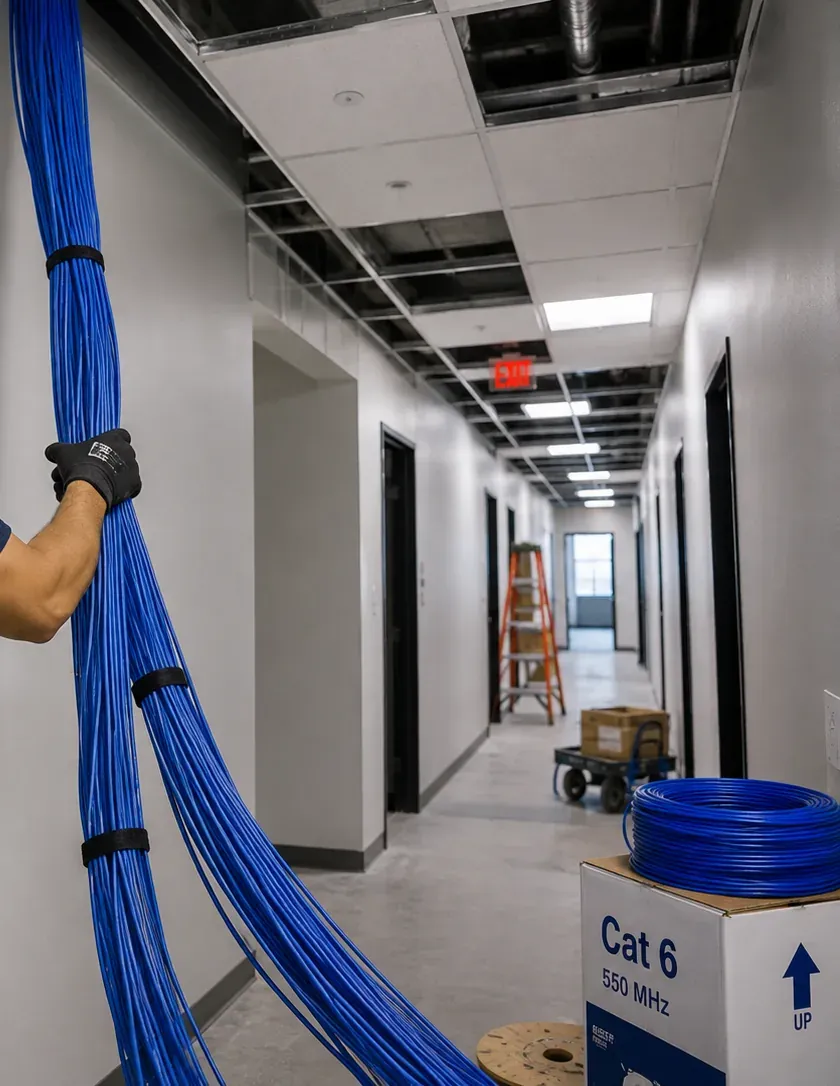
A thick bundle of blue cable comes down from the ceiling along a corridor wall, with a box of Cat6 cable on the floor. Long corridors carry a hall wall’s cabling to the closet.
Pricing
Video Wall Installation Cost in Rockland County
The wall configurations below are our Brooklyn base prices multiplied by our published Rockland County area factor of 1.30 and rounded. The add-on lines — controller, matrix, mounting structure, content software and maintenance — are shown at the same figures we publish for every area, and the service rate is the same everywhere. Installed prices include panels, mounting, controller where listed, basic content and schedule set-up, calibration and labour. They exclude the master electrician’s circuit and the inspection, structural work beyond the fabrication line, and maintenance unless chosen. Spare panels, cameras for overflow feeds, signage-service subscriptions and battery backup units are quoted after the site visit, because they depend on the exact model and room.
Configuration
Rockland installed price
Typical Rockland use
2x2 LCD (55" panels)
$15,600 – $23,400
Shul lobby or beis medrash, classroom, store feature wall
3x3 LCD (55" panels)
$31,200 – $49,400
Training room, campus lobby, larger hall
4x4 LCD (55" panels)
$54,600 – $84,500
Operations room, large atrium or store
2.5mm dvLED (110" equivalent)
$45,500 – $71,500
Sanctuary, catering hall, big-box store
1.9mm dvLED (138" equivalent)
$71,500 – $110,500
Closer viewing in a hall or lobby
1.5mm dvLED (165" equivalent)
$110,500 – $182,000
Boardrooms and close-viewing feature walls
Outdoor LED (per sq m)
$5,850 – $11,050
Courtyard, campus or storefront screens
Video wall controller add-on
$2,500 – $15,000
Multi-source layouts, saved presets, IP distribution
What raises a Rockland price. A wall that has to keep a full-year calendar with many modes. A sanctuary or hall where nothing may be fixed to the wall and a floor frame is needed. A dispatch or training room that must stay working while we install. Long runs to a closet in another building, which call for fiber. A store landlord who allows work only overnight. A new circuit from a distant panel.
What brings it down. Power and data already within a few feet of a framed or block wall; a rack with spare space and a working battery backup; a room the building can give us for two clear days; and, sometimes, our advice that one large display will serve better than a tiled wall.
Send the town or village, the room, the wall width and the calendar it must keep. You get a figure from the Rockland list with the electrician’s circuit, any spares and the signage service shown as their own lines.
A 2x2 wall of 55-inch commercial LCD panels ($15,600 – $23,400 installed) on a full-width rail, with a signage player, battery backup for the player and switch, and a schedule built for weekday, Shabbat and Yom Tov modes or for opening hours. For shul lobbies, school entrances and store feature walls.
Campus and Training Wall — from $31,200
Nine 55-inch panels in a 3x3 grid ($31,200 – $49,400 installed), sized for lecture-hall lobbies, training classrooms and bigger halls. The controller line ($2,500 – $15,000) adds multi-source layouts; fiber between buildings is priced once we have walked the route.
Hall and Sanctuary LED — from $45,500
A 2.5mm direct-view LED wall with a 110-inch-equivalent picture ($45,500 – $71,500 installed), set up for cameras so simchas and services film cleanly, with sound sent to the hall’s own speakers and an overflow feed if wanted.
Already bought the screens? Labour-only work
Bringing your own displays, mounts, players or controllers is fine. Where our install-your-own pricing page applies, labour follows it; for video-wall work, labour is quoted after the survey. Please send model numbers before we visit: televisions bought for home use seldom tile neatly or keep commercial warranty terms, panels from different models are hard to colour-match, and not every player renders right-to-left text.
Complete Services
Every Video Wall Installation Service in Rockland County
A hall wall is only as good as the sound behind it, so Rockland halls usually add speakers that carry to the back rows; schools and congregations usually fold in network cabling and door access for the same building. One survey, one set of cable routes, one electrician.
Field Notes
Field Notes: The Moved-Clock Test
Every Rockland wall we hand over goes through the same last hour, whatever it cost. With the person who will run it standing beside us, we move the player’s clock forward to the next moment the wall is supposed to change by itself — a Friday afternoon twenty minutes before candle lighting for a shul, the first day of a new term for a campus, opening time on the first day of a holiday sale for a store — and watch. The wall should switch modes on time, with the right content, without anyone touching it. Then we move the clock to the end of that period and watch it switch back.
If anything fails, we fix the schedule and run it again, and we do not leave until it passes. Then we switch off the circuit feeding the wall and its equipment, wait, and switch it on again, to see that the panels wake, the controller restores its layout and the player resumes its schedule on its own.
The test takes less than an hour. It is written into the proposal, so a board, a rav, a registrar or a store manager can see before signing that the wall will be proved on the days it matters, not only on the day it was hung.
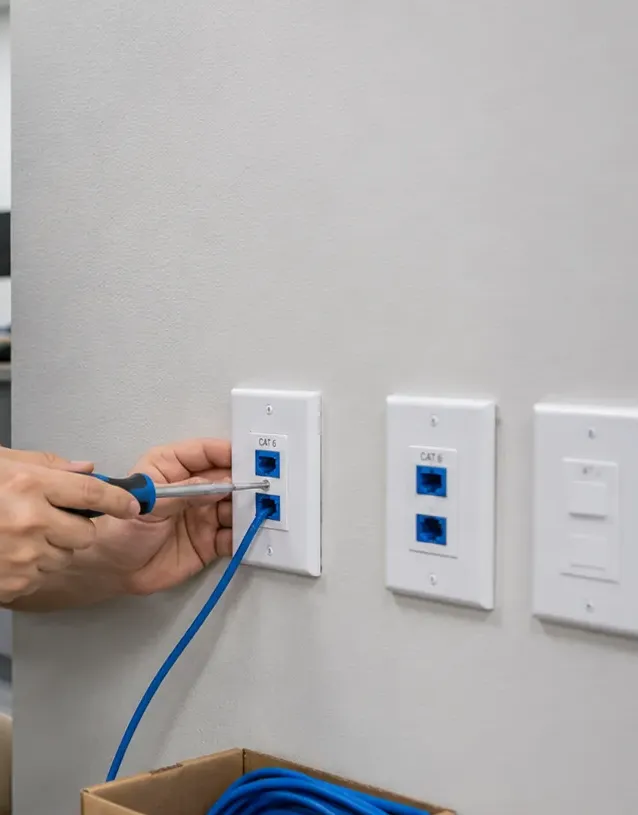
A screwdriver tightens a two-port wall plate as a blue cable feeds its lower jack, with two more plates beside it. Each screen position gets its own labelled outlet like this.
FAQ
Rockland County Video Wall Installation FAQ
Can the screen show the Hebrew date and the weekly parsha automatically?
+
Yes. Shul signage software works out the Hebrew date, the parsha and the day’s zmanim from the calendar and the building’s map coordinates, so nobody types them in each week. Your own minyan times, kiddush sponsors and notices are entered by the gabbai or the office, and we set it up so one person can do that from a phone. Before handover we compare a full week of displayed times with a printed luach the congregation trusts.
Should a lobby wall in a building used on Shabbat have a motion sensor that wakes it?
+
We advise against it. A motion or presence sensor changes the screen because someone walked past, and many congregations do not want any device reacting to people on Shabbat or Yom Tov. A fixed schedule set before candle lighting does the same job without that question. If an existing screen has such a sensor, we can disable it or limit it to weekdays. The congregation’s rav makes the call; we wire it the way he decides.
How should staff clean the screens without damaging them?
+
With the wall switched off and cool, using a dry microfibre cloth, and a cloth only lightly dampened with plain water for marks. Household glass cleaners, ammonia, alcohol wipes and paper towels can strip the anti-glare coating or scratch it, and liquid sprayed straight at a panel can run down inside the bezel. Direct-view LED surfaces are more delicate still and should be dusted with a soft brush, never wiped hard. We leave written cleaning instructions for the exact panels at handover.
Can the screen count down to the next minyan or to candle lighting?
+
Yes. Most shul signage software can show a countdown to the next minyan, to candle lighting or to the end of a fast, calculated from the same zmanim as the rest of the board. We set the countdown to stop and disappear at the moment it reaches zero, so it never shows a negative time or a stale clock, and we check it on a weekday by moving the player’s clock forward. Whether a countdown should still appear once Shabbat has begun is for the congregation to decide.
What stops someone outside the building from putting their own content on the wall?
+
Several layers, set up before handover. The player and controller sit on a network segment that does not accept connections from the internet, default passwords are replaced, each person who updates content gets their own account rather than a shared login, and only the content system, not the screens themselves, can publish. Remote-control features the building does not use, such as screen casting from phones, are switched off. A wall that hangs in a public lobby should never be one guessed password away from showing something else.
Why do some LED walls show lines or flicker when guests film them on a phone?
+
Because the wall and the camera are both refreshing faster than the eye can see. An LED wall switches its LEDs many times a second and a phone reads its sensor line by line; when the two do not line up, the video shows rolling bands that nobody in the room notices. Walls with a higher refresh rate and a processor set up for cameras show it far less, so tell us if simchas, speeches or performances will be filmed in front of the wall.
Can the wall display donor recognition or dedication panels?
+
Yes, and it is a practical use in a shul, a school or a college building. Rotating dedication slides carry more names than a fixed plaque, and new names go in without an engraver. We set donor slides to appear at a steady pace, never flash and stay up long enough to read. Many institutions keep a permanent plaque as well; the screen supplements it, and the content belongs to the institution.
Can you work around a school’s or a college’s exam weeks and quiet periods?
+
Yes. Drilling block and lifting panels is noisy, so loud work goes on days the building is closed or the room is free, and programming, calibration and training happen in regular hours. Send the academic calendar and testing dates with the purchase order and we schedule around them. In a dispatch or training building the duty roster sets the quiet times instead.
Does our IT person need to be on site on installation day?
+
Not all day, but at two points. At the start, to confirm which network the players and controller join, what addresses they get and what the firewall allows, so the wall can reach its content and its time server. At the end, to see the devices on their network and take over the logins. If your IT is outsourced, a thirty-minute call the week before saves a return visit.
Will a video wall interfere with our hearing loop or assistive listening system?
+
It can if it is placed carelessly. Some display power supplies and LED drivers give off electrical noise that an induction loop picks up as a hum, and a wall cable run beside the loop wire can do the same. We keep the wall’s power and data away from the loop cable and, before handover, listen through a loop receiver with the wall on and off. Infrared and radio listening systems are rarely affected.
All Areas Served
Video Wall Installation Across New York City, Long Island and the Hudson Valley
The Hudson Valley video wall installation hub is the parent of this page. Each of the sixteen area pages below was researched and written separately, with its own buildings, rules and prices.
Facts on this page come from the documents below, all opened in October 2026. Prices are from our own list, with the Rockland factor applied to the wall configurations.
Census Bureau QuickFacts for Rockland County: the July 1, 2025 population estimate, 2022 retail sales, and 2020–2024 survey figures for households, household size, age and home language
Jewish Virtual Library, “Rockland County” (community estimate of 92,000); Los Angeles Times and Journal News reports describing the Jewish population as about 31 percent of the county; Wikipedia, “Monsey, New York” (languages spoken at home)
County of Rockland, RFQ-RC-2019-167, “Video Wall Package Bundle, LG 55VH7EAW-4P As Specified,” published December 9, 2019 on BidNet Direct (delivery Pomona; specification; brand required; insurance and experience terms)
Rockland County Fire & Emergency contact page (Fire Training Center address); Clarkstown Police Department social-media post on its dispatch-center video wall
Laws of Rockland County, Chapter 250, Articles I and II (licensing of electrical contractors; electrical inspection agencies and certificates of approval), on eCode360
Rockland County Consumer Protection, licenses and permits page (Master Electrician and Electrical Inspection Agency licences; Chapter 286 Home Improvement License, effective May 14, 2026); News 12 report on the April 2026 contractor-licensing vote; Reddit r/Rockland thread on contractor registration
State Wide Inspection Services, coverage-area table (permit policies for Clarkstown, Haverstraw, Orangetown, Ramapo and Stony Point); Rockland County Office of Buildings and Codes (Village of Spring Valley)
The Journal News (lohud), “Palisades Center goes for $175M at foreclosure auction. Who bought it?”, February 4, 2026; News 12 Hudson Valley on the same auction; lohud, May 28, 2025, on Nanuet Town Centre plans
Rockland Community College Fast Facts; St. Thomas Aquinas College news; Dominican University New York name-change notice
Village of Nyack, Downtown Revitalization Initiative page (May 14, 2026 announcement); New York Department of State, Haverstraw Village Square groundbreaking release, October 7, 2026
DigitalShul free zmanim display page; Halachipedia, “Electricity on Shabbat”; Torah Musings, “Timers on Shabbat and Yom Tov”
Planar, “What is pixel pitch”; LG 55VM5J-H video-wall panel specification sheet; LG LAPA136 all-in-one LED specifications; CrownTV LED video wall cost guide; Reddit r/CommercialAV thread on replacing a single panel
2010 ADA Standards for Accessible Design, as explained in the U.S. Access Board guide to section 307 on protruding objects
We could not open Google’s question boxes, related searches or AI Overview, Answer the Public, Bing or DuckDuckGo suggestions, or Yelp reviews with our research tools this time, so none of them is used here.
Wall Showing the Wrong Times or No Picture? Call the Rockland Line
A zmanim board that missed the clock change, a store wall black after a power cut, a training wall that lost its layouts — phone or text (845) 640-3835. We book the next open window around your calendar, and most single faults are fixed within one to two hours of arrival.
Rockland County Video Walls From a Licensed, Insured Team
Rockland calls and texts: (845) 640-3835 · room photos by WhatsApp · Abstract Enterprises Security Systems, 460 E Fordham Rd, Bronx, NY 10458
4.7★ from 201 Google reviews · NYS license #12000287431 · same-day written estimates · insurance certificates issued to congregations, colleges, landlords and public buyers ahead of the visit
Full terms — including 50% deposit, one-year parts-only warranty on AESS-supplied products, and the late-fee schedule — are set out in the service agreement. See our warranty page.
Last full revision October 18, 2026. What changed: this Rockland County video wall page was rewritten from new research on the county’s shul, campus, retail and public-safety rooms, the county’s 2019 video wall bid, Chapter 250 electrical licensing and inspection, the 2026 Chapter 286 home-improvement law, town permit policies and the Nyack and Haverstraw downtown grants. Wall prices now follow the Brooklyn base list with the published Rockland factor of 1.30; add-on lines and the service rate are unchanged.