Dock Levels & Van Decks · Yard Gates & Weighbridges · Fence-Line Routes · Loss and OTDR Results
Maspeth has no subway station, and almost nothing here is built for people arriving on foot. The industrial lowland west of the Long Island Expressway is a landscape of truck ramps, dock doors, van decks, rolling gates and gravel yards; the village to the east is brick two-family houses with driveways and rear garages. We plan fiber along the routes the vehicles take — up the ramp, across the deck, out to the gate — and keep it out of their way, then test every strand before we hand it over.
Reviewed and updated October 17, 2026 · By Anwar Timothy, NYS low-voltage licence #12000287431 · A neighbourhood page of our Queens fiber optic installation service

Running a yard, a dock or a delivery operation and can't stop the trucks for a site visit? You won't have to. Call the Queens line at (347) 434-6392 or send the 60-second form, and tell us the hours when the gate is quietest; we walk the site around your schedule, not ours.

Maspeth was laid out for wagons long before it was laid out for trucks. Grand Street — today's Grand Avenue — was cut in the early 1800s to carry produce from the Queens farms to Williamsburg and downtown Brooklyn, and in 1854 the Maspeth Plank Road Company paved it with wooden planks. Along Newtown Creek, the nineteenth century brought oil refineries, glue works, copper smelters and chemical plants; the Phelps Dodge works stayed on the creek from 1920 until 1983. The streets from roughly 43rd to 58th, much of it built on the old Furman Island marsh, are still an industrial lowland, and the Long Island Rail Road's freight lines still cut across the neighbourhood.
Over the last decade the old plants and single-storey sheds have been replaced, one parcel at a time, by buildings designed around delivery vehicles. At 55-15 Grand Avenue, RXR and LBA built a last-mile distribution centre for Amazon that its builder describes as a two-storey logistics floor with three levels of parking above it — about 1.1 million square feet, with van launches and EV charging. At 55-90 48th Street, Skanska demolished three empty buildings and built FedEx Ground a two-storey facility with a precast ramp to rooftop employee parking and 45 truck bays. UPS took a long-term lease in 2017 on a 475,000-square-foot former Duane Reade distribution centre, and investors keep buying the smaller warehouses in between: Realterm, buying 50-35 56th Road in 2022, called Maspeth "an outstanding warehouse submarket" and said it ranks first for drive time among the industrial nodes around the city.
That changes where a network has to go. A delivery station's people are not at desks: they are on a dock, on a ramp, on a deck where hundreds of vans load before dawn. A contractor's or trucker's yard is mostly open ground, a gate and a trailer or a small office. Residents describe the neighbourhood the same way from the other side of the fence. "Hard to access without a car so lots of traffic," one Reddit commenter wrote of Maspeth; another, weighing an apartment, noted it sat "just on the other side of an incredibly 24/7 industrial area (Less than a block)," and a third, looking at a brick two-family, pointed out the parking and back yard and added that anyone living there was probably driving.
Fiber fits that kind of place better than copper does, because the distances are long and the ground is hostile. A camera on a far fence, a scale at the gate, an access point over the van deck or an office in a separate building can easily sit beyond the 100-metre limit of an Ethernet run, and the route to it crosses asphalt that trucks pound all day, concrete that is salted all winter and gravel that a loader regrades every spring. Security matters too. When the area's industrial owners formed a local development corporation about two decades ago, Galasso Trucking's Phil Galasso told the Queens Chronicle that "quite often, we get reports of theft of hundreds of thousands of dollars worth of equipment" — and that the streets were poorly lit and often unmarked. A yard's cameras and alarms are only as dependable as the link that carries them back to the recorder.
Maspeth is also about to change again. The MTA's planned Interborough Express would run along the Bay Ridge Branch freight corridor at Maspeth's eastern edge, with a station proposed on Grand Avenue near 74th Street beside Elmhurst Park; in September 2026 residents protested at the MTA's pop-up session there, and officials said design and environmental review could finish by the end of 2027. Owners on both sides of the tracks will be planning around it for years. A fiber plant that is documented, labelled and laid out with the vehicle routes in mind is much easier to protect through that kind of change than a tangle of drops nobody can trace.
| Fact | Figure | Source |
|---|---|---|
| Residents, 2020 Census (neighbourhood tabulation area) | 43,257; ZIP 11378; Queens Community District 5 | Wikipedia, citing NYC Department of City Planning |
| Subway stations inside Maspeth | None; nearest is the M at Middle Village–Metropolitan Avenue | Wikipedia, citing MTA maps |
| 55-15 Grand Avenue distribution centre | About 1.1 million sq ft: two-storey logistics floor, three parking levels above, 15 loading docks | Suffolk (builder) project page |
| FedEx Ground, 55-90 48th Street | Two storeys, 28,000 m², 45 truck bays, ramp to second-level parking; built May 2021 – Sept. 2023 | Skanska release via Informed Infrastructure; Juniper Park Civic Assn. |
| Grand Avenue Bus Depot | 17 overhead chargers for 60 electric buses unveiled May 14, 2024 | amNY, May 2024 |
| Kosciuszko Bridge replacement | Spans opened April 27, 2017 and August 29, 2019; $554.77 million design-build contract | Wikipedia, citing NYSDOT |
| Newtown Creek Superfund, East Branch | Interim dredge-and-cap action of nearly $250 million announced Jan. 17, 2025 | U.S. EPA news release |
Owners who fiber a yard usually want the gate and the fence covered on the same strands. Our commercial security camera team for Queens and Queens access control installers can plan the gate reader, the dock cameras and the recorder from the same site drawing, so the security systems sit on their own fibers rather than on the office internet.

When the gate camera goes black, the scale stops reporting or a whole dock level loses its scanners, the fault is usually somewhere a vehicle has been: a cable snagged by a trailer at the dock door, a box knocked off a column by a forklift mast, a buried duct crushed where a truck cut the corner, or a connector packed with dust. We treat that as a repair, not a project. Call (347) 434-6392 and say "fiber repair"; we dispatch the same day where the schedule allows, and most single faults are found and fixed within one to two hours of reaching the site. If copper runs inside the office are part of the problem, our Queens network cable repair crew can come on the same visit.

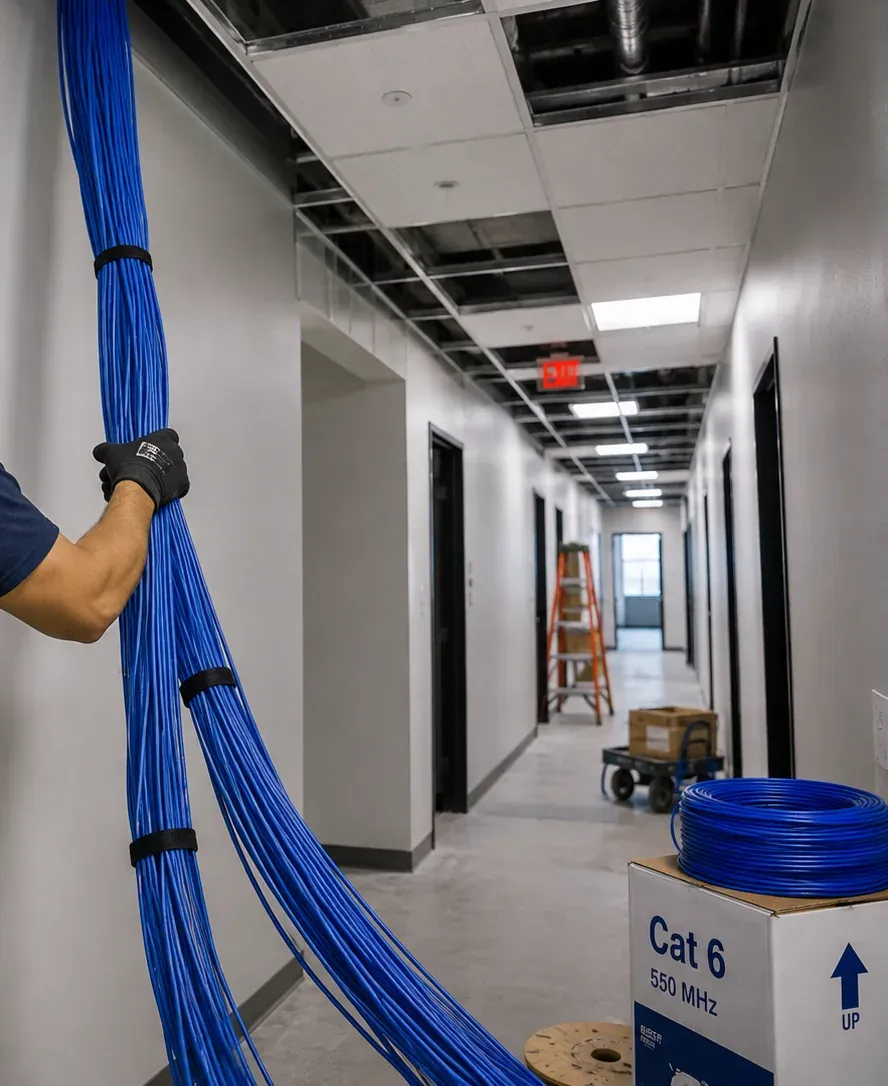
On a Maspeth site the cable rarely runs from one desk to another. It runs from the room where the provider lands to places with no desks at all — a dock level, a van deck, a gate, a fence corner, a scale house, a shop building across the yard. These are the jobs we are asked for most.
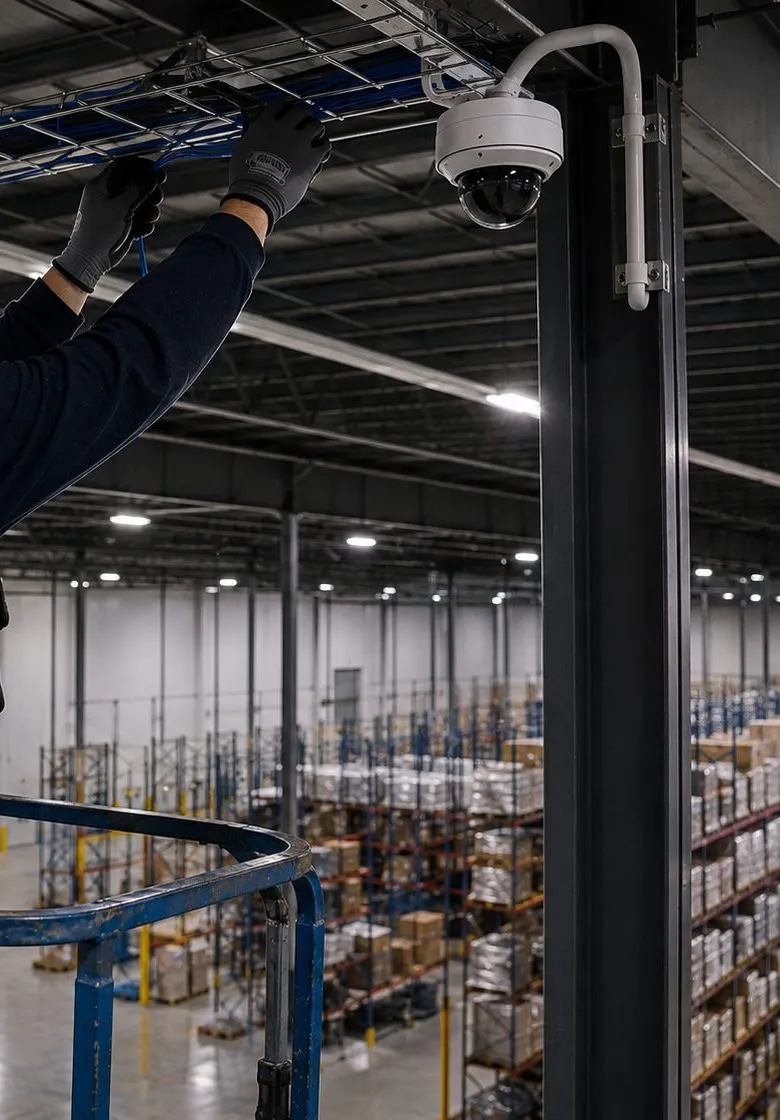
Single-mode strands from the main network room to an enclosure on each loading level of a delivery station or warehouse, so switches for scanners, label printers and dock cameras sit close to the work instead of at the end of long copper runs.
Cable carried up to rooftop or mezzanine parking decks in conduit fixed to the structure, clear of the ramp's driving surface and the deck's drainage, to feed access points, cameras and charger controllers.
Fiber from the office to a truck gate's keypad, plate camera and intercom, a guard booth, or a weighbridge's indicator, with the moving side of the gate fed through a protected loop.
Fence-line or buried routes to camera positions at the far corners of a yard, with small hardened switches at each cluster and the strands brought back to one recorder.
Armoured or ducted fiber between a front office, a shop building and a rear shed on the same property, replacing the patchwork of separate internet accounts many family businesses grew into.
Sleeve and conduit layouts for slabs, ramps and decks that are still being poured, so fiber can be pulled later without coring finished concrete.
A landlord-owned backbone in an older warehouse split between several food, trade or storage tenants, with a lockable enclosure for each tenant and spare strands for the next one.
Short runs for Grand Avenue stores and offices and for two-family houses: from a cellar or rear service entrance to an upstairs office, a rear garage workshop or a second apartment.
Fusion splicing, re-termination of old cable, loss and OTDR testing of every strand, and a site drawing showing where each run goes — including fiber left behind by a previous tenant.

Maspeth's building stock comes in two very different scales that sit within a few blocks of each other: the industrial structures west of the expressway, from century-old brick to buildings finished in the last three years, and the residential village of attached brick houses to the east and south. Each type hides its provider entrance, its vertical path and its hazards in a different place.
New cast-in-place concrete buildings with a logistics floor at grade and parking or loading on the levels above, reached by truck or car ramps. Long clear spans, voided or post-tensioned slabs, very little ceiling space, and decks that are open to the weather.
Steel-frame or block buildings with high clear heights, a row of dock doors and a front office in one corner. The provider usually lands at the office; the work is at the far wall, 100 metres or more away.
Mid-century masonry buildings divided among food distributors, trades and storage tenants, each behind its own roll-up door. Ceilings carry decades of abandoned cable, and the landlord, not the tenant, controls the walls between units.
Mostly open ground — asphalt, concrete or gravel — with a gate, a small office, sometimes a shop building and a container or two. The network's job is to reach the edges, not the middle.
Two- and three-storey brick buildings with a store at street level, an apartment or office above and a cellar below, often with a parking area or alley behind.
Rows built mostly between 1910 and 1930, including the 1930 Mathews Company rows near Grand Avenue and 79th Street: shared party walls, a cellar under each house, a separate apartment upstairs and a driveway or rear garage.
Owners of attached houses who add fiber often ask us to look at the front door at the same time; our intercom installers in Queens can wire a video intercom for the upstairs apartment while the walls are open.

Maspeth's business districts are defined by truck routes rather than by subway stops. The city's Maspeth Bypass study, begun in 2009, set out to move heavy trucks off Grand Avenue between the expressway and Rust Street, and scheduled several industrial streets to become one-way from October 2011. Those routes still decide where a fiber crew can park, unload and work.
The big new logistics buildings at 54-15, 55-15 and 56-19 Grand Avenue, assembled from parcels bought in 2018, and the older warehouses around them. Work here means delivery-station schedules, security escorts and decks.
FedEx Ground's two-storey facility at 55-90 48th Street, the 130,000-square-foot final-mile warehouse at 50-35 56th Road, and the long-standing UPS presence on 56th Road. Large fleets, large yards and very long camera runs.
Older industrial buildings such as the 70,500-square-foot multi-tenant warehouse at 55-30 46th Street, leased to food distributors. Landlord backbones and tenant-by-tenant enclosures.
The five-way intersection the city simplified, and the one-way streets around it, lined with contractors, suppliers and trucking firms behind fences and gates. Yard work, gate links and scales.
Concrete and material businesses, a sanitation garage and the street-end park at the old Plank Road on Newtown Creek. Dust, heavy equipment and industrial ground.
Maspeth's main street: banks, bakeries, delis, pubs, the library at 69-70 Grand Avenue and professional offices in two- and three-storey buildings, with the bus depot and Elmhurst Park at the eastern end.

In most of the city, a fiber plan starts at the riser. In Maspeth it starts at the gate. Before we draw a single cable, we ask the owner or the station manager to walk us through the day the way a vehicle sees it: where trucks queue on the street, where they turn in, where the trailers drop, which doors take which loads, where the vans park overnight and which way they leave in the morning, where the loader works and where the snow gets pushed. That walk tells us more about where fiber can and cannot go than any drawing of the building.
On a site like this, almost everything that damages cable is a vehicle or something a vehicle carries. A trailer that swings wide at a dock door pulls down anything hung on the door jamb. A forklift mast raised at the wrong moment takes out a box mounted on a column. A box truck cutting the corner at the gate crushes a duct buried too shallow under the apron. A plough blade catches a pull-box lid that sits proud of the asphalt. A van with a roof rack clips an enclosure fixed too low on a deck column. None of these are exotic; they are the normal life of a working yard. The fiber has to be put where none of them can reach it.
So the route usually ends up following the building's own skeleton rather than the shortest line. Inside a delivery station, that means the stair cores, the columns that are already protected by bollards, and the high steel under the roof deck. On a ramp, it means a conduit fastened along the parapet or under the slab edge, never across the driving surface. In a yard, it means the fence, the building walls and, only where there is no other choice, a duct buried deep enough and marked well enough that the next excavation will find it before it finds the cable. At the gate, it means a loop that lets the moving leaf travel without dragging anything with it.
The second thing the vehicle walk shows us is time. A delivery station has a rhythm — trucks arriving through the night, vans loading in waves before sunrise, a quieter stretch in the middle of the day — and the network cannot go down during the busy part. We schedule pulls, splices and cutovers into those quiet windows, and we bring our van onto the site at times when it will not block anyone else's.
The last thing is ownership. The big new buildings belong to investors and are leased to carriers; the yards are often family firms that have bought the lot next door, then the one after that, over decades; the older warehouses are split among tenants who change every few years. Each arrangement decides who may approve a route across a deck, a fence line or a neighbour's wall. We find that out first, because a fiber link is no use if the next landlord's facilities team pulls it out as unauthorised.
Schematic, not a real site: the fiber (red) leaves the office along the building wall to the shop, and along the fence to the gate, the scale and a corner camera, so nothing crosses the truck apron (amber).
To show how the vehicle-first approach changes a job, here is the route we would typically propose in a stacked delivery station of the kind now standing on Grand Avenue and 48th Street: offices and the main network room at grade, a two-level logistics floor, and parking decks above reached by a ramp. It is an illustration of method, not a description of any particular building, and every station's own facilities rules come first.
Start at the entrance room. The carriers' fiber usually arrives underground into a ground-floor room near the offices. We set a wall-mounted or rack-mounted splice enclosure there as the hand-off point and keep it passive: no switches, nothing that needs cooling, so that if the station's operator ever changes the room can be reassigned without touching the backbone.
Go up the core, not the ramp. The temptation in a building like this is to follow the ramp, because it is the obvious way up. We do not. Instead, a riser-rated single-mode cable goes up a sleeve beside a stair or service shaft, with a slack loop and a labelled enclosure on each floor it passes.
Distribute along the column lines. On each loading level and each deck, the cable leaves the core in conduit fastened high on the structure and runs along a line of columns to small sealed enclosures. Each one feeds the switches for that zone: scanners and access points, label printers at the sort lines, dock cameras, door sensors. The enclosures sit above the height of a van with a ladder rack, on the side of the column that faces away from traffic, and on columns already protected by bollards where there are any.
Keep the water out. An open deck sheds rain and meltwater toward its drains, and that water carries salt. Every enclosure on a deck enters from the bottom, every cable has a drip loop, conduit runs are sloped so water drains away from the boxes, and no enclosure is placed under an expansion joint, which is where water finds its way through to the level below.
Test what you built, in sections. Each segment — entrance room to core, core to each level, level to each enclosure — is tested for loss and traced with an OTDR, so if a vehicle ever damages one leg, the trace on file shows exactly where to look. Labels name the level and column grid, the language the facilities team already uses.
| Strands | From | To | Serves | Loss (example) |
|---|---|---|---|---|
| 1–2 | Entrance room enclosure ER-1 | Level 2, column C-7 | Sort-line switches, label printers | 0.6 dB |
| 3–4 | Entrance room enclosure ER-1 | Level 2, column F-12 | Dock door cameras 21–34 | 0.7 dB |
| 5–6 | Entrance room enclosure ER-1 | Deck 3, column B-4 | Deck access points, charger controllers | 0.9 dB |
| 7–8 | Entrance room enclosure ER-1 | Deck 4, column B-4 | Deck access points, van-launch camera | 1.1 dB |
| 9–12 | Entrance room enclosure ER-1 | Spare, coiled at Deck 4 | Reserved for the operator | Tested, unassigned |
Example values for illustration only; real records list the measured loss for every strand and attach the OTDR trace.
These are the questions station managers, yard owners, landlords and Grand Avenue business owners in Maspeth ask before they commit. Each answer starts with the short version and then explains how it works on site. Quicker points — neighbouring areas, trenching costs, day-of preparation — are in the FAQ further down.
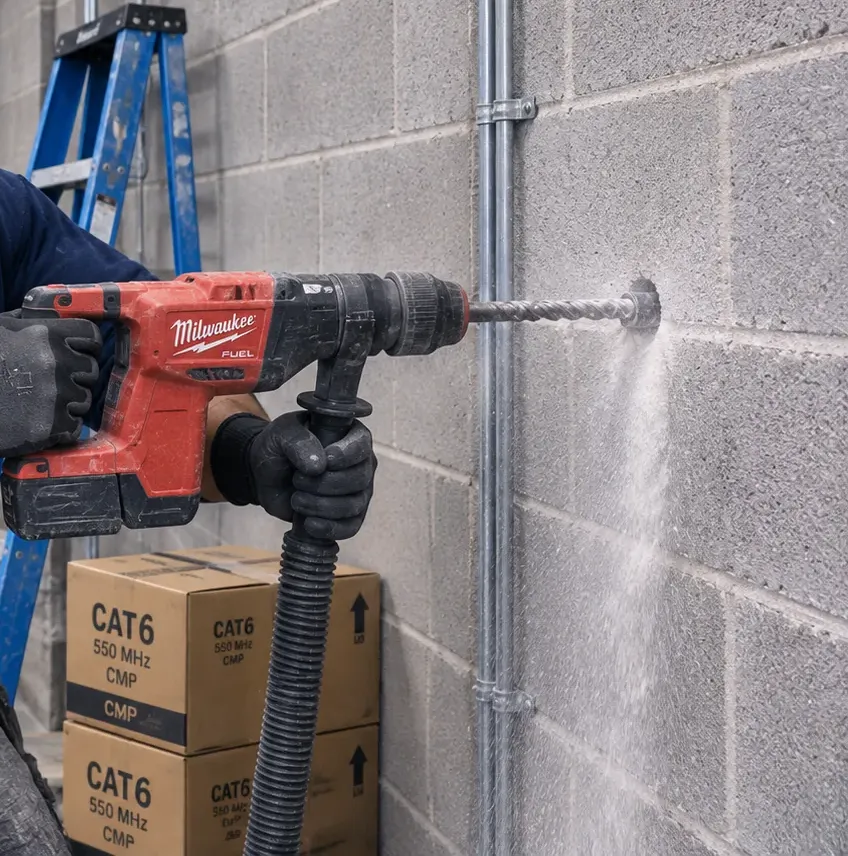
Where the building is still being built, sleeves through slabs and walls should go in before the pour; conduit runs along the deck are usually better surface-mounted afterwards. A sleeve set in the formwork costs very little and saves coring a finished slab later, which in a long-span or post-tensioned deck means scanning, an engineer's sign-off and sometimes a refusal. So we ask the general contractor for the pour schedule and mark the sleeve locations — at each stair core and service shaft, and where the network room's wall meets the slab — on the structural drawings well in advance.
Embedding long runs of conduit inside a ramp or deck slab is a different matter. It ties the fiber route to the concrete for the life of the building, it is hard to repair if a run is crushed or blocked, and it has to be coordinated with reinforcement, drains and any heating or de-icing system in the slab. In most stations, a conduit fastened along the parapet, the slab edge or the underside of the deck above is easier to inspect, easier to extend and easier to replace.
By putting the enclosures where the water does not go, making every cable enter from below, and never trusting a slab joint. Water on an open deck heads for the drains, but it also finds expansion joints, cracks and the gaps around any penetration, and it arrives on the level below carrying salt that attacks steel boxes, fittings and connectors. We look at the deck above before placing anything below it: where the drains are, where the joints run, where staining on the ceiling shows water already coming through.
Enclosures go on the face of a column or wall away from those lines, with gasketed doors, bottom cable entries and drip loops so water running down a cable drips off before it reaches the box. Fittings are non-metallic or corrosion-resistant where salt is a risk. Where a sleeve passes up through the deck, it is sealed on the top side and kept clear of the drainage slope.
Fiber does not fix Wi-Fi on its own, but it is usually what makes a proper deck wireless design possible. Scanners drop on a parking deck because the access points are too few, too far apart, or fed from a switch so far away that they were placed wherever a copper cable could reach rather than where the coverage was needed. A concrete deck full of metal vans is hard to cover, and an empty deck at noon behaves nothing like a full one at five in the morning.
The fix is a set of access points mounted on the column lines at the height the design calls for, each fed by a short copper run from a small switch in a sealed enclosure on the same level, with that switch connected back to the main network room by fiber. Fiber lets those switches sit right on the deck instead of in a closet hundreds of feet away. We install the pathway, the enclosures and the fiber, and we work with whoever is designing the wireless — your own IT team or our Queens network installation team — so the access points go where a survey of a loaded deck says they should.
Inside the station, assume it is off limits unless the station operator says otherwise in writing. Large carriers run their own networks to their own standards, and the building's facilities rules will normally prohibit outside contractors from adding cable to their decks, docks or network rooms. Your scanners and devices will run on what the operator provides. What you do control is your own space: a separate office, a yard where you keep your vans, a dispatch room you lease nearby.
That is where we usually help delivery contractors in Maspeth: a small office or yard of their own, linked by fiber to a shed or charging area, cameras over their own vehicles, and a clean separation between their network and anything they connect to inside the carrier's building. With written permission for a specific installation inside, we work to the operator's contractor rules.
Usually late morning to mid-afternoon, after the vans have left and before the evening line-haul arrivals build up — but the station manager's own schedule decides, and it differs between operators and seasons. A station that loads vans before sunrise and receives trailers overnight often has its calmest hours around the middle of the day; peak season in November and December can erase that window entirely. We ask for the real schedule, not the published one, and plan around it.
The work itself is split so that very little of it needs a quiet window. Pulling cable, mounting enclosures and splicing new strands can all happen while the old network keeps running. Only the cutover — moving live switches from old cable to new — needs a pause, and we stage it zone by zone so that each pause is short and only one area is affected at a time.
Usually it does not go to the moving side at all. The keypad, card reader, plate camera and intercom are mounted on a fixed post or the gate's support column, and the fiber terminates in a small enclosure there. Only the gate operator's own control wiring needs to reach the moving leaf, and gate manufacturers make purpose-built cable carriers and loops for that. Keeping the fiber on the fixed side removes the most common cause of gate-link failure: a cable that flexes thousands of times a day until it breaks.
Where a device genuinely has to ride on the gate — a camera fixed to the leaf, for example — we use a short, flexible copper or hybrid lead in a proper carrier from the fixed enclosure, so the fiber itself never moves. Our access control team can supply and wire the reader and gate interface on the same job.
Because we bury it deeper than the grading reaches, mark it above and below ground, and give you a drawing tied to things that do not move. In a gravel or crushed-stone yard the surface moves every year; a duct laid at the depth that is fine under asphalt can be dug out by a loader bucket in one season. So the duct goes deeper, with a bright warning tape laid above it partway up the trench, a tracer wire alongside it so a locator can find it, and pull boxes at each end and at any bend, set on a firm base with lids rated for the vehicles that will drive over them.
Above ground, we mark the route at the fence or building where it starts and ends, and the drawing gives distances from fixed points — the building corner, a fence post, the gate column — rather than from piles of material that will have moved by next year. And we give the operator a one-page sketch for the cab, because the best protection is a driver who knows the line is there.
Yes, and for a weighbridge out at the gate it is often the most reliable way to do it. The scale's weight indicator and any ticket printer, display or camera at the scale house need a data connection back to the office software, and the distance, the open ground and the lightning exposure of a metal platform on a long copper run all argue for fiber. We bring the fiber to a small enclosure in the scale house or on the indicator's post and convert it there to the connection the indicator uses — Ethernet in most modern systems, sometimes serial through a converter for older ones.
The scale itself, its load cells and its calibration belong to the scale company, and we do not touch them. What we provide is the link: the fiber, the converter, the enclosure and a clean hand-off that the scale technician and your office software can both rely on.
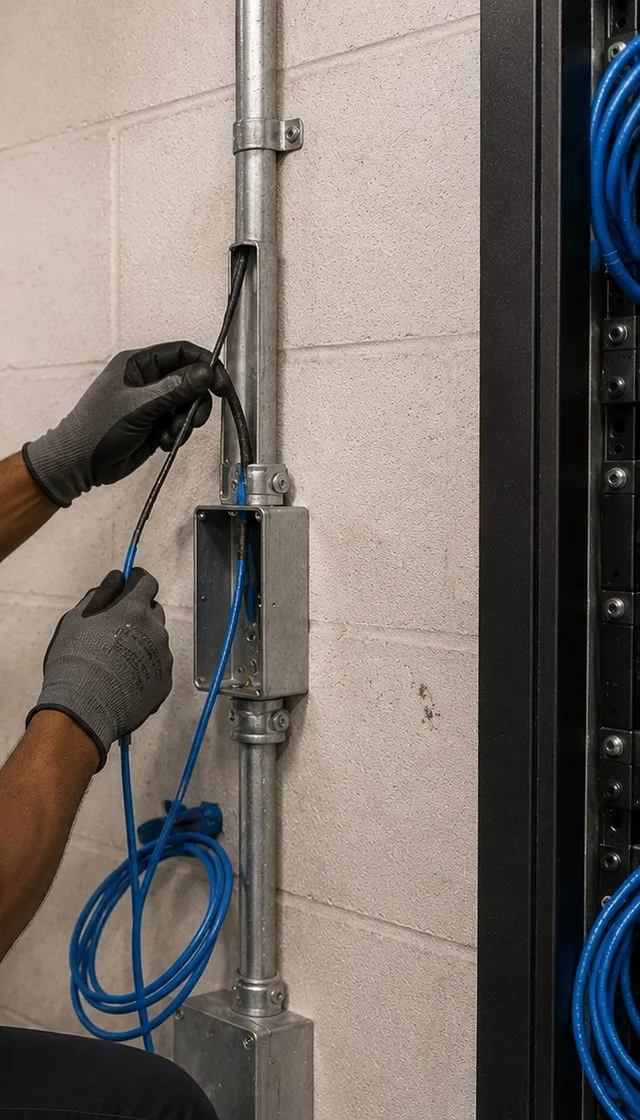
Often, yes — and in a working yard it is frequently the better choice. A fence or a solid perimeter wall is already the edge that trucks avoid, it does not get regraded, and a cable on it can be inspected and repaired without digging. We use outdoor-rated, rodent-resistant fiber, either in conduit clamped to the fence posts or lashed to a support strand along the fence top, with slack at the corners and at each enclosure, and with the run kept above the height where snow is piled.
There are limits. A chain-link fence that is regularly hit, cut for access or replaced is a poor support, and a run along a fence on a property line needs the agreement of whoever owns the fence. Where the fence has gaps, gates or sections owned by a neighbour, we switch to building walls or a short buried section rather than leave the cable exposed. We show the owner both options with a price for each.
Dirt is the most common reason a fiber link fails, and a concrete, aggregate or trucking yard has plenty of it. A single speck of dust on a connector's end face can add enough loss to drop a link or, worse, scratch the glass when the connector is pushed home. Cable runs are not the problem; the open ends are. So every connection in a dusty yard sits inside a gasketed enclosure, every unused port is capped, and connectors are inspected under a scope and cleaned immediately before they are mated.
We also design to reduce how often anyone has to open those boxes. Splices — which are permanent and sealed inside trays — are used in the field where possible, with connectors kept to the cleaner indoor ends. Switches that live outdoors sit in sealed, filtered cabinets rather than ventilated ones that draw dust in.
Fiber itself carries no power and does not care whether the lights are on; what fails is the equipment at each end. A yard's cameras, the switches that feed them and the recorder all need power, so the answer is battery backup at every point where equipment sits — in the office rack and in each outdoor enclosure — sized to carry the cameras for the hours that matter. Fiber's contribution is that it lets the recorder sit in the most secure room on the site, away from the fence and the gate, instead of in a box where an intruder can reach it.
We also look at the weak points an intruder would look at: the service panel and meter, an exterior junction box, a camera mounted low enough to be turned. Power to remote enclosures can come from a protected circuit inside the building, and the recorder can send an alert, through a cellular or second connection, the moment a camera loses power or the link drops. It does not replace your alarm company; it makes sure the footage exists. Our camera installers design the camera side.
It can, but not in a bare steel box. An uninsulated container in full sun can get far hotter inside than the outdoor air, and a switch, a recorder or a battery backup unit left there will throttle, fail early or, in the case of batteries, swell. If the container is the office, it presumably already has insulation and an air conditioner for the people in it; then the equipment can live there, on a shelf or in a small wall cabinet away from the door, on a protected circuit.
If the container is unconditioned storage, we keep the active equipment out of it. The fiber can enter the container and end in a passive splice enclosure, which does not mind heat, with the switches and recorder in the conditioned office or building. Where a device must live outside — a camera switch at the far fence, say — we use hardened industrial switches rated for outdoor temperatures in shaded, sealed cabinets.
Yes. Much of Maspeth's industrial area grew up with few sidewalks — the area's own property owners' group complained about it two decades ago — and an owner who redevelops, changes curb cuts or receives a violation may be required to build or rebuild the sidewalk along the frontage. That work digs up the strip between the property line and the curb. Anything buried there, including a private fiber duct, is at risk, and much of that strip is public right of way where private cable should not be laid without permission in the first place.
So we keep private fiber on the owner's side of the property line, set back from the front fence far enough that a sidewalk contractor's excavation will not reach it, and we route any crossing of the frontage — to a gate post at the curb cut, for instance — as short and as deep as possible, with the location recorded. If a sidewalk or curb project is already planned, we time the fiber after it. This is general guidance; the Department of Transportation decides what is required on any frontage.
Often yes, but it is not the same as digging in clean ground, and it should be settled before anyone picks up a shovel. Land along Newtown Creek carries a long history of refineries, smelters and chemical works, and the creek itself is a federal Superfund site where the EPA announced a nearly $250 million interim cleanup of the East Branch in January 2025. A particular lot may have a cap, an environmental easement, a soil-management plan from an earlier cleanup, or nothing at all — and only the owner's records and environmental consultant can say which.
We ask before we propose a trench. If the site has a cap or a management plan, digging through it may need the consultant's approval, specific handling and disposal of the soil removed, and restoration of the cap afterwards. In those cases the cheaper and simpler answer is often to avoid digging altogether: route along walls and fences, cross between buildings overhead on a support strand, or use an existing duct. We cannot advise on environmental law; the consultant leads.
Usually, yes. In Maspeth's attached rows it is common to find that a provider, years ago, brought one cable into the end house and ran it through the cellars or along the back walls to the others. It works until a neighbour renovates, seals their cellar wall, or simply objects — and then nobody can reach the splice that serves your house. A service entrance of your own, through your own front or rear wall, takes that dependence away.
The provider decides where its own cable can reach your house, so we start by asking them, then prepare the house side: a sealed sleeve through your foundation or rear wall at the point they can serve, a small wall enclosure in a dry part of your cellar, and fiber or cable from there to each apartment or to a home office. Low-lying blocks of Maspeth have a history of flooding after heavy rain, so equipment goes high on the cellar wall, not on the floor.
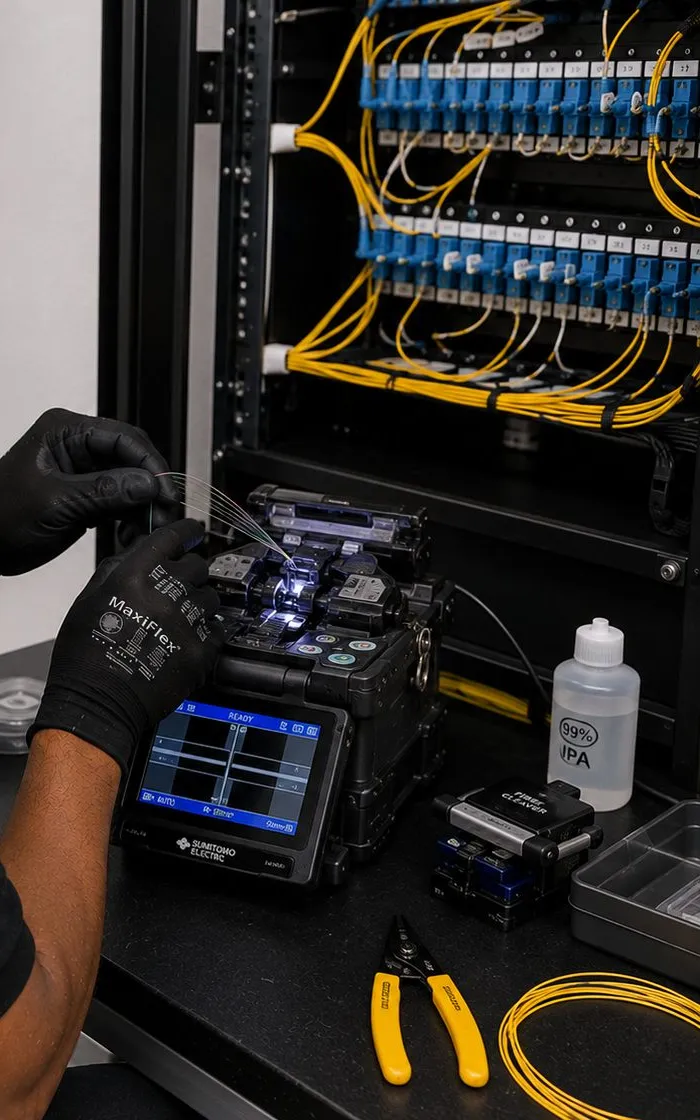
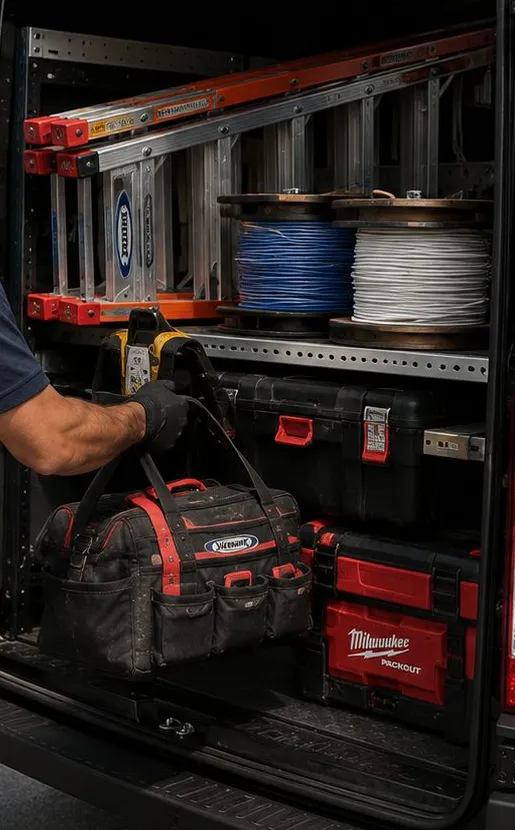
The material list for a Maspeth job is decided mostly by what the cable will be exposed to outside the walls: sun, salt, standing water, rodents, dust and the occasional vehicle. Inside the office, the choices are the same as anywhere else in the city.
The default between buildings, up a delivery station's core and out to a far gate. It reaches every distance a Maspeth site will ever need and leaves the faster optics of the future open.
Gel-free, water-blocked cable for buried ducts and fence-line conduit, rated for wet locations and the temperature swing of an exposed yard.
Steel- or glass-armoured jackets for runs in warehouses, cellars and fence lines where rats or crushing loads are a risk, and where a duct is not practical.
OFNR cable for vertical runs between levels and OFNP cable in air-handling ceilings of offices and showrooms, per the code listing for each space.
Smooth-wall duct with tracer wire and warning tape for buried crossings, long-radius sweeps at every bend, and boxes with lids rated for truck traffic.
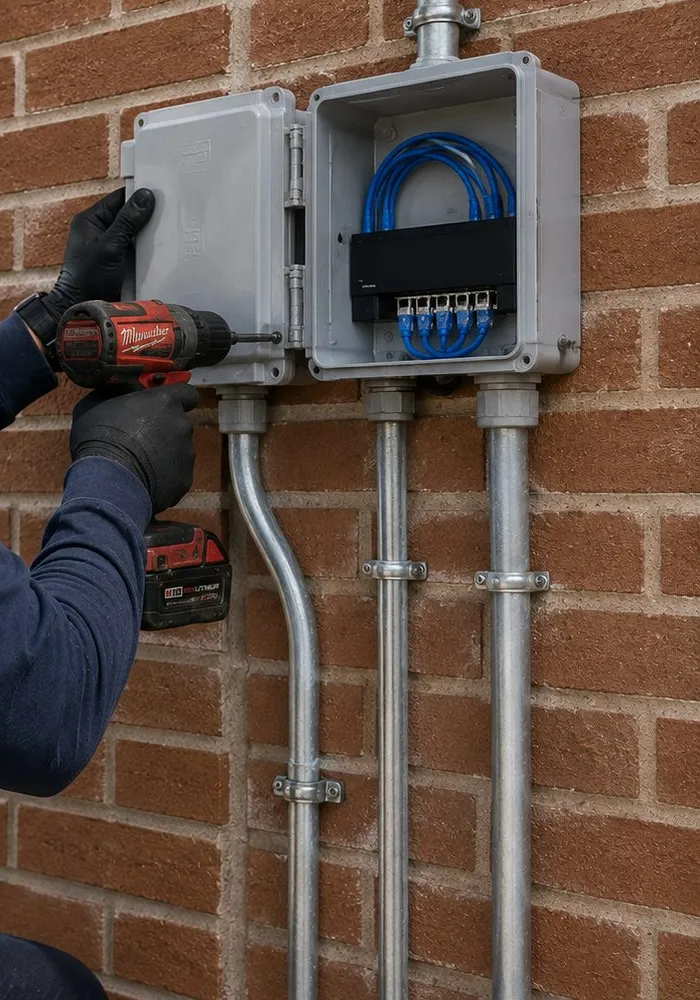
Gasketed, lockable, non-metallic or coated enclosures with bottom entries for gate posts, scale houses, fence corners and deck columns.
Switches rated for outdoor temperatures with fiber uplinks, for camera clusters and access points that have to live outside a conditioned room.
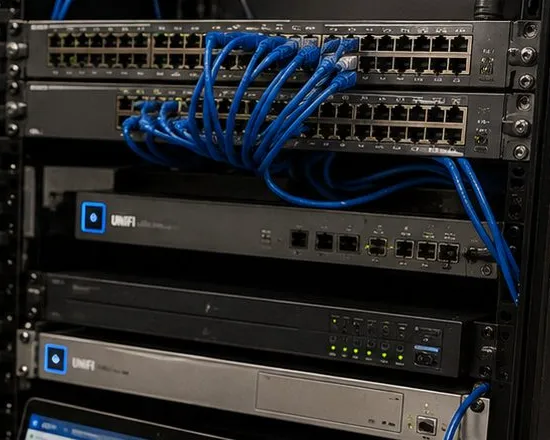
Rack or wall enclosures with splice trays at the entrance room and each zone, LC adapters for the switch end, and capped spare ports.
The small devices that turn light back into the copper connection a camera, scale indicator or older alarm panel expects, matched to the fiber type at each end.
| Link | Reach | What threatens it in a yard | Best used for |
|---|---|---|---|
| Outdoor copper Ethernet | 100 metres per run | Distance limit, lightning and ground faults between buildings, water in buried copper | A camera or reader close to the building it is fed from |
| Point-to-point wireless | Long, with clear line of sight | Stacked trailers, new buildings and cranes blocking the path; mounts knocked out of alignment | Temporary sites, or a crossing where nothing can be buried or hung |
| Fiber | Kilometres | Physical damage at the open ends and in shallow ducts — solved by routing and protection | Gates, scales, far fences, separate buildings, deck levels |
Yard owners who already pay ADT, Ring or SimpliSafe for monitoring sometimes assume one of them will wire the property. They sell alarm and camera service; building a fiber plant across a yard is not part of it. In practice a Maspeth owner chooses between letting every vendor drag its own cable to its own box, hiring a big integrator whose crew may be a subcontractor, or a licensed local installer with its own splicer and OTDR that comes back the day a truck finds the cable.

Automated summaries of Maspeth's fiber options lean on the same handful of sources: coverage maps, carrier marketing, cost guides and forum posts. We could not open Google's AI Overview itself from our build environment, so it is not quoted here. Instead, below are the published claims such summaries draw on — from broadband comparison sites, a carrier's marketing page, national cost guides and residential install pages — each set against what we find on Maspeth sites. Directory sites such as Angi, HomeAdvisor and Fixr returned no fiber-installation cost page in our searches, so they are not quoted.
Comparison sites publish confident percentages for the neighbourhood. BroadbandNow says "fiber internet is 88.4% available in Maspeth"; ISP Reports says Verizon Business "offers Fiber service to 97.6% of Maspeth homes"; BroadbandSearch lists EarthLink Fiber at 94.61% coverage. The numbers disagree with each other, and every one of them describes addresses that a provider says it can serve, mostly homes — not whether the glass reaches the building you lease, let alone the far side of your yard.
On an industrial lot the gap between "available" and "connected" is often the whole job. The provider may have fiber on the street, but its service ends at the first point of entry, which is usually the front office. The dock wall, the van deck, the shop building behind and the gate at the far end are on your side of that hand-off, and no availability map counts them.
The useful question is where your provider's service lands, how far that is from where the work happens, and who builds the rest — the part we measure on the walkthrough.
A common Reddit view of building wiring, repeated on r/AskNYC, is that "Its on the ISP to wire your building/apartment." For a home in a wired building that is roughly how it works: the installer brings service to the unit. Business service on an industrial site is different. The provider's job ends at its demarcation point, usually a small box or a rack position in one room, and anything beyond it is the customer's network.
That is why so many yards end up with a second and third internet account — office, shop building, guard booth — each the only way to reach a building the first service missed. It works, at a monthly cost, but the cameras end up on three undocumented networks.
One service, distributed across the property on the owner's own fiber, is usually cheaper over a few years and far easier to manage; the provider still supports the internet itself.
This range appears on contractor pages describing fiber in New York; Streamline Telecom, for example, says fiber-optic cable "costs anywhere from $1-6 per linear foot to install". For pulling cable through an existing empty pathway, that is not unreasonable; for a yard, it misses where the cost is.
On a Maspeth site the cable is a small part of the price. The money goes into the pathway — conduit up a core, sleeves through a slab, a deep and marked crossing under a truck apron, fence-line support — and into the ends: enclosures, splicing, switches, testing and labels. Two sites with the same footage can differ several times over in price because one has walls and fences to follow and the other has open ground and a slab to cross.
That is why our pricing below is listed per termination, strand, drop and backbone rather than per foot, and why every Maspeth quote follows a walkthrough.
National guides cite a much higher figure for buried fiber; one cost guide, drawing on the Fiber Broadband Association, gives a median of about $18 per foot for underground construction. That number describes outside-plant construction along public roads — boring, permits, restoration — over long distances.
It is the wrong yardstick for most private yards in either direction. A short buried crossing on private land, where the trench can be cut and patched by the owner's own site contractor, can cost much less per foot. A crossing that has to pass under a heavily trafficked concrete apron, through historic fill or near a cap, with traffic-rated boxes at each end, can cost more. And often the cheapest buried crossing is the one that is not needed, because the fence or a building wall offers a route.
We price buried work after seeing the ground and asking what is under it, and we always show the fence-line or overhead alternative beside it.
Residential provider pages give short install times — AT&T says "four to six hours" and T-Mobile says an in-home fiber install "can take up to 4 hours". Those figures are accurate for connecting one house to a provider's network that already runs past it, which is what they describe.
A site backbone is a different scale of job. A small yard — office, gate, scale and a few cameras — is usually a few days on site once the route is agreed. A delivery station's backbone to several levels and decks takes longer, and most of the time is spent on access: badges, escorts, lifts, working only in the quiet windows and waiting for the facilities team's sign-off at each stage.
Our proposals give both figures — the provider's hours and our days — with dates that depend on someone else's approval shown separately.
It is easy to assume that a building completed in the last few years, with a big-name tenant, has everything built in. New logistics buildings in Maspeth do come with impressive specifications — the builder of 55-15 Grand Avenue lists 15 loading docks, three parking levels for more than 600 employees and fleet vehicles, EV charging and van launches. What they come with for networking is decided by the lease and by the tenant's own standards, not by the building.
Typically the landlord provides conduit to an entrance room and perhaps sleeves between floors, and the tenant's integrator builds the rest. When that tenant leaves, the next occupant often finds an empty sleeve, a room of abandoned cable, or both.
New building or old, we start by finding what is actually there and whether it is usable, then quote only what is missing.
Some carriers advertise speed. One Queens business-internet provider promotes "Quick Installation -- Within 5 Days" for its service, which is a wireless circuit, and fiber providers advertise their own installation targets. For lighting a service to a building that is already connected, quick timelines can be real.
They do not cover your site's internal network, and they can hide a longer wait when the building is not yet connected: commercial fiber can take months when the carrier has to build a lateral, and one carrier's own blog describes a customer who waited 15 months.
Treat the provider's date and the internal network as two schedules: order service early, ask where it will enter, and let us build the owner's fiber from that point in parallel.
A free walkthrough from the office to the gate, a route drawn around your vehicles, and a price that shows the pathway and the cable separately.
Tell us the site, what drives in and out of it and where the internet arrives. A Maspeth installer will reply that business day, or call (347) 434-6392.
A Maspeth installer will call you back the same business day. If it can't wait, call (347) 434-6392.
Eight steps. On a Maspeth site the splicing is the easy part; the plan has to work around trucks, schedules, landlords and the ground itself.
With the owner or station manager we follow the trucks and vans through a working day: queue, gate, apron, docks, ramps, decks and parking, noting every place a vehicle turns, backs or loads.
Where the internet service lands, which lots and buildings belong to whom, what the lease or station rules allow, and whether any part of the ground has a cap or environmental plan.
Walls, fences, cores and column lines first; buried crossings only where nothing else works. Enclosure positions, strand counts and spares marked against fixed reference points.
A proposal that shows conduit, sleeves, trenching and supports apart from cable, splicing and testing, with the quiet windows we need and any approvals listed.
Conduit on walls, fences and structure, sleeves through slabs after scanning, deep marked ducts with tracer wire where buried, and traffic-rated boxes where vehicles pass.
Cable pulled within the maker's tension and bend limits, slack loops at every enclosure, drip loops and bottom entries outdoors, and every rated penetration firestopped.
Strands fused in sealed trays, connectors inspected and cleaned, loss measured on every strand and OTDR traces saved for each section from office to gate or deck.
Labels named for the place each strand serves, a site drawing for the office and a one-page sketch for the yard, and cutovers staged zone by zone in the quiet windows.
Maspeth's landmarks tell the same story as its streets: a farm village on a plank road, an industrial creek, and the highways and depots that came after. These are the places we use to describe where a site is.
The small town hall north of Grand Avenue, built in 1897 — not 1802, as its sign says, according to Forgotten New York — and later a police stationhouse and a school. Today a community centre in the heart of the residential village.
The cable-stayed I-278 crossing of Newtown Creek between Maspeth and Greenpoint, rebuilt as two spans opened in April 2017 and August 2019. The industrial blocks beside its Queens landing feed truck traffic straight onto the expressway.
Remnants of the nineteenth-century Maspeth Toll Bridge Co. plank road on Newtown Creek, restored as a small public shoreline by the Newtown Creek Alliance from 2013, beside a sanitation garage and a concrete supplier.
The six-acre park on the site of the old Elmhurst gas tanks, opened in 2011 on Maspeth's eastern edge beside the freight line, and the proposed location of an Interborough Express station near 74th Street.
A soccer ground in use since 1925, tucked among the houses south of Grand Avenue; a reminder that the village's residential blocks sit only a few streets from the yards.
The firehouse at 56-29 68th Street, opened in 1914, which lost 19 firefighters on September 11, 2001; the neighbourhood's memorial stands at 69th Street and Grand Avenue.
We also serve the neighbourhoods around Maspeth — Middle Village, Ridgewood, Woodside, Elmhurst and Sunnyside in Queens, and Greenpoint and East Williamsburg across the creek in Brooklyn.
A yard in Maspeth pays exactly what a building anywhere else in Queens pays. These are our published borough prices, listed so an owner can rough out a budget before the walkthrough fixes the real one. Terminations, tests, backbones and the second-room line carry the 1.05× Queens factor on our Brooklyn and Bronx base; the multimode and single-mode drop figures are the ones shown in the Queens structured cabling configurator.
| Item | Queens price | How it usually applies on a Maspeth site |
|---|---|---|
| Fiber termination on an existing cable | $37 per termination | Re-finishing old strands a previous tenant left in a warehouse or yard, one connector at a time |
| OTDR test | $42 per strand | A trace showing distance, splices and any fault, so a later vehicle strike can be located to the metre |
| Multimode fiber drop | $391 per drop | A short link inside one building, such as office to a dispatch room or mezzanine |
| Single-mode fiber drop | $447 per drop | A shorter outdoor link, such as office to a gate post or scale house |
| 12-strand OM4 floor-to-floor backbone | $4,725 – $7,350 | Entrance room up through a delivery station's levels, spliced and sealed at each, loss per strand |
| 24-strand OS2 between buildings or along a long structure | $8,400 – $15,750+ | Office to shop building and far fence, or along a long warehouse, with OTDR on every strand |
| Second telecom room with fiber link | from $2,520 | A second network room in a shop building or on an upper level, joined by fiber to the first |
| Service and callback rate | $195/hr, 3-hr minimum ($585) | Call-outs, fault finding after damage and later changes; the original installation is priced separately |
Each package below is simple arithmetic on the price table — no extra line items, no invented bundle discounts — sized to the three requests we get most from Maspeth yards and stations. The real proposal swaps in your measured route, your enclosure count and whatever surprises the site walk reveals.
$894
Two single-mode drops from the yard office: one to the gate post for the keypad, plate camera and intercom, one to the scale house for the weight indicator (2 drops at $447). Each drop is terminated and tested; enclosures and converters are supplied at cost, and any trenching is quoted separately.
$4,725 – $7,350
Twelve OM4 strands from the entrance room up a stair or service core to an enclosure on each loading level and deck, sealed at each slab and tested strand by strand. Where a job falls in the range depends mostly on the vertical route and the number of levels.
$8,400 – $15,750+
A 24-strand OS2 single-mode backbone from the office to the shop building, the far fence and the gate, or along a long warehouse, with OTDR on every strand — the base for cameras, gates, scales and every building on the site.
A fleet operator's corporate buyer or a yard's own IT contractor sometimes arrives with the reels, boxes and optics already purchased. In that case we bill labour alone: our crew pulls, fuses, tests and labels your materials at the $195 hourly service rate, three hours minimum ($585). Whatever you bought is warranted by its maker, not by us, and before any customer-supplied reel goes into a duct we shine a light through it to confirm it is continuous.
Full terms — including 50% deposit, one-year parts-only warranty on AESS-supplied products, and the late-fee schedule — are set out in the service agreement. Every strand we install is handed over with the test result that shows it passed on the day.

The walkthrough is free. You receive a route drawn on your site plan, the pathway and cable priced separately, and the dates we would need.
Not every Maspeth job involves a truck. East and south of the industrial lowland is one of the most intact small-house neighbourhoods in Queens: rows of attached brick homes, many built between 1910 and 1930, most of them two-family houses with an owner downstairs and a tenant or relative upstairs. Few buildings are taller than three storeys, and apartment buildings are rare. Fiber in these houses is a different, smaller craft.
The common requests are modest. A homeowner who works from a back bedroom wants a wired connection that does not depend on the Wi-Fi reaching upstairs. A two-family owner wants each apartment to have its own service without the second provider drilling a new hole in the front wall. A rear garage off the driveway has become a workshop or a small business and needs a camera and a network. In every case the work is about finding a clean path through a house that was built long before anyone thought about cables.
The paths we use are the ones the house already has: the cellar ceiling, which runs the full length of the house; the old telephone or cable route up the back wall or beside the chimney; a closet stacked above another closet. Where nothing lines up, a neat surface raceway along a baseboard or up an inside corner is often better than opening plaster. A run to a rear garage goes in conduit along the driveway wall, not loose on the ground.
Two local conditions shape where the equipment goes. Some low-lying blocks of Maspeth and neighbouring Woodside have flooded after heavy rain for years — the city's $101 million sewer and water-main project on 70th Street, reported nearly complete in 2023, was aimed at exactly that — so anything electronic in a cellar goes high on the wall, never on the floor. And homes along the freight tracks at the eastern edge feel the trains: one resident told NY1 in September 2026 that the CSX line ran about 80 feet from her back wall, and another said "the property is already shifting." Fiber does not mind vibration, but a wall-mounted box should be fixed into solid masonry, not a loose plaster face, and connectors should be secured rather than left hanging.
For a house, we usually recommend the simplest thing that will last: one service entrance per apartment where the provider supports it, a small labelled enclosure in the cellar, fiber or Cat6 to each place that needs a wire, and nothing in the attic that will cook in summer. The job is often a single day, and it leaves the house tidier than we found it.

These are the standing habits of our crews on industrial sites like Maspeth's, written in the installer's own words. They describe how we work, not a particular customer's job.
"Before I unroll anything, I stand at the gate for ten minutes and watch. You learn which way the trucks swing, where the drivers cut the corner, where the forklift parks when nobody's looking. Then I walk the fence and look for scrapes on the posts and dents in the bollards — that's where the cable can't go. I kick the lids of any boxes that are already in the ground; if one rocks, something has been driving over it. In the warehouse I look up before I look down: the tray, the sprinkler mains, the old cable nobody owns. On a deck I look at the ceiling underneath first, because the water stains tell you where the joints leak. And I always ask who plows the snow and where they push it, because a snow pile against an enclosure in February is the same as a truck hitting it. By the time I draw the route, half the job is deciding where the vehicles won't let us put it."
Once the strands reach the gate, the dock and the shop, the devices on the end of them follow. These Queens services plug into the same enclosures and appear on the same site drawing.
The copper side of the network: from each fiber enclosure to desks, dispatch screens, label printers and phones, numbered to match the strand record.
Short runs from a zone switch on a dock level or deck to access points, cameras and scanners' charging stations.
Switches, routers and wireless designed for a loaded deck or a long warehouse, set up and documented on the fiber we install.
Yard, dock and gate cameras with the recorder in the most secure room on site and battery backup at every enclosure.
Gate keypads, card readers and office doors on their own strands, separated from the business network.
Gate intercoms for drivers and video intercoms for two-family houses, wired while the pathway is open.
Intrusion alarms for offices, shops and yards, with communicators moved off old copper phone lines.
Everything else on the low-voltage side, from speakers in a showroom to sensors in a shop building.
Same-day fault finding when a cable inside the office or a copper drop on the dock has failed.
Our Maspeth work covers the full range of fiber services, from a single strand to a scale house to a backbone through a stacked delivery station.
Each fiber optic installation in Maspeth, Queens begins with a route walked on foot and drawn on the site plan. Fiber optic cable installation inside buildings uses tray, J-hooks or innerduct, never loose cable on ceiling tiles; fiber optic cable routing follows walls, fences, columns and cores; and fiber optic cable pulling is done within the manufacturer's tension limits with slack left at every enclosure. Outside, we handle underground fiber optic installation in marked ducts, armored fiber optic cable installation where rodents or crushing are a risk, and fiber optic conduit installation on fences, walls and structure.
Inside multi-level buildings we carry out fiber optic riser installation through sleeves and shafts, and multi-floor fiber optic installation that ties every loading level, deck or office floor back to one room. For two-family and small apartment buildings, apartment building fiber optic installation brings one service point to each unit cleanly.
Most Maspeth requests are commercial fiber optic installation: warehouse fiber optic installation along dock walls and through high-bay racking, business fiber optic network installation that links an office to a shop building and a yard, and fiber optic backbone installation between the entrance room and every zone. Data center fiber optic installation covers small server and recorder rooms. We install both single mode fiber installation and multimode fiber installation, choosing single-mode for anything outdoors or between buildings and multimode only for short indoor links, and we size fiber to the building and fiber to the premises connections to where the provider's service lands.
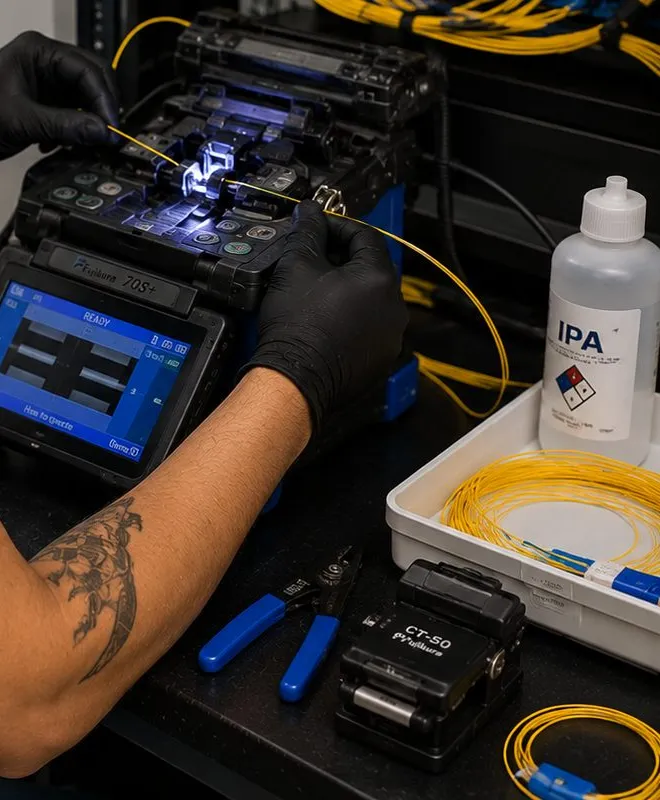
Fiber optic splicing is done in the field or in the entrance room with a fusion splicer; fusion splicing gives the lowest loss and a permanent, sealed joint, which is why we prefer it outdoors. Fiber optic termination uses factory-polished pigtails fused onto each strand, and fiber optic connector installation (LC, SC or MPO) matches whatever the switches, converters or carrier hand-off require. Fiber optic patch panel installation and fiber patch cord installation finish each end.
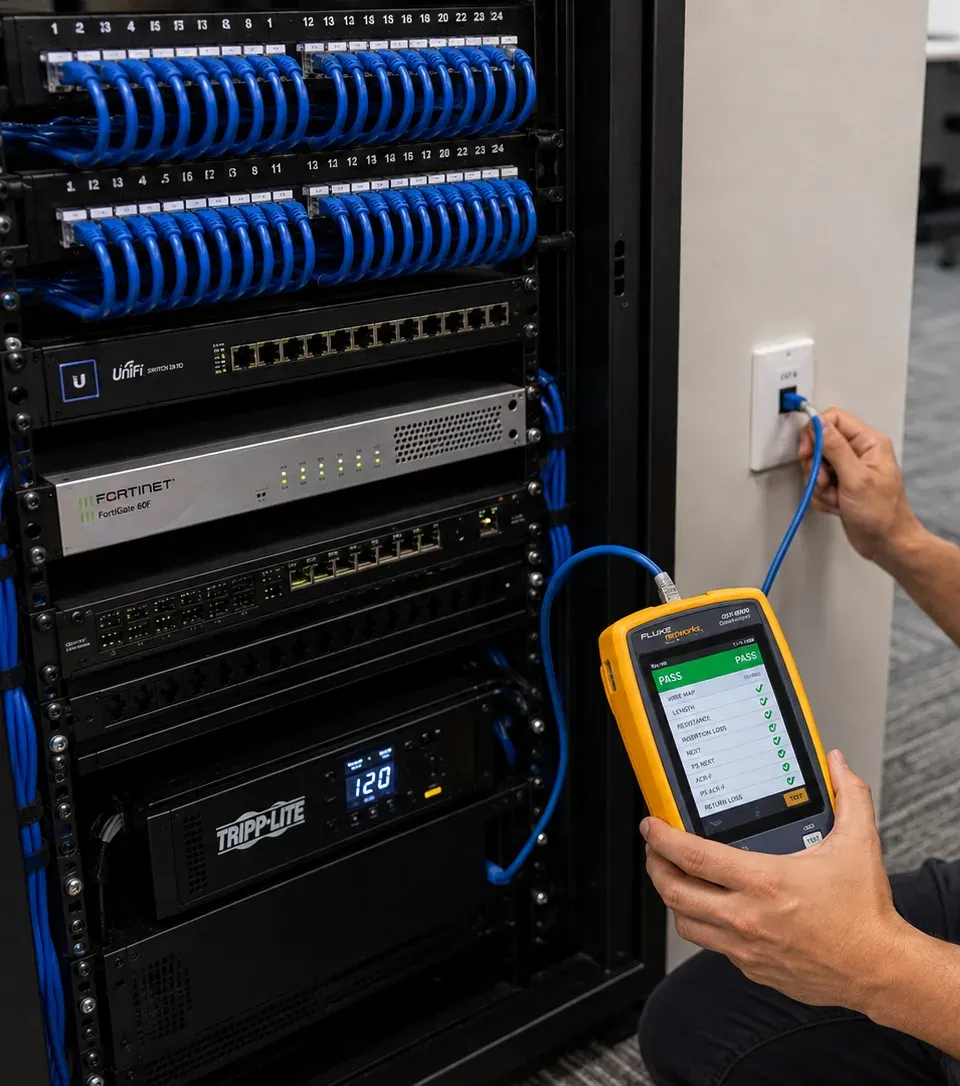
Fiber optic testing on every job includes an insertion-loss measurement on each strand; OTDR testing adds a trace that shows length, every splice and connector, and the exact distance to any fault, which is what makes later damage quick to find. Fiber optic certification compares those results with the design limits, and fiber optic inspection and cleaning of every connector end face is done before anything is mated. The results are handed over as part of the record.
When a link fails, fiber optic repair starts with fiber optic troubleshooting: a visual fault locator for short runs, the OTDR for long ones. Fiber optic cable repair after a vehicle strike or an excavation usually means splicing in a new section inside a sealed closure. Fiber optic maintenance and emergency fiber optic repair run through the Queens line on this page.
Fiber optic cable management means slack stored in proper loops, bend radius respected at every turn and nothing hanging free; fiber optic labeling names each strand for the place it serves at both ends. When a site changes, fiber optic upgrade work re-uses what is sound, and fiber optic replacement removes what is not, including old cable left by previous tenants.
Yes. Most of our Maspeth work is in the industrial area and along Grand Avenue, but we take fiber jobs throughout the neighbouring parts of Queens, including Middle Village, Ridgewood, Woodside, Elmhurst and Sunnyside, and across Newtown Creek in Greenpoint and East Williamsburg. Maspeth jobs run through our Queens line and are dispatched from our office on East Fordham Road in the Bronx.
It depends on the site, and the proposal says which. For short crossings we can arrange the trench, duct and backfill as a separate line item. Many yard owners prefer their own site or paving contractor to cut and patch the surface, in which case we specify the depth, duct, tracer wire and boxes, lay the duct when the trench is open and pull the fiber afterwards. Either way, surface restoration is priced apart from the fiber.
The screens themselves only need a normal wired connection; what matters is what they connect to. If the tracking data comes from a cloud service, a good internet line and solid copper inside the office are enough. Fiber becomes worthwhile when the dispatch room is in a different building or level from the main network room, or when the screens also show local camera feeds from the yard and docks, which move a lot more data.
Yes, provided both properties are yours. We survey both on the same walkthrough and can quote them together, with the work at the house and at the shop listed separately so you can see each part. If you want the two connected, the link between them is planned like any building-to-building run and stays on your own land wherever possible.
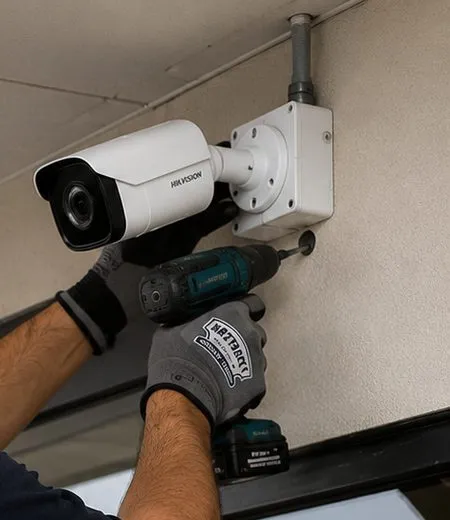
Yes. A plate camera at a gate is often far from the recorder and exposed to weather, which is exactly where fiber helps. The fiber ends in a sealed enclosure on the gate post or a nearby pole, and a short copper run powers and connects the camera. The camera's placement, angle and lighting decide whether plates are readable; our camera team designs that part.
Usually the alarm panel's communicator is changed rather than the line moved. Many older panels report over a copper phone line that providers are retiring; the common fix is a cellular or internet communicator, sometimes both. If the panel is in a building away from the office, fiber can bring the network to it. Your monitoring company has to approve the change, and our alarm team can do the panel side.
Yes, and it should be. We set sleeves and boxes before each pour where the drawings call for them, then come back for cable once the slabs have cured, the roof is on and the dust has settled. The general contractor's schedule drives our visits, and we coordinate through their superintendent so the fiber never holds up a pour.
A space inside the gate for our van, keys or access to the network room, gate and any locked enclosures, the site's safety rules and any badges or escorts, and a contact who can move vehicles or stock if they block the route. If there are quiet hours when we must not interrupt the network, tell us the day before so the cutover can be planned around them.
A good-quality outdoor enclosure rated for sun exposure should last many years, but the parts that wear first are the door gasket, the cable entry seals and the locks. We choose enclosures and cable rated for ultraviolet exposure, mount them in shade where possible, and check seals on any return visit. A box that has lost its gasket lets in water and dust long before the box itself fails.
This page zooms in on one corner of the borough covered by our Queens fiber optic installation page; the NYC fiber optic installation hub compares all five boroughs, and the regional pages below take the same crews out to Long Island and the Hudson Valley. Neighbourhood pages such as fiber optic installation in Long Island City and fiber optic installation in Williamsburg, just across Newtown Creek, look at single districts the way this page looks at Maspeth.
NYC fiber optic installation · Queens · Manhattan · Brooklyn · the Bronx · Staten Island
Maspeth, Queens (this page) · Williamsburg, Brooklyn · Parkchester, Bronx · Flushing, Queens · Downtown Brooklyn, Brooklyn · Fordham, Bronx · Hunts Point, Bronx · Bloomfield, Staten Island · Chelsea, Manhattan · Brooklyn Navy Yard, Brooklyn · Jamaica, Queens · Financial District, Manhattan · DUMBO, Brooklyn · Long Island City, Queens · Port Morris, Bronx · St. George, Staten Island · Midtown, Manhattan · Stapleton, Staten Island · Hudson Square, Manhattan · Sunset Park, Brooklyn · Astoria, Queens · New Springville, Staten Island · Harlem, Manhattan · Gowanus, Brooklyn · Mott Haven, Bronx · Port Richmond, Staten Island · Flatiron, Manhattan · College Point, Queens · Riverdale, Bronx · Charleston, Staten Island
Long Island fiber optic installation · Nassau County · Suffolk County
Hudson Valley fiber optic installation · Westchester · Rockland · Orange · Putnam · Dutchess · Ulster
Cameras, alarms, intercoms and our other services start from the Abstract Enterprises Security Systems home page, and the company's story is on the about us page.
Scanners down on the deck, the gate camera black, the scale house unable to print tickets, an office cut off from the shop across the yard? Call (347) 434-6392. We send a technician the same day when the schedule allows; the usual causes — a cable snagged at a dock door, a crushed duct at the apron, a dusty connector, a box knocked off a column — are normally fixed within an hour or two on site, and the strand is re-tested before we leave.
Abstract Enterprises Security Systems · 460 E Fordham Rd, Bronx, NY 10458 · Queens line (347) 434-6392 · WhatsApp (718) 679-0359 via wa.me
NYS Low-Voltage Licence #12000287431 · 100% Licensed & Insured · Same-Day Estimates · Rated 4.7★ from 201 Google Reviews
Full terms — including 50% deposit, one-year parts-only warranty on AESS-supplied products, and the late-fee schedule — are set out in the service agreement. See our warranty page.
Page reviewed and updated October 17, 2026. Changelog: first publication of the Maspeth fiber optic installation page.