What are you looking for?
About Us Contact Us Careers Get a Free Quote (800) 486-0943
Pick a service
✅ Got Your Own System?
🎬 Home TheatreQuote 🎶 AV SoundQuote 🔑 Access ControlQuote
Now pick your area
Pick your area
Long Island
Hudson Valley
Services available
Pricing & Tools
Pick a service for pricing
🚪 Intercom Pricing 🔔 Buzzer Repair Pricing
Calculators
📹 Camera System Calculator 🚨 Alarm Calculator ⚡ Cabling Quote Builder ✅ Got Your Own System?
Select your area
Home › Fiber Optic Installation NYC › Staten Island › Port Richmond
Licensed Low-Voltage Contractor · Port Richmond Avenue, Richmond Terrace & the Kill Van Kull Shore · Rented Shops, Working Yards, Village-Era Frame

Fiber Optic
Installation in
Port Richmond

Storefront Links · Yard & Shop Fiber · Frame-House Routes · Fusion Splicing · Every Strand Metered

Port Richmond was a village before it was a neighborhood, and it still works like one: a main avenue of small shops that mostly rent their space, a waterfront along the Kill Van Kull that is zoned for heavy industry and sits in the flood zone, and side streets of frame houses, some from before the Civil War, that have been rewired many times over. A fiber job here is rarely about distance. It is about building something a renting merchant can rely on, a yard owner can keep dry, and an old house can take without being torn open. We plan the route, splice and meter every strand ourselves, and hand you the results in writing.

Reviewed and updated October 17, 2026 · Written by Anwar Timothy, NYS licence #12000287431

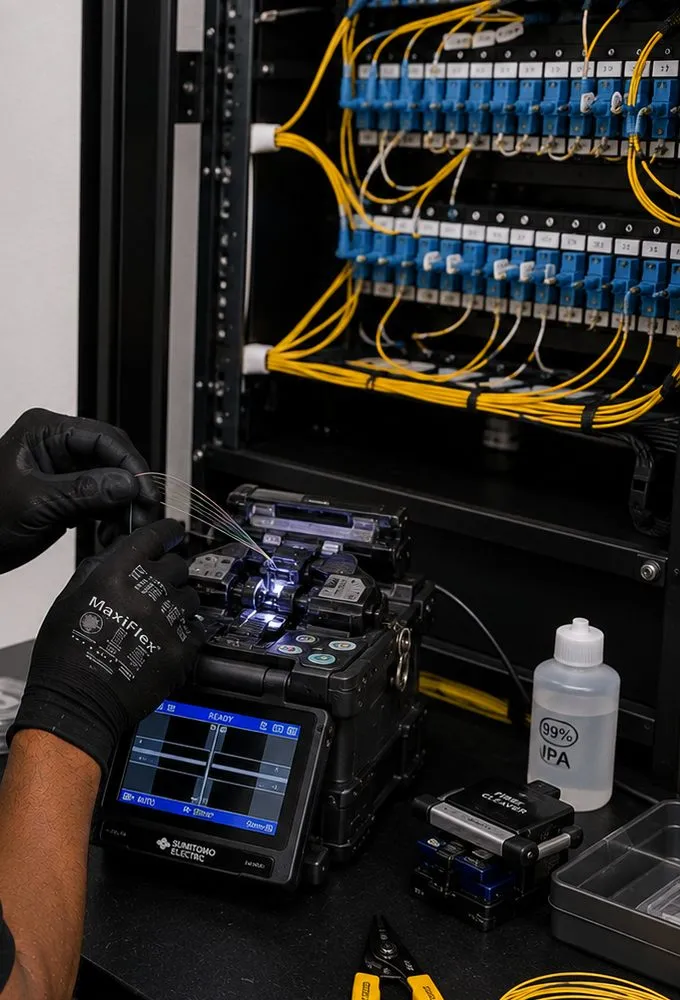
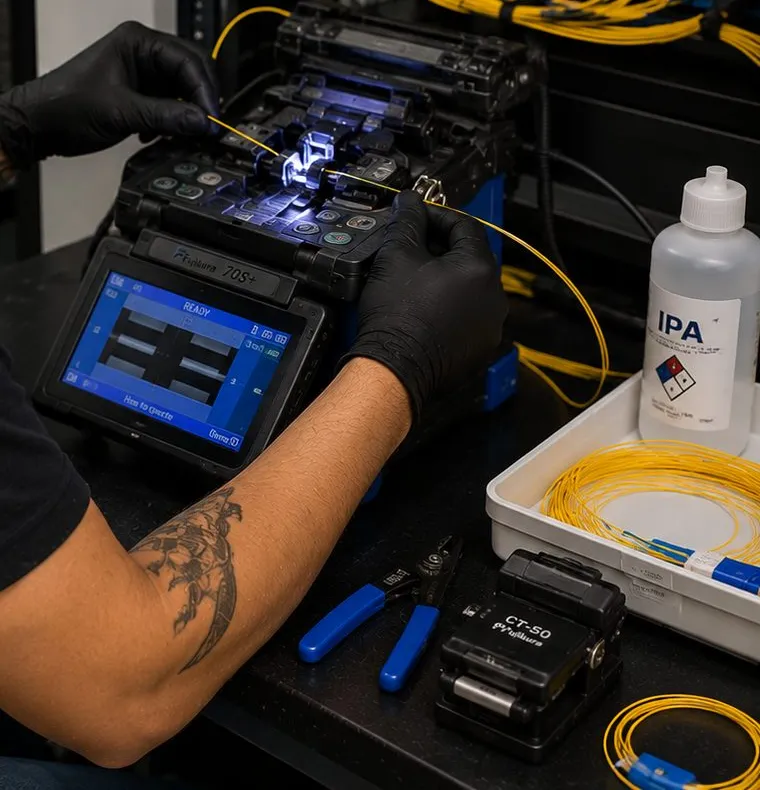
Port Richmond, Staten Island fiber optic installation: gloved hands feed a yellow fiber into a fusion splicer beside a rack of single-mode jumpers
Gloved hands guide a yellow fiber into the clamps of a fusion splicer whose screen reads ready; patched single-mode jumpers fill the rack behind it, and an alcohol bottle, cleaver and strippers sit on the bench. Library photo, cropped.
Port Richmond Fiber Quote
Tell us the address and the two points that need linking — we phone back the same business day

✅
Request Sent!
A member of our Staten Island team will call you back before the business day is over.
25+
Years Experience
✓
Same-Day Estimates
100%
Licensed & Insured
4.7★
201 Google Reviews

Running a shop on Port Richmond Avenue, a yard on Richmond Terrace, or an old house on Heberton Avenue? Call our Staten Island line at (347) 934-8335 or use the 60-second form. Two answers shape almost every quote we write here: do you own the building or rent it, and is the place where the internet arrives today the same place you need it?

  • Free site walk anywhere between the Kill Van Kull and Forest Avenue, the Bayonne Bridge and Clove Road
  • One crew plans, pulls, splices and meters the job; the loss reading for every strand is handed over on paper and by email
  • NYS low-voltage licence #12000287431; crews drive over from our 1282 Troy Ave base in Brooklyn
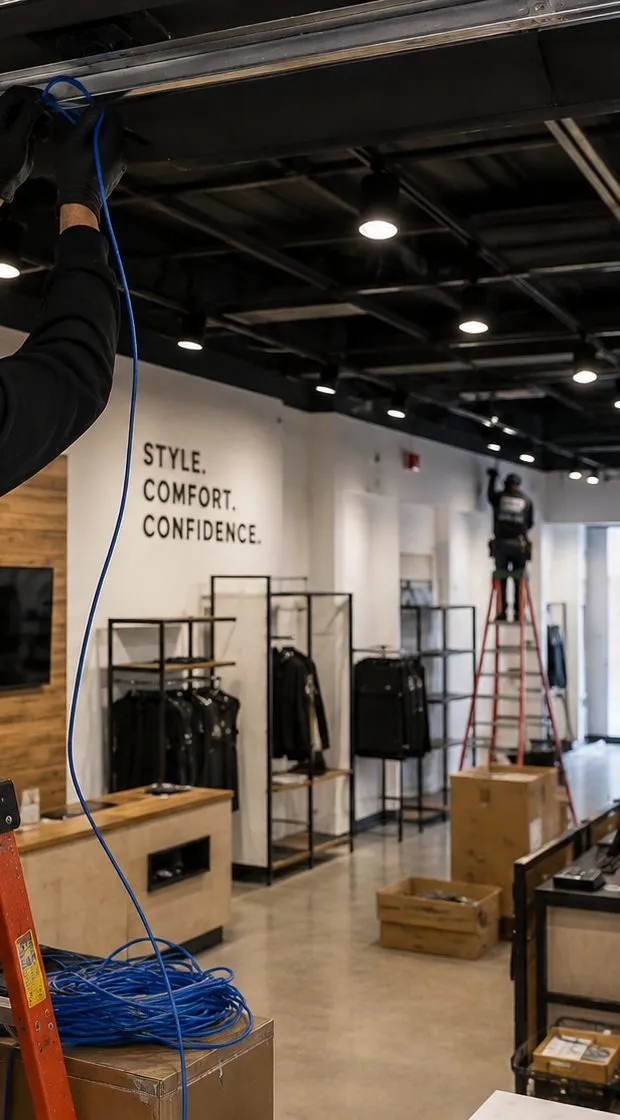
Fiber optic installation for a Port Richmond, Staten Island storefront: cable fed up into an open black retail ceiling from a stepladder
A technician on a stepladder feeds blue cable up into the open black ceiling of a retail floor, with the coil on a box below and clothing racks along the far wall. Library photo, cropped to remove a face and a printed phone number.
The Neighborhood

Why Port Richmond Properties Need Fiber Optic Installation

Port Richmond grew up as a landing. Ferries crossed from its docks to Bergen Point in what is now Bayonne, coaches on the New York–Philadelphia road stopped here, and oyster captains built houses along Richmond Terrace in the 1840s and 1850s. The village incorporated in 1866, the North Shore railroad arrived in the 1880s, and by the early twentieth century Port Richmond Avenue had a Carnegie library, a domed synagogue and, from 1924, the 2,126-seat Ritz Theater. Planners would later remember the avenue as the “5th Avenue of Staten Island.” Then the Bayonne Bridge opened in 1931, the ferries stopped, the North Shore rail line closed in 1953, and the place settled into what it is now: a working neighborhood of small businesses, old houses and a waterfront that still earns its living.

That history matters for fiber because it explains who calls us. The city's 2024 needs assessment of the commercial district counted 392 storefronts along Port Richmond Avenue and Forest Avenue, and of the 201 merchants it surveyed, 67 percent rent their space and only 16 percent own it. The typical business has been open about eight years and has three full-time employees. These are restaurants, bodegas, barbershops, check-cashing counters, clinics, auto shops and churches, and very few of them have an IT department or a landlord who wants to talk about cabling. When their network fails, it is almost never because the provider is missing; it is because the connection lands in a cellar, a hallway or a corner of the building that has nothing to do with where the register, the camera recorder or the back office sits.

North of Richmond Terrace the picture changes. The waterfront between the avenue and the bridge is zoned M3-1 for heavy industry, and the Department of City Planning's Port Richmond brownfield study described its open land as fleet storage, auto repair, junk storage, bus parking, maritime support and vacant lots. Most of those businesses own or lease a yard rather than a building. Their computers live in a shed, a trailer-sized office or a scale house, and the same study warned that updated federal maps would likely place most land north of the Terrace in Flood Zone A, with some buildings needing to be raised by as much as seven feet. A copper run across a wet yard to a low office is exactly the kind of link that fails first; a properly sealed fiber link with its electronics mounted high is the kind that comes back on when the water goes down.

The side streets are the third Port Richmond. Heberton Avenue, Bennett Street, Park Avenue and the blocks toward Post Avenue hold frame houses, a few of them from before the Civil War, that have been re-sided, divided and rewired by whoever happened to be working on them in each decade; more than half of Port Richmond's homes are now rented. Some are individual city landmarks; most are simply old. Fiber suits them better than another round of copper, because one thin cable fished through a single cavity can replace the bundle stapled along the baseboards, and it carries no current that could cause trouble near old electrical work. For the copper that finishes the job inside each room, see our Staten Island structured cabling page.

Six Port Richmond facts that shape a fiber job

  • 392 storefronts and 7.9 percent vacancy on the Port Richmond Avenue and Forest Avenue corridors in June 2024, against an average of 12.8 percent across the city's 75 business improvement districts (NYC Department of Small Business Services, Neighborhood 360° Commercial District Needs Assessment, La Colmena).
  • 67 percent of surveyed merchants rent and 16 percent own; the median business has three full-time employees and has been open eight years (same assessment, 201 merchant surveys) — so most fiber decisions here involve a landlord who is not on site.
  • 56 percent of occupied homes are rented in Port Richmond, whose population rose 8.9 percent between 2010 and 2020 to 22,609 (2020 Census, as compiled for the neighborhood).
  • Most land north of Richmond Terrace was expected to fall in Flood Zone A under the updated FEMA maps, and the waterfront is zoned M3-1 heavy manufacturing (Department of City Planning, Port Richmond Brownfield Opportunity Area presentation).
  • 72 percent of Staten Island's installed wire was overhead in the city's 2013 study of power lines, the highest share of any borough — which is why storm damage reaches Port Richmond's poles and drops so quickly (Mayor's Office of Long-Term Planning and Sustainability).
  • 215 feet of clearance now sits under the Bayonne Bridge, which lands in Port Richmond; the Port Authority's Raise the Roadway project lifted it from 151 feet and finished the new southbound roadway in February 2019.

When the fiber is going in anyway, many owners ask us to bring the door on the same path. If you would like a reader, a keypad or a video entry panel at the shop door or the yard gate, our Staten Island access control team can use the same pathway rather than drilling a second one.

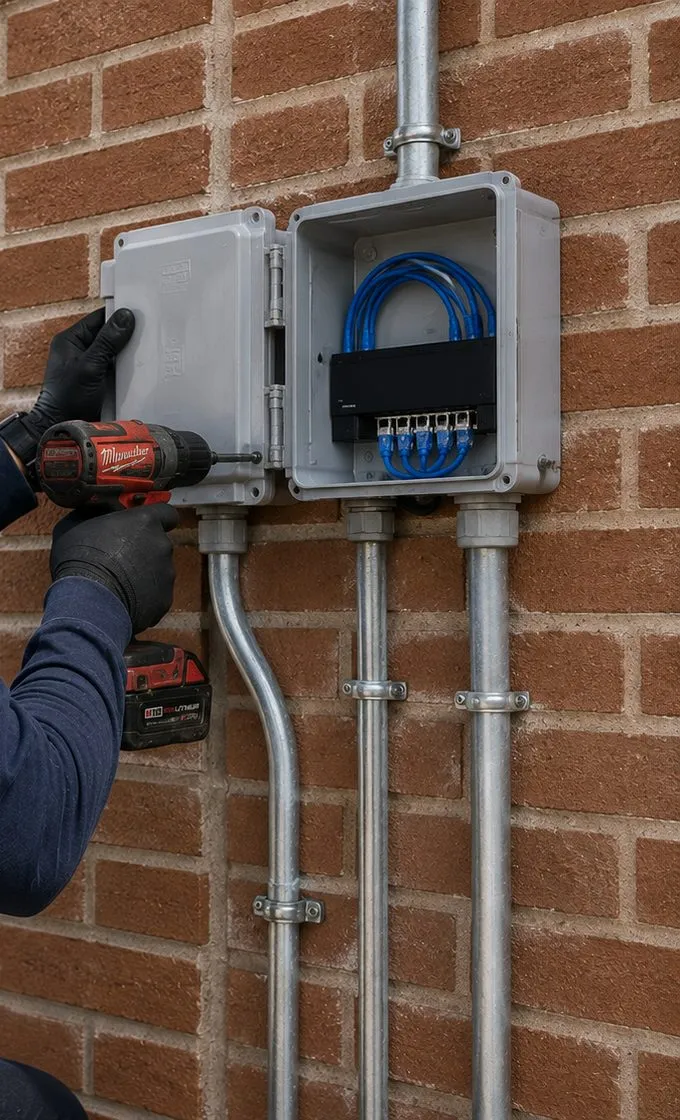
Port Richmond, Staten Island fiber job: weatherproof enclosures with conduit on a brick wall, one open to show a small switch
A gloved hand drives a screw into the lid of a grey weatherproof enclosure on a brick wall; the open box beside it holds a small switch and coiled blue cords, with metal conduit running down the brick from both boxes. Library photo, cropped to remove a face and a printed phone number.
Repair Capture

Need Fiber Repair in Port Richmond? Same Day Where Possible

A card reader that freezes every afternoon, a yard office that lost its link after a storm tide, an upstairs apartment that went dark when the store below changed hands. Repairs are billed at the service rate, not as a new installation. We try to reach Port Richmond the same day you call, and once inside, the usual culprits — a crushed patch cord, a dirty connector, a pigtail snapped in its tray, a cable pulled out of its gland when something heavy was moved — are found and fixed in about one to two hours, then metered again before we leave. Call (347) 934-8335 and say “fiber repair”; if the fault turns out to be on copper, our Staten Island network cable repair crew takes it from there.

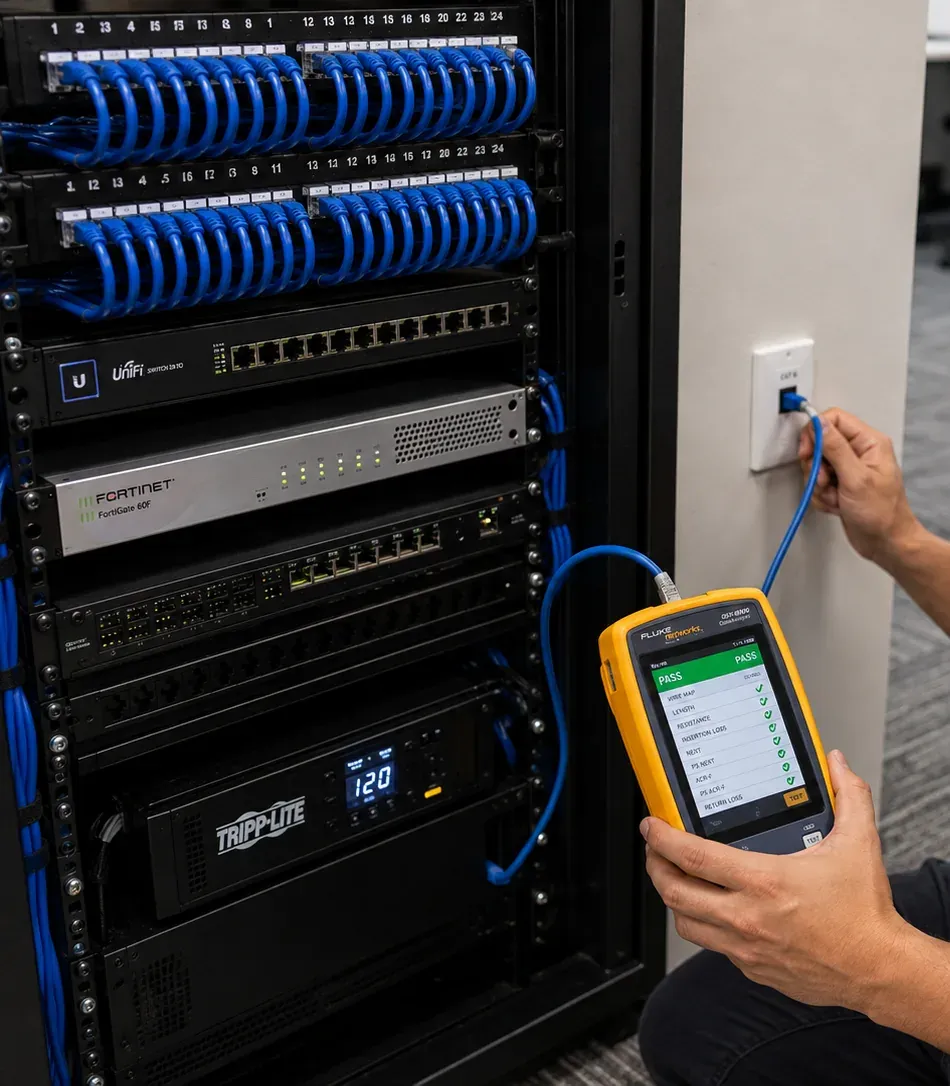
Link test for a fiber optic installation in Port Richmond, Staten Island: handheld certifier showing PASS beside a network rack
A handheld cable certifier showing a green PASS screen, its blue lead running to a wall jack beside a rack of patch panels, a switch, a firewall and a battery backup. Library photo of a copper certification test, cropped to remove a face.
What We Install

Fiber Optic Installation Services in Port Richmond

The internet provider brings service to the property line or the wall. Everything from that point to the place you actually use it is the owner's side, and that is the part we build. In Port Richmond that usually means short links that cross something awkward: a cellar that belongs to someone else, a yard that floods, a house that was never meant to carry cable.

Rented Storefront Links

A protected run from wherever the provider's line enters to the counter, the back office or the camera recorder, built so it can be documented for the landlord and left in good order when the lease ends.

Shop-and-Home Separation

For owners who live above the store: separate fiber paths and separate termination points for the business and the household, so a problem in one never takes down the other.

Yard and Scale-House Fiber

Outdoor-rated cable in conduit from the main office to a scale house, gate booth, shed or camera mast on an open waterfront lot, with every splice and switch mounted above the expected water line.

Auto and Body Shop Runs

Links to diagnostic stations, parts counters and office computers in repair shops, routed high and away from lifts, hoses and the paint booth, in cable rated for the space it passes through.

Frame-House Routes

A single small cable fished from the cellar through one cavity to an upper floor or the attic, for houses where there is no riser and the owner does not want baseboard wiring or walls opened.

Halls and Showrooms

Fiber to desks, kiosks and screens in large open rooms — showrooms, halls, gyms, churches — where there is no drop ceiling to hide a cable and the floor is the only path left.

Fusion Splicing

Pigtails and joins fused in our own splicer, with each splice protected in a tray and recorded, so later work can find any strand without guesswork.

Testing and Records

Loss measured on every strand, an OTDR trace where runs are long or leave the building, and a labelled sketch you can show to the next contractor or the next landlord.

Repairs and Re-terminations

Broken connectors, damaged jackets and links that stopped after other trades worked nearby, diagnosed with a light source, a power meter and a visual fault locator.

Building Specialists

Fiber Optic Installation for Port Richmond's Architecture

Port Richmond has no single building type. A short walk from the Reformed Church at the foot of the avenue to Forest Avenue passes Greek Revival frame, brick commercial blocks from the 1870s, a converted movie palace, low one-storey stores on slabs, metal sheds on the waterfront and a handful of newer apartment buildings. Each one asks the fiber to do something different.

Village-Era Frame Houses

Wood houses on Heberton Avenue, Cottage Place and the streets around them, some from the 1850s, with plaster on lath, narrow stair halls and fieldstone or brick foundations. No riser exists, so the route is a single cavity, a closet stack or a carefully placed exterior raceway, chosen with the owner before any hole is drilled.

Commercial Blocks With Flats Above

Two- and three-storey brick buildings along Port Richmond Avenue, some dating from the 1870s, with a store on the ground floor, apartments or offices above and a shared cellar below. Fiber usually rises through a rear stair or a chase beside the chimney, and the store and the upper floors are kept on separate termination points.

One-Storey Stores on Slabs

Low commercial buildings, including the strip buildings near Forest Avenue, with no cellar at all. The line comes in through a wall or the roof, and the only protected space for equipment may be a back-room shelf or a cabinet above the drop ceiling, so the layout is drawn around the stockroom.

Big Rooms: Theatres, Halls and Churches

The Ritz became a tile showroom in 1985, the old Empire Theater building was used by a lumber business until 2009, and the neighborhood's churches and halls have large open rooms. Fiber has to cross a wide floor or a high plaster ceiling without a grid to hide in.

Waterfront Sheds and Yard Offices

Steel buildings, block garages and small offices on the M3-1 waterfront, often on fill and inside the expected Zone A. Entries are sealed against water, enclosures go high on the wall, and outdoor runs use cable made for burial or wet conduit.

Newer Apartment Buildings

Newer apartment buildings on and near the avenue. These usually have a telecom closet; the work is extending clean fiber from it to a ground-floor store, a management office, a camera head-end or a laundry room.

How the method changes with the building

BuildingUsual entryUsual routeWhat we watch for
Frame houseCellar wall or sill plate, sealed sleeveOne stud bay, closet stack or painted exterior racewayFire-blocking in the cavity, old knob-and-tube or BX nearby, lath that cracks
Brick block with flatsCellar or rear wall, cored and sealedRear stair, chase or abandoned flue path to each floorShared cellar under several stores, party walls, store-tenant fit-outs
One-storey slab storeRear or side wall, sometimes the roofAbove the ceiling or along a surface raceway to the stockroomNo dry cellar, rooftop units, roof penetrations that must be flashed
Hall or showroomBack-of-house roomAlong walls and columns, or into a floor box where one existsFinished plaster ceilings, heavy displays, events that cannot be interrupted
Waterfront yardOffice wall above the flood lineBuried or wall-mounted conduit to sheds, scale houses and mastsZone A elevation, fill and old contamination, truck traffic over the route
Newer apartment buildingExisting telecom closetCorridor ceiling or sleeve to the store, office or equipment roomFirestopping at every rated wall, the developer's closet capacity
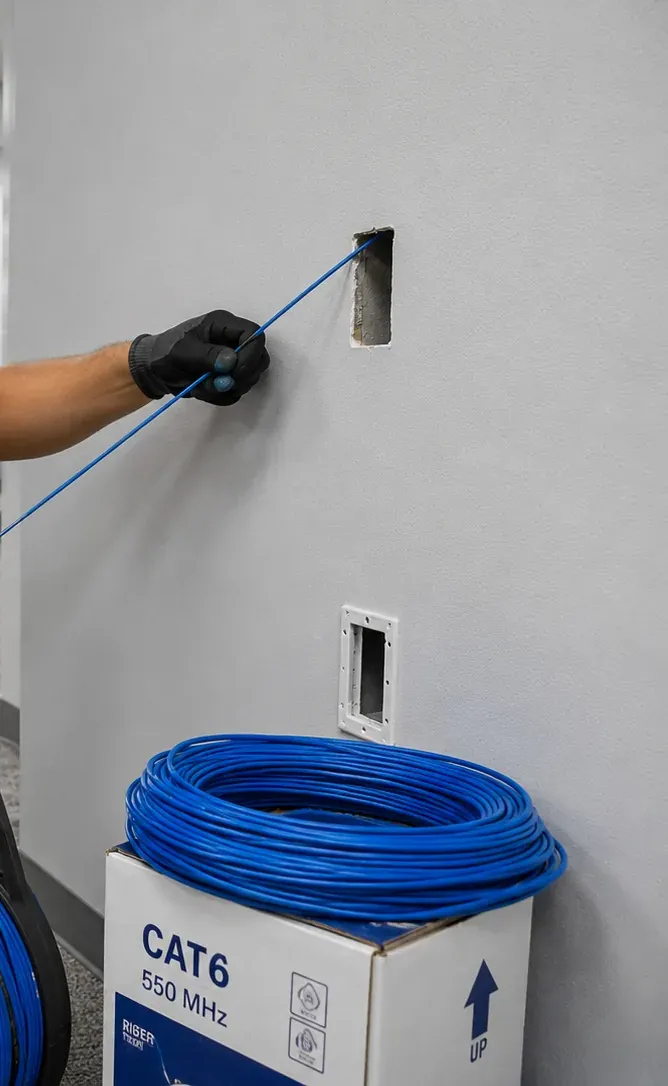
Retrofit fiber route in Port Richmond, Staten Island: fish rod pulled through a small cut-out in a finished wall
A gloved hand pulls a blue fish rod out of a small cut-out high on a painted wall, above a second wall opening and a coil of cable on its box. Library photo, cropped to remove a face and a printed phone number.
Commercial Fiber Optic Installation

Business Fiber Optic Installation in Port Richmond

The commercial district studied by the city runs along two streets: Port Richmond Avenue from Richmond Terrace to Forest Avenue, and Forest Avenue from Manor Road to Port Richmond Avenue. The waterfront along Richmond Terrace is a third economy entirely. Here is how fiber work tends to differ along each.

Lower Port Richmond Avenue

From the Terrace up past Bennett Street: the oldest commercial buildings, the Reformed Church, restaurants and food shops. Expect shared cellars, party walls and stores whose provider entry sits in a neighbor's space. Traffic counts on this stretch were about 10,320 vehicles a day in 2023.

Upper Port Richmond Avenue

Toward Castleton Avenue and Post Avenue: clinics, salons, money-transfer counters, professional offices and offices above stores. The jobs are mostly two short links — front counter to back office, store to upstairs — with careful separation between tenants.

Forest Avenue

Busier and newer, with about 19,638 vehicles a day near Jewett Avenue in 2023 and a mix of chains, strip buildings and auto businesses. Low buildings on slabs and pad sites mean roof or wall entries and equipment that cannot live in a cellar.

Richmond Terrace Waterfront

Maritime support, auto repair, fleet and bus parking, construction-debris transfer and open storage, much of it on M3-1 land in the expected flood zone. Fiber here runs between buildings across a yard, not up through floors.

Castleton Avenue and the Side Streets

Corner stores, churches, day cares, small offices and the Castleton bus depot nearby. Many of these are house-scale buildings converted to business use, so the frame-house methods apply.

Houses of Worship and Community Groups

The assessment noted a prominent nonprofit and social-services presence on the avenue. Congregations and community groups often need an office, a hall and a pantry or classroom linked on one property without a large budget.

Rules that apply to commercial fiber work here

Department of Buildings. Low-voltage cabling inside an existing building generally does not need a DOB permit on its own, but any work tied to a larger alteration, a change of occupancy or a new building follows that job's permits. Where we core through a rated floor or wall, the opening is closed with a listed firestop system and photographed before it is covered.
Landmarks. Port Richmond has individual city landmarks — among them the Reformed Church, the Carnegie library branch on Bennett Street, 121 Heberton Avenue, the former P.S. 20 on Heberton Avenue and 29 Cottage Place — but no designated historic district. Exterior work on a designated building needs Landmarks Preservation Commission approval; neighboring buildings do not.
Flood zone and zoning. Most land north of Richmond Terrace was expected to be mapped Flood Zone A, and the waterfront is zoned M3-1. Neither rule stops low-voltage work, but both shape it: equipment goes above the base flood elevation where it can, and any future flood-proofing or elevation project should be planned with the fiber route in mind.
Digging. Any trench or post hole on a yard must be called in to New York 811 first, and many waterfront lots carry the legacy of industrial use. Where a site has a remediation history or an environmental cap, we stay out of the ground until the owner's environmental consultant has said where digging is allowed.
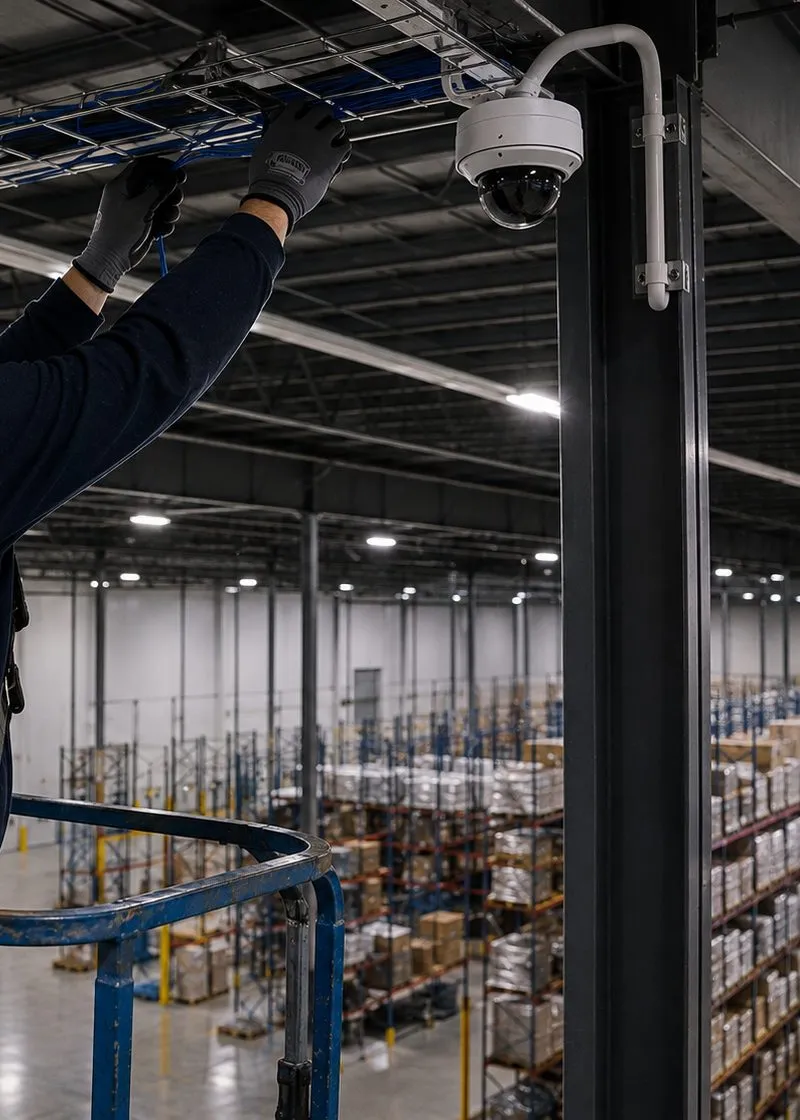
Port Richmond, Staten Island yard and shed fiber: cable dressed into a wire-basket tray under a high warehouse roof beside a dome camera
From a scissor lift, gloved hands dress blue cable into a wire-basket tray hung beneath a warehouse roof, next to a white dome camera on a pendant arm; pallet racking fills the floor below. Library photo, cropped to remove a face and printed lettering.
Renting the Space

Fiber for Merchants Who Rent Their Storefront

Two out of three Port Richmond merchants rent, and that single fact changes how a fiber job should be designed. A renter needs a link that works now, that the landlord will agree to, and that will not become an argument when the lease is renewed or ends. An owner can think in decades; a renter has to think in lease terms. We plan for both, but we start by asking which one you are.

The first step is a short written description of what we intend to do, in plain language, that a renting merchant can send to the landlord or the managing agent. It says where the cable will enter, which walls or floors it will pass through, how each opening will be sealed, where the small enclosure at each end will be mounted and what it will look like. Most landlords on the avenue are small owners, often living elsewhere on the island or off it, and a clear page with a sketch gets a faster yes than a phone call. If the landlord wants to see us, we will meet them at the building.

The second step is deciding which parts of the job are fixtures and which are equipment. Cable fastened inside walls and ceilings, sleeves through masonry and firestopping become part of the building in practice, and we design them to be useful to whoever comes next: labelled, documented and left with spare length coiled at each end. The switch, the media converter and the patch cords are the merchant's, mounted so they can be unplugged and carried to the next location in an afternoon. Writing that split into the proposal means nobody has to remember it later.

The third step is keeping the route inside the merchant's own space wherever the building allows it. In older blocks the provider's line often comes up in a cellar that is rented to a different store, or along a hallway that belongs to the apartments upstairs. Where that cannot be avoided, the run through someone else's space is kept short, enclosed and clearly marked with the merchant's name, so a future tenant downstairs does not mistake it for abandoned cable and pull it out.

None of this makes a renter's job more expensive than an owner's. It makes it more predictable. A storefront that knows exactly what was installed, where, and who it belongs to can renew a lease, sell a business or move three doors down without paying for the same cable twice.

The Waterfront

Richmond Terrace Yards: Fiber on Land That Works and Floods

North of Richmond Terrace, Port Richmond still looks the way the brownfield study described it: a strip of M3-1 land between the road and the Kill Van Kull, used for fleet and bus storage, auto repair, construction-debris transfer, maritime support and open storage, with the Bayonne Bridge rising over its western end. The study counted 37 sites with about 12.5 acres of open land in its first subarea alone, concentrated along the water. These are businesses that own or lease ground, not floors, and their networks are spread across it: an office near the gate, a shop or garage at the back, a scale or a camera mast somewhere in between.

Two things decide a fiber design on such a lot. The first is height. Because most of this land was expected to fall in Flood Zone A, every splice enclosure, switch and power supply goes as high on the wall as the building allows, with the cable entering from below through a sealed gland so water running down the conduit cannot reach the connectors. The cable itself can sit in wet conduit for years if it is the right kind — gel-free, water-blocked outdoor cable made for it — but electronics cannot. Storm Sandy showed what happens otherwise: a few minutes west along the Terrace in Mariners Harbor, one business owner told DNAinfo in December 2012 that the surge had topped his eight-foot seawall, and a neighbor said his building had been gutted.

The second is the ground. Waterfront lots in Port Richmond carry a long industrial history; the city's study named former paint, boat and lead sites among its strategic properties, one of them part of an EPA Superfund listing. We never trench through a yard on assumption. The route is called in to New York 811, the owner's records are checked for caps, liners or restricted areas, and where digging is off-limits we use surface-mounted conduit along fences and building walls, or an overhead span between two structures the owner controls. On land that carries heavy trucks, buried conduit goes deep enough and is sleeved where it crosses the driving lanes.

Kill Van Kull Expected flood line (illustrative, not to scale) Yard office switch Scale house converter camera mast water-blocked outdoor fiber in buried conduit, sleeved under truck lanes sealed gland, cable enters from below terminal mounted high
Schematic only: on a waterfront yard the cable can live in wet conduit, but every switch, converter and splice is mounted above the expected flood line and fed from below.

If your yard also needs cameras over the gate and the stacks, our Staten Island construction and yard camera crews can put them on the same fiber, and the warehouse camera team handles larger sheds.

Fiber optic installation Port Richmond, Staten Island: cable pulled from an EMT conduit elbow on a concrete-block wall
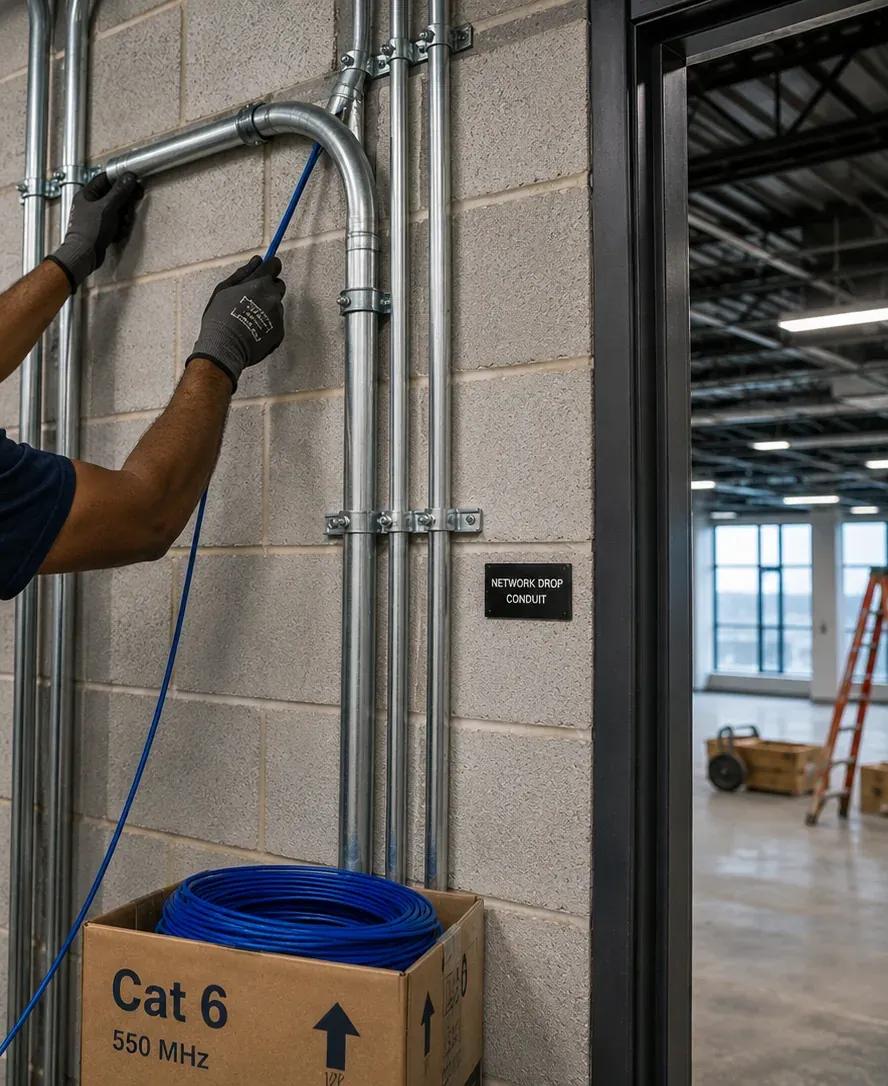
Gloved hands pull blue cable out of an EMT conduit elbow on a concrete-block wall, beside a labelled conduit sign and an open doorway onto an unfinished floor. Library photo, cropped to remove a face and a printed phone number.
Old Houses

Village-Era Houses: One Thin Cable Instead of Another Bundle

The houses off Port Richmond Avenue were built long before anyone imagined a network. The Landmarks Preservation Commission dates 121 Heberton Avenue to about 1859–61, the work of carpenter-builder James G. Burger, who also designed the Reformed Church; 29 Cottage Place is a two-storey Greek Revival frame cottage in the old saltbox form. Most of their neighbors are not landmarks, but they share the same bones: balloon or early platform framing, plaster on wood lath, stone or brick foundations and, very often, decades of telephone, cable and alarm wire stapled along the outside or the baseboards.

In a house like that, the goal is to add one path and remove three. We look first for a cavity that already runs from cellar to upper floor without fire-blocking — a closet stack, a chase beside an old chimney, a pipe chase from a bathroom added later — and fish a single small cable through it with a rod and a pull string, opening plaster only where an enclosure or outlet will sit. Where a cavity is blocked, we drill the plate carefully from below, never notching a joist, and close the opening around the cable with an approved fire-block material afterwards.

If no inside path exists, an exterior raceway is the honest alternative. Run vertically in a back corner, painted to match the siding and entering through a sealed sleeve under the eaves, it is less visible than the bundle of drop wires it replaces. On a designated landmark that exterior work needs the Commission's approval first; on the house next door it does not, but we still plan it so it can be removed without leaving scars.

Fiber has one more advantage in an old house: the glass carries light, not electricity. It can share a cavity with old wiring without adding heat or a shock risk, although we never open or disturb electrical work and will tell you if what we find needs an electrician's attention. When the house is also getting a doorbell camera or a smart lock, the same visit can include our Staten Island doorbell camera or smart lock installation crews.

Your Questions Answered

Fiber Optic Installation in Port Richmond: Questions Answered

These are the situations Port Richmond owners, merchants and yard operators describe when they call, grouped by the kind of property. Each answer is the one we would give on a site walk.

Storefronts and Mixed-Use Buildings

Our storefront still has its old pressed-metal ceiling — can fiber get to the back of the shop without cutting into it?

Usually, yes. Pressed-metal panels are nailed to wood furring, and the space above them is rarely accessible from below without damage, so we do not try to go through the ceiling at all. The cable travels along the top of a wall in a small painted raceway or inside the crown molding line, drops through the stockroom wall, or runs below the floor from the cellar and comes up behind the counter. If a panel has to come down for another reason — a light fixture, a sprinkler head — we can use that opening, and the panel goes back on its original nails. We photograph the ceiling before work starts so there is no argument afterwards about what was already dented.

Our family's shop and our apartment upstairs share one internet account — how do we split them onto separate, separately billed lines?

The provider has to open a second account, but the wiring is ours to arrange. We bring a small fiber cable or two strands from the entry point to an enclosure in the store and another to the apartment, so each account terminates in its own space with its own equipment. The business then has a clean line for card terminals, cameras and the office computer, and the household's streaming and homework never compete with it. Splitting them also helps at tax time and makes the shop easier to sell or lease separately later, since the store's network is already self-contained. If you want cameras watching the shop from upstairs, that is done on purpose through a firewall rule, not by accident through a shared router.

Our one-storey store is built on a slab with no cellar — where does the provider's line come in, and where does our equipment go?

With no cellar, the line comes in through an outside wall, usually at the rear or the side, or occasionally down through the roof where the drop arrives overhead. We core a sealed sleeve at that point and mount the provider's terminal and our splice enclosure on the inside of the same wall, high enough to be out of the way of stock and mops. From there fiber runs above the ceiling or in a surface raceway to wherever the network equipment will live. In small slab stores that is often a ventilated wall cabinet in the stockroom or office rather than a floor rack, because floor space is worth more as selling space. If the building's roof carries rooftop units, a roof entry is flashed by a roofer, not by us.

Our showroom fills one big hall with a finished ceiling we can't open — how does fiber reach a sales desk standing in the middle of the floor?

There are three honest routes, and the walk-through decides which one fits. If the floor is wood over a cellar, we drill up from below directly under the desk and finish the hole with a flush floor box. If it is a slab, we look for an existing floor box or trench, or run along the nearest column and down a surface raceway to the desk. If neither is acceptable, the desk can sit at the end of a short, low-profile floor cord cover from the nearest wall, which is less elegant but leaves the building untouched. Fiber helps in all three cases because the cable is so thin that a single small channel can carry the data for the point-of-sale, a screen and a camera at once.

Yards, Shops and the Waterfront

Our yard's truck scale and scale house sit by the gate, a long way from the office — can fiber connect the scale terminal to the office computer?

Yes, and fiber is often the best answer for exactly that distance. Many scale indicators still talk over a serial connection, and some newer ones use a network port; either can be carried by a fiber link with a small converter at each end, so the reading appears on the office computer as if the indicator were next to it. Because fiber does not conduct electricity, a lightning strike near the scale or a fault on the scale house's power cannot travel down it into the office. We run outdoor cable in conduit, sleeve it where it crosses the truck lane, and mount the scale-house converter well above the floor. Your scale company stays responsible for the indicator and its calibration; we only build and test the link.

Can a fiber run go into an auto-body paint booth, or does it have to stop outside?

The cable can sometimes pass through; the electronics stay outside. Spray booths are treated as hazardous locations because of the solvent vapour, and any device that could spark — a switch, a camera, a converter, a power supply — must either stay outside the booth or be specifically rated for that classification. A passive, all-dielectric fiber cable carries no current, which is why it is sometimes chosen to link equipment on either side of a booth wall. In practice we keep the network outside the booth, run fiber to a rated or remotely located device when a booth camera or controller is needed, and follow the booth manufacturer's and the fire inspector's requirements. If they say no penetration, there is no penetration.

Our building north of Richmond Terrace is due to be flood-proofed in the next few years — what fiber work should go in now, and what should wait?

Put in what will survive the project and leave out what the project will move. The entry sleeve, the route above the expected flood line and the main enclosure on an upper wall can usually go in now, because a flood-proofing design will want the network up high anyway. What should wait is anything at or below floor level — a floor box, a low cabinet, a buried run that the contractor may excavate — and anything attached to walls that will be rebuilt. We ask to see the engineer's drawings if they exist, mark the fiber on them, and leave extra cable coiled at the enclosure so a raised floor or a new wall can be accommodated by re-routing rather than re-pulling. If the building will be physically elevated, plan for the link to be disconnected and reconnected as part of that job.

Community Uses

We run a licensed day care on the ground floor — how is fiber run so children can't reach the cable or the equipment?

By keeping everything above reach and behind something. Cable runs inside walls or ceilings, or in a closed raceway mounted high, never as loose cord along the floor or across a play area. The enclosure, switch and Wi-Fi access points go on walls above about six feet, in a locked cabinet or the office, with no exposed patch cords. Fiber itself is a small hazard compared with copper because it carries no electricity, but a broken strand can leave a tiny glass splinter, so we clean up offcuts on a mat and check the floor before we leave. Work is scheduled when the children are not there, and we can supply the details of the installation for your licensing file if your inspector asks.

Apartment (household account) Store (business account) Cellar (may be shared or rented to another store) entry sealed sleeve splice shop home rear stair or chase short, labelled, enclosed Each account ends in its own space, on its own strands.
Schematic only: in a store with a family apartment above, the business and household paths split at the entry and never share equipment.
Equipment

Types of Fiber Optic Cabling We Install

Most Port Richmond links are short and cross one difficult thing, so the choice of cable is driven by what it crosses rather than how far it goes.

OS2 Single-Mode

Our default for anything leaving a building or likely to be upgraded: a yard link to a scale house, a store-to-apartment split, a hall to a rectory. Inexpensive glass that will carry far faster equipment than any shop needs today.

OM4 Multimode

For short runs inside one building where the equipment at both ends already uses multimode optics, or where an existing multimode backbone is being extended rather than replaced.

Indoor/Outdoor Water-Blocked Cable

Dry water-blocking tapes instead of gel, so one cable can run from a damp cellar or wet yard conduit into a building without a transition splice at the door.

Armored Cable

A metal or heavy dielectric armor layer where cable could be crushed or chewed: under shop floors, in yard conduit that trucks cross, along a cellar beam where stock is stacked.

All-Dielectric Cable

No metal anywhere in the sheath, for runs between separate structures, near hazardous-location boundaries and anywhere a conductive path would be a liability.

Small-Diameter Drop Cable

A slim, bend-tolerant cable for fishing through a single stud bay in a frame house or along a narrow raceway in a stair hall.

Wall and Rack Enclosures

Small wall-mount splice boxes for houses and stores without a rack, and rack-mount panels for offices and yard buildings that have one, all labelled strand by strand.

Media Converters and SFP Optics

The small electronics that turn light back into a network port at each end: a converter for a camera mast or a scale terminal, an SFP module where the switch has a fiber slot.

Staten Island fiber splicing for Port Richmond jobs: stripped fibers over a fusion splicer below blue adapter panels and yellow jumpers
A glove holds stripped fibers over the clamps of a fusion splicer on a bench, below a rack of blue adapter panels with yellow jumpers; a cleaver, an alcohol bottle and strippers lie on the bench. Library photo, cropped to remove a face and a printed phone number.
AI Overview Reality Check

What AI Gets Wrong About Fiber Optic Installation in Port Richmond

Search summaries and chat assistants answer fiber questions by blending national cost guides, provider marketing and forum posts. The numbers below are quoted from those published sources; none of them is wrong where it came from. They just describe somewhere other than a Port Richmond storefront or yard.

“Fiber optic cable installation costs average $4,500 for most homeowners”

A large home-services marketplace states that installation “costs average $4,500 for most homeowners, with most installations ranging from $1,500 to $7,000.” AI tools repeat that figure to anyone who asks what fiber costs, including shop owners.

The figure is built from residential projects across the country, many of them long runs from a road to a house on a large lot. Port Richmond requests are mostly the opposite: a store, a small office or a frame house where the distance is short and the difficulty is in the building.

Our Staten Island price list is published below and applies here unchanged. A two-drop storefront job is a fraction of that average; a building-to-building link across a yard can exceed it. The walk-through, not a national average, tells you which one you have.

“Materials cost $1 to $3 per linear foot”

The same guide, discussing doing it yourself, notes that “materials cost $1 to $3 per linear foot,” adding that you will also need strippers, cleavers, splicing kits and safety gear. Assistants sometimes turn that into a suggestion that a handy owner can install fiber for the price of the cable.

The cable really is cheap. The cost is in terminating, protecting and proving it: a fusion splicer, a scope to inspect each end face, a light source and power meter to measure loss, and the experience to avoid bending glass tighter than its rating in a cramped cellar.

A link that works on day one but was never metered tends to fail later in ways that look like provider trouble. That is why every job we do ends with a written loss reading for each strand.

“Drop count and run distance are the primary cost drivers”

A cabling firm's 2026 guide prices commercial work at “$300 to $800 per fiber drop installed for a typical office run” and concludes that “drop count and run distance are the primary cost drivers.”

That per-drop range is reasonable, and our Staten Island multimode and single-mode drop prices sit inside it. What it assumes, though, is an office with an open ceiling grid and a telecom room. Few Port Richmond buildings have either.

Here the variables are a shared cellar, a pressed-metal ceiling, a landlord's approval or a yard that floods. Those change the route and the hours, which is why the proposal lists each drop and each crossing separately instead of quoting one blended number.

“Commercial fiber optic installation cost in the Bay Area typically runs between $10,000 and $100,000+ per project”

A California installer's 2026 guide opens by saying commercial projects there run from $10,000 to more than $100,000, and advises that “for a small office build-out under 5,000 square feet, budget at least $10,000–$15,000.” Chat answers lift those lines without their location.

The median Port Richmond business surveyed by the city has three full-time employees. A typical request is one link from the entry to the counter and a second to the office or upstairs, not a full office build-out with dozens of outlets.

Small jobs are priced from our published lines and nothing else. If a storefront needs two drops, the proposal says two drops, and the number follows from that.

“Spectrum quote $6000 for ~450ft of cable on pre-installed poles”

A widely shared home-networking forum thread is titled “Fiber optic cable $/foot, Spectrum quote $6000 for ~450ft of cable on pre-installed poles,” and AI tools use posts like it to estimate what “getting fiber” costs.

That was a provider's construction charge to extend its own network along utility poles to a customer. It is a different job from the private fiber we install on your property, and the two are often confused.

On Staten Island, where the city's 2013 study found 72 percent of installed wire overhead, providers usually reach Port Richmond buildings from the pole. Our work begins where their drop ends, at your wall or your yard.

“Underground trenching costs $15–$35 per linear foot”

Another commercial guide lists “underground trenching costs $15–$35 per linear foot” and directional boring at $20 to $30. Assistants apply those ranges to any yard.

On the Port Richmond waterfront the price of a trench is set less by length than by what is underneath: fill, old foundations, a cap over former industrial ground, or a restriction from an environmental consultant. Some lots should not be dug at all.

That is why a yard link is often cheaper above ground than below it. Conduit on a fence line or building wall, or a span between two structures the owner controls, can avoid the trench entirely and keep the electronics above the flood line.

“24 Count Fiber = 70,000 ft at $0.68 per foot”

A question-and-answer site gives cable prices such as “24 Count Fiber = 70,000 ft at $0.68 per foot,” and AI answers sometimes treat that as the price of a fiber job.

Those are bulk material prices for an outside-plant project measured in miles. A storefront in Port Richmond uses a few hundred feet at most, and the reel price is a very small part of what it costs to do the work correctly.

What you are paying for is the entry sealed against water, the route agreed with the landlord, the splices, the test results and a labelled record. Our price table shows exactly how those are charged.
Counter to Back Office, Gate to Yard Office, Cellar to Attic

Send the address and tell us whether you own or rent. We walk the property, show you the route and put the price in writing before anything is drilled.

Get In Touch

Request a Free Quote

Give us the address, the two places that need to be connected and whether you own or rent the space. Port Richmond requests are answered within the business day, or call (347) 934-8335.

✅

Request Received

Got it. Expect a call from the Staten Island crew today; for a shop or yard that is offline at this moment, ring (347) 934-8335.

How It Works

Our Installation Process

The same six stages apply to a two-drop store and a three-building yard. What makes Port Richmond different is how often stage two depends on someone who is not on the property — a landlord, a managing agent, a scale company or an environmental consultant — so we chase those answers ourselves and keep the work date from slipping.

1. Site walk and ownership check

We find where the provider's line arrives, where the network has to be, who controls each space in between and how high water has reached on the property.

2. Written route and approvals

A one-page route description and sketch the landlord or agent can approve, an itemised proposal from our published lines, and any Landmarks or 811 steps the site needs.

3. Entries and pathways

Sealed sleeves through brick, block or siding; raceway, conduit or a fished cavity prepared; enclosures mounted high on the wall at each end.

4. Cable placed and protected

Pulled within its tension and bend limits, armored or sleeved where it could be crushed, fire-blocked or firestopped where it passes rated construction, and photographed before anything covers it.

5. Splice, inspect and meter

Pigtails fusion-spliced, every connector end face inspected before it is mated, loss measured on each strand, and an OTDR trace on runs that leave the building.

6. Cutover and handover

Equipment connected at a quiet hour, both ends labelled with the owner's or merchant's name, and the readings, photos and sketch delivered in writing.

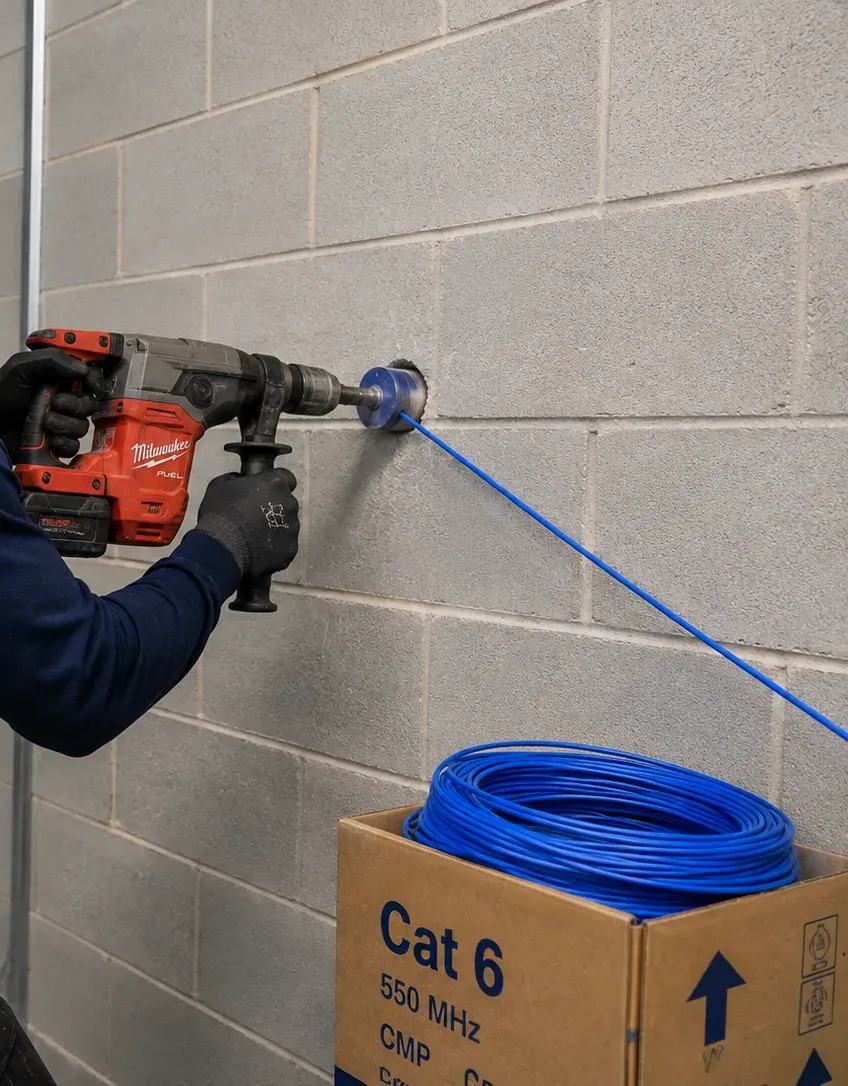
Port Richmond, Staten Island fiber entry: hammer drill boring a sleeve through concrete block with a pull line through the hole
A hammer drill with a hollow bit bores a sleeve through a concrete-block wall while a blue pull line runs from the hole to a coil on a box below. Library photo, cropped to remove a face and a printed phone number.
Coverage Area

Fiber Optic Installation Near Port Richmond's Landmarks

Port Richmond's landmarks are a map of its three economies: the old village, the main street and the working shore. We use them the way customers do, to say which end of the neighborhood a job is in.

Reformed Church on Staten Island

The Greek Revival church at 54 Port Richmond Avenue, built in the mid-1840s to designs by James G. Burger, with its Sunday school and cemetery; a designated city landmark at the foot of the avenue.

Port Richmond Library

The New York Public Library's Carnegie branch at 75 Bennett Street, opened on March 18, 1905, and later given the Chimes Playhouse auditorium; a city landmark a block off the avenue.

The Ritz

Built by Sol Brill and opened in 1924 with 2,126 seats at Port Richmond Avenue and Anderson Avenue, the former vaudeville and movie house became a tile showroom in 1985 and still has murals inside.

Bayonne Bridge

Opened in 1931 with a 1,675-foot arch span, the bridge lands on the western edge of the neighborhood; its roadway was raised to give 215 feet of clearance, and its walkway and bike path reopened in May 2019.

Faber Park and Pool

The waterfront park on Richmond Terrace, on land granted to Jenny Faber in 1869, with a pool completed in 1932 that was the largest on Staten Island at the time.

Heberton Avenue Landmarks

The house at 121 Heberton Avenue from about 1859–61 and the former P.S. 20, a school building of 1891 designated in 1988, anchor the street of older houses south of the avenue.

We also serve the blocks around them: Elm Park and Mariners Harbor to the west, West Brighton to the east and Westerleigh across Forest Avenue to the south, as well as the rest of the North Shore. Every one of those places is quoted from the same Staten Island price list.

Pricing

Fiber Optic Installation Cost in Port Richmond

Port Richmond carries no surcharge of its own. Every line below is copied exactly from our Staten Island fiber optic installation price list, which applies across the borough. What changes from one Port Richmond job to the next is how many of each line the job needs, never the price of the line.

ItemPriceWhat it covers
Fiber termination on an existing cable$39 per terminationAny common connector (LC, SC, ST, MPO); fused pigtail or field-installed mechanical end
OTDR test$44 per strandTrace and event table per strand, in addition to loss testing
Multimode fiber drop$385 per dropShorter in-building run, terminated and tested
Single-mode fiber drop$440 per dropShorter in-building run, terminated and tested
12-strand OM4 backbone$4,950 – $7,700Fusion-spliced, enclosures at both ends, firestopped, loss-tested
24-strand OS2 single-mode backbone or building-to-building link$8,800 – $16,500+Single-mode with an OTDR trace on every strand
Second telecom room with fiber linkfrom $2,640Extra closet built out, plus the strands that link it to your existing equipment room
Service and callback rate$195/hr, 3-hr minimum ($585)Repairs, troubleshooting and return visits — not the initial install; the same rate in every area

What moves a Port Richmond quote up or down

  • Who controls the route. A run that stays inside the merchant's own space is simpler than one that has to pass through a cellar or hallway controlled by someone else.
  • What the cable crosses. Brick and block are cored once; a pressed-metal ceiling, a finished hall or a frame cavity with fire-blocking takes more care and more hours.
  • Whether it leaves the building. A yard link is priced as a building-to-building run, with conduit and an OTDR trace, rather than as a drop.
  • How high the electronics must go. On land north of Richmond Terrace, mounting above the expected flood line sometimes means a longer route to a higher wall.
  • What can be reused. A sound existing sleeve, conduit or backbone saves labour; we test what is there before we price around it.
Shop Our Systems

Fiber Optic Installation Packages & Pricing

These three bundles are simply sums of the published lines above. They are a starting point for the conversation, not a menu you have to pick from.

Starter — Two Fiber Drops

$880

The usual first job on the avenue: one $440 single-mode drop from where the provider lands to the counter, and a second $440 drop to the office, stockroom or family apartment. Both ends finished and metered. Anything that leaves the building is priced after we have walked it.

Standard — Building Backbone

$4,950 – $7,700

For an owner of a brick block with stores below and flats or offices above: twelve OM4 strands from the cellar or entry to an enclosure on each upper floor, sealed through every rated floor, with a meter reading per strand.

Premium — Building to Building

$8,800 – $16,500+

A yard office tied to its shop or scale house, or a church tied to its hall: two dozen single-mode strands in outdoor cable between buildings the owner controls, each one traced on the OTDR and recorded.

Bring your own equipment — labour only. If you already have the cable, a converter kit your scale or camera vendor supplied, or switches your IT person chose, we install and test it on labour alone at $195 an hour with a three-hour minimum ($585). We still meter every strand and give you the readings.
Storms and Overhead Lines

When the Wind Takes the Pole: Fiber and North Shore Storms

Staten Island is the city's overhead borough. In the city's 2013 study of power lines, 72 percent of the island's installed wire was on poles, compared with 22 percent in Queens and 12 percent in Brooklyn. Telephone and cable plant share many of those poles, which is why Port Richmond's internet service usually reaches a building as an aerial drop from the street. When Tropical Storm Isaias hit in August 2020, Con Edison reported 29,000 Staten Island customers without power, much of it from trees and branches bringing down overhead lines.

Private fiber cannot stop a provider's drop from coming down, and nothing on this page pretends otherwise. What it can do is make the owner's side of the network the part that does not fail. A fiber run inside the building is immune to the lightning surges and ground faults that travel along copper during storms, and a link to a yard building or an upstairs apartment comes back the moment the provider restores service, without a dead switch or a burnt port to replace.

Three simple choices make a Port Richmond network ride through storms better. Put a small battery backup under the switch and the provider's equipment at the main end, so a short outage does not reboot everything. Keep the provider's entry and our enclosure high on the wall, away from the water that follows a storm surge. And where a business cannot be offline at all, plan a second path — a cellular backup or a second provider entering by a different route — and let the fiber carry whichever one is working to the rooms that need it.

The Bridge and the Rails

Living Beside the Bayonne Bridge and the Old North Shore Line

Two pieces of regional infrastructure cut through Port Richmond, and both come up when owners plan a route. The Bayonne Bridge lands on the neighborhood's western edge. Between 2013 and 2019 the Port Authority raised its roadway inside the original 1931 arch to let larger ships reach the port, opening the new northbound deck in February 2017 and completing the southbound side in February 2019 at a total cost of about $1.7 billion. The land under its approaches belongs to the bridge, not to the businesses beside it.

The North Shore Branch of the Staten Island Railway is the other. The Baltimore and Ohio, which owned the line, raised the Port Richmond section onto a viaduct in 1935; the branch closed in 1953, and the old Port Richmond station still stands. The city's brownfield study recommended environmental review for a bus rapid transit line on the former rail right-of-way, so its future use is a public question.

For a fiber job, the lesson from both is the same: a private link is planned on private land. We do not attach to bridge structures, rail viaducts or public rights-of-way, and we do not route a customer's cable across them on the hope that nobody minds. When two buildings an owner controls sit on opposite sides of one of these, the practical choices are a circuit leased from a provider, a point-to-point wireless link between rooftops, or a route that goes around rather than across. We will tell you which one makes sense at the site walk.

Small Budgets

Doing the Most Useful Part First on a Small-Business Budget

A business with three employees does not need a building backbone. It needs the one link that keeps sales moving, done properly. When a Port Richmond merchant tells us the budget is tight, we rank the work by what stops the business when it fails and quote the top of the list first.

The first priority is nearly always the path from the provider's entry to the counter. If that run is copper that passes through a damp cellar or a neighbor's space, it is the weak point, and replacing it with one single-mode drop and a converter at each end costs one line on our price list. The second is separating anything that does not belong on the same network: the family's apartment, a tenant upstairs, the public Wi-Fi for customers. The third is the camera recorder and anything else that would be expensive to lose in a flood, moved up and fed by fiber from wherever the line enters.

Everything we install in the first stage is sized for the next. We leave pull strings in any raceway or conduit, coil spare cable at each enclosure and use enclosures with room for more splices, so the second stage adds strands and devices rather than starting again. The proposal lists both stages, with prices from the same published lines, so the owner can decide when the second one makes sense.

Congregations and Community Groups

Churches, Halls and Community Rooms on One Property

Port Richmond has been a place of congregations since the Dutch Reformed church was founded here in the early eighteenth century, and the city's study of the avenue noted a strong nonprofit and social-services presence along it today. Many of these groups occupy a cluster of spaces on one lot: a sanctuary, an office, a hall or basement used for meals or classes, sometimes a rectory or a classroom wing added decades later.

The fiber pattern that fits most of them is simple. One small enclosure in the office, where the provider's service lands, and short single-mode links to each other space, each ending in a switch or an access point for that room. The livestream camera in the sanctuary, the pantry's sign-in tablet and the office computer can then share one internet account while staying on separate networks, and a volunteer can find and reset any one of them from a labelled diagram on the office wall.

Old sanctuaries need the same care as any big room: no new holes in decorative plaster, cable along existing moldings or through the cellar, and a pause for services and events. If part of the property is a designated landmark, as the Reformed Church on Port Richmond Avenue is, exterior changes go through the Landmarks Preservation Commission first, and we prepare the description and photos that application needs.

Up the Avenue

From the Kill Van Kull to Forest Avenue: How the Work Changes

Port Richmond Avenue runs south from the waterfront to Forest Avenue, and the buildings change block by block along the way. Walking it from the water up is the quickest way to see why one neighborhood needs several kinds of fiber job.

At the water. The avenue ends at a bulkhead on the Kill Van Kull, which the brownfield study proposed reconnecting to the neighborhood. Around it the lots are industrial and the ground is low. Jobs here are yard links, sealed entries and electronics mounted high, and the first question we ask is how far the water came in 2012.

Richmond Terrace. The study found that the Terrace's mapped width is far wider than the road that was built, with historic buildings standing inside the mapped bed, and that its sidewalks are narrow. For fiber that means buildings set right at the edge of the street, entries close to the curb and very little room to stage a truck. We plan deliveries and parking before the work day, not on it.

The lower avenue. Between the Terrace and Bennett Street stand the oldest commercial buildings, including the 1874 Griffith Block built for a shoe dealer, and the Reformed Church. Shared cellars, party walls and stores with flats above are the norm. Most jobs are a short entry-to-counter link and a separate path to the upper floor.

The middle avenue. Past Bennett Street, toward Castleton Avenue, offices, clinics and service businesses occupy upper floors as often as ground floors, and many tenants share one building. The work is about keeping each tenant's strands and equipment separate, labelled and accessible without entering a neighbor's unit.

Toward Forest Avenue. The buildings get lower and newer, the lots wider and the traffic heavier. One-storey stores on slabs, auto businesses and small strip buildings mean wall or roof entries, stockroom cabinets and runs above suspended ceilings. Forest Avenue had the highest daily traffic count of the three streets the city measured in 2023, which affects when we can safely work at the front of a building.

Kill Van Kull Port Richmond Avenue (schematic, not to scale) Waterfrontyard links,gear above flood line Richmond Terracenarrow sidewalks,curbside entries Lower avenueshared cellars,flats above stores Toward Castletonmany tenants,separate strands Forest Avenueslab stores,wall or roof entries
Schematic only: the same avenue asks for different fiber work at each end, from yard links at the water to slab-store entries near Forest Avenue.
Restaurants and Food Shops

Taquerias, Pizzerias, Delis and Bodegas: Keeping the Orders Flowing

Food is a large part of the avenue's economy. A local civic association told the city's redistricting commission in 2022 that 77 restaurants were registered in Port Richmond, and the commercial assessment's list of business types opens with full-service restaurants, limited-service restaurants, and delis, bodegas and smoke shops. Every one of them now runs on a network: card terminals at the counter, a tablet for each delivery app, an online-order printer in the kitchen, sometimes a menu screen and a camera recorder.

The kitchen is the worst place in the building for network equipment. Heat, grease and steam shorten the life of switches and power supplies, and nobody wants a technician working above the fryer during service. So the plan is to keep the electronics in the office, the cellar stair or the dry storage room, bring fiber from the provider's entry to that point, and use short copper runs only for the last few feet to the order printer and the counter. Where the dining room and the kitchen are far apart, as in a long, narrow storefront, one small fiber link to a second switch near the front saves pulling a bundle of copper the length of the shop.

Scheduling matters more than cable here. We plan the noisy steps before opening or after closing, keep the counter terminals working on their old path until the new one is tested, and switch over in the quiet hour between lunch and dinner. If the shop also wants cameras over the register and the back door, our Staten Island commercial camera installers can mount them on the same visit.

Site Walk

What a Free Port Richmond Site Walk Covers

The walk is free and usually takes under an hour for a store, longer for a yard or a building with several tenants. Bring whoever controls the spaces we need to see, or let us know who to call.

  • The provider's entry. Where the line comes in today, who installed the box, and whether a second provider could use the same sleeve.
  • Every space between the two ends. Who rents or controls each one, and whether we need a key, a date or a signature to pass through it.
  • Water history. Marks on cellar walls, the height of past flooding on a yard, and where equipment can sit dry.
  • The ceiling and floor. Pressed metal, plaster, tile grid or open joists above; wood over a cellar or slab below.
  • Old cable. What is live, what is dead and what belongs to a provider; we tag what can be removed later.
  • Power at each end. A nearby outlet for the converter or switch, and whether a small battery backup makes sense.
  • The paperwork. Whether a landlord letter, a Landmarks approval or an 811 ticket is needed before work, and who will obtain it.

Within a business day or two you receive a written proposal built only from the published price lines, the route sketch and the approval page for your landlord if you rent.

What We Find

The Wiring Port Richmond Buildings Collect Over the Years

Port Richmond's buildings have been wired by a long line of services. The neighborhood had its own telephone exchange name, “Port Richmond 7,” from 1930 until it was disconnected in 1948, and every decade since has added something: party-line phone pairs, alarm dialers, cable TV coax, satellite drops, DSL, Fios and, in many stores, a tangle of patch cords around a router on top of the refrigerator.

On a typical walk we find dead copper still fastened to the outside walls, provider boxes for services cancelled years ago, coax split four or five times to reach rooms that no longer exist, and cameras recording to a unit in a cellar that floods. None of that has to be removed for new fiber to work, but much of it can be, and labelling what stays is half the value of the job.

We never cut or remove a provider's live equipment; that belongs to the provider and is handled through them. What we can do is tidy the owner's side: retire dead cable with the owner's agreement, consolidate equipment into one labelled enclosure or cabinet, and leave a sketch showing what every remaining wire does.

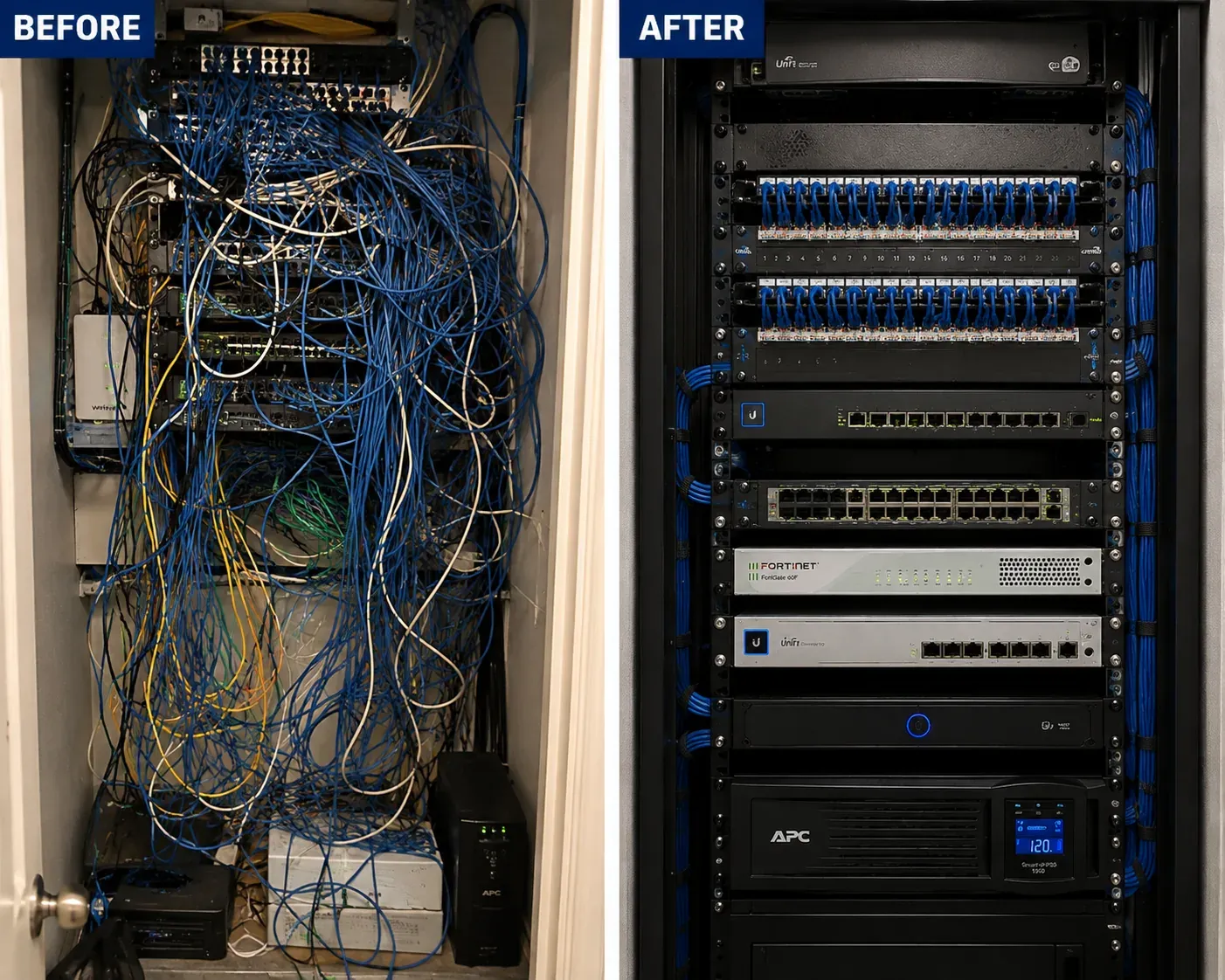
Before and after network closet cleanup, the kind of tidy-up done with fiber jobs in Port Richmond, Staten Island
Before and after: on the left a wall closet buried in loose blue, white and yellow cable around stacked equipment; on the right a rack with labelled patch panels, switches, a firewall and a battery backup, cables dressed along the sides. Library photo.
Before You Call

A Short Network Checklist for a Port Richmond Storefront

Small businesses on the avenue rarely have time to think about their network until it stops. Ten minutes with this list before the site walk makes the quote faster and more accurate.

  1. Find the provider's box. Note whether it is in your space, the cellar, a hallway or outside on the wall, and take a photo.
  2. List what must stay online. Card terminals, the point-of-sale computer, the camera recorder, phones, a scale, a kiosk, a time clock.
  3. Mark where each one sits. A rough sketch of the store with the counter, office, stockroom and any upstairs space is enough.
  4. Check your lease. Look for a clause on alterations, cabling or contractor approval, and note your landlord's or agent's contact.
  5. Remember the water. Has the cellar or yard ever flooded, and how high did it reach?
  6. Know your hours. When the store is closed or quiet, so the noisy steps can happen then.
  7. Collect the old paperwork. Any earlier installer's invoice or drawing helps us understand what is already in the walls.
Complete Services

Every Fiber Optic Installation Service in Port Richmond

Once a Port Richmond property has one tested path, most other systems can share it. These are the Staten Island services that most often ride on the same fiber.

Copper Cabling Inside

Cat6 drops from the fiber enclosure to each register, desk and access point: Staten Island Cat6 installation and structured cabling.

Network Equipment

Switches, firewalls and Wi-Fi set up at each end of the fiber: Staten Island network installation.

Store and Yard Cameras

Cameras for counters, gates and yards on the same link: Staten Island commercial security cameras.

Low-Voltage Work

Speakers, sensors, readers and the rest of the building's low-voltage systems: Staten Island low-voltage installation.

Alarms

Intrusion alarms moved off old phone lines and onto a tested path: Staten Island alarm installation.

Copper Repairs

Faults on the copper side of the network: Staten Island network cable repair and Cat6 repair.

Field Notes

Field Notes: How We Start a Job in an Old Port Richmond Building

This is our standing routine for buildings like the ones on the avenue, written down so customers know what to expect rather than as a story about any particular address.

We start at the provider's box and follow its cable by hand, not by assumption, because in a building that has had a dozen tenants the obvious path is often the wrong one. We put a visual fault locator on any fiber we find and a toner on any copper, and we tag each one with what it is and whether it is live before anything is moved.

Next we look up and down: up at the ceiling to see whether panels can be lifted without damage, down at the cellar wall to see how high water has marked it. The enclosure location is decided by those two lines, not by convenience.

Last, before we leave the walk, we photograph every space the cable will pass through and send the photos with the proposal. When the landlord, the next tenant or another trade asks what was there before, the answer is already in the owner's inbox.

FAQ

Port Richmond Fiber Optic Installation FAQ

Do you also cover Elm Park, Mariners Harbor, West Brighton and Westerleigh, next door to Port Richmond?
+

Yes. We work across the North Shore, so a job in Elm Park or Mariners Harbor to the west, West Brighton to the east or Westerleigh across Forest Avenue is booked and priced exactly like one on Port Richmond Avenue. Crews drive over from our Brooklyn base, and the site walk is arranged the same way wherever you are on the island.

Does armored fiber have to be grounded, and who does that?
+

If the armor is metal, yes. A metallic armor or strength member is a conductor, so the electrical code requires it to be bonded to the building's grounding system where the cable enters. We fit the bonding kit and leave the connection ready, and an electrician makes the final tie to the grounding electrode when one is needed. Where grounding would be awkward, as on a link between two separate buildings, we use all-dielectric cable so there is nothing to bond.

Will the router and switch we already have plug into the new fiber, or do we need new hardware?
+

Often they can stay. Fiber ends in a connector, not a regular network port, so something has to convert it: a small media converter beside your existing router, or an SFP module if your switch already has a fiber slot. We check the make and model of what you have during the site walk and tell you whether it can stay, needs a converter or should be replaced. Nothing is bought without your say-so.

How do you keep a new fiber run from being cut by the next electrician or contractor who opens the wall?
+

By making it obvious and recorded. Cable that runs inside walls and ceilings is labelled at both ends and at every access point with the owner's name and our number, enclosures carry a strand map, and we photograph the route before it is closed in. The owner keeps those photos and the sketch, so any later contractor can be shown exactly where the fiber is before they drill. Where it crosses a spot likely to be opened again, we sleeve or armor it.

Will plastic conduit on a sunny brick wall expand and pull apart in summer?
+

It can if it is installed without allowance for movement. PVC grows noticeably in length as it heats up, so a long run on a south- or west-facing wall gets an expansion fitting and straps that let it slide, and the joints are glued properly rather than pushed together. For short exterior runs on houses we often use painted metal raceway instead, which moves far less. The fiber inside is not harmed by the heat either way.

Does fiber need routine maintenance after it's installed?
+

Very little. The glass inside the walls does not wear out, so the care is at the ends: keep enclosures closed, keep dust caps on any unused connector, and do not let anyone unplug and replug fiber cords without cleaning them first, because a dirty end face is the most common cause of trouble. If you rearrange equipment or something stops working, a quick inspection and clean of the connectors usually fixes it.

Will your crew need to park in front of our store, and for how long?
+

Usually for part of the day. On Port Richmond Avenue and Richmond Terrace, where sidewalks are narrow and the city counts only about 152 on-street spaces along the avenue, we plan parking before the work day: a legal spot near the building, a side street, or the owner's lot or yard. The van is needed close by mainly while drilling and pulling cable; splicing and testing go on inside without blocking the curb.

Does fiber make our card terminals process payments faster?
+

Not the transaction itself; that speed is set by the payment processor. What fiber improves is the link between your terminals and the internet: it does not slow down when the store is busy, it is not disturbed by electrical noise from refrigerators, compressors or neon signs, and it does not fail because a copper wire corroded in a damp cellar. The result is fewer declined or stalled sales, especially at the busiest hours.

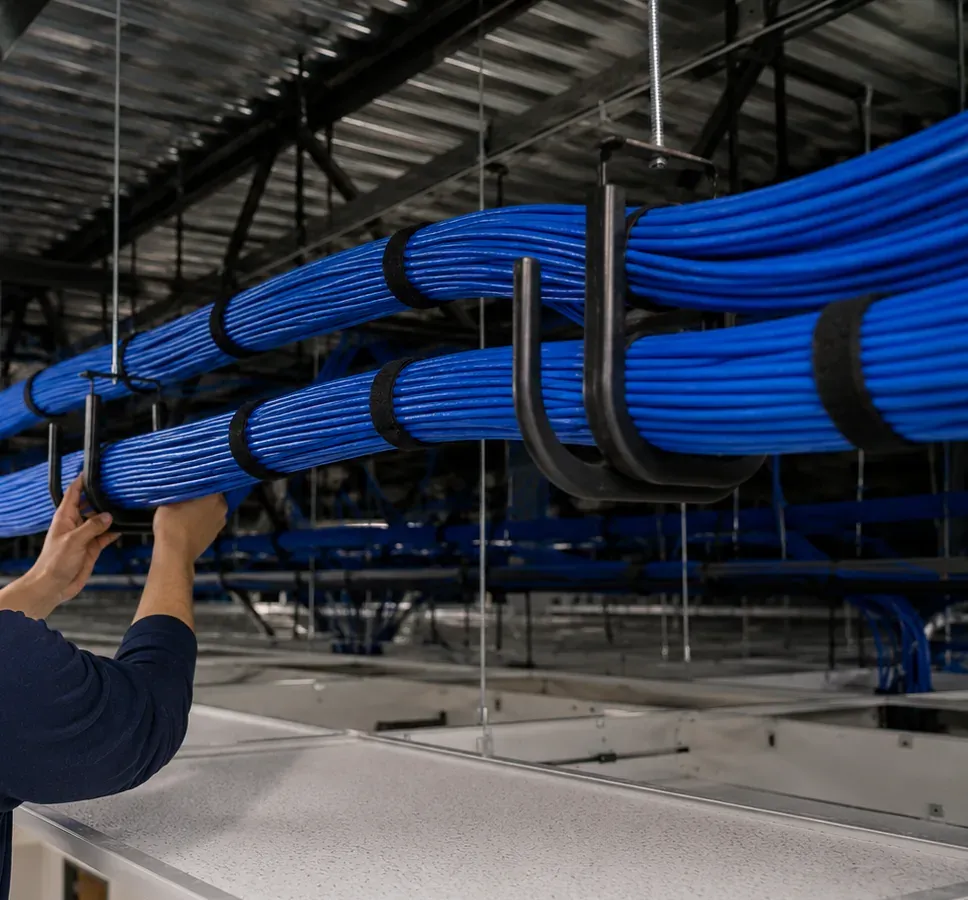
Cable pathway for a Port Richmond, Staten Island fiber installation: bundles seated in J-hooks above a suspended ceiling
Hands seat bundled blue cable into large J-hooks hung on threaded rod above a suspended ceiling, the bundles wrapped with hook-and-loop straps. Library photo, cropped to remove a face and a printed phone number.
All Areas Served

Fiber Optic Installation Beyond Port Richmond

Port Richmond is covered here as part of our Staten Island fiber optic installation service, and the island in turn reports up to the New York City fiber hub. The links below lead to the other boroughs, counties and neighborhoods, each described on its own terms.

If your block is not listed, the quote form still reaches the same crew. Cameras, alarms, intercoms and our other trades are listed under all our services; the company itself is introduced on the Abstract Enterprises Security Systems home page and the about Abstract Enterprises page.

Port Richmond Shop or Yard Offline Right Now?

Card terminals frozen, a yard office cut off after a high tide, or an upstairs unit dead since a contractor worked below? Call (347) 934-8335 and tell us the address and which end is down. We aim to reach Port Richmond the same day, and a damaged cord, a wet connector or a broken pigtail is usually found and repaired within one to two hours, then tested again before we go.

Fiber Optic Installation Port Richmond, Staten Island — Built for Renters, Yards and Old Houses

Abstract Enterprises Security Systems · 1282 Troy Ave, Brooklyn, NY 11203 · Staten Island line for Port Richmond (347) 934-8335 · WhatsApp (718) 679-0359 via wa.me

NYS Low-Voltage Licence #12000287431 · 100% Licensed & Insured · Same-Day Estimates · Rated 4.7★ from 201 Google Reviews

Full terms — including 50% deposit, one-year parts-only warranty on AESS-supplied products, and the late-fee schedule — are set out in the service agreement. See our warranty page.

Reviewed and updated October 17, 2026 (new page). Photos come from the AESS installation library, cropped for privacy, and do not show a specific job in this neighborhood.