What are you looking for?
About UsContact UsCareersGet a Free Quote(800) 486-0943
Pick a service
โœ… Got Your Own System?
๐ŸŽฌ Home TheatreQuote๐ŸŽถ AV SoundQuote๐Ÿ”‘ Access ControlQuote
Now pick your area
Pick your area
Long Island
Hudson Valley
Services available
Pricing & Tools
Pick a service for pricing
๐Ÿšช Intercom Pricing๐Ÿ”” Buzzer Repair Pricing
Calculators
๐Ÿ“น Camera System Calculator๐Ÿšจ Alarm Calculatorโšก Cabling Quote Builderโœ… Got Your Own System?
Select your area
Home โ€บ Fiber Optic Installation Manhattan โ€บ Flatiron
Licensed Low-Voltage Contractor ยท Ladies' Mile Lofts ยท Spec Suites ยท Growing Tech Floors

Fiber Optic
Installation in
Flatiron

Floor-to-Floor Links ยท Spec-Suite Stubs ยท Expansion Floors ยท Loft Risers ยท Fusion Splicing ยท OTDR Proof

Flatiron companies grow in jumps. A twelve-person startup takes a pre-built suite on a side street off Sixth Avenue, doubles within a year, and wants the floor above; a fintech on West 23rd Street expands to more than a quarter of a million square feet; an AI firm fills a tower on Madison Square Park. Most of that growth happens inside store and loft buildings put up for the department stores and wholesale trades of the decades before the First World War. We plan the fiber for the jump before it comes โ€” from the building's entry room to the floor you have, and the floor you are likely to want next โ€” then splice it, test every strand and leave the records with you.

Reviewed and updated October 17, 2026 ยท Written by Anwar Timothy, NYS license #12000287431

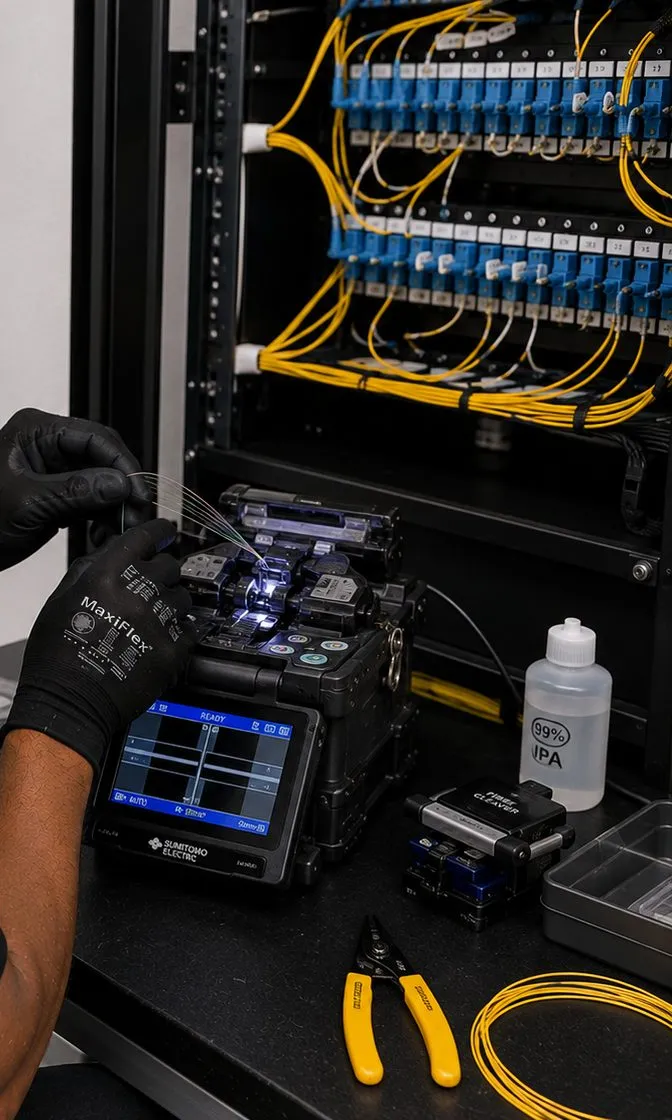
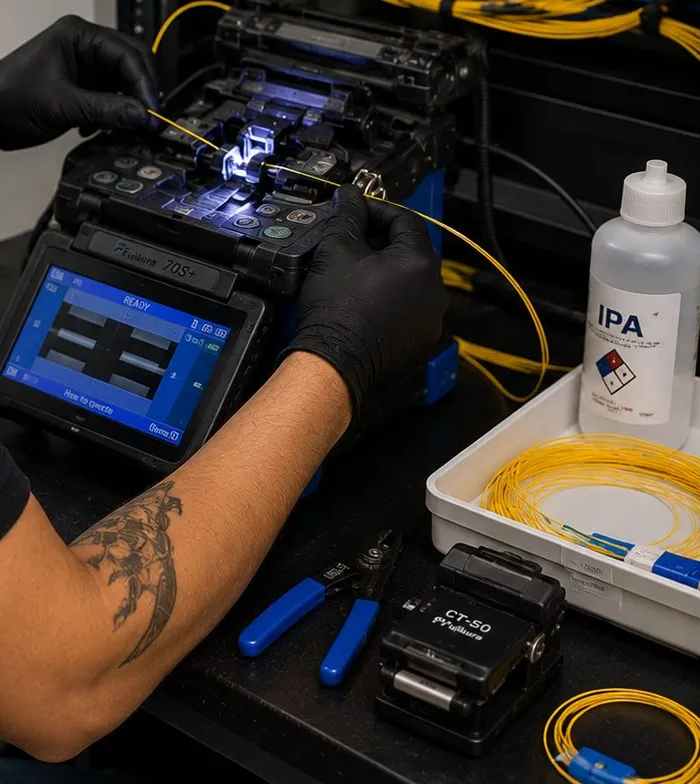
Gloved hands fusion-splicing a yellow fiber strand on a bench splicer for a fiber optic installation in Flatiron, Manhattan
Black-gloved fingers guide a yellow fiber into the splicer's glowing clamps; on the bench sit the cleaver, blue-handled strippers, an IPA bottle and a tray of coiled pigtails.
Flatiron Fiber Quote
Tell us your floor, your headcount plan and when you move โ€” a tech calls back the same business day

โœ…
Request Sent!
A Manhattan fiber tech will call you back the same business day.
25+
Years Experience
โœ“
Same-Day Estimates
100%
Licensed & Insured
4.7โ˜…
201 Google Reviews

Tell us how many people you are today and how many you expect in eighteen months. In Flatiron, that answer shapes the fiber more than the floor plan does. Call the Manhattan line at (929) 560-0737 or use the 60-second form.

  • Free site walk of the entry room, the riser and your floor โ€” plus the floor you may take next
  • No subcontractors on the glass: the people who pull the cable also fuse, inspect and measure it, and the numbers come to you
  • NYS license #12000287431 ยท Manhattan work dispatched from our Bronx office at 460 E Fordham Rd
The Neighborhood

Why Flatiron Properties Need Fiber Optic Installation

The blocks around the Flatiron Building have been rebuilt for new work more often than almost anywhere in Manhattan. They began as the Ladies' Mile, the carriage-trade shopping street of the late nineteenth century, with department stores along Sixth Avenue and Broadway and, later, loft buildings for the garment, toy and tabletop trades whose showrooms the district still remembers. In the 1990s the same lofts gave the district its other name, Silicon Alley, when internet and media start-ups and the venture firms backing them clustered here. Today the Flatiron NoMad Partnership counts more than 36 million square feet of commercial space and over 7,000 office tenants across its district, with tech, advertising, media and information firms the largest group.

What has changed is the pace and the size of the jumps. In 2025 office leasing in the Partnership's district passed 3.8 million square feet and vacancy fell from 15 to 12 percent. In the first quarter of 2026 the fintech Ramp expanded to 285,300 square feet at 28-40 West 23rd Street, the largest Midtown South lease of the quarter; the AI company Clay took 163,000 square feet at 11 Madison Avenue and brought the building to fully leased; Harvey AI expanded at One Madison Avenue. Brokers now describe Park Avenue South and the Madison Square edge as the centre of New York's AI office market, while the side streets toward Sixth Avenue still trade small loft floors and pre-built suites to companies that are just getting started.

For anyone wiring these buildings, that pattern matters more than any single statistic. A growing company in Flatiron rarely stays on one floor for long. It takes a suite, then the rest of the floor, then the floor above or a block of space two floors up; it sublets the part it has outgrown or hands it back to a landlord who rebuilds it for the next tenant. Each move asks the same question of the building: is there a tested, documented path from the room where the carriers land to this floor, and can it be extended to the next one without starting from nothing?

In a 1900s loft the honest answer is often "not yet." Many of these buildings were designed for freight, sewing machines and stock, not for networks, and their telephone closets and sleeves have been filled and emptied by decades of tenants. Our job is to find the path that exists, add what is missing, and lay it out so that the next jump โ€” up a floor, across a demising wall, into a lab room โ€” is a patch rather than a project. Teams moving into new floors often add door access and cameras at the same time, which is why our Manhattan structured cabling team usually walks the floor with us.

Flatiron in figures that shape a fiber plan

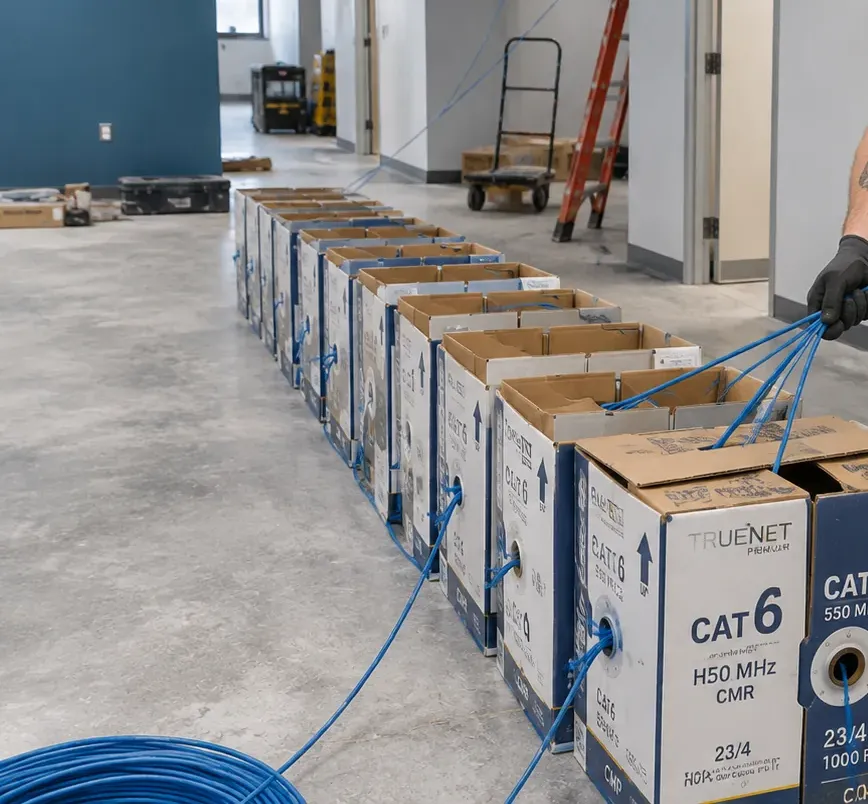
Row of cable boxes staged on the concrete floor of an unfinished office fit-out in Flatiron, Manhattan
A long row of open cable boxes on a bare concrete floor, with blue cable being drawn from them toward an unfinished corridor.
Repair Capture

Flatiron Floor Offline Before a Client Demo?

A link between two floors that went dark after another tenant's build-out, a jumper pulled loose when the landlord's contractor re-hung a ceiling, a spec suite that never connected on the day the team moved in: these are repair calls, booked separately from new installs. Same-day dispatch is the aim. A single fault โ€” a cracked pigtail, a contaminated connector, a strand crushed under a new partition โ€” is normally traced and fixed within one to two hours on site, and the strand is re-tested before we leave. Call (929) 560-0737 and ask for fiber repair; copper faults found on the same visit go to our Manhattan network cable repair team.

What We Install

Fiber Optic Installation Services in Flatiron

Most Flatiron fiber work is short and vertical, and it is rarely finished for good: a floor today, the floor above next year, a lab room or a sublet after that. These are the jobs we are asked for most between Park Avenue South and Sixth Avenue.

Entry-Room-to-Floor Links

Strands from the room where the carriers land, usually in the cellar, up the building's riser to an enclosure on your floor, labelled to your suite rather than to a company name.

Expansion-Floor Ties

A link from your existing floor to the one you have just added โ€” above, below or two floors away โ€” so both run as one network with one firewall.

Spec-Suite Stubs

For landlords: a small enclosure in each pre-built suite with tested strands back to a building panel, so a new tenant's provider or IT team patches in on day one.

Floor Closets on Open Lofts

Cabinets and wall enclosures placed on loft floors that have no back-of-house, with power, ventilation and a fiber feed planned around exposed brick and ceilings.

Engineering and Lab Links

Dedicated strands from desks to a server room, test bench or hardware lab, kept separate from the office network where the team needs it.

Re-Demising Splits

When a full floor becomes two suites, or two suites become one, we divide or join the fiber at the enclosure rather than pulling new cable through the new wall.

Ground-Floor Tenants

Links for restaurants, showrooms and stores along Fifth Avenue, Broadway and Sixth Avenue, from the cellar entry to the back office and the front of house.

Fusion Splicing and Termination

Pigtails fused on site, every end inspected under a scope before it is plugged in, and connector types matched to the switches your IT team has chosen.

Testing and Records

A loss reading for each strand, a trace wherever splices or length justify one, and one strand table written for both the landlord and the tenant.

Fusion splicer at the foot of a rack of blue LC adapter panels and yellow fiber jumpers in Flatiron, Manhattan
Rows of blue adapters with yellow jumpers above a bench where a splicer, a cleaver and a pair of strippers wait for the next strand.
Building Specialists

Fiber Optic Installation for Flatiron's Architecture

Ladies' Mile Department Stores

The great former stores on Sixth Avenue and Broadway, now retail below and offices above. Deep floors, wide column grids and long horizontal runs from the core to the windows.

Fifth Avenue and Broadway Loft Offices

Multi-storey store-and-loft buildings from the district's commercial heyday, with tall ceilings, big windows and one small core. Most tenants here take whole or half floors.

Side-Street Lofts Off Sixth

Narrower buildings on West 18th to 22nd Street where floors of a few thousand square feet are let as pre-built suites, often to companies of under twenty people.

Park Avenue South Prewar Towers

Taller loft and office buildings such as the 19-storey American Woolen Building at 225 Park Avenue South, refitted for tech tenants with new lobbies and mechanical systems.

Madison Square Towers

Full-block buildings such as 11 Madison and One Madison, run to institutional standards, where tenant fiber follows the landlord's riser rules and approved routes.

Offices Turned Residential

Conversions such as 212 and 225 Fifth Avenue, 1107 Broadway and now the Flatiron Building, where an owner's network serves lobbies, amenity rooms and individual condominiums.

How the method changes with the building

Building typeUsual routeWhat we watch for
Department-store palaceCore riser, then along the ceiling between column linesDistance to the far windows, fire-rated floor openings, retail tenant below
Fifth or Broadway loftStacked closets beside the elevator and stair coreSleeves filled by past tenants, single elevator, exposed ceilings
Side-street loftShared riser sleeve to a wall enclosure in each suiteSmall floors split between several tenants, landlord's suite plans
Park Avenue South towerBuilding riser with landlord-assigned capacityRiser approval, cable fill reports, after-hours work rules
Madison Square towerApproved tenant riser and entry-room cross-connectBuilding standards, contractor approvals, insurance requirements
Residential conversionNew telecom room and residential riserOffering-plan commitments, condominium board control after turnover

Good practice with the glass itself is the same in a tower and a side-street loft. The variables in Flatiron are elsewhere: who controls the sleeve, how long the lease runs, and how soon somebody will want the link extended to another floor, suite or lab.

Commercial Fiber Optic

Business Fiber Optic Installation in Flatiron

Brokers describe Flatiron as two office markets sharing a dozen blocks: a premium corridor on Park Avenue South and around Madison Square Park, and a value loft district toward Sixth Avenue. Six strips account for most of our commercial calls, and each asks something different of a fiber plan.

Park Avenue South

Renovated prewar towers where AI and fintech tenants sign full floors. Riser capacity is controlled by the landlord, and requests usually go through the managing agent's engineer.

Madison Square Park Edge

11 Madison and One Madison, both brought to fully leased in early 2026, plus the New York Life Building at 51 Madison: institutional buildings with strict contractor rules.

Fifth Avenue and Broadway Core

Loft offices above flagship stores and restaurants, including 200 Fifth Avenue, the former International Toy Center, now retail, office and residential space.

Sixth Avenue and the Ladies' Mile

Former department stores with large retail floors at street level and deep office floors above, plus the 28-40 West 23rd Street complex where Ramp has expanded.

West 18th to 22nd Street

Side-street lofts with floors of roughly 1,500 to 15,000 square feet, many offered as spec suites to small firms, practices and start-ups.

Broadway Plazas and Worth Square

Restaurants, food halls and experiential retail facing the pedestrian plazas, where back offices, kitchens and outdoor seating all want a connection.

Compliance callouts for Flatiron fiber work

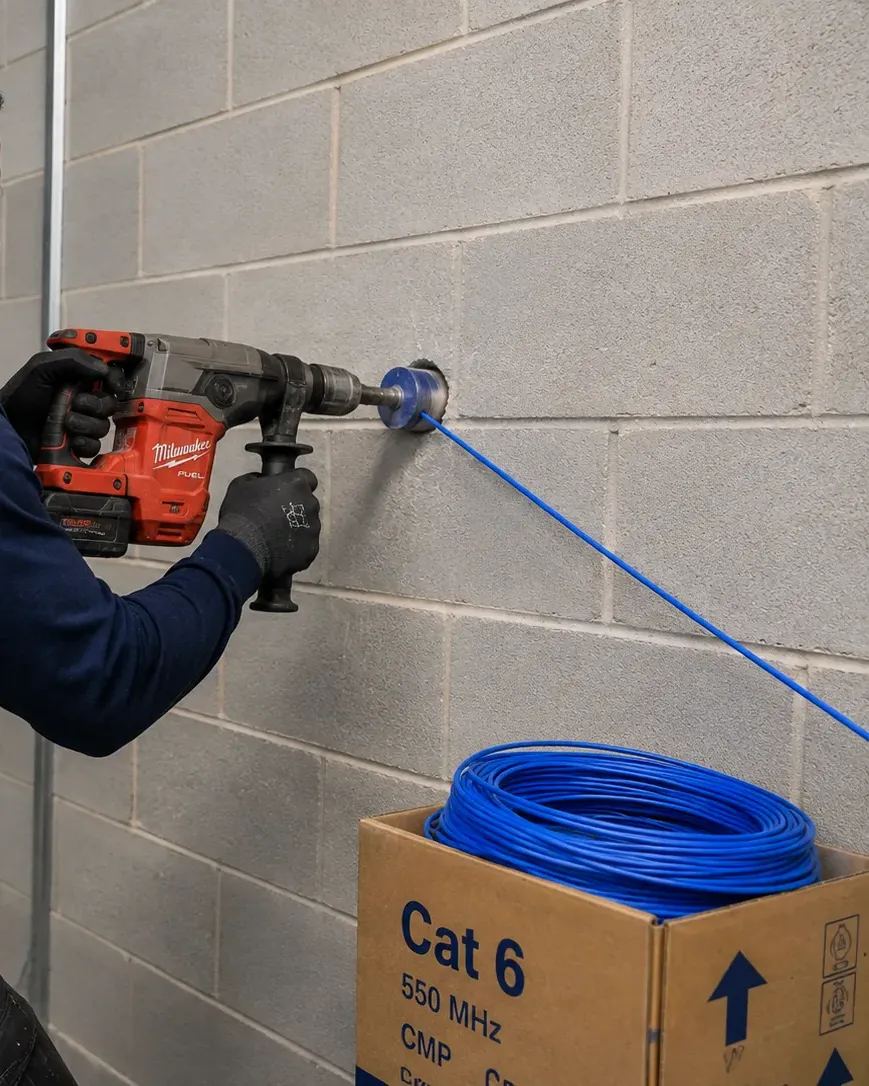
Core-drilling a block wall with a hammer drill as blue cable is fed through, pathway work in Flatiron, Manhattan
A hammer drill bores through a concrete-block wall while a blue cable is fed through the new opening from a box on the floor.
Growth Spurts

When a Flatiron Company Takes the Floor Above

The most common Flatiron fiber call is not a new building or a new tenant. It is an existing tenant that has run out of room. A team that signed for one floor two years ago now has people sitting in the kitchen, and the landlord has offered the floor above, a half floor three storeys up, or a suite in the building next door. The leases signed in 2025 and early 2026 show the pattern at the largest scale โ€” Ramp growing through the 28-40 West 23rd Street complex, Harvey AI expanding at One Madison โ€” but the same thing happens every month on the side streets, at a few thousand square feet at a time.

Joining two floors sounds simple and often is. When the new floor is directly above and the building's closets stack, a short riser link between two enclosures puts both floors on one network. It becomes harder when the floors are not adjacent, when the closets do not line up, or when the only sleeve between them is already full of other tenants' cable. Then the route may have to go down to the building's entry room and back up again, or the landlord may need to assign a new sleeve, and the time to ask is before the new lease is signed, not after the furniture arrives.

We therefore treat every first floor as the start of a series. When a company takes its first Flatiron space, we ask about headcount plans and any expansion rights in the lease, and we size the enclosure and strand count for at least one more floor. Spare strands in the same cable cost little compared with a second pull; a larger enclosure costs little compared with replacing a full one. If the landlord has given the tenant a right of first offer on the floor above, the proposal can show the extra link as an option, priced but not built.

Shrinking is part of the cycle too. Manhattan's sublet supply has tightened sharply since 2024, but companies still hand back or sublet part of a floor when plans change. A fiber layout that ends in one enclosure per suite, with each suite's strands labelled to the suite rather than to the company, makes it straightforward to split a floor between a tenant and a subtenant, or to return half a floor to the landlord without cutting the other half off.

The same thinking applies across a block. Some Flatiron companies spread through neighbouring buildings rather than up one stack, and private fiber cannot simply be strung across a city street. In those cases the realistic link between buildings is usually a carrier circuit, and our work is to give each building a clean, tested path from its own entry room to the company's floors, so the circuit lands somewhere tidy at both ends.

Floor 9 โ€” expansion option (spare strands parked)Floor 8 โ€” your suite (enclosure + switch)Floor 7 โ€” another tenant (riser passes through)Floor 6 โ€” sublet half (own enclosure)Ground โ€” retail / restaurantCellar โ€” entry room, carrier hand-offsactive strandssublet strandsspare, labelledriser sleeveassigned by landlord

Schematic, not to scale: one riser from the entry room with strands assigned per suite and spares parked for a likely expansion floor.

Pre-Built Suites

Spec Suites: Fiber for a Floor Built Before the Tenant Signs

Walk the side streets off Sixth Avenue and many of the listings say the same thing: pre-built, move-in ready, furniture available. Metro Manhattan's Flatiron guide notes a growing number of fully built-out spec suites "with furniture and cabling already in place so you can move in fast", and says many value-tier landlords will hand over a turnkey suite. Elsewhere in the country, brokers interviewed by LoopNet describe the same strategy: the landlord pays up front to build the space so the delivery timeline is quicker, and in return is often open to shorter leases of three to five years.

For a landlord, the fiber question in a spec suite is how to make the next tenant's connection fast without guessing at their equipment. Our usual answer is a small locked enclosure in each suite with a handful of tested strands back to a building panel near the entry room, labelled by suite number. The tenant's provider, or its own IT team, then patches in at both ends rather than asking for a new pull through someone else's ceiling. The enclosure costs far less than the delay of a missing path, and it outlasts the furniture.

For a tenant, the question is what "cabling already in place" actually covers. In most suites it means copper from a small rack or wall cabinet to the desks and access points โ€” useful, but separate from how the internet reaches the suite. Before signing, it is worth asking three things: where the suite's network cabinet is fed from, whether that feed is fiber or copper and who owns it, and whether the landlord will let the tenant's provider use the building's riser. If the answers are vague, a short survey before the lease is cheaper than a surprise after it.

Spec suites also change shape. Landlords combine two small suites for a growing tenant, or split a floor that a large tenant has given back. If each suite has its own enclosure and its own strands, these changes happen at the patch panel. If the suites share one cabinet hidden in one of them, every change of tenant means negotiating access to somebody else's office.

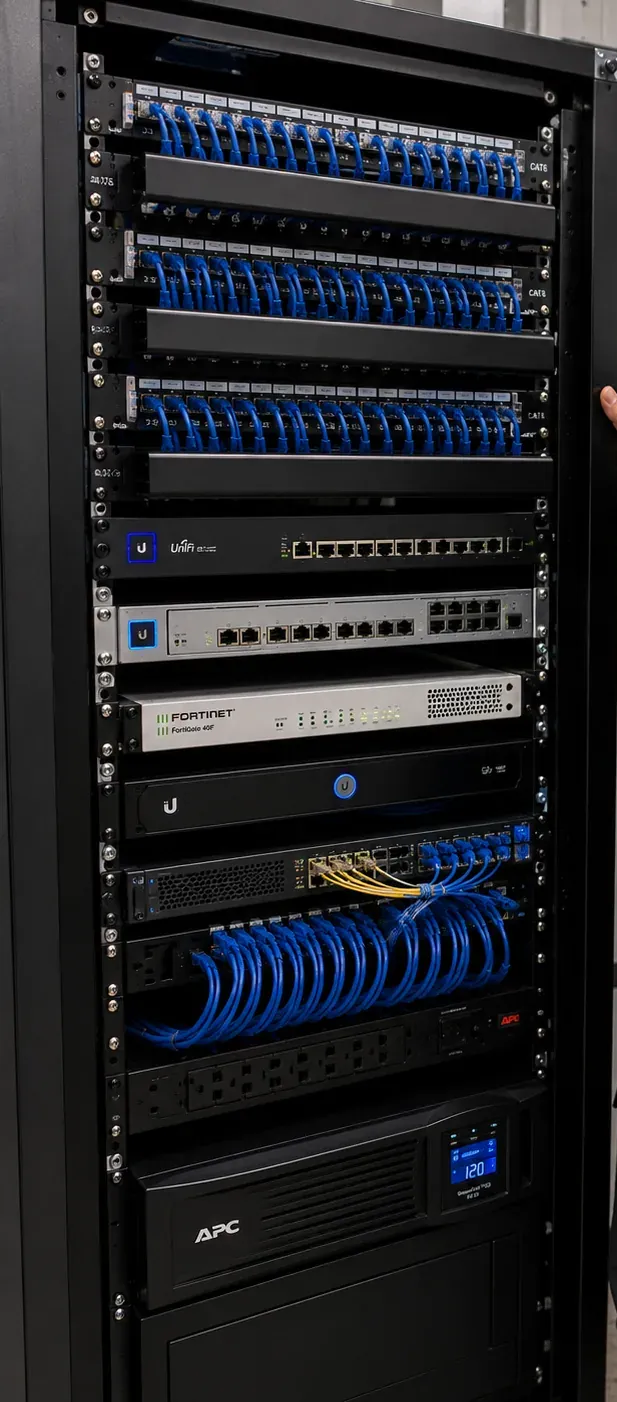
Finished floor rack with patch panels, switches, a firewall and a UPS ready for a suite in Flatiron, Manhattan
Floor rack after the work is done โ€” neat blue patching across the upper panels, network hardware stacked below, and battery backup filling the base.
Two Markets

Trophy Corridor or Side-Street Loft: How the Fiber Job Differs

Metro Manhattan's guide to the district makes a point every tenant should hear before touring: Flatiron is a premium AI corridor and a value loft district wearing one name. Savills tracked the Flatiron submarket at an average of $64.66 a square foot in late 2025 against $77.50 for Park Avenue South, and marketed rents at the Madison Square towers run higher still. The fiber work differs between the two just as sharply as the rent.

In the trophy and premium buildings, the landlord usually runs a managed riser and an entry room where carriers hand off. A tenant's fiber job there is about following rules well: submitting a route and cable details for approval, booking freight time, providing insurance certificates in the building's form, working in the hours the building allows and leaving the closets the way the chief engineer wants them. The physical path is usually clear; the paperwork decides the schedule.

In the side-street lofts, the paperwork is lighter and the physical path is the problem. The building may have one elevator, a riser sleeve shared by every tenant since the 1990s and a cellar where several generations of providers have left boxes on the wall. The landlord may be a family owner who knows the building well but has never drawn its risers. Here the job begins with tracing, clearing and labelling, and the proposal has to show what will be removed as well as what will be installed.

Between the two sit the Fifth Avenue, Broadway and Ladies' Mile loft buildings that landlords have renovated with new lobbies, mechanical systems and spec suites. These often have a better riser than the side streets and fewer rules than the towers, which makes them good places to build fiber properly once: a building panel near the entry room, assigned strands to each floor, spares, and a record kept by the managing agent.

The class label on a listing says little about any of this. As the same guide puts it, "Class describes the building. Rent tier describes what tenants pay." Neither describes the riser, and we recommend asking about it directly before a lease is signed.

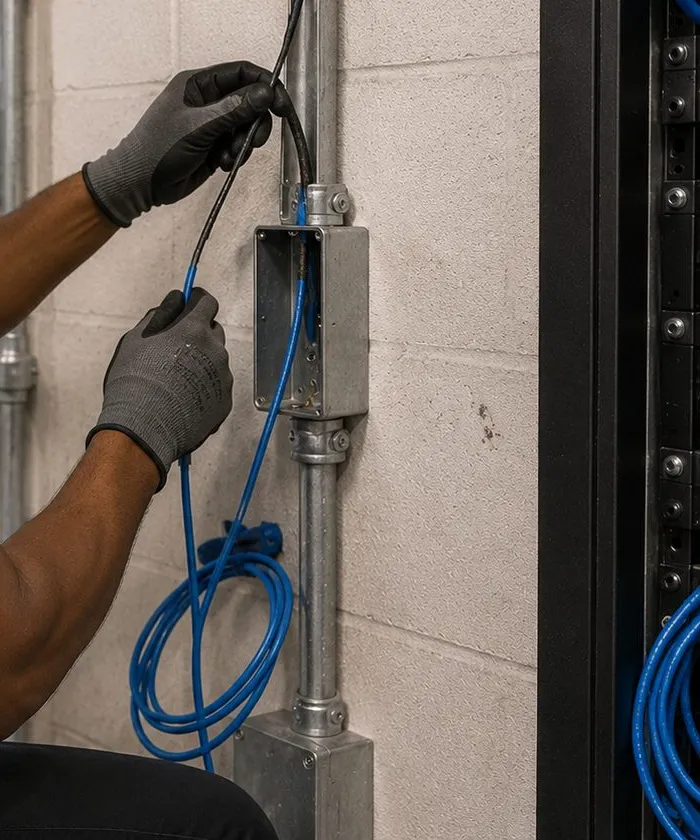
Gloved hands pulling blue cable out of a steel conduit box on a block wall, riser pathway work in Flatiron, Manhattan
Blue cable coming out of a steel pull box on a vertical conduit run, worked by hand against painted block beside an open rack.
Ladies' Mile

Fiber Behind 440 Protected Facades

The Ladies' Mile Historic District takes in 440 buildings on 28 blocks and parts of blocks, roughly from 15th to 24th Street and from Park Avenue South to west of Sixth Avenue. It was designated in May 1989 after a long campaign by community groups and the Historic Districts Council, and it is made up mostly of multi-storey store and loft buildings. North of 24th Street the Madison Square North Historic District continues the pattern around the park.

For fiber work, designation matters most at the edges of a building. The Landmarks Preservation Commission regulates work that affects the exterior, including storefronts, and its storefront guidance is explicit that conduit and wiring attached to a building or run out to sidewalk seating need a permit. Interior work that does not affect the exterior generally does not, and the Commission's staff will say whether a specific job does. In practice that means the fiber for a Ladies' Mile building should enter and travel inside: through the cellar, up existing risers and across ceilings, not up the facade or along a cast-iron storefront.

Carriers sometimes propose the quick route โ€” a box on the front wall, a conduit up the face of the building, a cable along a cornice. In a historic district that route can trigger a permit application and a delay, and it can leave the owner responsible for equipment the Commission never approved. We plan the entry with the carrier, keep it below grade or inside, and document it so the owner can show where everything is.

Inside, many Ladies' Mile floors are what tenants come for: tall ceilings, large windows, cast columns and exposed brick. Those features make cable visible. Our routes follow the column lines and the edges of ceiling bays, use tray or J-hooks painted to match when a ceiling stays open, and keep enclosures in the core rather than on a feature wall. A route that disappears is worth a few extra feet of cable.

Hand dressing bundled blue cable onto J-hooks under an open ceiling for an office floor in Flatiron, Manhattan
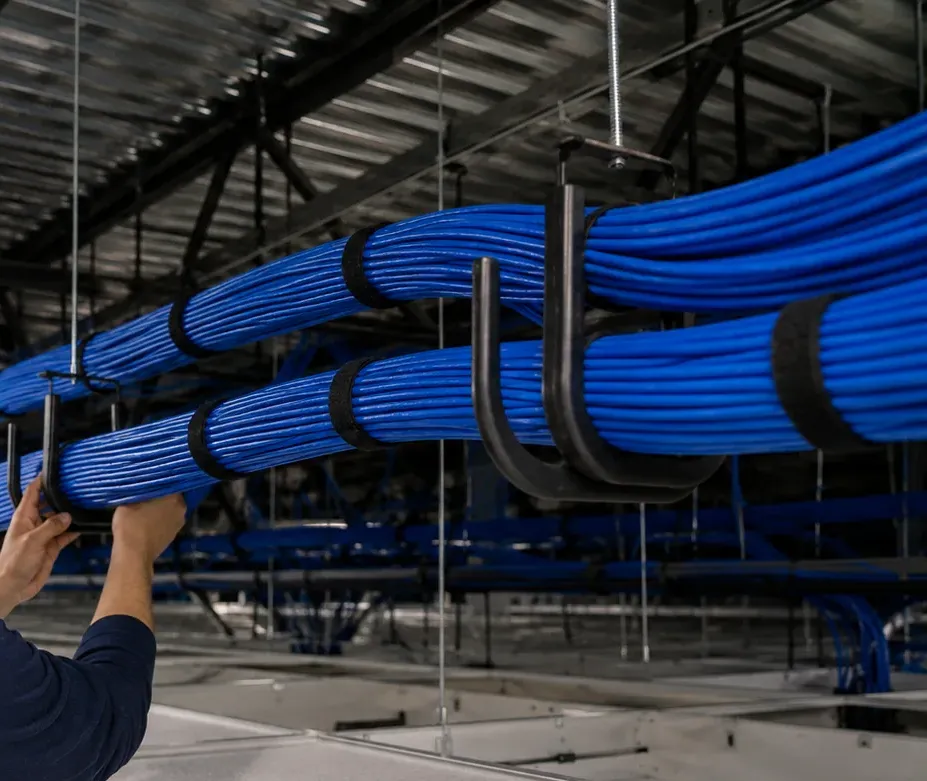
A hand guides a thick bundle of blue cable along a run of black J-hooks hung from threaded rod beneath an open ceiling.
The Street

Plazas, Bike Lanes and a Curb With Few Places to Stop

Since 2008 the roadbed where Broadway crosses Fifth Avenue has been given over to pedestrian plazas, and the Flatiron NoMad Partnership says that in good weather upwards of 100,000 people a day stop there. In 2021 Broadway from 21st to 23rd Street became what the Partnership calls the city's largest shared street, and the Broadway Vision programme has since turned more blocks north of Madison Square into plaza and slow-street space. For a crew arriving with reels, ladders and a fusion splicer, that means the front door of many buildings is no longer a place a van can stop.

The city's own design team spells it out. In a September 2026 update to Community Board 5 on the permanent reconstruction of the Flatiron plazas and Worth Square, the Department of Design and Construction and DOT noted that the block of Broadway between 22nd and 23rd Streets carries about 70 vehicles in the morning peak and 90 in the evening, has no major property entrances, loading docks or driveways, and keeps access through Fifth Avenue and 22nd Street; DOT, the presentation says, can work with property owners to maintain critical access for repairs and move-ins. Construction of the permanent plazas is scheduled to begin in the city's 2028 fiscal year.

So we plan the arrival before the install. On the walk we note where the building's freight entrance actually is โ€” often on a side street โ€” which loading signs apply on that block and at what hours, and whether the managing agent has a standing arrangement for deliveries. Reels and tools come in through that entrance at the agreed time, the van moves to legal parking, and anything that would block a plaza or a bike lane stays off it. When a job needs a long piece of equipment on a plaza-fronting block, we ask the owner to raise it with DOT early.

The sidewalks are busy in their own right. The Partnership's 2022 counts showed daily visitor and employee foot traffic recovering toward 2019 levels, and by late 2025 employee visits stood at 81 percent of pre-pandemic levels. Sidewalk cellar doors are opened only with a crew member standing at them, and work that could spill onto the pavement is done early in the morning, before the lunchtime crowds around the plazas and Madison Square Park.

Feeding blue cable into ganged EMT conduit on a block wall beside an open fit-out floor in Flatiron, Manhattan
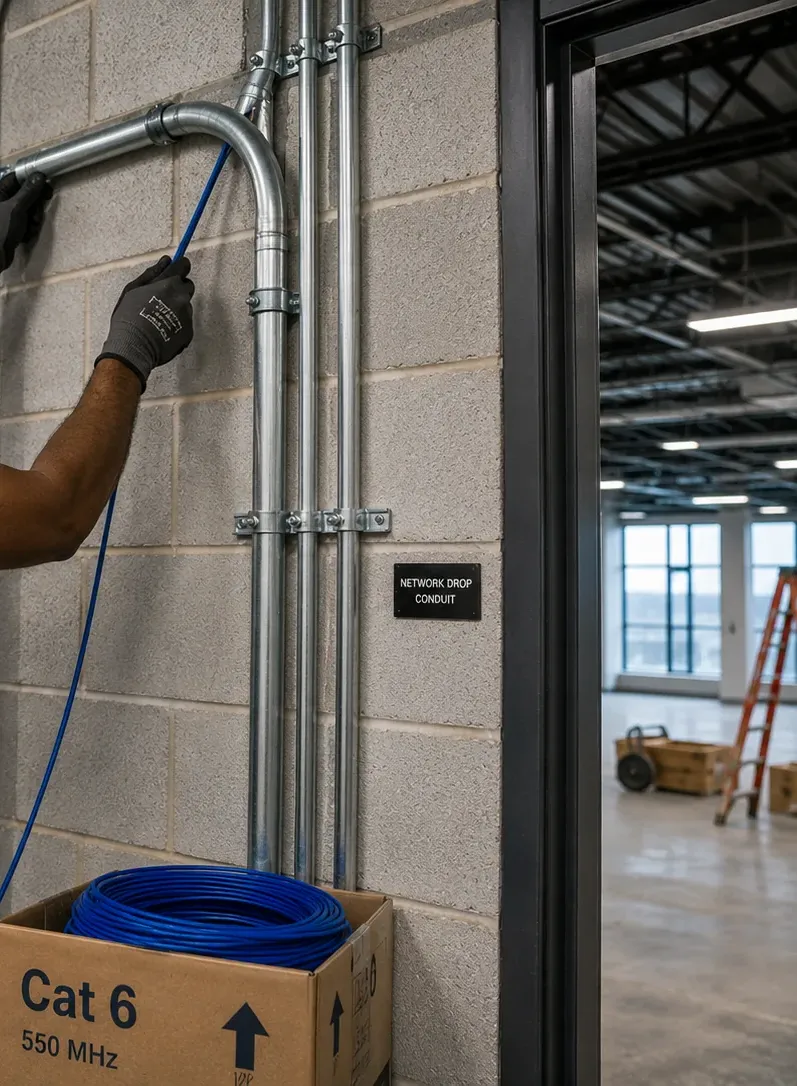
A gloved hand feeds blue cable into one of several steel conduits rising up a block wall, with an open, unfinished floor visible through the doorway.
July 2018

The Day Fifth Avenue Closed

On July 19, 2018, a steam pipe beneath Fifth Avenue at 21st Street burst, sending a column of vapour above the Flatiron District. More than 25 nearby buildings were evacuated, officials confirmed that the pipe's insulation contained asbestos, and people caught nearby were told to bag their clothes and shower. Fifth Avenue between 19th and 22nd Streets was expected to stay closed for several days while buildings were tested and cleaned. The Flatiron NoMad Partnership later named the explosion, alongside the pandemic, as one of the crises in which it worked with city agencies to help businesses recover.

Nobody can design a fiber plant around an event like that, but it shows two things that matter in this neighbourhood. The first is that access can disappear without warning. A company whose network records live only in one person's head, or in a binder in a building that is closed for a week, cannot tell a provider or an insurer what it has. A strand table and test results held by the owner and the tenant, outside the building as well as inside it, make it possible to plan the restart before the doors reopen.

The second is that old materials are part of the building. Loft buildings of this age may contain asbestos in pipe insulation, floor tiles or old fireproofing, and the owner is responsible for knowing where. Before any coring or ceiling work, we ask whether the building has a survey, avoid disturbing suspect material, and stop and report if we find something unexpected rather than drilling through it. That is slower for an hour and much faster than the alternative.

After a closure, the first visit back is a check rather than a guess. Connectors are inspected and cleaned, every strand that matters to the business is re-tested against the original results, and any change is written down. Where the original results exist, that comparison takes very little time; where they do not, it is the first thing we create.

Ground Floors

Restaurants, Showrooms and Flagship Stores

Flatiron's ground floors are as busy as its offices. The Partnership's 2022 report counted more than 1,100 ground-floor businesses, more than 400 food and beverage establishments โ€” over one business in three โ€” and more than 70 furniture and design stores; it noted that nearly 40 percent of the district's retail shops specialise in furniture and interior design, and that Porcelanosa chose 202 Fifth Avenue for its US flagship showroom. Eataly's first US market opened here in 2010 and the LEGO store in 2014.

Restaurants need dependable links for point-of-sale terminals, kitchen display screens, online-order tablets, music, cameras and a guest network, often split between a front of house at street level and a kitchen or office in the cellar. Fiber earns its place when the cellar office, the dining room and an upper-floor private room are far apart or separated by heavy kitchen equipment; copper remains the right answer for short runs inside one level. Where a restaurant has outdoor seating, the Landmarks Commission's storefront guidance requires a permit for conduit or wiring run from the building to the seating area, so outdoor terminals are usually best served wirelessly from inside.

Design showrooms have a different rhythm. Product displays, screens and lighting controls move when the collection changes, and the sales floor has to look finished every day. The answer is to bring fiber to a small enclosure in the back of house, then distribute copper and wireless from there to floor boxes and ceiling points chosen with the showroom's designer, so a new layout means moving a patch cord rather than opening a wall.

Flagship and experiential retail โ€” the Partnership lists attractions such as Harry Potter New York and The FRIENDS Experience โ€” adds ticketing, queue screens and large video displays to the usual retail systems. Those tenants generally arrive with their own network design; what they need locally is a clean, tested path from the building's entry room to their back office, finished before opening day, and a contractor who can work inside the landlord's rules.

Mounting a patch panel on a wall rack between steel studs with bundled blue cable in a back-of-house closet in Flatiron, Manhattan
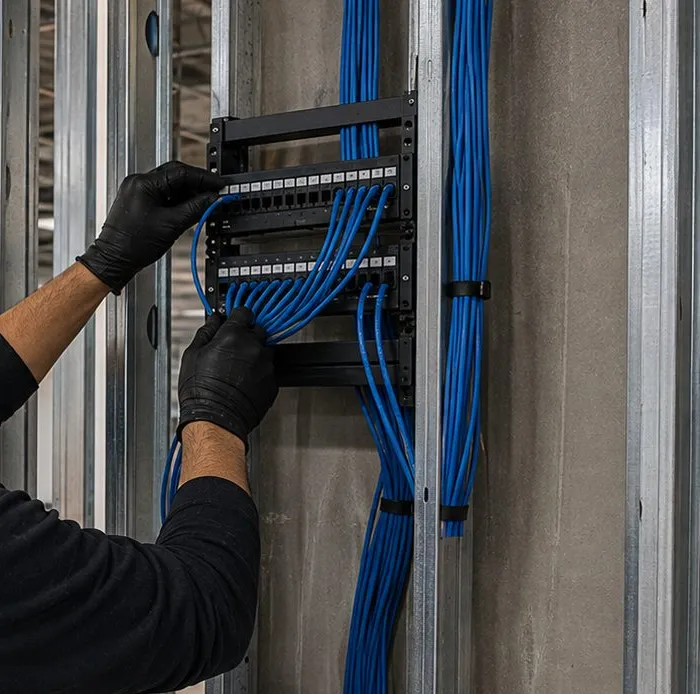
Gloved hands seat blue cords into a patch panel on a small wall rack fixed between steel studs, with cable bundles strapped up the wall beside it.
Engineering Floors

Fiber for Engineering Teams in Loft Buildings

Flatiron's tenant list now reads like a technology directory. The Partnership's 2022 report named IBM, Mastercard, Sony, Capital One, SeatGeek, FanDuel, Betterment and Dropbox among the companies with headquarters or major offices in the district; Metro Manhattan's 2026 guide lists Microsoft at 122 Fifth Avenue and a run of AI firms on Park Avenue South and around Madison Square. Brokers say the loft floor plates suit fast-growing engineering teams, and the tall ceilings and open floors are certainly popular.

An engineering floor loads the building's cabling differently from a sales office. There are more devices per person โ€” laptops, docks, test phones, development boards โ€” and some teams keep workstations or small servers in the office for jobs that are faster or cheaper to run locally. Big files move between desks and a server room many times a day. None of that needs exotic cable, but it does reward a short, clean path: fiber from the floor enclosure to a server or lab room, enough strands for a second link, and switches whose uplinks are fiber rather than copper.

Most such teams also depend heavily on the internet circuit, because their main systems run in the cloud. A faster circuit only helps if the path from the entry room to the floor and from the floor closet to the desks can carry it. We regularly find the bottleneck in between: an old copper link from the cellar, a small switch in a ceiling, or a single access point covering a loft floor through brick partitions. Fixing that path is usually the first and cheapest improvement.

Hardware companies add a further requirement. Labs, test benches and prototype rooms often need a network that is isolated from the office, either for security or because test equipment misbehaves on a busy network. Separate strands to the lab, ending in their own enclosure, let the IT team keep that network physically apart while the building only has to provide one riser.

Tracing an unlabeled cable at a patch panel with a probe and handheld tester before fiber work in Flatiron, Manhattan
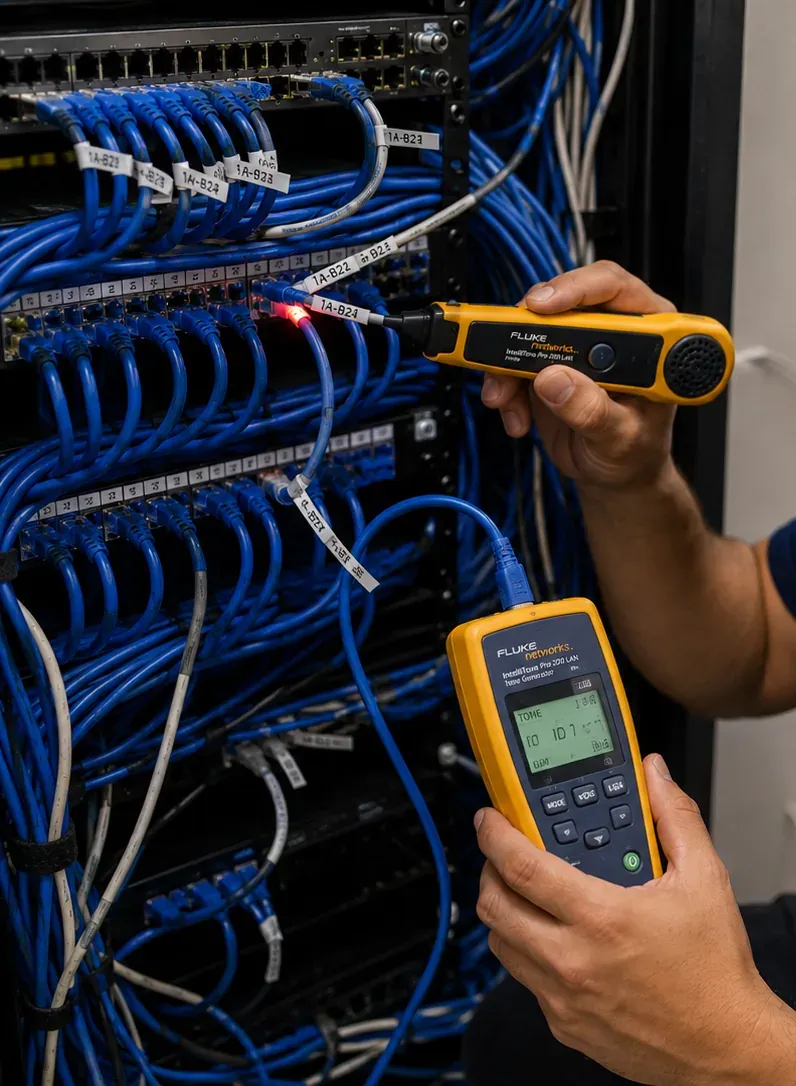
One hand holds a yellow probe against a labelled patch panel while the other holds a handheld tester whose screen shows a reading.
Conversions

From Office Floors to Condominiums: The Flatiron Building and Its Neighbours

Flatiron's most famous office building is leaving the office market. The Flatiron Building at 175 Fifth Avenue, completed in 1902 and used as offices for more than a century, is being converted to condominiums. Plans filed with the state Attorney General's office and reported by The Real Deal in June 2025 describe 38 condominium units, two commercial units and 40 storage units, with the Brodsky Organization and Sorgente Group among the developers; earlier reports had suggested about 60 units. The district has done this before: the Partnership points to 212 and 225 Fifth Avenue and 1107 Broadway, now 10 Madison Square West, as earlier office-to-residential conversions, and its 2022 report counted more than 35,000 residents in the district.

A conversion changes who the fiber serves. An office building's risers were laid out for tenants who each bought their own circuits. A condominium needs a residential riser that lets several providers serve individual units, a building network for the lobby, doors, cameras and amenity rooms, and a clear division between what the condominium owns and what each unit owner owns. The time to settle those questions is during design, when walls are open and the developer still controls every space.

Two details recur in converted lofts. First, old office closets rarely sit where a residential riser needs to be, so the new path is often a fresh sleeved core beside the plumbing stacks, sealed at every floor. Second, ownership changes at turnover: the developer builds the telecom room, then hands it to a condominium board. A strand table, test results and as-built drawings delivered at that moment save the board from having to trace its own building later.

Buyers can help themselves too. Before closing on a unit in a converted building, it is reasonable to ask how service reaches the apartment, how many providers can serve the building, and who maintains the riser after the sponsor leaves. The answers belong in the building's records, not only in a sales brochure.

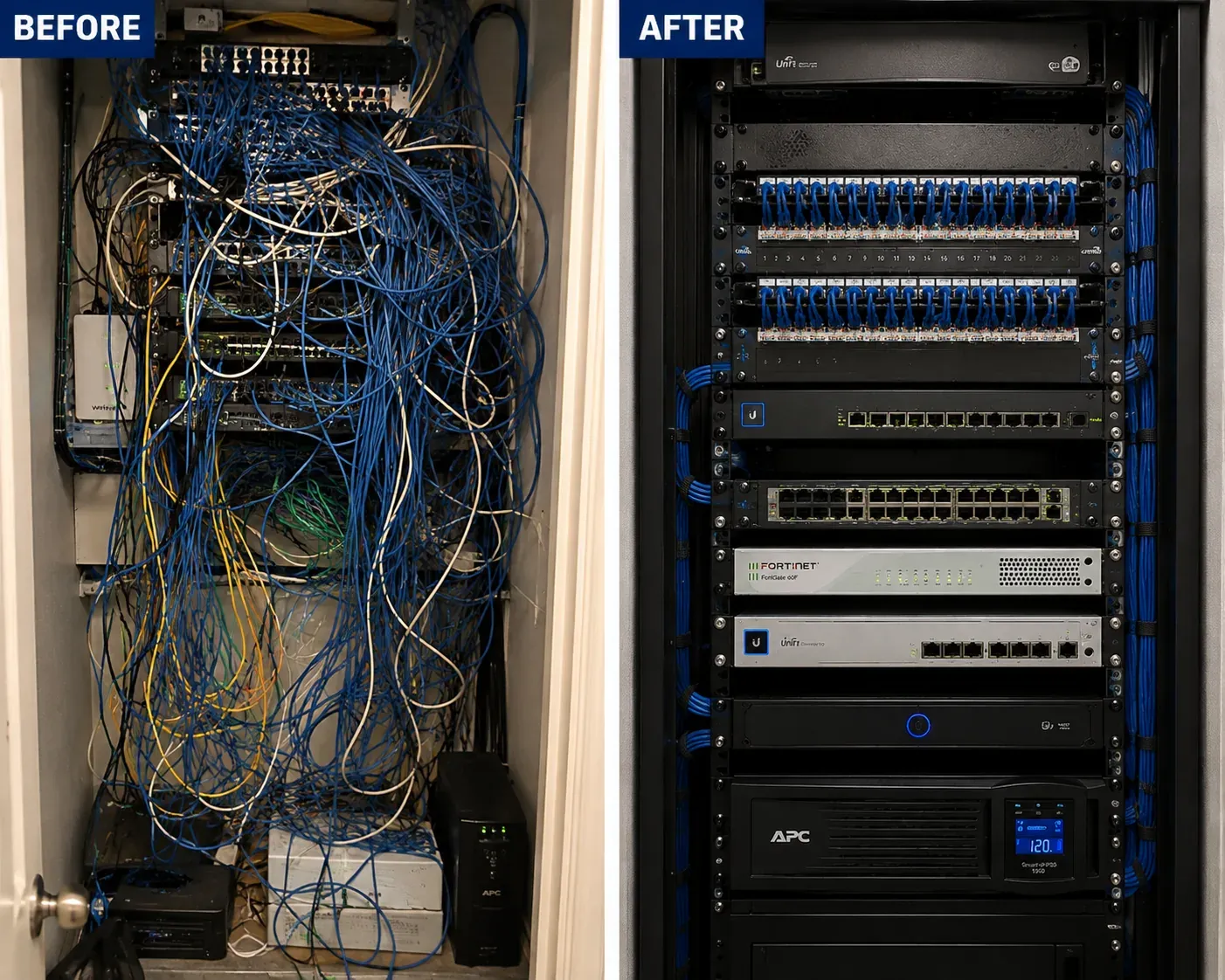
Before and after views of a tangled network closet rebuilt into a labeled rack, inherited cabling cleanup in Flatiron, Manhattan
Left, marked before: a closet full of loose, knotted cable and small boxes on the floor. Right, marked after: the same space as a rack of labelled panels, switches and a UPS.
Your Questions Answered

Fiber Optic Installation in Flatiron: Questions Answered

Questions grouped the way Flatiron jobs tend to reach us: from companies signing short leases and planning to grow, from loft floors that were never built for networks, and from the street, the plazas and the buildings turning residential.

Short leases and growing teams

We signed a three-year lease on a pre-built suite โ€” how much fiber is worth paying for in space we may outgrow?

Pay for the path, not for a monument. A short lease justifies a tested link from the building's entry room or riser panel to a small enclosure in your suite, with a few spare strands, because that is what lets your provider and IT team work quickly and what you will want again on your next floor. It rarely justifies building a large room or pulling a big backbone that only serves you. Ask the landlord whether a building-owned stub can be installed instead: it serves you now and the next tenant later, which is often a good reason for the landlord to share the cost.

Our headcount could double within a year โ€” can the fiber be planned now for a floor we have not leased yet?

Yes, and it is cheaper to plan it now than to retrofit later. If your lease includes an expansion option, a right of first offer or simply a landlord who has said the floor above may free up, we size the enclosure and the strand count on your current floor for one more link and price that link as a separate, optional line. Spare strands can be parked and labelled in the riser so they reach the likely floor without being terminated. Nothing is built in space you do not control, but the hard part โ€” capacity in the right sleeve โ€” is reserved in the drawing the managing agent approves.

We own the building and want to split a full floor into two spec suites โ€” how should the fiber be divided?

Give each future suite its own small enclosure and its own strands from the building panel, even if one tenant might later take both. Put the enclosures where the demising wall will not trap one inside the other suite, label them by suite number, and keep the building's own systems โ€” cameras, door access, sensors โ€” on separate strands that do not run through either tenant's space. If the floor is later recombined, the two enclosures are joined at the panel; if it is split again, nothing has to be moved. The work is modest and it removes one of the most common reasons a suite sits unlet: nobody knows how to get service into it.

We are leaving a coworking membership for our first floor of our own โ€” what fiber did the coworking operator handle that we now need?

Everything between the street and your desks. In a coworking space the operator owns the internet circuits, the riser link, the floor network and the Wi-Fi, and you simply connect. On your own floor you will need an internet contract, a tested path from the entry room to your floor, a network cabinet with power and ventilation, copper or wireless to the desks, and somebody to look after it. We handle the fiber path and the cabinet's fiber side, work alongside whichever IT provider you choose, and leave a record you can hand to them. Book the walk as soon as the lease is close, because carrier circuits take time to order.

Loft floors that were never built for networks

Our loft floor is open, with brick walls and an exposed ceiling โ€” where does the network cabinet go when there is no closet?

Next to the building core, where the riser and power already are, and inside a small enclosure or partition rather than on open floor. Most loft floors have some fixed elements by the elevator and stair โ€” a toilet block, a duct shaft, a former telephone closet โ€” and a cabinet tucked beside them shortens the fiber run from the riser and keeps cable off feature walls. It needs a dedicated circuit, some ventilation and a lockable door. If the design calls for no visible equipment at all, a shallow closet built into a new partition near the core does the same job without spoiling the room.

Our building has one elevator for people and freight โ€” how is a fiber pull scheduled around a single car?

By agreeing short, fixed slots with the managing agent and doing the heavy moves outside office hours. A fiber job does not need much freight: a reel, a ladder, a splicer and a few boxes. We bring those up in one booked trip early in the morning, keep them on your floor for the length of the job, and use the stairs only for hand tools. Pulls that cross several floors are scheduled so the car is not held between floors while other tenants wait. In buildings where the elevator is also the only route for residents, we confirm the slot a day before.

Our AI team runs GPU workstations in the office โ€” does that change the fiber between our floors?

It can change how much capacity the uplinks need, not the type of glass. Engineers who move model checkpoints and data sets between workstations and a local server will notice a slow link between floors before anyone else does. We plan single-mode strands with spares, so the IT team can raise speeds by changing optics rather than cable, and we keep the path between the workstations' switch and any server room short. The heat and power those machines need are a separate question for the landlord and your electrician; fiber itself adds neither, which is one reason it suits a crowded closet.

Our hardware lab needs a network that never touches the office network โ€” can fiber give it a separate path?

Yes. The simplest way is dedicated strands from the floor enclosure, or straight from the building panel, to an enclosure in the lab, used only by the lab's equipment. Physically separate glass is easy for an auditor or a security reviewer to understand, and it means a misbehaving test device cannot flood the office switches. We label the lab strands distinctly, document which ports they occupy at each end, and leave the decision about firewalls and routing to your IT team.

The street, the plazas and residential conversions

Our restaurant faces the Broadway plaza โ€” can a cable be run out to terminals at our outdoor seating?

Not casually. In a historic district the Landmarks Preservation Commission's storefront guidance says conduit or wiring run from a building to an outdoor dining area at the sidewalk or roadway requires a permit, and any element attached to the storefront needs one too. Most restaurants avoid the issue by using wireless card terminals at outdoor tables, served by an access point just inside the window that is fed by cable from the back office. We install the indoor side; if you still want a fixed outdoor connection, the permit comes first.

The city plans to rebuild the Flatiron plazas from 2028 โ€” will that work affect the fiber entering buildings along Broadway?

The plaza reconstruction is a city project in the public street, and the carriers and utilities whose cables run under it coordinate with the city directly; we cannot speak for them. What an owner can do is make sure the building's side is documented: where each provider's conduit enters, which entry room it lands in and what it serves. If street work ever disturbs a service, that record makes it quicker to show the provider what was lost. The city's September 2026 presentation also says DOT can work with property owners to keep critical access for repairs and move-ins, which is worth raising early if a job overlaps construction.

We are buying a condominium in a converted Flatiron office building โ€” what should we ask about how internet reaches the unit?

Ask four things: how many providers can serve the building today, how their service reaches each floor, whether there is spare pathway in the residential riser, and who maintains that riser after the developer hands the building to the board. The offering plan and the sponsor's engineers should be able to answer. If the building has fiber to the units, ask for the test results; if service still arrives over older office cabling, ask whether a residential riser is planned. A clear answer before closing is worth more than a promise in a brochure.

Equipment

Types of Fiber Optic Cabling We Install

OS2 Single-Mode

What we specify for nearly every riser and floor tie here, because a team that outgrows its speed changes the optics, not the cable.

OM4 Multimode

Short links inside one floor, such as a desk-area switch to a lab rack, where the switches already use multimode optics.

Riser and Plenum Cable

Jackets matched to the space: riser grade in vertical sleeves, plenum grade wherever a refitted loft ceiling now returns air to the mechanical system.

Small Wall Enclosures

Lockable boxes for spec suites and side-street offices, sized for a few strands, a splice tray and room for one more link.

Building Patch Panels

Rack-mounted panels near the entry room where every suite's strands are labelled, so landlords can assign them without calling us.

Armored Indoor Cable

Interlocking armor through cellars and freight corridors where deliveries, bins and carts pass the cable daily.

Pre-Terminated Trunks

Factory-made assemblies for a fit-out where the closets are fixed and the move-in date leaves no slack.

Optics and Converters

SFP modules matched to the strand type, or media converters for older equipment that only has copper ports.

Matching the cable to the Flatiron job

SituationUsual choiceWhy
Spec suite on a side streetA few OS2 strands to a wall enclosureGives the tenant's provider a tested hand-off without a new pull
Company on two stacked floors12-strand OS2 or OM4 between enclosuresJoins both floors into one network with spares for a third
Engineering floor with a server or lab roomDedicated strands from the floor enclosureShort, separate path for heavy traffic or an isolated network
Restaurant with cellar office and dining roomCopper on one level, fiber between distant levelsCopper is fine within one level; glass is better once a run climbs between the cellar, the dining room and the floors above
Residential conversionNew residential riser with pathway for several providersUnits need provider choice; the building needs its own systems apart

Why spare strands matter more here than almost anywhere

In a district where tenants expand, sublet and re-demise floors every few years, the cheapest part of a fiber job is the extra strands inside a cable that is being pulled anyway. A twelve-strand cable where four strands are used and eight are labelled as spare can serve an expansion floor, a lab, a subtenant or a building system later without anyone opening a ceiling. We say in each proposal how many strands are spare and where they end, so the landlord can hand them out with confidence.

AI Overview Reality Check

What AI Gets Wrong About Fiber Optic Installation in Flatiron

Search summaries, broker guides and national cost articles are written for typical offices in typical buildings. These claims appear in published sources that searches for Flatiron office space and fiber costs turn up; each is quoted as written, followed by what it leaves out in a loft building near Madison Square.

"Fully built-out spec suites with furniture and cabling already in place so you can move in fast"

Metro Manhattan's Flatiron guide uses this phrase for the growing stock of pre-built suites in the district's value buildings, and the suites it describes are real and popular.

"Cabling" in a spec suite almost always means copper from a small cabinet to the desks and ceiling access points. It does not tell you how the internet reaches that cabinet, whether the riser has room for your provider, or who owns the path from the entry room.

Before signing, ask to see where the suite's cabinet is fed from. If the answer is a tested fiber stub to a building panel, the suite really is quick to connect. If nobody knows, budget time for a survey and a short link.

"The ability to be up and operating in 30 to 60 days"

A broker quoted by LoopNet gives this as one of the reasons tenants choose spec suites over custom build-outs, and for furniture, finishes and desks it is a fair expectation.

The connection is a separate clock. Ordering a carrier circuit, getting riser approval from the managing agent and booking freight time each take their own time, and none of them start until someone asks. In a building with a crowded sleeve, the riser question can take longer than the furniture.

The fix is simply to start early. We can walk the building as soon as the lease is close, so the provider order and the internal link run in parallel with the landlord's work rather than after it.

"Some landlords provide cabling, which is a true value"

This comment, from a Dallas broker in the same LoopNet article, is true as far as it goes: landlord-supplied cabling saves a small tenant money it may not have budgeted.

The catch is ownership. If the landlord installs and owns the cabling, the tenant usually cannot change it without permission, and the landlord's records โ€” not the tenant's โ€” describe what is in the walls. That is fine when the records are good and awkward when they are not.

Whoever pays, ask for the test results and a strand or port map to be handed over with the keys. A cable that comes with its records is a true value; one that comes without them is a mystery with a lease attached.

"Sign one month, move in the next."

Metro Manhattan's guide says this of the turnkey, fully built-out suites that many value-tier Flatiron landlords offer, and for the walls, finishes and furniture it can be true.

A month is not much time for a connection. The internet order, the landlord's approval to use the riser and a slot in the building's freight schedule each run on their own timetable, and in an older loft the path from the cellar to the suite may still have to be traced before anyone can promise a date.

If the move really is a month away, tell the landlord and us on the day the lease is agreed. A walk that week lets the provider order and the internal link proceed together, and you learn early whether a temporary connection is needed for the first few days.

Avoiding "designing, building and having somebody on staff coordinate with contractors"

LoopNet quotes a broker who lists this among the things spec-suite tenants are glad to skip, and on the construction side the landlord does take that burden away.

Connectivity is the part that still needs an owner. Somebody has to choose the provider, confirm where the circuit lands, agree the route up the building and accept the test results, and in a pre-built suite that job often falls between the landlord, the tenant's office manager and an outside IT firm without anyone being told it is theirs.

We are happy to be the contractor that coordinates that piece: we meet the provider's technician at the entry room, deal with the managing agent on the riser, and hand the office manager a short record that says what was done and who to call.

"Class describes the building. Rent tier describes what tenants pay."

Metro Manhattan makes this point to explain why a renovated Flatiron loft can carry a Class B label and still out-rent a Class A tower. It is a good warning against reading too much into the letter.

Neither the class nor the rent tells you about the riser. A trophy tower may have a managed riser with strict rules; a family-owned loft may have one shared sleeve and no drawings; a renovated loft may have a new building panel. The connectivity of each floor has to be checked, not inferred.

On a walk we look at the entry room, the sleeve or closet that serves your floor and the space inside it. That takes less than an hour for most single floors and answers the question that the listing cannot.

"The loft floor plates suit fast-growing engineering teams"

The same guide gives this as one reason AI companies have clustered around Park Avenue South and Madison Square, and many teams clearly agree.

The floor plates were drawn for people and goods; the risers were not drawn for the networks those teams now run. A fast-growing team will want a second floor, a lab or a server room long before its lease ends, and each of those needs capacity in a sleeve that other tenants may also want.

Plan for the growth when you plan the first floor: spare strands, an enclosure with room to spare, and an optional link to the likely next floor written into the drawing the landlord approves.
Planning the Next Floor Before You Need It?

We walk the entry room, your floor and the space you may take next, free, and put the route and price in writing.

Full Service List

Every Fiber Optic Service We Handle in Flatiron, Manhattan

Manhattan fiber work runs from Financial District towers to Midtown stacks; in Flatiron it is mostly loft risers, spec suites and floors joined as companies grow.

Fiber Optic Installation and Cable Pulling in Flatiron, Manhattan

Our fiber optic installation services in Flatiron, Manhattan start at the building's entry room and end at the enclosure on your floor. Fiber optic cable installation, fiber optic cable routing through cores, sleeves and ceilings, and fiber optic cable pulling on J-hooks, in tray or in innerduct are all done by our own installers. In loft buildings that usually means short vertical runs that have to look tidy under exposed ceilings.

Where a new pathway is needed we provide fiber optic conduit installation, and where cable passes freight corridors or cellars we use armored fiber optic cable installation. Building owners ask for fiber optic riser installation and multi-floor fiber optic installation so each floor can be leased with a ready connection; residential conversions need apartment building fiber optic installation that lets several providers reach every unit. Underground fiber optic installation is rare here, since most sites are a single building on a city lot.

Commercial Backbones, Server Rooms and Upgrades

Commercial fiber optic installation is almost all of our Flatiron work. That covers fiber optic backbone installation between an entry room and tenant floors, data center fiber optic installation for small server and lab rooms on engineering floors, and a commercial building fiber backbone upgrade when a landlord wants every floor ready before re-letting. Warehouse fiber optic installation belongs elsewhere in the city; here the equivalent is a deep department-store floor with a long run to the far windows.

The same visit can cover fiber optic network upgrades, fiber optic network switch installation and SFP transceiver installation, so a new link is lit and passing traffic when we finish rather than waiting for another contractor.

Fusion Splicing, Termination and Panels

Joins are made with heat, not clamps: our fiber optic splicing services rely on fusion splicing. Good fiber optic fusion splicing depends on the preparation โ€” fiber optic cable stripping without nicking the glass, then fiber optic cable cleaving to a flat end โ€” and each finished join is protected and laid into place through fiber optic splice tray installation in the enclosure.

Terminations depend on where a link ends. In the cellar that means fiber distribution panel installation or fiber optic patch panel installation on the building panel; in a suite with no rack, fiber optic rack installation or a wall box through fiber optic termination box installation and fiber optic distribution box installation; in a lab, fiber optic wall outlet installation. LC fiber connector installation is our default, and fiber optic patch cord installation connects the result to your switch.

Fiber Optic Testing and Certification

No Flatiron link is handed over untested. Fiber optic testing and certification here means a light source at one end and a meter at the other โ€” fiber optic light source testing and optical power meter testing, together giving fiber optic signal loss testing for each strand โ€” plus fiber optic OTDR testing where splices or distance make a trace useful. The landlord shows the results to the next tenant's provider; the tenant shows them to its IT team at expansion time.

Fiber optic cable testing and fiber optic signal testing also prove a repair. The results are yours, and fiber optic network certification reports can go to the managing agent, your IT provider or a carrier on request.

Fiber Optic Repair and Troubleshooting in Flatiron, Manhattan

When a link drops, fiber optic troubleshooting starts with the ends. Fiber optic connector inspection and fiber optic connector cleaning come first, since dirt causes more outages than cuts; fiber optic break detection with the OTDR measures the distance to a fault, and fiber optic visual fault locator testing shows a cracked or over-bent strand as a red glow. In Flatiron the usual culprits are a neighbouring tenant's build-out, a re-hung ceiling or a closet cleared by someone who did not know what a cable served.

A strand snapped inside a tray needs broken fiber optic cable repair with a new fusion splice; damage at an end needs fiber optic cable repair at the connector; a length flattened under a new partition needs fiber optic cable replacement. Either way, fiber optic network repair is finished only when fiber optic network restoration is proven by a fresh test on the repaired strand.

Cable Management, Labeling and Maintenance

Fiber optic rack cleanup and fiber optic cable management keep jumpers off the floor and bend radius safe; fiber optic cable labeling at both ends ties every strand to a suite number. As a licensed low-voltage fiber optic installation contractor serving Flatiron, Manhattan, we also offer fiber optic maintenance visits that re-inspect connectors and re-test key links, keeping the fiber optic infrastructure installation useful through each new tenant.

Get In Touch

Request a Free Quote

Send the address, your floor or suite, the lease length and any space you expect to add. A Manhattan installer will reply within the business day, or phone (929) 560-0737.

โœ…

Request Received

Thanks โ€” your Flatiron details are with our Manhattan fiber team, who phone back within the business day. Anything urgent: (929) 560-0737.

How It Works

Our Installation Process

1. Walk the building and the floor you may add

We walk the entry room, the riser and your floor with the owner, managing agent or office manager, and look at any floor you are likely to take next, tracing and testing the cable already there.

2. Draw the route, reserve capacity and price it

You receive a marked-up route from the entry room to each enclosure, the strand count with spares, any optional expansion link, and a price for every line taken from our published rate table.

3. Settle approvals, hours and access

The riser request, certificates of insurance, freight bookings, permitted hours and any landmark questions are settled with the building before work is booked.

4. Clear and prepare the pathway

Dead cable is traced and removed, openings are cored and sealed with listed firestop, and supports and enclosures go in, with loud work kept to the hours the building allows.

5. Pull, splice and protect

The cable goes in by its strength yarn, never bent tighter than its rating allows, gets pigtails fused on at both ends and is dressed straight wherever an open loft ceiling will show it.

6. Test every strand

Every end-face goes under the scope and is cleaned, each strand gets a loss reading against its budget, and spliced or longer runs get an OTDR trace checked against the drawing.

7. Label by suite, cut over and hand over

Both ends are labelled by suite number, service moves across at a quiet hour, and the owner and tenant receive the drawing, strand table and test results.

Coverage Area

Fiber Optic Installation Near Flatiron's Landmarks

The Flatiron Building

The 1902 triangular tower at 23rd Street, Broadway and Fifth Avenue that named the district, now being converted from offices to 38 condominiums.

Madison Square Park

The 6.2-acre park across Fifth Avenue, revitalised by the Madison Square Park Conservancy and ringed by some of the district's largest office buildings.

Ladies' Mile Historic District

440 buildings on 28 blocks from roughly 15th to 24th Street, designated in 1989 to protect the carriage-trade stores and lofts.

11 Madison and One Madison

The former Metropolitan Life North Building and SL Green's redeveloped tower on the park, both reported fully leased in the first quarter of 2026.

200 Fifth Avenue

The historic Toy Center overlooking the park, repurposed with its neighbour 1107 Broadway into retail, office and residential space.

Flatiron Plazas and Worth Square

Former roadbed turned into public plazas since 2008, with permanent reconstruction scheduled to begin in the city's 2028 fiscal year.

We also work in the neighbourhoods around Flatiron: Chelsea to the west, Midtown to the north, and NoMad, Gramercy, Union Square and Kips Bay, all covered by our Manhattan fiber optic installation team.

Pricing

Fiber Optic Installation Cost in Flatiron

Flatiron is priced on our published Manhattan rates, which carry the 1.25ร— area rate for building access, out-of-hours work and approvals. Drop prices match the Manhattan structured cabling price builder. Riser and floor-to-floor links get a firm figure after the walk, inside the ranges below, and the proposal shows which lines the landlord pays and which the tenant pays when both share a job.

ItemManhattan priceWhat it covers
Fiber termination on an existing cable$44 per terminationLC, SC, ST or MPO, fusion-spliced pigtail or mechanical connector
OTDR test$50 per strandTrace and event table per strand, in addition to loss testing
Multimode fiber drop$453 per dropShorter horizontal run, terminated and tested
Single-mode fiber drop$517 per dropShorter horizontal run, terminated and tested
12-strand OM4 floor-to-floor backbone$5,625 โ€“ $8,750Fusion-spliced, enclosures both ends, firestopped, loss-tested
24-strand OS2 single-mode backbone (long or multi-floor route)$10,000 โ€“ $18,750+Single-mode with OTDR on every strand
Second telecom room with fiber linkfrom $3,000Room build-out and the fiber tie back to the main room
Service and callback rate$195/hr, 3-hr minimum ($585)Repairs, troubleshooting and return visits โ€” not the initial install

What moves a Flatiron fiber quote

National brand versus a local contractor. ADT, Ring and SimpliSafe sell alarms and cameras, not private fiber inside an office building, so they are not really in this comparison. The realistic choices in Flatiron are the carrier's own technician, whose work ends at its hand-off; a citywide integrator, which may subcontract the cabling; or a licensed installer that splices and tests with its own tools. AESS is the last kind.

Shop Our Systems

Fiber Optic Installation Packages & Pricing

These sample bundles reflect what Flatiron landlords and growing tenants ask for most. Each is built only from lines in the table above; your proposal replaces them with your building's real floors and route.

Starter โ€” Spec-Suite Hand-Off

$1,134

Two single-mode drops at $517 each from the building panel to a small enclosure in one pre-built suite, plus OTDR traces on both at $50 each, labelled by suite number so any future tenant's provider can patch in.

Standard โ€” Join the Floor Above

$6,225 โ€“ $9,350

A 12-strand OM4 backbone between your current floor and an expansion floor ($5,625 โ€“ $8,750), plus OTDR traces on all twelve strands at $50 each ($600), with spares labelled for a third floor or a lab.

Premium โ€” Building Ready to Re-Let

from $13,000

For an owner preparing several floors for new tenants: the published 24-strand OS2 single-mode backbone line ($10,000 โ€“ $18,750+) added to one second telecom room and its tie back (from $3,000). Every floor it passes can then be shown to a prospect with test results.

Bring Your Own Equipment โ€” Labour Only

Some Flatiron jobs arrive with the materials already bought: a parent company ships its standard enclosures, an IT provider supplies its preferred optics, or the landlord's contractor leaves a reel from the base-building work. Then you pay for our time alone โ€” pulling, splicing and testing โ€” at $195 an hour with a three-hour minimum ($585). The maker of anything you supply, not AESS, stands behind it, so we put a light source on each reel before a metre of it goes up the building.

Signing for Space in Flatiron This Quarter?

Let us check the riser and the entry room before the lease is final. The walk is free and the proposal is written from the published rates.

Before You Sign

A Connectivity Checklist for a Flatiron Lease

Most tenants tour for light, ceilings and location, and rightly so. The checklist below takes ten minutes during a second visit and saves weeks after move-in. A landlord or broker who can answer it quickly usually has a building that is easy to connect.

We are happy to walk a building with a tenant or broker before a lease is signed and put the answers in writing. If the honest answer is that the space will connect easily without us, we say so.

Site Walk

What We Look At on a Free Flatiron Site Walk

The walk is free. For one floor in a loft building it usually takes under an hour; for a whole building being prepared for re-letting, or a residential conversion, it takes longer. We start where the providers' cables enter, which in Flatiron is usually a cellar room, and follow the route the fiber would take to your floor and any floor you may add.

A few business days later the proposal arrives: the route drawn on your floor plan or a sketch of the building, each item priced from this page's table, and separate lines for clearing old cable, known building charges and anything excluded. Where the provider's own installation or plain copper is the better answer, that is what it recommends.

Complete Services

Every Fiber Optic Installation Service in Flatiron

Manhattan Structured Cabling

Copper drops, racks and patch panels on the floor the fiber feeds.

Manhattan Network Installation

Switches, firewalls and wireless access points for loft floors.

Manhattan Cat6 Installation

Category cable from the floor cabinet to desks, labs and ceilings.

Manhattan Access Control

Card and mobile entry for suites, labs and elevator lobbies.

Manhattan Commercial Cameras

Cameras for lobbies, storefronts and cellars on the building network.

Manhattan Intercoms

Video entry for converted residential lofts and mixed-use buildings.

Manhattan Smart Locks

Keyless locks for spec suites, showrooms and small offices.

Manhattan Network Cable Repair

Copper and fiber faults found, fixed and re-tested.

Records

Records That Survive the Next Re-Demising

In a district where floors are split, combined and re-let every few years, the drawing and the strand table are worth as much as the glass. A landlord who can show a prospective tenant exactly which strands reach the suite, with test results, sells the space faster. A tenant who can show its IT provider the same records expands faster.

The handover package has three parts. A drawing traces the route from the entry room to each enclosure. A strand table lists every strand by suite, floor or building system and marks the spares. The test file holds the loss reading for each strand and any OTDR traces. The owner or managing agent keeps the master copy, the paying tenant gets its own, a one-page summary is taped inside each enclosure door, and everything is emailed so a closed building never locks the records in.

When a suite changes hands, the landlord updates the table rather than calling a contractor. When a strand is reassigned, the label and the record change together. It is a small habit, and it is what stops a loft riser from filling up with another generation of unknown cable.

Field Notes

Field Notes From Flatiron Lofts

Three habits for loft buildings that change tenants often (our routine, not a report on any one address)

First, we ask about the next floor before we touch the first. A growing tenant's second link is cheapest when its strands are already in the cable and its capacity is already on the landlord's drawing. The question takes a minute on the walk.

Second, we label by suite, not by company. Companies in this neighbourhood move, merge and rename; suite numbers stay. A label that says "8 North" still makes sense after the tenant has gone.

Third, we photograph every opening we seal and every closet we leave. Loft risers are shared, and when something changes six months later, a dated photograph settles who did what faster than any conversation.

FAQ

Flatiron Fiber Optic Installation FAQ

Do you also take fiber work in NoMad, Gramercy, Union Square and the blocks north of Madison Square Park?
+

Yes. Flatiron runs into NoMad to the north, Gramercy and Kips Bay to the east, Union Square to the south and Chelsea to the west, and we work across all of them and the rest of Manhattan. Many NoMad and Union Square buildings are the same kind of store-and-loft building found around the Flatiron, so the same approach applies: trace the riser, plan for the next floor and leave records by suite.

Can our landlord's tenant-improvement allowance pay for the fiber?
+

Often it can, if the work letter allows it. Allowances usually cover improvements that stay with the space, and a tested link or enclosure serving the suite normally fits that description, while equipment you take with you may not. We can split the proposal into lines that match the work letter so the landlord's share and yours are clear. Check the wording with your broker or attorney before relying on it.

Can fiber link our floor to the building's shared amenity floor or conference centre?
+

Only with the landlord's agreement, because the amenity floor is building space. Most landlords run their own network there and give tenants guest access. Where a building wants tenants to use their own networks in bookable rooms, the cleaner design is a building-owned link from the riser panel to the amenity floor with ports the managing agent can assign, which we can install for the owner.

If our company is acquired and moves out mid-lease, can the fiber stay for the subtenant or assignee who takes over?
+

Usually, provided the lease and the landlord allow the assignment or sublease. Fiber labelled by suite rather than by company transfers easily: we re-test the strands, update the labels and the strand table, and give the incoming tenant and the landlord the same records. Anything the lease requires you to remove at the end of the term should be agreed in the transfer papers.

Can the strand map come as a spreadsheet our office-management software can import?
+

Yes. Alongside the PDF drawing and test results we can supply the strand table as a spreadsheet or CSV file, with one row per strand showing its cable, both end ports, the suite or system it serves, whether it is spare and its tested loss. Tell us the column layout your software expects and we will match it.

All Areas Served

Fiber Optic Installation Across Manhattan and New York

Borough-wide guidance on riser requests, building rules and conversions lives on our Manhattan fiber optic installation page, the parent of this Flatiron page. Nearby neighbourhood pages in this series include fiber optic installation in Chelsea and fiber optic installation in Midtown.

Not here for fiber? Every other AESS service is a click away on the Abstract Enterprises Security Systems home page, and the people behind the company are introduced on the about Abstract Enterprises page.

Two Flatiron Floors Not Talking Right Now?

If the link between your floors has dropped, the lab has lost its uplink or a new suite never came online, phone (929) 560-0737 with the address and the floors affected. Same-day dispatch is the goal. The usual causes โ€” a jumper knocked loose in a shared closet, a dirty end-face, a strand crushed by another tenant's contractor โ€” are typically fixed within one to two hours of arrival, and the repaired link is tested again before the technician leaves.

Fiber Optic Installation Flatiron โ€” Planned for the Next Floor

Flatiron and all of Manhattan: direct line (929) 560-0737, or message WhatsApp (718) 679-0359 through wa.me ยท Abstract Enterprises Security Systems, Bronx office at 460 E Fordham Rd, Bronx, NY 10458

NYS Low-Voltage License #12000287431 ยท 100% Licensed & Insured ยท Same-Day Estimates ยท Rated 4.7โ˜… from 201 Google Reviews

Full terms โ€” including 50% deposit, one-year parts-only warranty on AESS-supplied products, and the late-fee schedule โ€” are set out in the service agreement. See our warranty page.

Page reviewed and updated October 17, 2026. Changelog: first publication of the Flatiron fiber optic installation page.