What are you looking for?
About Us Contact Us Careers Get a Free Quote (800) 486-0943
Pick a service
✅ Got Your Own System?
🎬 Home TheatreQuote 🎶 AV SoundQuote 🔑 Access ControlQuote
Now pick your area
Pick your area
Long Island
Hudson Valley
Services available
Pricing & Tools
Pick a service for pricing
🚪 Intercom Pricing 🔔 Buzzer Repair Pricing
Calculators
📹 Camera System Calculator 🚨 Alarm Calculator ⚡ Cabling Quote Builder ✅ Got Your Own System?
Select your area
Home › Fiber Optic Installation NYC › Queens › College Point
Licensed Low-Voltage Contractor · Whitestone Expressway to the East River · Plants, Warehouses, Shops & Houses

Fiber Optic
Installation in
College Point

Front Office to Working Floor · Building to Building on One Lot · Installed Around Your Shifts

College Point is where a large part of northeast Queens goes to work. Behind the shopfronts of 14th and 20th Avenues sits a corporate park of owner-run plants — presses, window lines, aerospace machining, bottling, distribution — where the office is at the front, the work happens at the back, and the second building is across the lot. We install the fiber that joins those places: from the carrier’s handoff to the office rack, out across the plant floor, over to the next building, and down to the dock and the gate, planned around the hours your operation cannot stop.

Reviewed and updated October 17, 2026 · Written by Anwar Timothy, NYS licence #12000287431 · A neighbourhood page of our fiber optic installation in Queens

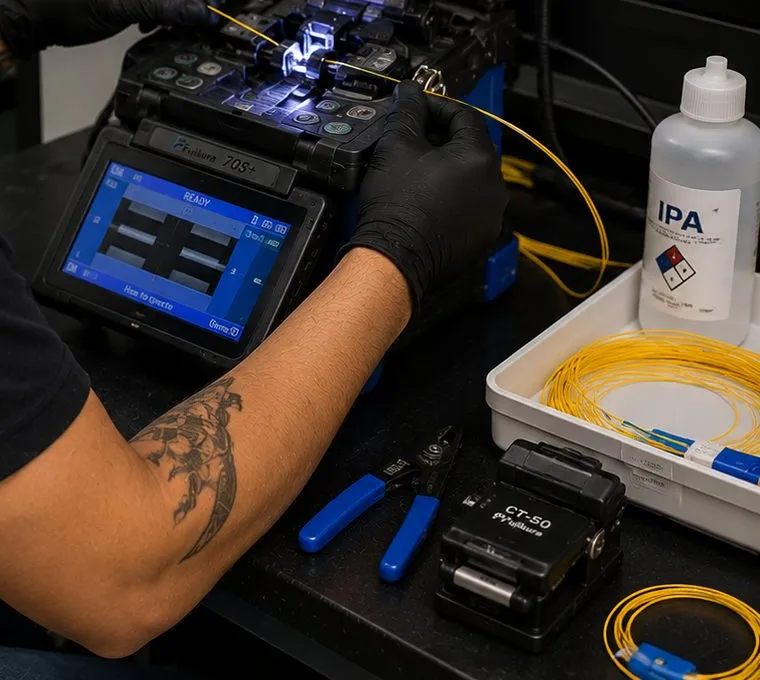
Gloved hands guiding yellow fiber into a fusion splicer on a work bench, fiber optic installation in College Point, Queens
Gloved hands lay a yellow fiber into a fusion splicer whose screen reads READY; beside it sit a cleaver, blue-handled strippers, a tray of yellow jumpers and a bottle of IPA.
College Point Fiber Quote
Tell us what the building does, how many buildings are on the lot and when the floor is quiet — a licensed installer calls back the same business day

✅
Request Sent!
An installer who works in College Point will call you back the same business day.
25+
Years Experience
✓
Same-Day Estimates
100%
Licensed & Insured
4.7★
201 Google Reviews

Running a plant off the Whitestone Expressway service road, a warehouse on 15th Avenue or a shop on 14th Avenue, and the network ends where the office does? Getting a connection from the front desk to the back of the building, or to the building next door, is exactly the work we do here. Ring our Queens line on (347) 434-6392 or use the 60-second form.

  • Routes planned around presses, cranes, racking and forklift lanes, not just around the ceiling grid
  • Work booked into your quiet shift, a weekend or a planned shutdown, so the line keeps running
  • Our vans come over the Whitestone Bridge from the Bronx office on East Fordham Road; every installer works under NYS licence #12000287431
The Neighborhood

Why College Point Properties Need Fiber Optic Installation

College Point fills up every morning. When the Queens Chamber of Commerce and the city’s Department of Small Business Services studied the neighbourhood between September 2024 and June 2025, their figures showed 19,798 people travelling in to work in College Point from somewhere else, against just 635 who both live and work there; 11,090 residents leave each day for jobs elsewhere. Few neighbourhoods in Queens look like that. The neighbourhood’s largest workplaces sit in the corporate park on the southern part of the peninsula, a district founded in 1974 on roughly 550 acres that held more than 200 companies by 2003. The largest building in it is a newspaper printing plant that opened in 1997 and has grown from 350,000 to 515,000 square feet.

That changes what a fiber job means. In a Flushing condominium or an Astoria walk-up the question is how a carrier reaches households or tenants. In College Point, the carrier usually already reaches the property line of the businesses that matter, and the trouble starts inside. A typical plant here has offices at the front facing the service road or the avenue, a production or warehouse floor behind that runs to the back of the lot, a loading dock on one side, and often a second or third building that was bought later as the business grew. The office network was built for the office. The scanners at the dock, the cameras on the yard, the terminals beside the machines and the time clock at the staff door hang off long copper runs, wireless bridges or a second internet subscription that was cheaper on the day it was ordered.

Copper Ethernet stops at 100 metres; a plant floor and its outbuildings are often longer than that from the office rack, and the electrical environment between them — motors, welders, drives, presses and forklift chargers — is the opposite of an office ceiling. Fiber carries no current, is not disturbed by those machines and goes kilometres without a repeater, which is why it is the normal answer for linking an office to the work floor and one building to the next. What makes it a College Point job rather than a textbook one is the hours: many of these businesses run early, late or around the clock, and the installation has to fit into their quiet shift.

A generic site plan. A service road runs along the bottom. The front building holds an office strip with the main network rack beside the carrier entry. Behind it is a long work floor with machines and racking. A loading dock sits on the right side. Across an open yard is a second building. A gate booth stands at the yard entrance. Red lines show fiber from the office rack across the high steel of the work floor to a zone cabinet, from there to the dock, under the yard in conduit to the second building, and to the gate booth. service road / avenue front office main rack carrier entry work floor machines and racking zone cabinet dock doors second building gate yard fiber at high level, clear of the floor conduit under the yard One owner, one lot, four places that need the network

A generic plan drawn for this page, not any particular College Point property. Solid red is fiber inside the building; dashed red is fiber in conduit underground.

The other half of College Point is a small town that the factories built. Conrad Poppenhusen arrived in 1854 with a hard-rubber business and turned the peninsula into a company town, and the blocks north of the park still read that way: single-family houses from the 1920s, 108 Cape Cod houses sold near 25th Avenue and 126th Street in 1953, newer townhouse rows, condominiums on the East River shore, and 254 storefronts on three corridors where three in four merchants rent. Their fiber questions are smaller but just as real — one resident who moved into a townhouse row finished a few years earlier found that only Spectrum was offered there — and later sections of this page deal with them separately.

College Point figures that shape fiber work

FactFigureSource
Daily work commute19,798 people work in College Point but live elsewhere; 635 live and work there; 11,090 live there and work elsewhereNYC SBS / Queens Chamber of Commerce Commercial District Needs Assessment, 2024–25
Corporate parkFounded 1974 on about 550 acres; over 100 companies by 1994 and more than 200 by 2003Wikipedia, College Point
Newspaper printing plantOpened 1997; 515,000 sq ft today; seven presses, up to 80,000 papers an hour at peakamNY, March 18, 2026
Storefronts on three corridors254 on 14th Avenue, 20th Avenue and College Point Boulevard; 10.2% vacant; 74% of surveyed merchants rent, 14% ownNYC SBS Commercial District Needs Assessment
Population33,625 in the 2020 Census, up 19.0% from 28,246 in 2010Wikipedia, College Point (Census figures)
Getting thereNo subway has ever served College Point; the Q65 and Q25 buses each carried over 15,000 riders on an average 2024 weekdayNYC SBS Commercial District Needs Assessment; Wikipedia

Plants that bring fiber to the dock usually want eyes on it too. Our Queens commercial camera installers put yard and dock cameras on the same strands, and access control installation in Queens covers the staff door and the gate.

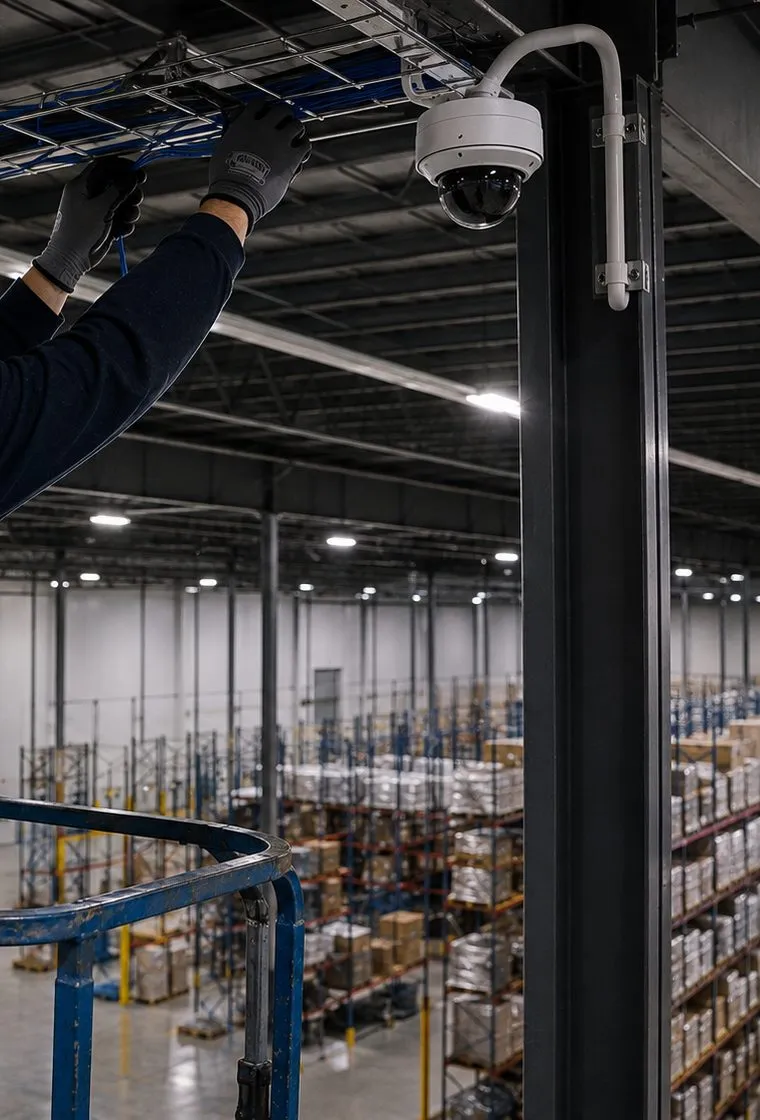
Gloved hands working at a wire basket tray high in a warehouse with racking below, cabling for fiber optic installation in College Point, Queens
Gloved hands reach into a wire basket tray carrying blue cable just under the roof steel of a high-bay warehouse; a dome camera hangs from a column and stocked racking fills the floor below.
Repair Capture

Plant Floor Cut Off From the Office in College Point?

When the scanners at the dock stop reporting, the terminals beside the machines lose the order system, or the building across the lot drops off while the office carries on, the fault is almost always on the link between them: a patch cord knocked out of a zone cabinet by a pallet, a cable crushed where someone hung something from the tray, a dirty connector after a dusty week, or a strand bent too tightly when the racking was moved. That is a repair, not a new installation. Call (347) 434-6392 and say “fiber repair”; we send a technician the same day when the schedule allows, and most single faults are found with a light source and an OTDR and fixed within an hour or two on site.

What We Install

Fiber Optic Installation Services in College Point

Here the owner’s fiber usually begins at the office rack and ends wherever the business actually happens. The carrier brings service to the property; everything between that handoff and the far corner of the work floor, the dock and the other buildings is private plant that belongs to the business and is ours to plan.

Office-to-Floor Backbone

Fiber from the main rack in the front office to a zone cabinet out on the production or warehouse floor, so terminals, scanners, cameras and printers at the back connect within a short copper run instead of a 300-foot one.

Building-to-Building Links

Outdoor-rated fiber in conduit under the yard, or on a messenger where the owner prefers it overhead, between buildings on one lot or on adjoining lots the same company owns.

Dock and Shipping Office Runs

Strands to the shipping office, the dock-door scanners and the label printers at the side of the building, kept high and protected where trucks and pallet jacks work.

Gate, Booth and Yard Links

A small sealed enclosure at the gate booth or a yard pole, fed by fiber so cameras, an intercom and a barrier controller work at the edge of the property without copper running out to it.

Production Network Kept Separate

Dedicated strands for the machines, controllers and vendor-maintained equipment on the floor, physically apart from the office network, so a problem on one cannot spread to the other.

Mezzanine and Upper-Floor Offices

Fiber up to offices, quality rooms or break rooms built on a mezzanine or second floor above the work floor, through a sleeve rather than draped down a column.

Storefront and Office Fiber

For businesses on 14th Avenue, 20th Avenue and College Point Boulevard: a clean entry, a small locked enclosure and a tested connection to the counter, the back office or the floor upstairs.

House and Townhouse Runs

An entry, a small enclosure and fiber to a home office or the rooms that matter in a detached house or one unit of a townhouse row, with conduit left for whichever provider comes next.

Survey, Test and Label Existing Fiber

For plants that inherited fiber from a previous owner: tracing each strand, testing it, finding the dead runs, and handing over a map that matches what is really on the walls.

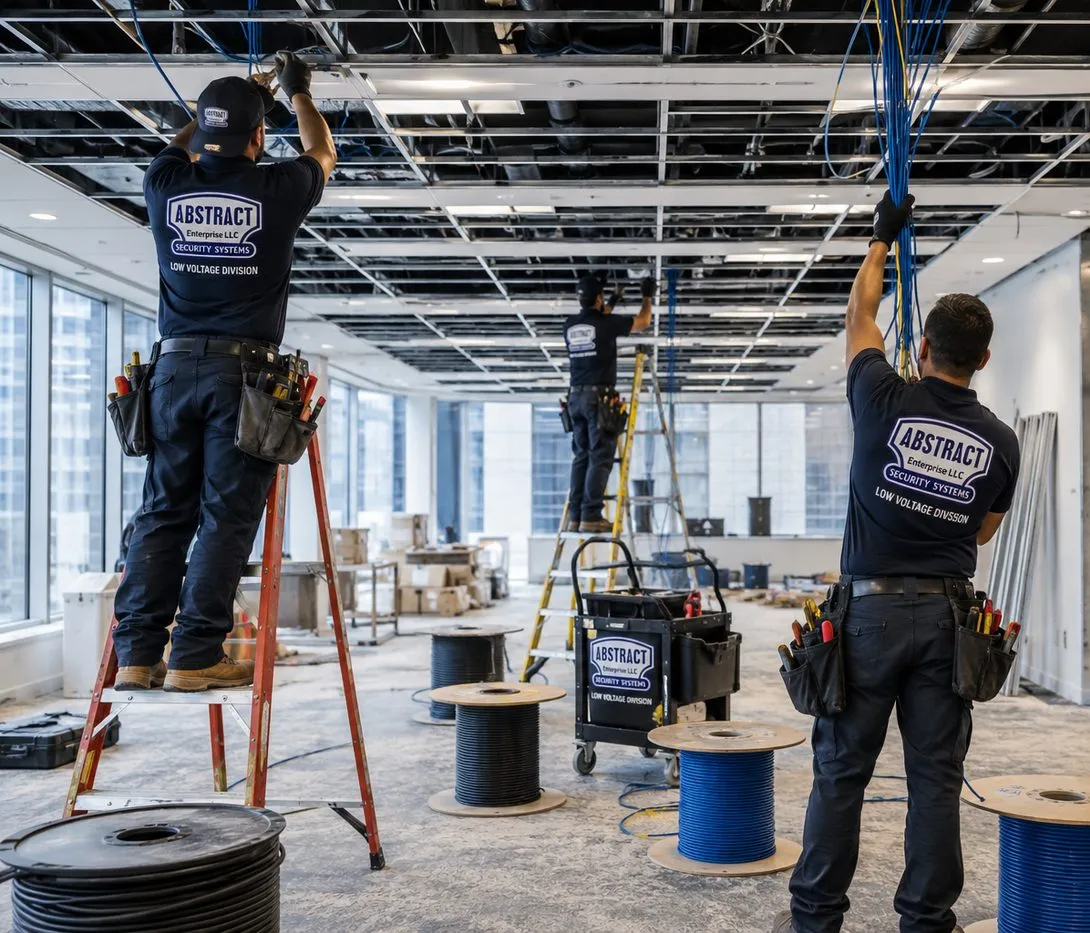
Three technicians pulling cable through an open ceiling grid above reels on the floor, a cabling crew at work in College Point, Queens
Three technicians on ladders and on the floor feed bundles of blue cable up into an open ceiling grid in a gutted office, with reels of blue and black cable and a tool cart around them.
Building Specialists

Fiber Optic Installation for College Point's Architecture

College Point’s buildings come in layers that follow its industries. Rubber, breweries and resorts in the nineteenth century; seaplanes and aircraft parts from the 1920s, when Edo Aircraft set up here and the Flushing Airport opened on the bay; a planned industrial park from 1974; big new distribution and institutional buildings since the 1990s; and, around all of it, the houses of the people who once walked to those jobs. Mill Creek kept the peninsula apart from the rest of Queens until the mid-twentieth century, reached only by College Point Boulevard, Linden Place, 20th Avenue and 14th Avenue, and that separateness still shows in how complete each layer is. Every one of them hides its cable path in a different place.

Single-Storey Plants With Front Offices

The typical corporate-park building: a block of offices along the street, a tall steel-framed work floor behind, a dock on the side. Fiber runs from the office rack up into the roof steel and out along the bay to zone cabinets placed where the work is.

Aircraft-Era Industrial Buildings

Older buildings on blocks such as 15th Avenue between 117th and 119th Streets, where a 2001 report noted six former aircraft-plant buildings, once used by LWF and Sikorsky, being reused for bottling and distribution. Masonry walls, steel trusses and decades of earlier wiring overhead.

Big-Box Print and Distribution Buildings

Very large floor plates such as the newspaper plant on the Whitestone Expressway, with press halls, paper storage and loading. Distances are long, ceilings high, and every route has to respect machinery that cannot be approached while it runs.

New Logistics Buildings With Parking Decks

Buildings like the College Point Logistics Center at 28-02 Whitestone Expressway, about 322,000 square feet with a 36-foot warehouse floor, twelve docks, two parking levels above and a solar array on the roof. Fiber here is easiest when it goes in alongside the fit-out.

Institutional Campuses

Multi-building public sites such as the Police Academy at 130-30 28th Avenue, three buildings and a central utility plant on a 35-acre former tow pound. Agencies run their own networks; our role on sites like this is limited to what a contractor or tenant is asked to do.

Detached Houses and Cape Cods

1920s single-family houses on the old estates and the 1953 Cape Cods near 25th Avenue: a cellar or crawlspace, a short run to the room that needs a reliable wired line, and a provider drop that may arrive overhead or underground depending on the block.

Townhouse Rows

Newer attached rows where each owner holds one unit but the walls, the frontage and often the utility paths are shared, and where the builder may have wired for a single provider.

Shoreline Condominiums

Condominium complexes along the East River shore, run by boards and managing agents, with common cellars and grounds that the association controls.

Nineteenth-Century Landmarks

A handful of protected buildings — the 1868 Poppenhusen Institute on 14th Road, Schleicher Court of 1857 on 13th Avenue — where any visible change needs approval and the inside is valued as much as the outside.

How the cable gets through each type

Building typeWhere fiber entersMain routeWhat we watch for
Plant with front officeCarrier handoff in or beside the officeUp into the roof steel, along the bay in tray or on supportsCrane runways, sprinkler mains, unit heaters, forklift heights
Aircraft-era buildingWhatever entrance the last owner used, often re-sealedAlong trusses or masonry walls in conduitDead wiring from earlier occupants, open roof penetrations
Print or distribution buildingDedicated telecom roomLong horizontal runs to zone cabinetsMachine guarding, dust, paper and pallet traffic
Logistics building with decksTelecom room set by the developerRisers to deck levels, tray across the warehouseWhich parts belong to the landlord and which to the tenant
Detached house or Cape CodCellar wall or a side wall near the metersThrough the cellar ceiling and up an interior wallLow cellars, finished rooms, the provider’s aerial drop
Townhouse rowEach unit’s own utility wall, or a shared closetInside the unit; along the shared frontage only with the association’s consentParty walls, common grounds, matching the builder’s conduits
Shoreline condominiumCommon cellar or utility roomCommon corridors to each unitBoard approval, ground covered by environmental rules on one site

Plants that are rewiring the office usually redo the copper at the same time. Our structured cabling team in Queens pulls the Cat6 from each zone cabinet to the desks and devices around it, numbered to match the fiber drawing.

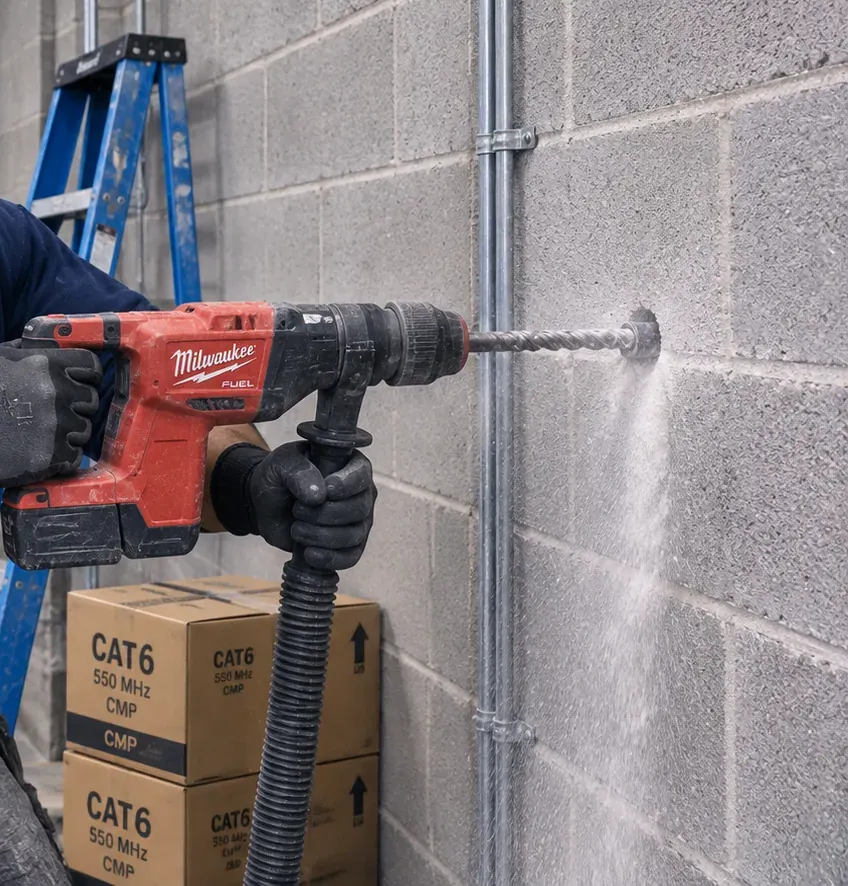
Rotary hammer drilling into a concrete block wall beside a vertical steel conduit, pathway work for fiber optic installation in College Point, Queens
A red rotary hammer bores into a grey concrete block wall beside a vertical run of steel conduit, throwing off a plume of dust, with a ladder and boxes of Cat6 cable behind it.
Commercial Fiber Optic Installation

Business Fiber Optic Installation in College Point

College Point’s business districts are of two kinds. The corporate park along the Whitestone Expressway and its side streets is industrial, wholesale and institutional, and it is where most of our larger College Point fiber work is. The three neighbourhood corridors that the 2024–25 needs assessment studied are retail and services, with family-owned businesses, a median of four full-time employees among the merchants surveyed, and plenty of cash registers, card terminals and back offices that need one dependable line.

The Whitestone Expressway Service Road

The corporate park’s front door: the newspaper plant, the College Point Logistics Center at 28-02, a 215,000-square-foot window and door factory at 31-10 that a 2014 Queens Chronicle profile said turned out close to 2,000 windows a day, and a long line of distributors and manufacturers. Office-to-floor and multi-building fiber is the usual job.

15th Avenue Industrial Blocks

Older industrial buildings between roughly 117th and 119th Streets, including the bottling plant a 2001 TimesLedger report placed at 117-02 15th Avenue, where earlier aircraft-plant buildings were taken over for distribution. Inherited wiring, masonry, and businesses that occupy several buildings on one block.

20th Avenue

Studied between College Point Boulevard and Petracca Place and carrying 21,669 vehicles a day in 2024 between Parsons Boulevard and 119th Street — the busiest of the three corridors. Shops and services, and the big-box centre that opened in 1998 with Target and BJ’s.

14th Avenue

The old main street, studied between 126th Street and 133rd Place; city counts in 2024 put about 12,597 vehicles a day on 14th Avenue between College Point Boulevard and the Whitestone Expressway. Small shops, restaurants and professional offices, with the Poppenhusen Institute just off the avenue on 14th Road.

College Point Boulevard

Studied between 14th and 23rd Avenues, with about 6,745 vehicles a day between 15th Avenue and College Place in 2024. Shops and services running south toward the Academy at 28th Avenue and, beyond the expressway, toward Flushing.

Linden Place and the Former Airport Edge

The road along the old Flushing Airport wetlands, closed for years by flooding and reopened in stages from 2015. Industrial and distribution sites on its edges, and the 80-acre airport site where a 3,000-home plan was announced in 2025.

Compliance callouts for College Point fiber work

  • Crossing a city street is a different job. Inside one lot, fiber between buildings is private work. If two buildings are separated by a mapped street, a private structure under or over that street needs a revocable consent from the city’s Department of Transportation — a petition with a licensed engineer’s or architect’s plan, agency review, a public hearing, filing fees of $100 to $750 plus an annual fee, and a term that is generally ten years. Many owners lease a carrier circuit instead; we lay out both options.
  • Listed cable for each space. Most plant runs are horizontal under roof steel, but a mezzanine office or a two-storey front building needs OFNR riser cable between levels, an office ceiling that doubles as an air plenum needs OFNP, and anything heading out across the yard needs an outdoor or indoor/outdoor jacket.
  • Firestopping at every rated wall and floor. Low-voltage cabling under 50 volts generally needs no Department of Buildings permit, but every penetration of a fire-rated wall or floor is sealed with a listed firestop system; unsealed penetrations are a common inspection failure.
  • Machine safety comes first. We do not route cable through guarded areas, across crane runways or near moving machinery, and we work within the plant’s own lockout, permit and escort rules.
  • Landmarks. Exterior work on a designated building such as the Poppenhusen Institute needs Landmarks Preservation Commission approval; we plan for interior routes and leave the facade alone.
  • Ground with rules attached. One shoreline site, the state-remediated College Point 3 site off 121st Street, sits under an environmental easement, a cover system and a site management plan. Digging there goes through the owner and that plan; we do not trench such ground on our own say-so.
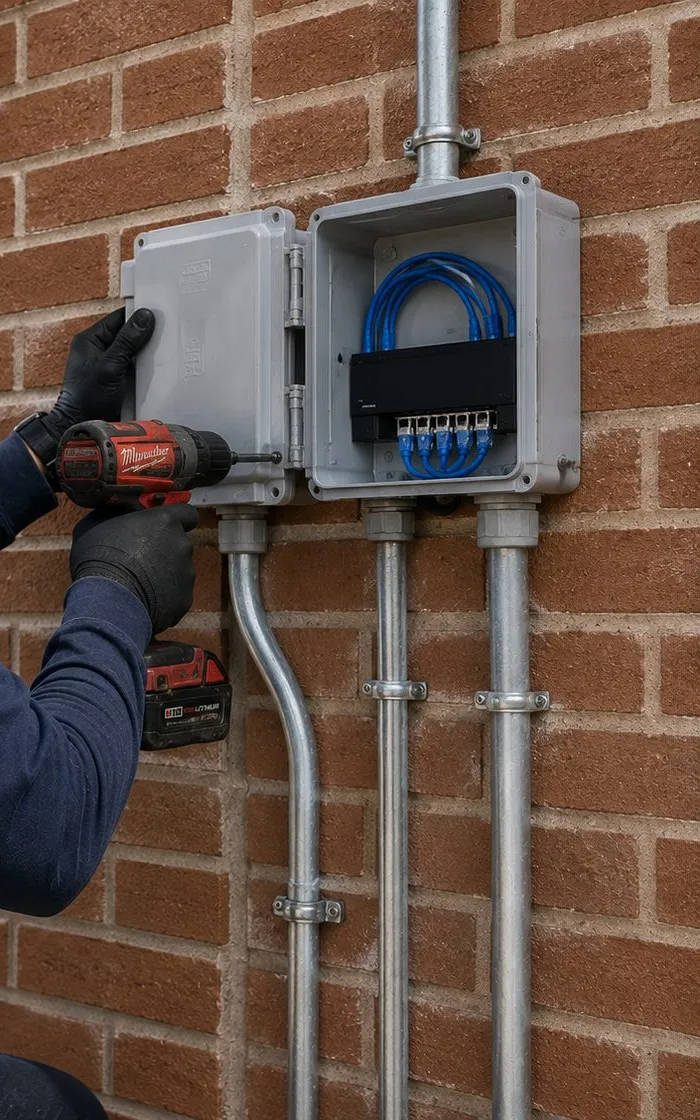
Gloved hands fastening an outdoor enclosure with steel conduits on a brick wall, exterior pathway for fiber optic installation in College Point, Queens
Gloved hands drive a screw into a grey outdoor enclosure on a brick wall; the open box beside it holds a small switch with blue patch cords, and three steel conduits run down the wall from below the boxes.
Office to Floor

Front Office to Working Floor: How a Plant Fiber Plan Comes Together

Most of the College Point plants we walk have the same shape and the same history. The business started in one building, put its server or network cabinet in the office, ran copper out to the floor as it needed it, and added wireless bridges and second subscriptions as it bought or leased more space. Ten or twenty years later it has a network that works, mostly, but nobody can draw it. Our plan replaces that with something simple enough to draw on one sheet.

Zone cabinets where the work is

Instead of running every device back to the office, we divide the property into zones — the press hall, the assembly line, the racking aisles, the dock, the second building — and put a small lockable cabinet in each, fed by fiber from the main rack. Copper then runs only the short distance from the cabinet to each device. The cabinet goes on a wall or column out of the forklift lanes, at a height the maintenance team can reach from a step ladder, and away from heat sources such as unit heaters and compressors.

The route goes up before it goes across

On a working floor the safest place for cable is high: in tray or on supports fixed to the roof steel, above the reach of forklift masts and stacked pallets, and clear of crane runways and the sprinkler mains. Where a run has to come down to a machine or a cabinet, it drops inside conduit or a protected raceway on a column rather than hanging free. Fiber is light but it dislikes being stepped on, pinched or bent sharply, so every drop is planned with a gentle bend and a protected end.

Separate strands for separate jobs

Each fiber cable carries several strands, so one route can keep jobs physically apart: a pair for the office network, a pair for the production equipment, a pair for the cameras and door controllers, and spares. Many plants have machine suppliers that maintain their own equipment remotely; giving that equipment its own strands means a supplier’s connection never touches the office network and an office problem never stops a machine.

Between buildings, the ground decides

For a second building on the same lot, the cable goes either underground in conduit across the yard or overhead on a messenger wire. Underground costs more to start but stays out of the way of trucks, snow ploughs and high loads; overhead is quicker where there is already a clear span. On parts of College Point where ground has a history — old landfill along the shore, the wetlands of the former airport — we check before anyone picks up a shovel.

Work fitted to the shift

The installation itself is planned in stages that match the operation: overhead pulls during a quiet shift or a weekend, cabinets mounted in an hour each, splicing done at a bench away from the floor, and the switch-over to the new links scheduled into a shutdown or a slow afternoon. Nothing on the floor is disconnected until its replacement has been tested.

BeforeAfter a fiber plan
Long copper runs from the office to the back of the building, some over 100 metresFiber to zone cabinets, short copper from each cabinet
Wireless bridge or second subscription to the other buildingA fiber link the owner controls, tested and labelled
Office, machines and cameras on one flat networkSeparate strands and separate networks for each job
Cables hung from whatever was handyOne supported route at high level, drawn on a single sheet
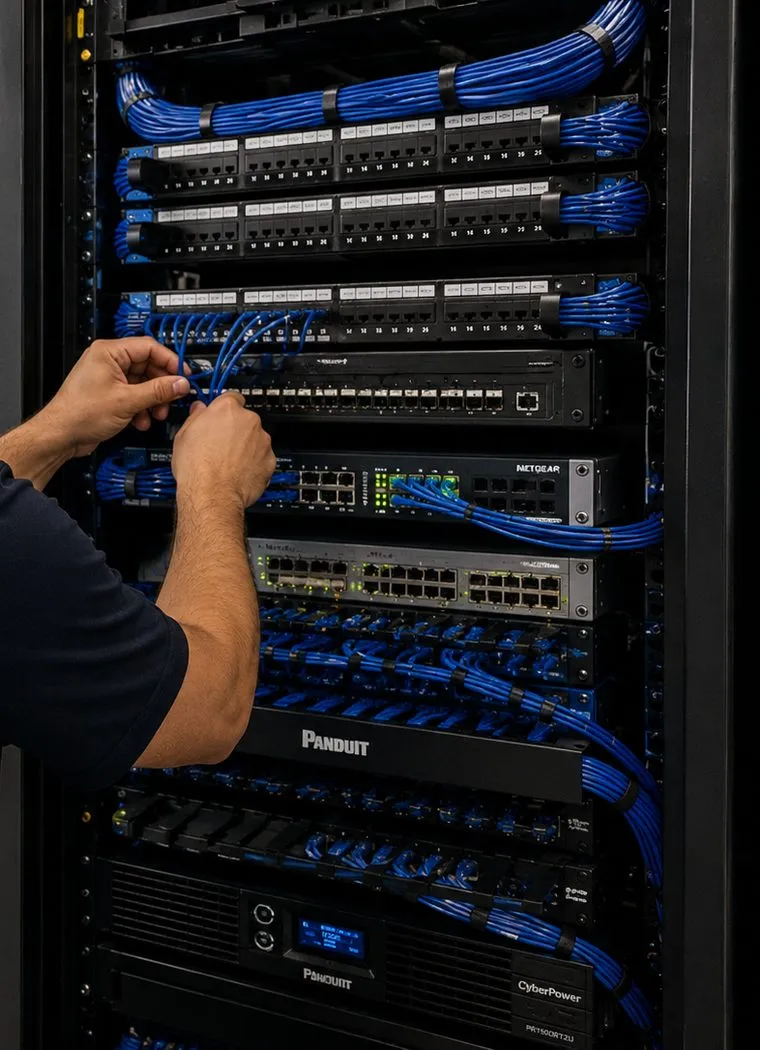
Hands patching blue cords between panels and switches in a tall network rack, the main rack end of a fiber optic installation in College Point, Queens
Two hands route blue patch cords from a patch panel into a switch in a tall black rack, with more panels above, further switches below, a cable manager and a rack-mounted power unit at the bottom.
Your Questions Answered

Fiber Optic Installation in College Point: Questions Answered

We hear the same handful of questions on almost every College Point walkthrough, from owner-operators, plant managers and the occasional homeowner. They are sorted below by where on the property they come up, with the answer we would give on the spot.

Steel, cranes and the air on the work floor

Our building on 15th Avenue dates from the aircraft era and has steel roof trusses high over the floor — can fiber simply hang from the trusses, or does it need supports of its own?

It needs its own supports, fixed to the steel, but the trusses are usually the best route in the building. We clamp beam clips or threaded-rod hangers to the bottom chords and carry the fiber in a light basket tray or on J-hooks spaced closely enough that the cable never sags into a tight curve. Nothing is tied to sprinkler pipe, conduit belonging to another trade or the roof deck itself, because those get moved or repaired and take the cable with them. In older buildings we first check what is already up there: decades of abandoned wiring, old hangers and sometimes corroded attachments. Dead cable that the owner confirms is abandoned can be removed in the same visit, which frees the route and makes the new run easier to see and maintain.

Our machining bay has an overhead crane running its full length — where can fiber go so the crane and its hook never touch it?

Outside the crane’s envelope entirely. A bridge crane sweeps the whole space between its runway rails, from the runway height down to the floor, so we treat that volume as off limits. The route runs above and outboard of the runway beams along the building columns, or along the side wall below the runway and behind the column line, and crosses the bay only at an end wall beyond the crane’s travel. Zone cabinets go on columns outside the hook’s reach. Work at height near a crane is done only with the crane locked out under the plant’s own procedure, and we agree with the crane’s owner before fixing anything to the runway structure at all, because those beams are designed and inspected for the crane, not for us.

The air in our machine shop carries oil mist and fine metal dust — how are fiber connectors kept clean where the network meets the shop floor?

By making sure connectors are almost never exposed there. Splices and patching live inside gasketed, lockable cabinets with sealed cable glands, mounted away from the worst of the coolant spray and the grinding stations; the cabinets on a dirty floor are the sealed kind used in factories, not the vented kind used in offices. Unused ports keep their dust caps. Where a device on the floor needs a fiber connection, we prefer a hardened switch or media converter in a sealed box with copper or an industrial connector to the device, rather than a bare fiber patch cord in the open. Every connector is inspected with a scope and cleaned before it is mated, and we leave the maintenance team a cleaning kit and show them how to use it.

Paint lines, roofs and the owner's own books

Our finishing line has a spray booth — can fiber pass through it on the way to the far end of the plant?

We route around it. Spray booths and the space around them are often treated as classified hazardous locations under the electrical code, where wiring methods and equipment are tightly restricted, and the simplest safe answer is to keep both cable and cabinets out of that area altogether. In practice the run goes over the booth’s exhaust plenum at a clear distance, or along the far wall, and any device that genuinely has to sit inside the booth is wired by your electrician using the methods that location requires. We will mark the booth’s boundary on the drawing so nobody later uses the booth as a shortcut for a new cable.

We're putting solar panels on the warehouse roof — can the inverters and meters report over our fiber, and should that traffic stay off the office network?

Yes on both counts. Solar inverters, meters and their monitoring gateway need a dependable network connection, and on a long building the roof-level gear can be a long way from the office rack. A pair of strands from the main rack to a small enclosure at the roof access point, with a short copper run to the monitoring gateway, does it neatly. We keep that equipment on its own strands or its own network segment, because the solar installer will want remote access to it and there is no reason for that access to reach your office systems. The roof penetration is coordinated with the roofer and the solar installer so the warranty on the roof membrane is respected.

We own the building and run our company in it — which parts of a fiber job are part of the building, and which are business equipment?

That is a question for your accountant, and we make it easy for them to answer. On request our proposal and invoice are split into the passive plant that is fixed into the structure — conduit, tray, cable, enclosures, splices and wall outlets — and the active electronics that can be unplugged and carried away — switches, optics and media converters — with labour shown against each. Owners who later sell the building, lease part of it or move the business elsewhere also find that split useful, because it shows exactly what stays with the walls and what goes with the company.

Houses and townhouse rows

We live in one house of an attached townhouse row — can a single owner add fiber on their own, or do all the owners have to act together?

Inside your own unit you can act alone: a run from your utility wall to a home office, a small enclosure in a closet, an outlet where you need it. Anything that crosses shared ground — the common frontage, a shared utility trench, the exterior walls if the association controls them — needs the association’s consent, and bringing a new provider into the row usually goes better when several owners ask together, because the provider is weighing the whole row rather than one house. A practical middle course is for each owner who renovates to leave an empty conduit from the utility wall to the inside of the unit, so when a second provider does arrive, connecting each house is quick and nobody has to open finished walls.

Where the other answers live

Pricing is on this page under cost; scheduling, coverage and access are in the FAQ; and general questions about fiber versus copper, permits and timelines are answered on our Queens fiber optic installation page and the NYC fiber hub.

Gloved hands seating a large bundle of blue cable in black J-hooks below a steel deck, pathway support for fiber optic installation in College Point, Queens
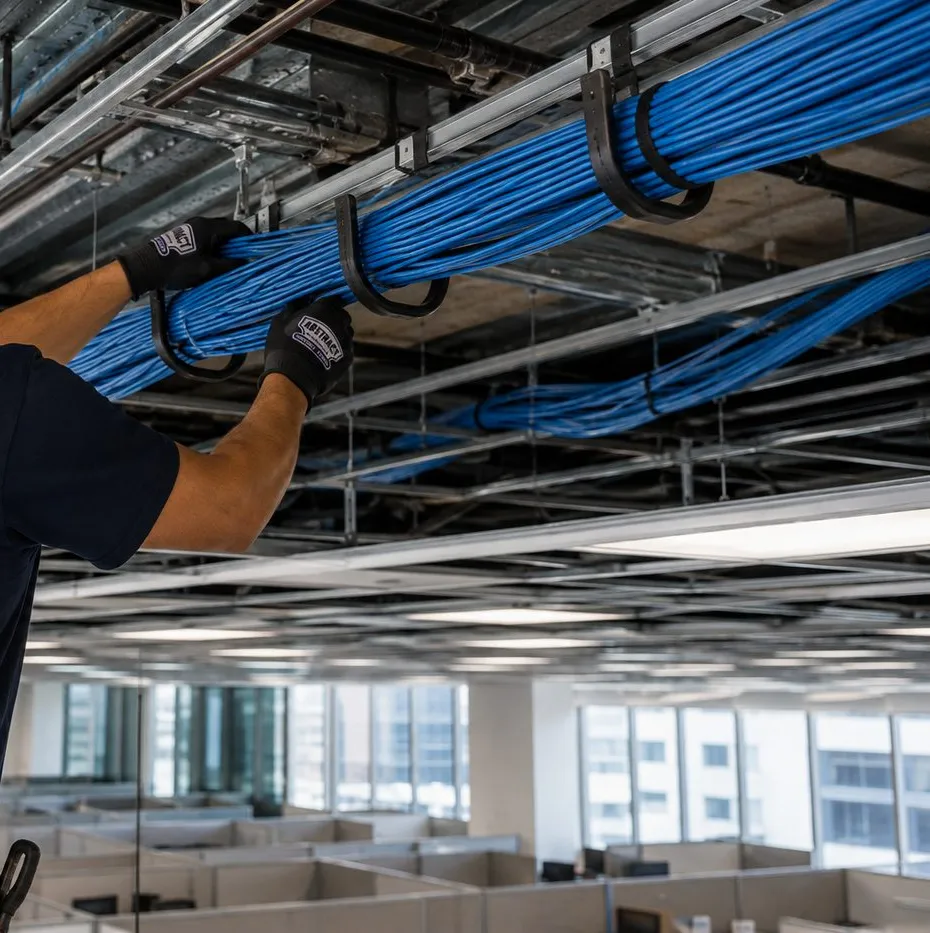
Gloved hands lay a thick bundle of blue cable into black J-hooks hung from the steel above an open office ceiling grid, with rows of workstations and windows in the distance.
Equipment

Types of Fiber Optic Cabling We Install

The parts list for a College Point plant is shaped by distance, dirt and the weather in the yard. Everything below is standard, listed material; the skill is in choosing which piece goes where.

OS2 Single-Mode Backbone

Our default between the office rack, zone cabinets and other buildings. It handles the long distances of a big floor plate or a yard crossing with plenty of headroom for future speeds.

Indoor/Outdoor Cable

One jacket listed for inside the building and for the conduit under the yard, so the run from the office rack to the far building needs no transition splice at either wall.

Armoured Fiber

Interlocking or corrugated armour for runs that drop down columns near forklift traffic, cross a storage cellar or need extra protection from rodents.

Sealed Industrial Cabinets

Gasketed, lockable enclosures for zone cabinets on dusty or oily floors, with cable glands instead of open knockouts.

Wall-Mount Splice Enclosures

Compact boxes where outdoor cable meets indoor cable at each building’s entry, holding the splice trays and the patch panel.

Basket Tray and Beam Hangers

Light tray clamped to roof steel, or J-hooks on beam clips, carrying fiber high above the floor with gentle bends.

Conduit and Innerduct

Underground conduit for yard crossings and innerduct inside it, so the fiber can be pulled, replaced or added to without digging again.

Hardened Switches and Media Converters

Industrial-temperature electronics for unheated docks, booths and roof enclosures, where office switches would fail in the first hard winter or hot summer.

LC Patching and SFP Optics

Small-form connectors and matched optics at each end, labelled to the drawing, so a link can be moved or upgraded by swapping an optic rather than the cable.

Linking a College Point plant to its second building: how copper, a radio bridge and fiber compare

OptionDistanceOn a plant floorBetween buildingsWhat the owner is left with
Long copper runs100 m per runExposed to electrical noise from motors and weldersNot suitable outdoors between separate buildingsMany cables back to one room, hard to trace
Wireless bridgeLine of sightNot used inside; signal blocked by racking and machinesQuick to install; affected by trucks, stacked goods and weatherA link that can fade without warning
Second subscriptionWherever the carrier reachesNot applicableA separate bill and separate network in each buildingTwo networks that do not talk to each other
Owner fiberKilometres on single-modeNot affected by electrical noiseUnderground or overhead, owned outrightOne drawn, tested network with spare strands
Gloved hands crimping a connector onto a blue patch cord at a bench with a cable tester, the copper side of a fiber optic installation in College Point, Queens
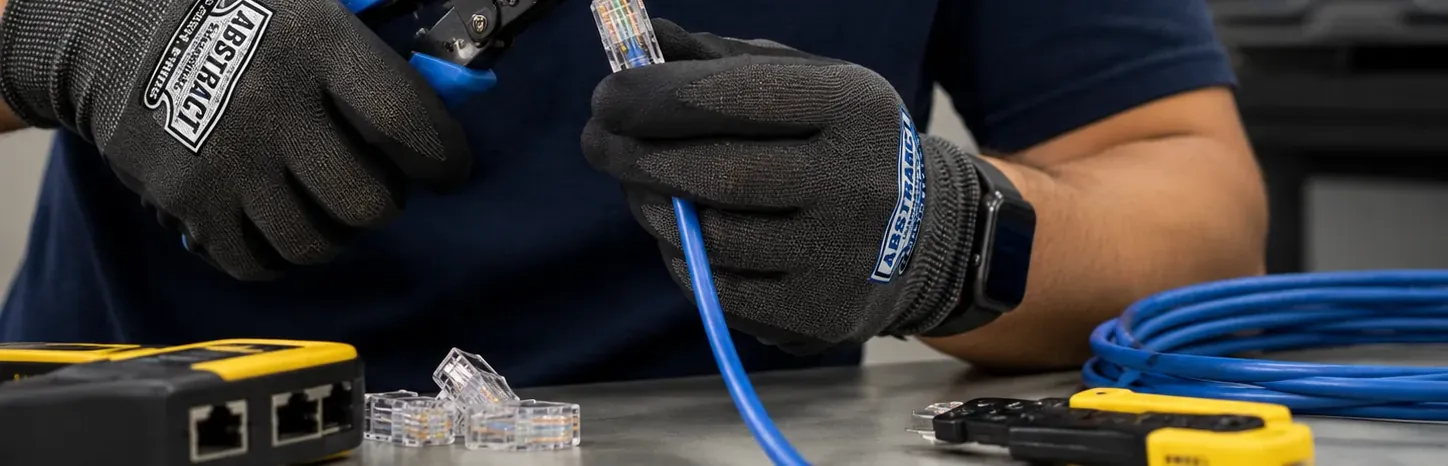
Gloved hands hold a crimping tool and a clear connector on the end of a blue patch cord over a metal bench, with spare connectors, a yellow cable tester and a coil of blue cable beside them — the short copper end of a run, after the fiber stops at a cabinet.
AI Overview Reality Check

What AI Gets Wrong About Fiber Optic Installation in College Point

Search summaries and cost guides are written for houses and offices in general. Below are claims we found published online, quoted as written, set against what a College Point plant or home actually involves. We could not retrieve Angi, HomeAdvisor or Fixr fiber cost pages during our research, so none are quoted here.

“It appears that only Spectrum is provided in this townhouse area.”

That line comes from a College Point resident asking about Fios on r/verizon, writing that the townhouses had been built within the previous five years and that only one provider served them. Search tools tend to turn statements like this into a rule: new construction means fiber, or a neighbourhood either has a provider or does not.

Neither is quite right. Whether a provider serves a row depends on what the builder installed, whether the provider reached an agreement to use it, and whether enough homes asked for service. A row built with one provider’s cable and no spare conduit can stay single-provider long after the street outside has more choice.

What owners can control is the inside: an empty conduit from the utility wall into each unit, a small enclosure and a tested run to the rooms that matter. That does not bring a provider by itself, but it removes the most expensive part of saying yes when one asks.

Price a whole plant with a tape measure at “$1-6 per linear foot”

A New York fiber contractor’s service page says that “fiber-optic cable costs anywhere from $1-6 per linear foot to install.” That is a reasonable description of pulling cable through open, easy pathways. Cost summaries repeat it as if a plant could be priced with a tape measure.

In a College Point plant the footage is the cheap part. The cost sits in supports on roof steel, work at height from a lift, routing around cranes and booths, sealed cabinets on a dirty floor, splicing, testing and doing all of it in the hours the plant allows. A 300-foot run along open trusses can cost less than a 60-foot run that has to cross an occupied dock.

That is why our College Point prices are quoted per drop, per strand tested and per backbone, and not per foot. The published Queens figures are in the pricing section below.

“Residential projects typically range from $1,500 to $6,000.”

A fiber cost article puts residential work in that band and says commercial jobs can run into six figures. For a College Point homeowner that range is misleading in both directions.

A detached house or one townhouse usually needs very little: an entry, a short run and a tested outlet, often well below that range at our Queens rates. The big numbers come from outside plant — trenching long distances on open ground — which is not what a College Point lot looks like.

For plants the reverse is true. A two-building lot with a yard crossing and several zone cabinets is a commercial project, and its price follows the number of buildings, cabinets and strands rather than any residential band.

“$300 to $800 for each fiber drop”

This per-drop range comes from a cabling vendor’s comparison of fiber with Cat6, and AI summaries often apply it to every connection in a building.

On a plant floor, very few devices get their own fiber drop. The fiber goes to zone cabinets; the cameras, scanners and terminals around each cabinet connect over short copper runs. So the number of fiber drops is the number of zones and buildings, not the number of devices, and the total is usually far lower than multiplying devices by a drop price would suggest.

Our own Queens drop prices, $447 for single-mode and $391 for multimode, sit inside that published range, but we count them per zone and per building.

Fiber installation “can take up to 4 hours”

This is how a national carrier describes installing service in a home, and AT&T gives “four to six hours”. Summaries then present a few hours as the time any fiber job takes.

Those figures describe connecting one household to fiber that is already at the door. A plant backbone with zone cabinets and a link to a second building is several days of work, usually spread over quiet shifts and weekends, plus splicing and testing time.

The more useful question for a College Point operation is not how long the job takes, but how long anything is disconnected. With the new links built and tested alongside the old ones, the switch-over itself is usually minutes per zone.

One business waited 15 months and still had no fiber, so private fiber must be just as slow

A fiber provider’s blog describes a commercial customer who waited 15 months and never got service, and the story circulates as proof that fiber projects drag on. The heading above is our summary of how that story gets used, not a quotation.

The delay in that account was the carrier building to the property. Owner fiber inside and between your own buildings does not depend on the carrier’s construction schedule at all; it depends on access, materials and your shift pattern.

The real dependency is the other way round: if a carrier is about to bring a new circuit into your office, it is worth having the internal links ready, so the new service reaches the floor and the second building on day one.

Any fiber that leaves a building needs a street-opening permit

The rule is lifted from a New York cabling guide that puts it in exactly those words: “any fiber that leaves the building in NYC needs a street-opening permit.” AI answers then apply it to every outdoor run.

For a run between two buildings on the same private lot, which is the commonest College Point case, the cable never touches a city street; the work is on your own ground, governed by your own site and any easements on it. The street rules start when a run has to cross a mapped street or sidewalk.

When it does, the city’s process is a revocable consent from the Department of Transportation for a private structure under or over the street, with an engineer’s plan, a hearing and an annual fee, and road work then needs its own permits. That is a real project, so we always price the alternative of leasing a carrier circuit between the two addresses beside it.
Walk the Floor With Us. Leave With a One-Page Plan.

A free walkthrough of the office, the work floor, the dock and the yard, scheduled around your shift, and a single drawing of where the fiber should run.

Get In Touch

Request a Free Quote

Tell us what the building does, how many buildings are on the lot and when the floor is quiet. An installer who works in College Point will reply that business day, or call (347) 434-6392.

✅

Request Received

Got it — your site details are with our Queens desk and someone will phone you today. If a link is down at this moment, call (347) 434-6392 rather than waiting.

How It Works

Our Installation Process

Seven steps. In a College Point plant the splicing is the easy part; the planning goes into routes that stay out of the operation’s way and a schedule it can live with.

1. Walk the site with whoever runs it

Office, work floor, dock, yard and every other building, with the plant or facilities manager: where the carrier lands, where devices are, where cranes, booths and lanes are, and when the floor is quiet.

2. Set the zones and the cabinet spots

Divide the property into zones, choose a wall or column in each for a sealed cabinet out of the traffic, and decide which building gets the main rack.

3. Draw the routes and the strand plan

One sheet: high-level routes on the roof steel, the yard crossing, strands for office, production, cameras and spares, each labelled by zone.

4. Price it and book the windows

A proposal from our published Queens prices, the lift and access needs, and work windows agreed around shifts, shutdowns and deliveries.

5. Supports, conduit and pulls

Hangers and tray on the steel, conduit across the yard, cable pulled at the agreed tension with service loops at each end, and listed firestop at every rated wall.

6. Splice, terminate and test

Fusion splices in each enclosure, connectors inspected and cleaned, a loss reading on every strand and an OTDR trace on the backbone and yard links.

7. Switch over and hand over

Each zone moved onto its new link in a quiet window, old cabling removed where agreed, and the drawing, labels and test results handed to the owner.

Coverage Area

Fiber Optic Installation Near College Point's Landmarks

College Point’s landmarks tell the neighbourhood’s working history — a factory owner’s institute, a printing plant, a training campus, a treatment plant — and the blocks around each have their own kind of building.

Poppenhusen Institute, 114-04 14th Road

Built in 1868 by Conrad Poppenhusen, home of the first free kindergarten in the United States, a city landmark since 1970 and on the National Register since 1976. A $6.2 million restoration replaced all 97 windows and repaired the masonry, reported in November 2025.

The Newspaper Printing Plant on the Whitestone Expressway

Opened in 1997 and now 515,000 square feet, with seven presses that between them print about 1.7 million copies of The New York Times each week as well as Newsday, USA Today and Schneps Media’s papers, according to an amNY report from March 2026.

Police Academy, 130-30 28th Avenue

A $950 million campus of about 730,000 square feet in three buildings — an eight-storey classroom building, a physical training building and a central utility plant — on a 35-acre former police tow lot. Phase One opened in December 2015.

Tallman Island Treatment Plant

On a narrow peninsula of the College Point shore, built between 1937 and 1939, treating about 80 million gallons a day on average for more than 400,000 residents. Flooded by Sandy’s surge in 2012, it has since had about $32 million of flood-protection work.

Hermon A. MacNeil Park

The waterfront park on the East River, once known as Chisholm’s and a summer residence of Mayor Fiorello La Guardia, named for the sculptor who designed the Standing Liberty quarter. The streets of houses south of it are typical of our residential College Point work.

The Former Flushing Airport

Opened on the bay in the late 1920s and closed in 1984, the site has since returned to about 80 acres of wetland. In 2025 the developers chosen by the city, Cirrus Workforce Housing and LCOR, revealed a plan for about 3,000 homes there, with construction expected from 2028 if approvals are granted.

We also serve the rest of College Point and the neighbourhoods around it: Malba, Whitestone and Beechhurst to the east, the Flushing blocks across the Whitestone Expressway, Willets Point, and every other part of the borough through our Queens fiber optic installation team.

Hands pressing a round white wireless access point onto a ceiling tile, one of the devices fed from fiber optic installation in College Point, Queens
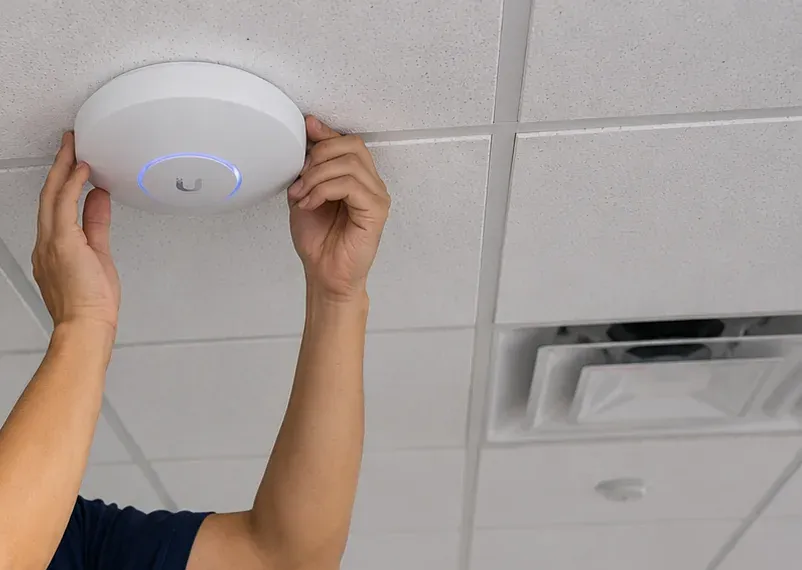
Two hands press a round white wireless access point with a blue status ring onto a suspended ceiling tile, beside an air diffuser in the grid.
Pricing

Fiber Optic Installation Cost in College Point

The numbers below are the Queens list; nothing is marked up for College Point. Lifts, shift windows and yard crossings differ from one site to the next, so the binding figure comes after the walkthrough. Two of the lines, the single-mode and multimode drops, are taken from the fiber options in our Queens structured cabling configurator, matching our Queens borough page; termination, OTDR, both backbones and the second room are our Brooklyn-and-Bronx base prices multiplied by the 1.05 Queens factor.

ItemQueens priceWhere it usually fits on a College Point job
Single-mode fiber drop$447 per dropOne zone cabinet, gate booth, roof enclosure or home office connected back to the main rack
Multimode fiber drop$391 per dropA short link inside one room or office suite, such as a server cabinet to a nearby switch
Fiber termination on an existing cable$37 per terminationFinishing fiber a previous owner left coiled, or bringing an inherited link back into service
OTDR test$42 per strandRun on every strand that crosses the yard or the length of the plant, so the owner has a dated baseline to compare against after any damage
12-strand OM4 floor-to-floor backbone$4,725 – $7,350An office building on the lot with floors above the ground floor, or a mezzanine office suite
24-strand OS2 between buildings or along a long structure$8,400 – $15,750+A second building across the yard, or the full length of a large plant from office to back wall
Second telecom room with fiber linkfrom $2,520A small powered network room in the second building or at the far end of a long floor
Service and callback rate$195/hr, 3-hr minimum ($585)Repairs, moving a cabinet when racking changes, adding a zone later; new installation is priced separately

What moves a College Point fiber quote

  • Height and access. A run along roof steel 30 feet up needs a lift and someone on the floor watching for traffic; a run above a dropped ceiling does not.
  • The work window. Jobs that can only happen on night shifts, weekends or a shutdown take more visits than a job we can do straight through.
  • Number of zones and buildings. Most of the price follows cabinets and links, not footage, so a compact plant with three zones costs less than a sprawling one with eight.
  • The yard crossing. Pulling through existing conduit is quick; new conduit under asphalt, around utilities and through a fence line is a project of its own.
  • What is already there. Inherited fiber that tests well can be terminated and reused for a fraction of the cost of new cable; dead cable that has to be traced and removed adds time.

Why not ADT, Ring or SimpliSafe? Those brands sell alarms and cameras, and none of them builds a private network across a plant floor or between buildings. The real alternatives for a College Point operation are a carrier’s leased circuit between buildings, a wireless bridge, or an electrician running cable without the splicer and test equipment to finish it. We are the licensed fiber option: our own splicing and test gear, a drawing the owner keeps, and the same Queens prices from the Whitestone Expressway to the East River.

Shop Our Systems

Fiber Optic Installation Packages & Pricing

Each figure below is simply our published unit prices added up for a kind of College Point site we are often asked about. The real proposal swaps in your own count of zones, buildings and strands.

Starter — Office to the Back of the Floor

$1,062

Two single-mode drops at $447 ($894), from the office rack to zone cabinets at the middle and back of a single-building plant, plus an OTDR trace on four strands at $42 ($168). Cabinets, supports and lift time, where needed, are itemised separately on the proposal.

Standard — The Second Building

from $2,520

A small powered network room in the second building on the lot with its fiber link back to the main rack — our published second-telecom-room line — so the other building joins the same network instead of keeping its own subscription.

Premium — Long Plant or Multi-Building Lot

$8,400 – $15,750+

A 24-strand OS2 single-mode backbone along a large plant or between buildings, with enough strands to give office, production, cameras and the solar or building systems their own pairs, and an OTDR trace on every strand.

Bring Your Own Equipment — Labour Only

Some plants already hold the materials — a reel left over from an earlier job, a cabinet bought through a parent company, a box of optics. We will put them in and charge only labour: $195 an hour, three hours minimum ($585), covering the supports, the pull, the splices, the tests and the labels. Your parts keep whatever warranty their maker gives, and we test a supplied reel end to end before it goes up into the steel.

Full terms — including 50% deposit, one-year parts-only warranty on AESS-supplied products, and the late-fee schedule — are set out in the service agreement. Every strand we finish is handed over with its test result from the day of installation.

Handheld cable certification tester showing PASS while connected to a wall jack, testing during fiber optic installation work in College Point, Queens
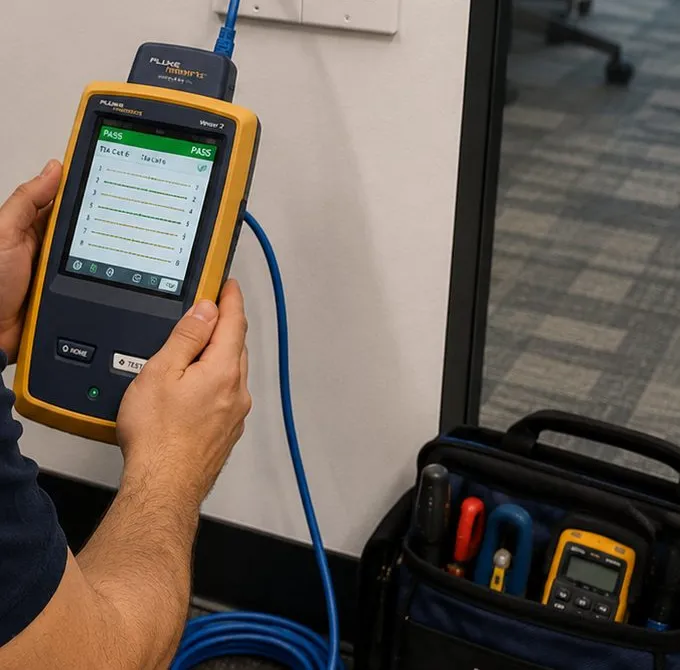
A yellow handheld certification tester connected to a white wall jack by a blue cord shows a green PASS screen; a tool bag with a multimeter sits on the floor below.

Need a Figure for Next Quarter’s Budget?

The walkthrough costs nothing. You get the drawing, the number of zones and links, and a price you can take to the owner or the parent company.

Street by Street

How a Fiber Job Changes Across College Point

College Point is only a little over a thousand acres, but the job changes sharply from one district to the next. Here is how we think about each part of the peninsula before we arrive.

The corporate park along the Whitestone Expressway

Large, mostly single-storey buildings with offices facing the service road and long work floors behind. Carriers generally serve these addresses already; the job is internal and between buildings. Expect lifts, steel, long horizontal runs and a strict work window. Truck traffic on the service road means our vans need a loading spot agreed in advance, ideally inside the yard rather than at the curb.

15th Avenue and the older industrial blocks

Buildings from the aircraft-parts years and the decades after, many of them reused several times. Here the first visit is about what is already in the ceilings: abandoned runs from previous occupants, old phone cable, sometimes fiber nobody has documented. We survey and test before we design, because reusing a good existing route can save a day of work.

20th Avenue and the shopping centres

The busiest of the three corridors the city studied, with retail centres and chain stores where the landlord or a corporate IT department sets the rules. Fiber work here is usually a tenant fit-out: a link from the centre’s telecom room to one store, scheduled outside opening hours, with a certificate of insurance naming the landlord.

14th Avenue and the old village centre

Smaller buildings, older storefronts and family businesses; across the three corridors the merchants surveyed in 2024–25 had been in business for a median of eight years. Typical jobs are a clean entry and a locked enclosure for one shop, a link between a shop and its office or stockroom upstairs, and the occasional professional office that needs a dependable connection for card terminals and records. Nineteenth-century buildings nearby, including the Poppenhusen Institute, call for interior routes and no exterior changes.

College Point Boulevard

The spine from the village centre south toward 28th Avenue and the expressway, mixing shops, services and larger lots. Work here ranges from storefront fiber to links between a business’s front building and a rear yard building.

The residential streets and the 1950s Cape Cods

Detached houses, Cape Cods near 25th Avenue and 126th Street, and newer townhouse rows. Jobs are small: a home office, a run to a garage workshop, conduit left for a second provider. Cellars are often low and finished, so we plan the route with the owner room by room.

The East River shore

Condominium complexes, MacNeil Park, Powell’s Cove and the treatment plant. Associations control common areas, and parts of the shore carry environmental restrictions from old landfilling. Anything that involves digging starts with the association and its paperwork.

Linden Place and the former airport

Industrial and distribution sites on the edge of the old airfield wetlands, and the 80-acre site itself, where a large housing plan is proposed. For businesses here, low ground and flood-prone streets shape where network equipment should sit inside the building.

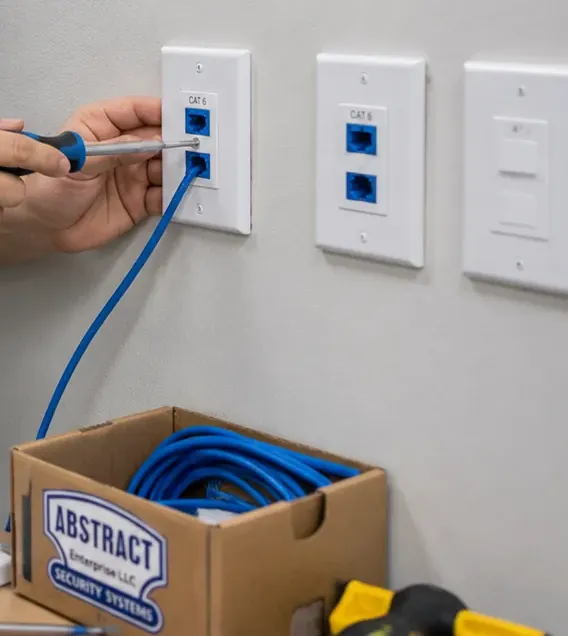
Screwdriver fixing a white data wall plate with blue jacks beside two more plates, an outlet at the end of fiber optic installation in College Point, Queens
A hand with a screwdriver fixes a white wall plate holding two blue jacks, with a blue cord leading down to a box of cable; two more plates are mounted along the same wall.
Shifts and Shutdowns

Presses, Lines and Trucks: Scheduling Fiber Work Around a Running Plant

The printing plant on the Whitestone Expressway can turn out up to 80,000 newspapers an hour at peak, according to amNY’s 2026 account of a visit; a 2014 profile of the window factory nearby described close to 2,000 windows a day. Plants like these do not stop because a contractor would find it convenient. Most College Point businesses we work for run something similar on a smaller scale: a line, a press, a pick-and-pack operation or a fleet that leaves at dawn. Planning the work around that rhythm matters as much as planning the cable route.

We start by asking for the operation’s calendar rather than offering ours. When is the floor quietest? Is there a planned shutdown for maintenance? Which days do the big deliveries arrive? Which doors and lanes must never be blocked? The answers decide the order of work. Overhead pulls and support installation, which need a lift on the floor, go into the quietest hours. Cabinet mounting and splicing, which are quiet and contained, can happen while the operation runs. The switch-over of each zone goes into a window the operations manager chooses, one zone at a time.

Lifts are the main constraint. A scissor or boom lift on a working floor needs a clear path, a spotter and an agreement with whoever directs forklift traffic; we bring cones and barriers, and in plants with their own lift rules we follow those. Where the plant owns lifts and is willing to lend them, we use theirs under its procedures; otherwise we arrange rental delivered to the dock at the start of the window and collected at the end.

The daily traffic counts in the city’s needs assessment give a sense of the streets our crews use: about 21,669 vehicles a day on 20th Avenue and 12,597 on 14th Avenue in 2024, with construction, truck and bus traffic listed among the problems merchants face. There is no subway, so everyone arrives by road. We arrive early, park where the site tells us, and keep vans off the curb lanes merchants depend on.

TaskNeeds the floor quiet?Typical window
Walkthrough and surveyNoAny time, with an escort
Supports and tray on roof steelYes, below the work areaNight shift, weekend or shutdown
Cable pulls at heightYes, below the runSame windows as supports
Cabinet mountingOnly locallyDuring operation, with a barrier
Splicing and testingNoDuring operation, at a bench
Zone switch-overBrief pause in that zoneA window chosen by operations
Homes

College Point Houses and Townhouse Rows: Fiber at Home Scale

The residential side of College Point grew in waves. About a hundred single- and two-family houses went up on the old Graham estate in 1926; the Schlesinger estate was sold in 1938 for a development of about fifty homes; 108 Cape Cods were sold near 25th Avenue and 126th Street in 1953 for $13,500 each; and newer townhouse rows have filled gaps since. The 2020 Census counted 33,625 residents, 19 per cent more than in 2010, and the city’s needs assessment found an average household of 3.11 people, larger than the Queens average of 2.77.

A larger household can mean several people working or studying online at once, and more devices in rooms far from where the provider’s cable enters the house. In a detached house the usual fix is modest: run fiber, or good copper, from the provider’s entry point in the cellar or utility wall to a small enclosure in a central closet, and from there to the rooms that need a reliable wired connection. Mesh Wi-Fi then has a strong wired backbone instead of struggling through floors and walls on its own.

Townhouse rows bring the one-provider problem a resident described online, and the shared-ground issue covered in our answers above. The most useful thing we can do in a row is make each house ready: conduit from the utility wall into the unit, a small enclosure, and a tested run inside, so that whichever provider arrives next can connect without opening finished rooms. For a whole row, the association can commission one survey of the common frontage and utility path, which is cheaper than each owner doing it separately.

Garages and backyard workshops are common on the older lots. A short fiber run in conduit from the house to the garage brings a camera, a door opener or a workbench computer onto the home network without the problems of running copper outdoors between two structures.

Shore and Ground

Landfill, Wetland and a Treatment Plant: What College Point's Ground Teaches

College Point meets the water on two sides — Flushing Bay to the west and the East River to the north — and some of its land is not what it seems. The state environmental department’s file on one shoreline site off 121st Street describes unregulated landfilling between 1966 and 1975, with fill that included construction debris and oil contaminated with PCBs, beneath what is now condominium buildings and a public park. Oil recovery began in 2008, buried drums and soil were removed in 2018, a soil cover was installed, and in 2022 the department proposed no further action, keeping an environmental easement, a groundwater-use restriction and a site management plan in place.

For fiber, the lesson is simple: on that kind of ground, nobody digs without the owner checking the site management plan first. Conduit across a condominium’s grounds there would have to respect the cover system, and an above-ground or through-building route may be easier than a trench. We raise this on the first visit rather than after a shovel has gone in.

The Tallman Island treatment plant at the peninsula’s edge offers a second lesson. Sandy’s storm surge in 2012 flooded its roadways, loading areas and critical equipment, and the city’s environmental protection department responded with flood walls, flood barriers, flood-resistant doors, elevated electrical and mechanical equipment and sealed penetrations, at a cost of about $32 million according to the engineering firm involved. A private business is not a treatment plant, but the same thinking scales down: keep active network equipment off the lowest floor where possible, seal every cable entry against water, and leave fiber, which tolerates water far better than electronics, to do the travelling through low places.

The former airport is the third. The 80-acre site has reverted to wetland since flights stopped in 1984, and roads around it have flooded badly enough that Linden Place was closed for years before reopening in stages. If the proposed housing goes ahead, construction there is expected from 2028; businesses on its edges should expect years of work traffic and, as with any large excavation next door, should keep a dated test of their own fiber on file before it starts.

Growing in Place

When a College Point Business Expands Next Door

College Point businesses tend to grow sideways. The 2001 TimesLedger report on the bottler’s move described six existing buildings on 15th Avenue being taken over for distribution rather than one new one. Untapped New York’s profile of S&L Aerospace Metals, which began in 1945 as a Brooklyn bicycle shop and now makes fracture-critical structural parts for aircraft, says the company chose to stay in New York instead of moving to larger premises offered elsewhere, and expanded by more than 100,000 square feet. And the College Point Logistics Center went up on a four-acre parcel the newspaper company had owned beside its printing plant.

Each of those moves leaves the network a little more spread out than before. The pattern we see is a business that ends up with buildings on both sides of a yard, or two buildings on the same block that were bought ten years apart, still joined by whatever was quickest at the time. The fix is to treat the whole holding as one site: one main rack, a fiber link to each building, and spare strands at every end so the next purchase can join without new digging.

If the next building is across a mapped street rather than across your own yard, the decision changes, and we set out the costs of a city consent against a leased circuit before anyone commits to either.

Before You Call

Six Things a College Point Plant Manager Should Know Before Hiring Any Installer

  1. Find out where the carrier lands. The demarcation point, usually in or near the office, is where your private network starts. Everything downstream of it is yours to design.
  2. Count zones, not devices. A plan built around zone cabinets needs a handful of fiber links, not one per camera or terminal.
  3. Ask about the crane, the booth and the lanes before the route. A route drawn on a floor plan without them is not a route.
  4. Keep production on its own strands. Machine suppliers, solar installers and camera companies often want remote access; give their equipment its own path.
  5. Insist on test results. Every strand should leave with a loss reading, and the backbone and yard links with an OTDR trace, dated and labelled.
  6. Get one drawing. A single sheet showing routes, cabinets, strand use and spares is what lets the next manager, or the next buyer of the building, understand what they have.
Complete Services

Every Fiber Optic Installation Service in College Point

Once the ceilings are open and the lift is on site, most plants add other low-voltage jobs to the same visit. Everything below can ride the routes, cabinets and drawing the fiber creates.

Structured Cabling in Queens

The copper from each zone cabinet to the desks, scanners and terminals around it, numbered to match the fiber drawing.

Cat6 Installation for Queens Businesses

Cat6 or 6A for a front office or mezzanine suite being refitted, pulled through the same ceiling access as the fiber.

Network Installation in Queens

Switches, firewalls and Wi-Fi at each end of the fiber, with office, production and guest networks kept apart.

Queens Network Cable Repair

Repairs to copper that has been crushed by a pallet, cut during a fit-out or damaged in a wet cellar.

Queens Structured Cabling Pricing

Where the Queens single-mode and multimode drop prices quoted above are published, with the copper options beside them.

Commercial Cameras in Queens

Dock, yard, gate and floor cameras riding on the same strands as the rest of the network.

Queens Access Control

Card readers at the staff entrance, the office door and the gate, fed from the nearest zone cabinet.

Intercoms in Queens

Gate and front-door intercoms that reach reception and the shipping office over the building’s own fiber.

Fiber Optic Installation in Queens

The borough page for everything outside College Point, from Long Island City to the Rockaways.

Field Notes

Field Notes From College Point Plant Floors

How we normally approach plant and warehouse work — a description of habit, not an account of any particular customer’s building

On a plant walkthrough we spend more time looking up than looking down. The roof steel tells us where a route can go, and it also tells us what previous contractors did: old hangers, cut-off cables, a junction box nobody can explain. We photograph all of it, because the owner usually wants to know what can come down as much as what is going up.

Then we walk the floor with whoever directs the traffic, not just whoever signs the order. That person knows where pallets get stacked on a busy day, which column gets hit by forklifts, and which corner floods when it rains hard. Cabinets go where that person says they will be safe, even if the drawing would prefer them somewhere else.

At the end we leave a drawing printed large enough to pin up in the maintenance office, with the zone names written the way the floor staff already talk about them. A label that says “Press Hall East” gets read; a label that says “ZC-03” on its own gets ignored.

Full Service List

Fiber Optic Services We Provide in College Point, Queens

For anyone searching by the name of a task, here is everything we do in College Point, grouped the way a plant, shop or home job actually runs.

Surveys, routes and pathways

Each project starts with a fiber optic site survey that records the carrier’s demarcation point, the zones on the floor and the obstacles above it. From that we design the fiber optic cable routing, install fiber optic cable tray and beam-mounted supports in the roof steel, and carry out fiber optic conduit installation across yards and through block walls. Outdoor and underground fiber optic installation between buildings, aerial fiber on a messenger where an overhead span already exists, and armored fiber optic cable installation near forklift lanes are all part of the same scope.

Industrial and warehouse fiber

Industrial fiber optic installation in College Point means an office-to-floor fiber backbone, zone cabinet installation on walls and columns, warehouse fiber optic installation along racking aisles, and plant floor networking that keeps production equipment on separate strands. We handle loading-dock fiber, guard-booth and gate fiber links, building-to-building fiber optic links on one lot, and fiber for solar monitoring and rooftop equipment.

Commercial and residential fiber

Commercial fiber optic installation for shops, banks, restaurants and offices on 14th Avenue, 20th Avenue and College Point Boulevard; office fiber optic installation for mezzanine suites; and residential fiber optic installation for detached houses, Cape Cods and townhouse units, including home office fiber runs and garage or workshop links.

Splicing, termination and enclosures

Fiber optic fusion splicing in sealed enclosures, fiber optic termination with LC and SC connectors, fiber patch panel installation in the main rack, wall-mount fiber enclosure installation at each building entry, and sealed industrial fiber cabinets on dusty or oily floors. SFP transceiver installation and industrial media converter installation complete each link.

Testing, documentation and repair

Fiber optic testing with a light source and power meter on every strand, OTDR testing on backbone and yard links, fiber connector inspection and cleaning, and fiber optic certification reports for owners, insurers and IT providers. When something fails, fiber optic troubleshooting, fiber break location, fiber optic cable repair, re-termination and fiber link restoration follow, along with re-labelling and an updated drawing whenever cabinets move or zones change.

FAQ

College Point Fiber Optic Installation FAQ

Do you also take fiber jobs in Malba, Whitestone and Beechhurst, or on the Flushing side of the Whitestone Expressway?
+

Yes. Most of our work on this side of the borough is in College Point’s corporate park and village streets, but we take jobs in Malba, Whitestone, Beechhurst and the Flushing blocks just across the expressway too. All of it runs through our Queens line and is dispatched from our office on East Fordham Road in the Bronx.

Can the overhead work be booked into our plant’s annual maintenance shutdown?
+

Yes, and it is often the best time for it. Tell us the shutdown dates as early as you can; we plan the survey and drawing beforehand, order materials so they are on site before the shutdown starts, and do the lift work, pulls and supports during it, leaving splicing and switch-over for after the floor restarts.

Can a zone cabinet be mounted on a steel building column instead of a wall?
+

Usually, yes. We mount cabinets on columns with clamps or a backing frame rather than drilling the steel, keep them above the height that forklifts and pallets reach, and add a bollard or guard where the column sits beside a traffic lane. If the column is part of a fire-rated assembly or the building engineer has rules about attachments, we follow those.

College Point has no subway — how do your crews get to the site, and what parking do they need?
+

We come by van, with the cable, tools and test gear on board, so the practical question is where the vans can stop. For plants, a space in the yard or beside the dock is best; for shops, a loading zone or a nearby legal space. Let us know about any gate times, security check-in or yard rules when you book.

Does fusion splicing count as hot work under our plant’s safety rules?
+

A fusion splicer joins glass with a small, enclosed electric arc, and some sites treat any tool that makes an arc as hot work. If yours does, we follow your permit system. Where a site prefers, we splice at a bench in the office or in our van and bring finished, tested assemblies onto the floor.

Will you leave spare patch cords and a cleaning kit so our maintenance team can swap a damaged cord?
+

Yes, if you would like them. We can leave labelled spare cords that match each cabinet, a connector cleaning kit, and a short walkthrough for the maintenance team on how to inspect, clean and replace a cord. Anything beyond a cord swap, such as a broken strand or a damaged splice, is a job for a technician with a splicer and test gear.

All Areas Served

Fiber Optic Installation Across New York City

College Point is one neighbourhood within our Queens fiber optic installation coverage, and Queens is one of the five boroughs on our NYC fiber optic installation hub. The cards link every borough, county and region we serve for fiber, along with each neighbourhood page published so far.

If the plant’s next project is a gate camera or a burglar alarm rather than glass, every other service we offer is a click away from the Abstract Enterprises Security Systems home page; how the firm began is told on our about us page.

College Point Plant, Shop or Home Offline Right Now

If the dock has lost the order system, the second building has dropped off the network, the shop on 14th Avenue cannot take cards or the home office upstairs has gone dark, phone (347) 434-6392. We send a technician the same day when the schedule allows; the common causes — a cord pulled from a cabinet, a cable caught by a lift or a load, a contaminated connector — are usually put right within an hour or two on site, and the link is tested again before we leave.

Fiber Optic Installation College Point — From the Office to Every Corner of the Lot

Abstract Enterprises Security Systems · 460 E Fordham Rd, Bronx, NY 10458 · Queens line (347) 434-6392 · WhatsApp (718) 679-0359 via wa.me

NYS Low-Voltage Licence #12000287431 · 100% Licensed & Insured · Same-Day Estimates · Rated 4.7★ from 201 Google Reviews

Full terms — including 50% deposit, one-year parts-only warranty on AESS-supplied products, and the late-fee schedule — are set out in the service agreement. See our warranty page.

Last checked October 17, 2026 · History: new page, launched 17 October 2026 with the College Point research summarised above; future revisions will be noted here.