Long Loft Runs · Campus Suite Links · Storefront & Rowhouse Fiber · Fusion Splicing · OTDR Records
Sunset Park is two neighbourhoods with one name, and the Gowanus Expressway draws the line between them. West of Third Avenue, carriers already reach the block-long concrete factories of Industry City, Bush Terminal and the Army Terminal; what is left is the long walk from the building's carrier room to a suite hundreds of feet away. Up the hill, the runs are short but the owners are many: four historic districts of rowhouses and two shopping avenues lined with small businesses. We plan, pull, splice and test private fiber on both sides of the highway, and we price it at the Brooklyn base rate.
Reviewed and updated October 17, 2026 · Written by Anwar Timothy, NYS licence #12000287431

Which side of the expressway are you on? That one answer tells us most of what the job will look like. Ring (347) 934-8335 or use the 60-second form, and tell us where your internet provider's equipment sits today and where the network has to reach.
Stand on Fifth Avenue at 40th Street and look west. Below you, past the steel of the Gowanus Expressway, the waterfront is lined with some of the biggest industrial buildings ever put up in New York: the rows of six-storey concrete factories that Irving T. Bush built between 1906 and 1928, Cass Gilbert's 1919 Army Terminal, and the eight-storey former Navy supply warehouse at 850 Third Avenue. Behind you, uphill, the blocks are rowhouses from the 1890s and 1900s, apartment houses, churches, and two commercial streets — Fifth Avenue and Eighth Avenue — packed with family businesses. Fiber reaches both halves differently, and that difference is the reason this page exists.
On the waterfront, getting a carrier to the building is mostly a solved problem. Industry City runs a meet-me room with more than forty carriers and a campus dark-fiber network out to tenant suites, according to its operator DataVerge. The city spent a 2015 broadband programme, Connect IBZ, putting fiber into the Southwest Brooklyn Industrial Business Zone. What is not solved is the inside of the building. A single Bush Terminal-era factory runs the length of a city block; a suite at the far end can be several hundred feet of corridor, column line and fire wall away from the room where the carriers land. Copper Ethernet stops at 100 metres. That is where fiber earns its money here, and where most of our waterfront work happens.
Up the hill the problem flips. Fiber service is widely available on the residential streets — one provider-comparison site, working from FCC filings, claims fiber availability above 95% across the neighbourhood — but availability at the curb is not the same as a clean, documented path inside a rowhouse split into three apartments, or into the back room of a Fifth Avenue shop that sits under someone else's apartment. Runs there are tens of feet, not hundreds. The work is in the permissions, the old plaster, the shared cellars and the decision about where the provider's box should go so the next tenant isn't drilling another hole.
And then there is the line in the middle. The expressway, opened as the Gowanus Parkway in 1941 on the pillars of the old Third Avenue elevated railway and widened to six lanes in the 1960s, still takes what one history of the road calls a daily pounding by well over 100,000 cars and trucks. Nobody runs private cable under it casually. When a business has a warehouse on Second Avenue and a shop on Fifth, the answer is nearly always two provider circuits joined by a private network, not one long strand of its own — and we say so on the walkthrough rather than after the quote.
Most Sunset Park clients pair the fiber with something else on the same visit — card readers on a suite door, cameras along a loading dock, or an intercom for a converted rowhouse — so we price those alongside and pull every cable through the same openings once.

A suite at the far end of a loft floor has dropped off, the shop's card terminals went quiet after a ceiling repair, or the link between two campus units stopped passing traffic overnight. Call (347) 934-8335. We aim for same-day dispatch from East Flatbush; on arrival the technician scopes the connectors at both ends and, if those are clean, shoots the strand with an OTDR to put a distance on the fault. A dirty end face, a crushed patch cord or a snapped pigtail is usually found and fixed within one to two hours, then re-tested before we leave.
Waterfront campuses ask for a contractor's insurance certificate before admitting a crew, so if you can have that request sent to us while you call, the visit starts sooner.
Six kinds of job make up nearly all of our fiber work between the waterfront and Ninth Avenue.
The run from the room where your provider lands — a campus meet-me room, a basement entrance, a closet on another floor — to your own rack, often several hundred feet along a loft corridor and up a shaft or two.
A fiber spine from your rack to small switches at the far end of a deep production or office floor, so workstations, printers and cameras there stay inside copper's 100-metre reach.
Private strands joining two spaces you lease in different wings or buildings of the same campus, routed through whatever pathways the owner approves and labelled with both suite numbers.
A short fiber or fiber-plus-copper path from the provider's terminal to the register area, stockroom, kitchen display or a back extension on Fifth or Eighth Avenue, kept out of the shop's way.
One documented fiber path from cellar to top floor in a converted rowhouse or small walk-up, with a labelled point per apartment, so providers stop stapling their own cable up the facade.
Fusion splicing, connector cleaning, loss and OTDR testing on fiber someone else installed — common when a business inherits a previous tenant's cable in a campus building.
Every job ends with labels at both ends, a strand map, and loss results for each fiber; single-mode and inter-building links also get OTDR traces. If a campus manager, landlord or co-owner needs a copy, we send it to them directly.

Six building types account for almost everything we see here. Each one decides where the cable can hang, where the enclosures can live and how many people have to agree before the first hole is made.
The block-long six-storey factories along Second and Third Avenues were designed by William Higginson in reinforced concrete, the method he had used for the Gair buildings in DUMBO, and built between 1906 and 1928. Today they make up most of Industry City and the city-run Bush Terminal campus. Expect deep floors, heavy slabs, long corridors, shared freight elevators and dozens of tenants per building.
Cass Gilbert's terminal was completed in 1919 as the country's largest military supply base. Its Building B is 980 feet long and eight storeys high around a skylit atrium where two rail tracks still run and a ceiling crane once fed loading balconies set at diagonal intervals. Now managed by NYCEDC, it houses manufacturers, food producers and climate-technology start-ups.
Liberty View Industrial Plaza at 850 Third Avenue is an eight-storey, 1.3-million-square-foot former Navy supply warehouse, restored after 2011 and listed on the National Register. Retail, manufacturing and offices share one structure, and its renovation replaced the old elevator machinery wholesale, so vertical routes have to be agreed with the owner.
Brownstone, brick and limestone rows built between the 1890s and 1919 in neo-Grec, Romanesque and Renaissance Revival styles, many now divided into two or three apartments. Inside, the challenge is plaster and stair halls; outside, it is the Landmarks Preservation Commission on the four districts it designated in 2019.
Three- and four-storey buildings with a shop at street level and apartments or offices above, lining Fifth Avenue's commercial strip and the Eighth Avenue blocks that became Brooklyn's largest Chinatown from the mid-1980s. Short runs, crowded cellars, rear extensions and owners who may not be on site.
Early twentieth-century apartment buildings — including the 1913–1914 apartment houses in the Sunset Park North district — and later walk-ups with a common stair, a basement meter room and sometimes a dozen providers' cables entering wherever a hole was easiest.
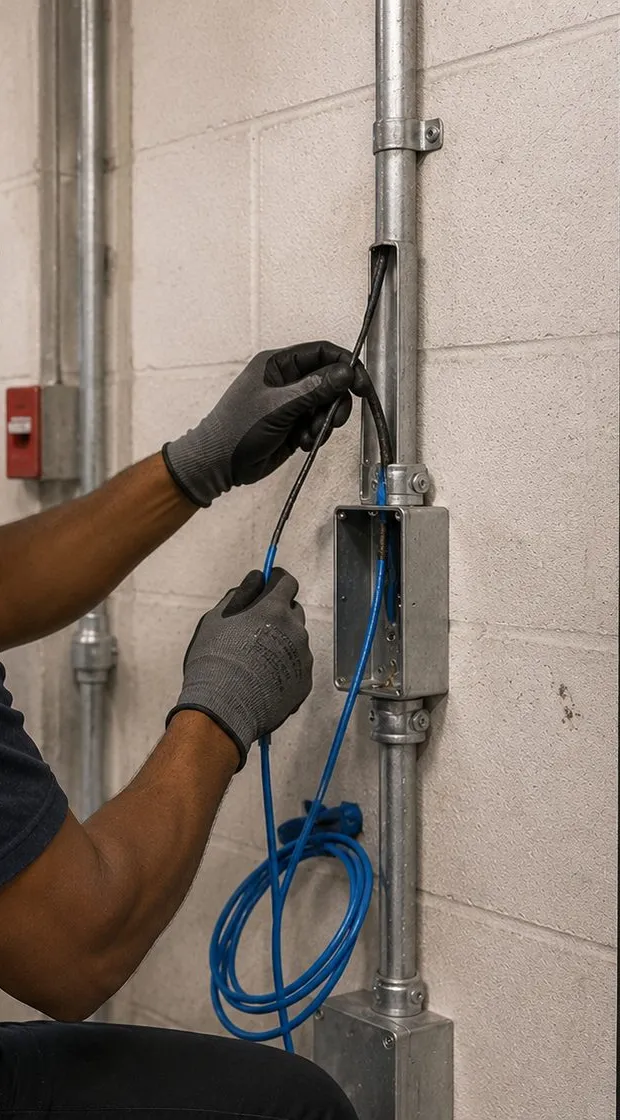
Concrete factory lofts. We fix cable to the structure rather than to whatever ceiling a tenant has added. In flat-slab bays that means strut or beam clamps on the slab soffit and around the column capitals, with tray or J-hooks at a steady interval and innerduct through any wall that might be rebuilt by the next tenant. Penetrations through slabs are scanned before coring, sleeved and firestopped with a listed system. Enclosures go on walls inside your own unit, never in a corridor that dozens of tenants pass with pallet jacks.
The Army Terminal and the Navy warehouse. Both are owner-managed buildings where vertical shafts, the atrium and the elevator machinery are the owner's to allocate. The plan we draw shows exactly which shaft or sleeve we propose to use, the cable's fire rating for each space it crosses, and how much spare capacity remains for the next tenant — the questions a property manager asks first.
Rowhouses. The usual path is cellar to top floor through a closet stack, a dumbwaiter or chase if one survives, or the back corner of the stair hall in surface raceway painted to match. Bend-insensitive single-mode lets us turn tight corners in narrow halls without losing light. Front facades in the historic districts are left alone; the provider entrance moves to the cellar or the rear wherever possible.
Avenue buildings. We locate the shop's equipment where the provider's terminal can reach it without crossing another tenant's space, and we put the building's own enclosure in a common area the landlord controls, so the upstairs apartments and the shop get separate, labelled ports.

Sunset Park's businesses cluster in a handful of places, and each place has its own fiber habits.
More than 650 businesses — manufacturers, design studios, food producers, offices and shops — across 16 buildings. The operator's meet-me room and campus dark fiber mean the carrier side is usually ready; tenant work is the run into the suite and around it.
NYCEDC's 4.1-million-square-foot campus with more than 100 businesses, including Jacques Torres Chocolatier, MakerSpace NYC, Rooftop Films, Altronix and FABSCRAP, and the BATWorks climate hub taking about 200,000 square feet of Building A.
The city-owned 20-acre, eight-building campus south of Industry City, where Building A offers 140,000 square feet of manufacturing space. New manufacturing tenants arrive with fit-outs that need fiber planned before walls close.
Under the expressway: wholesalers, trades, retail and the mixed manufacturing and office floors of 850 Third Avenue. Noise, dust and vibration are part of the setting, so enclosures are closed and cable is protected.
About 500 businesses between 38th and 64th Streets, many reflecting the Dominican, Mexican, Salvadoran, Ecuadorian and Colombian communities that shop there. Small footprints, cellar stockrooms and apartments overhead.
Brooklyn's largest Chinatown, settled along Eighth Avenue from about 42nd to 68th Street since the 1980s, with restaurants, groceries, bakeries, Buddhist temples and community organisations. Dense storefronts, deep buildings and frequent changes of tenant.
These are practical points from our work, not legal advice; your lease, the owner's rules and the agencies involved always govern.

Ask a tenant in a waterfront loft how far their suite is from the street and they will say a few hundred feet. Ask how far it is from the room where the carriers land and the honest answer is often further, because the carrier room sits wherever the original owner or today's operator put it, and the cable has to follow corridors, turn at fire walls, climb a shaft and come back along another floor. In a building that runs the length of a block, that route can easily pass the 100 metres that copper Ethernet is rated for. Fiber has no such limit inside a building; a single-mode link will carry ten gigabits for kilometres. So the question here is rarely whether to use fiber. It is how to get it along the building cleanly.
We start every waterfront walkthrough at the carrier end, not at your desk. On a campus with a meet-me room, that means meeting the operator's staff and finding out what they hand over: a cross-connect to your provider inside their room, a pair of strands on the campus network out to a patch panel near your suite, or simply a port you have to reach yourself. DataVerge describes Industry City's Campus Connect as a dark-fiber network from its meet-me room to tenant suites; if that lateral already ends at your door, your job may shrink to a short tail and a well-built rack. If it ends at a riser closet two floors below, you need a private run from there.
Then we walk the route with a measuring wheel and a camera. We note every place the cable would cross a tenant line, a fire-rated wall or a slab; whether the corridor ceiling belongs to the landlord or to the tenant next door; where the freight elevator is, how it is booked and how wide its door is for a reel cart; and where the column lines give a straight run. Bush Terminal-era lofts were built as factories with heavy loads in mind, so the slabs are thick and the column grid is regular. That regularity is a gift: a strut line clamped to the slab soffit can run hundreds of feet without a single hole through anyone else's wall.
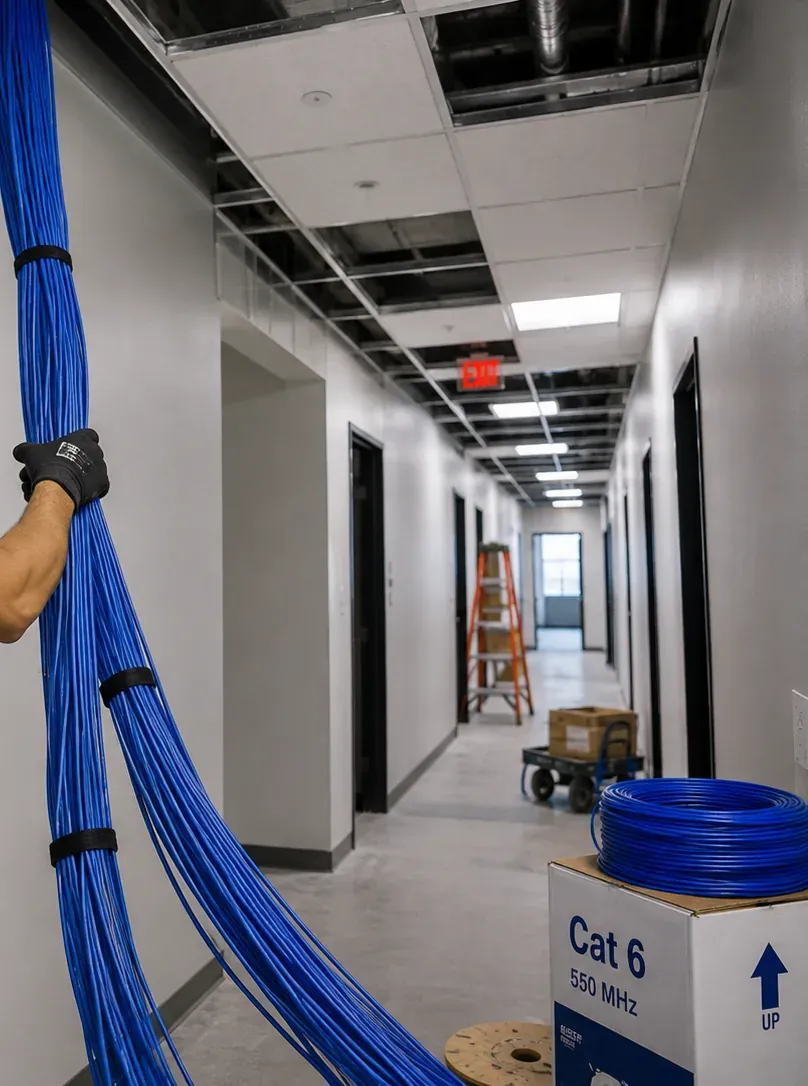
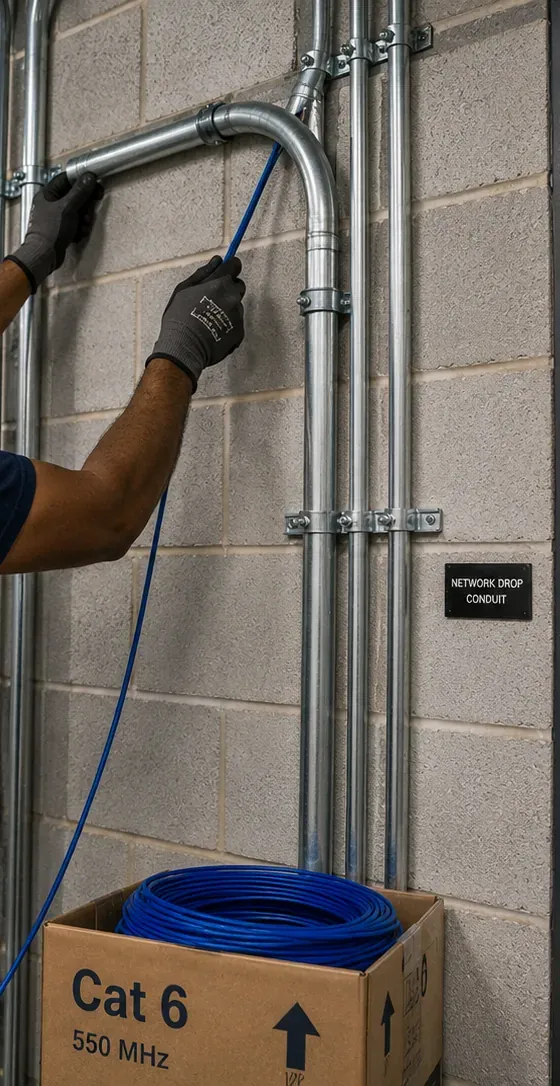
Length brings its own physics. Fiber cable has a maximum pulling tension, usually printed on the jacket or the data sheet, and a long run with several bends can exceed it if it is dragged from one end. On long corridors we set intermediate pull points, figure-eight the slack on the floor at each one and feed it on by hand, so the cable never sees more than a fraction of its rated load. Service loops are left at both enclosures and at any point where the next tenant is likely to rebuild a wall. Each strand is then tested end to end, so the length we were paid to bridge is proven, not assumed.
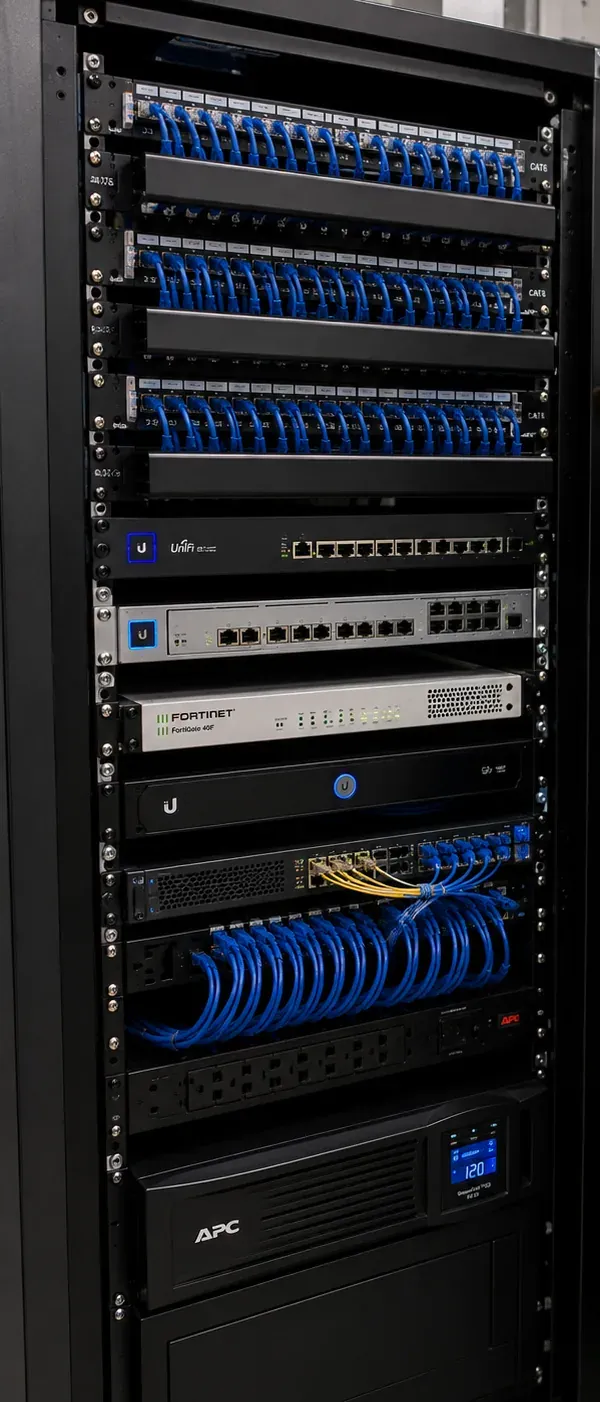
Finally, we look at where your equipment should live. In a long building it is tempting to put the switch wherever the internet arrives. Often it is better to put a small, ventilated enclosure at the middle of your space and run fiber to it, so every desk, camera and access point is a short copper hop away. For tenants who would rather not keep servers on a production floor at all, some campuses offer rack space in their own data room, and a fiber link from there to the suite makes the closet disappear.

East of the expressway the distances collapse. A rowhouse on 50th Street is perhaps forty feet deep and three storeys tall; a Fifth Avenue store is a narrow box with a cellar under it and apartments on top. Nobody needs fiber here because of copper's 100-metre limit. What fiber offers on these blocks is different: a thin, interference-free cable that carries everything a provider delivers, fits where a fistful of coax will not, and can be run once, documented and shared, instead of every new subscriber's installer drilling a fresh hole.
The difficulty is people, not physics. A rowhouse divided into three apartments may have an owner who lives in Bay Ridge, tenants on every floor and a cellar shared with the boiler. A building on Eighth Avenue may have a restaurant owner downstairs who rents the shop from someone who bought the building years ago and visits monthly. Before we quote, we find out who owns the walls the cable will pass through, who holds the key to the cellar and meter room, and whether anything we propose touches the front of a building in one of the 2019 historic districts. Getting those answers first saves a wasted day later.
Then we design the smallest permanent thing that solves the problem. In a divided rowhouse that is usually one fiber riser from a small enclosure in the cellar to a labelled outlet on each floor, with the provider's cable meeting it at the bottom. In a shop with apartments above, it is a path from the provider's terminal to the store's back office that does not pass through anyone's home, and a separate labelled route upstairs. In both, the work happens in a day or two, and the drilling is confined to a few planned openings, which matters in houses where the plaster is a hundred and twenty years old.
Avenue businesses add a twist of their own: back extensions. Many shops have a one-storey addition at the rear, built later with its own roof and sometimes its own foundation, which now holds a kitchen, a stockroom or a workroom. The extension is where the card terminal, the kitchen printer or the office computer ends up, and the original wall between front and back is often thick masonry. We look for the doorway head, an existing pipe sleeve or the cellar ceiling as the crossing point before reaching for a core drill.

Robert Moses chose Third Avenue for his parkway in the late 1930s over residents' suggestion of Second Avenue, and the elevated road he built has shaped Sunset Park ever since. For fiber, the expressway matters in three ways. First, it is a public right-of-way with heavy traffic below and a structure above, so any cable crossing it belongs to carriers working under their own franchises and permits, not to a private business. Second, buildings along Third Avenue live with vibration, dust and road grime, which affect how we close and protect enclosures. Third, it separates two very different customer bases, and a firm that only knows one side tends to misprice the other.
When a business has premises on both sides — a warehouse near the water and a shop or office up the hill — we recommend a carrier service at each site joined by a private network over the internet, or a point-to-point circuit bought from a provider that already has fiber under the avenue. Private fiber of your own across the expressway is technically possible only through a carrier's ducts or a street opening that a contractor would need city permits for, and the cost rarely makes sense against a monthly circuit. We will tell you that on the walkthrough, and we will build the inside of both sites so whichever carrier you choose lands cleanly.
Inside buildings on Third Avenue itself, we keep enclosures sealed, route cable away from the street wall where grime collects, and choose locations for equipment that a filter change and a wipe can keep clean. The traffic itself does no harm to glass; fiber is immune to electrical noise and to the low-level vibration a building next to a highway feels. Connectors are the vulnerable part, so they live behind doors.
We hear these on walkthroughs from Second Avenue to Eighth, so they are sorted by building type: waterfront campus first, then the uphill houses and shops. The FAQ near the end of the page deals with separate topics.
It is enough when it ends close to where your equipment will live, gives you the strand count and fiber type your switches need, and comes with test results you can see. Campus fiber of this kind is the operator's plant: they own it, they maintain it and they decide how it is patched. That suits most tenants. You need your own strands when the campus lateral ends somewhere awkward — a closet a floor away, the wrong side of your space — or when you are joining two of your own units and want a link nobody else patches. In those cases we run a private cable from the campus handoff to your rack, or between your units, and label it as yours.
Before deciding, ask the operator three things: where exactly their fiber terminates for your suite, whether it is single-mode or multimode, and whether they will share a loss test. We can read that test and tell you whether it is fit for the optics you plan to use.
Often, yes, if you have equipment that needs steady power, cooling and security. DataVerge's Industry City page says tenants can move an existing IT closet into its data centre through Campus Connect. A production floor is dusty, warm in summer and busy with people who are not IT staff; a data room is none of those things. The trade-off is that your suite then depends on the fiber link between the two, so we would run at least two strands more than you need, test each one and, where it matters, propose a second route.
What stays in the suite is the small stuff: a switch or two, the access points and the patching. That fits in a wall-mounted cabinet, which frees floor space and makes the suite easier to hand back at the end of a lease.
From the structure itself. We fix strut or beam clamps to the slab soffit using anchors suited to old concrete, and hang tray, J-hooks or a small raceway from them at regular intervals along the column line. Near each column the capital flares out, so the run either drops below the flare on a short hanger or tucks into the corner between capital and slab, whichever keeps it straight and clear of sprinkler pipes. Fiber is light enough that the anchors carry very little load, but supports still go in at a steady spacing so the cable never sags or pinches.
On an exposed ceiling, appearance matters. We keep the run parallel to the building grid and choose a cable or raceway colour that matches the space, so it reads as part of the design rather than as an afterthought.
By not pulling it all at once. A long run with bends is divided into sections with intermediate pull points. At each one the cable is laid out in a figure-eight on the floor so it doesn't twist, then fed onward by hand. Pulling grips attach to the cable's aramid strength members, not to the jacket or the glass, and a swivel stops the cable rotating. That keeps the load well under the tension on the manufacturer's data sheet and keeps bends wider than the minimum radius while the cable is moving.
Once it is in place, the cable is dressed into its supports and given service loops at both ends. The proof is the test: every strand is loss-tested end to end, and long single-mode runs are traced with an OTDR so any stress point would show up as a visible event before handover.
Usually, but only along a path the owner approves. In a building like the Army Terminal's Building B, the atrium is a historic feature and a shared space; nobody gets to string cable across it on a whim. The practical routes are along an existing bridge, balcony edge or gallery that already links the wings, inside a conduit or tray fixed out of sight beneath it, or around the end of the atrium through the corridors. A free span of cable across open air is the last resort and needs a messenger wire, proper anchors and a sign-off from the owner's engineer.
We draw the proposed route on the owner's plans and photograph the attachment points, which is what the property manager needs to say yes or suggest an alternative.
Crossing them is normally straightforward; following them is not. Old rail beds inside buildings such as the Army Terminal are part of the structure's history and often its floor drainage, and cutting a trench along or across them is the owner's decision. We avoid floor work wherever we can by going overhead: up a column, across at ceiling or balcony height and back down on the far side. If a floor crossing is unavoidable, we propose a surface-mounted ramp-style raceway rated for foot and cart traffic, or a core under the track only with the owner's engineer's approval.
The same thinking applies to old loading-dock edges and track pits along the waterfront: treat them as the building's, not ours, and stay above them.
Not by itself in most cases. Nearly all of Sunset Park was listed on the National Register in 1988, but a National Register listing generally does not restrict what a private owner does with private money; it matters mainly when federal funding, federal licences or historic tax credits are involved. The city's Landmarks Preservation Commission is different. Its four 2019 historic districts — Sunset Park North on 44th Street, Central Sunset Park around 47th and 48th Streets and Sixth Avenue, Sunset Park 50th Street, and Sunset Park South from 54th to 59th Streets between Fourth and Fifth Avenues — do require approval for visible exterior work.
So our rule of thumb is simple. Inside your building, the listing changes nothing about the fiber. On the outside, if you are inside one of the four city districts, we keep the provider entry and any conduit off the street facade, bring cable in through the cellar or the rear, and if exterior work is unavoidable we prepare the photographs and drawings for an LPC application. If your building has old provider cables stapled across the front, consolidating them into one rear or cellar entry is often the first improvement. This is general guidance, not legal advice.
Through the easiest existing opening in the old rear wall. That is often the doorway between front and back, where a small raceway can run along the head; sometimes a pipe sleeve or vent that already passes through; and often the cellar, if the extension has one or if the cellar runs under the back room. We avoid running cable across the extension's roof, which leaks at every penetration, and we avoid coring the original back wall unless there is no other choice, because in older buildings it is usually solid brick several courses thick.
Inside the extension, kitchens and stockrooms need cable protected from heat, grease and shelving, so it goes in raceway or conduit to a sealed outlet placed where nobody will stack boxes against it.

What goes into a Sunset Park job depends on which side of the expressway it is on. These are the components we specify most, and why.
Our default for loft runs to a campus handoff, unit-to-unit links and anything that may carry 10 gigabits or more later. Distance inside even the longest Sunset Park building is no constraint at all for single-mode.
Sensible for short runs inside one suite between a core switch and a far cabinet when the optics already in use are multimode. Cheaper optics, shorter reach, and it must match what is on the other end.
OFNR in shafts and between floors; OFNP in any ceiling used for return air. In campus buildings the owner's rules sometimes ask for plenum throughout, which we price from the start.
Interlocking armour where forklifts, pallet jacks or carts can reach the cable along production floors and docks, and indoor/outdoor jackets for runs that pass through unheated or damp spaces.
For tight rowhouse stairwells, closet corners and surface raceway, where fiber has to turn more sharply than standard cable allows without losing light.
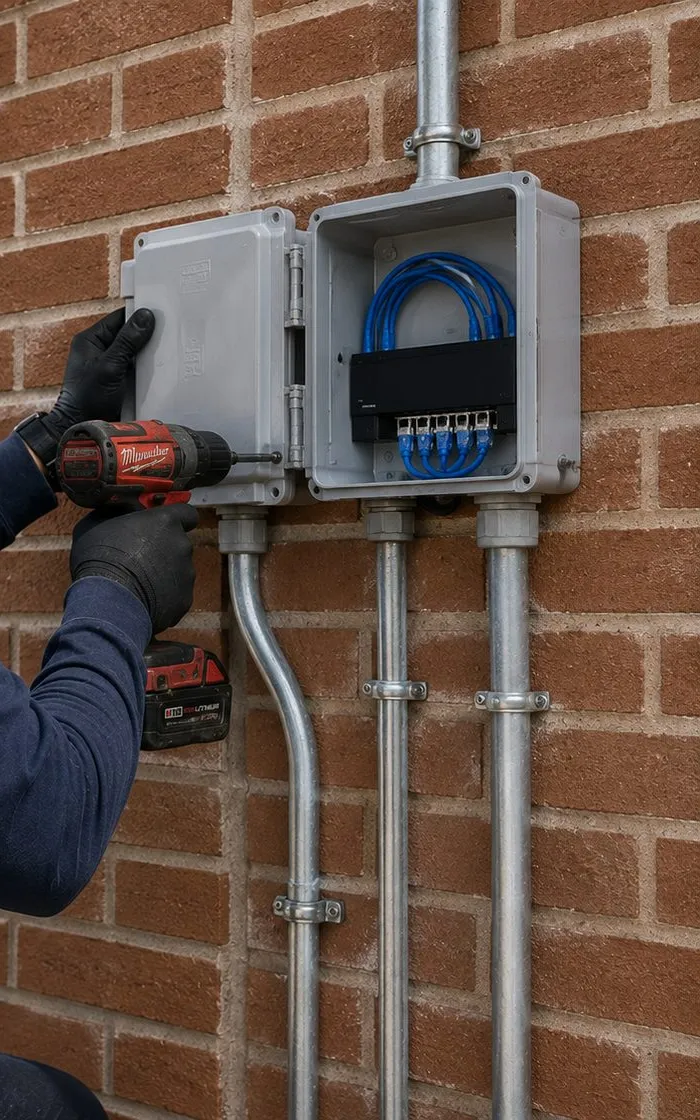
Lockable wall enclosures with splice trays for suites and cellars; rack-mount panels with LC adapters where there is a cabinet. Every port labelled with the far end's suite, floor or apartment.
Innerduct through walls a future tenant may rebuild; painted surface raceway in rowhouses and finished shops where the cable cannot be hidden.
Transceivers that turn electrical signals into light at each end of a link, chosen to suit the fiber type and distance; spares can be left in the enclosure on request.
Carrier circuit, campus fiber or private strands? A carrier circuit is the service your provider sells you, delivered to its handoff. Campus fiber is the owner's or operator's cable from that handoff toward your door. Private strands are cable you own outright between two points you control. Most Sunset Park tenants end up with all three in a chain, and our job is to make the joins clean and the chain documented.

AI summaries borrow from whatever is published. Google's AI Overview, Angi, HomeAdvisor and Fixr were not reachable from the environment this page was researched in, so rather than invent what they might say, we took seven statements that real cost guides, comparison sites and contractor pages print, quoted them exactly, and checked each against Sunset Park buildings.
That line appears on a New York fiber contractor's own service page. It may describe cable laid in an open, easy pathway, but it says nothing about where the cost in a waterfront loft actually comes from. A 400-foot run along a factory corridor needs supports clamped to concrete every few feet, pull points, sleeves through fire walls, firestopping, enclosures and splicing at both ends, and testing of every strand.
The cable itself is one of the cheapest parts of that job. Labour on ladders and lifts, the time spent waiting for a booked freight elevator, and the number of slab or wall penetrations dominate the bill, which is why our published prices are per termination, per test, per drop and per backbone rather than per foot.
So treat any per-foot figure as a rough idea of material cost, not a quote. The number that matters is what the measured route needs, and that only comes from walking it.
That figure, with $8.00 for aerial work, comes from a contractor's blog that attributes it to a 2025 Fiber Broadband Association report. It is a cost for building networks outdoors: cutting streets, boring under driveways, hanging cable on poles between neighbourhoods.
Almost none of that applies to a Sunset Park tenant. Carriers have long since built the street network to the waterfront campuses, and the city's Connect IBZ programme added more in 2015. What a business pays for is inside work, which has nothing to do with trench depth or pole attachments.
The one place outside-plant figures become relevant is a business wanting its own cable between sites, such as across Third Avenue. Even then, the answer is usually a carrier circuit, not new construction.
A Manhattan cabling firm's fiber guide puts it that way, and the standard is right: a structured-cabling copper channel is rated to 100 metres. The mistake is assuming the 100 metres is measured on a floor plan. It is measured along the cable, including every turn up a shaft, every detour around a fire wall and every metre of patch cord.
In a block-long Bush Terminal-era loft, a desk that looks 60 metres from the closet on the plan can be 110 metres away by cable route. That is why we measure with a wheel along the actual path, and why so many waterfront tenants need a fiber spine to a mid-floor cabinet even inside a single suite.
On the other side of the expressway, the 100-metre rule almost never bites. Rowhouse and storefront fiber is chosen for other reasons: space, interference and the chance to run one documented cable instead of several.
A provider-comparison site, citing FCC broadband filings as of December 2025, puts Sunset Park's fiber availability at 95.16% and lists Verizon and EarthLink fiber at 92.2%. The page's own provider figures don't quite add up to its headline number, which is a reason to treat it with care.
More importantly, availability means a provider reports it can serve an address. It does not mean the fiber reaches your apartment, your shop's back room or your suite at the far end of a loft. Inside a divided rowhouse or a multi-tenant factory building, someone still has to provide the path from the provider's terminal to the room where you need the service.
That path is where we come in, whether the provider is a household name or the independent fiber company that has served Industry City since at least 2015.
That's a comment on a New York City Reddit thread, and it is partly true: the internet provider installs its own drop to its own terminal. Beyond that terminal, inside wiring in a building is the owner's, and in a campus suite the tenant's, depending on the lease.
In Sunset Park the difference shows up most in divided houses, where a provider's installer will run a cable to the one apartment that ordered service and leave the next tenant to start from scratch. A building-owned riser solves that once.
On the waterfront, the equivalent is assuming the campus operator will run cable anywhere you like inside your suite. Operators provide the handoff; the inside of the suite is yours to wire.
The same Manhattan guide gives that estimate, and for an uphill rowhouse riser or a storefront link it is about right once the work is approved. It is the approval that varies.
On a waterfront campus, the clock starts with the insurance certificate and the owner's review of the drawings, and the work itself is bounded by freight-elevator bookings and the hours other tenants are working. A long loft run might be three or four days of labour spread across a fortnight of scheduling.
So when we quote a Sunset Park job, we give two numbers: how many days the crew needs on site, and how long the approval and scheduling usually take in that building.
A New York low-voltage contractor's pricing page says plenum-rated cable adds 15–25%. The difference in cable price is real, but the claim can mislead people into avoiding plenum cable to save money where it is required.
In Sunset Park the question is settled by the space, not the budget. A ceiling used for return air needs plenum-rated cable; a shaft needs at least riser-rated cable. Several campus owners specify plenum everywhere to keep things simple, and we price that from the first quote so there is no surprise later.
On most jobs the cable is a small share of the total, so the premium for doing it properly is modest in money terms and large in the trouble it avoids at inspection.
Tell us where the internet arrives, where you need it, and whether you're by the water or up the hill. We'll measure the route and write it up for whoever has to approve it.
From the Army Terminal piers to the rowhouses near Sunset Park itself, this is the full range of fiber work one crew can carry out for you.
Fiber optic installation in Sunset Park, Brooklyn begins with a measured route. We carry out fiber optic cable installation along loft corridors and up shafts, plan fiber optic cable routing that keeps clear of other tenants' ceilings, and handle fiber optic cable pulling with intermediate pull points so long runs never exceed their tension rating. Where no pathway exists we provide fiber optic conduit installation, innerduct and strut-mounted tray clamped to the concrete.
Vertical work includes fiber optic riser installation in campus shafts and multi-floor fiber optic installation for tenants on more than one level. Apartment building fiber optic installation in divided rowhouses and walk-ups gives each unit a labelled outlet from one cellar enclosure. Where a run has to pass through an unheated or damp space or near carts, armored fiber optic cable installation protects it; underground fiber optic installation is reserved for private property where a buried run genuinely makes sense.
Commercial fiber optic installation in the waterfront campuses covers suites, production floors and showrooms. Warehouse fiber optic installation reaches far racks, docks and cameras from a lift, and data center fiber optic installation links a suite to a campus data room with labelled panels at both ends. Fiber optic backbone installation ties several closets or units back to one core, and a commercial building fiber backbone upgrade replaces tired or undocumented cable left by earlier occupants.
Glass alone carries nothing, so the same crew can take on fiber optic network switch installation, SFP transceiver installation and wider fiber optic network upgrades; your new strands are passing live traffic before we pack up.
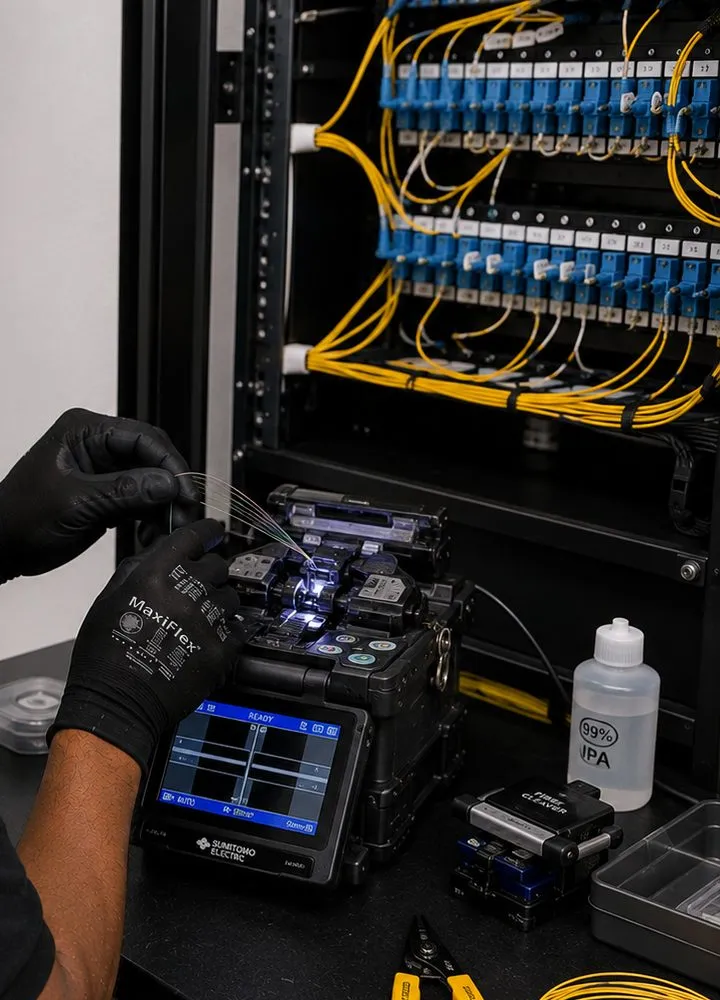
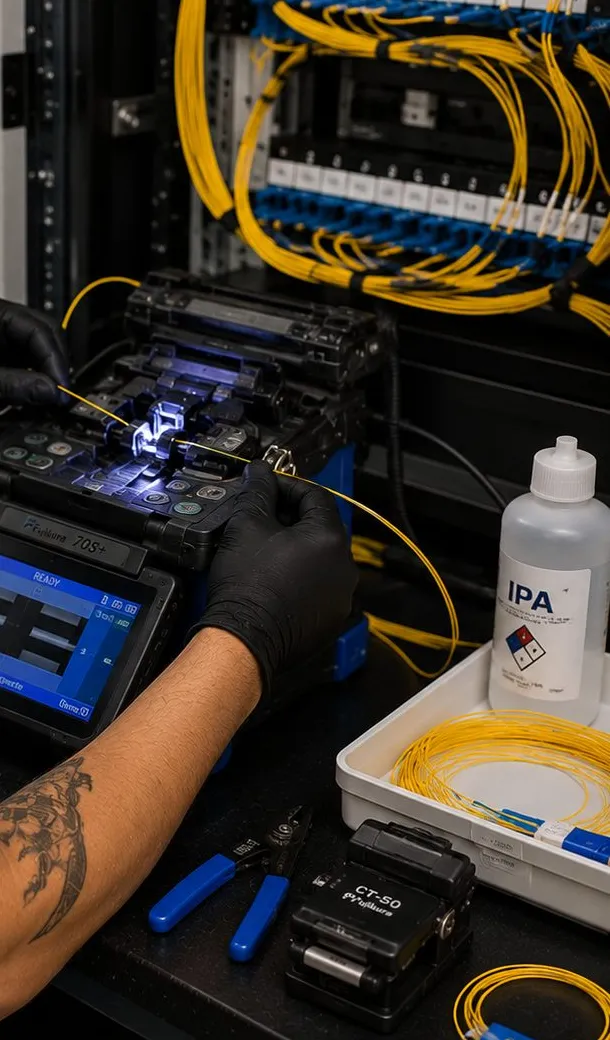
We fuse glass to glass rather than relying on mechanical splices. The work begins with fiber optic cable stripping and a fiber optic cable cleaving step that leaves a mirror-flat end; the joint is then fused, sleeved and laid into a tray as part of fiber optic splice tray installation, which together make up our fiber optic splicing services. Fiber optic termination at each end of a Sunset Park run can mean fiber optic patch panel installation or fiber distribution panel installation in a cabinet, fiber optic rack installation in a unit that has none, fiber optic termination box installation or fiber optic distribution box installation on a cellar or suite wall, LC fiber connector installation, fiber optic wall outlet installation beside a desk, and fiber optic patch cord installation into the switch.
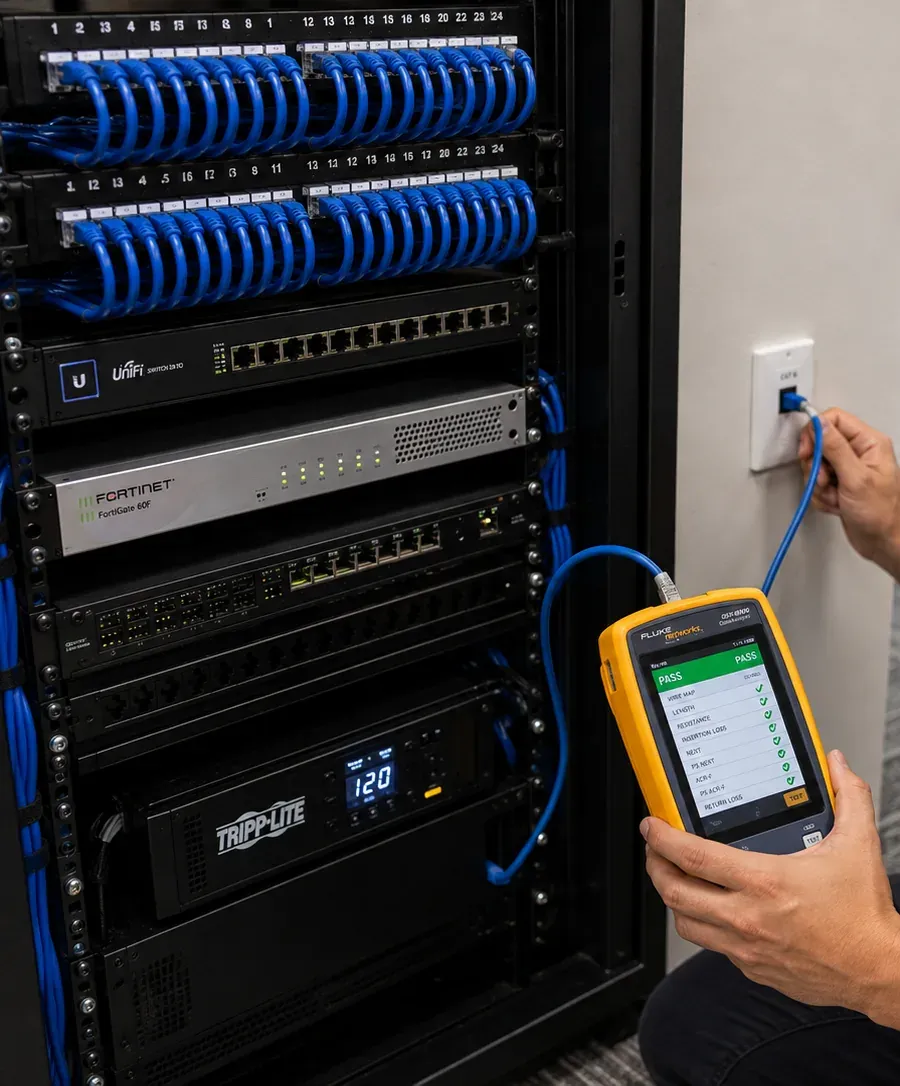
No link is handed over untested. On a Sunset Park job, fiber optic connector inspection comes before any connector is mated; fiber optic light source testing and optical power meter testing then give a fiber optic signal loss testing figure for each strand; and fiber optic OTDR testing maps single-mode and long corridor runs splice by splice. Those fiber optic cable testing and fiber optic signal testing records make up the fiber optic network certification a campus operator, landlord or IT team can file.
A dark link is diagnosed from the outside in. Fiber optic troubleshooting on our visits opens with fiber optic connector inspection and fiber optic connector cleaning, since contamination on an end face is the most common fault we find. If the strand is still dark, fiber optic visual fault locator testing sends red light down it to reveal a crack or tight bend nearby, and fiber optic break detection with the OTDR gives the distance to anything further away. The fix might be broken fiber optic cable repair with a fusion splice, fiber optic cable repair at the connector, or fiber optic cable replacement where a length has been crushed, after which fiber optic network repair and fiber optic network restoration bring the cameras, terminals and desks back.
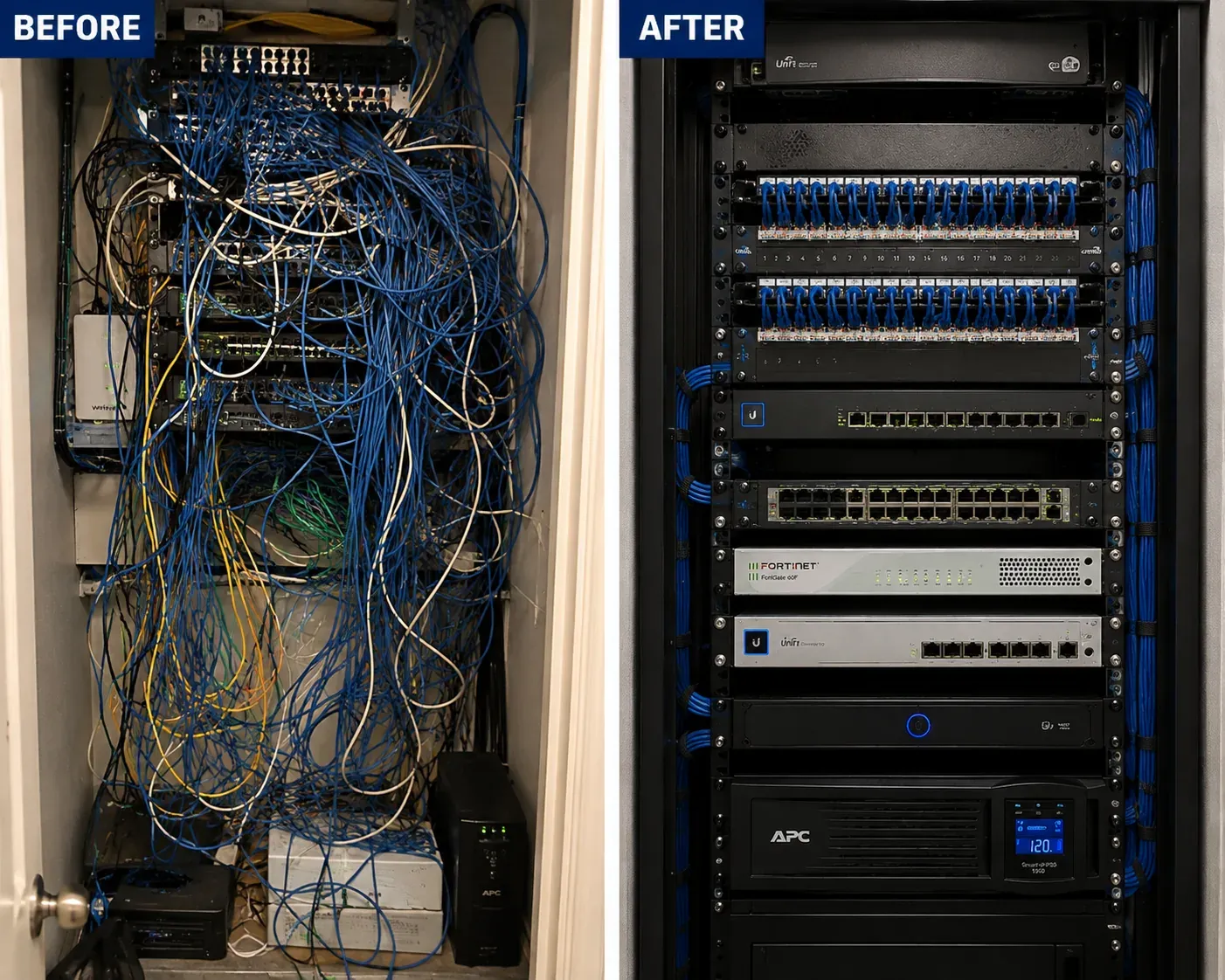
Fiber optic cable labeling at both ends, fiber optic cable management that respects bend radius, and fiber optic rack cleanup where a closet has been patched by too many hands all make the next change quicker. Fiber optic maintenance visits re-inspect and re-test key links as tenants come and go. As a licensed fiber optic installation contractor for Sunset Park, Brooklyn, we look after the fiber optic infrastructure installation from first pull to final certificate.
Give us a building number and suite if you are by the water, or the nearest corner if you are uphill, plus the two places the fiber has to join. Expect a reply within the business day; for anything urgent call (347) 934-8335.
A Brooklyn installer will call you back the same business day. If it can't wait, call (347) 934-8335.
Six stages from first call to handover. On the waterfront the approval stage takes the longest; up the hill it is finding every owner who has to agree.
We ask which side of the expressway you are on, where your provider's equipment sits, where the network must reach and who owns or manages the building, so the right people are at the walkthrough.
We start where the carrier lands and walk toward your space with a measuring wheel and camera, recording every wall, slab, shaft and shared area the cable would cross.
You receive an itemised price from the published lines; your campus manager, landlord or co-owners receive the route drawing, list of openings, cable fire ratings and our insurance certificate.
Supports are fixed to the structure, scanned cores are cut, sleeved and firestopped, and cable is pulled through intermediate pull points within its tension and bend limits.
Each end is fusion-spliced inside a wall or rack enclosure; we scope every connector, measure each strand's loss, and run OTDR traces on single-mode cable and any long corridor run.
Every port is named for what it serves — a suite, a floor or an apartment — the carrier's service is patched onto a labelled panel, and one closeout file holds the strand map, results, photos and as-built plan.
Six places that sum up the buildings we work in, from the water to the hill.
Bush Terminal's factory rows, begun in 1906 and renamed Industry City in the mid-1980s. At its World War II peak the complex was the largest multi-tenant industrial site in the country, with more than 25,000 workers and its own power plants; since 2013 its owners say they have spent over $450 million on infrastructure.
Completed in 1919 to Cass Gilbert's design, transferred to the city in 1981 and managed by NYCEDC. Building B's 980-foot atrium, with its rail tracks and diagonal loading balconies, is one of the city's great industrial interiors, and BATWorks is due to open permanently in 2028.
The city's 20-acre manufacturing campus beside Bush Terminal Piers Park, where a $38 million park revitalisation and a five-acre Pier 6 park due in 2027 are reshaping the shoreline next to working buildings.
The 1916 Navy supply warehouse at 850 Third Avenue, restored after 2011 with new elevators, exterior work completed in 2013 and a listing on the National Register.
Four rows of turn-of-the-century houses on 44th Street, 47th and 48th Streets, 50th Street and 54th to 59th Streets, designated after a campaign the Sunset Park Landmarks Committee began in 2013.
Fifth Avenue, which the local BID calls Sunset Park's Main Street, and Eighth Avenue, where Winley Supermarket opened at 5523 Eighth Avenue in 1986 and Brooklyn's largest Chinatown grew along a strip where only about thirty small shops had operated before 1984.
We also work in the neighbouring parts of Brooklyn — Greenwood Heights, Windsor Terrace, Borough Park, Bay Ridge, Gowanus and Red Hook — and across the rest of the borough from our East Flatbush office.
Whether the job is in a waterfront loft or a rowhouse on 50th Street, the rates are the borough-wide ones: Brooklyn’s 1.00× base, identical to the lines on our Brooklyn fiber optic installation page and in the Brooklyn structured cabling price builder. Fixed items are priced per unit; backbones and links between units carry a range, narrowed to a single figure once we have measured the route.
| Item | Price | What it covers |
|---|---|---|
| Fiber termination on an existing cable | $35 per termination | LC, SC, ST or MPO, fusion-spliced pigtail or mechanical connector |
| OTDR test | $40 per strand | Trace and event table per strand, in addition to loss testing |
| Multimode fiber drop | $350 per drop | Shorter in-building run, terminated and tested |
| Single-mode fiber drop | $400 per drop | Shorter in-building run, terminated and tested |
| 12-strand OM4 floor-to-floor backbone | $4,500 – $7,000 | Fusion-spliced, enclosures both ends, firestopped, loss-tested |
| 24-strand OS2 backbone or building-to-building link | $8,000 – $15,000+ | Single-mode with OTDR on every strand |
| Second telecom room with fiber link | from $2,400 | Room build-out and the fiber tie back to the main room |
| Service and callback rate | $195/hr, 3-hr minimum ($585) | Repairs, troubleshooting and return visits — not the initial install |
A worked example from the same lines. A tenant taking over a suite with an existing 12-strand single-mode cable back to the campus handoff, who wants it re-terminated and proved before relying on it, would pay 24 terminations at $35 ($840) plus 12 OTDR traces at $40 ($480): $1,320. A small Fifth Avenue shop needing two multimode drops from the provider's terminal to the register area and the back-room office would pay 2 × $350, or $700, plus any switch or optics it buys.
National brand versus local contractor. Household security names such as ADT, Ring and SimpliSafe are in the alarm, camera and monitoring business. None of them pulls private fiber along a loft corridor or up a rowhouse stair. In practice the choice is between the internet provider's own technician, whose work ends at the provider's box; a big systems integrator, which may send a subcontracted crew; and a licensed Brooklyn firm that owns its splicer and OTDR and talks to your campus manager or co-owners itself.

Three typical Sunset Park requests, each added up from the price table and nothing else. A real proposal swaps in your measured route and the number of strands you choose.
$800
Two single-mode drops at $400 each from the campus or provider handoff near your suite to your rack, or from a storefront's provider terminal to the back office and stockroom, terminated and tested.
$4,500 – $7,000
Twelve OM4 strands from the main rack out to a cabinet at the far end of a deep floor, or up to a second floor you lease. Enclosures at both ends, sealed penetrations and a loss figure per strand are included; how many slabs and fire walls the route crosses sets the final number in the range.
$8,000 – $15,000+
For a company spread over two units — say a workshop in one wing and offices in another building — a 24-fiber OS2 cable on whatever path the campus signs off, with armour on any stretch carts use. Before we leave, an OTDR trace confirms every one of those fibers from end to end.
Head offices sometimes ship their own approved cable and enclosures, and some units come with unused reels from an abandoned fit-out. If you would rather supply the parts, our crew works on labour alone: $195 an hour, three hours minimum ($585), covering the pull, the splices and the certification. Anything you provide is covered by its manufacturer, not by AESS, and we test supplied cable on the reel first so a faulty batch never reaches a ceiling.
A walkthrough costs nothing and ends with a scope your campus manager or co-owners can approve, priced from the lines above.
Superstorm Sandy reached the Sunset Park waterfront in October 2012. The Brooklyn Daily Eagle later reported, citing The New York Times, about $50 million of damage to Industry City buildings on 36th Street between Second and Third Avenues. In response the city, with FEMA money, paid for roughly $21 million of resiliency work at Industry City and the Army Terminal: site drainage, flood barriers and upgraded storm sewers at the former, an elevated electrical substation, and barriers protecting 1,200 linear feet of the Army Terminal's waterfront, which sits in a mapped flood zone.
Glass itself shrugs off water; fiber cable survives immersion far better than copper. What does not survive is everything around it: connectors, splice trays, enclosures, optics and the switches they plug into. So on ground-floor and cellar work by the water we follow a few habits. Splices are made in sealed enclosures mounted high on the wall rather than on the floor. Active equipment goes on an upper floor or at least on the upper part of a rack. Ground-floor penetrations through outside walls are sealed against water as well as fire. And spare cable is left at the upper enclosure, so if a ground-floor section is ever damaged, it can be cut back and re-spliced without pulling a new cable from the street.
Up the hill, flooding is not the usual worry, but cellars are. Rowhouse and storefront cellars collect water from failed drains and leaking pipes. Our cellar enclosures go on the wall above any watermark, with cable leaving them upward.
An avenue storefront is a small job with a lot of small decisions. Here is how we work through one, in order.
Most avenue jobs are a day of work once approved, scheduled around opening hours. Restaurants usually prefer mornings before service; retailers often prefer the hour before opening or a quieter weekday.
Waterfront leases are long documents, and fiber is usually a paragraph or two in the alterations and telecommunications sections. A few questions asked before signature save money later.
If it helps, we will walk the suite before you sign and send a short note on what the fiber will involve, so you can raise anything with the owner while you still have leverage.
The cable is invisible once the ceiling is closed or the raceway is painted, so the records are what make it useful for years. Every Sunset Park job closes with one file containing:
Keep it with the lease or the deed. The next contractor, the next tenant or the campus engineer will use it more than you expect.
The waterfront campuses house an unusual mix: chocolate makers and food producers, fabricators and makerspaces, film and event companies, fashion and textile recyclers, design studios, offices and climate-technology start-ups. Each uses fiber for something slightly different, and the design follows from that.
Food and light manufacturing. Production floors need a handful of wired points spread far apart: a label printer at the packing line, a scale, a camera on the loading dock, a terminal by the cold room. Fiber runs from the office rack to a sealed cabinet near the line, and short copper or wireless covers the rest. Armour and enclosure ratings matter more than strand count.
Fabrication and makerspaces. CNC machines, laser cutters and 3D printers increasingly take their jobs from a network share. Dust, vibration and heavy power cables are everywhere, so the fiber's immunity to electrical noise is useful and the connectors are kept well away from the work.
Media, design and events. Studios move large files between edit stations, storage and the internet. Here a multi-strand backbone between rooms, and sometimes between units, pays for itself in hours saved. Event spaces need temporary capacity for visiting crews, which a spare strand or two at a labelled panel provides without touching the house network.
Start-ups and labs. Climate-technology firms in incubator programmes tend to grow fast and move units. For them we keep the expensive equipment portable and the suite cabling simple, so a move to a larger unit on the same campus means re-patching rather than rebuilding.
Offices and showrooms. Conventional office tenants want what they would have anywhere: reliable internet to every desk, Wi-Fi everywhere and a tidy closet. In a deep loft that usually means one fiber spine to a mid-floor cabinet.
Working backwards from the day you want to open, this is the sequence we suggest for a unit in one of the waterfront campuses.
| When | What happens |
|---|---|
| Before you sign | Walk the unit with us; confirm where the carriers land and whether campus fiber already reaches the suite. Raise pathway and end-of-lease questions with the owner. |
| Six to eight weeks out | Order your internet service; carriers often need weeks to provision. Send us the floor plan and fit-out drawings so fiber goes on them. |
| Five to six weeks out | We submit the route drawing, list of openings, cable ratings and insurance certificate for the owner's approval. |
| Before walls and ceilings close | Pathways, sleeves and supports go in alongside the fit-out contractor, so nothing has to be opened again. |
| Two to three weeks out | Cable is pulled, spliced and tested; the rack or cabinet is built. |
| One week out | The carrier turns up service at the handoff; we patch it through and test end to end. |
| Move-in | Switches and Wi-Fi go live; you receive the closeout file. |
Every campus is different and some move faster, but the order rarely changes. The most common delay we see is ordering the internet service too late, not the fiber work itself.
Many uphill owners have a three-storey rowhouse with an apartment on each floor and a tangle of provider cables on the front. This is how a single fiber riser changes that.
Cellar. A small lockable enclosure goes on the wall above any watermark, near where the provider's cable enters. The provider's fiber, or its terminal, meets the building's own fiber here. Each apartment gets one or two strands, labelled by floor.
Going up. We look for a vertical path that does not cross anyone's living space: a closet stacked above closet, an old dumbwaiter or flue that is no longer used, a plumbing chase, or the back corner of the stair hall. Openings through floors are small, sleeved and firestopped. Where cable must be visible, it goes in slim raceway painted to match the woodwork.
Each floor. A neat outlet inside each apartment, near where the tenant will want a router. Whichever provider a tenant chooses, the installer connects at the cellar enclosure and the tenant plugs in upstairs. No more drilling through the facade for each new subscription.
Outside. Once the riser is live, abandoned provider cables on the front can be removed by the providers or with the owner's agreement. In a 2019 historic district, keeping the facade clear also avoids the need for a Landmarks application for future work.
A typical three-storey riser is a day or two of work, and it can be priced from the drop and termination lines in the table above once we have seen the house.
Buildings that have housed hundreds of businesses over a century collect cable. In the waterfront lofts it is common to take over a unit and find a fiber enclosure on the wall, a bundle of jumpers in a ceiling and no labels at all. Some of it is perfectly good. Some of it goes nowhere. The trick is finding out which before you either rely on it or pay to replace it.
We start by identifying the cable from its jacket print: the fiber type, strand count and fire rating are usually stamped every metre or so. Then we follow it, visually where we can and with a visual fault locator where we cannot, to find the other end. Often that is the campus handoff or a closet on another floor; sometimes it is an enclosure in a unit now leased to someone else, which matters because you would need that tenant's cooperation to use it.
If both ends are within reach and the route is sensible, we clean and inspect the connectors, test each strand for loss and, on single-mode, shoot it with an OTDR. Strands that pass can be re-terminated and labelled as yours for a fraction of the cost of new cable; the worked example in our pricing section shows how that adds up. Strands that fail, or cable that runs through someone else's space, are retired, and with the owner's agreement removed rather than left for the next tenant to puzzle over.
Either way, you end up with a strand map of what you actually have, which is also what a campus manager wants to see before approving anything new.
Very few Sunset Park jobs happen in an empty building. On the waterfront, the units on either side are running production lines, filming, packing orders or holding meetings. Uphill, shops are open and people are living upstairs. How we work is shaped by that.
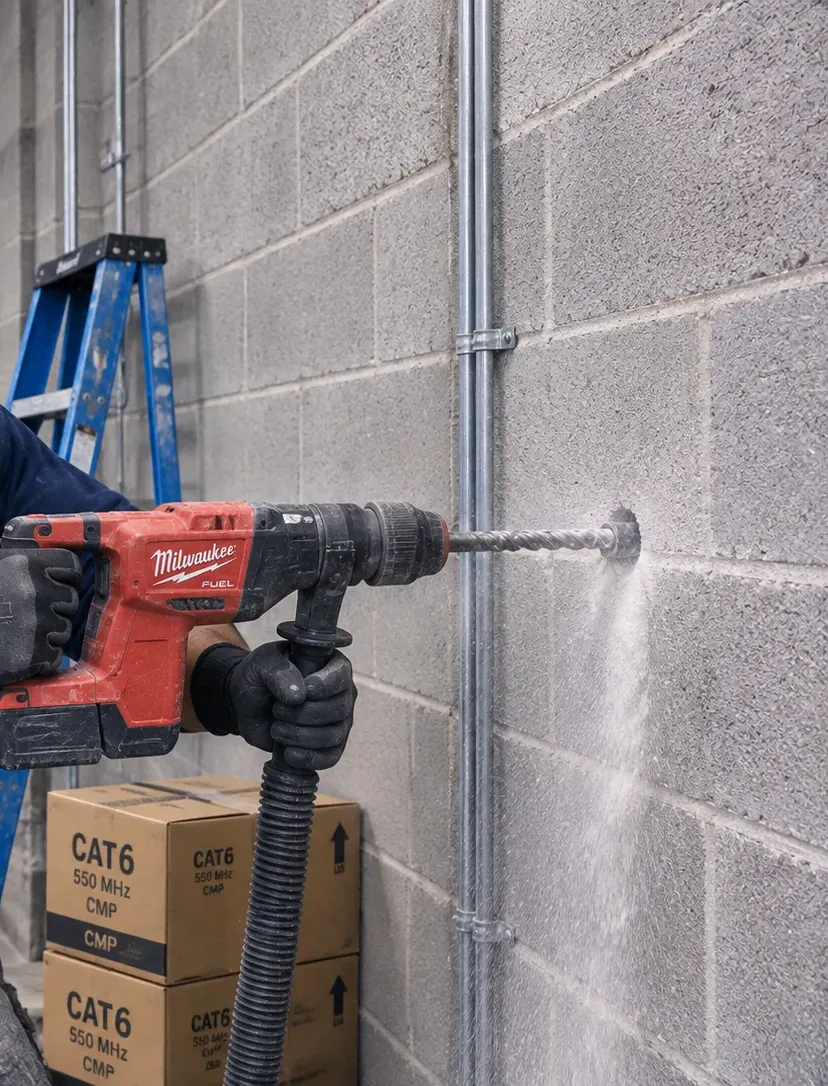
Noise. Coring and hammer drilling are the loudest things we do. We group them into as few sessions as possible, agree the times with the property manager or owner in advance, and do the quiet tasks — pulling, splicing, testing — around them.
Dust. Drilling uses water control or dust extraction, ceiling openings are kept small and closed at the end of each day, and food and production areas are screened before any opening is made overhead.
Shared spaces. Materials stay inside your unit or on our van, not in corridors that other tenants use with carts and pallet jacks. Freight-elevator time is booked, used and released promptly.
Live systems. If a ceiling we open carries fire alarm or sprinkler equipment, we coordinate with whoever manages those systems before we start, and we leave them exactly as we found them.
Shops. On the avenues we work before opening or in the quietest hours, keep the sales floor clear, and leave the space ready to trade at the end of each visit.
Whether you hire us or someone else, a fiber proposal for a building here should let you see exactly what you are buying. These are the items we put in ours, and the ones worth looking for in any bid.
If two bids include all six, comparing them is straightforward. If one leaves several out, it is usually cheaper because it has left work out, and that work tends to reappear as a change order once the ceiling is open.
Our own proposals are priced from the published lines on this page, so you can check the arithmetic yourself.
While the ceilings are open and the route is approved, it usually makes sense to run the other low-voltage cabling a unit needs. These Sunset Park and Brooklyn services can ride on the same visit and the same paperwork.
The copper from your new fiber cabinet to desks, access points and devices across a loft floor.
Card readers on suite doors and between units, reporting over the same backbone.
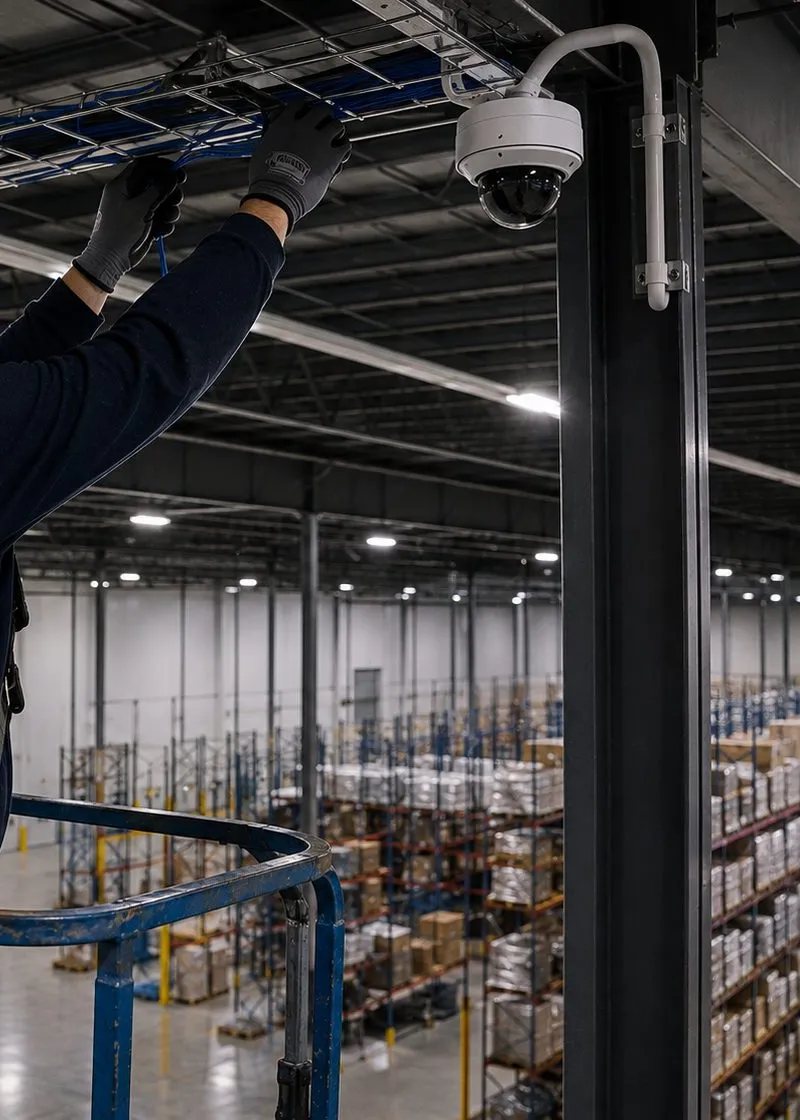
Dock, corridor and storefront cameras, with far cameras fed from a fiber-connected switch.
Video entry for divided rowhouses, walk-ups and suites that take deliveries.
Intrusion alarms for shops and units, with communicators planned alongside the new network.
Fire alarm work coordinated so cable and alarm devices are not disturbed during the fiber job.
Switches, optics, firewalls and Wi-Fi that put the fiber to work.
Category 6 and 6A inside the 100-metre limit, certified like the fiber.
Data, doors, cameras and audio planned as one scope for a new unit.
Standing practice, written by Anwar Timothy — not a story about any one client.
On the waterfront I start in the carrier room and walk toward the client, never the other way round. Walking from the suite, you pick the route that looks shortest on the plan. Walking from the handoff, you see what the building actually offers: which corridor ceilings belong to the landlord, where the old sleeves are, which shaft has room, how the freight elevator is booked. I carry a measuring wheel because the cable route is always longer than the floor plan says, and in a block-long loft that difference decides whether a desk can stay on copper.
Up the hill I start with a question rather than a tape: who owns each wall the cable will touch? In a divided rowhouse or a building over a shop, the answer is often two or three people. Getting all of them to agree to one small drawing before we drill is the difference between a one-day job and a job that stops halfway.
On both sides I look at the same last thing before leaving: where the connectors will live. Glass is tough. Connectors are not. If they sit behind a door, above the floor and away from the street grime under the expressway, the link will outlast the lease.
Yes. Crews from our Troy Avenue office regularly go north to Greenwood Heights and Gowanus, east to Windsor Terrace and Borough Park, south to Bay Ridge and along the water to Red Hook. Pricing doesn't change at the neighbourhood line; the whole borough uses the Brooklyn base rate.
Yes. Tenants at the Brooklyn Army Terminal and the Bush Terminal campus can hire their own licensed contractor for work inside their space, subject to the property manager's approval, insurance and working-hour rules, which always apply. We work for tenants; we have no contract with NYCEDC and this page is not endorsed by it. We send the scope and certificate to the property manager so approval runs alongside your review of the price.
Because length is rarely what costs the money. A run along an open slab soffit inside one unit is quick; the same length crossing two fire walls, a shaft and another tenant's corridor needs scanned cores, firestopping, booked freight time and owner approval. Strand count, armour and finish also change the labour. Ask each bidder to list penetrations, strands and tests, and the quotes become comparable.
The building number or name the campus uses, the floor and suite, and where the provider's equipment for your unit sits today. A photo of the campus directory or your lease's description of the premises helps too. Waterfront campuses often share one postal address across many buildings, so a street address alone can send a crew to the wrong entrance.
Usually one working day on site for a provider-terminal-to-back-office link with two or three drops, once the landlord has approved the openings. Add time for a back extension with a thick original wall, a cellar that needs clearing, or work timed around opening hours. The approval, not the cable, is normally the longest part.
Single-mode. Its reach is effectively unlimited inside any Sunset Park campus and it is what most campus fiber and carrier handoffs use, so the optics you buy now will keep working at the new unit. Multimode suits short runs inside one suite, but it ties you to matching optics and shorter distances. Cable inside your current suite usually stays with the building, so plan the core of your network around portable equipment.
Yes. Courtyards and common areas on the larger campuses host markets and public events, and the property manager will usually tell us which days to avoid for deliveries and noisy work. We stage materials inside your unit, keep reels and ladders out of shared spaces on event days, and plan quieter tasks such as splicing and testing for those times.
No. Fiber carries light, not electrical current, so it is immune to the electromagnetic fields around substations, switchgear, large motors and heavy feeders that can disturb long copper runs. The usual cautions still apply: keep cable out of the electrical room itself unless the owner allows it, use armoured or metal-free cable as the space requires, and keep enclosures accessible without entering a restricted room.
Looking for a different part of the city or the suburbs? Our fiber pages are arranged as a tree: this neighbourhood belongs to fiber optic installation Brooklyn, and Brooklyn belongs to the New York City fiber optic installation hub. The cards below list every borough, county and neighbourhood page currently live.
NYC fiber optic installation · Brooklyn · Manhattan · Queens · the Bronx · Staten Island
Long Island City · Jamaica · Flushing · Astoria · Mott Haven · Port Richmond · Flatiron
Hunts Point · Port Morris · Fordham · Bloomfield · St. George · Stapleton
Long Island fiber optic installation · Nassau County · Suffolk County
Hudson Valley fiber optic installation · Westchester · Rockland · Orange · Putnam · Dutchess · Ulster
For everything else we install, visit the Abstract Enterprises Security Systems home page or read about Abstract Enterprises.
If a link that worked yesterday is dark today, call (347) 934-8335 and give us the building and suite, or the corner. We try to send someone the same day; most faults we meet — a crushed jumper, a contaminated connector, a pigtail snapped in a closet — take one to two hours to find and repair once we are there, and the strand is re-tested afterwards.
Abstract Enterprises Security Systems · 1282 Troy Ave, Brooklyn, NY 11203 · Brooklyn line (347) 934-8335 · WhatsApp (718) 679-0359 via wa.me
NYS Low-Voltage Licence #12000287431 · 100% Licensed & Insured · Same-Day Estimates · Rated 4.7★ from 201 Google Reviews
Full terms — including 50% deposit, one-year parts-only warranty on AESS-supplied products, and the late-fee schedule — are set out in the service agreement. See our warranty page.
Changelog — October 17, 2026: Sunset Park page first published and reviewed. Facts about campuses, historic districts and avenues are summarised from the published sources noted in the text; your lease, the owner's rules and the agencies involved always govern. AESS has no contract with, or endorsement from, NYCEDC, Industry City or any campus operator named here.