Garden-Apartment Co-ops Β· Brick & Plaster Walls Β· Walk-ups Β· House Rules Β· Match-Day Sound Without Upsetting the Floor Below
Jackson Heights was planned around shared gardens and shared walls. The brick garden apartments the Queensboro Corporation put up between 1914 and the 1930s, many of them co-ops today, run on house rules that say when a drill may run and when a television may be loud, and on a match night the commentary has to carry over a living room full of fans without reaching the apartment underneath. We mount and set up soundbars for exactly that: anchored properly in old plaster and masonry, approved by the managing agent before anyone arrives, and tuned so the commentators stay clear while the bass stays home.
Reviewed and updated October 17, 2026 Β· Written by Anwar Timothy, NYS low-voltage license #12000287431

Start with a picture of the wall and the name of your building. Ring (347) 434-6392 or send the short form with a photo of the TV wall, the bar's model number and the floor you live on. If the co-op has a contractor form, attach it too. A licensed installer answers with a written total built from the published Queens price list on this page.
Most of New York grew lot by lot. Jackson Heights was drawn whole, and the drawing still decides how a television can be hung. According to the Jackson Heights Beautification Group's history, adapted from Daniel Karatzas's book Jackson Heights: A Garden in the City, the Queensboro Corporation under Edward MacDougall bought up the farms between 70th and 92nd Streets, Roosevelt Avenue and Northern Boulevard, finished Laurel Court as the first apartment house in 1914, and in 1917 built a complex it called the Garden Apartments β coining the phrase "garden apartment" in the process. MacDougall's rules were simple: build the whole block at once, leave a garden running its full length, set the buildings back from the street, and give as many rooms as possible two exposures.
Two years later, Queensboro announced that Linden Court, then rising between 84th and 85th Streets, would be sold under a Cooperative Ownership Plan, one of the first in the country. Between 1920 and 1925 the company finished eight block-long complexes β Hampton, Elm, Hawthorne, Laburnum and Cambridge Courts, The Chateau, The Towers and Spanish Gardens β and from 1924 it filled more than fifteen streets with brick English Garden Homes. A second wave came in the 1980s, when at least sixty buildings went co-op and added more than five thousand tenant-owned apartments to the five thousand already there. In 1993 the Landmarks Preservation Commission designated roughly thirty-six blocks as a historic district, then only the second in Queens.
For a soundbar, that history means three things. The walls are old and mostly masonry: the commission's designation report describes the garden apartment buildings as "executed in brick", and partitions inside pre-war New York apartment houses were often built of terra-cotta or gypsum block under plaster rather than wood studs. Many of the earliest buildings have no elevator at all, because every apartment Queensboro finished through 1921 was a walk-up. And the apartment is part of a corporation, so the board and its managing agent have rules about who comes in, when they may drill and how loud the television may be. One resident on the neighborhood's Reddit forum summed up the appeal of these buildings as "solid w thick thick walls" β which is true for the walls between rooms and much less true for the floor between you and the people downstairs.
The rules are not an abstraction. The house rules of one 82nd Street co-op, Allendale Apartments, allow installation work involving noise only on weekdays between 8:30 in the morning and 5 in the afternoon, forbid playing a "radio or television loud speaker" between 11 at night and 8 in the morning, ban outdoor antennas and satellite dishes, require every contractor to be screened and approved by management, and ask that at least 80 percent of each room's floor be covered with rugs or carpet. Other buildings word their rules differently, but a soundbar visit here starts with reading them.
Then there is what people watch. This is one of the most mixed neighborhoods in the city β the JHBG history notes you can hear English, Spanish, Russian, Bangla and Korean on a single walk β and a great deal of the viewing is live sport from somewhere else: fΓΊtbol in many Latin American homes β the Eagle's World Cup report spoke to Mexican-American fans on 34th Avenue β and cricket in many Bangladeshi and other South Asian homes around 74th Street. In June 2026 the city's Department of Transportation turned 34th Avenue's Paseo Park into a World Cup fan zone, and the Queens Daily Eagle described fans packed between 77th and 78th Streets for the opening match. At home, the same matches mean a crowd in the living room, commentary that has to rise above the cheering, and a subwoofer that should not be heard through a 1920s floor. That combination is what this page is about.
Put those together and the typical job looks like this: a brick co-op apartment, a plaster wall that may have block or brick behind it, a managing agent who wants paperwork first, a household that watches matches live with friends, and neighbors above, below and across the garden. The installation has to respect all of them.
Many of these visits grow into more than a bar. When the screen is new, the same appointment can include it through our Queens TV installation service; when a household wants real surround speakers for match nights, our Queens audio and sound team designs it. Shareholders who are also changing the front door can read our smart lock installation guide for Jackson Heights, which deals with the same boards and the same buildings.

If the bar dropped out after the cable company changed the box, the commentary is running a beat behind the players' mouths, the subwoofer has lost its pairing or a bracket in old plaster has started to tilt, that is a repair, not a new installation. We offer the next open two-hour window, often the same day, and most sound, sync and control faults are sorted within an hour or two of arrival. Call (347) 434-6392, tell us when kick-off or the first ball is, and list what feeds the TV β cable box, streaming stick, a laptop. Time-billed visits follow our TV and soundbar service policies.
Eight services, priced line by line from the Queens list and combined however the room needs. A visit is done when the bar is level and centered, the anchors suit the wall they went into, one remote runs picture and sound, and whoever watches the most matches has tried it from the sofa.
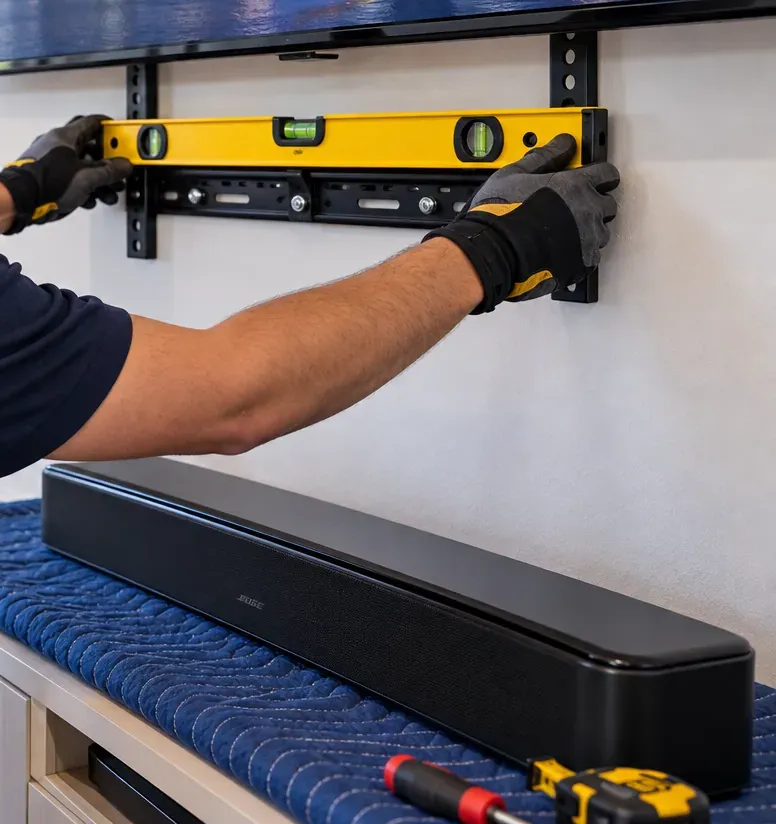
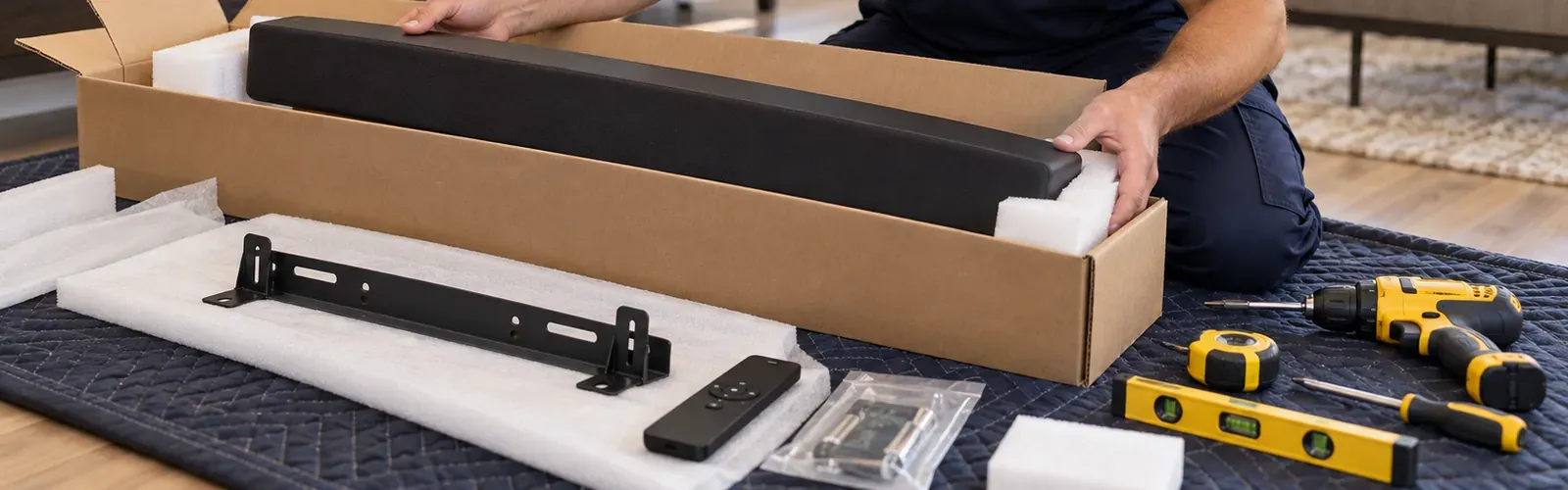
Pilot hole first, then the fixing the material calls for β masonry sleeves in brick, hollow-block anchors where a bit breaks into a void, toggles only where there is a real cavity. Leveled, connected and tested.
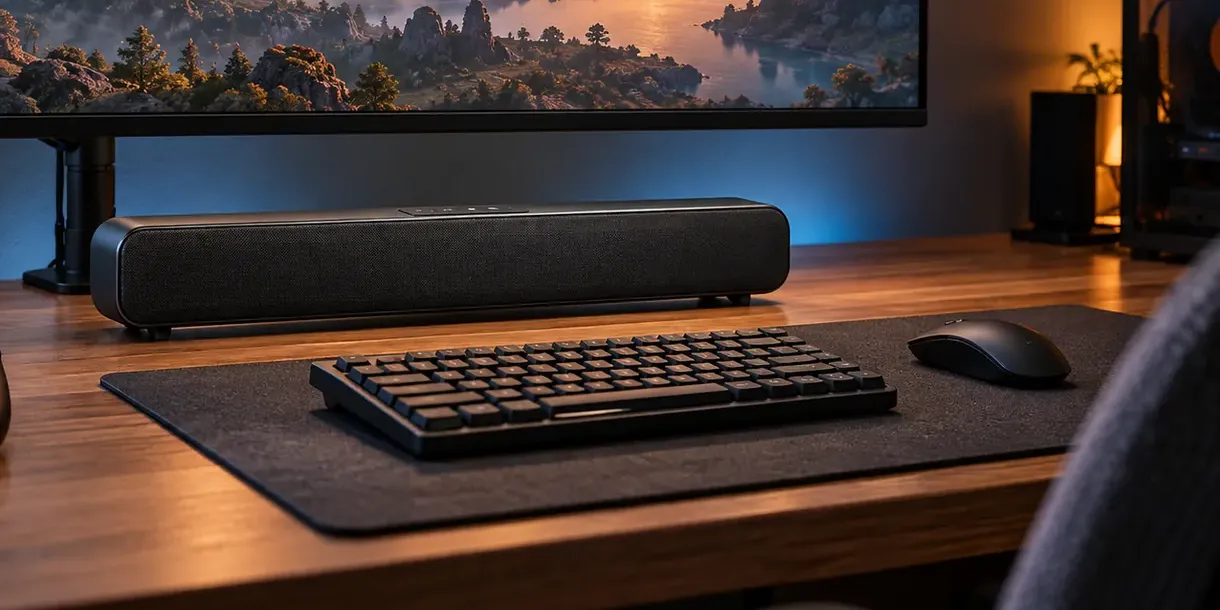
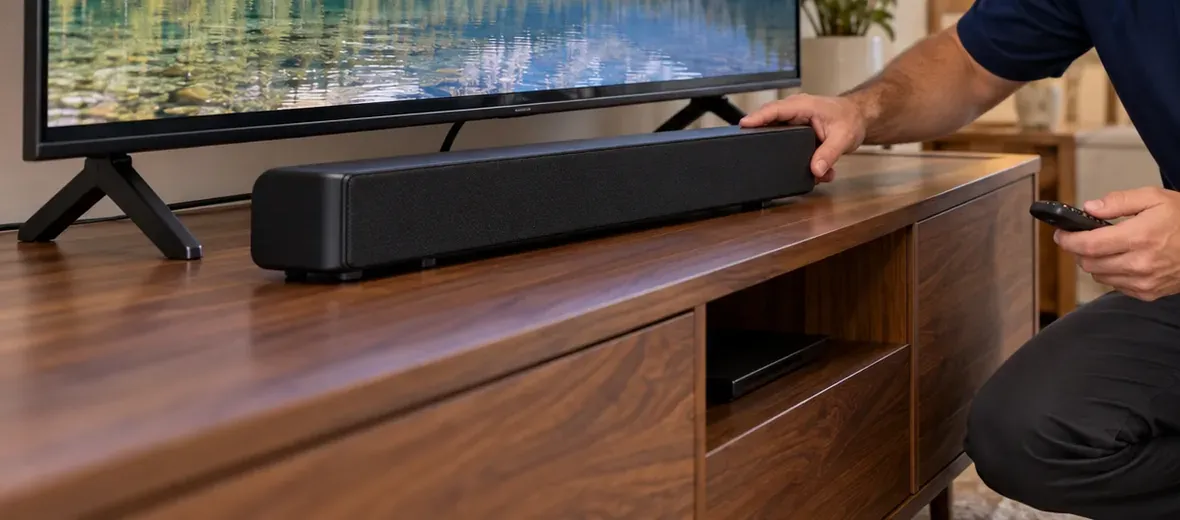
For boards still deciding, or shareholders who would rather not drill: the bar on the console, out of the TV's remote sensor path, cabled to eARC or ARC, cables tied off behind.
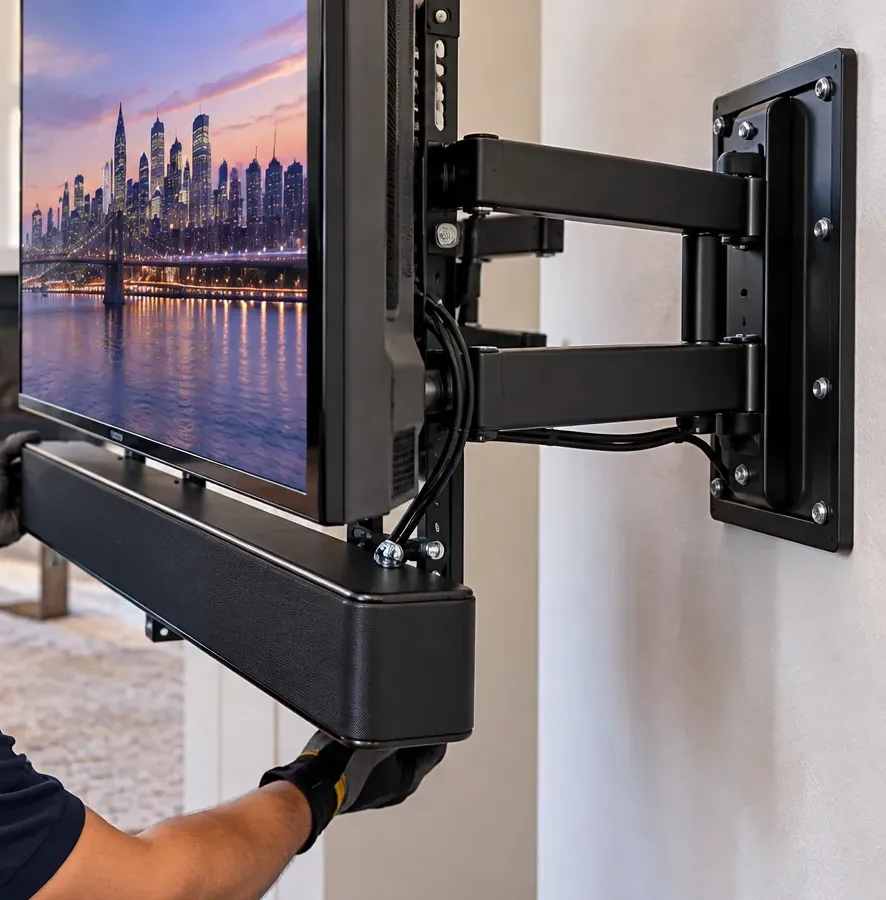
An adapter bracket carries the bar on the TV's own arm, so the pair moves together and the plaster gets no extra holes. Combined weight checked against the mount first.
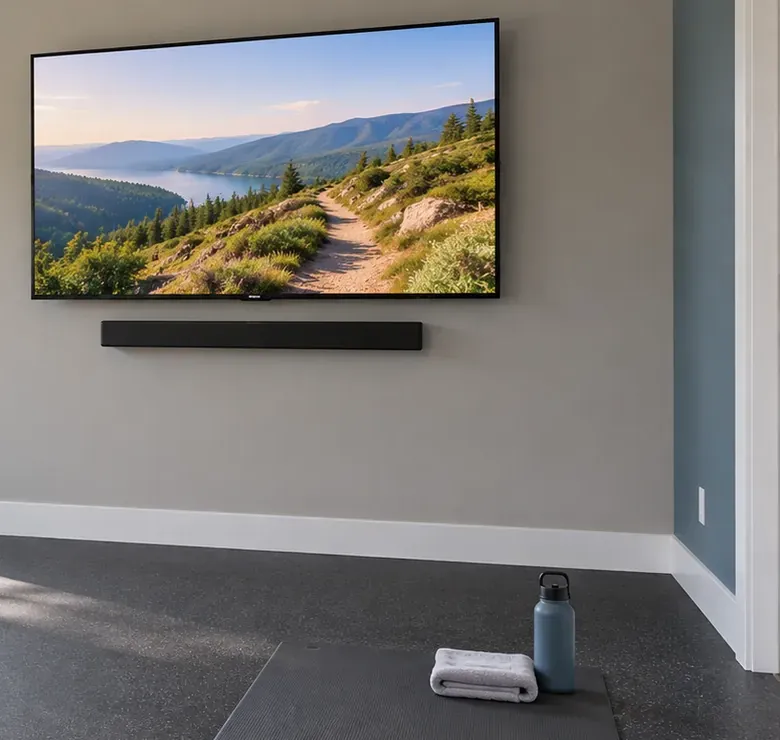
TV hung and bar fitted on the same day, with the height judged from the seat where most of the watching happens β which in some living rooms is two steps down from the doorway.
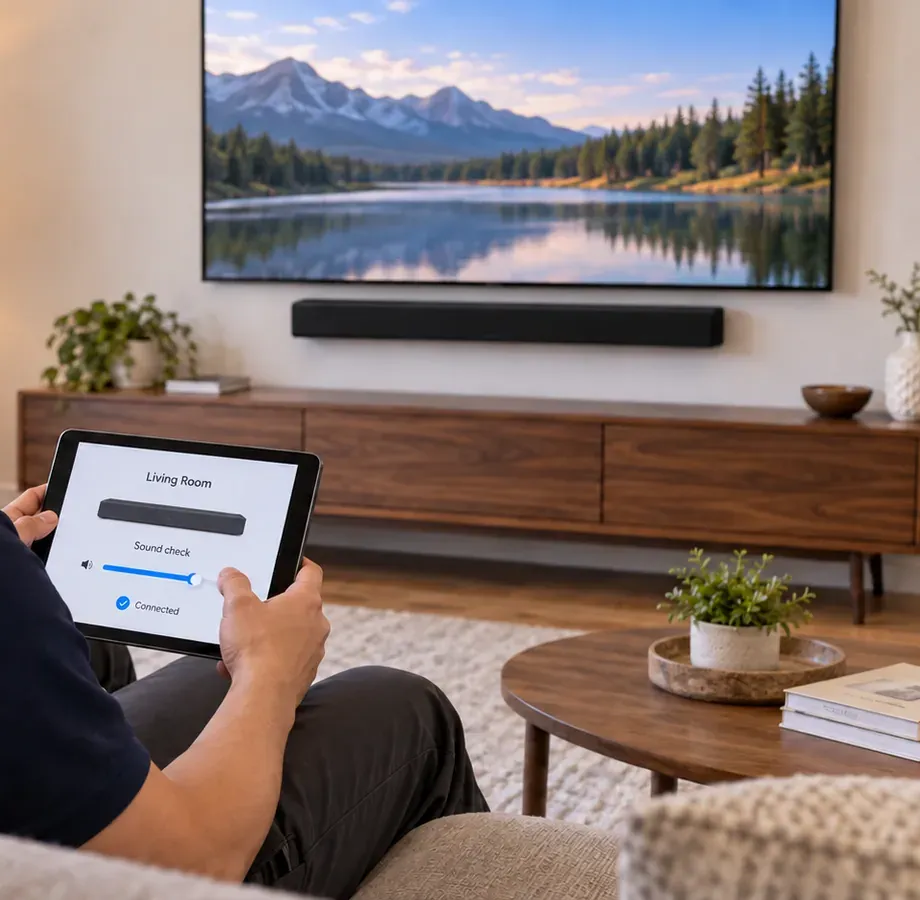
Cable box, streaming apps and any laptop routed through the TV to the bar, sound modes compared on a real broadcast, and a commentary-first preset saved for game nights.
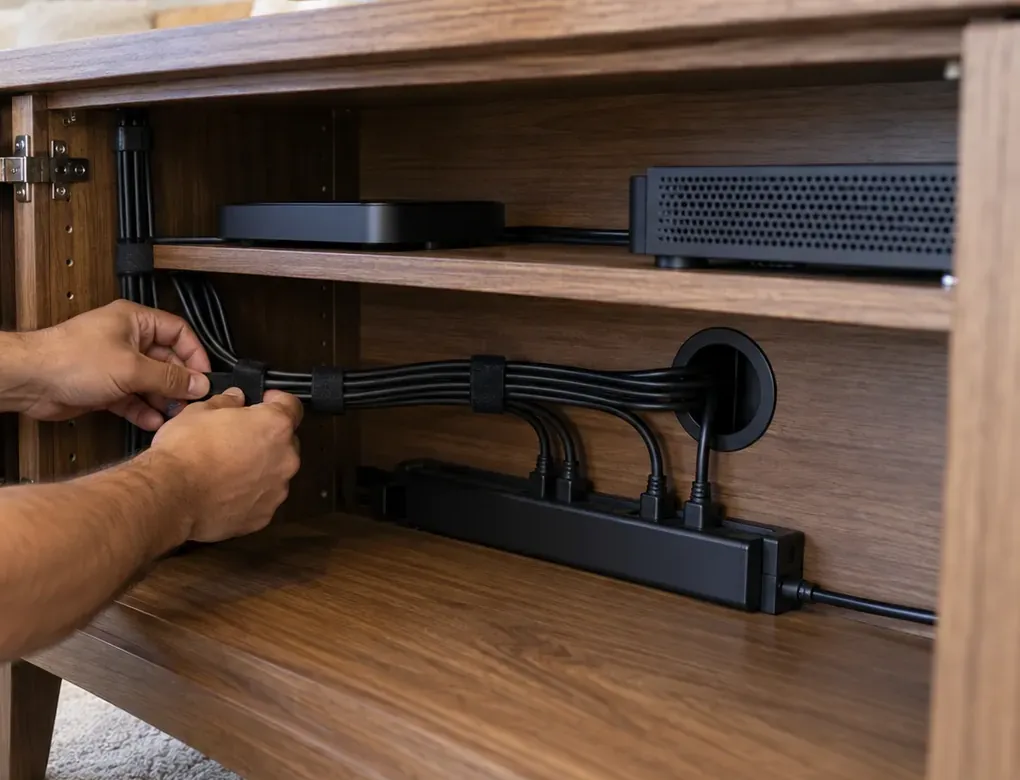
A slim paintable raceway on plaster and brick, or an in-wall power and cable kit where there is a genuine cavity β common in Garden Homes, rare in a solid co-op partition.
The subwoofer off the floor's weakest spans and away from party walls, on an isolation pad, its level judged from the sofa with the building's quiet hours in mind.
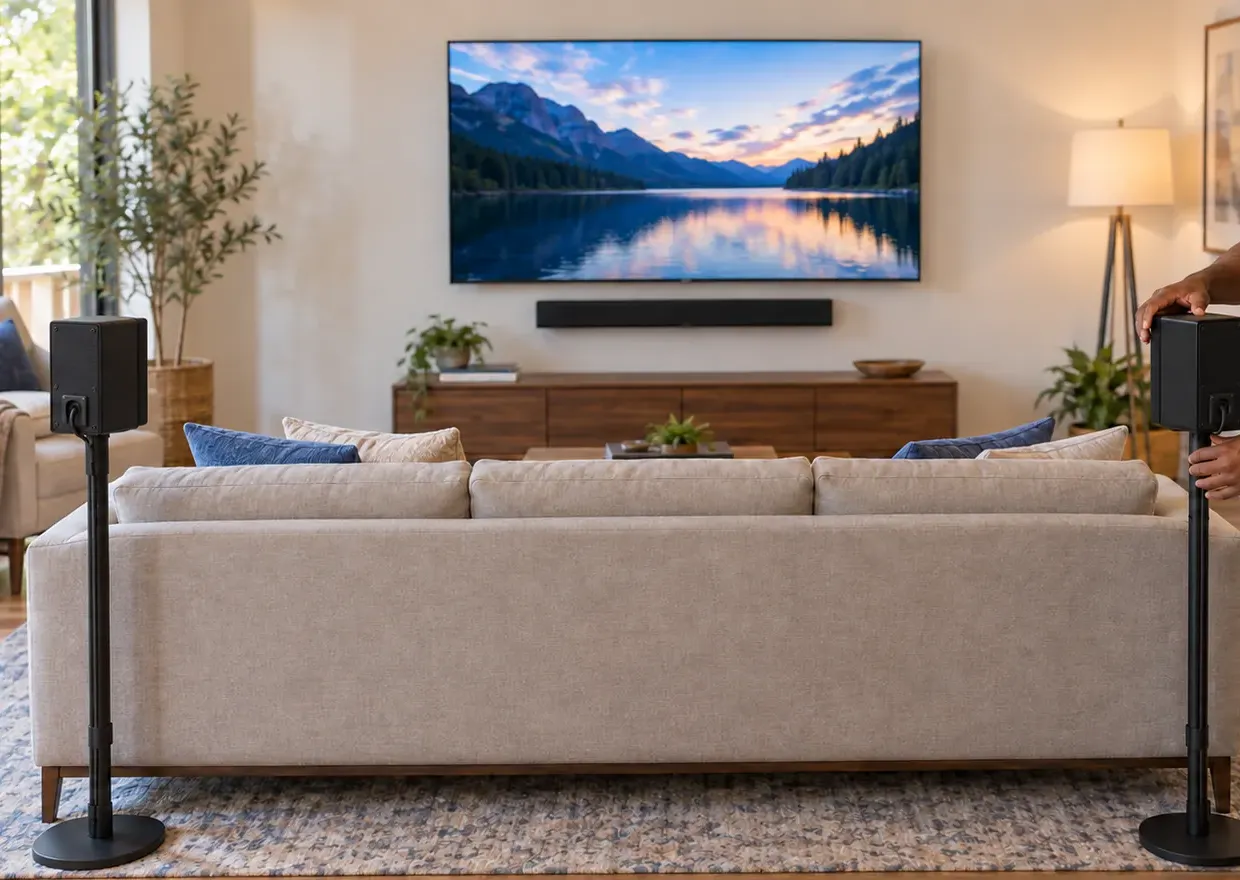
Wireless rears for a long living room, a compact bar for the bedroom that faces the garden, or a bar taken down in one co-op and hung in the next one across the avenue.

Jackson Heights was built in recognizable waves, and each wave left a different kind of TV wall. The dates below come from the JHBG history; the wall notes are what we expect and then confirm with a pilot hole, because a building's age tells you where to start, not what you will find.
Laurel, Oban and Penrhyn Courts, Plymouth and Willow Courts and the Colonials along 80th, 82nd and 83rd Streets. Every apartment finished through 1921 was a walk-up, so stairs come with the job, and the walls are plaster over masonry.
The Greystones, Linden Court and the eight complexes of 1920β25. George H. Wells's courts are attached four- and five-storey buildings around a huge interior garden; Andrew J. Thomas's are detached. Elm Court of 1922 brought the button-control elevator.
The Chateau of 1923, with slate mansard roofs and carved limestone entrances, and The Towers of 1924, ninety-six large apartments where MacDougall himself lived. Large apartments whose owners usually want the screen to sit quietly in the room rather than take it over.
Fillmore Hall's 132 units, Georgian Hall, Oak Halls, then Buckingham Hall and the Mount Vernon β rental buildings, several planned for the smaller three- and four-room suites in demand at the time. Several co-op listings on 76th and 77th Streets mention sunken living rooms and arched openings.
Thirty-eight apartment buildings finished in 1950 alone, many on the old end-block gardens of 34th and 35th Avenues. Many went up on plots sold to outside developers, so their walls cannot be assumed to match the Queensboro core; the test hole matters more than the address.
Houses built from 1924 on 87th Street and more than fifteen streets after it: solid brick, front and rear gardens, rear garages, fireplaces, slate or tile roofs. The owner decides, and a basement can carry cables.
| Where the TV is going | What we usually find behind the paint | How the bracket is fixed | Queens wall line |
|---|---|---|---|
| Outside wall of a pre-war co-op | Plaster on solid brick | Masonry sleeve anchors set in the brick face, never in a mortar joint alone | +$68.25 brick |
| Partition between two rooms | Plaster over terra-cotta or gypsum block | Slow drilling, then anchors made for hollow block once the bit shows whether it hit web or void | +$47.25 plaster or +$78.75 block |
| Wall shared with the next apartment | Masonry, often thicker than a room partition | Anchors kept short and shallow; bracket centered on the solid part | +$68.25 or +$78.75 |
| Renovated room | New drywall, sometimes on metal studs, sometimes laid over the old plaster | Toggles through the stud flange, or through both layers into the masonry behind | +$31.50 metal studs, plus the original wall's line where we drill through it |
| Garden Home living room | Brick outer walls; inner walls either framed or masonry, confirmed on the day | Lag screws into wood studs; masonry anchors on brick | $0 drywall on studs; +$47.25 plaster; +$68.25 brick |
| Kitchen or shop counter wall | Glazed tile over plaster or block | Tile bit through the glaze, then the anchor for what is behind | +$99.75 |
Schematic only: brick, clay block, gypsum block and a framed wall, each with the anchor it calls for and its Queens price line. A pilot hole on the day tells us which one is actually behind your paint.
Brick. An outside wall in a Queensboro building is usually plaster laid straight onto brick. It is the strongest wall in the apartment and the easiest to get wrong: an anchor set in a soft mortar joint can pull, so the bracket's holes are placed on the brick faces and the hammer drill is kept on low impact so the plaster skin does not let go around the hole. Outside walls also carry the radiator and the windows, which limits where the screen can sit.
Block partitions. Walls between rooms in pre-war New York apartment houses were often built from hollow terra-cotta block or gypsum block and then plastered; an engineer's write-up of a typical pre-war Manhattan building shows both. You cannot tell which from the paint. Clay block rings and then suddenly gives way as the bit reaches a cell; gypsum block drills like chalk and will crumble if forced. Both hold a soundbar comfortably with the right anchor β the wrong one, usually a toggle that cannot open inside a narrow cell, is what fails.
Renovated rooms. Many shareholders have opened kitchens or redone living rooms, and the new wall may be drywall over metal studs or a sheet of drywall laid over the old plaster. Those surfaces sound hollow, which tempts people to use the anchors in the box. We find out what the drywall is sitting on first, and if it is old plaster on block, the fixing goes through both layers. Listings for co-ops on 76th and 77th Streets also mention original details β arches, moldings, sunken living rooms β that change where a bracket can go, which is why we ask for a photo of the whole wall rather than just the spot.

In much of Jackson Heights the corporation, not the shareholder, decides how the visit runs. The examples below come from one published set of house rules for a co-op on 82nd Street; your building's rules will differ in the details, so send them to us with the photo and we will plan around them. None of this is legal advice, just what the paperwork usually asks for.
Rules that say every contractor must be "screened and approved by Management" are common. In practice that means the managing agent wants a certificate of insurance naming the corporation and the agent, our license number, the date and window, and sometimes a short description of the work. We send the certificate free and write the description; you only need to tell us who the agent is. Some buildings also send trades to a service entrance on the side or rear of the building, so tell us which door to use.
A weekday window of 8:30 to 5, with no noisy work on weekends or legal holidays, is a common pattern. A soundbar needs only a few minutes of drilling, but those minutes must fall inside the window, so we book drilling jobs on weekdays and leave the quiet part β connections, settings, the test on a live broadcast β to fill the rest of the visit. If you can only be home on a Saturday, the bar can go on the console or the TV mount that day and the wall can wait.
Older co-op house rules can still contain a line about loudspeakers, as the 82nd Street example does: no radio or television played aloud between 11 at night and 8 in the morning. Nobody expects silence, but a soundbar with a subwoofer is precisely what that rule was written about, and a match played on the other side of the world can easily fall inside those hours. We set a night preset that keeps commentary audible at low volume and turns the sub down or off, so the household can follow a late match without a complaint to the board the next day.
Bans on outdoor antennas, satellite dishes and anything hung from a window are common β the 82nd Street rules contain all three. That matters for sport: an antenna on the roof would give the lowest-delay picture, but where the rules forbid it, so the TV's sources are planned around cable, streaming or an indoor antenna instead. Nothing in a soundbar installation touches the outside of the building, and the landmark designation, which governs exteriors, does not come into it.
Co-op rule books often require most of each room's floor to be carpeted β the 82nd Street example says at least 80 percent, excluding kitchens, bathrooms, closets and foyer. A rug under the sofa is good for neighbors, but it does nothing for a subwoofer standing on bare boards at the edge of the room. We put the sub on an isolation pad and on the rug, away from the wall shared with the next apartment, and set its level with the floor below in mind.
An English Garden Home owner needs no one's permission for a bar inside the house, though in an attached house it is courteous to tell the neighbors before the hammer drill starts. Renters need the landlord's consent, and in a co-op a renter or subtenant also needs the shareholder's agreement and must follow the building's rules. Where drilling is not allowed, the console or the TV mount gives most of the benefit, and moving the bar to the wall later is priced as an ordinary wall mount.
Send us the agent's name and email and we deal with them directly. It saves you a round of forwarding, and the approval usually comes back faster when the agent is talking to the installer.
Jackson Heights shops trade under apartments, beside the el and around the busiest station in Queens, and a lot of them keep a television on. In a restaurant on a match night the job is to make commentary carry to the back tables; in a counter business it is to keep a waiting line informed without filling the room; everywhere it is to keep the sound inside the shop. These are the corridors where that work happens.
Planned by Queensboro as the main shopping street and rezoned from residential to commercial between Roosevelt and 37th Avenues in October 1927. The company's own headquarters, opened in May 1929, still stands at the corner of 37th Avenue.
Planned with 82nd Street as the neighborhood's main commercial district; today a long eastβwest run of ground-floor shops beneath apartment buildings.
South Asian shops and restaurants by the transit hub, with the pedestrian plaza on 37th Road between 73rd and 74th Streets. One Bangladeshi club nearby, on 76th Street, lists cricket matches among the events it celebrates.
The street under the 7, with elevated tracks overhead since 1917. Bars and restaurants β one Reddit poster warned that living on Roosevelt is loud "because of all the bars and the train" β and money-transfer and check-cashing counters at addresses such as 72-22 and 76-22 Roosevelt.
Where 74th Street, Broadway and Roosevelt Avenue meet over the station complex served by the 7, E, F, M and R. Shops here sit around the busiest station in the borough.
The 26-block open street from 69th Street to Junction Boulevard. Not a shopping strip, but in June 2026 it hosted the city's World Cup watch party for the opening match.
Businesses pay the same Queens prices as households, plus whichever wall line applies β commonly brick in an older storefront, block in a rear wall or tile behind a counter. Opening-hour constraints run the other way from the co-ops: we can come before the shutters go up or after close, so a match-night restaurant never loses a service to an installation.

These are questions that come up in Jackson Heights and are not already answered on our other soundbar pages, arranged the way they tend to arrive: the apartment first, then match day, then the shop.
Yes, in three ways. First, height: the people watching sit lower than anyone standing in the doorway, so the screen and the bar should be set for eye and ear level in the sunken part, not for the room as it looks from the foyer. In practice that often means a lower TV than the owner first imagines, with the bar just under it and aimed at the seats rather than at the step.
Second, the step itself is a small wall of its own. It reflects sound, and if the sofa backs onto it, bass tends to build up there. Pulling the sofa a little forward, or placing the subwoofer on the opposite side of the room from the step, usually smooths that out. Third, the floor: in an older building a sunken room is often built differently from the rest of the apartment, so we look at what is under the floor before choosing where the sub sits, and use an isolation pad either way. Several co-op listings on 76th and 77th Streets mention sunken living rooms, so we treat the step as a normal part of the plan rather than a surprise.
Diagram, not to scale: in a sunken room the TV and bar are set for the people on the sofa two steps down, and the sub goes on the opposite side from the step.
Usually, but not over the chute. Many older New York buildings once burned their garbage in basement incinerators and changed to compactor chutes from the 1970s on; one Jackson Heights co-op's house rules still talk about the "incinerator door" and dropping bags into "the flue". That shaft is part of the building's fire and refuse system, it belongs to the corporation, and nothing should be drilled into it or fixed across it.
We locate it first β the hallway chute door and the compactor room tell us where it runs β and then scan and test-drill only where the wall is ordinary partition. If the clear part of the wall is wide enough, the bracket goes there with the TV centered on the room rather than the wall. If it is not, the bar rides on the TV's mount, or the TV and bar move to another wall. A chute shaft can also carry sound, so the subwoofer stays away from it whichever way the bracket goes.
It can, as a temporary setup, but plan it as a building event rather than a living-room job. An indoor soundbar has no weather protection, so it needs a covered table or a stand under a canopy, off the grass, with the power cord run from an approved outlet along a path nobody trips over, and everything brought in before any dew or rain. A large TV on a rolling stand works better than a projector at dusk. We set the bar's level from the back row of chairs and keep the sub off, because the garden is surrounded by bedroom windows.
The rules matter more than the gear. One published set of house rules limits garden use to 9 a.m. until sundown and asks residents to be mindful of the people on the first floor, so a film that starts at dusk may need the board's specific approval. The managing agent will also want to know whose insurance covers the evening. We can set up and collect the equipment, but the date and the permission come from the board.
Not from the soundbar. A bar adds only a fraction of a second of processing; the gap you are hearing is in the feed. Stats Perform's measurements of the 2026 Super Bowl, reported by StreamTV Insider, put an over-the-air antenna about 19 seconds behind the field on average, traditional cable about 38 seconds, and the streaming apps between 48 and 62 seconds. A household watching on an app can easily be half a minute behind a neighbor on cable or an antenna, and in a garden building every cheer travels across the yard.
What you can change is the source. If the match is on the cable box as well as an app, the box is usually closer to live. It is also worth looking through your streaming service's settings for anything that brings live sport nearer to real time. An antenna is the quickest of all, but where the co-op forbids outdoor antennas it has to be an indoor one that can pick up the station from your apartment. Close the window on the garden side during big matches, and mute any phone apps that send goal alerts before the picture shows them.
The bar plays whatever audio the TV or the streaming device sends it, and in a multiview screen that is one game at a time. Crutchfield's guide to watching several games at once describes the usual method: move the highlight to the game you want with the remote, and its audio and captions follow, taking "a second or two" to switch. The bar simply follows.
Two settings make this smoother. First, make sure the TV is sending audio in a format the bar handles cleanly β if the sound drops for a moment at every switch, setting the TV's digital output to automatic or PCM usually stops it. Second, if the household wants to hear one match while watching both, a second small bar or a pair of headphones on a second TV is the only way to hear two at once; one soundbar cannot mix two separate broadcasts. We test the swap during the visit with whatever service you use, so you know how long it takes before the big day.
Often, but not on the partition itself. A glazed security screen and its framing are made to resist force, not to carry a cantilevered TV, and drilling the frame can void whatever rating it has. The TV and bar go on the structural wall above or beside the partition, or on a ceiling mount on the customer side, positioned so the screen faces the waiting line and the bar points down toward them rather than through the glass at your staff.
Two more checks. If the bracket would be above the head height of people standing in line, a high-mount line applies and the wall line depends on what is behind the finish β often block in these storefronts. And if the space is narrow, the ADA protrusion rule above keeps the TV out of the walking path. Keep the volume modest: a waiting line needs to hear announcements and the news, not compete with the train overhead, and the counter staff need to hear customers through the speaking grille.

In June 2026 Jackson Heights watched the World Cup together on 34th Avenue; most of the time, though, the match is watched at home, in a 1920s living room with friends on the sofa and neighbors on every side. The soundbar has three jobs on those nights: keep the commentary on top of the crowd noise, stay as close to live as the source allows, and keep the bass from becoming the downstairs neighbor's match too. This is how we set it up for that.
Delay is set by the feed, not by the bar. The Stats Perform figures for the 2026 Super Bowl make the point: antenna first, cable second, streaming apps last, with a spread of more than half a minute between them. A household that watches every match on an app and hears the neighbors cheer first is not imagining it. We list every source the family uses β cable box, sports apps, a streaming stick, sometimes a laptop on HDMI β and label the TV inputs so the fastest source for a given match is one button away.
Chart: average delay behind the field for each type of feed during the 2026 Super Bowl, as measured by Stats Perform and reported by StreamTV Insider. The soundbar adds only a small fraction of a second to any of these.
A sports broadcast is a mix of commentators and a stadium. Most bars offer a dialogue or voice mode that lifts the center channel, and many offer a sports mode too β but what that mode does varies by maker. TechRadar describes a sports mode as one that "places a lot of emphasis on dialogue"; P.C. Richard's guide suggests turning sports mode off "if crowd is too loud"; Yamaha recommends trying standard first. Those are not contradictions, just different bars. We play a real broadcast during the visit, try standard, voice and sports modes side by side with the household listening, and save the one where the commentators are clearest at a modest volume.
The thump of a goal celebration or a big hit is mostly subwoofer, and low frequencies travel through structure far more easily than voices do. In a pre-war co-op the floor is the path. The sub goes on an isolation pad, on the rug rather than bare boards, away from the wall shared with the next apartment and out of corners where bass piles up. Its level is set from the sofa and then checked with the household's own judgment of how loud a match night gets β not with the sub at the factory setting, which is almost always too high for an apartment building.
Plenty of matches fall outside convenient hours, and many house rules forbid a television played aloud between 11 at night and 8 in the morning. For those games we save a second preset: night or dynamic compression on, voice mode on, sub down or off, master volume capped. It keeps the commentary intelligible at low level, and pressing one button returns everything to the match-night setting the next afternoon.

Because the blocks were laid out with their long sides running northβsouth, as the landmarks designation report notes, most garden-apartment rooms face either the street or the interior garden. The two sides are different places to watch television. The street side gets traffic, buses and, near Roosevelt Avenue, the el β one Queens Reddit user wrote of a Jackson Heights apartment that "the train will be loudβ¦ if you are right on Roosevelt it could be." The garden side is quiet, but sound carries across the garden to dozens of windows.
If you have a choice of room, a living room on the garden side gives clearer dialogue at lower volume. If the living room faces the street, put the TV on an inside wall so the windows are to the side or behind the screen rather than behind the sofa; noise arriving from behind the listener competes with the commentary more than noise arriving from beside the TV. Heavy curtains do more than any setting on the bar, and closing the street-side window on a match night lets you keep the volume where it was.
MacDougall wanted as many rooms as possible to have two exposures, so corner living rooms with windows on two walls are common. They often leave one long unbroken wall and one short pier between windows. The long wall almost always wins; a bar squeezed onto a narrow pier with curtains brushing its ends loses clarity. Where the only wall is short, a compact bar or the TV mount option keeps the ends clear.
Diagram, not to scale: one way to arrange a Jackson Heights living room that has a street side and a garden side β screen on the long inside wall, street windows beside rather than behind the viewers, sub on a pad on the rug and away from the shared wall.
On a summer evening, windows all around the garden are open, and a soundbar near an open garden window is audible to far more people than one facing the street. Keeping the window behind or beside the bar closed during loud scenes, using the night preset after dark, and keeping rears and subs away from that window all help. It works the other way too: when the garden is busy, the voice mode is what keeps the commentary clear inside without turning everything up.
Outside walls in these buildings carry the radiators and most of the windows, and older apartments may have only one or two outlets per room. That often decides the TV wall before taste does. A bar draws modest power and can share the TV's outlet in most cases; where the only outlet is on the far side of the room, a painted raceway along the baseboard or a cable run to a cabinet is cleaner than an extension cord across the floor, and any new receptacle is an electrician's job.
Bring the bar you have, or ask us before you buy. In Jackson Heights the deciding questions are usually how the household watches sport, how much bass the building will tolerate, and what the wall is made of.
A dedicated center channel β the "3" in 3.0 or 3.1 β is what keeps commentators distinct from the crowd. The single most useful feature for match nights in an apartment.
A small wireless subwoofer adds the weight of a stadium without much floor-borne thump, and it is far easier to keep neighbor-friendly than a large one.
For walk-up bedrooms, overnight viewing and buildings with strict quiet hours: the bass stays inside the bar, and the floor below hears very little of it.
Up-firing drivers that bounce sound off the ceiling. Pre-war ceilings are often high and plastered, which can suit them, but beams, coves and light fixtures over the seats weaken the effect.
For long living rooms where the sofa sits well forward of the back wall. Each rear needs its own outlet, which older rooms may not have where you want them.
Whatever came in the box, or a Sanus bracket at $89.24 from the Queens list β either one checked against the bar's weight and hole spacing, then fixed to brick, block or studs with the right anchor.
Clamps that hang the bar from the TV's VESA mount, so a full-motion arm carries both. Total weight is checked against the arm's rating before anything goes up.
Masonry sleeves for brick, hollow-block anchors for clay and gypsum partitions, toggles for metal studs, isolation pads for subwoofers and paintable raceway for plaster walls.
Diagram: the usual match-day wiring in a Jackson Heights living room β every source into the TV, one eARC or ARC link to the bar, the sub paired wirelessly, and two presets saved on the bar.
| Situation | Connection we use | What to expect |
|---|---|---|
| Cable box, sports apps and a streaming stick | Every source into the TV; TV to bar over HDMI eARC or ARC | One remote for volume; every source plays through the bar with the same preset |
| Laptop for a web-only stream | HDMI from the laptop into the TV, never Bluetooth to the bar | Audio stays in step with the picture; the TV's sync adjustment still works |
| Older bedroom TV without ARC | Optical cable to a compact bar | Fine for commentary and news; the bar's own remote may handle volume |
| Two TVs, one living room and one bedroom | Separate bar on each, each TV feeding its own | Two programs at once without either room turning up to compete |
| Music from guests' phones between matches | Wi-Fi casting where the bar supports it, Bluetooth otherwise | Casting keeps quality and range; Bluetooth is quickest for visitors |
Tell us the model when you send the photo: it fixes which inputs exist, which bracket fits and what the anchors must carry, and a bar sold under the same name a year later may change all three.
Buy the center channel before the bass. Commentary is the part of a match broadcast that matters, and a bar with a real center speaker separates it from crowd noise better than a two-channel bar trying to fake one. Look for a first number of 3 or more β 3.0, 3.1, 5.1 and up.
Pick a sub you can turn down, or none. A large subwoofer is wasted in a building where the floor below has to stay friendly. A compact sub with fine level control, or an all-in-one bar, gives most of the excitement with a fraction of the trouble.
Check the sports and voice features. Voice or dialogue modes are nearly universal; sports modes vary widely in what they do. Night or dynamic-range modes are what make late matches possible under an 11 o'clock rule.
Think about the remote in a full room. A bar that answers the TV remote over HDMI-CEC is easier for guests than one that needs its own remote or an app. If several people will change the volume, keep it on the TV remote.
Mind the length. A long bar under a modest TV looks heavy on a narrow wall between windows. Measure the clear width of the wall, not just the TV.

Google's AI Overview would not load where this page was researched, so nothing here quotes it. What we did instead: each heading reproduces a line that a cost guide, retailer or manufacturer has actually published β the sort of sentence AI summaries borrow β and the three paragraphs beneath test it against a Jackson Heights co-op on a match night.
A 2026 surround-sound price guide from Woodlands Home Theater lists a soundbar-plus-sub system at $150 to $400 to install, aimed at small living rooms and bedrooms. As a national range it is not unreasonable.
What a range like that cannot know is the building. A fourth-floor walk-up in one of the 1910s courts adds stairs; a brick outside wall adds a masonry line; a managing agent who wants a certificate and a written description adds paperwork, even if we do not charge for it.
On our Queens list each of those is its own line β brick is $68.25, stairs above the second floor $42, the mount itself $135.45 β while the paperwork for the agent costs nothing. Add up the lines that apply and that is the price, in writing, before we come.
A popular home-improvement blog recommends snap toggles for heavy objects on both drywall and plaster. On plaster over wood lath with an open cavity behind it, that is sound advice.
In a pre-war co-op the plaster is often laid directly on brick or on clay or gypsum block. A toggle needs open space behind the wall to swing its wings open; in solid brick there is none, and in a hollow block the cell may be too narrow, so the toggle never seats properly.
The pilot hole tells us what is there. Brick gets a masonry sleeve in the brick face, hollow block gets an anchor designed to grip inside a cell, and toggles are kept for metal studs and real cavities.
Crutchfield's advice for a game-day setup is to pick a soundbar with a separate subwoofer for the crowd and the hits. In a house with a basement, it is good advice.
In a 1920s co-op the subwoofer's energy travels through the floor and the walls to people who are not watching the match. House rules that ask for 80 percent rug coverage and ban loud televisions late at night exist because of exactly this.
A sub can still be part of the system β compact, on a pad, on the rug, off the shared wall, set from the sofa. In the strictest buildings an all-in-one bar is the better buy, and we will say so before you spend the money.
TechRadar's explainer of TV sound modes says sports mode emphasizes dialogue because commentary is the main thing you hear. On some sets that is how it is tuned.
Other guidance points the opposite way: P.C. Richard's live-sports tips suggest turning sports mode off if the crowd is too loud, and Yamaha's suggests starting with standard. Sports modes differ from brand to brand, and a mode built to make a stadium feel big can bury a commentator in a small room.
The only reliable test is a real broadcast in your living room. We compare the modes with the household listening and save whichever keeps the commentary clearest at the volume your building tolerates.
That is how Samsung's support pages describe Active Voice Amplifier, a feature on select Samsung TVs that uses a sound sensor to raise dialogue when the room gets noisy, and which Samsung says works with soundbars.
In a living room full of fans, the "external sound" is often the guests. A feature that raises dialogue every time the room cheers will keep nudging the level up during the loudest moments of a match, and in an apartment facing the el it reacts to every passing train as well.
It can help a single viewer in a quiet room. For a watch party we usually leave it off and set the voice mode and volume by hand, so the level stays where the household chose it.
Sonos describes Night Sound as reducing the intensity of loud sounds while raising quieter ones, so dialogue stays clear without more volume. It does exactly that, and other makers' night modes work in a similar way.
What a night mode does not do is make a subwoofer inaudible downstairs. Compression narrows the gap between loud and quiet passages; the bass that travels through a 1920s floor is still there unless the sub itself is turned down or off.
So our late-match preset combines the night mode with a lower sub level and a capped volume. That is what keeps an overnight game within the spirit of an 11 p.m. house rule.
StreamTV Insider's report on Stats Perform's 2026 Super Bowl test found over-the-air broadcasts closest to live, at about 19 seconds behind the field on average, ahead of cable and well ahead of the streaming apps.
Advice built on that finding often ends with "put up an antenna". Where a Jackson Heights co-op's house rules prohibit outdoor antennas and satellite dishes, as the 82nd Street rules do, the roof is off the table.
An indoor antenna may still pull in the stations from your apartment, especially on a high floor facing Manhattan; if it does not, cable is the next quickest. We connect whichever you choose so its sound goes through the bar like everything else.
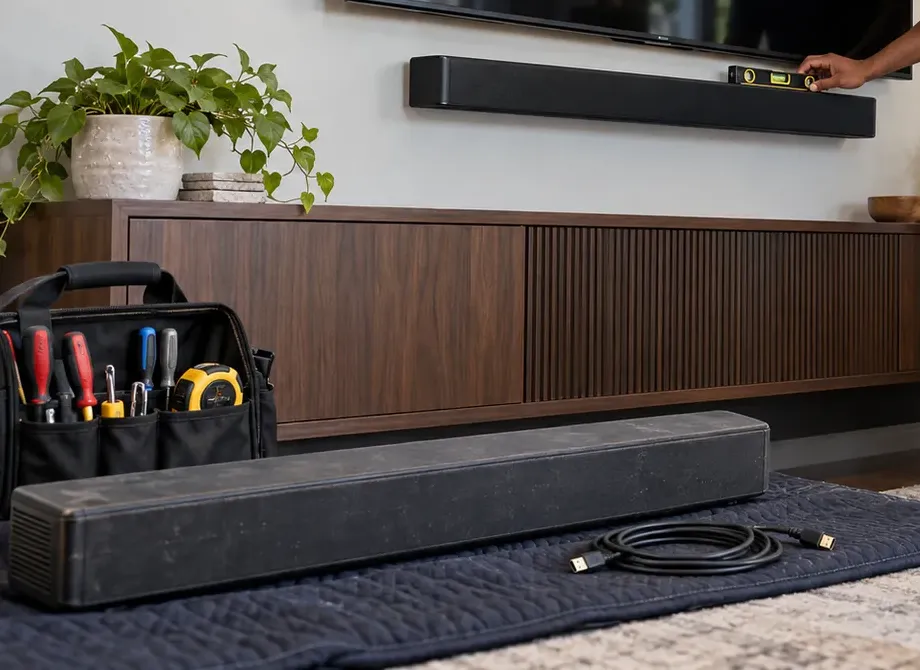
Three things get the job moving: a wall photo, the bar's model and your co-op's rules for contractors. Back comes a Queens price in writing and a plan your agent can sign.
A walk-up court near 82nd Street, an elevator co-op on 34th Avenue or an English Garden Home β send the details and a written price comes back before the business day ends. To talk it through, call (347) 434-6392.
Your request has landed with the Queens team. Expect a call from a licensed installer before the business day closes; for anything urgent, ring (347) 434-6392.
Every Jackson Heights visit follows the same seven steps, whether it is a compact bar in a walk-up bedroom or a full match-night system in a Garden Home.
Send a photo of the wall and outlet, the TV and bar model numbers, your floor and whether there is an elevator, and the co-op's contractor rules if you have them.
By the end of the business day a written figure arrives, itemized from the Queens list, so nobody books a date without knowing the cost.
We send the certificate of insurance free, write the short work description the managing agent asks for, and confirm the drilling window and entrance.
Pick a two-hour arrival window between 8 AM and 8 PM; drilling jobs are booked inside the building's permitted hours, and changes with a day's notice cost nothing.
The wall is scanned, a small pilot hole shows whether it is brick, block or a cavity, and the height is agreed from the seats rather than the doorway.
The bracket goes in with anchors suited to the wall, the bar is hung and leveled, every source is moved onto the TV, and the TV feeds the bar over eARC or ARC with CEC on.
A live broadcast is played, sound modes compared, the match and late-night presets saved, the sub set for the floor below, and the dust cleaned up before we leave.

Queensboro's story in six buildings and places β and the homes we work in surround every one of them.
Between 84th and 85th Streets, Roosevelt and 37th Avenues. Announced in May 1919 as the first building offered under Queensboro's Cooperative Ownership Plan, with detached buildings, interior sunrooms, a block-long garden and ground-level garages.
Queensboro's first major complex, built in 1917 as the Garden Apartments β the project that gave "garden apartment" its name β and renamed the Greystones in 1925.
Andrew J. Thomas's complex of 1923, known for its slate mansard roofs, carved limestone entrances and a lavish interior garden.
The 1924 complex at 80th Street and 34th Avenue, with ninety-six apartments, where Edward MacDougall moved his own family into a fourteen-room duplex on the top floor.
The three-storey building at 82nd Street and 37th Avenue that cost $500,000 and opened in May 1929, months before the crash that ended the company's boom.
Opened in 1937; its WPA-sponsored mural depicts the growth of the neighborhood Queensboro built.
The same crews cover the neighborhoods around Jackson Heights β East Elmhurst to the north, Corona and Elmhurst to the east and south, Woodside to the west β and the rest of Queens, the city, Long Island and the Hudson Valley. Paseo Park, the 26-block open street on 34th Avenue, runs straight through the area we cover most often.
Every Jackson Heights address is priced from the same published Queens list, whether it is a walk-up court from 1915 or a 1950 elevator building on 35th Avenue. The quote is the sum of the lines that apply, and the invoice matches the quote. If the pilot hole finds something the photo could not show β block instead of brick, a hidden cavity β you hear the price change before any extra work begins. The soundbar and accessory figures below already include the Queens area factor of 1.05.
| Soundbar service | Queens price | What it covers |
|---|---|---|
| Soundbar placed on a console or stand | $82.95 | Positioned, connected to the TV, set up and tested |
| Soundbar wall-mounted under the TV | $135.45 | Bracket fixed, bar mounted and leveled, connected and tested |
| Sanus soundbar bracket | $89.24 | When the bar came without one, or its own bracket does not suit the wall |
| In-wall concealment | $177.45 | Code-compliant in-wall power and cable kit, hollow walls only |
| Paintable cord cover | $61.95 | Surface raceway from the bar to the outlet or console |
| Cable run to a cabinet or other spot | $103.95 | Up to 25 ft |
| Sonos setup | $131.25 | Sonos bar, sub, rears, app and grouping |
| A/V receiver hookup | $135.45 | Receiver connected and configured |
| Universal remote | $103.95 | Programmed for the TV, the bar and every source |
| Streaming device setup | $51.45 | Roku, Apple TV, Fire TV, Chromecast or similar |
| Full home theater connection | $367.50 | Several components set up together |
| Condition | Queens price | Where it turns up in Jackson Heights |
|---|---|---|
| Drywall on wood studs | $0 | Some Garden Home interiors and renovated rooms |
| Metal studs | +$31.50 | Newer partitions in renovated apartments and shops |
| Plaster | +$47.25 | Most pre-war co-op rooms |
| Brick or stone | +$68.25 | Outside walls of the courts and the Garden Homes |
| Concrete or cinder block | +$78.75 | Block partitions, storefront rear walls |
| Tile or marble | +$99.75 | Kitchens, restaurant and counter walls |
| Plywood backer board | $89.25 | Where a weak surface needs a board to spread the load |
| High mount (above about 8 ft) | $78.75 | Restaurants and counters with screens over head height |
| Walk-up, 3rd floor and above | $42 | The early courts and other buildings without an elevator |
| Box removal | $26.25 | Cartons and foam taken away with us |
| Certificate of insurance | Free | Managing agents, co-op boards, landlords |
Four flights up in a 1910s court: our Sanus bracket ($89.24) into a plaster partition, the $135.45 mount, $47.25 for plaster, the $42 stair line and $61.95 of painted raceway down to the outlet β $375.89 in all.
An elevator co-op on 34th Avenue, where the bar's own bracket goes on a brick outside wall and the cable runs to a cabinet across the room, with the boxes taken away: wall mount $135.45, brick $68.25, cable run $103.95 and box removal $26.25, for $333.90.
An English Garden Home with nothing on show: the Premium package at $402.14 (mount, Sanus bracket and in-wall kit through a framed wall), plus $51.45 to set up a streaming stick and $103.95 for a single remote that runs it all β $557.54.
Over a Roosevelt Avenue waiting line: the bar on a Sanus bracket ($89.24), high on a block wall β $135.45 mount, $78.75 block line, $78.75 high-mount line β for $382.19. Yours is added up the same way and sent in writing.
A repair or setup call with nothing to hang β say the sound has slipped out of step with the picture, the subwoofer will not pair, an update wiped the presets, or the bar must be married to a new TV β is charged by the clock: $195 for the first hour at the Queens rate, then half-hour blocks. Hanging the TV as well? The Queens base for a 32- to 55-inch screen on a flat or tilt mount on drywall over wood studs is $179.99; other sizes, mount types and walls are on our Queens TV mounting price list.
Why a national menu price rarely fits a Jackson Heights apartment. Store and app booking menus assume one wall β drywall on wood studs β and an elevator. Nothing in them covers four flights of stairs, a brick outside wall, a hollow-block partition or a managing agent's paperwork. Our Queens list has a line for each, and a licensed local installer is still around when the bar needs adjusting before the next tournament.
Chart: how each of the four Jackson Heights examples breaks down, line by line, on the published Queens list (bar lengths roughly to scale).

Three packages cover most Jackson Heights apartments and houses. Each shows its total; the wall line from the table above is the only addition.
$82.95
Nothing drilled: the bar sits on your media unit, connected to eARC or ARC, answering the TV remote, with match and night presets saved. The usual choice while a board considers the paperwork, or for a shareholder who would rather not drill a pre-war wall at all.
$224.69
The $135.45 wall mount with our $89.24 Sanus bracket. Add $47.25 for plaster, $68.25 for a brick outside wall or $78.75 for block, and $42 if you live above the second floor of a walk-up.
$402.14
No visible cable: the in-wall power and cable kit ($177.45) joins the mount and the Sanus bracket in one price. It needs a real cavity β typically a framed wall in a Garden Home or a renovated room β and a building that allows the wall to be opened.
Bought your own bracket? Then the bill is the $135.45 Queens mounting labor plus the wall line, with nothing for hardware. It has to be rated for your bar, and a defect in it is a matter for its manufacturer. If it will not hold properly in brick or block, you hear that before a hole is drilled, and the Sanus bracket is offered instead.
Model, photo, floor number: with those three we can total the job and email it to you.
Queensboro's tract ran from 70th to 92nd Street between Roosevelt Avenue and Northern Boulevard, and the job changes noticeably as you cross it. These are the parts we see most, and what usually differs between them.
Schematic, not to scale: the main parts of Jackson Heights and the kind of building each mostly holds. The historic-district boundary is irregular; the shaded band shows only its rough extent.
The garden courts, the block-long complexes and the showpiece buildings. Expect a managing agent's approval before anything else, a weekday drilling window, plaster over brick or block, and a choice between the street-side and garden-side rooms. Walk-up surcharges apply in the earliest buildings. This is where the house rules on loudspeakers and floor coverings are most often written down, and where the late-match preset earns its keep.
Apartment buildings old and new face the open street, which is quiet of cars during its hours but busy with people, events and, during the World Cup, crowds. Rooms on the avenue side benefit from the TV on an inside wall and from the voice mode on busy evenings. Many of the 1950 buildings stand here on what were once end-block gardens.
The blocks near Travers Park and the boulevard mix older buildings with post-war ones. Walls vary more from building to building here, so the pilot hole decides the anchor and the line on the quote. Boulevard-facing rooms pick up traffic; garden-facing ones do not.
Brick houses with front and rear gardens, rear garages and fireplaces. The owner decides, framed interior walls can take in-wall kits, and the basement can carry cables between floors. These are the homes where a full Premium installation with nothing showing is most often possible, and where a second bar for an upstairs room is a common add-on.
Apartments over shops, beside the el and around the busiest station in Queens. Every visit here plans around train noise: TV on the wall away from the tracks where possible, windows closed for big matches, commentary-first settings. Commercial jobs on this stretch are often done before opening.
The shopping spine Queensboro planned, with homes above many of the shops. Residential visits look like the historic core; commercial visits follow the noise code and the ADA notes above, and are booked around trading hours.
Closing on a co-op, gutting a kitchen or buying a bigger screen tends to bring a second job with it; these are the ones we are asked for most alongside a bar.
New screen and bar on one visit, with the TV height set for the seats and the bar matched to it.
The borough's published screen-hanging rates, set out by TV size, mount style and wall material.
A Sonos bar joined to the speakers you already own, with sub, rears and grouping set up.
Separate speakers and an AV receiver for match nights at home, and distributed sound for restaurants and bars.
One button that dims the lights and starts the match with the bar on the right preset.
A wired network drop at the TV for streaming apps that stall in the second half.
Keyless entry for co-op apartments and Garden Homes, planned around the same boards.
Cameras, intercoms, Wi-Fi and data under the same state license.
One form for the bar, the screen and anything else on that wall, answered with a single written figure.

Standing practice for this neighborhood, written as habits rather than as the story of any one home
Read the house rules before booking, not at the door. If drilling is weekdays only, the bracket goes up in the first hour of a weekday visit and everything quiet β connections, presets, the live-broadcast test β fills the rest. Bring the certificate of insurance printed as well as emailed; supers like paper.
On a pre-war wall, drill the first hole small and listen. Brick resists evenly; clay block rings and then drops away into a cell; gypsum block goes soft and powdery. Move the bracket's holes onto brick faces rather than mortar, and never force an anchor that was meant for a different wall.
Before packing up, play a real match or highlights with the household on the sofa. Try standard, voice and sports modes in turn, save the clearest one, then set the late-match preset and turn the sub down with the floor below in mind. Show someone in the family how to switch between the two.
From the Queens list: wall mount $135.45, plaster $47.25, walk-up $42 and a universal remote programmed for the TV, the bar and every box $103.95, for $328.65. Your own bracket must be rated for the bar. If the pilot hole finds brick or block behind the plaster instead, that wall line replaces the plaster line, and you hear the change before any drilling. The certificate of insurance for the managing agent is free.
Yes. The same crews and the same published Queens price list cover East Elmhurst to the north, Corona and Elmhurst to the east and south, and Woodside to the west, as well as the rest of Queens and the city. The quote is built from the same Queens lines wherever the apartment is, with no separate line for the neighborhood.
No. The landmark designation concerns the outside of buildings, and nothing in a soundbar installation touches the exterior, so it adds no line to the price. What changes the total is the building itself: a walk-up adds the stair line, brick or block adds its wall line, and an elevator building with drywall partitions may add nothing at all. The approval paperwork is the same in both and costs nothing.
Not necessarily. Thirty-eight apartment buildings were finished in Jackson Heights in 1950 alone, many by developers other than the Queensboro Corporation, and their partitions and outside walls can differ from the older courts next door. We treat the address as a hint only: a small pilot hole shows whether the wall is plaster on block, brick or a framed cavity, and the anchor and the price line follow from that.
Some can, many cannot. A few bars store a sound mode for each input, while most keep a single setting until it is changed, and the TV may hold its own sound settings per input as well. We check what your bar and TV allow during setup. Where neither remembers per source, we save the match and late-night presets on the bar and show the household the one button that switches between them.
It can play, but it will rarely line up with the picture. A radio or app commentary arrives on its own timing, often seconds ahead of or behind the TV feed, and the bar cannot delay an outside source by that much. A phone or tablet can be connected to the bar's Bluetooth or a spare input, with the TV muted, and if the app lets you pause, a brief pause can bring the two closer. If the match channel itself offers a second audio language, that track stays in sync and is the better choice.
For the borough as a whole, see our soundbar installation service for all of Queens; for the five boroughs together, the AESS New York City soundbar hub. Below is every county and neighborhood we have written up separately, each one built around its own buildings.
Soundbar installers for NYC Β· Queens Β· Manhattan Β· Brooklyn Β· the Bronx Β· Staten Island
Long Island soundbar installation Β· Nassau County Β· Suffolk County
Soundbar installation in the Hudson Valley Β· Westchester Β· Rockland Β· Orange Β· Putnam Β· Dutchess Β· Ulster
Jackson Heights, Queens (this page) Β· Astoria, Queens Β· Flushing, Queens Β· Forest Hills, Queens Β· Long Island City, Queens Β· Upper East Side, Manhattan Β· Upper West Side, Manhattan Β· Harlem, Manhattan Β· Tribeca, Manhattan Β· Chelsea, Manhattan Β· Greenpoint, Brooklyn Β· Bayside, Queens Β· Kingsbridge, Bronx Β· New Dorp, Staten Island Β· Greenwich Village, Manhattan Β· Brooklyn Heights, Brooklyn Β· DUMBO, Brooklyn Β· Park Slope, Brooklyn Β· Williamsburg, Brooklyn Β· Bay Ridge, Brooklyn Β· Riverdale, Bronx Β· Mott Haven, Bronx Β· Pelham Bay, Bronx Β· Throgs Neck, Bronx Β· St. George, Staten Island Β· Great Kills, Staten Island Β· Tottenville, Staten Island Β· Todt Hill, Staten Island
Door entry, camera and Wi-Fi work in Jackson Heights is done under the same state license β everything we offer is on the Abstract Enterprises Security Systems home page, and the people behind it are on our about page.
If the bar went silent after a box swap, the sound trails the picture, the sub stopped pairing or the remote no longer turns it up, call (347) 434-6392. You get the next open two-hour window, often the same day, and most problems like these are fixed within an hour or two of the technician arriving.
Abstract Enterprises Security Systems Β· 460 E Fordham Rd, Bronx, NY 10458 Β· Queens line (347) 434-6392 Β· WhatsApp (718) 679-0359 via wa.me
NYS Low-Voltage License #12000287431 Β· 100% Licensed & Insured Β· Same-Day Estimates Β· Rated 4.7★ from 201 Google Reviews
Brackets and parts carry their manufacturer's warranty. Full terms β including 50% deposit, one-year parts-only warranty on AESS-supplied products, and the late-fee schedule β are set out in the service agreement. See our warranty page.
Sources used on this page (plus the 2010 ADA Standards for Accessible Design, Β§307.2):
Last reviewed October 17, 2026. Revision history: Jackson Heights page launched with guidance on garden-apartment co-op walls and house rules, match-day sound, street-side and garden-side rooms, local businesses and Queens pricing.