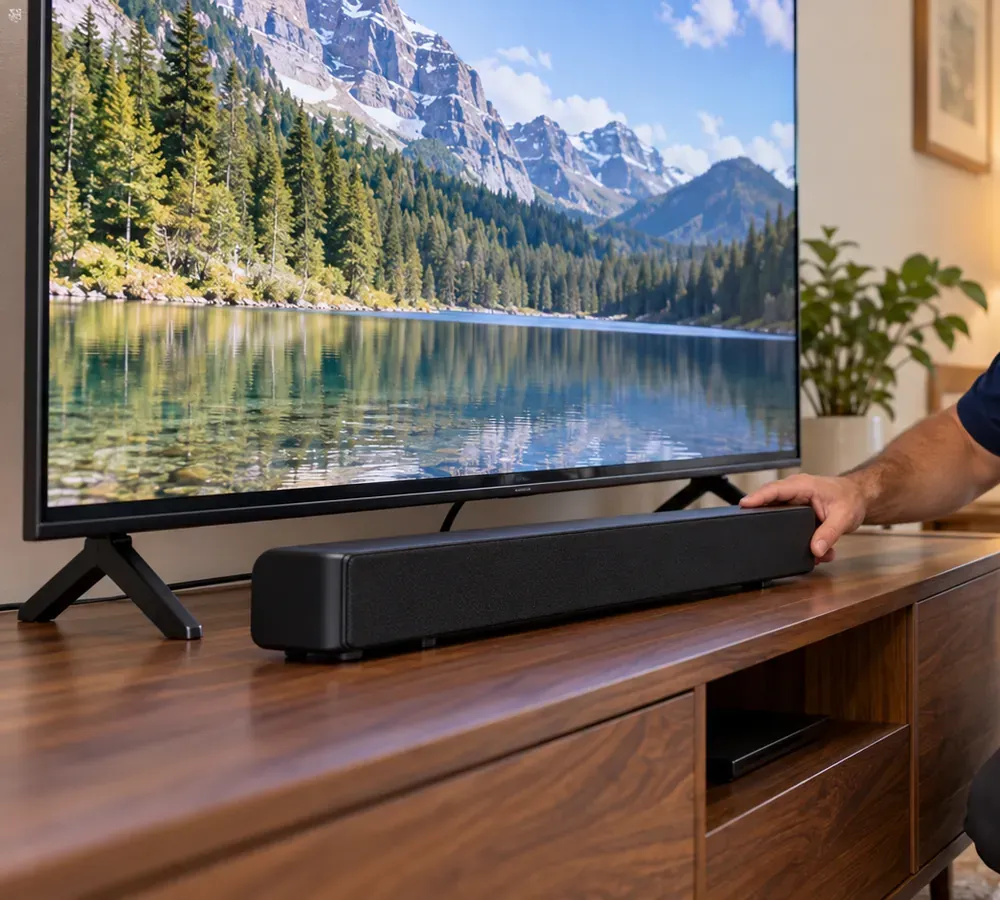
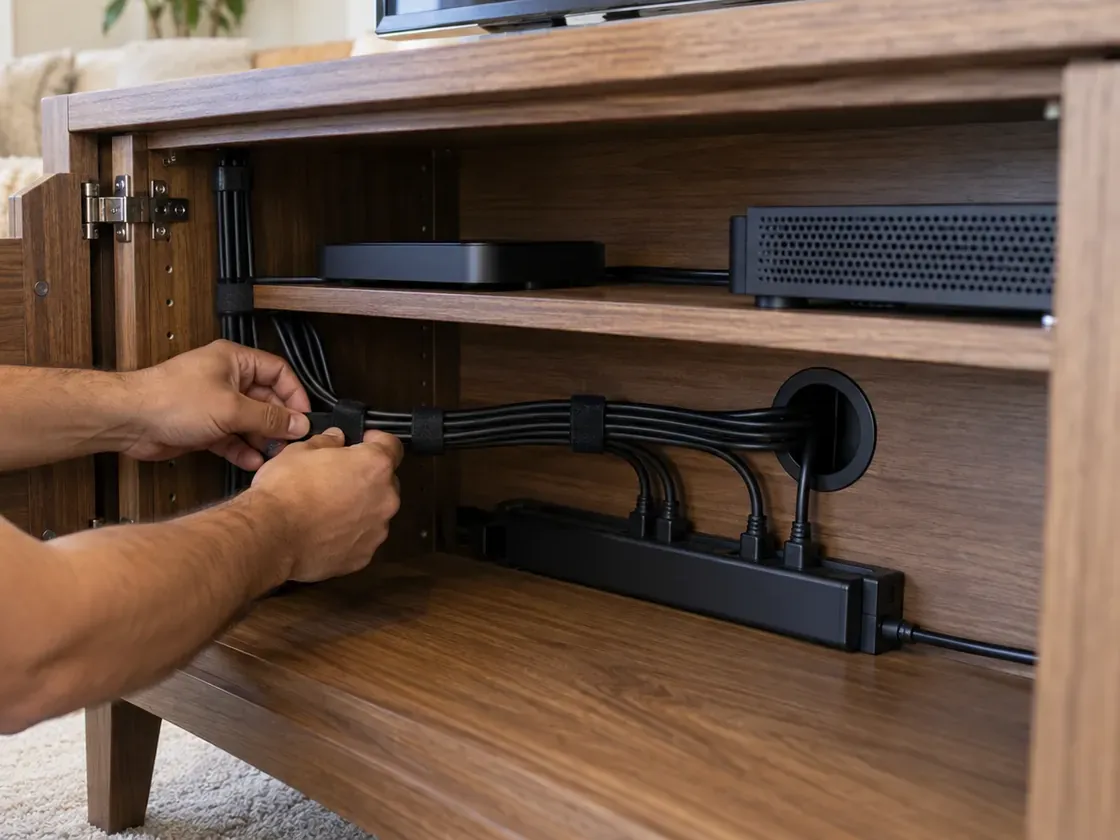
Sided Frame Walls · Brick-Filled Studs · Plaster & Lath · Tower Partitions · eARC & One-Remote Setup
In Greenpoint the outside of a building is a poor guide to the wall behind your television. A house on Noble or Calyer Street may wear aluminum or asphalt siding over a frame from the 1860s, with brick packed between the studs. A flat on Greenpoint Avenue may sit over a shop, with two more households stacked above it. A new apartment on the waterfront may hide wood blocking, steel studs or concrete behind identical white drywall. We find out what the wall really is before the drill comes out, then hang the bar, hide or dress the cable, and tune the sound for a building that other people live in too.
Page written by Anwar Timothy (NYS licence #12000287431) · Last reviewed and updated October 17, 2026 · Greenpoint visits are dispatched from 1282 Troy Ave, Brooklyn

Frame house, flat over a shop or a tower on the water — tell us which, and we will price it. The Brooklyn line, (347) 934-8335, reaches an installer who works north of McCarren Park every week, or send the form and get the figure in writing.
A soundbar is a small, light thing. What makes it awkward in Greenpoint is the wall it has to hang on, and the people on the other side of the floor. Brooklyn's northernmost neighbourhood was built fast in the second half of the nineteenth century for shipbuilders, refinery hands, potters and pencil makers, and much of what they built is still standing. Since then almost every house has been resurfaced, subdivided, insulated, rewired or opened up at least once, and often several times. The result is a neighbourhood where two houses that look alike from the pavement can have completely different walls behind the television, and where a living room is usually one floor of a building that holds two, three or more households.
The Landmarks Preservation Commission's report on the Greenpoint Historic District, designated in September 1982, describes exactly this mix. It lists substantial rowhouses built for the owners and managers of the local shipyards and factories, more modest rowhouses, and numerous flathouses — walk-up apartment houses — for the workers, along with commercial buildings on the shopping streets. It also says plainly that most of the district's early frame houses have been resurfaced with modern materials, while their original mass, window arrangement and underlying framing survive. Street by street the report records houses now covered in aluminum, in asphalt shingles, in composition siding and in imitation brick. If you live in one of those houses, the siding tells you that you live in a wooden building; it does not tell you what the wall behind the TV is made of.
Sometimes that wall holds a surprise. When Brownstoner followed the restoration of an 1870s three-family frame row house in Greenpoint in 2018, the builders stripped away the asphalt and aluminum siding and found the original wood frame filled in with brick. Brick between studs changes how a bracket is fixed and whether a cable can ever travel inside the wall, and no stud finder will warn you about it in advance. Other walls in the same houses have been strapped, panelled, re-plastered or covered in new drywall over the old lath, so the first job on any Greenpoint visit is simply to find out what is there.
The second job is about neighbours. The NYU Furman Center puts the homeownership rate for Greenpoint and Williamsburg at 16.6 percent in 2024, which means most people here rent, and most households share a building with others. In the frame houses that is often an owner on one floor and tenants on the others; in the flathouses on Manhattan Avenue and Greenpoint Avenue it can be a shop at street level with families stacked above. Wood-framed floors carry low-frequency sound well, so the subwoofer that feels pleasant in your living room can be the loudest thing in the flat underneath. Residents here are sensitive to noise for good reason: in 2019 the Brooklyn Eagle reported historic-district neighbours on Milton Street asking Community Board 1 to slow the spread of bars, one of them describing summer nights as sound ricocheting in a canyon. On r/Greenpoint, a resident asking about a loud weekly party near Franklin Street was told to file 311 complaints, contact the community board and go to the 94th Precinct council meetings. A soundbar should never add to that list.
Then there is the waterfront. The 2005 rezoning of 175 blocks across Greenpoint and Williamsburg opened the old industrial shoreline to housing, and Greenpoint Landing is the result most people can see from Manhattan Avenue: a 22-acre master plan that, according to New York YIMBY in August 2025, had already delivered nearly 3,000 apartments, with roughly 5,500 planned in all. Those buildings bring a completely different job — steel studs, concrete, glass walls facing the river, and a management office with rules about contractors — just a few blocks from houses that were standing before the Civil War. A single soundbar installer in Greenpoint has to be comfortable in both.
A soundbar call in Greenpoint often turns into a television call too, because the new TV is the reason for the new bar. Our Greenpoint TV installation service prices from the same Brooklyn list, and if one bar grows into rear speakers, a receiver or ceiling speakers, AESS AV and sound installation in Brooklyn takes it on.

Not every call is a new installation. If your bar dropped its sound after a TV update, stopped obeying the TV remote, slipped out of lip-sync, lost its wireless subwoofer, or has started to lean off a bracket that was screwed into plaster with nothing behind it, book it as a repair. These visits take the next open 2-hour window, and once we are in the room most are sorted within an hour or two. Phone (347) 934-8335, and see our TV and soundbar service policies for how setup-only time is billed.
From the creek down to McCarren Park, most requests fall into the jobs below, and plenty of visits combine two or three. The prices come from the list lower on the page. Whatever the mix, we do not leave until the screen and bar line up, no loose cable hangs in view, the TV remote controls the sound and you have heard the result from your own seat.
Most older Greenpoint houses are wood-framed, which is good news for a bracket once the studs are found. We locate them through plaster, panelling or old drywall, confirm with a small pilot hole, and fix into solid timber rather than trusting lath alone.
Where a frame wall turns out to be packed with brick between the studs, the bracket goes into the timber where it lines up and into sound brick where it does not, and the wiring stays on the surface or travels to a wall that is hollow.
Old plaster is fixed gently: sharp bits, low speed, no hammer action, and fixings sized so the keys holding the plaster to its lath are left alone. Cracked or loose areas are found before anything is hung from them.
The front rooms of walk-up flats over Manhattan Avenue and Greenpoint Avenue shops: narrow, often with doors on three walls and a window on the fourth. We help pick the one wall that works and set the sound for the people above and below.
Steel-stud and concrete walls in the Greenpoint Landing towers and the newer buildings along the shore, fixed with hardware made for each, and scheduled around the building's insurance and elevator rules.
In-wall concealment where the cavity is hollow and the building allows it; a slim paintable channel where it is not; or a short run down to the console. We tell you which is possible before the visit, not halfway through it.
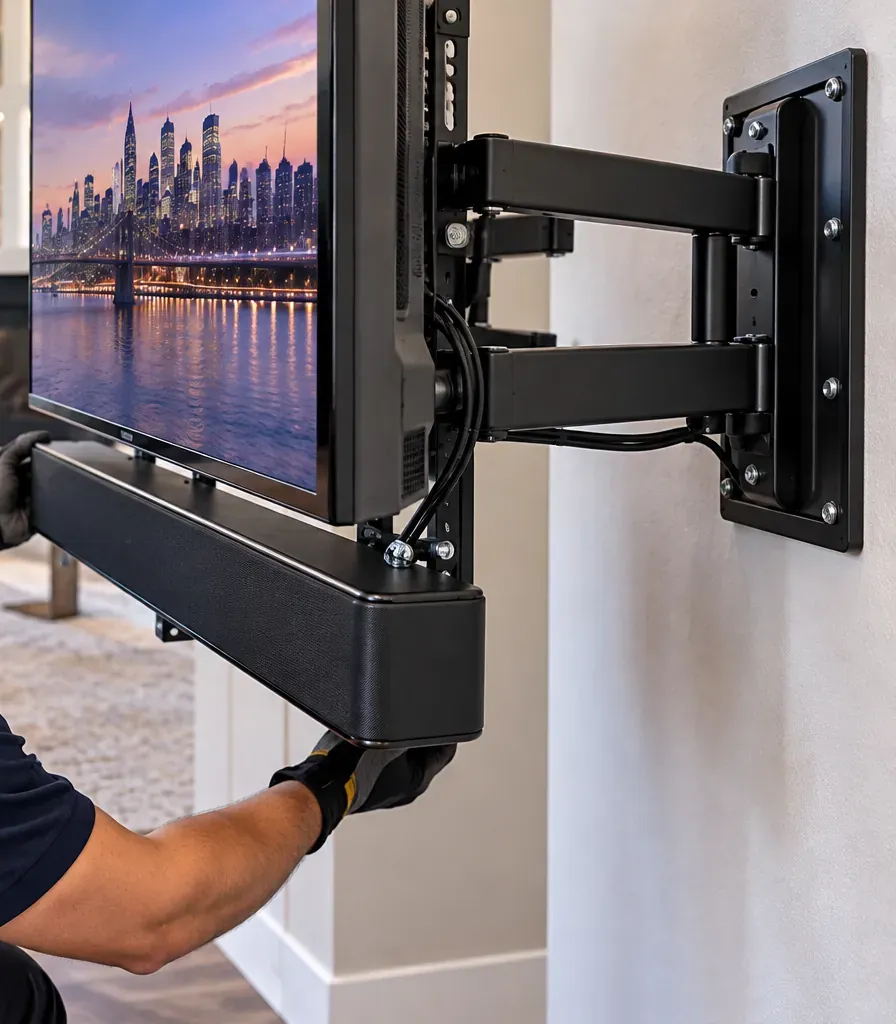
When the wall under the screen is fragile, finished or simply not yours to drill, the bar can hang from the television itself, so the only holes are the ones the TV mount already made.
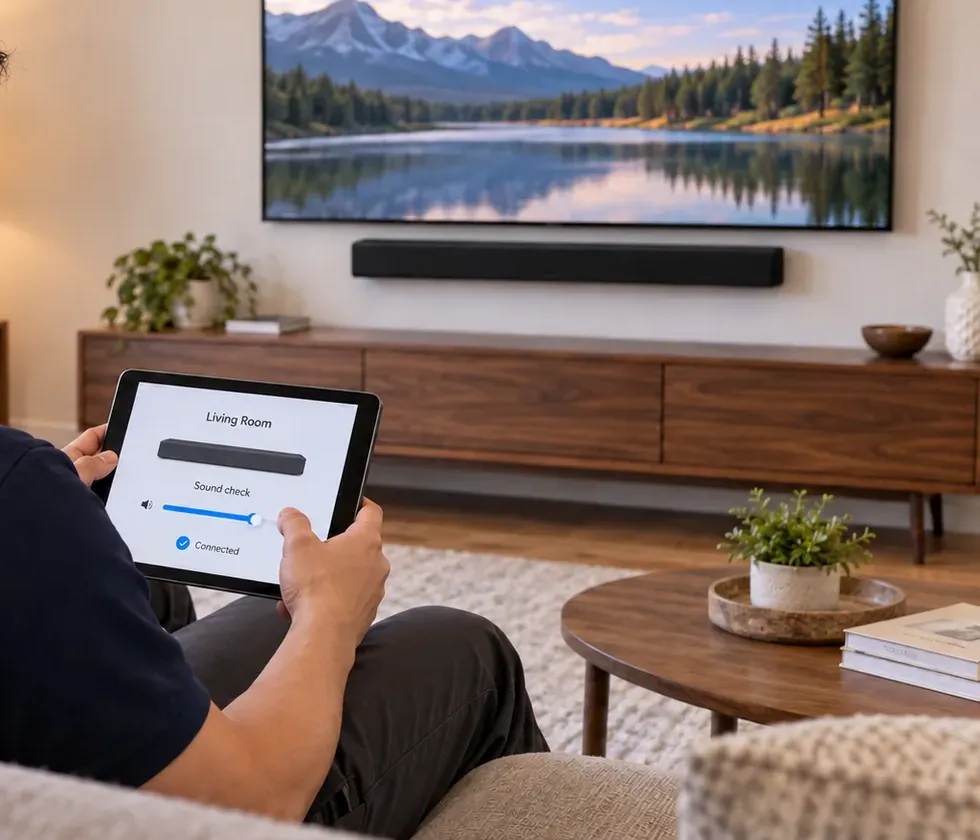
The bar on the TV's ARC or eARC socket, HDMI-CEC switched on so one remote does everything, lip-sync checked, dialogue settings tuned and a quieter evening setting saved for a building with neighbours.
Screens in Manhattan Avenue shopfronts, Franklin Street cafés, offices in converted factories and units in the industrial blocks near the creek, mounted out of reach and set at a level the business can live with all day.

Greenpoint packs six quite different kinds of building into about a square mile and a quarter. These are the ones we work in most, from the historic district around Milton and Noble Streets to the towers north of Commercial Street, and what each means for the bracket and the wire.
Two- and three-storey wooden houses from the 1850s onward, many re-sided in aluminum, asphalt or vinyl. Inside: wood studs, original plaster on lath or later drywall, often several generations of renovation layered on one wall. Usually two or three households to a house.
Some of the same frame houses, opened up, prove to have brick laid between the studs. Outside they look identical to their neighbours. Inside they behave like a masonry wall with timber running through it, which changes both the fixing and the cable route.
The Italianate, Second Empire and neo-Grec houses built for shipyard owners and managers on Kent, Noble and Milton Streets. Solid masonry party walls, plaster on the inside of them, high parlour ceilings and owners who want original detail left untouched.
Three- and four-storey walk-ups with a storefront at street level, such as the long 1870s and 1880s rows on Greenpoint Avenue the LPC describes, built with stores below and families on each floor above. Brick outer walls, plaster partitions, narrow rooms and a business underneath.
Larger walk-up buildings put up for factory workers, from ordinary tenements to the six-storey Astral Apartments on Franklin Street, built in 1885–86 for Charles Pratt's oil workers. Plaster on masonry or block, older wiring and lots of stairs.
Greenpoint Landing's towers, Eagle + West's pair at 30 and 40 storeys, and the mid-rise buildings that have filled in lots since 2005. Steel-stud partitions, concrete columns and slabs, big windows and a management office that sets the rules.
Frame walls with plaster or drywall. Studs in a nineteenth-century frame are not always at modern spacing, and they may have been doubled, notched or moved during a renovation. We scan, then confirm each stud with a small pilot hole, because a stud finder reads plaster, lath and old repairs unreliably. The bracket goes into solid wood with wood screws sized for the load; between studs we use toggles that clamp behind the plaster rather than plastic plugs that rely on it. A soundbar's weight is small, so the aim is a fixing that will still be tight in ten years on a wall that moves a little with the seasons.
Frame walls packed with brick. If the pilot hole meets brick dust instead of wood, we stop and map the wall. Studs still run through it, so where a stud lands at a bracket hole we use it; elsewhere a masonry anchor goes into whole brick, not the soft mortar around it. These walls cannot take an in-wall power kit, so the cable route moves to a paintable channel, to the console below, or to a neighbouring partition that is hollow.
Masonry party walls in rowhouses and flathouses. Old brick, often soft and sandy at the surface, behind a coat of plaster. Masonry anchors set into the brick, depth-limited so nothing comes through into next door, with the first hole tested before the rest are drilled. Plaster is cut cleanly around each hole so it does not spall.
Tower partitions and concrete. Steel studs take fasteners and toggles designed for light-gauge metal, never wood screws. Concrete columns and walls in towers are drilled only where the building permits it, because new construction can contain conduit or post-tensioned tendons; where it does not, the bar goes onto the partition or onto the television's own mount. Many new buildings also install wood blocking behind the drywall at the TV position, which, when we can find it, is the best fixing of all.

When the wall behind the TV is already open for other work, a network cable to the screen costs very little and frees the bar from a crowded wireless signal. That run belongs to our Greenpoint structured cabling crew and can be planned into the same visit.
Most Greenpoint businesses trade on the ground floor of buildings that people sleep in. A soundbar suits the screens they run — menus, news, the match, a looping video — because it gives clear speech without a sound system, and it is easier to keep polite. These are the settings we fit them in most.
The commercial spine of the neighbourhood and the heart of its Polish community, about fifteen blocks of bakeries, butchers, pharmacies, travel agencies, banks and restaurants, most with flats above. Screens over counters, bars fixed tight beneath them, and settings that keep the sound in the shop.
Boutiques, cafés, bars and restaurants along the old turnpike route on the historic district's western edge, many in small buildings shared with residents who have spoken up about late-night noise. Bars here are tuned for speech at low level, with the subwoofer off.
Delis, butchers and neighbourhood bars between McGolrick Park and the Nassau Avenue G station, in two- and three-storey buildings. A screen behind a deli counter or over a bar needs a bracket out of reach and a remote that lives behind the till.
Restaurants and shops from the ferry end inland, including the long rows of flathouses with commercial ground floors that the Landmarks Commission singled out. Cast-iron storefronts, plaster walls and apartments directly overhead.
Workshops, studios, warehouses and offices in the Greenpoint and North Brooklyn industrial business zones near Newtown Creek. Concrete, block, plywood and sheet-metal walls, break rooms and meeting rooms where a soundbar under a display is the whole AV system.
Retail, fitness studios and residents' lounges at the base of the waterfront towers. Management sets the volume and the hours, the wiring must vanish, and the sound must stay out of the lobby.

A bakery or café that books us for one screen often finds two more jobs while we are there: a camera to watch the till, a buzzer for the delivery door, a cable through to the office at the back. Our Brooklyn low-voltage installation team covers that work under one licence, and the Greenpoint security camera installers are dispatched from the same Troy Avenue office.
The most useful ten minutes of a Greenpoint soundbar visit happen before the drill is plugged in. In a neighbourhood where so many buildings have been resurfaced and rebuilt from the inside, the wall behind the television can be any of half a dozen things, and each one wants different hardware, a different cable plan and sometimes a different place for the bar altogether. Here is how we work it out, and why we would rather spend that time than guess.
From the street we learn the building type: a sided frame house, a brick rowhouse, a flathouse over a shop, a walk-up, a tower. That narrows the options but settles very little. The Landmarks Commission's report on the historic district notes house after house whose original clapboard or shingles were covered over in the twentieth century with aluminum, asphalt or composition siding, and plenty of houses outside the district went the same way. Siding is a skin; it says nothing about whether the interior walls are original plaster, 1970s panelling on furring strips, drywall over lath, or a frame filled with brick.
Inside, we start with the cheap tests. A knock along the wall tells hollow from solid and finds where panelling or drywall has been laid over something older. A scanner shows stud lines and, in newer walls, electrical cable, though it reads poorly through thick plaster. Outlets and switch plates are useful windows: with the power and the cover off, the edge of the box shows the layers of the wall in cross-section. Then, at the spot where the bracket's first screw will go anyway, a small pilot hole settles it, and what comes out on the bit — pale wood shavings, grey plaster, red brick dust, gypsum or nothing at all — decides the hardware.
An untouched nineteenth-century frame wall is fairly predictable once you know its spacing. A wall renovated three times is not. We regularly find drywall laid over old plaster with a gap between them, furring strips that do not line up with the studs behind, studs that were cut to move a doorway, and patches where a chimney or a pipe once ran. Every one of those changes where a screw can safely go, so on a layered wall we confirm each fixing point individually instead of assuming the pattern repeats.
Sometimes the right answer is to leave the wall alone. If the plaster under the screen is cracked and loose, if the wall is a finished feature the owner wants untouched, or if a renter's lease rules out new holes, the bar can sit on the console or hang from a bracket attached to the television itself. We would rather tell you that on the phone than discover it with a hole already in the wall.
Once the wall has been read, we note what it turned out to be and which fixings went into it: studs or blocking, toggles in plaster, anchors in brick, fasteners in steel. That short record is useful later to whoever paints, renovates or hangs the next television on the same wall, and to a landlord who wants to know what is behind the bracket. In a building that has been altered as often as most Greenpoint houses, knowing what one wall is made of saves the next person from guessing.

These are questions that Greenpoint rooms and buildings raise and a generic install guide skips: televisions forced over doorways in narrow flats, equipment closets at the far end of a floor-through, the blocking hidden in a new tower wall, bass that booms in a small parlour, and two kinds of commercial wall common near the creek. Booking and practical questions are in the FAQ further down.
Usually directly under the screen, on the wall above the door frame, provided there is enough height. A typical interior door with its trim reaches about seven feet, and a TV hung above it is already high, so the bar sits in the strip between the top of the trim and the bottom of the screen, tilted slightly downward if the bar's bracket allows it. We measure that strip first. If the gap is too tight for the bar to clear the trim, the alternatives are to hang the bar from the television's own mount, which keeps it tight to the screen, or to move it to a low shelf or console nearby and accept a little less precision in where voices seem to come from.
Two practical points matter above a doorway. The wall over a door is a header, so the framing is different from the rest of the wall: there is usually solid timber across the opening, which is excellent for fixing, but no stud directly above the centre of the door below the header. And the door itself must still open fully, including any door that swings toward the TV wall from the other side. We check the swing, the trim and the header before marking anything, and we keep the cable route away from the frame so the wiring does not end up running across the doorway's casing.
It can, but not with an ordinary cable from the drawer. A passive HDMI cable works reliably over modest lengths, and as the distance grows, especially with 4K and high-frame-rate signals, the picture and sound start to drop out. For longer runs the options are an active or fibre-optic HDMI cable, which carries the signal over much greater distances, or an HDMI-over-network extender that sends it along a category cable. Our published cable-run line covers up to 25 feet; anything longer is quoted in writing before the visit, with the cable type named.
There is often a simpler arrangement. If the sources go in the closet and only the TV and bar stay at the front, the remote also needs a path: infrared will not reach through a closed closet door, so either the box supports a radio or app remote or an IR repeater is added. Another approach is to keep a small streaming device at the TV and leave only the cable box in the closet. We sketch both on the visit and price whichever suits the flat, so you are not paying for a long run you do not need.
Blocking is a horizontal piece of timber or plywood fixed between the studs before the drywall goes up, so that a television bracket can be screwed straight into it. When it is there, it is the best fixing in the building, and a soundbar bracket a few inches lower can often use the same strip if the blocking is tall enough. The difficulty is that it is invisible. We ask management for the drawing or the height it was set at, scan for the change in density, and confirm with a small pilot hole inside the area the TV will cover, so a miss stays hidden.
If the blocking turns out to be narrower than promised, or set only at the height of the TV bracket, the soundbar can still hang from toggles rated for steel studs or from the television's own mount. We never assume blocking is present because a listing or a neighbour says so, and if management's paperwork disagrees with what the wall shows, we follow the wall and tell you.
Very often, yes. Every room has dimensions that make certain bass notes pile up in some spots and cancel in others. In a small, boxy parlour those peaks and dips are large, so the same subwoofer can rumble in a corner and almost vanish at the sofa a few feet away. Turning the sub up to fix the sofa makes the corner, and the flat downstairs, much worse. Moving it is the real cure: we try the sub in two or three positions while someone sits in the main seat, and a few feet along a wall can make a striking difference.
After placement come the settings. Many bars and subs have a room-calibration routine that measures from the seating position and evens out the worst peaks; we run it where the bar supports it. We also lower the sub's level relative to the bar, which in a small wooden room usually sounds fuller rather than weaker, and check that the bar's own bass setting is not doubling up with the sub. If the corner position still wins on sound but not on neighbours, an isolation pad and a lower night setting are a fair compromise.
Not to the sheet alone. Thin corrugated or ribbed panels are made to keep weather out, not to carry a load that sticks out from the wall, and screws in the sheet itself will pull through or rattle. What usually sits behind the panel is a steel frame of girts and columns, and that is what a display and soundbar should hang from. We locate it, then either fix to it with self-drilling fasteners suited to the steel, or mount a plywood or unistrut backer across two members and put the bracket on that.
Metal walls also bring two side issues. Sound reflects strongly off bare metal, so in a hard room the bar's dialogue setting and position matter more than its size. And if the wall is an exterior skin, condensation and temperature swings are part of its life, so we keep the cable entry on the inside face and avoid creating holes that let weather in. In a unit with no suitable framing nearby, a floor-standing display stand with a bar shelf is often the better answer.
Often they can, and it is a tidy way to get from the screen to a back-room rack. The question is what kind of space is above the tiles. If that void is used as a return-air plenum for the heating and cooling, the electrical code requires cable rated for plenum use, which is made to limit smoke and flame spread, and ordinary cable is not allowed there. We look above a tile or two, ask the landlord or building engineer when it is unclear, and use plenum-rated HDMI or network cable where the space requires it.
Above the ceiling, cable should be supported independently on its own hangers or hooks, not laid on the ceiling tiles or tied to sprinkler pipe, and it must not block access panels or fire-protection equipment. Where the ceiling is old plaster rather than tiles, or there is no void at all, the route moves to a surface channel along the wall or into the counter below the screen.

You choose the bar; our part is making it work on your wall and in your room. Greenpoint rooms run from tiny flathouse bedrooms to wide waterfront living rooms, so it is worth matching the bar's size to the space. Dimensions below are the makers' or retailers' published figures.
The scale for a flathouse bedroom or a screen below about fifty inches. Published figures: Sonos Beam (Gen 2), 25.63 in across, 6.35 lb, eARC over HDMI. The Ray is smaller still but takes an optical lead, which means it learns the TV remote’s volume codes rather than following HDMI-CEC.
Around four feet long and built for 65-inch screens and up. The Arc Ultra is listed at 46.38 in and 13.01 lb, and Sonos wants 4 in clear beneath the TV plus 12 in free at either end, so measure the wall between doorways before ordering one for a narrow room.
Multi-piece kits like the Samsung HW-Q990D: per Crutchfield, a 48.56-in bar weighing 17 lb, a 25.8 lb sub, and rear speakers that each want a wall outlet nearby. With a family under your floor, where that sub ends up counts for more than how big it is.
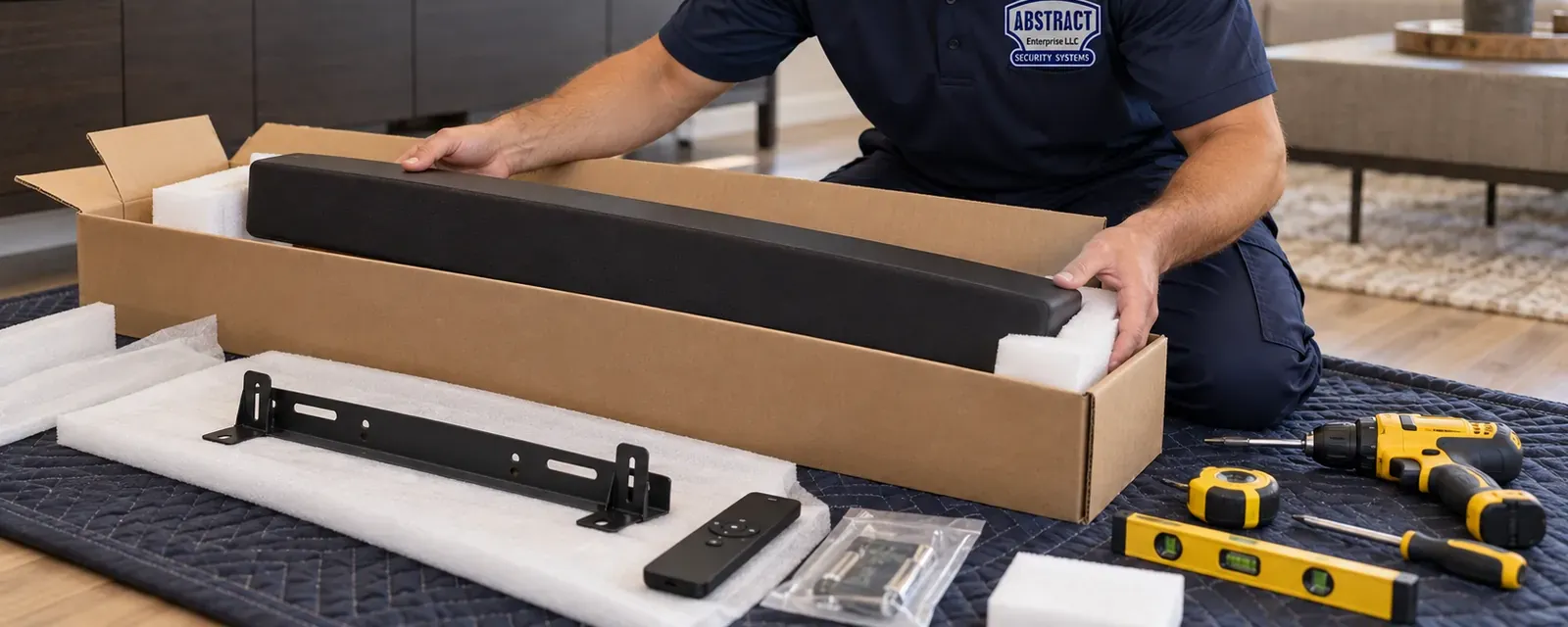
The slim brackets that sit the bar just below the screen. Many bars include one; where yours did not, or its shape will not suit the wall, the Sanus bracket on our list fills the gap.
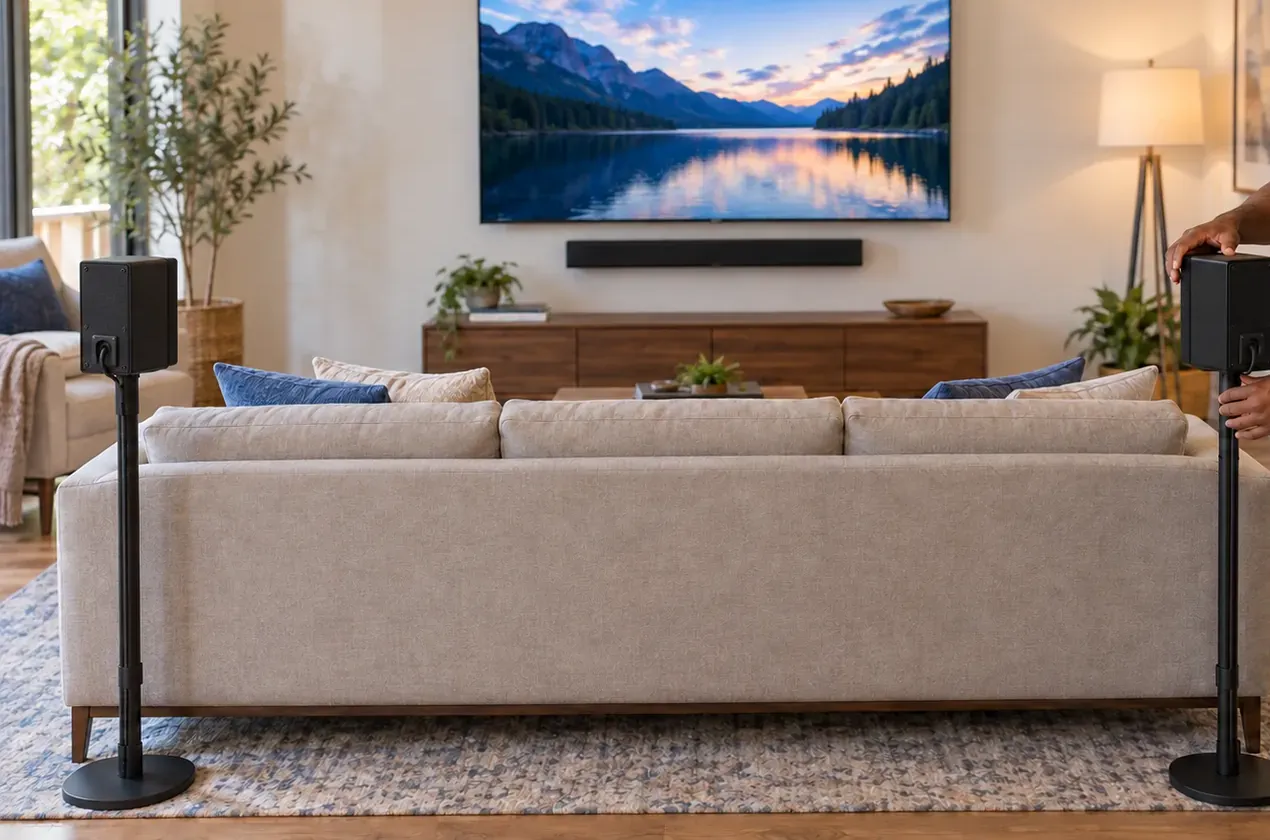
The bar clamps to the TV’s own mounting points, so plaster below the screen is never touched and an arm can swing both together. Sanus rates the WSSATM1 for most 50–90 in televisions and the universal SASB1 for most bars weighing up to 20 lb.
No bracket at all: the bar rests on furniture in front of the screen, nudged forward or lifted on low feet if it would otherwise cover the infrared window, with its leads run down behind the console. Renters and owners of fragile plaster choose this most.

AI search summaries about soundbar installation are fluent and confident, and they are built from national cost guides and product pages that picture a suburban living room. Seven of their most repeated points look different from inside a Greenpoint frame house, flathouse or waterfront tower.
Summaries usually quote one national range. HomeWyse estimated $58.43 to $231 per soundbar in September 2026, and Thumbtack listed national TV mounting at $121 to $234. For a bar on drywall over wood studs, those are reasonable numbers.
The trouble is the word standard. A Greenpoint TV wall might be original plaster, drywall over plaster, brick between studs, a masonry party wall, steel studs or concrete, and the hardware and time differ for each. A national average cannot know which of those is in your living room.
So our Brooklyn list separates the wall from the mount: $129 for a bar on drywall over wood, with published lines for metal studs, plaster, brick, concrete and tile. You see the wall line on the quote before we arrive.
AI how-to answers treat the stud finder as the answer to every wall. On modern drywall it is a good tool. On a wall with an inch of old plaster, metal lath, panelling over furring or brick between the studs, its readings range from vague to wrong.
That is why we treat a scanner as a first guess in older Greenpoint houses and confirm with a small pilot hole at a point the bracket will cover. What comes out on the drill bit is more reliable than any display, and it costs nothing in looks because the bracket hides it.
In the towers the opposite problem applies: the scanner works well, but what it finds — blocking, steel or concrete — still has to match what management allows to be drilled.
There is truth in it, but only for discs and some downloads. Uncompressed formats like Dolby TrueHD and DTS-HD Master Audio require the extra bandwidth of eARC. What Netflix, Disney+ or Max send is Atmos packed inside Dolby Digital Plus, and a standard ARC socket handles that.
So a five-year-old set with plain ARC is no barrier to streamed Atmos. The requirements are practical: the bar plugged into the ARC-labelled socket, CEC enabled in both menus, and the TV’s digital audio output on pass-through or auto rather than PCM.
Those three settings are the first things we check on a repair call, because a firmware update can quietly reset any of them.
The marketing reads as if sound will come from overhead in every room. Up-firing drivers actually work by bouncing off the ceiling, and Dolby’s own advice is a flat, hard ceiling somewhere between 7.5 and 14 feet high.
Greenpoint ceilings vary. Parlour floors in older rowhouses can be generous; top floors under a mansard roof slope; flats with a dropped ceiling or a soffit for ductwork break the reflection; tower apartments often have a bulkhead along the window line.
We measure the ceiling, keep the bar's upward drivers clear of beams and soffits, run calibration from your seat, and say plainly when the height layer is likely to be subtle.
A typical answer tells you to open the box and follow the leaflet. Usually the metal bracket inside is perfectly good; the little bag of screws and plastic plugs is the weak point, since it assumes timber or solid backing. Angi’s guide prices a replacement soundbar bracket at $30 to $100 for the cases where the supplied one is unusable.
Put those plugs into a Greenpoint wall and you can predict the result: old plaster crumbles round them, soft brick lets them turn, tower steel studs strip them, and concrete refuses them entirely. What holds is hardware chosen for what the pilot hole found.
Our routine is to use the maker’s bracket with our own fixings. If the carton had none, we fit the Sanus bracket from the price list.
On the city side the summaries are right: per Angi, only electrical or structural work brings permits, and a bar under a TV involves neither. What they leave out is private permission, and that is where Greenpoint visits actually stall.
Waterfront towers usually want a certificate of insurance and a booked time slot before a contractor goes up. Commercial landlords want their names on the certificate. Renters in frame houses need the owner's agreement before holes go in the plaster.
Each step is simple; skipping one is what costs a day. The certificate is free from us, it goes out ahead of time, and we check access with the desk or the owner the evening before.
Reviewers love a big low end and AI summaries echo them. That advice was written for houses with no one underneath. Here a living-room floor is usually joists and boards with another household’s bedroom ceiling nailed to the bottom of them.
Wood-framed buildings pass low frequencies through joists and studs far more readily than speech, so the neighbour hears the rumble long before they hear the words. A sub turned up for drama mostly turns up the flat below.
What works is modest and unglamorous: the sub moved away from party walls and corners, lifted onto a pad, its level dialled back from the showroom setting. Voices get clearer through the speech mode, while the bass stays in your own room.
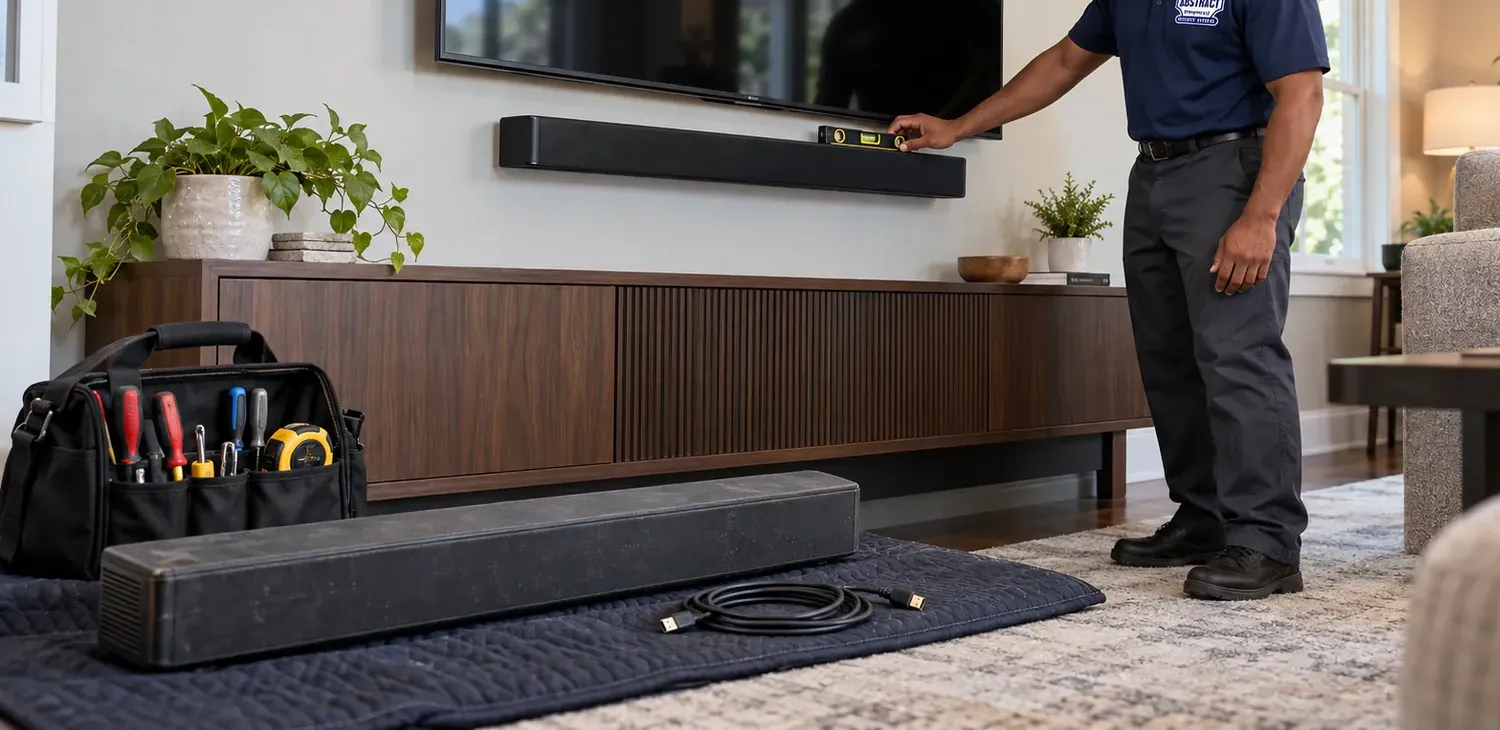
One picture of the wall, the model printed on the bar’s box and your floor number are enough for a written plan: the fixing, the cable route and the total.
Tell us the building — frame house, flathouse, rowhouse or tower — which floor you are on and anything you know about the TV wall, and a written Greenpoint total arrives before the end of the business day. Prefer to talk? Call (347) 934-8335.
Received. A Brooklyn installer will look at your Greenpoint details and reply today; for anything urgent, ring (347) 934-8335.
A compact bar in a top-floor frame-house bedroom and a full system in a tower living room follow the same six steps. What changes from building to building is the time spent working out the wall and the neighbours before anything is fixed.
Send the bar and TV model numbers, a photo of the TV wall and the outlet nearest to it, and tell us which floor you are on and who lives below. The written quote names the wall line, any high mount and the stairs.
Tenants confirm the owner agrees to new holes; towers and commercial landlords get our free certificate of insurance and a booked time slot. We confirm access the day before.
Arrival slots are two hours long, run from 8 AM to 8 PM and are offered every day, sometimes the same day. Changing the slot a full day ahead is free.
On arrival we knock, scan and drill a pilot hole inside the area the bracket will cover, so we know whether the wall is plaster on lath, drywall, brick between studs, masonry, steel stud or concrete before choosing the hardware.
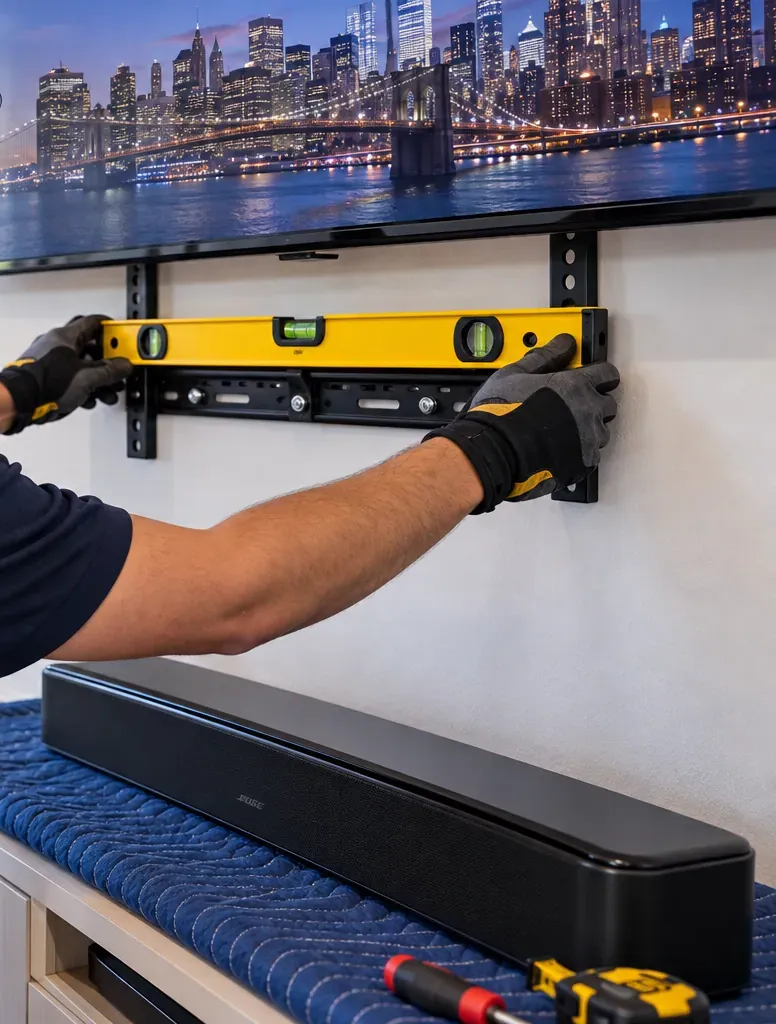
With the hardware chosen for that wall, the bracket goes up and is trued, the bar clips on parallel to the TV, the leads disappear into the cavity, a channel or the console, and the HDMI lead lands in the ARC or eARC port with CEC enabled.
We try the subwoofer in more than one spot from your seat, set it on a pad off shared walls, run calibration where the bar offers it, save a night setting, vacuum the dust and show you the controls.

Greenpoint's landmarks trace the same story as its walls: a shipbuilding and refinery town of wooden and brick houses, worker housing and factories, and a waterfront that has turned from industry to parks and towers within a generation.
Designated by the Landmarks Preservation Commission on September 14, 1982, and roughly bounded by Kent, Calyer, Noble and Franklin Streets, Clifford Place and Manhattan Avenue. Frame, brick and brownstone houses and flathouses from the 1850s to the 1890s, many built by and for the men of the local shipyards.
A block-long, six-storey apartment house of brick and terra cotta, built in 1885–86 by Charles Pratt for workers at his Astral Oil Works and now a city landmark. The grandest version of the worker housing that still fills much of the neighbourhood.
The small park off Nassau Avenue whose crescent-shaped 1910 shelter pavilion was made a city landmark in 1966, and which also holds a 1938 monument to the USS Monitor, the ironclad built at Greenpoint's Continental Iron Works.
The Roman Catholic church of 1875 on Manhattan Avenue, the neighbourhood’s shopping street. Along the avenue, which also holds St. Stanislaus Kostka with its Polish-language Mass, the flathouses carry shops below and flats above.
Opened in 2012 on the site of the radio station's old transmitter, NYC Parks notes its pier at the end of Kent Street with a view of the Manhattan skyline. The blocks behind it are a mix of old frame houses and new mid-rises.
The eight stainless-steel digesters of the Newtown Creek Wastewater Treatment Plant, each 145 feet high according to DEP, stand at the neighbourhood's northern edge. To the west rise the Greenpoint Landing towers, including 35 Commercial Street, a 22-storey building of 374 affordable apartments that opened in 2024.
We cover all of Greenpoint — the historic district, the blocks along Manhattan Avenue, Franklin Street and Nassau Avenue, the waterfront from Transmitter Park to the creek, and the streets around the Greenpoint Avenue and Nassau Avenue G stations — plus the neighbouring blocks of Williamsburg, East Williamsburg and Bushwick. Every Brooklyn neighbourhood is priced on our Brooklyn soundbar installation page; Long Island City, across the Pulaski Bridge, is covered by soundbar installation in Long Island City.

A Greenpoint address costs the same as one in Bushwick or Bay Ridge: Brooklyn is where our price list starts, at 1.00×. Choose the lines that describe your job. Should the wall hold a surprise, the extra line is named and agreed with you first, and nothing is added after the fact.
| Item | Greenpoint price | What you get |
|---|---|---|
| Soundbar placed on a console or stand | $79 | No drilling; bar connected, menus set, tested with your TV |
| Soundbar wall-mounted under the TV | $129 | Bar on the wall below the screen, hardware to suit what the wall is |
| Sanus soundbar bracket | $84.99 | Supplied by AESS if the carton had no bracket, or if its own one cannot work on this wall |
| In-wall concealment | $169 | Rated recessed power and cable plates, leads hidden in a hollow cavity |
| Paintable cord cover | $59 | A slim surface channel for plaster, brick or a wall that cannot be opened |
| Cable run to a cabinet or other spot | $99 | Up to 25 ft |
| Sonos setup | $125 | Sonos bar, sub or rears configured in the app and grouped |
| A/V receiver | $129 | Wired between the TV, sources and speakers, inputs labelled |
| Universal remote | $99 | Programmed for the TV, the bar and the cable box |
| Streaming device setup | $49 | Roku, Apple TV, Fire TV or similar |
| Full home theater | $350 | A multi-component system set up to work as one |
| Condition | Price | Where it turns up here |
|---|---|---|
| Drywall on wood studs | $0 | Renovated frame houses, newer mid-rise partitions |
| Metal studs | +$30 | Greenpoint Landing and other waterfront towers |
| Plaster | +$45 | Original frame-house walls, flathouses, rowhouse interiors |
| Brick or stone | +$65 | Masonry party walls, brick found between frame studs |
| Concrete or cinder block | +$75 | Tower columns where permitted, block walls in industrial units |
| Tile or marble | +$95 | Tiled feature walls, bar backs, café counters |
| Plywood backer board | $85 | Uneven or layered walls, metal-clad units, where a flat base is needed |
| High mount (above about 8 ft) | $75 | TVs over doorways, shop screens above counters |
| Walk-up, 3rd floor and above, no elevator | $40 | Top floors of frame houses, flathouses and tenements |
| Box removal | $25 | When you would rather not carry the carton downstairs |
| Certificate of insurance for your building | Free | Towers, managing agents, commercial landlords |
A frame wall packed with brick has no line of its own. When the pilot hole shows brick, the brick line applies only to the fixings that go into brick, and the written quote says so before you book whenever photos make it clear in advance.
These sums are illustrations, not offers: each one simply adds published lines from the tables, so you can see how a quote is assembled for a typical Greenpoint wall.
| Example | Lines | Total |
|---|---|---|
| Top-floor flat in a sided frame house, 1870s plaster, leads in a surface channel | $129 + $45 plaster + $40 walk-up + $59 cord cover | $273 |
| Greenpoint Landing living room, steel studs, our bracket, leads concealed in the cavity | $129 + $84.99 + $30 metal studs + $169 in-wall concealment | $412.99 |
| Bar above a doorway on a masonry party wall, high mount, channel down the side | $129 + $65 brick + $75 high mount + $59 cord cover | $328 |
| Bar on a backer across the frame of a metal-clad industrial unit, our bracket | $129 + $84.99 + $85 backer board | $298.99 |
| Console placement plus streaming setup in a rental flat | $79 + $49 streaming device | $128 |
When nothing goes on the wall — re-pairing a sub, chasing a failing eARC handshake, moving a bar to a replacement TV — the visit is setup-only: $195 for the first hour in Brooklyn, then half-hour blocks. A television hung at the same time starts from the $179.99 Brooklyn TV base and adds its own lines. A callback that is not part of a booked installation is $195 an hour, three hours minimum ($585). We charge $150 for a return trip only when the job cannot begin on arrival: no bar or bracket, no one to open the door, or no building approval. Moving the date a day or more ahead is free.
Big-box and app booking versus a local licensed firm. A one-price national booking imagines a drywall wall at ground level. Greenpoint rooms routinely add lath and plaster, brick hidden in a frame, a managing agent’s paperwork or a third-floor climb, and a flat fee either ignores those or adds them on the doorstep. A wall-by-wall list from a Brooklyn company holding a state low-voltage licence shows them in advance, and the same company answers the phone if something loosens later.
Three common combinations, each simply a total of list lines. Wall and stair add-ons from the table apply on top, and only where your building calls for them.
$79
$79: no holes anywhere. We set the bar on the furniture in front of the screen, keep the infrared window uncovered, plug into ARC or eARC, switch on CEC and hide the leads — the choice for a lease that forbids drilling or plaster too fragile to trust.
$213.99
The $129 wall mount with the $84.99 Sanus bracket comes to $213.99. Add $45 for original plaster, $65 for brick, $30 for a tower's steel studs or $75 for concrete.
$382.99
$382.99, being the standard bundle with the $169 concealment kit added, so no lead shows between bar and outlet. Only possible where the cavity is hollow and opening it is allowed: tower partitions, newer mid-rises, and frame walls that have been re-sheeted in drywall. Brick-filled frames and party walls cannot take it.
Already have a bracket, boxed with the bar or bought online? Then the charge is labour alone, $129 to hang it plus the line for your wall type. It has to be rated for the bar, and any fault in it is a matter for its manufacturer. Where we judge it wrong for the bar or for plaster, brick or steel stud, you hear that before a hole is drilled, with the Sanus as the alternative.
A wall photo and the bar’s model are all it takes; the itemised figure comes back by email.
Greenpoint's older buildings stack households on top of each other, and they do it on wooden floors. The LPC's report records frame houses built as three-family homes in the 1880s and flathouse rows planned with stores below and two families on each floor above. Those layouts survive, and they shape how a soundbar should be set up as much as the wall does.
Speech and most music travel through air, and plaster walls and floors block a fair amount of it. Bass is different. Low frequencies make the structure itself vibrate, and in a building whose floors are timber joists under boards, that vibration crosses to the next flat easily. That is why a neighbour downstairs can feel a film's soundtrack as a rumble without hearing a word of the dialogue. The parts of a soundbar system that cause complaints are therefore the subwoofer and the bar's own bass, not the voices.
Keep it off a shared wall and out of the corner nearest the neighbour's bedroom, because corners and walls make bass louder. Set it on an isolating pad rather than straight on the boards, so less vibration passes into the joists. And set its level by ear from the sofa, with someone listening in the flat below if they are willing; most subs ship turned up for the showroom. In a top-floor flat the same advice helps the people underneath; on the ground floor of a flathouse, the shop below you is usually closed at night, but the family across the landing is not.
Most current bars have a night mode, which narrows the gap between quiet and loud passages, and a speech or dialogue setting, which lifts voices. Together they let a late film be followed at a lower overall level. We save that combination where the bar allows it and show you how to switch it on from the remote or the app, so the evening setting is one button away instead of a menu dive.
In many Greenpoint frame houses the owner occupies one floor and rents the others, and either side may book the visit. Whoever books, the person whose wall is being drilled must agree to it, and a tenant should have the owner's permission in writing for new holes. We are glad to talk to both, and to set the system up so its sound suits the house rather than one floor of it.

A tower apartment on the Greenpoint waterfront is a different job from a frame house five blocks inland, and the differences start in the lobby. New York YIMBY reported in 2025 that the 22-acre Greenpoint Landing plan had delivered nearly 3,000 apartments and announced three more buildings — 21 Freeman Street at 40 storeys, 37 Freeman Street at 30 and a nine-storey building at 209 West Street — adding more than 1,000 rentals. Eagle + West, at 1 Eagle Street, put 745 apartments in towers of 30 and 40 storeys. Each building has its own management rules, and each new wave of tenants arrives with a new television.
Expect a certificate of insurance naming the building's owner and managing agent, a booked time slot, and sometimes a reserved service elevator. We issue the certificate free, usually the day it is requested, and confirm the slot with the front desk before the visit so the installer is not held downstairs while the clock runs.
Partitions in the towers are generally steel studs and gypsum board, sometimes with wood blocking at the TV position; columns and some walls are concrete. Management often limits drilling into concrete, and an apartment's demising wall may be built as a sound and fire assembly that should not be cut open for an in-wall kit. We follow the building's rules, fix to studs or blocking where we can, and use the television's mount for the bar where the wall is off limits.
Tower living rooms facing the river put glass on one long wall, which leaves the TV on a side wall or the wall opposite the view. Glass reflects sound sharply, so a bar placed near a window wall can sound bright and hard. Positioning the seating so the bar faces it squarely, adding rear speakers where the room is long, and running calibration from the sofa usually do more than a bigger bar. A wired network connection is worth considering too, because a high floor can see dozens of neighbouring Wi-Fi networks.
Greenpoint covers only about a square mile and a quarter, yet the walls change every few blocks. These are the patterns we see as we move through the neighbourhood, from the historic core to the creek.
The historic district's residential blocks hold the oldest houses: brick and brownstone rowhouses on the grander stretches, frame houses in between, many re-sided and almost all divided into flats. Expect plaster on lath, high ceilings on the parlour floors, owners who care about original mouldings and mantels, and tenants on the floors above. These are the rooms where a TV-attached bracket or a console placement often makes sense, and where we take most care with plaster dust.
Above the shops, the flathouses: long, narrow apartments with the living room at the street end, doors on most walls and radiators under the windows. Wall space is scarce, so the TV often goes over a doorway or between two openings, and the shop below may run a screen of its own. Stairs are steep, and the walk-up line applies from the third floor.
Small mixed buildings with cafés and boutiques at street level and flats above, plus newer infill. Residents here have been vocal about late-night noise from bars and backyards, so both commercial and residential bars on these blocks are set with neighbours in mind from the first visit.
Two- and three-storey frame houses and modest brick buildings, most of them divided into flats, alongside the delis and bars of Nassau Avenue. Renovations here range from careful restorations to full gut jobs with new drywall, so the wall behind the TV can be anything from 1870s plaster to last year's partition.
The wide boulevard through the east of the neighbourhood carries heavy traffic, and Streetsblog reported in January 2026 that the city would complete its narrowing to one travel lane in each direction. For a living room on the boulevard, street noise is part of the background the bar has to be heard over, which argues for dialogue settings over volume, and for front rooms with good windows.
The towers of Greenpoint Landing and Eagle + West, the newer mid-rises on West Street and the blocks by the creek. Here the questions are management approval, steel studs or blocking, glass walls and wireless congestion, not plaster and lath. Between the towers and the industrial blocks near the creek, a single afternoon can take an installer from a 40th-floor living room to a metal-clad workshop.
If you have not bought the bar yet, a few measurements save a trip back to the shop. AESS does not sell soundbars, so this is advice about rooms rather than a sales pitch. The table pairs common Greenpoint spaces with what tends to work in them.
| Room | Bar size | Subwoofer | Mounting |
|---|---|---|---|
| Front room of a flathouse, TV under 55 in | Compact, about two feet wide | Usually none, or a small one set low | Under the TV, or on the TV's mount over a doorway |
| Frame-house parlour with tenants below | Mid-size, matched to the screen | Optional; on a pad, off shared walls, night setting saved | Wall bracket into studs, or a TV-attached bracket on fragile plaster |
| Rowhouse parlour with original detail | Matched to the screen width | Placed by ear from the sofa | Often TV-attached or on a console to leave the plaster alone |
| Tower living room facing the river | Full-size, with rears if the room is long | Yes, kept off the demising wall | Steel-stud fasteners or blocking; wired network if possible |
| Bedroom under a sloping top-floor ceiling | Compact | None | Console or a low wall bracket below the slope |
| Shop, café or workshop | Compact to mid-size, speech-focused | Usually off | Out of reach, clear of walkways, remote kept behind the counter |
Two measurements matter most before you buy. First, the clear width of wall under the screen, or the space on the console in front of it, because a four-foot bar will not fit a gap meant for a two-foot one. Second, the height between the bottom of the TV and anything below it — a console top, a door frame, a radiator cover — since a bar needs room to sit and its drivers need room to breathe. Send both with a photo and we will say which sizes suit the wall.
If you already own the bar, that is fine too. Almost any current model can be made to work well in any of these rooms; the difference is in the fixing, the position of the sub and the settings, which is the part we handle.
Related work that Greenpoint customers often add to a soundbar booking, each with its own page.
Hanging the television on Greenpoint walls of every age, with the bar’s position settled at the same time.
The borough page, with guidance and prices for every Brooklyn neighbourhood from Greenpoint to Coney Island.
The full Brooklyn TV list, base price $179.99, with every size and wall line.
When a bar is not enough: separate speakers, receivers, in-ceiling audio and multi-room music.
A network cable to the TV wall, or HDMI-over-network for a long floor-through, run while the wall is open.
Scenes that dim the lights and wake the soundbar together when the film starts.
Buzzers and video entry for multi-family frame houses and walk-ups.
Booking windows, missed-access return trips, rescheduling and how hourly setup time is billed.
One form for the bar, the TV and whatever else the flat needs.
Our general working habits in Greenpoint’s older buildings — a method, not a story about a particular job
We ask two questions on the phone before anything else: what floor are you on, and who lives below? The first tells us about stairs and the walk-up line. The second tells us how carefully the subwoofer has to be placed, and whether a quieter setting should be part of the job from the start.
At the wall we knock first, scan second and drill a pilot third, always inside the area the bracket or TV will cover. If the bit brings out brick dust in a house that looks wooden from the street, we stop and plan again rather than pushing on with the hardware we brought for timber.
Before calibrating we sit where you sit, try the sub in more than one place, and leave the night setting saved. Then we vacuum the plaster dust, because old plaster gets everywhere and nobody wants to find it on the console a week later.
A straight bar under a gently curved screen looks fine to most people, because the curve is shallow and the bar sits below the edge rather than along it. Fix it to the wall centred on the screen, close enough that its ends tuck under the curve. Curved TVs often have an unusual back, so a TV-attached soundbar bracket may not fit; check the makerβs compatibility list first, and if it does not fit, mount the bar on the wall.
It works best centred under or just above the screen, because the bar carries the centre channel and voices should seem to come from the picture. A few inches off centre is barely noticeable; a bar on a shelf to one side makes dialogue sound as if it comes from beside the TV. If the space under the screen is impossible, mounting the bar on the TV itself usually beats a side shelf.
Yes, the bar should take the one labelled ARC or eARC, which is how the TV sends its sound out. If a cable box or console is already in that socket, move it to another, and if you run out, plug a source into the barβs own HDMI input when it has one, or add an HDMI switch. We sort the sockets on the visit and label each lead so it stays right.
No. The published Brooklyn line for hanging a bar under the TV is the same whatever its size, and the wall and access lines are what change the total. Size matters in other ways: a long bar needs enough clear wall under the screen, and a heavier one needs a bracket rated for it, which we check before drilling. A full system with a subwoofer and rear speakers can add Sonos or home-theater setup lines.
Greenpoint is one neighbourhood page beneath soundbar installation in Brooklyn, and Brooklyn reports to our NYC soundbar installation hub. Below are the other borough, county, regional and neighbourhood pages in the same series.
NYC soundbar installation · Brooklyn · Manhattan · Queens · the Bronx · Staten Island
Long Island soundbar installation · Nassau County · Suffolk County
Hudson Valley soundbar installation · Westchester · Rockland · Orange · Putnam · Dutchess · Ulster
Riverdale, Bronx · St. George, Staten Island · Tribeca, Manhattan · Long Island City, Queens · Mott Haven, Bronx · Great Kills, Staten Island · Upper West Side, Manhattan · Park Slope, Brooklyn · Astoria, Queens · Harlem, Manhattan · Bay Ridge, Brooklyn · Williamsburg, Brooklyn · Forest Hills, Queens · Pelham Bay, Bronx · Tottenville, Staten Island · Greenpoint, Brooklyn (this page)
AESS also installs cameras, intercoms, access control and network cabling — start at the Abstract Enterprises Security Systems home page, or read about our company and the licensed team behind it.
When a bar goes silent overnight, look for what else changed: the provider swapped the router, the TV installed an update, someone moved the cable box to another HDMI socket, or a new TV arrived. Ring (347) 934-8335 and we will book the next open 2-hour window; once we are there, most of these faults are fixed within an hour or two.
Abstract Enterprises Security Systems · 1282 Troy Ave, Brooklyn, NY 11203 · (347) 934-8335 · WhatsApp (718) 679-0359 via wa.me
NYS Low-Voltage Licence #12000287431 · 100% Licensed & Insured · Same-Day Estimates · Rated 4.7★ from 201 Google Reviews
Brackets and parts carry their manufacturer's warranty. Full terms β including 50% deposit, one-year parts-only warranty on AESS-supplied products, and the late-fee schedule β are set out in the service agreement. See our warranty page.
Page reviewed and updated October 17, 2026. Changelog: Greenpoint page launched under Brooklyn soundbar installation, with guidance for sided frame houses, flathouses and waterfront towers.