What are you looking for?
About Us Contact Us Careers Get a Free Quote (800) 486-0943
Pick a service
✅ Got Your Own System?
🎬 Home TheatreQuote 🎶 AV SoundQuote 🔑 Access ControlQuote
Now pick your area
Pick your area
Long Island
Hudson Valley
Services available
Pricing & Tools
Pick a service for pricing
🚪 Intercom Pricing 🔔 Buzzer Repair Pricing
Calculators
📹 Camera System Calculator 🚨 Alarm Calculator ⚡ Cabling Quote Builder ✅ Got Your Own System?
Select your area
Home › Soundbar Installation NYC › Brooklyn › DUMBO
Licensed Low-Voltage Contractor · DUMBO, ZIP 11201 · Gair Concrete Lofts, Brick-and-Timber Warehouses & Condo Towers

Soundbar
Installation in
DUMBO

Down Under the Manhattan Bridge Overpass · Century-Old Concrete · Belgian Block · Four Subway Lines Overhead

DUMBO is the only neighbourhood we cover where the loudest thing in the living room is often a subway train that never comes indoors. The B, D, N and Q cross the Manhattan Bridge directly over the district, and when the MTA measured train noise at residents' homes here at the end of 2023, the loudest single pass reached 94.76 dB(A) on Plymouth Street. The rooms underneath are just as particular: reinforced-concrete factories that Robert Gair began putting up in 1905, nineteenth-century brick-and-timber warehouses by the river, and newer towers with steel-stud partitions. We fix the bar into whatever the wall really is, route the cable without carving into concrete nobody wants carved, connect it by HDMI eARC or ARC so the TV remote runs everything, and tune dialogue and bass for a room that has to compete with the bridge. Two-hour arrival windows, seven days a week, 8 AM to 8 PM.

Reviewed and updated October 17, 2026 · Written by Anwar Timothy, NYS licence #12000287431 · Part of our Brooklyn soundbar installation coverage

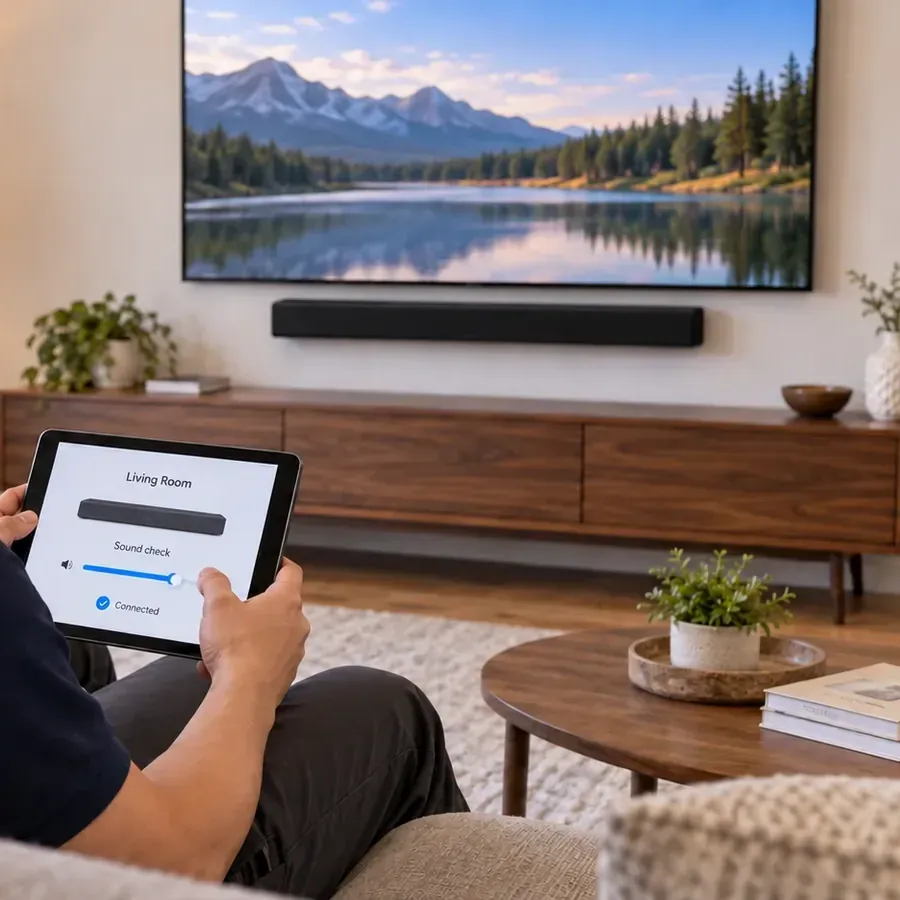
Hands holding a tablet showing a Living Room sound-check screen with a volume slider and a Connected tick, facing a wall-mounted TV and black soundbar above a long wooden console — DUMBO, Brooklyn soundbar installation
Sound check run from the seat, tablet in hand, with the bar already hung under the screen and the console below left clear.
DUMBO Soundbar Quote
Tell us the building and what the TV wall is made of — a written price comes back the same working day

✅
Request Sent!
We'll call you back the same business day.
25+
Years Experience
✓
Same-Day Estimates
100%
Licensed & Insured
4.7★
201 Google Reviews

Moved into a Main Street, Water Street or Jay Street loft and the new bar is still in its carton? Call (347) 934-8335 or send the short form with the building and a line about the wall. The written total that comes back is built only from the published Brooklyn lines on this page.

  • Concrete, brick, steel stud or drywall: the anchor is chosen after a test hole, not before
  • Console placement $79; wall mount under the screen $129
  • NYS low-voltage licence #12000287431, insured, and a free certificate for your managing agent
The Neighborhood

Why DUMBO Homes Need Soundbar Installation

Every soundbar job in DUMBO starts with two neighbours you can't move: a hundred-year-old concrete or brick wall, and a suspension bridge carrying four subway lines over the roof. The neighbourhood sits on the East River between the Brooklyn Bridge and the Manhattan Bridge and reaches east toward Vinegar Hill; Wikipedia describes it as bounded by Brooklyn Bridge Park to the north, the Brooklyn Bridge to the west, Brooklyn Heights to the south and Vinegar Hill to the east. It shares ZIP code 11201 and Community Board 2 with the Heights, but almost nothing about its buildings. The name itself is a description of where you are standing: Down Under the Manhattan Bridge Overpass, an acronym that artists adopted when they began moving into empty industrial floors in the late 1970s.

Those floors were built for machines, coffee and cardboard, not for living rooms. The Landmarks Preservation Commission's 2007 designation report for the DUMBO Historic District describes three ways the district was built: brick walls wrapped around slow-burning mill construction of massive wooden columns and beams; brick buildings with steel frames and terra-cotta floor tile; and buildings made entirely of reinforced concrete. It singles out the concrete factories erected by the Gair Company and other firms as among the earliest large-scale reinforced-concrete factory buildings in the United States. Robert Gair's paper-box empire built so much of it that the area was once called Gairville, and his 1914 building at 1 Main Street, the Clocktower, was the tallest reinforced-concrete building in the world when it went up.

Over the last forty years those buildings have filled with people. The Commission notes that artists converted industrial space, often illegally, into live-work lofts from the late 1970s, and that 1 Main Street became one of the earliest luxury residential conversions in DUMBO in 1998. A broker's profile of the building today counts 124 units on 16 floors and describes concrete ceilings and mushroom-capped columns in many of them, with deep multi-pane window bays set between concrete piers. The 1950 Brillo factory at 200 Water Street is now residential, Ketchum & McDougall's jewelry factory at 81–89 Washington Street holds loft apartments, and the 1893 Eagle Warehouse at 28 Old Fulton Street has been condominiums since 1980. Then came new towers: the Brooklyn Paper named the 33-storey J and the 23-storey Beacon Tower in 2008.

Living in a factory changes what a soundbar has to do. A TV wall might be bare concrete poured more than a century ago, thick brick, a column with a flared capital, or a newer partition of steel studs and drywall built during the conversion. Hard floors, concrete ceilings and big multi-pane windows make rooms bright and echoey. A stud finder is little use in most of them, and the conventional advice to hide every wire inside the wall assumes a hollow wall that many DUMBO lofts simply don't have.

And then there is the bridge. In 2008 the Brooklyn Paper reported that the president of the DUMBO Neighborhood Association had moved away from Plymouth Street, “hard by the Manhattan Bridge with its truck traffic and B, D, N, and Q trains,” and that sound engineers had recorded 80 decibels during the day at John and Adams Streets. Fifteen years later the problem was still on the table: after Assemblymember Jo Anne Simon wrote to the MTA in August 2023 asking for a noise abatement study, NYC Transit's environmental team scheduled measurements at the homes of DUMBO residents who volunteered, in November and December 2023. Its memo, dated January 18, 2024, logged hundreds of train passes at each address. One modification a member of the public had suggested, changing the joints between the rails, had already been judged infeasible in 2022.

Residents describe living with it in different ways. One post on the DUMBO subreddit says triple-paned windows turn the trains into “a mild, relaxing sigh” compared with nearby street construction; another, in a thread about neighbourhood life, calls the subways crossing the bridge “extremely loud” at rush hour. A renter asking about 100 Jay Street was told the bridge is audible from apartments near it but that the windows are soundproof, and a poster in r/AskNYC described the noise next to the bridge as audible but without vibration. A soundbar can't change the bridge. What it can do, set up properly, is keep voices clear while a train goes by, avoid turning the room into an echo chamber, and keep the bass out of the neighbours' concrete.

DUMBO in figures, for anyone planning a TV wall

  • December 18, 2007: the Landmarks Preservation Commission designated the DUMBO Historic District, about 91 buildings between John, Adams, Plymouth, Main, Water, Front, York, Washington, Pearl, Jay and Bridge Streets (LPC designation report).
  • 3,338 homes and 10,200 residents in 2023 across the area the DUMBO Improvement District reports on, where the median sale price in 2024 was $1,667,000. The 2020 census count for the narrower neighbourhood in Wikipedia's article is 4,975 people; the two figures use different boundaries.
  • 94.76 dB(A): the loudest train pass the MTA recorded at the nine DUMBO residences it monitored, at 135 Plymouth Street, against a background level of 44.5 dB(A). At 56 Adams Street the average level over 11 hours and 520 trains was 70.25 dB(A) (NYC Transit Noise Reduction Report, 2023).
  • 1,000+ creative and tech companies and 11,266 employees in 2022, across 15 office buildings and about 6 million square feet of commercial space (DUMBO Improvement District). Plenty of soundbars here hang in conference rooms, not living rooms.
  • $108 million and 26 blocks: the city's DUMBO street reconstruction, begun in 2019 and announced complete on November 19, 2025, with the Belgian block restored, a new 2,500-square-yard Pearl Street Plaza and new lighting in the Manhattan Bridge archway (NYC DOT).
  • 5 feet of water in the basement holding the electronics that run Jane's Carousel in Brooklyn Bridge Park during Sandy, as CBS New York reported, a reminder of how low the river edge sits.

Put together: converted industrial buildings, many of them landmarked, mostly with masonry or concrete where a suburban house would have studs; expensive homes that owners and boards want left unmarked; rooms that ring; and a bridge overhead that sets the background noise for half the neighbourhood. A good soundbar job here is one where the anchor suits the material, the cable route respects the building, and the sound has been tuned for the bridge rather than for a showroom.

A bar often arrives with a new TV. The AESS team that mounts TVs in DUMBO prices from the same Brooklyn list, and for a renovation that opens walls or ceilings, our DUMBO structured cabling installers can lay HDMI and network paths at the same time.

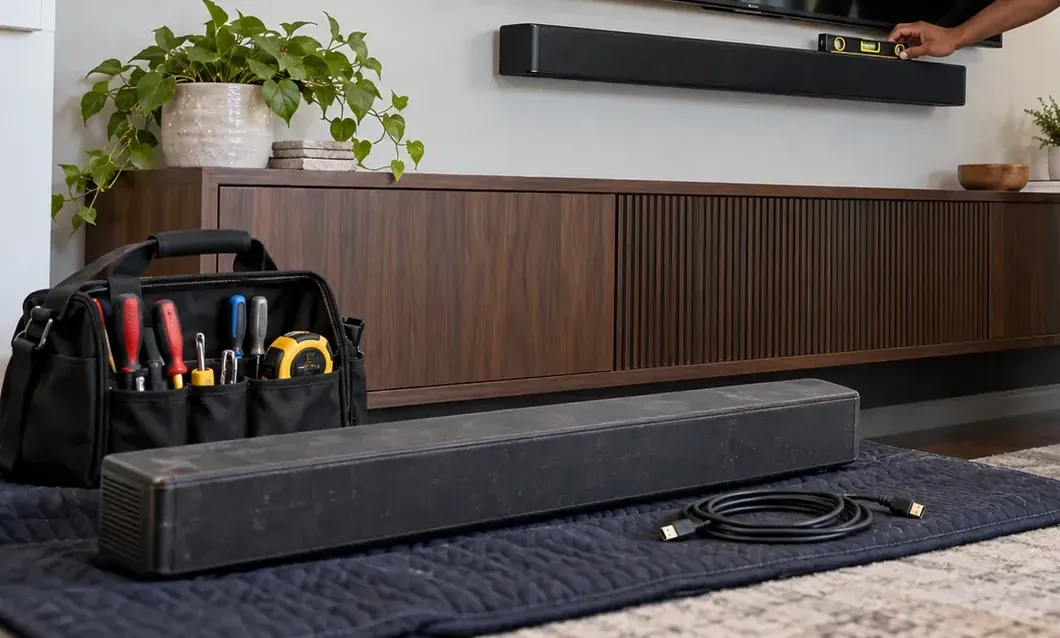
Hand resting a small level on a black soundbar hung beneath a TV above a dark wood fluted console, with an open tool bag, a second soundbar and a coiled HDMI cable on a moving blanket in front — DUMBO, Brooklyn soundbar installation
A short level along the top of the bar once it's hung; tools, a spare bar and the HDMI lead wait on a blanket so nothing scuffs the floor.
How DUMBO Was Built

Five Kinds of DUMBO Wall, Five Different Fixings

The first thing we ask about a DUMBO job is which building, not which bar. The address tells us, almost to the decade, what the TV wall is likely to be, and that decides the anchor, the drill, the time on site and which wall line appears on the bill.

The Gair Concrete Factory

55 Washington Street (1905), 1 Main Street (1914) and 45 Main Street (1919), all designed by William Higginson and built by Turner. Walls, columns and ceilings are reinforced concrete, often with flared mushroom capitals. Fixings go into concrete with a hammer drill and a metal scan first; the concrete line on the Brooklyn list adds $75.

The Brick-and-Timber Warehouse

The oldest stock by the river: Empire Stores at 53–83 Water Street (1870 and 1885) and 45 Water Street (1870). Thick brick bearing walls carry heavy timber beams and posts. Anchors go into sound brick rather than old lime mortar, and the brick line adds $65.

Steel Frame, Concrete Floors

Transitional buildings such as 68 Jay Street, a 1915 tea warehouse that the Improvement District lists as brick with a steel frame and reinforced-concrete floors. The perimeter is masonry; interior walls are usually later partitions. Each wall gets its own test hole.

The Mid-Century Factory

200 Water Street, built in 1950 by Turner for the Brillo Company and now residential. Later construction, but still an industrial shell, where the TV usually ends up on a partition added in the conversion or on block and concrete at the perimeter.

The Converted Loft Partition

Inside almost every conversion are walls that weren't there in the factory: drywall on wood or steel studs dividing bedrooms from the living space. Those are the walls where in-wall wiring is possible ($169), and steel studs add $30 because they need different fixings.

The Newer Tower

Newer high-rises, such as the 33-storey J and the 23-storey Beacon Tower that the Brooklyn Paper named in 2008. Expect a concrete frame, steel-stud partitions, large windows and an alteration process run by the managing agent.

There is also a sixth type that turns up a few times a year: the small early buildings on Front, Water and Old Fulton Streets that predate the factories. The Improvement District's building histories date 5–7 Front Street to 1834 and 85 Water Street to soon after 1835. Where those hold apartments, walls can be brick, old plaster or anything a later renovation added, so we price them only after seeing a photo.

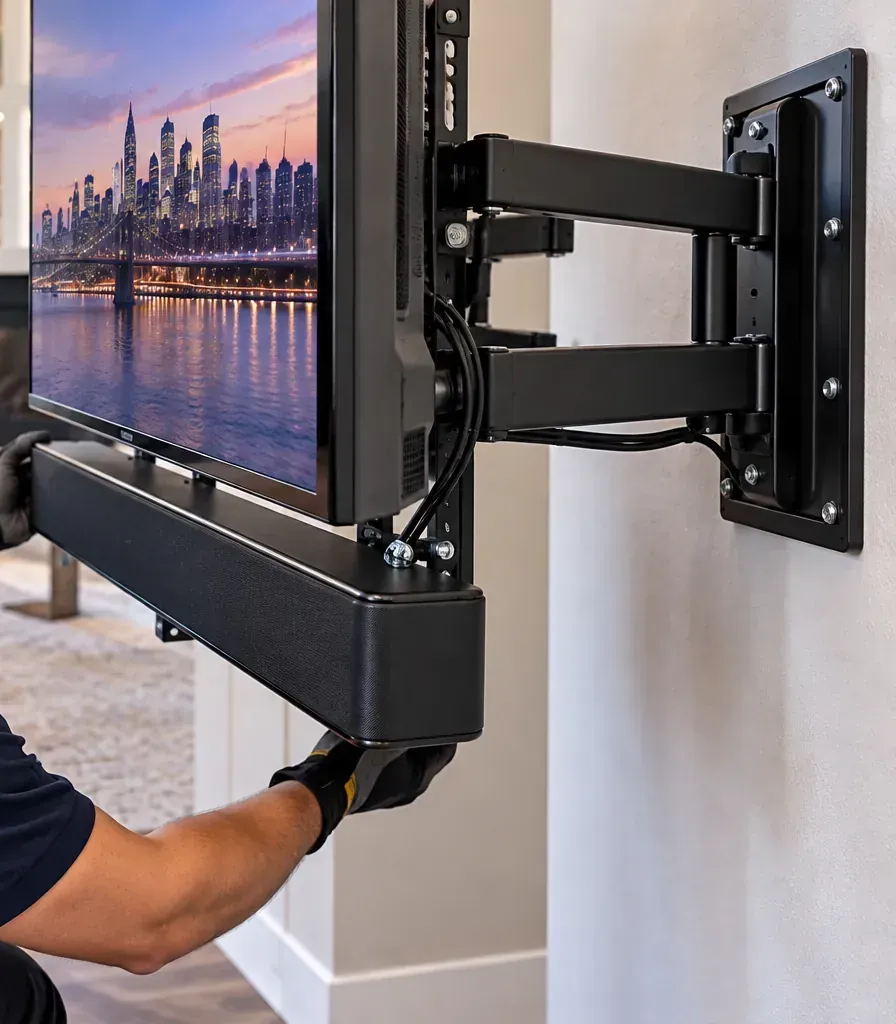
Gloved hands supporting a black soundbar fixed below a TV on a black articulating wall arm, with cables tied along the arm to its wall plate on a pale wall — DUMBO, Brooklyn soundbar installation
The bar rides on the TV's own arm, so the only holes in the wall are the arm's, and the leads follow the arm back to the plate.
What We Install

Soundbar Installation Services in DUMBO

DUMBO is priced on the Brooklyn list with nothing added for the neighbourhood. Whatever mix of lines your room needs, every visit ends the same way: the bar level with the bottom of the picture and centred on it, cable either inside a hollow wall or in a painted channel that reads as part of the trim, the TV remote controlling volume and power, and a listening test from your sofa with a train going over, if one obliges.

Bar on Concrete

Hammer-drilled anchors set in sound concrete after a metal scan, with the bracket positioned so the holes land clear of any rebar the scan finds. $129 for the mount with the bar's own bracket, plus the $75 concrete line.

Bar on Factory Brick

Masonry anchors in the face of solid brick, never the soft mortar joints, on the bearing walls of the riverside warehouses. The brick line is $65, and the cable usually runs down a slim cord cover painted to the wall ($59).

Bar on the TV or Its Arm

A clamp bracket that carries the bar on the TV or on an articulating arm, so the concrete only takes the TV mount's holes. Often the best answer where a board or landlord wants as few holes as possible.

Bar on the Console

Set on the furniture, connected, and placed clear of the TV's remote sensor. $79, and nothing touches the wall. The natural choice in a rental loft or while an alteration request is still with the managing agent.

Partition Walls and In-Wall Wiring

On the drywall partitions built inside conversions, the $169 in-wall kit takes power and HDMI behind the surface. Steel studs add $30. This is the one kind of DUMBO wall where hidden wiring is routine.

Cable Runs Across a Loft

Open plans put the cable box, router or game console a long way from the TV. A run to a cabinet or closet up to 25 feet is $99, routed along baseboards or furniture rather than across a concrete floor.

Subwoofer and Rear Speakers

Wireless sub and surround speakers paired and positioned: the sub off any shared wall, its level set for whoever lives downstairs. Sonos systems carry the $125 setup line; other brands are covered by the install.

Tuning for Hard, Loud Rooms

Room calibration run at a quiet moment, dialogue enhancement set for train passes, and night mode shown on the remote. Concrete and glass make rooms bright; we set the bar for the room you actually have.

Offices, Studios and Shops

Conference rooms in the converted factories, galleries on Main Street, shops and restaurants on Water and Front Streets. The same Brooklyn lines, a free certificate of insurance for the landlord, and volume limits staff can live with.

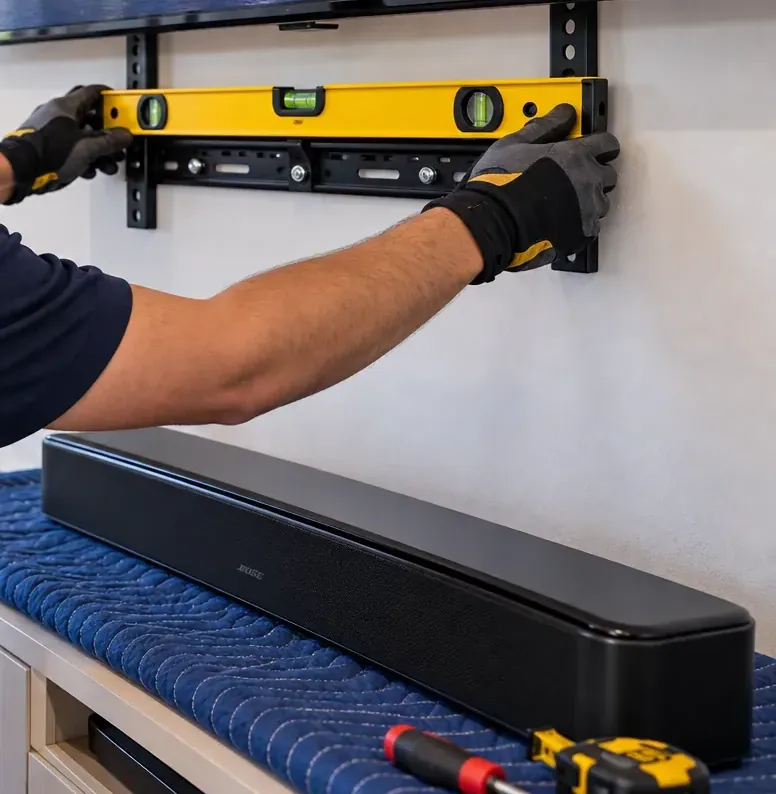
Gloved hands holding a yellow spirit level across a black wall bracket fixed under a TV, with a soundbar resting on a blue quilted blanket on the console below — DUMBO, Brooklyn soundbar installation
The bracket is levelled with the bar still down on a quilted blanket; on uneven old concrete we follow the TV's bottom edge, not the wall.

Bar Gone Quiet Under the Bridge

Silence from the bar, dialogue arriving late, or a TV remote it has started ignoring: after a firmware push, a blackout or a new cable box, that is almost always a configuration problem, and the hardware is fine. Call (347) 934-8335. A Brooklyn setup-only visit is $195 for the first hour and then charged in 30-minute blocks, and connection problems like these are usually sorted within one to two hours on site. If the bracket itself has loosened in old concrete or brick, mention it when you call so the right anchors come with the technician.

Building Specialists

Soundbar Installation for DUMBO's Architecture

Within a few blocks DUMBO puts early reinforced concrete, nineteenth-century mill construction, steel frames and modern partitions side by side, sometimes inside a single building. Here is how we treat each material, what usually surprises owners, and which line on the Brooklyn list each one brings with it.

Early reinforced concrete

The Gair buildings and their neighbours were poured when reinforced concrete was still a new material; the Improvement District's history of 55 Washington Street repeats the story that Gair and Turner lit a bonfire on the roof to prove the building was fireproof. A century on, that concrete is usually very hard on the surface and less predictable inside. The National Park Service's preservation brief on historic concrete notes that early mixes sometimes used cinder from burned coal or crushed brick as aggregate, and that once carbonation reaches the reinforcing steel, rust expands and cracks or spalls the concrete around it. So we scan for steel before drilling, drill a pilot hole to see what comes out, and only then choose the anchor and its depth. The concrete line adds $75.

Mushroom columns and flared capitals

Many concrete lofts are built on columns that widen at the top into a flared capital where they meet the slab, the “mushroom-capped columns” a broker's profile of 1 Main Street describes. They are part of the structure, they are often the most attractive thing in the room, and owners rarely want anything fixed to them. When the best TV position is beside a column, we check the clearance between the capital and the top of the screen, keep the bracket on the wall rather than the column, and fix the bar to the TV mount if the gap below the screen is tight.

Brick bearing walls in the riverside warehouses

In mill-construction buildings the outside walls carry the floors, and the brick in them is old, laid in mortar that is often softer than the brick itself. A soundbar is light compared with a TV, so the fixing is straightforward if it goes into the face of a sound brick and the hole isn't over-drilled. We keep anchors out of mortar joints, keep them a sensible distance from any opening, and run the cable down a painted cord cover rather than chasing it into a wall that is part of the building's structure. The brick line adds $65.

Steel frames and terra-cotta floor tile

The designation report describes a third type in the district: buildings with steel frames and terra-cotta floor tiles for added fire protection. In those, the outside wall may be brick, the interior may hide a steel column inside a furred-out box, and the floors are not the solid slabs of a Gair building. Our metal scan matters most here, because a fixing that meets steel in a boxed column needs a different approach from one that meets brick a few inches to the left.

Conversion partitions: wood studs, steel studs and furring

Bedrooms, bathrooms and closets in a converted loft are almost always new walls built inside the old shell. Some are wood studs, many are light-gauge steel, and some old concrete or brick walls have been furred out with framing and drywall to hide pipes or level the surface. A furred wall can look like drywall and behave like concrete two inches deeper, so the first pilot hole tells us whether the bracket fixes to framing, needs a longer masonry anchor through the cavity, or needs a backer board ($85). Steel studs add $30; ordinary drywall on wood studs adds nothing.

Window walls and window bays

Factory windows were made for daylight, and conversions kept them. Big multi-pane openings set between concrete piers, or full window walls in the newer towers, often leave one long solid wall in a living room and a few narrow piers. Glass behind or beside a TV causes glare and makes sound bounce, so we usually recommend the solid wall opposite or at right angles to the windows, and avoid pointing a bar's side-firing drivers straight at a large pane.

Original fabric in a DUMBO loft is part of what owners paid for. If the only sensible place for a fixing is a column capital, an original timber post, a cast-iron element or exposed brick that a board wants left untouched, we stop and explain the alternatives first. Usually that means a TV-attached bracket, a console placement or a different wall, not a hole in something that can't be replaced.

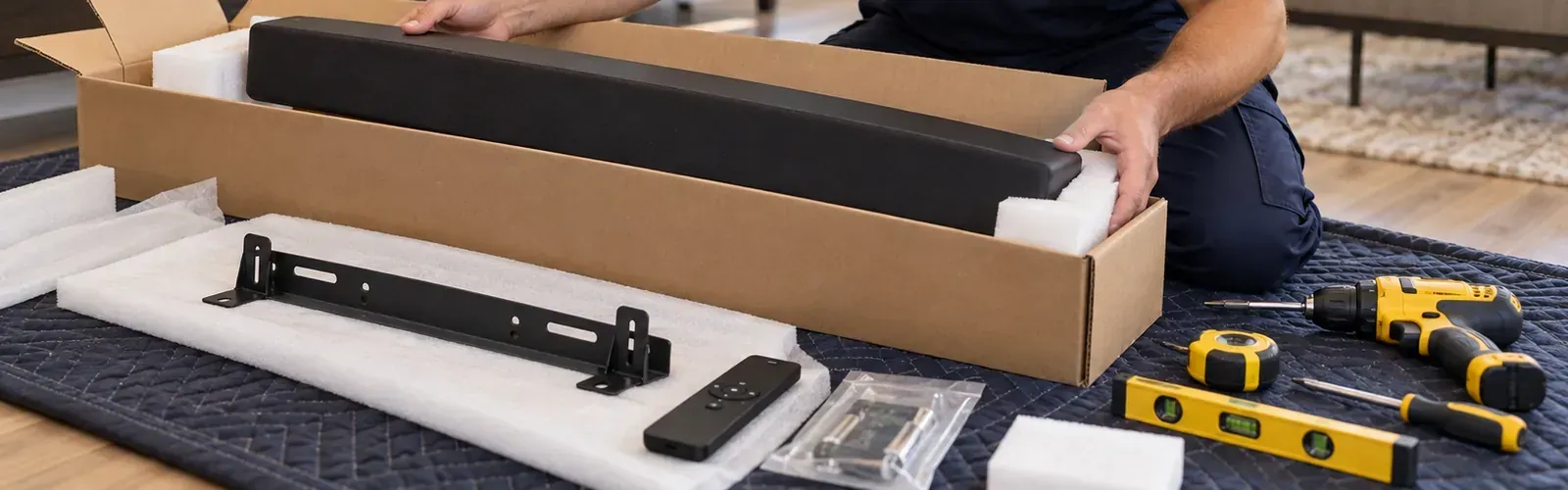
Soundbar being lifted out of its carton on a dark moving blanket, with its black wall bracket on foam packing, the remote, a bag of fixings, a cordless drill, tape measure and yellow level laid out beside it — DUMBO, Brooklyn soundbar installation
Everything in the box is laid out and counted before the first hole: bar, bracket, remote and fixings, with the drill and level ready beside them.
Commercial Soundbar

Business Soundbar Installation in DUMBO

DUMBO is a working neighbourhood as much as a residential one. Wikipedia calls it the centre of the Brooklyn Tech Triangle, and the Improvement District counts more than 1,000 creative and tech companies, 125 or more storefronts and over 20 galleries. Almost all of them sit in the same converted buildings as the lofts, so a business soundbar job meets the same concrete and brick, plus a landlord's rules.

Tech Offices in the Gair Buildings

55 Washington Street, Gair's first concrete factory, houses Etsy according to the Improvement District. Meeting rooms in buildings like it want a bar under a display for video calls and presentations, mounted on concrete or on a partition, with cables taken to a credenza.

Dumbo Heights and Coworking

WeWork runs private offices and coworking at Dumbo Heights on Sands Street. Members with a private office usually need the operator's agreement before anything is fixed to a wall, so we often start with a console or TV-attached bracket and a certificate of insurance.

Empire Stores

Seven brick warehouses on Water Street, now restaurants, retail, offices and event space with West Elm and Time Out Market among the tenants. Screens in a food hall or showroom need a bar that keeps speech clear without filling the whole floor.

Galleries on Main Street

16 Main Street, built in 1906 as Gair's stable, now holds four galleries according to the Improvement District. Video work and talks need sound that is clear at the front of a room and quiet in the next gallery, with no visible clutter.

Front and Water Street Restaurants

The oldest buildings in the neighbourhood, such as 1 Front Street (1868–69) and 5–7 Front Street (1834), now house restaurants. A bar behind a counter or over a dining room needs locked volume and a sub that stays quiet for the apartments upstairs.

Venues and Studios

St. Ann's Warehouse at 45 Water Street, the Improvement District's count of 152 artist studios. Most of these want proper speakers for performance; a soundbar is for the office, the green room or the lobby screen.

Rules that come with a business room

  • Late-night limits: between 10 PM and 7 AM, the DEP's noise code summary caps commercial music at 42 dB inside a neighbouring home and 7 dB over ambient on the street at 15 feet or more, and sets a separate bass limit. With lofts above a shop, the subwoofer is usually what breaches it.
  • Corridors and waiting areas: the ADA's protruding-objects rule limits how far anything mounted between 27 and 80 inches above the floor may stick out into a path of travel. A bar under a TV in a corridor is kept flat, high enough, or behind furniture.
  • Landlord paperwork: commercial landlords and coworking operators normally want a certificate of insurance before work starts. We send it free.
  • The facade: inside the historic district, a speaker, cable or fixture attached to the outside of a building goes before the Landmarks Preservation Commission. Everything we install stays indoors.
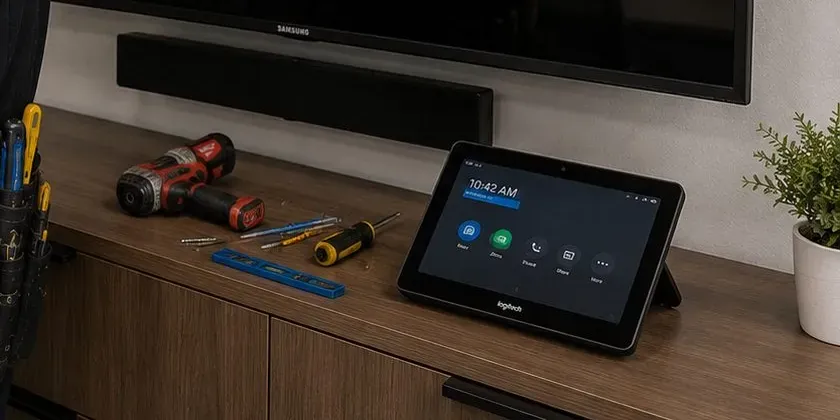
Bottom edge of a wall-mounted Samsung display with a black soundbar beneath it, above a wood credenza holding a drill, screwdrivers, a blue level and a tabletop meeting-room touch controller — DUMBO, Brooklyn soundbar installation
A meeting-room bar mounted close under the display, with the room's touch controller on the credenza and the tools still out.
Your Questions Answered

Soundbar Installation in DUMBO: Questions Answered

Most soundbar questions have the same answer anywhere in the city. These are the ones DUMBO adds: a bridge that interrupts the quiet the setup routines expect, concrete that was poured before the First World War, and columns and floors that behave nothing like a house.

Living under the bridge

A train crossed the bridge in the middle of the soundbar's room-calibration sweep — do we need to run it again?

Usually yes. Calibration routines such as Sonos Trueplay play test tones and listen to them with a microphone, either in the bar or in a phone moved around the room, and then shape the sound to the room. Sonos's own instructions ask you to minimise noise while it runs, and its support pages list background noise as a reason a tuning can turn out wrong. A loud train pass in the middle of a sweep is exactly the kind of noise those instructions mean: the system may stop with a background-noise warning, or finish and quietly apply a correction based on the bridge as well as the room.

The MTA's 2023 measurements give a sense of the scale. At the nine DUMBO homes monitored, background levels between trains were roughly 32 to 46 dB(A), and the loudest passes reached between about 72 and 95 dB(A). A sweep run during one of those peaks is not measuring the room you watch films in. So on DUMBO visits we wait for a gap, close the windows, switch off fans and the air conditioner, run the routine, then play a known clip and listen. If a train arrives halfway through, we start again; it costs a couple of minutes.

If you've already run it yourself and the bass now sounds thin or the dialogue odd, reset the tuning in the app and repeat it late in the evening or at another quiet time. If the result still sounds wrong, a setup-only visit ($195 for the first hour) covers running it properly along with the rest of the settings.

Could the soundbar be set up to cancel out the train noise in the room?

No, and it's worth knowing why before anyone sells you on it. Active noise cancellation works in headphones because a microphone sits right at the ear and the cancelling sound only has to match the noise at one small point; Bang & Olufsen's explanation of ANC describes microphones that listen to the sound outside and inside the earphone and a speaker that plays an inverted wave. In a room, the noise arrives from many directions and bounces off concrete and glass, and no speaker under a TV can produce an exact opposite of it at every seat. A soundbar has no setting that removes a passing train.

What a bar can do is make the noise matter less. Dialogue or voice enhancement lifts the frequencies where speech sits, so you follow the conversation without turning everything up. Night or dynamic-range modes keep quiet scenes audible, which is what people are actually missing when a train covers them. A bar with a dedicated centre channel, and placed close under the screen and aimed at the seats, also helps more than raw volume.

The real reduction of train noise is in the building: windows, seals and what the walls are made of. The Brooklyn Paper noted in 2008 that new and renovated buildings in DUMBO routinely installed double-paned windows, and residents now talk about triple panes. That is work for a window contractor and, in the historic district, possibly for the Landmarks Commission, not for a soundbar installer.

Concrete that's more than a century old

Our walls are 1910s factory concrete — could concrete that old crumble around the anchors?

It can happen, but it is rare for a soundbar's weight and it is easy to check for. The National Park Service's preservation brief on historic concrete explains that early concrete sometimes used cinder or crushed brick as aggregate, and that when carbonation reaches the steel, corrosion swells and cracks or spalls the concrete around it. Those conditions show up most where water gets in: near windows, roofs and outside walls. Indoor walls that have been dry for a century are usually sound.

Before fixing anything we look at the surface for cracks, rust stains or hollow-sounding patches, scan for steel, and drill a pilot hole. The dust and the way the bit cuts tell us a lot: hard grey dust and steady progress means dense concrete; gritty, dark or crumbling dust means a weaker mix or a patch. In sound concrete we use anchors sized for the bracket with the hole drilled to the depth the anchor needs, no deeper. If the material is weak, we move the bracket to sound concrete nearby, spread the load with more fixings, or switch to a TV-attached bracket so the bar adds no holes at all.

What we won't do is rely on adhesive alone or on plastic plugs meant for drywall. A bracket that will carry a bar, and the buzz of its bass, for years needs fixings that grip mechanically. If we see cracking that looks structural, we stop and tell you, because that is a question for the building's engineer, not for us.

Our loft floor is bare polished concrete — does the subwoofer still need an isolation pad?

Often not, which surprises people. On a timber floor, a sub sets the boards and joists vibrating, and the floor itself becomes a speaker for the room below. A massive concrete slab barely moves at the frequencies a home sub produces, so an isolation pad has much less to isolate. Owners on audio forums who have tried pads directly on slabs generally report little or no difference, while SVS, the subwoofer maker, describes decoupling as a way to reduce the energy passed into the floor and the disturbance to neighbours where the floor can carry it.

The catch is that many DUMBO floors aren't bare slab where it counts. A conversion may have laid wood flooring on sleepers or a resilient layer over the concrete, and a raised platform or a built-in cabinet can act like a drum. In those cases a pad or a set of isolation feet earns its place. We check what the sub is actually sitting on before deciding.

Either way, the bigger factor for the neighbours is where the sub is and how loud it is set. Bass travels through concrete structure as well as through air, so we keep the sub off shared walls and out of corners, trim its level after calibration, and show you night mode. If you're worried about the unit below, we can play test passages while you or the neighbour listens downstairs.

A mushroom column's flared top sits just above where we want the TV — does that limit the TV or the bar?

It limits the TV more than the bar. A flared capital widens the column at ceiling level, and on an exterior wall it can project into the space where a tall TV would sit. We measure the clearance between the underside of the capital, the wall and the top of the screen, allowing for a tilting or articulating mount if you want one, and mark the highest the TV can go before the capital gets in the way.

The bar follows the TV. If the TV has to sit lower to clear the capital, the bar usually goes beneath it on the wall or on the console; if the space under the screen is short because of a window sill or radiator, a TV-attached bracket keeps the bar tight to the screen. We don't fix anything to the column or the capital itself unless you specifically want it and the building agrees.

Columns also shape the sound. A bar set right beside a column bounces sound off it unevenly, and a sub tucked against one can resonate. Moving the TV a few feet away from the column often improves both picture and sound, and we'll suggest it if the room allows.

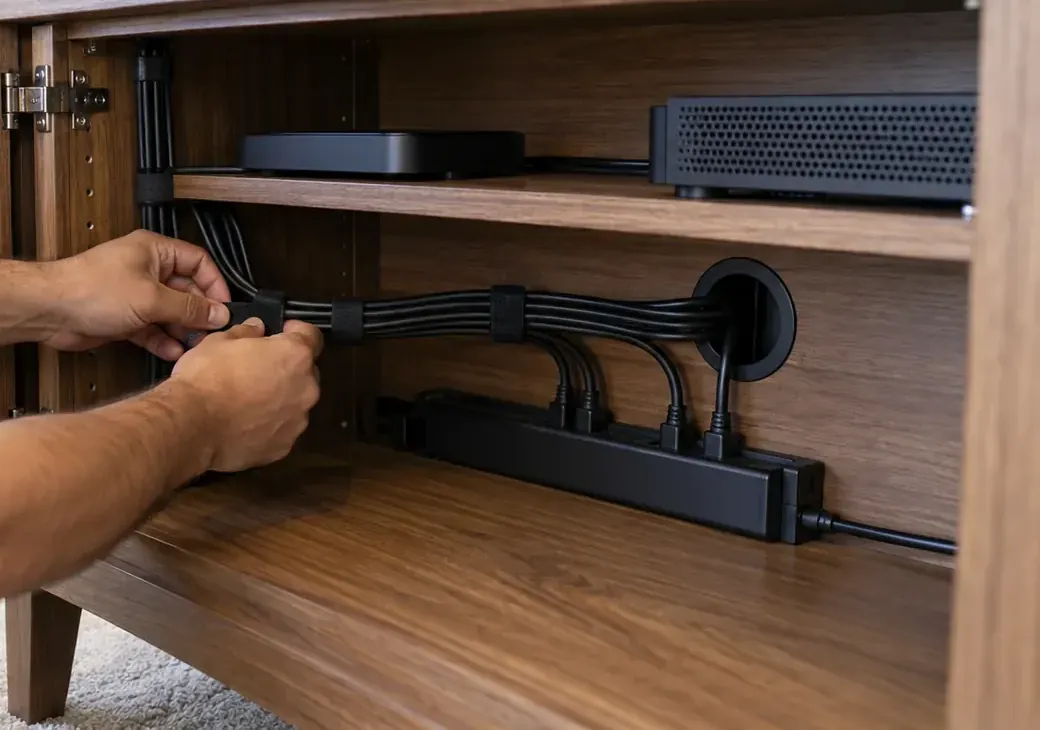
Hands wrapping a hook-and-loop strap around a bundle of black cables inside an open walnut media cabinet, the bundle passing through a round grommet to a power strip below two devices on a shelf — DUMBO, Brooklyn soundbar installation
Where a concrete wall can't hide the cables, the cabinet does: one strapped bundle through the grommet and every plug on a single strip.
Equipment

Types of Soundbars and Mounts We Install

We install the bar you bought, or help you choose before you buy. In a DUMBO loft the size of the room, its hardness and where the boxes can live matter more than the logo on the bar.

Compact Bars

For a bedroom carved out of a loft, a home office or a small studio. Sonos Ray connects by optical rather than HDMI; Sonos Beam weighs about 6.35 lb and connects by HDMI eARC. Short bars suit narrow piers between window bays.

Full-Width Atmos Bars

For a large living space and a big TV. Sonos Arc Ultra is about 46 inches wide and about 5.9 kg. Dolby's speaker guide wants a flat ceiling between 7.5 and 14 feet for up-firing drivers, so very tall loft ceilings weaken the height effect.

Bar, Sub and Rears

For open plans where the sofa floats in the middle of the room. Rear speakers on stands avoid fixing anything into concrete, and the wireless sub goes where the room and the neighbours allow.

Wall Brackets

We use the bracket packed with the bar where it suits concrete or brick. If the box had none, or its fixings assume drywall, we fit a Sanus soundbar bracket at $84.99.

TV-Attached Brackets

Brackets that grip the TV's mounting points and carry the bar with the screen. Sanus's SASB1 is rated for most soundbars up to 20 lb and fixes to the bar from behind or below. The wall takes only the TV mount's holes.

Cord Covers and Cable Paths

Painted surface raceway for solid concrete and brick ($59); in-wall kits only where a partition is hollow ($169); runs of up to 25 feet to a credenza or closet ($99).

Whatever the bar, we wire it the same way. One HDMI lead goes to the TV socket marked eARC, or ARC on older sets; HDMI-CEC is enabled so the TV's own remote handles power and volume; and the TV's audio output is switched from its speakers to the bar. According to AWOL Vision's comparison, lossless Dolby TrueHD Atmos needs eARC, while ARC can pass Atmos only wrapped in compressed Dolby Digital Plus. We use eARC whenever the TV offers it, and on sets with no ARC at all we fall back to optical, which still carries stereo and basic surround.

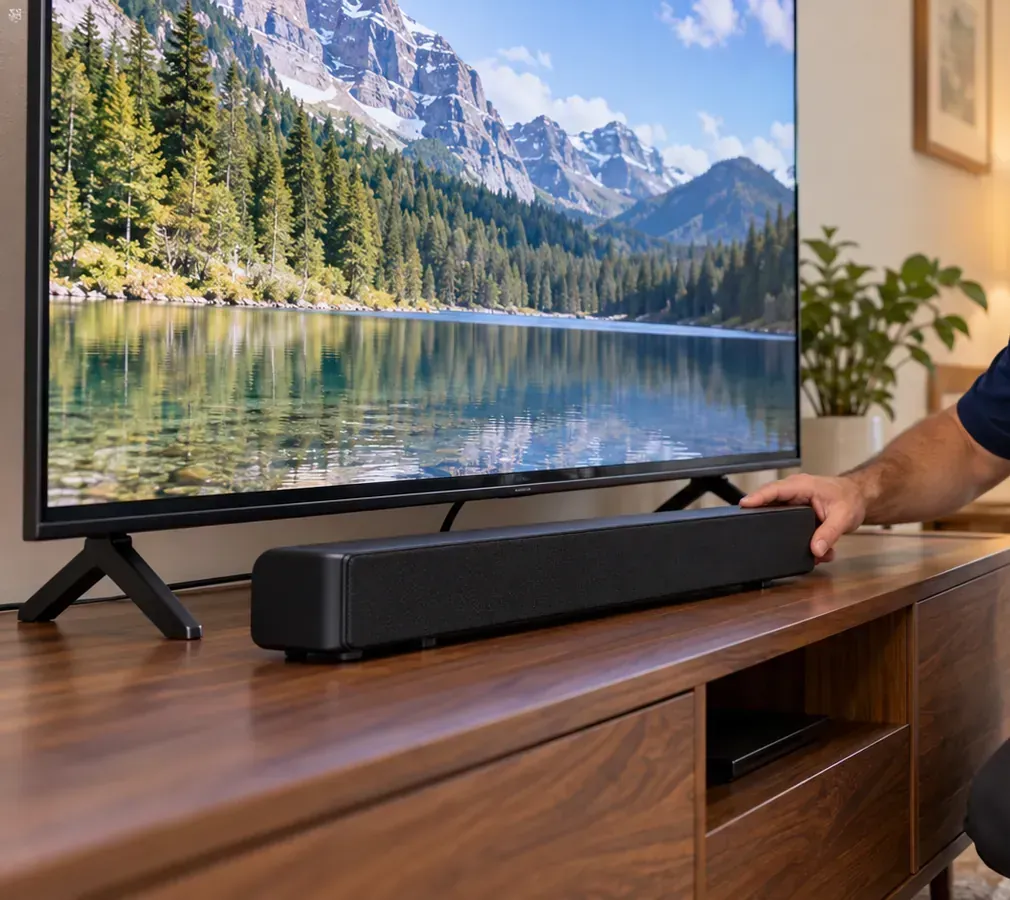
Hand placing a black soundbar on a walnut media console in front of a TV standing on its own feet, with a streaming box on the shelf below — DUMBO, Brooklyn soundbar installation
Wall untouched: the bar rests on the walnut console just in front of a TV standing on its own feet, sitting low so the picture stays clear.
AI Overview Reality Check

What AI Gets Wrong About Soundbar Installation in DUMBO

Ask a search engine or a chatbot about soundbar installation and you get a national answer assembled from cost guides, manufacturer blogs and handyman sites. We couldn't capture Google's AI Overview from our build environment, so below we take the published claims those answers draw on, name where each comes from, and set it against what a DUMBO loft actually involves.

The cost guides: “about $58 to $231 per soundbar”

Homewyse's national estimate for installing a soundbar runs from $58.43 to $231. That is a fair number for a bar on drywall in a house with studs every sixteen inches and a hollow wall for the cable.

A DUMBO loft rarely matches that picture. The mount is $129 on the Brooklyn list, concrete adds $75, our Sanus bracket is $84.99 if the bar's own one won't suit, and a painted channel for the cable is $59. Together that is $347.99, above the national range for reasons you can see on the wall.

The figure worth comparing isn't a national average but the written total for your wall. We send it before anyone drills, and if the wall proves different from the booking, you see the revised total before work starts.

The handyman quote: “$80 to put up the soundbar”

On Yelp's question pages, one TV installer answered a customer in September 2025 with $150 to mount a TV and $80 to install the soundbar. For drywall that may well be all you need, and Thumbtack puts national TV wall mounting at $121 to $234.

The difference in a Gair building is the tools and the judgement. Concrete takes a hammer drill and anchors rated for masonry, a metal scan before the bit goes in, and dust control in a finished loft. A drywall plug pushed into concrete, or a hole drilled too wide, is how bars end up hanging crooked a few months later.

Ask anyone you're considering three things: what anchor goes into your wall, how they'll find steel before drilling, and whether they can send the certificate of insurance your managing agent will ask for. Their answers tell you most of what a price can't.

The design blogs: “run the wires inside the wall”

Hidden wiring is the default recommendation almost everywhere, and Angi prices concealed wiring at $75 to $300 as a routine add-on. It assumes a hollow wall with space between studs.

In a concrete loft, the TV wall is often solid from face to face. Hiding a cable inside it would mean cutting a channel into structure that the building, the board and often the Landmarks Commission want left alone, for a cable worth a few dollars.

The honest options are a painted channel along the concrete, a run along the baseboard to a cabinet, a TV-attached bracket so the bar's cable never touches the wall, or choosing a partition wall where the $169 in-wall kit works properly. We'll tell you which walls in your loft are hollow before you decide where the TV goes.

The placement advice: “mount the bar just below the TV at ear level”

Dolby's guidance is sound: if you wall-mount a soundbar, it usually belongs below the TV and close to it. In most DUMBO living rooms that works fine.

Where it doesn't is in lofts with very high ceilings and big windows, where owners are tempted to hang a large TV high on a long wall. The bar follows the TV upward and sends dialogue over the heads of everyone on the sofa. We'd rather lower the TV, use a TV-attached bracket so the bar stays tight under the picture, and angle it slightly toward the seats where the bracket allows.

The other placement trap is the column. A TV hung beside a concrete column or under a flared capital can end up off-centre to the seating, and the bar then sounds lopsided. Centring the screen on the sofa matters more than centring it on the architecture.

The Atmos marketing: “height channels bounce sound off your ceiling”

Up-firing drivers do bounce sound off the ceiling, and Dolby's own speaker guide sets the conditions: a flat ceiling between 7.5 and 14 feet. Polk's Atmos guide adds that the ceiling should be rigid and acoustically reflective.

Concrete is certainly reflective, but plenty of DUMBO ceilings break the other rules. A broker's profile of 1 Main Street reports ceilings from 15 feet upward in that building; other lofts may have exposed ducts, sprinkler pipe or beams that scatter the reflection. In rooms like that the height effect shrinks to very little.

If height sound matters to you, a bar with a sub and rear speakers on stands gives more real surround in a tall loft than an expensive up-firing bar on its own. We'll say so before you buy, not after it's on the wall.

The quick fix: “use adhesive strips if you can't drill”

Renters are often told that a light bar can hang on adhesive strips or a no-drill mount. On smooth painted drywall in a quiet room, that sometimes holds for a while.

On dusty century-old concrete or sealed brick it is a gamble, and in a building where bass and passing trains add a little movement every day, a falling bar can land on a TV stand, a child or a polished floor. We won't hang a bar that way.

If drilling isn't allowed, the real no-drill options are the console ($79), a TV-attached bracket on a TV that is already mounted, or a floor stand with a soundbar shelf. None of them depends on glue holding.

The wireless shortcut: “just connect it by Bluetooth”

Bluetooth suits a phone playlist, not a film. The extra latency puts voices out of step with mouths, and the codec squeezes the audio on the way through.

Between the TV and the bar the link should be a cable: HDMI into the eARC or ARC socket, with optical held in reserve for older sets. That keeps speech lined up with lips and leaves volume on the TV remote. Radio links are fine from the bar to its own sub and surrounds, which are built to pair with it.

In an open loft where the cable box lives across the room, the answer is a longer HDMI run, a cabinet route or moving the box, not Bluetooth between the TV and the bar.
Sound That Holds Up When the Q Goes Over

Tell us the building, the bar and what the wall is made of. A photo is enough for us to name the anchor, the cable route and the price.

Under the Manhattan Bridge

Plymouth, Adams and Jay: What the MTA Measured

The Landmarks Preservation Commission describes the Manhattan Bridge as soaring over the district, its anchorage and piers spanning streets and sidewalks with bold arches. For the people underneath, it is also the soundtrack. NYC Transit's noise reduction report for 2023 includes a full DUMBO study: monitors placed in the homes of residents who volunteered through a contact at 100 Jay Street, and at three public spots, after Assemblymember Jo Anne Simon's office pressed the MTA about noise from the N, Q, B and D trains. Here is what it recorded at the residences.

AddressTrains measuredBackgroundAverage levelLoudest pass
135 Plymouth Street35744.5 dB(A)53.42 dB(A)94.76 dB(A)
56 Adams Street52046.4 dB(A)70.25 dB(A)94.66 dB(A)
68 Jay Street50338.6 dB(A)56.87 dB(A)90.37 dB(A)
98 Front Street32332.8 dB(A)46.57 dB(A)83.93 dB(A)
133 Water Street47231.8 dB(A)56.00 dB(A)80.36 dB(A)
100 Jay Street29233.4 dB(A)50.21 dB(A)78.27 dB(A)
177 Water Street38933.5 dB(A)51.96 dB(A)75.71 dB(A)
31 Washington Street42343.1 dB(A)54.54 dB(A)75.70 dB(A)
39 Pearl Street53734.1 dB(A)57.35 dB(A)71.88 dB(A)

The report doesn't say where in each home the monitor sat or whether windows were open, so treat the figures as a picture of the neighbourhood rather than a forecast for your apartment. Two things still stand out. The gap between quiet and loudest is enormous at every address, often 40 dB or more, which is the difference between a room you can hear a clock in and one where you can't hear the person next to you. And it isn't only the blocks nearest the bridge: Water Street and Front Street addresses also logged hundreds of passes in a few hours.

For a soundbar, that changes the brief. Most bars are set up in showrooms and suburban houses where the background is steady. Here the background jumps every few minutes, and a setup that is comfortable between trains loses the dialogue during them, while one turned up for the trains is too loud the rest of the time.

How we set a bar up for a room under the bridge

  • Calibrate in the gaps. Room-tuning routines are run between trains with windows shut and fans off, and repeated if a train interrupts them.
  • Favour the voice, not the volume. Dialogue enhancement and a slight centre-channel lift keep speech above a passing train without raising effects and music with it.
  • Compress for night. Night or dynamic-range modes narrow the gap between whispers and explosions, so you don't ride the remote every time the bridge gets busy. We put the button where you'll find it.
  • Keep the bar close to the picture. A bar tight under the screen and aimed at the seats delivers speech more directly than one on a low console a metre further away.
  • Don't fight bass with bass. Passing trains bring plenty of low rumble of their own. Turning the sub up to “beat” it only adds to what the neighbours hear. We set it for the film, not for the bridge.
  • Check the fixings. Brackets go into concrete or brick with mechanical anchors, and felt pads stop a bar buzzing against the wall when the low end gets busy.

None of this makes the trains quieter. It makes the film easier to follow while they pass, which is the part a soundbar can actually change.

Hard Rooms

Concrete, Glass and Tall Ceilings: Getting Clear Sound in a Loft

Converted factories make beautiful rooms and difficult listening spaces. Concrete ceilings, polished or hardwood floors, exposed brick and big windows all reflect sound, and a long open plan gives every reflection room to travel. One owner on a home theatre forum summed up the result: very high ceilings, a very echoey room, and being told soundbars wouldn't cut it. Another, on an acoustics forum, described a twenty-by-forty-foot concrete room and asked simply how to knock down the echo.

A soundbar can work well in a loft. It just needs help from the room and a setup that expects reflections. The good news is that most of that help is furniture you'd buy anyway.

What actually makes a loft sound better

  • A large rug between the TV and the sofa. The floor is the first reflection most sound hits on its way to you. A thick rug there cuts more harshness than anything on the walls.
  • Soft things behind the sofa. A loft sofa often floats in the middle of the room with nothing behind it but concrete thirty feet away. A bookcase, curtains or a padded screen behind the seating shortens the echo.
  • Curtains on the big windows. Glass reflects sound as well as light. Even unlined curtains drawn across part of a window wall help, and they cut screen glare at the same time.
  • A bar with a real centre channel. In a reflective room, a dedicated centre driver holds dialogue together better than a bar that blends speech into its left and right channels.
  • The sofa within a sensible distance. The further you sit, the more of what you hear is reflection. Bringing the seating closer to the screen helps more than buying a bigger bar.
  • Calibration after the furniture is in. A room-tuning sweep run in an empty loft tunes for an empty loft. Book the visit after the rug and sofa arrive, or ask us to re-run it when they do.

If none of that is possible, a bar with a sub and rear speakers on stands near the sofa puts more of the sound close to the listener, which makes the room's reflections matter less. We'll tell you plainly if a room is beyond what a soundbar can do well and a speaker system would serve you better.

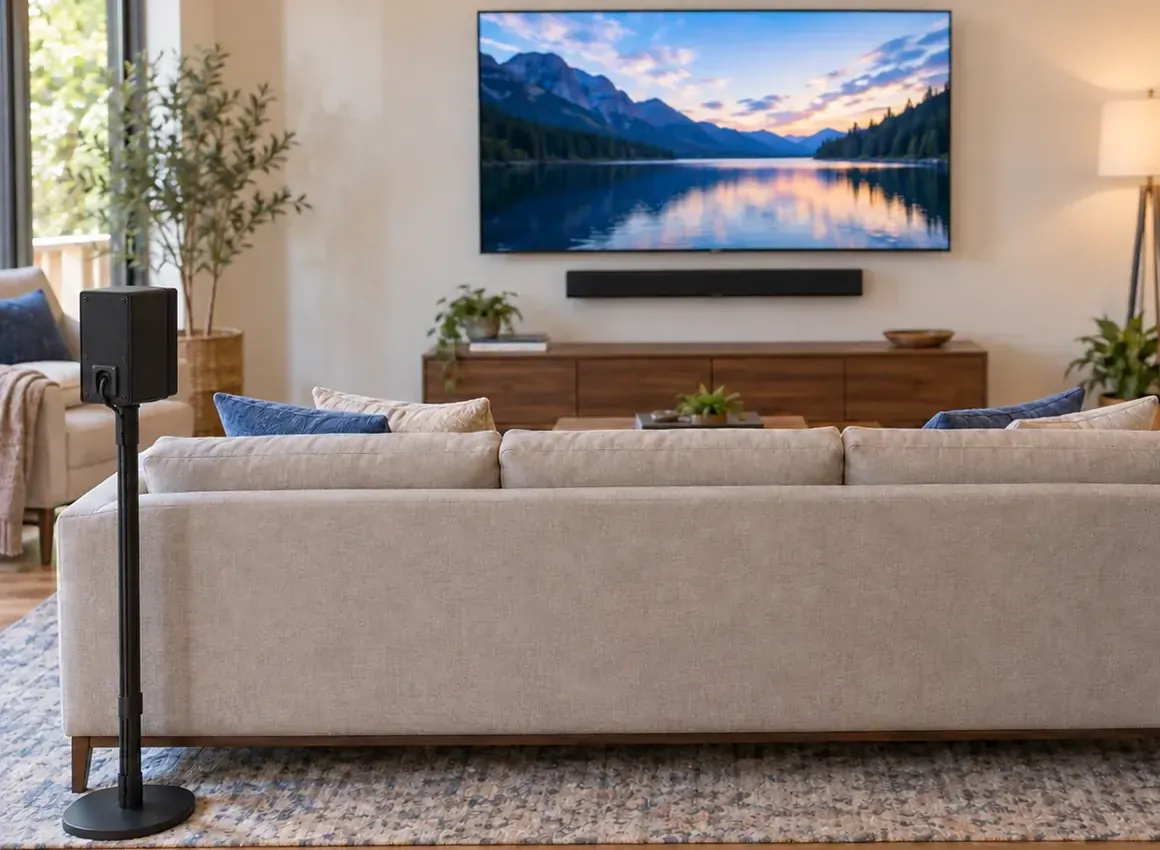
Beige sofa seen from behind on a patterned rug, with a black rear surround speaker on a floor stand at its left end, facing a wall-mounted TV and slim soundbar above a low wooden console — DUMBO, Brooklyn soundbar installation
A rear speaker on its own floor stand at the end of the sofa: surround sound brought close to the seats without a single fixing in the concrete.
By the River

Ground Floors on Water Street: Keeping Electronics Off the Floor

DUMBO's oldest warehouses sit at the water's edge, and Sandy showed how low that edge is. News photographs from October 2012 show flooded streets under the Manhattan Bridge, and CBS New York reported that the basement holding the electronics that run Jane's Carousel took five feet of water. The carousel's horses survived; the equipment below them didn't fare as well.

Most soundbar owners in DUMBO live well above street level, and none of this is a reason to avoid a ground-floor TV room. But for the minority of homes, offices and shops on ground floors and below near Water Street and the park, a few habits cost nothing:

  • Nothing important on the floor. The sub is the only part of a soundbar system that usually sits on the floor. In ground-floor rooms near the river we put it on a low stand, and keep the power strip and any network box on a shelf rather than behind the console at floor level.
  • One strip, easy to reach. Every plug goes on a single surge-protected strip you can reach without moving furniture, so the whole system can be unplugged in a minute when a storm warning goes up.
  • Wall-mount rather than floor-stand. A bar on the wall under the TV is out of harm's way; one on a low floor stand is not.
  • Photographs of the setup. Ask us to photograph the connections before we leave, so the system can be put back together quickly after it has been unplugged and moved.

For businesses in cellars and below-grade spaces, flood planning is a bigger job than any soundbar. We can work alongside whoever is planning it, and keep the AV side simple to unplug and lift.

Get In Touch

Request a Free Quote

A condo in a Gair concrete building on Main Street, a rental loft on Water Street, an office in one of the Jay Street conversions or a tower apartment near York Street: name the building, the floor and the wall, and a written quote follows within the business day. Prefer to talk it through? Call (347) 934-8335.

✅

We Got Your Request!

Expect our call later today. Need someone sooner? Dial (347) 934-8335.

How It Works

Our Installation Process

Seven steps, whatever the job: a short bar in a bedroom carved out of a loft, or a bar with sub and surrounds under a concrete ceiling.

1. Tell us the building and the wall

Send the bar and TV models, the address or nearest corner, the floor, and a photo of the TV wall taken from the sofa. Say whether it looks like concrete, brick or drywall, and where the cable box and router live.

2. Get the total in writing

The quote itemises what your room needs from the Brooklyn list: placement or mount, bracket, wall material, cable route and setup. Managing agents, landlords and coworking operators who want a certificate of insurance get one with it, free.

3. Book a two-hour window

Windows run from 8 AM to 8 PM every day and are fitted to your building's contractor hours and freight elevator booking. Moving a slot with 24 hours' notice costs nothing.

4. Scan and test the wall

A scanner checks for rebar, conduit and cable first. One small pilot hole, placed where the bracket will cover it, then shows from its dust whether we have concrete, brick, block or framing. You sit where you normally watch while we mark the height and centre line.

5. Fix the bracket and route the cable

Mechanical anchors suited to the material go in with dust extraction. Cable runs inside a hollow partition, down a painted channel on concrete or brick, or along the baseboard to a cabinet or closet.

6. Connect and place the speakers

HDMI goes into the eARC or ARC port with CEC switched on. The sub and any rears are placed away from shared walls and checked for what they sit on; every plug goes on one surge-protected strip; felt pads go where the bar meets the wall.

7. Tune between trains and hand over

Calibration runs in a quiet gap with windows shut; dialogue and night modes are set and shown on your remote, a test clip confirms lip sync, and the TV remote is proven on power and volume. Dust cleared, cartons stacked, settings explained.

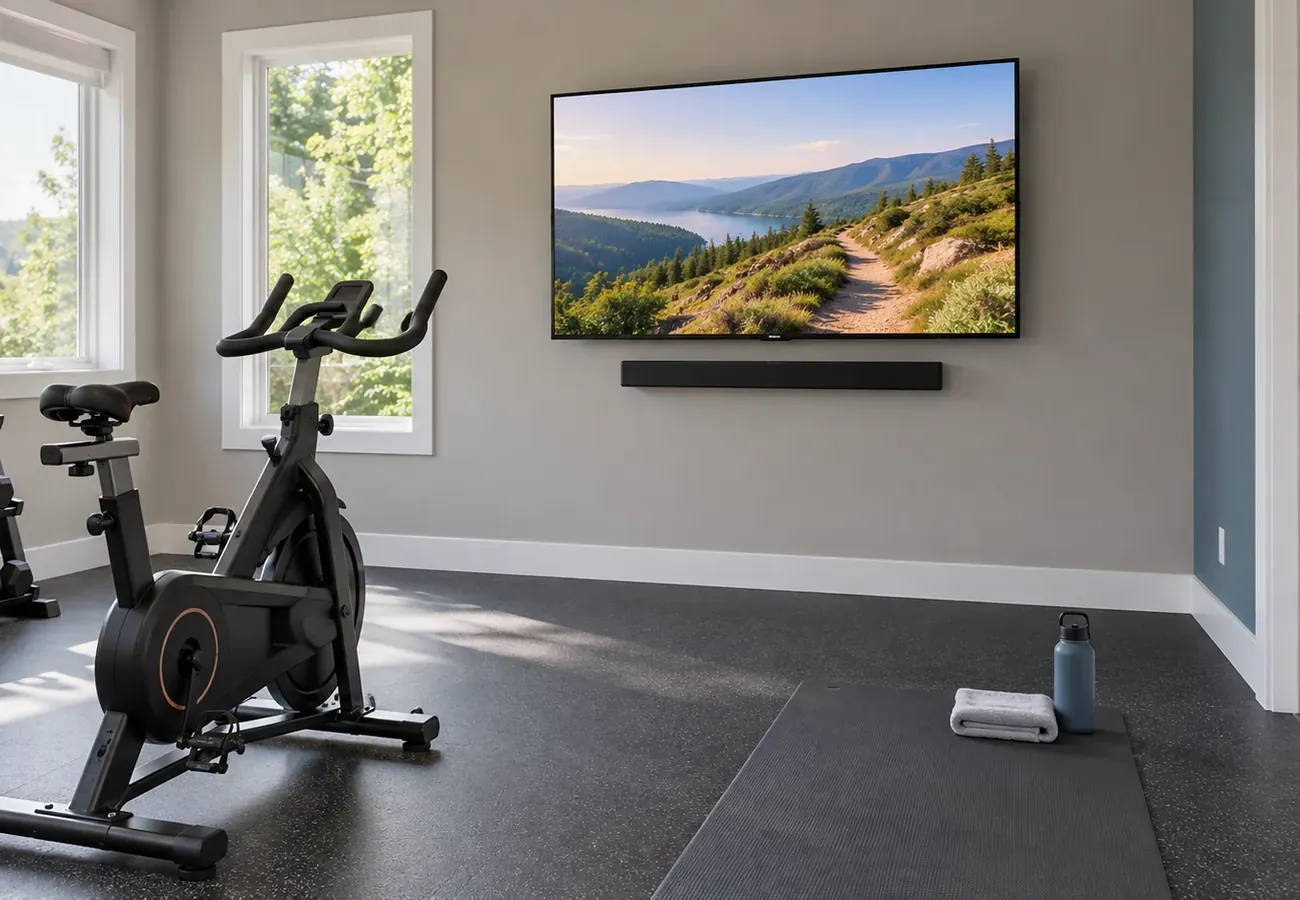
Wall-mounted TV with a slim black soundbar beneath it on a grey wall, above an exercise bike, a dark rubber floor, a mat and a water bottle beside a white baseboard — DUMBO, Brooklyn soundbar installation
A bar under the screen in a workout room: a rubber floor, an exercise bike and nothing on the floor near the TV wall to knock.
Coverage Area

Soundbar Installation Near DUMBO's Landmarks

We cover every block of DUMBO, from Old Fulton Street and the Brooklyn Bridge to the Manhattan Bridge anchorage and on toward Vinegar Hill, and from the river up to York Street. These six places anchor the neighbourhood, and each stands among buildings of a particular age and construction.

The Clocktower, 1 Main Street

Gair's 1914 office and factory building, the tallest reinforced-concrete building in the world when it went up, according to the Improvement District. Converted to condominiums in 1998 and the model for the concrete lofts around it.

Manhattan Bridge Archway and Pearl Street Plaza

The arch under the bridge's Brooklyn anchorage, restored with new lighting as part of the city's 26-block reconstruction, beside the 2,500-square-yard Pearl Street Plaza that opened with it. The MTA also took train readings at the archway.

Empire Stores

Seven brick warehouses at 53–83 Water Street, built in 1870 and 1885 to store coffee, hides, sugar and molasses for Arbuckle Brothers, and now offices, shops, restaurants and event space beside Brooklyn Bridge Park.

St. Ann's Warehouse

A brick-and-timber tobacco inspection warehouse of 1870 at 45 Water Street, cut back when New Dock Street was built and twice saved from demolition. Now a city landmark and home of the theatre company, with the Max Family Garden.

Jane's Carousel, Brooklyn Bridge Park

A carousel built in 1922 by the Philadelphia Toboggan Company, restored and open year-round in the 85-acre park the Improvement District says averages more than 600,000 visitors a week. Sandy flooded the basement holding its electronics.

135 Plymouth Street

The E. W. Bliss machinery factory of 1900, which employed more than 1,600 people by the early twentieth century. It now holds loft apartments, shops and the Adams Street Library, and it is where the MTA logged its loudest reading at a home in 2023.

We also install soundbars in the neighbourhoods around DUMBO: Vinegar Hill and the Navy Yard edge to the east, Fulton Ferry by the Brooklyn Bridge, Downtown Brooklyn up the hill and, just to the south, soundbar installation in Brooklyn Heights, where the walls are rowhouse brick and plaster rather than factory concrete. The Brooklyn soundbar installation page covers the whole borough.

Pricing

Soundbar Installation Cost in DUMBO

DUMBO is billed on the Brooklyn list, and Brooklyn is the base our other areas are multiplied from, so there is no neighbourhood surcharge. Choose the lines that match your room. If the wall turns out to be something other than what was booked, you get the revised total before any drilling starts.

ItemPriceWhere it comes up in DUMBO
Soundbar placed on a console or stand$79Rental lofts, alterations still awaiting approval, rooms not yet furnished
Soundbar wall-mounted under the TV$129The standard job in loft living rooms, bedrooms and meeting rooms
Sanus soundbar bracket$84.99Bar shipped without a bracket, or its bracket was made for drywall rather than concrete
In-wall concealment$169Hollow partitions built during a conversion
Paintable cord cover$59Concrete and brick walls that can't hide a cable
Cable carried to a closet, credenza or cabinet (25 ft maximum)$99Boxes in a closet or credenza across an open plan
Sonos setup$125Bar, sub and rears paired and grouped in the Sonos app
A/V receiver$129A receiver kept for turntables, older speakers or a projector
Universal remote$99A cable box or player that ignores CEC
Streaming device setup$49Roku, Apple TV or Fire TV stick logged in and mapped to its HDMI input
Full home theater$350Every source, the bar or receiver, the sub and the rears configured together on one trip

Wall and access lines in DUMBO buildings

ConditionPriceTypical DUMBO setting
Drywall on wood studs$0Bedroom and closet partitions in conversions
Metal studs+$30Partitions in newer towers and many conversions
Plaster+$45Where old plaster survives, as in some of the small early buildings
Brick or stone+$65Bearing walls in the riverside warehouses
Concrete or cinder block+$75Gair factory walls and piers, tower walls and columns
Tile or marble+$95Tiled feature walls, only with your go-ahead
Plywood backer board$85Furred walls where nothing solid lands under the bracket
High mount (above about 8 ft)$75Bars following a TV hung high on a tall loft wall
Walk-up, 3rd floor and above, no elevator$40Upper floors in any building without a lift
Box removal$25Cartons taken away rather than left for the recycling room
Certificate of insurance for your buildingFreeCondo boards, rental managers, coworking operators, commercial landlords

Five DUMBO jobs added up

Nothing in these totals is estimated: every figure is the sum of lines already shown above, so you can check how a DUMBO quote comes together. Treat them as examples; the wall itself fixes your number.

ExampleLinesTotal
Gair-building condo: Sanus bracket into the concrete wall, cable hidden in a painted channel$129 + $84.99 + $75 concrete + $59 cord cover$347.99
Tower apartment: light-gauge steel partition, Sanus bracket supplied, HDMI and power concealed in the cavity$129 + $84.99 + $30 metal studs + $169 in-wall$412.99
Water Street warehouse loft: bar on the brick bearing wall with its own bracket, HDMI taken along the baseboard to a closet$129 + $65 brick + $99 cable run$293
Rental loft: nothing drilled, Sonos bar on the credenza, sub and surrounds grouped, streaming stick added$79 + $125 Sonos setup + $49 streaming$253
Open-plan loft: bar fixed to the TV's articulating arm with our bracket, HDMI run to a closet within 25 ft$129 + $84.99 + $99 cable run$312.99

Setup-only visits, callbacks and TV mounting

Plenty of DUMBO calls need no drill at all: re-running a calibration that a train spoiled, getting eARC to pass sound again after a TV update, re-pairing a sub or taming a remote. Those are billed as a Brooklyn setup-only visit, $195 for the first hour and then in 30-minute blocks. A TV hung on the same visit is priced on its own lines from the Brooklyn TV mounting base of $179.99, listed on our Brooklyn TV mounting prices page. Return calls outside a booked job are $195 per hour with a three-hour minimum ($585). A $150 return-trip charge applies if work can't start because the bar or bracket isn't there, nobody can let us in, or the building's approval hasn't arrived; moving the appointment with 24 hours' notice is free.

What's included, and what belongs to other trades

  • Included: the mount and bar secured, audio linked over HDMI or optical, volume on the TV remote via CEC, leads dressed, calibration, a lip-sync test and a vacuum of our dust.
  • Electrician: a new outlet behind the TV, moving an outlet, or any new power circuit. In a condo, the board's alteration rules will usually say who may do that work.
  • Structural engineer: any cracking or spalling in concrete that looks like more than surface damage.
  • Window contractor: upgrades to keep train noise out. In the historic district, window changes may also need Landmarks approval.
  • Your own bracket: welcome if its rating covers your bar and its fixings suit the wall; any warranty on it is between you and its manufacturer.
Shop Our Systems

Soundbar Installation Packages & Pricing

Three combinations cover most DUMBO rooms. The card prices are plain sums of list lines, and wall, stud, high-mount or walk-up lines join them only where your room needs them.

STARTER — CONSOLE PLACEMENT
$79

No holes anywhere: the bar sits on the console clear of the TV's infrared sensor, connects to the eARC or ARC port with CEC on, and its leads are tucked behind the furniture. The obvious choice under a lease or while an alteration request is pending.

STANDARD — WALL MOUNT WITH BRACKET
$213.99

Our Sanus bracket ($84.99) plus the $129 wall mount. Concrete adds $75, brick $65 and a steel-stud partition $30; a painted channel for the cable is $59 more.

PREMIUM — CONCRETE WALL, CHANNEL AND CLOSET RUN
$446.99

The standard card on a concrete wall ($75), with the cable in a painted channel ($59) and a run of up to 25 feet to a closet or credenza ($99), so the boxes leave the TV wall entirely. The full treatment for a Gair-building living room.

Bring Your Own Equipment — Labour Only

Supplying the bracket yourself, whether it came in the box or you ordered it separately? You're charged for labour alone: the $129 mount and whichever wall line applies. The bracket must be rated for the bar, and its warranty stays with whoever made it. Where it was built for drywall and your wall turns out to be concrete, we flag it before the first hole so you can swap to our Sanus bracket.

Lounge with a wall-mounted TV and slim soundbar on a cream wall beside a framed print, green upholstered armchairs on a rug, a round side table and a tall window wall to the right — DUMBO, Brooklyn soundbar installation
One screen and one slim bar on the solid wall at right angles to a big window: less glare on the picture and less sound thrown at the glass.

Get the DUMBO Total in Writing

One photo and a model number get you an itemised DUMBO total, every Brooklyn line shown and summed, before a visit is even booked.

Block by Block

Six DUMBO Buildings, Six Different Visits

In DUMBO the building changes the job more than the bar does. Each sketch below is a composite of one building type and what we bring for it; none describes a real client's home.

A condo in one of the Gair concrete buildings

Main Street and Washington Street, in buildings poured between 1905 and 1919. The living room has a concrete ceiling, at least one mushroom column and a run of window bays between concrete piers, which leaves one long interior wall as the obvious TV position. We arrive with a hammer drill, a metal scanner and dust extraction, confirm with the managing agent that the work falls inside the building's hours, and fix the bracket into concrete after a pilot hole. The cable goes down a painted channel to a credenza, or across to a closet on a run of up to 25 feet, because cutting into the concrete isn't an option anyone wants. Calibration waits for the furniture and a gap between trains.

A rental loft in a brick-and-timber warehouse near the water

Water Street and the blocks around Empire Stores. The outside walls are thick brick, the ceiling is heavy timber beams, and the floor is old plank that may carry sound to the unit below. If the apartment is rented, the first question is whether the landlord allows holes in the brick at all. If not, the bar goes on the console or on a TV-attached bracket. If yes, we anchor into the face of sound brick and run a painted channel. Because timber floors pass bass downward, the sub goes on isolation feet and away from the beam lines, and we set its level with the neighbour below in mind.

An office floor in a steel-framed warehouse on Jay Street

Buildings like 68 Jay Street, a 1915 tea warehouse with a steel frame and concrete floors, now full of offices and studios. The TV usually goes on a partition in a meeting room. We confirm whether it's steel stud (adding $30), find a stud or use the right toggle, and keep the bar close under the display so voices come from the screen during video calls. The landlord gets a certificate of insurance before we arrive, and the bar's volume can be capped so a meeting doesn't carry into the open office next door.

An apartment in a newer tower near York Street

High-rise condos and rentals with concrete structure, steel-stud partitions and window walls. The condo's alteration rules and the managing agent's paperwork set the timetable: proof of insurance, approved hours and an elevator booking. On the day the TV wall is often a steel-stud partition where the in-wall kit can hide every cable, which makes these the tidiest finishes we do in DUMBO. Glare from the window wall decides which wall gets the screen, and the bar is calibrated with the blinds in the position you normally keep them.

A converted mid-century factory

The 1950 Brillo building at 200 Water Street is the best-known example. Construction is later than the Gair buildings but still industrial, and apartments mix block, concrete and newer partitions. We test each wall separately. Concrete and block take the $75 line, partitions take none or the $30 steel-stud line, and the bar usually ends up on whichever wall gives the sofa the best view rather than the one easiest to drill.

A small early building on Front or Old Fulton Street

The handful of 1830s and 1860s buildings near the ferry landing and the Brooklyn Bridge, with restaurants and shops at street level and apartments or offices above. Walls may be old brick, old plaster or entirely renovated. These are the jobs where a photo matters most before we quote, and where a sub must be set gently because the restaurant or the apartment is directly below. Night mode and a capped volume are set from the start.

Boards, Landlords and Operators

Condo Boards, Rental Managers and Landmarks: Who Signs Off

In a DUMBO loft, the wall is rarely the only thing that decides where a bar goes. Nearly every home here sits in a building with a manager, a board or a landlord, and most of the district sits inside a landmark boundary. None of that makes a soundbar complicated, but it does change who you ask first.

If you own a condo, the building's alteration rules come first. The Clocktower is a condominium, and so is the Eagle Warehouse at 28 Old Fulton Street. Boards differ: some treat a soundbar bracket as minor work needing only notice and an insurance certificate, others want a written description and approved hours. Ask the managing agent before booking, and we'll send whatever they request that a contractor can provide, including the certificate at no charge.

If you rent, drilling is the owner's decision, and concrete or brick holes are harder to hide at move-out than drywall ones. The Improvement District put DUMBO's rental vacancy rate at 7.6% and homeowner vacancy at zero in 2020, so plenty of people here rent, and the building's owner sets the rules on drilling. A bar on the console ($79) needs no permission; a TV-attached bracket adds no holes beyond the TV mount's. If the landlord agrees to a wall mount, get it in writing.

If you work in a coworking or shared office, the operator's member rules apply, and the landlord's sit behind those. Assume nothing gets fixed to a wall without the operator's written yes. Our FAQ below covers the practical options.

And the landmark district. The DUMBO Historic District, designated on December 18, 2007, protects the outside of about 91 buildings. A bar on an inside wall, with low-voltage cable inside the apartment, doesn't change any of that. Anything fixed to a facade, window frame or roof, including an outdoor speaker on a terrace visible from the street, is a different matter and goes through the Landmarks Preservation Commission. This is general guidance, not legal advice; your board, managing agent or the Commission can tell you what applies to a particular piece of work.

Before We Arrive

Seven Things to Sort Before a DUMBO Visit

  • A picture taken from where you sit, showing the whole TV wall, the windows, any column and the closest outlet. One frame answers most of our questions about a loft.
  • Model numbers for both bar and TV, which tell us the bracket pattern, the connections and whether eARC is available before anyone travels.
  • Your building's contractor rules: permitted hours, freight elevator booking, and the name to put on the certificate of insurance.
  • Written permission from the landlord, managing agent or coworking operator if anything will be fixed to a wall.
  • Where the boxes live: cable box, router, console or receiver, and whether you'd like them moved off the TV wall.
  • The Wi-Fi network name and password, typed in by you or whoever is home, so the app and streaming services can be signed in.
  • The rug and sofa in place, if possible, so the calibration is tuned to the room you'll actually be watching in.

On our side: hammer drill, rebar scanner, dust extraction, every anchor and lead, felt pads, isolation feet and floor protection. The carton can leave with us for $25.

Complete Services

Every Soundbar Installation Service in DUMBO

A concrete loft rewards doing related work on the same visit, along the same cable route and with the same paperwork. These are the AESS services DUMBO homes and offices most often add, each with its own DUMBO page.

TV Mounting in DUMBO

TVs anchored into factory concrete, warehouse brick or tower partitions, with space for the bar planned under the screen from the start.

Structured Cabling, DUMBO

Network and HDMI paths across open plans and between floors while a renovation has walls or ceilings open.

Fiber Optic for DUMBO Offices

Backbone fiber for tech and creative tenants in the converted factories.

Intercoms in DUMBO Buildings

Entry stations for loft buildings and condo lobbies.

Security Cameras, DUMBO

Cameras for loading doors, storefronts and lobbies.

Access Control in DUMBO

Card and phone entry for office floors, studios and shared buildings.

Sonos Installation in Brooklyn

Sonos bars grouped with speakers in a kitchen, a bedroom or a roof deck.

Visit Policies

Arrival windows, return trips, rescheduling and how setup-only time is billed.

FAQ

DUMBO Soundbar Installation FAQ

A film crew has put no-parking signs up on our block for the day of our appointment. Should we move it?
+

Usually not. Shoots are common in DUMBO; NY1 reported in 2018 on a five-day production with trailers lined up and no-parking signs on the lampposts. A soundbar visit needs no truck at the door: we park where we can and carry the tools in. Let us know when you see the signs so we can plan the walk and allow extra time for crowds on Washington Street. If the shoot blocks your building's entrance or loading door, we move the visit at no charge with 24 hours' notice.

What would a bar hung from our TV's articulating arm, with the HDMI taken to a closet across the loft, come to in DUMBO?
+

With our Sanus bracket carrying the bar on the arm and a cable run of up to 25 feet: $129 + $84.99 + $99 = $312.99. If the bar's own bracket fits the arm, take off the $84.99 and it is $228. Fixing the bar to the arm adds no holes, so there is no concrete or brick line. If the TV itself is being hung on the same visit, it is priced separately from the $179.99 Brooklyn TV mounting base.

We have a private office in a coworking building. Can a TV and soundbar go on our office wall?
+

Only with the operator's written permission, because the walls belong to them, or to their landlord, not to the members. Ask the community or building team first; we can send them the bracket details and a free certificate of insurance. If wall fixings aren't allowed, a TV on a floor stand with the bar on its shelf or on a credenza ($79 placement) gives you the same sound with nothing fixed to the wall, and it leaves with you when you move offices.

A projector screen drops from the ceiling in front of our TV wall. Where should the soundbar go so it works with both?
+

Not directly behind where the screen comes down, because a solid screen in front of the bar muffles it. The usual answers are a bar on a console that sits forward of the screen line, a bar mounted low enough that the lowered screen stops above it, or an acoustically transparent screen. Whichever you choose, the projector's sound has to reach the bar too, through the TV's eARC, a receiver or the projector's own audio output, so we plan the connections for both sources on the same visit.

All Areas Served

Soundbar Installation Across Brooklyn and New York

This page sits under our Brooklyn soundbar installation page, which sits under the New York City soundbar hub covering all five boroughs. The suburban counties have their own pages, and neighbourhood pages like this one look closely at the buildings of a single area.

This page is about soundbars only. For cameras, intercoms, locks and network cabling, the AESS home page lists every service, and the about page introduces the people who do the work.

Sources

Where the DUMBO Facts Come From

Every local fact on this page comes from a published source, listed here so it can be checked. Figures that cover a wider or different area than the neighbourhood are marked as such where they appear.

  • Historic district and construction types: NYC Landmarks Preservation Commission, DUMBO Historic District Designation Report (designated December 18, 2007; about 91 buildings; mill, steel-frame and reinforced-concrete construction; Belgian block and Jay Street Connecting Railroad tracks; 1 Main Street converted in 1998).
  • Neighbourhood boundaries, name and population: Wikipedia, “Dumbo, Brooklyn” (boundaries, ZIP 11201, Community Board 2, Tech Triangle, 2020 census count).
  • Housing, business and park figures: DUMBO Improvement District, “Dumbo By the Numbers” (2023 residents and units, 2024 median sale price, 2020 vacancy rates, 2022 companies and employees, Brooklyn Bridge Park visitors). Its boundary is wider than Wikipedia's.
  • Building histories: DUMBO Improvement District, “Dumbo by the Buildings” (1 Main, 45 Main, 55 Washington, 81–89 Washington, 16 Main, 68 Jay, 200 Water, 135 Plymouth, 45 Water, Empire Stores, 1 and 5–7 Front, 28 Old Fulton, 85 Water).
  • 1 Main Street interiors: The Roebling Team at Compass, building profile of 1 Main Street (124 units, 16 floors, concrete ceilings, mushroom-capped columns, window bays, ceiling heights).
  • Train noise: MTA, New York City Transit Noise Reduction Report for 2023 (DUMBO memo of January 18, 2024, residential measurements); Brooklyn Paper, “Deaf in DUMBO,” September 25, 2008.
  • Residents' comments: posts on r/DUMBO, r/NYCapartments and r/AskNYC (search excerpts; quoted as individual opinions).
  • Streets and archway: NYC DOT, “City Completes $108 Million Historic Street Restoration and Upgrade in Dumbo,” November 19, 2025.
  • Sandy: CBS New York on Jane's Carousel; Associated Press photo captions of flooded streets under the Manhattan Bridge, October 29, 2012; Jane's Carousel website (built 1922).
  • Filming: NY1, “DUMBO Residents at Odds with Influx of Film Shoots, Tourists,” October 18, 2018.
  • Coworking: WeWork, Dumbo Heights (77 Sands) building page.
  • Historic concrete: National Park Service, Preservation Brief 15 (aggregates, carbonation and corrosion).
  • Audio and equipment: Sonos support (Trueplay tuning and background noise); Bang & Olufsen (how active noise cancellation works); SVS and AVS Forum (subwoofer isolation); Dolby speaker-setup guide and Polk Audio Atmos guide (ceiling heights); AWOL Vision (eARC and ARC); Sonos and Sanus product pages; r/hometheater and r/Acoustics posts on echoey rooms.
  • Cost claims quoted: Homewyse, Thumbtack, Angi, and a Yelp question answered by a TV installer in September 2025.
  • Noise code and access: NYC DEP noise code guide (commercial music limits); 2010 ADA Standards (protruding objects).

Lost the Sound Somewhere Between the Two Bridges

The TV shows a picture but the bar stays silent, the remote no longer turns it up, or the sub's light keeps flashing without pairing: call (347) 934-8335. The next open two-hour window is yours, and faults of this kind are usually put right within an hour or two on site.

Soundbar Installation in DUMBO — Licensed, Insured, at Home in Concrete

Abstract Enterprises Security Systems · 1282 Troy Ave, Brooklyn, NY 11203 · serving DUMBO and all of Brooklyn · (347) 934-8335 · WhatsApp (718) 679-0359 via wa.me

NYS Low-Voltage Licence #12000287431 · 100% Licensed & Insured · Same-Day Estimates · Rated 4.7★ from 201 Google Reviews

Brackets and parts carry their manufacturer's warranty. Full terms — including 50% deposit, one-year parts-only warranty on AESS-supplied products, and the late-fee schedule — are set out in the service agreement. See our warranty page.

Last reviewed October 17, 2026. Changelog: first published for DUMBO lofts, offices and shops, drawing on the 2007 designation report, building histories, the MTA's 2023 train-noise measurements and Sandy flood reporting.