Retrofit Run Repair · Outdoor Camera Leads · Garage & Attic Routes · Siding Entries · Jack & Panel Re-Termination · Certification
Almost nobody in Tottenville lives in a house that was built for Ethernet. The village north of Hylan Boulevard went up for oystermen, shipbuilders and train crews; the colonials south-east of it were built in the 1980s and 1990s with phone jacks and cable-TV outlets; the shore houses were rebuilt after Sandy around everything but the network. So the Cat6 in them was added later, by whoever was handy, along whatever route was quickest. When a link dies, we test it to category, find the shortcut it took through the house, and repair it so it stays fixed.
Reviewed and updated October 21, 2026 · Written by Anwar Timothy, NYS licence #12000287431
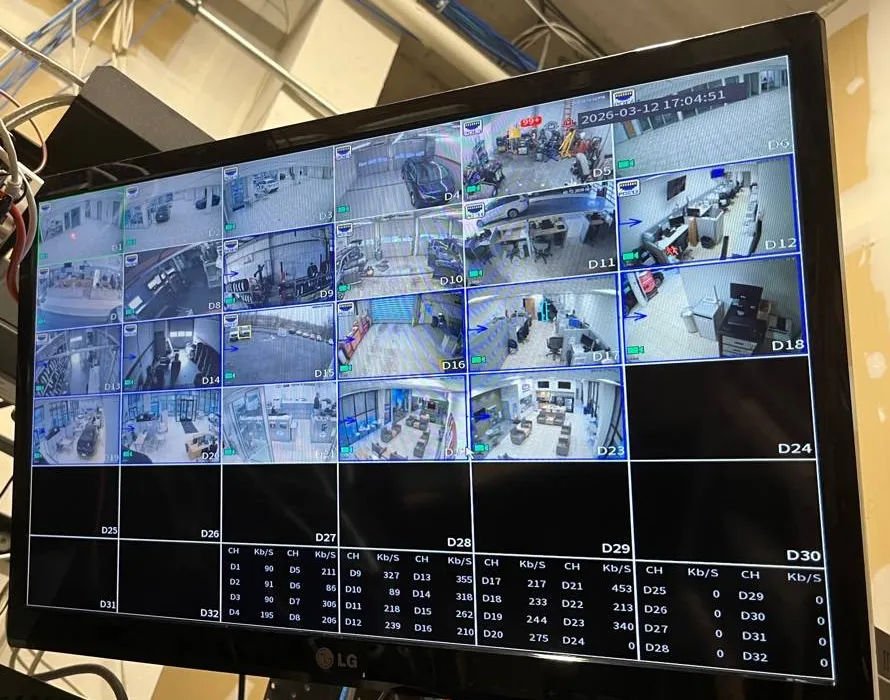
Reference photo from another AESS job: a recorder screen listing each camera channel and its bitrate, the quickest check that every networked camera is still sending.
Tottenville Cat6 Repair Quote
Tell us the house and what stopped working — a technician answers the same business day
✅
Request Sent!
A technician will call you back the same business day.
25+
Years Experience
✓
Same-Day Estimates
100%
Licensed & Insured
4.7★
201 Google Reviews
Camera over the garage gone blank, the upstairs office dropping out, or a wall jack that has not worked since the siding was replaced? Call (347) 934-8335 or fill in the 60-second form. A licensed technician reads what you send and tells you, before anything is booked, whether it sounds like a worn ending, a damaged run, a route that was never going to last, or a router, camera or computer that no amount of cable work will cure.
Every suspect link certified from both ends, so we open the one place that is actually broken
Outside work done to the siding, stucco or brick it passes through, with sealed entries and proper mounting
Licensed in New York State (#12000287431) and insured; one written price and no charge for the drive down the island
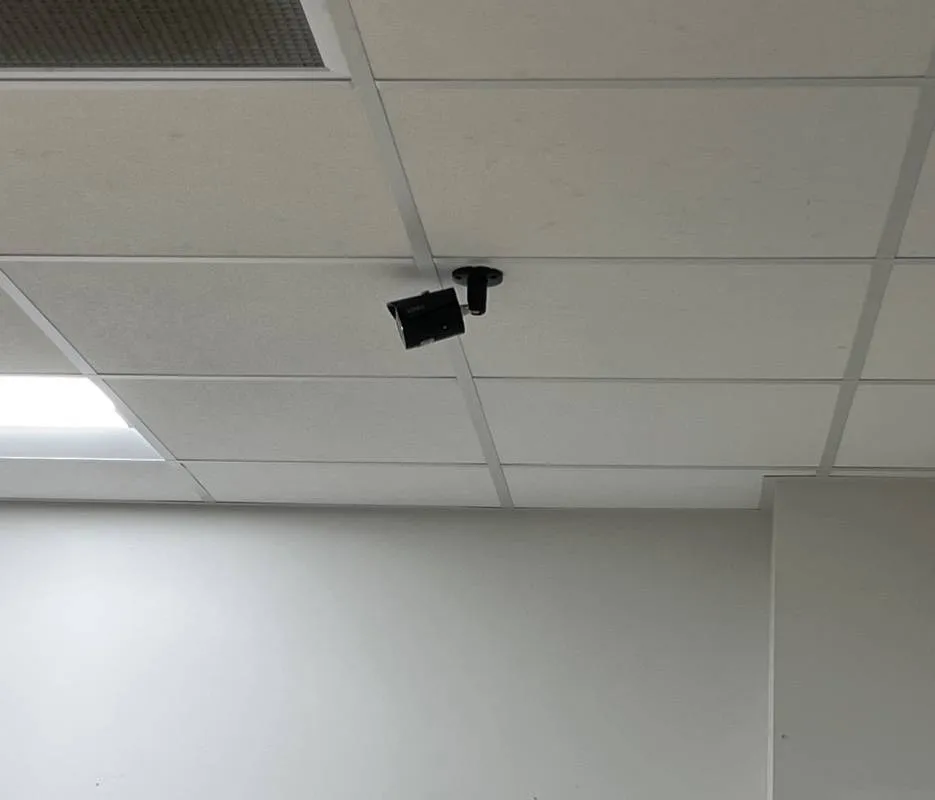
Reference photo from another AESS job: a bullet camera on a pendant mount through a ceiling tile, its cable hidden above the tile.
The Neighborhood
Why Tottenville Properties Need Cat6 Repair: Retrofit Runs in Houses Wired for Phones
Tottenville is the last stop. It is the southernmost neighbourhood in New York City and in New York State, bounded by the Arthur Kill on the west and north and by open water to the south, and the Staten Island Railway has ended here since June 2, 1860. The trip back up to St. George is fourteen miles and about forty-two minutes. Most people here own the place they live in — a little under 83 percent of homes are owner-occupied — and most of those homes are houses rather than apartments. That shapes what a Cat6 repair looks like. It is almost always somebody’s own house, wired one room at a time over the years it has been lived in.
The houses come from two building booms a century apart. The first is the old village around Main Street, Bentley Street, Hopping Avenue, Satterlee Street and the western end of Amboy Road: Greek Revival and Italianate houses from around 1850, Victorian and Gothic Revival cottages from the 1880s and 1890s, Colonial Revival houses from the early 1900s, many of them built for oyster catchers, boat builders, ship joiners and railway men. About one home in five in Tottenville dates from 1939 or earlier. The second boom began when the land south-east of Hylan Boulevard, which had been almost empty, filled with new houses in the 1990s. More than half of today’s homes were built between 1980 and 2009, and the median house dates from 1989. By 2006 a local broker quoted in The Cooperator was describing the newest houses as “Florida Style” centre-hall colonials with stucco and brick fronts, many of them replacing 14-foot-wide bungalows.
Neither generation was built with network cable in mind. A house from 1890 was wired, if at all, for electric light long after it was framed. A house from 1995 was handed over with telephone jacks and coaxial outlets, and the computer, the camera and the Wi-Fi point came later. So the Cat6 that serves most Tottenville rooms today is retrofit cable: fished down a stud bay, laid behind a knee wall, stapled across a garage ceiling, run down the outside of the house and in through the rim joist, or tucked behind a downspout to reach a camera at the back. Those routes were chosen for speed, not for twenty years of service, and they are where faults collect.
The third kind of house is the newest. Superstorm Sandy hit the Tottenville shore hard in October 2012; the Staten Island Advance described a wave tearing through the end of Yetman Avenue near Billop Avenue and leaving bare foundations full of muddy water, and the state later wrote that waves had knocked homes off their foundations. Many shore houses were repaired, raised or rebuilt, and in September 2024 the state finished the $111 million Living Breakwaters project offshore. Network cable in those homes is newer, but it was usually threaded through a house built in a hurry, around flood-resistant details, by trades who were not thinking about data. Our Staten Island Cat6 repair page covers the flood-line side of that in detail; this page is about the routes.
Tottenville facts that shape a Cat6 repair
5,412 homes, median year built 1989. Of those, 2,998 — about 55 percent — went up between 1980 and 2009, the era of phone-and-coax wiring (American Community Survey estimates, via Point2).
1,101 homes, about 20 percent, date from 1939 or earlier — the plaster-and-lath village where balloon framing and knee walls are common.
51.6 percent detached houses, 24.4 percent in two-unit buildings, 19.8 percent attached single-family (same survey). Long runs to garages, yards and second units are normal; shared risers are not.
2.505 square miles in the city’s southernmost neighbourhood; the wider Tottenville–Charleston tabulation area counted 16,089 residents in 2020, down 4.6 percent from 2010 (Wikipedia, citing the census).
Intense home building south-east of Hylan Boulevard in the 1990s, on land that had been almost uninhabited, with a second shopping core growing along Page Avenue and west of Amboy Road.
Living Breakwaters, completed in September 2024: eight partially submerged breakwaters, 2,400 linear feet, designed to bring waves near homes and roads below three feet, with sand added from Manhattan Street to Loretto Street.
Most Tottenville owners who call us about a dead jack are also thinking about the cameras round the house or the alarm; if that is you, our camera repair team on the island can look at the cameras on the same visit once the cable is proven.
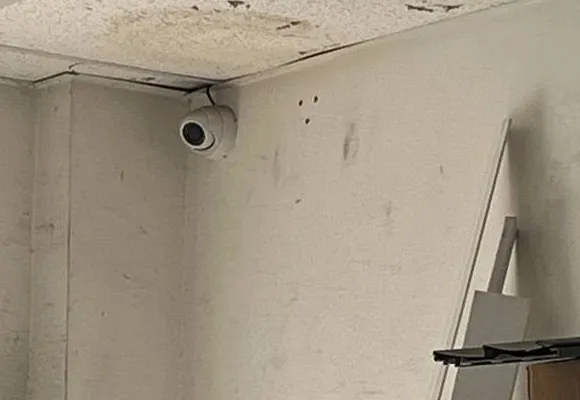
Reference photo from another AESS job: a dome camera in a storeroom corner below water-stained ceiling tiles, where a leak can reach the cable above.
Lost a Link South of Hylan This Morning?
Call (347) 934-8335. We offer same-day repair visits on the South Shore when the schedule allows, and most faults at a jack, a plug or a panel port are found and fixed within one to two hours of the technician reaching the router. If the run itself has been crushed against a garage track or water has got into an outdoor box, we make it safe on the first visit and price the proper repair before we leave.
We install replacement cable, jacks and supports as part of every repair, but the work starts with the fault. These are the jobs Tottenville houses and shops generate most.
Outdoor Camera Lead Repair
Cat6 to cameras on soffits, garage fronts and back corners, where indoor cable was used outside, a plug sits in an unsealed box, or the run follows a gutter. Rebuilt with outdoor-rated cable and sealed endings.
Garage-Ceiling and Opener-Side Runs
Cable stapled across the ceiling of an attached garage to reach a camera, a keypad or a room above, too close to the opener rail, the door track or the springs. Re-routed and re-supported where moving parts cannot reach it.
Stud-Bay and Knee-Wall Retrofits
Runs fished down the open cavities of a balloon-framed village house, or laid in the low triangular space behind a dormer’s knee wall. Traced, reached through the smallest opening and replaced in a safer path.
Siding, Stucco and Brick Entries
The hole where a cable leaves the house: sleeved, sealed and given a drip loop, with boxes mounted on a proper block rather than screwed through vinyl or into crumbling stucco.
Jack and Panel Re-Termination
Worn wall jacks, loose punch-downs and mismatched wiring schemes remade on hardware of the same category, often in the small media panel or the basement board where the house’s Cat6 ends.
Upstairs Office and Bedroom Links
Home offices and bedrooms on the second floor of a colonial, fed from a basement or garage router through a closet or an attic. Tested end to end and repaired without opening finished rooms where it can be avoided.
Wi-Fi Access Point Feeds
Ceiling and hallway access points that have dropped back to a wireless link because the cable behind them failed. The run is tested under power before anyone blames the access point.
Shop Counters and Back Offices
Card terminals, receipt printers, back-office desks and cameras in storefronts on Main Street, Amboy Road and Page Avenue, repaired around opening hours.
Certification and Records
Each repaired run is measured against its category, tagged with the room name at the jack and at the panel, and drawn on a rough plan of the house you keep.
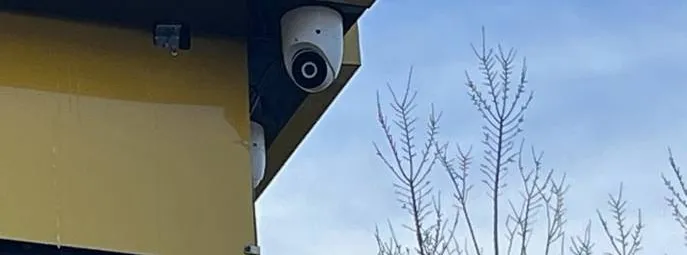
Reference photo from another AESS job: an outdoor dome camera under a fascia edge, the kind of exterior run that needs outdoor-rated cable and a sealed entry.
Building Specialists
Cat6 Repair for Tottenville’s Architecture
House age matters more here than in most of the city, because the age decides where a retrofitted cable could go. These are the six kinds of building we meet most, and what each one means for a repair.
Mid-1800s Village Houses
Greek Revival and Italianate houses from about 1850 on Bentley Street and Amboy Road, many built for boat builders and ship joiners. Heavy timber, plaster on lath, low cellars and few straight paths between floors.
Late-Victorian Cottages and Porch Houses
Gothic Revival and other Victorian houses of the 1880s and 1890s on Hopping Avenue and nearby streets, often with wrap-around porches, sunrooms and dormered top floors with knee walls.
Early-1900s Colonial Revival Houses
Houses of 1900–1925 with larger rooms and attics, still usually balloon-framed or close to it, where a cable can drop a long way inside one cavity.
1980s–2000s Colonials and Two-Families
The houses south-east of Hylan Boulevard: centre-hall colonials, side-hall houses and two-family homes with attached garages, finished basements and vinyl, stucco or brick fronts. Built with phone and coax; network cable added later.
Townhouse and Condo Communities
Attached houses in managed communities, where the outside walls and roof may belong to the association and any new hole for a camera run needs its approval first.
Raised and Rebuilt Shore Houses
Homes near the beach and the Conference House Park side that were repaired, raised or rebuilt after Sandy, with entries, enclosures and utility space arranged around flood rules.
How the repair changes with each house
Village houses: we look for the open stud bay the original installer used and decide whether the replacement can use it again, then restore any fire blocking we pass through. Holes in old joists stay within the usual boring limits.
Porch and dormer houses: runs behind knee walls are reached from the hatch or a small opening at the base of the wall, and new cable is supported off the floor of that space so stored boxes do not crush it.
1990s colonials: the garage, the attic over it and the outside walls are where the shortcuts are. We re-route away from the opener and the door track, and move outdoor boxes onto mounting blocks.
Two-family houses: each unit’s runs are traced to their own end before anything is cut, because the two networks frequently share a basement wall.
Townhouse communities: outside work waits for the association’s approval; inside work does not, and we can usually test and repair indoor links on the same visit.
Shore houses: terminations and equipment stay above the flood-resistant levels the house was rebuilt to; only continuous cable passes lower.
Materials we match, era by era
A repair should look as if it belongs to the house. In the village houses that usually means low-profile plates in white or ivory that sit flat on uneven plaster, mounted on old-work brackets that grip the lath rather than a box that needs a large hole, and cable kept out of sight along the cellar joists rather than across the baseboards. Where an old house has original trim, we go under it or behind it, never through it.
In the colonials, the existing plates and media panel set the standard. Builders of the 1990s and 2000s often used one brand of plate throughout the house, sometimes with phone, coax and data on the same plate; we match the style and colour of the plate and keep the other services on it working when we replace the data jack. Outside, boxes and raceway come in white, beige or grey to sit quietly against the siding or stucco, and on brick we follow the mortar lines.
In the shore rebuilds the materials are dictated more by the rules than by looks: flood-resistant finishes below the design flood level, sealed boxes, and continuous cable only. Upstairs, on the living floors, the work is the same as in any newer house.
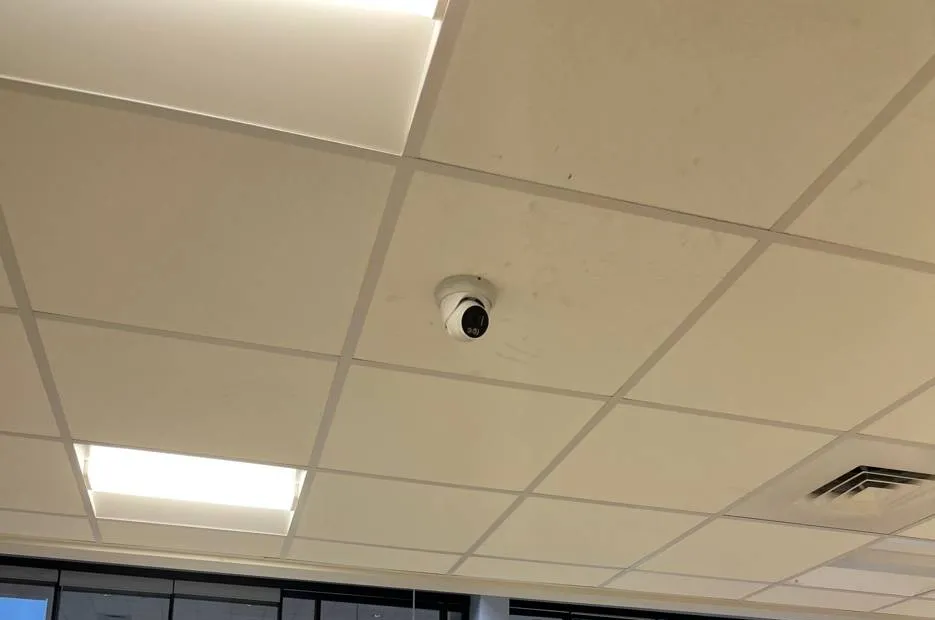
Reference photo from another AESS job: a dome camera set in a drop ceiling between a light panel and a vent.
Commercial Cat6 Repair
Business Cat6 Repair in Tottenville
Tottenville’s businesses are small and spread along a handful of roads. Few have a server room; most have a router in a back room, a switch under a counter and cameras on the front. These are the corridors we cover, and who works on them.
Main Street
The old commercial street of the village, with the 123rd Precinct at 116 Main Street, the post office at 228, the Masonic Hall and, since 2017, Scott LoBaido’s flag mural at Main and Amboy. Shops, delis and offices in older buildings, often with an apartment above.
Amboy Road
The long spine past the Carnegie library at 7430, the landmark houses near 7484 and 7647, Engine 151 and Ladder 76 at 7219, and the Tottenville Shopping Center at 7001 Amboy Road, a 45,000-square-foot centre that added a 20,000-square-foot building in a 2013 renovation.
Page Avenue
Part of the neighbourhood’s eastern edge, and with the blocks west of Amboy Road its second commercial core since the 2000s, close to the newer houses south-east of Hylan. Expect small plazas, shops and service businesses rather than office buildings.
Hylan Boulevard
Built in pieces in the 1920s between Rosebank and Tottenville, the boulevard runs right down to the Conference House at the neighbourhood’s southern tip, with businesses scattered among the houses along the way.
Arthur Kill Road and Bricktown
Just north, in Charleston, the Bricktown Centre is an open-air centre with the island’s first Target and its third Home Depot; Veterans Road West has grown into a shopping corridor, and a ShopRite opened there in June 2016.
Home Offices and Practices
Accountants, therapists, contractors and remote workers running a business from a converted room or a finished basement, where one failing Cat6 run is the whole office.
What a South Shore storefront needs from a repair
The pattern is the same up and down Amboy Road: a counter with a card terminal, a receipt printer and sometimes a kitchen printer; a back office with one or two desks; a handful of cameras on the front and the parking lot; and a router the internet company left on a shelf. The links that fail first are the ones that move or get kicked — under the counter, behind the printer, at the front door — and the outdoor camera runs. We test the counter first, keep it working through opening hours, and leave the longer work for when the shop is quiet.
Compliance callouts for Cat6 repair in Tottenville
Permits: a Cat6 repair in a Tottenville house normally needs no electrical permit. Section 28-105.4.7 of the city’s Administrative Code exempts signalling, alarm, communication and data circuits under 50 volts, provided the person doing the work is a licensed master or special electrician or a qualified person under the Electrical Code.
Landmarked houses: several Tottenville buildings are individual city landmarks, among them the Bedell House at 7484 Amboy Road, the Rutan-Journeay House at 7647 and the library at 7430. The Landmarks Preservation Commission’s guidebook ties interior work to a permit only when it also needs a DOB permit or affects the outside; any change to a landmark’s exterior, such as a new camera cable entry, is for the owner to clear with the Commission first.
Separation from power: indoor communications cable is kept at least two inches from light and power conductors except where the code allows otherwise, which matters in older houses where data cable was pushed through the same holes as electrical wiring.
Abandoned cable: dead runs left behind in walls and ceilings make the next fault harder to trace and crowd the holes a new run needs; we offer to take out whatever is accessible when we replace a run.
Fire blocking: where a balloon-framed house has had fire blocking added in its stud bays, a cable that passes through it is sealed again afterwards, so the blocking still does its job.
Structure: holes through joists follow the usual boring limits; in the model residential code, bored holes stay at least 2 inches from the top and bottom edges and no larger than one-third of the joist’s depth. Anything beyond that is a question for a carpenter or an engineer, not for us.
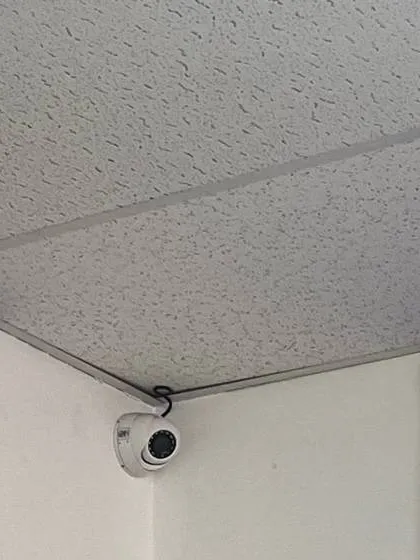
Reference photo from another AESS job: a dome camera in a ceiling corner, its cable looping up into the tile above.
Your Questions Answered
Cat6 Repair in Tottenville: Questions Answered
These are the questions Tottenville owners put to us about the routes their cable takes. They are grouped by the part of the house where the trouble lives, and each is answered straight away.
Inside the village houses
In our 1880s house the wall cavities run straight from the cellar to the attic — when a Cat6 run dropped down one of them fails, can its replacement go down the same space?
Usually, yes, and that open cavity is the best thing about an old balloon-framed house from a cabling point of view. In that way of building, long studs run from the sill to the roof, so a single stud bay can be a clear vertical path from the cellar to the attic. The failed cable is often still the easiest pull line for its replacement: we test it first to find where the damage is, tie the new Cat6 to its end and draw it through, which keeps the plaster closed.
There are three things we check before relying on that path. The first is what else is in the bay: old knob-and-tube or later electrical cable, a gas pipe, a plumbing vent. Data cable is kept at least two inches from power conductors, so a crowded bay may mean moving one stud bay over. The second is whether a later owner added fire blocking — This Old House’s writers describe those open bays as acting “like chimneys” that let fire travel from basement to attic in minutes, which is why renovators block them. If our cable passes a block, we seal around it again with a suitable fire-rated material. The third is what the cable rubbed on: in old houses the damage is often at a sharp edge where the bay meets a floor plate or a nail, and the replacement gets a grommet or a sleeve at that point.
When the bay is blocked solid, we look for the next easiest path — a closet stacked over a closet, a chase beside a chimney that is still in use only for the boiler, or a run along the cellar ceiling and up an inside wall — and we show you the options before opening anything.
The only cable to our dormer bedroom runs through the low space behind the knee wall — how is a failed run there reached?
Through the knee-wall hatch if the house has one, or through a small opening at the base of the wall if it does not. A knee wall is the short wall under a sloped ceiling on the top floor of a one-and-a-half-storey house, and behind it is a cramped triangular attic. Tottenville’s cottages and porch houses have plenty of them, and they are a favourite route for cable because they connect one end of the top floor to the other without opening a finished room.
The trouble is what happens to cable in there over the years. It is laid loose on the floor joists, so stored boxes, suitcases and Christmas decorations end up on top of it. Insulation gets added and the cable gets buried. In houses where the knee-wall space is outside the heated part of the house, it is hot in summer and cold in winter, and the jack at the end often sits in a wall that moves with the temperature. We test the run to find the damaged length, then replace it supported off the joists on hooks or in a light raceway along the back of the knee wall, where storage cannot reach it.
If there is no hatch at all, we can usually make one small opening, low down where furniture hides it, and fit a removable access panel so the next repair needs no cutting. We will tell you before we start whether the run needs that or can be reached from the attic above.
How large a hole can be drilled through the old floor joists for a replacement run, and does where it goes matter?
Size and position both matter, and in a house with timbers more than a century old we stay well inside the usual limits. The model residential code says bored holes in joists must not be within 2 inches of the top or bottom edge and must not exceed one-third of the joist’s depth. A single Cat6 cable needs a hole well under an inch, so the rule is easy to keep; the risk comes from earlier trades who notched the bottom of a joist or drilled several holes side by side. Before we drill, we look at what is already cut, keep our hole near the middle of the joist’s depth, and avoid the ends where joists bear on beams or walls.
Old joists are often deeper and rougher than modern lumber, sometimes with old bark edges or splits. If a joist is already split, notched or sagging, we route around it or under it and point it out to you; deciding what that joist needs is a job for a carpenter or an engineer, and city rules for your house are theirs to apply. In practice, most Tottenville cellar runs can follow the joists rather than cross them, which needs no drilling at all.
Around the newer colonials
Which way should the Cat6 to the camera above our garage door cross the ceiling so the door and opener can never reach it?
Off to one side of everything that moves, and down the wall beside the door frame rather than across the header. An opener’s rail, its trolley and chain or belt, the door panels as they roll up, the torsion spring and its cables all sweep the area above and beside the door every time it opens, so a cable stapled close to them gets brushed, pinched between a panel and the track, or caught when the door is serviced. Opener makers take care even with their own thin control wires: LiftMaster’s manual tells installers to staple the door-control wire to the wall and ceiling without piercing it, because a pierced wire can short or open.
In practice the replacement crosses the garage ceiling well to one side of the rail, then drops to the camera along the wall beside the door frame, supported every few feet with hardware that grips without crushing. If the camera sits right over the door, the last few feet go in a short protective raceway. The staples that held the old cable come out too, because a staple driven hard through a jacket is often where the fault started in the first place.
While we are in the garage we also check the run that goes on into the house. In many colonials the router or switch lives on a garage or basement wall, and the garage is unheated, so connections there get the full range of seasonal temperature; a clean, well-supported termination copes with that much better than a cramped one.
Someone ran our backyard camera cable down inside the gutter downspout — is that why it keeps failing, and where should it go instead?
Almost certainly. A downspout looks like a ready-made conduit, which is why people use it, but it is a pipe built to carry all the water off a roof. Inside, the cable sits in running water through every rainstorm, in standing water when the bottom elbow clogs, and in ice when that water freezes. Leaves and grit grind against the jacket. Water wicks along any nick to the plug at the bottom, and most of these runs end in an unsealed coupler or a bare plug at the foot of the spout. Even outdoor-rated cable is not made to live inside a drain.
The better route depends on the house. On a sided colonial we usually take the cable inside at the soffit or the rim joist close to the camera and run it through the attic or the basement, so only a few feet are ever outdoors. Where it has to stay outside, it goes in its own small UV-stable conduit or raceway beside the downspout, with sealed fittings, a drip loop where it enters the wall, and an outdoor-rated box at the camera. The old cable comes out of the downspout, which also lets the gutter drain properly again.
If the camera has stopped working at all, we test the run before blaming the camera; a soaked plug can look exactly like a dead camera, and a cable that tests clean after the plug is replaced means you saved the price of a camera.
The box where our camera’s Cat6 meets its patch lead is screwed straight to the vinyl siding and keeps pulling loose — how should it be remounted?
On a mounting block, fixed to solid backing behind the siding. Vinyl siding is designed to slide a little as it expands in the sun and contracts in the cold, and siding makers say plainly that fixtures must not be attached to it directly: CertainTeed’s guidance is to attach external fixtures to solid backing such as exterior-grade plywood, never directly to the vinyl, and to allow for the siding’s movement. A box screwed through the vinyl alone is being pulled back and forth every day, so the screws loosen, the box tilts, the gasket opens and the plug inside works itself out.
We replace that arrangement with a mounting block sized for the siding profile, fastened through to the sheathing and framing, with the weatherproof box on the block and the cable entering from below with a drip loop. The connection inside the box is remade with a fresh termination, because a plug that has been rocking in a damp box for a season is rarely worth keeping. On stucco or brick fronts the box goes on masonry anchors set into sound material, and any crumbling around the old holes is patched so water cannot get behind it.
If the siding itself is due to be replaced, it is worth telling the siding contractor about the camera runs before they start, so the blocks go in under the new siding and the cables are not cut or buried; we can leave the cable coiled and labelled ready for them.
The bonus attic over an attached garage
In many colonials the easiest way from the router to the upstairs rooms is through the low attic above the garage, and that is where a lot of retrofit cable lies. It is reached through a pull-down hatch in the garage ceiling or a small door from a bedroom closet, it is usually unfinished and unheated, and it is where the household keeps whatever does not fit anywhere else. Cable laid loose across the ceiling joists there gets trodden on, crushed by stored boxes and sometimes stapled by whoever added insulation. When we repair a run through that space we lift it onto supports along the side of a rafter or a top plate, out of the walking and storage area, and replace any section the tester shows has been crushed.
Routes that turn up in every kind of house
Runs that share a hole with power, water or gas
Retrofitters like an existing hole. In both old and new Tottenville houses we find Cat6 pushed through the same bored hole as an electrical cable, wrapped around a gas pipe across the cellar ceiling, or sharing a sleeve with a water line to an outside tap. Apart from the two-inch separation from power, these runs get disturbed whenever the plumber or electrician works on their own lines. When we replace such a run, it gets its own hole or its own support line, labelled as data, so the next trade knows to leave it alone.
Porch and sunroom jacks on the outside of the old wall
Tottenville is known for Victorian houses with wrap-around porches and sunrooms, and over the years some of those porches have been closed in as rooms. A jack added in an enclosed porch is often fed through what used to be an outside wall, sometimes through the old clapboard and sheathing, sometimes from under the porch floor. Those runs see more damp and temperature change than any indoor run, and the termination should be treated as semi-outdoor: sealed box, a cable with a suitable jacket, and an entry that does not let water track along it into the house.
Second-unit links in a two-family house
Nearly a quarter of Tottenville homes are in two-unit buildings. Where the owner shares an internet connection with the second unit, or has run a camera feed from it, the cable usually crosses a basement wall or a stairwell that both households use. We trace each unit’s runs to their own ends before cutting anything, label them by unit, and keep the repair inside the space the owner controls wherever possible.
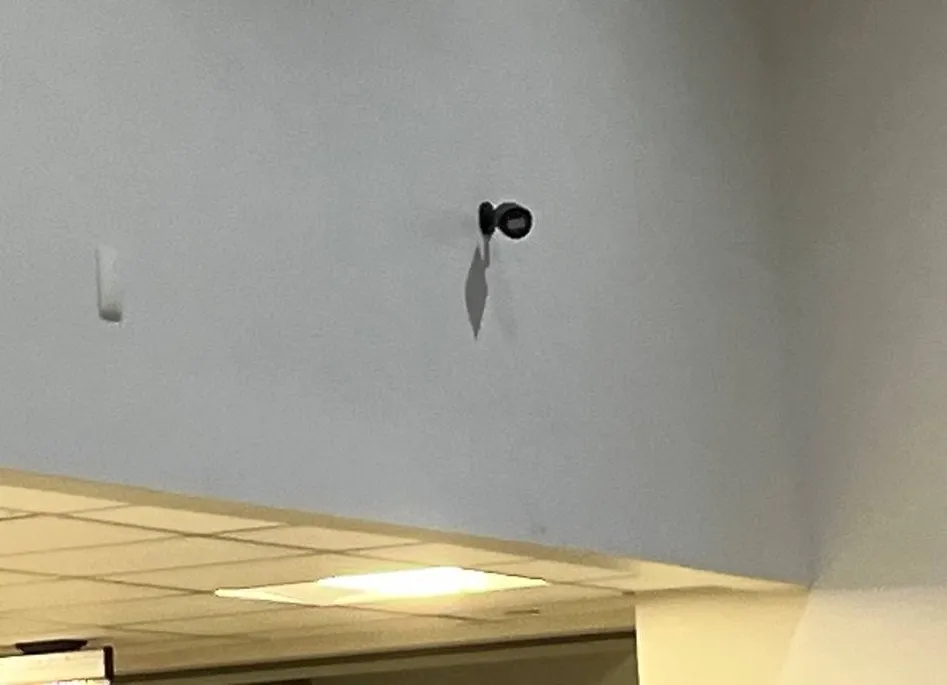
Reference photo from another AESS job: a small camera high on a wall above a lowered ceiling, with a sensor beside it.
Equipment
Types of Cat6 Repair Gear We Bring to Tottenville Houses
A house repair is a different kit from an office repair. Most of what goes on the van for a Tottenville call is about getting into awkward spaces and making the outside of the house right.
Certification Tester With Fault Distance
Tests each link to its category and reports how far along the run a fault lies, so a break in a stud bay or behind a knee wall can be found from the panel before anything is opened.
Tone Generator and Probe
Picks out one cable from a bundle of phone, coax, alarm and data wiring at a basement board, which is exactly what a 1990s house usually has.
PoE Load Checker
Confirms that a camera or access point actually receives power through the run under load, not just that the pairs are connected.
Outdoor-Rated Cat6 and Raceway
Sunlight- and moisture-resistant cable for the few feet that must stay outside, with UV-stable conduit and sealed fittings for runs that cannot come indoors.
Siding Mounting Blocks and Weatherproof Boxes
Blocks matched to common siding profiles, outdoor boxes with gaskets, sealant and drip-loop hardware, plus masonry anchors for stucco and brick fronts.
Fish Rods, Glow Rods and Flexible Bits
For drawing replacement cable down balloon-frame bays and across joists, and for reaching the far end of a knee-wall space from one opening.
Fire-Rated Sealant
To restore fire blocking and seal penetrations where a replacement run passes through a blocked bay or a garage-to-house wall.
Matched Keystones, Plugs and Panel Modules
Cat6 and Cat6A, shielded and unshielded, in the colours common in builder media panels, so a repaired jack matches its plate.
Labels and Route Sketch Pad
A label printer and a simple floor-plan sketch on which each repaired run is drawn, saved with the test results.
The internet company, a handyman or a licensed cabler — what each of them can actually do for a broken run
Each has a place. The internet company’s installer is responsible for its own equipment and the line up to it, and will usually replace the router or the outside wiring free if that is the problem; it does not, as a rule, repair cable inside your walls. A handyman can mount a box or run a cable, and for a single new run along a basement ceiling that may be fine. What neither usually brings is a certification tester: the instrument that shows whether a run meets its category, where along it a fault lies, and whether the repair actually fixed it.
That matters in Tottenville because the faults are so often in the middle of a route — in a downspout, under a staple in a garage, behind a knee wall — rather than at the jack. A licensed low-voltage contractor finds the fault, repairs it to the cable’s category, and leaves you with a result you can show the next person who works on the house. If what you really need is a new cable layout for the whole house, our Cat6 installation crew on Staten Island prices that separately.
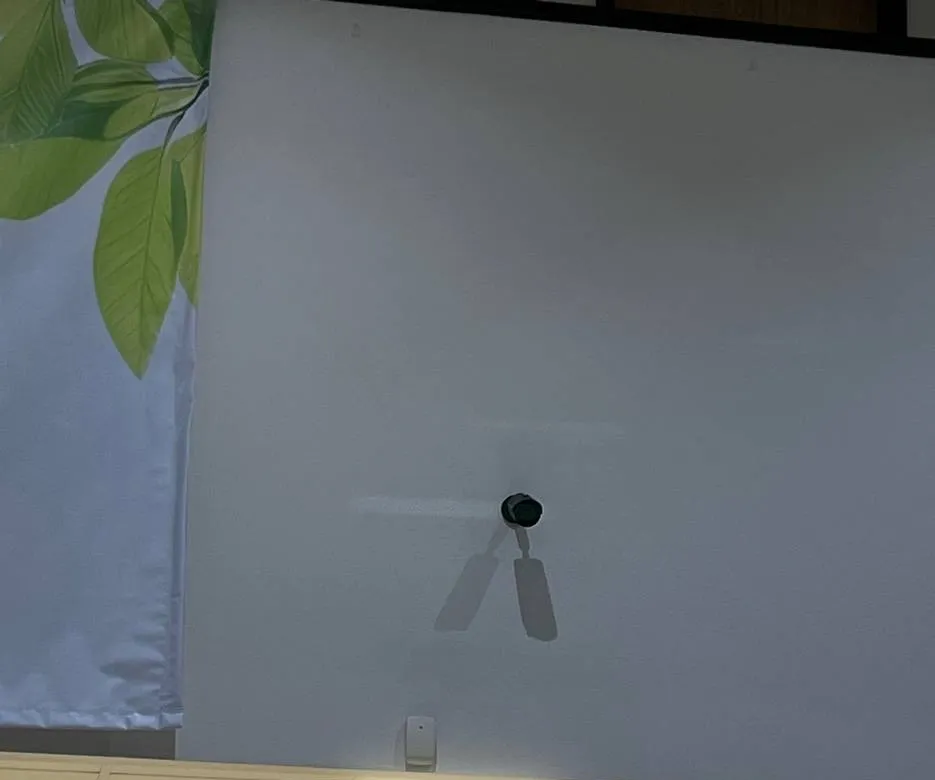
Reference photo from another AESS job: a compact camera on a short wall bracket, with a small white sensor lower down.
AI Overview Reality Check
What AI Gets Wrong About Cat6 Repair in Tottenville
We could not view Google’s AI Overview for these searches from our build environment, so we have not quoted it. What follows are seven claims that cost guides, product blogs, forum answers and AI summaries commonly repeat about network cable in houses, set against what we actually meet on Tottenville streets.
“Cat6 is Cat6 — any cable will do outdoors”
The category describes how a cable performs electrically. It says nothing about the jacket. Ordinary indoor Cat6 has a jacket made to sit in a dry wall cavity, and when it is run along a soffit or a back fence it hardens and cracks in sunlight and lets water travel along the pairs to the nearest plug.
Many of the outdoor faults we find on Tottenville houses start this way: a camera installed in a hurry with the cable left over from the indoor job, clipped along the siding and taken through a window frame or a vent. It works perfectly for a season or two, which is why the shortcut seems fine at the time.
The repair keeps outdoor exposure to the minimum, using cable and fittings made for it: the run comes inside close to the camera, any length that must stay outside is outdoor-rated and protected, and every outdoor ending sits in a sealed box with a drip loop below it.
“A house built in the 1990s came pre-wired for Ethernet”
Some did, as an option, but most houses of that decade were handed over with telephone jacks and coaxial cable-TV outlets, which is what buyers asked for at the time. In Tottenville, where the median home was built in 1989 and more than half went up between 1980 and 2009, that means most network cable was added by later owners.
Where a builder did put in “data” cable, it was often Cat5 or Cat5e run to a small panel in a closet or the basement, sometimes on the same plate as the phone jack. Cable of that age can still pass a test and carry a perfectly good connection, but it is not the same as a fresh Cat6 run, and the plates and panels are now thirty years old.
So the first step on a 1990s house is finding out what is actually in the wall. We test it, read the printing on the jacket where we can see it, and tell you whether the run should be repaired as it is, re-terminated to modern hardware, or replaced.
“Just drill wherever the cable needs to go”
Drilling is easy; drilling in the right place is the skill. A joist can be weakened by a hole too near its edge, and the model residential code sets the usual limits: no closer than 2 inches to the top or bottom, and no wider than a third of the joist’s depth. Old village houses have often been notched and drilled by earlier trades already.
Walls have their own hidden traffic. Electrical cable runs up the same bays, plumbing vents and gas lines cross floors, and some balloon-framed houses have had fire blocking added between floors that a careless hole would defeat. On the outside, a hole through siding or stucco in the wrong spot lets water straight into the wall.
Before we drill, we look at what is already cut, find the safest path, and agree the location with you. Every hole we make through the outside of the house is sleeved and sealed, and every hole through fire blocking is sealed again.
“You can screw a camera box onto the siding like anything else”
Vinyl siding moves. It is hung so that it can slide as it expands and contracts with the weather, and siding makers tell installers never to fasten a fixture directly to it but to use solid backing and allow for that movement. A box screwed straight through vinyl is being worked loose every day.
The result is predictable: a box that tilts, a gasket that opens, a plug that works out of its socket, and a camera that drops off the network in the first cold snap. We see the same thing on stucco fronts where anchors were set into the stucco skin alone and the material crumbled around them.
The fix is a proper mounting block fastened through to the sheathing and framing on sided houses, sound anchors in masonry on stucco and brick, and a fresh termination inside a sealed box once the mounting is right.
“Repairing the cable will fix slow internet”
Only if the cable is the bottleneck. A Cat6 run in good order can carry far more than most home internet plans deliver, so a slow connection is just as often the plan, the router, the Wi-Fi in the room or the device itself. A damaged run usually shows itself differently: a link that drops, a jack that connects at a fraction of its normal speed, or a camera that goes offline.
That is why we test before we quote. A certification result that passes tells you the cable is not your problem, which is worth knowing before you spend money on it, and it gives your internet provider one less thing to blame.
When the test does fail, we can usually tell you how much of the slowdown the cable was causing, and once the run is repaired we check the device again at its full link speed so you can see the difference.
“Running new cable through a century-old house means tearing into plaster”
Old houses are sometimes easier than new ones. A balloon-framed house of the 1880s or 1900s may have open stud bays running from the cellar to the attic, which makes a vertical replacement run straightforward, and knee-wall spaces on the top floor connect rooms without touching plaster.
The challenge is different: knowing what else shares those cavities, respecting fire blocking, and protecting old plaster and woodwork when an opening is unavoidable. That takes more care and more looking first, not more demolition.
In practice, most of the village houses we work in are repaired through existing openings, a hatch, a closet floor or a small access panel at the base of a wall, and we tell you before we start whether any opening at all will be needed.
“Expect to pay $125–$250 a drop”
That range is real — the cost guide Fixr gave $125–$250 per new Cat6 drop including materials and labour, and $45–$75 an hour for labour, in January 2025 — but it is a national average for new installation, not for finding and repairing a fault in a lived-in house.
Repair is mostly time spent testing, tracing and getting at the fault, and it depends on the route rather than the number of jacks. A worn jack in a basement panel is quick; a run through a downspout and across a garage ceiling is not.
Our own prices are in the pricing section below, taken from what we already publish for Staten Island: an hourly repair rate with a three-hour minimum, a per-run price for a replacement and a per-hole price for a sealed entry, with nothing extra for the distance to the South Shore.
Camera, Garage or Upstairs Office Offline? Let’s Find Where the Route Broke
Send a photo of the outside of the house where the cable leaves it and one of the router or panel. We will tell you what the repair will involve before anyone drives down.
A camera on a Bentley Street porch house or the upstairs office in a colonial off Page Avenue: tell us the street, roughly when the house went up and which link has stopped, and a technician sends back a likely cause and a price range the same working day. Prefer to talk it through? Ring (347) 934-8335.
✅
Got It — We’ll Be in Touch
Someone who repairs cable for a living will phone you back, normally the same working day. Camera or home office down this minute? Ring (347) 934-8335.
How It Works
Our Tottenville Cat6 Repair Process
Seven steps, the same on every call, built around finding the shortcut a retrofitted cable took through the house.
1. Tell us the house and the room
Which street, roughly when the house was built or last renovated, which jack, camera or room has stopped, and what changed beforehand: siding, a new garage door, painters, a storm, an internet upgrade.
2. Send three photos
The router or panel, the dead jack or the outdoor box, and the outside of the house where the cable leaves it. Those three pictures usually tell us whether we are dealing with an ending, a run or a shortcut someone took on the way.
3. Test from both ends
A certification tester at the panel and a remote at the jack or the device, so the fault is measured and placed by distance before any wall, soffit or ceiling is touched.
4. Walk the route
We follow the run through the house the way it was really installed: down a stud bay, along a garage ceiling, up a downspout, behind a knee wall. The shortcut is usually where the fault sits.
5. Agree the fix and the price
Re-termination, a new section, a better route or a new run, with the price from our published list and any opening agreed with you in writing before work starts.
6. Repair the right way round
Outdoor-rated cable outside, mounting blocks on siding, drip loops at entries, joists bored within the usual limits, fire blocking put back where we pass through it, and cable kept clear of garage door hardware.
7. Retest, label and sketch
Every link we touched certified again, labelled at both ends, and a simple sketch of where each repaired run goes through the house, saved with the test results for you.
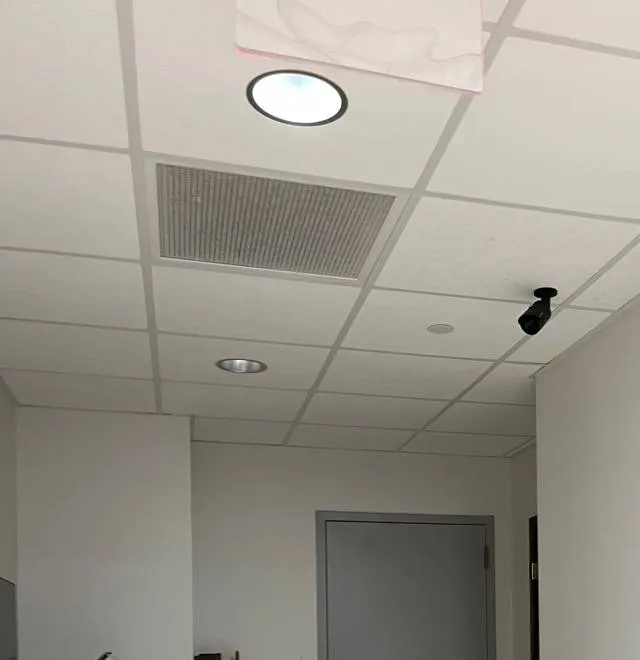
Reference photo from another AESS job: a bullet camera on a corridor ceiling grid aimed at a grey service door.
Coverage Area
Cat6 Repair Near Tottenville’s Landmarks
We repair cable in the houses, shops and offices around these places. They are named to describe the neighbourhood; none of them is claimed as a customer.
Conference House Park
The park’s “South Pole” marker shows where New York State ends. Its 265 acres also hold the Biddle, Ward and Rutan-Beckett houses and the 1680 manor where American and British delegates met without result on September 11, 1776.
Living Breakwaters
Eight partially submerged breakwaters, 2,400 linear feet in all, completed offshore in September 2024 at a cost of $111 million to cut the waves reaching Tottenville’s shore blocks and to help restore the beach along Conference House Park.
Tottenville Library
The Carnegie branch at 7430 Amboy Road, opened in 1904 to a design by Carrère and Hastings and now a city landmark.
Tottenville and Arthur Kill Stations
Trains first reached the Tottenville terminal on June 2, 1860, making it the end of the line ever since and the state’s most southerly station; one stop up, Arthur Kill station replaced the Atlantic and Nassau stops on January 21, 2017.
Amboy Road Landmark Houses
The Rutan-Journeay House at 7647, built in 1848, and the Bedell House at 7484, an 1869 Second Empire frame house designated in 2005, among a row of mid-1800s houses.
Bentley Street and the Old Ferry Landing
Streets of shipbuilders’ and oystermen’s houses from about 1850 to 1910 running down to the north end of Bentley Street, where the ferry to Perth Amboy landed until it stopped in 1963.
We also repair Cat6 in the neighbourhoods next door: Charleston, Richmond Valley, Pleasant Plains, Prince’s Bay, Huguenot, Rossville, Woodrow, Annadale and Great Kills. Tottenville High School, despite its name, sits on Luten Avenue in Huguenot.
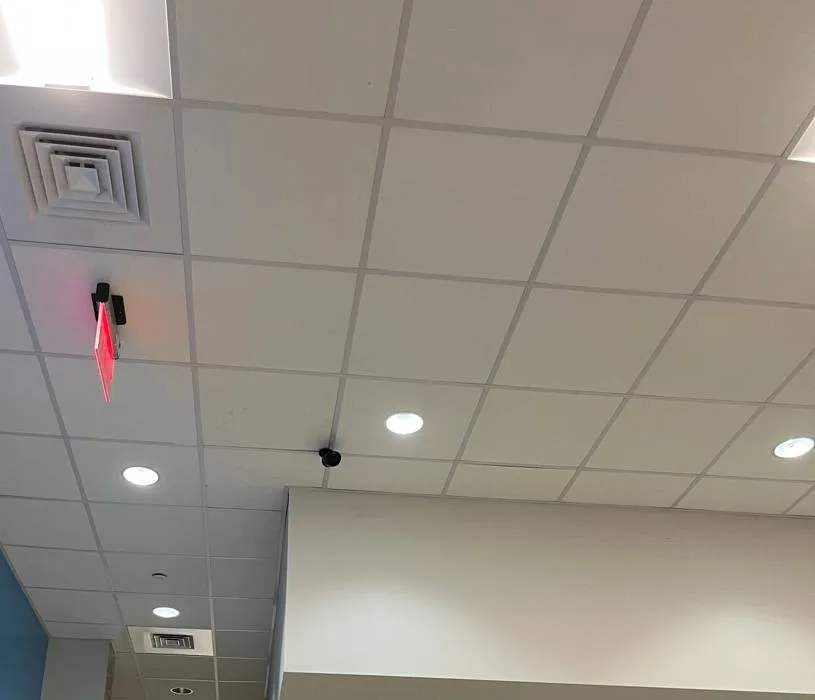
Reference photo from another AESS job: a drop ceiling carrying a red-lit device, a small camera, vents and downlights.
Pricing
Cat6 Repair Cost in Tottenville
Tottenville pays the island’s published prices, with no South Shore surcharge. Nothing in this table is new: every figure is copied from our Staten Island Cat6 repair and network cable repair pages. A bill has two parts, the time spent finding and fixing the fault and any new cable or wall entries, and the quote lists them separately.
Item
Price
What it covers
Time a technician spends at the house tracking down a Cat6 or Cat6A fault, reaching it, re-terminating and re-hanging cable, then proving the link
$195/hr, 3-hour minimum ($585)
Staten Island’s one published repair rate; every link we can finish inside the booked hours is included
Each hour after the first three
$195/hr
Same rate, by the hour
Fresh Cat6 along a better path, when the tester condemns the old run
From $175 per drop
Priced as a complete link: copper, jack, faceplate, panel end, test certificate, two labels and a cord to the device
Each hole we make through an outside wall or between floors, fitted with a sleeve, sealed, bonded and given a drip loop
From $185 per penetration
Per hole through the outside of the house or between floors
Side-by-side figure: our install price for one new Cat6 location where the run stays within 100 ft
$296 per drop
Published on our island install page beside Cat5e at $254 and Cat6A at $424; it is here so you can weigh fixing against starting fresh
Travel to Tottenville
No separate charge
No bridge or distance line on the invoice
Long re-routes, removing old cable from downspouts and walls, after-hours starts
Quoted after testing
Depends on the route and how much old cable there is
A colonial with two problems: how three booked hours get spent
Take a 1990s colonial with a camera dead over the garage and an upstairs office that drops out. Three hours normally pays for testing both links from the router and from the far end, tracing them through the garage and the attic, re-terminating the panel end and the office jack, remaking the camera ending in a properly mounted box, and moving the garage run clear of the opener. If either run has to be replaced, the price from the table is agreed with you first; if time is left, it goes on the next jack on your list.
And in a village house
Now a Hopping Avenue cottage with one dead jack in the dormer bedroom. The minimum usually covers testing the run from both ends, finding that it was crushed behind the knee wall, opening the hatch or fitting a small access panel, pulling a new length along the existing route with the old cable as a pull line, and terminating and certifying it. If the run turns out to need a new path down a stud bay or through the cellar, the per-run price applies and is agreed before the work starts.
Why there is no Tottenville premium
Tottenville is as far south as the city goes, but distance is not a line on our invoice. The island has one published repair rate and one per-run price, and a neighbourhood page is the wrong place to make up another. What changes from job to job is the route — a stud bay, a knee wall, a garage ceiling — and the written price after testing is where that shows up.
Five things that move a Tottenville repair bill
How deep in the house the break sits: a bad punch-down by the router takes minutes; a crushed length halfway along a run behind a knee wall takes a good deal longer to get at.
Whether the run comes outside: outdoor sections need the right cable, a mounting block and a sealed entry, each of which adds parts and time.
Access: a clear attic hatch and an unfinished basement ceiling save time; a sealed knee wall or a finished ceiling adds it.
The age of the house: old joists, plaster and fire blocking ask for more looking before any drilling.
Powered devices: camera and access-point runs get a power test under load, a few extra minutes each.
Full terms — including 50% deposit, one-year parts-only warranty on AESS-supplied products, and the late-fee schedule — are set out in the service agreement.
Shop Our Systems
Cat6 Repair Packages & Pricing
Three bundles cover nearly every call we get from Tottenville, and every dollar in them comes from the table above.
Starter — One Room or One Camera Back
$585
Three hours at $195 an hour. We test the failed link from both ends, find where along the route it broke, remake the endings, move the cable clear of whatever was damaging it, and certify the result. Spare time goes on the next jack.
Standard — Whole-House Route Check
$195/hr after the first 3 hours
For a house wired by several owners: every jack, camera and access-point run tested and traced, the shortcuts identified, the failing links repaired, outdoor boxes remounted, and a written price for anything that needs new cable.
Premium — Replace the Bad Routes
Repair time + from $175 per run
Downspout, siding and garage-ceiling runs replaced with properly routed cable from $175 per drop, outside entries made good from $185 each, and every link certified and drawn on a route sketch.
Bring Your Own Parts — Labour Only
If you already have cable, jacks, outdoor boxes or a panel — left by the builder or bought by your IT person — we will install them and charge for time only, as long as they suit the job: solid copper cable, hardware of the same category, outdoor-rated parts outside. Testing is exactly the same. Parts you supply carry their maker’s warranty, not ours, and if they will not pass we tell you before we start.
Reference photo from another AESS job: a dome camera on a ceiling tile near a wall corner, next to a light panel.
Replacing Siding, a Garage Door or the Roof This Year?
Have the camera and outdoor runs checked before the work starts. A tested, labelled cable is far less likely to be cut, buried or stapled through by the next trade.
Each Tottenville House Era, Where Its Cat6 Fails and What We Test
The date on a house is the best single clue to where a retrofitted run went. This table is the short version of what our technicians check first in each kind of Tottenville home.
House
Where the cable usually went
What usually fails
What we test and change
1840s–1880s village house
Down open stud bays, across low cellar ceilings, out through clapboard to a porch
Chafing at plates and nails, damp at the cellar end, staples into old timber
Fault distance from the panel; replacement down the same bay with grommets; sealed outside entries
1890s–1920s cottage or Colonial Revival
Behind knee walls on the top floor, through closets, along attic floors
Cable crushed under storage or buried in insulation; loose jacks in thin knee walls
Supported re-route behind the knee wall, a removable access panel, new jack on a proper bracket
1980s–2000s colonial or two-family
Across the garage ceiling, through the attic over the garage, down the outside to cameras, into a closet media panel
Runs beside the opener rail and door track, plugs in loose boxes on siding, indoor cable outdoors, downspout runs
Re-route out of the door’s sweep, mounting blocks, outdoor-rated sections, panel re-termination
Townhouse or condo
Shared walls, association-owned exteriors, a small panel in a closet
Outdoor runs added without approval, crowded panels
Indoor repairs on the day; outdoor work after the association agrees; certificate of insurance sent ahead
Raised or rebuilt shore house
Up from a ground-level enclosure, through new framing, to equipment on the living floors
Endings left low, cable through breakaway or enclosure walls
Endings moved above the flood-resistant level, continuous cable only below it, sealed penetrations
Main Street or Amboy Road shop
Under the counter, behind printers, out to front and lot cameras
Kicked or pinched counter runs, worn plugs, weathered camera endings
Counter first, around opening hours; camera endings rebuilt; ports labelled by device
Houses are rarely just one era. A village house may have a 1990s addition, a colonial may have a later finished basement, and nearly every house has had at least one camera added by someone other than the original builder. The test results tell us which pattern each link follows.
Before You Call
Five-Minute Checks for a Tottenville Homeowner
No tools, no ladder, nothing to open. Now and then one of these ends the problem outright; at worst they cut the length of our visit.
Check
What it tells you
What to tell us
Swap the patch cord at the dead jack or device for one that works elsewhere.
If the room comes back, it was the cord, and you are done.
Whether the swap changed anything.
Look at where the camera cable leaves the house. Is it in a downspout, stapled to siding, or through a window frame?
Outdoor shortcuts are the most common cause of camera faults.
A photo of the route and the box at the camera.
Open and close the garage door and watch the cables near the opener and the track.
Any cable that moves, touches or is pinched is a likely fault.
Where the cable runs in the garage.
Think back: siding, roof, garage door, painting, insulation, a new internet box?
Most sudden failures follow work on the house.
The date and which trade was there.
Find the router and any small switch or panel. Are their lights on, and is anything unplugged?
A switch that lost power takes several rooms with it.
A photo of the router, switch or panel.
If none of that helps, the fault is probably inside a wall, a ceiling or an outdoor box. Please do not cut into a wall or pull on the cable from the outside; old cable tears easily, and a pulled run is harder to replace than a broken one.
Complete Services
Every Cat6 Repair Service in Tottenville
A cable repair often turns up other jobs: a camera that is genuinely dead, a house that needs more jacks, a network that needs setting up again. These AESS services pick up where the repair ends.
Cameras, jacks, the TV wall and anything else, in a single message.
Field Notes
Field Notes on Retrofitted Cable in South Shore Houses
Our usual routine in a South Shore house — a general picture of how we work, not the story of any single job or client
We walk the outside before we open the panel. On a house where the cable came after the builder, the outside tells the story fastest: which downspout has a cable coming out of the bottom, which camera box is screwed straight to the siding, where a wire disappears into the garage beside the door.
We ask when the house was built and what has been done to it since. A new roof, new siding, a replaced garage door, a finished basement or blown-in insulation each leave a recognisable mark on the cable that was there before.
We use the old cable before we cut it. In a balloon-framed wall or behind a knee wall, the failed run is often the best pull line its replacement will ever have, as long as we find where it was damaged first.
And we draw what we did. A route sketch saved with the test results means the next owner, the next siding crew or our own next visit starts with the answer instead of the hunt.
Repair or Re-Route
When a Tottenville Run Should Be Repaired, Re-Routed or Replaced
Most people who call want the room or the camera back, not a project, and most of the time a repair is the right answer. Sometimes the route itself is the problem, and fixing the ending only buys a few months. These are the signals we weigh.
What testing and the route show
Usually points to
Why
The fault is at the jack, plug or panel; the cable passes
Repair
The copper inside the wall is healthy; only its two ends need new hardware.
The cable is damaged where it meets a moving or wet thing
Re-route that section
Garage hardware, downspouts and loose boxes will damage a new ending just as fast.
Indoor cable has been used outdoors for years
Replace the outdoor part
A hardened, cracked jacket keeps letting water in whatever is done at the ends.
An old Cat5 or Cat5e run passes cleanly
Keep it
Older cable that still passes is good enough for most household gear; we only swap it out for a device that needs more speed.
Most runs in the house fail for many different reasons
Discuss new cabling
Repairing link by link can cost nearly as much as a planned layout.
Siding, a roof or a renovation is coming soon
Make safe now, re-route with the work
New cable is easiest to place while walls and siding are open.
If the honest answer is fresh cable throughout, you get the results to keep, and our installers can quote the new layout separately if you ask them to. Either way the testing is not wasted: it shows which existing runs are worth keeping.
Before we suggest a new path, we ask how long you will stay
How long you plan to stay. About 83 percent of Tottenville homes are lived in by their owners, and for an owner who is staying put a camera run taken off the siding and brought in properly is worth more than a quick re-termination that will need doing again. If the house is going on the market next spring, the cheaper repair may be the sensible one. Where there is a real choice we price both and you decide.
Timing
Fitting a Repair Around a Tottenville Week
A lot of Tottenville’s working day happens somewhere else. The railway takes about forty-two minutes to reach the ferry at St. George, the SIM2, SIM25 and SIM26 express buses run to Manhattan, and the Outerbridge Crossing is next door for anyone who works in New Jersey. That means many of the houses we work in are empty from early morning to evening, or have one person working from a spare bedroom while everyone else is out. We plan visits around that.
For a house where nobody is home in the day, the usual pattern is a short first appointment early, when someone can let us in and show us the router, the garage and the attic hatch, followed by testing and outdoor work that do not need anyone inside. Indoor openings, if any are needed, are done while someone is there to agree them. For a home office, the important thing is to agree the downtime: most repairs cut the office’s connection for minutes, not hours, and we can do those minutes between calls.
Shops along Main Street, Amboy Road and Page Avenue have the opposite problem: they are busiest when everyone else is home. We test counter and camera links first, fix anything that would stop the till before opening, and leave the longer outdoor work for a quiet stretch. Outside work on the house itself depends on the weather; we will not seal an outdoor box in driving rain, and we would rather move a day than leave a camera ending that lets water in.
Summer brings its own timetable. Beach and park traffic, graduation parties and long weekends fill some Saturdays, and attics are at their hottest in the afternoon, so we book attic and knee-wall work early in the day from June to September. Winter is the better season for most indoor routes and the worse one for sealing outdoor boxes, which need a dry, not freezing, day for sealant to cure properly.
Outside the House
Why Outdoor Cat6 Has a Harder Life at the South End of the Island
Tottenville has water on three sides: the Arthur Kill along the west and north, and the bay to the south. Houses near the shore and the park get wind off the water, and every house gets the long summer sun on its south and west walls. None of that is unusual for a coastal neighbourhood, but it matters for a cable that was only ever meant to live indoors and has ended up stapled along a soffit or tucked behind a gutter.
The outdoor faults we see follow a pattern. Sunlit indoor jacket goes brittle and cracks first on the side facing the sun. Plugs left in unsealed boxes collect condensation and dust and lose contact a pin at a time, which shows up as a camera that reconnects every few minutes. Boxes fixed straight to vinyl or into crumbling stucco tilt and let water in. Cable that crosses a lawn or a patio on the surface gets stepped on, mowed over or chewed. And anything run through a downspout gets the full force of every storm.
The repair principles are simple and the same on every house: bring the cable indoors as close to the device as possible; use outdoor-rated cable and protected raceway for the parts that must stay outside; mount boxes on proper blocks or sound masonry; seal every entry and give it a drip loop; and leave every outdoor ending tested and labelled. Shore houses that were rebuilt after Sandy get one more rule, set out on our borough page: keep every ending above the flood-resistant level of the house, and let only continuous cable pass below it.
It is also worth asking before any big outside job — new siding, a new roof, a re-stuccoed front, a replaced garage door. Those trades are the most common cause of outdoor cable failures we meet, not because they are careless but because nobody told them the cable was there. A ten-minute check and a few labels before they start saves a repair visit afterwards.
What You Keep
What We Leave Behind After a Tottenville Repair
In a house where the cable was added by three different owners, the most valuable thing a repair can leave is a record. Every visit ends with the same set of things, whether we fixed one jack or every run in the house.
Test results for every link we touched, saved from the certification tester, showing the category each run was tested to and whether it passed.
Labels at both ends of each repaired run, using the room or device name rather than a number nobody remembers.
A simple route sketch of the house showing where each repaired run goes: which stud bay, which side of the garage, where it comes outside, where the outdoor box is.
A short written note of anything we found but did not fix, such as an older run that passes but is close to its limits, a joist someone else notched, or a camera that tested fine on the cable but will not connect.
The invoice in plain words, listing the time on site, any new cable or entries, and what was wrong.
Keep these with the house papers. When you sell, the next owner will want them; when a siding or roofing crew arrives, they show exactly where not to drill; and if the same room drops out again, the next technician starts from the answer.
Full Service List
Every Cat6 Cable Repair Service We Handle in Tottenville, Staten Island
Whether the call is a cottage on Hopping Avenue with one bedroom offline or an Amboy Road shop with five cameras down, the work falls into the categories below, named the way the trade and most search engines name them.
Testing, tracing and fault finding
A dark camera or an offline bedroom is where the trail starts, and from there the tester works backwards from jack to cable to panel to router. That is all Cat6 cable troubleshooting and network cable diagnostics really mean, and it is how a wall stays closed until we know the break is inside it. Ethernet cable troubleshooting rules out the cheap suspects first: the cord, the switch port, the device’s own socket. Houses wired by three owners usually need network cable tracing and Cat6 cable tracing before anything else; with tone generator tracing and toner-and-probe testing we pick our run out from the phone, coax and alarm wires on the basement board. Then Cat6 cable fault detection on the certification tester names the fault — open, short, split pair or crush — and gives its distance from the end.
Repairing and replacing cable
Damaged Cat6 cable repair covers runs pinched by garage doors, cut by siding and roofing crews, chafed in old stud bays and soaked in downspouts. Damaged Ethernet cable repair and broken Cat6 cable repair are matched to what the tester finds; where a section cannot be trusted, Cat6 cable replacement and network cable replacement put in solid-conductor cable along a better route, outdoor-rated where it has to be outside.
Connectors, jacks and wiring faults
Outdoor plugs turn green at the pins, indoor ones lose their tab to the vacuum cleaner, and some camera installers leave a crimp that was never tight. We cut back to bright copper and fit a new plug: RJ45 connector repair, or RJ45 connector replacement when the old one is past saving. Jacks get the same treatment — Cat6 wall jack repair and Ethernet wall jack repair in bedrooms and offices, data jack repair on the combined phone-and-data plates builders liked, Cat6 keystone jack repair in media panels. Where the two ends of a run were wired to different schemes, Cat6 wiring repair brings both to T568A or both to T568B, and Cat6 connector repair, Cat6 cable termination and Cat6 cable re-termination all finish with a tidy Cat6 punch-down on hardware rated for the cable.
Panels, boards and clean-up
Most 1990s houses here end their wiring in a white media enclosure in a closet or on a plywood board by the boiler. Re-punching its loose positions is Cat6 patch panel repair or network patch panel repair; working out which position feeds which bedroom is Ethernet patch panel troubleshooting. Network rack cable repair and network rack cable management cover small shop racks; patch cord replacement, network cable labelling at both ends and network cable clean-up, including removing accessible abandoned cable, finish the job.
Cameras, Wi-Fi and outdoor links
A camera that has gone dark is first checked for power arriving down the cable; only then do we decide between PoE camera cable repair and security camera Ethernet cable repair further back along the run. Outdoor Cat6 termination repair rebuilds endings in sealed boxes on proper mounts. Cat6 cable repair for Wi-Fi access points tests the run behind each ceiling or hallway access point before the access point is blamed, and runs to garages, sheds and pool equipment are tested under their real load.
Homes, shops and home offices
Residential network cable repair covers village houses, colonials, two-family homes, townhouses and rebuilt shore houses. Retail network cable repair and POS network cable repair keep Main Street, Amboy Road and Page Avenue counters running; commercial office Cat6 repair and workstation network repair cover back offices, practices and home businesses.
Certification and records
Before we pack up, the tester goes back on every link we worked on. A Cat6 run gets Cat6 cable certification; an older run is checked to its own category with network cable certification or Ethernet cable certification. Those result files, plus the route drawing, are yours to keep. Houses change hands and trades come and go, and structured cabling repair, testing and maintenance against that record keeps the wiring dependable. Whoever we send works under our New York State low-voltage licence and gives a single jack the same Cat6 cable repair services, network cabling repair services and Ethernet cable repair as a whole house.
FAQ
Tottenville Cat6 Repair FAQ
Will you still work in our attic or behind a knee wall during a summer heat wave?
+
Yes, but we plan it differently. The space under a roof is often far hotter than the rooms below on a July afternoon, so attic and knee-wall work is booked for the morning when we can, the technician takes breaks, and the hatch is left open with a fan running if you have one. If the forecast is extreme, we may test and trace from inside the house on the first day and do the attic part early the next morning. We will tell you that when we book rather than on the day, and it does not change the price, which is set by the work, not the weather.
Every December our front camera drops off the network once the holiday lights go up along the gutter — could the decorations be damaging its cable?
+
Quite possibly, and it is one of the easier faults to prevent. Light clips, staples and extension cords end up along the same soffit, gutter and porch rail that a camera’s Cat6 follows, so the cable gets clipped over, pinched under a hook, or tugged when the strands come down in January. We test the run to find where it was damaged, replace that length with outdoor-rated cable inside a small raceway so clips cannot reach it, and label it on the outside so whoever hangs the lights next year leaves it alone. If you put the decorations up yourself, a photo of where the camera cable runs saves guessing.
The weatherproof data outlet on our back deck has stopped working — can it be repaired, or does the whole outdoor outlet have to be replaced?
+
Usually the outlet can stay and only its insides change. Outdoor data outlets sit in a box with a hinged or gasketed cover; when the cover is left open or the gasket hardens, rain and dew reach the jack and its contacts corrode a pin at a time. We test the run from the router end first to make sure the cable behind the box is sound, then fit a fresh jack of the same category, renew the gasket or cover, and check that the box drains instead of holding water. If the cable itself has been wet for a long time, the tester shows it and we replace the outdoor length back to where it enters the house. The outlet is certified like any indoor link, so a laptop or camera plugged in out there gets a full connection.
The builder left a box of spare cable and jacks in our basement — can you use it for the repair?
+
Often, yes. We look at what is in the box first: the category printed on the jacket and the jacks, whether the cable is solid copper rather than copper-clad aluminium, and whether it is rated for where it has to go. Indoor cable cannot be used outside, and older Cat5e left over from the build may not match a Cat6 run. If the parts are suitable we install them and charge for time only, with the same testing; the manufacturer, not AESS, warrants parts you supply. If they are not suitable, we tell you why before starting and quote ours instead.
All Areas Served
Cat6 Repair Across Staten Island, New York City and Beyond
Tottenville is a neighbourhood page under our Cat6 repair page for Staten Island, which in turn sits under the NYC Cat6 repair hub. Long Island and the Hudson Valley have hubs of their own. Every page below is written around its own area’s buildings.
Alarms, door intercoms and complete camera packages are covered from our home page, and the people, history and licence behind AESS are on the about-us page.
Tottenville Link Down Between the Station and the Park?
A camera that went dark, a bedroom that lost its connection, a garage run that keeps breaking, a jack that never worked after the siding job — call (347) 934-8335. We book the next open window on the South Shore, and most jack, plug and panel faults are fixed in one to two hours once the technician is at the router.
Sources
Where the Tottenville Facts on This Page Come From
We list below the published pages behind each Tottenville number, date, address and rule we quoted. Our prices are the exception: they are ours, and they match what the borough pages already show.
The neighbourhood and its houses
Tottenville, Staten Island (Wikipedia): southernmost neighbourhood, area and 2020 population, 1990s building south-east of Hylan Boulevard, Main Street and Page Avenue cores, railway dates, library, precinct, post office and firehouse addresses.
Forgotten New York — Return to Tottenville 2025 and Part 2: dated houses on Bentley Street, Hopping Avenue, Satterlee Street and Amboy Road, the Perth Amboy ferry landing, Hylan Boulevard’s construction, the Main Street flag mural.
Cat6 Repair Tottenville, Staten Island — Licensed, Insured, Tested to Category
Abstract Enterprises Security Systems · 1282 Troy Ave, Brooklyn, NY 11203 · (347) 934-8335 · WhatsApp (718) 679-0359 via wa.me
NYS Low-Voltage Licence #12000287431 · 100% Licensed & Insured · Same-Day Estimates · Rated 4.7★ from 201 Google Reviews
Parts you supply carry their manufacturer’s warranty. See our warranty page and the service agreement for full terms.
Where this page mentions the Administrative Code, model building-code limits, fire blocking, Landmarks procedure or manufacturers’ instructions, it paraphrases them so a homeowner can plan; treat it as orientation, not as legal, structural or engineering advice. Landmarks and streets are named to describe the neighbourhood, not as customers. Page reviewed and updated October 21, 2026. Changelog: first publication of the Tottenville Cat6 repair page.