Mott Haven Cat6 Repair · Harlem River to St. Mary’s Park · Rowhouses, Public Housing, Port Morris Workshops & Waterfront Towers
Cat6 Repair in Mott Haven
Garage Bays · Distillery Floors · Day-Care Rooms · Smoke-Damaged Ceilings · Links Across the Street
On a single Mott Haven block a network cable can pass an auto repair bay, a room where spirits are distilled, a classroom of three-year-olds and an 1860s brick party wall. What the cable shares its space with decides how it fails and what it has to be rebuilt as. We find the broken length, repair it on matching Cat6 or Cat6A parts, and put the new cable in the jacket, route and protection its neighbours call for — then test it, label it and write down why.
Mott Haven page researched by our team and signed off by Anwar Timothy, NYS licence #12000287431 · reviewed and updated October 21, 2026
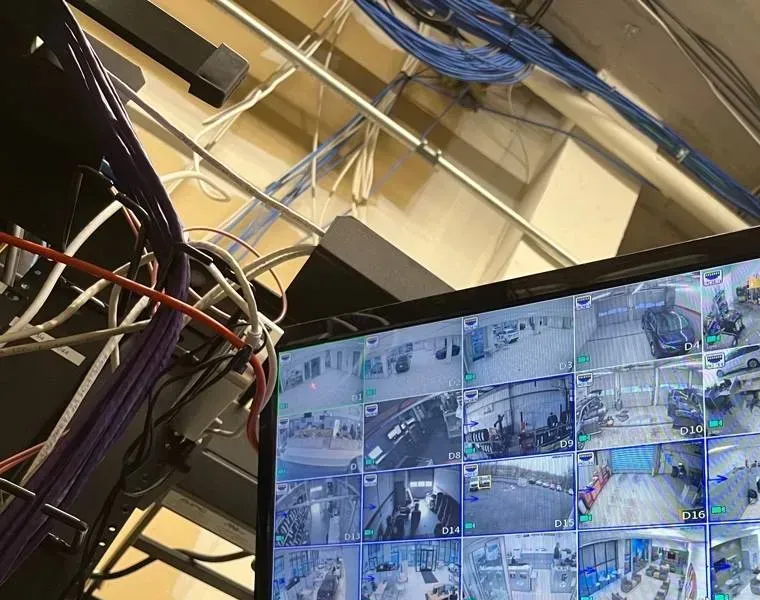
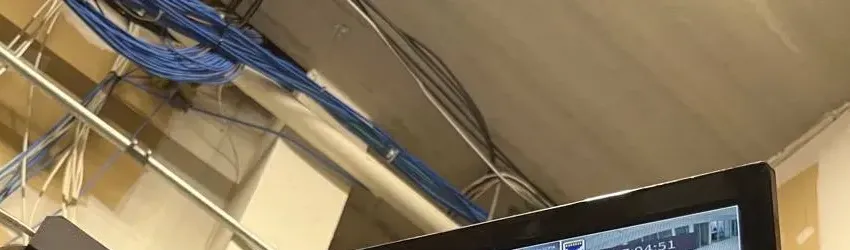
Reference photo from an AESS job (not a Mott Haven site): purple and white cables bunch at the top of a rack on the left, blue bundles run along a pipe across a beige ceiling, and a recorder screen of camera tiles fills the lower right.
Mott Haven Cat6 Repair Quote
Name the street, the kind of building and what sits next to the cable — the Bronx desk answers the same business day
✅
Request Received
The Bronx desk will ring you today about the Mott Haven repair.
25+
Years Experience
✓
Same-Day Estimates
100%
Licensed & Insured
4.7★
201 Google Reviews
Garage diagnostic station offline, classroom camera blank, or the link to the storeroom across the street dead since the weekend? Phone (646) 490-0629 or use the 60-second form. Tell us what the cable runs beside — a lift, a still, a radiator, a party wall — because on a Mott Haven call that detail usually tells us what broke it and what the repair must be made of.
Both ends tested before a wall, ceiling or counter is opened
Replacement cable chosen for the space it passes: oil-resistant jackets in bays, listed parts where an area is classified, guarded routes where children play
Work under NYS low-voltage licence #12000287431, fully insured, with a saved certification result for each link we fix
Where this page sits. It is the Mott Haven branch of our Bronx Cat6 repair page, which covers the whole borough and explains how we tell a builder’s defect from later damage. Here we stay between East 149th Street and the Harlem River, from the Grand Concourse edge east to Port Morris — the 138th Street spine, the Alexander Avenue rowhouse blocks, the Willis, Brook and St. Ann’s Avenue strips, the Port Morris manufacturing blocks along Bruckner Boulevard and the towers on the Harlem River — and concentrate on what Mott Haven cable lives beside. How a certification failure is read in general sits on our New York City Cat6 repair hub.
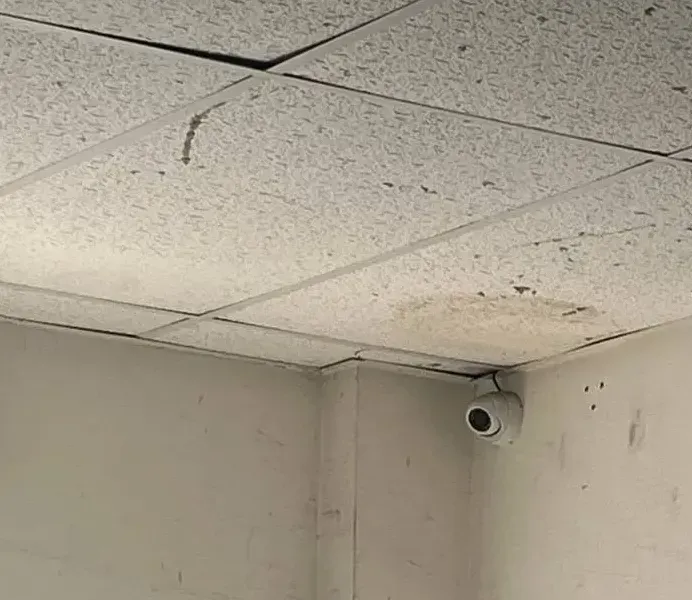
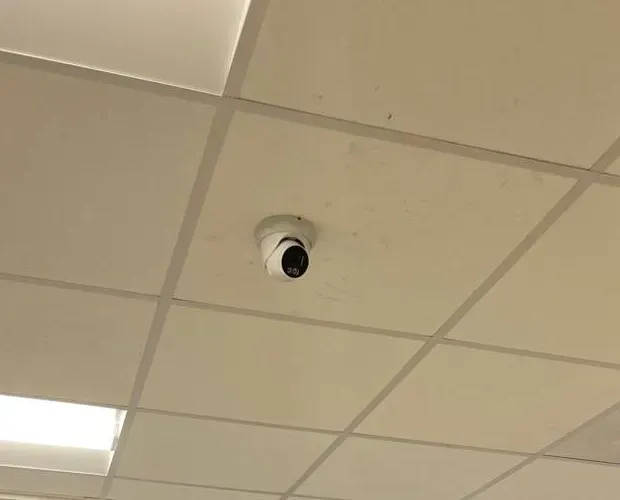
Reference photo from an AESS job: a white dome camera sits in a ceiling corner where the tiles are cracked and carry a brown water stain; scuffed bare walls run down below it.
The Neighborhood
Why Mott Haven Properties Need Cat6 Repair: The Cable’s Neighbours Decide How It Fails
Mott Haven is mixed-use in the most literal sense. Within a few hundred yards you can walk from a row of 1860s brick houses on Alexander Avenue to a public-housing tower, past an auto repair shop, a day-care centre and a church, to a former factory now split between a showroom and lofts, and on to a 25-storey rental tower on the Harlem River. The Cat6 inside those buildings is the same product everywhere, but it does not live the same life. Next to a lift bay it sits in oil mist. Next to a still it sits in a room where a spark matters. In a classroom it sits at the height of small hands. In a public-housing flat it lies along a baseboard because the walls are not the tenant’s to drill. Most of the faults we are called to in Mott Haven are explained by what the cable shares its space with, and most of the repairs only last if the replacement is chosen for that neighbour rather than for the reel on the van.
The mix is deliberate city policy as much as history. Mott Haven grew from the 1830s as an industrial district laid out by Jordan L. Mott, who went on to build housing for workers around Alexander Avenue — the area the Landmarks Preservation Commission made the Bronx’s first historic district in 1969, and where the Historic Districts Council dates one of the borough’s earliest rows of houses to 1863–1865. The Department of City Planning’s Port Morris/Bruckner Boulevard rezoning later paired residential and manufacturing districts on the blocks south of East 134th Street, noting that 44 of the 129 lots in its study area already held homes that did not conform to the old manufacturing zoning, and that vacant factory buildings could take upper-floor apartments and loft conversions. Homes, workshops and institutions were not just tolerated side by side; they were zoned to stay that way.
Then came the towers. NYU’s Furman Center counts 11,870 new apartments in buildings of four or more units completed in the Mott Haven/Melrose community district between 2010 and 2025, and the city Small Business Services needs assessment for Mott Haven described “a dozen new mixed-income residential towers” going up, mostly in the southwestern corner along the Harlem River and next to the bridges to Manhattan. Brookfield’s Bankside complex alone was planned as 1,350 apartments either side of the Third Avenue Bridge. That young cable sits a few blocks from public housing built in 1950 and from rowhouses older than the Brooklyn Bridge, so on a single afternoon our technicians can work on Cat6 that is two years old and Cat6 that was pushed through a hundred-and-fifty-year-old wall.
Who owns the walls shapes the job too. The Furman Center puts the 2024 homeownership rate in Mott Haven/Melrose at 6.1%, against 32.7% for the city, and records public housing as 24.1% of the district’s rental units. The people who phone us are overwhelmingly tenants, small-business owners renting a storefront, managing agents and the staff of churches, clinics and nonprofits. The SBS assessment found that 55% of the Mott Haven merchants it surveyed had two or fewer full-time employees. Nobody in a business that size is “the IT person”; the cable to the register or the camera recorder was put in by whoever was available, and the owner finds out it matters on the day it stops.
So our approach in Mott Haven runs in a fixed order. First we find the fault from both ends, the same as anywhere. Then, before choosing a part, we look at the cable’s neighbours: the bay, the still room, the classroom, the fire-damaged ceiling, the street it crosses, the block wall it cannot enter, the landmarked facade it hangs on. That second look decides whether the fix is a new jack, a new length in a tougher jacket, a re-route away from the hazard, or a conversation with somebody else — a landlord, the housing authority, an engineer or a city agency — before anything is cut.
Six numbers to know before a Mott Haven cable job
6.1% homeownership: the Furman Center’s 2024 figure for Mott Haven/Melrose, against 32.7% citywide — most callers rent, so routes outside their own walls need the owner’s say.
24.1% public housing: the share of the district’s rental units that are public housing in the same profile; Patterson Houses alone has 1,790 apartments in fifteen buildings and opened in 1950.
11,870 new apartments since 2010: completed in buildings of four or more units in Mott Haven/Melrose between 2010 and 2025, per the Furman Center — the newest cable in the neighbourhood.
44 of 129 lots: the homes City Planning found already standing on manufacturing-zoned lots in the Port Morris/Bruckner Boulevard study area, the root of today’s mix of lofts, workshops and houses.
55% of merchants with 0–2 employees: from the SBS Commercial District Needs Assessment’s merchant survey (drawn from more than 441 surveys plus stakeholder meetings with merchants, shoppers and owners).
Three historic districts: Mott Haven (1969), Mott Haven East and the Bertine Block (both 1994), where exterior work needs Landmarks Preservation Commission permits.
None of this makes Mott Haven cable unusually bad. It makes it unusually varied, and variety is what catches out a one-size repair. A plain PVC jacket that would last twenty years in an office can soften in a year on a bay wall. A wall jack that is perfectly safe in a shop is the wrong part in a distillery’s still room. A cable left looped at floor level is harmless in a storeroom and a hazard in a toddler room. We start every Mott Haven call by asking what is next to the run, and the answer usually tells us which of those mistakes was made.
Some calls turn out not to be a Cat6 fault at all. A dying switch, a router or a building still on Cat5e belongs with the Bronx network cable repair team, and if a building is short of outlets altogether, our Abstract Enterprises Cat6 installation service for the Bronx prices fresh drops. Mott Haven shops and buildings that are already opening a ceiling often pair the repair with work from our Mott Haven security camera installers, because the camera runs are usually the ones that pass the most hazards on the way.
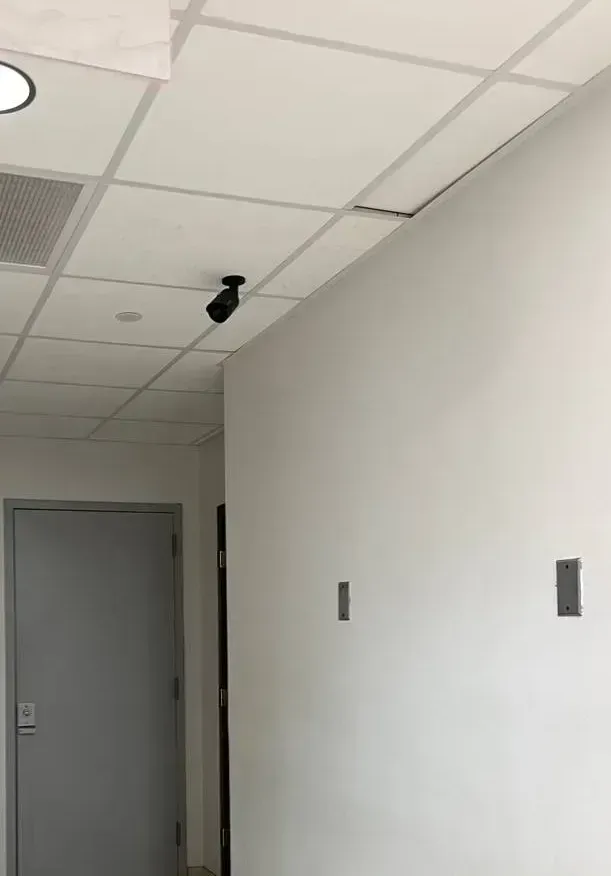
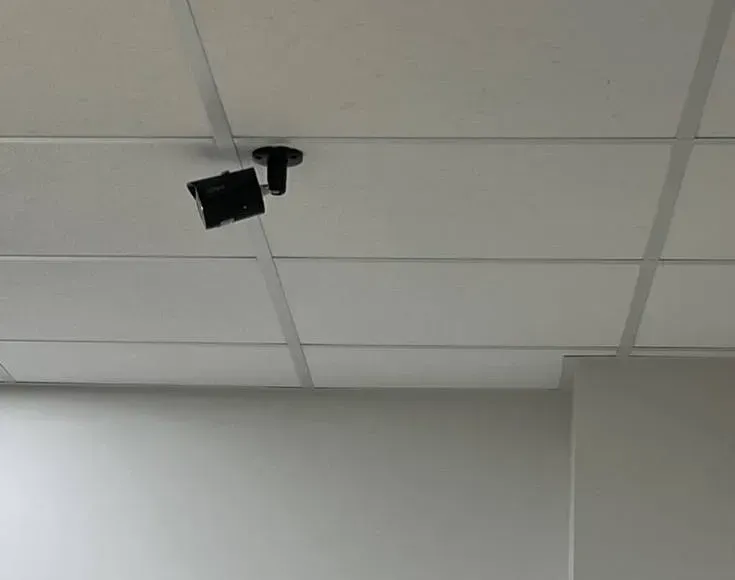
Reference photo from an AESS job: a black bullet camera hangs from a drop-ceiling tile over a corridor, a grey steel door with a keypad stands at the far end, and two blank cover plates sit on the white wall.
Repair Capture
Link Dead Somewhere Between the Third Avenue Bridge and Port Morris?
The bodega’s card terminal on 138th Street will not connect, the garage on St. Ann’s Avenue cannot reach its parts system, the parent-view camera in a classroom shows nothing, or the storeroom across the street dropped off the network after a storm. Those are repair calls. We take the first open two-hour arrival window and come with a certification tester, a toner, standard and oil-resistant Cat6 and Cat6A, matched keystones and plugs, sealed boxes, cable guards and factory-made leads. A fault at a jack, a plug or one damaged length is usually found and fixed within one to two hours on site. Repair time is $195 an hour against a three-hour minimum, which leaves room to check the next suspect link on the same booking. Ring (646) 490-0629.
What We Install
Cat6 Repair Services in Mott Haven
Each service below is named after the neighbour that usually did the damage. The visit always closes the same way: the repaired link graded against its category, the result saved, both ends labelled and a short note saying what failed, what it sat next to and what we changed so it does not happen again.
Garage and Body-Shop Runs
Links to diagnostic stations, parts terminals, office desks and bay cameras in auto businesses. Softened or cracked jackets are cut out and replaced with oil-resistant cable, and the route is lifted out of the splash zone around lifts, tyre machines and parts washers.
Production-Room Links
Cable serving distilleries, breweries, bakeries and small food producers on the Port Morris blocks. Where the owner’s engineer has classified part of a room, we keep the repair outside that boundary or use only what the classification allows, and say plainly where that line is.
Classroom and Day-Care Cables
Parent-view and hallway cameras, sign-in tablets, staff desks and classroom displays. Repairs are timed around nap and pick-up, loose cords are taken off the floor, and any run within a child’s reach goes into fixed raceway or up out of reach.
After-Fire Assessment
When smoke or firefighting water has reached a ceiling or wall from a fire nearby, we test every link that passed through the affected space, look at jackets and terminations, and replace what heat, soot or water has touched rather than trusting a link because it still lights up.
Building-to-Building Links
Runs between a shop and its storeroom, a church and its hall, or two halves of a business. We repair what crosses private ground, explain what a public-street crossing would need from the city, and suggest a different medium where copper is the wrong answer.
Rowhouse and Landmark Facade Runs
Cameras and doorbell feeds on the brick and brownstone houses of the Mott Haven, Mott Haven East and Bertine Block districts. Damaged lengths are replaced, entries are re-sealed, and anything that would change the facade is flagged before work so the owner can check what Landmarks needs.
Public-Housing Flat Runs
Resident-owned cables in NYCHA apartments, usually from the router the free city programme supplied to a bedroom or desk. We repair them along their existing surface route without opening block walls, and point residents to the housing authority for anything that belongs to the building.
New-Tower Suite Repairs
Jacks and in-unit runs in the waterfront buildings that went up after the Lower Concourse and Port Morris rezonings. We test inside the suite, show building management where the fault stops if it is on their side of the line, and fix what is the tenant’s.
Shopfront Register and Camera Links
Counters, back-room recorders and awning cameras on 138th Street, Willis Avenue and Third Avenue. Each run is traced, the damaged length replaced and the cord at the counter changed for a factory-made lead long enough not to be pulled tight.
Reference photo from an AESS job: a dense purple bundle drops down the side of a black equipment rack, with white cables and one orange lead looping over its top and the edge of a camera screen at the right.
Building Specialists
Cat6 Repair for Mott Haven's Architecture
Five kinds of building make up most of the neighbourhood, and each puts different things beside the cable. The cards below say what we usually find in each and how the repair changes because of it.
Rowhouses of the Three Historic Districts
Alexander Avenue’s rows, the houses east of it and the 31 buildings of the Bertine Block on East 136th Street between Willis Avenue and Brown Place, built from 1877 to 1899. Thick brick bearing walls, original plaster, narrow stair halls and facades that Landmarks oversees. Cable here was usually added floor by floor, hugging the stair or slipped out of a window to a camera.
Public-Housing Towers
Campuses such as Patterson Houses — fifteen buildings of six and thirteen storeys with 1,790 apartments, opened in 1950 — Mitchel, Mott Haven and Betances. Concrete and block, no ceiling voids in the flats, and building systems owned by the housing authority or, after a PACT conversion, its private manager. Resident cable runs on the surface; building cable runs where the authority put it.
Port Morris Factory Buildings
Brick and heavy-timber or concrete loft buildings from the area’s industrial era, such as the 1886 Estey Piano Company Factory at Lincoln Avenue and Bruckner Boulevard, now shared between showrooms, studios, workshops and apartments. Long open floors, exposed brick, old freight shafts and tenants who each brought their own cable.
Waterfront Rental Towers
The buildings along the Harlem River and around the Third Avenue Bridge, such as Bankside’s three Third Avenue towers of 25, 25 and 17 storeys. Young Cat6 in conduit and slab, structured enclosures in each apartment, and a building network run by management’s own vendor.
Low Commercial and Mixed Buildings
One- and two-storey garages, shops with a flat or two above, storage and warehouse buildings on the side streets. Ceilings close to the work, roll-down gates, small cellars, and cable that serves a business by day and a household upstairs by night.
Churches, Schools and Agencies
From St. Ann’s fieldstone church of 1841 to converted rowhouses holding day cares, clinics and nonprofits. Old walls, rooms that are full at fixed times, and networks that were added for one programme and have been stretched for every programme since.
How the method changes from one Mott Haven building to the next
Building
What usually broke the cable
How we change the repair
Historic-district rowhouse
A cable squeezed through a window frame or under a stair nosing; plugs worked loose by a door; a facade fixing that rusted through
Replace the length and give it a sealed entry through mortar rather than brick face; keep new fixings out of sight from the street; flag any visible change for the owner to check with Landmarks
Public-housing flat
A resident’s cable crushed under furniture or a radiator cover, or pulled when a door closed on it
Repair on the existing surface path with fixed raceway and corner pieces; no drilling into block or concrete; building-owned cable left to the authority
Port Morris factory building
Runs hung from old pipes or sprinkler lines, chafed on steel, or left looped on a workshop floor
Replace the damaged length on proper supports clear of other services; move floor crossings overhead; remove the dead lengths the last tenant left
Waterfront tower apartment
A jack never terminated, a cable nicked when a wall-mounted TV went up, a crowded enclosure
Test inside the unit first; repair the in-suite part; hand management a written result if the fault is upstream of the enclosure
Garage or workshop
Oil, solvent and heat on a PVC jacket; a cable run along the floor where carts and jacks roll
Oil-resistant cable, routed high on the wall or overhead, with the drop to each station in a protected sleeve
Church, school or clinic
Long runs from the office to a hall, a sanctuary or a far classroom, built from several pieces joined over the years
Find each joint, replace the run as one length where possible, and plan the visit around services, classes or patients
The material underneath matters as much as the use. Brick in the older houses takes a neat hole through a mortar joint and seals well; it crumbles if a masonry bit is pushed through the face of a soft old brick. The concrete in public-housing towers is not ours or the tenant’s to drill, which is why resident repairs stay on the surface. The factory buildings mix brick walls with heavy floors, and their long spans mean a single run can be eighty or ninety metres before it reaches a closet — close enough to the limit that a repair which adds a coupler and a patch cord can tip it over. The towers are the easiest to work in and the hardest to get into: everything is accessible once the building’s rules for contractors have been met.
Owners of the older buildings often ask whether it is worth repairing cable in a house that will be renovated later. In Mott Haven the answer usually turns on who is waiting for the link. A camera covering a shop door or a classroom cannot wait for a renovation, so we repair it properly now, on a route that the renovation can keep. When we can see that a building’s cable will be replaced wholesale within months, we say so, and quote the smallest repair that keeps things working until then.
Reference photo from an AESS job: loose loops of blue and white cable run along a metal pipe and across a beige ceiling beam, without trays or supports, above the top edge of a screen.
Commercial Cat6 Repair
Business Cat6 Repair in Mott Haven
Mott Haven’s businesses are small, varied and spread along a handful of streets. When the Small Business Services assessment tallied the storefronts on the corridors it studied — 138th Street, Third, Willis, Brook, St. Ann’s, Alexander, Lincoln and Cypress Avenues, Bruckner Boulevard and a few side streets — delis and bodegas topped the count at 38, beauty salons and barbershops came to 26, automotive businesses, rentals and gas stations to 21, schools and day-care centres to 19, doctors, dentists and medical services to 18, and agencies, nonprofits and houses of worship to 17. It put storefront vacancy at 8.3%. Each of those trades puts its own hazard next to the cable, so we organise commercial work by corridor and by what the businesses there do.
East 138th Street
The main east–west street through the neighbourhood, with wide sidewalks, bodegas, restaurants, pharmacies and money-transfer shops. Typical repairs: register and terminal runs at the counter, recorder runs to awning cameras, and cable that once fed a long-gone outdoor dining structure.
Bruckner Boulevard and Antique Row
City Planning’s rezoning study describes antiques dealers appearing along Bruckner Boulevard and factory buildings converted to lofts for commercial uses. Typical repairs: showroom cameras, gallery and studio networks, and runs that cross between a ground-floor business and the floors above.
Third Avenue South of 138th
The run down to the Third Avenue Bridge, where the SBS report lists 36,397 vehicles a day on Third Avenue between 138th Street and Bruckner Boulevard in 2019. Typical repairs: shopfront links, offices above the shops, and links in the new buildings at the bridge.
St. Ann’s, Willis and Brook Avenues
Garages and tyre shops among the delis and day cares — the SBS report credits the area’s industrial past for the automotive and warehouse trades that still line these blocks. Typical repairs: diagnostic and parts-terminal runs in bays, plus camera links that cover lots and roll-down doors.
The Port Morris Workshops
Distilleries, breweries, design workshops and storage among the warehouses south of the expressway, where a 100,000-square-foot two-storey logistics building at 307 Bruckner Boulevard was due to open in the third quarter of 2026. Typical repairs: production-room links, dock and office runs, and long lines between buildings.
Around Lincoln Hospital
Clinics, pharmacies and social-service offices on the streets near NYC Health + Hospitals/Lincoln at East 149th Street. Typical repairs: exam-room and front-desk jacks, often in converted houses, done before patients arrive or after they leave.
Taking over a storefront or workshop in Mott Haven
Because so many local businesses are small and rent their space, a new tenant usually inherits the last tenant’s cable without any record of it. Before the opening day we find the panel or switch, tone out each run, test the ones you intend to use, and mark the rest as dead or spare. In a garage or production space we also look at the jacket: cable that has spent years in a bay can test well today and fail in a month, and it is far cheaper to replace it before the counters, racks and machines go in.
Rules that come up on Mott Haven business repairs
NYC Electrical Code: since December 21, 2025 New York has enforced the 2025 City Electrical Code — the 2020 NEC with local amendments — so a replacement length has to carry the listing the space calls for, whether that is a riser, a plenum or a plain wall.
Abandoned cable: under NEC 800.25, accessible portions of abandoned communications cable are to be removed; we take out the dead lengths we can reach while the ceiling is open.
Hazardous (classified) locations: where a distillery, spray booth or fuel area has been classified under NEC Article 500, only equipment suitable for that class and division belongs inside it; the classification is the owner’s and their engineer’s to set, not ours.
Child care: the city Health Code’s Article 47 requires child-care premises to be “free of electrical, chemical, mechanical and all other types of hazards,” which is why repaired cable in a classroom goes out of reach.
Landmarks: the Landmarks Law requires a permit from the Commission before work that affects the exterior of a designated building, so a new camera entry on a historic-district facade is checked before it is drilled.
Public streets: a private cable over or under a city street or sidewalk needs a revocable consent from the city; the Buildings Department’s guidance says the process can take about six months.
Reference photo from an AESS job: a white turret camera sits centred in a beige drop-ceiling tile, with a light panel glowing at the lower left of the grid.
Your Questions Answered
Cat6 Repair in Mott Haven: Questions Answered
These are the questions Mott Haven owners, tenants, managers and staff bring us that our borough and city pages do not already answer. They are grouped by what the cable lives beside. Each answer starts with the short version and then explains it.
Workshops on the old manufacturing blocks
The Cat6 to the diagnostic computer and cameras in our auto repair shop runs along the bay wall, where oil, brake cleaner and degreaser get splashed. Is that what keeps killing it, and what should replace it?
Very likely, and the replacement should be cable with an oil-resistant jacket, moved up and out of the splash zone. Ordinary Cat6 has a PVC jacket made for offices. A cable supplier’s guide to industrial Ethernet puts it bluntly: standard PVC jackets “crack, bubble, or soften when exposed to oils, lubricants, alcohols, or acid vapors.” Once the jacket goes soft or splits, the twisted pairs inside lose the geometry that keeps a Cat6 link inside its limits, and the link starts throwing errors, falling back to a lower speed or dropping altogether — typically at the worst moment, with a car on the lift and the scan tool waiting for an update.
When we repair a bay run we cut the damaged length out back to cable that is still firm and clean, and replace it with cable whose jacket is rated for oil. Industry uses two UL test levels: Oil Res I for limited contact and Oil Res II for prolonged exposure and higher temperatures; in a working bay we use the tougher grade. Just as important is the route. We lift the cable to the top of the wall or overhead, bring a single protected drop down to each station, and keep it away from the parts washer, the tyre machine and the floor where creepers and jacks roll. The plug at the station end is a moulded, factory-made lead rather than a field crimp, because it is the part that gets touched with dirty gloves.
Two more things often turn up on garage calls. Body shops with a spray booth have an area where electrical equipment is restricted, and we keep any network gear and joints outside it. And many diagnostic tools now prefer Wi-Fi; if yours does, the cable that matters most may be the one to the access point above the bays, which we test and protect the same way. The SBS assessment counted 21 automotive businesses along Mott Haven’s corridors, so this is one of the repairs we plan for whenever a call comes from St. Ann’s or Willis Avenue.
Our distillery’s network cable passes through the still room. Can a failed run in there be repaired with ordinary jacks and boxes?
Not if that part of the room is a classified location — and the first step is finding out whether it is. Distilling puts ethanol vapour in the air around the stills and, where grain is handled, combustible dust. A process-safety consultancy writing about distilleries explains that a distillery “will have Class I areas because of the ethanol, and it will usually have Class II areas because milling grain produces combustible dust,” and that problems arise from installing outlets that are not rated, or from running cords in from outside the classified area. Under the electrical code, equipment inside a Class I or Class II boundary has to be suitable for that class and division. An ordinary keystone in a plastic surface box is not.
Who draws that boundary is not us. Classification is set by the owner’s engineer or fire-protection consultant using the standards written for it, and many small producers have a drawing from when they were permitted. We ask for it before the visit. If the failed length runs through a classified zone, the usual answer is to reroute the replacement so the cable and every termination sit outside the boundary, with the device inside reached by a method the classification allows — or, where a device simply must be inside, to leave that part to an electrician working to the classification. What we will not do is put a standard jack where the drawing says it should not go, however small the job.
Outside the classified areas, distillery and brewery cable fails for more ordinary reasons: wash-down water, forklift and pallet-jack traffic, and runs tied to process piping that is hot one hour and cold the next. Port Morris has both a distillery and a brewery among its converted buildings, and food producers in the same blocks. We treat each the same way: map the hazards first, then decide where a repaired cable can safely live.
Last-mile logistics and storage: long runs that pass through busy floors
The large warehouse buildings arriving in Port Morris, such as the two-storey logistics facility that New York YIMBY reported nearing completion at 307 Bruckner Boulevard in August 2026, are mostly cabled new and maintained by their operators’ own contractors. Our Mott Haven work in storage and wholesale buildings is usually in the older ones next door, where a single office, a gate camera and a handful of scanners hang off cable that was run across the floor and then covered by racking. We find the run, replace the length that racking or pallet traffic has crushed, and move it to the wall or overhead so the next pallet cannot reach it.
Rooms full of children, congregations and smoke
The Cat6 to the parent-view camera in one of our day-care classrooms has failed. Can it be repaired while the children are in, and how do we keep the new cable out of their reach?
Most of the fault-finding can happen with children in the room, but the cutting, drilling and ladder work should wait for a time the room is empty — and the finished cable must end up fixed and out of reach. We test from the recorder or switch end first, which is usually in an office or closet. That often tells us whether the fault is at the camera, in the wall or at the closet, so the in-room part of the visit is short. The repair itself we book for before opening, nap time in another room, or after pick-up, with the director’s agreement.
The rules give a clear target for how the room is left. The city Health Code’s Article 47, which governs child-care programmes, states plainly that premises “shall be free of electrical, chemical, mechanical and all other types of hazards.” A looped patch cord behind a cubby, a cable stapled along the skirting or a camera lead hanging within reach of a climbing frame does not meet that. So the replacement runs inside the wall where the building allows, in fixed, screwed-down raceway where it does not, and at ceiling height for the last stretch to the camera. Spare cable is cut back rather than coiled.
Day cares in Mott Haven are often in converted rowhouses or the ground floors of apartment buildings, and their cameras, sign-in tablets and office computers tend to share one small switch in a closet. When one classroom goes dark we check the others on the same visit, because the cause — a loose panel termination or a failing switch port — can be shared. If the camera system itself needs attention, that is a job for our camera team in Mott Haven; the cable repair is ours either way.
A fire next door left smoke in our ceiling and water from the hoses down our walls. Our network still works — does the Cat6 need replacing anyway?
Not necessarily all of it, but every link that passed through the smoke or water should be tested and inspected, and anything that was heated, soaked or coated should be replaced. Fires in attached buildings are a real risk on Mott Haven’s commercial streets. In June 2024 the Mott Haven Herald reported a four-alarm fire that gutted a row of businesses on Third Avenue in Melrose, just north of the neighbourhood; in May 2026 CBS New York reported a two-alarm fire in a two-storey building on Third Avenue between East 139th and 140th Streets that brought the roof down but did not spread to other buildings, with a neighbour telling reporters you could smell how bad it was. The buildings next door to fires like those are left with soot above their ceilings and water in their walls even when nothing of theirs burned.
The concern is not only what fails today. Restoration contractors warn that when smoke residue settles on electronics, the risk is that it causes damage over time, and the same applies to the copper contacts in jacks and patch panels. Water from hoses gets into wall boxes and floor boxes and sits there. Heat that never reached flame can soften a jacket enough to change how the pairs lie. A blanket rip-out of every cable after any structure fire is sometimes suggested; we think that overstates it for a building that only took smoke, but it is the right instinct for a building that took heat. So we test every affected link against its category, open and look at the terminations, replace jacks and panel modules that show residue or corrosion, and replace any length of cable that was heated, soaked or is now coated in soot.
Do this before the ceiling is painted and the walls are closed. Your insurer or the restoration contractor will usually want a written account, and we provide the test results and photographs of what we found and replaced. If the restoration company has already wiped down jacks and plates, tell us; cleaning the faceplate does nothing for the contacts behind it.
Churches and halls: long runs built from several short ones
Mott Haven’s churches and the community rooms attached to them often run a camera for streaming services, a sound desk, an office computer and a Wi-Fi point for the hall from one router in the parish office. Over the years each was added with the cable to hand, so a single link may be three lengths joined with couplers, crossing a stone wall through whatever gap was there. When the stream drops on Sunday, the fault is usually at one of those joints. We trace the run end to end, remove the couplers, replace it with one continuous length where the building allows, and test it. Older buildings such as St. Ann’s Church, built in 1841, have fieldstone walls; we use existing openings and conduit wherever possible rather than drilling new ones, and we book the work for a weekday when the sanctuary is empty.
Between buildings, landlords and the street
Our shop and our storeroom are in two buildings on opposite sides of the street. Can a Cat6 link be strung across, or run under, the street between them?
Not without the city’s permission, and usually the better answer is not a cable at all. The street and sidewalk belong to the city. The Buildings Department’s guidance on revocable consents explains that no permanent installation designed primarily for the private use of the abutting owner is allowed in the public right of way except through the revocable-consent process, and its list of eligible improvements includes overhead pipe, conduit and cable. Consents are granted for a fixed term with compensation paid to the city every year, consents for telecommunications purposes sit outside the Transportation Department’s process, and the guidance says the process can take approximately six months. A Cat6 cable thrown across from one fire escape to another, or pushed through an old pipe under the sidewalk, does not qualify.
For most small businesses the practical choice is between a point-to-point wireless link mounted on each building, a separate internet service at the second building, or, where the two buildings share a lot or a rear yard, a buried or wall-mounted route that never touches public ground. Cat6 also has a distance limit of 100 metres for the whole channel, and copper run outdoors between two buildings on different electrical services brings grounding and surge problems that a wireless link or fiber avoids. We will look at the current arrangement, repair whatever part of it is on private property, and give you the options in writing.
If a cable already crosses the street — it happens, usually from years ago — we will not repair it in place. We will tell you it is there, explain why it is a liability, and help you replace it with something that does not need it. Where the two buildings are both yours and joined at the back, a link between them is an ordinary repair and we treat it as one.
NYCHA apartments: the router sits where Big Apple Connect put it
Since September 2022 the city’s Big Apple Connect programme has given residents of participating NYCHA developments free home internet with a free modem and wireless router, and the city’s agreements with Optimum and Spectrum guarantee it until 2028. Patterson, Mitchel and Mott Haven are among the participating developments in the providers’ lists. The router goes wherever the provider’s outlet is, which is rarely where a child does homework or a parent works. Residents who want a wired connection elsewhere have usually run a cable along the skirting themselves, and that cable is the resident’s.
Those runs fail in predictable ways: crushed under a bed frame or a radiator cover, pinched in a door, or chewed at the plug. We repair them on the surface route they already follow, in screwed or adhesive raceway with proper corner pieces and a door crossing that the door cannot close on, without drilling into the concrete or block. Anything that belongs to the building — the provider’s outlet, the intercom, hallway cameras, the wiring in the walls — is the housing authority’s or the provider’s to repair, and we say so rather than touch it. As the Legal Aid Society reminds tenants, most leases prohibit alterations without the landlord’s prior permission, so a surface repair that leaves no mark is the right size of job.
Historic-district facades: repair the camera run without changing the front
On Alexander Avenue, the streets of Mott Haven East and the Bertine Block, front-door and stoop cameras are common and their cables are usually the first thing to fail, because they pass through the weather. Replacing the damaged length on the same path is a repair; adding a new hole in the facade, a new conduit up the front or a box on the cornice is a visible change, and the Landmarks Law requires a permit before work that affects the exterior of a designated building. We tell owners which of the two their repair is before we start. Usually the fix can go through the existing entry, re-sealed, or move to the side or rear where it does not show.
River towers: test from the unit’s own enclosure before blaming anyone
In the newer buildings on the river, each apartment or retail unit has its own enclosure where the building’s service arrives and the unit’s jacks begin. When a jack fails we test from that enclosure outward, which settles in minutes whether the fault is inside the suite or on the building’s side. Inside, we repair it. On the building’s side we give management a written result to pass to their vendor, so the tenant is not stuck between the two.
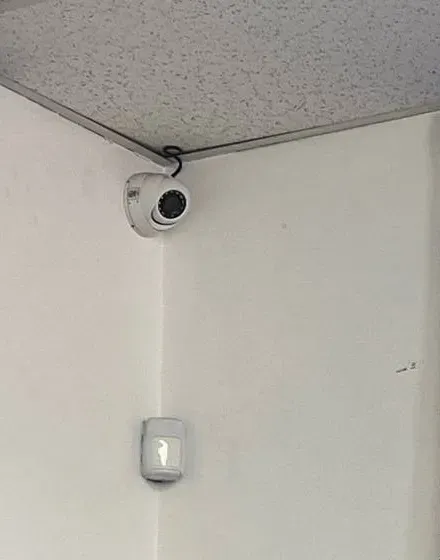
Reference photo from an AESS job: a white dome camera is fixed high in a corner, a small black cable loop rising from it into the ceiling edge, with a white wall sensor further down.
Equipment
Types of Cat6 Repair Gear Our Vans Carry for Mott Haven Bays, Classrooms and Facades
A Mott Haven day can start in a garage, move to a day care and end on a rowhouse stoop. The van is stocked for neighbours of the cable as much as for the cable itself.
Certifier With Distance-to-Fault
Grades each link against Cat6 or Cat6A limits and reports how far along a split, crush or bad joint lies, so we know whether to open the bay wall, the classroom ceiling or the closet before touching anything.
Oil-Resistant Cat6 and Cat6A
Reels with jackets tested to the UL oil-resistance levels, for garages, body shops, printing and machine rooms where ordinary PVC softens. Moulded leads to match, for the station end.
Toner and Inductive Probe
For finding one cable among the dead and live runs a previous tenant left behind, without unplugging the shop next door or the household upstairs.
Fixed Raceway and Child-Safe Fittings
Screw-down surface raceway, corner and door-crossing pieces and closed-back boxes, for public-housing flats, classrooms and anywhere a cable cannot go inside the wall.
Matched Keystones, Panel Modules and Plugs
Cat6 and Cat6A parts from the same family as the link, plus shielded versions, so a repair never leaves a lower-category part in the middle of a run.
Sealed Exterior Boxes and Entry Fittings
Weather-tight junction boxes, grommets and sealants for camera runs on rowhouse fronts, garage doors and yards, sized to re-use an existing opening wherever we can.
Inspection Light and Camera
For looking at jackets and terminations after a fire or flood and photographing residue, corrosion and heat damage for the owner, the landlord or the insurer.
PoE Load Tester
Confirms whether a camera or access point is getting the power it needs over the repaired run, which settles most “the camera keeps restarting” arguments in one reading.
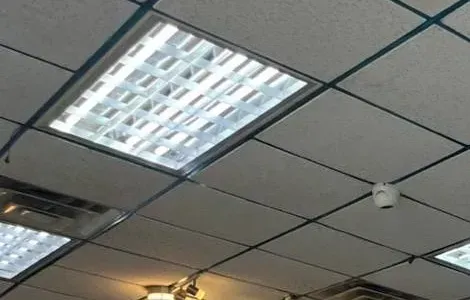
Reference photo from an AESS job: a small white dome camera sits on a dark-gridded drop ceiling near a bright lay-in light fixture, with an air vent at the left.
AI Overview Reality Check
What AI Gets Wrong About Cat6 Repair in Mott Haven
We were unable to load Google’s AI Overview while researching this page. What follows instead are seven claims that turn up again and again in quick answers, cost guides and forum threads, each checked against Mott Haven conditions and the sources listed further down.
“It’s an old neighbourhood, so the cable is all old and should just be replaced”
The picture of Mott Haven as only tenements and old rowhouses is out of date. The Furman Center counts 11,870 apartments completed in large buildings in Mott Haven/Melrose between 2010 and 2025, and the towers on the river are still filling up. Plenty of the cable we test here is a few years old.
Even in the older buildings, age is rarely the fault. Cat6 does not wear out sitting in a wall. What breaks it is what happened around it: a furniture move, a trade working nearby, a fire, a leak, a jacket left in oil. Replacing everything because the building is old wastes money on runs that test perfectly.
So we test first and replace by the result. A building gets a list of which links pass, which can be re-terminated and which really need a new length, rather than a blanket quote based on its date of construction.
“Whatever cable is on the reel is fine for a repair shop”
This holds in an office and fails in a bay. The cable that comes off most reels has a PVC jacket designed for dry, clean spaces, and suppliers of industrial cable warn that PVC cracks, bubbles or softens when exposed to oils, lubricants and solvent vapours.
The damage is slow, which is why it fools people. The link works for months, then starts to drop when the shop is busy, and the owner blames the computer or the internet provider. When we strip back the jacket near the lift we often find it tacky or split.
The correction is cable with an oil-resistant jacket where it passes through the bay, routed high, with a protected drop to each station. It costs more per foot than office cable and saves a second repair.
“A network jack is low voltage, so it can go anywhere”
Low voltage does not mean unrestricted. In a room where flammable vapour or combustible dust may be present — a distillery still room, a spray booth, a fuel store — the electrical code limits equipment inside the classified boundary to what is suitable for that class and division.
Small producers sometimes add a jack or a switch in the most convenient spot, which can be just inside that line. A process-safety specialist writing about distilleries names unrated outlets and cords run in from outside as common problems.
The right repair keeps the cable and its joints outside the classified area where it can, follows the owner’s classification drawing where it cannot, and brings in an electrician for anything that must be inside. It is a conversation to have before the visit, not on the ladder.
“Free internet in public housing means the wiring is the provider’s problem”
Big Apple Connect supplies the service, a modem and a wireless router to residents of participating NYCHA developments. That is real and useful, and the provider is responsible for its own equipment and connection.
It does not cover the cable a resident runs from that router to another room, and it does not cover the building’s own systems. The first belongs to the resident; the second — intercoms, hallway cameras, wiring in the walls — belongs to the housing authority or, after a PACT conversion, its manager, and is reported through NYCHA’s repair channels.
Knowing which of the three a dead connection belongs to saves days. We can repair the resident’s run; for the rest, we tell the resident who to call and what to tell them.
“If the network still works after a fire, the cable is fine”
A link that lights up after smoke has filled a ceiling is not proof of much. Restoration contractors warn that smoke residue on electronics can cause damage over time, and the same is true of the gold contacts in jacks and panel ports.
At the other extreme sits the advice to pull out every cable after any structure fire. In a building that took heat that is often right; in one that only took smoke, it can mean ripping out runs that are clean.
The evidence-based middle is to test every link in the affected space, open and inspect the terminations, and replace what was heated, soaked or coated, with photographs and results for the insurer.
“Just run a cable across to the building opposite”
Quick answers about linking two buildings often suggest an outdoor-rated Cat6 run between them. Across a private yard that can work within the 100-metre limit, with care about grounding.
Across a New York City street or sidewalk it is a different matter. The public right of way needs a revocable consent for private cable or conduit, granted for a fixed term with annual compensation, and the Buildings Department estimates the process at about six months.
For a Mott Haven shop with a storeroom across the road, a wireless bridge between the two buildings or separate service at the second site is usually faster, cheaper and legal. We repair the parts on private property and price the alternatives.
“A historic district means you can’t touch anything”
Owners in the Mott Haven, Mott Haven East and Bertine Block districts sometimes assume that any work, even inside, needs the Landmarks Preservation Commission. That puts people off repairs they could simply book.
The Landmarks Law requires a permit for work that affects the exterior of a designated building, and in some cases interiors. Replacing a damaged cable inside a house along its existing path does not normally change the exterior at all.
What does need care is the front: a new hole through the facade, conduit up the brickwork, a box beside the door. We point out which parts of a repair would be visible from the street so the owner can check with the Commission before we drill.
Cable Living Next to a Lift, a Still or a Classroom? Let’s Rebuild It for That
Name the neighbour — the lift, the still, the cubby wall — and the device that went dark. A Bronx technician rings back with the likely culprit and a price range before anyone books a van.
A few lines are enough: the block, whether it is a house, a shop, a flat or a workshop, which device lost its link and what the cable runs beside. A written reply follows the same business day, or ring the Bronx line on (646) 490-0629.
✅
Request Received
Thanks. Expect a call from the Bronx desk later today asking what the cable runs beside. If a register, a camera or a classroom is down right now, ring (646) 490-0629 instead of waiting.
How It Works
Our Mott Haven Cat6 Repair Process
Seven steps built around one Mott Haven habit: the cable’s neighbours decide how it failed, so the process looks at them before it chooses a part.
1. Ask what the cable lives beside
On the phone we ask what went dark, where the switch or router is and what the run passes: a bay, a still room, a classroom, a fire-damaged ceiling, a street. That decides which cable and parts go on the van.
2. Settle who has a say
We confirm whether the landlord, the housing authority, a building manager, an engineer’s classification drawing or Landmarks has to be part of the plan, and book a two-hour arrival window around opening hours, classes or services.
3. Test from both ends
The certifier goes on the closet end and the device end, grades the link and gives a distance to the fault, so only one wall, ceiling or box needs opening.
4. Look at the neighbours
At the fault we check what caused it: oil on the jacket, heat or soot, a door, a cart, a loose facade fixing. We photograph it and agree the repair with you before cutting.
5. Repair in the right material and route
A loose or corroded end gets a fresh termination on a part from the same family; a length the neighbour has spoiled is swapped for cable that suits the room, lifted or guarded away from what spoiled it, and any hole it passes through is sealed again.
6. Certify and label
The repaired runs go back on the certifier, get a printed tag at each end, and any dead cable within reach is pulled out.
7. Write down why
You receive the saved results, photos and a short note of what failed, what it sat beside and what we changed, ready for the landlord, the insurer or the next contractor.
Reference photo from an AESS job: a black bullet camera hangs from a short bracket on a white drop ceiling, angled across a plain grey wall.
Coverage Area
Cat6 Repair Near Mott Haven's Landmarks
These six places are here to help you place your street. They are orientation only — none is presented as a client of ours or a job we did.
Mott Haven Historic District
Designated on July 29, 1969, the Bronx’s first historic district, centred on Alexander Avenue — once nicknamed “the Irish Fifth Avenue” — with one of the borough’s earliest rows of houses, built between 1863 and 1865.
Bertine Block Historic District
Thirty-one buildings on both sides of East 136th Street between Willis Avenue and Brown Place, developed by Edward Bertine between 1877 and 1899 and designated in 1994, the same year as Mott Haven East.
Estey Piano Company Factory
The clock-towered brick factory at Lincoln Avenue and Bruckner Boulevard, whose first portion was finished in 1886; the Historic Districts Council calls it the oldest known former piano factory still standing in the Bronx. It became an individual landmark in 2006.
St. Ann’s Church and Graveyard
The fieldstone church on St. Ann’s Avenue built in 1841 by Gouverneur Morris Jr. in memory of his mother, with members of the Morris family, including Gouverneur Morris, buried in its crypt and graveyard.
St. Mary’s Park
35.31 acres between St. Ann’s and Jackson Avenues, which NYC Parks describes as the largest park in the south Bronx, with a recreation centre that has a 72-foot indoor pool.
NYC Health + Hospitals/Lincoln
The city hospital at 234 East 149th Street on the neighbourhood’s northern edge, a Level I adult trauma centre whose emergency department is described as the busiest single-site emergency department in New York City.
We also repair Cat6 throughout Port Morris, along the Harlem River waterfront and the Third Avenue Bridge approach, on the Willis, Brook, St. Ann’s and Cypress Avenue blocks, and in the neighbourhoods next door: Melrose and the Hub, Longwood, Hunts Point and the Lower Concourse. For the rest of the borough, start from AESS Cat6 repair across the Bronx, and for the busy shopping district to the north, our Fordham Cat6 repair page.
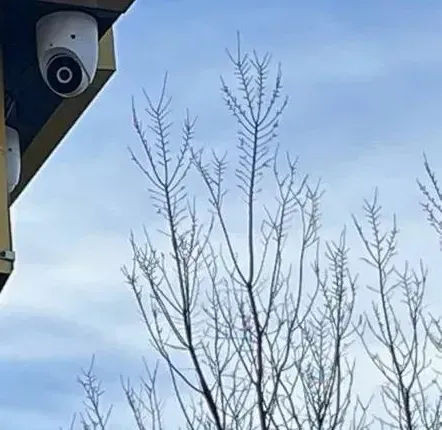
Reference photo from an AESS job: a white dome camera is fixed beneath a dark eave, seen from below against a pale blue sky and the bare branches of a tree.
Pricing
Cat6 Repair Cost in Mott Haven
Mott Haven is charged at the Bronx rates already on our site, with no neighbourhood surcharge. Our area multipliers put the Bronx at parity with the base rate, so the figures below are exactly the ones published for the borough. Each row names where it comes from. Work that depends on the space — a re-route out of a bay, a raceway run through a flat, a new exterior entry — is priced in writing once the link has been tested.
Item
Price
What it covers, and where the figure is published
Repair time on site: testing, tracing, opening the fault, re-termination and the closing certification
$195/hr, 3-hour minimum ($585)
The Bronx rate on our network cable repair and Cat6 repair pages; after the third hour, time is charged only as used
A run too damaged to keep, replaced with a new one
From $175 per drop
The published Bronx price; the new run arrives complete with its jack, faceplate, panel punch-down, certification, a label at each end and a cord
Exterior entry made good, sealed and bonded (facade, garage door or yard camera routes)
From $185 per penetration
As published on our Bronx network cable repair page
Benchmark: installing a Cat6 outlet where none existed (up to 100 ft)
$272 per drop
Install price, not a repair price, taken from the Bronx Cat6 installation table (Cat5e $233 and Cat6A $388 sit beside it there)
National cost guide, for context
$125–$250 per drop; $45–$75/hr labour
A national installation average from Fixr’s Cat6 cost guide, shown so the gap between installing and repairing is clear
Why a special cable does not mean a special rate
Oil-resistant cable, raceway and sealed boxes cost more than plain Cat6 and a faceplate, and we tell you the material cost on the written quote. The labour rate does not change because the room is a garage or a classroom; what changes is the time the route takes. A bay re-route that lifts a cable to the top of the wall takes longer than re-punching a jack, and the quote says so in hours.
How three hours are usually spent on a Mott Haven repair
The first part goes on testing from both ends and finding the fault. The second goes on the neighbour: cutting out the oil-soaked length, moving the classroom run up out of reach, opening the smoke-stained ceiling, or re-sealing the facade entry. The last part goes on certification, labels, closing up and the written note. A single damaged length at a garage station or a jack in a flat often fits inside the minimum with time left for a second link.
Things that make a Mott Haven bill bigger or smaller
Telling us the neighbour: if we know there is a bay, a still or a classroom involved, the right cable and fittings are on the van and nobody waits for a second trip.
Paperwork in hand: a classification drawing for a production room, the managing agent’s approval for a route, or the director’s preferred time for a classroom saves an hour of phone calls.
The route: a cable that can be replaced along its existing path is quick; one that must be moved away from a hazard takes longer.
After a fire or flood: the number of links that passed through the affected space sets the size of the job, not the size of the building.
Category: Cat6A and shielded links need dearer parts and more careful termination than plain Cat6.
Full terms — including 50% deposit, one-year parts-only warranty on AESS-supplied products, and the late-fee schedule — are set out in the service agreement.
Shop Our Systems
Cat6 Repair Packages & Pricing
No package price below is new: each is the sum of the published Bronx lines in the table above, grouped the way Mott Haven jobs usually arrive.
Starter — One Link, One Neighbour
$585
Three hours at $195 for one dead device and whatever damaged it: test, open the fault, repair in the right material, certify and label. If the job takes an hour, the rest of the booking goes on the next link you point to.
Standard — Repair and Re-Route
$585 + from $175 per replaced run
For a bay, a classroom or a production room where the old route was the problem: the damaged run replaced as a new drop, moved away from oil, children or traffic, and certified. Exterior entries, where needed, are added from $185 each.
Premium — Whole-Space Check After Damage
Repair time + from $175 per run
For a shop, church or office after smoke, water or a long run of DIY additions: every link through the affected area tested, terminations inspected, hourly repair where cable can be saved, new runs from $175 each where it cannot, and a written report with photos.
Bring Your Own Equipment — Labour-Only Repair
Garages sometimes keep the oil-rated reel left from the first install, managing agents sometimes insist on a particular raceway, and rowhouse owners often want the exterior box to match the others on the block. Hand us those parts and we install them for labour only, provided they are right for the room and the link’s category, and the link is certified the same as any other. Parts you supply carry their maker’s warranty rather than ours, and if a part will not give a passing link we tell you before fitting it.
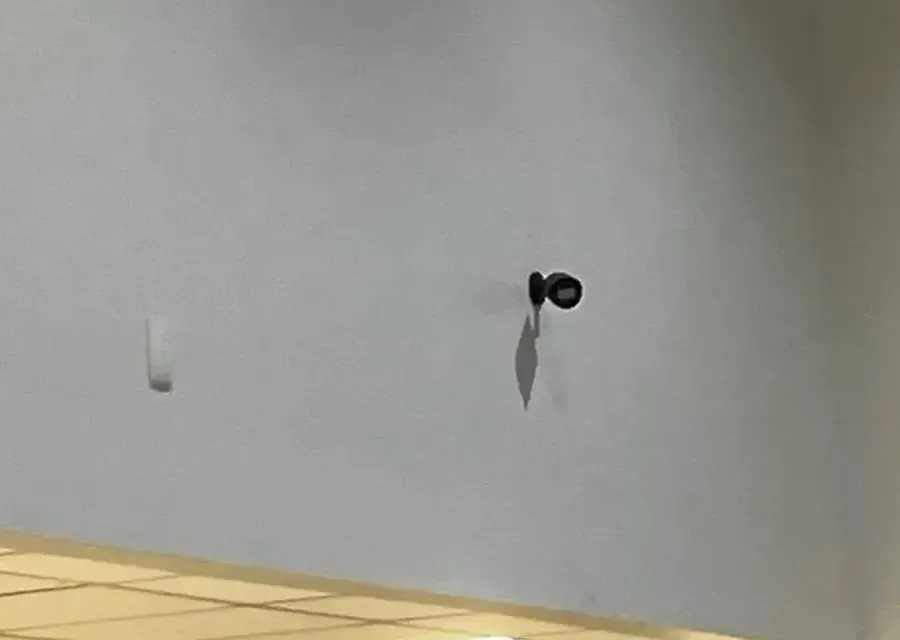
Reference photo from an AESS job: a small black camera on a short arm sits high on a pale wall and throws a long shadow, with a white wall box to its left and a lowered ceiling below.
Just Had a Fire, a Leak or a Contractor Next Door? Test Before You Close Up
A certified test of the links that passed through the damage, done before the ceiling is painted, costs far less than opening it again later.
Describe the whole list once — cable, cameras, doors — and get one reply.
Field Notes
How Our Technicians Approach Mott Haven Cable Calls
Working habits for this neighbourhood, written as practice rather than as the story of any one visit
We ask about the neighbour before the symptom. “It runs past the lift” or “it goes along the classroom wall” tells us more than “it stopped working”, and it decides what cable goes on the van.
We never re-use a jacket that has been in oil or soot. If the outside of a cable is tacky, cracked or coated, that length comes out, however well it tests on the day.
We ask for the drawing in production rooms. If nobody can say where the classified area ends, we keep our work well clear of the equipment and say so in writing.
We leave classrooms as if a toddler will inspect them, because one will. No loops, no loose cords, nothing within reach that can be pulled.
We stay on our side of every line: the tenant’s cable, not the housing authority’s; the private yard, not the public street; the inside of a landmarked house, not its face, unless the owner has checked first.
Full Service List
Every Cat6 Cable Repair Service We Handle in Mott Haven, Bronx
Below is the complete list of repair work we take on between the Harlem River and East 149th Street, arranged by the place a Mott Haven caller usually starts the conversation: the bay, the counter, the classroom, the flat, the facade or the closet.
From the garage bay and the workshop floor
Garages and production rooms are where jacket damage is most common, so Ethernet cable jacket damage near lifts and washers is our first look. From there the job becomes damaged Cat6 cable repair or cut Ethernet cable repair for short damage, and Cat6 cable replacement or network cable replacement in oil-resistant cable for anything longer. Diagnostic stations and office desks off the shop floor are brought back with desktop computer Ethernet troubleshooting and office Ethernet connection repair; where the shop has a counter, checkout counter Ethernet repair and POS network cable repair follow. Commercial network cable repair, low voltage cable repair and commercial office Cat6 repair cover the rest of the premises.
Where the floor is the problem, Cat6 cable damage from carts and jacks is fixed by moving the run: overhead Cat6 cable routing with Cat6 cable support installation, ceiling network cable repair where the run goes above a grid, and Cat6 cable replacement above ceiling grids in the workshop’s office.
From the shop counter on 138th Street
A card terminal that will not connect is usually a cord or a jack under the counter. Retail POS connectivity troubleshooting and retail store network cable repair start at the terminal and work back; patch cable replacement and network patch cord replacement swap the short leads that get pulled every day; Ethernet outlet repair and network outlet repair rebuild outlets fitted into counters. Data jack repair and data jack replacement deal with the jack itself, and network connection restoration is the moment the register comes back.
From the classroom, the clinic or the church office
Camera, display and staff-computer links in day cares, schools, clinics and churches are tested with Cat6 cable diagnostics and Ethernet connection diagnostics, and repaired as office workstation network repair, Ethernet wall jack repair, network wall jack repair and Cat6 wall jack repair. Long runs made of joined pieces get Cat6 cable continuity testing and Cat6 cable fault detection to find each coupler, then broken Cat6 cable repair or a single new length. Wi-Fi points for halls and waiting rooms are covered by Cat6 cable repair for WiFi access points, wireless access point cable repair, ceiling mounted access point repair and PoE access point troubleshooting.
From the camera that watches the door
Stoop, awning, bay and lot cameras are the links that pass the most hazards. PoE connection troubleshooting at the camera end is followed by PoE camera cable repair, security camera Ethernet cable repair, Cat6 cable repair for security cameras and offline security camera network repair. At the wall, weatherproof Ethernet connector repair and outdoor Cat6 termination repair close the exterior part of the run, and Cat6 cable damage from metal edges at gates and door frames is treated with sleeves or a new path.
From the apartment
In flats and rowhouses the work is residential network cable repair on surface or in-wall runs: Cat6 connector repair, Cat6 connector replacement, RJ45 connector repair, RJ45 connector replacement and broken RJ45 connector repair at the plug end; Cat6 keystone jack repair, Cat6 keystone jack termination and Cat6 keystone jack installation at the wall; and crimped Ethernet cable repair where someone made their own lead. Where two people wired the same house to different standards, Cat6 wiring repair, Cat6 wiring troubleshooting, incorrect Cat6 wiring repair and Cat6 wiring correction — T568A wiring repair or T568B wiring repair — make both ends agree.
From the closet, the rack or the cellar shelf
Small networks in Mott Haven usually live on a shelf or a wall-mounted rack. Cat6 patch panel repair, network patch panel repair, Cat6 patch panel termination and Ethernet patch panel troubleshooting deal with the panel; a careful Cat6 punch down repair rebuilds a loose port; RJ45 cable termination, RJ45 connector installation, Cat6 cable termination and Cat6 cable retermination handle the ends. Network rack cable repair, network rack cable management, network cable organization and network cable cleanup tidy what hangs off it, and network cable labeling with Cat6 cable labeling marks each end, with before and after network cable repair and before and after Cat6 cable repair photos to show the difference.
When nobody knows which cable is which, network cable tracing, Ethernet cable tracing and Cat6 cable tracing with tone generator cable tracing and network toner and probe testing find the right one, and Ethernet cable fault detection, Cat6 cable tester diagnostics, network cable diagnostics, network cable troubleshooting, Ethernet cable troubleshooting, Cat6 cable troubleshooting, network connectivity troubleshooting and low voltage network troubleshooting cover the detective work. Disconnected Ethernet connection repair and damaged Ethernet cable repair finish it.
When somebody needs proof
In this neighbourhood the paper trail often matters as much as the link. An insurer adjusting a smoke claim, a managing agent releasing payment and a foundation auditing a day care all ask the same thing: show me it works. A quick Cat6 cable signal test or a basic network cable test answers the owner standing beside the jack; Cat6 performance testing against the category limits answers everyone else, and Cat6 cable certification testing leaves a saved file per link that can be emailed on. Ethernet cable certification and network cable certification are simply the same file under other names. Put together, that is certified Cat6 cable repair: every run Cat6 cable repaired and tested, with Cat6 cable testing and network cable testing recorded rather than promised — and after a fire, a burst pipe or a gut renovation next door, network cable testing and certification of the affected links is the first thing we recommend.
Between emergencies, structured cabling maintenance, structured cabling testing and structured cabling troubleshooting keep small buildings in order, with structured cabling repair when something gives and Cat6 cable installation when a room needs a cable it never had. Ethernet cable repair, network cable repair, network cabling repair services, Cat6 cable repair services and professional Cat6 cable repair services all describe the same visit from a licensed low-voltage Cat6 cable repair contractor; the person who arrives is a Cat6 repair technician, or an Ethernet repair technician if that is what you call it.
FAQ
Mott Haven Cat6 Repair FAQ
Our NYCHA building’s lobby intercom or a hallway camera has stopped working. Can a resident hire you to repair its cable?
+
No. Intercoms, hallway and lobby cameras and the wiring in the building belong to the housing authority, or to the private manager of a development converted under PACT, and only they can authorise work on them. Residents report those faults through NYCHA’s Customer Contact Center or the MyNYCHA app, which take repair requests for building common areas as well as apartments. We work on those systems only when the authority, its PACT manager or one of their contractors engages us. What a resident can hire us for is their own cable inside the apartment.
Can the wall jacks we have repaired plug straight into the free router Big Apple Connect gave us?
+
Usually, yes. Big Apple Connect includes a free modem and wireless router, and home routers of that kind normally have a few wired ports on the back. A repaired run from a bedroom or desk can plug into one of those ports with a short patch cord. If you need more wired connections than the router has ports, a small unmanaged switch beside it adds more. The router and its settings stay the provider’s responsibility; we test that the cable from the router to your jack passes and leave it labelled at both ends.
All Areas Served
Cat6 Repair Across the Bronx, New York City and Beyond
Our Cat6 repair pages are arranged as a tree: this neighbourhood page hangs from the Bronx borough page, which hangs from the citywide Cat6 repair hub, with separate hubs for Long Island and the Hudson Valley. Pick any branch below.
Everything else we do for Mott Haven homes and businesses, from alarms to door buzzers, starts at the AESS home page, and the company and licence behind each visit are described on our about page.
Sources
Sources Behind the Mott Haven Facts on This Page
Every number, date and rule about Mott Haven on this page traces to one of the documents listed here. The summaries are short; where a legal question turns on the wording, read the original or ask the agency that wrote it.
Housing and the neighbourhood
NYU Furman Center, Mott Haven/Melrose profile (last updated May 6, 2026): homeownership 6.1% in 2024 against 32.7% citywide; public housing 24.1% of rental units; 11,870 units completed in buildings of four or more units, 2010–2025.
NYC Small Business Services, Mott Haven Commercial District Needs Assessment : more than 441 surveys plus stakeholder meetings; 38 delis and bodegas, 26 beauty and barber businesses, 21 automotive businesses, 19 schools and day-care centres, 18 medical and 17 agency, nonprofit and worship storefronts; 8.3% storefront vacancy; 55% of surveyed merchants with 0–2 full-time employees; “a dozen new mixed-income residential towers” along the Harlem River; Jordan L. Mott’s industrial development from the 1830s; 2019 traffic counts on Third Avenue.
NYC Department of City Planning, Port Morris/Bruckner Boulevard Rezoning: 44 of 129 lots occupied by non-conforming residences; paired residential and manufacturing districts; loft conversions in vacant buildings; antiques shops along Bruckner Boulevard.
Wikipedia, Patterson Houses: fifteen buildings of six and thirteen storeys, 1,790 apartments, opened 1950. Mott Haven Herald, March 8, 2021: Betances Houses’ 1,088 apartments renovated with new security cameras among other improvements, managed by a private team under RAD/PACT.
CityRealty on Bankside (Brookfield Properties): 1,350 units straddling the Third Avenue Bridge; Third at Bankside in towers of 25, 25 and 17 storeys. New York YIMBY, August 9, 2026: 307 Bruckner Boulevard, two-storey, about 100,000 sq ft last-mile logistics facility, due to open in the third quarter of 2026.
CityNeighborhoods.NYC, Port Morris: former factories turned into studios, distilleries and design workshops, naming the Bronx Brewery and Port Morris Distillery.
Landmarks
Historic Districts Council: Mott Haven Historic District designated July 29, 1969, early rows of houses 1863–1865, Alexander Avenue as “The Irish 5th Avenue”; three districts in Mott Haven; Estey Piano Company Factory, original portion 1886, oldest known former piano factory standing in the Bronx. CityLand (hearing April 11, 2006) and NYC Council Res. 0484-2006 on its designation.
6sqft: Mott Haven East and Bertine Block districts designated in 1994; Bertine Block’s 31 buildings on East 136th Street between Willis Avenue and Brown Place, built 1877–1899.
Urban Archive / Village Preservation and Wikipedia, St. Ann’s Church: built 1841 by Gouverneur Morris Jr. in memory of his mother; Morris family burials. NYC Parks, St. Mary’s Park: 35.31 acres, largest park in the south Bronx, 72-foot pool. NYC Health + Hospitals/Lincoln and Wikipedia, Lincoln Hospital: 234 East 149th Street; Level I trauma centre; busiest single-site emergency department in the city.
Programmes, codes and rules
NYC Office of Technology and Innovation, Big Apple Connect: launched September 2022; free internet, modem and wireless router, basic cable and some common-area Wi-Fi for NYCHA residents; agreements with Optimum and Spectrum to 2028. Optimum, Big Apple Connect: Mott Haven, Patterson and Mitchel among participating developments.
NYCHA, Repairs Process: apartment and building repairs requested through the Customer Contact Center or MyNYCHA. Legal Aid Society: most leases prohibit alterations without the landlord’s prior permission.
NYC Health Code Article 47 (child care): premises “shall be free of electrical, chemical, mechanical and all other types of hazards.”
NYC Department of Buildings, code notes on revocable consent: private installations in the right of way only by revocable consent; overhead pipe, conduit and cable among eligible improvements; fixed term and annual compensation; telecommunications consents outside DOT; about six months.
NYC Landmarks Preservation Commission, applications: permits required before work affecting the exterior of designated buildings. NYC Department of Buildings, Electrical Code: 2020 NEC with city amendments, in full effect December 21, 2025. EC&M on NEC 800.25: accessible abandoned cable removed.
Technical, news and prices
Cables and Kits, oil- and chemical-resistant Ethernet cables: PVC jackets crack, bubble or soften with oils, lubricants, alcohols and acid vapours; UL Oil Res I and Oil Res II.
Bluefield Process Safety, “Process Safety in Distilleries: Electrical Classification” (November 2025): Class I areas from ethanol, Class II from grain dust; unrated outlets and cords run in from outside as common problems.
Mott Haven Herald, June 21, 2024: four-alarm fire gutting a row of businesses on Third Avenue in Melrose. CBS New York, May 2026: two-alarm fire in a two-storey building on Third Avenue between East 139th and 140th Streets. Paul Davis restoration blog: smoke residue on electronics may cause damage over time.
AESS published prices: hourly rate, three-hour minimum, $175 replacement run and $185 sealed entry as they appear on our Bronx network cable repair and Bronx Cat6 repair pages; the $272 new-drop figure from our Bronx Cat6 installation page. Fixr, Cat6 cabling cost guide: national $125–$250 per drop and $45–$75 an hour, for comparison only.
Still Offline Beside the Bay, the Still or the Classroom?
If a register, a diagnostic station, a classroom camera or a link to another building has gone dark, call (646) 490-0629. Tell us what the cable runs beside and when somebody can let us in, and we will plan the repair around both.
Mott Haven Cat6 Rebuilt for What Lives Next to It, Tested and Written Down
Abstract Enterprises Security Systems · 460 E Fordham Rd, Bronx, NY 10458 · Bronx line (646) 490-0629 · WhatsApp (718) 679-0359 via wa.me
NYS Low-Voltage Licence #12000287431 · 100% Licensed & Insured · Same-Day Estimates · Rated 4.7★ from 201 Google Reviews
Parts you supply are covered by whoever made them; what we commit to is explained on the AESS warranty page.
Child-care rules, landmark permits, street consents, the electrical code and the Big Apple Connect programme are described in plain terms for planning only; none of it is legal advice. Page reviewed October 21, 2026; changelog: first version of the Mott Haven page published, local facts re-checked against their sources.