A North 7th Street walk-up whose top floor can't buzz anyone in, a Southside tenement with an HPD intercom violation, a converted loft with three sections or a boutique condo drowning in deliveries? Williamsburg door buzzer installation line: (347) 934-8335
Northside and Southside Walk-Ups · Converted Factory Lofts · Boutique Condos · Waterfront Rentals · Shops on Bedford Avenue and Grand Street
Door Buzzer Installation in Williamsburg
HPD Record Read Before the Visit · Every Apartment Tested From the Sidewalk · Delivery Settings Planned In · Written Price Before Ordering · Brooklyn Rate
Door buzzer installation in Williamsburg is mostly about two things: buildings whose old systems have failed apartment by apartment, and buildings whose doors are rung all day by couriers. On the numbered North and South streets and the avenues that cross them, HPD has written 82 intercom violations at 46 buildings since 2020. Residents on r/williamsburg describe drivers who press every button until someone opens the door. Below is how we plan a new entry system for the walk-ups, lofts, condos and shops of Williamsburg, and where each job lands on our Brooklyn price list.
Every price comes from our Brooklyn door buzzer list, and the full total, with each possible extra named, is agreed in writing before any equipment is ordered
Rated 4.7★ across 201 Google Reviews
Reviewed and updated November 11, 2026, against NYC Open Data's HPD Housing Maintenance Code Violations dataset (queried November 11, 2026, for ZIP codes 11211 and 11249 and for Williamsburg's numbered North and South streets, Bedford, Driggs and Kent Avenues and Havemeyer Street since January 1, 2020); r/williamsburg threads on couriers ringing every button and on Amazon's "ring any apartment" instruction; r/AskNYC and r/Brooklyn threads on small-building buzzers and doors that do not lock; ButterflyMX's guide to buzzer bombing; the Associated Press report on Amazon Key for Business carried by WBEZ (July 2021); Gothamist's November 2015 report on lobby package thefts in Williamsburg and Greenpoint; Brick Underground's guide to package handling in non-doorman buildings; the New York Attorney General's Residential Tenants' Rights Guide; New York's Multiple Dwelling Law §50-a; HPD's Tenant Data Privacy Law page; NYC311's Loft Law article; Wikipedia's articles on Williamsburg, the Bedford Avenue station, the Domino Sugar Refinery, Domino Park, Brooklyn Bowl and Marsha P. Johnson State Park; the Swiftlane, NYHLS and Swift Locksmith cost guides; Aiphone's GT Series page; Allegion's fail-safe guide; the building code's sensor-release provisions; and the 2010 ADA Standards. · Abstract Enterprises Security Systems, NYS license #12000287431 · crews dispatched from our Troy Avenue office in Brooklyn
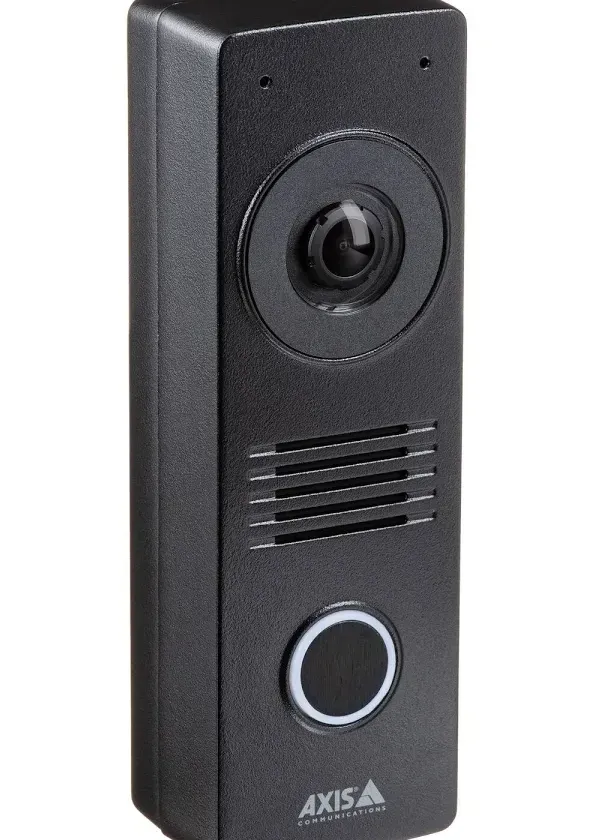
A photo from the AESS job library, not taken in Williamsburg: a black rectangular video door station with a camera lens, a speaker grille and one round call button that lights up. A single-button station like this belongs at the private street door of a Williamsburg row house or a ground-floor duplex, where a lit button and a camera at face height tell a courier exactly where to press and show the resident who is pressing it.
Williamsburg Buzzer Request
Walk-up, loft, condo, rental or shop: tell us the street, how many apartments the system has to reach and what is at the door now, and a technician calls back with the range
✅
Request Sent!
Thank you. A technician will call you about the Williamsburg address, usually within two hours during working hours.
25+
Years Experience
✓
Same-Day Estimates
100%
Licensed & Insured
4.7★
201 Google Reviews
Owner-operated since 2002 · Thousands of jobs completed · Booked within 2 hours
Quick answer: door buzzer installation in Williamsburg costs $400 to $900 on our Brooklyn list for an audio station and a new door release at a row house, a two-family or a single shop door, $700 to $1,800 for a video door station with indoor stations or phone answering at a small walk-up or a few loft units, and from about $2,500 to past $10,000 for a full entry system in a walk-up of 12 or more apartments, a sectioned loft building or an elevator rental. That price includes the door station, the apartment stations, the power supply, the electric strike or approved lock, the cable and the labor, and it is fixed in writing after a walkthrough from the sidewalk through the cellar to the top floor. Anything that depends on a test, such as an old riser pair that may not carry video or a closer that may need replacing, is named with its price before you order. Send photos of the street door, the panel and one apartment station to (347) 934-8335 or on WhatsApp, and we reply with the range that fits, usually within two hours during working hours.
Reading your photos and quoting a new system costs nothing. When an existing system has to be tested in person before it can be priced, that is the $250 service call booked online, and the $250 is applied toward the work.
All work is done under New York State license #12000287431. We install the low-voltage entry equipment; if the power supply needs a new 120-volt outlet or circuit, a licensed electrician does that part, and you know before the price is set.
We take instructions from whoever controls the door: an owner, a condo or co-op board and its managing agent, or a shop tenant with the landlord's written approval.
The Neighborhood
Why Williamsburg Properties Need Door Buzzer Installation
Williamsburg began as the Village of Williamsburgh, incorporated in 1827 and annexed to Brooklyn in 1855, when the "h" was dropped. Today the name covers a large and varied place, but this page is about Williamsburg proper: the North Side above Grand Street, the Southside between Grand Street and Broadway, and the waterfront along Kent and Wythe Avenues, from the Bedford Avenue station out to Union Avenue. Its housing is an unusual mix for one neighborhood. Late nineteenth- and early twentieth-century brick and frame walk-ups fill the numbered streets. Factories and warehouses have become loft apartments and offices. Since the rezoning of May 11, 2005, boutique condos and towers have gone up on side streets and on the water. Nearly all of them depend on a buzzer, because very few have a doorman.
Two problems account for most of the entry-system calls we see from these blocks, and both show up in public records and resident conversations rather than in anyone's sales pitch.
The first is old systems failing one apartment at a time. On November 11, 2026, we asked NYC Open Data for every HPD Housing Maintenance Code violation that mentions an intercom on Williamsburg's numbered streets, North 5th to North 9th and South 1st to South 5th, together with Bedford, Driggs and Kent Avenues and Havemeyer Street, since January 1, 2020. The answer was 82 violations at 46 buildings. South 2nd and North 7th Streets had 12 each, North 6th had 10, South 4th had 9, and South 3rd and North 8th had 8 each. Most of those buildings appear once, but a few appear again and again, which is the pattern of a riser or power supply that is wearing out rather than a single broken handset.
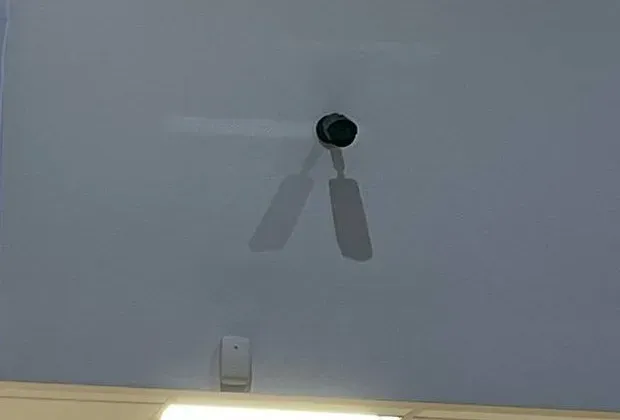
A photo from the AESS job library, not taken in Williamsburg: a small black camera mounted high on a pale wall, casting two shadows, with a small white device fixed below it. In the vestibule of a Southside walk-up, the wall above the inner door is where a camera that records who actually walks in after the buzzer releases usually goes, out of reach and clear of the door station.
The second is the delivery traffic. Most Williamsburg buildings have nobody at the door to take a package. On r/williamsburg, one resident explained what happens next: "In my building, delivery drivers will sometimes ring every button knowing that at least one person will buzz them in." Another described living in "an apartment building with many residents, no doorman and not a clear place to put packages except just through the exterior door." ButterflyMX, which sells cloud intercoms, calls the practice buzzer bombing and says plainly that "the majority of buzzer bombings are caused by busy delivery carriers." Each of those buzz-ins opens the street door to a stranger nobody has seen, and in 2015 the NYPD described thieves taking packages from North Brooklyn lobbies after being "buzzed into the lobby, by an unknown tenant."
An entry system in Williamsburg therefore has to do two jobs that pull in opposite directions. It has to reach every apartment reliably, including the fourth-floor rear unit at the end of a hundred-year-old riser, and it has to make it easy for residents to say no to a stranger and yes to their own delivery. The rest of this page is about how we design for both, building type by building type.
Six Williamsburg facts that change how a buzzer is planned
The violations cluster on the numbered streets. Of the 82 intercom violations we found since 2020 on Williamsburg-proper streets, 71 were on North 5th to 9th and South 1st to 5th Streets, the blocks of older walk-ups and converted buildings.
A few buildings carry a large share. Two addresses, 34 North 6th Street and 109 North 7th Street, account for 17 of the 82 violations, nine and eight respectively.
The station is often in the kitchen. HPD's descriptions at North 6th Street place the apartment's "return buzzer in the kitchen", which tells you where residents of converted lofts actually answer the door, and where a replacement station has to reach.
Inspectors often cannot get in. Several 2025 and 2026 records on North 6th Street and South 4th Street carry the status "first no access to re-inspect violation," meaning HPD's follow-up visit could not reach the apartment, so a violation can sit open for reasons that have nothing to do with the equipment.
The intercom law has an eight-apartment line. The Attorney General's tenants' rights guide states that a building with eight or more apartments must have "a two-way voice intercom system from each apartment to the front door" and that tenants "must be able to 'buzz' open the entrance door."
Doormen are rare, virtual doormen are not. Some boutique buildings on the North Side advertise a virtual doorman, a remote service that answers the door panel; a listing at 68 North 8th Street describes a "Carson virtual doorman system." Everyone else relies on the buzzer alone.
Where this page applies. This page covers Williamsburg proper, from the East River east to about Union Avenue and the BQE, and from North 15th Street and McCarren Park south to Broadway, including the North Side, the Southside and the waterfront. South of Broadway, our South Williamsburg door buzzer installation page covers the blocks around Lee and Bedford Avenues, and east of Union Avenue our East Williamsburg door buzzer installation page covers the lofts and walk-ups toward Bushwick. For the whole borough see door buzzer installation in Brooklyn.
Repair or Replace in Williamsburg
Need Repair in Williamsburg? One Dead Station, a Failing Riser or a System Past Saving
Many installation jobs in Williamsburg begin as a repair call. A tenant on the top floor of a South 2nd Street walk-up has stopped being able to let anyone in. An HPD violation has arrived with a correction date. A new owner has bought a building whose app panel was set up by someone who left with the password. Before we recommend any equipment, we decide which of three routes the building is really on, and we tell the owner which one in writing.
Route one is a repair, when one part is the whole fault: a power supply in the cellar that drops out when three apartments press release at once, an electric strike that has worked loose from a soft wooden frame, or one apartment's station. Route two is a partial replacement: a new street panel and power supply over a riser that tests sound, with only the dead stations swapped. Route three is a new system with new cable, for buildings where the riser has been spliced on every floor, where a renovation cut half the apartments off, or where there has never been more than a row of bell buttons and a door that locks with a key. If the honest answer is a repair, we price a repair, and the Brooklyn door buzzer team handles that work too.
One reason the route matters so much here is the pattern in HPD's record. A building that shows a single violation in six years usually had a single fault. A building that shows eight or nine, spread across different apartments and floors, usually has a shared cause, and replacing stations one at a time will not end the complaints. We look at that history before we visit, and if it points to the riser or the power supply, we price that alongside the stations so the owner can compare.
What We Install
Door Buzzer Installation Services in Williamsburg
Every service below is priced from the same Brooklyn door buzzer list. The number of apartments sets the size of the system, the doors decide which release each can take, and in Williamsburg the age of the cable, the layout of converted buildings and the volume of deliveries decide most of the design.
Walk-up system replacements
New street panels, power supplies and apartment stations for the four- and five-story walk-ups of the numbered streets, over tested riser pairs or new cable where the old pairs have failed.
Loft and sectioned-building systems
Entry systems for converted factories and warehouses whose apartments are grouped in sections, wings or separate stairs, with each section's door and directory planned on its own.
Audio-to-video upgrades
A video street panel and video apartment stations, often over the existing pairs with a two-wire system, so residents can see whether the person ringing is their courier or a stranger.
Delivery-aware door panels
Panels and settings that cut down on couriers pressing every button: a clear directory, a single delivery code or schedule set by the owner, and a camera view that shows who came in.
Phone answering for residents
Door stations that ring residents' phones as well as, or instead of, their apartment stations, with any monthly charge stated on the quote and a station kept for anyone who wants one.
Condo and boutique-building panels
Replacement or extension of developer-installed panels in post-2005 buildings, including adding apartments, a roof or cellar door, or a second entrance to an existing system.
Row house and two-family buzzers
One- to three-button video or audio stations with a release for frame row houses and two-families, sized for a door that only a few households use.
Strikes, closers and door preparation
Fail-secure electric strikes cut into old wood and steel frames, closers set so heavy street doors latch every time without slamming, and doors trued before any release goes on.
Shop, studio and office buzz-in doors
Buzz-in doors for storefronts, upstairs offices and studios on Bedford Avenue, Grand Street, Metropolitan Avenue and the side streets, kept separate from the apartments above.
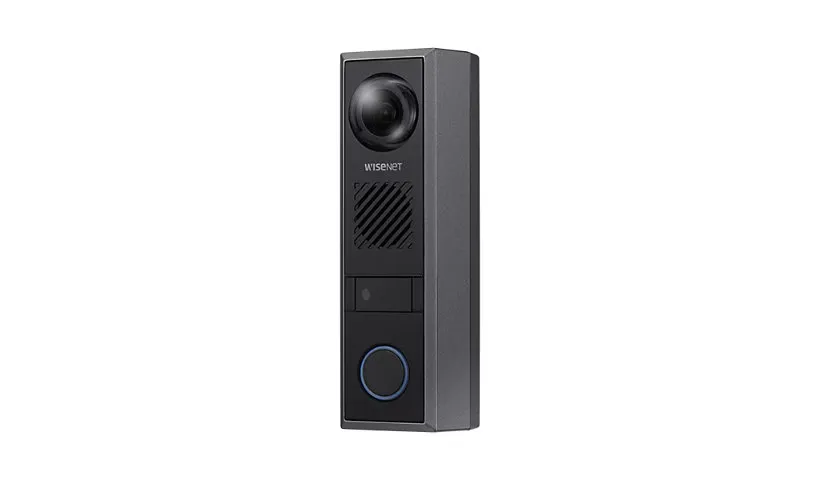
A photo from the AESS job library, not taken in Williamsburg: a slim dark grey wired doorbell with a camera lens, speaker slots and a round push button. On the narrow wooden door frame of a frame row house on one of the North Side's numbered streets, a unit this thin fits beside the trim where a full apartment panel would not, and it still gives the household video and a door release.
Building Specialists
Door Buzzer Installation for Williamsburg's Architecture
Six kinds of building make up nearly all of the entry systems we plan in Williamsburg. They differ in how many households share the street door, where the cable can run, who can order the work, and what tends to go wrong when the job is rushed.
Numbered-street walk-ups
Four- and five-story brick buildings on North 5th to 9th and South 1st to 5th Streets, often with a store or bar at street level, where most of the HPD intercom record sits.
Frame row houses and two-families
Narrow wood-frame and brick houses on the North Side, some covered in siding, with one street door and two or three households behind it.
Converted factory lofts
Former industrial buildings with apartments in sections or wings, kitchens on exterior walls, exposed brick and timber ceilings, and doors added wherever the conversion needed them.
Boutique condos and rentals
Five- to eight-story buildings put up on side streets after 2005, usually with a developer-installed panel, a small lobby and sometimes a virtual doorman.
Waterfront towers
The high-rise rentals and condos along Kent Avenue and at Domino, many with staffed lobbies at the front and buzzers at side, garage and amenity doors.
Mixed-use buildings with venues below
Apartment buildings above bars, restaurants and music rooms, where the residents' door sits a few feet from an entrance that is busy until closing.
Numbered-street walk-ups: twenty apartments, one riser and a century of repairs
The typical North 7th or South 2nd Street walk-up has four or five floors, four to six apartments on each, a narrow stair and a cellar with the meters, the boiler and the buzzer's power supply. Its first entry system was often a row of bell buttons or a simple audio panel, and every system since has reused the same riser of cable running up through the building, sometimes inside an old dumbwaiter shaft, sometimes stapled to the stair wall under layers of paint. That is the building HPD's record describes. At 202 South 2nd Street it wrote four intercom violations between 2020 and 2025; at 300 South 3rd Street, four between 2020 and August 2026, the latest for a "broken or defective buzzer and return voice intercom system."
The mistake in these buildings is to replace the street panel and stop there. A new panel on a riser with a dozen splices will work on install day and fail by the next winter. We meter every pair from the cellar before we price, and we tell the owner plainly whether the riser can carry a new system or whether new cable is the cheaper answer over five years. Where new cable is needed, the dumbwaiter shaft, a closet stack or a rear fire-escape wall usually gives a route that does not mean opening every apartment's walls.
Frame row houses and two-families: a door, two households and a stoop
The North Side still has frame houses from the nineteenth century, some with siding, some restored, many divided into two or three apartments. These buildings are below the eight-apartment line in the Multiple Dwelling Law, so no statute makes the owner install a buzzer, and many still have none. The usual request is simple: each household wants its own button, its own station and a way to release the street door without walking down the stoop.
The details decide whether it works. A frame house moves with the seasons, so a strike set into a soft wooden frame needs a reinforced jamb or it will drift out of line. The cable to the upper apartment can often follow an old bell wire route, if the wire is still there and the walls are plaster on lath rather than brick. And where two households share a front hall, the inner door may need its own release so the upstairs tenant can let a guest into the stair without the guest standing in the downstairs tenant's hallway.
Converted factory lofts: sections, wings and stations in the kitchen
Williamsburg's converted industrial buildings are the hardest entry systems to plan and the most interesting. The building at 34 North 6th Street shows why. HPD's records there identify apartments by section, with apartment numbers such as N2M, N5T, N6A and N6J and one description noting "section 'north'", and they place the apartment's buzzer station in the kitchen, on the north, east or west wall depending on the unit. Nine intercom violations have been written there since September 2024, most recently on October 31, 2026.
In a building like that, the entry system is really several systems sharing a street door. Each section may have its own stair and its own inner door, the cable runs are long, often across exposed timber or concrete ceilings, and the stations sit wherever the conversion put the kitchen, which may be a very long cable run from the panel. We plan these by section: a directory at the street door that groups apartments the way residents know them, a riser or home-run route per section, power sized for the longest run, and a station position agreed with the owner in each kitchen. NYC311's Loft Law guidance notes that units in the Greenpoint and Williamsburg industrial business zone can still fall under the Loft Law; for those buildings, the entry system is part of the legalization work the owner is already carrying out, and we work to the owner's architect.
Boutique condos and rentals: the developer's panel, ten years on
Many five- to eight-story buildings went up on Williamsburg's side streets after 2005, often with a dozen to forty apartments, a small lobby and a door panel chosen by the developer. A decade or more later, those panels are reaching the end of their support. The manufacturer may have stopped updating the app, the management account may belong to a developer who is long gone, or the board may want to add the roof deck, the bike room or a second entrance.
Before replacing anything, we find out what the building actually has. Some of these systems can be extended with more apartments or doors; some can be re-registered to the board; some are cloud panels whose subscription is the real problem. We give the board a written comparison of keeping and extending the current system against replacing it, including any subscription over ten years, and the tenant data rules that apply if the building uses a smart access system.
Waterfront towers: the side doors are the weak point
The towers along Kent Avenue, such as 325 Kent at Domino with its 522 apartments, mostly have staffed lobbies, so their front doors are not usually buzzer jobs. Their other doors are. Garage pedestrian doors, bike rooms, amenity floors, service entrances on the side streets and the doors to retail spaces at the base all need a way for a visitor or a courier to reach someone, and for the building to know who came in. We plan these as call stations that ring the front desk or the super, with a camera view and a release the desk controls, wired back to the building's main entry or management system where it allows.
Mixed-use buildings with venues below: keep the two doors apart
Many walk-ups on Bedford Avenue, North 6th Street and Grand Street sit over a bar, a restaurant or a music room. For the buzzer, the rule is simple: the residents' door and the business door are separate systems, with separate panels, power and releases, so nothing the business does can open the residents' stair and a fault in one never takes out the other. Where the residents' street door and the venue's door share a vestibule, we usually put the controlled door at the inner residents' door and leave the business entrance entirely out of the apartments' system.
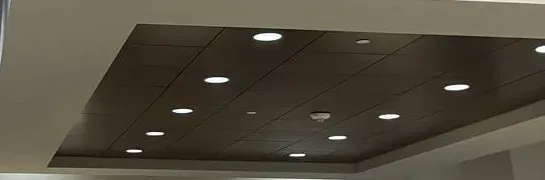
A photo from the AESS job library, not taken in Williamsburg: a dark recessed ceiling panel with round downlights and a small round device, framed by a lighter ceiling. Small lobbies in the boutique condos on Williamsburg's side streets are often finished with a feature ceiling like this, and when the developer's panel is replaced, the cable path from the street door to the riser closet usually runs above it.
Field Notes
Field Notes: Start at the Kitchen Wall, Follow the Pair to the Cellar, Then Ring It From the Curb
This is the order our technician works in on a first visit to an existing Williamsburg building, before a price is written.
Start inside the apartment the city wrote up. HPD's violation text names the wall and the room, such as "west wall return buzzer in the kitchen" or "north wall in the private hallway," so the technician goes straight to that station, takes it off the wall and looks at the cable behind it. Brittle cloth-covered wire, a splice taped inside the box, or a pair that has been cut short and stretched tell most of the story before any meter comes out.
Then follow the pair down. In a walk-up that usually means the stair wall or an old dumbwaiter shaft; in a converted loft it may mean a long run across the ceiling to a section's own riser. In the cellar the technician finds the power supply and the junction where the riser starts, counts the splices on the way and meters the pair against one that serves a working apartment on the same line.
Last, ring it from the curb. Standing where a courier stands, the technician presses the apartment's button, listens for the chime upstairs, talks both ways and releases the door, then lets the door go to see whether it closes and latches by itself. A system that rings but does not release, or releases a door that never latches, is not secure, and the fix is often in the door rather than the electronics.
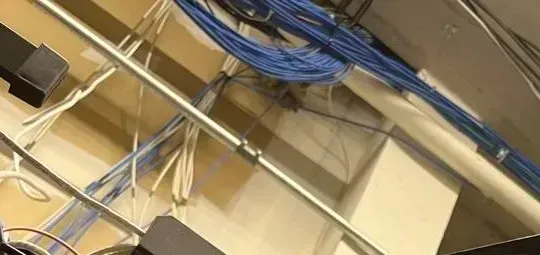
A photo from the AESS job library, not taken in Williamsburg: bundles of blue low-voltage cable laid over a ceiling beam beside a metal pipe in an open ceiling. In a converted factory loft on the North Side, the ceilings are often left open like this, and a new run from the street panel to a section's riser can follow the beams instead of being fished through finished walls.
The City's Intercom Record
82 HPD Intercom Violations at 46 Williamsburg Buildings: What the Record Shows Owners and Tenants
HPD's open data is the most honest picture available of how entry systems in Williamsburg actually fail, because it records what inspectors found when tenants complained. Our November 11, 2026 query covered every Housing Maintenance Code violation since January 1, 2020 whose description mentions an intercom, on North 5th to North 9th Streets, South 1st to South 5th Streets, Bedford, Driggs and Kent Avenues and Havemeyer Street, in ZIP codes 11211 and 11249. It returned 82 violations at 46 buildings. For the wider picture, the same dataset shows 38 intercom violations in ZIP code 11211 and 14 in ZIP code 11249 since January 1, 2025, though those ZIP codes also reach into South Williamsburg, East Williamsburg and the edge of Greenpoint.
Four things in the record matter for anyone planning an installation.
Most buildings fail once; a few fail constantly
Of the 46 buildings, 31 had exactly one intercom violation in nearly seven years. That is what a single failed station or a one-time fault looks like. At the other end, 34 North 6th Street had nine, from September 2024 to October 2026, and 109 North 7th Street had eight, from January 2020 to August 2025. Three more buildings, 202 South 2nd Street, 377 South 1st Street and 300 South 3rd Street, had four each. When one address keeps returning to the record, apartment after apartment, the cause is rarely the stations; it is the shared parts, the riser, the power supply or the panel, and the right quote prices those.
The wording tells you what tenants live with
The descriptions are specific. At 298 North 8th Street in June 2026, inspectors wrote two class B violations for the "bell/buzzer/intercom system from building street entrance to west wall in the foyer" for apartments on the second and third stories; both are now marked "not complied with." At 371 South 4th Street in October 2026 they described a broken "intercom door bell and return buzzer from building front entrance door." At 109 North 7th Street in August 2025 they named a "broken or defective intercom relay from vestibule," the part that actually releases the door. And at 308 South 3rd Street in October 2025 they ordered the owner to "replace with new the missing intercom system throughout the entire building," a violation later dismissed. Each of those is a resident who cannot let in a guest, a courier or a home attendant without walking downstairs.
Many violations stall at the re-inspection
Several recent records on North 6th Street and South 4th Street carry the status "first no access to re-inspect violation." That means HPD came back to check the correction and could not get into the apartment. For an owner who has fixed the problem, the remedy is to arrange access or certify the correction properly; for a tenant whose station still does not work, it is to make sure the inspector can get in. Either way, the paperwork we leave matters: our test sheet records the result for every apartment on the day of installation.
Taller buildings fail at the top
Farther along Metropolitan Avenue toward Union Avenue, 500 Metropolitan Avenue drew four intercom violations in the first four months of 2026 for apartments on the ninth and tenth stories, described as running "from building vestibule to return buzzer." In tall buildings, as in long lofts, the apartments farthest from the panel are where voltage drop and weak cable show first. We size power supplies for the longest run in the building and test the top floor first.
How we use the record on a Williamsburg job
Before the visit. The office looks the building up so the technician knows which apartments the city has already found with a dead station.
When pricing. If the record shows repeat violations across floors, the riser and the power supply are priced along with the stations, so the owner can compare a patch with a fix.
When scheduling. An open violation comes with a correction period. We schedule against it and say honestly if a special-order panel will not arrive in time, so a repair can hold until the new system goes in.
At handover. The test sheet lists every apartment with its result for call, voice and release, which is what an owner or managing agent needs when certifying a correction.
We install and document the system; we do not file certifications with HPD or represent owners before it. That remains the owner's or managing agent's job, and our paperwork is what they file with.
Deliveries and the Street Door
Couriers, Buzzer Bombing and Packages: Designing a Williamsburg Door for the Delivery Age
In most of Brooklyn, the main job of a buzzer is to let residents admit their guests. In Williamsburg, a large part of its job is now admitting, or refusing, couriers. The r/williamsburg threads we read describe the pattern in residents' own words: drivers who "ring every button knowing that at least one person will buzz them in," and a building with "no doorman and not a clear place to put packages except just through the exterior door." One thread's title asks why Amazon's own app suggests drivers "ring any apartment." Brick Underground's guide to package handling in non-doorman buildings put the underlying problem bluntly: "you just can't expect doorman services in a non-doorman building."
There is a real security cost to this. Every resident who buzzes in a stranger to be helpful opens the building to whoever that stranger is. In 2015 the NYPD asked for help identifying a pair accused of taking packages from apartment lobbies in Williamsburg and Greenpoint; in one incident, on Kingsland Avenue, the suspects "were buzzed into the lobby, by an unknown tenant," and in another, on Maspeth Avenue, they "pried open the lobby door." Neither incident needed anything more sophisticated than a resident pressing release without looking, or a door that gave way.
No entry system ends deliveries, and none should try to. What a well-planned one does is give the owner a few clear choices, and we walk every Williamsburg owner through them before choosing equipment.
Let residents see before they press
The single biggest change is video. A resident who can see a courier holding a box with a uniform and a scanner, or see an empty-handed stranger, makes a better decision than one who hears a muffled "delivery" through an audio handset. On walk-ups whose riser pairs test sound, a two-wire video system can usually go in over the existing cable, which keeps the cost inside the video or multi-unit range on our list.
Make the directory do the work
Couriers press every button partly because they cannot tell which one is right. Faded labels, apartment letters that do not match the mailbox numbers, and sections that are not shown on the panel all push drivers toward ringing everyone. A clear directory, with apartments grouped the way the building is actually laid out, and a code panel for buildings with more than a couple of dozen units, removes much of the guesswork.
Decide where packages go, then decide which door opens
The owner has to decide where packages should end up: inside the street door, inside a locked vestibule, in a package room or locker, or nowhere but the recipient's hands. The entry system can then be set to match. A delivery code can open only the outer door to a vestibule and never the stair door; a package room can have its own reader; a building that wants no delivery access at all can simply have none. What the system should not do is let a delivery code or a resident's buzz open every door at once.
Keep a record of who came in
Many video panels can save a picture each time the door is opened or a call is answered. ButterflyMX's buzzer-bombing guide recommends the same thing, an audit trail of dated photos of every door entry. For a small building, a camera inside the vestibule recording to a local recorder does the same job without a subscription. Either gives an owner something to show the precinct if packages go missing.
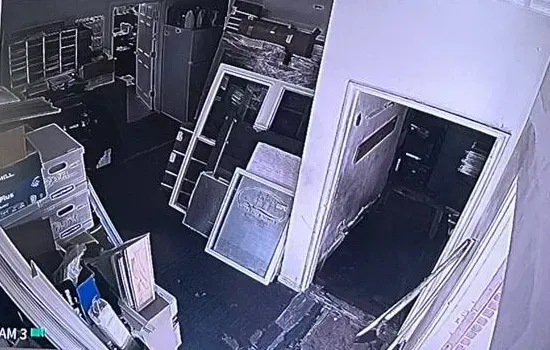
A photo from the AESS job library, not taken in Williamsburg: a black-and-white night camera view of a cluttered room with an open doorway into a dark back room. A storage room or cellar package area in a Southside walk-up looks much like this at night, and a camera recording it is how an owner learns whether parcels left after the courier's buzz-in were taken by an outsider or never delivered at all.
Third-Party Devices on the Buzzer
Courier Access Devices, Virtual Doormen and Phone-Dialing Panels: What Gets Wired Into a Williamsburg Buzzer
More and more Williamsburg buildings have something attached to the buzzer that the owner did not buy from an intercom installer. It is worth knowing what each one is before deciding whether to keep it, replace it or build it into a new system.
Courier access devices
The best known is Amazon Key for Business, a small device connected to a building's door release so that Amazon drivers can unlock the street door from their handheld. The Associated Press reported in 2021 that Amazon "has already installed the device in thousands of U.S. apartment buildings but declined to give a specific number," that it "installs the device for free and sometimes throws in a $100 Amazon gift card to whoever lets them in," and that "on one New York City street, the sticker was on three of 11 buildings." A privacy researcher quoted in the same report, Ashkan Soltani, put the concern simply: "You're essentially introducing a foreign internet-connected device into an otherwise internal network."
Our view is practical. A device like this is the owner's decision, not a tenant's or a courier's, and it should be wired to the door release properly, inside the panel or the power supply enclosure, not spliced into the riser where it can take the whole system down. When we replace a system we find these devices regularly, sometimes installed without the current owner knowing. We tell the owner what we found and ask whether to reconnect it, and if the building's new panel has its own delivery code feature, the owner may decide it is no longer needed.
Virtual doormen
A virtual doorman is a remote service that answers the building's door panel, speaks to visitors over video and releases the door for approved deliveries and guests. Some boutique buildings on the North Side advertise one; a listing at 68 North 8th Street describes the building as "fully equipped with Carson virtual doorman system." A virtual doorman does not replace the buzzer. It sits on top of a door station, a camera, a release and a network connection, all of which still have to be installed and maintained, and residents still need a way to admit their own guests if the service is ever dropped.
Phone-dialing panels
Many smaller buildings have a panel that dials residents' phone numbers instead of ringing a station in each apartment. They save running cable to every unit, and they are common in renovated walk-ups where the old riser was abandoned. Their weak point is the list of phone numbers. When a tenant moves or changes numbers, someone has to update it, and a member of one Bedford Avenue building's tenant group described a cloud intercom that was "still configured to my phone." On every phone-answering system we install, the owner or managing agent gets the administrator login, and we show them how to add and remove residents in a few minutes.
Rules and Responsibilities
Which Williamsburg Buildings Must Have a Buzzer, What It Must Do and Who Is Responsible
Buildings of eight or more apartments. Multiple Dwelling Law §50-a requires a self-locking main entrance door and an intercom allowing voice communication and remote release in Class A multiple dwellings erected or converted after January 1, 1968 with eight or more apartments. The Attorney General's tenants' rights guide summarizes it the same way: "a two-way voice intercom system from each apartment to the front door," with tenants able to "buzz" open the entrance.
Older buildings, when tenants ask. For buildings put up before that date, the duty arises once tenants occupying a majority of the apartments request or consent in writing, with installation begun within 90 days and completed within six months.
Every existing system must be kept working. Every intercom violation in the Williamsburg record cites Housing Maintenance Code §27-2005, the owner's duty to keep the building and its systems in good repair. An owner who already has a system cannot simply let it fail.
Small buildings are the owner's choice. A two-family or a four-apartment walk-up is outside §50-a's mandate. On r/AskNYC a Brooklyn tenant described exactly that: a building "with only 4 units, which means the landlord isn't required to put in a buzzer system or a self-locking front door."
Keyless systems bring data rules. HPD's Tenant Data Privacy Law (Local Law 63 of 2021) covers owners of multiple dwellings that use smart access systems: consent in writing or through an app, authentication data destroyed within 90 days unless anonymized, and no requirement that tenants use the smart system to enter their own homes.
Magnetic locks need the full package. Electromagnetic locks are made only fail-safe. The building code's sensor-release provisions call for a sensor on the egress side, a "PUSH TO EXIT" device 40 to 48 inches above the floor within 5 feet of the door that keeps it unlocked for at least 30 seconds, release on fire alarm or sprinkler activation, and UL 294 listed equipment.
Fire-rated doors stay latched. Allegion notes that fire doors need fail-secure strikes, so a rated stair or cellar door still latches in a fire; the release has to carry the right listing for that door.
Reach heights for door stations. Under the 2010 ADA Standards, the high forward reach is 48 inches maximum, so call buttons and keypads in public and commercial entrances are mounted within that range.
None of this is legal advice for a particular building. Owners answering a tenants' request, boards choosing a keyless lobby or anyone reading §50-a against their own building should confirm the details with a housing lawyer, the managing agent or the architect. What we deliver is a system that meets the requirement that applies, and paperwork showing what was installed.
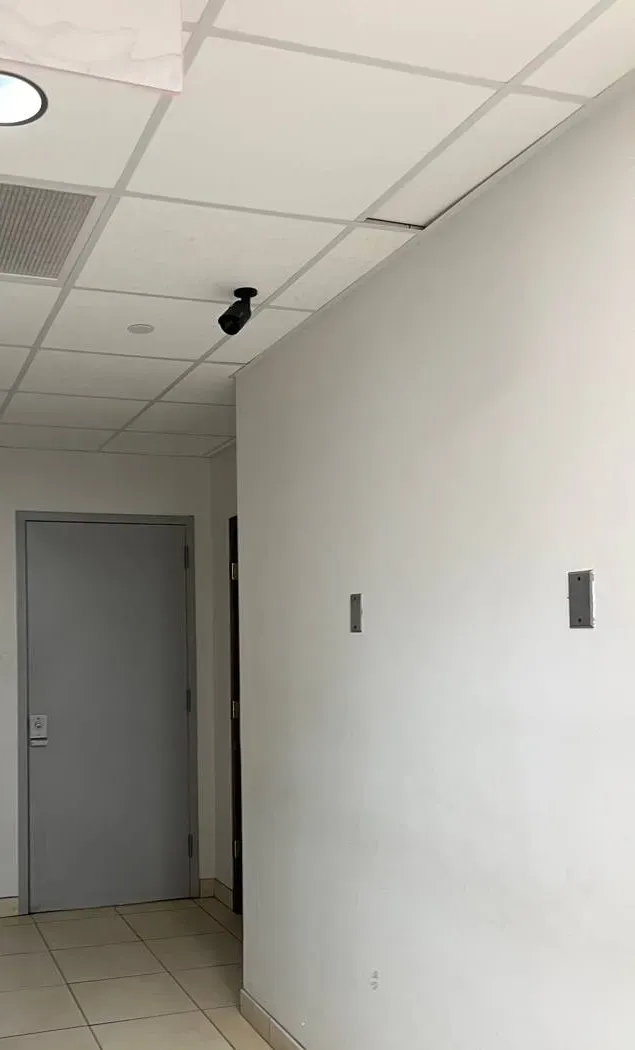
A photo from the AESS job library, not taken in Williamsburg: a tiled corridor with white walls and small wall plates ending at a grey steel door with a lever handle, under a drop ceiling with a small camera. The rear corridor of a converted Williamsburg building often ends at a door like this into a stair or a cellar, and whatever controls it from outside, it must always open from inside with one turn of the lever.
Commercial Door Buzzer Installation
Business Door Buzzer Installation in Williamsburg
Williamsburg's businesses mostly sit in the same buildings as its apartments: shops and cafes under walk-ups, studios and offices on the upper floors of converted factories, and venues on the ground floor of residential blocks. A business buzzer here is usually one of three things: a delivery or staff door at the back or side, an upstairs suite that buzzes clients in one at a time, or a ground-floor space that must be kept entirely apart from the residents' door beside it.
Bedford Avenue
The main shopping street, running past the Bedford Avenue L station at North 7th Street, with shops and restaurants under walk-ups whose residents' doors sit a step from the storefront.
North 6th Street and Wythe Avenue
The venue blocks around the Music Hall of Williamsburg at 66 North 6th Street and Brooklyn Bowl at 61 Wythe Avenue, where stage and loading doors take deliveries all day.
Grand Street
The line between the North Side and the Southside, with storefronts, bars and small offices below apartments, many in older mixed-use buildings.
Metropolitan Avenue
A long commercial street running east toward Union Avenue, with ground-floor businesses below walk-ups and taller apartment buildings farther along.
Kent Avenue and Domino
The waterfront, where the restored Domino Sugar Refinery reopened in 2023 as about 460,000 square feet of offices and new towers have retail at their base.
Converted loft offices
Former factories on the side streets near the water where studios, showrooms and small companies share a street door with each other, and sometimes with residents.
The most common business request is a buzzer on a door that has always been propped or locked with a key. A shop on Bedford Avenue wants couriers to ring at the side door rather than walk through the sales floor with a hand truck. A studio on the third floor of a converted building wants to see a client at the street before letting them climb the stairs. A restaurant wants its morning produce delivery to come in without staff leaving the kitchen. Each gets its own station, release and power supply, completely separate from any apartment system in the building, so a delivery buzzed in by the business never reaches the residents' stair. If the business is in an industrial building nearer the Navy Yard, our Brooklyn Navy Yard door buzzer installation page covers those doors.
Rules that apply to business entry installations in Williamsburg
Exit is always free. A business door with a buzzer, code or reader still opens from inside without a key or special knowledge. With an electric strike, Allegion's guide notes, "you can exit by turning the lever," whether the strike is fail-safe or fail-secure.
Venues and other places of assembly need extra care. A bar, music room or event space that fills up at night must be able to empty at once, so any release or magnetic lock on its doors follows the sensor-release requirements in full.
Tenants need the owner's written approval. A shop or office that rents its space orders its own buzzer only with the building owner's written permission, especially when the work touches a shared street door, the cellar or the apartments' cable.
Reach heights matter. Call buttons and keypads at a public or commercial entrance are mounted within the 2010 ADA Standards' reach range, 48 inches maximum for a forward reach.
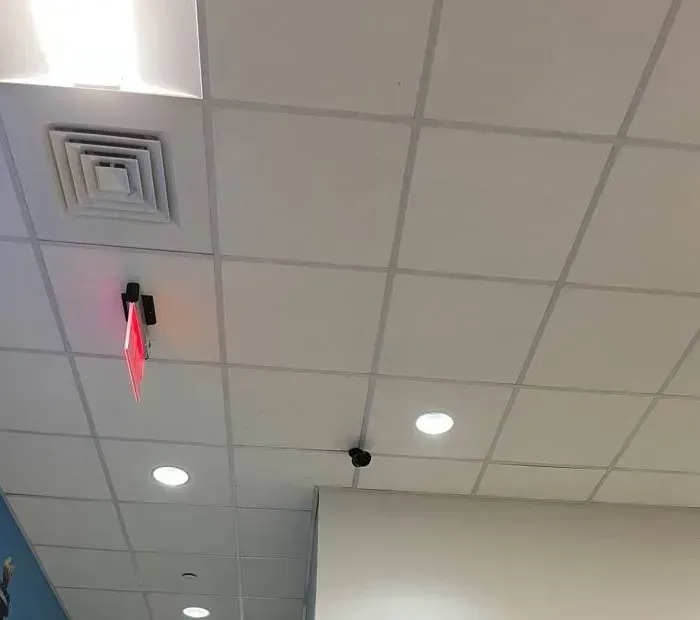
A photo from the AESS job library, not taken in Williamsburg: a drop ceiling with a lit red exit sign, an air diffuser, round recessed lights and a small black camera. Offices built into converted loft buildings near the Williamsburg waterfront often have ceilings like this, and the exit sign is the rule every business buzzer we install follows: whatever locks the door from outside, it opens from inside.
Your Questions Answered
Door Buzzer Installation in Williamsburg: Questions Answered
The HPD record and Williamsburg walk-ups
HPD's record on our apartment reads "first no access to re-inspect," but the station was replaced weeks ago. What happens now?
That status means an inspector came back to check the correction and could not get into the apartment, so the violation stays open on paper even if the equipment now works. It is common in the Williamsburg record; several 2025 and 2026 violations at North 6th Street and South 4th Street carry it. The fix is administrative, not technical: the owner certifies the correction through HPD's process, and the tenant makes sure the inspector can get in if HPD returns.
What we contribute is evidence. When we replace a station or a system, the test sheet records that apartment's call, voice and release result on the day, with the date, and the owner or managing agent can keep it with the certification. If the station has been replaced but still does not release the door, that is a different problem, and the cable or the power supply is the next thing to test.
HPD once ordered our owner to install a missing intercom throughout the building, then dismissed the violation. Does the building still have to have one?
The dismissal closes that violation, but it does not change the law that applies to the building. A violation like the one written at 308 South 3rd Street in October 2025, to "replace with new the missing intercom system throughout the entire building," can be dismissed for reasons the public record does not explain. Whether the building must have an intercom still depends on Multiple Dwelling Law §50-a: if it has eight or more apartments and was built or converted after 1968, it must; if it is older, it must once tenants occupying a majority of the apartments ask in writing.
For an owner, the practical question is the next complaint. If tenants are already calling about a missing system, another inspection is likely, and an installation planned now, on the owner's schedule, costs less than one rushed against a correction date. We are glad to walk the building and give the owner a written price either way.
Our four-apartment Northside walk-up does not legally need a buzzer, but the tenants want one. What does the owner actually get for the money?
Mostly, a street door that stays shut. In small walk-ups without a buzzer, tenants come down to let in every guest and courier, and the door ends up propped, unlatched or left on the latch for the afternoon. One r/Brooklyn poster described the result in a walk-up whose door would not lock: "We continue to find random people in our hallways and basement." A buzzer with a working closer means the door locks behind every visitor, and that protects the owner's building as much as the tenants' packages.
On our Brooklyn list, a four-apartment audio system with a new release usually sits in the $700 to $1,800 range, and video with phone answering at the upper end of it, depending on the cable. Fewer callbacks to let someone in, fewer broken locks from forced doors and an easier time renting the top floor are the returns owners tend to mention afterward.
We are buying a walk-up on one of the Southside streets that has an open intercom violation. What should we check about the entry system before closing?
Four things. First, the violation history, not just the open item: a building with one violation is different from one with four over six years, like several on South 2nd and South 3rd Streets. Second, who holds the logins and codes for any app or code panel, since a seller's managing agent may be the only one who has them. Third, whether any third-party device, such as a courier access unit, is wired to the door release. Fourth, the condition of the street door, its closer and its strike.
We can do a paid inspection visit before closing, the $250 service call, and give you a written note on what works, what does not and what replacing the system would cost on our Brooklyn list. If you go ahead with the work after you own the building, the $250 is applied toward it.
Converted lofts and long buildings
In our converted building, the apartments in the back wing always lose the buzzer first. Why, and how is that fixed?
Distance and shared power. In a long converted factory, the rear apartments are at the end of the longest cable run, so they see the most voltage drop and the most connections along the way, and an undersized power supply that copes with front apartments fails at the back first. HPD's records show the same pattern in tall buildings, where violations cluster on the top floors.
The fix is to design for the far end. We meter the run to the farthest apartment before quoting, size the power supply for the whole building's load with all releases operating, and where a run is too long for the chosen system, add a distribution point or a dedicated feed for that wing. On a new system, the rear wing is tested first, not last.
Our loft building has a north section and a south section, each with its own stair. Should the street door have one panel or two?
Usually one panel at the street door with a directory grouped by section, and a separate controlled door at the foot of each section's stair. Visitors only need one place to ring, and couriers are far less likely to press every button when the panel shows "North" and "South" groups the way residents describe their own apartments. Each section's stair door then releases only for calls to that section.
Where the two sections have separate street entrances, the answer changes: each entrance gets its own panel listing only its own apartments, both on one system so the owner manages them together. We draw the door plan on one sheet before pricing, because in buildings like this the doors, not the electronics, decide most of the cost.
Couriers, packages and third-party devices
Is giving couriers a delivery code safer or riskier than letting residents buzz them in?
It depends on which door the code opens. A code that opens only the outer street door into a vestibule, where packages are left and from which the stair door stays locked, is usually safer than the current habit of residents buzzing strangers straight into the hallway. A single shared code that opens every door in the building is riskier, because it spreads quickly and cannot be traced to anyone.
The best version is a code the owner can change, limited to set hours and to one door, with the panel saving a picture each time it is used. That keeps deliveries moving without anyone upstairs having to press release for a voice they cannot see.
When our old system comes out, what happens to the courier access device someone wired to the door release years ago?
We disconnect it safely when the old system comes out, label it and leave it with the owner, and we do not reconnect it without the owner's instruction. Devices like Amazon's Key for Business are installed free on buzzer systems, and the Associated Press reported that Amazon sometimes gave a gift card "to whoever lets them in," so it is not unusual for an owner to find one that nobody now remembers approving.
If the owner wants it back, it goes on the new release inside the panel or power supply enclosure, properly connected and labeled. If the new panel's own delivery code feature does the same job, the owner may decide it is no longer needed.
Our panel's apartment letters no longer match the mailboxes after a renovation. Does that cause wrong buzzes, and can the panel be relabeled instead of replaced?
It almost certainly causes wrong buzzes. A courier with a parcel for apartment 4R who sees "4B" and "4C" on the panel will press both, then everything else. Many button panels can be relabeled with new directory cards, and code and directory panels can be reprogrammed, so a mismatch alone is rarely a reason to replace a working system.
What we check while relabeling is whether each button still rings the apartment it says it does. After renovations, pairs are sometimes moved between apartments, and the only reliable way to know is to ring every button from the street and confirm which station answers.
Condos, waterfront buildings and shops
Our waterfront rental has a staffed front desk. Which of our other doors need a call station?
Any door where a person can arrive and expect to be let in: the garage pedestrian door, the bike room door from the street, the service entrance couriers are told to use, the door to the amenity floor or roof, and the residents' side entrance if there is one. Each needs a call station that rings the desk or the super, a camera view at the desk and a release the desk controls.
Doors that only residents use, such as a side door to the street, can take a reader or keypad with no call button at all. Every door still has to open freely from inside, and fire-rated stair doors keep fail-secure hardware so they latch in a fire.
Our boutique building pays a monthly fee for its cloud panel. How do we compare that with a wired system that has no subscription?
Put both on a ten-year table. Swiftlane's apartment intercom guide says software subscriptions commonly add five to fifteen dollars per unit per month, or thirty to one hundred dollars per door per month. For a 20-apartment building, the per-unit figure alone is $1,200 to $3,600 a year, before any hardware is replaced. A wired system with apartment stations and no subscription has no monthly cost, but it may need new cable where the cloud panel avoided it.
We quote both on the same sheet: installation price, ten-year running cost, what residents without smartphones use, and whether the building falls under HPD's tenant data rules for smart access systems. Boards usually find the decision is obvious once it is laid out that way.
Our Grand Street shop is adding a buzzer at its side door. Besides the landlord, whose sign-off or paperwork does the work need?
The low-voltage work itself, the door station, the strike and the power supply, is done under our New York State low-voltage license. What else the job needs depends on its scope: a new door opening, changes to the frame or the facade, a new electrical circuit, or a magnetic lock on a required exit, which brings in the code's sensor-release package and often the building's fire alarm. Those parts belong to the trades and filings that cover them.
If any of those apply, we say so before pricing, and the electrical or filing work is done by the trade that holds the right license. The landlord's written approval is the one document every shop tenant needs in every case.
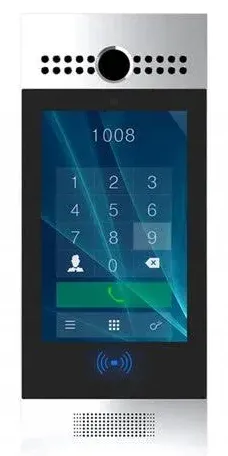
A photo from the AESS job library, not taken in Williamsburg: a touchscreen entry panel showing a dial pad with a four-digit apartment code entered, a camera above and a card-reader symbol below. In a 30- or 40-apartment boutique building on a Williamsburg side street, a panel like this replaces a wall of buttons, and the camera above the screen gives residents a picture of the person calling before they decide to release the door.
Equipment
Types of Door Buzzer Systems We Install
We quote a reliable non-branded system by default and install a named brand when an owner or board asks for one; the intercom brands we work with include Aiphone, ButterflyMX, 2N, Akuvox, Comelit and DoorBird. These are the kinds of equipment that come up most in Williamsburg.
Button panels with clear directories
Two- to twelve-button audio or video panels for row houses and small walk-ups, with directory cards that match the mailboxes so couriers find the right apartment.
Code and scrolling-directory panels
Panels with a camera and keypad for buildings of a few dozen apartments or more, with sections shown as residents know them and owner-controlled delivery codes.
Two-wire multi-tenant systems
Audio and video over one pair per apartment, the practical choice for walk-ups whose risers meter sound. Aiphone describes its GT Series as offering "the advantage of using existing wire and infrastructure."
Apartment video stations
Wall or desk stations with a screen and release button, placed where residents actually answer, which in many converted lofts is the kitchen.
Phone and app answering
Panels that ring residents' phones alongside or instead of stations, with any subscription named on the quote and an administrator login handed to the owner.
Fail-secure electric strikes
Releases cut into wood or steel frames that stay locked without power and let anyone inside leave by the lever or bar.
Vestibule and lobby cameras
A camera inside the street door recording to a local recorder, so an owner can see who came in after each buzz, with no monthly fee.
Battery-backed power supplies
Dedicated low-voltage supplies with battery backup in a locked cellar box, sized for the longest run in the building with every release operating.
Audio panel, wired video or cloud phone answering: which fits a Williamsburg building?
What matters
Audio panel and handsets
Wired video stations
Cloud panel with phone answering
See the courier before releasing
No
Yes, on the apartment screen
Yes, on the phone
Answer from away from home
No
Only on models with an app
Yes
Owner-controlled delivery code
Only with an added keypad
On many panels
Usually
Reuses old riser cable
Often
Often, with two-wire systems
Panel only
Needs internet at the building
No
No
Yes
Monthly fees
None
None
Often per apartment or per door
Brooklyn list range
$400–$900 small; from $2,500 for a building
$700–$1,800 small; from $2,500 for a building
Same ranges, plus any subscription quoted separately
ADT, Ring and SimpliSafe compared with a local installer for a Williamsburg building
A store-bought video doorbell can suit one household with its own front door. In a walk-up or loft it hits hard limits: it rings the phones of whoever set it up, not a station in each apartment; it does not release the street door unless it is wired separately to a strike; and it cannot give twenty apartments their own buttons, which §50-a requires in buildings of eight or more units. Those buildings need a multi-tenant entry system.
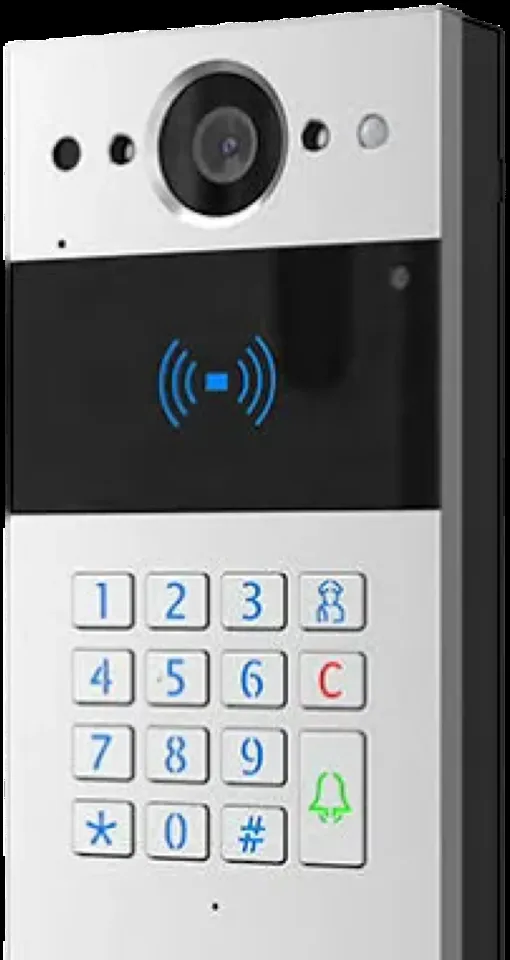
A photo from the AESS job library, not taken in Williamsburg: a silver and black keypad door station with a camera lens at the top, a blue card-reader symbol, a numeric keypad and a green bell key. At the street door of a sectioned loft building, a station like this lets residents enter by code or card, lets the owner issue a limited delivery code, and gives every other visitor one bell key and a camera to face.
AI Overview Reality Check
What AI Gets Wrong About Door Buzzer Installation in Williamsburg
Ask an AI assistant or a search summary about buzzers in New York and you get confident answers drawn from vendors' cost guides and blog posts. Some are fine for one building and wrong for a North 7th Street walk-up or a sectioned loft. Here are seven claims we see repeated, each checked against its source and against what we find at Williamsburg doors.
"Wired buzzer systems cost $450 to $1,900 installed"
NYHLS's door buzzer guide gives that range for wired systems, and $450 to $900 for wired audio-only.
For a single door with a handful of stations that is close to our Brooklyn list, where a small audio job runs $400 to $900 and small video $700 to $1,800. It does not describe a walk-up with twenty apartments on a hundred-year-old riser.
Those buildings start at about $2,500 on our list and rise with the apartments, the entrances and the state of the cable, so ask for the building's price, not a system's.
"Like-for-like audio replacement costs $1,000 to $3,000 per door"
Swiftlane's buzzer guide uses that figure, alongside $150 to $250 for repairs and a higher tier for smart video upgrades.
"Per door" hides the part that varies most in Williamsburg: what lies behind the door. One street door can serve four apartments or forty, and a sectioned loft may need a second controlled door for each stair.
We price the panel, the stations, the riser and each door as separate lines, so an owner can see what the number is made of.
"Most buzzer problems are a $150 to $250 repair"
Many single-station faults are, and ButterflyMX itself describes that range, which came from a New York installer, as only "a local benchmark for accessible, limited repair work."
The HPD record shows why it is not the whole story. Buildings such as 34 North 6th Street and 109 North 7th Street drew eight or nine intercom violations each across different apartments and years, which is the signature of a shared fault that one repair does not reach.
A cheap repair is the right answer when the fault is local, and the wrong one when the same building keeps returning to the record.
"An old buzzer is cheaper to keep than to replace"
Sometimes. Swift Locksmith estimates the cost of maintaining a 1970s buzzer at "about $400-$1200 per year for an average 6-unit NYC walkup."
Over five years that can approach the price of a new small-building system on our list, and it does not count tenants' time, missed deliveries or a door propped open while the panel is down.
We price repair and replacement side by side so the owner can make that comparison with real numbers for the building.
"A wireless video intercom with an app is the fastest way to stop buzzer bombing"
ButterflyMX, which sells such systems, says exactly that.
Video does help, and so do delivery codes and entry photos. But much of the problem in Williamsburg is a directory couriers cannot read and a door residents release blindly, and both can be fixed on a wired system with no subscription.
The right answer depends on whether residents want to answer away from home and whether the building wants a monthly bill; we quote both ways.
"Every apartment building in New York must have an intercom"
The Attorney General's guide is more precise: buildings that contain "eight or more apartments" must have a two-way intercom from each apartment to the front door, with older buildings covered once a majority of tenants ask in writing.
Williamsburg has many buildings below that line, frame two-families and four-unit walk-ups among them, and their owners choose whether to install one.
Where a system already exists, though, the Housing Maintenance Code requires it to be kept working, which is what every intercom violation on these streets cites.
"A free courier access device has no downside"
The device costs the owner nothing, as the Associated Press reported about Amazon Key for Business.
The same report quoted a privacy researcher warning that "you're essentially introducing a foreign internet-connected device into an otherwise internal network," and noted that tenants often did not know drivers had access to their front doors.
It is the owner's call, and if one is used it should be connected properly and listed in the building's records, so the next technician and the next owner know it is there.
Walk-Up in the HPD Record or Lobby Full of Couriers? Speak to a Tech
Send the address, a photo of the street door and the panel, one of an apartment station and one of the cellar power supply, and tell us how many apartments or sections the system serves. A technician will tell you which approach fits and where it falls on our Brooklyn ranges. Call or text (347) 934-8335, send photos on WhatsApp, or fill in the form below.
Get In Touch
Request a Free Quote
✅
Request Sent!
Thank you. A technician will call you about the Williamsburg address, usually within two hours during working hours.
How It Works
Our Installation Process
1. Look up the building and read the photos
The office checks the building's HPD intercom record and reads your photos of the street door, the panel, the cellar power supply and one apartment station before anyone visits.
2. Count every door and every apartment
The technician walks from the sidewalk to the roof door, listing every entrance in use, every apartment and section, and where each apartment answers the door today.
3. Get the street door to close and latch
The door is opened and let go. If it does not close and latch on its own, the closer, hinges or lockset are fixed first, because no buzzer secures a door that hangs open.
4. Test the old cable and pick the route for new cable
Each pair is metered from the cellar, and any new route is planned through risers, closets, dumbwaiter shafts or open loft ceilings.
5. Write the price and every possible extra
You get a written price from the Brooklyn list with every test-dependent extra named and priced, such as a failed riser pair or a new closer, before anything is ordered.
6. Order the equipment and book the visits
Equipment is ordered after the deposit. Stock systems are booked right away and special-order panels once they arrive, with two-hour arrival windows and access arranged for every apartment.
7. Install, label and set up answering
The panel, release, battery-backed power and stations go in, phone answering and delivery settings are configured, and every pair is labeled at both ends.
8. Test every apartment from the sidewalk and hand over
From the sidewalk the technician calls, talks to and releases every apartment, checks the door with power off, trains the owner or super and leaves the test sheet and wiring record.
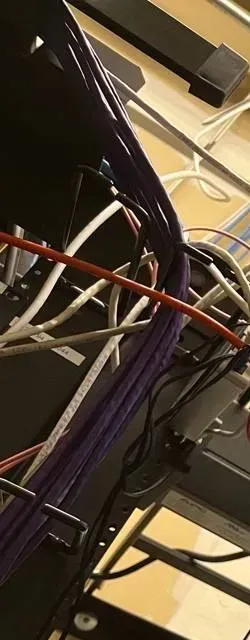
A photo from the AESS job library, not taken in Williamsburg: purple, white and red cable bundles dropping down beside a black equipment rack. In a waterfront building or a large converted loft, every line of apartments arrives at one room like this, and labeling each bundle in step 7 is what lets the next technician find one rear-wing apartment's pair in minutes.
Coverage Area
Door Buzzer Installation Near Williamsburg's Landmarks
Bedford Avenue station
The L train stop at Bedford Avenue and North 7th Street, opened in 1924, with 9,815,095 riders in 2025, 23rd of the system's 423 stations.
Domino Park
Five acres on the waterfront, opened June 10, 2018, beside the towers that replaced the sugar refinery's warehouses.
Domino Sugar Refinery
The landmarked 2007 refinery building, reopened in September 2023 as offices, with 325 Kent and One South First beside it.
Marsha P. Johnson State Park
Eleven waterfront acres at the end of the North Side's numbered streets, on the site of the Brooklyn Eastern District Terminal.
Brooklyn Bowl
At 61 Wythe Avenue in the former Hecla Iron Works foundry of 1882, a city landmark since 2004.
Williamsburg Bridge plaza
The 1903 bridge's Brooklyn landing at the southern edge of the Southside, with its bus terminal for the B32, B44 and Q54.
Williamsburg is billed at our standard Brooklyn rate. The final figure follows photos and a walkthrough, because the number of apartments and sections, the condition of the riser and the state of the street door drive the total far more than the brand on the panel.
Job
Typical Williamsburg property
Brooklyn range
Audio station or replacement with electric strike release, existing wiring reused where it tests well
Frame row houses and two-families, a single shop or studio door
$400–$900
Video door station with indoor stations or phone answering
Four- to six-apartment walk-ups, a few loft units, an upstairs office
$700–$1,800
Multi-unit entry system, audio or video by apartment count, with optional code or fob entry
Numbered-street walk-ups, sectioned lofts, boutique condos, waterfront side doors
from $2,500 to $10,000+
In-person test of an existing system, booked online
Any building where the old system must be tested before quoting
$250, applied toward the work
Monthly subscription
Any building choosing a wired system
$0
What moves a Williamsburg job inside its range is predictable. First the count: every apartment, section and extra entrance adds to the total. Then the cable: pairs that meter sound cost nothing extra, a riser spliced on every floor must be replaced, and an open loft ceiling is cheaper to run across than a finished wall. Then the door: a new closer, a reinforced wooden jamb or exit hardware matched to the release. Adding vestibule cameras on the same visit usually saves $200 to $400 in labor compared with a separate trip. Anything that depends on a test is named with its price before you approve.
Full terms — including 50% deposit, one-year parts-only warranty on AESS-supplied products, and the late-fee schedule — are set out in the service agreement.
Find Out Which Range Your Williamsburg Building Falls In
Tell us the street, how many apartments or sections the system must reach, every door people use and what is at the street door now, and we will tell you which Brooklyn range fits and what would move it. Call or text (347) 934-8335, send photos on WhatsApp, or fill in the form.
Shop Our Systems
Door Buzzer Installation Packages & Pricing
Three typical Williamsburg jobs, each placed inside the matching range on our Brooklyn list. The exact figure comes from the photos and the walkthrough.
Row house or shop door: $400–$900
An audio station at a two-family's street door or a shop's side door, a fail-secure strike, a closer set so the door latches, an answering station inside and battery-backed power.
Small walk-up video: $700–$1,800
A video panel with a clear directory for four to six apartments, video stations or phone answering in each, and the existing pairs reused where they test sound.
Building entry system: from about $2,500
A button, directory or code panel for a numbered-street walk-up or sectioned loft, stations or phone answering for every apartment, tested or new riser cable and an owner-controlled delivery code, rising toward $10,000 or more with apartments, sections and entrances.
Bring your own equipment. If you have already bought a panel or intercom kit, we can install it as labor-only work, quoted flat once we have seen the door and the cable path. Tell us the make and model first. Equipment you supply is covered by its maker's warranty, not ours.
Complete Services
Every Door Buzzer Service in Williamsburg
Walk-ups and lofts
Violation-driven replacements, riser testing, section directories and video upgrades. Request a quote
Condos, towers and shops
Panel extensions, side-door call stations, delivery codes and business buzz-in doors. Call (347) 934-8335
Will the street door be left unlocked while the old system is being taken out?
+
No. The door keeps its mechanical lock throughout, so residents use their keys while the release is disconnected. We plan the work so the new release and power supply are working before we leave each day, and if the new release is not finished by the end of a visit, the door simply stays on its mechanical lock and residents' keys overnight.
If a resident's phone is switched off, what happens when a visitor rings their apartment on a phone-answering system?
+
The call goes unanswered unless a second number or an apartment station is set up. Most phone-answering panels can ring a backup number after a set time, and an apartment station rings regardless of the phone. For residents who rely on the door for care visits, we recommend a station as well as the phone.
Can cameras for the vestibule and the cellar be added on the same visit?
+
Yes, and it usually costs less. Installing cameras on the same visit as the entry system typically saves $200 to $400 in labor compared with a separate trip, because the cable routes and the cellar power are already being worked on. The cameras are quoted as their own lines so you can decide on them separately.
Can the work be scheduled around the bar or restaurant on our ground floor?
+
Yes. We agree the visit times with the owner and the business before booking, so drilling and cellar work happen when the space is closed or quiet, and the business's own door and power are never interrupted without notice. Every visit is booked with a two-hour arrival window.
Can a resident who works from home in a loft have a desk station instead of one on the wall?
+
On many systems, yes. Several makers offer desk-stand versions of their apartment stations, or a wall station can be mounted on a short stand at a desk, with its cable run to a nearby box. We confirm the option for the chosen system before ordering.
One unit in our building is used as an office. Can its button ring only during business hours?
+
On many code and cloud panels, a directory entry can be scheduled, so the office's button rings its staff during set hours and shows as unavailable or rings a voicemail outside them. On simple button panels the office can silence its own station after hours instead.
Can the door station's camera be aimed so it does not look into the venue entrance next door?
+
Yes. The station's position and angle are chosen so the camera shows the person at the panel and the residents' doorway, not the neighboring entrance. Where the doors sit side by side, a hooded or angled mounting plate keeps the view on your own door.
Our building is converting from rentals to condos. When should the entry system be replaced?
+
Ideally before the first closings, so the new board inherits a working system with its administrator login, wiring record and test sheet. If the sponsor replaces it, we hand those documents to the sponsor to pass on; if the board replaces it later, we work from whatever records the sponsor left.
We manage three walk-ups on the same block. Can one person manage all three systems?
+
Yes, if the buildings use the same cloud platform, which usually lets one manager account see every building. With wired systems, each building keeps its own panel, but we can use the same model in all three so supers and residents learn one system.
Does the warranty cover a strike bent when someone forces the street door?
+
No. Physical damage, including a forced door, is outside the warranty, and the repair is billed as a service visit. What helps most is a strong frame and a reinforced jamb at installation, which we recommend wherever a wooden frame looks weak.
Ready for a Williamsburg Street Door That Rings the Right Apartment and Shuts Behind Every Courier?
Send a photo of the street door and the panel with the street, how many apartments or sections the system must reach and every door people use, and we will tell you which system fits and where it falls on our Brooklyn ranges. Call or text (347) 934-8335, message us on WhatsApp, or use the request form. Licensed under NYS license #12000287431, rated 4.7★ across 201 Google Reviews, with same-day estimates on most weekdays.