What are you looking for?
About Us Contact Us Careers Get a Free Quote (800) 486-0943
Pick a service
✅ Got Your Own System?
🎬 Home TheatreQuote 🎶 AV SoundQuote 🔑 Access ControlQuote
Now pick your area
Pick your area
Long Island
Hudson Valley
Services available
Pricing & Tools
Pick a service for pricing
🚪 Intercom Pricing 🔔 Buzzer Repair Pricing
Calculators
📹 Camera System Calculator 🚨 Alarm Calculator ⚡ Cabling Quote Builder ✅ Got Your Own System?
Select your area
One bell ringing on every floor of a City Line two-family, a cellar door nobody can answer, or a Liberty Avenue apartment door visitors walk right past? City Line door buzzer installation line: (347) 934-8335
Home › Door Buzzer Installation Brooklyn › City Line
Brick Two- and Three-Family Houses · Side-by-Side Family Homes on Forbell Street · Cellar and Side Doors · Small Walk-Ups · Liberty Avenue Stores With Apartments Above

Door Buzzer
Installation in
City Line

A Button for Every Household · Releases That Latch · Cellar and Side Entrances · Brooklyn Rate, No Travel Premium

Door buzzer installation in City Line is mostly about houses that hold more than one household. The blocks between Atlantic Avenue and Conduit Boulevard, from Euclid Avenue east to the Queens line, are lined with brick two-family and three-family houses where a grandmother may live on the first floor, a married son on the second and a tenant in the third-floor apartment, all coming and going through one street door, with a cellar door under the stoop and sometimes a side door off the driveway. When one plain bell rings everywhere, everyone goes to the window for a visitor who is not theirs. This page explains how we give each household its own button and its own way to answer, how we handle cellar and side doors, what the city's door rules ask of owners, and what each kind of job costs on our published Brooklyn list.

Reviewed and updated November 11, 2026, against the Citizens Housing & Planning Council's May 2023 interim report on the Basement Apartment Conversion Pilot Program in Community District 5; HPD's page on that pilot program; HPD's Self-Closing Door Proactive Program report for fiscal year 2025; the Rules of the City of New York, Title 1 §42-01, on entrance doors, locks and intercommunication systems; New York's Multiple Dwelling Law §50-a; a 1996 DHCR opinion letter on bell-and-buzzer systems; Brick Underground's November 2019 guide to NYC intercom repair; ButterflyMX's guide to how apartment buzzers work; City Limits' August 2013 report on City Line's Bangladeshi community; NYCHA's address listing for the East New York City Line development; the Wikipedia entries for City Line, Community Board 5 and the Grant Avenue and Euclid Avenue stations; Redfin's City Line market data; Openigloo's City Line building list; BK Reader's January 2025 report from Boulevard Houses; Allegion's fail-safe and fail-secure guide; the HomeAdvisor and Swiftlane cost guides; and the 2010 ADA Standards. · Abstract Enterprises Security Systems, NYS license #12000287431 · crews dispatched from our Troy Avenue office in Brooklyn

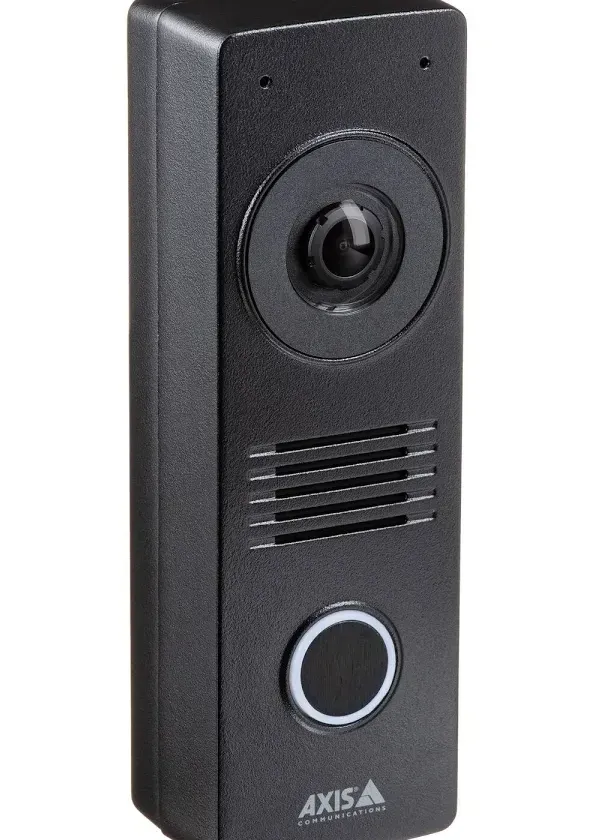
City Line, Brooklyn door buzzer installation: black rectangular video door station with a camera, speaker grille and round lit call button
A photo from the AESS job library, not taken in City Line: a black rectangular video door station with a camera at the top, a speaker grille and a single round lit call button. On a City Line house that one family fills from the cellar to the top floor, a one-button station like this is often all the street door needs, with the call ringing a group of stations on every floor rather than a separate button for each relative.
City Line Buzzer & Door Request
Two-family, three-family, family-owned houses side by side, small walk-up or Liberty Avenue store with apartments: tell us the street, how many households use the door and who owns it, and a technician calls back with the range

✅
Request Sent!
Thank you. A technician will call you about the City Line address, usually within two hours during working hours.
25+
Years Experience
✓
Same-Day Estimates
100%
Licensed & Insured
4.7★
201 Google Reviews

Owner-operated since 2002 · Thousands of jobs completed · Booked within 2 hours

Quick answer: door buzzer installation in City Line costs $400 to $900 installed on our Brooklyn list for an audio buzzer with talk-back on a one-, two- or three-household house, $700 to $1,800 for a video door station with indoor monitors or phone answering, and from about $2,500 to past $10,000 for a small walk-up or a store-and-apartment building with a lobby panel and a station in every apartment. Each price includes the door station, the stations inside, the power supply, the strike or release on the door, the cable and the labor. It is set in writing after a walkthrough, with any possible extra such as replacing an old cable that might fail its test named before you order, so nothing new appears on installation day. City Line is billed at the Brooklyn rate with no travel premium. Most houses here land in the first two ranges; what moves a job up is a street door that has to be repaired before it can latch, a cellar or side door that needs its own station, a cable route that has to be new because the old bell wire is gone, and video for every household instead of one. Send photos of the street door and the old bell to (347) 934-8335 or on WhatsApp, and we reply with the range that fits, usually within two hours of your message during working hours.

  • Looking at your photos and quoting a new buzzer costs nothing. If an existing system is dead and has to be diagnosed first, that is the $250 service call booked online, and the $250 is applied toward the work.
  • All work falls under New York State license #12000287431. We install low-voltage entry equipment; if a door needs a new 120-volt circuit for its power supply, a licensed electrician does that part, and we say so before the job is priced.
  • We work for whoever owns the door: the homeowner, the family that owns the house, or the owner or managing agent of a walk-up. The lobby doors in the Cypress Hills Houses and the East New York City Line Houses belong to NYCHA, and residents there report problems through NYCHA.
The Neighborhood

Why City Line Properties Need Door Buzzer Installation

City Line takes its name from the old boundary between the City of Brooklyn and Queens County, a line that stopped mattering on paper with consolidation in 1898 but still marks the eastern edge of the neighborhood, where Brooklyn meets Ozone Park, Queens. It is a sub-section of East New York inside Community Board 5, most of it in ZIP code 11208, and its boundaries are drawn a little differently by different sources; the usual description is Atlantic Avenue to the north, Conduit Boulevard to the south, Euclid Avenue to the west and the borough line to the east. Liberty Avenue is the main shopping street, and the A train stops at Euclid Avenue and Grant Avenue before climbing onto elevated tracks along Liberty Avenue into Queens.

The housing is overwhelmingly small. Openigloo's building list counts about 650 residential buildings in City Line, and most of the addresses on it sit on residential side streets such as Forbell, Crescent, Hemlock, Pine and Drew Streets and Lincoln, Sheridan and Autumn Avenues, with more on Euclid, Glenmore and Sutter Avenues. Redfin's market data shows the same picture in what is for sale: brick two-family houses with separate units, two-family houses with private driveways, three-family rentals and Liberty Avenue buildings with a store on the ground floor and two apartments upstairs, at a median sale price of $898,000 in March 2026. A door buzzer in a neighborhood like that is not a lobby panel with sixty names. It is usually two or three buttons, a cable up one stair, and a cellar door that has to be thought about.

Who lives behind those doors shapes the job as much as the bricks do. City Limits reported in 2013 that City Line, once a middle-income Italian neighborhood, had become home to more than 2,000 Bangladeshi residents, about 65 percent of them from Sylhet, and that families had bought adjacent houses on Forbell Street, the block above Liberty Avenue that the city co-named Mizanur Rahman Way. The same report described halal groceries and South Asian clothing stores replacing older businesses along Liberty Avenue and counted seven mosques in the area. When relatives own the houses on either side of each other, and a two- or three-family house is shared by one family across its floors with a rental apartment on one level, the requests a buzzer installer hears change: one bell that should ring every floor of a family's house, a separate button for the tenant, a way for the call to reach someone even when the first floor is out, and a way for family who live next door to answer each other's doors.

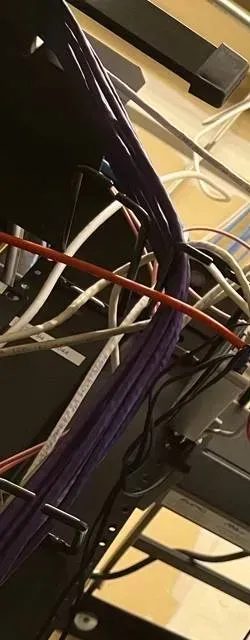
City Line, Brooklyn door buzzer installation: purple, white and red cable bundles dropping down beside a black equipment rack
A photo from the AESS job library, not taken in City Line: purple, white and red cable bundles dropping down beside a black equipment rack. A City Line two-family will never have a rack like this, but the same idea applies in its cellar: the buzzer's power supply and its cable to each floor end at one labeled spot near the electrical panel, so the next technician can find every pair without opening a wall.

The cellars are the other thing that sets these houses apart. The district held the city's only basement conversion pilot, and the Citizens Housing & Planning Council study of it, set out further down this page, shows how many City Line houses have space below grade and how few have a door from it to the street. For a buzzer installer, the cellar is where the power supply and the cable to every floor start, and any door down there is part of the entry plan.

City Line facts that change how a buzzer is installed

  • The district is built of small houses. CHPC counts about 16,000 one- to three-family properties in Community District 5 and nearly 9,000 two-family homes with below-grade space. Two- and three-button stations are the everyday job here, not lobby directories.
  • Cellars outnumber basements. Of 102 homes assessed in the pilot, 70 had cellars. The cellar is where the power supply goes and where the cable to each floor starts, and it is usually dry, reachable and close to the street door.
  • Most cellars have no outside door, and some do. Only 31 percent of assessed homes had a door straight out of the space below grade. Where one exists, it needs a lock that holds and, often, a way to know when it is open.
  • Families own houses side by side. City Limits reported families buying adjacent houses on Forbell Street. Two front doors owned by one family can share answering, so relatives in either house can let a visitor in.
  • Three apartments changes the rules. A house or building with three or more apartments is a multiple dwelling; its hall doors must swing closed and latch, and HPD's proactive program now inspects some larger buildings for exactly that.
  • Two subway stations, one shopping spine. The Euclid Avenue station opened in 1948 and the Grant Avenue station in 1956. Liberty Avenue, between them and the Queens line, carries the stores whose upstairs apartments and back doors make up most of the commercial buzzer work.

Where this page applies. It covers City Line from Atlantic Avenue south to Conduit Boulevard and from Euclid Avenue east to the Queens line, including the blocks along Liberty, Pitkin, Glenmore and Sutter Avenues and the side streets from Fountain Avenue to the borough line. For the rest of the borough see our door buzzer installation in Brooklyn page, for the Queens side of the line our Queens door buzzer installation page, and for the whole city our NYC door buzzer installation page.

Repair or Replace in City Line

Need Repair in City Line? A Bell Nobody Hears Upstairs, a Release That Hums but Won't Open, or a Button That Rings the Wrong Floor

Plenty of calls from City Line begin with "we need a new buzzer" and end with a repair. An old house bell that stopped ringing upstairs often has a broken splice in the cellar, a worn button or a transformer that has given out. A release that hums when someone presses it but leaves the door shut usually means the strike has slipped out of line with the latch, the door has dropped on its hinges so the latch binds, or the closer is slamming it so hard the strike cannot catch. A button that rings the wrong floor in a two- or three-family is often a pair of wires swapped at the last repair. As the installer Daniel Vasquez told Brick Underground about NYC intercoms, "It's all in the wire connections," at the door, at each station, at the strike and at the power supply, and that is where we look first.

If your street door will not lock right now, say so when you call (347) 934-8335. A diagnosis is the $250 service call booked online, and the $250 goes toward the repair, or toward a new system if replacing turns out to be the better value. You get both numbers and a plain recommendation. If a part has to be ordered, we leave the door able to lock and open with a key before we go. For a walk-up where the intercom or a self-closing door is part of an open HPD violation, we give the owner a dated record of what was found and what was done, which is what an owner needs when certifying the correction.

What We Install

Door Buzzer Installation Services in City Line

Every service below is priced from the same Brooklyn door buzzer list. How many households use the door sets the size of the system, the door and frame decide what release can go on it, and the house decides how long the cable work takes.

Buttons for each household

A two- or three-button station at the shared street door of a two- or three-family house, each button wired to its own floor, labeled by floor or apartment, never by family name.

One call for a family house

A single button that rings a group of stations on every floor of a house one family fills, so the call reaches whoever is home without anyone running down the stairs.

Video for the floors that want it

Video door stations with monitors or phone answering for the households that ask, with simple audio stations kept for relatives who prefer them, on one system.

Cellar and side doors

A second station, a door switch or a plain release for the cellar door under the stoop or the side door off the driveway, so the second entrance is watched and locked.

Strikes, closers and frames

Fail-secure electric strikes in wood and steel frames, closers set so the door latches every time, and the frame work a door needs before any release is wired.

Small walk-up systems

Lobby panels, risers tested pair by pair or replaced, stations in every apartment and battery-backed power for the four- to eight-apartment buildings on the side streets.

Apartments over Liberty Avenue stores

A small panel at the residential street door beside or around the corner from the shop, wired up the stair, kept on its own system and never shared with the store.

Shop delivery doors

A buzzer or video station at the rear or side door of a grocery or clothing store, answered at the counter or on a phone, with the door kept locked between deliveries.

Shared answering for houses side by side

Stations in two neighboring family-owned houses set up to answer each other's street doors, each house keeping its own power supply and its own release.

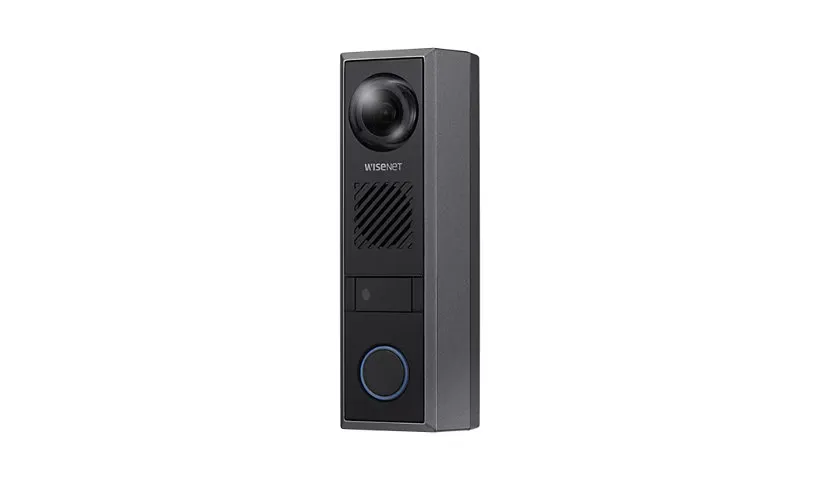
City Line, Brooklyn door buzzer installation: slim dark grey wired doorbell with a camera lens, speaker slots and a round push button
A photo from the AESS job library, not taken in City Line: a slim dark grey wired doorbell with a camera lens, speaker slots and a round push button. A unit this narrow fits the strip of trim beside the side door of a City Line house, where the driveway leaves only a few inches between the door frame and the wall, and it gives that second entrance its own camera and talk-back without a wide panel.
Building Specialists

Door Buzzer Installation for City Line's Architecture

Six kinds of privately owned property account for nearly every buzzer job we would quote in City Line. Each puts the door station, the cable and the stations inside in different places, and each has a mistake that turns up again and again when the work is rushed.

Brick two-family houses

One street door into a shared hall, a door to the first-floor apartment and a stair to the second, usually with a cellar below and often one bell that rings in both homes.

Three-family houses

Three apartments behind one street door, which makes the house a multiple dwelling under state law and brings the self-closing door rules with it.

Houses with a driveway and side door

Two-family houses where family and tenants come in from the driveway as often as from the stoop, so the side door matters as much as the front.

Family houses side by side

Two neighboring houses owned by one extended family, each with its own street door, cellar and power, and relatives who answer for each other.

Small walk-ups

Older apartment buildings of four to a dozen apartments on the side streets and avenues, some rent-stabilized, with a vestibule and a riser to every floor.

Store-and-apartment buildings

Liberty Avenue buildings with a shop on the ground floor and, typically, two apartments above, reached through their own street door.

Brick two-family houses: two homes, one hall, one bell that nobody owns

The two-family house is City Line's standard building, and Redfin's listings of brick two-families with separate units describe the layout we meet most: a stoop or a few steps up to a street door, a small shared hall, the first-floor apartment's own door off that hall and a stair to the second floor. The bell is usually the oldest part of the house. Often there is one button at the street door wired to a chime in the hall, so both households hear every ring, and whoever is closest goes to the door whether the visitor is theirs or not.

The installation answers that with a two-button station at the street door, each button wired only to its own apartment's station, and a release at each station so either household can let its own visitors in. The cable usually starts in the cellar, where the power supply goes beside the electrical panel, runs up behind the hall wall or inside the stair stringer to the second floor and through the first-floor apartment's hall closet to its station. Because brick walls take more time to fish through than wood framing, the cellar route is almost always faster and cleaner than running anything along the face of the house.

The common mistake is leaving the old chime in the hall connected. A two-button station wired to a shared chime still rings both households, and the owner pays for a new system without fixing the original complaint. We disconnect or rewire the old chime as part of the job, and if a household likes the sound of the old bell, it can be kept on that household's button only.

Three-family houses: when the third apartment brings the city's door rules

A three-family house looks like a two-family with one more floor, and the buzzer itself is only one button bigger. What changes is the law around the door. HPD treats a building with three or more apartments as a multiple dwelling, and its Self-Closing Door Program report puts the rule plainly: apartment and common-area doors in multiple dwellings "are required by law to swing closed and latch." The city's housing code also requires a heavy-duty latch, a deadbolt and a chain guard on each apartment door in a Class A multiple dwelling. None of that is buzzer equipment, but all of it sits on the doors we work on.

So a three-family job starts with the doors. We check that the street door's closer brings it all the way shut and that the latch catches without a push, and we check the hall doors to each apartment while we are there, because a new entry system on a house whose hall doors do not self-close is a house that can still be written up. The station is a three-button panel, each household gets its own talk-back or video station and release, and the power supply is sized so that a household that wants video later can have it without starving the others.

Houses with a driveway and a side door: the second entrance most plans forget

Many City Line houses have a private driveway down one side, and Redfin's listings mention them often. Where there is a driveway there is usually a side door, sometimes into the first-floor apartment's kitchen, sometimes into the cellar stair, sometimes into a back hall shared by both households. The family that parks in the driveway uses that door every day; the front door at the top of the stoop is for visitors and deliveries.

That changes what a buzzer should do. A visitor should still find the button at the front, but the household that lives at the back may want its station near the side door, and the side door itself may need a door switch so the owner knows when it is left open, or its own small station if relatives arrive that way. We look at which door each household actually uses before deciding where anything goes.

Family houses side by side: one family, two front doors

When relatives own the houses on either side of each other, as City Limits described on Forbell Street, the two houses are two separate buildings to the city and to us: each keeps its own street door, its own power supply in its own cellar and its own release. What they can share is the answering. On many video systems, the stations in one house can be set to ring when a visitor presses the button at the other house's door, so an aunt next door can see and speak to a courier when the family she shares the block with is out, and release their door if they have agreed she should.

We keep the wiring of each house inside that house and connect the two only over a single cable through the shared cellar wall where the houses are attached, or through the family's own network where they are not. Each household can be taken off the other house's answering later without touching any wire, which matters the day one of the houses is sold or rented to someone outside the family.

Small walk-ups: risers, vestibules and the rent-stabilized side streets

Openigloo's list of City Line buildings marks a number of small buildings on streets such as Lincoln Avenue, Sheridan Avenue and Crescent Street as rent-stabilized, and the neighborhood's apartment buildings are usually described as small, many from the 1920s and 1930s. They have a street door, a small vestibule with the mailboxes, an inner door and a stair, with a riser carrying the intercom cable to every floor. In buildings that age the riser pair is often the most valuable thing in the system: if it tests sound apartment by apartment, a modern two-wire system can usually run over it, and nobody has to open walls in occupied apartments.

A rent-stabilized building also has paperwork to think about. In a 1996 opinion letter, the state's housing agency said an owner who installs a bell-and-buzzer system can apply for a Major Capital Improvement rent increase, and the same letter noted that buildings built or converted after 1968 must have "some type of intercom system," even "if only a bell and buzzer system." MCI rules have been tightened since that letter, so an owner who plans to apply should check the current rules with the agency before the work starts. Our dated invoice, equipment list and test record are what an application like that is built from.

Store-and-apartment buildings on Liberty Avenue: the apartments get their own door

One Liberty Avenue building in Redfin's City Line listings had a commercial first floor and two residential units above, and that is the usual shape of the mixed-use buildings along the avenue. The apartments are reached through a narrow street door beside the store, or on corner lots through a door on the side street. The store has its front door, a gate that rolls down at night and, on many lots, a back or side door for deliveries.

The apartments get a small two-button panel at their own street door, wired up their own stair to a station in each apartment, with the power supply in the part of the cellar the owner controls. The store gets its own buzzer at the delivery door, answered at the register. The two are never put on one panel, because a single panel invites shoppers to ring tenants and tenants to release strangers into the store's back hall, even when the cables share the same cellar ceiling.

City Line, Brooklyn door buzzer installation: dark recessed ceiling panel with round downlights and a small round device framed by a lighter ceiling
A photo from the AESS job library, not taken in City Line: a dark recessed ceiling panel with round downlights and a small round device, framed by a lighter ceiling. Vestibule ceilings in the small walk-ups on City Line's side streets are far plainer than this, but the lesson carries over: the light above the street door decides whether the door station's camera shows a face or a silhouette, so we check it before choosing where the station goes.
Field Notes

Field Notes: Count the Doors, Then the Households, Then the Wires

These notes describe how our technicians approach a house in a neighborhood like City Line. They are our standard practice, not a story about one address.

Every door a visitor or a relative can use. The technician walks the house from the sidewalk: the street door at the top of the stoop, the cellar door under it, the side door off the driveway, a gate across the drive, and on Liberty Avenue the residential door beside the store and the shop's back door. Each one is either part of the plan or deliberately left on a key, and the owner is told which. A house with a perfect front-door buzzer and a cellar door that does not latch is not secure, and it is the cellar door that people forget.

Every household, and who answers for whom. Next comes the head count: how many households live in the house, who is family and who is a tenant, whether relatives next door should be able to answer, and whether anyone in the house cannot easily use a phone app. That conversation decides the number of buttons, whether calls ring one station or a group, and who holds the admin access. Getting it right before ordering is the difference between a system the family uses and one that rings the wrong floor for ten years.

Every wire already in the walls. Last, the technician finds the old bell or panel, follows its cable to the cellar, reads the transformer and tests each pair. Sound wire is reused and keeps the price down. Wire that fails, or wire that might fail once it is asked to carry video, is named in the written price as a possible replacement with its cost, so the owner knows before ordering exactly what could be added and why.

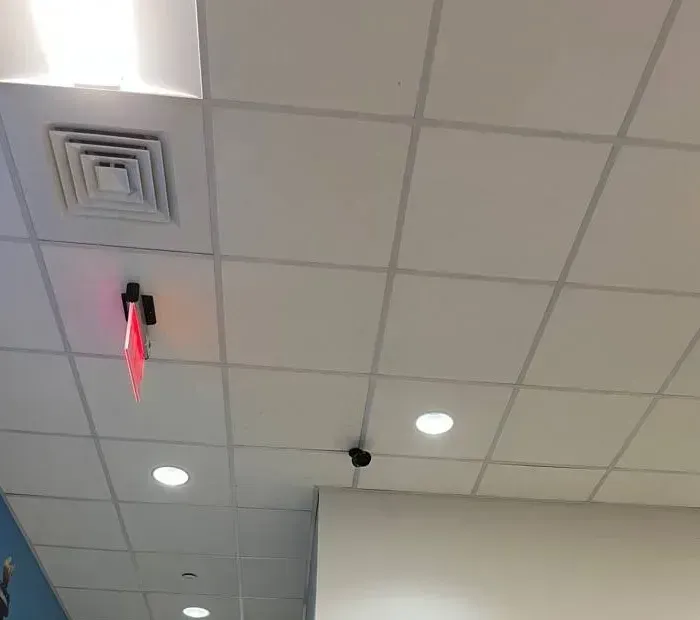
City Line, Brooklyn door buzzer installation: drop ceiling with a lit red exit sign, an air diffuser, round recessed lights and a small black camera
A photo from the AESS job library, not taken in City Line: a drop ceiling with a lit red exit sign, an air diffuser, round recessed lights and a small black camera. A ceiling like this is what the back of a larger Liberty Avenue store or an upstairs office looks like, and the exit sign marks the kind of door whose egress has to be checked before any lock or release is added to it.
Below the Stoop

Cellars, Side Doors and Second Entrances: The Part of a City Line Buzzer Job Nobody Asks About

Ask a City Line owner what door the buzzer is for and the answer is always the front door. Walk around the house and there is usually more. The CHPC study of Community District 5 is the best public picture of what is below these houses: of the 102 homes assessed for the basement pilot, 70 had cellars and 32 had basements, and only 31 percent had at least one door opening directly from that space to the outside. In other words, most houses here have no outside door below the stoop, and roughly one in three does. Both facts matter to an entry system.

Where there is no cellar door, the cellar is the wiring hub. In a house whose cellar is reached only from inside, the cellar is the safest place for everything that is not a station: the power supply, any controller, the splice points and the start of the cable to each floor. It is usually close to the street door, the electrical panel is there for the power supply's outlet, and a technician can come back years later without entering anyone's apartment. We mount the parts on a board above floor level, label each pair by floor and apartment, and keep them away from the boiler, the water heater and the laundry, because heat and moisture shorten the life of a power supply far more than age does.

Where there is a cellar door, it needs a decision. A door from the cellar to the yard or to the steps under the stoop is a way into the house that bypasses the buzzer completely. Sometimes the family uses it every day to take out trash or reach the yard; sometimes it has not been opened in years. In either case it should close and lock properly. Where it is used, the usual plan is a self-closing door with a latch that locks from outside and opens freely from inside, plus a door switch so the owner's phone or station shows when it is left open. Where relatives come and go through it, a small keypad or a second station lets them in without leaving it unlocked. What we never do is chain or padlock a door that people may need to get out through.

Where a cellar has been, or will be, made into an apartment. The city's Basement Apartment Conversion Pilot Program, run by HPD with the Cypress Hills Local Development Corporation, was open only to owner-occupied one- to three-unit homes in this district. CHPC found that 35 percent of properties were screened out because the space below grade had no door to a public way, and that under the pilot a cellar unit needed two egress doors. HPD's page now says the program is no longer considering applications. For a buzzer, the lesson is simple: any lawful apartment below grade has its own door to the outside, and that household needs its own button and station like any other. When an owner tells us a legal below-grade unit is planned, we leave a spare pair in the cable and a button position on the station, so adding it later is a connection, not a new system.

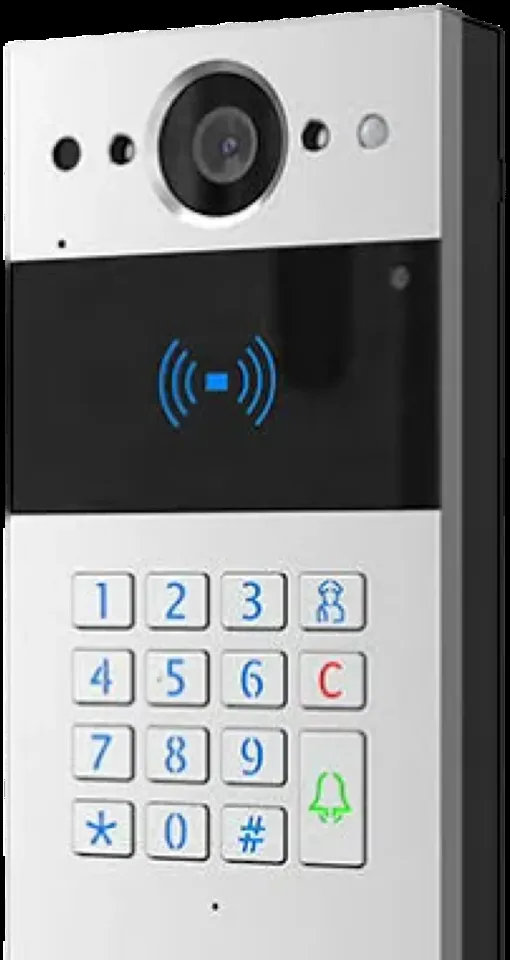
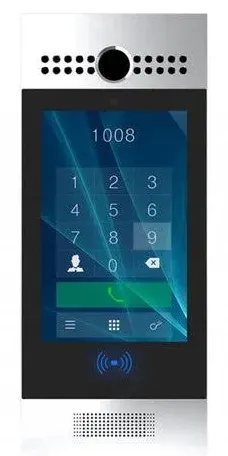
City Line, Brooklyn door buzzer installation: silver and black keypad door station with a camera lens at the top, a blue card-reader symbol, a numeric keypad and a green bell key
A photo from the AESS job library, not taken in City Line: a silver and black keypad door station with a camera lens at the top, a blue card-reader symbol, a numeric keypad and a green bell key. A station like this suits the cellar or side door of a City Line house that relatives use every day, because each person can come in with a code while visitors still press the bell key and ring the household upstairs.
The Door Itself

Closers, Strikes and Frames: Why the Door Decides Whether a City Line Buzzer Works

When someone presses release, nothing upstairs touches the door. ButterflyMX's explanation of apartment buzzers describes the sequence well: the resident's station sends a release command to a relay, and the relay switches the door-release circuit on for a set time so the visitor can push the door open, after which it locks again. The relay "doesn't physically swing the door open." Everything after that moment depends on parts nobody sees: the strike in the frame, the closer at the top of the door and the door hanging square on its hinges.

The strike. Most street doors we install on get an electric strike, a powered keeper in the frame that lets the latch pass when the release is pressed. Allegion's guide explains the two kinds simply: "Fail safe products are unlocked when power is removed," and "fail secure products are locked when power is removed." With a strike, a person inside can still leave by turning the lever either way. For the street door of a two- or three-family house we fit fail-secure strikes almost every time, so a power cut leaves the house locked and the family uses their keys, which is what owners here expect of a front door.

The closer. In a three-family house or a walk-up, the street door and the hall doors must close and latch on their own. HPD's proactive Self-Closing Door Program shows how seriously the city treats this: in fiscal year 2025 it inspected 300 buildings and issued 2,937 self-closing door violations, 904 of them on public-area doors, and 289 of the 300 buildings received at least one. In Brooklyn alone, 93 buildings with 4,833 apartments were inspected and 728 violations were written. A buzzer that releases a door the closer cannot pull shut leaves the house open after every visitor, so every installation includes adjusting or replacing the closer and watching the door latch on its own before we leave.

The frame. Older City Line doors, especially on the walk-ups and on houses that have been through several owners, often have frames that have been pried, shimmed or repainted until the latch barely reaches. A strike in a split or bent frame does not hold. Repairing or reinforcing the frame, and closing the gap at the latch so it cannot be slipped, goes in the written scope when it is needed, priced before ordering.

Magnetic locks. Some owners ask for a magnetic lock because it mounts easily on a tired frame. Allegion notes that electromagnetic locks are only available fail safe, so the door unlocks whenever power drops, and the building code's sensor-release provisions for electrically locked egress doors call for a sensor on the inside, a push-to-exit button within reach and unlocking on loss of power and on fire alarm activation. On a house, that usually makes the magnetic lock the more expensive and less secure choice, and we say so with both prices on the page.

The City's Rules

What New York's Door and Intercom Rules Actually Ask of a City Line Owner

Most of City Line's houses are one- and two-family homes, and for them the law asks very little of a doorbell: it is the owner's choice. The rules begin to bite at three apartments and tighten at eight. Here is how they line up for the buildings found in this neighborhood, in plain terms and without legal advice.

One- and two-family houses. These are private dwellings, outside the Multiple Dwelling Law. There is no city requirement for an intercom, and the choice of audio, video, one button or two is entirely the owner's. HPD does require a two-family house where neither the owner nor the owner's immediate family lives to be registered with the agency, but that is a registration matter, not an equipment one.

Three to seven apartments. A building occupied by three or more households living independently is a multiple dwelling. Its public-hall doors and apartment doors must swing closed and latch, the housing code sets the locks required on each apartment door, and HPD can and does write violations when they fail. An intercom is not required at this size unless the building's history makes it so, but keeping the street door self-closing and self-locking is, in practice, half of what a new buzzer installation does.

Eight or more apartments. Under Multiple Dwelling Law §50-a, a Class A multiple dwelling with eight or more apartments built or converted after January 1, 1968 must have a self-locking main entrance door with an intercommunication system that lets tenants speak to visitors and release the door. In older buildings, the owner must install the door and intercom when tenants of a majority of apartments request or consent in writing, with work started within 90 days and finished within six months.

What counts as an intercom. The city's own rule on the subject, Title 1 §42-01 of the Rules of the City of New York, sets a modest minimum: "a bell or buzzer system" with a return buzzer that unlocks the door, or a speaking and listening device. The same rule puts push buttons no more than six feet above the floor and the speaking device between four and five feet up, and it lets the Buildings Department accept existing equipment that is in good condition and working adequately. A modern installation goes well beyond that minimum, but the rule is useful to know when an owner is told an old working system "must" be replaced.

Commercial Door Buzzer Installation

Business Door Buzzer Installation in City Line

City Line's businesses are concentrated on a few streets, and the buzzer requests from each are predictable. Stores want a way to answer a delivery door without leaving the counter, the apartments above the stores want a street door of their own, and the mosques, churches and community rooms want people let in during their own hours and the door kept shut the rest of the time.

Liberty Avenue

The neighborhood's shopping spine, with halal groceries, South Asian clothing stores and other shops on the ground floor and apartments above, often reached through a narrow street door between storefronts.

Euclid Avenue at Pitkin Avenue

The western edge of the neighborhood around the Euclid Avenue station, where the A and C trains stop and corner buildings mix storefronts with upstairs apartments and offices.

Grant Avenue

The blocks around the Grant Avenue station, whose only entrance is on the east side of the avenue just north of Pitkin, with small mixed-use buildings on the corners nearby.

Atlantic Avenue

The northern boundary, a wide and busy avenue where storefronts and residential buildings each need a street door that is answered without being left open.

Fountain Avenue and Hegeman Avenue

The streets around the East New York City Line Houses, whose lobby doors are NYCHA's, and the privately owned buildings and small businesses on the blocks beside them.

Mosques, churches and community rooms

City Limits counted seven mosques in the area; together with churches and community rooms they need side doors that admit people at set times and lock again after.

For a store, the job is usually a buzzer or a video station at the back or side door where suppliers arrive, answered at the register or on the owner's phone, with the door kept locked between deliveries. We keep the station out of the reach of carts and hand trucks, use a vandal-resistant housing on any door that faces an alley, and keep the cable away from the roll-down gate's motor and housing, so servicing the gate never damages the buzzer.

For the apartments above a store, the scope is the same as a small house: a two-button panel at the residential street door, a station in each apartment and a release on the door, all on a system that has nothing to do with the shop. If the residential door is on a side street, the panel goes there with a clear number, and the apartments' visitors are told which door to use. For an upstairs office, clinic or program, it is a street-door station with a short directory, a release at the front desk and a closer that pulls the door shut behind each visitor so the stair is never left open to the street.

For a mosque, church or community room, the request is usually about a side door: open for a set time before and after prayers, services or meetings, locked otherwise, with a station so latecomers can ring someone inside. Those doors carry the same egress questions as any assembly space, so we look at how people leave the room before we put anything on the door they leave through.

Rules that apply to City Line entry installations

The intercom and self-closing door rules for houses and walk-ups are set out in the section on the city's rules above. Three more apply to business and community doors in particular:

  • Electrically locked egress doors. Where a magnetic lock is used instead of a strike, the building code's sensor-release provisions call for a sensor on the egress side, a manual push-to-exit device near the door, and unlocking on loss of power and on fire alarm activation.
  • Accessible reach. The 2010 ADA Standards put the high forward reach at 48 inches maximum and the low forward reach at 15 inches minimum. We keep buttons and keypads on business doors, clinics and community rooms inside that range.
  • Smart access data. In multiple dwellings using fobs or apps, the Tenant Data Privacy Law sets consent and data-retention rules, and a tenant cannot be required to use smart access to enter their own apartment.

If a store or building also wants cameras on the entrance, they can go in on the same visit and be priced together with the buzzer; customers who combine the two typically save $200 to $400 in labor.

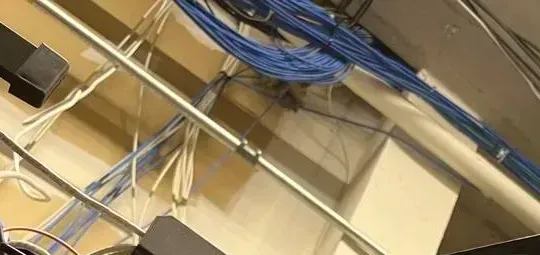
City Line, Brooklyn door buzzer installation: bundles of blue low-voltage cable laid over a ceiling beam and a metal pipe in an open ceiling
A photo from the AESS job library, not taken in City Line: bundles of blue low-voltage cable laid over a ceiling beam and a metal pipe in an open ceiling. The cellar of a Liberty Avenue store-and-apartment building often looks like this, and it is where the shop's delivery buzzer and the apartments' entry system can share a route across the ceiling while staying two separate systems.
Your Questions Answered

Door Buzzer Installation in City Line: Questions Answered

These are the questions City Line homeowners, families who share houses, small landlords and shop owners bring to us, along with ones raised in Brick Underground's and ButterflyMX's guides and in tenants' threads on Reddit, answered for the houses and buildings here.

Families across floors and next door

Our family owns the two attached houses side by side on our block. Can relatives in either house answer both front doors?

Yes, on most video systems, and it is one of the more useful things an entry system can do in a neighborhood where families own neighboring houses. Each house gets its own door station, its own power supply in its own cellar and its own release, so each house works on its own if the other is switched off. On top of that, the stations in one house are set to ring when the button is pressed at the other house's door, either for every call or only when nobody in the first house answers. A relative next door can then see and speak to a courier or a guest and, if the family agrees, release that door.

Where the houses are attached, the link between them is one low-voltage cable through the shared cellar wall, sealed on both sides. Where they are detached, it runs over the family's own network instead. Either way, the shared answering is a setting, not a wire you cannot undo, so the day one house is sold or rented to someone outside the family, the link is switched off and each house carries on alone.

If nobody picks up on the first floor, can the call roll over to the family upstairs?

Yes. On systems that support call groups, the button for a household can be set to ring its own station first and, after a set number of seconds without an answer, ring the next floor or a relative's phone. In a house that one extended family fills, that means a delivery driver at the door is answered by whoever is home, without everyone's station ringing at once every time.

The order and the delay are chosen with the family on installation day and can be changed later from the admin settings. Tenants in the same house are kept out of the group, so a call for the family never rings the rental apartment, and a call for the tenant never rings the family.

Can the stations double as an intercom between floors, so we can call each other inside the house?

Many can. Most multi-station systems, audio and video, include a station-to-station call, so a parent on the first floor can call a grown child's station on the third floor without anyone going to the stairs. For houses where an older relative lives on one floor and the rest of the family on another, owners often find this more useful day to day than the door function itself.

We set the internal calls only between the family's own stations. A tenant's apartment is left out of the internal calling unless the tenant and the owner both want it, so the system never becomes a way into someone else's home.

I live on the first floor and rent out the top floor. Should my station be able to see who comes to ring my tenant?

We set it up so that it does not, and we recommend that. On most video systems the owner's admin access could be configured to view the door camera at any time, but a tenant's visitors are the tenant's business, and a station that shows the owner every call to the upstairs apartment invites a dispute. The usual set-up is that each household's monitor shows the door only when that household's button is pressed, and the owner sees the door on their own calls.

If the owner wants a view of the front door for security, a separate camera on the stoop does that job openly, and the tenant knows it is there. That keeps the buzzer what it should be: each household's own way to answer its own door.

Old systems behaving strangely

Our old buzzer sometimes rings on its own when nobody is at the door. Is that a sign the whole system has to go?

Not by itself. A bell or buzzer that rings with nobody there usually has one fault, not many: a button outside that sticks or lets water in, a cable with worn insulation touching another pair somewhere along its run, or a damp splice in the cellar. ButterflyMX lists "Why does my apartment buzzer keep buzzing?" among the most common questions, and the cause is usually that kind of single failure point.

We find it on the service call and price the repair against a replacement. If the house's wiring is otherwise sound and the household is happy with an audio bell, a repair is the better value. If the same visit shows the old cable failing in several places, or the family wanted separate buttons for each floor anyway, replacing it costs less over the next ten years than fixing it twice. The $250 service call goes toward whichever you choose.

What happens if the old cable fails its test after we have approved the price?

That should not happen, because the testing comes before the price. On the walkthrough the technician tests every pair we plan to reuse, and any pair that is borderline, wire that passes today but may not carry video reliably, is listed in the written price as a possible replacement with its own cost. You decide before ordering whether to replace it from the start or keep it and accept that it may need replacing later.

We work this way because equipment, once ordered, cannot be returned, and a customer should never learn about an extra cost on installation day. If something truly unforeseeable turns up inside a wall, we stop, show you, and nothing extra is done without your written approval.

Our two-family has a separate electric meter for each apartment. Whose meter should the buzzer run on?

The owner's. The power supply for the entry system should be on a circuit the owner controls, normally the house or cellar circuit that also feeds the hall light and the boiler, not on either tenant's apartment panel. If the buzzer is powered from an apartment, the door stops working the day that household switches off a breaker or moves out and the utility shuts off the account.

A buzzer's low-voltage power supply draws very little, so the cost to the owner is negligible. Where there is no free outlet on the owner's circuit near the cellar wiring point, a licensed electrician adds one, and that is named in the written price before ordering.

Paperwork, owners and who decides

How do we find out whether the city lists our house as a two-family or a three-family before we choose a system?

Check the house's certificate of occupancy, if one was issued, and its HPD registration. The Buildings Department's public records show the legal use and number of apartments, and HPD's registration records show whether the building is registered as a multiple dwelling or as a private dwelling. A house the city treats as three-family is a multiple dwelling, with the self-closing door and apartment-door lock rules that come with it.

It matters for the buzzer because the plan should match the legal house. If your house is legally two-family, we design for two households and two buttons. If the city lists three apartments, the street door and every hall door have to self-close and latch, and that work goes into the scope. We do not advise on legalizing units; we install to the house as it legally stands and leave room for what you tell us is coming.

We rent our store on Liberty Avenue. Do we need the building owner's permission to add a delivery buzzer at the back door?

Yes. A buzzer means drilling through the door frame or the wall, running cable through the building and sometimes changing the strike, and all of that is work on the landlord's building. Most commercial leases require the landlord's consent for alterations, and the back door is often also an exit for the apartments or another tenant.

We make it easy: we give you a short written scope and price, with photos of where the station and strike would go, to send to the owner. Once the owner agrees in writing, we book the job. If the owner would rather the building had one plan for the shop door and the apartments' street door, we quote both together as separate systems.

My sister and I own the house together and each live in one apartment. Who should hold the admin access to the system?

Both of you, as equal administrators, with the login details written down and kept where either of you can find them. On most systems more than one admin account can be created, so each co-owner can add or remove a phone, change call order or reset a code without asking the other to do it.

What we avoid is a system registered to one person's phone or email alone. If that person changes phones, moves or is away for a long time, the other owner is locked out of their own front door's settings. At hand-over we set up both admins, show both of you how to use them, and leave the wiring note and test record with the house rather than with one person.

Our driveway gate is shared with the house next door. Whose system should control it, and can both houses release it?

A shared gate should be on a release that both houses can trigger, but its power and its wiring should belong to one of them, agreed in writing between the neighbors before anything is installed. In practice, the gate's release and power supply are wired into one house's system, and the other house is given a release button or an app permission for the gate only, without any access to the first house's own doors.

The gate must also be able to take a release at all: it needs to swing freely and close and latch on its own, on a spring or a closer, with a solid latch post. A gate that has to be pulled shut by hand will not hold, and the fix there is gate hardware first. Neighbors who cannot agree on ownership are better off with the gate left on keys and each house's buzzer at its own door.
Equipment

Types of Door Buzzer Systems We Install

We quote a reliable non-branded system by default and install a named brand when an owner asks for one; the intercom brands we work with include Aiphone, ButterflyMX, 2N, Akuvox, Comelit and DoorBird. These are the kinds of equipment that suit City Line's family houses, two- and three-family rentals, small walk-ups and Liberty Avenue storefronts.

Group-call door stations

A single-button audio or video station whose call rings a group of stations on every floor of a family house, with roll-over to the next floor or a phone when nobody answers.

Multi-button house stations

Two- and three-button stations for shared street doors, each button wired to one household's talk-back station or video monitor with its own door release.

Two-wire systems for old cable

Systems that carry voice, video, power and the release over one pair, so a sound bell pair, an unfinished intercom cable or a walk-up riser can be reused.

Side and cellar door stations

Slim doorbell-style stations, keypads and door switches for the driveway side door, the cellar door and the driveway gate, tied into the same system as the front.

Lobby panels for small walk-ups

Directory or code panels with apartment stations on every floor, sized for four to a dozen apartments, with battery-backed power and a keyed override.

Strikes, closers and door switches

Fail-secure electric strikes for wood and steel frames, closers set so the door latches after every release, and switches that report a door left open.

Group call, a button per household or a lobby panel: which fits a City Line door?

The right set-up depends less on the building's size than on who lives behind the door. The table compares the three arrangements we install most often here.

What mattersOne button, group callA button per householdLobby panel with directory
Typical City Line fitA two- or three-family house one family fillsA house with a tenant apartment, or apartments over a storeWalk-ups of four apartments or more
Who hears a ringEvery family station, in the order chosenOnly the household whose button was pressedOnly the apartment selected
Who can release the doorAny family stationEach household for its own visitorsEach apartment, plus the owner or super
Station-to-station callsYes, between floorsOnly within the family's own stationsUsually to the super only
Changes when a tenant moves inA second button is addedNone; the button already existsThe directory entry is updated
Brooklyn list range$400–$900 audio, $700–$1,800 video$400–$900 audio, $700–$1,800 videoFrom about $2,500

ADT, Ring and SimpliSafe compared with a local installer for a City Line house

Plenty of City Line homes already have a Ring doorbell or an alarm plan from ADT or SimpliSafe, and owners reasonably ask whether that covers the front door. On a one-family house with one household, a consumer video doorbell often does, and we will install and properly power the one you already own. Where those products fall short here is the house with more than one household: a consumer doorbell rings one account's phones and one chime, it cannot give a tenant on the second floor a button and station of their own, it cannot ring a relative's house next door as a group, and on its own it does not release a street door. National alarm companies sell doorbells inside monitoring plans; the buzzer systems we install are owned outright, with no plan required. For a walk-up, none of the consumer products is designed to be a multi-apartment entry system.

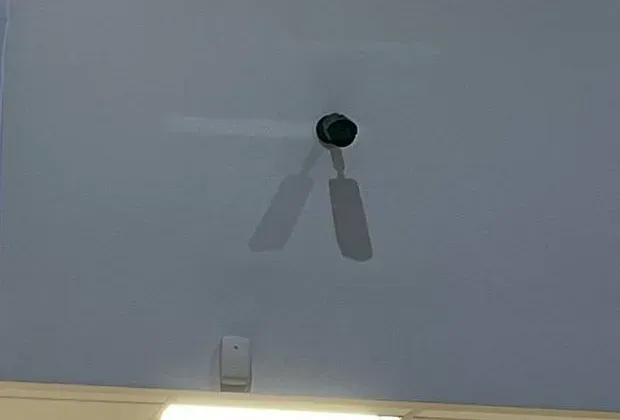
City Line, Brooklyn door buzzer installation: small black camera mounted high on a pale wall casting two shadows, with a small white wall device below
A photo from the AESS job library, not taken in City Line: a small black camera mounted high on a pale wall, casting two shadows, with a small white wall device below it. In the shared hall of a City Line two-family, a camera placed high like this can watch the inside of the street door and the stair, while the door station's own camera handles faces at the stoop.
AI Overview Reality Check

What AI Gets Wrong About Door Buzzer Installation in City Line

These claims appear in generic online answers, in national cost guides such as HomeAdvisor and Angi, and on manufacturers' and vendors' blogs. Each one is quoted or paraphrased, then checked against City Line's houses, the manufacturers' own guidance and the city's rules.

"Installing an intercom system costs an average of $2,500"

That is HomeAdvisor's headline figure, inside a range of $1,500 to $15,000.

An average across every kind of building in the country says very little about a brick two-family in East New York. Most City Line jobs are two or three households behind one door, with a cellar route to every floor, and on our Brooklyn list they fall between $400 and $1,800. The figure is closer to what a small walk-up with a station in every apartment costs, which on our list starts at about $2,500.

An owner who budgets from a national average either overpays for a house or underestimates a building. A walkthrough and a written price for the actual door fix both.

"A whole-house system for five rooms costs $1,000 to $1,500 to install"

HomeAdvisor quotes that range for a five-room whole-house intercom and estimates one to two hours of work per station.

Room-to-room intercoms in a single-family house are a different product from a door buzzer in a house with separate households. In a City Line two- or three-family, each station has to be wired to the street door, each household needs its own release, and the street door often needs a strike and a closer before any of it works. The time goes into the cellar route and the door, not into hanging stations.

Families who want both, internal calling between floors and door answering, get it from a single multi-station door system rather than two separate products.

"Software subscriptions commonly add $5 to $15 per unit per month"

Swiftlane's cost guide gives that range for cloud entry systems, or $30 to $100 per door per month.

For a large managed building those fees may be worth it. For a City Line two-family, a per-unit fee is a monthly bill for a front door that a wired system answers for nothing, and the owner pays it for as long as the house has the system. A six-apartment walk-up at $5 to $15 per unit is $30 to $90 a month before anything breaks.

We price wired and cloud options side by side when an owner asks, with the monthly cost over five and ten years next to the installed price, and most houses here choose a system with no subscription.

"If the existing wires are in good condition, they can be reused"

Aiphone's own upgrade guide says exactly this, and for many City Line houses it is true.

The catch is the phrase "in good condition." Old bell wire in a house that has been renovated by several owners may be spliced in the cellar, painted over, cut behind a new wall or never connected to anything upstairs. Reuse only works after every pair has been tested from the door to each floor, and wire that carried a bell may not carry video reliably.

We test before pricing and say in writing which wire is reused, which is replaced and which is borderline, with its replacement cost named before you order.

"New York City buildings must have a video intercom"

Vendor marketing often implies that NYC law requires a modern video system in apartment buildings.

It does not. The Multiple Dwelling Law requires an intercom in Class A multiple dwellings of eight or more apartments built or converted after 1968, or in older ones when a majority of tenants ask in writing, and the city's rule, 1 RCNY §42-01, accepts as a minimum "a bell or buzzer system" with a return buzzer that unlocks the door. One- and two-family houses, which make up most of City Line, have no intercom requirement at all.

Video is a choice, and often a good one, but no City Line owner should be told the law forces it on a working system.

"Plug-in wireless chimes are an easy way to reach the upper floors"

Owners on forums such as Brownstoner describe syncing plug-in chimes to a video doorbell so the upper floors of a multi-family house hear it.

That reaches the upper floors, but in a house with more than one household it reaches all of them. Every chime rings for every visitor, nobody upstairs can talk to the person at the door, and nobody upstairs can release it, so someone still walks down to open the door, which is the problem a buzzer is meant to solve.

A chime is fine for a one-family house. A shared door needs a button per household, a station per household and a release.

"A fail-safe lock is always the safer choice"

Online answers often treat fail-safe as the safe option because the word "safe" is in the name.

Allegion's guide explains that fail-safe products unlock when power is removed and fail-secure products stay locked. On a City Line street door with an electric strike, a person inside can leave by turning the lever either way, so the choice only decides what happens outside during a power cut. A fail-safe strike leaves the house open to the sidewalk; a fail-secure strike keeps it locked and the family uses their keys.

For the front door of a family house, fail-secure is almost always the right answer, and magnetic locks, which Allegion notes are only made fail-safe, are rarely the right choice at all.

Not Sure Whether Your House Needs Separate Buttons, a Group Call or Just a Better Door? Ask a Tech

Tell us how many households live behind the door and send a photo of the door and the old bell. Call now at (347) 934-8335, send a fast quote request, or speak to a tech on WhatsApp. Estimates are booked within two hours of your request during working hours.

Get In Touch

Request a Free Quote

Tell us the street, the kind of house or building, how many households use the street door, which other doors visitors or relatives use, whether you own it, and what is by the door now. A technician calls back with the range for the City Line address, or you can call (347) 934-8335 right now.

✅
Request Sent!
Thank you. A technician will call you about the City Line address, usually within two hours during working hours.
How It Works

Our Installation Process

1. Photos and household count

Send the street door, the frame, any old bell or panel and where its wire ends, with the street, how many households use the door, who is family and who rents, and who owns the house.

2. Weekday walkthrough

A technician checks how the door closes and latches, tests the old wire and power, walks the side door, cellar door and any gate, and traces a cable route to every household.

3. Written scope and price

Equipment, mounting spots, cable route, door and strike work and every possible add-on, such as a borderline cable, with the total price in writing before anything is ordered.

4. Door and power first

The door is made to close and latch on its own, the strike goes into a sound frame, and the power supply goes on an owner-controlled circuit in the cellar, with an electrician for any 120-volt work.

5. Cable and stations

Low-voltage cable runs from the cellar up stair halls and closets to the door station and each household's station, kept off the face of the house and labeled at both ends.

6. Test from the sidewalk

Every button is rung from outside, every station talks and releases, group calls and roll-over are checked, and the door is watched latching after each release, with a dated test record.

7. Hand-over

The owner or co-owners get the wiring note, admin access and test record, and each household is shown how to answer, release the door and change who can answer.

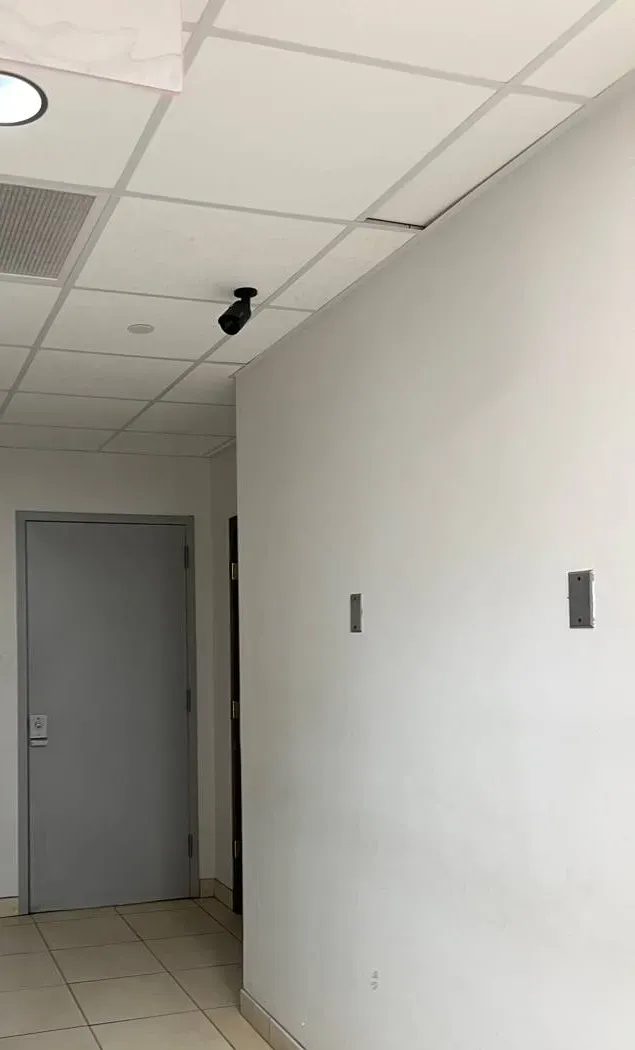
City Line, Brooklyn door buzzer installation: tiled corridor with white walls and small wall plates ending at a grey steel door with a lever handle under a drop ceiling with a small camera
A photo from the AESS job library, not taken in City Line: a tiled corridor with white walls and small wall plates ending at a grey steel door with a lever handle, under a drop ceiling with a small camera. The back hall of a Liberty Avenue store or a small walk-up often ends at a steel door like this one, and step four applies to it as much as to the front: it must close and latch on its own before any release or door switch is wired to it.
Coverage Area

Door Buzzer Installation Near City Line's Landmarks

Grant Avenue station

The A train stop opened on April 29, 1956, the easternmost Fulton Street Line station in Brooklyn, with its only entrance on the east side of Grant Avenue just north of Pitkin Avenue.

Euclid Avenue station

The A and C station at Euclid and Pitkin Avenues, opened in 1948 and the C train's terminal, with elevators completed by 2006, on the neighborhood's western edge.

Forbell Street (Mizanur Rahman Way)

The block of Forbell Street above Liberty Avenue, co-named Mizanur Rahman Way, where City Limits reported families buying neighboring houses.

The Liberty Avenue el

East of Grant Avenue the A line climbs onto elevated tracks along Liberty Avenue, the neighborhood's shopping street, and carries on into Queens.

Cypress Hills Houses

The NYCHA development completed in 1955, 15 seven-story buildings with 1,442 apartments on 29 acres between Linden Boulevard, Sutter, Euclid and Fountain Avenues.

East New York City Line Houses

The NYCHA development completed in 1976, listed as 33 buildings on Hegeman Avenue, Fountain Avenue and Logan Street in ZIP code 11208.

We also serve Cypress Hills, East New York, Spring Creek and Brownsville at the same Brooklyn rate, and Ozone Park across the line, which is covered on our Queens page. See our door buzzer installation in Brooklyn page for the whole borough, or nearby neighborhood pages such as Brownsville door buzzer installation.

Pricing

Door Buzzer Installation Cost in City Line

City Line is billed at our Brooklyn rate, with no travel premium. The ranges below are installed prices covering equipment, power, any strike or release, cable and labor. Where a house lands inside a range depends on the door's condition, the cable route from the cellar, the number of households, whether side or cellar doors are included and the choice of audio, video or phone answering. The figure for your door is set in writing after the walkthrough, with any possible add-on named and priced before you order, and it does not change unless you change the scope.

ItemBrooklyn priceTypical City Line job
Audio / small system$400–$900Two- or three-button station at a shared street door, a talk-back station per household, a release on the door, cellar power supply
Video / mid-size system$700–$1,800Video station with monitors or phone answering for a family house or a two-family, group calls between floors, a side-door station or door switch where wanted
Multi-unit building$2,500–$10k+Lobby panel, tested or new riser, apartment stations, strike, closer and battery-backed power for a small walk-up
Service call booked online$250Diagnosis of an existing system; applied toward the work

What usually moves a City Line job toward the top of its range: a street door or frame that must be repaired before a strike can hold, a cellar or side door added to the system, a new cable route because the old bell wire is missing or will not carry video, video monitors for every household, and shared answering between two houses. What keeps a job toward the bottom: wire that tests sound and can be reused, a door that already closes and latches, one household or a family using one group call, and audio stations or phone answering instead of monitors.

Full terms — including 50% deposit, one-year parts-only warranty on AESS-supplied products, and the late-fee schedule — are set out in the service agreement.
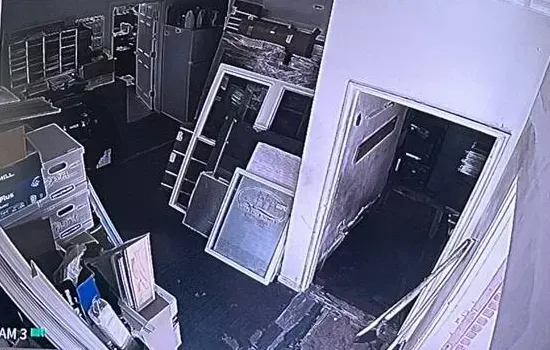
City Line, Brooklyn door buzzer installation: black-and-white night camera view of a cluttered room with an open doorway into a dark back room
A photo from the AESS job library, not taken in City Line: a black-and-white night camera view of a cluttered room with an open doorway into a dark back room. A storeroom like this behind a Liberty Avenue grocery is usually where the delivery door is, and it is why shop owners often price a camera on that door together with the rear buzzer.

Find Out Which Range Your City Line House Falls In

Send three photos, the street door from the sidewalk, the frame and latch close up, and the old bell or panel, plus a note of how many households live there and which other doors they use, and we tell you which range fits and what would move it. Call (347) 934-8335, speak to a tech on WhatsApp, or use the fast quote form.

Shop Our Systems

Door Buzzer Installation Packages & Pricing

Three typical City Line jobs, each priced inside the matching range on our Brooklyn list. The exact figure comes from the walkthrough.

Two-family with a tenant, a button each: $400–$900

A lit two- or three-button audio station at the shared street door, a talk-back station and release for each household, the old hall chime disconnected, a fail-secure strike in a sound frame, the closer adjusted and the power supply on the owner's cellar circuit.

Family house video with group call: $700–$1,800

A video door station whose call rings monitors on every floor in the order the family chooses, roll-over to a phone, station-to-station calls between floors, and a slim station or door switch at the side or cellar door if wanted.

Small walk-up entry system: from about $2,500

A lobby panel for a four- to twelve-apartment building, the riser tested pair by pair or replaced, audio or video stations in every apartment, strike, closer, door switch and battery-backed power, with a dated test record for the owner.

Bring your own equipment. If you have already bought a door station, video doorbell or intercom kit, we can install it as long as it suits the door, the number of households and the house's power. Labor for customer-supplied equipment is quoted flat at the walkthrough, and any strike, closer, power supply and cable are priced from the same list. Customer-supplied equipment carries the manufacturer's warranty rather than ours, so we check the model with you before you book.

City Line, Brooklyn door buzzer installation: touchscreen entry panel showing a dial pad with a four-digit apartment code entered, a camera above and a card-reader symbol below
A photo from the AESS job library, not taken in City Line: a touchscreen entry panel showing a dial pad with a four-digit apartment code entered, a camera above and a card-reader symbol below. A panel like this is more than a two-family needs, but it suits the larger walk-ups on City Line's avenues, where visitors dial an apartment code and residents can come in with a card instead of a street-door key.
Complete Services

Every Door Buzzer Service in City Line

Family houses and two-families

Group calls, a button per household, side and cellar doors. Request a quote

Walk-ups and store buildings

Lobby panels, risers, strikes and closers. Call (347) 934-8335

Across Brooklyn

The same list in every neighborhood. Brooklyn door buzzer installation

Across the line in Queens

Ozone Park and the rest of the borough. Queens door buzzer installation

FAQ

City Line Door Buzzer Installation FAQ

Do we pay anything before the equipment for our City Line house is ordered?
+

Yes, a deposit, and only after you have approved the written price. Looking at your photos and quoting the job cost nothing. Once you sign off on the scope, including any possible add-ons we named, the deposit is paid and the equipment is ordered. Because ordered equipment cannot be returned, we make sure the button count, the finish and the stations are exactly what you want before that point.

Can an apartment station be moved to another room after it is installed?
+

Yes. A station can be moved by extending its cable to the new spot, usually from the cellar or through a closet below, and patching the old mounting holes. It is simplest to decide on the room during the walkthrough, so we ask each household where they actually spend the day, which is often the kitchen rather than the hallway by the apartment door.

Our address is on the Queens side of the line in Ozone Park. Who quotes it?
+

We do, but on our Queens list rather than the Brooklyn one, because prices are set by borough. The work itself is the same, and many houses on both sides of the line are built alike. Tell us the address when you call and we will quote it from the right list.

Can the door station share the spot beside our mailboxes on the front wall?
+

Usually, as long as there is room for it at a comfortable height and the mailboxes do not block a visitor's face from the camera. Mounting the station next to the mailboxes helps visitors and couriers, because that is where they already look for a name or a number. We check the spacing with the door open and closed, so the door, the mail slot and the station never get in each other's way.

Can the system show which household released the street door?
+

Many app-based and networked systems keep a log of calls and releases by station, and the admin can see it. Simple audio systems do not. In a two- or three-family house this is mainly useful when the door is being left open or strangers are being let in and the owner needs to know where to start. In a building with three or more apartments using smart access, the city's tenant data rules limit what can be collected and kept, so we set the log up within those limits.

Is a single doorbell on a one-family house in City Line too small a job for you?
+

No. A one-family house with one button and one or two stations inside sits at the low end of our audio range, and a video doorbell with a chime upstairs sits in the video range. We price it the same way as any other job, from photos and a short walkthrough, and the written price covers the station, the power, the cable and the labor.

Can neighbors on the same City Line block book their installations together?
+

Yes. Each house gets its own written price and its own system, but we can schedule the walkthroughs on the same visit and the installations on consecutive days. Neighbors who do this save themselves separate trips to compare options, and they often end up choosing the same station, which makes the block look tidy.

Is the house left unlocked while the old bell is out and the new system is going in?
+

No. The street door keeps its normal lock and key throughout the job. The old bell is disconnected only when the new station is ready to go in, and the strike is fitted and tested in one sitting so the door is never left on a half-installed release. If a part has to wait for another day, the door is left locking normally with a key.

We already have a Ring doorbell. Can it be wired to open our street door?
+

Not on its own. A consumer video doorbell rings phones and a chime, but it has no door release built in. If you want to keep it as a camera, we can leave it on the door and add a release with its own station or button inside, or replace it with a door station that does both. For a house with a tenant, the second option is usually better, because the tenant gets a button of their own.

Does a door buzzer need regular maintenance once it is in?
+

The electronics need very little. What changes over the years is the door: hinges loosen, frames shift and closers weaken, until the latch stops catching after a release. If the door begins to stay open after visitors come in, or the release hums without opening, that is the time for a service call, which is the $250 visit booked online, applied toward any repair.

More Door Buzzer Installation near City Line

Door Buzzer Installation Brooklyn NY | Brownstones & Condos · Door Buzzer Installation NYC | Apartment & Building Entry · Door Buzzer Installation Manhattan NY | Apartments & Co-ops · Door Buzzer Installation Queens NY | Co-ops & Apartments · Door Buzzer Installation Bronx NY | Co-ops & Apartments · Door Buzzer Installation Staten Island NY | Homes & Apts · Door Buzzer Installation Long Island NY | Nassau & Suffolk · Door Buzzer Installation Hudson Valley NY | Apartments · Door Buzzer Installation Nassau County NY | Homes & Co-ops · Door Buzzer Installation Suffolk County NY | Homes · Door Buzzer Installation Westchester County NY | Co-ops · Door Buzzer Installation Rockland County NY | Homes & Apts · Door Buzzer Installation Orange County NY | Homes & Farms · Door Buzzer Installation Putnam County NY | Lake Homes · Door Buzzer Installation Dutchess County NY | Homes · Door Buzzer Installation Ulster County NY | Kingston

Door Buzzer Installation Bath Beach Brooklyn NY · Door Buzzer Installation Bay Ridge Brooklyn NY · Door Buzzer Installation Bedford-Stuyvesant Brooklyn NY · Door Buzzer Installation Bensonhurst Brooklyn NY · Door Buzzer Installation Bergen Beach Brooklyn NY · Door Buzzer Installation Beverley Square Brooklyn NY · Door Buzzer Installation Boerum Hill Brooklyn NY · Door Buzzer Installation Brooklyn Navy Yard, Brooklyn NY · Door Buzzer Installation Brooklyn NY | Brownstones & Condos · Door Buzzer Installation Brownsville Brooklyn NY · Door Buzzer Installation Bushwick Brooklyn NY · Door Buzzer Installation Cadman Plaza Brooklyn NY · Door Buzzer Installation Canarsie Brooklyn NY · Door Buzzer Installation Carroll Gardens Brooklyn NY

Other services in City Line

TV Installation City Line Brooklyn · Structured Cabling Installation City Line Brooklyn NY · Fire Alarm Installation City Line Brooklyn NY · Access Control Installation City Line Brooklyn NY · Door Buzzer Repair City Line Brooklyn NY | AESS · Alarm Installation City Line Brooklyn NY · Intercom Installation City Line Brooklyn NY | AESS · Security Camera Installation City Line Brooklyn NY | AESS

Ready for a City Line Front Door Where Every Household Has Its Own Button?

Send a photo of the street door from the sidewalk, the frame and latch, and the old bell or panel, with your street, how many households live in the house and which other doors they use, and we will tell you what the door needs and where it sits on the Brooklyn list. Call or text (347) 934-8335, message us on WhatsApp, or use the request form. Licensed under NYS license #12000287431, rated 4.7★ across 201 Google Reviews, owner-operated since 2002.