Fob Lobbies With a Shabbat Key Path · Family-Size Apartment Buildings · Lee Avenue and Broadway Shops
Access Control Installation in South Williamsburg
A Mechanical Way Through Every Electric Door · Doors That Latch Themselves All Weekend · Credentials Sized for Big Households · Brooklyn Base Pricing
South Williamsburg, the blocks south of Division Avenue between the river and the Broadway el, is home to one of the largest ultra-Orthodox Jewish communities in the United States. That changes what a door system has to do. From before sunset on Friday until after dark on Saturday, and for longer stretches when a festival runs into Shabbat, many residents will not tap a fob, punch a keypad or open an app. A lobby built only for those things either locks people out or ends up with its latch taped open. We design the other way round: every electrified door keeps a verified mechanical path, the door still closes and locks itself, and the weekday conveniences sit on top.
NYS licensed and insured; written Brooklyn price the same day
Rated 4.6★ from 390+ Google reviews
Reviewed and updated October 18, 2026, against Wikipedia’s South Williamsburg, Independence Towers and Taylor–Wythe Houses articles, CityLand’s report on the 2017 Pfizer Sites rezoning, Chabad.org’s October 2025 guide to doors and locks on Shabbat, the Dinonline beis hora’a answer on electric doors (June 2026), JFeed’s September 2026 report on the Shabbat-morning break-in, and NYC Building Code sections 1010.1.9.8 and 1010.1.9.9 · Abstract Enterprises Security Systems, NYS license #12000287431 · technicians leave from our Troy Avenue office in Brooklyn.
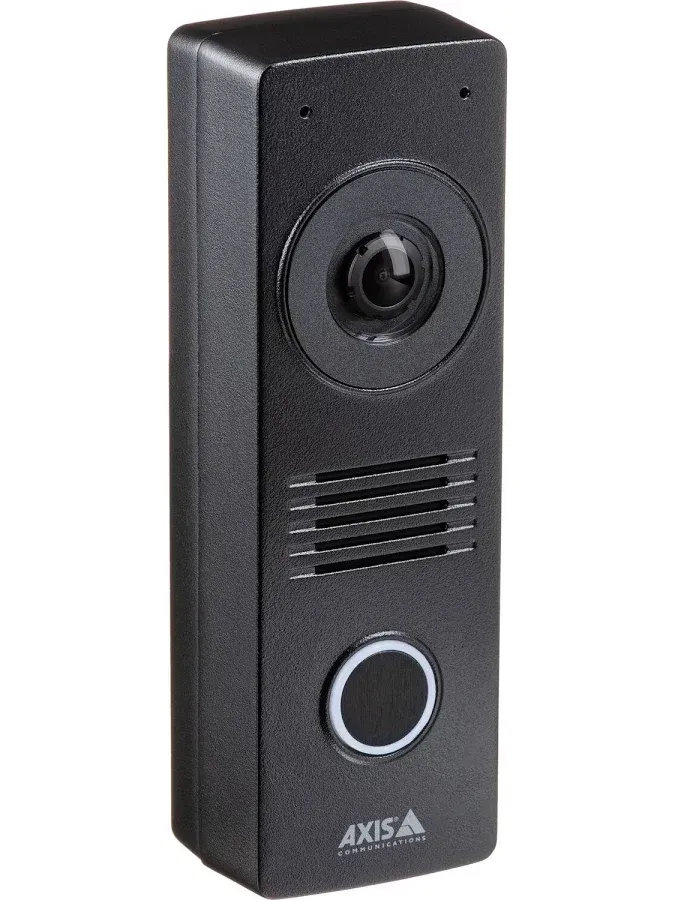
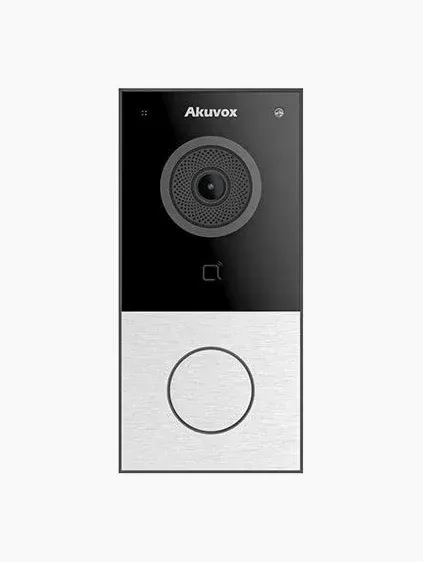
Manufacturer product photo, used as a reference: a slim one-button video station of the kind that fits the narrow pier beside a walk-up’s street door. In South Williamsburg the station is only half the job; the door it serves also needs a key path that works with the power off.
South Williamsburg Door Request
Walk-up, new family building, co-op or shop — tell us the doors and how they’re used on Shabbat
✅
Request Sent!
A technician will call you back about the South Williamsburg building before the end of the business day, and never on Shabbat unless you ask.
25+
Years Experience
✓
Same-Day Estimates
100%
Licensed & Insured
4.6★
390+ Google Reviews
Three facts let us price a South Williamsburg door before anyone comes out. First, the building: an older brick walk-up, a newer mid-rise with stacked balconies, a big complex near Flushing Avenue, or a storefront on Lee Avenue or Broadway. Second, the doors: how many lead in from the street, the yard, the cellar and the garage, and what is on each one now, whether that is a plain key lock, a buzzer strike, a magnetic lock or a fob reader. Third, Shabbat: which of those doors residents must be able to open on Shabbat and Yom Tov without electronics, and how they open them today. Text a photo of the street door from outside and one of its edge from inside, and we can usually tell you what is there and what it would take.
Looking at photos and answering questions by text is free; billable time starts only at the building
New York State low-voltage license #12000287431, with insurance that covers work in occupied lobbies, stairwells and shops
The Neighborhood
Why South Williamsburg Properties Need Access Control
South Williamsburg has carried that name for a long time. Wikipedia’s article on the neighborhood traces it to 1835, when the Village of Williamsburgh absorbed part of the Town of Bushwick and split into three districts, the first of which people called the “South Side.” Through the nineteenth century the waterfront filled with industry: the sugar refinery that later became Domino opened in 1856, and Charles Pfizer founded his chemical company in Williamsburg in 1849 and kept a plant in the neighborhood until 2007. By the 1890s the inland blocks had become a center of Eastern European Jewish immigration, and the Williamsburg Bridge, opened in 1903, brought more families across from the Lower East Side.
The neighborhood most visitors picture today took shape after the Second World War. Thousands of Hasidic Jews, many of them Holocaust survivors from Hungary and Romania, settled south of Division Avenue from the late 1940s. Wikipedia records that the Satmar Rebbe, Rabbi Joel Teitelbaum, arrived in 1947 and founded Congregation Yetev Lev in 1948, and that the community went on to rebuild abandoned housing and put up yeshivas, mikvahs and synagogues across the area. A 2023 UJA-Federation study cited there counted about 36,000 Jewish adults and 32,000 Jewish children in 21,000 households in Williamsburg as a whole. The neighborhood is also home to a long-established Puerto Rican and Dominican community, concentrated nearer Grand Street in the area known as Los Sures.
For a door system, one fact about daily life matters more than any other. Most households in the Hasidic blocks keep Shabbat, and Chabad.org’s 2025 guide to doors on Shabbat states the common rule plainly: doors that open with electronic key cards, fobs or keypads may not be used on Shabbat, because doing so activates electrical circuits, while an ordinary lock and key, or a combination lock that is entirely mechanical, is generally not a problem. A lobby that opens only to a fob therefore stops working for most of its residents every Friday evening. The building does not stop being used: families walk to and from synagogue, guests come for meals, children go in and out all afternoon. Something has to give, and too often it is the lock.
The usual workarounds are well known. The same Chabad.org guide describes taping a latch down, wedging the latch hole or leaving a string under the door, and says those are for situations where security is not a concern. In a five-story walk-up on a busy block, security is a concern. A latch taped on Friday afternoon leaves the street door open to anyone for twenty-five hours, and it is easy to forget the tape on Saturday night. In September 2026 JFeed, citing the local outlet Williamsburg 365, reported that an intruder had walked into an occupied home around 5 a.m. on a Shabbat morning while the family slept, after a month in which two homes on Hooper Street were burglarized; neighborhood volunteers said the suspect moved along the streets testing front doors, rear entrances, porches and ground-floor windows for one that was not locked.
So the work in South Williamsburg starts from a different question than in most of Brooklyn. Not “fob or keypad?” but “how does this door open on Shabbat, and does it still lock itself when it closes?” The answer is nearly always a door that latches every time, a key or a mechanical hold-back that works with the power switched off, no magnetic lock on doors residents need on Shabbat, and electronic credentials for the other six days and for everyone in the building who uses them.
South Williamsburg facts we checked before writing this page
Boundaries. Sources draw them differently. Wikipedia gives Division Avenue on the north, Broadway on the northeast, Flushing Avenue on the south and the East River on the west; CityNeighborhoods.NYC gives Division Street, Broadway, Flushing Avenue and Kent Avenue; a 2009 New York Times City Room post described the Hasidic section as roughly bounded by Division Avenue, Broadway, Heyward Street and the Brooklyn Navy Yard. Wikipedia’s main Williamsburg article names either Division or Broadway as the line with Los Sures to the north.
Size. Wikipedia’s infobox gives a 2020 estimate of 47,065 residents and lists ZIP codes 11206 and 11211; the NYCHA towers near the waterfront use 11249.
Services. The neighborhood is in Brooklyn Community District 1 and the NYPD’s 90th Precinct; Wikipedia lists Engine 211/Ladder 119 and Engine 216/Ladder 108 as its fire companies and the 33rd City Council District as its representation.
Transit. The J and M run on the elevated Jamaica Line above Broadway, with stations at Marcy Avenue, Hewes Street, Lorimer Street and Flushing Avenue that opened on June 25, 1888, as part of the Union Elevated Railroad. The Brooklyn-Queens Expressway cuts through the neighborhood.
Zoning. The City Council approved the Greenpoint-Williamsburg rezoning on May 11, 2005, covering 175 blocks, and approved the Pfizer Sites rezoning near Flushing Avenue on October 31, 2017, by a vote of 38 to 6.
Institutions. Congregation Yetev Lev D’Satmar on Rodney Street, a second Yetev Lev synagogue at Kent Avenue and Hooper Street built in 2006, and the United Jewish Organizations of Williamsburg, founded in 1966 (Wikipedia).
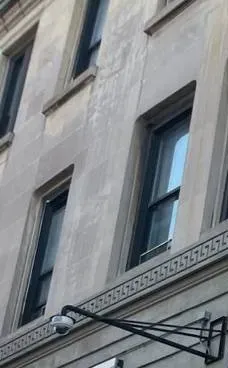
Abstract Enterprises Security Systems schematic drawn from the boundary descriptions quoted on this page; street positions are approximate and not to scale. We serve buildings on both sides of every one of these lines.Timeline drawn by Abstract Enterprises Security Systems from the sources on this page: the neighborhood’s industry and transit, the community that settled it after the war, and the rezonings and rebuilding of the last twenty years.Photo from our job library, not taken in South Williamsburg: a camera held off an old stone front on a steel arm, so the drilling lands in a mortar joint rather than carved stone. We mount door hardware on older fronts the same way, fixing into joints and bringing cable through the frame.
Street Door Not Latching, or a Reader Dead Before Shabbat? Same-Day Repair
Some calls need to skip the quote stage, and in this neighborhood the clock that matters is candle-lighting on Friday. A strike that stopped releasing, a closer that no longer pulls the door shut, a magnetic lock that dropped with a power supply, a reader that went dark on Thursday night: ring (347) 934-8335, tell us how many hours remain before Shabbat, and we will tell you honestly whether a technician can get there and finish in time. A single failed part is normally replaced in one visit. If it cannot be finished before Shabbat, we will leave the door latching on its key and not half-wired. Repair calls follow the Brooklyn list: a $250 service call that is credited toward any larger job you go ahead with.
Photo from our job library, not taken in South Williamsburg: a camera watching a steel service door from inside. Rear and cellar doors are where a building’s weekend security usually fails, because nobody walks past them on Shabbat to notice one standing open.
What We Install
Access Control Services in South Williamsburg
Every job below is built on the same rule: the electronic part is an addition to a door that already closes, latches and opens by key on its own. That is what lets the system serve the whole building, including residents who will not use it on Shabbat. The cards run roughly in the order owners and boards in the neighborhood ask for them.
🔑
Key paths for electric doors
A key cylinder or a mechanical hold-back added to an existing fob or buzzer door, tested with the power switched off, so the door has a way through that involves no electronics at all.
🚪
Lobby readers and keypads
Fob, card or code entry on the street door and the inner vestibule door of walk-ups and mid-rises, with the electric strike fitted so the key still works whether the system is on or off.
📟
Video panels and directories
Call panels that ring apartments, phones or indoor screens, sized for buildings where a single apartment may have a dozen people who come and go.
🕯️
Shabbat and Yom Tov schedules
Door and elevator-reader settings that change before candle-lighting and change back after Shabbat, set up only where the building’s residents have agreed to them.
🏗️
New-building entry design
Door hardware schedules, riser and conduit plans and the choice of which entrance carries the mechanical key path, settled with the architect before the walls close.
🧺
Cellar, yard and service doors
Self-latching hardware, door contacts and cameras on the rear and basement doors that nobody passes on a quiet Saturday afternoon.
🛒
Shop and office doors
Staff codes and timed locking for stores on Lee Avenue, Bedford Avenue and Broadway that close from Friday afternoon until Saturday night.
🔧
Repairs to other installers’ systems
Diagnosis of strikes that stick, readers that drop out and magnetic locks that fail, including systems whose original installer cannot be reached.
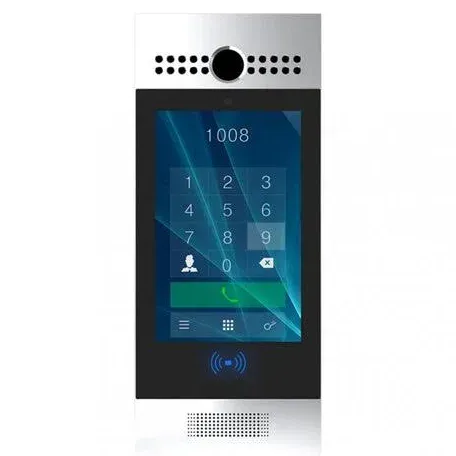
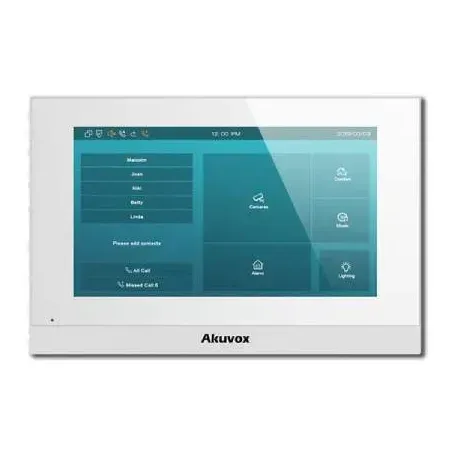
Manufacturer product photo, used as a reference: a touchscreen panel with a built-in card and fob reader below the screen. In a large South Williamsburg building this kind of panel handles visitors and weekday entry; the same door still needs its mechanical key path for Shabbat.
The Shabbat Door
Twenty-Five Hours Without a Fob: Designing Doors for Shabbat and Yom Tov
Most access control is designed around the idea that everybody carries a credential and uses it every time. South Williamsburg asks for something different. For roughly a day each week, and for runs of two or three days when a festival falls next to Shabbat, a large share of the people using a building will not operate anything electrical to get through its doors. A good design accepts that from the first drawing rather than leaving residents to improvise.
The most useful guidance we have found comes from the community’s own sources. A June 2026 answer from the Dinonline beis hora’a, replying to a family who loved an apartment whose entrances all used electronic tags, sorted building doors into three kinds. Intercom doors with an electric strike often also take an ordinary key, and many have a latch that can be set before Shabbat to bypass the electric operation, which the answer says may be moved on Shabbat because it is entirely mechanical; it adds that this can be verified during the week simply by switching off the power to the intercom and lock and seeing whether the door still opens by hand. Magnetic locks, held shut by current, it calls problematic. Magnetic locks with a manual release are less of a problem, but only once someone has checked that operating the release turns no light on or off and trips no small switch.
That is an installer’s checklist as much as a halachic one, and it is the one we work to. We do not decide what is permitted; that belongs to each family’s rav and to the building’s residents. What we can do is give them hardware whose mechanical path is real and documented: a key cylinder that drives the latch directly, a hold-back that is set before Shabbat and keeps the door on its latch, no hidden sensor on that path, and a door that still shuts and locks behind every person who walks through.
Abstract Enterprises Security Systems example, not a particular building: each door has its own weekly pattern, and only the doors the residents agreed to change on Shabbat ever do.Abstract Enterprises Security Systems diagram of a typical strike-and-latch door: the strike is what the fob controls, the key works the latch directly, and the two paths never depend on each other.
A mechanical path that is really mechanical
On a strike-and-latch door, the simplest path is the lockset’s own key cylinder on the street side, with the electric strike in the frame doing the weekday work. Turning the key withdraws the latch by hand; the strike never needs to move. What can spoil it are the extras: a request-to-exit switch inside the lever, a door-position switch that tells the controller the door opened, a light that comes on with movement. None of those is needed for the key path to work, and where a building wants the key path kept free of them we fit the lever without an internal switch, mount the position switch on a door the residents do not use on Shabbat, or put it on a separate circuit that can be switched off before Shabbat. We then hand over a short written description of each door so the residents can show it to whoever they ask.
A door that still locks itself
The danger in every Shabbat workaround is that it leaves the door open. A key path avoids that, because the latch springs back into the strike when the door closes and the next person needs a key, just as on a weekday. A closer strong enough to pull a heavy steel door past the weatherstrip and into the latch, adjusted for a cold January wind, matters as much as anything electronic. When a building does choose to hold its latch back for Shabbat, we fit a hold-back on the inner vestibule door and keep the street door latching, so the building is never open straight from the sidewalk.
Why we avoid magnetic locks on these doors
A magnetic lock has no latch and no key; it is a magnet and a plate, and it holds only while current flows. That makes it attractive for glass doors and cheap retrofits, and it is why so many of them appear in lobbies. On a door residents need on Shabbat it is the wrong lock. It cannot be opened by key, it must have a sensor or button inside to let people out, and the only way to open it without electronics is to switch it off, which leaves the door unlocked. NYC Building Code sections 1010.1.9.8 and 1010.1.9.9 also require these locks to release on power loss and on a request-to-exit signal. We replace them with electric strikes or electrified mortise locks wherever the door allows.
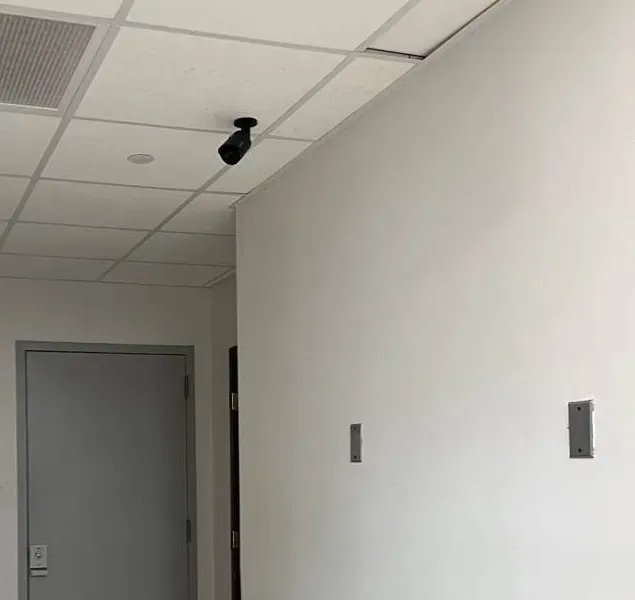
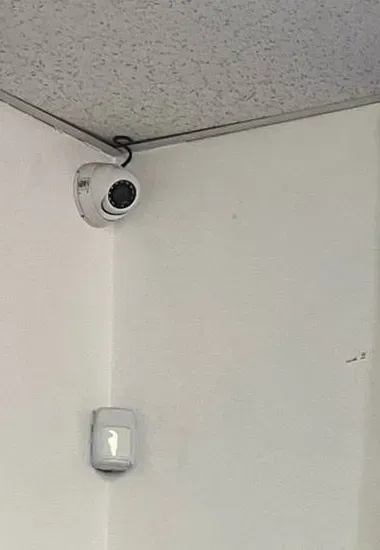
Abstract Enterprises Security Systems comparison drawn from the Building Code sections and the Dinonline answer cited on this page; it is not a ruling on any particular lock.Photo from our job library, not taken in South Williamsburg: a camera above a small wall sensor. Devices like these are fine in a stairwell or cellar, but on the route residents take on Shabbat we plan where each sensor goes, and whether it can be switched off before Shabbat, with the building rather than after the fact.
Schedules agreed by the building, set before candle-lighting
Some buildings prefer a timer: the inner door unlocks itself before Shabbat and relocks after it, with nobody touching anything. The Dinonline answer notes that a time switch needs the consent of the building’s neighbors, and that is a practical point as well as a religious one: a door left unlocked by schedule is unlocked for everyone. We set such schedules only on written instructions from the owner or board, put them on the inner door rather than the street door, make the times follow the published candle-lighting and havdalah times rather than a fixed hour, and give the board one place to see and change them. Many buildings decide against a timer once they have a reliable key path.
Abstract Enterprises Security Systems diagram for buildings near the edges of the neighborhood, where households of every kind share a lobby.
Yom Tov runs and long weekends
Two-day festivals that run into Shabbat can leave a door system untouched for three days. Battery-powered locks and readers must have enough charge to cover that, so we set low-battery alerts to arrive by Wednesday, not Friday, and put festival dates on the maintenance calendar. Wired systems need a battery backup big enough to carry the strikes and the controller through an outage at any point in that stretch, because nobody will be resetting a tripped breaker until the holiday ends.
Keys are now part of the security plan
Once a building relies on ordinary keys again for part of every week, those keys matter. A large family can easily hold a dozen copies, and tenants move on. We fit cylinders with a restricted keyway where the building wants them, so copies can be cut only on the owner’s authorization, and keep a simple record of how many keys went to each apartment. When a household leaves, rekeying one cylinder costs far less than wondering who still has a key.
Abstract Enterprises Security Systems checklist: the test takes about ten minutes for a walk-up and is repeated after any change to the doors or the system.
Building Specialists
Access Control for South Williamsburg’s Architecture
South Williamsburg’s buildings come from several very different eras, and each brings its own doors. Brick walk-ups from the tenement decades line the inland streets; Brooklyn Magazine and the guide Frieda Vizel describe older brownstones with modern front balconies added on, and a generation of newer mid-rises built for large families with zig-zagging balconies stacked so that every sukkah is open to the sky. Toward the river stand the public housing towers of Independence and Taylor–Wythe, and near Flushing Avenue whole blocks have been rebuilt on former factory land. The door that matters, and the way it should open on Shabbat, is different in each.
Older brick walk-ups
Four- and five-story buildings with a stoop or a few steps, an outer street door, a small vestibule and an inner door to the stairs. Usually a buzzer strike on the inner door and a plain lock on the outer. The cellar door at the back or under the stoop is often the weakest door in the building.
Brownstones with added balconies
Row houses converted to apartments, with front balconies added in recent decades. Wood doors in original frames, sometimes with glass. Strikes go into the wood jamb and cable comes up from the cellar rather than across the face.
Family-size mid-rises
Newer elevator buildings of six to twelve stories with stacked sukkah balconies, big apartments and busy lobbies. Steel or aluminum storefront entrances, an elevator, a cellar with storage and meters, sometimes a parking entrance.
Large new complexes
Multi-building projects on former industrial sites, such as the Pfizer Sites rezoning area between Walton and Gerry Streets. Several entrances, garages, courtyards and retail, designed from scratch with full riser systems.
Public housing towers
Independence Towers (six 21-story buildings) and the Taylor–Wythe Houses (five buildings of 8 to 13 stories) near the waterfront. Entry hardware is chosen by NYCHA or its PACT partners; we mention them because their doors shape the blocks around them.
Shops, schools and offices
Storefronts on Lee Avenue, Bedford Avenue and Broadway, many with apartments above, plus offices and classrooms in converted buildings. Glass shop doors at the front, steel doors at the back.
How the hardware changes from one South Williamsburg building to the next
Treat each row as a starting guess that the survey confirms or changes. Doors here have often been replaced more than once, and a building that looks original from the street may have a 1990s steel door with a magnetic lock behind the stoop.
Building
Typical street door
Lock we usually fit
Shabbat path
Older brick walk-up
Wood or steel outer door; inner vestibule door with a buzzer strike
Electric strike on the inner door; outer door self-latching on a key lock
Key in both doors; hold-back on the inner door only if the building chooses
Brownstone with added balconies
Wood door in an original frame, sometimes glazed
Concealed strike in the jamb, cable from the cellar
The lockset’s own key, unchanged
Family-size mid-rise
Aluminum storefront entrance with a closer; separate cellar and service doors
Electrified mortise lock or strike; never a magnetic lock on the main entrance
Key cylinder on the street side, tested with the power off
Large new complex
Several entrances, garage doors, courtyard gates
Electrified mortise locks with key override; readers on every entrance
One designated entrance per building with a documented key path
Shop with apartments above
Glass shop door; separate residential street door; steel back door
Keypad or reader on the staff door; residential door on its own system
Residential door keeps its key path; shop stays locked through Shabbat
School or office
Paired entrance doors; several fire exits
Strikes or electrified mortise locks with exit devices on egress doors
Per the institution’s own rules and schedule
Abstract Enterprises Security Systems schematic, not drawings of real addresses: the controlled door is usually the one at the foot of the stairs or the lobby, and the key path stays on it.
Methods that suit the local buildings
In the walk-ups, cable runs are short if the cellar is open: a single hole up through the floor at the vestibule, a run along the cellar ceiling to the meter wall, and the controller in a locked box beside it. Stairwell walls are often plaster on brick, so we use surface raceway painted to match rather than chasing the wall. In the mid-rises the work happens in the riser closets and the ceiling above the lobby, and the main question is whether the original electrician left a conduit to the entrance; if not, we route through the ceiling and down inside the door frame’s hollow mullion. On added balconies and new storefront entrances we check what the door frame is made of before choosing a strike, because a thin aluminum frame needs a different strike body than a steel one.
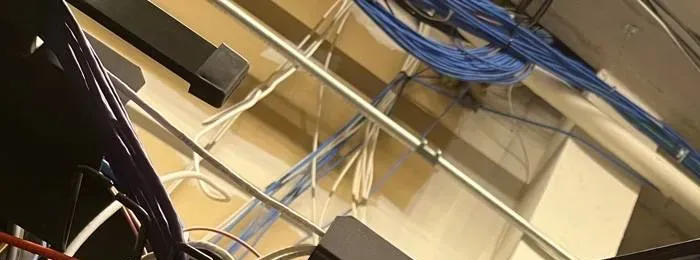
Photo from our job library, not taken in South Williamsburg: bundled cable above a rack in a utility room. In a new mid-rise the door controller usually shares a room like this with the building’s network and cameras, and every cable is labeled to the door it serves.
Commercial Access Control
Business Access Control in South Williamsburg
Commerce here follows the week. Shops on the main streets close ahead of Shabbat on Friday and reopen on Saturday night or Sunday, which means a store’s doors sit locked and unattended for a long, predictable stretch every week, and then face a rush. Most of the businesses we are asked about are small: a grocery’s stock room, a clothing store’s back door, a print shop, an office on an upper floor, a school building’s side entrance. The corridors below are where they are.
Lee Avenue
The main shopping street of the Hasidic blocks, described by CityNeighborhoods.NYC and Wikipedia as the center of the community, with kosher groceries, bakeries, clothing and housewares. Each fall the street is closed to traffic for the market selling lulavs and etrogs before Sukkot (Brooklyn Magazine).
Bedford Avenue
The other spine of the neighborhood, running south from Division Avenue past synagogues, yeshivas, shops and apartment buildings toward Flushing Avenue, and past Independence Towers near Wilson Street.
Broadway under the el
The northeast edge, under the J and M tracks between Marcy Avenue and Flushing Avenue stations. Ground-floor shops with apartments above, and on the corner of Bedford Avenue the landmark Kings County Savings Bank building, now the Williamsburg Art & Historical Center.
Division Avenue
The traditional dividing line between the Hasidic blocks and the Southside, with shops, offices and newer apartment buildings along it.
Flushing Avenue and the Broadway Triangle
The southern edge, along the Navy Yard and toward the former Pfizer plant between Union and Harrison Avenues, where the 2017 rezoning allows 1,146 homes, 62,810 square feet of commercial space and public open space (CityLand).
Kent and Wythe Avenues
The waterfront side: the Yetev Lev synagogue at Kent Avenue and Hooper Street, former industrial lofts, and the NYCHA towers between Wythe Place and Bedford Avenue.
A shop and the apartments over it never share one administrator account on our systems, even when one cable route serves both. The store owner manages staff codes; the landlord or board manages residents. Shops that also want cameras at their doors can use our commercial camera installation for Brooklyn businesses, wired back to the same small cabinet.
Rules that apply to South Williamsburg doors
These are the rules that come up most often on jobs in the neighborhood, boiled down for planning. None of this is legal advice, and none of it is religious guidance; how a rule applies to your door is for your architect, engineer or attorney to confirm, and how Shabbat applies is for your rav.
Free exit. NYC Building Code sections 1010.1.9.8 and 1010.1.9.9 govern doors with sensor release and with request-to-exit devices: anyone inside must be able to leave, and electrically locked egress doors must unlock on loss of power and, where a fire alarm is installed, when it activates. A key path for entry never changes the requirement that the inside lever always opens the door.
Apartment buildings. New York State Multiple Dwelling Law section 50-a requires older multiple dwellings to have a self-closing, self-locking entrance door and a way for residents to admit visitors. A Shabbat hold-back on the inner door must not leave the building without a working self-locking entrance; that is one reason we keep the street door latching.
Tenant data. In a multiple dwelling, entry data from fobs, phone apps or biometrics falls under Local Law 63 of 2021, the Tenant Data Privacy Act, which limits what may be collected and kept and requires a written policy for residents. Keys leave no record at all, which some residents prefer.
Fair housing. In 2015, two observant residents of a 20-building Rego Park complex sued the owner in federal court under the Fair Housing Act after electronic keys replaced metal ones, asking for one door in each building that a regular key would open and a Sabbath elevator (JTA). We cite it not as a ruling but as a reason to plan a key path at the start rather than after a dispute.
Public housing. Doors at Independence Towers and the Taylor–Wythe Houses are managed by NYCHA and its PACT partners, whose renovation renewed the doors at Independence (Wikipedia); Abstract Enterprises Security Systems does not alter those building doors at an individual resident’s request.
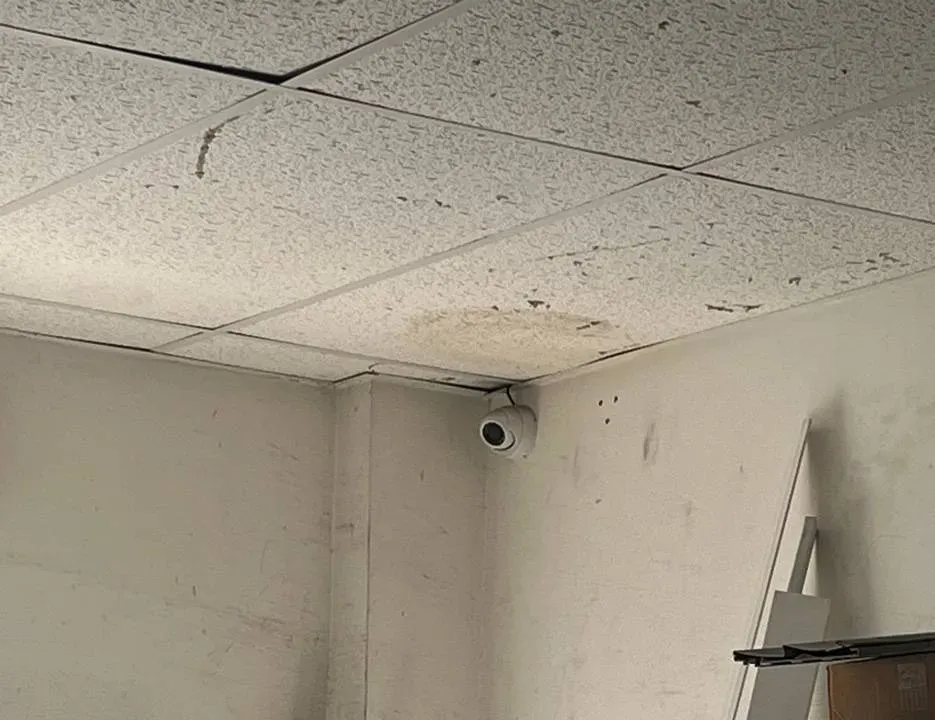
Photo from our job library, not taken in South Williamsburg: a camera in the corner of a working stock room. A shop that closes for Shabbat leaves rooms like this unattended for a day or more every week, so the back door’s lock and alerts matter as much as the storefront.
Your Questions Answered
Access Control in South Williamsburg: Questions Answered
These questions come from the situations on this page: lobbies that must work on Shabbat as well as on weekdays, buildings full of large families, new construction on former industrial land, and shops that close for a day each week. Each answer starts with the short version in bold.
Shabbat, Yom Tov and the street door
Our lobby door has a fob reader and no key cylinder at all. Can a key path be added without replacing the door?
Usually yes. Most fob-only doors can take a mortise or rim cylinder, or a new lockset with a key, while the reader and strike stay where they are.
How it is done depends on what is holding the door shut now. If it is an electric strike in the frame with a latching lock on the door, the lock body often already has a cylinder hole hidden under a blank plate, and the job is a cylinder, a cam and a test. If the door has a plain passage set with no key function, we change it for a lockset that has one, keeping the same backset so no new holes are needed. If the door is held by a magnetic lock, there is no latch for a key to work, so the magnet comes off and an electric strike or an electrified mortise lock goes in; that is a bigger job but uses the same door. Aluminum storefront doors with narrow stiles take a narrow-backset mortise lock made for them. In each case we test the key with the system powered down before we leave.
Our lobby has a push-button opener for wheelchairs and strollers. What do residents who won’t use it on Shabbat do instead?
Make sure the door can also be opened by hand without much force, and that a manual route through the vestibule does not depend on the opener at all.
Chabad.org’s guide advises finding a regular door when an entrance opens automatically, and in a building that may simply mean the same door used by hand. Power operators are usually installed in low-energy mode, which lets the door be pushed open manually, but the closer and operator together can make it heavy. We adjust the operator’s manual resistance and the closer so an adult pushing a stroller can open it, check that the operator does not start a powered cycle when the door is pushed by hand, and make sure the inner door has the same key path as the outer one. For residents who use wheelchairs, the weekday button stays; their Shabbat arrangements are for them and their families to decide, and we can add a second, lower-force door where the vestibule allows.
Guests come for Shabbat meals and nobody will buzz them in. How should a building plan for visitors on Shabbat?
Decide it in advance as a building: either hosts meet their guests at the door, or the inner door runs on a schedule the residents have agreed, with the street door still latching.
On a weekday a guest presses the apartment button and the host buzzes them in. On Shabbat that chain breaks, and the common fixes, a propped door or a latch taped back, leave the building open to everyone. The arrangement that keeps the building safest is the simplest: guests are told the time, and the host or a child comes down to open the door from inside, which needs nothing electronic because the inside lever always works. Buildings with many guests every week sometimes choose a scheduled unlock on the inner vestibule door for the Friday-evening hours instead. A mechanical push-button lock on the inner door, with a code given out before Shabbat, is a third option some buildings use. Which of these suits your building is a decision for the residents and their rabbis; we install whichever they choose and make sure the street door locks regardless.
Abstract Enterprises Security Systems summary of the arrangements buildings ask us to install; which one a building uses is decided by its residents and their rabbis.
Can one apartment’s indoor monitor be kept quiet for Shabbat while the neighbors’ monitors keep ringing?
Yes. Most video intercom systems let each apartment’s station be set to do-not-disturb on a schedule, apartment by apartment.
A family that does not want the screen lighting up and chiming on Shabbat can have its indoor station set to silent from Friday afternoon to Saturday night, with the schedule following that week’s candle-lighting time if the system supports it, or a fixed early time if it does not. Visitors pressing that apartment’s button then hear nothing back, so we usually add a short line on the directory saying calls are not answered on Shabbat. Neighbors who do answer on Shabbat, or who are not observant, keep their stations ringing as normal. On older audio intercoms with handsets the only option is a switch on the handset or a muted chime, which we can fit.
A burglar has been testing front doors, back doors, porches and ground-floor windows in the neighborhood. Which openings in our building should we check first?
Start with the doors that nobody watches on a quiet morning: the cellar door, the rear yard door and any ground-floor door off a porch or side passage, then the street door’s latch.
The September 2026 reports said the suspect looked for anything left unlocked, which is exactly what a quiet Shabbat morning at 5 a.m. tends to offer. Walk the building and push each outside door after it closes by itself. If any one of them fails to latch, the closer or strike needs adjusting before anything else is spent. Check that rear and cellar doors have self-closing hinges or closers, since these are often left on the latch by whoever took out the garbage. Ground-floor and cellar windows that open onto a yard or areaway need working locks or bars that still allow escape from inside. Door contacts that send an alert when a rear door stays open are useful during the week; whether they stay active on Shabbat is the building’s choice. Neighborhood volunteers urged residents to report suspicious activity at once, and said local rabbis had ruled that calling for help about a possible intruder is permitted on Shabbat.
Abstract Enterprises Security Systems schematic of a generic walk-up, not any real building: the doors at the back and below grade come first because nobody sees them on a quiet morning.
Large households and family-size buildings
Eleven people live in our apartment, including teenagers and a live-in helper. How many fobs or codes should one household have, and what happens when a child loses one?
Give each person who goes in and out alone their own credential, enrolled under the apartment, so a lost one can be cancelled without touching anyone else’s.
Buildings sometimes cap each apartment at two or three fobs, which in a large household means fobs get shared and nobody knows whose went missing. Most controllers have no practical limit per apartment, so we suggest the board set the number by need rather than by unit, perhaps with a small charge for extra fobs. Each fob is labeled in the software with the apartment and a first name or role, such as “helper” or “eldest.” When one is lost, the parent or the super cancels that one fob from a phone and issues a new one; the other ten keep working. Children too young to go out alone need nothing. A live-in helper’s fob can be set to stop on a date if their stay is fixed. Keys for the Shabbat path are counted the same way.
Our sukkah balcony door gets heavy use for eight days each fall. Should a balcony door be on the access system at all?
Usually not. A balcony door is inside the apartment’s own space, and what it needs is a solid lock and hinges that stand up to a week of constant use, not a reader.
Brooklyn Magazine and Frieda Vizel have both described how the newer buildings stagger their balconies so that every sukkah has open sky above it. During the holiday the balcony becomes the family’s dining room, and the door between kitchen and balcony is opened hundreds of times, with trays, chairs and children. Electronic locks add nothing there and wear out quickly. The useful work is on the hardware: a door that closes without slamming, a lock the family can secure at night, and on lower floors a check that a balcony cannot be reached from the street, a fence or a neighboring roof. Where a balcony can be reached from outside, a door contact that alerts the family during the week is a reasonable addition.
Abstract Enterprises Security Systems schematic of the staggered layout described in the sources, not any real building.
Our elevator runs a Shabbat setting that stops on every floor. Can a reader limit which floors visitors reach without breaking that setting?
Yes, if the elevator company wires the reader so that the Shabbat setting overrides it. On Shabbat the car stops everywhere and the reader is out of the circuit.
Floor restriction works by letting a credential enable only certain floor buttons. A Shabbat setting works by ignoring the buttons altogether and stopping at every floor in turn. The two only conflict if the restriction is wired after the Shabbat controller instead of before it. Elevator controllers are the elevator contractor’s responsibility, so the work is done jointly: we supply the reader, the controller output and the schedule; the elevator mechanic connects them into the car controls and confirms that switching to the Shabbat setting bypasses the reader. Many buildings in the neighborhood do not restrict floors at all, and do not need to; it is worth asking first whether the building’s visitors actually cause a problem upstairs.
Abstract Enterprises Security Systems schematic of the wiring order we agree with the elevator contractor; the details differ by controller make.
On Shabbat and Yom Tov mornings most of a big building leaves for shul within the same hour. Can a lobby door take that traffic and still latch every time?
It can if the closer, hinges and strike are rated for heavy use and adjusted for it. Residential-grade hardware on a busy lobby door is what usually fails.
A door that opens hundreds of times in a morning wears its closer, its hinge pins and the edge of its strike far faster than the same door in a quiet building. We fit commercial-grade closers sized for the door’s width and weight, hinges with bearings, and a strike whose keeper the latch can drop into cleanly even when the door bounces. The closer’s latching speed is set so the door finishes closing firmly rather than drifting to a stop just short of the latch. Hold-open arms or kick-down stops, which people use to prop a door during a rush, are best left off the street door altogether. A quick push test after the morning rush, by the super or a resident, catches a door that has started to stop short.
Abstract Enterprises Security Systems diagram: most doors that fail to latch after a busy morning need a closer adjustment or a new keeper, not a new lock.Abstract Enterprises Security Systems example, not a real household: the software has no trouble with many fobs per apartment, and a building rule can set any limit it wants.
New buildings, shops and shared spaces
We are putting up a new building on a former industrial lot near Flushing Avenue. Which door should be the key-operated Shabbat entrance, and how should it appear on the plans?
Normally the main residential entrance, shown on the door hardware schedule as an electrified lock with a mechanical key override and no switches on the key path.
Making the main entrance the Shabbat door means residents do not have to walk around the building, and it puts the key path where the closer, the light and the camera are already best. On the drawings, the hardware schedule should name the lock function precisely: a fail-secure electrified mortise lock or a strike with a key cylinder on the street side, a request-to-exit device in the inside lever only if the building agrees, and a door-position switch on a circuit that can be isolated. Secondary entrances, the garage and the cellar can be fob-only. The riser plan should run a conduit to every door that might take a reader later, because adding one once the finishes are in costs several times more. We are glad to review hardware schedules for architects and developers before the bid set goes out.
Our Lee Avenue store is closed from before Shabbat until after it ends. Can the doors lock themselves and stay locked to staff codes without anyone touching them?
Yes. The shop’s doors can follow a weekly schedule set once: locked to everyone from Friday closing, staff codes off, and back to normal hours on Saturday night or Sunday morning.
The schedule lives in the controller, so nobody needs to do anything on Friday afternoon except close and leave. During the closed period the storefront stays on its key and roll-down gate as before, while the staff door at the back refuses every code, including managers’, unless an owner overrides it for an emergency. Door contacts on both doors keep reporting, and the owner decides whether alerts reach a phone on Shabbat or are only reviewed afterwards. A shop that closes earlier in winter can have the schedule follow sunset, or simply be set for the earliest closing time of the season. Holidays are added to the calendar in advance.
Abstract Enterprises Security Systems example for a store that closes for Shabbat; the hours shown are illustrative, not any shop’s real schedule.
Can the lobby panel’s directory and on-screen prompts be shown in Yiddish?
Often, but it depends on the panel. Some accept custom directory text in Hebrew characters; fewer can change their built-in prompts. We test before we promise.
Wikipedia notes that Yiddish is the primary language of the Hasidic community here, and a directory residents can read easily is worth having. Directory names are stored as text, and many current touchscreen panels can display them in Hebrew script, including the right-to-left order; older panels with fixed character sets cannot. The panel’s own screens, such as “press to call,” come from the manufacturer’s language files, and Yiddish is rarely among them, though some panels allow custom text. A printed directory beside the panel, in whatever languages the building wants, is the dependable fallback. We load a sample before ordering so the board can see exactly how it will look.
A ground-floor prayer room or classroom in our building is used by people who don’t live here. How do we keep them out of the residential stairs?
Give the ground-floor space its own entrance from the street, or a lobby door of its own, and put the residential stair behind a separate locked door.
Mixed buildings work best when the line between public and private is a door, not a sign. If the room has a street door of its own, it runs on its own schedule and its users never enter the lobby. If they must come through the lobby, we put a locked door between the lobby and the stair hall, with a reader or key for residents, and leave the room’s door on the lobby side. On Shabbat, when the room is busiest, the stair door stays locked and residents use their key; the room’s users can still leave freely. The room’s organizers get their own administrator account and their own credentials, separate from the building’s, so their schedule never opens a residential door.
Abstract Enterprises Security Systems example for architects and developers, not a real project: deciding the keyed entrance on the drawings costs nothing; adding it after the walls close costs a door.Manufacturer product photo, used as a reference: an indoor answering screen of the kind fitted beside a kitchen doorway. Most stations like this can be scheduled to stay silent on Shabbat, apartment by apartment, without affecting the rest of the building.
Equipment
Types of Access Control We Install in South Williamsburg
Eight kinds of hardware cover almost every door we work on in the neighborhood; the written quote names the brand and model for each door, and the last column says where each earns its place here.
Equipment
What it does
Where it fits in South Williamsburg
Electric strikes
Sit in the door frame and release the latch on a valid credential; the lockset’s key still works on its own
The standard choice for walk-up and mid-rise street and vestibule doors, because the key path is untouched
Electrified mortise locks with key override
Lock and unlock the lever electrically, with a mechanical cylinder that withdraws the latch by hand
New buildings and heavy steel or aluminum entrances; specified without a request-to-exit switch on the lever where the building asks
Mechanical hold-backs and dogging
Hold a latch or exit-device bolt retracted until released, entirely by hand
Inner vestibule doors in buildings that choose to leave the inner door free on Shabbat while the street door latches
Fob and card readers
Read a credential and signal the controller
Weekday entry for every resident who uses them; enrolled per person so large households can cancel one lost fob
Video call panels and directories
Let visitors call apartments, phones or indoor screens and be admitted
Large buildings with many visitors; directories in Hebrew script where the panel supports it
Indoor answering stations
Ring inside the apartment and show the caller
Kitchens and hallways of family apartments, each with its own do-not-disturb schedule
Door-position switches and alerts
Report whether a door is closed and latched
Cellar, yard and service doors; placed or circuited so they can be kept off the Shabbat path
Controllers and battery backup
Hold the rules and schedules; carry the doors through an outage
A locked cabinet in the cellar or riser closet, with batteries sized for a three-day Yom Tov run
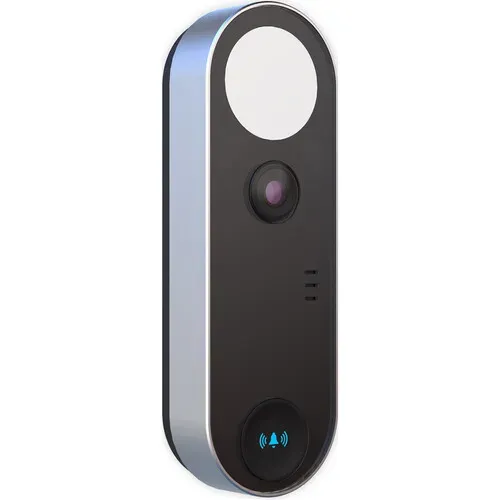
Abstract Enterprises Security Systems schematic: the key path needs no power at all; the battery only decides how long the weekday electronics keep working through an outage.Manufacturer product photo, used as a reference: a one-button video station suited to a brownstone or a small walk-up where each floor is one family. It rings a screen and phones on weekdays, and the door beside it still opens by key on Shabbat.
National alarm brands versus a local installer
ADT, Ring and SimpliSafe make capable products, and for a single family that wants a doorbell camera and alerts, one of them may be all that is needed; we will say so. What they are not built for is the building’s front door shared by thirty families, or a key path that must work with every electronic device switched off. A consumer smart lock that relocks itself automatically, chimes, lights up and reports every opening to a phone is the kind of device Chabad.org’s guide says should ideally be disabled before Shabbat. Our work is the part those products leave out: strikes and mortise locks that keep their keys, hold-backs on the right door, schedules the building agreed to, and a power-off test with the residents watching.
AI Overview Reality Check
What AI Gets Wrong About Access Control in South Williamsburg
They are the generalizations that turn up again and again in quick online answers, consumer guides and listings on Angi, HomeAdvisor and Fixr, set against what we see on doors in this neighborhood.
“Keyless entry is always more secure than keys.”
This treats every building as if everyone in it uses the credential every day. In South Williamsburg a fob-only lobby is fully keyless for six days and, for many residents, unusable on the seventh.
What usually happens next is not that residents stop going out on Shabbat; it is that somebody tapes the latch, props the door or disconnects the lock. The building ends up less secure than one with a good key lock, because the electronic door is now an open door.
Security comes from a door that latches every time it closes. A fob system on top of a working key path keeps that, and adds the convenience and records the weekday needs.
“A magnetic lock is the simplest way to secure a lobby door.”
It is often the cheapest to install, which is why so many lobbies have one. Online guides rarely mention that it has no key path and must release on loss of power and on a request-to-exit signal under NYC Building Code sections 1010.1.9.8 and 1010.1.9.9.
On a door residents need on Shabbat, the Dinonline answer calls such locks problematic, and the only manual way through them is to switch them off, unlocking the door for everyone.
An electric strike or electrified mortise lock costs a little more and keeps a real latch and a real key. On the doors that matter here, that difference is the whole point.
“Smart locks have a Sabbath mode, so any brand will do.”
Some appliances and elevators have recognized Sabbath modes; door locks vary widely, and a feature called “privacy” or “vacation” mode is not the same thing.
Chabad.org’s guide points out that many smart locks relock automatically and log every use to an app, and that ideally they should be disabled before Shabbat. Whether a particular lock’s settings satisfy a household is a question for its rav, not for a product listing.
We document exactly what each lock does when it is opened by key with its electronics switched off, so the family can ask that question with the facts in hand.
“Access control costs a fixed amount per door.”
Per-door figures from national sites assume a fresh door with an easy cable route, which a pre-war walk-up with a buzzer strike and a plaster stairwell rarely offers.
The biggest swing in this neighborhood is what is on the door now. Swapping a magnetic lock for a strike and adding a cylinder costs more than adding a reader to a door that already latches and takes a key.
Our prices come from the Brooklyn list on this page, and the written quote names each door and what is done to it.
“Two or three fobs per apartment is plenty.”
That default works for a couple or a small family.
It does not work for an apartment of ten or twelve people. When fobs are rationed they are shared, and when a shared fob is lost nobody is sure whose it was or whether it should be cancelled.
Enroll credentials per person under the apartment, cancel only the lost one, and let the board set a fair rule for extras. The software has no difficulty with a few hundred fobs in a building.
“A video doorbell lets you answer the door from anywhere.”
True on a weekday, and useful for parcels.
On Shabbat many residents will not answer a phone or screen at all, so a building that relies on remote answering for visitors has no plan for Friday night. The guests still arrive.
The building needs a Shabbat visitor arrangement that involves no answering: hosts meeting guests at the door, an agreed schedule on the inner door, or a mechanical lock the residents choose. Remote answering then covers the rest of the week.
“Burglars pick locks, so buy a better lock.”
The reports from the neighborhood in 2026 described someone moving from door to door and window to window looking for one that was simply unlocked.
Against that, the best-rated lock in the world is useless on a door that does not close by itself, or on a cellar door left on the latch.
The cheapest improvements are often a closer adjustment, a new strike keeper and a self-closing hinge on the yard door. We check all of those before recommending anything electronic.
Fob Lobby With No Key Path? Send Us Two Photos
A photo of the street door from outside and one of its edge and frame from inside are usually enough to tell what holds it shut and what a Shabbat key path would take. Expect a call back the same working day, before Friday afternoon if you send them early in the week.
A walk-up on Rodney Street that needs a key on its fob door, a new building near Flushing Avenue at the drawings stage, a store on Lee Avenue that closes for Shabbat: describe it in a few lines and we will reply with a plan and a Brooklyn price.
✅
We Got Your Request!
Received. A technician will phone you today about the building. Street door that will not lock at all? Skip the wait and call (347) 934-8335.
How It Works
Our Installation Process
The seven steps are the same for a single walk-up door and for a new building with a dozen entrances. What is particular to South Williamsburg is step five, the power-off test, and the timing: we plan every visit so that no door is left half-finished when Shabbat begins.
1. Photos and how the doors are used
You send photos of the street door from both sides, the number of outside doors, and which of them residents use on Shabbat and how they open them now.
2. Survey of every door
A technician checks each outside door’s latch, closer, hinges and frame, what is holding it shut, the cellar cable routes, and any sensors or lights on the residents’ route.
3. Written plan and Brooklyn price
A door-by-door plan naming the lock, the key path and the credential on each door, with a fixed price from the Brooklyn list, usually the same day.
4. Doors repaired first
Closers, hinges, strike keepers and frames are put right so every door closes and latches by itself before anything electronic is fitted.
5. Install and power-off test
Hardware and cable go in, scheduled to finish before Friday afternoon; then the system is switched off and every key path is opened by hand in front of the owner or board.
6. Credentials, schedules and keys
Fobs enrolled per person under each apartment, any schedules the building agreed entered with the right times, and keys counted out and recorded.
7. Handover and follow-up
A one-page description of each door for the residents, administrator training for the board or super, and a check-back visit after the first few weeks of use.
Before every Shabbat: a two-minute check
On Friday morning, whoever looks after the building should push the street door shut from outside and confirm it latches, look at the inner door to see that the hold-back, if the building uses one, is set as agreed, and check that the system shows no low-battery or offline warnings. Before a two- or three-day Yom Tov, do the same on Wednesday so there is time to fix anything. Most failures we are called to on Friday afternoon would have shown up in that check on Wednesday.
Coverage Area
Access Control Near South Williamsburg’s Landmarks
Callers give directions by these places, so we list them: “around the corner from the big shul on Rodney,” “by the Hewes Street station,” “across from the towers on Wythe.” None of them is a customer of ours; the descriptions come from the sources at the end of this page.
Congregation Yetev Lev D’Satmar, Rodney Street
The main synagogue of the followers of Rabbi Zalman Leib Teitelbaum and one of the largest Hasidic synagogues in the United States, built to replace the earlier main synagogue on Bedford Avenue (Wikipedia).
Yetev Lev at Kent Avenue and Hooper Street
Built in 2006 by followers of Rabbi Aaron Teitelbaum in about two weeks of round-the-clock work, which earned it the nickname “the miracle synagogue” (Wikipedia).
Lee Avenue
The neighborhood’s main shopping street, closed to traffic each fall for the market in lulavs and etrogs before Sukkot (Brooklyn Magazine).
The Broadway el stations
Marcy Avenue, Hewes Street, Lorimer Street and Flushing Avenue on the J and M, all opened on June 25, 1888, as part of the Union Elevated Railroad (Wikipedia).
Independence Towers and Taylor–Wythe Houses
Six 21-story NYCHA towers between Clymer and Wilson Streets, completed in 1965, and five buildings of 8 to 13 stories with 525 apartments, completed June 30, 1974 (Wikipedia).
Kings County Savings Bank, Broadway at Bedford Avenue
A French Second Empire bank building designed by William H. Wilcox, now the Williamsburg Art & Historical Center (WAH Center; NYBG Plant Talk).
We also serve the neighborhoods around it: Williamsburg north of Division Avenue, East Williamsburg across Broadway, Bedford-Stuyvesant south of Flushing Avenue, where, as the Center for Jewish History’s blog notes, the community has been expanding, Clinton Hill past the Navy Yard, and Greenpoint further up the waterfront. For a building in Borough Park, the same Shabbat questions apply.
Pricing
Access Control Cost in South Williamsburg
South Williamsburg pays the Brooklyn base list, the same as the rest of the borough: no surcharge for older buildings, for the key-path work or for Friday deadlines. At the bottom of its range, one controlled door comes with the reader, the strike, the cable and ten fobs; where an existing door already latches and takes a key, the cost of adding a reader sits near that bottom. Replacing a magnetic lock with a strike and cylinder, or rebuilding a worn frame first, moves it up the range.
Item
Brooklyn price
Typical South Williamsburg use
Single door: reader or keypad, electric strike, wiring, 10 fobs
$1,500 – $2,500
A walk-up’s street or vestibule door, keeping its key path
Keypad on a personnel or service door
$1,500 – $2,000
A shop’s back door or a building’s cellar door
Card readers on several office or classroom doors in a shared building
$4,000 – $12,000
Offices, schools and community rooms in converted buildings
Multi-door building system with cloud management
$4,000 – $15,000
A family-size mid-rise: entrance, vestibule, cellar, parking and schedules
Full building: lobby, service entrance, elevator restriction, parking
$15,000 – $40,000+
Large new buildings near Flushing Avenue and on former industrial lots
Video intercom panel with fob access, replacing a buzzer
$1,500 – $3,000
A walk-up’s old buzzer panel, with indoor stations that can be silenced for Shabbat
Service visit outside warranty
$195/hr, 3-hr minimum ($585)
Schedule changes, adjustments, other installers’ systems
Repair service call
$250
Diagnosis and repair; credited toward a larger job
Cat6 cable drop for a reader, controller or door station
from $175 per drop (Cat6A from $250)
The run from the cellar or riser closet up to a lobby door
What pushes a South Williamsburg price up or down
What holds the door now. A latching lock with a key is the cheapest starting point; a magnetic lock that has to come off is the most expensive.
The door and its frame. Thin aluminum storefront frames and worn wood jambs need more work to take a strike than a sound steel frame.
The cellar. An open cellar under the lobby keeps cable runs short; a finished ground floor or a slab adds labor.
The elevator. Floor restriction needs the elevator contractor as well as us, and their time is billed separately by them.
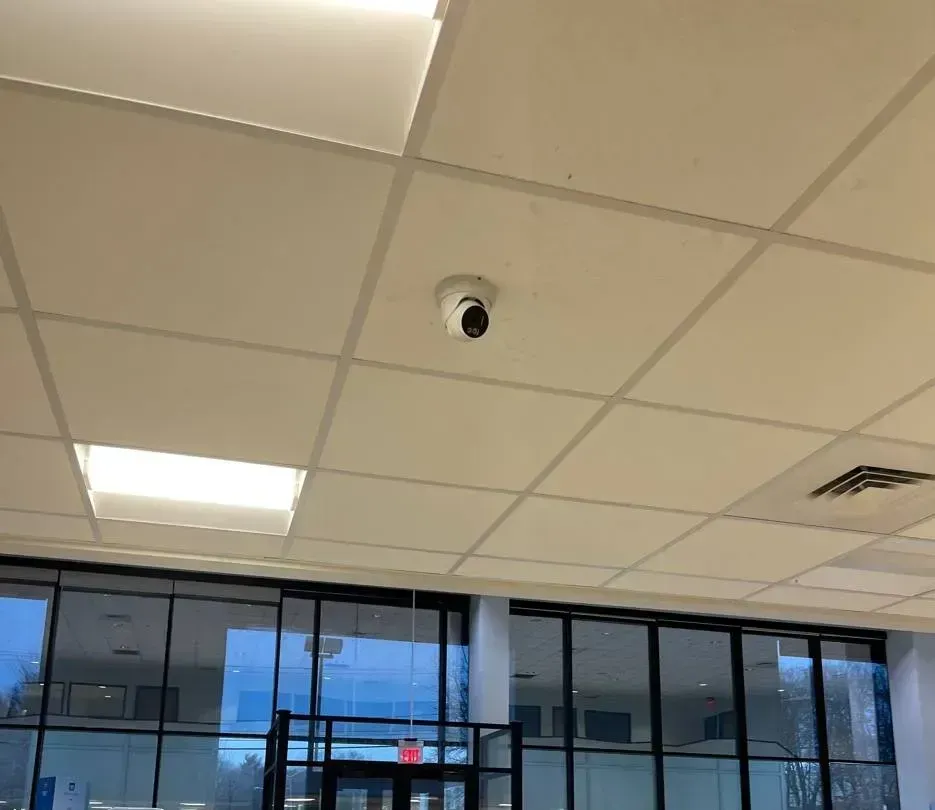
Photo from our job library, not taken in South Williamsburg: a ceiling camera watching a glass entrance from inside. Glass storefront entrances like this one are common on newer buildings; their narrow aluminum stiles decide which electric lock will fit.
Get a Written Brooklyn Price for Your South Williamsburg Building
Tell us how many outside doors the building has, what is on the street door now and which doors are used on Shabbat, and the price comes back in writing, usually before close of business.
One door with a reader or keypad, an electric strike, cable from the cellar and ten fobs, fitted so the door’s own key opens it with the system switched off. The closer and latch are set right first.
Video Panel Replacing a Buzzer — $1,500 to $3,000
A call panel with a built-in reader at the street door, ringing apartments, phones or indoor screens, each of which can be scheduled silent for Shabbat. The key path stays on the door.
Whole Building — $4,000 to $15,000
Street, vestibule, cellar and service doors on one cloud-managed system, credentials enrolled per person, any Shabbat schedules the building agrees, and a documented key path on the main entrance. Large new buildings with elevators and garages are priced on the full-building line.
Supplying your own hardware? Labor-only installation
If you already own a lock, reader or panel, or your architect has specified a particular product, we can fit it at our labor rate alone. Before agreeing we check three things: that the lock has a true mechanical key override and, if you want it, no switch on that path; that the reader and controller can be managed by someone in the building after we leave; and that the hardware suits the door’s frame. If any of the three fails we tell you before we start, not after.
Complete Services
Every Access Control Service in South Williamsburg
The common combination in the neighborhood is a reader and video panel at the street door with its key path kept, a door contact on the cellar door and a camera on the yard. Booked together, the cable for all of it goes in during the same visit, and the power-off test covers every door at once.
Field Notes
Field Notes: Test Every Door With the Power Off
This describes how we survey lobbies in general, not any particular building or customer. When a board tells us its door “has a key for Shabbat,” we switch the system off and try it, because what a door is supposed to do and what it actually does are often different. The cylinder may turn but not reach the latch, because whoever fitted the strike also swapped the lockset for a passage set. The key may open the outer door while the inner door is held by a magnet with no key at all. The key may work perfectly, while a sensor above the door switches on the lobby light every time it opens.
So the survey ends at the breaker. With the board or super watching, we switch off the access controller and the lock power, walk in from the street with a key exactly as a resident would on Shabbat, and note every door that does not open, every light or chime that responds, and every latch that fails to catch on the way out. Then we switch everything back on and repeat it with a fob.
Abstract Enterprises Security Systems example of the two lists that end our surveys; it describes no particular building.Manufacturer product photo, used as a reference: a compact video intercom with a built-in card reader. Before recommending any unit like this for a South Williamsburg door, we check what it does, and what it lights up, when the door beside it is opened by key.
FAQ
South Williamsburg Access Control FAQ
Do you decide whether a lock or door setting is permitted on Shabbat?
+
No. That is a question for each family’s rav and, for shared doors, for the building’s residents and their rabbis. What we provide is the technical description they need to ask it well: exactly what each door does when it is opened by key with the system off, which devices are on that route, what lights or switches respond, and what any schedule changes and when. We write that down door by door at handover, and we are glad to walk a rabbi or a board member through the doors in person and switch things on and off while they watch. If the answer comes back that something must change, we change it.
Before we pay, can you show us that each door opens mechanically with the power switched off?
+
Yes, and we would rather you insisted on it. The final payment visit includes a power-off test: we switch off the access controller and lock power supplies at their breakers, then open each door that is meant to have a mechanical path, from outside with a key and from inside by the lever, while you watch. Anything that does not open, or that lights, beeps or logs when it should not, is fixed before the job is signed off. The Dinonline answer on electric doors suggests the same check for any building, and it takes about ten minutes for a typical walk-up.
Can the installation be finished before Friday afternoon so the building is never left with a half-wired door over Shabbat?
+
Yes. We schedule South Williamsburg jobs to finish early in the week wherever possible, and never start removing a lock on a Friday unless the work is certain to be done and tested hours before candle-lighting. In winter, when Shabbat begins in mid-afternoon, that means Thursday is effectively the last working day. If a job runs over, the door is returned to working on its key and latch before we leave, with the electronics finished the following week. We also avoid scheduling work on Yom Tov and, where the building prefers, on Chol Hamoed.
Several adults in our household carry basic phones with no apps. Which credentials work for them?
+
Fobs, cards and keypad codes all work without any phone at all, and for most residents a fob on the key ring is the simplest choice. Phone-based credentials are an option for those who want them, not a requirement; we never set up a system that forces residents to install an app. Video panels can call a basic phone as an ordinary phone call, so a resident without a smartphone can still answer a visitor and press a digit to open the door. Administrators, such as the super or a board member, do need a phone or computer with the management app.
Some households in our building keep Shabbat and some don’t. Can one lobby serve both without inconveniencing either?
+
Yes, and that is the normal case near the edges of the neighborhood. The street door keeps its fob reader, which works every day for everyone who uses it, and its key path, which works every day for everyone who carries a key. Nothing about the Shabbat path stops a fob holder from coming in on Saturday. The only shared decision is whether the building runs any schedule on the inner door or keeps sensors off the Shabbat route, and those choices are made by the board or owner with all residents in mind. Indoor stations are set apartment by apartment.
How do we stop someone leaving the Shabbat hold-back on the inner door switched on all week?
+
Choose a hold-back that is set by a key rather than a thumb-turn or button, and give the key only to the people responsible for setting it before Shabbat and releasing it afterwards. Exit devices on aluminum or steel doors can be fitted with cylinder dogging for exactly this reason. A door-position switch on the inner door can also tell the super if the door has been left unlatched on a Monday morning. Finally, put the Friday and Saturday-night routine in writing and post it where the responsible residents will see it.
A resident went out on Shabbat without a key and the door has locked behind them. What can they do?
+
The same thing as in any building: wait for a neighbor to come in or out, or ask someone inside to open the door from within, which needs nothing electronic because the inside lever always opens it. What a building should not do is prevent this by leaving the street door unlatched. Some families arrange before Shabbat to leave a spare key with a neighbor in the building. Whether a resident may carry or retrieve a key on Shabbat is a question for their rav, and buildings differ on it.
Doesn’t adding a key cylinder make the door easier to break into than a fob-only door?
+
Not in any way that matters on a residential lobby door. A good cylinder with a restricted keyway resists picking and unauthorized copies, and a protective ring or guard plate stops it being pried or twisted out. Most break-ins at lobby doors happen because the door did not latch, was propped, or had its strike or frame forced, and a fob-only door is just as exposed to all three. A key path that keeps residents from taping the latch on Friday makes the building more secure, not less. We fit the cylinder, the guard and the strike together so the weakest part is still strong.
What does it cost to add a key-operated Shabbat path to a lobby that already has a fob reader?
+
If the door already has a latching lock with a hidden cylinder hole and an electric strike, adding a cylinder and testing it is a short visit billed at our service rate, $195 an hour with a three-hour minimum ($585), plus the cylinder itself; that time usually also covers adjusting the closer and strike. Replacing a passage set with a keyed lockset adds the lockset. Removing a magnetic lock and fitting an electric strike or electrified mortise lock with a key is priced on the single-door line of the Brooklyn list, $1,500 to $2,500. The written quote names which of these your door needs.
All Areas Served
Access Control Installation Across Brooklyn, New York City, Long Island and the Hudson Valley
This page sits under our Brooklyn access control installation hub, which covers the borough as a whole. Each rebuilt neighborhood page below was written from separate research into its own streets, buildings and doors, so they read differently by design: the Shabbat key path that runs through this page is particular to South Williamsburg and the neighborhoods like it.
The history, dates, figures, rules and news on this page were checked against the sources below in October 2026. What is not sourced is our own: the prices, which come from the Abstract Enterprises Security Systems Brooklyn list, and every description of how we fit doors, which is Abstract Enterprises Security Systems practice rather than local fact. Nothing here is religious guidance; where we quote a rabbinic source, it is to explain what residents may ask of a door, not to rule on it.
Wikipedia, “South Williamsburg, Brooklyn” — boundaries, 2020 population estimate, ZIP codes, precinct, fire companies, the 1835 “South Side,” Domino 1856, Pfizer 1849–2007, Satmar arrival 1947 and Yetev Lev 1948, UJO 1966, UJA 2023 household study, 2005 rezoning, BQE, Lee and Bedford Avenues, Yiddish, the two Yetev Lev synagogues.
Dinonline, “Electric doors on Shabbos” (June 15, 2026) — intercom doors with keys and mechanical bypass latches; power-off verification; magnetic locks; time switches and neighbors’ consent; manual releases and microswitches.
Reddit, r/Brooklyn and r/Judaism threads on staggered balconies and on key fobs on Shabbat — search excerpts only, used for background, not quoted.
Where sources disagree, we say so. The neighborhood’s northern line is Division Avenue to Wikipedia, Division Street to CityNeighborhoods.NYC and, in some accounts, Broadway; its western edge is the East River, Kent Avenue or the Navy Yard depending on the source. Wikipedia’s infobox counts the Latino Southside within South Williamsburg, while its own text and the Times treat the Hasidic blocks south of Division Avenue as the core. The UJA household figures cover Williamsburg as a whole, not South Williamsburg alone.
Not everything could be checked. Reddit threads were read only as search excerpts. Hyperlocal sources such as Williamsburg 365 were seen only through JFeed’s report.
Lock Won’t Release or a Reader Gone Dark? Call the South Williamsburg Line
A strike that will not release or a reader that stopped answering rarely takes a whole day. Ring (347) 934-8335, say whether it is the street door, the vestibule door or a back door, and ask for the earliest two-hour arrival slot. Most single failed parts are replaced in one visit, and on a Thursday or Friday we put the door back on its key and latch before anything else, so the building is secure for Shabbat whatever happens to the electronics.
South Williamsburg Door Systems From a Licensed, Insured Brooklyn Team
The South Williamsburg line is (347) 934-8335 for calls and texts, and photos of doors are easiest to send by WhatsApp. Technicians leave from our Brooklyn office on Troy Avenue, and quotes are written, door by door, before any work starts.
Customers have rated us 4.6★ across 390+ Google reviews. Work is done under New York State low-voltage license #12000287431, and if an owner, a managing agent or a board needs a certificate of insurance naming the building, we send it before the first visit.
Full terms — including 50% deposit, the 30-day warranty and optional paid extended warranty, and the late-fee schedule — are set out in the service agreement. See our warranty page for what it covers.
Revision log, October 18, 2026: this page was rebuilt from scratch around how entry systems work in South Williamsburg, centered on lobbies that keep a mechanical key path for Shabbat and Yom Tov, replacing an earlier template page.