Grand Concourse Elevator Buildings · Side-Street Walk-Ups · Bainbridge Avenue Houses · Bedford Park Boulevard Shops · Webster and Jerome Storefronts
Access Control Installation in Bedford Park, Bronx
Fob and Card Entry for Rental Buildings · Intercom Kept Working · Tenant Data Rules Followed · No Monthly Fees
Bedford Park is a neighborhood of renters living behind other people’s front doors. Between Mosholu Parkway and East 196th Street, from Jerome Avenue across to Webster Avenue, most households reach home through the street door of a five- or six-story apartment house, or through the lobby of one of the taller buildings on the Grand Concourse. Many of those doors still run on a brass key that has been copied for decades and a buzzer panel wired when the building was young. We replace that arrangement with fob, card and code entry that a landlord can actually manage, while keeping the apartment intercom that New York law expects in larger buildings, and while following the city’s rules on what a keyless system may record about the people who live there.
Reviewed and updated October 18, 2026: Multiple Dwelling Law §50-a, NYC Housing Maintenance Code §27-2043, the Tenant Data Privacy Law (Local Law 63 of 2021) as summarized by HPD, the NY Attorney General’s 2020 key-fob assurance, NYU Furman Center’s 2026 Kingsbridge Heights/Bedford profile, Bronx Community Board 7, and News 12 and Norwood News reporting from Bedford Park in 2025 · Anwar Timothy, NYS license #12000287431 · Bedford Park visits dispatched from our office on East Fordham Road
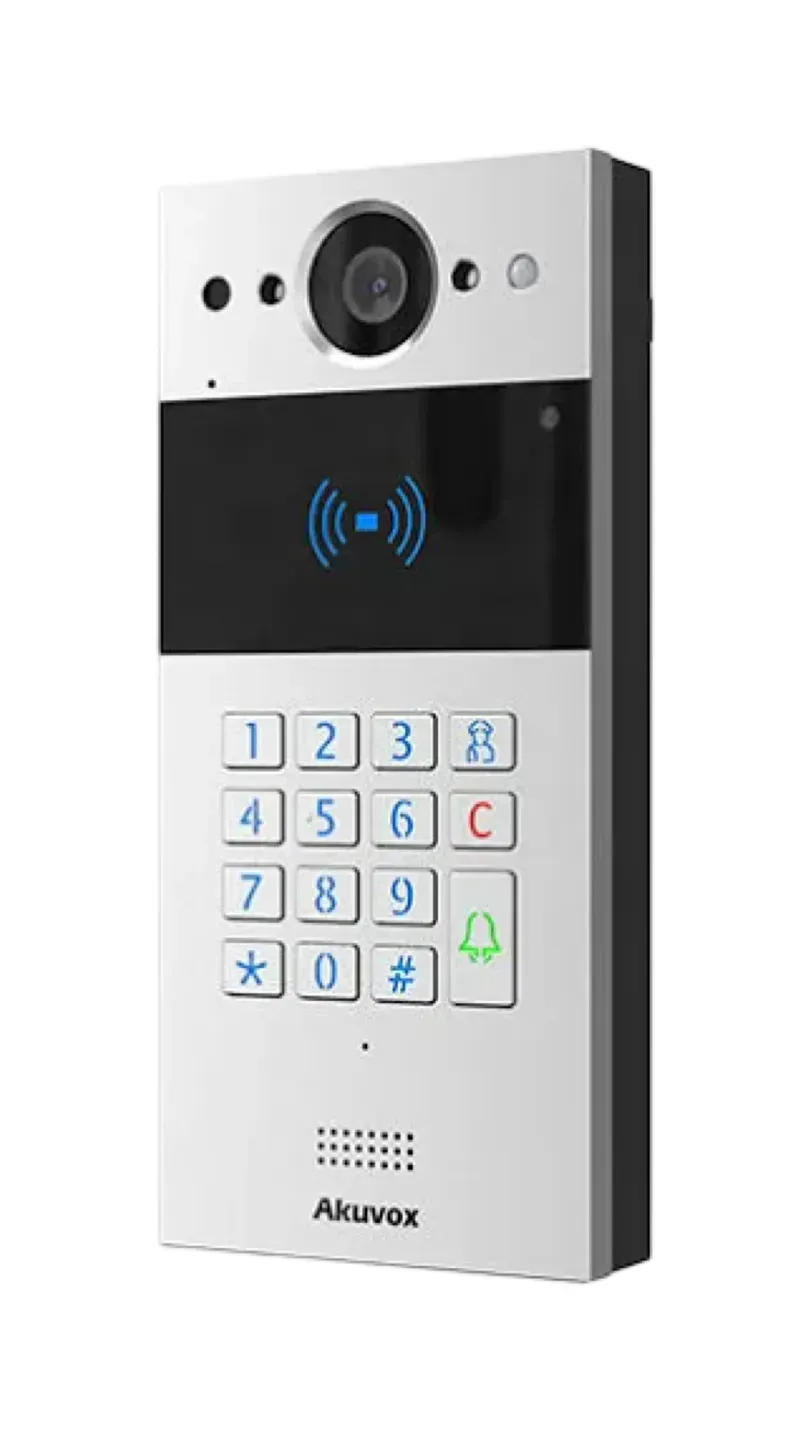
Manufacturer reference photo: an aluminum entry station combining a small camera, a contactless card reader marked with a wave symbol and a numeric keypad. A unit like this lets residents use a fob or code while visitors dial an apartment, which is the combination most Bedford Park apartment entrances need. The keypad also gives the super a code for contractors that can be deleted the day the job ends.
Bedford Park Entry System Request
Building, number of apartments and doors — we call back the same business day
✅
Request Sent!
A technician will call you back about the Bedford Park building the same business day.
25+
Years Experience
✓
Same-Day Estimates
100%
Licensed & Insured
4.7★
201 Google Reviews
Begin with three photos and a count. Stand on the sidewalk and photograph the street door with its frame and whatever panel is beside it; open the panel or the cellar closet where the buzzer wires end and photograph that; then photograph the inside face of the door so we can see the closer, the hinges and the lock. Add the number of apartments and the number of doors you want controlled — street door, inner vestibule door, cellar, laundry, roof, rear yard — and send it to (646) 490-0629. That is usually enough for us to say whether the existing wire can carry a new system, whether the door itself will hold an electric lock, and what the work will cost before anyone takes a day off to meet us.
Photo review is free, and a written estimate follows the same business day
The apartment intercom keeps working after the upgrade, so every unit can still talk to a visitor and release the door
New York State licensed under the security and fire alarm installer law (General Business Law §69-m), license #12000287431, and insured for work in occupied apartment buildings
The Neighborhood
Why Bedford Park Properties Need Access Control
Bedford Park is small on a map and dense on the ground. Wikipedia’s entry, drawing on City Planning and census figures, puts the neighborhood at a little less than half a square mile, bounded by Mosholu Parkway to the north, Webster Avenue to the east, East 196th Street to the south and Jerome Avenue to the west, with the New York Botanical Garden just across Webster. Inside that box the building stock is described plainly: five- and six-story apartment buildings, three-story Victorian houses, and taller apartment buildings along the Grand Concourse, plus the two 41-story Tracey Towers beside the Jerome Park Reservoir. That mix is the reason entry control here is mostly a rental-building problem rather than a homeowner one.
The numbers say the same thing. The NYU Furman Center’s 2026 profile of the Kingsbridge Heights/Bedford community district, which takes in Bedford Park, records a homeownership rate of 4.0 percent in 2024 against 32.7 percent citywide, and a rental vacancy rate of 1.1 percent. Almost everyone is a tenant, and apartments rarely sit empty, which means people move in and out of the same buildings constantly and every move is a moment when a key either comes back or does not. A brass key to a street door can be copied at any hardware counter, and once copies are loose there is no record of how many exist or who holds them.
The cost of an open door here is not hypothetical. In August 2025 News 12 reported that tenants at 2850 Grand Concourse had petitioned their management after people began using the building’s stairs to take drugs; the station described the entryway as “accessible through an unlocked door,” and the petition asked management to secure entry points against unauthorized access. A daycare that operates inside the building told the station parents were afraid to bring children in. The 52nd Precinct responded with patrols and by monitoring the building’s cameras. A month later, Norwood News carried an NYPD appeal about a 4 a.m. burglary near Perry Avenue and Mosholu Parkway South, where police said a man got into a residential building through the front door as a tenant was leaving.
Neither story is about exotic technology. Both are about a street door that either was not locking or could be held long enough for someone to follow a resident inside. That is the core of an access control job in Bedford Park: a door that closes and latches every time, a lock that releases only for a valid fob, card, code or an apartment pressing the intercom button, and a record the landlord can check when something goes wrong. Cameras help afterwards; a working door prevents the problem in the first place. Owners who also want the lobby recorded usually pair the door work with security cameras for Bedford Park buildings, wired on the same visit.
There is a legal frame around all of this that many owners only discover when a tenant files a complaint. New York’s Multiple Dwelling Law §50-a requires self-closing, self-locking street doors and an apartment-to-door intercom in larger apartment buildings, and it gives tenants in older buildings a way to demand them in writing. Since 2021, New York City’s Tenant Data Privacy Law has governed what a fob or app-based system may collect and how long it may keep it. And for rent-stabilized buildings, state housing regulators and the Attorney General have said what landlords may and may not ask of tenants when fobs replace keys. We build every Bedford Park system inside those rules, and we explain them in plain terms further down this page.
Bedford Park at a glance, from the sources we read
Area and boundaries: about 0.455 square miles, from Mosholu Parkway south to East 196th Street and from Jerome Avenue east to Webster Avenue (Wikipedia, citing City Planning).
Tenure: a 4.0 percent homeownership rate in Kingsbridge Heights/Bedford in 2024, against 32.7 percent across the city (NYU Furman Center, 2026 profile).
Tight rental market: a 1.1 percent rental vacancy rate in 2024 for the same district (NYU Furman Center).
Building conditions: 283.6 serious housing code violations per 1,000 privately owned rental units in 2025, against 152.1 in 2006 (NYU Furman Center).
Housing stock: 47,528 housing units across the district in 2024, including 10 Mitchell-Lama properties with 1,713 units (NYU Furman Center).
Civic map:Bronx Community Board 7, at 229-A East 204th Street, covers Bedford Park with Fordham, Jerome Park, Kingsbridge Heights, Mosholu Parkway, Norwood and University Heights; policing is by the 52nd Precinct at 3016 Webster Avenue.
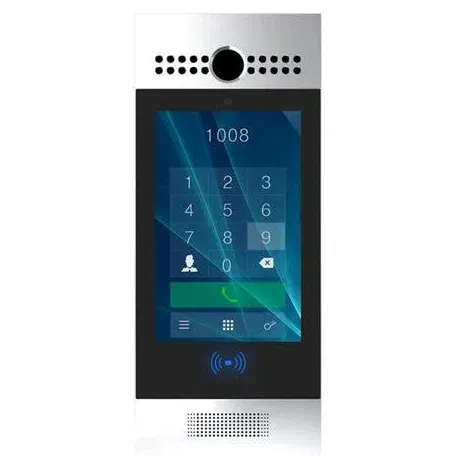
Manufacturer reference photo: a touchscreen entry panel with a speaker strip and camera above a blue dial-pad screen and a contactless reader below. On a larger elevator building, a searchable on-screen directory replaces a long column of buzzer buttons. Residents are found by name or apartment number, and the list is updated from the management software rather than by relabeling buttons.
Repairs
Need an Entry System Repaired in Bedford Park Today?
When the street door stops locking, the building is open until someone fixes it, so repair calls go to the front of the line. Ring (646) 490-0629 and describe what the door is doing: swinging free, refusing every fob, releasing on its own, or buzzing without opening. The usual culprits are a failed power supply in the cellar, a lock whose strike plate has shifted as the door sagged on its hinges, a closer that no longer pulls the door shut against the wind off the parkway, or a reader whose cable was cut during unrelated work. Most single faults are sorted within an hour or two of the technician arriving, and we will fix systems installed by others as readily as our own.
If you are a tenant rather than the owner, the fastest route is still the landlord or managing agent, because we can only work on a building with the owner’s authorization. What tenants can do is document the problem — dates, photos of the door standing open — and report it to the city through 311, a step we describe in the questions section below.
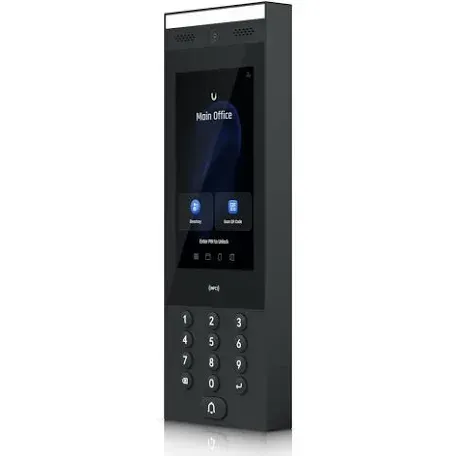
Manufacturer reference photo: a slim black panel with a touchscreen showing a Main Office call screen above a raised numeric keypad. A layout like this suits a clinic or community office on a Bedford Park ground floor where visitors call one destination and staff enter a code. The office's own schedule can then run separately from the residential lobby beside it.
What We Install
Access Control Services in Bedford Park
Every job starts with the door that matters most, which in Bedford Park is almost always the street entrance of an apartment house. From there the work extends to whichever other doors the building actually needs controlled.
🔑
Street-door fob and card entry
A reader at the entrance, an electric lock in the frame, a power supply with battery backup and a controller that holds the list of valid credentials. Lost fobs are cancelled in minutes rather than solved with a new cylinder and a round of keys.
📞
Intercom-integrated entry panels
Combined panels that carry the tenant directory, a call button or touchscreen, a camera and a credential reader in one housing, so the intercom required in larger buildings and the fob reader share a single opening in the masonry.
🚪
Vestibule and inner-door control
Many prewar entrances have two doors. We decide which one locks, which one simply closes, and how the pair is sequenced so a visitor waiting for the buzzer is not stuck between them in the cold.
🧺
Cellar, laundry and roof doors
Secondary doors on schedules: the laundry room readable by tenants during set hours, the cellar limited to the super and contractors, the roof door kept as the code requires while still alarming if propped.
🏪
Storefront and back-of-house keypads
Code or card entry on shop back doors and staff rooms along Bedford Park Boulevard, Webster Avenue and Jerome Avenue, with separate codes per employee so a departing worker is removed without changing locks.
📋
Credential and records setup
Enrollment of every apartment, a written data-retention and privacy policy for the owner to hand tenants, and audit settings tuned to the city’s 90-day limit on keeping authentication data.
🔧
Takeovers and repairs
Diagnosis and repair of fob systems, keypads and entry panels installed by other companies, including recovering administrator access when the previous installer or super left without handing over the password.
📲
Phone-based visitor entry
Panels that ring a tenant’s phone instead of a hallway handset, useful where the apartment wiring has failed. Tenants who prefer the original handset keep it; nobody is forced onto an app.
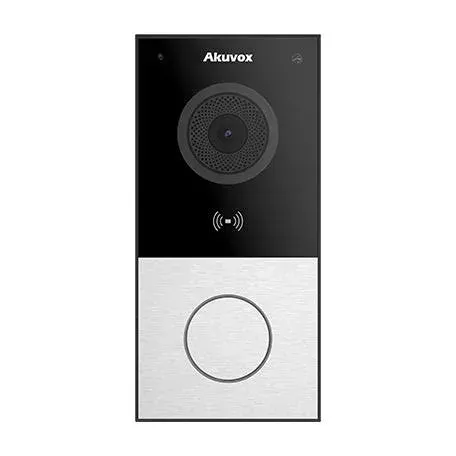
Manufacturer reference photo: a compact door station with a camera, a contactless card area marked by a wave symbol and a single round call button. Single-button stations fit the front door of a two- or three-unit house where a full directory would be overkill. The card area accepts a fob for household members while guests press the button.
Building Specialists
Access Control for Bedford Park’s Architecture
The same fob reader goes on very different doors here. What changes from one building to the next is the door, the wall around it, the distance to the cellar, and who has to sign off.
Concourse elevator buildings
The Grand Concourse filled with apartment houses after the roadway was completed in 1914 and the Jerome Avenue subway arrived in 1917. These are the neighborhood’s tallest prewar buildings, with deep lobbies, inner and outer doors, mail areas and an elevator, so the system usually covers a street door, a lobby door and one or two service entrances.
Five- and six-story side-street walk-ups
The most common building in Bedford Park, on blocks along Bainbridge, Decatur, Briggs and Perry Avenues. One street door, a narrow vestibule, a cellar entrance under the stoop or at the side, and a buzzer riser running up a stairwell. One reader and one well-hung door do most of the work.
Three-story Victorian houses
Survivors of the planned “villa” community laid out around Villa Avenue in the 1890s and of the houses that followed. Many now hold two or three rental units. These owners usually want a keypad or single reader, not a building system, and the law’s intercom threshold does not reach them.
Subsidized and Mitchell-Lama towers
Furman Center counts 10 Mitchell-Lama properties in the district, and Wikipedia notes Tracey Towers was completed in 1972 under the program. Buildings with a government supervisor or regulatory agreement often need written approval before entry hardware changes, so we provide drawings and cut sheets for that review.
Shops under apartments
Bedford Park Boulevard is the neighborhood’s main business street, and ground-floor shops also line Webster and Jerome Avenues. A shop’s back door or the residential entrance beside it often shares a wall and sometimes a cellar with the store, which shapes where cable can go.
Churches, schools and community rooms
Institutional buildings near Bainbridge Avenue and Bedford Park Boulevard, including the landmark-designated Bedford Park Congregational Church of 1882, need entry schedules for services, classes and meetings. Designated landmarks can also need a Landmarks permit for anything mounted on the facade.
How the work differs door by door
Prewar steel-clad and wood doors. Many street doors in older walk-ups are heavy wood or hollow-metal doors in a frame that has settled over a century. An electric strike needs a frame we can cut cleanly and a door that meets it squarely, so the first job is often rehanging: new hinges or a continuous hinge, a closer adjusted to latch reliably, and a strike positioned for the door as it hangs now rather than as it hung in 1925. Skipping that step is the reason so many Bedford Park doors with perfectly good readers still stand ajar.
Aluminum-and-glass lobby doors. Concourse buildings that modernized their entrances in later decades often have narrow aluminum stiles with little room for a strike. There we use a lock made for narrow stiles, or an electrified exit device with a powered transfer through the hinge, and keep the glass intact.
Masonry around the reader. Limestone, brick and terra cotta surrounds are common at the street. We prefer to mount the reader on the door frame or on a plain brick course rather than on carved stone, drill through mortar joints where we can, and route cable inside the frame or vestibule rather than across the facade.
The old buzzer riser. The multi-pair cable that runs from the cellar to each apartment’s handset is often reusable for an upgraded intercom if it tests clean, which keeps cost down and avoids opening plaster in every hallway. Where it has failed, phone-based entry or a new riser in an existing chase are the options, and we price both.
Cross-sell that actually fits. Most Bedford Park walk-up owners who upgrade the door also replace the apartment handsets at the same time; see our Bedford Park intercom installation page for that side of the job.
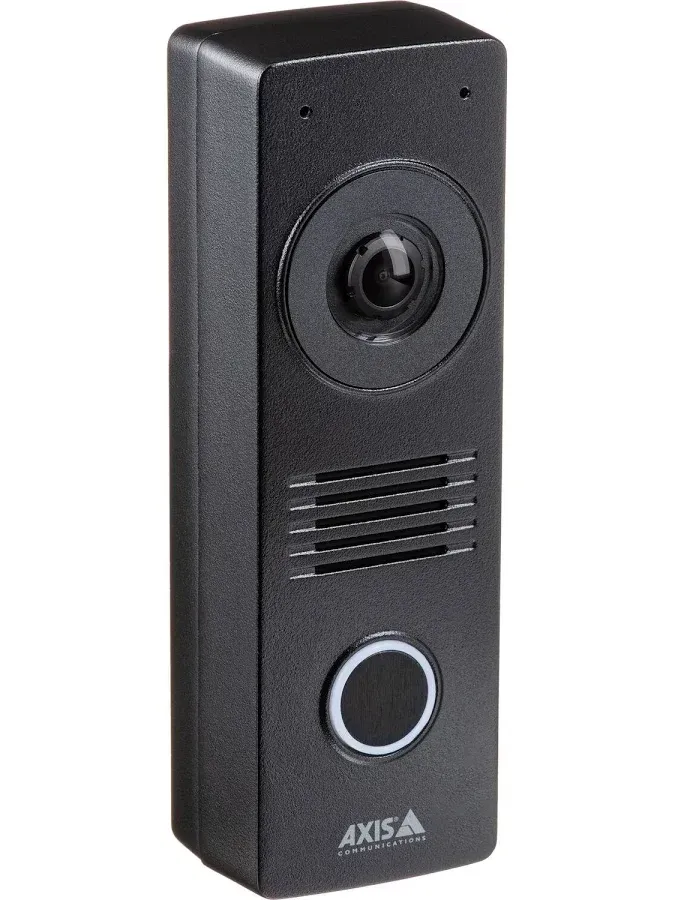
Manufacturer reference photo: a narrow dark door station with a large camera lens, speaker slots and one lit button, shaped to fit on a door frame or mullion. Narrow units like this are useful on prewar entrances where the stone surround should not be cut. Its cable can run inside the frame rather than across the masonry.
Commercial Access Control
Business Access Control in Bedford Park
Commercial work in Bedford Park is small-scale and close to home. It is the pharmacy, the clinic suite, the hair salon, the restaurant with a basement prep kitchen, the church office and the community room, nearly always under or beside apartments. That changes the priorities: doors are shared, cable paths cross residential cellars, and the business owner is frequently a tenant of the same landlord who owns the apartments upstairs.
Bedford Park Boulevard
Wikipedia calls it the main business district of the neighborhood, and it is served by two of Bedford Park’s three subway stations: Bedford Park Boulevard–Lehman College on the 4 and Bedford Park Boulevard on the B and D. Shops here need staff-door codes and back-room readers more than front-door hardware.
Webster Avenue
The eastern edge of the neighborhood, carrying the Bx41 and Bx41 Select Bus, with the 52nd Precinct at 3016 Webster and the Botanical post office at 2963 Webster. Storefronts along the avenue face the Botanical Garden side, and their rear doors often open to yards shared with residential buildings.
Jerome Avenue under the el
The western edge, with the elevated 4 line overhead and stations at Bedford Park Boulevard–Lehman College and Mosholu Parkway. Ground-floor businesses here typically have roll-down gates; a keypad or reader has to be reachable when the gate is up and protected when it is down.
Grand Concourse ground floors
Professional suites and offices in the bases of Concourse apartment buildings, where the business and the residential lobby can share an entrance. Separate credentials and schedules let a clinic open at 8 a.m. without unlocking the residential lobby to the street.
Bainbridge Avenue and East 204th Street
A mix of houses of worship, schools, small offices and the Community Board 7 office at 229-A East 204th Street. Organizations here usually want scheduled unlocking for public hours and staff-only codes at other times.
The Educational Mile
Lehman College, at 250 Bedford Park Boulevard West, and the high schools along the Jerome Park Reservoir create steady foot traffic and a student rental market nearby. Landlords near the campus see frequent roommate turnover, which is where cancelling one fob instead of rekeying pays off.
Compliance notes for Bedford Park buildings
Multiple Dwelling Law §50-a. Class A multiple dwellings built or converted after January 1, 1968 need automatic self-closing, self-locking street doors and, at eight or more apartments, an intercom from each apartment to the lobby door with remote release. Older buildings must provide both once a majority of tenants request them in writing. A fob system has to sit alongside that intercom, not replace it.
Housing Maintenance Code §27-2043. Every apartment entrance door needs a key lock, with at least one key supplied, and in class A buildings a heavy-duty latch set, a heavy-duty deadbolt and a chain door guard. Apartment doors stay on keys; our work is the building’s shared entrances.
Tenant Data Privacy Law. Owners using fobs, cards, apps or biometrics in multiple dwellings must get express consent, collect only listed data, give tenants a data-retention and privacy policy, destroy authentication data within 90 days unless anonymized, and may not require a smart credential to enter a tenant’s own apartment.
Rent-stabilized buildings. The Attorney General’s 2020 assurance with a security firm that ran a fob rollout in Queens stated that Rent Stabilization Code obligations and state housing agency guidance bar recording tenants’ ID data and require fobs to be issued to tenants without the per-unit cap the firm had imposed.
Egress and fire safety. As general AESS practice, every electrically locked door we install opens freely from the inside with a single motion, and maglocks are only used where the building’s fire alarm can release them and a request-to-exit device is fitted.
This summary is practical guidance, not legal advice. Owners with a specific question about a regulatory agreement, a rent-stabilization filing or a tenant dispute should speak to their attorney or the supervising agency.
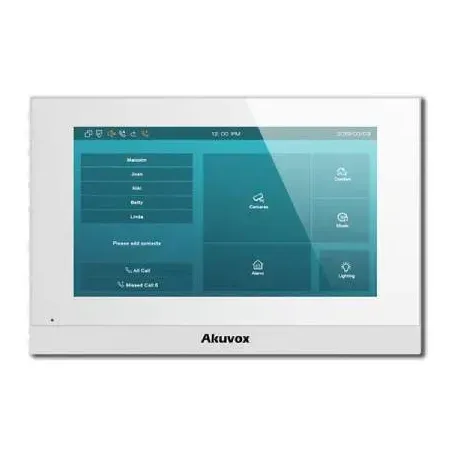
Manufacturer reference photo: a white indoor monitor whose teal touchscreen shows a contact list and large call icons. This is the apartment side of an intercom, where a tenant sees the visitor and releases the street door. Where the old handset wiring still tests clean, a monitor like this can often reuse it.
Your Questions Answered
Access Control in Bedford Park: Questions Answered
These are the questions owners, managing agents and tenants in Bedford Park actually bring to us, grouped by what they are really about. Each answer is short and direct; the reasoning follows.
The Law on Your Street Door
Our building went up before 1968. If a majority of tenants sign a written request for a locking street door and an intercom, what is the landlord’s deadline?
Installation has to start within 90 days of a valid majority request and be finished within six months. Multiple Dwelling Law §50-a makes self-closing, self-locking entrance doors and an apartment intercom mandatory for class A buildings erected or converted after January 1, 1968. For older buildings, which describes most of Bedford Park’s walk-ups and Concourse apartment houses, the same equipment becomes required once a majority of tenants request or consent to it in writing on the forms the housing agency prescribes. Buildings owned by a municipal housing authority get a year.
The statute also addresses how an owner may recover the cost from tenants in rent-regulated and redevelopment-company buildings, which is a question for the owner’s attorney and the rent agency rather than for us. What we can do is make the timeline workable: a majority request is the kind of thing that arrives without warning, and an owner who calls us early can have a survey, a written scope and an install date within the 90-day window.
For tenants, the practical point is that the request has to be in writing and from a majority of the apartments. A petition gathered in the lobby is a strong start, but the law refers to the agency’s prescribed forms, so ask the agency or a tenant organizer which form applies before collecting signatures.
The front door has been left unlocked for weeks. What can tenants in a Bedford Park building do about it?
Put it in writing to the landlord, report it to the city through 311, and keep a dated record. Where §50-a applies, an owner who fails to install or maintain the required door and intercom equipment commits a misdemeanor under the statute, and so does anyone who willfully damages, jams or removes it without justification. That last part matters: a door propped with a wedge or a lock taped open by a resident is also a violation, not just a nuisance.
The tenants at 2850 Grand Concourse whose August 2025 petition was reported by News 12 did roughly this: they documented what was happening on the stairs, asked management in writing to secure the entry points, and involved the precinct. Tenants on AskNYC threads about broken buzzers give the same advice from experience: intercoms are required at eight or more units, and the complaint route is HPD through 311. We are not tenant advocates and we cannot work on a building without the owner’s authorization, but when an owner calls us after a complaint, the fix is usually quick, and simple faults are handled by our Bedford Park buzzer repair crew the same day.
If the cause is mechanical rather than neglect — a closer that has lost its pull, a strike that no longer lines up — tell the super exactly what the door does. “It closes but stops an inch short of latching” points straight to a closer adjustment; “it latches but any push opens it” points to the strike or the lock. Precise reports get precise repairs.
We are adding fobs to a 30-unit building. Does every apartment still need to be able to talk to visitors and buzz them in?
Yes. Fobs let residents in; the intercom is how everyone else gets in, and the law requires it at eight or more apartments. Section 50-a describes the intercom in functional terms: voice communication between each apartment and a person at the self-locking lobby door, and a way for the occupant to release the lock from inside the apartment. A fob reader does neither of those things, so a building that rips out its buzzer panel and installs only a reader has removed a required system.
In practice we install a combined entry panel that carries both: a directory or call buttons with a camera, plus a credential reader for residents. Behind the scenes the intercom side and the access control side share a lock and a power supply, and the panel is listed with the release wiring the apartments need. Where the hallway handset wiring is beyond saving, the panel can call tenants’ phones instead, with the original handsets retained in apartments where tenants prefer them.
The intercom requirement is also why we recommend a panel with a camera. Tenants can see who they are letting in, which is the most direct answer to the follow-someone-through-the-door problem that Bedford Park buildings have had.
We own a three-unit Victorian house. Do the city’s tenant data rules reach a keypad on our front door?
Very possibly. The Tenant Data Privacy Law is written for multiple dwellings, and a house with three or more apartments is one. Many of the three-story Victorian houses that survive in Bedford Park now hold two or three rentals. A two-family house is not a multiple dwelling, but a three-family house is, and HPD’s summary describes smart access systems broadly enough — electronic or computerized entry, RFID cards, apps and biometrics among them — that an owner adding electronic entry to a three-unit house should assume the consent and data rules apply and confirm with counsel.
In practice the obligations are light for a small building: a one-page consent from each household, a short written retention and privacy policy, and a keypad or reader set to keep its entry log no longer than the 90 days the law allows for authentication data. Many simple keypads keep no personal data at all beyond a code number, which is the easiest position to defend. The intercom rule in §50-a, by contrast, starts at eight apartments and does not reach these houses.
We will happily quote a single-door system here rather than talk a house owner into a building-scale panel. A single door with a keypad or fob reader starts at $1,500 in the Bronx, the same as our Brooklyn base price, and we leave the owner with the consent form and policy template either way.
Fobs, Tenants and Records
What paperwork does the Tenant Data Privacy Law expect an owner to hand tenants before the fobs go live?
A consent, in writing or through an app, and a data-retention and privacy policy.HPD’s summary of Local Law 63 of 2021 says owners of multiple dwellings that use smart access systems — key fobs, RFID cards, mobile apps, biometrics and similar — must obtain express consent before collecting reference data, limit collection to a listed minimum, provide tenants with a data retention and privacy policy, protect the system with robust safeguards, and destroy authentication data no later than 90 days after it is collected or generated unless it is kept in anonymized form.
The minimum list is short: the user’s name, unit number and the doors or common areas they may use, preferred contact method, card or device identifiers and credentials, biometric identifiers only if the system uses them, lease move-in and move-out dates where available, and the time and method of access for security purposes. Anything beyond that — a photo of an ID, a date of birth, an employer — is outside the list.
At handover we give the owner a plain-language template policy built around the system we installed, a simple consent form for each household, and audit settings that purge entry records on a rolling basis inside the 90-day limit. The owner should have their attorney review the final policy, but nobody should be starting from a blank page.
Can the landlord ask for a driver’s license or cap each apartment at two fobs when handing them out?
In a rent-stabilized building, the Attorney General has said no to both. In a 2020 Assurance of Discontinuance, the Attorney General’s office addressed a security company that ran a fob rollout in a rent-stabilized Queens building, recorded tenants’ driver’s license numbers and limited each unit to two fobs. The assurance states that, as the owner’s agent, the firm had to follow the Rent Stabilization Code and state housing agency guidance, which bar recording ID data and require fobs for tenants without that cap, and it required the firm to stop.
Brick Underground’s reporting on the housing agency’s rulings adds detail: fobs are to be provided free to all lawful occupants, a set number of extra cards at no cost, and a capped charge for replacing a lost one. Bedford Park is overwhelmingly a rental neighborhood, and a building’s rent-regulation status is not something we can tell from the sidewalk, so we plan every rollout on the assumption that these rules apply unless the owner tells us otherwise.
Our rollout checklist therefore asks for apartment numbers and household names only, issues as many fobs as each household’s lawful occupants need, and records nothing from identity documents. If a managing agent hands us a form asking for more, we will point to the assurance and suggest they check with counsel.
Could fob entry records be used to claim a tenant does not really live in the apartment?
The city’s law forbids using smart access data to harass or evict a tenant. HPD lists among the Tenant Data Privacy Law’s prohibitions tracking the frequency or timing of a tenant’s use of the system to harass or evict, tracking a tenant’s relationship status, and using any information to harass or evict. Data may be used only for access, monitoring entrances, exits and common areas, limiting entry times, and security. Location tracking outside the building is prohibited outright.
Tenants’ worry is not imaginary. Brick Underground reported in 2018 that fob logs had been offered as evidence that a tenant did not live in an apartment full-time, while noting that such logs are weak on their own. That reporting predates the 2021 law, which now draws the line clearly.
How we configure systems reflects that. Event logs are set to the shortest retention the owner’s security needs allow and never beyond 90 days; reports are built around doors and times, not around individual tenants’ patterns; and the owner’s staff get only the permissions they need. A system built that way is useful for investigating a break-in and useless for building an eviction case, which is the balance the law intends.
Roommates near Lehman College change every semester. How should fobs be issued in a shared apartment?
One credential per person, each tied to the apartment, each cancelled the day that person leaves. Lehman College sits at 250 Bedford Park Boulevard West, and the specialized and public high schools along the reservoir draw families as well. Shared apartments with changing occupants are common in the blocks between the campus and the Concourse. When everyone in a four-person share uses the same copied key, a departing roommate keeps access indefinitely; with individual fobs, removing one is a single click.
The data rules still apply. Each roommate is a user whose name and unit can be recorded, but nothing more, and the household’s fobs should be issued to lawful occupants rather than rationed. In rent-stabilized buildings that point is not optional. We also leave the owner with a simple procedure for a mid-lease change: the leaseholder or the managing agent requests the new occupant’s credential, the old one is deactivated the same day, and the change appears in the audit trail.
Where turnover is especially high, phone credentials can reduce the handing-over of plastic. They are not mandatory under our designs, though, because the city’s law does not let an owner force anyone onto an app to reach their own apartment, and we prefer a building where a physical fob always works.
Doors, Vestibules and Locks
Our entrance has an outer door and an inner vestibule door. Which one should get the electric lock?
Usually the inner door, with the outer door left free or on a schedule. Many Bedford Park buildings have a vestibule between the street and the lobby, often with mailboxes and the intercom panel inside it. If the outer door locks and the panel sits inside, visitors and carriers cannot reach the panel. Putting the controlled lock on the inner door keeps the vestibule as a sheltered waiting space with the directory, the camera and the mailboxes, while the lobby and stairs stay secured.
There are exceptions. If the vestibule itself has been a problem — people sleeping in it, or using it the way 2850 Grand Concourse’s tenants described their stairs being used — the outer door can lock at night on a schedule while the panel is moved outside to the street face. That move means a weather-rated panel and a carefully chosen mounting on the masonry, and it is worth the extra cost only when the vestibule is genuinely being misused.
Whichever door locks, both must close reliably. A vestibule with a locked inner door and an outer door that hangs open in the wind loses its heat, its mail and its point. We adjust or replace closers on both as part of the job.
Can our street door be left unlocked during the day while the super is working somewhere in the building?
Not if the door falls under §50-a. The law lets a required self-locking door stay unlocked only while an attendant is on duty. The statute’s wording, as published on the State Senate’s legislation site, is that the entrance doors are to be kept locked except when an attendant is on duty. A super fixing a radiator on the fifth floor, a porter mopping the cellar or a manager in an office upstairs is not attending the door, and the door left on the latch for their convenience is exactly the condition the tenants at 2850 Grand Concourse described.
Where staff genuinely need the door open for a stretch — moving furniture, a delivery of boiler parts — the right tool is a timed unlock from the controller, started by a staff credential and ending automatically, so nobody has to remember to relock it. The event is logged as a door held open by schedule rather than as a fault, and the door relocks even if the person who opened it is called away.
For buildings built before 1968 where tenants have not made a majority request, the statutory duty may not yet apply, but the practical risk is identical. The September 2025 burglary near Perry Avenue and Mosholu Parkway South happened at 4 a.m. through a front door; an entrance left unlocked by day simply widens that window. We configure every Bedford Park system so the default state of the street door is locked, and so any exception has a start, an end and a name attached to it.
Can the roof door go on the fob system like the street and cellar doors?
It can be monitored by the system, but it should not be turned into a self-locking door. Section 50-a treats the roof differently from the street: the roof entrance gets a self-closing door that is not self-locking and is bolted or locked from the inside. The roof of a Bedford Park walk-up is part of the way out of the building, so the goal is to stop people coming in from the roof while never trapping anyone trying to leave by it.
What we add instead is awareness. A door position switch on the roof door, wired to the same controller as the street and cellar doors, tells the super when the roof door has been opened or left ajar, and a local alarm can sound at the door itself to discourage people from propping it for a smoke or a summer evening. Those events show up in the same log as the other doors, which keeps the roof from being the forgotten weak point of an otherwise secured building.
Any hardware we fit to a roof door is chosen to keep free egress, and where a building’s fire safety plan or a fire inspector has specific requirements for that door, those govern. We would rather leave a roof door on its existing hardware than install something that makes the stairs less safe.
Shops on the Avenues
Where should a keypad go on a Jerome Avenue shop whose roll-down gate covers the door at night?
Inside the gate line, on the frame of the shop door itself, with the gate handled as a separate mechanical or motorized step. Businesses under the elevated 4 line on Jerome Avenue, and along Webster Avenue and Bedford Park Boulevard, typically open by raising a gate and then unlocking a glass or steel door behind it. A keypad mounted outside the gate is exposed overnight and invites tampering; a keypad behind the gate is protected but only usable once the gate is up.
Most owners are best served by keeping the gate on its existing key or motor and moving access control to where it adds value: the back door to the yard or cellar, the stock room, and the office where cash and records live. Each employee gets a personal code or card, so a departing worker is deleted from the system rather than taking a key with them, and the log shows which code opened the back door at 6 a.m.
Where the owner does want the gate on a credential, it is a motor and controller job with its own safety requirements, and we quote it separately after seeing the gate. For the shop door itself, we favor a keypad with a backlit, weather-rated face and a mechanical key override.
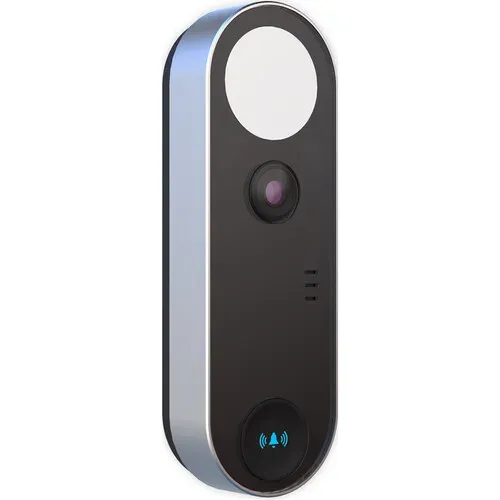
Manufacturer reference photo: a rounded black and silver video unit with a camera in its center and a small blue-lit icon near the base where a credential or phone is presented. Compact units like this suit a side or rear door that tenants use. Its small face leaves room on a narrow frame for the door position switch beside it.
Equipment
Types of Access Control We Install in Bedford Park
We choose hardware for the building, not the other way round. These are the categories that show up most on Bedford Park jobs and where each one makes sense.
Combined entry panels
Directory, camera, speaker and credential reader in one stainless or aluminum housing, from intercom makers we regularly install such as Akuvox, 2N, Comelit and Aiphone. The default choice for apartment buildings of eight or more units, where the intercom is a legal requirement.
Standalone fob and card readers
A slim reader on the frame tied to a controller in the cellar. Used for laundry, cellar, roof and rear doors, and on street doors where a separate intercom panel is staying in place.
Keypads and keypad-readers
Code entry, alone or combined with a card reader. Best for shops, offices and two- or three-unit houses where the number of users is small and codes are easy to manage.
Electric strikes
Replace the strike plate in the frame and release the latch on command. The first choice on wood and hollow-metal doors, because the door keeps its normal mechanical lock and free exit.
Electrified locksets and exit devices
For narrow-stile aluminum doors or doors with panic hardware, where a strike will not fit. Power reaches the door through a concealed hinge transfer.
Magnetic locks
Used sparingly, on doors where nothing else will work, and only with a request-to-exit device, a release on the building fire alarm and a manual release button inside.
Controllers and power supplies
Networked or standalone controllers in a locked enclosure in the cellar, with a supervised power supply and battery backup sized for the locks and readers it serves.
Apartment stations and phone entry
Wired audio or video handsets in each unit, or a phone-calling service on the panel. We keep working handsets where the riser tests good and offer phone entry where it does not.
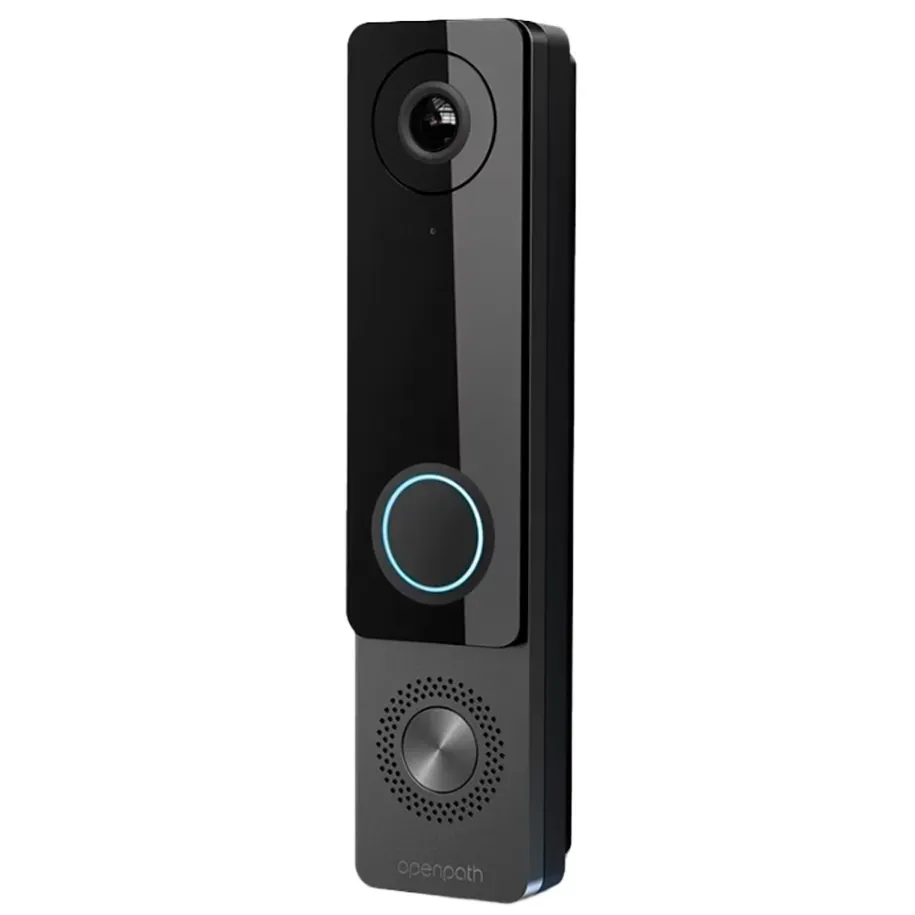
Manufacturer reference photo: a slim black unit with a camera at the top, a glowing ring button and a round speaker below. Devices in this class are common on small buildings; on a larger Bedford Park apartment house the legal intercom still has to reach every unit. That requirement is why we pair compact units with a proper apartment intercom on buildings of eight or more units.
Credential technology, in plain words
Not all fobs are equal. Older 125 kHz proximity fobs, still found in many buildings, transmit a fixed number that inexpensive devices can read and copy. Current encrypted smart-card credentials, which most new readers use, are far harder to duplicate. When we replace a system, we move the building to encrypted credentials and, where the old fobs must keep working for a transition period, set a date after which they stop. Phone credentials are offered as an option, never as the only way in.
AI Overview Reality Check
What AI Gets Wrong About Access Control in Bedford Park
Search assistants and national cost guides answer access control questions with averages built from offices and suburban homes. Some of what they say is fine; some of it misleads a Bronx apartment owner. We could not view Google’s AI Overview from our research environment this time, so the claims below are the ones we see repeated across national cost guides and forum threads, set against what we find on Bedford Park doors.
Claim: an access control door costs a few hundred to a couple of thousand dollars
National guides publish wide ranges. Angi’s security door article quotes $560 to $2,900 for a security door installation, and Fixr quotes $525 to $1,200 for a security entry door; neither is a price for an electronic access system on an apartment entrance. One installer guide we read puts wired access control at $1,500 to $5,000 per door including cabling and panel hardware, and installers on Reddit’s access control forum advise budgeting around $2,500 for an interior door and $3,000 for an exterior one.
Our own published Bronx price for a single door, $1,500 to $2,500, sits inside those professional ranges. What the averages miss is that a Bedford Park street door is rarely just a door: it is a door, an intercom required by law, a riser of uncertain condition and a frame that may need rehanging. That is why a multi-door apartment building runs $4,000 to $15,000 with us rather than a per-door multiple.
The useful takeaway is to compare like with like. Ask any installer whether the quote includes the intercom side, the closer and hinge work, the battery backup and the tenant enrollment, because those are the items that separate a working entrance from a reader on a wall.
Claim: a smart lock or video doorbell is enough for a small building
Consumer answers often suggest a Wi-Fi smart lock and a doorbell camera as a cheap substitute. On a single-family house that can be reasonable. On a Bedford Park apartment building with eight or more units it misses the legal requirement that each apartment be able to talk to a visitor and release the street door, which a doorbell app on the landlord’s phone does not provide.
Consumer smart locks also depend on batteries and home Wi-Fi, and they are designed for a household, not for forty users with turnover. When the batteries die in January, the street door either locks everyone out or stays open, and neither is acceptable for a building.
For two- or three-unit houses, a good keypad deadbolt can be the right answer, and we install them. For apartment buildings, the answer is a powered system with an intercom, a supervised power supply and credentials the owner can manage.
Claim: fobs make a building secure by themselves
AI summaries often present access control as the security solution. On the ground, the fob reader is the smallest part of the outcome. A door that does not latch, a closer turned down to stop slamming, a wedge left in the vestibule or a door held for a stranger defeats any reader, which is exactly what the 2025 Bedford Park reports describe.
That is why our surveys start with hinges, closers and strikes, why we add a door position switch that reports a door left open, and why we recommend a camera on the entry panel. The reader decides who may enter; the door decides whether anyone else can.
Owners should expect an installer to talk about the door before the electronics. One who only talks about the reader is selling a part, not an entrance.
Claim: the landlord can collect whatever data the system offers
Product pages advertise detailed tenant analytics, and general answers tend to repeat that as a benefit. In New York City multiple dwellings, the Tenant Data Privacy Law limits the data an owner may collect through a smart access system, requires consent and a written policy, sets a 90-day destruction rule for authentication data and bans using the data to harass or evict.
So a feature that reports how often a particular tenant comes and goes is not a selling point here; it is a liability. Biometric options such as face or fingerprint readers are permitted only within the same consent and minimization rules.
We switch off analytics that the law does not allow, keep logs short and door-focused, and give owners a policy template that matches the configuration. Legal review of that policy is still the owner’s call.
Claim: old buzzer wiring must be torn out for a modern system
General answers often assume a full rewire. In many Bedford Park walk-ups, the multi-pair riser cable that served the original buzzers is still intact and tests clean, and modern two-wire intercom systems are designed to run on exactly that kind of cable.
Reusing it avoids opening plaster in every hallway and apartment, which matters in occupied rental buildings. Where the riser has failed, a phone-calling panel removes the need for in-apartment wiring altogether.
We test before we promise. The estimate states whether the existing riser is being reused, and the price reflects it, so the owner is not paying for a rewire that turns out unnecessary or surprised by one that turns out essential.
Claim: national alarm brands handle apartment access control
Assistants frequently name ADT, Ring or SimpliSafe when asked who installs access control. Those companies are built around household alarm monitoring and consumer devices; their offerings are not designed around a forty-unit apartment intercom, a cellar controller and city tenant-data rules.
The difference shows up in ongoing costs too. Consumer and monitored products often come with monthly plans. The systems we install for Bedford Park buildings run without a mandatory monthly fee; cloud management is available as an option where an owner wants remote administration.
Ask whoever you consider whether they hold a New York State license under General Business Law §69-m, whether the intercom remains compliant after their work, and who owns the administrator login when they leave. Those three answers tell you more than a brand name.
Claim: installation takes a day
For a single keypad on a shop back door, a day is realistic. For an apartment building, the calendar is set by things outside the install: tenant notice, approval from a regulatory agency for subsidized buildings, ordering a panel engraved or programmed with the directory, and a rollout day when residents collect fobs.
The physical work on a typical walk-up street door is one to two days. The rollout, with enrollment and handing out credentials to every household, often takes another visit, scheduled when people are home — and because tenants in any building keep different hours, that often means an evening or weekend session as well as a weekday one.
An honest schedule names all of those steps. Ours does, in writing, before the owner commits.
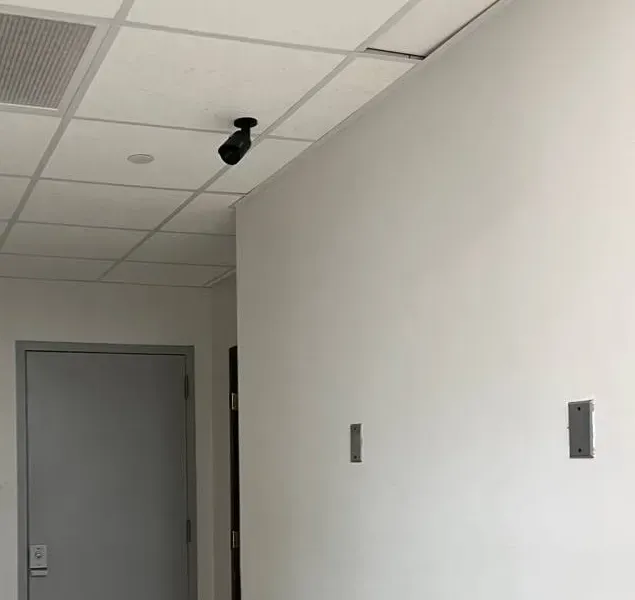
Photo from the AESS job library: a small black camera on a drop ceiling looks down a white corridor toward a grey steel door, with two open wall boxes waiting for devices. A camera that sees the controlled door is what turns a door-held-open alert into something a super can check. Without the camera, the alert only says that the door is open; with it, the super can see why.
Talk to Us Before You Announce the Changeover to Tenants
A changeover notice that promises the wrong date, asks for the wrong information or forgets the intercom causes more trouble than the installation. A ten-minute call first lets us line up the date, the consent forms and the rollout session.
Tell us in a sentence or two what the building is — a six-story walk-up off Bainbridge Avenue, an elevator building on the Concourse, a two-family house near Villa Avenue, a shop on Bedford Park Boulevard — how many apartments or users it has, and which doors you want controlled. We reply in writing the same business day using our published Bronx prices. Prefer to talk? Ring (646) 490-0629.
✅
We Got Your Request!
Received. A technician is reading your Bedford Park details and will phone you today. If it cannot wait, the Bedford Park line is (646) 490-0629.
How It Works
Our Installation Process
A keypad on a shop door and a full panel on a sixty-unit Concourse building follow the same steps. In rental buildings the tenant steps matter as much as the wiring.
1. Photos and a count
Three photos of the street door, its panel and the cellar wiring, plus the number of apartments and doors, so we can judge the door, the riser and the likely cost before visiting. Most owners send them from a phone in five minutes; tenants can help, but the request itself has to come from the owner or managing agent.
2. Door and riser survey
On site we check hinges, closer, frame and latch, test the buzzer riser to sample apartments, and confirm where the controller and power supply can live in the cellar. We also note any tenant majority request, open HPD complaint or supervising agency, because each one changes the order of the work that follows.
3. Written plan and approvals
A door-by-door scope and fixed price from our published Bronx figures, with drawings and product data for any supervising agency or Landmarks review the building needs. The plan names which existing parts are reused, which are replaced, and what happens to the old keys, so nothing is left to be argued about on install day.
4. Door work and cabling
Hinges, closers and strikes put right first, then cable pulled from each door to the cellar along agreed paths, labeled at both ends and tested. Openings through fire-rated walls or floors are fire-stopped, and cable in the vestibule runs inside the frame or a painted raceway rather than across the facade.
5. Panel, locks and controller
Entry panel, readers and locks mounted, controller and battery-backed power supply installed in a locked enclosure, and free exit and fire release verified at every door. We pull the building's power at the panel to prove the battery carries the locks, then restore it and confirm every door relocks on its own.
6. Tenant rollout
Consent forms, the data-retention and privacy policy, and fobs issued to each household's lawful occupants at scheduled sessions, with the old keys retired on an announced date. Tenants who cannot attend either session are enrolled later by the super using the same consent form, so nobody is left holding a key that has stopped working.
7. Handover
Administrator login set in the owner's name, schedules and log retention configured within the 90-day limit, the super trained, and the monthly door test walked through on site. The owner receives the documentation pack, the template privacy policy and our direct line, and the first service check is booked for a month after handover.
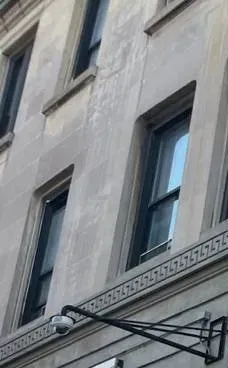
Photo from the AESS job library: a pale stone apartment facade with a decorative band course, with a dome camera suspended from a black steel arm bolted beneath it. On prewar Bedford Park facades we keep fixings in plain masonry or mortar joints and away from carved stone. Readers and panels follow the same rule at the entrance itself.
After handover: the monthly two-minute door test
We leave every Bedford Park owner and super with a short routine. Once a month, let the street door close on its own from fully open and watch it latch; if it stops short, adjust the closer before winter. Try a fob that has been deactivated and confirm it is refused. Press the call button for one apartment and have someone release the door from upstairs, which proves the intercom side still works. Glance at the controller’s battery indicator. Two minutes, and most failures are caught before a tenant has to report them.
Coverage Area
Access Control Near Bedford Park’s Landmarks
These are the places that orient a Bedford Park job — the landmarks people give as cross streets when they call us.
Lehman College
250 Bedford Park Boulevard West. Built as Hunter College’s Bronx campus, with original Collegiate Gothic buildings by the Works Progress Administration; in 1946 the campus briefly hosted the United Nations. Student renters fill the nearby blocks.
Jerome Park Reservoir and the Educational Mile
The reservoir replaced Jerome Park Racetrack, first home of the Belmont Stakes, after 1890. Along it sit Walton, DeWitt Clinton and Bronx Science, the High School of American Studies at Lehman College, and Lehman itself.
New York Botanical Garden
Across Webster Avenue from the neighborhood’s eastern edge, with Metro-North’s Botanical Garden station on the Harlem Line serving Bedford Park. Many buildings on the east side of the Concourse fall in ZIP code 10458.
Mosholu Parkway
The northern boundary and the neighborhood’s main east–west arterial, with a 4 train station of the same name on Jerome Avenue. The Perry Avenue and Mosholu Parkway South area was the scene of the September 2025 burglary reported by Norwood News.
Bedford Park Congregational Church
At Bainbridge Avenue and East 201st Street, dating to 1882 and designated a city landmark in 2000. Its Queen Anne design recalls the neighborhood’s origins as a small planned suburb.
52nd Precinct and Mosholu Library
The precinct house at 3016 Webster Avenue, and the New York Public Library’s Mosholu branch at 285 East 205th Street, next to Whalen Park, opened in 1955. The Convent of Mount St. Ursula stands at Bedford Park Boulevard and Bainbridge Avenue.
Bedford Park is priced at our Bronx rate, which is the same as our Brooklyn base: a multiplier of 1.00 with no borough surcharge. The figures below are installed prices covering hardware, installation, programming, initial credential issue and training, with New York City sales tax of 8.875 percent added and the exact figure fixed in writing after we have seen the door and the cellar.
System or item
Bedford Park price
Typical Bedford Park building
Single door: keypad or fob reader with electric strike
$1,500 – $2,500
Street door of a small walk-up, front door of a two- or three-unit house, office or clinic suite door
Keypad on a staff or back door
$1,500 – $2,000
Rear or cellar door of a shop on Bedford Park Boulevard, Webster or Jerome Avenue
Multi-door building
$4,000 – $15,000
Walk-up or elevator building: street door plus vestibule, cellar, laundry or rear entrance, with networked management
Card readers on several office doors in a shared building
$4,000 – $12,000
Professional suites or community offices sharing one building, each with its own schedule
Full building
$15,000 – $40,000+
Large Concourse apartment building with lobby, service entrances, elevator restriction and full credential management
Buzzer repair (for comparison)
$200 – $500
Fixes the old system but adds no credential control or audit trail
Service and repair visit
$195/hr, 3-hr minimum ($585)
Any brand or installer; most single faults fixed in one to two hours
Payment terms follow our standard agreement: jobs under $500 are paid in full up front, and jobs over $500 take a 50 percent deposit. Full terms — including 50% deposit, the 30-day warranty and optional paid extended warranty, and the late-fee schedule — are set out in the service agreement.
What moves a Bedford Park quote up or down
The door. A sound door with good hinges takes a strike and a reader. A sagging door, a rotten frame or a narrow-stile aluminum door needs rehanging, a different lock or a powered hinge, and that is often the largest variable on a prewar entrance.
The intercom. Buildings of eight or more units need the apartment intercom to keep working. Reusing a healthy riser is far cheaper than replacing handsets on every floor; phone-based entry is the middle option.
Distance to the cellar. Controllers and power supplies live in a locked enclosure, usually in the cellar. A short, open path from the street door is cheap; a long route through finished walls costs more labor.
Number of controlled doors. Each added door brings a reader, a lock and a cable run. Laundry and cellar doors are inexpensive add-ons once the controller is in place.
Approvals. Subsidized and supervised buildings may need drawings and product data for review, and a landmark building may need a Landmarks permit for anything on the facade. Paperwork time is quoted openly.
Five things to ask any installer before you sign
Does the apartment intercom still work afterwards? In buildings of eight or more units it must, so the quote should say how each apartment talks to the door and releases it.
What happens to the door itself? A quote that never mentions hinges, closer or strike assumes the door already latches. On older Bedford Park entrances that assumption is often wrong.
Who owns the administrator login? It should be the owner, in writing, with recovery details handed over at completion rather than kept by the installer or an employee.
How long are entry records kept? The answer should be a number of days no greater than 90, set in the controller, with a template policy for tenants to match.
What is the monthly cost? Some systems require a subscription for cloud management or phone entry. Ours do not require one, and any optional service is priced separately so it can be declined.
An installer who answers all five clearly, in writing, is usually one who has done this work in occupied rental buildings before. Vague answers on the intercom and the data questions are the ones that cause trouble with tenants and the city later.
How these prices compare with national guides
National consumer guides publish figures for security doors, alarm kits and smart locks that look lower than ours because they are describing different work. A single electronic door at $1,500 to $2,500 is in line with what professional installers publish for wired access control, and an apartment entrance in Bedford Park also carries the intercom, the door hardware work and the tenant enrollment. Every quote we send is itemized, so an owner can see exactly what each door, each lock and each foot of difficult cable is costing.
Photo from the AESS job library: bundles of blue and white cable run beside a pipe through an open ceiling space. Cable distance and the path from the street door to the cellar controller are among the biggest variables in a Bedford Park quote. A clear run along an exposed cellar ceiling costs far less than a route through finished walls.
Get a Written Bedford Park Price for Your Entrance
Send the three photos and the apartment count. We come back with a door-by-door plan and a fixed written price, usually the same business day.
One controlled door at $1,500 to $2,500: a keypad or fob reader, an electric strike or suitable lock, a power supply with battery backup, closer adjustment and programming. Suits a two- or three-unit house, a small walk-up whose intercom is staying, or a clinic or office door.
Walk-Up Building — from $4,000
A multi-door system at $4,000 to $15,000 for a typical Bedford Park apartment house: street door with a combined intercom and reader panel, the vestibule or lobby door, and the cellar, laundry or rear door on schedules, managed from one controller.
Full Building — from $15,000
A complete system at $15,000 to $40,000 and up for the larger Concourse buildings: lobby and service entrances, elevator floor restriction where wanted, garage or yard gates, a video entry panel and full credential management for every household.
Already bought the hardware? Labor-only installation
We install owner-supplied readers, panels and locks on a labor-only basis, priced after we see the model numbers and the door. Before ordering, check three things: that the panel provides a true apartment intercom with door release if the building has eight or more units, that the credentials are encrypted rather than legacy proximity fobs, and that the controller lets you set log retention so you can stay within the city’s 90-day rule. Send us the list first and we will tell you whether it suits the building.
Room to grow
Owners often start with the street door and add the cellar, laundry and roof later. We size the controller and power supply with spare capacity and leave labeled pull strings toward likely future doors, so adding one later is a matter of mounting and connecting rather than replacing the core of the system.
Field Notes: Fix the Door Before You Wire the Reader
This is a note on method, not a story about a particular building. On older Bronx apartment entrances, the most common reason an access system disappoints is that nobody looked at the door. The hinges have worn, the door has dropped a fraction, and someone long ago turned the closer down because the door slammed. Now it drifts shut and stops just short of the latch. Put a new reader on that door and residents will tap their fobs, hear the lock click, and walk into a building that was already open.
So our surveys start at the hinge side. We lift the door by its handle to feel for play, close it slowly from different angles to see where it binds, and watch where the latch actually meets the frame. We check the closer’s sweep and latch speeds and whether its arm is bent. We look at the threshold for wear that lets wind push the door back open. Only then do we choose the lock: a strike if the frame is sound, an electrified lockset or exit device if it is not, and a maglock only when nothing else will work and the fire alarm can release it.
The last step is a door position switch wired to the controller, so a door that fails to close becomes an alert rather than a surprise. None of this is glamorous, and very little of it is expensive. It is simply the difference between an entrance that locks and one that looks as if it does.
FAQ
Bedford Park Access Control FAQ
How long does a typical Bedford Park walk-up take from the first photos to a working fob door?
+
Usually two to three weeks. The written estimate follows the photos the same business day; ordering a programmed entry panel takes about a week; the physical work on a walk-up street door is one to two days; and the tenant rollout, when households sign consent forms and collect fobs, is scheduled after that. Buildings that need an agency or Landmarks review take longer, and we say so in the estimate. If the building is under a tenant majority request, we work backwards from the statutory deadline instead, so the owner knows from day one whether the 90-day start and six-month finish are comfortably in reach. Repairs on an existing system, by contrast, are booked the same or next day.
Do tenants in a rent-stabilized Bedford Park building have to pay for their fobs?
+
Not for the initial set. Brick Underground has reported the state housing agency's rulings that new fobs must be given free to all lawful occupants, with a limited number of extra cards at no cost and a capped fee for replacing a lost one, and the Attorney General's 2020 assurance treated issuing fobs without a per-unit cap as part of the owner's obligations. We plan every rollout that way unless the owner's counsel advises otherwise. In practice that means the owner budgets for enough fobs for every lawful occupant from the start, keeps a small stock of spares in the super's office, and posts the replacement charge in the tenant notice so nobody is surprised later. Commercial tenants and market-rate buildings follow whatever the lease says, which we confirm with the owner first.
Once fobs are installed, whose job is it to keep the street door system working?
+
The owner's. Multiple Dwelling Law section 50-a makes the owner responsible for installing and maintaining the required door and intercom equipment, and treats a failure to do so as a misdemeanor, as it does willful damage or jamming by anyone else. In practice the super handles daily checks, we handle repairs and service under a written agreement, and the owner keeps the records. Full terms, including the 30-day warranty on equipment we supply, are set out in our service agreement. Tenants who see a fault should report it to the super or managing agent the same day; a wedge in the door or a taped latch is a violation, not a convenience.
Can a Bedford Park rental building use fingerprint or face readers at the street door?
+
Only with care. The city's Tenant Data Privacy Law allows biometric identifiers in a smart access system, but only with tenants' express consent, collection limited to what the system needs, a written retention and privacy policy, and destruction of authentication data within 90 days unless anonymized. Owners also cannot require a smart credential to enter a tenant's own apartment. For most buildings, encrypted fobs and cards meet the need with far less risk. If an owner still wants biometrics, we ask that the consent form, the policy and an alternative credential for tenants who decline are settled with counsel before any reader is ordered. We will not enable biometric enrollment until that paperwork exists.
Our building is in the Mitchell-Lama program. What do you provide for the supervising agency's review?
+
A written scope listing every door, a riser diagram, product data sheets for the panel, readers, locks and power supplies, a description of how free exit and fire alarm release are handled, and the tenant data policy template. Wikipedia notes that Tracey Towers was built under the program, and the Furman Center counts 10 Mitchell-Lama properties in the district; supervised buildings often need sign-off before hardware changes, so we prepare the package before scheduling work. Turnaround depends on the agency, so we date the package and keep a copy, which lets the managing agent show exactly what was submitted and when if the review takes longer than expected. Changes the agency requests are folded into the scope before we order anything.
Can a tenant decline to sign the smart access consent form, and how do they get in then?
+
The consent requirement exists because tenants may say no. HPD's summary of the Tenant Data Privacy Law requires express consent before reference data is collected and bars owners from requiring a smart access system to enter a tenant's own apartment. How a building handles a tenant who declines at the street door is a question for the owner's counsel, so we design for it either way: the apartment intercom keeps releasing the door, and the system can be set up with a non-personal code or a mechanical key path for the household. Nobody should be locked out of their home over a form.
Can the system tell the super a door was left open without tracking which tenant opened it?
+
Yes, and for most Bedford Park buildings that is the right default. Door position switches report a door left ajar or forced, and those alerts are about the door, not about a person. Individual credential events can be kept for a short period for security investigations, within the 90-day limit, while the alerts the super sees day to day carry no names at all. That keeps the useful part of the system, a door that tells someone when it has not closed, and drops the part the city's tenant data law is wary of. If the alerts show the same door failing repeatedly, the cause is usually a closer or strike, which we adjust on the next service visit.
Can the laundry room door accept fobs only during posted laundry hours?
+
Yes. Each door on the controller can have its own schedule, so the laundry room can accept tenant fobs from, say, early morning to late evening while the super's and the service company's credentials work at any time. The same approach handles a roof door, a bike room or a storage cage, and schedules can be changed later from the management software without a visit. Schedules respect free exit at all times: a door that refuses fobs after hours still opens from the inside with a single motion, so nobody is ever trapped in a laundry room or on a roof. Holiday and summer schedules can be loaded in advance.
How are fobs handed out on rollout day when many tenants work during the day?
+
We schedule at least two sessions, one in the evening or on a weekend, and leave the owner with a simple way to enroll anyone who missed both. Each household signs the consent form, gives the names of the lawful occupants who need credentials, and receives fobs on the spot. Nothing is copied from identity documents, and the old key keeps working until the announced switchover date. A short notice in the lobby and under each door a week ahead gives the dates, explains what tenants will be asked to sign, and makes clear that no ID is needed, which noticeably improves turnout. Notices can be printed in more than one language if the owner asks.
Does a fob system help or hurt residents with disabilities?
+
It can help a great deal if it is planned. As general AESS practice we mount readers and keypads at a reachable height beside the latch side of the door, choose panels with audible and visual feedback, and set a longer unlock time for residents who need it. Where a heavy prewar door is the real barrier, a low-energy power operator can be tied to the same credential so the door opens itself. Tenants who need accommodations can tell the owner before rollout, and the settings are changed for their credential only, without affecting anyone else in the building. Nothing about the accommodation is recorded beyond the setting itself.
Should the cellar door be on the same system as the street door?
+
Usually yes. Cellar doors in Bedford Park walk-ups often open to a side alley or under the stoop, and they are frequently the weak point that a well-locked street door leaves behind. Putting the cellar on the same controller lets the owner limit it to the super, the boiler contractor and the exterminator, see when it was opened, and receive an alert if it is left ajar. Where a cellar door is also a required exit, it keeps its free-exit hardware on the inside, and the controller only governs who can come in from the outside. The cellar camera, if there is one, is set to view that door.
Our building mixes rent-stabilized and market-rate apartments. Can one fob policy cover everyone?
+
It can, and it is usually simpler. Running separate rules for different leases on the same street door invites mistakes, so we suggest owners apply the stricter standard to the whole building: fobs for every lawful occupant at no charge for the initial set, no identity documents collected, a single posted replacement fee, and the same consent form and privacy policy for every household. The Attorney General's 2020 assurance and the rulings Brick Underground reported concern rent-stabilized tenants, but nothing stops an owner extending the same treatment to market-rate neighbors, and it removes any argument about who was treated differently. Owners with a regulatory agreement should check its terms with counsel first.
All Areas Served
Access Control Installation Across New York City, Long Island and the Hudson Valley
We read each of the following in October 2026 while writing this page; the neighborhood facts, statistics and legal summaries above come from them. Prices do not come from outside sources: they are our own published access control prices at the Bronx rate, which equals our Brooklyn base.
Wikipedia, “Bedford Park, Bronx” (boundaries, land use, history, transit, 52nd Precinct, schools, landmarks, ZIP codes and nearby hospitals), citing NYC Planning community profiles, NYC Health community health profiles and others
Bronx Community Board 7, nyc.gov (office address and neighborhoods served); Lehman Center for the Performing Arts directions page (campus address)
Angi and Fixr security-door cost pages, an installer’s 2026 access control cost guide, and r/accesscontrol and r/AskNYC threads — quoted as published estimates and opinions, not as fact
Some sources we normally check were out of reach this time: Google’s question boxes, related searches and AI Overview, Answer the Public, Bing and DuckDuckGo autocomplete, and Yelp reviews. Because we could not see them, nothing on this page relies on them.
Street Door Not Locking Tonight? Call the Bedford Park Line
When the lobby door stands open, fobs stop working or the intercom no longer releases the lock, ring (646) 490-0629. Repair calls go into the next free two-hour arrival window, and most single faults are fixed within an hour or two of the technician arriving.
Bedford Park Access Control From a Licensed, Insured Team
Bedford Park jobs are dispatched by Abstract Enterprises Security Systems from 460 E Fordham Rd in the Bronx (NY 10458), a few minutes south of the neighborhood. Call or text the Bedford Park line at (646) 490-0629, or send photos of the door, the panel and the cellar over WhatsApp.
Google rating 4.7★ from 201 reviews. New York State license #12000287431. Same-day written estimates. Certificates of insurance go to the owner or managing agent before the first visit.
Full terms — including 50% deposit, the 30-day warranty and optional paid extended warranty, and the late-fee schedule — are set out in the service agreement. See our warranty page.
Revision log, October 18, 2026: page rebuilt from scratch around how Bedford Park actually lives — a rental neighborhood of walk-ups, Concourse elevator buildings and converted houses where the street door is the security system — and around the rules that govern it: Multiple Dwelling Law §50-a, the Housing Maintenance Code, the city’s Tenant Data Privacy Law and the Attorney General’s 2020 fob assurance. New local research covered the Furman Center’s 2026 district profile and 2025 reporting by News 12 and Norwood News. Prices are at the Bronx rate of 1.00 times the Brooklyn base; the service rate is unchanged at $195 an hour with a 3-hour minimum.