A semi-detached two-family off Pitkin Avenue, a walk-up over a Liberty Avenue store, a new building on Atlantic Avenue or a shop door in the industrial park? East New York door buzzer installation line: (347) 934-8335
Semi-Detached Rowhouses · Two- to Four-Family Houses · Older Walk-Ups · New Buildings on Atlantic, Fulton and Pitkin · Storefronts With Apartments Above · Shops and Yards in the Industrial Park
Door Buzzer Installation in East New York
Street Door Checked First · A Button for Every Household · Old Wiring Metered Before Pricing · Written Price Before Anything Is Ordered · Brooklyn Rate
Door buzzer installation in East New York is mostly work on small, shared front doors. The neighborhood's homes are largely semi-detached houses and two- to four-family rowhouses, with older walk-ups on the avenues and a wave of large new buildings that followed the 2016 rezoning along Atlantic Avenue, Fulton Street, Pitkin Avenue and Broadway Junction. Every one of those doors needs the same three things: a door that shuts and locks on its own, a button and a station for each household, and a release that opens the door only when someone upstairs decides to. Below is how we plan that for each kind of East New York building, what the city's rules say, and how a job here is priced.
Every East New York job is priced per building, in writing, before anything is ordered, with any item that depends on a test named in advance
Rated 4.7★ across 201 Google Reviews
Reviewed and updated November 12, 2026, against NYC Administrative Code §25-151 on entrance doors, locks and intercommunication systems (as published by HPD Filing); New York's Multiple Dwelling Law §50-a; HPD's self-closing doors rule and its Self-Closing Doors Program report for fiscal year 2025; NYC Administrative Code §28-105.4.7 on low-voltage work and Local Law 128 of 2024; the Landmarks Preservation Commission's rules and Permit Guidebook chapter on intercom panels; the NYCHA Public Housing Resident Handbook (2024), NYCHA's Layered Access Control design guidelines and its December 2025 intercom specification; HPD's Tenant Data Privacy Law page; Wikipedia's article on East New York; the Department of City Planning's East New York Neighborhood Plan; the City Council's East New York plan page; Brownstoner's reporting on 2683 Atlantic Avenue, The Highland and 30 Inspiration Lane; Gothamist on Chestnut Commons; 6sqft on the Herkimer-Williams plan at Broadway Junction; Urban Omnibus's 2025 essay on Linden Houses; News 12 on Boulevard Houses; City Limits and the East Brooklyn BID on the industrial park; Allegion's fail-safe and fail-secure guide; the 2010 ADA Standards; the Swiftlane, HomeAdvisor and Low Voltage Nation guides; TechCrunch on add-on intercom devices; and Yelp listings for Brooklyn intercom service. · Abstract Enterprises Security Systems, NYS license #12000287431 · crews dispatched from our Troy Avenue office in Brooklyn
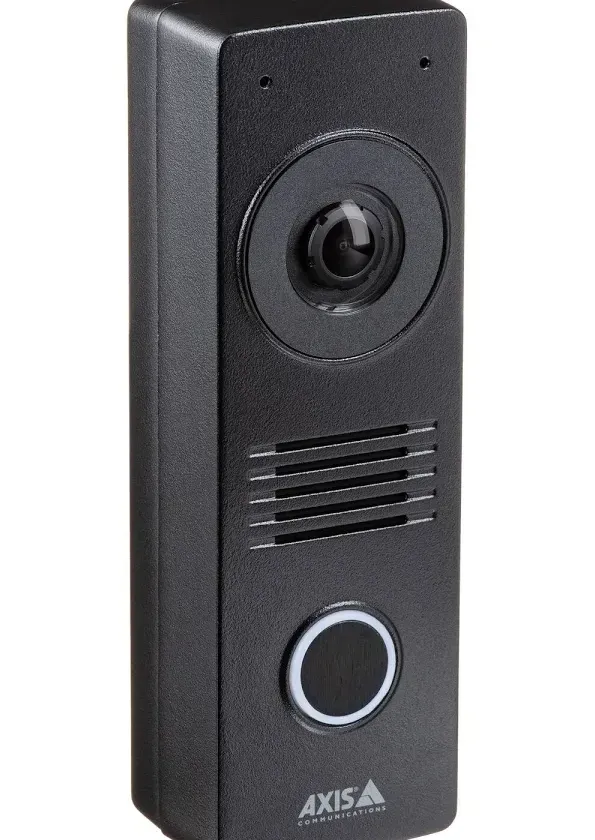
A photo from the AESS job library, not taken in East New York: a black rectangular video door station with a camera lens, a speaker grille and a single round call button that lights up. A one-button station like this suits the one- and two-household houses that fill many East New York blocks, where the visitor has to find the button after dark and the family inside wants to see and hear who is at the door before pressing release.
East New York Buzzer Request
Rowhouse, two- to four-family, walk-up, new building or business door: tell us the street, how many households the system must reach and what is at the door now, and a technician calls back
✅
Request Sent!
Thank you. A technician will call you about the East New York address, usually within two hours during working hours.
25+
Years Experience
✓
Same-Day Estimates
100%
Licensed & Insured
4.7★
201 Google Reviews
Owner-operated since 2002 · Thousands of jobs completed · Booked within 2 hours
Quick answer: door buzzer installation in East New York is priced per job, after we have seen the building, because the number of households, the condition of the street door and the state of the old cable decide the total far more than the brand on the panel. A typical job here covers a door station with a button for each household, a station in each apartment (or phone answering where it is wanted), an electric release cut into the street door's frame and a battery-backed power supply, installed and tested from the sidewalk to every floor. Send photos of the street door, the bell plate and the cellar to (347) 934-8335 or on WhatsApp, and a technician calls back, usually within two hours during working hours, to book the walkthrough and explain what will drive your price.
The written price comes before any equipment is ordered, and anything that depends on a test, such as whether an old riser pair can be reused, is named on the quote in advance so nothing new appears on installation day.
All work is done under New York State license #12000287431, by a company owner-operated since 2002.
We work for whoever controls the door: an owner living on the first floor, a family that holds a few houses, a managing agent, a condo or co-op board, a developer, or a store owner with the landlord's written approval.
The Neighborhood
Why East New York Properties Need Door Buzzer Installation
East New York fills the far eastern edge of Brooklyn, from the cemetery belt and the Queens line in the north down to Jamaica Bay in the south, with the subway's Canarsie line, the Bay Ridge Branch and Van Sinderen Avenue along its western side. It covers ZIP codes 11207, 11208 and 11239, sits inside Brooklyn Community District 5 and is policed by the 75th Precinct. Wikipedia describes its housing as "primarily semi-detached homes, two-to-four family houses, and multi-unit apartment buildings, including condominiums and co-ops," and illustrates the article with a photo captioned "Typical multi-unit semi-detached rowhouses in East New York." That one caption describes most of the front doors we are asked to work on here.
A semi-detached two- or three-family house has one shared street door, a hall or stair behind it, and two to four households who each receive visitors, deliveries and home-health aides. Many of these houses never had a proper talking system. They have a row of bell buttons and a chime, a handset in the first-floor hall that stopped talking years ago, or nothing but a knock and a walk down the stairs. The owner often lives on the first floor and ends up answering the door for everyone. A first real buzzer, with its own button and station for each household, is the commonest job we do in buildings like these.
The second group is the older walk-ups on and near the avenues: brick apartment buildings with a street door, a vestibule of mailboxes and a stair running up four or five floors, often with stores below. These buildings usually have an entry system of some age, and it is usually the cable between the cellar and the floors, not the panel at the door, that keeps failing. The third group is the large new buildings that followed the 2016 rezoning, which came with modern entry systems and bring their own questions about networks, subscriptions and directories for hundreds of households.
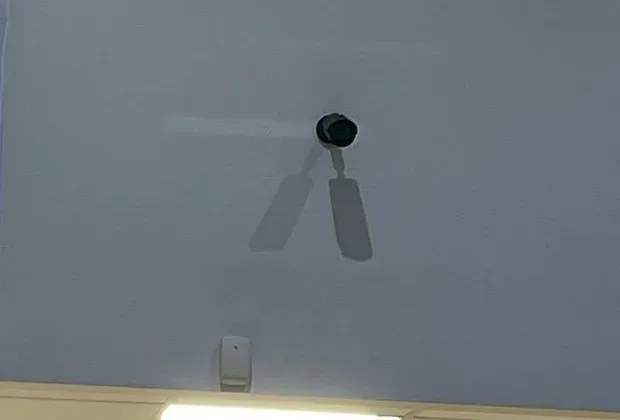
A photo from the AESS job library, not taken in East New York: a small black camera mounted high on a pale wall, with a small white device below it. Inside the vestibule of an East New York walk-up, a camera placed high like this records who actually stepped through the street door after a resident pressed release, which a talk-only buzzer can never tell an owner.
There is also a fourth group that we describe on this page but do not install for privately: the public housing developments. Louis Heaton Pink Houses on Linden Boulevard alone has 22 eight-story buildings with about 1,500 apartments and more than 3,000 residents, and Linden Houses has about 1,586 apartments. Their entry systems belong to the New York City Housing Authority or, where a development has moved into the PACT program, to the private partner that now manages it. Residents there report a dead intercom to NYCHA or to that manager, not to an outside installer. We explain how that works further down, because it is the first question many East New York residents have.
Whatever the building, a buzzer only works as well as the door it releases. A door that drifts open, a latch that misses its keeper, a frame chewed up by pried locks or a closer set so hard that a visitor cannot push the door after being buzzed in will defeat any panel. That is why every East New York job we plan starts at the street door and only then moves to the electronics, and why most of our quotes include a line for door hardware before they include a line for a screen.
Six facts that shape an East New York buzzer installation
Small shared houses dominate. Wikipedia lists semi-detached homes and two- to four-family houses first among the neighborhood's housing types, and Linden Boulevard, Pennsylvania Avenue and Atlantic Avenue as its main thoroughfares.
The law starts at eight apartments. NYC Administrative Code §25-151 requires self-closing, self-locking entrance doors and an intercom at the main entrance of class A multiple dwellings built or converted after January 1, 1968 with eight or more apartments. A two- to four-family house installs one by choice.
Older buildings follow the tenants. For buildings put up before 1968, doors, locks and an intercom are required when a majority of the tenants request or consent in writing, and Multiple Dwelling Law §50-a lets the owner recover the cost from the tenants.
Doors are inspected without a complaint. HPD picks 300 buildings a year for self-closing door inspections and reported 2,937 self-closing door violations citywide in its fiscal year 2025 program report; owners now get 14 days rather than 21 to correct one.
The new buildings are big. Since the City Council approved the East New York Neighborhood Plan on April 20, 2016, buildings such as 2683 Atlantic Avenue (13 stories, 229 apartments) and The Highland at 268 Barbey Street (14 stories, 320 apartments) have gone up, and the Department of City Planning counts nearly 6,000 new units, more than 60 percent of them affordable.
Buzzer wiring itself needs no electrical permit. Under Administrative Code §28-105.4.7, as updated by Local Law 128 of 2024 effective December 21, 2025, wiring under 50 volts for signaling and communication needs no electrical permit when done by a licensed or qualified person; connections to power circuits are an exception.
Where this page applies. We use East New York for the blocks in ZIP codes 11207, 11208 and 11239, from Broadway Junction and the industrial park in the north down past Linden Boulevard to the Spring Creek and Gateway Center area by the bay. Several of the neighborhood's own sections have their own pages: see our Cypress Hills door buzzer installation, New Lots, City Line, Spring Creek and Starrett City pages. For the whole borough see our door buzzer installation in Brooklyn page.
Install or Repair in East New York
Need Repair in East New York? How We Decide Between Fixing One Part and Installing a New System
A lot of installation calls from East New York start out as repair calls. The upstairs tenant has stopped hearing the bell, the release clicks but the door does not open, or one apartment's handset hums all day. Sometimes a single part is the whole story: a transformer in the cellar that has burned out, a strike whose screws have pulled out of a soft wood frame, a handset cord cut by a moving dolly, a button contact gone green with corrosion. Those are repairs, and we price them as repairs.
It stops being a repair when the faults move around. If one floor fails this month and another next month, if the talk works but the release does not, or if the old system is so old that every replacement part comes from a different maker, the trouble is usually the cable between the cellar and the floors or the age of the system itself. Each patch then costs a visit and lasts a season. Metering every pair tells us which situation you are in. If the cable tests sound, a new door station and power supply on the old pairs may be all you need; if it does not, a new system on new cable ends the cycle.
We say which it is in plain words, and if one part is all your building needs, our Brooklyn door buzzer team will price it that way. One Brooklyn customer on Yelp objected to an installer "disconnecting, dismantling and throwing out a perfectly working exterior intercom panel." We would rather leave a working part on the wall and tell you so than replace something that still does its job.
What We Install
Door Buzzer Installation Services in East New York
Every service below is quoted per building after the walkthrough. In East New York the number of households sets the size of the system, the street door decides what kind of release it can take, and the walls and the cellar decide most of the labor. A frame partition lets cable climb in an afternoon; a brick walk-up or a solid stoop needs a route planned floor by floor.
First buzzers for two- to four-family houses
A door station with one button per household, a station in each apartment and an electric release in the street door frame, for the semi-detached and attached houses that have only ever had a chime or a knock.
Talk-back added to bells and a release
For houses where residents can buzz the door open but cannot speak to the person outside, we add voice, and video where it is wanted, and keep any release that already tests well.
Replacement systems for older walk-ups
New door panels, apartment stations and power for walk-ups whose old system fails floor by floor, on riser pairs that meter sound or on new cable where they do not.
Street door releases, closers and latches
Fail-secure electric strikes cut into sound frames, closers set so the door shuts every time without fighting the visitor, and latch work on frames worn down by years of use.
Residents' doors beside storefronts
A separate panel, release and power supply for the apartments' door next to a store on Pitkin, Liberty, Fulton or Atlantic, kept apart from the store's own door and alarm.
Side, yard and cellar doors
Second entrances off driveways and yards, brought onto the system with their own release or set to lock and stay locked from outside, so the front door is not undone by the back.
Phone answering for owners who live elsewhere
Door stations that ring owners' and residents' phones as well as, or instead of, a station on the wall, useful for families who own a house here and live in another borough.
Entry systems for new and larger buildings
Directory or code panels, apartment stations and network connections for the bigger buildings on the rezoned corridors, planned with the developer before the walls close where we can.
Buzz-in doors for shops, offices and yards
Release buttons at the counter or desk for stores, clinics and offices on the avenues, and call boxes at the pedestrian gates of businesses in the East Brooklyn Industrial Park.
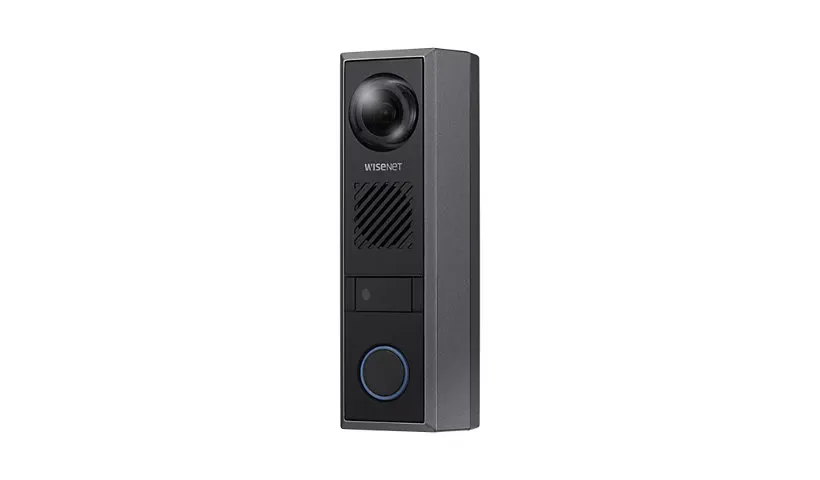
A photo from the AESS job library, not taken in East New York: a slim dark grey wired doorbell with a camera lens, speaker slots and a round push button. On the narrow door casings of many East New York semi-detached houses a slim wired unit like this fits where a wide panel would not, and because it is wired it never needs its battery changed on a cold front step.
Building Specialists
Door Buzzer Installation for East New York's Architecture
Six kinds of entrance account for nearly every door buzzer request we get from East New York. They differ in exactly the things that decide a buzzer job: how many households share the door, what the walls are made of, where the cellar is and who can reach it, and what the street door looks like after decades of use.
Semi-detached multi-family houses
Pairs of houses sharing one side wall, each with its own front door, stoop or porch and two to four households behind it, often with the owner on the first floor and the bell wiring running from a cellar under the front.
Attached rowhouses in long blocks
Rows of nearly identical houses where every door looks like the next one, which makes clear house numbers on the station and the right mounting height matter as much as the electronics.
Owner-occupied single-family homes
Houses built for one family, including the Nehemiah homes, with full basements and front doors close to the sidewalk, where the job is usually one station, a release and an answering point on each floor.
Older brick walk-ups
Apartment buildings of four to six floors with a vestibule, mailboxes and a stair, usually with an aging system on riser cable that runs up a stair hall or a closet stack.
Mixed-use buildings on the avenues
A store on the ground floor and apartments above, with a narrow residents' door squeezed between shop windows and a cellar that the store often uses for stock.
Rezoning-era mid-rises
New buildings of ten to fifteen stories with lobbies, package rooms, elevators and hundreds of households, where the entry system is a networked product chosen early in construction.
Semi-detached houses: one shared wall, one door and a cellar that holds the answers
In a semi-detached house the cellar is usually where the job is decided. The old bell transformer is screwed to a joist somewhere near the front, the bell wire leaves it in a bundle with phone and cable television lines, and each pair climbs to a floor through a partition, a closet or the stair wall. If those pairs meter sound from the cellar to each floor, a new system can often use them. If they do not, the new cable route stays inside your half of the pair, never through the shared wall, so nothing has to be opened on the neighbor's side.
The door station goes on the casing or a solid backing beside your own door, with your house number clearly marked, because in a semi-detached pair the two front doors are often only a few feet apart and visitors look at the nearer one first. Where the house has a porch, the station is mounted where a visitor actually stands, not hidden behind a storm door or a column.
Most of these houses hold two or three households. That means two or three buttons, two or three stations, and one release that every household can operate. Where the owner wants to know when the door has been released for a tenant's visitor, some systems can show that on the owner's station; we price it as an option rather than assuming it.
Attached rowhouses in long blocks: make the right door easy to find
East New York has long blocks where house after house shares the same front, the same stoop and the same door. On blocks like that, the most common complaint is not a broken buzzer but a visitor at the wrong house. A lit button, a house number printed on or beside the station, and a station mounted at the same height a visitor's eye lands on all help. Where a block has iron gates in front of the stoops, the station sometimes belongs on the gate pier, so the visitor never has to open a stranger's gate to ring.
Behind the facade, rowhouses vary. Some have frame partitions that make cable runs quick; others were rebuilt with masonry or have finished basements where the old route has been closed in. The walkthrough answers that, house by house, rather than assuming every house on the block is the same inside because it is the same outside.
Owner-occupied single-family homes: one door, several floors
For a house with one family, the buzzer question is usually about hearing the door. A chime in the front hall is easy to miss from a basement den, a back kitchen or a bedroom two floors up. A door station with an answering point on each floor you actually use, or a station that also rings the family's phones, lets the person nearest a station answer and release the door without running to it.
The Nehemiah homes were built with full basements and front doors close to the street, and the later Nehemiah Spring Creek townhouses were built from factory-made steel modules with fiber cement siding and concrete floors. In houses of the second kind, the cable route and the fastening for the door station are planned around the steel frame rather than cutting into it; in both kinds, the basement is usually where the power supply belongs.
Older brick walk-ups: the riser decides the price
In a brick walk-up the old intercom cable usually climbs through one route: a stair-hall chase, a stack of closets or a run of surface conduit along the hall walls. That riser is the most valuable thing in the building for a buzzer job. If its pairs meter sound from the cellar to every apartment, a new system can use them, and the work stays in the cellar, the vestibule and inside each apartment's station location. If they do not, new cable has to find a path, and in solid brick that path is planned with the owner floor by floor.
Many of these buildings also have a vestibule with mailboxes and an inner door into the stair. Under §25-151, where the inner door from the vestibule is self-closing and self-locking, that is the door the release belongs on, which keeps the mailboxes reachable for the carrier in the outer vestibule. Where the building has fewer than eight apartments, we still follow the same logic, because it is the sensible arrangement for any small lobby.
Mixed-use buildings on the avenues: two doors, two systems
On Pitkin, Liberty, Fulton and Atlantic, apartments above stores are reached through a narrow residents' door beside the shop. That door gets its own panel, its own release and its own power supply, separate from anything the store uses. A store that changes tenants, closes for renovation or loses power to its own circuits should never leave the apartments without a working door. The panel has to sit where a roll-down gate, a sign or a sidewalk display cannot cover it, and the cable to the apartments usually climbs the residential stair rather than passing through the store.
Rezoning-era mid-rises: chosen early, managed for years
Brownstoner reported that 2683 Atlantic Avenue, a 13-story building with 229 apartments, replaced a row of small mixed-use buildings, and that The Highland at 268 Barbey Street has 14 stories and 320 apartments beside the landmarked Empire State Dairy. Buildings at that scale take a lobby panel with a scrolling directory or code entry, often phone or app answering, a package room door, a garage or service door and an elevator lobby. The most useful thing we can do there is be brought in while the drawings are still open, so the riser, the network room, the power for every door and the panel location are decided before the finishes go up.
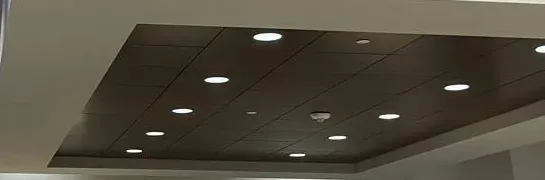
A photo from the AESS job library, not taken in East New York: a dark recessed ceiling panel with round downlights and a small round device set into it, framed by a lighter ceiling. In the lobby of one of the new buildings on Atlantic Avenue, a ceiling like this is where cable runs between the entry panel and the network room, and planning that route before the ceiling closes costs far less than fishing it afterward.
Field Notes
Field Notes: What Our Technician Writes Down at an East New York House Before Recommending Any Panel
The first visit to an East New York two- or three-family house follows the same order every time, and it is written down as it goes, because the notes become the quote.
Who comes to which door. The technician asks the owner who receives visitors, who gets deliveries, who has home-health aides or relatives with keys, and which doors those people actually use. A house listed as a two-family may have a third household in a finished basement or a grown child on the top floor who wants their own button. Every household that receives visitors gets a button.
The door, opened and released. The street door is opened all the way and let go. It should close by itself, latch on the first try and stay latched when pushed from outside. Then the side door and any gate. Anything that fails gets a line on the notes before any electronics are discussed.
The cellar, traced and metered. The old transformer is found, the bell pairs are separated from the phone and cable lines, and each pair is metered to its floor. A pair that tests sound is marked to be kept; one that fails is marked for new cable, and the route for it is chosen on the spot.
Where each station goes. The technician stands in each apartment where the household spends its time and asks where they would want to answer. Kitchens and hallways near the apartment door are the usual answers, but the choice is the household's.
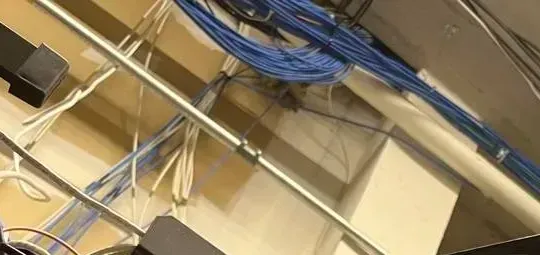
A photo from the AESS job library, not taken in East New York: bundles of blue low-voltage cable laid over a ceiling beam beside a metal pipe in an open ceiling. The cellar ceiling of an East New York semi-detached house is often where the old bell wire, phone lines and cable television runs all cross, which is why each pair is traced and metered before any of it is trusted.
Rules and Responsibilities
Which East New York Buildings Must Have a Buzzer, and What the City Expects of the Door
The rules that apply to a door buzzer in New York City come from a handful of sources, and they are often summarized wrongly online. Here is what the texts themselves say, as they apply to the kinds of buildings found in East New York.
Eight or more apartments, built or converted after 1968. Administrative Code §25-151(d) requires every street, court, yard or cellar entrance to a class A multiple dwelling erected or converted after January 1, 1968 with eight or more apartments to have self-closing, self-locking doors, and an intercommunication system at the main entrance. Some websites say "more than eight"; the text says eight or more, and that is the number we work from.
Older buildings, when the tenants ask. For buildings put up before 1968, door locks and an intercom are required when a majority of the tenants request or consent in writing, and Multiple Dwelling Law §50-a allows the owner to recover the cost from the tenants. Many of the older walk-ups on the avenues fall into this group.
The legal minimum is modest. The rule accepts a bell or buzzer, or a talk-and-listen device, for each apartment, together with a return buzzer that releases the door lock. Talk-back and video are what residents usually ask for, not what the rule demands.
A system that exists must work. A broken intercom is treated as a class B hazardous violation, enforced by HPD when a tenant complains. A building of fewer than eight apartments that has chosen to install a buzzer can still be cited when it stops working.
Self-closing doors are checked on HPD's own schedule. HPD selects 300 buildings a year for self-closing door inspections, and its fiscal year 2025 report counted 2,937 self-closing door violations citywide. Owners now have 14 days, down from 21, to correct a door written up under that program. A release must never stop a door from closing on its own.
Two- to four-family houses install by choice. Most East New York houses are far below the eight-apartment line. A first buzzer there is something owners and tenants want, not something a rule forces, but once it is in it should be kept working.
Smart entry carries privacy rules. HPD's Tenant Data Privacy Law page describes limits on owners who use smart access systems: consent, collecting the minimum data, destroying data within 90 days, no tracking of tenants outside the building, and no requirement that tenants use smart access to get into their own apartment. We set app-based systems up with those limits in mind.
Permits, power and who does what
Buzzer and intercom cable is low-voltage signaling and communication wiring. Administrative Code §28-105.4.7, as updated by Local Law 128 of 2024, which took effect on December 21, 2025, says no electrical permit is needed for wiring under 50 volts for signaling, communication, alarm and data when it is done by a licensed master electrician, a special electrician or a qualified person. The exceptions are life safety systems, hazardous locations and connections to power circuits. One guide we read still says all low-voltage work needs a Buildings Department permit; that reads as out of date against the current code text.
The power side is different. Where a new power supply needs a new 120-volt outlet, or a magnetic lock has to be tied into a building's fire alarm, that connection is electrical work, and we say on the quote who will do it and whether a permit applies. Most strikes and door stations in East New York houses run from a plug-in or existing-outlet power supply in the cellar, but we never assume that until we have seen the cellar.
Landmarks
The Landmarks Preservation Commission's rules mention intercom panels among equipment "common for security," and its Permit Guidebook has a section on installing light fixtures and intercom panels. Any work on an individual landmark or a building in a historic district needs an LPC permit first. East New York has individual landmarks such as the Empire State Dairy buildings and the New Lots Reformed Church; most of its houses are not landmarked, but if yours is, the panel's size, finish and position are decided with the Commission's rules in hand before anything is ordered.
None of this is legal advice for a particular building. HPD, the Buildings Department, the Landmarks Preservation Commission or your own lawyer can say exactly which rules apply to yours. What we do is install a system that meets those rules where they apply and leave written proof of what was installed and tested.
The Door Comes First
An East New York Street Door Has to Shut, Latch and Open From Inside Before It Gets a Release
An entry system has two halves. One is electronic: the panel, the stations, the cable and the power. The other is mechanical: the door, its hinges, its closer, its latch and the release cut into its frame. Owners shop for the first half, but most of the trouble we see at East New York street doors is in the second.
What we check on every door
The door must swing freely, close fully from any position, latch without help and stay latched when someone pushes or pulls from outside. If the closer is worn, set too weak or set so hard that a visitor cannot push the door after being buzzed in, it is adjusted or replaced. If the latch misses its keeper because the door has dropped on its hinges, the hinges are tightened or the door is rehung. If the wood around the old keeper has been chewed up by pried locks and replaced strikes, a reinforcing plate or a frame repair comes first. Only then does the release go in.
The door must also open from inside without a key. The city's rule for self-locking entrance doors requires that, and it is plain common sense in a house with children or older relatives. With an electric strike, the lever or knob on the inside always opens the door, whatever the release is doing.
Why we use fail-secure strikes on street doors
Allegion's guide explains the two kinds of electrified hardware simply: fail-safe products are unlocked when power is removed, and fail-secure products are locked when power is removed. With an electric strike, a person inside can always leave by turning the lever, whichever type it is. A fail-secure strike keeps the house locked during a power cut while never trapping anyone inside. NYCHA's own Layered Access Control guidelines call for electric strikes configured fail-secure, and that is the setting we use on residential street doors here too.
Magnetic locks are a different matter. Allegion notes that electromagnetic locks are only available fail-safe, which means they let go when the power goes, and on doors that are part of an exit route they need a release sequence that meets the building code. We only suggest one where a door cannot take a strike, and when we do, the quote says what else has to come with it.
Side doors, yard doors and gates
A front door that locks behind every visitor protects nothing if the side door off the driveway is left on the latch. For buildings of eight or more apartments, §25-151 covers every entrance from the street, court, yard or cellar. For a two-family house it is not required, but the logic is the same. Most second doors do not need a panel; they need a closer, a lock that works from inside without a key, and sometimes a keypad for the household that uses that door every day. We price them on the same quote so the whole house closes together.
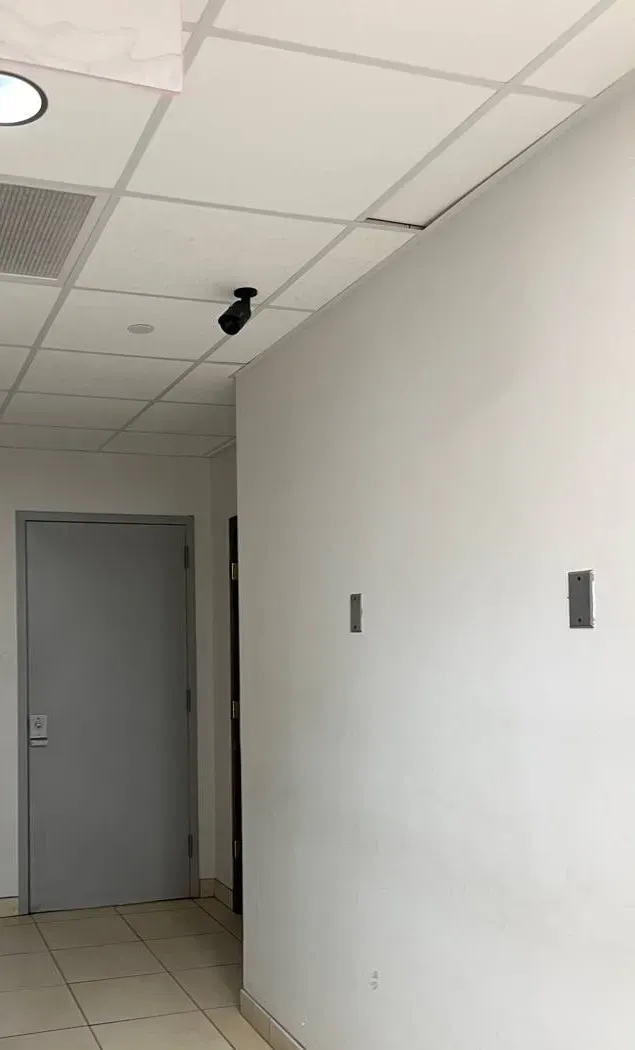
A photo from the AESS job library, not taken in East New York: a tiled corridor with white walls and small wall plates leading to a grey steel door with a lever handle, under a drop ceiling with a small camera. The lever on the inside of a door like this is what lets anyone leave without a key, which is what the city's rule asks of a self-locking entrance door and what we keep on every East New York door we fit with a release.
Public Housing and PACT
NYCHA and PACT Buildings in East New York: Who Fixes the Intercom, and What Private Owners Can Learn From It
East New York has a large share of Brooklyn's public housing. Wikipedia lists Cypress Hills Houses, East New York City Line, Long Island Baptist Houses, Louis Heaton Pink Houses, Unity Plaza and Vandalia Avenue among its NYCHA developments, and Boulevard Houses, Belmont-Sutter Area, Fiorentino Plaza, Linden Houses and Pennsylvania Avenue-Wortman Avenue among those converted under PACT, the program that moves management of a development to a private partner. Urban Omnibus reported in 2025 that Linden Houses entered PACT in 2021 and is being rehabilitated in the same project as Penn-Wortman across Vermont Street.
If you live in one of those developments and the intercom is dead, the fix comes from the housing authority or its partner, not from a private installer you hire. NYCHA's 2024 resident handbook tells residents to report a broken intercom through the MyNYCHA app or NYCHA's Customer Contact Center. In PACT developments, the partner's management office takes those reports. When News 12 covered a Boulevard Houses resident's complaint in January 2025 that the entrance door lock did not work and the intercom was out, NYCHA said it was working with the Boulevard Houses PACT partner team. That is the route: report it, keep the ticket number, and follow up with the manager.
What private owners can take from NYCHA is its specification. Its Layered Access Control program pairs key fobs with a direct-call intercom and new door locks. Its guidelines allow the intercom's phone connection to be a traditional line, VoIP or IP, ask for a dedicated 120-volt outlet within six feet of a new interior intercom, and set electric strikes to fail-secure. Its December 2025 intercom specification lets up to eight telephone entry modules share one phone line. And the intercoms it has been installing ring directly on the resident's own phone, landline or mobile. None of that is a rule for a private two-family, but it is a sensible benchmark: a door that stays locked when the power goes, power that does not depend on a tenant's outlet, and a call that reaches residents whatever kind of phone they have.
Where we can help in this part of the neighborhood is for the contractors and partners who do work on these buildings, for privately owned buildings next door to them, and for the many residents who move from public housing into houses of their own and ask us what the door should do.
New Buildings
Entry Systems for the Buildings the 2016 Rezoning Brought to Atlantic Avenue, Fulton Street and Broadway Junction
The East New York Neighborhood Plan, approved with modifications by the City Council on April 20, 2016, was the first rezoning under the city's Mandatory Inclusionary Housing rules, which apply to new buildings with more than ten units. It aimed new housing at Atlantic Avenue, Fulton Street, Pitkin Avenue and the area around Broadway Junction. The buildings that followed are the opposite of the neighborhood's two-family houses: hundreds of households behind one lobby.
Gothamist has written about Chestnut Commons, a 275-apartment affordable complex on Atlantic Avenue. Brownstoner reported on 2683 Atlantic Avenue, 13 stories and 229 units at New Jersey Avenue; on The Highland at 268 Barbey Street, 14 stories and 320 units attached to the landmarked Empire State Dairy; and on Innovative Urban Village at 30 Inspiration Lane near Flatlands and Pennsylvania Avenues, whose first phase has 15 stories and 386 units, with part of the building set aside for households receiving supportive services and for survivors of domestic violence, and 1,975 apartments in 11 buildings planned in all. At Broadway Junction, 6sqft reported that the Herkimer-Williams plan, approved by the Council in December 2025, has four buildings on four blocks with housing, retail, community space and open space, and could bring 1,000 affordable homes. None of that reporting describes the buildings' entry hardware, so we do not claim to know what any of them use.
What a large East New York building's entry system has to do
Find the right household quickly. A directory or code panel that a visitor can search in seconds, with names or unit numbers as the owner and residents choose.
Reach residents however they answer. Stations in the apartments, phone answering, or both, so residents without smartphones are never left out.
Keep working when the internet does not. Where a panel depends on the network, a plan for when the connection drops, whether a backup cellular link or local release that does not need the cloud.
Separate the doors. Residential lobby, package room, garage, retail and community spaces each get the access they need and no more.
Stay in the owner's hands. Administrator logins, wiring records and the service relationship belong to the building, not to whoever installed it.
The City Council's East New York plan page lists city funding for broadband conduit along Atlantic Avenue. That is a useful sign for networked entry panels on the avenue, but conduit in the street is not service in your building. Before a cloud panel is chosen, the building's actual internet connection at the door and in the network room has to be confirmed, and that is part of our planning on any new building.
Commercial Door Buzzer Installation
Business Door Buzzer Installation in East New York
Most business doors in East New York fall into two groups: storefronts on the avenues, many with apartments above them, and the shops, yards and offices of the East Brooklyn Industrial Park. The first group is planned together with the residents' door next to it; the second is planned around long distances, heavy doors and staff who arrive before anyone is at a desk.
Atlantic Avenue frontage
The 120-foot-wide avenue that carries much of the rezoning's new housing, with ground-floor retail in the new buildings and older mixed-use rows between them. Shops want buzz-in stockroom doors kept clear of the residential lobby.
Pitkin Avenue shops
One of the corridors the city's commercial district assessment names, lined with beauty supply stores, clothing shops and services, most of them under apartments whose residents use a narrow door between the windows.
Liberty Avenue storefronts
The other corridor named in that assessment, with corner stores and small businesses whose back and side doors take deliveries and whose apartments above need their own panel.
Fulton Street near Broadway Junction
Shops along the corridor the rezoning targeted near the transit hub, where new mixed-use buildings and older ones sit side by side.
Pennsylvania Avenue and Linden Boulevard
Two of the neighborhood's main thoroughfares, with offices, clinics and pharmacies that want a release at the front desk and the door locked behind every visitor.
The East Brooklyn Industrial Park
Steel and iron works, precast, auto shops, bus and carting companies, recycling, self-storage and warehouses between Atlantic and Sutter Avenues, with pedestrian gates and office doors that need a call box someone actually answers.
The industrial park is a real business district, not a handful of shops. City Limits reported that the East Brooklyn Business Improvement District counted 6,265 employees at more than 100 businesses in 2019, and that the area includes Belmont Metals, in business for 125 years, school bus companies with large lots and at least six storage warehouses. The BID's own directory lists steel and iron works, precast, auto shops, a bus company, carting, recycling, self-storage, pharmacies, check cashing and delis. For a door buzzer that means three common jobs: a pedestrian gate call box that reaches the dispatch office, an office door that drivers and vendors ring from outside, and a buzz-in door at a counter.
On the avenues the commonest business request is a shop or office that wants to see who is outside before letting them in, with the release at the counter. The second is a delivery door at the side or back, answered from inside so nobody has to leave the register. Both are usually single-door jobs, and both are kept separate from the apartments' system so a driver buzzed into a stockroom never ends up in the residential stair. Stores that are thinking about keeping the front door locked and buzzing customers in should talk to us before choosing, because the right release and the right camera position depend on how the store's floor is laid out.
Rules that apply to business entry installations in East New York
Anyone inside can always get out. A business door with a buzzer, code or reader still opens from inside with one motion and no key. With an electric strike, the lever or push bar works whatever the release is doing.
Controls within reach. The 2010 ADA Standards set the high forward reach for operable parts at 48 inches maximum and the low forward reach at 15 inches minimum, so a customer's call button and a receptionist's release go inside that range where the business serves the public.
Tenants need the landlord's approval in writing. A shop or office that rents its space orders its own buzzer only with the building owner's written permission, and its cable stays clear of the residents' system.
Magnetic locks bring more requirements. Where a door cannot take a strike, a magnetic lock needs the release devices, signage and, where the building has one, the fire alarm connection the building code requires, and the power connection may be electrical work. The quote says so before anyone chooses it.
Low-voltage cable, licensed work. Signaling and communication wiring under 50 volts needs no electrical permit under §28-105.4.7 when done by a licensed or qualified person; we do it under NYS license #12000287431.
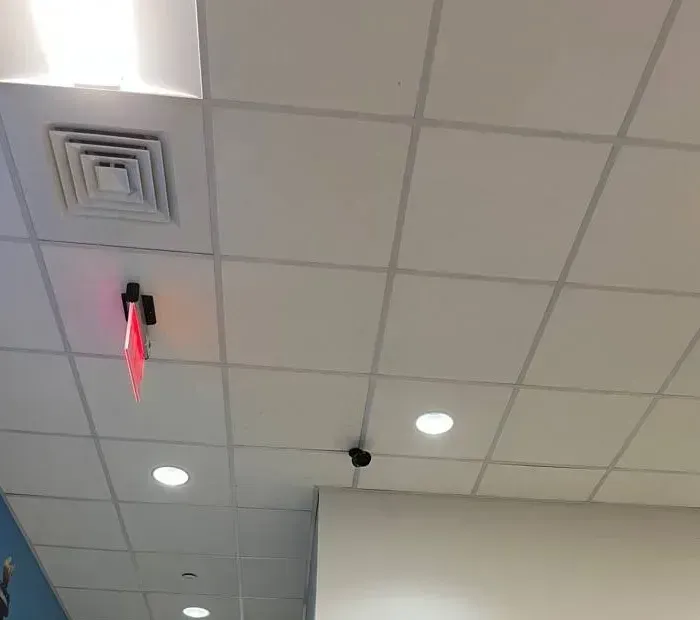
A photo from the AESS job library, not taken in East New York: a drop ceiling with a lit red exit sign, an air diffuser, round recessed lights and a small black camera. In a clinic on Pennsylvania Avenue or an office in the industrial park, the exit sign marks a door that must always open from inside, so any buzzer release fitted to it is chosen to lock out visitors without ever locking people in.
Your Questions Answered
Door Buzzer Installation in East New York: Questions Answered
Two- to four-family houses and their old wiring
An old repairman called the wiring in our two-family's cellar a "4 + 1" system. What does that tell you before anything is opened?
It tells us how the old system was built. In a classic "4 + 1" door phone, four wires are shared across the system for power, communication and the door release, and one more wire runs to each apartment so that apartment's handset can talk to the door. In a two-family that means a bundle of shared wires plus one dedicated wire per household, usually meeting at a terminal strip near the old transformer in the cellar.
That is useful, because it means there may already be several conductors running to each floor. Some modern two-wire systems can run over a sound pair taken from that bundle, which can save opening walls. Whether yours can is a question for the meter, not the label: we test each conductor from the cellar to each apartment for breaks, shorts and leakage, and only the pairs that pass are kept.
If the old bundle fails, the "4 + 1" layout still helps: it shows us the route the original installer used, and new cable can often follow the same path through the house.
Could someone unscrew the door station on our stoop, touch two wires together and open the street door?
On a properly installed system, no. The weakness you are describing exists when the wires that drive the release run straight through the outdoor panel, so that anyone who pries the panel off can reach them. That happens in some old installations and in some quick ones. On our installations, the release is driven from the power supply or a controller indoors, in the cellar or a locked closet, and the panel outside only sends a signal.
We also fasten the panel with tamper-resistant screws into solid backing, bring its cable in through the wall behind it rather than along the surface, and fit a fail-secure strike, so a cut wire or a dead power supply leaves the door locked rather than open. If your current panel has loose wiring visible behind it, send us a photo; it is one of the first things we look at.
Before you take anything out of our house, how will we know which old parts still work?
Because we test them in front of you and write the results down. On the walkthrough the technician tries every button, every handset and the release, meters the pairs, and notes which parts work, which work badly and which are dead. The quote then lists what stays, what is replaced and why. Nothing that works is thrown out without the owner agreeing to it in writing.
Sometimes a working part still has to go, for example when an old outdoor panel cannot talk to the new apartment stations. When that happens the quote says so plainly. And if you want the old panel or handsets left with you rather than taken away, they are left with you.
Older walk-ups and buildings with several entrances
Our co-op has four street entrances, each with its own call panel. Does every telephone-entry panel need a phone line of its own?
Not necessarily. Some telephone-entry systems let several entry panels share one line, and NYCHA's December 2025 intercom specification allows up to eight telephone entry modules on a single phone line. When two visitors call at once on a shared line, one call has to wait, so the right number of lines depends on how busy the entrances are, not only on how many there are.
For a building with four entrances, the usual choices are one shared line with the entrances taking turns, one line per busy entrance, or a networked or cellular connection instead of a phone line. We look at which entrances residents and visitors really use, at what time of day, and price the options side by side so the board can choose.
If our building gives up the copper phone line the entry panel dials out on, what can the panel use instead?
There are three usual paths. The first is a VoIP line, which some panels accept in place of a traditional line, often through an adapter. The second is a network connection, where the panel calls residents over the internet. The third is a cellular connection built into the panel or added to it, which needs no wiring to the street at all. NYCHA's own access guidelines allow the intercom's line to be a traditional line, VoIP or IP, which shows how common the change has become.
Which suits your building depends on the panel you already have, whether there is reliable internet where the panel's equipment lives, and whether the building wants to avoid a monthly line or service charge. Some older panels cannot make the change and are better replaced. We check the model on the walkthrough and tell you which path it can take.
New buildings on the rezoned corridors
The city funded broadband conduit along Atlantic Avenue. Can our new building on the avenue count on that for a cloud-based intercom?
Count on it only after you have confirmed service at your own building. The City Council's East New York plan lists funding for broadband conduit along Atlantic Avenue, which makes fiber service more likely on the avenue, but conduit under the street is not a connection in your network room, and a cloud intercom needs a working connection at the panel every hour of every day.
For a new building we ask the developer which provider is serving the building and when, where the network room is, and how the entry panel will reach it. We also plan what happens if that connection drops: a cellular backup, local release that does not depend on the cloud, or stations in the apartments that keep working on their own. A panel that strands visitors when the internet is down is not acceptable for hundreds of households.
Does the Mandatory Inclusionary Housing rule say anything about the entry system in our new building?
No. Mandatory Inclusionary Housing, which applied to new buildings of more than ten units in the 2016 East New York rezoning, is a zoning rule about how many apartments are affordable and at what incomes. It does not set out what goes on the front door. The entrance rules come from Administrative Code §25-151 and the Multiple Dwelling Law: for a class A multiple dwelling erected after January 1, 1968 with eight or more apartments, self-closing, self-locking entrance doors and an intercom at the main entrance.
In practice, every household in the building, whether its apartment was leased through the housing lottery or at market rent, should get the same station and the same way of answering. We set systems up that way as a matter of course.
Some apartments in our new building house people who need to stay hard to find. Can a unit be left off the lobby directory entirely while visitors can still reach it?
Yes, on most directory and code panels. A unit can be hidden from the scrolling directory so a stranger browsing the panel sees no listing for it, while a visitor who has been given a code can still call that apartment directly. In a building with a staffed desk, calls for those units can go to the desk first, so staff decide whether to connect the visitor.
Brownstoner reported that part of the first phase at 30 Inspiration Lane is set aside for supportive-services households and survivors of domestic violence, which is exactly the situation where this matters. The decision about which units are hidden and how calls are screened belongs to the building's operator and the residents, not to us; we set the panel up the way they decide and leave a written record of the settings.
Public housing and the transfer to private managers
Our NYCHA development is moving to a private PACT manager. While the handover happens, who answers for a dead intercom at our building door?
Until the partner formally takes over, NYCHA does; after that, the PACT partner's management office does. NYCHA's resident handbook directs residents to report a broken intercom through MyNYCHA or NYCHA's Customer Contact Center, and in developments already converted, the partner's office takes repair requests. When a Boulevard Houses resident complained to News 12 in January 2025 about a broken entrance lock and intercom, NYCHA said it was working with the PACT partner team, which is how a report made during or after the transfer gets handled.
The practical advice is to report every outage, keep the ticket or work order number, and raise unresolved ones at the development's resident meetings. A private installer hired by a resident cannot work on a development's entry system; that work is done under the housing authority's or the partner's contracts.
Placement on crowded fronts and in business yards
The gas meter and the electric meter sit right beside our front door. Does that get in the way of the door station?
It can decide where the station goes. We do not mount a door station on a meter board, on a meter's enclosure or anywhere that blocks the utility's access to read or service the meters, and we keep the station's cable well clear of gas piping. On many East New York fronts the meters take up the wall on one side of the door, so the station goes on the opposite casing instead.
Where both sides are crowded, a station can sometimes go on a gate pier or a short post at the foot of the steps, which also helps visitors who cannot easily climb a stoop. We look at the meters on the walkthrough and show you the spot before anything is drilled.
Our yard in the industrial park has a pedestrian gate well away from the dispatch office. Can the call box at the gate ring the dispatcher's desk phone instead of a separate intercom station?
Often, yes. Telephone-entry call boxes are built to ring a phone, and many can ring a desk extension, a mobile phone or a short list of numbers in turn, with the dispatcher pressing a key on the phone to release the gate. Whether it can ring your desk phone directly depends on your phone system, which we check before choosing the call box.
The distance matters for the other half: the gate's lock or release needs power and a signal at the gate, which means cable across the yard or a wireless link. Long open runs in an industrial yard are planned around trucks, buried services and fences. Where running cable is impractical, a cellular call box at the gate with a release powered locally is the usual alternative, and the quote shows both ways if both are possible.
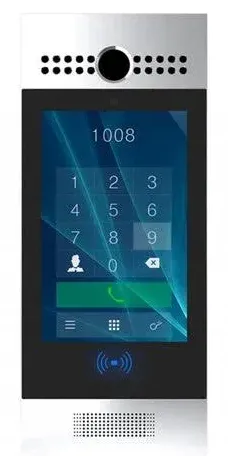
A photo from the AESS job library, not taken in East New York: a touchscreen entry panel showing a dial pad with a four-digit apartment code entered, a camera above and a card-reader symbol below. A code panel like this fits the larger new buildings on Atlantic Avenue, where a row of buttons for hundreds of households would be impossible and some units need to stay off the visible directory.
Equipment
Types of Door Buzzer Systems We Install
We quote a reliable non-branded system by default and install a named brand when an owner or board asks for one; the intercom brands we work with include Aiphone, ButterflyMX, 2N, Akuvox, Comelit and DoorBird. These are the kinds of equipment that come up most at East New York doors, and where each one fits.
Single-button video stations
One button, one camera and a speaker, slim enough for the narrow casings of semi-detached and attached houses with one household.
Two- to four-button panels
Audio or video panels with a lit button and label for each household, the standard choice for East New York's two- to four-family houses.
Directory and code panels
Scrolling directories or code entry with a camera, for walk-ups of eight or more apartments and the new buildings on the rezoned corridors.
Two-wire systems
Audio and video over a single pair per apartment, the usual answer where an old riser or bell bundle meters sound and the walls are hard to open.
Apartment audio stations
Plain talk-and-release stations for households that want a button and a voice, no screen to learn and nothing to charge.
Apartment video stations
Wall stations with a screen and a release button, so a household sees who is on the stoop before opening.
Phone answering and call boxes
Door stations and call boxes that ring residents', owners' or dispatchers' phones, over a phone line, the internet or a cellular connection.
Fail-secure electric strikes
Releases cut into the frame that stay locked in a power cut and never stop anyone leaving from inside.
Battery-backed power supplies
Dedicated low-voltage power with battery backup, mounted in the cellar or a locked closet, never inside one tenant's apartment.
Bell and release, audio talk-back, video stations or phone answering: which fits an East New York door?
What matters
Bell and release
Audio talk-back
Video stations
Phone answering
Household knows who is outside
No
By voice
By voice and picture
By voice, and picture on video models
Meets the city's minimum where §25-151 applies
Yes, with a return buzzer
Yes
Yes
Yes, with a working release for each apartment
Works for residents without smartphones
Yes
Yes
Yes
Yes if it rings an ordinary phone
Can reuse old bell or riser pairs
Usually
Often
Often, with two-wire systems
Needs little or no apartment cable
Needs internet or a phone line at the building
No
No
No
Yes, or a cellular link
Ongoing service charges
None
None
None for wired stations
Some services charge monthly; shown separately on the quote
ADT, Ring and SimpliSafe compared with a local installer for an East New York house
National brands come up in nearly every conversation about a front door. For a one-family house, a store-bought video doorbell may be all anyone wants, and we have no quarrel with that. For a two-, three- or four-family house it runs into limits quickly. A doorbell rings the phones of whoever set it up, not a station in each apartment. It has one button, not one per household. It does not release the street door unless it is separately wired to a strike, and a door that must lock itself needs a release every household can operate. Ring does sell an add-on for existing apartment intercoms, but it depends on the old system working. Alarm companies such as ADT and SimpliSafe are built around alarms, not multi-household entry. We install the entry system the house needs and, where an owner also wants a camera covering the entrance, put it in on the same visit; most East New York owners who add a buzzer ask about that camera too.
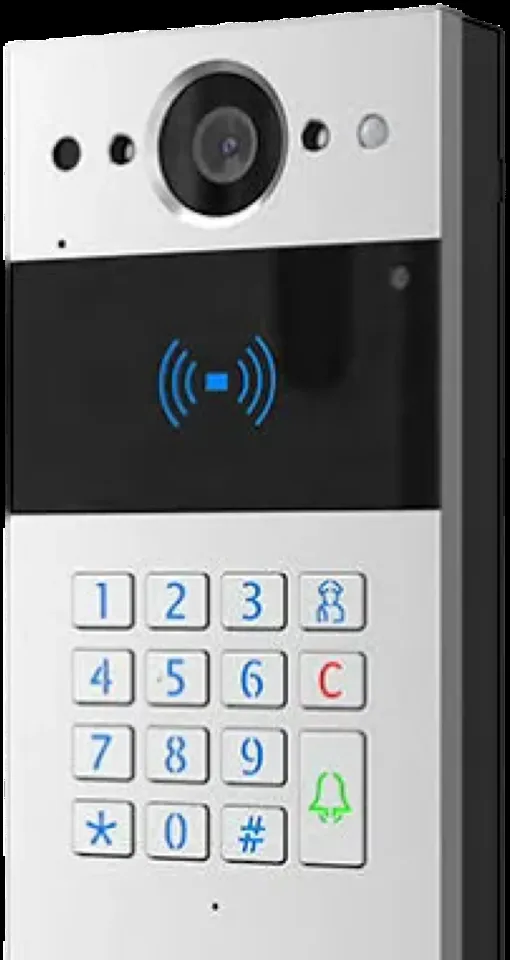
A photo from the AESS job library, not taken in East New York: a silver and black keypad door station with a camera lens at the top, a blue card-reader symbol, a numeric keypad and a green bell key. At an East New York two-family where one household comes and goes by the side door off the driveway, a keypad station like this lets them in with a code while visitors still ring at the front.
AI Overview Reality Check
What AI Gets Wrong About Door Buzzer Installation in East New York
Ask an AI assistant or a search summary about buzzers and you get tidy answers lifted from installers' blogs, cost guides and vendor articles, most of them written for a generic building or a Manhattan lobby. Here are seven claims we see repeated, traced to where they come from, and set against what we find at East New York's houses, walk-ups and new buildings.
"Buzzer replacement is priced per door"
Swiftlane's guide to apartment buzzer systems prices a like-for-like audio replacement, and a smart video upgrade, per door. Swiftlane sells cloud entry systems, and its figures are national ones aimed at apartment buildings.
For most East New York properties, the door is the wrong unit. A three-family house has one street door and three households, and what changes the cost is the number of households, the state of the old wiring and the condition of the frame. Two houses with one door each can come out very differently.
The door count matters more when a building has several entrances, but even then the side and yard doors usually need a closer and a lock, not a second panel. That is why we price East New York jobs from the walkthrough, building by building.
"Every apartment building in New York City has to have an intercom"
This is the summary many answers give, and it is too broad. Administrative Code §25-151 requires an intercom at the main entrance of class A multiple dwellings built or converted after January 1, 1968 with eight or more apartments. For older buildings, the duty follows a written request or consent from a majority of the tenants, under Multiple Dwelling Law §50-a.
East New York is mostly two- to four-family houses, far below the eight-apartment line, where a buzzer is the owner's choice. At the other end, the new buildings on Atlantic Avenue are far above it and were built with entry systems from the start.
What summaries leave out is the other half: once a building has a buzzer, a broken one can be cited as a class B violation after a tenant complains, whatever the building's size. So the real question for a small house is not whether a rule forces it, but whether the owner will keep it working once it is in.
"Low-voltage buzzer wiring needs a Buildings Department permit"
Low Voltage Nation's article on the city's electrical code says low-voltage work requires DOB permits. It is the kind of line that gets repeated in summaries and scares owners away from a simple job.
The current code text says otherwise. Administrative Code §28-105.4.7, as updated by Local Law 128 of 2024 effective December 21, 2025, exempts wiring under 50 volts for signaling, communication, alarm and data from the electrical permit when it is done by a licensed master electrician, a special electrician or a qualified person. The exceptions are life safety systems, hazardous locations and connections to power circuits.
So the cable and stations for a buzzer in a two-family house do not need an electrical permit, while a new 120-volt outlet for its power supply, or a magnetic lock tied into a fire alarm, is a different matter. Our quotes say which parts are which.
"Clip a smart add-on onto the old buzzer and it is fixed"
TechCrunch has covered products such as Ring Intercom, an add-on for existing apartment intercoms, and Doorport, which wires into an existing buzzer so a phone can unlock the door. Summaries present these as an easy upgrade for any building.
They only work when the system underneath works. An add-on cannot fix a handset that no longer talks, a pair that fails between the cellar and the third floor, or a strike that clicks while the door stays shut. In many East New York walk-ups, those are exactly the problems.
There is also the question of whose building it is. A tenant wiring a device into a shared buzzer needs the owner's agreement, and an owner adding smart entry has to respect HPD's Tenant Data Privacy Law. We test the old system first and tell you whether an add-on would actually help.
"Hire a local installer to fix your building's intercom"
Ask a search assistant what to do about a dead intercom and it usually recommends calling a licensed local installer. That is sound advice for a privately owned house or walk-up.
It is the wrong advice for a large share of East New York residents. In NYCHA developments such as Pink Houses or Linden Houses, the entry system belongs to the housing authority or its PACT partner, and NYCHA's resident handbook sends residents to MyNYCHA or the Customer Contact Center to report it.
An outside installer hired by a resident cannot touch those systems. The useful answer is to report every outage, keep the ticket number and follow up through the development's management, which is what we tell anyone in public housing who calls us.
"Wireless is the easy choice for a buzzer"
HomeAdvisor's intercom cost page says "Wireless systems are the best option if you want to DIY," and summaries stretch that into advice for any building.
A multi-household street door is not a do-it-yourself room intercom. The release in the frame is wired whatever the stations are, it needs a dependable power supply, and the signal has to reach floors through brick, plaster and steel. In houses with frame partitions or an old bell bundle that meters sound, wired is often no harder and far more reliable.
We use wireless links where a cable run truly cannot be made, such as across an industrial yard to a far gate, and say so on the quote. For the main system in a house or walk-up, cable is what makes it last.
"Cloud video entry makes apartment stations unnecessary"
Vendor guides promote phone-only entry, and Swiftlane's own cost guide notes that software subscriptions are commonly added per unit per month or per door per month. Summaries tend to mention the convenience and skip the charge.
For a new building on Atlantic Avenue with reliable internet and a management company to run it, phone answering can be a good fit. For a three-family house, the subscription recurs every month, the panel needs internet at the door, and any household without a smartphone needs a station anyway.
We price phone answering as an option, alongside wired stations, with any service charge shown separately so the owner can compare over the years they will own the system.
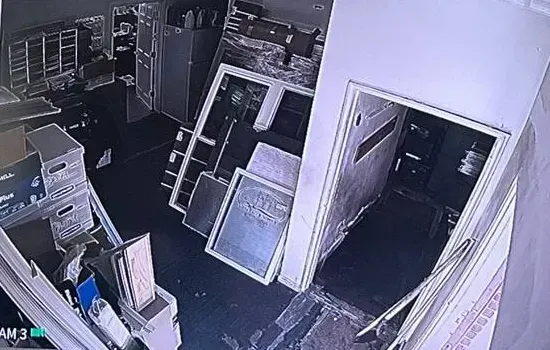
A photo from the AESS job library, not taken in East New York: a black-and-white night camera view of a cluttered room with an open doorway into a dark back room. A back room like this behind a shop on Pitkin or Liberty Avenue is where a delivery door often opens, and it is the door national cost guides forget when they price a building by its front entrance alone.
A Two-Family With Only a Chime, or a Walk-Up Where Every Floor Fails in Turn? Speak to a Tech
Send the address, a photo of the street door and the bell plate, and tell us how many households live behind the door. We will tell you whether it is a repair, a new panel on old wiring or a new system, and what will drive the price. Call or text (347) 934-8335, send photos on WhatsApp, or fill in the form below.
Get In Touch
Request a Free Quote
✅
Request Sent!
Thank you. A technician will call you about the East New York address, usually within two hours during working hours.
How It Works
Our Installation Process
1. Send photos and the cross street
Photos of the street door, the bell plate or old panel and the cellar, with the cross street and the number of households, let the office see the building before anyone visits.
2. Confirm who controls the door
We confirm who can approve changes to the entrance: the owner, a managing agent, a board, a store's landlord or, for public housing, the housing authority or its partner.
3. Walk the building from sidewalk to top floor
The technician counts every household that receives visitors, every door people use, including side, yard and cellar doors, and every floor the system must reach.
4. Test the street door
The door is opened and let go. It must close by itself, latch the first time and open from inside without a key. Any closer, hinge, latch or frame work is noted before the electronics.
5. Meter the old cable and plan the route
Every existing pair is metered from the cellar to each apartment. Sound pairs are kept; failed runs are planned as new cable, hidden inside the walls wherever the house allows.
6. Give a written price before ordering
The job is priced in writing, with any item that depends on a test named in advance. Equipment is ordered only after approval and the deposit, and every visit gets a two-hour arrival window.
7. Install, conceal and label
The release, the battery-backed power supply, the door station and the apartment stations go in, cable is hidden where the walls allow, and both ends of every run are labeled.
8. Test every household from the sidewalk and hand over
Standing where visitors stand, the technician calls each household, talks, releases and checks the door shuts and relatches, then leaves a written test sheet and the administrator login with the owner.
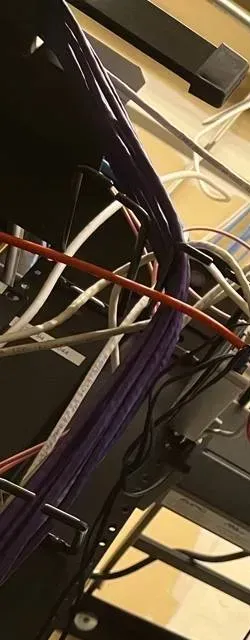
A photo from the AESS job library, not taken in East New York: purple, white and red cable bundles dropping down beside a black equipment rack. In the network room of one of East New York's new mid-rises, the point where every apartment's cable meets the entry system's controller is where labels at both ends save the next technician hours of tracing.
Coverage Area
Door Buzzer Installation Near East New York's Landmarks
Empire State Dairy buildings
The dairy complex at 2840 Atlantic Avenue, completed in 1915 and landmarked in December 2017, now joined to The Highland's 320 new apartments at 268 Barbey Street.
East New York Savings Bank
One of the neighborhood's listed landmarks, a reminder of the avenues' long history as shopping streets where stores sit under apartments.
New Lots Town Hall
A landmark from the years before East New York became part of Brooklyn in 1886, among the blocks of older houses in the neighborhood's southern half.
Engine Company 236
A landmarked firehouse, one of the historic buildings Wikipedia lists for East New York alongside its churches and civic buildings.
Thomas Jefferson High School
The landmarked school building, surrounded by the semi-detached and attached houses that make up most of our East New York work.
Louis Heaton Pink Houses
The NYCHA development on Linden Boulevard with 22 eight-story buildings and about 1,500 apartments, whose entry systems are handled by the housing authority.
East New York is billed at our standard Brooklyn rate, with no extra charge for being at the eastern edge of the borough. We do not publish a fixed price for this neighborhood, because two jobs that look the same from the sidewalk rarely cost the same once the cellar has been opened. Every job is priced in writing after photos and a walkthrough, and the table below shows what drives the number.
What we look at
Keeps the price down
Pushes the price up
Number of households
One or two households behind one door
Every extra household adds a button, a station and a cable run
Old cable
Bell or riser pairs that meter sound and can be reused
Failed pairs and a new route through brick or finished rooms
Street door
A sound frame and a closer that only needs adjusting
A frame that needs reinforcing, a new closer or latch, or a rehung door
Other doors
One entrance only
Side, yard and cellar doors and gates brought up to the same standard
Answering
Audio stations
Video stations, extra stations on several floors, phone answering
Power
An existing outlet in the cellar for the power supply
A new outlet or electrical connection that an electrician has to add
Ongoing charges
Wired stations with no subscription
Phone or cloud services that charge monthly, always shown separately
The walkthrough is where those questions are answered. If an old system has to be tested in person before it can be priced, we tell you that in advance and what the visit involves. If the job also adds a camera covering the entrance, doing it on the same visit saves a second trip. Anything that depends on a test is named on the quote before you approve it, and equipment is ordered only after the written price is approved and the deposit is in.
Full terms — including 50% deposit, one-year parts-only warranty on AESS-supplied products, and the late-fee schedule — are set out in the service agreement.
Find Out What Your East New York Door Will Take
Tell us the street, the number of households and what is at the door today, and send a photo of the door and the bell plate. We call back, explain what will drive the price and book the walkthrough that turns it into a written quote. Call or text (347) 934-8335, send photos on WhatsApp, or fill in the form.
Shop Our Systems
Door Buzzer Installation Packages & Pricing
Three typical East New York jobs, described by what they include. Each is priced per job after the walkthrough, because the household count, the door and the cable decide the figure.
House starter: priced per job
For a one- or two-household semi-detached or attached house: an audio or single-button video door station, a station for each household, a fail-secure release in the street door frame and a battery-backed power supply, reusing old bell pairs where they test sound.
Multi-family standard: priced per job
For a three- or four-family rowhouse or a small walk-up: a panel with a lit button per household, audio or video stations in every apartment, phone answering for owners who want it, and door work so the street door closes and latches on its own.
Building and business premium: priced per job
For walk-ups of eight or more apartments, new buildings and business doors: a directory or code panel, stations on tested or new cable, side, yard and cellar doors brought to the same standard, and a written test sheet for every apartment.
Bring your own equipment. If you have already bought a door station or an intercom kit, we can install it as labor-only work. Send us the make and model and photos of the door and the house, and we quote the labor after reviewing them. The equipment itself, including any wireless signal it depends on, is covered by its maker's warranty rather than ours; our workmanship on the installation is ours to stand behind.
Complete Services
Every Door Buzzer Service in East New York
Houses and rowhouses
First buzzers, talk-back added to bells, video at the door, side and yard doors, and door work so the street door closes and locks. Request a quote
Walk-ups, new buildings and businesses
Replacements for failing systems, riser testing, directory and code panels, storefront and yard gate call boxes. Call (347) 934-8335
Why doesn't this page list a set price for a door buzzer in East New York?
+
Because a set price would be wrong for most of the houses here. Two semi-detached two-families on the same block can need very different work once the cellar is opened: one has bell pairs that test sound and a frame that takes a strike easily, the other needs new cable and a reinforced frame. We quote each job in writing after photos and a walkthrough, at our standard Brooklyn rate, and name in advance anything that depends on a test.
Will your technicians keep a copy of our building's administrator password after the job?
+
The system is set up in the owner's name, and the administrator login is handed to the owner or managing agent at the end of the job along with the test sheet. Default installer passwords are changed before handover. If you want the password changed again in front of you after the technician leaves, we walk you through it, so the only people who can change the directory, the codes or the release settings are the ones you choose.
If a tenant's phone silences calls from unknown numbers, will the door still reach them on a phone-answering system?
+
It may not. Many phones can be set to silence callers who are not in the contacts list, and a door panel that calls from an unfamiliar number can be silenced along with them. The simple fix is for each resident to save the panel's calling number as a contact, and we show residents how at handover. Systems that use an app instead of a phone call depend on the app's notifications being allowed instead.
Does phone answering need a data plan, or can the door call an ordinary voice line?
+
That depends on the system. Telephone-entry panels place an ordinary call, so a resident can answer on a basic phone with no data plan and press a key to open the door. App-based systems need data or Wi-Fi on the resident's phone to ring and to show video. In East New York houses where some relatives use basic phones, we usually pick a panel that can call a plain number, or add a station on the wall for that household.
Can the door station make a sound so a visitor who cannot see knows the door has been released?
+
Yes, on most stations. Many door stations play a tone, and some a short spoken message, when the call connects and again when the door is released, and the strike itself makes an audible click or buzz. Where a household has a visitor or relative with low vision, we choose a station that gives a clear signal and set it loud enough to hear from the stoop without disturbing the block at night.
The names by our old buttons faded in the sun within a year. What lasts longer on a new panel?
+
Labels behind the panel's clear cover, printed rather than handwritten, last far longer than paper slips taped beside a button. Engraved or printed unit numbers on the panel itself last longest of all, which is one reason many owners list apartment numbers rather than names. On a door that faces the afternoon sun, we also mount the panel under any overhang the doorway has, which slows fading and keeps water off the face.
How should residents clean the station inside their apartment without damaging it?
+
With a soft cloth that is only lightly damp, wiped over the face and buttons, never with spray cleaner sprayed straight onto the station, which can run into the speaker and the buttons. Screens on video stations should be cleaned the way a phone screen is. Stations should not be painted over when an apartment is repainted, because paint can clog the speaker and the microphone, so we suggest owners remind their painters.
Can a video station show us who is approaching the door before they ring?
+
Some can. Certain video door stations and phone-answering systems can start the picture or send an alert when someone stands in front of the camera, before any button is pressed. Others only show video once the call comes in. If seeing a visitor on the walk before they ring matters to your household, tell us at the walkthrough and we choose a station that does it and set its sensitivity so passing cars and people on the sidewalk do not set it off all day.
How does a visitor at our door know the call actually went through to us?
+
A good door station tells them. Most give a ringing tone or a light while the call is waiting, and a change of tone or light when someone answers, so a visitor is not left wondering whether to ring again or walk away. Lit buttons that stay visible after dark help too. We test this from the stoop at handover, standing where your visitors stand, so you hear exactly what they hear.
Can we answer and open the door from a smartwatch?
+
Sometimes, with an app-based system. Alerts from the door often appear on a watch paired with the phone, and a few apps let you talk or release from the watch itself, while others only let you see the alert and answer on the phone. It depends entirely on the system and its app, so if it matters to you we check the specific model before it is ordered rather than promising it on the walkthrough.
Ready for an East New York Front Door That Locks Behind Every Visitor and Lets Every Household Answer?
Send a photo of the street door and the bell plate, or just tell us the street and how many households live behind it, and a technician calls back to explain what the job will take and book the walkthrough for your written price. Call or text (347) 934-8335, message us on WhatsApp, or use the request form. Licensed under NYS license #12000287431, rated 4.7★ across 201 Google Reviews, with same-day estimates.