A six-story Art Deco building on Brightwater Court, a 150-apartment co-op on Brighton Beach Avenue, a walk-up over a shop under the el or a new rental on Ocean View Avenue? Brighton Beach door buzzer installation line: (347) 934-8335
Six-Story Prewar Elevator Buildings · 1930s Art Deco Lobbies · Postwar Co-ops by the Boardwalk · Walk-Ups Over Brighton Beach Avenue Shops · New Rentals on Ocean View Avenue
Door Buzzer Installation in Brighton Beach
Lobby Door Checked Before Any Panel Is Chosen · Every Riser Pair Metered · Head End Kept Above the Water Line · Written Price Before Ordering
Door buzzer installation in Brighton Beach is mostly lobby work in big buildings. Between 1921 and 1929 the neighborhood got thirty six-story elevator apartment houses with Art Deco entrances, doormen and ten or more apartments on a floor, and the 1930s added more along Brighton Beach Avenue and Brightwater Court. A single entrance here often has to reach well over a hundred households. Those lobbies were designed around a person at the door; today most of them rely on a panel, a riser, a release in the lobby door and a station in every apartment. Below is how we plan each of those for the buildings that actually line these blocks, and how a job here is priced.
Every Brighton Beach job is priced for that building after photos and a walkthrough, and the total, with any part that depends on a test named in advance, is agreed in writing before anything is ordered
Rated 4.7★ across 201 Google Reviews
Reviewed and updated November 12, 2026, against the Brooklyn Jewish Historical Initiative's neighborhood history of Brighton Beach; ReinventNY's and Brick Underground's guides to Brighton Beach housing; Newyorkitecture's notes on 711 Brightwater Court; Homes.com building records for 1150 and 1120 Brighton Beach Avenue and 3100 Brighton 3rd Street; the listing for 524 Ocean View Avenue; CIE Group's case study of an Akuvox intercom project on Brighton Beach Avenue; City Limits' 2012 reports on Hurricane Sandy in Brighton Beach; the Commercial Observer's 2014 report on the Oceana; the Forward's 2013 report on Brighton Beach Avenue businesses; Forgotten New York's 2014 walk through the Brighton lanes; Augrented's summaries of HPD and 311 records for 3033 Brighton 13th Street and 3121 Brighton 5th Street; NYC 311's maintenance complaint guidance; New York's Multiple Dwelling Law §50-a; NYC Administrative Code §28-105.4.7 and the 2025 NYC Electrical Code; the Department of City Planning document describing the Riegelmann Boardwalk scenic landmark; Allegion's fail-safe and fail-secure guide; Aiphone's GT Series pages; the 2010 ADA Standards; the Swiftlane, HomeAdvisor and ButterflyMX intercom guides; a Mike Holt forum thread on small-building intercoms; and Brooklyn intercom reviews on Yelp. · Abstract Enterprises Security Systems, NYS license #12000287431 · crews dispatched from our Troy Avenue office in Brooklyn
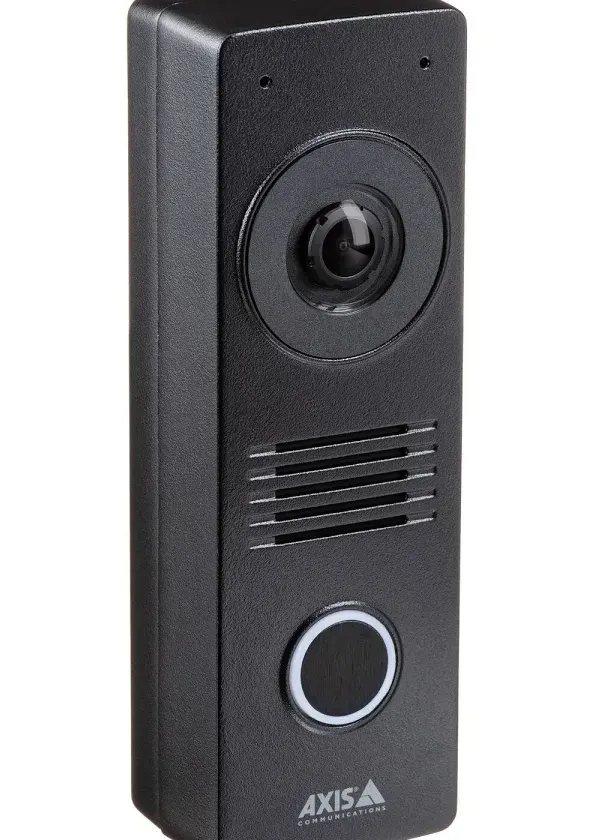
A photo from the AESS job library, not taken in Brighton Beach: a black rectangular video door station with a camera lens, a speaker grille and a single round call button that lights up. A one-button station like this suits a small house or a shop's back door in Brighton Beach; the big six-story lobbies on Brighton Beach Avenue need a directory or code panel instead, but the same basic parts, a camera, a speaker and a clear place to press, are what every visitor looks for.
Brighton Beach Buzzer Request
Elevator co-op, rental building, walk-up over a shop, small house or business door: tell us the street, how many apartments the panel must reach and what is at the door now, and a technician calls back about the job
✅
Request Sent!
Thank you. A technician will call you about the Brighton Beach address, usually within two hours during working hours.
25+
Years Experience
✓
Same-Day Estimates
100%
Licensed & Insured
4.7★
201 Google Reviews
Owner-operated since 2002 · Thousands of jobs completed · Booked within 2 hours
Quick answer: door buzzer installation in Brighton Beach is priced per job, because the cost here is set by three things a flat rate cannot see: how many apartments the lobby panel has to call, whether the building's old riser pairs still test sound, and what the lobby door needs before it can hold an electric release. A complete installation covers the door station, a station in every apartment (or phone answering where the building wants it), the release in the lobby door frame and a battery-backed power supply placed above the level water has reached in the building, all tested from the sidewalk to the top floor. Send photos of the lobby doors, the current panel and the cellar to (347) 934-8335 or on WhatsApp, and we reply, usually within two hours during working hours, with what the job involves and the step to a written price.
Looking at your photos and telling you what kind of job it is costs nothing. A walkthrough follows when the riser or the doors have to be tested before a price can be written.
All work is done under New York State license #12000287431, and equipment is ordered only after the written price is approved and the deposit is in.
We work for whoever controls the entrance: a co-op or condo board, a managing agent, an owner who holds one building or several, or a shop owner with the landlord's written approval.
The Neighborhood
Why Brighton Beach Properties Need Door Buzzer Installation
Brighton Beach is the strip of Brooklyn between Ocean Parkway and Corbin Place, running from the Belt Parkway down to the beach and the boardwalk, in ZIP code 11235 and Community District 13. The B and Q trains run above Brighton Beach Avenue, the neighborhood's main street, where Cyrillic signs hang over most of the shops. Behind that avenue, on the numbered Brighton streets and on Ocean View Avenue, Brightwater Court and Coney Island Avenue, the housing is what decides how a door buzzer gets installed: apartment buildings, most of them six stories, put up between the 1920s and the 1960s, many of them elevator co-ops with plain brick fronts.
The oldest of those buildings were large from the start. The Brooklyn Jewish Historical Initiative's history of the neighborhood describes thirty modern apartment buildings going up between 1921 and 1929, six stories high, with Art Deco entrances, elevators, doormen and ten or more apartments on each floor. The 1930s continued the pattern: the building at 1150 Brighton Beach Avenue went up in 1935 with 159 residences, and 711 Brightwater Court, at Coney Island Avenue, is a six-story Art Deco building from the same year. Next door at 1120 Brighton Beach Avenue there are 157 units. A lobby like that does not need a three-button bell plate; it needs a panel that can find any one of 150 households quickly and a riser that carries every call up six floors.
The doormen those buildings were designed around are, in most cases, long gone. What is left is an entrance whose door, vestibule and lobby were laid out for a person standing there, now run by equipment. Some buildings still route callers to a desk; the listing for 1150 Brighton Beach Avenue shows "Intercom to Front Desk" and "Secure Lobby." Many others have an apartment-call system installed decades after the building opened and patched since. That gap, between a lobby planned for staff and a lobby that has to answer itself, is the reason most of our Brighton Beach work is a full lobby installation rather than a single new button.
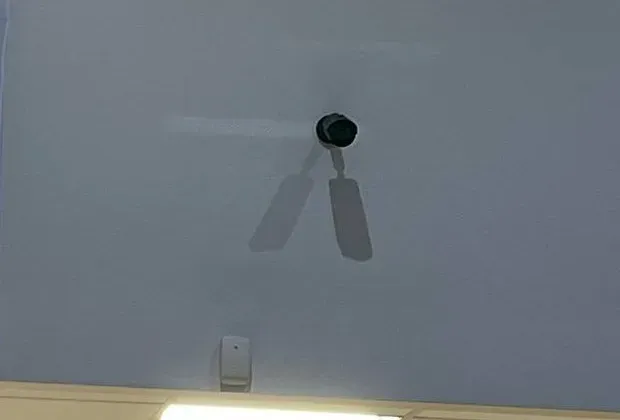
A photo from the AESS job library, not taken in Brighton Beach: a small black camera mounted high on a pale wall, with a small white device below it. In a Brighton Beach lobby with ten or more apartments on every floor above it, a camera placed like this inside the inner door shows who actually walked through after a resident pressed release, which a lobby panel alone cannot show a board or a managing agent.
The city's records show what happens when those systems age. HPD inspectors wrote a Class B violation on April 18, 2026, at 3033 Brighton 13th Street ordering the owner to "properly repair or replace the broken or defective bell/buzzer intercom from building entrance panel." On May 20, 2026, another Class B violation at 3121 Brighton 5th Street ordered repair or replacement of "the broken or defective intercom system from building entrance to apartment entrance." Augrented's summaries of the city data list 233 HPD violations in total for the Brighton 13th Street building, against a Brighton Beach average of 17.7, and 56 calls to 311 for the Brighton 5th Street building, against a neighborhood average of 17.1. Both orders cover the whole path, from the panel at the door to the station in the apartment, which is exactly what an installation replaces.
Residents add their own reasons. Brighton Beach has a large Russian-speaking population, many of them older people living in the high-rise and six-story buildings, and households here range from long-time rent-stabilized tenants in the Art Deco buildings near the beach to shareholders who sublet their apartments right away. A post on r/Brooklyn about package theft put the lobby problem bluntly: "It's 100% guaranteed from the lobby, It's Brighton Beach." A lobby door that latches every time, and a panel that lets the right resident see or hear who is outside before pressing release, is the part of that problem an installation can actually fix.
The last reason is the water. In October 2012 Hurricane Sandy's surge converged on Brighton Beach Avenue in a wave City Limits described as five feet high, submerging streets, cars and every basement apartment in the neighborhood. In the basements of the big buildings, salt-soaked equipment put elevators and boilers out of service. A buzzer system's power supply and distribution equipment usually live in that same cellar. Where they go in a new installation is a decision, not a habit, and we make it with the building's own water history in hand.
Six facts that shape a Brighton Beach buzzer installation
The buildings are big. The 1920s apartment houses were built six stories high with ten or more apartments on a floor; 1150 Brighton Beach Avenue has 159 residences and 1120 Brighton Beach Avenue has 157 units.
Smaller elevator buildings still have dozens of households. The six-story building at 3100 Brighton 3rd Street has 65 units, a live-in superintendent and part-time maintenance staff, a common arrangement for who looks after the entry system here.
HPD writes these up as Class B. The 2026 violations on Brighton 13th Street and Brighton 5th Street were both Class B orders to repair or replace the intercom from the entrance to the apartments.
Residents can complain through 311. NYC 311's maintenance complaint categories for apartments and for public areas both cover doorbells, buzzers or intercoms that are broken or missing.
Owners here have already gone to network systems. CIE Group documents an owner on Brighton Beach Avenue with eight buildings, each holding more than 60 apartments, who installed Akuvox R29C door stations and IT83A indoor monitors.
Basements are where the water went. Sandy's surge reached every basement apartment in Brighton Beach in 2012, and at the Oceana complex the parking garage flooded, which is why power supplies and head-end equipment are placed with care.
Where this page applies. We use Brighton Beach for the blocks between Ocean Parkway and Corbin Place, from the Belt Parkway to the boardwalk: the numbered Brighton streets, the lanes and courts off them, Brighton Beach Avenue under the el, Ocean View Avenue, Neptune Avenue, Brightwater Court and Brightwater Avenue, and the southern end of Coney Island Avenue. For the rest of the borough see our door buzzer installation in Brooklyn page, and for the blocks across Corbin Place our Manhattan Beach door buzzer installation page.
Install or Repair in Brighton Beach
Need Repair in Brighton Beach? One Dead Line Is a Repair; a Lobby Full of Dead Lines Is an Installation
A lot of Brighton Beach installation calls begin as a request to fix one apartment. A shareholder on the fifth floor cannot hear the lobby, or the release in one kitchen has stopped opening the door, and the board wants the cheapest way to make the complaint go away. Sometimes that is a repair, and we treat it as one: a station with a broken handset cord, a release button worn out inside one unit, a single pair that tests open between the cellar and one floor and can be replaced on its own.
It stops being a repair when the pattern spreads. In a building with 150 apartments, the signs are easy to read once every line is metered: several floors failing at once, calls that ring the wrong apartment, a panel whose maker stopped supplying parts years ago, a power supply that has been replaced twice and still drops the system in summer heat, or an HPD order, like the ones written on Brighton 13th Street and Brighton 5th Street in 2026, that covers the whole run from the entrance panel to the apartments. At that point each repair buys a few months, and the building keeps paying for visits. A new panel and power supply on riser pairs that test sound, or a new system on new cable where they do not, ends the cycle. We tell the board or the owner which it is after testing, and when one part is all the building needs, our Brooklyn door buzzer team prices it as a repair, not as an installation.
The decision is also about time. A board that patches one line at a time can spend a year chasing failures that a single installation would have cleared in a few working days. A board that replaces a system with two failing stations out of 150 may be spending money it did not need to spend. The test results, written per apartment, are what let the board choose with numbers instead of guesses.
What We Install
Door Buzzer Installation Services in Brighton Beach
Every service below is quoted per building. In Brighton Beach the apartment count sets the size of the system, the riser decides how much cable has to be pulled, and the lobby door decides what release it can take. The building's water history decides where the equipment that runs it all is allowed to sit.
Lobby systems for six-story elevator buildings
Directory or code panels at the entrance, a station in each of the building's 60, 100 or 150-plus apartments, distribution in the cellar or on a higher floor, and a power supply sized for the whole building.
Desk-call lobbies changed to apartment calls
Entrances that were wired to ring a front desk or doorman's station, reworked so a visitor can reach an apartment directly when the desk is not staffed, with the desk kept on the system where the building still uses it.
Video at the entrance
A camera door station in the vestibule with video monitors in the apartments that want them, audio stations in the ones that do not, and phone answering for households who want to see the lobby from their phones.
Riser testing and new cable
Every pair metered from the cellar to every apartment before a system is chosen; sound pairs reused, failed runs replaced along the stair, a closet stack or the corridor ceiling, planned floor by floor with the super.
Lobby door releases and closers
Fail-secure electric strikes cut into the frames of heavy prewar and postwar lobby doors, closers adjusted or replaced so the door shuts against ocean wind, and latches set so the door relatches every time.
Second entrances
Beach-side rear doors, garage doors, cellar doors and side-street entrances brought onto the system with their own release, or locked and kept locked from outside where nobody should be entering.
Residents' doors on shop blocks
A separate panel and release for the apartments' door beside a Brighton Beach Avenue or Coney Island Avenue storefront, kept apart from the shop's own door, alarm and power.
Entry systems for new buildings
Pre-wiring and full systems for the newer rentals and condos going up on former bungalow lots and on Ocean View and Neptune Avenues, planned while the walls are open.
Shop, restaurant and office buzz-in doors
Buzz-in front doors, delivery doors at the back or side, and doors to second-floor medical and professional suites, with the release where staff actually stand.
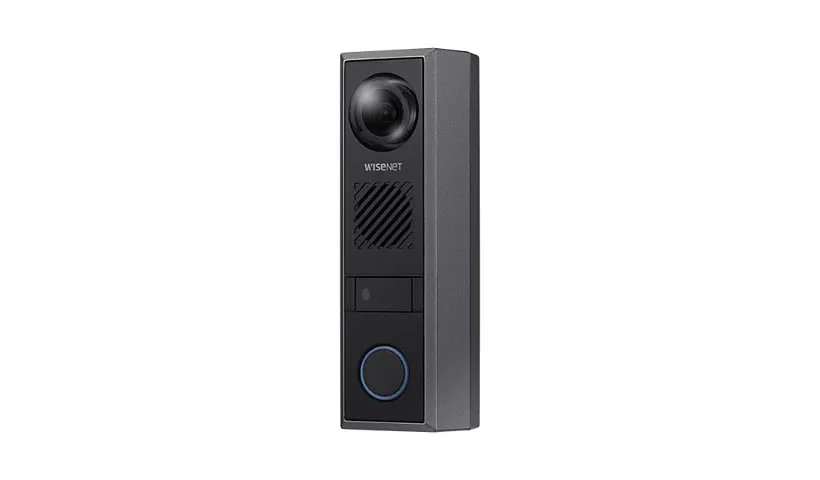
A photo from the AESS job library, not taken in Brighton Beach: a slim dark grey wired doorbell with a camera lens, speaker slots and a round push button. A unit this size belongs on a small Brighton Beach house, a converted bungalow on one of the lanes, or a restaurant's back door, where one household or one business answers; it is the wrong tool for a six-story lobby, and we say so when a building asks for one.
Building Specialists
Door Buzzer Installation for Brighton Beach's Architecture
Six kinds of building account for nearly every entrance we are asked about in Brighton Beach. They differ in the things that set a buzzer job: how many households one panel must reach, what the lobby walls and doors are made of, where the cellar is and what happened to it in 2012, and who is actually responsible for the door on a Tuesday afternoon.
1920s six-story elevator houses
The neighborhood's first big buildings: six stories, ten or more apartments a floor, Art Deco entrances, an elevator and a lobby laid out for a doorman who is no longer there.
1930s Art Deco buildings
Buildings like 1150 Brighton Beach Avenue and 711 Brightwater Court, with stone or marble lobbies, decorative metal and glass entrance doors and 150-plus households behind them.
Postwar co-ops and towers
Brick co-ops near the boardwalk on Brightwater Avenue and taller buildings at the north end, with longer risers, larger elevator lobbies and boards that approve every change.
Condo complexes
Newer multi-building complexes such as the Oceana, with several entrances, garages, shared security offices and equipment placed to post-Sandy standards.
Walk-ups over stores
Low brick buildings on Brighton Beach Avenue and Coney Island Avenue, with a narrow residents' door between shopfronts and the el running beside the upper floors.
Small houses and new mid-rises
Winterized bungalows and small houses on the lanes and courts, and the newer buildings that have replaced many of them, from small two-families to rentals of a couple of dozen apartments.
1920s six-story elevator houses: big directories, long corridors, one riser
With ten or more apartments on each of six floors, the 1920s buildings put sixty or more households behind one entrance before counting any apartments added in the cellar or the attic over the decades. A row of buttons that size is taller than most vestibule walls, so the practical choices are a scrolling directory, a code panel where the visitor enters the apartment number, or a combination of the two. The decision depends on how the building numbers its apartments and how its residents and their visitors are used to finding them.
In these buildings the riser is usually a multi-pair cable running up a chase near the stair or elevator, with branches along each floor's corridor to the apartments. The corridors are long, and the apartment at the far end of a floor may be more than a hundred feet of cable from the riser. When the old pairs meter sound end to end, a two-wire system can often reuse them, which keeps both the price and the disruption down. When they do not, the new cable has to find a path that the board and the residents will accept, and in a building with plaster corridors and lobby finishes from the 1920s, that path is planned one floor at a time with the super.
The lobby door in these buildings is often original or a heavy replacement, and it has to close against the wind that comes up the side streets from the ocean. A release goes into the frame only after the closer has been set so that the door shuts fully from any position, latches without help, and is still light enough for an older resident to push open after being buzzed in.
1930s Art Deco buildings: finishes come first
The Art Deco buildings of the 1930s are where the lobby itself is part of the job. The listing for 1150 Brighton Beach Avenue describes geometric details and marble floors, and many entrances on Brightwater Court and along the beach still have their original decorative metal and glass. A new panel in a lobby like that is placed and sized so that it covers the old opening or fits a plain section of wall, its cable comes in from behind or from below rather than running across the stone, and the strike is chosen to fit the existing frame instead of forcing a change to the door.
Many of these buildings are rent stabilized or rent controlled, with long-time tenants who have used the same handset for decades. For them the most important part of an installation is often the apartment station: a clear speaker, a large release button and nothing to learn. We plan audio stations for the households that want them and video for the ones that ask, on the same system, so the building is not forced to choose one for everyone.
Postwar co-ops and towers: boards, budgets and longer risers
The brick co-ops built after the war, including those near the boardwalk on Brightwater Avenue, tend to have one large lobby, a longer elevator riser and a board that approves every change to the entrance. Our work there begins with the riser test written per apartment, because that report is what the board needs before it can decide between a new panel on old pairs and a new system on new cable, and before it can explain the choice to shareholders.
Towers at the north end of the neighborhood have more floors and more apartments per floor, which pushes the system toward distribution equipment placed on intermediate floors rather than a single point in the cellar. That is also the simplest way to keep the most important equipment away from a basement that has flooded before.
Condo complexes: several doors, one plan
The Commercial Observer reported in 2014 that the Oceana complex had 16 buildings and 927 units, and that its newest building at 50 Oceana Drive East was built to post-Sandy standards, with electrical switchgear on an elevated platform and elevator controls moved to the roof. A complex like that needs every entrance planned together: which doors call which buildings, which doors call the security office, how the garages are handled, and where each building's entry equipment sits relative to the switchgear and the flood level. We work from the complex's own drawings and its management's rules, and we match the equipment choices to what the complex already uses where that makes sense.
Walk-ups over stores: the residents' door stands alone
On Brighton Beach Avenue and the southern end of Coney Island Avenue, the apartments above the shops are reached through a narrow door between storefronts. That door gets its own panel, its own release and its own power supply, kept separate from anything the store runs, so a store renovation or a change of tenant never leaves the apartments without a working door. The cable climbs the residents' stair rather than passing through the shop, and the panel is placed where a roll-down gate, a sign or a sidewalk display cannot cover it.
Small houses and new mid-rises: short runs, clear choices
Forgotten New York's 2014 walk through the lanes off Brighton Beach Avenue described bungalow colonies that had been winterized for year-round living and were being replaced by higher apartment buildings. The bungalows that remain need the simplest systems in the neighborhood: one or two buttons, short cable runs and a station in each household. The newer buildings on those lots need a proper multi-apartment system from the start, and the best time to plan it is before the walls close.
Where the head-end equipment goes in every type
Whatever the building, the power supply and any distribution or network equipment are placed by the building's own history. We ask the super how high water came in the cellar in 2012, look for the marks it left, and set the equipment above that line, on a higher shelf, in a dry room upstairs or on an intermediate floor. Cable that must pass through the cellar is routed high on the walls and ceiling rather than along the floor. None of this makes a building flood-proof; it keeps the part of the system that is hardest and slowest to replace out of the water's most likely path.
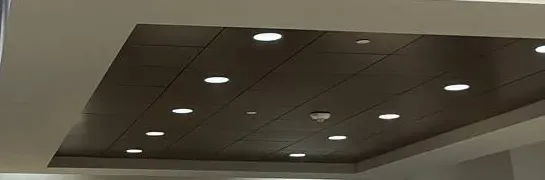
A photo from the AESS job library, not taken in Brighton Beach: a dark recessed ceiling panel with round downlights and a small round device set into it, framed by a lighter ceiling. In the long corridors of a six-story Brighton Beach building, a dropped or recessed ceiling like this is often where new cable to the far apartments can run out of sight, which matters most in the Art Deco lobbies where nothing should be surface-mounted.
Field Notes
Field Notes: Four Things Our Technician Looks At in a Brighton Beach Lobby Before Anyone Talks About Panels
On a walkthrough in a Brighton Beach building, the technician does four things before equipment comes up. Together they take about an hour in a 150-apartment building, and they settle most of what the job will cost.
The first is the directory. The technician compares the names or numbers on the old panel with the mailboxes and with the managing agent's list of apartments. In buildings where shareholders sublet and tenants turn over, the three rarely match, and the system has to be sized for the real number of households, including any basement or combined units.
The second is the doors. Every lobby door, the outer vestibule door, the beach-side or rear door and the garage door are opened, released and let go. Each one should close by itself, latch on the first try and stay shut when the wind pushes on it. Sand on the threshold, a closer set too weak, or a frame that has dropped on its hinges are noted before anything electronic.
The third is the cellar. The technician finds the old power supply and distribution, asks the super where the water reached in 2012, and meters every riser pair from that point to the apartments. Sound pairs are marked for reuse; failed ones are marked for replacement.
The fourth is the desk. If the lobby still has a doorman's station, or wiring to one, the technician traces what it does today and asks how the building wants visitors handled when nobody is sitting there.
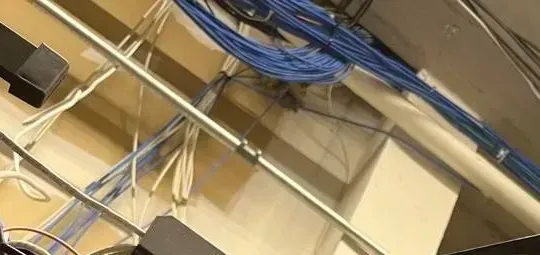
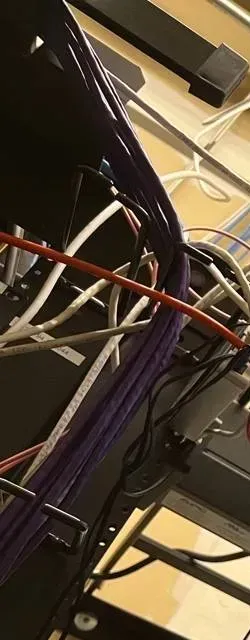
A photo from the AESS job library, not taken in Brighton Beach: bundles of blue low-voltage cable laid over a ceiling beam beside a metal pipe in an open ceiling. In a Brighton Beach cellar, cable belongs up at the ceiling like this rather than along the floor or low on the wall, because the floor is where water arrives first in a building close to the ocean.
The Lobby Without a Doorman
Brighton Beach's Early Lobbies Were Built for Doormen. Here Is What an Entry System Has to Do Instead
When the first big buildings went up in Brighton Beach in the 1920s, the doorman was the entry system. He saw every visitor, knew every tenant, held the door, took packages and phoned upstairs when someone asked for an apartment. The lobby layout followed from that: a street door, sometimes a vestibule, a wide lobby, the elevator, the mailboxes and a spot where the doorman stood. Very few of those buildings still have a doorman at the door all day. The layout is still there, and an entry system installed into it has to take over each of those jobs or leave the building with a gap.
Seeing who is outside
The doorman's first job was looking. An audio panel lets a resident hear the visitor; a video panel lets them see the visitor before pressing release. In lobbies with an outer and an inner door, the panel belongs where a visitor stands before reaching the locked door, and its camera has to see a face there, not the top of a head or the street behind. Lobby lighting is part of that: an Art Deco vestibule lit by a single decorative fixture may need the panel's own light or a placement that catches the existing light.
Finding the right household
The doorman knew who lived in 5K. A panel has to work that out from what the visitor types or scrolls. In a building with 150 apartments, that means a directory the building actually keeps up to date, and a person who has the access to update it. We set up the administrator access on day one, give it to the person the board or owner names, and show that person how to add, change and remove a listing. Where a building keeps a part-time desk, the panel can also carry a listing for the desk.
Holding the door shut
A doorman made sure the door closed behind each visitor. A system relies on the closer and the latch. That is why we set the lobby door before installing the release, and why we use fail-secure electric strikes on lobby doors: as Allegion's guide explains, a fail-secure strike stays locked when power is removed, while a person inside can still leave by turning the lever. The building stays locked during an outage, and nobody is ever trapped inside.
Taking the call when the desk is staffed, and when it is not
Some buildings still route lobby calls to a desk, at least for part of the day. Those buildings need a system that can send a visitor's call to the desk when it is staffed and to the apartment when it is not, or that lets the visitor choose. Buildings that have stopped staffing the desk entirely need the desk's old wiring removed or repurposed, so a visitor never presses a button that rings an empty chair. Either way, the change is planned with the board before equipment is ordered, because it changes how residents and visitors use the lobby every day.
The mailboxes and the parcels
The doorman took packages. Without one, the lobby layout decides where they end up. When mailboxes sit inside the locked door, the carrier needs a way through it; when parcels are left in an open vestibule, they are at risk. An entry installation cannot solve package theft on its own, but placing the panel, the camera and the locked door in the right order, so that a parcel left by a courier is inside a locked space and on camera, is part of the plan for every Brighton Beach lobby we work in.
Choosing the System
Wired, Two-Wire or Network: What One Brighton Beach Avenue Owner's Eight-Building Project Does and Does Not Tell You
The most useful local example of a modern intercom project in Brighton Beach is a published case study. CIE Group describes an owner on Brighton Beach Avenue with eight buildings, each holding more than 60 apartments, who installed Akuvox R29C door stations at the entrances and Akuvox IT83A indoor monitors in the apartments. The case study says that needing less building wiring lowered the installation costs compared with a traditional intercom system. It is a real project in buildings of the size that dominate this neighborhood, and boards here ask us about it.
What it shows is that network-based door stations and indoor monitors are a realistic option for big Brighton Beach buildings. What it does not show is that they will be cheaper in every building. "Less building wiring" depends entirely on what is already in the walls. A network system still needs a network path from the door station to each indoor monitor, through cable the building already has, cable that is added, or a combination. In a building whose existing cable suits that use, the savings can be real. In a building whose old riser is a bundle of thin copper pairs that only an audio or two-wire system can use, the network option may need more new cable, not less.
The three families of system we see in Brighton Beach lobbies
Older multi-wire audio systems. Many prewar buildings here still run systems with several conductors per apartment from a cellar distribution. They are reliable when the cable is sound and hard to expand when it is not, and many of their makers no longer supply parts.
Two-wire systems. These carry audio, and on many models video, over a single pair per apartment. Aiphone describes its GT Series as a multi-tenant system "for new builds and retrofit projects" that "offers the advantage of using existing wire and infrastructure," with capacity for thousands of tenant stations. Where a building's old pairs meter sound, two-wire is often the least disruptive path to video.
Network (IP) systems. Door stations and indoor monitors that talk over a network, like the Akuvox equipment in the Brighton Beach Avenue project, often with phone answering built in. They need network cable or a suitable path to each apartment, network equipment in the building and someone who manages it.
How we compare them for a particular building
We start from the riser test. If the existing pairs meter sound from the cellar to every apartment, a two-wire system on those pairs is usually priced first, because it reuses what is there. If the building already has suitable network cable, or is about to pull it for another reason, a network system is priced alongside. If neither is true, we price new cable for both and let the board see the difference. The written quote shows what is reused, what is new and what each choice means for residents, so the decision rests on the building's own cable, not on another owner's case study.
The second question is who will look after the system. Network systems give boards and managing agents more control, remote directory updates and phone answering, and they bring the work that comes with any network: passwords, updates and someone to call when the building's internet changes. Two-wire and audio systems do less and ask less. In a building with a live-in super and part-time maintenance staff, like the 65-unit building on Brighton 3rd Street, that difference matters as much as the installation price.
The third question is the residents. Some buildings here have many residents who will never use a phone app and want a station on the wall with one button to release. Others have young renters and subtenants who expect to answer the door from anywhere. A mixed system, with wall stations for those who want them and phone answering for those who ask, is often the right answer, and we price it that way when the building wants it.
Rules and Responsibilities
Which Brighton Beach Buildings Must Have an Intercom, What the City Checks and What the Work Needs
Buildings of eight or more apartments put up or converted after 1968 must have one. New York's Multiple Dwelling Law §50-a requires class A multiple dwellings erected or converted after January 1, 1968, with eight or more apartments, to have self-closing, self-locking entrance doors and an intercommunication system that lets a tenant speak with a visitor and release the door.
Older buildings can be brought under it by tenants. For buildings put up before 1968, §50-a requires the same doors and intercom once tenants occupying a majority of the apartments request or consent in writing, with installation to start within 90 days and be finished within six months. Much of Brighton Beach's housing predates 1968, so this part of the law applies to many buildings here.
Sources disagree on the smallest buildings covered. Some industry guides say the rule reaches most residential buildings with three or more units; others put the threshold at eight. We do not rely on either for your building. If you need to know whether yours is required to have an intercom, ask HPD or your lawyer.
A release with no voice does not meet the voice requirement. Where the law applies, it calls for voice communication between the apartment and the entrance, not just a button that opens the door.
A system that exists has to work. HPD writes violations when it does not, as the 2026 Class B orders on Brighton 13th Street and Brighton 5th Street show, and 311 accepts complaints about doorbells, buzzers or intercoms that are broken or missing in apartments and in public areas.
Exits must always open from inside. Any entry hardware that blocks people from leaving the building breaks the city's fire rules, and improperly locked exits are written up as immediately hazardous. Every release we install leaves the door openable from inside with one motion and no key.
Low-voltage work and permits. Under NYC Administrative Code §28-105.4.7, which took effect with the 2025 NYC Electrical Code on December 21, 2025, an electrical permit is not required for wiring that operates at less than 50 volts for signaling, communication or alarm work, as long as a licensed or qualified person does it. The exemption has exceptions, including life-safety systems, hazardous locations and connections to power circuits. Some older websites still say all electrical work needs a permit; that is out of date for most buzzer wiring, but any new outlet or circuit the power supply needs is an electrician's job.
Landmarks. The Riegelmann Boardwalk is a city scenic landmark from West 37th Street in Coney Island to Brighton 15th Street. We have not found a historic district that covers Brighton Beach's apartment blocks, but if your building fronts the boardwalk or you are unsure, check with the Landmarks Preservation Commission before changing an entrance.
None of this is legal advice for a particular building. HPD, the Buildings Department or your lawyer can say which rules apply to yours. What we do is install a system that meets those rules where they apply and leave a written test sheet showing every apartment calling, talking and releasing on the day the job was finished, which is what an owner or managing agent files with when certifying a correction.
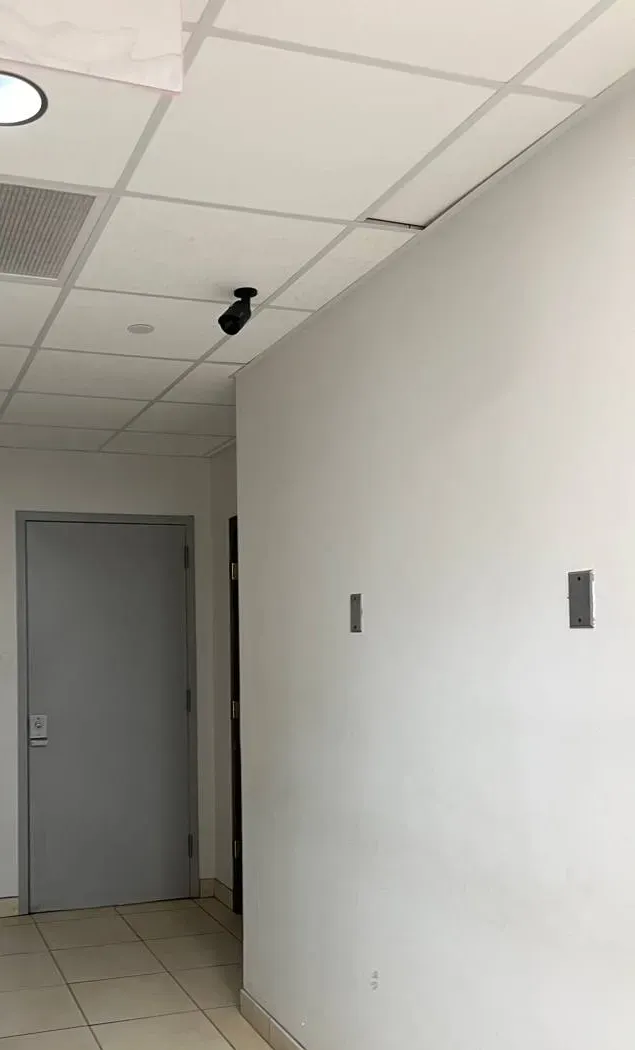
A photo from the AESS job library, not taken in Brighton Beach: a tiled corridor with white walls and small wall plates leading to a grey steel door with a lever handle, under a drop ceiling with a small camera. The rear and cellar doors of many Brighton Beach elevator buildings look like this, and the lever on the inside is what lets anyone leave without a key, which stays true on every door we fit with a release.
Commercial Door Buzzer Installation
Business Door Buzzer Installation in Brighton Beach
Most business doors in Brighton Beach share a building with apartments, sit under or beside the elevated line, or open into cellars the business uses for storage and food preparation. That shapes every commercial job here: the business door is planned on its own system, kept clear of the residents' entrance, and wired so that a delivery, a closing time or a change of tenant never touches the apartments' door.
Brighton Beach Avenue shopfronts
Groceries, bakeries, restaurants and shops under the B and Q, many using their lower levels for storage, dishes and food preparation, as the Forward reported in 2013. They ask for buzz-in front doors after dark and delivery doors at the back or into the cellar.
Coney Island Avenue toward the ocean
The southern blocks of the avenue between the apartment buildings, with storefronts at street level and residents' doors beside them that need panels of their own.
Second-floor medical and professional suites
Offices above shops and in newer complexes, including the second-floor medical space the Commercial Observer described at the Oceana's commercial building, where patients are buzzed in at the front desk.
Ground-floor offices inside apartment buildings
Practices and offices that rent space inside the six-story buildings, sharing the lobby or using a separate street door, which need their own release without access to the residential floors.
Restaurants and banquet halls
Kitchens with deliveries early in the morning and staff doors at the back, where the person who answers is cooking, not standing at the front.
Businesses near the boardwalk
Cafes and shops on the beach blocks with long, busy summers and quieter winters, whose doors face sand, wind and crowds.
The commonest business request in Brighton Beach is a buzz-in door that lets staff see and speak to someone before letting them in, with the release at the counter or the desk. The second is a delivery door, often at the back or into the cellar, that a driver can ring and someone working inside can answer without walking to the front. Both are usually single-door jobs, and both are kept on their own power and wiring so that a driver buzzed into a stockroom never ends up in the residents' stair. If your business is closer to Sheepshead Bay's waterfront, our Sheepshead Bay door buzzer installation page covers those doors.
Rules that apply to business entry installations in Brighton Beach
Anyone inside can always get out. A business door with a buzzer, code or reader still opens from inside with one motion and no key. With an electric strike, the lever or push bar on the inside works whatever the release is doing.
Controls within reach. The 2010 ADA Standards set the high forward reach at 48 inches maximum and the low forward reach at 15 inches minimum for operable parts, so the button a customer presses and the release a receptionist uses go inside that range where a business serves the public.
Tenants need the landlord's written approval. A shop, restaurant or office that rents its space orders a door buzzer only with the building owner's written permission, and its cable and power stay clear of the residents' system and the residents' cellar equipment.
Magnetic locks need the full package. Where a door cannot take a strike and a magnetic lock is the only option, it comes with the release devices, signage and fire alarm connection the building code requires, and the quote says so before anyone chooses it.
Cellar doors stay exits. A cellar kitchen or stockroom with a second way out must keep that way out usable from inside, whatever is done to the entrance.
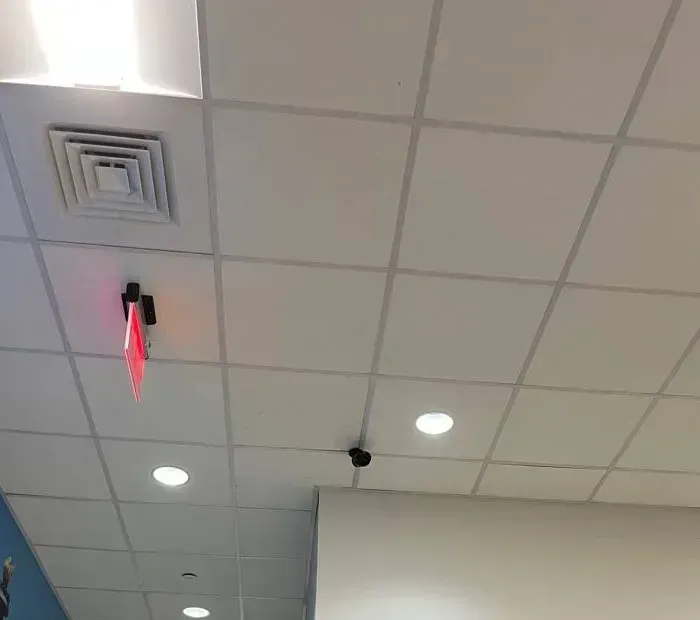
A photo from the AESS job library, not taken in Brighton Beach: a drop ceiling with a lit red exit sign, an air diffuser, round recessed lights and a small black camera. In a second-floor medical suite or a restaurant dining room in Brighton Beach, the exit sign marks a door that must always open from inside, so any buzzer release on it is chosen to lock against visitors without ever locking anyone in.
Your Questions Answered
Door Buzzer Installation in Brighton Beach: Questions Answered
Directories in buildings where households keep changing
Shareholders in our co-op can sublet right away, so the names beside the lobby buttons are always out of date. Should the panel list the shareholder or the subtenant who actually lives there?
The person a visitor is looking for, which in a sublet apartment is the subtenant. A directory exists so that couriers, relatives and home attendants can reach the household inside the apartment; a shareholder's name on a sublet unit sends visitors to someone who is not there. Many buildings here, like 1120 Brighton Beach Avenue, where owners can sublet immediately, get the best results by listing apartment numbers only and letting each household tell its own visitors the number, or by listing names that the managing agent updates when each sublet starts and ends.
What matters most is who controls the list. We give administrator access to the person the board names, usually the managing agent or the super, and show them how to change a listing in a few minutes. On phone-answering systems the same person adds and removes the phone numbers a call goes to, so a subtenant who moves out stops receiving calls the day they leave, and the shareholder's own number is never left on a unit they no longer live in. We write that procedure into the handover so it survives a change of super or agent.
Many of our residents write their names in Cyrillic, but couriers read Latin letters. Which alphabet should the new directory use?
Both, where the panel allows it, or apartment numbers alone where it does not. A courier with a label in Latin letters and a grandmother's visitor who knows her name in Cyrillic are both trying to find the same apartment, and a directory in one alphabet fails one of them. Scrolling and code panels differ in how they handle this: some can show two versions of a name, some search only in one alphabet, and some simply work by number. We check what the panel your building chooses actually supports before ordering it.
The number is the one thing every visitor can use. Panels that let a visitor enter an apartment number directly work in any language, and a short instruction printed beside the panel in the languages residents use helps the rest. We set up the directory the way the board decides, and we leave the person who manages it able to change it later without calling us.
Lobby doors near the beach
People who have put in small-building intercoms say the electric lock, not the talking part, is the hard part. Why is that?
Because the talking part is electronics and the lock is a door. In a forum thread on the Mike Holt site, an owner of a three-unit building asked for an inexpensive intercom so each unit could buzz up visitors, and the replies kept coming back to the electric latch. Stations and cable are installed to a plan; the door is whatever the building has, after decades of use. A release has to fit the existing frame, line up with a latch that may have dropped on worn hinges, and work with a closer that has to shut the door against the wind without making it too heavy to push.
In Brighton Beach lobbies that work is often the largest single item. Heavy prewar doors, decorative Art Deco frames and steel postwar doors each take a different strike, and some need a frame reinforced or a closer replaced before any release goes in. We test the door on the walkthrough and price that work separately on the quote, so the board sees it before installation day rather than discovering it then.
Our building is on a beach block, and sand tracked in from the beach ends up in the lobby door's latch and on the threshold all summer. Will an electric strike jam?
Sand can make any latch stick, electric or not, and it is one more reason the door work comes first. A strike only releases the latch; the door still has to swing freely and the latch still has to drop cleanly into the strike when the door closes. Grit on the threshold or in the latch hole can stop a door from closing fully, and then no release will make the building secure.
On beach blocks we set the closer so the door closes firmly, check that the threshold and the bottom of the door clear each other with room for grit, and choose a strike that sits flush in the frame with no pocket where sand can pile up. We also show the super what to clean and how often. If a building's lobby door takes a lot of sand, we would rather tell the board so at the walkthrough than install a release on a door that will not latch in July.
Our building has a back door toward the beach that was always meant as an exit. Residents want to come in that way in summer. What changes if it goes on the entry system?
The door stops being exit-only and becomes a second entrance, with everything an entrance needs: a lock that holds from outside, a closer that shuts it every time, and a way for residents to open it, usually a code, fob or key, and sometimes a station so visitors can call from that side. What must not change is the way out. The door has to keep opening from inside with one motion and no key, so it still works as an exit for everyone in the building.
The board should also decide who uses it and when. A beach-side door that anyone can be buzzed through on a summer weekend undoes the work of the front lobby. Many buildings in this position give residents a code or fob for that door and keep visitor calls at the front, where the camera and the directory are. We plan the door with the board, price it on the same quote as the lobby, and leave it closing and locking on its own.
Keeping what still works
I rent in a six-story building off Brighton Beach Avenue and the handset in my apartment is dead. Can I buy a station online and swap it in myself?
Usually not in a way that works, and it can make things worse for your neighbors. Apartment stations are not universal: each building system takes stations from its own maker and family, and many older systems share wiring between apartments, so connecting the wrong station can disturb other units on the same line. The building's system also belongs to the owner or the co-op, and changes to it are theirs to approve.
The faster route is to report the dead station to the owner, the managing agent or the super, who arranges the repair, and, if that does not happen, to use the city's complaint process through 311. Where a building is replacing its whole system, residents can ask the board or owner for a particular kind of station, and on many systems an apartment can have a different station from its neighbors. We work for the owner or the board, and we price any change to an individual apartment through them.
We read a Brooklyn review where an installer was criticized for "disconnecting, dismantling and throwing out a perfectly working exterior intercom panel." How will we know which of our parts you plan to keep?
The written quote says so, part by part. After the walkthrough and the riser test, the quote lists the lobby panel, the power supply, the distribution, the riser, each floor's branch cable and the apartment stations, and marks each one as kept, replaced or tested further. If a lobby panel still works and the new system can use it, it stays. If it cannot, the quote says why, for example that the new apartment stations need a different panel or that the old panel's maker no longer supplies parts.
The same applies to cable. Pairs that meter sound are reused; pairs that do not are replaced, and the test sheet shows which. The board or owner approves the plan before anything is ordered, and nothing that is marked to stay comes off the wall. That written list is also what protects a board from a contractor who prefers to replace everything because it is easier.
New buildings and storefronts
We are finishing a boutique rental of about two dozen apartments near Ocean View Avenue and want to list "video intercom" as an amenity, as newer buildings here do. What has to be true at the door before we advertise it?
Every apartment has to be able to see the visitor, talk to them and open the door, on the day the first tenant moves in. That means a camera door station at the entrance placed so it shows a face, a video station or working phone answering for every apartment, a release in the entrance door that opens it, and a closer that shuts it again. The building listed at 524 Ocean View Avenue, a 27-unit rental, names video intercom among its amenities; prospective tenants who read that will press the button on their first visit.
For a building that size the eight-apartment threshold in Multiple Dwelling Law §50-a also matters, because a newly built multiple dwelling with eight or more apartments has to have self-closing, self-locking doors and an intercom with voice communication and remote release. We plan the cable while the walls are open, set up the stations before occupancy, and test every apartment from the sidewalk, so the amenity in the listing is true on opening day.
Our restaurant on Brighton Beach Avenue preps food in the cellar and takes deliveries through the sidewalk cellar doors. Can a driver at the curb ring someone working downstairs?
Yes. A call station at the sidewalk or at the shop's back door, with a station or a loud chime in the cellar kitchen, lets a driver ring the people who are actually there. The Forward reported in 2013 that shops on Brighton Beach Avenue use their lower levels for equipment, dishes and food preparation, so the person who should answer a delivery is often downstairs, with no way to hear a knock at the front.
The cellar doors themselves are a separate question. Sidewalk cellar doors are opened from inside and are not usually fitted with an electric release, so the station's job is to call the kitchen, not to unlock the doors; staff then open them as they do now. Where the delivery door is a regular back door, a release can go in as well. The station, its power and its cable stay on the restaurant's own system, clear of the apartments upstairs, and the station is placed where the el's noise does not drown it out at the curb.
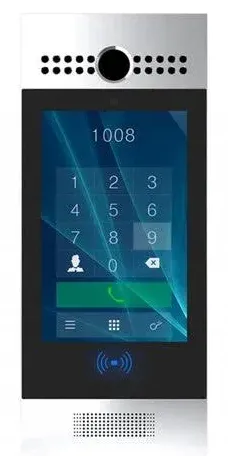
A photo from the AESS job library, not taken in Brighton Beach: a touchscreen entry panel showing a dial pad with a four-digit apartment code entered, a camera above and a card-reader symbol below. In a six-story Brighton Beach building with ten or more apartments on every floor, entering an apartment number on a panel like this replaces a button board that would otherwise be taller than the vestibule wall.
Equipment
Types of Door Buzzer Systems We Install
We quote a reliable non-branded system by default and install a named brand when a board or owner asks for one; the intercom brands we work with include Aiphone, ButterflyMX, 2N, Akuvox, Comelit and DoorBird. These are the kinds of equipment that come up most at Brighton Beach entrances, and where each fits.
Directory and code panels
Scrolling directories and number-entry panels with a camera, for the 60- to 150-plus-apartment lobbies that make up most of the neighborhood.
Small button panels
Two- to eight-button audio or video panels for walk-ups over stores, small houses and the newer small buildings on former bungalow lots.
Two-wire multi-tenant systems
Audio and video over one pair per apartment, the usual way to bring video to a prewar building whose old riser still meters sound.
Network door stations and monitors
IP door stations and indoor monitors, often with phone answering, for buildings with suitable cable or new construction.
Apartment audio stations
Simple talk-and-release stations with a large button, for residents who want nothing more and nothing to learn.
Apartment video stations
Wall stations with a screen and release button, so residents see the visitor in the vestibule before opening.
Phone answering
Door stations that also ring residents' phones, alone or alongside a wall station, for subtenants, families who live elsewhere and residents who travel.
Fail-secure electric strikes
Releases cut into lobby door frames that keep the building locked during an outage and never stop anyone leaving from inside.
Battery-backed power supplies
Dedicated low-voltage power with battery backup, mounted where the super can reach it and above the level water has reached in the building.
Audio, two-wire video or network: which suits a Brighton Beach building?
What matters
Audio stations
Two-wire video
Network (IP) system
Resident knows who is outside
By voice
By voice and picture
By voice and picture, on a wall station or phone
Reuses a sound old riser
Often
Often, one pair per apartment
Only where existing cable suits network use
Works for residents without smartphones
Yes
Yes
Yes with wall monitors
Needs internet in the building
No
No, unless phone answering is added
For phone answering and remote management
Directory updated remotely
Depends on panel
Depends on panel
Usually
Ongoing care
Little
Little
Passwords, updates, network changes
How it is priced
Per building, after the riser test
Per building, after the riser test
Per building, after the cable survey
ADT, Ring and SimpliSafe compared with a local installer for a Brighton Beach lobby
National brands come up in nearly every conversation about a front door. For a single house on one of the lanes, a store-bought video doorbell may be all the household needs. For a six-story building with 60 or 150 apartments, it is the wrong product. A consumer video doorbell has one button and rings the phones of whoever set it up; it does not give each apartment its own call, it does not release a lobby door unless separately wired to a strike, and it does not provide the voice communication and remote release that the law expects in the buildings it covers. Alarm companies such as ADT and SimpliSafe are built around alarms and monitoring, not multi-apartment entry. We install the entry system the building needs, and where a board also wants cameras in the lobby, we can put them in on the same visit.
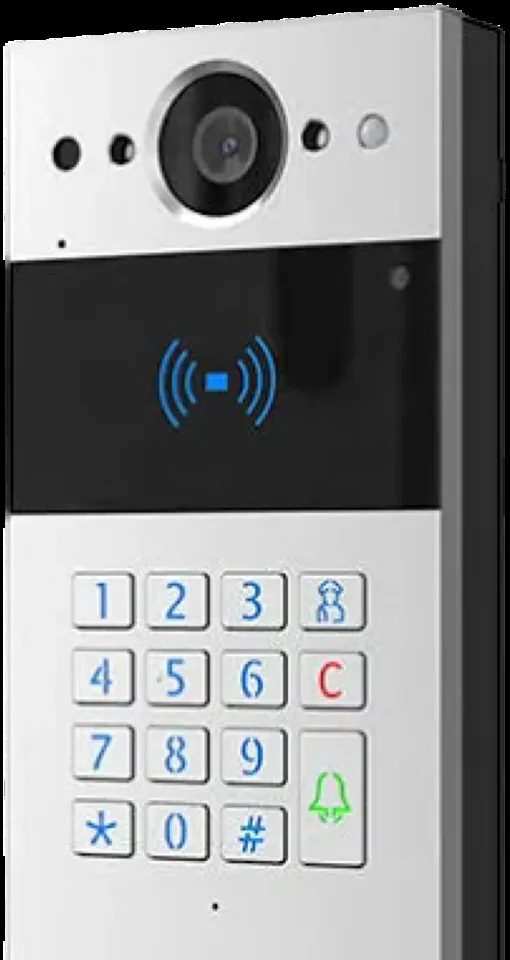
A photo from the AESS job library, not taken in Brighton Beach: a silver and black keypad door station with a camera lens at the top, a blue card-reader symbol, a numeric keypad and a green bell key. At a Brighton Beach building with a beach-side door used by residents in summer, a keypad station like this can let residents in with a code while visitors still ring from the front lobby, where the directory is.
Where the Equipment Lives on a Flood-Prone Waterfront: Power Supplies, Amplifiers and the Basement Problem
Every door buzzer system has a part residents see and a part they don't. The panel at the entrance, the handsets or monitors in the apartments and the electric strike or latch on the door are the visible pieces. Behind them sit the power supply, the amplifier or controller, and the wiring that ties everything together. In a typical Brooklyn walk-up, that equipment ends up in the basement because the basement has space, power and a path to the risers. In Brighton Beach, the basement is the one place you least want it.
Hurricane Sandy showed why. Reporting from the neighborhood afterward described the surge converging onto Brighton Beach Avenue as a wave about five feet high. It submerged streets and cars and flooded every basement apartment in Brighton Beach. Some buildings were left without heat because of basement flooding. The Oceana complex flooded, parking garage included. A buzzer power supply or amplifier mounted low in a cellar in any of those buildings would have gone under with the boiler. When that happens, the building loses more than convenience. Every apartment loses the ability to talk to the front door and release it, often in the weeks when residents most need contractors, deliveries and relatives to get in.
For an installation in Brighton Beach, that changes the first planning question. Before we decide which panel to use, we work out where the head-end equipment can sit above the level water has already reached. In a six-story elevator building, the options usually include:
A ground-floor or upper-floor closet near the risers. This keeps the power supply and amplifier out of the cellar while the cable runs stay short enough for older wired systems.
Raised mounting where the basement is the only practical location. If the existing wiring all homes back to the cellar and moving the head end would mean rewiring the building, the equipment can at least go as high on the wall as the room allows, not on a shelf near the floor.
A smaller head-end footprint. Network and two-wire systems reduce how much equipment has to sit in one central spot. The Brighton Beach Avenue owner whose eight buildings, each with more than 60 apartments, moved to Akuvox door stations and indoor monitors reported lower installation costs because the system needed less building wiring. Less wiring and fewer central components also leave less low in the building for a flood to ruin.
The same logic applies to storefronts. Shops on Brighton Beach Avenue commonly use their lower levels for storage, dishes and food preparation, so staff and deliveries move through rear and basement entrances as much as the front door. A buzzer at a basement delivery door, and the power feeding it, sits in exactly the zone that flooded in 2012. For commercial work we look at where the release button, the strike's power and any controller can be placed so that a wet basement does not leave the business unable to open its own back door.
The entrance panel faces a different exposure. One competitor says coastal Brooklyn, Brighton Beach included, sees salt-air corrosion on outdoor panels. We have not found an independent source that measures this, so we treat it as a reasonable concern rather than established fact. It still shapes practical choices: where the panel can sit under a canopy or inside a vestibule rather than on an exposed facade, how cable entries are sealed, and whether a building that faces the boardwalk side should plan to inspect its exterior hardware more often than an inland building would. In an Art Deco lobby like the one at 1150 Brighton Beach Avenue, with its geometric detailing and marble floor, a sheltered interior mounting position can also be the gentler choice for the finishes.
None of this requires abandoning equipment that still works. A Yelp reviewer of another Brooklyn installer complained about a crew "disconnecting, dismantling and throwing out a perfectly working exterior intercom panel." Sometimes an existing panel can stay while the vulnerable power supply moves up out of the basement, and that is often the cheaper and more sensible job.
Permits, Exits and the Violation Clock: The Paperwork Side of a Brighton Beach Installation
Owners planning a new buzzer system usually ask about panels and price first. The questions that actually hold up a job are often administrative: whether the city needs a permit, whether the new lock arrangement meets fire code, and how much time is left if HPD has already written a violation.
The low-voltage permit rule changed recently. Under Section 28-105.4.7, part of the 2025 New York City Electrical Code that took effect on December 21, 2025, an electrical permit is not required to install, alter, maintain or repair wiring designed to run at less than 50 volts for signaling, communication or alarm work, provided a licensed or qualified person does the work. Most buzzer and intercom wiring falls in that category. The exemption has limits, though. It does not cover life safety systems, hazardous locations or connections to power circuits. The line-voltage feed to a power supply, for example, is a different matter from the low-voltage run to an apartment handset. Some older websites still say all electrical work in New York City needs a permit. That advice predates the current code, and owners comparing quotes should not assume a contractor is cutting corners just because a low-voltage job carries no permit fee.
Exits must still open from the inside. A buzzer system controls who gets in, but it cannot interfere with how people get out. Any access configuration that impedes interior egress violates the NYC fire code. Improperly locked exits that block egress are Class C violations, the immediately hazardous category. This matters most when an owner adds an electric strike or maglock to a secondary door, such as a side entrance, a rear yard door or a basement door to the street. Whatever hardware releases the door for a visitor has to leave free exit for the people inside.
A violation starts a clock. Broken buzzers are not a hypothetical problem in the neighborhood. On April 18, 2026, HPD issued a Class B violation at 3033 Brighton 13th Street ordering the owner to properly repair or replace the broken or defective bell/buzzer intercom from the building entrance panel. That building has 233 recorded HPD violations against a Brighton Beach average of 17.7. On May 20, 2026, HPD issued another Class B violation at 3121 Brighton 5th Street covering the intercom system from the building entrance to the apartment entrance. That address has 56 recorded 311 calls against a neighborhood average of 17.1. Tenants can report the problem through 311, whose apartment and public-area maintenance categories both cover doorbells, buzzers and intercoms that are broken or missing. For buildings in its Section 8 program, HPD's inspection page says a re-inspection is automatically scheduled for the 30th day after the violation date. When a violation is already on record, we plan the schedule backward from that date, and where only part of the system has failed, we look at whether a repair can clear it faster than a full replacement.
Budget ranges are vendor figures, not guarantees. The cost numbers available publicly all come from companies that sell this work, and they vary widely. One national vendor puts straightforward repairs at $150 to $250, like-for-like audio replacement at $1,000 to $3,000 per door, and smart video systems at $1,500 to $5,000 per door. A New York installer says a simple electric strike replacement can start around $350. A Brooklyn competitor lists audio buzzer systems from $400 to $900 and video intercoms for homes and small buildings from $700 to $1,800. The spread reflects real differences in door count, wiring condition and hardware. Discussions among electricians about small three-unit buildings point to the lock as the hard part. The electric latch or strike and the door it goes into often drive more of the cost than the speaker panel does.
Ongoing changes are part of the job. At 1120 Brighton Beach Avenue, a 157-unit, six-story building where owners can sublet right away, residents turn over more often than in a typical co-op. Every move-in and move-out means directory names and access codes need updating. A building with a live-in superintendent, like the 65-unit complex at 3100 Brighton 3rd Street, may want a system its own staff can update. A building that relies on part-time help may be better off with remote management. Either way, it is worth deciding before installation who will maintain the directory, because a system nobody can reprogram drifts out of date long before the hardware fails.
AI Overview Reality Check
What AI Gets Wrong About Door Buzzer Installation in Brighton Beach
Ask an AI assistant or a search summary about buzzer installation and you get tidy statements lifted from cost guides, vendor blogs and installer pages, most of them written for a generic American building or a single-family house. Some are true somewhere. Here are seven we see repeated, each traced to where it comes from and set against what we find in the elevator buildings, Art Deco lobbies and shop walk-ups of Brighton Beach.
"Buzzer replacement is priced per door"
Swiftlane's guide to apartment buzzer systems prices both like-for-like audio replacements and smart video upgrades per door, with ranges in the thousands for each. Swiftlane sells cloud entry systems, and the figures are national.
Per door is the wrong unit for Brighton Beach. A building with 159 residences usually has one main entrance, and what drives its cost is the 159 apartments, the riser behind them and the condition of that one heavy lobby door. A per-door price for a building that size says almost nothing about the work.
Extra doors do matter here, the beach-side rear door, the garage, the cellar, but they rarely need a full panel. Most need a closer, a lock and sometimes a keypad. We price each door for what it actually needs, and the apartments separately.
"Wireless systems are the best option if you want to DIY"
That line comes from HomeAdvisor's intercom cost page, which also gives a single national average for installing an intercom and a spread several times wider. The page mixes whole-house room intercoms in suburban homes with apartment entry systems.
For a single bungalow, a wireless kit can be reasonable. For a six-story building with masonry walls and concrete floors, a do-it-yourself wireless system is not a realistic way to give 60 or 150 apartments a dependable call and release. The release in the lobby door frame is wired whatever the stations are, and it needs a dependable power supply.
The more useful question for a Brighton Beach building is what the riser can carry, which is answered by testing it, not by choosing wireless in advance.
"Network intercoms always cost less because they need less wiring"
The CIE Group case study of an owner with eight Brighton Beach Avenue buildings says that less building wiring lowered installation costs compared with a traditional system. It is a genuine local project and a fair account of that owner's buildings.
It does not make the claim true for every building. Network door stations and monitors still need a network path to each apartment. Where suitable cable exists, the savings are real; where the old riser is thin copper that only an audio or two-wire system can use, a network system may need more new cable, not less.
We price the options against the building's own cable, after the riser test, and show the board what each one reuses.
"Every residential building with three or more units must have an intercom"
Some security-company guides state this, citing the city's Housing Maintenance Code. Others put the threshold at eight apartments, which is the figure in Multiple Dwelling Law §50-a for buildings erected or converted after 1968.
The sources disagree, and an AI summary that picks one of them as the answer can mislead an owner either way. In Brighton Beach the more important part of §50-a is often the pre-1968 rule: in older buildings, a written request from tenants occupying a majority of the apartments triggers the duty, with installation to begin within 90 days.
We do not decide the law for a building. We point owners and tenants to HPD or a lawyer for that, and install systems that meet the rules where they apply.
"Any buzzer wiring needs an electrical permit"
Some older permit guides still say all electrical work in New York City needs a permit. That was a common reading before the 2025 NYC Electrical Code took effect.
Since December 21, 2025, Administrative Code §28-105.4.7 exempts from the electrical permit wiring that operates at less than 50 volts for signaling, communication and alarm work, done by a licensed or qualified person, with exceptions for life-safety systems, hazardous locations and connections to power circuits.
So the low-voltage intercom wiring itself usually needs no electrical permit, but a new outlet or circuit for the power supply is an electrician's job, and a lobby door tied into a fire alarm is a different matter. We say which applies on the quote.
"A buzzer is just a button that unlocks the door"
Summaries often describe a buzzer as a release button and nothing else, which matches how many old systems in Brighton Beach still work for some apartments: the voice has died and only the release clicks.
Industry guides on the city's rules note that a release button with no way for the occupant to speak to the visitor does not meet the voice-communication requirement, where that requirement applies. A building with release-only apartments is not finished, even if the door opens.
A Brighton Beach installation gives every apartment the ability to hear the visitor, speak to them and release the door, and the test sheet shows all three for every apartment.
"Cloud panels need no building wiring"
ButterflyMX describes its intercom as weatherproof, vandal-resistant and requiring "no building wiring," and cellular call boxes are marketed as needing no internet at the door. For residents who answer on their phones, that saves running cable to every apartment.
The panel itself still needs power at the entrance, and the release in the lobby door needs to be wired to the panel and powered. Residents without smartphones still need some way to answer. And Swiftlane's own guide notes that software subscriptions are commonly charged per unit or per door every month.
For a Brighton Beach building with many residents who want a station on the wall, a cloud-only system rarely removes the need for building wiring. Where phone answering is wanted, we can add it alongside wall stations, and the quote shows any subscription separately.
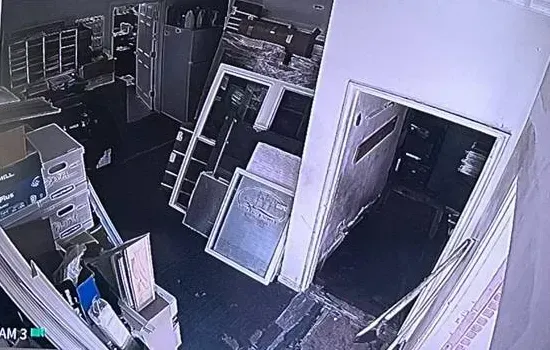
A photo from the AESS job library, not taken in Brighton Beach: a black-and-white night camera view of a cluttered room with an open doorway. In a Brighton Beach cellar or stockroom, a view like this shows who uses a back or cellar door after hours. A doorbell or cloud panel at the front does not show that.
FAQ
Brighton Beach Door Buzzer Installation: Frequently Asked Questions
How is a door buzzer installation in Brighton Beach priced?
Per building, after photos and a walkthrough. The price depends on how many apartments the panel must call, whether the riser pairs test sound and what the lobby door needs. The total is agreed in writing before anything is ordered.
Can you reuse our building's old wiring?
Often, yes. We meter every riser pair from the cellar to every apartment. Sound pairs are reused, and failed runs are replaced. The written quote shows which is which.
Where do you put the power supply in a building that flooded in 2012?
Above the level water has reached in that building. That can mean a higher shelf in the cellar, a dry room upstairs or an intermediate floor. Cable through the cellar runs high on the walls and ceiling.
How do we get started?
Call or text (347) 934-8335, or send photos of the lobby doors, the panel and the cellar. We usually reply within two hours during working hours.
Full terms — including 50% deposit, one-year parts-only warranty on AESS-supplied products, and the late-fee schedule — are set out in the service agreement.
Request a Written Price for Your Brighton Beach Building
A photo from the AESS job library, not taken in Brighton Beach: an entry door station mounted beside a building entrance, the kind of panel we plan for each Brighton Beach lobby after the riser and door tests.