What are you looking for?
About Us Contact Us Careers Get a Free Quote (800) 486-0943
Pick a service
✅ Got Your Own System?
🎬 Home TheatreQuote 🎶 AV SoundQuote 🔑 Access ControlQuote
Now pick your area
Pick your area
Long Island
Hudson Valley
Services available
Pricing & Tools
Pick a service for pricing
🚪 Intercom Pricing 🔔 Buzzer Repair Pricing
Calculators
📹 Camera System Calculator 🚨 Alarm Calculator ⚡ Cabling Quote Builder ✅ Got Your Own System?
Select your area
A rebuilt house where nobody hears the front door from the kitchen, a buzzer transformer that never came back after the storm, or a West End Avenue building whose intercom keeps losing apartments? Manhattan Beach door buzzer installation line: (347) 934-8335
Home › Door Buzzer Installation Brooklyn › Manhattan Beach
Detached Houses on the Lettered Streets · Rebuilt and Enlarged Homes · Co-ops and New Buildings on West End Avenue · Synagogues and Schools

Door Buzzer
Installation in
Manhattan Beach

Answering Points Where You Actually Live · Power Kept Above the Flood Line · Written Price Before Ordering · Brooklyn Rate

Door buzzer installation in Manhattan Beach is mostly a house problem, not an apartment-building problem. On the peninsula between Sheepshead Bay and the ocean, the typical home is a detached brick or stucco house set back behind a garden, and many of them have been enlarged or rebuilt from the ground up, so the front door can be a long way from the kitchen, the den and the bedrooms where people actually are. Basements here took water in 2012, which is where most old bell transformers lived. And at the West End Avenue end, a handful of co-ops, older apartment buildings and new mixed-use buildings need full entry systems with a station for every unit. Below is how we plan each of those jobs, where each one sits on our Brooklyn price list, and what the city's own records say about entry systems on these streets.

Reviewed and updated November 11, 2026, against NYC Open Data's HPD Housing Maintenance Code violations for ZIP 11235; the NYC Building Code's Appendix G on flood-resistant construction; Hush Street's October 2026 Manhattan Beach development tracker; New York YIMBY's October 2022 report on 101 Oriental Boulevard and Marketproof's June 2025 note on its condo offering; the Homes.com and Augrented building records for 150 West End Avenue and 286 Corbin Place; City Limits' December 2012 and Brooklyn Paper's November 2012 reports on Hurricane Sandy in Manhattan Beach; the Wikipedia and CityNeighborhoods profiles of the neighborhood; Chabad.org's mezuzah placement guide; Swiftlane's gate intercom and apartment buzzer guides; New York's Multiple Dwelling Law §50-a; Allegion's fail-safe and fail-secure guide; the building code's sensor-release provisions; HomeAdvisor's intercom cost guide; Aiphone's GT Series pages; ButterflyMX's call box guide; two r/AskNYC threads and one r/homesecurity thread; and the 2010 ADA Standards. · Abstract Enterprises Security Systems, NYS license #12000287431 · crews dispatched from our Troy Avenue office in Brooklyn

Manhattan Beach, Brooklyn door buzzer installation: black rectangular video door station with a camera, speaker grille and round lit call button
From the AESS job library, not photographed in Manhattan Beach: a black rectangular video door station with a camera, a speaker grille and one round call button that lights up. One button is all a single-family house on Hastings or Kensington Street needs at the door; the planning effort goes into where that button rings inside a house that may run three floors and a hundred feet deep.
Manhattan Beach Buzzer Request
House on the lettered streets, two-family, co-op or apartment building on West End Avenue or Corbin Place, new building, synagogue or school: tell us the address, how many households or offices the door serves and where the old equipment sits, and a technician calls back with the range

✅
Request Sent!
Thank you. A technician will call you about the Manhattan Beach address, usually within two hours during working hours.
25+
Years Experience
✓
Same-Day Estimates
100%
Licensed & Insured
4.7★
201 Google Reviews

Owner-operated since 2002 · Thousands of jobs completed · Booked within 2 hours

Quick answer: door buzzer installation in Manhattan Beach runs $400 to $900 on our Brooklyn list for an audio door station with a new electric release on a single-family house or a two-family, $700 to $1,800 for a video door station answered on monitors or phones across a large or rebuilt house, and from about $2,500 to past $10,000 for a full entry system with a panel and an answering point for every apartment in a co-op, older apartment building or new mixed-use building at the West End Avenue end. The price includes the door station, the answering stations or app accounts, the power supply, the electric strike, the cable and the labor. On the peninsula two things move a house job inside its range more than anything else: how far the front door is from the rooms where people answer it, and whether the power supply has to move up out of a basement that has flooded. Both are named and priced in writing before you approve anything. Manhattan Beach is billed at the Brooklyn rate. Send photos of the front door to (347) 934-8335 or on WhatsApp and we reply with the range that fits, usually within two hours of your message during working hours.

  • Looking at your photos and quoting a new system costs nothing. If an existing system has to be tested in person before anyone can say whether it is worth keeping, that is the $250 service call booked online, and the $250 is applied toward the work.
  • All work is done under New York State license #12000287431. We install low-voltage entry equipment; if the new power supply's location needs a 120-volt outlet that is not there, a licensed electrician adds it, and you know that before the job is priced.
  • We take instructions from whoever controls the door: the homeowner, both owners of a shared house, a co-op or condo board, a managing agent, or the administrator of a synagogue, school or office.
The Neighborhood

Why Manhattan Beach Properties Need Door Buzzer Installation

Manhattan Beach sits at the bottom of Brooklyn on a strip of land with Sheepshead Bay along its north side, the Atlantic along its south and east sides, and Brighton Beach to the west. It is a small place: the 2020 census counted 4,684 residents. Oriental Boulevard runs the length of the peninsula and carries the B1 and B49 buses, Shore Boulevard follows the bay, and between them run the alphabet streets from Amherst to Pembroke. Kingsborough Community College fills the eastern tip. The houses are mostly detached brick and stucco homes in Mediterranean or Colonial Revival styles, set back from the street behind gardens, with some rows and low apartment buildings from the 1920s through the 1940s and a strip of larger apartment buildings at the West End Avenue and Corbin Place end. Hush Street's development tracker, updated in October 2026, described the neighborhood as "a peninsula of single-family homes and a public beach, with almost no vacant lots left to build on."

That shape matters more for a buzzer than anything else about the place. In most of Brooklyn, a buzzer job is about splitting one street door between several households. In Manhattan Beach the more common problem is the opposite: one household, one door, and a house so large that the door is out of earshot. Over the past few decades a great many of the original cottages and modest houses were replaced or expanded. The Real Deal reported in 2006 that the city had halted nearly forty oversized new houses here, and a 2016 Brooklyn Eagle piece on the neighborhood's houses described enlarged homes and new houses standing where tear-downs had been. When a house grows from a front room and a kitchen to three floors, a lower level and an addition at the back, the original doorbell, usually a button, a transformer in the basement and a chime in the front hall, stops doing its job long before it stops working.

Then there is the water. When Hurricane Sandy came in from both the bay and the ocean in October 2012, the president of the Manhattan Beach Community Group told City Limits, "Every house was flooded." Brooklyn Paper reported that power was out on the peninsula for more than a week. Basements are where old bell transformers, buzzer power supplies and the splices for the chime wiring usually sat, and in many houses they sat there until they were thrown out with the rest of the basement. Some owners replaced them with a battery doorbell camera and never put back a way to open the door from upstairs. Others put a new transformer back in exactly the same spot. A new installation here starts by deciding where the power and the controller go so the next storm does not take them with it.

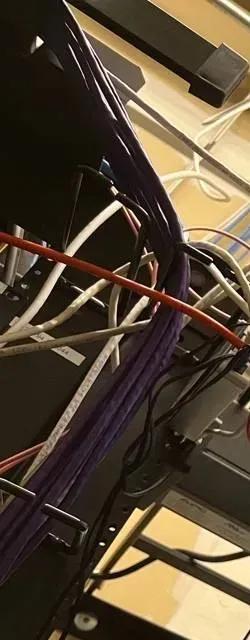
Manhattan Beach, Brooklyn door buzzer installation: purple, white and red cable bundles dropping down beside a black equipment rack
From the AESS job library, not photographed in Manhattan Beach: purple, white and red cable bundles dropping down beside a black equipment rack. In a Manhattan Beach house the buzzer's power supply and controller belong in a spot like this on a dry upper floor, a utility closet or a laundry room above grade, rather than on a basement wall where the 2012 surge reached.

The apartment buildings at the western end tell a different story, and the city's records show it. HPD's Housing Maintenance Code violations, published on NYC Open Data, list fifteen intercom or buzzer violations on Manhattan Beach's streets across the whole record, at just five addresses. Six of them were written at one building on Corbin Place between 1997 and 2008. Six more were written at 35 West End Avenue between May 2008 and December 2009, and every one of those six names the same apartment, A7, with one of them describing a broken intercom "from 1 story front areaway" to that unit. The rest are single violations at 150 Corbin Place in 2019, 45 Falmouth Street in 2016 and 50 Shore Boulevard in 2010. A building where one apartment's line is cited again and again is not a building that needs repairs; it is one whose wiring path to that apartment has a fault that a quick fix keeps missing, and that is the kind of thing a proper installation is designed to end.

Six facts that shape a Manhattan Beach buzzer installation

  • Mostly one household per door. The peninsula is overwhelmingly detached single-family houses, so most jobs are about how many places inside a large house can answer the door, not how many buttons go on the panel.
  • Houses much larger than their original doorbells. Enlarged and rebuilt houses, reported by The Real Deal in 2006 and the Brooklyn Eagle in 2016, often still run on a single button and one chime in the front hall.
  • Basements that flooded. Sandy's surge reached houses from both the bay and the ocean in 2012, and the NYC Building Code's Appendix G expects utilities and attendant equipment in flood areas to sit at or above the design flood elevation or be built to keep water out.
  • A small cluster of real apartment buildings. 150 West End Avenue is a six-story, 96-unit co-op completed in 1951; 286 Corbin Place is a six-story, 38-unit building from 1941; 59 West End Avenue is a four-story, 17-unit structure from 1931 that houses a yeshiva.
  • New mixed-use buildings at the West End end. Permits filed in 2022 for 101 Oriental Boulevard describe eight stories with 20 residences, community-facility space, commercial space and ten enclosed parking spaces; a condo offering plan for 20 units followed in 2025.
  • Few violations, concentrated in a few buildings. Fifteen intercom or buzzer violations at five Manhattan Beach addresses in HPD's full record, compared with 127 across the whole 11235 ZIP code, which takes in Brighton Beach and Sheepshead Bay, since January 2020 alone.

Where this page applies. It covers the whole peninsula: the lettered streets from Amherst to Pembroke, Oriental Boulevard and Shore Boulevard, the short stretch of Ocean Avenue on the Manhattan Beach side of the footbridge, West End Avenue and the Corbin Place edge, and the institutions around Kingsborough Community College. For the rest of the borough see our door buzzer installation in Brooklyn page, and for every borough our NYC door buzzer installation page.

Repair or Replace in Manhattan Beach

Need Repair in Manhattan Beach? Bring the Old Doorbell Back, Build On It, or Start Over: Sorting It Out Before Anyone Drills

A call from Manhattan Beach that starts with "we need a new buzzer" turns into one of four jobs once we have looked at the house. The first is the simplest: the old system is fine except for one dead part, often the transformer or the chime, and it can be brought back for a small fraction of a new installation. The second is a working doorbell in a house that outgrew it, where the button, the wire and maybe the transformer stay, and what gets added is answering points on the other floors and a way to open the door. The third is a house where nothing survived, because the basement equipment was lost to flooding or a renovation pulled the old wire, and the job is a new system from the door inward. The fourth is the apartment-building job at the western end, where the question is whether the building's riser and lobby panel can be kept while apartment stations are replaced, or whether the whole system has reached the end of its life.

Photos usually sort a house into one of the four. Send a picture of the front door from the walk, a close-up of whatever button or station is beside it, a picture of anything on a basement or utility-room wall that looks like a small transformer or a box with wires, and any chime or handset inside. Send them to (347) 934-8335 or on WhatsApp. If the system needs to be tested in person, that is the $250 service call booked online, and the $250 goes toward whichever path the house takes. Where a repair and a new installation are both reasonable, you get both prices and a plain recommendation. Straight repairs are covered on our repair pages; this page is about installing, extending and replacing.

One thing is worth checking before you call anyone: whether the old doorbell still has power at all. On a house whose basement flooded, a transformer that was underwater may have been disconnected by an electrician afterward, and the circuit it was on may now feed something else. That is not a reason to keep the old system, but it explains why a house can have a perfectly good button at the door and a silent chime, and it changes what a technician needs to bring.

What We Install

Door Buzzer Installation Services in Manhattan Beach

Every service below is priced from the same Brooklyn door buzzer list. On the peninsula, the size of the house and the number of floors decide most of the design, the door decides what release it can take, and the flood history of the basement decides where the equipment goes.

Whole-house answering for large homes

A door station at the front entrance with answering stations on each floor and in the rooms the family uses most, so a visitor can be seen, spoken to and let in from the kitchen at the back or a bedroom on the third floor.

Buzzers rebuilt after flood damage

New power supplies and controllers mounted above the flood line, new cable where the old run passed through a flooded basement, and a release put back on a door that has been key-only since the storm.

Systems designed into new houses

Cable, back boxes and equipment space planned with the architect and builder on a house going up on a cleared lot, so the stations and the release are in place before the walls are finished.

Releases added to existing doorbells

An electric strike, a power supply and an answering station added to a house that already has a working button or a wired video doorbell, so the door can finally be opened without walking to it.

Two-family and shared-house panels

A button for each household, answering stations in each home, and a release that each household can use without reaching into the other's space, for the two-family houses and shared family homes on the peninsula.

Video and phone answering

Video door stations answered on wall monitors, on phones or both, for houses where the front door cannot be seen from anywhere the family sits, and for owners who are often away from home.

Apartment and co-op entry systems

Lobby panels, directory or code entry, and a station or app account for each apartment in the co-ops and apartment buildings along West End Avenue and Corbin Place.

Entry for new mixed-use buildings

Separate, coordinated entry systems for buildings with condos, a community facility and shops under one roof, so each door calls only the people it should.

Synagogue, school and office doors

Buzzers for institutional doors on West End Avenue and offices around the college end, answered at a desk or an office phone, with a separate button for any residence in the building.

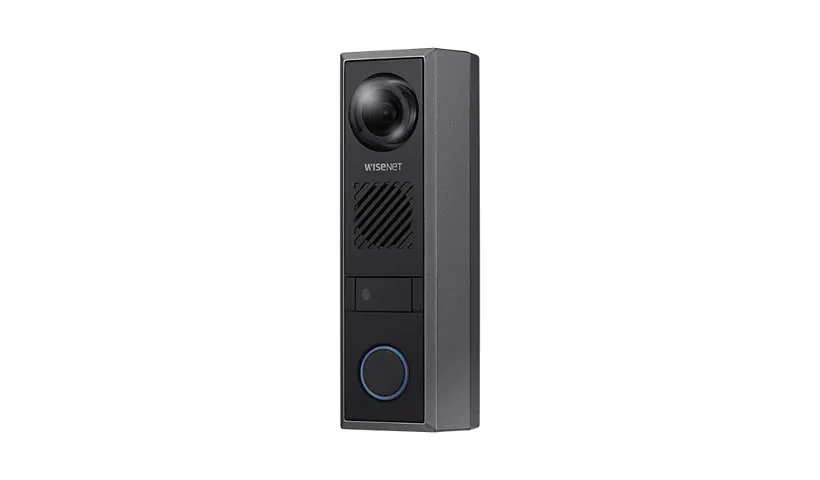
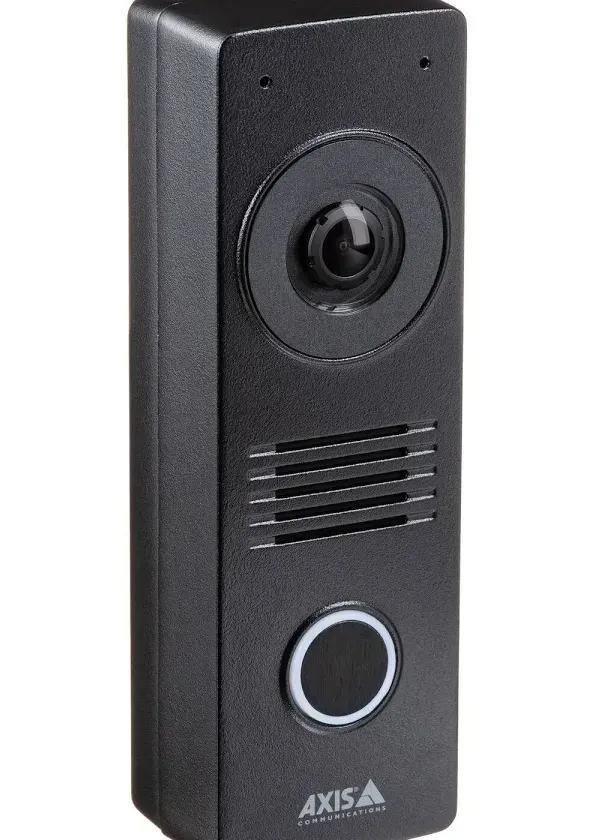
Manhattan Beach, Brooklyn door buzzer installation: slim dark grey wired doorbell with a camera lens, speaker slots and a round push button
From the AESS job library, not photographed in Manhattan Beach: a slim dark grey wired doorbell with a camera lens, speaker slots and a round push button. Many Manhattan Beach houses already have a wired doorbell like this one at the door; on its own it shows the visitor and rings a chime, and the installation job is adding the release and the answering points it was never connected to.
Building Specialists

Door Buzzer Installation for Manhattan Beach's Architecture

Six kinds of property make up almost every buzzer job on the peninsula. They differ in how far the door is from the people who answer it, where the cable can run, whether the basement can be trusted, and who signs for the work. Each has a mistake we see when the job is planned in a hurry.

Original detached houses

Brick and stucco houses in Mediterranean and Colonial Revival styles, set behind front gardens on the lettered streets, many still close to their original size, with a basement and two floors above.

Enlarged and rebuilt houses

Homes extended upward and backward, or built new on a tear-down lot, with three floors, a lower level, a long ground floor and rooms far from the front door.

Houses under construction

New houses on cleared lots, where the buzzer can be planned on the drawings and cabled while the framing is open, instead of fished in afterward.

Two-family and shared homes

Houses with two households, often relatives, sharing a front door or with a second entrance at the side, each needing its own button and its own way to answer.

Co-ops and older apartment buildings

The six-story buildings at the western end, such as the 96-unit co-op at 150 West End Avenue and the 38-unit building at 286 Corbin Place, with lobbies, risers and decades-old wiring.

New mixed-use buildings and institutions

Buildings like the eight-story project at 101 Oriental Boulevard, and the synagogues and schools along West End Avenue, with several kinds of user sharing one structure.

Original detached houses: one button and a basement that has to be checked first

A Manhattan Beach house that has kept roughly its original size is often the simplest job on the peninsula, with one exception. The front door opens into a hall, the living and dining rooms are on the ground floor, bedrooms are upstairs, and the basement holds the boiler, the laundry and, in most cases, the old doorbell transformer. One door station at the front door, an answering station in the kitchen and one on the bedroom floor cover most of these houses, with a release in the door frame so whoever answers can let the visitor in.

The exception is the basement. Before we suggest reusing anything, we find out what happened to it in 2012. If the old transformer and the wire splices were underwater, the wire itself may still test fine, but every connection made in that basement is suspect, and the power supply for the new system should not go back on the same wall. In these houses we usually move the power and the controller to a closet or utility space on the ground floor, bring the cable up from the door through the frame or the hall floor, and use the basement only as a path if the run has to cross it, with the cable kept high near the joists.

The mistake we see most in these houses is a battery doorbell camera added after the storm, with no wired chime and no release. It shows the visitor on a phone, which helps when the phone is in hand. It does not let anyone open the door from upstairs, and it stops working the day its battery runs down. A small wired system costs more than a battery doorbell and far less than most owners expect.

Enlarged and rebuilt houses: the door is the easy part, the distance is the job

In an enlarged or rebuilt house, the front door is often in the same place it always was, but the house behind it may now be three or four times the size, with a family room across the back, a kitchen opening onto the garden, a home office in the lower level and a primary suite on the top floor. A chime in the front hall is inaudible from half those rooms. People end up watching a phone app, leaving the front door unlocked when guests are expected, or walking the length of the house every time someone rings.

The design question is where people really are at different times of day and how they want to answer. Our usual plan in these houses is a video door station at the front door, a wall monitor in the kitchen, one on the bedroom floor and one in the lower level or home office, with phone answering added for anyone who wants it. Each monitor can release the door. The cable route depends on how the house was built: a rebuilt house often has a utility chase, a stacked closet or an attic that makes the runs straightforward, while an enlarged older house may need the cable fished through finished walls, which we plan to stay inside closets and behind built-ins wherever possible.

Distance also decides wired versus wireless. A Wi-Fi door station on the front of a long house is talking to a router that may sit at the far end, through brick, concrete and several walls. We test the signal at the door before recommending anything that depends on it. A wired station with its own cable keeps working whatever the house's internet is doing, and in a house this size it is the reliable backbone, with phone answering added on top.

Houses under construction: put it on the drawings before the framing closes

Manhattan Beach has very few empty lots, but houses are still rebuilt here, and a house going up from the foundation is the cheapest moment to install a buzzer system properly. Everything that is hard in a finished house, getting cable from the door to each floor, finding a dry spot for the power supply, keeping wiring away from finished surfaces, is easy while the walls are open.

What we ask the architect or builder for is simple. A back box at the front door location sized for the door station the owner wants, with conduit from it into the house. A dedicated, labeled cable from that location to each answering point, plus a spare run to one future location. A small equipment space for the power supply and controller on a floor above the design flood elevation, with a nearby outlet on a circuit the owner controls. And a frame prepared for an electric strike, because a strike is far easier to fit to a new frame than to a finished one. The door station, the monitors and the strike go in when the finish work is done.

Two-family and shared homes: each household gets its own button and its own release

The two-family houses on the peninsula are often family arrangements: parents on one floor and adult children on another, or a lower-level apartment for a relative. They share the front door, or one household has its own entrance at the side. Either way, each household needs its own button so a visitor calls the right home, its own answering station, and a release that does not depend on the other household being in.

Where both households share the front door, the station has two buttons and each home's monitor can release that door. Where one household has its own entrance, that door gets its own station calling only that household, and we decide with the owners whether either household should be able to open the other's door. In a family house the answer is often yes for convenience; if the second home is rented, the answer is no, and the systems stay separate.

Co-ops and older apartment buildings: a lobby, a riser and wiring with history

The handful of real apartment buildings on the peninsula are concentrated at its western edge. 150 West End Avenue was completed in 1951 as a six-story building with 96 units; a current listing describes an intercom to the front desk, a secure lobby, cameras in the lobby and on every floor, and fob entrance doors. 286 Corbin Place, built in 1941, has 38 units on six floors. 59 West End Avenue, built in 1931 with four stories and 17 units, is home to a yeshiva and the site of a long-filed replacement plan.

Buildings of this age usually have a riser running up a stair or a utility shaft, with a pair for each apartment and a lobby panel at the street door. Whether a new system can reuse that riser depends on testing it line by line, and the city's record at 35 West End Avenue, six violations in under two years for the same apartment, shows why a building should know which lines are sound before it decides. We test every line, report the results to the board or managing agent, and price both a system on the existing riser and one with new cable, so the board can choose with real numbers in front of it.

New mixed-use buildings and institutions: several users, separate doors

The new buildings filed for the West End Avenue end combine uses that rarely share a building elsewhere on the peninsula. The 101 Oriental Boulevard filing describes residences, a community facility, commercial space and enclosed parking in one eight-story structure; the 73 West End Avenue filing pairs eight residences with community-facility space; and the yeshiva's plan for 59 West End Avenue would put 19 residential units above a community facility. Each of those uses has its own visitors, its own hours and its own people who should be able to open its door.

We plan these buildings as coordinated but separate entry points. The residential entrance gets a panel that calls only apartments. The community facility gets its own station answered at its office, often with a schedule for the hours it is open. The commercial space gets its own door station or none, depending on the tenant. The power supplies and controllers sit in one dry equipment room, labeled by use, so the building's manager can service any of them without touching the others.
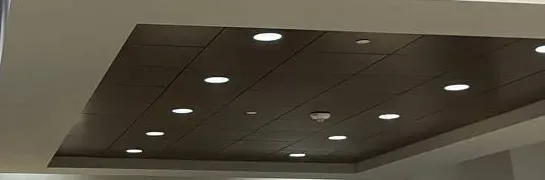
Manhattan Beach, Brooklyn door buzzer installation: dark recessed ceiling panel with round downlights and a small round device framed by a lighter ceiling
From the AESS job library, not photographed in Manhattan Beach: a dark recessed ceiling panel with round downlights and a small round device in a lighter surrounding ceiling. Finished ceilings like this are common in the entry halls of rebuilt Manhattan Beach houses, and they are the reason cable is best run before the drywall goes up rather than fished across it later.
Field Notes

Field Notes: Walk From the Door to Every Chair, Ask Where the Water Reached, Then Look at the Doorpost

These notes describe how our technicians approach a buzzer installation in a Manhattan Beach house. They are our standard practice for the peninsula, not a story about any single address.

Walk from the door to every chair. The technician starts at the front door and walks the house with the owner to each place someone might be when the bell rings: the kitchen, the family room at the back, the home office, the bedrooms, the lower level, the deck. At each spot the question is the same: would you hear a chime here, and if a visitor rang right now, how would you want to answer? The answers decide how many stations the house needs and where, and in a large house they almost always add up to more than the owner expected and fewer than a salesman would push.

Ask where the water reached. Next, the technician goes down to the basement or the garage level and asks how high the water came in 2012 and whether anything has flooded since. The old transformer and chime wiring are found and checked. If any of it was underwater, it is noted on the plan as not to be reused, whatever it tests like today. Then a dry location for the new power supply and controller is chosen on a floor above, close to an outlet the owner controls and away from any tenant's or relative's separate circuit.

Look at the doorpost. Last, the technician looks closely at the front door and its surround. Is there a mezuzah on the right doorpost, a house number, a light fixture, an old button, a camera someone added? Is the wall stucco, brick, stone or wood? Does the door close and latch on its own, and is the frame sound enough for a strike? Is there a storm door, a vestibule door or a gate that also needs to open for a visitor? Each of these decides where the station can go and what the release has to do.

All of it goes on the written price: the stations and their locations, the release, the closer, where the power supply goes, the cable route, any part of the old system that will be reused and any that will not. Nothing about the house should be a surprise on installation day.

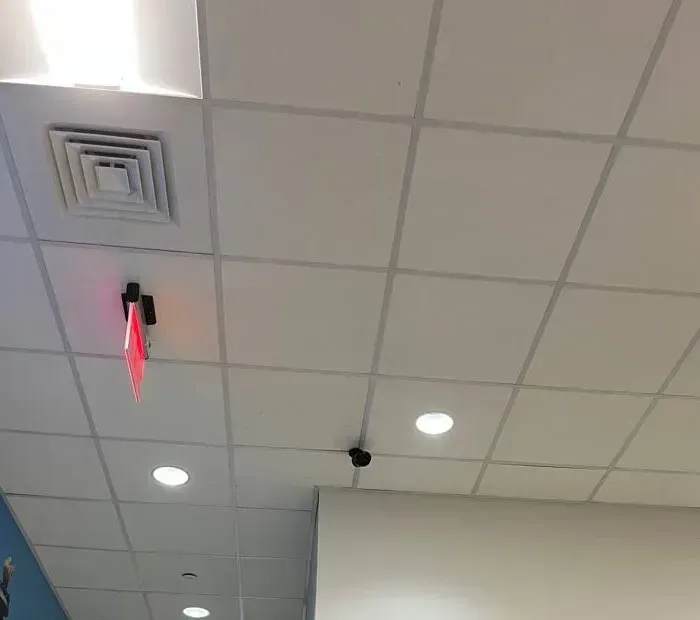
Manhattan Beach, Brooklyn door buzzer installation: drop ceiling with a lit red exit sign, an air diffuser, round recessed lights and a small black camera
From the AESS job library, not photographed in Manhattan Beach: a drop ceiling with a lit red exit sign, an air diffuser, round recessed lights and a small black camera. Corridors like this one are found in the schools, synagogue buildings and college offices at either end of the peninsula, and the exit sign is the reminder that a door a buzzer locks must still let everyone out freely.
Flood-Zone Basements

Above the Water Line: Where a Buzzer's Power Supply, Controller and Cable Belong on a Peninsula That Flooded

Every buzzer system has two parts that live away from the door: a low-voltage power supply, which turns house current into the small voltage the stations and the strike use, and, in most modern systems, a controller or distributor that connects the door station to the answering stations. In older houses on the peninsula, both of those jobs were done by a doorbell transformer screwed to a basement joist or mounted on the side of the electrical panel, with the chime wire spliced nearby. That placement made sense for a hundred years. After Sandy, it does not.

The city's own code points the same way. The NYC Building Code's Appendix G, which covers flood-resistant construction, says for residential buildings in flood areas that "utilities and attendant equipment shall be located at or above the design flood elevation," or be built to keep water from entering or collecting in them during a flood. Appendix G is written for new construction and substantial improvements, and an owner replacing a doorbell in an existing house is not usually doing either. But the principle it sets out is the right one for every house on the peninsula, new or old: equipment that fails when wet does not belong below the level water is expected to reach. A buzzer power supply costs little; losing the door system for weeks after a storm, at exactly the time contractors, insurers and relatives are coming and going, costs a great deal more.

In practice that means three decisions on most Manhattan Beach jobs. First, the power supply and controller go on a floor above grade, typically in a utility closet, a laundry room, a hall closet or the back of a pantry, on an outlet the owner controls. If the house has a standby generator, we discuss with the owner whether that outlet should be on a generator-backed circuit; the electrician who installed the generator decides what can go on it. Second, the cable from the door station runs inward and upward, through the door frame or the hall floor into a wall cavity on the ground floor, rather than down into the basement and back up. Where the run has to cross the basement or the garage level, it stays high near the joists, in one continuous length with no splices below the level water reached. Third, the battery backup sits with the power supply, so it is dry when it is needed.

Houses built or rebuilt since the storm often have a lower level designed to take water, with flood openings in the walls and only parking, storage and an entry at that level. Appendix G allows that kind of enclosure below the design flood elevation, and it means a new house's front door may open into a space the code expects to flood. In those houses we treat the lower level as a corridor only: the door station at the street entry, its cable running straight up inside a wall or chase to the first living floor, and nothing else of the system at the lower level except the strike and the station itself, which are built to be outdoors anyway.

One more thing about water: the chime or answering station in a basement family room is the first thing a flood ruins and the cheapest to replace, so we do not tell owners to skip it. We wire it as a branch that can be lost without taking down the rest of the house, and we label it at the power supply so whoever restores the house after a storm knows exactly what it is.

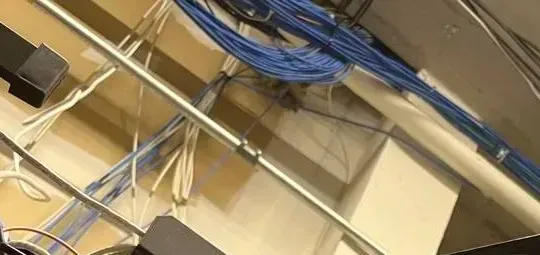
Manhattan Beach, Brooklyn door buzzer installation: bundles of blue low-voltage cable laid over a ceiling beam and a metal pipe in an open ceiling
From the AESS job library, not photographed in Manhattan Beach: bundles of blue low-voltage cable laid over a ceiling beam and a metal pipe in an open ceiling. Where a Manhattan Beach buzzer run has to cross a basement, it should look like this, kept up at the joists in one continuous length, with no splice anywhere water reached in 2012.
Distance and Signal

A Long Walk, a Deep House and a Router at the Back: Planning for Distance on a Detached Lot

Most Brooklyn buzzers cover a few feet: a button at a stoop and a station one or two floors up. A Manhattan Beach house can put a garden between the sidewalk and the front door and a hundred feet of house between the front door and the kitchen. Distance changes three things about the installation: whether wireless equipment is reliable, how cable gets from point to point, and whether a visitor should ring at the sidewalk or at the house.

Wireless works where it is tested, not where it is assumed. Swiftlane's guide to gate intercoms is blunt on this: "Weak signal at gates is common," and "Range limits are frequently underestimated." The same warning applies to a Wi-Fi doorbell on the front of a long brick or concrete house whose router is in a back room. Owners often tell us their doorbell camera "drops" in the evening or takes several seconds to show a picture; that is usually signal, not a faulty camera. Before we recommend anything that depends on Wi-Fi or cellular at the door, we measure it at the exact mounting point. Swiftlane also reminds readers that even a wireless intercom "requires electrical power plus either internet or cellular connectivity," so wireless rarely means no work at the door.

Cable follows the house, not the straight line. Inside a large house, the run from the door station to each answering point is planned room by room. We look for stacked closets, utility chases, attic space and the space under the first floor, and we choose the route that avoids opening finished walls in the main rooms. Every answering station gets its own labeled run back to the controller. That costs a little more cable than daisy-chaining stations together, and it means one damaged run never silences the rest of the house.

Sidewalk or front door. Some owners want visitors and couriers to ring from the front gate rather than walk up the path. That is possible, but it is a bigger job than a door station: the gate needs power and a cable path across the garden or the walk, and a release that works on a moving gate. We price it separately so the owner can see what the gate adds. For most houses on the lettered streets, where the path from the sidewalk to the door is short and open, the station belongs at the front door, with a clear house number at the sidewalk so visitors know where to go.

How far is too far for a wired station? Within a house, practically never. Wired door stations and answering stations are designed for runs far longer than any house on the peninsula. What limits the design is not cable length but the number of stations a given system supports and the power supply that feeds them, both of which we size for the house before ordering.

The City's Record

Fifteen Violations at Five Addresses: What HPD's Intercom Record Says About the Peninsula's Apartment Buildings

HPD writes violations under the Housing Maintenance Code when an inspector finds a broken or missing intercom, buzzer or bell in a rental apartment building, and the city publishes every one of them on NYC Open Data. We searched that dataset for violations in ZIP 11235 whose descriptions mention an intercom or a buzzer, on Manhattan Beach's own streets: Oriental Boulevard, Shore Boulevard, West End Avenue, Corbin Place and the lettered streets. The result is short, and it is useful precisely because it is short.

Across the whole published record, there are fifteen such violations at five addresses. At 200 Corbin Place, six violations were written between 1997 and 2008, describing intercoms broken "from vestibule" to particular apartments and, in 2008, a bell and buzzer "in the entrance" that had to be replaced with new. At 35 West End Avenue, six violations were written between May 2008 and December 2009, and every one concerns the same apartment, A7; the earliest describes the defective intercom running "from 1 story front areaway" to that unit. The other three are single violations: 50 Shore Boulevard in January 2010 for an intercom in an apartment's foyer, 45 Falmouth Street in February 2016 for an intercom in an apartment, and 150 Corbin Place in February 2019 for a "bell and return buzzer system from 1st story public hall vestibule" to an apartment. All of them cite section 27-2005 of the Administrative Code, the owner's general duty to keep the building in good repair.

For comparison, the same search across the entire 11235 ZIP code, which also takes in Brighton Beach and much of Sheepshead Bay, returns 127 intercom or buzzer violations with inspection dates since January 2020 alone. The difference is mostly the building stock: Manhattan Beach has few rental apartment buildings for HPD to inspect, and its single-family houses fall outside these rules entirely. But inside the few buildings it does have, the record shows the two classic failures of an aging entry system.

The repeat apartment. When the same apartment is cited again and again within months, the problem is almost never the apartment's handset. It is the line between the lobby and that apartment, a splice in a junction box, a pair damaged where it passes through a wall or, in a building with a street-level areaway entry, the exposed section of the run near the door. A technician who replaces the handset clears the violation and leaves the fault in place. On a new installation or a riser reuse, we test each apartment's line from the lobby end and the apartment end and replace any line that fails rather than nursing it.

The vestibule end. Several of the descriptions start at the vestibule or the entrance. The door station, the strike and the vestibule wiring take the weather, the slamming and the traffic, and in a building a few blocks from the ocean they take salt air as well. A new system puts the street-side equipment on a dedicated, protected run and gives the managing agent a station and strike that can be replaced on their own without touching the riser.

The Doorpost

Mezuzah, House Number, Lantern and Camera: Finding Room for a Door Station on a Crowded Doorpost

The front door of a Manhattan Beach house is rarely bare. The peninsula's synagogues and Jewish schools, including the Manhattan Beach Jewish Center at 60 West End Avenue, are part of its daily life, and a front door here may well carry a mezuzah. Add a house number, one or two lanterns, an older bell button, maybe a doorbell camera added after the storm, and a stucco or brick wall that has its own limits, and the question of where a new door station goes is a real one.

Chabad.org's guide to mezuzah placement explains that the mezuzah "is affixed on the right-hand side of the door as you enter," and that "the proper place for the Mezuzah is at the bottom of the top third of the doorway." A door station, by contrast, belongs at a height a visitor can reach and a camera can see a face, and on any door used by the public its buttons stay within the 2010 ADA Standards' forward reach range, no higher than 48 inches above the ground. The two rarely compete for the same spot on the frame, but they can crowd each other on a narrow doorpost, and the station's screws and cable must never go through or behind the mezuzah case. We measure both before choosing the station, and where the right side is taken, the station goes on the left of the door or on the wall beside the frame.

The wall material matters as much as the layout. Stucco can crack if it is drilled carelessly, especially over old lath, and an exterior back box cut into stucco has to be sealed so water does not get behind it. Brick and stone take anchors well at the mortar joints. A door frame of solid wood is often the neatest location of all for a slim station, with the cable entering through the frame from behind, so nothing shows on the facade. Where an older bell button or camera is coming off, we plan the new station to cover its holes or leave a small, clean patch for the owner's painter.

Lighting is the last piece. A video station needs light on the visitor's face, not behind it. On houses with a lantern on each side of the door, that usually means placing the station between a lantern and the door edge rather than under the lantern, where the glare washes out the camera. On houses with a deep porch or an arched entry, the camera's night mode does most of the work, and we test the picture after dark before calling the job finished.

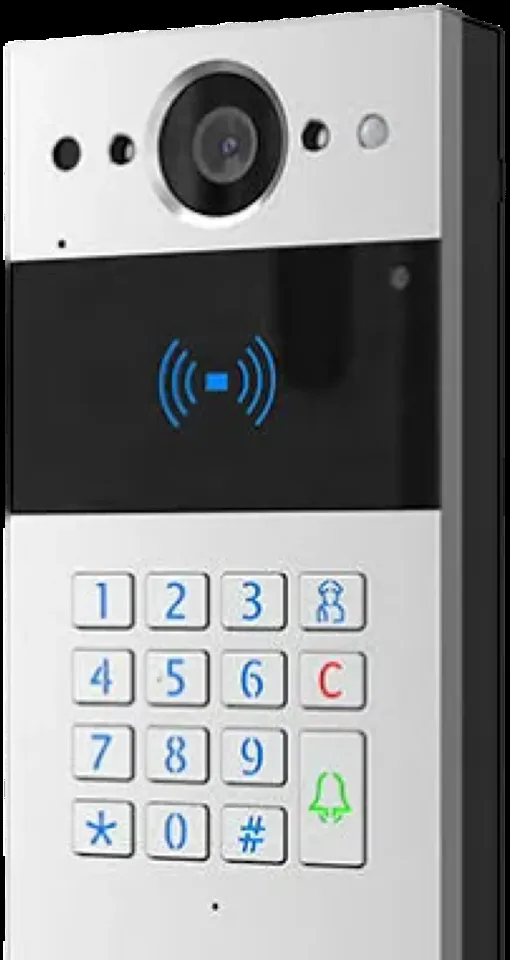
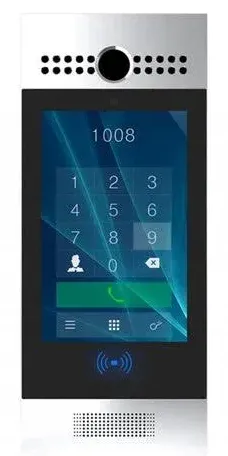
Manhattan Beach, Brooklyn door buzzer installation: silver and black keypad door station with a camera lens at the top, a blue card-reader symbol, a numeric keypad and a green bell key
From the AESS job library, not photographed in Manhattan Beach: a silver and black keypad door station with a camera lens at the top, a blue card-reader symbol, a numeric keypad and a green bell key. A tall combined unit like this suits the wide entrance of a West End Avenue co-op or an institutional door; on a house with a mezuzah, a lantern and a house number already on the doorpost, a slimmer station is usually the better fit.
The Rules

Houses, Co-ops and New Condos: Which Entry Rules Apply to Which Manhattan Beach Door

Because the peninsula mixes single-family houses with a few sizeable apartment buildings and new mixed-use projects, the rules land very differently from one door to the next. Here is how they apply in plain terms. None of it is legal advice.

Single-family houses: no entry-system rule at all. A detached house with one household is not a multiple dwelling, and no city rule requires it to have a buzzer, an intercom or a self-locking door. Everything about the system is the owner's choice, which is why the design can follow the way the family lives instead of a code minimum. The one rule that still applies is the obvious one: the door must open from the inside without a key or special knowledge, which an electric strike in the frame preserves automatically.

Two-family houses: still a choice, but agree it in writing. A two-family house is also below the size the state's entry-system law reaches. Where the second home is rented, owner and tenant should agree how the tenant answers and releases the front door, because once a tenant relies on a working buzzer, a broken one becomes a repair question between them.

Larger apartment buildings: talk and release from every apartment. New York's Multiple Dwelling Law covers New York City, and its §50-a requires class A multiple dwellings built or converted after January 1, 1968 with eight or more apartments to have a self-locking main entrance door and an intercommunication system that lets tenants speak with a visitor and release the door from their apartments. Older buildings of that size, which includes the 1931, 1941 and 1951 buildings at the western end, must install both when tenants occupying a majority of the apartments ask or consent in writing, with work started within 90 days and finished within six months. New buildings such as 101 Oriental Boulevard fall under the post-1968 rule from the start.

Rental buildings: a broken system is a reportable condition. NYC 311 takes complaints about broken or missing doorbells, buzzers and intercoms, in apartments and in public areas, and HPD inspects and writes violations under the Housing Maintenance Code, as the fifteen violations on the peninsula's streets show. If your building has an open violation, tell us its class and date when you ask for a quote, because the correction deadline sets the schedule.

Every door with a lock: free exit. Electric strikes leave the inside lever working, so the door opens from inside whether the strike is fail-safe or fail-secure; Allegion's guide makes that point and notes that fire doors need fail-secure strikes so they stay latched in a fire. Magnetic locks hold the whole door, so the building code's sensor-release provisions call for an egress-side sensor, a manual release marked "PUSH TO EXIT" 40 to 48 inches above the floor within five feet of the door, release on power loss and on fire alarm or sprinkler activation, and hardware listed to UL 294. On houses we use strikes; on apartment and institutional doors we use strikes wherever the door allows.

Commercial Door Buzzer Installation

Business Door Buzzer Installation in Manhattan Beach

Manhattan Beach has no shopping street of its own; its commercial life is across the footbridge on Emmons Avenue in Sheepshead Bay and on Brighton Beach Avenue to the west. The doors that need business-grade entry systems on the peninsula belong instead to its institutions, its new mixed-use buildings and the offices people run from their homes. Their needs are the same as any business door: stay locked when they should, open for the right visitor without someone walking to the door, and never interfere with the homes around them.

West End Avenue synagogues and schools

Synagogue buildings, a kollel and yeshivas along and near West End Avenue, with offices, study halls and classrooms that receive visitors, parents and deliveries at set hours.

Manhattan Beach Jewish Center, 60 West End Avenue

The synagogue of 1952 and community center of 1962, listed on the National Register of Historic Places in 2015, with a sanctuary entrance and a community-center entrance serving different users.

59 West End Avenue

The 1931 building that houses the Mesivta and Yeshiva Gedolah of Manhattan Beach, still operating there as of September 2025, with a long-filed plan for residences above a community facility.

101 Oriental Boulevard

The eight-story mixed-use building filed at the corner of West End Avenue, with condos, community-facility space, commercial space and enclosed parking that each need their own entry.

Kingsborough Community College

The City University campus on the eastern tip, opened in 1963 on 71 acres of a former maritime training center and air force station, with departments and offices that keep their own doors.

Home offices on the lettered streets

Practices and offices run from the ground floor or lower level of a house, where clients need a door and a button that do not ring the family upstairs.

For a synagogue or school building, the usual job is a door station at the main entrance and the office entrance, answered at the office desk and, outside office hours, on the phone of whoever is responsible for the building. Visitors and parents ring and are seen before being let in; regular staff use a code that works only during their hours. Where a building also holds a residence, for a rabbi, a caretaker or a family, the residence gets its own button and its own answering station, kept separate from the office so callers for one never ring the other. Many institutions also want the door to stay unlocked during services or events and buzzer-only the rest of the time, and the system can follow that schedule without anyone wedging the door.

For a new mixed-use building, the work starts on the drawings. The residential lobby, the community facility and the commercial unit each get their own entry point, their own answering arrangement and their own release, wired back to one dry equipment room above the design flood elevation. For a home office, the answer is usually a second station at the side or lower-level door that rings only the office during working hours and the family's phones at other times.

Rules that apply to Manhattan Beach institutional and business entry installations

  • Free exit at all times. Every door with a buzzer, code or reader must still open from inside without a key or code. An electric strike keeps the inside lever working, so it is our default for institutional doors.
  • Sensor release for magnetic locks. Where a magnetic lock is the only workable option on a glass or aluminum entrance, the building code calls for an egress-side sensor, a push-to-exit device near the door, release on power loss and fire alarm activation, and UL 294 listed hardware.
  • Fire-rated doors stay latched. Stair and corridor doors in schools and larger buildings are often fire-rated, and fire doors need fail-secure strikes so they stay latched in a fire. We read the door's label before choosing hardware.
  • Accessible reach. Buttons, keypads and readers on public doors stay between 15 and 48 inches above the floor or ground, inside the 2010 ADA Standards' reach range.
  • Equipment above the flood line. In new buildings, controllers and power supplies go in an equipment room at or above the design flood elevation, in keeping with Appendix G of the NYC Building Code.
  • National Register listing is not a barrier. The New York State Historic Preservation Office explains that owners of listed properties who use no state or federal funds or permits remain free to alter them, subject to local rules, so a buzzer at a listed synagogue is planned on its merits.

If an institution also wants a camera on its entrance, it can be installed on the same visit and priced with the buzzer; customers who combine the two typically save $200 to $400 in labor.

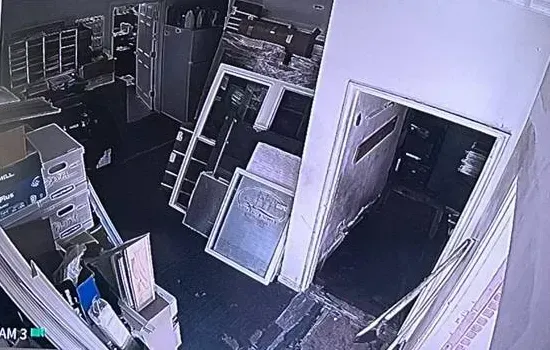
Manhattan Beach, Brooklyn door buzzer installation: black-and-white night camera view of a cluttered room with an open doorway into a dark back room
From the AESS job library, not photographed in Manhattan Beach: a black-and-white night camera view of a cluttered room with an open doorway into a dark back room. The back rooms and service doors of Manhattan Beach's synagogue buildings and schools are where deliveries arrive, and a buzzer and a camera fitted on the same visit let staff see who is there before opening up.
Your Questions Answered

Door Buzzer Installation in Manhattan Beach: Questions Answered

Questions Manhattan Beach homeowners, boards and institutions bring to us, together with ones raised in r/AskNYC and r/homesecurity threads, the city's records and the code, answered for the houses and buildings on the peninsula.

Large and rebuilt houses

Our rebuilt house is several times the size of the cottage that stood here, and from the kitchen at the back we cannot hear the front door at all. How many answering stations does a house like this really need?

Usually one on each floor where people spend time, plus one in any room that is both far from the door and used for long stretches, such as a kitchen across the back of the house or a home office in the lower level. For a three-floor house with a lower level, that typically means three or four wall stations, each of which can see or hear the visitor and release the door. Phone answering can be added for anyone who wants it, but it works best on top of wired stations, not instead of them.

We work it out by walking the house with you from the door to each room and asking two questions in each: would you hear the door from here, and is this where you would want to answer it? Rooms that fail the first question and pass the second get a station. The written price lists each one by location, so if you want to drop or add a room, you can see what it changes.

Our new house has a ground level built to take floodwater, with parking, storage and the front entry down there and the living floors above. What happens to the buzzer wiring that has to pass through that level?

It passes through without stopping. The door station and the strike sit at the street entry, because that is where the door is, and both are built for outdoor conditions. From the station, the cable goes straight up inside a wall or a chase to the first living floor, in one continuous length, and everything else, the power supply, the controller and the answering stations, lives on the floors above. Nothing that can be ruined by water is left on the lower level.

This follows the logic of the NYC Building Code's Appendix G, which allows an enclosure for parking, storage and building access below the design flood elevation and expects utilities and attendant equipment to sit at or above that elevation or be built to keep water out. If the house is still being built, the chase and the back box at the entry should go on the drawings now; if it is finished, we look for the shortest dry path from the entry to the first living floor before pricing.

We are replacing our house with a new one. Can the buzzer equipment from the old house be taken out and reused in the new one?

Sometimes, but it is rarely worth it. A door station or monitor that is only a few years old and from a system that is still sold can be removed carefully before demolition and reinstalled, and we are glad to do that. Older equipment, anything that sat in a flooded basement, and anything that depended on a specific old wiring arrangement is usually better left behind, because the new house will be wired differently and its system should be sized for the new layout.

The more useful thing to save from the old house is information: which rooms you used to answer from, which ones you could not hear from, and what you wished the old system did. That shapes the new design far more than the hardware does.

Water and power

Our old buzzer transformer was on a basement joist, and Sandy's water reached it. Where should the power supply for a new system go, and does moving it change the price?

On a floor above grade, in a dry, accessible spot near an outlet the owner controls: a utility closet, a laundry room, a hall or pantry closet. The power supply is small, and it sits beside the controller and the battery backup so all three can be reached without going into the basement. The NYC Building Code's Appendix G expects utilities and attendant equipment in flood areas to sit at or above the design flood elevation, and while a doorbell replacement in an existing house is not usually the kind of work that triggers Appendix G, it is the right standard to follow on this peninsula.

Moving the power supply up usually adds little to the price, because the new system needs new power anyway. What can add cost is the cable route: if the old run went from the door down into the basement and up again, the new run needs a path that goes inward and upward instead. That is named on the written price before you approve. If there is no outlet in the right place, a licensed electrician adds one, and you know that up front too.

Apartment buildings, new buildings and institutions

A new building going up near us will have condos, a community facility and a store under one roof. How many separate entry systems does a building like that need?

Usually three entry points that share an equipment room but not their releases. The condo lobby gets a panel with a directory or code entry that calls only the apartments, plus stations or app accounts in each unit. The community facility gets its own station, answered at its office during its hours, with the option of a schedule that leaves the door open during events and buzzer-only otherwise. The store either gets a simple station of its own or none, depending on the tenant. Each door releases only from the stations that belong to it.

The 101 Oriental Boulevard filing is a good example of the mix: residences, community-facility space, commercial space and ten enclosed parking spaces in one eight-story building. Under the Multiple Dwelling Law, a new building with eight or more apartments must give every apartment talk and release from the main entrance, so the residential system is not optional. The other two are design decisions, and they are far cheaper to settle on the drawings than after the walls are closed.

Our synagogue building has the rabbi's family living upstairs and the office and study hall below, all through one front door. Can the family have its own button?

Yes, and it should. The door station gets two clearly labeled buttons, one for the office and one for the residence, and each rings only its own answering station. The office's station can release the front door during office hours; the family's station can release it at any time. If the residence has its own inner door off the entrance hall, that door stays on the family's key and is never released from the office.

Many synagogue buildings also want the front door to stay unlocked during services and on a buzzer at other times. That is a schedule in the controller, set with whoever manages the building, and the family's button keeps working whatever the schedule is. Where the building is listed on the National Register, as the Manhattan Beach Jewish Center is, the State Historic Preservation Office's guidance is that owners using no state or federal funds or permits remain free to alter it, so the design can follow what the building needs.

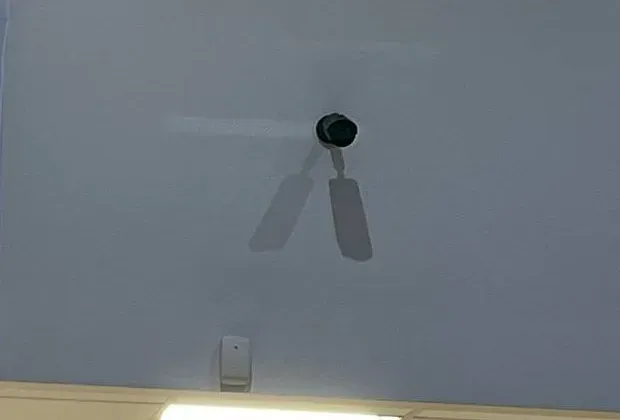
Manhattan Beach, Brooklyn door buzzer installation: small black camera mounted high on a pale wall casting two shadows, with a small white wall device below
From the AESS job library, not photographed in Manhattan Beach: a small black camera mounted high on a pale wall casting two shadows, with a small white wall device below it. In the lobby of a West End Avenue co-op or the entry hall of a synagogue building, a camera placed like this watches the door the buzzer releases, so a board or an administrator can see who came in after a release was pressed.
Equipment

Types of Door Buzzer Systems We Install

We quote a reliable non-branded system by default and install a named brand when an owner asks for one; the intercom brands we work with include Aiphone, ButterflyMX, 2N, Akuvox, Comelit and DoorBird. These are the kinds of equipment that come up most on the peninsula, and where each one fits.

Slim single-button video stations

Narrow stations with a camera and one button for a single-family house, sized to fit a door frame or the wall beside it without crowding a mezuzah, a lantern or the house number.

Two-button house stations

Stations with a clearly labeled button for each household in a two-family or a shared family house, each ringing only its own home.

Multi-station house systems

Systems that support several wall monitors on different floors and in far rooms, each able to see, talk and release, for enlarged and rebuilt houses.

Two-wire systems for existing cable

Stations and monitors that carry voice, video, power and release on one pair, useful where an old run tests sound and opening walls is the expensive part.

Lobby, directory and code panels

Panels for co-ops, apartment buildings and new condos where visitors scroll a list or enter a unit code, with a station or app account for every apartment.

Phone and app answering

Stations that call residents' or staff phones, alone or beside wall monitors, for owners who travel and for institutions whose staff are not always at a desk.

Electric strikes and electrified locks

Fail-secure strikes for wood and metal frames on houses and institutions, with fail-safe or fail-secure chosen for each door and fire-rated doors kept latched.

Closers and door hardware

Closers sized for heavy front doors and lobby doors, set so the door relatches after every visitor, including on windy days off the water.

Power supplies and battery backup

Low-voltage supplies with battery backup, mounted on a dry upper floor on an owner-controlled circuit and labeled, so the system rides out a short outage and survives the next flood.

Audio station, wired video with monitors, or phone answering: which fits a Manhattan Beach house?

What mattersAudio stationWired video with monitorsPhone or app answering
Typical peninsula fitOriginal-size houses where the front walk is visible from the main roomsEnlarged and rebuilt houses, two-family houses, co-ops with sound risersOwners often away, home offices, institutions with staff on the move
How people answerWall station with a release keyWall monitor on each floor, often with a phone optionPhone, ideally with at least one wired station
Works without the house internetYesYes, for the wired monitorsNo, it needs internet or cellular at the door
Distance in a long houseNo issue on cableNo issue on cableDepends on Wi-Fi or cellular signal at the door, tested first
After a long power cutRuns on battery backup for a whileRuns on battery backup for a whileStops when the router or cellular service stops
Monthly feesNoneNone unless an app service chargesSometimes, per unit or per door
Brooklyn list range$400–$900 for a house; from about $2,500 for a building$700–$1,800 for a house; from about $2,500 for a building$700–$1,800 for a house; from about $2,500 for a building

ADT, Ring and SimpliSafe compared with a local installer for a Manhattan Beach house

Owners ask about the national names, so here is a straight comparison. Ring sells video doorbells and cameras that a household installs itself; a Ring doorbell is a reasonable choice for a house that only wants to see who is at the door on a phone, and many houses on the peninsula have one. What it does not do is open the door, give a second household its own button, or ring a wired station on the third floor when the Wi-Fi drops. SimpliSafe sells self-installed alarm systems, and ADT sells professionally installed and monitored security, chiefly alarms and cameras; neither is built around a door station that rings several answering points and releases the front door. What a large Manhattan Beach house needs is a station placed to suit a crowded doorpost, a strike fitted to its frame, a closer that works, answering points in the rooms the family uses, and power kept above the flood line. That is on-site work by a licensed installer, and it can sit alongside a doorbell camera the family already likes.

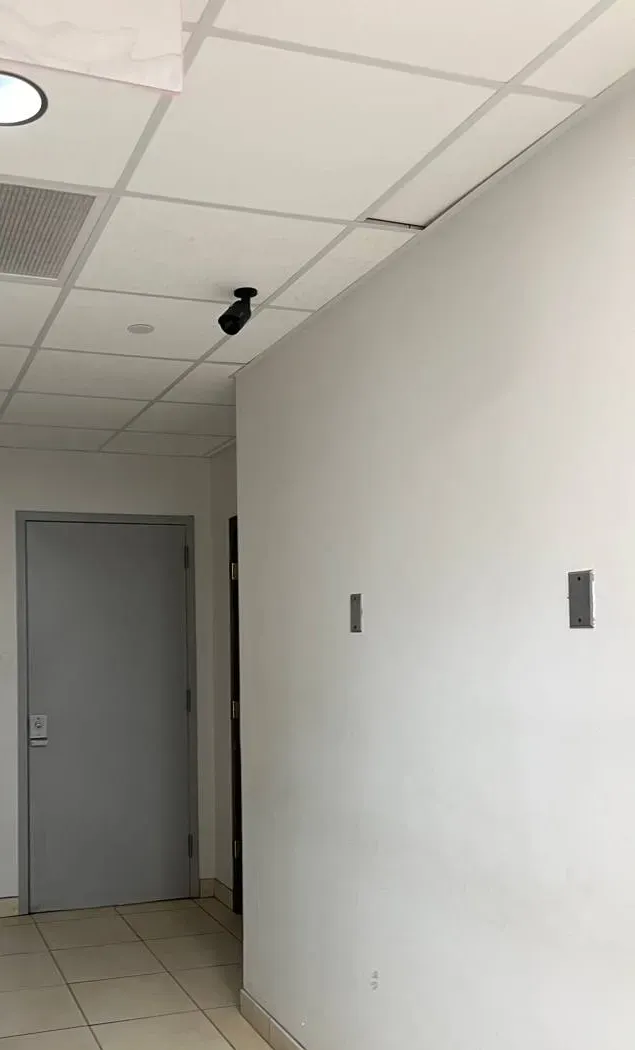
Manhattan Beach, Brooklyn door buzzer installation: tiled corridor with white walls and small wall plates ending at a grey steel door with a lever handle under a drop ceiling with a small camera
From the AESS job library, not photographed in Manhattan Beach: a tiled corridor with white walls and small wall plates ending at a grey steel door with a lever handle, under a drop ceiling with a small camera. Steel corridor doors like this one are found in the schools and older apartment buildings at the West End Avenue end; a lever-handle door takes an electric strike, and anyone inside can still leave just by turning the lever.
AI Overview Reality Check

What AI Gets Wrong About Door Buzzer Installation in Manhattan Beach

Search for buzzer installation and you get confident summaries assembled from national cost guides and vendor blogs. Some of it holds; some of it does not fit a detached house on a flood-prone peninsula at all. Below are seven common claims, where they come from and what the field shows here. We have not quoted any AI-generated answer word for word; the claims come from the published guides those answers draw on.

"A door buzzer is an apartment-building thing"

Most guides about buzzers are written for landlords and tenants, and summaries built from them treat a house as a place that needs only a doorbell.

In Manhattan Beach, where the typical home is one household in a large detached house, the case for a buzzer is often stronger than in an apartment, because the people inside can be farther from the door. A family in a rebuilt three-floor house with a kitchen across the back has the same problem as a tenant on the fifth floor: they cannot hear or reach the door.

The fix is the same idea, a station at the door and answering points where people are, scaled to one household instead of thirty.

"An intercom installation averages about $2,500"

HomeAdvisor's cost guide gives that average, with a range of $1,500 to $15,000, wireless systems at $150 to $1,500 and hard-wired systems at $1,000 to $15,000.

For a single house here, that average is too high for most jobs and too vague for the rest. An audio station with a release on an original-size house sits at $400 to $900 on our Brooklyn list, and a video system answered across a large house sits at $700 to $1,800. The building range, from about $2,500 to past $10,000, applies to the co-ops, apartment buildings and new condos at the western end.

What moves a house within its range is the number of answering points and the cable route, both of which come from walking the house.

"Wireless is the easy option"

Cost guides present wireless systems as the do-it-yourself, no-wiring choice.

On a long detached house, wireless is only as good as the signal at the door, and Swiftlane's gate intercom guide says plainly that "Range limits are frequently underestimated." A router at the back of a brick or concrete house may not reach the front door reliably, and a wireless station still needs power at the door.

Wireless can be the right answer, but only after the signal is measured at the mounting point. Wired stations remain the dependable backbone in a house of this size.

"Put the transformer next to the electrical panel"

Doorbell instructions routinely tell owners to mount the transformer at or near the panel, which in most older houses means the basement.

On a peninsula where, in the words of the Manhattan Beach Community Group's president after Sandy, "Every house was flooded," the basement is the worst place for it. The NYC Building Code's Appendix G expects utilities and attendant equipment in flood areas to sit at or above the design flood elevation or be built to keep water out.

We put the power supply and controller on a dry upper floor and run the cable inward and upward from the door, keeping anything that can be ruined by water out of the basement.

"A doorbell camera does the same job"

Summaries often present a video doorbell as the modern replacement for a buzzer.

A doorbell camera shows the visitor and rings a phone or a chime. It does not release the door, so someone still has to walk to it, and in a house where the door is far from the kitchen that is the whole problem. Many cameras on the peninsula were added after the storm as a quick replacement, which is why so many households still walk the length of the house to open up.

A wired system with a strike lets whoever answers open the door from where they are, and it can sit alongside a camera the family already likes.

"Old buzzer wiring should always be replaced"

Summaries often treat old bell wire as a reason to start over, and owners who have been through a flood assume the same.

The truth is in between. Wire that ran up through dry walls may test perfectly well; Aiphone builds its GT Series for retrofit projects with "existing wire and infrastructure." Connections and equipment that sat in floodwater, on the other hand, should not be trusted whatever they test like today.

So we test every run we might reuse, mark any part of the old system that was underwater as not for reuse, and name both on the written price.

"Every building needs an intercom by law"

Summaries drawn from New York City tenant guides can leave the impression that every home must have an intercom.

The Multiple Dwelling Law's §50-a requirement applies to class A multiple dwellings with eight or more apartments, built or converted after 1968, and to older buildings of that size when a majority of tenants ask in writing. A single-family house on Kensington Street or a two-family on Pembroke Street is not covered at all.

That is good news for owners: the system can be designed around the way the household lives, not around a code minimum. The co-ops and new condos at the western end are a different matter, and their boards should plan accordingly.

Not Sure How Many Stations Your House Needs, or Whether Anything From the Old Doorbell Is Worth Keeping? Speak to a Tech

Send a photo of the front door, a close-up of whatever button or station is beside it, a photo of any transformer or box on a basement or utility wall, and a rough description of the house's floors and the rooms you use most, with the address, to (347) 934-8335 or on WhatsApp. A technician will tell you roughly how many answering points the house needs, where the power should go, and whether a repair, an extension or a new system makes more sense, before anyone visits. Or use the request form and we will call you back.

Get In Touch

Request a Free Quote

✅
Request Sent!
Thank you. A technician will call you about the Manhattan Beach address, usually within two hours during working hours.
How It Works

Our Installation Process

1. Send photos and describe the house

Photos of the front door, any gate or side entry and whatever bell or station is there now, with the address, the floors people use and who lives in the house or building.

2. Find the flood line and the dry route

We locate the basement or garage level, ask how high water came in 2012, and plan the power supply and controller on a floor above it, with a cable route that stays dry.

3. Agree who signs and how access will work

The homeowner, both owners of a two-family, a co-op or condo board, a managing agent or an institution's administrator signs, and entry is planned so no door is ever left unlocked.

4. Walk the house and test the door

We walk from the door to each answering point, test any old wire, check that every door on the system closes and latches, and check the doorpost for a mezuzah, plaques and lights.

5. Price everything in writing

Door station, every answering station or app account, strike, closer, power supply, cable route and labor on one written price, with every possible add-on named before anything is ordered.

6. Prepare the door and the power

The closer is set so the door relatches, the strike goes into the frame, and the battery-backed supply is mounted above the flood line on an owner-controlled circuit, with an electrician for any new outlet.

7. Install, protect and label

Cable runs on the planned route with floors and finishes protected, stations go in on each floor, and every station, cable and circuit is labeled at the power supply.

8. Test from the sidewalk and hand over

Every answering point is rung from outside, talks and releases while the door is watched relocking, and the owner gets the wiring record, the test sheet and written instructions.

Manhattan Beach, Brooklyn door buzzer installation: touchscreen entry panel showing a dial pad with a four-digit apartment code entered, a camera above and a card-reader symbol below
From the AESS job library, not photographed in Manhattan Beach: a touchscreen entry panel showing a dial pad with a four-digit apartment code entered, a camera above and a card-reader symbol below. A code panel like this suits the lobby of a new condo building at the West End Avenue end, where apartments change hands and codes can be reissued without a new faceplate, and step 8 tests every code from the sidewalk.
Coverage Area

Door Buzzer Installation Near Manhattan Beach's Landmarks

Manhattan Beach Park

The public beach and park at the peninsula's ocean side, with a boardwalk promenade, a concession and a beach-season parking lot reached from the Belt Parkway.

Kingsborough Community College

The CUNY campus founded in 1963 on 71 acres at the eastern tip, built on a former maritime training center and Manhattan Beach Air Force Station.

Manhattan Beach Jewish Center

The synagogue at 60 West End Avenue, built in 1952 with a community center added in 1962, listed on the National Register of Historic Places in 2015.

Ocean Avenue Footbridge

The footbridge across Sheepshead Bay linking the short Manhattan Beach stretch of Ocean Avenue with Emmons Avenue on the Sheepshead Bay side.

Shore Boulevard

The boulevard along the bay's south bank, built in 1907 beside the promenade that runs for nearly a mile toward Holocaust Memorial Park.

P.S. 195 on Irwin Street

The neighborhood's public elementary school, flooded in Sandy and reopened, a few blocks from the houses on the middle lettered streets.

We also serve Coney Island, Bergen Beach, Canarsie and Bath Beach at the same Brooklyn rate, along with Brighton Beach, Sheepshead Bay and Gerritsen Beach next door. See our door buzzer installation in Brooklyn page for the whole borough.

Pricing

Door Buzzer Installation Cost in Manhattan Beach

Manhattan Beach is billed at our Brooklyn rate, with no premium for the peninsula's larger houses. Final pricing follows a look at the house, because the number of answering points, the cable route through a large or finished house, whether the power has to move up from a flooded basement, and the door itself drive the total far more than the brand on the station.

JobTypical Manhattan Beach propertyBrooklyn range
Audio buzzer or replacement with electric strike release, existing wiring reused where it tests wellOriginal-size detached house, two-family with a shared front door, a home office door$400–$900
Video door station with indoor monitors or smartphone door releaseEnlarged or rebuilt house with answering points on several floors, two-family with video for both homes$700–$1,800
Directory or button panel with every unit wired or on app answering, audio or video by unit count, optional fob integrationCo-ops and apartment buildings on West End Avenue and Corbin Place, new condo and mixed-use buildings$2,500–$10,000+
Service call booked onlineTesting an existing system before deciding whether to repair, extend or replace$250, applied toward the work
Monthly fee on a wired systemAny house or building choosing the no-subscription option$0
Buzzer and entrance camera on the same visitHouses, lobbies and institutional doorsTypically saves $200–$400 in labor

What moves a Manhattan Beach job within its range is predictable. First, answering points: an original-size house with stations in the kitchen and on the bedroom floor sits near the bottom of a range, while a rebuilt house with four monitors on three floors and a lower level sits near the top. Then the cable: a house under construction or one with an open utility chase keeps the job simple, and fishing new cable through finished walls in a large house pushes it up. Then the power: moving the supply and controller from a flooded basement to a dry upper floor usually adds little, but a missing outlet means an electrician. Then the door: a closer to replace, a strike for a heavy or unusual frame, a second entrance or a gate. Anything that depends on a test, such as an old run that might fail or a Wi-Fi signal that might be weak at the door, is named on the quote with its price before you approve.

Full terms — including 50% deposit, one-year parts-only warranty on AESS-supplied products, and the late-fee schedule — are set out in the service agreement.

Find Out Which Range Your Manhattan Beach House or Building Falls In

Tell us the address, how many floors the house has and which rooms you want to answer from, how many households or apartments the door serves, whether the basement flooded, and what is at the door now, and we will tell you which of the three Brooklyn ranges fits and what would move it. Call or text (347) 934-8335, send photos on WhatsApp, or fill in the form.

Shop Our Systems

Door Buzzer Installation Packages & Pricing

Three typical Manhattan Beach jobs, each placed inside the matching range on our Brooklyn list. The exact figure comes from the walkthrough.

House buzzer with release: $400–$900

An audio door station sized for the doorpost, answering stations with release in the kitchen and on the bedroom floor, a fail-secure strike fitted to the frame, a closer set to relatch and a battery-backed power supply on a dry upper floor.

Video for a large or rebuilt house: $700–$1,800

A slim video door station placed to suit the mezuzah, lanterns and house number, monitors or phone answering on each floor and in far rooms, old runs reused only where dry and sound, a strike for the door and concealed cable.

Co-op, apartment or mixed-use building system: from about $2,500

A button, directory or code panel at each entrance residents use, wall stations, app answering or both for every unit, the riser tested line by line or new cable run, strike or approved lock, power above the flood line and a board-ready written price, rising toward $10,000 or more with unit count, doors and cable work.

Bring your own equipment. If you have already bought a door station, video kit or intercom set, we can install it as labor-only work, quoted flat once we have seen the door, the house and the cable path. Tell us the make and model when you write, and we will tell you before the visit whether it supports the number of answering points the house needs and whether it can release your door.

Complete Services

Every Door Buzzer Service in Manhattan Beach

Houses and two-families

First buzzers, releases added to existing doorbells, whole-house answering, systems planned into new houses. Request a quote

Buildings and institutions

Co-op and apartment entry systems, mixed-use buildings, synagogue, school and office doors. Call (347) 934-8335

Across Brooklyn

The same price list in every neighborhood. Brooklyn door buzzer installation

Across New York City

Every borough's buildings and rules. NYC door buzzer installation

FAQ

Manhattan Beach Door Buzzer Installation FAQ

We already have a wired video doorbell. Can it be made to unlock the front door, or does it have to be replaced?
+

It depends on the doorbell. Most consumer video doorbells have no output that can operate a lock, so they keep doing what they do now while a separate system adds the release and the answering stations. Some wired door stations do have a lock output, and on those we add a strike, a power supply and the indoor stations around the existing unit. Send us the make and model and we will tell you which kind you have before anyone visits.

We put in a standby generator after Sandy. Should the buzzer's power supply be on a generator circuit?
+

It is worth asking your electrician, because a buzzer draws very little power and is one of the things a household misses most during a long outage. The buzzer's own battery backup covers short outages; a generator-backed outlet keeps it going through a long one. Which circuits the generator carries is decided by the electrician who installed it, so we mount the power supply near an outlet they confirm, and label it.

There is a mezuzah on the right-hand doorpost of our front door. Where does the door station go so it does not crowd it?
+

Usually lower on the same side or on the other side of the door. The mezuzah sits at the bottom of the top third of the doorway, while a door station sits at a height a visitor can reach and a camera can see a face, so the two rarely want the same spot. On a narrow doorpost we move the station to the left side or to the wall beside the frame, and no screw or cable ever passes through or behind the mezuzah case.

Our house has a residential elevator. Can there be an answering station inside it or at each landing?
+

At each landing, yes; inside the cab, usually not. Cable to a moving cab has to travel in the elevator's own traveling cable, which belongs to the elevator company, so we put answering stations on the landings or in the rooms beside them instead. For someone who uses the elevator because stairs are hard, phone answering or a station right outside the elevator door on their main floor does the job without touching the elevator.

Our live-in caregiver answers the door for my mother. Can she let visitors in without having access to the family's phones or app?
+

Yes. A wall station in her area of the house, or on the floor where your mother spends the day, lets her see the visitor, talk and release the door with no phone or app at all. If she also wants to answer on her own phone, she can get her own account that you can remove at any time, separate from the family's accounts.

Can the door ring different rooms at different times of day, for example the home office in working hours and the kitchen in the evening?
+

On many systems, yes. Stations can be set to ring in groups, and some systems change the group by schedule, so the office station rings during working hours and the kitchen and bedroom stations ring at other times. Where a system cannot follow a schedule, each station can simply be turned to silent from its own buttons. We confirm what the chosen system can do before you approve it.

If the installation takes two days, will we be able to lock our front door overnight in between?
+

Yes. The door is never left unable to lock. If the strike is fitted on the first day, it is wired and powered before the technician leaves, or the original lock is put back in working order. Cable work inside the house can stop at any point overnight; the door hardware is always finished or restored the same day.

Our house was extended toward the street, and the old front door is now an inside door. Where should the new door station go?
+

At the door visitors actually reach now, which is the new outside entrance. The old door can keep its lock as an inner door, and its old bell button should come out so nobody is confused. Any old bell wire at the former door can sometimes be extended to the new entrance, but in most extensions it is simpler and more reliable to run new cable from the new door station to the controller.

When a hurricane is forecast, should the door station be taken down or covered?
+

No. Outdoor door stations are built to stay in place in rain and wind, and removing one risks damaging it and leaving its cable open to the weather. What helps before a storm is making sure the power supply and battery are on the dry upper floor where they belong and charged, and knowing where the release is labeled so it can be switched off if the house is evacuated and the door needs to stay locked.

How do you protect finished floors and furniture inside a large house while the cable is being run?
+

Floors on the work route are covered, furniture near each station location is moved with your permission or covered, and drilling at finished walls is done with dust collection at the bit. Openings are kept to the fewest and smallest the route allows, mostly inside closets, and every one is named on the written price beforehand. We do not patch or paint, so any opening in a finished room is left clean for your painter.

More Door Buzzer Installation near Manhattan Beach

Door Buzzer Installation Brooklyn NY | Brownstones & Condos · Door Buzzer Installation NYC | Apartment & Building Entry · Door Buzzer Installation Manhattan NY | Apartments & Co-ops · Door Buzzer Installation Queens NY | Co-ops & Apartments · Door Buzzer Installation Bronx NY | Co-ops & Apartments · Door Buzzer Installation Staten Island NY | Homes & Apts · Door Buzzer Installation Long Island NY | Nassau & Suffolk · Door Buzzer Installation Hudson Valley NY | Apartments · Door Buzzer Installation Nassau County NY | Homes & Co-ops · Door Buzzer Installation Suffolk County NY | Homes · Door Buzzer Installation Westchester County NY | Co-ops · Door Buzzer Installation Rockland County NY | Homes & Apts · Door Buzzer Installation Orange County NY | Homes & Farms · Door Buzzer Installation Putnam County NY | Lake Homes · Door Buzzer Installation Dutchess County NY | Homes · Door Buzzer Installation Ulster County NY | Kingston

Door Buzzer Installation Bath Beach Brooklyn NY · Door Buzzer Installation Bay Ridge Brooklyn NY · Door Buzzer Installation Bedford-Stuyvesant Brooklyn NY · Door Buzzer Installation Bensonhurst Brooklyn NY · Door Buzzer Installation Bergen Beach Brooklyn NY · Door Buzzer Installation Beverley Square Brooklyn NY · Door Buzzer Installation Boerum Hill Brooklyn NY · Door Buzzer Installation Brooklyn Navy Yard, Brooklyn NY · Door Buzzer Installation Brooklyn NY | Brownstones & Condos · Door Buzzer Installation Brownsville Brooklyn NY · Door Buzzer Installation Bushwick Brooklyn NY · Door Buzzer Installation Cadman Plaza Brooklyn NY · Door Buzzer Installation Canarsie Brooklyn NY · Door Buzzer Installation Carroll Gardens Brooklyn NY · Door Buzzer Installation City Line Brooklyn NY · Door Buzzer Installation Clinton Hill Brooklyn NY · Door Buzzer Installation Cobble Hill Brooklyn NY · Door Buzzer Installation Columbia Street Waterfront Brooklyn · Door Buzzer Installation Coney Island Brooklyn NY · Door Buzzer Installation Crown Heights Brooklyn NY · Door Buzzer Installation Cypress Hills Brooklyn NY · Door Buzzer Installation Ditmas Park Brooklyn NY · Door Buzzer Installation Downtown Brooklyn NY · Door Buzzer Installation DUMBO Brooklyn NY | Loft Entry

Other services in Manhattan Beach

Access Control Installation Manhattan Beach Brooklyn NY · Structured Cabling Installation Manhattan Beach Brooklyn NY · Alarm Installation Manhattan Beach Brooklyn NY | Detached · Door Buzzer Repair Manhattan Beach Brooklyn NY · Security Camera Installation Manhattan Beach Brooklyn NY · Fire Alarm Installation Manhattan Beach Brooklyn NY · TV Installation Manhattan Beach Brooklyn | (347) 934-8335 · Intercom Installation Manhattan Beach Brooklyn NY

Ready to Answer Your Manhattan Beach Front Door From the Kitchen, the Top Floor or the Office, and Let the Visitor In Without Walking the Length of the House?

Send a photo of your front door and whatever is beside it now, with the address, the floors and rooms you want to answer from and whether your basement flooded, and we will tell you which system fits and where it falls on our Brooklyn ranges. Call or text (347) 934-8335, message us on WhatsApp, or use the request form. Licensed under NYS license #12000287431, rated 4.7★ across 201 Google Reviews, with same-day estimates on most weekdays.