A two-family that grew to five stories, an apartment built out into the old back yard, a walk-up over a 13th Avenue store or a front door that opens all day long? Borough Park door buzzer installation line: (347) 934-8335
Houses Built Up a Floor or Two · Apartments Extended Into the Yard · Walk-Ups Over 13th, 16th and 18th Avenue Stores · New Mid-Size Buildings · Front Doors That Never Stop Opening
Door Buzzer Installation in Borough Park
Every Floor Reached, Old and New · Strikes Rated for a Busy Door · Old Wire Metered Before It Is Trusted · Written Price Before Anything Is Ordered
Door buzzer installation in Borough Park usually means wiring a house that is larger than it was when its first bell went in. The New York Times reported that since 1990 the Buildings Department had issued more permits for new homes and additions in the Borough Park area than in any other residential neighborhood in Brooklyn, and a 1992 special zoning district let owners build on 65 percent of the lot. The result, on many blocks, is old bell wire that stops at a floor which is no longer the top, a newer apartment where the back yard used to be, and a street door opened by far more people than it was hung for. Below is how we bring every household onto one working street door, from the cellar to the newest floor, and how each job is quoted.
Every Borough Park job is priced individually and agreed in writing before any equipment is ordered
Rated 4.7★ across 201 Google Reviews
Reviewed and updated November 12, 2026, against Wikipedia's articles on Borough Park and on Thirteenth Avenue (including the New York Times finding on construction permits and the 1992 special zoning district quoted there); the Brooklyn Eagle's 2016 report on housing construction in Borough Park; CityLand's report on the HPD-selected affordable housing project on 37th Street; New York's Multiple Dwelling Law §50-a and §3; a published decision in a Manhattan condominium intercom case posted by the ALB law firm; the NYC Comptroller's audit of Buildings Department code enforcement; HPD's homeowner resources page on illegal conversions; the 2025 NYC Construction Codes summary of AC 28-105.4.7 on low-voltage electrical work; the Landmarks Preservation Commission's Permit Guidebook, Chapter 11; Allegion's guide to fail-safe and fail-secure hardware; Aiphone's GT Series product page; the International Building Code section on sensor release of electrically locked egress doors; the 2010 ADA Standards; brooklynjewish.org's Borough Park guide; CBS New York (2014), News 12 Brooklyn (2026) and Boro Park Shomrim (2025) reports; Augrented's building data for Borough Park; Brick Underground's 2014 piece on broken buzzers; and the HomeAdvisor, Swiftlane, ButterflyMX and UA Security cost guides. · Abstract Enterprises Security Systems, NYS license #12000287431 · crews dispatched from our Troy Avenue office in Brooklyn
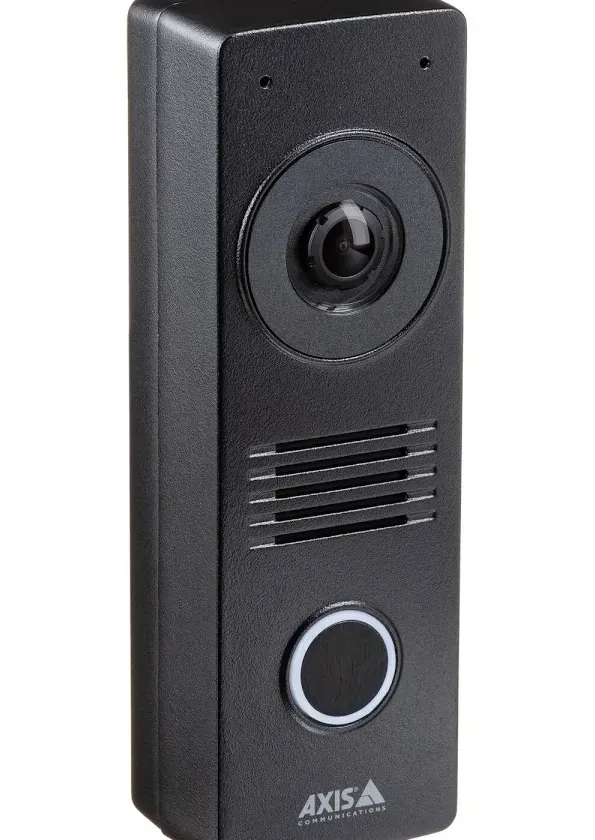
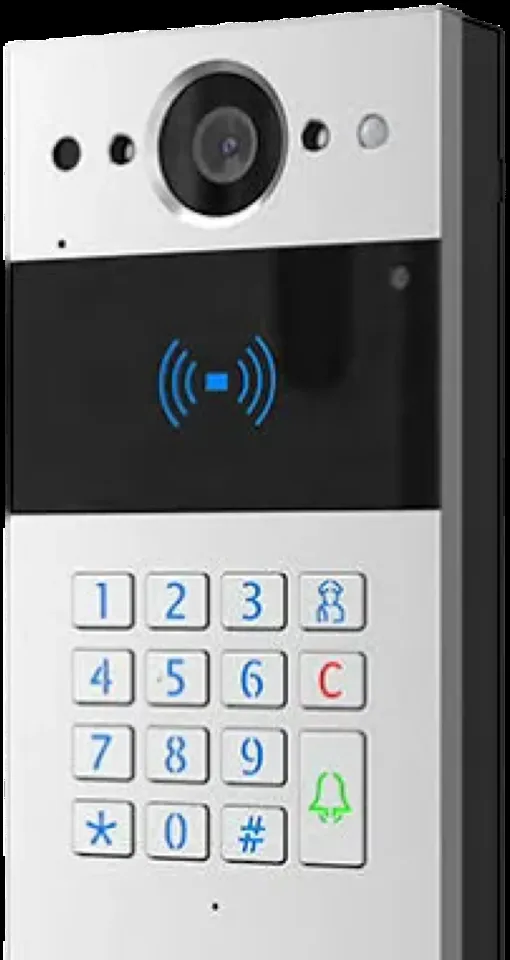
A photo from the AESS job library, not taken in Borough Park: a black rectangular video door station with a camera, a speaker grille and a single round call button that lights up. On a Borough Park two-family where one household still answers the door for everyone, a one-button station like this is often the starting point, and it is the unit we replace with a multi-button panel once an enlargement adds more households behind the same door.
Borough Park Buzzer Request
Enlarged house, rear extension, walk-up, co-op, condo or a store on the avenue: tell us the street, how many households share the door and which floors were added later, and a technician calls back
✅
Request Sent!
Thank you. A technician will call you about the Borough Park address, usually within two hours during working hours.
25+
Years Experience
✓
Same-Day Estimates
100%
Licensed & Insured
4.7★
201 Google Reviews
Owner-operated since 2002 · Thousands of jobs completed · Booked within 2 hours
Quick answer: door buzzer installation in Borough Park is priced per job, in writing, after we see the door and count the households, because the same street address can be a two-family that never changed or a five-story building that grew out of one. The price covers the door station, an answering station or phone answering for every household, a release in the street door's frame and a battery-backed power supply, installed and tested from the sidewalk to the newest floor. Send photos of the street door, the bell plate and the cellar to (347) 934-8335 or on WhatsApp, and a technician gets back to you, usually within two hours during working hours, to book the visit or tell you what the photos already show.
Looking at photos and talking through the job costs nothing. When an existing system has to be tested in person before it can be priced, we tell you so before booking.
All work is done under New York State license #12000287431, and equipment is ordered only after the written price is approved and the deposit is in.
We work for whoever controls the street door: an owner who lives in the house, a family that owns several houses, a co-op or condo board, a managing agent, or a store owner with the landlord's written permission.
The Neighborhood
Why Borough Park Properties Need Door Buzzer Installation
Borough Park sits in the middle of south Brooklyn, with Bensonhurst to the south, Dyker Heights to the southwest, Sunset Park to the west, Kensington and Green-Wood Cemetery to the north, Flatbush to the east and Mapleton to the southeast. Thirteenth Avenue runs about a mile through it, and 16th and 18th Avenues carry most of the rest of the shopping. Most addresses fall in ZIP code 11219, with edges in 11204, 11218 and 11230. The area grew from a small settlement called Blythebourne in the 1880s and took the name Borough Park in 1902. What matters for a door buzzer is not the history of the name, though. It is what has happened to the houses since.
Families here are large, and they stay. Wikipedia's article on the neighborhood reports an average of 6.72 children in Orthodox and Haredi families and a birth rate of 24.4 per 1,000 residents, and both show up in the housing. A house that was right for one couple and their children in one decade has a married son's family on a new third floor in the next, and perhaps a rental apartment built where the yard used to be. The New York Times put it plainly in a line Wikipedia quotes: "Since 1990, the Building Department has issued more permits for private construction projects — new homes and additions — in the Borough Park area than in any other residential neighborhood in Brooklyn." The 1992 special zoning district made that possible by letting owners cover 65 percent of the lot, with smaller setbacks and yards.
The Brooklyn Eagle gave a typical example in 2016: a two-story, two-family house on 44th Street being enlarged, according to its Buildings Department filings, into a five-story, four-family building of more than 5,600 square feet. Picture the door buzzer in a house like that. Its wire was run decades ago from a transformer in the cellar to two kitchens. Now there are four households, two of them on floors that did not exist when the wire went in, and the visitor at the street door is still pressing a plate with two buttons on it. That is the job we do most often in Borough Park: not a first system for an unchanged house, and not a lobby for a tower, but a buzzer that catches up with a building that kept growing.
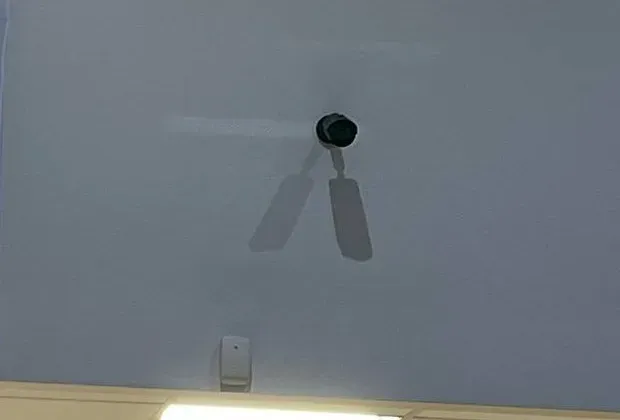
A photo from the AESS job library, not taken in Borough Park: a small black camera mounted high on a pale wall, throwing two shadows, with a small white device fixed below it. In the stair hall of an enlarged Borough Park house, a camera placed high like this inside the street door shows who actually came in after someone on an upper floor pressed release, which a talk-only buzzer can never tell the family.
The second reason is the door itself. In a house with many children, grandparents, visiting relatives, deliveries from the avenues and guests, the street door opens and closes far more often than the hardware on it was ever chosen for. Closers wear out or get tightened until the latch binds. Old electric strikes, many of them built for occasional use, overheat and fail. A buzzer is only as good as the door it releases, and on a busy family door that means choosing a strike and a closer for the traffic, not just for the opening.
The third reason is that most of these buildings are small enough that nobody is forced to install anything. New York's intercom requirement in Multiple Dwelling Law §50-a reaches buildings with eight or more apartments, and most Borough Park houses have fewer. Owners put buzzers in because the family on the fourth floor should not have to walk down every time the bell rings, and because a door that opens to whoever knocks is not much of a door. That makes the choices the owner's, which is why we lay them out plainly on this page.
The fourth reason is security, kept in proportion. Local reporting shows that the risks here are real but varied. CBS New York reported in 2014 that eight Borough Park homes were burglarized in under two months, each time through a rear window. News 12 Brooklyn reported in March 2026 that two people broke into a home near 39th Street and Fort Hamilton Parkway on a Sunday evening. Boro Park Shomrim reported an arrest in 2025 after packages were stolen in the 38th Street area. A door buzzer answers one of those problems well, the question of who gets through the front door, and we say honestly when the weak point is somewhere else.
Six Borough Park facts that shape a door buzzer job
More construction than anywhere else in residential Brooklyn. The New York Times found that since 1990 the Borough Park area had received more building permits for new homes and additions than any other residential neighborhood in the borough.
Bigger buildings on the same lots. The 1992 special zoning district allowed 65 percent lot coverage with reduced setbacks and yards, so many houses now run further back and higher than their original wiring.
Households keep multiplying. A birth rate of 24.4 per 1,000 residents and large families mean the number of people using one street door tends to rise year after year.
The city watches small houses too. A NYC Comptroller audit of Buildings Department enforcement listed Community District 12, which covers Borough Park, Kensington and Ocean Parkway, with 537 violations issued to one- and two-family properties and penalties assessed at more than 1.3 million dollars.
Buildings here carry a record. One building-data site puts the Borough Park average at 10.2 HPD violations and 7.4 calls to 311 per building, across all categories, not just doors and intercoms.
New mid-size buildings are coming. CityLand reported that HPD chose the Southern Brooklyn Community Organization to build seventeen four-story affordable housing buildings on two narrow City-owned parcels on 37th Street, the kind of building where the entry system is planned before the walls close.
Where this page applies. We use Borough Park for the blocks between roughly Fort Hamilton Parkway and McDonald Avenue, from the high 30s down to about 60th Street, the area most sources describe, and we work there at our standard Brooklyn rate. For the rest of the borough see our door buzzer installation in Brooklyn page; for the blocks just north, our Kensington door buzzer installation page; and for the blocks to the south, our Bensonhurst door buzzer installation page.
Install or Repair in Borough Park
Repair or Replace in Borough Park: Telling a Worn Part From a System the House Has Outgrown
Plenty of Borough Park installation calls begin as a repair. The release stopped working, the bell in the top-floor kitchen went quiet, or the door station's buttons cracked. Some of those are genuinely one part: a power supply in the cellar that burned out, a strike coil that failed, a station whose speaker died. We price those as repairs and say so, and our Brooklyn door buzzer team handles them the same week where the part is in stock.
The difference in this neighborhood is that a fault is often a symptom of growth rather than age. When the house gained two floors, someone may have extended the old bell wire up to the new apartments with splices hidden inside a wall, or run a second, separate doorbell for the new households beside the original plate. When the rear extension went in, the wire to the back apartment may have been routed through a ceiling that was later closed. Those arrangements fail where the old and new work meet, and they keep failing however many times the station is changed. Replacing the station a fifth time does not fix a splice in a closed wall.
So the first thing we do on a call that might be a repair is find out whether the trouble is in the part or in the path. We meter the wire from the cellar to each household, note where it changes type or color, and look for the place where the original house ends. If the path is sound, the repair is the right answer. If the path is the problem, we price a proper run to the newer floors next to the repair, so the owner sees both numbers before choosing. Sometimes the cheapest sensible job is new cable to only the floors that were added, with the original house left on its tested wire.
A photo from the AESS job library, not taken in Borough Park. On a repair call in an enlarged Borough Park house, we test the equipment and the wire path separately, so the owner knows whether a part or the route to the newer floors is at fault.
What We Install
Door Buzzer Installation Services in Borough Park
These are the jobs we are asked for in Borough Park, grouped by what the house or building needs rather than by product. The number of households decides the size of the system, the street door decides what release it can take, and in this neighborhood the history of the building decides most of the labor, because the route from the cellar to the newest floor is rarely a straight line.
Buzzers that reach the added floors
New runs from the power supply to apartments on floors built after the original wire went in, joined to the system in an accessible, labeled box rather than spliced inside a wall.
Stations for rear extensions
Answering stations for households in sections built toward the back of the lot, wired through common halls, the cellar or the stair rather than through another family's apartment.
Panels sized for the house as it is now
Door stations with a button for every household that actually receives visitors, replacing a two-button plate that has been fronting a four- or five-household building.
Strikes and closers for heavy use
Fail-secure electric strikes rated for continuous duty, and closers set so the door shuts and latches every time without needing a shove, on doors opened by many people all day.
First systems for unchanged two-families
A two-button station, an answering station on each floor and a release in the frame, for houses that still have one bell and a family that walks down to open the door.
Residents' doors on the avenues
A separate panel, release and power supply for the apartments' door beside a store on 13th, 16th or 18th Avenue, kept apart from the store's own door, gate and alarm.
Store and office buzz-in doors
A release at the counter or front desk so staff can see and admit customers or visitors, with the door always opening from inside by one motion.
Entry systems for new buildings
Panels, stations, cable and door hardware planned with the architect and the general contractor for new mid-size buildings, before the walls are closed and the first families move in.
Phone answering for owners off site
Door stations that also ring an owner's or a relative's phone, for families who own a house on one block and live on another.
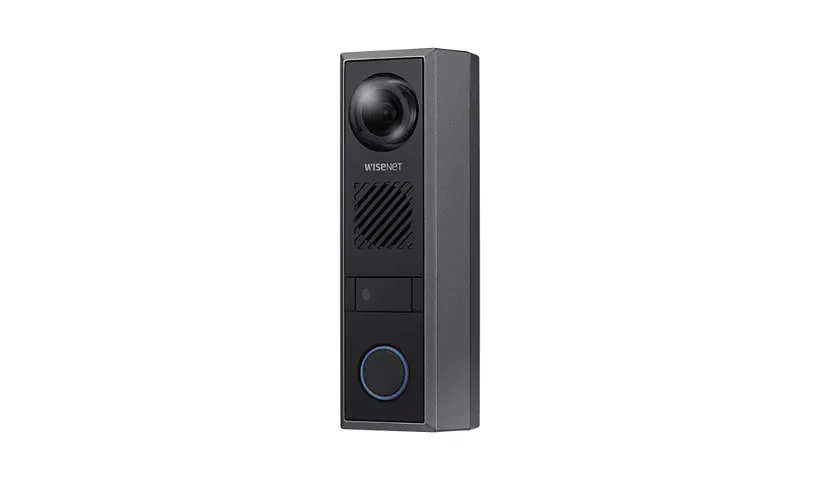
A photo from the AESS job library, not taken in Borough Park: a slim dark grey wired doorbell with a camera lens, speaker slots and a round push button. On a Borough Park house where the family uses a side or rear door as much as the front, a slim wired unit like this is a tidy way to add a second answering point without a full panel, and because it is wired it does not depend on a battery or on Wi-Fi reaching the back of a deep house.
Building Specialists
Door Buzzer Installation for Borough Park's Architecture
Six kinds of building account for nearly every Borough Park street door we are asked about. They differ in the ways that decide a buzzer job: how many households share the door, how many times the building has been changed, where the cellar and the power are, and how the cable can travel from the entrance to the farthest home.
Houses built up a floor or more
Two-family houses that gained a third, fourth or fifth floor, often with new households on the added floors and the original families below.
Houses built out toward the yard
Houses extended back under the 1992 zoning, with a rear apartment or a larger rear section reached by a hall, a side passage or a new stair.
Two-families as they were built
Houses that kept their original shape, with one street door, two households and usually a single bell wired decades ago.
Small apartment buildings
Walk-ups with a handful of apartments off one stair, where the entry system is older than most tenants and parts are hard to match.
Buildings with a store below
Mixed buildings on the shopping avenues, with a store at street level and apartments reached by a separate residents' door.
New mid-size buildings
Four-story and larger buildings going up on narrow lots, including affordable housing, where the entry system is part of the construction drawings.
Houses built up a floor or more: the riser ends at the old roofline
When a house is raised, the new floors get new framing, new power and new plumbing, and very often nothing for the door. The original bell or buzzer wire was run, years ago, from the cellar up to the floors that existed then. It ends where the old top floor ended. Anyone who later wanted the new apartments to answer the door had three choices: extend the old wire, run a second doorbell, or leave the new households to come down. We find all three.
Our approach is to run the new floors from the power supply in a continuous cable of the right type, following whatever vertical path the enlargement created. Raised houses often have a new stair or a new mechanical chase serving the upper floors, and those are the natural routes. The original floors stay on their old wire if it meters sound. Where the two meet, the joint is made in a box that can be opened later, with both runs labeled, so the next person who works on the house can see exactly what was done.
The door station also has to change. A plate with two buttons in front of a four-household building means visitors guess, and the family on the ground floor ends up as the doorman for everyone. The new panel has one button per household, labeled the way the family wants, and it is sized to the door casing that the enlargement left at the entrance.
Houses built out toward the yard: the back apartment is the hardest to reach
An extension toward the rear lot line usually means a household whose front door is far from the street, sometimes down a hall that passes other homes, sometimes along a narrow side passage. The answering station for that household has to be wired without running cable through another family's rooms. In practice that means the cellar, a common hall ceiling, or the stair, and it means planning the route on the walkthrough with the owner standing beside us.
Rear sections built later often sit on a different foundation from the original house, with a step in the cellar or no cellar at all under the extension. We look for the point where the original cellar ends, because that is where a cable has to come up into the extension, and whether that point is reachable from a common space decides whether the run is simple or needs to go up and over through the floor above.
Two-families as they were built: a first system on a short run
Not every house here has been enlarged. A two-family that kept its shape is the simplest job we do in the neighborhood: two buttons at the door, an answering station on each floor, a release in the frame and a small power supply in the cellar. The old bell pair is often good enough to carry a two-wire system, and if it is not, the run is short.
The one question we always ask is whether the house is likely to change. If the family is talking about adding a floor in a few years, we choose a panel that can take more buttons and a power supply with room to spare, so the first system does not have to be thrown away when the second phase of the house begins.
Small apartment buildings: one stair, many households, old parts
In a walk-up, the entry system has usually been repaired one apartment at a time for years, with whatever handset was available. The riser up the stair hall may be sound or may be a patchwork. We meter every pair from the cellar, mark which apartments pass and which do not, and give the owner a choice between keeping the sound pairs under a new two-wire system or running new cable to all of them. Either way, every apartment ends up on the same system from the same maker, tested on the same day.
Buildings with a store below: two doors, kept apart
On the avenues, the apartments' door is usually a narrow opening beside the store window. It gets its own panel, its own release and its own power supply, separate from anything the store uses, so a store that closes, renovates or changes tenants never takes the apartments' door down with it. The panel goes where a roll-down gate, a sign or a display cannot cover it, and the cable climbs the residents' stair rather than crossing the store's ceiling.
New mid-size buildings: the entry system belongs on the drawings
For a new four-story or larger building, the cheapest entry system is the one whose cable goes in before the walls close. We work from the architect's plans, mark a conduit or a pull path from the entrance to every apartment, size the power supply and plan the street door's hardware with the door supplier, so the frame arrives prepared for a strike. If the building will have eight or more apartments, the system also has to meet Multiple Dwelling Law §50-a, which we cover below, and the release has to satisfy the egress rules for the door it locks.
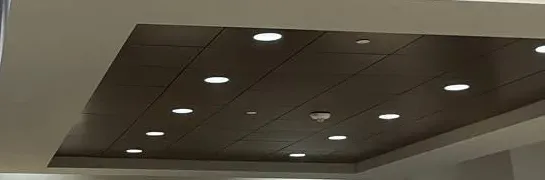
A photo from the AESS job library, not taken in Borough Park: a dark recessed ceiling panel with round downlights and a small round device set into it, framed by a lighter ceiling. In the halls of a Borough Park house that gained new floors, a finished ceiling like this is often the only route for buzzer cable to a rear apartment, which is why we plan that route during construction when we can, before the ceiling is closed.
Field Notes
Field Notes: Reading the Seam Where the Old House Meets the New Floors
Before equipment is even discussed at an enlarged Borough Park house, our technician looks for one thing: the seam. Every addition has one, the line where the original building stops and the newer construction starts. It is usually easy to see from the cellar, where the old foundation meets a newer wall or slab, and from the stair, where the treads, rails or ceiling change. That seam is where old wire tends to stop, where hidden splices tend to sit, and where cable routes have to change direction.
Next the technician follows the existing wire from the transformer or power supply in the cellar. Bell wire from different decades often looks different, so a change in color or jacket partway up the house is a clue that someone extended it. Each pair is metered to every household, and the reading at each floor is written down, so the owner can see on paper which floors are on sound wire and which are not.
Then the door. Our technician releases the street door and lets go, from fully open and from halfway. On a family door used all day, the closer is often either worn out, so the door drifts, or cranked tight, so the latch drags on the keeper and the release cannot pull it free. Both are noted on the plan, because fixing the door is part of making the buzzer work.
Last, the technician asks how the family actually uses the house: which door visitors come to, where people are when the bell rings, who answers, and whether more construction is coming. A house with another floor planned gets a panel and power supply chosen for the building it will become.
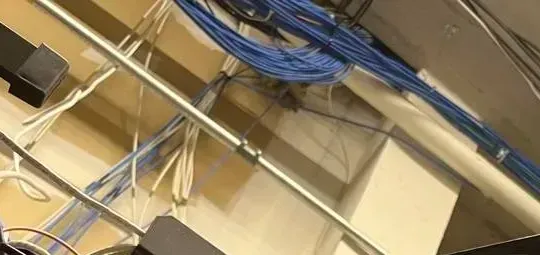
A photo from the AESS job library, not taken in Borough Park: bundles of blue low-voltage cable laid over a ceiling beam beside a metal pipe in an open ceiling. In the cellar of an enlarged Borough Park house, the old bell wire, newer phone lines and cable from each phase of construction often cross at a spot like this, which is why every pair is traced and metered before any of it is reused.
Where the Old Wire Stops
Wiring a Buzzer Through a Borough Park House That Was Built in Stages
An unchanged house has one cable path from the cellar to the top floor. A house built in two or three stages can have three, none of which connect cleanly. This section explains how we plan the route through each stage, because in Borough Park that plan is most of the job.
Start from one power supply, not two
A common shortcut when floors are added is a second, separate doorbell for the new households, with its own button by the door and its own transformer. It works until one of the two fails, and then nobody knows which transformer feeds which button. We put the whole house on one battery-backed power supply in a common space the owner can reach, so there is one place to look when anything goes wrong and one system to maintain. If the old transformer is screwed to a joist in an apartment's private cellar room, we move the new power supply to a place that is not inside anyone's home.
Use the vertical path the addition created
Additions usually bring a new way up: a stair that serves only the upper floors, a stack of closets, a pipe chase, or the space beside a new chimney or flue. Those are the routes we look for first, because they reach the new floors without opening finished rooms. Where the new section has fire-rated walls around a stair or a shaft, any opening made for the cable is sealed with fire-rated sealant, so the rating the builder paid for stays intact.
Make every joint where someone can find it
If the original floors keep their sound old wire and the new floors get new cable, the two have to meet somewhere. We make that joint in an accessible box in the cellar, the hall or a closet, never inside a closed wall, and we label both sides. Hidden splices made during construction are one of the commonest reasons a buzzer in an enlarged house works on some floors and not others, and they are expensive to find once the plaster is up.
Keep the rear apartment off other families' ceilings
The route to a rear extension should not depend on any household letting someone into its apartment ten years from now. We run it through common space wherever the building allows, and where the only practical route crosses one apartment, we tell the owner before the work starts and put the cable in a neat, accessible raceway rather than burying it where nobody can reach it.
Plan for the next stage now
Because construction here does not stop, we ask on every job whether more is coming. A panel with spare button positions, a power supply with spare capacity and a pull string left in the new chase cost little at installation time and save a great deal when the next floor goes up. If the family is not sure, we size the system for the building as it stands and say what a later expansion would involve.
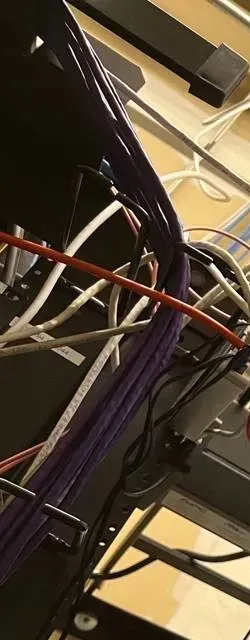
A photo from the AESS job library, not taken in Borough Park. In a house built in stages, every joint between old and new cable goes in an accessible, labeled box so the next technician can find it.
The Busy Door
Choosing a Strike and a Closer for a Borough Park Front Door That Opens All Day
An entry system has an electronic half, the panel, the stations and the cable, and a mechanical half, the door, its hinges, its closer, its latch and the release in its frame. In houses with many people coming and going, the mechanical half fails first, and it fails in predictable ways.
Strikes built for occasional use
Many older buzzers in Brooklyn run an electric strike from an AC transformer, and AC strike coils are generally rated for intermittent duty. On a door released a few times a day that is fine. On a door released over and over, by a family, their guests and a steady stream of deliveries, the coil runs hot and eventually burns out, and some residents learn to hold the button down until the strike buzzes loudly, which makes it worse. For busy doors we use strikes rated for continuous duty, powered from a regulated low-voltage supply, so the release does its job however often it is used.
Fail-secure on the street door
Allegion's guide to door hardware explains the distinction: fail-safe products unlock when power is removed and fail-secure products stay locked, and with an electric strike a person inside can always leave by turning the lever, whichever type is installed. We fit fail-secure strikes on residential street doors, so a power cut leaves the house locked against the street without ever trapping anyone inside.
Closers that are neither tired nor cranked
On a heavily used door the closer gets adjusted by whoever is annoyed that day. If it is too weak, the door drifts and stays open behind a visitor. If it has been tightened until the door slams, the latch presses so hard against its keeper that the strike cannot release it, and the resident upstairs presses the button while the visitor pushes on a door that will not move. We set the closer so the door closes fully from any position, latches without help and can still be pushed open with a normal hand once released, and we replace it if it cannot hold that adjustment.
Hinges, frames and the latch
A door that has been opened tens of thousands of times drops on its hinges, and the latch starts to miss the strike. We tighten or replace hinges and check the latch's throw before cutting a strike into the frame. A frame that has been chewed up by old strikes and screws gets a reinforcing plate or repair before the new strike goes in, and that work is named on the quote rather than discovered on installation day.
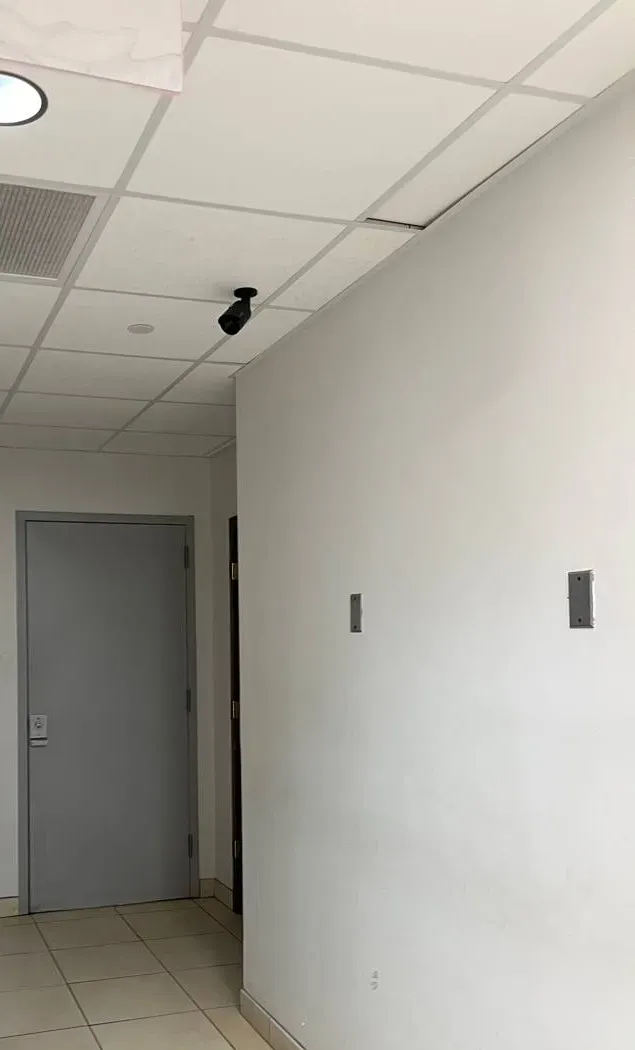
A photo from the AESS job library, not taken in Borough Park: a tiled corridor with white walls and small wall plates, ending at a grey steel door with a lever handle under a drop ceiling with a small camera. A lever on the inside of a door like this is what lets anyone leave without a key, and on the steel entrance doors of new Borough Park buildings it is the reason a fail-secure strike can keep the building locked without locking anyone in.
If your household has religious practices that affect how the street door is opened on Shabbos or Yom Tov, tell us at the walkthrough. We describe what each piece of hardware does mechanically and electrically; the religious questions are for your rav, not for us, and we install whatever arrangement you settle on as long as it keeps the door safe to leave from inside.
Rules and Responsibilities
What New York Law and the City's Codes Say About Borough Park Buzzers
Eight apartments is the line in the statute. Multiple Dwelling Law §50-a requires every class A multiple dwelling erected or converted after January 1, 1968 with eight or more apartments to have self-closing, self-locking doors and an intercommunication system at the main entrance, allowing voice communication with the visitor and remote release of the door. The Multiple Dwelling Law applies in cities of 325,000 people or more, which includes New York City.
Older buildings depend on the tenants. For buildings put up before 1968, §50-a ties the requirement to a written request or consent from tenants occupying a majority of the apartments, with installation to begin within 90 days and finish within six months.
Some vendors say three units; the statute says eight. One security vendor's glossary claims that buildings of three or more units must have an intercom. The text of §50-a sets the threshold at eight, and that is the figure we work from.
A court has applied the threshold to a small building. In a Manhattan condominium case published by the ALB law firm, the court found that §50-a(2) and (3) did not apply because the building had fewer than eight units and a majority of occupants had not requested a compliant intercom in writing, dismissed the HPD violation and directed HPD to remove it. That decision concerned one building's facts; it is not a promise about yours.
Enlargements can change the count. Because the statute covers buildings "erected or converted" after 1968, an enlargement that takes a building to eight or more apartments is worth raising with your architect or expediter, since the door and intercom requirements may come with it.
HPD defines illegal conversions. HPD's homeowner guidance says that adding an apartment in a basement, attic or garage without Buildings Department approval and permits is an illegal conversion. A button on a door panel does not make an apartment legal. If a household's legal status is unsettled, that is a question for an architect or lawyer before it is a question for us.
Violation classes and fines are reported inconsistently. Published pages variously describe a broken intercom as a class B violation, as a more serious class, and as carrying a fixed daily fine. We do not repeat any of those as fact; HPD's own notice on your building is the authority.
Permits for low-voltage work and the power behind it
The 2025 NYC Construction Codes summary of AC 28-105.4.7 says that no electrical permit is needed to install or repair wiring designed to operate below 50 volts for signaling, communication, alarm and data circuits, provided the work is done by a licensed master electrician, a special electrician or a qualified person; the section is reported as effective December 21, 2025. A door buzzer's stations, cable and strike run at low voltage. Where a job needs a new 120-volt outlet or circuit for the power supply, that is an electrician's work. Other published sources describe intercom permitting differently, so on a building where an architect or expediter is already filing with the Buildings Department, we follow their reading and coordinate with them.
Magnetic locks on doors people must be able to leave by
A magnetic lock on an egress door is not a simple swap for a strike. The International Building Code's section on sensor release of electrically locked egress doors, which New York's codes are built on, calls for a sensor on the egress side, unlocking on loss of power, a manual unlocking device between 40 and 48 inches above the floor within five feet of the door marked "PUSH TO EXIT" that keeps the door unlocked for at least 30 seconds, and release when the fire alarm or sprinkler system activates. We use strikes wherever the door allows. Where a magnetic lock is the only option, we quote the full package the code requires.
Landmarks
The Landmarks Preservation Commission's Permit Guidebook covers intercom panels on designated buildings in Chapter 11. The lists of Brooklyn historic districts we checked show none in Borough Park, so most doors here do not need Commission approval. Individually designated buildings are a different matter, and the Commission's online map is the place to confirm the status of a particular address before any panel is mounted.
None of this is legal advice for a particular building. HPD, the Buildings Department or your own lawyer can say which rules apply to yours. What we do is install to the rules that apply and leave written proof of what was installed and tested.
Commercial Door Buzzer Installation
Business Door Buzzer Installation in Borough Park
Business doors in Borough Park cluster on a few avenues, and most of them share a building with apartments. That shapes every commercial buzzer job here: the store's door and the residents' door are planned together, kept on separate systems, and wired so that work on one never leaves the other without a working entrance.
13th Avenue
The main shopping street, running about a mile through the neighborhood from 39th to 55th Street, with Judaica, books, electronics, wig stores and kosher food, and in 2009 fourteen banks in the ten blocks from 45th to 55th Street. Stores here often want a buzzer at a stockroom or office door and a separate panel for the apartments above.
16th Avenue
A second shopping avenue, home to the 66th Precinct station house at number 5822. Residents' doors here sit between storefronts and need panels that a gate or a sign cannot cover.
18th Avenue
The third of the shopping avenues, along the neighborhood's southern side. Mixed buildings with stores below are common, and their residents' doors open straight onto busy sidewalks.
New Utrecht Avenue
The avenue under the elevated West End line, with stations at Fort Hamilton Parkway, 50th Street and 55th Street. Door stations here are chosen and placed with the noise of passing trains in mind.
Fort Hamilton Parkway
The western edge of the neighborhood, with a West End station and a Sea Beach line station, where buildings face heavy traffic and door hardware takes constant use.
McDonald Avenue
The eastern edge, with the F line running along it, where offices and workshops share blocks with houses and a buzz-in door often serves a business on the ground floor.
Wikipedia notes that stores and businesses on 13th Avenue are shuttered on the Sabbath and Jewish holidays, chains included. For a buzzer, that is a practical detail: a store's own door system is idle for a day or more at a time, while the apartments above are busy with guests. That is one more reason the residents' door belongs on its own power, panel and release, and it is why we never wire an apartment door through a store's equipment, a store's cellar room or a store's alarm.
The commonest business request here is a buzz-in door for a store or office that wants to see who is outside before letting them in, with the release at the counter or desk. The second is a door at the back or side for deliveries, answered from inside so staff do not have to leave the floor. Both are single-door jobs, and both stay separate from the apartments' system so a driver buzzed into a stockroom never reaches the residential stair. If your business is closer to the shopping streets of the next neighborhood south, our New Utrecht door buzzer installation page covers those buildings.
Rules that apply to business entry installations in Borough Park
Anyone inside can always get out. A business door with a buzzer, code or reader still opens from inside with one motion and no key; with an electric strike, the inside lever or push bar works whatever the release is doing.
Controls within reach. The 2010 ADA Standards set the high forward reach at 48 inches maximum and the low forward reach at 15 inches minimum for operable parts, so where a business serves the public, the button a customer presses and the release staff use are mounted inside that range.
Tenants need the landlord's written approval. A store or office that rents its space orders its own door buzzer only with the building owner's written permission, and its cable stays clear of the residents' system.
Magnetic locks bring their own requirements. Where a storefront door cannot take a strike, a magnetic lock comes with the sensor release, manual release, signage and fire alarm connection described above, and we say so before anyone chooses it.
Low-voltage work and line voltage are separate trades. The buzzer cable and strike are low-voltage; any new 120-volt circuit for the power supply is an electrician's job, coordinated with the store's own contractor where one is working.
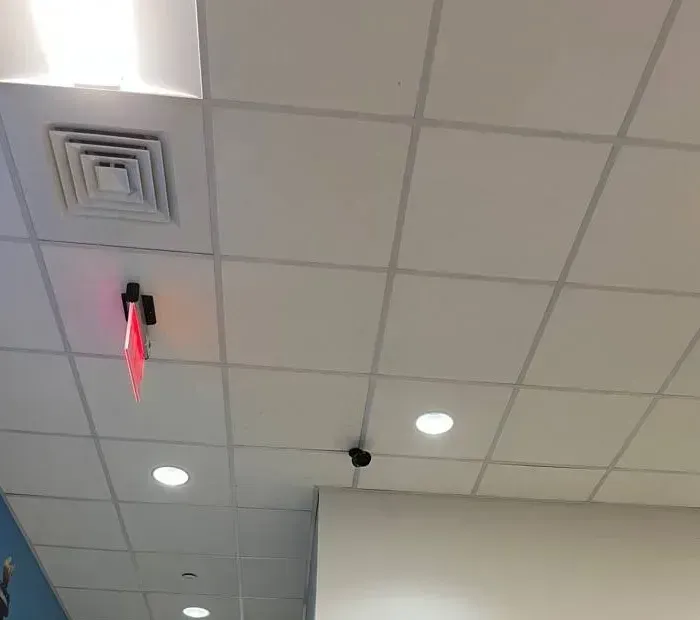
A photo from the AESS job library, not taken in Borough Park: a drop ceiling with a lit red exit sign, an air diffuser, round recessed lights and a small black camera. In a store or office on 13th Avenue, the exit sign marks a door that must always open from inside, so any buzzer release on it is chosen to lock against the street without ever locking customers or staff in.
Your Questions Answered
Door Buzzer Installation in Borough Park: Questions Answered
Houses that kept growing
Our house had two floors when its bell wire was run, and it has five now. How do the three added floors get onto the buzzer?
With new cable of their own, run from the same power supply as the original floors and joined to the system in a box someone can open. The old wire ends where the old roof was, and extending it upward with splices inside the new walls is what usually leads to a buzzer that works downstairs and fails upstairs. The new floors almost always came with a new way up, a stair, a chase or a stack of closets, and that is where their cable goes.
The original two floors keep their old wire if it meters sound from the cellar to each kitchen. If it does not, they get new cable too, usually along the same path. The door station changes from a two-button plate to a panel with a button for every household now living behind the door, and the whole house runs from one battery-backed power supply in a common space.
Where the house might grow again, we leave a pull string in the new chase and choose a panel with spare positions. That small step means the next floor joins the system without anyone opening a wall.
Our newest apartment was built out behind the original house, where the yard used to be. Can its station be wired without going through the front apartment?
Usually, yes. The route depends on where the original cellar ends. If the cellar reaches back far enough, or the extension has a crawlspace or cellar that connects to it, the cable runs under the floors and comes up inside the rear apartment's own walls. If the extension sits on a slab with no space below, the route goes through a common hall ceiling, along the stair, or up and across through a common area on the floor above.
We walk the possible routes with you and mark the one that stays in common space. If the only practical path crosses another household's rooms, we say so before anything is priced, and the cable goes in a neat, accessible raceway rather than being buried where it cannot be reached later.
The rear household also needs to be findable. If visitors reach that apartment by a hall that passes other doors, a clear label on the panel and, where useful, a small sign inside the street door save the family from callers knocking at the wrong home.
The newer part of our building has a fire-rated stair enclosure and a pipe chase. Can the buzzer cable use either one?
Often, and they are usually the best routes in an addition, because they connect every new floor without opening finished rooms. Cable can pass through the walls of a rated stair or shaft, but every opening made for it has to be sealed with a fire-rated sealant so the enclosure keeps the rating it was built to. We do that as a matter of course and show you where the penetrations are.
A pipe chase that carries plumbing can usually hold a low-voltage cable fastened clear of the pipes. We keep the cable away from hot water and steam lines and from gas piping, support it independently rather than tying it to the pipes, and avoid sharing a chase with line-voltage electrical runs unless they are separated as the code requires.
Does every addition that was built onto our house push the buzzer price up?
Not by itself. What adds labor is not the number of additions but how hard it is to get cable from the power supply to each household. An addition with a new stair or chase running past every new floor can be easier to wire than the original house, whose plaster walls and closed ceilings leave fewer routes. An addition built without any common vertical path, or a rear extension on a slab, takes longer.
The other things that move a Borough Park price are the number of households, the condition of the old wire, the state of the street door and whether the door needs a strike rated for heavy use. Every job is quoted in writing after the walkthrough, with any item that depends on a test named before you approve.
The door that takes the traffic
Our last door release ran hot to the touch and quit within about a year. Was it simply the wrong part for a door this busy?
Very possibly. Many older buzzers drive an AC strike from a doorbell-style transformer, and AC strike coils are generally built for intermittent use. On a door that opens a few times a day, they last for years. On a family door released over and over, especially when people hold the button down until the strike buzzes loudly, the coil overheats and eventually burns out. Heat at the strike is a warning sign, not a normal condition.
The fix is a strike rated for continuous duty, powered from a regulated low-voltage supply sized for it, and a closer adjusted so the latch is not pressed hard against the keeper. When the latch binds, residents hold the button longer, and the strike works harder. With both corrected, the release opens on a short press and stays cool.
We also check the wire to the strike. A thin or long run can starve a strike of voltage, which makes it hum without fully releasing, and that too leads people to hold the button. If the run is undersized, it is replaced as part of the job.
Our electrician says the new strike needs its own permit because it is electrical work, even though the buzzer is low-voltage. Who is right?
It depends on what is being powered and how. A buzzer's strike normally runs at low voltage from the buzzer's own power supply, and the 2025 NYC Construction Codes summary of AC 28-105.4.7 says wiring designed to run below 50 volts for signaling and communication circuits does not need an electrical permit when a licensed master electrician, a special electrician or a qualified person does the work. On that reading the strike and its cable fall on the low-voltage side.
What does belong to the electrician is any new 120-volt outlet or circuit that feeds the power supply. If the cellar has no outlet near where the power supply should go, that piece is electrical work. Some published sources read the intercom permit rules differently, so if your electrician or expediter is already filing for the building, we coordinate with them and follow their filing rather than argue the point at your front door.
The street and the seasons
Every fall our sukkah goes up on the porch, right in front of the street door. Where should the door station go so visitors can still reach it that week?
Somewhere the sukkah cannot cover. brooklynjewish.org's guide to the neighborhood notes that sukkahs here are built on sidewalks and balconies, and when one goes up on a porch or stoop it can hide the door station behind its walls for the whole holiday. Before we mount anything, we ask where your sukkah stands each year and how its walls are fixed, and we place the station where a visitor can still see and reach it: on the casing on the side the sukkah does not occupy, on the gate or railing at the foot of the steps, or at the point where the path enters the porch.
If the only workable spot is inside the area the sukkah encloses, the station can still serve visitors who walk into the sukkah to ring, but the camera will see canvas or panels rather than the street. Many families prefer a second, small station at the front gate for that reason. We plan the cable for it on the same visit, so it can be added that year or later.
We also check that the sukkah's frame will not be fastened to the station's mounting area or press on the cable where it enters the wall. A few inches of clearance planned in advance saves a cracked faceplate every autumn.
Burglars on our block have come in through rear windows. Is a better buzzer at the front door still worth the money?
It depends on what you want it to do. CBS New York reported in 2014 that eight Borough Park homes were burglarized in under two months, each time through a rear window. A door buzzer does nothing for a rear window. What it does is control the front door: the door shuts and locks after every visitor, and nobody upstairs has to open it blind or walk down to see who is there. For a house with many people coming and going, that is a real gain, but it is a different problem from the back of the house.
If the rear windows are your main worry, the right money goes to window locks, bars where the fire code allows them, lighting and an alarm, and we will tell you so at the walkthrough rather than sell you a panel you do not need. If you want both, a camera inside the street door and a buzzer can go in on the same visit as other security work, and we quote each part separately so you can choose.
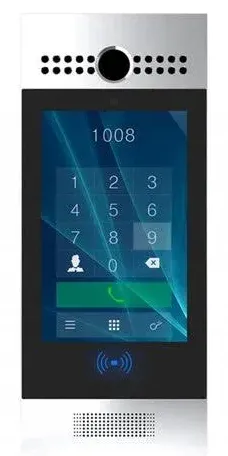
A photo from the AESS job library, not taken in Borough Park: a touchscreen entry panel showing a dial pad with a four-digit apartment code entered, a camera above and a card-reader symbol below. A code panel like this suits a new Borough Park building with many apartments, where a column of buttons would run longer than the entrance can hold and residents can come in without carrying a key.
Pricing a Borough Park Buzzer Job: What the Published Numbers Cover and What They Leave Out
Most owners in Borough Park ask about price first, and they usually expect one number. There isn't a single honest figure for buzzer work in this neighborhood. The building stock varies too much, and the cost data that exists comes from companies selling the work. This section explains what those published figures describe, how they apply to the houses and small apartment buildings between Fort Hamilton Parkway and McDonald Avenue, and which questions to ask so you can tell whether a quote fits your building.
Start with the source of the figures. Every cost benchmark for NYC buzzer and intercom work comes from a vendor. No independent agency publishes a price survey for this trade. ButterflyMX, an intercom manufacturer, says so directly when it discusses buzzer pricing: "No independent national cost survey is established here." Use the ranges below as reference points, not as averages, and treat any quote, including ours, as a description of one particular job.
The published ranges fall into a few tiers. One NYC security company lists many common, accessible intercom and buzzer repairs at a flat rate of $150 to $250, with a 30-day repair warranty. The same company quotes $435 to $1,835 for installing or upgrading a system at a small property, and $1,235 to $4,535 or more for multi-unit buildings. A video intercom vendor quotes per door rather than per building: $1,000 to $3,000 to replace an audio system with another audio system, and usually $1,500 to $5,000 per door to move up to a smart video system. Another NYC installer says a simple electric strike replacement can start at about $350.
Full terms — including 50% deposit, one-year parts-only warranty on AESS-supplied products, and the late-fee schedule — are set out in the service agreement.
These figures can't simply be added together or compared. A flat-rate repair assumes the fault is easy to reach and easy to identify. A per-door price assumes a defined entrance with a defined set of apartments behind it. A building-wide range assumes someone has already counted the stations, traced the wiring, and checked the door. In Borough Park those assumptions often fail, and the gap between the low and high ends of each range usually comes from the conditions described below.
Whether the existing wire can carry the new system. Wiring is the biggest cost driver, and old cable is often more usable than people expect. Across Brooklyn, most intercom work replaces an existing system rather than installing a first one. The typical building has a panel older than any current tenant, half the apartment handsets dead, and a landlord who lets visitors in by phone. In prewar buildings, the riser wiring that carried the original buzzer can often be reused. Retrofit kits are built for this. Comelit Ultra, Aiphone GT, and Akuvox all offer kits designed to run over legacy 2-wire and 6-wire cable, so the walls don't have to be opened. Most buzzer-to-video conversions also connect to the building's existing electric strike instead of requiring a new one. When the riser and strike are reusable, a video upgrade costs mostly equipment and labor at the panel and at each apartment. When they aren't, the job also covers new wiring and wall repair.
Whether the wire has survived the basement. In Brooklyn's prewar walk-ups, it's common to hear that old copper deteriorates in damp basements and exposed conduit. This is a field observation from installers, not a measured finding, and how much it applies depends on where your cable runs and how dry the space has stayed. It matters for cost because a riser that tests fine upstairs may have a damaged section where it passes the boiler room or a wet corner of the cellar. A quote written without testing the run is a guess. A quote written after testing tells you whether the reuse-the-wiring savings are real for your building.
Whether the house has been extended. Borough Park is not a neighborhood of untouched prewar rows. According to the New York Times, since 1990 the Buildings Department has issued more permits for private construction projects, new homes and additions, in the Borough Park area than in any other residential neighborhood in Brooklyn. A 1992 law made Borough Park a special zoning district that let residents build on 65 percent of their lot, which shrank setbacks and backyards. In practice, many houses have a rear section or upper floor that the original buzzer wiring never reached. The reusable riser may serve the old front of the house and stop short of the newest rooms. Pricing a job like this means pricing two systems: reuse where the old wire runs, and a new run where it doesn't. That split is a major reason two quotes for the same address can differ so much.
Whether the door is the real problem. A common complaint is that the buzzer sounds but the door won't open. Two causes come up again and again in Brooklyn. First, vestibule door closers get tightened until the latch jams against the keeper, so the strike releases but the door is held closed by its own hardware. Second, strike coils wear out. AC strike coils are rated for intermittent duty, and under heavy use they overheat and burn out. Either way, money spent on a new panel won't fix the entrance. A strike replacement starting around $350 is a different job from a panel replacement, and a closer adjustment may cost less than either. A useful quote identifies which part has actually failed before recommending replacement.
How heavily the door is used. This connects strike wear to the neighborhood. Borough Park is growing quickly. Orthodox and Haredi families average 6.72 children, and the birth rate of 24.4 per 1,000 residents has driven sharp population growth. More people per household means more trips through the front door each day: children going to and from school, deliveries, visiting relatives, neighbors. A strike rated for intermittent duty can fail sooner on a door like this. When we price a strike for a busy Borough Park entrance, we weigh duty rating along with cost, because the cheapest coil can become the most expensive one if it fails within a season.
Whether the new hardware needs line voltage or a permit. Permit and licensing questions also affect cost, and the sources disagree. One reading of the updated code says that, under Administrative Code section 28-105.4.7 on low-voltage electrical work, effective December 21, 2025, no electrical permit is needed to install or repair wiring designed to run below 50 volts for signaling, communication, alarm, and data circuits, provided a licensed master electrician, a special electrician, or a "qualified person" does the work. Other sources say new intercom installations and substantial modifications need DOB permits, with electrical work requiring a separate permit and a licensed electrician. Another says low-voltage intercom work needs no DOB permit but line-voltage wiring does, for example powering a new electric strike or maglock on a vestibule door. These positions haven't been reconciled in what we've reviewed, so we confirm the permit status of each job's specific scope before quoting. If a job adds line-voltage power at the door, the quote should state whether a permit and a licensed electrician are included.
Whether a maglock is being proposed for an exit door. Some upgrades replace a strike with a magnetic lock. Maglocks have uses, but a maglock can't go on a designated egress door without a DOB-approved release sequence. If a proposal puts a maglock on a door people use to leave the building, ask how the release will work and whether that sequence is approved. If it isn't, the job isn't finished regardless of the price.
The cost of a visit that doesn't fix anything. One complaint circulating about NYC intercom service reads: "A tech showed up, charged me $300, intercom still broken." We can't verify where it came from, but owners recognize the situation. It usually happens when a technician replaces whatever is easiest to reach, often the panel or a handset, without tracing the actual fault. For a Borough Park house built in stages, the fault may be at the seam where the old riser meets the new addition, or at a jammed latch on a door that cycles all day. Paying for diagnosis first, and getting the result in writing, is the best protection against paying twice.
Storefronts versus houses. Commercial entries are priced differently. Thirteenth Avenue is Borough Park's main shopping street, and in 2009 a ten-block stretch from 45th to 55th Streets had 14 banks, with two more opening by 2010. A storefront, office, or bank door releasing customers all day puts more demand on the strike than a two-family house does. It may also need a release arrangement that a residential vestibule doesn't. Expect commercial pricing to reflect heavier-duty hardware and, where line voltage or egress issues come up, the permit questions above.
Several buildings at once. Owners with several properties often ask whether the work can be done together. It can, and sometimes it costs less per door, but only if each building is surveyed on its own terms. Two Borough Park buildings on the same block can have very different riser conditions if one was extended and the other wasn't. A portfolio quote that applies one per-door figure to every address hides the differences that drive cost.
To sum up: a fair Borough Park quote states whether the existing wiring was tested and can be reused, whether the house has additions the old wiring doesn't reach, whether the door hardware was checked before the panel was condemned, whether the strike suits the building's traffic, and whether any line-voltage work, permit, or egress release is included. The published ranges help you notice when a number is far off. They can't tell you what your building needs. Only a look at the actual wiring and door can do that.
A photo from the AESS job library, not taken in Borough Park. Every Borough Park quote is written after the wiring and the door have been checked, so the price reflects the building rather than a published range.
Matching the Panel to the People Inside: Unit Counts, Added Apartments, and Getting a Dead Buzzer Fixed
Every buzzer panel reflects an assumption about who lives in the building, one button for each household that needs to let someone in. In much of Brooklyn that assumption stays roughly accurate for decades. In Borough Park it often doesn't. Households grow, houses get extended, and the number of doors to answer changes. This section covers how unit count affects what a building is required to have and what it actually needs, and what tenants and owners can do when a buzzer stops working.
Why unit count matters legally. The Multiple Dwelling Law ties intercom obligations to the number of apartments and the building's age. Under MDL section 50-a, every Class A multiple dwelling erected or converted after January 1, 1968 with eight or more apartments must have an intercom system at its self-locking main entrance door. Buildings with fewer than eight apartments aren't covered by that intercom requirement, but the self-closing, self-locking door requirement still applies. For multiple dwellings built or converted before January 1, 1968, self-locking doors and a two-way intercom must be installed if a majority of tenants request them, and the landlord may recover the cost of the equipment from tenants under the same section.
There is a conflict in the published material to be aware of. One vendor glossary says MDL section 50 requires a functioning intercom or bell system in Class A multiple dwellings with three or more residential units. That doesn't match the eight-unit threshold above. We haven't resolved the discrepancy from the sources we reviewed, and we don't want any owner relying on our summary as legal advice. If your building's obligations depend on whether the threshold is three units or eight, read the statute itself or have an attorney do so.
Why this matters for small buildings. Borough Park has many small residential buildings, and one court decision shows how the unit count can decide whether an intercom violation stands. In a Chelsea condominium case, the court found that subsections (2) and (3) of MDL section 50-a did not apply because the building had fewer than eight units and a majority of occupants had not requested a statute-compliant intercom in writing. The court dismissed the HPD violation and directed HPD to remove it. The decision doesn't say a small building can ignore its front door. The self-closing, self-locking door requirement remains. It does show that in a smaller pre-1968 building, a written request from a majority of occupants is a key step under the statute, and that the actual unit count matters.
For tenants in a small pre-1968 Borough Park building who want a working two-way intercom, this suggests a practical approach. Put the request in writing and collect signatures from a majority of the occupants. Understand that the landlord may be able to recover the equipment cost from tenants under section 50-a. For owners, it means checking the building's construction or conversion date and current apartment count before assuming the intercom question either does or doesn't apply.
Added apartments and extra buttons. The unit count isn't always what the certificate of occupancy shows. HPD defines an illegal conversion as adding an apartment in a basement, attic, or garage without DOB approval or permits. A New York City Comptroller audit of the Buildings Department's code enforcement listed Community District 12, which covers Borough Park, Kensington, and Ocean Parkway, with 537 violations issued to one- and two-family properties, totaling $1,326,363 in assessed penalties.
This affects buzzer work directly. An unpermitted extra apartment often comes with an unpermitted extra buzzer station: a button added to the front panel, a handset in the basement, a cable run through a wall that wasn't part of any approved plan. When we see more stations than a house's legal unit count would explain, we can't treat it as just a wiring detail. Adding a station for an apartment that isn't approved means building entry hardware around a condition the city treats as a violation. Owners planning to add or relabel buttons should first confirm that the units being served are legal.
The opposite case comes up too. Many Borough Park buildings have legally expanded under the neighborhood's permissive zoning, with rear extensions and added floors. Families who need more room often add it through a permitted addition rather than a move. In those houses the panel may have the right number of buttons but the wrong wiring layout, with the original riser serving the front of the house and a newer room or floor reached by an improvised run. The panel matches the people inside, but the wiring hasn't caught up with the building.
Mid-size buildings. Borough Park also has larger buildings than its houses and small walk-ups. HPD selected the Southern Brooklyn Community Organization to build seventeen four-story affordable housing buildings on two narrow City-owned parcels on 37th Street in Borough Park. Buildings of this type are the reason the eight-unit threshold and the pre-1968 versus post-1968 distinction matter. A four-story building with enough apartments and a recent construction date is exactly the case the statute's mandatory intercom language addresses. Owners and managers of mid-size buildings should confirm the apartment count and construction date and maintain the intercom accordingly, since the requirement doesn't depend on a tenant request.
When the buzzer goes dead. A dead buzzer in an occupied building is more than an inconvenience. One vendor that summarizes the Housing Maintenance Code describes a non-working intercom or buzzer as a Class B hazardous violation, enforceable on a tenant's complaint, and notes that courts have treated a working intercom as an essential service tied to the warranty of habitability. Other sources disagree on how serious it is. One describes it as an active Class C-style violation, and another claims civil penalties of $250 to $500 per day until corrected, a figure we haven't verified against HPD's own penalty schedule. We note all three because owners sometimes rely on whichever is most convenient. The safe assumption is that a broken buzzer is a violation HPD can issue on complaint and that courts take seriously. Under section 304 of the Multiple Dwelling Law, failing to install and maintain the required equipment is a misdemeanor.
What tenants can do. Tenants in Borough Park sometimes ask what to do when a landlord won't fix the buzzer. The usual first step is a written repair request to the landlord or managing agent that describes the problem: the panel is dead, a particular apartment's button doesn't ring, or the buzzer sounds but the door doesn't release. The last of these points to the door hardware, not the panel. If the request goes unanswered, a complaint through 311 can lead to an HPD inspection. Inspections aren't always quick. In one renter's account, she waited three months for a city inspector to respond to her 311 complaint about a broken intercom and a front door that was always propped open. That example comes from a single report, not a measured average, but it shows that a complaint starts a process, not an immediate fix.
That renter's propped-open door reflects a common pattern. When the buzzer fails, people stop relying on it. They prop the door, leave it unlatched, or give up and have visitors call from the sidewalk, which matches the Brooklyn-wide pattern of landlords letting people in by phone. Each workaround undermines the self-closing, self-locking door the law requires even in buildings too small for the intercom mandate. Fixing the buzzer is how the door gets locked again.
Co-ops, condos, and owner-occupied houses. Responsibility for repairs isn't always the same as in a rental building. Borough Park includes single-family and two-family homes, apartment buildings, co-ops, condos, and commercial properties, and who must fix the buzzer depends on the type. In a rental, it's the landlord. In a co-op or condo, the shared entrance hardware is generally the board's or the association's responsibility, while what's inside an individual unit depends on the governing documents. In an owner-occupied two-family house, the owner is usually both the person who wants the buzzer fixed and the person responsible for fixing it. Before calling an installer, a co-op shareholder or condo owner should confirm whether the failed component is building equipment or unit equipment, because that determines who authorizes and pays for the work.
How Borough Park buildings compare. Owners sometimes ask whether their violation history is unusual. One building-data site puts the Borough Park average at 10.2 HPD violations and 7.4 311 calls per building. Those figures cover all violation types, not just intercoms or doors. We couldn't obtain Borough Park HPD data filtered to intercom and door-entry violation codes, so we can't say what share relates to entry systems. The baseline is still useful. A building well above it has a record HPD and prospective tenants can see, and an unresolved buzzer complaint adds to it.
Planning a panel for growth. A buzzer system built for today's households won't necessarily fit the building in ten years. With large families and a high birth rate, Borough Park homes tend to gain occupants, and homeowners tend to add space through permitted extensions. When we plan a new panel or a buzzer-to-video upgrade here, we account for that. Where the existing riser can carry a 2-wire or 6-wire retrofit, the system can be installed without opening walls. Where a legal addition has created a new floor or rear section, we plan the run to reach it properly instead of relying on a temporary extension. Where the button count would exceed the legal unit count, we raise that question before installing anything. A panel that matches the building's legal unit count, reaches every lawful apartment, and opens a door that latches and releases reliably is one that holds up under HPD complaints and inspections.
Equipment
Types of Door Buzzer Systems We Install
We quote a reliable non-branded system by default and install a named brand when an owner asks for one; the intercom brands we work with include Aiphone, ButterflyMX, 2N, Akuvox, Comelit and DoorBird. Aiphone describes its GT Series as a multi-tenant system for new builds and retrofits that can use existing wire. These are the categories of equipment that come up most at Borough Park doors.
Expandable button panels
Audio or video panels with spare positions, for houses that have grown once and may grow again, so a new household is added without replacing the panel.
Single- and two-button video stations
Compact stations with a camera for two-families that kept their shape, sized for the narrow casings beside many street doors.
Code and directory panels
Panels with a dial pad or a scrolling directory for new Borough Park buildings with many apartments, where a column of buttons would run longer than the entrance can hold.
Continuous-duty strikes and power supplies
Electric strikes rated for continuous duty and regulated, battery-backed low-voltage power supplies, for street doors opened by many people all day.
Request a Borough Park Door Buzzer Quote
Tell us the street and cross avenue, how many households share the street door, and which floors or rear sections were added later. A technician calls back, usually within two hours during working hours. You can also call or text (347) 934-8335.