A two-family on 17th Avenue with one dead bell, a store building on 18th Avenue with apartments upstairs, or a six-story co-op off 84th Street ready to replace its old panel? New Utrecht door buzzer installation line: (347) 934-8335
Attached Two-Family Rows · Legal Four-Families with Two Front Doors · Shops with Apartments on 18th Avenue · Prewar Walk-Ups · Six-Story Co-ops and Rentals
Door Buzzer Installation in New Utrecht
Every Door Counted · Old Cable Tested Before It Is Trusted · Door Fixed Before the Release · Written Price Before Ordering · Brooklyn Rate
Door buzzer installation in New Utrecht means working in the old Dutch town center that is now part of Bensonhurst, where most homes were built by 1939 and most of them are rented. The same few blocks hold attached two-family houses, legal four-families with two front doors and a basement entrance, stores on 18th Avenue with families living upstairs, small prewar walk-ups and six-story buildings with fifty or sixty apartments. Each needs a different system, and each raises a different question about who is required to have one, who pays and who answers the door. Below is how we plan the job for every kind of building here, and where it falls on our Brooklyn price list.
Every price comes from our Brooklyn door buzzer list, and the total, with each possible extra named, is agreed in writing before anything is ordered
Rated 4.7★ across 201 Google Reviews
Reviewed and updated November 11, 2026, against New York's Multiple Dwelling Law §50-a; a 1996 opinion letter from the state Division of Housing and Community Renewal on bell and buzzer systems; DHCR Fact Sheet #26 (July 2025) on major capital improvement increases; NYC Administrative Code §27-2041.1 and §27-2043; the Department of Buildings' electrical work guidance for Local Law 128 of 2024 and EC&M's October 2025 article on the 2025 NYC Electrical Code; NeighborhoodScout's New Utrecht housing profile; building records from StreetEasy, Compass, Brownstoner and CityRealty; openigloo tenant reviews; News 12 Brooklyn's July 18, 2025 report from Bensonhurst; the Brooklyn Reporter's April 2025 report on a break-in at 21st Avenue and 72nd Street; Hoodline's September and October 2026 crime reports; the Brooklyn Paper's report on the Feast of Santa Rosalia; Forgotten NY's New Utrecht Avenue series; the Landmarks Preservation Commission designation of the New Utrecht Reformed Church; ButterflyMX's small-building and NYC repair guides; Brick Underground's November 2019 intercom guide; a Brownstoner forum thread; the HomeAdvisor and Swiftlane cost guides; Allegion's fail-safe guide; the building code's sensor-release provisions; and the 2010 ADA Standards. · Abstract Enterprises Security Systems, NYS license #12000287431 · crews dispatched from our Troy Avenue office in Brooklyn
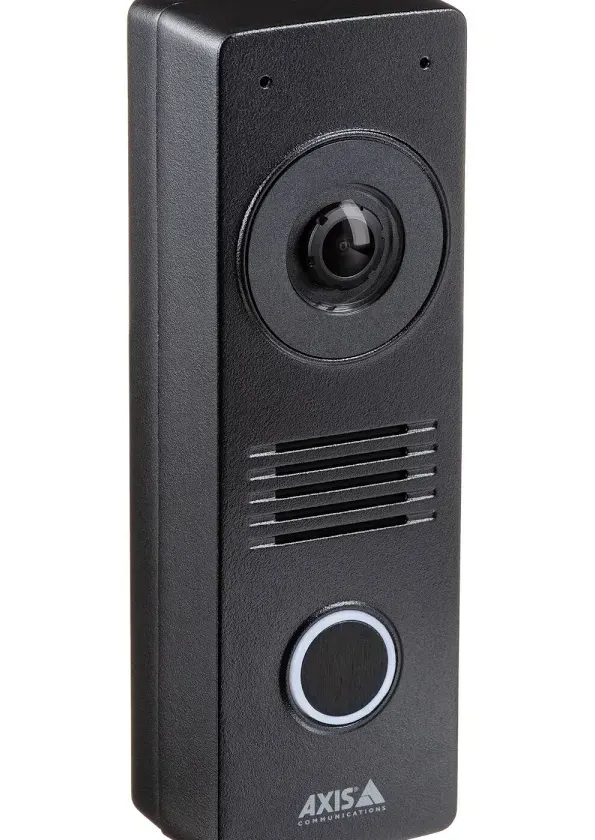
A photo from the AESS job library, not taken in New Utrecht: a black rectangular video door station with a camera lens, a speaker grille and a single round call button that lights up. One-button stations like this suit the separate street door of a single household, such as the owner's floor of a 17th Avenue two-family or the family entrance beside a store on 18th Avenue, where a full directory panel would be more than the door needs.
New Utrecht Buzzer Request
Two-family, four-family, walk-up, six-story building, or a store with apartments above: tell us the address, how many homes the system has to reach and how many doors people use, and a technician calls back with the range
✅
Request Sent!
Thank you. A technician will call you about the New Utrecht address, usually within two hours during working hours.
25+
Years Experience
✓
Same-Day Estimates
100%
Licensed & Insured
4.7★
201 Google Reviews
Owner-operated since 2002 · Thousands of jobs completed · Booked within 2 hours
Quick answer: door buzzer installation in New Utrecht costs $400 to $900 on our Brooklyn list for an audio buzzer with a new door release on a house or a single entrance, $700 to $1,800 for a video door station with indoor monitors or phone answering on a two-family, four-family or small walk-up, and from about $2,500 to past $10,000 for a full entry system serving every apartment in a six-story building or a co-op with several doors. Each price includes the door station, the answering units, the power supply, the electric strike or approved lock, the cable and the labor. It is fixed in writing after we have seen the doors, and anything that depends on a test, such as an old wire pair that might fail or a closer that has to be replaced before a release can hold the door, is named and priced before you order. Send photos of the street door and whatever is mounted beside it to (347) 934-8335 or on WhatsApp, and we answer with the range that fits, usually within two hours of your message during working hours.
Reviewing your photos and quoting a new system costs nothing. If an existing system has to be diagnosed in person before we can quote, that is the $250 service call booked online, and the $250 is applied toward the work.
All work is done under New York State license #12000287431. We install low-voltage entry equipment; if a door needs a new 120-volt outlet or circuit for its power supply, a licensed electrician does that part, and you know before the job is priced.
We work for whoever controls the door: the owner of a house or building, a co-op board or its managing agent, or a store or office tenant with the landlord's written approval.
The Neighborhood
Why New Utrecht Properties Need Door Buzzer Installation
New Utrecht is no longer a separate place on the map. The Dutch town founded in the 1650s was annexed by the City of Brooklyn in 1894, and its old center around 84th Street and 18th Avenue is now counted as part of Bensonhurst, in Brooklyn Community District 11 and the 11204 and 11214 ZIP codes. That matters for a buzzer job in a practical way: when an owner looks up violations, a listing or a tenant review, the building usually appears under "Bensonhurst," even when everyone on the block still calls the streets around the Reformed Church and the Liberty Pole New Utrecht. Either name gets you the same crew and the same Brooklyn prices.
What sets the area apart for door buzzer installation is the age and ownership of its housing. NeighborhoodScout's profile of New Utrecht puts 71.0% of the residential real estate as built in 1939 or earlier, some of it much earlier, and finds that most of it is renter occupied. Most front doors here belong to buildings older than modern entry systems, and most people pressing the buttons inside are tenants. A bell on cloth-covered wire and a landlord who lives upstairs are the normal starting point.
The building mix is wider than a quick drive along 18th Avenue suggests. Listing records show what we mean. 8418 17th Avenue is described as a legal four-family built in 1929, with "two residential entrances in the front, plus its own stairs in the front leading to a lovely basement entrance." 8418 18th Avenue, built in 1931, is a three-story building with 1,440 square feet of commercial space at street level and two apartments above. 1830 81st Street is a prewar rental from 1930 with six apartments on three floors. 8210 19th Avenue is a six-story building from 1939 with 53 apartments. And 2021 84th Street, an elevator co-op, was finished in 1963 with 65 units on six stories. Five buildings within a few blocks of each other, and each needs a different entry system.
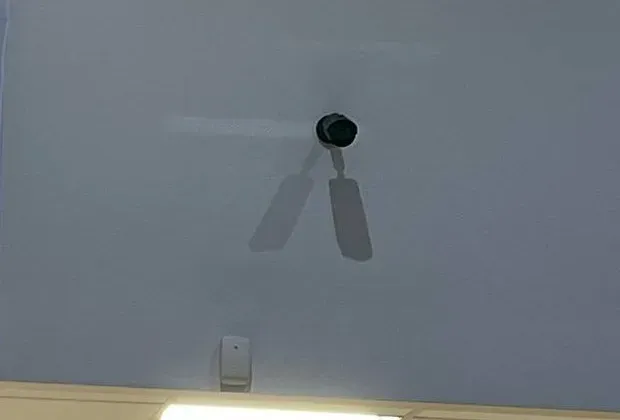
A photo from the AESS job library, not taken in New Utrecht: a small black camera mounted high on a pale wall, casting two shadows, with a small white device fixed lower down. In the vestibule of a six-story building like the ones off 19th Avenue, a camera placed this way looks down on the inner door and the mailboxes, so the moment a stranger slips in behind a resident is recorded even when the door station's own camera is facing the street.
The people who live in these buildings say what goes wrong when the front door is neglected. On openigloo, where renters review their buildings, a former tenant of 8210 19th Avenue advised the owners that "the packages get stolen by outsiders who come in when you hold the door open," and an earlier reviewer of the same building wrote that a "door bell is not working since April." Neither complaint is about a dramatic break-in. Both are about a front door that residents cannot control from upstairs, so they prop it, hold it or walk down to open it, and the building's security comes down to whoever happens to be in the hall.
The local news adds a second reason. In July 2025, News 12 Brooklyn reported that a man approached a 71-year-old Bensonhurst woman as she entered her home, offered to help with her walker, then knocked on her apartment door claiming he had come to fix a leak and took her money and jewelry. In April 2025 the Brooklyn Reporter covered thieves who broke into a home at 21st Avenue and 72nd Street at 3:30 in the morning. A buzzer cannot prevent every crime, but a door that latches every time and a station that shows who is outside close the easiest way in.
Finally, the rules differ from one building to the next. A six-story building that went up after 1968 with eight or more apartments must have a talk-and-release intercom whether anyone asks or not; the same building finished in 1963 needs one once tenants in a majority of apartments ask for it in writing; a six-family walk-up falls below the threshold altogether; and a two-family house is outside that law entirely. We sort out which applies at the start, because it changes who orders the work and what the system must do. If the building also wants a camera over the entrance or a keypad on the basement door, both can be planned into the same visit and the same written price.
Six facts that shape a New Utrecht buzzer installation
The housing is old. NeighborhoodScout counts 71.0% of New Utrecht's residential real estate as built in 1939 or earlier, so old bell wire, old transformers and old doors are where most jobs begin.
Most homes are rented. The same profile finds most residential real estate renter occupied, which puts the owner, not the person answering the door, in charge of ordering the system.
Multi-family houses have several front doors. Legal three- and four-family houses such as 8418 17th Avenue have two residential entrances plus a basement door, and each door needs its own plan for which apartments it calls.
Stores and homes share buildings. On 18th Avenue, buildings like 8418 18th Avenue put a store at street level and apartments above, so the shop door and the residents' door must stay separate.
The big buildings straddle the 1968 line. 8210 19th Avenue dates from 1939 and 2021 84th Street from 1963, both before the date in Multiple Dwelling Law §50-a, so their legal duty depends on a tenants' written request rather than applying automatically.
Only one landmark sits in the old town center. The New Utrecht Reformed Church on 18th Avenue between 83rd and 84th Streets is an individual city landmark; no historic district covering New Utrecht was found, so most door stations here need no Landmarks permit.
Where this page applies. There is no official New Utrecht boundary. This page covers the blocks around the old town center at 84th Street and 18th Avenue, from about 16th Avenue east to Bay Parkway, and the length of New Utrecht Avenue under the elevated D line from about 60th Street down to 86th Street. For the rest of the borough see our door buzzer installation in Brooklyn page, and for the whole city our NYC door buzzer installation page.
Repair or Replace in New Utrecht
Need Repair in New Utrecht? Fix the Bell Board, Swap the Door Station or Start Again: Deciding Before Anyone Buys Equipment
Most calls about "a new buzzer" in New Utrecht come from an owner whose old one has stopped doing part of its job. The upstairs bell rings but the release does nothing. One apartment hears nothing at all. The street door closes but never quite latches, so the release clicks against a door that is already open. Each of these sounds like a reason to buy a new system, and sometimes it is, but in a building this old the cheapest fix is often a single part, and the most expensive mistake is a brand-new panel wired onto a fault nobody found.
So we sort every job into one of three paths before we price it. The first is a targeted repair: a burned-out transformer, a cracked handset, a strike that has worn loose in its frame or a closer that no longer pulls the door shut. The second is a partial replacement: a new door station and power supply on old wiring that tests sound. The third is a full replacement with new cable, for buildings whose old pairs fail or that have never had talk-back. Brick Underground's NYC intercom guide quotes Daniel Vasquez of Paragon Security and Locksmith on where most trouble hides: "It's all in the wire connections." We agree, and that is why the wire gets tested before the quote is written.
If a repair is all you need, we say so and price it as one. When replacement is the honest answer, for example because a 1930s bell board gives nobody a way to talk to the visitor, we explain what the new system adds and how much old cable it can reuse.
What We Install
Door Buzzer Installation Services in New Utrecht
Every service below is priced from the same Brooklyn door buzzer list. The number of homes sets the size of the system, the doors decide which release each entrance can take, and in New Utrecht the age of the wiring, the number of front doors on a multi-family house and whether a store shares the building decide much of the labor.
First buzzers for multi-family houses
A door station with one button per apartment, a release on the street door and a station or chime on every floor, for three- and four-family houses that have only ever had a doorbell or nothing at all.
Bell board to talk-back upgrades
Replacing ring-only bell plates in prewar walk-ups with stations that let a tenant speak to the visitor and release the door from the apartment, reusing sound pairs where they test well.
Whole-building entry systems
Directory, code or button panels with apartment stations or phone answering for six-story buildings and co-ops of fifty or more homes, with riser cable tested floor by floor.
Second front doors and basement entrances
Separate stations or keypads for the second residential entrance and the basement door of a legal four-family, each wired to call only the apartments it serves.
Store-and-apartment separation
Two independent systems for buildings with a shop at street level: one for the residents' door and the apartments, one for the store's own door, back door or delivery entrance.
Video and phone answering
Video door stations with indoor monitors, or panels that ring residents' phones, for owners who want to see the visitor and for households where nobody is home during the day.
Electric strikes and door preparation
Fail-secure strikes cut into sound frames, closers set so the door shuts and latches on its own, and the door itself trued up before any release goes on it.
Power supplies and backup
A dedicated low-voltage supply on the building's own circuit with battery backup, placed where the super or owner can reach it and nobody will unplug it.
Office and practice doors
Buzz-in doors for offices and practices on the avenues, with the release at the front desk and the door locking behind each visitor, kept apart from the apartments' system.
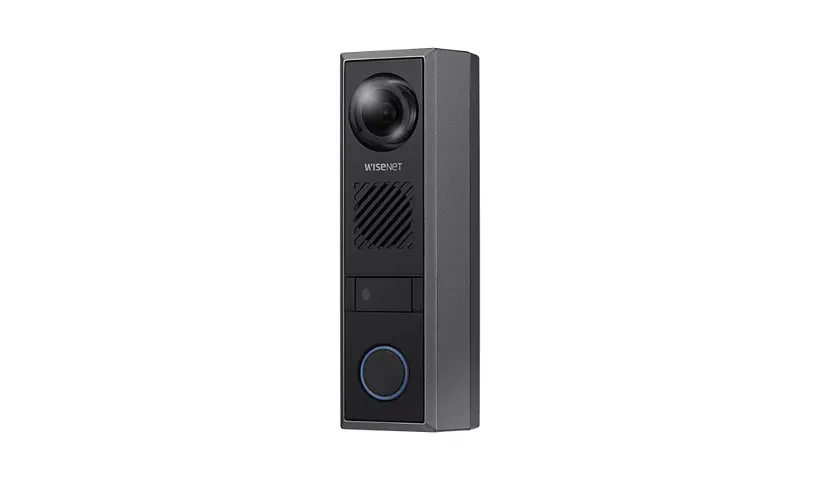
A photo from the AESS job library, not taken in New Utrecht: a slim dark grey wired doorbell with a camera lens, speaker slots and a round push button. A unit this narrow fits the wood trim beside the door of an attached two-family house, and on a legal four-family with two front entrances, one can go at each door so every household sees its own visitors without a shared panel.
Building Specialists
Door Buzzer Installation for New Utrecht's Architecture
Six kinds of building account for nearly every buzzer installation we plan in New Utrecht. They differ in how many doors people use, how cable can reach each home, how old the existing wiring is and who has the authority to order the work, and each has one mistake that shows up when the job is rushed.
Attached and semi-attached two-families
Brick or stucco houses from the 1920s and 1930s, often with the owner on one floor and a tenant on the other, one street door, two bells and an old transformer in the cellar.
Legal three- and four-families
Larger houses like the 1929 four-family on 17th Avenue, with two residential doors at the front and a separate basement entrance, each serving different apartments.
Stores with apartments above
Avenue buildings with a shop at street level and two or more apartments above, where the residents' door sits a few feet from the store's own entrance.
Small prewar walk-ups
Three-story buildings with six or so apartments, like the 1930 rental on 81st Street, usually with a ring-only bell board and wiring that has been spliced for decades.
Six-story prewar rentals
Larger buildings like the 1939 building on 19th Avenue with more than fifty apartments, long risers, a vestibule with mailboxes and a lobby door that sees heavy use.
Postwar elevator co-ops
Six-story co-ops from the late 1950s and 1960s, like the 65-unit building on 84th Street, run by a board that has to vote on the system and the budget.
Two-families: one door, two households and a transformer nobody has looked at
The commonest job in New Utrecht is also the smallest. A two-family house has one street door, sometimes a second door to the owner's floor, and two bell buttons wired to a transformer in the cellar that may be older than anyone in the house. The owner usually wants three things: each button to ring only its own floor, each floor to be able to release the street door, and, more and more, a way to see who is outside before pressing anything. None of that needs a building-sized system. A two-button audio or video station, a fail-secure strike in the frame and a small battery-backed supply cover it.
The mistake here is reusing the old transformer and bell wire because they still ring. A doorbell transformer was sized for a chime, not for a door station, a monitor and a strike, and wire that has been stapled to joists since the 1930s often has one cracked conductor that works until the new equipment draws more current through it. We test the pairs and replace the transformer with a supply sized for the new equipment. Where the old cable is sound we reuse it; where it is not, the new run is priced in the quote before you approve, not discovered on the day.
Legal four-families: two front doors, a basement door and a button plan on paper first
Larger houses such as the 1929 four-family on 17th Avenue have two residential entrances side by side at the front and stairs down to a separate basement entrance. Each door leads to different apartments, and the residents of one half of the house have no reason to be buzzed through the other half's door. Before any equipment is chosen we draw a simple plan: which door each apartment uses, which buttons go on which station, and which stations can release which doors.
That plan usually produces two small stations, each with its own release, sharing one power supply in the basement, plus a keypad or station for the basement door. These houses rarely have a common riser, so the quote says how each run reaches its apartment and whether it is concealed or carried in paintable raceway.
Stores with apartments above: two systems that never share a button
On 18th Avenue, buildings like 8418 18th Avenue put a store on the ground floor and apartments above, with the residents' street door squeezed beside the shopfront. The store has its own needs: a back or side door for deliveries, perhaps a buzz-in door for a practice or office, and an alarm. The apartments need a station at their door that calls only the apartments. Mixing the two on one panel creates the classic problem of shoppers and couriers pressing residents' buttons, and residents being able to release a door that opens into the store.
We keep them separate, each with its own power supply, so a problem in the shop cannot take the residents' door down. Where the only cable route to the apartments crosses the store's ceiling, that is arranged with the store in advance.
Small prewar walk-ups: from a bell board to a door that talks
A building like the six-apartment rental at 1830 81st Street, built in 1930, typically has a bell board at the street door, one button per apartment, a buzzer in each apartment and a release button that may or may not still work. Tenants cannot speak to the visitor, so they either walk down or press release blind. Six apartments falls below the eight-apartment line in Multiple Dwelling Law §50-a, so no law forces an upgrade, but this is exactly where an owner gets the most for the money: a talk-back station at the door and an audio or video station in each apartment, usually over pairs already in the building if they test sound.
The thing to watch is decades of splicing: a cable rejoined a dozen times during renovations may carry a chime and still fail with a modern station, so every pair is tested before it is reused.
Six-story prewar rentals: long risers, a busy vestibule and residents who hold the door
The six-story buildings off 19th Avenue and Bay Parkway are where a buzzer stops being a convenience and becomes the building's front-line security. 8210 19th Avenue, built in 1939, has 53 apartments, and its tenant reviews describe the two failures we see most: apartments whose doorbells stopped working and were not fixed, and packages taken by outsiders who came in while residents held the door. A new system has to fix the first completely and make the second less tempting, which means every apartment can reach the street door and release it from upstairs, so nobody has a reason to prop it.
The technical challenge is a six-floor riser full of old splices: where its pairs are sound, a two-wire multi-tenant system reuses them; where they are not, new cable or phone answering takes over. The vestibule matters too: the inner door, the mailboxes and the stairs all sit just behind the street door, and the station, the release and any camera are positioned so the locked door is the one between the street and the mailboxes.
Postwar elevator co-ops: a board vote, a budget and sixty-odd homes
2021 84th Street, an elevator co-op finished in 1963 with 65 units on six stories, is typical of the postwar buildings on the side streets. The board, not a single owner, decides on the system, usually after comparing several bids, and the shareholders live with the result for years. A building of this size needs a directory or code panel, because a button for every apartment would not fit a single lobby station neatly, plus either apartment stations or phone answering, a release on the lobby door and often a second station at a side or garage door.
Boards ask what each option costs over ten years, whether residents without smartphones can still answer and whether the existing cable can carry new equipment. We answer those in writing with the quote.
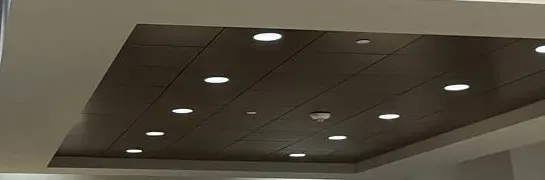
A photo from the AESS job library, not taken in New Utrecht: a dark recessed ceiling panel with round downlights and a small round device, framed by a lighter ceiling. Lobbies in the postwar elevator co-ops off 84th Street were often refinished with ceilings like this, and the space above a dropped or recessed ceiling is usually the cleanest route for new cable from the lobby panel to the riser closet.
Field Notes
Field Notes: Count the Doors, Push the Door, Then Follow the Bell Wire Down
This is our technician's standard first half hour at a New Utrecht building, before anything is priced.
First, the doors. The technician walks the front of the building and counts every way in that residents use: the main street door, a second front door on a four-family, the stairs down to a basement entrance, a side door by the alley and, on a store building, the shop's own entrances. Each door gets a note: what it is made of, which homes it leads to, and whether it should call, release or both.
Second, the push test. The technician opens the street door, lets it go and watches. Does the closer bring it all the way shut? Does the latch catch the strike plate without someone pulling it? A door that drifts open or needs a tug will defeat any release, and fixing the closer or the frame is cheaper on day one than after the new system is blamed for it.
Third, the wire. In the cellar, the technician finds the old transformer and follows the bell wire to where it leaves for the floors above, looking for cloth-covered conductors, splices taped over long ago and staples driven through the jacket. Then a meter goes on each pair. What it shows decides whether the quote reuses the building's cable or adds new runs, and either way you see that decision on paper before you approve.
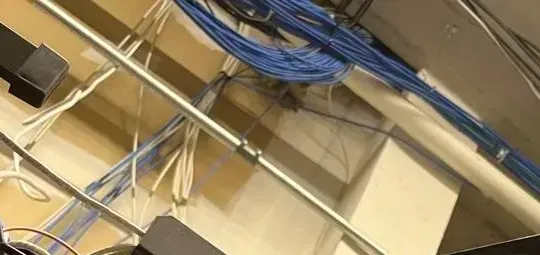
A photo from the AESS job library, not taken in New Utrecht: bundles of blue low-voltage cable laid over a ceiling beam beside a metal pipe in an open ceiling. In the cellar of a prewar walk-up or two-family, new buzzer cable follows the same kind of path along the joists to the point where it turns up the wall, kept clear of the heating and water pipes rather than strapped to them.
Power and Equipment Placement
Where the Power Supply and Controller Belong in a Two-Family, a Walk-Up and a Six-Story Building
Every buzzer system has a part residents never see: the power supply, and on larger systems a controller feeding each line of apartments. In older New Utrecht buildings it is often a small transformer on a cellar joist, wired years ago to the nearest circuit, sometimes on a tenant's meter or behind a store's locked door.
A new installation is the moment to put it somewhere sensible. In a two-family house, that is usually the cellar near the owner's electrical panel, on the owner's circuit, labeled so the next person knows what it is. In a walk-up or a four-family, it is a spot the super or owner can reach without entering an apartment or a store. In a six-story building, it is the cellar room or closet where the riser begins, mounted off the floor in a box with a lock. In a building with a store downstairs, the residents' supply never goes inside the store's space, because the store's hours and keys should not decide whether the apartments can open their door.
Wherever it goes, three things go with it. A battery backup, so the door station and release keep working for a period during an outage. A clear label on the supply, the outlet and the panel breaker. And a written record, left with the owner or board, of where the supply is, what it feeds and which pair goes to which apartment. If the supply needs a new dedicated outlet or circuit, that part is done by a licensed electrician, and you know about it before the job is priced.
Rules and Responsibilities
Which New Utrecht Buildings Must Have a Buzzer, What It Has to Do and Who Pays for It
Newer buildings with eight or more apartments must have one. Under New York's Multiple Dwelling Law §50-a, every Class A multiple dwelling erected or converted after January 1, 1968 with eight or more apartments must have an intercom at the self-locking main entrance that lets a visitor and a resident speak and lets the resident release the door from the apartment.
Older buildings must install one when a majority of tenants ask. For buildings put up before that date, which covers almost every apartment building in New Utrecht, the duty arises when tenants occupying a majority of the apartments request or consent in writing. A 1996 opinion letter from the state Division of Housing and Community Renewal put it this way: "under certain circumstances a bell and buzzer system may still be required."
The basic legal system is voice and release, not video. ButterflyMX's NYC intercom repair guide notes that the §50-a baseline does not by itself require video or phone access. Video, apps and cameras are choices an owner or board makes, not legal minimums.
Once a system is there, it has to work. Courts have treated a working intercom as an essential service, and HPD can issue violations for one that does not. ButterflyMX cites a 2022 Bronx Housing Part decision that recorded a Class B violation for an inoperable bell and return-buzzer system, and HPD guidance on correction periods of 90 days for Class A and 30 days for Class B violations.
Self-closing doors are their own duty. NYC Administrative Code §27-2041.1 requires the owner of a multiple dwelling to keep self-closing doors in good repair, and a failure is a Class C immediately hazardous violation with 14 days to correct. A buzzer installation should leave every self-closing door closing and latching on its own.
Apartment doors have their own hardware rule. Under §27-2043, apartment entrance doors in a Class A multiple dwelling need a heavy-duty latch set and a heavy-duty dead bolt. The street door's release does not replace or change those.
Rent-stabilized buildings have narrow cost recovery. The 1996 DHCR letter said a landlord who installs a bell and buzzer system can apply for a major capital improvement (MCI) increase, but DHCR Fact Sheet #26 (July 2025) now caps MCI increases at 2% a year and bars them where 35% or fewer of the apartments are rent regulated (more on this below).
Two-family houses are outside these rules. A one- or two-family house is not a multiple dwelling, so the buzzer is the owner's choice and the owner's to maintain, which makes the quality of the first installation the only thing that matters.
The church is the only landmark in the old town center. Work on the outside of the New Utrecht Reformed Church, designated a city landmark in 1966, needs a Landmarks Preservation Commission permit first. Ordinary houses and apartment buildings nearby are not inside a historic district.
None of this is legal advice for a particular building. An owner facing a tenants' request, an HPD order or an MCI application should check the details with a housing lawyer, the managing agent or DHCR. What we provide is a system that meets the requirement that applies and paperwork showing what was installed.
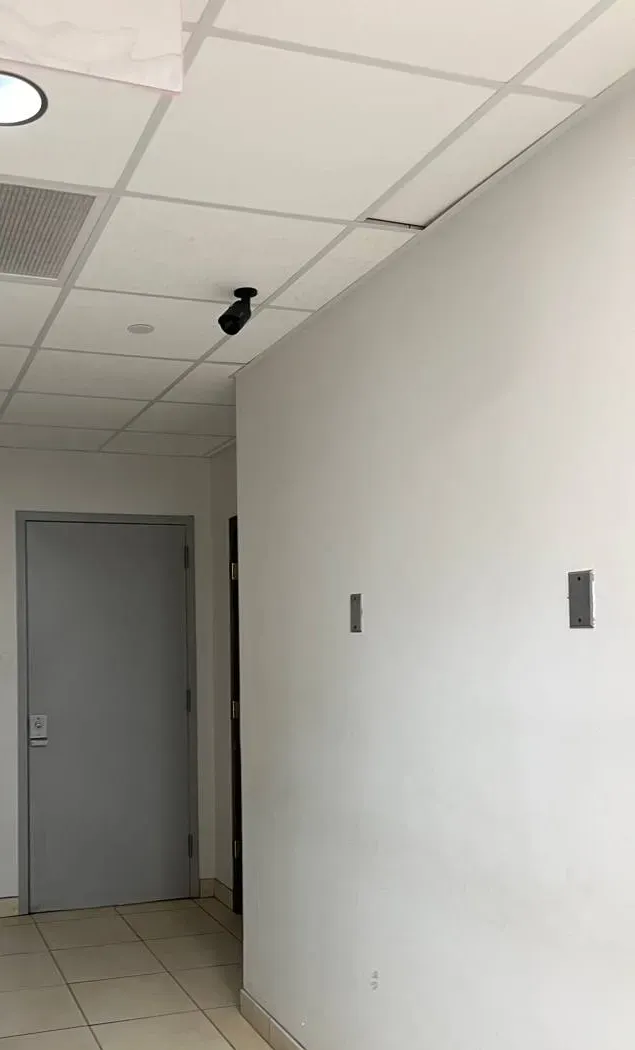
A photo from the AESS job library, not taken in New Utrecht: a tiled corridor with white walls and small wall plates leading to a grey steel door with a lever handle, under a drop ceiling with a small camera. Self-closing steel doors like this one, at the end of a cellar or service corridor in a larger New Utrecht building, have to keep closing and latching on their own after any buzzer or keypad work, because the city treats a failed self-closing door as an immediately hazardous condition.
Switch-Over Day
Switching an Occupied New Utrecht Building to Its New System Without Leaving Anyone at the Door
In a two-family house, the switch takes an afternoon. In a building with fifty or sixty apartments, people are coming home and deliveries are arriving while the system is replaced, so the street door must never end up jammed shut or swinging free.
The order we follow is simple. The new cable and apartment stations go in first, alongside the old system, which stays connected and working. The new power supply is mounted and tested on its own. Only when every new station has been checked does the door station change over, and the release is swapped last, usually in a short window when the super is on hand. If anything goes wrong at that point, the old release can be reconnected while it is sorted out, so residents keep a way in.
Before the work starts, the owner or managing agent tells residents the day and who to call if their station does not ring afterward; we supply a short lobby notice for that.
Commercial Door Buzzer Installation
Business Door Buzzer Installation in New Utrecht
New Utrecht's businesses line the avenues and the street under the el, and almost every one shares its building with apartments. A business buzzer here is rarely about letting customers in during opening hours. It is about the doors that should not be open to everyone: the back and side doors kitchens and bakeries use for deliveries, the buzz-in door of a practice or office upstairs, the staff entrance after closing and the apartments' door beside the shopfront. Recent reports give owners reason to take those doors seriously. Hoodline reported in September 2026 on two suspects accused of hitting 19 businesses from Bensonhurst to Williamsburg in a five-week spree, and in October 2026 on a gunpoint robbery near 17th Avenue and 74th Street that was captured on surveillance video.
18th Avenue
Cristoforo Colombo Boulevard, the main shopping street through the old town center, with bakeries such as Villabate Alba, family shops and buildings that put a store at street level and apartments above.
86th Street under the el
A commercial corridor beneath the elevated line, with storefronts below apartments and busy sidewalks, where residents' doors and shop doors sit side by side.
New Utrecht Avenue
The old plank road, now under the D train, where Forgotten NY describes a stretch between 76th and 77th Streets once known as "Wedding Row" for its bridal and tuxedo shops.
Bay Parkway
The eastern edge, lined with six-story buildings such as 8301 Bay Parkway, with 94 units, and ground-floor businesses that share the street with large residential lobbies.
17th Avenue
A quieter avenue of attached brick dwellings with stoops and bay windows near 81st to 84th Streets, mixing houses, multi-family buildings and small offices.
84th Street by the church
The double-width street through the old town center, past the Reformed Church grounds and the Liberty Pole, with practices, community groups and apartment buildings nearby.
The commonest business request here is a buzzer on a door that has always been propped or locked with a key: a bakery's back door, a second-floor practice that buzzes patients in one at a time, or a staff door that should lock behind each person. Each gets its own station, release and power, kept fully separate from any apartment system in the building.
Rules that apply to New Utrecht business entry installations
Anyone inside can always get out. A business door with a buzzer, code or reader still opens from inside without a key or code. A fail-secure electric strike that leaves the inside lever free is the usual choice, because, as Allegion's guide puts it, with an electric strike "you can exit by turning the lever" whether the strike is fail-safe or fail-secure.
Fire-rated doors keep their rating. Allegion notes that fire doors need fail-secure strikes, so a rated door to a stairwell or cellar stays latched in a fire; the release hardware has to carry the right listing for the door.
Magnetic locks bring extra requirements. Electromagnetic locks are only made fail-safe. The building code's sensor-release provisions call for a sensor on the egress side, a manual "PUSH TO EXIT" device 40 to 48 inches above the floor within 5 feet of the door that cuts power directly and keeps the door unlocked for at least 30 seconds, release on fire alarm or sprinkler activation, and UL 294 listed equipment.
The front desk button stays reachable. The 2010 ADA Standards set the high forward reach at 48 inches maximum, so call buttons outside and release buttons at a reception desk are mounted within that range.
Tenants need the landlord's written approval. A store or office that rents its space orders its own door buzzer only with the building owner's written permission, especially where the work touches a shared street door or crosses into the apartments' cable routes.
The landmark has its own permit. A business or group using space at the New Utrecht Reformed Church needs a Landmarks Preservation Commission permit for anything fixed to the outside of the landmark.
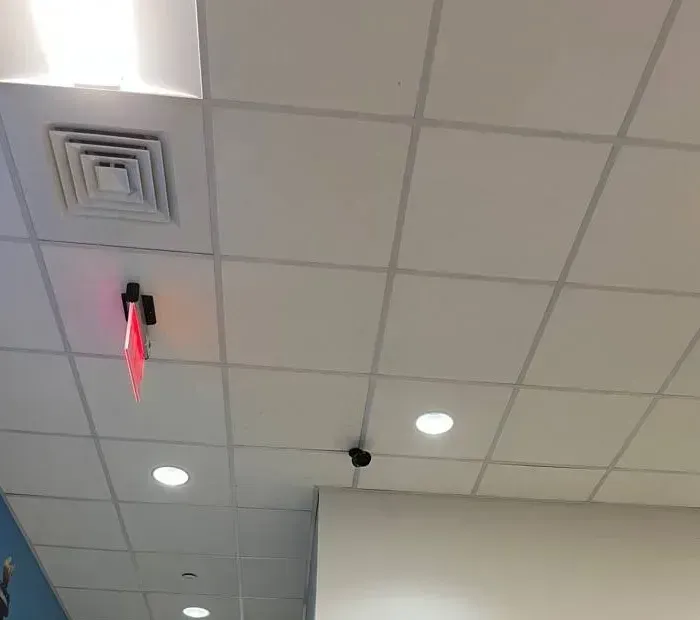
A photo from the AESS job library, not taken in New Utrecht: a drop ceiling with a lit red exit sign, an air diffuser, round recessed lights and a small black camera. Shops and offices on 18th Avenue and 86th Street often have ceilings like this, and the exit sign is a reminder of the rule every business buzzer here follows: whatever locks the door from outside, it always opens from inside.
Your Questions Answered
Door Buzzer Installation in New Utrecht: Questions Answered
The six-story buildings and co-ops
Our elevator co-op on 84th Street was finished in 1963, a few years before the 1968 date in the intercom law. Does that date matter when the board replaces a system the building already has?
It matters less than boards expect. The 1968 date in Multiple Dwelling Law §50-a decides whether a building had to install an intercom without being asked. A 1963 building with 65 units, like 2021 84th Street, falls on the older side of the line, so its original obligation depended on a written request from a majority of residents. But once a building has a working intercom, residents rely on it, courts have treated it as an essential service and HPD treats a dead one as a maintenance failure. A board replacing an existing system should plan as though the requirement applies.
At minimum, the new system must let every apartment talk to a visitor at the lobby door and release it from upstairs. Video, phone answering and a second station at a side or garage door are the board's choice.
Online reviews of our building say some apartments' bells have been dead for months. When the new system goes in, how is every apartment proven to work before your crew leaves?
By testing from the street, one apartment at a time. Once the system is programmed, the technician stands at the street door and calls each apartment, while a second person, the super or a crew member, confirms the station rings, the voice is clear both ways and the release opens the door. Every apartment gets a line on a test sheet with the result. Anything that fails is fixed before we leave or listed with a return date.
The completed sheet goes to the owner or managing agent and shows, apartment by apartment, that the doorbell works.
The owner of our four-family lives in New Jersey, and one apartment is often empty between tenants. Can the door call her phone for that apartment while the tenants answer at their own stations?
Yes. Many current systems let individual buttons call a phone or an app instead of, or as well as, a wall station. The tenants' buttons ring their stations as usual, and the vacant apartment's button, or a separate "owner" button, rings the owner's phone wherever she is, so she can speak to a contractor, a broker showing the apartment or a delivery and release the door remotely.
Phone answering usually depends on an internet or cellular connection at the building, and some systems charge monthly for it, so we say which ones do before you choose. When a new tenant moves in, the button is switched back to the apartment's station in the settings.
Our co-op board is collecting competing bids. What should be identical in every quote so the numbers can actually be compared?
The scope. Ask every bidder to price the same list: which doors get a station and a release, how many apartments are served and how, whether the old riser cable is reused or replaced and on what test, where the power supply goes and whether it has battery backup, whether closers and strikes are included, and what happens to the old equipment. Then ask for any monthly or annual fees on a separate line, with the total over ten years.
Bids that look far apart usually differ on cable, door hardware or a subscription. We write our quotes with every possible extra named and priced, so a board can line ours up against anyone's.
Avenue buildings with a store downstairs
We own an 18th Avenue building with our store on the ground floor and our family in both apartments upstairs. Since everything belongs to us, is one shared system fine?
It works for now, but we would still wire it as two. Families change: a grown child moves out and the apartment is rented, the store is leased to someone else, or the building is sold. When that happens, a single system that lets the apartments release the store's door, or lets the store release the residents' door, becomes a problem that is expensive to unpick.
Separate wiring from the start costs little more. While the building is all yours, a station upstairs can still answer the store's back door, and it can be disconnected in minutes when circumstances change.
Our street door is on 18th Avenue inside the blocks the Feast of Santa Rosalia takes over. Should the feast affect when the work is done and what goes on the wall?
Yes, on both counts. The Brooklyn Paper describes the feast running on 18th Avenue, also known as Cristoforo Colombo Boulevard, between 68th and 75th Streets. While it is on, the sidewalk in front of a building there is full of people and stands, a crew cannot work safely at the door, and residents need their door at its most reliable. We schedule installations on those blocks well clear of the feast dates, so nothing is half-finished when the crowds arrive.
For the station itself, a busy sidewalk favors a sturdy metal faceplate, buttons without exposed seams and clear unit labels, placed where a stand will not hide it.
Our building has no internet service in the hall or the cellar. Does a cellular call box solve that, and what keeps costing money after it is installed?
A cellular call box can work where there is no wired internet, but it is not free to run. ButterflyMX's small-building guide lists "possible recurring software, cellular, network, or telephone-service charges" as a cost driver, because a cellular unit needs a data plan and most phone-answering systems add a software subscription. Before recommending one, we test cell reception at the actual door, since a station that cannot hold a signal will drop calls.
The alternative is a wired system over the building's own cable, with no internet and no monthly fee, which suits most New Utrecht walk-ups and four-families.
Houses and small walk-ups
Our six-family on 81st Street is below the eight-apartment line in the intercom law. If we install a talk-back system anyway, does it then have to meet that law?
The law's requirement is set by the building's size and age, not by what you install, so putting in a better system does not move a six-family into §50-a. What it does change is what tenants reasonably expect. Once apartments can talk to the door and release it, that becomes part of the service the building provides, and letting it fall into disrepair invites complaints, just as a broken bell board would.
That is a reason to install something that lasts: a sound strike and closer, battery-backed power, tested cable and stations whose parts will be available for years.
We live across the street from the Reformed Church grounds on 18th Avenue, which are a city landmark. Do Landmarks rules apply to a door station on our building?
Not because of the church. The New Utrecht Reformed Church, between 83rd and 84th Streets, is an individual landmark, designated in 1966 with an extension in 1998. That designation covers the church property, not the surrounding blocks, and no historic district covering New Utrecht was found. A house or apartment building across the street can install a door station without a Landmarks permit.
The church and its buildings are different: anything fixed to the outside of the landmarked property needs a Commission permit before work begins. If you are not sure whether your building is designated, the Commission's online map will tell you, and we check before quoting any facade work.
The city's new electrical code took effect in December 2025. Does it change anything for a buzzer installation in our house?
For the low-voltage parts of a buzzer, very little that a homeowner will notice. The Department of Buildings says the 2025 NYC Electrical Code, under Local Law 128 of 2024, applies to filings made on or after December 21, 2025, and EC&M reports that it moved the city's baseline from the 2008 to the 2020 National Electrical Code. The door station, the apartment stations, the strike and the cable that connects them run on low voltage from a plug-in or hard-wired supply.
Where it matters is the 120-volt side: a new outlet or circuit is done by a licensed electrician under the current code, and the quote says so if your job needs one.
Visitors and timing
A Bensonhurst woman was robbed by a man who followed her in and said he had come to fix a leak. What can a new system do so my mother never opens her door to someone like that?
Three things, working together. First, a video station in her apartment, so she can see who is at the street door before pressing anything; a person claiming to be a plumber can be asked to wait while she calls the super or the owner. Second, a street door that closes and latches every time, with a closer strong enough that nobody can slip in behind her, which is how the News 12 Brooklyn case began. Third, a station placed where she can reach it easily, with buttons large enough to use without her glasses.
The other half is a habit: real repair work in a rental is arranged by the owner or super in advance, and a station and a locked door give her time to check.
If we ask for a particular brand of door station, how does that change when the installation can happen?
It can add weeks. We quote a reliable non-branded system by default because it is in stock, and the installation date can be set as soon as the deposit is in. Some named brands, especially imported video stations, are special-order items that do not sit on a supplier's shelf, and their shipping time is outside our control.
For those, the order goes in after the deposit, we tell you the arrival date once the supplier confirms it, and the installation is booked when the equipment is here, never promised before.
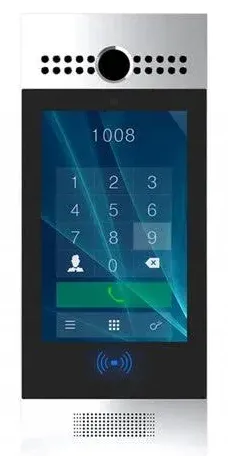
A photo from the AESS job library, not taken in New Utrecht: a touchscreen entry panel showing a dial pad with a four-digit apartment code entered, a camera above and a card-reader symbol below. A code panel like this suits a 65-unit co-op or a six-story rental, where a separate button for every apartment would crowd the lobby wall and visitors can find the right home by scrolling a directory or entering its code.
Equipment
Types of Door Buzzer Systems We Install
We quote a reliable non-branded system by default and install a named brand when an owner or board asks for one; the intercom brands we work with include Aiphone, ButterflyMX, 2N, Akuvox, Comelit and DoorBird. These are the kinds of equipment that come up most often in New Utrecht buildings, and where each one fits.
One- and two-button stations
Compact audio or video stations for houses and two-families, one button per household, mounted on the door frame or the wall beside the door.
Multi-button audio panels
A button per apartment and a speaker, for walk-ups and four-families replacing a ring-only bell board, with handsets or hands-free stations upstairs.
Two-wire video systems
Systems built to run video and audio over a single pair, the practical choice in prewar buildings where old riser pairs test sound and new cable would mean opening walls.
Directory and code panels
Scrolling directories or code entry for six-story buildings and co-ops with fifty or more apartments, often with a keypad or reader for residents.
Phone and app answering
Door stations that ring residents' phones, for owners who live elsewhere, households out all day and buildings where running cable to every apartment is impractical.
Combined keypad and call stations
A station with a camera, a keypad and a card reader in one faceplate, for a basement or side door residents use with a code and visitors use to call.
Fail-secure electric strikes
Releases cut into the door frame that stay locked when power is removed and let anyone inside leave by turning the lever, the default for street doors here.
Door closers and latches
Closers adjusted or replaced so the door shuts and latches on its own, and latch hardware matched to the strike, because a release only works on a door that closes.
Battery-backed power supplies
Dedicated low-voltage supplies with battery backup on the owner's circuit, sized for the door station, monitors and release rather than a chime.
Audio panel, two-wire video or phone answering: which fits a New Utrecht building?
What matters
Multi-button audio panel
Two-wire video system
Phone or app answering
Typical New Utrecht fit
Two-families, four-families and small walk-ups replacing a bell board
Walk-ups and six-story buildings whose old pairs test sound
Owners living elsewhere, households out all day, hard cable routes
See the visitor
No
Yes, on the apartment monitor
Yes, on the phone, where the system supports video
Needs internet
No
No, unless phone answering is added
Yes, wired internet or cellular at the door
Works for residents without smartphones
Yes
Yes
Only if a station or landline option is included
Reuses old cable
Often, where pairs test sound
Often, one pair per apartment
Needs cable only to the door and release
Monthly fees
None
None
Often a software or cellular charge
Brooklyn list range
$400–$900 for small buildings, more with apartment count
$700–$1,800 for small buildings; from about $2,500 for large ones
Within the same ranges, plus any subscription quoted separately
ADT, Ring and SimpliSafe compared with a local installer for a New Utrecht building
National alarm and doorbell brands come up in almost every conversation about a front door, and for a one-family house a store-bought video doorbell can be a reasonable choice. For anything with more than one household, the comparison changes. A doorbell camera rings the phones of whoever set it up; it does not give each apartment its own button, it does not release the street door from upstairs, and it cannot meet the talk-and-release standard the intercom law sets for buildings that need one. A Brownstoner forum thread from a multi-family owner who "can't see out our front door" shows the usual dilemma: whether a battery doorbell can sit on top of the old intercom, or whether both apartments need a real video system, which one estimate put at "more like $3,000."
What a local installer adds is the part the national brands leave out: the strike, the closer, the power supply, the cable to every floor, the button plan for a four-family's two front doors and a written record of the wiring.
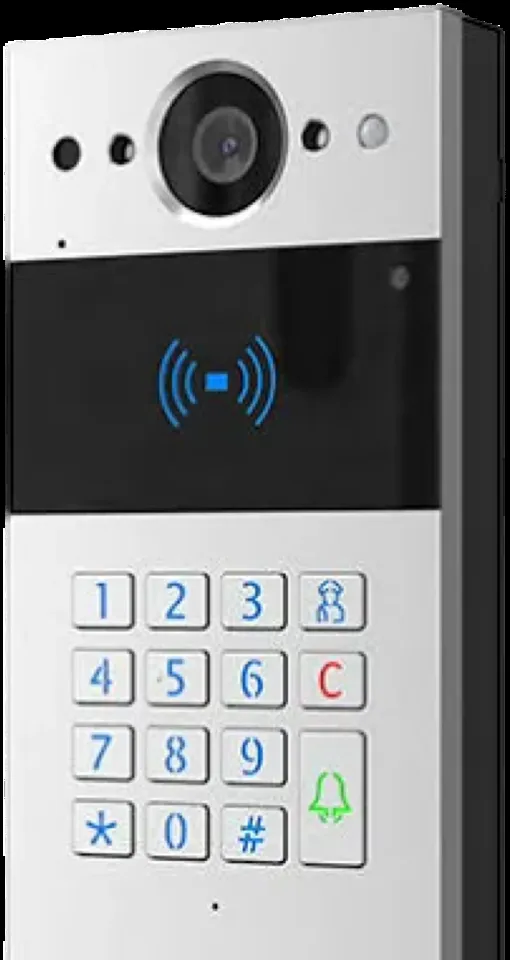
A photo from the AESS job library, not taken in New Utrecht: a silver and black keypad door station with a camera lens at the top, a blue card-reader symbol, a numeric keypad and a green bell key. On a legal four-family with a separate basement entrance, a station like this lets residents open the basement door with a code while visitors press the bell key to call the apartment it serves.
AI Overview Reality Check
What AI Gets Wrong About Door Buzzer Installation in New Utrecht
Ask an AI assistant or a search summary about putting in a buzzer and you get confident answers drawn from national cost guides, vendor blogs and generic how-to pages. Some are right in general and wrong for a neighborhood of 1920s two-families, prewar walk-ups and six-story buildings on both sides of the 1968 line. Here are seven claims we hear repeated, each checked against its source and against what we see at New Utrecht doors.
"Installing an intercom system costs an average of $2,500"
That figure is HomeAdvisor's national average, and the same guide gives a range of $1,500 to $15,000, with wireless systems at $150 to $1,500 and hard-wired ones at $1,000 to $15,000. An average across every kind of house and building in the country tells a New Utrecht owner very little, because the job here could be a two-button station on a two-family or a sixty-apartment co-op.
On our Brooklyn list, an audio buzzer with a new release on a house or single entrance runs $400 to $900, a video station with indoor monitors or phone answering for a small building $700 to $1,800, and a full system for a six-story building from about $2,500 to past $10,000. Most two- and four-family jobs in New Utrecht land in the first two ranges, well under the national average.
What moves a price within its range is local: front doors, old pairs, a store's ceiling in the cable route and the door itself. A national average cannot see any of that.
"Replacing a small building's buzzer runs $1,500 to $2,500"
ButterflyMX's October 2026 guide to small buildings gives that range from its own figures, and quotes Swiftlane's 2026 guide at "roughly $2,200 to $5,000 or more for a small single-entrance project." The guide itself warns that the two figures may rest on different assumptions, and both come from companies that sell cloud intercoms, whose prices often assume new hardware and a subscription.
A New Utrecht walk-up replacing a bell board with an audio system over sound pairs can come in well below those figures, and a four-family with two front doors, a basement entrance and no usable cable can come in above them. The guide makes the same point in its own words: cost depends more on entrances, door hardware, wiring and system type than on the number of apartments.
"New York law requires an intercom in every apartment building"
It does not. Multiple Dwelling Law §50-a requires one automatically only in Class A multiple dwellings built or converted after January 1, 1968 with eight or more apartments. Older buildings must install one when tenants in a majority of apartments ask in writing, and smaller buildings fall outside the section.
That leaves most of New Utrecht's housing outside the automatic rule. The six-apartment building at 1830 81st Street is below the eight-apartment threshold. 8210 19th Avenue, built in 1939, and 2021 84th Street, finished in 1963, both predate 1968, so their duty depends on a tenants' request. Two-family houses are not multiple dwellings at all.
The catch runs the other way too: once a building has an intercom, HPD can write violations for one that fails.
"A video doorbell is a cheaper replacement for a building buzzer"
For a one-family house with one door, often yes. For a two-family or larger, a consumer video doorbell sends calls to the phones of whoever installed it. It does not give each household a separate button, it cannot release the street door from inside an apartment unless separately wired to a strike, and it gives a tenant without the app no way to answer.
The Brownstoner thread we mentioned shows how owners run into this: one owner asked whether a battery doorbell could go on top of the old intercom, another wired a doorbell camera into the foyer and bought plug-in chimes, and a third wrote that "$1500 for a wired video doorbell sounds cheap to me" after paying more to rewire three doorbells.
In a New Utrecht four-family, the cheaper answer is usually a two-wire or audio system over existing pairs, with a button and release for every apartment.
"Your existing buzzer wiring can be reused"
Sometimes. ButterflyMX's guide says existing low-voltage wiring "can sometimes be reused when it is in suitable condition," then adds the important part: reuse "cannot be confirmed from a photo, the age of the building, or the look of a wall station." That is the right warning for a neighborhood where most buildings went up by 1939.
In New Utrecht we find both extremes: sound cable that has carried a bell for ninety years and will carry a two-wire video system, and cable spliced so many times during renovations that it barely carries a chime. Nothing on the outside shows which you have.
So every pair is metered before the quote, and a borderline pair is listed with what replacing it would add.
"A landlord can pass the cost of a new intercom on to rent-stabilized tenants"
Not in the way many owners assume. A 1996 DHCR opinion letter said that a landlord who installs a bell and buzzer system can apply for a major capital improvement increase. The rules have tightened since. DHCR Fact Sheet #26, dated July 2025, caps MCI increases at 2% a year and spreads the cost over 12 years in buildings with 35 or fewer units.
The same fact sheet bars MCI increases outright in buildings where 35% or fewer of the apartments are rent regulated, and it does not list intercoms among its examples of eligible work. For many New Utrecht buildings with a mix of regulated and market-rate apartments, the recoverable amount may be small or nothing.
An owner should confirm eligibility with DHCR or a housing lawyer before counting an MCI in the budget.
"A cellular intercom needs no building wiring"
ButterflyMX describes its intercom as one that "requires no building wiring," and for a gate at the end of a driveway, a cellular unit can avoid trenching. At a New Utrecht street door, the door station still needs power, and the lock still needs a wired connection to the strike in the frame and to the station that triggers it.
What a cellular or app-based panel can save is the cable between the door and each apartment, since residents answer on their phones. That is real value in a building where every route upstairs is blocked. But it comes with a monthly data or software charge and depends on a good signal at the door, which we test before recommending it.
For most walk-ups and multi-family houses here, a wired system over the building's own pairs costs nothing per month and works when the internet is down.
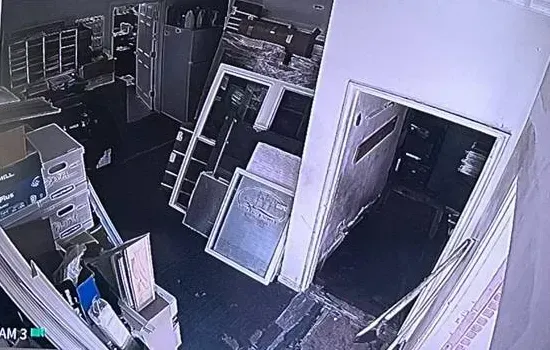
A photo from the AESS job library, not taken in New Utrecht: a black-and-white night camera view of a cluttered room with an open doorway into a dark back room. Stockrooms behind shops on 18th Avenue and under the el often connect to a back or delivery door, and a buzzer or keypad on that door, with a camera inside watching it after hours, keeps the back room as secure as the storefront.
Not Sure Whether Your Bell Wire, Your Door or the Whole System Needs Replacing? Speak to a Tech
Send photos of the street door, the bell plate or panel beside it and, if you can, the transformer or power supply in the cellar, along with the number of apartments and doors, and a technician will tell you which path looks likely and what it would cost on our Brooklyn ranges. Call or text (347) 934-8335, send photos on WhatsApp, or fill in the form below.
Get In Touch
Request a Free Quote
✅
Request Sent!
Thank you. A technician will call you about the New Utrecht address, usually within two hours during working hours.
How It Works
Our Installation Process
1. Count the doors and the homes
We list every door people use, including second front doors, basement and side entrances and a store's own doors, and every apartment, office or shop the system has to reach.
2. Settle who signs and who has to agree
We confirm who is ordering: the owner, the co-op board or managing agent, or a store tenant with the landlord's written approval, and whether a tenants' request or a Landmarks permit is involved.
3. Check the door before the wiring
We test the closer, latch, hinges and frame. If the door does not close and latch on its own, that is fixed first, because no release can hold a door that drifts open.
4. Test the old cable pair by pair
In the cellar and at each floor we meter the existing pairs for continuity, shorts and noise, and mark which runs will be reused and which need new cable.
5. Price the job in writing
You get a written price from the Brooklyn list, with every possible extra, such as a pair that might fail or a closer that might need replacing, named and priced before anything is ordered.
6. Take the deposit, order and schedule
Equipment is ordered once the deposit is in. In-stock systems are scheduled right away; special-order panels are booked once they arrive. Every visit gets a two-hour arrival window.
7. Install, label and program
We mount the door station, release and power supply, run or reconnect the cable, install apartment stations or set up phone answering, and label every pair and button, keeping the old system live until switch-over.
8. Test every home from the sidewalk and hand over
Standing at the street door, we ring and release every apartment, show residents how to answer and leave the test sheet and wiring record with the owner or board.
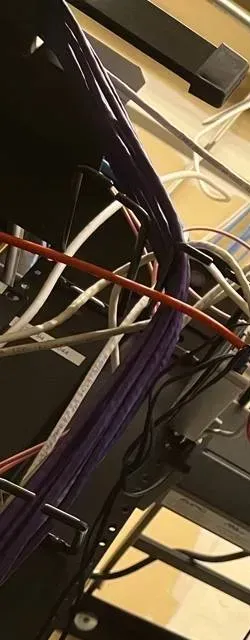
A photo from the AESS job library, not taken in New Utrecht: purple, white and red cable bundles dropping down beside a black equipment rack. In a six-story New Utrecht building, the cable from each line of apartments arrives at one point in the cellar like this, and labeling every bundle there during step 7 is what lets the next technician trace a single apartment in minutes instead of hours.
Coverage Area
Door Buzzer Installation Near New Utrecht's Landmarks
New Utrecht Reformed Church
The 1828 Gothic Revival church on 18th Avenue between 83rd and 84th Streets, built with stones from the congregation's 1700 church and designated a city landmark in 1966.
Liberty Pole
The sixth pole on the church grounds at 18th Avenue and 84th Street, marking the first raising of an American flag in New Utrecht after the British left in November 1783.
New Utrecht Cemetery
The burial ground near 16th Avenue and 84th Street, consecrated in 1654 and still kept beside the old town center.
Milestone Park
The small park on 18th Avenue between 81st and 82nd Streets, on the site of the Van Pelt Manor house and home to the oldest surviving milestone in New York City.
New Utrecht High School
Founded in 1915 and in its building at 80th Street and 16th Avenue since 1924, one of the largest high schools in the city.
18th Avenue station
The D train stop above New Utrecht Avenue, opened in 1916 when the BMT West End elevated line was built over the old plank road.
New Utrecht is billed at our standard Brooklyn rate. The final figure follows photos and a walkthrough, because the number of homes, the number of doors people use, the condition of the old wiring and the state of the door itself drive the total far more than the brand on the panel.
Job
Typical New Utrecht building
Brooklyn range
Audio buzzer or replacement with electric strike release, existing wiring reused where it tests well
One- and two-family houses, a single store or office door
$400–$900
Video door station with indoor monitors or phone answering
Two-families wanting video, four-families, small walk-ups, store buildings with apartments above
$700–$1,800
Multi-unit entry system, audio or video by apartment count, with optional fob or code entry
Six-story rentals and co-ops, buildings with several doors
from $2,500 to $10,000+
In-person diagnosis of an existing system, booked online
Any building where the old system must be tested before quoting
$250, applied toward the work
Monthly subscription
Any building choosing a wired, no-subscription system
$0
What moves a New Utrecht job inside its range is predictable. First the homes and the cable: a six-family walk-up whose pairs test sound stays near the bottom of its range, while new cable up six floors to fifty apartments pushes a system toward the top of its own. Then the doors: a second front door, a basement entrance or a store's back door each adds a station or keypad and a release. Then the building's particulars: a closer or frame that needs work, a power supply that has to move out of a store's space or off a tenant's meter, a cable route across a shop ceiling. Anything that depends on a test is named on the quote with its price before you approve.
Full terms — including 50% deposit, one-year parts-only warranty on AESS-supplied products, and the late-fee schedule — are set out in the service agreement.
Find Out Which Range Your New Utrecht Building Falls In
Three typical New Utrecht jobs, each placed inside the matching range on our Brooklyn list. The exact figure comes from the photos and the walkthrough.
House or single door: $400–$900
An audio station for a two-family's street door with a button per floor, or a buzzer for a store's back door or an office suite, with an answering unit on each floor, a fail-secure strike in a sound frame, a closer that shuts the door and battery-backed power.
Multi-family video entry: $700–$1,800
A video station for a two-family, a legal four-family's front doors or a small walk-up, with monitors or phone answering for each apartment, old pairs tested and reused where sound, and the strike and closer set for each door.
Six-story building system: from about $2,500
A directory, code or button panel at the lobby door, stations for side or basement doors, apartment stations or phone answering for every home, tested or new riser cable and power in a locked cellar box, rising toward $10,000 or more with apartments and doors.
Bring your own equipment. If you have already bought a door station or intercom kit, we can install it as labor-only work, quoted flat once we have seen the doors, the frames and the cable path. Tell us the make and model, and we will say before the visit whether it can reach every apartment and release your doors. Equipment you supply is covered by its maker's warranty, not ours.
Complete Services
Every Door Buzzer Service in New Utrecht
Houses and multi-families
First buzzers, bell board upgrades, second front doors and basement entrances. Request a quote
Stores, offices and practices
Back-door buzzers, buzz-in front desks and separate shop systems. Call (347) 934-8335
What should the photos we send show so the first quote lands close to the final price?
+
Send one photo of each door people use from the sidewalk, a close-up of the bell plate or panel beside the main door, a photo of the door's edge and frame where the latch meets it, and, if you can reach it, the transformer or power supply in the cellar with the wires leaving it. Add the number of apartments and which door each one uses. With those, the range we give is usually the range you end up paying.
Does an address in New Utrecht cost more than one elsewhere in Brooklyn?
+
No. New Utrecht is billed at the same Brooklyn rate as every other neighborhood in the borough, with no travel premium. What changes the price is the building itself: the number of apartments and doors, the condition of the old cable and whether the door needs work before a release can hold it.
After the deposit, when is the rest of the money due?
+
The deposit is paid when you approve the written quote, and equipment is ordered only after it arrives. The balance is due when the installation is finished and every apartment has been tested from the street door with you or your super. The service agreement sets out the deposit, the payment terms and the warranty in full before you sign.
Our listing says Bensonhurst while the neighbors call these blocks New Utrecht. Does the name matter when we ask for a quote?
+
Not at all. New Utrecht has no official boundary today and most records place it inside Bensonhurst, in the 11204 and 11214 ZIP codes. Give us the street address or the nearest cross streets, and the same crew, the same Brooklyn prices and the same booking times apply whichever name you use.
Can we buy longer coverage than the warranty that comes with the installation?
+
Yes. Longer warranty plans are offered as a paid add-on, priced per extra year on the quote, so an owner or board can decide before approving whether the added coverage is worth it for their building. Phone and photo support from a technician costs nothing whether or not you buy a plan.
Several of our tenants work from home. How much drilling is there, and when does it happen?
+
The loud work is short and concentrated: drilling at the street door for the station and strike, holes through cellar walls or floors for the cable, and a few minutes at each apartment station. Most of the day is quieter wiring and programming. We tell the owner in advance which hours each line of apartments will be visited, so the notice in the lobby can warn residents.
Will the new cable show on our hallway walls?
+
That depends on the option you choose, and the quote names it. Concealed cable goes inside the walls, which may need small access cut-outs where it crosses framing; we finish each with a blank plate, and patching and painting are not included. Raceway carries the cable on the wall in a paintable channel. Exposed cable is fastened neatly with clips and is the lowest-cost option, but you will see it.
Will the old system keep working until the new one is switched on?
+
Yes, in almost every building. The new cable, stations and power supply go in alongside the old system, which stays connected until everything new has been tested. The door station and release change over last, in a short window, and the old release can be reconnected temporarily if anything needs sorting out, so residents always have a way in.
If a tenant breaks the station inside their apartment, who pays to replace it?
+
Between owner and tenant, that is a question for the lease. On our side, the warranty covers parts that fail in normal use, and physical damage is excluded, so a station that is pulled off the wall or smashed is replaced at the normal price for that part. We can quote a spare station when the system goes in, so the owner has one on hand.
The old panel sits in an awkward spot beside our door. Can the new station go somewhere else?
+
Usually, yes. A new station can go wherever visitors can reach it and see it, within 48 inches of the ground for the buttons, as long as there is a route for its cable back into the building. The old opening is covered with a plate or a weatherproof blank, and the quote states where both the new station and the cover will go.
Does the super need to be there while the crew works?
+
It helps at three moments: at the start, to open the cellar and show us the power and the cable route; during the visits to each line of apartments; and at switch-over, when the street door changes to the new release. In a house, the owner or someone they trust plays the same role. Between those moments the crew can work on its own.
Our wooden street door swells and sticks every summer. Will a release still open it in August?
+
Only if the door is fixed first. A swollen door presses the latch hard against the strike, and many releases will not let go under that pressure, so the visitor pushes and nothing happens. We plane or adjust the door where needed, set the closer and choose a strike rated to release under side pressure, then test it with the door pushed and pulled, before calling the job finished.
Ready for a New Utrecht Front Door That Rings the Right Apartment and Locks Behind Every Visitor?
Send a photo of your street door and whatever is mounted beside it, with the address, the number of apartments or units and every door people use, and we will tell you which system fits, how much of your old wiring it can reuse and where it falls on our Brooklyn ranges. Call or text (347) 934-8335, message us on WhatsApp, or use the request form. Licensed under NYS license #12000287431, rated 4.7★ across 201 Google Reviews, with same-day estimates on most weekdays.