An Ocean Parkway co-op with apartment stations from four different decades, a duplex-porch two-family whose upstairs family still walks down to open the door, or a Church Avenue walk-up with a panel nobody can program? Kensington door buzzer installation line: (347) 934-8335
Ocean Parkway Co-ops · Six-Story Prewar Apartment Houses · Duplex-Porch Two-Families · Walk-Ups Over the Shops of Little Bangladesh
Door Buzzer Installation in Kensington
Planned From the Apartment End Out · Every Line Tested · Written Price Before Ordering · Brooklyn Rate
Door buzzer installation in Kensington is mostly a job about apartments, not about the panel at the street. The city's own records show it: of the 181 intercom violations HPD has written in ZIP code 11218 since 2016, 171 name a specific apartment, and Ocean Parkway alone accounts for 39 of them across 19 buildings. A new system here has to give every apartment in a six-story prewar co-op a station that works, give both households in a duplex-porch two-family their own button and release, and keep the apartments above a Church Avenue or McDonald Avenue store separate from the store's door. Below is how we plan each of those jobs and where each one sits on our Brooklyn price list.
Every figure on this page comes from our published Brooklyn door buzzer list, and your total, with every possible add-on named, is agreed in writing before any equipment is ordered
Rated 4.7★ across 201 Google Reviews
Reviewed and updated November 11, 2026, against HPD's Housing Maintenance Code violation records for ZIP code 11218 published on NYC Open Data (queried November 11, 2026); News 12 Brooklyn's April 2026 reports from 455 and 514 Ocean Parkway; Openigloo's record for 210 Caton Avenue; Corcoran's listing for 100 Ocean Parkway; the Landmarks Preservation Commission's November 2025 release on the Beverley Square West and Ditmas Park West historic districts; Wikipedia's articles on Kensington and Ocean Parkway; Forgotten New York's 2012 walk through the lanes of Kensington; Brownstoner's October 2022 report on the Little Bangladesh co-naming; an r/AskNYC thread on buzzer costs for a four-unit Brooklyn building; ButterflyMX's guide to replacing a small building's buzzer; New York's Multiple Dwelling Law §50-a; Aiphone's GT Series pages; Allegion's fail-safe and fail-secure guide; the building code's sensor-release provisions; the HomeAdvisor and Swiftlane cost guides; and the 2010 ADA Standards. · Abstract Enterprises Security Systems, NYS license #12000287431 · crews dispatched from our Troy Avenue office in Brooklyn
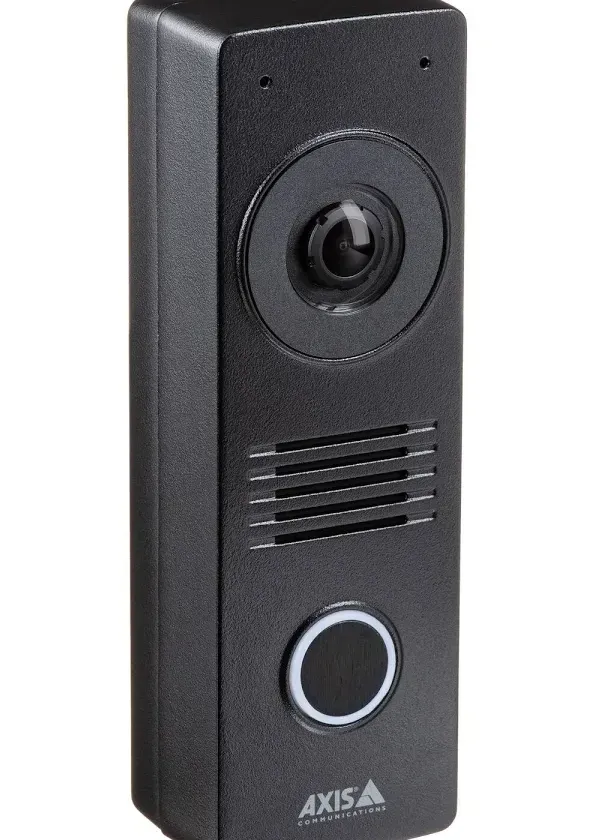
A photo from the AESS job library, not taken in Kensington: a black rectangular video door station with a camera, a speaker grille and one round call button that lights up. A one-button station like this is what a Kensington Foursquare or Victorian kept as a single home usually needs, and it fits on the wood casing beside a porch door without touching the clapboard or shingle around it.
Kensington Buzzer Request
Ocean Parkway co-op, prewar apartment house, two-family, row house on one of the lanes or apartments over a shop: tell us the address, how many apartments or households the door serves and who controls the building, and a technician calls back with the range
✅
Request Sent!
Thank you. A technician will call you about the Kensington address, usually within two hours during working hours.
25+
Years Experience
✓
Same-Day Estimates
100%
Licensed & Insured
4.7★
201 Google Reviews
Owner-operated since 2002 · Thousands of jobs completed · Booked within 2 hours
Quick answer: door buzzer installation in Kensington costs $400 to $900 on our Brooklyn list for an audio buzzer with a new door release on a house or a two-family, $700 to $1,800 for a video door station with indoor monitors or phone answering on a two-family, a row house on one of the lanes or a small walk-up over a shop, and from about $2,500 to past $10,000 for a full entry system with a lobby panel and a station or app account for every apartment in a prewar apartment house or co-op on Ocean Parkway, Coney Island Avenue, Dahill Road or the numbered East streets. Each price covers the door station, the apartment stations or app accounts, the power supply, the electric strike or other approved lock, the cable and the labor. It is fixed in writing after we have seen the building, with any possible extra named and priced first, such as a riser pair that might fail its test, an apartment whose station was wired in an unusual way, or a closer that has to be replaced so the lobby door relatches. Kensington is billed at the Brooklyn rate. Send photos to (347) 934-8335 or on WhatsApp, and we reply with the range that fits, usually within two hours of your message during working hours.
Reviewing your photos and quoting a new system costs nothing. If an existing system has to be diagnosed in person first, that is the $250 service call booked online, and the $250 is applied toward the work.
All work is done under New York State license #12000287431. We install low-voltage entry equipment; if a lobby or cellar needs a new 120-volt outlet or circuit for the power supply, a licensed electrician does that part, and you know before the job is priced.
We take instructions from whoever controls the door: the owner, the managing agent, a co-op board, or, for a shop or office, the tenant with the landlord's written approval.
The Neighborhood
Why Kensington Properties Need Door Buzzer Installation
Kensington sits just south of Prospect Park and Green-Wood Cemetery, between Windsor Terrace to the north, Prospect Park South and Ditmas Park to the east, Borough Park to the west and Midwood to the south, and it shares the 11218 ZIP code with a few blocks of its neighbors. It grew up after Ocean Parkway was laid out in the 1870s. The result is a neighborhood of two very different scales sitting side by side: a long spine of six-story brick apartment houses and later towers along Ocean Parkway and Coney Island Avenue, many of them co-ops, and behind them blocks of detached Victorians, Foursquares, duplex-porch two-families and short lanes of attached row houses. Church Avenue and McDonald Avenue, co-named Little Bangladesh in October 2022, carry the shops, with apartments above most of them.
For a buzzer installer, the striking fact about Kensington is where the failures sit. We looked up every Housing Maintenance Code violation HPD has written in ZIP code 11218 that mentions an intercom. Since January 2016 there have been 181 of them, at 85 different buildings. All but eleven of them, 171, are written against a particular apartment: "repair the broken or defective bell/buzzer/intercom from building entrance to apt" followed by the apartment number and floor, or a station "in the foyer located at apt 6F, 6th story." The lobby panel is rarely the part an inspector writes up. It is the station on the wall inside someone's front door, or the pair of wires that reaches it.
The street-by-street figures say the same thing about which buildings carry the load. Ocean Parkway has 39 of those violations at 19 buildings, East 2nd Street 25 at eight, Argyle Road 15 at four, Avenue C 12 at four, and 18th Avenue, East 8th Street, Dahill Road, McDonald Avenue, Coney Island Avenue, Albemarle Road and Caton Avenue a handful each. Those are the streets of the six-story elevator buildings and the larger walk-ups. The numbers are not falling, either: 26 such violations were written in 2018, 19 in 2023, 17 in 2024, 19 in 2025 and 14 so far in 2026. Of the 181, 42 were still open when we checked on November 11, 2026.
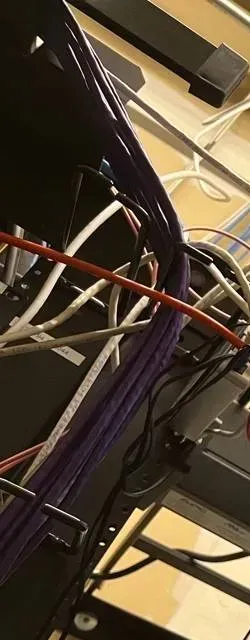
A photo from the AESS job library, not taken in Kensington: purple, white and red cable bundles dropping down beside a black equipment rack. In a six-story Kensington apartment house the intercom's power supply and controller usually end up in a cellar room like this, beside the building's phone and cable boards, and the riser pairs that leave it are what decide whether every apartment on the floors above can be called.
Other building problems on the parkway show how quickly a lobby can stop working for residents. In April 2026 News 12 reported that tenants at 514 Ocean Parkway had water coming through the lobby ceiling for nearly two months, soaking mail and packages, and that the building's only elevator had been out for about three weeks. Two days earlier it reported tenants at 455 Ocean Parkway, a 17-story complex with more than 300 residents, describing elevators that date to 1964 and break down so often that one tenant said "it is extremely rare to go one day without the elevators being broken." Neither story is about the intercom. But in buildings where getting downstairs is hard, the station inside each apartment is the only way most residents can let a visitor, an aide or a delivery in.
The small buildings have the opposite problem: no one is required to put in a system, so many never get one. A tenant in a four-unit Brooklyn building wrote on r/AskNYC that "the landlord isn't required to put in a buzzer system or a self-locking front door," and asked what one would cost. That is the situation in most Kensington two-families and three-families, and in the lanes of row houses off Church Avenue. The households there install a buzzer because walking down a flight every time the bell rings gets old, not because a law makes them.
Six facts that shape a Kensington buzzer installation
Apartment-end failures dominate the record. 171 of the 181 intercom violations HPD has written in 11218 since 2016 name an apartment, so a new system is planned station by station, not panel first.
Ocean Parkway is the busiest street in that record. 39 intercom violations at 19 buildings since 2016, in a corridor of prewar six-story elevator houses, postwar towers and co-op conversions.
The parkway itself is a scenic landmark. The New York City Landmarks Preservation Commission designated Ocean Parkway a scenic landmark in January 1975; the designation covers the parkway's roadways, malls and paths, and we confirm on the Commission's map whether anything about a specific building front is regulated before planning a panel.
The nearest new historic districts are in Flatbush. The Commission designated Beverley Square West, 118 houses, and Ditmas Park West, 127 houses, on November 25, 2025, and the Commission describes both as Flatbush districts; we still check every address on the Commission's map before choosing where a station goes.
Small houses fall below the intercom law. Multiple Dwelling Law §50-a's talk-and-release requirement applies to class A buildings of eight or more apartments built or converted after 1968, and to older ones when a majority of tenants ask in writing, so most Kensington two- and three-families install a buzzer by choice.
A broken intercom is written up under the general repair duty. The violations in 11218 cite §27-2005 of the city's Administrative Code, the owner's duty to keep the building in good repair; most are class B, which HPD treats as hazardous.
Where this page applies. It covers Kensington from Caton Avenue and Fort Hamilton Parkway south to Foster Avenue, and from McDonald Avenue and the Borough Park edge east to Coney Island Avenue, including the Ocean Parkway apartment houses, Parkville's angled blocks around 18th Avenue, the lanes such as Kermit, Caton, Friel and Turner Places, and the Church Avenue and McDonald Avenue shopping streets. For the rest of the borough see our door buzzer installation in Brooklyn page, and for the whole city our NYC door buzzer installation page.
Repair or Replace in Kensington
Need Repair in Kensington? Fix the Failing Lines, Replace the Apartment Stations, or Start Over: How We Decide First
Most Kensington calls about an apartment building's intercom start the same way: a tenant has complained, HPD has written a violation for one or two apartments, and the owner or the board wants to know whether this is the moment to replace everything. Once we have looked, the answer falls into one of three jobs. The first is a system that is sound at the lobby and in the riser, with a handful of failed apartment stations; those stations are replaced with compatible ones and the violations corrected. The second is a system whose lobby panel and power supply still work but whose apartment stations have been swapped one at a time over thirty years until no two floors match; that building usually needs new stations throughout on the old riser. The third is a system with nothing worth keeping, because the panel is obsolete, the riser has been cut or spliced past saving, or the building has changed so much that the old directory no longer describes it.
Photos tell us a lot about which job a building is. Send a picture of the lobby panel, the label inside the power supply cover if you can reach it, and two or three apartment stations from different floors, to (347) 934-8335 or on WhatsApp, along with any violation numbers. If the system has to be tested in person, that is the $250 service call booked online, and the $250 goes toward whichever path you take. Where a repair and a replacement are both reasonable, you get both prices and a plain recommendation, and we will not sell a new system to a building that a few stations would put right.
The violation record helps here too. When the same apartments or the same vertical line of apartments come up again and again over several years, the trouble is usually in the riser or the power, not in the station on the wall. When the violations are scattered, one here and one there on different floors, the stations themselves are usually the weak link. This page is about installing, extending and replacing; straight repairs of a single station or a single door are handled on our repair pages.
What We Install
Door Buzzer Installation Services in Kensington
Every service below is priced from the same Brooklyn door buzzer list. The number of apartments or households sets the size of the system, and the doors decide what release each entrance can take. In Kensington, three more things decide much of the labor: how many apartments sit on each riser line, whether the stations inside the apartments all match, and whether the building is a co-op whose shareholders own what is inside their walls.
Full systems for prewar apartment houses
A lobby panel, a matched station in every apartment and battery-backed power, run on the old riser where it tests sound, for the six-story elevator buildings on Ocean Parkway, Dahill Road and the East streets.
Apartment station replacement
New stations installed floor by floor on an existing lobby panel and riser, when the panel is sound and the stations inside the apartments are what keep failing.
Systems for postwar towers
Directory or code panels, apartment stations or app answering, and separate panels for garage or side doors, for the taller buildings along the parkway and Caton Avenue.
Co-op board projects
A written scope that separates the board's shared equipment from each shareholder's station, priced so the cost can be split the way the proprietary lease says.
Two-family and three-family buzzers
A button for each household, a station and a release on each floor that is lived on, and a strike on the shared porch door, for the duplex-porch houses and frame two-families.
First buzzers for houses
A single station at the porch door and answering points on each floor of a Victorian or Foursquare that has only ever had a mechanical bell or a knocker.
Row houses on the lanes
Compact stations and releases for the attached houses on Kermit Place, Friel Place and the other short streets, where doors sit a few feet apart.
Walk-ups over the shops
Panels for the apartment doors beside the storefronts on Church Avenue, McDonald Avenue and Coney Island Avenue, wired so the store and the apartments never share a release.
Releases, closers and power
Electric strikes fitted to steel, aluminum and wood frames, closers set so the lobby door relatches behind every visitor, and supplies on an owner-controlled circuit.
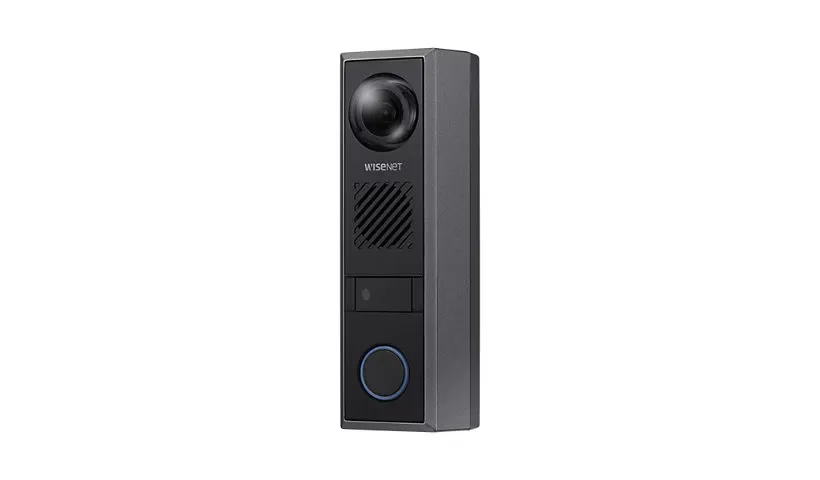
A photo from the AESS job library, not taken in Kensington: a slim dark grey wired doorbell with a camera lens, speaker slots and a round push button. A station this narrow fits the casing of one of the two front doors under a Kensington duplex porch, so each household can have its own button directly beside its own door instead of a shared plate between them.
Building Specialists
Door Buzzer Installation for Kensington's Architecture
Six kinds of building account for nearly every buzzer we plan in Kensington. They differ in how many households share the street door, how the cable reaches each one, how much of the old system can be saved and who signs for the work. Each has a mistake we see when the job is rushed.
Six-story prewar elevator houses
Brick apartment buildings from the late 1920s to 1941 on Ocean Parkway, Coney Island Avenue, Dahill Road and the East streets, some built around courtyards and many now co-ops.
Postwar towers and complexes
Taller buildings from the 1960s along the parkway and buildings like the six-story, 46-unit 210 Caton Avenue from 1960, with longer lobbies, garages and side doors.
Duplex-porch two-families
Two-family houses with stacked porches, which Forgotten New York called "almost the signature style of the neighborhood," usually with one household on each floor.
Victorians and Foursquares
Detached frame houses on the numbered streets off Beverley Road and Ditmas Avenue, often still one family, sometimes with a rental floor added.
Row houses on the lanes
Attached houses on short streets such as Kermit Place, and two-story brick houses on Friel Place with one apartment on each floor.
Walk-ups over the shops
Three- and four-story buildings on Church, McDonald and Coney Island Avenues with a store at street level and apartments reached by a narrow residential door.
Six-story prewar elevator houses: dozens of apartments on a handful of riser lines
The buildings that define Ocean Parkway went up between the late 1920s and 1941: six stories of brick, an elevator, a lobby with a pair of doors, and dozens of apartments arranged around a courtyard or a long central hall. Their intercoms were usually installed decades after they were built, then replaced once or twice since, and the riser that carries the calls runs up a handful of vertical paths, one for each line of apartments stacked above each other. When a line fails, every apartment on it goes quiet at once.
These are the buildings behind most of the 39 Ocean Parkway violations in the HPD record, and the pattern in the descriptions is consistent: a defective station "in the foyer" of one apartment, then another a few floors up a year later. Our plan for them starts at the cellar with a test of every riser pair, then moves to the apartments with a sample of stations on each line, so we know before pricing whether the old pairs can carry a modern two-wire system. Aiphone describes its GT Series as built for "new builds and retrofit projects," with the advantage of "using existing wire and infrastructure," and in a sound prewar riser that approach saves opening walls in sixty apartments.
The mistake we see most is replacing the lobby panel alone. The panel is the visible part and the part owners are shown in brochures, but in these buildings it is rarely what HPD writes up. A new panel on top of a riser and a set of apartment stations that were already failing gives the building a shiny front and the same violations six months later.
Postwar towers and complexes: longer runs, more doors, more residents who cannot get downstairs
The parkway also has taller postwar buildings, including the 17-story complex at 455 Ocean Parkway that News 12 described in April 2026, and mid-size postwar buildings on the side streets such as 210 Caton Avenue, six stories and 46 units built in 1960, whose Openigloo listing carries a former tenant's note that "it has a elevator and intercom." These buildings tend to have longer lobbies, a garage or service door, a side entrance and, in the largest ones, staff at a desk for part of the day.
A full system here means a panel at every door residents and visitors actually use, each one able to release only its own door, and a station or app account in every apartment. Because elevator outages are a fact of life in some of these buildings, we treat the apartment station as the essential part: a resident who cannot get to the lobby for three weeks still has to be able to talk to a visitor and press release. Directory and code panels suit these buildings better than rows of buttons, because the apartment count is high and apartments change hands often.
The mistake here is assuming that app answering replaces the apartment station. Some residents of these buildings are older, some have no smartphone, and some simply want a station on the wall. A system that offers both, with a wired station available to any apartment that wants one, avoids the call from HPD.
Duplex-porch two-families: two households, two front doors or one, and stairs inside
Forgotten New York's Kevin Walsh, walking Turner Place in 2012, wrote that "the duplex porch is a common style, almost the signature style of the neighborhood." In these houses a porch on the first floor sits under a second porch for the upstairs household. Some have two front doors side by side on the lower porch, one opening into the downstairs apartment and one onto a stair that climbs straight to the upper floor; others have one door into a shared hall with both apartments off it.
Where there are two doors, each household gets its own button beside its own door and its own release, and the two stations never interfere. Where there is one shared door, a two-button station sits on that door's casing, and each household answers on its own floor. In both cases the upstairs family needs a station at the top of their stair or in their kitchen, so nobody walks down to let a guest in. Cable usually comes up from the cellar through a closet or along the back of the stair, which keeps it out of the front rooms.
The mistake we see is a consumer video doorbell on each door with no release. Each family can see who is there and still has to go down to open the door, so in summer the door stands on the latch for deliveries. A proper two-household buzzer costs less than most owners expect.
Victorians and Foursquares: one button, many rooms and a deep porch
The detached frame houses on the numbered streets off Beverley Road and Ditmas Avenue, many built between the 1890s and the 1930s in the Foursquare style, are usually still one family. The button is the easy part. The hard part is that the porch is deep, the front door is set well back from the steps, and the family spends its time in a kitchen at the back or on the second floor, far from the front hall where the old mechanical bell still rings.
Our usual plan is a one-button station at the porch door, answering points in the kitchen and on the second-floor landing, and a release on the front door so whoever answers can let the visitor in from where they are. Frame houses make cable easier than brick: there is usually a path up through a closet or the back of the stair. Where a rental floor has been added upstairs, the station gets a second button and the upstairs household its own answering point.
Row houses on the lanes: narrow fronts and neighbors a few feet away
Kensington's short lanes, which Forgotten New York catalogued in 2012, hold some of its most compact houses: a row of attached homes on Kermit Place from around the 1910s, and two-story boxy brick houses on Friel Place with one apartment on each floor. Doors here are close together, stoops are short or absent, and the house fronts are narrow enough that a visitor can easily ring the wrong one.
These houses get small stations, mounted on the casing or the brick right beside the door, with a clearly lit house number above or beside the button. In a Friel Place-style house with one apartment per floor, a two-button station and a release on the shared front door give each floor its own answer, and the upstairs apartment's station usually goes at the top of the stair, where the cable can come straight up from the cellar.
Walk-ups over the shops: the residential door beside the storefront
On Church Avenue and McDonald Avenue, in the blocks Council Member Shahana Hanif's co-naming made Little Bangladesh in 2022, and on Coney Island Avenue, the typical building has a store, café or restaurant across the ground floor and a narrow residential door to one side leading straight to the stair. The apartments above need a buzzer; the business below often needs its own for a back or side door, and the two must never be able to release each other's doors.
We keep them as two separate systems even when their cables share a basement. The residential panel calls only apartments and its power supply sits on the landlord's circuit. The store's station calls the counter or the owner's phone and releases only the store's door. When the store controls the only basement, the apartments' power supply goes in a locked box on the first-floor stair hall instead, so the residents' entry never depends on the shop being open.
A photo from the AESS job library, not taken in Kensington: a dark recessed ceiling panel with round downlights and a small round device in a lighter surrounding ceiling. Lobbies on Ocean Parkway that have been renovated over the years often have a dropped or recessed ceiling like this, and the cable from a new lobby panel to the riser usually travels above it rather than across the walls.
Field Notes
Field Notes: Read the Violations, Open Three Apartment Stations, Then Go to the Cellar
These notes describe how our technicians approach a buzzer installation in a Kensington apartment house or two-family. They are our standard practice, not a story about any one address.
Read the violations first. Before the visit, the technician looks up the building's open and closed intercom violations on HPD's public records and lists them by apartment and floor. A building with five violations on the same line of apartments over four years points to a riser problem. A building with violations scattered across every floor points to the stations. A building with none is either well kept or has tenants who have stopped complaining, and the walkthrough has to find out which.
Open three apartment stations. Next, with the super or the managing agent, the technician visits at least three apartments on different lines and floors, including any apartment named in an open violation. Each station is opened to see its make and model, how many wires reach it and whether those wires were spliced in the wall. In buildings where stations were replaced one at a time, this is where we find a 1980s handset, a 2000s hands-free station and a store-bought unit all on the same riser.
Then go to the cellar. Last, the technician finds the power supply, the lobby panel's controller and the point where each riser line leaves the cellar, and tests each pair. The power supply's circuit is noted, along with whose panel it is on, and whether the room it sits in is shared with the boiler.
Everything from that walk goes on the written price: the lines that test sound and the ones that do not, the stations to be replaced, the lobby panel, the strike, the closer and the order in which apartments will be visited. Nothing is discovered on installation day.
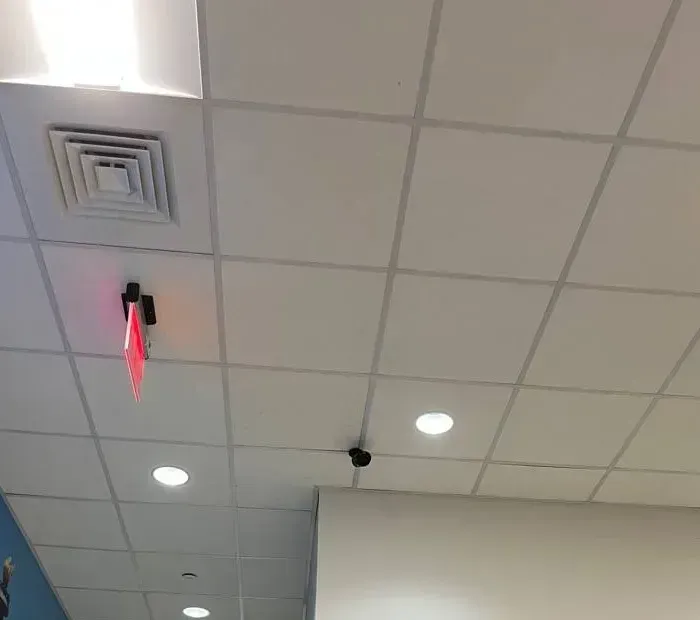
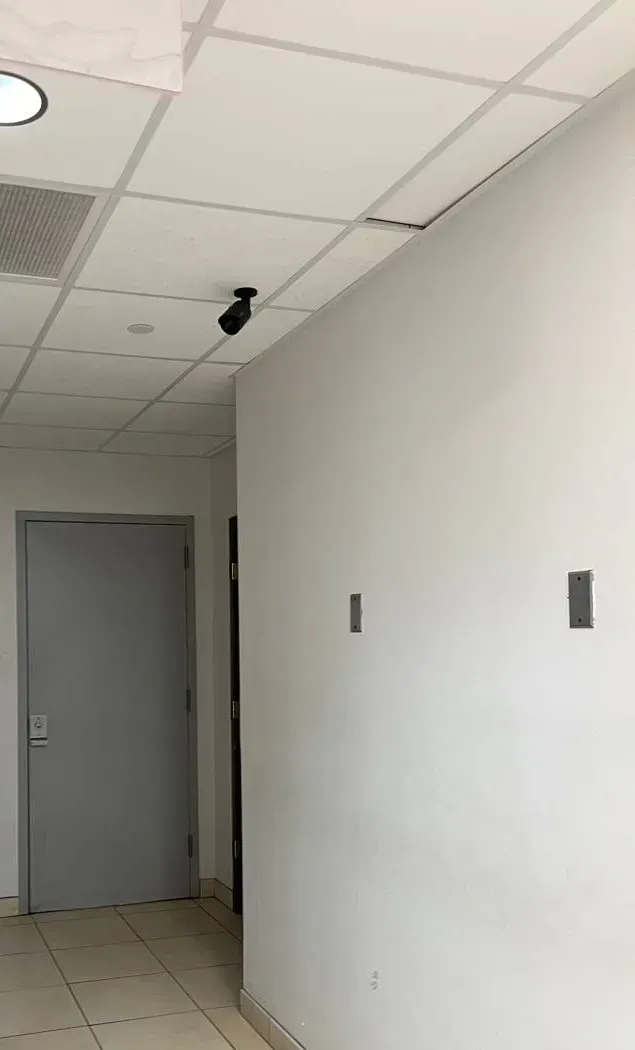
A photo from the AESS job library, not taken in Kensington: a drop ceiling with a lit red exit sign, an air diffuser, round recessed lights and a small black camera. Corridors like this belong to the offices, clinics and community spaces on Kensington's avenues, and the exit sign is the reminder that any door a buzzer locks must still let people out freely from inside.
What the Records Show
181 Violations, 171 of Them at an Apartment: Why a Kensington Entry System Is Planned From the Inside Out
Owners and boards usually picture an entry system from the sidewalk: the panel, the camera, the directory. The HPD record for 11218 suggests that picture is backwards for Kensington's apartment buildings. Inspectors almost never write up the panel. They write up a single apartment, because a tenant called 311 to say their station does not ring, they cannot hear the visitor, or the release does nothing. The violation text is specific about it, giving the apartment, the floor and often the wall: "at west wall in the foyer located at apt 3D, 3rd story."
That shapes four decisions in our plan. First, the apartment stations are chosen before the panel, because they are the part that has to survive thirty years of tenants, painters and renovations. Second, every riser line is tested from the cellar to the farthest apartment on it, not just at the lobby, because a pair that measures fine in the cellar can be broken behind a foyer wall on the fifth floor. Third, the stations are installed with their connections inside a mounting box rather than spliced loosely in the wall, so the next station change does not disturb the wire. Fourth, every station and every pair gets a label that matches the apartment number on the directory, so a future repair starts at the right line.
The record also explains why owners who replace equipment piecemeal keep getting violations. A building that fixes apartment 3D's station in 2019, apartment 6F's in 2021 and apartment 1B's in 2024, each with whatever compatible station the repair company had in the truck, ends up with a riser feeding three generations of equipment that were never designed to work together. Each repair corrects one violation. None of them corrects the system. At some point a building is better served by one planned replacement than by another round of single-station fixes, and the violation history is the clearest way to see when that point has come.
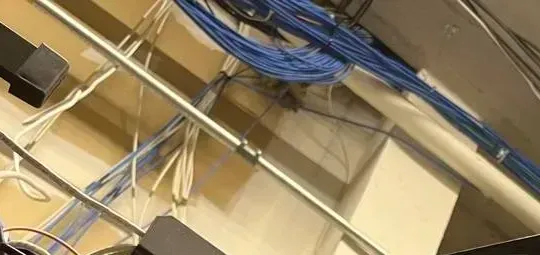
A photo from the AESS job library, not taken in Kensington: bundles of blue low-voltage cable laid over a ceiling beam and a metal pipe in an open ceiling. In the cellar of a Kensington apartment house, this is how the lines from the power supply and controller are carried across to the points where each riser turns up toward the apartments, and each bundle is labeled with the apartments it feeds.
How to read your own building's intercom record
HPD's violation records are public and searchable by address on HPD Online and on NYC Open Data. For an intercom project, four things in them matter. The class: most intercom violations in 11218 are class B, the hazardous category, and a few are class A. The status: open violations need to be corrected and certified, and the new installation should be scheduled with that in mind. The location: the apartment and floor numbers show whether failures cluster on one line or spread across the building. And the dates: a building with the same apartment cited three times in five years has a problem that a new station alone will not solve.
We read the record with you before the walkthrough, and the written price says which violations the work corrects. What we do not do is promise that a violation will be removed from HPD's records on a date; correcting the condition is our part, and certifying the correction and any reinspection is between the owner and HPD.
What a station inside an apartment has to survive
Kensington's apartment houses are old, many are rent-stabilized or co-op, and apartments turn over. A station in a foyer gets painted around, knocked by furniture, unplugged by a tenant who did not like the chime, or replaced by a well-meaning shareholder with a model from a hardware store. The stations we choose for these buildings mount on a box with the wiring on terminals inside, have no loose plug, and are the same model in every apartment, so a spare can replace any one of them in minutes. A plain wired station with a handset or a hands-free button costs less than a video monitor and survives longer in a rental; video goes where residents want it and the riser can carry it.
Co-ops and Rentals on the Parkway
A Board, Sixty Shareholders and a Station in Every Foyer: Running an Entry Project in a Kensington Co-op
Wikipedia's article on Kensington notes that the prewar brick buildings on Ocean Parkway and Coney Island Avenue include "many that operate as co-ops," and the parkway saw many conversions in the decades after its postwar towers went up. In a co-op, an entry project has more owners than in any other building type. The board controls the lobby, the panel, the riser and the street door. Each shareholder controls the inside of their apartment, which includes the wall the station hangs on. Some shareholders have already replaced their own station; some want video and some do not; some will not be home for weeks.
The written price for a co-op is therefore split into two parts. The shared part covers the lobby panel, any side or garage door panels, the power supply, the strike and closer and any riser work. The apartment part lists one station per apartment, with the price of each, so the board can decide whether to pay for all stations from reserves, assess shareholders, or let each shareholder choose a standard or video station at their own cost. The proprietary lease and house rules usually answer who pays for what, and the board's managing agent usually knows the answer; we price it so either approach works.
Scheduling follows from the same split. The lobby panel and power supply can be installed in a day with the building's door covered the whole time. Apartment stations are installed floor by floor over several days, with notices posted in advance and a sign-up sheet so shareholders choose a window. Apartments whose owners cannot be reached keep their old station connected until the new one goes in, if the two can share the riser for a few days, or get a new station on a later visit arranged through the managing agent.
What the board should have in writing before it votes
The results of the riser test, line by line, and which lines will be reused or replaced.
The list of apartments named in open HPD intercom violations and how the work corrects each one.
The shared-equipment price and the per-apartment station price, separately.
Whether the system has any monthly fee, who owns its software account if it has one, and who will hold the administrator login.
The door hardware plan: strike or approved lock, closer, and how residents exit freely.
The schedule for the lobby cut-over and for apartment visits, and how the street door stays secure on each day.
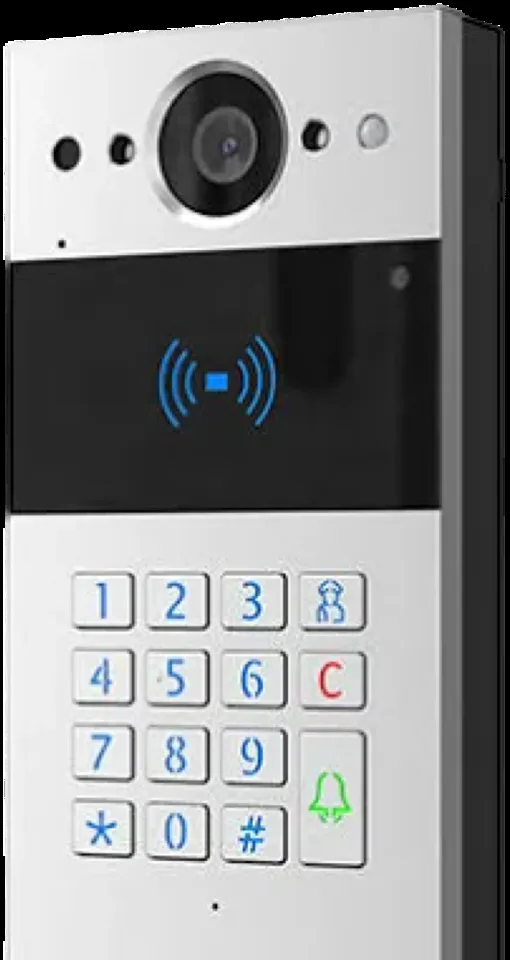
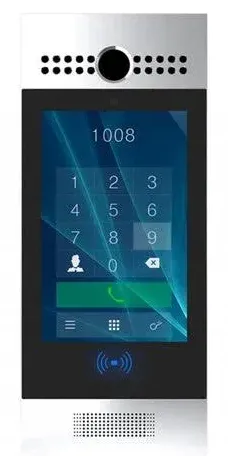
A photo from the AESS job library, not taken in Kensington: a silver and black keypad door station with a camera lens at the top, a blue card-reader symbol, a numeric keypad and a green bell key. A keypad station like this suits an Ocean Parkway co-op lobby with dozens of apartments, because visitors dial an apartment code instead of hunting along rows of buttons, and residents can open the door with a card or code.
The Lobby Door
Courtyards, Paired Lobby Doors and Steel Frames: Getting the Release Right on a Kensington Apartment House
An entry system is only as good as the door it releases. In Kensington's apartment houses that door is often one of a pair of heavy glass-and-metal doors at the lobby, sometimes behind an outer vestibule door, sometimes at the far end of a courtyard from the street. Each arrangement needs a different release and a different closer.
Pairs of lobby doors. Many prewar lobbies have double doors, with one leaf used daily and the other bolted. The strike goes in the frame or the inactive leaf for the daily leaf, and the bolted leaf is checked so a visitor cannot simply pull it open. Where the doors are aluminum with narrow stiles, a strike sized for narrow frames or an electrified lock body is used instead of cutting the frame.
Courtyard buildings. Some buildings on the parkway are U-shaped around a courtyard, with the lobby door at the back of it and an iron gate or open entrance at the sidewalk. Where the gate is open, the panel belongs at the lobby door, sheltered by the entrance, and the address sign at the sidewalk tells visitors where to go. Where the gate is locked, the gate needs its own release and the panel goes at the gate, which means cable crossing the courtyard in a buried conduit or along the building wall.
Closers. A heavy lobby door that drifts shut and does not latch defeats any intercom. The closer is adjusted or replaced as part of the job, so the door closes firmly behind each visitor, and the strike is aligned so it catches every time.
Fail-secure or fail-safe. Allegion explains that "fail safe products are unlocked when power is removed" and "fail secure products are locked when power is removed," and that with an electric strike "you can exit by turning the lever" either way. We normally fit fail-secure strikes on lobby doors, so the building stays locked in a power cut while residents can still leave. Magnetic locks are fail-safe by design and come with the sensor-release requirements of the building code, so they are a last resort here.
Commercial Door Buzzer Installation
Business Door Buzzer Installation in Kensington
Kensington's businesses sit on a few long avenues, most of them in buildings with apartments above. Their doors need to stay locked when they should, open for the right visitor without someone walking to the door, and never interfere with the residents' entrance a few feet away.
Church Avenue
The Little Bangladesh stretch around McDonald Avenue, with Bangladeshi cafés, restaurants and other shops, most of them with apartments upstairs and a residential door beside the store.
McDonald Avenue
Shops and offices under and near the elevated F and G line between Church Avenue and Ditmas Avenue, with deliveries through side and rear doors.
Coney Island Avenue
The eastern edge of the neighborhood, with stores, offices and medical practices in mixed buildings and the stretch known as Little Pakistan running from Church Avenue toward Avenue H.
Ditmas Avenue and 18th Avenue
Smaller commercial blocks around the Ditmas Avenue and 18th Avenue stations, with neighborhood shops and offices on the ground floors of walk-ups.
Fort Hamilton Parkway and Caton Avenue
The northern edge by the Fort Hamilton Parkway station and the stable block on Caton Place, with offices and small businesses in low buildings.
Houses of worship and community spaces
Congregations such as the Ocean Parkway Jewish Center and St. Rose of Lima, and community organizations, whose doors are attended at some hours and buzzer-only at others.
For a shop or restaurant with apartments above, the usual job is a buzzer at the staff or delivery door, answered at the counter or on the owner's phone. Deliveries can be let in without the door being propped, and staff can see or hear who is there first. The store's system has its own power supply and its own station and has no wire in common with the residential panel, so nobody behind the counter can release the tenants' door.
For an office or practice on Coney Island Avenue that receives patients or clients by appointment, the job is usually a video station at the street or suite door answered at a front desk, with a code for staff. For a house of worship or community space, the door may be attended during services or programs and buzzer-only the rest of the week, and the system should make both easy without anyone wedging the door.
Rules that apply to Kensington business entry installations
Free exit at all times. Every business door with a buzzer, code or reader must still open from inside without a key or code; an electric strike keeps the inside lever working, so it is our default.
Sensor release for magnetic locks. Where a magnetic lock is the only workable option, the building code calls for an egress-side sensor, a push-to-exit device near the door, release on power loss and fire alarm activation, and UL 294 listed hardware.
Fire doors stay latched. Allegion notes that fire doors need fail-secure strikes; stair and corridor doors in larger buildings are often rated, and we check the label before choosing hardware.
Accessible reach. Buttons, keypads and readers on public doors stay between 15 and 48 inches above the floor, inside the 2010 ADA Standards' reach range.
Landlord approval in writing. Work on a shared street door or a door in the landlord's frame starts only once the landlord or managing agent has approved it.
Two systems, two power supplies. A store's buzzer and the residents' entry never share a supply, a controller or a release, even in the same basement.
If a business also wants a camera on its entrance, it can be installed on the same visit and priced with the buzzer; customers who combine the two typically save $200 to $400 in labor.
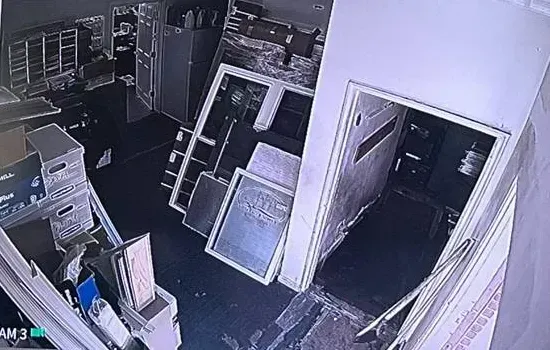
A photo from the AESS job library, not taken in Kensington: a black-and-white night camera view of a cluttered room with an open doorway into a dark back room. Stockrooms like this sit behind many of the shops on Church Avenue and McDonald Avenue and lead to the delivery door, which is where a buzzer and a camera installed on the same visit do the most good.
Your Questions Answered
Door Buzzer Installation in Kensington: Questions Answered
Questions Kensington owners, boards, tenants and businesses bring to us, together with ones raised by the city's violation records, Reddit threads about small Brooklyn buildings and Ocean Parkway co-ops, and the guides building owners read before calling an installer, answered for the buildings here.
What the violation records tell an owner
Our building has a long list of HPD intercom violations going back years. Can that list actually help you plan the new system?
Yes, and it is one of the first things we ask for. Each violation names the apartment and floor where the inspector found the defect, so a list sorted by apartment shows at a glance whether failures cluster on one vertical line, which points to the riser, or spread across many floors, which points to the stations. It also tells us which apartments to open on the walkthrough, because an apartment cited three times is where we are most likely to find a spliced wire or a mismatched station.
The list also sets the schedule. Open violations have to be corrected, so the apartments named in them are put at the front of the installation order, and the written price lists each open violation and the work that corrects it. Certifying the correction with HPD is the owner's step; we provide the test results for each corrected apartment so the certification is backed by something concrete.
Can a new system tell the super which apartment's station has stopped working before a tenant has to complain?
Some can. Networked and some two-wire systems report each station's status to a controller or a management app, so a station that goes offline, is unplugged or stops answering shows up as a fault on the super's screen or phone. That is worth a great deal in a Kensington building where almost every past violation started at an apartment, because a fault can be fixed in a day instead of waiting for a 311 complaint and an inspection.
Plain audio systems do not report anything, and the cheapest way to get a similar result there is a short test routine: the super calls every apartment from the lobby panel once a month and writes down any that do not ring. We leave a printed test sheet with every installation for that purpose. Which approach fits depends on the size of the building and whether the board or owner wants the system online at all, and both options are priced on the quote.
Tenants in our building have painted over stations, unplugged them and pulled them off the wall. Are there apartment stations that hold up better?
Yes. The stations that fail least in rental buildings mount onto a screwed-down back box with the wires on terminals inside, have no plug or loose cord a tenant can disconnect, and have a sealed face that tolerates paint and cleaning sprays. Handset models with a heavy cord are more likely to be damaged than hands-free stations with a single button. We also put the same model in every apartment, so the super can keep two spares and replace any damaged one in a few minutes.
The other half of the answer is the wall. A station screwed into crumbling plaster will come loose however good it is, so in older foyers we set a proper box or a plate anchored into the framing. And we label each station on the back with its apartment, so when one is damaged the replacement goes on the right line.
Ocean Parkway and Coney Island Avenue apartment houses
Can some apartments in our building get video monitors while the rest keep audio-only stations on the same system?
On most modern two-wire and networked systems, yes. The lobby panel has a camera; apartments that want to see the visitor get a video monitor, and apartments that are happy to talk and press release get an audio station, all on the same riser. In a co-op this often matches how the cost is shared: the board pays for a standard audio station in every apartment and shareholders who want video pay the difference.
The thing to settle at the start is that every station comes from the same system family, so all of them can be called, programmed and replaced the same way. What does not work is mixing in stations from a different maker because one shareholder already bought one, which leads straight back to the patchwork the violation records describe.
A shareholder in our co-op bought and installed his own station a few years ago. Does he have to give it up when the building replaces the system?
Usually, yes, if the building is moving to a new system, because a station from the old system or another maker will not work with the new lobby panel and controller. What he keeps is the choice of which station from the new system goes in his apartment, standard or video, and, depending on the board's decision, whether he pays for an upgrade. His old station can be handed back to him when it comes off the wall.
If the building is only replacing failed stations on its existing system, his station may stay, provided it is compatible and tests properly on the riser. Either way, the board's notice to shareholders should say plainly what happens to stations they own, so nobody is surprised on the day.
Our building has two wings with a street door each. Can a call from one door release only that door, not both?
Yes, and that is how we set it up. Each door gets its own panel and its own strike, and the apartment station's release button opens the door the call came from. Residents of either wing can be listed on both panels if visitors use either entrance, or each panel can list only its own wing's apartments so visitors are steered to the right door.
The mistake to avoid is a single relay that fires both strikes on every release, which leaves one door unlocked with nobody standing at it. In buildings where the old system did that, we rewire the releases separately and test each door from each wing before handing over.
Houses, lanes and two-families
Our house is on one of the lanes and the next front door is a few feet from ours. How do we stop our neighbor's visitors ringing our bell?
Three things help most. A station mounted directly beside your door, rather than centered on the brick between two doors, makes it clear which house it belongs to. A lit house number on the station or right above it settles the question for couriers at night. And on a video station, you see the visitor before you answer, so a wrong ring costs you a glance at the screen instead of a trip downstairs.
In our two-family the stair to the upstairs apartment starts just inside the shared front door. Should the upstairs family's station go at the top of the stair or inside their kitchen?
Wherever the household actually spends its time, which is usually the kitchen or the main room rather than the landing. A station on the landing is easy to wire, because the cable comes straight up the stair wall from the cellar, but nobody hears it from a back bedroom. A station in the kitchen takes a little more cable work and is answered every time.
Above the stores
The store downstairs controls the only basement in our building. Where does the apartments' power supply go?
Somewhere the landlord and the residents can always reach, which usually means a small locked enclosure in the first-floor stair hall or a closet off it, wired to an outlet on the landlord's own electrical service. The residents' buzzer should never depend on the store being open or on the store's meter being paid.
If the store's basement is the only place cable can pass, we ask for the landlord's written permission to route it through, in conduit and labeled, but the equipment itself stays outside the store. If a new outlet is needed in the hall, a licensed electrician installs it, and that is on the quote before you approve.
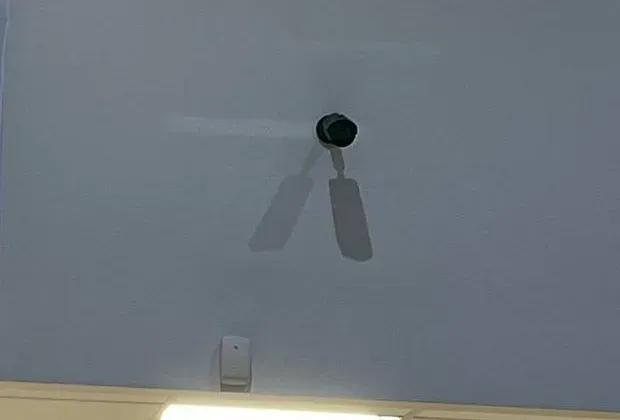
A photo from the AESS job library, not taken in Kensington: a small black camera mounted high on a pale wall casting two shadows, with a small white wall device below it. In a Kensington apartment lobby, a camera placed like this watches the door the intercom releases, so an owner or board can see who came in after a resident pressed release.
Equipment
Types of Door Buzzer Systems We Install
We quote a reliable non-branded system by default and install a named brand when an owner asks for one; the intercom brands we work with include Aiphone, ButterflyMX, 2N, Akuvox, Comelit and DoorBird. These are the kinds of equipment that come up most in Kensington houses and buildings, and where each one fits.
Two-wire systems on old risers
Door panels and apartment stations that carry voice, video, power and release on one pair, often on a prewar building's existing riser once each line tests sound.
Matched apartment stations
Audio and video stations from one system family, box-mounted with wiring on terminals, so any apartment can be swapped from a spare.
Directory and code panels
Panels where visitors scroll a list or dial an apartment code, for co-op and rental lobbies with dozens of apartments.
Keypad and card stations
Panels with a keypad or reader so residents and staff can enter without a key, alongside the call function.
Two-button house stations
Compact stations with a button per household for two-families and lane houses, sized for a porch casing or narrow brick pier.
Phone and app answering
Stations that call residents' phones, alone or beside wall stations, for owners who travel and residents who want to answer from anywhere.
Electric strikes and electrified locks
Fail-secure strikes for steel and wood frames, narrow-stile strikes and lock bodies for aluminum lobby doors, and releases for courtyard gates.
Closers and door hardware
Closers sized for heavy lobby doors, hinge work and latch alignment, so the door relatches after every visitor.
Power supplies and backup
Battery-backed low-voltage supplies on an owner-controlled circuit, mounted in the cellar or a locked hall enclosure and labeled.
Audio stations, two-wire video or app answering: which fits a Kensington building?
What matters
Audio stations
Two-wire video
App answering
Typical Kensington fit
Rental apartment houses replacing every station on a budget; two-families
Co-ops on the parkway; upstairs households in two-families; lane houses
None for phone users; internet or cellular at the panel
Works for residents without smartphones
Yes
Yes
Only with a wall station or phone-line option
Station faults reported to the super
No; monthly test calls
On some systems
Panel status reported; phone side depends on each resident
Monthly fees
None
None unless an app service charges
Often per unit or per door
Brooklyn list range
$400–$900 small; from about $2,500 for a building
$700–$1,800 small; from about $2,500 for a building
$700–$1,800 small; from about $2,500 for a building
ADT, Ring and SimpliSafe compared with a local installer for a Kensington building
Owners ask about the national names, so here is a straight comparison. Ring sells video doorbells and cameras that a household installs itself; a Ring doorbell can suit a Victorian kept as one home that only wants to see the porch, but it has no door release and cannot give the second household in a two-family, or the sixty apartments of a parkway co-op, their own stations. SimpliSafe sells self-installed alarm systems, and ADT sells professionally installed and monitored security, chiefly alarms and cameras; neither is built around a lobby panel that calls each apartment and releases a lobby door. What a Kensington apartment house needs is a tested riser, a matched station in every foyer, a strike that suits a heavy lobby door and a closer that works. That is on-site work by a licensed installer.
A photo from the AESS job library, not taken in Kensington: a tiled corridor with white walls and small wall plates ending at a grey steel door with a lever handle, under a drop ceiling with a small camera. Steel doors like this lead from the halls of Kensington's apartment houses to the yard, the cellar or a side street, and a lever-handle door takes an electric strike while anyone inside can still leave by turning the lever.
AI Overview Reality Check
What AI Gets Wrong About Door Buzzer Installation in Kensington
Search for buzzer or intercom installation and you get confident summaries assembled from national cost guides, vendor blogs and generic advice. Some of it holds; some does not fit a Kensington apartment house or two-family at all. Below are seven common claims, where they come from and what the records and the field show. We have not quoted any AI-generated answer word for word; the claims come from the published guides and common advice those answers draw on.
"Most intercom problems start at the front door panel"
Guides about buzzer upgrades tend to lead with the panel, because it is the part visitors see and the part vendors sell.
The city's records for Kensington point the other way. Of the 181 intercom violations HPD has written in ZIP code 11218 since 2016, 171 name a specific apartment, describing a defective station in a foyer or a broken connection "from building entrance to apt." The panel is rarely the part an inspector cites.
That is why our quotes for Kensington apartment houses start with the riser test and the apartment stations, and why a panel-only replacement is the job we talk owners out of most often.
"Anything on Ocean Parkway needs Landmarks approval"
Owners hear this because the parkway is famous and was designated a scenic landmark in 1975.
A scenic landmark designation covers the landscape it names, here the parkway's roadways, malls, bike path and plantings. It is a different thing from a historic district, which regulates building fronts. The two historic districts the Commission designated nearby in November 2025, Beverley Square West and Ditmas Park West, are described by the Commission as Flatbush districts.
So we do not assume either way. We check each address on the Commission's map before planning a panel. A buzzer job on a parkway building normally stays on the building, inside the lobby entrance and the cellar, and does not touch the parkway itself.
"Small buildings don't need a buzzer"
This one comes from a real rule. Multiple Dwelling Law §50-a requires a talk-and-release intercom in class A buildings of eight or more apartments built or converted after 1968, and in older ones when a majority of tenants ask in writing. The r/AskNYC poster in a four-unit Brooklyn building was right that the law did not require one.
But "not required" is not the same as "not needed." In a Kensington two-family or three-family, the upstairs household has no way to let a visitor in without walking down, and in summer that usually means a front door left on the latch.
And where a building does have an intercom, HPD's violations cite the owner's general duty to keep the building in good repair under Administrative Code §27-2005, so a system that has been installed has to be kept working.
"A modern video intercom costs $1,000 to $5,000 per door"
Swiftlane's cost guide gives that per-door range for modern IP or video systems and adds that software subscriptions commonly run "$5 to $15 per unit per month." HomeAdvisor's guide puts the average intercom installation at $2,500, with a range from $1,500 to $15,000.
Per-door pricing describes the panel and its door, not a Kensington apartment house, where the cost is mostly in the apartments: one station per foyer and the riser work behind them. On our Brooklyn list a two-family or small walk-up sits at $400 to $900 for audio or $700 to $1,800 for video, and a full building system starts at about $2,500 and can pass $10,000 with unit count and cable work.
The subscription matters too. For a sixty-apartment co-op, a per-unit monthly fee adds up every year, which is why we always price a no-fee wired option alongside any app system.
"An app-based panel means no wiring inside the apartments"
Vendors of cloud and cellular panels say their systems need little or no building wiring, and for the panel that can be true.
In a Kensington apartment house, though, the residents who most need the intercom are often the ones least likely to answer it on a phone: older tenants, residents who cannot get downstairs when an elevator is out, and households without smartphones. A building that removes every apartment station removes the one way those residents can answer.
The working answer here is usually both: app answering for residents who want it, and a wired station on the old riser for anyone who asks. The riser is already in the walls; keeping it in service costs far less than the complaints that follow without it.
"Prewar riser wire is too old to carry a new system"
Summaries often treat any wire older than the residents as a reason to start over.
Aiphone builds its GT Series for retrofit with "existing wire and infrastructure," and its upgrade guide says that if the existing wires are in good condition, "they can be reused." ButterflyMX's small-building guide makes the same point from the cost side: what drives a replacement is "controlled entrances, door hardware, wiring condition, system type, and local requirements, not apartment count alone."
So we test every line. In a six-story Kensington building, a riser that tests sound saves opening foyer walls in every apartment, and a line that fails is named on the price before you approve, with the cost of replacing it.
"Allow one to two hours per station"
HomeAdvisor gives that per-station time for installation.
It assumes the station's location is open and the wire is there. In a Kensington apartment house the clock is set by access: reaching every apartment on a schedule tenants and shareholders can keep, with the super present, over several days. The station itself often goes on in a fraction of that time.
The honest schedule comes from the walkthrough and the sign-up sheet, not a per-station figure, and it goes on the written plan with the price.
Not Sure Whether Your Building Needs New Stations, a New Riser or a Whole New System? Speak to a Tech
Send a photo of the lobby panel, two or three apartment stations from different floors and the inside of the power supply cover if you can open it, with the address and any violation numbers, to (347) 934-8335 or on WhatsApp. A technician will tell you what the photos suggest, whether the job is likely to be stations, riser or a full replacement, and what the walkthrough will need to see, before anyone visits. Or use the request form and we will call you back.
Get In Touch
Request a Free Quote
✅
Request Sent!
Thank you. A technician will call you about the Kensington address, usually within two hours during working hours.
How It Works
Our Installation Process
1. Send photos and the building's records
Photos of every entrance, the lobby panel and one apartment station, plus the address, the number of apartments or households and any HPD intercom violations on file.
2. Read the violation history
Open and closed intercom violations are listed by apartment and floor, so the walkthrough starts at the stations and lines that have failed before.
3. Agree who signs and how apartments will be reached
The owner, managing agent, co-op board or commercial tenant with landlord approval signs, and a schedule is set for reaching every apartment station.
4. Test the doors, the riser and the apartment ends
Each entrance is released and watched relocking, each riser pair is tested from the cellar, and sample apartment stations are opened to see how they were wired.
5. Price everything in writing
Door station, apartment stations or app accounts, strike, closer, power supply, cable work and labor go on one written price, with every possible extra named before ordering.
6. Prepare the door and the power
The closer is set so the door relatches, the strike is fitted to the frame and the battery-backed supply goes on an owner-controlled circuit.
7. Install apartment by apartment and label
New stations go in floor by floor, every pair is labeled at the cellar and at the apartment, and the lobby panel is cut over last so the building is never without a way in.
8. Call every apartment from the street and hand over
Each apartment is called from the entrance, talks and releases while the door is watched relocking, and the owner receives the line-by-line test sheet and wiring record.
A photo from the AESS job library, not taken in Kensington: a touchscreen entry panel showing a dial pad with a four-digit apartment code entered, a camera above and a card-reader symbol below. A code panel like this suits a Kensington postwar building whose apartments change hands often, because codes can be reissued without a new faceplate, and step 8 checks every one of them from the entrance.
Coverage Area
Door Buzzer Installation Near Kensington's Landmarks
Ocean Parkway
Olmsted and Vaux's 5.5-mile parkway, built 1874 to 1876 and a scenic landmark since 1975, lined through Kensington by prewar apartment houses, co-ops and postwar towers.
Little Bangladesh
The stretch of Church Avenue and McDonald Avenue co-named in October 2022, unveiled at McDonald and Church, with shops below and apartments above.
Kensington Post Office
The 1935 Colonial Revival post office on McDonald Avenue designed by Lorimer Rich, listed on the National Register of Historic Places in 1988.
Kensington Library
The Brooklyn Public Library branch at 4207 18th Avenue, opened in 2012 on the Parkville side of the neighborhood.
Ocean Parkway Jewish Center
The synagogue whose cornerstone was laid in April 1925 and which was completed in 1926, listed on the National Register in 2009.
The lanes of Kensington
Kermit, Caton, Friel, Turner, Hinckley and Lewis Places and Slocum Place, the short streets of row houses and two-families Forgotten New York walked in 2012.
Kensington is billed at our Brooklyn rate, with no premium for Ocean Parkway addresses or co-op buildings. Final pricing follows a look at the building, because the number of apartments or households, how many riser lines can be reused, how many apartment stations are replaced, the lobby doors and the access schedule drive the total far more than the brand on the panel.
Job
Typical Kensington building
Brooklyn range
Audio buzzer or replacement with electric strike release, existing wiring reused where it tests well
Victorian or Foursquare kept as one home, duplex-porch two-family, Friel Place-style house with one apartment per floor
$400–$900
Video door station with indoor monitors or smartphone door release
Two-family whose upstairs household wants to see the porch, row house on a lane, small walk-up over a shop
$700–$1,800
Directory or button panel with every unit wired or on app answering, audio or video by unit count, optional fob integration
Six-story prewar apartment house or co-op, postwar tower, larger walk-up on Church, McDonald or Coney Island Avenue
$2,500–$10,000+
Service call booked online
Diagnosis of an existing system before deciding to repair or replace
$250, applied toward the work
Monthly fee on a wired system
Any house or building choosing the no-subscription option
$0
Buzzer and entrance camera on the same visit
Lobbies, two-family porches and shop doors
Typically saves $200–$400 in labor
What moves a Kensington job within its range is predictable. First, the apartments: a building that needs a new station in every foyer costs more than one whose stations are mostly sound. Then the riser: lines that test sound keep a job near the bottom of its range, and a line that has to be replaced through six floors of finished halls pushes it up. Then the doors: a closer to replace, a strike for a narrow aluminum frame, a second panel for a side or garage door, a courtyard gate. Then the extras: video instead of audio in some or all apartments, app answering, station status reporting to the super. Anything that depends on a test, such as a riser pair that might fail or an apartment whose station was wired in an unusual way, is named on the quote with its price before you approve.
Full terms — including 50% deposit, one-year parts-only warranty on AESS-supplied products, and the late-fee schedule — are set out in the service agreement.
Find Out Which Range Your Kensington Building Falls In
Tell us the address, how many apartments or households use the door, whether it is a co-op or a rental, how many intercom violations are open, and whether the lobby door closes and latches on its own, and we will tell you which of the three Brooklyn ranges fits and what would move it. Call or text (347) 934-8335, send photos on WhatsApp, or fill in the form.
Shop Our Systems
Door Buzzer Installation Packages & Pricing
Three typical Kensington jobs, each placed inside the matching range on our Brooklyn list. The exact figure comes from the walkthrough.
House or two-family buzzer: $400–$900
An audio station at the porch door with a button for each household, an answering station and release where each household lives, a fail-secure strike fitted to the frame, a closer set to relatch and a battery-backed power supply in the cellar.
Video for a two-family, lane house or small walk-up: $700–$1,800
A compact video door station beside the right door with a lit house number, monitors or phone answering for each household, old pairs tested and reused where sound, a strike chosen for the door and concealed cable.
Apartment house or co-op system: from about $2,500
A directory, code or button panel at each entrance residents use, a matched station or app account for every apartment, the riser tested line by line, strike or approved lock, owner-controlled power and a board-ready written price split into shared and per-apartment parts, rising toward $10,000 or more with unit count, doors and cable work.
Bring your own equipment. If you have already bought a door station, video kit or intercom set, we can install it as labor-only work, quoted flat once we have seen the building, the doors and the cable path. Tell us the make and model when you write, and we will tell you before the visit whether it can reach every apartment or household and release your door.
Complete Services
Every Door Buzzer Service in Kensington
Apartment houses and co-ops
Full systems on tested risers, floor-by-floor station replacement, board scopes and violation-driven plans. Request a quote
Houses, two-families and shops
First buzzers, a button per household, lane-house stations and separate shop and apartment systems. Call (347) 934-8335
Does Ocean Parkway's scenic-landmark status change anything about putting a new entry system on our building?
+
Usually not. The scenic landmark designation from 1975 covers the parkway itself, its roadways, malls and paths, while an entry system goes on your building's entrance and in its cellar. We still check every address on the Landmarks Preservation Commission's map before planning, and if anything about a building front is regulated, the station is chosen and placed to meet those rules before the price is written.
HPD's violation for our building mentions a "return buzzer." What is that, and does a new system still have one?
+
In the older wording, the bell is the ring an apartment hears when a visitor presses its button, and the return buzzer is the sound at the street door when the tenant presses release, telling the visitor to push. A violation for a defective bell and return buzzer means one or both halves did not work from that apartment. Every system we install does both, and each apartment's ring and release are tested from the entrance before we leave.
Some of our residents are slow to reach the station. Can a visitor's call be kept open longer before it hangs up?
+
On most modern systems, yes. The ringing time before a call gives up and the talk time once it is answered are both settings, and we set them during programming to suit the building. In buildings with many older residents we lengthen the ringing time, and we can set the release to hold the door unlocked a few seconds longer for people who move slowly through a heavy lobby door.
Our cellar's only dry room is the boiler room. Can the intercom power supply go in there?
+
We avoid it where we can. Heat and dust shorten the life of power supplies and backup batteries, and access to a boiler room is often restricted to the super. If there is no other dry space, the supply goes as far from the boiler as possible, in a ventilated enclosure on its own outlet, and we note on the handover sheet where it is and who holds the key.
Should our building keep spare apartment stations after the installation?
+
Yes, for any building with more than a handful of apartments. Because every apartment gets the same model, one or two spares let the super replace a damaged or failed station the same day it is reported, without waiting for an order. We include spares as a line on the written price so the board or owner can decide how many to keep.
The light on our apartment station glows all night in a small foyer next to the bedroom. Can it be dimmed or turned off?
+
On many current stations the standby light and screen brightness are adjustable, and some can be set to stay dark until a call arrives. Where it matters to residents, we choose a model with that setting and show each household how to use it on installation day. The ringer volume is a separate setting and stays loud enough to wake whoever needs to answer.
Our co-op board does not want a camera recording the lobby. Can the new panel be audio only?
+
Yes. Audio-only lobby panels are still made and work on the same riser and apartment stations, and some video panels can have their cameras switched off or set to show a live picture without storing anything. We tell the board exactly what each option shows and stores, so the decision matches the building's own rules about recording.
Is a broken intercom an HPD matter or a Buildings Department matter?
+
For residents and owners, usually HPD. Complaints about a broken bell, buzzer or intercom go through 311 to HPD, which inspects and writes violations under the Housing Maintenance Code, as the records for ZIP code 11218 show. The Department of Buildings deals with things like elevators and construction permits, which is why the elevator violations at 455 Ocean Parkway reported in 2026 were DOB matters.
Is the price for a building worked out per apartment or for the whole building at once?
+
Both, in one document. The written price lists the shared equipment, meaning the lobby panel, power supply, strike, closer and riser work, as one figure, and the apartment stations as a per-apartment figure multiplied by the number of apartments. That makes it easy to see what adding video to some apartments would cost, and it lets a co-op split the bill the way its documents require.
Our old apartment handsets are much bigger than the new stations. What happens to the outline they leave on the wall?
+
Where the old outline would show, we mount the new station on an adapter plate sized to cover it, so the wall looks finished without painting. We do not do plaster or paint work ourselves. If a resident prefers a bare wall and a smaller footprint, their painter can touch up the old outline after the new station is in.
Can residents' codes or cards open the laundry or bike room as well as the street door?
+
Yes, if the system includes a keypad or reader and that door gets its own strike or electrified lock. Each resident's code or card can then be allowed at the street door only, or at the street door and the laundry or bike room, and removed from both when they move out. Each extra door is priced as its own line on the quote.
Some older residents want a handset to hold instead of a hands-free speaker. Can each apartment choose?
+
Often, yes. Many system families offer both a handset station and a hands-free station that work on the same riser and the same lobby panel, so apartments can be given whichever their residents prefer. A handset can be easier to hear for some people because the sound is right at the ear. We list both styles and their prices on the quote so the owner or board can offer the choice.
Ready for a Kensington Entry System Where Every Apartment Rings, Every Household Has Its Own Button and Every Release Opens the Right Door?
Send a photo of the lobby panel or the porch door, one or two stations from inside, the address, the number of apartments or households and any open violation numbers, and we will tell you which system fits and where it falls on our Brooklyn ranges. Call or text (347) 934-8335, message us on WhatsApp, or use the request form. Licensed under NYS license #12000287431, rated 4.7★ across 201 Google Reviews, with same-day estimates on most weekdays.