A 1901 two-family on Bainbridge Street with one bell for two households, a walk-up rebuilt in the 1990s, or a salon on Ralph Avenue that locks after dark? Ocean Hill door buzzer installation line: (347) 934-8335
1900s Two-Families on 18-Foot Lots · Houses and Walk-Ups from the 1990s Rebuilding · New Mid-Rise Buildings on Broadway · Storefront Churches, Salons and Delis
Door Buzzer Installation in Ocean Hill
Date the Building First · Door That Latches Before Any Release · Old Pairs Metered Before Reuse · Written Price Before Ordering · Brooklyn Rate
Door buzzer installation in Ocean Hill starts with one question: when was this building put together? On the same few blocks between Broadway and East New York Avenue you find two-families built between 1900 and 1915, houses and walk-ups built or gutted in the rebuilding that began in 1993, public-housing buildings in the middle of a renovation, and eight- and ten-story buildings that opened in the last few years. Each age hides a different cable path, a different door and a different set of rules about who has to provide a buzzer. Below is how we plan each one, what it costs on our Brooklyn list, and what the law and the building itself decide before we ever pick up a drill.
Prices come from our published Brooklyn door buzzer list, and the full total, with every possible extra named, is set in writing before any equipment is ordered
Rated 4.7★ across 201 Google Reviews
Reviewed and updated November 11, 2026, against New York's Multiple Dwelling Law §50-a; the NYC Comptroller's resident-powered audit of NYCHA entrance doors; News 12 Brooklyn's reports on the Brownsville Houses intercom (November 2018) and the Ocean Hill PACT renovation (September 2025); NYCHA's community plan for Ocean Hill Apartments, Saratoga Village and the neighboring developments; the Small Business Services Neighborhood 360° assessment of Ocean Hill and Weeksville; Community Board 16's statement of district needs; Habitat Magazine's February 2024 intercom article; Brick Underground's broken-buzzer guide; Brownstoner's Jardine Place profile, its 2014 report on Broadway and Decatur Street and its December 2025 report on 2425 Pacific Street; the Brooklyn Paper's report on 1510 Broadway; Ocean Hill listings for 593 and 505 Bainbridge Street and 170 Hull Street; three Brownstoner forum threads from multi-family owners; the Health Department's group child care compliance guide; the HomeAdvisor and Swiftlane cost guides; ButterflyMX's intercom guides; Allegion's fail-safe guide; the Aiphone GT product page; the building code's sensor-release provisions; and the 2010 ADA Standards. · Abstract Enterprises Security Systems, NYS license #12000287431 · crews dispatched from our Troy Avenue office in Brooklyn
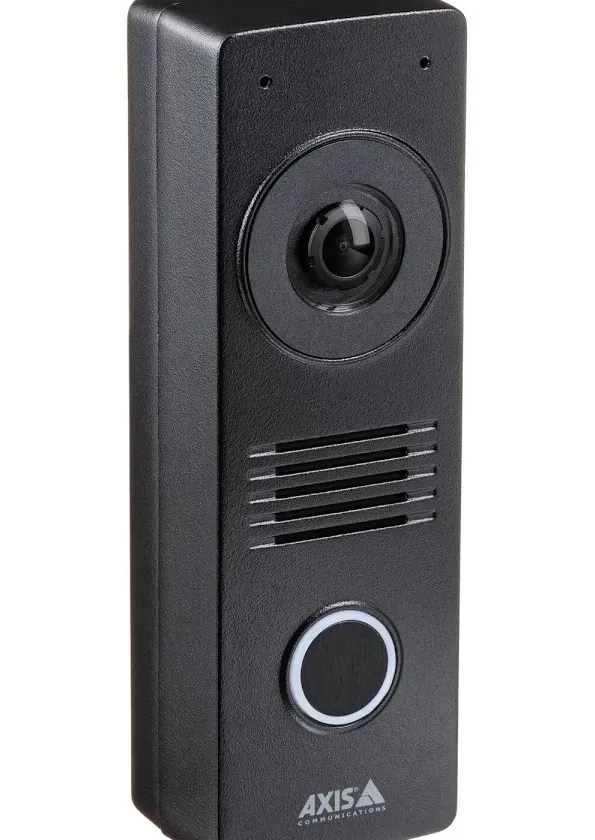
A photo from the AESS job library, not taken in Ocean Hill: a black rectangular video door station with a camera lens, a speaker grille and one round call button that lights up. A single-button station like this fits a door that serves one household or one business, such as the under-stoop entrance of a rental duplex in a Hull Street two-family, or the front door of a salon that keeps itself locked after dark.
Ocean Hill Buzzer Request
Row house, two-family, 1990s walk-up, newer building, storefront church, salon or day care: tell us the address, how many households or businesses the system has to reach and which doors people use, and a technician calls back with the range
✅
Request Sent!
Thank you. A technician will call you about the Ocean Hill address, usually within two hours. If it is urgent, call (347) 934-8335.
25+
Years Experience
✓
Same-Day Estimates
100%
Licensed & Insured
4.7★
201 Google Reviews
Owner-operated since 2002 · Thousands of jobs completed · Booked within 2 hours
Quick answer: door buzzer installation in Ocean Hill is billed on our standard Brooklyn list, which runs $400 to $900 for an audio buzzer with an electric strike release on a one- or two-household house or a single shop door, $700 to $1,800 for a video entry panel with indoor monitors or a smartphone release on a two-family, three-family or small walk-up, and from about $2,500 to past $10,000 for a directory system that reaches every apartment in a building of twelve to fifty or more units. The figure covers the door station, the answering stations or phone set-up, the power supply, the strike or approved lock, the cable and the labor. It is written down after we have seen the doors and tested whatever wire is already in the walls, and anything that depends on that test, such as an old pair that might fail or a closer that has to be replaced first, is named and priced before you order. Send photos of the street door and the bell or panel beside it to (347) 934-8335 or on WhatsApp and we reply with the range that fits, usually within two hours.
Looking at photos and writing a quote for a new system costs nothing. When an existing system has to be diagnosed in person before anyone can price it, that is our $250 service call booked online, and the $250 is applied toward the work.
Every job is done under New York State license #12000287431. We install the low-voltage side of an entry system; if a power supply needs a new 120-volt outlet or circuit, a licensed electrician does that piece, and you are told before the job is priced.
We take the order from whoever controls the door: the owner of the house or building, a managing agent or board, or a business or congregation that rents its space and has the landlord's written approval.
The Neighborhood
Why Ocean Hill Properties Need Door Buzzer Installation
Ocean Hill sits at the eastern edge of Bedford-Stuyvesant, in ZIP code 11233 and Community Board 16, with the elevated J and Z along Broadway on its northern side and Broadway Junction at its northeast corner. Its population grew from 31,935 in 2010 to 37,952 in 2020, a rise of about 18.8 percent. More households behind the same front doors means more people ringing, more deliveries arriving and more visitors who need to reach one specific home, which is exactly the job a door buzzer exists to do.
The building stock is the reason no single system fits the neighborhood. The oldest houses are two-families from the first years of the twentieth century. A two-family townhouse at 593 Bainbridge Street was built in 1901 on a lot 18 feet wide and 100 feet deep, with three livable floors and a full basement. A two-family brownstone at 505 Bainbridge Street dates from 1910, with a garden level and a parlor floor. A brick two-family at 170 Hull Street from 1915 has the owner's four-bedroom duplex above a two-bedroom rental duplex that includes the basement. On Jardine Place, one of fourteen one-block "Place" streets between Atlantic Avenue and Herkimer Street, Brownstoner described ten two-family houses built with a rental on the top floor. Every one of these has two households sharing, at most, two doors, and most of them were wired for a bell long before anyone thought about talking to a visitor.
Then comes the rebuilding. Community Board 16's statement of district needs records that in 1993, construction and rehabilitation of more than 1,500 housing units began in the part of Ocean Hill bounded by Broadway, Saratoga Avenue, Atlantic Avenue and Van Sinderen Avenue. Some of those homes were built new on empty lots; others were old shells gutted and rebuilt inside. A house or walk-up from that program has walls, cable paths and doors that behave nothing like a 1901 row house, and its age can even change what the intercom law asks of it. The newest layer is mid-rise housing: the eight-story building at 1510 Broadway and Hancock Street opened with an intercom in every apartment and a package room, and the ten-story building at 2425 Pacific Street, reported by Brownstoner in December 2025, has 236 apartments.
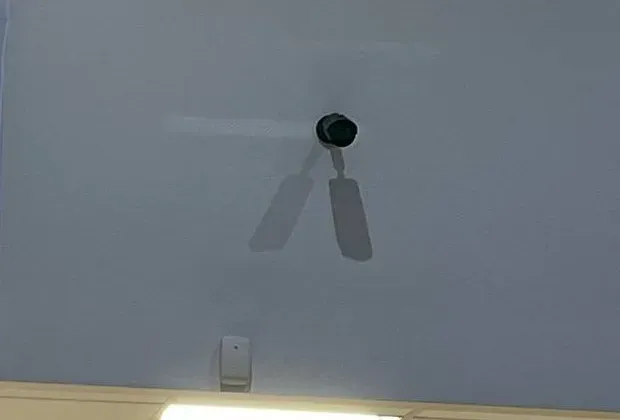
A photo from the AESS job library, not taken in Ocean Hill: a small black camera mounted high on a pale wall, throwing two shadows, with a small white device lower on the same wall. Vestibules in Ocean Hill walk-ups and in the newer buildings along Broadway often end up looking like this once an entry system is added: the camera watches the door from above while the release and its controls stay out of reach on the inside.
What happens when an entrance stops working is documented just next door. In November 2018 News 12 Brooklyn reported that tenants at the Brownsville Houses, the public-housing development in the neighborhood just south of Ocean Hill, said the intercom they used to buzz visitors in was broken. Four years later, the city Comptroller's resident-powered audit of NYCHA entrances found that in Brooklyn 46.1 percent of entrance doors were standing open and 39.7 percent had broken locks, and residents told auditors that broken intercoms, keys and door-release buttons were a common reason doors got propped. "Broken doors are a symbolic reminder that home safety starts at the entrance," Comptroller Brad Lander said. A private two-family is not a public-housing tower, but the chain is the same: when the people upstairs cannot let a visitor in from where they are, someone finds a way to leave the door unlocked.
The storefront blocks have their own version. The Department of Small Business Services' Neighborhood 360° assessment of Ocean Hill and Weeksville, carried out with the Bridge Street Development Corporation in 2023 and 2024, counted 560 storefronts on Broadway, Ralph Avenue, Rockaway Avenue and Fulton Street. Houses of worship were the largest group at 79, followed by salons and barbershops at 65 and delis and bodegas at 52, with 63 storefronts vacant. Eighty-three percent of merchants rent their space, and safety was among the improvements both merchants and shoppers asked for. Shoppers also said the lighting under the Broadway el made the street feel worse at night. A congregation that is only inside on certain evenings, a salon working late with one stylist, a deli with apartments upstairs: each needs a door that stays locked and still lets the right person in.
Finally, the rules change from one building to the next. A walk-up of eight or more apartments built or converted after 1968 has to have a working two-way intercom and a remote release at its self-locking front door. A two-family on Bainbridge Street has no such duty, but once a tenant relies on the bell, a dead one becomes a landlord-tenant problem. A storefront day care answers to the Health Department, and a congregation answers to its trustees. Sorting out which of those applies is part of planning the installation, not an afterthought.
Six facts that shape an Ocean Hill buzzer installation
Two households, one door. The typical older house here is a two-family on a narrow lot, often with the owner in a duplex and a rental duplex below, so one street door has to serve two separate homes and sometimes a second door under the stoop.
Three ages of house on one block. Houses from 1901 to the 1920s stand next to homes built or gutted after 1993 and next to buildings finished in the last decade, and each age has a different wall, door and cable situation.
A law with a date in it. Multiple Dwelling Law §50-a requires an intercom with voice and remote release in buildings of eight or more apartments erected or converted after January 1, 1968; older buildings must install one when tenants of a majority of apartments ask in writing.
Doors get propped when entry fails. In the Comptroller's 2022 audit, 57.9 percent of NYCHA entrance doors citywide were open or had broken locks, up from 23.5 percent in 2018, and residents tied that to broken intercoms and release buttons.
Storefronts are mostly churches, salons and delis. Of 560 storefronts counted in the Neighborhood 360° assessment, 79 were houses of worship, 65 salons and barbershops and 52 delis and bodegas, and 83 percent of merchants rent.
Public housing is mid-renovation. A $433 million PACT project covers 920 apartments in 14 buildings across Ocean Hill Apartments, Saratoga Village, Stuyvesant Gardens I and II and Bedford-Stuyvesant Rehab, including an upgrade of building security systems.
Where this page applies. Ocean Hill has no single official boundary. This page covers the blocks from Broadway south toward East New York Avenue, and from Ralph Avenue east to Van Sinderen Avenue and Broadway Junction, including the Place streets off Atlantic Avenue and the stretch of Fulton Street that runs through. For the rest of the borough, see our door buzzer installation in Brooklyn page; for the neighborhoods on either side, see Bedford-Stuyvesant and Brownsville. Most Ocean Hill owners who add a buzzer also ask about a camera at the same door, and the two can be planned on one visit.
Repair or Replace in Ocean Hill
Need Repair in Ocean Hill? Start With the Door, Then the Wire, Then the Panel
Plenty of Ocean Hill calls that begin with "we need a new buzzer" turn out to be something smaller. In a two-family the usual culprits are a bell transformer that has been running for decades, a pushbutton worn through by weather on the stoop, or a strike that hums but no longer lets the latch go because the door has dropped on its hinges. In a walk-up from the 1990s rebuilding, it is often a single apartment station that failed, or a power supply that went when the building lost power and never came back properly. None of those needs a whole new system.
So every job is sorted into one of three paths before it is priced. The first is a repair: replace the failed part, adjust the door, and test. The second is a partial replacement: keep the cable that tests sound and replace the door station, the power supply or the apartment stations that are past saving. The third is a full replacement, where the old cable is beyond reuse, the old system can no longer be bought or programmed, or the household wants something the old system cannot do, such as video or answering from a phone.
When a repair is all the door needs, we say so and price it as a repair. When replacement is the better money, the quote shows why: which pairs failed the test, which parts are no longer made, and what the repair would have cost against the new system. If an existing system has to be opened up and tested before anyone can tell which path applies, that is the $250 service call, and the $250 is credited toward whichever path you choose.
What We Install
Door Buzzer Installation Services in Ocean Hill
Each service below is priced from the same Brooklyn door buzzer list, with the work scoped to the building in front of us rather than a package chosen in advance.
Two-household entry for two-families
One station at the stoop door with a button for each household, a release each family can trigger from its own floor, and, where the rental duplex has its own door under the stoop, a second small station that rings only that home.
Ring-only bells turned into talk-back
Replacing a bell and chime that only announce a visitor with a station that lets the household speak to whoever is outside and open the door without walking down two flights.
Entry for 1990s houses and walk-ups
Systems for homes built or rebuilt after 1993, where cable can often be fished through framed walls and the front door is often newer than the house beside it, which changes which strike fits.
Apartment building directory systems
Directory, code or button panels with apartment stations or phone answering for walk-ups and mid-rise buildings, sized to the apartment count and the number of doors residents use.
Video and phone answering
Video door stations with indoor monitors, or panels that ring residents' phones, for owners who live elsewhere, households out all day, or anyone who wants to see the visitor before opening.
Storefront, salon and deli doors
A locked front or back door with a station and a release placed where staff actually work, kept on its own power and its own buttons so the business never shares wiring with the apartments upstairs.
Church and community-space doors
Entry for congregations and community rooms that are only staffed at certain hours, with calls routed to whoever is responsible that day and a door that relocks behind every visitor.
Day care and office entrances
Controlled entrances for child care programs and offices, with a keypad, card or code for staff and parents, a call button for everyone else and free exit from inside at all times.
Strikes, closers and power
Fail-secure electric strikes set into the frame, closers adjusted or replaced so the door shuts and latches every time, and a battery-backed low-voltage power supply on a circuit the owner controls.
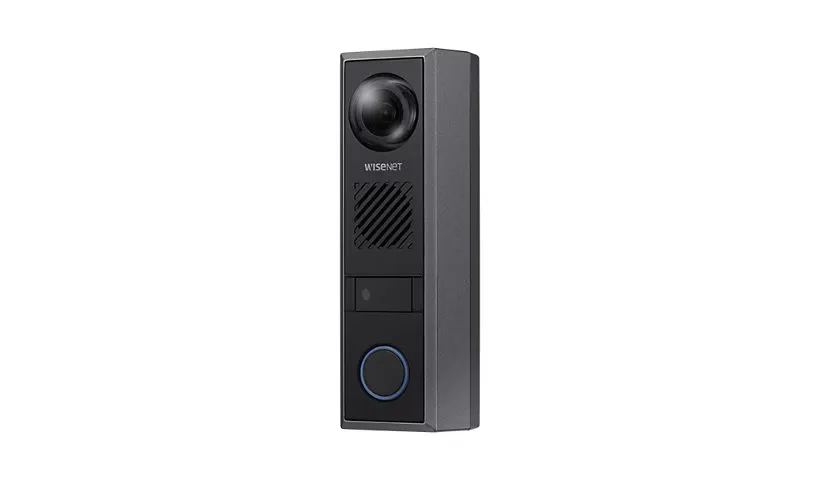
A photo from the AESS job library, not taken in Ocean Hill: a slim dark grey wired doorbell with a camera lens, speaker slots and a round push button. On a one-household house built in the 1990s rebuilding, where a narrow door frame leaves little room, a wired unit this size can replace a plain pushbutton without a larger panel, provided the wire behind it tests sound and a proper power supply feeds it.
Building Specialists
Door Buzzer Installation for Ocean Hill's Architecture
Six kinds of building make up nearly all of the entry work in Ocean Hill. The first question at every one of them is the same, and it is not about the buzzer: when was the house or building put together, and what has been done to it since?
1900s two-families on narrow lots
Brownstone and brick two-families from about 1900 to 1915 on Bainbridge, Hull, Macon and the streets around Saratoga Park, often 18 feet wide, with an owner's duplex over a rental duplex and a basement below.
Place-street two-families
Houses on the one-block Place streets between Atlantic Avenue and Herkimer Street, such as the ten two-families on Jardine Place that Brownstoner described with a rental apartment on the top floor.
Houses from the 1993 rebuilding
One-, two- and three-family homes built new on empty lots after 1993 in the area between Broadway, Saratoga Avenue, Atlantic Avenue and Van Sinderen Avenue, with framed interior walls and newer doors.
Old shells rebuilt inside
Walk-ups and houses whose original front walls survived while everything behind them was gutted and rebuilt, so the stoop and facade are old but the hallways, risers and wiring are not.
Newer mid-rise buildings
Eight- to ten-story buildings such as 1510 Broadway and 2425 Pacific Street, opened with entry systems, package rooms and staff, where the work is extending, repairing or replacing what the developer installed.
Mixed-use storefront buildings
Two- to four-story buildings on Fulton Street, Broadway, Ralph Avenue and Rockaway Avenue with a store, salon, church or deli at street level and apartments above.
1900s two-families: two homes, one stoop and a bell that predates the second household
The commonest Ocean Hill job is a two-family like 593 Bainbridge Street: 18 feet wide, three floors over a full basement, a stoop door into the owner's floors and, very often, a separate door under the stoop into the garden level. These houses were built for a bell, not for a conversation. Today the owner lives on the top two floors and a tenant has the floor below plus the basement, and both are expected to hear the same visitor and let them in.
The cleanest plan is usually a two-button station at the stoop door with a fail-secure strike in the frame, a talk-back station on each household's main floor, and, if the under-stoop door is the tenant's real front door, a one-button station there that rings the rental only. Cable runs from the basement up the inside of the party wall or a closet stack, which in an 18-foot house is a short distance. What makes it harder is the history: a century of owners leaves splices, abandoned wire and transformers in odd places, so the existing pair is metered before anyone promises to reuse it.
Place-street houses: short blocks, top-floor rentals and stairs through the owner's hall
Brownstoner's profile of Jardine Place describes ten two-family houses designed with a rental on the top floor. That layout means the tenant's visitor walks through the owner's hall and up the owner's stairs. The entry question is less about the street door, which both households share, and more about where the second lock sits: whether the stair to the rental has its own door, and whether the owner wants the tenant's release to open only the street door or the inner door as well.
On these houses we plan the release around privacy as much as convenience. Most owners choose a station for each household at the street door, a release on the street door only, and a plain lock on any inner door that stays under the owner's control. If the rental's visitors need to reach an inner door too, a second strike can be added, but it is priced and discussed before anyone orders it.
Houses from the 1993 rebuilding: framed walls, newer doors and a bell nobody upgraded
The houses built after 1993 between Broadway and Atlantic Avenue are the easiest older homes in Ocean Hill to wire, and the ones owners most often underestimate. In the ones we work in, interior walls are framed with drywall rather than solid brick, so cable can be fished from the basement or a utility space to each floor with small openings instead of surface runs. Often the house still has the original builder's doorbell and a plain pushbutton, because the house was sold as a one- or two-family and nobody ever needed more.
The catch is the door. A newer factory-made door with a narrow frame may not take a standard strike without a different model or a modified frame, and some have hardware that fights with an electric release. The technician looks at the frame profile, the latch and the closer first, then chooses the release, which is why a photo of the door edge and frame helps more than a photo of the bell.
Old shells rebuilt inside: an old face on a new building
Some of the rebuilding kept original front walls and rebuilt everything behind them. From the sidewalk these buildings look like the 1900s row houses next door; inside, they are much newer, with new stairs, new walls and cable paths that have little in common with the facade. Owners often do not know which kind of building they own until someone opens a cover plate.
That decides whether cable can be pulled through an existing path or has to be routed fresh, and how much of the facade the job touches. On these buildings the door station usually goes on the original masonry beside the door, while every cable run happens inside the rebuilt structure, so the old face of the building is left as it was apart from the station itself.
Newer mid-rise buildings: extend, repair or replace what the developer installed
Buildings like the eight-story 1510 Broadway, which opened with an intercom in every apartment, a package room and a live-in super, or the ten-story 2425 Pacific Street, do not need a first buzzer. They need someone who can work on the system that is already there: add a door, replace a damaged panel, reprogram the directory after turnover, or plan a replacement when the original model is no longer supported. The first step is identifying the make and model, and whether the owner still has the programming access the original installer set up.
In these buildings we also look at where a visitor actually stands. A street door beside the Broadway el, a rear door by the parking or the trash room, a separate entrance for a ground-floor program: each may need its own station or keypad on the same system. Sound-deadening windows keep the el out of the apartments, which also means residents rely entirely on the station to know someone is at the door.
Mixed-use storefront buildings: the business and the homes on separate circuits
On Fulton Street, Broadway, Ralph Avenue and Rockaway Avenue, many buildings put a business at street level and two or three apartments above, sometimes with a shared vestibule and sometimes with a separate residential door beside the shop. We keep the two systems apart: the apartments' station, release and power supply on one side, the business's own door and call button on the other. A problem in the shop never takes the tenants' buzzer down, and the tenants never ring the store.
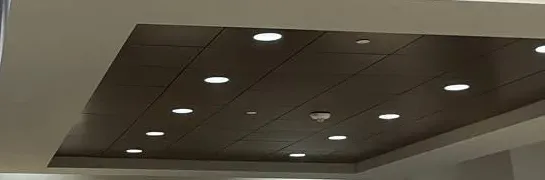
A photo from the AESS job library, not taken in Ocean Hill: a dark recessed ceiling panel with round downlights and a small round device, framed by a lighter ceiling. Lobbies in the newer mid-rise buildings along Broadway and Pacific Street often have finished ceilings like this, and any cable added for a new door station or a second entrance has to reach the equipment without leaving a scar across them.
Field Notes
Field Notes: Date the Building, Shut the Door, Then Find the Wire
This is how our technician spends the first half hour at an Ocean Hill house or walk-up before giving any price. It is a method, not a story about a particular customer.
First, the age. From the sidewalk the technician notes the facade, the stoop and the door, then asks the owner what they know: when they bought, whether the inside was rebuilt, and whether the house was ever a one-family. Inside, a glance at the stairs, the hall walls and the basement usually confirms whether this is an untouched 1900s house, a 1990s build, or an old shell rebuilt inside. That single answer predicts most of what follows.
Second, the door. The technician opens the street door, lets it go and watches. Does it close on its own? Does the latch catch without a push? Is there daylight at the top of the frame where the door has dropped? A buzzer only releases a door that was locked, and a door that rests just off its latch is never locked at all. If the closer, hinges or frame need work, that is priced as part of the job.
Third, the wire. In the basement the technician finds the old transformer, notes what it feeds, and puts a tester on every pair running upstairs. In a 1901 house that might be one twisted pair painted into the plaster; in a 1990s house it might be a multi-pair cable that was never used. Whatever tests sound is marked for reuse. Whatever fails is priced as new cable, and the written quote says which is which.
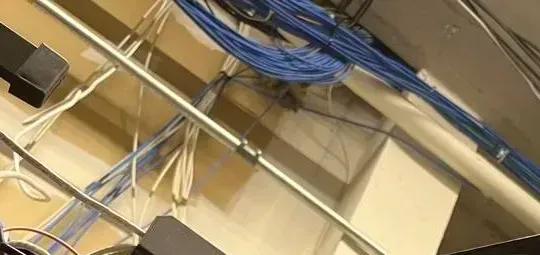
A photo from the AESS job library, not taken in Ocean Hill: bundles of blue low-voltage cable laid over a ceiling beam and a metal pipe in an open ceiling. The basement of an Ocean Hill row house is where a buzzer's new cable usually starts, running along the joists from the power supply to the point where it turns up the inside of the house toward each floor.
Where the Equipment Lives
Where the Power Supply and Controller Go in a Two-Family, a 1990s House and a Storefront Building
Every entry system has a box residents never see: the power supply that feeds the door station and the strike, and in larger systems a controller or distributor that sorts calls to each home. Where it goes decides who can reach it, how long it lasts and what happens when the power goes out.
In a 1900s two-family the obvious place is the basement, but in Ocean Hill the basement often belongs to the rental duplex, as it does at 170 Hull Street. Putting the owner's equipment inside a tenant's home means every service visit needs the tenant's cooperation. We look first for a common space, a front hall closet or a corner of a shared utility area, and if the basement is the only option, we place the box near the stair where it can be reached with notice. Wherever it goes, it sits off the floor and away from the boiler and the water lines.
In a 1990s house the same rule applies: the box goes in a space the owner controls, not in a tenant's apartment. In a storefront building, the apartments' power supply never goes in the store's space or on the store's electric meter, because the day the store changes hands or loses power, the tenants lose their buzzer. Whatever the building, three things come with the box: a battery backup sized to keep the door working through an outage, a label saying what it feeds and who installed it, and a dedicated circuit or outlet that is not on one apartment's meter.
The battery deserves a word. A fail-secure strike stays locked when the power is cut, so the door stays secure but nobody can buzz anyone in. A fail-safe magnetic lock does the opposite and releases. That difference is why the release type and the battery are chosen together, and why we explain both before you choose.
Rules and Responsibilities
Which Ocean Hill Buildings Must Have a Buzzer, What It Has to Do and Who Answers for It
Eight or more apartments, built or converted after 1968. Under Multiple Dwelling Law §50-a, a Class A multiple dwelling erected or converted after January 1, 1968 with eight or more apartments must have a self-locking main entrance door and an intercommunication system that lets each apartment speak with the visitor and release the door. In Ocean Hill that takes in the mid-rise buildings on Broadway and Pacific Street and some of the larger walk-ups from the rebuilding.
Older buildings of eight or more, when tenants ask. A building of that size erected before 1968 must install the self-locking door and intercom if the tenants of a majority of the apartments request it in writing. The work has to start within 90 days of the request and be finished within six months.
Two-families and small walk-ups. Houses and buildings below the eight-apartment line have no §50-a duty to provide an intercom. That covers most of the 1900s two-families and the smaller homes from the rebuilding. The owner decides, but tenants who have relied on a bell will notice when it dies.
Once it exists, it has to work. Habitat Magazine's February 2024 article notes that the city's housing maintenance code also requires a functioning intercom where one is required, and that courts have treated intercoms as an essential service, so a failure can breach the warranty of habitability. As one attorney quoted there put it, "the co-op has a legal obligation to repair or replace the intercom."
Locks must always open from inside. Whatever locks the door against the street, a person inside must be able to leave without a key, a code or power. An electric strike leaves the lever or knob working from inside, which is why it is the usual choice for Ocean Hill street doors.
Magnetic locks bring extra parts. A magnetic lock is fail-safe by nature, so the building code's sensor-release provisions require a sensor on the inside, a manual "PUSH TO EXIT" device 40 to 48 inches above the floor within five feet of the door, release on loss of power and release on fire alarm activation where there is one. A strike avoids most of that.
Buttons people can reach. The 2010 ADA Standards set a high forward reach of 48 inches maximum and a low reach of 15 inches minimum for operable parts. Where a business, church or day care is open to the public, the call button and keypad go inside that range, and we use it for residential stations as a sensible default.
None of this is legal advice for a specific building. An owner facing an HPD violation, a written tenant request or a Health Department inspection should confirm the requirements with the agency or a lawyer. Our part is to build a system that does what the rule asks, document what was installed, and tell you plainly where the rule ends and your choice begins.
Installation Day
What Installation Day Looks Like in an Ocean Hill House or Walk-Up
Installation is booked in a two-hour arrival window, and the crew arrives inside it. In a two-family the job is usually one visit: the old bell stays live while the new cable goes in, the door is adjusted and the strike set, and the switch from old to new happens near the end of the day so nobody is without a doorbell for long. Both households should expect the crew to need a few minutes in their apartment to mount and test their station.
In a walk-up or a mid-rise building, the work is staged. The door station, release and power supply go in first, then each line of apartments in turn, with notice to tenants about when the crew will need access. The old system keeps working until the new one has been tested from the sidewalk, and only then is the street door switched over. If an apartment cannot be reached on the day, its station is installed on a return visit and the rest of the building is not held up.
At the end, the technician walks the owner, and any residents who are home, through the new stations: how to answer, how to release, how to tell which button rang. Every household gets a line on the test sheet showing that its call and release worked. The owner gets the sheet, the labels and the model numbers, so the next person who works on the system starts with a map instead of a mystery.
Commercial Door Buzzer Installation
Business Door Buzzer Installation in Ocean Hill
Ocean Hill's commercial streets are small-scale: two- to four-story buildings with one or two shops at street level, a handful of larger lots near Broadway Junction, and the auto-oriented businesses along Atlantic Avenue. The Neighborhood 360° assessment found that houses of worship, salons and barbershops, and delis and bodegas make up the largest groups of storefronts, and that most merchants rent. Each corridor puts a different demand on a door.
Broadway, Lexington Avenue to Conway Street
Storefronts under the J and Z el, where shoppers said the lighting made the street feel worse at night. A business that locks after dark needs a lit call button, a camera that sees the visitor and a release it can trust.
Fulton Street, Utica Avenue to Mother Gaston Boulevard
The corridor where the assessment found the poorest storefront conditions, between Howard and Rockaway Avenues. Older doors and frames here often need repair before any release goes on.
Rockaway Avenue, Broadway to East New York Avenue
Shops, salons and congregations with apartments above, where keeping the business's door and the residents' door on separate systems avoids most later complaints.
Ralph Avenue, Broadway to East New York Avenue
The western edge of Ocean Hill, with salons, delis and small offices. Many keep a back or side door that staff use, which can get its own keypad or call button.
Atlantic Avenue and Broadway Junction
Gas stations, car washes, repair shops and storage along the avenue, plus larger sites near the junction, where an office door, a staff door and a customer door may each need different access.
Storefront congregations across the neighborhood
The 79 houses of worship counted in storefronts and the former synagogue buildings now used as churches, which are full on certain evenings and empty much of the week.
Delis and bodegas: deliveries, the apartments upstairs and a door that never closes
A deli's own front door is usually open whenever it is open, so the buzzer question is about the other doors: the residential door beside the shop that serves the apartments upstairs, and the back or side door where deliveries come in. We keep the residential door on the tenants' system and give the delivery door its own call button that rings the counter or the owner's phone, so a driver at the back never ends up ringing a family upstairs.
Shops under the Broadway el: a door that has to work in poor light
The Neighborhood 360° shoppers' survey singled out the lighting under the elevated tracks on Broadway as a reason the street feels worse after dark. For a business door on that stretch, the station is chosen for night use: a call button that is lit or backlit so a visitor can find it, a camera that handles the contrast between a dark sidewalk and a bright shop window, and a speaker loud enough to be understood when a train passes overhead. The release is placed where staff can see the door, or watch it on a screen, before letting anyone in.
The door itself gets the same attention as on any street door: a closer that pulls it shut against wind and traffic vibration, a latch that catches every time, and a strike rated for a commercial door that is opened all day. A station is only as useful as the lock behind it, and a door that drifts open after a delivery undoes the whole point.
Atlantic Avenue businesses: office doors, staff doors and doors for customers
City planning's East New York profile describes Atlantic Avenue as auto-oriented, with gas stations, car washes, repair shops and storage. These businesses rarely want a buzzer on the bay door itself. What they ask for is a controlled office door, so customers ring and wait instead of walking into the shop, and a staff door at the side or back that opens with a code rather than a key passed around. Each door gets the access it needs: a call button and release for the office, a keypad for staff, and nothing at all on doors that should stay closed.
Because these sites are often larger and noisier than a storefront, the release for the office door is usually duplicated: one button at the counter and one on a phone, so whoever is free can let the customer in.
Compliance callouts for Ocean Hill businesses
Free exit always. Whatever locks the door from the street must open from inside without a key or special knowledge. Strikes keep the inside lever working; magnetic locks need sensor release and a "PUSH TO EXIT" device.
Fire doors and strikes. Allegion's guide notes that fire doors need fail-secure strikes, and that "Electromagnetic locks are only available fail safe." A rated door between a store and a residential hall gets a listed fail-secure strike, never a magnet.
Reach range. Call buttons, keypads and card readers on a public entrance go between 15 and 48 inches above the ground under the 2010 ADA Standards.
Tenant approval. With 83 percent of merchants renting, most business doors belong to a landlord. We need the owner's written approval before cutting a frame or mounting a station on a rented storefront.
Separate power. A business's entry equipment runs on the business's circuit and the apartments' equipment on the building's, so neither can switch the other off.
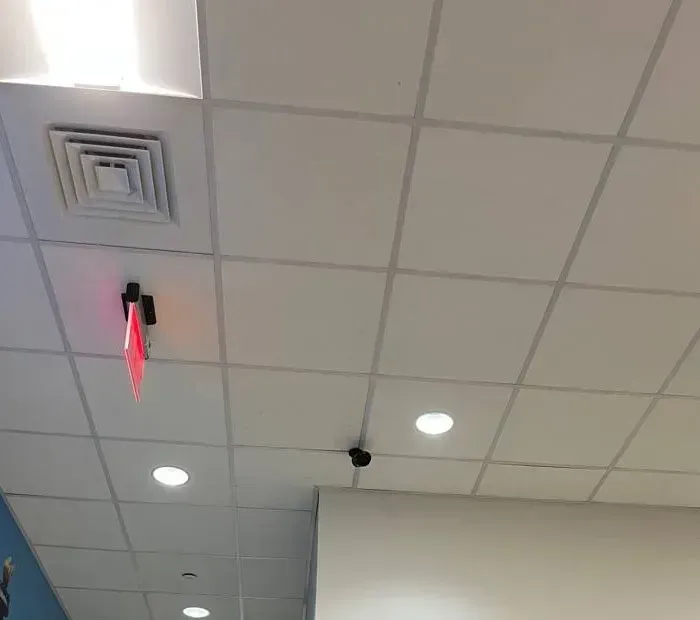
A photo from the AESS job library, not taken in Ocean Hill: a drop ceiling with a lit red exit sign, an air diffuser, round recessed lights and a small black camera. Storefront churches, day cares and offices on Fulton Street and Rockaway Avenue often have ceilings like this, and the exit sign is the reminder that matters for every business door we lock: it must always open freely from the inside.
Your Questions Answered
Door Buzzer Installation in Ocean Hill: Questions Answered
Owners of the older two-families
The tenant in our Hull Street two-family says that if a stranger walks in through our dead street-door buzzer, we would be the ones blamed. Is there anything to that?
There can be. Brick Underground's guide to broken buzzers, citing the New York Attorney General's tenants' rights guidance, notes that a landlord could be held liable if a crime happens because a broken buzzer left the door unlocked. A two-family has no duty under the intercom law to have a buzzer at all, but once the door is supposed to lock and the tenant relies on the bell to let visitors in, a failure that leaves the door open or propped is the kind of condition an owner can be asked about later.
The practical answer is to fix the whole chain, not only the button. The street door has to close and latch on its own, the release has to hold it locked until someone upstairs lets the visitor in, and the tenant has to be able to answer from their own floor. Whether any particular situation creates liability is a question for a lawyer, not an installer; what we can do is leave the door in a state where it locks every time and document that it did on the day we finished.
We can only afford part of the job this year. Should the money go to a release on the door or to talk-back stations upstairs?
Usually to the door. A talk-back station that cannot open the door still sends someone downstairs, and a door that does not latch reliably is unlocked whatever is mounted beside it. In most Ocean Hill two-families the first phase is the door itself: closer, latch and frame put right, a fail-secure strike set in the frame and a power supply with battery backup in the right place, with the cable for the future stations pulled at the same time while the walls are open.
The second phase is the stations, which then go in without new cable work. Doing it in that order keeps the expensive, disruptive part to one visit, and the second visit becomes mostly mounting and programming. The written quote shows both phases separately, so you can see what each costs on the Brooklyn list before you decide when to do the second.
Our stoop faces the street with nothing over it. Will a door station survive Ocean Hill winters out there?
A station built for outdoor use will, if it is chosen and mounted for it. Manufacturers rate their door stations for exposure; Aiphone, for example, describes the door stations in its GT series as "designed to withstand harsh conditions such as rain and snow." The weak points on an exposed stoop are usually not the station's face but the mounting and the cable entry: a box that lets water run down behind it, or a cable that enters from the top and channels water into the electronics.
On an unprotected stoop we mount the station with a rain hood or in a recessed back box where the wall allows, bring the cable in from below or from the back, and seal the entry. The strike in the frame is chosen to keep working when the door swells in damp weather, and the closer is set so a cold, stiff door still pulls shut and latches.
Walk-ups from the rebuilding
Our eight-apartment walk-up has a 1900s front wall, but everything behind it was rebuilt in the 1990s. Does the intercom law treat it as an old building or a new one?
That depends on the building's records, not on how it looks. Multiple Dwelling Law §50-a requires an intercom with voice communication and a remote release in Class A multiple dwellings of eight or more apartments "erected or converted" after January 1, 1968. A building that dates from before 1968 only has to install one when the tenants of a majority of apartments ask in writing. Whether a 1990s gut rehabilitation counted as a conversion for that purpose is something the owner should confirm from the certificate of occupancy and with a lawyer or HPD, because the answer changes whether an intercom is optional or required.
For the installation itself, we plan as though it is required. A building of this size with a self-locking street door and tenants who expect to buzz visitors in needs voice and release to every apartment either way, and if the building turns out to fall under §50-a, the system is already what the law asks for.
Shops, congregations and child care
Our salon on Ralph Avenue locks its door after dark, and the stylists are working at chairs at the back of a long, narrow shop. Where does the release go so nobody has to walk to the front between clients?
Where the work happens. A release button does not have to be next to the door; it can be at a station in the middle of the shop, on a phone, or on a small wireless remote that a stylist keeps at the chair. The door station at the front, with a camera, shows who is outside on a screen at the back or on a phone, so the stylist can see the client before pressing the button. The door then relocks itself behind every visitor.
Two details make this work in a narrow storefront. The screen or phone has to be somewhere staff glance at naturally, and the release has to give the door long enough to be pushed open from the sidewalk but not so long that it stays unlocked after the client is in. Both are set on the day of installation and adjusted after the first week if staff find them awkward.
The store on the ground floor of our Rockaway Avenue building has been empty for months. Should the new apartment buzzer leave a place for whoever rents it?
It is cheaper to decide now than later. The Neighborhood 360° assessment counted 63 vacant storefronts out of 560 across Ocean Hill's corridors, so empty stores here are common, and a new tenant may well want a locked door of their own. While the apartments' cable is being run and the power supply placed, a separate cable to the store's door and a separate power feed can be added for modest extra labor, without connecting the store to the apartments' system.
What we do not do is put the store's door on the residents' system. Whatever business moves in gets its own station and release, on its own circuit, so its hours, its visitors and its problems never reach the tenants upstairs. If you would rather wait, the apartments' system is designed so a separate store system can be added later without touching it.
Our congregation rents a storefront on Fulton Street, and nobody is in the building most weekdays. What should a door buzzer there actually do?
Let the right person answer from wherever they are. When the building is empty, a visitor who rings at the door station can be routed to the pastor's phone or a trustee's phone, and whoever picks up can speak to the visitor and, if they were expected, release the door from a distance. During services and scheduled events, the door can be held unlocked on a schedule and relock itself afterward, so nobody has to stand at the door with a key.
The congregation decides who holds the answering phones and the codes, and should be able to change that without calling an installer. Because most storefront congregations rent, the landlord's written approval is needed before a strike is cut into the frame. If the building was originally a synagogue or another older religious building, as some here were, its doors may need closer and frame work before any release will hold them.
We are opening a group child care program in an Ocean Hill storefront. What does the Health Department expect at the entrance, and where does a buzzer fit into that?
The Health Department's compliance guide for group child care centers, based on Article 47 of the Health Code, asks that entrances be "Monitored by staff and/or electronic or other surveillance allowing unobstructed views" and "Secured with passkey identification or other means of limiting access to staff, parents and other authorized persons." It also requires a panic bar on each exterior door, between 34 and 48 inches from the floor on the inside, and at least two exits, and it says parents must have unrestricted access to their children.
An entry system covers the first two points well: a keypad, card or code at the door for staff and parents, a call station with a camera for everyone else, and a release and screen at the front desk where staff can see who is waiting. The panic bar stays fully mechanical so the way out is never affected by power or programming. Parents' access is handled by giving them their own codes or cards, so they never wait outside. Your licensing inspector has the final word on whether the setup meets the code, and we install to whatever they ask for.
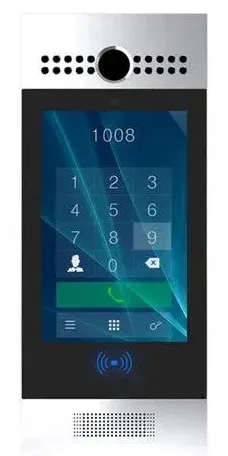
A photo from the AESS job library, not taken in Ocean Hill: a touchscreen entry panel showing a dial pad with a four-digit apartment code entered, a camera above and a card-reader symbol below. Panels like this suit the mid-rise buildings on Broadway and Pacific Street, where a visitor dials an apartment code and residents use a card, while a storefront day care could use the same kind of panel with codes issued to staff and parents.
Equipment
Types of Door Buzzers We Install
On the default quote we install a non-branded system chosen for the building, and we install named brands when an owner asks for one. What matters more than the badge is matching the category of equipment to the house or building.
Audio door stations
Talk-back stations with one button per household for two-families and small walk-ups, the simplest upgrade from a ring-only bell and the least dependent on old cable.
Video door stations
Stations with a camera and indoor monitors, for households that want to see the visitor first, including those on blocks where night lighting is poor.
Two-wire multi-tenant systems
Systems that run video and audio over one pair per apartment, such as Aiphone's GT series, which its maker lists for "new builds and retrofit projects" with up to 5,000 tenant stations.
Phone and app answering
Panels that ring residents' or owners' phones, useful for owners who live elsewhere, storefront congregations and businesses with nobody at a front desk.
Keypad and card stations
Code or card entry for staff, parents and residents, combined with a call button for visitors, for day cares, offices and buildings that want to stop handing out keys.
Directory panels
Scrolling or dial-code directories for buildings of twelve or more apartments, where a button per apartment no longer fits beside the door.
Fail-secure electric strikes
Releases cut into the frame that stay locked when power is removed, so the street door stays secure in an outage while the inside lever always lets people out.
Closers and latch hardware
Closers set or replaced so every door shuts and latches on its own, because no release can lock a door that rests open.
Battery-backed power supplies
Dedicated low-voltage supplies with a battery that carries the system through an outage, mounted where the owner, not a tenant or a store, controls them.
Audio station, two-wire video or phone answering: which fits which Ocean Hill building
What matters
Audio door station
Two-wire video system
Phone or app answering
Usual Ocean Hill fit
1900s two-families and Place-street houses moving off a ring-only bell
Three-families, 1990s walk-ups and mixed-use buildings with several apartments
Owners who live elsewhere, storefront congregations, salons and offices without a desk
See the visitor
No
Yes, on the indoor monitor
Yes, on the phone, where the panel has a camera
Needs internet
No
No, unless phone answering is added
Yes, a wired connection or cellular at the door
Works for people without smartphones
Yes
Yes
Only if a station or landline option is included
Reuses old cable
Often, where the old pair tests sound
Often, one sound pair per apartment
Needs cable only to the door and the release
Monthly fees
None
None
Often a software or cellular charge
Brooklyn list range
$400–$900 for one- and two-household buildings
$700–$1,800 for small buildings; from about $2,500 for larger ones
Within the same ranges, plus any subscription stated in writing
ADT, Ring and SimpliSafe compared with a local installer
National names come up in almost every Ocean Hill conversation about a front door, usually because someone already has a Ring or SimpliSafe doorbell or an ADT alarm. Those products do one job well: a single household's doorbell camera or a monitored alarm. One Brownstoner forum owner with an old two-apartment buzzer described wiring a SimpliSafe doorbell camera in the foyer and adding plug-in chimes because the old doorbell wiring was too old to use. That works for one household. It does not give a second household its own button, its own answering station or a way to release a shared street door.
What a local installer adds is the part national brands leave out: a release in the door frame, a closer that makes the door latch, a station for each household or apartment, a power supply with backup in the right place, and a test of every call and release from the sidewalk. A doorbell camera can sit beside that system or be replaced by a video station that does both jobs, and an existing alarm can stay as it is. The choice is about what the door must do for the number of homes behind it.
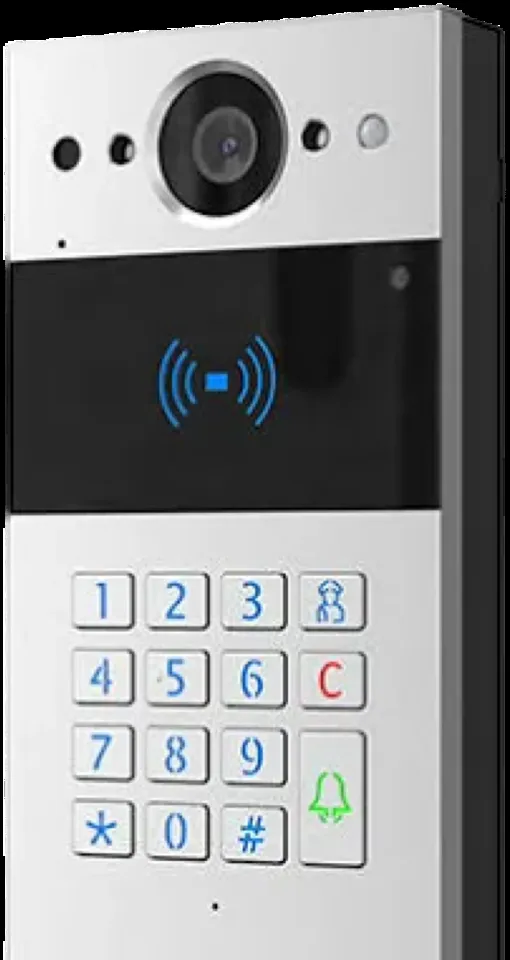
A photo from the AESS job library, not taken in Ocean Hill: a silver and black keypad door station with a camera lens at the top, a blue card-reader symbol, a numeric keypad and a green bell key. One station like this can give staff and parents of a storefront day care their own codes or cards while visitors press the bell, or let residents of a 1990s walk-up use a code instead of a key.
AI Overview Reality Check
What AI Gets Wrong About Door Buzzer Installation in Ocean Hill
Ask an AI assistant or a search summary what a door buzzer costs or what the law requires, and you get answers assembled from national cost guides and vendor blogs. Each claim below is the kind those sources make, followed by what it means for an actual Ocean Hill house, walk-up or storefront.
"Installing an intercom system costs an average of $2,500"
That is HomeAdvisor's national average, alongside a range of $1,500 to $15,000. It blends single-family homes, office suites and apartment buildings from across the country, so it describes almost nobody in particular.
For a 1900s two-family on Bainbridge or Hull Street, our Brooklyn list puts an audio buzzer with a new release at $400 to $900 and a video station at $700 to $1,800. The $2,500 figure is closer to the starting point for a directory system in an apartment building, which on our list runs from about $2,500 to past $10,000 depending on the number of apartments.
What moves an Ocean Hill job inside its range is specific: how many households the door serves, whether the old pair tests sound, whether the door needs a closer or frame work before a release can hold it, and whether a second door under the stoop or at the back has to be included.
"Wireless systems are the best option if you want to DIY"
HomeAdvisor says wireless systems are the best choice for do-it-yourself installation and puts them at $150 to $1,500, against $1,000 to $15,000 for hard-wired systems. For a single household with one door, a wireless doorbell can be a reasonable stopgap.
The trouble in an Ocean Hill two-family is not the signal but the door. A wireless chime can tell the family upstairs that someone is there, but it cannot release a shared street door unless a strike and a power supply are wired into the frame, and that wiring is the part a do-it-yourself kit leaves out.
The Brownstoner owners who tried it say as much: battery cameras and plug-in chimes worked for announcing a visitor, while letting the visitor in still meant walking downstairs.
"New York City law requires an intercom in every apartment building"
It does not. Multiple Dwelling Law §50-a requires a self-locking door and an intercom with voice and remote release in Class A multiple dwellings of eight or more apartments erected or converted after January 1, 1968. Older buildings of that size must install one only when tenants of a majority of apartments ask in writing.
That leaves most of Ocean Hill's two-families and three-families outside the law's direct reach, while the mid-rise buildings on Broadway and Pacific Street and the larger walk-ups from the rebuilding may fall inside it.
The obligation runs the other way once a system exists. Habitat Magazine notes that the housing maintenance code requires a functioning intercom and that courts have treated intercoms as an essential service, so an owner who has one cannot simply let it die.
"A cellular intercom requires no building wiring"
ButterflyMX describes its intercom as one that "requires no building wiring," meaning no cable to each apartment, because residents answer on their phones over the internet or a cellular link.
The door end still needs wiring. A station has to be powered, a strike or lock has to be wired into the frame and connected to the panel, and a power supply has to live somewhere safe. In an Ocean Hill row house that is a cable from the basement to the stoop door, which is real work even if no apartment is touched.
What a phone-based panel does save is cable to each home, which matters most in old buildings where riser cable has failed. For a two-family with a short cable path, a wired station is often simpler and has no monthly charge.
"A magnetic lock is a cheap, simple upgrade for an apartment door"
Magnetic locks are easy to mount, but Allegion's guide notes that "Electromagnetic locks are only available fail safe," meaning they release when power is lost.
On a means of egress, the building code's sensor-release provisions then require a sensor on the inside, a manual "PUSH TO EXIT" device 40 to 48 inches above the floor within five feet of the door, release on loss of power and release on fire alarm activation. That is a lot of extra equipment for a street door that a strike could secure.
For most Ocean Hill doors we recommend a fail-secure strike, which stays locked in an outage while the inside lever always lets people out. A magnet is reserved for doors where a strike cannot be fitted, and then it comes with every part the code requires.
"Software subscriptions are a small add-on"
Swiftlane's cost guide says subscriptions "commonly add $5 to $15 per unit per month, or $30 to $100 per door per month," on top of $1,000 to $5,000 or more per entry door for modern IP or video systems.
For a building the size of 1510 Broadway, with 108 apartments, $5 to $15 per unit works out to $540 to $1,620 a month, or $6,480 to $19,440 a year, every year the system is in use. That is a real operating cost, not an add-on.
Some buildings decide phone answering is worth it. When they do, the quote shows the fee and who pays it on its own line, and the system is chosen so that residents without smartphones can still answer.
"Your existing wiring can be reused"
Sometimes. Aiphone's GT series is sold partly on "using existing wire and infrastructure," and its upgrade guide says existing wires can be reused if they are in good condition. The condition is the whole question.
In a 1901 house the bell pair may have been spliced, painted over and rerouted by several owners. In a 1990s house it may be a newer cable that was never used. Both can be fine or useless, and nobody can tell from the outside.
So every pair is tested before the quote, and a pair that might fail on the day is priced as a named extra in advance, never discovered after the equipment has been ordered.
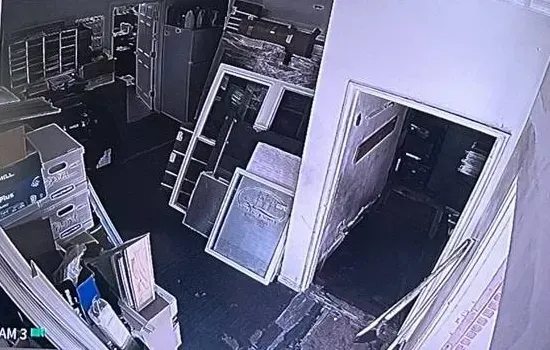
A photo from the AESS job library, not taken in Ocean Hill: a black-and-white night camera view of a cluttered room with an open doorway into a dark back room. The back rooms of delis and shops on Fulton Street and Rockaway Avenue look much like this, and an open doorway at the back is exactly where a delivery buzzer and a door that closes behind the driver make the difference.
Not Sure Whether Your Door, Your Wire or the Whole System Is the Problem?
Send photos of the street door, the edge of the door and its frame, the bell or panel beside it and, if you can, whatever is mounted in the basement, along with the number of households or businesses, and a technician will tell you which path looks likely and where it falls on our Brooklyn ranges. Call or text (347) 934-8335, send the photos on WhatsApp, or use the request form.
Get In Touch
Request a Free Quote
✅
Request Sent!
Thank you. A technician will call you about the Ocean Hill address, usually within two hours.
How It Works
Our Installation Process
1. Photos and a first call
You send photos of every door people use and whatever is mounted beside it, with the address and how many homes or businesses the system must reach. A technician calls back, usually within two hours, with the likely path and the range on our Brooklyn list.
2. Count the doors and the households
At the walkthrough we list the stoop door, the door under the stoop, any back or store door, and every household or business that has to be reachable, and confirm who controls the door and will sign for the work.
3. Fix the door before the electrics
We test the closer, latch, hinges and frame. A door that does not shut and latch on its own is put right first, because a release can only hold a door that is actually locked.
4. Test the old cable
Every pair from the basement or utility space to each floor is metered. Sound pairs are marked for reuse; failed pairs are priced as new cable, and the quote says which is which.
5. Price it in writing
You get a written price from the Brooklyn list, with every possible extra, such as a closer, a frame repair or a second door, named and priced before you approve anything.
6. Deposit, order and schedule
Equipment is ordered once the deposit is in, and once ordered it cannot be returned, which is why every extra is settled first. Special-order parts are flagged in advance, and installation is booked in a two-hour arrival window.
7. Install, label and program
We mount the door station, strike, power supply and indoor stations or set up phone answering, label every pair and button, and program the directory, codes or call routing.
8. Test from the sidewalk and hand over
Standing at each door, we call and release every household or business, record each result on a test sheet, and show the owner and residents how to answer and open the door.
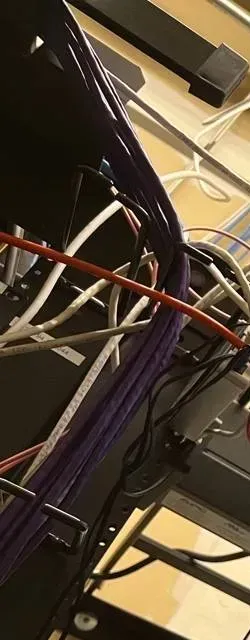
A photo from the AESS job library, not taken in Ocean Hill: purple, white and red cable bundles dropping down beside a black equipment rack. In a mid-rise building like those on Broadway and Pacific Street, the cable from every floor comes together at a point like this, and labeling each bundle on installation day is what lets the next technician find one apartment's line in minutes.
Coverage Area
Door Buzzer Installation Near Ocean Hill's Landmarks
Saratoga Park
The 3.21-acre park bounded by Halsey Street, Macon Street, Saratoga Avenue and Howard Avenue, bought by the city in 1896, with two-families and brownstones on the streets around it.
Saratoga Branch Library
The 1908 Classical Revival library by Rudolph L. Daus at 8 Thomas S. Boyland Street and Macon Street, which reopened in February 2023.
Broadway Junction
The transit hub where Broadway, Atlantic Avenue, Rockaway Avenue and Van Sinderen Avenue meet, served by the A, C, J, L and Z trains, near the auto businesses and larger sites on Atlantic Avenue.
Jardine Place
One of the one-block Place streets between Atlantic Avenue and Herkimer Street, formerly Washington Street, lined with ten two-family houses built with a rental on the top floor.
Prospect Plaza
The former NYCHA towers between St. Marks Avenue, Sterling Place, Howard Avenue and Saratoga Avenue, the first NYCHA development fully demolished, replaced by low-rise affordable buildings.
1510 Broadway
The eight-story affordable building at Broadway and Hancock Street, with 108 apartments, an intercom in every unit, a package room and a live-in super, under the J and Z el.
Ocean Hill is billed at our standard Brooklyn rate, with no neighborhood surcharge. The final figure follows photos and a walkthrough, because the number of households, the number of doors people use, the condition of the old wire and the state of the door itself drive the total far more than the brand on the station.
Job
Typical Ocean Hill building
Brooklyn range
Audio buzzer or replacement with electric strike release, existing wiring reused where it tests sound
1900s two-families, Place-street houses, one shop or office door
$400–$900
HD video entry panel with indoor monitors or a smartphone release, four-wire retrofit available
Two- and three-families wanting video, 1990s houses and small walk-ups, storefront buildings with apartments above
$700–$1,800
Multi-unit directory panel with every apartment wired, audio or video by unit count, optional fob integration
Walk-ups and mid-rise buildings of twelve to fifty or more apartments
from $2,500 to $10,000+
In-person diagnosis of an existing system, booked online
Any building where the old system has to be opened and tested before quoting
$250, applied toward the work
Monthly subscription
Any building that chooses a wired system without phone answering
$0
What moves an Ocean Hill job inside its range is predictable. First the households and the cable: a two-family whose old pair tests sound stays near the bottom of the audio range, while new cable to three floors and a second door under the stoop pushes it toward the top. Then the door: a closer that has given out, a frame that has dropped, or a newer door that needs a different strike all add parts and labor. Then the building's particulars: a power supply that has to move out of a tenant's basement or off a store's meter, a store that needs its own separate system, or phone answering with a monthly fee. Every one of these is named on the written quote, with its price, before you approve. Customers who install a camera at the same door on the same visit usually save $200 to $400 in labor against booking the two jobs separately.
Full terms — including 50% deposit, one-year parts-only warranty on AESS-supplied products, and the late-fee schedule — are set out in the service agreement.
Find Out Which Range Your Ocean Hill Building Falls In
Tell us the address, how many households or businesses the door serves, every door people use and what is mounted at the door now, and we will tell you which Brooklyn range fits and what would move it up or down. Call or text (347) 934-8335, send photos on WhatsApp, or fill in the form.
Shop Our Systems
Door Buzzer Installation Packages & Pricing
Three typical Ocean Hill jobs, each placed inside the matching range on our Brooklyn list. Your written quote may land anywhere inside the range, and it states why.
Two-household audio: $400–$900
An audio station at the stoop door of a 1900s two-family with a button for each household, a fail-secure strike in the frame, a talk-back station on each household's main floor and a battery-backed power supply, reusing the old pair where it tests sound. Suits Bainbridge, Hull and Macon Street houses and the Place-street two-families moving off a ring-only bell.
Video for a house or small walk-up: $700–$1,800
An HD video entry panel with indoor monitors or a smartphone release for a two- or three-family, a house from the 1990s rebuilding or a storefront building with apartments above, with a second station for a door under the stoop or at the back where it is needed.
Building directory system: from about $2,500
A directory, code or button panel at the main entrance, every apartment wired, audio or video by unit count, with optional fob or card entry and a station at a rear door, for walk-ups and mid-rise buildings of twelve to fifty or more apartments. Larger video or phone-answering systems can reach $10,000 and more.
Already bought your own equipment?
If you have already bought a kit or a building system, we can install it on a labor-only price. That price is quoted from photos of the equipment and the doors and a phone conversation, rather than a walkthrough. The equipment's own warranty stays with its maker, and its performance, including any wireless signal it depends on, is the equipment's, not ours. If the kit cannot do what the door needs, for example a second household's button or a release for a shared street door, we tell you before you book.
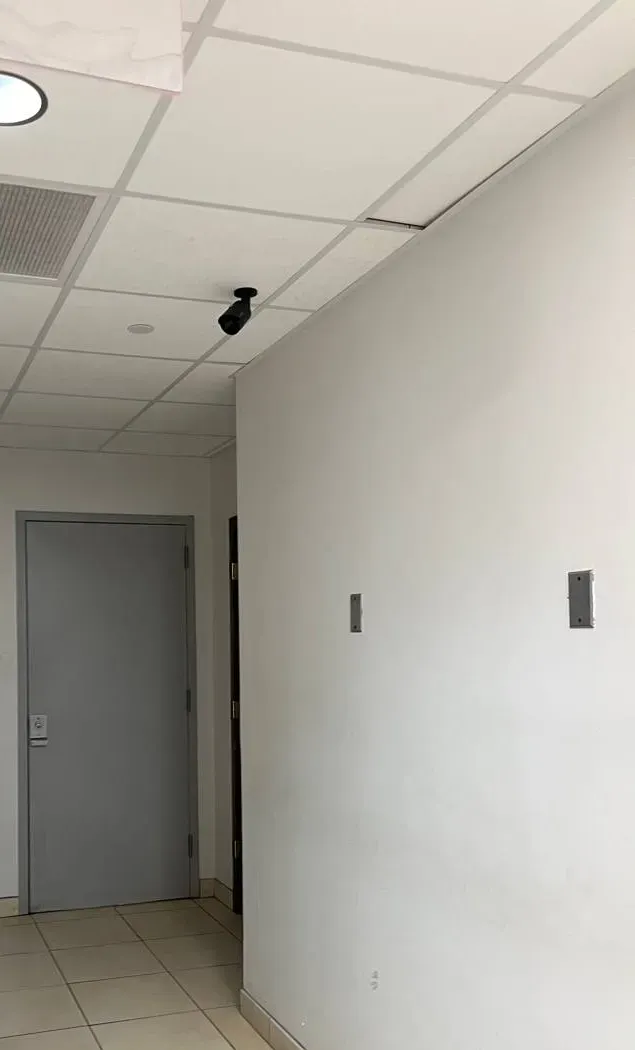
A photo from the AESS job library, not taken in Ocean Hill: a tiled corridor with white walls and small wall plates ending at a grey steel door with a lever handle, under a drop ceiling with a small camera. A rear or service door like this in a walk-up or mid-rise building is often the door residents use most, and it can get its own keypad or station on the same directory system as the front.
Complete Services
Every Door Buzzer Service in Ocean Hill
Houses and two-families
First buzzers, ring-only bells turned into talk-back, stations for doors under the stoop and video for each household. Request a quote
Storefronts, churches and day cares
Locked business doors, delivery buzzers, scheduled church doors and controlled child care entrances. Call (347) 934-8335
Can we see buzzer installations you have done in other Ocean Hill houses before we decide?
+
We do not give out the addresses or contact details of other customers, because their front doors and their privacy are theirs. The photos on this page come from our job library and are labeled honestly as not taken in Ocean Hill. For what past customers think of the work, read our Google reviews, where we are rated 4.7 stars across 201 reviews, and send us photos of your own door so we can show you what we would put on it.
After we send the request form, how quickly does someone get back to us?
+
Requests are usually booked within two hours. A technician calls or texts back with questions about the doors and the number of households, gives the likely range from the photos, and offers a walkthrough time in a two-hour arrival window if one is needed. If you need an answer sooner, call (347) 934-8335 directly.
If the station we pick is a special-order item, how long does it take, and who sets the installation date?
+
Most stations, strikes and power supplies are stock items. When a particular model has to be special ordered, we tell you before you pay the deposit, because its shipping time is set by the supplier and not by us. The equipment is ordered after the deposit, we tell you when it is due to arrive, and the installation is booked once it is actually here, so nobody is given a date the parts cannot keep.
What happens to the price if the old wire in our house turns out to be in good shape?
+
It is already in the price. We test the old pairs at the walkthrough, before the written quote, so a sound pair is priced as reused and only failed pairs are priced as new cable. If a pair is borderline and might fail on the day, the quote shows it as a named extra with its own price, which you only pay if the test on installation day confirms it has to be replaced.
Can our teenager have a door code that only works on school days in the afternoon?
+
On keypad and code stations that support schedules, yes. Each code can be limited to certain days and hours, so a teenager's code can open the street door on weekday afternoons and be inactive late at night, while the parents' codes work at all times. Codes can be added, changed or deleted by the owner later without a service visit. If you want this, mention it before the station is chosen, because not every model supports scheduled codes.
Can one ring at the street door reach both my phone and my husband's phone at the same time?
+
Yes, on systems with phone or app answering. A household's button can ring several phones at once, along with the station on the wall, and whoever answers first speaks to the visitor and can release the door. The others stop ringing. Phone answering usually needs an internet connection at the door and may carry a monthly fee, which the written quote states on its own line before you choose it.
We have a dog that bolts for open doors. How does the crew handle that while it works?
+
Tell us when the installation is booked. The street door has to be open at times while the strike and closer are fitted, so we ask that pets be kept in a closed room for those parts of the job, and the crew closes every interior door it passes through. If you prefer, we schedule the door work for a time when someone can take the dog out, and do the inside stations first.
The owner lives out of state. Can our tenant let the technician in for the walkthrough?
+
Yes, as long as the owner arranges it. The owner books the walkthrough and tells us who will open the door, and the tenant shows the technician the street door, the stations and the basement. The technician sends the owner the findings and the written price directly, and the owner approves and pays. We do not take instructions about the work from anyone the owner has not named.
If a station stops working a year or two after the job, what does it cost to have you look at it?
+
Tech support by phone or text is free, and many problems are settled that way, such as a station knocked off its settings or a release time that needs changing. When someone has to come out, it is the $250 service call booked online, and the $250 is applied toward the repair. Parts covered by the warranty in your paperwork are replaced under those terms.
What should we move or clear before the crew arrives on installation day?
+
Clear the area around the street door and the stoop, the wall where each indoor station will go, and a path in the basement or utility space to the place where the power supply will be mounted. Move anything fragile off shelves near those walls. If a closet is part of the cable route, empty the floor of that closet. Let tenants know the day and the two-hour arrival window, so someone can open each apartment when the crew reaches it.
Ready for an Ocean Hill Front Door That Locks Behind Every Visitor and Lets Each Household Answer?
Send a photo of your street door and whatever is mounted beside it, with the address, the number of households or businesses and every door people use, and we will tell you which system fits, how much of your old wire it can reuse and where it falls on our Brooklyn ranges. Call or text (347) 934-8335, message us on WhatsApp, or use the request form. Licensed under NYS license #12000287431, rated 4.7★ across 201 Google Reviews, with same-day estimates on most weekdays.