A street door nobody can buzz open, a walk-up that has gone years without a working intercom, or a new building that needs entry cable before the walls close? Ocean Hill intercom line, same-day estimates: (347) 934-8335
1870s–1890s Brownstone and Brick Rows · Painted-Brick Blocks on Pacific, Bergen and Prospect Place · Houses and Walk-Ups Rebuilt in the 1990s · PACT Apartments · New Buildings Near Broadway Junction · Mixed-Use Fronts on Broadway, Fulton, Ralph and Rockaway
Intercom Installation in Ocean Hill
One Button for Every Household · Old Wire Tested Before It Is Trusted · Doors That Latch Behind Every Visitor · Billed at the Brooklyn Rate
Intercom installation in Ocean Hill starts with a question that has nothing to do with brands: who controls the street door? The neighborhood between Broadway, Ralph Avenue, East New York Avenue and Van Sinderen Avenue is mostly rented. Homes.com counts 83 percent of residents as renters, but the people renting live in very different buildings. Some rent a floor in an 1870s–1890s Italianate or Neo-Grec row house where the owner lives downstairs and answers the bell herself. Some live in a walk-up that sat empty after the 1977 blackout and was rebuilt inside during the 1990s, and their owner lives somewhere else. Some live in Ocean Hill Apartments or Saratoga Village, which moved to private management under NYCHA's PACT program in September 2025. A growing number live in buildings that did not exist ten years ago, like Oceanhill III at 428 Saratoga Avenue, which advertised a video intercom to its first tenants. Each of those buildings needs a different intercom, and a different person signs off on it. This page is written for the owners, boards, managers and developers who make that decision. It covers how many households share each door, which rules apply to the building, whether the old wire can stay, where the station goes on a painted-brick or brownstone front, and how a new building gets its entry cable onto the drawings before the walls close.
Each quote is written for one building, once we know how many households share the door, what the old wire tests like, and who will look after the system afterward
Rated 4.6★ by customers across 390+ Google reviews
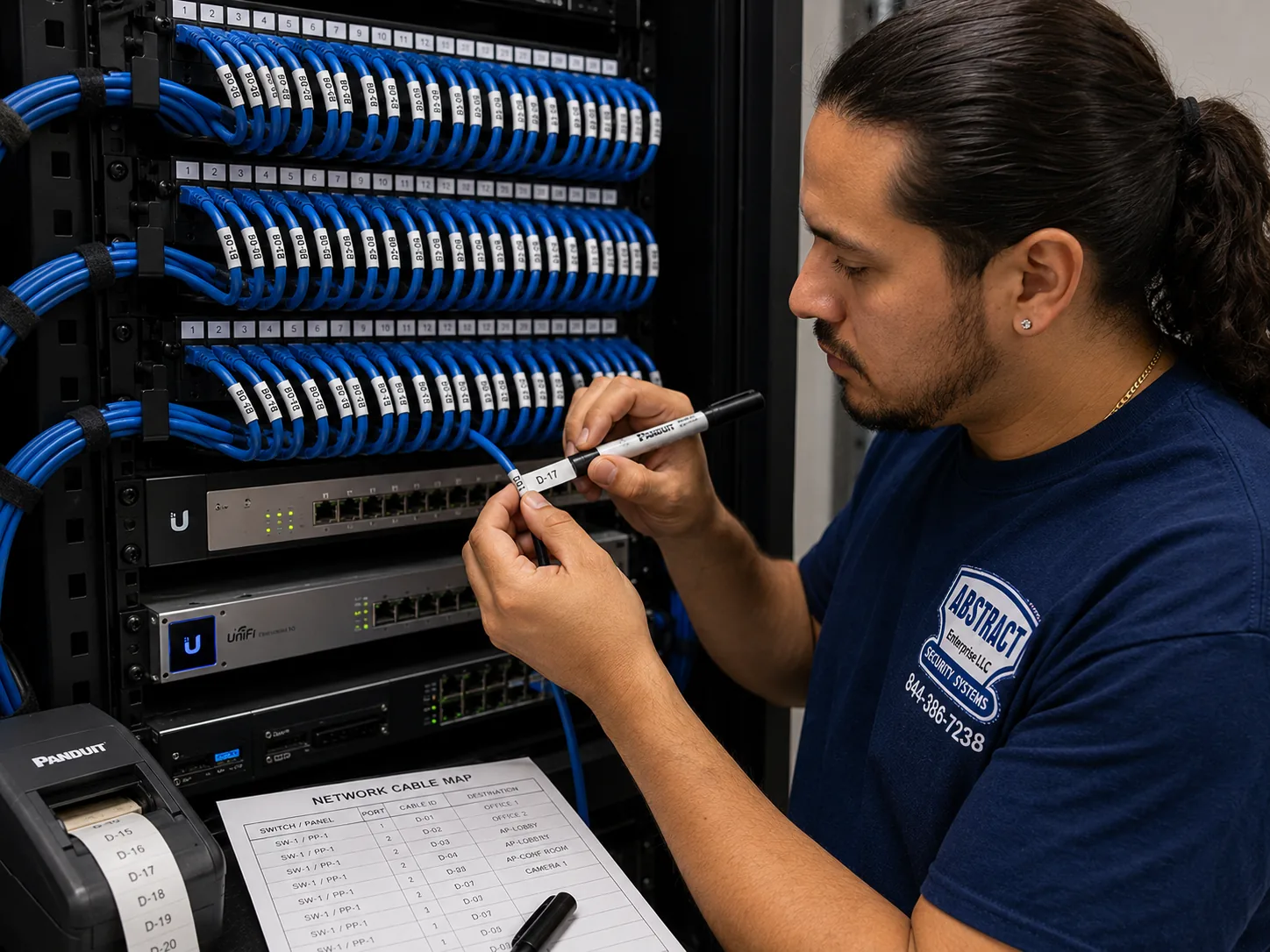
A photo from our job library, not taken in Ocean Hill: a technician printing cable labels at a patch panel, with a printed map of every port taped beside it. An Ocean Hill row house never needs a panel this size, but the habit matters more there than almost anywhere. In buildings that have changed owners several times since the 1990s rebuilding, the next person to open the cellar box should find every intercom run tagged with the floor and apartment it serves, not a bundle of unmarked wire.
Ocean Hill Intercom Request
Row house, walk-up, mixed-use building or new construction: tell us the street, how many households share the front door and who answers, and a technician calls back
✅
Request Sent!
Thank you. A technician will call you about the Ocean Hill address on the same working day.
25+
Years Experience
✓
Same-Day Estimates
100%
Licensed & Insured
4.6★
390+ Google Reviews
Owner-operated since 2002 · Thousands of jobs completed · Booked within 2 hours
Quick answer: intercom installation in Ocean Hill is quoted per building, at our Brooklyn rate, in writing after a short survey. We do not publish one intercom price, because a two-family row house with sound 1990s cable and a twelve-apartment walk-up with nothing usable in its stair hall are different jobs, and a new building on the Broadway side is a third. The written quote lists every station by model, the strike and closer, where the power supply will go, the cable route, the programming and the labor, each on its own line. Requests are booked within two hours on working days, and many estimates can be given the same day from photos. Service calls on existing systems are billed at our $195-an-hour service rate with a three-hour minimum.
The most useful first message has five things in it. A photo of the street door from the sidewalk, showing the stoop or step, the frame and whatever is mounted beside it now. A close photo of the call plate or buttons, even if half of them are dead or taped over. A photo of the latch side of the door, open, so we can see the latch, the lock and the frame. A photo of the old intercom's power supply or transformer if anyone knows where it is, which in Ocean Hill row houses is usually somewhere in the cellar. And two sentences about the building: how many households live there, whether the owner is one of them, and whether the building is rent-stabilized, in a PACT conversion or still under construction. Send it with the street name to (347) 934-8335 or on WhatsApp.
If you cannot answer all of that, send what you have. An owner who has just bought a house from an estate, a tenant association writing up what the building lacks, or a developer with drawings but no door yet can all start with a phone call. The survey exists to fill in what the photos leave out.
Reviewing photos and answering questions costs nothing. The written quote follows the survey, and if a wall, a riser or an old run turns out different from what the photos suggested, we stop and explain before going further.
Work is done under New York State license #12000287431, with insurance a managing agent, a lender, a nonprofit sponsor or a general contractor can ask to see before we start.
Ocean Hill is billed at our Brooklyn rate. There is no surcharge for walk-ups, for buildings near the el or for buildings with open violations; the quote changes only with the work itself.
Reviewed and updated November 2, 2026. This page draws on Wikipedia, cityneighborhoods.nyc, the Brooklyn Eagle, Brownstoner, Homes.com, OpenIgloo building records, the NYC Department of Small Business Services' Ocean Hill–Weeksville Commercial District Needs Assessment, NYCHA's Ocean Hill + Stuyvesant Gardens PACT community plan and NYCHA design guidelines, NYC Housing Connect, the Community Board 16 statement of district needs, NYC Department of City Planning, New York YIMBY, Gothamist, News 12 Brooklyn, NYC Parks, the Landmarks Preservation Commission permit guidebook, NYC Department of Buildings rule 1 RCNY 42-01, Habitat Magazine, and intercom and low-voltage summaries by Parker Custom Security, Seneca Security, Low Voltage New York and Low Voltage Nation.
The Neighborhood
Why Ocean Hill Properties Need Intercom Installation
Most intercom advice starts with the visitor on the step. In Ocean Hill the better place to start is the key ring. With renters making up 83 percent of residents, in most buildings the person who hears the bell is not the person who decides what kind of bell it is. On a single block of row houses that can mean an owner on the parlor floor who answers her own door and rents the floors above, an owner in another borough who sees the building once a month, a family that inherited a house and is still working out who handles repairs, and a managing agent who looks after twenty buildings. An intercom that suits the first of those owners can quietly fail for the third, because nobody on site notices when one handset goes dead or the strike stops pulling. So before we talk about stations and screens, the survey settles who will hold the administrator login, who gets the call when a tenant reports a fault, and who can approve a hole through the front wall. That conversation shapes the design more than any brand does. An absentee owner usually needs a system that can be checked and changed from a phone, while an owner who lives downstairs may be better served by something simpler that she understands completely and can explain to every new tenant herself.
The second thing that shapes the work is what is already inside the walls, and in Ocean Hill that depends on a building's history more than its age. Developers subdivided farmland into narrow lots and put up Italianate and Neo-Grec row houses of brownstone and brick between the 1870s and the 1890s, according to cityneighborhoods.nyc, and many of those shells still stand. What changed was the inside. After the 1977 blackout the neighborhood went through arson and abandonment, and by the 1990s city-backed rehabilitation was restoring buildings and filling empty lots. Community Board 16's needs statement records that in 1993, construction and rehabilitation of more than 1,500 housing units began in the area bounded by Broadway, Saratoga Avenue, Atlantic Avenue and Van Sinderen Avenue. So an 1890s front on Decatur Street may hide 1990s partitions, 1990s wire and a 1990s steel door, while the house beside it keeps its plaster, its cellar and bell wire from a century earlier. Two buildings that look alike from the sidewalk can need completely different cable work, which is why we test before we price, and why this page never promises that old wire can stay.
The third is that Ocean Hill is building again at a scale it has not seen since that rebuilding. Oceanhill III at 428 Saratoga Avenue brought 107 new apartments, and its Housing Connect advertisement listed security cameras, a video intercom system and a live-in superintendent. A building at 2425 Pacific Street holds 236 apartments, according to Brownstoner. The Henry Apartments on Broadway at Decatur Street were described by their sponsor as 134-unit buildings with two elevators each. New York YIMBY has reported permits filed for an 11-story mixed-use building at 50 Sackman Street and an eight-story mixed-use building at 1520 Broadway. And the City Council approved Herkimer-Williams, a four-building complex with up to 1,000 affordable homes in the triangle formed by Van Sinderen Avenue, East New York Avenue, Atlantic Avenue and Fulton Street. For those buildings the intercom is not a replacement job but a line on the drawings, and the decisions made before the walls close will decide whether the entry still works properly twenty years from now.
Then there is the law, which treats these buildings very differently. Habitat Magazine summarizes the Multiple Dwelling Law this way: buildings built or converted after 1968 with eight or more units must have a two-way voice intercom linking the front door to each apartment, and the city's housing maintenance code requires a functioning one. Parker Custom Security's summary adds that older buildings of that size are covered once tenants of a majority of the apartments ask in writing, and that a broken intercom is a Class B hazardous violation that HPD enforces on tenant complaint. Most Ocean Hill row houses fall below the eight-apartment line, so for their owners an intercom is a decision about how the building should run. For the walk-ups and new buildings above that line it is an obligation, and the obligation is to keep it working, not only to install it.
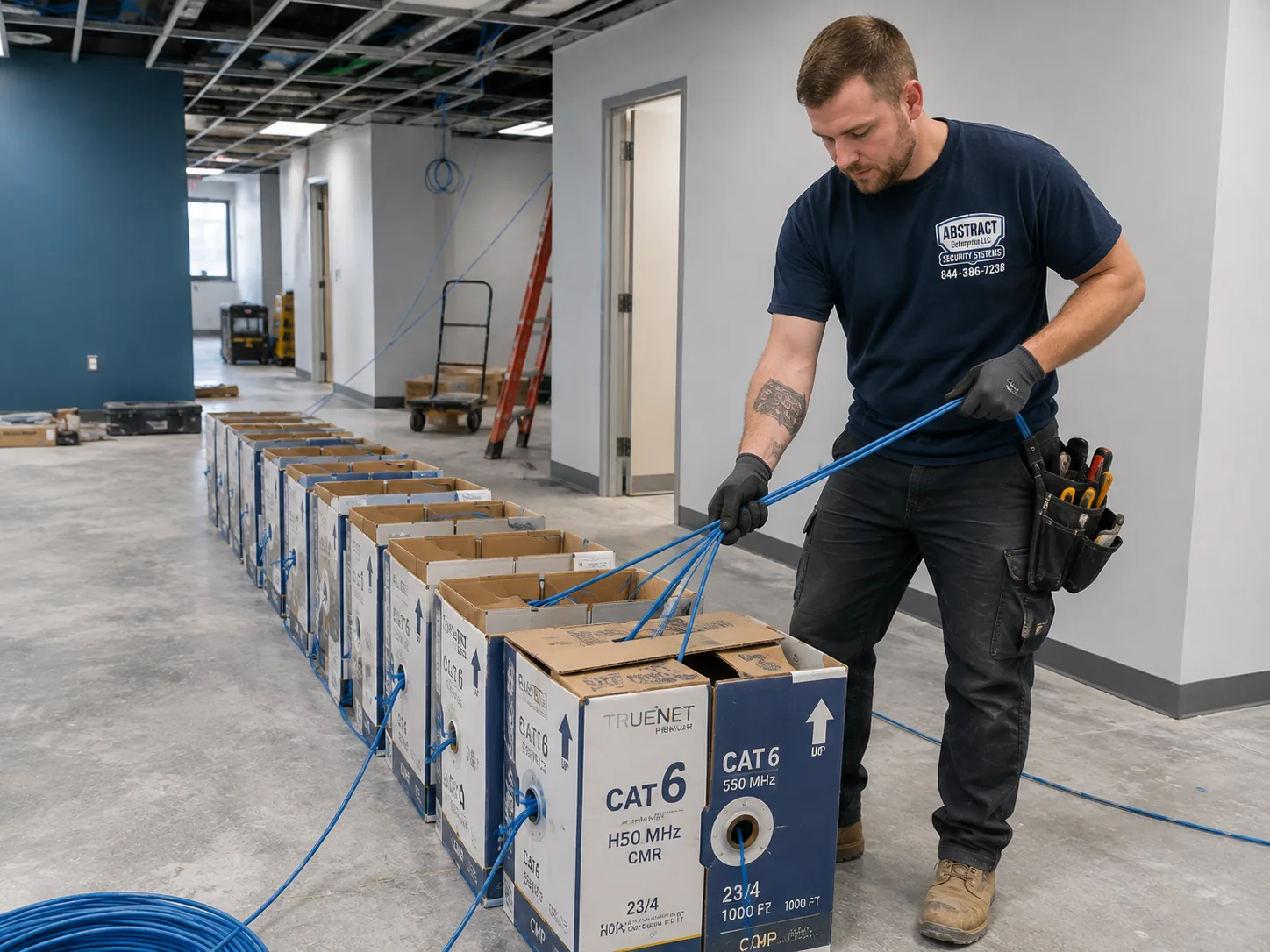
A photo from our job library, not taken in Ocean Hill: boxes of cable staged on the floor before several runs are pulled at once. In a new Ocean Hill building, such as the mid-rises filed for the Broadway side of the neighborhood, entry cable should arrive this way, with runs to the lobby station, the vestibule door, each elevator lobby and every apartment pulled in one pass while the framing is open, instead of being fished through finished walls after tenants move in.
What the public record says about Ocean Hill before anyone chooses a door station
Renters in most buildings. Homes.com puts renters at 83 percent and owners at 17 percent, so in most jobs the owner, a managing agent or a sponsor decides, and tenants live with the result every day.
Two eras of building inside one set of facades. Row houses from the 1870s to the 1890s stand beside buildings rebuilt or newly built after 1993, when more than 1,500 units were started between Broadway, Saratoga Avenue, Atlantic Avenue and Van Sinderen Avenue. The front tells you little about the wire.
Small fronts and short streets. The Brooklyn Eagle points to painted brick rows on Pacific Street, Bergen Street and Prospect Place, three-story brick rows on St. Marks Place, and one-block streets such as Monaco, Sherlock, Louis and Dewey Place. Brownstoner describes 722 Decatur Street as an 18-foot-wide house with its brownstone front intact. Space beside the door is often tight.
Public housing under new management. NYCHA's PACT plan groups five developments, including Ocean Hill Apartments with 236 apartments and Saratoga Village with 125, under Wavecrest Management from the fall of 2025, with key fob access planned at front and back doors.
New buildings arriving with video entry. Oceanhill III advertised a video intercom from the start, and buildings of 107, 134 and 236 apartments have opened or been announced, with an 11-story and an eight-story building filed on Sackman Street and Broadway.
No historic district inside Ocean Hill proper. We found no Landmarks Preservation Commission district inside the neighborhood. The Stuyvesant Heights Historic District, designated in 1971, lies to the west, and an LPC filing places 321 Decatur Street, in ZIP 11233, inside its expanded boundaries, so some 11233 addresses do fall under LPC review.
Where this page applies. Wikipedia bounds Ocean Hill by Broadway on the north, Ralph Avenue on the west, East New York Avenue on the south and Van Sinderen Avenue on the east, while cityneighborhoods.nyc draws the northern line at Fulton Street and wraps the south and east along Eastern Parkway. The neighborhood shares ZIP 11233 with parts of Bedford-Stuyvesant, falls under Community Boards 3 and 16, and is patrolled mainly by the 73rd Precinct. Streets that come up again and again in our research include Decatur, Macon, Halsey, MacDougal, Bergen, Dean, Pacific, Sumpter and Herkimer Streets, St. Marks Place, Prospect Place, and Saratoga, Rockaway and Howard Avenues. Every block is billed at our Brooklyn rate. For the blocks to the west, see our Bedford-Stuyvesant intercom installation page; north across Broadway, Bushwick; south of East New York Avenue, Brownsville; east past Van Sinderen, East New York; and for the whole borough, our Brooklyn intercom installation page.
Repair Calls in Ocean Hill
Need Repair in Ocean Hill? A Walk-Up That Has Gone Years Without a Working Intercom, a System Nobody Has Paperwork For, or New Stations That Were Never Finished
The repair calls we get from Ocean Hill tend to sit right on the line between repair and installation. The first kind comes from a walk-up where the intercom has been dead so long that tenants have stopped expecting it to work. Visitors call from the sidewalk, someone walks down three flights to open the door, and eventually the door gets propped open with a folded piece of cardboard because walking down is a nuisance. The second kind comes from a house or building rebuilt in the 1990s, where the original installer is long gone, the handsets are a model nobody makes anymore, and one or two apartments have stopped ringing. The third kind is newer: a recently built or renovated building where the stations were mounted but the job was never really finished. The directory is half empty, calls go to the wrong phones, the release opens the door for a second and lets it bang shut before anyone can push it, or nobody in the building knows the administrator password. Each of these starts the same way. A technician traces the existing runs, tests each station and the power supply, and tells the owner in writing whether the system can be brought back or has reached the end of its useful life.
Two things are worth doing before you call. First, make sure the street door still latches and locks with its key. While the intercom is down, a door that stays shut matters more than a door that buzzes. Second, find the intercom's power supply or transformer, which in Ocean Hill row houses and walk-ups is usually on a cellar wall or a joist near the electrical panel. If it has an indicator light that is out, check the breaker that feeds it, and if the breaker trips again, leave it off. If the box has been wet from a leak, do not switch it back on at all, and tell us when you call. Call (347) 934-8335 or send photos on WhatsApp. Many single faults, such as a failed power supply, a cut run in the cellar, one dead handset or a strike that no longer meets its latch, are found and fixed in one visit. Service calls and fault tracing are billed at our $195-an-hour service rate with a three-hour minimum, and we estimate the tracing time before we start. When repairing an old system would cost a large share of a new one, you get both options on paper. Residents of Ocean Hill Apartments and Saratoga Village should report lobby and entry problems to the building's management first, since those systems belong to the PACT renovation.
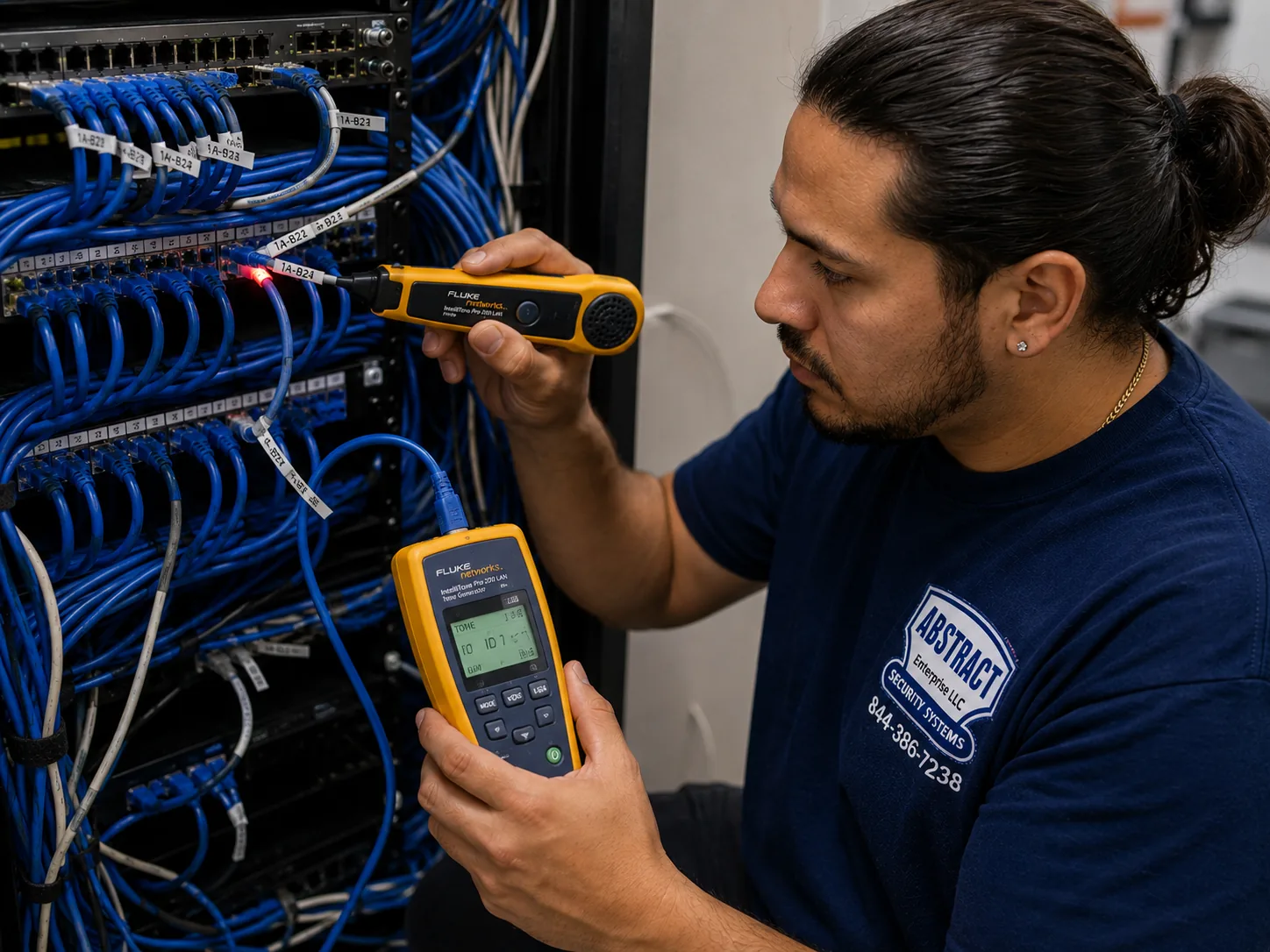
A photo from our job library, not taken in Ocean Hill: a technician tracing an unlabeled cable with a tone generator and a probe. In an Ocean Hill walk-up where the cellar holds wire from the original building, the 1990s rebuilding and at least one later repair, this is how the run that actually reaches the third floor is found. The tone goes on at the apartment end, the probe finds it downstairs, and nothing is cut on a guess.
What We Install
Intercom Installation Services in Ocean Hill
Every Ocean Hill job is shaped by three facts: how many households share the street door, what the building's existing wire can and cannot do, and who will look after the system once we leave. The services below cover the combinations we see most often on these blocks, from a two-family on a short Place street to a new building near Broadway Junction.
Stations for row-house street doors
A call station at the stoop door or the ground-floor door, anchored into solid brick or brownstone rather than a mortar joint, with a labeled button for each household.
A button and a station for every household
For rows that hold two, three or four apartments: each household rings separately, answers separately and releases only the street door.
Video upgrades for walk-ups
Moving a three- to twelve-apartment walk-up from an old audio or buzzer system to video, on tested existing cable where it passes and new cable where it does not.
Full replacement where nothing works
For buildings where the old system is dead or missing entirely: new street station, apartment stations, power, cable and door hardware, planned as one job.
Strikes, closers and latching
Electric strikes fitted to the actual latch and frame, closers set so the door returns and latches on its own after every release, in line with the city's self-closing rules.
Prewire for new construction
Cable to every station, door, elevator lobby and apartment, plus a sensible equipment room, pulled while a new building or gut rehab is still open.
Residential doors beside storefronts
For mixed-use buildings on Broadway, Fulton, Ralph and Rockaway: the apartments' door gets its own station, power and cable, separate from the business below.
Phone answering and mixed answering
Calls that reach a wall station, a phone or both, so a tenant who works nights and an owner who lives in Queens can each answer the way that suits them.
Takeovers of systems without paperwork
Systems inherited from a builder, a previous owner or an earlier rehab, tested, documented, reprogrammed and either kept or replaced with a written reason.
A photo from our job library, not taken in Ocean Hill: a technician at work on a door-entry installation. At an Ocean Hill row-house or walk-up door, this is the stage where two things are settled together: that a release from any apartment opens this street door and nothing else, and that the same door still opens freely from inside, with no button or code, whether or not the intercom has power.
Building Specialists
Intercom Installation for Ocean Hill's Architecture
Six kinds of building account for almost every intercom request from Ocean Hill. They differ in what the front is made of, how much room there is beside the door, how many households share it, what survived inside the walls, and who has the final say. The cards name them; the notes that follow explain how the work changes for each.
The brownstone and brick row
Italianate and Neo-Grec row houses from the 1870s to the 1890s, with stoops, carved lintels and narrow fronts, many split into two to four apartments.
The painted-brick row
Rows on Pacific Street, Bergen Street, Prospect Place and nearby blocks where the brick has been painted, sometimes many times over.
The rebuilt shell
An old front with a 1990s interior: new partitions, newer wiring, often a steel door and frame, and an intercom installed during the rebuilding.
The house from the 1990s rebuilding
Houses and small buildings put up new on empty lots after 1993, when city-backed construction filled much of the neighborhood.
The walk-up and the mixed-use building
Three- and four-story buildings with apartments over stores, common around Broadway and Saratoga Avenue and along Fulton Street, plus prewar walk-ups on the side streets.
The managed building
PACT apartments such as Ocean Hill Apartments and Saratoga Village, and new affordable buildings with live-in superintendents and professional management.
The brownstone and brick row: little room, solid walls, two doors to choose from
The oldest Ocean Hill houses were built for one family and a stoop. Brownstoner describes the row at 587–611 Decatur Street, designed and built by J. Mason Kirby in 1891, and 722 Decatur Street as part of a row from about 1895, an 18-foot-wide house that keeps its brownstone front. Fronts that narrow leave very little flat wall beside the door. Between the door frame, a carved surround, the stoop railing and the property line there may be only a few inches that a station can sit on and a visitor can reach. The first decision on these houses is which door the visitor should use. Where the house has been divided, the stoop door usually leads to the stair and the apartments above, while the ground-floor door under the stoop serves the garden apartment or the owner. If both doors receive visitors, both need a station, and each indoor station needs to know which door is calling. If only the stoop door matters, the lower door stays on its key.
Inside, the route for cable usually starts in the cellar. Wire comes up through the floor near the front wall, rises in the stair hall along the stringer or inside a closet, and reaches each apartment at its entry. Brownstone and old brick take a station well when it is anchored into the stone or the face of a solid brick, not into a mortar joint, and mounted on a backing plate where the surface is uneven. Where the old bell plate left holes, we plan the new station to cover them rather than add new ones beside them. Original plaster stair halls get the least disturbance we can manage: cable rides in the shadow of a baseboard or a stair stringer, inside a painted raceway where it must be visible, and through floors at the back of closets wherever the layout allows.
The painted-brick row: what the paint hides
The Brooklyn Eagle singles out the painted brick rows of Pacific Street, Bergen Street and Prospect Place as some of the neighborhood's best-looking blocks. Paint is part of what makes them handsome, and it also changes the installation. Under several coats it can be hard to tell solid brick from a patched area, an old filled opening or a soft joint, and an anchor that looks secure in fresh paint can pull out of crumbling brick behind it. Before drilling, we look at the wall at an angle in good light, tap around the planned spot, and drill a small test hole where the wall gives any doubt.
The other issue with painted fronts is that every surface we add has to live with the next coat of paint. A station mounted directly on painted brick will either be painted around, leaving a ring when it is removed, or painted over, which can seal its speaker grille and buttons. We mount on a backing plate sealed to the wall, run any exterior cable inside the wall or behind the door frame wherever possible, and leave the owner a note for the painters about what should be masked. Where the cable has to show outside for a short stretch, it goes in a slim raceway the painters can coat to match.
The rebuilt shell: a 1990s building behind a 19th-century front
Many Ocean Hill buildings were rebuilt from the inside out during the city-backed rehabilitation that followed the years of abandonment. From the street they look original. Inside, the stairs, partitions, wiring and doors can all date from the 1990s, and so can the intercom, if one was installed at all. These buildings often make intercom work easier than an untouched row house, because the interior walls are newer drywall over studs, the cellar ceiling may be open, and there may be a chase or a closet stacked floor over floor. They also bring their own problems. The steel door and frame installed during the rebuilding take a different strike than a wooden door, and the frame may be filled with grout. The 1990s intercom, if there is one, is now about thirty years old, and its handsets and power supply may be impossible to replace one at a time.
What decides the job in these buildings is the cable. If the rebuilding left a dedicated intercom run to each apartment, still intact and still tagged, it can often carry a new two-wire video system once it passes a test. If the wire was spliced through several later repairs, run in a daisy chain from apartment to apartment, or shared with something else, it usually cannot. We test every run for continuity and for leakage between conductors before deciding, and we write down which ones pass. The answer is usually mixed: some runs stay, some are replaced, and the quote says which.
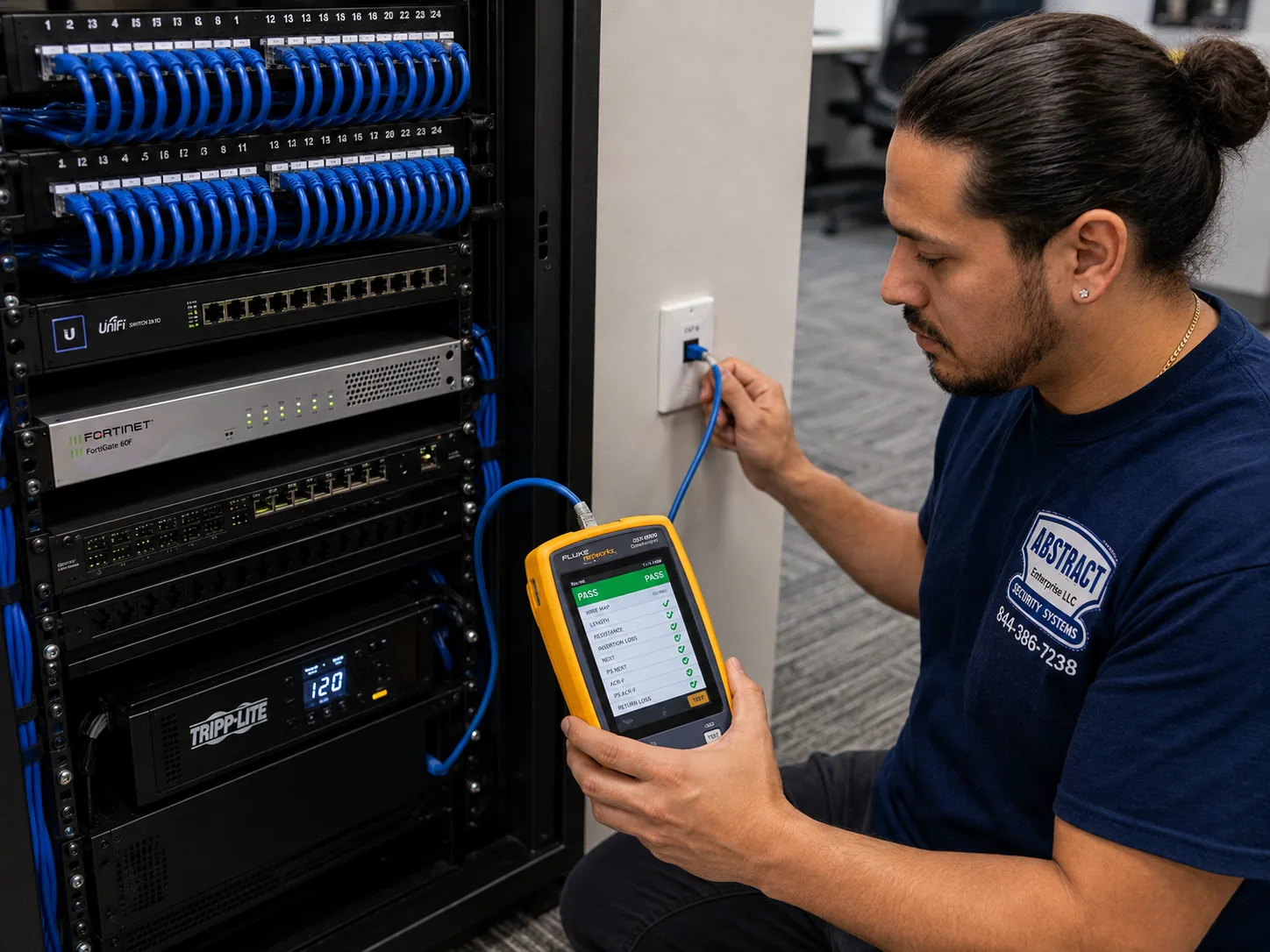
A photo from our job library, not taken in Ocean Hill: a technician certifying a cable run with an analyzer that reads PASS. In an Ocean Hill building rebuilt during the 1990s, the existing intercom runs are tested in much the same spirit before anyone decides to reuse them. A run that passes can carry a new system; a run that fails, or was spliced in the cellar by three different repairmen, is replaced, and the quote says which is which.
The house from the 1990s rebuilding: built new, now middle-aged
On many blocks between Broadway and Atlantic Avenue, the house beside a 19th-century row was built new during the 1990s, when HPD and the New York City Housing Partnership were among the neighborhood's major developers. These houses usually have one, two or three households, a front door at or near ground level rather than at the top of a tall stoop, and frame or block construction behind a brick face. Some came with a simple doorbell, some with a basic audio intercom, and some with nothing at all. Their owners are often the first or second people to live in them, and many have rented an upper floor for years.
The work here is closer to a modern house than an old row. Cable can often travel through a basement ceiling or a utility space and up an interior wall without much drama. The questions are mostly about households: whether the tenant upstairs should be able to release the street door but not the owner's apartment door, whether the owner wants a camera picture on a phone while at work, and whether the original wire, if any, is still the gauge and condition a new system needs. Where the face is brick veneer over block, we anchor into the block behind it through a sealed opening rather than relying on the veneer alone.
The walk-up and the mixed-use building: risers, vestibules and a store downstairs
Community Board 16's 2020 minutes describe the blocks around Broadway and Saratoga Avenue as mostly three- and four-story mixed-use buildings, and Fulton Street has its own run of buildings with stores below and apartments above. Homes.com lists 2132A Fulton Street, for example, as a four-family with one commercial unit at street level. In these buildings the residential door often sits right beside a shop entrance, behind a roll-down gate or under a sign, and leads to a narrow stair. Prewar walk-ups on the side streets add a vestibule, with an outer door and an inner door. The station goes where a visitor will find it and nobody will block it, the strike goes on the door that actually secures the stair, and the residential system gets its own power, separate from the store.
Getting cable up a walk-up without opening every apartment is the hard part. We look for an old riser, an abandoned pipe, a dumbwaiter shaft, a closet stacked over closet, or the stair hall itself. Where a cellar wall has to be crossed, the hole is cored, sleeved and sealed. In buildings with eight or more apartments the city's intercom requirement applies, and the system has to reach every apartment and keep reaching it; we size the power supply for the farthest station and keep the equipment where the owner or super can get to it.
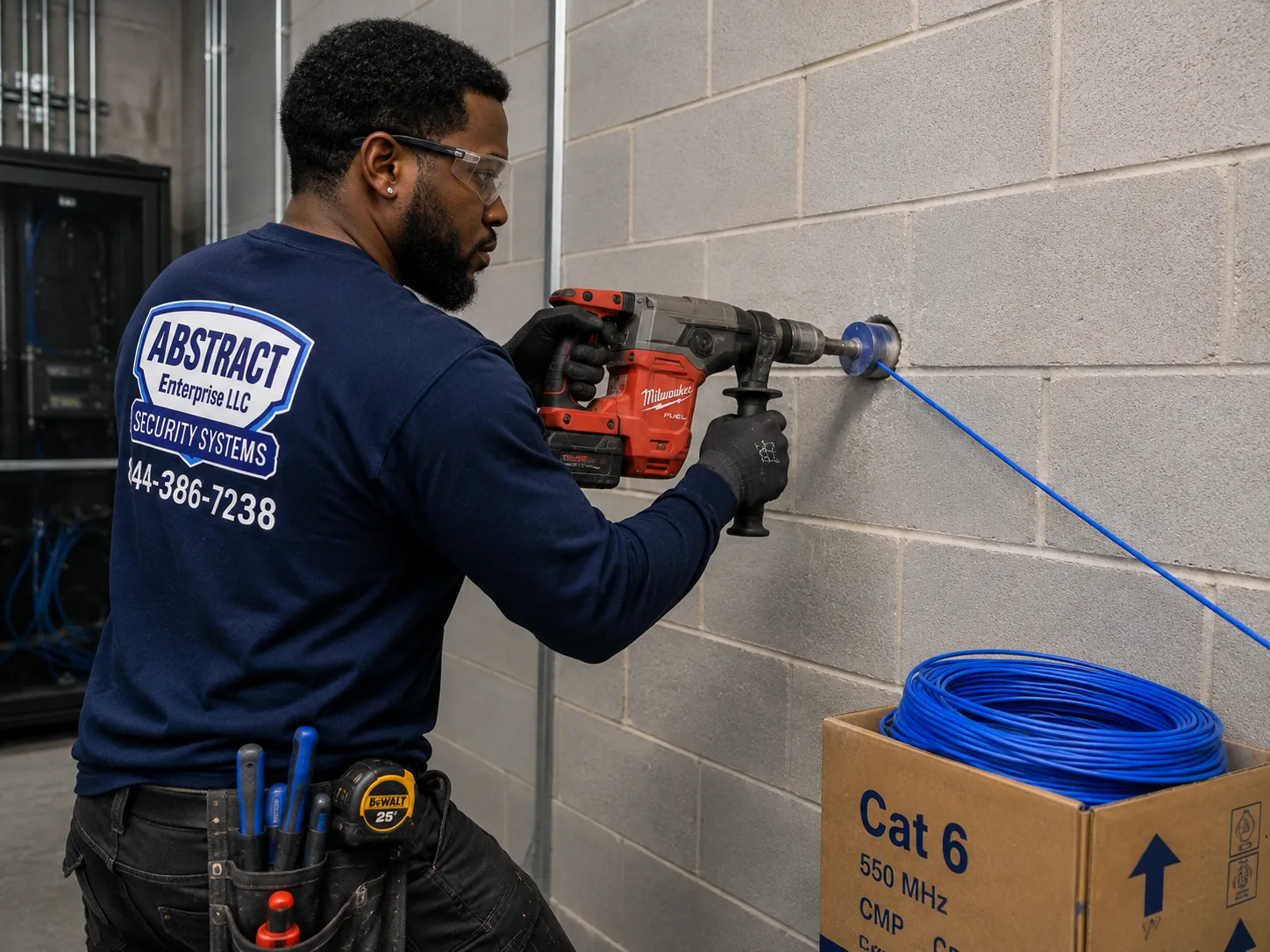
A photo from our job library, not taken in Ocean Hill: a technician core drilling a block wall so cable can pass through to a network room. In an Ocean Hill building rebuilt with block walls in its cellar, intercom cable reaches the stair or the equipment closet the same way, through a clean core that is sleeved and sealed afterward so neither water nor pests follow the cable in.
The managed building: PACT apartments and new affordable housing
Ocean Hill Apartments and Saratoga Village are part of NYCHA's Ocean Hill + Stuyvesant Gardens PACT conversion, which closed its financing on September 25, 2025 and handed management to Wavecrest. The community plan describes key fob access at front and back doors and a large camera system, and NYCHA's Layered Access Control standard calls for key tags, a direct-call intercom and new locks, with electric strikes configured as fail-secure. Entry work in those buildings is part of the renovation, and residents with a problem should report it to management. We mention them here because their standards are useful to anyone building or renovating nearby: NYCHA's entrance guidelines, for instance, require building entrance closers to take at least five seconds to swing from 90 degrees open to 12 degrees, which is a sensible benchmark for any busy Ocean Hill door.
For private affordable buildings, such as Oceanhill III with its video intercom and live-in superintendent, the intercom belongs to a professional operation. The owner or sponsor usually wants calls to reach apartments directly, the super to have a way in for repairs and deliveries, and the management office to update the directory as apartments turn over. The work is less about cable and more about setup and records: who administers the system, how listings change at move-in and move-out, how residents without smartphones answer, and what happens to calls when the super is off duty. We set those rules up in writing with the manager before handover.
Field Notes
Field Notes: What a Technician Looks At Between an Ocean Hill Stoop and the Cellar
Ask who holds the keys. The survey starts with people, not wire. Who owns the building, who lives in it, who answers the door during the day, and who gets the phone call when something breaks. In a building where the owner lives elsewhere, that person needs to be part of the plan from the start.
Count households, not doors. A row house with one street door may hold four households, and a walk-up may have more apartments than buttons on its old plate. The technician counts mailboxes, apartment doors and gas or electric meters, then compares that count with the plate and with what the owner says.
Look at the door before the wire. An electric strike cannot fix a door that does not close. The technician opens the street door, lets it go, and watches whether it returns and latches on its own. A door that sticks, sags, drags on the saddle or slams too hard needs closer or hinge work before any release goes on.
Find the old power supply. In row houses it is usually on a cellar wall, sometimes beside the boiler, sometimes behind a stack of stored boxes. Its age, its label and the condition of the wires on its terminals say a lot about what else is waiting in the building.
Test the runs that already exist. Every run that might stay is checked for continuity and leakage. Old bell wire, 1990s intercom cable and any later additions are marked on a sketch as usable, doubtful or dead.
See the entrance at the hours it is used. Under the elevated structure on Broadway, a doorway that looks fine at noon can be in deep shadow at night. The technician notes the light at the door, what the camera will face, and where glare from passing headlights or shop signs will fall.
Ask who maintains it next year. Before anything is ordered, we agree who will add and remove names, reset a forgotten password, and call when a station fails. That person gets the administrator login and a copy of the wiring record.
Which Rules Apply
Four Households or Forty: What New York Rules Ask of an Ocean Hill Front Door
Ocean Hill holds every size of building on the same blocks, from two-family rows to buildings of more than two hundred apartments, so the rules an owner faces depend on which building they own. We are installers, not lawyers, and nothing on this page is legal advice. These are the public sources we work from, so owners, boards and managers can ask their attorney or agent the right questions before the work starts.
One- and two-family houses. The city's best-known intercom rules are written for multiple dwellings, which begin at three apartments. An owner of a one- or two-family row who installs an intercom does so by choice. Once a tenant relies on a door system, though, keeping it working becomes part of keeping the apartment in good repair.
Buildings with three to seven apartments. Parker Custom Security summarizes the rule this way: buildings with fewer than eight apartments are not covered by the intercom requirement, but the self-closing and self-locking door requirement still applies. Many Ocean Hill rows and small walk-ups fall in this group. NYCHA's design guidelines quote the definition in Local Law 62 of 2022: a self-closing door returns to the closed position and self-latches shut when it is opened and released. Any strike we fit has to work with that, not against it.
Buildings with eight or more apartments. Habitat Magazine and Parker Custom Security both describe the Multiple Dwelling Law requirement for a two-way voice intercom between the self-locking front door and each apartment in buildings of eight or more units built or converted after 1968, with older buildings covered once tenants of a majority of the apartments request one in writing. Parker Custom Security adds that a non-working intercom is a Class B hazardous violation enforced on tenant complaint, and that courts have treated a working intercom as part of the warranty of habitability under Real Property Law §235-b.
Rent-stabilized buildings. Seneca Security notes that replacing an intercom in a rent-stabilized building is generally considered a capital improvement under DHCR guidelines, which brings more paperwork and tenant notice. Owners in that position should talk to their attorney before the work is scheduled. What we can supply is an itemized quote, a dated invoice, a description of the equipment installed and removed, and a written schedule of the days we need access to apartments.
Heights at the entrance. Department of Buildings rule 1 RCNY 42-01 says no push button may be more than six feet from the floor and the speaking and listening device must be between four and five feet from the floor. On an Ocean Hill stoop, we measure from the top step where the visitor stands, not from the sidewalk.
Permits. The sources disagree. A 2025 guide from Low Voltage New York says that under Administrative Code §28-105.4.7, effective December 21, 2025, wiring below 50 volts for communication and signaling circuits may be done without an electrical permit by a licensed master electrician, a special electrician or a qualified person, while Low Voltage Nation says low-voltage work requires permits through DOB. Both agree that line-voltage work, such as a new circuit for an intercom power supply, needs a permit and a licensed master electrician. We tell each owner which parts of their job fall where, and the electrical side stays with a licensed electrician.
Landmarks. We found no historic district inside Ocean Hill proper, but the expanded Stuyvesant Heights district reaches some 11233 addresses to the west, including 321 Decatur Street. Where LPC does apply, its permit guidebook allows one intercom panel per door opening, reviewed under Section 2-20(c)(3) of its rules. The LPC's Discover NYC Landmarks map is the place to check a specific lot before ordering a panel.
Getting out. Whatever the building, every door we fit with an electric strike or lock opens from inside without a key, a code or a button, and keeps doing so with the power off. The intercom controls who comes in, never who can leave.
Before the Walls Close
Ocean Hill Is Building Again: Putting the Intercom on the Drawings, Not on the Punch List
The new buildings rising in Ocean Hill are bigger than anything built here in decades. Oceanhill III has 107 apartments, the Henry Apartments 134 per building, 2425 Pacific Street 236, and the approved Herkimer-Williams complex up to 1,000 across four buildings. In buildings that size the intercom is a system that touches the lobby, every floor, the elevators, the super's apartment and the management office. When it is treated as a fixture to be bought near the end of construction, the result is familiar: cable pulled late through finished walls, a lobby station placed wherever the last electrician left a box, and a directory nobody owns. When it is planned with the building, it disappears into the walls and works.
When to bring it in. The right moment is when the electrical and low-voltage drawings are being drawn, before the rough-in. At that point the lobby station location can be chosen with the architect, the vestibule doors can be specified for the strike and closer the system needs, and the equipment room can be put somewhere dry, ventilated and reachable without walking through an apartment. The cable itself goes in right after the electrician's rough-in, while studs and ceilings are open.
What gets pulled. A run from the lobby station and from every other entrance station to the equipment room. A run to each apartment station location, terminated in a box at the agreed height and wall. A run to each electric strike or lock, and to any door position sensor the manager wants. Runs to elevator lobbies if the building will use elevator access. Spares, labeled and capped, where the builder allows, because the cheapest cable a building ever gets is the cable pulled before the drywall goes up.
The entrance on Broadway. Several of the new buildings face the elevated structure. The city's merchant study for Ocean Hill and Weeksville found that poor lighting under the el on Broadway contributes to a poor sense of safety at night. For a new lobby that means the station should sit where the building's own lighting falls on the visitor's face, out of direct glare from shop signs and passing traffic, inside a recess deep enough to keep the weather off. Those choices are easy on paper and expensive to change once the facade is finished.
Handover to management. Affordable buildings often lease through Housing Connect, which can mean dozens of households moving in within weeks. Before the first move-in the manager should have the administrator login, a directory format that matches apartment numbers, a way to load names in batches, a plan for residents without smartphones, and a written record of every cable and device. We build that handover into the quote, because a system that is installed perfectly and handed over badly will look broken to the first tenants who use it.
A useful benchmark. NYCHA's Layered Access Control standard, used in the PACT buildings nearby, calls for a direct-call intercom, fail-secure electric strikes, and building entrance closers that take at least five seconds to close from 90 degrees to 12. A private developer is not bound by NYCHA's standard, but the same choices make sense for any Ocean Hill lobby that will see hundreds of people a day.
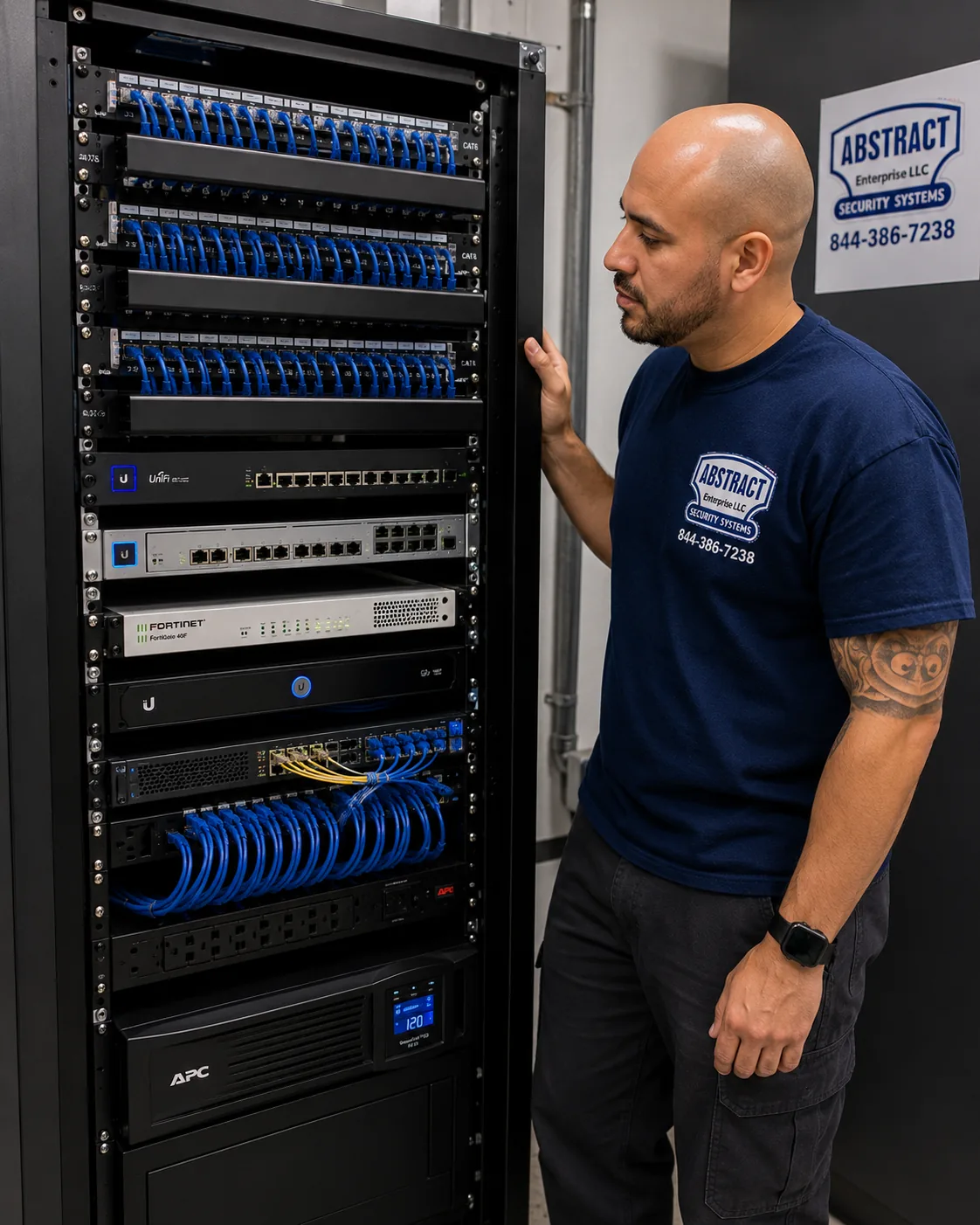
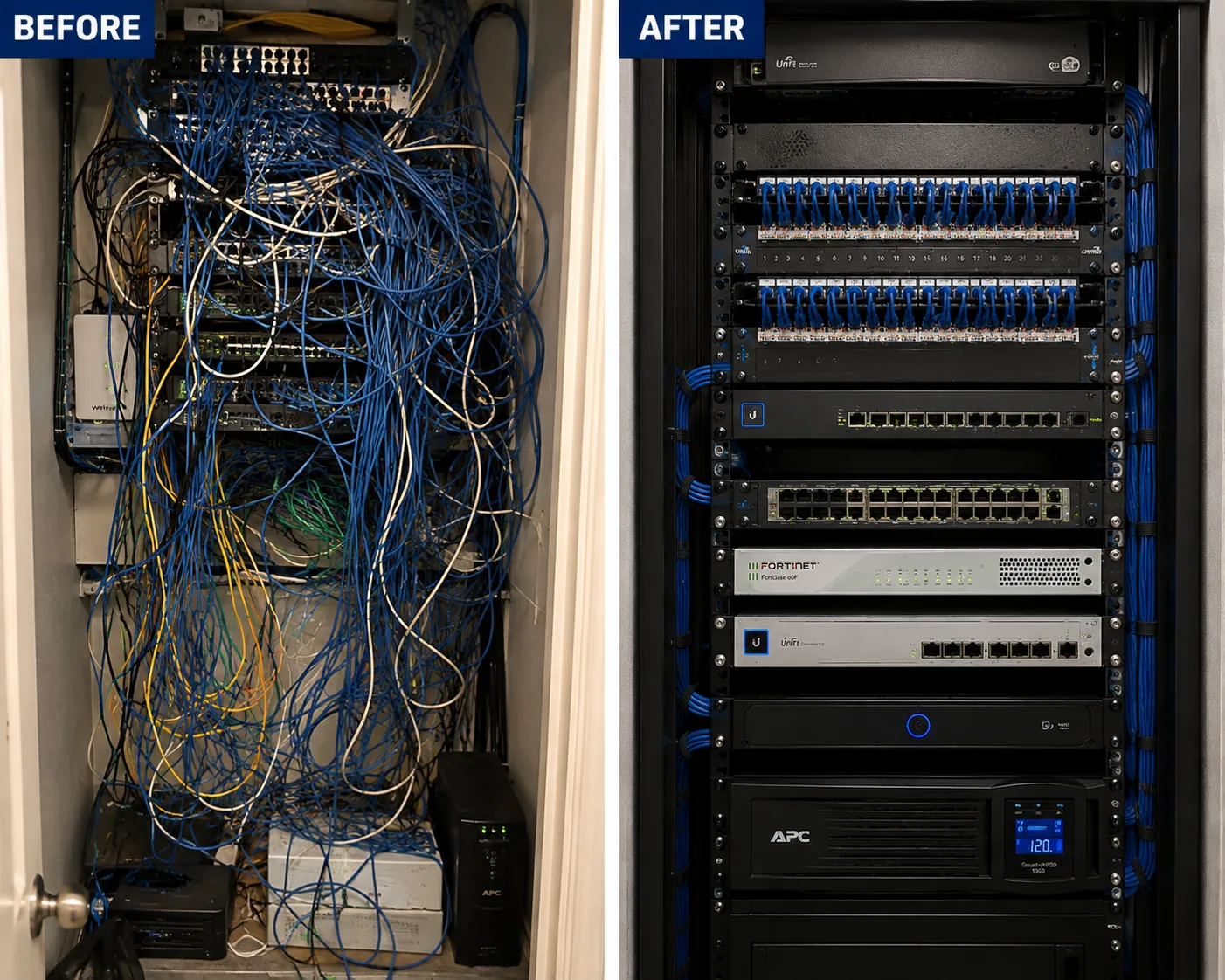
A photo from our job library, not taken in Ocean Hill: a finished rack with patch panels, switching, a firewall and battery backup, every cable dressed and labeled. A new Ocean Hill building of a hundred or more apartments needs its entry equipment to end up like this, in a dry room the super and the manager can reach, with battery backup for the lobby and every run named, so that the first service call after the builder leaves is a short one.
Commercial Intercom Installation
Business Intercom Installation in Ocean Hill
The Department of Small Business Services' Commercial District Needs Assessment for Ocean Hill and Weeksville, prepared with Bridge Street Development Corporation between September 2023 and June 2024, names four main commercial corridors: Broadway, Ralph Avenue, Rockaway Avenue and Fulton Street. It counted 560 storefronts, 11.3 percent of them vacant. Houses of worship were the largest category, with 79 storefronts, followed by beauty salons and barbershops with 65 and delis and bodegas with 52. Most merchants rent their space, and safety ranked high among what both merchants and shoppers said the corridors needed. The study also found that the poorest storefront conditions were on Fulton Street between Howard and Rockaway Avenues, and that the lighting under the elevated train on Broadway makes the street feel unsafe at night. City Planning's profile of the area describes Atlantic Avenue as auto-oriented, lined with gas stations, car washes, repair shops and storage. The cards below describe the kinds of space where a door station earns its place; we do not name any business as a customer.
Storefront churches
A station at the side or hall door so visitors for a weekday program reach whoever is inside without the front doors standing open, and a release kept to the people who run the space.
Salons and barbershops
A station at the door, with the indoor unit placed where the person at the front chair can see the picture without leaving a client.
Delis, bodegas and food shops
A station at a rear or side delivery door so suppliers ring the stockroom instead of walking through the shop, with the cable kept clear of coolers and heat.
Apartment doors beside storefronts
The residential door in a mixed-use building, with its own station, power and cable, so shop hours, renovations and tenant changes never touch the apartments' entry.
Offices and community organizations
Upstairs offices, clinics and programs on the avenues, where visitors ring at the street door and staff see them before releasing it.
Garages and yards on Atlantic Avenue
Repair shops, storage and service yards where a station at a pedestrian door or gate lets a driver or customer reach the office from outside.
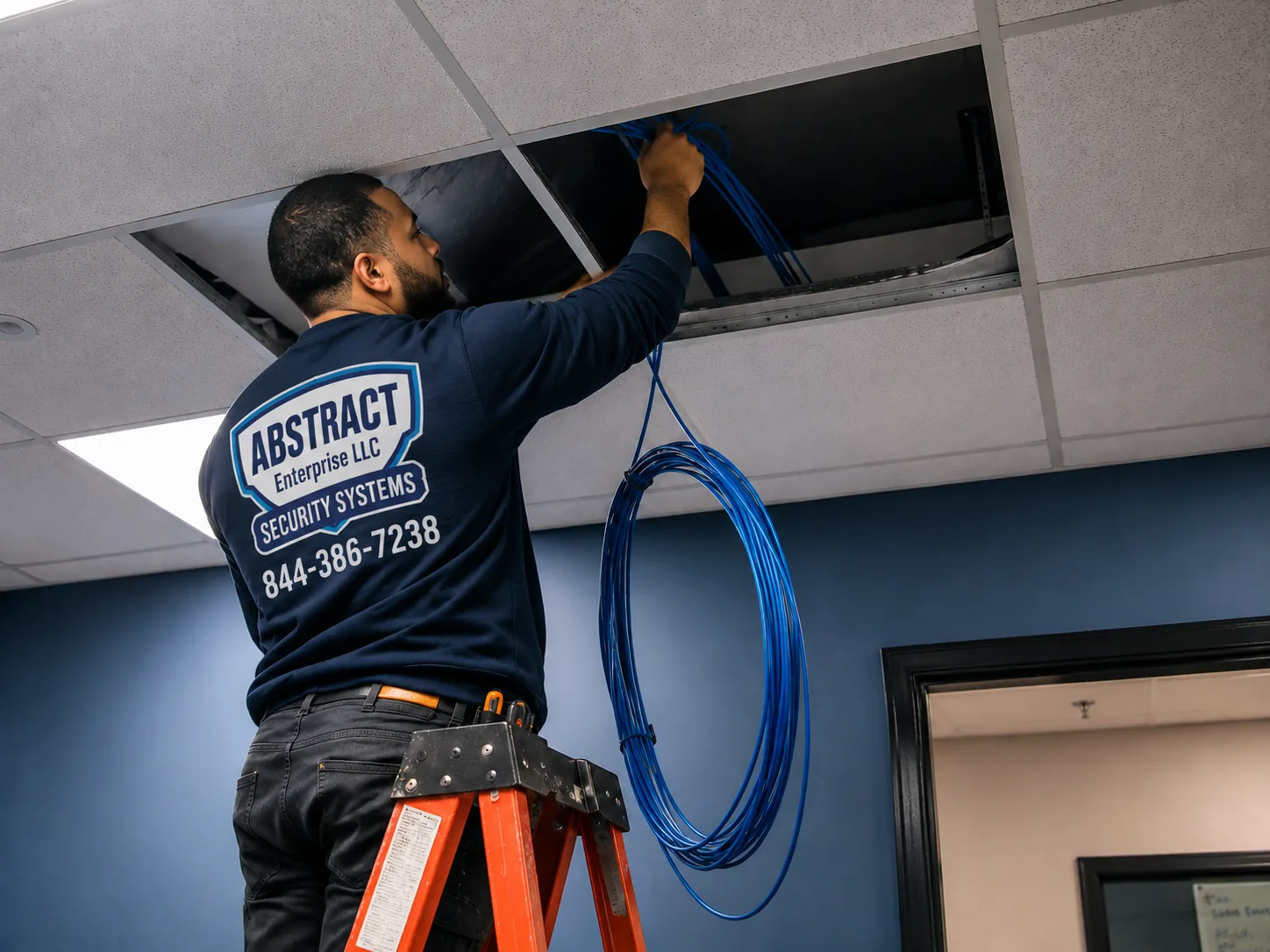
A photo from our job library, not taken in Ocean Hill: a technician feeding cable through the ceiling of a commercial space that stays open during the work. When a salon on Rockaway Avenue or a deli on Fulton Street keeps serving customers while a station goes in at its back door, the cable is pulled in short sections, the floor stays clear, and working hours are agreed with the owner before the ladder goes up.
Compliance notes for Ocean Hill stores, churches and mixed-use buildings
Free exit from every door. Doors with an electric strike or lock open from inside without a key, code or button, and stay that way with the power off. The intercom controls entry only.
The apartments' door still closes and latches. Where apartments share a building with a business, the residential door must return and latch on its own after every release, in line with the self-closing rules HPD enforces.
Reach heights. Rule 1 RCNY 42-01 caps push buttons at six feet and places the speaking device between four and five feet. Spaces open to the public also follow accessibility reach rules, which usually puts buttons lower.
Separate systems for residents and businesses. The residential intercom gets its own power and cable path, so a store's renovation or a change of tenant never cuts off the apartments upstairs.
Life-safety devices left clear. Stations and cable never block an exit sign, a fire alarm device, a sprinkler head or the swing of an exit door, and low-voltage cable stays out of power wiring pathways.
The landlord's approval in writing. With most merchants renting, the building owner's written approval comes before any facade mounting or new opening through an outside wall.
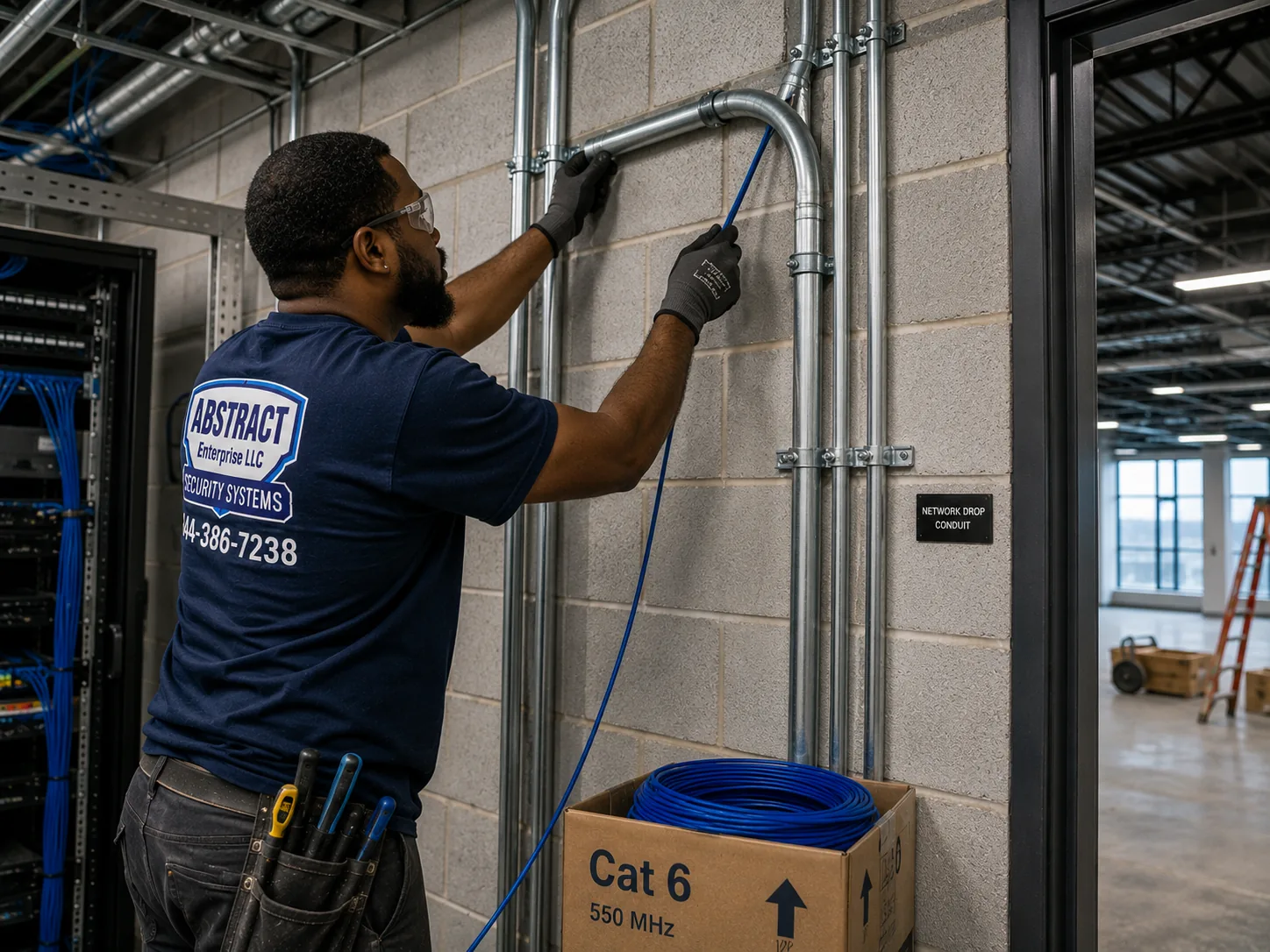
A photo from our job library, not taken in Ocean Hill: a technician running cable into EMT conduit beside a telecom room in an industrial building. In an Ocean Hill cellar shared by a store and the apartments above it, or in a repair shop on Atlantic Avenue, intercom cable travels the same way, inside metal conduit where stock, tools and deliveries cannot crush or cut it.
Your Questions Answered
Intercom Installation in Ocean Hill: Questions Answered
These are the questions Ocean Hill owners, landlords and managers raise most when an intercom is being planned: how it fits a painted or brownstone front, what happens inside old and rebuilt walls, what rent-regulated buildings should keep on file, and how new and mixed-use buildings set up their entries. Each is answered once here and not repeated in the FAQ further down.
On the front of the house
Our row's painted brick front is due for a fresh coat in the spring. Should the door station go in before the painters or after?
Usually before the painters, with a clear plan for what they mask. If the station goes in first, the anchors, the backing plate and the sealant around it are part of the wall the painters cover, so there is no fresh drilling into new paint and no unpainted ring around the station later. The painters mask the station face, its speaker grille and buttons, and the new coat seals the edge of the backing plate. If the station goes in after, it has to be mounted on paint that may still be curing, and any adjustment leaves marks on a finished wall. The exception is a front that needs brick repair: if the painters are also repointing or patching near the door, the masonry work should come first, the station next, then the paint. We leave the owner a short note for the painting contractor that says what can be painted, what must be masked and what must not be pried off.
Our 1890s row still has its old brass bell pushes beside the door. Do they have to come off when the new station goes on?
Not necessarily. Old brass pushes are part of the front's character, and many owners would rather keep them. If the pushes are not connected to anything, they can stay in place as decoration, with any wire behind them cut back and capped so nobody mistakes them for working buttons. If they are still wired to an old bell, the owner can decide whether to keep that bell working alongside the new system or retire it. The real issue is space and confusion. On a narrow front, the new station needs a flat, solid spot near the door, and if the pushes occupy the only good spot, the choice is between moving the station somewhere slightly less convenient or moving the pushes. And visitors should never stand facing two sets of buttons wondering which one works. Where the old pushes stay, the new station gets a clear label and the pushes stay dark.
Inside old and rebuilt walls
Our kitchen wall is plaster laid straight onto the brick party wall. How does an apartment station go there when there is no hollow space for the wire?
There are three usual answers, and the survey decides which fits. The first is to choose a different wall. A kitchen in an old row house often has at least one partition wall of plaster on lath or a newer stud wall, and moving the station a few feet onto that wall lets the cable run inside it. The second is to bring the cable along the surface in a slim painted raceway from the floor or from a nearby door frame, which keeps the brick untouched and is easy to remove later. The third, where the owner wants nothing visible, is to cut a shallow channel in the plaster, lay the cable in it and patch over it, which is slower and is only worth doing on a wall that is being replastered anyway. We do not chase into the brick of a party wall itself without the owner's agreement, since that wall is shared with the house next door.
The intercom wire in our 1990s rehab is stapled along the cellar ceiling, right where the plumber keeps working. Should it be moved?
If it keeps getting knocked, cut or bundled with pipe, yes. Cellar ceilings in Ocean Hill rehabs tend to fill up over the years with new water lines, gas lines and a tangle of later cable, and the intercom run stapled to the bottom of a joist in 1995 is usually the first thing a plumber pushes aside. When we install a new system, the cellar route is planned to stay out of the way: along the side of a joist rather than its bottom edge, in hangers or a short stretch of conduit where it crosses a work area, away from the boiler flue and hot pipes, and labeled every few feet so the next tradesperson knows what it is. If the existing run is being reused, we check it at the cellar end for staples driven through the jacket and old repairs taped together, both of which are common and both of which are worth fixing while the ceiling is accessible.
Our St. Marks Place row has four apartments on three floors and one street door. Is a boxed four-button kit enough, or should we plan for something bigger?
A well-chosen kit can serve four apartments perfectly well, as long as it really fits the building. The questions are practical. Does the kit's cable requirement match what the building has or can get, especially if it relies on a single pair of old wire up three floors? Can it add a fifth button later if a cellar or top-floor unit is legalized? Are replacement apartment stations sold on their own, so one broken unit does not mean replacing the set? Does it work with the strike the street door needs? And does it let some households answer on a phone without forcing everyone to? Many kits do all of that. Some are built as a closed set that cannot grow. We look at the specific kit before the visit if the owner already has one in mind, and if a slightly larger system costs only a little more for a lot more flexibility, the quote shows both side by side.
Rent-regulated walk-ups
We own a rent-stabilized walk-up and our attorney may file the new intercom with DHCR. What should the installer's paperwork show?
Your attorney will say exactly what the filing needs, but the paperwork that usually helps is easy to produce if it is asked for at the start. An itemized quote and an itemized final invoice, with equipment and labor separated and every station, strike, power supply and cable run listed. Make and model numbers of what was installed. A description of what was removed, such as the old street panel and handsets, and what was left in the walls. The dates the work was done, and the dates we needed access to each apartment. Proof of payment. Photos of the old system before removal and the new one after installation. And a note that the system serves the whole building, not a single apartment. We keep this as a single packet, dated and signed, so the owner is not reconstructing it months later from text messages. We do not advise on rent calculations or filings themselves; that belongs with the attorney and DHCR.
A tenant has a video doorbell on her apartment door inside the hallway. Will it conflict with the new building intercom?
Usually not, because the two do different jobs at different doors. The building intercom handles the street door: a visitor rings from outside, the tenant answers and releases the street door. The doorbell at her apartment door handles whoever reaches that door, such as a neighbor or a courier already inside. The two can sit side by side without interfering, as long as nothing about the new system depends on the hallway Wi-Fi her doorbell is using. What we do check is the wiring. If her doorbell was wired into the old intercom's handset or its power, which tenants sometimes do, removing the old handset can leave her doorbell dead. We look for that before the old equipment comes out, tell the owner and the tenant, and leave her doorbell's wire capped and labeled so it can be powered properly. Whether a tenant may mount anything on her apartment door is between her and the owner.
New and mixed-use buildings
Our new building has more than a hundred apartments, and most households will move in within a few weeks. How do we keep the lobby directory right during lease-up?
Treat the directory as part of the move-in process, not as a separate task. Before the first move-in, load every apartment into the system by number, so a visitor can reach any apartment even before a name is attached. Decide who adds names, which is usually the leasing or management office, and give that office its own login rather than sharing the master administrator password. Use a format the residents agree to, such as surname and initial, and let anyone who prefers to be listed by apartment number only do so. Most networked systems can import a list from a spreadsheet, which beats typing a hundred entries by hand; the leasing office's rent roll is a good starting point. Phone answering should be set up at the move-in appointment, with the resident present, so it is tested before keys are handed over. We set up the structure and train the office, and the office keeps it current from there.
The apartments' door in our Rockaway Avenue building sits in a recessed doorway beside the shop's roll-down gate. Where can the station go so the gate never covers it?
On the side of the recess away from the gate's track, or on the face of the doorway's frame itself, and only after the gate has been rolled all the way down on the survey. Roll-down gates on these buildings often come down over more of the front than anyone remembers, and some have a box or a lock bracket that sticks out at chest height. The station has to stay reachable and visible with the gate fully closed at night and fully open during the day, and its camera has to see a visitor standing in the recess, not the inside of the gate's housing. We also check where the gate's own motor wiring runs so the intercom cable does not share it, and that the gate's bottom bar and lock cannot strike the station or its cable as the gate comes down. If the recess is too tight, a station mounted on the wall just outside it, under a small hood, is usually the fallback.
A photo from our job library, not taken in Ocean Hill: a technician completing and checking an installation before handing it over. In an Ocean Hill building, this is when every apartment calls the street door and is called from it, every release opens the door and lets it relatch, the door is opened by hand with the power switched off, and the wiring record and logins are handed to the person who will look after the system.
Equipment
Types of Intercom Systems We Install
We install and service Aiphone, Comelit, 2N, Akuvox, ButterflyMX, DoorBird, Dahua and Hikvision door stations, among others, and work on many older systems already in Brooklyn buildings. In Ocean Hill the right category depends on how many households share the door, what the existing cable tests like, whether the owner lives on site, and whether residents want to answer on a wall, a phone or both.
Audio intercoms
A street station and a talk-and-release handset in each apartment. Durable and easy to explain, and still the right answer in many two- to four-family rows.
Two-wire video
Video, audio and release carried over a single pair, which lets many rebuilt walk-ups move to video on 1990s cable that passes a test.
Networked stations
Street, vestibule and apartment stations on network cable, often powered through it, for new buildings, gut rehabs and larger walk-ups.
Phone and app answering
Calls that reach residents' phones, alone or alongside a wall station, for owners who live elsewhere and tenants who are rarely home.
Strikes, closers and door hardware
Strikes for wooden, mortise-lock and steel-framed doors, and closers set so each release ends with the door shut and latched.
Power supplies and backup
Supplies sized for the farthest apartment, mounted where the owner or super can reach them, with battery backup where the entrance needs it.
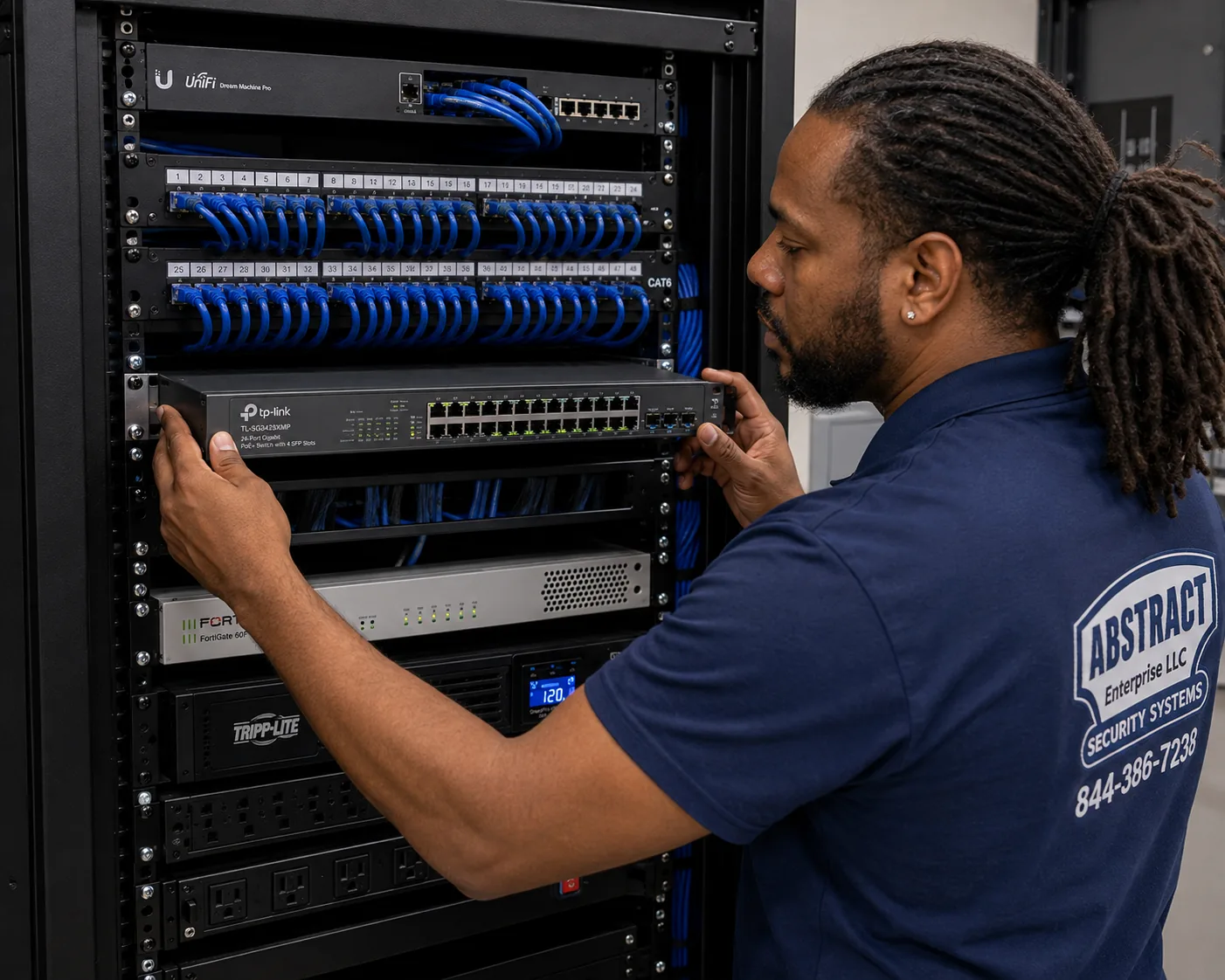
A photo from our job library, not taken in Ocean Hill: a technician mounting a managed switch that powers devices over their network cable, below a row of patch panels. In a networked intercom for a new Ocean Hill building or a large walk-up, a switch like this powers the lobby station, the vestibule station and the apartment stations from one place, so there is a single supply to back up and a single closet to check when something goes quiet.
National brands, a do-it-yourself doorbell, or a local installer, for an Ocean Hill building
Smart doorbells from companies like Ring and SimpliSafe are built mainly for one household behind one door, and for that they can work well. ADT and similar national companies sell systems on a monthly-service model. This comparison is about Ocean Hill's shared row-house doors, walk-ups and mixed-use buildings, not about the quality of any company.
What the building needs
Smart doorbell or national brand
Abstract Enterprises Security Systems in Ocean Hill
Three or four households on one street door
One button, one account
A labeled button and station for each household
Releasing the street door from upstairs
Usually not connected to any lock
Strike fitted, powered and tested on the actual door
Owner who lives somewhere else
Owner shares one login with tenants
Owner keeps the administrator login; each household its own access
Thick brick walls between the door and the router
Depends on Wi-Fi reaching the door
Cable from the station to the equipment
A building of eight or more apartments
Not designed for it
A system that reaches every apartment and can be documented
AI Overview Reality Check
What AI Gets Wrong About Intercom Installation in Ocean Hill
We could not capture a live AI Overview for this search, so the claims below are the ones general answers, cost guides and installer pages commonly make about intercoms in this part of Brooklyn. Each is set against what the local record and our work actually show.
"Ocean Hill is mostly postwar housing"
Some neighborhood summaries, including Homes.com, describe postwar buildings as the norm in Ocean Hill. An answer built on that line would assume modern walls, modern wiring and modern doors.
The record is more mixed. Cityneighborhoods.nyc dates the Italianate and Neo-Grec rows to the 1870s through the 1890s, Brownstoner documents 1891 and 1895 rows on Decatur Street, and Community Board 16 records more than 1,500 units started in the 1993 rebuilding. Many buildings are old outside and newer inside, and plenty are old all the way through.
For an intercom that difference is the whole job. Cable routes, anchors, door hardware and the reuse of old wire all depend on which kind of building is behind the front, so we find out on the survey instead of assuming.
"Most intercom upgrades can reuse the existing wiring"
Installer pages for Brooklyn say this often, and cost guides on Angi, HomeAdvisor and Fixr tend to price intercoms per apartment on the same assumption. When it is true, it saves a lot of money.
In Ocean Hill it is true for some buildings and badly wrong for others. A 1990s rehab with intact, dedicated runs can often carry two-wire video. An old row with spliced bell wire, or a walk-up whose wire was repaired piece by piece after years of neglect, usually cannot.
The only honest answer comes from a test. We check every run before quoting reuse, write down which runs pass, and price new cable only where the test says it is needed.
"Intercom wiring always needs a DOB permit," or "it never does"
General answers tend to pick one side. Some say any wiring needs a permit; others say low-voltage work needs nothing at all.
The sources themselves disagree. One 2025 guide reads Administrative Code §28-105.4.7, effective December 21, 2025, as allowing wiring under 50 volts for communication and signaling without an electrical permit when done by a licensed master electrician, special electrician or qualified person, while another says low-voltage work requires DOB permits. Both agree that line-voltage work needs a permit and a licensed master electrician.
So the right answer depends on the job. A strike and station on existing power is different from a new circuit in the cellar, and we tell each owner which parts fall where before work starts.
"Replacing a building intercom is a simple repair"
Answers aimed at homeowners describe an intercom replacement as a straightforward swap: take down the old panel, put up a new one.
For a rent-stabilized Ocean Hill walk-up, Seneca Security notes that intercom replacement is generally treated as a capital improvement under DHCR guidelines, which brings more paperwork and tenant notice. Apartments have to be entered, tenants have to be told, and the owner may need records long after the job ends.
We plan those buildings with the owner's attorney and agent in mind: an itemized quote, a written access schedule, and a dated packet of invoices, model numbers and photos at the end.
"A video intercom will make an entrance on Broadway safe at night"
Answers about building security often present video entry as the fix for an uneasy entrance.
The SBS study found that poor lighting under the elevated train on Broadway shapes how safe the street feels at night. A camera in a dark doorway shows a dark shape. And no intercom keeps out someone who follows a resident through the door or forces a weak frame.
A video station helps residents identify visitors before releasing the door. Lighting at the door, a closer that shuts the door fast enough, a sound frame and residents who do not prop the door open do the rest, and we look at all of them on the survey.
"Every 11233 address is in a landmark district," or "none of Ocean Hill is"
Because Ocean Hill sits beside Stuyvesant Heights and shares its ZIP code, general answers sometimes assume landmark rules everywhere, or nowhere.
We found no LPC district inside Ocean Hill proper, but an LPC filing places 321 Decatur Street, ZIP 11233, inside the expanded Stuyvesant Heights district. The ZIP code alone does not settle it.
The LPC's map does. Where a lot is covered, the permit guidebook allows one intercom panel per door opening, and we plan the station around that before anything is ordered.
"Owners face fines of $250 to $500 a day for a broken intercom"
This figure appears on several installer pages, including an older page of our own, and AI answers repeat it as settled fact.
We have not verified it with HPD. What the public sources agree on is that a non-working intercom in a covered building is a Class B hazardous violation, enforced on tenant complaint.
An owner who receives a notice should read the class and the correction instructions printed on it, rather than relying on a number repeated online. Our part is getting the system working and leaving dated records of the repair.
Not Sure Whether Your Building's Old Wire Can Stay? Ask Before You Order Anything
Tell us the street, the kind of building, how many households share the street door, and whether the owner lives in the building. If the old system has been dead for a while, say how long. If the building is rent-stabilized, in a PACT conversion or still under construction, mention it, and for new buildings tell us when the framing will be open. A technician will call back about the Ocean Hill address, or you can call (347) 934-8335 now.
✅
Request Sent!
Thank you. A technician will call you about the Ocean Hill address on the same working day.
How It Works
Our Installation Process
1. Photos and a door count
The street door, the old call plate, the latch side of the door and the old power supply, plus how many households share each entrance and who answers.
2. Building size, age and who signs
How many apartments, when the building was built or converted, whether it is rent-stabilized, and who approves the work and keeps the login.
3. Survey walk and wire test
The visitor's route walked, the door checked for closing and latching, the light at the entrance noted, and every existing run tested before any reuse is promised.
4. Written design and quote
Stations, buttons, door hardware, equipment location, cable routes and phone answering written down line by line before anything is ordered.
5. Door hardware and power
Strike fitted to the actual latch, closer set so the door returns and latches, and the power supply mounted somewhere dry, labeled and reachable.
6. Cable and stations
Cable on the agreed route and labeled at both ends; the street station anchored into solid masonry at the measured height, and each apartment station mounted and labeled.
7. Testing and handover
Every apartment calls and is called, every release opens the door and lets it relatch, the door opens by hand with the power off, and the wiring record and logins go to the person who looks after the system.
Full terms — including 50% deposit, the 30-day warranty and optional paid extended warranty, and the late-fee schedule — are set out in the service agreement.
FAQ
Ocean Hill Intercom Installation FAQ
How is intercom installation in Ocean Hill priced?
Each building is quoted in writing at our Brooklyn rate after a short survey. The quote lists every station, the strike and closer, the power supply location, the cable route, the programming and the labor on separate lines. There is no surcharge for walk-ups, for buildings near the el or for buildings with open violations.
What does a service call on an existing intercom cost?
Service calls and fault tracing are billed at our $195-an-hour service rate with a three-hour minimum, and we estimate the tracing time before we start. If repairing an old system would cost a large share of a new one, you get both options on paper.
How quickly can I get an estimate?
Requests are booked within two hours on working days, and many estimates can be given the same day from photos of the street door, the call plate, the latch side of the door and the old power supply.
Will the street door still open from inside if the intercom loses power?
Yes. Every door we fit with an electric strike or lock opens from inside without a key, a code or a button, and keeps doing so with the power off. The intercom controls who comes in, never who can leave.
Our management company won't let anyone touch the entrance of our Ocean Hill row house on Macdougal Street until it has a certificate of insurance naming the owner as additionally insured. Can you send that before install day, and how quickly?
Work is done under New York State license #12000287431, with insurance a managing agent, a lender, a nonprofit sponsor or a general contractor can ask to see before we start. Call (347) 934-8335 with any questions.