A dead buzzer in a Prospect Place walk-up, a three-family on Dean Street with no way to open the door from upstairs, or a church side door on Bergen Street? Weeksville door buzzer installation line: (347) 934-8335
Row-House Two- and Three-Families · Prewar Walk-Ups · New Affordable Buildings · Churches · Shops on Atlantic, Utica and Ralph Avenues
Door Buzzer Installation in Weeksville
HPD and 311 Record Read First · Door Made to Latch Before Any Release · Every Apartment Tested From the Sidewalk · Written Brooklyn Price
Door buzzer installation in Weeksville is mostly about small and mid-size buildings that the city's intercom rules treat very differently. On the blocks between Atlantic Avenue, Eastern Parkway, Troy Avenue and Ralph Avenue, more than 1,700 residential lots hold seven apartments or fewer, nearly 300 lots with eight apartments or more were built before 1968, and since January 2025 tenants there have filed 221 buzzer and intercom complaints with 311. Below is how we read that record, how we plan a system for each kind of building, and where each job lands on our Brooklyn price list.
Every price comes from our Brooklyn door buzzer list, and the total, with each possible extra named, is agreed in writing before anything is ordered
Rated 4.7★ across 201 Google Reviews
Reviewed and updated November 11, 2026, against NYC Open Data's HPD Housing Maintenance Code Violations, 311 Service Requests and MapPLUTO datasets (queried November 11, 2026 for the blocks between Atlantic Avenue, Eastern Parkway, Troy Avenue and Ralph Avenue, and for ZIP codes 11213 and 11233); HPD's Clear Violations page; the NYC Comptroller's 2022 report on building doors in NYCHA developments; the 2019 Kingsborough visioning summary published by HPD; New York's Multiple Dwelling Law §50-a; NYC Administrative Code §28-105.4.7; Brick Underground's November 2019 guide to NYC intercoms; LawNY's guide to landlord repairs; Wikipedia's articles on Weeksville and the Kingsborough Houses; Brownstoner's histories of Weeksville and Atlantic Avenue; NYC Housing Connect's listing for 1921 Atlantic Avenue; the New York Housing Conference's Weeksville Place profile; the NYC Department of Small Business Services' Ocean Hill–Weeksville commercial district needs assessment; the NYU Furman Center's Community District 8 profile; Aiphone's GT Series page; Allegion's fail-safe and fail-secure guide; the building code's sensor-release provisions; the 2010 ADA Standards; and the HomeAdvisor, Swiftlane and ButterflyMX intercom guides. · Abstract Enterprises Security Systems, NYS license #12000287431 · crews dispatched from our Troy Avenue office in Brooklyn
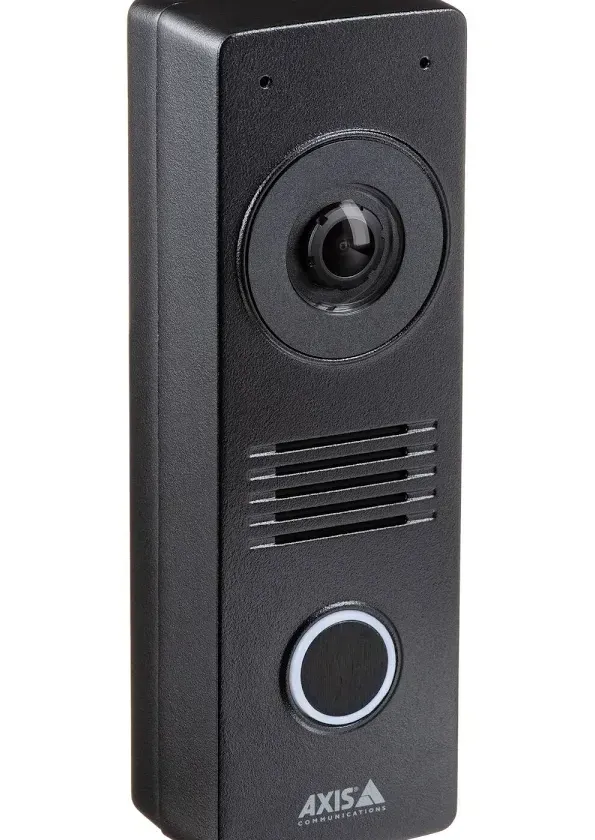
A photo from the AESS job library, not taken in Weeksville: a black rectangular video door station with a camera, a speaker grille and one round call button that lights up. A single-button station like this is the right size for the street door of a Weeksville two-family where the owner lives on the parlor floor, and the lit button gives a visitor on an unlit stoop something to find after dark.
Weeksville Buzzer Request
Row house, walk-up, new building, church or shop: tell us the block, how many households the system must reach and what is at the door now, and a technician calls back with the range
✅
Request Sent!
Thank you. A technician will call about your Weeksville building, usually within two hours during working hours.
25+
Years Experience
✓
Same-Day Estimates
100%
Licensed & Insured
4.7★
201 Google Reviews
Owner-operated since 2002 · Thousands of jobs completed · Booked within 2 hours
Quick answer: door buzzer installation in Weeksville costs $400 to $900 on our Brooklyn list for an audio station with a new electric release at a row house, a two-family or a single shop door, $700 to $1,800 for a video door station with indoor stations or phone answering in a two- or three-family or a small walk-up, and from about $2,500 to past $10,000 for a full entry system in a building with a dozen apartments or more. That price includes the door station, the apartment stations, the battery-backed power supply, the strike or approved lock, the cable and the labor, and it is fixed in writing after we have walked the building from the stoop to the cellar to the top floor. Anything that depends on a test, such as an old pair that may fail or a closer that may need replacing, is named and priced before you order. Text photos of the street door, the panel and one apartment station to (347) 934-8335 or send them on WhatsApp, and we reply with the range that fits, usually within two hours during working hours.
Looking at your photos and pricing a new system costs nothing. When an existing system must be tested in person before we can price it, that is the $250 service call booked online, and the $250 is applied toward the work.
All work is done under New York State license #12000287431. We install the low-voltage entry equipment; if the power supply needs a new 120-volt outlet or circuit, a licensed electrician does that part, and you know before the price is set.
We take orders from whoever controls the door: the owner of a two- or three-family, a landlord or managing agent, a co-op board, a church's trustees or pastor, or a shop tenant with the building owner's written approval.
The Neighborhood
Why Weeksville Properties Need Door Buzzer Installation
Weeksville is the part of central Brooklyn that grew from the free Black village James Weeks helped found after buying land here in 1838. Today most maps fold it into Crown Heights, a few older sources put it in Bedford-Stuyvesant, and its four Hunterfly Road houses on Bergen Street are city landmarks run by the Weeksville Heritage Center. That history is told well elsewhere. What matters for a door buzzer is the building stock that replaced the village and what the city's own data says is happening at its front doors.
Start with the buildings. When we queried the city's MapPLUTO file on November 11, 2026 for the blocks between Atlantic Avenue, Eastern Parkway, Troy Avenue and Ralph Avenue, it listed 2,089 lots with apartments. Of those, 1,079 are one- and two-family houses and 642 hold three to seven apartments. Another 220 hold eight to nineteen apartments and 148 hold twenty or more; the same blocks take in the sixteen six-story buildings of the Kingsborough Houses. In other words, four out of every five residential lots here are small, and the people who order a buzzer for them are usually an owner who lives in the building, not a managing agent with a maintenance budget.
The same file shows why the law reaches some of these doors and not others. Of the 368 lots with eight or more apartments, 299 were built before 1968, holding 7,628 apartments, and 69 were built in 1968 or later, holding 1,795. New York's Multiple Dwelling Law §50-a requires an intercom with voice and remote door release in buildings of eight or more apartments erected or converted after January 1, 1968, and in older ones only when tenants occupying a majority of apartments ask for it in writing. So for most of the large buildings in Weeksville, an intercom became a legal duty only if tenants asked for one or the building was converted later, and wherever a system exists, the Housing Maintenance Code requires the owner to keep it working.
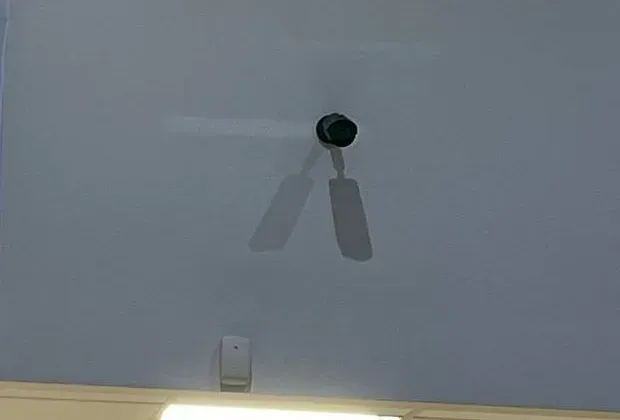
A photo from the AESS job library, not taken in Weeksville: a small black camera mounted high on a pale wall, casting two shadows, with a small white device fixed below it. In the vestibule of a prewar walk-up on a street like Park Place or St. Marks Avenue, that high spot above the inner door is where we would put a camera that shows who actually walks in after the buzzer releases the door.
Then the record. Between January 2, 2025 and November 10, 2026, HPD issued 89 Housing Maintenance Code violations mentioning an intercom at 56 buildings inside those same blocks, and 311 logged 221 bell, buzzer and intercom complaints from 87 addresses. The two numbers do not match because most complaints never turn into a violation: 71 were closed after the inspector found nothing that broke the housing laws on the day of the visit, 55 because the inspector could not get in and the tenant did not call back, and 45 because the inspection could not be completed. Only 35 led to violations. A closed complaint is not the same thing as a working buzzer, and a fault that comes and goes, in a building where the person who complained is out at work when the inspector rings, can stay in that loop for a long time.
Last, the doors that are not apartment doors. The city's commercial district needs assessment for Ocean Hill–Weeksville, done between September 2023 and June 2024, counted 560 storefronts on its study corridors, including 79 houses of worship, 65 salons and barbers and 52 delis and bodegas, and found that 83 percent of merchants rent their space. Churches, pantries, small offices and stores below apartments all have doors that must stay locked against the street and still let the right person in, and each needs its own release, separate from the apartments upstairs.
Six numbers that shape a Weeksville buzzer job
1,721 small lots. MapPLUTO lists 1,079 one- and two-family lots and 642 lots with three to seven apartments between Atlantic Avenue, Eastern Parkway, Troy and Ralph, all below the eight-apartment line in §50-a.
299 older large buildings. Lots with eight or more apartments built before 1968, where an intercom is required only once a majority of tenants ask in writing.
74 newer multi-unit lots. Lots with three or more apartments built since 2010, holding 1,194 apartments, many of them affordable buildings on long-vacant land.
89 violations at 56 buildings. HPD intercom violations issued in those blocks from January 2025 to November 2026, 45 of them still showing "NOV sent out."
221 complaints, 35 violations. Of the 311 buzzer and intercom complaints in the same blocks since January 2025, only 35 ended with HPD writing a violation.
Two ZIP codes. Weeksville straddles 11213 and 11233, where HPD issued 133 and 143 intercom violations respectively since January 1, 2025, most of them class B.
Where this page applies. Sources draw Weeksville's edges differently: Wikipedia gives the old village as bounded by Fulton Street, East New York Avenue, Ralph Avenue and Troy Avenue, and Brownstoner's history uses Atlantic Avenue instead of Fulton. For the city data on this page we used the blocks between Atlantic Avenue and Eastern Parkway from Troy Avenue to Ralph Avenue, which includes Bergen, Dean, Pacific, St. Marks, Prospect Place, Park Place, Sterling Place and St. Johns Place. For the rest of the borough see our door buzzer installation in Brooklyn page, and for the city as a whole our NYC door buzzer installation page.
Repair or Replace in Weeksville
Need Repair in Weeksville? Fix One Fault, Replace the Panel, or Put In a New System
Many Weeksville installation jobs begin as a repair call: a tenant's 311 complaint, a class B violation with a 30-day correction period, an owner who has replaced the same apartment station twice, or a newly bought building whose panel has been dead since before the closing. Brick Underground's guide to NYC intercoms quotes Daniel Vasquez of Paragon Security and Locksmith on where those failures usually live: "It's all in the wire connections," at the lobby panel, the apartment station, the door strike or the power supply, far more often than in the cable inside the walls.
That is why we decide between three paths before choosing any equipment, and tell you which one fits. A repair is right when one part is the whole problem, such as a power supply that sags, a strike that has worked loose in a wood frame or one apartment's station. A partial replacement is right when the cable meters sound: a new street panel and power supply, with only the failed stations replaced. A new system with new cable is right for buildings whose pairs have been spliced on every floor, and for the many two- and three-families that never had more than a row of bell buttons. If a repair is all your building needs, it is priced as a repair, and our Brooklyn door buzzer team handles both.
What We Install
Door Buzzer Installation Services in Weeksville
Each service below is priced from the same Brooklyn door buzzer list. The number of households sets the size of the system, the door decides what release it can take, and in Weeksville the age of the cable, who lives in the building and what else shares the front door decide most of the labor.
Talk and release for bell-only houses
Two- and three-families where each floor has a bell button and nothing else, given a door station, a station on each floor and a strike so nobody has to walk down the stoop stairs to open the door.
Replacing written-up building intercoms
Panels, power supplies and stations for walk-ups with an HPD intercom violation, scheduled against the correction period and tested apartment by apartment for the owner's certification.
Finding faults that come and go
Diagnosis for systems that pass when the inspector visits and fail at night, starting with the power supply under load, the strike's draw and every splice between the cellar and the top floor.
Audio-to-video upgrades
A video street panel and new apartment stations over pairs that test sound, so a tenant on the fourth floor can see who is on the stoop before releasing the door.
Separate doors for church and community use
A call station and release on a sanctuary, office or pantry side door, controlled from inside by staff or volunteers, with free exit kept for everyone leaving.
Store and office buzz-in doors
Buzz-in doors for shops, salons, offices and auto businesses on Atlantic, Utica and Ralph Avenues, wired apart from any apartments above.
Phone answering for owners who work away
Door stations that ring an owner's or tenant's phone as well as the station inside, with any monthly charge stated before you choose, and a station kept for anyone without a smartphone.
Strikes, closers and door repair first
Fail-secure strikes cut into sound frames, closers set so a heavy street door shuts and latches every time, and loose or rotted frames flagged before any release goes on them.
Entry systems for new affordable buildings
Lobby panels, apartment stations and resident entry for buildings going up on former vacant lots, roughed in while the framing is open and finished after the painters leave.
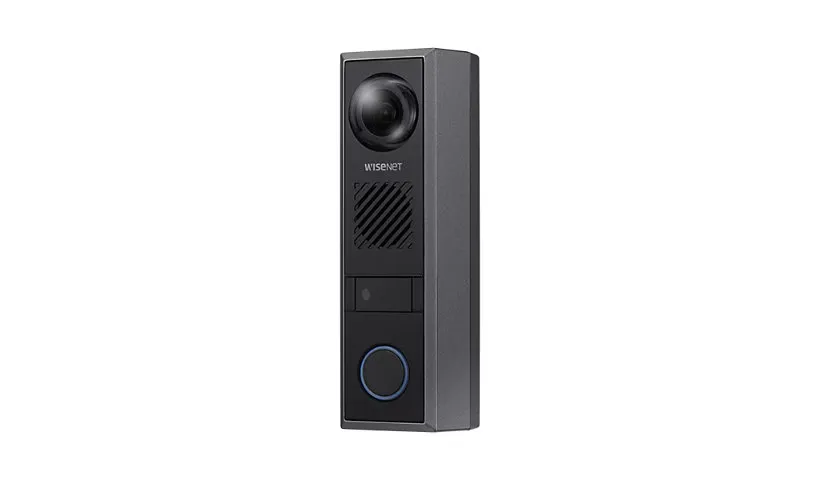
A photo from the AESS job library, not taken in Weeksville: a slim dark grey wired doorbell with a camera lens, speaker slots and a round push button. On the narrow masonry jamb of a Weeksville row-house door, or beside the separate door of a ground-floor apartment, a unit this slim fits where a wide two-button panel would cover the trim.
Building Specialists
Door Buzzer Installation for Weeksville's Architecture
Six kinds of building make up nearly every Weeksville buzzer job we plan. They differ in how many households sit behind the street door, how cable gets to them, who has the right to order the work and which rules apply. Each has one mistake that shows up when the job is rushed, and we name it below.
Masonry row-house two-families
Brick and brownstone rows on Dean, Bergen, Pacific and St. Marks, built when, in Brownstoner's words, "wood-framed houses were replaced by masonry row houses," usually with an owner on one floor and a tenant on the other.
Three- to seven-apartment buildings
The 642 lots of this size in the study blocks, from three-families to small walk-ups, below the eight-apartment line but still multiple dwellings with tenants who complain to 311.
Prewar walk-ups and apartment houses
The 299 lots with eight or more apartments built before 1968, on blocks like Park Place, Prospect Place and Sterling Place, where most of the HPD intercom record sits.
New affordable buildings
Buildings on long-vacant land, like Weeksville Place, eight stories and 45 apartments on Prospect Place between Ralph and Buffalo, and the 199-apartment lottery building at 1921 Atlantic Avenue.
Surviving wood-frame houses
A handful of 19th-century frame houses, some only 17 feet wide, with wood doors and wood door frames that move with the seasons and take a strike differently from brick.
Churches and storefront buildings
Congregations like Berean Missionary Baptist Church at 1635 Bergen Street, and the mixed buildings on Utica, Ralph and Atlantic where a shop and the apartments above share a facade.
Masonry row-house two-families: two households, one door, and an owner who usually answers for both
In a Weeksville two-family the street door is almost always shared, the owner often lives on the parlor or garden floor, and the tenant is upstairs. The most useful system is small: a two-button door station, a station on each floor with talk and release, and a strike in the frame. The decision that matters most is where each station goes. A station by the apartment's entry door is easy to wire and easy to miss from a back kitchen, so we place it where the household actually spends its day and run the cable to that wall.
The mistake to avoid is wiring the tenant's station off the owner's. When both share one cable, a fault in one apartment takes out the other, and when the tenant moves, the owner cannot change anything without touching the tenant's wall. Each floor gets its own pair back to the power supply in the cellar, so either station can be replaced on its own. Brick party walls mean we route cable through the cellar and up through closets or the stair hall, not across the front of the house.
Three- to seven-apartment buildings: under the eight-apartment line, still inside the Housing Maintenance Code
These buildings fall below the §50-a threshold, so the law does not require an owner to install an intercom. But they are multiple dwellings with tenants, and if a system is there, HPD can write it up when it breaks. In practice the owners we meet in buildings this size face one of two situations: an old audio system that half works, or nothing but bell buttons and a key. A small button panel with audio or video stations covers either one, and the price usually sits in the $700 to $1,800 range for three or four apartments with sound cable, rising toward the building range as apartments are added or the cable has to be replaced.
The mistake here is buying a panel with exactly as many buttons as there are apartments today. Brooklyn owners often legalize a basement unit or combine two apartments later, and a panel that cannot take one more button means a new faceplate or a new panel. We choose a panel with room for at least one more, and leave a spare pair in the cellar labeled for it.
Prewar walk-ups and apartment houses: long risers, many owners over the decades, and the city watching
The large prewar buildings are where Weeksville's HPD record concentrates. On the streets we checked inside the study blocks, one Park Place building east of Buffalo Avenue received eleven intercom violations between October 2024 and September 2026, all still showing "NOV sent out," and one Bergen Street building east of Ralph Avenue had an intercom violation marked "false certification" in December 2025 and four marked "invalid certification" in July 2026. Those statuses describe paperwork as much as wiring, and they are what an owner inherits when a building is sold with a failing system.
For these buildings we meter every pair from the cellar, ring the top floor first, and count the splices on each riser before pricing. Pairs that test sound are reused with a new panel and new stations, which keeps the job toward the lower end of the building range; risers with a splice on every floor are priced as new cable. The mistake is replacing stations one at a time on a riser that is the real cause, which is how a building collects a new violation every winter.
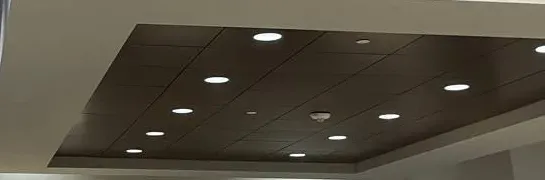
A photo from the AESS job library, not taken in Weeksville: a dark recessed ceiling panel with round downlights and a small round device, framed by a lighter ceiling. New affordable buildings on former vacant lots along Prospect Place and Atlantic Avenue often have lobby ceilings finished like this, and the cable for the entry panel, the camera and the door release has to be above it before the ceiling closes.
New affordable buildings: dozens of apartments, residents who change, and a lobby that has to work without staff
Weeksville Place, built by Settlement Housing Fund on a formerly vacant city-owned lot, has 45 apartments for seniors, individuals and families, with a community room, laundry and roof terrace. The building on Atlantic Avenue that Housing Connect lists as 1921 Atlantic Avenue offered 199 lottery apartments with an elevator, gym and rooftop terrace (the same listing also calls it 1911 Atlantic Avenue). Buildings like these are above the eight-apartment line and built after 1968, so §50-a requires an intercom with talk and release for every apartment, and they need a panel that can be updated as residents move in and out.
We plan these with the developer and the managing agent, usually with a directory or code panel at the lobby, a video station or phone answering for each apartment, and a reader for residents. The mistake is designing only for phones. The Kingsborough planning summary published by HPD in 2019 asked for "video intercom and security cameras" for its planned senior building and for housing "accessible for people with mobility and visual impairments." A senior building in particular needs a station in each apartment that works without a smartphone.
Surviving wood-frame houses: soft frames, shifting doors and narrow jambs
A few of Weeksville's 19th-century wood-frame houses are still lived in, like the two-story frame house at 1718 Dean Street that Brownstoner described in 2018 as 17 feet wide. For a buzzer, what sets them apart is the door. A strike cut into a wood frame needs solid wood behind it, the frame may have shifted over a century, and a wood door that rubs in summer can stop the latch from reaching the strike.
We check the frame with a probe before cutting, choose a strike with an adjustable keeper so it can be reset if the door moves, and set the closer so the door pulls fully home. The mistake is treating a frame house's door like a brick building's steel frame: a strike screwed into soft wood eventually pulls loose, and the buzzer seems to fail when it is really the frame.
Churches and storefront buildings: doors that open to the public at set hours
Berean Missionary Baptist Church, founded in 1850, worships in a 1961 church next to its 1894 building, which became its fellowship hall, and Brownstoner notes it runs programs including food pantries. Congregations and storefront churches like it, and the shops on Utica and Ralph, have doors that must open freely at some hours and be controlled at others. The system for these is a call station outside, a release inside where staff or volunteers actually sit, and a schedule or a simple switch for open hours.
The mistake is putting a church or a store on the same system as the apartments upstairs. A buzzer for the sanctuary or the shop should never release the residents' door, and its power supply should be on its own circuit so a fault in one never locks out the other.
Field Notes
Field Notes: Load the Power Supply, Ring After Dark, Then Follow the Pair
This is how our technician approaches an existing Weeksville system whose tenants say it fails but which has passed an inspection, before anything is priced. It is the method we use, not a story about one building.
First, the power supply. Intermittent buzzers often come down to a supply that holds voltage with nothing happening and sags when a strike pulls current and a station rings at the same time. The technician meters the supply at rest, then again while someone holds the release, and listens for the strike's buzz weakening. A supply that drops under load gets replaced before anything else is blamed.
Second, the time of day. A system can pass at eleven in the morning and fail at eleven at night, when more apartments are home, more stations are on and the cellar is colder. Where the record shows complaints that keep closing with no violation, we ask the owner whether the tenant who complained can tell us when it fails, and test at that hour if we can.
Third, the pair. From the cellar the technician follows the failing apartment's pair up the riser, opening each junction and checking for corrosion, loose screw terminals and splices twisted and taped by an earlier repair. Each one found goes on the quote as a repair or, when there are too many, as a reason to run new cable.
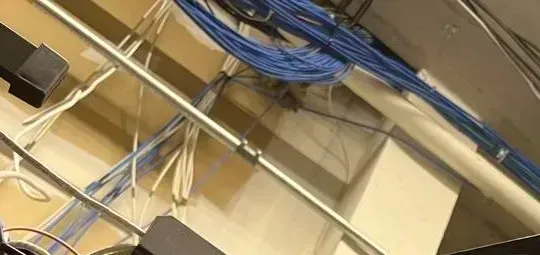
A photo from the AESS job library, not taken in Weeksville: bundles of blue low-voltage cable laid over a ceiling beam beside a metal pipe in an open ceiling. In the cellar of a Weeksville walk-up the riser cable crosses joists and pipes like this before it turns up into the building, and every splice along that run is a place to check when a buzzer works one day and not the next.
The City's Intercom Record
What 221 Buzzer Complaints and 89 Intercom Violations Tell Weeksville Owners
HPD's open data shows what happens at Weeksville's front doors more clearly than any survey, and it is worth reading before an owner spends money. Our November 11, 2026 queries covered the blocks from Atlantic Avenue to Eastern Parkway between Troy and Ralph Avenues, from January 2025 onward. Three patterns stand out.
The first is the gap between complaints and violations. Tenants at 87 addresses filed 221 complaints categorized as bell, buzzer or intercom problems. HPD wrote violations from 35 of them. The rest closed for reasons that have nothing to do with whether the buzzer was fixed: 71 because the inspector did not see a violation on the day, 55 because nobody let the inspector in and the tenant did not call back to reschedule, 45 because the inspection could not be completed, and 10 were still open awaiting the owner's repair. HPD's own closing message for a no-access complaint tells tenants to "submit a new service request with 311 if the condition still exists."
The second is the wording of the violations themselves. In ZIP codes 11213 and 11233 they read like "§ 27-2005 ADM CODE PROPERLY REPAIR THE BROKEN OR DEFECTIVE ELECTRIC BELL BUZZER / INTERCOM SYSTEM IN THE ENTIRE APARTMENT," or "PROPERLY SECURE THE LOOSE INTERCOM PANEL," naming the apartment, the story and the wall. HPD is not citing these buildings for lacking an intercom. It is citing owners for not maintaining one. Most were class B, which HPD treats as hazardous, with 30 days to correct.
The third is what happens after. Of the 89 violations in the study blocks, 45 still showed "NOV sent out," meaning the notice went to the owner and no correction had been accepted; 20 had been dismissed and 8 closed; and the rest carried statuses like "not complied with," "first no access to re-inspect," "NOV certified late" and "false certification." HPD's Clear Violations page explains the last one plainly: violations found not corrected after an owner certified them "are placed into a False Certification status. These violations remain open," and a false certification "subjects a property owner to civil penalties and may result in placement onto the Certification Watchlist."
How we use the record on a Weeksville job
Before the visit. We look up the building's intercom violations and 311 complaints, so the technician knows which apartments the city has found without a working station, and which complaints closed without an answer.
When pricing. Violations at several apartments on one line point to the riser or the power supply, so we price that alongside the stations instead of quoting station after station.
When scheduling. A class B violation's 30-day clock runs from the date of service. If a special-order panel will not arrive inside it, we say so, and a repair can keep the door working until the new system goes in.
At handover. The owner gets a dated test sheet listing every apartment with its result for call, talk and release, the record an owner needs when certifying the correction.
One limit we state plainly: we install, test and document the system, and the owner or managing agent files the certification with HPD. We do not file it, and we do not represent owners before HPD.
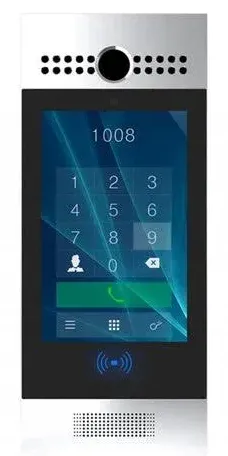
A photo from the AESS job library, not taken in Weeksville: a touchscreen entry panel showing a dial pad with a four-digit apartment code entered, a camera above and a card-reader symbol below. In a new Weeksville building with dozens of apartments, a code panel like this replaces a wall of buttons, and the managing agent can add and remove residents without a technician on site.
Public Housing and Private Buildings
Kingsborough Houses, Its Neighbors, and Who Can Order a Buzzer
The Kingsborough Houses, finished in 1941, fill the blocks between Ralph and Rochester Avenues and Pacific and Bergen Streets with sixteen six-story buildings and 1,148 apartments, with a 1966 extension built for seniors. They are NYCHA property. The doors, intercoms and locks there are NYCHA's to maintain, and repairs go through NYCHA, not a private installer hired by a resident. We say that up front because residents of public housing ask.
The problem they describe is real. When the NYC Comptroller's audit staff visited 262 NYCHA developments between August 30 and September 8, 2022, they found 36.8 percent of residential building entrance doors open and 40.1 percent of entrance locks broken, and residents and employees told them "doors were propped open because intercoms, locks, keys, and door release buttons do not work." The share of entrance doors that were open or had broken locks had risen from 23.5 percent in 2018 to 57.9 percent in 2022.
The lesson carries over to the private buildings on the surrounding blocks. A street door that cannot be released from upstairs gets propped, and a propped door makes the lock, the closer and the buzzer pointless. When we price a private building near Kingsborough, the door's closer and latch are checked as carefully as the panel, and the release time is set short enough that the door is never left hanging open. Where the HPD and NYCHA planning for the new senior building beside Kingsborough asked for video intercom and accessible housing, a private owner on Bergen or Dean Street can ask for the same things in a building of any size.
Rules and Responsibilities
Which Weeksville Buildings Must Have a Buzzer, Who Keeps It Working and What the Code Asks of the Door
Owners in Weeksville ask us the same handful of legal questions, usually after a tenant's complaint or a violation. We are an installer, not a lawyer, and nothing here is legal advice, but these are the rules we work to, with the sources they come from.
Buildings of eight or more apartments built or converted after January 1, 1968. Multiple Dwelling Law §50-a requires a self-locking main entrance door and an intercommunication system that lets a resident talk to a visitor at that door and release it from the apartment. Of the 368 large lots in our study blocks, 69 fall in this group.
Older buildings of eight or more apartments. The same section requires the owner to install the door and intercom if tenants occupying a majority of the apartments request it in writing, with installation started within 90 days and completed within six months. This covers 299 lots in the study blocks.
Any building that has a system. Wherever an intercom exists, the Housing Maintenance Code's §27-2005 duty to keep the building in good repair applies, which is the section nearly every intercom violation in 11213 and 11233 cites.
Correction periods. HPD gives 90 days for class A violations, 30 days for class B and 14 days for class C self-closing door violations, counted from the date of service, and certification of correction is free.
Permits. NYC Administrative Code §28-105.4.7 says an electrical permit is not required for wiring "designed to operate at less than 50 volts for signaling, communication, alarm, and data transmission circuits," provided the work is done by a person qualified as the electrical code defines. A new 120-volt outlet for the power supply is ordinary electrical work and goes to a licensed electrician.
Reach. The 2010 ADA Standards put the high forward reach at 48 inches maximum, and we mount buttons and speakers on public-facing panels within that range unless the owner has a reason to do otherwise.
Two door rules shape every installation. With an electric strike, Allegion's guide explains, "you can exit by turning the lever" whether the strike is fail-safe or fail-secure, so the buzzer only controls who comes in. We use fail-secure strikes on street doors, which, in Allegion's words, "are locked when power is removed." Magnetic locks are different: "Electromagnetic locks are only available fail safe," and the building code's sensor-release provisions require a sensor on the egress side, a manual release marked "PUSH TO EXIT" between 40 and 48 inches above the floor, unlocking on loss of power and on fire alarm or sprinkler activation. That is why we rarely recommend a magnetic lock on a Weeksville street door and price the extra parts in full when one is used.
Commercial Door Buzzer Installation
Business Door Buzzer Installation in Weeksville
Weeksville's commercial doors sit mostly on its edges and corners: the auto businesses along Atlantic Avenue, the shops and salons of Utica and Ralph Avenues, delis and churches on the corners of the side streets, and the institutions of Bergen Street and Buffalo Avenue. Business buzzers here usually serve one of three doors: an office or back room that should lock between customers, a side door for deliveries or volunteers, or a ground-floor shop that must stay apart from the apartments above it.
Atlantic Avenue
Brownstoner's history of the avenue describes auto businesses, tire and repair shops and garages in one- and two-story buildings under the elevated railway, with a few tall glass apartment buildings near Ralph Avenue.
Utica Avenue
One of Crown Heights' commercial streets, with stores below apartments and the 77th Precinct station house at 127 Utica Avenue.
Ralph Avenue
The eastern edge of the study blocks, where Brownstoner notes that a couple of tall glass-and-steel apartment buildings have gone up on and near the avenue beside its older buildings.
Bergen Street
Home to Berean Missionary Baptist Church at 1635 Bergen Street, between Utica and Rochester Avenues, whose programs include food pantries that bring the public to a side door on set days.
Fulton Street to the north
Part of the Ocean Hill–Weeksville commercial study, which counted 560 storefronts on its corridors, including 79 houses of worship, 65 salons and barbers and 52 delis and bodegas.
Buffalo Avenue
The Weeksville Heritage Center at 158 Buffalo Avenue admits visitors by pre-registered guided tour, at most 14 people at a time, the kind of controlled public entrance a buzzer can serve.
The most common business request we get in neighborhoods like this is a buzzer for a door that has always been either propped or locked with a key: an office behind a service counter, a salon that locks after dark, a church office or pantry door, or a store's side door for deliveries. Each gets its own call station, release and power supply, separate from any apartment system in the building. Because 83 percent of merchants in the Ocean Hill–Weeksville study rent their space, the first step for most is the building owner's written approval.
Rules that apply to business entry installations in Weeksville
Exit is never blocked. A business door with a buzzer, keypad or reader still opens from inside without a key, a code or anyone's help.
Rooms that fill up get extra care. A church hall, a pantry line or a community room must let everyone out at once, so its releases and any magnetic locks follow the sensor-release rules in full.
Tenants need the owner's written approval. A shop or church that rents its space orders a buzzer only with the building owner's written permission, especially where the work touches a shared street door, the cellar or the apartments' cable.
Separate power, separate system. A store's or a congregation's buzzer is never powered from the apartments' supply and never releases the residents' door.
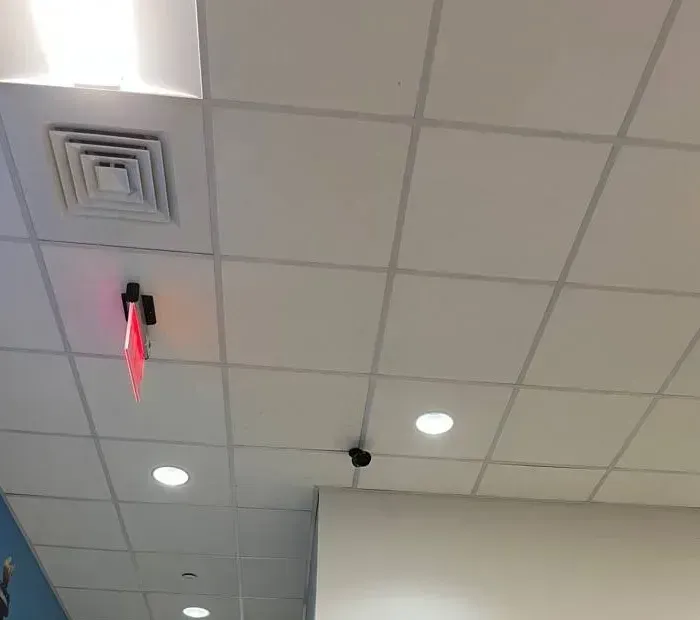
A photo from the AESS job library, not taken in Weeksville: a drop ceiling with a lit red exit sign, an air diffuser, round recessed lights and a small black camera. A church fellowship hall or a storefront office on Utica Avenue often has a ceiling like this, and the exit sign states the rule every business buzzer we install keeps: whatever locks the door from outside, it opens from inside.
Your Questions Answered
Door Buzzer Installation in Weeksville: Questions Answered
Reading your building's HPD and 311 record
HPD's file for our building shows "first no access to re-inspect" on an intercom violation we repaired last spring. What do we do so it actually comes off?
That status means HPD went back to check the repair and could not get into the apartment, so the violation is still open on the record even though the work may be done. It is not rare here: four of the intercom violations issued in our study blocks since January 2025 carry it, at two buildings. The fix is partly paperwork and partly access. HPD's Clear Violations page describes certification of correction as a free process, and an owner who has corrected a condition can certify it; what keeps a violation like this open is that the inspector still needs to see the apartment.
Our part is the evidence and the working system. If we did the repair or the replacement, the owner has a dated test sheet showing that apartment's station calling, talking and releasing the street door, and the wiring record behind it. If someone else did the work and the station still fails, we find out why before anyone arranges another inspection. Then the owner and the tenant agree a time the apartment will be open, so the next visit is not another no-access.
A tenant's buzzer complaint was closed because she was not home when the inspector came. Does that end the owner's obligation?
No. A complaint closed for no access tells you the city could not inspect; it says nothing about whether the buzzer works. HPD's closing message for those complaints tells the tenant to "submit a new service request with 311 if the condition still exists," and in our study blocks 55 of the 221 buzzer complaints since January 2025 closed that way. The owner's duty to keep an existing system in repair under the Housing Maintenance Code does not depend on a violation having been written.
For an owner, the practical point is that the same tenant will very likely file again, and the next inspection may find the fault. Dealing with it now, while there is no deadline, usually costs less than dealing with it inside a 30-day class B correction period, when a special-order panel may not arrive in time. A complaint that closed without an inspection is a free warning.
Our building has intercom violations in two different apartments on the same side of the building, written months apart. Is that a coincidence or one fault?
Often one fault. In most older Weeksville walk-ups the apartments stacked above one another, the A line or the rear line, share a riser cable from the cellar, and a corroded junction, a failing splice or a damaged section low on that riser affects every apartment above it. Two violations on one line, even a year apart, point there before they point at two bad stations.
We test it from the cellar: meter each apartment's pair on the line, compare them with a pair on a line that works, and open the junctions between floors. If the riser is the cause, we price repairing or replacing that section along with the two stations, and the quote says so. Replacing the two stations alone, and waiting for the third violation, is the more expensive route over a couple of years.
Our violation now reads "NOV certified late." We fixed the intercom inside the 30 days but sent the paperwork after. What should we do differently next time?
That status appears twice among the intercom violations in our study blocks since January 2025. HPD's rules expect the owner to submit certification within the timeframe set by law, which for a class B intercom violation means 30 days from service, and how HPD handles a late certification on your particular violation is a question for HPD, not for us. What we can change is the timeline on our side.
When we finish a repair or replacement for a violation, the test sheet is dated and signed the same day and handed to the owner or the managing agent before the technician leaves, with the apartment, story and wall named the way the violation names them. That makes it possible to certify within days of the work rather than weeks. If the correction period is short and the part is special order, we tell you at the quote, not on day 29.
Doors that get propped, shared and opened to the public
Tenants in our walk-up keep propping the street door with a brick because the buzzer is dead. Will a new system alone stop that?
It removes the main reason, but not every reason. The Comptroller's 2022 audit of NYCHA doors recorded residents saying doors were propped "because intercoms, locks, keys, and door release buttons do not work," and private buildings work the same way: when nobody upstairs can let a visitor or a delivery in, someone props the door. A working buzzer with a release in every apartment takes that pressure away.
The rest is the door. If it takes two hands to pull closed, or the closer slams it so hard tenants hold it open to avoid the noise, or the latch misses the strike in cold weather, it will still get propped. So we set the closer to pull the door fully home without slamming, make sure the latch catches every time, and keep the release short. Owners who also want to know when the door is held open can add a door contact that reports it, quoted as an option.
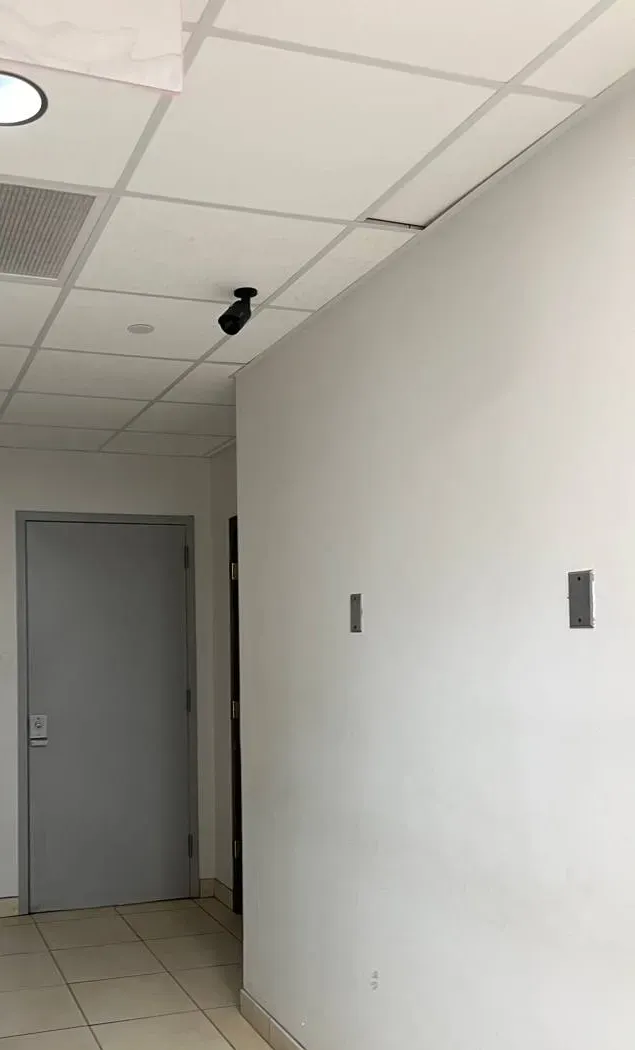
A photo from the AESS job library, not taken in Weeksville: a tiled corridor with white walls and small wall plates ending at a grey steel door with a lever handle, under a drop ceiling with a small camera. The rear or side door of a walk-up or a church hall in Weeksville often looks like this, and a steel door with a lever is the easiest kind to fit with a fail-secure strike that still lets everyone out by turning the handle.
Our church runs a food pantry from a side door on Bergen Street twice a week. Can volunteers let people in at that door without opening the rest of the building?
Yes, and it is a good use of a buzzer. The side door gets its own call station outside and a release inside where the volunteers stand, so people waiting can ring and a volunteer can let them in one or a few at a time. That door's release is on its own power supply and its own wiring, and it does nothing to the sanctuary doors, the office or any apartments in the building.
Two details make it work for a pantry. The release button should be where the volunteer at the table can reach it without leaving the line, often a button on the wall beside the table rather than at the door. And inside, the door from the pantry room into the rest of the church should lock from the pantry side, so a visitor buzzed in for food reaches the pantry and nothing else. On days without a pantry the side door simply stays locked, and nobody needs to remember to switch anything.
Our cultural organization admits small pre-registered tour groups at set times. Can staff see who has arrived and let the whole group in with one release?
Yes. A video door station at the visitor entrance with a station or a monitor at the front desk lets staff see the group gathered outside, check the name against the registration and release the door once while the group walks in. The release can be set to hold the door unlocked for long enough for several people to enter, then relock, and a camera inside the entrance shows staff whether anyone has followed the group in after the door closed.
For an organization that runs tours on a schedule, a station at a second desk, a phone that rings when the front desk is unstaffed, or a release on a timer for the start of each tour can all be added. What stays fixed is exit: everyone inside can leave by the door's lever or bar at any time, with or without staff.
Our deli on Ralph Avenue is under four apartments, and customers looking for us keep pressing the apartment buttons when the store is closed. How do we stop that?
Start by making the two doors look different. The residents' panel should show apartment numbers or names and nothing that could be read as a store, and if the store wants a bell of its own for deliveries or late pickups, it gets a separate, clearly labeled button beside the store's own door, not on the residents' panel. Most mistaken rings come from a panel that sits closer to the store's entrance than the store's own bell, or from an unlabeled top button that people assume belongs to the shop.
Then keep the systems apart. The store's bell rings inside the store or on the owner's phone, on its own power, and the residents' system never rings the store. If the apartments' panel has to move to make the difference obvious, we price the move with the rest of the job. All of this needs the building owner's written approval, since the facade and the street door belong to the building.
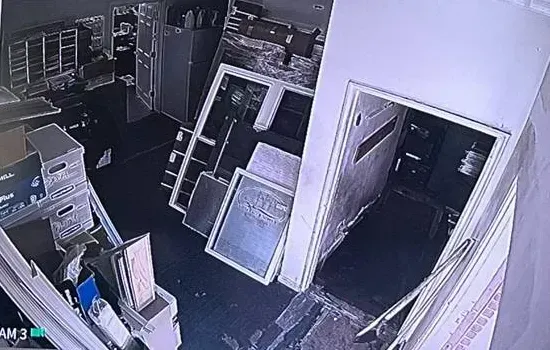
A photo from the AESS job library, not taken in Weeksville: a black-and-white night camera view of a cluttered room with an open doorway into a dark back room. A deli or bodega stockroom on Ralph or Utica Avenue often leads back to a cellar or side door like that one, and keeping the store's buzzer and the building's buzzer separate means a delivery let in at the back reaches the store, not the residents' stair.
Small buildings below the eight-apartment line
Our three-family on Dean Street shares a stoop with the identical house next door, and visitors keep ringing the wrong building. Can the panels be made hard to confuse?
Yes. On matched row houses with stoops side by side, the door station should sit on your own door frame or on your side of the shared stoop wall, not on a pillar between the two doors where it reads as belonging to either. A station with a lit house number, or a lit nameplate beside the buttons, helps a visitor confirm the building before ringing, especially after dark.
If your neighbor is also replacing a buzzer, it helps to choose panels that look clearly different, or at least to put them at different heights and on the outer edge of each door. The camera on a video station should face your stoop, not your neighbor's, so the picture upstairs shows who is at your door. We keep everything on your property and your wall, so nothing we install depends on the house next door.
Our two-family has only a bell for each floor, and the upstairs tenant has to come down two flights to open the door. What is the least disruptive way to fix that?
An audio or video door station with a release, and a station upstairs with talk and a door button, wired back to a small power supply in the cellar. In most Weeksville row houses the cable can run from the cellar up a closet, the stair hall or the back wall of the building, so the front rooms are not opened up. The street door gets a fail-secure strike in its frame, and the existing keys keep working.
On our Brooklyn list that is usually a $400 to $900 job for audio, or $700 to $1,800 for video with stations on both floors. The things that move it are how far the upstairs station is from the cellar, whether the frame can take a strike as it is, and whether the door closes and latches on its own. The old bell buttons can usually come off and the new station cover their holes.
Equipment
Types of Door Buzzer Systems We Install
We quote a dependable non-branded system by default and install a named brand when an owner, board or developer asks for one; the intercom brands we work with include Aiphone, ButterflyMX, 2N, Akuvox, Comelit and DoorBird. These are the kinds of equipment that come up most in Weeksville, and where each one fits.
One- and two-button stations
Slim audio or video stations for row-house two-families and single doors, small enough for a narrow masonry jamb or a wood frame.
Small button panels
Three- to eight-button panels for three-families and small walk-ups, chosen with room for one more button if an apartment is added later.
Directory and code panels
Scrolling directories or code entry with a camera for new affordable buildings and larger walk-ups, updated by the managing agent as residents change.
Two-wire multi-tenant systems
Audio and video over one pair per apartment, the practical answer for prewar buildings whose pairs still meter sound. Aiphone describes its GT Series as offering "the advantage of using existing wire and infrastructure."
Apartment stations with large buttons
Video or audio stations with a clear screen and one obvious door button, for older residents and anyone who does not want to answer on a phone.
Phone and app answering
Door stations that ring residents' or owners' phones as well as the station inside, with any subscription named on the quote before anyone chooses.
Separate stations for churches and shops
Call stations and office releases for sanctuary, pantry and store doors, on their own power and never connected to the apartments' release.
Fail-secure electric strikes
Releases cut into the frame that stay locked without power and let anyone inside leave by the lever, with adjustable keepers for wood doors that move.
Battery-backed power supplies
Dedicated low-voltage supplies with battery backup in a locked box in the cellar, sized for the panel, every station and the strike all working at once.
Audio stations, wired video or phone answering: which suits a Weeksville building?
Question
Audio panel and stations
Wired video stations
Panel with phone answering
Can the resident see who is on the stoop?
No
Yes, on the station screen
Yes, on the phone, and on a station if one is added
Works for someone without a smartphone
Yes
Yes
Only with a station in the apartment
Owner can answer from work
No
Only on models with an app option
Yes
Internet needed at the building
No
No
Yes, or a cellular panel
Reuses old cable in a prewar riser
Often
Often, on two-wire systems
At the panel; apartments answer over the internet
Monthly charge
None
None
Often, per apartment or per door
Brooklyn list range
$400–$900 for a house or single door; from $2,500 for a building
$700–$1,800 for a small building; from $2,500 for a large one
Within the same ranges, with any subscription quoted separately
ADT, Ring and SimpliSafe compared with a local installer for a Weeksville building
National brands come up in almost every conversation about a front door. For a single household in a one-family house, a store-bought video doorbell may be all that is wanted, and it does what it says. For the buildings on this page it hits hard limits. It rings the phones of whoever set it up, not a station in each apartment. It does not open the street door unless someone separately wires a strike and a power supply to it. It gives a three-family one button, not three, and it cannot serve the 45 or 199 apartments of a new building that §50-a requires to have talk and release for every apartment. And none of those companies is going to meter a 1920s riser in a Prospect Place cellar.
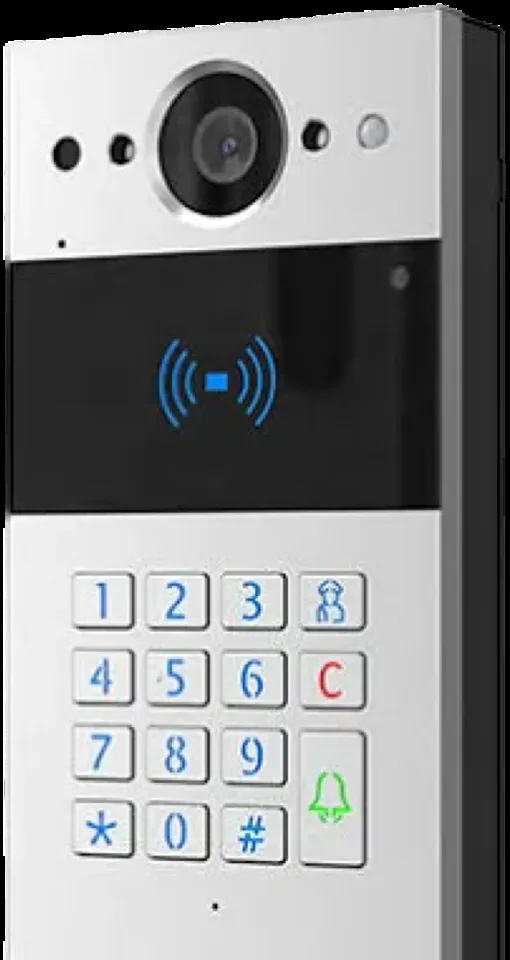
A photo from the AESS job library, not taken in Weeksville: a silver and black keypad door station with a camera lens at the top, a blue card-reader symbol, a numeric keypad and a green bell key. At the lobby door of a mid-size Weeksville walk-up, a station like this lets residents enter by code or card while a visitor presses the bell key and picks an apartment, and the managing agent can cancel a lost card without changing a lock.
AI Overview Reality Check
What AI Gets Wrong About Door Buzzer Installation in Weeksville
Ask a search summary or an AI assistant what a buzzer costs, or whether a building needs one, and the answer usually comes from national cost guides and intercom companies' blogs. Those sources are useful, but they are written for an average American house or a large managed tower, and Weeksville is mostly neither. Here are seven claims we see repeated, each checked against its source and against the buildings on these blocks.
"Installing an intercom system costs an average of $2,500"
That line is from HomeAdvisor's intercom cost guide, which also gives a range of $1,500 to $15,000. As a national average across every kind of property it is a fair summary.
For the 1,079 one- and two-family lots in our study blocks, it overstates the usual job. On our Brooklyn list, an audio station with a release for a house or a single door is $400 to $900, and video with stations on two floors is $700 to $1,800. The $2,500 mark is where our multi-unit building range starts, not where a two-family begins.
An average blends houses with towers. Ask for the price of your building, with the parts listed.
"Hard-wired systems run $1,000 to $15,000"
HomeAdvisor's figure for hard-wired systems is meant to span everything from a small house to a large building, and the top of it is real for big projects.
What decides where a Weeksville building falls is not whether it is wired but whether its existing pairs can be reused. In a prewar walk-up whose riser meters sound, a new panel and stations over the old cable keeps the job near the bottom of our building range. A riser spliced on every floor has to be replaced, and that is what pushes a job toward and past $10,000.
The test of the old cable, done before the quote, matters more than any range in a guide.
"Wireless systems are the best option if you want to do it yourself"
HomeAdvisor says this, and gives wireless systems a range of $150 to $1,500. For a single household adding a doorbell to a one-family, it is reasonable advice.
In a shared building the part that opens the door is never wireless. The strike in the frame still needs wire and power, the power supply still needs a protected spot in the cellar, and a wireless station on the third floor of a brick row house has to reach through masonry. Work on a shared street door also needs the owner's approval, which a tenant buying a kit usually does not have.
Wireless stations are a tool for an awkward run, not a way around the door hardware.
"Modern IP or video intercoms cost $1,000 to $5,000 or more per entry door"
Swiftlane's apartment intercom guide gives that range per door for modern IP and video systems, and says whole projects run from $1,500 to $50,000 or more.
A per-door figure makes sense for a cloud panel at the lobby of a managed building. It says little about a Weeksville three-family, where one video panel and three wired stations sit inside our $700 to $1,800 range on sound cable, or about a walk-up where most of the cost is in the apartment stations and the riser, not the door.
Ask any installer, us included, to separate the door, the apartments and the cable on the quote.
"Phone-based intercoms are cheaper because there is nothing to wire"
ButterflyMX describes its intercom as weatherproof, vandal-resistant and needing "no building wiring," and cellular call boxes can run without internet at the door.
The installation can cost less, but the monthly charge is the part summaries skip. Swiftlane's guide says software subscriptions commonly add $5 to $15 per unit per month, or $30 to $100 per door per month. For a small owner on Pacific Street with three tenants, that fee runs every month for as long as the system is in use, and residents without smartphones still need a station.
For many small Weeksville buildings, a wired system with no subscription is the better buy over ten years, and we quote both when an owner asks.
"Every apartment building in New York must have an intercom"
Close, but not quite. Multiple Dwelling Law §50-a makes an intercom with talk and release mandatory in buildings of eight or more apartments built or converted after January 1, 1968, and in older ones once a majority of tenants ask in writing.
In our study blocks that leaves 1,721 lots with fewer than eight apartments outside the mandate, 299 older large buildings where it depends on the tenants' written request, and 69 newer large buildings inside it. The duty that reaches nearly everyone is different: once a system exists, the Housing Maintenance Code requires it to be kept working, and that is what the violations in 11213 and 11233 cite.
The right question for most Weeksville owners is not "must I have one" but "must I fix the one I have," and the answer is yes.
"If HPD found nothing wrong, the intercom works"
Summaries of tenant complaints sometimes treat a closed 311 complaint as a resolved one. The record does not support that. Of the 221 buzzer complaints in our study blocks since January 2025, 71 closed because the inspector saw no violation on the day of the visit.
A system that fails at night, in the cold or under load can pass at midday. Brick Underground's guide says intercom faults usually sit in "the wire connections" at the panel, the apartment, the strike or the power supply, and loose connections are exactly the kind that come and go.
If tenants keep complaining after a clean inspection, test the power supply under load and the connections on the complaining apartment's line before deciding nothing is wrong.
Bell Buttons Only, or a Walk-Up Back in the HPD Record? Speak to a Tech
Send the address, a photo of the street door and the panel, and one of an apartment station or the bell buttons, along with how many households the system must reach and any HPD violation number. A technician will tell you which approach fits and where it falls on our Brooklyn ranges. Call or text (347) 934-8335, send photos on WhatsApp, or fill in the form below.
Get In Touch
Request a Free Quote
✅
Request Sent!
Thank you. A technician will call about your Weeksville address, usually within two hours during working hours.
How It Works
Our Installation Process
1. Pull the building's city record
Before the visit, the office reads the building's HPD intercom violations and 311 buzzer complaints and looks at the photos you send of the street door, the panel and one apartment station or bell button.
2. Count the doors and the households
On site the technician lists every door people actually use and every household the system must reach, including a parlor-floor owner, a basement tenant, a church office or a shop.
3. Fix the door before the buzzer
The street door is closed and latched by hand. A door that drifts, a worn closer or a loose frame is repaired or priced first, because a release cannot hold a door that does not shut.
4. Test the old cable from the cellar
Each existing pair is metered from the power supply to the apartment, and any new route is planned through the cellar, risers, closets or the back of the building.
5. Write the price
You receive a written price from the Brooklyn list with every possible extra named, such as a failed pair, a new closer or an outlet that needs a licensed electrician, before anything is ordered.
6. Order and book the work
Equipment is ordered once the deposit is in. Stock systems are scheduled right away, special-order systems are booked when they arrive, and every visit gets a two-hour arrival window.
7. Install and label
The door station, release and battery-backed power supply go in, cable is run or reconnected with as little showing as the building allows, and every pair is labeled at both ends.
8. Test from the sidewalk and hand over
Standing where a visitor stands, the technician calls, talks to and releases every apartment, checks the door with power off, and leaves a dated test sheet and wiring record for the owner.
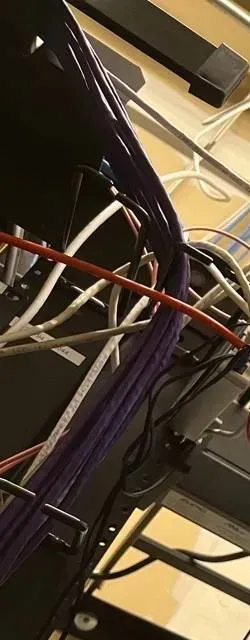
A photo from the AESS job library, not taken in Weeksville: purple, white and red cable bundles dropping down beside a black equipment rack. In a new affordable building on a former vacant lot, the cable from every floor arrives at one room like this, and labeling each bundle in step 7 is what lets the next technician find one apartment's pair in minutes.
Coverage Area
Door Buzzer Installation Near Weeksville's Landmarks
Hunterfly Road houses
Four 19th-century frame houses off Bergen Street between Buffalo and Rochester Avenues, city landmarks since 1970 and the last remains of the free Black village.
Weeksville Heritage Center
The center at 158 Buffalo Avenue, with its 2014 building by Caples Jefferson, where pre-registered guided tours of the historic houses start.
Kingsborough Houses
Sixteen six-story NYCHA buildings with 1,148 apartments between Ralph and Rochester Avenues and Pacific and Bergen Streets, finished in 1941.
Berean Missionary Baptist Church
The congregation founded in 1850, at 1635 Bergen Street between Utica and Rochester, with its 1894 church kept as a fellowship hall.
P.S. 243, The Weeksville School
The public school at 1580 Dean Street, which traces its roots to the village's Colored School No. 2.
Weeksville Playground
A small NYC Parks playground in ZIP code 11233, within Community Board 3, named for the village James Weeks helped found.
Weeksville is billed at our standard Brooklyn rate. The final figure follows photos and a walkthrough, because the number of households, the condition of the old pairs, the state of the street door and who else shares the facade drive the total far more than the brand on the panel.
Job
Typical Weeksville property
Brooklyn range
Audio station or replacement with electric strike release, existing wiring reused where it tests well
Row-house two-families, wood-frame houses, a shop, office or pantry door
$400–$900
Video door station with indoor stations or phone answering
Two- and three-families with stations on each floor, a church office door, small walk-ups
$700–$1,800
Multi-unit entry system, audio or video by apartment count, with optional fob or code entry
Prewar walk-ups on Park Place, Prospect Place and Sterling Place, newer affordable buildings
from $2,500 to $10,000+
In-person diagnosis of an existing system, booked online
Any building whose old system must be tested before it can be priced
$250, applied toward the work
Monthly subscription
Any building choosing a wired system without phone answering
$0
What moves a Weeksville job inside its range is predictable. First the count: a two-family with one station per floor sits near the bottom of its range, a three-family with video on every floor near the top, and in a walk-up each apartment and each extra entrance adds to the total. Then the cable: pairs that meter sound cost nothing extra, a riser spliced on every floor has to be replaced, and a run through a brick party wall costs more than one up a closet. Then the door: a heavy street door that needs a new closer, a wood frame that needs a solid block behind the strike, or a church side door that needs exit hardware matched to the release. If you also want cameras at the entrance, putting them in on the same visit usually saves $200 to $400 in labor compared with a separate trip. Anything that depends on a test is named on the quote with its price before you approve.
Full terms — including 50% deposit, one-year parts-only warranty on AESS-supplied products, and the late-fee schedule — are set out in the service agreement.
Find Out Which Range Your Weeksville Building Falls In
Tell us the block, how many households the system must reach, every door people use and what is at the street door now, and attach any HPD violation, and we will tell you which Brooklyn range fits and what would move it. Call or text (347) 934-8335, send photos on WhatsApp, or fill in the form.
Shop Our Systems
Door Buzzer Installation Packages & Pricing
Three typical Weeksville jobs, each placed inside the matching range on our Brooklyn list. The exact figure comes from the photos and the walkthrough.
Row-house audio: $400–$900
A two-button audio station at the street door of a two-family or a single door for a shop or pantry, a fail-secure strike in the frame, the closer set so the door latches, a talk-and-release station on each floor or inside the business, and battery-backed power in the cellar.
Small building video: $700–$1,800
A video panel at the street door of a two- or three-family or a small walk-up, a video station on each floor where the household spends its day, phone answering for an owner who works away if wanted, and pairs reused where they meter sound.
Walk-up or new building system: from about $2,500
A button, directory or code panel at the lobby door, stations or phone answering for every apartment, tested or new riser cable, a release with free exit and power in a locked box, rising toward $10,000 or more with apartments, entrances and new cable.
Bring your own equipment. If you have already bought a panel or an intercom kit, we can install it as labor-only work, priced flat once we have seen the door, the frame and the cable route through the building. Tell us the make and model, and we will say before the visit whether it can reach every apartment and release your door. Equipment you supply is covered by its maker's warranty, not ours.
Complete Services
Every Door Buzzer Service in Weeksville
Houses and small buildings
Talk and release for bell-only two- and three-families, video upgrades, phone answering and strikes for wood and masonry frames. Request a quote
Walk-ups and new buildings
Violation-driven replacements, riser testing, intermittent-fault diagnosis and lobby panels for affordable buildings. Call (347) 934-8335
Do churches, block associations or other nonprofits get a different price?
+
Every customer is priced from the same Brooklyn list, so a church side door costs what a shop door of the same kind costs. What we do for nonprofits is make the paperwork easy: an itemized quote that lists each door and each part separately, an itemized invoice that matches it, and a completion record with photos and the test sheet, which is what a funder, a diocese or a board usually asks to see.
Our building is being run by a court-appointed administrator. Who has to approve the work?
+
Whoever the court's order gives control of the building's repairs, which is normally the administrator rather than the owner of record. We need that person's written approval of the quote before ordering anything, and the invoice goes to whoever the order says pays for repairs. If tenants are paying rent to the administrator and the intercom has a violation, the administrator is usually the one with both the authority and the deadline.
What does the $250 service visit actually include when you come to test an existing system?
+
A technician tests the power supply at rest and under load, the street panel, the strike and the stations at the apartments we can reach, meters the pairs from the cellar, and checks whether the door closes and latches. You get a plain answer on what failed and whether it is a repair, a partial replacement or a new system, with a written price. The $250 is applied toward the work if you go ahead.
Do we have to tell HPD before replacing an intercom that already has an open violation?
+
Not before. The violation asks the owner to correct the condition within the correction period and then certify the correction, which HPD describes as a free process an owner submits once the condition is fixed. A full replacement corrects it as surely as a repair does. What matters is finishing inside the period and keeping the dated test sheet for the apartment the violation names, so the certification is accurate.
We plan to add a floor of apartments on top of our building in a year or two. Should the new buzzer wait?
+
Only if the present system is working. If it is failing or has a violation, it should be fixed now. In that case we choose a panel and power supply that can take the extra apartments, leave spare pairs in the riser up to the top floor, and note on the wiring record where the new apartments will connect. Adding stations for the new floor later is then a small job instead of a new system.
A tenant is renovating her kitchen and wants the apartment station moved to another wall. Can it be moved, and who pays?
+
It can be moved, usually by extending the pair inside the wall while it is open, which is far easier during a renovation than after. Because the station belongs to the building's system, the owner has to approve the move. Who pays is between the owner and the tenant; we price the move as a service visit and do it while the walls are open, before the painters finish.
My father has arthritis and struggles with small buttons. Is there an apartment station he can use easily?
+
Yes. Several apartment stations have a large door-release button and a hands-free talk button that need only a light press, and some can be set to start talking as soon as the station is answered. We bring the options to the walkthrough, mount the station at a height he can reach comfortably, and show him how it works before the technician leaves, with the owner's approval since the station is part of the building's system.
Our old system is a brand you do not install. Can you still replace it, and can any of it stay?
+
Yes. The brand of the old panel does not limit what goes in next. What can stay is usually the cable: if the pairs from the cellar to each apartment meter sound, a two-wire system can often run over them. The old panel, stations and power supply normally come out, because mixing old stations with a new panel rarely works reliably. We test the cable first and price both reuse and new cable when the result is borderline.
Where can we see how many apartments the city has on file for our building before deciding what the law requires?
+
HPD's online records list a building's registered units and its violations, and the city's MapPLUTO data, the source for the counts on this page, lists residential units for every lot. The certificate of occupancy, where the building has one, shows the legal number of apartments. If they disagree, ask HPD or the Buildings Department; for our part, we size the system to every household that actually needs to be reached.
Is there an extra charge if your technician finds the real problem is the building's 120-volt power, not the buzzer?
+
The diagnosis is the same $250 service visit either way. If the outlet or circuit feeding the power supply is dead or unsafe, that is electrical work for a licensed electrician, which we do not do, and we tell you so with what we found. Once the outlet is fixed, the buzzer work is priced from the Brooklyn list as usual, with the $250 applied toward it.
Our tenants' association wants to meet the installer before the work starts. Is that possible?
+
Yes, with the owner's agreement. Tenants usually know which apartments fail and at what time of day, which helps the walkthrough, and they need to know when the technician will need access to each apartment. The quote and the scope are agreed with the owner or managing agent, who hired us, but we are glad to explain the plan and the schedule to tenants' representatives.
Ready for a Weeksville Street Door That Every Household Can Answer and Open?
Send a photo of the street door and the panel or bell buttons, the block, how many households the system must reach and any HPD violation, and we will tell you which system fits, which rules apply to your building and where the job falls on our Brooklyn ranges. Call or text (347) 934-8335, message us on WhatsApp, or use the request form. Licensed under NYS license #12000287431, rated 4.7★ across 201 Google Reviews, with same-day estimates on most weekdays.