A four-story walk-up on 14th Street, a brick row house below Fifth Avenue or a frame two-family with a rented top floor? South Slope door buzzer installation line: (347) 934-8335
Prewar Walk-Ups on the Numbered Streets · Brick Row Houses and Frame Two-Families · Newer Buildings on Fourth Avenue · Shops on Fifth and Seventh Avenues · Historic District Blocks Near Prospect Park
Door Buzzer Installation in South Slope
Strikes HPD Accepts, Not Mag Locks · Every Apartment Rung From the Sidewalk · Riser Metered Before the Quote · Written Price Before Ordering · Brooklyn Rate
Door buzzer installation in South Slope is mostly about walk-ups. Between 10th and 19th Streets, HPD inspectors wrote 39 intercom violations at 20 buildings from January 2021 to late October 2026, and across ZIP code 11215 they wrote 19 orders to remove magnetic locks from building entrance doors as "unacceptable" fastenings. Below is how we put a working buzzer on a South Slope street door that passes the next inspection, from a two-family on 17th Street to a 71-apartment co-op in a converted clock factory, and where each job lands on our Brooklyn price list.
Every price comes from our Brooklyn door buzzer list, and the total, with every possible extra named, is agreed in writing before anything is ordered
Rated 4.7★ across 201 Google Reviews
Reviewed and updated November 11, 2026, against NYC Open Data's HPD Housing Maintenance Code Violations file (intercom, entrance-door lock and self-closing door records for ZIP 11215 and for 10th through 19th Streets, queried November 11, 2026); HPD's Clear Violations page; New York's Multiple Dwelling Law §50-a; CityLand's report on the Landmarks Preservation Commission's April 17, 2012 vote on the Park Slope Historic District Extension and the Commission's April 12, 2016 release on Extension II; the Department of City Planning's South Park Slope rezoning; Brownstoner's January 2015 Building of the Day on 199 17th Street, its 2006 house listing thread on the neighborhood's frame houses and its forum threads from 2007, 2009 and a recent multi-family video doorbell discussion; the Brooklyn Public Library's history of the Ansonia Clock Company; the Brooklyn Eagle's August 2019 report on a South Slope lobby package theft; Brick Underground's buzzer guide; Allegion's fail-safe guide; the building code's sensor-release provisions; Aiphone's GT Series pages; the HomeAdvisor, Swiftlane and ButterflyMX guides; and the 2010 ADA Standards. · Abstract Enterprises Security Systems, NYS license #12000287431 · crews dispatched from our Troy Avenue office in Brooklyn
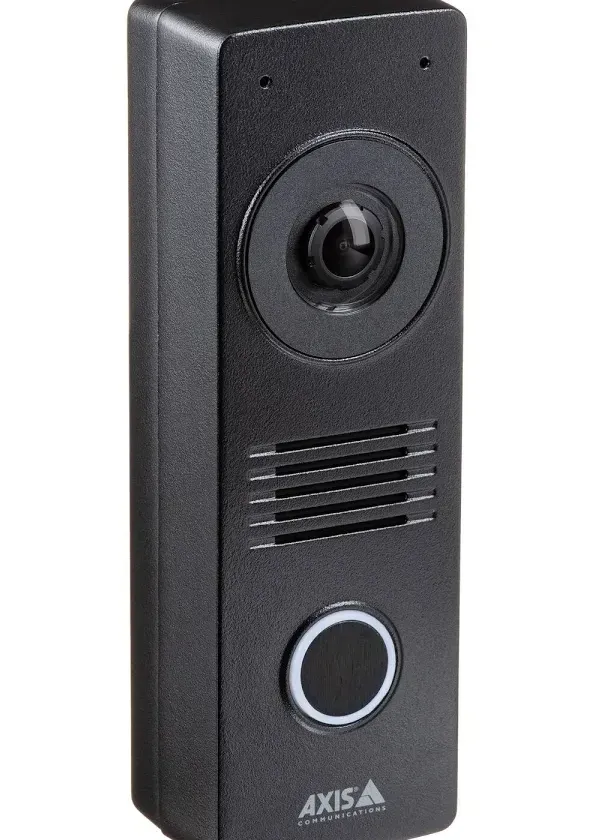
A photo from the AESS job library, not taken in South Slope: a black rectangular video door station with a camera lens, a speaker grille and a single round call button that lights up. On a South Slope row house or a frame two-family with one street door, a narrow one- or two-button station like this fits on the brick pier or the door casing at the top of the stoop, where the old bell button usually sat.
South Slope Buzzer Request
Walk-up, row house, frame two-family, co-op or a shop on the avenues: tell us the street and cross street, how many apartments or floors the system must reach and whether HPD has written anything up, and a technician calls back with the range
✅
Request Sent!
Thank you. A technician will call you about the South Slope address, usually within two hours during working hours.
25+
Years Experience
✓
Same-Day Estimates
100%
Licensed & Insured
4.7★
201 Google Reviews
Owner-operated since 2002 · Thousands of jobs completed · Booked within 2 hours
Quick answer: door buzzer installation in South Slope costs $400 to $900 on our Brooklyn list for an audio station and electric strike on a one- or two-family row house, $700 to $1,800 for a video station with indoor stations or phone answering on a house or small building, and from about $2,500 to past $10,000 for a full entry system in a walk-up or co-op, depending mainly on the number of apartments and whether the old riser cable tests sound. The price includes the door station, the apartment or floor stations, a battery-backed power supply, a fail-secure electric strike in place of any magnetic lock, the cable and the labor, and it is set in writing after we have rung every apartment from the sidewalk and metered the wiring. Anything that depends on a test, such as an old pair that might fail or a door closer that may need replacing, is named and priced before you order. Send photos of the street door, the panel and any HPD notice to (347) 934-8335 or on WhatsApp, and we reply with the range that fits, usually within two hours during working hours.
Reading your photos and your HPD record and quoting a new system costs nothing. If an existing system must be tested in person before we can price it, that is the $250 service call booked online, and the $250 is applied toward the work.
All work is done under New York State license #12000287431. We install the low-voltage entry equipment; if the power supply needs a new 120-volt outlet or circuit, a licensed electrician does that part, and you know before the price is set.
We take instructions from whoever controls the street door: the owner of a house or a walk-up, a co-op or condo board or its managing agent, or a shop tenant with the landlord's written approval. Tenants with a dead buzzer are welcome to send us the HPD record, and we will explain what it shows.
The Neighborhood
Why South Slope Properties Need Door Buzzer Installation
South Slope is the lower end of Park Slope, and even its borders are argued over. Listing guides have used Ninth Street to the Prospect Expressway between Fourth Avenue and Prospect Park West, while City Planning's 2005 South Park Slope rezoning treated 15th to 24th Streets as its own area. For a buzzer, the boundary matters less than what stands on the streets: block after block of three- and four-story brick buildings, many of them walk-ups with four to twenty apartments, mixed with row houses that hold one to three households, a pocket of old frame houses below Fifth Avenue, newer apartment buildings on the wide lots of Fourth Avenue and storefronts with apartments above on Fifth and Seventh Avenues.
In that kind of housing stock, the buzzer is not a gadget. It is the only thing that lets a tenant on the fourth floor answer the street door without walking down, and the only thing that keeps the door shut the rest of the time. When it fails, the pattern is the same in every building: deliveries are missed, visitors are let in by whoever happens to be in the hall, and somebody props the door. A Park Slope tenant on the Brownstoner forum described exactly this in 2009, after one apartment's refusal to let in the electrician left a new system dead for the whole building: residents propped the lobby door for deliveries, and "of course this is not safe but there is no other way."
The city's own inspection records show how common the failure is here. Using NYC Open Data's HPD violations file, we pulled every violation whose text mentions an intercom at addresses on 10th through 19th Streets in ZIP code 11215. From January 2021 to October 28, 2026 there were 39, at 20 different buildings, between four and nine in every year. Nine were Class A and thirty Class B, and eleven were still open on the day we checked. The language is plain: "PROPERLY REPAIR OR REPLACE THE BROKEN OR DEFECTIVE INTERCOM SYSTEM FROM BUILDING ENTRANCE" to a station in an apartment's foyer, kitchen or private hallway.
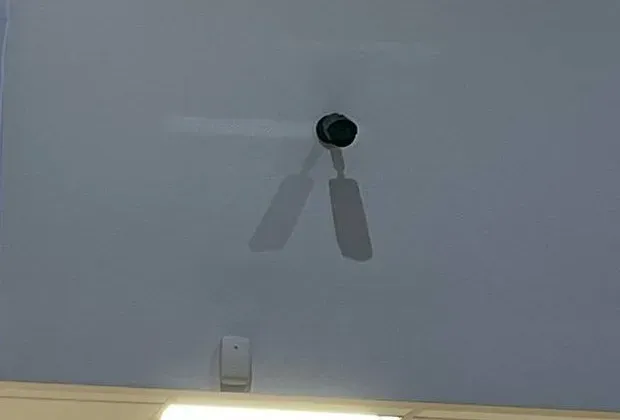
A photo from the AESS job library, not taken in South Slope: a small black camera mounted high on a pale wall, casting two shadows, with a small white wall device below it. In the narrow ground-floor hall of a South Slope walk-up, a camera set high like this sees the inside of the vestibule door and the foot of the stairs, which is where packages are left and where a visitor buzzed in by one apartment first stands.
The same file shows the doors around the buzzer are under at least as much scrutiny. On those ten streets HPD wrote 139 self-closing door violations at 74 buildings for building entrance or vestibule doors in the same period, and 28 lock-related violations at 13 buildings. Across ZIP 11215, which covers South Slope along with the rest of Park Slope and Windsor Terrace, inspectors ordered the removal of an "UNACCEPTABLE ELECTROMAGNETIC LOCKING DEVICE INSTALLED AT THE BUILDING ENTRANCE DOOR" 19 times at 15 buildings since 2021, including a 10th Street building in March 2026 and buildings on Fifth and Fourth Avenues in the summer of 2026. Key-operated double-cylinder locks on entrance doors and iron front gates drew Class C violations, the immediately hazardous class, on 11th, 13th and 16th Streets. A buzzer job here is therefore always a door job too: the release has to be one HPD accepts, the door has to close and latch on its own, and nothing can stop a tenant getting out.
Two more things set the work apart. Part of South Slope is landmarked: the Landmarks Preservation Commission's 2012 Park Slope Historic District Extension took in about 600 buildings, generally from 7th to 15th Street between Seventh and Eighth Avenues, plus buildings on 15th Street around Bartel-Pritchard Square, so a door station on those blocks follows the Commission's rules. And theft from lobbies happens in daylight. The Brooklyn Eagle reported in August 2019 that three men were seen cutting open packages in the lobby of an apartment building near Sixth Avenue and 16th Street at about 3:10 in the afternoon. A buzzer cannot stop someone a tenant lets in, but a street door that latches every time and a video station that shows who is asking for entry make that much harder.
Six facts that shape a South Slope buzzer installation
Intercom violations recur on the same streets. 39 HPD intercom violations at 20 buildings on 10th to 19th Streets from 2021 to October 2026, and one 18th Street building alone received 12 of them between 2021 and 2024.
Many of the failures are inside the apartments. The violation texts place the defective station in apartment foyers, kitchens and private hallways, and at least nine of the 39 name the "return buzzer" or "return panel," the apartment's answer-and-release unit.
Magnetic locks get written up. 19 HPD orders across ZIP 11215 since 2021 to remove an electromagnetic lock from a building entrance or vestibule door, so we fit fail-secure electric strikes instead.
The doors themselves are inspected. 139 self-closing violations on entrance and vestibule doors at 74 buildings on these ten streets, which is why the closer and the latch are checked before any release goes on.
Some blocks are landmarked. The 2012 Park Slope Historic District Extension reaches 15th Street between Seventh and Eighth Avenues and the buildings around Bartel-Pritchard Square.
The building stock is old and mixed. Brownstoner's 2015 profile of 199 17th Street describes a simplified Italianate brick house standing by 1880 on a block filled mostly with masonry rows by 1888, with a few frame houses among them.
Where this page applies. We use South Slope here for the blocks from roughly Ninth Street down to the Prospect Expressway, between Fourth Avenue and Prospect Park West or Eighth Avenue, the area most of our South Slope calls come from. For the blocks north of Ninth Street see our Park Slope door buzzer installation page, for the rest of the borough our door buzzer installation in Brooklyn page, and for the whole city our NYC door buzzer installation page.
Repair or Replace in South Slope
Need Repair in South Slope? Fix the Failing Part, Swap the Panel or Rebuild the Whole System
A good share of the calls we get from South Slope begin with "we need a new buzzer" and end with something smaller. The owner of a six-apartment walk-up gets an HPD notice for one tenant's kitchen station and assumes the whole system must go. Sometimes it must. Often the fault is one station, one pair of wires or a transformer in the cellar that has been running hot for twenty years. Before anything is ordered, we decide which of three paths fits the building.
The first is a targeted repair: the one apartment station HPD wrote up, a strike that has loosened in a patched frame, a closer that no longer pulls the vestibule door shut. The second is a partial replacement: a new street panel and power supply on riser cable that tests sound, keeping or replacing the apartment stations depending on what the building wants. The third is a full installation with new cable to some or all apartments, for buildings whose risers were cut during renovations, whose pairs fail the meter or whose stations are so old that parts no longer exist. If a repair is honestly all the building needs, we price it as a repair, and our Brooklyn door buzzer team handles both kinds of work on the same visit.
On these blocks the deciding checks are usually the same three: whether the riser pairs pass the meter all the way to the top floor, whether the street and vestibule doors close and latch on their own, and whether the lock on the door is one HPD will accept. Settle those, and the choice between repair and replacement mostly makes itself.
What We Install
Door Buzzer Installation Services in South Slope
Every service below is priced from the same Brooklyn door buzzer list. The number of apartments or floors sets the size of the system; the street door, the vestibule door and any gate decide which release each can take; and in South Slope the condition of the riser and the HPD history of the building decide much of the labor.
Walk-up entry systems
A new button or directory panel at the street door, a station in every apartment and a release on the right door, for the three- to five-story walk-ups that line the numbered streets from Fourth Avenue to Eighth Avenue.
HPD intercom violation work
The specific station, pair or panel named in an HPD violation repaired or replaced, tested from the street door to that apartment, with a written record the owner can keep with the certification.
Magnetic lock replacement
Removal of an electromagnetic lock from a building entrance or vestibule door and a fail-secure electric strike fitted in its place, wired to the existing or new buzzer so tenants keep their release.
Row house and two-family buzzers
One- to three-button stations for brick row houses with a rental floor or two, each button ringing only its own household, each household able to release the street door.
Frame house stations
Stations mounted on the casing or a solid backer on the old frame houses below Fifth Avenue, with cable routed through the cellar and up interior walls rather than across the siding.
Video and phone answering
Video door stations with indoor screens, or answering on residents' phones, for buildings where tenants want to see who is asking for entry before they let anyone into the hall.
Co-op and condo lobby systems
Directory or code panels with apartment stations, phone answering or a desk station, for the larger co-ops and the newer condo buildings on Fourth Avenue and near Prospect Park West.
Vestibule and gate releases
Releases on the inner vestibule door or an areaway gate where the building needs one, with free exit from inside and locks that HPD does not treat as illegal fastenings.
Shop and office doors on the avenues
Buzz-in doors for shops, offices and practices on Fifth Avenue, Seventh Avenue and Fourth Avenue, kept fully separate from the apartments' system above.
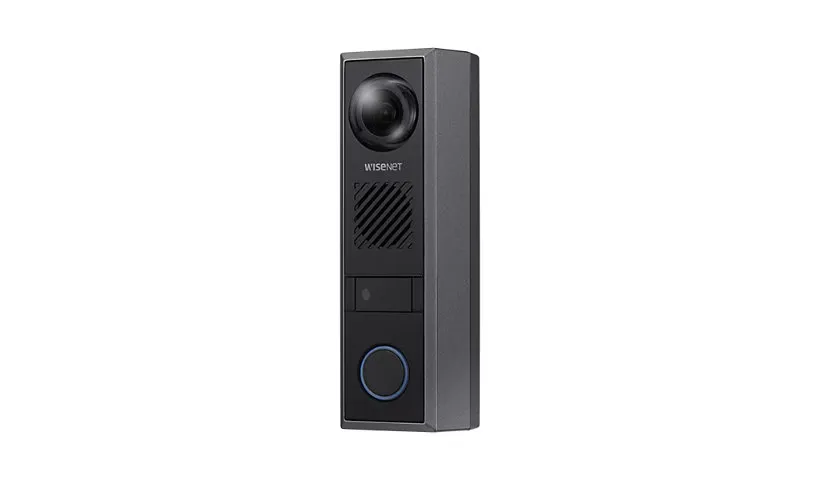
A photo from the AESS job library, not taken in South Slope: a slim dark grey wired doorbell with a camera lens, speaker slots and a round push button. A unit this narrow suits the door casing of a South Slope frame house or a one-family row house, where there is only a strip of wood or a single brick pier beside the door and no room for a wide apartment panel.
Building Specialists
Door Buzzer Installation for South Slope's Architecture
Six kinds of building account for almost every buzzer we plan in South Slope. They differ in how many households the street door serves, how cable can reach each floor, who orders and pays for the work and which inspection rules apply, and each has its own way of going wrong when a job is rushed.
Prewar walk-ups
Three- to five-story brick buildings with four to twenty apartments, a vestibule with mailboxes and a single stair, the buildings that carry nearly all of the area's HPD intercom violations.
Brick row houses
Two- and three-story brick and brownstone row houses, many split into two or three apartments, some with a stoop and some with the entrance at sidewalk level.
Frame houses below Fifth Avenue
Old wood-frame houses, a few of them four stories, scattered through the blocks from about 11th to 15th Street west of Fifth Avenue, often holding two households.
Converted industrial co-ops
Large co-ops in former factories, such as the 71-apartment co-op in the old Ansonia Clock Company plant that fills the block from Seventh Avenue at 12th Street to Eighth Avenue at 13th Street.
Newer buildings on Fourth Avenue
Mid-rise apartment and condo buildings on the wide lots along Fourth Avenue, many with video or cloud entry systems installed by the developer.
Shops with apartments above
Mixed buildings on Fifth and Seventh Avenues with a storefront at street level and a separate apartment door beside it.
Prewar walk-ups: a riser that has been patched for decades and a vestibule HPD inspects
The typical South Slope walk-up has a button panel set into the wall beside the street door, a vestibule with the mailboxes, a second door into the hall and the stair, and a station in each apartment, usually in the foyer or the kitchen, which is where the HPD violation texts on these streets keep putting them. The cable runs from the panel down to the cellar and up a riser, sometimes in a chase, sometimes stapled up a light well or along the stair. Over the years individual stations get swapped for whatever was on the shelf, and pairs get spliced where a renovation crossed them.
That history is why we never quote a walk-up from the panel alone. We ring every apartment from the street, meter every pair from the cellar and look at what each apartment actually has on the wall. A building where every pair tests sound can take a new two-wire system over its old cable at the lower end of the multi-unit range. A building where the upper floors fail needs new cable to those floors, routed through closets or the public hall ceiling, and the price says so before you approve it.
Brick row houses: one street door, two or three households and a stoop
A row house split into apartments is the commonest small job here. The owner often lives on the lower floors and rents the top one or two, all behind a single street door. The usual problem is not wiring but logic: one bell that rings for everyone, or a two-button plate where the second button was never wired. We fit a station with one button per household, a station in each apartment and a release that any household can trigger, and we place the station on the brick pier or the door casing so it does not cover the original woodwork.
Frame houses below Fifth Avenue: wood walls, siding and the cellar route
South Slope still has a scattering of frame houses. A Brownstoner listing thread from 2006 described a four-story frame two-family with the owner's triplex over a garden floor-through, and a commenter noted that many frame houses survive on the blocks from 11th Street to about 15th Street below Fifth Avenue. These houses need a different fixing and a different route. The station goes on a solid section of the door casing or on a backer block set into the wall, never screwed only into thin siding, and the cable drops straight through the wall into the cellar and comes up inside to each floor.
Converted industrial co-ops: big buildings, heavy walls and a board decision
The Brooklyn Public Library's history of the Ansonia Clock Company says its Brooklyn plant, "said to be the largest clock factory in the world," filled the block from Seventh Avenue and 12th Street to Eighth Avenue and 13th Street, and that it is now a 71-unit co-op. A building of that size and age is a different job from a walk-up. The entry system usually has to reach apartments across several wings from one or more entrances, through masonry walls far thicker than a row house's, and the decision is made by a board, often on the advice of a managing agent.
Newer buildings on Fourth Avenue: a developer's system and who now controls it
City Planning's South Park Slope rezoning, approved by the City Planning Commission on October 19, 2005 and the City Council on November 16, 2005, kept the midblocks low-rise and mapped higher-density zoning with an inclusionary housing option on Fourth Avenue, where many lots held one-story warehouses and commercial buildings. Many of the newer buildings along the avenue came with a video or app-based entry system chosen by the developer. When those buildings call us, the question is rarely the cable, which is usually modern. It is who has the administrator access, whether the equipment is still supported, and what the monthly charge is. We document what is installed before recommending anything.
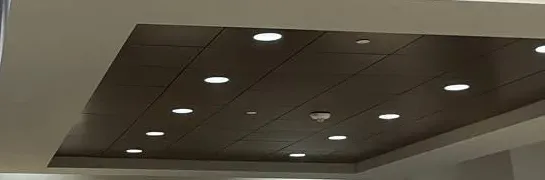
A photo from the AESS job library, not taken in South Slope: a dark recessed ceiling panel with round downlights and a small round device, framed by a lighter ceiling. The lobbies of the newer condo buildings on Fourth Avenue often have ceilings built like this, and the space above a dropped panel is usually the clean route for new cable from the entrance panel back to the equipment room.
Field Notes
Field Notes: Ring Every Apartment From the Sidewalk, Then Follow the Riser Down to the Cellar
This is the order our technician works in on the first visit to a South Slope walk-up, before anything is priced. It is method, not a story about one building, and it is the same whether the building has four apartments or forty.
The visit starts at the street door, with the building's HPD record in hand and the door checked first for a magnetic lock, a double-cylinder lock or a closer that leaves it ajar. Then comes the ring test. With a tenant or the super's help, the technician presses every button and listens at each apartment: does the station ring, can the visitor be heard, can the tenant be heard at the street, and does the release open the door. The answers sort each line into one of four groups: working, ringing but silent, silent altogether, or talking but not releasing. A pattern across several apartments on the same floor or the same side of the building usually points to a riser problem; a single silent apartment usually points to its own station or its own short run.
Last is the cellar. The technician finds the power supply or transformer, checks what it is plugged into and whether it is on the building's own circuit or borrowed from an apartment, and follows the riser as far as it can be seen. Each pair gets metered from the cellar end. Only then is the cable plan drawn: which pairs are reused, which floors need new cable and which route it takes, and that plan is what the written price is built on.
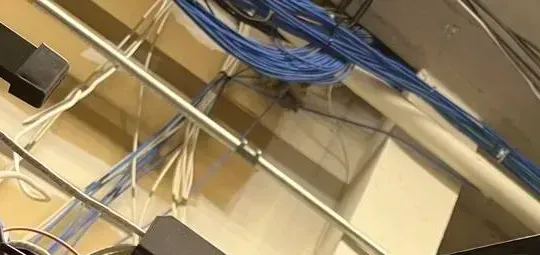
A photo from the AESS job library, not taken in South Slope: bundles of blue low-voltage cable laid over a ceiling beam beside a metal pipe in an open ceiling. In a South Slope walk-up cellar the buzzer cable follows a path like this along the joists from beneath the street door to the foot of the riser, kept clear of the boiler piping and labeled where each apartment's pair turns up.
The Inspection Record
What 39 HPD Intercom Violations on 10th to 19th Streets Tell an Installer
An HPD violation is written for one apartment, one condition and one date, so a single notice says little about a building. Taken together for a whole stretch of streets, the notices say a lot about how buzzer systems fail in South Slope's housing. We pulled every HPD Housing Maintenance Code violation whose description mentions an intercom at addresses on 10th through 19th Streets in ZIP code 11215, with inspection dates from January 1, 2021 to the latest record, October 28, 2026. Addresses on the avenues are not included in this count, because their house numbers do not line up with the street grid, so the true figure for the neighborhood is somewhat higher.
Inspection year
Intercom violations
Class A
Class B
Still open on November 11, 2026
2021
7
2
5
1
2022
6
1
5
2
2023
9
1
8
0
2024
7
4
3
2
2025
6
0
6
4
2026 (to October 28)
4
1
3
2
Total
39 at 20 buildings
9
30
11
Source: NYC Open Data, HPD Housing Maintenance Code Violations, filtered by ZIP 11215, street names 10 Street through 19 Street, description containing "INTERCOM," inspection date from January 1, 2021. Counts are by inspection date. A building can appear more than once in a year, and a closed violation means HPD's record shows it as closed, not that the system has worked ever since.
Reading one: the failures cluster in a few buildings
Twenty buildings shared the 39 violations, but they did not share them evenly. One building on 18th Street received 12 between September 2021 and April 2024, sometimes several apartments on one inspection day, and on September 5, 2023 one of its notices read "PROPERLY REPAIR OR REPLACE THE BROKEN OR DEFECTIVE INTERCOM SYSTEM AT BUILDING FRONT TO ALL APARTMENTS." One building on 12th Street has four intercom violations still open, written in March 2024, June 2024, August 2025 and April 2026, all for the same first-floor apartment. A system that gets written up again and again is usually a system that has been repaired one symptom at a time. When we see that pattern, we price the cause, not the latest symptom.
Reading two: the inspector stands in the apartment, not at the panel
Almost every one of the 39 descriptions locates the defect inside an apartment: "AT EAST WALL IN THE FOYER," "AT SOUTH WALL IN THE KITCHEN," "IN THE PRIVATE HALLWAY." Eight of them put the station in the kitchen. That matches how these buildings were wired, with the apartment station at the end of a long run from the street door, often in the room the old cable reached first. It also means a new street panel alone does not clear an apartment-level violation. The test that matters is the one HPD makes: press the button at the street, and can the tenant in that foyer or kitchen hear, speak and release the door.
Reading three: the release side fails as often as the talk side
At least nine of the descriptions name the "RETURN BUZZER" or the "RETURN PANEL," the part of the apartment station a tenant presses to buzz the street door open. One 14th Street notice from August 2026 spells out both halves: "THE BROKEN OR DEFECTIVE BUZZER AND RETURN VOICE INTERCOM SYSTEM FROM BUILDING ENTRANCE DOOR UP TO PANEL." So when we test, we test both directions on every line, and we test the door: a release signal that reaches a strike that has worked loose in its frame is still a failed release.
HPD gives owners a fixed time to correct each class. On its Clear Violations page, Class A non-hazardous violations have "90 Days from date of service," Class B hazardous violations "30 Days," self-closing door violations in Class C "14 Days," and most other Class C conditions "24 Hours." Owners then certify the correction, HPD may audit the certification, and tenants can challenge it, which triggers a reinspection. A repair that only lasts until the certification is filed tends to come back on the next inspection.
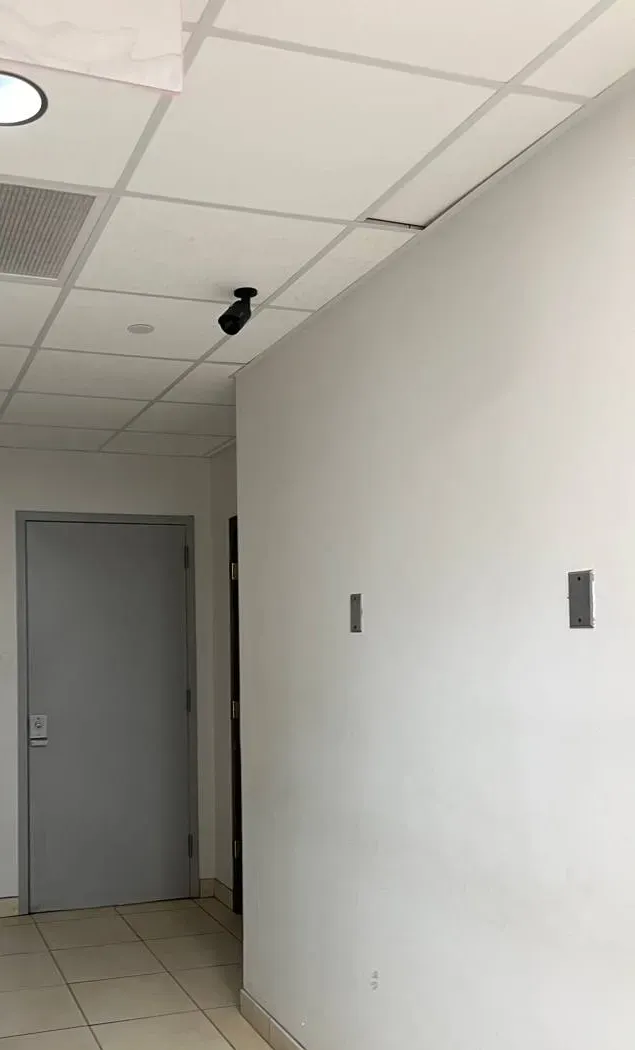
A photo from the AESS job library, not taken in South Slope: a tiled corridor with white walls and small wall plates ending at a grey steel door with a lever handle, under a drop ceiling with a small camera. A rear or cellar door like this one in a South Slope building has to open from inside with one turn of the lever, whatever release is added, and HPD writes keyed locks and padlocks on such doors as Class C violations.
The Lock Behind the Buzzer
Magnetic Locks, Double-Cylinder Locks and the Strikes That Replace Them on South Slope Street Doors
The buzzer gets the attention, but the part that decides whether a South Slope installation passes inspection is often the lock it releases. HPD's records for ZIP 11215 make the point twice over.
The first is the magnetic lock. A magnetic lock is a steel plate on the door held against an electromagnet on the frame; it holds the door as long as it has power and releases it when power is cut. It is quick to install on almost any door, which is why previous owners and handymen put them on street doors. Since January 2021, HPD inspectors in ZIP 11215 have written 19 violations ordering the removal of an electromagnetic locking device from a building entrance or vestibule door, at 15 different buildings, under the wording "REMOVE THE ILLEGAL FASTENING CONSISTING OF AN UNACCEPTABLE ELECTROMAGNETIC LOCKING DEVICE." Most were Class C. They include a 10th Street building inspected on March 22, 2026, whose violation was still open when we checked, a Fourth Avenue building on June 14, 2026 and a Fifth Avenue building that received two such orders in July 2024 and two more on July 30, 2026.
The reason is in how the locks work. Allegion's guide on fail-safe and fail-secure hardware says "Electromagnetic locks are only available fail safe," meaning they release when power is lost, and the building code's sensor-release provisions only allow an electrically locked egress door with a sensor on the inside, a manual release marked "PUSH TO EXIT" mounted 40 to 48 inches above the floor within 5 feet of the door that cuts power directly and keeps the door unlocked for at least 30 seconds, release on fire alarm or sprinkler activation and UL 294 listed equipment. A magnetic lock added to a walk-up's street door without that package is the kind HPD treats as an illegal fastening. We do not install one on a residential entrance door. We fit a fail-secure electric strike in the frame instead.
A fail-secure strike keeps the door locked when power fails, so a blackout on the block does not leave the building open, and it does nothing at all to the inside of the door. As Allegion puts it, with an electric strike "you can exit by turning the lever" regardless of whether the strike is fail-safe or fail-secure. The tenant's way out is the lever or knob on the lock already on the door, which is exactly how the door worked before any buzzer existed.
The second problem is the double-cylinder lock, a deadbolt that needs a key on both sides. In ZIP 11215, HPD has written key-operated double-cylinder locks as illegal fastenings on building entrance doors, vestibule doors, iron security gates at building entrances and front-yard gates, including on 11th Street in 2021, on 16th Street in 2023 and 2026, on 13th Street in 2023 and on a 10th Street front-yard gate in 2025. A door or gate that tenants must pass through to leave cannot require a key to open from inside. Where a gate stands in front of the street door, we fit a lock with free exit from the inside and, if the building wants visitors buzzed through it, a release on the gate wired to the same system.
What we check on every South Slope entrance door before a release goes on
The lock that will stay. The existing lockset or deadbolt must open from inside with a lever or knob, no key. A double-cylinder lock is replaced before the release is fitted.
The frame. The strike is cut into the frame, so the frame has to be sound. Old wood frames patched after earlier break-ins sometimes need a steel reinforcing plate or a new jamb section first.
The closer. The door has to close from fully open and latch on its own. On these ten streets HPD wrote 139 self-closing violations on entrance and vestibule doors at 74 buildings since 2021, so the closer is adjusted or replaced as part of the job if it needs it.
The gaps. HPD has also cited vestibule doors on these streets under the Fire Code for gaps over 1/8 of an inch at the top and sides or 3/4 of an inch at the bottom. A strike that is set correctly does not change those clearances; a door that sags on worn hinges does, and that is fixed before the strike is set.
The power. The strike and the stations run from a dedicated low-voltage supply with battery backup on the building's own circuit, not one tenant's outlet.
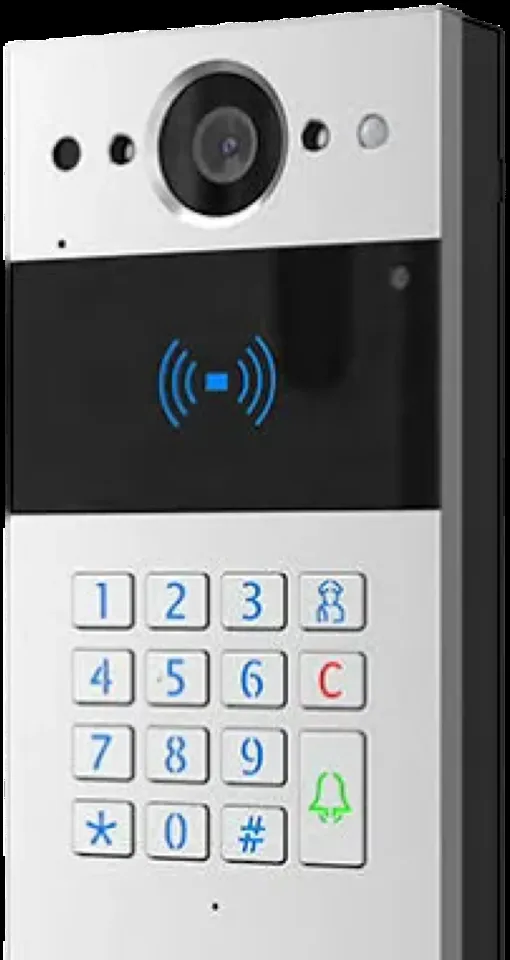
A photo from the AESS job library, not taken in South Slope: a silver and black keypad door station with a camera lens at the top, a blue card-reader symbol, a numeric keypad and a green bell key. On a South Slope walk-up whose owner wants residents to enter by code, a station like this releases a fail-secure strike in the frame rather than a magnetic lock, so the door stays locked in a power cut and still opens from inside with the lever.
Rules and Responsibilities
Which South Slope Buildings Must Have a Working Buzzer, and What It Has to Do
Buildings of eight or more apartments built or converted after 1967. Under Multiple Dwelling Law §50-a, a Class A multiple dwelling erected or converted after January 1, 1968 with eight or more apartments must have an intercommunication system at the self-locking main entrance that lets a resident speak to a visitor and release the door. Many of the newer buildings on Fourth Avenue fall into this group.
Older apartment buildings when a majority of tenants ask. For buildings put up before that date, which includes most of the prewar walk-ups on the numbered streets, the same section requires the system once tenants occupying a majority of the apartments request or consent in writing, with installation begun within 90 days and finished within six months.
Whatever is installed has to be kept working. The 39 violations on 10th to 19th Streets were all written under Housing Maintenance Code §27-2005, the general duty to keep the building in good repair. An intercom a building already has is treated as something the owner must maintain, whatever the building's age or size.
Exit doors open without a key. Double-cylinder locks and padlocked hasps on entrance doors, gates, cellar doors and roof bulkheads are written as illegal fastenings on these streets. Any release we add leaves the door opening freely from inside.
Entrance doors close and lock themselves. Brick Underground's buzzer guide summarizes the city rules: buildings with at least eight apartments need a self-closing, self-locking front door as well as an intercom that lets tenants talk to and buzz in guests. HPD writes Class C self-closing door violations with a 14-day correction period.
Houses are the owner's call. A one- or two-family house is not a multiple dwelling under these rules, so whether to install a buzzer, and what kind, is up to the owner, unless the house is on a landmarked block, where the station's placement follows the Commission's rules below.
None of this is legal advice for a particular building. An owner facing a tenants' written request, a co-op board with an HPD notice or a buyer looking at a building's open violations should confirm the details with a housing lawyer or the managing agent. What we provide is a system and a door that meet the requirement that applies, and a written record of what was installed and tested.
The Historic District Blocks
Door Stations on the Landmarked Blocks Between Seventh and Eighth Avenues
Most of South Slope is not landmarked, but its upper corner is. CityLand's report on the Landmarks Preservation Commission's unanimous vote of April 17, 2012 describes the Park Slope Historic District Extension as about 600 buildings on the southwest border of the original 1973 district, generally bounded by 7th Street on the north, 15th Street on the south, Seventh Avenue on the west and Eighth Avenue on the east, with buildings on 15th Street around Bartel-Pritchard Square and a group facing Prospect Park West between 9th and 10th Streets. The Commission's later Extension II, designated on April 12, 2016, added 292 buildings around the northern part of the district and does not reach South Slope. The fastest way to check a single address is the Commission's own map.
On those blocks the Commission's rules for health and safety equipment apply to a door station the same way they apply to a light or a camera. The practical effect is that the station belongs at the doorway, attached at a mortar joint, a plain stretch of masonry, wood or metal, not through carved stone or ironwork, sized as small as the job allows and finished to blend in; that one doorway carries one intercom panel; and that the cable goes back into the wall behind the station rather than along the facade, with only a short length of painted conduit tolerated where hiding it is impossible. Work that meets the staff criteria is handled at staff level. Work that does not, such as a panel on a new post at the foot of the stoop, can end up before the full Commission.
For a South Slope row house or walk-up inside the extension, that usually means the new station goes where the old panel or bell plate already is, or on the brick pier beside the door; the cable drops through the wall into the vestibule or the cellar; and any old panel holes that are no longer used are patched to match. We plan the route from the inside first and choose a station that fits the opening, and if the job needs an application, we supply the product sheets, a marked-up photo and the mounting details for it.
Commercial Door Buzzer Installation
Business Door Buzzer Installation in South Slope
South Slope's businesses sit on its avenues and on Ninth Street, nearly always in buildings with apartments above or beside them. A business buzzer here is about the doors that should not be open to everyone: an upstairs office that lets clients in one at a time, a practice that buzzes patients through a locked street door, a restaurant's delivery door and the apartment door next to the shopfront that must stay out of the business's hands.
Fifth Avenue
One of the neighborhood's two main commercial streets, lined with restaurants, bars and shops under apartments, and the avenue where HPD wrote magnetic-lock violations on a building's entrance and vestibule doors in 2024 and again in July 2026.
Seventh Avenue
The other primary commercial avenue; south of Ninth Street it becomes lower-density and more local, with small shops, offices and practices at street level and apartments above.
Fourth Avenue
The wide western edge, where the 2005 rezoning allowed larger buildings on lots that once held one-story warehouses, and where newer mixed buildings put retail under apartment lobbies.
Ninth Street
A main shopping street with F and G stations at Fourth and Seventh Avenues, at the northern edge of the blocks this page covers.
Prospect Park West at Bartel-Pritchard Square
The corner where the old Pavilion Theater became Nitehawk Prospect Park, across from the square's columns and the 15th Street station entrance.
Eighth Avenue at the Armory
The 14th Regiment Armory between 14th and 15th Streets, a city landmark that houses a women's shelter and a YMCA sports facility, with residential blocks on all sides.
If you also want a camera on the back or delivery door, our Park Slope door buzzer installation page covers the commercial blocks of Fifth and Seventh Avenues north of Ninth Street.
Rules that apply to business entry installations in South Slope
Free exit, always. A business door with a buzzer, keypad or reader still opens from inside without a key, code or button. A fail-secure electric strike does that by design.
Magnetic locks only with the full package. Where a commercial door genuinely needs a magnetic lock, the code's sensor-release requirements come with it: inside sensor, "PUSH TO EXIT" button 40 to 48 inches up within 5 feet, direct power cut, 30-second unlock, release on fire alarm or sprinkler activation and UL 294 listed parts. On a shared residential entrance we do not fit one at all.
Fire-rated doors stay rated. Allegion's guidance is that fire doors take fail-secure strikes so they stay latched in a fire, and the release must carry the right listing for the door.
Reception buttons within reach. Release buttons at a front desk and call buttons at the door go no higher than the 48-inch high forward reach in the 2010 ADA Standards.
The landlord signs off. A shop or office tenant orders work on a shared street door only with the building owner's written approval, and the apartments' wiring is not touched without it.
New buildings plan the entry early. A new building of eight or more apartments on Fourth Avenue falls under the §50-a intercom requirement, and its lobby, retail and service doors cost least to wire before the walls close.
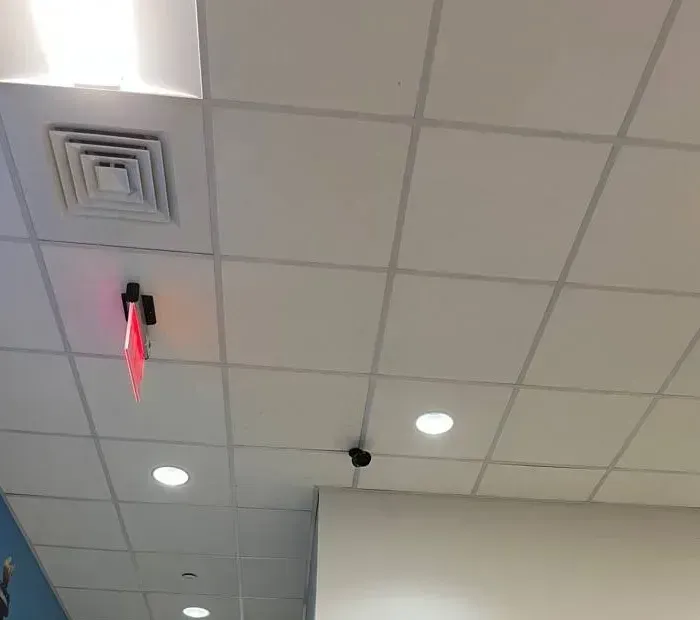
A photo from the AESS job library, not taken in South Slope: a drop ceiling with a lit red exit sign, an air diffuser, round recessed lights and a small black camera. Offices and practices over the shops on Fifth and Seventh Avenues often have ceilings like this, and the exit sign states the rule every business buzzer here follows: whatever locks the door from outside, it opens from inside.
Your Questions Answered
Door Buzzer Installation in South Slope: Questions Answered
What the HPD record is telling you
HPD wrote up the intercom in four different apartments of our walk-up on the same morning, each one "from building entrance" to that apartment. Is that four separate faults or one?
Usually one, or one plus a few loose ends. When several apartments fail together, the common parts are the first suspects: the street panel, the power supply in the cellar and the riser cable those apartments share. An 18th Street building on our list received intercom violations for several apartments on the same inspection days in 2023, and one of them was written for the system "AT BUILDING FRONT TO ALL APARTMENTS," which is what a shared fault looks like on paper.
We test it the same way. Each written-up apartment is rung from the street, then the shared parts are checked: the supply's output under load, the panel's connections and the riser pairs from the cellar up. If the shared part is at fault, the price is for that part plus whatever each apartment station needs, rather than four separate repairs. If the four turn out to be unrelated, the quote says so, line by line.
The magnetic lock a previous owner put on our street door has been written up as an "unacceptable electromagnetic locking device." Will our tenants still be able to buzz people in once it comes off?
Yes, if the lock is replaced rather than simply removed. The magnetic lock is the part the tenants' release buttons currently operate. When it comes off, something else has to hold the door and respond to those same buttons, and the usual answer is a fail-secure electric strike cut into the frame, wired to the existing buzzer system. The tenants press the same button; the strike releases instead of the magnet; and the door opens from inside with the lever, which is the point of the violation.
Two checks come first. The existing buzzer has to be able to drive a strike, which most can, sometimes with a relay. And the lockset on the door has to latch into a strike, which a door that has been held only by a magnet sometimes cannot do without a new latch or a frame repair. Both are priced before the work starts, and the strike goes in on the same visit the magnet comes off, so the building is never left without a locking street door.
The inspector also wrote our vestibule door up for gaps around the edges. If you cut an electric strike into the frame, could that make the gaps worse?
Not if the door is fixed first. HPD has cited vestibule doors on these streets under the Fire Code for gaps over 1/8 of an inch at the top and sides and over 3/4 of an inch at the bottom. Those gaps come from the door and frame, usually worn or loose hinges, a frame that has moved or a door that was trimmed badly, not from the strike. A strike sits in the latch side of the frame and, set correctly, holds the door where it already closes.
The order of work matters, though. If a strike is set on a door that sags, it is set to the wrong position, and when the hinges are tightened later the latch no longer lines up. So we have the hinges, the frame and the closer sorted first, by us where it is hardware work or by a carpenter where the frame needs it, and then set the strike to the door as it will stay.
Our building's iron front gate has a lock that needs a key on both sides, and we have seen neighbours get Class C violations for the same thing. What can go on the gate instead, and can the buzzer open it?
A lock that opens from the inside without a key, and yes. HPD has written key-operated double-cylinder locks on iron gates at building entrances and on front-yard gates as illegal fastenings in ZIP 11215, including on 13th Street in 2023, 16th Street in 2023 and 10th Street in 2025. The fix is a gate lock with a thumb turn, lever or push bar on the inside and a key or code on the outside, so anyone leaving can open it without a key.
If visitors should be buzzed through the gate as well as the street door, the gate lock gets an electric release on the same system, either opening with the street door or on its own button. The cable to a gate has to reach a part that moves, so we route it through the hinge post with a loop or a flexible conduit and price that run separately. If the gate is only meant to be closed at night, a lock with free exit and no release may be all you need.
Buying, owning and renting on these blocks
We are in contract on a small walk-up here and the HPD record shows intercom violations still open. Should the system be replaced before the closing or after?
That depends on the contract, and your lawyer decides it, but the technical answer can help the negotiation. Before closing, we can review the HPD record and, with the seller's permission, ring every apartment and meter the riser, then give you a written scope and price for what it will take to make the system and the entrance doors pass. That figure is useful whether the seller fixes it, credits you for it or the price moves.
After closing, the open violations become your responsibility, with the correction periods HPD gives each class. If you plan to replace the system anyway, it is usually better to do it once, properly, soon after closing, than to pay for a seller's patch you will rip out. Some of the open violations we saw on these streets were years old, and a buyer inherits them.
We are on the board of a large co-op in a converted factory. With thick masonry walls and apartments in several wings, is a wired system still realistic, or should we go to phones?
Often both, in the right mix. In a converted industrial building the existing intercom cable usually runs in a few long risers or along corridor ceilings to each wing, and those runs can be in better shape than a walk-up's, because they were installed once, in conduit or chases, during the conversion. If they test sound, a wired system over the existing cable gives every apartment a station with no monthly charge.
Where a wing's cable fails, new runs through thick masonry are the expensive part. A phone-answering system can serve that wing without new runs to every apartment, but it brings a possible subscription and needs a station or code option for residents without the app. We test line by line and price both options side by side, including what each costs over ten years, so the board votes on numbers.
I rent on the fourth floor and the buzzer has been dead for months. The landlord says a Class A violation gives him 90 days. Is that how it works?
Partly. HPD's Clear Violations page does give owners "90 Days from date of service" to correct a Class A violation and "30 Days" for Class B, and on these streets most intercom violations were written as Class B. The period runs from when the notice is served, not from when the buzzer broke, and it is the time before civil penalties can be sought, not a reason to wait. After correcting it, the owner has to certify; if the certification is false, tenants can challenge it and HPD can reinspect.
As an installer we can only act for whoever controls the door, which in a rental is the owner or managing agent. What a tenant can do is make sure the condition is on record through 311, keep the dates, and tell the landlord in writing. If your landlord asks us to look at it, the violation text tells us exactly which station to test first.
The avenues
Our practice is on the second floor of a Fifth Avenue building and shares the street door with three apartments. Can we buzz in patients without being able to ring or open for the tenants?
Yes. The practice gets its own call button on the street door and its own release, on a separate power supply and separate cable, so a patient presses the practice's button, the practice answers and releases the door, and nothing in the practice can call an apartment. The tenants' buttons, stations and release stay exactly as they are.
The door still has one strike, so whichever side releases it, the same door opens. If the practice wants the waiting room protected from the stair as well, a second release on the practice's own door at the top of the stair, controlled only from the reception desk, does that. Both need the landlord's written approval, because the street door is shared.
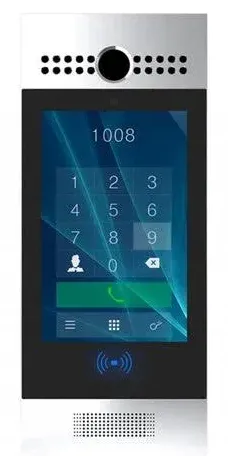
A photo from the AESS job library, not taken in South Slope: a touchscreen entry panel showing a dial pad with a four-digit apartment code entered, a camera above and a card-reader symbol below. In a large South Slope co-op or a newer Fourth Avenue condo, a code panel like this takes the place of a long column of buttons, and the reader gives residents a way in that the board can manage without cutting new keys.
Equipment
Types of Door Buzzer Systems We Install
We quote a reliable non-branded system by default and install a named brand when an owner or board asks for one; the intercom brands we work with include Aiphone, ButterflyMX, 2N, Akuvox, Comelit and DoorBird. These are the kinds of equipment that come up most often on South Slope jobs, and where each fits.
Button panels for walk-ups
Surface or flush panels with one button per apartment, a speaker and a microphone, sized to replace an old plate in the same opening on a brick front or in a vestibule wall.
Two-wire apartment systems
Systems that carry voice, and on some models video, over a single pair to each apartment, the practical way to reuse a walk-up's existing riser when its pairs test sound.
Apartment audio and video stations
Handsets or hands-free stations with a release button for each apartment's foyer or kitchen, with video screens where tenants want to see the visitor before opening.
Directory and code panels
Scrolling directories, code entry and card readers for co-ops and condo buildings with more apartments than a button panel can hold neatly.
Phone and app answering
Door stations that ring residents' phones, as the whole system or alongside wall stations, for buildings where new cable to every apartment would cost more than it saves.
One- to three-button house stations
Slim stations for row houses and frame houses, one button per household, small enough for a brick pier or a strip of casing.
Fail-secure electric strikes
Releases cut into the frame that stay locked in a power cut and leave the inside lever working, our standard replacement for a magnetic lock on a residential entrance.
Door closers
Closers adjusted or replaced so the street and vestibule doors close from fully open and latch on their own, the condition HPD inspects for self-closing violations.
Battery-backed power supplies
Dedicated low-voltage supplies with battery backup, mounted in the cellar on the building's own circuit and sized for the panel, every station and the strike.
Patching the old system, a wired replacement or phone answering: which fits a South Slope walk-up?
What matters
Patch one station at a time
Wired system over a tested riser
Phone or app answering
Clears the violation in front of you
Usually, for that apartment
Yes, for every apartment tested
Yes, if every apartment can answer
Likely to bring the next violation
Often, from another apartment
Much less likely
Depends on residents' phones and the building's internet
Works for a tenant without a smartphone
Yes
Yes
Only with a station or a landline option
Needs internet at the building
No
No
Yes, or a cellular connection
New cable to every apartment
No
Only where pairs fail
Usually not
Monthly fees
None
None
Often a per-unit or per-door charge
Brooklyn list range
Priced as a repair
From about $2,500 for a walk-up
Within the same ranges, plus any subscription quoted separately
ADT, Ring and SimpliSafe compared with a local installer for a South Slope building
A national alarm company or a store-bought video doorbell is the first thing many South Slope owners think of, and for a one-family row house it can be enough. For anything with more than one household behind the street door it runs into the same limits. A video doorbell rings the phones of whoever set it up, not a station in each apartment, so the tenant on the third floor gets nothing. It does not release the street door unless it is separately wired to a strike. It does not fix a dead riser, a magnetic lock HPD has written up or a closer that leaves the door ajar. A Brownstoner forum thread on a multi-family brownstone shows the gap: upstairs residents who "can't see out our front door" wanted a video doorbell over an old buzzer serving two apartments, and the installer's quote for a proper video system ran to about $3,000.
AI Overview Reality Check
What AI Gets Wrong About Door Buzzer Installation in South Slope
Search summaries and AI assistants answer buzzer questions from national cost guides, vendor blogs and generic how-to pages, including the ones published by Angi and HomeAdvisor. Some of what they say is right in general and wrong for a neighborhood of prewar walk-ups where HPD inspects the door as closely as the intercom. Here are seven claims we hear, each checked against its source and against what we see on these streets.
"Installing an intercom system costs an average of $2,500"
That is HomeAdvisor's national average, from a guide that gives a range of $1,500 to $15,000, with wireless systems at $150 to $1,500 and hard-wired ones at $1,000 to $15,000. A national average blends single-family doorbells with large buildings and says nothing about a riser in a five-story walk-up.
On our Brooklyn list, a row house audio station with a strike runs $400 to $900, a video station with indoor stations or phone answering for a house or small building $700 to $1,800, and a full system for a walk-up starts at about $2,500 and can pass $10,000 in a large building.
So a South Slope walk-up of eight apartments often lands near the national average, while a two-family row house lands well below it. The number that matters is your apartment count and your riser test.
"Modern IP and video intercoms run $1,000 to $5,000 or more per entry door"
That figure comes from Swiftlane's apartment intercom cost guide, which adds that "Software subscriptions commonly add $5 to $15 per unit per month, or $30 to $100 per door per month." It describes cloud systems for managed apartment buildings.
Most South Slope buildings have one street door and between four and twenty apartments. A per-door cloud price can be reasonable for a newer Fourth Avenue condo, but for a small walk-up the subscription line can cost more over ten years than the hardware did.
That is why every quote we give a building of this size includes a wired option with no monthly fee, priced next to any cloud option.
"A magnetic lock is the simplest way to put any door on a buzzer"
It is the quickest to fit, which is exactly why HPD keeps finding them. Inspectors in ZIP 11215 have written 19 violations since 2021 ordering the removal of an "UNACCEPTABLE ELECTROMAGNETIC LOCKING DEVICE" from building entrance and vestibule doors, most of them Class C, the immediately hazardous class.
Allegion notes that "Electromagnetic locks are only available fail safe," and the code allows them on egress doors only with a sensor, a "PUSH TO EXIT" release, a fire alarm tie-in and listed equipment. A magnet bolted to a walk-up's street door has none of that.
The simple answer that passes is a fail-secure electric strike, which leaves the inside lever as the way out.
"Landlords only have to provide an intercom in buildings with eight or more apartments"
That is half of Multiple Dwelling Law §50-a. The automatic requirement applies to Class A multiple dwellings of eight or more apartments erected or converted after January 1, 1968; older buildings must install a system when tenants occupying a majority of the apartments ask in writing.
The other half is maintenance. Every one of the 39 intercom violations on 10th to 19th Streets since 2021 was written under the Housing Maintenance Code's general repair duty, in buildings of every size, because the system already existed.
In practice, a South Slope owner with a buzzer must keep it working, whether or not the law would have required it in the first place.
"A broken buzzer has to be fixed within 24 hours"
Not under HPD's rules for most intercom violations. The Clear Violations page gives "90 Days from date of service" for Class A, "30 Days" for Class B and 24 hours only for most Class C conditions. On these streets, 30 of the 39 intercom violations were Class B and 9 were Class A.
The door is different. Self-closing door violations in Class C carry a 14-day period, and illegal fastenings such as double-cylinder locks are written as Class C.
So when an inspection writes up both the intercom and the door, the door is usually the urgent part, and we schedule it first.
"If the existing wires are in good condition, they can be reused"
That line is from Aiphone's upgrade guide, and it is true. Its GT Series is described as a "Multi-tenant intercom system for new builds and retrofit projects" that "offers the advantage of using existing wire and infrastructure." The catch is the word "if."
In South Slope walk-ups the riser has often been spliced, re-run in part during apartment renovations or borrowed for something else. Nothing at the panel shows which pairs survived.
So we meter every pair before the quote, and any pair that fails is on the price with its replacement route before you approve.
"A wireless intercom requires no building wiring"
ButterflyMX says its intercom "is both weatherproof and vandal-resistant and requires no building wiring," meaning no cable to each apartment, because residents answer on their phones. The entrance still needs power, a network or cellular connection and a wired release on the door.
In a walk-up that saves the riser, which is real money where pairs have failed, but it moves the burden to residents' phones and usually to a subscription. Tenants without smartphones still need a way to answer.
It is a good tool for some South Slope buildings, not a way to skip the door hardware, and we price it alongside a wired option so the owner can compare.
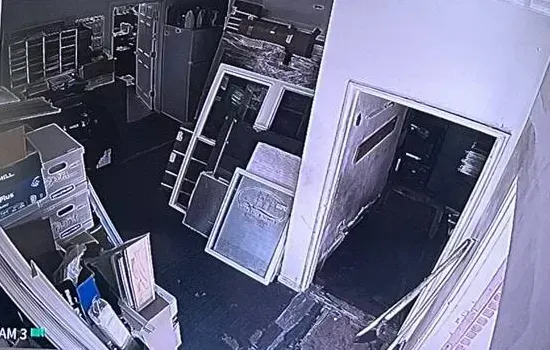
A photo from the AESS job library, not taken in South Slope: a black-and-white night camera view of a cluttered room with an open doorway into a dark back room. Stockrooms behind the shops on Fifth Avenue often lead to a cellar or delivery door like this, and a buzzer on that door, with the apartments' entrance kept on a separate system, keeps the back of the building as closed as the front.
Not Sure Whether Your Building Needs One Station, One Strike or a New System? Speak to a Tech
Send a photo of the street door and the panel, one of the vestibule door, a photo of the power supply in the cellar if you can reach it, and any HPD notice or violation number, along with how many apartments the system serves. A technician will tell you which approach fits and where it falls on our Brooklyn ranges. Call or text (347) 934-8335, send photos on WhatsApp, or fill in the form below.
Get In Touch
Request a Free Quote
✅
Request Sent!
Thank you. A technician will call you about the South Slope address, usually within two hours during working hours.
How It Works
Our Installation Process
1. Read the record and the door
We look up the building's HPD history for intercom, lock and self-closing door violations, then inspect the street door, the vestibule door and any gate before the electronics.
2. Ring every apartment from the street
Every button is pressed at the panel while someone listens and talks in each apartment, sorting each line into working, silent, one-way or not releasing.
3. Check the lock and the closer
Any magnetic lock or double-cylinder lock comes out of the plan, and the door is checked to close from fully open and latch on its own before a strike is chosen.
4. Trace and meter the riser
We follow the cable from the panel to the cellar and up to each floor, meter every pair and plan new cable through closets, hall ceilings or the cellar where pairs fail.
5. Price in writing
You get a written price from the Brooklyn list, with every possible extra, such as a failed pair, a new closer or a frame repair, named and priced before anything is ordered.
6. Order and schedule
Equipment is ordered once the deposit is in. Every visit gets a two-hour arrival window, and tenants are told in writing when their station will be changed.
7. Install and label
We mount the panel, strike and power supply, change each apartment station, reconnect or replace cable and label every pair at the panel and in the cellar.
8. Test from the sidewalk and hand over
From the street door we call, talk and release every apartment, confirm the door opens freely from inside and leave the test sheet and wiring record with the owner.
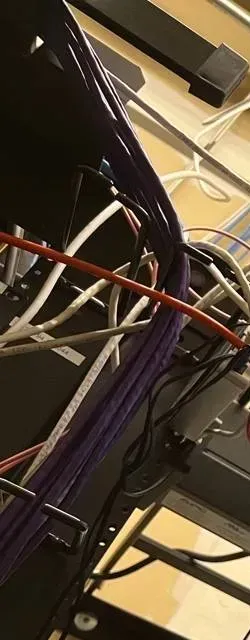
A photo from the AESS job library, not taken in South Slope: purple, white and red cable bundles dropping down beside a black equipment rack. In a large South Slope co-op or a newer Fourth Avenue building, the cable from each line of apartments arrives at one point like this, and labeling every bundle in step 7 is what lets the next technician find one apartment's pair in minutes when HPD writes up a single station.
Coverage Area
Door Buzzer Installation Near South Slope's Landmarks
Bartel-Pritchard Square
The circle where Prospect Park West, Prospect Park Southwest and 15th Street meet, named in 1923 for two local men killed in the First World War, with columns attributed to Stanford White.
14th Regiment Armory
The 1891–95 armory at 1402 Eighth Avenue between 14th and 15th Streets, designated a city landmark in 1998.
The Ansonia Clock Factory
The former clock plant filling the block between Seventh and Eighth Avenues at 12th and 13th Streets, now a 71-unit co-op.
Nitehawk Prospect Park
The old Pavilion Theater at 188 Prospect Park West, at 14th Street, reopened as a seven-screen cinema after a condo plan was dropped.
15th Street–Prospect Park station
The F and G station at the square, one of the stations on the line listed on the National Register of Historic Places.
199 17th Street
The simplified Italianate brick semi-detached house between Fourth and Fifth Avenues that Brownstoner traced back to 1880.
South Slope is billed at our standard Brooklyn rate. The final figure follows photos and a walkthrough, because the number of apartments, the condition of the riser, the state of the street and vestibule doors and any lock HPD has objected to drive the total far more than the brand on the panel.
Job
Typical South Slope property
Brooklyn range
Audio station or replacement with electric strike release, existing wiring reused where it tests well
One- and two-family row houses, frame houses, a single shop or office door
$400–$900
Video door station with indoor stations or phone answering
Three-family row houses, small buildings, owners who want to see visitors
$700–$1,800
Multi-unit entry system, audio or video by apartment count, with optional fob or code entry
Walk-ups on the numbered streets, co-ops, Fourth Avenue buildings
from $2,500 to $10,000+
In-person diagnosis of an existing system, booked online
Any building where the old system must be tested before quoting
$250, applied toward the work
Monthly subscription
Any building choosing a wired, no-subscription system
$0
What moves a walk-up inside its range is predictable. First the apartment count, since each apartment needs a station and a tested line. Then the riser: pairs that pass the meter cost nothing extra, while new cable to the upper floors of a five-story building adds labor. Then the doors: a magnetic lock replaced with a strike, a closer replaced, a frame reinforced or a gate lock changed. Anything that depends on a test is named on the quote with its price before you approve.
Full terms — including 50% deposit, one-year parts-only warranty on AESS-supplied products, and the late-fee schedule — are set out in the service agreement.
Find Out Which Range Your South Slope Building Falls In
Tell us the street and cross street, how many apartments the system serves, what is at the street door now and what HPD has written up, and we will tell you which Brooklyn range fits and what would move it. Call or text (347) 934-8335, send photos on WhatsApp, or fill in the form.
Shop Our Systems
Door Buzzer Installation Packages & Pricing
Three typical South Slope jobs, each placed inside the matching range on our Brooklyn list. The exact figure comes from the photos and the walkthrough.
Row house audio: $400–$900
A one- to two-button audio station on the brick pier or casing, a fail-secure strike in the frame, the closer set so the door latches, a station in each household and battery-backed power in the cellar.
House or small-building video: $700–$1,800
A video station with one button per household, indoor video stations or phone answering, cable hidden from the street door to the cellar and up, and the street door's lock and closer brought up to standard.
Walk-up entry system: from about $2,500
A new button or directory panel, a station in every apartment, the riser tested and replaced where it fails, a strike in place of any magnetic lock and a labeled power supply, rising toward $10,000 or more with apartments and doors.
Bring your own equipment. If you have already bought a door station or intercom kit, we can install it as labor-only work, quoted flat once we have seen the door, the frame and the cable path. Tell us the make and model, and we will say before the visit whether it can reach every apartment and drive your strike. Equipment you supply is covered by its maker's warranty, not ours.
Complete Services
Every Door Buzzer Service in South Slope
Walk-ups and co-ops
New panels, apartment stations, riser testing and HPD violation work for the numbered streets. Request a quote
Row houses and frame houses
One- to three-button stations, strikes and closers for one- to three-family houses. Call (347) 934-8335
A four-story walk-up with eight apartments and one street door: is that your multi-unit range or the video range?
+
The multi-unit range, which starts at about $2,500 on our Brooklyn list. The video range is for houses and very small buildings. An eight-apartment walk-up whose riser pairs all test sound, with audio stations, usually sits toward the lower part of the multi-unit range; video stations in every apartment, new cable to the top floors or door work such as a new closer or a strike in place of a magnetic lock move it up.
Will the street door be left unlocked while the new system goes in?
+
No. The old lock stays in service until the new strike is ready, and the changeover on the door itself is done in one stretch, usually well under an hour, with a technician at the door throughout. If a magnetic lock is coming off, the strike goes in on the same visit, so the building always has a door that locks. Tenants are told the changeover time in advance.
How long do you need inside each apartment?
+
For a station swap on a tested pair, usually a short visit per apartment: remove the old station, mount the new one, connect and test it from the street. Apartments that need new cable take longer and may need a second visit. We give the owner a schedule by apartment so tenants know when someone needs to be home, and the cellar and panel work goes on without them.
Can you look at our HPD violations before visiting and tell us roughly what is wrong?
+
Yes, and it costs nothing. Send the violation numbers or a screenshot of the record with photos of the panel, the street door and the power supply. The violation text names the apartment and often the wall the station is on, which tells us whether the fault is likely in one apartment or in a shared part. We then tell you what we expect to test and which range the work is likely to fall in.
Our street door sits in a steel frame rather than wood. Can a strike still be fitted?
+
Yes. Steel frames take electric strikes well, and many hollow steel frames have space behind the latch side for the strike body and its cable. The frame is cut to the strike's template, the cable runs inside the frame to the wall, and the strike is matched to the lockset on the door. A solid-filled frame takes more work, which we check at the walkthrough and price before you approve.
Do tenants need new keys for the street door after the strike goes in?
+
Not usually. An electric strike replaces the part of the frame the latch locks into, not the lock on the door, so the existing cylinder and keys keep working. New keys are needed only if the lockset itself is replaced, for example because it was a double-cylinder lock that HPD would object to or because the latch cannot work with a strike, and that is on the quote.
Will the new panel cope with winter slush and salt at the top of a stoop?
+
A panel rated for outdoor use and mounted with a rain hood or in a recess handles rain, snow and salt spray. What shortens its life is water getting in behind it, so we seal the cable entry and mount it plumb on a flat surface. If the panel sits where a shovel or a salt spreader hits it, we suggest a recessed or vandal-resistant model.
Is a new panel bigger than our old four-button plate?
+
It depends on the model. Audio panels for a few apartments are often close to the size of an old plate and can cover the same opening; video panels are taller. We measure the existing opening and the brick or wall around it and choose a panel that covers the old holes, so the front does not end up with an outline of the previous plate showing.
There are dead wires from two older intercoms hanging in our vestibule and cellar. Do you take them out?
+
Yes, where they are confirmed dead. Abandoned cable is a common source of confusion for the next repair, so we remove what we can reach once we have proved it is not carrying anything, and label anything that has to stay. Cable buried inside finished walls is cut back and capped at the ends rather than pulled out through the plaster.
How does the mail carrier get through the street door once the new system is in?
+
Many buildings have a key switch for the Postal Service beside the panel that releases the door for the carrier. If yours has one, we keep it working with the new release, and if it has to be moved or reconnected we coordinate with the building, since the switch belongs to the Postal Service. If the building has never had one, the managing agent can ask the local post office about it.
Ready for a South Slope Street Door That Answers Every Apartment and Passes the Next Inspection?
Send a photo of the street door and the panel, the HPD record if there is one, the street and cross street and the number of apartments, and we will tell you which system fits, what the door needs and where it falls on our Brooklyn ranges. Call or text (347) 934-8335, message us on WhatsApp, or use the request form. Licensed under NYS license #12000287431, rated 4.7★ across 201 Google Reviews, with same-day estimates.