A Victorian on Albemarle Road set forty feet back from the sidewalk, a legal two-family with a rental top floor, or a prewar co-op by the Parade Ground? Prospect Park South door buzzer installation line: (347) 934-8335
Freestanding 1899–1911 Houses · Legal Two-Families · Prewar Apartment Buildings on the Edges · Shops on Church and Coney Island Avenues · Landmark District Rules
Door Buzzer Installation in Prospect Park South
One Panel Per Doorway · Cable Hidden Behind the Trim · Plaster Checked Before It Is Cut · Written Price Before Ordering · Brooklyn Rate
Door buzzer installation in Prospect Park South starts with a distance most of Brooklyn never deals with: the front door of a district house sits up a walk, across an open lawn and at the back of a porch, a long way from the person ringing. Around those houses stand legal two-families with a rented top floor, a 1925 apartment building with 42 units on Stratford Road and a 73-unit co-op from 1927 facing the Parade Ground, each needing a different system and each under different rules. Below is how we plan a buzzer for every one of them inside the Landmarks limits, and where each lands on our Brooklyn price list.
Prices come from our Brooklyn door buzzer list, and the total, with every possible extra named, is agreed in writing before anything is ordered
Rated 4.7★ across 201 Google Reviews
Reviewed and updated November 11, 2026, against the Landmarks Preservation Commission's Permit Guidebook chapter on health and safety equipment; the Commission's proposed rule amendments for its November 17, 2026 public hearing; New York's Multiple Dwelling Law §50-a; HPD's Tenant Data Privacy Law page (Local Law 63 of 2021); an HPD violation record for 15 Westminster Road published by LucidRents; listing records for 1123 and 922 Albemarle Road (Milton Coste), 55 Parade Place (CityRealty) and 51 Stratford Road (openigloo); Brownstoner's June 2024 report on a Prospect Park South renovation and its 2007 and 2008 forum threads on electric strikes and front-door security; the Brooklyn Eagle's July 2025 history of the neighborhood; the Prospect Park South Association; the Department of City Planning's South of Prospect plan and 6sqft's May 20, 2026 report on it; ButterflyMX's apartment buzzer guide; Brick Underground's November 2019 intercom guide and its buzzer rights guide; the HomeAdvisor and Swiftlane cost guides; Allegion's fail-safe guide; the building code's sensor-release provisions; and the 2010 ADA Standards. · Abstract Enterprises Security Systems, NYS license #12000287431 · crews dispatched from our Troy Avenue office in Brooklyn
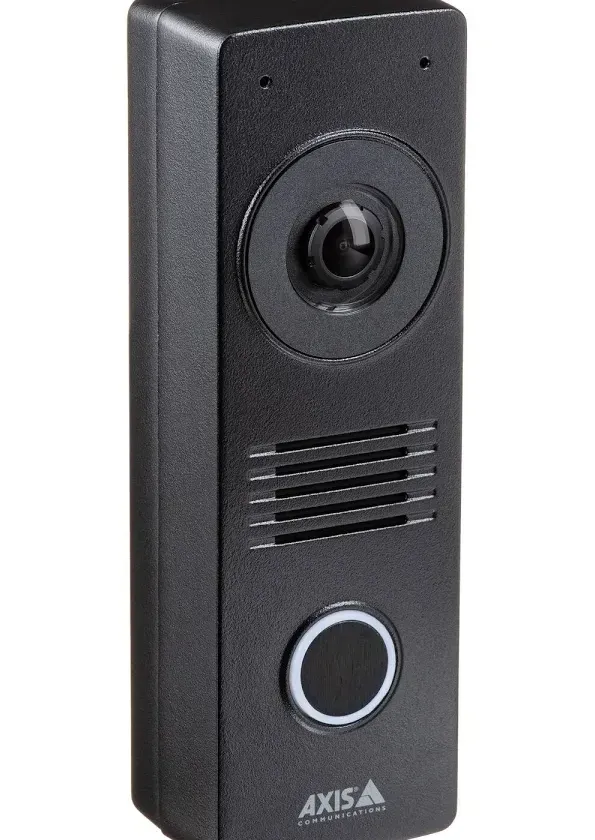
A photo from the AESS job library, not taken in Prospect Park South: a black rectangular video door station with a camera lens, a speaker grille and one round call button that lights up. A single-button station this size is what a one-family district house usually needs at its porch door, and its narrow face fits against the wood casing beside the door, the spot the Landmarks rules point an intercom toward.
Prospect Park South Buzzer Request
District house, legal two-family, apartment building or a shop on the avenues: tell us the street, how many floors or apartments the system must reach and which doors get used, and a technician calls back with the range
✅
Request Sent!
Thank you. A technician will call you about the Prospect Park South address, usually within two hours during working hours.
25+
Years Experience
✓
Same-Day Estimates
100%
Licensed & Insured
4.7★
201 Google Reviews
Owner-operated since 2002 · Thousands of jobs completed · Booked within 2 hours
Quick answer: door buzzer installation in Prospect Park South runs $400 to $900 on our Brooklyn list for an audio station and a new door release on a one-family house, $700 to $1,800 for a video door station with indoor stations on each floor or phone answering for a large house or a legal two-family, and from about $2,500 to past $10,000 for a full entry system in one of the apartment buildings at the district's edges. The price covers the door station, the indoor stations, the power supply, the electric strike or approved lock, the cable and the labor, and it is fixed in writing once we have walked the property from the sidewalk to the cellar. Anything that depends on a test, such as an old bell wire that might fail or plaster that should be checked before it is cut, is named and priced before you order. Send photos of the walk, the porch door and whatever is mounted beside it to (347) 934-8335 or on WhatsApp, and we reply with the range that fits, usually within two hours during working hours.
Looking at your photos and quoting a new system costs nothing. If an existing system has to be tested in person before we can quote, that is the $250 service call booked online, and the $250 is applied toward the work.
All work is done under New York State license #12000287431. We install the low-voltage entry equipment; if the power supply needs a new 120-volt outlet or circuit, a licensed electrician does that part, and you know before the price is set.
We work for whoever controls the door: the owner of a house, the owner of a two-family who rents a floor, a co-op board or its managing agent, or a shop tenant with the landlord's written approval.
The Neighborhood
Why Prospect Park South Properties Need Door Buzzer Installation
Prospect Park South was laid out from 1899 as a suburb inside the city. Dean Alvord's company built roughly two hundred freestanding houses, the Brooklyn Eagle's July 2025 history describes 39-foot setbacks from the street, and the whole area became a city historic district in 1979. The short version for anyone planning a buzzer is that almost every house here was designed to keep the street at a distance, and a door buzzer is the piece of equipment whose whole job is to close that distance. The visitor stands at one end of a long walk; the household is somewhere inside a large house with several floors and a cellar; the door is in between, behind a porch, and under rules that limit what can be fixed to it.
That changes the questions owners ask. In a row house on a busy block, the bell is a step from the sidewalk and the problem is usually old wiring. Here, the first problem is that nobody on the second or third floor of a house this size hears a knock or a mechanical bell at the porch door, and the second is that a visitor or courier at the foot of the walk has no idea which door to go to. A buzzer with an indoor station on each floor, or with phone answering, solves both.
The houses are not all one-family homes any more, and that is the second reason buzzer work here is its own job. Listing records show what we mean. 1123 Albemarle Road, inside the historic district, is listed as "a rare two-family" with a garden-level duplex and "the apartment above," and NYC records show two residential units in an R1-2 zone. 922 Albemarle Road is described as "currently set up as a legal two-family dwelling," with a top-floor rental above a four-bedroom owner's duplex. When a district house is shared this way, a single bell becomes a daily nuisance: the owner gets rung for the tenant's visitors, the tenant walks down two flights to let a friend in, and nobody can release the porch door from upstairs.
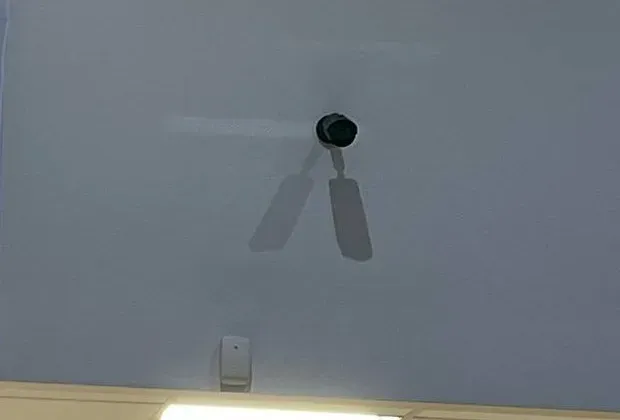
A photo from the AESS job library, not taken in Prospect Park South: a small black camera mounted high on a pale wall, casting two shadows, with a small white device below it. Inside the front hall of a district house, a camera placed high like this covers the inside of the porch door and the foot of the stairs, which is where the household and a rental tenant's visitors meet once the buzzer has let them in.
At the edges of the district the building stock changes completely. 51 Stratford Road is a four-story apartment building with 42 units, built in 1925. 55 Parade Place, the Sovereign, is a six-story co-op from 1927 with 73 apartments, a live-in super and, according to its CityRealty listing, no doorman. Along Church Avenue and Coney Island Avenue, shops sit at street level with apartments above. In those buildings a buzzer is not a convenience but the main thing standing between the sidewalk and the stairs, and New York law has something to say about whether they must have one.
Two current events add to the picture. The Department of City Planning opened its South of Prospect plan in May 2026, and 6sqft reported that it targets Coney Island Avenue from Caton Avenue to Avenue I, the corridor along the district's western side, with the Planning Director speaking of "potentially thousands of housing units." New apartment buildings there will need entry systems from day one. And the Landmarks Preservation Commission holds a public hearing on November 17, 2026 on rule amendments that would let its staff approve more kinds of work, including some hardware changes on historic doors for accessibility.
Finally, the security case is simple and does not need exaggerating. As Daniel Vasquez of Paragon Security and Locksmith told Brick Underground, "Now everyone wants more security. They want a camera to see in front of the door before allowing someone in." In a house where the front door is the first thing a stranger reaches after crossing an open lawn, being able to see and speak to that person from the kitchen or the top floor, without opening anything, is most of the value of the system.
Six facts that shape a Prospect Park South buzzer installation
The front doors are far from the street. The Brooklyn Eagle describes 39-foot setbacks, so the walk, the porch steps and the porch itself all sit between a visitor and the door.
The district limits what goes on a doorway. The Landmarks guidebook says intercom panels and doorbells "must be installed within or adjacent to a door opening," with "a maximum of two light fixtures and one intercom panel" per opening.
Hidden cable is the rule, not the upgrade. Conduit "must be concealed" behind the installation, and where that is impossible staff "may approve a maximum of approximately ten inches of visible conduit."
Many houses now hold two households. 1123 and 922 Albemarle Road are both legal two-families, the pattern that turns a single bell into a two-button station with separate releases.
The apartment buildings predate the intercom law's 1968 line. 51 Stratford Road (1925) and 55 Parade Place (1927) are both older than the date in Multiple Dwelling Law §50-a, which shapes when an intercom becomes mandatory.
Old plaster can hide asbestos. Brownstoner's June 2024 report on a Prospect Park South renovation describes asbestos-containing plaster walls the architects did not anticipate, which is why we plan cable routes before anyone cuts.
Where this page applies. The Prospect Park South Historic District runs from Church Avenue south to Beverley Road, between the open cut of the B and Q subway line on the east and, depending on which map you read, Stratford Road or Coney Island Avenue on the west. This page covers the district houses and the apartment buildings and shops around its edges. For the rest of the borough see our door buzzer installation in Brooklyn page, and for the whole city our NYC door buzzer installation page.
Repair or Replace in Prospect Park South
Need Repair in Prospect Park South? Keep the Old Bell, Fix One Part or Install a Real System
Many calls about "putting in a buzzer" here come from owners who already have something at the door. It might be a bell button wired decades ago to a chime in the kitchen, an audio intercom installed by a previous owner with stations on two floors, or a system that half works: the door station rings but nobody can hear the visitor, or the release clicks and the door stays shut. Before any equipment is chosen, we decide which of three paths fits.
The first path is a targeted repair, when one part is the whole problem: a failed transformer in the cellar, a strike that has worked loose in an old wood frame, a closer that no longer pulls the porch door shut. The second is a partial replacement: a new door station and power supply on old cable that tests sound, with new indoor stations. The third is a full installation with new cable, for houses whose old bell wire was lost in renovations, or that never had more than a bell. If a repair is all you need, we say so and price it as a repair, and our Brooklyn door buzzer team handles both kinds of work.
Here the deciding checks are rarely electronic: whether the porch door latches on its own, whether the old cable survived the last renovation, and whether a station fits the one-panel limit where the old bell was.
What We Install
Door Buzzer Installation Services in Prospect Park South
Every service below is priced from the same Brooklyn door buzzer list. The number of floors or apartments sets the size of the system, the doors decide what release each one can take, and in Prospect Park South the distance from the sidewalk, the Landmarks limits on the doorway and the age of the walls decide much of the labor.
First buzzers for district houses
A door station at the porch door, a release in the frame and an indoor station on each floor, for houses that have only ever had a bell or a knocker, planned inside the one-panel limit.
Two-button systems for legal two-families
One button for the owner's duplex and one for the rental floor, each ringing only its own household, each able to release the porch door, with the tenant's stair door handled separately if needed.
Whole-house video answering
Video stations in the kitchen, the main floor and the top floor of a large house, so whoever is closest can see the visitor at the porch and let them in without walking down.
Phone answering for owners who travel
Door stations that ring your phones as well as the indoor stations, for households that are often away or use the house seasonally, with any monthly charge stated before you choose.
Concealed cable in old houses
Cable routed behind trim, through closets and along the cellar ceiling, with the visible conduit kept within the roughly ten inches Landmarks staff may approve where hiding it is impossible.
Apartment building entry systems
Directory, code or button panels with apartment stations or phone answering for the prewar buildings on Stratford Road, Parade Place and the avenues, with risers tested floor by floor.
Strikes for old wood doors and frames
Fail-secure electric strikes cut into sound wood frames, closers set so a heavy original door shuts and latches, and the door trued up before any release goes on it.
Side, kitchen and cellar doors
Keypads or small stations for the doors a household actually uses every day, kept off the front facade where possible and wired to call only the right floor.
Shop and office doors on the avenues
Buzz-in doors for shops, offices and practices on Church Avenue and Coney Island Avenue, kept fully separate from the apartments' system upstairs.
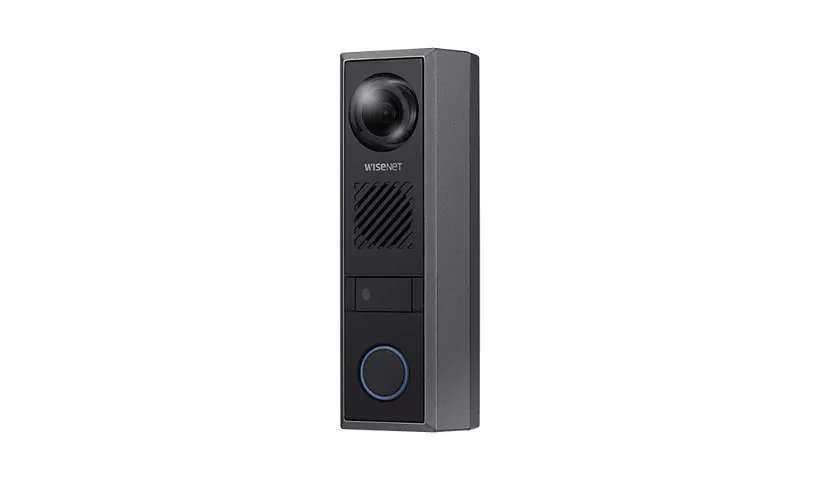
A photo from the AESS job library, not taken in Prospect Park South: a slim dark grey wired doorbell with a camera lens, speaker slots and a round push button. A narrow unit like this is the kind of station that keeps the equipment "as small as possible," as the Landmarks guidebook asks, on the painted wood casing of a porch door, where a wide apartment panel would cover the trim.
Building Specialists
Door Buzzer Installation for Prospect Park South's Architecture
Six kinds of property account for nearly every buzzer we plan in and around the district. They differ in how far the door is from the street, how cable can reach each floor or apartment, who has the authority to order the work and which rules apply, and each has one mistake that shows up when the job is rushed.
Freestanding one-family houses
Wood-frame and masonry houses from 1899 to 1911, set back behind open lawns, with a porch door, often a side or kitchen door and a cellar, all inside the historic district.
Legal two-families in district houses
Houses such as 1123 and 922 Albemarle Road, where an owner's duplex and a rental floor share the porch door and sometimes the front hall.
Unusual and architect-designed houses
The district's showpieces, including a Japanese-style house on Buckingham Road from 1902–03 and a Swiss chalet on Rugby Road from 1900, whose doors and trim match no catalog.
Prewar walk-up apartment buildings
Four-story buildings like 51 Stratford Road, built in 1925 with 42 units, with a street door, a vestibule and riser cable that has served several generations of equipment.
Six-story prewar co-ops
The Sovereign at 55 Parade Place, built in 1927 with 73 apartments on six floors, run by a board, served by a live-in super and without a doorman at the lobby.
Shops with apartments on the avenues
Church Avenue and Coney Island Avenue buildings with a store at street level and homes above, where the residents' door sits a few steps from the shop's entrance.
Freestanding one-family houses: a long walk, a deep porch and a household spread over several floors
The typical district job is a one-family house with a porch door that has only ever had a bell. The household wants three things. They want to know someone is at the door wherever they are in the house, including the top floor and the cellar. They want to see and speak to that person before opening anything. And they want to let a trusted visitor in, a relative, a cleaner, a courier with a heavy box, without walking down and across the hall. A single-button video station at the porch door, a fail-secure strike in the frame, an indoor station on each lived-in floor and a battery-backed supply in the cellar covers all three.
The mistake here is treating the house like an apartment and putting one indoor station in the front hall. In a house this size, the hall is the one place nobody is when the door rings. We ask where the household actually spends the day, usually the kitchen at the back, a family room, a home office and the bedrooms on the top floor, and place stations there. Phone answering can cover the rooms without a station, but we never make it the only way to answer, because phones are not always charged or nearby.
Legal two-families: an owner's duplex, a rental floor and one porch door
A house like 922 Albemarle Road, set up as a legal two-family with a top-floor rental above the owner's duplex, needs a system that keeps the two households apart while they share the same entrance. The door station gets two buttons, each ringing only its own household. Both households can release the porch door. And where the rental floor is reached by a stair that starts in the shared front hall, the question becomes whether that stair door should also lock and release, so a visitor buzzed in for the tenant does not wander into the owner's floor.
There is no legal requirement behind any of this. A two-family house is not a multiple dwelling under New York's housing laws, so the intercom duty in Multiple Dwelling Law §50-a does not reach it. The reason to do it properly is practical: a tenant who can answer their own door and let their own visitors in is a tenant who does not prop the porch door or hand out keys. We put the plan on paper before choosing equipment, so the owner and the tenant both know which button does what.
Unusual and architect-designed houses: fitting a station to a doorway that matches no catalog
Prospect Park South is known for houses that look nothing like each other. The district's records name a Swiss chalet on Rugby Road from 1900, a Japanese-style house on Buckingham Road from 1902–03 and a Tudor house on Argyle Road from 1904. Doorways on houses like these have carved trim, unusual proportions and doors that were made for the house. Off-the-shelf stations are designed for a flat strip of wall beside a standard door.
The Landmarks rules give the direction: equipment "as small as possible and painted to blend," attached "at mortar joints, plain masonry, wood, or metalwork," and "not ... on any decorative surfaces." On these doorways we look for the plainest piece of wood or masonry within or beside the opening, choose the slimmest station that will do the job, and plan the cable so it disappears into the wall behind it. Where no plain surface exists, we say so before quoting.
Prewar walk-ups: a 1925 building on Stratford Road and the tenants' written request
A building like 51 Stratford Road, four stories and 42 units from 1925, is the kind of entrance where a buzzer is the building's front-line security. It also sits on the older side of the 1968 date in Multiple Dwelling Law §50-a. For buildings like this with eight or more apartments, the law requires a self-locking door and an intercom when tenants occupying a majority of the apartments request it in writing, and Brick Underground's guide to buzzer rights notes that in that case the tenants bear the cost. Once a building has a system, though, it has to be kept working.
The Sovereign and other prewar co-ops: 73 apartments, a live-in super and no doorman
The Sovereign at 55 Parade Place, built in 1927 with 73 apartments on six floors, is the largest building at the district's edge, facing the Parade Ground. Its listing describes a live-in super and no doorman, which means the lobby door and its panel do the job a doorman would do in a building on Ocean Parkway or in Manhattan. A building of this size needs a directory or code panel rather than 73 buttons, either apartment stations or phone answering, a release on the lobby door and usually a second station at a service or side entrance.
The board decides, usually after comparing bids, and we answer its usual questions in writing: the ten-year cost including any subscription, how residents without smartphones answer, and how much riser cable is reused.
Shops with apartments on the avenues: two systems that never share a button
On Church Avenue and Coney Island Avenue, a shop at street level and apartments above often share one building and one cellar. The shop needs its own doors handled: a back door for deliveries, perhaps a buzz-in door for an office upstairs. The apartments need a station at their own street door that calls only the apartments. We wire them as two systems with separate power, so a problem or a new tenant in the shop never touches the apartments' door.
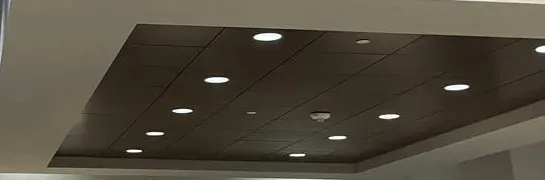
A photo from the AESS job library, not taken in Prospect Park South: a dark recessed ceiling panel with round downlights and a small round device, framed by a lighter ceiling. Lobbies in prewar co-ops like the ones by the Parade Ground were often refinished with ceilings like this, and the space above a dropped panel is usually the cleanest route for new cable from the lobby door to the riser closet.
Field Notes
Field Notes: Start at the Sidewalk, Ring From the Top Floor, Then Find Where the Bell Wire Went
This is how our technician spends the first part of a visit to a district house, before anything is priced.
First, the walk. The technician starts at the sidewalk, where a visitor starts, and looks at the house the way a courier would. Is it obvious which door to go to? Is the porch door visible from the walk, or hidden at the side of a wraparound porch? Where would a parcel be left, and can it be seen from the street? Then up the steps to the porch door: what the door is made of, how it is trimmed, whether there is a plain surface beside it and what is already mounted there, from a lantern to an old bell button.
Second, the listening test. Someone presses the existing bell, if there is one, while the technician stands on the top floor, in the kitchen and in the cellar. In a large house this usually answers the household's question before it is asked: the bell cannot be heard in half the rooms people use. That tells us how many indoor stations the job needs and where.
Third, the cable. In the cellar the technician looks for the old bell transformer and follows its wire as far as it goes. In houses that have been renovated, it often stops at a wall that was opened and closed again. The technician also notes the walls themselves: original plaster on lath, newer drywall, any material that looks like it should be tested before anyone drills through it. Only then is the cable route drawn and priced.
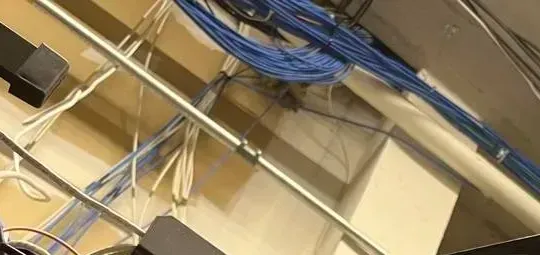
A photo from the AESS job library, not taken in Prospect Park South: bundles of blue low-voltage cable laid over a ceiling beam beside a metal pipe in an open ceiling. In the cellar of a district house, new buzzer cable follows the same kind of path along the joists from below the porch door to the power supply, kept clear of the heating pipes and turned up into the walls only where a closet or chase hides it.
Doorway Rules in the District
One Panel, Two Lights and Ten Inches of Conduit: Fitting a Door Station Inside the Landmarks Limits
Every house inside the Prospect Park South Historic District falls under the Landmarks Preservation Commission, and its Permit Guidebook chapter on health and safety equipment covers exactly the things a buzzer puts on a house: intercom panels, doorbells, lights, cameras and the conduit that feeds them. The rules are specific, and they are the reason a buzzer here is planned differently from one on an unlandmarked block.
The placement rule comes first. "Light fixtures and intercom panels, as well as doorbells, must be installed within or adjacent to a door opening," the guidebook says, and "An intercom can also be installed on a fence or wall in front of the entranceway." Most district houses have no fence or front wall, because the open lawn was part of the design, so in practice the station belongs at the porch door, on the casing or the wall beside it. The guidebook also limits each doorway to "a maximum of two light fixtures and one intercom panel." If a porch door already has two lanterns, the station has to fit in alongside them without adding a third fixture.
The fixing rule is next. Equipment must be attached "at mortar joints, plain masonry, wood, or metalwork," and "must not be attached through cast iron or on any decorative surfaces." On a wood-frame house that usually means a plain section of painted casing; on a masonry house, a mortar joint rather than the face of a stone or brick. And "Most equipment must be as small as possible and painted to blend with surrounding building material, if possible," which favors slim stations over wide panels.
Then the cable. "The conduit must be concealed by going through plain masonry or wall cladding behind the installation." Where that is impossible, "staff may approve a maximum of approximately ten inches of visible conduit," and surface conduit "must be painted to match the background surface." For a buzzer, that means the station's cable should go straight back into the wall behind it and down inside the house, not across the porch ceiling in a run of raceway. We plan the route from the inside first, then place the station where the route can reach it.
Two more points matter for owners. The guidebook says no permit is needed for "ordinary maintenance, repair, and retrofitting," while staff can issue permits for work that meets the criteria above, and work that does not "may be presented to the LPC Commissioners for review at a public hearing." A station that fits the criteria is a staff-level matter; a station on a post in the middle of the lawn, or a run of visible conduit across the front, is the kind of thing that can end up in front of the Commission. And cameras have their own count: for small residential buildings, "no more than two security cameras can be installed for every 25 feet of street frontage." We ask what is already on the front before adding a station with a camera.
The proposed rule amendments the Commission will hear on November 17, 2026 do not mention intercoms, doorbells or cameras. They would let staff approve more door alterations for accessibility, including "changing hardware and hinges, and the installation of an automatic opener" on historic doors. For an owner thinking about a release and an opener on an original porch door for a family member who needs it, that is worth following.
Rules and Responsibilities
Which Prospect Park South Properties Must Have a Buzzer, What It Has to Do and Who Decides
Newer apartment buildings of eight or more units must have one. Under Multiple Dwelling Law §50-a, a Class A multiple dwelling erected or converted after January 1, 1968 with eight or more apartments must have an intercom at the self-locking main entrance that lets a visitor and a resident speak and lets the resident release the door. Any new building on Coney Island Avenue under the South of Prospect plan that meets that size will fall in this group.
Older apartment buildings must install one when a majority of tenants ask. For buildings put up before that date, like 51 Stratford Road (1925) and 55 Parade Place (1927), the duty arises when tenants occupying a majority of the apartments request or consent in writing. Brick Underground's guide notes that tenants pay for the installation in that case.
Houses are outside these rules. A one- or two-family house is not a multiple dwelling, so whether to install a buzzer, and what kind, is the owner's choice.
Every exit door must open without a key. In March 2026 HPD issued a Class C, immediately hazardous, violation at 15 Westminster Road to "abate the nuisance consisting of key operated lock at door to fire escape." Any lock or release we add to a building door leaves it opening freely from inside.
Keyless systems in apartment buildings come with data rules. HPD's Tenant Data Privacy Law (Local Law 63 of 2021) covers owners of multiple dwellings that use smart access systems. Owners must get express consent "in writing, or through a mobile application," destroy authentication data "no later than 90 days" after it is collected unless anonymized, and may not "require use of a smart access system to gain entry to the tenant's dwelling unit."
The district's houses need the Landmarks criteria met. Station placement, lights, cameras and conduit on any house inside the historic district follow the Permit Guidebook limits described above, and work outside them needs Commission review.
Magnetic locks need more than a lock. Electromagnetic locks are only made fail-safe, and the building code's sensor-release provisions require a sensor on the egress side, a manual "PUSH TO EXIT" device 40 to 48 inches above the floor within 5 feet of the door that keeps it unlocked for at least 30 seconds, release on fire alarm or sprinkler activation, and UL 294 listed equipment.
None of this is legal advice for a particular building. A board facing a tenants' request, an owner planning a keyless system or a developer on Coney Island Avenue should confirm the details with a housing lawyer, the managing agent or the Commission. What we provide is a system that meets the requirement that applies and paperwork showing what was installed.
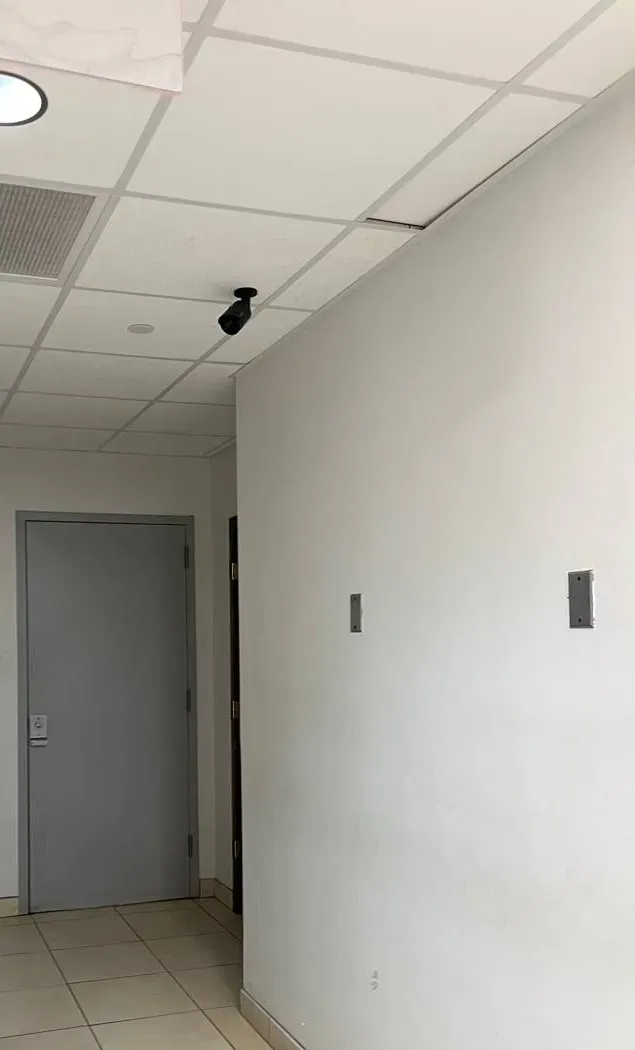
A photo from the AESS job library, not taken in Prospect Park South: a tiled corridor with white walls and small wall plates ending at a grey steel door with a lever handle, under a drop ceiling with a small camera. A rear or cellar exit door like this one in an apartment building near Church Avenue must open from inside with a turn of the lever, whatever lock or release is added, which is the point of the March 2026 violation at a Westminster Road building.
Renovations and Old Walls
Planning a Buzzer Around a Restoration, Old Plaster and a House Full of People
Many district houses get their first real buzzer during a restoration, and the timing makes a large difference to how much of the cable can be hidden. Brownstoner's June 2024 report on a Prospect Park South house describes the kind of project we mean: a landmarked freestanding house restored inside and out, approvals from both the Buildings Department and the Landmarks Commission, "completely updated all building systems," the porch structure and stairs rebuilt, and an unnecessary side entry door removed and replaced with a window.
Each of those decisions touches the buzzer. A rebuilt porch is the moment to run cable from the porch door into the house before the decking and ceiling close. A side door that disappears is one fewer station to plan. Updated systems usually mean open walls on some floors, which is when a cable to the top floor costs least. If you are planning a restoration, the best time to bring us in is when the floor plan is settled and before the walls are closed, so the cable goes in with the rest of the low-voltage work and the station position goes into the same Landmarks filing as the rest of the exterior work.
The same report mentions something owners of these houses should know before anyone drills: asbestos-containing plaster walls that the architects had not anticipated. We do not cut, drill or fish through plaster we have reason to suspect. Our first choice is a route that avoids the old walls entirely: up through closets, along the cellar ceiling, beside existing pipes and chases. Where a route must pass through original plaster, we tell the owner before the price is fixed, and the material should be tested by a licensed inspector before the hole is made. That costs a little time and saves a great deal of trouble.
Commercial Door Buzzer Installation
Business Door Buzzer Installation in Prospect Park South
The district itself is residential, but its edges are not. Church Avenue on the north and Coney Island Avenue on the west carry shops, restaurants, offices and practices, many of them in buildings with apartments above. A business buzzer here is about the doors that should not be open to everyone: the delivery door, an upstairs office's buzz-in door and the apartments' door beside the shopfront.
Church Avenue
The northern edge of the district, with storefronts below apartments, a subway station at the Brighton line and the café the Prospect Park South Association names for neighbors to support.
Coney Island Avenue
The western corridor, inside the South of Prospect study area that City Planning describes as including Little Pakistan and Little Bangladesh, and the street its May 2026 plan targets for new housing from Caton Avenue south.
Beverley Road by the station
The district's southern edge, home to the open-cut Beverley Road station on the B and Q line, whose station house dates from 1907.
Parade Place and Caton Avenue
The northwest corner across from the Parade Ground, where the Sovereign's lobby door is the only way into a building of 73 homes.
Houses of worship and community buildings
Congregations and community groups in and around the district, including the Albanian mosque established on Albemarle Road in 1972, with doors that open for gatherings and stay locked between them.
The commonest business request at the district's edges is a buzzer on a door that has always been propped or locked with a key: a shop's back door, an upstairs office that buzzes clients in one at a time, or a community room whose door should lock behind each person after hours. Each gets its own station, release and power, fully separate from any apartment system in the building. If you run a business on these avenues and also want cameras over the back door, our Flatbush door buzzer installation page covers the wider avenue blocks to the east.
Rules that apply to business entry installations around Prospect Park South
Anyone inside can always get out. A business door with a buzzer, code or reader still opens from inside without a key. As Allegion's guide puts it, with an electric strike "you can exit by turning the lever" whether the strike is fail-safe or fail-secure, which is why a fail-secure strike is the usual choice.
Fire-rated doors keep their rating. Allegion notes that fire doors need fail-secure strikes, so a rated door to a stairwell or cellar stays latched in a fire; the release hardware must carry the right listing for the door.
No keyed exits. The March 2026 violation at 15 Westminster Road for a key-operated lock on a fire escape door is the reminder: whatever secures a door from outside cannot trap anyone inside.
Reception buttons within reach. Release buttons at a front desk and call buttons outside go no higher than the 48-inch high forward reach in the 2010 ADA Standards.
Tenants need the landlord's written approval. A shop or office that rents its space orders its own buzzer only with the building owner's written permission, especially where the work touches a shared street door or the apartments' cable.
New buildings plan the entry from the start. A new building of eight or more apartments on Coney Island Avenue falls under the §50-a intercom requirement, and its lobby, shop and service doors are cheapest to wire before the walls close.
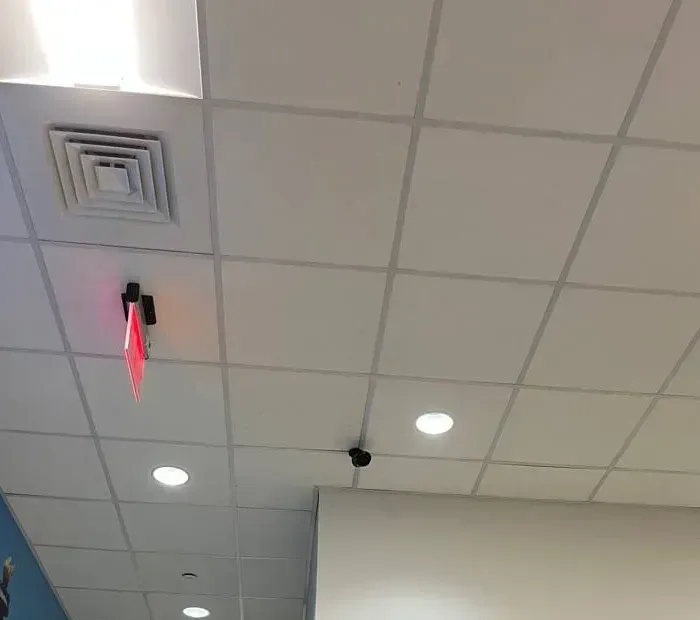
A photo from the AESS job library, not taken in Prospect Park South: a drop ceiling with a lit red exit sign, an air diffuser, round recessed lights and a small black camera. Shops and offices along Church Avenue and Coney Island Avenue often have ceilings like this, and the exit sign is the rule every business buzzer here follows: whatever locks the door from outside, it always opens from inside.
Your Questions Answered
Door Buzzer Installation in Prospect Park South: Questions Answered
The walk, the lawn and the porch
Our house stands about forty feet back from the sidewalk across an open lawn. How does a visitor at the street end of the walk know where to ring, and what will the station's camera actually see?
The visitor finds the station the way they find the door: by walking up to it. In a district where houses were built behind deep setbacks, the station belongs at the porch door, which is also where the Landmarks rules point it. What helps a first-time visitor is making the porch door obvious from the walk, keeping the house number where it can be read from the sidewalk, and choosing a station with a lit button, so someone arriving at dusk can see where to press without hunting along the porch.
The camera on a door station is built to show the person standing in front of it, not the far end of the walk. From the porch it will show the visitor's face and the steps behind them clearly, and the lawn and sidewalk only as background. If you want to see who is coming up the walk before they reach the door, or a parcel left at the top of the steps, that is a separate camera, and it counts toward the district's limit of two cameras per 25 feet of frontage on a small residential building.
The Landmarks guidebook allows an intercom on a fence or wall in front of the entrance, but our block has no fences at all. Could we add a short post at the foot of the walk to hold the station?
It is possible to ask, but it is a harder request than it sounds. The guidebook's fence-or-wall option assumes the fence or wall is already there. A new freestanding post in the middle of an open front lawn is a new element in the district's most recognizable feature, it needs a trench across the lawn for its cable, and it falls outside the doorway criteria staff can approve on their own, so it is the kind of proposal that can end up before the Commissioners at a public hearing.
For most houses there is a simpler answer. Put the station at the porch door, where staff criteria cover it, and give the household phone answering or extra indoor stations so the distance never matters to whoever is answering.
Our porch door already has a pair of lanterns on either side. If the Landmarks rules allow two light fixtures and one intercom panel per opening, can a lit door station still go up?
Yes. A door station is the one intercom panel the rule allows; the two lanterns are the two light fixtures. The station's own button light and camera illumination are part of the panel, not an extra fixture, and we choose a station whose lighting is small and soft so it does not compete with the lanterns. What would cross the line is adding a third fixture, such as a separate light over the station, or a second panel at the same opening.
The thing to check is space. Two lanterns on the casing can leave little plain wood between them and the door. We measure what is left and choose a slim station that fits it.
Inside large and unusual houses
Our house has a finished cellar, two main floors and bedrooms on the top floor, and a mechanical bell nobody hears upstairs. How many indoor stations does a house this size need, and where should they go?
Usually three or four, placed where people actually are rather than where the old bell was. A typical plan for a large district house is one station in the kitchen, because that is where the household spends the most time on the main floor; one on the bedroom floor, often on the landing or in the primary bedroom; and one in the cellar if it is a lived-in room, a gym, an office or a playroom.
Every station rings when the door station is pressed, and whoever answers first takes the call. Phone answering can add the rooms without a station, such as a home office in the attic, but we treat it as an addition, not a replacement, so a visitor can always be answered when a phone is upstairs on a charger. The number of stations is the main thing that moves a large-house job within its price range.
A neighbor's restoration turned up asbestos in the original plaster. How do you run cable through a house like ours without disturbing walls we haven't tested?
By avoiding them wherever we can, and by stopping before we cut where we cannot. Brownstoner's June 2024 report on a Prospect Park South renovation describes exactly that surprise: asbestos-containing plaster the architects had not expected. In a house of the same age, we look first for routes that never touch original plaster: closets stacked above one another, the cellar ceiling, the space beside existing pipes, the inside of built-in cabinetry.
Where the only route passes through plaster that may be original, we say so at the walkthrough and price the job both ways. Before anyone drills or fishes through that wall, the owner has the material tested by a licensed inspector, and we schedule the cable work after the result. It adds a step, but it keeps the installation from becoming an abatement job.
Apartment buildings, the avenues and shared houses
Our building's rear exit leads to a fire escape and a yard, and strangers have been getting in that way. Can we put a keyed lock or a buzzer on that door?
Not a lock that needs a key to get out. In March 2026 HPD issued a Class C violation, the immediately hazardous class, at 15 Westminster Road to "abate the nuisance consisting of key operated lock at door to fire escape." Any door on the way out of a building has to open from inside without a key, a code or a button.
What can be done is to control the outside. A fail-secure strike or a lock that stays locked from the yard side, with free exit from inside by the lever, keeps strangers out without trapping anyone. If residents need to come in that way, a keypad or reader on the outside can release it. Where a rear door is fire-rated, the hardware has to carry the right listing so the door still latches in a fire.
Our board wants fobs and phone unlocking at the lobby door. Can a building like ours make every resident use them, or must regular keys keep working?
The city's rule is narrower than many boards expect. HPD's Tenant Data Privacy Law (Local Law 63 of 2021) applies to owners of multiple dwellings that use smart access systems. Owners must get express consent "in writing, or through a mobile application" before collecting a user's data, must destroy authentication data "no later than 90 days" after it is collected unless it is anonymized, and may not "require use of a smart access system to gain entry to the tenant's dwelling unit."
In practice, we plan keyless lobby systems for buildings like the ones on Stratford Road and Parade Place with a working key cylinder or another non-app option at the door, and with apartment doors left on their own keys. The data settings are configured so logs are kept only as long as the rule allows. A board or managing agent should confirm its policy with its lawyer, but the hardware can be set up to match whatever policy it adopts.
We own a building on Coney Island Avenue inside the South of Prospect study area. Should we hold off on a new entry system until the rezoning is decided?
Not if the current door is failing. The South of Prospect plan began its community process in May 2026, with workshops and walkshops through the fall, and 6sqft's report gave no adoption timeline. A plan that may allow a larger building on your lot in a few years is not a reason to leave tenants with a dead buzzer now, and an existing building that keeps its apartments keeps its obligation to maintain the system it has.
What we would do is buy sensibly for the time you expect to keep the building. A good audio or video system over the existing cable, with a power supply and door station that can be moved, is money well spent even if the building changes later. If you are actively planning a new building, the entry system belongs in the design, because a new building of eight or more apartments must have the talk-and-release intercom §50-a requires.
Our legal two-family on Albemarle Road has the rental floor reached by a stair from the shared front hall. Should that stair door lock too, so a tenant's visitor can't walk into our floor?
If the hall opens into your living space, yes, it is worth considering. With a two-button station and one release on the porch door, a visitor buzzed in by the tenant arrives in the shared hall. If your duplex opens off that hall without a door of its own, that visitor is effectively inside your home. The fix is either a lock on your duplex door, which is the simplest answer, or a second release on the door at the foot of the tenant's stair, controlled only from the tenant's station.
Which is better depends on the house. In some, the owner's floor already has a door from the hall; in others the stair is open. We look at the layout at the walkthrough, and whatever we add leaves every door opening freely from the inside.
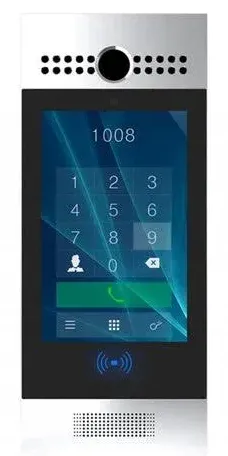
A photo from the AESS job library, not taken in Prospect Park South: a touchscreen entry panel showing a dial pad with a four-digit apartment code entered, a camera above and a card-reader symbol below. In a 73-apartment co-op like the Sovereign, a code panel like this replaces a wall of buttons, and the card reader gives residents a way in that a board can manage without handing out new keys.
Equipment
Types of Door Buzzer Systems We Install
We quote a reliable non-branded system by default and install a named brand when an owner or board asks for one; the intercom brands we work with include Aiphone, ButterflyMX, 2N, Akuvox, Comelit and DoorBird. These are the kinds of equipment that come up most often around Prospect Park South, and where each one fits.
Slim one-button stations
Narrow audio or video stations for a one-family porch door, small enough for a strip of wood casing and simple enough for any visitor to use.
Two-button stations
One button for an owner's duplex and one for a rental floor, each calling its own household, for the legal two-families on the district's streets.
Indoor video stations
Wall stations with a screen and a release button for the kitchen, the bedroom floor and a lived-in cellar, all ringing together when the porch door is pressed.
Phone and app answering
Door stations that ring your phones as well as the wall stations, for households often away from the house and for rooms without a station.
Two-wire multi-tenant systems
Systems that run audio and video over one pair per apartment, the practical choice for prewar buildings like those on Stratford Road whose risers test sound.
Directory and code panels
Scrolling directories or code entry for co-ops with 70 or more apartments, with a keypad or reader for residents and a call button for the super.
Keypad and call stations for side doors
A station with a camera, keypad and reader in one faceplate for a kitchen or side door, so family enter by code and visitors can still ring.
Fail-secure electric strikes
Releases cut into the door frame that stay locked without power and let anyone inside leave by turning the lever, matched to the lock already on an original door.
Battery-backed power supplies
Dedicated low-voltage supplies with battery backup, mounted in the cellar on the owner's circuit and sized for the station, the indoor stations and the release.
Bell and chime, wired video stations or phone answering: which fits a Prospect Park South house?
What matters
Old bell and chime
Wired video stations on each floor
Phone or app answering
Heard on every floor of a large house
Rarely
Yes, a station rings on each floor
Wherever the phone is
See and speak to the visitor
No
Yes
Yes, where the system supports video
Release the porch door from upstairs
No
Yes
Yes, if wired to a strike
Needs internet
No
No
Yes, at the house
Works for a tenant or a guest without the app
Yes
Yes
Only with a station as well
What shows on the doorway
A button
One slim station within the one-panel limit
One slim station within the one-panel limit
Monthly fees
None
None
Sometimes a software charge
Brooklyn list range
Not a buzzer
$700–$1,800 for a house or two-family
Within the same ranges, plus any subscription quoted separately
ADT, Ring and SimpliSafe compared with a local installer for a district house
National brands come up in almost every conversation about a front door, and for some households a store-bought video doorbell is all they want. In a Prospect Park South house it runs into three limits. It rings the phones of whoever set it up, but not a station in the kitchen for a parent who does not use the app. It does not release the porch door unless it is separately wired to a strike, which is the part that saves the walk downstairs. And in a legal two-family it gives the tenant no button of their own. A Brownstoner forum thread from 2008 shows how long owners have wanted the missing piece: a townhouse owner asked for a way to buzz a courier through the outer door so packages could be left inside, rather than walking down four flights with a baby.
What a local installer adds is that missing piece and everything around it: the strike in an old wood frame, the closer on a heavy original door, the cable hidden inside the house, the indoor stations, the battery-backed supply and a station placed to the Landmarks criteria. An alarm company may add a doorbell camera to its panel; we build the whole door.
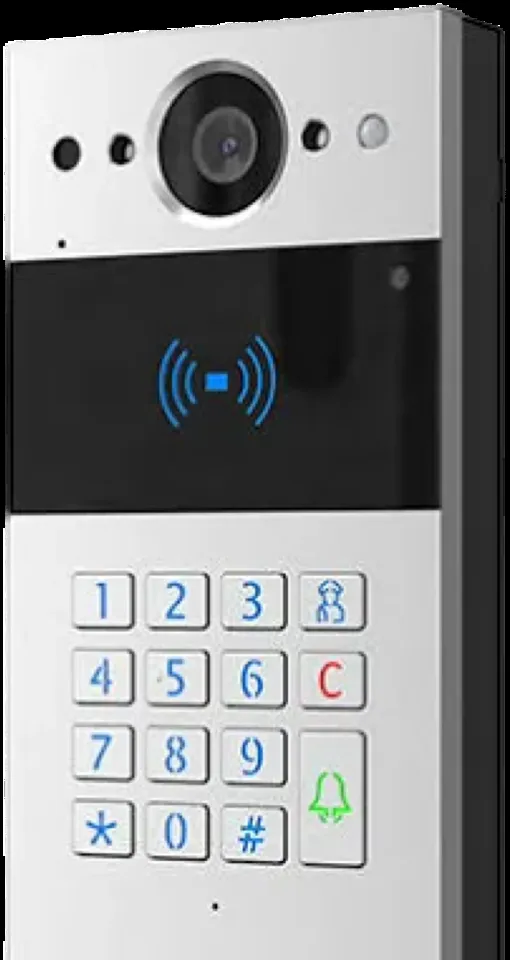
A photo from the AESS job library, not taken in Prospect Park South: a silver and black keypad door station with a camera lens at the top, a blue card-reader symbol, a numeric keypad and a green bell key. At the kitchen or side door of a large district house, a station like this lets the family come in by code while a regular visitor presses the bell key and rings the same indoor stations as the porch door.
AI Overview Reality Check
What AI Gets Wrong About Door Buzzer Installation in Prospect Park South
Ask an AI assistant or a search summary about putting a buzzer on a house and you get confident answers drawn from national cost guides, vendor blogs and how-to pages written for row houses and new apartment buildings. Some of it is right in general and wrong for a landmarked district of freestanding houses set back behind lawns. Here are seven claims we hear repeated, each checked against its source and against what we see at doors here.
"Installing an intercom system costs an average of $2,500"
That is HomeAdvisor's national average, and the same guide gives a range of $1,500 to $15,000, with wireless systems at $150 to $1,500 and hard-wired ones at $1,000 to $15,000. A national average says nothing about doors behind a 39-foot setback.
On our Brooklyn list, an audio station with a release on a one-family house runs $400 to $900, and a video station with indoor stations on each floor or phone answering, the usual choice for a large district house or a legal two-family, runs $700 to $1,800. A full system for a 42- or 73-apartment building starts at about $2,500 and can pass $10,000. Most district houses land in the middle range, below the national average.
What moves a price here is the number of indoor stations, the cable route through an old house and the condition of the door, not a national figure.
"Modern IP and video intercoms cost $1,000 to $5,000 or more per entry door"
That range comes from Swiftlane's apartment intercom cost guide, which also notes that "Software subscriptions commonly add $5 to $15 per unit per month, or $30 to $100 per door per month." It describes cloud systems for apartment buildings.
A district house is one door and one household, or two, and the equipment it needs is a station, indoor stations and a strike. There is no reason for a house to carry a per-door cloud price or a monthly fee unless the owner wants phone answering from a system that charges for it, and we say which ones do before you choose.
For the apartment buildings at the district's edges, the subscription line matters more. At 73 apartments, a per-unit monthly charge adds up quickly over ten years, which is why we quote wired options with no monthly fee alongside any cloud option.
"New York law requires every apartment building to have an intercom"
It does not. Multiple Dwelling Law §50-a requires one automatically only in Class A multiple dwellings erected or converted after January 1, 1968 with eight or more apartments. Older buildings must install one when tenants occupying a majority of the apartments ask in writing, and the section does not reach smaller buildings.
Around Prospect Park South that matters, because the apartment buildings are old. 51 Stratford Road dates from 1925 and 55 Parade Place from 1927, both on the older side of the line, so the duty depends on a tenants' written request. The district's houses, including its legal two-families, are not multiple dwellings at all.
The rule runs the other way for new construction: any new building of eight or more apartments on Coney Island Avenue under the South of Prospect plan would have to include the intercom from the start.
"You can't put a modern intercom on a landmarked house"
You can, within limits. The Landmarks Permit Guidebook allows intercom panels and doorbells "within or adjacent to a door opening," up to "one intercom panel" per opening, attached to plain wood, masonry or metal, with concealed cable and, where hiding it is impossible, "a maximum of approximately ten inches of visible conduit." Staff can issue permits for work that meets those criteria.
What the rules discourage is clutter: several panels at one door, a wide panel over carved trim, raceway across the facade, a third light.
Work outside the criteria, such as a new post on a front lawn, can go to the Commissioners at a public hearing, which is why we plan the station to the criteria first.
"A wireless buzzer avoids running any cable"
Not quite. ButterflyMX's apartment buzzer guide says wireless systems "may avoid some runs to apartments" but "shifts risk toward power, coverage, and connectivity," and that "the entrance panel, power supply, controller, and lock still need dependable connections." The release in the door frame still needs a wire to its power and to whatever triggers it.
In a large house with plaster walls and floors of solid framing, the hard runs are usually from the porch door to the cellar and from the cellar to the top floor. Wireless indoor stations or phone answering can save the second; the first still has to be wired, and it is the one that has to be hidden to meet the Landmarks cable rule.
So wireless is a tool for the upstairs rooms, not a way to skip the door.
"Your old doorbell wire can carry a new video buzzer"
Sometimes. ButterflyMX says "Older analog systems often use dedicated conductors between the entrance and each unit," and that compatible equipment "may sometimes reuse those runs," but reuse "can't be assumed building-wide without an inspection."
In district houses we find both extremes: a bell pair that runs cleanly from the porch door to the cellar and will carry a two-wire station, and a bell wire that stops at a wall closed during a renovation decades ago. Nothing on the outside of the house shows which you have.
So the old wire is metered before the quote, and if it is not usable, the new route and its cost are on the quote before you approve.
"A Wi-Fi relay turns any old buzzer into a smart one"
It can, on the right system. A Brownstoner forum thread from a three-family owner describes the idea: Wi-Fi relays that connect to the release contacts of an existing system, with the warning that the voltage must match the existing system and that a hardwired system should be installed by a low-voltage installer. The same thread points out that older mortise locks and newer tubular locks open differently, which affects what a release can do.
In a district house, a relay is only as good as the release it triggers. If the porch door has no strike, or a strike that has worked loose in an old frame, the relay has nothing to open. And in an apartment building, adding phone unlocking brings the city's tenant data rules with it.
We will tell you honestly when a relay on your existing system is the cheapest good answer, and when the door needs a proper release first.
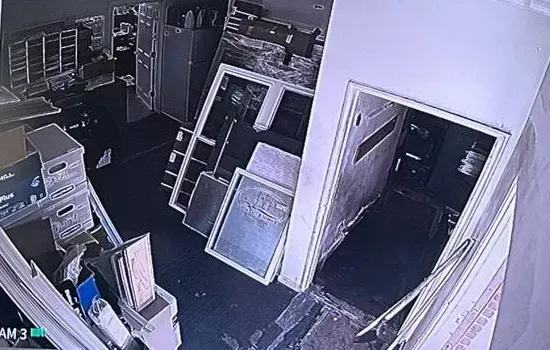
A photo from the AESS job library, not taken in Prospect Park South: a black-and-white night camera view of a cluttered room with an open doorway into a dark back room. Stockrooms behind shops on Church Avenue and Coney Island Avenue often lead to a back or delivery door, and a buzzer on that door, with a camera inside watching it after hours, keeps the back of the shop as secure as the front.
Not Sure Whether Your House Needs a Station on Every Floor or Just a New Release? Speak to a Tech
Send a photo taken from the sidewalk, one of the porch door and whatever is mounted beside it, and, if you can, one of the old bell transformer in the cellar, along with how many floors the household uses and which doors you come in by. A technician will tell you which approach fits and where it falls on our Brooklyn ranges. Call or text (347) 934-8335, send photos on WhatsApp, or fill in the form below.
Get In Touch
Request a Free Quote
✅
Request Sent!
Thank you. A technician will call you about the Prospect Park South address, usually within two hours during working hours.
How It Works
Our Installation Process
1. Walk the property from the sidewalk to the cellar
We start where a visitor starts, at the sidewalk, then list every door the household or building uses and every floor or apartment the system must reach.
2. Check the district and the paperwork
We confirm whether the house is inside the historic district, who signs for the work, and whether the station, lights and conduit fit the Landmarks staff criteria or need an application.
3. Test the door before the electronics
We open and release the door and check the closer, latch, hinges and frame. A heavy original door that does not shut and latch on its own is fixed first, because no release can hold a door that drifts.
4. Map and meter the cable route
We trace the old bell wire, meter each pair and plan any new cable through closets, trim and the cellar ceiling, flagging original plaster that should be tested before it is cut.
5. Price the job in writing
You get a written price from the Brooklyn list, with every possible extra, such as a failed pair or a closer that needs replacing, named and priced before anything is ordered.
6. Order and schedule
Equipment is ordered once the deposit is in. In-stock systems are scheduled right away; special-order stations are booked once they arrive. Every visit gets a two-hour arrival window.
7. Install, conceal and label
We mount the station, release and power supply, run or reconnect cable with as little showing as the rules allow, install indoor stations or phone answering, and label every pair.
8. Test from the sidewalk and hand over
Standing where visitors stand, we call and release every floor or apartment, show the household how to answer and leave the test sheet and wiring record.
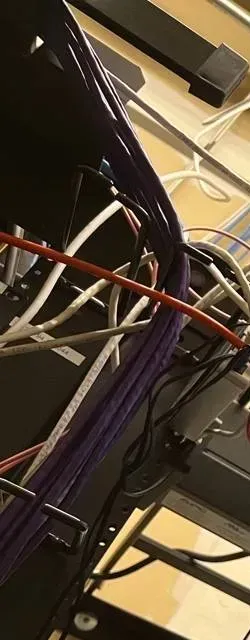
A photo from the AESS job library, not taken in Prospect Park South: purple, white and red cable bundles dropping down beside a black equipment rack. In a six-story co-op like the one on Parade Place, the cable from each line of apartments arrives at one point in the cellar like this, and labeling every bundle during step 7 is what lets the next technician find one apartment's pair in minutes.
Coverage Area
Door Buzzer Installation Near Prospect Park South's Landmarks
The PPS entrance piers
The brick piers at the district's street entrances, a reminder that the whole neighborhood was planned as one suburb, designated a city historic district in 1979.
The Japanese house on Buckingham Road
The 1902–03 Japanese-style house designed by Petit & Green, one of the showpieces that make the district's doorways so varied.
The Swiss chalet on Rugby Road
The 1900 chalet-style house by Nitchie, among the earliest of the district's architect-designed homes.
Beverley Road station
The open-cut station on the B and Q line at the district's southern edge, with a station house dating from 1907.
The Sovereign
The six-story co-op at 55 Parade Place, built in 1927 with 73 apartments, the largest building at the district's edge.
The Parade Ground
The playing fields across Parade Place from the Sovereign, at the northwest corner where the district meets the blocks south of Prospect Park.
Door Buzzer Installation Cost in Prospect Park South
Prospect Park South is billed at our standard Brooklyn rate. The final figure follows photos and a walkthrough, because the number of indoor stations or apartments, the cable route through an old house, the condition of the door and the Landmarks limits on the doorway drive the total far more than the brand on the station.
Job
Typical Prospect Park South property
Brooklyn range
Audio station or replacement with electric strike release, existing wiring reused where it tests well
One-family houses with one porch door, a single shop or office door
$400–$900
Video door station with indoor stations or phone answering
Large district houses with stations on each floor, legal two-families with two buttons
$700–$1,800
Multi-unit entry system, audio or video by apartment count, with optional fob or code entry
Apartment buildings on Stratford Road, co-ops on Parade Place, avenue buildings
from $2,500 to $10,000+
In-person diagnosis of an existing system, booked online
Any property where the old system must be tested before quoting
$250, applied toward the work
Monthly subscription
Any property choosing a wired, no-subscription system
$0
What moves a district house inside its range is easy to predict. First the stations: one indoor station on the main floor keeps a job near the bottom of the video range, while stations in the kitchen, on the bedroom floor and in a finished cellar push it up. Then the cable: an old bell pair that tests sound costs nothing extra, while a new run from the porch door to the cellar and up to the top floor, hidden to the Landmarks rule, adds labor. Then the door: an original door that needs its closer replaced or its frame reinforced before a strike can go in, and a side or kitchen door that gets its own keypad. If a job also adds a camera over the walk, installing it on the same visit usually saves $200 to $400 in labor compared with a separate trip. Anything that depends on a test is named on the quote with its price before you approve.
Full terms — including 50% deposit, one-year parts-only warranty on AESS-supplied products, and the late-fee schedule — are set out in the service agreement.
Find Out Which Range Your Prospect Park South House or Building Falls In
Tell us the street, how many floors or apartments the system must reach, every door people use and what is mounted at the porch or lobby door now, and we will tell you which Brooklyn range fits and what would move it. Call or text (347) 934-8335, send photos on WhatsApp, or fill in the form.
Shop Our Systems
Door Buzzer Installation Packages & Pricing
Three typical Prospect Park South jobs, each placed inside the matching range on our Brooklyn list. The exact figure comes from the photos and the walkthrough.
Porch door audio: $400–$900
A slim audio station on the casing of a one-family porch door, a fail-secure strike in the frame, a closer set for a heavy original door, an answering station on the main floor and battery-backed power in the cellar.
Whole-house or two-family video: $700–$1,800
A one- or two-button video station inside the one-panel limit, indoor video stations in the kitchen and on the bedroom floor or one per household, phone answering if wanted, and cable hidden from porch to cellar.
Apartment building system: from about $2,500
A directory, code or button panel at the lobby door, apartment stations or phone answering for every home, tested or new riser cable, a release with free exit and power in a locked cellar box, rising toward $10,000 or more with apartments and doors.
Bring your own equipment. If you have already bought a door station or intercom kit, we can install it as labor-only work, quoted flat once we have seen the door, the frame and the cable path through the house. Tell us the make and model, and we will say before the visit whether it can reach every floor and release your door. Equipment you supply is covered by its maker's warranty, not ours.
Complete Services
Every Door Buzzer Service in Prospect Park South
District houses and two-families
First buzzers, indoor stations on every floor, two-household stations and side-door keypads. Request a quote
Apartment buildings and co-ops
Lobby panels, riser testing and phone answering for the buildings at the district's edges. Call (347) 934-8335
Our front lawn is part of the open, fenceless look the district was planned around. Will the crew have to dig across it for cable?
+
Not for a station at the porch door. The cable for a porch-door station goes straight back into the house behind the station and down to the cellar, so the lawn is never touched. A trench across the lawn would only be needed if the station were moved to a new post near the sidewalk, which is a separate decision that would also need Landmarks review. Ladders and drop cloths stay on the porch and the walk.
If our painter takes the door station off to repaint the porch trim, is it still covered afterward?
+
Removal and refitting by someone else after we finish is outside the warranty, because the station, its seal and its cable connection are no longer the way we left them. The easy answer is to call us before the painter starts. We can take the station off, cap the cable and refit and test it once the paint is dry, quoted as a short service visit, and the coverage carries on as before.
Where does a large one-family district house with a station on every floor usually land on your price list?
+
Most land in the $700 to $1,800 video range. The low end is a video station at the porch door with one or two indoor stations over an old pair that tests sound. The high end is three or four indoor stations, phone answering and a new hidden cable route from the porch door to the cellar and up to the top floor. A building-sized system is never needed for a single house.
In our legal two-family, the tenant wants a video station but we are happy with audio. Can the two floors have different stations on one system?
+
Usually, yes. Many systems accept both audio and video indoor stations on the same door station, so each household can have what it wants, and the price reflects the mix. If the door station has a camera, the video station shows the visitor and the audio station simply ignores the picture. We confirm the chosen system supports the mix before quoting.
Our house has a porch door, a side door and a kitchen door. Does every one of them need a station?
+
No. Only doors where visitors arrive need a station. The porch door almost always gets one. A side or kitchen door that the family uses every day usually gets a keypad, so nobody needs a key, and sometimes a small call station if regular visitors such as a cleaner or a caregiver use it. A door nobody uses stays as it is, locked and opening freely from inside.
Can the system keep a picture of everyone who rang while we were out?
+
Many video systems can, either on the indoor station or in the app, and some store a short clip as well as a still picture. Whether it keeps images, how many and for how long depends on the model, so we tell you what the chosen system records before you approve. In an apartment building, any stored entry data falls under the city's tenant data rules.
For phone answering, do you need our home Wi-Fi password, and what happens if we change it later?
+
The door station or its indoor unit has to join your network, so someone in the household enters the password during setup, ideally with the technician there to test the connection at the porch. If you later change the password or replace the router, the system has to be reconnected; we can talk you through it on the phone, and changes to your internet or router are outside the installation warranty.
Can we have the door released only from inside the house, never from a phone?
+
Yes. Remote release is a setting, not a requirement. Some owners want to see and speak to visitors on their phones while away but only let people in when someone is home. The indoor stations keep their release buttons, and the app is set to answer only. The setting can be changed later if the household's needs change.
Who helps us if the system acts up a year after it goes in?
+
Call or text the same line you used to book. A technician starts with a phone or photo check, which costs nothing, because many problems after a year are a setting, a changed router or a station knocked loose. If a visit is needed, we tell you whether it is covered before we come, and the wiring record we left at installation makes the fault quick to find.
Do the indoor stations need their own outlets in each room?
+
Usually not. On most wired systems the indoor stations draw their power over the same cable that carries the call, from the supply in the cellar, so no outlet is needed beside them. Some video stations with larger screens need a small local power supply, and phone answering units need to be near the router. The quote lists any outlet a station needs, and any new outlet is fitted by a licensed electrician.
More Door Buzzer Installation near Prospect Park South
Ready to Answer Your Prospect Park South Porch Door From the Kitchen or the Top Floor?
Send a photo taken from the sidewalk and one of the porch door, with the street, how many floors or apartments the system must reach and every door people use, and we will tell you which system fits, how it can sit inside the Landmarks limits and where it falls on our Brooklyn ranges. Call or text (347) 934-8335, message us on WhatsApp, or use the request form. Licensed under NYS license #12000287431, rated 4.7★ across 201 Google Reviews, with same-day estimates on most weekdays.