What are you looking for?
About Us Contact Us Careers Get a Free Quote (800) 486-0943
Pick a service
✅ Got Your Own System?
🎬 Home TheatreQuote 🎶 AV SoundQuote 🔑 Access ControlQuote
Now pick your area
Pick your area
Long Island
Hudson Valley
Services available
Pricing & Tools
Pick a service for pricing
🚪 Intercom Pricing 🔔 Buzzer Repair Pricing
Calculators
📹 Camera System Calculator 🚨 Alarm Calculator ⚡ Cabling Quote Builder ✅ Got Your Own System?
Select your area
An Ocean Avenue lobby panel that stopped calling half the building, a walk-up over a Church Avenue store with nothing but a knock, or an HPD intercom violation with a deadline? Flatbush door buzzer installation line: (347) 934-8335
Home › Door Buzzer Installation Brooklyn › Flatbush
Prewar Elevator Apartment Houses · Walk-Ups Over Avenue Stores · Victorian Houses in the Historic Districts · Offices and Day Programs Upstairs

Door Buzzer
Installation in
Flatbush

Every Riser Tested · Every Apartment Called From the Sidewalk · Written Price Before Ordering · Brooklyn Rate

Door buzzer installation in Flatbush is mostly about big buildings. In the area NYC Open Data labels Flatbush, HPD inspectors wrote 102 violations for broken or defective intercoms in 2026 through November 9, after 119 in 2024 and 99 in 2025, and most of them sit on a handful of streets lined with prewar elevator apartment houses: Ocean Avenue alone drew 52 intercom violations from 2024 on, and East 21st Street 46. So a Flatbush installation starts with the lobby panel, the risers that carry every apartment's line, the cellar where the power supply lives and the street door that has to relatch behind every visitor. We also plan smaller jobs: the walk-ups above Flatbush Avenue, Church Avenue and Nostrand Avenue stores, the Victorian houses south of Church Avenue, and the offices, clinics and programs on upper floors. Below is how each one is planned and where it lands on our Brooklyn price list.

Reviewed and updated November 11, 2026, against NYC Open Data's HPD housing maintenance code violations for the Flatbush neighborhood area (intercom and self-closing door violations, pulled November 11, 2026); NYC 311 service requests for bell, buzzer and intercom complaints in Brooklyn Community Board 14; New York's Multiple Dwelling Law §50-a; the NYC Housing Maintenance Code (§27-2005, §27-2041.1 and §27-2043); the entrance door and intercom rule published as §42-01 on UpCodes; the Landmarks Preservation Commission's Permit Guidebook chapter on health and safety work and its November 2025 Flatbush historic district designations; News 12 Brooklyn's July 2025 report from a Flatbush building with broken entrance locks; Brownstoner's reports on 55 East 21st Street and 1111 Ocean Avenue; the city's Avenue NYC needs assessment for Flatbush; the Furman Center's Flatbush-Midwood profiles; HPD's tenant guide to self-closing doors; Aiphone's upgrade guidance; Habitat Magazine's February 2024 article on intercom obligations; ButterflyMX's guide to intercom repair in New York City; Brick Underground's NYC intercom guide; Reddit threads on r/AskNYC and r/Brooklyn; the HomeAdvisor and Swiftlane cost guides; Allegion's fail-safe and fail-secure guide; and the 2010 ADA Standards. · Abstract Enterprises Security Systems, NYS license #12000287431 · crews dispatched from our Troy Avenue office in Brooklyn

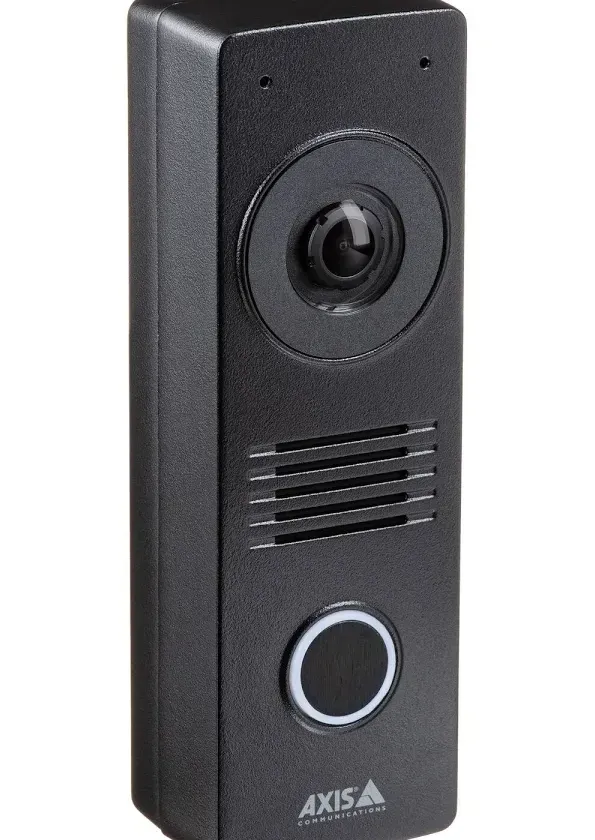
Flatbush, Brooklyn door buzzer installation: black rectangular video door station with a camera, speaker grille and round lit call button
A photo from the AESS job library, not taken in Flatbush: a black rectangular video door station with a camera, a speaker grille and one round call button that lights up. A one-button station like this suits the separate street door of a Victorian house on Argyle Road or Rugby Road, a doctor's office entrance beside a Flatbush Avenue storefront, or the side door of a house with one rental floor.
Flatbush Buzzer Request
Elevator apartment house, walk-up, apartments over a store, Victorian house or upstairs office: tell us the address, how many apartments the system has to reach and whether there is an open HPD violation, and a technician calls back with the range

✅
Request Sent!
Thank you. A technician will call you about the Flatbush address, usually within two hours during working hours.
25+
Years Experience
✓
Same-Day Estimates
100%
Licensed & Insured
4.7★
201 Google Reviews

Owner-operated since 2002 · Thousands of jobs completed · Booked within 2 hours

Quick answer: door buzzer installation in Flatbush runs $400 to $900 on our Brooklyn list for an audio buzzer with an electric strike release on a house or a single office door, $700 to $1,800 for a video door station with indoor monitors or phone answering on a small walk-up or a house with tenants, and from about $2,500 to past $10,000 for a lobby panel that reaches every apartment in a walk-up or elevator apartment house, depending mostly on the number of apartments and whether the old risers test sound. Flatbush is billed at the Brooklyn rate. We book a walkthrough within two hours of your request, and the written price, with every add-on named, comes before anything is ordered.

  • Looking at your photos and quoting a new system costs nothing. If an existing system has to be diagnosed in person first, that is the $250 service call booked online, and the $250 is applied toward the work.
  • All work falls under New York State license #12000287431. We install low-voltage entry equipment; if the building needs a new 120-volt circuit for the power supply, a licensed electrician does that part.
  • A wired system can run with no monthly fee at all. Phone and app answering is an option, not a requirement.
The Neighborhood

Why Flatbush Properties Need Door Buzzer Installation

Flatbush has no official borders, but most people mean the stretch of central Brooklyn south of Prospect Park and Parkside Avenue, running roughly from Ocean Avenue and Coney Island Avenue east toward Nostrand Avenue and New York Avenue, down past Church Avenue and Cortelyou Road toward the Junction at Brooklyn College. It sits in Brooklyn Community District 14, which it shares with Midwood. The B and Q trains run along its western side and the 2 and 5 end at Flatbush Avenue–Brooklyn College. What matters for an entry installer is how much of the housing is rental apartment buildings: after the First World War a city tax exemption that lasted until 1932 helped fill Ocean Avenue and the side streets with six-story Art Deco and Colonial Revival elevator apartment houses, and the Furman Center's profile of the district counted more than four out of five rental units as rent-regulated in 2010. Its 2024 figures put homeownership in the district at 24.4 percent.

That building stock explains the city's records. Each of those apartment houses has one lobby panel, a set of risers carrying a line to every apartment, a power supply in the cellar and dozens of apartment stations, many of them decades old and replaced one at a time with whatever fit. When any part of that chain fails, a tenant calls 311, an HPD inspector tests the line from the building front to the station in that apartment, and a violation is written under the Housing Maintenance Code's general duty-to-repair section, §27-2005. In the Flatbush neighborhood area, those intercom violations climbed from 71 in 2020 to 119 in 2024, and have stayed near a hundred a year since, with 102 written in 2026 through November 9. Across Community Board 14 as a whole, which adds Midwood, 311 logged 341 bell, buzzer and intercom complaints in 2026 through November 11, the most of any year since at least 2020.

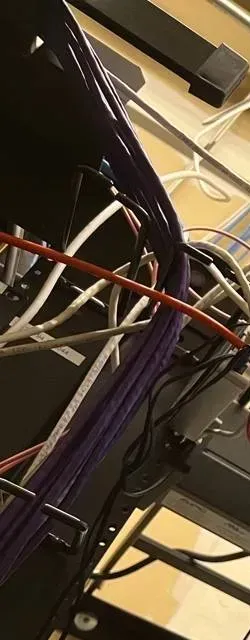
Flatbush, Brooklyn door buzzer installation: purple, white and red cable bundles dropping down beside a black equipment rack
A photo from the AESS job library, not taken in Flatbush: purple, white and red cable bundles dropping down beside a black equipment rack. In a Flatbush apartment house the equivalent spot is usually a corner of the cellar near the boiler room, where the lobby panel's cable meets the risers to every wing and the power supply, and where we start tracing every apartment's line.

The violations read like a map of the buildings. In 2026 alone, HPD's intercom notices in this area name stations in apartment foyers, in private hallways and in kitchens, on floors up to the sixth in the courtyard buildings and up to the eleventh in one Parkside Avenue tower. They name apartments by wing, such as RC6 and LF1 on Ocean Avenue, because many of the larger buildings wrap around a courtyard with separate sections, each with its own stair or elevator. Some name a "relay," the small switching part that turns a tenant's button press into the door release. Seventeen intercom violations written here since 2020 name a tenant's cell phone or phone as the answering point, which means the building had already moved to a system that dials residents. And on East 21st Street in September, a class C notice ordered the owner to fix "broken or defective glass creating cut hazard at intercom system at building front," which is what a smashed lobby panel becomes in the code.

The door matters as much as the panel. HPD wrote 1,098 self-closing door violations in the Flatbush area in 2026 through November 9, after 1,425 in 2025 and 1,498 in 2024. Not all of those are street doors; many are apartment doors. But in July 2025, News 12 Brooklyn reported from a Flatbush apartment building whose residents said a man who did not live there kept getting into the common areas and covered a hallway camera's lens on two nights running. The residents blamed broken locks at the entrances, and during the station's visit its crew picked the "repaired front entrance" using keys from the news van. "I don't feel safe in my apartment. I don't feel safe in this building," one resident, Johnson, told the station. A new intercom on a street door that any key will open, or that never latches, buys a building nothing.

Small buildings have their own version of the problem. Flatbush's avenues hold hundreds of storefronts with apartments overhead: the city's Avenue NYC commercial district needs assessment for Flatbush, with fieldwork from October 2021 to June 2022, counted 1,662 storefronts along Church Avenue, Flatbush Avenue, Nostrand Avenue and Rogers Avenue. The residential door beside each shop leads to three, four or six apartments, and many of those buildings fall under the eight-apartment line where the state's intercom requirement starts. One Brooklyn renter on r/AskNYC put it plainly about a four-unit building: the landlord "isn't required to put in a buzzer system or a self-locking front door." Required or not, tenants in those buildings still walk down two flights for every delivery, and owners still get the calls. Most Flatbush apartment houses we plan also pair the buzzer job with a camera over the entrance, which is why our pricing below shows what bundling the two saves.

Six numbers behind a Flatbush buzzer installation

  • About a hundred intercom violations a year. HPD wrote 99 intercom violations in the Flatbush neighborhood area in 2025 and 102 in 2026 through November 9, per NYC Open Data, up from 71 in 2020.
  • Two streets carry almost half of them. From 2024 on, Ocean Avenue drew 52 intercom violations and East 21st Street 46, followed by East 19th Street and Caton Avenue with 19 each and East 18th Street with 15.
  • Most are class B. Of the 102 written in 2026, 87 are class B, 13 class A and 2 class C. ButterflyMX's summary of HPD guidance gives class B a 30-day correction period.
  • A fix that does not hold shows up in the record. Among this year's intercom violations, 8 are marked "not complied with" and 2 "false certification," meaning a later inspection did not find the repair the record said was made.
  • Doors are written up far more often. 1,098 self-closing door violations in the same area in 2026 through November 9, more than ten for every intercom violation.
  • Complaints are rising, and many never reach an inspection. Community Board 14 logged 341 bell, buzzer and intercom complaints to 311 in 2026; 54 closed because the inspector could not get in, and 60 because the inspection could not be completed.

Where this page applies. It covers Flatbush from Parkside Avenue and the park's southern edge down toward the Junction at Flatbush and Nostrand Avenues, and from Ocean Avenue and the Prospect Park South and Ditmas Park blocks east toward Nostrand Avenue, including Ocean Avenue's apartment houses, the numbered East 16th to East 27th Streets, Caton Avenue, Lenox Road, Linden Boulevard, Clarkson Avenue, Woodruff Avenue and the Church, Flatbush, Nostrand and Rogers Avenue corridors. Neighboring East Flatbush and Ditmas Park have their own pages.

Repair or Replace in Flatbush

Need Repair in Flatbush? One Apartment, One Wing or the Whole Building: Sorting the Job Before You Pay for the Wrong One

Most calls we get from Flatbush owners and managing agents begin with a violation or a tenant's complaint about one apartment. The first question is how far the failure reaches, because the same symptom can mean a $250 visit or a full replacement. ButterflyMX's guide to intercom repair in New York City sorts it by symptom in a way we agree with: when one apartment is dead, look first at that station and its local wiring; when several apartments fail, look at the shared riser, the controller, the power or the entry panel; when the whole building is down, look at the panel, the power supply and the controller; and when the buzzer sounds but the door stays locked, look at the electric strike or magnetic lock, the release wiring, the relay or the power supply.

In a courtyard building with three or four wings, there is a fourth pattern worth knowing: one wing failing while the rest work almost always points to that wing's riser or a junction where it splits off in the cellar. That is a repair, not a reason to replace a whole system. A building whose violations keep coming back at different apartments every few months, on different floors and wings, is telling a different story: worn stations, tired risers and a power supply working at its limit. That is when a replacement plan usually costs less than another year of visits.

We sort which group your building is in before quoting. Photos of the lobby panel, the street door, the cellar equipment and one or two apartment stations, sent to (347) 934-8335 or on WhatsApp with any HPD violation numbers, usually tell us enough. Where the system has to be tested in person, that is the $250 service call booked online, and the $250 is applied toward whichever job follows.

What We Install

Door Buzzer Installation Services in Flatbush

Every service below is priced from the same Brooklyn door buzzer list. The number of apartments sets the size of the system; the condition of the risers decides how much new cable it needs; and in Flatbush the number of wings and entrances, the state of the lobby door and whether a store or office shares the building decide much of the rest.

Lobby panel replacements

New audio or video entry panels for apartment houses whose old lobby board has lost buttons, speakers or whole sections, with the cellar equipment and power supply replaced at the same time so the new panel is not running on a tired transformer.

Riser testing and rewiring

Every apartment line traced from the cellar to its station and tested, wing by wing; sound pairs reused, failed ones replaced with new cable in the least visible route the building allows.

Apartment station change-outs

A matched set of stations for every apartment in place of the mix of old handsets that builds up over decades, mounted where the tenant can hear them, usually the foyer or the hall near the apartment door.

Wing and courtyard entrances

Extra door stations for the side or courtyard entrances that serve one section of a large building, calling only that section's apartments and releasing only that door.

Phone and app answering

Systems that ring residents' phones as well as, or instead of, a wall station, for buildings where tenants are often out or where the old risers are not worth saving.

First buzzers for small buildings

A door station, release and answering unit in every apartment for three- to six-apartment buildings over avenue stores and for houses with tenants that have only ever had a bell or nothing at all.

Strikes, closers and lobby door work

Electric strikes fitted to the lobby door frame, closers set or replaced so the door relatches every time, and a check that the door opens from inside without a key.

Victorian house entries

Single- and two-button stations for detached houses in Prospect Park South, Ditmas Park and Beverley Square, placed at the door opening or the front walk the way the Landmarks Commission allows.

Office, clinic and program doors

Buzzers for medical offices, day programs, churches and offices on upper floors along Flatbush, Church and Nostrand Avenues, answered at a desk or on a phone so the street door can stay locked.

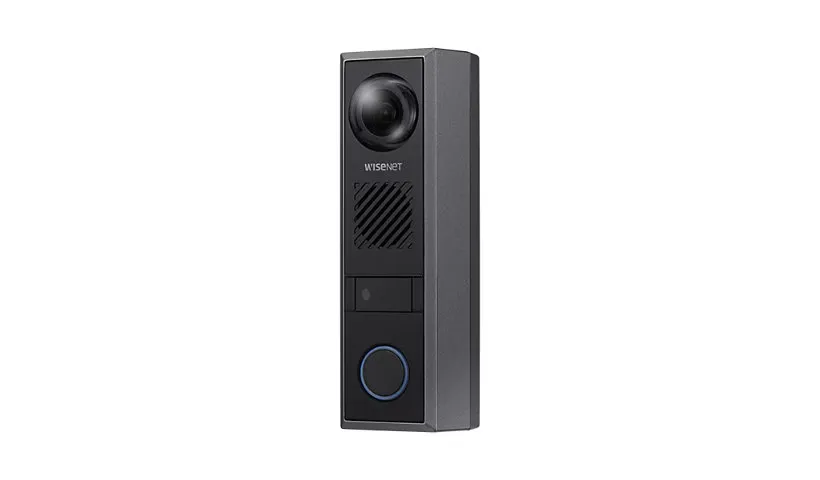
Flatbush, Brooklyn door buzzer installation: slim dark grey wired doorbell with a camera lens, speaker slots and a round push button
A photo from the AESS job library, not taken in Flatbush: a slim dark grey wired doorbell with a camera lens, speaker slots and a round push button. A narrow unit like this fits the door casing of a Victorian house where the Landmarks Commission wants the device discreet and beside the door, or a single upstairs office door off a Flatbush Avenue stair.
Building Specialists

Door Buzzer Installation for Flatbush's Architecture

Six kinds of building account for nearly every Flatbush buzzer job we plan. They differ in how many apartments one panel has to reach, how the cable climbs the building, who is allowed to sign for the work and what the entrance looks like, and each has a mistake we see when the job is rushed.

Courtyard elevator buildings

Prewar six-story buildings on Ocean Avenue, Lenox Road, Caton Avenue and the numbered East streets, wrapped around a light court, with apartments lettered by wing and one main lobby.

Side-street walk-ups

Three- to five-story brick buildings on blocks like East 18th and East 19th Streets, with one entrance, one stair and a bell system that was often installed before anyone in the building was born.

Apartments over avenue stores

Two- to four-story buildings on Church, Flatbush, Nostrand and Rogers Avenues with a shop at street level and a narrow residential door beside it.

Co-op and condo buildings

Apartment houses that converted to co-ops, many in the late 1980s, where the board owns the lobby and the risers and shareholders may own what is inside each apartment.

Victorian and frame houses

Detached houses in Prospect Park South, Ditmas Park, Beverley Square and their newer historic districts, some single-family, some divided into apartments.

New mixed-use buildings

Recent and planned buildings near the Junction and on former commercial sites such as the Sears building redevelopment, where the entry system is chosen by the developer.

Courtyard elevator buildings: one lobby, four wings and a line to every apartment

Walk into one of Flatbush's larger prewar apartment houses and the lobby panel is only the visible end of the system. Behind it, a cable bundle drops to the cellar, where the power supply and, in many buildings, a controller sit near the boiler room. From there, separate risers climb each wing, sometimes in a stair shaft, sometimes in a pipe chase, sometimes in a surface channel painted over many times. Each riser carries the lines for every apartment in that wing. The apartment lettering in HPD's notices, RC6, LF1, LD3, tells you how the building was planned: by section first, then by floor and line.

That layout changes how we plan an installation. We test the risers wing by wing before choosing a system, because a building with two sound risers and two failed ones has a different answer from a building where every riser is failing. Two-wire systems, which carry voice, video, power and release over one pair to each apartment, can often run on the old pairs where they test sound; Aiphone's upgrade guidance says the same, that existing wire can be reused when it is in good condition. Where a riser has failed, the replacement cable usually follows the old route, so no new holes are cut through apartment walls. Where the building has side or courtyard doors that serve one wing, each gets a smaller door station that calls only that wing.

The mistake we see most here is a new lobby panel on an old power supply and a cellar full of unlabeled splices. We replace the supply, move it to a dry spot on an owner-controlled circuit with battery backup, and label every line by wing and apartment.

Side-street walk-ups: an old bell system and a stair that carries everything

The walk-ups on the numbered streets between Church Avenue and Newkirk Avenue are smaller versions of the same problem. A typical building has one entrance, a vestibule with mailboxes and one stair serving every apartment. Many still run a bell-and-return-buzzer system, the kind HPD's notices describe as a "bell and return buzzer": a ring in the apartment and a button that releases the door, with no voice at all, or a voice system added later on top of it.

For buildings of eight or more apartments built or converted after 1968, Multiple Dwelling Law §50-a calls for a system that lets tenants talk to the visitor and release the door; older buildings come under the same requirement when tenants of a majority of apartments ask in writing. So a walk-up still running ring-and-release usually gets a voice or video system, not another bell board. Cable here runs up the public stair, and the choice is between reusing the old bell pairs, if they test sound for the system chosen, and a new run in painted raceway along the stair wall. We price both and explain which we would choose and why.

Apartments over avenue stores: two doors, two systems, one cellar

On Church Avenue, the co-named Bob Marley Boulevard in the Little Caribbean district, and on Flatbush, Nostrand and Rogers Avenues, the usual building has a store taking most of the frontage and a narrow residential door to one side leading straight up a stair. Three or four apartments sit above. The store has its own hours, deliveries and staff; the tenants have theirs. Many of these buildings are below the eight-apartment line, so nothing requires an intercom, but a working buzzer is the difference between a door that stays locked and a door propped with a folded flyer.

We keep the residential system separate from anything the store uses. The panel calls only apartments, its release opens only the residential door, and its power supply is on a circuit the landlord controls, not one that goes dark when the store's meter is shut off. If the store wants a buzzer for a back or side door, that is a second, separate system answered at the counter. Cable for the apartments often has to pass through the store's cellar, so we plan access with both the owner and the store before the work date.

The physical challenge is the door itself: narrow, set in a shallow recess between storefronts, used constantly and often a steel door in a frame that has been bent and repaired. The strike has to suit that frame and the closer has to beat the draft from the avenue.

Co-op and condo buildings: who owns the station on the wall

Some Flatbush apartment houses became co-ops during the conversion wave the New York Times reported on in 1989. In a co-op or condo, the board or association usually controls the lobby, the cellar and the risers, while the proprietary lease or the bylaws decide who owns each apartment station. Habitat Magazine's February 2024 article on intercom obligations quotes Nancy Kourland of Lasser Law Group on a case where "the co-op has a legal obligation to repair or replace the intercom." That is the board's question to settle with its own counsel, not ours, but it changes how we price: we can separate the shared parts, the panel, power, cellar equipment and risers, from the per-apartment stations on the written quote, so the board can split the cost the way its documents require.

Victorian and frame houses: discreet, at the door, and landmark-aware

South of Church Avenue, Flatbush turns into blocks of detached houses: Prospect Park South, Ditmas Park, and since November 25, 2025, the Beverley Square West and Ditmas Park West historic districts, which the Landmarks Preservation Commission designated with 118 and 127 houses respectively, mostly built between about 1894 and 1910 in Queen Anne, Colonial Revival and Shingle styles. Some are single-family; some have a rental apartment or two. A buzzer here is usually a small job: a one- or two-button station, a release and an answering unit on each floor.

The Landmarks rules shape where it goes. The Commission's Permit Guidebook says intercom panels and doorbells "must be installed within or adjacent to a door opening," that an intercom can also go "on a fence or wall in front of the entranceway," and that the design should be neutral and discreet, with a limit of one intercom panel per door opening. Equipment is attached at mortar joints, plain masonry, wood or metalwork, and visible conduit is kept to about ten inches. We pick a slim station that meets those rules and send manufacturer cut sheets for the owner's Portico application. Houses in the historic districts have their own pages on our site; this section covers the Flatbush blocks around them.

New mixed-use buildings: a modern panel that nobody can manage

The newer buildings near the Junction, and the roughly 650-unit redevelopment planned around the landmarked former Sears building at Beverley Road and Bedford Avenue, come with entry systems chosen by the developer, often app-based. The usual problem is not hardware but an admin account in a departed installer's name and a directory nobody can change. We start with an audit of who controls the account and what it costs.

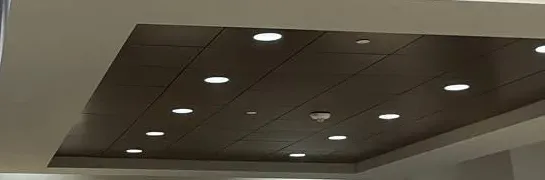
Flatbush, Brooklyn door buzzer installation: dark recessed ceiling panel with round downlights and a small round device framed by a lighter ceiling
A photo from the AESS job library, not taken in Flatbush: a dark recessed ceiling panel with round downlights and a small round device, framed by a lighter ceiling. Prewar Flatbush lobbies often have similar dropped or coffered sections near the entrance, and that is where we look first for a hidden path for new cable from the lobby panel to the cellar.
Field Notes

Field Notes: Start in the Cellar, Test Every Wing, Then Call Every Apartment From the Sidewalk

These notes describe how our technicians approach an installation in a building like the ones in Flatbush. They are our standard practice, not a story about one address.

Start in the cellar. In a large apartment house the lobby panel tells you very little. The technician goes to the cellar first, finds where the panel's cable lands, finds the power supply and notes what circuit it is on and whose meter that circuit belongs to. A system powered from a tenant's or a store's circuit, or from a transformer bolted to a damp wall next to a sump, is a system that will fail on a holiday weekend. That goes on the written price before anything else.

Test every wing. Next, each riser is traced and each pair tested: continuity, shorts to neighboring pairs and to ground, and whether it can carry the system we plan. The results are written up wing by wing and apartment by apartment, reusable or not. In buildings with HPD notices, we check the apartments named in the violations first, because they tell us where the system already failed.

Call every apartment from the sidewalk. At the end of the job, the test is the same one an HPD inspector would run: from outside the building, call each apartment, have someone answer and talk, press the release, and watch the door open and relatch. Every result goes on a dated test record with the apartment number, the entrance used and the time. That record is what an owner needs when certifying a violation corrected, and what we hand over with the wiring map.

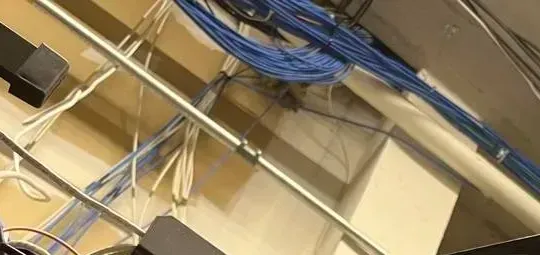
Flatbush, Brooklyn door buzzer installation: bundles of blue low-voltage cable laid over a ceiling beam and a metal pipe in an open ceiling
A photo from the AESS job library, not taken in Flatbush: bundles of blue low-voltage cable laid over a ceiling beam and a metal pipe in an open ceiling. Cellar ceilings in Flatbush apartment houses look much the same, crowded with heating pipes, and new riser cable has to be kept clear of hot pipes and labeled by wing as it is laid.
Reading the Record

From the Building Front to the Foyer Wall: What Flatbush's HPD Intercom Notices Say About Where Systems Fail

An HPD intercom violation is short, but it is precise, and reading a few dozen of them from one neighborhood tells an installer more than any brochure. Nearly every one written in the Flatbush area this year follows the same pattern: "properly repair or replace the broken or defective intercom system from building front to" a named wall, in a named room, in a named apartment, on a named story. The inspector stood at the entrance, called the apartment, and recorded where the call failed to arrive.

Four things in those notices shape how we install here.

The station's location is part of the violation. Notices name the station "at south wall in the foyer," "at west wall in the private hallway," "to the south wall in the kitchen." Prewar Flatbush apartments usually have a small entry foyer or a private hall off the apartment door, and that is where the original stations were placed and where inspectors find them. When we install new stations, we mount them in the same zone unless the tenant's layout has changed, because that is where the existing cable ends and where an inspector will look. If a tenant cannot hear the foyer station from a bedroom at the far end of a long apartment, we add a chime there rather than moving the station somewhere the cable does not reach.

Some notices name a single part. Several 2026 notices on Lenox Road, Woodruff Avenue and Flatbush Avenue name the "intercom relay" at the building entrance, the switching part that takes the release signal and powers the door's strike. A failed relay leaves every apartment able to talk to the visitor but none able to open the door. It is one of the cheaper repairs in the system, and if it is the only fault, replacing a whole building's equipment because of it would be a waste.

Phone-dialing systems get written up too. Notices on Crooke Avenue, Woodruff Avenue, Newkirk Avenue and East 21st Street name the answering point as the "tenant's cell phone" or "tenant phone." Those buildings had replaced apartment stations with a panel that dials residents. HPD tested them the same way: from the building front to the tenant. A phone-based system that cannot reach a tenant whose number changed, or whose account was never set up, is as broken as a dead wall station.

The lobby panel itself is a hazard when it is broken. The class C notice on East 21st Street in September, for broken glass "creating cut hazard at intercom system at building front," is the most urgent kind HPD writes; ButterflyMX's summary of HPD guidance puts the correction period for most class C conditions at 24 hours. A panel with a glass face on a busy entrance should be replaced with one built for the location: a metal or polycarbonate face, recessed or shrouded buttons and a camera lens that is not the weakest point.

What the statuses tell an owner. Of the 102 intercom violations written in the Flatbush area in 2026 through November 9, 32 were still at the stage of a notice sent to the owner, 15 were marked "CIV14 mailed," a later stage of HPD's notice process, 14 were closed, 23 were dismissed, 8 were marked not complied with, 2 were marked false certification and 5 had a first failed attempt to re-inspect because nobody could get in. We do not read more into any one building's record than HPD wrote. What the pattern says is simple: a repair that is not tested at every apartment, and documented, tends to come back as another notice.

That is why our installation ends with the sidewalk test of every apartment described in our field notes. It is the same test the inspector runs, done before the inspector arrives.

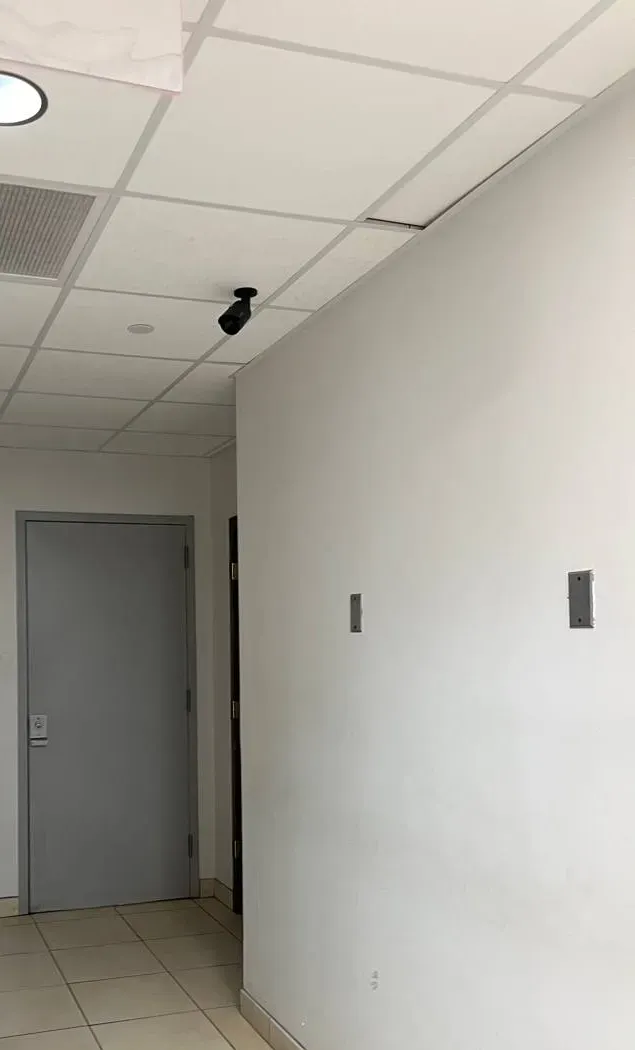
Flatbush, Brooklyn door buzzer installation: tiled corridor with white walls and small wall plates ending at a grey steel door with a lever handle under a drop ceiling with a small camera
A photo from the AESS job library, not taken in Flatbush: a tiled corridor with white walls and small wall plates, ending at a grey steel door with a lever handle under a drop ceiling with a small camera. Corridors like this lead from the lobby to the side and courtyard doors of many Flatbush apartment houses, and every door at the end of one that people use needs to close, latch and open from inside without a key.
The Lobby Door

A Crew Picked the "Repaired" Front Entrance With Its Own Keys: Why a Flatbush Buzzer Job Includes the Lock, the Strike and the Closer

The July 2025 News 12 Brooklyn report is worth reading closely, because it shows the gap between a door that has been "fixed" and a door that is secure. Residents of the Flatbush building said management made temporary fixes without lasting solutions; the property manager's answer, by phone, was to "call back next week." The station's crew then opened the repaired front entrance with keys from their own van. Whatever had been done to the lock, it had not made the door harder to open for a stranger.

HPD's own numbers say doors are the larger problem here. The 1,098 self-closing door violations written in the Flatbush area in 2026 through November 9 are more than ten times the intercom count. The Housing Maintenance Code, in §27-2041.1, makes a failure to maintain required self-closing doors "a class C immediately hazardous violation" with 14 days to correct, and sets a civil penalty of $250 to $500 plus $250 a day after the correction date. Many of those violations are apartment doors, not street doors, but the rule and the penalty are the same.

So every Flatbush installation we quote includes four checks at each entrance people use, and the written price includes whatever they find.

  • The cylinder and the keys. A lobby lock that has been rekeyed with a common keyway, or whose cylinder has worn loose, opens for keys it was never cut for. If we find that, we say so, and the owner can have a locksmith change the cylinder to a restricted keyway before or alongside our work. The electric strike works with whatever lock the door keeps.
  • The strike and the latch. An electric strike replaces the fixed plate in the frame. When it is powered, it lets the latch pass; when power stops, it holds the latch again. We fit it so the latch bolt seats fully every time, which on an old frame often means moving the strike plate or shimming the frame. With a strike, Allegion's guide notes, "you can exit by turning the lever" whether the strike is fail-safe or fail-secure, so people inside can always leave.
  • The closer. A hydraulic closer has a main swing speed and a separate latch speed for the last few inches. Turned wrong, or leaking, it lets the door drift to a stop just short of latching. We adjust closers that can be saved and replace those that cannot.
  • The vestibule. Many Flatbush buildings have two sets of doors with the mailboxes between them. The city's entrance door rule, published as §42-01, says that where the vestibule-to-lobby door is self-closing and self-locking, the street door to the vestibule does not have to be. We decide with the owner which door carries the release, and make sure that door, at least, closes and locks every time.

If the door itself is past saving, a hollow metal door rusted through at the bottom or a frame bent by years of forced entries, we say so before quoting. The owner can replace it first and have us install afterward, or have both planned together so the building is never left with a door that does not lock.

Flatbush, Brooklyn door buzzer installation: black-and-white night camera view of a cluttered room with an open doorway into a dark back room
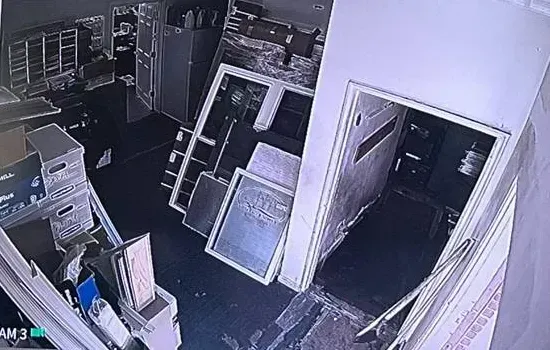
A photo from the AESS job library, not taken in Flatbush: a black-and-white night camera view of a cluttered room with an open doorway into a dark back room. This is the kind of view an entrance or hallway camera gives after dark, and in a building where an outsider has been covering hallway cameras, a door station with its own camera at the entrance records the face before anyone gets inside.
The Rules

Eight Apartments, 1968 and a Majority Request: The Rules That Decide What a Flatbush Building Must Have

Flatbush buildings run from single-family houses that no entry rule touches to apartment houses with a hundred apartments, so the rules land differently from one building to the next. Here is how they apply in plain terms. This is not legal advice; an owner with a violation or a dispute should talk to their own attorney.

Larger buildings need a talk-and-release system. Multiple Dwelling Law §50-a requires every class A multiple dwelling built or converted after January 1, 1968 with eight or more apartments to have self-closing, self-locking entrance doors and an intercommunication system at the main entrance that lets tenants speak with a visitor and release the door. For older buildings of that size, which covers most of Flatbush's prewar apartment houses, the owner must install the doors and the system when tenants occupying a majority of the apartments ask or consent in writing; the work has to begin within 90 days and be finished within six months. The entrance door rule published as §42-01 adds that every self-locking door it requires "shall be installed and maintained so as to be readily openable from the inside without the use of keys."

Once a system is there, it has to work. The Flatbush notices are written under the Housing Maintenance Code's §27-2005, the owner's general duty to keep the building in repair. Habitat Magazine's February 2024 article put the point in its headline: a working intercom "isn't an amenity," and the city's housing maintenance code requires a functioning one. ButterflyMX's summary of HPD guidance gives general correction periods of 90 days for class A, 30 days for class B and 24 hours for most class C conditions.

Video and apps are choices. The same ButterflyMX guide notes that §50-a's baseline is voice communication between apartments and the entrance and apartment-controlled release of the lobby door, and that it does not by itself require video or mobile access. A well-installed audio system meets the requirement. Video is worth it where tenants want to see who is outside, especially at entrances where an outsider has been getting in.

Magnetic locks carry extra conditions. A magnetic lock holds the whole door, so the building code's sensor-release provisions call for a sensor on the egress side, a manual release marked "PUSH TO EXIT" 40 to 48 inches above the floor within five feet of the door, unlocking on loss of power and when the fire alarm or sprinklers activate. That is why we use electric strikes on residential lobby doors by default.

Historic districts need a permit before the panel goes up. In Prospect Park South, Ditmas Park, Beverley Square West, Ditmas Park West and Flatbush's other historic districts, a new or replacement panel on a facade needs Landmarks Preservation Commission approval. Work that meets the Permit Guidebook's rules can get a staff-level permit; manufacturer cut sheets for the intercom are part of the application, which is filed through the Commission's Portico system.

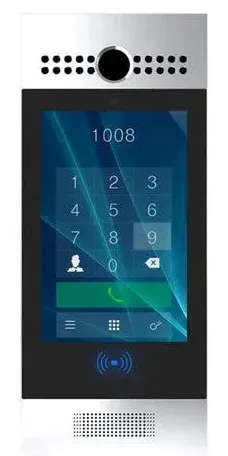
Flatbush, Brooklyn door buzzer installation: silver and black keypad door station with a camera lens at the top, a blue card-reader symbol, a numeric keypad and a green bell key
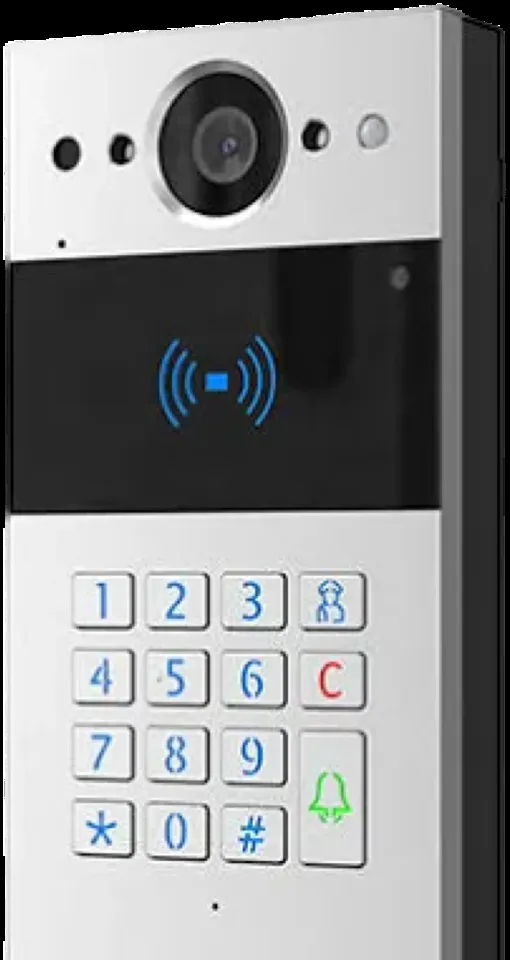
A photo from the AESS job library, not taken in Flatbush: a silver and black keypad door station with a camera lens at the top, a blue card-reader symbol, a numeric keypad and a green bell key. A station like this suits the lobby of a large Flatbush apartment house, where visitors dial an apartment code, residents can use a card or code, and the release still has to work from every apartment.
Commercial Door Buzzer Installation

Business Door Buzzer Installation in Flatbush

Flatbush's businesses are concentrated on four avenues and the Junction, and most of them share buildings with apartments. The ground floor is a store, a restaurant or a bakery; the floors above hold doctors' and dentists' offices, tax preparers, churches, after-school and day programs, union halls and apartments, often in the same building. Each upstairs business needs its visitors buzzed in without the street door being left open for everyone. The Avenue NYC assessment found that 53 percent of the merchants it surveyed wanted safety changes on their corridors, which matches what we hear: owners want the door locked and the visitor still let in.

Flatbush Avenue from Parkside to the Junction

The main shopping street, from the park down past the Kings Theatre and Erasmus Hall to Brooklyn College, with offices, clinics and apartments over almost every storefront and a narrow street door beside many of them.

Church Avenue and Little Caribbean

The corridor co-named Bob Marley Boulevard, from Coney Island Avenue east, with Caribbean restaurants, bakeries, travel and shipping offices, salons and upstairs professional offices that need their own door control.

Nostrand Avenue

Stores and offices from Parkside Avenue south toward the Junction, with many mixed buildings whose residential and office doors share one entrance.

Rogers Avenue

The shorter commercial strip from Clarkson Avenue to Church Avenue, with storefront churches, small offices and walk-ups over shops.

Cortelyou Road

Restaurants, cafes and small shops on the Ditmas Park side, where a back or side door for deliveries often needs a buzzer answered at the counter.

The Junction at Flatbush and Nostrand

Large stores, the Brooklyn College edge and newer buildings with offices and apartments above retail, where entry systems are chosen by developers and later inherited by managers.

Upstairs offices and clinics: one street door, several tenants

The common commercial job in Flatbush is a building with two or three upstairs tenants behind one street door. We install one panel there with a button for each business and apartment and a release at each business's desk, plus, where wanted, a second buzzer at the suite door. The landlord controls the street panel; each business controls only its own suite.

Compliance notes for Flatbush businesses

  • Anyone inside must be able to leave. A buzzer-controlled door still has to open from inside without a key, a code or special knowledge. With an electric strike, the inside lever always works.
  • Magnetic locks bring extra devices. A magnetic lock needs an egress sensor, a "PUSH TO EXIT" release 40 to 48 inches above the floor within five feet of the door, release on power loss and release when the fire alarm or sprinklers activate. We recommend strikes unless the door cannot take one.
  • Fire doors take fail-secure strikes. Allegion's guide notes that fire doors need fail-secure strikes, which stay latched when power is lost, so the door still holds back fire and smoke.
  • Buttons within reach. The 2010 ADA Standards put the high forward reach at 48 inches and the low at 15 inches. For an office, clinic or program door the public uses, the station, keypad and any push button stay inside that range.
Flatbush, Brooklyn door buzzer installation: drop ceiling with a lit red exit sign, an air diffuser, round recessed lights and a small black camera
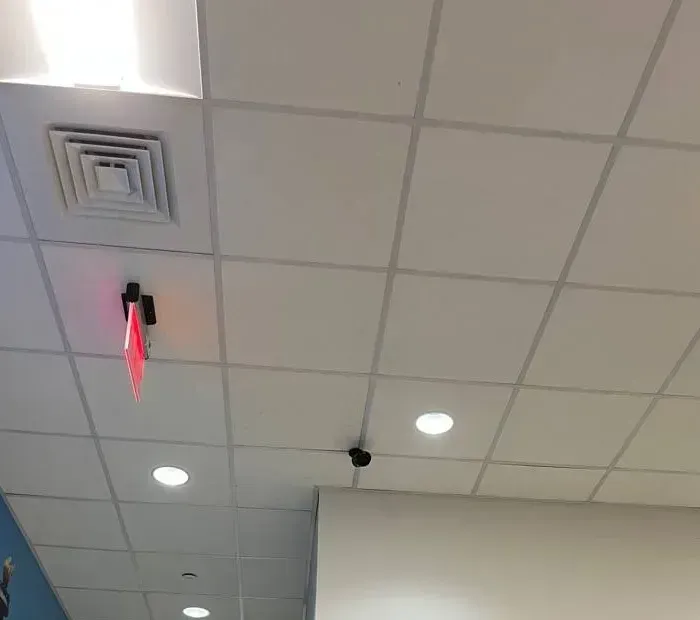
A photo from the AESS job library, not taken in Flatbush: a drop ceiling with a lit red exit sign, an air diffuser, round recessed lights and a small black camera. Upstairs offices and clinics over Flatbush Avenue and Church Avenue storefronts often have ceilings like this, which make it easy to run a buzzer line from the street door stair to the front desk.
Your Questions Answered

Door Buzzer Installation in Flatbush: Questions Answered

Questions Flatbush owners, boards, tenants and businesses bring to us, plus ones raised in r/AskNYC and r/Brooklyn threads, Brick Underground, Habitat Magazine and ButterflyMX's guides, answered for the buildings here.

Reading violations and the city's record

Why do so many of Flatbush's intercom violations land on Ocean Avenue and East 21st Street?

Because that is where the large apartment houses are. Ocean Avenue and the numbered East streets near it are lined with prewar elevator buildings, including the 103-apartment 1111 Ocean Avenue and the 60-apartment 55 East 21st Street that Brownstoner has reported on, and every apartment is a station that can fail and a tenant who can call 311. A street of two-family houses could have perfect buzzers or none at all and still produce almost no violations, because there is nobody to file and often no system the law requires.

The numbers follow from that. From 2024 on, NYC Open Data shows 52 intercom violations on Ocean Avenue and 46 on East 21st Street in the Flatbush area, against 19 each on East 19th Street and Caton Avenue. Some of those come from a few buildings with repeated notices. For an owner, the lesson is not that these streets are unlucky; it is that a big building needs a system planned as a system, with risers tested and power supplies sized for every apartment, not a series of one-apartment repairs.

When HPD inspects an intercom complaint in our building, what exactly does the inspector test?

The notices themselves describe it. The inspector goes to the building entrance, uses the panel to call the apartment that complained, and checks whether the call arrives at the station in that apartment and whether the tenant can answer and release the door. When it fails, the violation names the path: from the building front, or the vestibule, to the station on a particular wall of a particular room.

That is why we test the same way at the end of every installation, from outside, for every apartment, with the release watched at the door. An installer who tests from the cellar or from inside the lobby can pass a system an inspector would fail, because the problem may be at the panel's speaker or in the outdoor wiring.

HPD's record for our building shows an intercom violation marked "false certification." What does that mean for us now?

It means the record says the condition was certified as corrected, but HPD's later check did not find it corrected. Two of the intercom violations written in the Flatbush area in 2026 carry that status. It is a status owners should take seriously, and the details of what follows from it, including penalties, are a question for HPD and your attorney rather than for an installer.

What we can do is make sure the next certification is backed by a real fix. That means finding why the last repair did not hold, which in our experience is usually a fault upstream of the apartment that was patched, such as a riser pair, a junction in the cellar or a weak power supply, and then testing every apartment, not just the one in the notice, and leaving a dated test record that shows each call, answer and release. Owners who certify with that record in hand are certifying something they have seen work.

Our HPD notice names the "intercom relay" at the building entrance. What is that, and does it mean the system is finished?

The relay is a small switching component, usually in or near the lobby panel or in the cellar equipment, that takes the release signal from an apartment and powers the door's electric strike. When it fails, tenants can usually still hear and talk to visitors, but pressing the door button does nothing. Several 2026 notices in Flatbush, on Lenox Road, Woodruff Avenue, Regent Place and Flatbush Avenue, name exactly that part.

On its own, a failed relay is a small repair and no reason to replace everything. We first check why it failed, since a strike drawing too much current or an overheating power supply can kill relays one after another, and price both options if the system is wearing out.

Large buildings, wings and entrances

Our building wraps around a courtyard in four wings, and the apartments are lettered by wing. Can one new lobby panel reach every wing?

Yes, almost always. The panel itself does not care how many wings the building has; what matters is the path from the cellar to each wing's apartments. In courtyard buildings, each wing usually has its own riser leaving the cellar, and a new system connects to all of them at a central point. Wing-by-wing riser testing tells us whether each one can be reused, and the written price lists the result for each wing separately.

The directory is the part people forget. Visitors standing at the panel may not know that apartment RC6 is in the rear wing; a directory panel that lets them search by name, or a button layout grouped by wing with clear labels, saves calls to the wrong apartment. Where the building has courtyard or side doors that serve one wing, each can get a smaller station that calls only that wing's apartments.

Tenants use our side-street entrance more than the front. Does that door need the same system as the main lobby?

It needs to lock and close like the front door, and it usually needs a way to let visitors in. For a building of eight or more apartments built or converted after 1968, the city's entrance door rule published as §42-01 requires automatic self-closing and self-locking doors at every entrance from the street, a court, a yard or the cellar, with the intercom at the main entrance. Many older buildings follow the same standard once tenants request it under §50-a.

In practice, the door people use is the one that matters. We usually put a smaller station there that calls the apartments it serves and releases only that door.

The company that installed our building's system has closed, and replacement parts are hard to find. Is that a reason to replace now?

It is one of the strongest reasons. ButterflyMX's repair guide lists discontinued or hard-to-source parts alongside recurring multi-component failures and compromised wiring as the signs that a replacement should be evaluated rather than another repair. The practical problem in a Flatbush apartment house is that each failed station becomes a hunt for a used part, and each hunt leaves a tenant without a working intercom past a violation's correction period.

Before deciding, we check whether the risers can be reused, because that is usually the biggest part of the cost. If they test sound, a replacement can be a panel, cellar equipment and matched stations on the old wire, near the lower end of the building range.

Security, tenants and the people who live here

A stranger kept getting into our building, management "repaired" the front lock, and a news crew still opened it with keys from their van. What does a real fix at the entrance include?

A real fix treats the entrance as four parts: the lock cylinder, the strike and latch, the closer and the door itself. The cylinder decides which keys open the door; a worn cylinder, or one rekeyed to a common keyway, can open for keys it was never cut for, which is a locksmith's job to change. The strike and latch decide whether the door holds when it is shut; the closer decides whether it shuts at all; and the door and frame decide whether the rest has anything solid to hold.

The buzzer system is what lets residents keep that door locked and still let people in. A video station at the entrance adds a record of who rang before anyone is let through. If outsiders have been covering hallway cameras, as residents told News 12 in July 2025, a camera built into the door station, at the point of entry, is harder to reach unnoticed than one in a corridor. We price the strike, closer and station together and tell you when the cylinder or the door needs a locksmith or a door contractor first.

I am apartment hunting in Flatbush. How can I tell in a few minutes whether a building's front door and buzzer actually work?

Ask to test it. A thread on r/Brooklyn comparing Flatbush with other neighborhoods lists checking whether the front door locks among the basics before signing a lease, and it takes very little time. Let the street door close on its own from fully open and see whether it latches without a push. Pull it from outside afterward. Look at the lobby panel: missing buttons, taped-over speakers or handwritten labels for half the building are signs of a system on its last legs.

Then ask the broker or super to buzz the apartment from the lobby while someone answers upstairs, and to release the door. You can also look up the building's open intercom and self-closing door violations on HPD's website by address.

Our tenant association is tired of the landlord patching the intercom one apartment at a time. What can tenants actually ask for?

Tenants can ask for a working system, and the law backs that request; what form the fix takes is the owner's decision, within the code. The owner's duty under the Housing Maintenance Code is to keep the system in repair, which can mean repairing or replacing. In a pre-1968 building of eight or more apartments with no proper intercom, §50-a gives tenants of a majority of apartments the right to request one in writing. Tenant attorneys and organizers can advise on the rest, including HP actions and rent-related remedies.

What a tenant association can usefully bring an owner is a list of every apartment with a dead or weak station, the dates and the violation numbers. With that list we can tell an owner whether the failures point to one riser, the power supply or the whole system, and what each option costs.

The glass face of our lobby panel was smashed and HPD wrote a class C cut-hazard violation. Does that have to be fixed faster than the intercom itself?

Usually, yes. ButterflyMX's summary of HPD guidance gives most class C conditions a 24-hour correction period, against 30 days for class B. The East 21st Street notice in September 2026 was exactly that: broken glass at the intercom at the building front, written as a hazard rather than an intercom failure. The first step is to make the panel safe, which can be as simple as removing the broken glass and covering the opening, and then to decide what replaces it.

A panel that has been smashed once is likely to be smashed again. Replacements for busy Flatbush entrances should have a metal or polycarbonate face, a recessed camera lens and buttons that cannot be pried out, mounted on a backplate fixed into masonry rather than into the old panel's opening alone. If the building is replacing the panel anyway, this is the moment to fix the rest of the system behind it.

Where in a prewar Flatbush apartment should the new station go, and can it be somewhere other than the foyer?

The foyer or private hallway near the apartment door is usually right, and it is where HPD's notices find the stations in most Flatbush buildings. It is where the old cable ends, it is close to the door the tenant will go to after releasing the street door, and it keeps the station away from cooking steam and furniture. In apartments where the kitchen opens off the entry, the kitchen wall can work as well.

Moving it to a room at the far end of a long apartment means a new cable run, so the usual alternative is a second chime, or on video systems phone answering, so the tenant hears the call anywhere. We confirm the spot with the tenant before drilling.
Equipment

Types of Door Buzzer Systems We Install

We quote a reliable non-branded system by default and install a named brand when an owner asks for one; the intercom brands we work with include Aiphone, ButterflyMX, 2N, Akuvox, Comelit and DoorBird. These are the kinds of equipment that come up most in Flatbush buildings, and where each fits.

Directory and code lobby panels

Panels where visitors scroll a name list or dial an apartment code, for courtyard buildings with wing-lettered apartments and lists that change every month.

Button panels

One button per apartment with a speaker, for walk-ups and small buildings over stores where tenants want something simple with nothing to update.

Two-wire audio and video systems

Stations that carry voice, video, power and release over one pair per apartment, often on the old riser pairs once they test sound.

Phone-dialing and app panels

Panels that call residents' phones, alone or alongside wall stations, set up so the owner or manager can update numbers when tenants change.

Apartment stations

Audio handsets, hands-free stations and video monitors in a matched set, mounted in the foyer or private hall, with extra chimes for long apartments.

Vandal-resistant faces

Metal and polycarbonate panel faces, recessed lenses and fixed buttons for busy avenue entrances where glass faces get broken.

Electric strikes

Fail-secure strikes sized for hollow metal, steel and wood frames, so the door stays locked through a power loss and the inside lever always opens it.

Closers and door hardware

Heavy-duty closers and latch work so lobby, vestibule and side doors relatch after every visitor.

Power supplies and backup

Battery-backed low-voltage supplies on an owner-controlled circuit, mounted off the cellar floor and away from boilers and sumps.

ADT, Ring or SimpliSafe compared with a local installer for a Flatbush building's entry

National home security brands come up often when owners start looking. They are built for something different. A Ring or SimpliSafe video doorbell gives one household a camera and a phone notification; it does not call forty apartments, it does not release a lobby door from each of them and it does not meet a requirement for talk-and-release from every apartment. ADT and similar monitored-alarm companies sell alarm systems; a building entry system with apartment stations and a strike is not their main product.

A local low-voltage installer's job is the whole chain: panel, risers, stations, power, strike, closer and the test record. For a house with one or two households, a wired video doorbell with a release can be right, and we install those too. Where several households share one street door, the answer is an entry system.

Flatbush, Brooklyn door buzzer installation: small black camera mounted high on a pale wall casting two shadows, with a small white wall device below
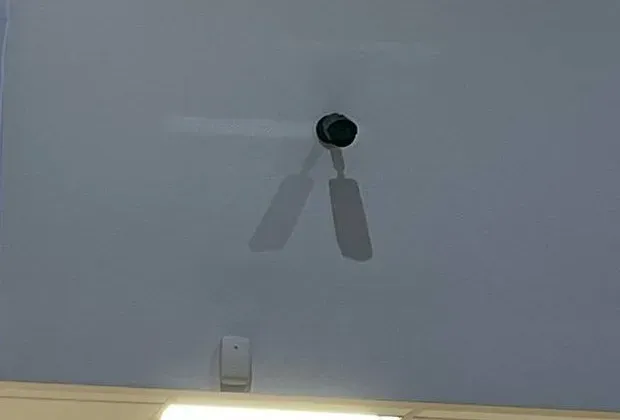
A photo from the AESS job library, not taken in Flatbush: a small black camera mounted high on a pale wall, casting two shadows, with a small white wall device below. In a Flatbush lobby, a camera mounted high above the door station and the mailboxes is the usual partner to a new buzzer system, recording everyone let in.
AI Overview Reality Check

What AI Gets Wrong About Door Buzzer Installation in Flatbush

Ask a search engine about intercom or buzzer installation and you get confident summaries built from national cost guides and vendor blogs. Some of it is useful; some of it does not fit a Flatbush apartment house at all. Here are seven common claims, where they come from, and what we see in the field. We have not quoted any AI-generated answer word for word; the claims below come from the published guides such answers draw on.

"Installing an intercom system costs about $2,500 on average"

HomeAdvisor's intercom cost guide gives that average, with a range of $1,500 to $15,000, and puts hard-wired systems at $1,000 to $15,000.

For Flatbush the average hides the real spread. A Victorian house on Argyle Road with one rental floor can sit at the bottom of our Brooklyn list, $400 to $900. A walk-up over a Church Avenue store with four apartments and a video station typically lands in the $700 to $1,800 range. A courtyard apartment house on Ocean Avenue with a hundred apartments starts around $2,500 and can run well past $10,000.

What decides where a building lands is the apartment count and the risers. Two buildings with the same number of apartments on the same block can be thousands apart because one has sound pairs in every wing and the other needs new cable up three of four.

"Wireless systems are the best option if you want to DIY"

The same HomeAdvisor guide recommends wireless systems for do-it-yourself installs, and for a single house that is sometimes reasonable.

In a prewar Flatbush apartment house it rarely is. Thick masonry walls, steel and dozens of neighbors' Wi-Fi networks make wireless links between a lobby and sixty apartments unreliable, and a do-it-yourself system in a multiple dwelling is still the owner's legal responsibility the day an inspector tests it.

The cheaper path in these buildings is usually the old wire. If the riser pairs test sound, a two-wire system can reuse them, which avoids most of the labor a new cable run would cost.

"The law requires a modern video or app-based intercom"

Vendor blogs selling video and app panels often imply that a building needs one to comply.

ButterflyMX's own repair guide states the baseline more carefully: Multiple Dwelling Law §50-a calls for voice communication between apartments and the entrance and apartment-controlled release of the lobby door, and does not by itself require video or mobile access.

An audio system installed properly meets that requirement. Video is worth adding where tenants want to see who is outside, and phone answering where tenants are often out, but neither is what clears a Flatbush violation. A working line from the building front to every apartment is.

"Buildings under eight apartments don't need to do anything"

This one comes from forum threads more than cost guides; a Brooklyn renter on r/AskNYC wrote that in a four-unit building the landlord "isn't required to put in a buzzer system or a self-locking front door."

The eight-apartment line in §50-a is about whether a building must install a system. Once a system is there, HPD's Flatbush notices are written under the Housing Maintenance Code's general repair duty, §27-2005, and HPD's self-closing door rule reaches buildings of three or more apartments, according to the agency's tenant guide to self-closing doors.

So the owner of a six-apartment walk-up over a Nostrand Avenue store may not have to add an intercom, but if one is on the wall, it has to work, and the doors have to close and latch.

"Replacing a building's intercom takes weeks"

Owners are often told to expect a long outage, and vendor blogs describe big projects in months.

Brick Underground's NYC intercom guide quotes installers estimating that a five-apartment building can be done "in a day" and a 100-unit building "in about two days." Our experience in Flatbush buildings matches that range for the hands-on work, once equipment is in and access is arranged.

The real delay is usually access. In Community Board 14 this year, 54 buzzer complaints closed because the inspector could not get in; installers face the same problem. A written notice to tenants and a second pass for missed apartments are what keep a two-day job from stretching into two weeks.

"Cloud intercoms cost a few dollars per unit and nothing else"

Swiftlane's cost guide puts software subscriptions at $5 to $15 per unit per month, or $30 to $100 per door per month, on top of $1,000 to $5,000 or more per entry door for modern IP or video systems.

For a 60-apartment Flatbush building, even the low end of the per-unit figure is a real line in the operating budget, every month, for as long as the system is in. Owners should compare that against a wired system with no subscription at all, which is an option on our list.

Subscriptions also create the account problem we see in newer buildings near the Junction: the admin login belongs to someone who left, and the system cannot be updated until it is recovered.

"Old intercom wiring always has to be replaced"

Many quotes treat every old building as a full rewire, because new cable is easy to price.

Brick Underground's experts said core wiring is usually fine even in older systems, and that "it's all in the wire connections." Aiphone's upgrade guidance says existing wires in good condition can be reused.

In Flatbush's courtyard buildings, we often find some wings with sound pairs and others with failed ones. Testing each riser before quoting, and listing which we reuse, is what keeps a building out of the top of its price range when it does not need to be there.

Not Sure Whether It Is One Riser, the Power Supply or the Whole System? Speak to a Tech

Send photos of the lobby panel, the street door from both sides, the cellar equipment if you can reach it and one apartment station, with the address, the number of apartments and any HPD violation numbers, to (347) 934-8335 or on WhatsApp. A technician will tell you which part most likely failed and whether a repair, a partial replacement or a new system makes sense, before anyone visits. Or use the request form and we will call you back.

Get In Touch

Request a Free Quote

✅
Request Sent!
Thank you. A technician will call you about the Flatbush address, usually within two hours during working hours.
How It Works

Our Installation Process

1. Send photos, the HPD record and the unit list

Photos of every entrance and the lobby panel, any open intercom or door violations with their class and date, and a list of every apartment the system has to reach.

2. Settle who signs and how we reach every apartment

Owner, LLC representative, managing agent or co-op board signs; we agree a written notice for tenants, two-hour arrival windows and a second pass for missed apartments.

3. Walk every entrance and test the doors

Each street, vestibule and side door is checked to close, latch and lock by itself and to open from inside without a key; the frame is checked for a strike.

4. Trace the risers and test every line

From the lobby panel to the cellar and up each wing, every apartment line is tested and marked reusable or not.

5. Put the full price in writing

Station, apartment units, door hardware, power, cable and labor on one written price inside our Brooklyn ranges, with every test-dependent add-on named before anything is ordered.

6. Fix the door, the release and the power first

Closer set, strike fitted, and a battery-backed supply on an owner-controlled circuit in a dry spot, with a licensed electrician for any 120-volt work.

7. Install, program and label

Lobby panel and stations or phone answering go in, the directory is built from the current list, and every line and station is labeled by apartment.

8. Call every apartment from the sidewalk and hand over the record

Each apartment is called from each entrance, talks and releases while the door is watched relocking; the owner gets the dated test record, wiring map and resident instructions.

Flatbush, Brooklyn door buzzer installation: touchscreen entry panel showing a dial pad with a four-digit apartment code entered, a camera above and a card-reader symbol below
A photo from the AESS job library, not taken in Flatbush: a touchscreen entry panel showing a dial pad with a four-digit apartment code entered, a camera above and a card-reader symbol below. In a courtyard building with apartments lettered by wing, a code panel like this lets each apartment be given a simple number visitors can dial.
Coverage Area

Door Buzzer Installation Near Flatbush's Landmarks

Kings Theatre

The 1929 movie palace at 1027 Flatbush Avenue, reopened in 2015, in the middle of the stretch where offices and apartments sit over Flatbush Avenue storefronts.

Erasmus Hall High School

The school founded in 1786 at 899–925 Flatbush Avenue between Church Avenue and Snyder Avenue, at the heart of the old village crossroads.

Flatbush Reformed Dutch Church

The landmarked church at 890 Flatbush Avenue, built 1793–98, across from Erasmus Hall at Church Avenue.

Flatbush Town Hall

The 1874–75 town hall at 35 Snyder Avenue, a reminder of when Flatbush was its own town, on a block of walk-ups and houses.

Former Sears building

The 1932 landmarked store at Beverley Road and Bedford Avenue, where a large residential redevelopment is planned.

Flatbush Library

The 1905 Carnegie branch of the Brooklyn Public Library at 22 Linden Boulevard, on a street with several apartment houses in HPD's 2026 intercom notices.

We also serve East Flatbush, Ditmas Park, Crown Heights and Beverley Square at the same Brooklyn rate, along with Prospect Lefferts Gardens and Midwood. See our door buzzer installation in Brooklyn page for the whole borough.

Pricing

Door Buzzer Installation Cost in Flatbush

Flatbush is billed at our Brooklyn rate, with no premium for large buildings or historic districts. Final pricing follows a walkthrough, because the number of apartments, the condition of the risers, the number of entrances and the state of the lobby door drive the total far more than the brand on the panel.

JobTypical Flatbush buildingBrooklyn range
Audio buzzer or replacement with electric strike release, existing wiring reused where it tests wellVictorian or frame house with one or two households, an upstairs office door$400–$900
Video door station with indoor monitors or smartphone door releaseSmall walk-up over an avenue store, a house with a rental entrance, a clinic or program door$700–$1,800
Directory or button panel with every apartment wired or on phone answering, audio or video by unit count, optional fob integrationSide-street walk-up, courtyard elevator building, co-op$2,500–$10,000+
Service call booked onlineDiagnosis of an existing system before deciding to repair or replace$250, applied toward the work
Monthly fee on a wired systemAny building choosing the no-subscription option$0
Buzzer and entrance camera on the same visitLobbies, vestibules and office entrancesTypically saves $200–$400 in labor

What moves a job inside its range is predictable. First the apartments and the risers: sound pairs in every wing keep a building near the bottom of its range, new cable up several wings pushes it up. Then the entrances and the door: a side or courtyard door that needs its own station, a closer that has to be replaced, a frame that needs the strike moved. Then the extras: video instead of audio, phone answering, vandal-resistant faces. Anything that depends on a test is named on the quote with its price before you approve.

Full terms — including 50% deposit, one-year parts-only warranty on AESS-supplied products, and the late-fee schedule — are set out in the service agreement.

Find Out Which Range Your Flatbush Building Falls In

Tell us the address, the number of apartments and wings, how many entrances people use and whether there is an open violation, and we will tell you which Brooklyn range fits and what would move it. Call or text (347) 934-8335, send photos on WhatsApp, or fill in the form.

Shop Our Systems

Door Buzzer Installation Packages & Pricing

Three typical Flatbush jobs, each placed inside the matching range on our Brooklyn list. The exact figure comes from the walkthrough.

House or single-door buzzer: $400–$900

An audio station with a button for each household at a Victorian or frame house, or at an upstairs office door, with an answering unit and release on each floor or at the desk, a fail-secure strike, a closer and a battery-backed power supply, placed to meet Landmarks rules where they apply.

Video entry for a small building: $700–$1,800

A video door station for a walk-up over a Church, Flatbush or Nostrand Avenue store, with monitors or phone answering for each apartment, the old wire reused where sound, a strike for the residential door and power kept separate from the store's.

Apartment house system: from about $2,500

A directory, code or button panel at the lobby and any side or courtyard entrance, stations or phone answering for every apartment, risers tested wing by wing, new power and cellar equipment, strike and closer work and a full test record, rising toward $10,000 or more with apartments, wings and cable work.

Bring your own equipment. If your building has already bought a lobby panel, stations or a video kit, we can install it as labor-only work, quoted flat once we have seen the doors, the risers and the cellar. Tell us the make and model when you write, and we will tell you before the visit whether it can reach every apartment and release your door.

Complete Services

Every Door Buzzer Service in Flatbush

Apartment houses and co-ops

Lobby panels, riser testing, station change-outs, wing entrances and violation-deadline scheduling. Request a quote

Houses, stores and offices

Discreet house stations, residential doors over stores and upstairs office buzzers. Call (347) 934-8335

Across Brooklyn

The same list in every neighborhood. Brooklyn door buzzer installation

Across New York City

Every borough's buildings and rules. NYC door buzzer installation

FAQ

Flatbush Door Buzzer Installation FAQ

If one tenant will not let the installer in, does the rest of the building's new system still work?
+

Yes. Each apartment connects at its own point, so a missing station does not stop the others. That apartment's line is left ready and labeled, the owner gets it on the list of unfinished units, and the station goes in on a later short visit once access is arranged.

Can a new lobby panel be set into a marble or stone lobby wall without cracking it?
+

Usually. We reuse the old panel's opening where the new panel fits, use a surface backplate or trim ring when it does not, and drill stone only with the right bits at slow speed, anchoring into joints where possible. If a wall is too fragile, we say so and propose a mounting that avoids it.

Can our super see the lobby door camera from his own apartment or phone?
+

On a video system, yes. The super's apartment can have a monitor like any tenant's, and many systems also let the super or managing agent answer and view the entrance on a phone. We set which doors each person can see and release so the super's access is not every tenant's.

Our building is owned by an LLC and we have never met the owner. Who has to approve the work?
+

Someone with authority to sign for the LLC, usually the managing agent or a named officer. We need that person's written approval and contact details before quoting a building system, and the written price goes to them. Tenants can still send us the details to pass along with their request.

What happens if an HPD inspector arrives while the installation is half finished?
+

We plan for it. The street door, strike and lobby panel go in first so the entrance works throughout, and apartments are switched over one by one. Any apartment not yet switched still runs on the old system until its new station is connected and tested.

Can the same visit fix the lobby door closer HPD wrote up as a self-closing door violation?
+

Yes, if the closer and door can be fixed with hardware. Closer adjustment or replacement and latch and strike alignment are part of our entry work and go on the same written price. If the door or frame itself needs replacing, we tell you before quoting so a door contractor can do that first.

Can a tenant pay to have a video station in their own apartment while the rest of the building stays on audio?
+

On many systems, yes, if the lobby panel has a camera and the owner agrees. The tenant's station is swapped for a compatible video monitor on the same line. The owner has to approve the change, since the station stays with the apartment, and we confirm compatibility before anything is ordered.

Do you install lobby panels that call tenants' phones instead of wall stations?
+

Yes. Phone-dialing and app panels suit buildings where the risers are not worth saving or tenants are often out. We set them up so the owner or manager controls the number list, explain any monthly cost before ordering, and can combine them with wall stations for tenants who prefer one.

Should a building our size keep spare apartment stations on hand?
+

For a building of thirty or more apartments, we usually suggest one or two spares of the same model, labeled and stored with the super. When a station is damaged or taken by a departing tenant, the replacement is then a short visit instead of a wait for an order, which helps with violation deadlines.

Our building's old system is still under a service contract with another company. Can you install a new one?
+

Yes, but check the contract first. Some service agreements have notice periods or own the equipment on the wall. Owners should confirm what has to be returned or cancelled, and we plan the switchover so the old company's equipment can be removed and handed back cleanly.

More Door Buzzer Installation near Flatbush

Door Buzzer Installation Brooklyn NY | Brownstones & Condos · Door Buzzer Installation NYC | Apartment & Building Entry · Door Buzzer Installation Manhattan NY | Apartments & Co-ops · Door Buzzer Installation Queens NY | Co-ops & Apartments · Door Buzzer Installation Bronx NY | Co-ops & Apartments · Door Buzzer Installation Staten Island NY | Homes & Apts · Door Buzzer Installation Long Island NY | Nassau & Suffolk · Door Buzzer Installation Hudson Valley NY | Apartments · Door Buzzer Installation Nassau County NY | Homes & Co-ops · Door Buzzer Installation Suffolk County NY | Homes · Door Buzzer Installation Westchester County NY | Co-ops · Door Buzzer Installation Rockland County NY | Homes & Apts · Door Buzzer Installation Orange County NY | Homes & Farms · Door Buzzer Installation Putnam County NY | Lake Homes · Door Buzzer Installation Dutchess County NY | Homes · Door Buzzer Installation Ulster County NY | Kingston

Door Buzzer Installation Bath Beach Brooklyn NY · Door Buzzer Installation Bay Ridge Brooklyn NY · Door Buzzer Installation Bedford-Stuyvesant Brooklyn NY · Door Buzzer Installation Bensonhurst Brooklyn NY · Door Buzzer Installation Bergen Beach Brooklyn NY · Door Buzzer Installation Beverley Square Brooklyn NY · Door Buzzer Installation Boerum Hill Brooklyn NY · Door Buzzer Installation Brooklyn Navy Yard, Brooklyn NY · Door Buzzer Installation Brooklyn NY | Brownstones & Condos · Door Buzzer Installation Brownsville Brooklyn NY · Door Buzzer Installation Bushwick Brooklyn NY · Door Buzzer Installation Cadman Plaza Brooklyn NY · Door Buzzer Installation Canarsie Brooklyn NY · Door Buzzer Installation Carroll Gardens Brooklyn NY · Door Buzzer Installation City Line Brooklyn NY · Door Buzzer Installation Clinton Hill Brooklyn NY · Door Buzzer Installation Cobble Hill Brooklyn NY · Door Buzzer Installation Columbia Street Waterfront Brooklyn · Door Buzzer Installation Coney Island Brooklyn NY · Door Buzzer Installation Crown Heights Brooklyn NY · Door Buzzer Installation Cypress Hills Brooklyn NY · Door Buzzer Installation Ditmas Park Brooklyn NY · Door Buzzer Installation Downtown Brooklyn NY · Door Buzzer Installation DUMBO Brooklyn NY | Loft Entry

Other services in Flatbush

Fire Alarm Installation Flatbush Brooklyn NY · Access Control Installation East Flatbush Brooklyn NY · Access Control Installation Flatbush Brooklyn NY · TV Installation Flatbush Brooklyn · Structured Cabling Installation East Flatbush Brooklyn NY · Security Camera Installation East Flatbush Brooklyn NY · Structured Cabling Installation Flatbush Brooklyn NY · Intercom Installation Flatbush Brooklyn NY · TV Installation East Flatbush Brooklyn · Alarm Installation Flatbush Brooklyn NY | Apartments & Shops · Door Buzzer Repair Flatbush Brooklyn NY · Fire Alarm Installation East Flatbush Brooklyn NY

Ready for a Flatbush Lobby Where Every Apartment Answers and the Door Locks Behind Every Visitor?

Send a photo of your lobby panel and street door, with the address, the number of apartments and any HPD violation numbers, and we will tell you which system fits and where it falls on our Brooklyn ranges. Call or text (347) 934-8335, message us on WhatsApp, or use the request form. Licensed under NYS license #12000287431, rated 4.7★ across 201 Google Reviews, with same-day estimates on most weekdays.