A brownstone on Prospect Place split into three apartments, a 1920s apartment house on Lincoln Place, or a newer building near the old rail yards whose front door will not stay locked? Prospect Heights door buzzer installation line: (347) 934-8335
Landmarked Brownstone Rowhouses · Rowhouses Split into Apartments · 1909–1929 Apartment Houses · Doorman Co-ops on Eastern Parkway · Pacific Park Towers · Shops on Vanderbilt and Washington
Door Buzzer Installation in Prospect Heights
Landmark Status Checked First · Door Made to Latch Before Any Release · Riser Tested Line by Line · Written Price Before Ordering · Brooklyn Rate
Door buzzer installation in Prospect Heights covers three generations of buildings packed into one small neighborhood. The brownstone rowhouses of the 1860s to 1890s sit inside a city historic district, so a new door station has to follow the Landmarks Commission's rules on where it goes and how much cable may show. South of St. Johns Place, apartment houses built between 1909 and 1929 have long risers and old handsets that no maker supports any more. Around the old rail yards, the Pacific Park towers are new enough that the state intercom law applies to them automatically, and two of them have already shown what happens when a front door or an intercom line fails and stays failed. Below is how we plan each kind of job, and where it falls on our Brooklyn price list.
Every price comes from our Brooklyn door buzzer list, and the full figure, with each possible extra named, is agreed in writing before anything is ordered
Rated 4.7★ across 201 Google Reviews
Reviewed and updated November 11, 2026, against New York's Multiple Dwelling Law §50-a as published by the New York State Senate; chapter 11 of the Landmarks Preservation Commission's Permit Guidebook; LPC permit PMW-23-08373 for 169 Underhill Avenue; the Prospect Heights Neighborhood Development Council's 2009 designation report summary, its 2018 Apartment House District FAQ and its August 2018 campaign update; the Historic Districts Council's January 2018 article on the Apartment House District in 6sqft; Atlantic Yards Report's February 28, 2023 report on 535 Carlton Avenue; City Limits' July 24, 2024 report on 38 Sixth Avenue; New York YIMBY's report on 535 Carlton Avenue; News 12 Brooklyn's November 14, 2025 report from St. Johns Place; building records from CityRealty and openigloo; the Brooklyn Paper and New York City DOT on the Vanderbilt Avenue Open Street; 6sqft's June 30, 2026 report on the next phase of Pacific Park; Habitat's November 2019 report on a co-op intercom retrofit; ButterflyMX's NYC repair guide; Brownstoner forum threads on brownstone doors and intercoms; the HomeAdvisor and Swiftlane cost guides; Allegion's fail-safe guide; the building code's sensor-release provisions; and the 2010 ADA Standards. · Abstract Enterprises Security Systems, NYS license #12000287431 · crews dispatched from our Troy Avenue office in Brooklyn
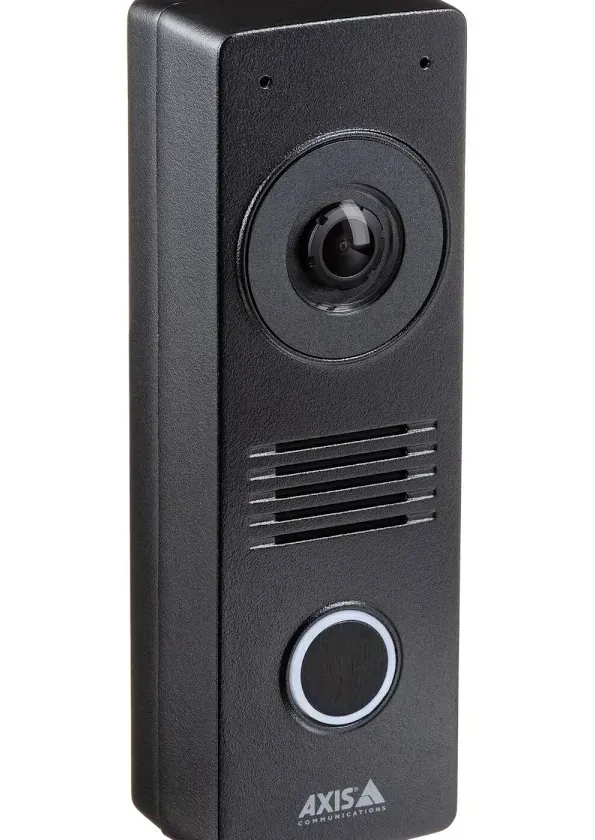
A photo from the AESS job library, not taken in Prospect Heights: a black rectangular video door station with a camera lens, a speaker grille and one round call button that lights up. A single-button station this compact suits the parlor door of a Prospect Heights brownstone that has gone back to being one home, where the Landmarks rules allow one intercom panel at the door opening and a full directory plate would look out of place against the brownstone.
Prospect Heights Buzzer Request
Brownstone, apartment house, co-op, tower or avenue shop: tell us the address, how many homes the system has to reach and which doors people use, and a technician calls back with the range
✅
Request Sent!
Thank you. A technician will call you about the Prospect Heights address, usually within two hours during working hours.
25+
Years Experience
✓
Same-Day Estimates
100%
Licensed & Insured
4.7★
201 Google Reviews
Owner-operated since 2002 · Thousands of jobs completed · Booked within 2 hours
Quick answer: door buzzer installation in Prospect Heights costs $400 to $900 on our Brooklyn list for an audio buzzer with a new door release on a one- or two-household brownstone, $700 to $1,800 for a video door station with indoor monitors or phone answering on a rowhouse split into apartments or a small walk-up, and from about $2,500 to past $10,000 for a full entry system in a six-story apartment house, a doorman co-op or a newer tower. The price includes the door station, the answering units, the power supply, the electric strike or approved lock, the cable and the labor, and it is fixed in writing after we have seen the doors. Anything that depends on a test, such as an old riser pair that might fail, a closer that has to be replaced before a release can hold the door, or a Landmarks permit for a house in the historic district, is named before you order. Send photos of the door and whatever is mounted beside it to (347) 934-8335 or on WhatsApp, and we answer with the range that fits, usually within two hours of your message during working hours.
Looking at your photos and quoting a new system costs nothing. When an existing system has to be diagnosed in person before we can quote it, that is the $250 service call booked online, and the $250 is applied toward the work.
All work is done under New York State license #12000287431. We install low-voltage entry equipment; if a door needs a new 120-volt outlet or circuit for its power supply, a licensed electrician does that part, and you know before the job is priced.
We work for whoever controls the door: the owner of a house, a co-op or condo board and its managing agent, a building owner, or a shop or office tenant with the landlord's written approval.
The Neighborhood
Why Prospect Heights Properties Need Door Buzzer Installation
Prospect Heights is small, a wedge of blocks between Flatbush Avenue on the west, Atlantic Avenue on the north, Washington Avenue on the east and Eastern Parkway running out from Grand Army Plaza on the south, split between the 11217 and 11238 ZIP codes. What makes it unusual for anyone installing an entry system is how many different eras of building share those few blocks. Each was built with a different idea of what a front door should do, and each needs a different kind of buzzer.
The oldest layer is the rowhouse. The Landmarks Preservation Commission designated the Prospect Heights Historic District in 2009, and the Prospect Heights Neighborhood Development Council describes it as roughly 850 buildings, mostly Italianate and neo-Grec rowhouses, along with churches, small commercial buildings and apartment buildings, the largest district the Commission had designated in more than twenty years. Many of those houses were built for one family and now hold two, three or four households, so the single bell by the parlor door has become a row of buttons, a tangle of wire in the cellar and, often, nobody who can say which wire goes where.
The second layer is the apartment house. South of St. Johns Place, toward Eastern Parkway, the blocks are lined with larger multifamily buildings put up between 1909 and 1929, after subway plans announced in 1903 drew builders to the parkway and its institutions; Turner Towers was even sold as "Park Avenue Apartments on Eastern Parkway." The Historic Districts Council counted 82 such buildings in 2018, and the neighborhood council's campaign that year put the proposed Apartment House District at 107 buildings across six blocks. They range from four-story walk-ups like 442 Sterling Place, built in 1911 with 20 apartments, through six-story buildings like 327 St. Johns Place (1912, 37 apartments) and 364 Lincoln Place (1927, 54 apartments), to Turner Towers at 135 Eastern Parkway, a 16-story co-op from 1926 with 186 homes and a doorman. Their risers are the main question in any quote.
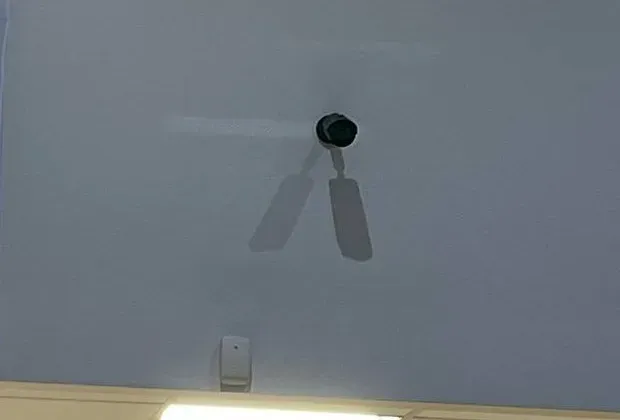
A photo from the AESS job library, not taken in Prospect Heights: a small black camera mounted high on a pale wall, casting two shadows, with a small white device fixed lower down. In the vestibule of a six-story apartment house south of St. Johns Place, a camera placed this high looks down over the inner door and the mailboxes, so a stranger who slips in behind a resident is recorded even while the door station's own camera faces the sidewalk.
The newest layer sits around the Vanderbilt rail yards. The Pacific Park project had finished nine of its first fifteen buildings by the end of 2023 and, as 6sqft reported on June 30, 2026, a plan unveiled that week calls for seven more buildings on six sites with about 5,600 more homes, with construction possibly starting as early as 2028. These are big buildings: 535 Carlton Avenue, one of the project's affordable towers, has 19 floors and 298 apartments. They were built with lobby panels, fobs and front desks, and they are new enough that the state's intercom rules apply to them without anyone having to ask. They have also shown that newer is not the same as reliable.
The evidence from the neighborhood is plain. In February 2023, Atlantic Yards Report published a complaint from the 535 Carlton tenants' association that the building's main entry door had been "broken and unlocked for 5 days," so anyone could walk in, especially when the concierge was away from the desk. In July 2024, City Limits reported that at 38 Sixth Avenue, a 303-apartment Pacific Park building at the arena end of the project, residents had spent months lobbying over a front door that did not lock, HPD had a pending violation for the lack of a self-closing door, and faulty intercoms affected perhaps 30 percent of the apartments; a vendor later traced faulty intercom wiring. At 364 Lincoln Place, tenant reviews say the "package room isn't very closely guarded." And in November 2025, News 12 Brooklyn reported tenants of 340 St. Johns Place listing "violence at the front door" among the problems in a legal fight with their management company.
None of those stories is about a clever burglar. They are about entrances where one part failed, a door that would not lock, a line of intercoms that stopped ringing, a room behind the door nobody watched, and residents were left to manage the gap themselves. A good installation in Prospect Heights is mostly about not leaving gaps like that: a door that shuts and latches every time, a release that fails locked, cable that has been tested rather than assumed, and paperwork that lets the next technician fix a single fault in an hour.
Six facts that shape a Prospect Heights buzzer installation
Most rowhouses are landmarked. The Prospect Heights Historic District, designated in 2009, covers roughly 850 buildings, so a door station on most brownstones here goes in under the Landmarks Commission's rules for intercom panels.
The Commission allows one panel per doorway. Its Permit Guidebook says "a maximum of two light fixtures and one intercom panel can be installed per door opening," and the panel must sit within or beside the door opening or on a fence or wall in front of the entrance.
A district of apartment houses is proposed but not designated. The proposed Apartment House District covers about a hundred buildings from 1909 to 1929 in the southeast of the neighborhood; until the Commission acts, their entrances follow ordinary rules.
The newer towers fall under the intercom law automatically. Multiple Dwelling Law §50-a requires buildings erected or converted after January 1, 1968 with eight or more apartments to have an intercom that lets residents talk to visitors and release the lobby door, so every Pacific Park building is covered.
Older apartment houses are covered once tenants ask. Buildings put up before 1968, which includes every apartment house from the 1909–1929 wave, must install self-locking doors and an intercom when tenants of a majority of apartments request or consent in writing.
Doors in the newer buildings have already failed. The 535 Carlton front door sat broken and unlocked for five days in 2023, and a third of the intercoms at 38 Sixth Avenue were reported faulty in 2024, which is why we design for the day a part breaks.
Where this page applies. This page covers Prospect Heights from Flatbush Avenue east to Washington Avenue and from Atlantic Avenue south to Eastern Parkway, including the Pacific Park buildings north of Pacific Street and the apartment houses along the parkway. Buildings just across Washington Avenue are on our Crown Heights door buzzer installation page, and for the rest of the borough see door buzzer installation in Brooklyn.
Repair or Replace in Prospect Heights
Need Repair in Prospect Heights? Each Generation of Building Starts From a Different Problem
When a Prospect Heights owner calls about "a new buzzer," the first job is to work out whether they need a new system at all, and each generation of building tends to fail in its own way.
In a brownstone, the usual story is a bell system that grew one apartment at a time. Buttons were added as floors became rentals, each spliced into whatever was already in the cellar. These houses often need a new door station and a new power supply, but the cable to each floor may be perfectly good. In a 1909–1929 apartment house, the usual story is an intercom whose parts are no longer made: handsets swapped over the decades with whatever fit, a lobby panel held together by repairs, and a riser that may be sound or may be the real fault. Habitat's 2019 report on a large co-op that replaced its old system captured the owners' problem in a sentence from its property manager: "We couldn't get replacement parts. No one is making them anymore." In a newer tower, the usual story is a modern system that has been badly maintained, a door whose closer or lock has given out, or a line of apartments with a wiring fault.
So we sort every job into one of three paths before pricing it. A targeted repair fixes the one part that has failed: a closer, a strike, a power supply, a damaged pair, a lobby panel's faceplate. A partial replacement puts a new door station and power supply on cable that tests sound, which is where many rowhouses and apartment houses land. A full replacement adds new cable as well, for buildings whose old pairs fail or that never had talk-back at all.
What We Install
Door Buzzer Installation Services in Prospect Heights
Each service below is priced from the same Brooklyn door buzzer list. The number of homes sets the size of the system, the doors decide which release each entrance can take, and in Prospect Heights two local questions decide much of the labor: whether the house is in the historic district, and whether an apartment house's riser can carry new equipment.
Door stations for landmarked rowhouses
One panel per door opening, sized and finished to suit brownstone, placed beside the doorway or on the areaway fence, with its cable taken into the house through plain masonry so little or none shows.
Button plans for split brownstones
A door station with one button per household, a release at the stoop or garden door and a station on every floor, for rowhouses that now hold two to four apartments on wiring that grew piecemeal.
Apartment house intercom replacement
New lobby panels, power supplies and apartment stations for the 1909–1929 buildings south of St. Johns Place, reusing riser pairs that test sound and replacing the ones that do not.
Entry systems for towers and condos
Directory or code panels, front desk consoles and phone answering for the Pacific Park buildings and newer condos, with every line of apartments tested from the lobby before handover.
Doorman co-op lobbies
Panels that call the desk while it is staffed and the apartments when it is not, with release stations at the desk, for the large co-ops along Eastern Parkway.
Video and phone answering
Video door stations with indoor monitors, or panels that ring residents' phones, for owners who want to see the visitor and for households where nobody is home during the day.
Electric strikes and door preparation
Fail-secure strikes cut into sound frames, closers set so heavy prewar doors shut and latch on their own, and glass-and-wood stoop doors prepared so the release has solid material to work in.
Power supplies with battery backup
Dedicated low-voltage supplies on the owner's circuit, sized for the station, monitors and release, placed where the super or owner can reach them and labeled for the next technician.
Shop, restaurant and office doors
Buzzers for back and delivery doors on Vanderbilt and Washington Avenues, buzz-in doors for offices and practices, all kept apart from the apartments' system upstairs.
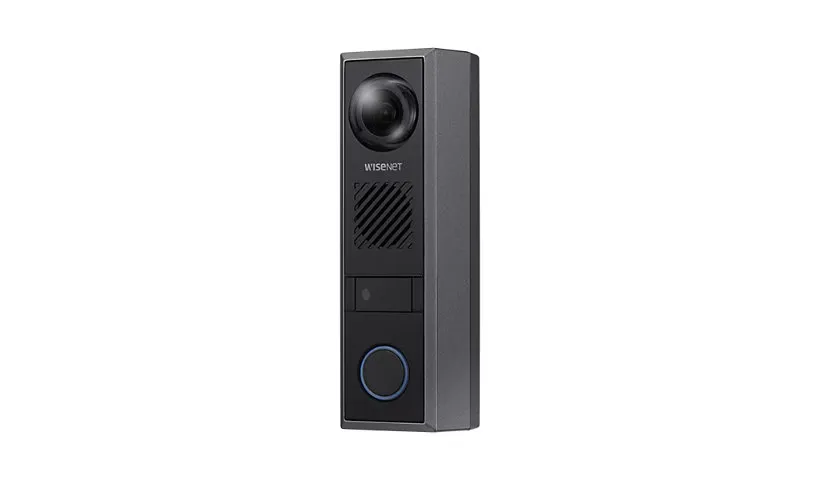
A photo from the AESS job library, not taken in Prospect Heights: a slim dark grey wired doorbell with a camera lens, speaker slots and a round push button. A unit this narrow fits the wood casing of a brownstone's garden door under the stoop, where a ground-floor household can have its own button and camera without adding a second panel at the parlor doorway above.
Building Specialists
Door Buzzer Installation for Prospect Heights's Architecture
Seven kinds of building account for almost every buzzer installation we plan in Prospect Heights. They differ in how many doors people use, how cable can reach each home, how old the existing wiring is, whether the Landmarks Commission has a say and who has the authority to order the work.
Single-family brownstones
Italianate and neo-Grec rowhouses inside the historic district that are one home again, with a parlor door up the stoop, a garden door below and a bell that may still be on cloth-covered wire.
Brownstones split into apartments
The same houses holding two to four households, usually with a row of mismatched buttons, a transformer in the cellar and no record of which wire serves which floor.
Prewar walk-ups
Four-story buildings with around twenty apartments, like 442 Sterling Place from 1911, with a vestibule, a ring-and-release system and decades of splices.
Six-story apartment houses
The 1909–1929 buildings south of St. Johns Place, such as 327 St. Johns Place and 364 Lincoln Place, with long risers, rent-stabilized tenants and a lobby that sees heavy use.
Doorman high-rise co-ops
Buildings like Turner Towers, 16 stories and 186 homes on Eastern Parkway, where the desk answers visitors by day and the board decides on any new system.
Pacific Park towers and newer condos
Buildings from the last fifteen years around the rail yards and along Vanderbilt Avenue, with networked panels, fobs and front desks, and hundreds of apartments per lobby.
Avenue mixed-use buildings
Shops and restaurants on Vanderbilt and Washington Avenues with apartments above, where the residents' door and the business's doors sit side by side.
Single-family brownstones: one panel, chosen for the doorway
When a Prospect Heights brownstone is one household again, the buzzer job is small but the setting is demanding. The door station goes beside a parlor door framed in carved brownstone or wood, inside a historic district, on a block where the neighbors notice anything new. The Landmarks Commission's guidebook is specific: intercom panels and doorbells "must be installed within or adjacent to a door opening," there can be one intercom panel per door opening, and the "design, size, and finish of installations must be compatible with the architecture of the building." In practice that rules out the large brushed-steel panels made for apartment lobbies and points toward a compact one-button audio or video station in a dark or bronze finish, set on a plain surface beside the door rather than on carved stone.
Inside, the house usually needs very little: a station on the parlor floor, perhaps one in the kitchen on the garden level, a release on the street door and a small battery-backed power supply in the cellar. The care goes into where the cable enters. The guidebook wants conduit concealed "by going through plain masonry"; where that is impossible, staff may approve "a maximum of approximately ten inches of visible conduit," painted to match. We plan the route through the wall behind the station before the quote is written, so the house does not end up with a run of conduit that would never have been approved.
Brownstones split into apartments: sorting out a bell system that grew one floor at a time
The commonest Prospect Heights job is the brownstone that now holds two, three or four households. The bell plate by the door has a button for each, often of different ages, and the wiring in the cellar shows every stage of the house's conversion: a pair added for the top floor in one decade, a splice for the garden apartment in another, a transformer sized for a single chime trying to serve four stations. The owners usually want each button to ring only its own apartment, each apartment to be able to talk to the visitor and release the street door, and, more and more, video.
We start by drawing the button plan on paper: which household uses which door, which buttons belong on the parlor-door panel, whether the garden apartment needs its own station under the stoop, and which stations release which doors. Then every pair is metered. Brownstone walls are solid and plaster is finished, so reusing a sound pair can save a great deal of disruption; where a pair fails, the quote says how the new run reaches that floor and whether it is concealed, carried in paintable raceway or run exposed but neat. Concealed runs can need small access cut-outs where the cable crosses framing; we finish each with a blank plate, and patching and painting are not included.
Prewar walk-ups: twenty apartments, one vestibule and a lot of splices
Four-story walk-ups such as 442 Sterling Place, built in 1911 with 20 apartments, usually have an outer street door, a small vestibule with mailboxes and a locked inner door, with a ring-and-release system that has been repaired apartment by apartment for decades. At twenty apartments, the building is over the eight-apartment line in the intercom law, but because it predates 1968 its legal duty depends on a written request from tenants in a majority of apartments, and once a working system is there, residents rely on it.
These buildings are where a multi-button audio panel or a two-wire video system over the existing pairs gives the most for the money. The work that decides the price is in the cellar and the stairwell: tracing which pair goes to which apartment, replacing the pairs that fail and choosing which door, the outer or the inner, the release should hold. We put the lock on the door between the street and the mailboxes wherever the layout allows, so the vestibule is not a free space for anyone walking by.
Six-story apartment houses: long risers, regulated tenants and parts nobody makes
The six-story buildings south of St. Johns Place, like 327 St. Johns Place with 37 apartments and 364 Lincoln Place with 54, are the heart of the proposed Apartment House District. Many have rent-stabilized apartments and long-term tenants. Their intercoms have usually been through several generations of handsets, and the lobby panel is often the newest part of a very old system. The two questions every quote has to answer are whether each line of apartments in the riser can carry new equipment, and how the building keeps a working door while the change is made.
Where the riser pairs test sound, a two-wire multi-tenant system can reuse them, which avoids opening hallway walls on six floors. Where they do not, phone answering or new cable takes over for the failed lines. These buildings also tend to have a package or mail area just inside the lobby, and the station, the release and any camera are placed so the locked door is the one between the street and those packages.
Doorman high-rise co-ops: the desk by day, the panel by night
Turner Towers at 135 Eastern Parkway, built in 1926 and described by CityRealty as Brooklyn's first residential high-rise, has 16 stories, 186 homes and a 24-hour doorman. In a building like this, the entry system has a different job: most visitors are announced by the desk, but the system still has to let the desk reach every apartment, release the door from the desk, and cover the moments when the doorman is away from the lobby.
The usual answer is a lobby panel that calls the desk when it is staffed and the apartments when it is not, a desk console or station that can call and release, and apartment stations or phone answering for 186 homes.
Pacific Park towers and newer condos: modern systems that still fail
The towers around the rail yards came with networked panels, fobs and front desks. They are also where Prospect Heights has seen its most public entry failures. At 535 Carlton Avenue, the main entry door sat broken and unlocked for five days in February 2023 while management secured a vendor to replace a "faulty door component." At 38 Sixth Avenue, City Limits reported a front door that did not lock for months and intercoms faulty in perhaps 30 percent of apartments, traced to wiring.
Work in these buildings starts with what is already installed: which panel, which controllers, which lines and who holds the administrator access. Often the right job is not a new system but a repaired door, a replaced lock component, a traced and repaired line, and a written record so the next failure is fixed in hours rather than days.
Avenue mixed-use buildings: the shop door and the residents' door
On Vanderbilt and Washington Avenues, many buildings put a restaurant, café or shop at street level and two or three apartments above, with the residents' door a step away from the business's entrance. The business may want a buzzer on a back or delivery door; the residents need a station that calls only their apartments. We keep the two systems separate, each with its own power supply, so a problem in the shop cannot take the residents' door down and nobody downstairs can release the apartments' door.
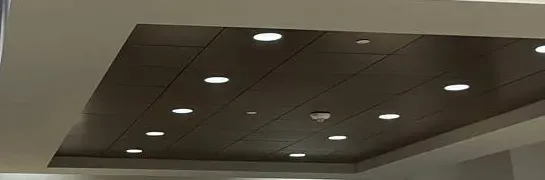
A photo from the AESS job library, not taken in Prospect Heights: a dark recessed ceiling panel with round downlights and a small round device, framed by a lighter ceiling. Lobbies in the newer buildings near the rail yards and in renovated apartment houses on Eastern Parkway often have ceilings like this, and the space above them is usually the cleanest route for new cable between the lobby panel, the desk and the riser closet.
Field Notes
Field Notes: Look Up the Map, Stand on the Stoop, Then Go Down to the Riser
This is our technician's standard first half hour at a Prospect Heights address, before anything is priced.
First, the map. Before the visit, the address goes into the Landmarks Commission's online map. If the building is inside the historic district, the door station, its cable and anything else fixed to the front come under the Commission's rules, and the quote has to allow for a staff-level permit. If it is one of the apartment houses in the proposed Apartment House District, we note that too, because a designation later would affect any future change to the entrance.
Second, the stoop. The technician counts every way in: the parlor door up the stoop, the garden door beneath it, the areaway gate, a lobby's outer and inner doors, a courtyard gate, a side or service door, a shop's entrances. Each door gets a note: what it is made of, which homes it serves, whether it should call, release or both, and whether there is plain masonry beside it where a panel and its cable can go. Then comes the push test: open the door, let it go and watch. A heavy prewar door that drifts open or needs a tug defeats any release, and fixing the closer or the frame on day one is cheaper than after the new system gets blamed.
Third, the riser. In a rowhouse, that means the cellar, the old transformer and the bundle of bell wire leaving it for the floors above. In an apartment house or tower, it means the point where each line of apartments begins, usually a cellar closet or a panel near the lobby. A meter goes on each pair. In a building where only some apartments' intercoms work, we write down which ones fail and which line they are on, because a pattern by line points at the cable and a scattered pattern points at the stations. What the meter shows decides whether the quote reuses the building's cable or adds new runs, and either way you see that decision on paper before you approve.
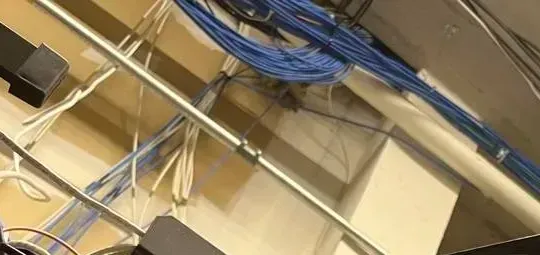
A photo from the AESS job library, not taken in Prospect Heights: bundles of blue low-voltage cable laid over a ceiling beam beside a metal pipe in an open ceiling. In the cellar of a Prospect Heights brownstone or apartment house, new buzzer cable follows the same kind of path along the joists to where it turns up toward the floors, kept clear of the heating and water pipes rather than strapped to them.
Landmarks and the Doorway
What the Landmarks Rules Say About a Door Station in the Prospect Heights Historic District
Because most Prospect Heights rowhouses are inside a historic district, a new buzzer on one of them is partly a permit question. The Landmarks Commission publishes its rules for this kind of equipment in chapter 11 of its Permit Guidebook, which covers health, safety and utility installations, and those rules are clear enough that most door stations can be approved by staff rather than at a public hearing. The neighborhood council notes that the Commission reviews exterior changes and any work in a district that needs a building permit, so for a buzzer the front of the house is where its rules matter most.
Location. "Light fixtures and intercom panels, as well as doorbells, must be installed within or adjacent to a door opening." The guidebook adds: "An intercom can also be installed on a fence or wall in front of the entranceway."
Number. "A maximum of two light fixtures and one intercom panel can be installed per door opening." A brownstone with a parlor door and a garden door has two openings, so each can have its own panel; a single doorway gets one.
Appearance. The "design, size, and finish of installations must be compatible with the architecture of the building." A compact station in a dark or bronze finish on plain masonry beside the door is the usual answer; a large lobby panel on carved brownstone is not.
Cable. Conduit "must be concealed by going through plain masonry." Where that is not possible, staff "may approve a maximum of approximately ten inches of visible conduit," and surface-mounted conduit "must be painted to match the background surface."
Mailboxes. The same chapter lets mailboxes go on "a plain masonry stoop wall adjacent to a basement-level entrance door," which matters when the garden door is the one that takes mail and deliveries.
Speed. "Permit applications for work that meets the LPC Rules can be approved faster." Staff permits are routine in the district; LPC permit PMW-23-08373, issued March 22, 2023 for brownstone resurfacing at 169 Underhill Avenue, is one example of the Commission's staff-level process at work on a Prospect Heights house.
The proposed Apartment House District is a different case. The neighborhood council's FAQ describes it as "larger multifamily apartment buildings built between 1909 and 1929," says that if a building has modern doors and the owner wants to replace them, the Commission would apply its standards once designated, and adds that "the interiors of buildings in the Apartment House District are not being proposed for landmark designation." Until the Commission acts, a lobby panel on one of those buildings needs no Landmarks permit. We still suggest choosing a panel that sits within the door surround rather than across the facade, so nothing has to be reconsidered later.
The chapter does not mention keypads or card readers, and its rules for this equipment are about the front of the building. Our part is to choose equipment and a cable route that meet the rules, provide the product sheets and photos an application needs, and wait for the permit before mounting anything on the front.
Rules and Responsibilities
Which Prospect Heights Buildings Must Have a Buzzer, and What the Law Expects of the Door
The newer towers are covered automatically. Multiple Dwelling Law §50-a requires Class A buildings erected or converted after January 1, 1968 with eight or more apartments to have an intercom at the lobby door that lets residents talk to visitors and release the door. Every Pacific Park building, and any new condo of eight or more homes on Vanderbilt or Atlantic Avenue, falls here.
Those buildings' entrance doors must lock themselves. The same section requires self-closing, self-locking doors at the street entrances of those buildings, kept locked unless an attendant is on duty. That is the rule the 535 Carlton tenants' association cited when its door stood unlocked for five days.
The prewar apartment houses are covered on request. Buildings put up before 1968, which includes every apartment house from the 1909–1929 wave, must install self-locking doors and an intercom when tenants of a majority of apartments request or consent in writing.
Jamming or removing the equipment is an offense. Section 50-a makes failing to install and maintain the required doors and intercom, or willfully damaging, jamming or removing them, a misdemeanor, which is worth knowing in a building where the lobby door is propped open as a habit.
A working system has to stay working. HPD can write violations for a dead intercom. ButterflyMX's NYC repair guide cites general correction periods of "90 days for Class A violations, 30 days for Class B violations," and a 2022 Bronx Housing Part decision that "recorded a Class B violation for an inoperable bell and return-buzzer system," while noting that one case is not a rule for every defect.
Residents can report it. NYC311 lists broken or missing doorbells, buzzers and intercoms as reportable conditions, both in an apartment and in public areas, after the resident has first contacted the building.
Rowhouses with one or two families are outside these rules. A one- or two-family brownstone is not a multiple dwelling, so the buzzer is the owner's choice and the owner's to maintain. A brownstone with three or more apartments is, and its doors and intercom then follow the building's age.
Landmarked fronts need a permit. Anything fixed to the front of a house in the historic district needs a Landmarks permit first, as set out above.
None of this is legal advice for a particular building. An owner facing a tenants' request, an HPD violation or a court order should check the details with a housing lawyer, the managing agent or HPD. What we provide is a system that meets the requirement that applies and paperwork showing exactly what was installed.
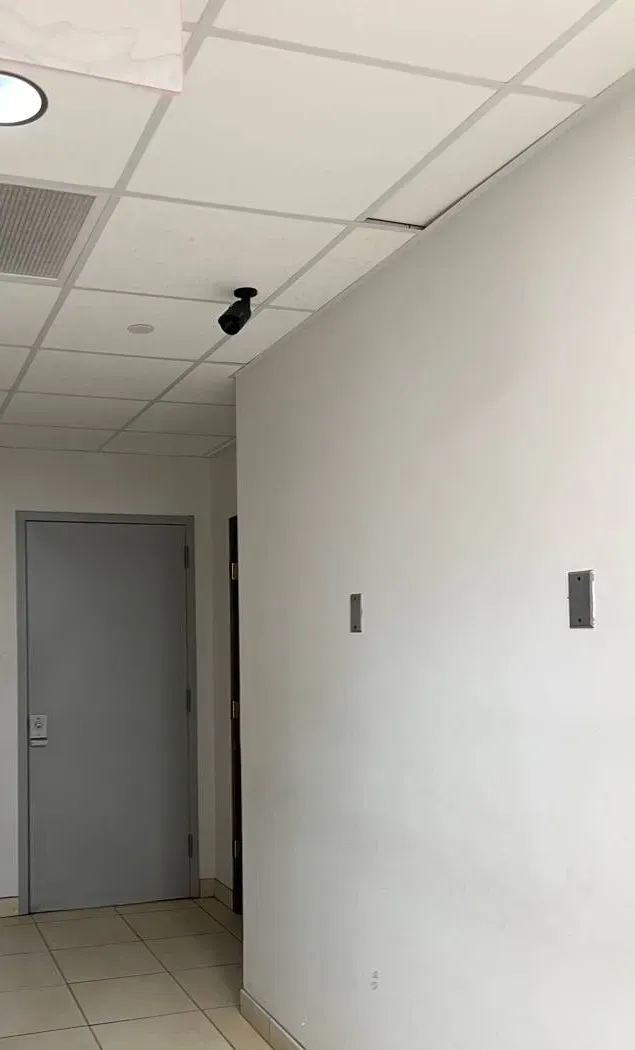
A photo from the AESS job library, not taken in Prospect Heights: a tiled corridor with white walls and small wall plates leading to a grey steel door with a lever handle, under a drop ceiling with a small camera. Service and cellar corridors in the larger Prospect Heights buildings end at self-closing steel doors like this one, and any buzzer, keypad or fob reader added to them has to leave the door closing and locking on its own every time.
Lessons From the Rail Yards
What Two Pacific Park Buildings Teach About Installing Entry Systems in a Tower
The two public failures at Pacific Park buildings are worth reading closely, because they are the failures any large Prospect Heights building can have. At 535 Carlton Avenue, the tenants' association reported that the main entry door was "broken and unlocked for 5 days," that anyone could walk in when the concierge was on a break, and that the door was fixed after "5+ days of complaints to management, 311, etc." Management's statement said a vendor had been secured to replace a "faulty door component." At 38 Sixth Avenue, City Limits reported in July 2024 that residents had lobbied for months over a front door that did not lock, that a manager had written "The door will not be replaced at this time," and that faulty intercoms affected perhaps 30 percent of the apartments until a vendor identified faulty wiring.
Four lessons come out of those reports, and they shape how we install in any tower.
The door is part of the system. In both buildings the visible failure was the door, not the panel. Every installation we do includes the closer, the latch and the strike or lock, set and tested so the door shuts and locks on its own, and the quote names any door hardware that needs replacing before the release can work.
A failed part should leave the door locked. Allegion's guide explains the difference: "Fail safe products are unlocked when power is removed," while "Fail secure products are locked when power is removed." For a street door, we use a fail-secure strike wherever the code allows, so a dead power supply or a broken controller leaves the door locked, with free exit from inside, rather than open to the street.
Standard parts are fixed in hours. A door that waits five days usually waits for a part. We prefer strikes, closers and power supplies that any supplier stocks, record their make and model on the handover sheet, and recommend the building keep one spare of the parts most likely to fail.
Wiring faults show up as patterns. When a third of the intercoms in a building fail, the cause is usually in the cable to particular lines or floors. On a new installation we test and label every line before handover; on an existing one, we map which apartments fail before replacing anything, so the building pays for a wiring repair rather than for new stations on a faulty line.
Switch-Over Day
Changing Over an Occupied Prospect Heights Apartment House One Line at a Time
In a brownstone, the switch from old to new takes an afternoon and the household is usually home for it. In a six-story apartment house with fifty apartments, or a tower with three hundred, people are coming and going all day and deliveries keep arriving, so the street door can never be left jammed shut or swinging free while the system is changed.
We work in a fixed order. The new power supply goes in first and is tested on its own. Then the new cable and apartment stations go in line by line, alongside the old system, which stays connected and working. Only when every new station has been checked does the lobby panel change over, and the release is swapped last, in a short window when the super or the desk is on hand. If anything goes wrong at that point, the old release is reconnected while it is sorted out, so residents always have a way in.
Before the work starts, the owner or managing agent tells residents the days and who to call if their station does not ring afterward; we supply a short lobby notice for that.
Commercial Door Buzzer Installation
Business Door Buzzer Installation in Prospect Heights
Prospect Heights's businesses sit on a handful of streets, and almost all of them share a building with apartments. A business buzzer here is rarely about letting customers in during opening hours. It is about the doors that should not be open to everyone: the back and delivery doors restaurants use, the buzz-in door of an office or practice on an upper floor, a staff entrance after closing, and the residents' door a step away from the shopfront. Vanderbilt Avenue adds a local twist: the Department of Transportation's 2022 presentation describes the Open Street as a full closure to cars from Atlantic Avenue to Park Place, Friday to Sunday, so for three days a week couriers and visitors arrive on foot from the corners.
Vanderbilt Avenue
The neighborhood's restaurant street, closed to cars on weekends for the Open Street between Atlantic Avenue and Park Place, with dining rooms at street level and apartments above.
Washington Avenue
The eastern edge, zoned for commerce since 2000, mixing shops and cafés with apartment houses and facing the Brooklyn Museum at its southern end.
Flatbush Avenue
The western edge from Atlantic Avenue to Grand Army Plaza, with ground-floor businesses below apartments and the arena at its northern end.
Atlantic Avenue
The northern edge along the rail yards and Barclays Center, with newer buildings whose retail spaces and residential lobbies share frontage.
Underhill Avenue
The avenue through the middle of the neighborhood, given limited local access on weekdays in the 2022 Open Streets plan, lined with rowhouses, apartment houses and corner businesses.
Eastern Parkway frontage
The southern edge, where large apartment houses face the parkway and ground-floor offices or practices share a lobby with residents.
The commonest business request here is a buzzer on a door that has always been propped or opened with a key: a restaurant's back door for deliveries, a second-floor practice that buzzes patients in one at a time, or a staff door that should lock behind each person. Each gets its own station, release and power, kept fully separate from any apartment system in the building. On an Open Street block, we put the delivery station where a courier walking in from the corner will find it, with the business's name on it, so drivers do not press the residents' buttons instead.
Rules that apply to Prospect Heights business entry installations
Anyone inside can always get out. A business door with a buzzer, code or reader still opens from inside without a key or code. Allegion notes that with an electric strike "you can exit by turning the lever" whether the strike is fail-safe or fail-secure, which is why a strike is usually the first choice.
Fire-rated doors keep their rating. Fire doors need fail-secure strikes, so a rated door to a stair or cellar stays latched in a fire, and the release hardware must carry the right listing for the door.
Magnetic locks bring extra requirements. Electromagnetic locks are only made fail-safe. The building code's sensor-release provisions call for a sensor on the egress side, a manual "PUSH TO EXIT" device 40 to 48 inches above the floor within 5 feet of the door that cuts power directly and keeps the door unlocked for at least 30 seconds, release on fire alarm or sprinkler activation, and UL 294 listed equipment.
Buttons stay within reach. The 2010 ADA Standards set the high forward reach at 48 inches maximum, so call buttons outside and release buttons at a reception desk are mounted within that range.
Tenants need the landlord's written approval. A shop or office that rents its space orders its own door buzzer only with the building owner's written permission, especially where the work touches a shared street door or the apartments' cable routes.
Storefronts in the district need a permit too. The historic district takes in small commercial buildings as well as houses, so a station on their fronts follows the same Landmarks rules as a rowhouse.
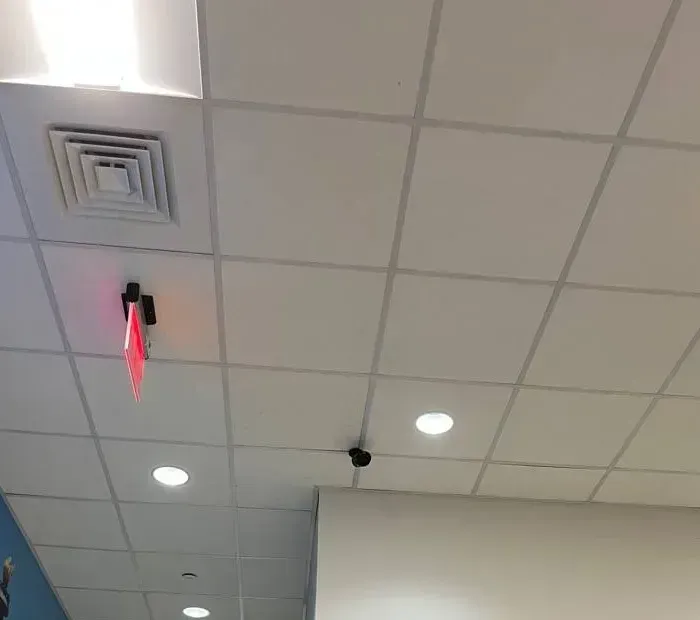
A photo from the AESS job library, not taken in Prospect Heights: a drop ceiling with a lit red exit sign, an air diffuser, round recessed lights and a small black camera. Restaurants and offices on Vanderbilt and Washington Avenues often have ceilings like this, and the exit sign is a reminder of the rule every business buzzer follows: whatever locks the door from outside, it always opens from inside.
Your Questions Answered
Door Buzzer Installation in Prospect Heights: Questions Answered
Towers and newer buildings near the rail yards
The 535 Carlton front door stood unlocked for five days in 2023 while management found a vendor. If our board replaces its entry system, what should the contract and handover include so that cannot happen to us?
Three things on paper, besides good equipment. First, a parts list: the make and model of the strike or lock, the closer, the power supply and the controller, so any locksmith or supplier can match a part the same day. Second, a recommendation for one spare of each part most likely to fail, stored in the building, so a repair does not wait for an order. Third, a clear response arrangement: who the super calls, and how quickly a technician comes when the street door will not lock, which is a security failure rather than an inconvenience.
On the equipment side, the street door gets a fail-secure strike where the code allows it, so a power or controller failure leaves it locked with free exit from inside, and, where the panel supports it, a door-position contact that tells the desk or the managing agent when the door has been left open.
About a third of the apartments in our tower cannot hear visitors, and the managing agent says the whole system has to be replaced. How do we find out whether it is really the wiring first?
By mapping the failures before buying anything. We list every apartment whose station does not ring or has no audio and mark it against the building's lines and floors. If the dead apartments line up, for example the same line of apartments on several floors, or every apartment above a certain floor, the fault is almost always in the cable or a connection serving that group. If they are scattered, stations or programming are more likely. Then we test the suspect lines from the riser.
City Limits' report on 38 Sixth Avenue is a useful example: intercoms in perhaps 30 percent of apartments were faulty, and a vendor eventually identified faulty wiring. Replacing every station in that situation would have spent the money in the wrong place.
Our building is switching residents to key fobs. If everyone carries a fob, does the intercom at the lobby door still have to work?
Yes. A fob only lets residents in. Visitors, couriers, repair people and anyone a resident is expecting still need a way to call an apartment, speak to someone and be let in, and Multiple Dwelling Law §50-a requires buildings built after 1968 with eight or more apartments to have exactly that at the lobby door. The fob reader and the intercom usually release the same lock, so the job is to make both work through one strike or lock and one power supply.
City Limits reported that 535 Carlton was being upgraded to a new key fob entry system. In a changeover like that, we check that the intercom's release still works on the new lock and that every apartment can still answer the door.
If the next phase of Pacific Park goes ahead, our building will have construction beside it for years. Does that change anything about how the entry system should be installed?
It changes a few choices. 6sqft reported in June 2026 that the plan for seven new buildings could see construction start as early as 2028. Years of building work next door means dust, vibration, contractors and deliveries at the sidewalk, and more strangers near the entrance. We favor a panel with a metal faceplate and sealed buttons, mounted where construction barriers and sidewalk sheds will not block it, and a camera at the door that can show residents who is there before they release.
The apartment houses south of St. Johns Place
Our 1920s building is inside the proposed Apartment House District. If the Landmarks Commission designates it after we put in a new lobby panel, will we have to take the panel down?
Designation does not normally reach back to undo work done legally before it. The neighborhood council's FAQ explains that the Commission cannot require owners to restore features lost before designation, but would review proposed changes from then on. A panel installed legally today could stay; a future replacement of it would then need the Commission's review.
That is a reason to choose carefully now. A panel set within the door surround on plain material, in a finish that suits the entrance, is the kind of installation that sits comfortably under the Commission's standards if they ever apply, so the next replacement is a routine staff permit rather than a problem.
News 12 reported tenants of a St. Johns Place building listing "violence at the front door" among their complaints. What can an entry installation do about the moment residents are standing outside unlocking the door?
It can shorten that moment and make it more visible. A code or fob at the street door means a resident is not standing on the step searching for keys. A door station with a camera covering the step and the sidewalk records who was there. Good light over the door, which in the historic district counts toward the Commission's limit of two fixtures per opening, removes the dark corner. And a closer adjusted so the door shuts and latches quickly stops anyone from following a resident in.
Brownstones in the historic district
The stone around our parlor door is carved almost to the edge of the frame. If the cable cannot go through plain masonry, how is the ten inches of visible conduit the Commission allows actually used?
Usually as a short, painted connection from the station to the nearest plain surface or into the door frame itself. The guidebook prefers conduit concealed through plain masonry and allows staff to approve about ten inches of visible conduit where that is impossible, painted to match the surface behind it. On a heavily carved doorway, the cable often goes through the wood door frame beside the station rather than the stone, or the station goes on the areaway fence, which the Commission also allows, with its cable run underground or along the ironwork to the house.
The avenues
From Friday to Sunday, restaurant tables fill the Vanderbilt Avenue roadway in front of our building. Will you install on those days, and how do you get equipment to the door?
We normally book street-door work on Vanderbilt Avenue between Atlantic Avenue and Park Place for Monday to Thursday, when the street is open to vehicles and the van can stop near the door. DOT's 2022 presentation describes the Open Street there as a full closure from Friday to Sunday, so on those days equipment would have to be carried in from a corner and the crew would be working beside diners.
Work that does not touch the street door, such as stations in the apartments or cable in the cellar, can be scheduled on any booking day. The quote says which visits need the street open.
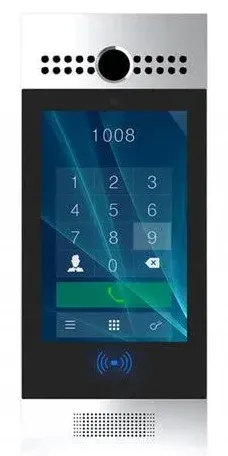
A photo from the AESS job library, not taken in Prospect Heights: a touchscreen entry panel showing a dial pad with a four-digit apartment code entered, a camera above and a card-reader symbol below. A code panel like this suits the lobby of a tower near the rail yards or a large co-op on Eastern Parkway, where hundreds of homes could never fit as buttons and residents can use the card reader below while visitors dial the apartment.
Equipment
Types of Door Buzzer Systems We Install
We quote a reliable non-branded system by default and install a named brand when an owner or board asks for one; the intercom brands we work with include Aiphone, ButterflyMX, 2N, Akuvox, Comelit and DoorBird. These are the kinds of equipment that come up most often in Prospect Heights buildings, and where each one fits.
Compact one- and two-button stations
Small audio or video stations for single-family brownstones and two-family houses, sized for a carved doorway and finished in dark or bronze tones that suit the district.
Multi-button panels for split rowhouses
A button for each household, a speaker and an optional camera, for brownstones holding three or four apartments, with stations or handsets on each floor.
Two-wire multi-tenant systems
Video and audio over one pair per apartment, the practical choice for the 1909–1929 apartment houses where old riser pairs test sound and new cable would mean opening six floors of hallway.
Directory and code panels
Scrolling directories or code entry for towers and large co-ops, often with a card or fob reader for residents built into the same faceplate.
Desk consoles and concierge stations
A station at the front desk that answers the lobby panel, calls apartments and releases doors, for doorman co-ops and staffed lobbies.
Phone and app answering
Panels that ring residents' phones, for owners who live elsewhere, households out all day and lines where the riser cable has failed.
Combined keypad and call stations
A camera, keypad and reader in one faceplate, for a garden door, a service entrance or a restaurant's delivery door used by staff with codes and visitors who call.
Fail-secure electric strikes
Releases cut into the frame that stay locked when power is removed and let anyone inside leave by turning the lever, the default for street doors here.
Closers, latches and battery-backed power
Closers set for heavy prewar doors, latches matched to the strike, and supplies with battery backup sized for the whole system rather than a chime.
Audio panel, two-wire video or phone answering: which fits a Prospect Heights building?
What matters
Multi-button audio panel
Two-wire video system
Phone or app answering
Typical Prospect Heights fit
Brownstones with two to four households, small walk-ups
Six-story apartment houses whose riser pairs test sound
Owners living elsewhere, failed riser lines, large towers alongside stations
See the visitor
No
Yes, on the apartment monitor
Yes, on the phone, where the system supports video
Needs internet
No
No, unless phone answering is added
Yes, wired internet or cellular at the door
Works for residents without smartphones
Yes
Yes
Only if a station or landline option is included
Station size on a landmarked doorway
Small for two to four buttons
Small to medium
Usually a single compact panel
Monthly fees
None
None
Often a software or cellular charge
Brooklyn list range
$400–$900 for one or two households, more with each apartment
$700–$1,800 for small buildings; from about $2,500 for apartment houses
Within the same ranges, plus any subscription quoted separately
ADT, Ring and SimpliSafe compared with a local installer for a Prospect Heights building
National alarm and doorbell brands come up in almost every conversation about a front door. For a single-family brownstone, a video doorbell from a national brand can be a reasonable choice, provided it is wired properly and the Landmarks rules on the doorway are followed. For a house with several households or an apartment house, the comparison changes. A consumer doorbell rings the phones of whoever set it up; it does not give each apartment its own button, it does not release the street door from upstairs unless separately wired to a strike, and it cannot meet the talk-and-release standard the intercom law sets for buildings that need one.
What a local installer adds is the part the national brands leave out: the strike, the closer, the power supply, the cable to every floor, the button plan for a brownstone's two doors, the Landmarks paperwork and a written record of the wiring.
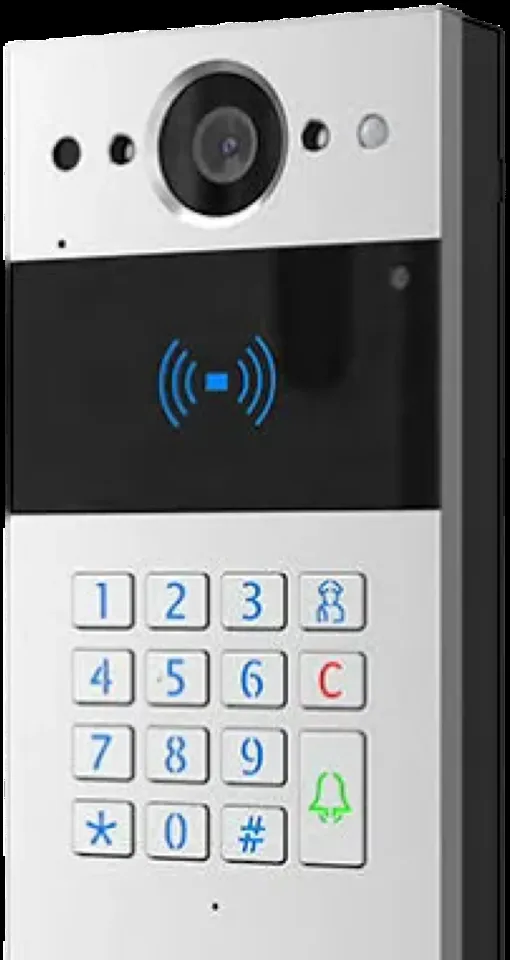
A photo from the AESS job library, not taken in Prospect Heights: a silver and black keypad door station with a camera lens at the top, a blue card-reader symbol, a numeric keypad and a green bell key. On a restaurant's delivery door off Vanderbilt Avenue or a service entrance in a larger building, a station like this lets staff enter with a code or card while couriers press the bell key to reach whoever is working.
AI Overview Reality Check
What AI Gets Wrong About Door Buzzer Installation in Prospect Heights
Ask an AI assistant or a search summary about putting in a buzzer and the answer is stitched together from national cost guides like Angi's HomeAdvisor and Fixr, intercom vendors' blogs and generic how-to pages. Much of it is fine in general and wrong for a neighborhood of landmarked brownstones, 1920s apartment houses and new towers. Here are seven claims from those sources, each checked against what we see at Prospect Heights doors.
"Between $1,500 and $15,000"
That is HomeAdvisor's national range for installing an intercom system, around an average of $2,500. It spans everything from a house to a complex, which is why it tells a Prospect Heights owner almost nothing.
On our Brooklyn list, a one- or two-household brownstone with an audio buzzer and a new release is $400 to $900, which is below the bottom of that national range. A video system for a split brownstone or small walk-up is $700 to $1,800. Only the apartment houses, doorman co-ops and towers reach the $2,500-plus range, and the largest go past $10,000.
What moves a job within its range here is local: the riser's condition, how many doors people use, whether the door itself needs work and whether a Landmarks permit is involved.
"Wireless systems are the best option if you want to DIY"
HomeAdvisor's advice suits a single house with one door and one household. A wireless doorbell or chime kit can be screwed beside a door in an afternoon. But it does not release the street door, it does not give each apartment its own button, and it cannot meet the talk-and-release standard the intercom law sets.
In a Prospect Heights brownstone, a DIY kit also runs into the Landmarks rules: one intercom panel per door opening, a finish compatible with the building and cable concealed through plain masonry. A battery doorbell stuck to carved stone beside an old bell plate becomes a second panel on the doorway.
The part a kit leaves out, the strike in the frame and the power to run it, is the part that makes a buzzer a buzzer.
A station takes one to two hours to install
HomeAdvisor puts installation time at about one to two hours per station, which is roughly right for mounting a station on a wall that already has a cable behind it. It leaves out most of the work in an older Prospect Heights building.
In a 1912 or 1927 apartment house, the hours go into tracing and testing riser pairs, preparing a heavy prewar door so it latches, cutting a strike into its frame and changing over a building of occupied apartments without leaving the door unlocked. In a brownstone, they go into getting cable through solid masonry into the house.
The station itself is the quick part. That is why we price from a walkthrough rather than a count of stations.
"$1,000 to $5,000 or more per entry door"
Swiftlane's cost guide gives that figure for modern IP or video systems, priced per door. For cloud systems in commercial buildings, pricing by the door makes sense.
For a Prospect Heights brownstone with a parlor door and a garden door, per-door pricing would put a two-household house at $2,000 or more before any apartment equipment, when our Brooklyn list places most such jobs between $400 and $1,800. In an apartment house, the cost follows the apartments and the riser more than the number of doors.
Per-door figures help compare cloud panels with each other, not budget a rowhouse.
"$5 to $15 per unit per month"
The same Swiftlane guide says software subscriptions commonly add that much per apartment each month. It is easy to read past. For a 298-apartment building the size of 535 Carlton Avenue, that works out to between $1,490 and $4,470 a month, every month, on top of the equipment.
Subscriptions can buy real features: phone answering, remote management and logs. But a wired system over the building's own cable, with stations in the apartments and a console at the desk, carries no monthly fee at all.
Boards should see the ten-year total of any subscription next to the installed price before they vote, and we put both on the quote.
"Using existing wire and infrastructure"
Aiphone presents its GT Series as offering the advantage of using existing wire and infrastructure, and its upgrade guide says that if existing wires are in good condition they can be reused. The condition is the important part. ButterflyMX's NYC guide puts it plainly: reuse "can't be promised in advance."
Prospect Heights has both extremes. A rowhouse whose bell pairs have sat untouched in a dry wall for a century can carry a two-wire video system, while the newer tower at 38 Sixth Avenue had intercoms failing in perhaps 30 percent of apartments until a vendor found faulty wiring. Age does not tell you which you have.
So every pair is metered before the quote, and any borderline pair is listed with the cost of replacing it.
"Landmark review can depend on the project and property"
That line from ButterflyMX's guide is true and unhelpfully vague, and AI summaries often turn it into either "you need a hearing" or "nobody checks." Neither is right for the Prospect Heights Historic District.
The Commission's guidebook sets out exactly what staff can approve: an intercom panel within or beside the door opening or on a fence or wall in front of the entrance, one panel per door opening, a design and finish compatible with the building, and conduit concealed through plain masonry or limited to about ten inches visible. Work that meets those rules can be approved faster.
For the apartment houses in the proposed Apartment House District, no Landmarks permit applies today, because the district has not been designated.
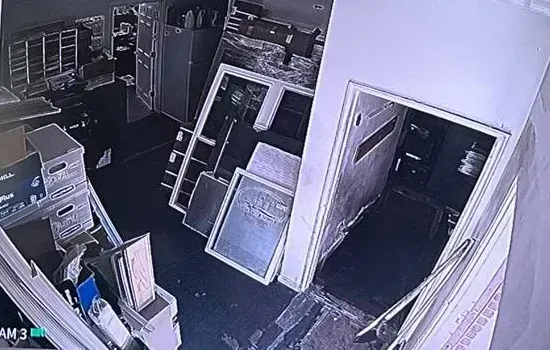
A photo from the AESS job library, not taken in Prospect Heights: a black-and-white night camera view of a cluttered room with an open doorway into a dark back room. Storerooms behind restaurants on Vanderbilt Avenue often connect to a back or delivery door, and a buzzer or keypad on that door, with a camera inside watching it after closing, keeps the back of the business as secure as the front.
Not Sure Whether Your Riser, Your Door or Your Landmarks Permit Comes First? Speak to a Tech
Send photos of the door, the panel or bell plate beside it and, if you can, the power supply or cable in the cellar, with the number of apartments and doors and whether the house is in the historic district, and a technician will tell you which path looks likely and where it falls on our Brooklyn ranges. Call or text (347) 934-8335, send photos on WhatsApp, or fill in the form below.
Get In Touch
Request a Free Quote
✅
Request Sent!
Thank you. A technician will call you about the Prospect Heights address, usually within two hours during working hours.
How It Works
Our Installation Process
1. Check landmark status and who signs
We look the address up on the Landmarks map and confirm who orders the work: the owner, the co-op or condo board, the managing agent, or a business tenant with the landlord's written approval.
2. Walk every entrance
We list every door people use, from the parlor and garden doors of a brownstone to a lobby's inner door, a service door and a store entrance, and every home each door must call.
3. Test the door itself
We check the closer, latch, hinges and frame. If the door does not shut and latch on its own, that is fixed first, because no release can hold a door that drifts open.
4. Find the riser and test the cable
We meter every pair from the cellar or riser closet and map any apartments that already fail, marking which runs will be reused and which need new cable.
5. Write the price from the Brooklyn list
You get a written price, with every possible extra named and priced, and, for a landmarked front, the product sheets and photos a staff permit application needs.
6. Take the deposit, order and schedule
Equipment is ordered once the deposit is in. In-stock systems are scheduled right away; special-order panels once they arrive. Every visit gets a two-hour arrival window.
7. Install, label and program
We mount the station, release and power supply, run or reconnect the cable, set up stations or phone answering and label every pair, keeping the old system live until switch-over.
8. Test every home from the street and hand over
From the street door we call and release every apartment, record each result, show residents how to answer and leave the test sheet and wiring record with the owner or board.
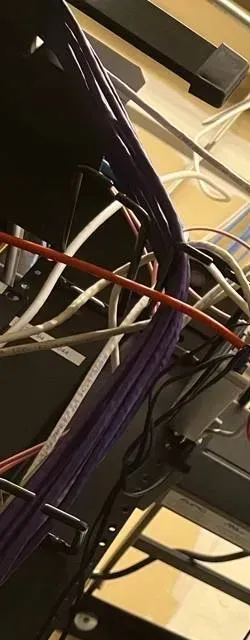
A photo from the AESS job library, not taken in Prospect Heights: purple, white and red cable bundles dropping down beside a black equipment rack. In a Pacific Park tower or a large Eastern Parkway co-op, the cable from every line of apartments arrives at one closet like this, and labeling each bundle there in step 7 is what lets the next technician trace a single failing line in minutes.
Coverage Area
Door Buzzer Installation Near Prospect Heights's Landmarks
Grand Army Plaza
The circle at the neighborhood's southwest corner where Flatbush Avenue meets Eastern Parkway, home to a Saturday Greenmarket held year-round since 1989.
Central Library
The Brooklyn Public Library's main branch, on Grand Army Plaza at the head of Eastern Parkway.
Brooklyn Museum
The museum on Eastern Parkway at Washington Avenue, facing the 1909–1929 apartment houses of the proposed Apartment House District.
Barclays Center
The arena at 620 Atlantic Avenue, opened in 2012 on the neighborhood's northwest corner at the western end of the Pacific Park site.
Co-Cathedral of St. Joseph
The Spanish Colonial church at 856 Pacific Street, completed in 1912, on the street that runs along the rail yards.
Engine 219 and Ladder 105
The firehouse at 494 Dean Street that serves the neighborhood's rowhouses, apartment houses and towers.
Prospect Heights is billed at our standard Brooklyn rate. The final figure follows photos and a walkthrough, because the number of homes, the doors people use, the condition of the riser and the state of the door decide the total far more than the brand on the panel.
Job
Typical Prospect Heights building
Brooklyn range
Audio buzzer or replacement with electric strike release, existing wiring reused where it tests well
Single-family or two-household brownstones, a single shop or office door
$400–$900
Video door station with indoor monitors or phone answering
Brownstones with three or four apartments, small walk-ups, avenue buildings with apartments above
$700–$1,800
Multi-unit entry system, audio or video by apartment count, with optional fob or code entry
Apartment houses south of St. Johns Place, doorman co-ops, newer towers
from $2,500 to $10,000+
In-person diagnosis of an existing system, booked online
Any building whose system must be tested before quoting, such as a tower with dead lines
$250, applied toward the work
Monthly subscription
Any building choosing a wired, no-subscription system
$0
Inside its range, a Prospect Heights job moves for predictable reasons. A brownstone whose old pairs test sound stays near the bottom; one where every floor needs new cable through solid walls moves up. An apartment house with a sound riser stays lower than one where several lines must be replaced. A door that needs a new closer or a frame repaired before it will latch adds to the total, and so does a second entrance such as a garden door or a service door. Our Brooklyn list notes that most customers who combine the buzzer with related low-voltage work in one visit save $200 to $400 in labor. Anything that depends on a test is named on the quote with its price before you approve.
Full terms — including 50% deposit, one-year parts-only warranty on AESS-supplied products, and the late-fee schedule — are set out in the service agreement.
Find Out Which Range Your Prospect Heights Building Falls In
Three typical Prospect Heights jobs, each placed inside the matching range on our Brooklyn list. The exact figure comes from the photos and the walkthrough.
Brownstone doorway: $400–$900
A compact audio station at the parlor door of a one- or two-household brownstone, an answering unit on each floor, a fail-secure strike in a sound frame, a closer that shuts the door and battery-backed power, with the station chosen to suit the Landmarks rules.
Split brownstone or walk-up video: $700–$1,800
A video station for a brownstone with three or four apartments or a small walk-up, monitors or phone answering for each household, old pairs tested and reused where sound, and the strike and closer set for each door.
Apartment house, co-op or tower: from about $2,500
A directory, code or button panel at the lobby, a desk console where there is a doorman, stations or phone answering for every home, tested or new riser cable and power in a locked box, rising toward $10,000 or more with apartments and doors.
Bring your own equipment. If you have already bought a door station or intercom kit, we can install it as labor-only work, quoted flat once we have seen the doors, the frames and the cable path. Tell us the make and model, and we will say before the visit whether it can reach every apartment, release your doors and suit a landmarked doorway. Equipment you supply is covered by its maker's warranty, not ours.
Complete Services
Every Door Buzzer Service in Prospect Heights
Brownstones and walk-ups
Landmark-friendly stations, button plans and new releases. Request a quote
Does a brownstone inside the historic district cost more to fit with a buzzer than one outside it?
+
The equipment and labor come from the same Brooklyn ranges either way. What can add cost on a landmarked front is the route: taking cable through solid masonry so it stays hidden, or choosing a compact station in a finish that suits the house. Preparing the product sheets and photos for a staff permit is part of our quote, and every such item is named before you approve.
Will the Landmarks permit for our door station be public?
+
Yes. The Commission posts issued permits online, the way the 2023 permit for 169 Underhill Avenue can be read today. A permit for a door station would show the address, the approved equipment and any conditions, which is also useful later, because a future owner or contractor can see exactly what was approved for the doorway.
Does a light built into the door station count against the two light fixtures the Commission allows at each doorway?
+
The guidebook counts light fixtures and intercom panels separately, and a station's lit buttons or camera light are part of the panel itself. We show the station's lighting in the photos and product sheets on the application so the staff reviewer can see it, and the reviewer decides. If you also want a new lantern beside the door, it counts as one of the two fixtures.
Our tower's front door lock failed and management says the replacement must come from the original maker. Can a standard part go in while we wait?
+
Often, yes. If the failed part is the strike, the lock or the closer, a standard part with the same voltage and size can usually be fitted so the door locks and releases again within the day, and the original part can be swapped back later if the owner prefers. The order has to come from whoever controls the door, usually the managing agent, and we write down exactly what was fitted.
How far ahead should an Eastern Parkway co-op board start planning a new entry system?
+
Start with the walkthrough and written quote, then allow time for bids, the board vote and the deposit. An in-stock system can be scheduled as soon as the deposit is in; a named brand that is special order adds its shipping time, which we confirm only after ordering. A board that wants the work done before a set date should begin with the comparison of bids, not with the date.
How do you work on a high brownstone stoop without marking the stone or the railings?
+
Tools and cable are carried up rather than dragged, ladders stand on padded feet on the treads instead of leaning on ironwork or carved stone, and drilling is done only into the plain surface or mortar joint chosen for the station. Dust from drilling is caught at the hole and the steps are swept before we leave.
Our brownstone is a legal three-family, while our neighbors' houses are two-families. Does that put our door under different rules?
+
It can. A house with three or more independent households is a multiple dwelling, so its entrance and intercom fall under the multiple dwelling rules for a building its age, while a one- or two-family house is outside them. For an older brownstone that usually means no automatic duty, but a working system becomes something tenants rely on and HPD can write up if it fails.
Crowds pass our door on their way to and from Barclays Center. Should that change the station we choose?
+
On blocks with heavy foot traffic we lean toward a metal faceplate, sealed push buttons rather than a touchscreen, a camera behind a hard cover and a station mounted flush or close to the wall so it cannot be pulled or knocked. On many systems residents can also silence their own stations at night, so a stray press on the way home from an event does not wake anyone.
Our stoop faces the afternoon sun. Will the camera show a visitor's face when the sun is behind them?
+
It depends on the camera and where it points. Stations with wide dynamic range handle a bright street behind a dark face far better than basic ones, and angling the station slightly or adding a small hood keeps direct sun off the lens. We look at the doorway's light when choosing the model and can show you a sample image before you decide.
Our 1920s building still has old telephone cable running up the riser. Can a new intercom use those pairs?
+
Sometimes. Many two-wire intercom systems can run on any sound twisted pair, so unused telephone pairs that reach each apartment may carry the new system. Each pair is metered first, and the quote lists which apartments use the old telephone pairs and which need new cable, so nobody discovers a dead pair on installation day.
More Door Buzzer Installation near Prospect Heights
Ready for a Prospect Heights Entrance That Locks Every Time and Reaches Every Apartment?
Send a photo of your door and whatever is mounted beside it, with the address, the number of apartments and every door people use, and we will tell you which system fits, how much of the old wiring it can reuse, whether a Landmarks permit is involved and where it falls on our Brooklyn ranges. Call or text (347) 934-8335, message us on WhatsApp, or use the request form. Licensed under NYS license #12000287431, rated 4.7★ across 201 Google Reviews, with same-day estimates on most weekdays.