Planned Around the Landmarks Rules · Parlor Door, Garden Door and Rear Garden · Written Line-by-Line Quotes
Security camera installation in Prospect Heights starts with a count most owners have never heard of. Roughly 850 buildings here sit inside the city's Prospect Heights Historic District, and the Landmarks Preservation Commission's own permit guidebook limits small buildings to no more than two security cameras for every 25 feet of street frontage. On a typical row house that means the front gets one or two carefully chosen cameras, and the rest of the plan has to come from the cellar, the garden, the halls and the inside of the parlor door. Around that sit the things that set this neighborhood apart: crowds leaving the arena at its northwest corner, weekend closures on Vanderbilt Avenue, Saturday markets at Grand Army Plaza, Labor Day closures along the parkway, and an 1830s lot pattern that tilts some buildings away from the street. We walk your house, building or shop, give each camera one job, run cable through the cellar and old plaster rather than across the brownstone, and put every camera, mount, run and setting on a written quote before anything is ordered.
Reviewed and updated November 4, 2026 by Abstract Enterprises Security Systems, NYS license #12000287431 · Sources: the Historic Districts Council on Prospect Heights; Wikipedia entries for Prospect Heights, the Prospect Heights Historic District (National Register) and Barclays Center; CityLand on the 2009 designation and on Landmarks camera violations in Hamilton Heights; the LPC Permit Guidebook chapter on health and safety work, the LPC rules and guides page, and LPC presentation materials for 7 East 7th Street (December 2025) and 628 Carlton Avenue (January 2026); 6tocelebrate on the area's development; Brooklyn Paper on the district and the Vanderbilt Avenue open street; Patch on the Eastern Parkway mail thefts, Prospect Place mail thefts, the Vanderbilt Avenue jewelry theft, the old street grid and precinct coverage; Brooklyn Eagle on the summer 2026 business burglaries; amNY on the 2020 home burglary pattern; DNAinfo on the 2015 Carlton Avenue restaurant break-in; Hoodline on the 2026 business burglary spree and the October 2026 bicycle theft; Brooklyn News Service on life beside the arena; NYC DOT on the Prospect Heights open streets; GrowNYC on the Grand Army Plaza Greenmarket; NY1 on 2026 Labor Day closures; BK Reader and 6sqft on Pacific Park; Prospect Places, CityNeighborhoods, Commercial Observer, StreetEasy and CityRealty on building stock; Brick Underground, Justia Answers, Outerbridge Law and security-systems.nyc on camera rules in rentals; the NYPD 78th Precinct page; Yelp and the Brownstoner forum; NY General Business Law Article 6-D, Civil Rights Law §52-a and Penal Law §250.45 · Dispatched from 1282 Troy Ave, Brooklyn

Owner-operated since 2002 · Thousands of jobs completed · Booked within 2 hours
Security camera installation in Prospect Heights usually means a wired system for a brownstone or brick row house that covers the parlor door and stoop, the garden-level door and areaway, the cellar entrance and the rear garden, kept within the Landmarks limit on front-facade cameras; a building system for a small apartment house, a prewar co-op on Eastern Parkway or Plaza Street, or a newer tower in Pacific Park; or a door, counter and office system for a restaurant, bar or shop on Vanderbilt, Washington, Flatbush or Sixth Avenue. Every job is priced on our Brooklyn rate and quoted in writing after you send photos or we walk the building, with each camera, mount, cable run, recorder, drive and setup task on its own line. A rear-garden camera fed straight up from an open cellar is a short job; a cornice camera on a four-story house reached through plaster walls is a long one, and the quote says which you have. The few fixed prices we publish, such as a setup-only visit at $225 for the first hour, are in the pricing section below. Estimates are free, requests are booked within 2 hours, and the work is done under NYS license #12000287431 with insurance in place. Call (347) 934-8335 or use the form.
Prospect Heights is a neighborhood of front doors that sit above the sidewalk, back gardens that sit out of sight and a historic district that decides how much of the front a camera may occupy. Wikipedia bounds it by Flatbush Avenue on the west, Atlantic Avenue on the north, Washington Avenue on the east and Eastern Parkway, starting at Grand Army Plaza, on the south. The area was mostly farm and woodland until the middle of the nineteenth century; according to the 6tocelebrate history project, the land between Sterling Place and Prospect Place was sold off in the 1880s and built up with the row houses that now make up most of the historic district, while the strip between Eastern Parkway and St. John's Place was tied up in title litigation and stayed empty until well after 1900. The Brooklyn Paper and CityLand describe Neo-Grec row houses from the 1860s and 1870s, Romanesque and Renaissance Revival houses from the 1880s and 1890s and larger mixed-use buildings along Flatbush Avenue. Brownstones and townhouses went up on the side streets and apartment buildings on the avenues, and one guide places the densest rows on Park Place, Prospect Place, St. Marks Avenue and Underhill Avenue. Wikipedia adds larger apartment buildings on Lincoln Place and St. Johns Place between Underhill and Washington. It is ZIP 11217 and 11238 and Community District 8.
The Landmarks Preservation Commission designated the Prospect Heights Historic District on June 23, 2009. The Historic Districts Council counts about 850 buildings, mostly single-family row houses and apartment buildings, and Wikipedia gives its rough limits as Flatbush Avenue, Sterling Place, Washington Avenue and St. Marks Avenue, with one section reaching north to Pacific Street. Sources rank it differently: CityLand reported at designation that it would be Brooklyn's largest district and the city's largest since 1990, and Wikipedia now calls it the fifth largest in New York City. Either way, most houses in the neighborhood fall under it, and the LPC permit guidebook names security cameras directly, with a limit on how many may go on the street side of a building and examples of dome cameras finished to match the facade. That rule is the single biggest difference between a camera plan here and one on an unlandmarked block in another part of Brooklyn, and it is why we count the front before we design anything else. A separate, older National Register district, listed in 1983 with 305 contributing buildings from 1865 to about 1900, overlaps part of the same ground; the camera rules we follow come from the city district.
The newer side of the neighborhood is just as real. The arena at 620 Atlantic Avenue opened in 2012 at the northwest corner, and the Pacific Park project over the rail yards has, by BK Reader's count, brought about 3,000 apartments in eight new buildings, with a plan unveiled in June 2026 for seven more on six sites. Along Eastern Parkway and Plaza Street sit prewar elevator co-ops, including the 16-story, 186-unit building at 135 Eastern Parkway, built in 1926, and on Grand Army Plaza and Vanderbilt Avenue there are glass condominiums such as One Grand Army Plaza and the 278-unit building at 550 Vanderbilt. Prospect Places describes the brownstones as having deep backyards, and that matters: a rear garden here is often a long, walled space that nobody on the street can see, reached by the garden-level door under the stoop. Wikipedia puts the 2010 population at 19,849 on about 237 acres. One block can hold a single-family brownstone, a four-unit rental row house, a corner store and a co-op elevator building, each with a different owner deciding where a camera may go.
The incidents in the local press point at the same few places on a building. Patch reported a thief, caught on residents' surveillance footage, breaking into the mail bin in front of 55 Eastern Parkway at least three times and taking the whole bag of mail for six buildings near Underhill Avenue; years earlier Patch had covered repeated mail thefts at a dozen or more homes on Prospect and Park places between Underhill and Vanderbilt. amNY described a 2020 burglary pattern that included an attempt at 8:45 a.m. on January 8 at a home on Park Place near Carlton Avenue, where the burglar tried to damage an apartment door lock. In July 2026, the Brooklyn Eagle reported, a burglar who hit 11 Brooklyn businesses that summer entered a Prospect Heights bar at 80 Sixth Avenue through a basement door around 4:15 a.m., forced his way into an office and took about $4,000; police said he got into businesses primarily through basement-level doors. Hoodline reported that two suspects committed 19 commercial burglaries across 16 neighborhoods, Prospect Heights among them, between August 3 and September 10, 2026, and in October a bicycle was taken from a residential building near Underhill Avenue and Dean Street. Patch reports the 78th Precinct covers the western side of the neighborhood, from Flatbush Avenue to the western half of Vanderbilt, and the 77th covers the rest. We found no crime statistic that ranks Prospect Heights blocks, and we do not offer one.
What Prospect Heights owners tend to add next. After the parlor door and garden cameras go in, owners often ask whether the stoop camera's picture can show on an intercom screen inside, or whether the areaway gate could report when it is left open. We leave a labeled spare port on the recorder and, where a video intercom is likely, a spare cable to the vestibule, so the cellar ceiling only has to be opened once.

Two calls come in from buildings like these. Either a camera has gone dark, most often the rear-garden camera or the one at the garden door, after a storm, a power cut, a new modem or a ladder brushed against it, and nobody knows how long it has been out; or something has happened, a door has been tried, a package or a bicycle has gone, and you need the footage before the drive fills and starts over. For a dead camera, note which one it is and when it last showed a picture, check whether the recorder and any switch beside it still have lights, and do not reset the recorder to factory settings, which can erase the passwords and remote access along with the fault. For an incident, leave the recorder running, write down the camera and the time, and copy that window to a USB stick if you know how. If anyone was hurt or threatened, call 911 first and tell the officers you have video. Then call (347) 934-8335. We book every request within 2 hours, walk you through what can be done by phone, and send a technician when the fix needs hands on the equipment.
Most camera plans start by asking how many cameras the owner wants. In the Prospect Heights Historic District the better first question is how many the front of the building may carry. The LPC Permit Guidebook's chapter on health and safety work says that, for small residential and commercial buildings, no more than two security cameras may be installed for every 25 feet of street frontage, and for large buildings no more than three, and it points to LPC Rules Section 2-20. The guidebook illustrates the idea with two dome cameras finished to match the facade. The Commission's rules page explains the consequence: work that meets the rules can be approved by LPC staff, and work that does not has to go before the full Commission at a public hearing. So the facade allowance is not a ban. It is a budget, and the job is to spend it on the two views that matter most.
On a row house, those two views are almost always the parlor door at the top of the stoop and the garden-level door beneath it, or one camera that covers both from the right height. Everything else that people want to see, the rear garden, the cellar door, the side of the areaway, the hall inside the vestibule, can usually be covered from places that do not face the street at all. The guidebook passage we rely on counts cameras against street frontage; for walls that do not face a street, we ask LPC staff rather than guess. One security vendor's summary of the rules says they generally discourage installation on a primary facade unless no other option exists. That is a vendor's reading, not the Commission's wording, but it fits how we plan anyway: the front gets the fewest, smallest cameras that do the job, and the inside of the house does the rest.
The review is detailed. Presentation materials the Commission posted for a brownstone at 7 East 7th Street in December 2025 show pole-mounted cameras attached under the water table, mock-ups on the building and comparisons of camera housing sizes, and the Commission posted presentation materials in January 2026 for 628 Carlton Avenue, an 1871 building inside this district. The guidebook's application section asks for manufacturer cut sheets for security cameras, light fixtures, intercoms and mailboxes. Skipping the process has a cost: CityLand reported that homeowners in Hamilton Heights, a historic district in Manhattan, received Landmarks violations for putting up cameras to catch graffiti vandals. Our part is to choose cameras that will fit the rule, give you the cut sheets and marked-up photos the application asks for, and wait for the permit before anything goes on the front.
| Building on the block | What the rule allows on the street side | Where the other cameras usually go | What we watch for |
|---|---|---|---|
| Single-family brownstone, about 20 feet wide | Up to two, as a small building | Rear garden from the back wall, cellar door from inside, vestibule from inside | Housing size, color and mounting into mortar joints, not stone |
| Row house with rental apartments | Up to two, still counted by frontage | Halls and stair inside, garden from the rear | Which household sees which view |
| Small apartment house on Lincoln Place or St. Johns Place | Two or three per 25 feet, depending on whether LPC treats it as large | Lobby, mailboxes, cellar and rear yard | Confirm the building's category with LPC before planning three |
| Mixed-use building on Flatbush Avenue | Counted on the same frontage the store and apartments share | Store interior, residential hall, rear | Store and owner sharing one allowance |
| Corner building | Ask LPC how each street frontage is counted | Side street views planned only after that answer | Never assume the side street gives a second allowance |
| Building outside the city district | No Landmarks limit applies | Planned on the views alone | Check the address on the LPC map first; the lines are irregular |
With only two cameras on the street side, each has to earn its place. The one we place first almost always looks along the stoop from the side of the door opening, low enough to record a face at the top step and wide enough to show the bottom of the stoop and the gate to the areaway. If the front has room for a second, it goes where it can see the garden door under the stoop from a height that catches faces rather than hats, often in the door opening itself. Anything that would only look at the sidewalk for the sake of it, or that duplicates a view the first camera already has, is left off.
A camera inside the vestibule, looking out through the inner door at whoever comes through the outer one, does not count against the facade at all and sees faces at close range. A camera on the back wall of the house covers the whole garden. A camera inside the cellar watches the cellar door from the side that matters. On most Prospect Heights row houses, the finished plan has two or fewer cameras on the street side and three to five inside or at the rear, all feeding one recorder in a dry, locked spot.
Prospect Heights has busier days than most residential neighborhoods, and they come back on a schedule. The arena at the northwest corner seats 17,732 for basketball and about 20,000 for concerts, according to Wikipedia, and has no dedicated parking lot of its own. A 2013 Brooklyn News Service report described what residents near it lived with after its opening: bass and vibration near Dean Street, crowds after concerts, and buses, black cars and limousines idling on Sixth Avenue behind the building. Vanderbilt Avenue between Atlantic Avenue and Park Place becomes an open street, closed to cars Friday through Sunday under the program NYC DOT described in June 2022, run by the Prospect Heights Neighborhood Development Council. The Grand Army Plaza Greenmarket runs every Saturday, year-round, from 8 a.m. to 4 p.m., GrowNYC says, at the northwest entrance of Prospect Park. And on Labor Day, NY1 reported for 2026, the plaza circle, Flatbush Avenue from Grand Army Plaza to Caton Avenue, Washington Avenue from Sterling Place to Lincoln Road and the Eastern Parkway main and service roads from Plaza Street East are all closed for the parade.
None of this is a reason to fear the neighborhood. It is a reason to set cameras up for it. On those days the sidewalks fill with people who have nothing to do with your house, and a camera set to alert on any motion in front of a stoop will send dozens of notifications an hour until you turn alerts off, which is the moment something that matters goes unnoticed. A camera framed too wide records a crowd in which no one can be told apart. And a drive sized for a quiet week may write over Thursday night by the time a neighbor asks, on Sunday, whether anyone saw who tried the door.
The fix is to separate what the camera records from what it tells you about. The stoop camera records everything, all the time. The alert zone is drawn tightly around the stoop treads above the second step, the areaway gate and the garden door, so a person walking past on the sidewalk never triggers it and a person climbing toward the door does. Many cameras also offer line crossing, so the alert fires only when someone passes through the gate in the inward direction. On a building near the arena we usually add a schedule that sends stoop alerts only after the hour the street normally empties, while the garden and cellar cameras alert at any hour, because nobody should be in your garden on an event night either.
When the sidewalk is crowded, the camera that helps is the one with a narrow, close view of a doorway, not the one looking at the whole block. A face filling a good part of the frame at the top of the stoop is identifiable even with forty people walking behind it. We aim the door camera to fill its frame with the door and the top steps, set a fast enough shutter that people moving at walking pace do not blur, and keep the wide street view, if there is one, as background context only.
Reports of a tried door or a missing package on a busy weekend often surface days later. We size the drive so the entrance cameras keep at least two weeks of continuous recording at the quality you need, and show you how to lock a clip so the recorder skips it when it overwrites. Before a known busy weekend, such as Labor Day, it takes two minutes to open the app and confirm every camera is recording and the clock is right; we show you how during the handover.
These are the camera jobs Prospect Heights homeowners, landlords, co-op and condo boards, managing agents, restaurant owners and shopkeepers ask us for most. Each is quoted in writing after photos or a walk-through, with every item on its own line, and a recorder system you own carries no monthly fee.
One camera, placed in or beside the door opening, that records a face at the top step and shows the stoop and the areaway gate, within the Landmarks allowance.
A low view of the door under the stoop and the steps down from the sidewalk, the entrance many row-house rentals use every day.
Cameras on the back wall of the house covering the full depth of the garden, aimed to stop short of the windows that overlook it.
Inside views of cellar and basement-level doors, the route the summer 2026 business burglar used, recorded from the side of the door that stays dry.
A camera inside the vestibule looking out at the outer door, plus stair and hall views for row houses with rental apartments.
Lobby, package room, mailroom, service entrance, elevator and cellar cameras for prewar buildings on Eastern Parkway, Plaza Street and the avenues.
Camera additions, upgrades and takeovers in Pacific Park and the glass condos near Grand Army Plaza, working with the building's existing network.
Door, counter, office, stock room and cellar cameras along Vanderbilt, Washington, Flatbush and Sixth avenues and Dean Street.
Recorders and cameras left by a previous owner, a sponsor or a former tenant, traced, given new passwords, kept where they work and removed where they do not.

The sources describe Neo-Grec, Italianate, Romanesque Revival and Renaissance Revival row houses, apartment houses on the avenues, prewar elevator co-ops along Eastern Parkway and Plaza Street, mixed-use buildings on Flatbush Avenue, glass condominiums and the new towers of Pacific Park, plus some buildings that sit at odd angles because of an older street grid. Each gives a camera a different surface to sit on and a different path back to the recorder.
The 1860s and 1870s houses: brownstone fronts, high stoops, incised lintels, a parlor door up top and a garden door below.
The 1880s and 1890s rows, with heavier stone, rounded or arched openings and more ornament around the entrance.
Walk-ups and elevator buildings, such as those on Lincoln Place and St. Johns Place, with a street door, a vestibule, mailboxes and a cellar.
Fifteen- and sixteen-story buildings from the 1920s on Eastern Parkway and Plaza Street, with lobbies, service entrances and package rooms.
One Grand Army Plaza, 550 Vanderbilt and the towers over the rail yards, with glass entrances, concrete slabs and building-wide networks.
Houses set at an angle to the street on 1830s lot lines, and the few buildings Patch found reached only through another building.
| Building | What the camera mounts on | How the cable reaches the recorder | What we keep out of the picture |
|---|---|---|---|
| Brownstone row house | Mortar joints or the door opening at the front; brick at the rear | Up from the cellar through the garden-level ceiling, inside closets or chases to upper floors | Neighbors' stoops and the windows that overlook the garden |
| Romanesque or Revival house | Recesses of arched openings; rear brick | Same cellar route, avoiding carved stone entirely | Ornament, which is never drilled |
| Apartment house | Inside the vestibule and lobby; plaster or tile in halls | Cellar to a pipe chase or closet stack; painted raceway as a last resort | Apartment doors and the inside of units |
| Prewar co-op | Lobby ceilings, service corridors, package room walls | Through existing risers and cellar corridors to a locked equipment room | Shareholders' doors and staff break rooms |
| Glass condo or tower | Concrete soffits, lay-in ceilings, garage structure | Building riser and network closet, with the board's or manager's approval | Glare off the curtain wall and residents' doors |
| Old-grid angled building | The corner of the facade nearest the approach | Cellar as usual | The angled neighbor whose windows face yours |
Nearly every row house here has a cellar running front to back under the garden floor, and it is the reason a camera job on these houses can be tidy. Cable for the stoop, the garden door, the cellar door and the rear garden travels along the cellar joists and comes up through small openings at each camera, so nothing runs across the face of the building. At the front, where a camera has to sit on or near the facade, we mount into mortar joints or the wood of the door frame rather than into brownstone, which is a soft sandstone that spalls when it is drilled carelessly. At the rear, the wall is usually brick and far easier to work with, and a camera there at the height of the parlor floor sees the full depth of the garden. Reaching a camera on an upper floor means following a closet stack or an old chase up through the house; plaster on lath is opened only at small, patchable points. The recorder goes in a closet on the owner's floor or a dry corner of the cellar well above any spot that has taken water, on battery backup.
The 1880s and 1890s houses tend to have deeper, rounder entrances, rough-faced stone and carved panels. These are the details the historic district exists to protect, and they are never drilled. The recess of an arched entrance is often a good place for a small camera, because it is sheltered and sees the top of the stoop square on, and a mounting plate can be fixed into a joint inside the opening where it is barely visible from the sidewalk. Where the stonework leaves no joint to use, we fall back to a camera inside the vestibule looking out, which often gives a closer, clearer face anyway.
The co-ops on Eastern Parkway and Plaza Street were built as elevator apartment buildings; one source describes the parkway in the mid-1920s becoming a corridor of 15-story buildings. They usually have staff in the lobby for part of the day, a service entrance on a side street or in the rear, a package or mail room, a cellar with storage, and sometimes a garage. A camera plan here is a board decision, and the board needs to settle who may view and export footage before anything is installed. The cable routes are usually good, through risers and cellar corridors to an equipment room, and the views that add most are the ones staff cannot see from the desk: the service entrance, the package room, the cellar storage doors and the elevator lobbies on the floors.
Patch's history of the old grid explains that in 1833 the Hoyt and Underhill land was laid out in 25-by-100-foot lots at roughly 45 degrees, oriented to the old Flatbush Turnpike, and that some lot lines survived the 1839 grid. The result is houses such as 323 Prospect Place sitting at an angle, wedge-shaped rooms, and three buildings that can only be reached by an alley and a doorway through another building, mostly between Underhill and Washington avenues. For cameras, an angled facade means the door camera sits on the corner nearest the direction people approach from, so it sees faces rather than shoulders; a building reached through a passage means the most important view is the passage itself, which belongs to someone else.


CityNeighborhoods names Vanderbilt, Underhill, Carlton and Washington avenues as streets where row houses mix with cafes, corner shops and new buildings; other guides list retail along Vanderbilt, Washington and Dean Street, and Commercial Observer described Vanderbilt from roughly Park Place to Pacific Street as a restaurant row in 2020. These are the corridors and business types the sources describe. We do not name any business as a customer.
Restaurants, bars and shops between Atlantic Avenue and Park Place, the weekend open street, and stores such as the jewelry shop at 613 Vanderbilt that Patch covered.
The eastern edge, with shops and restaurants under apartments and the Brooklyn Museum close by.
Larger mixed-use buildings on the western edge, between the arena and Grand Army Plaza.
Bars and businesses near the arena, including the bar at 80 Sixth Avenue entered through a basement door in July 2026.
Stores and services at the base of the new towers, where a tenant's cameras sit alongside the building's own.
Cafes and corner shops in row-house blocks, often in buildings with apartments above and a cellar shared with the building.
The local record for restaurants and bars is mostly about the hours after close. The Brooklyn Eagle reported the July 2026 burglar entering 80 Sixth Avenue through a basement door around 4:15 a.m. and forcing his way into an office; DNAinfo reported in 2015 that a thief cut through a wall into the owner's office at a restaurant on Carlton Avenue at Park Place sometime between midnight and 9 a.m.; and the Brooklyn Paper reported a restaurant at Vanderbilt and St. Marks avenues where the front door was broken around 3:30 a.m. and an ATM holding about $13,000 was taken, in a year the article does not give. For a restaurant or bar, the cameras that matter are therefore inside the cellar door, inside the office covering the whole room including its walls, at the front door from inside, over the bar and register, and at any ATM. Kitchen cameras, if wanted, go on the pass rather than the line. The recorder goes somewhere other than the office, on battery backup, so a thief who reaches the office does not also reach the recording. Customer areas get overview cameras; restrooms are never covered.
Patch reported two women taking more than $6,000 in jewelry from Specific Gravity at 613 Vanderbilt Avenue, between Bergen Street and St. Marks Avenue, and police released the store's footage. Hoodline described the 2026 spree in which an object was thrown through a store window and cash and merchandise were taken. Those two incidents point at the two jobs a shop camera has. During the day, a camera at head height just inside the door records each customer's face, and a camera above and slightly in front of the counter records hands and what passes over it. At night, a camera inside the glass watches the window and the door, so it keeps recording if the glass is broken. A back corner overview and a camera on the stock room or rear door from inside complete the plan. Screens and card pads stay out of frame, and audio stays off.
A store at the base of a Pacific Park tower, or on the ground floor of a mixed-use building on Flatbush Avenue, shares walls, doors and sometimes a cellar with a building that has its own cameras and its own rules. The lease usually gives the landlord control of the outside of the building and the shared areas, and in the historic district the landlord's front facade also carries the Landmarks camera allowance, which the store and the building share. We plan the store's cameras inside the store and on its own doors, get written approval from the landlord for anything outside, and keep the store's recorder separate from the building's unless both sides want them joined.


This is a description of our method on these houses, not a story about one job. We start on the sidewalk across the street, because that is where you see what the Landmarks Commission will see: how wide the frontage is, where the door opening sits, whether there is a mortar joint inside it, and how the stoop and areaway gate line up. Then we stand at the bottom of the stoop and at the top, and at the garden door below, looking for the height at which a face would fill a frame. In the vestibule we check whether a camera inside could see through the outer door's glass. In the cellar we look for the clearest run from front to back, any sign of past water, the old wires we will need to trace, and the spot where the recorder could live. Finally we go out the garden door and stand at the rear lot line looking back at the house, which shows where a rear camera would see the whole garden and which windows on the next street overlook it. By the end we know how many cameras the front can carry, where the others go and how long each cable is, and that is what the written quote is built from.

Landmarks and the front of the house
The LPC Permit Guidebook allows no more than two security cameras for every 25 feet of street frontage on small residential and commercial buildings, under LPC Rules Section 2-20, so a twenty-foot row house can have up to two on its street side if they meet the rest of the rule, and work that meets the rules can be approved by LPC staff. Large buildings may have up to three per 25 feet, but whether an apartment house counts as large is a question for LPC staff, not something we assume. For a corner building, ask LPC how each street frontage is counted before planning a side-street camera. In practice, most row houses here are well served by one or two small cameras at the door openings, with the garden, cellar and vestibule covered from places that do not face the street.
The water table is the projecting stone course at the base of the facade, near the top of the garden level. Presentation materials for a brownstone at 7 East 7th Street, posted by the Commission in December 2025, show pole-mounted cameras attached beneath it, along with mock-ups and housing size comparisons. A camera there sits roughly at head height for someone at the garden door and below eye level for someone climbing the stoop, so it sees faces at both entrances rather than the tops of heads, and the projecting stone above it shelters it from rain and hides much of it from the sidewalk. The trade-off is that it is within reach of the areaway, so it needs a hard housing and a secure mount.
The camera limits we follow come from the city's Landmarks Preservation Commission, which designated the Prospect Heights Historic District in 2009 and publishes the permit guidebook. The National Register district, listed in 1983 with 305 contributing buildings from 1865 to about 1900, is a separate federal listing that overlaps part of the same area. Because the city district's boundaries are irregular, roughly Flatbush Avenue, Sterling Place, Washington Avenue and St. Marks Avenue with a section reaching Pacific Street, we check your exact address on the Commission's map before planning the front.
Row-house layout
Usually the one people actually use. On many houses with a garden rental, the garden door is the busy entrance and the parlor door is opened mostly for guests, and on single-family houses it is often the reverse. If both see traffic, a single camera placed low in the parlor door opening or under the water table, angled to see down the stoop and across to the garden door, can cover both, though neither as closely as a dedicated camera would. We decide this standing on the stoop with you, because the answer depends on the angle of the steps and how deep the areaway is.
We mount on the side of the door opening that people approach from, so the camera looks toward their faces as they come along the sidewalk and up the steps. On a facade turned away from the street, a camera fixed square to the wall would spend most of its frame on the sidewalk at a slant and see people side-on. Patch's history of the old grid notes these angled lots are most visible between Underhill and Washington avenues, where 1830s lot lines survived the 1839 street plan, and on those blocks the neighboring house is often angled too, so we check that the corrected view does not end up looking at the neighbor's windows instead.
It sees more ground but less detail. From the roofline of a four-story house, a camera takes in the whole garden and the neighbors' gardens too, looks steeply down on anyone in it and shows mostly the tops of heads. At the height of the parlor floor, it sees the full depth of a typical deep Prospect Heights garden, the rear fence and the garden door at a better angle for faces, and it is easier to keep out of other people's yards and windows. We usually put the main rear camera at parlor-floor level and add a high camera only when the garden has a structure or a corner the lower camera cannot reach.
Only with the other owner's written agreement, because the passage and the doorway through their building are their property. Patch found three buildings in the neighborhood reached only by an alley and a doorway through another building, and for them the passage is the one approach everyone uses, so it is the most valuable view to have. If the neighboring owner agrees, the camera goes where it sees the passage from your end; if not, the camera sits on your own door, looking back along the passage as far as your property allows. Either way, we note in the camera names and on the map how a responder actually reaches your door.
Event days and the avenues
Yes, if it is framed for the door rather than the street. The camera that identifies someone in a crowd is one whose frame is filled by the top of the stoop and the door, so a person standing there is large in the picture while the crowd behind is small and out of the way. A fast shutter keeps people at walking pace from blurring under streetlights. Add a detection zone drawn only around the upper steps and the areaway gate, and the camera can record the whole sidewalk while alerting you only when someone actually comes up to the house.
It changes what the outside view is good for. With the roadway full of people and seating from Friday through Sunday, a camera looking out at the street records a crowd, and car-focused views lose their purpose on those days. The views that stay useful are the ones on your own door, your counter and any equipment you keep outside, recorded from inside or from your own frontage. We often set a separate alert schedule for open-street weekends so the storefront camera does not alert on the constant foot traffic, and keep the after-close alerts on the door and cellar at full sensitivity.
Open the app and confirm every camera is showing a live picture and that the recorder's clock matches your phone. Check that the drive is recording continuously on the entrance cameras and has room for the weekend. Make sure the people who should get alerts are still on the account, and that the battery backup unit is plugged in and charged. NY1 reported that for the 2026 parade the plaza circle, Washington Avenue from Sterling Place to Lincoln Road and the Eastern Parkway main and service roads from Plaza Street East were closed, which means a technician may not be able to drive to your door that day, so these checks are worth doing on the Friday before.
Bars, restaurants and buildings
The camera inside the cellar door, recording from the dry side, matters most, because everyone who comes in that way passes it first and it can alert the owner the moment the door opens after closing. The office camera comes next, covering the whole room, including the safe or cash drawer and the walls, since a forced office door or a cut wall both end there. The stair between them is the third view. In the 80 Sixth Avenue case reported by the Brooklyn Eagle, the burglar came through a basement door around 4:15 a.m. and forced the office; a system that watched only the front door and the bar would have missed both.
Over the shelves, looking toward the door, so it records each person's face as they enter and then their hands as they take a box from a shelf. A camera only at the doorway shows who came in but not what they took; a camera only over the shelves shows boxes moving but not faces. In a larger room, a second camera at the back covers the far shelves. We keep the view inside the package room, away from the lobby desk's screens, and the board decides in writing who may review footage when a resident reports a missing delivery.
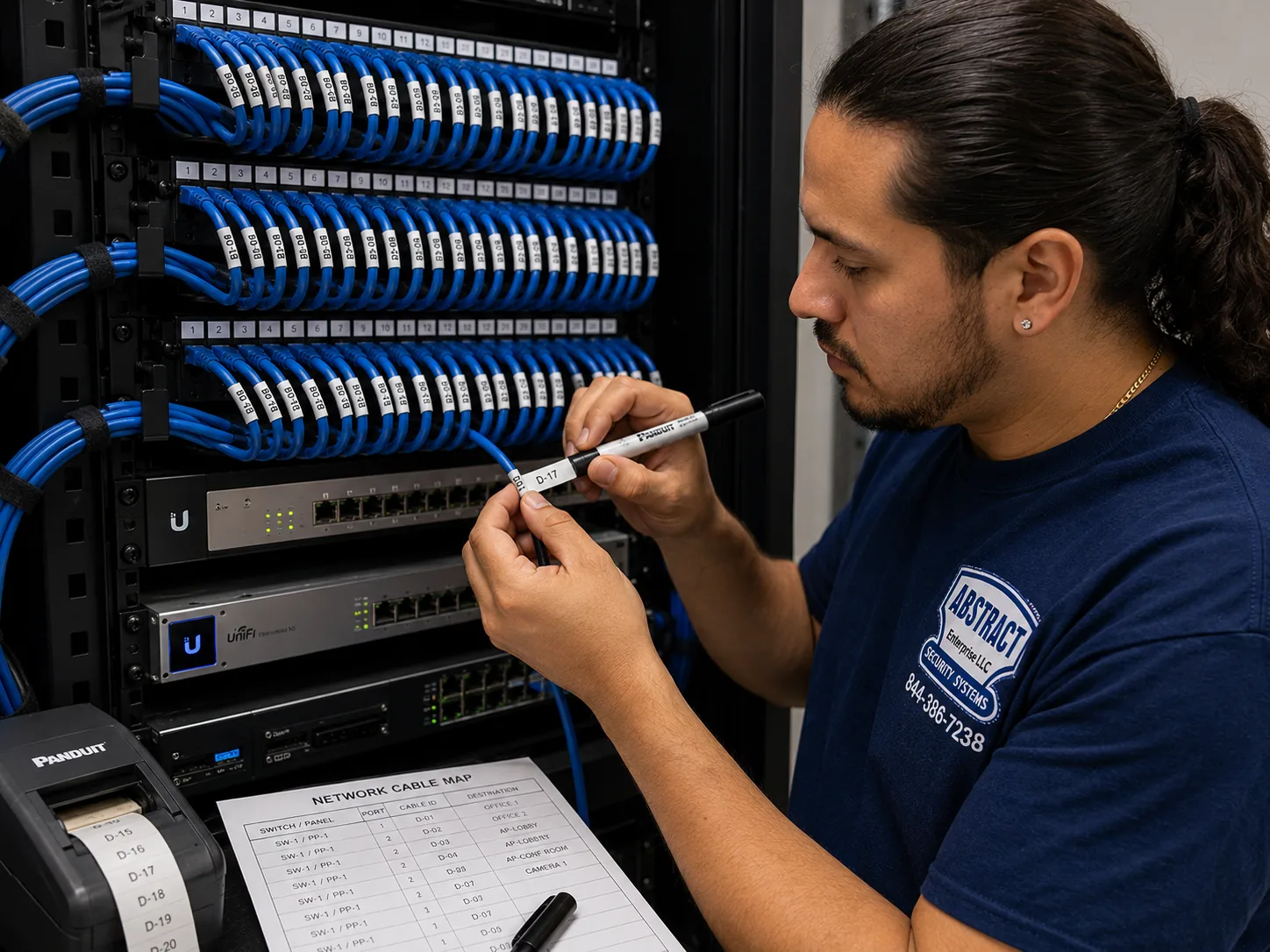
A camera job in Prospect Heights runs into more rules than in most Brooklyn neighborhoods, because the Landmarks rules sit on top of the ones that apply everywhere in the state. Here is how each set plays out on the houses, buildings and shops here.
The Landmarks Commission, on the front. In the historic district, the Landmarks Preservation Commission's rules set how many security cameras may go on the street side of a building, and its permit guidebook asks for manufacturer cut sheets for cameras, light fixtures, intercoms and mailboxes. Work that meets the rules can be approved by staff; work that does not goes to a public hearing. The same chapter of the guidebook says light fixtures and intercom panels must be installed within or adjacent to a door opening, and that one intercom panel can be installed per door opening, which matters when a camera, a light and an intercom all want the same spot. We give you the equipment details and photos for the application and do not put anything on the front until the permit is in hand.
Who may install. New York's General Business Law Article 6-D requires anyone in the business of installing or servicing security systems to be licensed. Owners installing cameras on their own property are a different case, but a contractor or handyman doing it for pay is not. Abstract Enterprises Security Systems holds NYS license #12000287431, and we send a copy to owners, boards and landlords who ask.
Where a camera may look. Civil Rights Law §52-a gives a resident a civil claim against a neighbor who records them where they reasonably expect privacy, and Penal Law §250.45 makes recording people in private places such as bathrooms or bedrooms without consent a crime. Row houses here share party walls and gardens backed by the windows of the next street, so every outdoor camera is framed on your own stoop, door, garden and fence, and anything else that falls in the frame is masked. Outerbridge Law notes that recording a tenant's conversation in a corridor or elevator without consent might break wiretapping laws, so we set building cameras to record video only.
Owners, boards and tenants. Brick Underground notes that renters need the landlord's permission to install equipment in common areas, including the hallway outside their own apartment, and an attorney answering on Justia notes that landlords and co-op boards can generally install cameras in lobbies, entryways, hallways and other shared spaces. In a row house split into apartments, the owner decides about the outside and the halls; in a co-op or condo, the board does. In the historic district, a tenant's ground-floor store shares the building's facade allowance, so the owner has the final word on the front.
Is anyone required to have cameras? One New York compliance guide notes that city law does not universally require apartment buildings to install security cameras. Sources disagree on whether a city law requires buildings with common-area cameras to notify residents: one installer cites "Local Law 50," another site cites "Local Law 3 of 2019," and we could not confirm either against an official source. Telling residents in writing where cameras are and who reviews footage is good practice regardless, and we recommend it to every board and owner.
Walls and openings. Every opening through brick or a mortar joint is sloped outward and sealed against water. Every opening through a fire-rated wall or floor in an apartment house, co-op or tower is sealed with rated firestop before we leave. Carved stone is never drilled.
These are the cameras and parts we expect to fit on Prospect Heights row houses, apartment houses, co-ops, towers and shops. For wired systems we install brands including Lorex, Hikvision, Dahua and Uniview, and each item is named on the written quote, with its manufacturer cut sheet available for a Landmarks application.
Low-profile domes that sit inside or beside a door opening on a landmarked front, the type the LPC guidebook illustrates, in a finish that suits the facade.
For garden doors, vestibules, cellar doors and the back wall, aimed for faces at close range and sharp at walking speed.
Adjustable lenses for deep gardens, long co-op corridors and shop floors, zoomed so the fence, the package shelves or the counter fill the frame.
For gardens and areaways after dark, keeping clothing and colors readable with the light already there.
Hard-cased domes for low positions under a water table, bar ceilings, cellar stairs and garages.
Sized for continuous recording and at least two weeks on entrance cameras, with synced clocks and separate accounts for each household or staff role.
Power and picture over one cable for co-ops, apartment houses and businesses where cameras outnumber the recorder's ports.
Keep the recorder, switch and modem running through a short outage so a flicker does not leave a gap.
A wall-mounted TV or monitor in the parlor, the kitchen, the lobby office or the back of a shop showing the stoop, garden and doors at a glance.
Plenty of owners here start with a video doorbell or a nationally advertised plan, and each has a place. This table compares how they fit the buildings here, without putting anyone's prices side by side.
| Question | Doorbell or self-install kit (Ring and similar) | National monitored plan (ADT, SimpliSafe and similar) | Abstract Enterprises Security Systems as a local installer |
|---|---|---|---|
| A landmarked row-house front | Still a device on the facade, so it still needs to fit the rules | Depends on the devices chosen | Front cameras counted against the allowance, cut sheets supplied for the application |
| Garden door, cellar door and rear garden | Wi-Fi often weak at the rear of a masonry house | Depends on the plan and add-ons | Wired cameras fed from the cellar, one recorder inside |
| Separate views for owner and tenants | Shared access varies by product | Varies by plan | Separate accounts with set limits before we leave |
| Crowded event nights | Motion clips, often many | Varies | Tight alert zones, continuous recording, two weeks or more on entrances |
| Ongoing fees | Optional cloud plans | Usually a monitoring contract | No monthly fee for a recorder system you own |
| Best fit here | A renter's door inside an apartment | Owners who want professional alarm monitoring | Row houses, co-ops, apartment houses and shops |


Quick answers from search tools, cost sites such as Angi, HomeAdvisor and Fixr, and AI summaries tend to treat Prospect Heights as either a generic brownstone block or a generic high-rise district. These are claims we see repeated about cameras here, written as summaries rather than quotations, and what the sources and the work show instead.
This one stops people from protecting their houses at all. It is true that most of the neighborhood sits in the Prospect Heights Historic District and that the Landmarks Preservation Commission regulates the fronts.
But the Commission's permit guidebook names security cameras and allows them: up to two per 25 feet of street frontage on small buildings and up to three on large ones, under LPC Rules Section 2-20, with staff approval for work that meets the rules.
The limit shapes the plan; it does not forbid one. Most row houses here end up with one or two small front cameras and the rest inside or at the rear.
Small cameras are easy to overlook from the sidewalk, and plenty go up without anyone asking.
CityLand reported that homeowners in Hamilton Heights, another historic district, received Landmarks violations for cameras they put up to catch graffiti vandals. The Commission's December 2025 presentation materials for a brownstone show how closely it reviews camera mounts, down to housing size and mock-ups.
Getting the permit first is cheaper than taking a camera down later. We supply the equipment details the application asks for.
The arena does change the neighborhood on event nights, and residents have described the noise, the crowds and the idling vehicles behind it.
We found no source that measures crime in Prospect Heights blocks against arena events, and we will not claim one. What the sources do show is crowds, and crowds are a design problem: alert zones, door-focused framing and storage, not more cameras.
The incidents in the local press, at cellar doors, mail bins, a counter and an office, call for the right few views, not cameras everywhere.
Some pages say the 78th Precinct, at 65 Sixth Avenue, covers the neighborhood.
Patch reports a split: the 78th covers the western side, from Flatbush Avenue to the western half of Vanderbilt, and the 77th covers the rest.
It matters when you hand over a clip. Ask the officer which precinct is handling the report, and name the camera and the time when you send it.
Battery cameras save running cable, which is real convenience, and they suit a renter's door inside an apartment.
On a landmarked front, a battery camera is still a device on the facade, so it still counts toward the street-side allowance and still needs to fit the rule. And at the rear of a masonry row house, Wi-Fi from a router on an upper floor is often weak.
For the garden, cellar and doors, wired cameras fed from the cellar record continuously and never need charging.
A tenant can put a camera inside their own apartment, aimed at their own door and rooms.
The hallway is a common area. Brick Underground notes that renters need the landlord's permission to install equipment there, including the hall right outside their door.
In a row house split into apartments, ask the owner in writing; in a co-op or condo, ask the board or management.
Building owners hear this from some installers' pages.
One New York compliance guide notes there is no universal requirement for apartment buildings to install cameras. Notice-law claims conflict: one page cites "Local Law 50," another "Local Law 3 of 2019," and we could not confirm either against an official source.
Our advice is the same either way: tell residents in writing where cameras are and who reviews footage, and keep cameras out of private spaces.
Send photos from across the street, from the top and bottom of the stoop, from the garden door, the cellar and the rear garden, or of your shop's door, counter, office and cellar, along with the address and who lives or works there. A technician will tell you whether the building is in the historic district, how many front cameras the rules allow, where the rest can go and what the quote will cover, before anyone visits. Call (347) 934-8335, message us on WhatsApp, or use the quick form.
Tell us the address, the kind of building or business, whether it is landmarked, how many households or staff use it, and which doors or rooms need cameras. Prefer to talk? Call (347) 934-8335.
Every Prospect Heights camera job, from a renter's single indoor camera to a four-story row house, a parkway co-op or a Vanderbilt Avenue restaurant, follows the same eight steps. Steps two and four carry the most weight here: checking the historic district and who signs off, and counting the front before the plan is drawn.
Photos of the stoop, parlor door, garden door, areaway, rear garden, cellar or counter, who owns the building, who rents part of it and who will watch the footage. Requests are booked within 2 hours.
Whether the building is inside the city historic district, and who approves: the owner, a co-op or condo board, a store's landlord, and the Landmarks Commission for front cameras.
From across the street to the top of the stoop, down to the garden door, through the cellar, out to the back fence and up through the halls, marking where faces and hands can be recorded.
One task per camera, named in plain words, with the front kept within the Landmarks allowance for the building's frontage.
Each camera, mount, cable run, opening, recorder, drive, battery unit, viewing screen and setup task listed, plus the cut sheets and photos a Landmarks application needs.
Cable through the cellar and interior chases, sealed openings in mortar joints, exposed runs in conduit, and the recorder in a locked, dry spot on battery backup.
Recorder synced to a time server, each cable certified, every view checked in daylight and after dark, alert zones that ignore the sidewalk, unique passwords and two-step sign-in.
Each household or staff member gets only their own views, the owner exports a test clip while we watch, and we leave a written map naming every camera.

These are places the sources tie to Prospect Heights or its edges, and what a camera job near each one tends to involve.
At 620 Atlantic Avenue since 2012; houses and bars on Dean Street and Sixth Avenue nearby need alert zones that ignore event-night crowds.
The Saturday Greenmarket, year-round from 8 a.m. to 4 p.m., and the prewar co-ops on Plaza Street, where lobby and package room cameras carry the load.
Across the parkway from the Central Library, Mount Prospect Park, the Botanic Garden and the Brooklyn Museum, where the parkway co-ops sit.
At 856 Pacific Street between Vanderbilt and Underhill avenues, built in 1912, on blocks of row houses and apartment houses.
Atlantic Avenue to Park Place, closed to cars Friday through Sunday, with restaurants and shops that need door, counter and cellar cameras.
At 65 Sixth Avenue, covering the western side of the neighborhood, with the 77th covering the east, according to Patch.
We also install security cameras in neighboring Crown Heights, Clinton Hill, Fort Greene, Bedford-Stuyvesant and Downtown Brooklyn, and across the rest of the borough from our Brooklyn security camera installation page.
A camera system for a Prospect Heights house, building or business is priced per job, on our Brooklyn rate, after we have seen photos or walked the building. We do not publish a single per-camera figure, because the labor behind each camera varies so much here. A rear-garden camera fed straight up from an open cellar is quick; a camera at the top of a four-story house reached through plaster walls, or a front camera that has to fit inside a carved door opening, takes far longer. What moves a Prospect Heights quote is mostly how many cameras the front may carry, whether the cellar gives a clear run from front to back, how far up the house the cable must climb, how many households or staff need their own accounts, how many days of recording you want, and whether any new outlet is needed from an electrician. Each of those is its own line on the written quote.
A few items have fixed published prices, and they come up often on camera jobs here, especially when an owner wants a screen in the parlor or kitchen showing the stoop, garden door and rear garden, or wants an existing system set up properly rather than replaced. Plaster walls and marble mantels are common in these houses, and both have fixed adds.
| Item (Brooklyn rate) | Price | When it applies on a camera job |
|---|---|---|
| Setup-only visit, first hour | $225, then 30-minute blocks | Setting up cameras or a recorder you already own: clock sync, names, accounts, alert zones and an export test |
| TV wall mounting, drywall on wood studs, up to 55 inches | From $209.99 (bracket sold separately) | A wall-mounted screen for watching the cameras |
| TV placed on its stand, no wall mount | $137.99 | A viewing screen set on a cabinet or counter |
| Plaster wall add | $45 | Mounting the screen on original plaster |
| Brick or stone wall add | $65 | Mounting the screen on an exposed brick wall |
| Above-fireplace mounting add | $130 | Mounting the screen above a parlor mantel |
| In-wall concealment with code-compliant in-wall power and cable kit | $169 | Hiding the screen's power and cable inside the wall |
| Paintable cord cover | $59 | Covering the screen's cords where in-wall work is not wanted |
| Take down old TV | $85 | Removing an old screen first |
| Soundbar wall-mounted / placed | $129 / $79 | If the viewing screen doubles as the household TV |
Everything else on a camera job, including cameras, recorders, drives, cable runs, mounts, conduit and labor, is priced in writing for your building before any equipment is ordered, and nothing is added later without your agreement.
Full terms — including 50% deposit, the 30-day warranty and optional paid extended warranty, and the late-fee schedule — are set out in the service agreement.Most Prospect Heights jobs fall into one of three shapes. Each is quoted in writing for your building, because the cellar route, the height of the house and the facade allowance decide the labor; the descriptions show what each typically covers.
One or two front cameras within the Landmarks allowance, covering the parlor door, stoop and garden door, plus a rear-garden camera, on a recorder inside the house with continuous recording and an owner account. Priced in writing after photos.
Front, vestibule, cellar door, rear garden and stair cameras for a row house, with separate accounts for the owner and each tenant household, battery backup and storage for two weeks or more. Priced in writing after a walk-through.
Lobby, package room, service entrance, cellar and elevator cameras for a co-op or apartment house, or door, counter, office, cellar and ATM cameras for a restaurant, bar or shop, with a PoE switch and a viewing screen where useful. Priced in writing after a walk-through.
Some owners arrive with a kit bought online or a system left by the previous owner. If the cameras are already mounted and only need proper setup, a setup-only visit is $225 for the first hour, then 30-minute blocks, and covers syncing the recorder clock, naming each camera, setting separate accounts, drawing alert zones that ignore the sidewalk and practicing an export. If the cameras still need mounting and wiring, we quote the labor in writing after seeing the equipment and the building. If a camera from a kit is too large or the wrong shape for a landmarked door opening, or a wireless camera cannot reach the rear garden from your router, we say so before any work starts.
Front, garden door, cellar and rear-garden cameras for single-family and rental row houses, planned to the Landmarks allowance. Request a quote.
Lobby, package room, service entrance and hall cameras with board-approved access lists.
New cameras and inherited systems in Pacific Park and the glass condos near Grand Army Plaza.
Door, counter, office and cellar cameras along Vanderbilt, Washington, Flatbush and Sixth avenues. More borough options on our Brooklyn camera page.
The setup-only visit is $225 for the first hour on our Brooklyn rate, then billed in 30-minute blocks. In that time we sync the recorder clock to a time server, give each camera a plain name such as parlor door or rear fence, set up separate accounts for each household, draw alert zones that ignore the sidewalk, set new passwords and two-step sign-in, and have you export a test clip while we watch.
Wall mounting a screen up to 55 inches starts at $209.99 for drywall on wood studs, with the bracket sold separately, and mounting on plaster adds $45. If an old TV has to come off that wall first, taking it down is $85. If you would rather not mount anything, placing a TV on its own stand is $137.99.
Usually, yes. Mounting above a fireplace adds $130 to the wall mounting price, and if the chimney breast is exposed brick or stone rather than plaster, the brick or stone add of $65 applies instead of the plaster add. We check the height first, because a screen set too high over a mantel is hard to watch from a sofa.
There are two. In-wall concealment with a code-compliant in-wall power and cable kit is $169 and leaves nothing showing below the screen. Where you would rather not open the wall, a paintable cord cover is $59 and can be painted to match the room.
The LPC permit guidebook says light fixtures must be installed within or adjacent to a door opening, so a light for the stoop camera belongs at the door, not elsewhere on the front, and the guidebook asks for manufacturer cut sheets for fixtures just as it does for cameras. A licensed electrician wires any new fixture. Often a low-light color camera works with the light already at the door, and we test that at night before suggesting a new fixture.
The LPC guidebook treats intercom panels and security cameras in separate passages: one intercom panel per door opening, within or adjacent to it, and a separate camera allowance counted by street frontage. Whether a camera built into an intercom panel is counted as a camera is a question for LPC staff, and we ask it when the application is prepared rather than assume the answer.
Brooklyn Security Camera Installation · Security Camera Installation NYC | Licensed Installer · Security Cameras Installed in Manhattan · Security Camera Installation Queens NY · Security Camera Installation Bronx | No Monthly Fees · Staten Island Security Camera Installation · Long Island Security Camera Installation NY · Hudson Valley Security Cameras · Security Camera Installation Nassau County NY · Security Camera Installation Suffolk County NY · Westchester Security Camera Installation · Rockland County Camera Installation · Orange County NY Security Cameras · Putnam County Camera Installation · Dutchess County Security Cameras · Ulster County Security Camera Installation | Kingston NY
Security Camera Installation Bath Beach Brooklyn NY · Security Camera Installation Bay Ridge Brooklyn NY · Security Camera Installation Bedford-Stuyvesant Brooklyn NY · Security Camera Installation Bensonhurst Brooklyn NY · Security Camera Installation Bergen Beach Brooklyn NY · Security Camera Installation Beverley Square Brooklyn NY · Security Camera Installation Boerum Hill Brooklyn NY · Security Camera Installation Borough Park Brooklyn NY · Security Camera Installation Brighton Beach Brooklyn NY · Security Camera Installation Brooklyn Chinatown Brooklyn NY · Security Camera Installation Brooklyn Heights Brooklyn NY · Security Camera Installation Brooklyn Navy Yard Brooklyn NY · Brooklyn Security Camera Installation · Security Camera Installation Brownsville Brooklyn NY · Security Camera Installation Bushwick Brooklyn NY · Security Camera Installation Cadman Plaza Brooklyn NY · Security Camera Installation Canarsie Brooklyn NY · Security Camera Installation Carroll Gardens Brooklyn NY · Security Camera Installation City Line Brooklyn NY | Abstract Enterprises Security Systems · Security Camera Installation Clinton Hill Brooklyn NY · Security Camera Installation Cobble Hill Brooklyn NY · Security Camera Columbia Street Brooklyn NY · Security Camera Installation Coney Island Brooklyn NY · Security Camera Installation Crown Heights Brooklyn NY
Door Buzzer Repair Prospect Heights Brooklyn NY · Structured Cabling Installation Prospect Heights Brooklyn NY · TV Installation Prospect Heights Brooklyn · Access Control Installation Prospect Heights Brooklyn NY · Intercom Installation Prospect Heights Brooklyn NY | Abstract Enterprises Security Systems · Fire Alarm Installation Prospect Heights Brooklyn NY · Alarm Installation Prospect Heights Brooklyn NY | Event Days