A six-story rental with dead foyer stations, a postwar co-op ready to retire its lobby panel, or a house thirty feet back from the parkway with no way to see who is at the gate? Ocean Parkway door buzzer installation line: (347) 934-8335
Six-Story Prewar Rentals · Postwar Elevator Co-ops · Full-Service Co-ops · Newer Small Condos · Houses Behind the 30-Foot Front Yard · Ground-Floor Practices
Door Buzzer Installation in Ocean Parkway
Building Record Read First · Every Door Pushed Before Wiring · Riser Tested Section by Section · Written Price Before Ordering · Brooklyn Rate
Door buzzer installation on Ocean Parkway starts with an unusual amount of public evidence. The parkway's frontage is lined with six-story apartment houses from the 1920s through the 1960s, many with sixty to more than a hundred apartments, and the city's own violation records show what goes wrong at their entrances: foyer stations that stopped calling, vestibule relays that stopped releasing, and street doors whose hinges, latches or frames failed. Behind the thirty-foot front yards that the parkway's zoning requires, the job is to give every apartment a station that rings, a release that opens a door that actually latches, and power that survives an outage. This page explains how we plan that for each kind of building along the parkway and where it falls on our Brooklyn price list.
Every price comes from our Brooklyn door buzzer list, and the total, with each possible extra named, is agreed in writing before anything is ordered
Rated 4.7★ across 201 Google Reviews
Reviewed and updated November 11, 2026, against HPD Housing Maintenance Code violation records for Ocean Parkway published on NYC Open Data (dataset wvxf-dwi5, read November 11, 2026); New York's Multiple Dwelling Law §50-a; NYC Administrative Code §27-2005, §27-2041.1 and §27-2043; Zoning Resolution Article XI, Chapter 3 (Special Ocean Parkway District, §113-12); the Landmarks Preservation Commission's 1975 Ocean Parkway scenic landmark designation report (LP-0871); building records from openigloo and CityRealty; News 12 Brooklyn's April 8, 2026 report from 514 Ocean Parkway; BoroPark24's November 12, 2024 report from Ocean Parkway and Cortelyou Road; Habitat magazine's December 2015 article on a Ditmas Park co-op's entry system; two Brownstoner forum threads; ButterflyMX's intercom replacement guide; the HomeAdvisor and Swiftlane cost guides; Allegion's fail-safe and fail-secure guide; the building code's sensor-release provisions; and the 2010 ADA Standards. · Abstract Enterprises Security Systems, NYS license #12000287431 · crews dispatched from our Troy Avenue office in Brooklyn
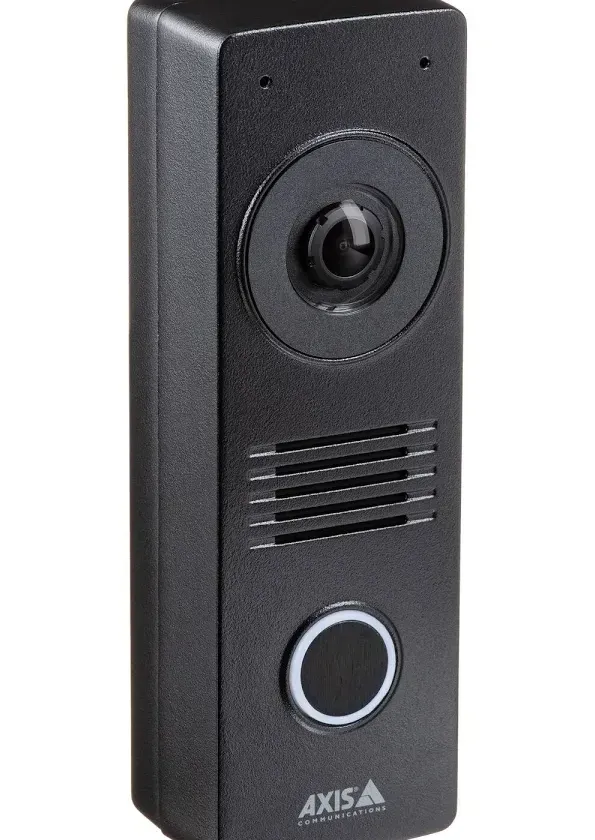
A photo from the AESS job library, not taken on Ocean Parkway: a black rectangular video door station with a camera lens, a speaker grille and one round call button that lights up. A single-button station like this suits a detached or semi-detached house on the parkway frontage, where a visitor has to cross a thirty-foot front yard and the household wants to see that person clearly before anyone walks down to the door.
Ocean Parkway Buzzer Request
Six-story rental, co-op, condo, house behind the front yard or a ground-floor practice: tell us the address, how many apartments the system reaches and which doors people use, and a technician calls back with the range
✅
Request Sent!
Thank you. A technician will call you about the Ocean Parkway address, usually within two hours during working hours.
25+
Years Experience
✓
Same-Day Estimates
100%
Licensed & Insured
4.7★
201 Google Reviews
Owner-operated since 2002 · Thousands of jobs completed · Booked within 2 hours
Quick answer: door buzzer installation on Ocean Parkway costs $400 to $900 on our Brooklyn list for an audio buzzer with a new door release on a house or a single office door, $700 to $1,800 for a video door station with indoor monitors or phone answering on a house or a small building, and from about $2,500 to past $10,000 for a full entry system serving every apartment in one of the parkway's six-story rentals or co-ops. Each price includes the door station, the answering units, the power supply, the electric strike or approved lock, the cable and the labor. It is fixed in writing after we have seen the doors and tested the old cable, and anything that depends on a test, such as a riser pair that might fail or an entrance door whose hinges or closer must be fixed before a release can hold it, is named and priced before you order. Send photos of the entrance and the panel beside it to (347) 934-8335 or on WhatsApp, and we answer with the range that fits, usually within two hours of your message during working hours.
Reviewing your photos and quoting a new system costs nothing. If an existing system has to be diagnosed in person before we can quote, that is the $250 service call booked online, and the $250 is applied toward the work.
All work is done under New York State license #12000287431. We install low-voltage entry equipment; if a door needs a new 120-volt outlet or circuit for its power supply, a licensed electrician does that part, and you know before the job is priced.
We work for whoever controls the entrance: the owner of a house or building, a co-op or condo board or its managing agent, or an office or practice tenant with the landlord's written approval.
The Neighborhood
Why Ocean Parkway Properties Need Door Buzzer Installation
Ocean Parkway is a road before it is a neighborhood. Olmsted and Vaux's boulevard runs about five and a half miles from the circle at the southwest corner of Prospect Park down to Coney Island, and the blocks along it pass through Kensington, Midwood, Homecrest, Gravesend and Sheepshead Bay on the way. People who live on it give their address as "Ocean Parkway" no matter which of those neighborhoods the map shows, and for a buzzer job that address tells us a great deal, because the buildings that face the parkway were built to a pattern that repeats for miles.
That pattern is the six-story apartment house. Building records show how consistent it is. 230 Ocean Parkway, between Church Avenue and Beverley Road, went up in 1926 with 60 rental apartments on six floors. 1777 Ocean Parkway in Homecrest dates from 1926 with 75 units. 1628 Ocean Parkway, built in 1928, has 123 units on six floors. 39 Ocean Parkway, from 1929, has 83. Then the late 1930s and 1940: 240 Ocean Parkway in 1938 with 55 units, 1440 Ocean Parkway in 1939 with 60, 125 Ocean Parkway in 1940 with 84. Even the postwar buildings kept the height, such as 399 Ocean Parkway, a six-story building of 68 units finished in 1963. Dozens of entrances, each serving fifty to more than a hundred households, almost all wired long before modern entry systems existed.
The city's records show what happens when those entrances age. Since 2002, HPD inspectors have written 165 Housing Maintenance Code violations at Ocean Parkway addresses in Brooklyn whose descriptions name an intercom or buzzer, according to the agency's violation data on NYC Open Data. The count has risen: 9 in 2021, 12 in 2022, 21 in 2023, 14 in 2024 and 24 in 2025, the highest of any year in the data, spread across a dozen buildings. Ten more had been written in 2026 by November 10. The wording is specific in a way that helps anyone planning a replacement: "broken or defective bell buzzer intercom system from the building entrance door to panel at north wall in the foyer," "defective intercom relay from vestibule door," "replace with new the missing intercom system on north wall in the foyer." Those are the three ways a parkway system usually fails: the apartment station, the release circuit and the station that simply is not there anymore.
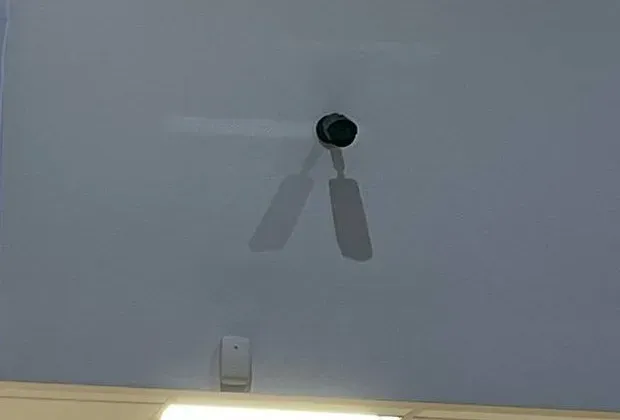
A photo from the AESS job library, not taken on Ocean Parkway: a small black camera mounted high on a pale wall, casting two shadows, with a small white wall device below it. In the vestibule of a six-story parkway building, a camera placed this high looks down on the inner door and the mailboxes, which is where a person who slipped in behind a resident ends up, even when the door station's own lens faces the front yard.
The doors fail too, and a buzzer is only as good as the door it releases. In September and October 2026 alone, HPD wrote immediately hazardous Class C violations on Ocean Parkway for a defective latch at the vestibule door of 1440 Ocean Parkway, defective hinges at the building entrance door of 2265 Ocean Parkway, a defective door frame at the vestibule door of 269 Ocean Parkway, and a brick wedged into a door to the public hall in the cellar of 800 Ocean Parkway. A former tenant of 1628 Ocean Parkway described the problem in plain words on openigloo: "the doors don't close because everything has a million layers of paint." A release that clicks against a door standing ajar does nothing for anyone, so on the parkway the door is always checked before the wiring.
Residents say what they want. A former tenant's advice to the owners of 39 Ocean Parkway, posted on openigloo, was five words long: "Update to a video intercom for security." At 101 Ocean Parkway a tenant wrote that "package theft used to be a big issue but not so much right now." In November 2024 BoroPark24 reported the 66th Precinct's appeal after someone "entered a residential building in the vicinity of Ocean Parkway and Cortelyou Road" and took a resident's credit card from a mailing envelope. And in April 2026 News 12 Brooklyn filmed water pouring through the lobby ceiling of 514 Ocean Parkway, where a longtime tenant said, "Literally, you need rubber boots to get to the mailbox." Not one of those is a break-in through a window. Each is about the few square feet between the street door and the mailboxes, and who controls them.
Finally, the setback changes the experience at the door. The parkway's special zoning district requires a thirty-foot front yard along every lot that faces it, kept open and landscaped, so the entrance of a parkway building sits well back from the sidewalk and the service road. A visitor stands at a station thirty feet from the street, often in the shade of trees and hedges, and a resident upstairs has to decide from a voice, or from a picture if there is one, whether to press release. That is why lighting, camera angle and a clear speaker matter more here than on a block where every door is on the sidewalk. Buildings that also want a camera over the front walk or a keypad on the cellar door can plan both into the same visit and the same written price.
Six facts that shape an Ocean Parkway buzzer installation
The intercom record is public and growing. HPD's violation data lists 165 intercom or buzzer violations at Ocean Parkway addresses since 2002, with 24 in 2025 across 12 buildings, the most in any year so far.
A few buildings account for many of them. Since January 2021, 1628 Ocean Parkway has drawn 21 of those violations, 230 Ocean Parkway 8, 1440 Ocean Parkway 7 and 716 Ocean Parkway 5, which is the pattern of a system repaired one apartment at a time.
The typical building is six stories and large. The parkway buildings we found in public records run from 55 to 123 apartments on six floors, built between 1926 and 1963, so riser cable and directory size drive most quotes.
Most of them predate the 1968 line. Multiple Dwelling Law §50-a requires an intercom automatically only in buildings put up or converted after January 1, 1968 with eight or more apartments; a newer building like the 13-unit 423 Ocean Parkway, built in 2004, is on the other side of it.
Every entrance sits behind a thirty-foot yard. Zoning Resolution §113-12 requires a thirty-foot front yard along the parkway and bars porches, canopies and stairs from projecting into it, so the station is mounted on the building, not out at the sidewalk.
The landmark stops at the curb. The Landmarks Preservation Commission's 1975 designation of Ocean Parkway as a scenic landmark is bounded by the outer curbs of the service roads, so the facades and entrances of the buildings themselves are not part of it.
Where this page applies. This page covers buildings with an Ocean Parkway address and those on the side streets just off it, from Church Avenue at the Kensington end down to Seabreeze Avenue near Coney Island. Billing is the same Brooklyn rate along the whole length. For the rest of the borough see our door buzzer installation in Brooklyn page, and for the whole city our NYC door buzzer installation page.
Repair or Replace on Ocean Parkway
Need Repair on Ocean Parkway? Reading the Violation Wording to Decide Between One Station, the Release Circuit and a New System
Many calls about "a new intercom" on the parkway come from an owner or managing agent holding a violation notice, or from a board that has paid for the same repair several times. Before anyone buys a panel, we sort the job into one of three paths, and on Ocean Parkway the inspector's own wording is often the best first clue.
When a notice reads "from the building entrance door to panel at north wall in the foyer," the inspector stood in one apartment and found that the station on the foyer wall did not ring or did not talk. That can be one dead handset, one broken pair in the riser or a failed line card serving a whole vertical line of apartments. When a notice reads "intercom relay from vestibule door," the voice may work while the release does not, which points at the relay, the strike or the power supply. And when a notice reads "replace with new the missing intercom system," a tenant has been living without a station at all, often because a previous repair took it off the wall and nobody put one back.
If the pattern is a single apartment, a targeted repair is the honest answer, and we price it as one. If the same building keeps drawing notices from different floors, as 1628 Ocean Parkway did with twenty-one intercom or buzzer violations between 2021 and November 2026, the trouble is usually the riser or a controller near the end of its life, and fixing one foyer at a time costs more over a few years than a new system would. ButterflyMX's replacement guide lists the same warning signs we see: static or humming, a release that fails "due to old wiring, broken buttons, or a dead strike," and an owner "frequently needing repairs." When replacement makes sense, we explain what it adds and how much of the old cable it can reuse, and the price comes from the Brooklyn list either way.
What We Install
Door Buzzer Installation Services in Ocean Parkway
Every service below is priced from the same Brooklyn door buzzer list. On Ocean Parkway the number of apartments sets the size of the system, the condition of a six-floor riser decides much of the labor, and the state of the entrance door, its hinges, latch and closer, decides whether a release will hold it.
Whole-building replacements for six-story houses
Directory, code or button panels at the entrance, with apartment stations or phone answering for buildings of fifty to more than a hundred and twenty apartments, riser cable tested floor by floor.
Foyer station replacements by line
New apartment stations for a vertical line of apartments that has stopped ringing, matched to the existing panel where it is sound, with the line's riser pair tested before the stations go on the wall.
Vestibule release and relay work
New relays, strikes and power supplies for entrances where residents can talk to a visitor but cannot open the door, the failure the city calls a defective "intercom relay from vestibule door."
Video and phone answering
Video door stations with indoor monitors, or panels that ring residents' phones, for buildings where tenants ask to see who is waiting thirty feet back from the street before they press release.
Cellar, laundry and garage doors
Keypads or call stations on the doors that tenants and staff keep wedging open, such as the door from the cellar to the public hall and the laundry room door, so they can lock without inconveniencing anyone.
House stations behind the front yard
Audio or video stations for detached and semi-detached houses on the parkway frontage, with a release on the front door and, where the household wants one, a chime or monitor on every floor.
Door preparation and closers
Closers adjusted or replaced, latches and hinges put right and frames trued, so the door shuts and latches on its own before any strike is cut into it.
Power supplies and backup
Dedicated low-voltage supplies with battery backup, mounted in the cellar room where the riser begins, off the floor and away from leaks, with every breaker and outlet labeled.
Practice and office doors
Buzz-in doors for ground-floor offices and practices in parkway apartment buildings, with the release at the front desk, kept fully apart from the building's own system.
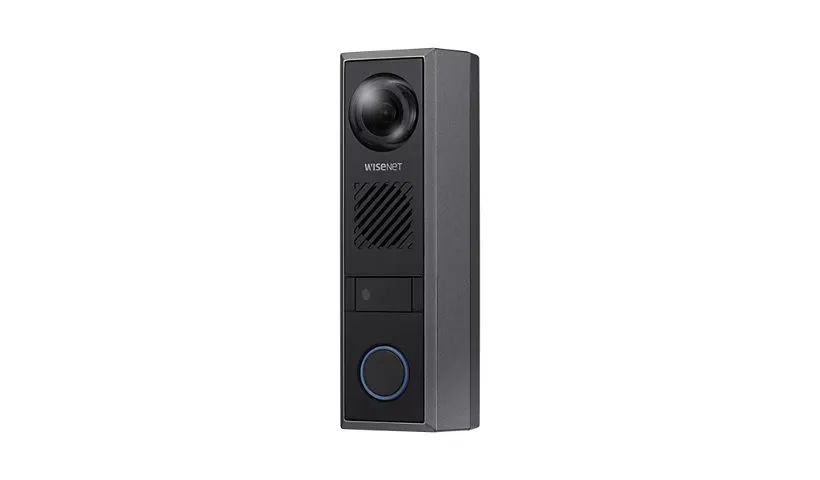
A photo from the AESS job library, not taken on Ocean Parkway: a slim dark grey wired doorbell with a camera lens, speaker slots and a round push button. On a house behind the parkway's thirty-foot front yard, a unit this narrow fits the trim beside the front door, and because it is wired to a proper supply rather than a battery, it keeps ringing and recording through a cold January without anyone climbing up to recharge it.
Building Specialists
Door Buzzer Installation for Ocean Parkway's Architecture
Six kinds of building account for nearly every buzzer installation we plan along the parkway. They differ in how many apartments the panel has to reach, how old the riser is, how the entrance is arranged and who has the authority to order the work, and each one has a mistake that shows up when the job is rushed.
1920s six-story rentals
Buildings such as 230 Ocean Parkway (1926, 60 apartments) and 1628 Ocean Parkway (1928, 123 apartments), with long risers, a vestibule with mailboxes, and decades of piecemeal intercom repairs.
Late-1930s and 1940 apartment houses
Six-story buildings such as 240, 1440 and 125 Ocean Parkway, built between 1938 and 1940 with 55 to 84 apartments, often with an elevator and a live-in super.
Postwar elevator co-ops
Six-story buildings finished in the 1950s and 1960s, such as 399 Ocean Parkway from 1963, now run by boards that compare bids and vote on the budget.
Full-service co-ops
Larger co-ops near the Prospect Park end, such as 135 Ocean Parkway, described in its listing as a full-service building with a full-time doorman, video security and a live-in super.
Newer small condos
Infill buildings from the last few decades, such as 423 Ocean Parkway, built in 2004 with 13 units on eight floors, which fall on the post-1968 side of the intercom law.
Houses behind the setback
Detached and semi-detached houses on the parkway frontage, many enlarged over the years, set behind the required thirty-foot front yard with the front door well back from the sidewalk.
1920s six-story rentals: a riser that has been repaired one foyer at a time
The oldest apartment houses on the parkway are also the ones whose intercom records are longest. In a building like 1628 Ocean Parkway, with 123 apartments, HPD's violations since 2021 name stations on north walls and south walls, foyers and private hallways, from the first story to the sixth, in several lettered sections of the building. That spread tells us the problem is not one handset. It is a riser carrying pairs that have been spliced, re-terminated and bypassed for decades, a panel whose replacement parts are hard to find, and a power supply that may have been moved more than once.
The mistake here is replacing the entrance panel and leaving the riser as it is. A new panel on a failing riser produces the same notices a year later, now blamed on the new equipment. We test the riser line by line before quoting, and the quote states which lines can carry a new system over their existing pairs and which need new cable or phone answering instead.
Late-1930s and 1940 apartment houses: the vestibule and the inner door
Buildings such as 240 Ocean Parkway from 1938, 1440 Ocean Parkway from 1939 and 125 Ocean Parkway from 1940 usually have an outer street door, a vestibule with the mailboxes and the panel, and an inner door into the lobby. The release normally belongs on the inner door, so that the mailboxes and the lobby are both behind a lock, while the outer door may stay unlocked during the day. In 2026 HPD cited 1440 Ocean Parkway for a defective latch at its vestibule door, and that is the door a new release depends on.
So the door work comes first: the latch, the closer and the frame are put right, then the strike is cut, then the station goes on. In a vestibule with a ceiling leak or a radiator, the panel and its wiring are also placed where water and heat cannot reach them.
Postwar elevator co-ops: a board, a budget and a cable decision
A 1963 co-op such as 399 Ocean Parkway, with 68 apartments on six floors, is run by a board that decides on the system after comparing bids, and its shareholders live with the choice for years. The central question is usually cable. Habitat magazine described a 114-unit co-op in neighboring Ditmas Park, built in 1961, that replaced its hardwired intercom with a telephone entry system after learning that rewiring the building would have cost about $70,000, against $7,000 for the phone system. That was a decade ago, and both prices have moved, but the shape of the decision has not: test the existing pairs, price both routes and show the board the difference.
Boards also ask whether residents without smartphones can still answer, what the monthly fees are and how the system will be maintained. We answer all three in writing with the quote.
Full-service co-ops: a desk, a door station and the hours between shifts
Some co-ops near the Prospect Park end staff the lobby. A building like 135 Ocean Parkway, listed as a full-service co-op with a full-time doorman, video security and a live-in super, still needs an entry system, because the desk is not always staffed, the doorman steps away to take a package or help a resident, and side and garage doors need their own control. A good installation lets the station ring the desk when it is staffed, ring apartments directly when it is not, and give the doorman a release that works from wherever he stands.
The mistake is wiring the panel so that only the desk can answer. When the desk is empty, the door should still reach the apartments.
Newer small condos: an obligation from day one
A building like 423 Ocean Parkway, built in 2004 with 13 units on eight floors, is newer than the 1968 date in Multiple Dwelling Law §50-a and large enough to be covered by it, so its talk-and-release intercom is a legal requirement, not an amenity. Condo buildings of this age usually have a video or audio system already, and their typical problem is a discontinued model or a cloud service the original developer set up and nobody now manages.
Houses behind the setback: thirty feet between the gate and the door
The parkway's zoning encourages large one- and two-family houses in its subdistrict, and many of them have been enlarged or combined over the years. They share one feature that matters for a buzzer: the front door is far from the sidewalk. A visitor walks up a front path through a yard that, under §113-12, cannot have a porch, canopy or stair projecting into it, and arrives at a door that faces the parkway's traffic and trees.
For these houses the station is chosen for the view and the light: a video station at the front door, lit well enough to show a face at night, with chimes or monitors on each floor and a release on the front door. Where the household wants to answer from anywhere, the station can ring phones as well. If there is a locked gate at the sidewalk, it can be added to the system, but the cable route under the front path is part of the quote, not a surprise.
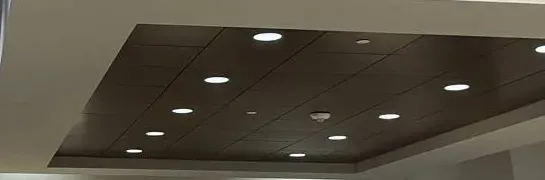
A photo from the AESS job library, not taken on Ocean Parkway: a dark recessed ceiling panel with round downlights and a small round device, framed by a lighter ceiling. Postwar co-op lobbies along the parkway have often been refinished with ceilings like this, and the space above a dropped or recessed section is usually the cleanest route for new cable from the entrance panel back to the riser closet.
Field Notes
Field Notes: Start at the Sidewalk, Push Every Door, Then Read the Riser Line by Line
This is our technician's standard first hour at a parkway building, before anything is priced.
First, the walk. The technician starts on the sidewalk by the service road and walks the front path the way a visitor would, noting how far the entrance is from the street, how the hedges and trees shade it at different times of day, and whether a person standing at the station can be seen and heard from inside. Then the side and rear: the cellar door, the laundry room, the garage ramp, the door the super uses for the bins. Each door gets a note: what it is made of, who uses it and whether it should call, release or stay key-only.
Second, the push test. At every door the technician opens it, lets go and watches. Does the closer bring it all the way shut? Does the latch catch without a tug? Is anything holding it open: a brick, a folded piece of cardboard, a door so thick with paint that it binds in the frame? A door that does not close will defeat any release, so its repair is priced first.
Third, the riser. In the cellar the technician finds the power supply and the point where the intercom cable leaves for the floors above, then meters each pair, line by line, against the list of apartments that have been cited or have complained. A line that tests clean can carry a new station; a line with a short or high resistance is marked for new cable or phone answering. Every decision is written on the quote, so the board or owner sees exactly what is being reused before approving.
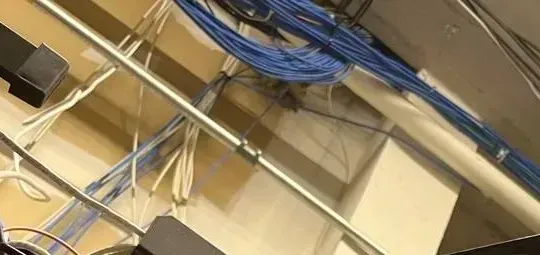
A photo from the AESS job library, not taken on Ocean Parkway: bundles of blue low-voltage cable laid over a ceiling beam beside a metal pipe in an open ceiling. In the cellar of a six-story parkway building, new buzzer cable follows the same kind of route along the beams to the riser, kept clear of steam and water pipes rather than strapped to them, so the next plumbing job does not cut it.
The Public Record
What HPD's Intercom Violations Say About Ocean Parkway Entrances
HPD publishes every Housing Maintenance Code violation it writes, and the descriptions are detailed enough to be useful. We read the record for Ocean Parkway in Brooklyn on November 11, 2026, counting every violation whose description names an intercom or buzzer. The totals by year show the trend.
Year
Intercom or buzzer violations at Ocean Parkway addresses
Buildings cited
2017
14
8
2018
9
7
2019
4
3
2020
5
3
2021
9
8
2022
12
10
2023
21
11
2024
14
11
2025
24
12
2026, through November 10
10
7
Over the whole record, back to 2002, the count is 165. Three things stand out when the individual entries are read rather than counted.
The failures sit in the apartments as often as at the door. Most notices locate the defect at a station in an apartment foyer or private hallway, "from building entrance to return buzzer at north wall in the foyer," rather than at the panel outside. For a replacement, that means the apartment stations and the riser that feeds them deserve as much attention as the entrance panel, which is the part everyone sees.
Some buildings are cited again and again. Since 2021, 1628 Ocean Parkway accounts for 21 of the notices, 230 Ocean Parkway for 8, 1440 Ocean Parkway for 7 and 716 Ocean Parkway for 5. Several more, including 1201, 1075, 1802, 465 and 602 Ocean Parkway, have 3 each. Repeated notices in one building, from different floors and sections, are the clearest sign that patch repairs have run their course.
The language names every part of the system. Between them, the notices cite the "bell buzzer intercom system," the "return voice," the "intercom relay from vestibule door," the "intercom panel at north wall of vestibule at street entrance to building," and even a "tele communication intercom system from the building's vestibule to tenant's tele devices," a system that rang residents' phones. A replacement has to restore whichever of those the building relies on, and the test sheet we leave behind shows each one working, apartment by apartment.
A violation record is not a judgment on any particular owner; buildings with large numbers of apartments simply have more stations to fail. But it is a free, public map of where a parkway system is weakest, and we read it for every building we quote.
Power and Equipment Placement
Keeping the Power Supply, the Panel and the Release Away From Water, Heat and Tampering
Every entry system has a part residents never see: the power supply, and in a large building a controller feeding each vertical line of apartments. In many parkway buildings it sits in the cellar near the boiler room, sometimes on a shelf, sometimes on the floor, wired years ago to whatever outlet was closest.
Water is the main enemy. The lobby leak News 12 Brooklyn filmed at 514 Ocean Parkway in April 2026 had been coming through the ceiling "on and off" for about two months, by a tenant's account, right over the mailboxes, which is exactly where a lobby panel and its wiring usually run. Before we mount a new panel or run cable through a ceiling with a history of leaks, the source has to be stopped, and the new equipment goes where the water was not. In the cellar, the supply and controller go on the wall, off the floor, in a locked box, away from pipes that sweat or drip.
Wherever it goes, three things go with it: a battery backup, so the door station and release keep working for a period during an outage; a clear label on the supply, the outlet and the breaker; and a written record, left with the owner, board or managing agent, of where the supply is, what it feeds and which pair goes to which apartment. If the supply needs a new dedicated outlet or circuit, a licensed electrician does that part, and you know before the job is priced.
Rules and Responsibilities
Which Ocean Parkway Buildings Must Have a Buzzer, What the Door Must Do and What the Parkway's Own Rules Change
Post-1968 buildings with eight or more apartments must have one. Under New York's Multiple Dwelling Law §50-a, every Class A multiple dwelling erected or converted after January 1, 1968 with eight or more apartments must have an intercom at the self-locking main entrance that lets a visitor and a resident speak and lets the resident release the door from the apartment.
Older buildings must install one when a majority of tenants ask. For buildings put up before that date, which includes nearly every six-story house on the parkway, the duty arises when tenants occupying a majority of the apartments request or consent in writing; installation then has to start within 90 days and finish within six months.
Once a system is there, HPD expects it to work. The parkway's violation record cites §27-2005 of the Housing Maintenance Code, the owner's general duty to keep the building in good repair, for broken buzzers and intercoms. HPD's notices on the parkway have been written as Class A, B and occasionally C, depending on the condition.
Self-closing doors are their own duty. NYC Administrative Code §27-2041.1 requires self-closing doors in a multiple dwelling to be kept in good repair, and the notices written on the parkway in 2026 for defective latches, hinges and frames at entrance and vestibule doors, and for bricks and cardboard holding doors open, were Class C, immediately hazardous.
Apartment doors keep their own hardware. Under §27-2043, apartment entrance doors in a Class A multiple dwelling need a heavy-duty latch set and a heavy-duty dead bolt. A new entrance release does not change those, and neither does a video station in the apartment.
The front yard stays open. Zoning Resolution §113-12 requires a thirty-foot front yard along the parkway and bars porches, canopies and stairs from it. A door station, a camera or a light mounted on the building's own wall is not a projection into the yard, but a new entrance canopy or a freestanding call post in the yard is a zoning question to settle first.
The scenic landmark ends at the curb. The Landmarks Preservation Commission's 1975 designation covers the roadway, the malls and the service roads to their outer curbs, not the buildings behind them. Unless a particular building is landmarked in its own right, a door station on its facade needs no Commission permit.
Houses are outside the multiple-dwelling rules. A one- or two-family house is not a multiple dwelling, so its buzzer is the owner's choice and the owner's to maintain.
None of this is legal advice for a particular building. An owner facing a tenants' request or an open HPD order, or a board unsure of its obligations, should check the details with a housing lawyer or the managing agent. What we provide is a system that meets the requirement that applies, a door that latches, and paperwork showing what was installed and tested.
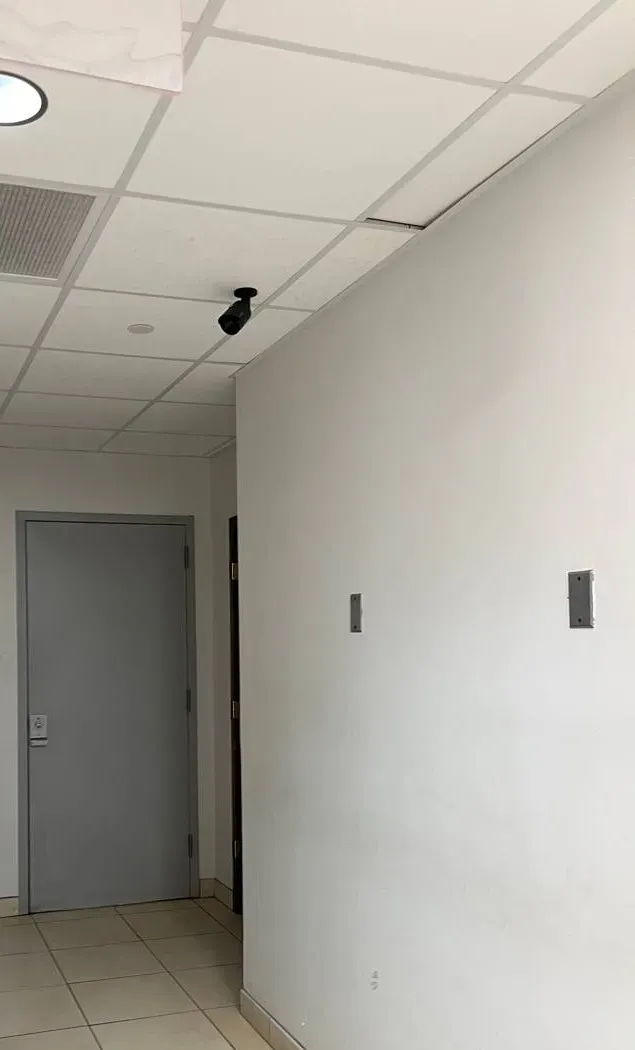
A photo from the AESS job library, not taken on Ocean Parkway: a tiled corridor with white walls and small wall plates leading to a grey steel door with a lever handle, under a drop ceiling with a small camera. The door between a parkway building's cellar and its public hall looks much like this one, and when residents wedge it open with a brick, as an inspector found at 800 Ocean Parkway in 2026, the city writes it up as immediately hazardous. A keypad on that door gives people a reason to stop propping it.
Commercial Door Buzzer Installation
Business Door Buzzer Installation in Ocean Parkway
Commercial vehicles are barred from the parkway's main roadway, and its frontage is overwhelmingly residential, so most business buzzer work here happens in two places: ground-floor offices and practices inside parkway apartment buildings, and the shopping streets that cross the parkway. The burglaries reported along the road give owners reason to take their doors seriously; a commercial office at 3049 Ocean Parkway was among the targets in a series of break-ins near Brighton Beach covered by News 12. For a business, a buzzer is about letting the right person through one door at a time and keeping that door separate from the residents' entrance.
Ground-floor practices on the parkway
Medical, dental and professional offices in parkway apartment buildings, which need a buzz-in door at reception and an entrance kept apart from the building's own lobby.
Church Avenue at the Kensington end
The northern boundary of the scenic landmark, where the parkway meets a busy shopping street with storefronts below apartments and offices on upper floors.
Cortelyou Road and Ditmas Avenue
Kensington cross streets with shops and small offices in mixed-use buildings a short walk from the parkway, where upstairs tenants share a street door with the stores.
Avenue J and Kings Highway
The Midwood shopping streets that cross the parkway, with offices, practices and stores whose back and side doors open onto service areas.
Avenue U
A long commercial street crossing the parkway in Homecrest and Gravesend, with storefronts, upstairs offices and community organizations.
Neptune Avenue and Brighton Beach Avenue
The southern end near Coney Island and Brighton Beach, with shops, practices and apartment buildings close to the subway viaduct.
The commonest business request on the parkway is a practice or office in an apartment building that wants patients and clients buzzed in one at a time, without the building's tenants being able to release its door or its visitors being able to wander into the lobby. Each gets its own station, release and power, kept fully separate from the building's system. Schools, synagogues and nursing homes along the parkway need the same separation between the public entrance and the doors staff use.
Rules that apply to Ocean Parkway business entry installations
Anyone inside can always get out. A business door with a buzzer, code or reader still opens from inside without a key or code. A fail-secure electric strike that leaves the inside lever free is the usual choice, because, as Allegion's guide puts it, with an electric strike "you can exit by turning the lever" whether the strike is fail-safe or fail-secure.
Fire-rated doors keep their rating. Allegion notes that fire doors need fail-secure strikes, so a rated door to a stairwell or cellar stays latched in a fire; release hardware has to carry the right listing for the door.
Magnetic locks bring extra requirements. Electromagnetic locks are only made fail-safe. The building code's sensor-release provisions call for a sensor on the egress side, a manual "PUSH TO EXIT" device 40 to 48 inches above the floor within 5 feet of the door that cuts power directly and keeps the door unlocked for at least 30 seconds, release on fire alarm or sprinkler activation, and UL 294 listed equipment.
Buttons stay within reach. The 2010 ADA Standards set the high forward reach at 48 inches maximum, so call buttons outside and release buttons at a reception desk are mounted within that range.
Tenants need the landlord's written approval. A practice or office that rents space in a parkway apartment building orders its own buzzer only with the owner's written permission, especially where the work touches a shared entrance or the building's cable routes.
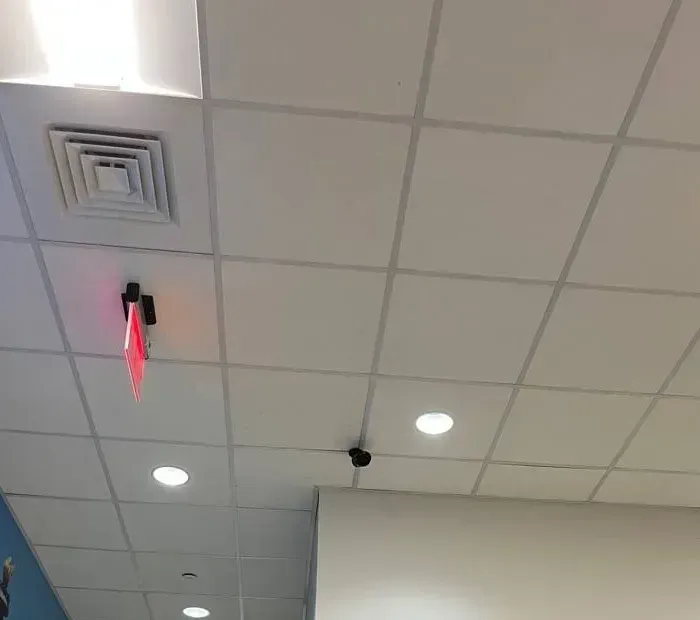
A photo from the AESS job library, not taken on Ocean Parkway: a drop ceiling with a lit red exit sign, an air diffuser, round recessed lights and a small black camera. Ground-floor practices in parkway apartment buildings often have ceilings like this one, and the exit sign is a reminder of the rule every business buzzer follows: whatever keeps the door locked from outside, it always opens from inside.
Your Questions Answered
Door Buzzer Installation in Ocean Parkway: Questions Answered
The large six-story buildings
Our building has more than a hundred apartments in several lettered sections. Can the new system go in one section this year and the rest next year?
Yes, if it is planned that way from the start. The entrance panel, the controller and the power supply are sized for the whole building on day one, because replacing them twice costs more than buying them once. The apartment side is then converted section by section: one section's riser is tested or recabled and its stations installed, while the other sections stay on the old system through a temporary connection to the new panel or on the old panel at a second station.
The quote shows the full system, then splits it into phases with a price for each, so a board or owner can budget across two years. The one condition is that every section stays answerable at every stage; no part of the building is left without a way to talk to the door and release it.
Before we sign, how will we know which of our riser lines can carry a new system and which need new cable?
Because we test them before writing the quote. In the cellar and on each floor, the technician meters the existing pairs for continuity, shorts between conductors, shorts to ground and noise, line by line, and compares the results with the apartments that have been cited or have complained. A line that tests clean is marked for reuse; a line with a fault is marked for new cable, or for phone answering where a new run would mean opening finished walls.
The quote lists every line with its result and its price. A line that tests borderline is shown with what replacing it would add, so nothing changes between the quote and the installation day unless you choose it.
If the owner adds video at the entrance, does every apartment have to get a monitor, or can some tenants keep an audio station?
Most current systems allow a mix. The entrance station can carry a camera while each apartment gets either a video monitor or an audio station, and some systems add phone answering for residents who want to see the visitor on their own phones. That lets an owner put monitors where tenants ask for them, or budget video for a few lines at a time, without leaving anyone unable to answer.
What the law sets for buildings that must have an intercom is voice and release; video is a choice. We price the system both ways, all-video and mixed, so the owner can decide where the money goes.
Doors, front yards and the cellar
Our entrance is thirty feet back from the sidewalk behind a front garden. Could the call station go out by the sidewalk instead of at the door?
Usually it belongs on the building. The parkway's zoning keeps the thirty-foot front yard open and bars porches, canopies and stairs from projecting into it, and a freestanding post at the sidewalk raises questions the building's own wall does not. A station at the door also stays out of the weather under the entrance and close to the release it controls.
Where a building or house already has a locked gate at the sidewalk, a second station or a release on that gate can be added, with its cable run under the front path. The quote shows that route and its cost, because digging through a landscaped front yard is real work. For most buildings, good lighting and a well-placed camera at the door do more than a station at the curb.
HPD has written our vestibule door up as immediately hazardous because of its latch. Can the new release go in on the same visit, or does the door have to be finished first?
The door comes first, but it can be the same job. A release depends on a latch that catches and a door that closes; putting a new strike on a door that HPD has cited for its latch, hinges or frame means the new system fails on day one. We price the door repair as the first line of the quote, do it at the start of the installation, test that the door closes and latches on its own, and only then cut in the strike.
If the violation has a correction deadline that comes before the full installation can be scheduled, the door repair can be done as a separate first visit, so the owner can certify it in time.
Residents keep propping the door between the cellar and the public hall with a brick so they can carry laundry and bins through. Can that door go on the system?
Yes, and it often solves the propping. People wedge that door because opening it with a key, arms full, is a nuisance. A keypad or a card reader on the cellar side, with the door's closer set to shut it gently behind them, gives residents a quick way through and the super a door that locks on its own. The hall side keeps free egress, so nobody is ever trapped in the cellar.
The same applies to a laundry room door. Codes can be given to residents and staff and changed when people move out, and the door can be left off the visitor directory entirely, so it is never a way in for someone at the front.
Water has come through our lobby ceiling near the mailboxes more than once. Should the new panel wait until the leak is fixed?
Yes. Water in a lobby ceiling finds its way into cable, junction boxes and the back of a panel, and electronics that get wet once rarely recover fully. Before we install, the leak's source has to be repaired and the ceiling dried out. If the original panel position is directly under the leak, we can move the station and keep its cable out of that ceiling altogether.
In the meantime, a failing old panel can be kept going with a targeted repair, priced as one, so residents are not left without a buzzer while the plumbing is sorted out.
Co-ops, condos and staffed lobbies
Our co-op has a doorman during the day only. What should the entrance do after his shift ends?
Switch modes on a schedule. While the desk is staffed, visitors at the entrance call the desk, and the doorman calls up or lets them in. When the shift ends, the station switches automatically, or with a button at the desk, to calling apartments directly, so residents answer and release the door themselves. Side and garage doors can follow the same schedule, open to residents' codes all day and closed to visitors after hours.
The mistake to avoid is a system that only rings the desk, so that late visitors reach nobody. We set the schedule with the board and the staff, and show them how to change it for holidays.
Can phone answering work without a monthly subscription?
Sometimes, and we say which before you choose. Some stations ring residents' phones over the building's own internet connection with no software fee; others route calls through a cloud service that charges per apartment or per door each month. Swiftlane's cost guide puts software subscriptions at "$5 to $15 per unit per month, or $30 to $100 per door per month," which adds up quickly in a parkway building of eighty or a hundred apartments.
If the board wants no recurring fees at all, the alternative is a wired system with stations in every apartment, which costs nothing per month and keeps working when the internet is down. The quote shows any monthly charge on its own line.
Houses on the parkway frontage
Our house on the parkway has been enlarged twice and now has three floors and a finished basement. Can the door station also let us talk between floors?
Yes. Many house systems pair the door station with indoor stations that call each other as well as the door, so the person in the basement can call the top floor, and anyone can answer the front door and release it from where they are. With video, the indoor monitors show the front path as well as the person at the door.
In an enlarged house the cable route is the main question, because additions rarely line up with the original walls. We look for routes through closets and the cellar, and where none exist, the quote offers phone answering or a wireless link for that floor instead of opening finished walls.
Ocean Parkway is a city scenic landmark. Does a new station on our building's front wall need approval from the Landmarks Preservation Commission?
Not because of the parkway. The Commission's 1975 designation covers the roadway, the malls and the service roads out to the outer curbs, not the buildings facing them. A station, a camera or a light on the facade of an ordinary parkway building needs no Landmarks permit on that account.
The exception is a building that is landmarked in its own right or sits inside a historic district. If you are not sure, the Commission's online map will tell you, and we check before quoting any work on a facade.
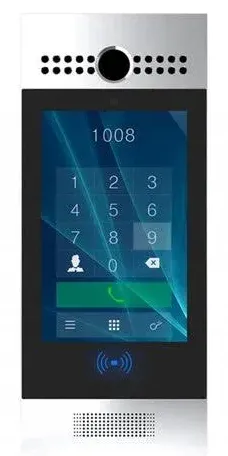
A photo from the AESS job library, not taken on Ocean Parkway: a touchscreen entry panel showing a dial pad with a four-digit apartment code entered, a camera above and a card-reader symbol below. In a parkway building of 123 apartments, a button for every home would cover the vestibule wall, so a code or scrolling directory panel like this one lets visitors find the right apartment, including the lettered apartment numbers many of these buildings use.
Equipment
Types of Door Buzzer Systems We Install
We quote a reliable non-branded system by default and install a named brand when an owner or board asks for one; the intercom brands we work with include Aiphone, ButterflyMX, 2N, Akuvox, Comelit and DoorBird. These are the kinds of equipment that come up most often in parkway buildings and houses, and where each one fits.
Directory and code panels
Scrolling directories or code entry for six-story buildings of fifty to more than a hundred apartments, where a button per home would not fit the vestibule wall.
Multi-button audio panels
A button per apartment and a speaker, for smaller buildings and the side streets off the parkway, with handsets or hands-free stations upstairs.
Two-wire video systems
Systems that carry video and audio over a single pair, the practical choice where the old riser tests sound and new cable would mean opening plaster on six floors.
Phone and app answering
Panels that ring residents' phones, for lines where the riser has failed, for owners who live elsewhere and for households out all day, with any monthly fee shown up front.
Desk consoles for staffed lobbies
A station at the doorman's desk that answers the entrance, calls apartments and releases doors, with an automatic switch to direct calling when the desk is empty.
Keypad and reader stations
A camera, keypad and card reader in one faceplate for cellar, laundry, side and garage doors that residents use with a code and visitors never see.
Fail-secure electric strikes
Releases cut into the frame that stay locked when power is removed and let anyone inside leave by turning the lever, the default for parkway entrance and vestibule doors.
Closers, latches and hinges
Door hardware adjusted or replaced so the door shuts and latches on its own, because a release only works on a door that closes, and a failed self-closing door is an immediately hazardous violation.
Battery-backed power supplies
Dedicated low-voltage supplies with battery backup, wall-mounted in a locked box in the cellar, sized for the panel, the stations and the release.
Directory panel with stations, two-wire video or phone answering: which fits an Ocean Parkway building?
What matters
Directory panel with wired audio stations
Two-wire video system
Phone or app answering
Typical parkway fit
Six-story rentals whose riser tests sound and whose owners want no monthly fees
Co-ops and rentals where tenants want to see the visitor and the pairs are reusable
Lines where the riser has failed, owners living elsewhere, houses
See the visitor
No
Yes, on the apartment monitor
Yes, on the phone, where the system supports video
Needs internet
No
No, unless phone answering is added
Yes, wired internet or cellular at the entrance
Works for residents without smartphones
Yes
Yes
Only if a station or landline option is included
Reuses the old riser
Often, where pairs test sound
Often, one pair per apartment
Needs cable only to the entrance and release
Monthly fees
None
None
Often a software or cellular charge
Brooklyn list range
From about $2,500 for a building, rising with apartments
$700–$1,800 for a house or small building; from about $2,500 for a large one
Within the same ranges, plus any subscription quoted separately
ADT, Ring and SimpliSafe compared with a local installer for an Ocean Parkway building
National alarm and doorbell brands come up in nearly every conversation about a front door. For a single-family house on the parkway frontage, a store-bought video doorbell can be a reasonable first step, as long as it is wired to proper power rather than a battery that dies in winter. For an apartment building, the comparison is not close. A doorbell camera rings the phones of whoever set it up; it does not give eighty apartments their own buttons, it does not release the vestibule door from upstairs, and it cannot meet the talk-and-release standard that the intercom law sets for buildings that must have one. An alarm company's contract covers monitoring, not the riser, the strike or the closer.
What a local installer adds is the part national brands leave out: the door repair, the strike, the power supply, the riser test on every line, the directory for a hundred apartments, the keypad on the cellar door, and a written record of what was installed and tested.
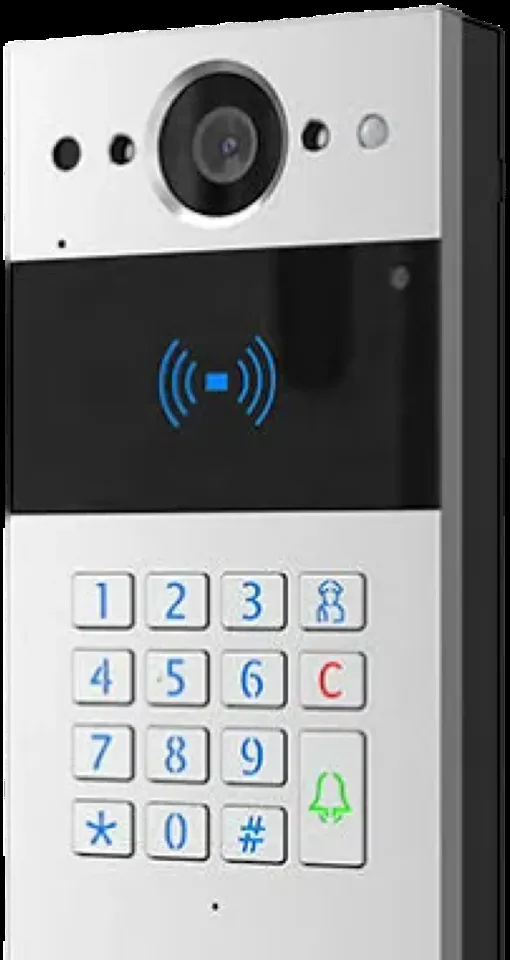
A photo from the AESS job library, not taken on Ocean Parkway: a silver and black keypad door station with a camera lens at the top, a blue card-reader symbol, a numeric keypad and a green bell key. On the door from a parkway building's cellar or garage to its public hall, a station like this lets residents and the super get through with a code or card, while a visitor at that door can still press the bell key to reach the desk or the super.
AI Overview Reality Check
What AI Gets Wrong About Door Buzzer Installation in Ocean Parkway
Ask an AI assistant or a search summary about installing a buzzer and you get confident answers drawn from national cost guides, vendor blogs and generic how-to pages. Some are right in general and wrong for a road lined with six-story buildings of fifty to more than a hundred apartments, set behind thirty-foot front yards. Here are seven claims we see repeated, each checked against its source and against what we find at parkway entrances.
"Installing an intercom system costs an average of $2,500"
That is HomeAdvisor's national average, and the same guide gives a range of $1,500 to $15,000, with wireless systems at $150 to $1,500 and hard-wired ones at $1,000 to $15,000. An average across every house and building in the country says little about a parkway job, which could be a single video station on a house or a directory system for 123 apartments.
On our Brooklyn list, an audio buzzer with a new release on a house or office door runs $400 to $900, a video station with monitors or phone answering for a house or small building $700 to $1,800, and a full system for a six-story building from about $2,500 to past $10,000. The large parkway buildings sit in that last range, often near its upper end because of their size.
What moves the price within each range is the riser, the number of doors and the state of the entrance door. No national average can see those.
"A typical apartment buzzer replacement costs about $1,500 to $2,500"
ButterflyMX's replacement guide gives that figure, and for a small building it can be close. For a parkway building it rarely applies. A building of 60 to 123 apartments has a directory panel, a controller, a power supply, a release, a station or phone line for every apartment and a six-floor riser to test, and those are not small-building numbers.
The figure also comes from a company that sells cloud intercoms, whose prices often assume new hardware and a subscription. A wired system reusing a sound riser can cost less per apartment, and a building whose riser has failed can cost more. The only way to know is to test the riser.
A smaller building on a side street, with six or eight apartments, is where a figure like that belongs.
"Every apartment building in New York must have an intercom"
Not automatically. Multiple Dwelling Law §50-a requires one without being asked only in buildings erected or converted after January 1, 1968 with eight or more apartments. The parkway's six-story houses from 1926 to 1963 fall on the older side of that line, so their legal duty to install depends on a written request from tenants occupying a majority of the apartments. A newer building such as 423 Ocean Parkway, from 2004, is covered outright.
In practice, though, almost every large parkway building already has an intercom, and HPD's record shows the agency citing broken ones under the Housing Maintenance Code's general duty to keep the building in repair: 165 times on Ocean Parkway since 2002.
So the useful question for most owners is not whether they must install one, but how to keep the one they have from becoming a violation.
"A video doorbell is a cheaper replacement for a building buzzer"
For a house with one front door, sometimes. For an apartment building, no. A consumer doorbell calls the phones of whoever installed it. It does not give each apartment a button, it cannot release the vestibule door from inside an apartment unless separately wired to a strike, and it gives a tenant without the app no way to answer.
Owners of small multi-family buildings run into this on Brownstoner's forums all the time; one owner of a three-unit building was quoted "$2,000" to replace a system that "works only sporadically" and was hoping for "a repair bill for a few hundred bucks." The video doorbell does not solve that owner's problem, because the problem is the building's wiring and release.
On the parkway, where buildings have dozens of apartments, a doorbell is not a candidate at all.
"Your existing intercom wiring can be reused"
Sometimes, and it is worth a great deal when it can. Aiphone's guidance says that where existing wires are in good condition, they can be reused, and two-wire systems are built for exactly that. But a parkway riser that has drawn notices from different floors and sections for years is the kind of cable that cannot be assumed to be sound.
Habitat magazine's account of a 114-unit Ditmas Park co-op shows how much rides on the answer: rewiring that building would have cost about $70,000, and the board chose a $7,000 telephone entry system instead. "It was awful and costing the building a ton of money," a former board member said of the old intercom.
So every line is metered before the quote, and a board sees the cost of reuse and of replacement side by side.
"A new intercom fixes a door that won't stay shut"
It does not. An intercom controls when the door unlocks; it has nothing to do with whether the door closes. A door with failed hinges, a worn latch, a warped frame or "a million layers of paint," as a former tenant of 1628 Ocean Parkway put it, will stand open no matter how good the panel is.
HPD treats those conditions on their own. In 2026 alone, inspectors wrote immediately hazardous violations on the parkway for a defective latch at 1440 Ocean Parkway's vestibule door, defective hinges at 2265 Ocean Parkway's entrance and a defective frame at 269 Ocean Parkway's vestibule door.
That is why the door is the first line of our quote, and why a new release is only cut in once the door closes and latches by itself.
"Landmark rules make it hard to change anything on Ocean Parkway"
The parkway is a scenic landmark, designated by the Landmarks Preservation Commission in 1975, and summaries often stretch that into a rule covering everything along it. The designation is bounded by the outer curbs of the service roads. The buildings and their entrances are outside it.
What does apply is zoning. The Special Ocean Parkway District requires the thirty-foot front yard and keeps porches, canopies and stairs out of it, so a door station is mounted on the building, not out in the yard.
For an ordinary parkway building, then, a new station needs neither a Landmarks permit nor a zoning change, only a sensible place on the wall beside the door.
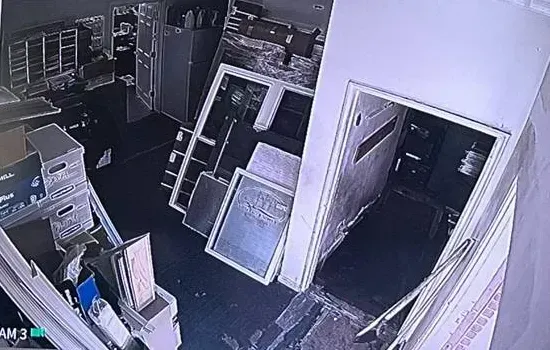
A photo from the AESS job library, not taken on Ocean Parkway: a black-and-white night camera view of a cluttered room with an open doorway into a dark back room. Storage rooms and bin rooms in the cellars of parkway buildings often connect to the doors residents prop open, and a keypad on that door, with a camera inside watching it after hours, keeps the cellar as secure as the vestibule.
Not Sure Whether Your Riser, Your Door or the Whole System Needs Replacing? Speak to a Tech
Send photos of the entrance, the panel in the vestibule, an apartment station and, if you can reach it, the power supply in the cellar, along with the number of apartments and any HPD notices you have received, and a technician will tell you which path looks likely and where it falls on our Brooklyn ranges. Call or text (347) 934-8335, send photos on WhatsApp, or fill in the form below.
Get In Touch
Request a Free Quote
✅
Request Sent!
Thank you. A technician will call you about the Ocean Parkway address, usually within two hours during working hours.
How It Works
Our Installation Process
1. Read the record and walk the front
We look up the building's public HPD intercom and door violations, then walk from the sidewalk through the front yard to every door residents use, including cellar, laundry, side and garage doors.
2. Confirm who orders and who must agree
We confirm whether the owner, the co-op or condo board, the managing agent or an office tenant with written landlord approval is ordering, and whether a tenants' request or an open order is involved.
3. Test the doors before the wiring
We check the closer, hinges, latch and frame of each door. If a door does not close and latch on its own, that is fixed first, because no release can hold a door that stands open.
4. Meter the old cable section by section
In the cellar and on each floor we test the riser pairs for continuity, shorts and noise, line by line, and mark which can be reused and which need new cable or phone answering.
5. Price the job in writing
You get a written price from the Brooklyn list, with every possible extra, such as a line that might fail or a door that needs work, named and priced before anything is ordered.
6. Take the deposit, order and schedule
Equipment is ordered once the deposit is in. In-stock systems are scheduled right away; special-order panels are booked once they arrive. Every visit gets a two-hour arrival window.
7. Install, label and program, one section at a time
We mount the panel, release and power supply, convert the apartments line by line or section by section, and label every pair and button, keeping the old system live until switch-over.
8. Test every apartment from the street and hand over
Standing at the entrance, we ring and release every apartment, record each result on a test sheet and leave the sheet and the wiring record with the owner, board or managing agent.
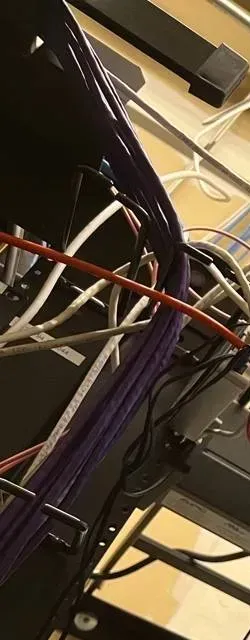
A photo from the AESS job library, not taken on Ocean Parkway: purple, white and red cable bundles dropping down beside a black equipment rack. In a six-story parkway building, the cable from each vertical line of apartments arrives at one point in the cellar like this, and labeling every bundle there in step 7 is what lets the next technician find a single foyer station's pair in minutes when an inspector writes it up.
Coverage Area
Door Buzzer Installation Near Ocean Parkway's Landmarks
Church Avenue end
The northern edge of the scenic landmark as designated in 1975, where the parkway's apartment houses begin just below Prospect Park in Kensington.
Kensington Stables
The riding stable near the top of the parkway on the Kensington side, a few blocks from Prospect Park and the parkway's first apartment houses.
Ocean Parkway station
The Q train stop near the southern end, carried on a masonry viaduct with three groin vaults over the parkway.
Abraham Lincoln High School
The public high school near the point where Ocean Parkway meets Shore Parkway, on the stretch where six-story co-ops line both sides.
South Brooklyn Health
The hospital campus near Avenue Z, on a site that has served as a hospital since 1909.
Seabreeze Avenue
The southern boundary of the scenic landmark, where the parkway reaches Coney Island after about five and a half miles.
Ocean Parkway is billed at our standard Brooklyn rate along its whole length, from the Kensington end to Coney Island. The final figure follows photos and a walkthrough, because the number of apartments, the condition of the riser, the number of doors people use and the state of the entrance door drive the total far more than the brand on the panel.
Job
Typical Ocean Parkway property
Brooklyn range
Audio buzzer or replacement with electric strike release, existing wiring reused where it tests well
Houses on the frontage, a ground-floor office or practice door
$400–$900
Video door station with indoor monitors or phone answering
Houses behind the front yard, small buildings on the side streets
$700–$1,800
Multi-unit entry system, audio or video by apartment count, with optional code or fob entry
Six-story rentals and co-ops of fifty to more than a hundred apartments, condos
from $2,500 to $10,000+
In-person diagnosis of an existing system, booked online
Any building where the old system must be tested before quoting
$250, applied toward the work
Monthly subscription
Any building choosing a wired, no-subscription system
$0
What moves a parkway job inside its range is predictable. First the apartments and the riser: a sixty-apartment building whose pairs test sound stays lower in the multi-unit range, while new cable or phone answering for a hundred and twenty apartments in several sections pushes toward the top and beyond. Then the doors: each cellar, laundry, side or garage door adds a keypad or station and a release. Then the building's particulars: an entrance door that needs new hinges or a latch, a power supply that has to move away from a leak or a radiator, a staffed desk that needs its own console. Anything that depends on a test is named on the quote with its price before you approve.
Full terms — including 50% deposit, one-year parts-only warranty on AESS-supplied products, and the late-fee schedule — are set out in the service agreement.
Find Out Which Range Your Ocean Parkway Building Falls In
Tell us the address, the number of apartments, every door people use, what is mounted in the vestibule now and any HPD notices you have, and we will tell you which Brooklyn range fits and what would move it. Call or text (347) 934-8335, send photos on WhatsApp, or fill in the form.
Shop Our Systems
Door Buzzer Installation Packages & Pricing
Three typical Ocean Parkway jobs, each placed inside the matching range on our Brooklyn list. The exact figure comes from the photos, the riser test and the walkthrough.
House or single door: $400–$900
An audio station at the front door of a house behind the setback, or a buzz-in door for a ground-floor practice, with an answering unit where it is needed, a fail-secure strike in a sound frame, a closer that shuts the door and battery-backed power.
House video entry: $700–$1,800
A lit video station at the front door of a parkway house, with monitors on each floor or phone answering, the front door's strike and closer set, and the option of a release on a sidewalk gate quoted separately.
Six-story building system: from about $2,500
A directory or code panel in the vestibule, keypads for cellar and side doors, apartment stations or phone answering for every home, a tested or new riser and power in a locked cellar box, rising toward $10,000 or more with apartments, sections and doors.
Bring your own equipment. If the building or household has already bought a door station or intercom kit, we can install it as labor-only work, quoted flat once we have seen the doors, the frames and the cable path. Tell us the make and model, and we will say before the visit whether it can reach every apartment and release your doors. Equipment you supply is covered by its maker's warranty, not ours.
Complete Services
Every Door Buzzer Service in Ocean Parkway
Six-story buildings and co-ops
Whole-building systems, phased replacements, foyer stations by line and cellar door keypads. Request a quote
Houses and practices
Video stations behind the front yard and buzz-in office doors. Call (347) 934-8335
How many working days does a full entry system take in a six-story building on the parkway?
+
It depends mostly on the riser. In a building of sixty or so apartments whose pairs test sound, the panel, power supply, release and apartment stations usually take a few working days. A building of more than a hundred apartments, or one where several lines need new cable or phone answering, takes longer and is often scheduled section by section. The written quote states the expected number of days and the order in which the lines will be done, so the owner or board can post the schedule in the lobby.
What happens to the old panel and the apartment handsets once the new system is working?
+
They come off the wall and leave with the crew, unless the owner or board asks to keep them, for example as spare parts for another building on the same old system. The holes left behind are covered with blank plates or, at the entrance, with the new panel's own trim. The quote says which of those applies, so nobody is surprised by an old handset left hanging in a foyer next to the new station.
Can the new entrance panel go into the opening the old one leaves, so the vestibule wall needs no repair?
+
Often, yes. Many replacement panels come with trim or back boxes sized to cover the cut-out of an older panel, and where they do not, an adapter plate fills the gap. We measure the old opening during the survey and choose a panel that fits it or name the adapter in the quote. If the old position is poorly lit, under a leak or too high to reach, we recommend moving it, and the quote then says how the old opening will be closed.
Can the keypad on our cellar door let the super know when the door has been left standing open?
+
Yes, on many systems. A small contact on the door frame tells the keypad or controller whether the door is shut, and if it stays open past a set time, the system can sound a local tone, send a message to the super's phone or log the event. It is a simple way to catch the brick or the folded cardboard before an inspector does. The quote lists the contact and the notification as an option so the board can decide.
How are residents shown how to use their new stations, especially those who are not comfortable with technology?
+
At handover, the technician shows the super and any residents who are home how to answer, talk and release the door, and leaves a one-page guide for the lobby. Residents who want a personal demonstration can ask while the crew is on their line. Stations with large, clearly marked buttons are available for buildings with many older residents, and phone answering is never forced on anyone who would rather use a station on the wall.
If an apartment station stops working a month after the installation, who do we call and what does it cost?
+
Call or text the same number you used to book. A technician first looks at photos or talks the super through a quick check, which costs nothing, because many early problems turn out to be a loose connection or a setting. If a visit is needed, whether it is covered depends on the cause and on the warranty terms in the service agreement you signed, and we tell you which applies before anyone comes out.
Can the camera on a video entrance panel keep a record of who was let in, and for how long?
+
Some panels save a snapshot or short clip every time a call is made or the door is released, stored on the panel, on a local recorder or in a cloud account. How long it is kept depends on the storage chosen, from days to months. We set that with the owner or board, and where a building already has a camera recorder, the panel's camera can often be added to it, so the entrance appears alongside the vestibule and cellar views.
What happens if a tenant will not let the crew in to change the station in their apartment?
+
That apartment cannot be finished until access is given, and it is listed on the test sheet as not completed, with the reason. Because the lines of a building are linked, we cannot certify an apartment we have not tested. The owner or managing agent arranges access through the usual notice to the tenant, and we return for that apartment on a scheduled visit. Telling residents the schedule in advance, line by line, avoids most of these cases.
Can one co-op shareholder pay to upgrade only their own apartment station to a video monitor?
+
If the building's system supports both audio stations and video monitors on the same line, yes, and many current systems do. The shareholder pays for the monitor and its installation, with the board's approval, and the rest of the building is unaffected. If the entrance panel has no camera, a monitor has nothing to show, so the upgrade only makes sense once the board has put video at the entrance or plans to.
Can new cable run up the outside of the building instead of through the apartments?
+
Occasionally, but it is rarely the best choice on the parkway. Cable on the facade is exposed to weather, harder to protect and visible from the street, and each run still has to come through the wall into every apartment. Interior routes through closets, shafts and the existing riser are usually cleaner. Where no interior route exists for a line, phone answering for those apartments is often a better answer than a cable on the brick.
Our board is planning to renovate the lobby next year. Should the entry system be replaced before, during or after?
+
During, if possible, with the cable work timed before the new ceiling and wall finishes go up. That lets new cable run through open ceilings and walls, the panel sit exactly where the designer wants it and the power supply move out of harm's way, all without cutting into new finishes later. Send us the lobby plans early and we will mark where the panel, the cable and any cameras need to go, so the contractor can leave room for them.
Ready for an Ocean Parkway Entrance That Rings Every Apartment and Latches Behind Every Visitor?
Send a photo of your entrance and the panel in the vestibule, with the address, the number of apartments, every door people use and any HPD notices you have received, and we will tell you which system fits, how much of your riser it can reuse and where it falls on our Brooklyn ranges. Call or text (347) 934-8335, message us on WhatsApp, or use the request form. Licensed under NYS license #12000287431, rated 4.7★ across 201 Google Reviews, with same-day estimates on most weekdays.