What are you looking for?
About Us Contact Us Careers Get a Free Quote (800) 486-0943
Pick a service
✅ Got Your Own System?
🎬 Home TheatreQuote 🎶 AV SoundQuote 🔑 Access ControlQuote
Now pick your area
Pick your area
Long Island
Hudson Valley
Services available
Pricing & Tools
Pick a service for pricing
🚪 Intercom Pricing 🔔 Buzzer Repair Pricing
Calculators
📹 Camera System Calculator 🚨 Alarm Calculator ⚡ Cabling Quote Builder ✅ Got Your Own System?
Select your area
Mailbox pried open in your Ocean Parkway lobby, a stranger on the fire escape, or a car hit on the service road overnight? Copy the clip before the recorder records over it. Call the Brooklyn line: (347) 934-8335
Home › Security Camera Installation Brooklyn › Ocean Parkway
Parkway Houses · Prewar Elevator Buildings · Co-op Lobbies & Mailrooms · Enclosed Garages · Shuls & Yeshivas · Licensed Low-Voltage

Security Camera
Installation in
Ocean Parkway

Two Faces Per Property · Mailrooms and Fire Escapes · Footage You Can Hand Over

Security camera installation in Ocean Parkway means planning for a property with two very different faces: the formal front on the 210-foot-wide landmark parkway, with its service road, tree-lined malls and bike path, and the working side on a numbered street or avenue, where the fire escapes, service doors, driveways and garage entrances are. The local record shows where cameras earn their keep. In 2015 the 66th Precinct warned that burglars were climbing in through fire-escape windows in the Ocean Parkway area between Ditmas Avenue and Fort Hamilton Parkway. In 2024 and 2025 police went looking for people who got into apartment buildings near Cortelyou Road and Avenue M and went straight for the mail. So an Ocean Parkway plan covers the lobby door, the mailbox wall, the fire-escape window line and the garage ramp before it worries about the view of the trees. Four-camera systems on our Brooklyn rate start at $850 installed, and every job is quoted in writing after photos or a walk-through.

Reviewed and updated November 13, 2026 by Abstract Enterprises Security Systems, NYS license #12000287431 · Sources: Bklyner on the 2015 66th Precinct fire-escape burglaries near Ocean Parkway; BoroPark24 on the 2024 mail-area theft near Ocean Parkway and Cortelyou Road; Hoodline on the 2025 mailbox burglary near Ocean Parkway and Avenue M; News 12 Brooklyn on the 2026 lobby leak at 514 Ocean Parkway and the December 2025 Kensington crash; reporting on the December 2025 incident in front of 510 Ocean Parkway; The Yeshiva World on the 2021 Shomrim package-van stakeout at Avenue P and on Boro Park Shomrim's 2026 community camera initiative; the NYC Zoning Resolution, Special Ocean Parkway District; NYC DOT parkway truck rules; the Historic Districts Council, the Cultural Landscape Foundation and Wikipedia on the parkway's design and 1975 scenic landmark designation; The Real Deal on Ocean Parkway teardowns; Openigloo, Raveis, HL Real Estate and Nest Seekers building listings; Habitat Magazine, Brick Underground and FirstService Residential on co-op camera rules and footage access; UJA-Federation of New York on small-synagogue security funding; HomeAdvisor on Brooklyn camera costs; and New York City's biometric identifier law.

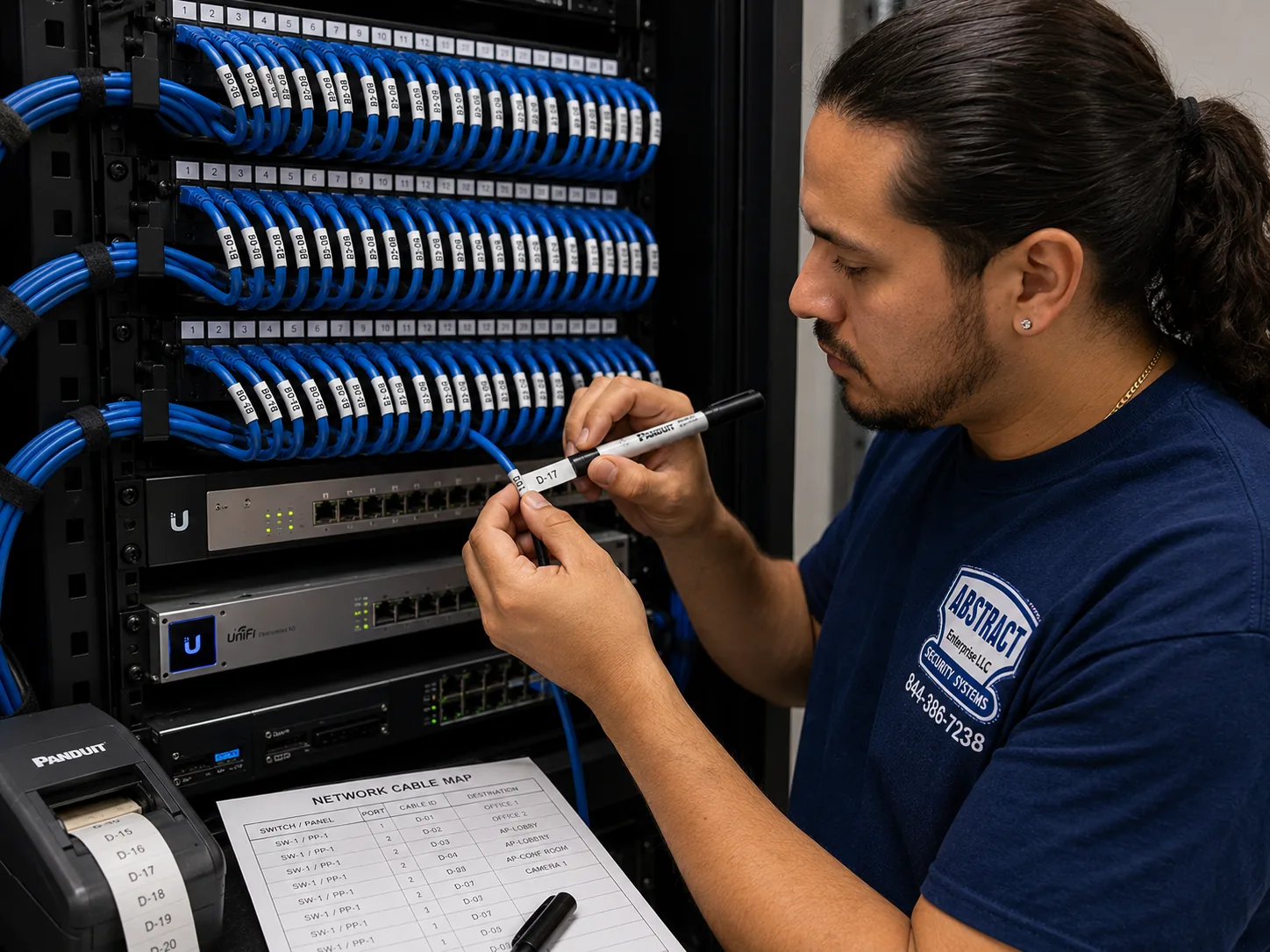
Ocean Parkway, Brooklyn security camera installation job-library photo: a technician printing cable labels at a patch panel beside a printed port map
Photo from our job library, not taken on Ocean Parkway: a technician printing cable labels at a patch panel beside a printed port map. In a six-story Ocean Parkway elevator building, a mailroom camera's cable may climb a riser, cross a cellar and end in a locked closet next to a dozen others, so every run is labeled at both ends and written onto a paper map that stays with the super or the board.
Ocean Parkway Camera Quote
Tell us the address or cross street, the kind of property, and which door, mailroom, window or garage worries you most

✅
Request Sent!
We'll call about your Ocean Parkway cameras the same business day.
25+
Years Experience
✓
Same-Day Estimates
100%
Licensed & Insured
4.7★
201 Google Reviews

Owner-operated since 2002 · Thousands of jobs completed · Booked within 2 hours

Security camera installation on Ocean Parkway starts at $850 for a four-camera system installed on our Brooklyn rate, with a recorder, two weeks of continuous recording and phone viewing included; most four- to eight-camera house jobs land between $850 and $2,500, and buildings, stores and congregations usually run $1,500 to $5,000 and up. The final number for any Ocean Parkway property is written down after photos or a walk-through, with every camera, mount, cable run, recorder and extra storage period on its own line, and a recorder you own carries no monthly fee from us. The jobs we see most along the parkway are lobby, vestibule and mailbox-wall cameras for prewar elevator buildings and postwar co-ops; fire-escape and rear-yard cameras for walk-up and elevator buildings alike; front, driveway and side cameras for the large detached houses; enclosed-garage cameras where the zoning rules put the parking indoors; and entrance cameras for shuls and yeshivas. Requests are booked within 2 hours, estimates are free, and the work is done under NYS license #12000287431. Call (347) 934-8335 or use the form.

  • The mailbox wall and the lobby door covered first in apartment buildings, because the recent Ocean Parkway police appeals were about people who got inside and went for the mail
  • Fire-escape window lines and rear yards watched from the building's own walls, the route the 66th Precinct flagged in 2015
  • A written answer, before work starts, on whether a board, landlord or lease has to approve each camera, and who will be able to see each one
The Neighborhood

Why Ocean Parkway Properties Need Security Camera Installation

Ocean Parkway is a road first and a neighborhood second, and the camera work follows from that. Frederick Law Olmsted and Calvert Vaux laid it out in the 1870s as a grand boulevard running about five and a half miles from the Prospect Park end down to Surf Avenue in Brighton Beach. It is 210 feet across, with a 70-foot central roadway, two landscaped malls with benches and the country's first bike path, and a service road on each side. The Landmarks Preservation Commission designated it a scenic landmark on January 28, 1975. The landmark is the parkway itself: the roadway, malls, paths and rows of maple, oak, sycamore and elm. The homes and apartment buildings that line it are private property, and they are what we put cameras on.

Those buildings fall into a few clear groups. Along much of the parkway between Kensington and Gravesend stand large detached and semi-detached houses, many of them rebuilt or enlarged; The Real Deal reported in 2017 that city records showed 35 homes on the road enlarged since 1995, and that most owners belonged to the Sephardic community, which wants to live within walking distance of family, schools and synagogues. Between the houses, and in long runs near Kensington, Midwood, Homecrest and the southern end, are six-story apartment buildings from the 1920s and 1930s, postwar red-brick co-ops, and a handful of newer condos. Shuls, yeshivas and schools sit along the parkway and on the side streets. And the shopping is not on the parkway at all but on the avenues and streets that cross it or run beside it, from Church Avenue at the north end to Kings Highway, Avenue U and Coney Island Avenue further south.

What the record shows about crime here is mostly about getting into buildings. In October 2015, Bklyner reported that the 66th Precinct's commander, Captain Kenneth M. Quick, told the precinct community council that "in the past 28 days there has been a surge in Kensington burglaries," with burglars coming in through fire-escape windows in the Ocean Parkway area from Ditmas Avenue to Fort Hamilton Parkway. The precinct's own message was blunt: "male committing burglaries around Ocean Pkwy. Call 911 for susp person on fire escapes and backyards." A resident reported a sixth-floor apartment, not even next to a fire escape, entered through the top half of a window, possibly from the roof. In October 2024, BoroPark24 reported that a person entered a residential building near Ocean Parkway and Cortelyou Road in the afternoon, took a credit card from an envelope in the building's mail area and ran up about $1,859 in purchases. In August 2025, Hoodline reported a person who got into an apartment building near Ocean Parkway and Avenue M at about 4:40 a.m., pried open a mailbox and took a checkbook.

None of those cases needed a broken front door. They needed a way in behind someone, an unwatched mail area, or a window off a fire escape or a yard that nobody looks at. That is why we start a building's camera plan at the vestibule and the mailbox wall, then the rear yard and fire-escape lines, then the cellar and service doors, and only then the street. For a house, the order shifts: the side driveway and the back come before the front steps, because the front of a parkway house is the side most people are already looking at. The record also includes the street itself. In December 2025, police released surveillance video after a man allegedly slammed a 12-year-old boy's head into a car windshield in front of 510 Ocean Parkway on a weekday afternoon, and News 12 Brooklyn ran video of a 1:30 a.m. crash on the Kensington stretch that appeared to knock down a city traffic camera pole. Private cameras facing the service road and the curb are often what investigators ask for after events like these.

Ocean Parkway facts that shape a camera plan

  • A landmark road, private buildings: the parkway was designated a scenic landmark on January 28, 1975, and listed on the National Register of Historic Places in 1983; the designation covers the roadway, malls and paths, not the houses and buildings beside them.
  • Fire escapes: in 2015 the 66th Precinct linked a burglary surge to fire-escape windows in the Ocean Parkway area between Ditmas Avenue and Fort Hamilton Parkway, per Bklyner.
  • The mail area: police appeals in 2024 (near Cortelyou Road) and 2025 (near Avenue M) both involved people inside apartment buildings going for mail, a credit card in one case and a checkbook in the other.
  • Parking indoors: under the Special Ocean Parkway District zoning, accessory parking for new developments with parkway frontage "shall be completely enclosed," so many newer buildings have indoor garages to cover.
  • No trucks on the parkway: NYC DOT lists Ocean Parkway among roads where commercial vehicles are not allowed, so deliveries and service vans for parkway buildings arrive on the side streets.
  • Older buildings, open violations: Openigloo lists 1609 Ocean Parkway (built 1929, 59 units) with 29 open HPD violations and 1850 Ocean Parkway (built 1938, 70 units) with 86, so a camera plan in buildings like these often has to work around ongoing repairs.

Many Ocean Parkway building owners who ask us about cameras also ask about the entry door itself, because a camera records who followed a resident in while a door that closes and locks properly keeps them out. We plan the vestibule cameras around whatever intercom or entry panel the building has, so the two work together rather than staring at each other. For the rest of the borough, see our Brooklyn security camera installation page.

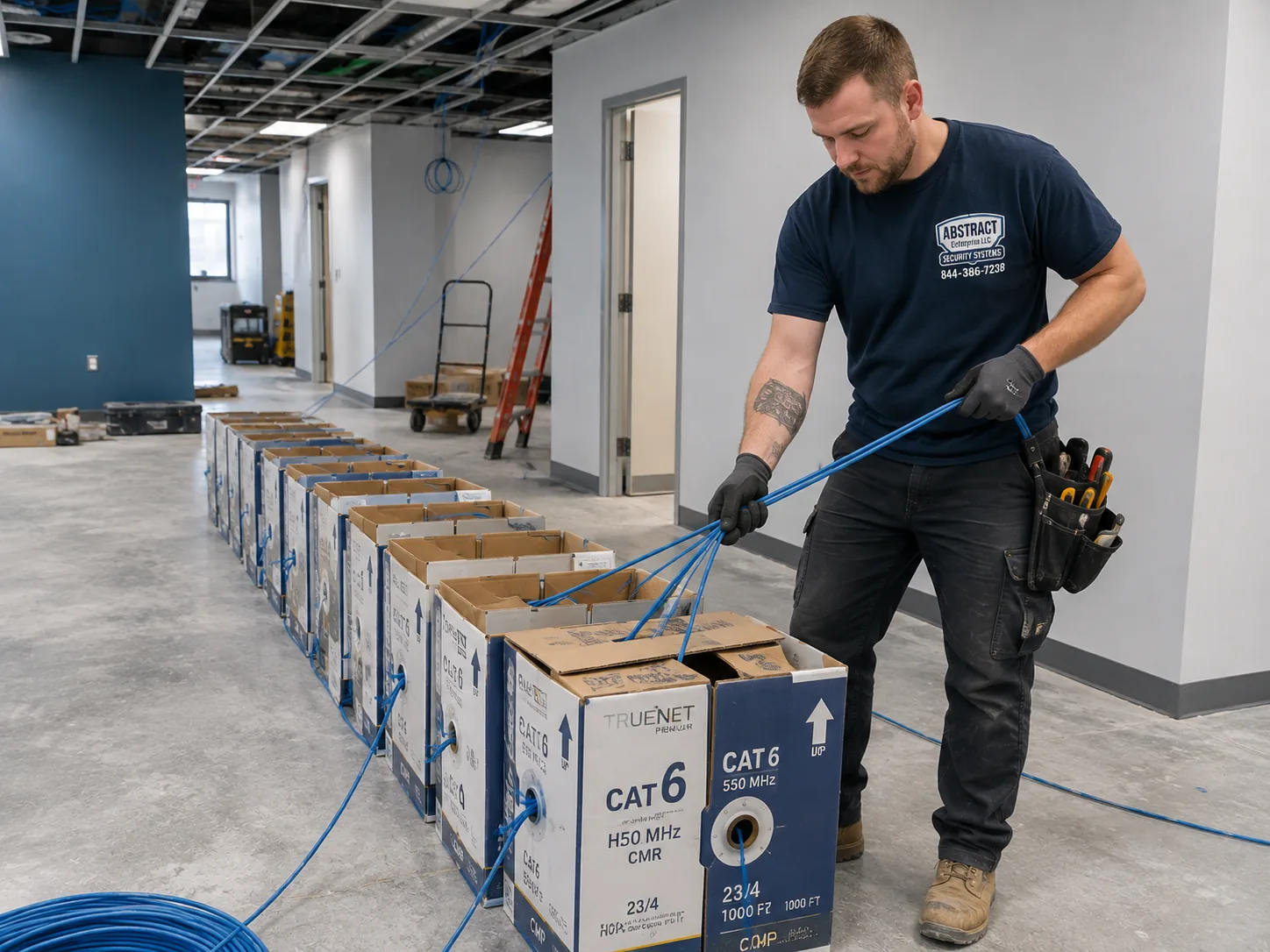
Ocean Parkway, Brooklyn security camera installation job-library photo: boxes of cable staged together for a multi-drop pull on a working premises
Photo from our job library, not taken on Ocean Parkway: boxes of cable staged together for a multi-drop pull on a working premises. A prewar Ocean Parkway elevator building with cameras planned for the vestibule, the mailbox wall, the elevator landing, the rear yard, the cellar door and the laundry room is pulled the same way, every run started from one staging point in the cellar so the super always knows where the crew is working.

Mailbox Pried, a Figure on the Fire Escape, or a Car Hit on the Service Road? Fast Camera Help on Ocean Parkway

The urgent calls from along the parkway tend to come in a few shapes. A super or a managing agent finds a mailbox door bent in the lobby and needs to know who did it and when. A tenant hears something on the fire escape at night and wants to know whether the rear camera saw anyone. A homeowner comes out in the morning to a car on the service road with a smashed window or a fresh dent, and wants the clip from the front camera. A shopkeeper on an avenue a block away has a short till. If anyone was hurt or threatened, call 911 first and tell the officers you have video. Do not unplug the recorder to carry it anywhere; leave it running. Write down which camera and roughly what time, and if you know how, copy that stretch of time to a USB stick or your phone. A recorder writes over its oldest footage first, and in a building where the system has been running for years, nobody may remember how long it keeps. Call (347) 934-8335 and a technician is booked within 2 hours of your request to help save the clip, work out why a camera missed something, or get a dead camera back up. We do not promise same-day installation, but we make sure the footage you already have is safe first.

The Parkway Face

The Parkway Side and the Street Side: Planning Cameras for a Property With Two Fronts

Most Brooklyn camera plans have one front. An Ocean Parkway property usually has two. The parkway face is formal, set back behind a deep front yard, looking across a service road and a mall of trees toward the main roadway. The other face, on a numbered street or an avenue, is where the garage door, the service entrance, the trash area and often the real day-to-day front door are. Here is how each part of that layout changes what a camera can and should see.

The service road and the curb

The service road is where residents park, where guests are dropped off, where packages are carried in from a double-parked van and where a car gets clipped at night. A camera on the house or the building, aimed down at the curb in front of your own property, records who stopped and who got out. It does not need to see across the mall to the main roadway, and on most parkway lots it cannot, because the mall's rows of trees are in the way for half the year. We frame the curb camera on your own frontage, from the edge of the driveway to the edge of the lot, and set it to record continuously rather than on motion, because the steady stream of cars and bikes along the service road would otherwise trigger it all day. If you want plate detail on cars that stop, that is a second, narrower camera aimed at the stopping spot, not a wider lens on the first one.

The malls, the benches and the bike path

The malls belong to the city, and they are part of the scenic landmark. We do not mount anything on mall trees, benches, lampposts or the bike-path fencing, and we do not aim private cameras to study people sitting on the benches. A curb camera will inevitably show some of the nearer mall and the people passing along it; that is fine, and it is often exactly the context a detective wants. What we avoid is a camera whose main job is watching the public mall rather than your own frontage. Owners sometimes ask for a long zoom across to the far side of the parkway. Between the trees, the distance and the headlights on the main roadway at night, it rarely shows anything useful, and we will say so before you pay for it.

The deep front yard and the walk to the door

The zoning rules for the parkway keep a large yard between the sidewalk and the house, with no porches or stairs allowed to push into it, so the front door of a parkway house is a long walk from the street. For cameras, that means the doorway camera and the curb camera are two separate jobs. A single high camera on the facade trying to cover both ends up showing small figures at the curb and the tops of heads at the door. We put the door camera close to the entrance, a little above head height, and give the curb its own view. On houses where the front walk is lined with plantings or a low wall, a third view along the walk covers anyone who cuts across the yard to the side of the house.

The side street, the driveway and the garage door

On a corner lot, the side street is where the cars actually come and go. Zoning requires driveways in the parkway front yard to run straight in from the street, and many houses have their garage or driveway on the side street instead. The camera that matters here is the one watching the driveway and the gap beside the house, because that is the way into the back that the street cannot see. We mount it high on the side wall near the front corner, aimed back along the driveway, and a second camera at the back corner covers the yard and the back door.

Trees, leaves and the winter view

The parkway's trees are the reason people love living on it, and they change a camera's picture twice a year. A view that is clear in January can be half leaves by June, and a branch swaying in front of a lens at night will set off motion alerts until you turn them off. We look at the trees in front of every camera position, aim below the canopy where we can, and set motion zones that ignore the top of the frame. Where a summer canopy will block a view entirely, we tell you before mounting, not after the first spring.

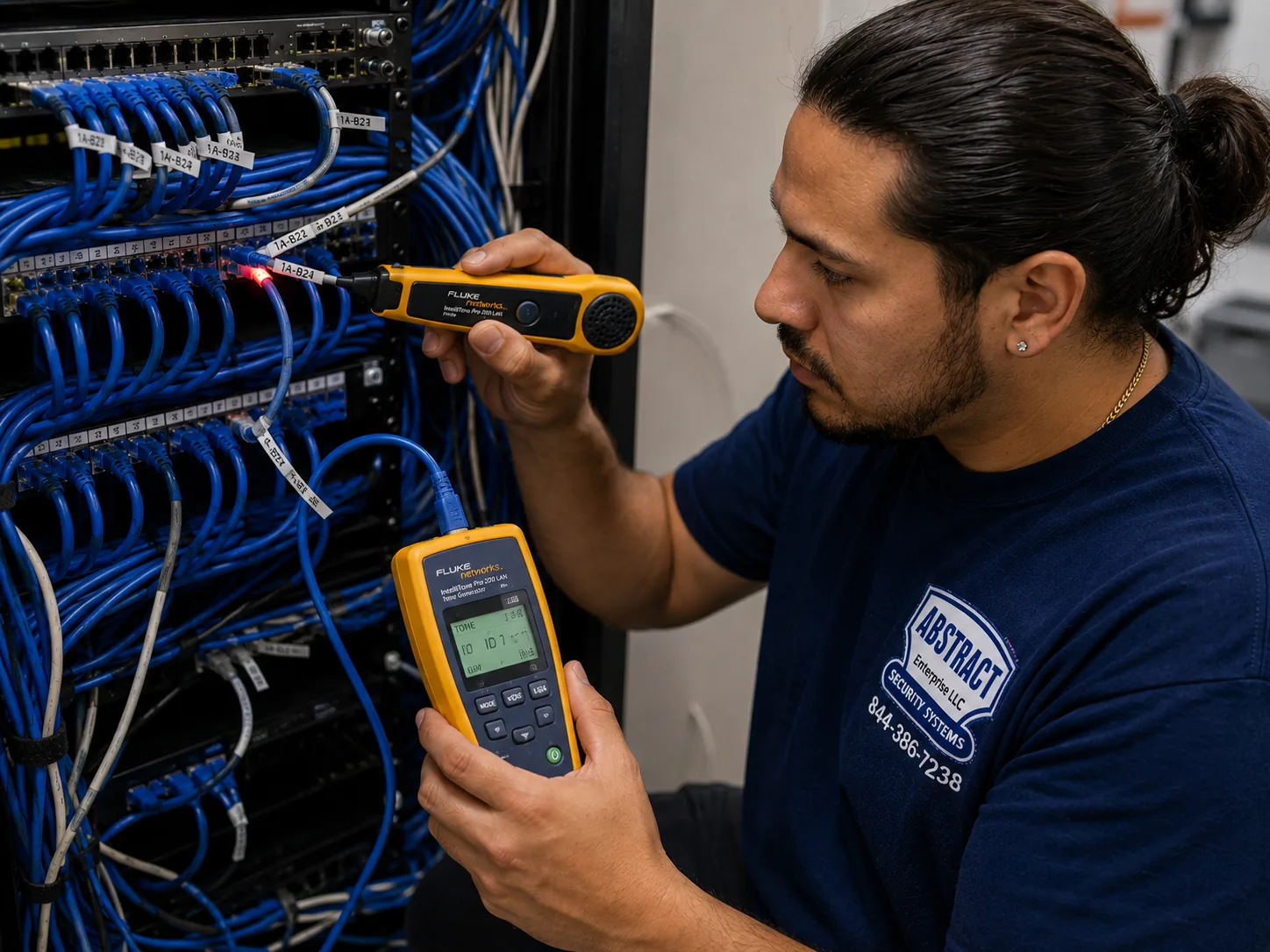
Ocean Parkway, Brooklyn security camera installation job-library photo: a technician tracing an unidentified cable run at a patch panel with a tone generator and probe
Photo from our job library, not taken on Ocean Parkway: a technician tracing an unidentified cable run at a patch panel with a tone generator and probe. Older Ocean Parkway apartment buildings often have unmarked cable left from earlier camera, intercom and cable-TV work running up the risers; tracing each one tells us whether it can carry a new camera or should be cut back.
What We Install

Security Camera Installation Services in Ocean Parkway

These are the camera jobs owners, boards, managing agents, tenants, shopkeepers and congregations along the parkway ask us for most. Each is quoted in writing after photos or a walk-through, and a recorder system you own carries no monthly fee from us.

📬

Vestibule and Mailbox-Wall Cameras

A face camera inside the street door and a second view that shows the full bank of mailboxes and the hands at them, for prewar and postwar buildings where the mail area sits just past the inner door.

🪜

Fire-Escape and Rear-Yard Lines

Cameras on the building's own rear wall looking along the fire escapes and down into the yard, framed to show anyone on the ironwork without looking into any apartment.

🏡

Parkway House Fronts

A door camera close to the entrance and a separate curb camera on the service road, for the large detached and semi-detached houses set back behind deep front yards.

🚗

Enclosed Garages and Ramps

Ramp cameras set for plates and aisle cameras set for people, for the indoor garages that the parkway's zoning requires on newer buildings and that many postwar co-ops already have.

🚪

Service Doors, Cellars and Laundry Rooms

Side-street service entrances, trash and recycling areas, cellar stairs, laundry rooms and bike rooms, where deliveries arrive and where residents are alone late at night.

🛗

Elevator Landings and Halls

Cameras at the ground-floor landing and on hallways the board or landlord chooses, set so no camera sees into an apartment when a door opens.

🏪

Stores Off the Parkway

Door, counter and stockroom cameras for shops on Kings Highway, Avenue U, Church Avenue, Coney Island Avenue and McDonald Avenue, the commercial streets that cross or run beside the parkway.

🕍

Shuls, Yeshivas and Schools

Entrance, lobby and corridor cameras planned around arrival and dismissal times, with accounts for the people who actually run the building and nothing aimed into private rooms.

🔧

Takeovers and Repairs

Buildings and houses whose last installer is gone: recorders found, passwords reset to the owner, cables traced and labeled, and cameras kept or replaced one at a time.

Building Specialists

Security Camera Installation for Ocean Parkway's Architecture

The buildings on Ocean Parkway run from the 1920s to the 2010s, from walk-in rentals to doorman co-ops to houses that have been rebuilt from the ground up. These are the types we plan for most often, drawn from building listings and local reporting.

🏛️

Large Detached Parkway Houses

Single-family houses set behind deep front yards, many from the 1920s and 1930s and many since enlarged or replaced, with side driveways and yards behind.

🏗️

Rebuilt and Enlarged Homes

Houses under construction or just finished, where camera cable can go in while the walls are open and the recorder can be planned into a closet from the start.

🏠

Side-Street Two-Families

Semi-detached and two-family houses on the numbered streets just off the parkway, with two households, two doors and a shared yard or driveway.

🏢

Prewar Six-Story Elevator Buildings

Rent-stabilized buildings from the 1920s and 1930s, such as 1609, 1777 and 2901 Ocean Parkway, with a vestibule, a mail area, one elevator, rear fire escapes and a cellar.

🧱

Postwar Red-Brick Co-ops

Larger co-ops such as the 12-story Park Tower at 370 Ocean Parkway and the six-story building at 820 Ocean Parkway, with doormen, garages or parking, bike rooms and laundry rooms.

🏙️

Newer Condos

Smaller elevator condos such as the 24-unit building at 379 Ocean Parkway, built in 2019 with a video intercom, an enclosed garage and storage units.

Large detached parkway houses: a long front, a hidden side

The older houses along the parkway are big, often brick or stucco, with a center or side entrance well back from the sidewalk and a driveway down one side to a garage or a paved yard. The walls are usually masonry, so each outdoor camera means a hole drilled through brick or block from inside, sealed and sleeved, with the cable coming straight out behind the camera base. The attic and the basement are the cable routes: down from the attic for the front and side eaves, through the basement for the back wall. On these houses we usually recommend five or six cameras for a first system: the front door, the service-road curb, the driveway from the front corner, the back door and yard from the rear corner, and one inside the garage if there is one. The recorder goes in a basement or closet away from the front door, so a person coming in does not find it in a minute.

Rebuilt and enlarged homes: wire it before the walls close

Ocean Parkway has seen a long run of teardowns and expansions; The Real Deal counted 35 homes on the road enlarged under Department of Buildings permits between 1995 and 2017. If your house is in that process, the cheapest time to plan cameras is before the drywall goes up. We meet the general contractor or the electrician, mark camera positions on the plans or on the framing, and pull cable to each one, coiled and labeled, along with a home run to a closet where the recorder and switch will live. The cameras themselves can go up at the end of the job, when the exterior is finished and the stone or stucco is on. Owners who do this end up with no visible wire anywhere, which also means no wire anyone can cut. We work as a low-voltage trade alongside the builder; we do not do the electrical work, so if a camera position needs a new outlet, that goes on the electrician's list.

Side-street two-families: two households, one set of cameras

On the numbered streets off the parkway, two-family and semi-detached houses are common, with the owner in one unit and a tenant or relatives in the other. The cameras on shared doors, the driveway and the yard belong to whoever owns the house, but the people living there will want to know where they point. We can set up one recorder with separate accounts so each household sees its own door and the shared areas, or two small systems if the households prefer to keep things separate. Semi-detached houses have one party wall and one open side; the open side gets the driveway camera, and the back wall gets a camera aimed at your half of the yard.

Prewar six-story elevator buildings: vestibule, mail, fire escape, cellar

These are the buildings where the recent police appeals took place, and they share a layout: an outer door, a small vestibule, an inner door, a lobby with the mailboxes on one wall, a single elevator, a stair, fire escapes at the back or side, and a cellar with the boiler, laundry and storage. Openigloo lists 1609 Ocean Parkway as built in 1929 with 59 units on six floors, 1777 Ocean Parkway as built in 1926 with 75 units, and 2901 Ocean Parkway as built in 1926 with 60 units. Cable in these buildings runs up existing risers and through the cellar ceiling, and we agree the route with the super before we start. The first cameras are the vestibule face camera and the mailbox wall; the next are the rear yard and fire-escape lines, the cellar door, the laundry room and the ground-floor elevator landing. The recorder goes in a locked room the owner chooses, not the super's apartment.

Postwar co-ops: doormen, garages and a board decision

The larger postwar co-ops on the parkway often already have a doorman and a few cameras. Nest Seekers lists The Park Tower at 370 Ocean Parkway as a 12-floor, 131-unit co-op with a 24-hour doorman, outdoor parking, a waitlist for indoor parking, storage and a bike room. HL Real Estate lists 820 Ocean Parkway as a six-story, 72-unit co-op with a full-time doorman, a live-in super, a garage and a bike room. In buildings like these, the job is usually adding cameras where the doorman cannot see: the garage, the bike room, the laundry, the package area, the service door and the roof door, and replacing an old recorder that nobody can get clips off. The board decides where cameras go and who sees them, and we write the proposal so it can be read at a board meeting.

Newer condos: an intercom with a camera, and everything else

Newer buildings usually come with a video intercom at the street door, as listings for the 24-residence Ocean 24 Condominium at 379 Ocean Parkway describe, along with an enclosed garage and storage units. The intercom's camera sees whoever presses the button; it does not see the garage ramp, the storage room, the roof deck, the gym or the trash room. We add cameras to those areas on a separate recorder or one the condo controls, and we leave the intercom system and its network alone unless the board asks us to tie them together.

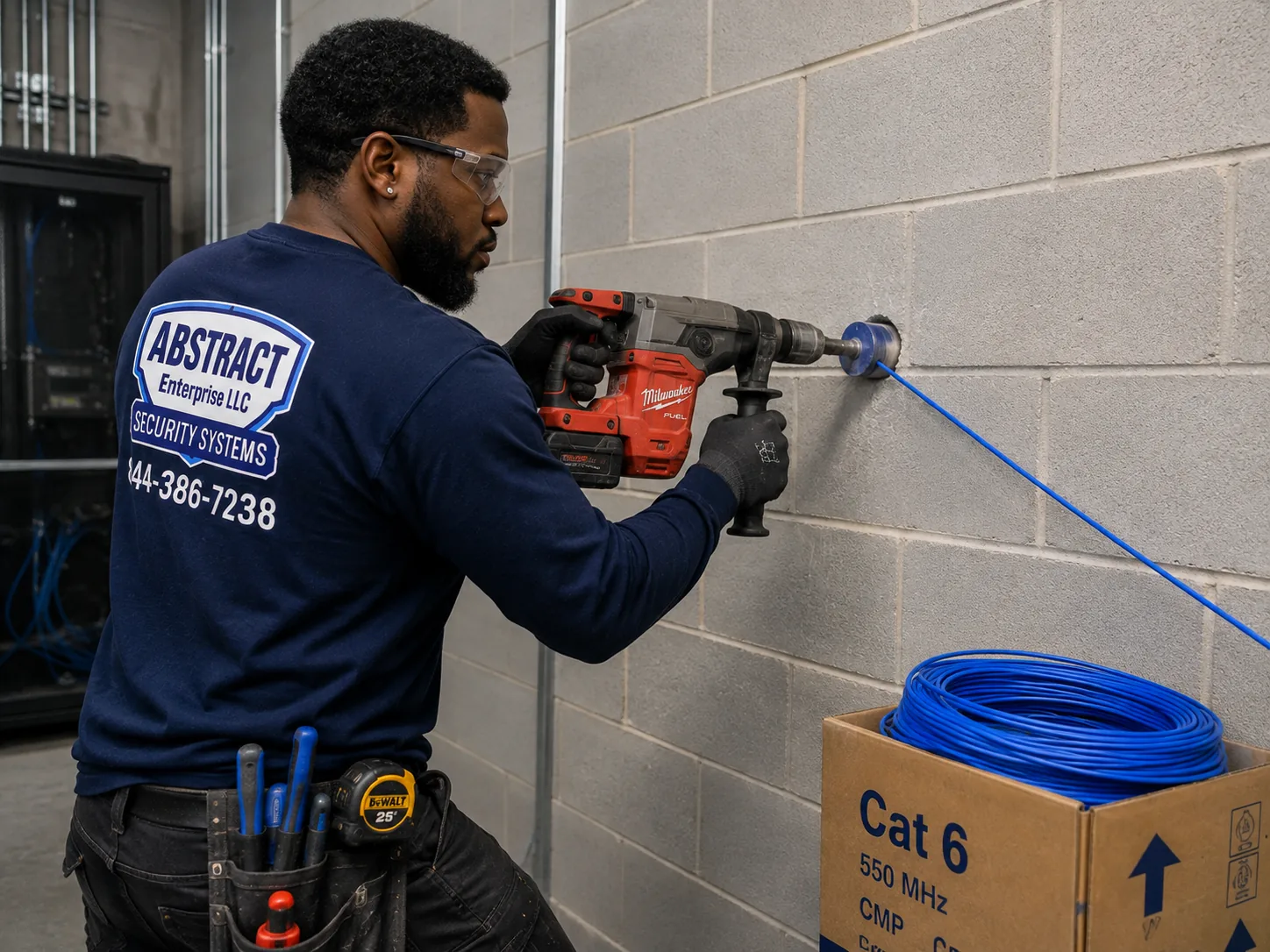
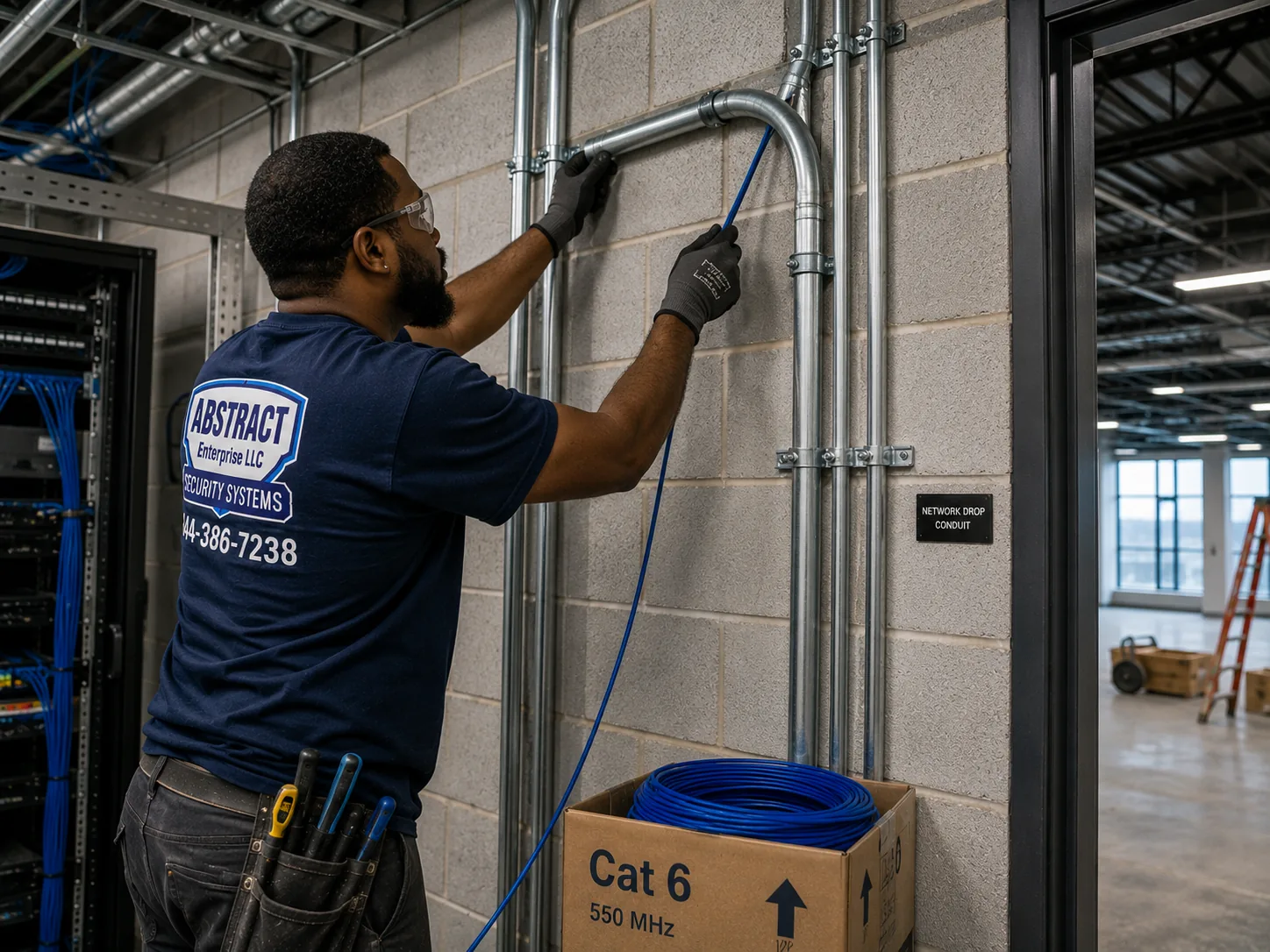
Ocean Parkway, Brooklyn security camera installation job-library photo: a technician core drilling a block wall to carry cable through to a network room
Photo from our job library, not taken on Ocean Parkway: a technician core drilling a block wall to carry cable through to a network room. The same kind of drilled, sleeved and sealed hole carries camera cable from an Ocean Parkway co-op's enclosed garage into the room where the recorder lives, or through the foundation wall of a detached parkway house to a camera on the back of the garage.
Commercial Security Camera Installation

Business Security Camera Installation in Ocean Parkway

The parkway itself is almost entirely homes, schools and houses of worship, and commercial vehicles are not allowed on it. The businesses that serve the people who live along it are on the streets that cross or parallel it. These are the corridors we work on and what tends to matter on each.

🛍️

Kings Highway

The big cross-town shopping street, with stores, offices and restaurants on the blocks either side of the parkway and apartments above many of them.

🏬

Avenue U

A long commercial avenue crossing the southern stretch, with groceries, restaurants, pharmacies and services in low buildings with back doors onto lots and alleys.

🍞

Church Avenue and Ditmas Avenue

The northern end near Kensington, where shops sit under walk-up and elevator apartments and the parkway's service road meets the bus routes.

🛣️

Coney Island Avenue

The busy avenue east of the parkway, with long, narrow stores, auto businesses and restaurants that stay open late.

🚆

McDonald Avenue

West of the parkway under the elevated F line, with supply houses, contractors' yards, workshops and garages behind roll-down gates.

🎓

Schools, Shuls and Offices

Yeshivas, synagogues and community offices along the parkway and side streets, with arrival rushes, after-hours events and a lot of people who need keys.

Kings Highway: shared facades and apartments above

Many Kings Highway stores sit under apartments that belong to someone else. The store wants its door, counter and stockroom covered; the building owner wants the residential door and the sidewalk. Two systems on one facade can work if they are planned together, so that the store's door camera does not stare into the residential entrance and neither looks up into the apartment windows. Inside, the plan starts with a face camera just inside the door, a counter camera behind the register aimed at the customer side, and an overview camera high at the front looking back through the store. A stockroom or basement stair gets its own camera.

Avenue U and Coney Island Avenue: long stores and back doors

Stores on these avenues are often long and narrow, with shelves or racks down the middle and a back door onto a lot, an alley or a loading area. After-hours trouble usually starts at the back, and daytime trouble at the counter. We put one camera just inside the back door and one outside it looking along the rear wall, and keep the counter camera on continuous recording rather than motion, because in a busy store motion recording is either always on or set so loosely that it misses things. Bright windows behind a customer can turn a face into a silhouette, so we set the door camera's exposure for the people walking in, and check it on site at midday.

McDonald Avenue: yards, gates and the elevated line

Under the elevated tracks, contractors' yards, supply houses and workshops keep vans, tools and stock behind gates. The camera plan here covers the gate from inside the yard, the doors to any building on the lot, and the van parking. Long yards often need a varifocal camera zoomed on site to the far end, and cable runs across a yard go in conduit or overhead rather than lying on the ground. The noise and vibration of the trains overhead are no problem for the cameras, but they do mean motion alerts should be set on people, not on movement in general.

Rules and limits for business cameras near Ocean Parkway

License. Abstract Enterprises Security Systems installs under NYS license #12000287431 and carries insurance; ask any installer for both before work starts. Facial recognition. New York City's biometric identifier law requires retail stores, food and drink businesses and places of entertainment that collect biometric data, such as facial recognition, to post a clear and conspicuous sign at their entrances, and bars them from selling or profiting from that data. Ordinary recording cameras do not collect biometric data, and we leave face-matching features switched off unless the owner has taken advice and posted the sign. Restrooms and changing areas. No camera views a restroom, fitting room or changing area, and we will not install one that does. Sound. We leave audio recording off unless the owner has taken advice on it. Deliveries. Because commercial vehicles are barred from Ocean Parkway, our vans park on the side streets, and we plan the work so ladders and cable are carried in from there. Public property. We do not mount private cameras on street trees, mall lampposts, light poles or the elevated structure.

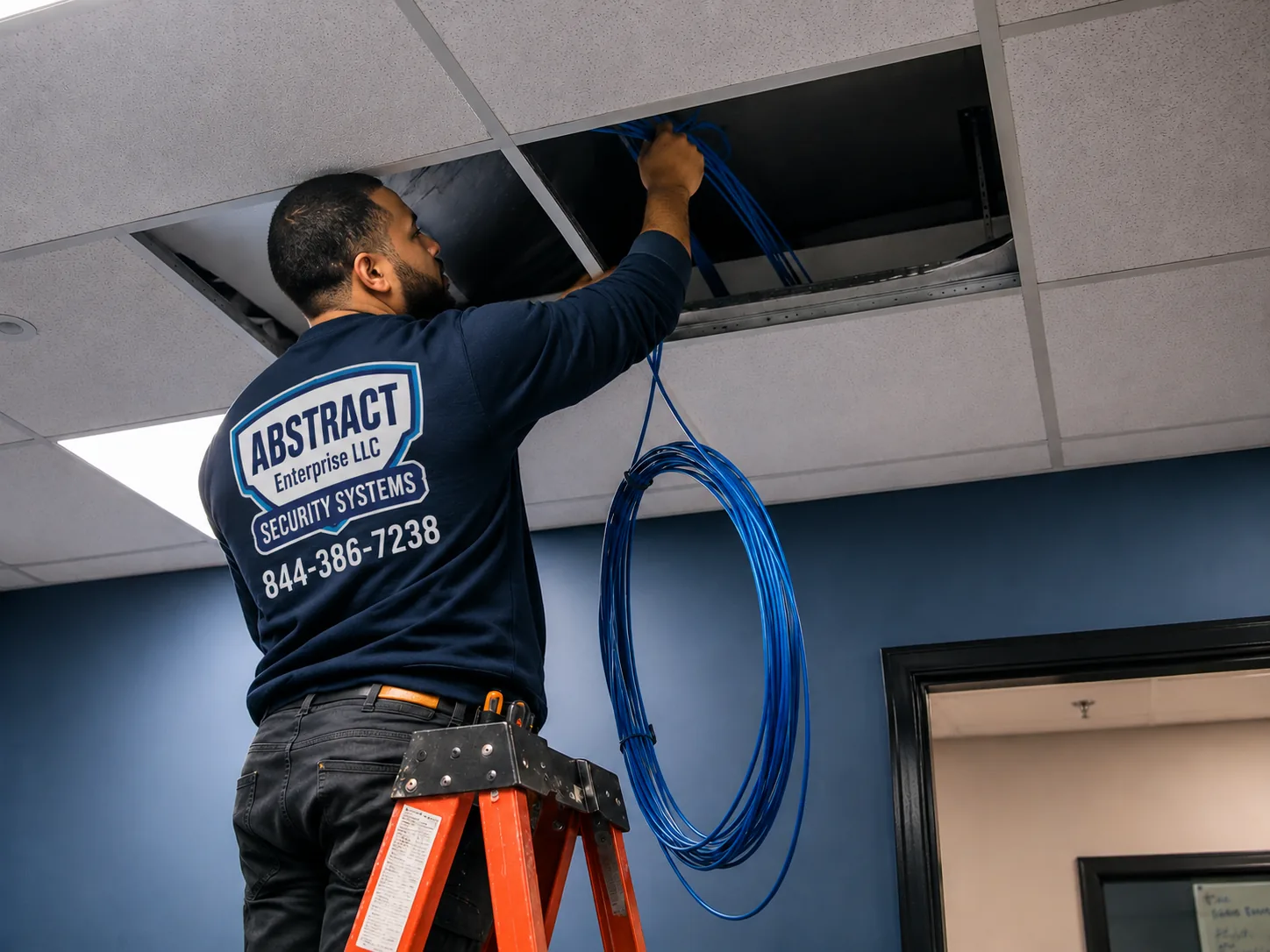
Ocean Parkway, Brooklyn security camera installation job-library photo: a technician feeding cable through a ceiling in an occupied commercial space
Photo from our job library, not taken on Ocean Parkway: a technician feeding cable through a ceiling in an occupied commercial space. Stores on Kings Highway and Avenue U mostly stay open while cameras go in, so the cable for the counter and stockroom cameras goes above the ceiling one section at a time, with the aisle under the ladder kept clear.
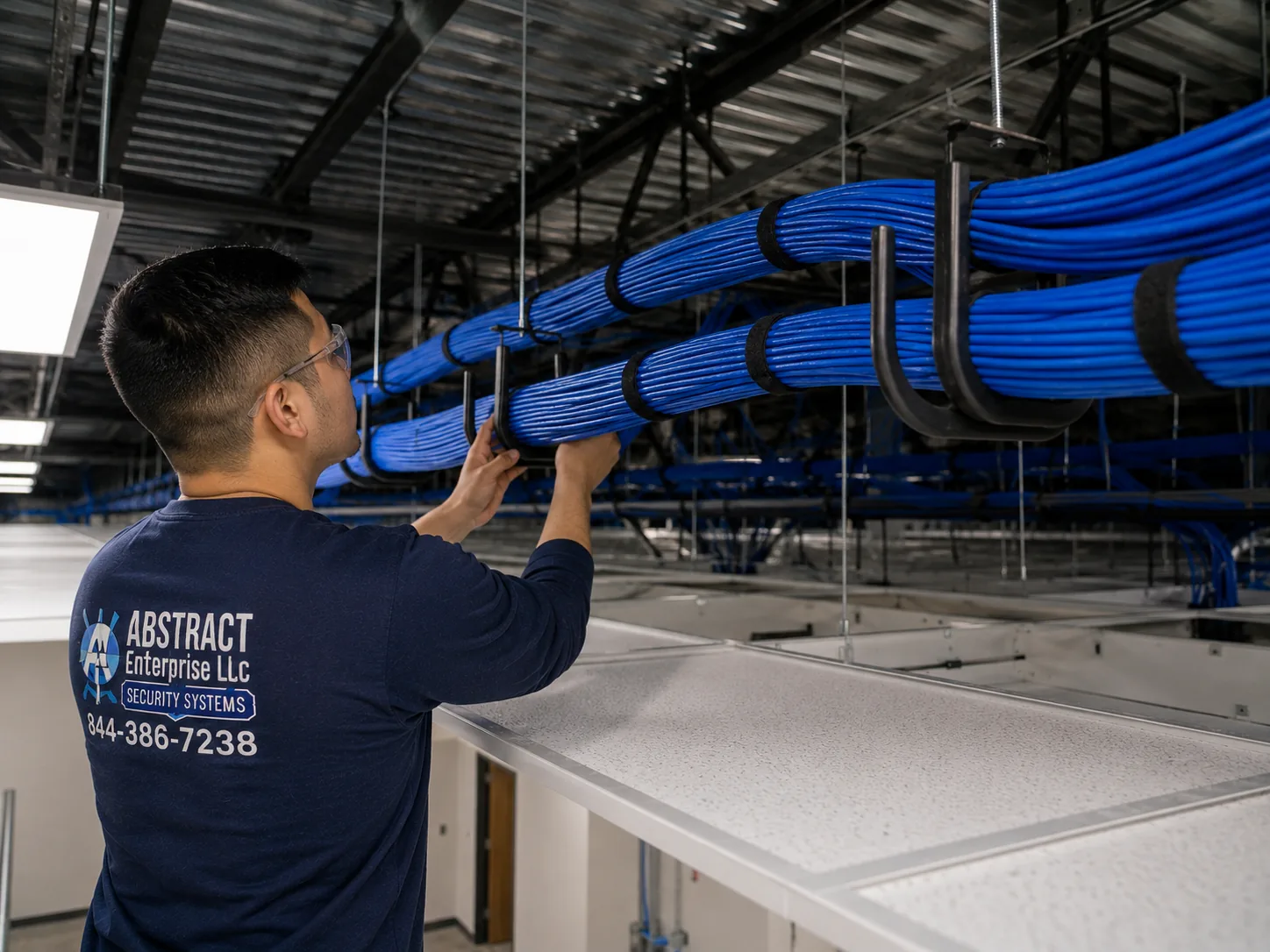
Ocean Parkway, Brooklyn security camera installation job-library photo: J-hooks carrying dressed cable bundles across a commercial ceiling
Photo from our job library, not taken on Ocean Parkway: J-hooks carrying dressed cable bundles across a commercial ceiling. In a yeshiva or a larger avenue store, camera cable shares the ceiling with sprinkler pipe, ductwork and data cable, so it rides on its own hooks, bundled and labeled, instead of lying on the ceiling tiles.
Apartment Buildings

Vestibules, Mail Areas and Fire Escapes: A Camera Plan for an Ocean Parkway Apartment Building

The most useful camera plan for an Ocean Parkway apartment building follows the path a person takes from the sidewalk to a mailbox, an apartment window or a cellar storage room. Here is that path, step by step, with what each camera has to show and the building conditions we plan around.

The outer door and the vestibule

In both recent police appeals, the person got into a residential building first. The records do not say how; in many buildings like these, it is simply by walking in behind a resident or waiting for the door to drift shut too slowly. The vestibule camera's job is a clear face of everyone who comes through the inner door, and especially of anyone who comes through right behind someone else. We mount it inside, above and slightly to one side of the inner door, aimed back at the person walking toward it, so the light behind them from the street does not blank out the face. If the building has an intercom panel with its own camera, we place ours so the two complement each other: the intercom sees whoever rings, our camera sees whoever actually enters.

The mailbox wall

The 2024 theft near Cortelyou Road came from a mailing envelope in the building's mail area. The 2025 burglary near Avenue M involved a mailbox pried open at about 4:40 a.m. A camera on the mailbox wall needs to show three things: the face of whoever is standing there, the hands, and which box they are at. That usually means a camera mounted across the lobby from the mailboxes, at a height that sees over the head of a person standing at them and down onto the boxes, plus the vestibule camera's face shot as they arrive. We set it to record continuously, because a slow, careful theft at a mailbox may not move enough to trigger motion recording. The camera covers the boxes and the people at them; it does not read the names on the boxes or the mail in a resident's hands in detail, and the building's footage policy decides who can review it.

The lobby ceiling, leaks and where equipment goes

In April 2026, News 12 Brooklyn reported that water had been coming through the lobby ceiling at 514 Ocean Parkway for nearly two months, soaking mail and packages, while the building's single elevator was out for about three weeks. Lily Schwab, a tenant of more than 50 years, told the station: "Nothing gets fixed. Nothing gets done." For a camera installer, the lesson is practical: in an older building with known leaks, we keep cameras, power supplies and cable joints out from under the wet spots, mount lobby cameras on walls rather than on a sagging ceiling, and put the recorder somewhere dry and locked, not in a cellar corner beside the boiler. A camera that records the leak, and when it started, can also be useful to a tenants' association or an owner trying to show HPD what happened.

The rear yard and the fire escapes

The 2015 surge the 66th Precinct described came in through fire-escape windows, and in one case through a sixth-floor window reached from above. A camera on the building's own rear wall, mounted at the second or third floor and aimed along the line of fire escapes and down into the yard, shows anyone climbing onto the ironwork or moving along it. It must not look into any apartment. We aim along the face of the wall, not at the windows, and use the recorder's privacy masking to black out any window that cannot be kept out of frame. A second camera at roof level aimed at the roof door and the top of the fire escape covers the route from above. In a courtyard building, the courtyard gets its own camera, framed on the ground and the base of the fire escapes.

The cellar, the laundry room and the bike room

Cellars are where storage cages, bikes and strollers are broken into, where packages are sometimes stacked, and where residents do laundry alone at night. We put a camera at the cellar door or the bottom of the cellar stair, one on the laundry room's door side, and one on the bike room or storage area. The cellar is also where the cable for the rest of the building usually runs, so we plan these cameras together with the riser routes. The recorder often ends up in a locked cellar room, which is fine as long as it is dry, ventilated and behind a door that is not left open for the boiler service.

Who decides, and who gets to see

In a rental building, the owner decides where common-area cameras go and who can review them. A tenant who wants a camera in the hall needs the landlord's permission; attorney Jeffrey Reich told Brick Underground in 2022 that a common-area camera should be positioned so it would not film inside any apartment, and that without permission, a tenant should not install one. In a co-op, the board decides; Habitat Magazine reported in 2023 that there is no city law banning doorbell cameras in apartment hallways, but co-op rules govern, and shareholders need board approval for anything in a common area. FirstService Residential's 2024 guidance for New York co-ops and condos suggests keeping footage for about 30 to 90 days, limiting access to the manager or a security provider, and logging every request. We set the recorder up to match whatever policy the building adopts, with separate accounts for the super, the agent and the board contact.

Field Notes

Field Notes: Starting an Ocean Parkway Building Walk-Through at the Mailboxes

This describes how we approach buildings here, not one particular job. On an Ocean Parkway apartment building, we start inside the vestibule, not on the sidewalk. We stand at the mailbox wall and ask the super three questions: when does the mail arrive, who has keys to the inner door, and where do packages end up when nobody is home. Then we watch the inner door close by itself, and time it. A door that takes several seconds to latch is a door someone can walk through behind a resident, and the vestibule camera has to be placed for that moment, face-on to the person coming in second.

From there we go down to the cellar and find where the risers are, because that decides where every other camera's cable can run. Then out the back, to stand in the yard and look up at the fire escapes, and up to the roof door. Only then do we walk out front onto the service road. At night we come back, or ask the super for phone photos of the lobby, the yard and the cellar stair with the lights as they really are. The quote follows, one line per camera, each with its job written beside it: vestibule face, mailbox wall, rear fire-escape line, roof door, cellar stair, laundry room, service road.

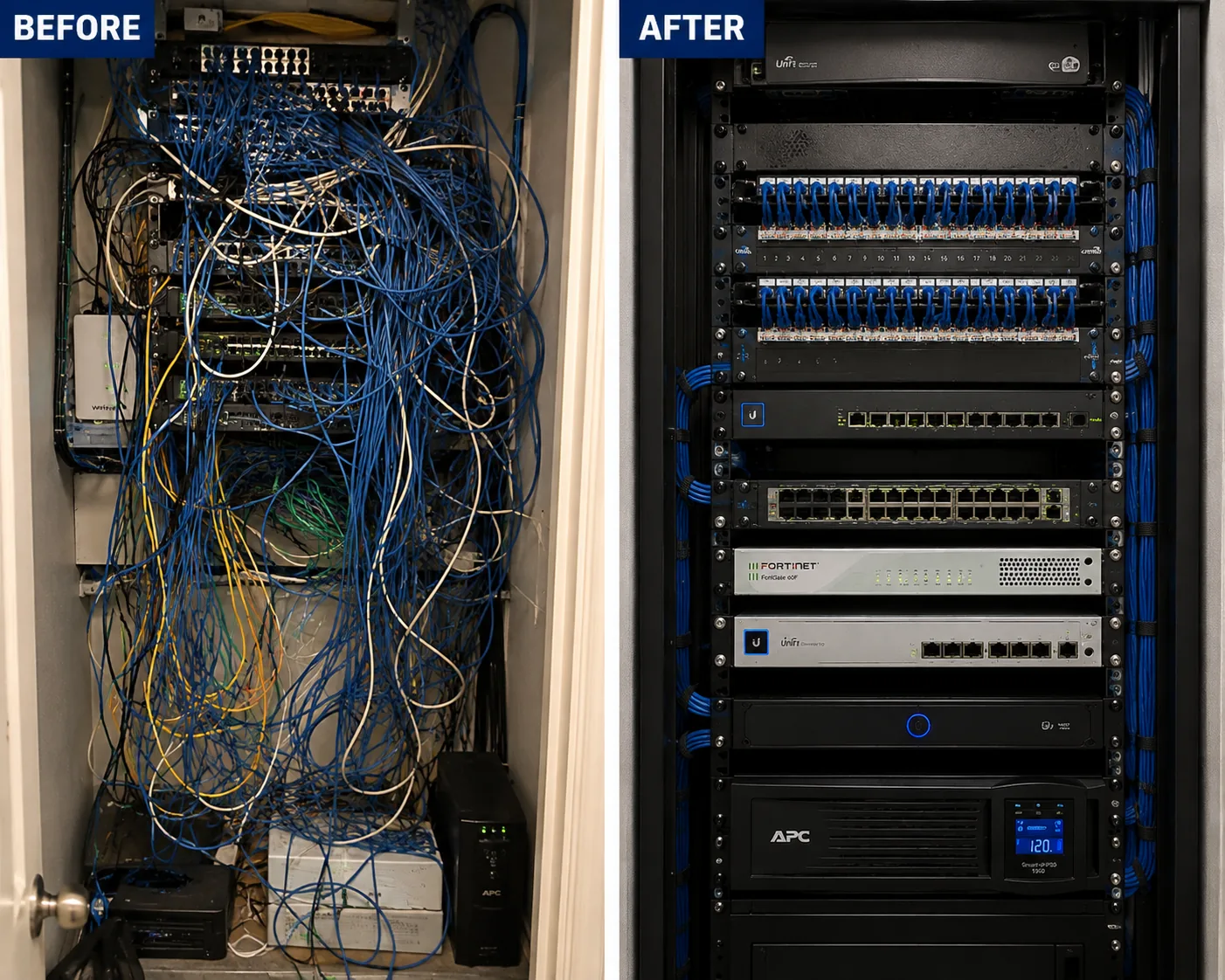
Ocean Parkway, Brooklyn security camera installation job-library photo: before-and-after views of a network rack, an unlabelled tangle rebuilt into a dressed and identified rack
Photo from our job library, not taken on Ocean Parkway: before-and-after views of a network rack, an unlabelled tangle rebuilt into a dressed and identified rack. When an Ocean Parkway building changes managing agents, the camera recorder, modem and power supplies are often found in a cellar closet in much the same state, and rebuilding them like this is usually the first day of a takeover.
Your Questions Answered

Security Camera Installation in Ocean Parkway: Questions Answered

The 2024 theft near Ocean Parkway and Cortelyou Road started with a credit card taken from an envelope in the mail area. If our building only has a camera on the street door, would it have helped?

Partly. A street-door camera shows who came into the building and when, which is a start. It does not show which mailbox they went to, what they took or whether they were the person who later used the card. A second camera aimed at the mailbox wall ties the face at the door to the hands at the boxes, and that is what turns a guess into something police can act on. In most prewar Ocean Parkway lobbies, both cameras run to the same recorder for little more than the cost of one extra run.

The August 2025 mailbox burglary near Avenue M happened at about 4:40 in the morning. What should a lobby camera be set to do in the hours before dawn?

Record continuously, see faces in low light, and send an alert to the right phone. Lobby lights in older buildings are often dimmed or partly out by early morning, so we check the picture at night and add infrared or a brighter fixture where needed. We can set an alert for any person at the mailbox wall between, say, midnight and 6 a.m., sent to the super or the agent rather than every tenant. That way someone knows the same morning, not days later when the checkbook is missed.

In 2015 the 66th Precinct said burglars were getting in through fire-escape windows near Ocean Parkway. Can the landlord put a camera on the fire escape itself?

We do not mount cameras on the fire escape ironwork, because it is an exit route that must stay clear and it would put the camera right outside a tenant's window. The better spot is the building's rear wall, at a floor where the camera can look along the line of fire escapes and down into the yard without facing any window. That records someone climbing up or moving along the ironwork, and the recorder's privacy masks black out any window that cannot be kept out of view.

A tenant in our 1920s building wants to put her own camera in the hallway facing her door. As the owner, what should we say?

The hallway is a common area, so it is your decision, and the safest answer is a written yes or no rather than a shrug. If you allow it, the usual conditions are that it faces only her own door, does not look into any other apartment when a neighbor's door opens, is removable without damage, and does not record sound. Many owners prefer to install one building camera on that floor instead, which solves the tenant's worry without creating a precedent for a camera at every door.

Our co-op board on the parkway is fielding complaints about a shareholder's video doorbell. Can the board require us to take ours down too?

It can adopt a house rule on video doorbells, and an attorney told Brick Underground in 2022 that a board can pass one without a shareholder vote; some boards ban them, others only bar cameras that face directly into other apartments. If yours goes that way, the usual alternative is a building camera on each hallway, managed by the board. If the rule only limits the angle, we can re-aim or replace a doorbell so it shows your own doorway and nothing across the hall.

The 2017 Real Deal story said dozens of homes on the parkway have been enlarged. We are rebuilding ours now. When should cameras come into the plan?

Before the walls are closed, ideally when the electrician is roughing in. We mark camera positions on the plans or the framing and pull labeled cable to each one, plus a run to the closet where the recorder will go. The cameras themselves go up after the facade is finished. Doing it this way means nothing shows on the outside, and you are not drilling through new stone or stucco a year later. If the house is still at the permit stage, a camera layout sheet can go to the builder with the low-voltage drawings.

Our house faces the parkway, but our driveway and garage open onto the side street. Which side should get cameras first?

The side street, in most cases. The parkway front is visible to everyone walking on the mall and the service road, while the driveway and the gap beside the house are the way to the back of the lot that nobody sees. We would start with a camera at the front corner aimed down the driveway, one at the back corner on the yard and back door, and the front door after that. A service-road curb camera comes next if you park on the parkway side.

Can a camera on our parkway house record who parks and gets out on the service road in front of us?

Yes, if it is aimed at the curb along your own frontage and set to record continuously. Mounted on the facade or at the eave, framed from one edge of your lot to the other, it shows cars that stop, people who get out and which way they walk. It will catch some of the passing traffic and the nearer mall in the background, which is normal. For plates, a second narrow camera aimed at the main stopping spot works better than trying to zoom one wide camera.

In December 2025, police released video after a boy was attacked in front of 510 Ocean Parkway in the afternoon. If something happens on the sidewalk in front of our building, how quickly can we get the clip to detectives?

The same day, if the recorder is set up properly and someone in the building knows how to export. We show the owner, the super or a board contact how to find a time window on the right camera and copy it to a USB stick or a phone in a few minutes. The recorder's clock is synced to a time server so the clip's time matches what police have from other cameras. If nobody on site is comfortable doing it, call us and we will help copy it before it is overwritten.

The Kensington end of the parkway had a 1:30 a.m. crash in December 2025 that knocked down a traffic camera pole. Will a city camera like that cover our car on the service road?

Do not count on it. City traffic cameras are aimed at the main roadway for traffic enforcement and monitoring, not at private cars parked along a service road, and the one in that crash was knocked over. A camera on your own building, aimed at your frontage, is the only view of your car you control. Car damage at night is often a sideswipe from the service road itself, so the curb camera should see the side of the car facing the traffic, not just the plate.

Our yeshiva's front entrance is on the parkway, but buses unload on the side street. How should the cameras split between the two?

Each door in use gets its own face camera, and the bus area gets an overview camera that shows children getting off and walking toward the door. The parkway entrance is often used by parents and visitors, the side entrance by staff and buses, so both need faces. Alerts are set for the hours the building should be empty, and the recorder is sized so a second phase of hallway cameras can be added later without replacing it.

Our building has an enclosed garage under it, as the parkway zoning requires for newer buildings. Should the garage cameras be on the same recorder as the lobby?

Usually yes, on the same recorder but with separate accounts, so the doorman or super can watch the lobby while the board or a garage manager reviews the garage. Garage cameras need different settings: low-light performance, a ramp camera set for plates, and aisle cameras set for people walking between cars. Cable in a garage typically runs in metal conduit on the concrete, and a long garage may need a switch partway along. All of that is listed separately on the quote.

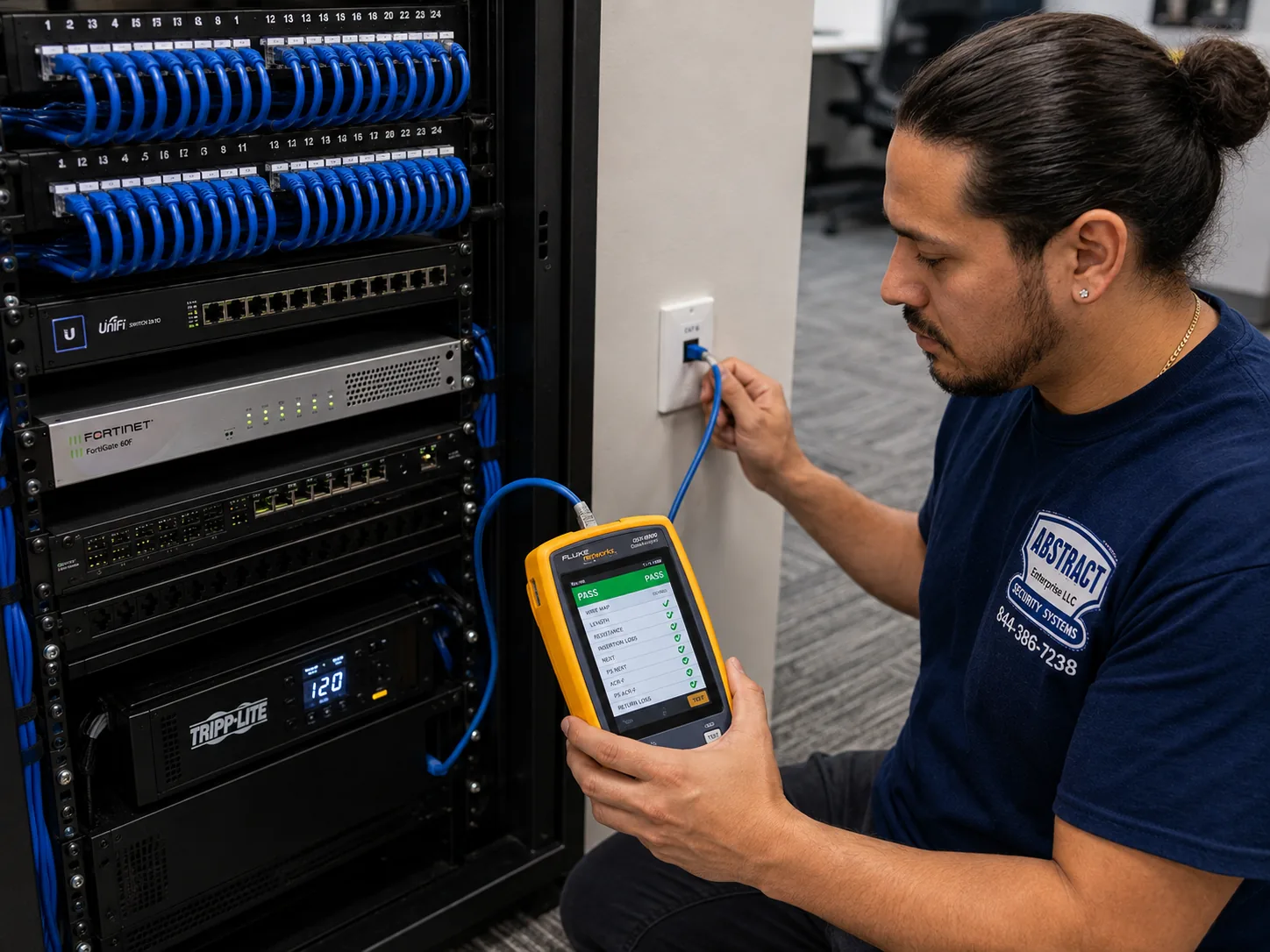
Ocean Parkway, Brooklyn security camera installation job-library photo: a technician certifying a data drop with a cable analyzer showing a PASS result
Photo from our job library, not taken on Ocean Parkway: a technician certifying a data drop with a cable analyzer showing a PASS result. A rear fire-escape camera on an Ocean Parkway building can go months without anyone checking it, which is why its cable is certified the day it goes in rather than trusted until the night it is needed.
Who Sees the Footage

Shomrim, Detectives, Boards and Neighbors: Who Asks for Ocean Parkway Camera Footage

The recordings from a camera you own are yours. But along the parkway, a lot of people may ask about them: detectives, volunteer patrols, the board, a tenant, and the neighbor next door. Knowing how each request works before the cameras go up makes those conversations easy.

Volunteer patrols

Shomrim patrols are part of life in this part of Brooklyn, and their work often turns on pictures. In November 2021, The Yeshiva World reported that after package thefts near Avenue W and East 3rd Street, a Flatbush Shomrim night patrol spotted the suspects' van parked near Avenue P and Ocean Parkway at about 1:30 a.m., with packages inside; volunteers watched it for more than an hour before the NYPD stopped it on Quentin Road and found it was stolen. The key image in that case was an eyewitness photo of the van. In January 2026, Boro Park Shomrim renewed a community camera initiative asking homeowners and businesses to share access to their exterior cameras, and said community-camera footage tracked suspects over several days in a vandalism case at Gravesend Park. "This case clearly shows how vital community-shared cameras are in helping law enforcement and Shomrim respond quickly and effectively," the group said. Whether you take part is your decision. Nothing we install connects your recorder to anyone else, and if you choose to share access, we set up a separate, limited account for it that you can switch off.

Co-op boards and condo boards

In a co-op or condo, the lobby, halls, mail area, garage and service doors are common areas, and the cameras there are a board decision. Good practice, as FirstService Residential's 2024 guide describes it, is a written policy: who can view live and recorded video, how residents request footage, how long it is kept, and a log of who accessed what. "Limiting access protects the privacy of residents and helps prevent potential misuse," Christina Forbes of FirstService told the firm's readers. We set up the recorder's accounts to match the policy, so the doorman sees live views, the agent can export, and nobody else can.

Neighbors

Parkway houses and side-street two-families sit close together at the sides and backs. New York's Civil Rights Law section 52-a lets a neighbor sue over a camera installed to record their backyard without written consent with intent to harass, annoy or alarm them. We aim every yard and side camera at your own property, use privacy masks for whatever cannot be framed out, and are happy to show a neighbor the view on a phone before anything goes up.

Equipment

Types of Security Camera Installation We Install

These are the cameras and parts we expect to fit Ocean Parkway houses, apartment buildings, co-ops, stores and congregations. Every item is named on the written quote so you can look it up before you agree to anything, and quotes default to our own non-branded system unless you ask about a specific brand.

👤

Vestibule Face Cameras

Small fixed-lens cameras mounted inside the inner door at a shallow angle, with backlight handling so a face stays clear against the bright street behind it.

📬

Wide Lobby Domes

Vandal-resistant domes for the mailbox wall and the lobby, mounted on walls rather than on old plaster ceilings, set to record continuously through the night.

🔎

Varifocal Bullets

Lenses zoomed on site for a service-road curb, a long side driveway, the far end of a garage aisle or a contractor's yard off McDonald Avenue.

🌙

Low-Light Rear Cameras

For rear yards, fire-escape lines and courtyards with little light after dark, with their own infrared or a small fixed light nearby, aimed along walls rather than at windows.

🚗

Garage Ramp Cameras

Narrow-view cameras set for plates at the entrance of an enclosed garage, paired with aisle cameras for people, both tuned for headlights and dim concrete.

🔔

Video Doorbells

For the front door of a parkway house or a two-family on a side street, wired where possible, and placed where a co-op or condo's rules allow.

💾

Recorders (NVR and DVR)

Sized for continuous recording and the building's retention policy, synced to a time server, with separate accounts for the super, the agent, the board and each household.

🔌

PoE Switches and Conduit

Power and picture over one cable to each IP camera, with metal conduit in garages and cellars and a switch partway along long runs in large buildings.

🔋

Battery Backup Units

Keep the recorder, switch and modem running through short outages, and let the system come back on its own when the power returns.

Doorbell kit, national plan or a local installer: how each fits an Ocean Parkway property

Plenty of households and buildings along the parkway start with a Wi-Fi doorbell or a nationally advertised plan, and each has its place. This table compares how each fits the properties here, without putting anyone's prices side by side.

QuestionDoorbell or self-install kit (Ring and similar)National monitored plan (ADT, SimpliSafe and similar)Abstract Enterprises Security Systems as a local installer
Mailbox wall and vestibule in an apartment buildingNot designed for it; needs board or landlord approval anywayUsually aimed at single homesWired face and mailbox cameras on a recorder the building owns
Fire escapes and rear yardWi-Fi and battery at the back of a masonry building are the weak pointsDepends on the devices chosenWired rear-wall cameras aimed along the ironwork, with window masking
Enclosed garageOften out of Wi-Fi range below gradeVariesConduit runs, ramp and aisle cameras on their own quote lines
Co-op or condo hallway rulesOwner has to clear it with the boardOwner has to clear it with the boardProposal written for the board, accounts set to its footage policy
Monthly feesOptional cloud plansMonitoring plan requiredNo monthly fee from us for a recorder you own
Getting a clip to detectives or a patrolFrom the app, if the plan stores itDepends on the planExport to USB or phone practiced with you at handover
Best forThe front door of a house or one apartmentPeople who want professional alarm monitoringBuildings, large houses and stores that need many doors and the back covered
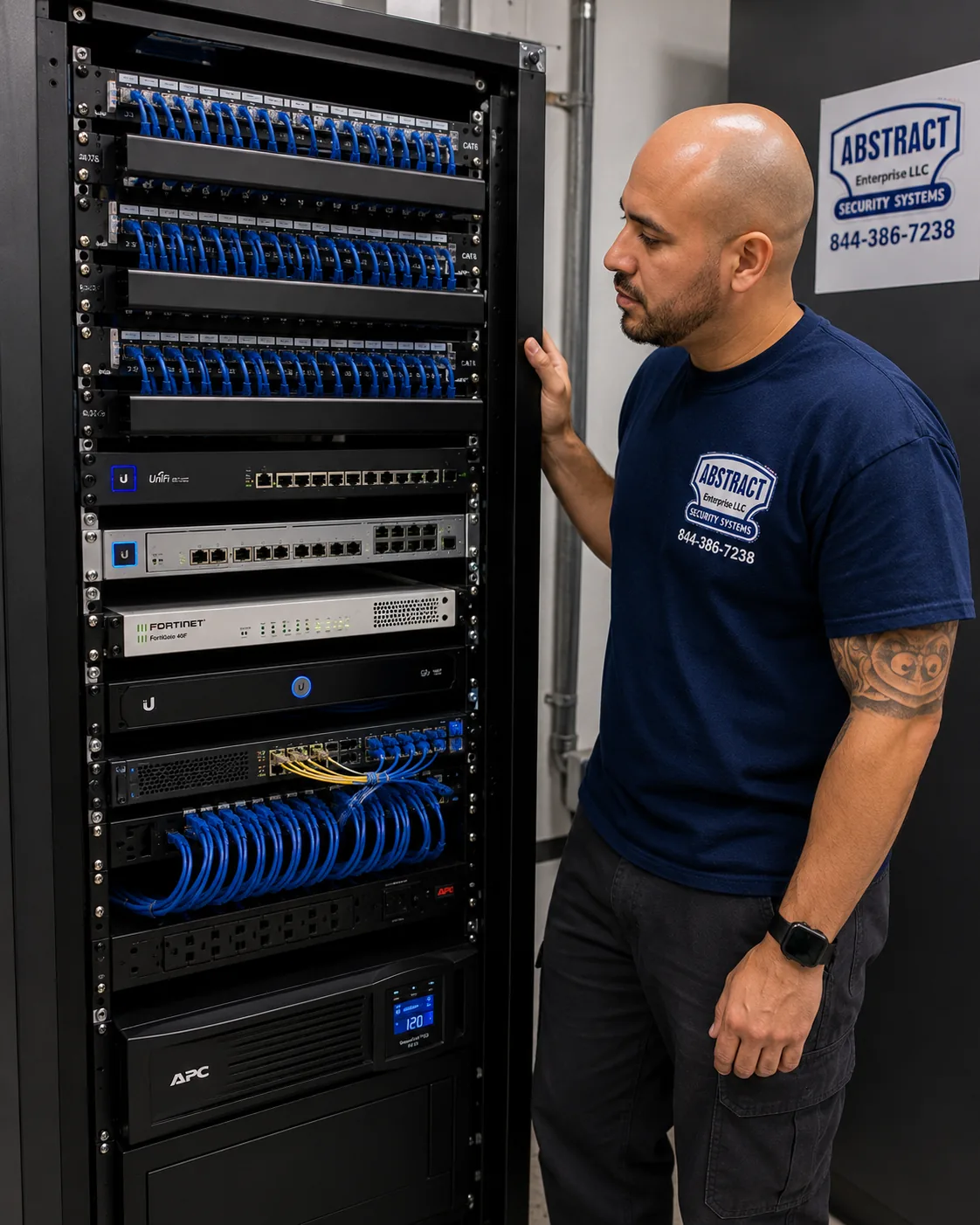
Ocean Parkway, Brooklyn security camera installation job-library photo: a finished network rack with patch panels, switching, firewall and battery backup, dressed and identified
Photo from our job library, not taken on Ocean Parkway: a finished network rack with patch panels, switching, firewall and battery backup, dressed and identified. A postwar Ocean Parkway co-op with cameras on every entrance, the garage, the bike room and the laundry ends up with a small version of this in a locked room, with the battery unit keeping the recorder alive through an outage.
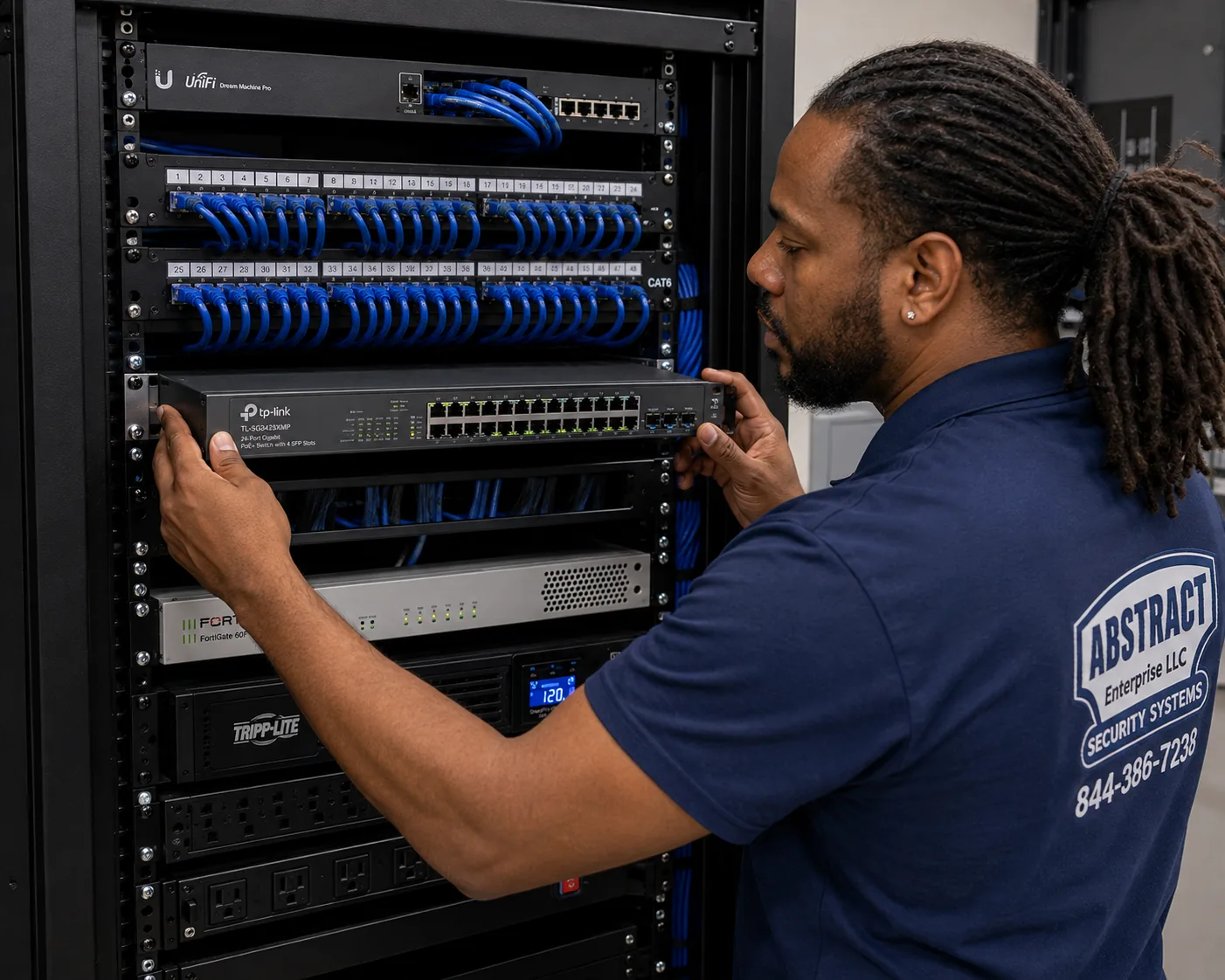
Ocean Parkway, Brooklyn security camera installation job-library photo: a technician mounting a managed PoE switch below patch panels in a commercial network rack
Photo from our job library, not taken on Ocean Parkway: a technician mounting a managed PoE switch below patch panels in a commercial network rack. One switch like this powers every IP camera in an Ocean Parkway building over its data cable, so the fire-escape camera on the rear wall and the ramp camera in the garage need no outlet of their own.
AI Overview Reality Check

What AI Gets Wrong About Security Camera Installation in Ocean Parkway

The claims below turn up in AI-written answers, cost guides and directory sites such as Angi, HomeAdvisor and Thumbtack when people ask about cameras for a Brooklyn building or house. Where a claim comes from a named source, we say so. Each is followed by what we see on Ocean Parkway properties.

"Ocean Parkway is a landmark, so you can't put cameras on the buildings."

The scenic landmark designated in 1975 is the parkway itself: the roadway, the malls, the paths and the trees. The Historic Districts Council's description of the designation covers those features, not the homes and apartment buildings that face them.

What that means in practice is that the malls, benches and lampposts are off limits for private equipment, which we would not use anyway. The walls of your house or building are yours, subject to your board, your landlord or your lease.

If a particular building sits inside a separate historic district or is an individual landmark, its own rules apply, and we check that before quoting. For most properties on the parkway, the approval that matters is the board's or the owner's.

"Security camera installation in Brooklyn averages about $1,400."

HomeAdvisor's Brooklyn guide gives an average of $1,416 and a usual range of $680 to $2,145 for camera installation or repair. That is a reasonable picture of a small house job, and it says very little about a six-story building.

An Ocean Parkway elevator building with a vestibule, a mailbox wall, a rear yard, fire escapes, a roof door, a cellar and a laundry room may need eight to twelve cameras and cable up a riser, which is commercial work. A big detached house with a garage and a long driveway may need six.

That is why we publish starting prices, from $850 for four cameras installed, and then quote each property in writing with every camera and run on its own line, so you can see what is driving the number.

"Put a camera over the front door and you're covered."

On an Ocean Parkway building, the recent police appeals were about what happened inside, at the mail area, after someone was already through the door. The 2015 burglaries came in from fire escapes. A front-door camera alone would have recorded the arrival and nothing else.

On a parkway house, the front door is the most visible part of the lot. The side driveway, the gap beside the house and the back door are where nobody on the mall or the service road can see.

The front-door camera is worth having, but on most properties here, it is the third or fourth camera, not the first.

"Wireless cameras work anywhere."

They work where the Wi-Fi reaches. In a masonry apartment building, a router in one apartment or the super's office rarely reaches the rear yard, the cellar or an enclosed garage, and a battery camera on a fire-escape wall will need climbing up to recharge.

A wired camera gets its power and its connection through one cable, records to a recorder in the building whether the internet is up or not, and does not run flat in January.

We use wireless only where a cable truly cannot go, and say so on the quote. For lobbies, rear walls, cellars and garages, we wire.

"A tenant can put a camera anywhere outside their own door."

Not in a common hallway without permission. Brick Underground's 2022 expert answer was that a renter needs the landlord's permission for a camera in a common area, and that it must be placed so it would not film inside any apartment.

In a co-op, Habitat Magazine reported in 2023 that board approval is needed for anything in a common hallway, and Brick Underground reported in 2022 that boards can adopt a ban on video doorbells as a house rule.

Inside your own apartment or house, you have far more freedom. For anything in a hall, a lobby or on a building's facade, ask first, and we will help you write the request.

"Keep footage forever, just in case."

Buildings that keep everything forever end up with drives that fail without anyone noticing, and a pile of recordings of residents that nobody has a reason to hold. FirstService Residential's guide for New York co-ops and condos suggests about 30 to 90 days, with a plan for deleting footage after that.

The right number depends on how quickly incidents come to light. A missing check may not be noticed for weeks, so a mailbox camera in an apartment building benefits from a month or more.

We size the recorder's drives to the retention the board or owner chooses, and longer storage is a one-time upgrade on the recorder, not a subscription.

"Facial recognition is the best way to secure a store."

It is the most regulated. New York City's biometric identifier law requires retail stores, food and drink businesses and places of entertainment that collect biometric data to post a clear and conspicuous sign at their entrances, and makes it unlawful to sell or profit from that data, with a right for customers to sue.

For a shop on Kings Highway or Avenue U, ordinary cameras that record clear faces at the door and the counter do the job most owners need, without collecting biometric data at all.

If a store wants face matching, we will explain what the law asks for and leave that decision with the owner and their adviser. By default, we leave those features switched off.
Get in Touch

Request a Free Quote

Tell us the address or cross street, the kind of house or building, who owns or manages it, and which doors, mailboxes, windows or garage worry you most. Photos of the vestibule, the back and the cellar help most. Prefer to talk? Call (347) 934-8335.

✅
Request Sent!
We'll call about your Ocean Parkway cameras the same business day.
How It Works

Our Installation Process

Every Ocean Parkway camera job, from three cameras on a two-family to a co-op with a garage, follows the same eight steps. In a building, the walk-through starts at the mailboxes; at a house, it starts at the side driveway.

1. Send the address and a few photos

Which side of the parkway or which side street, plus photos of the entrances, the back, any fire escape, the garage and where the internet comes in. Every request is booked within 2 hours.

2. Settle who signs off

We confirm whether a board, a landlord, a congregation committee or a store lease controls the walls and common areas, and get the approval in writing before anything is ordered.

3. Walk both faces of the property

The parkway face and the street or rear face, the service-road curb, the fire escapes, the mailroom and the garage, with the light at each spot checked after dark.

4. Assign each camera one task

Service-road curb, vestibule face, mailbox wall, fire-escape line, garage ramp, register: each camera gets a written task, and the recorder gets a hidden, dry spot.

5. Write the line-by-line quote

Every camera, mount, cable run, conduit length, recorder, drive, storage period and setup task on its own line, with any approval the job depends on noted beside it.

6. Pull cable and mount cameras

Through cellars, risers, closets and garages, labeled at both ends, masonry drilled and sealed, with stairs, lobbies and store floors kept clear while people come and go.

7. Test in daylight, at night and through an outage

Each run certified, the clock synced, faces checked at night with the real headlights and streetlights, and the system restarted from battery to prove it recovers alone.

8. Hand over accounts, a written map and an export drill

Each person gets only the cameras they should see, you export a clip while we watch, and we leave a written map of every camera and cable.

Coverage Area

Security Camera Installation Near Ocean Parkway's Landmarks

These are places the sources tie to the parkway, from its northern end to the ocean, and what a camera job on the blocks around each one tends to involve.

The Malls and the Bike Path

The tree-lined malls, benches and the bike path opened in 1894, part of the 1975 scenic landmark; house and building cameras frame their own frontage and leave the city's mall alone.

Machate Circle

The northern end near Prospect Park, where the parkway's service roads meet the circle and taller apartment buildings with lobbies, garages and many entrances take over.

Mir Yeshiva

On the parkway at Avenue R, one of the many yeshivas and shuls along the road whose entrances and halls need cameras planned around arrivals and dismissals.

Abraham Lincoln High School

At Ocean Parkway and Shore Parkway, where buildings and stores nearby see heavy student foot traffic and need door cameras that frame their own steps.

South Brooklyn Health

The hospital campus near Avenue Z, formerly Coney Island Hospital, surrounded by apartment buildings where garages, lobbies and late-night shift workers shape the camera plan.

Ocean Parkway Station

The Q train's Ocean Parkway stop in Brighton Beach at the southern end, where buildings near the station and the boardwalk face salt air and steady pedestrian traffic.

We also install security cameras in nearby Borough Park, Ditmas Park, Bensonhurst, Brighton Beach and Coney Island, and across the borough from our office at 1282 Troy Avenue, Brooklyn.

Pricing

Security Camera Installation Cost in Ocean Parkway

Ocean Parkway is priced on our Brooklyn base rate. Residential systems start at $850 with professional installation, a recorder, two weeks of continuous recording and phone viewing included. What moves an Ocean Parkway quote is mostly the building and the cable route: the number of entrances, a riser climb to a rear fire-escape camera, conduit in an enclosed garage, masonry drilling on a brick house, cameras beyond four, and longer storage for a mailbox camera. Every property is quoted in writing after photos or a walk-through, and nothing is ordered until you have agreed to the written quote.

Item (Brooklyn rate)PriceWhat it is
Residential system, 4 camerasStarting at $850Four cameras installed with a recorder, two weeks of continuous recording and phone viewing
Residential system, 4 to 8 camerasTypically $850 – $2,500Houses and two-families, depending on camera count, walls and cable runs
Recording storage on a standard 4-camera system2 weeks $100 (included) · 1 month $180 · 2 months $270 · 3 months $360 · 4 months $450Continuous recording kept before the oldest footage is overwritten; a one-time upgrade, not a subscription
Commercial CCTV$1,500 – $5,000+Apartment buildings, co-ops, stores, schools and congregations, depending on cameras, building and any intercom or access control
Monthly fees$0The recorder stores footage locally; no cloud subscription, contract or monitoring fee from us

Everything beyond the starting system, including extra cameras, long cable runs, garage conduit, switches, lighting, cabinets and labor, is priced in writing for your property before any equipment is ordered, and nothing is added later without your agreement.

Full terms — including 50% deposit, one-year parts-only warranty on Abstract Enterprises Security Systems-supplied products, and the late-fee schedule — are set out in the service agreement.
Shop Our Systems

Security Camera Installation Packages & Pricing

Most Ocean Parkway jobs begin from one of three starting points. Your written quote shows exactly what your house or building adds.

Starter: Four Cameras from $850

Four cameras on a recorder with two weeks of recording and phone viewing, a good fit for a side-street two-family that needs the driveway, the back door, the yard and the front door covered.

House: Four to Eight Cameras, Typically $850 to $2,500

For a large detached parkway house: front door, service-road curb, side driveway, back corner, garage and more, with masonry drilling and attic or basement cable routes priced line by line.

Building: Commercial Systems from $1,500

For apartment buildings, co-ops, stores and yeshivas: vestibule, mailbox wall, rear fire-escape line, roof door, cellar, laundry and garage, typically $1,500 to $5,000 and up.

Ocean Parkway, Brooklyn security camera installation job-library photo: a technician running cable into EMT conduit beside a telecom room in an industrial building
Photo from our job library, not taken on Ocean Parkway: a technician running cable into EMT conduit beside a telecom room in an industrial building. In the enclosed garage of an Ocean Parkway co-op or condo, or along a cellar wall on the way to a rear-yard camera, cable runs in metal conduit like this so it is protected from cars, carts and storage.

Already bought your cameras? Labor-only installation and setup

Some Ocean Parkway owners come to us with a kit bought online, a system a previous managing agent left behind, or Wi-Fi cameras that keep dropping out in the cellar or at the back of the building. We install and set up customer-supplied cameras on a labor-only basis, priced after photos of the cameras and the property. That covers mounting, cable runs, moving the passwords to the owner, syncing the recorder clock, naming each camera by its task, separate accounts for the super, the agent, the board or each household, alert schedules for the hours a lobby or yard should be quiet, a restart test after a power cut, and an export drill. Customer-supplied equipment is not covered by our product warranty, and a customer's own wireless cameras depend on the customer's own network, so it pays to check the cameras' condition and warranty before the visit.

Complete Services

Every Security Camera Installation Service in Ocean Parkway

Apartment Buildings

Vestibule, mailbox wall, rear yard, fire-escape line, roof door, cellar and laundry cameras for prewar rentals and their owners. Request a quote.

Co-ops and Condos

Garage, bike room, package area and service door cameras, a proposal written for the board, and accounts set to the building's footage policy.

Parkway Houses and Two-Families

Front door, service-road curb, side driveway, yard and garage cameras, including pre-wiring for houses being rebuilt or enlarged.

Stores, Schools and Takeovers

Door, counter and stockroom cameras on the avenues, entrance cameras for shuls and yeshivas, and old systems taken over. More on our Brooklyn camera page and our NYC security camera installation hub.

FAQ

Ocean Parkway Security Camera FAQ

A missing check might not be noticed for weeks. What does it cost to keep a month or more of mailbox-camera recordings on Ocean Parkway?
+

On a standard four-camera system, two weeks of continuous recording is included, and longer storage is a one-time upgrade on the recorder: one month is $180, two months $270, three months $360 and four months $450. Larger building systems are sized to the retention the owner or board chooses. There is no monthly fee for storage, because the footage stays on the recorder's own drives in the building.

If the building's internet goes out, do the lobby and mailbox cameras on our Ocean Parkway building keep recording?
+

Yes. The cameras record to a recorder inside the building over their own cables, so an internet outage only stops remote viewing on phones. Recording continues, and phone access comes back by itself when the internet does. A battery backup unit on the recorder and switch keeps everything running through short power cuts as well.

The company that installed our building's cameras is gone and nobody has the password. Can we keep the cameras and just take over the recorder?
+

Often, yes. We find the recorder, reset or recover the administrator account so it belongs to the owner, test each camera and cable, and replace only the cameras that have failed. Many older recorders can be reset with the manufacturer's help once ownership is shown. If the recorder itself is too old to support current phone apps, we replace it and keep the working cameras where they are compatible.

Can our super watch the lobby and cellar cameras on his phone without seeing the garage or the board's exports?
+

Yes. The recorder supports separate user accounts, each with its own cameras and permissions. The super can have live view of the lobby, cellar and laundry, the doorman the entrances, the managing agent everything with export rights, and the board contact whatever the building's policy allows. Each account has its own password, so a staff change means deleting one account rather than resetting the whole system.

Can the camera work in our parkway building be scheduled so the lobby is not blocked during the morning rush?
+

Yes. Every visit is booked as a two-hour arrival window on a day you choose, and in a building we work the lobby and vestibule in the middle of the day, after the morning rush and before school pickup. Ladders and cable stay out of the path to the elevator and mailboxes, and anything left overnight is closed up, with no open ceiling tiles or loose cable in common areas.

Couriers leave boxes in a pile by our lobby elevator. Can one camera show the pile and who takes from it?
+

Yes, if it is placed for that spot. A camera across the lobby, aimed at the package area from a height that sees over people standing there, shows hands and boxes, while the vestibule camera records the face of whoever came in. If packages go into a separate room, a camera inside its door does the same job. Moving deliveries to a single marked spot also makes the camera far more useful.

Our small shul near the parkway may get help through a funding program like UJA-Federation's fund for small Brooklyn synagogues. How should the camera quote be written?
+

Itemized, so the funder and the board can follow it. UJA-Federation of New York's 2022 fund described security packages for small Brooklyn shuls that could include video cameras. We list each camera, mount, cable run, recorder and labor item on its own line, mark which entrances each camera covers, and can split the job into phases if the funding comes in stages.

Our newer building already has a video intercom at the street door. Will new cameras interfere with it?
+

No. The intercom's camera and the building cameras do different jobs and can run on separate equipment. We mount the new vestibule camera where it sees the people who actually come through the inner door, not just whoever presses the button, and leave the intercom's wiring and network untouched. If the board wants both on one screen at the front desk, we check whether the intercom supports that before promising it.

Can the doorman's desk in our co-op show all the cameras on one screen?
+

Yes. The recorder can drive a monitor at the desk showing a grid of live views, with the entrances largest. We mount or place the monitor so visitors at the desk cannot read it, and set the desk's account to live view only, so the doorman can watch but not export or delete footage.

Our building is near the beach at the southern end of the parkway. Does the salt air change which cameras go on the outside?
+

It changes the mounts and the details more than the cameras. Near the ocean we choose outdoor-rated housings, stainless or coated hardware, sealed cable entries and drip loops, and we avoid bare metal brackets that rust onto the brick. The rear and roof cameras get checked more closely at handover, and we show the super what to look for after a winter storm.

Can our co-op board see what each camera will show before voting on the proposal?
+

Yes. The written proposal includes a photo of each camera position with the expected view marked on it, a note of what each camera is for, and a plan of who will be able to see which cameras. If the board wants, we can hold a test camera up at a disputed spot during the walk-through and send the board the picture, so the vote is on a real view rather than a guess.

Should an Ocean Parkway building tell residents before new lobby and hallway cameras go up?
+

It is good practice, and it heads off most complaints. A short notice saying which common areas will have cameras, that none look into apartments, who can view the footage, how long it is kept and how residents can ask for a clip answers the questions people raise. We give the owner or board a plain list of camera locations to base that notice on.

More Security Camera Installation near Ocean Parkway

CCTV & Security Camera Installation Brooklyn, NY | Abstract Enterprises Security Systems · Security Camera Installation NYC | Licensed Installer · Security Cameras Installed in Manhattan · Security Camera Installation Queens NY · Security Camera Installation Bronx | No Monthly Fees · Staten Island Security Camera Installation · Long Island Security Camera Installation NY · Hudson Valley Security Cameras · Security Camera Installation Nassau County NY · Security Camera Installation Suffolk County NY · Westchester Security Camera Installation · Rockland County Camera Installation · Orange County NY Security Cameras · Putnam County Camera Installation · Dutchess County Security Cameras · Ulster County Security Camera Installation | Kingston NY

Security Camera Installation Bath Beach Brooklyn NY · Security Camera Installation Bay Ridge Brooklyn NY · Security Camera Installation Bedford-Stuyvesant Brooklyn NY · Security Camera Installation Bensonhurst Brooklyn NY · Security Camera Installation Bergen Beach Brooklyn NY · Security Camera Installation Beverley Square Brooklyn NY · Security Camera Installation Boerum Hill Brooklyn NY · Security Camera Installation Borough Park Brooklyn NY · Security Camera Installation Brighton Beach Brooklyn NY · Security Camera Installation Brooklyn Chinatown Brooklyn NY · Security Camera Installation Brooklyn Heights, Brooklyn NY · Security Camera Installation Brooklyn Navy Yard Brooklyn NY · CCTV & Security Camera Installation Brooklyn, NY | Abstract Enterprises Security Systems · Security Camera Installation Brownsville Brooklyn NY · Security Camera Installation Bushwick Brooklyn NY | Abstract Enterprises Security Systems · Security Camera Installation Cadman Plaza Brooklyn NY · Security Camera Installation Canarsie Brooklyn NY | Abstract Enterprises Security Systems · Security Camera Installation Carroll Gardens Brooklyn NY · Security Camera Installation City Line Brooklyn NY | Abstract Enterprises Security Systems · Security Camera Installation Clinton Hill Brooklyn NY · Security Camera Installation Cobble Hill, Brooklyn NY · Security Camera Columbia Street Brooklyn NY · Security Camera Installation Coney Island Brooklyn NY · Security Camera Installation Crown Heights Brooklyn NY

Other services in Ocean Parkway

TV Installation Ocean Parkway Brooklyn | (347) 934-8335 · Door Buzzer Repair Ocean Parkway Brooklyn NY | Co-ops · Fire Alarm Installation Ocean Parkway Brooklyn NY · Alarm Installation Ocean Parkway Brooklyn NY | Setback · Door Buzzer Installation Ocean Parkway Brooklyn NY · Security Camera Repair Ocean Parkway Brooklyn NY · Intercom Installation Ocean Parkway Brooklyn NY · Access Control Installation Ocean Parkway Brooklyn NY · Structured Cabling Installation Ocean Parkway Brooklyn NY

Ready to Cover the Lobby, the Back and the Garage on Ocean Parkway?

Whether it is a prewar elevator building near Kensington, a postwar co-op with a garage, a big detached house with its driveway on the side street, a two-family a block off the parkway, a store on Kings Highway or Avenue U, or a yeshiva with doors on two streets, send a few photos and the address and we will tell you which cameras matter most, who has to approve them and what the written quote will cover. Requests are booked within 2 hours, estimates are free, and the work is done under NYS license #12000287431 from our Brooklyn office at 1282 Troy Avenue. Call (347) 934-8335, message us on WhatsApp, or go back up to our Brooklyn security camera installation page for the rest of the borough.