Property management security in Rockland County starts at $250, the service call that sends a licensed low-voltage technician to a dead buzzer, a door that no longer latches, a fob reader that stopped answering or a camera that went black at any rental your office handles. Two-family houses in Spring Valley, walk-ups above the shops in Haverstraw and Nyack, garden apartments and newer complexes along Route 59, Pearl River rentals near the train and the condominium and HOA communities your firm manages for their boards can all sit on one vendor record with one phone number.
Quick answer: A Rockland landlord or managing agent needs a contractor who can fix the part that failed this week and plan the larger change the owner is weighing for next year, with records that survive a sale or a change of manager. Every repair opens with the $250 service call. Our Rockland service pages already publish the rest: $250–$525 for an apartment station, $450–$950 for an electric strike with alignment, $650–$1,800 for lobby panel work, $1,200–$3,500 for a video intercom in a four- to eight-unit building, $1,700–$5,000 for a single controlled door or gate, $1,950 per car for a Level 1 elevator reader and four-camera systems from $1,099. A whole building or a whole portfolio is priced building by building after a site survey.
Last updated November 27, 2026 by Abstract Enterprises Security Systems, NYS license #12000287431 · Sources: Rockland County Department of Health (Multiple Dwelling Rental Registry; Lead Poisoning Prevention Program); Village of Haverstraw Code ch. 171; Rockland County Times (June 2025, May 2026, July 2026); NYS Homes and Community Renewal ETPA fact sheet and Nyack update; NYS Department of Health Lead Rental Registry; U.S. Census Bureau QuickFacts; News 12 Hudson Valley (Feb 2024); Orange & Rockland Utilities (July 2026); Rockland County Code ch. 250 and ch. 286; Town of Clarkstown Code ch. 91; NYS Multiple Residence Law §3; Daily Voice (April 2026)
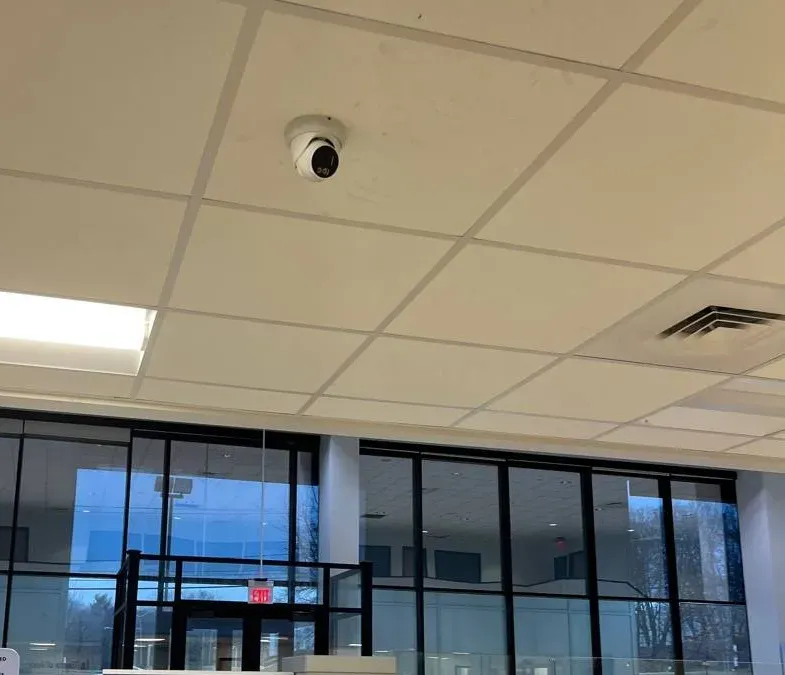
Real job photo: a small white turret dome set into a drop ceiling tile, looking toward a wall of tall windows and a glass entry door. A ceiling position just inside the entrance sees every face coming in, which is where most Rockland complexes and leasing offices want their first camera.
Rockland Landlord & Manager Request
One house, one building or the whole Rockland list
✅
Request Sent!
Got your details. Expect a call or a text from the Rockland desk, as a rule inside two hours, offering a two-hour window for the visit.
25+
Years Experience
2 Hr
Booking
$250
Service Call
4.7★
201 Google Reviews
Rockland visits leave from 460 E Fordham Rd in the Bronx · NYS low-voltage license #12000287431 · Call or text (845) 640-3835
The County
Why a Rockland Rental List Needs One Security Contractor and One Set of Records
A Rockland rental portfolio almost never looks like a city portfolio. There are no tall lobbies with a doorman and no single landlord owning a whole avenue. What an office here usually carries is a spread of small and mid-size properties: a two-family on a side street in Spring Valley, a converted house split into four apartments near Main Street, a three-story walk-up above a storefront in Haverstraw village, a 1970s garden complex in Nanuet or Pomona with six or eight separate entrances, a newer building in Pearl River a short walk from the train, and perhaps a townhouse community the firm manages for its homeowners association. Each one came with its own buzzer brand, its own camera kit and its own idea of who was supposed to call whom when the front door stopped latching.
That spread is what makes security expensive for a Rockland manager. The parts are rarely the costly piece. The costly piece is the office phoning three different contractors in three different towns, waiting a week for a callback, paying for a second trip because the first technician arrived without the right strike, and losing a morning because nobody can find the login for the camera recorder at a building the owner bought last spring. Our approach is to put every property on one vendor record, write down what is installed at each address and in what condition, and make sure the technician who arrives next time reads the notes before touching anything.
The county's shape explains a lot of the work. Rockland has no cities at all. It is made up of five towns — Clarkstown, Haverstraw, Orangetown, Ramapo and Stony Point — and eighteen incorporated villages, plus hamlets such as Nanuet, Pearl River, Valley Cottage and Congers that belong to their towns. At 199 square miles it is the smallest county by area in New York outside the city, which keeps drive times short, but it also means a manager deals with a different building department, a different set of local laws and sometimes a different police department for almost every property. The 2020 Census counted 338,329 residents and the Census Bureau lists 109,999 housing units, with an owner-occupied rate of 67.9 percent for 2020–2024. Put the other way, roughly one occupied home in three is rented, and a large share of those rentals sit in small buildings rather than big complexes.
On top of that, Rockland has layered its own rental rules over the state's. The county health department runs a Multiple Dwelling Rental Registry: every building with three or more rental units, and every rooming house, must register and hold a Multiple Dwelling Rental Certificate, a new certificate is needed after each change of ownership, and the department says failure to comply may bring penalties of $2,000 a day. The Village of Haverstraw requires a rental permit for every apartment that is not occupied by the owner or the owner's family, valid for two years, with an inspection folded into the permit fee. Orangetown adopted a landlord registry in June 2025 with a yearly fee of $75 for properties of one to four units and $150 for five or more, and owners who live in their own two-family are not required to register. And because Spring Valley is one of the twenty-five communities of concern under the state's Lead Rental Registry, pre-1980 rentals with two or more units in ZIP code 10977 must be inspected for lead hazards every three years or after a sale. None of those programs is a security law, but each one brings an inspector, a closing or a renewal date into the calendar, and each of those dates is a sensible time to get the front door, the entry system and the records in order.
Rent regulation is patchier here than people expect. New York's Homes and Community Renewal fact sheet lists the Town of Haverstraw and the Village of Spring Valley as the Rockland municipalities that have adopted the Emergency Tenant Protection Act, which reaches buildings of six or more units built before 1974. The Village of Nyack opted out of the ETPA in January 2024 after its board decided its vacancy survey had been inaccurate. Code enforcement is uneven as well: since February 14, 2022 the county's Office of Buildings and Codes has handled inspections in the Village of Spring Valley under a state order, and News 12 reported that the county carried out more than 2,000 inspections and cited more than 12,400 alleged violations there in the first two years. We are a security contractor, not a law office, and nothing here is legal advice. We simply plan every job knowing which of these rules touch the building, and we cite where each one comes from so the owner's attorney can check it.
The person behind the business started on entry and camera systems as a technician in 2000 and has owned the company since 2002. Visits are routed from our Bronx office at 460 East Fordham Road, across the Mario M. Cuomo Bridge or up the Palisades Parkway, and every job is done under New York State low-voltage license #12000287431 with general liability coverage in place. Rockland requests come in on one line, (845) 640-3835, and the office books the visit within 2 hours of the request into the next open two-hour arrival window.
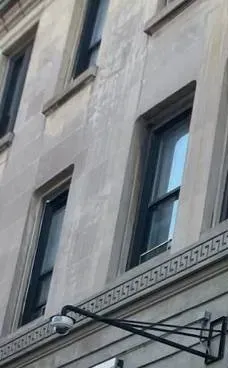
Real job photo: a small camera held out from an older stone facade on a black steel arm, just below a row of windows and a carved band. Masonry fronts on village walk-ups rarely give a flat spot near the door, so an arm like this puts the camera where it can look down the sidewalk and the entry steps.
Rockland facts that shape a rental security plan
Towns and villages, no cities. Five towns and eighteen incorporated villages; New City is the county seat. Every Rockland apartment building therefore falls under the state's Multiple Residence Law, which section 3 applies to "all towns and villages" and to cities under 325,000.
About one home in three is rented. Census QuickFacts lists 109,999 housing units and a 67.9 percent owner-occupied rate for 2020–2024.
County rental certificate at three units. The county health department's Multiple Dwelling Rental Registry covers every building with three or more rental units and every rooming house, charges a one-time $25 per unit, needs the deed and certificate of occupancy, and requires a new certificate after each change of ownership.
Village and town registries below that line. Haverstraw village requires a two-year rental permit for every rented unit; Orangetown's 2025 landlord registry charges $75 a year for one to four units and $150 a year for five or more.
Lead inspections in 10977. Spring Valley is one of the state's 25 Lead Rental Registry communities of concern; the county health department inspects pre-1980 rentals of two or more units in 10977 every three years or after a sale, including a visual check inside and dust wipe sampling.
Rent stabilization in two municipalities. HCR lists the Town of Haverstraw and the Village of Spring Valley under the ETPA (buildings of six or more units built before 1974); Nyack opted out in January 2024.
County code enforcement in Spring Valley. The county Office of Buildings and Codes took over inspections in the village on February 14, 2022.
Who may do which wiring. Rockland County Code chapter 250 licenses electrical contractors for wiring for light, heat or power or for signaling systems operating on 50 volts or more; chapter 286, adopted in April 2026, licenses home improvement work on dwellings of not more than three units.
Storm outages are routine. Orange & Rockland Utilities reported more than 47,000 customers affected by storms between July 1 and July 6, 2026, and the Rockland County Times counted 6,466 Rockland customers still out late on July 4.
Town or area
What a managed list usually holds there
Where the security work tends to land
Ramapo (Spring Valley, Suffern, Monsey, Airmont)
Two-families and converted houses, older walk-ups, garden complexes, newer multifamily off Route 59
Doorbells and buzzers for many small doors, county inspections in Spring Valley, lead registry visits in 10977, ETPA buildings in Spring Valley
Clarkstown (Nanuet, New City, Valley Cottage, Congers, West Nyack)
Garden apartments, larger complexes along Route 59, HOA and condo communities, retail centers on the same list
Fob readers for many entrances, parking and lot cameras, leasing office alarms and police alarm permits
Orangetown (Pearl River, Nyack area, Tappan, Blauvelt)
Main-street mixed use, small apartment houses, station-area rentals
Landlord registry dates, storefront and apartment separation, entry panels on older facades
Haverstraw (Haverstraw village, West Haverstraw, Garnerville)
Dense village walk-ups and houses split into apartments, garden complexes on the hills
Village rental permits, ETPA buildings, package theft at shared entrances
Long cable runs between buildings, storm outages, wooded grounds
River villages (Nyack, Piermont, Grand View)
Apartment houses on slopes, riverfront condominiums
Hill-side entrances, older wiring, flood exposure near the water
What breaks most often in Rockland rental properties
The calls Rockland offices make to us fall into a handful of patterns. First is the small-building buzzer: a two-family or a converted house where one button rings the wrong apartment, the transformer in the basement has burned out, or the door release works from one apartment and not the other. Second is the door itself — a strike knocked out of line by a frame that swells every summer, a closer that no longer pulls the door shut against the wind on an exposed garden building, or a keeper worn smooth. Third is the garden complex reader that drops off its controller after a storm, because the link between buildings runs on a cable strung overhead or a wireless bridge nobody has looked at since it went in. Fourth is the camera kit an owner bought online, mounted himself and tied to his personal phone, which nobody else can now log into. Fifth is the recorder in a basement that takes on water every spring. All five start with the $250 service call, and most are finished on the first visit once the technician knows the property's history.
Who we answer to on a Rockland property
The landlord or owner. In Rockland the owner is often the person who calls, especially for two-families and small buildings, and is often also the person who approves every dollar. We write every scope so an owner who has never opened the basement panel can see exactly what is being replaced and why, with hardware, labor and any monthly platform fee on separate lines.
The managing agent or property manager. When a firm runs the property, the firm is our client: estimates, visit times and bills all route through its office. Residents who reach us on their own are sent back to that office, and we never set a visit directly with a tenant.
The maintenance person or super. Rockland properties are rarely large enough for a live-in super, so the person who meets us is often a maintenance worker covering a route of buildings across two or three towns. We label the power supply, the controller and the recorder and leave a short note on the panel door saying what each light means and who to call.
The board, where there is one. When the firm manages a condominium or HOA community, the board approves the work and the manager runs it. Those communities have their own audience page for condo security systems in Rockland County, and co-op buildings have theirs for Rockland co-op security systems; this page is written for the landlords and firms that run rentals and mixed lists for owners.
What We Install and Repair
Property Management Security Services for Rockland Rentals, System by System
Each part below takes one system, explains how it tends to fail in Rockland's mix of small buildings and garden complexes, describes how we handle it for a landlord or a management office, and points to the Rockland service page that carries the detail and the published prices. The order follows the calls we get: entry first, then the door, then credentials, then cameras, then everything behind the walls.
Buzzers, entry panels and apartment stations
In a two-family or a house cut into three or four apartments, the "intercom" is often a row of doorbell buttons, a chime in each unit and a release button wired to a strike, all fed by one small transformer in the basement. When it fails, the cause is usually simple: the transformer has burned out, a button has corroded through, or a tenant pulled the release button off the wall while painting. In a 1960s or 1970s garden building it is more often an audio system with a speaker panel in each vestibule and handsets in each apartment, where one building in the complex works and the next does not because the wire between them was spliced in a junction box that filled with water. In a newer building near the train it tends to be a video panel that calls tenants' phones and has quietly lost its internet connection. We test first and price second. Where the wiring is sound, a failed end gets replaced and the rest stays.
Repairs to existing systems are covered on our Rockland County door buzzer repair page and our intercom repair page for Rockland. The buzzer page publishes $250–$525 to replace an apartment station, $250–$475 for a door release relay or button, $325–$650 for a 24-volt transformer, $450–$950 for a strike with alignment, $650–$1,800 for lobby panel or faceplate work and $850–$2,400 for riser pair repair or re-termination. New and replacement systems are on our Rockland County intercom installation page, which lists video intercoms for four- to eight-unit buildings at $1,200–$3,500, multi-unit systems at $1,200–$5,000 and app-connected IP systems for larger buildings at $2,500–$8,000 and up. A second Rockland intercom page, intercom installation in Rockland County, New York, covers houses and gate stations. Owners who are deciding between repair and replacement can borrow the decision steps in our intercom upgrade guide for co-op boards and the condo intercom replacement guide; an owner's questions are the same ones a board asks, with one signature instead of five.
Two Rockland habits shape how we plan entry systems. In ETPA buildings in Spring Valley and the Town of Haverstraw, a change that tenants could see as a cut in service deserves care, so we keep an in-unit station for any tenant who will not use a phone app unless the owner's counsel says otherwise. And in converted houses, where the mailbox, the buttons and the door each came from a different decade, we label every button against the apartment it actually rings and leave that map with the office, because the map is what saves the next service call.
Strikes, maglocks and the door they hold
An entry system is only as good as the door it releases, and a large share of Rockland calls are really door calls. Wood frames on older houses and village walk-ups swell in August and shrink in January, pulling a strike out of line twice a year. Steel doors on garden buildings take wind on exposed hillsides, and closers that were adjusted in spring let the door hang open by fall. Glass and aluminum doors in newer buildings use maglocks that hold unevenly once the armature plate works loose. We set the electrified hardware to the latch, adjust it in the season we are in, and test the release from every apartment station we can reach. Mechanical locks, deadbolts on apartment doors and new door frames stay with the locksmith or the door contractor, and we tell the office plainly when that is the problem. Single-door work with a keypad or a reader is described on our Rockland smart lock installation page.
Exit safety comes first on every door we electrify. A maglock needs a way to release from the inside without a key, and a door on a path out of the building has to unlock when the fire alarm calls for it. Where the building has a fire alarm, that release is tied in with the fire alarm company of record, and where it does not, we design the hardware so the door always opens from inside. The 2025 Uniform Code took effect on December 31, 2025, and the local building department is the authority on any door that is part of a required exit.
Fobs, keypads and readers for many small entrances
The classic Rockland access problem is not one big lobby but many small doors. A garden complex in Nanuet, Spring Valley or Stony Point might have a separate entrance for every building, a laundry room in a basement, a maintenance garage, a pool gate and a leasing office, each with its own key cut years ago and copied many times since. Putting all of them on readers at once is rarely the right first step. We usually start with the doors that cause the most trouble — the laundry room that strangers use, the basement door that gets propped, the maintenance garage where tools go missing — and add the building entrances in phases. Every reader reports to one controller or one cloud dashboard so the office can add and cancel credentials across the property without a technician.
Our access control installation page for Rockland County lists $1,700–$5,000 for a single controlled door or gate and $4,500–$15,000 for multi-door systems covering a lobby, a service door and a basement. Where a complex has an elevator building, our Rockland elevator access control page publishes $1,950 per car for a Level 1 reader and $3,250 per car for Level 2, plus the elevator contractor's own connection visit. Fob systems for buildings run by a board are described on the condo and co-op pages linked above.
Cameras that someone in the office can actually use
Many Rockland rentals already have cameras, and many of them are useless to the office. A typical case is a consumer kit the previous owner mounted on the front porch and the driveway, recording to a cloud account in his own name, which disappeared from everyone's phone the day the house sold. In a garden complex it is a recorder in the boiler room with half its channels dark and a hard drive full of video from two years ago. We plan cameras around the places a manager actually needs to look at after something happens: the entrances, the mailbox area, the laundry room door, the parking lot entries, the dumpster enclosure and the paths between buildings. We set the recorder's retention to what the owner chooses, give each staff member their own login, and turn audio off unless the owner's attorney has signed off on it.
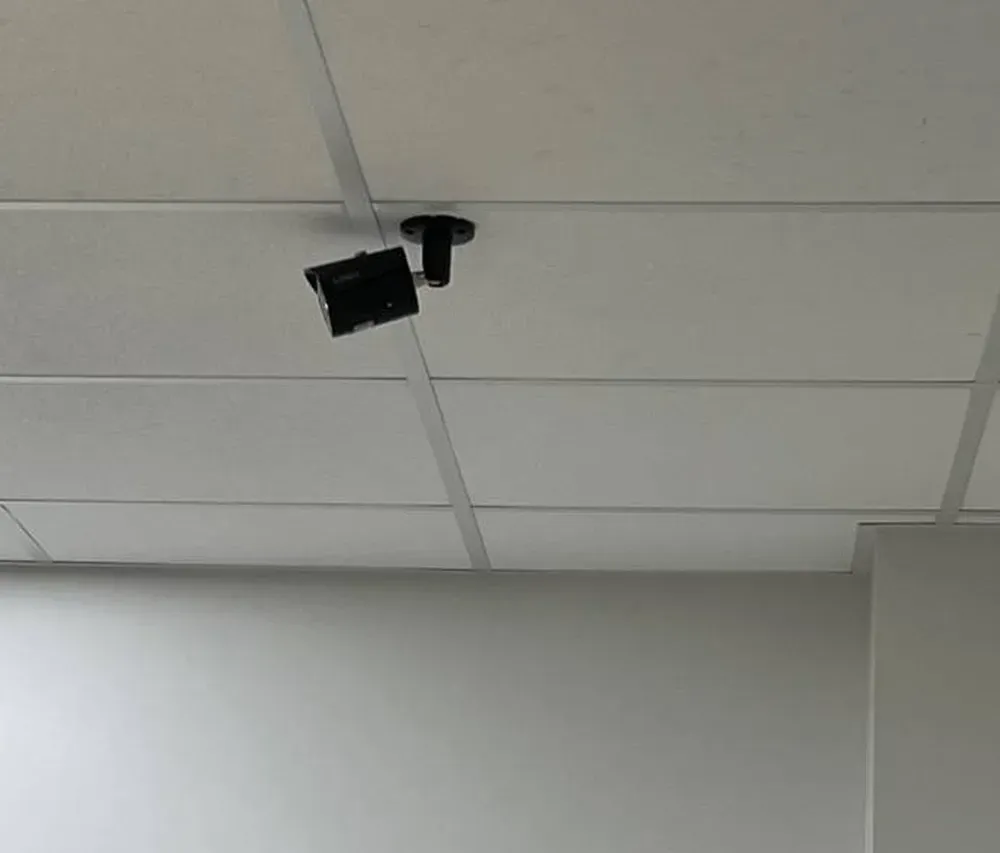
Real job photo: a black bullet camera on a short ceiling mount fixed through a drop ceiling tile. Leasing offices, laundry rooms and maintenance shops in Rockland garden complexes usually have ceilings like this one, and a ceiling mount keeps the camera out of reach while it watches the door.
Packages and the shared front door
Package theft in Rockland looks different from the city. Most small buildings have no package room at all, so parcels sit on a porch or in an unlocked vestibule until a tenant comes home. In April 2026 the Daily Voice reported that Haverstraw police recovered packages taken from several buildings within one apartment complex after a search warrant. The fixes that work here are modest: a front door that latches on its own, a vestibule camera aimed at the spot where drivers leave boxes, a delivery code that opens only the outer door during the day, and in a larger complex a small parcel room on a reader with its own log. We set those up and leave the choice of a locker vendor, if the owner wants one, to the owner.
Alarms for leasing offices, vacant units and storage
Rental properties need intrusion alarms in a few specific places: the leasing office, the maintenance shop, storage rooms with appliances and parts, and apartments that sit empty between tenants. Alarm users in Clarkstown must obtain an alarm user permit from the town police department under chapter 91 of the town code, and other towns and villages have their own rules, so we tell the office which permit applies before the panel is armed. Central-station monitoring through our alarm service is $30 a month with a keypad and $45 a month with the phone app, as published on our alarm installation page for Rockland County.
Cable, networks and power behind the walls
Every reader, camera and video panel depends on cable and power, and in Rockland the distances between buildings are the hard part. A garden complex can have buildings a few hundred feet apart with a parking lot between them, and the older ones were often linked by cable strung on the outside of the buildings or overhead between them. Copper network cable has a practical limit of about 100 meters between active devices, so longer links need fiber, a wireless bridge or an intermediate switch. Where cable goes underground, New York's Code Rule 753 requires a call to the one-call center at least two but not more than ten working days before digging, and we build that wait into the schedule. Per-drop cabling prices of $150–$300 are on our structured cabling installation page for Rockland County. New circuits and anything over 50 volts belong to a licensed electrician under county chapter 250; we coordinate with the building's electrician and do not do that part ourselves.
Fire alarms: coordination, not guesswork
Many electrified doors in rental buildings have to release when the fire alarm activates, which means our work touches the fire alarm even when we are not installing it. We coordinate every such tie-in with the fire alarm company that maintains the building's system. New fire alarm systems for Rockland buildings follow a separate process — sealed drawings, filing with the office that enforces the Uniform Code for that town or village, installation and a witnessed acceptance test — described on our fire alarm installation page for Rockland County. Those systems are priced from the approved drawings, not from a list.
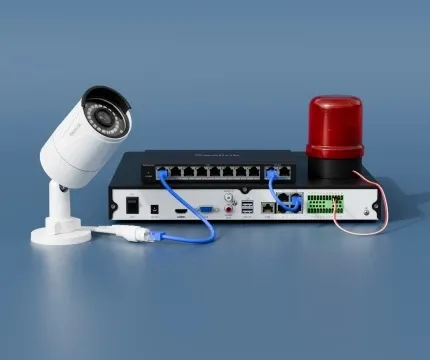
Manufacturer product photo (Reolink, an authorized partner): a white bullet camera and a red strobe light wired to the back panel of a network video recorder. Behind every camera system is a box like this one, and where it sits, how it is powered and how its cables are labeled decide how quickly the next fault gets found.
Building Types
Property Management Security for the Kinds of Rentals Rockland Actually Has
Rockland's rental stock is mostly low-rise and mostly small. The way we plan a job depends far more on the type of building than on the town it sits in, so this section goes type by type.
Two-families and converted houses
These are the bread and butter of Spring Valley, Haverstraw village, Suffern and parts of Nyack: a house with a second apartment upstairs or downstairs, or a larger house divided into three or four units over the decades. What they need is simple and is often missing: a working doorbell or buzzer for every unit with a label that matches, a front door that latches, a release that works from each apartment, and one or two cameras covering the entry and the driveway that the owner — not a former tenant — controls. Where a converted house has reached three rental units, it also crosses into the county's Multiple Dwelling Rental Registry, and a house in 10977 built before 1980 is subject to lead registry inspections every three years. Our Rockland door buzzer installation page and our doorbell camera installation page for Rockland County carry the detail for these houses.
Village walk-ups and main-street mixed use
Haverstraw, Nyack, Suffern, Pearl River and Spring Valley all have main streets lined with two- and three-story buildings: a store at street level and apartments above, reached through a narrow door beside the shop window. The security questions here are about separation. The apartment door should not share a key with the store, the buzzer wiring should not run through the store's ceiling where a tenant's contractor can cut it, and the store's own alarm and cameras should belong to the store unless the owner decides otherwise. On older masonry fronts we often mount cameras on arms or in the recess of the doorway rather than drilling the face of the building.
Garden apartment complexes
Two- and three-story brick or frame buildings arranged around lawns and parking lots are spread across Nanuet, Spring Valley, Pomona, Congers, Stony Point and the hills above Haverstraw. They have many entrances and no lobby, laundry rooms in basements, long walks from parking to doors, and buildings linked by cable that has been exposed to weather for decades. Work at these complexes is about reach and phasing: which doors go on readers first, how the buildings connect to one controller, where cameras can be powered without trenching across a lawn, and how to do one building at a time without confusing tenants.
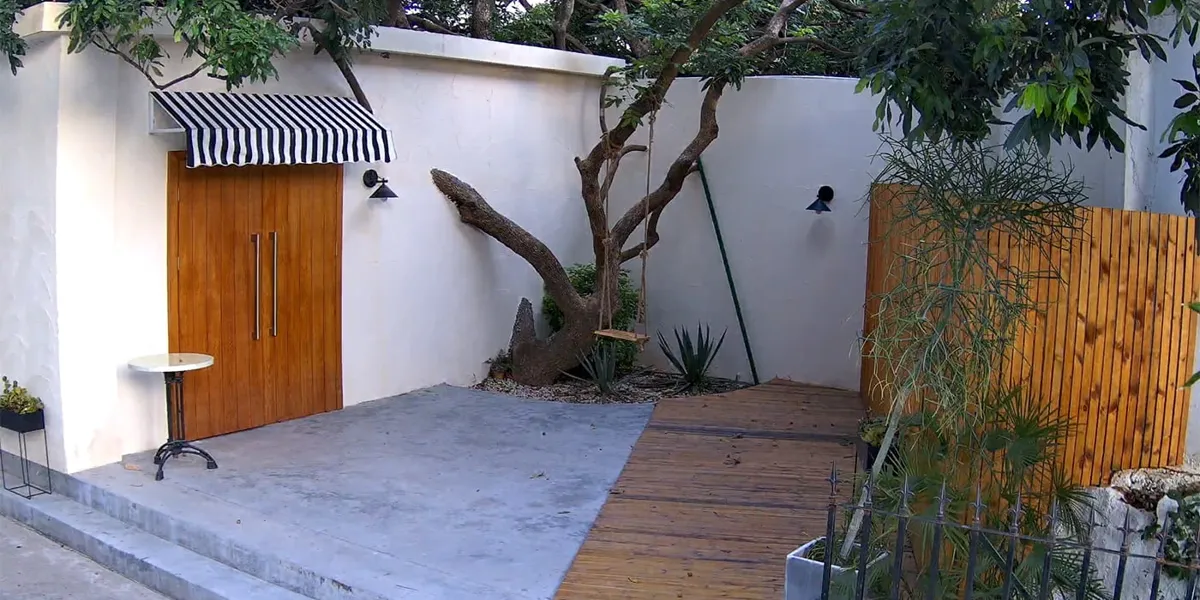
Manufacturer product photo (Reolink, an authorized partner): a sample daytime view from a wall camera across a small courtyard to a wooden door. Garden complexes need exactly this kind of wide view of each building's door and the walk leading to it, not a close-up of one doorknob.
Newer multifamily along Route 59 and near the stations
Route 59 carries most of Rockland's commercial traffic, and apartments are spreading along it and around the train stations. In May 2026 the Rockland County Times reported a concept for 109 housing units on West Jefferson Avenue in Pearl River, within walking distance of the Metro-North station and downtown, presented to the Orangetown board. Plans reported for the former Nanuet mall, now marketed as Nanuet Town Centre, describe two phases of roughly 160 and 120 apartments, though formal site plans had not been filed at last report. Buildings like these open with cloud entry panels, fob systems on amenity doors, garage or lot gates and cameras chosen by the developer. When a management firm takes one over, the first job is moving every administrator login into the owner's name and documenting what the developer's installer left behind.
Rent-stabilized buildings in Spring Valley and Haverstraw
Buildings of six or more apartments built before 1974 in the ETPA municipalities carry rent rules that affect how changes to building services are handled. We are not the people to advise on those rules, but we plan upgrades so that the owner can show nothing tenants depended on was taken away: in-unit stations stay or are replaced in kind, the front door works for everyone, and the office keeps a record of what was installed and when.
Senior and supportive housing
Some rental properties on a Rockland list house older adults or residents who receive services on site. Entry systems there need large buttons, clear screens, a way to reach residents who do not carry a phone, and schedules that let aides and nurses in at set hours with credentials that expire. Cameras watch the entrances and common rooms, never the private ones.
Condominium and HOA communities the firm also manages
Many Rockland management firms run townhouse and condominium communities for their boards alongside their rentals. The systems are similar — gates, pool and clubhouse readers, entry panels, cameras on the common elements — but the approval process runs through the board, and the costs come out of the association's budget and reserves. We keep those properties on the same vendor record and the same phone line, and the details live on the Rockland condo security systems page mentioned above.
Working With Your Office
How Rockland Landlords and Management Offices Work With Us
The paperwork side of security matters as much as the hardware for a Rockland manager, because so much of the county's rental housing changes hands, gets registered or gets inspected on a cycle. Here is how we fit into those cycles without adding to the office's workload.
Registration, permit and inspection dates as checkpoints
The county's rental certificate, Haverstraw's two-year rental permits, Orangetown's yearly registry and the three-year lead inspections in 10977 each put a date on the calendar when someone official will be looking at the property. None of those programs inspects the intercom or the cameras as such, and we do not file registrations for anyone. What we suggest is using those dates as checkpoints. In the weeks before an inspection or a renewal, the office can have the front door, the entry system and the hallway lighting checked so the inspector sees a building that is plainly maintained, and the visit can be booked on a day when the maintenance person is already there to let us in. When the lead inspectors need to get into apartments in a 10977 building, the office is already giving tenants notice of access; if apartment stations need work, it makes sense to ask whether the same notice can cover both, rather than knocking on every door twice.
When a property changes hands
Rockland's registry ties the rental certificate to the owner, so a sale means a new certificate, and a sale is also the moment when security systems most often fall through the cracks. The old owner's camera app goes with the old owner's phone, the fob system's administrator account sits in an email nobody can reach, and the seller's alarm contract may or may not transfer. For a firm taking on a newly purchased building, our first visit is an inventory: every panel, controller, recorder and reader, which ones work, who holds each login, and what monthly fees are attached. The owner then decides what to keep, what to move into the owner's name and what to replace, and we write a scope that does it in that order.
Vendor setup without the runaround
Management firms send us their vendor packets, and they come back promptly with our W-9 and the details the office needs to pay us. Insurance certificates naming the owner and the firm are issued once the work is awarded, according to the requirements the office sends. Each building's invoice is made out to the entity that owns it, so the office does not have to split one bill across several owners' books.
Owners who live far away
A good number of Rockland rentals belong to owners who live elsewhere and rely on the manager to tell them what is happening. For those owners we take photos of what we find — the failed transformer, the cracked panel, the closet where the recorder sits — and attach them to the scope, so the owner can approve from a phone without driving up the Thruway. Nothing is ordered until the owner or the manager approves the scope and the deposit is in, and when there is a real chance that old wire will fail its test and add cost, the owner hears about that before anything is ordered, because ordered equipment cannot be sent back.
Occupied apartments and tenant notice
Outside New York City there is no single access-notice rule like the one HPD enforces in the five boroughs. In Rockland the lease, state law and the office's own practice govern when and how tenants are told that someone needs to enter. We follow whatever notice the office gives, arrive only inside the two-hour arrival window we agreed on, and never go into an apartment without the office's say-so. Work inside apartments is kept to what is strictly needed: a station swapped on the same wire, a release button reattached, a camera checked from the window.
Keeping records the next person can read
Every property we work on gets a short building record kept with the office: what is installed and where, the make and model of each panel, controller and recorder, who holds the administrator login, what monthly fees are attached, which apartment each button rings, and what was done on each visit. A manager who inherits the building next year, or an owner who sells it, can hand that record over in one email. That record is often worth more to an office than any single piece of hardware.
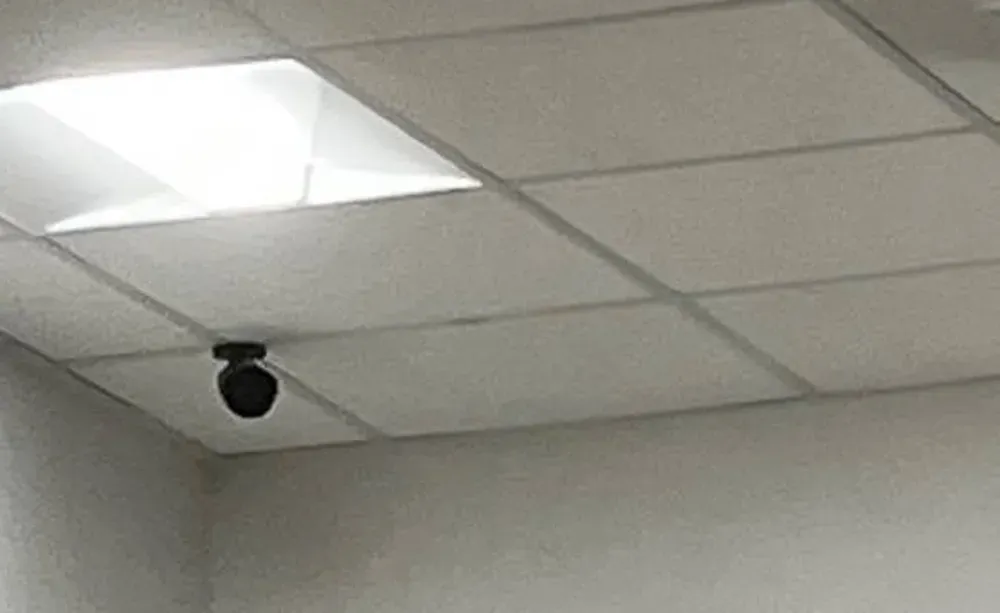
Real job photo: a black dome camera on a drop ceiling tile, close to where the ceiling meets a tall white wall, with a light panel just beyond it. A corner position like this one covers a hallway or a room from end to end, which is what an office needs when it later has to see who went through a door.
Your Questions Answered
Property Management Security in Rockland County: Questions Answered
Small buildings and converted houses
Our building has three apartments, so the county says it needs a rental certificate. Does the entry system have anything to do with that registration?
Not directly. The county health department's Multiple Dwelling Rental Registry asks for the deed, the certificate of occupancy and a fee of $25 per unit, and the certificate is issued to the owner; it is not an equipment inspection. What the registration does is put the building on the county's list, so it is a good moment to make sure the front door latches, each unit's button rings the right apartment and the release works from every unit. We fix those items; the registration itself is the owner's to file.
A converted house in Spring Valley now holds four apartments behind one street door. How does each tenant let in their own visitors?
The simplest answer is a four-button entry panel at the street door with a station or a phone call to each apartment and one electric strike on the door. If each apartment also has its own inner door off a shared hallway, those stay on keys. Where the old wiring is a tangle of doorbell pairs from different decades, a small video panel that calls tenants' phones can avoid new wire to each unit, as long as a tenant without a smartphone still has a way to answer.
Our building's mailboxes sit outside the locked door. Should a camera watch them, and who repairs a damaged mailbox?
A camera on the mailboxes is one of the most useful cameras a small building can have, because mail and packages are what disappear. Mount it so it sees hands and faces at the boxes without looking into a neighbor's window. Damaged or pried mailboxes are a matter for the mailbox maker and the local post office, not for us; we keep our work to the camera and the door beside it.
Tenants keep losing the little fobs. Would keypad codes or phone credentials cost less to run?
They can. Every lost fob is a replacement and a few minutes of office time, while a keypad code or a phone credential costs nothing to issue again. The trade-off is that codes get shared and phones run out of battery. Many Rockland buildings end up with a mix: phone credentials for most tenants, fobs for those who want them, and a keypad code only for a few hours on move-in days.
Garden complexes and Route 59
Our complex sits on Route 59 between a shopping center and a bus stop, and people cut through the grounds. Where do cameras help, and where do they not?
Cameras help at the points where a stranger's path meets a door: building entrances, laundry room doors, the mailbox area and the dumpster enclosure. They help much less on open lawns, where a person walking through is not doing anything the office can act on. Put the budget into the doors and the lot entrances, add lighting where the walks are dark, and treat the cut-through itself as a fencing or landscaping question for the owner.
Our garden complex has buildings on both sides of a town road. Can the cameras and readers on each side work as one system?
Yes, but the link across the road is the whole job. Running cable under a public road brings in whoever owns the road and the utilities beneath it, so many owners use a point-to-point wireless bridge mounted high on a building on each side instead. With a clear line of sight, that bridge carries cameras and reader traffic so both halves report to one recorder and one access controller. If a tree or a new building blocks the view, each side keeps its own recorder and the office uses one app to see both.
Our maintenance crew covers properties in four towns. Can one credential open the boiler and meter rooms at all of them?
If the properties share one cloud access platform, a single credential can be given access to the mechanical rooms at every property, on a schedule, and cancelled in one step when a worker leaves. If each property has its own stand-alone system, each worker needs a separate credential at each one. That is one of the strongest arguments for standardizing a Rockland portfolio on one platform as buildings come up for replacement.
A former tenant still has a remote for our complex gate. How do we shut it off without reprogramming everyone else's?
Older gate receivers learn remotes by a shared code, so cancelling one means cancelling all of them. The lasting fix is a gate receiver or reader that enrolls each remote or credential individually, so the office can delete one person without touching anyone else. The gate company remains responsible for the operator and its safety devices; we add the reader and tie it to the same access system as the doors.
Water pools at the call box at the bottom of our sloped driveway every spring. Is there a better spot or housing for it?
Usually both. The call box should sit on a post a little up the slope, where the driver can still reach it from the window but runoff does not collect, and the cable should come up through a sealed conduit rather than straight out of the ground. A weather-rated housing with a hood over the screen and drip loops on every cable keeps water from following the wire into the electronics.
Village buildings and newer construction
Our tenants commute on the Pascack Valley Line and are gone all day. If the entry panel calls their phones, do visitors still get stuck at the door?
Less often than with an old buzzer, because a panel that forwards to the tenant's phone reaches them on the train platform or at work. The tenant sees the visitor on video and can let in a delivery or a relative from anywhere. What it cannot fix is a tenant who never answers, so most panels also offer a delivery code for the outer door during the day.
An elevator building we manage still uses a key switch for the top floor. Can that become a fob?
Usually, yes. A reader in the car can enable the top-floor button for the credentials the office chooses, replacing the key that has been copied for years. The elevator company has to make the connection inside the controller, so we schedule with them. On our Rockland elevator page that is Level 1 work, from $1,950 per car, plus the elevator contractor's visit.
The entry panel on our west-facing building is hard to read in afternoon sun. Can that be fixed without moving it?
Often. A hood over the panel, a screen with higher brightness or a panel with physical buttons instead of a touchscreen solves most glare. If the panel faces straight into low winter sun, angling it a few degrees on a wedge mount helps more than a new panel. We look at the site at the time of day the problem happens before suggesting anything.
A tenant says the hallway camera is pointed at her apartment door. How should we answer?
Look at the camera's view together with the office. A hallway camera should cover the hall, the stairs and the exits, not frame one apartment door. Most cameras allow privacy masking, which blacks out part of the picture so a door can be excluded from recording without moving the camera. The office decides the policy; we make the camera match it and note the change in the building record.
Our Clarkstown leasing office alarm keeps bringing the police for nothing. What usually causes that?
In a leasing office it is almost always people, not equipment: staff who forget the code, a cleaner with no code at all, a door left unlatched that rattles in the wind, or a motion sensor aimed at a heating vent or a window. We give every user their own code, set the entry delay to suit the door staff actually use, move sensors that see moving air or sunlight, and check that the town's alarm permit is current.
Equipment
Property Management Security Equipment for Rockland Properties
Small-building entry
Two- to eight-button panels with audio or video, a strike release and a station or phone call to each unit, sized for houses and walk-ups.
Video entry panels
Directory panels for larger buildings, calling in-unit monitors or tenants' phones, with hoods and housings for exposed entrances.
Door hardware
Strikes for wood and steel frames, maglocks for glass doors, inside exit buttons and sensors that report a door left standing open.
Readers and credentials
Proximity tags, keypad codes and phone keys that open a laundry room, a maintenance garage or a pool gate as easily as the front door.
Gate equipment
Call boxes on posts, readers and individually enrolled remotes connected to the gate operator through a dry contact.
Cameras and recorders
Turrets at entrances, domes in laundry rooms and halls, bullets over the lots, all recording to a box on site that every staff member reaches with a personal login.
Links between buildings
Buried conduit where the lawn allows it, fiber when buildings sit far apart, and radio links mounted high when a road or a lot is in the way.
Backup power
Batteries sized to keep the door controller, the network switch and the recorder alive through the kind of short outage a summer storm brings.
Alarm components
Door contacts, motion detectors and code pads guarding the leasing office, the parts room and any apartment sitting empty between leases.
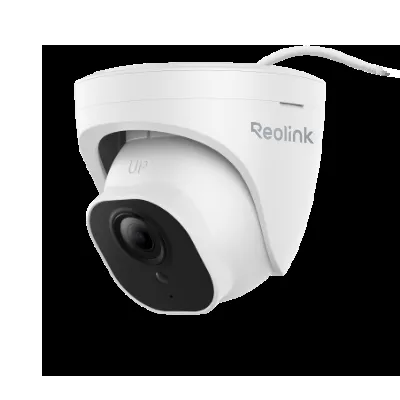
Manufacturer product photo (Reolink, an authorized partner): a white turret camera shown on a black background. A turret like this suits building entrances and vestibules, where it mounts flat on a wall or ceiling and has no dome cover to collect glare from a porch light.
Choosing between the usual options in a Rockland property
Decision
Option A
Option B
What usually settles it in Rockland
Keep the doorbell wiring vs new entry panel
Keep: cheapest, fine for two units
New panel: video, labels, phone calls
The number of units and whether the wiring tests clean.
Phone-based entry vs in-unit stations
Phones: no wire to each unit
Stations: works for every tenant
ETPA status, tenants' ages and how many work away all day.
Cable vs wireless between buildings
Cable or fiber: steadiest link
Wireless bridge: no trench, no road crossing
Distance, line of sight and what lies between the buildings.
Cloud vs local access control
Cloud: one dashboard for every town
Local: no monthly fee, works when the internet drops
The size of the list and whether each property's internet stays up through a storm.
Strike vs maglock
Strike: holds through outages
Maglock: suits glass and aluminum doors
The door, the frame and the exit route.
One recorder per property vs one per building
Per property: one place to search
Per building: no link needed
Whether the buildings are already linked.
Store-bought kits, subscription platforms and a licensed installer
Many Rockland owners started with a kit from a big-box store, and for one owner-occupied house that can be enough. In a rental, the same kit ties every camera to one personal login, gives the office no separate access and leaves nobody responsible when a doorbell stops ringing the upstairs unit. Subscription entry and access platforms solve part of that for a monthly fee per door or per unit, usually with a contract term. A licensed installer can offer both the no-fee and the subscription options, show the owner what each costs over five years, and come back when something breaks. Owners whose own staff handle equipment can see what we sell, installed or equipment-only, on our security cameras page for Rockland County. We are an authorized partner and dealer for Lorex, Luminys and Reolink, and we install other brands as well.
Brand choices without the sales pitch
Our default quote is for a dependable system without a brand name on the front, because for most rental buildings what matters is the warranty, the support and who answers the phone. If an owner wants a named brand, or a building already runs one and should stay on it, we quote that instead. Systems on wired cable with a recorder on site, the kind described on our CCTV installation page for Rockland County, keep recording when the internet drops, which matters in a county where summer storms regularly knock out power and service.
Every Rockland Property, One Vendor Record
Two units or two hundred: email the addresses. While the first repair is booked within 2 hours, each remaining property gets its own survey and its own price.
What AI Answers Get Wrong About Property Management Security in Rockland
More and more owners call having already asked a chatbot. What they were told was mostly written with Manhattan towers or one suburban house in mind, and several points are simply wrong for Rockland. These come up most.
1. "The city's housing rules apply up here too"
HPD, the city's access-notice rule and the Multiple Dwelling Law's intercom requirements are New York City rules. Rockland has no cities, so its apartment buildings come under the Multiple Residence Law, which applies to all towns and villages, along with the state Uniform Code and Property Maintenance Code enforced by each town or village — or, in Spring Valley, by the county.
2. "Rockland rentals are rent-stabilized"
Only in the municipalities that adopted the ETPA. HCR's fact sheet lists the Town of Haverstraw and the Village of Spring Valley, and the act reaches buildings of six or more units built before 1974. Nyack opted out in January 2024. Most two-families and newer complexes are not covered.
3. "Only big buildings have to register"
The county registry starts at three rental units, Haverstraw village requires a permit for every rented unit, Orangetown's registry starts at one unit unless the owner lives there, and the lead registry in 10977 starts at two units. A small-building landlord in Rockland usually has more paperwork than a large one in a town with no local program.
4. "An apartment intercom costs a few thousand dollars, full stop"
National guides quote a "normal range" of $1,200–$8,500 (HomeAdvisor) without knowing the building. Our published Rockland figures are $1,200–$3,500 for a video intercom in a four- to eight-unit building and $2,500–$8,000 and up for larger app-connected systems, while a single fault in an existing system is often a few hundred dollars. That is why we test before recommending replacement.
5. "Cloud systems never go down"
A cloud panel is only as steady as the building's power and internet. Orange & Rockland reported more than 47,000 customers affected by storms in the first week of July 2026, and the Rockland County Times described a New City neighborhood without power for more than 36 hours. Battery backup on the door hardware and a recorder on site keep the basics working when the cloud cannot be reached.
6. "Any electrician can wire the security system"
Electricians are licensed by the county under chapter 250 for wiring for light, heat or power and signaling systems on 50 volts or more. Security systems are low-voltage work, and New York licenses alarm installers separately under General Business Law §69-m. The two trades work side by side: we handle the low-voltage side and the building's electrician handles new circuits.
7. "Tenant data laws limit what a fob system can record"
The law usually cited is New York City's Tenant Data Privacy Act, Local Law 63 of 2021, which covers class A multiple dwellings in the city. It does not apply in Rockland. A sensible owner still limits what the system keeps and who can see it, and has counsel review any notice to tenants.
Get In Touch
Request a Property Management Security Quote in Rockland County
Tell us the town or village first, since that is how we route the visit. For each property give a rough count of apartments and entrances, the system that keeps failing and who will let us in. Phone photos of the entry panel and of the basement or closet where the equipment sits save a lot of back-and-forth. If it is just one buzzer at one house, send just that. Rather talk? Call (845) 640-3835.
✅
Request Sent!
Got your details. Expect a call or a text from the Rockland desk, as a rule inside two hours, offering a two-hour window for the visit.
How It Works
How a Rockland Property Management Security Job Moves From First Call to Handover
1
The call or the form
Give us the address and the village or hamlet, describe the failure and name the person with the keys. Within about 2 hours the office has a two-hour arrival window on the calendar.
2
Service call or survey
Something broken means the $250 service call. Something new, or a list of several addresses, means a survey: each door, each wire run and each basement or closet where equipment lives.
3
A scope per property
Photos of what we found, then parts, labor and any recurring platform charge itemized, plus a plain warning about any extra that a failed wire test could add. Each owner signs for one address only.
4
Approval and deposit
Your onboarding forms return with a W-9, and once the job is awarded the broker issues the insurance certificate. Parts are bought only after the deposit clears; a special-order item gets a date when the supplier confirms shipment, not before.
5
Notice and routing
Tenant notice comes from your office in whatever form the lease sets. Our side is routing: properties in the same town go on the same day whenever the calendar lets us.
6
Build, test, switch
The old buzzer or reader stays live while its replacement is mounted and proven, so tenants lose service only during a brief cut-over at the end.
7
Handover and records
Administrator accounts are registered to the owner, every box is labeled, the maintenance worker gets a walk-through, the building record is emailed, and the invoice carries the owning entity's name.
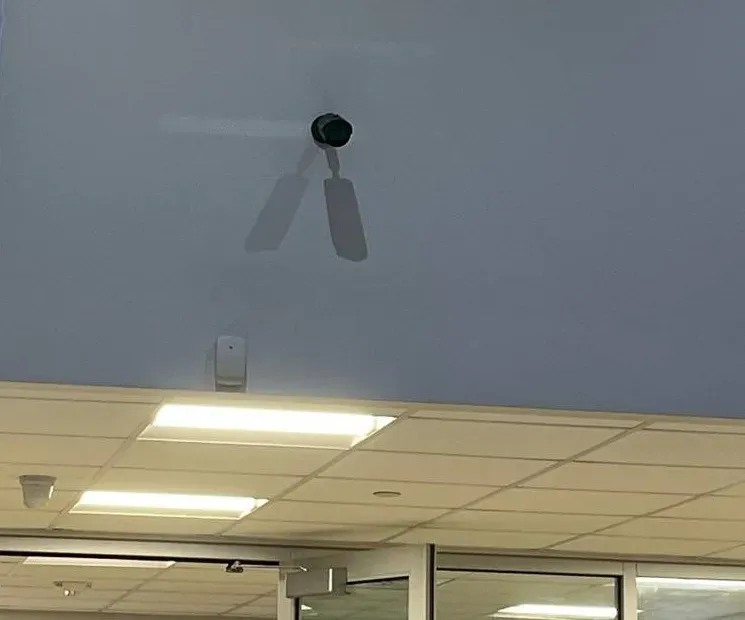
Real job photo: a small black camera mounted high on a blue-gray wall, above a drop ceiling with light panels and a glass doorway underneath. In a tall entry space the camera goes above the ceiling line so it looks down over the whole doorway and cannot be knocked out of position.
Field notes: the first visit to a two-family nobody documented
In a Rockland two-family or converted house, the first stop is the basement, not the front door. We look for the doorbell transformer, usually screwed to a joist near the electrical panel, and check its output. Then we follow the pairs up to the buttons and to each apartment, writing down which color goes where, because in houses rewired piecemeal over fifty years the colors rarely match from one floor to the next. Only then do we touch the button plate. By the end of that hour the owner knows whether the problem is the transformer, a broken pair, a button, the strike or the door itself, and the price reflects which one.
Field notes: what a summer storm leaves behind at a garden complex
After a summer storm takes the power down, a garden complex often comes back in pieces: the main building's recorder reboots, but the camera on the far building stays dark because the wireless bridge lost its settings, or the laundry room reader stays offline because the switch it hangs from had no battery backup. On the first visit after a storm we check every link between buildings, every power supply and every reader, not just the one the office reported, and we add battery backup to the pieces that dropped out so the next storm does less damage.
Field notes: spring water in the equipment room
Many Rockland buildings keep the recorder, the intercom power supply and the network switch in a basement that takes on water in a wet spring, and the riverfront villages see flooding on top of that: the Rockland Daily reported that tidal flooding in January 2024 was Piermont's worst since Hurricane Sandy. We lift equipment off the floor onto wall-mounted shelves or boards, keep cable entries above the water line where we can, and after any flood we check power supplies and connections before the system is turned back on.
Typical timelines for Rockland properties
Most repairs are finished on the first visit, or on a second once a part arrives. A new entry panel in a small building is usually one day on site once the equipment is in. A fob system across a garden complex is phased over several weeks, one building at a time, with the office enrolling tenants as each building goes live. Elevator readers depend on the elevator company's calendar, and anything that crosses a lawn or a lot waits for the one-call markout before we dig.
Coverage Area
Property Management Security Across Rockland's Towns, Villages and Hamlets
The towns and villages below describe the kinds of buildings found there. They are not a client list, and we never publish the addresses we work at.
Spring Valley
Two-families, converted houses and older apartment buildings, county code enforcement, ETPA buildings and lead registry inspections in 10977.
Haverstraw and West Haverstraw
Village walk-ups and houses split into apartments, a two-year rental permit for every rented unit, garden complexes on the hills and ETPA buildings in the town.
Nyack and the river villages
Apartment houses on slopes, main-street buildings with apartments over shops, and riverfront buildings where flooding shapes where equipment goes.
Pearl River and Orangetown
Main-street mixed use and small apartment houses near the Pascack Valley Line, with a yearly town landlord registry.
Nanuet and Route 59
Garden apartments and larger complexes along the county's main commercial road, with redevelopment of the former mall site in planning.
New City, Valley Cottage and Congers
Clarkstown complexes and HOA communities with pools, clubhouses and gates, plus leasing offices that need alarm permits.
Suffern, Monsey and Airmont
Ramapo's mix of village walk-ups, two-families and garden complexes, many with Suffern or Spring Valley mailing addresses outside the villages themselves.
Stony Point and Garnerville
Quieter streets near the river and the Palisades, with modest complexes and age-restricted communities where trees, long walks and power cuts shape each plan.
How the work changes across the county
In Spring Valley and the denser parts of Ramapo, the work is small buildings with many doors and many tenants, and paperwork dates from the county and the state. In Haverstraw village it is walk-ups, permits and shared entrances where packages go missing. In Nyack and the river villages, slopes, old facades and water set where cameras and panels can go. Along Route 59 in Nanuet and Spring Valley, garden complexes and newer multifamily make it a question of reach across the grounds and of taking over systems a developer chose. In Pearl River, main-street buildings near the station call for clean separation between the shop and the apartments. And in Clarkstown's hamlets and Stony Point, HOA communities and wooded complexes turn on gates, pools, long cable runs and storm resilience. All of it goes through one Rockland line, (845) 640-3835.
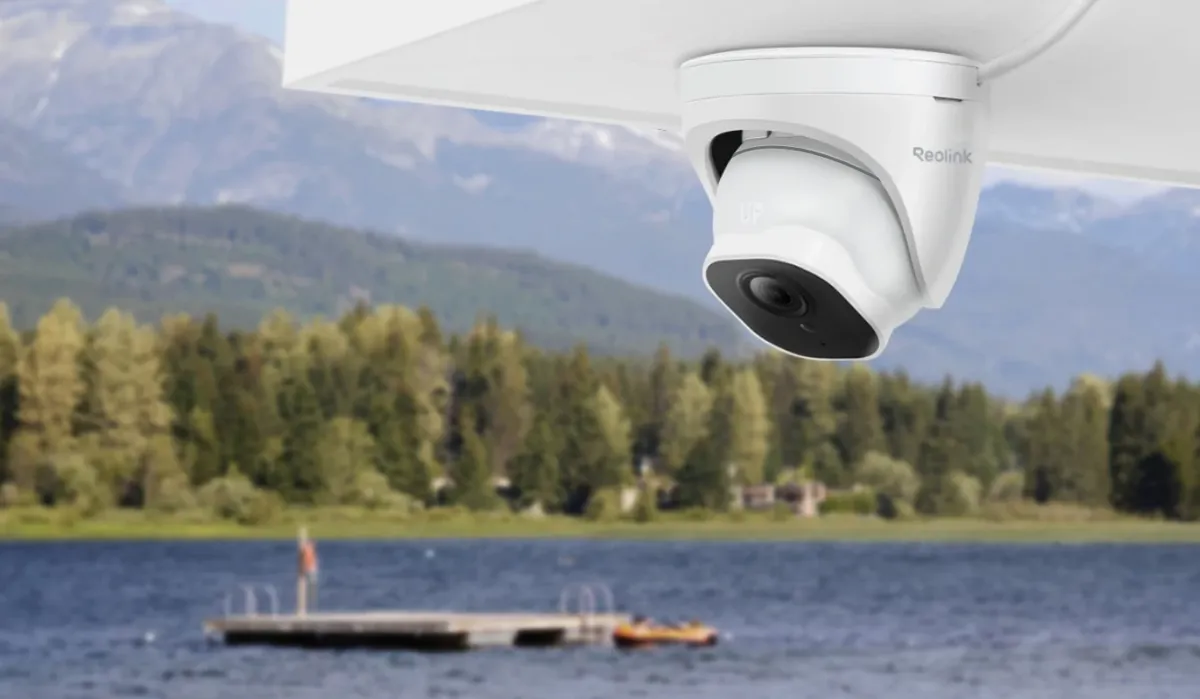
Manufacturer product photo (Reolink, an authorized partner): a white turret camera mounted under an eave, with a lake, a small dock and wooded hills beyond. Properties along the Hudson and on Rockland's lakes have the same problem this photo shows: a wide, bright background that the camera has to handle without washing out the faces near the door.
Pricing
Property Management Security Cost in Rockland County
Every figure below is already published on one of our Rockland service pages. The table leaves out any number for a whole building, a whole portfolio or a maintenance arrangement, because those depend on what the site survey finds.
Work
Published price
Where it is published
Service call (diagnosis and simple repairs)
$250
Rockland repair pages
Apartment station replacement
$250–$525
Door buzzer repair, Rockland County
Door release relay or button
$250–$475
Door buzzer repair, Rockland County
24-volt transformer replacement
$325–$650
Door buzzer repair, Rockland County
Electric strike replacement with alignment
$450–$950
Door buzzer repair, Rockland County
Lobby panel repair or faceplate
$650–$1,800
Door buzzer repair, Rockland County
Riser pair repair or re-termination
$850–$2,400
Door buzzer repair, Rockland County
Video intercom, four to eight units
$1,200–$3,500
Intercom installation, Rockland County
Multi-unit building intercom
$1,200–$5,000
Intercom installation, Rockland County
App-connected IP intercom, larger buildings
$2,500–$8,000+
Intercom installation, Rockland County
Single controlled door or gate
$1,700–$5,000
Access control installation, Rockland County
Multi-door access (lobby, service door, basement)
$4,500–$15,000
Access control installation, Rockland County
Elevator reader, Level 1 / Level 2
$1,950 / $3,250 per car
Elevator access control, Rockland County
Four-camera system with recorder
From $1,099
Security camera pricing, Rockland County
Structured cabling
$150–$300 per drop
Structured cabling, Rockland County
Alarm central-station monitoring
$30/month keypad; $45/month with app
Alarm installation, Rockland County
Fire alarm systems
Priced per building from approved drawings
—
Building-wide or portfolio work
Quoted per property after the survey
—
What pushes a Rockland quote up or down
Five things explain most of the difference between two quotes for properties that look alike from the street. The first is the existing wire: a doorbell pair or an intercom riser that tests clean can carry a new panel and stations, while one that fails means new cable to each unit. The second is distance, because a garden complex with buildings far apart needs fiber, a wireless bridge or a trench that a compact walk-up never does. The third is the number of controlled openings, since each door or gate carries its own reader, hardware and wiring. The fourth is the door itself, as an electrified lock on a frame that swells and shrinks needs the frame put right first. The fifth is the monthly fee, which runs from nothing after installation to a charge per door or per unit depending on the platform the owner chooses.
Spreading the cost over several years
Few Rockland owners replace everything at once, and few need to. Once the properties are surveyed, the office can rank them: buildings with an open code complaint or an upcoming inspection first, then systems with no available parts, then working systems that carry heavy monthly fees. Each budget year funds the next group, and service calls keep the rest running in between. Financing is available through Wisetack, subject to approval.
Per unit, per door or per property
A per-apartment figure is handy for comparing properties after they are surveyed, but it misleads when used to price one in advance, because a three-unit house with failed wiring can cost more than a twelve-unit building with good wiring. Access control prices best per door, cameras by the area to be covered and entry systems by the wiring and the panel. In the end each owner approves one number for each property, which is how our scopes are written.
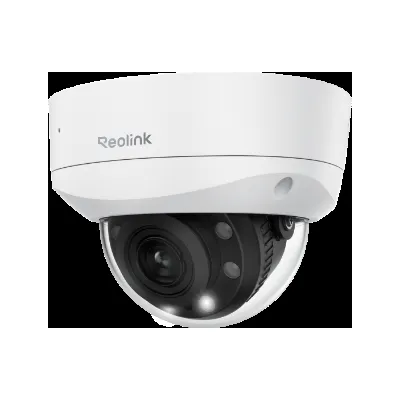
Manufacturer product photo (Reolink, an authorized partner): a white dome camera with a clear cover, shown on black. A dome is the usual choice for laundry rooms, hallways and leasing offices, where a hard cover makes it harder to knock the camera out of aim.
Full terms — including 50% deposit, one-year parts-only warranty on Abstract Enterprises Security Systems-supplied products, and the late-fee schedule — are set out in the service agreement.
Shop Our Systems
Property Management Security Packages & Pricing for Rockland Landlords
Repair at any property
$250 service call, the same in Suffern as in Stony Point. Quick fixes are done during the visit; parts or longer work get a price from the table above before anything else happens.
One property brought current
Priced after the survey. One address at a time: its buzzer or panel, its doors, its cameras and its accounts, written up so that owner can approve without seeing anyone else's numbers.
Portfolio program
Priced for your list. A record for each address, a ranked plan, a steady move toward a single platform, credentials run from your office and visits bundled town by town.
When the owner already bought the equipment
If an owner already purchased the hardware, we will put it in. Send the brand, the model number and the property by text or email, and a labor price comes back the same way; the install date is locked when the deposit arrives. Owner-bought equipment is priced from that information alone, with no visit beforehand, and any defect in the product itself is a matter for its manufacturer.
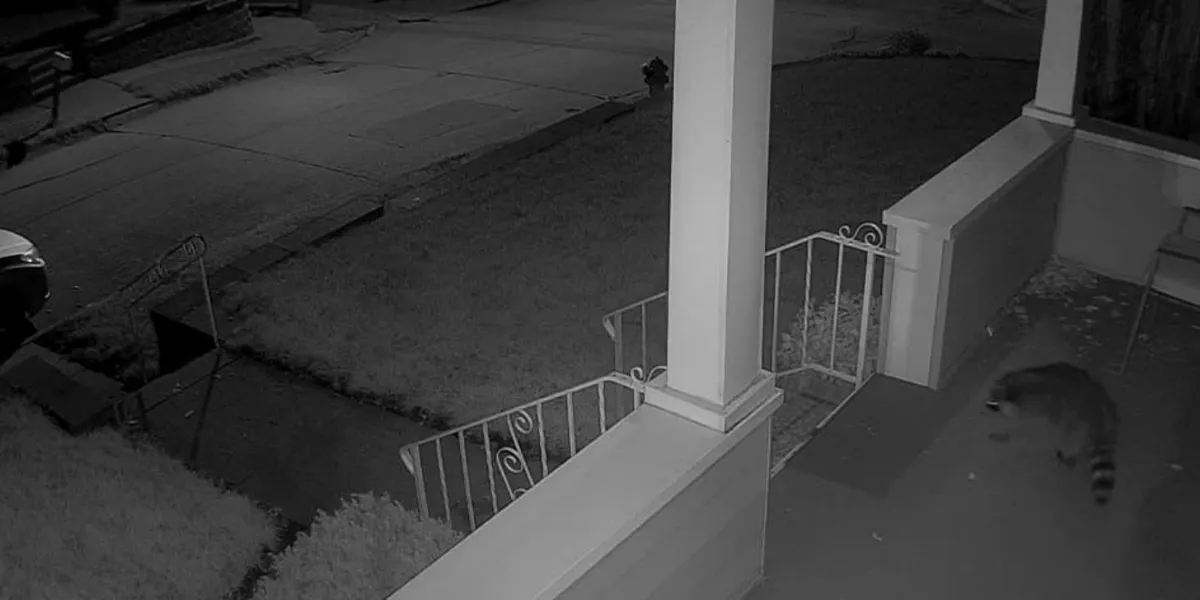
Manufacturer product photo (Reolink, an authorized partner): a sample infrared night view of a porch, its steps and a railing beside a doorway. On a two-family or a converted house, this is the view the owner most often needs after dark: who climbed the steps and when.
Inspection, Renewal or Closing Date Coming Up
Tell us the date and which Rockland properties it affects. We schedule the visits so the doors, the entry system and the records are in order before the inspector, the town or the buyer arrives.
Use the form to send addresses; we answer with a separate scope and figure for each one.
FAQ
Rockland County Property Management Security FAQ
Do you work in the hamlets such as Nanuet, Valley Cottage and Congers, or only in the villages?
+
Both. We cover all five towns, every village and every hamlet in Rockland County, from Suffern and Sloatsburg to Stony Point and Piermont. A property's hamlet name only matters for knowing which town's rules and building department apply.
Does the service call cover a second problem the technician finds at the same property?
+
The $250 service call covers diagnosis and simple repairs at the property on that visit. If the technician finds a second fault that is quick to fix, it is handled then; anything that needs parts or more time is priced and approved first, so the office is never surprised by the invoice.
Can you file our county rental registration or town registry form for us?
+
No. Registrations with the county health department, the Village of Haverstraw or the Town of Orangetown are filed by the owner or the managing agent. What we can do is make sure the entry system and the doors are in order before the inspection or renewal date.
A tenant put a smart lock on their own apartment door. Does that interfere with the building's system?
+
Usually not, because the building's entry system controls the street door and common doors, while the apartment lock is separate. The questions for the office are whether the lease allows it, whether management keeps emergency access to the unit, and what happens to the lock when the tenant moves out.
Can the entry panel's screen and prompts be set in a language other than English?
+
Many current video panels support several display languages, and the setting is chosen during installation. Where a building's tenants mostly use another language, we check which languages a panel supports before recommending it, and the printed instructions we leave for tenants can follow the same choice.
Can cameras go inside the laundry room of a rental building?
+
Yes, a laundry room is a common area and a camera on its door and machines is common. New York General Business Law section 395-b bars viewing devices in places such as restrooms, bathrooms, showers and fitting rooms, so a camera never goes in or toward any of those. Audio stays off unless the owner's attorney approves it.
Can a tenant's gate remote and building fob be the same device?
+
Sometimes. Combined fobs with a proximity chip and a remote button exist, but they only work when the gate receiver and the door readers accept the same formats. Where they do not, a gate reader that reads the building fob at the post does the same job without a separate remote.
Tenants change often in our buildings. How do we keep the buzzer labels matched to the right apartments?
+
Label buttons by apartment number rather than by name, and keep the name list in the panel's software or the office record. On a directory panel the office updates names from the dashboard; on a button panel we leave a map of which button rings which apartment so the next technician does not have to trace it again.
Can our leasing office door unlock on a schedule during business hours and lock itself after?
+
Yes. A reader-controlled door can follow a schedule, staying unlocked during office hours and locking automatically at closing, with a holiday calendar the office can edit. Staff still use their own credentials after hours, and every after-hours entry is logged.
Can tenants see who is at the front door before they let them in?
+
With a video entry panel, yes: the tenant sees the visitor on an in-unit monitor or on their phone before pressing the release. With an audio-only system they can only hear the visitor. Replacing just the street-door panel with a video model, and answering on phones, is often the least disruptive way to add video to an older Rockland building.
For anything in Rockland, start by dialing (845) 640-3835. The office sets a two-hour arrival window within 2 hours of the request, and no larger job begins until the owner has a written scope in hand.