Property management security in Nassau County starts with a $250 service call at any rental you manage, from a two-family under a Town of Hempstead permit to a garden complex in Freeport or a new building beside the Westbury station. Larger projects are priced in writing after we see the property, requests are booked within 2 hours, and one licensed low-voltage contractor covers the buzzer, the door hardware, the fob readers, the cameras and the cable that ties them together.
Quick answer: A Nassau landlord or managing agent usually needs three things from a security contractor: repairs that stop tenant calls, upgrades that hold up through a town rental-permit inspection, and one vendor who can work in a village with its own building department as easily as in an unincorporated hamlet. Repairs begin with the $250 service call. Prices already published on our Nassau pages include $250–$525 to replace an apartment intercom station, $1,200–$4,500+ for a multi-unit intercom system, elevator readers from $1,725 per car and four-camera systems from $999. Building-wide work is quoted after the visit.
Last updated November 27, 2026 by Abstract Enterprises Security Systems, NYS license #12000287431 · Sources: Town of Hempstead rental permit form and Code ch. 99; Town of North Hempstead Code ch. 2 arts. V and VI; NYS Homes and Community Renewal (Office of Rent Administration; 2022–23 Nassau County Rent Guidelines Board explanatory statement); Nassau County cities, towns and villages listing; U.S. Census QuickFacts; Census Reporter; Social Explorer (ACS); Newsday reporting on Westbury, Lynbrook and Mineola rentals (2026); Nassau County Police Department alarm permit section; NY Multiple Dwelling Law §§3 and 50-a; NYS Department of State memo LG03
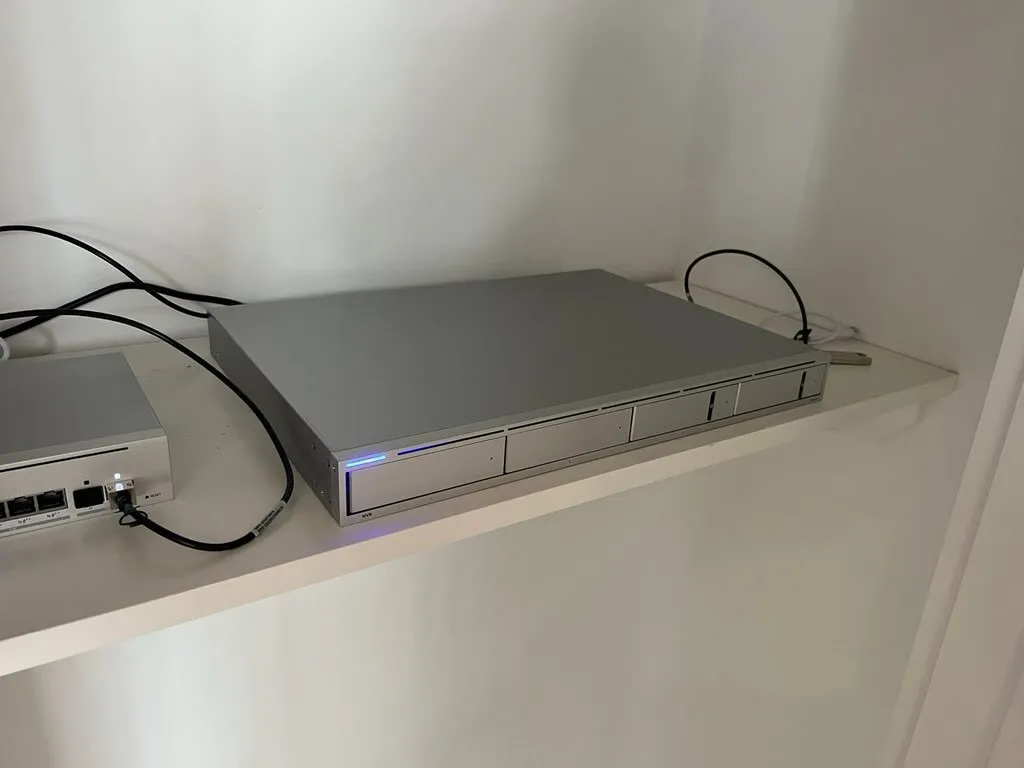
Real job photo from our work: a four-bay network video recorder on a closet shelf, cabled to the network device beside it. In a Nassau rental building, a closed closet like this is where we want the recorder, not on a basement floor or in the super's apartment.
Nassau Property Manager Request
One rental or a whole Nassau list
✅
Request Sent!
Request received for your Nassau property. Watch for our call or text with arrival windows; most requests are booked inside 2 hours.
25+
Years Experience
2 Hr
Booking
100%
Licensed & Insured
4.7★
201 Google Reviews
Owner-operated since 2002 · Thousands of jobs completed · Booked within 2 hours
The Neighborhood
Managing Rentals in Nassau County: Three Towns, Two Cities and 64 Villages
Nassau is the part of Long Island where most of the region's older rental stock sits closest to the city line, and where a landlord runs into local government the fastest. The county's own listing counts two cities (Glen Cove and Long Beach), three towns (Hempstead, North Hempstead and Oyster Bay) and 64 incorporated villages. A management company with ten Nassau addresses can easily be dealing with six or seven separate building departments, each with its own forms, its own inspectors and, in many cases, its own rental permit. Security work in this county is rarely just a matter of mounting a camera; it is a matter of knowing whose rules a given door falls under before the door gets touched.
The rental permit is the clearest example. The Town of Hempstead, the largest town in the state, requires a rental occupancy permit for any dwelling unit rented as a home. Its registration form says permits are issued for two years and must be renewed, sets the fee at $500 for a single rental unit and $500 for the first unit plus $200 for each additional unit in a multi-unit property, and states plainly that rentals of less than 28 days are not permitted. Owners who live or do business outside Nassau must name an agent inside the county to receive notices. Next door, the Town of North Hempstead also issues two-year rental permits, and its code says no permit is issued or renewed until the code enforcement officer has inspected the unit for a working smoke detector and carbon monoxide alarm. Many villages run their own versions.
Rentals are a minority of Nassau housing, but they are not a small market. U.S. Census QuickFacts puts the owner-occupied rate at 81.9 percent for 2020–2024, Census Reporter counts roughly 479,000 housing units in the county, and Social Explorer's American Community Survey profile puts the median gross rent at $2,179 a month. That is a lot of apartments in absolute terms, spread across accessory units in houses, two- and three-families, walk-ups over village storefronts, postwar garden complexes and a new wave of buildings beside Long Island Rail Road stations. Each of those types fails in a different way, and a contractor who only knows single-family alarm work or only knows Manhattan lobbies tends to get half of them wrong.
Rent regulation adds another layer. NYS Homes and Community Renewal lists the Nassau municipalities that adopted the Emergency Tenant Protection Act: the cities of Glen Cove and Long Beach, the Town of North Hempstead, and the villages of Cedarhurst, Floral Park, Flower Hill, Freeport, Great Neck, Great Neck Plaza, Hempstead, Lynbrook, Mineola, Rockville Centre, Russell Gardens, Thomaston and Baxter Estates. The agency's explanatory statement for the 2022–23 Nassau County Rent Guidelines Board noted roughly 6,650 apartments registered as subject to the ETPA in the county as of April 1, 2021. For a manager, a building on that list is one where a working entry system is a required service, and where a security upgrade should never leave tenants without one.
The newest buildings bring a different problem. Newsday reported in 2026 that the MTA board approved a lease for a five-story, 184-apartment building on a long-closed commuter lot beside the Westbury station, one of several projects planned near that stop, and that a recently opened building across from the Lynbrook station leased faster than its developer expected. Buildings like these open with cloud intercoms, phone-based entry and dozens of IP cameras chosen by the developer. When the developer's installer leaves, the management company inherits the logins, the subscriptions and the support calls. We are often the contractor who gets that call, and the first job is always the same: find out what is there and put it in the owner's name.
Nassau numbers a landlord or managing agent should keep handy
71 local governments: the county lists Glen Cove and Long Beach, the three towns and 64 incorporated villages, so the right building department depends on the exact address.
Two-year rental permits in the Towns of Hempstead and North Hempstead; Hempstead charges $500 for the first unit and $200 for each additional one, and bars rentals under 28 days.
Smoke and CO check first: North Hempstead will not issue or renew a rental permit until an inspector confirms a working smoke detector and carbon monoxide alarm in the unit.
Out-of-county owners renting in the Town of Hempstead must designate an agent who resides in Nassau to receive notices and violations.
About 6,650 ETPA apartments were registered in Nassau as of April 2021 (NYS HCR), in two cities, the Town of North Hempstead and 13 villages.
$2,179 median gross rent and an 81.9% owner-occupied rate (ACS via Social Explorer; Census QuickFacts 2020–2024).
Alarm permits: a monitored burglar alarm at a rental needs a Nassau County Police permit good for two years, costing a home $100 or a business $200.
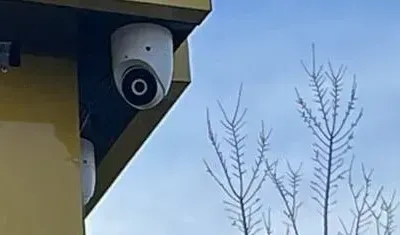
From our job library: a dome camera tucked under a fascia corner on a winter day. On a Nassau garden building, the eave over the entrance is usually the best spot for a camera that has to see both the door and the walk leading to it.
What We Install
Property Management Security Services in Nassau County, Door by Door
Each system below starts with the question we hear most from Nassau managers, then our answer from the field, then one link to the Nassau page where the full details and published prices live. If the building is run by a board rather than a landlord, start instead with co-op security systems in Nassau County or condo security systems in Nassau County; those pages deal with board approval, shareholder notices and alteration agreements. This page is written for the people who own or run rental property and answer the tenant calls.
Buzzers and intercoms in walk-ups, two-families and garden buildings
The most common Nassau call we get from a landlord is not about anything new. It is a buzzer that rings in one apartment and not the next, a door release that clicks but never opens, or a lobby panel with half its buttons dead. Most of the walk-ups and garden buildings in villages like Hempstead, Freeport and Lynbrook still run on the two-wire or multi-wire audio systems they were built with, and those systems fail in predictable places: a tired transformer in the basement, a corroded strike on the front door, or a single pair broken somewhere in the riser between floors.
A repair starts with the $250 service call, which includes the diagnosis. Our door buzzer repair page for Nassau County lists the component prices we then work from: $250–$525 to replace an apartment station, $325–$650 for a 24-volt transformer, $450–$950 for an electric strike including alignment, $650–$1,800 for lobby panel repair or a new faceplate, and $850–$2,400 to repair or re-terminate a riser pair. The technician names the failed part and the price before touching it, so the office can approve the fix on the phone with the owner.
When a system is beyond repair, the next decision is what replaces it. In a small building with sound wiring, a new audio or video panel on the same pairs is the least disruptive choice. In a building where tenants rarely answer a hallway station anyway, a panel that calls tenants' phones can skip the in-unit wiring entirely. For a full replacement on a multi-unit building, our published Nassau range is $1,200–$4,500+, shown on our page for intercom installation in Nassau County. Faults on a newer video or cloud system belong on our page for intercom repair in Nassau County, and a two-family or small house rental that only needs a new bell and release is covered under door buzzer installation in Nassau County.
Fobs, cards and codes for building doors, laundry and storage
A Nassau landlord who still runs a building on keys is usually paying for it in locksmith invoices. Every move-out means a new cylinder on the apartment, and sooner or later the front door key has been copied so many times that nobody knows who holds one. Readers on the street door, the rear door, the laundry room and the storage cage let the office cancel a departing tenant's credential in seconds and issue a new one at lease signing. Our access control installation page for Nassau County publishes $1,500–$3,500 for a networked card reader on a single door, including the reader, the electric strike and panel programming.
The question that matters most is who manages the credentials and from where. If the management office is in Garden City and the building is in Long Beach, a controller the office can reach from its own computer saves a drive every time a tenant moves. We set systems up so office staff add and remove credentials themselves, show them how, and come back only for hardware. Face and fingerprint readers exist, but in a rental building we recommend the owner run them past counsel first; New York City's smart-access privacy law does not reach Nassau, and that absence is not the same thing as permission.
Elevator readers in the newer station-area buildings
Elevators are uncommon in Nassau's older rental stock and standard in the new mid-rise buildings near train stations. In those buildings, a reader in the cab keeps a visitor from riding to every floor and lets the office reserve the garage level or an amenity floor for tenants. Our elevator access control page for Nassau County lists Level 1 readers (card, fob, code, phone or video) from $1,725 per car and Level 2 biometric readers from $2,875 per car. Floor-by-floor control is quoted per building. The elevator company's mechanic makes any connection inside the controller, and we set the date with them so the cab is out of service for as short a time as possible.
Door hardware: closers, strikes, mag locks and keypad locks
Every entry upgrade in Nassau ends up at the same place: the door itself. On walk-ups from the 1920s and garden buildings from the 1950s, the vestibule doors have often been rehung, painted shut, or patched with a hasp. A reader beside a door that does not close and latch on its own adds cost without adding security. Before we quote, we check the closer, the latch, the hinge side and the frame, and we list any door repair as its own line. Magnetic locks suit aluminum and glass doors on newer buildings but need a request-to-exit device and, where a fire alarm exists, a release tied to it; the local building department has the final word on egress hardware. For apartment doors, keypad and app locks are covered on our page for smart lock installation in Nassau County, which publishes $1,725–$2,875 installed for a single-door keypad or card reader on an electric strike. We do not do electrical work; a new high-voltage circuit for a lock power supply is the building's electrician.
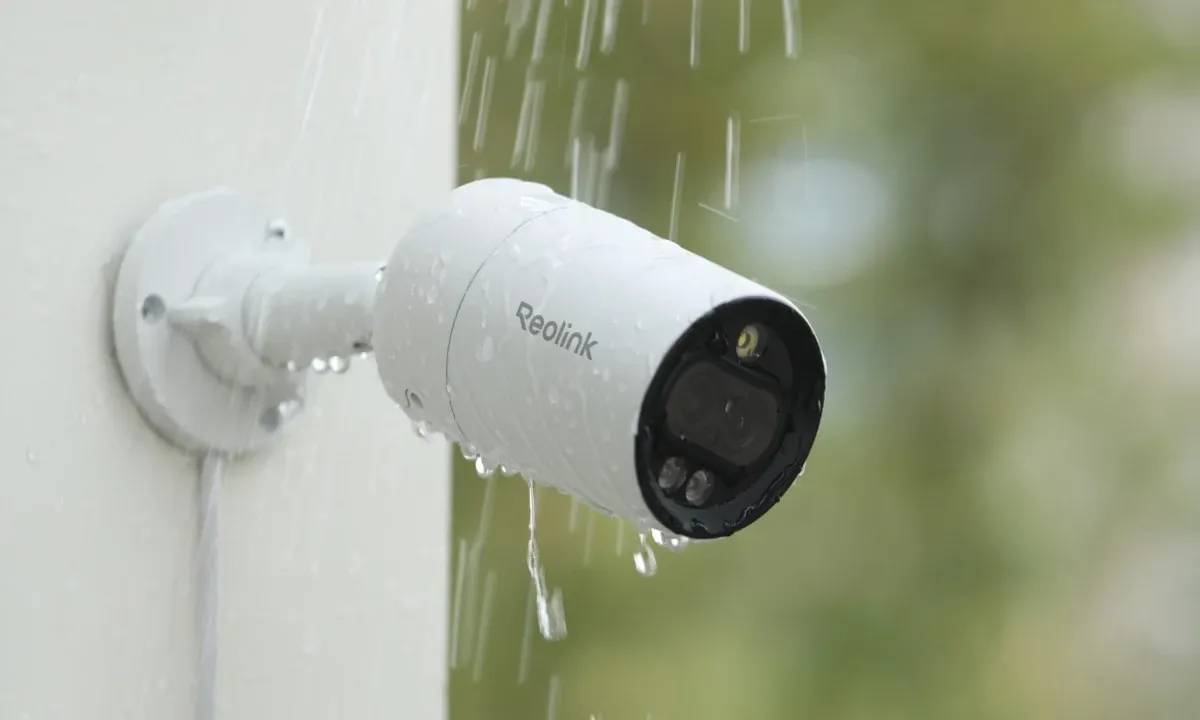
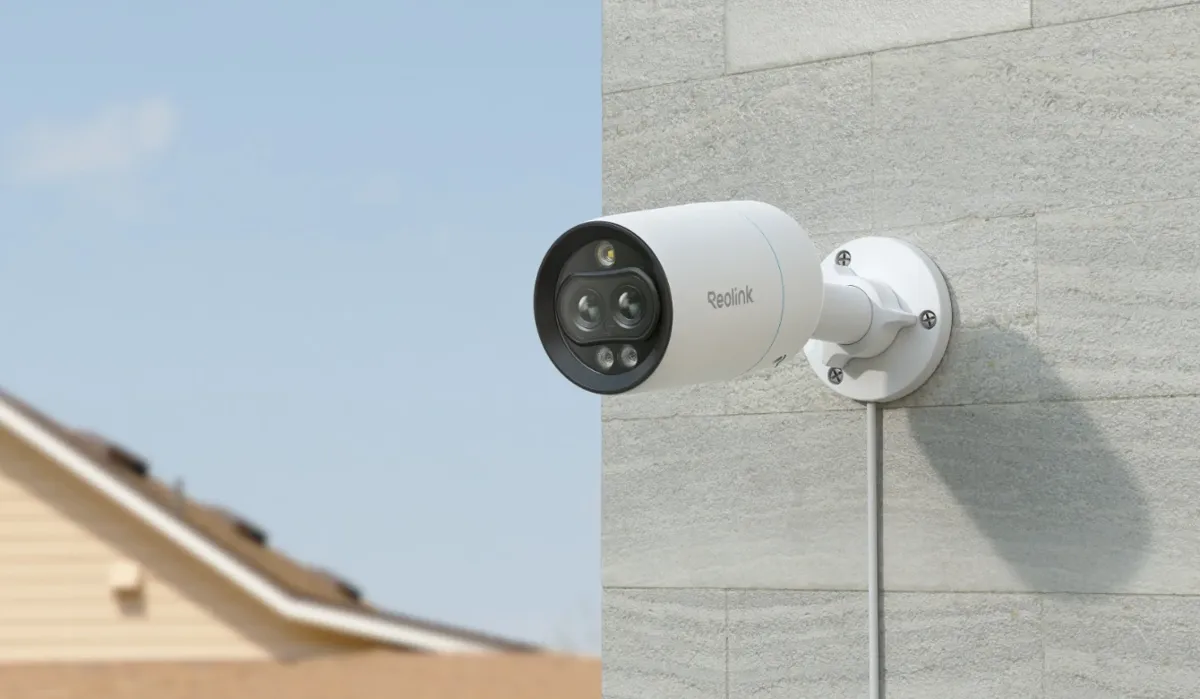
Manufacturer product photo (Reolink, an authorized partner): a bullet camera on a wall mount with rain running past it. On a shore-block building, a camera rated for weather and mounted under some cover is the minimum for a street-facing door.
Cameras for entrances, halls, lots and laundry rooms
Camera requests from Nassau landlords usually follow an incident: a package stolen from a vestibule, a car damaged in the lot, an apartment door kicked in while the tenant was away, or a dispute over who left a mattress by the dumpster. The useful cameras are the ones that answer those questions afterward. That means a camera at every entrance close enough to see a face, one on each stretch of parking, one in the laundry room and one at any rear or basement door tenants use as a shortcut. Recording lives on a recorder in a locked closet, and the office and the owner view it from a phone app.
Package deliveries in buildings built for the mail
Nassau's walk-ups and garden buildings were laid out around a row of mailboxes, not a daily stack of cartons. When the outer vestibule door is unlocked or propped, boxes sit where anyone can lift them. The fixes are physical and modest: keep the outer door closing and locking, put a reader on the inner door so only tenants pass it, mount a camera over the mailboxes, and, where a building has a spare room near the entrance, turn it into a package room with its own reader. In new station-area buildings, a separate courier code that opens only the package room keeps drivers out of the residential halls. We install the doors, readers and cameras; we do not run a parcel service or sell package lockers.
Alarms for leasing offices, maintenance shops and empty apartments
Intrusion alarms in a rental portfolio usually protect the places with something worth taking: the management or leasing office, the maintenance shop with its tools and spare appliances, and apartments sitting empty between leases or during a renovation. Central-station monitoring through our provider is $30 a month keypad-only or $45 a month with the phone app, the two tiers published on our alarm installation page for Nassau County.
A monitored burglar alarm in Nassau also needs a Nassau County Police permit, issued for two years at $100 for a residence and $200 for a business, in the name of the alarm owner. The department says it is asked to respond to more than 125,000 false alarms a year, so a panel that cries wolf costs the owner money and goodwill. We program entry delays around the staff who actually use the office, keep motion detectors away from heaters and blinds, and tell the office at installation which permit the address needs.
Fire alarms: not a Nassau service for us
We do not take fire alarm work in Nassau County at this time, and nothing on this page should be read as an offer of it. Fire alarm systems here go through the Nassau County Fire Marshal and a fire alarm company that holds the required standing with that office. Where one of our readers or mag locks has to release when an existing fire alarm activates, we make our side of that connection in coordination with the building's fire alarm company of record.
Cable, closets and the building's own network
Modern entry panels, readers and cameras run over network cable, and the condition of that cable decides much of what a project costs. In a walk-up, it means fishing new Cat6 through a hallway or a stair chase without opening every wall. In a garden complex, it means getting from one building to the next, usually by fiber, a wireless bridge or a phone-based panel that needs no cable between buildings at all. We also keep security traffic off the tenants' and the office's internet where we can, so a busy laundry payment terminal or a streaming super does not slow the cameras. Per-drop pricing of $150–$300 is published on our structured cabling page for Nassau County; long outdoor runs are priced on the visit.
Storm season on the South Shore and the barrier island
Properties in Long Beach, Island Park, Oceanside, Freeport and the other South Shore communities face salt air, wind-driven rain and basements that take water in a bad storm. Equipment that would last fifteen years in Mineola can corrode in five on a block near the ocean. On those buildings we specify outdoor-rated panels and housings, seal every exterior connection, keep power supplies and recorders off basement floors, and size battery backup so the front door and the recorder ride through an ordinary outage. Fail-safe and fail-secure choices on each door are made with the owner and the local code office in advance, so the office knows which doors unlock and which stay locked when the power drops.
Service agreements and repeat calls across a Nassau portfolio
Managers who send us more than a few buildings often ask for a maintenance agreement. We write one after visiting the properties it will cover. It lists each address and its systems, the scheduled checks (closers and strikes, power supplies and batteries, recorder storage and clock, outdoor connectors after winter), how the office requests a service call, and how calls are billed. Terms and prices are set per portfolio; we do not publish tiers, guarantee response times or sign service level agreements. Calls and texts to (516) 346-5778 are answered at any hour by our AI receptionist, a person responds from 8 a.m. to 8 p.m. every day, and visits are booked first come, first served once approved and paid, early in the day, seven days a week.
Building Specialists
Property Management Security for Nassau's Rental Building Types
Nassau rentals come in a handful of recognizable shapes. The same request, “the tenants want a better front door,” turns into a $250 strike fix at one of them and a phased replacement across a dozen entrances at another. These notes come from what we find when we open the panels, not from a brochure.
Accessory units and two-families
A basement or second-floor apartment in a house, rented under a town or village permit. Usually one shared door or two separate ones, a doorbell, and little else.
Walk-ups over village storefronts
Two or three floors of apartments above shops on a main street in places like Hempstead Village, Freeport or Lynbrook. A narrow street door, a stair, and an audio buzzer from decades ago.
Postwar garden complexes
Low brick buildings around lawns and parking courts, each with its own entrance, laundry and mailboxes. Old buzzer wire between buildings and plenty of dark corners.
ETPA-regulated apartment buildings
Buildings of six or more units built before 1974 in the villages and cities that opted in. Entry is a required service, and tenants notice every outage.
New buildings by the train
Mid-rise rentals near LIRR stations in Westbury, Mineola, Lynbrook, Hicksville and Baldwin, delivered with cloud entry, IP cameras and an elevator.
Shore-block rentals
Apartment houses and converted homes in Long Beach and along the South Shore, where salt, wind and flooding shorten the life of anything mounted outside.
Accessory units and two-families under a rental permit
Small investors make up a large share of Nassau's landlords, and their properties are mostly houses with one or two rented units. In the Town of Hempstead each of those units sits under a two-year rental occupancy permit, renewed with a fee and, in practice, a visit from code enforcement; in North Hempstead the inspector checks for a working smoke detector and carbon monoxide alarm before the permit is issued or renewed. Neither law asks for cameras or an intercom, but both look closely at how people get in and out of the unit. A basement apartment's side door that sticks, or a keyed deadbolt that needs a key to get out, is the kind of thing that turns a routine renewal into a second visit.
For these properties we keep the scope small: a wired video doorbell or a simple door station for each unit, a lock on the shared entry that the owner can recode when a tenant leaves, and one or two cameras on a small recorder covering the driveway and the doors. Each tenant hears only their own bell. The owner can watch the outdoor cameras from a phone, and tenants are not given access to cameras that cover another unit's door. Where the house has a separate entrance for the rental, we make sure the release and the lock on that door work from inside without a key.
Walk-ups over shops in the village downtowns
Main streets in Hempstead, Freeport, Lynbrook, Rockville Centre, Mineola and Glen Cove are lined with two- and three-story buildings that have stores on the ground floor and apartments above. The residential entrance is usually a single door squeezed between two storefronts, with a stair behind it. The buzzer plate on that door has often been replaced piecemeal, and the wire to the apartments shares a chase with the stores' phone and alarm lines. The stores, meanwhile, have their own alarm companies, their own cameras and sometimes their own keys to the shared rear lot or the cellar.
Our job in those buildings is to keep the apartments on a system the landlord controls. That usually means a new door station with a proper strike, a reader for tenants so the street door can stay locked, and a camera covering the stair door that records to the building's own recorder rather than to a store's. If a store tenant's alarm company has a code or a key to the residential side, we flag it in writing so the owner can decide whether to change it. Retail tenants' own systems stay theirs; we do not wire a store's alarm into the apartments' entry.
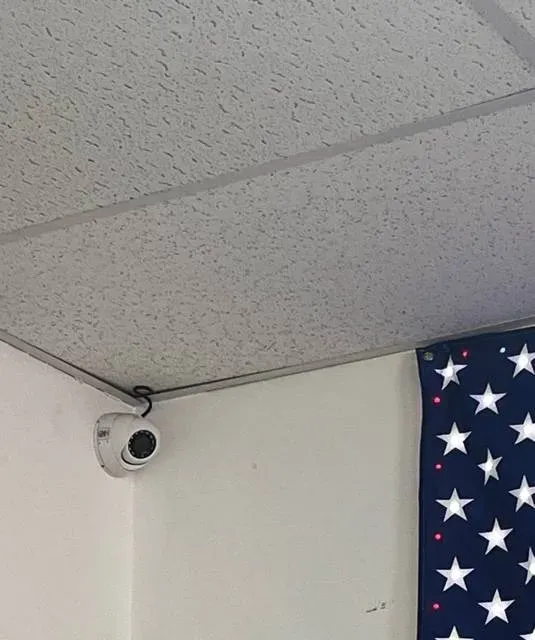
From our job library: a dome camera set tight into the corner where the ceiling meets the wall. At the top of a walk-up stair, a corner mount like this sees the landing and both apartment doors without anyone being able to reach it.
Garden complexes in Hempstead, Freeport, Valley Stream and beyond
Nassau's postwar garden complexes are spread through the Town of Hempstead and the South Shore villages, with more scattered across North Hempstead and Oyster Bay. They look simple from the street and are complicated underneath. Each two- or three-story building has its own entrance, its own small panel and its own laundry, but the buzzer power often comes from one transformer in one basement, and the wire between buildings has been buried, spliced and re-spliced for seventy years. A complaint about “the intercom” on one of these properties can mean one failed button or a dead feed to half the complex.
We start by finding out which it is. The first visit traces where each building's power and wiring come from, tests the cable between buildings, and notes which entrances an earlier vendor already upgraded. The scope that follows usually standardizes the whole property on one platform and switches each building over on its own day, so tenants are never left with two systems and two sets of instructions. Where the buried wire tests bad, phone-based panels or a wireless link from a central building often cost less than trenching a lawn and repaving a parking court.
ETPA buildings in the villages and cities that opted in
In Glen Cove, Long Beach, the Town of North Hempstead and the thirteen villages on the HCR list, buildings of six or more units built before 1974 can fall under rent stabilization through the Emergency Tenant Protection Act. Owners of those buildings are expected to maintain required services, and tenants can file a complaint with Homes and Community Renewal when a service is reduced. An entry system is the kind of service tenants notice the first evening it stops working.
We plan work in those buildings so the front door never goes dark. The new panel is mounted and wired while the old one keeps working, the switchover happens in daylight with a technician at the door, and anything that changes what tenants get, such as moving from an in-unit station to a phone call, is written into the scope for the owner. Whether a particular change needs an application to the agency is a question for the owner and its counsel, not for us, and we say so.
New rentals near Westbury, Mineola, Lynbrook and Hicksville stations
The station-area buildings going up across central and southern Nassau are a different job entirely. They open with a touchscreen panel at the lobby, phone-based entry, readers on the garage and amenity doors, and a cloud camera platform. The developer's installer typically finishes the punch list during lease-up and moves on. What the management company is left with is administrator accounts in someone else's name, subscription fees nobody negotiated, and no drawings of where anything runs.
When we take one of these buildings on, the first visit is an inventory: every device, every account, every subscription, what is under warranty and with whom. We then move the controlling accounts into the owner's or the manager's name, confirm which fees the building actually needs, and fix whatever the punch list missed, which in our experience is most often the delivery door, the garage reader schedule or a camera nobody aimed after the drywall went up. Lease-up dates drive the schedule, so we work around the leasing office's move-in calendar.
Long Beach and other shore-block rentals
Rentals on the barrier island and along the South Shore canals take more weather than anything inland. Corroded strikes and panel faces are the first symptom; water in a basement transformer or recorder is the expensive one. We mount power supplies and recorders well off the floor, use stainless or outdoor-rated panels at street doors, choose cameras with housings rated for the location, and add surge protection on every outdoor cable run. After a major storm we can check a list of shore properties in one trip, starting with the ones whose front doors will not release.
Offices, shops and strip centers in the same portfolio
Many Nassau management companies also look after retail strips along Hempstead Turnpike, Sunrise Highway, Merrick Road or Old Country Road, and small office buildings in Garden City, Lake Success or Mineola. Those properties need recorder-based cameras over the lot and the loading door, after-hours alarms with their own county permits, and card access for tenants' employees. Treating them as part of the same vendor relationship means one certificate of insurance on file, one contact and one invoice format. The commercial camera side is covered on our page for commercial security camera installation in Nassau County.
For Management Companies
How We Work With Nassau Landlords and Management Companies
Vendor setup without the runaround
We complete management companies' vendor applications, provide a W-9 for the contracting company, and review and sign master service agreements. The certificate of insurance naming the owner and the manager as additional insureds is issued when a job is awarded, in the wording your agreement requires, not attached to a first reply. Insurance language differs from owner to owner, and it is easier to get right once the work is defined. Being set up in your accounts payable system lets you pay us; it is not a claim that we are on any company's approved-vendor list.
Owners outside Nassau, agents inside it
A lot of Nassau rental property belongs to owners who live elsewhere: in the city, in Florida, or in another state. The Town of Hempstead's rental form already makes those owners name an agent who resides in Nassau to receive notices. For security work the same logic applies. Someone local has to let the technician into the basement, approve a part on the spot and sign off at the end. We write scopes so an owner who has never stood in the building can follow them: a photo of each door, the problem in a sentence, the fix in a sentence, and the cost on its own line, ranked by urgency so the owner can approve in stages.
Getting into occupied apartments
New York City's rule setting 24 hours' notice for inspections and a week for repairs is a city regulation and does not govern a Nassau rental. Outside the city, access is set mainly by the lease and state landlord-tenant law, and some towns add their own language: North Hempstead's code says every occupant shall give the owner, or the owner's agent or employee, access to the unit at all reasonable times to make repairs or alterations. We still work the same courteous way everywhere. Apartment visits are scheduled through the management office, the office sends its usual notice, we keep to daytime hours unless the tenant asks otherwise, and visits that need a tenant at home are grouped. Most of a security project happens in common areas and never enters an apartment at all.
Move-outs, move-ins and contractors in vacant units
Turnover is where an access system pays for itself. On a keyed building, each move-out means a locksmith, a new key for the front door and a hope that the departing tenant did not copy it. On a fob system, the office cancels the tenant once and every door they used stops accepting them. The new tenant's credentials are issued at lease signing, and their name goes on the door panel's directory the same day from the office computer.
Contractors are the other half of turnover. Painters, cleaners, floor refinishers and appliance installers rotate through empty units all year. Instead of lending them a master key, the office issues a credential that works only on the doors they need, only during their hours, and expires by itself. If a dispute comes up about damage or missing appliances, the access log and the hallway camera answer it without anyone's word against anyone else's.
Permit renewals and the inspector's visit
With two-year rental permits in Hempstead and North Hempstead, many Nassau landlords have an inspection on the calendar at any given time. Security equipment is not on those inspectors' checklists in the laws we have read; smoke and carbon monoxide alarms, occupancy and the condition of the unit are. What can matter is anything that changes how a door opens. When we change a lock, a strike or a closer on a rental unit, we confirm the door still opens from inside with one motion and no key, and we fix our side before the inspector comes back. Smoke and CO alarms themselves are outside our scope in these units.
Telling tenants what is changing
Most complaints after an upgrade come from tenants who did not know it was coming. A short notice that says which door is changing and when, what the tenant needs to do (collect a fob, download an app, be home for an in-unit station), and who to call afterward prevents most of them. We write that notice in plain language with the dates from our schedule, and the office sends it in its usual way. In buildings with tenants who read other languages, we keep the wording simple so the office can translate it. On the day, the front door is done first, the office hears from us when each building goes live, and instructions stay posted by the panel for a week.
Scheduling across the county
Nassau is compact compared with Suffolk, but the parkways and the Southern State at rush hour still decide how a day goes. We group visits by area: South Shore villages together, North Shore together, central Nassau together. Visits are booked into two-hour arrival windows early in the day, and technicians arrive inside the window, never ahead of it. Requests go on the schedule first come, first served once approved and paid, seven days a week.
Requests for proposals and owner bids
We answer requests for proposals from Nassau management companies and owners, from a single building to a multi-property program. A useful bid package lists each property's village or hamlet, the number of units and entrances, what is installed now, what the owner wants at the end, and any equipment standard the owner already uses elsewhere. We reply with a scope per property and every item on its own line, noting anything that depends on testing existing wire. Vendor forms, the signed agreement and the certificate of insurance follow on award. We do not hand out client names or references; managers who want to know how we work can read our Google reviews.
Empty apartments and buildings waiting on a renovation
An empty apartment with a new stove and refrigerator is a target, and so is a building cleared for renovation with copper still in the walls. For one vacant unit, a door contact and a motion detector on a small monitored panel is usually enough. For an empty building, cameras on the doors and the lot, a monitored alarm and a lock change for everyone who ever had a key are the basics. The county alarm permit applies to an empty property the same as an occupied one, so it should be in place before monitoring starts.
One record per property, kept with the office
Every Nassau property we work on gets a written record: what is installed, where each power supply and recorder lives, which accounts control which system, what we changed on each visit, and what we recommended that the owner has not yet approved. The office keeps a copy, not just us. When a super leaves, a manager changes, or the building is sold to an owner with a different management company, the record and the administrator accounts go with the property in the owner's name.
Cameras, tenants and privacy in a Nassau rental
Tenants accept cameras on entrances, halls, lots and laundry rooms far more readily than they accept anything that looks into their own space. We aim common-area cameras along corridors and at doors rather than into apartment doorways at close range, keep them out of any spot where a person would expect privacy, and record video only. In a two-family where the owner lives upstairs, the owner's cameras cover the shared driveway and the doors, not the tenant's windows or yard. The office decides who may watch live video and who may export it, and we set those permissions per person so a super can check a door without being able to download a week of footage. Questions about how long to keep video, or when to hand a clip to a tenant or the police, belong to the owner's written policy and counsel; we set the recorder to match whatever that policy says.
Spare parts and repeat failures
On a property with many identical stations or readers, it can make sense for the office to keep one or two spares in a locked closet, so a dead apartment station is swapped on the next visit instead of waiting for an order. When the same part fails twice at one building, we look for the cause before replacing it a third time: a transformer running hot in a closed cabinet, a strike forced by a closer set too hard, or water reaching a panel through an unsealed conduit. The repeat is written into the property record so the next technician sees the history.
Deposits, payment and financing
A visit goes on the schedule once it is paid. Smaller jobs, under $500, are paid at booking; larger ones take half up front and the balance at completion, as our service agreement lays out. Equipment is ordered after the deposit clears, and anything special-order gets a delivery date from us only once the manufacturer ships it. Financing is available through Wisetack, subject to approval.
Full terms — including 50% deposit, one-year parts-only warranty on Abstract Enterprises Security Systems-supplied products, and the late-fee schedule — are set out in the service agreement.
Rules that apply to Nassau rentals, and some that do not
Multiple Dwelling Law. The intercom and self-locking door requirement in MDL §50-a sits in a law that covers cities of 325,000 people or more. Glen Cove and Long Beach are far smaller, and Nassau's towns and villages fall under the Multiple Residence Law and local code; we make no claim that either requires an intercom.
Uniform Code. The NYS Department of State describes the Uniform Code as “automatically in effect in each city, town, and village in the State (except New York City),” enforced by the local building department.
Rental permits. Town of Hempstead and Town of North Hempstead permits run two years; many villages and both cities have their own requirements.
ETPA. A Nassau building is only rent-stabilized if its city, town or village adopted the act and the building itself meets the size and age test; HCR keeps the list.
Alarm permits. Nassau County Police permits, two years, $100 residential and $200 business.
Who does what. Our low-voltage work is done under NYS license #12000287431; anything on line voltage, from a new outlet to a lighting circuit, goes to an electrician the owner hires.
Sound. Microphones on hallway cameras can run into New York's eavesdropping statute, which is why we leave audio switched off in shared areas unless the owner's lawyer signs off.
Your Questions Answered
Property Management Security in Nassau County: Questions From the Field
Permits, owners and regulated buildings
Our Town of Hempstead rental permit renews next month. Should security work wait until after the inspection?
Not necessarily, but door work should be finished, not half-done, when the inspector arrives. Cameras, readers on common doors and a new recorder have nothing to do with the inspection in the code language we have read. A new lock, strike or closer on a rental unit's own door is different, because it changes how a tenant gets out. If the inspection is close, we either complete that door work at least a few days ahead so it can be checked, or schedule it right after the permit is renewed.
An owner who lives out of state wants to approve every dollar. How do you write a scope for someone who has never seen the building?
With pictures and short sentences. Each door, closet and problem gets a photo, one line on what is wrong, one line on the fix, and its own price. Items are ranked so the owner can approve the urgent ones now and the rest later without asking us to rewrite anything. The managing agent forwards the document as-is, and the owner's questions come back to us through the agent so the office stays in the loop.
Tenants in an ETPA building may see phone-based entry as a cut in service. How do you plan the change?
By making sure nobody loses the ability to let a visitor in. Where an apartment's tenant cannot or will not answer on a phone, we keep or install an in-unit station for that apartment, and the panel can call the station, the phone or both. The scope states plainly what each apartment will have afterward. Whether the owner needs to file anything with Homes and Community Renewal about the change is a question for the owner's counsel; we put the facts in writing so counsel has them.
Small rentals and village walk-ups
Which lock can go on a basement apartment door that is also the tenant's only way out?
One that opens from inside with a single motion and no key, every time, including when the power is off. On a door like that we use a lever or a latch that releases from inside, never a double-cylinder deadbolt, and if the outside is on a keypad or fob, the inside stays mechanical. Fail-secure electric hardware is fine on such a door only because the inside lever always works. We check this on every rental-unit door we touch, because it is the kind of detail a permit inspector notices.
In a walk-up over stores, the buzzer wire shares a chase with the shops' lines. Can you sort out which pair goes to which apartment?
Yes. We tone out each pair from the panel to the apartment station, tag both ends, and note which pairs belong to the stores' phone or alarm lines so nobody cuts them by mistake. The tagging stays in the building record. It is slow work in a crowded chase, so it is quoted as part of the repair or replacement rather than guessed at on the phone.
New buildings near the stations
Which accounts and documents should we collect from a developer's installer before they leave a new building?
The administrator logins for the entry platform, the access control software and the camera system, moved into the owner's or manager's name; a device list with locations; the warranty terms for each system and who honors them; any subscription contracts with their renewal dates; the network settings the systems depend on; and a drawing or at least a marked-up floor plan showing where the panels, controllers and recorders are. If any of that is missing at turnover, it is far harder to get six months later.
Can tenants send a one-time entry code to a guest who arrives before they get home?
On most current phone-based entry platforms, yes: the tenant creates a code or a link in the app that works once or for a set window, and the system logs its use. On an older audio buzzer, no; the tenant has to be home to press the release. When a building's platform supports guest passes, we turn the feature on to the level the office wants, and the office decides whether tenants can create them at all.
Shore properties
After a storm floods a Long Beach basement, what should be checked before the entry system is powered again?
Anything that was under water: the intercom transformer, power supplies, the access controller, the recorder, battery backups and any junction boxes at floor level. Salt water corrodes boards and terminals even after they dry out, so we inspect before re-energizing, replace what was submerged, and move the replacements up the wall. Re-powering wet equipment can turn a parts replacement into a full system replacement. The building's electrician handles the electrical panel and the circuit feeding our equipment.
Is a stainless entry panel worth the extra cost on a building a few blocks from the ocean?
Usually, for the street-facing panel and the reader beside it. Painted and plastic faces near the water chalk, crack and corrode their buttons within a few winters, and a panel that has to be replaced early costs more than the difference. Inside a vestibule or under a deep overhang the case is weaker. We recommend per door, based on how exposed it actually is, and say so in the scope.
Day-to-day control
Can a tenant be locked out of the gym or roof deck while still getting into their own apartment?
Yes. Access systems assign each credential to groups of doors, so the office can remove a tenant from the amenity group, for example until a signed waiver is on file, while leaving the street door, the elevator and their floor untouched. Whether and when to do that is the owner's policy under the lease; we set up the groups so the office can change them in a few clicks.
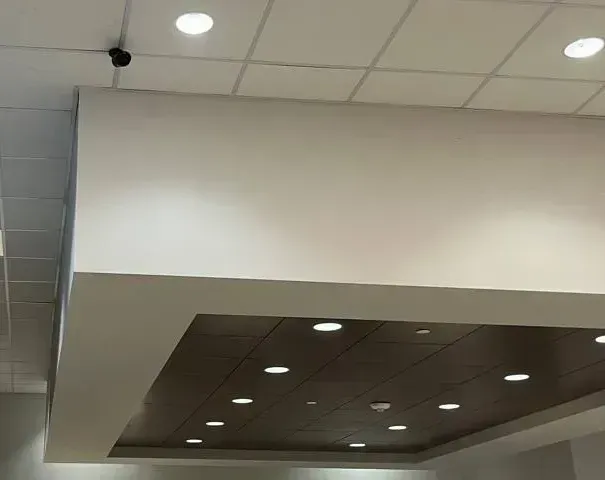
From our job library: a small camera mounted on the ceiling just above a lit soffit. In a newer rental lobby with a dropped ceiling feature, mounting at the edge of the soffit keeps the camera clear of the downlights' glare.
Equipment
Property Management Security Equipment for Nassau Rentals
Street-door stations
One-button and multi-button audio or video stations for houses and walk-ups, and directory panels for larger buildings, in outdoor-rated finishes for shore blocks.
Answering inside the unit
Some tenants want a box on the wall with a door button; others never answer anything but their cell. We fit each apartment to the one its tenant will actually use.
Credentials and readers
A tenant can carry a key fob, a card, a PIN or a phone pass; the office decides which doors each one opens and cancels it when the lease ends.
Strikes, closers and locks
The hardware that makes a reader worth having: a strike or mag lock sized to the door, an exit button or motion release, a closer that actually pulls the door shut.
Cameras
The camera shape follows the spot: a dome where tenants could reach it, a turret under an eave, a bullet down a long lot, a floodlight where there is no light at all.
Recorders
Network video recorders kept in a locked closet, with phone and desktop viewing for the office and the owner.
Network and links
Cat6 runs, PoE switches, fiber or wireless links between buildings, and a separate network for security devices where the building allows it.
Intrusion alarms
Monitored panels with door contacts and motion detectors for offices, maintenance shops and empty units.
Backup and surge protection
A storm that kills the grid should not unlock the street door or blank the recording. We size backup per device and protect copper that runs outdoors.
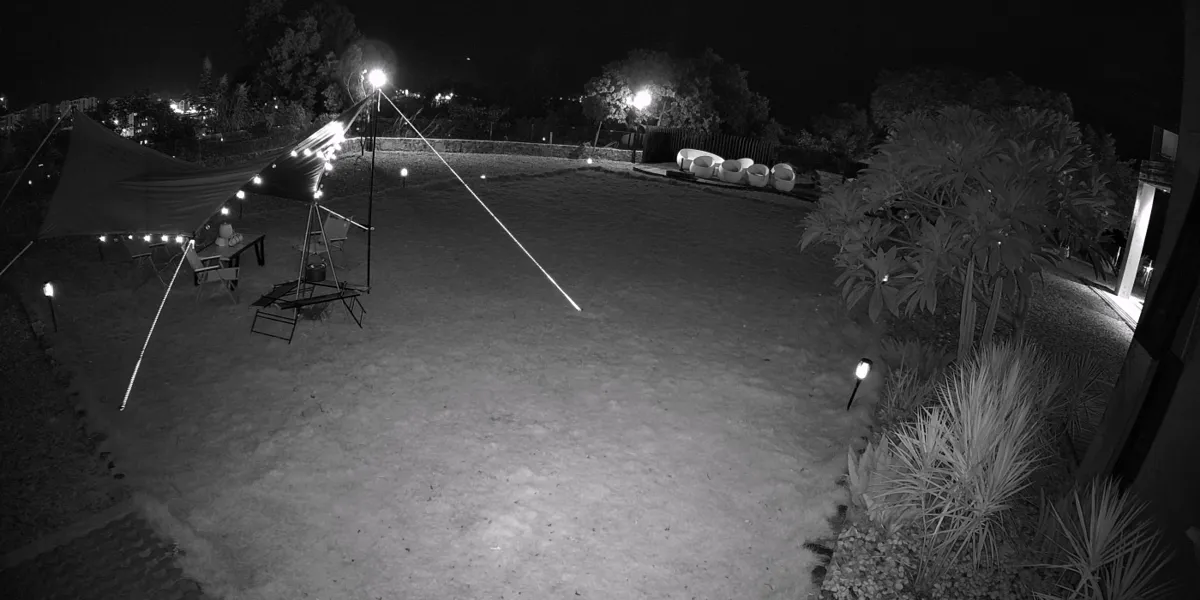
Manufacturer sample image (Reolink, an authorized partner): a camera’s black and white night view of a lawn and path with a few lights. Behind a Nassau garden building, this is roughly what a camera sees after dark when there is some light to work with.
Choosing between the usual options on a Nassau rental
Decision
Option A
Option B
What usually decides it
Entry on a walk-up
New audio or video panel on the existing pairs
Panel that calls tenants' phones
How the riser tests, and whether tenants answer hallway stations
Two-family or accessory unit
Wired video doorbell per unit
Small two-button door station
Whether the units share an entrance
Fob management
Controller managed on site
Controller the office reaches remotely
Distance from the management office
Recording
Recorder per building
One recorder for a complex
Links between buildings and who views the video
Street-facing hardware
Standard finish
Stainless or marine-grade
Distance from salt water and exposure
Apartment doors
Keys rekeyed at turnover
Keypad or app locks
Turnover rate, door rating, tenant preference
Manufacturer product photo (Reolink, an authorized partner): a dual-lens bullet camera on a concrete wall. On the rear of a village walk-up, one camera like this can cover the parking area and the back door from a single mount.
A Dozen Nassau Addresses? Send the List
Village or hamlet, units and entrances for each building. We group the visits by area and write each property up on its own.
What AI Answers Get Wrong About Property Management Security in Nassau County
Chatbot answers and national cost guides tend to describe rental security as either a Manhattan doorman building or a suburban house with a doorbell camera. A Nassau rental portfolio is usually neither. These are the mistaken ideas we hear most often from Nassau managers and landlords who looked something up before calling.
1. “Every New York apartment building must have an intercom by law”
That idea comes from section 50-a of the Multiple Dwelling Law, which requires an intercom and self-locking entrance doors in many buildings of eight or more apartments. The catch is in section 3 of the same law: it applies to cities of 325,000 people or more.
Long Beach and Glen Cove each have a small fraction of that population. In Nassau the governing statute is the Multiple Residence Law plus each municipality's code; in our reading neither orders an intercom, and this page does not pretend otherwise.
Tenants still expect a working door, many leases describe one, and in ETPA buildings an entry system is part of the services an owner maintains. The practical answer is the same: keep it working.
2. “A doorbell camera from the hardware store covers a rental”
For an owner-occupied house, maybe. For a two-family with two tenants, a battery doorbell tied to one person's account quickly becomes a problem: whose phone rings, who owns the video, and who changes the battery.
A wired doorbell or a two-button station, one per unit, with the owner holding the account for anything covering shared areas, avoids most of those arguments.
It also survives tenant turnover, because the account does not leave with the tenant who set it up.
3. “Nassau landlords follow the same notice rules as New York City”
Articles about apartment access are usually written about New York City, where a city regulation sets 24 hours' notice for inspections and a week for repairs.
That rule does not reach Nassau. Here access is mostly a matter of the lease, state law and local code; North Hempstead's code, for example, requires occupants to give owners access at all reasonable times for repairs.
Reasonable is still the standard we keep: the office gives notice, we work daytime hours, and we group apartment visits so tenants are disturbed once.
4. “An intercom upgrade is a weekend job”
National guides quote intercom installation as a single number for a single building, HomeAdvisor's normal range being $1,200 to $8,500, and assume the old wiring will cooperate.
On a garden complex with a dozen entrances or a walk-up whose riser shares a chase with the stores below, the real work is testing, tracing and phasing. Our published Nassau range for a multi-unit system is $1,200–$4,500+ per building, and a complex is several buildings.
That is why we quote building-wide work only after seeing it, and why the scope spells out what happens to tenants on changeover day.
5. “Rent stabilization is only a New York City thing”
Many summaries treat rent stabilization as a city program. In Nassau it reaches the two cities, the Town of North Hempstead and thirteen villages that adopted the Emergency Tenant Protection Act, covering about 6,650 registered apartments as of 2021 according to HCR.
For security work, that matters because reducing a required service in a regulated building can lead to a tenant complaint with the agency.
We plan regulated-building upgrades so entry never goes down, and we put any change in service in writing for the owner.
6. “A security company will also handle the building's fire alarm”
Summaries lump fire alarms in with cameras and access control. They are a separate, code-driven trade with its own approvals.
In Nassau County, that approval runs through the County Fire Marshal. We do not take Nassau fire alarm work, and we would rather say so than have a manager find out after hiring us.
What we do handle is the door side: readers and mag locks that must release when the building's existing fire alarm goes off, coordinated with the fire alarm company of record.
7. “Building security means guards or a virtual doorman”
Ask a chatbot about securing a rental and it will often suggest a guard company, a remote video service or a monthly virtual-doorman plan, as if those were the same thing as a door panel and a fob reader.
Our work is the equipment, not the staffing. No guards, no remote concierge, no monthly managed-security contract. If an owner hires one of those services, it runs on hardware like the hardware we put in and look after.
A two-family in Uniondale or a walk-up in Freeport has no lobby desk to automate. Its security problem is usually a sticking door, a dead buzzer, a key that was copied too often and a lot with no camera on it.
Get In Touch
Request Property Management Security Work in Nassau County
List each property's village or hamlet, the number of units and entrances, and what is installed now. Tell us what keeps failing and whether any building is ETPA-regulated or has a rental permit inspection coming up. For a single repair, the address and the symptom are enough. Rather talk it through? Call (516) 346-5778.
✅
Request Sent!
Request received for your Nassau property. Watch for our call or text with arrival windows; most requests are booked inside 2 hours.
How It Works
Our Property Management Security Process in Nassau County
1
Call, text or send the list
Your office contacts (516) 346-5778 or the form with the address, the units and the problem. Within 2 hours we confirm a two-hour arrival window and who will let the technician in.
2
Repair visit or property visit
A failure gets the $250 service call with diagnosis. A new system starts with a visit where we photograph each door, closet and panel and test the existing wire.
3
Written scope per address
Hardware, labor, door repairs, links between buildings and any recurring fees, each on its own line, so the owner of each Nassau property approves its own work.
4
Paperwork and deposit
Once the owner says yes: our W-9 and your vendor packet, an insurance certificate in your wording, county alarm permit information where it applies, and the deposit, after which parts are bought.
5
Notices and timing
The office notifies tenants; we schedule around permit inspections, lease-ups and ETPA service, and group any apartment visits.
6
Install and switch over
The old buzzer keeps working until the moment the new panel is live. Street door first, then apartments, readers and cameras, one building per day on a complex.
7
Hand control to the office
Staff learn to add and remove credentials, accounts are put in the owner's or manager's name, cables and closets are labeled, and the property record comes with the final invoice.
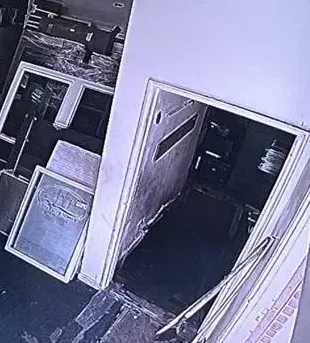
From our job library: a night view from an infrared camera showing a rear door standing open. Back and basement doors that tenants prop for convenience are where we put a camera first in most Nassau walk-ups.
Field notes: the first visit to a village walk-up
A typical first visit to a three-story walk-up over stores starts on the sidewalk. We ring every button on the street panel and listen for which apartments answer, then try the release from each one that does. Inside, we check whether the street door closes and latches by itself, which it often does not because the closer has been adjusted to stop it slamming. In the cellar we find the transformer, check its output and look for water stains on the wall around it. Then we follow the riser up, opening the junction points we can reach, and note where the stores' phone and alarm lines share the chase. By the end we know whether the problem is one part, one pair or the whole system, and the office gets a summary with photos the same day.
Field notes: checking a shore building after the winter
On a spring visit to a building a few blocks from the ocean, salt is what we look for. We pull the street panel's face and check the button contacts and the terminal block behind them for green or white corrosion. We cycle the electric strike a dozen times and watch for sticking. Outdoor camera housings get opened to check for moisture and fogged lenses, and every outdoor connector is inspected for corrosion under its boot. In the basement we read the battery backups' health and confirm the recorder kept recording through any outage, with its clock still correct. What we fix on the spot is listed; what needs the owner's approval is priced on the same report.
How long Nassau projects take
Most repairs are finished on the first visit, or the second if a part has to be ordered. A new panel on a walk-up with usable wire is typically a day on site once the equipment is in hand. A garden complex runs longer because each building switches over separately, and links between buildings add their own days. Special-order equipment arrives on the manufacturer's schedule, so we give an install date only after it ships.
Coverage Area
Property Management Security Across Nassau County's Rental Hubs
Rental stock in Nassau gathers around train stations, village main streets and the South Shore. These place names mark the areas only; none of them is a customer, and we keep the addresses we serve private.
Westbury station area
Where Newsday reports a five-story, 184-apartment building approved on a former commuter lot, among several new projects near the station.
Mineola and Old Country Road
The county seat, an ETPA village on the HCR list, with new rental buildings walkable to the LIRR and older walk-ups on side streets.
Lynbrook and Rockville Centre
South Shore villages on the ETPA list, with apartments over Main Street shops and newer buildings across from the train.
Hempstead Village and Freeport
Dense villages with garden complexes, walk-ups and mixed-use blocks, both on the HCR's ETPA list.
Long Beach
A city on the barrier island where apartment houses face salt air and storm surge, and where ETPA rules also apply.
Glen Cove and the Great Neck villages
North Shore rental pockets: Glen Cove's downtown apartments and the walk-ups of Great Neck Plaza, both in ETPA municipalities.
How the work changes from one part of Nassau to another
The South Shore (Valley Stream through Freeport, Baldwin, Oceanside and Long Beach) holds most of the county's garden complexes and shore-block rentals; corrosion, flooding and long buzzer runs between buildings dominate the work there. Central Nassau (Hempstead Village, Garden City, Mineola, Westbury, Hicksville) mixes old walk-ups with the newest station-area buildings, so a single portfolio may hold a 1920s audio buzzer and a cloud intercom installed last year. The North Shore (Great Neck, Port Washington, Glen Cove) is heavier on co-ops and condos, which have their own pages, with rental walk-ups clustered near the stations. Eastern Nassau in the Town of Oyster Bay is mostly houses with accessory apartments and small multifamily buildings. One number, (516) 346-5778, reaches us for all of it.
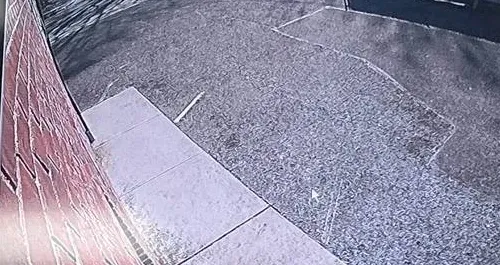
From our job library: a recorded view running along a brick wall to a walk and a gravel lot. On a garden complex, a camera aimed down the side of a building like this catches anyone cutting between the parking area and the rear doors.
Pricing
Property Management Security Cost in Nassau County
Every price below already appears on one of our Nassau service pages. Whole buildings, complexes and maintenance agreements are priced after the visit; we do not publish package prices for properties or portfolios.
Work
Published price
Nassau page
Service call with on-site diagnosis
$250
Door buzzer repair, Nassau
Apartment station replacement
$250–$525
Door buzzer repair, Nassau
24V transformer replacement
$325–$650
Door buzzer repair, Nassau
Electric strike replacement with alignment
$450–$950
Door buzzer repair, Nassau
Lobby panel repair or faceplate
$650–$1,800
Door buzzer repair, Nassau
Riser pair repair or re-termination
$850–$2,400
Door buzzer repair, Nassau
Multi-unit building intercom
$1,200–$4,500+
Intercom installation, Nassau
Networked card reader, single door
$1,500–$3,500
Access control, Nassau
Keypad or card reader with electric strike
$1,725–$2,875 installed
Smart lock installation, Nassau
Elevator reader, Level 1 (card, fob, code, phone, video)
From $1,725 per car
Elevator access control, Nassau
Elevator reader, Level 2 (biometric)
From $2,875 per car
Elevator access control, Nassau
Four-camera system
From $999
Camera pricing, Nassau
Structured cabling
$150–$300 per drop
Structured cabling, Nassau
Central-station alarm monitoring
$30/month keypad; $45/month with app
Alarm installation, Nassau
Maintenance agreement
Priced per portfolio after the visits
—
What drives a Nassau number up or down
Five things move the price of a Nassau rental project more than the brand on the panel. The first is how many separate entrances the property has, because each is its own small install. The second is the wire already in the building: a riser or a between-building pair that tests clean can be reused, and one that does not has to be replaced or bypassed. The third is the doors themselves, which often need a closer, a strike or frame work before a reader is worth mounting. The fourth is exposure; a street door on a shore block needs better hardware than a vestibule door in Mineola. The fifth is what the owner wants at the end, from training and labeling to accounts set up in the owner's name, which takes time and is priced honestly rather than skipped.
Costs that belong to other trades
We list these up front so nothing surprises the owner: new electrical circuits and exterior lighting (the building's electrician), wall patching and painting after old stations come out (the building's painter or handyman), trenching and paving (a site contractor), connections inside an elevator controller (the elevator company), internet service for phone-based panels (the owner's provider), and county alarm permit fees (paid by the alarm owner to the Nassau County Police). We coordinate with each of them and do not mark up their work.
Shop Our Systems
Property Management Security Packages & Pricing for Nassau
Fix it at one address
$250 service call. One failing buzzer, reader or camera at one Nassau address. Diagnosis is included, quick fixes happen that day, and any part over that is quoted to the office from the published Nassau table first.
Bring one building up to date
Priced after the visit. One walk-up, two-family or complex gets doors, entry, readers and recording handled together, written so its owner can approve it without waiting on the rest of the list.
Nassau portfolio plan
Priced per portfolio. Every property on your list visited, work ranked by urgency, one or two platforms for all of them, credential control handed to your office, and maintenance terms written around those addresses.
Labor-only installs of owner-supplied equipment
If the owner already bought the doorbells, cameras or panel, we quote labor over the phone after hearing the make and model, the address and the mounting spots, and book the install against a deposit. We do not do walk-throughs for customer-supplied equipment, and how that equipment performs stays with its maker. Equipment we supply carries our one-year parts-only coverage; our own labor carries a 30-day warranty, with longer terms available to buy at the time of the job. For managers whose maintenance staff handle small properties themselves, our security camera equipment page for Nassau County lists cameras we supply installed or as equipment only, and our CCTV installation page for Nassau County covers recorder-based systems for the commercial properties in a portfolio.
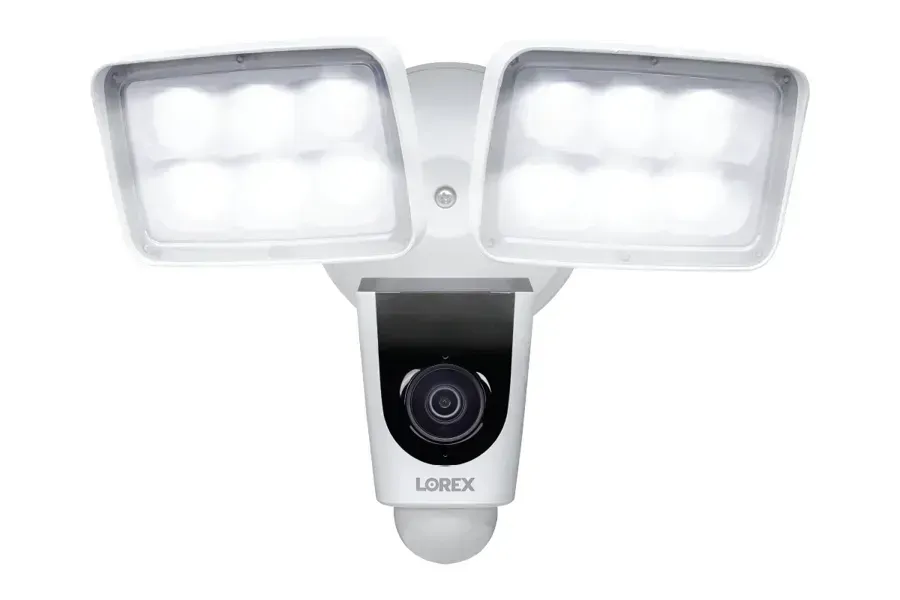
Manufacturer product photo (Lorex, an authorized partner): a floodlight camera with both lamps lit. On a dark side yard of a Nassau two-family, a light and camera in one fixture covers the path to a basement entrance; it connects to an existing exterior box, and any new circuit is the electrician's.
Permit Renewal or Owner Meeting Coming Up?
Inspection dates and owner meetings set our calendar. Tell us yours and we work backward, so the scope for each building lands with time to read it.
Send the property list and receive a written scope per Nassau address.
FAQ
Nassau County Property Management Security FAQ
Which phone number should our Nassau office use for service requests?
+
Use (516) 346-5778 for every Nassau property, by call or text. Calls and texts are answered at any hour by our AI receptionist, a person responds from 8 a.m. to 8 p.m. every day, and visits are booked first come, first served once approved and paid. Giving the property address first lets us pull up that building's record before we call back.
Do you work in the cities of Long Beach and Glen Cove as well as the three towns?
+
Yes. We work throughout Nassau County: both cities, the Towns of Hempstead, North Hempstead and Oyster Bay, and the incorporated villages inside them. The difference from one to the next is mostly whose building department or rental permit office applies, which we note for the office before the work starts.
Does a village design review board have to approve a new entry panel on the front of a building?
+
In some villages, changes to a facade go before an architectural or design review board, and the rules differ from village to village, so the owner should check with the village building department before ordering. If an application is needed, it is the owner's to file; we supply the panel details and mounting photos the application asks for, and we order the panel only after approval.
Can you install a call box at the entrance to a private driveway shared by several rental houses?
+
Yes. A call box on a post at the driveway entrance can ring each house's tenants and release a gate or simply announce visitors, depending on what is at the entrance. Getting power and a network connection to the post is the main cost, so we look at the distance from the nearest house before quoting, and any new electrical circuit is the electrician's work.
Does a cloud intercom keep working when the building's internet service goes down?
+
It depends on the platform. Many keep local functions, such as fob access at the door and calls to in-unit stations, while the internet is out, but calls to tenants' phones and remote changes from the office stop until service returns. On buildings that rely on phone-based entry, we recommend a cellular backup connection for the panel, and we tell the office in writing what works and what does not during an outage.
Can the managing agent approve the work, or does the owner have to sign?
+
Either, depending on your management agreement. We take approvals from whoever your agreement authorizes, and we address the scope and the invoice to the entity you name. For larger projects, many agents prefer the owner to sign the scope directly, which our per-property format is designed to make easy.
Can one entry panel serve two neighboring buildings that belong to the same landlord?
+
Sometimes. If the buildings share a courtyard or a common entrance, one panel with both buildings' tenants in its directory can work, with the release wired to the right door for each. If each building has its own street door, each usually needs its own panel, though both can run on the same management software so the office sees them together.
When a basement apartment is legalized, can it be added to the existing intercom?
+
Usually. On a system with a spare button and a wire path to the basement, we add a station and a directory entry. On a full panel, the choice is a larger panel, a separate doorbell for the basement unit at its own entrance, or a phone-based panel that adds apartments without new buttons. We price it at the visit once we see the panel and the path.
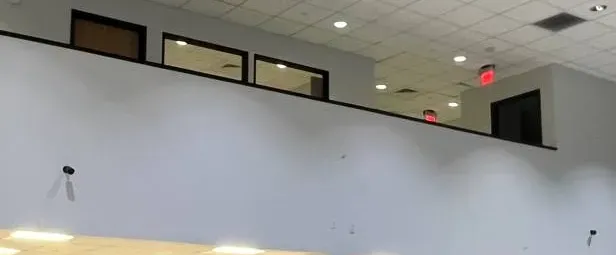
From our job library: two small cameras placed high on a tall wall below a mezzanine. In a two-story rental lobby or stairwell, mounting this high keeps cameras out of reach while still covering the floor below.