Managing rentals in Newburgh, Middletown, Port Jervis or the Monroe area? One security contractor for every Orange County address on your list: (845) 640-3835
Property management security in Orange County starts at $250, the service call that sends a licensed low-voltage technician to a rental building where the entry panel is dead, the street door won't latch, a reader ignores fobs or a camera stopped recording. Newburgh rowhouses and walk-ups, older multifamily houses in Middletown and Port Jervis, the apartment blocks of Kiryas Joel and the Town of Palm Tree, garden complexes along the county's highways and the student and commuter rentals near the colleges and the train all go on one vendor record and one phone line.
Quick answer: An Orange County landlord or managing agent needs a contractor who can fix today's failure, document what each building has, and plan upgrades around the county's rental licenses, rental permits and registries. Repairs open with the $250 service call. Our Orange County service pages already publish the rest: $250–$525 for an apartment station, $450–$950 for a strike with alignment, $650–$1,800 for lobby panel work, $1,200–$3,500 for a video intercom in a building of four to eight units, $1,700–$5,000 for a single controlled door or gate, and $2,100 per car for a Level 1 elevator reader. Whole buildings and portfolios are priced building by building after a site survey.
Last updated November 27, 2026 by Abstract Enterprises Security Systems, NYS license #12000287431 · Sources: U.S. Census Bureau, American Community Survey 2019–2023 (tables B25003, B25024, B25034, B25064) and ACS 2024 profiles via Census Reporter; City of Newburgh Code Chapter 240 (L.L. No. 1-2024); City of Middletown rental permit law; City of Port Jervis vacant and abandoned property law; NYS Department of Health Lead Rental Registry; Orange County Legislature (April 2026, via Citizen Portal); NYS Homes and Community Renewal ETPA updates; City & State NY (Dec 2023); NYS Department of Public Service utility list; Orange & Rockland and Central Hudson (2026); MTA Port Jervis Line schedule
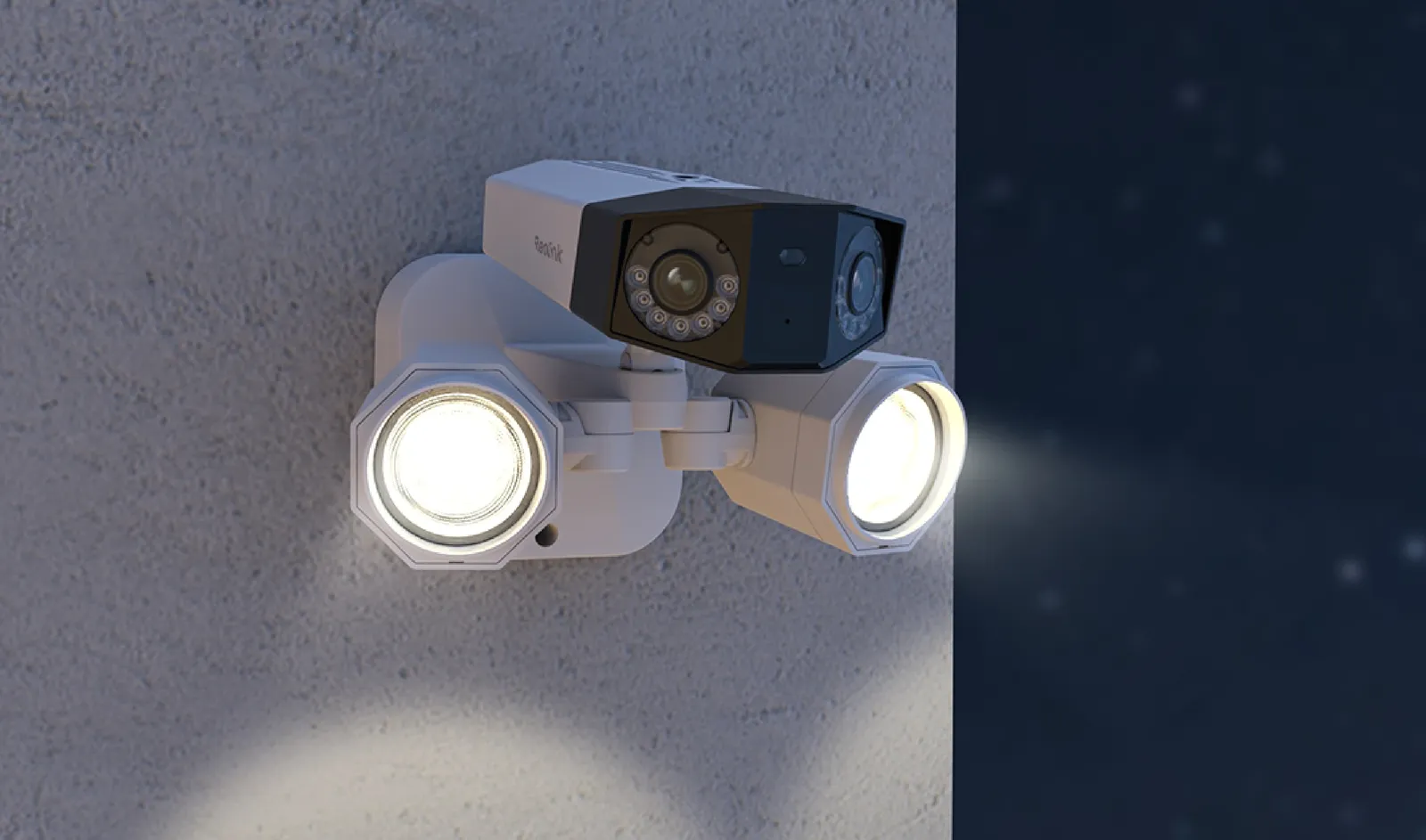
Manufacturer product photo (Reolink, an authorized partner): a floodlight camera with both lamps switched on at dusk, mounted high where a pale wall meets a dark one. Parking areas behind older walk-ups often have no pole lighting at all, and a lit camera over the back door is the cheapest way to give that corner light and a recording.
Orange County Landlord Request
One rental or the whole Orange County list
✅
Request Sent!
Got it. Our office will call or text you, normally within two hours, to set the visit.
25+
Years Experience
2 Hr
Booking
$250
Service Call
4.7★
201 Google Reviews
Licensed NYS low-voltage contractor · Vans dispatched from 460 E Fordham Rd in the Bronx · Orange County line (845) 640-3835
The County
Orange County Rentals, Seen From the Management Office
Orange County is often described as suburbs and farmland, and most of it is. The rental housing that keeps a management office busy is concentrated in a handful of places, and each one is a different kind of job. The City of Newburgh is a river city of brick rowhouses and walk-ups, most of them a century old or more. The City of Middletown has older two- to four-family houses on its side streets and apartment buildings near downtown. Port Jervis, at the western end of the county and the last stop on the Port Jervis Line, has walk-ups and converted houses on narrow lots. Kiryas Joel, coterminous with the Town of Palm Tree, is almost entirely apartment buildings. And between those places, along the highways and around the village centers, sit garden complexes, townhouse rentals and small mixed-use buildings over storefronts.
A landlord or a management company with buildings in more than one of those places is running several different kinds of property at once. An entry system that works in a forty-unit Kiryas Joel building would be wrong for a three-family house in Port Jervis, and a fob plan for a garden complex says nothing useful about a Newburgh rowhouse with one front door and a buzzer from another era. What ties the list together is the office: one person who needs to know what is installed at each address, who holds the logins, what failed last and what it cost. That is the job we take on. Every building gets a file, every visit starts from the file, and every invoice describes the work at one address.
The Census Bureau's numbers show how uneven the county's rental market is. American Community Survey figures for 2019 through 2023 count 43,352 renter-occupied homes in Orange County out of 137,311 occupied homes, about 32 percent. Inside the City of Newburgh the share flips: 6,689 of 10,335 occupied homes are rented, nearly 65 percent, and 5,747 of the city's 11,624 housing units were built in 1939 or earlier. Middletown rents 4,841 of its 10,182 occupied homes, and Port Jervis 1,702 of 3,533, close to half in both cities, with more than half of Port Jervis's housing units dating from 1939 or earlier. In Kiryas Joel, 4,462 of 6,869 occupied homes are rented, and 6,347 of its 7,383 housing units sit in buildings of five or more apartments, while only 215 are detached single-family houses.
Those figures explain most of what we find on a first visit. Old buildings mean old wiring and doors that have shifted in their frames. High rental shares mean constant turnover, which is where keys, codes and fobs go missing. Dense apartment blocks mean doors that open thousands of times a week. And a county where a third of households rent, spread across a wide area, means a manager's buildings are often an hour apart, so anything that can be checked or changed remotely saves a day of driving.
On our side, the company is owned by a technician who has worked on security and entry systems since 2000 and has run the business since 2002. Every job is done under New York State low-voltage license #12000287431, with general liability insurance in place. Orange County requests come in on one line, (845) 640-3835, and the visit is booked within 2 hours of the request into the next open early-day arrival window. Crews leave our Bronx office at 460 East Fordham Road and are routed by part of the county, so buildings near each other are seen on the same trip.
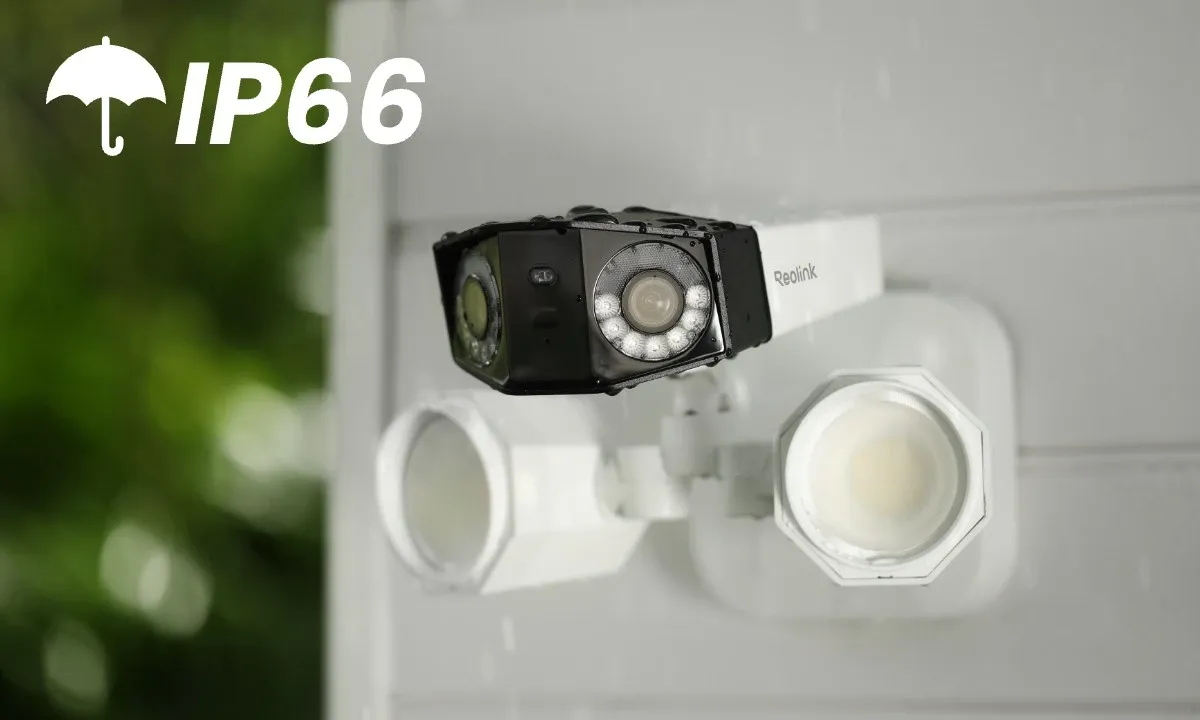
Manufacturer product photo (Reolink, an authorized partner): a floodlight camera with a two-lens camera body between two round lamps, on a white wall, with the maker's IP66 weather-rating label in the corner. A unit like this suits the rear door or the trash corral of a garden building, where the light and the camera share one mounting point.
Orange County numbers that shape a security plan
About one in three households rents. ACS 2019–2023 counts 43,352 renter-occupied and 93,959 owner-occupied homes in the county.
Newburgh is a renters' city in old buildings. 6,689 of 10,335 occupied homes are rented, and 5,747 of 11,624 housing units were built in 1939 or earlier.
Middletown and Port Jervis rent nearly half their homes. 4,841 of 10,182 in Middletown and 1,702 of 3,533 in Port Jervis; 2,110 of Port Jervis's 3,896 housing units predate 1940.
Kiryas Joel is apartment buildings. 86 percent of its housing units are in buildings of five or more apartments, about 65 percent of homes are rented, and the ACS 2024 profile puts average household size at 5.1 people.
Rents vary widely. Median gross rent is $1,602 countywide, $1,614 in Middletown, $1,575 in Kiryas Joel, $1,363 in Newburgh and $1,247 in Port Jervis (ACS 2019–2023).
Two cities on the state lead registry list. Newburgh and Middletown are among the 25 "communities of concern" where the state Lead Rental Registry took effect on November 3, 2025.
Three electric utilities. The state Department of Public Service lists NYSEG, Central Hudson and Orange & Rockland as electric utilities serving Orange County.
A train line through the middle. The Port Jervis Line stops at Harriman, Salisbury Mills–Cornwall, Campbell Hall, Middletown–Town of Wallkill, Otisville and Port Jervis, which shapes where commuters rent.
Place
Renter-occupied homes (ACS 2019–2023)
What a managed list usually holds there
Where the security work concentrates
City of Newburgh
6,689 of 10,335 (about 65%)
Brick rowhouses, walk-ups and converted multifamily houses, many from before 1940
Old buzzer wiring, street doors in worn frames, the city's rental license, lead registry access
City of Middletown
4,841 of 10,182 (about 48%)
Two- to four-family houses, older apartment buildings near downtown, newer complexes at the edges
Rental permit renewals, side-entrance apartments, lead registry access
City of Port Jervis
1,702 of 3,533 (about 48%)
Walk-ups, converted houses and mixed-use blocks on small lots
Vacant-building registration, empty units, aging doors and wiring
Kiryas Joel / Town of Palm Tree
4,462 of 6,869 (about 65%)
Apartment buildings, mostly of five to forty-nine units
Heavy-use lobby doors, large households, intercoms and fob lists that change often
Countywide
43,352 of 137,311 (about 32%)
Garden complexes, townhouse rentals, mixed-use main streets, single-family rentals
Many entrances per property, long drives between buildings, outages on rural lines
Three city laws that put an inspector in your buildings
Newburgh's rental license. Under Chapter 240 of the City of Newburgh Code, adopted as Local Law No. 1 of 2024, it is unlawful to offer or rent a dwelling unit in a building that is not owner-occupied without a rental license. No license is issued or renewed until the city's municipal officer has found that the property complies with the code, based on an inspection, and the license must be renewed every year, though owners the city designates as compliant landlords can receive a two-year term. Licenses do not transfer to another person or another property, and the application must state whether the building is equipped with a fire alarm system. For a landlord, that means an inspector walks the building on a regular schedule, and a front door that doesn't close and latch, or an entry system that has been half-disconnected, is the kind of thing that gets noticed.
Middletown's rental permit. The City of Middletown's law makes it unlawful to lease a single-family or owner-occupied two-family dwelling unit without a rental permit issued by the Department of Public Works, and it bars listing, advertising or showing such a unit, or accepting rent or a security deposit, unless a permit is in effect or a complete application has been filed. Applications and renewals are granted only after an inspection, and violations carry fines of $250 to $1,000, up to fifteen days in jail, or both, with each day a separate offense. Permits run in two-year terms. The practical result is that turnovers in Middletown houses come with an inspection, which is a good moment to make sure locks, doorbells and any cameras are in order before the next tenant moves in.
Port Jervis's vacant-building rules. The City of Port Jervis requires owners and mortgagees of vacant or abandoned buildings, including those in foreclosure, to register them and secure them within 30 days, and to provide proof of inspection at least every 30 days after the vacancy begins. The building official, the fire inspector and the police may inspect, violations can bring fines of up to $500 and up to 30 days in jail, and unpaid charges go on the city tax bill. An owner holding an empty building in Port Jervis therefore has a standing reason to know what is happening inside it between visits, which is where door contacts, a motion sensor and a camera earn their keep.
We are a security contractor, not a law firm, and nothing on this page is legal advice. We read these local laws because they decide when an inspector arrives and what a manager has to show, and we cite where each rule comes from so the owner's attorney can check the current text.
The state lead registry in Newburgh and Middletown
On top of the city rules, Newburgh and Middletown are two of the 25 communities where the state's Lead Rental Registry took effect on November 3, 2025. The Department of Health says the registry covers residential rental properties built before 1980 with two or more units, that a lead hazard inspection must be performed at least every three years by a qualified inspector, and that tenants should be given the dates and times ahead of scheduled inspections or repairs. At an April 2026 meeting, county staff told the Orange County Legislature that more than 1,000 properties had registered, about a quarter of those required, as the county accepted $728,600 in state funding for the program. We don't inspect for lead. What the registry does for a manager is create a recurring day when every apartment in an older building is open, and intercom handsets, apartment stations and in-unit wiring can be serviced on the same day instead of after a second round of tenant notices.
Newburgh's short-lived rent stabilization
Managers sometimes ask whether Newburgh buildings are rent-stabilized. The city council voted unanimously on December 18, 2023 to adopt the Emergency Tenant Protection Act for buildings constructed before 1974 with six or more units, after a vacancy study reported a 3.93 percent vacancy rate. Building owners challenged the study, and on April 19, 2024 the state Supreme Court in Orange County ruled it flawed and declared the city's adoption of the ETPA null and void, according to New York State Homes and Community Renewal. For security work, the point is narrower than the politics: a building's regulatory status can change, and an owner considering a move from in-apartment intercom stations to a phone-only entry system should have counsel check whether any change in service needs tenant consent or notice before work is scheduled.
Who we answer to in an Orange County building
The owner or the managing agent authorizes work, so quotes, appointments and invoices run through them. Many Orange County rentals are owned by small landlords who manage a handful of buildings themselves, and for them the owner and the office are the same person. Tenants who reach us directly are sent back to the office, and we don't schedule anything with a tenant on our own.
The maintenance lead or super is the person who meets us at the door. In Orange County that person often covers buildings in several towns, so we label the equipment, leave a one-page sheet in each equipment room, and tell them exactly what to look for before calling.
Inspectors from the city building department, the fire inspector or a lead inspector are not our clients, but their visits drive a lot of our scheduling. When an office tells us an inspection date, we plan around it.
Tenants judge the whole system by two things: whether the door opens for them with their hands full, and whether a visitor can reach them. Their complaints are the office's early warning, and when they reach us they go back to the office.
What We Install and Repair
Property Management Security Services in Orange County, System by System
Each part below covers one system, how it usually fails in Orange County rentals, what we do about it for a landlord or an office, and which Orange County service page carries the detail and the published prices. Board-run communities have their own pages: condo security systems in Orange County and co-op security systems in Orange County. This page is for owners and firms running rentals.
Entry panels, buzzers and apartment intercoms
In a Newburgh rowhouse or a Port Jervis walk-up, the entry system is often a row of buttons at the street door, a transformer in the basement and a handset or speaker in each apartment, wired decades ago and patched since. When "the buzzer doesn't work," the cause is usually at one end: a button corroded by winter salt, a transformer that finally burned out, a handset a tenant pulled off the wall, or a strike that no longer releases. The cable between them is frequently fine. We test each line before recommending anything, repair what failed, and only price a new system when the wiring itself has given up or the owner wants features the old system can't give.
Our door buzzer repair page for Orange County publishes the parts ranges: $250–$525 to replace an apartment station, $250–$475 for a door release relay or button, $325–$650 for a transformer, $450–$950 for a strike with alignment, $650–$1,800 for lobby panel repair or a new faceplate, and $850–$2,400 for riser pair repair or re-termination. New systems are on our Orange County intercom installation page, which lists video intercoms for four- to eight-unit buildings at $1,200–$3,500, multi-unit building systems at $1,200–$5,000 and app-connected systems for larger buildings at $2,500–$8,000 and up. Repairs to existing intercoms of any brand are covered on our Orange County intercom repair page.
In the larger apartment buildings of Kiryas Joel and in garden complexes, the entry is usually a directory panel in a vestibule. There the failures shift toward the panel and the network: a screen that went dark, a panel that lost its connection when the internet account changed, or a directory nobody has updated since three turnovers ago. A panel that calls tenants' phones suits a building of commuters; a building with older tenants or large families sharing one phone number may do better with in-apartment stations, and the owner should hear that before choosing.
Strikes, maglocks and doors that won't latch
A large share of the "intercom" calls we take from Orange County landlords are really door calls. Old wood frames swell and shrink with the seasons, steel frames in walk-ups get knocked out of line by moving day, and doors in busy buildings simply wear out their closers. When the latch stops meeting the strike, the release upstairs buzzes and the door stays shut, or the door closes but never locks. We reset the strike to where the latch actually lands, adjust or replace the closer, add a door-position switch where the office wants to know when a door is left open, and test the release from every apartment we can reach. Where a door needs new hinges, a new frame or new mechanical locks, we tell the office so the carpenter or locksmith can do that part.
Exits get the same attention as entries. A maglock needs a way out that works when its power is cut, a request-to-exit sensor or button, and a release tied to the fire alarm where one exists. A strike must leave the door openable from inside with one motion. We install those parts as part of the job, and when existing hardware doesn't meet that standard, we say so in writing.
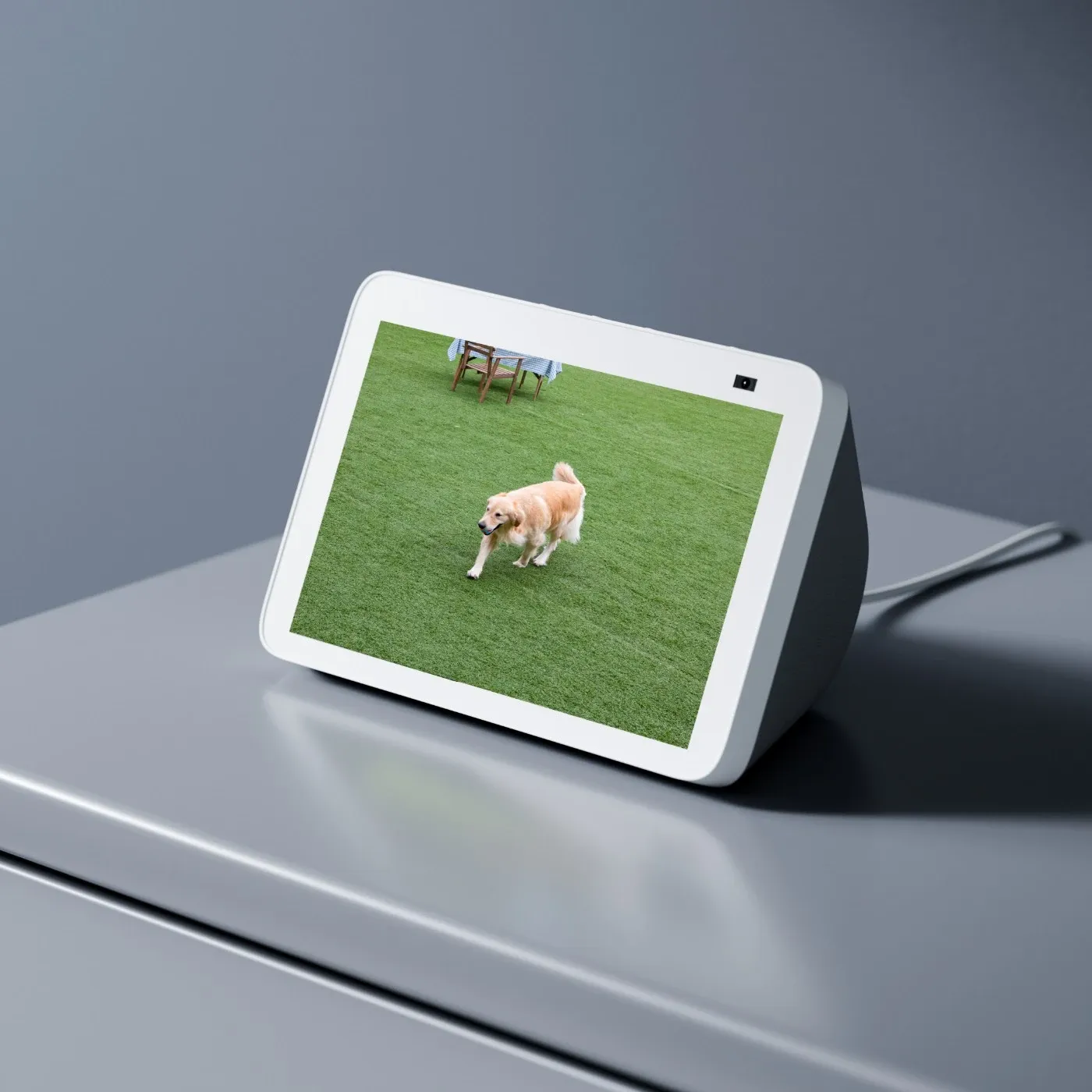
Manufacturer product photo (Reolink, an authorized partner): a small smart display on a gray cabinet, showing a live camera view of a dog trotting across a lawn with a toy. A display like this in a leasing office or a super's apartment lets staff glance at an entrance or a yard without opening an app.
Fobs, readers and access control
Turnover is where keys get expensive. A fob or code system lets the office add a tenant once and cancel them once, for every door they should open: the front door, a rear door to the lot, the laundry room and the storage area. For a landlord with several small buildings, a cloud platform puts them all in one dashboard; for a single building with unreliable internet, a local controller with no monthly fee may be the better choice. We set up each staff member with their own login and only the permissions their job needs, and we show the office how to compare active fobs against the current rent roll, which is the simplest way to find a credential that should have been cancelled months ago.
Our access control installation page for Orange County publishes $1,700–$5,000 for a single door or gate with a keypad, fob reader or gate controller, $4,500–$15,000 for a multi-door property such as a lobby, service entrance and basement or a vehicle gate with a pedestrian gate, and $15,000–$50,000 and up for a multi-building campus or full apartment complex. Those are installed figures; any monthly platform fee is shown on its own line so the owner can compare the long-run cost of each option.
Gates, lots and the paths between buildings
Garden complexes and townhouse rentals in Orange County usually have lots instead of garages, and sometimes a gate at the entrance road. Each controlled point should take the same credential as the building doors, so the office manages one list. We add readers or keypads at gates, connect them to the access system, and coordinate with the gate company that maintains the operator, because the motor and the safety devices are theirs. Cameras for lots, gates and walkways are covered on our Orange County parking lot camera page.
Elevator readers in the larger buildings
Most Orange County rentals are walk-ups, but the larger apartment and senior buildings have elevators, and some owners want floors restricted to residents. A reader in the cab tied to the floor buttons does that through the elevator controller, so the building's elevator maintenance company is part of the job and we schedule with them. Our elevator access control page for Orange County publishes $2,100 per car for a Level 1 card, fob, code or intercom reader and $3,500 per car for a Level 2 face, fingerprint or iris reader, with the elevator contractor's own visit billed by them.
Cameras for entrances, halls and lots
Cameras have their own pages, so here is the management version. In Orange County rentals the incidents that reach an office are packages taken from porches and vestibules, car break-ins and dumping in the lot, damage to doors and entry panels, arguments in shared halls, and falls on stairs and walks. We plan coverage around those events, keep cameras away from apartment doors and windows, and record locally to a recorder in a locked room with remote viewing for the office. Our apartment building security camera installation page for Orange County covers rental buildings in depth and prices building systems at roughly $500–$1,500 per camera installed. Smaller properties start with the four-camera systems from $1,199 on our Orange County security camera installation page, with every model listed on our Orange County camera pricing page. Condominium buildings have their own condo security camera installation page for Orange County.
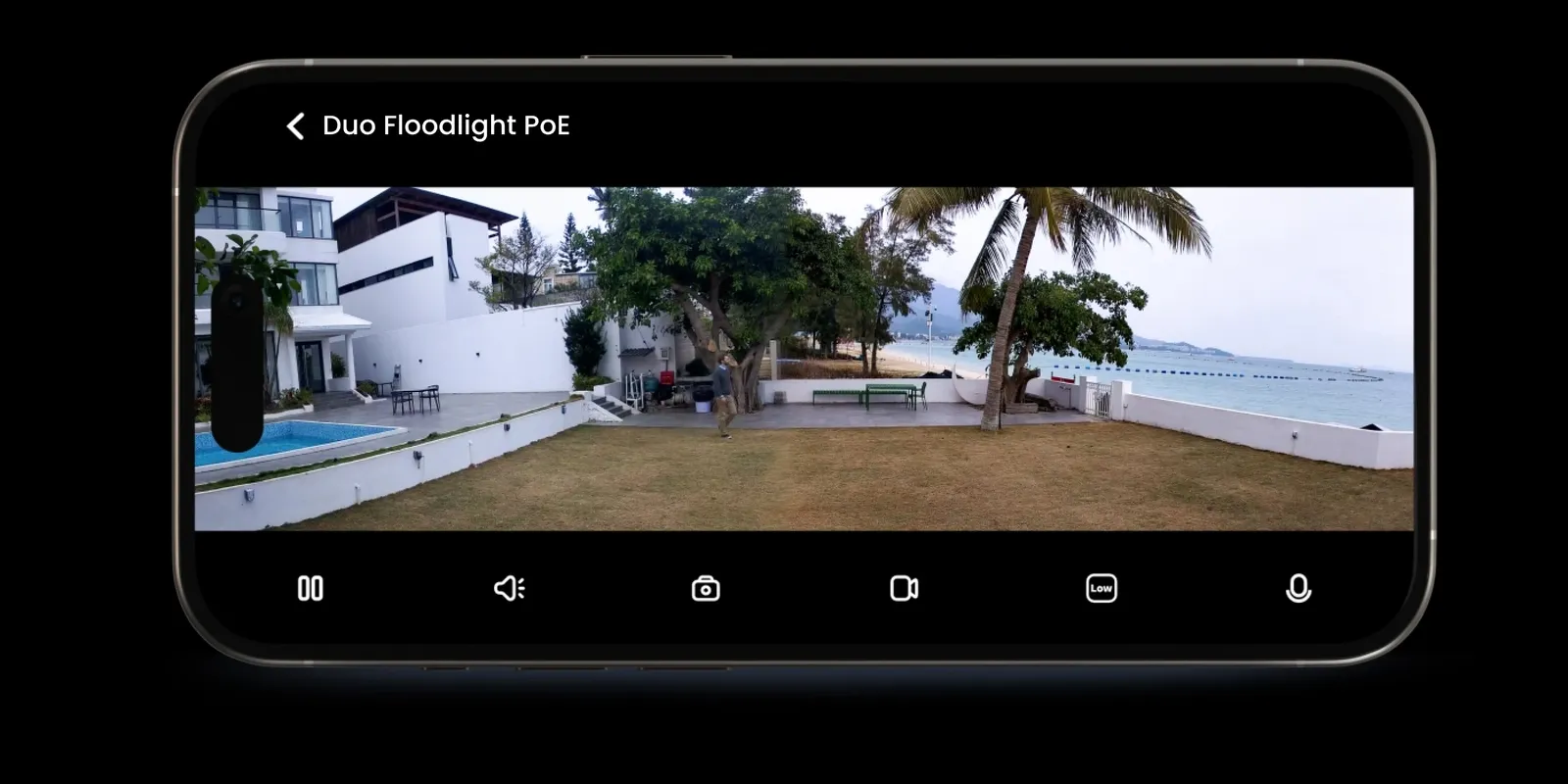
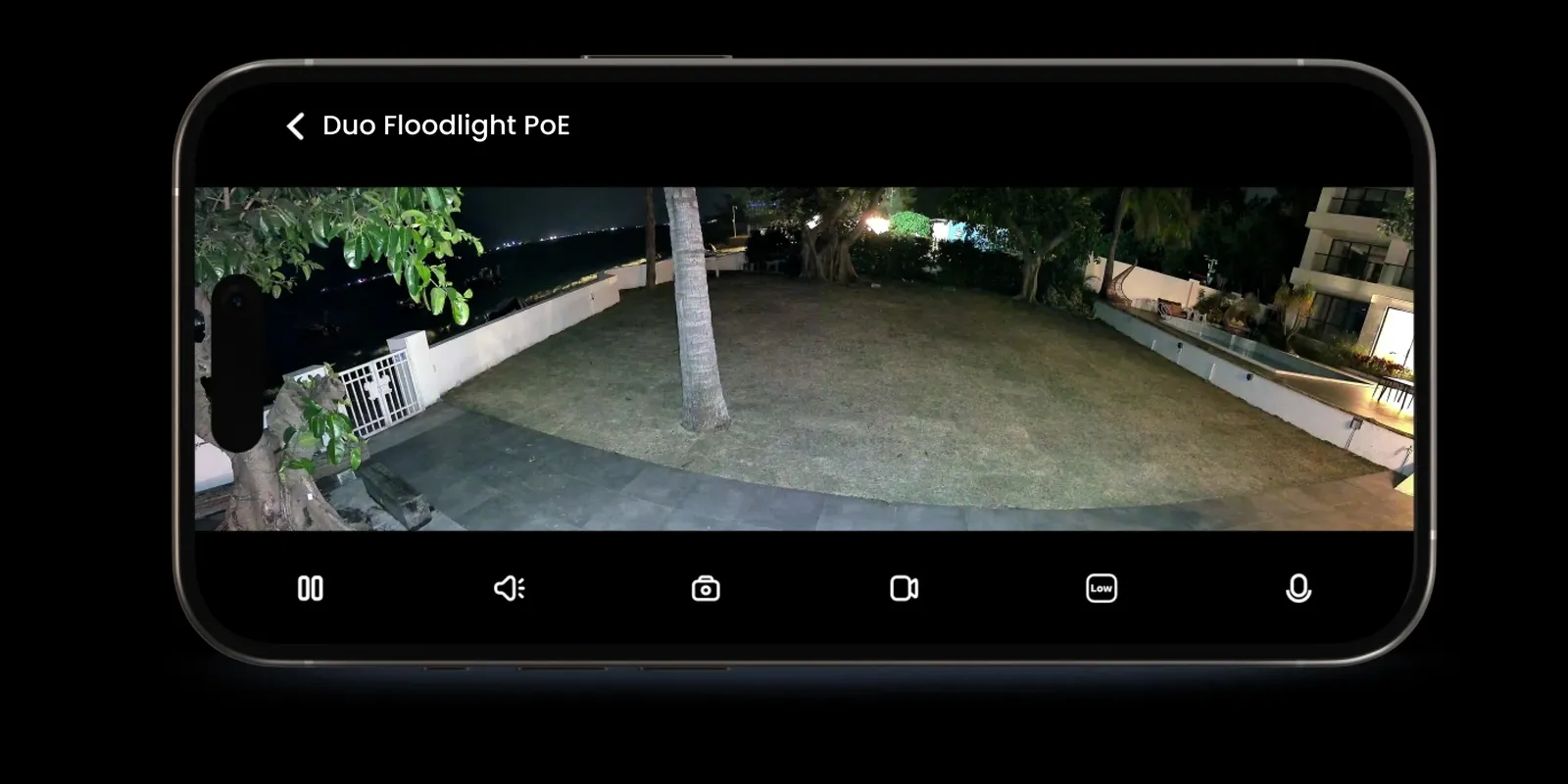
Manufacturer product photo (Reolink, an authorized partner): a phone turned sideways in the camera app, showing one very wide daytime view of a lawn, palms, a pool and a house, with the app's buttons underneath. A manager checking a building an hour's drive away sees it the same way: one wide picture first, then playback if something needs a closer look.
Empty units and vacant buildings
Vacancy is a bigger part of the job in Orange County than in the city. Units sit empty between tenants and during renovations, and Port Jervis requires vacant buildings to be registered and inspected every 30 days. An empty unit is exactly where pipes get stripped, squatters move in and damage goes unnoticed until the next showing. A small intrusion alarm, door contacts on each entrance, a motion sensor inside and a camera on the approach tell the office when someone enters and give whoever does the 30-day check a record of what happened in between. Central-station monitoring is $30 a month keypad-only or $45 a month with the phone app, as published on our Orange County alarm installation page. When the unit is rented, the alarm can stay for the owner's storage areas or come out.
Fire alarm systems
Fire alarm work is in our scope in Orange County. Outside New York City, approval runs through the city, town or village code enforcement office under the state Uniform Code, and the sequence is drawings from an engineer or architect, approval, installation and an acceptance test. Our Orange County fire alarm installation page explains the steps. We don't publish fire alarm prices; each system is priced from approved drawings. Where a building has electric locks, the fire alarm must release them, so we plan the two together.
Cabling, networks and equipment rooms
Every system above depends on cable and a network. We pull Cat6 to each device, set PoE switches in a locked cabinet, add battery backup and keep security equipment on its own network so cameras and readers never compete with a tenant's Wi-Fi or a laundry vendor's card readers. In old Newburgh and Port Jervis buildings the hard part is the route through plaster walls and stone basements; in garden complexes it is getting a network from one building to the next. Our Orange County structured cabling page lists Cat6 data drops at $175 and up per drop. We don't do electrical work; a new circuit for a gate operator or an equipment cabinet goes to the building's licensed electrician, and we coordinate with them.
Power and outages on three utilities
Orange County buildings sit on three different electric systems. The state Department of Public Service lists NYSEG, Central Hudson and Orange & Rockland as electric utilities in the county, and the utilities' own 2026 updates show how often storms reach this area: Orange & Rockland reported more than 47,000 customers affected by heat, storms and heavy rain between July 1 and July 6, 2026, and Central Hudson reported more than 19,000 customers out after a nor'easter in late September 2026. When power drops and returns, the equipment that fails is the unprotected equipment: a PoE switch, a panel power supply or a recorder that reboots before its cameras. We put battery backup on the access controller and the network switch, surge protection on outdoor runs, and a note in the equipment room listing what to restart in what order. Doors on fail-secure strikes stay locked from outside in an outage and still open from inside; maglocks release, so buildings that rely on them need backup sized for hours, not minutes.
Video doorbells and smart locks for houses
Many Orange County rental lists are mostly houses: single-family rentals, two-families and three-families where each apartment has its own door. A shared entry panel rarely makes sense there. A wired video doorbell at each entrance, set up in the tenant's account and reset at each turnover, does the job, with the owner's own cameras on the driveway and yard in the owner's account. Our Orange County doorbell camera installation page covers that work, and code locks for rentals with frequent turnover or furnished rooms are on our smart lock installation page for Orange County.
Who holds the logins
A surprising number of failed systems in Orange County rentals are not broken at all. The panel, the cameras or the fob system work, but the administrator account belongs to a previous owner, a former super or an installer who moved away, so nothing can be changed. When buildings change hands often, and Newburgh's rental license does not transfer with a sale, that problem repeats. We put administrator rights in the owner's name, give the managing agent a separate administrator login and give staff limited accounts, so a sale or a change of manager means removing one set of accounts and adding another.
Building Types
Property Management Security for Orange County's Rental Building Types
An Orange County rental list can run from a 1900s brick rowhouse on a Newburgh hillside to a three-year-old townhouse rental near an interchange, with a fifty-year-old garden complex and a converted Victorian in between. Each needs a different plan for the door, the wiring and the cameras, and the plan for one teaches very little about the next.
Newburgh rowhouses and walk-ups
Attached brick buildings from before 1940, three to six apartments each, with a buzzer row at the street door and a basement that serves as the equipment room.
Converted multifamily houses
Large old houses in Middletown, Port Jervis, Newburgh and the villages, split into apartments with front, side and rear entrances.
Kiryas Joel apartment buildings
Buildings of five to forty-nine apartments with heavy daily traffic, large households, vestibules and shared storage.
Garden complexes
Two- and three-story buildings spread over grounds with lots, mailbox clusters, laundry rooms and many separate entrances.
Townhouse and newer rentals
Recent rental communities with private front doors, a leasing office and sometimes a gate or amenity building.
Mixed-use main streets
Apartments over shops in the downtowns of Newburgh, Middletown, Port Jervis and the villages, sharing walls, cellars and rear yards with the store.
Student and commuter rentals
Houses and small buildings rented by the room near the colleges, or near the stations on the Port Jervis Line.
Single-family rentals and vacant stock
Scattered houses on one owner's list, plus empty units and buildings waiting for renovation or a buyer.
Newburgh rowhouses and walk-ups: start with the street door
Nearly half of Newburgh's housing units were built in 1939 or earlier, and the rowhouses and walk-ups show it. The street door is usually wood in a wood frame, painted many times and swollen or shrunk depending on the season. The entry system is a row of buttons, a transformer in the basement and a handset upstairs, often with one or two apartments disconnected over the years. The most valuable single fix is almost always the door: a strike set true to the latch, a closer that pulls the door fully shut, and a release that works from every apartment. After that comes the panel. If the wiring tests sound, a new button panel or a two-wire video system can reuse it; if not, new cable per line is priced so the owner can decide floor by floor. Newburgh's annual rental license inspection is a fair reason to get this done before the inspector's visit rather than after.
Basements in these buildings matter as much as lobbies. The transformer, any recorder and the network equipment usually live there, beside the boiler or the water heater, on a damp floor. We lift equipment onto shelves or walls, give it a locked cabinet, keep it clear of the boiler's heat and label everything, because the person who next opens that basement door may not be the person who was there last time.
Converted multifamily houses: three entrances, one system
Big old houses in Middletown, Port Jervis and Newburgh were often split into apartments decades ago, and the entrances followed the floor plan rather than any security idea: one apartment off the front porch, another up a side stair, a third through the back. The best layout usually gives each entrance its own small panel or doorbell for the apartments behind it, all running from one power supply and one controller in the basement, so the owner maintains a single system. Cameras go on the approaches to each door and on the driveway, with the tenants' own doorbells kept in their own accounts. Middletown's rental permit inspections on two-year terms, and at changes of occupancy, are natural points to check that every entrance still locks and every doorbell still rings.
Kiryas Joel apartment buildings: doors that never rest
Kiryas Joel's housing is unlike anywhere else in the county. Census data shows 86 percent of its housing units in buildings of five or more apartments and an average household of about 5.1 people, so a forty-unit building can be home to two hundred people. Lobby doors cycle all day, strollers and carts hit them constantly, and the fob or code list changes often. We use heavy-duty closers and strikes rated for frequent cycling, set the hold-open timing so a parent with a stroller gets through, add kick plates and door-position switches, and keep spare credentials with the office so a new family is enrolled the day they arrive. Vestibule cameras aimed at the door and the mailboxes cover the incidents an office actually hears about.
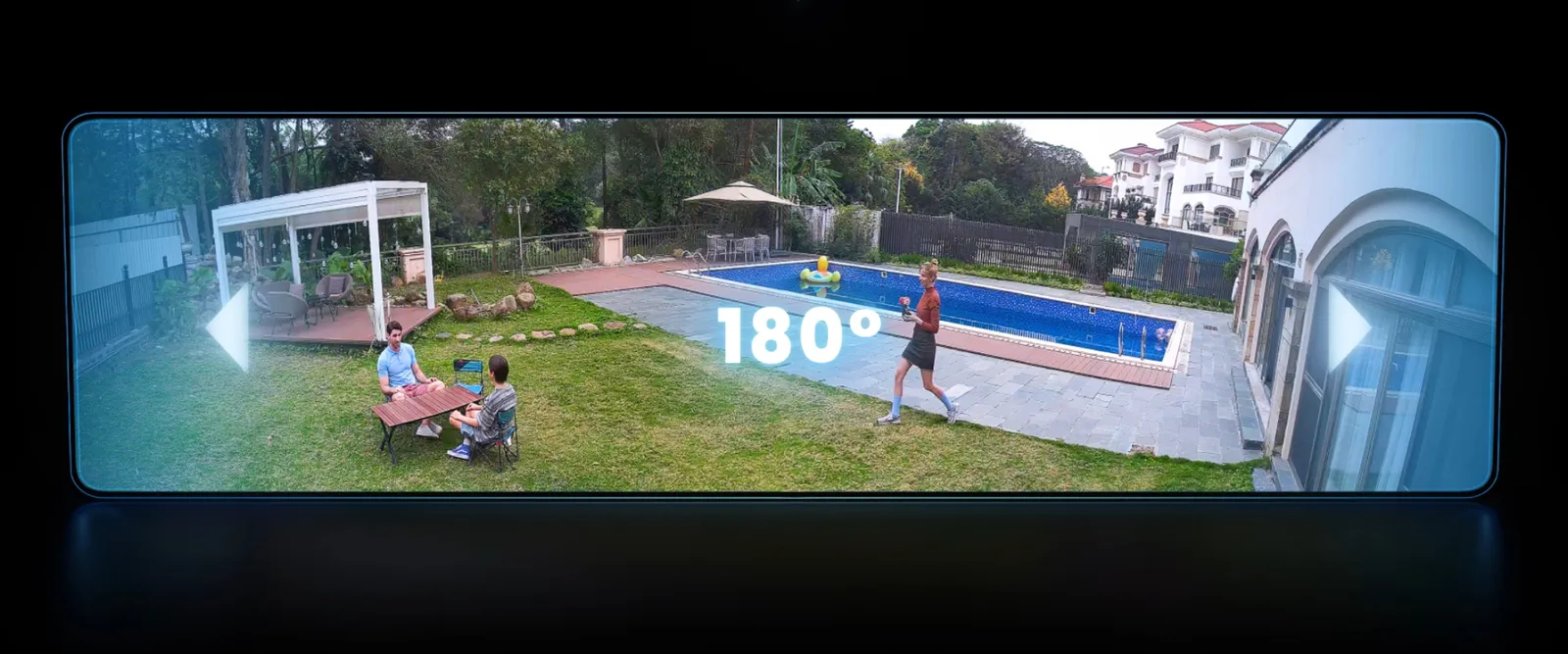
Manufacturer product photo (Reolink, an authorized partner): a curved screen image labeled 180° showing a lawn, a pergola, a patio table and a pool behind a fence. Garden complexes with a pool or a courtyard between buildings are where a single wide-view camera can replace two ordinary ones.
Garden complexes: reach across the grounds
A garden complex has no single front door. It has a dozen or more building entrances spread across lawns and lots, mailbox clusters near the road, a laundry room or two, a maintenance shop and sometimes a pool. The work here is mostly about reach. Every entrance should take the same credential so the office keeps one list, every building needs a network path back to the controller and the recorder, and the outdoor areas, lots, paths, dumpster corrals and mailboxes, matter as much as the doors because that is where incidents happen. We survey the grounds first, use existing conduit where we can and wireless links between buildings where trenching isn't practical, and phase the work building by building so no tenant is ever without a working entrance.
Townhouse and newer rental communities
Newer rental communities usually arrive with a leasing office, a gate or an amenity building on a platform the developer picked, and private front doors on each unit. The management firm that takes over often finds the administrator account in a developer's name and a subscription billed to someone else's card. Our first visit is an inventory: what is installed, who holds each login, what is billed monthly, and what the developer left unfinished. Private unit doors are usually best served by a doorbell camera or a code lock per unit, reset at every turnover, rather than a shared system.
Mixed-use buildings on Orange County main streets
Apartments above a deli, a salon or a pizzeria share a building with a business that keeps different hours and has its own staff, deliveries and, often, its own cameras. The residential stair needs a hard boundary: shop staff shouldn't hold a credential for the apartment door, a shared cellar or rear yard should be controlled from the residential side, and the camera on the apartment entrance should belong to the building, not to the store. We draw that boundary into the access plan and keep the store's own cameras and monitor on its own account unless the owner wants them combined.
Student rentals and commuter rentals
Mount Saint Mary College sits in Newburgh, and SUNY Orange has campuses in Middletown and Newburgh, so both cities have houses and small buildings rented by the room. Turnover there follows the academic year, and keys walk away every May. Code or fob locks on the front door, and on bedroom doors where the lease is by the bedroom, let the office cancel one credential instead of rekeying, and an app-based intercom can ring every roommate's phone. Commuter rentals cluster near the Port Jervis Line stations at Harriman, Salisbury Mills–Cornwall, Campbell Hall, Middletown–Town of Wallkill, Otisville and Port Jervis. Tenants there leave early and come home late, so cars sit in lots all day, packages sit on porches, and the cameras that matter most are the ones on the lot and the delivery spot.
Single-family rentals and vacant buildings
Many Orange County landlords own scattered single-family houses rather than apartment buildings. Each needs only a doorbell per entrance, an owner camera on the driveway and perhaps a code lock, but the list can be long and spread over several towns. The vacant end of the list needs something different: an intrusion alarm, door contacts and a camera that let the owner know when someone goes in, and in Port Jervis, a record that supports the city's 30-day inspection requirement for registered vacant buildings.
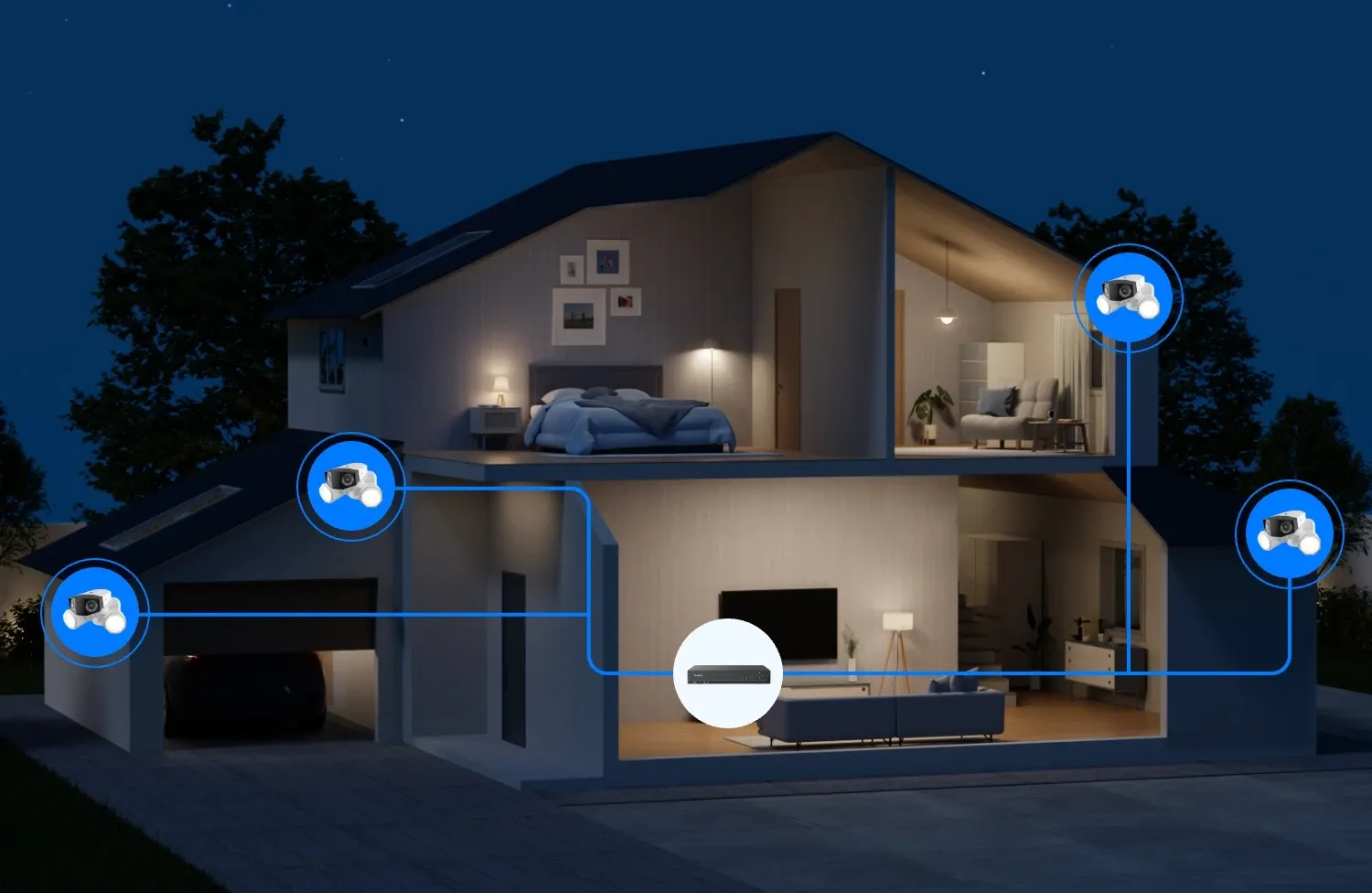
Manufacturer product photo (Reolink, an authorized partner): a cutaway of a two-story house at night, with four camera icons on the outside joined by blue lines to one recorder inside. The same layout, every camera wired back to a single recorder, is how we plan a two- or three-family rental in Middletown or Port Jervis.
How the building type changes the job
Building type
Where the cable usually runs
The hard part
What we check first
Newburgh rowhouse or walk-up
Original buzzer wires through plaster and a stone basement
A worn wood door and frame
Whether the latch meets the strike
Converted multifamily house
Separate runs to front, side and rear entrances
Entrances that grew with the floor plan
Which apartments each door serves
Kiryas Joel apartment building
Risers and a vestibule panel on structured cable
Door wear from constant use
Closer, strike and hinge condition
Garden complex
Conduit or wireless links between buildings
Network across the grounds
Paths between buildings and to the lot
Townhouse rental community
New structured cabling and a leasing-office closet
Logins and subscriptions left by the developer
Who owns the administrator account
Mixed-use main street
Separate residential and store routes
Shared cellar and rear doors
Which doors the store's staff can open
Vacant building
Wireless sensors and a cellular or existing connection
No one on site between checks
Every way in, including basement windows
Working With Your Office
How Orange County Landlords and Managers Work With Us: Licenses, Registries and Turnovers
Vendor setup
Send your vendor packet and it comes back with our W-9. Certificates of insurance are issued by our insurer once a job is awarded, naming the additional insureds your contract requires; we don't attach certificates to quotes. A master service agreement is signed once its scope, insurance and payment terms match how we work. Small landlords who don't use vendor packets can simply call, describe the building and book the visit.
Planning around rental license and permit inspections
Newburgh inspects before issuing or renewing its annual rental license, and Middletown inspects before granting a rental permit or a renewal. We don't certify code compliance and we can't tell an owner what an inspector will decide. What we can do is make sure the parts of a building we work on are in order before the visit: the street door closes and latches, the entry system reaches every apartment, exit hardware opens from inside with one motion, and nothing in the entry system has been left half-disconnected. Tell us the inspection date and we book the visit a week or two ahead, so any part that has to be ordered arrives in time.
Lead registry days and apartment access
In Newburgh and Middletown, the Lead Rental Registry means pre-1980 buildings with two or more units now get a lead hazard inspection at least every three years, with tenants given the dates and times in advance. Those are days when every apartment is open. If an office sends us the inspection schedule and the list of apartments with intercom or handset problems, we book our in-unit work for the same days and keep out of the inspector's way, which saves the office a second round of tenant notices. We don't inspect for lead or disturb painted surfaces beyond the small holes our work requires.
Working in occupied apartments
Outside New York City, apartment access is governed by the lease and state law, so we follow the notice your office gives tenants and the hours it sets. Common areas come first, the old system keeps working until the new one is ready, and the switch happens in one short window. For in-apartment work, the office books the appointments, and we ask for access to every affected apartment on the same visit, because a buzzer fault in one unit is often caused by wiring in another.
Turnovers, lost fobs and move-in day
Rentals turn over constantly, and the system should handle it without a technician. We set systems up so the office can add a tenant, cancel a former tenant, issue a replacement fob, update the directory and create a temporary code for movers, a cleaner or a contractor. Every change is logged under the staff member who made it. For student houses we suggest a fixed reset day each spring, when every outgoing tenant's credentials are cancelled at once and the new list is loaded for the fall.
Taking over buildings someone else wired
A lot of Orange County rental property changes hands, and the new owner inherits whatever the last one left. On a takeover we document what is installed, recover or reset administrator access with the owner's written authorization, test the wiring, the doors and the cameras, and tell the office what is worth keeping. We will repair a system we didn't install, and we're plain about parts that can no longer be found.
Vacant units and renovations
An empty unit is the cheapest time to work inside it. We replace apartment stations, run new cable and add devices while nobody lives there, and if the building is getting a new system later, we install the new station now so the unit doesn't need another visit. During a gut renovation, we prefer to come in before the walls close, so conduit, back boxes and door preparation go in at the right moment, and we protect the vacant unit with sensors and a camera until the tenant moves in.
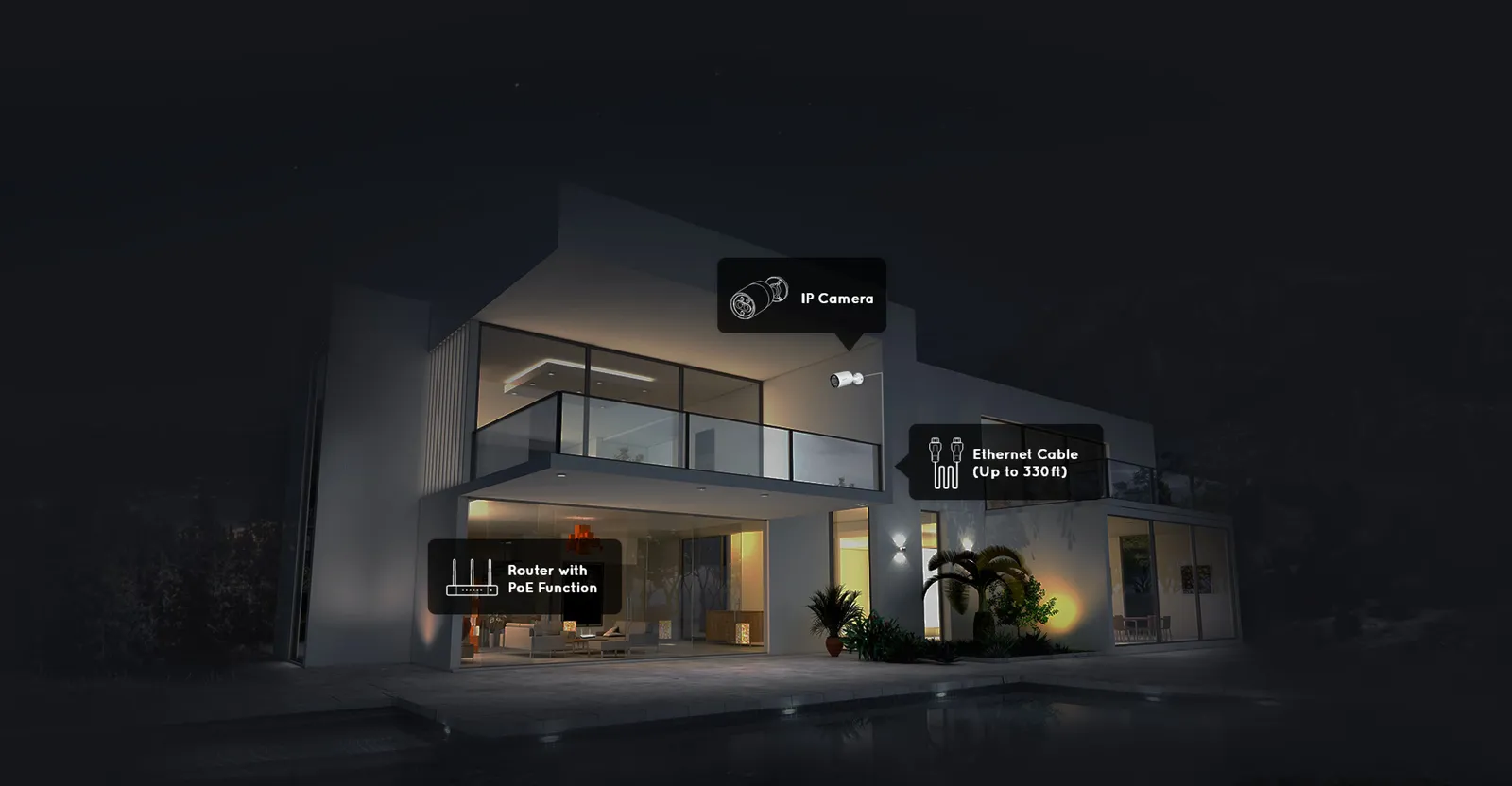
Manufacturer product photo (Reolink, an authorized partner): a modern house at night with callouts for an IP camera on the wall, the Ethernet cable feeding it and a PoE router. One cable carrying both power and video is what keeps an outdoor camera running on a building with no outlet near the door.
Repair or replace
We recommend repair when the failure is isolated, parts are still made and the wiring tests clean. We recommend replacement when the same fault keeps coming back, parts are discontinued, the system can't do something the owner now needs, or a renovation is opening the walls anyway. In between, the owner gets both numbers and decides. For buildings with long-term tenants, we add one question: does the change keep every tenant's existing way of being reached from the door?
Records an owner can use
Every building we service gets a file: the equipment and model numbers, where the controller, power supplies and recorder are, which doors are on which system, who holds which login, and what was repaired when. The maintenance lead gets a labeled equipment room and a one-page guide. The office gets an invoice per building that describes the work in plain words, which is what an owner, an accountant or an insurance adjuster will ask for later. We don't promise that a system will lower an insurance premium; that is the carrier's decision.
Footage and door logs after an incident
At handover we set the recorder's clock, set retention to the number of days the owner chooses, give export rights to named staff only and show the office how to save a clip and a door log for a given time. Audio recording on common-area cameras stays off unless the owner's counsel approves it, because New York's eavesdropping law can apply to recorded conversations. When police ask for footage, the office decides what to release; we don't hand footage to anyone on our own.
Bids and scopes
We respond to bid requests from management firms and owners. A scope that lets bids be compared lists every building and entrance, says whether existing wiring is to be reused, names the platform or asks each bidder to name one, separates equipment, labor and recurring fees, and says who will own the administrator accounts at the end. We bid as the licensed contractor and provide the insurance certificate once the work is awarded. We don't give out client names or building addresses; our Google reviews are public.
Rules an Orange County landlord should keep in view
Newburgh rental license. City Code Chapter 240 (L.L. No. 1-2024): no renting of non-owner-occupied units without a license; inspection before issue and renewal; annual renewal, two years for designated compliant landlords; licenses don't transfer.
Middletown rental permit. Permit from the Department of Public Works for single-family and owner-occupied two-family rentals; inspection before issue and renewal; two-year terms; fines of $250 to $1,000 per offense.
Port Jervis vacant buildings. Registration and securing within 30 days of vacancy, proof of inspection at least every 30 days, fines up to $500.
Lead Rental Registry. In Newburgh and Middletown, pre-1980 rentals with two or more units, lead hazard inspection at least every three years, advance notice to tenants (NYS Department of Health).
Rent stabilization. Newburgh's 2023 ETPA adoption was declared null and void by the state Supreme Court on April 19, 2024 (NYS Homes and Community Renewal).
Fire alarm approval. Local code enforcement approves fire alarm systems under the state Uniform Code, from engineered drawings.
Licensing. Alarm and security installers in New York are licensed by the state; we work under NYS license #12000287431.
Your Questions Answered
Property Management Security in Orange County: Questions Answered
Licenses, registries and inspections
Our Port Jervis building is on the city's vacant-property register. Can sensors and a camera back up the inspection the city asks for every 30 days?
They can support it, though they don't replace it. The Port Jervis vacant-building rules ask the owner or mortgagee to provide proof of inspection at least every 30 days after a building becomes vacant, and the city's building official, fire inspector and police can inspect too. A door contact on each entrance, a motion sensor inside, and one or two cameras with dated recordings give the person doing those checks a record of what happened between visits, and an alert if a door is forced. Ask the city what form of proof it accepts; we install the equipment, and the inspection itself stays with the owner.
The Newburgh rental license application asks whether the building has a fire alarm system. What should we have on file before we answer it?
Know exactly what is in the building before anyone fills in the form. City of Newburgh Chapter 240 asks the application to state whether the structure is equipped with a fire alarm system, and a smoke detector in each apartment is not the same thing as a panel with pull stations and horns. We can identify what is installed, whether a panel is working and who monitors it, and leave a short written description for the file. If a panel needs work, that is fire alarm work in our scope, done from approved drawings with local code enforcement.
Older houses and walk-ups
Our Newburgh rowhouse still has its original wood front door and frame. Can an electric strike go in without replacing the door?
Usually, yes. A strike is mortised into the frame, not the door, so the question is whether the frame has enough solid wood behind the latch side to hold it. On old rowhouse doors we often find layers of paint, a frame that has shifted and a latch that barely engages. We check the frame, square the strike to where the latch actually lands, and run the wire in a slim raceway if the frame can't be fished. If the frame is split or rotted, we say so before ordering anything, because a strike in soft wood fails fast.
A converted Middletown house has apartments on the front entrance and a side stair. Does it need one call panel or two?
Usually two small ones. Visitors go to the door that leads to the apartment they want, so each entrance gets a panel or a set of buttons for the apartments behind it. Both can run from one power supply and one controller in the basement, so the owner still has a single system to maintain. One panel at the front only works if the side-stair tenants are happy walking guests around the house, which in practice they rarely are.
Large families, students and commuters
Families in our Kiryas Joel buildings average more than five people per apartment. How does that change the lobby door hardware?
It means the door cycles far more often than the hardware catalog assumes, and strollers and carts hit it every day. Census figures put the village at about 5.1 people per household. We size the closer for heavy use, set the strike and the hold-open timing so a parent with a stroller can get through without the door closing on them, add a kick plate and a door-position switch, and check the hinges, because a sagging door is what usually defeats the latch. A reader that takes a fob at a distance helps when hands are full.
Our house near Mount Saint Mary College rents by the bedroom. Should each bedroom door get its own lock or code?
If the lease is per bedroom, a code or fob lock on each bedroom door makes turnover easier: when a student leaves, the office cancels one code instead of rekeying a lock. The front door then takes a code or fob for every tenant in the house. Bedroom locks must still open from inside with a simple lever, and mechanical lock changes on bedroom doors can also go to the owner's locksmith; we handle the electronic side and the front entrance.
Running buildings from a distance
Our office is in Goshen and our buildings are an hour apart. What can be fixed remotely before anyone drives out?
More than most offices expect. On networked systems we can see whether a panel or a reader is online, restart a recorder, check that every camera is still recording, review the door log for a door held open, and change codes and schedules. What can't be fixed from a laptop is physical: a strike out of line, a dead power supply, a cut cable or a broken handset. Setting buildings up for remote access is a one-time job, and it is the difference between a phone call and a wasted trip down Route 17.
Rents in Newburgh are lower than the county median. How do we keep security spending in proportion to the rent roll?
Spend first on the things that protect the building and fail the most: the street door that must latch, the entry system every tenant uses, and cameras at the two or three spots where incidents happen. Census figures put Newburgh's median gross rent at $1,363 against $1,602 for the county, so we write scopes that fix the door and the entry before anything else, reuse sound wiring, and leave optional extras on separate lines. Financing is available through Wisetack, subject to approval.
Our buildings are spread across three electric utilities. Should outage planning differ from building to building?
A little. The state's utility map lists NYSEG, Central Hudson and Orange & Rockland all serving parts of Orange County, and each restores power on its own schedule. The basics are the same everywhere: battery backup on the access controller and the network switch, surge protection on outdoor runs, and a note in the closet on what to restart in what order. What changes is how long a building tends to wait, so we size backup batteries for the buildings that sit at the end of long rural lines rather than the ones in town.
Daily operation
The recorder in our walk-up's boiler room keeps failing. Where else can it go?
Somewhere cooler, drier and locked. Boiler rooms run hot all winter, and the hard drive and power supply are what give out first. A closet on the first floor, a locked cabinet in a stairwell landing, or a ventilated cabinet on the basement wall farthest from the boiler all work, as long as the cameras' cables can reach it. We move the recorder, the switch and the battery backup together, raise them off the floor, and leave a note in the old spot saying where they went.
Melting snow refreezes on the threshold of our garden-building doors and the doors won't latch. Is that a hardware problem?
Partly. Ice on the sill holds the door off its latch, and once a strike is pushed out of line by a door that has been forced shut against ice, it stays out of line in spring. We set the strike and the closer so the door pulls fully shut, check that the threshold and sweep clear, and add a door-position switch so the office gets an alert when a door stays open. Clearing the ice itself is a grounds job, but a building where the door reports itself open stops losing heat and tenants' patience.
We may sell one of our Port Jervis buildings within a year. Is it worth putting in cameras and a new entry panel now?
Usually only the parts that protect the building while you hold it. Fix the street door and the entry system tenants depend on, and add cameras where the incidents are, on a recorder that stays with the building. Keep administrator accounts in the owner entity's name rather than a staff member's, so they can be handed to a buyer at closing. Skip platform subscriptions with long contract terms, which a buyer may not want, and keep the equipment list and the passwords in one file the buyer's manager can take over.
Equipment
Property Management Security Equipment for Orange County Rentals
Entry panels and button rows
Button panels for small walk-ups, directory and video panels for larger buildings, and weather-sealed housings for exposed doors.
Apartment stations
Audio handsets, video screens and phone forwarding, including options for tenants who won't use an app.
Door hardware
Strikes and maglocks, heavy-duty closers, request-to-exit devices and door-position switches, tied to the fire alarm where required.
Readers and credentials
Fobs, cards, keypads and phone credentials for front doors, rear doors, gates, laundry rooms and storage.
Doorbells and code locks
Wired video doorbells and code locks for houses, townhouses and rooms rented separately.
Cameras and recorders
Wall, ceiling and floodlight cameras with recorders sized for the retention the owner chooses.
Alarms for empty space
Door contacts, motion sensors and keypads for vacant units, storage rooms and maintenance shops.
Network and power
Cat6, PoE switches, wireless links between buildings, battery backup and surge protection.
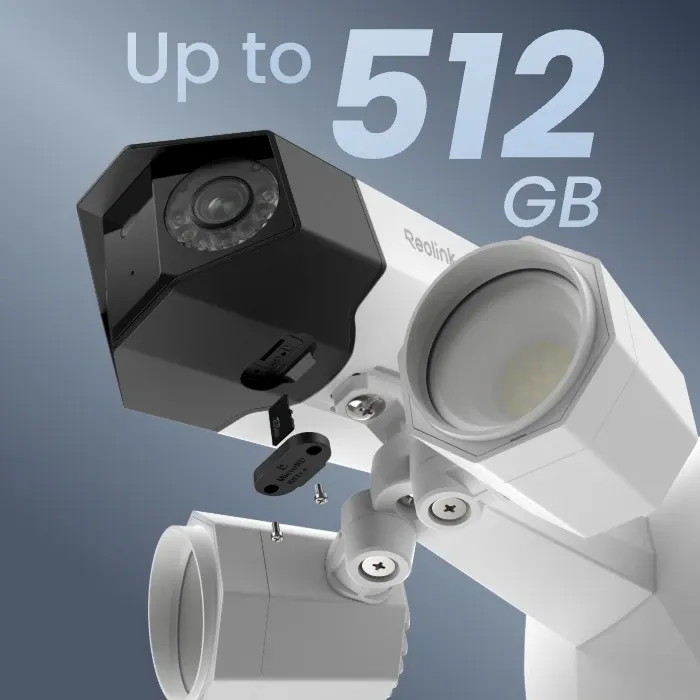
Manufacturer product photo (Reolink, an authorized partner): an exploded view of a floodlight camera, its black camera head, two lamp housings, mounting screws and a small memory card, under the maker's "Up to 512 GB" graphic. A card inside the camera is a backup; for a managed building we still record to a recorder in a locked room.
Choosing between the usual options
Decision
Option A
Option B
What usually decides it in Orange County
Repair the old buzzer vs new panel
Repair: lowest cost, nothing changes for tenants
New panel: video, phone calling, a directory
How the wiring tests and how often the old system fails.
Phone-only entry vs apartment stations
Phone: no in-unit wiring
Stations: reach every tenant, phone or not
Who lives in the building and how many share one phone.
Cloud vs local access control
Cloud: every building in one dashboard
Local: no monthly fee, works without internet
How many buildings the office runs and how reliable each connection is.
Shared panel vs a doorbell per entrance
Panel: one system for one front door
Doorbells: right when each apartment has its own door
The house's layout.
Wired vs wireless link between buildings
Wired: most reliable
Wireless: no trenching across lawns and lots
Existing conduit and the line of sight between rooftops.
Store-bought kits, subscription platforms and a licensed installer
Consumer doorbells and camera kits are made for one house and one owner. On a rental property they tie every device to one personal login, can't separate staff permissions, and leave no one responsible when a door release fails. Subscription platforms fix part of that for a monthly fee per door or per unit. A licensed installer can offer both the subscription-free and the platform options, show the owner the long-run cost of each, and come back when something breaks. Owners whose own staff install equipment can see what we sell, installed or equipment-only, on our Orange County security cameras page.
Every Orange County Rental on One Vendor Record
Newburgh rowhouse, Middletown two-family, Port Jervis walk-up, Kiryas Joel apartment building. Send the list, and the first repair goes on the calendar within 2 hours while the rest are surveyed and priced one building at a time.
What AI Answers Get Wrong About Property Management Security in Orange County
Landlords increasingly arrive with an answer from a chatbot or a search summary. Most of those answers were written for New York City or for a single house somewhere else. These are the ones we correct most often in Orange County.
1. "Newburgh buildings are rent-stabilized"
The city adopted the ETPA in December 2023, but the state Supreme Court declared that adoption null and void in April 2024, according to New York State Homes and Community Renewal. Owners should still have counsel confirm a building's current status before changing how tenants are reached from the door.
2. "HPD rules decide when you can enter an apartment"
HPD is a New York City agency. In Orange County, access is governed by the lease, state law and local code, and the office sets the notice. We follow what the office gives tenants.
3. "Lead rules only matter in the city"
The state Lead Rental Registry now covers pre-1980 rentals with two or more units in Newburgh and Middletown, with inspections at least every three years. It isn't security work, but it decides when every apartment in an older building will be open.
4. "Kiryas Joel is a village of owner-occupied homes"
Census figures show about 65 percent of its occupied homes are rented, and 86 percent of its housing units are in buildings of five or more apartments. It is one of the most apartment-heavy places in the county, and its entry systems work harder than most.
5. "A rental inspection checks your cameras"
Newburgh's license and Middletown's permit inspections are about compliance with the code, not about whether a building has cameras. What does come up is whether doors close and lock, whether exits work and, on Newburgh's application, whether there is a fire alarm system.
6. "An apartment intercom costs about two thousand dollars"
National cost guides quote single-house prices. Our Orange County intercom page lists $1,200–$3,500 for a video intercom in a four- to eight-unit building and $2,500–$8,000 and up for app-connected systems in larger ones, while a single failed part in an old system is often a few hundred dollars. That is why we test before recommending replacement.
7. "Security wiring is the electrician's job"
Electricians handle line-voltage power. Entry, camera and access systems are low-voltage work, and alarm installers in New York are licensed by the state. The two trades work side by side, and we coordinate with the building's electrician whenever a new circuit is needed.
Get In Touch
Request a Property Management Security Quote in Orange County
Start with the city, town or village, because that is how we route the visit. For each building, give a rough count of apartments and entrances and tell us what keeps failing. Phone photos of the entry panel, the street door's latch side and the basement or closet where the equipment lives save a lot of back-and-forth. If an inspection date is coming, include it. Only one door at one house? Send just that. Rather talk? Call (845) 640-3835.
✅
Request Sent!
Got it. Our office will call or text you, normally within two hours, to set the visit.
How It Works
How an Orange County Property Management Security Job Runs, Call to Handover
1
You send the address and the problem
Give us the city, town or village, what failed and who will meet the technician. The visit is booked within 2 hours of the request into an early-day, two-hour arrival window.
2
Service call or site survey
A failed door, panel, reader or camera gets the $250 service call. New systems and lists of buildings get a site survey of the entrances, the wiring and the equipment rooms.
3
A scope for each building
Hardware, labor and any platform fee are on separate lines, along with any cost that could come up if old cable fails testing, so the owner of each building approves only their own.
4
Paperwork and deposit
We return your vendor packet with our W-9; the insurance certificate is issued once the work is awarded. Equipment is ordered after the deposit, and special-order parts get a date only when the supplier ships.
5
Tenant notice and routing
Your office gives tenants the notice its leases require and books apartment access. We put buildings in the same part of the county on the same route.
6
Install alongside the old system
New equipment is mounted and tested while the old system keeps working, then the building is switched over in one short window.
7
Handover
Administrator rights go in the owner's name, cables and devices are labeled, the super or maintenance lead sees the equipment room, and the office learns the dashboard.
Manufacturer product photo (Reolink, an authorized partner): the same app at night, showing a dim view of a yard, a low wall, trees and a lit doorway. Night views like this are what an office actually reviews after a complaint, so we check every camera after dark before a job is handed over.
Field notes: the basement of a hundred-year-old walk-up
In an old Newburgh or Port Jervis building, the first hour goes to the basement, not the front door. We find the buzzer transformer, the terminal block where the apartment wires land, any recorder or switch, and the path the wires take upstairs. Often there are three generations of wiring side by side, and only one is live. We tag what is in use, note anything nobody can explain, then go to the street door and test each apartment's line. By the end of that hour, the office knows whether the fault is the door, the panel, the transformer, a single apartment or the wiring itself, and the scope reflects it.
Field notes: an empty building between inspections
A vacant building has no one to notice a forced door, a broken basement window or water on the floor. We walk every way in, including cellar doors and ground-level windows, put contacts on the doors that can be opened, a motion sensor where anyone entering has to pass, and a camera on the approach. Where there's no internet, a cellular communicator carries the alarm. The owner's 30-day check then starts with a look at the event list rather than a guess.
Typical timelines
Most repairs are finished on the first visit, or on a second once a part arrives. A new button panel or video panel on sound wiring is usually one day on site once the equipment is in. A fob system for a mid-size apartment building takes a few days plus enrollment time for the office. A garden complex is phased over weeks, building by building. Elevator readers follow the elevator company's schedule, which we book as early as we can.
Coverage Area
Property Management Security Across Orange County's Cities, Towns and Villages
We name places here only to describe their rental housing; none are presented as clients, and we don't list the buildings we work in.
City of Newburgh
The county's most rental-heavy city: brick rowhouses and walk-ups, nearly half its housing from before 1940, an annual rental license and the lead registry.
City of Middletown
Two- to four-family houses, older downtown apartment buildings and newer complexes, with rental permits on two-year terms and the lead registry.
City of Port Jervis
Walk-ups and converted houses on small lots at the end of the Port Jervis Line, with a 30-day inspection rule for registered vacant buildings.
Kiryas Joel and Palm Tree
A village of apartment buildings, coterminous with the Town of Palm Tree since January 1, 2019, with large households and heavy door traffic.
Monroe, Harriman and Woodbury
Garden complexes and townhouse rentals near the Harriman station and the highways, where lots and gates drive the work.
Town of Wallkill and Goshen
Complexes and commercial properties around Middletown's edges and the county seat, many on the same management lists.
Town of Newburgh, New Windsor and Cornwall
Garden apartments and newer rentals around the city of Newburgh, along the river and near Salisbury Mills–Cornwall station.
Southern and western villages
Warwick, Walden, Montgomery and the smaller villages: mixed-use main streets, converted houses and scattered single-family rentals.
How the work changes from one end of the county to the other
In Newburgh, the work looks most like an old city: worn street doors, original buzzer wiring, basements that double as equipment rooms, and a licensing inspector on an annual cycle. In Middletown, it is houses with several entrances and permit inspections at turnover. In Port Jervis, small old buildings and vacant ones that need watching between visits. In Kiryas Joel, door hardware built for constant use and credential lists that change often. Across the towns, garden complexes and townhouse communities turn the job into reach across the grounds, and the long drives between buildings make remote access worth setting up. All of it runs on one record and one number, (845) 640-3835.
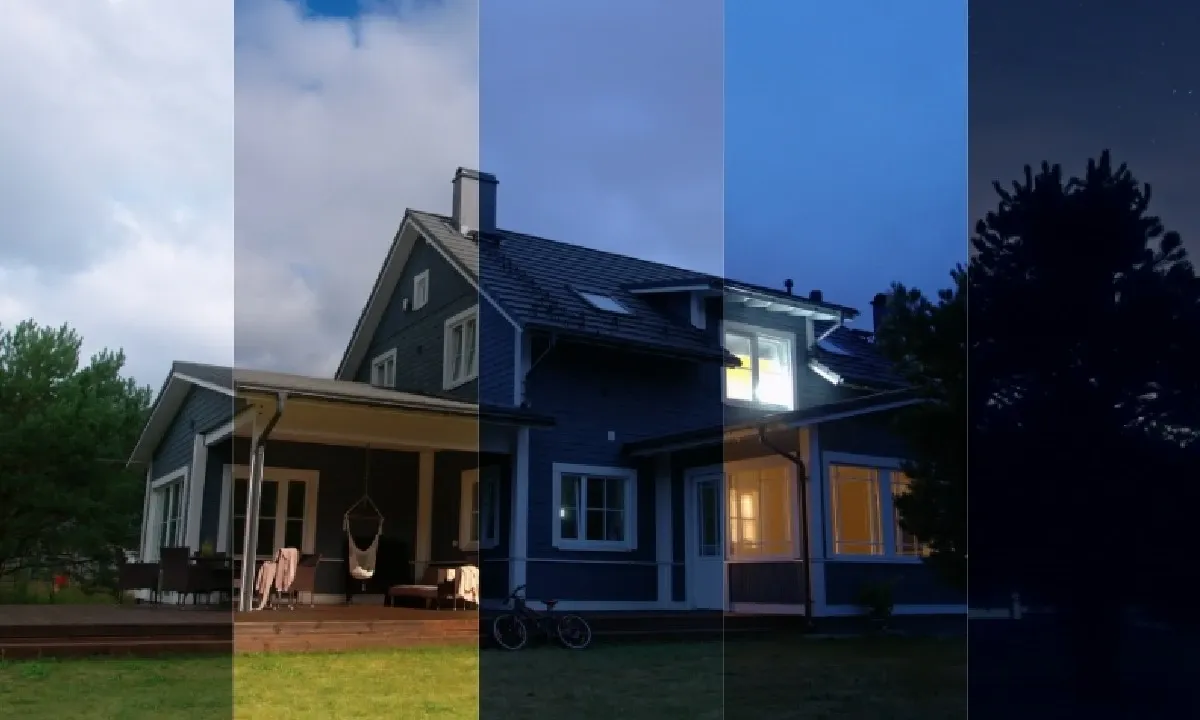
Manufacturer product photo (Reolink, an authorized partner): one two-story house with a covered porch, split into vertical strips that run from daylight on the left to full dark on the right. Most of the incidents a management office gets asked about happen in the right-hand strips, which is why camera placement is checked at night as well as by day.
Pricing
Property Management Security Cost in Orange County
Every figure in this table is already published on one of our Orange County service pages. What the table doesn't include is a number for a whole building, a portfolio or a maintenance agreement, because those depend on what the site survey finds.
Work
Published price
Where it is published
Service call (on-site diagnosis and simple repairs)
$250
Orange County repair pages
Apartment station replacement
$250–$525
Door buzzer repair, Orange County
Door release relay or button
$250–$475
Door buzzer repair, Orange County
Intercom transformer
$325–$650
Door buzzer repair, Orange County
Electric strike replacement with alignment
$450–$950
Door buzzer repair, Orange County
Lobby panel repair or new faceplate
$650–$1,800
Door buzzer repair, Orange County
Riser pair repair or re-termination
$850–$2,400
Door buzzer repair, Orange County
Video intercom, four to eight units
$1,200–$3,500
Intercom installation, Orange County
Multi-unit building intercom
$1,200–$5,000
Intercom installation, Orange County
App-connected intercom, larger buildings
$2,500–$8,000+
Intercom installation, Orange County
Single door or gate access control
$1,700–$5,000
Access control installation, Orange County
Multi-door property access control
$4,500–$15,000
Access control installation, Orange County
Multi-building campus or full complex
$15,000–$50,000+
Access control installation, Orange County
Elevator reader, Level 1 / Level 2
$2,100 / $3,500 per car
Elevator access control, Orange County
Four-camera system with recorder, installed
From $1,199
Security camera pricing, Orange County
Apartment building cameras
About $500–$1,500 per camera installed
Apartment building cameras, Orange County
Cat6 data drop
$175 and up per drop
Structured cabling, Orange County
Alarm central-station monitoring
$30/month keypad; $45/month with app
Alarm installation, Orange County
Fire alarm systems
Priced per building from approved drawings
—
Maintenance agreement
Quoted per portfolio after the survey
—
What moves an Orange County quote up or down
Five things explain most of the gap between quotes for buildings that look alike. The wiring: if the old buzzer wires test clean, a new panel can reuse them, and if not, new cable goes to every apartment. The doors: a strike on a sound frame is a simple job, and a strike on a rotted or split frame needs carpentry first. The number of controlled entrances, since each carries its own reader, hardware and cable. The distance between buildings on a garden property, which decides between trenching, existing conduit and wireless links. And recurring fees, which run from nothing after installation to a monthly charge per door or per unit, depending on the platform.
Budgeting across a list of buildings
Few owners fix everything at once, and few should. After the buildings are surveyed, the office can sort them: anything an upcoming license or permit inspection will notice first, then the doors and entry systems tenants complain about most, then equipment whose parts are gone, then working systems with heavy monthly fees. Each budget year takes the next group, with service calls covering the rest. For owners who would rather spread a project's cost: Financing is available through Wisetack, subject to approval.
Per unit, per door or per building
A per-apartment figure is handy for comparing buildings after a survey, but it is a poor way to price one in advance, because a small rowhouse with failed wiring can cost more than a larger building with good cable. Access control prices best per door, cameras by the area covered, and intercoms by the wiring and the panel. In the end the owner approves one number per building, which is how our scopes are written.
Manufacturer product photo (Reolink, an authorized partner): a small memory card floating over a blurred grid of camera views, with the maker's "Up to 256GB" graphic. Cards fill and overwrite quickly; how many days of footage a building keeps is a decision for the owner, and it is set on the recorder, not left to a card.
Full terms — including 50% deposit, one-year parts-only warranty on Abstract Enterprises Security Systems-supplied products, and the late-fee schedule — are set out in the service agreement.
Shop Our Systems
Property Management Security Packages & Pricing for Orange County Landlords
Repair at any property
$250 service call at any building in the county. The technician finds the fault and handles small repairs on the spot; anything larger is priced first from the table above.
One building brought up to date
Priced after the survey. The street door, the entry system, the cameras and the logins at one address, on a scope that stands alone for that owner.
A whole rental list
Priced for your list. Every property documented, an order of work tied to inspections and budgets, credentials the office controls and visits routed by part of the county.
When the owner already bought the equipment
Some landlords arrive with a doorbell, a camera kit or a panel still in the box. We can install it. Text or email the make, model and address, and we come back with a labor-only price; the date is held once the deposit is in. We don't do site walk-throughs for owner-supplied equipment, and how that equipment performs is between the owner and its maker.
Inspection or Turnover Coming Up?
Tell us the date and the address. We book the visit early enough that any part we need is in hand before the inspector or the new tenant arrives.
Start with the form; each property on your list comes back with its own scope and price.
FAQ
Orange County Property Management Security FAQ
Will the office get an alert if someone pries open a lobby entry panel?
+
On most current panels, yes. A tamper switch inside the housing reports when the faceplate is removed, and the platform can send that alert to the office or the super. On older panels without one, a door contact or a camera aimed at the panel does the same job.
Do card and fob readers keep working at exposed garden-building doors in winter?
+
Outdoor-rated readers do. We use readers rated for the temperature range they'll face, mount them under an overhang or in a weather hood where possible, and seal the cable entry so water can't freeze inside the housing. Indoor readers on outside walls are a common cause of winter failures.
Can a lobby panel be mounted where a wheelchair user can reach it?
+
Yes. We set the panel's buttons and screen within reach from a seated position and leave clear floor space in front of it, and we can add a second, lower panel where an entrance has steps on one side and a ramp on the other.
Can part of a camera's view be blacked out so it never records a neighbor's windows?
+
Yes. Most recorders and cameras support privacy masks, which black out a chosen area of the picture before it is recorded. We set them at installation and show the office how they look on playback.
In a shared student apartment, can the intercom ring every roommate's phone?
+
On app-based systems, yes. One apartment entry can ring several phones at once, and each roommate gets their own login, so when one moves out the office removes that person without touching the others.
Can keypads at dim side entrances have lit buttons?
+
Yes. Many outdoor keypads have backlit buttons, and we choose those for side and rear doors where there is little light. A camera with its own lamp over the same door helps both the keypad user and the recording.
When a recorder's hard drive fills up, does it stop recording?
+
Not if it is set up correctly. The recorder overwrites the oldest footage first, so the drive always holds the most recent days. We set that at installation and size the drive for the number of days the owner wants kept.
Will an old telephone-entry panel stop working if the building's landline is cancelled?
+
If it dials out over a phone line, yes. Before a line is cancelled, the panel can be moved to a cellular module or replaced with a network panel, so tenants can still be called from the door.
Can our office export a month of door events for an owner's report?
+
On networked access platforms, yes. Staff with the right permission can filter the event log by building, door and dates and export it as a file. We show the office how to do it at handover.
Can a tenant's fob be set to stop working on the last day of the lease?
+
Yes, on most platforms. Each credential can carry an end date, so it stops opening doors on its own. If the tenant renews, the office extends the date instead of issuing a new fob.
Wherever a property sits, the first step is the same: one call to (845) 640-3835 for Orange County, a visit booked within 2 hours of the request into an early-day window, and a written scope before any larger work begins.