Visitors riding past the lobby of your senior building? A shared elevator code nobody can cancel? Book an Orange County elevator access survey on a day that suits your staff: (845) 640-3835
Elevator access control installation in Orange County, NY means fitting your elevator with a reader, keypad, phone credential or face reader so the car carries only the people you have approved, and only to the floors they belong on. Abstract Enterprises Security Systems installs the low-voltage side of that system for senior residences, affordable and market-rate apartment buildings, medical offices, campus buildings and county and municipal buildings from Port Jervis to Newburgh: the readers, the floor-release relays or interface board, the cable, the credentials, the programming and the link to your entry intercom. Your building's licensed elevator contractor makes the connection inside the elevator controller. Because Orange County buildings are spread over a large area, every visit is scheduled in advance in a 2-hour arrival window, and we design systems your staff can run from the office without waiting for us to drive up.
Reviewed and updated November 17, 2026 by Abstract Enterprises Security Systems, NYS license #12000287431 · Sources: U.S. Census Bureau 2020 Decennial Census; Pattern for Progress population density research; Orange County affordable housing for adults list; Garnet Health; SUNY Orange; City of Newburgh housing and waterfront announcement; Pennrose (Bourne & Kenney); New York State Department of Labor elevator licensing information; NYS Labor Law Article 33; Village of Kiryas Joel affordable housing code; Paul Rudolph Institute and Wikipedia on the Orange County Government Center
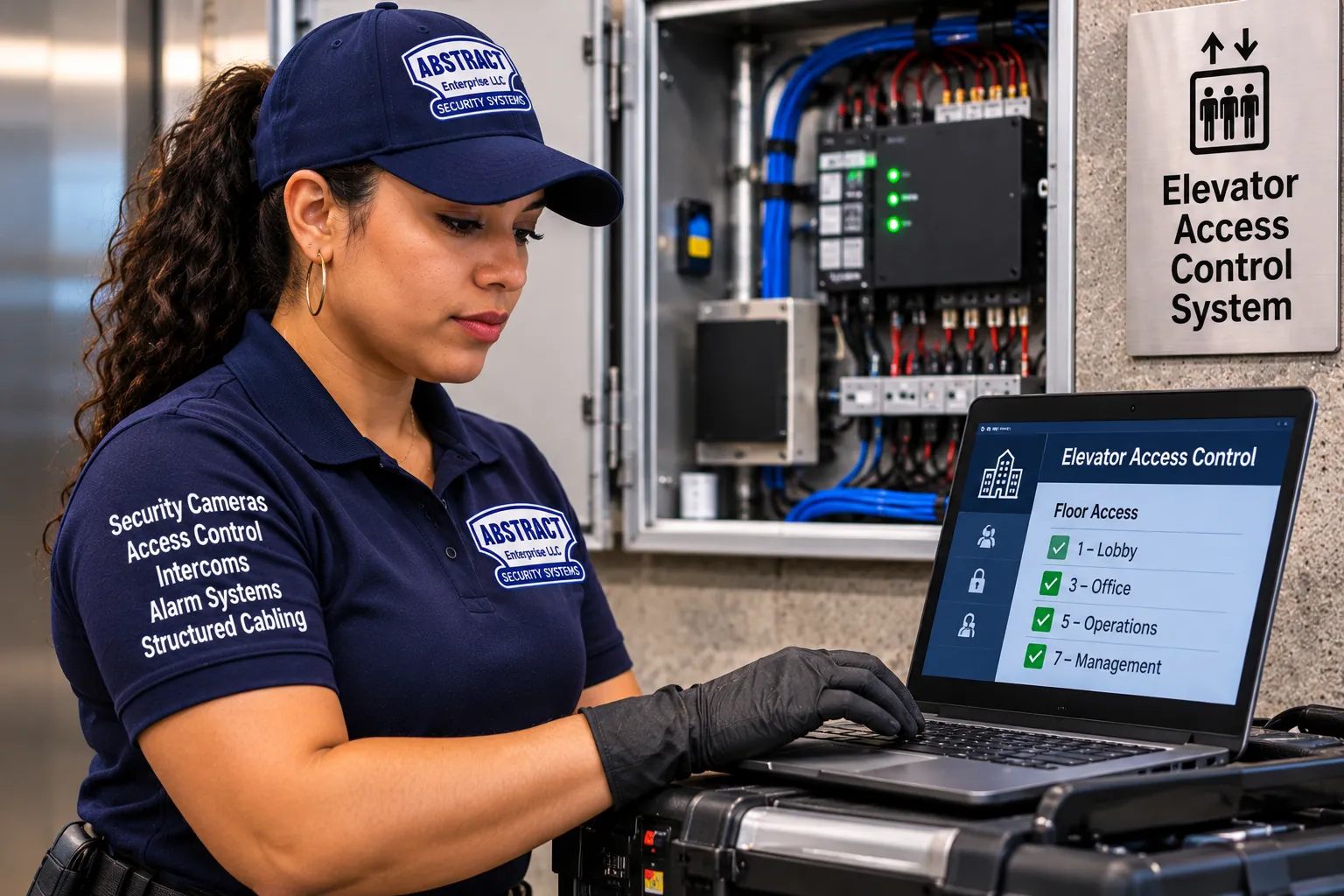
Photo from the Abstract Enterprises Security Systems elevator access control photo library, not taken in an Orange County customer's building: a gloved technician types on a laptop whose screen lists floor permissions for lobby, office, operations and management floors, next to an open access panel. Floor lists like this are what a medical office or county building in Orange County signs off on before any floor is locked.
Orange County Elevator Access Request
Tell us the town, the building type, the floors and cars, and who should ride where
✅
Request Sent!
Thank you. We will be in touch to book your Orange County elevator access survey, usually within 2 hours of your request.
25+
Years Experience
2 Hr
Arrival Windows
100%
Licensed & Insured
4.7★
201 Google Reviews
Owner-operated since 2002 · Thousands of jobs completed · Booked within 2 hours
Quick answer: elevator access control installation in Orange County starts at $2,100 per elevator car for a Level 1 card, fob, code or intercom-station reader, and at $3,500 per car for Level 2 face, fingerprint or iris readers. Floor-by-floor restriction, readers at lobby or garage call buttons, time schedules and intercom floor release are Level 3, quoted per building after a survey. The elevator contractor's work at the controller is arranged with and billed by your elevator company. A one-car senior building in Port Jervis, a two-car medical office near Middletown and a new mixed-use building on Liberty Street in Newburgh all start from the same per-car price; what changes is how many floors, cars and call stations are controlled. We book the survey within 2 hours of your request and arrive in a 2-hour arrival window on the scheduled day.
Readers, relays, interface boards, wiring, credentials, programming and intercom links by Abstract Enterprises Security Systems under NYS license #12000287431
Controller connections and fire-service behavior handled by your building's elevator contractor, which New York State requires to be licensed by the Department of Labor
Orange County visits booked ahead on a set day; never a same-day promise
Where Orange County's Elevators Are: Three Small Cities, Senior Buildings and a Few Large Campuses
Orange County is not a place most people picture when they hear the words elevator security. It is a county of villages, farms, commuter subdivisions and three small cities, and most homes here have no elevator at all. That is exactly why the elevator buildings that do exist matter so much. They are concentrated in a handful of places, they house people who depend on the elevator more than most, and many of them are managed by a small staff who are not on site every hour of the day.
Figure
What it means for elevator access control
Source
401,310 residents in Orange County at the 2020 census
A large, growing county whose elevator buildings are clustered in a few dense places rather than spread evenly.
U.S. Census Bureau, 2020 Decennial Census profile
Three cities: Newburgh, Middletown and Port Jervis
Planning researchers describe the three cities as pockets of high population density inside a mostly low-density county. That is where most multi-story elevator buildings are.
Pattern for Progress, Orange County population density by census tract
17 senior and age-restricted complexes on the county's affordable adult housing list name an elevator as a feature
From Middletown and Newburgh to Port Jervis, Walden, Washingtonville, New Windsor, Monroe and Tuxedo. Senior buildings are the single most common elevator building type we see in the county.
Orange County affordable housing for adults list (orangecountyny.gov)
106 apartments at Southeast Towers in Middletown, listed with elevators and keycard access
Card access already exists in some Orange County senior buildings. The usual next question is whether the elevator should check the card too.
Same county list
Seven floors and 383 beds at Garnet Health Medical Center, 707 East Main Street, Middletown, opened August 5, 2011
The county's largest hospital anchors a cluster of medical offices around it. We name it only as a landmark, not as a client.
Garnet Health
87,000 square feet at Kaplan Hall, SUNY Orange's Newburgh campus, with an underground parking garage, opened for classes January 19, 2014
Garage levels are the classic place where a car should not be callable by anyone off the street after hours.
SUNY Orange; Selux project page
145 homes and 10,000 square feet of commercial space planned beside Washington's Headquarters on Liberty Street, plus more than 200 mixed-income homes on Liberty Street
New multifamily construction in Newburgh usually arrives with an elevator and a door system that can be extended into the car.
City of Newburgh announcement of state Pro-Housing and downtown awards
205 affordable homes at Bourne & Kenney in Newburgh, including the Bourne tower, slated for upgrades with new building systems and enhanced safety and security
Large renovations are the cheapest moment to add elevator access control, because walls and ceilings are already open.
Pennrose / Contour Housing Partners and the Newburgh Housing Authority
Three practical lessons come out of those numbers. The first is that most Orange County elevator buildings are small: one car, sometimes two, serving three to seven floors. The right answer for a building like that is usually a reliable reader in the car and a well-run credential list, not an elaborate floor-by-floor system. The second is that a large share of the riders are older adults, people with disabilities, home health aides and visiting family, so a system that is confusing or that strands someone at the lobby is a real failure, not an inconvenience. The third is that the people who run these buildings are rarely on site around the clock. A senior building in Port Jervis may share a property manager with a complex in Walden, and a county office building in Goshen is run by a facilities department with a long list of other buildings. The system has to be manageable from a desk, with an audit trail that shows who rode where, without a technician in the lobby.
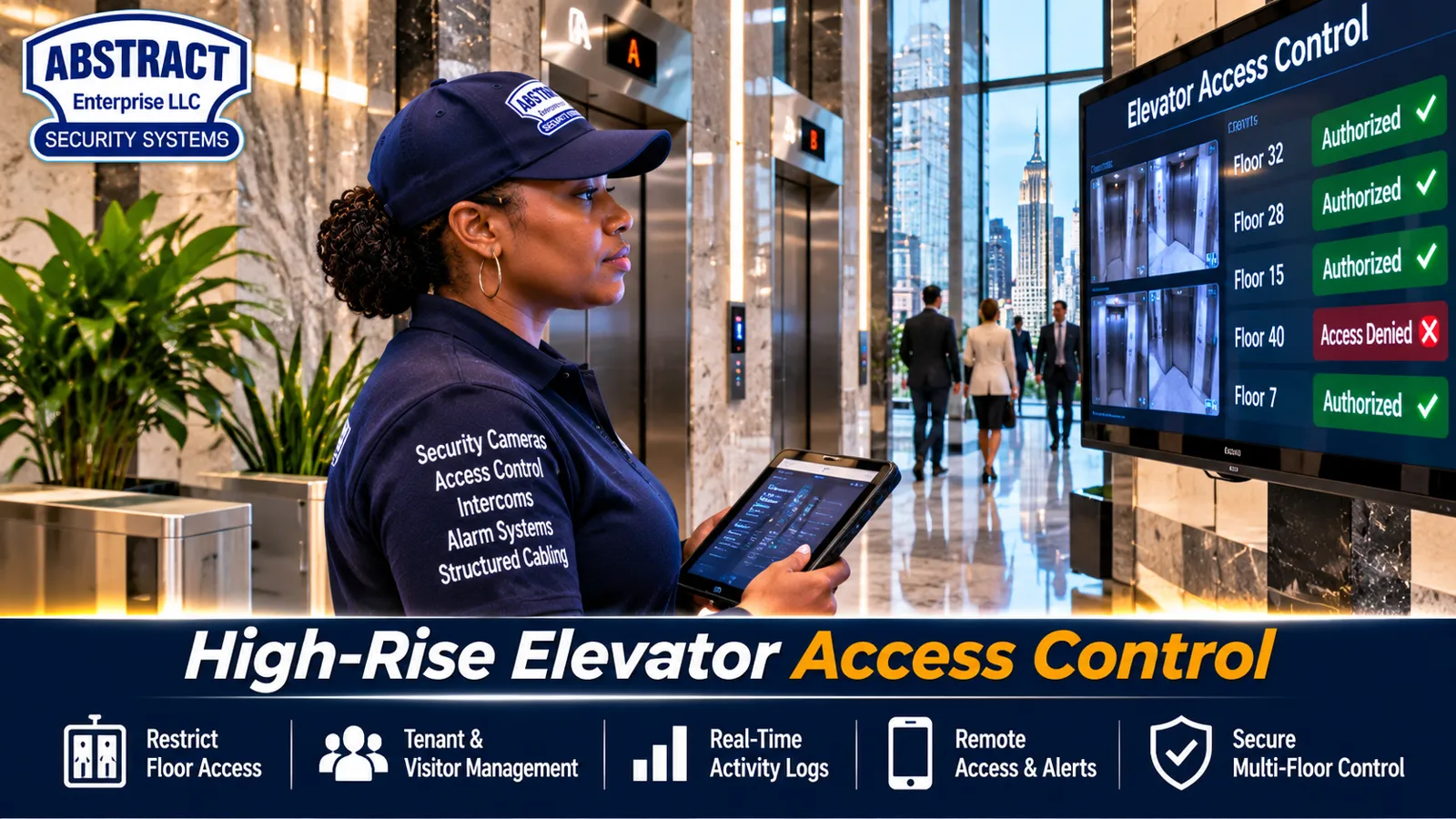
Photo from the Abstract Enterprises Security Systems elevator access control photo library, not taken in Orange County: a staff member holding a tablet stands next to a wall display that lists which floors are authorized and which are denied. In Orange County, where a manager may oversee several buildings in different towns, a floor view like this is how access gets checked without a site visit.
The Problems It Solves
What Orange County Owners Are Usually Trying to Stop When They Call About Elevator Security
Very few people call us because they want an elevator access system for its own sake. They call because something has happened, or keeps happening, and the elevator is how it gets upstairs. In Orange County the same handful of problems come up again and again.
Tailgating at the front door. A visitor slips in behind a resident, or a door is propped for a delivery, and then rides straight to the residential floors. A locked front door does nothing once someone is inside. A car-enable reader means the person who got through the door still cannot ride.
People sleeping in stairwells or on upper floors. Some managers find people sheltering on the top-floor landing or near the roof door. Stopping uncredentialed riding to the top floor and the roof is usually the first request.
Former tenants and staff who still have a way in. A shared elevator code or a key switch cannot be taken back from one person. Individual credentials can be cancelled in a minute, which is the main reason owners replace old systems.
Medical or office floors reached after hours. A practice or tenant finds that someone reached its floor in the evening when the suite was closed. A time schedule on that floor ends it.
Garage and basement stops used as back doors. An unattended garage or rear lot entrance lets anyone call the car. A reader at that landing closes the gap without affecting the lobby.
Insurance, board or funder requirements. Nonprofit sponsors of senior and supportive housing, condominium boards and government facility managers increasingly want an audit trail showing who entered which floor. An elevator access control system with audit trail provides it.
Knowing which of these is the real problem decides the design. If it is outsiders riding the elevator, a Level 1 reader in the car is usually enough. If it is insiders reaching floors that are not theirs, the answer is floor restriction for those floors only. We ask about the problem before we talk about equipment, because the cheapest system that actually stops it is almost always the right one.
How It Works
What Elevator Access Control Actually Changes Inside a Small Orange County Elevator
The simplest way to understand an elevator access control system is to think about the moment just after the doors close. Without access control, the car will go wherever anyone asks it to. With access control, the car first asks a question: has this rider shown a credential that is allowed to go there? Everything else about the elevator stays the same. It still levels at each floor, opens its doors, runs its own safety circuits and responds to firefighters. Our equipment only decides whether a floor button, or a call button at a landing, is allowed to register for the person standing in front of it.
In Orange County buildings the decision is usually made in one of three ways:
Car enable. A reader in the car wakes the floor buttons for a few seconds after a valid fob, card, code, phone or face. A rider with a valid credential can choose any floor the car serves; a visitor without one can press buttons all day and the car stays put. This is Level 1 or Level 2, and it covers most single-car senior buildings and small apartment buildings in the county.
Floor-by-floor restriction. Each floor button is tied to its own relay, and each credential unlocks only the floors it is assigned. A medical office building that rents the third floor to one practice and the fourth to another, or a county building with a records floor that only certain staff should reach, needs this. It is part of Level 3.
Landing control. A reader at the lobby, garage or basement call station stops the car from being called to that landing without a credential. In a building with an underground garage or a rear parking-lot entrance, this is often the stop that matters most, because it is the one nobody is watching.
The hardware on our side is similar in every design: a reader, an access control panel, an elevator interface (usually a set of relays or an input/output board with one point for each floor that is controlled in each car), a power supply with a backup battery, the cable that joins them, and software where your manager adds and cancels credentials. The elevator contractor connects our outputs to the elevator controller or car operating panel. In New York State that connection is elevator work, which the Department of Labor licenses; we plan it with the elevator company and never do it ourselves.
Building owners use a lot of different words for the same thing: elevator security system, elevator key fob system, elevator card reader, lift access control, elevator floor control, elevator authorization or elevator access management. Whatever the name, it is some mix of those three designs plus the software behind them. In Orange County the design that fits is decided by the building, by who rides it and by who will run it after we leave, far more than by the brand on the reader.
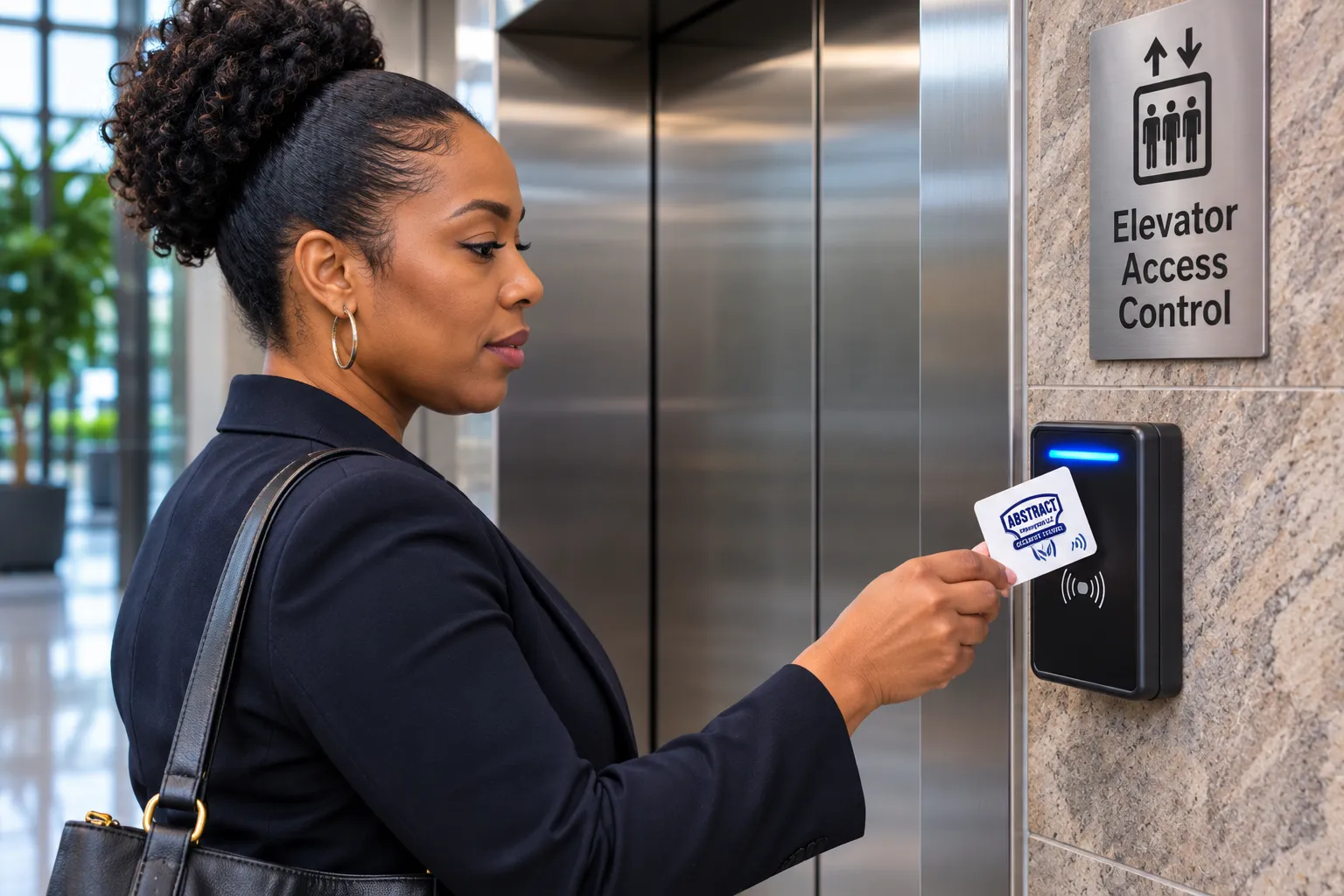
Photo from the Abstract Enterprises Security Systems elevator access control photo library, not taken in an Orange County building: a woman with a shoulder bag holds a card up to a reader mounted beside the elevator. The same card that opens the front door of an Orange County senior or rental building can usually be enrolled to enable the car as well.
Planning for Distance
Designing Elevator Security for a Building Your Installer Cannot Reach in Ten Minutes
This is the part of the job that is most different in Orange County than in the city, and it shapes almost every recommendation we make here. The county stretches from the Hudson River at Newburgh and Cornwall to the Delaware River at Port Jervis, and from the Shawangunk Ridge down to the New Jersey line at Greenwood Lake and Tuxedo. A building in Warwick and a building in Walden are both in Orange County, but they are a long drive apart, and neither is around the corner from any installer.
We do not pretend otherwise. We schedule Orange County visits in advance, give a 2-hour arrival window for the scheduled day, and do not promise same-day service. What we do instead is design each system so it rarely needs a visit at all:
Remote administration from the start. Credentials are added, changed and cancelled from a browser or app, so a manager in Middletown can cut off a lost fob at a building in Port Jervis in a minute. Where the building has no reliable internet in the machine room, we plan a cellular or network link as its own line in the quote rather than leaving the system stranded.
A spare reader and spare fobs left on site. The most common service call on any elevator access system is a damaged reader or a resident who lost a fob. If a spare reader is in the office and blank fobs are in the drawer, the manager or super can solve most of those problems the same day without us, and we confirm the swap remotely.
Battery backup sized for real outages. Storms that knock out power for hours do reach Orange County; Hurricane Irene in 2011 flooded and closed the county's own government center in Goshen. The access panel's battery is sized so the system stays in its chosen state through a typical outage, and the building decides in writing whether the car should free up or stay controlled when that battery finally runs down.
Fault alerts by email or text. Panels that support it send a message when the reader goes offline, the battery is low or the cabinet door is opened. A manager who learns about a problem on Tuesday morning instead of from a resident complaint on Friday saves a lot of grief.
One clear diagram in the machine room. We leave a labeled drawing of every relay, floor and wire, so the elevator mechanic on a periodic test can see exactly what our equipment does and leave it alone.
The same planning helps when a board, a nonprofit sponsor or a county department changes managers. The next person inherits a system with documented credentials, a clear audit trail and an administrator login, not a box of mystery fobs and a phone number for someone who retired.
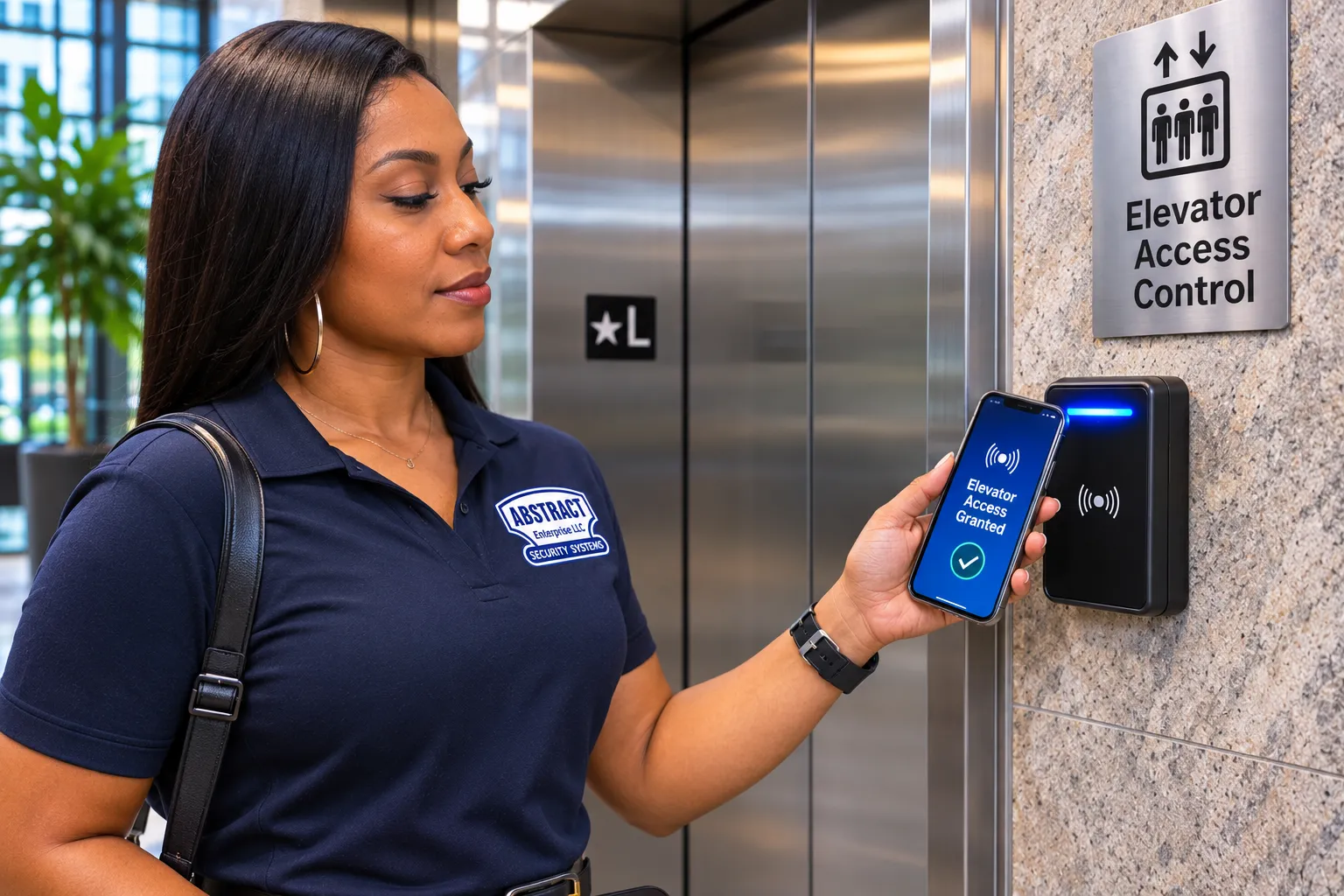
Photo from the Abstract Enterprises Security Systems elevator access control photo library, not taken in Orange County: a woman holds a phone showing Elevator Access Granted up to a reader beside the elevator. Phone credentials can be issued and cancelled from the office, which matters when the building is a long drive from the person managing it.
Building Types
Orange County Building Types and the Elevator Access Control Each One Usually Needs
Elevator access control for apartment buildings, elevator access control for commercial buildings and elevator access control for office buildings are three different conversations in Orange County, and the county adds a few building types that barely exist in the city. These are the ones we plan for most often, what each usually needs, and where the design tends to go wrong.
Senior and age-restricted apartment buildings
The county's own list of affordable housing for adults reads like a map of Orange County's elevator buildings. It names elevators at Middlecrest Crossing II (100 apartments) and Senior Horizons at Silver Lake (84) in Middletown, at Southeast Towers in Middletown (106 apartments for residents 62 and older or with disabilities, listed with keycard access), at Cerone Place (60), High Point (82) and Hudson Pointe (65) in Newburgh, at New Windsor Senior Housing (92), at Monroe Commons (35, listed with an intercom security system), at Park Plaza and the Waters Edge buildings in Port Jervis, at The Cedars in Walden, at Rocky Point in Washingtonville and at The Promenade at Tuxedo Place. Most are one or two cars serving three to six floors.
For a building like this the goal is almost always the same: keep people who do not live there out of the residential floors without making the elevator harder for a resident with a walker, poor eyesight or arthritic hands. That points to a Level 1 reader in the car that accepts the same fob or card residents already carry for the front door, with a large, well-lit reader face mounted at a height everyone can reach. Floor-by-floor restriction is rarely worth it here; residents visit each other, and a resident who can only reach their own floor cannot get to the community room or a friend's apartment. Where floors are restricted, it is usually the roof, a mechanical floor or a staff-only basement, not the residential floors.
Newburgh's new mixed-use and waterfront buildings
Newburgh is where most of the county's new elevator construction is happening. The City of Newburgh has announced state support for more than 200 mixed-income homes on Liberty Street and for a mixed-use building beside Washington's Headquarters with 145 homes and 10,000 square feet of commercial space on a parcel that has sat vacant for more than fifty years. Buildings like these usually have stores or community space at street level, apartments above, and at least one elevator that serves both. The design question is how to keep the retail or community floor open during business hours while the residential floors stay closed to anyone without a credential. That is a time-scheduled floor rule, which is Level 3, and it is easiest to price and install while the building is still under construction.
Large renovations: Bourne tower and buildings like it
The Bourne & Kenney redevelopment in Newburgh, led by Contour Housing Partners with the Newburgh Housing Authority, plans upgrades for 205 affordable homes, including new building systems and enhanced safety and security in the Bourne tower. A renovation of that kind is the cheapest moment to add elevator access control to an existing building, because the elevator contractor is usually already modernizing the controller and the ceilings and walls along the cable route are already open. When an Orange County owner tells us an elevator modernization is coming, our advice is to add the access control interface to the elevator contractor's scope at the same time, rather than paying for the elevator company to come back a year later.
Medical office buildings near the hospitals
Medical offices cluster around Garnet Health Medical Center on East Main Street in Middletown and around Montefiore St. Luke's Cornwall's campuses in Newburgh and Cornwall. We name those hospitals only as landmarks, not as clients. The medical buildings near them typically have two to five floors, several practices with different hours, a pharmacy or lab on the ground floor and patients who arrive in wheelchairs or with walkers. Elevator access control for a building like this usually means floors open to the public during each practice's posted hours and locked to staff-only credentials outside them, so a patient can always reach their appointment and nobody wanders into a closed suite at night. That is Level 3 floor scheduling, and it needs a careful list of which floor belongs to which tenant.
County, municipal and court buildings
Goshen is the county seat. The Orange County Government Center there, designed by Paul Rudolph and completed in the late 1960s, was closed after Hurricane Irene in 2011, partly demolished and reopened in 2017 after a long renovation. Buildings like it, along with courthouses, city halls in Newburgh, Middletown and Port Jervis, and town halls across the county, have the clearest need for floor restriction: records rooms, server rooms, finance offices and secure corridors that the public should never reach by elevator, alongside public counters that must stay open. Government buildings also usually need a full audit trail of who rode to which floor and when, and they often have their own card platform that the elevator has to join rather than replace. We integrate the elevator with the building's existing access control where the platform allows it.
Campus buildings and garages
SUNY Orange's Kaplan Hall in Newburgh is an 87,000-square-foot building with an underground parking garage on First Street. Any campus or office building with garage levels raises the same question: who should be able to call the elevator from the garage at 10 p.m.? A card reader at the garage landing, or a car-enable rule that only applies to the garage stop after hours, keeps the building open to students and staff without turning the garage into a back door to every floor.
Multifamily buildings in Monroe and Palm Tree
The southeastern corner of the county around Monroe and the Town of Palm Tree (formerly the Village of Kiryas Joel, which became its own town) has a large and growing stock of multifamily buildings. The village code's affordable housing chapter allows the planning board to require an elevator, or space reserved for one, depending on what the state building code requires. Buildings here are often family buildings with many children, strollers and grandparents, so the elevator is used heavily all day. Car-enable with fobs for each household, plus a way to give a visiting relative temporary access, is the usual fit.
Office, flex and light-industrial buildings
Office parks along the Route 17 and Interstate 84 corridors, and office and flex space in the Stewart Airport area near New Windsor, tend to have one or two elevators shared by several tenants. For these buildings, elevator access control for property management companies is mostly about tenant turnover: when a tenant leaves, their floor and their staff credentials must be removed the same day, and the new tenant's people must be added before move-in. A cloud-managed platform where the property manager controls that list is the right tool.
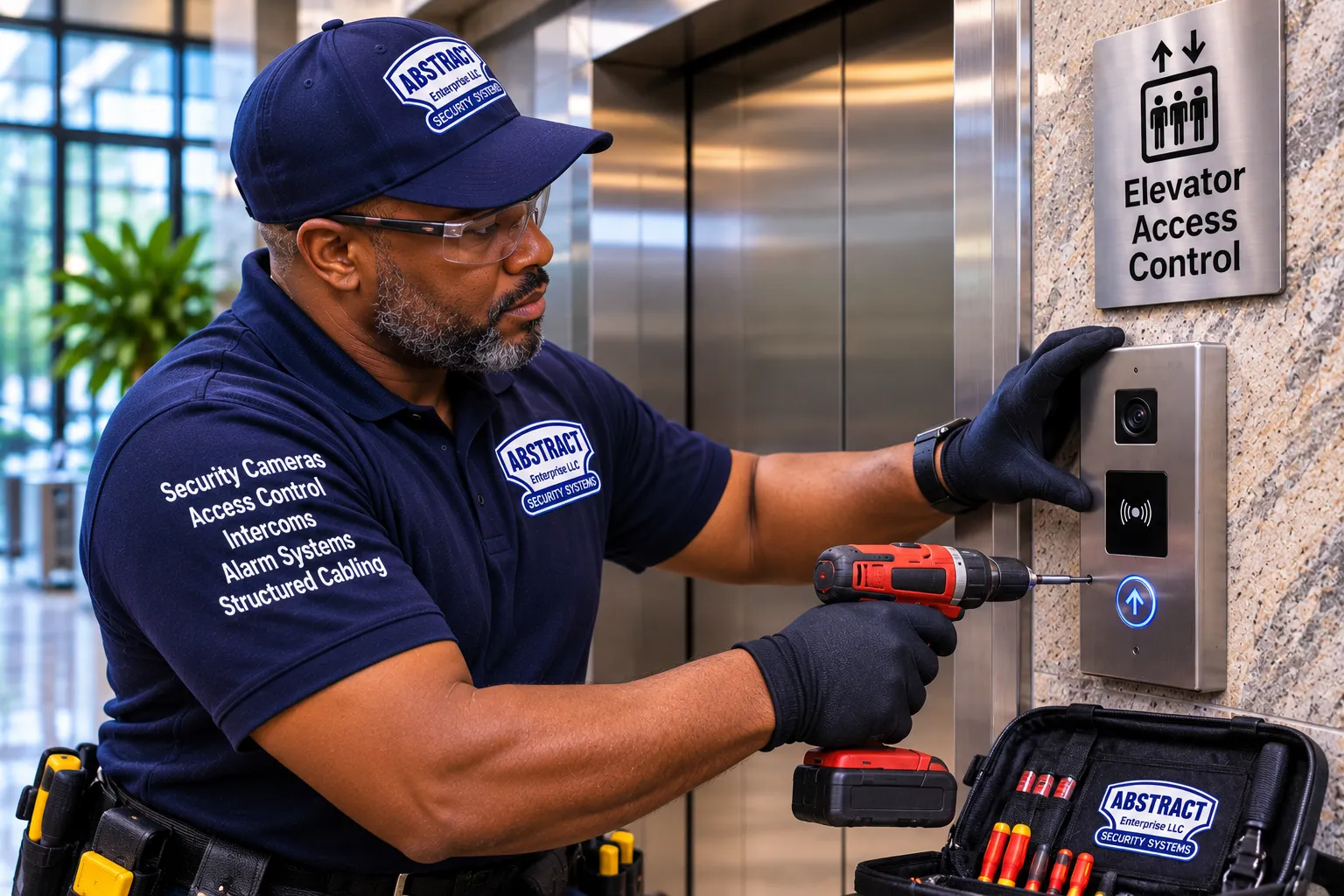
Photo from the Abstract Enterprises Security Systems elevator access control photo library, not taken in Orange County: a technician drills to mount a stainless panel that combines a camera, a card reader and a call button. A station like this lets a visitor call a resident, and lets the resident release the visitor's floor, in an Orange County building without a front desk.
Licensing and Code
Who Is Allowed to Work on the Elevator Itself in Orange County, and What That Means for Your Project
Every elevator access control job has two halves, and in New York State the law draws a hard line between them. Our half is low-voltage security work: readers, panels, relays or interface boards, power supplies, cable, credentials and software. Abstract Enterprises Security Systems does that work under NYS low-voltage license #12000287431. The other half is anything inside the elevator itself: the controller, the car operating panel wiring, the traveling cable, fire-service behavior and any change to how the elevator responds to calls.
Outside New York City, that second half is governed by the state's elevator licensing law, Article 33 of the New York State Labor Law. The New York State Department of Labor explains that businesses and individuals who design, install, alter, service or repair elevators and other conveyances must be licensed by the Department, and that individuals who perform work on an elevator must hold an elevator mechanic's license (with narrow exceptions for accessibility lift technicians). An elevator contractor's license, in turn, requires the contractor to employ licensed elevator mechanics. In practice, that means the connection between our relays and your elevator controller is made by your licensed elevator contractor, or by a licensed elevator mechanic working for one, and never by a security installer.
That is not a technicality, and it shapes how we run every Orange County project:
Your elevator maintenance company is on the survey. We ask for the name of the company that holds your maintenance contract before we visit, and we invite their mechanic to look at the controller with us or send us their notes. Their answer about spare inputs, the condition of the traveling cable and the controller type decides what is possible.
The scope is written in two columns. Our proposal lists every reader, relay, cable run and credential we supply; the elevator contractor's proposal lists their controller work. Owners in Orange County sometimes discover that their elevator company is booked out for weeks, so we build their timing into the schedule from the beginning.
Local permits are the building's and the elevator contractor's call. Elevator alterations and building work outside the city are overseen locally under the New York State Uniform Fire Prevention and Building Code by the city, town or village code enforcement office. Whether a given elevator change needs a permit or inspection is a question your elevator contractor answers with that office; we provide the drawings and equipment data they need.
Nothing is energized until both sides sign off. We test our outputs, the elevator mechanic tests the controller response and fire service, and only then are floors locked for real.
One more note on law, because owners sometimes read about it online. New York City's Local Law 63 of 2021 sets rules for apartment buildings in the five boroughs that use electronic or biometric entry. It is a New York City law and does not apply to buildings in Orange County. We still recommend that any Orange County building using face or fingerprint readers adopt a written policy explaining what is collected, who can see it and when it is deleted, and offer residents a fob or card as an alternative. It is simply good practice, and it avoids arguments later.
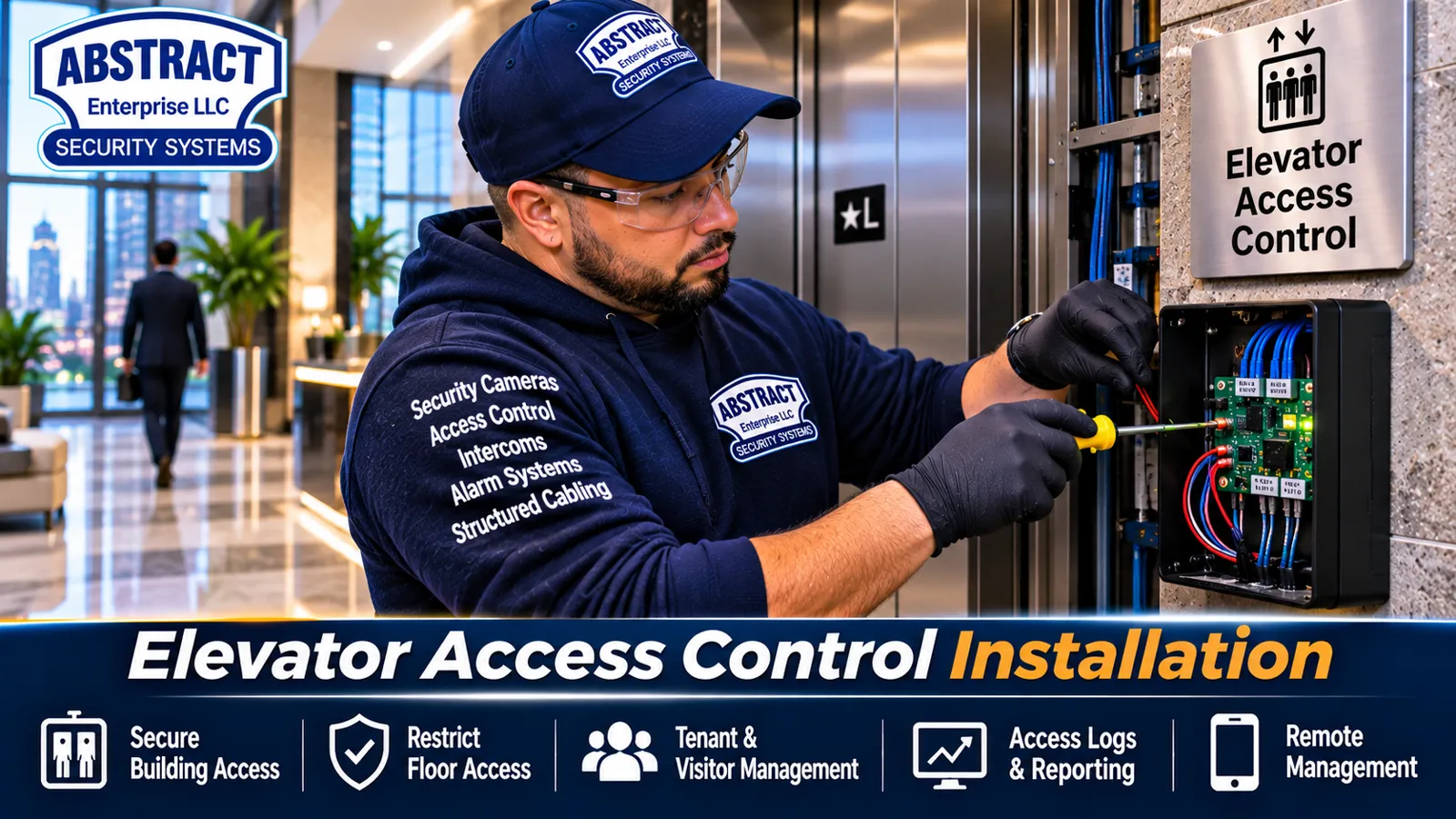
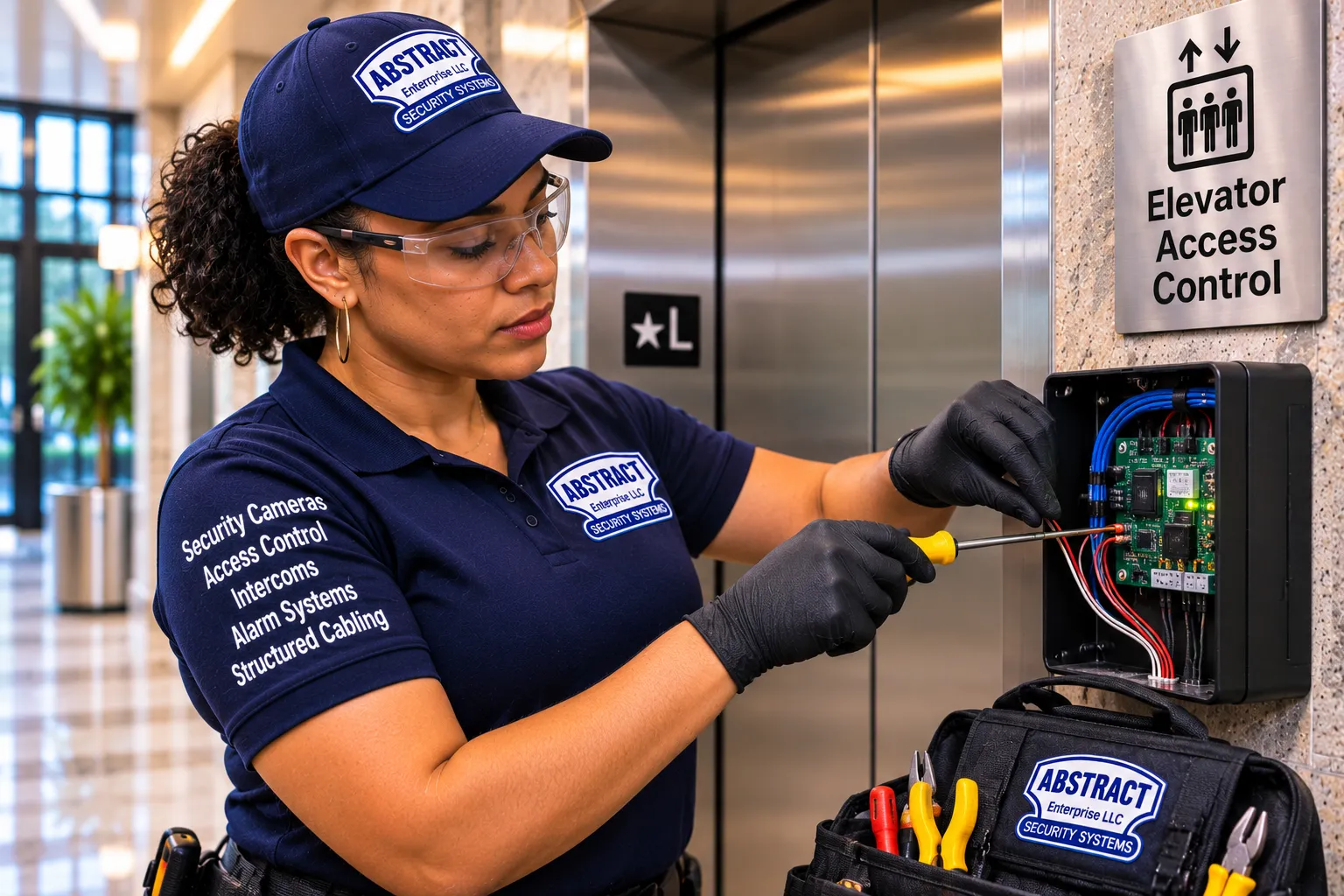
Photo from the Abstract Enterprises Security Systems elevator access control photo library, not taken in Orange County: a technician wearing safety glasses wires an open reader enclosure next to a stainless steel elevator, under an elevator access control banner. This is our side of the job; the elevator contractor makes the controller connection.
Fire, Power and Storms
Fire Service, Power Outages and Storm Damage in Orange County Elevator Buildings
The questions owners ask us most nervously are about emergencies: what happens to a locked elevator when the fire alarm goes off, when the power fails, or when water gets into the building. The answers are straightforward, but they need to be decided on paper before installation, not discovered during an emergency.
Fire alarm: the elevator stops taking orders from our system
When the fire alarm recalls the elevator, the elevator follows its fire-service program, and our access control has no say in it. Firefighters' service, recall to the designated floor and in-car firefighter operation all run in the elevator controller. The interface the elevator contractor installs is arranged so that our floor-release relays cannot block or delay that behavior. This is one of the main reasons the elevator contractor makes the connection: they know exactly how their fire-service circuits are wired and they test them after the change.
Power failure: choose fail-safe or fail-secure ahead of time
Our panel has its own battery. During a short outage, if the elevator has emergency power, the access control keeps working as normal. If the outage outlasts the battery, the system ends up in one of two states, and the building chooses which in writing. Fail-safe means the car's floors free up when our system loses power, so nobody is stuck unable to ride. Fail-secure means the controlled floors stay locked. Most senior and residential buildings in Orange County choose fail-safe for the residential floors and fail-secure only for a mechanical floor or roof. A county or court building may choose differently for a records floor.
Water and storm damage: keep the brains high and dry
Hurricane Irene in 2011 did enough damage to the county's own government center in Goshen that it stayed closed for years. Flooding along the Wallkill and the Neversink, and in low streets near the Hudson and Delaware, is a real risk for some buildings. We do not mount access panels, power supplies or batteries on the floor of a basement that has ever taken water. Where the machine room is in the basement, we look for a mounting spot above the known flood line, or put the panel on a higher floor and run cable down. It costs a little more cable and saves the whole system the next time a storm comes through.
Accessibility and the override
Every controlled elevator needs a documented way to override access control for emergencies and for residents who cannot use the reader. That might be a keyed switch held by staff, a remote unlock from the management software, or a schedule that frees floors during staffed hours. In senior buildings we also test the reader with residents who use wheelchairs and walkers before we finish, because a reader that is technically accessible but mounted at the wrong angle is a daily problem for the people who need the elevator most.
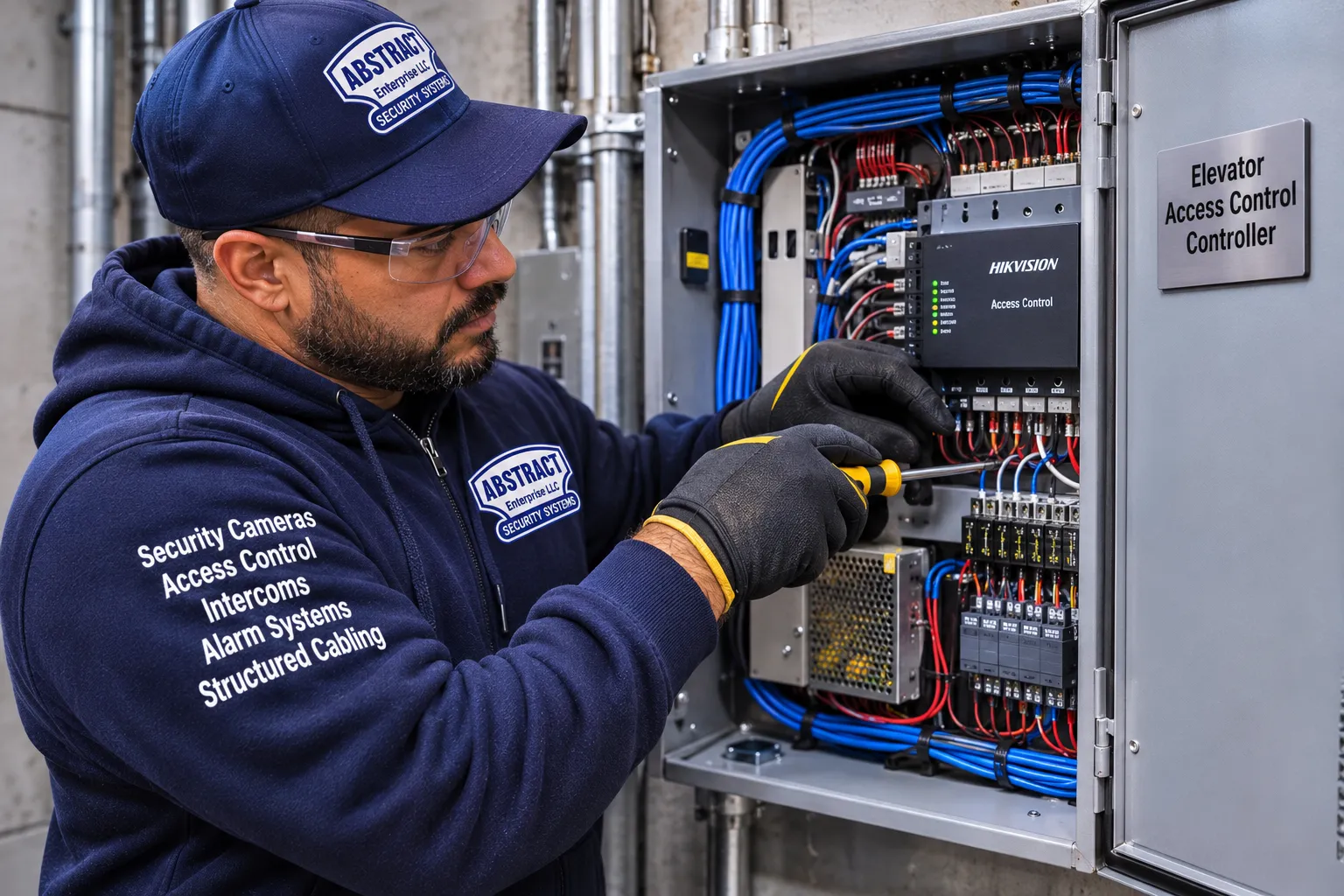
Photo from the Abstract Enterprises Security Systems elevator access control photo library, not taken in an Orange County building: a technician lands wires on terminals inside a metal enclosure labeled Elevator Access Control Controller. In Orange County we mount this panel where the elevator mechanic can see our labeled drawing on a periodic test.
Credentials
Fobs, Cards, Codes, Phones or Faces: Picking a Credential That Orange County Riders Will Actually Use
The credential is the part of the system residents and staff touch every day, so it deserves more thought than it usually gets. In Orange County the right choice depends heavily on who rides the elevator.
Credential
Where it fits in Orange County
What to watch
Key fob
Senior buildings, family buildings in Monroe and Palm Tree, most apartment buildings. Easy to hold, hard to break, works on a keychain.
Lost fobs must be cancelled quickly; keep blank fobs on site so the manager can issue a replacement without a visit.
Card
County, municipal and medical buildings where staff already carry an ID badge that can carry the credential.
Older proximity cards can be copied cheaply. For new systems we recommend encrypted card technology.
PIN code
Aides, cleaners and contractors who should get access for a set period without carrying anything.
One shared code that everyone knows is how most old systems failed. Codes should be individual and expire.
Phone credential
Newer rentals on Liberty Street and the waterfront, offices, and buildings managed from a distance.
Some older residents do not want app-based access; always keep a fob option.
Face, fingerprint or iris (Level 2)
Staff-only floors, records rooms, buildings where badge sharing is a real problem.
Needs a written privacy policy and an alternative credential. Lighting and mounting height matter.
Most buildings end up with two credentials: a fob or card for residents and regular staff, and individual PIN codes or phone passes for aides, contractors and visiting family. Elevator access control with key fob readers, with RFID card readers and with smartphone credentials can all run on the same reader in many platforms, so a building does not have to pick just one.
A practical tip from Orange County senior buildings: when you switch from an old shared code to individual fobs, plan a few days with staff in the lobby handing out fobs and showing residents how to tap them. The technical cutover takes an afternoon. The human cutover takes a week, and it goes much better when residents get their fob from someone they know.
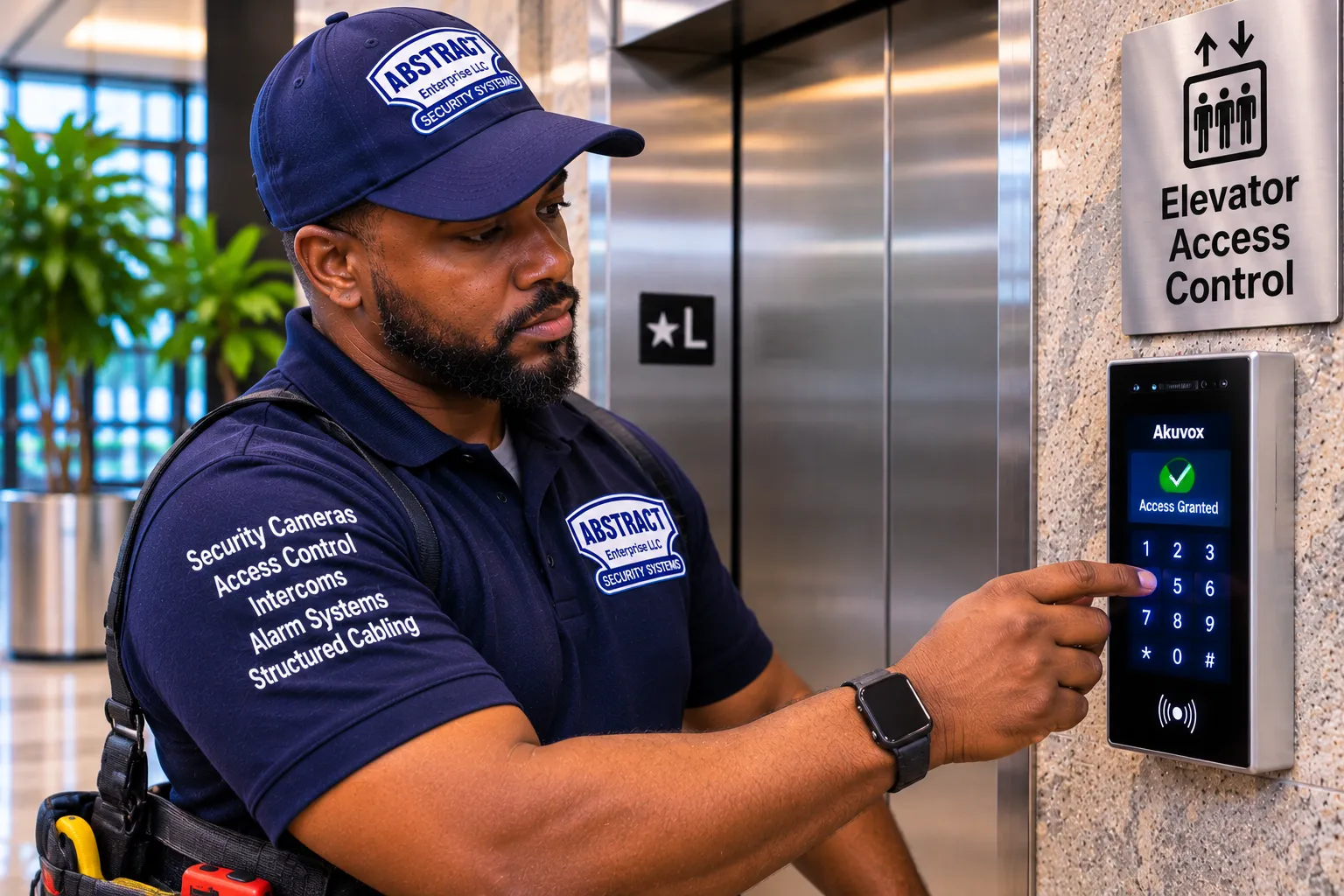
Photo from the Abstract Enterprises Security Systems elevator access control photo library, not taken in an Orange County customer's building: a technician enters a code on an Akuvox keypad and card reader whose screen reads Access Granted beside the elevator. Individual codes on a station like this suit staff and aides who should not be handed a fob.
Visitors and Aides
Home Health Aides, Visiting Nurses, Deliveries and Family in Orange County Elevator Buildings
In a lot of Orange County elevator buildings, especially senior buildings, the residents are not the only regular riders. Home health aides arrive every morning. Visiting nurses, physical therapists and meal deliveries come several times a week. Adult children drive up from the city on weekends. A system that only thinks about residents will be propped open, borrowed or bypassed within a month.
The tools for this are simple, and the trick is setting them up on day one:
Time-based permissions for aides. An aide's code or fob works only during their shift hours and only on the floor where their client lives, and expires automatically when the assignment ends. This is elevator access control with time-based floor permissions in its most useful form.
Intercom floor release. When a visitor buzzes an apartment from the entry intercom, the resident's answer opens the front door and releases the resident's floor in the elevator for one ride. The visitor never needs a credential and cannot reach any other floor. This is elevator access control integrated with building security, and it is the feature senior buildings appreciate most.
Temporary passes. Many platforms let staff send a visitor a phone pass or a one-time code that works for a day or a weekend. That is elevator access control system with visitor management, without a front desk.
Delivery handling. Most buildings simply keep couriers in the lobby or a package room, so they never need elevator access at all. Where a building delivers to apartment doors, a delivery code limited to set hours keeps that door from becoming permanent.
An audit trail. Every credential use is logged with a time and a floor. When a resident reports something missing, or a family asks whether an aide arrived, the manager can check the record instead of guessing. That is what an elevator access control system with audit trail is for.
All of this depends on someone keeping the lists current. We set up the first lists with your manager, train them on adding and cancelling people, and leave a one-page guide in the office. A building that reviews its aide and contractor list once a month rarely has problems.
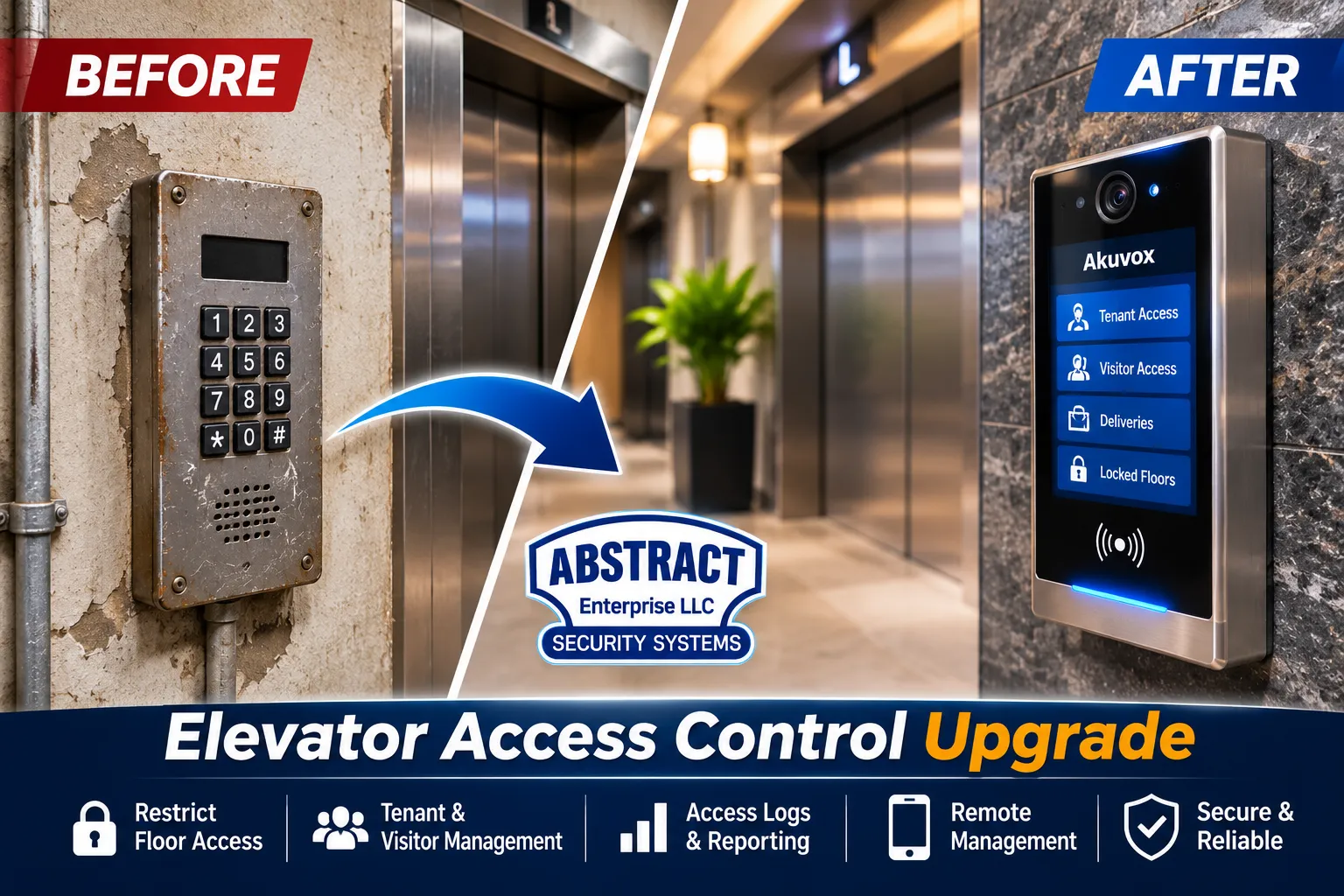
Graphic from the Abstract Enterprises Security Systems elevator access control photo library, not an Orange County building: on the left a worn keypad beside an elevator, on the right a modern touchscreen station offering tenant, visitor, delivery and locked-floor choices. Replacing a shared code that has been in use for years is the most common upgrade request we get from the county's senior buildings.
Step by Step
How Elevator Access Control Is Installed in an Orange County Building, Visit by Visit
People often ask how to install elevator access control as if it were a single day's work. In practice it is a short project with a clear order, and in Orange County, where every visit is scheduled, the order matters even more. This is how professional elevator access control installation services run here, from the first call to the first controlled ride.
Send us the building basics. Tell us the address and town, the number of floors and elevator cars, any garage, basement or roof stops, the door or intercom system you use now, and the name of your elevator maintenance company. Photos of the car's button panel and the machine room door help.
Book the survey on a set day. We book the survey within 2 hours of your request for a scheduled day with a 2-hour arrival window. Orange County surveys are grouped by area so the visit is planned, not rushed.
Walk the building with the elevator contractor's input. We look at each car, the lobby and garage call stations, the machine room, the cable path, power and internet, and we get the elevator contractor's view of the controller, spare inputs and traveling cable.
Agree who rides where. With your manager, board or facilities office we write down which credentials reach which floors, at which hours, and how visitors, aides and contractors get up. This list becomes the programming.
Receive a written two-column proposal. Our side lists every reader, relay, cable run, credential and programming step with a price. The elevator contractor's side lists their controller work. Nothing is ordered until you approve both.
Install readers, panel and cable. Our crew mounts the readers, panel, power supply and battery, runs the cable and labels every conductor. Work is planned around residents and staff, usually car by car so one elevator stays in normal service.
Elevator contractor makes the connection. The licensed elevator mechanic connects our floor-release outputs to the controller or car operating panel and confirms fire service and normal operation are unaffected.
Program, test and hand over. We enroll credentials, set schedules and intercom floor release, test every floor in every car with you, train your staff, and leave a labeled diagram and spare credentials on site.
For a single-car building with a Level 1 reader, our part is usually one or two working days once equipment is in hand; the elevator contractor's connection is often a separate, shorter visit. Floor-by-floor restriction across two or more cars takes longer, mainly because every floor in every car has to be tested. The longest part of most Orange County projects is not installation at all; it is getting the elevator contractor's visit on the calendar, which is why we ask for their name at the start.
What the building has at the end
An administrator login for your manager or facilities office, with at least two people trained
A credential list matched to residents, staff and tenants, with cancelled fobs from any old system removed
A labeled drawing of every relay, floor and cable in the machine room or electrical closet
Spare credentials and, where we recommend it, a spare reader kept in the office
Written fail-safe or fail-secure decisions for power loss and the override procedure
The service agreement, including the parts warranty terms
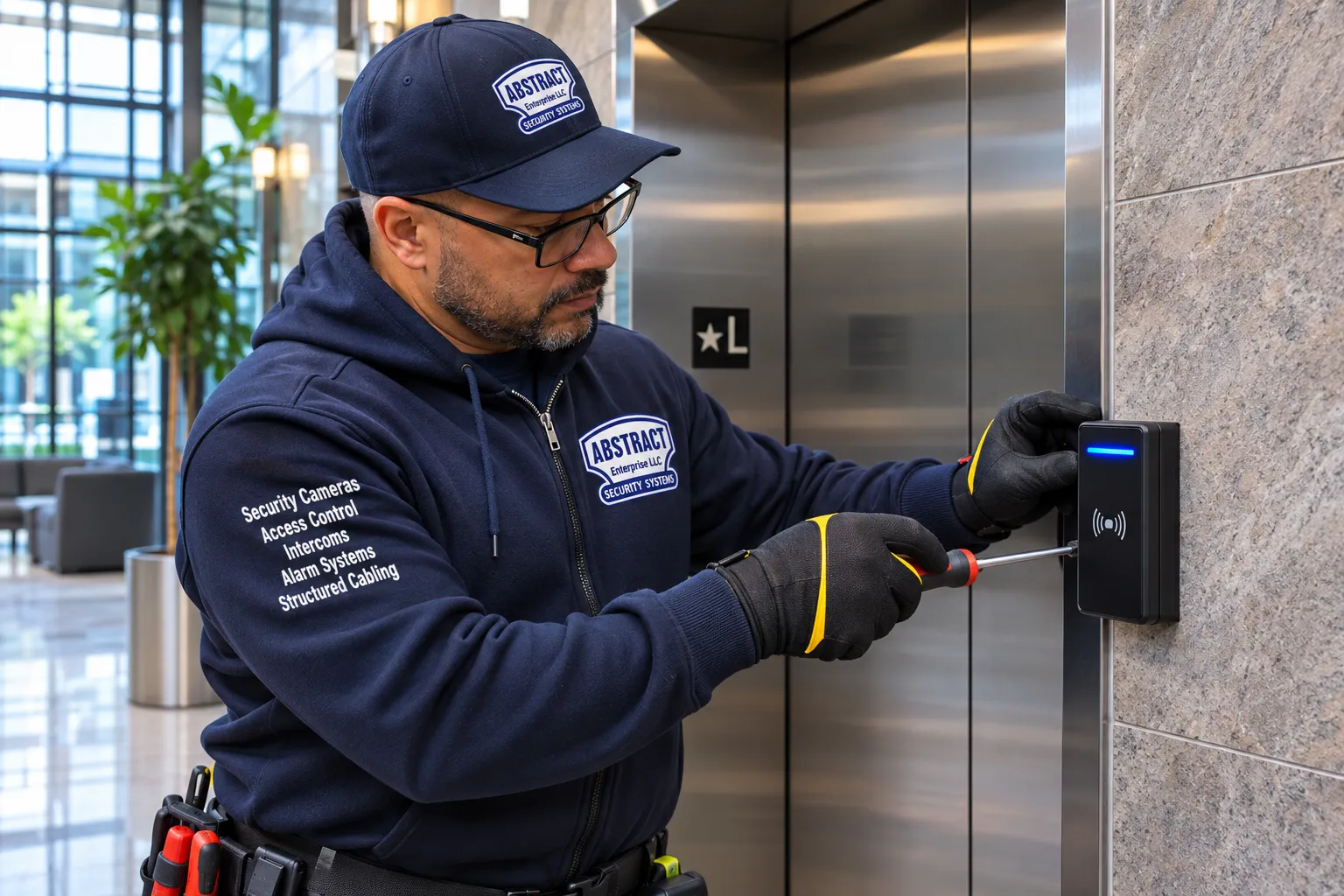
Photo from the Abstract Enterprises Security Systems elevator access control photo library, not taken in Orange County: a technician in glasses tightens a screw on a black card reader mounted next to elevator doors. A reader at the landing like this is how a garage or basement stop in an Orange County building is kept from being called by anyone without a credential.
The Survey
What We Look at During an Orange County Elevator Access Survey
Because every Orange County visit is scheduled and the drive matters, we try to collect everything we need on one survey. This is what we look at and why:
What we check
Why it matters
Number of cars and the floors each serves
Every car in a bank must be controlled the same way; the floor count sets the relay count for any floor restriction.
The car operating panel and floor buttons
Shows where a reader can mount, whether the panel has room for a reader, and how the buttons are wired.
Lobby, garage, basement and roof stops
Landing readers may be needed where those stops are unattended.
The machine room or controller location
Where our panel, power supply and battery can live, how far cable must run, and whether the spot is safe from water.
Controller type and age (with the elevator contractor)
Decides whether spare inputs exist, whether a relay interface or a data integration is used, and how much controller work is needed.
The traveling cable
Free conductors or a shielded pair for a reader in the car; if there are none, we plan an alternative with the elevator contractor.
Power and internet in the machine room
A dedicated circuit for our power supply, and a network or cellular link if the system will be managed remotely.
The current door and intercom system
Whether the elevator can use the same credentials, and whether intercom floor release is possible.
Who rides, and when
Residents, staff, tenants, aides, contractors and visitors, and the hours each group needs.
Fire alarm interface
Confirms with the elevator contractor how fire recall is wired, so our interface cannot interfere with it.
After the survey you receive a written proposal with drawings where they help. If something cannot be known without the elevator company opening the controller, the proposal says so plainly, rather than burying the uncertainty in a vague allowance.
Commercial and residential surveys are different visits
Commercial elevator access control surveys in Orange County, for an office building, a medical building or a government facility, spend most of their time on the floor-by-floor plan: which tenant or department owns which floor, which hours each floor is public, which staff need every floor and who must never reach a given floor. Residential elevator access control surveys, for a senior building or an apartment building, spend most of their time on people: how many residents, how many already carry a fob or card, how many aides and caregivers visit, and how the building handles guests. Both visits look at the same elevator hardware, but the questions that decide the design are different, and we plan the survey around them.
Decisions to Make First
Decisions an Orange County Board, Sponsor or Facilities Office Should Make Before the Survey
The survey goes faster, and the proposal is more accurate, when the people who own the building have already talked through a few decisions. None of these need technical knowledge. They are policy questions, and only the building can answer them.
List everyone who rides
Write down every group of people who ride the elevator in a normal week: residents or tenants, building staff, the managing agent, aides and caregivers, cleaners, contractors, delivery drivers, visitors, and emergency services. For each group, decide whether they should ride freely, ride only to certain floors, ride only at certain hours, or not ride without someone letting them up. That list becomes the first version of the programming.
Name the people who will run it
Name at least two people who will add and cancel credentials: usually the property manager and the superintendent, or a facilities supervisor and an assistant in a county or municipal building. In a self-managed condominium or a small nonprofit senior building, it may be a board member and a resident volunteer. If nobody can take on that role, choose a platform where a managing company can do it remotely, and say so before the survey.
Agree what happens when something fails
Decide in principle whether residential floors should free up or stay locked if the system loses power for a long time, who holds the override key or login, and who the elevator company should call if they find our equipment during a test. These choices go into the written proposal and the labeled diagram we leave behind.
Plan how residents and staff are told
A change to how people ride the elevator affects everyone in the building, so plan a notice, a date, and in senior buildings a few hours of help in the lobby. Boards and sponsors that announce the change early, explain why, and make fobs easy to collect have far fewer complaints than buildings that switch overnight.
Settle the budget and the timing
If an elevator modernization, a renovation or a new door intercom is planned in the next year or two, say so. It is often cheaper to add elevator access control as part of that work. If the budget only allows one car or one floor at first, we can design a system that starts small and grows without throwing anything away.
Cost
Elevator Access Control Cost in Orange County, NY
Elevator access control cost in Orange County is set per elevator car for the reader levels and per building for floor-by-floor work, because those are the things that actually change the amount of equipment and labor. These are our starting prices for Orange County:
Level
What it includes
Orange County starting price
Level 1: card, fob, code or intercom reader
One reader in the car (or one intercom-linked station) that enables the car for valid credentials, with panel, power supply, battery, interface relay, cable, enrollment of credentials and programming
From $2,100 per car
Level 2: face, fingerprint or iris reader
The same car-enable design using a biometric reader, usually with a card or fob fallback for riders who prefer it
From $3,500 per car
Level 3: floor-by-floor, landing control, schedules and integrations
Individual floor relays or an input/output interface, readers at lobby, garage or basement call stations, time schedules, intercom floor release, links to an existing building access platform or destination dispatch
Quoted per building after the survey
Three items sit outside those prices and are listed separately when they apply. The elevator contractor's controller work is quoted and billed by your elevator company. A network or cellular link to the machine room, where remote management needs one and the building has none, is its own line after the survey. Credentials beyond the starting quantity are quoted at the survey based on how many riders the building has.
Worked examples for common Orange County buildings
A one-car senior building in Port Jervis or Walden that wants residents' existing fobs to enable the car: Level 1, from $2,100 for our side, plus the elevator contractor's connection.
A two-car senior or rental building in Middletown or Newburgh with Level 1 readers in both cars: from $4,200 for our side (2 cars × $2,100), because every car in a bank has to be controlled the same way or riders simply wait for the open one.
A county or professional office building with two cars that wants face readers for staff: Level 2, from $7,000 for both cars (2 × $3,500), with fobs kept as the fallback credential.
A medical office building with practices on separate floors that needs floors open only during each practice's hours: Level 3, priced per building after we count the floors and cars and see the controller.
A new mixed-use building in Newburgh with a garage stop, retail on the ground floor and apartments above: Level 3, ideally priced with the general contractor and elevator installer during construction.
We do not quote floor restriction over the phone, and we do not give an Orange County price for the elevator company's work, because neither can be known before someone looks at the controller. What we can promise is a written proposal with a price on every line before anything is ordered. See the Hudson Valley elevator access control page for the pricing in the other Hudson Valley counties.
Photo from the Abstract Enterprises Security Systems elevator access control photo library, not taken in Orange County: a technician terminates colored conductors on an open reader circuit board. Most dead readers we find in older Orange County systems trace back to a loose termination, a failed power supply or a worn-out battery rather than the elevator itself.
Compare the Levels
Level 1, Level 2 and Level 3 Side by Side for Orange County Buildings
Level 1
Level 2
Level 3
What it does
Enables the car for valid fob, card, code or intercom credential
Enables the car for a valid face, fingerprint or iris
Restricts individual floors, landings and hours; links to other systems
Best Orange County fit
Senior buildings, small apartment buildings, family buildings
Staff-only buildings, records floors, buildings where badges get shared
Medical offices, county and court buildings, mixed-use buildings, garages
Starting price
From $2,100 per car
From $3,500 per car
Quoted per building
Elevator contractor work
One car-enable connection per car
One car-enable connection per car
One connection per controlled floor or landing, per car
Typical riders' experience
Tap, then press any floor
Look or touch, then press any floor
Tap, and only your floors light up
Manageable from a distance
Yes, with a cloud or networked panel
Yes, with a cloud or networked panel
Yes; schedules run automatically
A good rule for Orange County: start with the least restrictive design that actually stops the problem you have. If the problem is people who do not live or work in the building riding the elevator, Level 1 solves it. If the problem is people who belong in the building going to floors they should not, you need Level 3 for those floors. Level 2 is about how riders identify themselves, not about which floors they reach, and it can be combined with Level 3 for staff-only floors.
Upgrade and Repair
Replacing an Old Elevator Key Switch, Shared Code or Card System in Orange County
Many Orange County elevator buildings already have some form of elevator security, and most of it is old. The three systems we replace most often are a key switch in the car that only staff could use, a keypad with one code that everyone has known for years, and a first-generation card system whose company no longer supports it or whose software runs on a single office computer that is failing.
An elevator access control upgrade is usually less work than a new installation, because some of what is already there can stay. If the elevator contractor confirms the existing interface and traveling cable are sound, we can often reuse them and change only the reader, panel and software. Old proximity cards can sometimes be kept for a while on a new reader that reads both old and new technologies, which lets a building switch residents over gradually. We look at each piece honestly and tell you what to keep and what to replace.
When the existing reader just stops working
Elevator access control repair in Orange County usually starts with a phone call that the car will not respond to fobs anymore. Before anyone drives out, we ask a few questions over the phone: is the reader's light on, does the car run normally for staff override, did the building lose power recently, and has anything been changed in the software. A surprising number of problems are a failed power supply or a battery at the end of its life, a reader damaged by impact or water, a network link that dropped, or a credential list that was accidentally changed. When we do come out, it is on a scheduled visit with the likely parts in the van.
If our output tests correctly and the floor still does not respond, the problem is on the elevator side, and we give the elevator company a precise description so their mechanic arrives knowing what to look for. If the car is stuck, behaving unsafely or someone is trapped, always call your elevator company or 911 first; that is never an access control call.
Taking over a system another company installed
We regularly take over elevator access control maintenance for systems we did not install. The first visit is a documentation visit: we identify the platform, confirm the administrator login works, trace and label the wiring, check the battery and power supply, and write down how every floor is controlled. Only then do we recommend whether to keep, repair or replace it.
Platforms
Elevator Access Control Platforms We Install, Integrate and Service in Orange County
We install, integrate and service elevator access control from a range of manufacturers. We are not a certified dealer or authorized partner of any of the brands below; we choose the platform that fits the building and the people who will run it.
Akuvox intercoms and access stations, including elevator floor release from the entry intercom, which suits buildings without a front desk.
ButterflyMX and 2N video intercoms where the building already uses them at the front door and wants the elevator to follow the same credentials.
Brivo and Kisi cloud platforms for property managers who run several Orange County buildings from one office.
HID readers and credentials, often the reader of choice where a county, school or hospital-affiliated tenant already uses HID cards.
LenelS2, Genetec, Gallagher, ICT and Suprema in larger institutional or government buildings that need the elevator to join an existing enterprise system.
Paxton and ZKTeco for smaller buildings that want a straightforward, locally managed system.
Axis readers and network door stations in buildings that are standardizing on network video and access.
The brand matters less than three questions we ask every time: can your staff run it without calling us, will its credentials work at your front door as well as in the elevator, and will the company still support it in ten years? For an Orange County building that is far from its installer, the first question usually decides the answer.
Common Misunderstandings
Five Things People Get Wrong About Elevator Access Control in Orange County
1. "It is a city thing; buildings up here do not need it."
Orange County has fewer elevator buildings than the city, but the ones it has are senior residences, medical buildings, government offices and new mixed-use buildings in downtowns. Those are exactly the buildings where an uninvited rider on an upper floor causes the most harm, and where staff are least likely to be standing in the lobby to notice.
2. "The security company rewires the elevator."
No. In New York State, work on the elevator itself is licensed by the Department of Labor and done by a licensed elevator contractor. A security installer that offers to make the controller connection itself is offering to do work it is not licensed for. Our job is the reader, the panel, the relays, the cable and the software; the elevator company connects them.
3. "Locking the elevator will trap people during a fire."
The elevator's fire-service program overrides access control. When the fire alarm recalls the car, our system has no say, and the elevator contractor tests that after the connection is made. Power-loss behavior is chosen in writing ahead of time, and every building gets a documented override.
4. "We need floor-by-floor control on every floor."
Most Orange County apartment and senior buildings do not. If the problem is outsiders riding the elevator, a car-enable reader solves it at a fraction of the cost and keeps residents free to visit neighbors and use the community room. Floor restriction earns its cost in medical, office, government and mixed-use buildings where floors genuinely belong to different people.
5. "Once it is installed, it runs itself."
The hardware does, mostly. The credential list does not. A system whose list still includes former tenants, old aides and lost fobs is not secure, no matter how good the reader is. That is why we train two people at every building and recommend a monthly list review.
Across the County
From Port Jervis to Newburgh: How Elevator Access Control Differs Across Orange County
Each part of Orange County has its own mix of elevator buildings, and the design we recommend shifts with it.
Area
Typical elevator buildings
What usually fits
City of Newburgh, Town of Newburgh and New Windsor
Senior buildings such as Cerone Place, High Point and Hudson Pointe; the Bourne tower; new mixed-use projects on Liberty Street; SUNY Orange's Kaplan Hall; office and flex space near Stewart
Car-enable for senior and rental buildings; time-scheduled floors for mixed-use; garage landing control for campus and office buildings
Middletown and Wallkill
Senior buildings including Southeast Towers, Middlecrest Crossing II and Senior Horizons at Silver Lake; medical offices around Garnet Health; downtown buildings improved under the state's Downtown Revitalization Initiative
Fob-based car-enable, often reusing existing keycards; floor scheduling for medical offices
Goshen and Chester
County government and court buildings, professional offices
Floor-by-floor restriction with an audit trail, integrated with existing staff card systems
Monroe, Palm Tree and Woodbury
Multifamily family buildings, Monroe Commons senior apartments, commercial buildings along Route 17
Household fobs with temporary passes for visiting relatives; intercom floor release
Port Jervis and Deerpark
Park Plaza and the Waters Edge senior buildings, small downtown buildings
Simple, robust Level 1 readers, remote administration and spare credentials kept on site because of the distance
Walden, Montgomery, Washingtonville and Cornwall
Small senior buildings such as The Cedars and Rocky Point, medical offices near the Cornwall hospital campus
Level 1 readers sized for a single car, with clear override procedures
Warwick, Greenwood Lake and Tuxedo
Age-restricted buildings such as The Promenade at Tuxedo Place, small offices
Accessible reader placement and fail-safe power behavior
The rest of our elevator work in the region is on the Hudson Valley elevator access control hub, with separate pages for neighboring counties. Buildings just across the river or down Route 17 often have the same building types, but different code offices, elevator contractors and pricing.
Before You Hire
A Checklist for Hiring an Elevator Access Control Contractor in Orange County
Whether you hire us or someone else, these are the questions we would ask any elevator access control company before signing:
Will you coordinate with our elevator maintenance company, and will their mechanic make the controller connection? (The answer should be yes.)
Can you show me a written proposal that separates your work from the elevator contractor's, with a price on every line?
What is your low-voltage license number? (Ours is NYS #12000287431.)
How will the system behave in a fire alarm and during a power outage, and can we choose fail-safe or fail-secure in writing?
Can our manager add and cancel credentials from the office, and how many people will you train?
Will our existing fobs or cards work, or do we have to replace them?
How do visitors, aides and contractors get up, and can their access expire automatically?
What happens if a reader fails: what can we do ourselves, and how far ahead is a service visit scheduled?
Where will you mount the panel and battery, and is that spot safe from water?
Who owns the administrator account and the credential database if we change companies later?
An elevator access control installer who answers those clearly, in writing, is worth hiring. One who promises same-day installation or offers to wire the controller itself is not.
Why Us
Why Orange County Buildings Call Abstract Enterprises Security Systems for Elevator Access
We have been doing security work since 2002. Abstract Enterprises Security Systems is owner-operated and has completed thousands of jobs across New York City, Long Island and the Hudson Valley.
We plan both halves of the job. Our proposals are written with the elevator contractor's role spelled out, so nothing falls between the two companies.
We design for distance. Remote administration, spare credentials on site, fault alerts and labeled drawings are standard in Orange County, not extras.
We book fast and arrive when we say. Surveys are booked within 2 hours of your request and every visit has a 2-hour arrival window.
We are licensed and insured. NYS low-voltage license #12000287431, rated 4.7★ from 201 Google Reviews.
Call (845) 640-3835 to talk about your building, or use the form, and we will book a survey on a day that suits your staff.
After Installation
Running Elevator Access Control Day to Day in an Orange County Building
Most of the value of elevator access control comes after the installer leaves. These are the habits that keep Orange County systems working well:
Review the credential list monthly. Remove residents who moved out, aides whose assignments ended and contractors who finished. It takes ten minutes.
Cancel lost fobs the same day. From the software, not by waiting for a visit.
Check the battery once a year. Backup batteries in access panels wear out; we can replace them on a scheduled maintenance visit.
Tell the elevator company about the system. Make sure the mechanic who does your periodic inspections knows the access interface is there and has seen the diagram, so tests do not leave a floor locked by mistake.
Read the audit log when something happens. If a resident reports a stranger upstairs, the log shows which credential, if any, was used and when.
Plan credential changes before they happen. A new tenant moving into an office floor, a board election or a change of management company are all moments to update administrator access.
Our service agreement sets out what we maintain and how service visits are scheduled. Full terms — including 50% deposit, one-year parts-only warranty on Abstract Enterprises Security Systems-supplied products, and the late-fee schedule — are set out in the service agreement.
Plain-Language Terms
Elevator Access Control Terms for Orange County Boards, Managers and Facilities Staff
Proposals for elevator access control are full of jargon. These are the terms you are most likely to see on ours, explained plainly:
Term
What it means
Car enable
The reader in the car unlocks the floor buttons for a few seconds after a valid credential; the rider can then pick any floor.
Floor restriction (floor lockout)
Each floor button is locked by default and unlocked only for credentials assigned to that floor.
Hall call or landing control
A reader at a landing call button, so the car cannot be called to that floor without a credential.
Relay interface or I/O board
The device that turns our access decisions into on/off signals the elevator controller understands, one point per controlled floor per car.
Traveling cable
The cable that hangs from the car to the hoistway and carries signals between the car and the machine room.
Car operating panel (COP)
The button panel inside the car.
Fire service (Phase I and Phase II)
The elevator's firefighter recall and in-car firefighter operation, which always override access control.
Fail-safe and fail-secure
Whether controlled floors free up (fail-safe) or stay locked (fail-secure) when the access system loses power.
Credential
Whatever the rider presents: a fob, card, PIN code, phone pass, face or fingerprint.
Audit trail
The log of every credential use, with time and floor.
Destination dispatch
Lobby kiosks that assign riders to cars; access permissions are sent to it as data rather than through relays.
Intercom floor release
When a resident answers a visitor at the entry intercom, the visitor gets one ride to that resident's floor.
FAQ
Orange County Elevator Access Control Installation FAQ
Our Middletown senior building already uses keycards at the front door. Can the same cards run the elevator?
+
Often, yes. If the existing cards use a technology the new elevator reader can read, we enroll the same card numbers so residents carry one credential for the door and the car. If the cards are an older, easily copied type, we usually recommend issuing new fobs or cards over a planned changeover week, with staff in the lobby to help residents.
How far ahead should an Orange County building schedule an elevator access control survey?
+
We book the survey within 2 hours of your request, for a set day with a 2-hour arrival window. The part that takes planning is the elevator contractor, whose visit for the controller connection can be weeks out. Asking your elevator company early, and giving us their name when you contact us, is what keeps an Orange County project on schedule.
Does New York City's Local Law 63 apply to biometric elevator readers in an Orange County apartment building?
+
No. Local Law 63 of 2021 is a New York City law for buildings in the five boroughs. For any Orange County building using face or fingerprint readers, we still recommend a written policy on what is collected, who can see it and when it is deleted, and offering a fob or card to anyone who prefers not to enroll.
Can a property manager who runs buildings in Port Jervis and Walden control elevator access for both from one office?
+
Yes, with a cloud-managed or networked platform. The manager adds and cancels credentials, checks the audit log and changes schedules for each building from a browser or app. Each building needs a reliable internet or cellular link in the machine room, which we price as its own line if one is not already there.
What should happen to the controlled elevator in an Orange County senior building when a storm knocks out the power?
+
That is decided in writing before installation. Our panel has a backup battery, so a short outage changes nothing if the elevator has emergency power. For a long outage, most senior buildings choose fail-safe, so floors free up when our battery runs down and no resident is left unable to ride. Fire-service operation is always controlled by the elevator, not by our system.
Who makes the connection to the elevator controller in Orange County, and why can't the security installer do it?
+
Your licensed elevator contractor does. New York State's elevator licensing law, administered by the Department of Labor, requires businesses and individuals who install, alter or service elevators to be licensed, and individuals working on an elevator to hold an elevator mechanic's license. We install the readers, panel, relays, cable and software, and coordinate the controller work with the elevator company.
Can a medical office building near Garnet Health open its floors to patients during office hours and lock them at night?
+
Yes. That is a time-scheduled floor rule, part of our Level 3 design. Each floor follows its own practice's hours: open to anyone during posted hours, staff credentials only outside them. We build the floor-by-floor schedule with the building manager and each tenant, then test every floor in every car before it goes live. It is quoted per building after a survey.
Is it worth adding elevator access control during an elevator modernization in Newburgh rather than afterward?
+
Usually, yes. During a modernization the elevator contractor is already working in the controller and car operating panel, so adding the access interface to their scope costs less than bringing them back later. Ceilings and walls along the cable route may also be open. We coordinate with the modernization schedule so the access system is tested along with the new controller.
How do home health aides get up to a client's floor in an Orange County elevator building without a resident's fob?
+
The building issues each aide their own code, fob or phone pass, limited to their shift hours and their client's floor, and set to expire when the assignment ends. Alternatively, the aide buzzes the client from the entry intercom and the client's answer releases their floor for one ride. Either way, nobody needs to share a resident's fob.
What does a Level 1 elevator reader cost for a single-car building in Orange County?
+
Level 1 starts at $2,100 per car in Orange County. That covers our reader, panel, power supply, backup battery, interface relay, cable, credential enrollment and programming. The elevator contractor's connection at the controller is billed by your elevator company, and extra credentials or a network link, if needed, are listed separately after the survey.
Can a county or court building in Goshen add the elevator to the badge system staff already use?
+
In many cases. If the building's existing access platform supports elevator control, we add readers and an elevator interface to that platform so staff use the same badge and the same audit trail covers the elevator. If it does not, we explain the options, from an add-on controller to a platform change, before any equipment is ordered.
Our Orange County building's elevator card reader stopped working and the original installer is gone. Where do we start?
+
Call us with the brand on the reader if you can see one, whether its light is on, and whether the car still runs on staff override. We usually find a failed power supply, a worn-out battery, a damaged reader or lost software access. We schedule a visit with the likely parts, document the system and tell you honestly whether to repair or replace it.
Will residents who use wheelchairs or walkers be able to use the elevator reader easily?
+
They should, and we test for it. We mount car and landing readers at an accessible height and angle, choose readers with a large target area and clear light and sound feedback, and test with residents who use mobility devices before we finish. Every building also gets a documented override for anyone who cannot use the reader.
Elevator Access Control Installation in the rest of our service area
Request a Free Elevator Access Control Quote for Your Orange County Building
Tell us the town and address, how many floors and elevator cars the building has, whether the car stops at a garage or basement, what door, fob or intercom system you use now, and who should be able to reach which floors. A photo of the car's button panel and the name of your elevator maintenance company help us plan a single, well-prepared survey visit. Prefer to talk? Call our Hudson Valley line at (845) 640-3835.
✅
Request Sent!
Thank you. We will be in touch to book your Orange County elevator access survey, usually within 2 hours of your request.