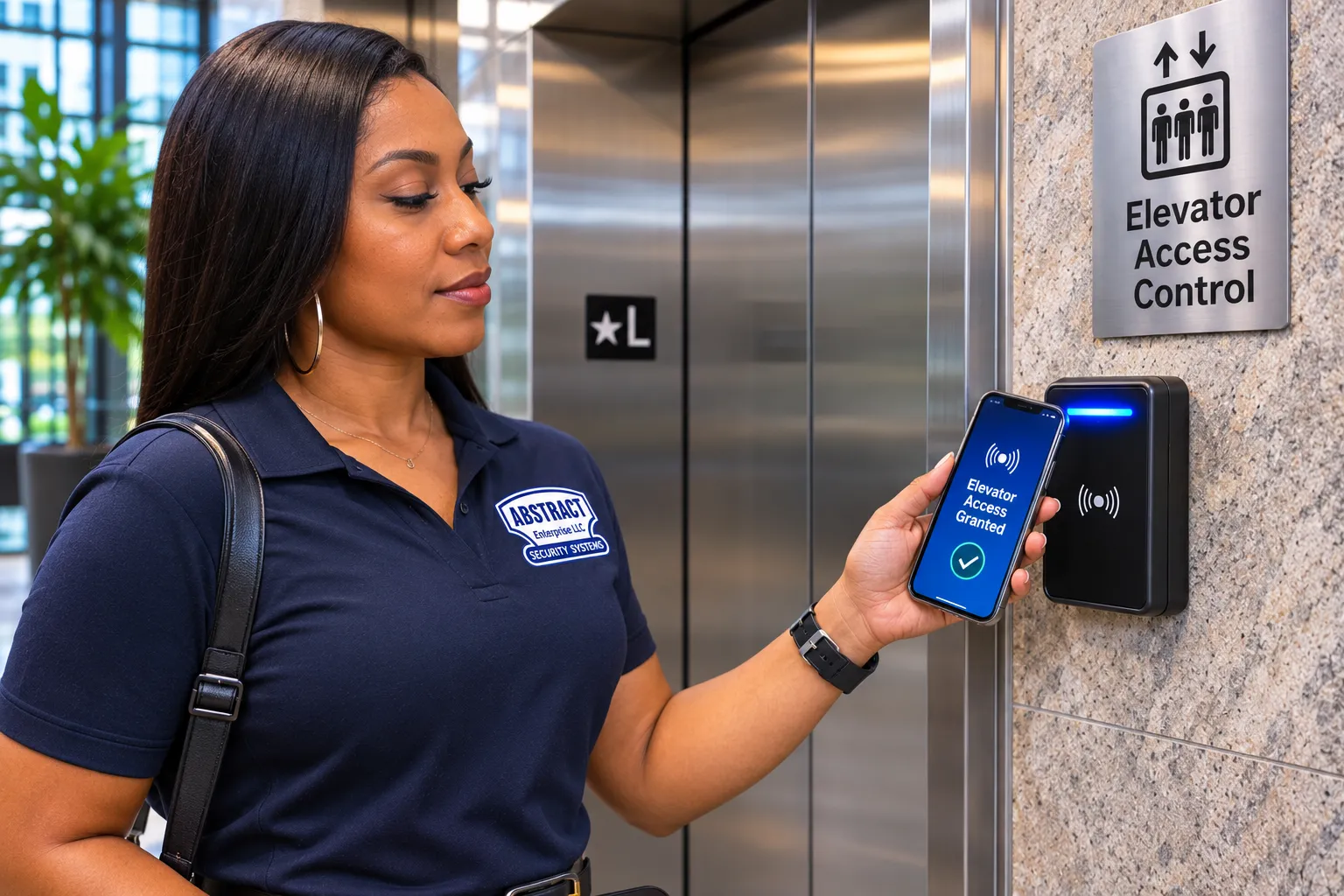
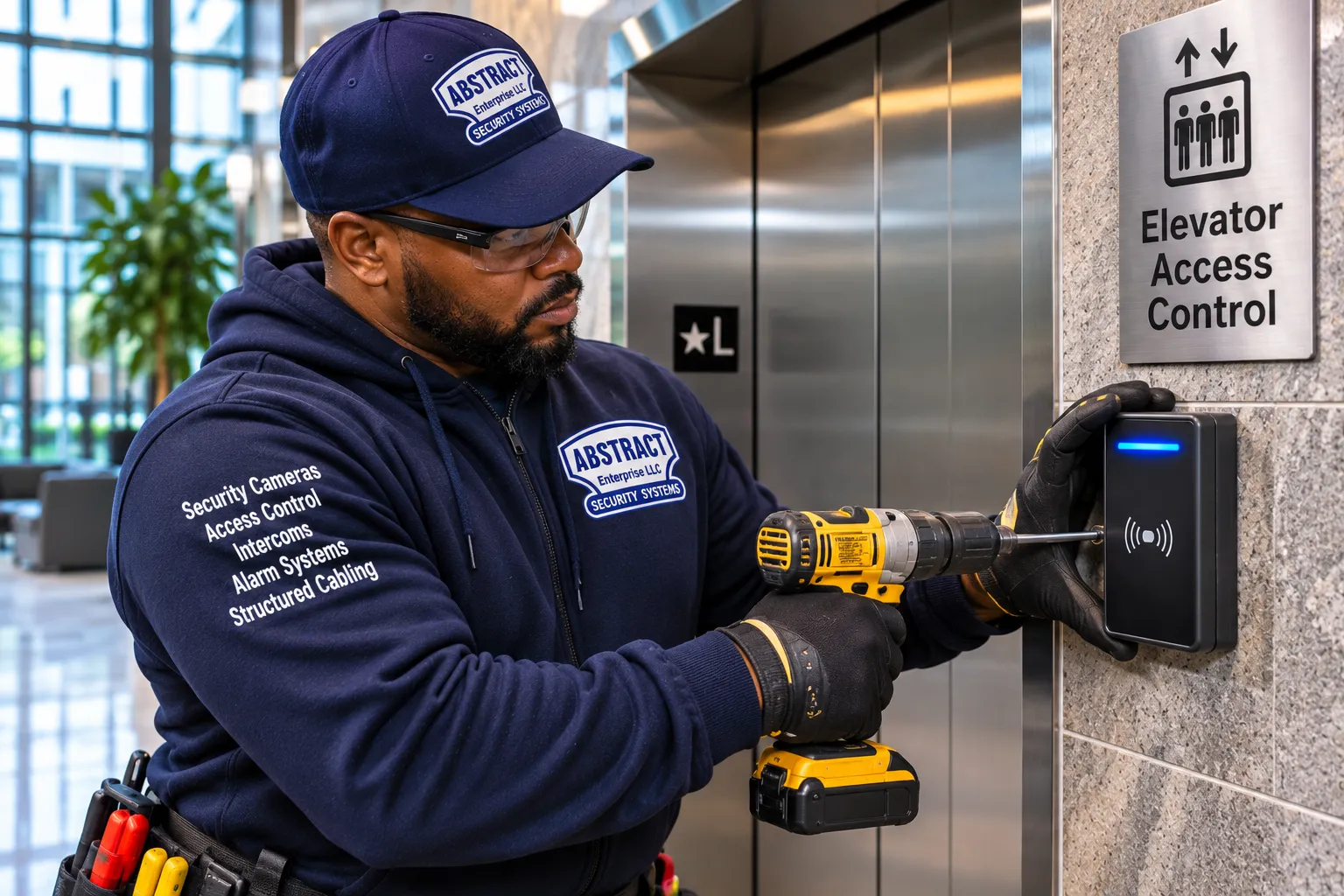
Key Fob · Card · Phone · Keypad · Face & Fingerprint · Floor Restriction
Elevator access control installation in Brooklyn is the job of putting a reader, keypad, phone credential or biometric reader on your elevators so the cars answer only the people your building approves, and, where you want it, only for the floors those people live or work on. Abstract Enterprises Security Systems is based in Brooklyn and has worked in the borough's buildings since 2002. We install the low-voltage half of the system: the reader in the car or at the lobby call button, the floor-enable relays or interface board, the cable, the panel, the fobs and cards, the programming and the link to your intercom. Your building's licensed elevator contractor makes the connection inside the elevator controller. We plan both halves together so a Downtown Brooklyn rental tower, a DUMBO loft condo, an Ocean Parkway co-op or a Navy Yard tenant floor ends up with one system that works on the first day.
Reviewed and updated November 16, 2026 by Abstract Enterprises Security Systems, NYS license #12000287431 · Sources: Brooklyn Borough President's 2016 Downtown Brooklyn report as summarized by Planetizen; Planetizen on the 2021 Gowanus rezoning; Bisnow on the 2005 Greenpoint-Williamsburg rezoning; GlobeSt on the Starrett City sale; Brick Underground on key-locked elevators; Security Sales and the Brooklyn Daily Eagle on the Atlantic Plaza Towers facial recognition dispute; CBS New York and News 12 Brooklyn on lobby package thefts; Brooklyn Daily Eagle on Industry City; NYC HPD on Local Law 63 of 2021; NYC DOB Buildings Bulletin 2022-010 and elevator license FAQ

Owner-operated since 2002 · Thousands of jobs completed · Booked within 2 hours
Quick answer: elevator access control in Brooklyn starts at $1,500 per elevator car for a Level 1 reader in the car (card, fob, PIN code, phone or a video keypad station) and at $2,500 per car for Level 2 face, fingerprint or iris readers; floor-by-floor restriction, lobby and garage hall-call readers, schedules, intercom floor release and destination dispatch links are Level 3, quoted per building after a survey. Brooklyn is our base rate, the lowest we publish anywhere. The quote lists every reader, relay, cable run, credential and programming task on its own line and shows separately what your elevator contractor must do, because the building arranges and pays the elevator company for the controller connection directly. We book the survey within 2 hours of your request and arrive inside a 2-hour arrival window.
Brooklyn has more kinds of elevator buildings than almost any place we know. In one week a Brooklyn crew can stand in a forty-story glass rental on the Williamsburg waterfront, a six-story 1930s co-op on Ocean Parkway with a single small car and no doorman, a converted printing plant in DUMBO where the elevator opens straight into the apartments, a twenty-building rental complex in East New York, and a manufacturing building at the Brooklyn Navy Yard where the freight car is more important than the passenger car. Every one of those buildings has the same basic weakness. The front door is locked, the lobby may even have a camera, but once someone is inside the elevator the building has no say in where that person goes.
For most of the twentieth century that was fine. Brooklyn apartment houses were smaller, neighbors knew each other, and a super lived on site. The borough has changed. The 2004 Downtown Brooklyn rezoning was written to bring offices, but according to a 2016 report from the Brooklyn Borough President's office it produced more than 11,000 housing units in its first dozen years, against the 979 the city had expected. The 2005 Greenpoint-Williamsburg rezoning opened the industrial waterfront to towers. The 2021 Gowanus rezoning, the largest of its era, allows up to 8,000 new apartments along the canal. Buildings of two or three hundred units, with package rooms, roof decks, gyms, co-working lounges and parking levels, are now ordinary in neighborhoods that used to be brownstones and warehouses. More floors, more strangers and more amenities mean more places where a board or an owner wants a say over who rides where.
At the same time, older Brooklyn buildings are under their own pressure. Co-op boards in Brooklyn Heights, Park Slope, Flatbush, Bay Ridge and Sheepshead Bay hear the same complaints at every annual meeting: delivery people wandering the halls, tailgaters following residents through the door, roof doors propped open, packages disappearing. Large rental complexes have to manage thousands of credentials and constant turnover. Rent-stabilized buildings have to change their systems inside rules that newer buildings never face, and since Local Law 63 of 2021 every Brooklyn apartment building that uses fobs, cards, phone credentials or biometrics has written duties about the data those systems keep.
Elevator access control answers those problems in a controlled way. It does not replace the front door system, the intercom or the cameras. It adds one more checkpoint at the place where a visitor's path through the building is easiest to limit: the moment they choose a floor. Done well, it is invisible to residents, who tap the same fob they already use at the door. Done badly, it traps a grandmother in the lobby because her fob was never added to the car, or it locks out the fire department, which is exactly what the city's rules exist to prevent. The rest of this page is about doing it well in Brooklyn's actual buildings.

An elevator key fob system has three parts that talk to each other, and one part it borrows from the elevator. Knowing the four makes every conversation with a contractor, a board or a managing agent easier.
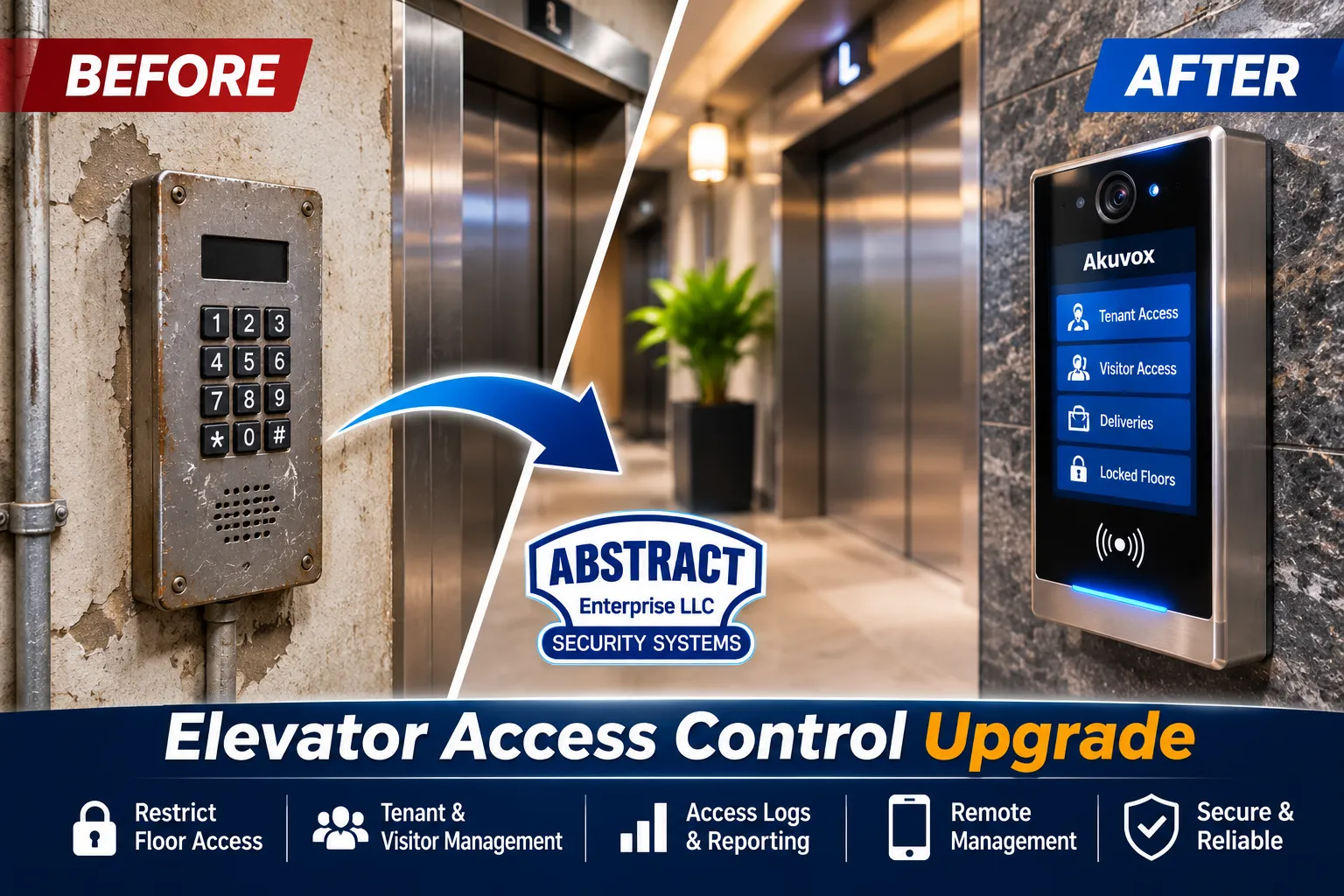
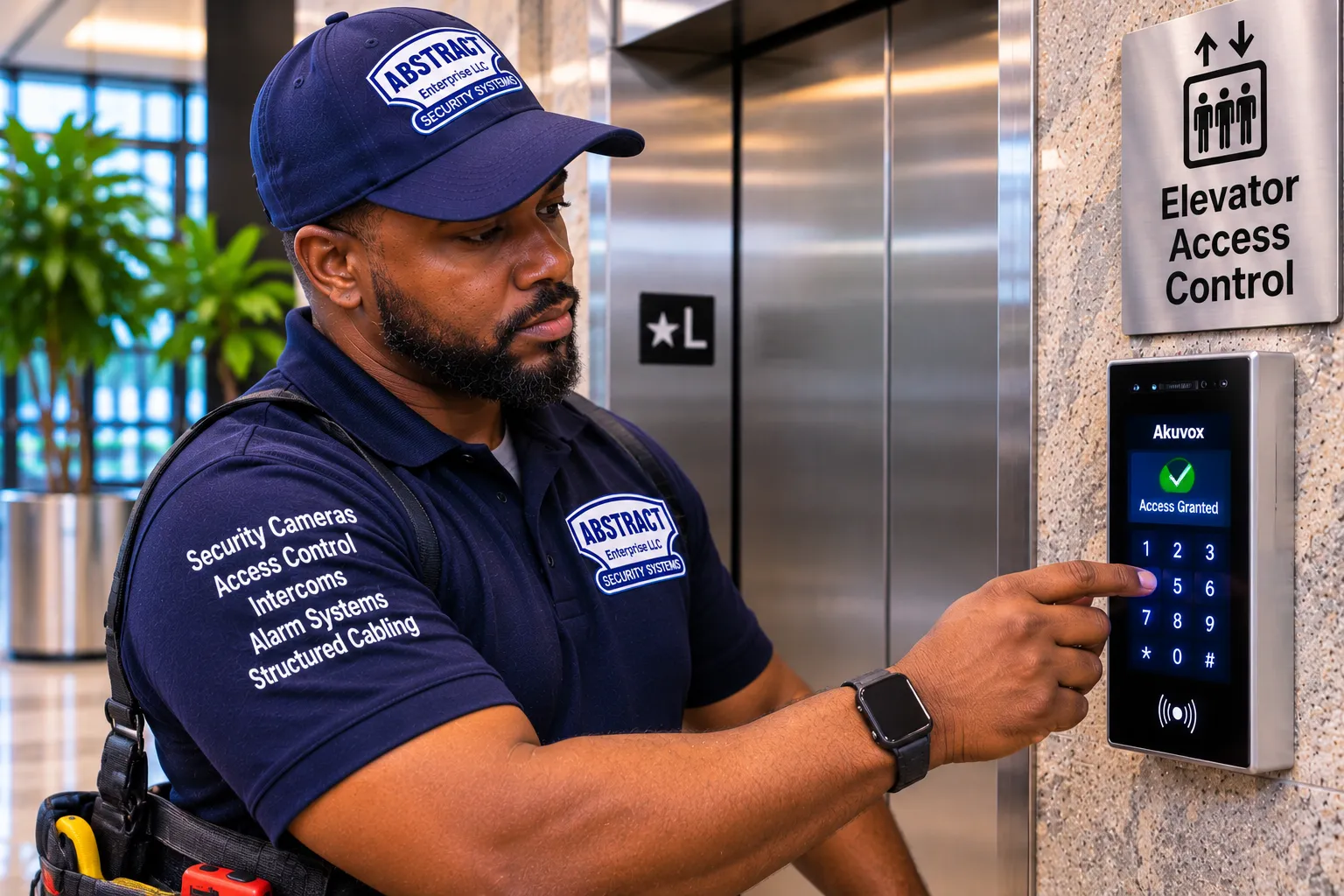
The reader. A small reader is mounted on the car operating panel or on the cab wall beside it, and sometimes also next to the call button in the lobby, the cellar or the garage. When a resident holds up a fob, card or phone, the reader picks up the credential's number and passes it down a cable to the access control panel. A keypad or a video station like an Akuvox unit does the same thing with a PIN code. A biometric reader does it with a face or fingerprint template.
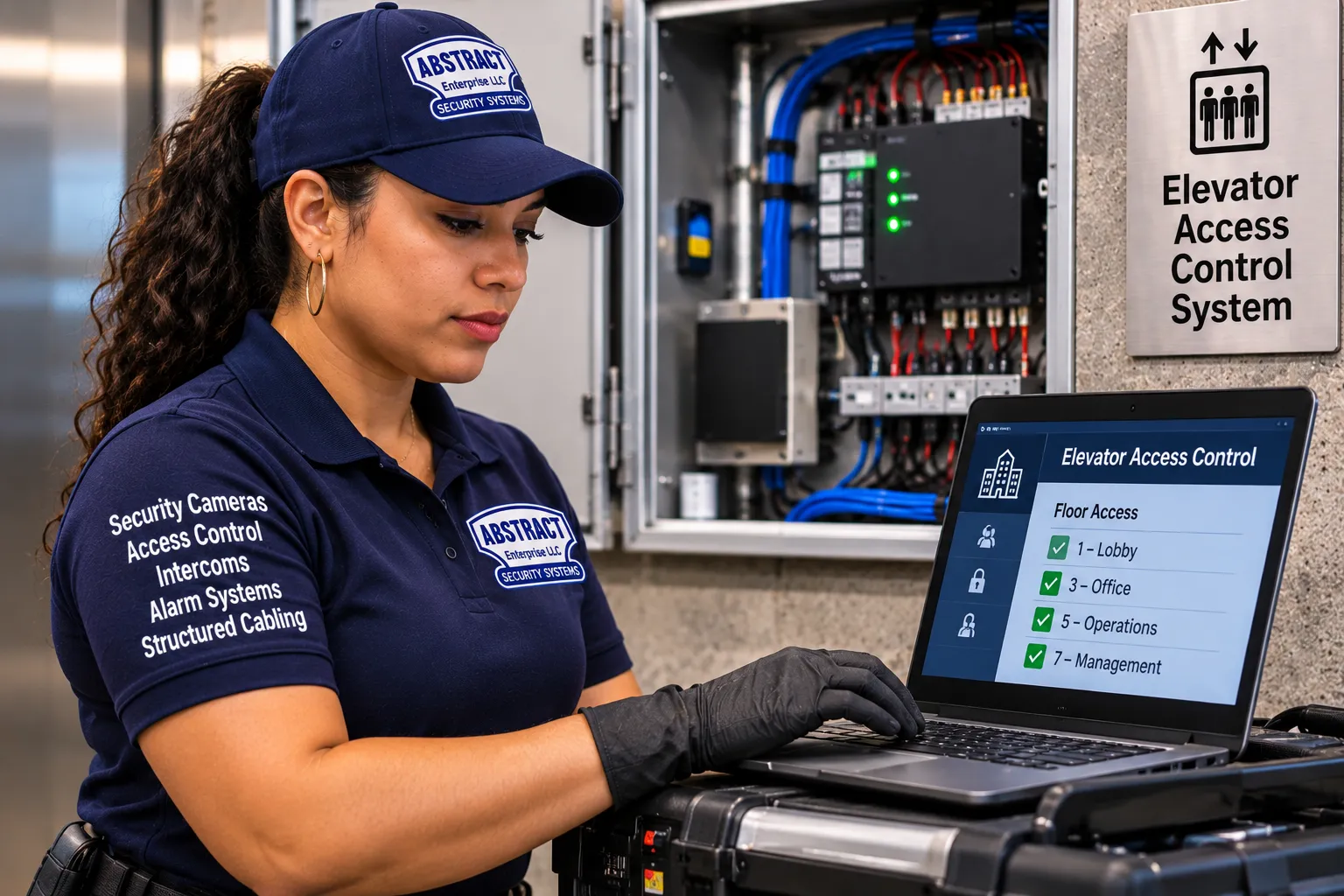
The panel and the software. The panel checks the number against its user list. That list says which group the resident belongs to, which floors that group may reach, at which hours, and whether the credential is active, suspended or deleted. In most systems we install in Brooklyn, the same list already runs the front door, the package room and the gym, so the super adds a resident once and the elevator follows.
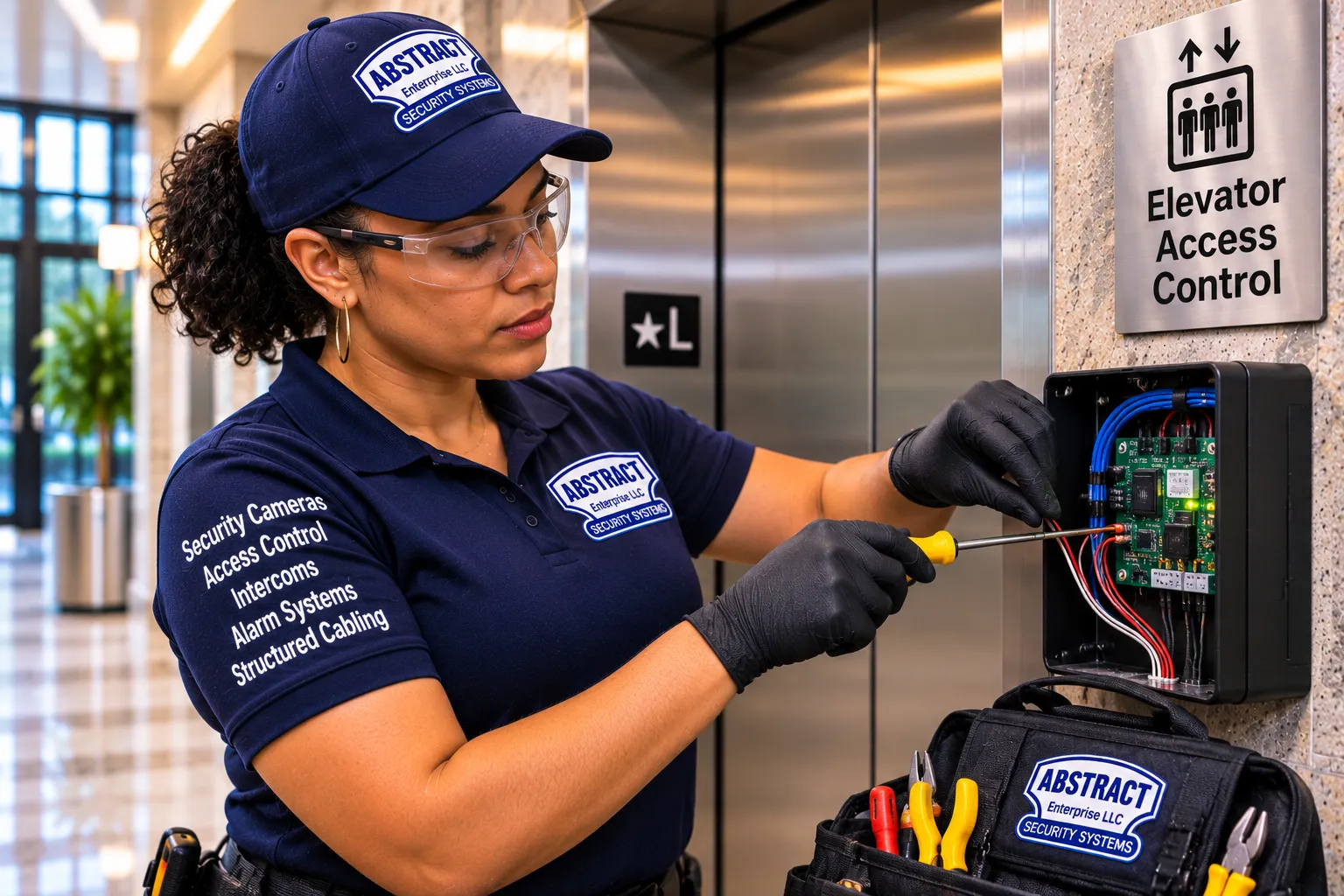
The floor-enable outputs. When the panel approves a rider, it closes one or more relays for a few seconds. Each relay is wired to one floor in one car. While it is closed, that floor button works; when it opens again, the button goes back to being ignored. In a simple Level 1 setup a single output enables the whole car, so an approved rider can pick any floor. In a Level 3 floor-by-floor setup, the panel closes only the relays for the floors the rider is allowed to reach, so a resident of 9C sees the lobby, the ninth floor and the amenity floor light up and nothing else.
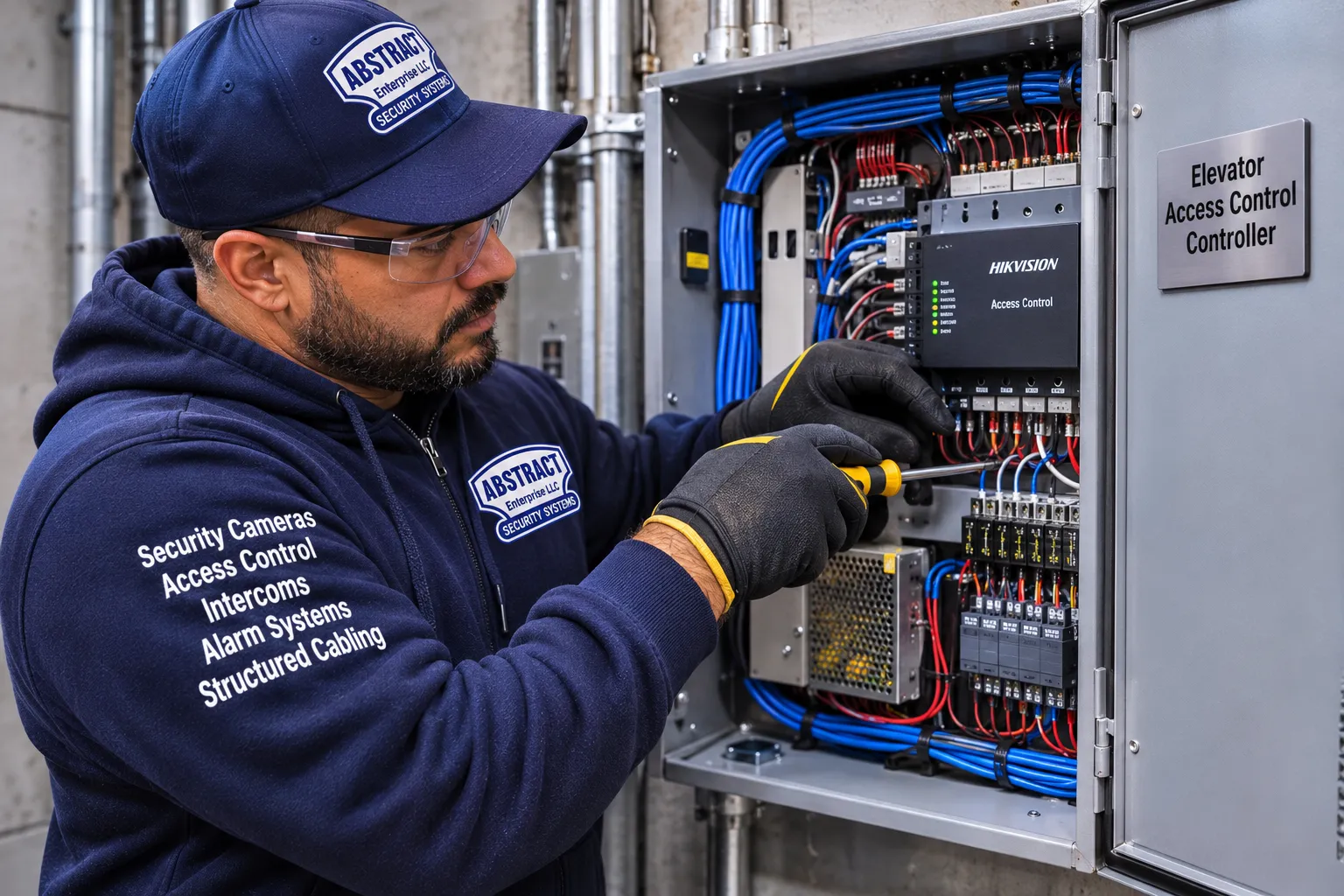
The elevator controller. The relays do not move the elevator. They connect to points inside the elevator controller that the elevator contractor provides, often spare conductors already running through the traveling cable to the car. The controller still decides everything about how the car moves, opens its doors and responds to fire service. That is why the controller side is elevator work, done by your licensed elevator contractor, and why the access side is low-voltage security work, done by us.
A tap at the reader, a check at the panel, a relay closing for a few seconds, and a floor button that now answers: that is the whole cycle, and it takes about as long as it takes to read this sentence. Everything else is design. Where the readers go, how many floors are locked, what happens during a move-in, how a visitor reaches one apartment, how a lost fob is shut off and what the system records about each ride are the decisions that make an elevator key fob access system good or frustrating. For background on how the city's rules apply to every borough, our elevator access control installation NYC page covers the citywide picture; this page stays in Brooklyn.

Every Brooklyn elevator access control job is built from the same handful of services. A small Bay Ridge co-op might need two of them; a new Gowanus rental might need all of them. Here is what each one covers and where it usually fits in the borough.
All of it is low-voltage access control installation. None of it touches the elevator's machinery, its door operator or its safety circuits. When a job needs a connection inside the controller, a change to the car operating panel buttons at the controller, a fire service tie-in or a destination dispatch interface, we bring in the building's licensed elevator contractor and plan the two scopes side by side.
The rental towers that went up after the Downtown Brooklyn, Greenpoint-Williamsburg and Gowanus rezonings were mostly designed with door access control from day one. Many of them, though, were built with an elevator that answers anyone who gets into the lobby, or with a car reader that was specified, installed and then never switched on because the leasing office wanted to avoid complaints during lease-up. Once the building is full, the reasons to finish the job pile up: amenity floors that non-residents find their way onto, a roof deck that hosts parties nobody signed up for, a co-working lounge used by people who do not live there, and package rooms that become a target.
A typical post-rezoning Brooklyn rental already runs a cloud access platform at the front door, a video intercom, a package locker or package room, and two to four passenger cars plus a service car. The fob or phone credential every tenant carries is the key to all of it. That is good news for the elevator: in most of these buildings the elevator can join the platform the building already pays for, so tenants keep one credential and the leasing staff keep one user list. Before we propose any new hardware we check whether the existing platform has an elevator module, whether its controllers can drive enough floor outputs, and whether the readers already in the cars are compatible.
Most requests in new Brooklyn towers are about amenity floors rather than apartments. Owners want the gym open from early morning to late night, the roof deck open only in season and only until a set hour, the co-working lounge open to residents but not to their guests after a certain time, and the parking level reachable only by people who rent a space. Each of those is a time-based floor permission. On a floor-by-floor system they are easy: the amenity floor relay simply follows its own schedule, and the residential floors follow each tenant's group. On a Level 1 car-enable system, they are not possible, because once the car is enabled any floor can be pressed. That difference is the most common reason a new building moves from Level 1 to Level 3.
Rental towers churn. A three-hundred-unit building can see dozens of move-ins and move-outs in a busy month, each one with a moving company that needs the service car, padded walls and a floor held open for hours. We set up a move mode that the super or leasing office can switch on for one car and one floor, with an automatic end time so nobody forgets to turn it off. Move-outs are where Local Law 63 matters: when a tenant leaves, their credential has to be deleted, and the law sets a deadline for destroying a departed tenant's reference data. We build that step into the move-out checklist so it is not left to memory.
Gowanus and many Downtown Brooklyn buildings mix market-rate and income-restricted apartments under one roof. Elevator access should never sort residents by rent. Every household gets the same credential type, the same floors and the same amenity rules that apply to its lease, and the permission chart we hand the owner is written that way. If an owner wants to charge for an amenity such as a parking level or a storage floor, that permission follows the paid add-on, not the apartment's rent program.

Converted warehouses and factory buildings in DUMBO, Williamsburg, Greenpoint and Vinegar Hill have a kind of elevator that most of the city rarely sees: a car that opens directly into an apartment, or into a small private vestibule shared by two lofts. Brick Underground describes how these key-locked elevators work. A single car may serve several units, each resident's key opens only their floor, and many older loft buildings use physical keys, often high-security Medeco cylinders, that must be turned back to the locked position after the button is pressed. If the key is left in the open position, the floor stays open to anyone who rides the car. The same article names The Metropolitan in North Williamsburg as a newer condo where some residences have keyed elevators opening directly into the apartment, some of them large freight-style cars serving two units.
Mechanical elevator keys have three problems in a Brooklyn loft building. First, the human-error problem above: a key turned and forgotten leaves a home open. Second, keys get copied, lent to dog walkers and contractors, and never come back. Re-keying a floor means a locksmith and an elevator mechanic, and residents rarely do it after a sale. Third, a key leaves no record. When a loft owner asks who rode to their floor on a Tuesday afternoon, the board has no answer. Replacing the floor key switches with credential-controlled floor-enable outputs solves all three: the floor opens only for a few seconds after a valid tap, a lost fob is shut off at the panel, and every ride to a private floor is logged.
In a loft building, floor restriction is not a convenience feature, it is the front door of each apartment. We design these jobs accordingly. Each floor is its own permission, usually limited to the household on that floor plus building staff. Visitors are let in by the resident through the intercom, which releases only that resident's floor. Dog walkers, cleaners and contractors get their own credentials with their own hours, which the owner can suspend without asking the board. The super gets a documented override for emergencies and moves, and every use of it is logged. Where a car opens into a vestibule shared by two lofts, both households share that floor permission, and the private apartment doors inside the vestibule stay on their own locks.
Old loft elevators are often older than the condo conversion, and some were freight cars converted to passenger service. The elevator contractor has to confirm that the existing key switches can be replaced or paralleled by access control outputs and how that interacts with the car's existing controls. In some buildings the contractor will want to leave the mechanical key switches in place as a backup and add our floor-enable outputs alongside; in others the keys come out entirely. We do not decide that alone, and we do not quote the loft job until the contractor has looked at the controller.

Brooklyn's co-op stock is enormous and very different from one neighborhood to the next. Ocean Parkway is lined with prewar and postwar elevator co-ops; Emroy House at 763 Ocean Parkway, for example, is a six-story co-op built in 1937 with an elevator and no doorman, which describes a great many buildings on that boulevard. Brooklyn Heights has prewar co-ops and converted hotels with old elevators and landmark lobbies. Park Slope has elevator co-ops along Prospect Park West and the avenues. Flatbush and Prospect Lefferts Gardens have large prewar co-ops around the park. Bay Ridge has rows of six-story elevator co-ops along Shore Road and the avenues. Sheepshead Bay and Brighton Beach have postwar towers, and Coney Island has the Trump Village co-op buildings on West 5th Street, more than twenty stories tall.
The classic Brooklyn co-op elevator access job is a building with one small car, five to seven floors, a part-time super and no doorman. These buildings rarely need floor-by-floor restriction. What they need is for the car to stop being a free ride for anyone who slips through the front door behind a resident. A Level 1 reader in the car, tied to the same fobs as the front door, does exactly that: people without a fob can still take the stairs, but they cannot use the elevator to reach the upper floors quickly and quietly. It is also the least expensive elevator access control we offer, at the Brooklyn rate of $1,500 per car, plus whatever the elevator contractor charges the building for their visit.
Many Brooklyn co-op elevators were modernized once, decades ago, and some still run on relay-logic controllers. The access side works the same on old and new controllers; the question is how the elevator contractor makes the connection. On a relay controller there are usually simple points to interrupt or enable a call. On a microprocessor controller there may be a built-in security input, or there may need to be an interface. Either way, the contractor decides. If the board already has an elevator modernization on the capital plan, we recommend timing the access work with it, so the new controller is ordered with the security inputs ready and the contractor makes one visit instead of two.
In a Brooklyn co-op the elevator belongs to the corporation, and the board decides. We give boards a short written scope, a per-car price, a one-page explanation of what residents will see, and a permission chart they can adopt as a house rule. The concerns we hear most often from Brooklyn shareholders are practical: elderly residents worried about fobs, families with aides who come and go, and people who simply do not want to be tracked. Our answers are equally practical. Aides get codes or their own fobs with their own hours. Residents who prefer can use a keypad code instead of a fob. And the logging settings are chosen by the board, kept to what the building needs, and written into the privacy policy that Local Law 63 already requires for rental units and that many co-op boards adopt for all residents as good practice.

Some of the biggest elevator access projects in Brooklyn are not single towers at all but complexes of many buildings under one owner or one co-op corporation. Starrett City, renamed Spring Creek Towers, is the extreme example: 5,881 apartments in 46 buildings across 153 acres north of the Belt Parkway, according to GlobeSt's report on its sale. Trump Village in Coney Island and the large postwar rental and co-op complexes in Sheepshead Bay, Canarsie and East Flatbush raise the same questions on a smaller scale.
In a complex, the first design question is whether a resident's credential should work only in their own building or across the campus. Most owners want a resident's fob to open their own building's front door, their own elevator and shared facilities such as the laundry building, community rooms and parking, and nothing else. That rule is simple to set up on a modern platform, but only if every building runs on the same system. Complexes that grew over decades often have a different access system in each building, or none at all in some. Our survey in a complex therefore starts with an inventory: every building, every car, every door, every existing panel and every existing credential format.
Nobody rewires forty-six buildings in a week. In a large complex we plan the work building by building, starting with the buildings that have the most complaints, so the management office can learn the system on a few cars before the rest come online. Each phase is scoped and priced per car, so the owner can budget it year by year. The one rule we hold to is that every phase uses the same platform and the same credential format, so a resident who moves from one building to another in the complex keeps the same fob.
A large complex has its own maintenance staff, outside contractors, security patrols and a steady stream of move-ins and move-outs. The system needs permission groups that match how the management office actually works: porters who can ride every car in their assigned buildings, security who can ride every car in every building, contractors whose access expires when their job ends, and residents whose access changes the day a lease starts or ends. We build those groups with the management office, not in advance, and we train several staff members, not just one, so the system does not depend on a single person.

A large share of Brooklyn's elevator apartment buildings are rent-stabilized, and changing how tenants get into and around those buildings is not only a technical decision. Two sets of rules matter, and Brooklyn has already seen what happens when an owner gets ahead of them.
In 2018 the owner of Atlantic Plaza Towers, a rent-stabilized complex of roughly 700 apartments in Brownsville, applied to replace the buildings' key fob entry with a facial recognition system. Tenants organized against it, and more than 130 residents filed a legal objection, according to Security Sales. The Brooklyn Daily Eagle reported that under state law the owner of a pre-1974 rent-regulated building must apply to the state's Homes and Community Renewal agency for approval of a "modification in service," and that tenants filed a formal complaint with that agency in May 2019. The same coverage noted that the Department of Buildings said facial recognition may only supplement a traditional key-based system. Whatever one thinks of biometrics, the lesson for any Brooklyn owner is that access changes in a rent-regulated building need a plan for tenant notice, any required state filing, and residents who do not consent.
We are not lawyers and we do not give legal advice about rent regulation. What we do on every rent-stabilized Brooklyn job is raise the question at the survey, so the owner can check with their counsel whether the planned change needs approval before work is scheduled, and design the system so it does not take anything away from tenants. In practice that means a credential every tenant can use without a smartphone, no biometric requirement, the stairs and the elevator's normal operation left intact, and a phased switch-on with plenty of notice. Adding a reader that lets credentialed tenants use the elevator while keeping out strangers is very different from replacing keys with something tenants object to, and the design should make that difference obvious.
Local Law 63 of 2021, the Tenant Data Privacy Act, applies to residential multiple dwellings in New York City that use smart access systems, which includes key fobs, key cards, phone credentials and biometric readers at entrances, apartments and common areas. As HPD summarizes it, owners need to give tenants a plain-language privacy policy, collect only the data needed to grant access and monitor entrances, protect that data, and destroy a departed tenant's reference data within 90 days. Consent rules apply to biometrics and other sensitive data. The elevator is a common area, so an elevator key fob access system in a Brooklyn rental falls inside the law.
Our part is to set the system up so an owner can comply. We turn off logging the building does not need, set retention periods the owner chooses, make deleting a departed tenant's credential a single step on the move-out checklist, and hand over a description of what the elevator system records so the owner's privacy policy can describe it accurately. When an owner asks for biometrics in a rental, we explain the consent burden first and recommend fobs, cards or codes unless there is a strong reason otherwise.
Many long-term tenants in rent-stabilized Brooklyn buildings are older and rely on home health aides, family members and visiting nurses. A system that only works with a smartphone app would shut some of them out. Every tenant gets a physical fob or card at no extra step, aides can be given codes or their own fobs tied to the tenant's apartment and floor, and the super can see and fix a problem from the panel without asking a tenant to install anything.
Package theft is one of the most common reasons Brooklyn boards and owners call us, and it is worth being honest about what an elevator reader can and cannot do about it. The thefts that make the news usually happen in the lobby. CBS New York reported a man filmed walking into an apartment building on Lawton Street in Bushwick and walking out with packages from the lobby. News 12 Brooklyn reported a man at a Crown Heights building on Crown Street who used a child in a stroller to get a resident to hold the lobby door, checked that the lobby was empty, and took two packages from a pile on the floor.
An elevator reader would not have stopped either theft. Both happened within a few steps of the front door. What elevator access control does stop is the next stage: the thief who gets in and then rides upstairs to take packages left at apartment doors, or to try door handles on quiet floors. In Brooklyn buildings where carriers leave boxes at the apartment door, floor restriction keeps a tailgater in the lobby or on the open floors. In buildings with a package room, the right fix for the lobby itself is a controlled package room or lockers on the same fob system, a camera that covers the drop area, and an intercom that lets carriers in to a delivery zone instead of the whole building.
The best Brooklyn package setup we design is one credential system covering the front door, the package room or lockers, and the elevator. Carriers get a delivery code or an intercom path that opens the front door and the package room but not the cars. Residents tap the same fob for all three. The managing agent sees in one log when a delivery code was used and when the package room was opened. Elevator access control is one part of that picture, not the whole of it, and we tell boards so before they spend money on the wrong part.
Brooklyn's commercial buildings are less about glass office towers and more about converted industrial space shared by many tenants. Industry City in Sunset Park alone holds more than 650 businesses in 16 buildings and about 6 million square feet, with thousands of workers on site, according to the Brooklyn Daily Eagle. At the Brooklyn Navy Yard, Building 77 opened in 2017 as manufacturing and office space expected to bring thousands of jobs. Along the waterfront from Red Hook to Greenpoint, and inland through East Williamsburg and Bushwick, old factories now hold studios, food producers, tech offices, schools and light manufacturers on different floors of the same building.
In these buildings the freight elevator often matters more than the passenger car. Tenants move pallets, carts and equipment between floors all day. A card reader on a freight car needs to be mounted where an operator can reach it without climbing over a load, rugged enough to survive carts and pallet jacks, and set up so that loading crews are not tapping at every trip. The common answer is a reader that enables the car for a set period, with each tenant's crew allowed only its own floors plus the loading dock level, and a building override for the freight manager.
Commercial tenants in Brooklyn industrial buildings frequently bring their own door access systems for their own suites. The building's elevator system does not have to match each tenant's system, but it does need to read the credentials those tenants carry. Multi-technology readers in the cars can read several card formats at once, and the building's platform can hold each tenant's employees as its own group with its own floors and hours. Where a tenant needs after-hours access for a production shift, that tenant's group gets a schedule of its own, and the rest of the building stays locked.
Industrial buildings do not keep office hours. Some tenants run early shifts, some run nights, some run weekends. We build schedules per tenant group rather than for the building as a whole, plus holiday calendars, so a bakery's early crew and a studio's late crew each get the floors they need when they need them. Lobby and common floors can stay open during busy daytime hours so visitors and couriers are not stuck at the reader.
Downtown Brooklyn and Fort Greene are home to The Brooklyn Hospital Center, founded in 1845 and now at 121 DeKalb Avenue on the west side of Fort Greene Park, with 464 licensed beds. Large hospitals run their own security departments and elevator programs, but the medical office buildings, outpatient clinics, dialysis centers and physician practices that grow up around a hospital often sit in mixed-use buildings with ordinary passenger elevators. Those buildings want public floors open to patients during clinic hours, staff-only floors such as storage, records and pharmacy kept on cards, and the whole building locked down at night. A floor-by-floor system with schedules handles that, with the elevator contractor deciding how the controller handles any hospital-service or medical emergency features the cars already have.

Owners and boards often ask us for "the best elevator access control system." There is no single best brand. There is a best design for a given building, and in Brooklyn the building usually tells you what it is within a few minutes of the survey. These are the patterns we see most.
Five to eight floors, one or two cars, a front door fob system already in place, and a problem with outsiders riding up. Level 1, a reader in each car on the same fob system as the front door, solves the problem at the lowest cost. Floor-by-floor restriction is rarely worth it in these buildings, because most residents know each other and the goal is to keep strangers off the elevator, not to keep neighbors off each other's floors.
Ten to twenty floors, two to four cars, a gym, roof or storage floor that the owner wants to control by hours, and a lobby intercom. Level 3 floor-by-floor restriction is usually right here, because amenity schedules and visitor floor release are the features the building is really asking for. Many of these buildings can keep the existing front door platform and add elevator outputs.
Floor restriction is essentially mandatory, because the elevator is the door to each home. Every floor gets its own permission, visitors are released through the intercom only to their host's floor, and the super has a logged override.
Hundreds or thousands of residents, constant turnover, several cars per building and sometimes many buildings. What matters most is the platform: cloud management, mobile credentials alongside fobs, clean move-in and move-out workflows, and the ability to handle the data duties of Local Law 63 without manual work. Floor-by-floor restriction is common in the towers; car-enable readers are often enough in mid-rise buildings of a complex.
Whatever the design, the buildings where elevator access control goes smoothly follow the same few rules. Tell residents what is changing, when, and why, several weeks before switch-on. Issue credentials before the restriction is turned on, not on the same day. Leave the lobby and the floors everyone uses open where you can. Give older residents and aides a code or a second fob. Turn the restriction on during a weekday, with staff available, not on a Friday night. And keep a person in the management office who can fix a missing permission the same day it is reported.

"Phone control" means two different things, and Brooklyn buildings often want both.
Most modern platforms we install let a resident use a phone app instead of, or alongside, a fob. The phone talks to the reader in the car over Bluetooth or NFC, and the panel treats it like any other credential. In new Brooklyn rental towers mobile credentials are now common, because leasing offices can issue them remotely before a tenant even picks up keys. We still recommend that every resident who wants one keeps a physical fob on the same account, and in rent-stabilized buildings and co-ops with many older residents we treat the fob as the default and the phone as the option.
The more useful kind of phone control for a Brooklyn building is remote management. A cloud-managed access platform lets the super, the managing agent or the leasing office add a resident, suspend a lost fob, change a floor permission, open a floor for a contractor, switch on move mode for a service car or check the log, from a phone or laptop, without going to the building. For a managing agent who runs a dozen buildings across Brooklyn, that is the difference between a five-minute fix and a trip across the borough. Some platforms also let staff release a floor for a resident who is standing in the car with a dead fob, with that action recorded in the log.
Remote management needs the panel to be on a network. In newer Brooklyn buildings that is usually easy, because the access system already has a network connection in the lobby or the telecom room. In older buildings, the panel may sit in a machine room on the roof or in the cellar with no network nearby. A network connection or new cable run to reach it is quoted as its own line after the survey. Remote programming is also how we keep most Level 1 jobs simple: once the reader is installed and the elevator contractor has made the connection, we can usually update the user list and settings without coming back.

The credential is what residents and workers notice every day, so it is worth choosing carefully. This is how the options compare in Brooklyn's building types.
| Credential | Strengths | Weak spots | Where it fits in Brooklyn |
|---|---|---|---|
| Proximity key fob | Cheap, familiar, works for every age | Older formats can be copied; lost fobs must be shut off | Co-ops, rent-stabilized rentals, complexes with existing fob systems |
| Encrypted smart card or fob | Much harder to copy; same easy tap | May require new readers if the building has old prox readers | Condos, new rentals, any building replacing old prox fobs |
| Mobile credential (Bluetooth or NFC) | Issued remotely, hard to lend, no fob to lose | Depends on a charged phone and an app | New rental towers in Downtown Brooklyn, Williamsburg and Gowanus |
| PIN keypad or video keypad station | No credential to carry; easy for aides and staff | Codes can be shared; needs periodic code changes | Buildings with many home health aides; service cars; small co-ops |
| Multi-technology reader | Reads several card formats at once | Settings must be kept tidy as formats are retired | Navy Yard, Industry City and other multi-tenant commercial buildings |
| Face, fingerprint or iris (Level 2) | Nothing to lose or lend | Consent and privacy duties; strong tenant objections in some buildings | Staff-only floors, private condo floors with owner consent; rarely rentals |
The biggest decision for most Brooklyn buildings is not which credential is best, but whether to keep the credential residents already carry. If the front door uses an older proximity fob, extending it to the elevator is the cheapest path but carries the old fob's weaknesses into the car. If the building is planning to replace the front door system anyway, moving everyone to encrypted credentials at the same time is the cleaner choice. We lay out both paths with prices before the board or owner decides.
We install, integrate and service readers and platforms from manufacturers including HID, Akuvox, Brivo, Kisi, LenelS2, Genetec, Gallagher, ICT Protege, Suprema, ZKTeco, Paxton, Axis, ButterflyMX and 2N. We are not a certified dealer or partner of any of them, which lets us recommend whichever fits the building, including the one the building already owns.
Residents are the easy part. The design work in a Brooklyn building is mostly about everyone else who needs to ride.
We set these groups up with the people who will manage them, because a visitor plan that looks good on paper and confuses the doorman will be bypassed within a week. The goal is that nobody has to prop a door or leave a car on independent service just to get through an ordinary day.
Elevator access control in Brooklyn always has two trades on the job, and the safety rules are the reason. Since January 1, 2022, anyone performing elevator work in New York City, including alteration and installation, needs both city and state elevator licenses, as the Department of Buildings' license FAQ explains. Abstract Enterprises Security Systems works on the low-voltage access control side under NYS license #12000287431 and does not perform elevator work. The building's licensed elevator contractor makes the controller connection, handles any changes to the car operating panel at the controller, and owns the fire service behavior of the car.
NYC DOB Buildings Bulletin 2022-010 says devices added to elevator cabs and hall stations must not impede normal or emergency operation and must become inoperative when Phase I or Phase II firefighters' emergency operation begins. In practice, when the fire alarm or a recall key brings the cars down, our readers and floor relays are ignored and the car responds only to the firefighters. We design the wiring so that happens, and we test it together with the elevator contractor before handover. This is not something to compromise on, and any proposal that keeps floors locked during recall is a proposal to walk away from.
Our access panels have battery backup, sized for the readers and relays they carry, so a short outage does not change anything. For longer outages, the building decides in advance whether floors should open or stay locked when the access system loses power, and the elevator contractor confirms how that interacts with the car's own emergency power and lowering features, which are separate from our system. In most Brooklyn apartment buildings the board or owner chooses to free the floors if our panel's power fails, so residents are never kept from their own floor by a dead battery.
The elevator contractor's visit to make the controller connection is arranged and paid by the building directly, usually through the existing maintenance contract. It is not part of our price. We send the elevator company our drawings and the list of floor outputs, agree the connection points and the test plan, and schedule our work around their visit so the car is out of service as briefly as possible. If the elevator contractor decides a DOB filing is needed for their part, that is their filing and their timeline, and we raise the question early so it does not surprise the board at the end.
The survey is where most of the quote is decided. In Brooklyn buildings we pay particular attention to the things that vary most across the borough's stock.

These are the eight steps on every Brooklyn job, from a one-car Bay Ridge co-op to a multi-car Gowanus rental. The elevator contractor appears in steps four and seven.
Elevator access control from Abstract Enterprises Security Systems is sold in three levels and priced per elevator car, and Brooklyn is our base rate.
| Level | What it does | Brooklyn price |
|---|---|---|
| Level 1: reader in the car | Card, fob, PIN code, phone or video keypad station inside the car. Once authorized, the rider can choose any floor the car serves. Ties into spare conductors in the elevator controller cabinet; usually programmed remotely. | From $1,500 per car |
| Level 2: biometrics | Face recognition, fingerprint or iris reader in the car, in place of or alongside cards and codes. | From $2,500 per car |
| Level 3: floor-by-floor and building-wide | Floor-by-floor restriction, lobby and garage hall-call readers, time schedules, intercom floor release, destination dispatch integration. | Quoted per building after survey |
A two-car building on Level 1 therefore starts at $3,000 for our part. Level 3 is not published as a single price because it grows with the number of floors, the number of cars, the number of hall stations and the way the building wants to handle visitors, schedules and amenity floors.
Two items are never in our per-car price. The first is the elevator company's visit to make the controller connection, which the building arranges and pays directly. The second is a network connection or a new cable run to the car or machine room if remote management needs one; that is quoted as its own line after the survey, because in a cellar machine room in a prewar co-op it can be very different from a telecom closet next door in a new tower.
Our quote is written per building after the survey, lists every item on its own line, and shows the elevator contractor's part separately so the board or owner sees the full cost of the project, not only ours. Visits are booked as a 2-hour arrival window.
Full terms โ including 50% deposit, one-year parts-only warranty on Abstract Enterprises Security Systems-supplied products, and the late-fee schedule โ are set out in the service agreement.
The same four designs show up across the borough, but each one fits some Brooklyn buildings much better than others.
| Brooklyn building | Usual design | Level | Main reason |
|---|---|---|---|
| Six-story prewar co-op, one car, no doorman (Ocean Parkway, Bay Ridge, Flatbush) | Reader in the car on the front door fobs | Level 1 | Keep tailgaters off the elevator at the lowest cost |
| Loft condo with key-locked floors (DUMBO, Williamsburg, Vinegar Hill) | Floor-by-floor restriction with intercom floor release | Level 3 | The elevator is each home's front door |
| Post-rezoning rental tower (Downtown Brooklyn, waterfront, Gowanus) | Floor-by-floor with amenity schedules and mobile credentials | Level 3 | Amenity floors, guests and constant turnover |
| Large multi-building complex (Spring Creek, Coney Island, Canarsie) | Car readers building by building on one platform, floor control in towers | Level 1 to Level 3, phased | One credential across many buildings and a budget spread over years |
| Rent-stabilized walk-in elevator building | Reader in the car with fobs and codes, no biometrics | Level 1 | Keep strangers out without taking anything from tenants |
| Industrial multi-tenant building (Navy Yard, Industry City, Bushwick lofts) | Multi-technology readers, tenant groups and schedules, freight car control | Level 3 | Many tenants, many badge types, non-office hours |
| Medical office building near Downtown Brooklyn hospitals | Public floors open by schedule, staff floors on cards | Level 3 | Patients by day, staff only at night |
| Private condo floor with owner consent | Fingerprint or face reader for that floor | Level 2 | Nothing to lose or lend for a small group of owners |
AI answers about elevator access control are usually written for a generic office park. Brooklyn's buildings expose the gaps quickly.
It may be sold that way, but in Brooklyn the most public test of the idea went badly for the owner. At Atlantic Plaza Towers in Brownsville, a plan to replace key fobs with facial recognition drew a formal objection from more than 130 residents and a complaint to the state housing agency. Local Law 63 adds consent and data duties for biometrics in residential buildings. For most Brooklyn rentals, fobs, encrypted cards, codes and optional phone credentials are the practical standard. Biometrics belong where the people using them have agreed to them.
The Bushwick and Crown Heights thefts in the news happened a few steps inside the front door. An elevator reader keeps intruders off the residential floors, which protects packages left at apartment doors, but the lobby needs its own answer: a controlled package room or lockers on the same fob system, a camera on the drop area and a delivery path that does not open the whole building.
In New York City the connection into the elevator controller is elevator work that needs city and state elevator licenses. A security contractor installs the readers, relays, cable and software and coordinates; the building's licensed elevator contractor does the controller side. A proposal that skips the elevator contractor is a proposal to decline.
A single reader usually just enables the car, so an approved rider can press any floor. That is fine for a small co-op trying to keep strangers off the elevator, and useless for a loft condo where each floor is someone's home. Floor restriction needs an output for each floor in each car, or a destination dispatch interface in the few buildings that have one.
Prewar and postwar cars with older controllers can very often accept access control outputs; the elevator contractor decides how. The more common obstacle in old Brooklyn buildings is the cable path to a rooftop or cellar machine room, which is a labor and planning question, not a reason to give up.
Not in a building with older residents, aides and tenants who do not want an app. Phones are a good option and a fine default in new rental towers. In co-ops and rent-stabilized buildings we keep physical fobs as the default and add phones for those who want them.
On some platforms it is, on paper. In practice the elevator brings another trade, safety rules about fire service, a power-loss decision, a permission chart for every floor and, in Brooklyn's rentals, data duties under Local Law 63. Treating it as an afterthought is how buildings end up with readers installed in cars that were never switched on.
A good share of our Brooklyn elevator work is on systems someone else installed. The problems repeat from building to building, and so do the fixes.
When we take over an existing system, you get a written finding first: what is installed, what works, what is unsupported, and what we recommend, so a board can decide between repair and replacement with facts in hand.
Brooklyn boards and managers usually have three options when they want elevator key fob access: their elevator maintenance company, their existing door access or intercom vendor, or an independent low-voltage security contractor. The elevator company knows the controller but often does not install or manage access platforms. The intercom vendor may sell only one brand. An independent contractor can work with the elevator company and the building's existing systems at the same time. That is the role we fill.
Abstract Enterprises Security Systems is based in Brooklyn, with our Brooklyn office at 1282 Troy Avenue. We have been in the security business since 2002, and intercoms, door access control, cameras and building cabling are our daily work in the borough's co-ops, rentals and commercial buildings. What that means for an elevator job:
Ask who makes the controller connection and whether they hold elevator licenses; whether the contractor will meet your elevator company before ordering; what the readers do on firefighters' recall; what happens to the floors if the access panel loses power; how a lost fob is shut off and how quickly; what the system records and for how long; and whether the quote separates their price from the elevator company's. A contractor who answers all of those plainly is one you can work with.
A finished elevator access job should leave the building able to run it without calling us for every change. Every Brooklyn job ends with:
The fob itself only carries a number. When a tenant taps it on the reader in the car, the access panel looks that number up, finds the tenant's group, and closes a relay for each floor that group may reach at that hour, usually the lobby, the tenant's own floor and any amenity floor that is open. Those buttons work for a few seconds and the rest stay dead. In a Level 1 building the panel enables the whole car instead, so any floor can be pressed after a valid tap.
That is a question for the owner's counsel, and we raise it at the survey. Coverage of the Atlantic Plaza Towers case in Brownsville reported that owners of pre-1974 rent-regulated buildings must apply to New York State Homes and Community Renewal for approval of a modification in service. We design rent-stabilized jobs so nothing is taken from tenants, with fobs and codes for everyone and no biometric requirement, and we schedule work only after the owner confirms what approvals apply.
You will need both, and we are the Brooklyn-based half. Abstract Enterprises Security Systems has its Brooklyn office at 1282 Troy Avenue and installs the readers, relays, cable, fobs and programming under NYS license #12000287431. Your elevator maintenance company makes the connection inside the controller under its elevator licenses. We contact them, agree the connection and test plan, and schedule around their visit so the board deals with one plan instead of two.
Put every building on one access platform and one credential format, then add readers to the cars building by building, starting with the buildings that have the most complaints. Each resident's fob opens their own building's door and elevator plus shared facilities, and nothing else. Porters, security and contractors get their own groups. Phasing the work and pricing it per car lets a large owner spread the cost over several budget years without ending up with mixed systems.
In most of these buildings, a Level 1 reader in the car on the same fobs as the front door. It keeps tailgaters and strangers from riding up quietly, costs from $1,500 for the car at the Brooklyn rate plus the elevator company's visit, and changes almost nothing for shareholders. Floor-by-floor restriction is rarely needed in a small co-op where neighbors know each other. Residents who dislike fobs can use a keypad code instead.
Yes, if the building runs a cloud-managed platform and the panel is on a network. The manager can open the app, check why the resident was refused, fix the permission or release the floor for that ride, and the action is logged. In older buildings where the panel sits in a rooftop or cellar machine room without a network connection, we quote the connection separately after the survey so this kind of remote help is possible.
Levels 1 and 2 are priced per car, so two cars on Level 1 start at $3,000 for our part, and two cars on Level 2 start at $5,000. Both cars normally get readers, because riders take whichever car arrives first. Level 3 floor-by-floor restriction is quoted per building after the survey. The elevator company's visit is paid by the building directly, and any network or new cable run is quoted on its own line.
Yes. Each floor becomes its own permission, limited to that household and building staff, and visitors are released to their host's floor through the intercom. The floor opens only for a few seconds after a valid tap, so nobody can leave it open by forgetting to turn a key back, and a lost fob is shut off at the panel instead of re-keying. The elevator contractor decides whether the old key switches come out or stay as a backup.
It helps upstairs, not in the lobby. Floor restriction keeps intruders away from packages left at apartment doors, but thefts like the ones reported in Bushwick and Crown Heights happen a few steps inside the front door. For the lobby, the answer is a controlled package room or lockers on the same fob system, a camera on the drop area, and a delivery code that opens the door and package room without opening the residential floors.
Yes. We mount a rugged reader where an operator can reach it beside a load, and set it so one tap enables the car for a working period rather than a single trip. Each tenant's crew can reach only its own floors and the loading dock, and the freight manager has an override for deliveries. Schedules follow each tenant's real shifts, which matters in buildings at the Navy Yard or Industry City that run early mornings, nights and weekends.
Rarely. Tenants in Brownsville strongly opposed a plan to replace fobs with facial recognition, Local Law 63 adds consent and data duties for biometrics in residential buildings, and the Department of Buildings said such systems may only supplement a key-based system. We install Level 2 biometrics from $2,500 per car where users have agreed, such as staff-only floors or private condo floors, and recommend fobs, cards or codes for rentals.
Always. Every resident gets a physical fob or card, and we treat it as the default in co-ops and rent-stabilized buildings. Residents who prefer can use a keypad code. Aides and family caregivers can get their own fobs or codes tied to the resident's floor and shift hours. Phone credentials are offered as an extra for people who want them, never as the only way to ride.
We book the survey within 2 hours of your request, by phone at (347) 934-8335 or through the form, and the visit itself is scheduled in advance in a 2-hour arrival window that suits the super or manager. Installation dates follow the written scope and the elevator contractor's schedule, so we do not promise same-day installation, but the first step happens quickly.
Elevator Access Control Installation NYC | Fob & Card ยท Elevator Access Control Installation in Manhattan ยท Elevator Access Control Installation in Queens ยท Elevator Access Control Installation in the Bronx ยท Elevator Access Control Installation in Staten Island ยท Elevator Access Control Installation Long Island NY ยท Elevator Access Control Installation Hudson Valley NY ยท Elevator Access Control Installation in Nassau County ยท Elevator Access Control Installation in Suffolk County ยท Elevator Access Control Installation in Westchester County ยท Elevator Access Control Installation in Rockland County ยท Elevator Access Control Installation in Orange County
Tell us the Brooklyn address and neighborhood, how many floors and elevator cars the building has, what fob, intercom or access system you use now, and who should be able to reach which floors. Let us know whether it is a co-op, condo, rent-stabilized rental, large complex or commercial building, and name your elevator maintenance company if you know it. Photos of the lobby, the inside of a car and the machine room door help. Prefer to talk? Call our Brooklyn office at (347) 934-8335 or toll-free at (800) 486-0943.