Restricting floors in a Nassau co-op, keeping a club or medical floor private, or planning elevator access in a new Suffolk building? Call (800) 486-0943
Home › Elevator Access Control Installation Long Island
Elevator Access Control Installation on Long Island
Floor-by-Floor Restriction · Card, Fob, Keypad & Phone Credentials · Coordinated With Your Elevator Contractor
Elevator access control installation on Long Island means one thing in practice: the person who rides the car can only reach the floors their card, fob, code or phone allows. On the Island that request comes from a mix of buildings the city rarely sees together, from seven-story co-ops in Great Neck and oceanfront towers in Long Beach to medical office complexes in Lake Success, hotels with a club floor in Garden City, apartment buildings beside the Long Island Rail Road stations and senior residences in Suffolk. Abstract Enterprises Security Systems installs the low-voltage side of the job, the readers in the cab or at the hall call stations, the floor-release relays, the cabling, the credentials and the programming, and we plan every tie-in to the elevator controller with the licensed elevator contractor who maintains your cars.
Reviewed and updated November 14, 2026 by Abstract Enterprises Security Systems, NYS license #12000287431 · Sources: New York State Labor Law Article 33 and the NYS Department of Labor elevator licensing page; the NYS Department of State draft of the Existing Building Code of New York State on altered elevators; ASME A17.1 firefighters' emergency operation as summarized by the NYC Department of Buildings; Habitat Magazine on The Waters Edge in Long Beach after Superstorm Sandy; the Long Island Herald on 415 National Boulevard; CooperatorNews on Kenwood Gardens; Bisnow on Long Island transit-oriented development; Long Island dot com on Alston Station Square; the Governor's office on 11 Park Drive in Wyandanch; the Crexi listing for the Lake Success Quadrangle; The Garden City Hotel; Stony Brook University's access control policy; IPVM, ButterflyMX and installers on r/accesscontrol on how floor restriction is wired.
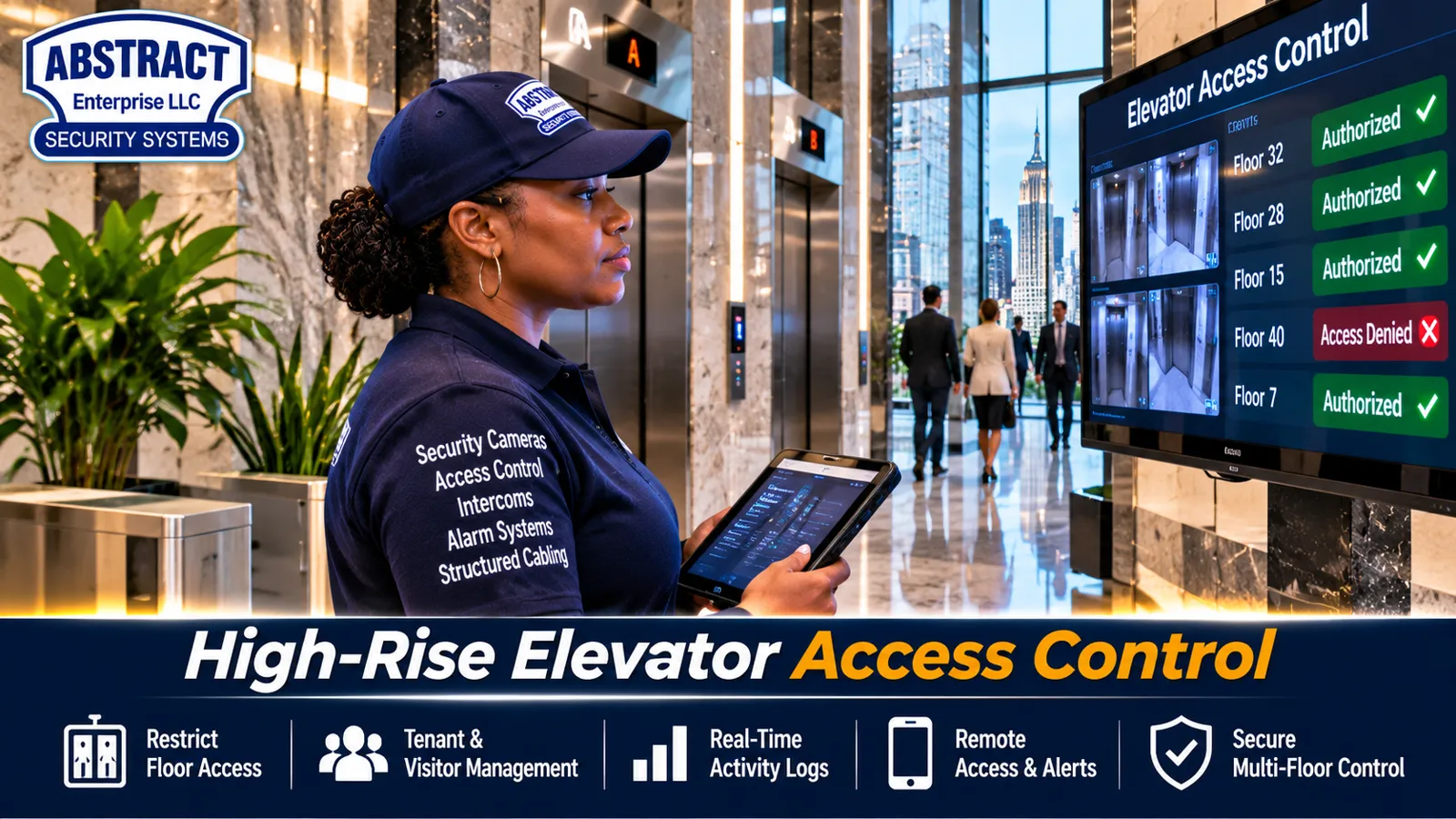
A technician in an elevator lobby checks a tablet while a wall display lists each floor as authorized or denied. On a Long Island property this screen is usually the managing agent's laptop rather than a lobby monitor, but the idea is the same: every floor has its own rule, and every rule is visible.
Long Island Elevator Access Request
Tell us the building, how many cars and floors, and what you want controlled
✅
Request Sent!
Thank you. We will be in touch to book your Long Island building survey, usually within 2 hours of your request.
25+
Years Experience
2-Hr
Arrival Windows
100%
Licensed & Insured
4.7★
201 Google Reviews
Owner-operated since 2002 · Thousands of jobs completed · Booked within 2 hours
Quick answer: elevator access control on Long Island starts at $1,725 per elevator car in Nassau and $1,800 in Suffolk for a Level 1 card, fob or code reader, and at $2,875 and $3,000 per car for Level 2 biometrics; floor-by-floor restriction is quoted per building after a survey that counts the cars, the floors each car serves, the hall call stations and the controller type, because one reader in a single-car Suffolk senior residence and floor-by-floor restriction across a two-car bank in a Nassau co-op are completely different amounts of equipment and coordination. The quote is written: which readers go where, how each floor is released, what the elevator contractor does at the controller and what we do, how credentials are issued, and a price for every line. We book the survey within 2 hours of your request and arrive inside a 2-hour window. Call (800) 486-0943 or use the form.
Readers, floor-release relays, wiring, credentials and programming by our crew; controller connections made with, or by, your licensed elevator contractor
Every car in a bank treated the same way, so a rider cannot simply wait for the car without a reader
Low-voltage work under NYS license #12000287431, with your board, managing agent or facilities office and your elevator contractor signed off before a crew is booked
Why Long Island Buildings Need Elevator Access Control Installation
Long Island's elevator buildings are a smaller share of its housing than in the city, but they are concentrated exactly where security questions are hardest: older co-ops with no doorman, oceanfront towers that have already lost their entry systems once to a storm, new station-area rentals with hundreds of units behind one lobby, and medical and hotel properties where one floor has to stay private. Most of Nassau and Suffolk is single-family houses, so a building with a passenger elevator tends to stand out in its village. It is often the one with the most residents, the most visitors, the most deliveries, and in many cases the oldest elevator equipment in town. When a board or an owner asks for elevator access control, they are usually trying to solve one of four problems.
The first problem is the lobby that anyone can get through. In a building without a doorman, the front door is the only real control point, and once someone is behind it, whether they followed a resident in, came in with a delivery or found a door propped open, the elevator takes them to any floor they like. A reader that releases only the rider's own floor turns a single checkpoint into two. That second layer matters most in the Island's older co-ops and in senior housing, where what residents want is simple to say: to know that the person on their hallway is supposed to be there.
The second problem is the private floor. Hotels with a club level, office buildings with an executive suite or a server room, medical buildings with a surgical or records floor, condo towers with a penthouse and a rooftop amenity deck all need one or two floors that open only for certain people at certain times. On Long Island this is common in the Garden City and Lake Success corridors, along the Route 110 office belt and around the Stony Brook and Mineola medical campuses.
The third problem is the building that has outgrown its keys. Plenty of Island buildings still run their restricted floors on a keyswitch in the car operating panel. The key works until it is copied, lost or handed to a contractor who never returns it, and there is no record of who used it. Replacing keyswitches with card, fob, code or phone credentials gives the board or the manager a list of every credential, the ability to cancel one in seconds, and a log of what was used and when.
The fourth problem is the building that is brand new. The station-area apartment buildings going up next to Long Island Rail Road stations, from Mineola to Patchogue to Ronkonkoma and Wyandanch, are designed with elevators, amenity floors, package rooms and garages from the start. Planning elevator access control before the elevator contractor finishes the controller and before ceilings close costs a fraction of retrofitting it two years after occupancy.
Long Island facts that shape an elevator access plan
The Island's first co-op is an elevator building: Kenwood Gardens in Great Neck, seven stories and 69 units built in 1925, is described by CooperatorNews as the first co-op constructed on Long Island. Buildings of that age carry elevators that have usually been modernized more than once, and every modernization leaves its own wiring behind.
The ocean has already taken out entry systems once: after Superstorm Sandy, The Waters Edge co-op at 700 Shore Road in Long Beach had a flooded lobby, a garage filled with sand and only one working elevator for a time, and its repair bill, including electrical work and a new boiler, came to about $3.2 million according to Habitat Magazine.
Seniors notice when security fails: three months after Sandy, residents of 415 National Boulevard, a six-story senior building run by the Long Beach Housing Authority, told the Long Island Herald that one elevator was still out and the front-entrance intercom did not work, so anyone could walk in.
Station-area buildings put hundreds of homes behind one lobby: Bisnow counted 275 units in the six-story Modera Mineola and 291 at New Village at Patchogue, and TRITEC opened the first 245 rental units of Alston Station Square at the Ronkonkoma Hub in two buildings in September 2019.
Senior housing is being built with elevators: 11 Park Drive Apartments in Wyandanch Village, completed in 2022 according to the Governor's office, has 94 affordable apartments for residents 62 and older on five stories.
Office and medical space comes in very large complexes: the Lake Success Quadrangle lists about 1.1 million square feet of Class A office and medical space with on-site owner management, indoor parking and shared amenities.
Hotels with a private floor: The Garden City Hotel, across from the Garden City LIRR station, lists 269 rooms and suites and a Club Level on its penthouse floor, the classic case for a floor that only some key cards should reach.
What Long Island boards and managers usually add next. Once the elevator only goes where a credential allows, the next weak points are the doors that bypass it: the stairwell doors on restricted floors, the garage entrance and the side door by the trash room. Those are door access jobs on the same platform, so on the first survey we note which doors would need a reader, a lock or a camera, and leave capacity in the controller for them.
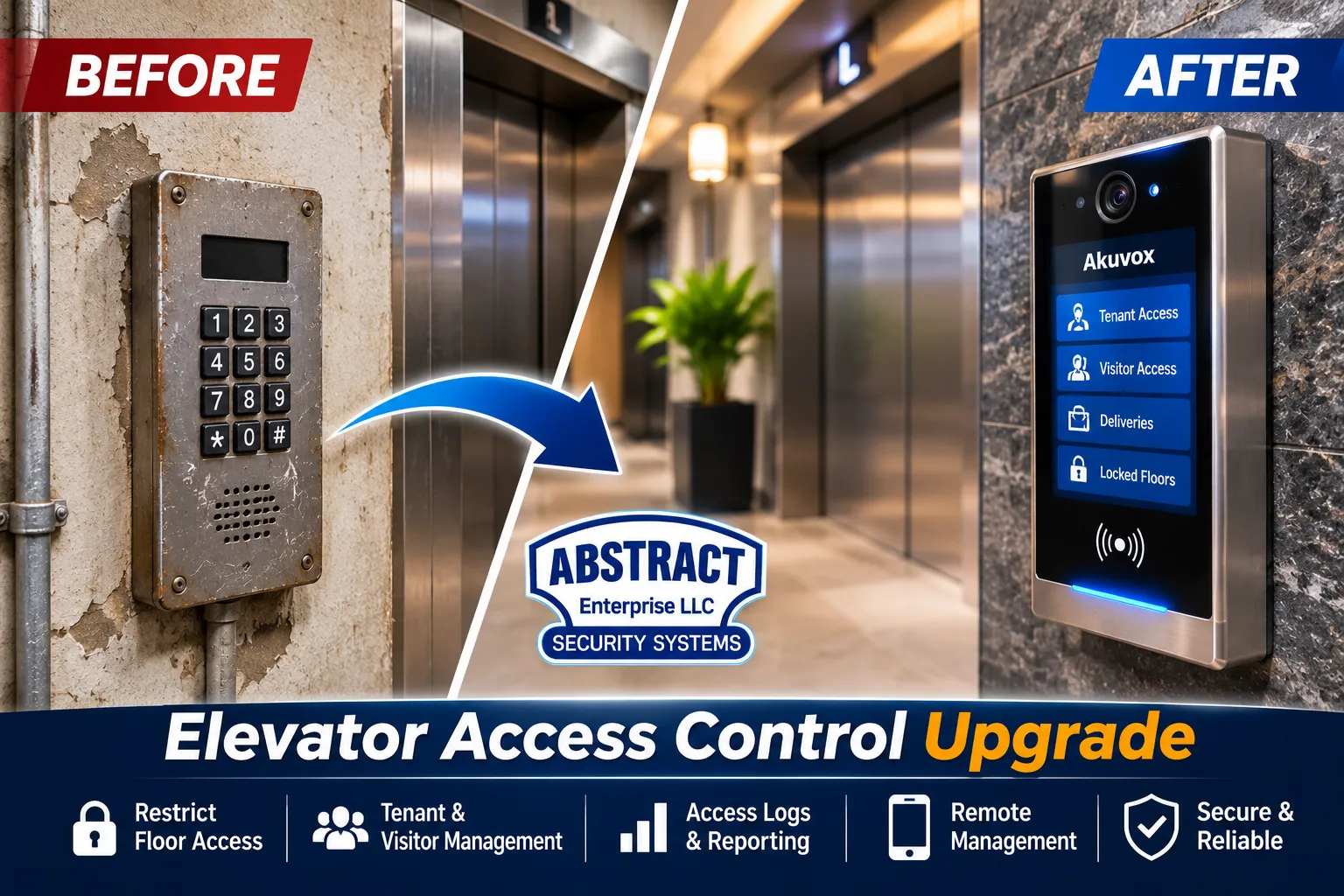
Before and after in one frame: a rusted keypad with a speaker grille on a stained wall, and a modern touchscreen station offering tenant access, visitor access, deliveries and locked floors. Many Long Island co-ops and post-war rentals still have something like the left side bolted beside the elevator.
Fob Stopped Working in the Cab, a Floor Won't Release, or the Reader Is Dark? What to Check First
Some elevator access problems need a technician and some do not. Before you call, three checks tell you which kind you have. First, is it one person or everyone? If one resident's fob is refused in the cab but everyone else rides normally, the credential has most likely expired, been cancelled by mistake or been damaged, and the fix is in the software, not the elevator. Second, is it one car or the whole bank? If the reader in one car is dark while the other car works, that points to power, a cable or the reader itself in that car's traveling cable or cab panel. Third, did anything happen to the elevator recently? A maintenance visit, an inspection, a power outage, a lightning storm or a firefighters' recall test can all leave the access system and the controller out of step. Write down which floor, which car, what the reader's light did and the time, then call (800) 486-0943. If the cars themselves are stuck, out of service or alarming, call your elevator company first; that is their equipment and their emergency, not ours.
Nassau and Suffolk Are Different Elevator Markets: How the Work Changes From Great Neck to Ronkonkoma
Nassau County's elevator buildings are older, denser and mostly run by boards; Suffolk's are newer, more spread out and more often run by a single owner, a hospital system, a college or a housing developer. That difference decides who approves the work, how much existing equipment we inherit, and how the project is scheduled.
Nassau: co-ops, condos and medical corridors
In Nassau the typical elevator access call comes from a co-op or condo board on the North Shore or the South Shore. Great Neck, Great Neck Plaza, Manhasset, Port Washington, Roslyn, Garden City, Mineola, Rockville Centre, Hempstead, Freeport and Long Beach all have apartment houses built between the 1920s and the 1970s, plus a newer layer of luxury condos and rentals near the Long Island Rail Road. Many of them have one or two passenger cars, a basement laundry and storage level, sometimes a garage, and either no doorman or a doorman only part of the day. Boards ask for three things in roughly this order: stop strangers from reaching the residential floors, lock the basement and garage levels to residents and staff, and replace a front-door intercom that no longer works with one that can also send a guest to the right floor.
Nassau is also where the large medical and office complexes cluster, along Marcus Avenue and Lakeville Road in Lake Success and New Hyde Park, along Old Country Road and Stewart Avenue in Mineola, Garden City and Westbury, and around the hospitals in Mineola, Manhasset and Valley Stream. There the request is usually a single restricted floor, an after-hours schedule, or reader replacement when a tenant or a hospital system changes its badge technology.
Suffolk: campuses, hospitals, hubs and senior housing
Suffolk's elevator buildings are spread over a much larger area and are more often institutional. The university and hospital campus at Stony Brook, the hospitals in Riverhead, Patchogue, Smithtown, Bay Shore and West Islip, the office parks along Route 110 in Melville and along the Long Island Expressway in Hauppauge, the new downtown buildings in Patchogue, Ronkonkoma, Wyandanch and Lindenhurst, and a growing number of senior and assisted living residences all have elevators that need someone to decide who rides to which floor. Large institutions usually have their own access control office and their own standard system; Stony Brook University's policy, for example, gives its Office of Access Control and Lock Shop sole responsibility for the design, installation and maintenance of its electronic card access systems. In that setting our role is to install to the owner's standard, not to sell a different one.
Suffolk also has more new construction where elevator access can be designed in from the start. A five-story senior building or a station-area rental is a short list of cars and floors, but the decisions made during construction, where the controller sits, how many spare conductors run in the traveling cable, whether the car operating panel has room for a reader, are expensive to undo later.
What is the same in both counties
Outside the five boroughs, building and elevator work follows New York State rules rather than New York City's, and the elevator itself belongs to a licensed elevator contractor's scope under state law. Both counties also share the same practical reality: the elevator company that maintains your cars has a maintenance agreement, a technician who knows the controller and a schedule that we have to fit into. Every Long Island elevator access project we plan starts with that company's name and phone number.
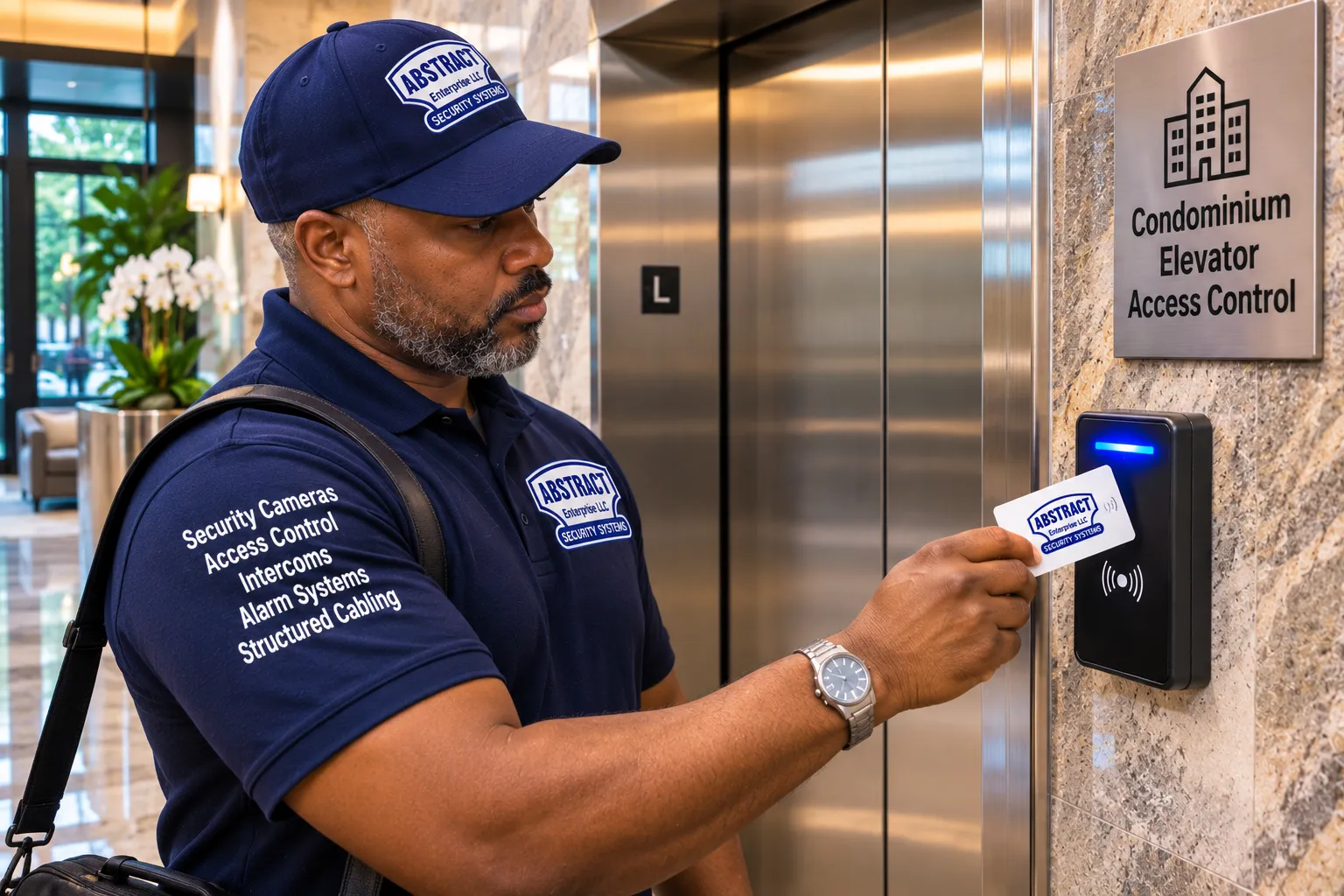
A card held to a lobby reader beside a stainless elevator door, under a sign reading condominium elevator access control. In a Nassau co-op or a Suffolk condo, the lobby reader is often the first piece installed, because it stops non-residents from calling the car at all.
Rules Outside the City
The Rules That Apply to Elevator Access Control in Nassau and Suffolk
Three sets of rules matter on Long Island: the state law that says who may work on an elevator, the code rules on altering an existing elevator, and the firefighters' emergency operation that every reader has to give way to. We summarize them here so a board or a manager knows what to ask for. This is general information, not legal advice; the elevator contractor, your engineer or architect and the local building department have the final word on any particular building.
State law: the elevator belongs to a licensed elevator contractor
Article 33 of the New York State Labor Law requires licenses for the businesses and the workers who design, install, inspect, maintain or repair elevators and other conveyances, and the state Department of Labor administers those licenses. An elevator contractor's business must be owned by, or employ, a licensed elevator mechanic. That is why our scope stops where the elevator's own equipment begins. We install and wire the access control system, readers, controllers, relay or input-output boards, power supplies and credentials, and we bring a labeled, tested set of dry contacts to a point the elevator contractor agrees on. The connection into the elevator controller, any change to the car operating panel's button circuits and any change to the elevator's operation are made by, or under the direction of, the licensed elevator contractor. A proposal that has a security installer wiring inside an elevator controller on Long Island without the elevator company should be a red flag to any board.
Altering an existing elevator: the whole bank, not one car
The New York State Department of State's draft of the Existing Building Code of New York State carries a short rule on elevators that shapes how access control is planned. Altered elements of existing elevators must comply with ASME A17.1, and where an element is altered, the same element must also be altered in the other elevators programmed to respond to the same hall call. In everyday terms, if two cars answer the same lobby call button, you do not put floor restriction in one car and leave the other wide open. Apart from the code, it would not work anyway: a rider who is refused in car one simply waits for car two. Our survey therefore counts cars by bank, and our quote always treats a bank as one unit.
Firefighters' emergency operation always wins
ASME A17.1, the elevator safety code adopted in New York, defines Phase I emergency recall and Phase II emergency in-car operation for firefighters. Guidance from the New York City Department of Buildings on devices added to elevator cabs and hall stations states the principle plainly: such a device must not impede the elevator's normal or emergency operation, and it must become inoperative when Phase I or Phase II operation starts. The same principle is built into every elevator access design we install on Long Island. When the fire alarm recalls the cars, or a firefighter turns the key, the access system steps out of the way, every floor button works for the firefighter, and nothing we installed can hold a car or a door. The elevator contractor confirms this during the acceptance test, and we document it for the board.
Who does what on a Long Island elevator access job
Task
Abstract Enterprises Security Systems
Licensed elevator contractor
Owner, board or manager
Decide which floors, people and times
Recommend and document
Confirm what the controller can do
Approve
Readers in the cab or at hall stations
Supply, mount and wire
Approve location in the car operating panel or fixture
Approve finish and position
Access controller, relay or I/O boards, power supply
Supply, install, program
Agree the interface point
Provide space and a power source by a licensed electrician if none exists
Traveling cable conductors to the cab
Identify spare pairs with the contractor
Assign or add conductors
Approve any added cost
Connection into the elevator controller and button circuits
Bring labeled dry contacts to the agreed point
Make the connection and any controller change
Schedule the cars out of service
Fire recall behavior
Design the access system to drop out
Test and confirm at acceptance
Keep the records
Credentials and user list
Program and train staff
None
Own the list and the privacy policy
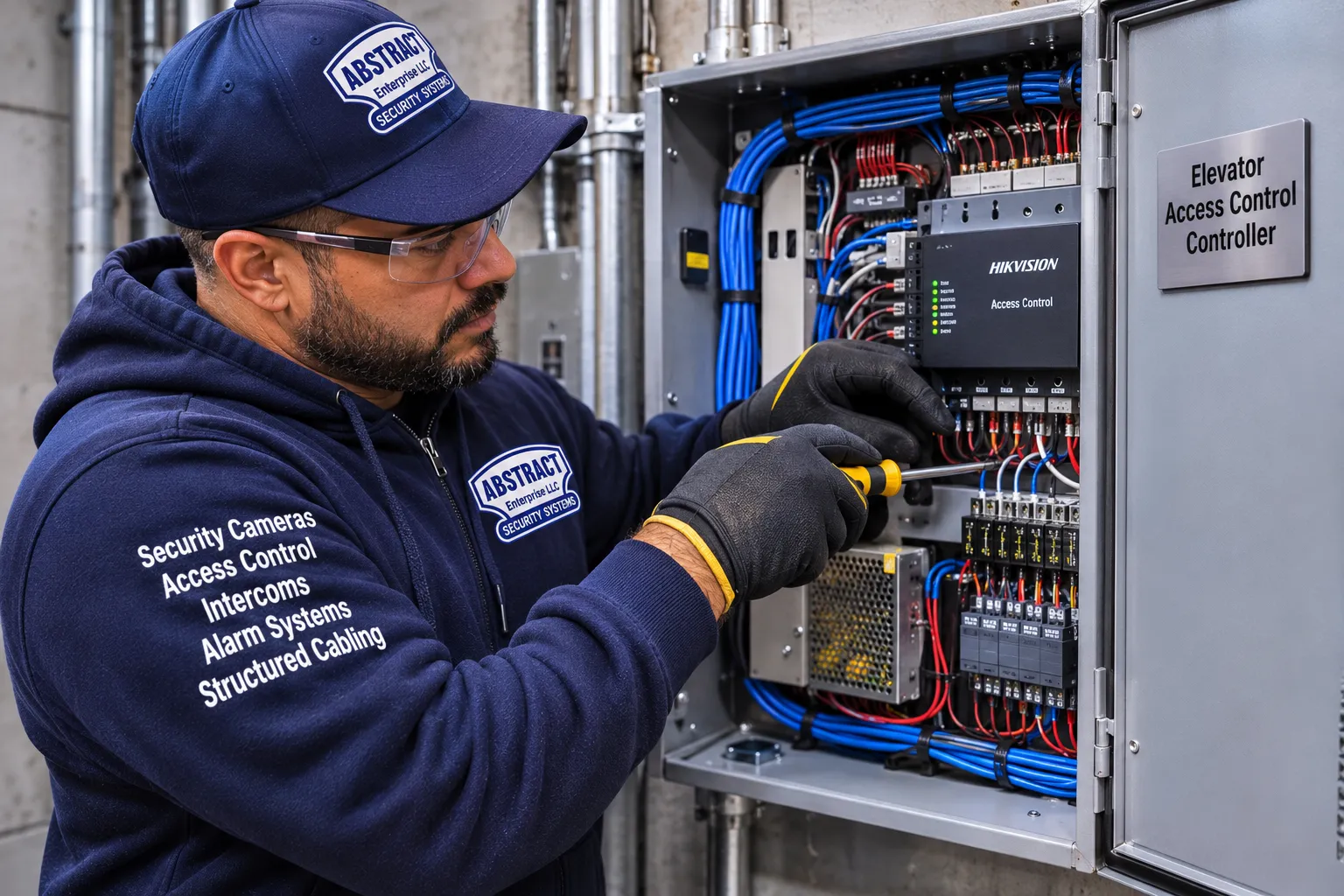
A technician tightens terminals inside a steel cabinet that holds an access control unit, rows of relay modules and neatly dressed blue cable. This is the part of a Long Island elevator project that belongs to the security installer; the elevator contractor connects these labeled outputs to the elevator controller.
What We Install
Elevator Access Control Installation Services Across Long Island
Every elevator access system is built from the same few choices: where the rider proves who they are, how the floor is released, which credential they carry, and what the manager can see and change. These are the combinations we install most often in Nassau and Suffolk.
Floor-by-floor restriction with a reader in the cab
A card, fob or phone reader inside each car, wired to a relay or input-output board that enables the floor buttons a rider is allowed to use for a few seconds after a valid read. Each floor is locked by default; a resident's credential releases their own floor plus any shared floors such as the lobby, laundry, gym or roof deck. As IPVM's examination of elevator access control points out, a reader that only grants use of the car, without per-floor relays, still lets the rider press any floor the car normally serves. On Long Island we nearly always recommend real floor-by-floor control for residential buildings for exactly that reason.
Hall call control at the lobby, basement and garage
A reader beside the hall call buttons on the levels where outsiders enter: the lobby, a garage level, a basement with a laundry or storage, a side entrance off a parking lot. Without a valid credential the call button does nothing, so the car never comes. Installers in elevator trade forums describe this as one of the most effective first steps in a residential building, because it stops most unwanted riders before they are inside the car. In Long Beach and other South Shore towers, where garages and lower lobbies sit at flood level, we place readers and their controllers with that in mind.
Visitor release from the intercom
A video intercom at the front door that lets a resident admit a guest and, in the same step, release that resident's floor in the elevator for a limited time. The guest rides only to the floor of the person who let them in. This is the most requested feature in Nassau co-ops that already plan to replace an old audio intercom. Intercom platforms such as Akuvox, ButterflyMX and 2N offer elevator relay modules or integrations; we install and integrate the one that fits your building and your existing door hardware.
Time-based schedules
Rules that change by time of day and day of week: an office floor open during business hours and card-only after six, an amenity floor closed overnight, a medical floor open to the public during clinic hours, a staff-only floor open to cleaning crews for two hours on weeknights. Scheduled floor rules are common in Long Island office parks and medical buildings and are written into the system during commissioning, not left to a manager to figure out later.
Mobile credentials, keypads and biometrics
Phones with Bluetooth or NFC credentials in place of fobs, keypads for staff who should not carry a card, and, where an owner chooses it, biometric readers for high-security floors. Each has trade-offs in cost, convenience and privacy, which we lay out in the written plan before anything is ordered.
Destination dispatch integration
In buildings with destination dispatch, where the rider selects a floor at a lobby kiosk and is assigned a car, access control talks to the dispatch system rather than to individual buttons. This is a software and network integration between your access platform and the elevator manufacturer's system, and it is always done jointly with the elevator contractor. It is less common on Long Island than in Manhattan towers, but it appears in some newer office and medical buildings.
Audit logs, cameras and remote management
Every elevator access system we install keeps a record of credentials used and floors released, can be managed from a browser or app, and can tie into the building's cameras so a manager can see who was in the car when something happened. We set retention and access to those records with the board or owner, because a log of where residents go is sensitive information.
A technician drills a stainless panel that combines a small camera, a credential reader and an illuminated up-call button next to an elevator door. On a garage or basement landing in a Long Island building, a station like this keeps the car from answering anyone without a credential.
By Building Type
How Elevator Access Control Works in Each Kind of Long Island Building
The equipment list barely changes from one building to the next. What changes is who the riders are, who approves the rules, and what has to keep working when something goes wrong. These are the patterns we plan around on the Island.
Co-ops and condos without a full-time doorman
This is the largest group of Long Island requests. A board wants residents to reach their own floor and the shared floors, guests to reach only the floor of the person who let them in, and the super, porters and contractors to have the access their work needs and nothing more. The board also wants a system the managing agent can run without calling an installer every time a unit sells. The usual design is floor-by-floor restriction with a reader in each car, a hall call reader on the garage or basement level, intercom visitor release, and an administrator account for the managing agent. We write the credential rules into a short policy the board adopts, covering how many fobs each household receives, how replacements are issued and paid for, and how long a former resident's credential stays active, because those are the questions that fill board meetings once a system is live.
Oceanfront and bayfront towers on the South Shore
In Long Beach, Lido Beach, Atlantic Beach and along the bays, the same design applies, with one addition: assume the lowest level will flood again. Superstorm Sandy filled lobbies and garages with water and sand and knocked out elevators and intercoms for months. We place access controllers, power supplies and battery backup on a floor above the garage wherever the building allows, keep hall call readers on the lowest landings simple and replaceable, and give the board a written plan for how residents get in and up if the low level is out of service. A system that cannot be restored quickly after a storm is a system residents will prop the door open to get around.
Medical office buildings and professional complexes
Medical buildings in Lake Success, New Hyde Park, Mineola, Garden City, Manhasset, Melville and around the Stony Brook and Patchogue hospitals have a public that changes every hour: patients, families, couriers and vendors, plus staff for many separate practices. The elevator usually stays open to the public during clinic hours, with one or two restricted floors such as an ambulatory surgery floor, a records or IT floor, a mechanical penthouse or a tenant's private suite. After hours, the whole bank may switch to card-only. The design questions are about schedules, multiple tenant administrators and compatibility with the badge technology a hospital system already issues its staff.
Hotels and a club or penthouse floor
A hotel's guest room key card is already an access credential. Elevator access control lets the same card release only the guest's floor and the floors with shared amenities, and keeps a club level or a penthouse suite floor private. Hotels such as The Garden City Hotel, with a Club Level on its penthouse floor, are the type of property where this is standard practice. Our work on a hotel project is the interface between the hotel's lock and key card system and the elevator, done with the lock vendor and the elevator contractor, and scheduled around occupancy so no guest is ever stuck in a lobby.
Station-area apartments and new mixed-use buildings
The newer buildings near Long Island Rail Road stations combine rental apartments with lobbies, package rooms, amenity floors, roof decks, retail at street level and structured parking. Elevator access in these buildings is usually part of a single access platform covering every door, and it is most efficient when it is designed with the building rather than after. Where a developer or general contractor brings us in during construction, we coordinate with the elevator contractor on controller interface points and traveling cable conductors before the cars are commissioned.
Senior housing and assisted living
In senior and assisted living buildings the priorities shift toward ease of use and safety. Readers are placed at a comfortable height with clear feedback, credentials can be wristbands or simple cards rather than phones, and staff need an instant way to give a caregiver, a nurse or a family member temporary access. Restricted floors may include memory care units, where the rules are set by the operator and its licensing obligations, not by us. Everything is designed so that a resident is never trapped and an emergency responder is never slowed down.
Schools, colleges and campus buildings
Colleges and school districts on Long Island usually run one access platform across every building and have a facilities or security office that sets the standard. Elevator access in a residence hall, library or administration building is added to that platform, using its readers, its credential format and its naming conventions. We install to the institution's specification and hand over documentation in the format its access control office uses.
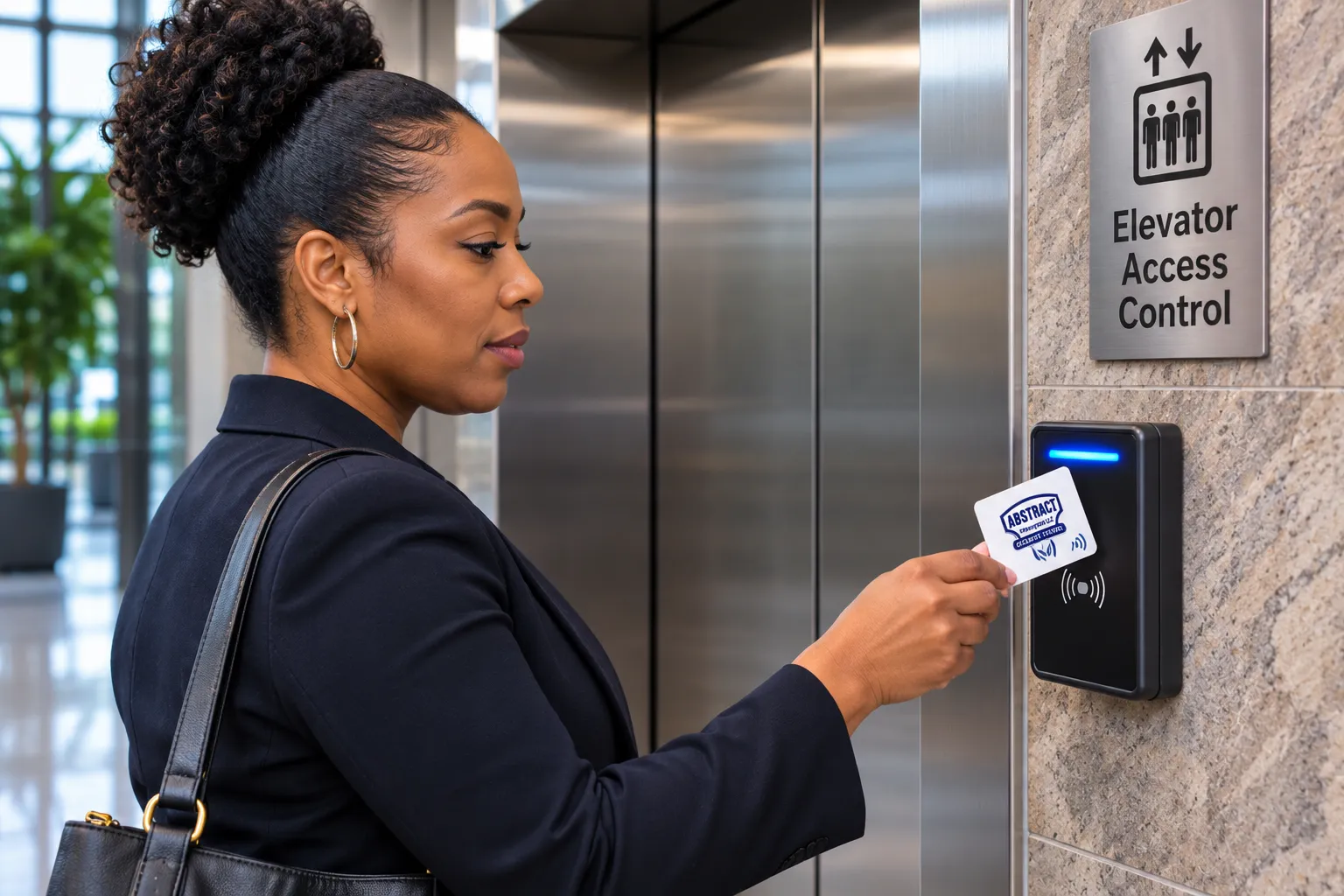
A woman with a shoulder bag holds a white card to a black reader with a blue status light beside an elevator. For a resident in a Long Island co-op or a visitor badge holder in a medical building, the whole system should feel this simple: tap, then press the floor.
Building Stock
Long Island's Elevator Equipment: What We Usually Find When We Open the Panel
The age and type of the elevator controller decide more about an access project than the access system does. On the Island we see three broad generations of equipment, and each is approached differently.
Modernized microprocessor controllers
Many pre-war and post-war co-ops in Nassau, and most office and medical buildings, have had their elevators modernized with microprocessor controllers. These typically have provision for security inputs: a set of terminals or a software feature that lets an external system enable or disable car calls per floor. When the elevator contractor confirms that provision exists and is licensed for use, the access side of the project is straightforward. Our relay or input-output board connects to those inputs at the point the contractor designates, and the floor rules live in the access software.
Older relay-logic controllers
Some smaller buildings, especially older walk-up conversions that added an elevator decades ago and some low-rise senior buildings, still run on relay logic or early solid-state controllers. Floor restriction is still possible, usually by having the elevator contractor wire our floor-enable contacts into the car call circuits, but it involves more of the contractor's time and sometimes reveals that the controller is due for modernization anyway. When that happens we tell the board early, because adding access control to a controller that will be replaced in two years is money spent twice.
New installations and hydraulic low-rise cars
New buildings and many three-to-six-story buildings across Suffolk use hydraulic or machine-room-less traction elevators with current controllers. These usually have security features available as options from the elevator manufacturer, and the cleanest path is to specify them at purchase. Where the building is already open, the elevator contractor can often add the option later.
The traveling cable and the car operating panel
A reader inside the car needs power and data, which reach the cab through the traveling cable that hangs between the car and the hoistway. Older cables may have no spare conductors; newer ones often do. Some installers use wireless links from the car to the machine room instead. The car operating panel itself must have room for a reader, or a separate small panel is mounted. These details are confirmed with the elevator contractor during the survey, and they are listed in our written plan, because they decide whether the job is a day or a week.
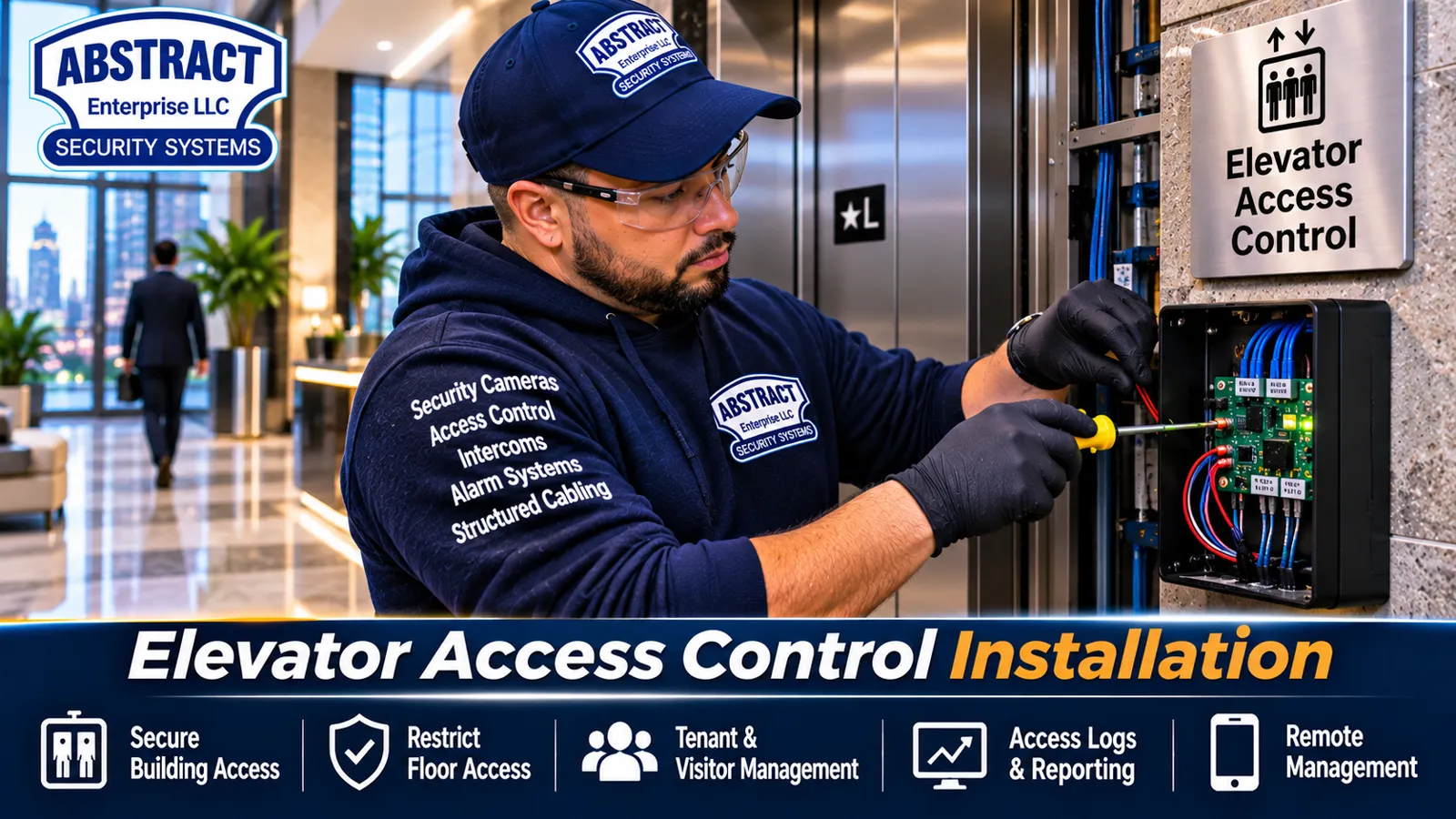
A technician in a navy cap and safety glasses works a screwdriver into the terminals of a reader board inside an open enclosure next to a stainless elevator, with a banner listing secure building access, floor restriction, tenant and visitor management, access logs and remote management. That list is the menu a Long Island board chooses from.
Field Notes
Field Notes: Why a Long Island Elevator Survey Starts With the Elevator Contract, Not the Reader
We do not publish stories about named customers unless they can be documented, so this is our routine, not a story about one building. It is how a survey begins for any elevator access request in Nassau or Suffolk.
Before anyone looks at a reader catalog, we ask the board, manager or owner for three documents: the elevator maintenance agreement, the most recent inspection report and any modernization paperwork. The maintenance agreement tells us which company holds the elevator, whether its contract covers work tied to a security system or bills it separately, and who to call to schedule the cars out of service. The inspection report tells us whether the elevator has open items that should be fixed first. The modernization paperwork tells us what controller is in the machine room and when it was installed, which answers most of the question of how floors can be released.
Then we call the elevator contractor. We describe what the building wants, which floors, which cars, which credentials, and ask three questions: does the controller have a security interface and is it enabled, are there spare conductors in the traveling cable, and where would they like our connection point. Most Long Island elevator companies have done this before and answer quickly; some ask for a short written description, which we send.
Only then do we walk the building with the board member or manager: the lobby, every landing on the restricted floors, the stairwell doors, the garage and basement levels, the machine room or controller space with the elevator contractor's permission, and the place where the new access controller and its power will live. We photograph each location, note the finish of the car operating panel and the hall fixtures, and check where the nearest outlet on an emergency or reliable circuit is.
The result is a written plan with two parts, one for our work and one describing what we need from the elevator contractor, so the board can get the contractor's price on the same scope instead of discovering it halfway through the job.
Your Questions Answered
Elevator Access Control on Long Island: Questions Boards, Managers and Owners Ask
Co-op and condo boards
Our Nassau co-op has two cars that answer the same lobby button. Can we put a reader in just one of them to save money?
You can, but it will not stop anyone. A visitor refused in the car with the reader simply waits for the other one. The state's draft existing-building rules also say that when an element of an existing elevator is altered, the same element is altered in the other elevators that answer the same hall call. Budget for every car in the bank, and if money is tight, start with a hall call reader on the lobby and garage levels for both cars, then add in-car floor restriction later.
How do we handle the shareholder who refuses to carry a fob?
Give them another credential rather than an exception. Most systems accept a PIN on a keypad, a phone credential or a wristband as well as a fob or card. What we advise against is a master key or a code shared by several people, because it defeats the record of who used what. If a resident cannot use a credential for health or accessibility reasons, the board and manager should agree an accommodation in writing, such as staff escort or a credential held by a caregiver.
When a unit sells, how does the new owner get access and the old owner lose it?
The managing agent cancels the seller's credentials on the closing date and issues new ones to the buyer, usually in a few minutes in the management software. We set up the account so the agent can do this without us, and we write the step into the closing checklist the agent already uses. Cancelling every credential tied to a unit at once, instead of one fob at a time, is a setting we configure during commissioning.
Our building has a part-time doorman. Should the elevator restriction switch off while he is on duty?
Usually not. A doorman controls who comes in the front door; elevator restriction controls where they go once inside, and both are useful at the same time. Some boards do choose to relax the lobby hall call reader during staffed hours while keeping in-car floor restriction on around the clock. That is a schedule in the software and can be changed by the manager at any time.
Office, medical and hotel managers
Our Lake Success medical building wants the elevators open to patients by day and card-only at night. Is that one system or two?
One system with two schedules. During clinic hours the floor buttons work normally for everyone except on any floors you choose to keep restricted. At closing time the schedule changes and every floor requires a valid credential, with exceptions you define for cleaning crews, security and specific tenants. Holidays and late clinics are handled as calendar exceptions, so nobody has to remember to flip a switch.
Several tenants in our Melville office building use different badge brands. Can one elevator system read them all?
Often, yes. Many current readers are multi-technology and read several common card formats, and many access platforms accept credentials from more than one source. The survey includes a sample read of each tenant's badge. Where a tenant's badges are an encrypted format the building's platform cannot read, the options are issuing that tenant's staff a building credential or adding a reader that supports their format, and we price both.
Our hotel's key card vendor says the elevator interface is "their job." Where do you fit in?
Hotel lock vendors often supply their own elevator control modules, and if yours does, we do not duplicate them. Where we help is in wiring, mounting readers in the car, coordinating the elevator contractor's connection, testing every floor and documenting it. Where the hotel's system has no elevator module, we install a separate controller that accepts the vendor's credentials. We sort this out with the vendor before quoting so the hotel does not pay twice.
Owners, developers and senior housing operators
We are building near an LIRR station in Suffolk. When should elevator access be decided?
Before the elevator is purchased. The decisions that are free on paper and costly later are the controller's security interface option, the number of spare conductors in the traveling cable, room in the car operating panel for a reader, power and network in the controller space, and conduit from the access control room to the machine room. If the elevator contract is already signed, tell us before the cars are commissioned, so the contractor can add the options while the crew is still on site.
Our senior residence wants wristbands instead of fobs. Do elevator readers accept them?
Yes. Wristbands, key tags, stickers and cards are all just different shapes for the same credential chip, and a reader that accepts one format accepts it in any shape. Wristbands are popular in senior buildings because they are hard to lose. We pick the credential format with the operator before ordering readers, and we place readers where a resident using a walker or wheelchair can reach them comfortably.
What happens to the elevator access system when the power goes out?
It depends on how the building is designed, and we write the answer down for your building before work begins. The access controller and readers can run on battery backup for a period, and many elevators have emergency power or a lowering feature. What must never happen is that a dead access system traps riders or stops a car from answering a fire recall. We design the release behavior with the elevator contractor so that, on loss of access system power, the elevator returns to the condition the owner chooses, typically free access, rather than locking everyone out of every floor.
Does elevator access control on Long Island require a building permit?
The low-voltage access control work generally does not need the same permits as elevator alterations, but work on the elevator itself is regulated and some villages and towns have their own requirements. The elevator contractor handles any elevator-side filings and inspections required for the controller connection, and we confirm with the local building department whenever a project involves new power circuits or fire alarm interfaces, which are done by licensed electricians and fire alarm contractors.
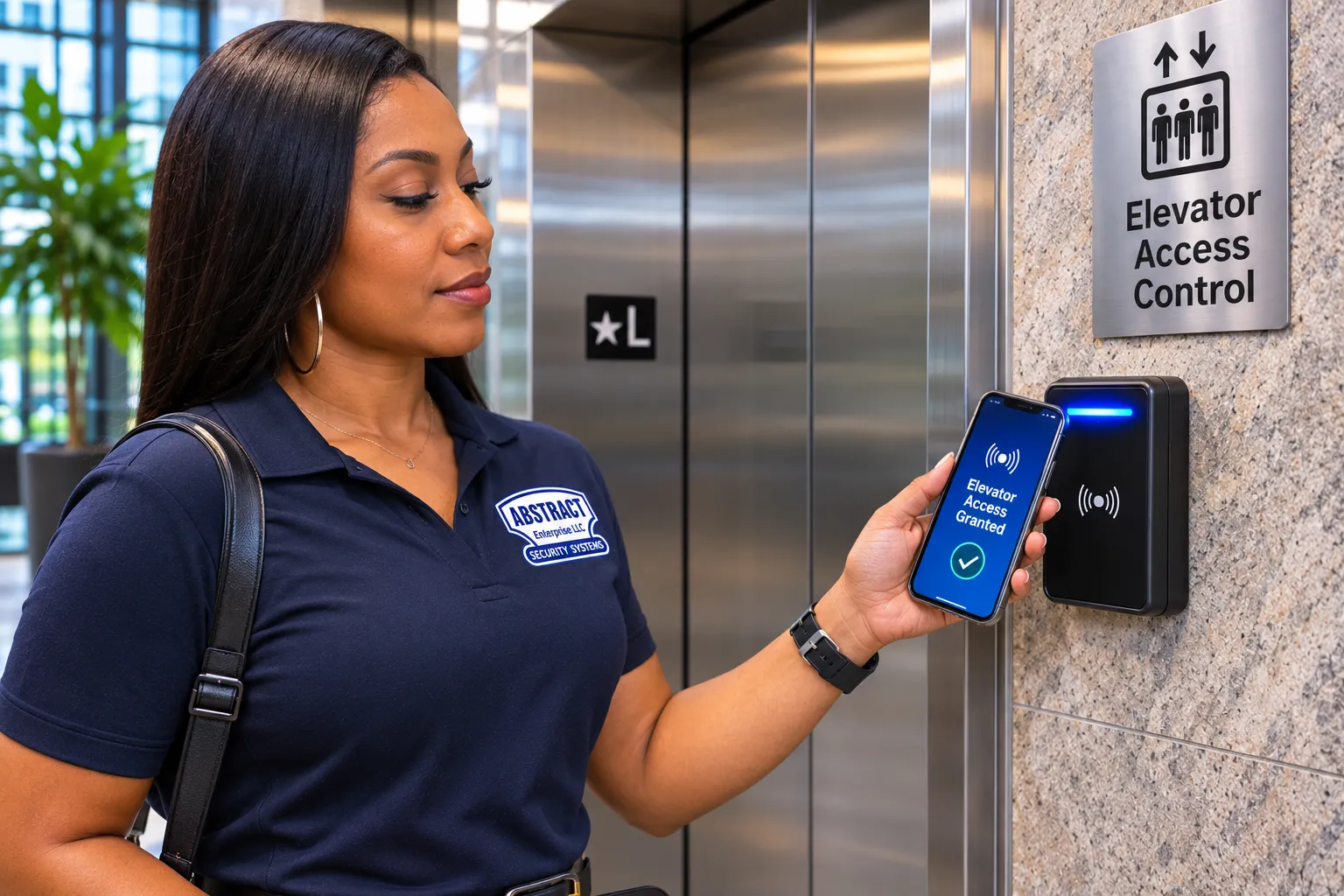
A woman in a navy polo holds a phone that reads elevator access granted next to a black reader with a blue light. Phone credentials suit Long Island office tenants and younger residents in new station-area buildings; many co-op boards keep fobs or cards available alongside them.
Equipment
Types of Elevator Access Control Equipment We Install on Long Island
In-cab card and fob readers
Proximity and smart card readers mounted in or beside the car operating panel, sized to fit stainless fixtures, with clear light and sound feedback for each read.
Hall call station readers
Readers beside the call buttons on the lobby, garage, basement and amenity landings, so the car only answers a valid credential on those levels.
Keypads and combination readers
Keypads for PIN entry and readers that accept card plus PIN for higher-security floors, such as records, server or executive levels.
Mobile and NFC readers
Readers that accept Bluetooth and NFC phone credentials, alongside cards and fobs, for buildings moving away from physical credentials.
Floor-release relay and I/O boards
One output per floor per car, or a network interface where the elevator controller supports it, mounted in a locked enclosure near the controller space.
Access controllers and power
The controller that stores credentials and rules, with supervised power supplies and battery backup sized for the readers and relays it serves.
Intercom elevator modules
Modules that let a video intercom release one floor when a resident admits a guest, from platforms we install and integrate such as Akuvox, ButterflyMX and 2N.
Management software and apps
Cloud or on-site software to add and cancel credentials, set schedules, view logs and manage several buildings, with administrator roles for boards and agents.
We install and integrate access platforms and readers from many manufacturers, including HID, Brivo, Kisi, LenelS2, Genetec, Gallagher, ICT Protege, Suprema, ZKTeco, Paxton and Axis, along with the intercom brands above. We are not presenting ourselves as a certified dealer of any of them; we recommend what suits the building, the elevator controller and the owner's existing systems, and if your building or institution already has a standard, we work to it.
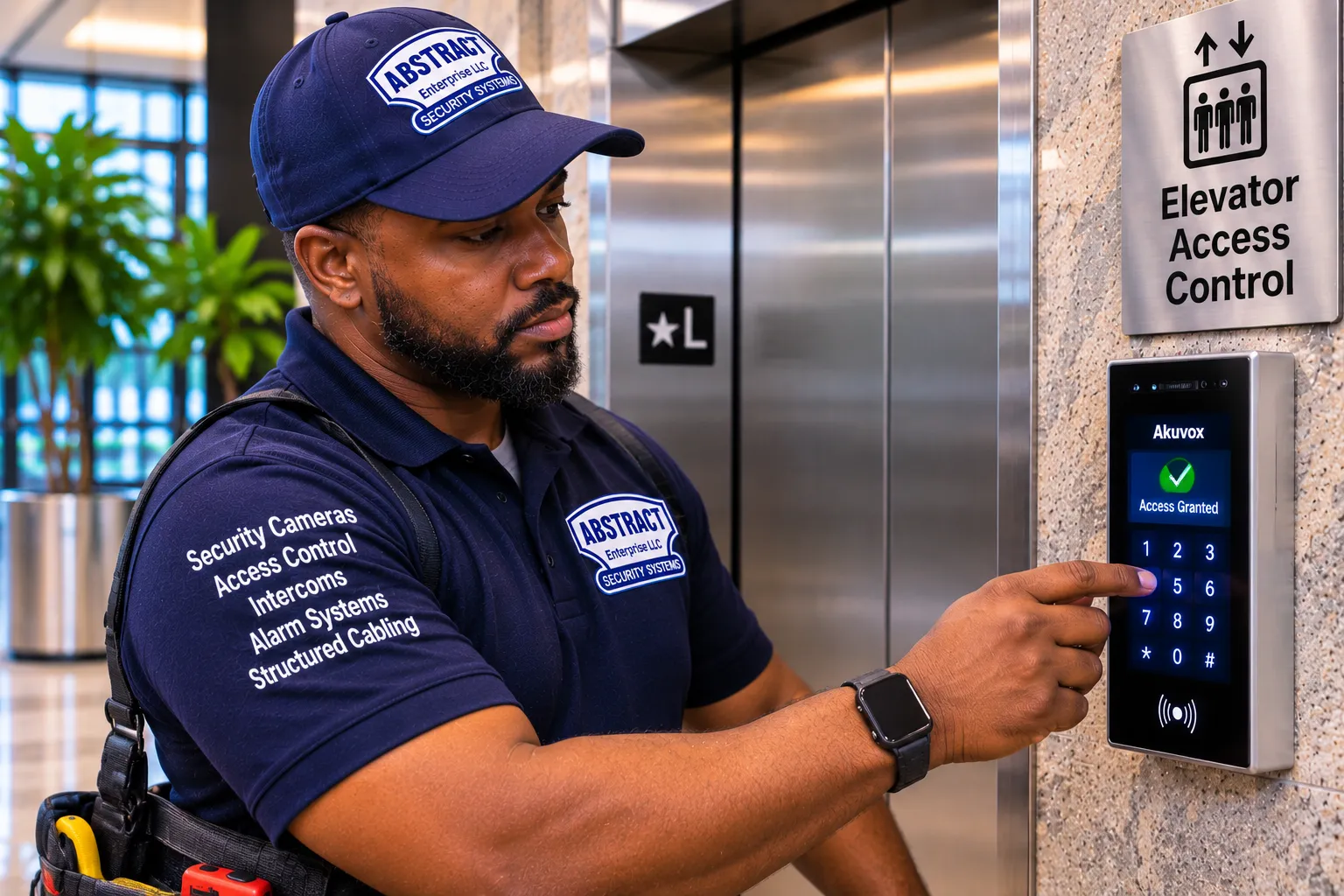
A technician in a navy polo taps a keypad on a touchscreen station that shows a green access granted check, mounted on stone tile beside an elevator. Keypads give Long Island buildings a credential for staff and vendors who should not carry a card.
AI Overview Reality Check
What AI Gets Wrong About Elevator Access Control on Long Island
AI summaries and vendor blogs explain elevator access control well in general terms. They are weaker on how it actually gets done in a particular building in Nassau or Suffolk. These are the claims customers bring to us most often, and what holds on Long Island.
"Any security company can wire a card reader into your elevator."
Not on its own. New York State Labor Law Article 33 licenses the businesses and mechanics who install, maintain and repair elevators, and the connection into an elevator's controller and button circuits is elevator work. A security installer can install the readers, the access controller and the floor-release outputs, and should; the elevator contractor makes or directs the connection to the elevator.
Ask any company quoting your building who will connect to the controller, and ask your elevator company whether it has agreed to that plan. If the answers do not match, the project will stall in the machine room.
"A reader in the elevator means strangers can't reach your floor."
Only if each floor is released individually. A reader that simply enables the car, without floor-by-floor relays, lets anyone with a valid credential, or anyone riding with them, press any button the car serves. IPVM's review of elevator access control makes the same point.
The question to ask is not "is there a reader in the elevator" but "which floors does each credential release, and are the other cars in the bank set up the same way."
"Phone apps have replaced fobs, so you don't need cards anymore."
For some buildings that is close to true. In others, especially co-ops with older shareholders, senior residences and buildings with many contractors and caregivers, physical credentials remain the easiest option for many riders. Most current readers accept both, which is what we recommend on the Island.
The bigger decision is not phone versus fob but who administers the list of credentials and how quickly a lost one is cancelled.
"Elevator access control is a New York City thing; suburban buildings don't need it."
Long Island's elevator buildings are fewer, but they are often less staffed than Manhattan towers, so the elevator is a bigger share of their security. A seven-story co-op with no doorman, a senior building whose intercom has failed or a station-area rental with hundreds of residents and constant deliveries has more reason to restrict floors than a staffed city tower, not less.
Not Sure What Your Long Island Building's Elevators Can Support? Ask a Technician First
Send the building address, the number of cars and floors, the name of your elevator company, a photo of the car operating panel and a photo of the lobby call buttons. A technician will tell you what that type of building and controller usually allows, what to ask your elevator company, and what the survey should focus on. Call (800) 486-0943, message us on WhatsApp, or send the quick form.
Seven Decisions a Long Island Board or Owner Makes Before Elevator Access Goes Live
Most of the arguments about an elevator access system happen after it is installed, and almost all of them come from decisions nobody wrote down. We ask every Long Island board, managing agent and owner to settle these seven before we order equipment, and we put the answers in the handover file so the next board inherits them.
1. Which floors are locked, and which are shared
List every floor the cars serve and mark each one as residential, shared or restricted. Residential floors open only for the households on them. Shared floors, such as the lobby, a laundry level, a gym, a roof deck or a parking level, open for everyone with a building credential. Restricted floors, such as a mechanical penthouse, a storage level or a management office, open only for named staff. In a mixed-use building, add commercial floors and decide whether their tenants can reach the residential floors at all.
2. Lobby call control, in-car control, or both
A hall call reader keeps the car from answering outsiders at the lobby and garage. An in-car reader decides which floor a rider can choose once inside. Buildings without a doorman usually benefit from both. Buildings with a full-time front desk sometimes start with in-car control only. Put the decision and the reasons in the minutes, because it will be questioned again the first time a visitor reaches the wrong floor.
3. Which credential, and how many per household
Choose the formats the building will issue, fob, card, wristband, phone credential or PIN, and how many each household receives at no charge. Decide what a replacement costs and who collects the money. On Long Island, where many co-op shareholders are older and many households employ caregivers, boards usually allow at least one extra credential per unit for an aide, set to expire on a date the shareholder chooses.
4. How visitors, deliveries and contractors ride
Visitors admitted through the intercom can be given a one-floor, time-limited release. Package carriers usually need the lobby or a package room only, not residential floors. Contractors working in a unit can be given credentials that start and end with the alteration agreement's dates. Movers may need a car placed on independent service by the super, which is an elevator function, not an access control one. Write down who issues each kind of credential and who is allowed to approve exceptions.
5. What happens when something fails
Decide in advance how the building behaves if the access system loses power or its network, if a reader in a car breaks, or if the elevator contractor takes a car out of service for repairs. The elevator contractor confirms how the controller responds; the board decides whether a failure should leave floors open or closed. In almost every residential building the answer is open, because a trapped resident is worse than a temporarily unrestricted floor. Firefighters' operation overrides everything regardless.
6. Who administers the system
Name the people who can add and cancel credentials, change schedules and read logs. A managing agent usually holds the main administrator role, with a board member as backup and the super limited to issuing temporary credentials. Large medical and office buildings may give each tenant its own administrator limited to its own floor. Every administrator has their own login, so the record shows who changed what.
7. What records are kept, and for how long
An elevator access log shows which credential released which floor and when. That is useful after an incident and sensitive at all other times. Decide how long logs are kept, who may see them and when they may be shared, and adopt it as a written policy. New York City's tenant data privacy rules for smart access systems, Local Law 63 of 2021, do not apply in Nassau or Suffolk, but a board that follows the same spirit, collecting only what it needs, protecting it and deleting it when a resident leaves, avoids most of the complaints that come with any electronic access system.
Repair & Service
Elevator Access Control Repair and Upgrades on Long Island
Not every call is a new system. Many Long Island buildings already have elevator readers that were installed by a company that has since closed, merged or stopped answering, and the board is left with readers that work some days and not others. We troubleshoot and repair existing elevator access systems as well as installing new ones.
The usual causes when a cab reader stops working
When a reader in a car stops responding, the cause is usually in one of four places. The reader itself can fail, especially older proximity readers exposed to years of cleaning chemicals and impact. The cable to the reader runs through the traveling cable, which flexes with every trip; a conductor that has broken inside the jacket can work intermittently for months before it fails completely. The access controller can lose its programming or its network connection after a power event. And the interface at the elevator controller can be changed or disconnected during elevator maintenance or modernization without anyone telling the access company. Our troubleshooting follows that order, from the reader back to the controller, and we bring in the elevator contractor as soon as the fault points to the traveling cable or the elevator side.
Replacing a discontinued system
Older elevator access systems often use readers, credential formats or software that are no longer supported. Replacement does not always mean starting over. In many cases the floor-release outputs and their wiring to the elevator controller can be reused, and only the readers, the access controller and the software change. That keeps the elevator contractor's part of the work small. The survey tells you which parts can stay, which must go and what the transition plan for residents' credentials will be, including whether the old fobs can be read by the new readers during a changeover period.
Keeping the system healthy
An elevator access system needs very little routine maintenance, but it needs some. Readers should be cleaned and checked, batteries in the controller's backup replaced on schedule, software kept current, and the user list reviewed so former residents and staff do not keep working credentials. We also recommend that the board ask its elevator contractor to tell the managing agent before any work on the controller, so an access interface is never disconnected by accident. Our handover file includes a one-page checklist for the managing agent covering those points.
Upgrading from keyswitches to credentials
Buildings that still restrict floors with a keyswitch in the car operating panel can usually move to credentials with modest changes: the keyswitch circuit is replaced by, or paralleled with, a floor-release output from the access system, and the keyswitch is retained for staff or removed as the board chooses. The elevator contractor makes the change at the controller or the panel. The board gets a list of every credential and the ability to cancel one, which no key can offer.
Worked Example
A Worked Example: Floor Rules for a Typical Seven-Story Long Island Co-op
This is an illustration of how a plan is written, not a description of any particular building. Picture a seven-story co-op of the kind found in Great Neck, Rockville Centre or Long Beach: one passenger car, a basement with laundry and storage, a lobby at street level, five residential floors above it and a roof with mechanical equipment. There is no doorman; the super lives in the building and a managing agent runs it from an office in another town.
Level
Who can ride there
When
Notes for the plan
Basement (laundry, storage)
All residents, super, porters
Daily during laundry room hours, staff always
Hall call reader on the basement landing so the car does not answer anyone who came in a service door without a credential
Lobby
Everyone
Always
Hall call reader beside the lobby button; visitor release from the intercom sends a guest to one floor only
Floors 2 to 6 (apartments)
Households on that floor, super, porters; caregivers and contractors by dated credential
Always for residents, scheduled for staff and contractors
Floor-release output per floor; a credential releases the holder's floor plus the shared floors
Roof (mechanical)
Super and named contractors
As needed
Restricted floor; elevator contractor confirms whether the car serves it at all
From that table, the equipment list writes itself: one in-car reader, two hall call readers, seven floor-release outputs, an access controller with battery backup in a locked enclosure near the controller space, and an intercom elevator module if the board is replacing the front-door intercom at the same time. The elevator contractor's part is the connection of seven outputs and the two hall call interfaces at the controller, confirmation of spare conductors in the traveling cable for the in-car reader, and the acceptance test with fire recall.
The administration plan is just as short. The managing agent holds the main administrator role and handles move-ins and sales. A board member is the backup administrator. The super can issue a contractor credential for the dates on an approved alteration agreement and nothing else. Each household receives two fobs and one dated caregiver credential on request; replacements are charged at the board's set price. Logs are kept for a period the board chooses and are viewed only by the managing agent and the board president.
Written that way, the plan answers in advance the questions that otherwise come up at the first board meeting after installation: why a visitor could not reach the roof, why a former porter's fob no longer works, why the laundry floor is closed at night, and who decided each of those things. A larger building, a medical complex or a hotel needs a longer table, but the method is the same.
The same example in a two-car building
If the same co-op had two cars answering the same hall buttons, everything above doubles except the controller and the hall call readers, which are shared by the bank. Two in-car readers, fourteen floor outputs and the same two hall call readers. The elevator contractor connects both controllers, or one group controller, depending on how the bank is configured, and both cars are tested floor by floor. This is the point where boards most often try to save money by equipping only one car, and the point where we most firmly recommend against it.
How It Works
Our Elevator Access Control Installation Process for Long Island Buildings
A single-car senior residence in Suffolk and a two-bank medical complex in Nassau follow the same eight steps. On Long Island, step three, agreeing the interface with the elevator contractor, is the step that most often decides the schedule.
1. Send the building details
Address, number of cars and floors, current readers or keys, the elevator company's name, and what you want controlled.
2. Collect the elevator paperwork
Maintenance agreement, latest inspection report and any modernization records, so we know the controller before we visit.
3. Agree the interface
A call with the elevator contractor on the security interface, traveling cable conductors and the connection point.
4. Survey every landing
Lobby, restricted floors, garage and basement, stair doors, controller space and power, photographed and measured.
5. Issue the written plan
Our scope, the elevator contractor's scope, credentials, schedules and fire recall behavior, each line priced and approved in writing.
6. Install and wire
Controller, power, relay or I/O boards and readers installed and labeled; cars taken out of service only in the agreed windows.
7. Connect and test every floor
The elevator contractor connects at the agreed point; every floor, every car and fire recall drop-out tested together.
8. Train and hand over
Credentials issued, managers trained, and a handover file with wiring, settings, test results and the user policy.
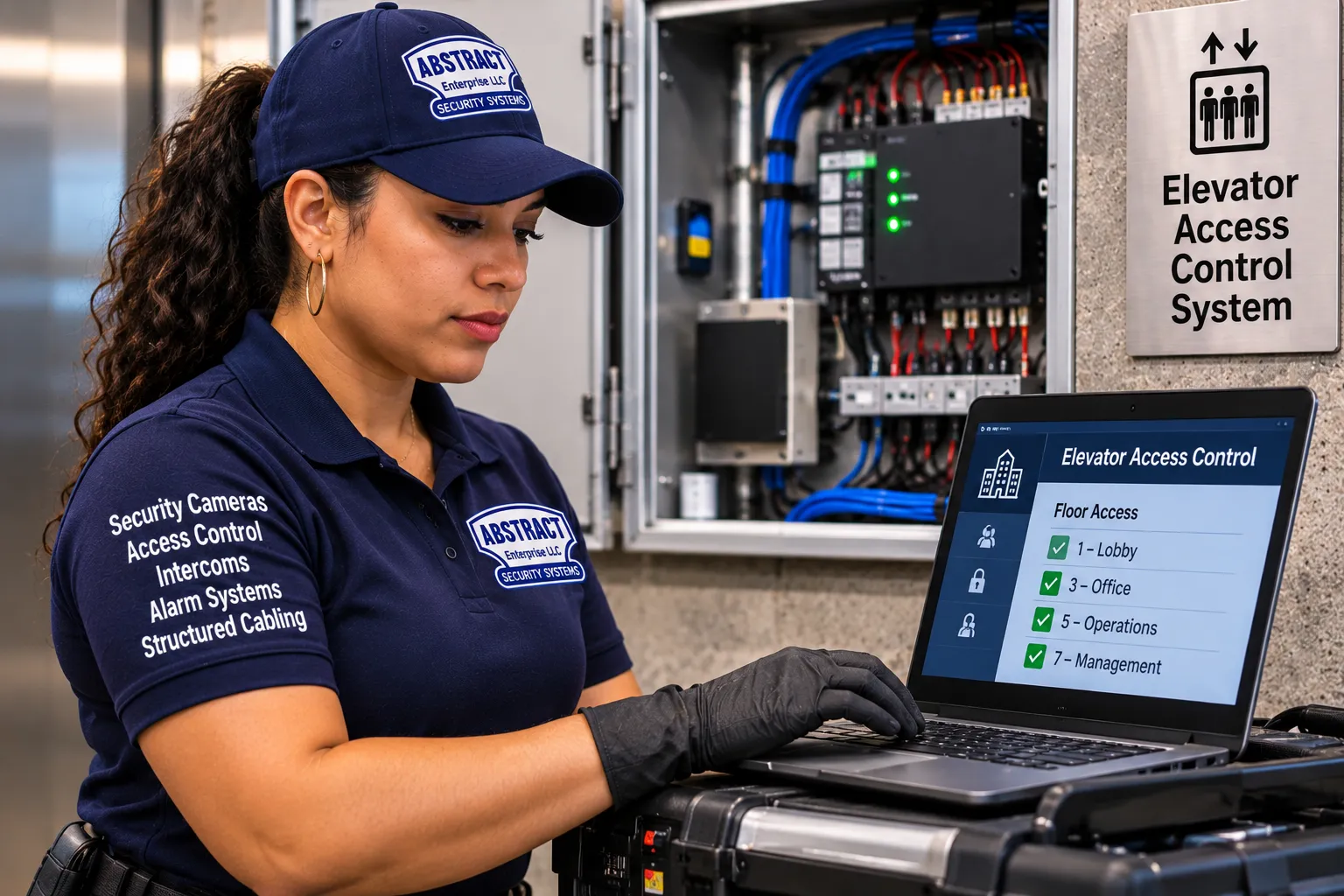
A technician in black gloves types on a laptop whose screen lists floor access for the lobby, an office floor, operations and management, in front of an open cabinet with green status lights. Step eight on a Long Island job ends with that screen handed to the building's own administrator.
Where We Work
Elevator Access Control Across Nassau and Suffolk Counties
We serve every town and village on Long Island from the Queens line to the East End. The places where elevator access requests come from most often follow the map of the Island's elevator buildings.
Area
Typical elevator buildings
Most common request
Great Neck, Great Neck Plaza, Manhasset, Port Washington, Roslyn
Pre-war and post-war co-ops and condos, a few newer luxury rentals
Floor restriction and intercom visitor release without a doorman
Garden City, Mineola, Westbury, Carle Place
Hotels, office and medical buildings, station-area rentals
New downtown and station-area apartments, senior housing
Elevator access designed into a whole-building platform
Stony Brook, Port Jefferson, Riverhead, Bay Shore, West Islip
Hospital, campus and medical buildings
Readers installed to the institution's own access standard
As the Nassau and Suffolk elevator access pages go live, each will carry its county's direct line and local details; until then, the toll-free number on this page reaches us for any address on the Island.
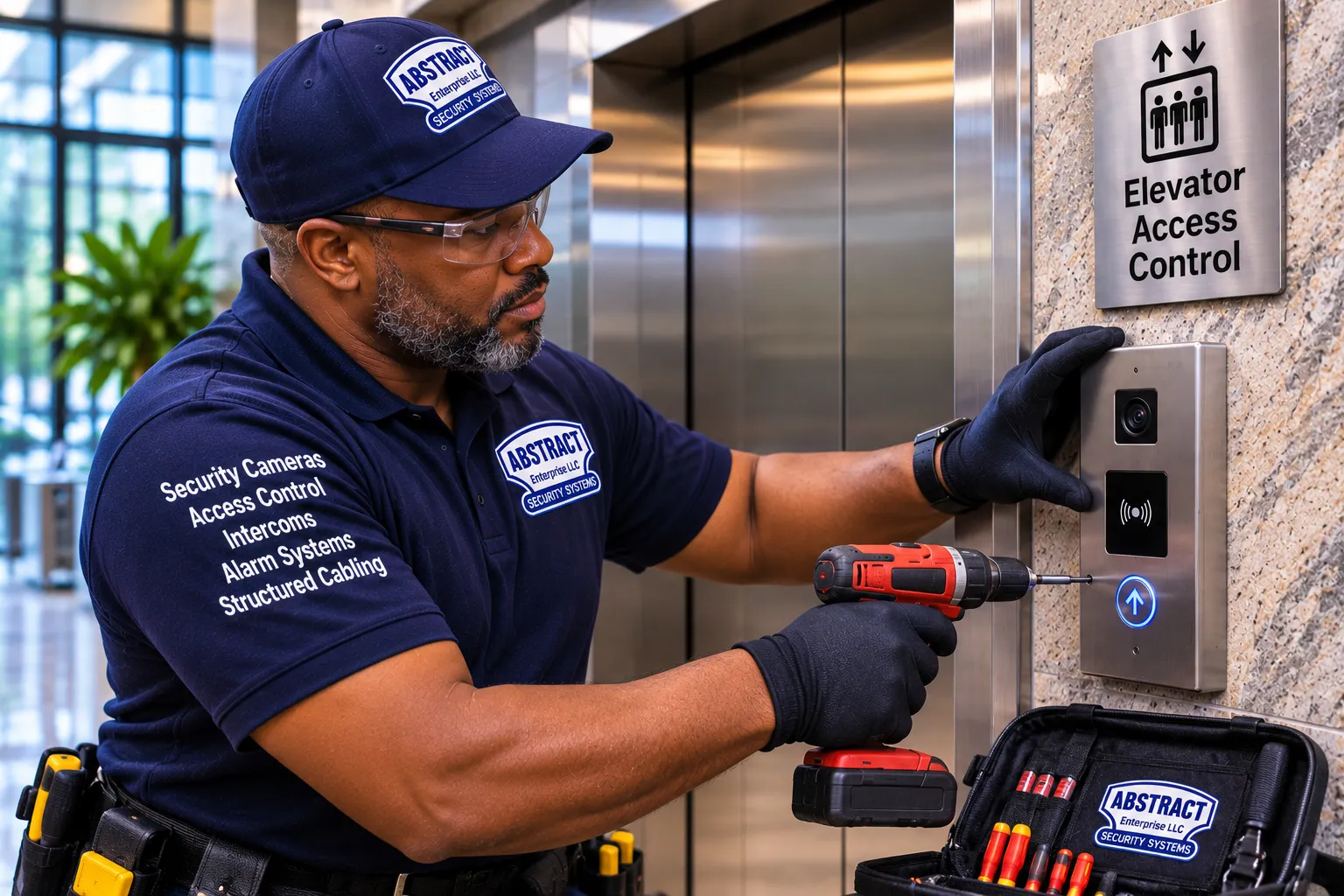
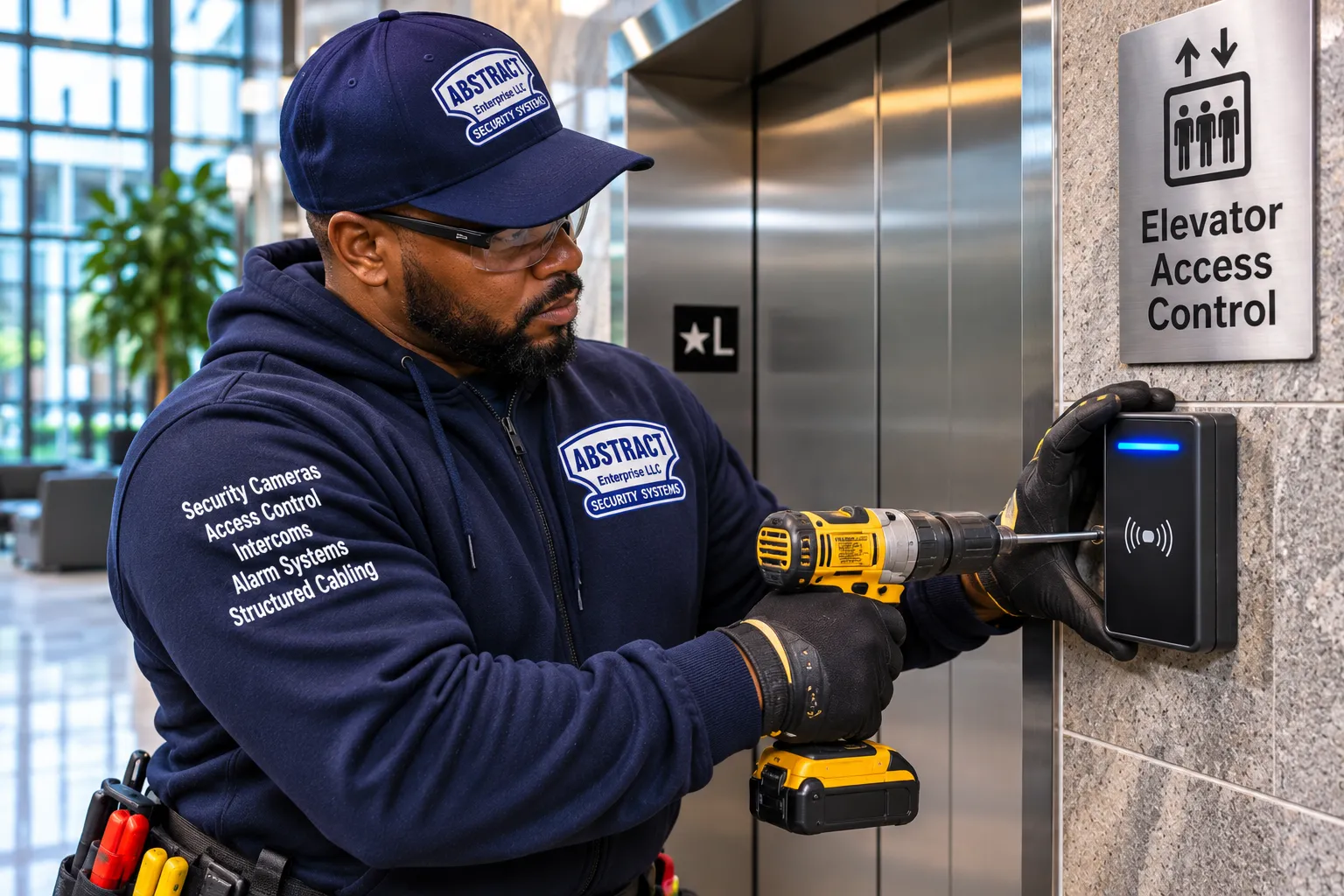
A technician in safety glasses and gloves holds a black reader flat against granite beside an elevator and drives a screw with a yellow cordless drill. On stone or tile lobby walls in Long Island co-ops, readers are set on masonry anchors and the cable is fed from behind so nothing runs on the surface.
Pricing
Elevator Access Control Installation Cost on Long Island
Elevator access control levels and starting prices in Long Island
Elevator access control from Abstract Enterprises Security Systems comes in three levels, priced per elevator car. Level 1 is the most common setup: a reader goes inside the car, and the rider swipes a card or fob, enters a code, or uses a phone or video intercom station before the car will run. Once the rider is authorized, they can select any floor that car serves. The reader ties into spare conductors the elevator company already has in the controller cabinet, and in most buildings we can program and update it remotely. Level 2 adds biometrics: face recognition, fingerprint or iris readers in place of, or alongside, cards and codes. Level 3 goes further: floor-by-floor restriction so each credential reaches only its own floors, readers at the hall-call stations, time schedules, intercom floor release and destination dispatch links. Level 3 is priced per building after the survey because it depends on how many floors and cars are controlled.
Area
Level 1: card, fob, code or intercom reader
Level 2: face, fingerprint or iris
Nassau County
from $1,725 per car
from $2,875 per car
Suffolk County
from $1,800 per car
from $3,000 per car
Two things sit outside our price. The elevator company has to make the connection inside its controller, and that visit is arranged and paid for by the building directly with its elevator contractor. And if the car needs a network connection or a new cable run for remote management, that is listed as its own line after the survey. Level 3 work, extra landings and integrations are quoted on the same written plan.
Beyond the starting prices above, the final Long Island quote is written per building after a survey, because the same reader count can be a modest job on a controller with a security interface already built in, or a much larger one on an old relay controller with no spare conductors in the traveling cable. As ButterflyMX notes in its multifamily pricing guidance, access control is priced per controlled opening rather than per apartment, and elevator access limits floors without replacing the elevator itself. The written plan prices each line of our work, lists what the elevator contractor will do so you can get their price on the same scope, and nothing is added on the day without your written approval. For the door-side work that usually comes with an elevator project, see our Long Island access control installation page.
What moves the price of a Long Island elevator access project
Driver
How it shows up on the Island
How the quote handles it
Number of cars and floors
A single hydraulic car in a Suffolk senior building, or a two-car bank serving eight floors in a Nassau co-op
Readers and floor outputs counted per car, per floor
Controller type and age
Modernized microprocessor controllers in many co-ops, older relay logic in some small buildings
Interface method stated, with the elevator contractor's scope listed separately
Traveling cable
Spare conductors available, none available, or a wireless link needed
Path to the cab stated and priced
Hall call landings
Lobby only, or also garage, basement, amenity and roof levels
Each landing reader listed on its own line
Credentials
Fobs, cards, wristbands, phone credentials or a mix
Quantity and type priced, with replacement cost stated
Integrations
Intercom visitor release, hotel key cards, tenant badges, cameras
Each integration described and priced separately
Work windows
Cars out of service only overnight, weekends or between clinic sessions
Schedule and phasing written into the plan
When the elevator surprises everyone
Sometimes the controller turns out to need an update, the traveling cable has fewer good conductors than the drawings showed, or the car operating panel cannot take a reader without a new faceplate. When that happens the work stops at that point, we and the elevator contractor show you what was found, and you choose between the alternatives with their prices before anything changes. No change is billed that you did not approve in writing. Payment terms are set out in the service agreement before the job is booked.
Full terms — including 50% deposit, one-year parts-only warranty on Abstract Enterprises Security Systems-supplied products, and the late-fee schedule — are set out in the service agreement.
Project Shapes
Elevator Access Control Packages for Long Island Buildings
Three common shapes of elevator access project on the Island. They describe scope, not a fixed price; each is quoted per building in the written plan after the survey.
Starter: Lobby and Garage Call Control
Readers at the hall call buttons on the lobby and the garage or basement landing for every car in the bank, so the elevator only comes for residents, staff and approved visitors. A sensible first phase for a co-op on a tight budget.
Standard: Floor-by-Floor Restriction
A reader in every car, floor-release outputs for every floor, the lobby and garage call readers, credentials for every household or tenant, administrator training and a written user policy for the board or manager.
Premium: Whole-Building Platform
Elevator floor restriction, intercom visitor release, door readers on lobby, stair, garage and amenity doors, mobile credentials, schedules, camera tie-in and multi-building management on one platform.
Already have an access system?
Many Long Island buildings already have door access or an intercom that could run the elevator too. Before recommending anything new, we check whether your current platform supports elevator control, whether its readers and software are still supported, and whether adding floor outputs is the cheaper route. If your system is worth keeping, we extend it. Equipment you already own is not covered by our product warranty, but every connection we make to it is tested and documented the same way.
Complete Services
Every Elevator Access Control Service on Long Island and Beyond
Long Island Elevator Access Control Installation FAQ
How many floors can one elevator access system restrict?
+
Every floor the car serves. Floor outputs are added per floor and per car, so a three-stop hydraulic car in a Suffolk senior building and a twelve-stop bank in a Nassau co-op use the same kind of system with a different number of outputs. The practical limit is the elevator controller's interface, which the elevator contractor confirms during the survey.
Can residents still use the stairs if the elevator restricts their floor?
+
Yes. Elevator access control does not lock exit stairs, and stair doors that are part of a required exit path must keep working for people leaving the building. Some buildings add readers on the stair doors re-entering residential floors, where the building code and the fire department allow it; that is a separate door access decision we review with the board.
Do you work on Long Island weekends?
+
Survey and installation dates are booked in advance in a 2-hour arrival window, and work that takes the elevators out of service is scheduled at the quietest time the building allows, agreed with the board, manager and elevator contractor. Tell us your building's preferred windows when you send the request.
Is the work done under a New York State license?
+
Yes. Abstract Enterprises Security Systems performs low-voltage work under NYS license #12000287431, and the number appears on every quote and invoice. Elevator-side connections are made by your licensed elevator contractor, and any new power circuit is done by a licensed electrician and listed separately.
Can a lost fob be shut off right away?
+
Yes. A board member, manager or administrator cancels the credential in the management software, usually in under a minute and often from a phone. The fob stops working at every reader at once, in the cars, at the lobby and on any doors on the same system.
Will the elevators be out of service during installation?
+
Only briefly, and only in agreed windows. Mounting controllers and running cable happens with the cars in service. Each car is taken out of service, one at a time where the building has more than one, only while readers are set in the car and the elevator contractor makes the controller connection and tests it.
Can guests be given access for just one evening?
+
Yes. Temporary credentials can be set to start and expire at specific times, and visitor release through the intercom opens only the host's floor for a short period. Mobile guest passes sent by text or email are available on most current platforms.
Who keeps the record of which floors residents visit?
+
The building owner or board, under a policy it adopts. We set who can see the logs and how long they are kept during commissioning. We recommend keeping only what security needs and limiting log access to a small number of administrators, because a record of residents' movements is personal information.
Our elevator readers were put in by a company that no longer answers. Can you support them?
+
Often. We survey the existing readers, controller and software, check whether the platform is still supported and whether its administrator accounts can be transferred, and give a written report on what can be kept, what needs updating and what it would cost to move to a different platform.
Do you install elevator access in buildings with only one elevator?
+
Yes, and those are common on Long Island. A single-car building is the simplest case: one cab reader, one set of floor outputs and, if needed, a hall call reader at the lobby and garage.
What should the board have ready before the survey?
+
The elevator maintenance agreement, the most recent inspection report, any modernization paperwork, a list of floors and the rules you want for each, and the name of a contact at the elevator company. Access to the machine room or controller space is arranged with the elevator contractor.
Do you also install cameras in the elevator lobby and cab?
+
Lobby and landing cameras, yes. Cameras inside the cab involve the traveling cable and the car's interior panels, so they are planned with the elevator contractor in the same way as an in-car reader, and often installed during the same out-of-service window.
More Elevator Access Control and Building Security on Long Island
Request a Free Quote for Your Long Island Building
Tell us the town and street, the type of building, the number of elevators and floors, which floors you want restricted and for whom, and what readers, keys or intercom you have now. The name of your elevator company and a photo of the car operating panel help a great deal. Say whether you are a board member, managing agent, owner or facilities manager, and any deadline you are working toward, so we can line up approvals and the elevator contractor. Prefer to talk? Call (800) 486-0943.
✅
Request Sent!
Thank you. We will be in touch to book your Long Island building survey, usually within 2 hours of your request.