Co-op board tired of strangers riding to every floor? New tenant who needs its floors locked after hours? Book an elevator access control survey anywhere in the five boroughs: (800) 486-0943
Elevator access control installation in NYC means fitting the elevator with a reader, keypad or phone credential so that only people you approve can call the car or press a button for a floor they are allowed to reach. Abstract Enterprises Security Systems installs the low-voltage side of that system across Manhattan, Brooklyn, Queens, the Bronx and Staten Island: the readers in the cab or at the lobby hall station, the floor-enable relays or interface board, the cable back to the access control panel, the credentials and the programming, plus links to your intercom, cameras and visitor tools. The building's licensed elevator contractor makes the connection inside the elevator controller, because in New York that is elevator work under its own license. We plan the two halves together, so the floors lock and unlock the way your board, owner or property manager wants, and every reader drops out of the way the moment firefighters' service takes over the car.
Reviewed and updated November 14, 2026 by Abstract Enterprises Security Systems, NYS license #12000287431 · Sources: NYC Department of Housing Preservation and Development, 2023 New York City Housing and Vacancy Survey selected initial findings; NYC Department of Buildings Elevator Report and elevator license FAQ (NYS Elevator Safety Act, effective January 1, 2022); DOB Buildings Bulletin 2022-010; NYC Building Code Chapter 30 and Appendix K; NYC Local Law 63 of 2021 (Tenant Data Privacy Act) as summarized by HPD; IPVM and installer discussions on floor-relay design
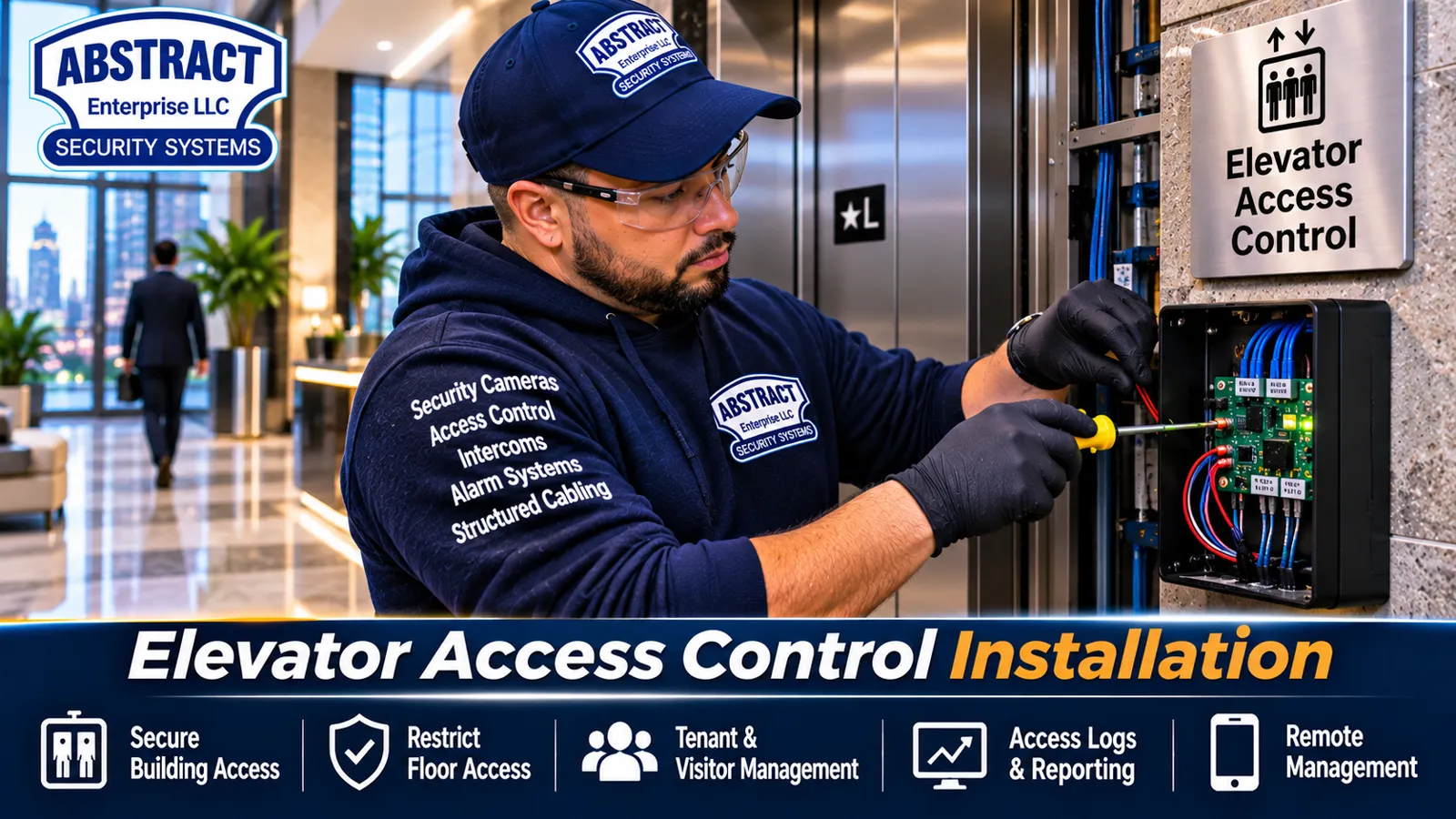
Abstract Enterprises Security Systems photo: a technician in safety glasses and gloves works on an open reader enclosure next to a stainless lobby elevator, with an Elevator Access Control sign on the stone wall and a banner listing floor restriction, tenant and visitor management, access logs and remote management.
NYC Elevator Access Request
Tell us the building, how many floors and cars, and who should reach which floors
✅
Request Sent!
Thank you. We will be in touch to book your elevator access survey, usually within 2 hours of your request.
25+
Years Experience
2 Hr
Survey Booking
100%
Licensed & Insured
4.7★
201 Google Reviews
Owner-operated since 2002 · Thousands of jobs completed · Booked within 2 hours
Quick answer: elevator access control in New York City starts at $1,500 per elevator car in Brooklyn and the Bronx for a Level 1 card, fob or code reader ($1,875 in Manhattan) and at $2,500 per car for Level 2 face or fingerprint readers; floor-by-floor restriction is quoted per building after a survey, because the work grows with the number of floors, the number of cars and the number of places a rider can call or steer the elevator, and because the elevator contractor's part of the job is priced by them, not by us. A two-car prewar co-op on the Upper West Side, a twenty-story rental in Downtown Brooklyn and a multi-tenant office floor in Midtown each need a different count of readers, relays and controller connections. You get a written scope that lists every reader, every floor relay, every cable run, the credentials, the programming, the intercom or camera links, and exactly which items the elevator company must do and sign off. We book the survey within 2 hours of your request and arrive inside a 2-hour arrival window.
Readers, floor-enable relays, interface boards, wiring, credentials and programming by Abstract Enterprises Security Systems under NYS license #12000287431
Controller tie-in, fire service and any DOB elevator filing handled by the building's licensed elevator contractor, coordinated by us
Readers wired so they go inoperative on firefighters' recall, as DOB Bulletin 2022-010 requires for devices added to cabs and hall stations
What Elevator Access Control Is, and the Four Ways NYC Buildings Use It
Most New York elevators were built to answer anyone who presses a button. The front door may be locked and the lobby may have a doorman, but once a person is in the car, every floor is one press away. Elevator access control closes that gap. A credential reader is added to the cab, to the lobby call station, or to both, and the elevator stops honoring a floor button until a valid credential has been shown for that floor.
There are four common ways to do it, and the right one depends on the building, not on the brand of reader:
Cab reader that enables the car. The rider shows a fob or card inside the car and the car becomes usable. It is the simplest version, and also the weakest, because once the car is enabled the rider can usually press any floor the car serves.
Floor-by-floor lockout. Every floor button is locked by default. The reader tells the access control panel who the rider is, and the panel closes a relay for each floor that person may reach, for a few seconds, so only those buttons light. This is what most co-op boards, condo associations and multi-tenant office owners mean when they ask for an elevator floor restriction system.
Hall-call (landing) control. The reader sits at the lobby or garage call button, so a stranger cannot even bring the car to the lobby or up from the garage without a credential. It is common at garage levels and back entrances.
Destination dispatch integration. In newer office towers the rider picks a floor on a lobby kiosk and is assigned a car. Here the access control system sends the elevator system a permission over a data link, instead of switching buttons with relays.
In every version the elevator itself still decides how to move. The access control system only grants or denies the right to ask for a floor. That separation is the reason the work is shared between a low-voltage security contractor and a licensed elevator contractor in New York, and it is the reason a good installation never touches the safety circuits of the car.
When people search for an elevator security system, an elevator card reader, an elevator key fob system or a lift access control system, they are usually describing one of these four designs. When they search for elevator access management, credential management or an elevator access control management platform, they mean the software side: who holds which credential, which floors that credential opens, at what hours, and where the record of each ride is kept.
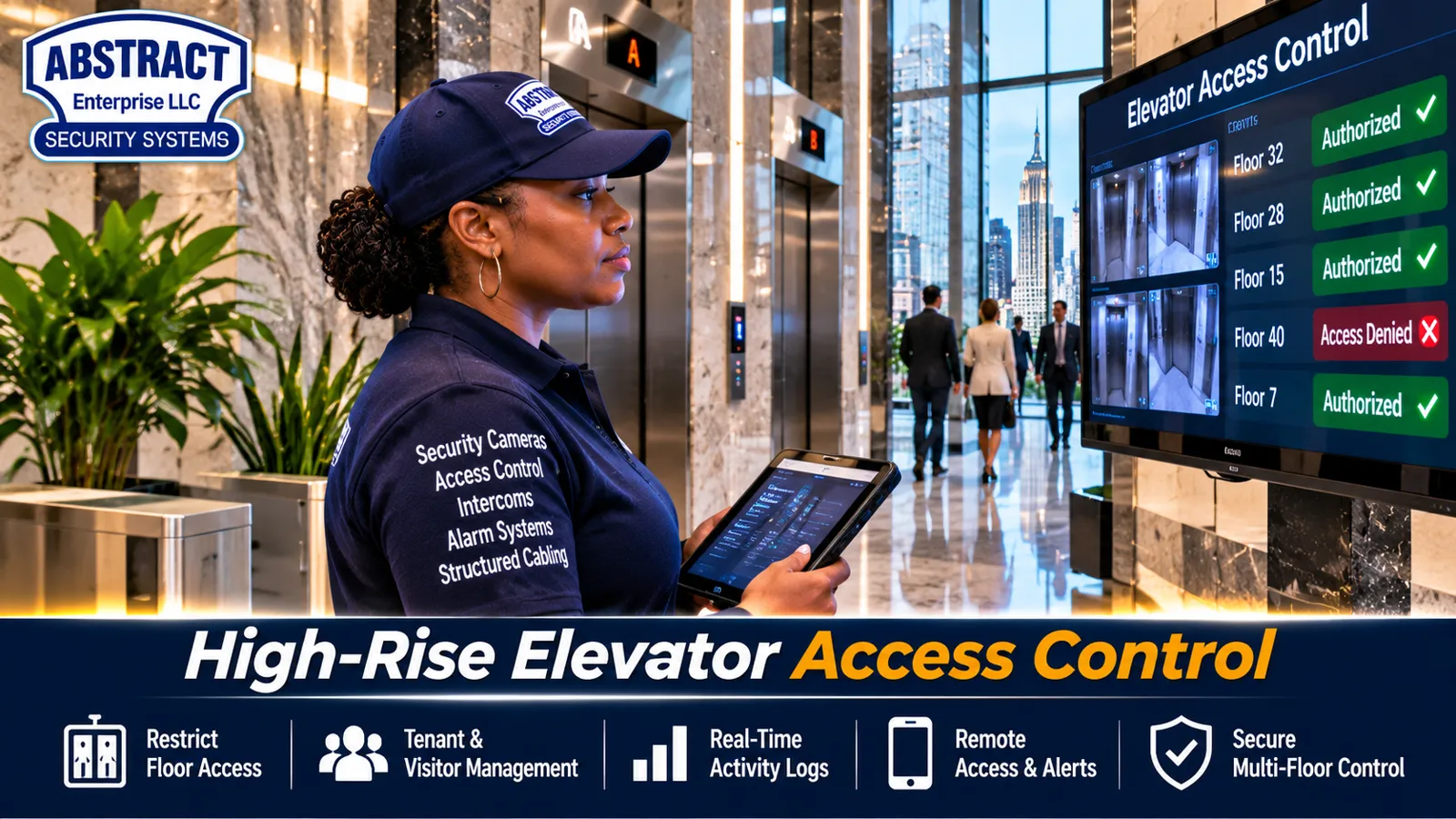
Abstract Enterprises Security Systems photo: a staff member holding a tablet stands in a marble elevator lobby while a wall screen lists floors as Authorized or Access Denied, with a banner for restricted floor access, tenant and visitor management, activity logs, remote access and multi-floor control.
NYC by the Numbers
Why Elevator Floor Access Matters So Much in New York City
New York is one of the most elevator-dependent cities in the country, which is why floor-level security matters more here than almost anywhere else.
Figure
What it means for elevator security
Source
84,000+ elevator devices citywide
Passenger and freight elevators, escalators and other devices registered with the Department of Buildings; the DOB calls the stock one of the largest and oldest in the world.
NYC DOB Elevator Report, April 2018
1,699,000 homes (46%) are in buildings with an elevator
Nearly half of all New York housing units are reached by elevator, so the elevator is the main path from the street to the apartment door.
2023 NYC Housing and Vacancy Survey (HPD)
77% of Manhattan homes (712,000 units) have an elevator
Manhattan is an elevator borough; almost every multifamily building there has a car that can carry a stranger to any floor.
2023 NYCHVS
10% of Staten Island homes (18,470 units)
On Staten Island, elevator security is mostly a question for mid-rise co-ops, senior buildings, offices and medical buildings rather than houses.
2023 NYCHVS
829,200 homes (22%) are in buildings of 100 or more units
Large buildings mean many floors, several cars and many credentials to manage, the situation floor-by-floor control was designed for.
2023 NYCHVS
861,200 occupied homes are in condo or co-op buildings
Boards and associations, not a single landlord, decide who may reach which floors, so the rules must be set out in writing before programming.
2023 NYCHVS
Two facts follow from those numbers. First, the elevator is the shared hallway of a New York building: a locked lobby door protects every floor only as long as nobody follows a resident inside. Second, the city's elevator stock is old, so many cars still run on relay or early microprocessor controllers, and the elevator contractor's interface work can be very different from one building to the next. A survey that skips the machine room is not a real survey.
Across the Five Boroughs
Elevator Access Control in Manhattan, Brooklyn, Queens, the Bronx and Staten Island
The same reader on the wall does very different jobs in each borough, because the buildings are different. This is how the work usually looks across the city, and each borough has its own page with local detail and its direct phone line.
Manhattan: prewar co-ops, postwar towers and multi-tenant office floors
Manhattan has the highest share of elevator homes in the city, and two very different kinds of building. Prewar co-ops on the Upper East and Upper West Sides often have one or two cars, some still with an attendant at certain hours, and boards that want residents to reach only their own floor while staff keep access to every floor and the roof. Postwar and new rental towers have several cars, package rooms, gyms and roof decks, which turns floor control into amenity control as well. Office buildings from Midtown to the Financial District add tenants who each lease one or more floors and want those floors locked to everyone else after hours, while the lobby desk and turnstiles keep handling visitors. Elevator access control installation in Manhattan covers the borough in detail.
Brooklyn: new rental towers, converted lofts and growing co-op stock
Brooklyn's elevator buildings range from the high-rise rentals of Downtown Brooklyn and the Williamsburg and Greenpoint waterfront to converted factory lofts in Dumbo, Gowanus and Bushwick, and six-story elevator apartment houses along Ocean Parkway and in Flatbush. New towers usually have a cloud access platform at the front door already, so the request is to extend it into the cars. Lofts tend to have keyed elevators that open straight into a unit, where the goal is to replace a mechanical key with a credential the owner can cancel. Elevator access control installation in Brooklyn has the borough page.
Queens: Long Island City towers, Flushing mixed-use and garden co-ops
Long Island City has added a skyline of rental towers with garages, amenity floors and package rooms, where hall-call readers at the garage level matter as much as readers in the cab. Flushing and Jackson Heights mix offices, medical suites and residences in one building, which means one elevator may serve a clinic, an accountant and apartments at once, each with its own hours. Co-op complexes in Forest Hills, Rego Park and Bayside often want to modernize old intercom and key systems without disturbing older residents. Elevator access control installation in Queens explains the local options.
The Bronx: Grand Concourse apartment houses, Riverdale co-ops and campuses
The Bronx has a deep stock of six-story elevator apartment houses on and around the Grand Concourse, high-rise co-ops in Riverdale and Co-op City, and large hospital and university campuses. Many of these buildings already use key fobs at the front door, so the next step is often a reader in the car that keeps people who slip in from wandering the upper floors and the roof. Campuses bring service elevators, staff-only floors and time schedules. Elevator access control installation in the Bronx goes into the details.
Staten Island: mid-rise co-ops, senior buildings, offices and medical buildings
Only a small share of Staten Island homes are in elevator buildings, so the work here is concentrated: mid-rise co-ops and condos near the North Shore, senior residences, professional buildings and medical offices. The usual request is a simple, reliable reader with credentials that a property manager can add and cancel without calling anyone, plus a clear plan for what happens during a power failure. Elevator access control installation on Staten Island covers the borough.
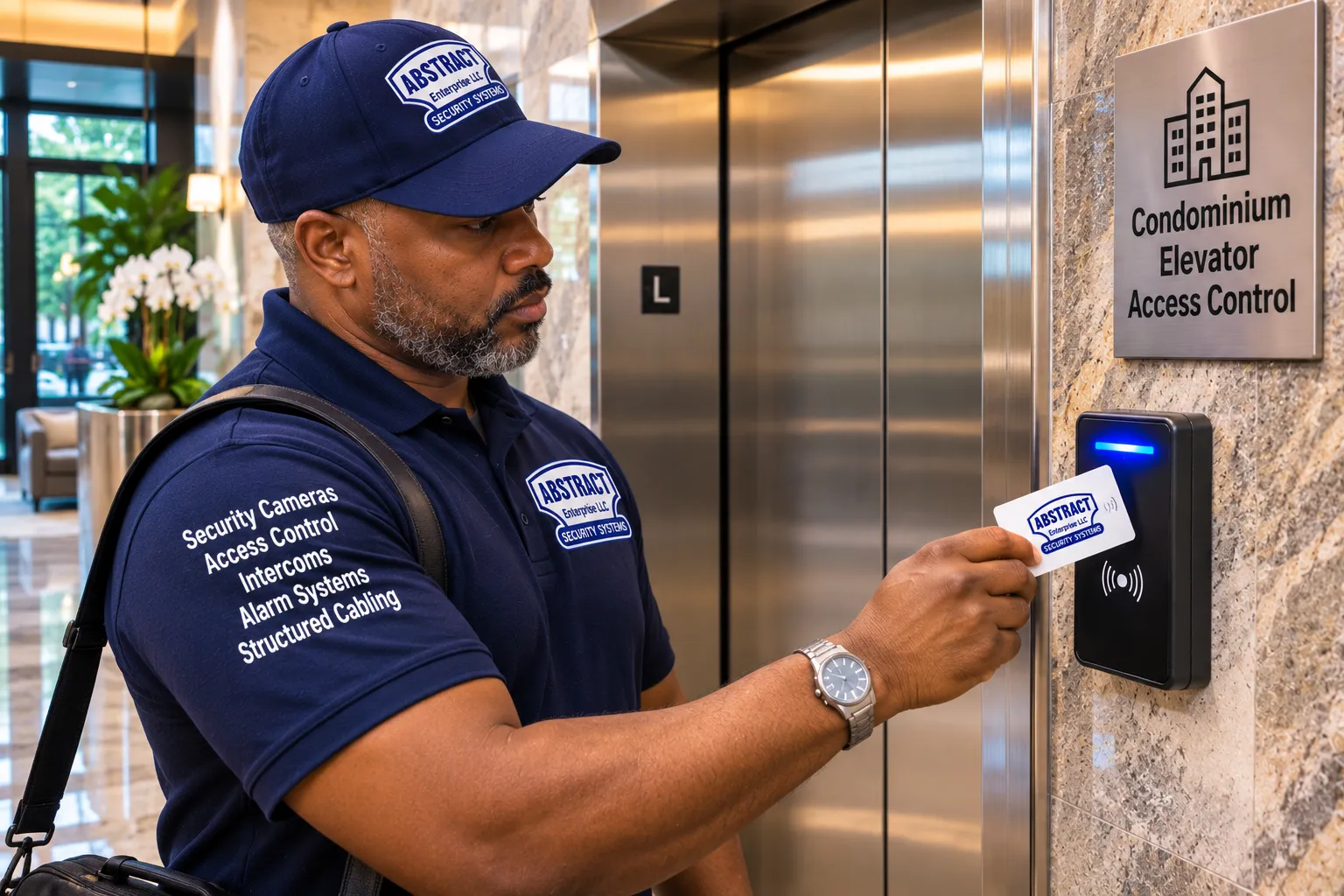
Abstract Enterprises Security Systems photo: a man in a navy polo holds a card to a black wall reader with a blue light beside polished elevator doors, under a sign reading Condominium Elevator Access Control, in a lobby with orchids and a marble floor.
Who Does What
The Line Between Low-Voltage Access Control and Licensed Elevator Work in NYC
This is the part of the job most often misunderstood, and getting it wrong is what stalls projects. In New York City, work on the elevator itself is regulated work. Since January 1, 2022, under the New York State Elevator Safety Act, anyone who performs elevator work, meaning the alteration, installation, maintenance, repair, replacement or modernization of elevators, must hold both a New York City and a New York State license, and the employer must have a Licensed Elevator Agency Director. Filings for elevator alterations go through the Department of Buildings' DOB NOW: Build system.
Abstract Enterprises Security Systems is a licensed low-voltage security contractor, not an elevator agency, and we say so on every quote. That is not a limitation in practice, because elevator access control is designed in two halves with a clean line between them:
Our side (low-voltage access control)
Elevator contractor's side (licensed elevator work)
Readers in the cab or at the hall station, keypads and mobile credential readers
Connection of floor-enable signals into the elevator controller or car operating panel
Access control panel, elevator interface or relay board, power supply and battery backup
Traveling cable or wireless link in the hoistway, if a new conductor to the car is needed
Cable from the reader location to the machine room or controller room interface point
Fire service and independent service behavior, testing with the controller
Credentials, floor permission groups, time schedules, visitor rules
Any DOB elevator filing, permit posting and sign-off the work requires
Intercom, camera, visitor management and building management integration
Destination dispatch configuration and its data interface on the elevator side
We meet the elevator contractor before anything is ordered. Together we confirm the controller type, where the floor signals can be picked up, whether there is a spare conductor in the traveling cable, what fire service and independent service do today, and whether a filing is needed. The building pays the elevator contractor directly for their part, and our scope lists it as a separate item so nobody is surprised.
If you do not know who maintains your elevators, the maintenance contract or the certificate posted in the car usually names the company. Bring it to the survey and we will make the call.
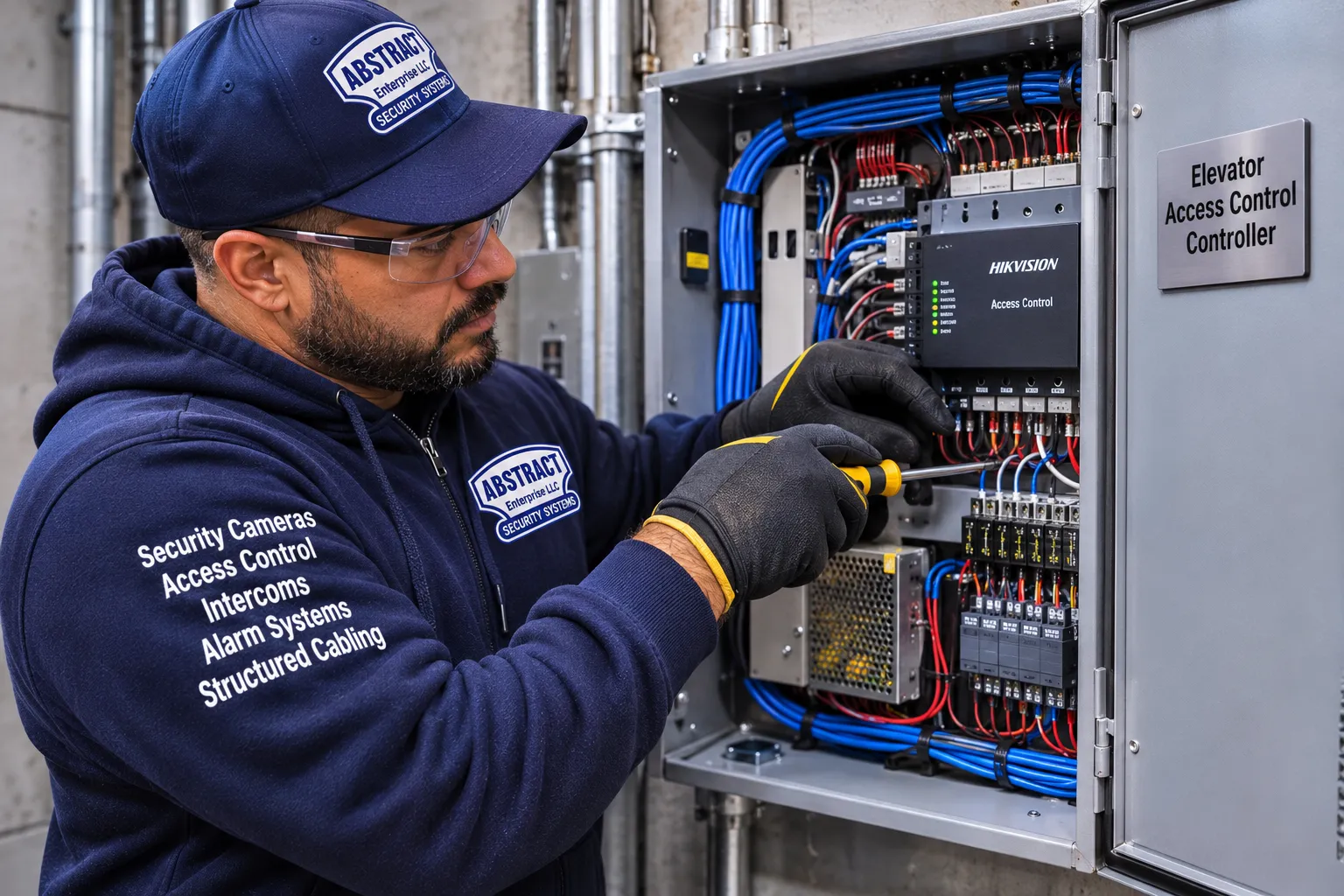
Abstract Enterprises Security Systems photo: a technician with a screwdriver works inside an open steel enclosure labeled Elevator Access Control Controller, full of neatly bundled blue cable, relay modules and an access control unit marked Hikvision.
Life Safety
Fire Recall, Power Loss and Emergency Override: Elevator Access Control That Gets Out of the Way
Every elevator in New York City follows ASME A17.1, the national elevator safety code, as modified by Appendix K of the NYC Building Code. Part of that code is firefighters' emergency operation: when a smoke detector in an elevator lobby or machine room trips, or a firefighter turns the recall key, the cars return to the designated landing and are taken out of normal service. NYC buildings also have the labeled BANK FIRE RECALL and CAR FIRE RECALL switches that the code describes.
Anything added to a cab or a hall station has to stay out of the way of that. The Department of Buildings made the point directly in Buildings Bulletin 2022-010, written about touchless call devices: an added device must not impede the normal operation, emergency operation or evacuation of the elevator, and it must become inoperative when Phase I or Phase II emergency operation begins. Floor-restriction readers fall under the same logic, so we design every system around three rules:
Recall wins. When firefighters' service starts, the elevator ignores the access control system completely. The interface is wired so the elevator controller, not our panel, decides what happens.
Know the power-loss state. We agree in writing what the floors do if the access control panel loses power. Most residential buildings choose floors that stay locked except for the lobby and the floors staff must reach, with battery backup on the panel; some commercial tenants choose otherwise. It is the owner's decision, made before installation, not discovered during an outage.
A manual override exists and is documented. A key switch or a programmed override lets the super, the doorman or building security free all floors at once, for moves, deliveries, a medical call or an emergency, and every use is recorded.
Accessibility counts too. A rider who uses a wheelchair needs the reader at a height and position they can reach from inside the car, and a resident who cannot easily present a fob may need a phone credential or a longer unlock window. We set those up during programming, not after a complaint.
None of this is legal advice, and your elevator contractor and, where needed, your design professional have the final word on code compliance for the elevator. Our job is to make sure the security system never becomes the reason an elevator fails an inspection.
Tenant Data Privacy
Local Law 63 and Residential Elevator Key Fobs in New York City
If your building is a residential multiple dwelling in New York City and you use key fobs, cards, phones or biometrics to let people in, NYC Local Law 63 of 2021, the Tenant Data Privacy Act, applies to the system. It covers more than the front door. It reaches common areas reached through the smart access system, which is why an elevator floor-restriction system in an apartment building belongs inside the same privacy plan as the lobby reader.
As the Department of Housing Preservation and Development and law-firm summaries describe it, the law requires owners of these buildings to:
get tenants' express consent before collecting reference data such as biometrics;
give tenants a plain-language privacy policy that says what the system collects, who it is shared with, how it is protected and how long it is kept;
use the data only for granting access and monitoring entrances, exits and common areas, not to track tenants' relationships or follow them outside the building;
protect the data with real security safeguards; and
destroy a departed tenant's reference data within 90 days.
That shapes the way we program an elevator system in an apartment building. We keep the ride log to what the building actually needs, which is usually who used which credential at which reader and when. We avoid face or fingerprint readers in residential elevators unless the owner has a consent process in place. We give the property manager a clear procedure for deactivating the credential of a tenant who moves out and for clearing the record on time, and we hand over the platform's own privacy documentation so the owner can include it in the policy given to tenants.
Office buildings, hotels, hospitals and schools are not Class A multiple dwellings, so this particular law does not apply to them, but most commercial clients ask for the same discipline anyway: short retention, named administrators and an audit trail of who changed what.
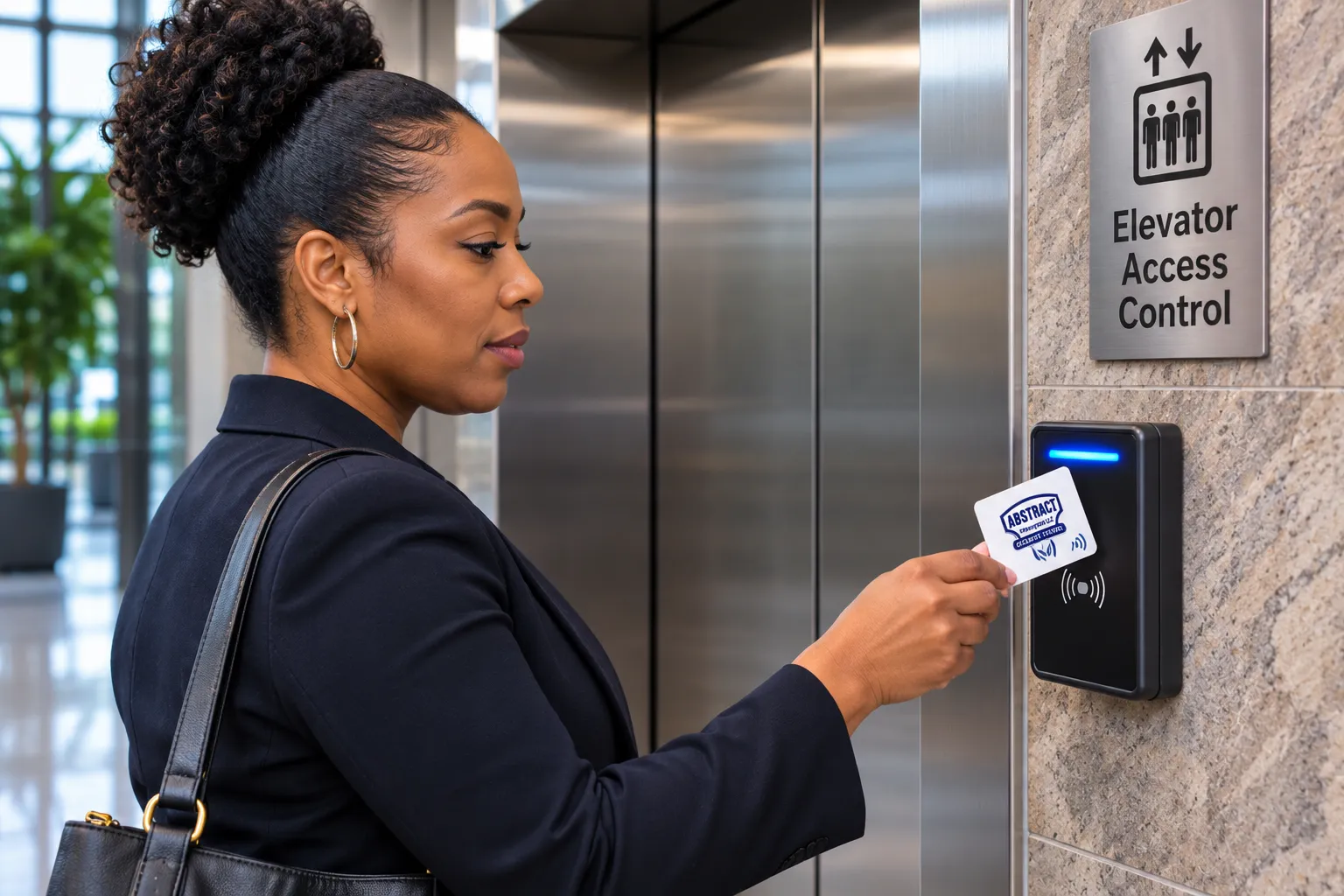
Abstract Enterprises Security Systems photo: a woman with a shoulder bag holds a white key card to a black reader with a blue status light beside steel elevator doors, under a sign reading Elevator Access Control.
Credentials
Key Fobs, Cards, Phones, Keypads and Biometrics: Choosing Elevator Credentials in NYC
The credential is the part residents and employees touch every day, so it decides whether a system is loved or hated. These are the options we install, and what each is good and bad at in a New York building:
Credential
Best for
Watch out for
Proximity key fob or card (125 kHz)
Older buildings extending an existing fob system into the elevator
Easy to copy at a kiosk; we recommend moving to encrypted credentials when the system is replaced
Encrypted smart card or fob (13.56 MHz, e.g. DESFire-class)
Co-ops, condos and offices that want credentials that cannot be cloned in a minute
Readers and cards must match; we check compatibility before ordering
Multi-technology reader
Buildings moving from old fobs to new ones without re-issuing everything at once
Plan a date when the old technology is switched off, or the weak credential stays forever
Mobile credential (Bluetooth or NFC phone app)
Rental towers and offices with tech-comfortable users; guests and cleaners with time-limited access
Phones die; keep a physical credential for every resident who wants one
PIN keypad
Service elevators, staff floors, contractors, back-up access
PINs get shared; pair with a card for sensitive floors
Biometric reader (face or fingerprint)
High-security commercial floors, labs, data rooms
In NYC residential buildings, Local Law 63 consent and policy rules apply
Because a resident in New York may hold a fob for the front door, the package room, the gym and the garage, we try to make the elevator use the same credential as everything else. A second fob just for the elevator is the fastest way to make residents prop doors and hold cars for strangers.
Elevator key fob programming and access card replacement are part of what we hand over. The property manager gets a simple procedure to issue, suspend and replace credentials, so a lost fob is cancelled in minutes, and an elevator credential management routine that matches the front door's.
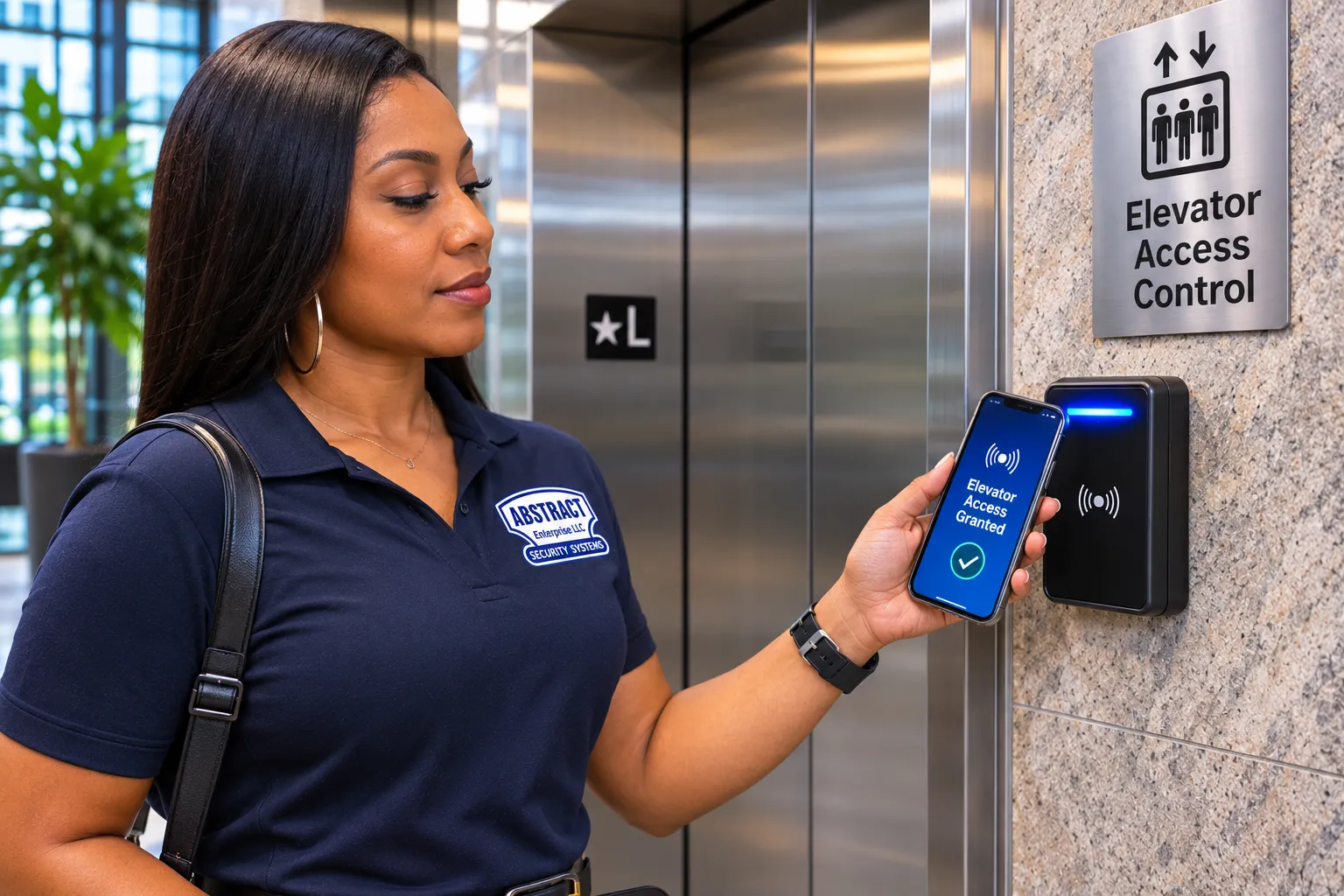
Abstract Enterprises Security Systems photo: a woman in a navy polo holds a phone that reads Elevator Access Granted against a black wall reader with a blue light, next to an elevator and an Elevator Access Control sign.
Honest Limits
What Elevator Access Control Stops in a New York Building, and What It Doesn't
Elevator access control is a strong tool, but it is one layer, and a board or owner should know what it does not do before spending money on it.
What it stops well
Strangers who slip in behind a resident and then try to reach other floors, the roof or the mechanical floors.
Old keys and copied fobs that have spread over the years, once the building moves to encrypted credentials it can cancel.
Visitors wandering beyond the floor of the person they came to see.
After-hours traffic on office, clinic and amenity floors.
What it does not stop on its own
A person riding up with a resident to that resident's floor. Only building culture, a doorman or a camera deals with that.
Stairwells. Stair doors are governed by the fire and building codes for egress and re-entry, so elevator restriction is not a reason to lock stairs in a way that traps anyone, and we do not design it that way. Stair doors are a separate access control conversation with the building's design professional.
A lobby door propped open by a mover or a resident. Door-held alarms and cameras at the entrance cover that gap better.
A credential that is lent out. Time limits, named credentials and the access log make lending visible, but they cannot prevent it.
The best results in New York come from combining layers: a secure front door with an intercom, elevator floor restriction, cameras in the lobby and the cars, and a property manager who actually uses the log. We price and plan the elevator part honestly as one of those layers.
Apartment Buildings
Elevator Access Control for NYC Co-ops, Condos and Rental Buildings
In apartment buildings the elevator decides who can reach a resident's door. Floor restriction does not replace the lobby door, the intercom or the doorman; it adds a second gate that holds even when the first one is beaten by someone following a resident inside.
Co-ops and condos
Boards usually want three things: residents reach their own floor plus shared floors such as the lobby, laundry, storage and roof deck; staff reach every floor; and guests reach only the floor of the resident who let them in. Penthouse and private-floor owners often want their floor locked to everyone else, including other residents. Because a board decides these rules, we write them out as a permission chart and have it approved in writing before programming, and we leave the board with a way to change it later without a service call.
Rental buildings
Owners of rental buildings ask for elevator access control to cut down on non-residents riding to upper floors, roof access, package theft from hallways and short-term rental traffic. The main tasks are fast move-in and move-out handling, which means issuing and cancelling credentials from the property management office, and the Local Law 63 rules described above. Many owners also want the elevator credential to be the same fob or phone app that opens the front door and the package room.
Luxury and amenity buildings
Amenity floors change the design. A building with a gym, a children's playroom, a screening room and a roof terrace usually wants those floors open to residents at set hours and closed at night, while the lobby desk can open them for a booked event. Time-based floor permissions handle that without anyone switching keys.
Visitors and deliveries
A visitor who is buzzed in through the intercom should be able to reach the resident's floor and no other. With an integrated video intercom, the resident's tap on the app or in-unit monitor can open the lobby door and enable that one floor in the car for a short window. Delivery drivers can be kept to the lobby or a package room floor. This is one of the most requested upgrades in New York, because it stops the habit of residents coming down to ride up with every guest.
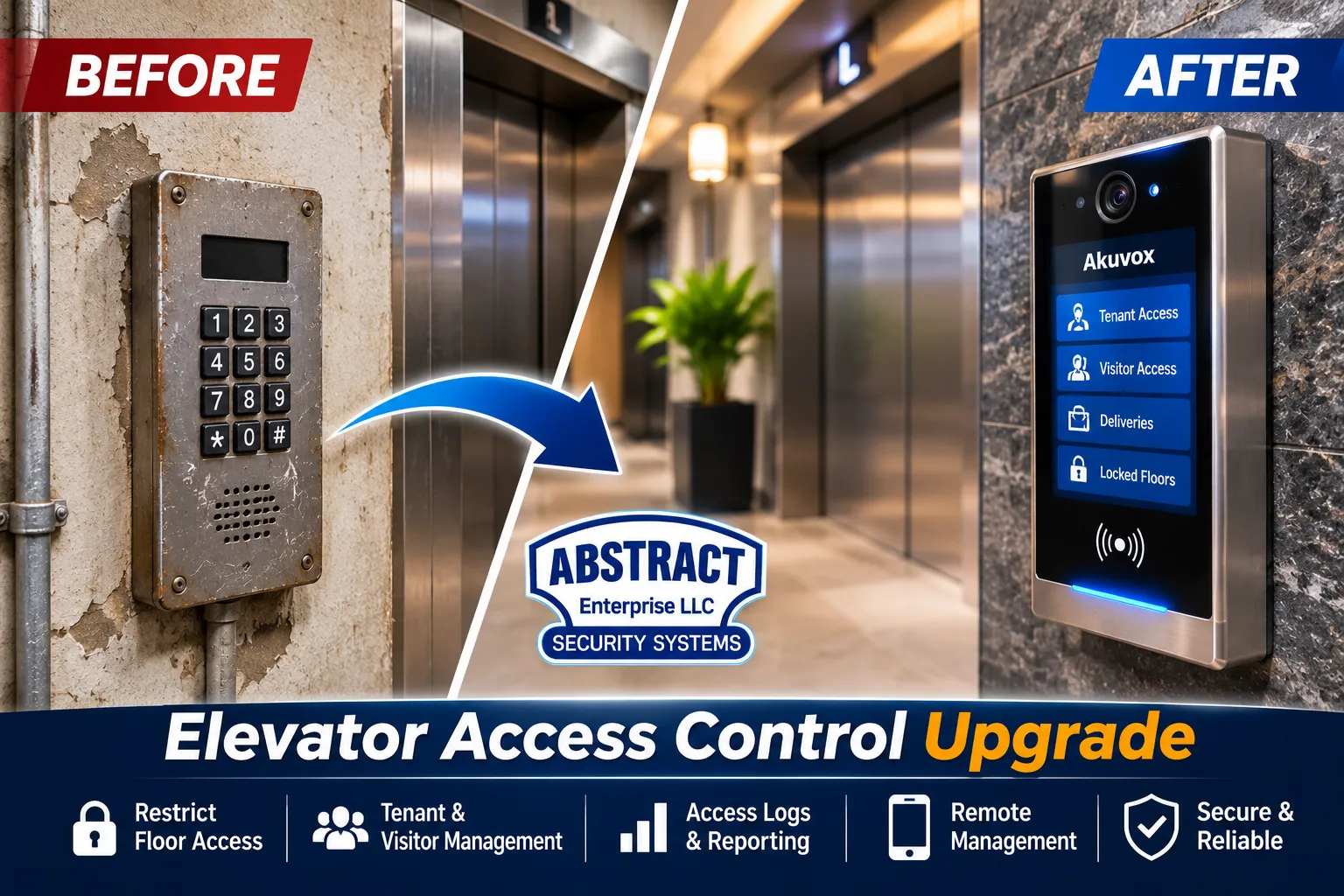
Abstract Enterprises Security Systems image: on the left, an old worn metal keypad on a stained wall beside an elevator; on the right, a modern Akuvox touch panel offering tenant access, visitor access, deliveries and locked floors, joined by an arrow and the Abstract logo.
Building Types
Four NYC Building Situations and How Elevator Access Control Handles Each
Four New York situations come up again and again, and each needs a slightly different design.
The prewar co-op with an attended elevator
Many older co-ops still run an elevator with an operator during some hours and in automatic mode the rest of the time, or have a handman who runs the car for moves. Floor restriction has to respect both modes. When the operator is on duty, the board may want floors free, because the operator already knows every resident. When the car is in automatic mode at night, floors lock and residents use their fobs. We set that up as a schedule with a manual switch for the staff, so the operator never has to fight the security system, and we keep the reader position away from the car's original brass or wood panel wherever the board wants the interior preserved.
These buildings are also where residents are least likely to want an app. A fob or card for each resident, plus a written procedure for issuing one to a new shareholder at closing, keeps the system usable for everyone, including residents who have lived in the building for fifty years.
The loft with a keyed elevator that opens into the unit
Converted manufacturing buildings in Lower Manhattan, Dumbo, Long Island City and Williamsburg often have an elevator that opens directly into each unit, controlled by a mechanical key switch. A key that has been copied for years by contractors, cleaners and former tenants is not much of a lock. Replacing the key switch function with a reader, through the elevator contractor, gives each owner credentials they can issue and cancel themselves, and a record of who rode to their floor. Because the elevator door is effectively the unit's front door, fire egress and the power-loss state matter even more than in an ordinary building, and we settle them with the elevator contractor and the board before anything is ordered.
The garage, cellar or back-lobby stop
A building can have a doorman at the front and still be wide open from the garage. Hall-call readers at the garage and cellar landings stop the car from being called from those levels without a credential, and a reader in the car can keep someone who rides up from the garage limited to the resident's floors. For mixed-use buildings, we often separate the commercial tenants' stops from the residential floors entirely, so a store employee in the cellar cannot ride to the apartments.
Roof access, package rooms and hallway theft
Some of the most common complaints that lead to elevator access control in New York are not burglaries but roof parties, people sleeping in stairwells, and packages taken from hallway doormats. Locking the roof and mechanical floors to staff, limiting the package room floor to residents, and keeping riders to their own floors cuts the traffic that causes all three. The access log then gives the managing agent something better than guesswork when a complaint comes in.
People and Permissions
Doormen, Guests, Aides and Movers: Planning Elevator Permissions for a New York Building
A New York building has a lot of people who are not residents or employees but still need the elevator. Planning for them is what separates a system people accept from one they defeat with a doorstop.
Who
Typical rule
Doormen, supers, porters, handymen
All floors at all hours, each with a personal credential so actions are logged by name
Guests let in through the intercom
The host's floor only, for a short window after the host opens the door
Delivery drivers and couriers
Lobby or package room floor only; apartment deliveries go through the desk or the host
Home health aides and caregivers
The client's floor, often at set hours, with a credential that expires on a date the resident chooses
Cleaners, dog walkers, babysitters
The employer's floor during agreed hours, issued and cancelled by the resident or management
Contractors and movers
Specific floors on approved days, often with the car on independent service operated by staff during the move
Elevator mechanics and inspectors
Never blocked; the elevator contractor's own service modes override the access system
Emergency responders
Never blocked; firefighters' service overrides the access system
Every rule in that table becomes a permission group in the platform, so adding a new aide or cancelling a cleaner's access is one change, not a call to us. For residential buildings, time-limited credentials for aides and service workers are also a practical way to keep the data the system holds to what is needed.
Commercial Buildings
Elevator Access Control for NYC Office Buildings, Medical Buildings, Hotels and Campuses
Commercial buildings use elevator access control to give each tenant control of its own floors and to keep the building's back-of-house floors private. The common requests we see across Manhattan, Brooklyn, Queens and the Bronx are:
Multi-tenant office floors. Each tenant's floors open to its own employees and stay locked to everyone else, at least outside business hours. The lobby desk issues visitor credentials that open one floor for one visit.
After-hours lockdown. Floors are open during the day and require a credential at night and on weekends, with a schedule the building manager can change for holidays.
Executive and secure floors. One floor, often the top, stays locked even to the tenant's own staff unless they are on the list.
Medical and professional buildings. Patients reach clinic floors during office hours, while records rooms, staff floors and the roof stay restricted.
Hotels. Guests' key cards open only the guest floors and amenities they have paid for.
Schools, campuses and public buildings. Employee-only floors, service elevators and restricted facility floors with logs for every ride.
Service and freight elevators. A keypad or reader so only staff and approved contractors can use the car, with a separate schedule for move-ins.
In larger Manhattan office towers the lobby often already has turnstiles, and newer towers use destination dispatch, where riders choose a floor at a kiosk before boarding. In those buildings the access control system and the elevator system share permissions over a data link, and the work becomes a coordination exercise between the security platform, the turnstiles and the elevator manufacturer's interface. We install and program the security platform side and work to the elevator manufacturer's interface specification, which the elevator contractor provides.
For tenants rather than owners: you cannot add elevator access control on your own floors without the landlord. The elevator belongs to the building. What a tenant can do is ask the landlord to add its floors to the building's existing system, or to approve an extension we install at the tenant's cost under the landlord's rules. We help tenants put that request together.
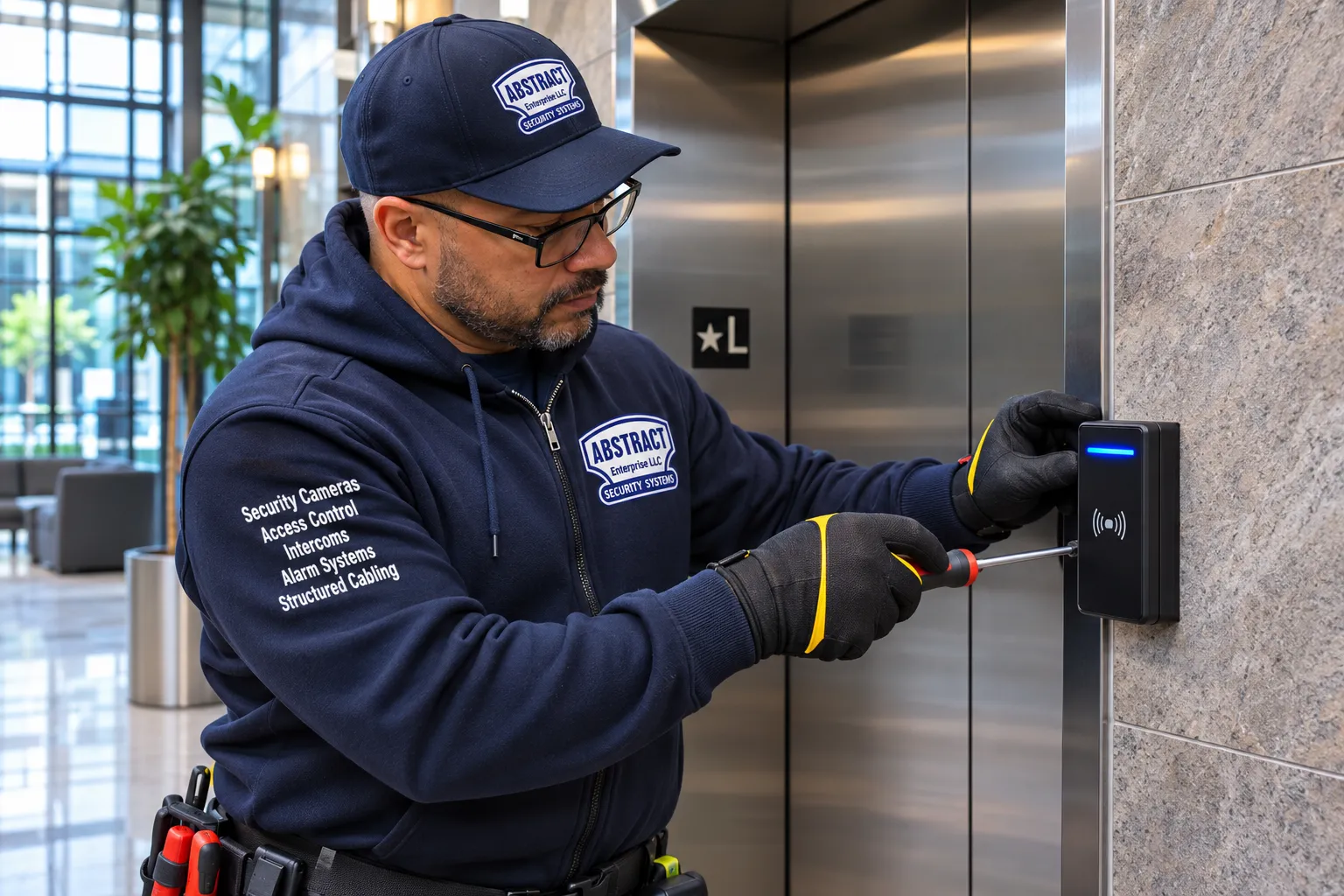
Abstract Enterprises Security Systems photo: a technician in a navy cap, safety glasses and gloves fastens a slim black card reader with a blue light to the stone wall beside a stainless elevator in a glass-walled office lobby.
Schedules
Time-Based Floor Permissions for NYC Offices, Clinics and Amenity Floors
Time-based floor permissions let one system behave differently at different hours without anyone touching a key. These are the schedules New York buildings ask for most:
Office floors open from morning to evening on weekdays and locked nights, weekends and holidays, with a holiday calendar the building manager edits each year.
Medical floors open during clinic hours so patients can ride up without a credential, and locked when the practice closes.
Amenity floors such as gyms, playrooms and roof terraces open to residents at posted hours and closed overnight.
Move-in and move-out days, when a freight or service car runs on independent service and floor restriction is suspended for that car only.
Attended hours in a co-op, when the operator runs the car and floors are free, and automatic hours, when floors lock.
Schedules are the part of an elevator access control system most often set once and forgotten. We leave the building with a one-page schedule summary and show the manager how to change it, so the system matches the way the building actually runs a year later.
Other Properties
Elevator Access Control for NYC Hotels, Medical Buildings, Schools and Public Buildings
Beyond apartments and offices, a handful of New York property types have their own elevator access patterns.
Hotels and extended-stay buildings
The guest's room key opens the guest floors and the amenities included in the stay, and stops working at checkout. The hotel's property management system usually issues the key, so the elevator readers must read the same card format the room locks use. Service floors, laundry and roof access stay staff-only, and the front desk can open a floor for a guest who lost a key without sending them back downstairs.
Hospitals, clinics and medical office buildings
Patient floors are open during visiting hours, while pharmacy, records, staff-only and mechanical floors stay restricted. Service elevators carrying equipment or supplies often need a keypad or reader so only staff use them. Medical buildings in the outer boroughs often share one elevator between several practices with different hours, which is a natural fit for per-floor schedules.
Schools, universities and campuses
Classrooms are open during the school day, while offices, server rooms and the roof stay locked. Campuses with many buildings benefit from one platform and one credential across all of them, with each building's elevator floors as separate permissions. Accessibility matters here more than anywhere, because the elevator may be the only route for a student who uses a wheelchair; we make sure the student's credential works on every floor they need.
Government and restricted facilities
Public buildings often have public floors open during business hours and restricted floors for staff, records or secure functions. These projects usually come with written specifications, insurance and prevailing wage requirements; we respond to the specification as written and say plainly where a requirement needs a decision from the owner.
Integration
Tying Elevator Access Control to Intercoms, Cameras and Visitor Systems in NYC
Elevator access control works best as one part of a building system rather than a separate box. These are the integrations we set up most often in New York City:
Door access control. The elevator uses the same panel, the same credentials and the same user list as the front door, package room and gym. See access control installation in NYC.
Cameras. An event at an elevator reader, such as an invalid credential or a forced override, bookmarks the camera in the car or lobby so the property manager sees the clip instead of a line of text. See security camera installation in NYC.
Visitor management. Guests receive a time-limited mobile pass or QR code that opens the lobby and one floor, and expires on its own.
Building management and alarms. Status signals such as panel trouble or a door held open can be sent to the building's management system or to an alarm panel.
Cloud management and API. Most current platforms let the property manager add and remove people from a phone, and many offer an API so the building's resident app or leasing software can create credentials automatically.
The access logs these systems keep are useful, but they are also data about people. We set retention to what the building actually needs, give each administrator a separate login, and turn on the audit trail that records who changed which permission. For apartment buildings, that design also supports the Local Law 63 duties described above.
The cable for all of this has to get from the reader to a panel and from the panel to the elevator interface. In older buildings that often means a careful run up a riser or through the machine room; we handle the low-voltage pathways ourselves, and structured cabling in NYC explains how we plan and certify cable runs.
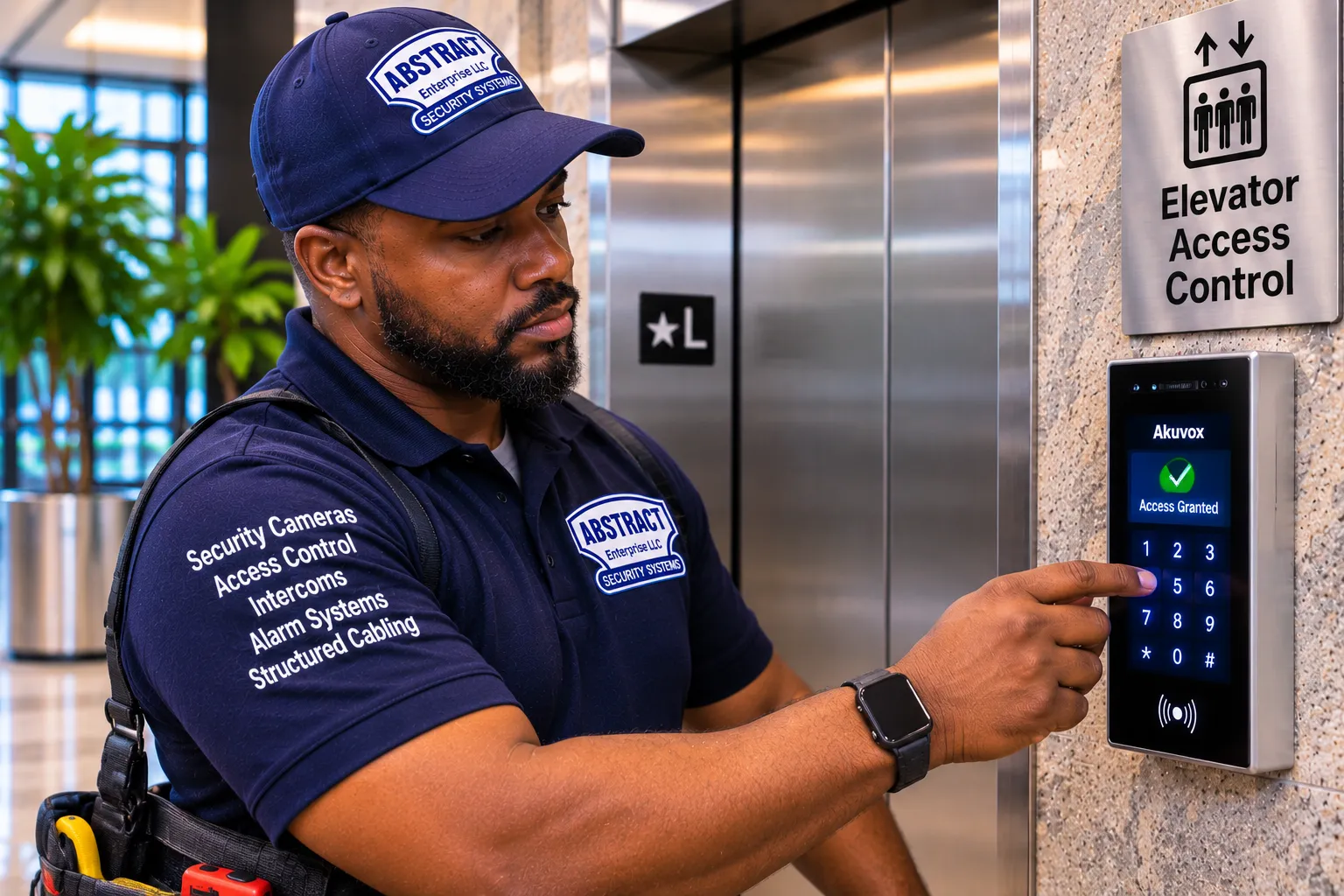
Abstract Enterprises Security Systems photo: a technician in a navy polo presses a key on an Akuvox panel with a numeric keypad and card symbol, whose screen shows a green check and Access Granted, beside an elevator and an Elevator Access Control sign.
For Boards
How We Answer the Concerns Raised at an NYC Co-op or Condo Board Meeting
When an elevator access project reaches a co-op or condo board meeting, the same concerns come up in almost every building. Here is how we address each one in the written proposal.
Cost to residents
The project is quoted per building, and the board decides how it is funded. The written scope lists every item, including the elevator contractor's part, so the board can compare it fairly with any other bid and see exactly what the building is paying for.
Older residents and residents without smartphones
Every resident can have a physical fob or card. Mobile credentials are offered, never required. Readers are placed where they can be reached from a wheelchair, and the unlock window is long enough for someone who moves slowly.
Privacy
For residential buildings we explain what the system records, who can see it, how long it is kept and how departed residents' data is deleted, in line with Local Law 63. The board approves the retention period.
What happens when something breaks
The board sees the agreed power-loss behavior, the override procedure and who to call for the security side and the elevator side. Nobody is stranded because a reader failed; the staff override frees the floors and the event is logged.
Disruption during installation
Most of the low-voltage work happens in the machine room and inside the car with short interruptions, scheduled in the building's permitted work hours. Each car is taken out of service only while it is being worked on, and the building is told in advance.
Brands
Elevator Access Control Platforms We Install and Integrate in NYC
We are brand-flexible. The right platform is usually the one your building already uses at the front door, extended into the elevator, because one credential and one user list beats two. We install, integrate and service elevator access control on platforms including Akuvox, ButterflyMX, 2N, HID readers and credentials, Brivo, Kisi, LenelS2, Genetec, Gallagher, ICT Protege, Suprema, ZKTeco, Paxton and Axis, and we work with the elevator interface products these platforms support.
Two notes keep that list honest. First, we are an installer and integrator for these brands, not a manufacturer, and we do not claim certifications we do not hold; if your project specification requires a factory-certified dealer for a particular platform, tell us at the survey and we will tell you plainly whether we qualify. Second, every brand's elevator module has limits, such as a maximum number of floors per interface board, so the brand choice is made after we count floors and cars, not before.
If you are choosing a platform from scratch, we will lay out two or three options for your building with the trade-offs: cloud versus on-site server, licence fees, mobile credential support, intercom integration and how easily your property manager can run it day to day. For a quick comparison of two popular building platforms, see our ButterflyMX installation page.
Upgrades and Repairs
Replacing, Upgrading and Repairing Elevator Access Control Systems in NYC
A large part of our elevator access work in New York is not new systems but old ones: readers that stopped talking to the panel, fobs that open the front door but not the car, floors that stay locked or never lock, and systems whose software nobody can log into anymore.
Upgrades and replacements
Older elevator card reader systems were often installed with a stand-alone controller in the machine room and a proprietary card format. When the front door is upgraded to a new platform, the elevator is left behind and residents end up carrying two credentials. A replacement keeps whatever is good, usually the cable and sometimes the relay board, and moves the elevator onto the same platform as the doors. Where the old relay interface is sound and the elevator contractor agrees, the upgrade can often reuse it, which keeps the elevator contractor's part of the job small.
Repair and service calls
When an elevator card reader is not working, the cause is usually one of a short list: the reader lost power or communication, the panel lost its connection to the network or cloud, a schedule or permission group was changed, the credential format does not match the reader, or a relay or interface board failed. The cure is different for each, and some of them sit on the elevator contractor's side. We diagnose our side, document what we find, and if the fault is in the elevator controller we tell the building and the elevator company exactly what we saw.
Service calls are booked like every other visit: a 2-hour arrival window, and the technician arrives inside that window. Existing customers with a support plan should call the number on their paperwork. For anyone else, we start with an account and a booked visit; we do not walk through elevator wiring by phone, because a wrong change in a machine room can strand people in a car.
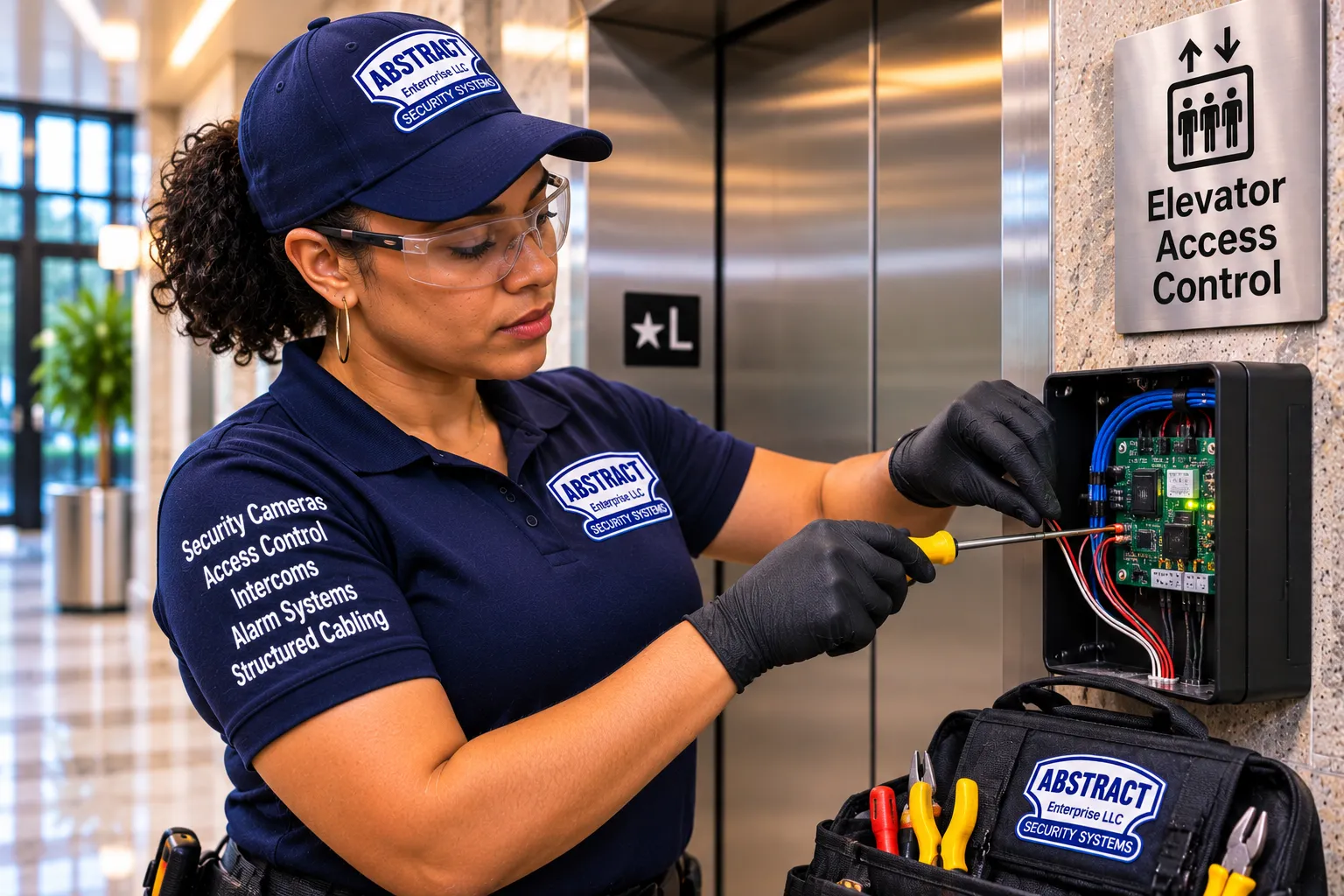
Abstract Enterprises Security Systems photo: a technician in safety glasses and black gloves uses a small screwdriver on the terminals of an open reader enclosure with a green circuit board next to an elevator, with an Abstract-branded tool bag beside her.
Common Problems
Elevator Card Reader and Key Fob Problems We Diagnose in NYC Buildings
If you already have an elevator access system, these are the problems that most often bring a New York building manager to us. Each one is diagnosed on site, because the fix depends on what the system is and where the fault sits:
Residents' fobs open the front door but the elevator does not respond.
One floor never unlocks, or one floor never locks.
The car works for some credentials and not others after a software update or a change of management company.
The reader shows a communication or offline light, or the platform shows the panel as offline.
Floors lock correctly during the day but the schedule fails at night or on holidays.
Nobody has the admin login, so credentials cannot be added or removed.
The intercom opens the door but no longer releases the visitor's floor.
For existing customers we start from the records we left behind. For buildings new to us, we book a diagnostic visit in a 2-hour arrival window, confirm which part of the problem is on the security side and which is on the elevator side, and give a written finding before any repair.
Keep or Replace
Should Your NYC Building Repair or Replace Its Elevator Card Reader System?
Buildings that already have an elevator card reader or fob system often ask whether to repair it or replace it. This is how we help decide:
Situation
Usually the better choice
System works, software supported, credentials secure
Keep it; add floors or cars and tune the permissions
System works but the front door was moved to a new platform
Move the elevator onto the front door platform so residents carry one credential
Old 125 kHz fobs being copied at kiosks
Move to encrypted credentials, using multi-technology readers to phase the change
Software unsupported or nobody has the admin login
Plan a replacement that reuses cable and, where the elevator contractor agrees, the interface
Elevator modernization scheduled in the next year or two
Repair only what is needed now and design the new access interface into the modernization
Frequent faults traced to the elevator controller
Have the elevator contractor fix the controller side before spending on security hardware
Either way, you get a written finding first. We do not replace working equipment just because a newer model exists.
Infrastructure
Power, Network and Machine Room Planning for Elevator Access Control in NYC
The quiet part of an elevator access control installation is the infrastructure behind the reader. Getting it right is what keeps the system running years later.
Power. The access control panel and interface boards need a dedicated power supply with battery backup sized for the readers and relays. Where a new outlet or circuit is needed, it goes to a licensed electrician and appears as its own line, because Abstract Enterprises Security Systems does not do electrical work.
Network. Cloud platforms need a reliable internet connection at the panel. In buildings where the machine room has no network, we either run cable from the building's network closet or plan a cellular connection, and we confirm the panel still makes local decisions if the internet drops, so riders are not stranded by an outage at the provider.
Location. The panel and interface boards sit where the elevator contractor can reach the connection point and where building staff cannot casually unplug them, usually in or next to the machine room or controller room, in a locked enclosure.
Cable. Reader cable to the car usually travels with the car through conductors the elevator contractor provides, and everything else runs in the building's pathways, labeled at both ends.
Records. At the end, the building keeps a drawing or list of every reader, panel, interface board, relay-to-floor mapping and cable run, so the next technician does not have to guess.
If the machine room is locked by the elevator company, as many are, we arrange access through the building and the elevator contractor rather than asking for a key we should not have.
Field Notes
What We Check on an NYC Elevator Access Control Survey
What a real survey in a New York building looks at, in the order we check it:
The machine room or controller room first. We note the controller type, any existing access interface, spare conductors in the traveling cable, and where a new panel can sit with power and a network connection. Old relay controllers and newer microprocessor controllers are handled differently by the elevator contractor.
Every car, every station. How many cars, which floors each serves, whether there is a garage or cellar stop, and whether the lobby has one call station or several.
The permission chart. Who should reach which floors, at what hours, with what credential. For a co-op that is a board decision; for an office it is the landlord and each tenant.
The existing front door system. Brand, credential type and who runs it, so the elevator can share it.
Power and failure behavior. Where battery backup goes and what the floors do if the panel goes dark.
The people. Doormen, supers, porters, movers, dog walkers, home health aides, cleaners. Every one of them needs a rule, and forgetting one is what fills a lobby with propped-open cars.
From that visit you get a written scope with the elevator contractor's part listed separately, and a plain explanation of why the design was chosen, so a board or an owner can approve it with confidence.
Our Process
How We Install Elevator Access Control in NYC Buildings, Step by Step
Elevator access control installation in New York follows the same eight steps whether it is a two-car co-op or a twenty-floor office building. The elevator contractor appears in step four and step seven, by design.
Send the building details. Share the address and borough, the number of floors and elevator cars, the access control or intercom brand you use now, and the name of your elevator maintenance company if you know it.
Agree who decides. Confirm who approves the work and the floor rules: the co-op or condo board, the owner, the managing agent, or the landlord and each tenant in an office building.
Survey the machine room, cars and lobby. Walk the machine or controller room, every car and every call station, and the front door system, inside a booked 2-hour arrival window.
Meet the elevator contractor. Confirm with the building's licensed elevator contractor where the floor signals connect, what fire service and independent service do, and whether a DOB filing is needed.
Approve the written scope and permission chart. Receive a scope listing every reader, relay, cable run, credential and integration, with the elevator contractor's part listed separately, plus a chart of who reaches which floors and when.
Install the low-voltage side. Mount readers, set the panel and interface board with battery backup, pull and label cable, and leave the connection point ready for the elevator contractor.
Connect, program and test with the elevator contractor. The elevator contractor makes the controller connection; we program credentials, floors and schedules, then test every floor in every car, recall behavior and the override together.
Hand over and train. Give the property manager the admin logins, the permission chart, credential procedures, the cable and panel records and a short training session for staff.
On a typical building the low-voltage installation itself is a matter of days, but the calendar is set by the approvals, the elevator contractor's schedule and equipment lead times, so the dates go in the written scope rather than in a promise on the phone. Visits always come with a 2-hour arrival window, and work in occupied residential buildings is scheduled around the building's permitted work hours.
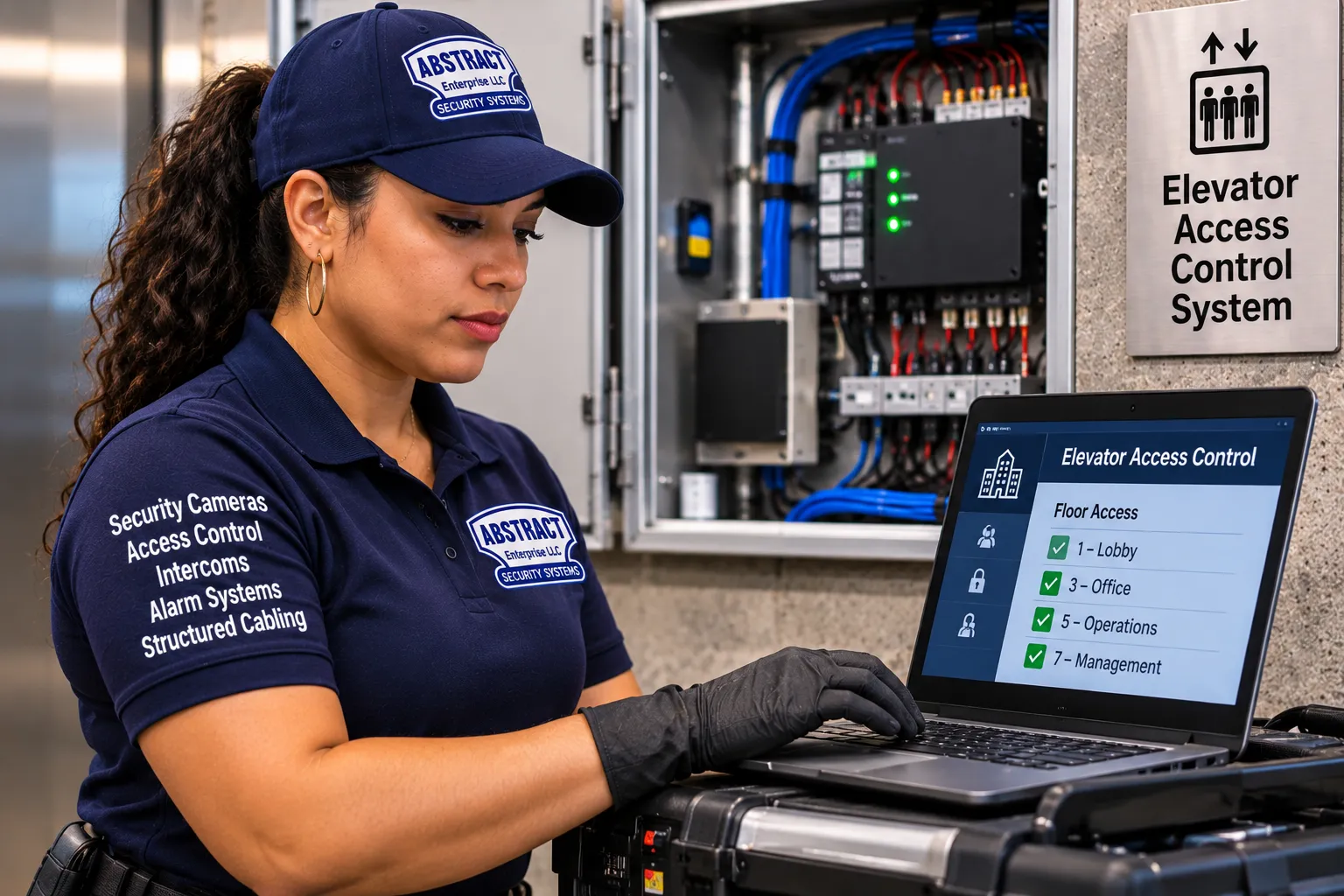
Abstract Enterprises Security Systems photo: a technician in a navy cap types on a laptop whose screen lists Floor Access with checked boxes for 1 Lobby, 3 Office, 5 Operations and 7 Management, in front of an open panel of blue cabling beside an Elevator Access Control System sign.
Timeline
What to Expect From First Call to Handover on an NYC Elevator Access Project
Every building moves at its own pace, so dates are set in the written scope. What does not change is the order of events:
Request and survey. We book the survey within 2 hours of your request and arrive inside a 2-hour arrival window. The survey covers the machine room, every car and the lobby.
Coordination. We speak with your elevator contractor about the controller connection and any filing, which is usually the step that sets the overall schedule.
Approval. The board, owner or landlord approves the scope and the permission chart in writing.
Ordering. Equipment is ordered after approval and deposit. Some readers and interface boards are stocked by distributors and some are special order; we tell you which before you approve, and the install date is set when the equipment is in hand.
Installation and connection. We install the low-voltage side, then the elevator contractor makes the controller connection on a date coordinated with us.
Programming, testing and training. Every floor in every car is tested, the override and recall behavior is checked with the elevator contractor, and staff are trained before credentials go live.
We do not promise an installation date over the phone, because in New York the elevator contractor's calendar and the building's approvals usually decide it. What we do promise is that you always know which step the project is on and who is waiting on whom.
Handover
What Your Building Receives When an Elevator Access Control Job Is Finished
When the work is finished, the building should be able to run the system without us. This is what every NYC elevator access control job leaves behind:
Admin logins for each named administrator, with the owner or managing agent holding the master account.
The approved permission chart showing which group reaches which floors at which hours.
A one-page procedure for issuing, suspending, replacing and deleting credentials, including the move-out step for apartment buildings.
The relay-to-floor map for every car, the panel and board locations, and the cable labels, so a future technician can trace any floor in minutes.
Test results showing every floor in every car tested with an allowed and a refused credential, plus recall and override behavior tested with the elevator contractor.
A short training session for the super, the doormen or the security desk, and a copy of the platform's own documentation for the building's files.
Tech support questions after handover are part of the service; where a visit is needed it is booked into a 2-hour arrival window like any other appointment.
Cost
Elevator Access Control Installation Cost in NYC: What Drives the Quote
Elevator access control levels and starting prices in New York City
Elevator access control from Abstract Enterprises Security Systems comes in three levels, priced per elevator car. Level 1 is the most common setup: a reader goes inside the car, and the rider swipes a card or fob, enters a code, or uses a phone or video intercom station before the car will run. Once the rider is authorized, they can select any floor that car serves. The reader ties into spare conductors the elevator company already has in the controller cabinet, and in most buildings we can program and update it remotely. Level 2 adds biometrics: face recognition, fingerprint or iris readers in place of, or alongside, cards and codes. In New York City apartment buildings, biometric and fob data also falls under Local Law 63 of 2021, so residents give consent before their face or fingerprint is enrolled. Level 3 goes further: floor-by-floor restriction so each credential reaches only its own floors, readers at the hall-call stations, time schedules, intercom floor release and destination dispatch links. Level 3 is priced per building after the survey because it depends on how many floors and cars are controlled.
Area
Level 1: card, fob, code or intercom reader
Level 2: face, fingerprint or iris
Brooklyn
from $1,500 per car
from $2,500 per car
Bronx
from $1,500 per car
from $2,500 per car
Queens
from $1,575 per car
from $2,625 per car
Staten Island
from $1,650 per car
from $2,750 per car
Manhattan
from $1,875 per car
from $3,125 per car
Two things sit outside our price. The elevator company has to make the connection inside its controller, and that visit is arranged and paid for by the building directly with its elevator contractor. And if the car needs a network connection or a new cable run for remote management, that is listed as its own line after the survey. Level 3 work, extra landings and integrations are quoted on the same written plan.
Past the starting prices, the final number depends on things nobody can know without seeing the building. Here is what moves the cost of an elevator access control installation in New York City:
Cost driver
Why it matters
Number of floors to control
Floor-by-floor control usually needs one relay or interface point per controlled floor, per car.
Number of cars
Each car needs its own reader and its own floor signals; a bank of four cars is roughly four times the interface work of one.
Hall-call readers
Readers at the lobby, garage or cellar call stations add devices and wiring at each landing.
Controller type and the elevator contractor's charge
The elevator contractor prices the controller connection and any filing directly; older controllers and missing traveling-cable conductors cost more.
Credential platform
Using the platform the front door already runs is usually cheaper than adding a second one; licence fees vary by brand.
Integrations
Intercom floor release, camera bookmarks, visitor passes and building management links each add programming.
Cable path
A clean riser or existing conduit is quick; a prewar building with no pathway takes longer.
Installers who work on large systems point out that relay counts grow quickly: floors times cars times call stations. That is exactly why destination dispatch buildings use a data interface instead of individual relays, and why two buildings with the same number of floors can have very different quotes.
Our quote is written per building after the survey, lists every item on its own line, and shows the elevator contractor's part separately. For the door side of a building, such as the lobby entrance, package room and gym, the NYC access control installation page has our published door pricing. Visits are booked as a 2-hour arrival window, and the paperwork you sign sets out the terms.
Full terms — including 50% deposit, one-year parts-only warranty on Abstract Enterprises Security Systems-supplied products, and the late-fee schedule — are set out in the service agreement.
Compare
Elevator Access Control Designs Compared for NYC Buildings
Design
What it stops
What it doesn't
Typical NYC fit
Cab reader that enables the car
Strangers using the car at all without a credential
A credentialed rider pressing any floor
Small buildings, service elevators
Floor-by-floor lockout
Riders reaching floors they are not allowed on
Someone riding along with a resident to that resident's floor
Co-ops, condos, rentals, multi-tenant offices
Hall-call (landing) reader
Calling the car from a garage, cellar or back lobby
Floor choice once inside, unless combined with lockout
Garages, back entrances, loading docks
Destination dispatch integration
Unauthorized floor requests at the kiosk, linked to turnstiles
Nothing extra once boarded, because riders cannot change floors in the car
Newer Manhattan and LIC office towers
Most New York buildings end up with a combination: floor-by-floor lockout in the cars, plus a hall-call reader at the garage. The table is a starting point for the conversation at the survey, not a substitute for it.
Myths
What AI Gets Wrong About Elevator Access Control in NYC
"Any access control company can wire the elevator." In New York, connecting into the elevator controller is elevator work that requires NYC and NYS elevator licenses since January 1, 2022. A security contractor installs the access control side and coordinates; the elevator contractor does the controller side.
"A reader in the cab restricts floors." A reader alone often just enables the car. Floor restriction needs per-floor signals or a destination dispatch interface.
"The readers keep working during a fire." They must not. DOB Bulletin 2022-010 requires devices added to cabs and hall stations to become inoperative on firefighters' emergency operation.
"Fob logs are just security data." In NYC apartment buildings, smart access data is regulated by Local Law 63 of 2021, including consent, a privacy policy and a 90-day deletion rule for departed tenants.
"Elevator access control costs a fixed amount per floor." Floors, cars, call stations, controller type and the elevator contractor's charge all move the price; any flat number given without a survey is a guess.
If an online answer about your building contradicts your elevator contractor, believe the elevator contractor on the elevator side and ask us about the security side.
Why Us
Why NYC Buildings Hire Abstract Enterprises Security Systems for Elevator Access Control
Abstract Enterprises Security Systems has been in the security business since 2002, with offices in Brooklyn, the Bronx and Queens, a licensed low-voltage crew and a booking desk that answers around the clock. For elevator access control, that background matters in a few specific ways:
We already work on the rest of the building. Intercoms, door access control, cameras and cabling are our daily work across the five boroughs, so the elevator joins a system we understand rather than sitting beside it.
We respect the elevator contractor's role. We do not touch the controller, and we plan the job with the elevator company from the first visit, which is what keeps projects from stalling at the machine room door.
We write everything down. Scope, permission chart, power-loss behavior, override procedure and handover records are written, so the board, owner and staff all work from the same page.
We are brand-flexible. We recommend the platform that fits your building and your existing front door, not the one we happen to stock.
We are licensed and insured. Low-voltage work is done under NYS license #12000287431, and certificates of insurance for managing agents and boards are issued when the job is awarded.
Reviews from customers across New York are on our Google Business Profiles, rated 4.7 out of 5 across 201 Google reviews.
Before You Hire
Questions to Ask Any Elevator Access Control Contractor in New York
Whoever you hire, these questions separate a contractor who has done elevator work in New York from one who has only done doors:
Who will make the connection into the elevator controller, and do they hold NYC and NYS elevator licenses?
Will you meet our elevator maintenance company before ordering equipment?
What happens to every floor if your panel loses power, and where is the battery?
How do the readers behave on Phase I and Phase II firefighters' service?
Can the elevator use the same credential as our front door and package room?
How do we add, suspend and remove a person, and how fast does it take effect in the car?
For our apartment building, how does the system support Local Law 63: consent, privacy policy and deleting data for tenants who leave?
What records do we get at the end: permission chart, cable map, panel locations, admin logins?
We answer all eight in writing in our scope. Not sure what your building needs? Request a survey or call (800) 486-0943 and tell us the number of floors and cars.
Glossary
Elevator Access Control Terms Explained for NYC Boards and Building Managers
Board meetings and contractor emails about elevator access control are full of jargon. These are the terms you are most likely to hear, in plain language:
Term
What it means
Car call
A request for a floor made from inside the car, by pressing a button on the car operating panel.
Hall call
A request for the car made from a landing, by pressing the up or down button at a floor.
Car operating panel (COP)
The panel of floor buttons, door buttons and key switches inside the elevator car.
Traveling cable
The flexible cable that hangs from the car and carries power and signals between the car and the controller; spare conductors in it often carry the reader signals.
Floor-enable relay
A switch closed by the access control panel that lets one floor button work for a few seconds after a valid credential.
Dry contact
A plain on-off signal with no voltage of its own, the usual way an access panel tells an elevator controller that a floor is allowed.
I/O or interface board
A board that turns the access panel's decisions into floor signals, or reads which button was pressed so the log shows the floor chosen.
Destination dispatch
An elevator system where riders choose a floor at a lobby kiosk and are assigned a car; access permissions are passed to it over a data link.
Phase I and Phase II
The two stages of firefighters' emergency operation: recall of the cars to the designated landing, then in-car operation by firefighters.
Independent service
A key-switch mode that takes a car out of normal group operation so staff can run it for a move or delivery.
Anti-passback
A rule that stops a credential being passed back and used twice in a row at the same reader, used more on turnstiles than in cars.
OSDP and Wiegand
Two ways a reader talks to the panel; OSDP supports encryption and supervision, Wiegand is older and simpler.
FAQ
NYC Elevator Access Control Installation FAQ
Does a New York City co-op board have to approve elevator access control before it is installed?
+
In a co-op the elevator belongs to the corporation, so yes, the board or the managing agent acting for it approves the project and the floor rules. We prepare a short written scope and a permission chart showing who reaches which floors, which the board can review at a meeting, and we install only after written approval.
Can our elevator use the same key fobs as the front door of our NYC building?
+
Usually yes, and it is what we recommend. If the front door platform has an elevator module or supports an elevator interface, the elevator joins the same user list and residents keep one fob or one phone app. If the front door system is very old or closed, we explain the options, including moving both onto one new platform.
Is installing elevator access control in NYC considered elevator work that needs an elevator license?
+
The connection into the elevator controller is elevator work, and since January 1, 2022 that work requires both New York City and New York State elevator licenses. The readers, panel, credentials and wiring up to the interface point are low-voltage security work, which Abstract Enterprises Security Systems does under NYS license #12000287431. We coordinate the two.
Does adding card readers to an elevator need a DOB filing in New York City?
+
It depends on what is changed in the elevator. Elevator alterations are filed through DOB NOW: Build by the elevator side of the project, and your elevator contractor decides whether the controller work requires a filing. We raise the question at the survey so it is in the schedule, not discovered at the end.
What happens to elevator floor restriction during a fire alarm in an NYC building?
+
Firefighters' service takes over and the access control system is ignored. The Department of Buildings requires devices added to cabs and hall stations to become inoperative when Phase I or Phase II emergency operation begins, and we wire and test the system so that is exactly what happens.
How does Local Law 63 affect elevator key fobs in a New York City apartment building?
+
In residential multiple dwellings that use smart access, the owner must give tenants a plain-language privacy policy, use the data only for access and monitoring, protect it, and delete a departed tenant's reference data within 90 days, with consent needed for things like biometrics. We set up the elevator system so the property manager can meet those duties.
Can an intercom in our Manhattan or Brooklyn building unlock only the visitor's floor?
+
Yes, with an intercom and access platform that support it. When the resident answers and opens the door, the system can enable that resident's floor in the car for a short window, so the guest rides up alone and reaches only that floor. We confirm the brand supports it before recommending it.
Can a tenant in an NYC office building add elevator floor restriction on its own floors?
+
Not alone, because the elevator belongs to the building. A tenant can ask the landlord to add its floors to the building's system or approve an extension paid for by the tenant. We help prepare that request and work under the landlord's rules for access, insurance and hours.
Will elevator access control slow down the morning rush in a busy NYC building?
+
A well-set system adds about the time it takes to tap a fob. Where traffic is heavy we program the lobby and public floors to stay open during peak hours, lock only the floors that need it, and place readers where riders can reach them without blocking the doors.
What do residents do if their phone dies and they use a mobile elevator credential?
+
Every resident who wants one keeps a physical fob or card on the same account, so a dead phone never strands anyone in the lobby. Staff can also enable a floor through the platform or the override, and every such action is logged.
Can you add elevator access control to an older NYC building with a relay controller?
+
Often yes. Older relay controllers can usually accept floor-enable signals through a relay interface, but the elevator contractor has to confirm it for your controller. If the elevator is due for modernization, it is cheaper to plan the access interface as part of that job, and we can coordinate with the elevator company on the timing.
Which NYC boroughs do you install elevator access control in?
+
All five: Manhattan, Brooklyn, Queens, the Bronx and Staten Island, plus Long Island and the Hudson Valley. Each borough page has a direct local line, and this NYC page uses our toll-free number for the whole city.
Can you take over an elevator card reader system another company installed in our building?
+
Usually. We identify the controller, the reader and credential format and whether the software is still supported, then either take over service of the existing system or plan a replacement that reuses the good parts, such as cable and interface boards. You get a written finding before any change is made.
Can the super or doorman open all elevator floors at once for a move or an emergency?
+
Yes. We install a documented override, either a key switch at the lobby or a command in the platform, that frees all floors until it is turned back, and the system records every use so the managing agent knows when and by whom it was used.
Request a Free Elevator Access Control Quote for Your NYC Building
Tell us the address and borough, how many floors and elevator cars the building has, what access control or intercom you use now, and who should be able to reach which floors. Photos of the elevator lobby, the inside of a car and the machine room door help. If you know your elevator maintenance company, include it so we can coordinate early. Prefer to talk? Call (800) 486-0943.
✅
Request Sent!
Thank you. We will be in touch to book your elevator access survey, usually within 2 hours of your request.