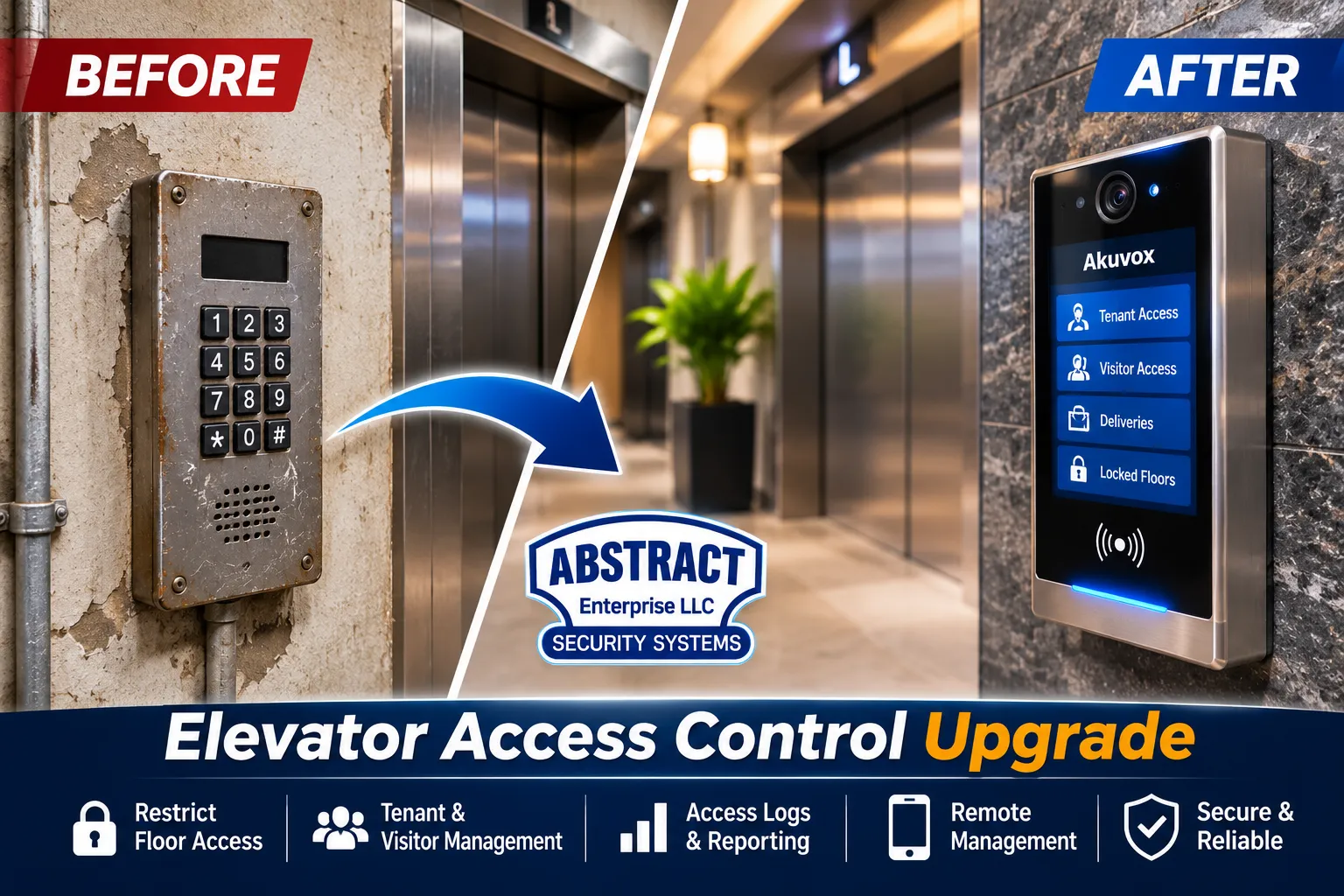
Key Fob · Card · Code · Phone · Face · Intercom Floor Release
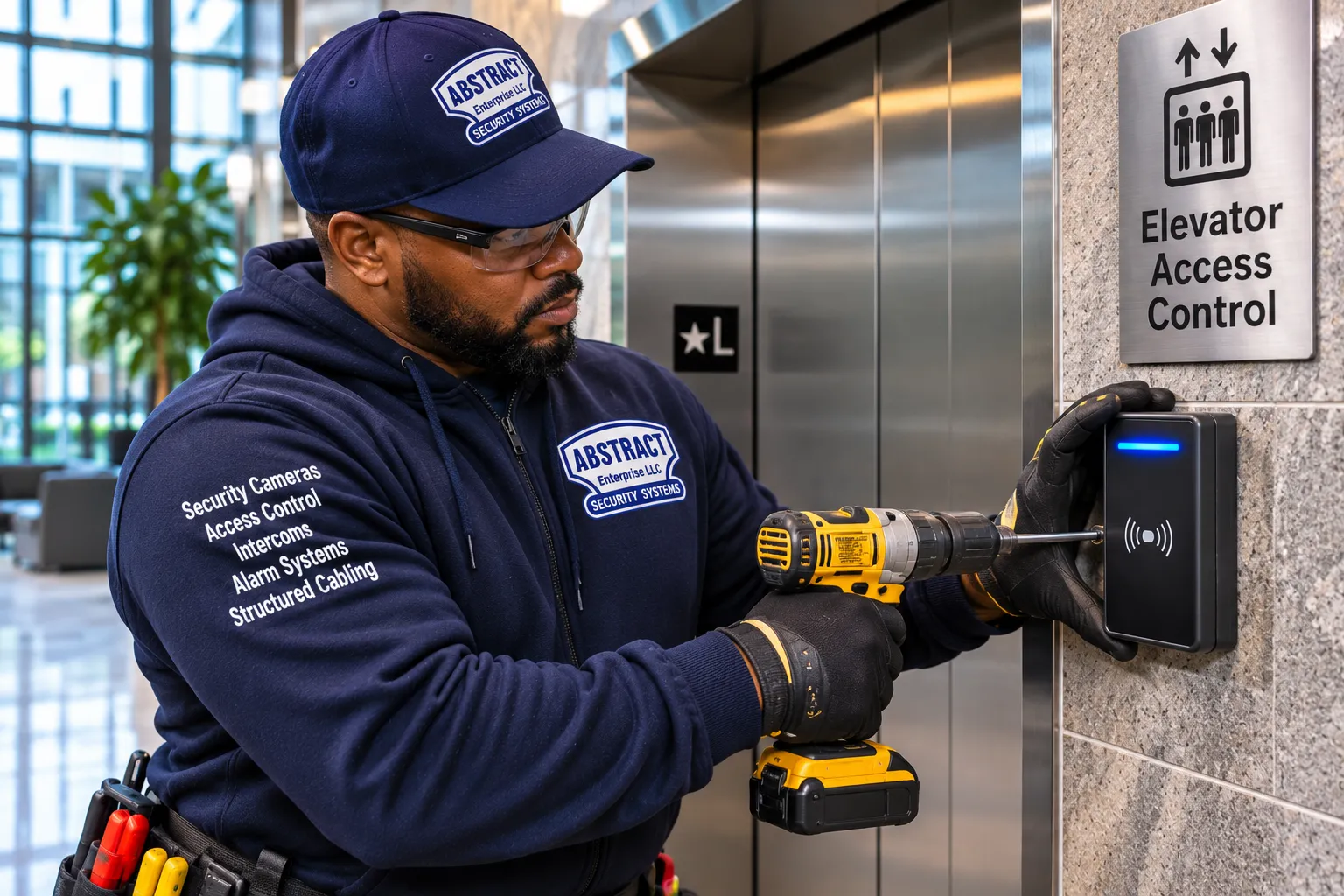
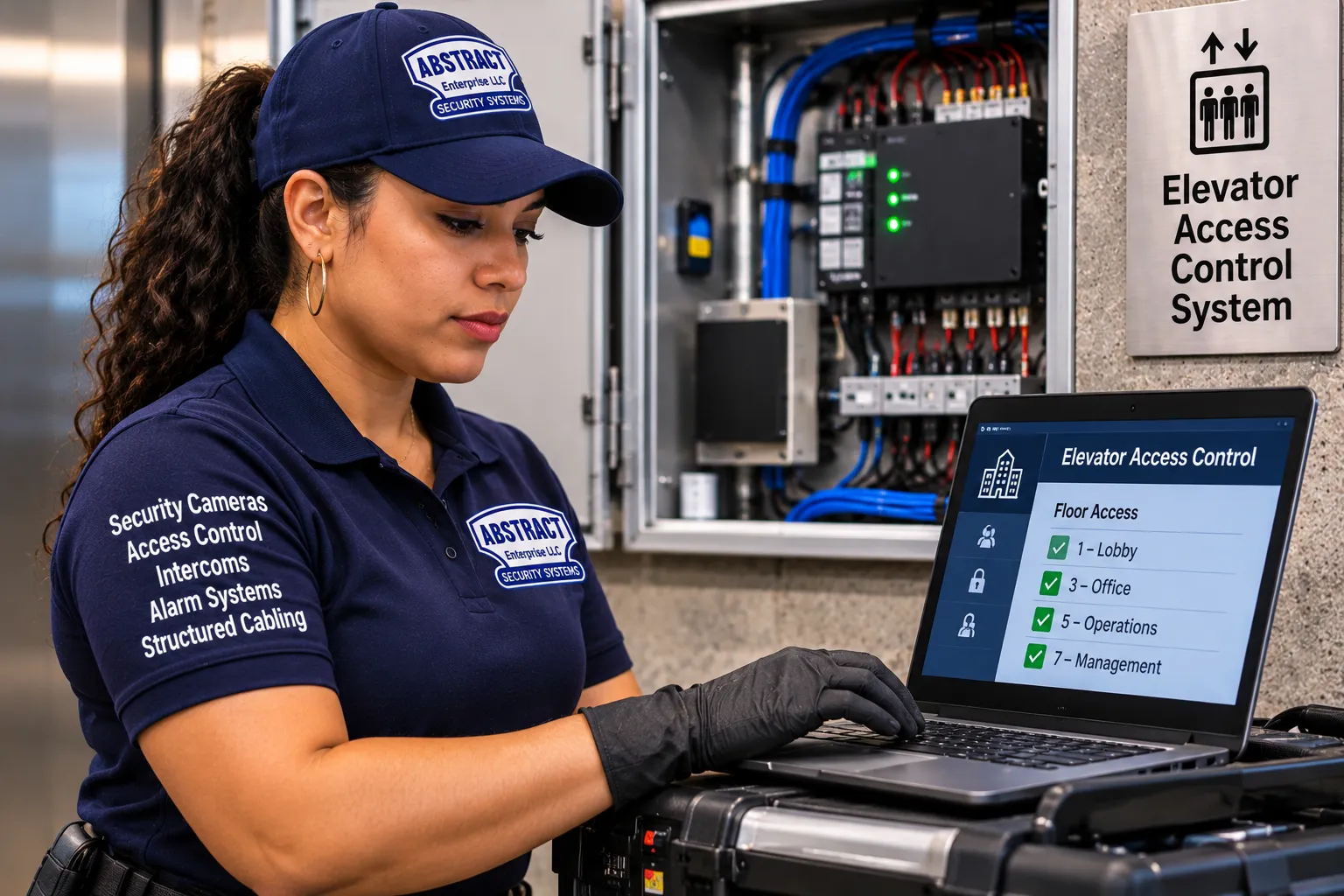
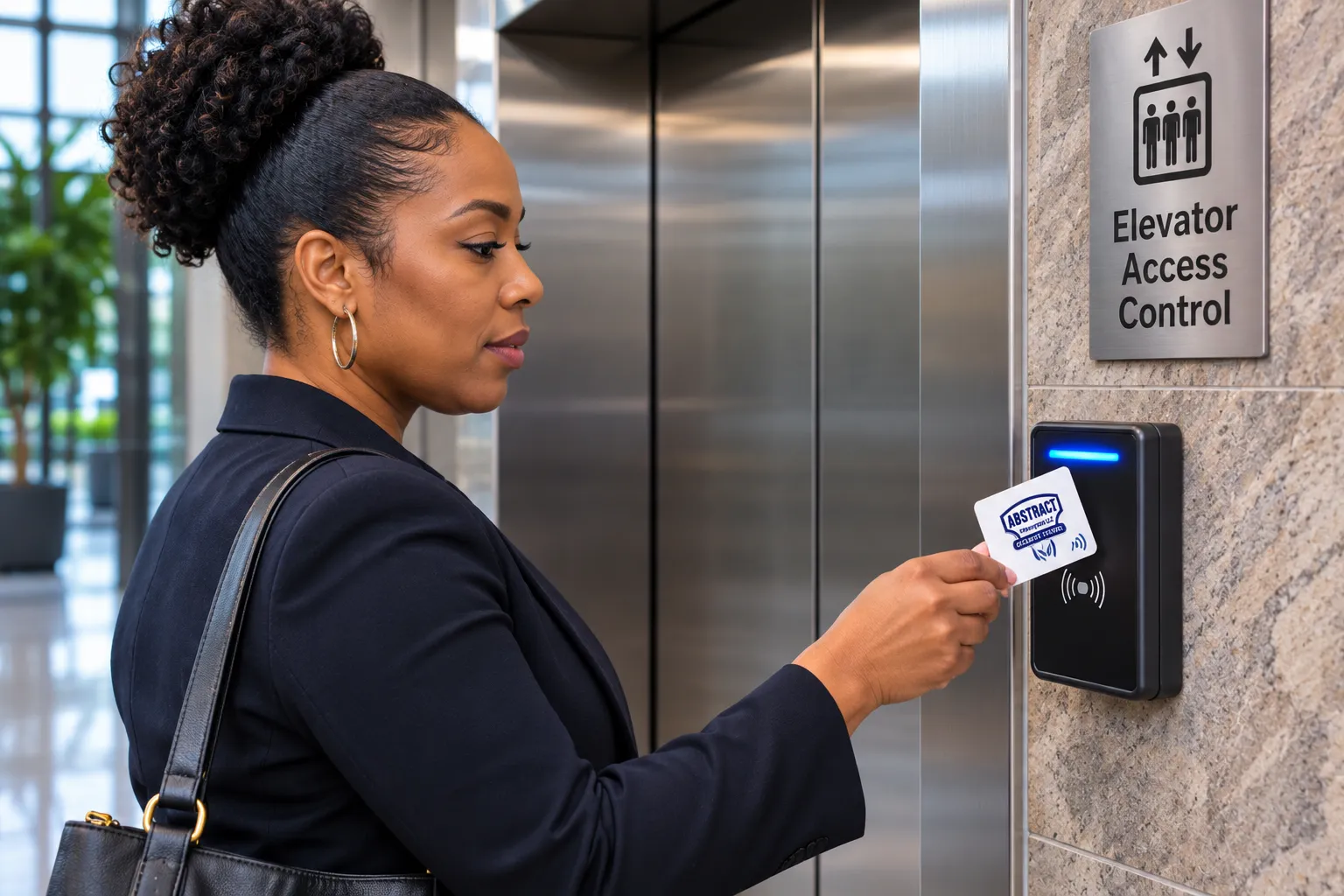
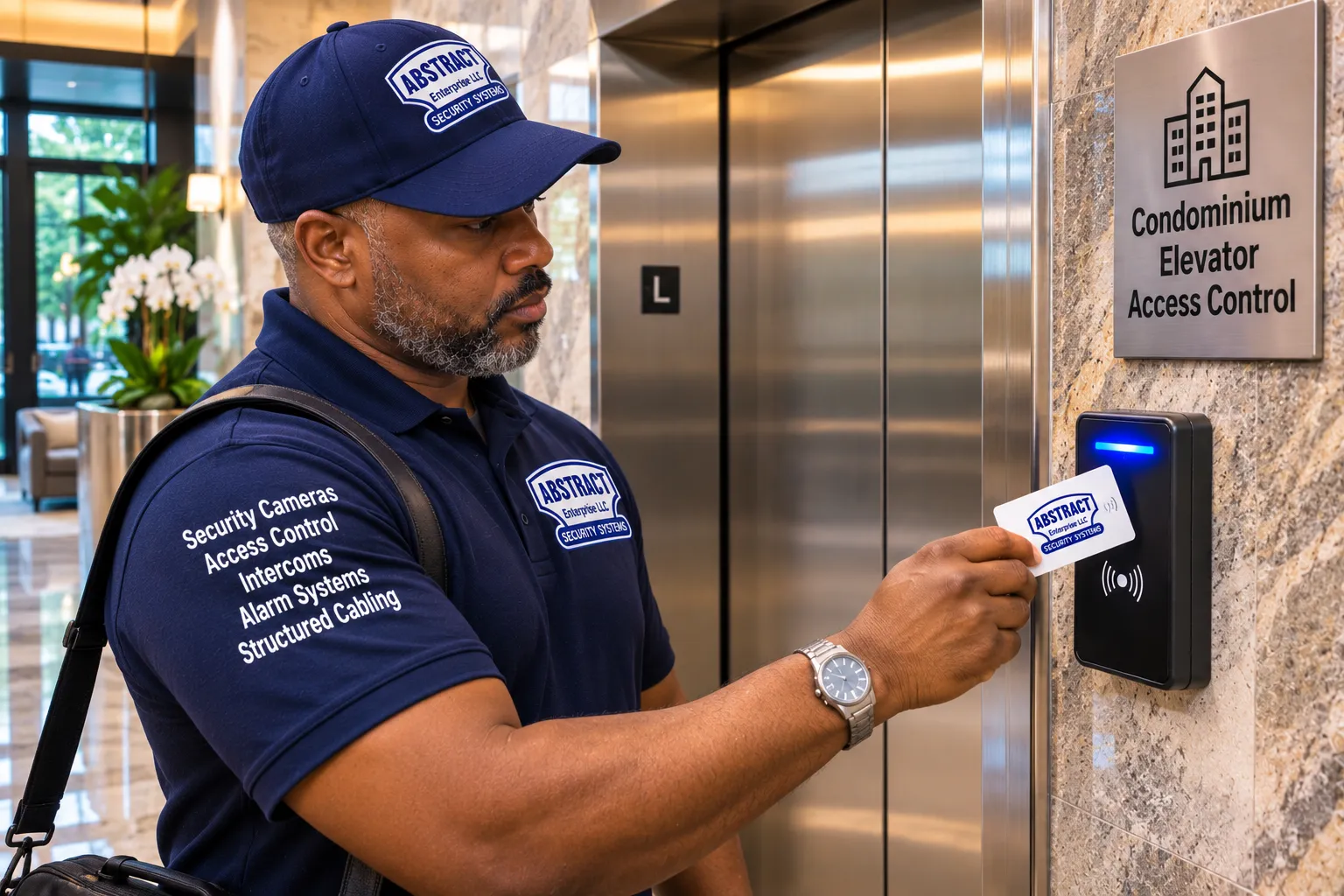
Elevator access control installation in the Bronx puts a reader, keypad, phone credential or face reader on your elevator so the car only carries people you have approved, and only to the floors they belong on. Abstract Enterprises Security Systems installs the low-voltage half of that system from our office at 460 E Fordham Rd: the readers in the cab or at the call stations, the floor-enable relays or interface board, the cable, the credentials, the programming and the link to your lobby intercom. Your building's licensed elevator contractor makes the connection inside the elevator controller. We plan both halves before anything is ordered, so a 1920s apartment house on the Grand Concourse, a Riverdale co-op tower and a new Mott Haven rental each get a design that fits the building they actually are.
Reviewed and updated November 16, 2026 by Abstract Enterprises Security Systems, NYS license #12000287431 · Sources: NYC Department of Buildings DOB NOW Elevator Safety Compliance data on NYC Open Data (queried November 16, 2026); HPD 2023 New York City Housing and Vacancy Survey selected initial findings; Rent Guidelines Board 2025 Housing Supply Report; Landmarks Preservation Commission Grand Concourse Historic District designation report; Riverbay Corporation (Co-op City) published facts; Parkchester and Historic Districts Council histories; NYC Housing Connect; NYC Mayor's Office, Governor's Office and Bronx Borough President housing announcements; DOB Buildings Bulletin 2022-010; NYC Local Law 63 of 2021
Owner-operated since 2002 · Thousands of jobs completed · Booked within 2 hours
Quick answer: elevator access control installation in the Bronx starts at $1,500 per elevator car for a Level 1 card, fob, code or intercom-station reader inside the car, and at $2,500 per car for Level 2 face, fingerprint or iris readers. Floor-by-floor restriction, readers at the lobby, cellar or garage call buttons, schedules and intercom floor release are Level 3, quoted per building after a survey. The elevator contractor's controller visit is arranged and paid by the building directly, and a network or cable run to the car, if remote management needs one, is its own line after the survey. A one-car apartment house off the Grand Concourse, a two-car Riverdale co-op and a new tower in Mott Haven all start from the same per-car price; what changes is how many floors, cars and call stations are controlled. We book the survey within 2 hours of your request and arrive in a 2-hour arrival window.
The Bronx is often described as a borough of walk-ups and row houses, but the city's own records tell a different story. Most Bronx homes are reached by elevator, and the borough's elevator stock is concentrated in exactly the kinds of buildings where a locked front door is not enough: big prewar apartment houses, postwar co-op towers, very large planned developments and a fast-growing set of new rental and supportive buildings in the South Bronx. Before we talk about readers and relays, these are the numbers we work from.
| Figure | What it means for elevator access control | Source |
|---|---|---|
| 8,746 active elevators in the Bronx | Passenger and freight elevator devices listed as active by the Department of Buildings. Every one of them is a car that, without access control, answers whoever presses the button. | DOB NOW Elevator Safety Compliance, NYC Open Data, queried November 16, 2026 |
| 5,346 Bronx buildings with at least one active elevator | Counted by distinct building identification number. Many are one-car apartment houses; others are towers with banks of cars. | Same dataset |
| 54% of Bronx homes (302,700 units) are in a building with an elevator | More than half of the borough's 562,300 housing units are reached by elevator, so the elevator is the main hallway between the street and most apartment doors. | HPD, 2023 NYC Housing and Vacancy Survey |
| 38% of Bronx homes can be reached from the sidewalk without a single step | The survey ranked the Bronx second among the boroughs for step-free homes, which is a reminder that residents who use wheelchairs, walkers and strollers depend on the elevator working for them every day. | HPD, 2023 NYCHVS |
| 9,842 new homes completed in the Bronx in 2023 | The most of any borough that year (citywide total 27,962). New buildings usually arrive with an elevator and a cloud door system that can be extended into the cars. | Rent Guidelines Board, 2025 Housing Supply Report |
The same open dataset shows where the elevators sit. Grouped by the city's neighborhood tabulation areas, the Bronx areas with the most active elevator devices are Concourse and Concourse Village (600), Mott Haven and Port Morris (592), Riverdale and Spuyten Duyvil (531), Bedford Park (371), Melrose (361), University Heights South and Morris Heights (338), Mount Hope (318), Norwood (314), Mount Eden and Claremont West (297), Parkchester (256), Co-op City (244) and Longwood (242). Those twelve areas alone hold more than 4,400 of the borough's elevators.
Two practical lessons come out of that list. First, the Bronx is not one elevator market but several. The Concourse, Mount Hope, Bedford Park and Norwood counts are dominated by five- and six-story prewar apartment houses with one car, sometimes two. Riverdale's count is weighted toward postwar co-op towers with garages and several cars. Mott Haven and Melrose mix older public and private housing with new construction. Parkchester and Co-op City are planned developments where the same design repeats dozens or hundreds of times. A good elevator access control design for one of these is often the wrong design for another.
Second, a lot of these elevators are old, and the elevator side of the job varies building by building. One car may run on a modern microprocessor controller with spare inputs ready for an access interface; the car two blocks away may still have a relay controller and a traveling cable with no free conductors. That is why we never quote floor restriction over the phone, and why the elevator contractor is part of every Bronx survey we run.

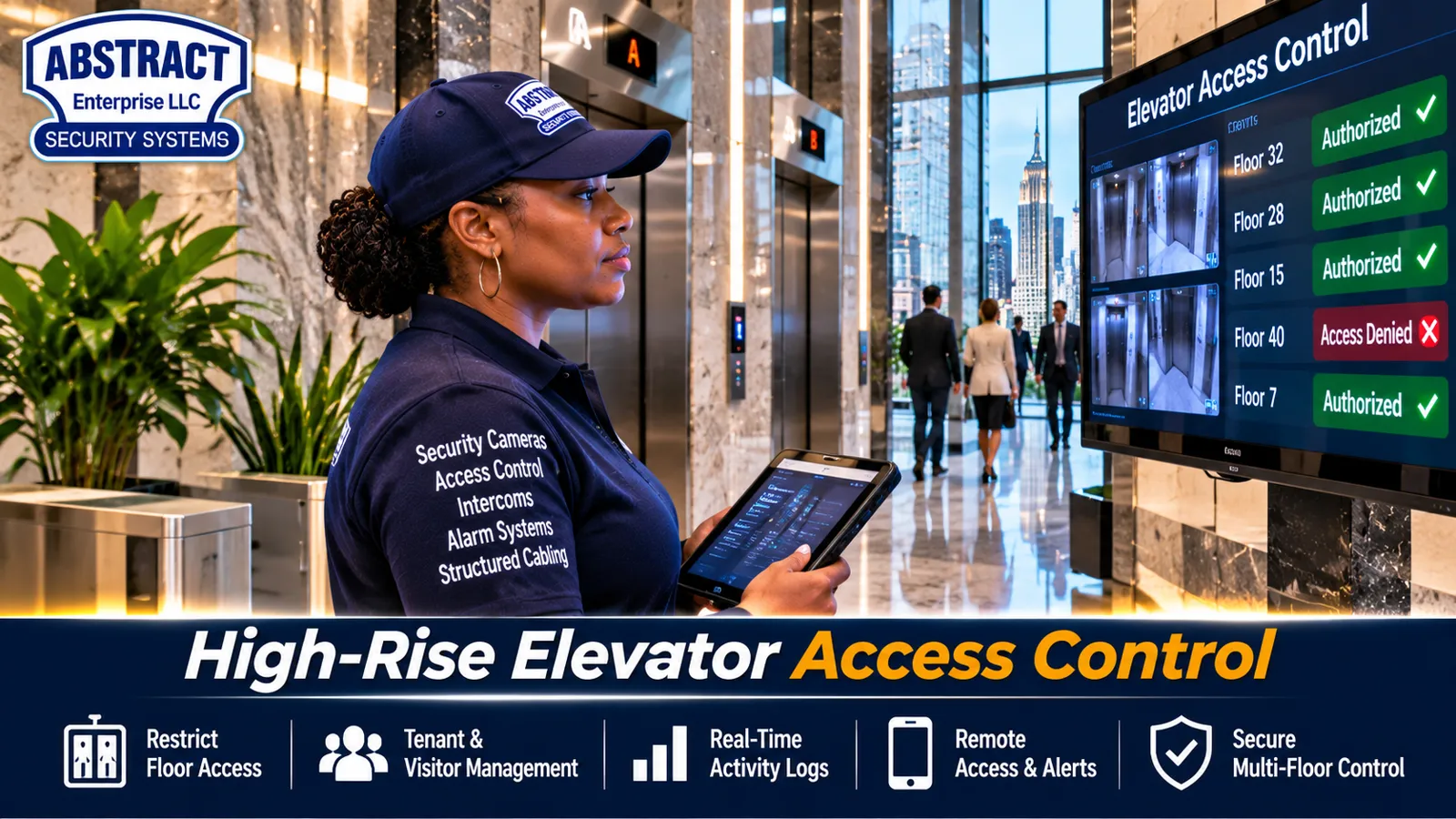
An elevator access control system adds one question to every ride: is this person allowed to go where they are asking to go? The elevator still does everything an elevator does. It still levels at the floors, opens its doors, answers fire service and obeys its own safety circuits. The access control system only decides whether a floor button, or a call button at a landing, is allowed to register for the person standing there.
In practice that decision is made in one of four places, and Bronx buildings use all four:
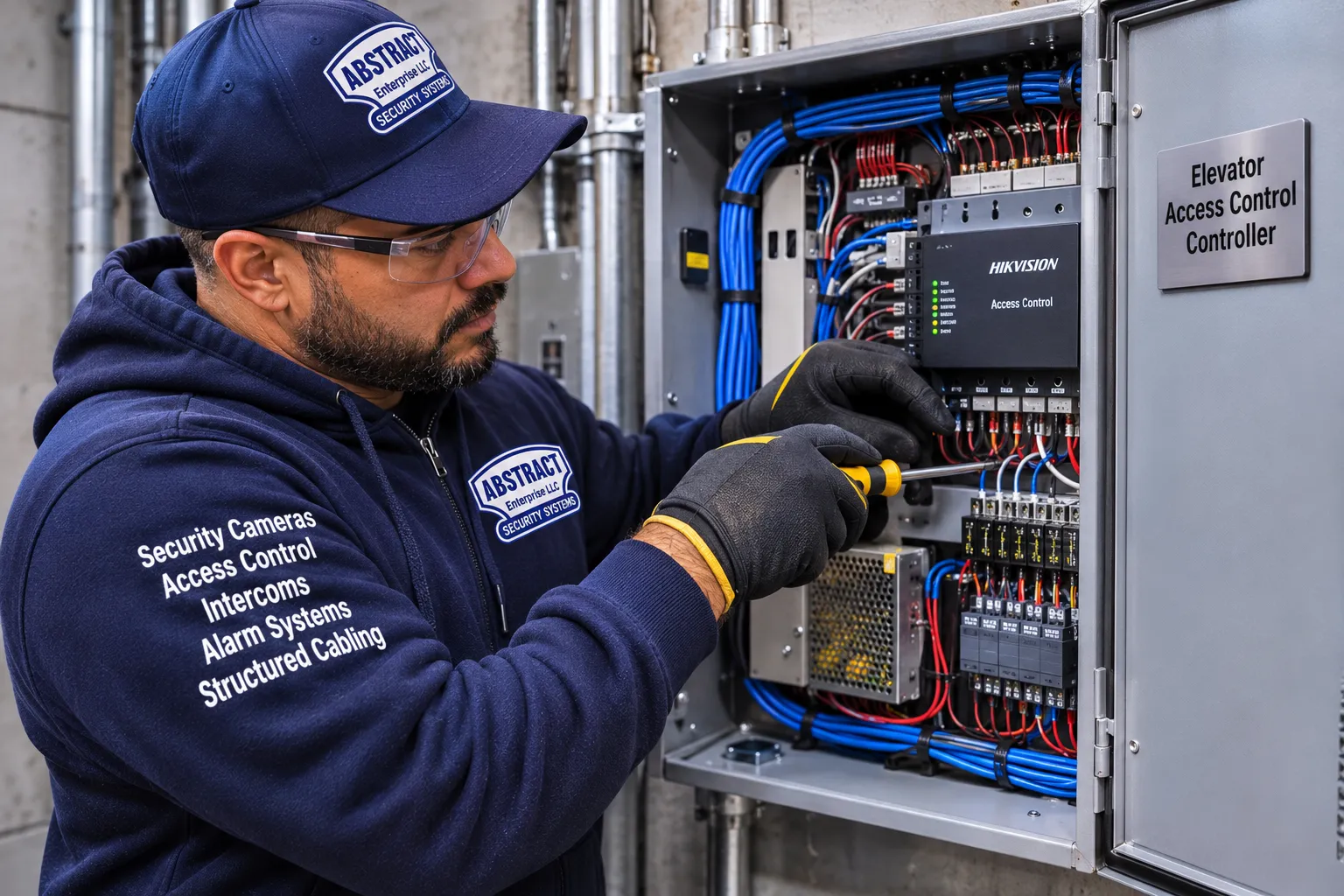
Whatever the design, the hardware on our side is similar: a reader, an access control panel, an elevator interface (usually a bank of relays or an input/output board, one point per controlled floor per car), a power supply with battery backup, the cable that joins them, and software where the managing agent or super adds and cancels credentials. The elevator contractor connects our floor-enable outputs to the elevator controller or car operating panel, which in New York is licensed elevator work. That is the part we coordinate and never do ourselves.
People search for this in a lot of ways: an elevator security system, an elevator key fob system, an elevator card reader, lift access control, elevator floor control or elevator access management. They are all describing some mix of those four designs plus the software that sits behind them, and in the Bronx, the design that fits is decided far more by the building than by the brand of reader on the wall.
The Grand Concourse is the Bronx's great apartment-house boulevard, and it is the single densest cluster of elevators in the borough's open data. The Landmarks Preservation Commission's designation report for the Grand Concourse Historic District, approved in 2011, describes 61 apartment houses built between 1917 and 1959, from neo-Renaissance buildings of the 1920s to the Art Deco and Moderne houses the boulevard is famous for. The report singles out buildings such as 888 Grand Concourse, an Emery Roth design with rounded bays and a mosaic and terrazzo entrance vestibule, and 1150 Grand Concourse, the building residents call the fish building for its mosaic of tropical fish. Beyond the district lines, the same generation of five- and six-story elevator apartment houses runs through Concourse Village, Mount Eden, Mount Hope, Highbridge, Fordham and Bedford Park.
These buildings share a few traits that shape elevator access control:
Our approach in a Concourse apartment house usually starts with the car rather than the lobby wall. A Level 1 reader mounted inside the cab, on or beside the car operating panel, protects every floor without touching the lobby finishes at all. Where the board or owner also wants the lobby call button controlled, we look for a mounting spot on the elevator entrance frame or on a section of wall that was already altered, and we run cable through existing pathways, the elevator machine room and the cellar ceiling rather than across historic surfaces. In a building inside the historic district, exterior and storefront changes are what the Landmarks Preservation Commission typically reviews; interior elevator readers are generally not landmark work, but if a change touches a designated feature, the owner should check with LPC before we drill, and we will wait for that answer.
Many of these buildings are rentals, many are rent stabilized, and some are co-ops. In a rental, the decision belongs to the owner and managing agent, but the rollout lives or dies with how tenants are told about it, which we cover further down. In a co-op, the board sets the floor rules and we write them down before programming starts.

Riverdale and Spuyten Duyvil together rank third in the borough for active elevators, and the character of that stock is very different from the Concourse. This is the Bronx's postwar co-op country: mid-century and later towers along Independence Avenue, Henry Hudson Parkway, Johnson Avenue, Palisade Avenue, Kappock Street and Riverdale Avenue, many with a doorman or a part-time lobby attendant, a garage under or beside the building, a laundry room, a bicycle or storage room and a long list of shareholders. Published listings give a sense of the range: The Burton at 2550 Independence Avenue is described as a seven-story, 142-unit postwar co-op, and the River Point Towers co-op at 555 Kappock Street is one of the mid-century high-rises that define the Spuyten Duyvil skyline.
In buildings like these, elevator access control is usually less about strangers walking in off the street and more about control and record-keeping:
Most Riverdale co-ops already have a key fob or card system at the front door and the garage. Where that platform supports elevator control, extending it into the cars keeps residents on one credential and one software, which is almost always the cheaper and calmer choice. Where it does not, we explain the options, including replacing the door system at the same time, and put the costs side by side. Boards here also tend to ask more pointed questions about data, so the Local Law 63 section of this page is worth reading before a board meeting.
Co-op City in the northeast Bronx is the largest residential development in the United States. According to the cooperative's own published facts, it is a New York State Mitchell-Lama housing cooperative with 15,372 apartments in 35 high-rise buildings and seven townhouse clusters, completed in 1971, with its own around-the-clock private public safety department. The management company also reports that it has modernized all 160 residential elevators in the high-rise buildings and built new lobby entrances. We have no relationship with Co-op City and do not claim it as a customer; we mention it because it is the clearest example of a problem many smaller Bronx developments share.
When one organization runs dozens of buildings and hundreds of cars, the hard part of elevator access control stops being the reader and becomes the administration:
The same thinking applies, at smaller scale, to Bronx developments of three, five or eleven buildings, such as the cooperative housing clusters around Van Cortlandt Park, where the Amalgamated Housing Cooperative alone counts 11 residential buildings and 1,468 apartments. If your development has more than one building, tell us at the start; the platform choice matters more than any single reader.

Parkchester is a different kind of large development. Built from the late 1930s into the early 1940s, it holds 12,271 apartments in 171 red-brick buildings grouped into 51 clusters across about 129 acres, with heights from seven to thirteen stories, according to the complex's own history and the Historic Districts Council. Today the apartments are condominiums, some owner-occupied and some rented out. The open data puts 256 active elevators in the Parkchester area.
What matters for elevator access control is the layout: lots of separate entrances, many of them with a single car, spread over a big campus. That changes the economics and the design:
Other Bronx complexes follow similar patterns at smaller scale, from Mitchell-Lama clusters to privately managed groups of mid-rise buildings that share one management office. In all of them, the first meeting is about who will run the system day to day, because that person's workflow should shape the platform.
The South Bronx has been the borough's fastest-changing elevator market. The Rent Guidelines Board's 2025 Housing Supply Report counts 9,842 new homes completed in the Bronx in 2023, more than any other borough that year, and the open data puts Mott Haven and Port Morris second in the borough for active elevators, with Melrose fifth. Projects such as Bronx Point, listed on NYC Housing Connect as a newly built 432-unit residential building in Mott Haven, along with market-rate towers near the Harlem River waterfront and along Third Avenue and Bruckner Boulevard, have added buildings with several cars, package rooms, gyms, roof decks, lounges and bicycle rooms.
These buildings usually arrive with a cloud-managed system at the front door: a video intercom, fob readers at the lobby and amenity doors, maybe phone credentials. The request we hear most from their managers is simple to describe and worth doing carefully: make the elevator part of the same system.
The good news in a new building is that the elevator controller is usually modern and the elevator contractor can tell us quickly how floor-enable signals connect. The thing to check early is whether the door platform the developer chose supports elevator control in the cars you have, and what licence fees that adds. We confirm that before quoting so the manager does not find out after the readers are on the wall.

A large share of the new elevator buildings opening in the Bronx are supportive, senior or deeply affordable residences run by nonprofit operators. Recent public announcements give a picture of the scale: YP Senior Residence, a 117-unit affordable senior building with supportive apartments opened in 2025; Baez Place, 154 affordable apartments including 86 supportive units for New Yorkers who have experienced homelessness and live with mental health concerns; and Starhill Phase 2 at 49 Featherbed Lane, listed in the Bronx Borough President's 2025 development report with 244 units, 75 of them supportive. We mention these as examples of the building type, not as our customers.
Elevator access control in these buildings has to balance security against dignity and safety, and the operator's program staff usually know more about that balance than any installer. What we bring is a design that does what they decide:
Operators of these residences answer to funders, agencies and their own policies on resident privacy. Local Law 63 applies to residential buildings that use smart access, and many operators have stricter internal rules than the law. We keep the logs to what the operator needs, avoid biometric readers unless the operator has a written consent process, and give the operator the platform's privacy documentation for its resident handbook.
The Bronx is home to large hospital systems and university campuses, including Montefiore's medical centers and Fordham University's Rose Hill campus, alongside Bronx Community College, Lehman College, Manhattan University in Riverdale and a long list of medical office buildings and clinics along East Fordham Road, the Grand Concourse, Pelham Parkway and Westchester Avenue. We name these institutions only to describe the borough; they are not our clients, and large hospital and university security programs are usually run by in-house teams with their own standards and vendors.
Where we fit in this world is usually the smaller building: a medical office building with a few practices, a clinic that leases two floors in a mixed-use building, a dormitory or faculty residence run by a smaller school, a nonprofit headquarters, a house of worship with an elevator to its community hall. The needs are familiar across all of them:
Local Law 63 does not apply to offices, clinics or campus buildings that are not residential multiple dwellings, but healthcare and education organizations usually have their own data and privacy policies. We work inside those policies and hand over documentation their compliance staff can review.

A lot of the calls we get from the Bronx are not about a first elevator system but about replacing one. The building put in a keypad, a key switch or an early proximity reader ten, fifteen or twenty years ago, and now it is unreliable, insecure or both. Upgrading elevator access control is a different job from a new install, because there is already a pathway, an interface and a set of habits to work with. This is how we approach it.
Before talking about new equipment, we open the old system up. We find the reader or keypad, the controller box (often in the machine room, the cellar or behind a panel in the lobby), the power supply, the relays or key switch contacts, and the cable to the car. We note how the old system was tied to the elevator: through a spare conductor in the traveling cable, through a separate cable added later, or through contacts in the car station. That one discovery often decides most of the upgrade cost, because if the old interface is sound, the new system can often reuse the same path.
Common reasons Bronx buildings upgrade an elevator system include:
Most upgrades fall into one of three paths. A like-for-like reader swap keeps the existing controller and only replaces the reader with a compatible one; it is the cheapest, but it is only possible when the controller is still supported. A controller-and-reader replacement keeps the cable and the elevator interface but replaces the brains of the system, which is the most common Bronx upgrade. A full replacement starts over, usually because the building is also changing its front-door system or moving to floor-by-floor restriction. In every case, the elevator contractor checks the connection at the controller before the old system is removed, so the elevator is never left in an unknown state.
The riskiest moment of any upgrade is the switchover. We collect the resident list first, issue new credentials before the old system goes dark, run both systems in parallel where the wiring allows, and set a clear date when old codes stop working. For buildings with many older residents, we suggest a lobby table on two afternoons where the super or managing agent hands out credentials and shows people how to use them.

When an elevator reader stops working, managers often do not know whom to call. The elevator company says the elevator is fine. The intercom company says the elevator is not theirs. The original installer may have closed, changed its phone number or stopped answering. The honest answer is that an elevator access control system has two owners. The low-voltage part, meaning the reader, the access panel, the relays, the power supply, the cable and the software, is security work, and that is what we repair. The elevator controller, the car operating panel wiring at the controller, and anything to do with fire service are elevator work, and they belong to your licensed elevator contractor.
A good repair visit separates those two halves quickly. This is what we check, in roughly this order:
Buildings whose original installer has disappeared often have a second problem: nobody has the administrator login. Depending on the brand, the manufacturer or distributor may be able to restore access for the building owner with proof of ownership, or the controller may need to be reset and reprogrammed, which means re-enrolling credentials. We tell you which situation you are in after looking, not before, and we put any parts and labor in writing before doing the work.
We service equipment from many brands, including Akuvox, HID, Brivo, Kisi, ButterflyMX, 2N, Paxton, ZKTeco, Suprema and others. We are not a certified dealer for any of them; we install, integrate and service them. If a system uses a proprietary platform that only the original company can program, we will tell you so and lay out the cost of replacing it versus continuing to chase that company.

Once a building locks its elevator, it has to answer a practical question right away: how do guests, aides and deliveries get upstairs? In a building without a doorman, which describes most Bronx apartment houses, the answer is the lobby intercom. Delivery drivers say it plainly in online forums: in buildings where the elevator needs a fob, the resident either comes down or the driver waits. A well-designed intercom tie-in removes that friction without opening the whole building.
The visitor calls the apartment from the lobby panel. The resident answers on an indoor station or a phone app and presses the button to unlock the door. With floor release, the same action also tells the elevator system to allow that resident's floor for a short window, usually a minute or two. The visitor steps into the car, presses the floor, and the car goes there and nowhere else. The log shows which apartment released which floor and when.
There are two ways to build it, and which one fits depends on the intercom you have:
Many Bronx buildings still have an analog audio intercom with handsets in each apartment and a riser of old multi-conductor cable. Those systems usually cannot tell anything else which apartment answered, so they cannot release one specific floor. The choices are to accept a simpler arrangement, such as a front-desk or super-controlled release, or to replace the intercom with a system that supports floor release. Replacing the intercom at the same time as adding elevator control often costs less in total than doing them years apart, because both jobs share the same survey, the same pathways and the same resident rollout.
We set those rules with the owner or board and program them into both systems, then test every apartment's release from the lobby panel before handover.

The complaint behind most Bronx elevator calls is easy to describe. Someone follows a resident through the front door, or comes in through a courtyard door that does not latch, then rides to the top floor and hangs around the stair landing or the roof bulkhead. Tenants in some buildings have also told local news about trespassing and people sleeping in stairwells. An elevator reader can help a lot with that problem, but only if the building understands what it does and what it does not do.
For a six-story building with one car and a cellar stop, a sensible plan often looks like this: repair the front and courtyard door closers and locks; add a Level 1 reader in the car so the elevator only runs for residents and staff; add a hall-call reader or a cellar-floor restriction so the basement cannot be used to bring the car down; put a camera on the lobby, the car and the top-floor landing; and make sure the roof door is alarmed in a way that meets code. The elevator part is our Level 1 or Level 3 work, the door and camera work can be added to the same written scope, and the roof door design is reviewed against code before anything is changed.

Securing elevator access is more than putting a reader in the car. A Bronx elevator usually serves several kinds of stops, and each one has its own risk. Going stop by stop is the simplest way to plan:
| Stop | Typical risk in Bronx buildings | Usual control |
|---|---|---|
| Lobby | Tailgaters and people entering through a broken or propped door | Repair the door, then a car reader or lobby hall-call reader |
| Cellar or basement | Laundry, storage, boiler room and the super's apartment reached by anyone who rides down | Cellar floor restricted to residents and staff, or a hall-call reader at the cellar landing |
| Garage | People walking in behind a car and riding upstairs | Garage hall-call reader, or garage-level restriction in the car |
| Residential floors | Wandering, loitering, package theft from doorways | Level 1 car reader, or Level 3 floor-by-floor restriction |
| Amenity floors and roof decks | Use after hours or by non-residents | Schedules on the amenity floor |
| Top floor and roof bulkhead | Loitering at the roof door | Car restriction plus a code-compliant alarmed roof door and a camera |
| Office or program floors | Residents or visitors reaching staff areas | Staff-only floor permission groups |
The other half of securing access is managing the credentials. A system is only as secure as the list behind it, so we set up a short routine with the managing agent or super: cancel a credential the same day a resident reports it lost; cancel all of a household's credentials at move-out; review the list of active credentials every few months; and give contractors and aides time-limited access instead of a resident's fob. That routine costs nothing, and it is what keeps a three-year-old system as secure as it was on day one.
Finally, staff need a way to free the elevator when the building needs it. A key switch or a programmed override lets the super open all floors for a move, a delivery of furniture or an emergency, and puts every use in the log. We install and test that override as part of every job.
Because most Bronx elevator buildings are residential, NYC Local Law 63 of 2021, the Tenant Data Privacy Act, applies to many of the systems we install here. As the Department of Housing Preservation and Development summarizes it, owners of residential multiple dwellings that use smart access systems such as fobs, cards, phone apps or biometrics must get express consent before collecting reference data such as biometric templates, give tenants a plain-language privacy policy, use the data only to grant access and monitor entrances, exits and common areas, protect it with real safeguards, and destroy a departed tenant's reference data within 90 days. The law reaches common areas, and an elevator is a common area.
For a Bronx owner or board, that translates into a handful of design choices we make with you:
Rollout matters just as much. In online tenant forums, renters ask whether a landlord can make them use a fob when the lease never mentioned one, and some are unhappy when a new system appears without explanation. Many Bronx buildings are rent stabilized, and tenants there may raise questions about changes to building services. We are not lawyers and this is not legal advice; owners should get their own counsel on the lease and service questions. What we can do is make the change easy to live with: a letter to every apartment before installation, a clear explanation of what is recorded and why, a way to get a replacement credential quickly, and options for tenants who cannot easily use a small fob.
For co-ops and condos, the same privacy principles apply, and the board usually adopts the floor chart and the privacy notice together at one meeting. Office buildings, clinics and campus buildings are not covered by this particular law, though most choose the same discipline voluntarily.
Every elevator access control job in the Bronx has two contractors, and the job goes smoothly only when both know their part from the first day. Since January 1, 2022, under the New York State Elevator Safety Act as applied by the Department of Buildings, anyone who performs elevator work, including alteration, installation, repair and modernization, must hold New York City and New York State elevator licenses, and the employer must have a Licensed Elevator Agency Director. Abstract Enterprises Security Systems is a licensed low-voltage security contractor, not an elevator agency, and we say so on every quote.
In practice the split looks like this:
| Abstract Enterprises Security Systems | Your licensed elevator contractor |
|---|---|
| Readers in the car and at hall stations, keypads, phone and face readers | Connecting floor-enable signals into the elevator controller or car operating panel |
| Access control panel, relay or I/O interface board, power supply, battery backup | Providing a spare conductor in the traveling cable, or another approved path to the car |
| Cable from the reader to the machine room interface point, labeled at both ends | Fire service and independent service behavior, tested with the controller |
| Credentials, floor groups, schedules, intercom release rules | Any DOB elevator filing the change requires, and its sign-off |
| Intercom, camera and visitor system integration | Destination dispatch configuration on the elevator side, where it exists |
Bronx buildings use a wide range of elevator maintenance companies, from large national firms to small local shops that have looked after the same buildings for decades. We work with whichever company holds your maintenance contract. The building arranges and pays the elevator contractor directly for its part, and our written scope lists that item separately so the board or owner sees the full picture.
Elevators in New York City follow ASME A17.1 as modified by Appendix K of the NYC Building Code, including firefighters' emergency operation. The Department of Buildings' Buildings Bulletin 2022-010, written about touchless call devices, states the principle for added devices in cabs and hall stations: they must not impede normal or emergency operation and must become inoperative when Phase I or Phase II firefighters' service begins. We design every Bronx system the same way. On recall, the elevator ignores our system entirely. We also agree in writing what the floors do if our panel loses power, add battery backup to the panel, and install a documented override for staff. If the building loses utility power, the elevator's own emergency behavior is the elevator contractor's domain, and our system is designed never to stand in its way.

The credential is what residents and staff live with every day, so it deserves as much thought as the hardware. These are the trade-offs we walk Bronx buildings through:
| Credential | Strengths | Watch out for | Often a fit for |
|---|---|---|---|
| Key fob | Cheap, durable, easy to replace, works for nearly everyone | Older proximity fobs can be copied; choose encrypted credentials | Prewar rentals, Parkchester-style condos, large co-op developments |
| Card | Same as a fob, can carry a photo for staff | Easier to bend or lose in a wallet | Medical offices, campus residences, staff of supportive buildings |
| PIN code | Nothing to carry; good backup | Shared codes spread; use individual codes and change them | Staff, contractors, combined card-plus-code floors |
| Phone credential | No fob to lose, can be issued remotely, works with intercom apps | Not every resident has or wants a smartphone; needs a fallback | New South Bronx rentals, younger buildings with app-based intercoms |
| Face, fingerprint or iris (Level 2) | Nothing to carry, hard to share | Local Law 63 consent in residential buildings; enrollment process needed | Staff-only floors, program offices, buildings with a written consent process |
Most Bronx buildings end up with a mix: fobs for residents, phone credentials for those who prefer them, individual codes for staff and contractors, and in a few cases face readers for staff areas. The platform handles all of them in one list. What we avoid is forcing one credential type on every resident of a building where people range from teenagers to residents in their nineties.
Elevator access control installation in the Bronx follows the same eight steps whether it is a one-car apartment house in Highbridge or a multi-car tower in Riverdale. The elevator contractor appears in steps four and seven by design.
In an occupied Bronx building, the low-voltage work for a Level 1 car reader is often a short visit, and the car is typically out of service only for brief periods while the elevator contractor makes and tests its connection. Floor restriction across several cars takes longer. The calendar is set mostly by board or owner approval, the elevator contractor's schedule and equipment lead times, so the dates go in the written scope, not in a promise over the phone. We schedule noisy work inside the building's permitted hours and post notices for residents in advance.
Elevator access control from Abstract Enterprises Security Systems is sold in three levels, priced per elevator car, and the Bronx shares our lowest starting prices in the city.
| Level | What it includes | Bronx price |
|---|---|---|
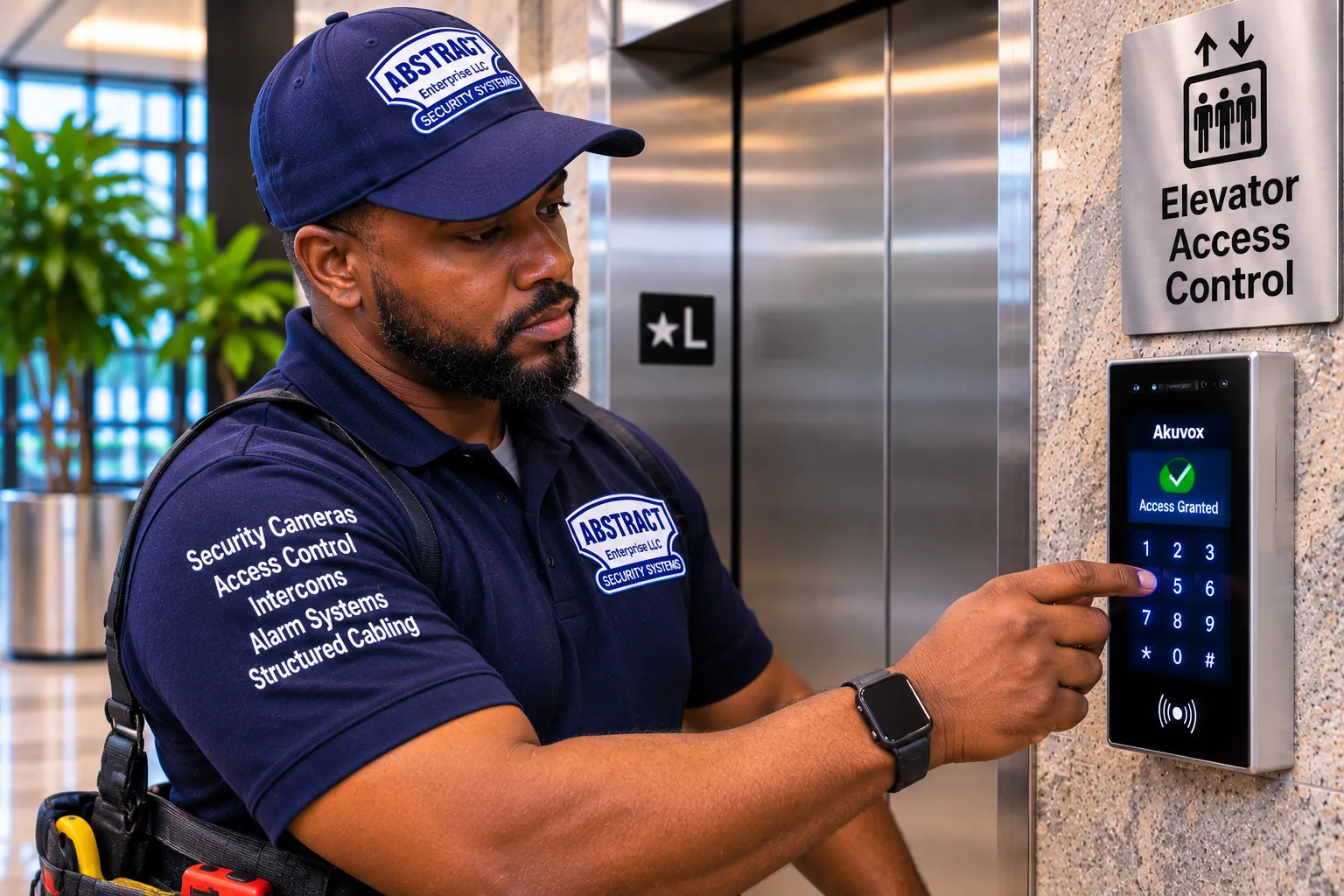
| Level 1 | A reader inside the car: card, fob, PIN code, phone, or a video intercom or keypad station such as Akuvox. Once authorized, the rider can choose any floor the car serves. Ties into spare conductors the elevator company has in the controller cabinet; usually programmed and updated remotely. | from $1,500 per car |
| Level 2 | Biometrics: face recognition, fingerprint or iris readers in place of, or alongside, cards and codes. | from $2,500 per car |
| Level 3 | Floor-by-floor restriction, hall-call readers at the lobby, cellar or garage, time schedules, intercom floor release and destination dispatch links. | Quoted per building after survey |
Two items sit outside our price. The elevator company's visit to make the connection inside its controller is arranged and paid by the building directly with its elevator contractor. And if a car needs a network connection or a new cable run for remote management, that is listed as its own line after the survey.
Within Level 3, these are the things that move a Bronx quote:
| Cost driver | Why it matters in the Bronx |
|---|---|
| Floors controlled | Floor-by-floor restriction usually needs an interface point per controlled floor, per car. A six-story Concourse house and a twenty-story Riverdale tower are very different counts. |
| Number of cars | Each car needs its own reader and floor signals. Multi-car banks multiply the interface work. |
| Cellar, garage and lobby call stations | Each hall-call reader adds a device and a cable run at that landing. |
| Controller age | Recently modernized controllers usually interface more simply than old relay controllers; the elevator contractor prices its side. |
| Existing platform | Extending the door system the building already runs is usually cheaper than adding a second platform. |
| Intercom | Floor release through a modern intercom is programming; an old audio intercom may need replacing first. |
| Cable path | Clear risers and existing conduit are quick; finished prewar lobbies and plaster walls take more care. |
Installers who build large systems point out that relay counts grow fast, floors times cars times call stations, which is why destination dispatch buildings use a data link instead. For most Bronx buildings, the right answer is simpler: control the car, control the cellar or garage stop, and add floor-by-floor rules only where the board or owner has a clear reason.
Our quote is written per building after the survey, lists each item on its own line and shows the elevator contractor's part separately. Visits are booked in a 2-hour arrival window, and the service agreement you sign sets out the terms.
Full terms โ including 50% deposit, one-year parts-only warranty on Abstract Enterprises Security Systems-supplied products, and the late-fee schedule โ are set out in the service agreement.
| Building | Usual starting design | Common add-ons |
|---|---|---|
| One-car prewar apartment house (Concourse, Highbridge, Fordham, Bedford Park) | Level 1 reader in the car | Cellar stop restriction, door repairs, lobby and car camera |
| Two-car postwar co-op (Riverdale, Spuyten Duyvil) | Floor-by-floor restriction (Level 3) | Garage hall-call reader, contractor credentials, doorman schedule |
| Large multi-building development | Level 1 or Level 3 repeated building by building on one platform | Central management, security desk view, phased rollout |
| Planned complex with many single-car lobbies | Level 1 per car, standardized hardware | Remote management to every panel |
| New South Bronx rental tower | Extend the existing cloud door platform into the cars | Amenity schedules, intercom floor release, phone credentials |
| Supportive or senior residence | Floor restriction for staff floors | Front-desk release, aide credentials, accessible reader placement |
| Medical office or small campus building | Schedules: public by day, staff at night | Service car reader, badge compatibility, Level 2 for sensitive floors |
The table is a starting point, not a prescription. Two buildings on the same block can need different designs because one has a modernized controller and the other does not, or because one board wants floor-by-floor rules and the other only wants strangers out of the car.
A survey is where a Bronx elevator project is won or lost. These are the things we check before we write a single line of the scope:
Bring the elevator maintenance contract or the name on the certificate posted in the car if you have it. Photos of the car operating panel, the lobby call button and the machine room door, sent with your request, help us arrive prepared.
We have a Bronx office at 460 E Fordham Rd, and we have been owner-operated since 2002. The same company that installs your elevator readers can also handle the lobby door hardware, the intercom and the cameras, which matters in Bronx buildings where the elevator is only one of several gaps. We are licensed under NYS license #12000287431 and insured, and we provide certificates of insurance naming the co-op corporation, condo board, owner or managing agent before work begins.
We are also clear about what we do not do. We do not do elevator mechanical or controller work, we do not claim to be a certified dealer for any brand, and we do not promise same-day work. Surveys are booked in advance in a 2-hour arrival window, usually within 2 hours of your request, and every quote is written after we have seen the building. For an overview of how we handle elevator access control across all five boroughs, see our elevator access control installation page for New York City.
Usually not for a reader inside the elevator car, which is where we put most Level 1 readers in Concourse buildings precisely because it leaves the lobby untouched. The Landmarks Preservation Commission typically reviews exterior and storefront changes in a historic district, but if a lobby reader, conduit or new door hardware would alter a designated feature, the owner should check with the Commission first. We choose mounting points on surfaces that have already been altered, run cable through the machine room and cellar instead of across terrazzo or marble, and wait for any landmark answer before drilling.
It usually means replacing the keypad and its controller with a reader that supports individual credentials, such as fobs, personal codes or phone access, while reusing the existing cable and elevator connection if the elevator contractor confirms it is sound. We collect the resident list, issue the new credentials before the old code is switched off, and set a cutover date residents know about in advance. After that, a code or fob that leaks can be cancelled on its own without changing everyone's access. A Level 1 reader in the car starts from $1,500 per car in the Bronx.
Call the security contractor first if the car itself runs normally and only the reader or floor access has failed. The reader, panel, power supply, relays, cable and software are low-voltage security equipment, and most failures are a dead power supply or battery, a damaged reader, a lost network link or a credential problem. If we test our output and it is switching correctly but the floor still will not register, the fault is on the elevator side, and we pass the elevator contractor a precise description. If the car is stuck or behaving unsafely, always call the elevator company right away.
Most older audio intercoms cannot tell another system which apartment answered, so they cannot release one specific floor. Some buildings live with a simpler arrangement, such as a front desk or the super releasing floors, or a timed release of the whole floor. For true apartment-by-apartment floor release, the intercom usually has to be replaced with a current system that can talk to the elevator access platform. Doing both projects together tends to cost less overall, because they share one survey, one cable plan and one resident rollout.
Often yes. Several current intercom and access platforms manage the front door, amenity doors and elevator floors in one app, so residents use one credential and the manager uses one list. Whether it works in your building depends on the platform the developer chose, the elevator controller and the licence options for elevator control. We confirm those three things before quoting so you do not discover a missing module after the readers are installed. Floor release and floor-by-floor rules are Level 3 work, quoted per building after the survey.
An elevator reader removes the easy ride to the top, but stairwells are exit routes and must stay usable, so a determined person can still climb. The next layers are usually the doors and the cameras: repair the front and courtyard door closers and locks so people cannot walk in behind residents, add cameras at the lobby, in the car and at the top landing, and have the roof door alarmed or monitored in a way that meets fire and building code. We put those layers in one written scope beside the elevator work so the board or owner can see what each one adds.
It usually makes the job easier. Modern controllers commonly have provisions for security or card-reader inputs, and a modernization often leaves spare conductors in a new traveling cable, so the elevator contractor's connection tends to be simpler than on an old relay controller. You did not need to wait, but if a modernization is still being planned, it is worth telling the elevator contractor now that access control is coming, so the right inputs and conductors are included in their work and nothing has to be reopened later.
Yes. Abstract Enterprises Security Systems installs door access control, intercoms, cameras and elevator readers, and putting them in one scope means one survey, one credential system and one rollout to tenants. The one part we never do is the work inside the elevator controller, which your licensed elevator contractor handles under its own license. For a rent-stabilized building, we also help the owner plan a clear letter to tenants about what is changing and what data is kept, though questions about leases and building services should go to the owner's own counsel.
By choosing a platform that holds every credential in one database and organizes access by building, floor and hours through permission groups. Residents who move between buildings, staff who work across the campus and contractors who visit several buildings then live in one list, and cancelling a credential works everywhere at once. The security desk and the management office can each get their own view and rights, with a log of every change. We usually design one building first, then repeat the same layout and settings across the rest in phases.
In most cases, yes. One reader model, one mounting height, one machine room layout and one platform across every lobby make training, spare parts, resident instructions and repairs much simpler for years. Readers that already work can sometimes stay if the new platform supports them, which spreads the cost over time, but mixing brands usually means two lists of credentials and two sets of problems. Because our prices are per car, from $1,500 per car for Level 1 in the Bronx, a complex can standardize one lobby as a pilot before committing to the rest.
Yes, that is a standard floor-by-floor setup. Staff credentials belong to a group that reaches every floor, including program offices and records rooms, while each resident's credential reaches the lobby, their own floor and the shared spaces the operator chooses. The front desk can release a floor for a signed-in visitor, and home care aides can get credentials limited to one floor and set hours. We follow the operator's own privacy policy and Local Law 63, and we avoid biometric readers for residents unless the operator has a written consent process.
Yes. A reader at the garage hall-call station means the car can only be called to the garage by a credential that belongs to the parking group, and a garage-level restriction inside the car can stop residents without parking from riding down. Residents who arrive through the lobby notice no change. The elevator contractor confirms how the garage landing call connects to the controller, and the board decides who is in the parking group and how guests with a parking pass are handled. This is Level 3 work, quoted after the survey.
Yes, our Bronx office is at 460 E Fordham Rd, and the Bronx line is (646) 490-0629. We book surveys within 2 hours of your request and give you a 2-hour arrival window for the visit. We do not promise same-day work, because a proper elevator survey needs access to the machine room and, ideally, a conversation with your elevator contractor. Sending the address, floor and car count, your elevator company's name and a few photos with your request helps us arrive ready.
Elevator Access Control Installation NYC | Fob & Card ยท Elevator Access Control Installation in Manhattan ยท Elevator Access Control Installation in Brooklyn ยท Elevator Access Control Installation in Queens ยท Elevator Access Control Installation in Staten Island ยท Elevator Access Control Installation Long Island NY ยท Elevator Access Control Installation Hudson Valley NY ยท Elevator Access Control Installation in Nassau County ยท Elevator Access Control Installation in Suffolk County ยท Elevator Access Control Installation in Westchester County ยท Elevator Access Control Installation in Rockland County ยท Elevator Access Control Installation in Orange County
Tell us the Bronx address and neighborhood, how many floors and elevator cars the building has, whether the car stops at a cellar or garage, what door, fob or intercom system you use now, and who should be able to reach which floors. Photos of the car's button panel, the lobby call button and the machine room door help. If you know your elevator maintenance company, include it so we can coordinate early. Prefer to talk? Call our Bronx line at (646) 490-0629.