Suffolk rental, medical office, condo or senior building where anyone who gets in can ride to any floor? Book an elevator access control survey from Huntington Station to Riverhead: (631) 407-2884
Elevator access control installation in Suffolk County makes your elevator ask who is riding before it moves. Abstract Enterprises Security Systems installs the low-voltage side across the county's ten towns: card, fob, phone, code, video and biometric readers in the car and at garage or lobby landings, the access panel and battery, the floor relays, the wiring, the credentials and the programming. Your building's state-licensed elevator contractor makes the final connection at the controller, and we plan both halves together. Most Suffolk elevator buildings are young, have parking and sit near a downtown or a train station, so the system is designed around the garage and the side doors as much as the lobby.
Reviewed and updated November 17, 2026 by Abstract Enterprises Security Systems, NYS license #12000287431 · Sources: U.S. Census Bureau QuickFacts (2020 Census); Suffolk County open data; Office of the Governor, Carriage House groundbreaking, Ronkonkoma Hub phase two, 11 Park Drive Wyandanch and Huntington Apartments completions; TRITEC, New Village at Patchogue and Station Yards; NY Housing Conference and Long Island Business News (Sept. 11, 2025), Wyandanch Village; RiverheadLOCAL (May 30, 2025) and Riverhead News-Review (March 2026); Stony Brook Medicine, Advanced Specialty Care; Regional Plan Association, Hauppauge Industrial Park; Town of Huntington Fire Prevention Bureau; Town of Brookhaven Division of Fire Prevention; Town of Islip Fire Marshal's Office; NYS Department of Labor elevator licensing; NBC New York (April 23, 2025); IPVM and installer discussions on floor-relay design
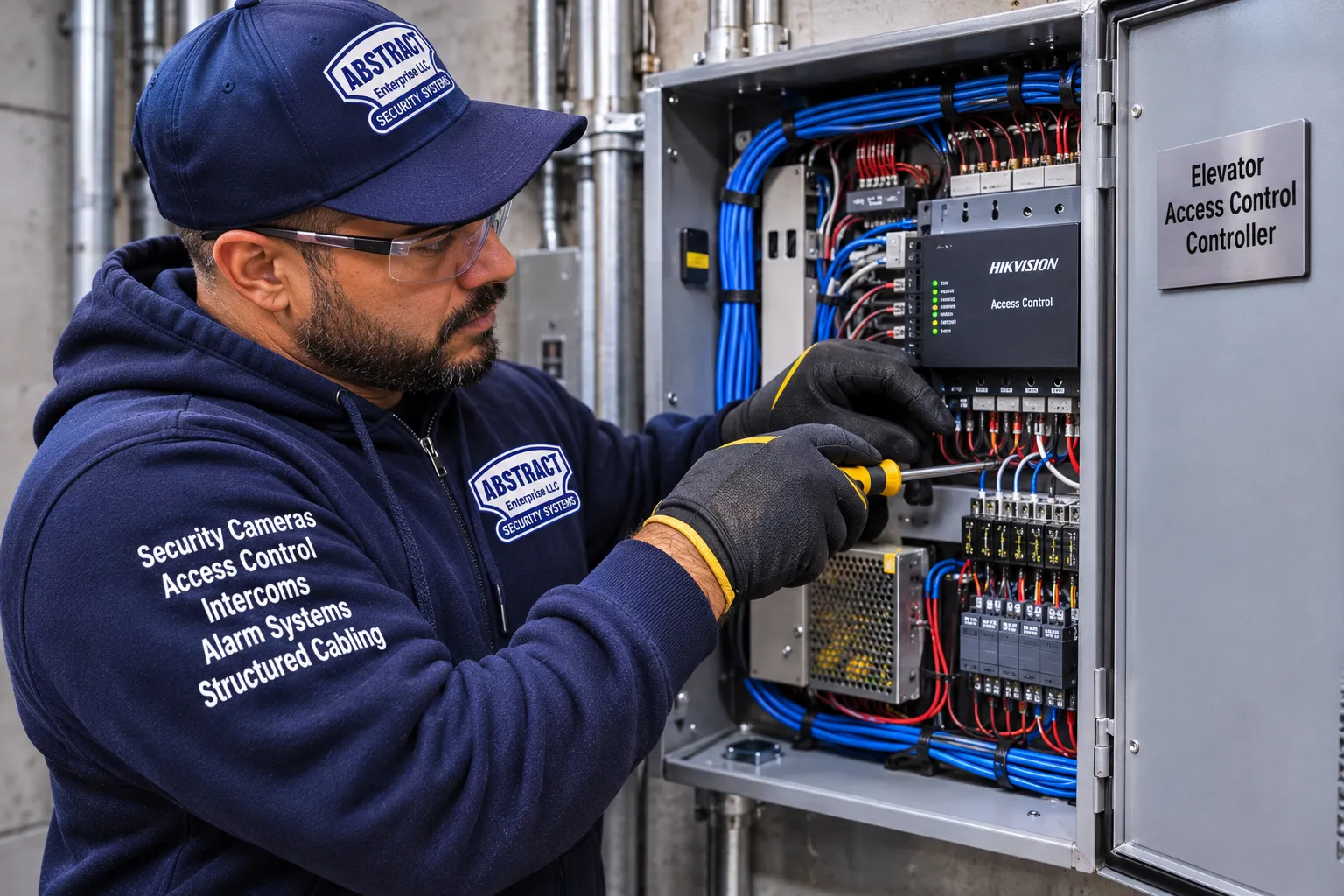
Photo from the Abstract Enterprises Security Systems elevator access control photo library (not taken in Suffolk County and not a customer's building): a technician in safety glasses and gloves lands wires on relay terminals inside a metal enclosure labeled Elevator Access Control Controller. In a Suffolk machine room or controller closet, this enclosure is our side of the line; the elevator contractor makes the last connection at the controller.
Suffolk Elevator Access Request
Tell us the town, how many floors and cars, and whether there is a garage stop
✅
Request Sent!
Thank you. We will be in touch to book your Suffolk elevator access survey, usually within 2 hours of your request.
25+
Years Experience
10
Suffolk Towns Served
100%
Licensed & Insured
4.7★
201 Google Reviews
Owner-operated since 2002 · Thousands of jobs completed · Booked within 2 hours
Quick answer: elevator access control installation in Suffolk County starts at $1,800 per elevator car for a Level 1 card, fob, phone, code or video reader in the car and at $3,000 per car for a Level 2 face, fingerprint or iris reader; floor-by-floor restriction, garage and lobby landing readers, schedules and intercom floor release are Level 3 and are quoted per building after a survey. A single-car condo or a small office usually needs only Level 1. A five-story rental near the train with a parking deck and an amenity floor, or a medical building with staff-only floors, usually needs Level 3. Your elevator contractor's connection at the controller is billed to the building directly. We book the survey within 2 hours of your request and arrive inside a 2-hour arrival window; call (631) 407-2884.
Readers, panel, relays, wiring, credentials and programming by Abstract Enterprises Security Systems under NYS license #12000287431
Controller connection and firefighters' service behavior handled by your NYS-licensed elevator contractor, scheduled with us
Planned around Suffolk's town and village code offices, not New York City rules
What Elevator Access Control Means for a Suffolk County Building
Elevator access control in Suffolk County is a newer conversation than it is in the city, and that changes how a first call usually goes. A property manager in Patchogue has just taken over a five-story rental near the train and discovers that anyone who gets through the front door can ride to every floor, including the rooftop lounge. A medical office owner in Hauppauge wants the second-floor surgical suite closed to walk-in patients without locking out the doctors who arrive through the rear lot. A condo board on the North Fork wants to know whether the fobs it already uses at the lobby door can also run the elevator. They are asking the same question in different words: how do we make the elevator stop taking strangers upstairs, and what does that involve?
The short answer is that an elevator, on its own, has no idea who is riding it. It answers buttons. If a person is inside the car and presses five, the car goes to five. In the city, many buildings have lived with doormen, buzzers and locked vestibules for a century, so the elevator was rarely the weak point. In Suffolk, most elevator buildings are young, many sit beside a surface lot or a garage, and many have more than one way in: the lobby, a parking-deck door, a side door by the bike room, a loading door behind the retail space. Each of those doors is a chance for someone without permission to reach the car. Elevator access control closes that gap at the one place every upstairs trip has to pass through.
It works by adding a reader to the elevator and a small panel that decides whether the reader's request is allowed. The reader can be a card or fob reader, a keypad, a phone reader that accepts a mobile credential, a video intercom station, or a biometric reader that checks a face or a fingerprint. The panel sits in the machine room, the controller closet or a nearby electrical room. When an approved credential is shown, the panel closes a relay, which is simply a switch, and the elevator controller accepts the floor call. When the credential is not approved, nothing happens and the attempt is logged with the time and the credential that was tried.
That is the whole mechanism. What makes one Suffolk building's system different from another's is how strict it needs to be, how many cars and floors it covers, who besides residents or employees has to ride, and how it ties in with the door system, the intercom and the cameras the building already owns. Abstract Enterprises Security Systems installs the low-voltage side of all of this across the county, from the Huntington and Babylon line out to Riverhead and the forks: the readers, the panel, the battery backup, the relays, the cable, the credentials and the programming. The connection inside the elevator controller is made with, or by, the building's own licensed elevator contractor, because New York State licenses elevator work separately and nobody else should be inside that cabinet.
We describe the work as three levels, and most Suffolk buildings start on the first one:
Level 1: a reader in the car. The car will not accept a floor call until an approved credential is shown. After that, the rider can pick any floor the car serves. For a single-tenant office building, a small condo or a senior building where the concern is outsiders, this is usually enough.
Level 2: biometric readers. The same car-level control, but the credential is a face, a fingerprint or an iris. Suffolk buildings that choose it are usually medical or professional buildings where staff share or lose badges, or residential buildings where fob sharing has become a problem.
Level 3: floor-by-floor control and the extras around it. Each rider reaches only the floors their permission allows. Readers can be added at the lobby or garage call buttons. Floors can lock and unlock on a schedule. The intercom can release a single floor for a visitor. This is what a multi-tenant medical building, a rental with amenity floors or an office building with separate companies on each floor tends to need.
The rest of this page explains how each of those levels plays out in the buildings Suffolk actually has, what the county's town-by-town code offices care about, what it costs at the Suffolk rate, and how to tell whether a contractor really knows elevators or just knows doors.
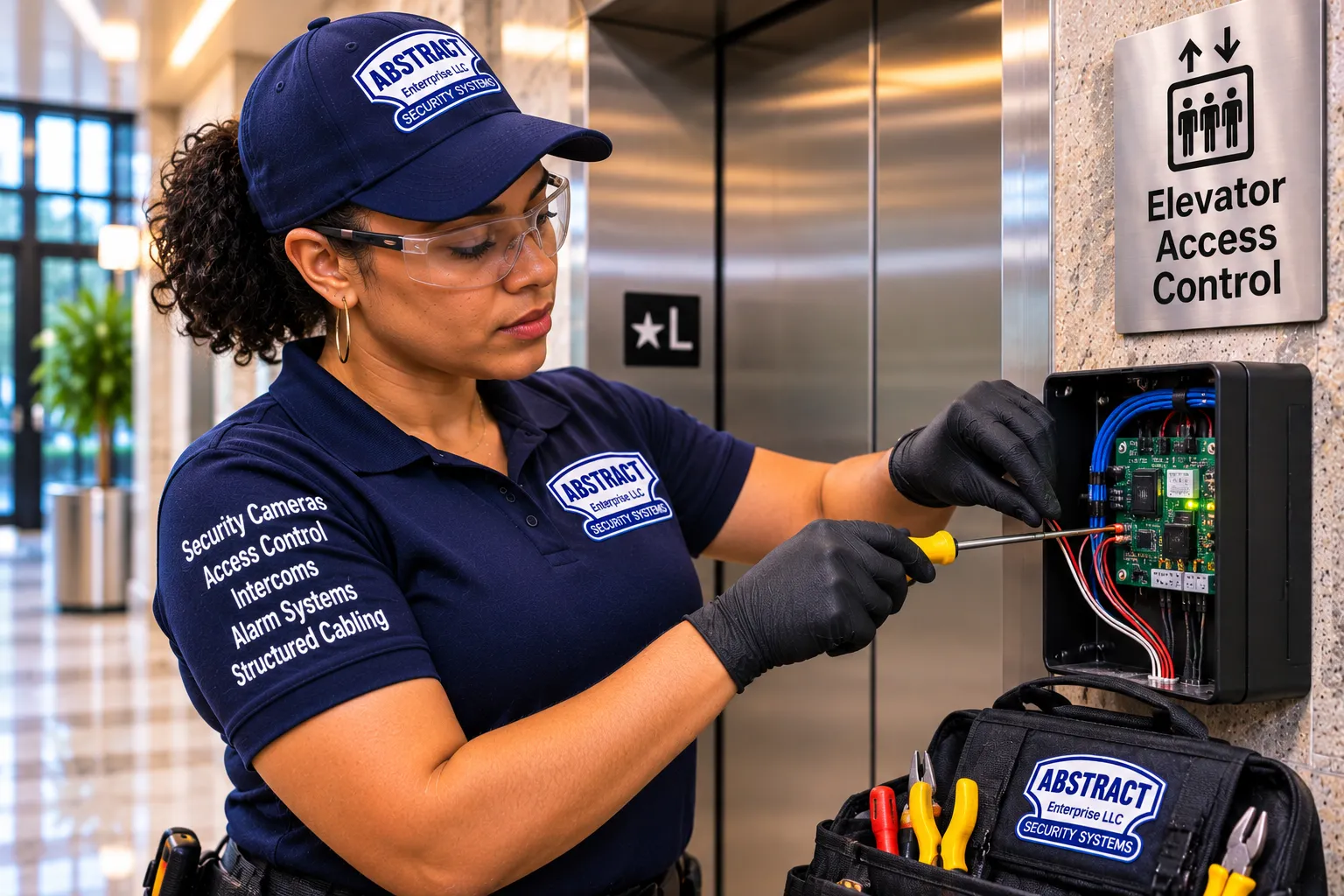
Photo from the Abstract Enterprises Security Systems elevator access control photo library (not taken in Suffolk County): a technician in safety glasses wires an open reader enclosure next to a stainless elevator. Reader wiring like this is the first visible step when a Suffolk building adds a reader beside the car or at a garage landing.
Suffolk in Numbers
Suffolk County's Elevator Buildings: Young, Spread Out and Clustered Around the Train
Suffolk is a county of single-family houses, and that is the starting point for anyone planning elevator security here. Elevator buildings are a small share of the housing stock and a modest share of the commercial stock, and they are scattered across ten towns and dozens of villages rather than packed into a few neighborhoods. Over the last fifteen years, though, the number has grown quickly, and nearly all of that growth has happened in the same kind of place: a downtown or a station area where a town or village rezoned for four- and five-story mixed-use buildings. The figures below come from public sources and are used only for what they say.
Figure
What it means for elevator access in Suffolk
Source
1,525,920 residents in the 2020 Census, about 1,675 people per square mile
Suffolk is the most populous county in New York outside the five boroughs, but at a fraction of city density. Elevator buildings are scattered, so travel time and scheduling matter more than in the city.
U.S. Census Bureau QuickFacts
Ten towns and two Native American reservations, plus many incorporated villages
Building and fire code enforcement is local. The office that cares about your elevator lobby in Islip is not the one that cares in Huntington or in a village like Lake Grove.
Suffolk County open data, Census county subdivisions
New Village at Patchogue: 291 apartments with 45,000 square feet of retail and 17,000 square feet of office
A single downtown block can mix residents, shoppers and office tenants who all share one elevator core and one garage.
TRITEC
The Carriage House, Patchogue: 262 homes, 53 of them affordable, in two five-story buildings on either side of the Patchogue River
Two separate buildings with separate cars, under one owner, often want one credential that works in both.
Office of the Governor
Ronkonkoma Hub phase two: 388 homes, 73,000 square feet of commercial space and 15,500 square feet of office; the full Station Yards plan calls for 1,450 apartments
Station-area buildings next to the LIRR are going up in phases, which means elevator access decisions get made building by building over years.
Office of the Governor; TRITEC
Alston Station Square, the first Ronkonkoma Hub phase: 245 apartments in two buildings, opened in September 2019
The oldest of the new station buildings are now old enough for their first access-control upgrade or credential migration.
LongIsland.com
Wyandanch Village: 177 apartments in two mixed-income buildings, with more under way, including a 218-unit building with 202 affordable apartments that opened applications in September 2025
Affordable lease-ups mean many new residents receiving credentials in a short window, which shapes how the system is set up.
NY Housing Conference; Long Island Business News
11 Park Drive, Wyandanch: 94 affordable apartments for residents 62 and older, five stories
Senior buildings need readers that are easy to use and an elevator that never becomes harder to reach.
Office of the Governor
Heritage on Main, Riverhead: 165 market-rate apartments over 7,910 square feet of ground-floor commercial and amenity space, with 155 parking stalls
The East End now has downtown elevator rentals too, not just the western towns.
RiverheadLOCAL
Advanced Specialty Care, 500 Commack Road: more than 30 specialties in nearly 120,000 square feet
Large outpatient buildings in Suffolk mix public floors with staff-only areas, the classic case for floor-level control.
Stony Brook Medicine
Hauppauge's industrial park: roughly 1,300 to 1,350 companies and about 55,000 employees
Most of these buildings are one or two stories, but the multi-story office and flex buildings among them often share an elevator among several tenants.
Regional Plan Association; HIA-LI
Three things follow from those numbers. First, a Suffolk elevator building is usually less than twenty years old, which means its elevator controller is probably modern and its elevator contractor is used to being asked about access control. That is good news: the connection is usually simpler than in an old city building. Second, the building almost always has parking, and the garage or the rear lot is where most uninvited riders actually come from. A system that only protects the front door misses the point. Third, the buildings are far apart. A contractor who works mostly in the city may not be keen to drive to Riverhead twice for a programming change, which is why it matters that the system can be managed remotely and that the company you hire actually schedules work out here.
How It Works
How Elevator Access Control Works Inside a Suffolk Elevator, From Parking Deck to Hallway
The easiest way to understand the system is to follow one rider. Picture a tenant in a five-story rental a few minutes' walk from an LIRR station. He drives home, parks on the second level of the building's garage, and walks to the garage elevator lobby. The building has a Level 3 system with a reader at the garage call button and floor control inside the car. This is what happens.
He calls the car from the garage. The call button on the garage level only works after a valid credential is presented at the reader next to it. He taps his phone. The panel checks the credential, sees he is a resident, and enables the hall call for a few seconds. He presses the button and the car comes.
He steps inside. The reader in the car is mounted on the front return panel at a height a wheelchair user can reach. He taps again. The panel looks up his permissions: lobby, garage levels and the fourth floor, where his apartment is, plus the fifth floor amenity lounge between 7 a.m. and 11 p.m.
The panel enables his floors. For each floor he is allowed, it closes a relay that tells the elevator controller to accept that floor's button for a short window, typically eight to fifteen seconds. Floors he is not allowed stay locked.
He presses four. The button lights and the car goes. If he had pressed three, where he does not live, the button would not have responded.
The event is logged. The panel records the time, the credential and the floor. The property manager can see it later from a browser or an app, and so can we if the building has asked us to support the system remotely.
A visitor rides differently. If his friend arrives at the lobby, the friend uses the video intercom. When the tenant answers on his phone and presses the release, the system unlocks the lobby door and enables only the fourth floor in the car for the next ride. The friend cannot stop at the amenity floor or the roof.
A Level 1 building does a simpler version of the same thing. There is one relay for the whole car instead of one per floor. A valid credential enables every button in the car for a few seconds, so the question it answers is "should this person be riding at all?" rather than "where may they go?" In many Suffolk buildings, especially single-tenant offices, small condos and senior residences where the concern is outsiders, that is the right question.
Three practical details decide how easy the job is in a given building:
The path from the car to the panel. The reader in the car needs a few conductors to reach the panel. They usually run through the traveling cable, the flexible bundle that hangs from the bottom of the car. Newer Suffolk buildings often have spare conductors, or even a network pair, already in that cable. If they do not, the elevator contractor either adds a cable or provides a wireless or network link, and that is a real cost. We look for it on the survey.
The type of controller. Most buildings put up in the county in the last two decades have microprocessor controllers with inputs designed for exactly this kind of tie-in. Some controllers can accept a network connection from the access system instead of a bank of relays, which simplifies floor control in taller buildings. Older hydraulic elevators in 1970s and 1980s office and medical buildings usually need relays.
The door system. The cheapest and most convenient result is when the elevator uses the same credentials and the same software as the lobby and garage doors. If the building already has a door system we can extend, we usually recommend it. If the door system is closed to other installers or past its life, it may be the moment to replace both.
Photo from the Abstract Enterprises Security Systems elevator access control photo library (not taken in Suffolk County): a technician in a polo shirt terminates colored conductors on a reader circuit board. In a Suffolk elevator these conductors usually arrive through the traveling cable, which is why we check for spare conductors before quoting.
Floor Control
Elevator Floor Access Control: Restricting Certain Floors in a Suffolk Building
Floor control, sometimes called elevator floor restriction, is the part people ask about most. It is the difference between "you may ride" and "you may ride to these floors only." In Suffolk the request almost always comes from one of four situations: a building with stores or offices downstairs and apartments above, a medical or professional building with several practices, a rental with amenity floors that the owner wants open only at certain hours, or a building where the roof, the mechanical floor or a storage level should be off-limits to everyone but staff.
In the car, at the landing, or both
There are two places to put the restriction. In the car, the reader enables only the rider's floors, as described above. At the landing, a reader beside the hall call button decides whether the car can be called to that floor at all. Garage levels are the classic landing case in Suffolk: the building wants anyone in the lobby to be able to ride up, but only residents to be able to call the car from the parking deck, because the deck has an open entrance. Many buildings use both, a garage landing reader plus in-car floor control.
What it does not do
Floor control decides which buttons respond. It does not stop someone from walking up the stairs, and it should not. Stair doors are governed by the fire code, and in most buildings the stair doors on the residential floors have to allow people out into the stair at all times. Where a building wants to control re-entry from the stair onto certain floors, that is a separate door-hardware conversation that has to match the code and the building's fire alarm. We cover it on the survey, but elevator floor control is not a way around it.
How many relays a Suffolk building needs
The count is roughly floors controlled, times cars, plus any landing readers. A five-story rental with one car and four controlled floors needs a handful of relay points. A five-story rental with two cars and a garage stop needs roughly twice that, plus a landing reader at the garage. A ten-story medical office with three cars and every floor controlled can need dozens. That count, more than anything else, is why Level 3 is quoted per building after a survey instead of off a price list.
When a Suffolk building should not bother with floor control
Plenty of buildings ask for floor control and end up better off without it. A three-story office with one tenant, a small condo where every owner is welcome on every floor, or a senior building where residents visit each other constantly will often be happier with a Level 1 reader and a locked roof. Floor control adds programming, adds things to maintain, and adds one more reason for a resident to be told "your fob doesn't work on that floor." We would rather install the simpler system that people use than the complicated one they resent.
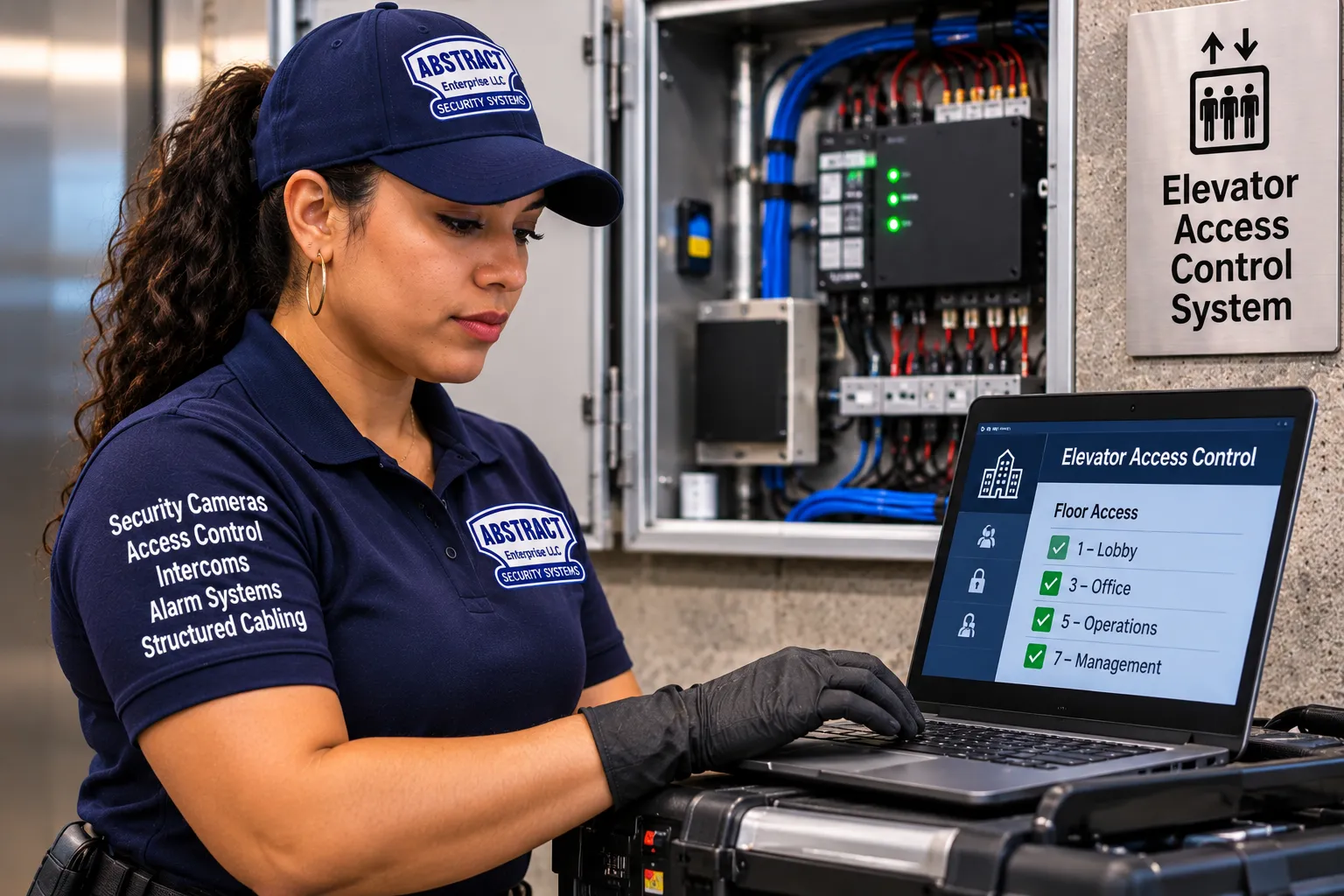
Photo from the Abstract Enterprises Security Systems elevator access control photo library (not taken in Suffolk County): a technician in gloves types on a laptop listing floor permissions for lobby, office, operations and management floors. In a multi-tenant Suffolk medical or office building, this is where each tenant's floors and hours are set.
Building Types
Suffolk Building Types and the Elevator Access Control Each One Usually Needs
Suffolk's elevator buildings fall into a handful of families. Each has its own habits, its own decision-makers and its own typical system. The descriptions below are drawn from what is publicly known about the county's building stock and from how these buildings are generally run. Buildings named here are examples of a type, not our customers.
Downtown and station-area rentals: Patchogue, Ronkonkoma, Lindenhurst, Huntington Station, Riverhead
These are the buildings that have changed Suffolk's skyline, such as it is, over the last fifteen years. New Village at Patchogue, the Carriage House going up on West Main Street, the Alston and Station Yards buildings at the Ronkonkoma Hub, the proposed five-story, 172-unit Lindenhurst buildings over retail and parking, Avalon Huntington Station, and Heritage on Main in downtown Riverhead all follow a similar pattern: four or five stories, apartments over ground-floor retail or amenity space, a garage or a large lot, one or two elevator cars, and a lobby that is staffed by a leasing office during business hours and by nobody at night.
The typical request is Level 3, but a narrow version of it: residents can ride to their own floor and to the amenity floor during posted hours; the garage call buttons need a credential; the retail floor is separated from the residential floors entirely. Most of these buildings already have a cloud-managed door system at the lobby and garage, and most owners want the elevator to join it so a resident has one credential and the leasing office has one place to turn access on and off. When an owner is in the middle of a lease-up, or when a phase two building is about to open next to phase one, getting the credential plan right matters more than the hardware.
Affordable and supportive housing: Wyandanch, Huntington Station and beyond
Suffolk's affordable buildings, such as the Wyandanch Village buildings and Huntington Apartments at 201 Fall Street, where a nineteenth-century building now holds 53 affordable homes including 27 with supportive services for veterans, have a different emphasis. The owner is usually a nonprofit or a mission-driven developer working with a property manager and a social-services partner. Access control has to support case managers and service staff who move around the building, residents who may be new to fobs and apps, and funders who expect clear records. Level 1 with a well-kept credential list is often enough for the residential floors, with floor control used only for offices, program rooms and the roof.
Senior housing
Senior buildings, such as 11 Park Drive in Wyandanch and the many senior apartment communities across Brookhaven and Islip, are where access control can do the most harm if it is done badly. Residents may have limited hand strength, low vision or memory problems. Home health aides, family members and medical transport crews come and go all day. And an elevator that becomes harder to use is a real hardship: when an East Patchogue senior facility's elevator went unrepaired in the spring of 2025, residents were stuck upstairs, as NBC New York reported. Our rule in these buildings is that the access system must never be a reason the elevator does not work. That means large, simple readers, long enable windows, credentials that do not depend on a smartphone, an aide credential that is easy to issue and revoke, and a battery and power-failure plan agreed in advance.
Medical and professional buildings
Suffolk has a large outpatient medical sector, from multi-specialty centers like Stony Brook Medicine's Advanced Specialty Care at 500 Commack Road and its larger Lake Grove facility to two- and three-story professional buildings along Route 25, Route 347 and Route 111. These buildings almost always need floor control, because patients should reach the floors they are visiting and no others, and some floors hold surgical suites, imaging, records or pharmacy areas that are staff-only. Hours matter: the building is open to the public during clinic hours and closed at night, but staff, cleaners and on-call clinicians still need to ride. A schedule-driven Level 3 system, with public floors open by day and everything on credentials at night, is the usual answer.
Office buildings and office parks: Melville, Hauppauge, Islandia, Ronkonkoma
Route 110 in Melville, the Hauppauge park and the office corridors near the Long Island Expressway hold most of the county's multi-story office space. Buildings like the 400,000-square-foot 3 Huntington Quadrangle, which renovated its lobby, corridors and elevators to attract tenants, compete on amenities and security. Tenants arrive with their own badge systems, and the landlord wants one elevator system that recognizes all of them, or at least issues landlord credentials that open tenant floors. Floor control by tenant, after-hours schedules, and a lobby desk or visitor kiosk that issues temporary credentials are standard. Several older Melville buildings are being discussed for conversion to residential or live/work use under the Town of Huntington's revived rezoning plans, which brings a residential access model into a building whose elevator was set up for offices.
Condos, co-ops and East End buildings
Suffolk has fewer co-ops than Nassau or the city, but it has many condominiums, from 1980s garden-style complexes with a single elevator in each building to waterfront condos and hotels on the South Shore and the East End. Boards here tend to be practical: they want the strangers out of the building, they want residents to keep using the fobs they already have, and they want a system the management company can run without calling us every week. Level 1 with a locked roof or storage level is common. Seasonal buildings on the East End add a twist: owners who are away for months, renters who need access for a week, and staff who need a different schedule in July than in January.
Mixed-use buildings with stores below
Many village downtowns, from Babylon and Bay Shore to Port Jefferson, Northport and Riverhead, have three- to five-story buildings with stores or restaurants on the ground floor and apartments or offices above, sometimes with a small elevator added during a renovation. The concern is simple: customers of the ground-floor business should not be able to ride upstairs. Level 1 in the car, sometimes paired with a landing reader at the ground floor, solves it. In Riverhead, where the Town Board approved the Zenith Group's request in March 2026 to take a downtown project to five stories with 15 apartments, buildings like this are being added right now.
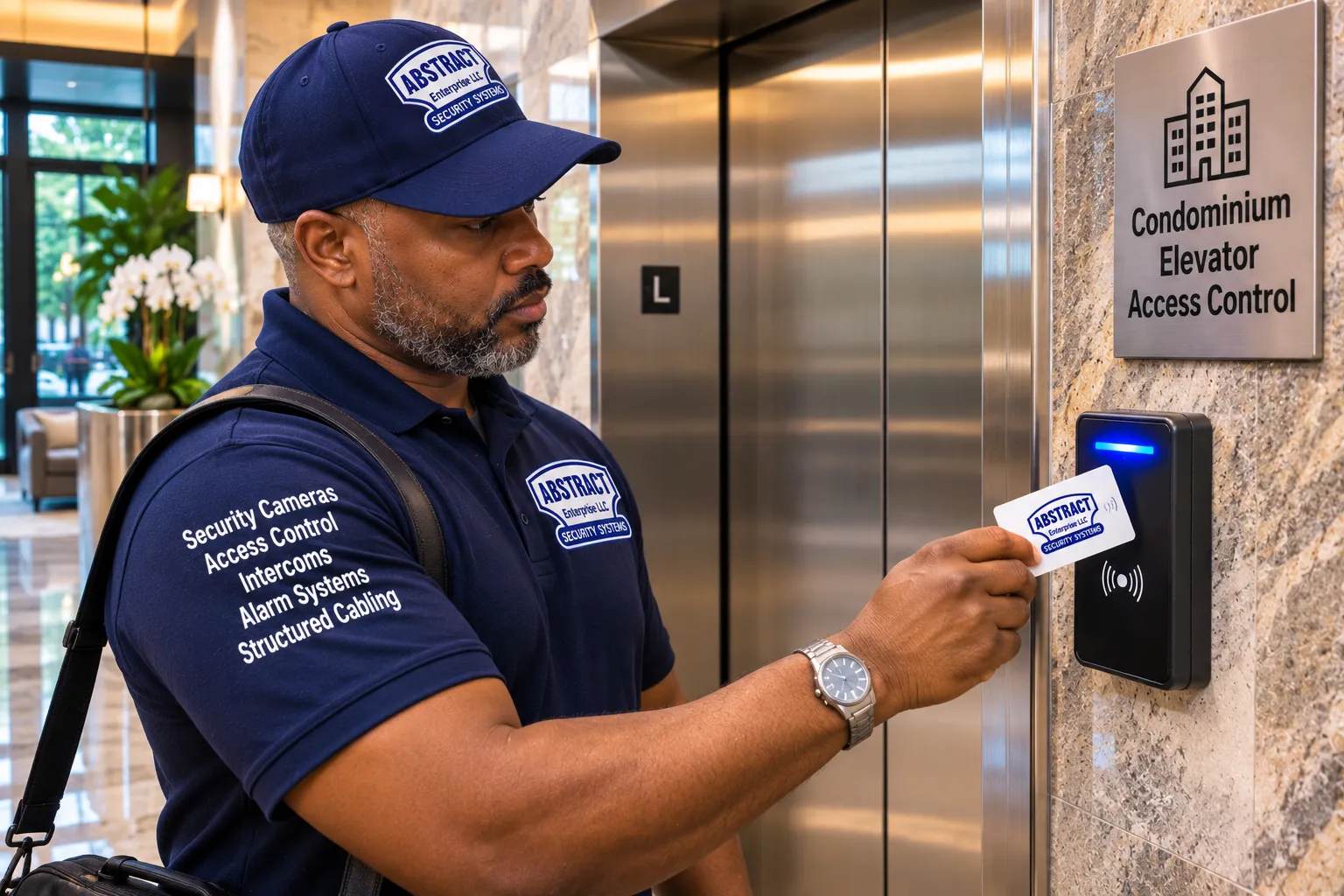
Photo from the Abstract Enterprises Security Systems elevator access control photo library (not taken in Suffolk County): a man in a polo shirt holds a card to a reader beside a sign reading Condominium Elevator Access Control. A Suffolk condo board that already uses cards or fobs at the lobby can often use the same credential in the car.
Codes and Permits
Ten Towns, Many Code Offices: What Suffolk Building and Fire Officials Expect
One thing that surprises owners coming from the city is that there is no single building department for Suffolk County. Building permits and code enforcement are handled by each of the ten towns and by the incorporated villages within them, under the New York State Uniform Fire Prevention and Building Code. Fire prevention is handled the same way, by town fire marshals' offices or by village officials. The rules for New York City, including its Department of Buildings bulletins and Local Law 63 on tenant data privacy, do not apply in Suffolk, and a contractor who quotes them to you as Suffolk law is mixing up jurisdictions.
What stays the same everywhere is the elevator standard. Elevators in New York State are built and altered under the ASME A17.1 safety code as adopted in the state codes, and New York's Labor Law requires the companies and mechanics who install, alter and maintain elevators to be licensed by the state Department of Labor. Under that standard, anything added to an elevator car or a hall station must not interfere with the elevator's normal or emergency operation, and it must stop having any effect when firefighters' emergency operation is in use. Every reader we install is wired to drop out of the way in that situation, and the elevator contractor confirms it at the controller.
Here is how the local side usually works in practice:
Town fire marshals look closely at anything that touches the fire alarm. In the Town of Huntington, for example, the Fire Prevention Bureau requires that the licensed company installing fire alarm, sprinkler or suppression equipment apply for a construction permit and perform the acceptance inspection with a fire marshal witnessing it. Our access system does not modify the fire alarm, but if a building wants doors or elevator functions to release on alarm, the interface is made by the building's fire alarm company under its own permit, and we coordinate the timing.
Brookhaven and Islip run their own fire prevention divisions. Brookhaven's Division of Fire Prevention takes permits through its online portal, and its inspectors, who are state-certified building safety inspectors, inspect commercial buildings that do not need annual inspection at least once every three years. Islip's Fire Marshal's Office publishes its own submission requirements. A building owner should expect the local office to ask about any change to egress doors or fire alarm interfaces, even when the elevator reader itself needs no permit.
Building departments care about the elevator alteration. Whether a particular elevator access project needs a building permit depends on the town or village and on what the elevator contractor changes at the controller. We ask the elevator contractor how they file their part, and we tell you in writing whether we expect any filing for ours.
Villages may have their own requirements. A building in Patchogue, Lindenhurst, Port Jefferson or Northport answers to the village, not the town, on many of these questions. We check which office applies before we schedule.
The practical lesson for a Suffolk owner is to decide early who will speak to the local office, and to make sure the elevator contractor, the fire alarm company and we are working from the same plan. In our experience the projects that run long are almost never slowed by the access hardware; they are slowed by a missing conversation with an inspector about a door.
Who Does What
Who Installs Elevator Access Control in Suffolk: Our Crew and Your Elevator Contractor
Elevator access control is a two-trade job, and it goes best when everybody knows where the line is. Abstract Enterprises Security Systems does the security side under NYS low-voltage license #12000287431. Your building's elevator contractor, licensed by the New York State Department of Labor, does the elevator side.
Task
Who does it
Notes for Suffolk buildings
Survey of the cars, controller, traveling cable and door system
Abstract Enterprises Security Systems, with the elevator contractor's input
We photograph the car station and controller and ask the elevator company about spare conductors before quoting.
Readers in the car and at landings
Abstract Enterprises Security Systems
Mounted at accessible heights, sealed to the car's finishes. Cutting or drilling the car's fixture panels is coordinated with the elevator contractor.
Access panel, power supply and battery
Abstract Enterprises Security Systems
Installed in the machine room, controller closet or an adjacent room with the elevator contractor's agreement.
Relays or network interface to the controller
Both: we supply and wire to the terminal point; the elevator contractor lands the final connection
This is the line. We never work inside the elevator controller.
Firefighters' emergency operation behavior
Elevator contractor confirms; we test with them
Readers must drop out when the car is on fire service.
Abstract Enterprises Security Systems, with your property manager
We build the permission chart with you before the first ride.
Ongoing elevator maintenance
Your elevator contractor
Our work does not change who maintains the elevator.
Ongoing access system support
Abstract Enterprises Security Systems, if you want it
Remote programming where the platform allows it, with site visits booked in 2-hour arrival windows.
If you do not know who maintains your elevator, look at the inspection certificate posted in the car or in the machine room, or ask your managing agent. The elevator contractor's visit is scheduled and paid for by the building directly; we coordinate dates so their technician and ours can test together. In Suffolk, where an elevator contractor's mechanic may be covering a route from Babylon to Riverhead, booking that joint visit a few weeks ahead is the single best way to keep a project on schedule.
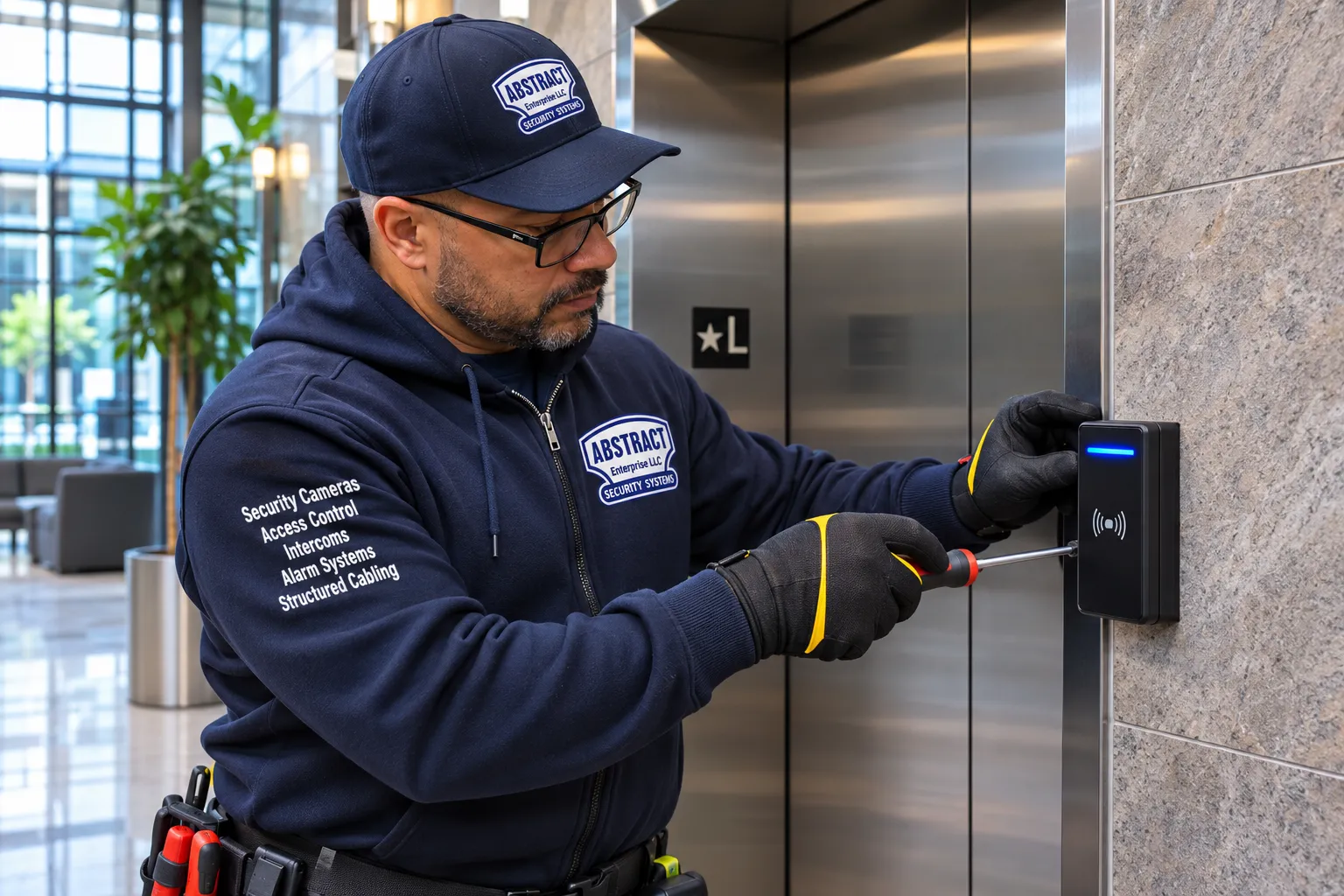
Photo from the Abstract Enterprises Security Systems elevator access control photo library (not taken in Suffolk County): a technician in glasses tightens a screw on a black card reader mounted beside closed elevator doors. A reader at a landing like this is how a Suffolk building controls who can call the car to a garage level.
Safety
Fire Service, Storms and Power Failures in Suffolk Elevator Buildings
Every elevator access system has to answer three questions before it is installed: what happens in a fire, what happens when the power goes out, and what happens when somebody urgently needs to ride and their credential does not work. Suffolk adds a fourth: what happens when a storm knocks out power to half the county for days.
Fire: the readers step aside
When the building's fire alarm recalls the elevators, or a firefighter turns the key for in-car operation, the access system must have no effect on the car. That is the rule in the elevator safety code, and it is the first thing we test with the elevator contractor at the end of a job. In practice, the elevator controller ignores the access relays once it is on fire service, and in some designs the access panel also receives a signal so it can log the event.
Power failure: decide the answer in advance
If utility power fails, the elevator either stops or runs on the building's emergency power if it has a generator. Our panel has its own battery, sized to keep the readers working for a period the building chooses. The more important decision is what the elevator does if our panel loses power entirely. In most Suffolk residential and senior buildings, the right answer is that the car goes back to working for everyone, because trapping residents upstairs is a far bigger risk than a stranger riding the elevator during an outage. In a medical building with controlled substances or an office with sensitive floors, the owner may choose differently for certain floors. We write the decision down and wire to it.
Storms: protect the panel, plan the restart
Hurricanes, tropical storms and nor'easters have all cut power across Long Island for days at a time. For an elevator building that means two things. Put the access panel and its battery somewhere dry and reachable, not in a basement pit or a ground-floor closet that floods in a South Shore storm surge. And plan the restart: when power comes back, the panel, the network equipment and the cloud connection have to come up in the right order, and somebody has to check that the readers are online before residents are told everything is normal. We leave a one-page restart sheet in the panel.
The override
Every system we install has an override that the building controls: usually a key switch, a supervisor credential, or a software command that puts the car back on free access. A paramedic crew arriving at a senior building at 2 a.m. should never be stopped by a reader. We agree with the building who carries the override and how it is used, and we train the staff who need it.
Privacy
Biometrics, Resident Data and Privacy in Suffolk Elevator Buildings
Buildings in New York City have Local Law 63, which sets out how residential buildings may collect and keep data from smart access systems. Suffolk buildings are not covered by that city law. That does not mean anything goes. An elevator access system creates a detailed record of who rode where and when, and a Suffolk owner should treat that record carefully for three reasons: residents and tenants expect it, insurers and lenders increasingly ask about it, and New York State law already limits some uses, such as the restriction in the state's Labor Law on employers requiring fingerprints as a condition of employment.
Our recommendations for Suffolk buildings are practical rather than legal, and an owner with specific concerns should speak to their own attorney:
Collect only what the system needs. A fob number, a name and a unit or suite is enough for most buildings. There is no need to store dates of birth or other personal details in the access system.
Write a short policy. One page that tells residents or tenants what is recorded, who can see it, how long it is kept and how to ask about it. We can give you a plain-language starting point.
Set a retention period. Most platforms let you delete logs older than a set number of days. Pick a period that suits your building and turn it on.
Make biometrics optional where you can. If a Level 2 face or fingerprint reader is used by residents, give anyone who does not want to enroll a fob or card that works just as well. For employees, check with counsel before making a fingerprint reader mandatory.
Remove people promptly. When a tenant moves out or an employee leaves, their credential should be deleted the same day, not when someone gets around to it.
Credentials
Fobs, Cards, Phones, Codes and Faces: Choosing an Elevator Credential for Suffolk Riders
The credential is what a rider carries, types or is. It is also the part residents and staff notice every day. In Suffolk, where many residents drive and keep their keys on one ring, and many offices already issue badges, the right choice usually builds on what people already have.
Key fobs. The most common credential in Suffolk apartment and condo buildings. Cheap to issue, easy to use with a car key in hand, and simple to cancel when lost. Choose a secure fob format rather than the oldest proximity type, which can be copied with inexpensive tools.
Cards and office badges. The default in office and medical buildings. If tenants already carry badges from their own systems, we check whether the elevator readers can read the same technology. Often they can, which means employees use one badge for their suite door and the elevator.
Phone credentials. Increasingly popular in the newer station-area rentals, where the leasing office wants to issue and revoke access without handing out hardware. Riders tap their phone or hold it near the reader. Good for residents, less good for seniors or anyone without a current smartphone, so we never make it the only option.
Keypad codes. Useful as a backup and for staff who should not carry a fob home. A code alone is weak security because codes are shared, so we usually pair codes with another credential or limit them to service hours.
Video intercom stations. A station with a camera, a call button and a reader serves both residents and visitors. It is often the best choice for a single-car building where the elevator lobby is also the entrance.
Faces and fingerprints. Level 2. Strong against shared credentials and good for staff-only areas, with the privacy steps described above.
Wristbands and pendants. Some senior residences prefer a wristband or pendant to a fob because residents are less likely to lose it. Many readers accept them; we confirm the format during the survey.
Whatever you choose, plan the credential life cycle before the first one is issued: who issues them, how a lost one is shut off, what a replacement costs the resident, and how moving out works. Most of the day-to-day problems in elevator access come from that process, not from the hardware.
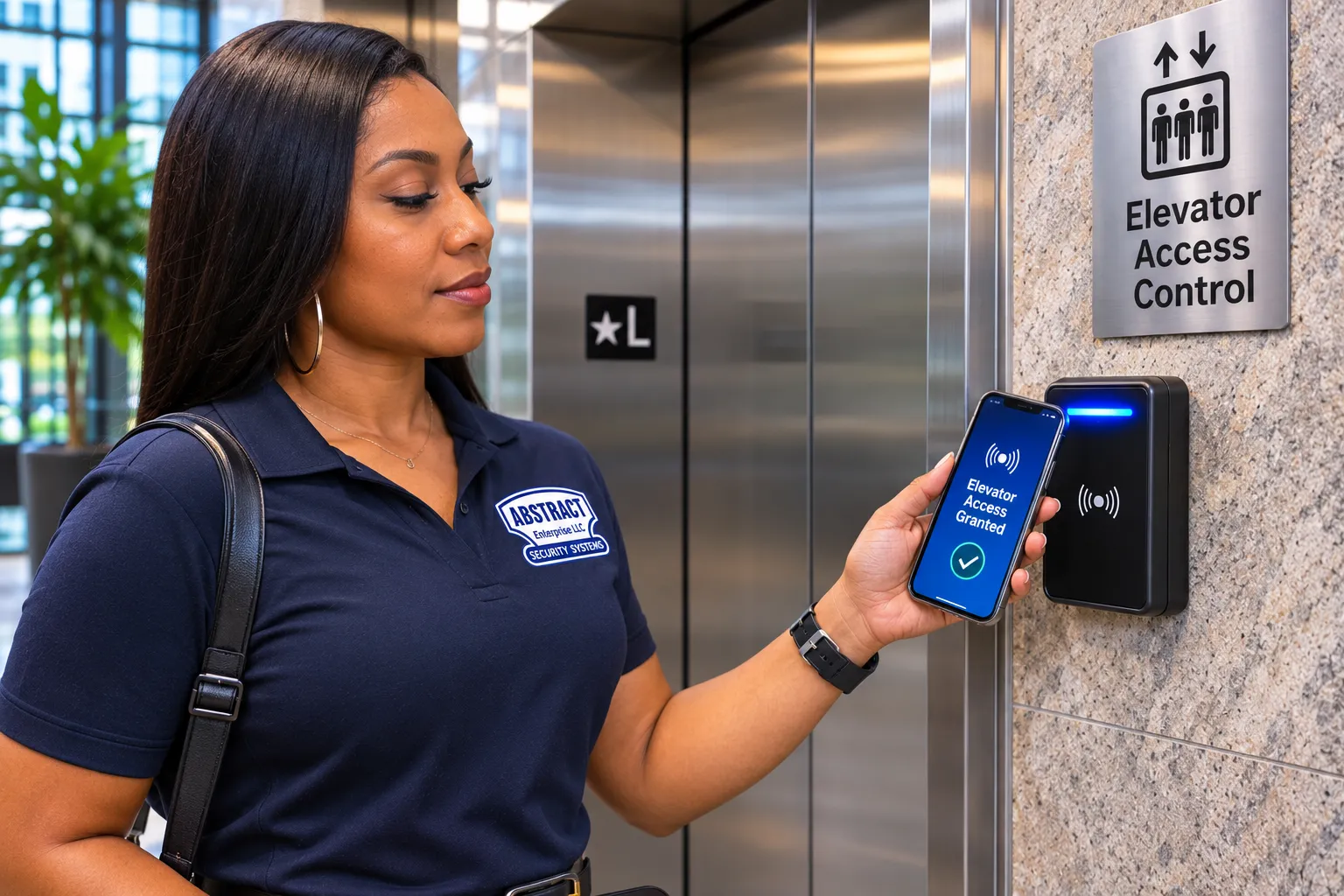
Photo from the Abstract Enterprises Security Systems elevator access control photo library (not taken in Suffolk County): a woman holds a phone displaying Elevator Access Granted up to a reader beside an elevator. Phone credentials suit the newer station-area rentals in Suffolk, with a fob kept available for residents who prefer one.
Visitors and Deliveries
Guests, Aides, Deliveries and Commuter Parking in Suffolk Elevator Buildings
The hard part of elevator access control is never the residents. It is everybody else. Suffolk buildings have their own mix of people who need to ride but do not live or work there:
Guests. In a building with a video intercom, the resident answers on a phone or an in-unit monitor and releases the visitor's floor. Where there is no intercom, the resident can send a time-limited phone pass, or the leasing office can issue a temporary credential.
Home health aides and caregivers. Common in senior buildings and in any building with older residents. A separate aide credential, tied to the resident it serves and limited to the hours the aide works, is better than a resident lending out a fob.
Package and food deliveries. Most Suffolk rentals now have a package room off the lobby, which means delivery drivers never need the elevator. Where they do, a delivery credential that opens only the lobby and package floor during set hours keeps them moving without opening the building.
Contractors and movers. Moves happen on weekends and during lease-ups, often several in a day. We set up a move mode that puts one car on a restricted schedule with a credential for the moving crew, so the other car keeps serving residents.
Patients and their drivers. In medical buildings, patients ride to the floor they are visiting during clinic hours. Ambulette and medical transport crews need a way up after hours, usually a call to the front desk or a code issued per trip.
Commuter and shopper parking. Several station-area buildings share or sit next to commuter parking, and many mixed-use buildings share a lot with their retail tenants. A landing reader on the parking level keeps commuters and shoppers from using the residential elevator as a shortcut.
Emergency responders. Police, fire and EMS get in through the building's emergency access arrangements, and the elevator goes to fire service when the firefighters take it. Nothing about our system should ever slow them down.
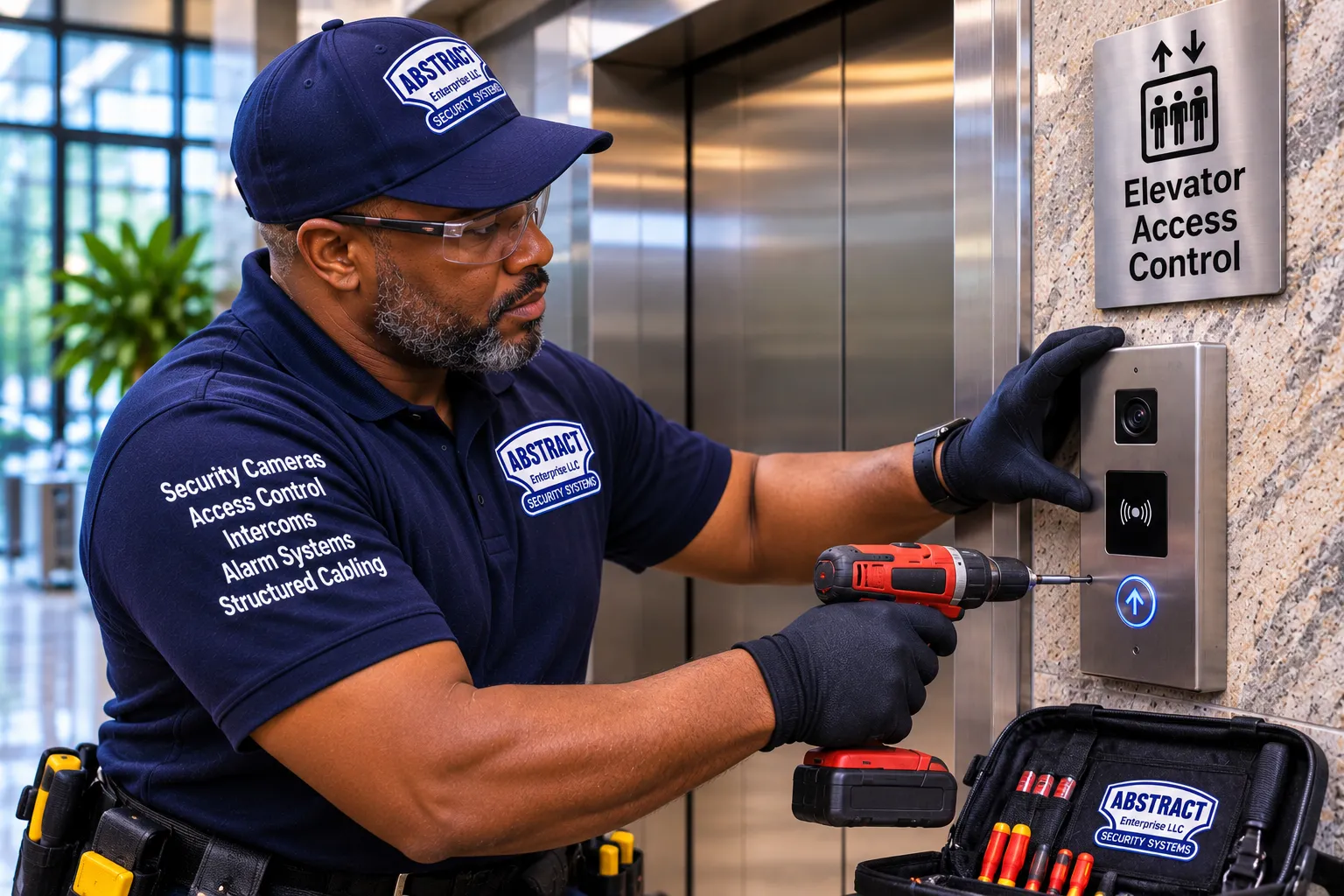
Photo from the Abstract Enterprises Security Systems elevator access control photo library (not taken in Suffolk County): a technician drills to mount a stainless panel that combines a camera, a card reader and a call button. A station like this lets a Suffolk building release a single floor for a visitor the resident has just seen on video.
Installation
How to Install Elevator Access Control in a Suffolk Building, Step by Step
This is the order we follow on every Suffolk elevator job, whether it is one reader in a single-car condo building in Smithtown or floor-by-floor control across a two-building rental complex in Patchogue.
Send the building details. Share the Suffolk address and town or village, the number of floors and elevator cars, any garage or parking-deck stop, the door or intercom system you have now, and the elevator maintenance company named on the inspection certificate if you know it.
Agree who decides. Confirm who approves the work and who will manage credentials afterward: the owner, the property manager, the leasing office, the condo board or the facilities manager. On a multi-tenant office or medical building, decide whether tenants have a say in their own floors.
Survey the cars and the controller. Our technician looks at each car station, the machine room or controller closet, the traveling cable, the door system and the parking-level landings, and we ask the elevator contractor whether spare conductors or a network interface are available.
Write the permission chart. Before anything is ordered, we draft who can ride to which floors, from which landings, at which times, plus how visitors, aides, deliveries and movers ride. The building signs off on the chart.
Send a written quote. The quote lists every reader, the panel, the relays or interface, the wiring, programming and credentials, priced at the Suffolk rate, and shows the elevator contractor's part and any traveling-cable work separately.
Book the joint visit. We schedule our installation and the elevator contractor's connection for the same window so the system can be tested end to end, with at least one car kept in service in buildings that have two.
Install, connect and program. Our crew mounts the readers and the panel, runs and labels the low-voltage wiring and loads the credentials. The elevator contractor lands the final connection at the controller.
Test every floor and hand over. We test allowed and refused credentials on every controlled floor and landing, confirm the readers have no effect on firefighters' service, test the power-failure behavior and the override, and train the people who will run the system.
On a typical Level 1 job the on-site work for our crew takes about a day per car, and the elevator contractor's part is usually a few hours. Level 3 jobs take longer, mostly because of programming and testing every floor. We do not promise a same-day installation, and we do not schedule the cutover on a day when the elevator contractor cannot be there.
What the building keeps at the end
A permission chart showing who can ride where and when. Wiring diagrams and panel labels. The admin login for the software, in the owner's name, not ours. A one-page guide for front-desk or management staff. The restart sheet for power failures. And the warranty and service terms in writing.
Cost
Elevator Access Control Cost in Suffolk County, Level by Level
Elevator access control from Abstract Enterprises Security Systems is priced per elevator car at the Suffolk County rate. Level 1, a card, fob, code, phone or video reader in the car, starts at $1,800 per car. Level 2, a face, fingerprint or iris reader in the car, starts at $3,000 per car. Level 3, floor-by-floor restriction, landing readers, schedules and intercom floor release, is quoted per building after a survey, because the amount of equipment depends on the number of floors, cars and landing stations controlled.
What the per-car price covers: the reader in the car, the access panel and its battery, the relay or interface hardware for that car, the low-voltage wiring between them, programming, credentials for the initial roster up to an agreed number, and testing with the elevator contractor. What it does not cover, and what we list separately on every quote: the elevator contractor's own charge for the connection and testing at the controller, which the building pays directly; any new traveling cable or wireless link if the car has no spare conductors; network or internet service for a cloud platform; and door work at the lobby or garage if the building wants it at the same time.
Why Suffolk costs more than the boroughs: travel. A building in Riverhead or on the North Fork is a long drive from where our crews start the day, and a two-day job may become a three-day job once travel and the elevator contractor's schedule are counted. The Suffolk rate reflects that honestly instead of hiding it in change orders.
Worked examples for common Suffolk buildings
Single-car condo building, Level 1 on the existing fob. From $1,800 for the car, plus the elevator contractor's connection, billed to the building directly.
Five-story station-area rental, two cars, Level 1 in both. From $3,600, because each car has its own reader and its own connection.
The same rental with a garage landing reader and the amenity floor on a schedule. Level 1 in both cars plus a Level 3 addition for the garage landing and the amenity floor, quoted after the survey.
Two-story medical building, one car, staff-only second floor after hours. Starts from Level 1 at $1,800 with a schedule; if public and staff floors must be separated during clinic hours as well, it becomes a small Level 3 job quoted per building.
Office building with face readers for a secure tenant floor. Level 2 from $3,000 for the car, with the floor restriction quoted as Level 3.
Every quote is written per building after the survey, lists every item on its own line and shows the elevator contractor's portion separately. Surveys are booked within 2 hours of your request, and visits are scheduled in a 2-hour arrival window.
Full terms — including 50% deposit, one-year parts-only warranty on Abstract Enterprises Security Systems-supplied products, and the late-fee schedule — are set out in the service agreement.
Compare
Level 1, Level 2 and Level 3 Side by Side for Suffolk Buildings
Level 1
Level 2
Level 3
What it controls
Whether the car will accept any floor call
Same as Level 1, with a biometric credential
Which floors each rider can reach, at which times, from which landings
Credentials
Fob, card, phone, code or video station
Face, fingerprint or iris, usually with a card backup
Any of the above
Suffolk starting price
From $1,800 per car
From $3,000 per car
Quoted per building after a survey
Typical Suffolk building
Small condo, single-tenant office, senior building, mixed-use with stores below
Medical or professional building, secure tenant floor, building with a fob-sharing problem
Station-area rental with garage and amenity floors, multi-tenant medical or office building
Elevator contractor's part
One connection per car
One connection per car
One connection per controlled floor per car, or a network interface
Programming effort
Low
Low to medium, plus enrollment
Medium to high
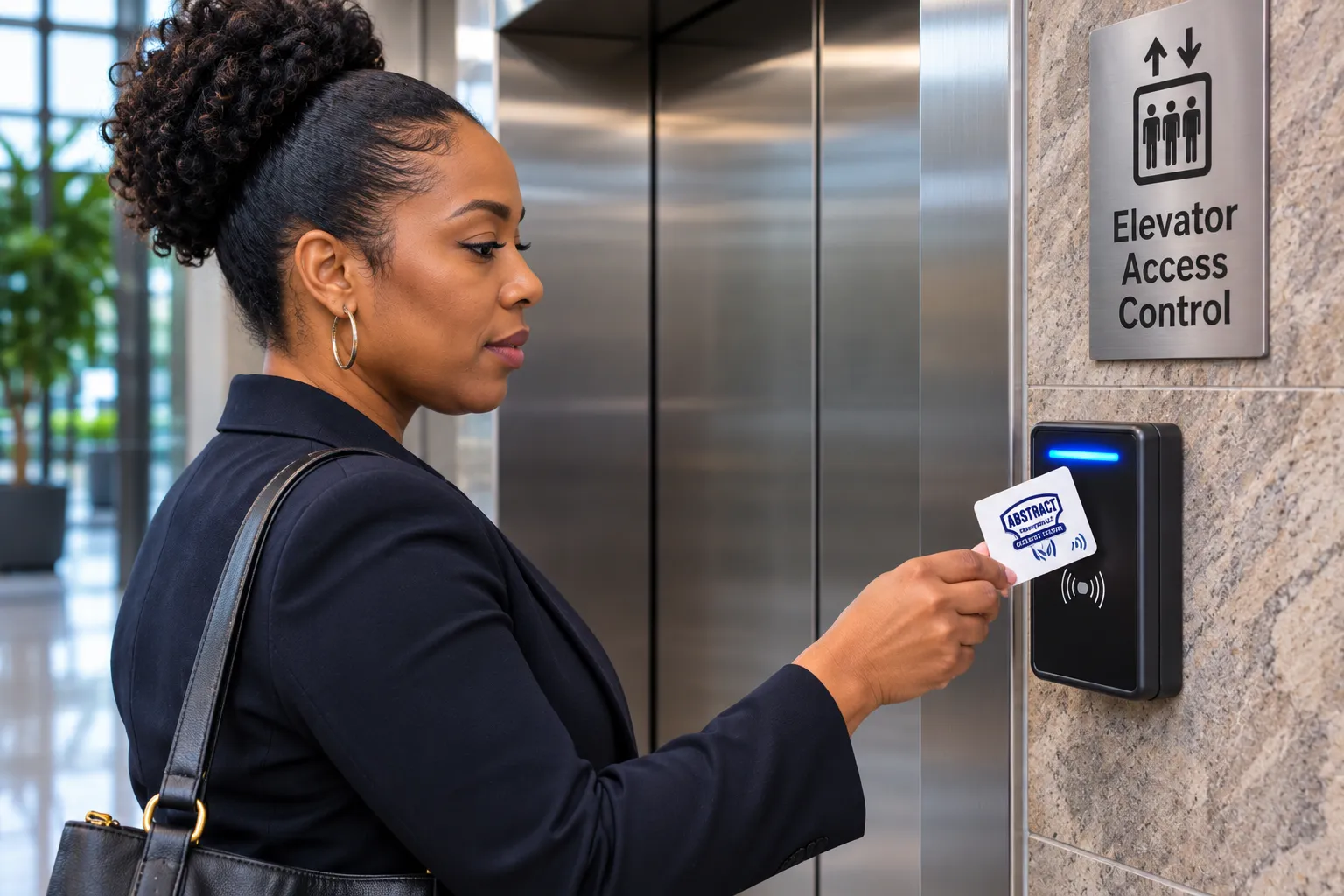
Photo from the Abstract Enterprises Security Systems elevator access control photo library (not taken in Suffolk County): a woman with a shoulder bag holds a card to a reader next to the elevator. In a Suffolk office or medical lobby, the same badge can open the suite door and enable the tenant's floor in the car.
Upgrades and Repair
Upgrading, Replacing and Repairing Elevator Card Reader Systems in Suffolk
Suffolk's first generation of elevator access systems went into office buildings and medical buildings in the 1990s and 2000s, and into the early station-area rentals in the 2010s. Many of them are now due for attention. The symptoms we hear about most:
Readers that work for some fobs and not others, usually because the building has issued two generations of credentials over the years, or because a reader is failing.
A system nobody can log into, because the company that installed it has closed, been sold, or stopped answering, and the admin password went with them.
A software platform that has reached end of life, or a panel that the manufacturer no longer supports with updates.
Floor schedules that no longer match the building, such as a medical floor that changed tenants but still opens at 7 a.m. for a practice that left years ago.
Intermittent faults in the car, often a loose or worn conductor in the traveling cable or a corroded termination, which shows up as a reader that drops offline when the car is at certain floors.
For a repair, we start with what you have: test the readers, check the panel, check the conductors to the car with the elevator contractor, and fix what is broken. For an upgrade, we look at whether the existing relays and wiring can be reused with a new panel and new readers, which often saves a lot of money, and whether existing credentials can be read by the new readers so residents do not all have to be re-issued fobs on the same day. When an old system is being replaced, we plan a cutover that keeps at least one car in service and moves people from the old credentials to the new ones over a set period.
If another company installed your system, we can usually take it over. We will tell you honestly after the survey whether it is worth supporting or whether replacing it will cost less over the next five years.
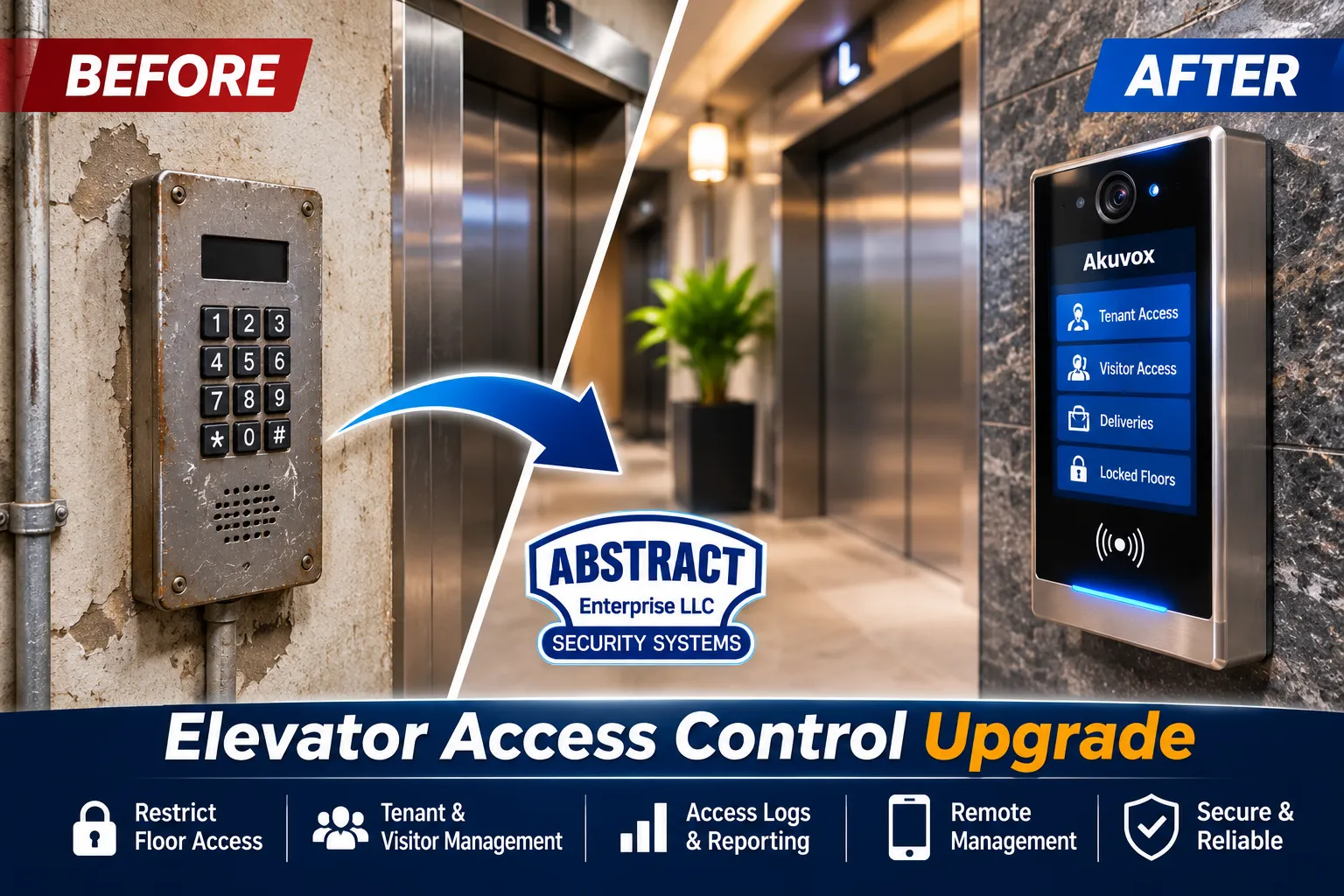
Photo from the Abstract Enterprises Security Systems elevator access control photo library (not taken in Suffolk County): a worn keypad beside an elevator on the left and a modern touchscreen station showing floor options on the right. Many Suffolk office and medical buildings from the 1990s and 2000s are at this point, with relays and wiring that can often be reused.
Platforms
Elevator Access Control Platforms We Install and Integrate in Suffolk
We install, integrate and service elevator access control on a range of platforms, and we choose with you based on what your building already has, who will manage it and how many buildings it needs to cover. We are not a certified dealer or partner of the brands below; we install and integrate them as an independent installer.
Cloud-managed platforms such as Brivo, Kisi and similar systems, popular with Suffolk property managers who run several buildings in different towns and want to manage all of them from one dashboard.
On-premises and enterprise platforms such as LenelS2, Genetec, Gallagher, ICT, Suprema and Paxton, common in larger office and medical buildings that already have them at the doors.
Intercom-led systems such as Akuvox, 2N and ButterflyMX, where the video intercom at the lobby is also the hub for visitor floor release.
Readers and credentials from HID and other manufacturers, chosen to match what tenants already carry.
Value platforms such as ZKTeco and Hikvision, for small buildings with a tight budget, chosen with care about support and security updates.
Axis and other network devices, where the elevator system needs to share video with the building's cameras.
The right platform is the one your property manager will actually use, that can be supported from a distance without a truck roll to Riverhead for every change, and that will still be supported in ten years. We will tell you which one we think that is and why.
AI Reality Check
What AI Gets Wrong About Elevator Access Control in Suffolk
People increasingly ask a chatbot before they call a contractor. The answers are often reasonable in general and wrong about Suffolk in particular. These are the mistakes we see most:
"You will need a Department of Buildings permit." That is a New York City answer. Suffolk has no county building department; permits, where needed, come from the town or village, and the elevator contractor's filing is separate from ours.
"Local Law 63 requires tenant consent for elevator fobs." Local Law 63 is a New York City law. It does not apply to buildings in Suffolk County. Good privacy practice still matters, as described above.
"Any access control company can wire into the elevator controller." No. Work on the elevator itself is licensed by the New York State Department of Labor and belongs to a licensed elevator contractor. The access control company works up to the interface point.
"A reader in the car stops people from reaching any floor." Only Level 3 floor control does that. A Level 1 reader enables the whole car, after which the rider can choose any floor.
"Elevator access control is a few hundred dollars." A reader by itself may be, but a working elevator system includes the panel, the relays, the wiring to a moving car, the elevator contractor's connection, programming and testing. In Suffolk, Level 1 starts at $1,800 per car.
"You can have it installed today." We book surveys within 2 hours of your request and schedule installation around the elevator contractor's availability. A reputable installer does not promise same-day elevator work.
Across the County
Elevator Access Control Across Suffolk's Towns, From the Huntington Line to the Forks
Suffolk runs from the Nassau line all the way out to Orient Point and Montauk, and the elevator buildings in it are not evenly spread. How we plan a job depends a lot on where the building is.
Western Suffolk: Huntington, Babylon and Islip
The densest part of the county and the most familiar to us. Melville's office corridor along Route 110, Huntington Station's new rentals, the village downtowns of Huntington, Babylon, Lindenhurst and Bay Shore, and the medical and office buildings around Islip and Islandia all fall here. Most jobs in this area can be surveyed and scheduled quickly, and the elevator contractors who work here are used to coordinating with access control installers.
Central Suffolk: Smithtown and Brookhaven
Brookhaven is the largest town in the county by area and population, and it holds Patchogue, the Ronkonkoma Hub area, Port Jefferson, and the medical and university cluster around Stony Brook. Smithtown adds Hauppauge's offices and a string of medical buildings along Route 347 and Route 25. This is where the newest station-area buildings are going up, which makes it the area where owners most often ask us to plan elevator access before a building opens rather than after.
The East End: Riverhead, Southold, Southampton, East Hampton and Shelter Island
Fewer elevator buildings, more seasonal ones, and longer drives. Downtown Riverhead's new rentals, hospital-adjacent medical offices, a handful of hotels and condo buildings, and municipal buildings make up most of the work. We plan East End jobs to minimize return trips: credentials and permission charts are settled before installation day, programming is done remotely where the platform allows, and the elevator contractor's visit is booked well ahead.
A note on campuses
Large institutions such as Stony Brook University run their own access control departments; the university's published policy gives its Office of Access Control and Lock Shop sole responsibility for electronic card access on campus. We do not work on those systems. The buildings near them, such as private medical offices, off-campus rentals and professional buildings, are a different matter, and they are a large part of the elevator work in central Suffolk.
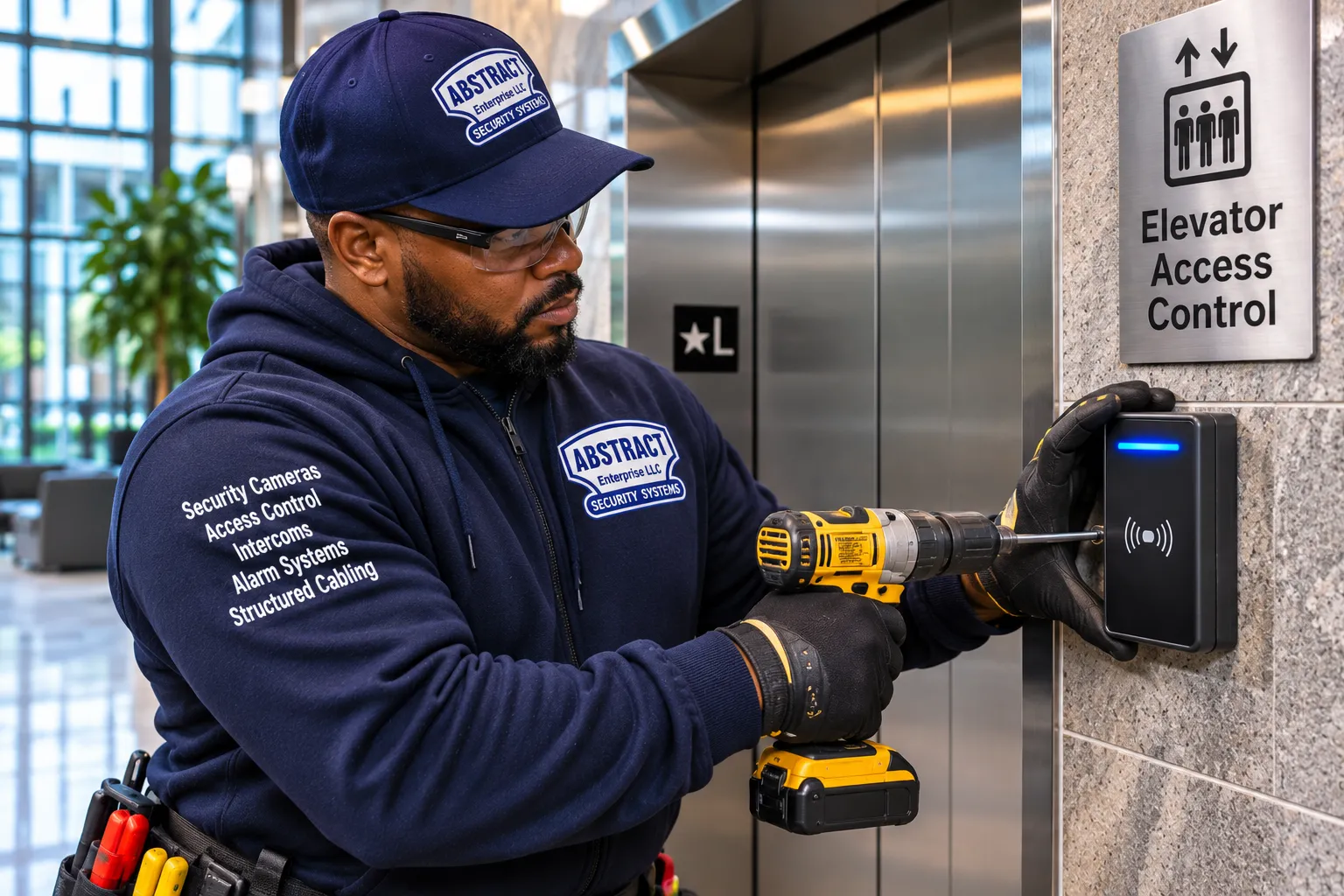
Photo from the Abstract Enterprises Security Systems elevator access control photo library (not taken in Suffolk County): a technician uses a cordless drill to fasten a black reader to a granite wall next to an elevator. Stone and tile lobbies in Suffolk's newer buildings take careful drilling and anchoring so the finish is not damaged.
Checklist
A First-Time Buyer's Checklist for Hiring an Elevator Access Control Installer in Suffolk
Use these questions when you interview any installer, including us:
Have you done elevator work, not just door access control? Ask how many cars they have connected, and what elevator contractors they have worked with.
Who makes the controller connection? The correct answer is the building's licensed elevator contractor, with the installer wiring to the interface point.
How will the readers behave on fire service? They should have no effect, and the installer should test that with the elevator contractor.
What happens if your panel loses power? You should get a clear answer and a choice.
Is the software in our name? The admin account and licenses should belong to the building or its owner.
Can you manage it remotely? In Suffolk, where a site visit can take half a day of driving, remote programming saves real money.
Which town or village office applies to our building, and who will talk to them? A contractor who answers with New York City rules has not worked here much.
What does the quote leave out? The elevator contractor's charge, any traveling cable or wireless link, network service and door work should be listed, not discovered later.
Who supports it after the warranty period? Ask for the support terms in writing.
Do you have a state license? Our NYS low-voltage license is #12000287431.
Why Us
Why Suffolk Buildings Call Abstract Enterprises Security Systems for Elevator Access
We are an owner-operated security company that has been installing cameras, intercoms, access control and alarm systems since 2002. Elevator access is not a sideline for us; it is where our access control, intercom and low-voltage cabling work meet. For Suffolk buildings that means a few specific things. We put the elevator contractor's part in the plan from the first day instead of discovering it on installation day. We quote at an honest Suffolk rate that includes the travel. We set systems up so the building can manage them, and so we can support them remotely instead of billing for every drive out. And we tell you when the simpler system is the better one.
Our customers rate us 4.7 out of 5 across 201 Google reviews. We are licensed and insured, we book surveys within 2 hours of your request, and we show up inside a 2-hour arrival window. The direct line for Suffolk County is (631) 407-2884.
If you are planning door readers, cameras or intercoms at the same time, our Long Island elevator access control page explains how we approach projects that cross the Nassau and Suffolk line, and the same crew can quote the rest of the building.
After Installation
Running an Elevator Access System Day to Day in a Suffolk Building
A system is only as good as the person who looks after it. In a Suffolk rental that is usually the leasing office or property manager; in a condo it is the management company or a board member; in an office or medical building it is a facilities manager or the landlord's building engineer. Whoever it is, these habits keep the system working:
Add and remove people the same day. Tie credential changes to move-ins, move-outs, hires and departures, not to a monthly clean-up.
Review the schedule twice a year. Amenity hours, clinic hours and tenant floors change. A schedule that was right at opening is often wrong two years later.
Look at the denied-access log. A run of denials at the same reader is often a failing reader or a credential problem, not an intruder.
Test the override. Make sure the staff who are supposed to carry it know where it is and how it works.
Keep the restart sheet with the panel. After the next storm, someone will need it.
Tell us before the elevator is modernized. A new controller changes how our system connects, and planning it in advance avoids a building with no access control for weeks.
If you have support with us, most changes can be made remotely. Visits that need a technician on site are booked in a 2-hour arrival window.
FAQ
Suffolk County Elevator Access Control Installation FAQ
Our Patchogue rental has a garage under the building. Should the reader go at the garage call button, in the car, or both?
+
If the garage has an open entrance or is shared with retail or commuter parking, put a reader at the garage call button so only residents can bring the car down to that level, and keep a reader in the car if residents should be limited to their own floors. If the garage is gated and residents-only, a reader in the car is usually enough on its own.
What does a Level 1 elevator reader cost per car in Suffolk County?
+
Level 1 starts at $1,800 per car in Suffolk County. That covers the reader in the car, the access panel and battery, the relay or interface for that car, the low-voltage wiring, programming, initial credentials and testing. The elevator contractor's charge for the controller connection is billed to the building directly, and any new traveling cable or wireless link is quoted separately after the survey.
Why is the Suffolk price higher than the price for buildings in the city?
+
Travel time and scheduling. Suffolk elevator buildings are spread across ten towns, and a job in Riverhead or on the North Fork can add hours of driving each day plus a separate trip to meet the elevator contractor. The Suffolk rate builds that in up front, so it does not appear later as a surprise charge.
Which office do we talk to about permits: the town, the village, or the county?
+
Not the county. Building and fire code enforcement in Suffolk is handled by the ten towns and by incorporated villages. A building inside a village such as Patchogue or Port Jefferson usually deals with the village; elsewhere, the town. The elevator contractor files for its own work where required, and we tell you in writing whether we expect any filing for ours.
Does New York City's Local Law 63 apply to fobs in a Suffolk apartment building?
+
No. Local Law 63 is a New York City law and covers buildings in the five boroughs only. Suffolk owners should still follow good privacy habits: collect only what the system needs, give residents a short written policy, set a log retention period and remove credentials promptly when people move out.
Can the Town of Huntington fire marshal stop our elevator project?
+
The fire marshal's office is concerned with fire alarm, sprinkler and suppression systems and with egress, and in Huntington the licensed company installing fire alarm equipment needs a construction permit and a witnessed inspection. Our elevator readers do not modify the fire alarm, but any alarm interface a building adds must be done properly under the fire alarm company's permit, so we coordinate with them.
Our Suffolk rental is two separate five-story buildings with their own elevators. Can one resident credential work in both?
+
Yes, if both buildings are on the same access platform or on platforms that share a credential format. A cloud-managed system can run separate panels in each building under one account, so a resident's fob works in their own building's elevator and, if the owner allows it, in the shared amenity spaces in the other.
How do we give a home health aide elevator access to one resident's floor without giving out a resident fob?
+
Issue the aide their own credential linked to the resident they serve, limited to that resident's floor and the hours the aide works. When the aide stops visiting, the credential is deleted without affecting the resident. The log also shows when the aide arrived, which some families and agencies find useful.
Will an elevator reader slow down paramedics at a Suffolk senior building at night?
+
It should not. Emergency crews get in through the building's emergency access arrangements, firefighters' service takes the elevator out of the access system entirely, and every system we install has an override the building controls. We agree in advance who carries it and train the overnight staff to use it.
Our Melville office building has tenants on three different badge systems. Can the elevators read them all?
+
Often, yes. Many elevator readers can read several common card technologies, and many platforms can import or recognize badges from tenant systems. Where that is not possible, the landlord issues building credentials that open the elevator and the tenant's floors. We check every tenant's badge type during the survey before recommending a reader.
What happens to the elevator readers after a hurricane knocks out power for days?
+
The panel's battery keeps the readers working for a limited time, and the elevator itself depends on utility or generator power. Before installation we agree what the car should do if our panel loses power, usually return to free access in residential and senior buildings, and we leave a restart sheet so staff can confirm the readers are back online when power returns.
We are converting an older Hauppauge or Melville office building to apartments. When should the elevator access be planned?
+
During design, before the elevator is modernized or the lobby is rebuilt. Office elevators are often set up for tenant floors and business hours, while apartments need resident floors, amenity schedules, garage control and visitor release. Planning it alongside the elevator modernization lets the elevator contractor provide the right interface instead of adding it afterward.
Can you program floor changes remotely so you do not have to drive out to Riverhead for every update?
+
Yes, on most modern platforms. Once the system is installed and connected, adding people, changing floors and adjusting schedules can be done by your property manager or by us remotely. Site visits are only needed for hardware problems, and those are booked in a 2-hour arrival window.
Is a face-recognition reader worth it for a two-story Suffolk medical office?
+
Sometimes. If staff share or lose badges, or a floor holds controlled substances or records, a Level 2 face reader from $3,000 per car makes sense. If the concern is only keeping patients off the staff floor after hours, a Level 1 card reader on a schedule usually does the job for less. We recommend the simpler option when it is enough.
How long does a Suffolk elevator access project take from the first call to the first ride?
+
The survey is booked within 2 hours of your request. After that, the timeline depends mainly on equipment lead times and on when the elevator contractor can join us for the connection. A Level 1 car usually needs about a day of our on-site work; Level 3 takes longer because every floor is programmed and tested.
Elevator Access Control Installation in the rest of our service area
Request a Free Elevator Access Control Quote for Your Suffolk Building
Tell us the town or village and the address, how many floors and elevator cars the building has, whether residents or tenants come up from a garage or parking deck, what door or intercom system is in place now, and who should be able to ride where. A photo of the buttons inside the car and the name of your elevator maintenance company help us plan the survey. Prefer to talk? Call our Suffolk line (631) 407-2884.
✅
Request Sent!
Thank you. We will be in touch to book your Suffolk elevator access survey, usually within 2 hours of your request.