Anyone who walks in behind a delivery can ride to every floor? A garage level that lets strangers call the car? Book a Rockland County elevator access survey: (845) 640-3835
Elevator access control installation in Rockland County puts a fob, card, code, phone or face reader on your elevator so the car carries only the people you approve, to the floors they belong on. Abstract Enterprises Security Systems installs the low-voltage side: readers in the car or at the garage and lobby call buttons, floor-enable relays, cable, credentials, programming and the link to your intercom. Your building's NYS-licensed elevator contractor makes the connection inside the controller. Most Rockland elevator buildings are short, with one car, a few floors and often a garage, so we size the system to the building rather than to a city tower.
Reviewed and updated November 17, 2026 by Abstract Enterprises Security Systems, NYS license #12000287431 · Sources: U.S. Census Bureau QuickFacts for Rockland County; Village of Nyack (Nyack Housing Authority); Governor's office, 30 West announcement (June 9, 2026); Rockland County Times (May 21, 2026); Town of Orangetown Local Law 13 of 2025; Rockland County Office of Buildings and Codes; NYS Department of Labor elevator licensing (Labor Law Article 33); Blue Hill Plaza; building and community websites cited in the text
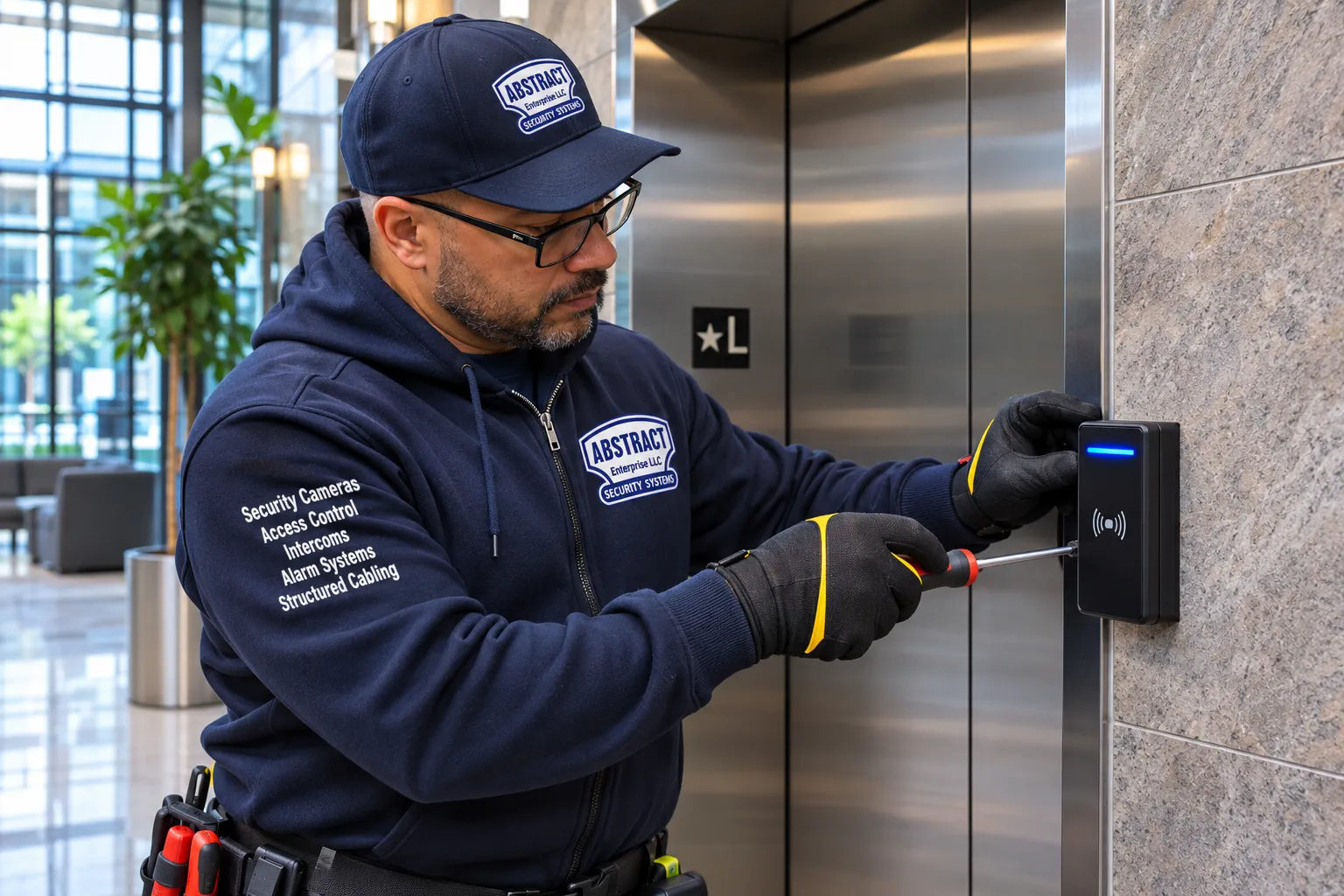
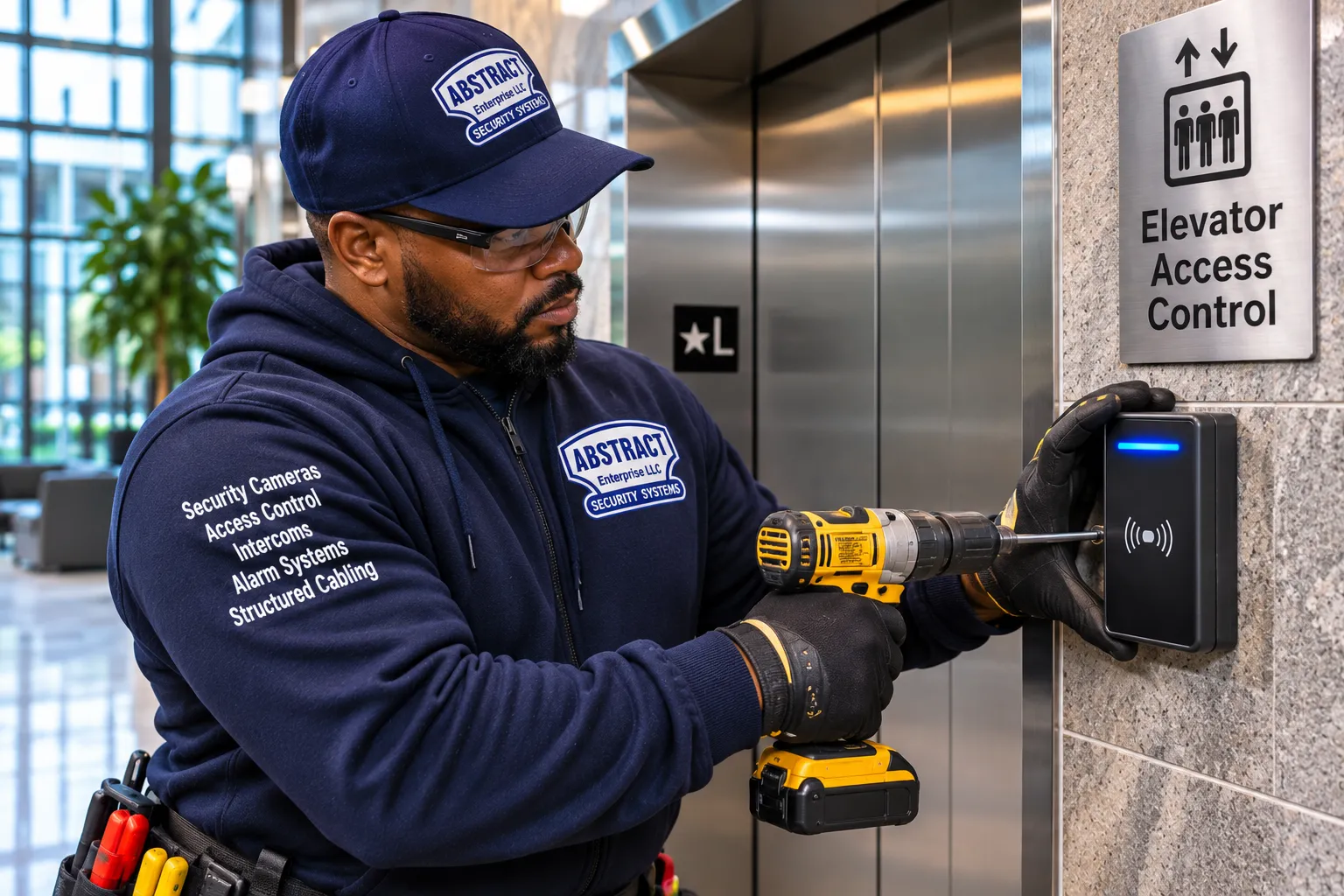
Photo from the Abstract Enterprises Security Systems elevator access control photo library, not taken in a Rockland customer's building: a technician tightens the mounting screw on a black card reader next to the elevator doors. In a single-car Rockland building, one reader like this is often the whole Level 1 system.
Rockland Elevator Access Request
Tell us the village or hamlet, the floors and cars, any garage stop, and who should ride where
✅
Request Sent!
Thank you. We will be in touch to book your Rockland elevator access survey, usually within 2 hours of your request.
25+
Years Experience
5
Rockland Towns Served
100%
Licensed & Insured
4.7★
201 Google Reviews
Owner-operated since 2002 · Thousands of jobs completed · Booked within 2 hours
Quick answer: elevator access control installation in Rockland County starts at $1,950 per elevator car for a Level 1 fob, card, code or intercom-station reader, and at $3,250 per car for Level 2 face, fingerprint or iris readers. Floor-by-floor restriction, garage and lobby hall-call readers, schedules and intercom floor release are Level 3, quoted per building after a survey. Your NYS-licensed elevator contractor's controller visit is arranged and paid by the building directly. Because most Rockland elevator buildings have a single car and three to six floors, one reader in the car is often the whole system. We book the survey within 2 hours of your request and arrive in a 2-hour arrival window, never with a same-day promise.
Readers, relays, wiring, credentials, programming and intercom links by Abstract Enterprises Security Systems under NYS license #12000287431
Controller connection and fire service behavior handled by your elevator contractor, licensed by the NYS Department of Labor, and coordinated by us
Covering Clarkstown, Orangetown, Ramapo, Haverstraw and Stony Point, including every Rockland village
Rockland's Elevator Buildings: A Short List, Mostly Low and Mid-Rise
Rockland County is a county of houses. The Census Bureau counts 109,999 housing units here, and about two of every three homes are owner-occupied, most of them single-family houses and townhouses in Clarkstown, Orangetown, Ramapo, Haverstraw and Stony Point. That is why elevator access control in Rockland County looks so different from the same work twenty-five miles south. There are no blocks of twenty-story co-ops here. What Rockland does have is a short, specific list of elevator buildings, and almost every one of them sits in one of a handful of places: a village downtown near a train or bus station, the Hudson waterfront in Haverstraw and Nyack, a senior or 55-plus community, a medical office building within a few minutes of Nyack or Suffern, or one of the office campuses along the Palisades Interstate Parkway and the Thruway.
Before we talk about readers and relays, here are the figures we work from when we plan elevator security in Rockland County. Every one has a source, and the ones that describe a proposal rather than a finished building are labeled that way.
Figure
Why it matters for elevator access control
Source
109,999 housing units in Rockland County; 67.9% owner-occupied
Elevator buildings are a small minority of the housing stock, so most boards and owners here are buying elevator access control for the first time, often with no in-house security staff.
U.S. Census Bureau QuickFacts (V2025; 2020–2024 ACS)
173 apartments at Nyack Plaza, with the senior homes in an elevatored tower at Depew and South Franklin Avenues
A typical Rockland pattern: one elevator building inside a larger complex, serving the residents who most depend on it.
Village of Nyack, Nyack Housing Authority page
81 apartments at 30 West, Village of Haverstraw, with a parking garage for tenants and the public
New construction that started in June 2026. A garage shared with the public is exactly where a hall-call reader earns its keep.
Governor's office announcement, June 9, 2026
178 units at Hickory House, a shareholder co-op on Main Street, Spring Valley
One of the county's larger co-ops, on a Main Street lined with apartments over stores.
Hudson Valley Property Group report on Spring Valley housing
109 apartments proposed on West Jefferson Avenue, Pearl River, near the Metro-North station
Proposal stage only. A sign of where the next elevator buildings are coming: walking distance of a train.
Rockland County Times, May 21, 2026
21 stories and 550,000 square feet at One Blue Hill Plaza, Pearl River
The county's best-known office tower and its tallest elevator bank, on a 93-acre campus that advertises 24-hour building access.
Blue Hill Plaza; CBRE listing
Read those numbers together and three things stand out. First, most Rockland elevator buildings are short. A three-story building on Main Street in Nyack, a four-story rental near the Suffern station and a six-story co-op in Spring Valley all have an elevator, but each one usually has a single car serving a lobby, a handful of residential floors and sometimes a garage or a basement storage level. Second, many of these buildings serve older residents, either by design (senior and 55-plus buildings in Nanuet, Suffern, Pearl River and West Haverstraw) or simply because the elevator is why people who no longer want stairs chose to live there. Third, the new buildings are arriving near transit and on the river, and they come with garages, amenity floors and app-based door systems that can reach into the elevator if someone plans for it before the cab is finished.
That combination shapes everything else on this page. A Rockland elevator access control design usually needs fewer readers than a city design, a gentler credential for older riders, a clear answer for the garage level, and an equipment location that stays dry and powered when a nor'easter or an ice storm knocks out the lines along Route 9W.
Plain Terms
Elevator Access Control, Explained for a Rockland Board Buying It for the First Time
Elevator access control is a way of making your elevator ask a question before it moves: who are you, and where are you allowed to go? Without it, the elevator in your Rockland building answers anyone who reaches the lobby. With it, the car waits for an approved fob, card, code, phone or face before it will carry someone upstairs, and it can limit each person to the floors that belong to them.
The equipment is modest. A reader goes in the elevator car, usually on or beside the button panel, or at the lobby or garage call button. A small access control panel goes in the machine room or another secure closet, with a battery backup. Between the panel and the elevator controller sits a set of switches, called relays, or an interface board that does the same job. When a resident presents an approved credential, the panel closes the right switch for a few seconds, and the elevator controller accepts a call to that resident's floor. When a stranger presses the button without one, nothing happens.
Nothing about the elevator itself is rebuilt. The motor, the cables, the doors, the safety circuits and the controller stay exactly as they are. Our equipment sits beside the elevator and talks to it through a connection that your building's licensed elevator contractor makes and approves. That division of work matters in New York State, where the people who touch the elevator's own systems must hold a license from the Department of Labor, and we explain it in detail further down.
For a Rockland building that has never had it, elevator access control solves a short list of real problems:
Strangers who slip in behind a delivery can no longer ride to the upper hallways or the roof door.
A tenant who moves out takes nothing with them; their fob stops working the moment the manager deletes it.
Garage levels in waterfront and transit buildings stop being a back door into the residential floors.
A medical or professional building can keep each practice's floor private after hours without a guard.
The board or owner gets a record of who used the elevator and when, which settles disputes quickly.
What it does not do is replace good doors. The lobby door, the garage door and the stair doors are still the first layer. Elevator access control is the second layer, and in a short Rockland building it is often the most cost-effective second layer, because a single reader in a single car protects every floor above the lobby.
Why Rockland Is Different
One Car, a Few Floors, a Village Downtown: How Rockland Elevator Buildings Differ From the City's
Most of what is written online about elevator security is written for Manhattan towers: banks of six cars, destination dispatch, a security desk staffed around the clock. Very little of it fits a Rockland building, and following it can lead a board to buy far more system than it needs.
Here is what we usually find when we survey an elevator building in Rockland County.
A single elevator car
The majority of Rockland elevator buildings we see have one car. That simplifies the design enormously. One reader in one car, wired to one small panel, protects the whole building. There is no second car for a stranger to wait for, and no bank of hall stations to coordinate.
Three to six floors
A building on Main Street in Nyack or Lafayette Avenue in Suffern may have a lobby, two to four residential floors and a basement. Floor-by-floor restriction across five floors needs only a handful of relays, so even the more advanced design stays affordable here. Often, though, the board's actual goal is simpler: keep non-residents out of the car entirely. A single reader that enables the whole car does that.
A garage or a parking level
Waterfront buildings in Haverstraw advertise indoor garage parking. Transit-area rentals in Suffern and Pearl River pair surface lots with garages. New construction such as 30 West in Haverstraw includes a garage that the public will use too. Any time the elevator stops at a parking level, that stop deserves its own decision, and in many Rockland buildings it is the most important decision on the job.
Older riders
Senior and 55-plus buildings make up a large share of Rockland's elevator stock. The credential has to work for someone with arthritis, limited vision or a walker, and the reader has to sit within comfortable reach for a rider in a wheelchair. That is a design requirement, not an afterthought.
No full-time staff
Most Rockland elevator buildings are run by a volunteer board, a small owner or a managing agent who covers several properties. The system must be simple to run from a laptop or a phone, and a lost fob must be easy to cancel without calling us.
Weather that reaches the machine room
The river towns sit on the Hudson, and much of the county loses power in a bad ice storm or nor'easter. Where the access panel goes, and what the elevator does when power fails, matters more here than in a city high-rise with a generator in the cellar.
None of this makes Rockland work harder. It makes it different. The right Rockland elevator access control design is usually smaller, simpler and more focused than the city version, and a good installer should tell you so rather than quoting a tower system for a four-story building. Our Hudson Valley elevator access control page covers the wider region; this page is about Rockland's own buildings.
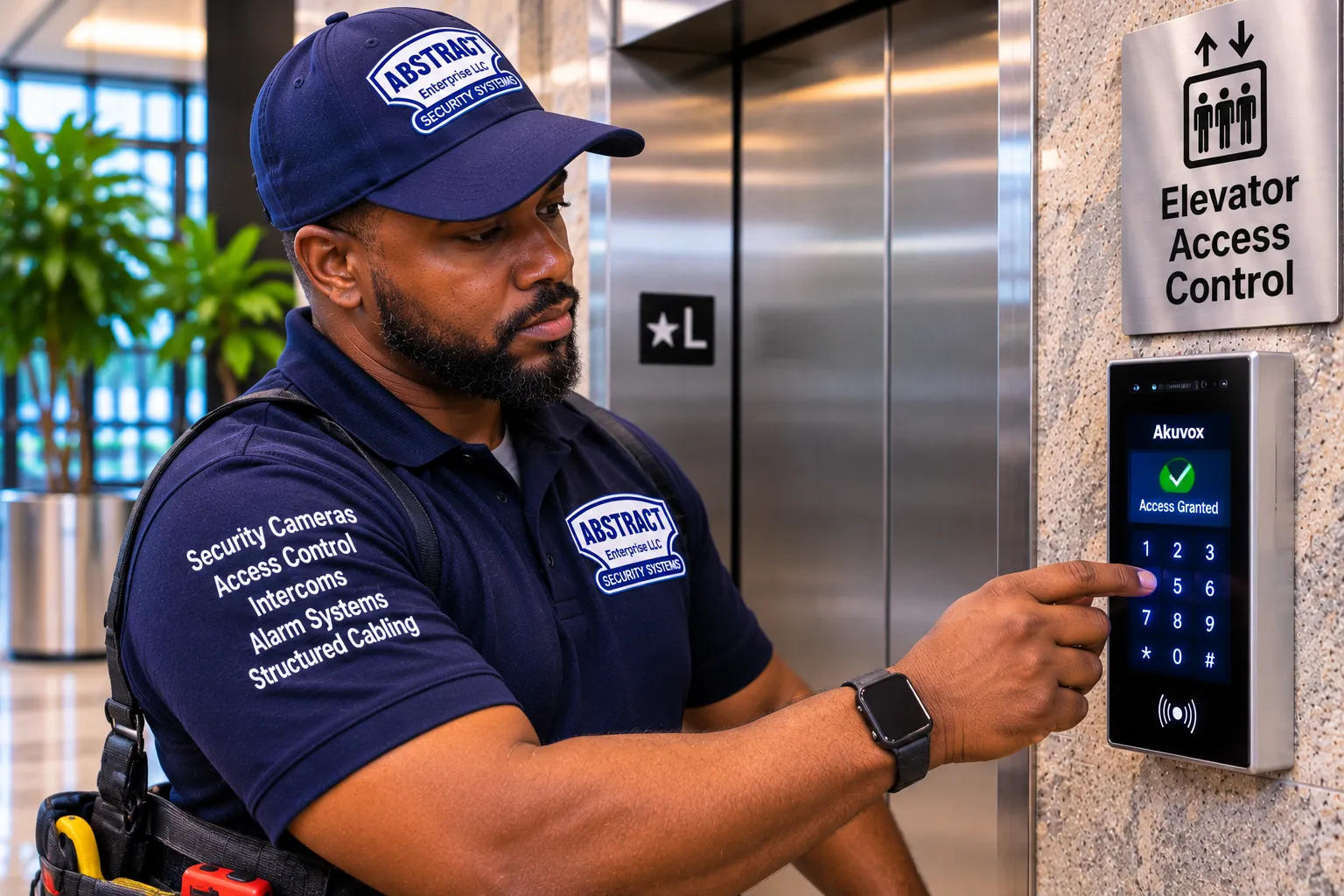
Library photo, not a Rockland job: a technician keys a code into an Akuvox keypad and reader, which answers Access Granted beside the elevator. A keypad with individual codes is a useful backup credential in Rockland senior buildings.
How It Works
How a Fob Becomes a Floor in a Rockland Elevator
It helps to follow a single ride from start to finish, because once a board sees the path, the choices on the quote make sense.
Step one: the reader sees the credential
A resident of a four-story building in Pearl River steps into the car and holds a fob near the reader. The reader picks up the fob's number by radio over a distance of an inch or two. A keypad reads a code instead; a phone reader picks up a Bluetooth or NFC signal; a face reader compares the rider to an enrolled photo. Whatever the credential, the reader's only job is to identify it and pass the number on.
Step two: the signal travels to the panel
The reader's wire runs down the elevator's traveling cable, the flexible bundle that hangs from the car and follows it up and down the hoistway, to the machine room. If the traveling cable has spare conductors, we use them. If it does not, the elevator contractor may add a cable, or we may use a wireless bridge designed for elevators. This single question, whether there are free conductors in the traveling cable, decides more about the cost of a Rockland job than any other.
Step three: the panel decides
The access control panel checks the number against its list. Is this fob active? Is it allowed in this elevator? Is it allowed at this hour? Which floors may it reach? The answer takes a fraction of a second.
Step four: the elevator is allowed to answer
If the fob is approved, the panel closes a relay for each floor that resident may reach, usually for five to ten seconds. The relays connect to inputs on the elevator controller that the elevator contractor has designated for security. While a relay is closed, the floor button works. When it opens again, the button goes back to doing nothing for anyone else.
Step five: the ride is logged
The panel records the event: which credential, which elevator, which time, and whether access was granted or refused. A board member or manager can look this up later, which is useful when a dispute or an incident needs facts.
Two things are worth noticing. First, nothing in that chain touches the elevator's safety circuits. Our relays only tell the controller which calls it may accept; the controller still decides how the car moves. Second, the design scales gently. A Level 1 job uses one relay that enables the whole car. Floor-by-floor control adds a relay per controlled floor. In a five-floor Rockland building, the difference between those two is a few relays, a little more programming and a longer conversation with the elevator contractor, not a different system.
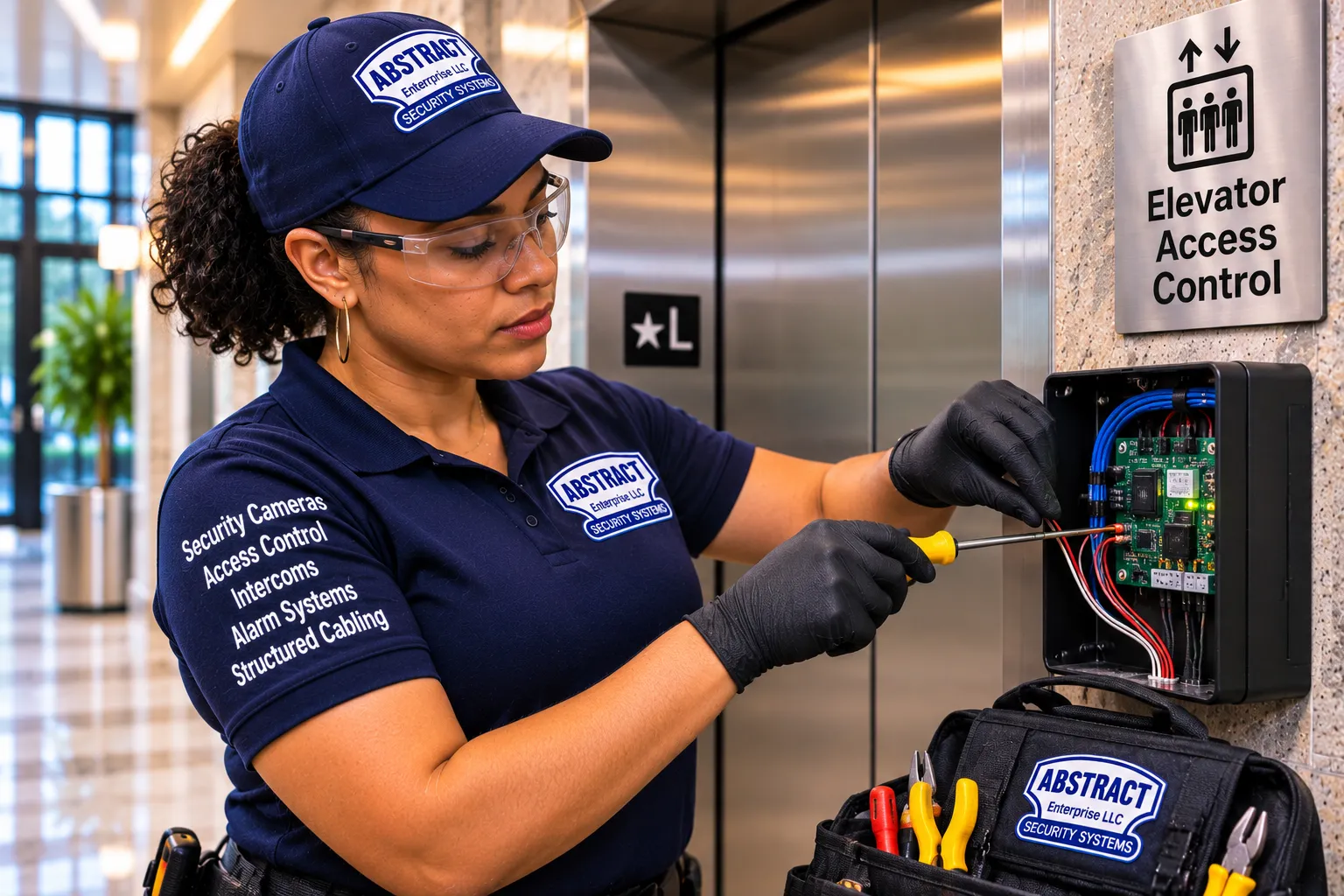
Library photo, not taken in Rockland: a technician lands colored low-voltage conductors on a reader's circuit board. Every conductor that runs down the traveling cable to the machine room is labeled so the elevator contractor knows exactly what it carries.
Floor Control
Floor-by-Floor Restriction in a Three- to Six-Story Rockland Building
Floor restriction means a credential reaches only certain floors. A resident of the third floor can ride to the lobby, the third floor and perhaps the laundry level; a resident of the fourth floor reaches the fourth; the superintendent and the managing agent reach everything. It is the most requested feature in larger buildings, and in Rockland it is worth thinking through carefully, because a short building does not always need it.
When a Rockland building needs floor restriction
Mixed-use buildings where a store, office or medical practice occupies one floor and apartments occupy the others.
Medical and professional buildings where each practice wants its own floor closed after hours.
Buildings where the garage or basement holds storage cages, bike rooms or mechanical spaces that residents should not reach freely.
Senior and supportive buildings where staff, program spaces or records rooms are on a floor residents should not visit unaccompanied.
Larger co-ops, such as the Main Street co-ops in Spring Valley, where the board wants individual floors private.
When a single reader is enough
In a three-story Nyack building where every floor is residential and every resident is trusted to visit neighbors, restricting each person to their own floor adds cost and friction without much benefit. A single reader that enables the whole car for any resident keeps strangers out, which is usually the actual goal. If the board later wants floor restriction, the same reader and panel can usually be expanded.
In-car control versus hall-call control
There are two places to control access. In-car control puts the reader inside the elevator and restricts which buttons work. Hall-call control puts a reader beside the call button on a particular landing, such as the garage, so the car cannot even be summoned to that landing without a credential. Rockland buildings often need both: a reader in the car for the residential floors and a reader at the garage hall station to stop the parking level from being an open door.
What floor restriction cannot do
It cannot stop someone from riding along with a resident who is allowed to go to a floor. It cannot lock the stairs, which must remain usable as an exit. And it cannot override firefighters, who take control of the elevator in an emergency and ignore our system entirely. Boards that understand these limits make better decisions about where to spend the rest of the security budget.
Counting the relays
For a rough sense of scale, the number of relays equals the floors you want to control multiplied by the number of cars, plus any hall stations with readers. A six-story, single-car building with every floor controlled needs six relays, plus one for a garage hall-call reader. That is a small, tidy panel. We count them exactly on the survey and list them line by line on the written proposal.
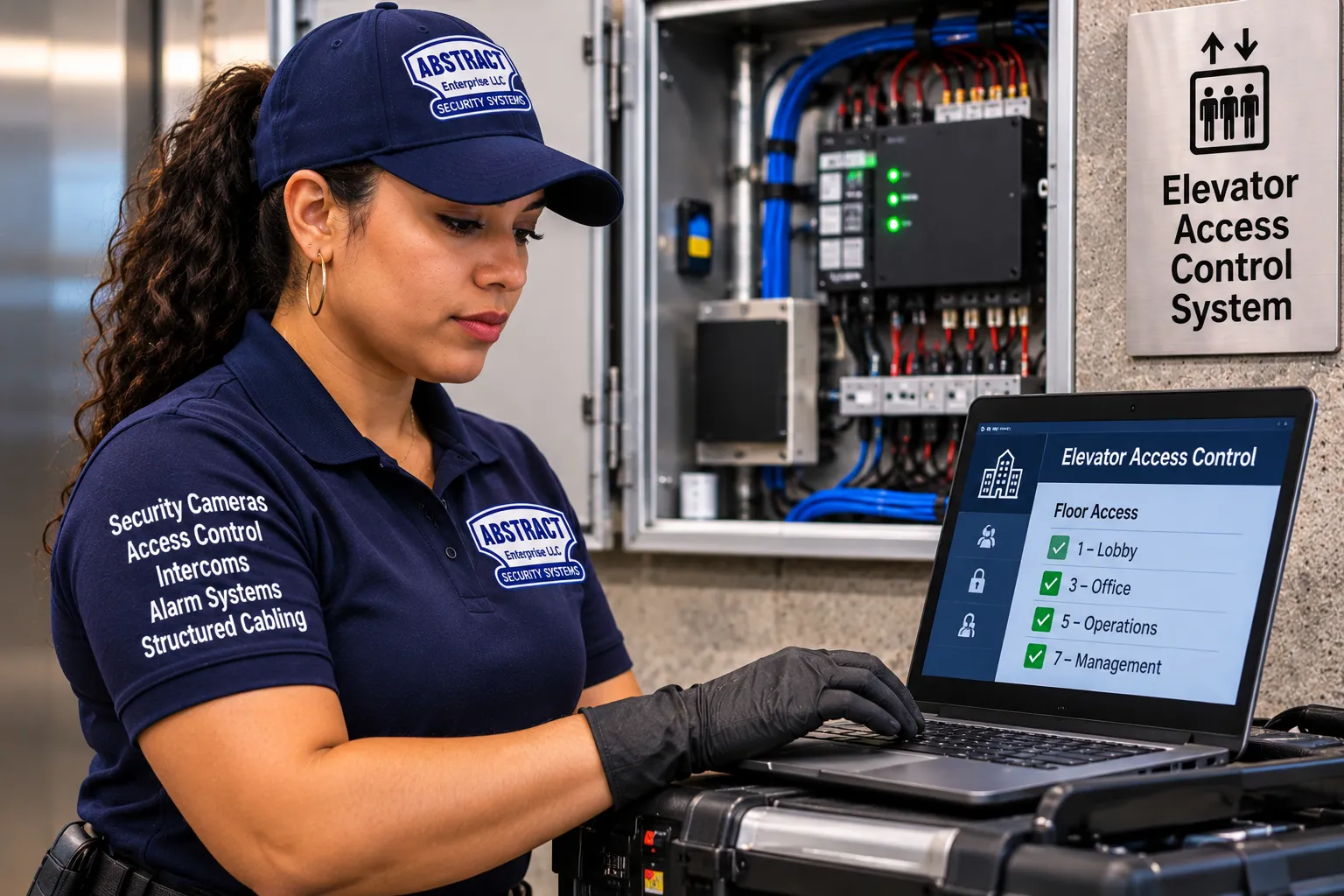
Library photo, not a Rockland building: a technician in gloves programs floor permissions on a laptop beside an open access control panel. In a three- to six-story Rockland building, the floor list on that screen is short, which keeps floor restriction affordable.
Building Types
Rockland Building Types and the Elevator Access Control Each One Usually Needs
Rockland's elevator buildings fall into a handful of recognizable types. Each type tends to need the same starting design, and knowing which one you are in saves time on the survey.
Village downtown buildings over stores: Nyack, Suffern, Pearl River, Spring Valley, Haverstraw
Main Street in Nyack, Lafayette Avenue in Suffern, Central Avenue in Pearl River and Main Street in Spring Valley all have apartments over stores, and the newer ones have an elevator. Nyack Point Apartments at 263 Main Street is a three-story building; Diana Place at 259 Main Street lists an elevator; the village's own zoning analysis counted eleven new units approved across six small projects in the downtown mixed-use zone over two years. These are small buildings with big problems for their size: a street door that opens onto a sidewalk with heavy foot traffic, a ground-floor tenant with customers coming and going, and apartments above that need to stay private. The usual design is a reader in the car that enables the residential floors, with the store or office floor either open during business hours or on its own credential group.
Waterfront buildings in Haverstraw and Nyack
The Waterfront at Harbors in Haverstraw is built as elevator buildings with only two homes per floor and indoor garage parking, on the river at its widest point. In buildings like this, the elevator opens almost directly into each home's hallway, so the elevator is effectively the front door of every apartment. That makes a reader in the car, and a reader at the garage landing, a high priority. It also makes panel placement important, because the garage level of a waterfront building is the last place you want electronics during a storm surge.
Senior and 55-plus buildings
Nyack Plaza's senior homes sit in its elevatored tower. Esther Gitlow Towers on Lafayette Avenue in Suffern lists controlled access and elevators. West Haverstraw Senior Citizens Apartments on Route 9W and Maplewood Gardens in Nanuet appear on the state's senior housing referral list. In Pearl River, the Town of Orangetown adopted a zone change in 2025 for twenty 55-plus rentals downtown. These buildings need a credential older residents can use without frustration, a reader at a height a wheelchair user can reach, and a plan for aides, family and visiting nurses. Some senior buildings in Rockland are only two stories, such as the residential buildings at Vincent's Village in Nanuet; where those have a lift or elevator, one reader often covers it.
Co-ops and condominiums
Spring Valley's Hickory House is a 178-unit shareholder co-op on Main Street, and condo communities such as the Harbors on the Haverstraw waterfront are governed by elected boards. Co-op and condo boards usually want an audit trail, a clear policy on who gets fobs, and a system the managing agent can run. Floor restriction is common in larger co-ops; whole-car enable is often enough in smaller ones.
Transit-area rentals
176 Lafayette in Suffern advertises a secure elevator building with keyless entry and intercom access, within half a mile of the Suffern train station. The 109 units proposed near the Pearl River Metro-North station would be the same kind of building if approved. New rentals like these often arrive with a cloud-based door and intercom platform already chosen by the developer. The best time to add the elevator is before the cab is finished, so the platform's elevator module, the traveling cable conductors and the controller inputs are all specified together.
Medical and professional buildings
Medical offices cluster near Montefiore Nyack Hospital and Good Samaritan in Suffern, and outpatient practices have been opening across the county. We name those hospitals only as landmarks; the work we describe is in the independent medical and professional buildings around them. A two- or three-story medical building with an elevator typically has several practices on different floors, each with its own hours. Floor restriction by practice, with the lobby and ground floor open during the day, is the usual answer.
Office buildings and campuses
Rockland's office stock runs from small professional buildings to the 21-story tower at Blue Hill Plaza in Pearl River and the office and light-industrial parks around Orangeburg and Nanuet. Multi-tenant office buildings often want after-hours floor restriction tied to each tenant's badge, so the building can stay open in the morning and lock down at night without a guard.
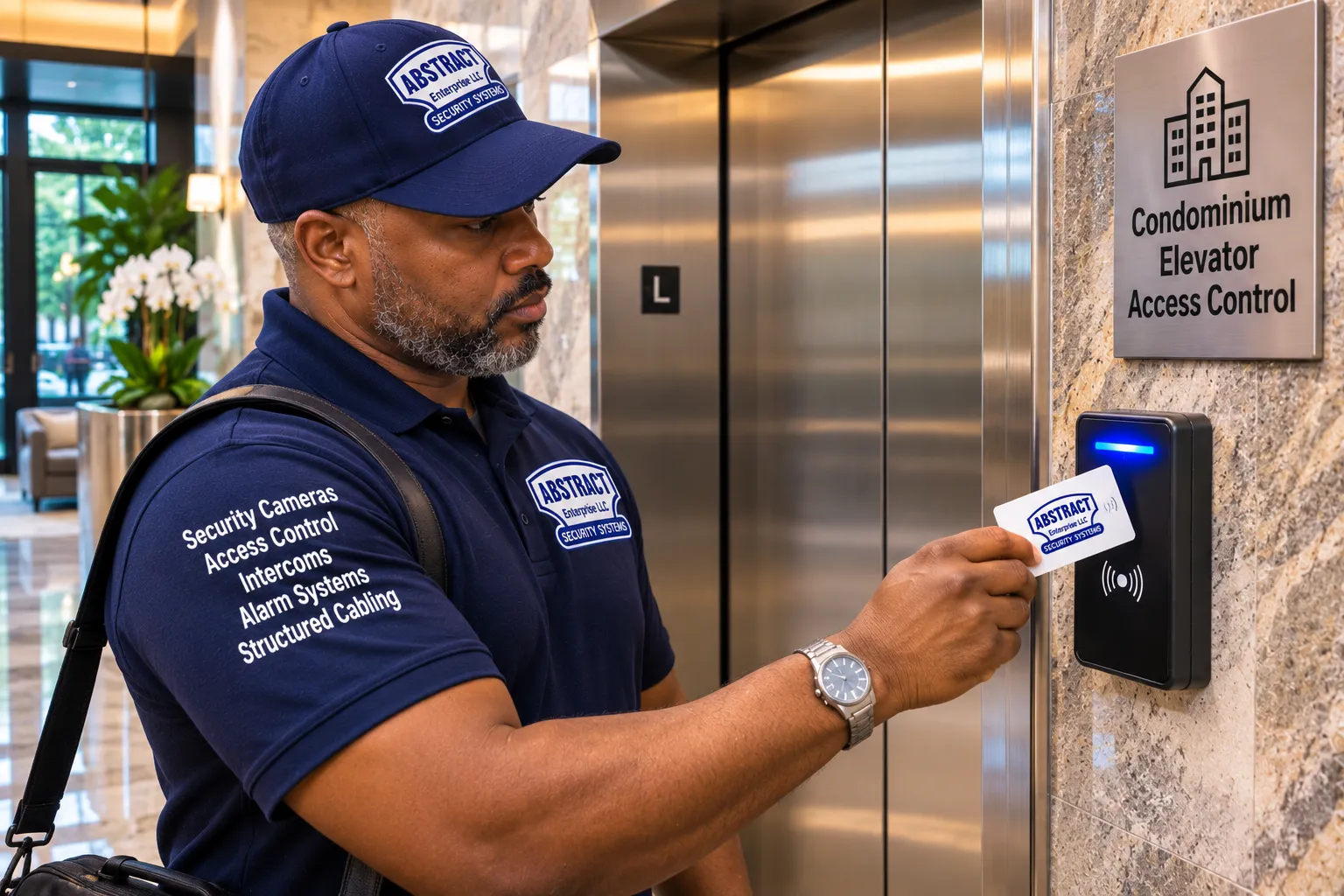
Library photo, not taken at a Rockland condominium: a man holds a card to a reader under a sign reading Condominium Elevator Access Control. Co-op and condo boards from Spring Valley to the Haverstraw waterfront usually start with one credential per resident and a clear issuing policy.
Who Does What
Who Installs Elevator Access Control in Rockland: Our Crew and Your NYS-Licensed Elevator Contractor
Every elevator access control job has two halves, and in New York State the line between them is drawn by law.
Since January 1, 2022, Article 33 of the New York State Labor Law has required businesses and workers who design, install, alter, maintain, service or repair elevators to be licensed by the state Department of Labor. That includes elevator contractor licenses and elevator mechanic licenses. Inside Rockland County, that means the company that maintains your elevator, and the mechanic who opens the controller, must hold those state licenses.
Abstract Enterprises Security Systems is a licensed low-voltage contractor, NYS license #12000287431. We do not do elevator mechanical or controller work, and we never claim to. Here is how the job divides:
Task
Who does it
Survey of the car, lobby, garage and machine room
Abstract Enterprises Security Systems, with the elevator contractor's input on the controller
Readers in the car or at hall stations, panel, power supply and battery
Abstract Enterprises Security Systems
Low-voltage cable to the machine room, labeling and testing
Abstract Enterprises Security Systems (using spare traveling-cable conductors the elevator contractor confirms)
Relays or interface board, credentials, schedules, programming
Abstract Enterprises Security Systems
Connection inside the elevator controller, fire service behavior, any new traveling cable
Your building's NYS-licensed elevator contractor
Any filing or inspection the local code official requires for the elevator side
Your elevator contractor, under its license
Lobby intercom link, door readers, cameras
Abstract Enterprises Security Systems
In practice, we run the coordination. We call your elevator maintenance company before the survey, ask about the controller and the traveling cable, and send them a written description of what we will land on their side: how many relays, what kind of contact, where the terminals will sit. They tell us which controller inputs to use and whether the car needs anything from them. The elevator company's visit is arranged and paid by the building under its maintenance contract or as a separate service call, and we put that clearly on our proposal so nobody is surprised.
This arrangement protects the building. The elevator contractor stays responsible for the elevator, and its maintenance contract stays intact. We stay responsible for the access control. If something goes wrong later, there is no argument about whose equipment failed, because the boundary is a labeled terminal strip that both companies signed off on.
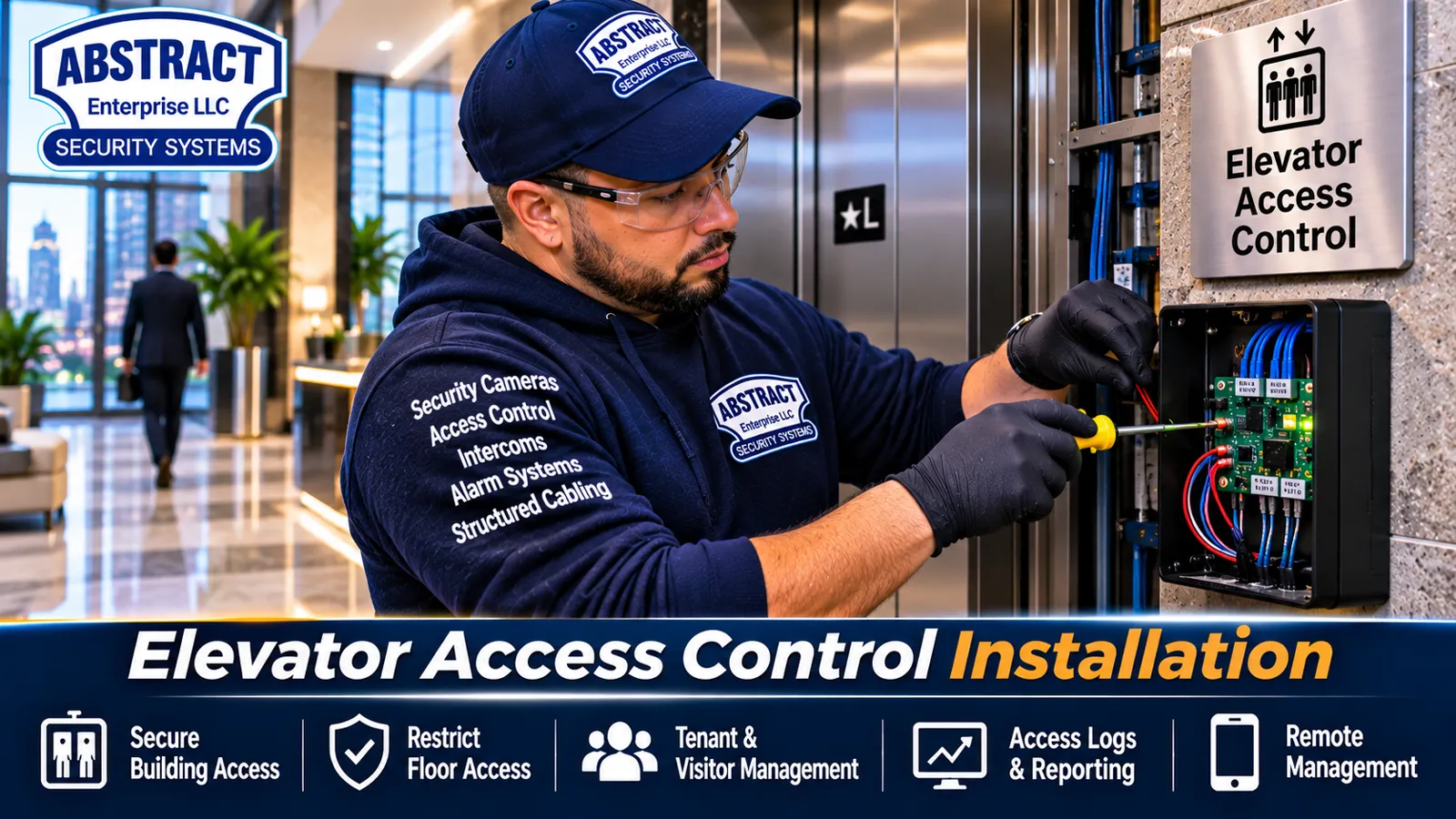
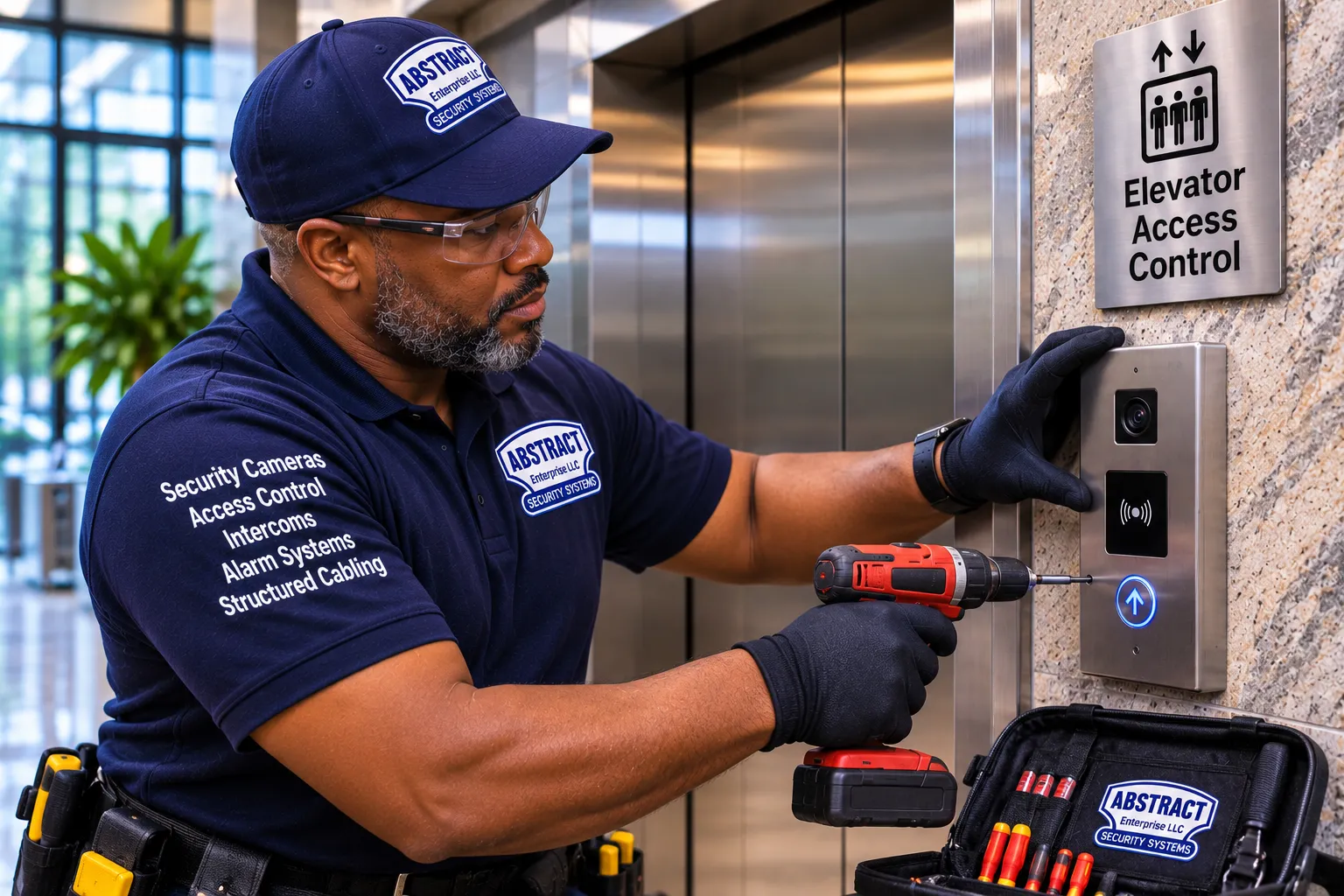
Abstract Enterprises Security Systems promotional photo, not taken in Rockland: a technician in a branded cap and safety glasses wires an open reader enclosure next to a stainless elevator, under a banner listing secure building access, floor restriction, tenant and visitor management, access logs and remote management. The low-voltage side shown here is our work; the controller connection belongs to your NYS-licensed elevator contractor.
Codes and Approvals
Permits, Code Officials and Privacy Rules for Elevator Access Control in Rockland
One of the most common questions we hear from Rockland boards is who has to approve this. The honest answer is that it depends on where the building is, because Rockland does not have one building department.
The Uniform Code, enforced locally
New York State's Uniform Fire Prevention and Building Code applies everywhere outside New York City, but it is enforced by the local town or village. Rockland has five towns, Clarkstown, Haverstraw, Orangetown, Ramapo and Stony Point, and a long list of incorporated villages within them, from Nyack and Piermont to Suffern, Haverstraw and West Haverstraw. A building in an incorporated village usually deals with the village building department; a building in an unincorporated hamlet such as Nanuet, Pearl River or New City deals with the town.
A Rockland exception: Spring Valley
In the Village of Spring Valley, Rockland County's own Office of Buildings and Codes administers and enforces the Uniform Code and the Energy Code, issuing permits and certificates of occupancy and scheduling inspections. A Spring Valley co-op or rental therefore talks to the county office, not a village building department.
Fire inspectors
Several villages assign Uniform Code fire prevention duties to their own fire safety inspector; the Village of West Haverstraw's code, for example, gives enforcement of the fire prevention code to its Fire Safety Inspector. Because an elevator reader must never interfere with firefighters' service, the local fire official may want to see how the system behaves in recall.
What usually needs a permit
In our experience, adding readers and low-voltage wiring to an existing elevator is treated differently from altering the elevator itself, and the elevator contractor's connection may be treated as an alteration under its license. Practices vary by municipality, and we do not guess. Before we schedule a Rockland job, we ask the elevator contractor how it handles the controller connection with the local code official, and we check with the building department if anything about the job could count as an alteration to fire-rated construction, such as a new penetration through a rated wall.
Privacy: NYC's Local Law 63 does not apply here
You may read that apartment buildings must follow special rules before using fobs or biometrics. Those rules, in New York City's Local Law 63 of 2021, apply only to buildings in the five boroughs. They do not apply in Rockland County. We still follow sensible privacy practice in every Rockland building: collect only the data the system needs, tell residents in writing what is recorded and who can see it, delete departed residents' credentials promptly, and get clear consent before enrolling anyone's face or fingerprint. Boards that want face readers should still put a written policy in place, because residents will ask.
Fire, Power and Weather
Fire Recall, Ice-Storm Outages and River Flooding in Rockland Elevator Buildings
An elevator reader is low-voltage equipment, but it sits inside a life-safety system. Three situations need a decision before the first reader is mounted.
Fire: the elevator stops listening to us
When the building's fire alarm triggers recall, or firefighters take the car with their key, the elevator controller goes into firefighters' service and ignores ordinary calls. Our relays become irrelevant. That is the correct behavior, and the elevator contractor confirms it during commissioning. We never wire anything that could hold a car at a floor or prevent recall. If a Rockland building's fire alarm is old or its recall wiring is uncertain, the elevator contractor will want to look at it, and that is a conversation worth having anyway.
Power failure: decide the answer in advance
A long outage is not unusual in Rockland. When the power goes, the elevator stops unless the building has emergency power for it. Our panel runs on a battery for a period that depends on the battery size and the number of readers. The board decides in advance what happens if the battery runs down: the readers can fail secure, so the car stays restricted, or fail open, so any rider can use it when power returns. Senior buildings usually choose fail open for the car and keep the lobby door secure, so residents are never stuck waiting for the system to recover. We set the choice in writing, test it, and label it in the panel.
Water: keep the brains above the river
Waterfront buildings in Haverstraw and Nyack, and low-lying sites anywhere along the river or its creeks, should never have the access panel in a garage or basement if there is a dry, secure room higher up. In most single-car buildings the machine room is at the top or beside the hoistway, which is fine. Where the machine room is at the bottom, we look for an alternative location for our panel, such as an electrical closet on an upper floor, and run the cable accordingly. A panel ruined by a storm surge leaves the car either open or locked, and neither is what a board wants on the morning after a storm.
Accessibility: the override that should exist
A resident who needs the elevator should never be trapped behind a dead reader. Every Rockland system we install includes a defined way for the superintendent or manager to put the car in free mode, either in software or with a keyed switch in the machine room, and the instructions go into the binder we leave on site.
Library photo, not a Rockland job: a technician drills into a stone wall to fasten a black reader beside the elevator. In Rockland senior buildings we set the mounting height so a rider in a wheelchair can reach the reader comfortably.
Credentials
Fobs, Cards, Codes, Phones and Faces: Choosing an Elevator Credential for Rockland Riders
The credential is what residents feel every day, so it deserves more thought than it usually gets. Here is how each option tends to work out in Rockland buildings.
Key fobs
A small plastic tag on a key ring. Easy, cheap to replace, and familiar to most residents. Fobs are the default in Rockland apartment and co-op buildings, and they work well for older riders as long as the reader is within easy reach and gives a clear light and tone. We recommend secure, encrypted fobs for new systems, because the oldest 125 kHz proximity fobs can be copied cheaply.
Cards
The same technology in a wallet-sized card. Offices and medical buildings often prefer cards because staff already carry an ID badge, and the elevator can read the same badge that opens the office door.
PIN codes
A keypad in the car. Codes are free to issue and impossible to lose, which is why some senior buildings like them, but shared codes spread, and many older riders struggle with small keypads in a moving car. We use individual codes, never one code for the whole building, and pair the keypad with a fob reader so residents can choose.
Phone credentials
A phone app that presents a credential by Bluetooth or NFC. Rental buildings with app-based door systems like phone access because move-ins and move-outs are handled remotely. Phones are a poor sole credential in senior buildings and for anyone who does not keep their phone charged, so we always keep a fob option.
Face, fingerprint and iris readers
Biometric readers are Level 2 and cost more. They suit buildings where credentials are frequently shared or lost, and some offices and medical buildings. In apartment buildings, residents need to be told clearly what is stored and must agree before enrolling. Face readers also need decent lighting in the car.
Mixing credentials in one building
Nothing forces a building to pick just one. The same reader can usually accept a fob from one resident, a phone from another and an individual code from a third, all managed in the same list. That flexibility is especially useful in Rockland buildings that house several generations: grandparents who want a fob, adult children who want their phone, and a weekly aide who gets a time-limited code. What matters is that every credential belongs to one named person and can be cancelled on its own.
Our usual Rockland recommendation
For most Rockland apartment, co-op and senior buildings: encrypted fobs, with individual PIN codes as a backup for residents who prefer them. For offices and medical buildings: cards, often the same card that opens the suite. For new transit-area rentals: phone credentials with a fob option. Face readers where the board has a specific reason and a written privacy policy.
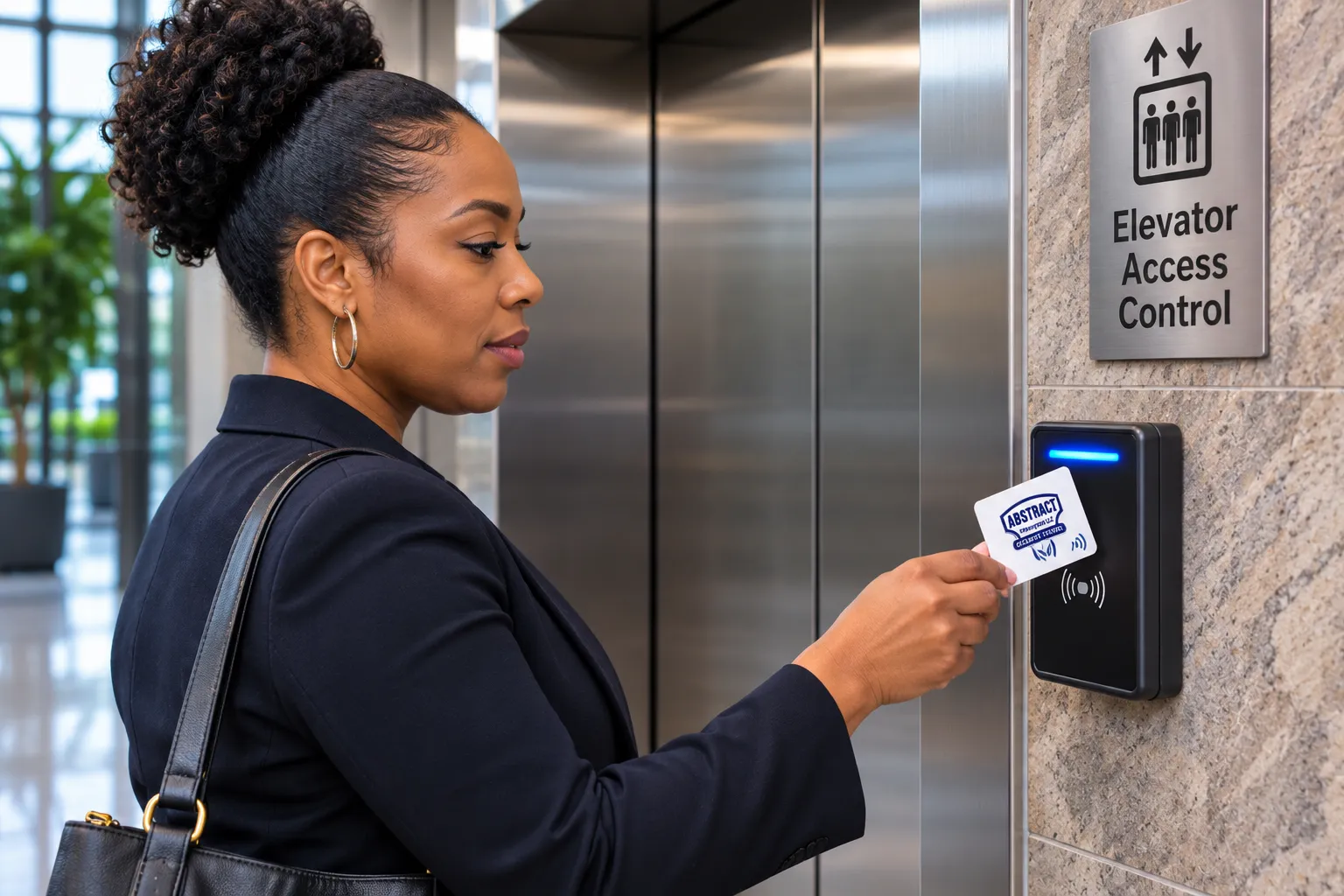
Library photo, not taken in a Rockland building: a woman with a shoulder bag holds a card to the reader by the elevator. For most Rockland riders the daily experience is exactly this: one tap, then the floor button works.
Visitors and Deliveries
Guests, Aides, Deliveries and Garage Arrivals in Rockland Elevator Buildings
Once the elevator is restricted, everyone who is not a resident needs a way up. Planning for them is what separates a system residents like from one they prop open.
Guests
The cleanest answer is an intercom that can release the visitor's floor. When the resident answers the lobby intercom and opens the door, the system also enables the elevator to that resident's floor for a minute or two. That requires an intercom that knows which apartment answered, which most current video intercoms do and most older audio systems do not. Where the intercom cannot do it, the resident can come down to meet the guest, or the system can issue a temporary code or phone pass for a set day and time.
Home health aides and visiting nurses
In Rockland's senior and 55-plus buildings, aides and nurses are part of daily life. Each aide can receive a credential limited to one floor and set hours, which expires automatically when the care arrangement ends. The family or the resident's care agency asks the manager, the manager issues it, and nobody has to share a resident's own fob.
Deliveries
Most buildings keep deliveries in the lobby or a package room and do not let couriers ride up at all. If a building wants deliveries brought to the door, the intercom can release the floor for that single delivery, or a time-limited courier code can work only during set hours.
Contractors, movers and the superintendent
Move-in days, plumbers and painters can receive temporary credentials limited to the floors they need for the days they need them. The superintendent and managing agent have credentials that reach every floor, including mechanical levels. Every credential, temporary or permanent, shows up in the log.
Garage arrivals
This is where Rockland buildings differ most from city buildings. In a waterfront building with indoor parking, or a transit-area rental with a garage, residents arriving by car never pass through the lobby. A reader at the garage hall-call station lets them call the car with the same fob they use upstairs, while stopping anyone who walked into the garage behind a car from summoning the elevator. In buildings where the garage is shared with the public, such as the new 30 West development in Haverstraw with its garage for tenants and the public, this reader is not optional. It is the main control.
Emergency responders
Police, ambulance and fire crews must be able to reach residents quickly. Firefighters use the elevator's own fire service key, which bypasses our system completely. For ambulance calls, many Rockland buildings place a lockbox or a responder credential at the entrance under the local fire department's guidance. We set up whatever arrangement the building and its responders agree on, and we never configure the elevator in a way that would slow a medical call.
Library photo, not taken in Rockland: a technician drills to mount a stainless station that combines a camera, a card reader and a call button. A station like this at a lobby or garage landing lets residents badge in and visitors call up, so the intercom can release the right floor.
Step by Step
How to Install Elevator Access Control in a Rockland Building, Step by Step
Here is the sequence we follow on a typical Rockland job, from the first call to the day residents ride with their new fobs.
1. Send us the building details
The address, the village or hamlet, the number of floors and cars, any garage or basement stop, the door or intercom system you have now, and the name of your elevator maintenance company. A photo of the button panel inside the car helps.
2. Agree who approves
Confirm who signs off: the co-op or condo board, the owner, the managing agent, or the operator of a senior or supportive building. Decide who will run the system day to day.
3. Survey the building with the elevator contractor in the loop
We visit in a 2-hour arrival window, booked in advance. We look at the car operating panel, the lobby and garage landings, the machine room, power, and any network connection. Before or after the visit, we speak with the elevator contractor about the controller and the traveling cable.
4. Receive a written proposal
The proposal names every reader and where it mounts, which floors each relay controls, how visitors get up, what the elevator contractor must do on its side, what happens in a fire recall and a power cut, and a price for every line. Nothing is ordered until the board approves it.
5. Schedule both trades
We agree an installation date with the building and the elevator contractor. The car is usually out of service only for the elevator contractor's connection and our final testing, often a few hours. We post a notice for residents in advance.
6. Install and wire
Our crew mounts the readers, installs the panel and power supply in a dry, secure location, runs and labels the cable, and lands our wiring on a terminal strip for the elevator contractor. The elevator contractor makes its connection in the controller.
7. Program and test floor by floor
We load the resident list and credential groups, set the schedules, link the intercom if it is in scope, then ride the car with the manager and test every floor, every group, the garage station, fire recall behavior with the elevator contractor, and the battery and power-failure response.
8. Hand over and roll out
We issue credentials, train the manager or board, and leave a binder with the wiring map, the credential policy and the free-mode procedure. Residents receive fobs before the restriction is switched on, so nobody is caught out.
What the building keeps at the end
A labeled panel, a wiring map, the software login, a list of every credential, the fire and power-failure settings in writing, and a direct line to our team for changes. For a single-car building in Rockland, steps 5 through 8 usually fit inside one or two working days on site, after the survey and the approval.
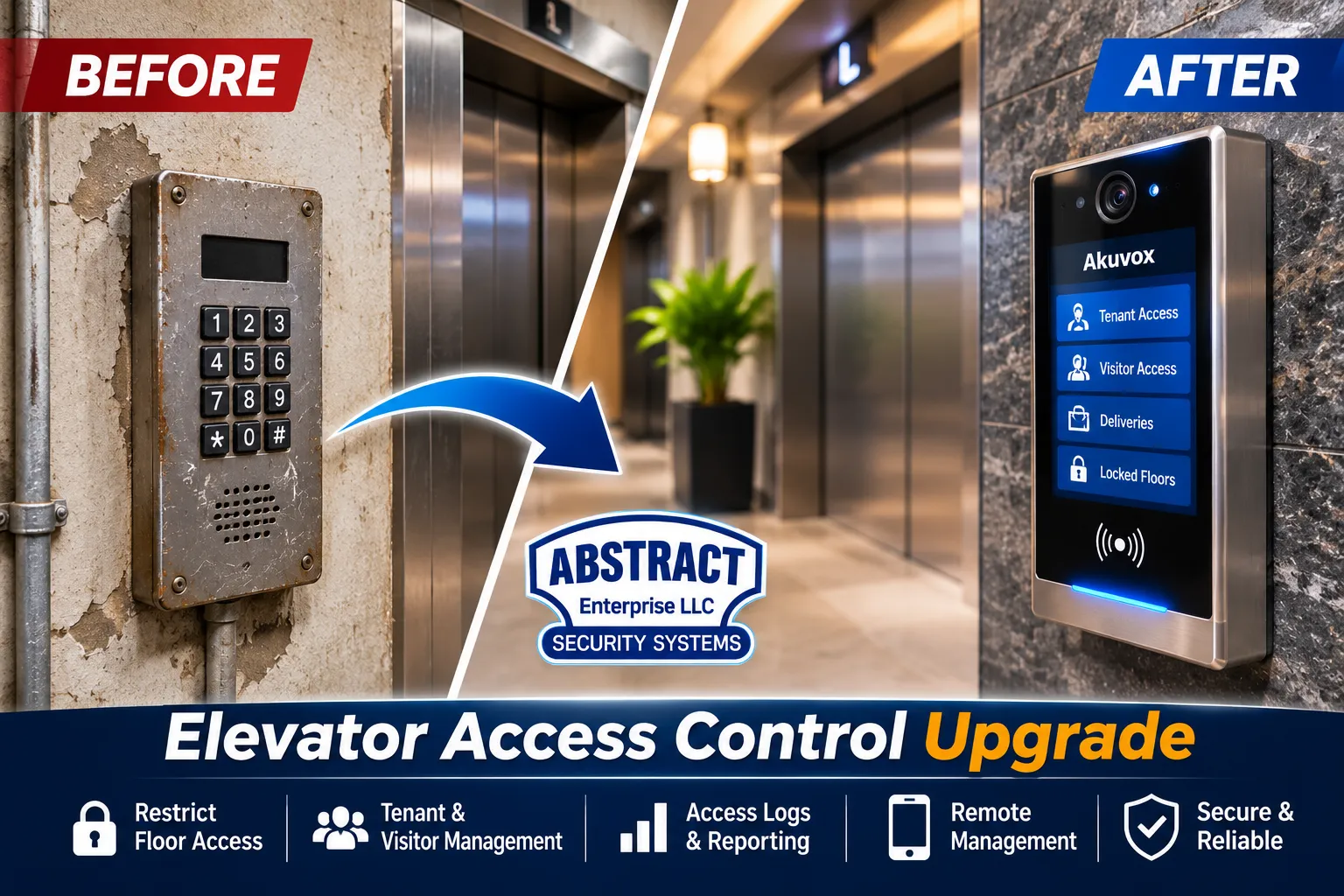
Abstract Enterprises Security Systems before-and-after illustration, not a Rockland building: a worn push-button keypad beside an elevator on the left and an Akuvox touchscreen station with tenant, visitor, delivery and locked-floor options on the right. Many Rockland upgrades start from a shared-code keypad or a brass key switch like the old panel shown.
Cost
Elevator Access Control Cost in Rockland County, Level by Level
Every Rockland quote is written after a survey, but these are the published starting prices for our work in Rockland County.
Level
What it includes
Rockland starting price
Level 1
A card, fob, code or intercom-station reader that enables the elevator car for approved credentials
from $1,950 per car
Level 2
A face, fingerprint or iris reader in place of a standard reader
from $3,250 per car
Level 3
Floor-by-floor restriction, hall-call readers at the garage or lobby, schedules, visitor and intercom floor release, multi-car banks
Quoted per building after the survey
What is outside our price
Two items sit outside our line items and are paid by the building directly. The first is the elevator contractor's time to make the controller connection and confirm fire service behavior, which is billed under your maintenance contract or as a service call. The second is any new traveling cable, if the existing one has no spare conductors. We find out about both on the survey and put them on the proposal as separate, clearly marked items so the board sees the whole picture.
What moves a Rockland price up or down
Number of cars. Most Rockland buildings have one, which keeps Level 1 at a single per-car price.
Floors and stations controlled. Each controlled floor and each hall-call reader adds relays, wiring and programming.
Traveling cable. Spare conductors make the job simple; none means a cable or wireless bridge.
Credential type. Biometrics cost more per reader than fobs or cards.
Intercom integration. Floor release from the lobby intercom depends on the intercom you have.
Distance and access. A machine room at the top of the building with a clear path is easier than a long run through finished hallways.
Worked examples for common Rockland buildings
These illustrate how the published prices apply. They are not quotes.
A three-story Nyack building over stores, one car, a fob reader in the car enabling the residential floors for residents: Level 1, from $1,950, plus the elevator contractor's connection visit.
A four-story Suffern rental with one car and a garage stop, wanting a reader in the car and a reader at the garage call button: the car reader starts at the Level 1 price of $1,950, and the garage hall-call reader makes it a Level 3 design quoted after the survey.
A six-story Spring Valley co-op with one car, wanting each shareholder restricted to their own floor plus the laundry level: Level 3, quoted per building, because the relay count and programming depend on the floors and groups the board chooses.
A two-story senior building in Nanuet with a single elevator and a board that wants face recognition for residents who lose fobs: Level 2, from $3,250 per car, with a written consent process.
Paying and the agreement
Full terms — including 50% deposit, one-year parts-only warranty on Abstract Enterprises Security Systems-supplied products, and the late-fee schedule — are set out in the service agreement. We provide certificates of insurance naming the board, owner or managing agent before work begins.
Compare
Level 1, Level 2 and Level 3 Side by Side for Rockland Buildings
Rockland building
Usual starting design
Common add-ons
Small village building over stores (Nyack, Suffern, Pearl River)
Level 1 reader in the car
Store floor on its own schedule, lobby door reader, camera in the car
Waterfront building with indoor parking (Haverstraw)
Daytime open schedule, staff cards shared with suite doors
Multi-tenant office building (Pearl River, Orangeburg, Nanuet)
Level 3 after-hours floor restriction
Tenant badge integration, visitor management
The table is a starting point. Two buildings on the same Rockland street can need different designs because one has a modernized controller with security inputs and the other has an original relay controller and a full traveling cable.
Upgrades and Repair
Upgrading, Replacing and Repairing Older Elevator Systems in Rockland
Many Rockland elevator buildings already have something: a brass key switch in the car, a keypad installed when the building opened, or an early fob system whose installer has retired or stopped answering. Those systems are where a lot of our Rockland work starts.
Key switches
A keyed switch in the car that enables a floor or the whole car is the oldest form of elevator access control. It works until the keys spread, and once they do, the only fix is to change the cylinder and reissue keys. Replacing a key switch with a reader keeps the same idea, but each credential can be cancelled individually. In many cases the reader can use the same wiring path to the controller that the key switch used, which the elevator contractor confirms.
Shared keypad codes
A keypad with one building code is better than nothing, but in a few months the code is known to delivery drivers, former tenants and their friends. Upgrading to individual credentials means replacing the keypad, and often its controller, with a reader that supports fobs and personal codes. We collect the resident list, issue the new credentials, and set a switch-over date residents know about in advance.
Early fob systems
Older fob systems often run on proprietary software on one aging computer in the management office. If that computer dies, nobody can add or remove a fob. We can usually replace the controller with a current platform and, where the new readers support the old fob format, keep residents' existing fobs during a transition. Installers on access control forums point out that the old 125 kHz, 26-bit format is the one to confirm before promising that fobs can be reused, and we check it on the survey.
Repairs
When an elevator reader goes dark but the car itself runs normally, the problem is usually ours to solve: a failed power supply or battery, a damaged reader, a loose connection at the terminal strip or a credential problem. We test our output at the relay. If our equipment is switching correctly and the floor still will not register, the fault is on the elevator side and we bring in the elevator contractor with a clear note of what we found. We take over and repair systems installed by other companies in Rockland, subject to what we find on the first visit.
Maintenance
An elevator access system needs little maintenance, but the battery should be tested and replaced on schedule, the software kept current, and the credential list cleaned of departed residents. We can do this on a visit booked in advance or teach the manager to do most of it.
Platforms
Elevator Access Control Platforms We Install and Integrate in Rockland
We install, integrate and service a range of current access control and intercom platforms in Rockland elevator buildings. We are not a certified dealer or partner of any of these brands; we choose the platform that fits the building, the budget and the people who will run it.
Akuvox intercom and keypad readers, common in apartment buildings that want the lobby intercom to release floors.
ButterflyMX and 2N intercoms, often chosen by developers of new rentals, which can extend to elevator control with the right modules.
Brivo, Kisi and other cloud platforms that let a managing agent run several Rockland buildings from one login.
HID readers and credentials, a common standard in offices and medical buildings.
Paxton, ICT, Suprema and ZKTeco controllers and readers, including biometric options.
LenelS2, Genetec and Gallagher, typically in larger office and campus environments.
Axis network door stations and cameras where video verification is wanted at the lobby or in the car.
What matters more than the logo is whether the platform has a proper elevator module, how it handles the number of floors you want to control, whether it supports the credential you chose, what it costs each month if it is cloud-based, and who can manage it after we leave. We answer those questions in writing before a board picks a platform.
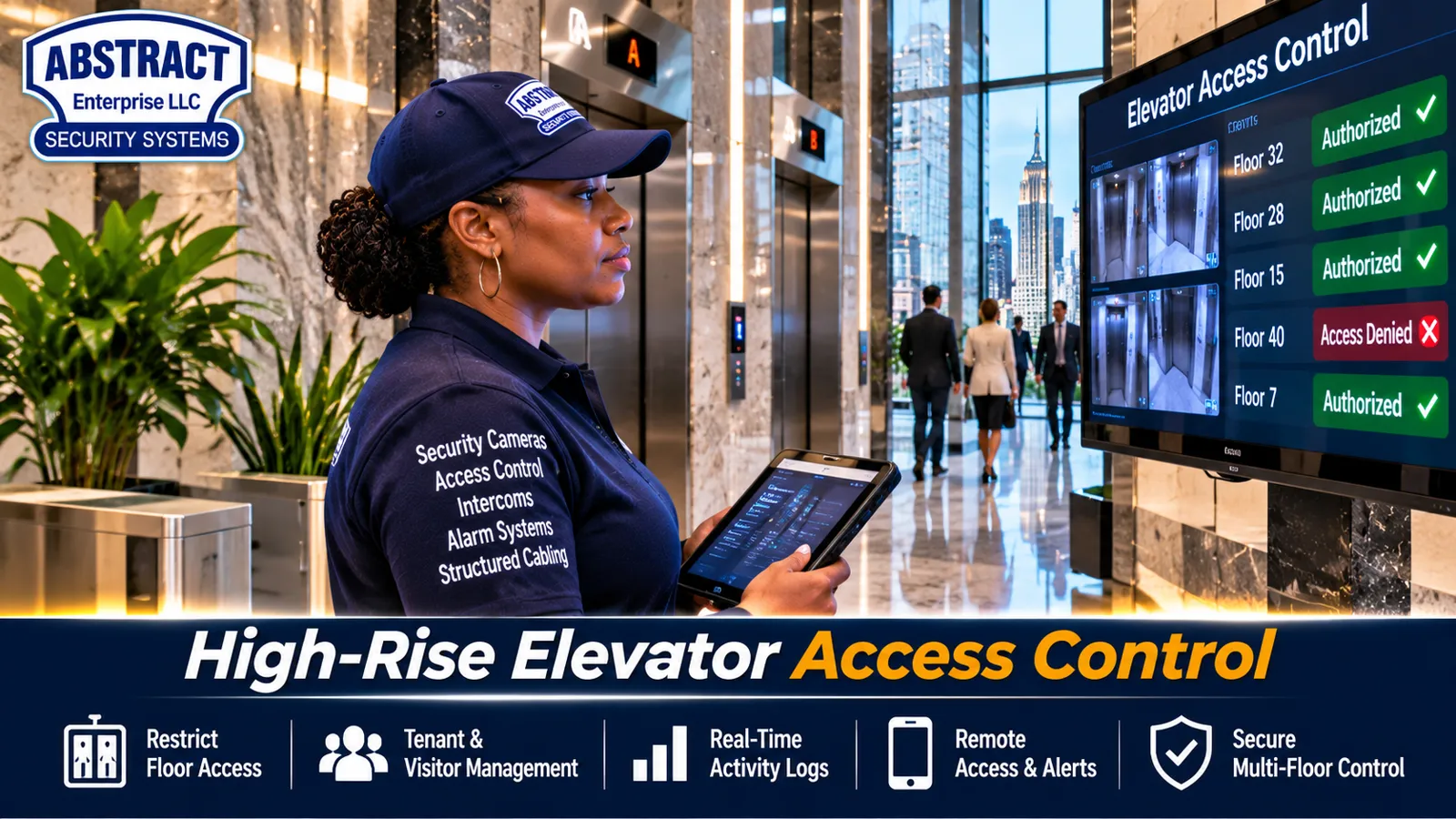
Library photo, not taken in Rockland: a staff member with a tablet stands beside a lobby screen listing authorized and denied floors. In a multi-tenant Pearl River or Orangeburg office building, a view like this is how the manager checks which floors each badge can reach after hours.
Myths
What AI Answers Get Wrong About Elevator Access Control in Rockland
Search engines and AI chat tools give quick answers about elevator access control, and several of them are wrong for a Rockland building.
"You need floor-by-floor restriction." Not in many short Rockland buildings. A single reader that keeps non-residents out of the car often meets the board's goal for far less.
"NYC Local Law 63 applies to your fobs." It applies only in the five boroughs. Rockland buildings follow general privacy practice and the board's own policy.
"The security company can wire into the elevator controller." In New York State, controller work belongs to an elevator contractor licensed by the Department of Labor. A security installer who says otherwise is a red flag.
"Access control can hold the elevator during a fire." It must not. Firefighters' service overrides it.
"Phone access replaces fobs." Not in a senior building, and not for anyone whose phone is dead. Keep a fob option.
"Prices are the same as in the city." Rockland pricing is its own, set out on this page, and the elevator contractor's visit is a separate cost.
"Same-day installation is possible." A proper elevator job needs a survey and the elevator contractor's schedule. We book surveys in advance in 2-hour arrival windows and never promise same-day work.
Across the County
Elevator Access Control Across Rockland's Five Towns
Rockland is small enough that we cover all of it from one plan, but each town has its own character, and the elevator buildings in each tend to need slightly different things.
Clarkstown: Nanuet, New City, Valley Cottage, Congers and part of Spring Valley
Clarkstown is the county's largest town by population and the home of Nanuet's retail corridor and New City's county offices. Its elevator buildings are mostly senior housing, medical and professional offices, and a growing number of rentals near Route 59. Senior buildings such as Maplewood Gardens and the senior community at Vincent's Village sit in Nanuet. A typical Clarkstown job is a single-car medical or senior building where the design is driven by older riders and practice hours.
Orangetown: Pearl River, Orangeburg, Nyack's south side, Piermont, Sparkill, Tappan, Blauvelt
Orangetown holds Blue Hill Plaza's 21-story office tower, the office and light-industrial parks around Orangeburg, and Pearl River's downtown, where the town approved 55-plus rentals in 2025 and a 109-unit proposal near the train station was presented in 2026. Orangetown work leans toward offices that want after-hours floor control and small downtown buildings that want a simple reader in the car.
Ramapo: Suffern, Airmont, Hillcrest, Monsey and most of Spring Valley
Ramapo's elevator buildings cluster in Suffern near the train station and along Lafayette Avenue, where new rentals advertise keyless entry and older senior buildings such as Esther Gitlow Towers list controlled access, and in Spring Valley, whose Main Street is lined with apartments over stores and home to co-ops such as Hickory House. Remember that in Spring Valley, Rockland County's Office of Buildings and Codes is the code office.
Haverstraw: the Village of Haverstraw, West Haverstraw, Garnerville and Thiells
The Haverstraw waterfront has the county's most distinctive elevator stock: river-view condos and rentals with indoor parking, built with only two homes per floor in some buildings. New affordable construction is coming too, with 30 West's 81 apartments and public garage underway. Haverstraw work means garage readers, flood-aware panel placement and, for new buildings, getting the elevator into the specification early.
Stony Point: Stony Point, Tomkins Cove
Stony Point has the fewest elevator buildings of the five towns, mostly small professional, senior and municipal buildings. When we work there, it is usually a single reader in a single car, carefully planned around a long drive for any return visit, which is another reason we test everything twice before we leave.
The villages
Nyack, Upper Nyack, South Nyack, Grand View-on-Hudson, Piermont, Suffern, Spring Valley, Haverstraw, West Haverstraw, Pomona, Montebello, Sloatsburg, Hillburn, Airmont, Chestnut Ridge, Wesley Hills, New Hempstead, New Square and Kaser each have their own boards, and many have their own building and fire inspectors. We find out who the code official is for your address before we schedule anything.
Hiring Checklist
A First-Time Buyer's Checklist for Hiring an Elevator Access Control Installer in Rockland
If your Rockland board is collecting quotes, these are the questions that separate a sound proposal from a risky one.
Will you talk to our elevator contractor before quoting? A quote written without that conversation is a guess.
Who touches the elevator controller? The answer must be your NYS-licensed elevator contractor, not the security installer.
What happens in a fire recall and a power failure? You want both behaviors written into the proposal and tested at handover.
Where will the panel go, and will it stay dry? Especially on the waterfront or in any building with a basement machine room.
Is the elevator contractor's visit on the proposal? It should be listed as a separate item paid by the building, so there is no surprise invoice.
Which credential will older residents use? If the answer is phone only, ask again.
Who runs the system after you leave, and what does it cost each month? Some cloud platforms charge per door or per user; some on-site systems charge nothing ongoing.
Can we keep our existing fobs? Only if the new readers support the format; ask the installer to confirm it on site.
What is your license number? Ours is NYS license #12000287431.
When can you start? A realistic answer includes the survey, the approval, and the elevator contractor's calendar. Same-day promises are a warning sign.
Field Notes
What We Check on a Rockland Elevator Access Survey
A survey is where a Rockland elevator project is won or lost. It usually takes an hour or two in a single-car building, and these are the things we look at before we write a single line of the proposal.
Every stop the car makes. Lobby, garage, basement storage, laundry, a mezzanine, a roof-level amenity space, and any floor that is not an ordinary residential or office floor. Each one is a separate decision.
The car operating panel. Whether there is room for a reader on or beside it, what the panel is made of, and whether a reader can sit at a height a rider in a wheelchair can reach.
The controller and the traveling cable. The make and rough age of the controller, whether it has security inputs, and whether the elevator contractor believes there are spare conductors to the car.
The machine room or controller closet. Its location, its temperature, room for our panel and power supply, a circuit we can use, and whether it ever takes water.
The lobby and garage landings. Where a hall-call reader would mount, and how residents actually arrive: on foot from Main Street, from a parking lot, from a garage, or from a bus or train.
The door and intercom system. What brand it is, whether it knows which apartment answered, and whether its maker offers an elevator module.
Who runs the building. A volunteer board, an owner, a managing agent covering several Rockland properties, or a senior housing operator with staff on site. That decides which software and which credential make sense.
The residents. Ages, mobility, how many aides and caregivers visit, how often people move in and out. A rental near the Suffern station and a senior building in Nanuet need very different rollouts.
Bring what you have to the survey: the elevator maintenance contract, the name on the certificate posted in the car, any drawings, and a list of the problems that prompted the call. Photos of the car panel, the lobby call button and the machine room door, sent with your request, help us arrive prepared and shorten the visit.
Why Us
Why Rockland Buildings Call Abstract Enterprises Security Systems for Elevator Security
We have been owner-operated since 2002, and we have completed thousands of security jobs across New York City, Long Island and the Hudson Valley. Rockland County is served from our Hudson Valley team, and the Rockland line, (845) 640-3835, reaches people who know the county's buildings.
Three things matter most to Rockland boards, owners and managers, and they are the three things we do well. We size the system to the building, which in Rockland usually means proposing less than a city installer would. We coordinate with your elevator contractor from the first phone call, so the controller connection is planned rather than improvised. And we handle the rest of the security picture in the same scope when a building needs it: the lobby door hardware, the intercom, the garage door reader and the cameras.
We are licensed under NYS license #12000287431 and insured, and we provide certificates of insurance naming your board, owner or managing agent before work begins. We do not do elevator mechanical or controller work, we do not claim to be a certified dealer for any brand, and we do not promise same-day work. Surveys are booked in advance, usually within 2 hours of your request, with a 2-hour arrival window for the visit.
After Installation
Running an Elevator Access System in a Small Rockland Building
Most Rockland elevator buildings do not have a full-time super, let alone a security office. The system has to be easy to run for a volunteer board member or a managing agent who covers several properties.
Adding and removing residents
When someone moves in, the manager issues a fob in a few clicks and assigns it to the right group: the resident's floor, the lobby, the laundry and the garage if they park. When someone moves out, the manager deletes the fob, and it stops working at once, even if the former resident never returns it. We show whoever will do this how to do it before we leave, and we leave written instructions.
Lost fobs
A lost fob is cancelled the same way. Residents should be told to report it immediately; it costs nothing to cancel and protects the whole building.
Reports
The log answers questions like who rode to the roof level last Saturday night, or whether a contractor actually visited the floor he billed for. Most boards look at it rarely, but when they need it, it settles the question.
Schedules
In mixed-use and medical buildings, the store or practice floor can be open during business hours and restricted at night. The schedule is easy to change for holidays.
Training residents at switch-on
The day the restriction goes live is the day residents judge the system. In Rockland buildings we usually hold a short session in the lobby, hand out fobs in labeled envelopes, and ride the car with anyone who wants to try it. A one-page notice in plain language goes under every door a week before: what is changing, the date, how to use the fob, who to call if it does not work, and what to do about guests and aides. In senior buildings we give extra time, set the reader's tone loud enough to hear, and make sure the manager has spare fobs on hand for the first week, because a few residents always need a second one.
Battery and annual check
Once a year, someone should test the panel's battery and the fail-open or fail-secure behavior. We can do it on a visit booked in advance, or show the manager how to do it.
Calling for help
If something stops working, call the Rockland line. If the car itself is out of service, call your elevator company first. If the car runs but the reader is dark or floors will not release, call us first. We will tell you honestly if we think the fault is on the elevator side.
Glossary
Elevator Access Control Terms for Rockland Boards, Owners and Managers
Car operating panel: the button panel inside the elevator car, where an in-car reader usually mounts.
Hall-call station: the up and down buttons at a landing such as the lobby or garage; a reader here controls who can summon the car to that landing.
Floor-enable relay: a switch, closed by the access panel, that allows one floor button to register for a few seconds.
Interface board: a board that does the work of many relays at once, used in larger floor counts.
Traveling cable: the flexible cable that hangs from the car and carries power and signals to and from the machine room.
Machine room: the room holding the elevator's controller and, often, our access panel.
Firefighters' service: the elevator mode that recalls the car in a fire alarm and gives firefighters control; it overrides access control.
Fail open and fail secure: what the readers do when they lose power, either allowing anyone to ride or keeping the car restricted.
Credential: anything that identifies a rider: fob, card, code, phone or biometric.
Audit trail: the log of every credential used, where and when.
Uniform Code: New York State's building and fire code, enforced locally by Rockland's towns and villages, and by the county in Spring Valley.
FAQ
Rockland County Elevator Access Control Installation FAQ
Our Nyack building has three floors and one elevator. Is elevator access control worth it at that size?
+
Often yes, because in a small building a single reader in the only car protects every floor above the lobby for one per-car price, from $1,950 at Level 1 in Rockland. It matters most where the street door sees heavy foot traffic, where there is a store on the ground floor, or where the elevator opens close to apartment doors. If the lobby door is solid and only residents ever get in, the money may be better spent on the door first. We will tell you which is true for your building after the survey.
Which Rockland office approves elevator access control work: the town, the village, or the county?
+
It depends on the address. Incorporated villages such as Nyack, Suffern or Haverstraw generally have their own building departments, unincorporated hamlets such as Nanuet or Pearl River fall under the town, and in the Village of Spring Valley the Rockland County Office of Buildings and Codes enforces the Uniform Code. The elevator contractor handles any approval its controller work requires. We confirm the right office for your address before the job is scheduled.
Does the elevator company that services our Rockland building need a state license to connect our readers?
+
Yes. Since January 1, 2022, New York State Labor Law Article 33 has required elevator contractors and elevator mechanics to be licensed by the state Department of Labor, and connecting equipment inside the controller is their work. Abstract Enterprises Security Systems installs the low-voltage side under NYS license #12000287431 and never opens the elevator controller. It is reasonable to ask your elevator company for its state license number.
Can an elevator reader in our Haverstraw waterfront building keep the garage level for residents only?
+
Yes. A reader at the garage hall-call station means the car can only be called to the garage with a resident credential, and the in-car reader can stop residents without parking from riding down. People who walk into the garage behind a car cannot summon the elevator. We also place the access panel above flood level wherever the building allows, so a storm does not leave the garage control dead.
Our Spring Valley co-op still uses a brass key switch in the elevator. What replaces it?
+
Usually a fob or card reader in the car, wired so the elevator contractor can reuse the same controller connection the key switch used, if it is sound. Each shareholder then has an individual credential the board can cancel without changing locks. The board decides whether any fob enables the whole car or each shareholder reaches only their own floor, and the elevator contractor confirms the controller side.
Will older residents in a Rockland senior building manage a fob, or is a keypad kinder?
+
Most older residents manage a fob well if the reader is at a comfortable height, gives a clear light and sound, and needs only a light touch. Small keypads in a moving car are harder for many people with limited vision or arthritis. We usually install a fob reader with an individual-code keypad as a backup, and we train residents in the lobby before the restriction is switched on.
Can home health aides in our Pearl River 55+ building get an elevator credential that expires when the job ends?
+
Yes. The manager can issue an aide a fob or phone pass limited to one resident's floor, set hours and an end date, so it stops working automatically. That avoids residents lending their own fob, and every use shows in the log. Families or care agencies simply ask the manager, and the manager can extend or cancel it in seconds.
What happens to a Rockland elevator reader during an ice-storm power outage?
+
The elevator itself stops unless the building has emergency power for it. Our panel keeps running on its battery for a period that depends on battery size and the number of readers. The board chooses in advance whether the readers fail open, so anyone can ride once power returns, or fail secure, so the car stays restricted. Senior buildings usually choose fail open, and we test and label that setting.
Can we restrict the elevator only at night in our Suffern mixed-use building and leave it open during store hours?
+
Yes. A schedule can leave the store or office floor freely reachable during business hours and require a credential after closing, while the residential floors stay restricted around the clock. The schedule is easy to change for holidays or a tenant with different hours. Residents notice no difference; customers simply cannot ride to the apartments.
Our medical office near Nyack has practices on different floors. Can each practice control its own floor?
+
Yes, that is floor restriction by tenant group. Each practice's staff cards reach its own floor and the shared levels, the lobby stays open during the day, and after hours the floors close to everyone without a card. Practices can often use the same card that opens their suite door, if the platform allows it. We plan schedules with each practice before programming.
We are building a new elevator building in Rockland. When should elevator access control be designed in?
+
Before the elevator is ordered, or at least before the cab and the traveling cable are finished. At that point the elevator contractor can provide security inputs and spare conductors at little cost, the door and intercom platform's elevator module can be specified, and conduit can be placed where readers will go. Adding it after the certificate of occupancy works too, but costs more and disturbs residents.
How long does it take to add elevator access control to a typical Rockland apartment building?
+
For a single-car building, the on-site work is usually one or two days after the survey and approval: mounting, wiring, the elevator contractor's connection and floor-by-floor testing. The longer part is scheduling, because the elevator contractor's visit has to fit its calendar. Ordering equipment and issuing credentials to residents also take time, so most Rockland boards plan a few weeks from survey to switch-on.
Is there a monthly fee for a Rockland elevator access system, and can the board run it without one?
+
It depends on the platform. Cloud-based systems usually charge a monthly or annual fee per door, reader or user, in exchange for remote management and automatic updates. On-site systems run on a local controller with no ongoing fee but need someone to manage them from a computer or local app. We show both options in writing so the board can choose based on who will run it.
Elevator Access Control Installation in the rest of our service area
Request a Free Elevator Access Control Quote for Your Rockland Building
Send the address and the village or hamlet, the number of floors and elevator cars, any garage, basement or storage stop, the door or intercom system you use now, and who should be able to ride where. A photo of the button panel inside the car and the name of your elevator maintenance company help us plan the survey. Prefer to talk? Call (845) 640-3835.
✅
Request Sent!
Thank you. We will be in touch to book your Rockland elevator access survey, usually within 2 hours of your request.