Nassau co-op, condo, station rental, senior residence or medical building with an elevator anyone can ride? Book an elevator access control survey from Long Beach to Great Neck: (516) 346-5778
Elevator access control installation in Nassau County makes your elevator ask for a fob, card, code, phone or face before it will carry someone upstairs. Abstract Enterprises Security Systems installs the low-voltage side across the county, from oceanfront co-ops in Long Beach to new rentals across from the Mineola and Westbury stations: the elevator card reader or keypad, the access panel and battery, the floor relays, the wiring, the credentials and the programming. Your building's licensed elevator contractor makes the final connection inside the controller, and we plan both halves together so the cars are out of service as briefly as possible.
Reviewed and updated November 17, 2026 by Abstract Enterprises Security Systems, NYS license #12000287431 · Sources: Nassau County, Cities, Towns and Villages and Building and Zoning Permits pages; Nassau County Fire Marshal contractor guide and 2021 annual report; DeVito Team compilation of OneKey MLS co-op records (Aug 2026); Habitat Magazine on Long Beach buildings after Hurricane Sandy (Nov 2012); Long Island Business News on Mineola (2023) and Westbury (2025, 2026) transit-oriented development; Patch, Mineola; NYS Homes and Community Renewal, Estella Housing; New York Housing Conference, Rosenberg Residence; North Hempstead Housing Authority; NYU Langone; NYS Department of Labor elevator licensing; NY Senate bill S1422A; IPVM on elevator floor-relay design
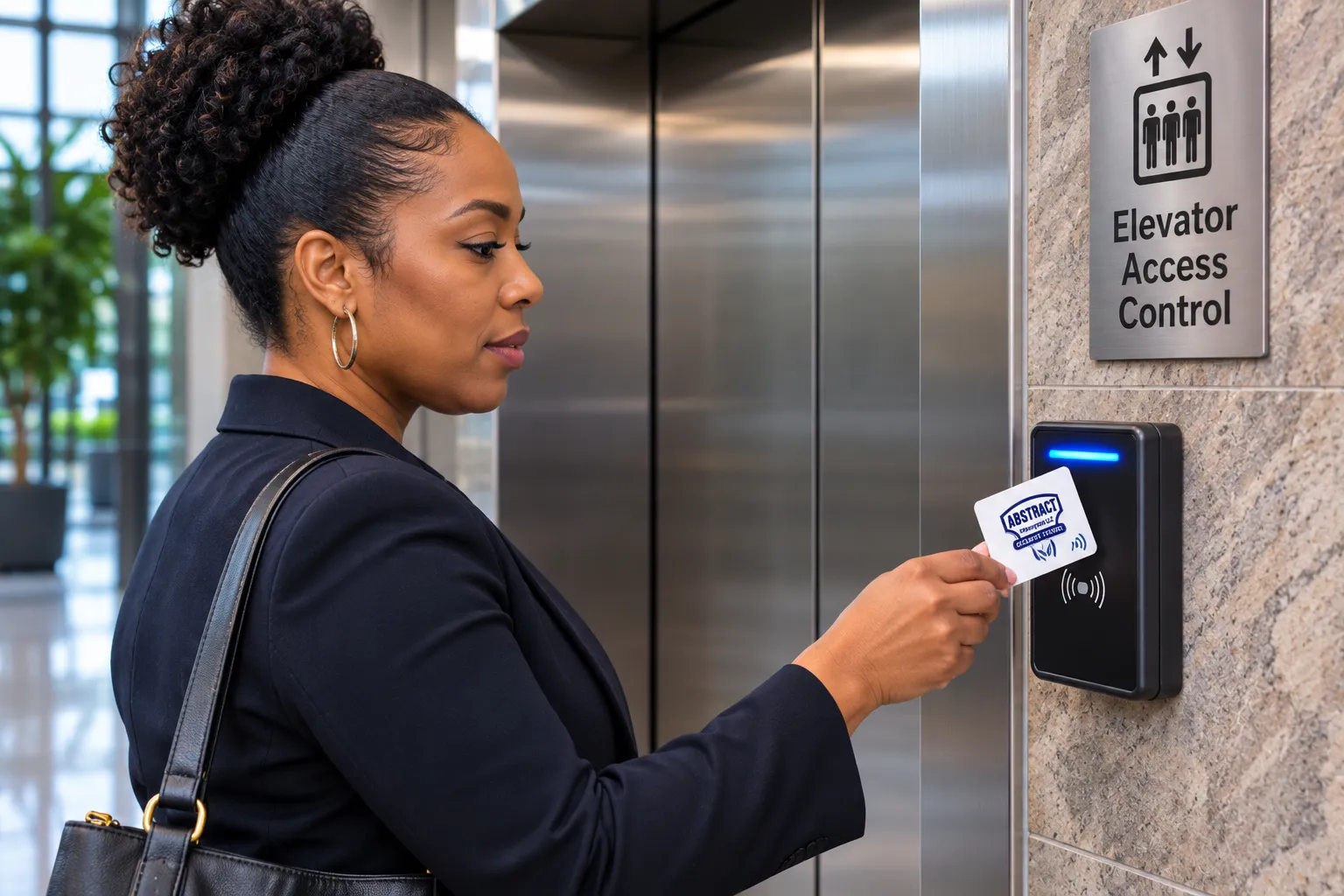
Photo from the Abstract Enterprises Security Systems elevator access control photo library (not taken in Nassau County and not a customer's building): a woman with a shoulder bag holds a card to a wall reader beside elevator doors. A tap like this is the whole daily experience of a Level 1 system for a resident of a Nassau co-op: one motion, and the car accepts a floor call.
Nassau County Elevator Access Request
Tell us the village or town, floors and cars, and who should be able to ride
✅
Request Sent!
Thank you. We will be in touch to book your Nassau County elevator access survey, usually within 2 hours of your request.
25+
Years Experience
2 Hr
Arrival Windows
100%
Licensed & Insured
4.7★
201 Google Reviews
Owner-operated since 2002 · Thousands of jobs completed · Booked within 2 hours
Quick answer: elevator access control in Nassau County starts at $1,725 per elevator car for a Level 1 card, fob, code, phone or video reader in the car, and at $2,875 per car for Level 2 face, fingerprint or iris readers; floor-by-floor restriction, garage and lobby landing readers, schedules and intercom floor release are Level 3 and are quoted per building after a survey. A two-car Long Beach co-op often needs only Level 1 in each car, while a new rental across from a Nassau train station or a multi-practice medical building usually needs Level 3. The elevator contractor's controller work is ordered by the building directly. We book the survey within 2 hours of your request and arrive inside a 2-hour window; call (516) 346-5778.
Readers, panel, floor relays, wiring, credentials and programming by Abstract Enterprises Security Systems under NYS license #12000287431
Controller connection and firefighters' service bypass handled by your licensed elevator contractor and tested with us
Panels placed above flood risk in south shore buildings, with a power-failure plan agreed in writing
What Elevator Access Control Means for a Nassau County Board, Landlord or Facilities Manager
Elevator access control in Nassau County usually begins with a specific complaint rather than a plan. A board member in a Long Beach tower notices that people who do not live in the building are riding to the top floor to look at the ocean from the hallway window. A property manager at a new rental near a Long Island Rail Road station finds that the amenity floor is being used after hours by friends of a friend of a tenant. A medical practice on an upper floor of a Garden City office building wants patients to stop wandering onto the floor where the billing staff sit. A housing provider running a five-story senior residence wants to know who is in the building at two in the morning. In every one of these cases the front door is doing its job some of the time, and the elevator is the part of the building that never asks a single question.
An elevator with no access control will carry anyone to any floor it serves. That is how it was designed, and for decades it was acceptable in most of Nassau, because the county's elevator buildings were relatively few and most of them had a doorman, a resident super or a staffed lobby. That has changed. Staffing has been trimmed, package volume has exploded, garages and side doors have multiplied, and new buildings around the train stations are going up with more cars, more floors and more shared space than the county has seen before. The elevator is now the one route to every apartment, office and roof that a stranger can use without a key.
Elevator access control closes that route. A reader is added to the elevator, either inside the car or beside the call button at a landing. A resident, tenant or employee presents a credential: a key fob, a card, a code, a phone, or in some buildings a face or a fingerprint. The reader sends that credential to an access control panel, the panel checks whether this person is allowed and, if so, closes a relay that tells the elevator controller the request is permitted. If the person is not allowed, the buttons stay dead and the attempt is logged. Abstract Enterprises Security Systems installs that whole low-voltage side: the elevator card reader, the elevator keypad or video station, the elevator key fob credentials, the panel, the relays, the cable and the programming. The building's licensed elevator contractor makes the final connection inside the controller, because in New York State that is elevator work.
For a first-time buyer in Nassau the most useful thing to understand is that this is not one product with one price. It is a short ladder, and each building climbs only as far as it needs to:
Level 1, a reader in the car. The car ignores floor buttons until a valid credential is shown. Once it is, the rider can choose any floor the car serves. This is the right answer for a great many Nassau co-ops and small rentals, where the only question is whether someone belongs in the elevator at all.
Level 2, biometrics. The same control, but the credential is a face, a fingerprint or an iris. It suits buildings with a serious lost-fob or shared-fob problem and staff who change often.
Level 3, floor-by-floor control and the extras. Each rider reaches only the floors they are allowed on. Readers can be added at garage and lobby call buttons, floors can open and close on a timetable, and the intercom can send a guest to one floor only. Station-area rentals, multi-tenant medical buildings and office buildings usually live here.
Two more points save a lot of confusion. First, your elevator does not get replaced or rebuilt. Its motor, doors, brakes and safety circuits are untouched, and your elevator maintenance company keeps maintaining them. Second, every honest proposal for elevator access control in Nassau has two parties on it: the low-voltage security contractor and the licensed elevator contractor. We plan both halves together, and we explain later on this page exactly where the line between them falls. If you are still deciding whether the work belongs on the front door, the garage door or the elevator, our Long Island elevator access control overview covers the regional picture, and this page stays with Nassau.
The County
Where Nassau County's Elevator Buildings Are: Ocean Towers, Village Downtowns and Station Rentals
Nassau is a county of houses, and anyone planning elevator security here should start from that fact. Most residents live in single-family homes, and most commercial space is low and spread out. Elevator buildings exist, but they cluster in a handful of places, and each cluster has its own character. Knowing which cluster a building belongs to tells us a lot before we ever walk in: how old the elevator controller is likely to be, whether there is a garage stop, who manages the property, and what kind of people are riding the car.
The county's own description of itself explains why the work feels so local. Nassau is divided among three towns, Hempstead, North Hempstead and Oyster Bay, plus two cities, Long Beach and Glen Cove, and inside the towns sit 64 incorporated villages and more than a hundred unincorporated hamlets. Many of those villages run their own building departments. A tower in Long Beach, a co-op in Great Neck Plaza and a new rental in Mineola are three different jurisdictions, even though they are a short drive apart.
The clusters we see most often are these. Long Beach has the county's densest group of tall residential buildings along Shore Road and the boardwalk, most of them built in the 1960s. The north shore villages around Great Neck have prewar and postwar elevator co-ops near the station. The county seat area, Mineola and Garden City, has medical and office buildings along Franklin Avenue and Old Country Road and, more recently, a wave of new apartment buildings across from the train. Westbury, Hempstead Village and other downtowns are rezoning for multifamily housing around their stations. Glen Cove's waterfront is being rebuilt with condominiums and rentals over parking. And scattered across all of it are senior and supportive housing buildings, usually four to six stories with one or two cars.
Nassau fact
What it means for elevator access control
Source
2 cities, 3 towns, 64 incorporated villages, 100+ unincorporated areas
Permit questions are answered by the local city, town or village, not by one county office
Nassau County, Cities, Towns and Villages
Only 9 co-op developments of seven stories or more; 8 of them in Long Beach
Tall residential towers are concentrated on one barrier island, with similar 1960s controllers and flood exposure
DeVito Team compilation of OneKey MLS records, Aug 2026
The Wychwood, Great Neck Plaza: built 1929, seven stories
Prewar co-ops need a careful survey of the traveling cable and the machine room
Same
Eight-story, 119-apartment building planned across from the Mineola LIRR station
Station rentals arrive with amenity floors and garages that call for floor control
Long Island Business News, Aug 1, 2023
266-unit building at 199 2nd Street, Mineola, with underground parking
A garage stop is the most common back door into a station building
Patch, Mineola
Westbury downtown zoning district (Dec 2019, about 50 acres); 187-unit TOD across from the station; MTA's first Long Island TOD approved Sept 2026
New buildings can have elevator access designed in before the walls close
Long Island Business News, 2025 and 2026
Estella Housing, Village of Hempstead: five stories, 95 affordable supportive apartments
Supportive housing needs reliable car control and simple credentials
NYS Homes and Community Renewal
NYU Langone Hospital—Long Island in Mineola: 591 beds
The medical corridor around it is full of multi-suite buildings with staff-only floors
NYU Langone
Those numbers explain why our Nassau surveys vary so much. A nine-story oceanfront co-op from 1965 and an eight-story rental completed last year have almost nothing in common behind the elevator doors, even though both are "elevator buildings" and both are in the same county. One has a relay-logic or early microprocessor controller with a traveling cable that may or may not have spare conductors; the other has a modern controller that was built expecting an access control interface. One has a self-managed board or a small managing agent; the other has a leasing office and a property management company with written security standards. We plan each one for what it is.
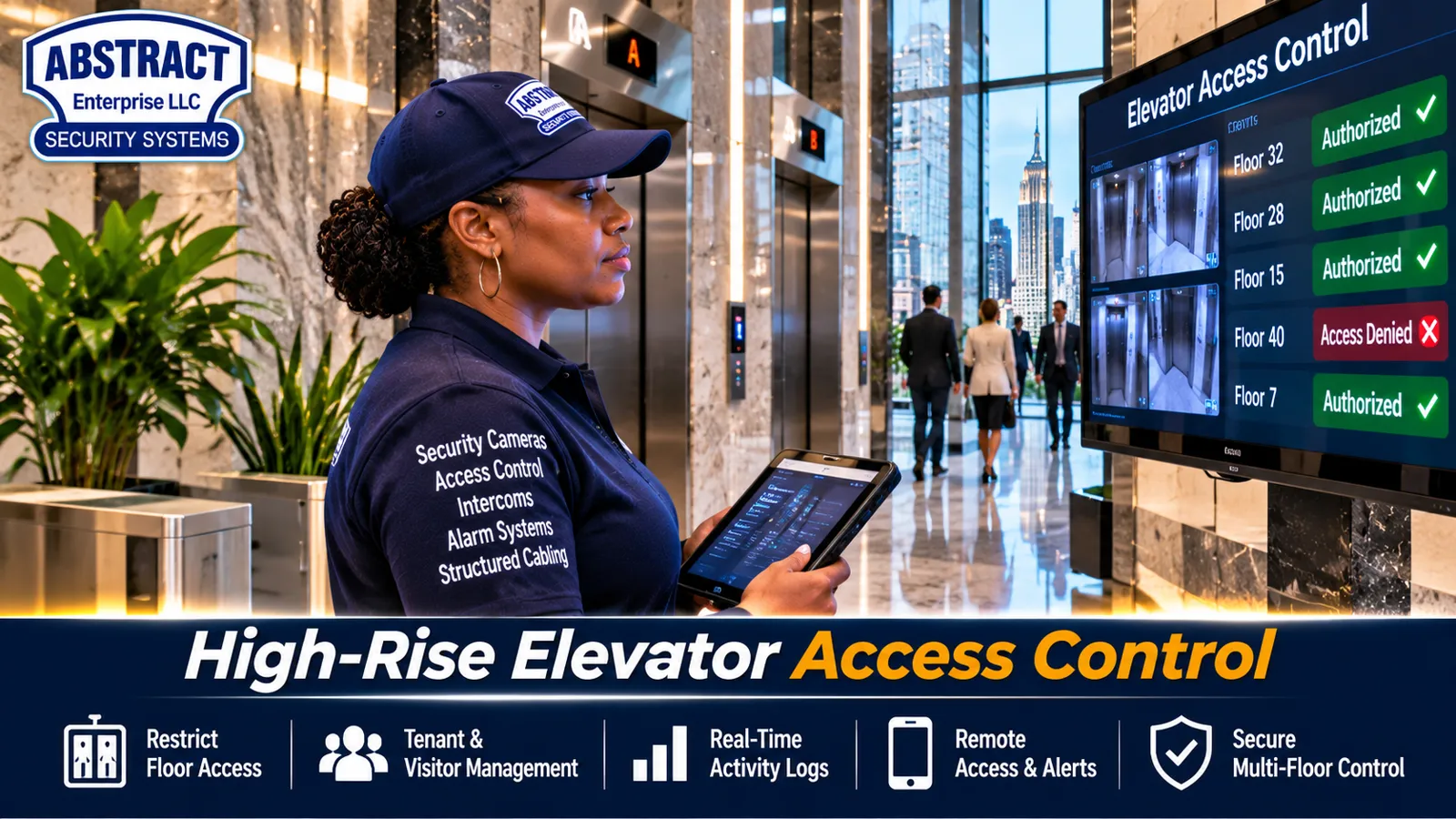
Photo from the Abstract Enterprises Security Systems elevator access control photo library (not taken in Nassau County and not a customer's building): a staff member holding a tablet stands beside a lobby display that lists authorized and denied floors. This is the kind of view a leasing office in a new Nassau station rental uses to check floor permissions without going to the machine room.
How It Works
How a Nassau Elevator Card Reader Talks to the Car, From Tap to Floor
The mechanics of an elevator access system are simpler than most people expect, and knowing them helps a board or a manager read a proposal critically. There are four pieces of hardware and one connection that matters.
The first piece is the reader. In most Nassau buildings it goes inside the car, mounted on or next to the button panel, because that is where the decision about floors is made. A reader can also go at a landing, beside the hall call button in the lobby or the garage, so the car will not even come unless a credential is shown. The reader might be a simple elevator RFID card and fob reader, a keypad, a combined keypad and reader, a phone-compatible reader, or a video station with a camera and a screen.
The second piece is the access control panel. It is a small powered enclosure, usually in the elevator machine room or in a communications closet nearby, that holds the list of approved credentials and the rules for each one. It has a battery so it keeps working through a short outage, and in most systems it connects to the building's network so the manager can add and remove people from an office or a phone.
The third piece is the relay board. A relay is an electrically operated switch. In a Level 1 system there may be only one relay per car: when the panel approves a credential, the relay closes for a few seconds and the controller accepts floor calls. In a floor-by-floor system there is a relay for each controlled floor in each car, and the panel closes only the relays for floors that person is allowed to reach.
The fourth piece is the wiring. The reader in the car needs power and data, and the only path into a moving car is the traveling cable, the flat bundle of conductors that hangs from the car to the hoistway wall. Many elevators have spare conductors in that cable that the elevator contractor can assign to the reader. Some have none, or have conductors that have been used up by earlier additions such as cameras, phones or card readers from a previous system. When there are no spares, the options are a new traveling cable, which is elevator work, or a wireless bridge between the car and the hoistway, which we plan with the elevator contractor.
The connection that matters is the one between our relays and the elevator controller. That is where the elevator learns whether a floor call is allowed. On newer controllers it is often a dedicated security input or a set of terminals the manufacturer designed for exactly this purpose. On older controllers it may involve the elevator technician wiring our relay contacts in series with the floor button circuits. In both cases it is the elevator contractor's job, and in both cases the access system must step out of the way whenever the elevator is in firefighters' service, which we cover in detail below.
Put together, a ride works like this: a resident steps in, taps a fob, the reader sends the fob number down the traveling cable, the panel looks it up, the panel closes the right relay or relays, the controller lights the allowed buttons for a few seconds, the resident presses their floor and the car goes. The whole exchange takes well under a second. A stranger who follows the resident in can press any button they like after the timer runs out, and the car will not move for them. Every tap, accepted or refused, is written into an audit trail with the time, the car and the credential.
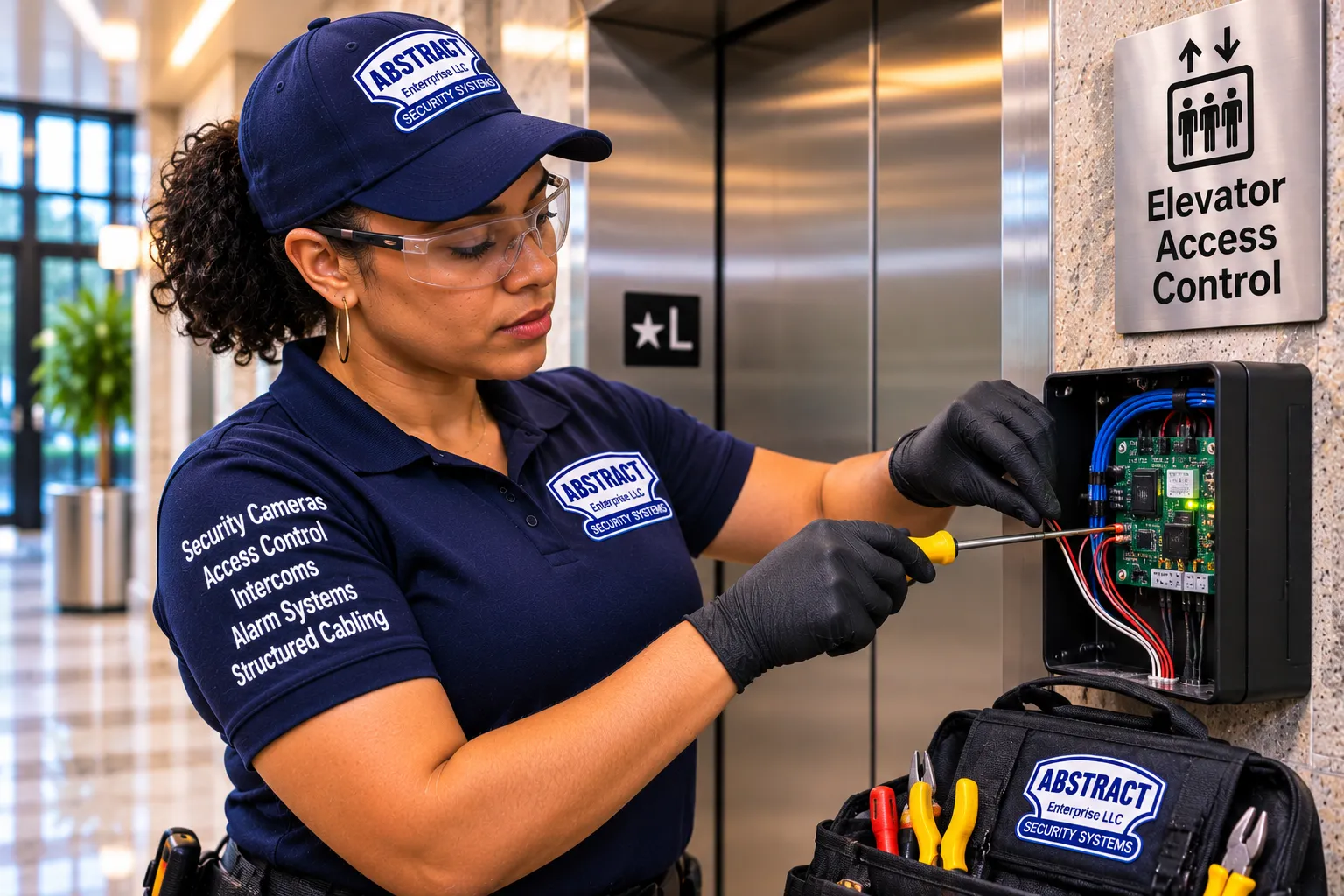
Photo from the Abstract Enterprises Security Systems elevator access control photo library (not taken in Nassau County and not a customer's building): a technician in a polo shirt lands colored conductors on a reader circuit board. In a Nassau elevator, these are the pairs that reach the car through spare traveling cable conductors assigned by the building's elevator contractor.
Design Choice
Car Reader or Floor-by-Floor Restriction: Picking the Right Starting Point in Nassau
The most important design decision on any Nassau job is whether the building needs to control access to the elevator, or access to particular floors. They sound similar. They are not, and they lead to very different amounts of equipment and coordination.
A reader that simply enables the car answers one question: does this person belong in our elevator? Once they tap in, they can reach any floor that car serves. For a residential co-op where every shareholder has a reason to be on every hallway, because the laundry is on one floor, the storage on another and friends live throughout the building, that is usually all the building needs. It stops the stranger who slips in behind a delivery from roaming the halls, and it keeps the roof and the top-floor corridor from becoming a hangout. It is also the least disruptive to install: one reader, one relay and one controller input per car.
Floor-by-floor control answers a different question: which floors may this person reach? Each controlled floor in each car gets its own relay, and each credential carries a list of floors. A tenant on the fourth floor of a medical building sees only the lobby and the fourth floor light up. A resident of a rental tower sees their own floor, the lobby, the garage and the amenity floor, but not anyone else's corridor. That is a stronger kind of security, and in some buildings it is essential, but it multiplies the relays, the wiring at the controller and the programming. In a building with two cars serving eight floors and a garage, it can mean eighteen controlled stops instead of two.
Our honest advice to most Nassau residential boards is to start with the simplest version that solves the real problem, and to build it so it can grow. A Level 1 system installed with a panel that has room for more relays, cable sized for more conductors, and credentials that will work in a floor-by-floor system later can be upgraded without throwing anything away. We would rather install a car reader your co-op will actually use than a floor-restriction scheme that annoys shareholders until someone props the stairwell door open. Where a building really does need floors locked, such as a rental with a paid amenity floor, a professional building with separate practices, or any building with a mechanical penthouse or roof that must stay staff-only, we design that from the beginning.
There is one more variant worth knowing about: landing control. Instead of, or in addition to, a reader inside the car, a reader is placed at the call station on a specific floor, typically the garage or the lobby. The car will not answer a call from that landing until someone presents a credential. In Nassau buildings where the garage is the weak point, because residents drive in, gates stay open, and anyone who walks down the ramp can summon the elevator, a single reader at the garage call button can do more good than readers in every car.
Floor Control
Elevator Floor Restriction System Installation for Nassau Buildings With Mixed Floors
When a building does need elevator floor restriction, the design is a matter of counting and then deciding. We count the cars, the floors each car serves, the call stations at each landing and the doors that open onto each floor from the car. Then we decide, floor by floor, who should reach it and when.
In Nassau, the buildings that genuinely need floor-level control fall into a few groups:
Station-area rentals with amenity floors. Fitness rooms, lounges, co-working rooms and roof decks are a selling point, and management wants them reachable by residents only, sometimes only during posted hours. Floor restriction with a time-based schedule does exactly that.
Multi-tenant medical and professional buildings. Along Franklin Avenue in Garden City and around the Mineola hospital campus, buildings hold several practices on different floors, each with its own hours. Patients need to reach their doctor; they do not need to reach every floor.
Office buildings with mixed tenancy. A law firm on one floor, an accountant on another and a vacant suite on a third each want their floor protected after hours, while the lobby and common floors stay open during the day.
Buildings with staff-only floors. Mechanical penthouses, roof access, storage floors and management offices are better locked to everyone except staff, even in a building that otherwise runs on Level 1.
Garages. A garage level is often the one floor that needs control in both directions: residents should be able to ride down to their cars, and nobody coming up from the garage should be able to call the car without a credential.
Floor restriction also brings a few questions every Nassau manager should settle before installation, because they decide how the system behaves on its worst day. Which floors are always open, such as the lobby? Which floors open on a schedule, such as an office floor from eight to six on weekdays? What happens on holidays? Who can override the schedule, and how? Can a resident with mobility needs be given a credential that lights every floor they visit, including a neighbor's? And what is the plan for a contractor who needs to work on several floors for a week? We write the answers into the programming worksheet that goes with the proposal so nothing is decided by accident on install day.
The relay count is the number to watch. A simple rule of thumb is that each controlled floor in each car needs its own output, and each controlled landing call station needs its own as well. Two cars serving a garage, a lobby and eight upper floors, with every upper floor controlled and the garage landing controlled, can need twenty or more outputs. That is perfectly normal for a modern rental, but it is the reason a floor-by-floor quote looks so different from a single car reader, and it is why we never give a floor-restriction price over the phone.
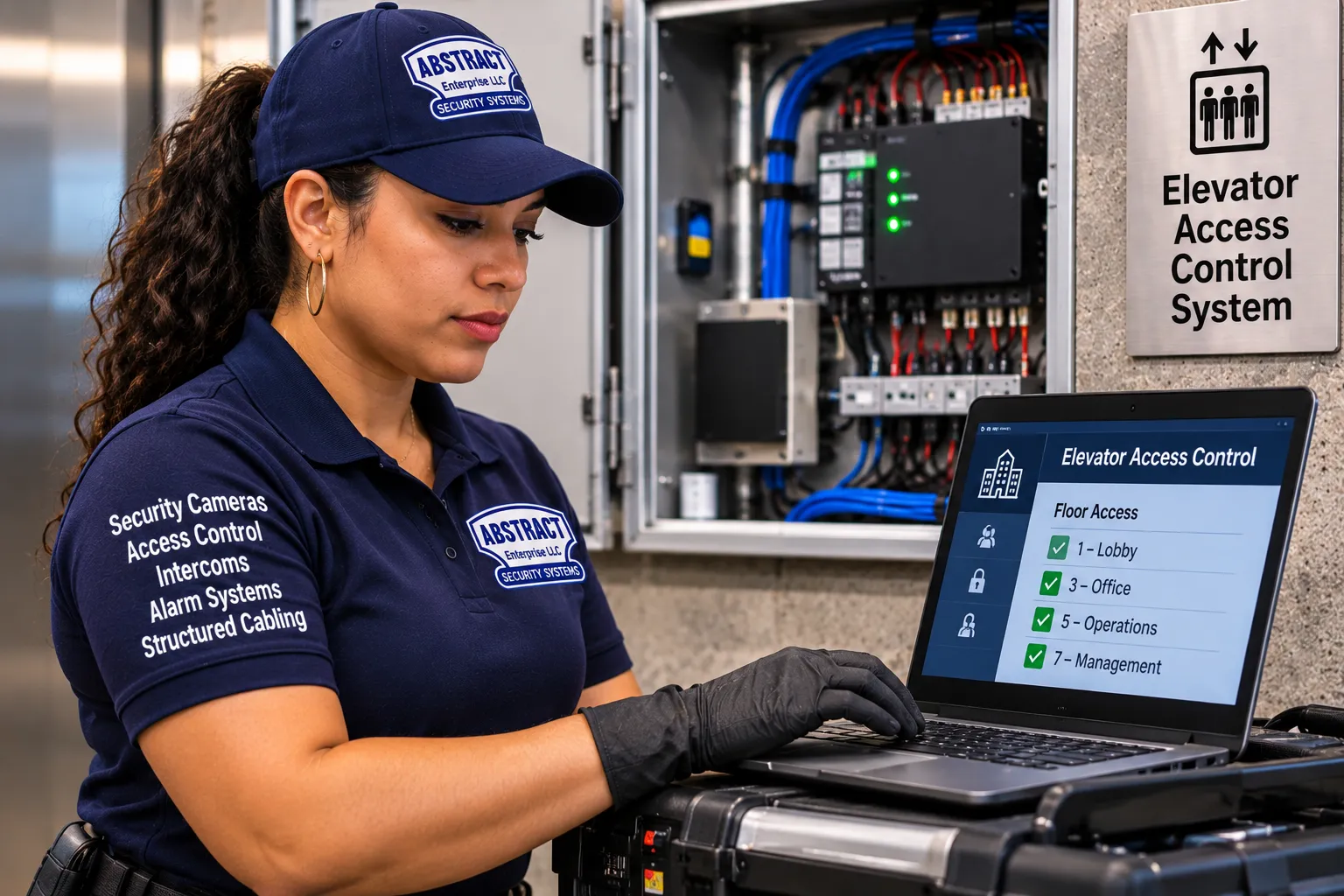
Photo from the Abstract Enterprises Security Systems elevator access control photo library (not taken in Nassau County and not a customer's building): a technician in gloves types on a laptop that shows floor permissions for lobby, office, operations and management floors, next to an open access panel. Floor-by-floor rules for a Nassau medical or office building are set up this way and checked floor by floor before handover.
Building Types
Nassau Building Types and the Elevator Access Control Each One Usually Needs
The best way to plan an elevator system in Nassau is to start from the building type. The same reader, panel and relays can be arranged a dozen ways, and the right arrangement depends on who rides, how the building is managed and what has gone wrong before. These are the types we see most across the county, with the design that usually fits each one.
Long Beach oceanfront co-ops and condos
Long Beach holds most of the county's tall residential buildings. Of the nine Nassau co-op developments of seven stories or more in a recent compilation of MLS records, eight are in Long Beach, with names residents will recognize: Long Beach Terrace and Neptune Towers at nine stories, Sea Pointe Towers at ten, and Lafayette Terrace, Oakwood House, Sherwood House, Surfside and Watersedge at seven. Most were built between 1965 and 1968. That tells us a lot. Controllers in these buildings have usually been modernized at least once, but the hoistways, machine rooms and traveling cables often date from the original construction or a modernization decades ago. Many have two cars in a bank. Residents skew older and many have lived in the building for years, while summer brings visitors, renters and guests who do not know the rules.
For these buildings we usually recommend Level 1 readers in every car of the bank, keyed to the same fob used at the front and boardwalk-side doors, with a code or video station option for residents who struggle with small fobs. Where the building has a garage or a beach-level storage floor, a landing reader at that call station often does more than anything else. And because these buildings sit on a barrier island that flooded badly in 2012, the location of the panel and its power supply is a design question in its own right, which we cover in the flood section below.
Prewar and postwar elevator co-ops on the North Shore
Great Neck Plaza, Great Neck and the surrounding villages have a different kind of elevator building: smaller, older, often closer to the train and often handsome. The Wychwood in Great Neck Plaza dates to 1929 and stands seven stories. Buildings like it have narrow hoistways, machine rooms on the roof, and traveling cables that may have been replaced once in their lives. Spare conductors cannot be assumed. Boards here tend to care deeply about how a reader looks in a paneled car, and about not disturbing residents with weeks of noisy work. A slim reader matched to the car finish, a careful survey of the cable with the elevator contractor, and a short, well-announced installation window are what these boards value.
New rentals across from the train in Mineola, Westbury and other downtowns
The fastest-growing category of elevator building in Nassau is the transit-oriented rental. Mineola has led the way: an eight-story, 119-apartment building planned across from its station; The Bridge at Mineola with 101 units across from the station; a 266-unit building at 199 2nd Street with underground parking; and a 106-unit condominium planned at 530 West Broadway in two buildings joined above a mezzanine. Westbury rewrote its downtown zoning in 2019, approved Alpine Residential's 187-unit building across from the station, and in 2026 approved the MTA's first transit-oriented development on Long Island on a former commuter lot. These buildings have multiple cars, garages, amenity floors, package rooms and a leasing office that wants everything managed from one screen.
For station rentals the right design is usually Level 3 from the start: readers in every car tied to the same platform that runs the entry doors, floor-by-floor control so each resident reaches their floor plus the shared floors, a landing reader at the garage, scheduled hours for the amenity floor, and intercom floor release so a guest who is buzzed in can ride only to the resident who let them in. If the building is still under construction, the single most valuable thing an owner can do is bring elevator access into the design before the elevator contractor finalizes the controller order, so the security inputs and traveling cable conductors are specified rather than improvised later.
Glen Cove's rebuilt waterfront
Glen Cove's Garvies Point redevelopment brings a mix of condominiums and rentals to the harbor, including plans for a large condominium building of nine residential stories over two stories of parking. Parking podiums are a recurring theme: the garage levels are where residents arrive, where guests and contractors park, and where an open gate turns into an open elevator. Readers in the cars plus a controlled garage landing are the core of the design, with the condominium board or the rental management deciding how far floor restriction should go.
Senior and supportive housing
Nassau has a steady stock of senior and supportive buildings, and they have their own needs. The Allan and Geraldine Rosenberg Residence in Freeport is five stories with 44 one-bedroom apartments and an apartment for an on-site manager. Estella Housing in the Village of Hempstead is a new five-story building with 95 affordable supportive apartments. The Homestead Senior Apartments run by the North Hempstead Housing Authority date to 1979, with elevator access to every level across 98 apartments. In buildings like these the priority is a system residents can use without thinking: large readers, credentials that work on a lanyard or wristband, codes for aides, and a clear record of who entered and when, without turning the elevator into an obstacle for people who depend on it.
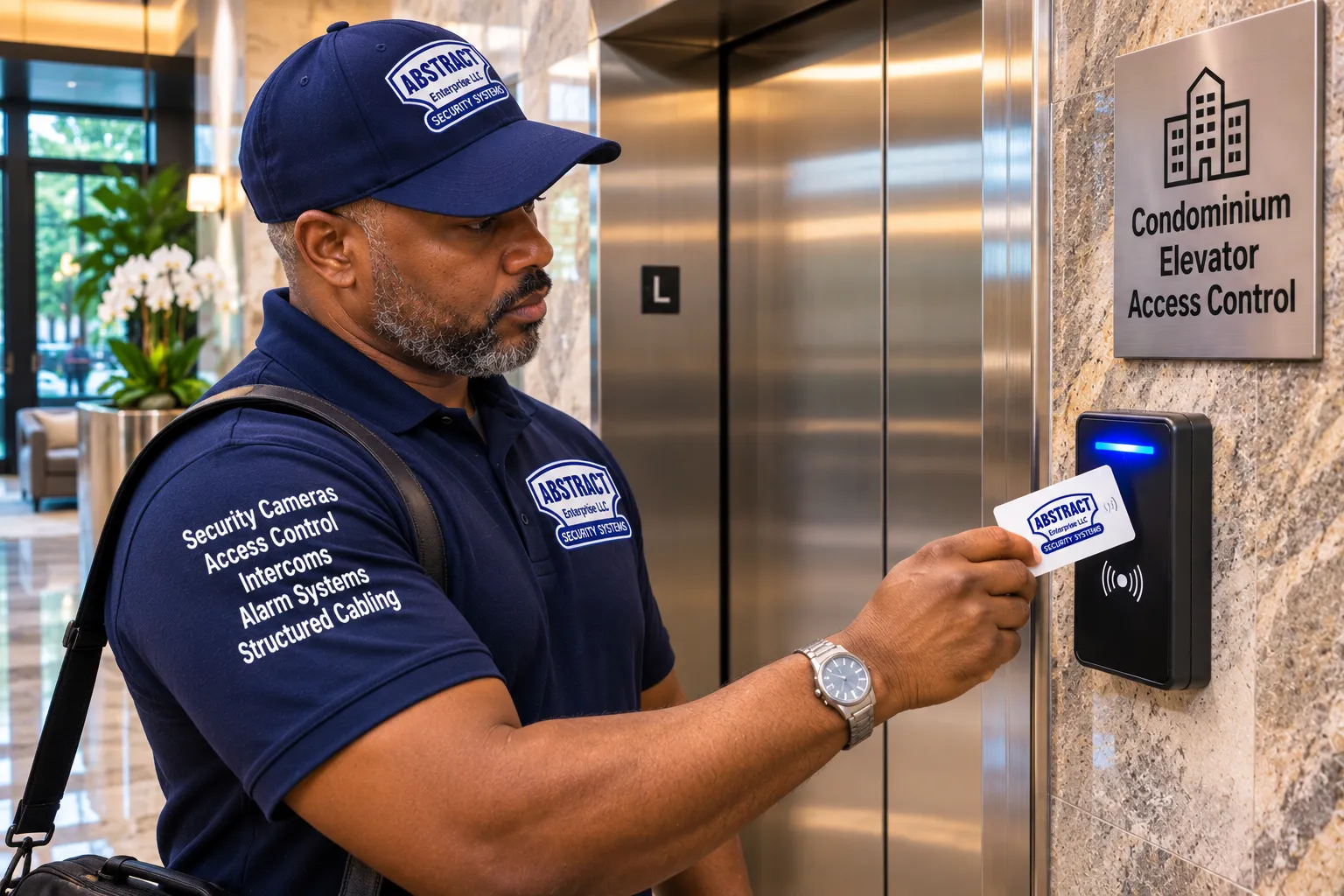
Photo from the Abstract Enterprises Security Systems elevator access control photo library (not taken in Nassau County and not a customer's building): a man in a polo shirt holds a card to a reader mounted below a sign that reads Condominium Elevator Access Control. Oceanfront and waterfront condominiums in Nassau often post a sign like this so guests and seasonal visitors understand why the car will not move for them.
Medical and professional buildings along Franklin Avenue and Old Country Road
The county seat area is Nassau's medical district. NYU Langone Hospital—Long Island, a 591-bed medical center, anchors Mineola, and Franklin Avenue in Garden City is lined with multi-suite medical buildings where practices occupy lower-level, mid-level and upper-level suites. We mention these as landmarks, not as customers. Buildings of this kind usually need floor-by-floor control with office-hour schedules, a way for cleaning crews to reach every floor at night without carrying a master fob all day, and a policy for patients who arrive after the front desk closes. The landlord, the practices and the cleaning contractor each need their own credential groups.
Office buildings and corporate parks
Nassau's office stock is mostly low-rise, but the buildings with elevators tend to be large: multi-tenant buildings in Garden City and Mineola near the courts and county offices, and office parks along the Northern State and Long Island Expressway corridors. Tenants often bring their own badge systems. The elevator design question is whether the building can read each tenant's badges, or whether every tenant needs a second credential just for the elevator. Where the readers support several card formats, we program the building's system to accept them; where they do not, a mobile credential is often the cleanest common denominator.
Mixed-use buildings in village downtowns
From Rockville Centre to Freeport to Great Neck, many downtowns have three- to five-story buildings with stores on the ground floor and apartments or offices above, sometimes served by one small elevator. The problem here is usually customers of the ground-floor business finding their way upstairs. A single Level 1 reader in the car, with the ground floor always open and everything above it credential-only, solves that for very little equipment.
Two Contractors
Who Does What: Our Low-Voltage Crew and Your Licensed Elevator Contractor in Nassau
The most common misunderstanding about elevator access control is who is allowed to do which part of it. In New York State, the business and the workers who install, maintain or repair elevators must be licensed under Article 33 of the Labor Law. Wiring a reader into a car, landing a relay output on a controller terminal and changing how the controller responds to floor calls are elevator work. Abstract Enterprises Security Systems holds New York State low-voltage license #12000287431 and does the access control side; we do not touch the elevator's controller, safety circuits, door operators or hoistway equipment, and we do not claim to.
In practice the two crews work as one job. We survey first, often with the elevator contractor's technician present or on the phone, and write a proposal that names both scopes. The building orders the elevator contractor's part directly from its maintenance company, because that company already holds the maintenance contract, knows the controller and carries the responsibility for the elevator's safe operation. We then schedule our installation days around the elevator technician's visits so the car is out of service as briefly as possible.
Task on a Nassau elevator job
Who does it
Site survey of cars, landings, lobby, garage and machine room
Abstract Enterprises Security Systems, with input from your elevator contractor
Choosing readers, credentials and the access platform
Abstract Enterprises Security Systems, with your board or management
Mounting readers in the car and at landings
Abstract Enterprises Security Systems (in-car mounting coordinated with the elevator contractor)
Assigning traveling cable conductors or installing a new cable
Your licensed elevator contractor
Installing the access panel, power supply, battery and relay boards
Abstract Enterprises Security Systems
Connecting relay outputs to the elevator controller
Your licensed elevator contractor
Confirming the access system is bypassed in firefighters' service
Your licensed elevator contractor, tested with us
Programming credentials, floors, schedules and visitor rules
Abstract Enterprises Security Systems
Training the board, super or manager
Abstract Enterprises Security Systems
Ongoing elevator maintenance and inspections
Your licensed elevator contractor
If you do not know which company maintains your elevators, the name is usually on the inspection certificate or maintenance card in the car, or in the managing agent's contract file. Bring it to the survey. When the elevator company has been with the building for years, their technician often knows exactly which conductors are free and which controller terminals are spare, and that knowledge saves days. If your elevator contractor tells you an access interface is not possible on your controller, ask them to say why in writing; sometimes the honest answer is that it needs a part or a new traveling cable, which is a cost to plan for, not a reason to give up.
Approvals
Permits in a County of 64 Villages: Who Signs Off on Elevator Access Work in Nassau
Building owners new to Nassau are sometimes surprised that there is no single county building department to call. The county's own permit page says it plainly: building permits come from your city, town or village. Long Beach and Glen Cove issue their own. The towns of Hempstead, North Hempstead and Oyster Bay issue permits in their unincorporated areas. And most of the 64 incorporated villages, from Garden City and Mineola to Great Neck Plaza, Rockville Centre, Freeport and Westbury, run their own building departments with their own inspectors. Village building superintendents work under the New York State Uniform Fire Prevention and Building Code; the village code of Floral Park, for example, requires its superintendent of buildings to hold the qualifications of a code enforcement officer under the Uniform Code.
What does that mean for an elevator access project? Three things.
The elevator side follows the elevator code. New York State's codes reference ASME A17.1, the safety code for elevators, and alterations to elevator equipment are the licensed elevator contractor's responsibility, including any filing or inspection their work requires in your jurisdiction. We plan the schedule around that, not around it.
The low-voltage side is usually light. Readers, panels and low-voltage cable are often treated as minor work, but practice varies by municipality. On every Nassau job we confirm with the local building department, or have the managing agent confirm, whether a permit is required before we book installation days. We never tell a building a permit is not needed without checking with the municipality that actually issues it.
The fire alarm side belongs to the fire alarm contractor. Many access systems are tied to the building's fire alarm so that doors release and readers step aside in an emergency. In Nassau, fire alarm plan approval and permits are handled by the Nassau County Fire Marshal's office in Westbury, which enforces the county fire prevention ordinance and the state code and performs plan review on commercial construction. If our work needs a fire alarm relay or a change to the fire alarm's programming, the building's fire alarm contractor makes that change and files whatever the Fire Marshal requires. We supply the interface details.
One point deserves emphasis because it is often stated wrongly online. New York City's rules for smart-access buildings, including Local Law 63 of 2021, apply inside the five boroughs. They do not apply in Nassau. That does not mean Nassau buildings have no privacy duties, and we explain the ones that do matter in their own section. It does mean that advice written for Manhattan landlords should not be copied into a Garden City co-op's house rules without checking.
Safety
Firefighters' Service, Storm Surge and Blackouts in Nassau Elevator Buildings
An elevator security system is judged on its worst day. A board does not lose sleep over a fob that works on a sunny Tuesday; it loses sleep over what the elevator will do during a fire, a hurricane or a summer blackout. These are the three scenarios we design for on every Nassau job.
Fire: the elevator stops listening to the access system
Modern elevators have firefighters' emergency operation. When a smoke detector in an elevator lobby or machine room trips, or when a firefighter turns the recall key in the lobby, the cars return to a designated floor and open their doors. That is Phase I. A firefighter can then take a car under manual control from inside, which is Phase II. The safety code for elevators requires that devices added to the car or the hall stations, such as card readers, must not interfere with that operation and must become inoperative when it begins. In plain terms, the moment the elevator enters fire service, our relays no longer matter. The elevator contractor wires the interface so that this happens automatically, and we test it with them before the system goes live. No Nassau building should accept an elevator access installation that has not had that test witnessed and written down.
Storm surge: put the brains of the system above the water
Nassau's south shore knows what salt water does to building systems. In the days after Hurricane Sandy in 2012, a property manager described Long Beach buildings that lost their ground floors, lobbies and heating plants; at one building on Neptune Boulevard the boiler room sat under fifteen feet of water, and at an oceanfront condominium the first floor, gym and lobby were destroyed. Elevator machine rooms on the roof generally survived; anything in a basement, cellar or ground-floor closet did not. We apply that lesson directly. In Long Beach, Oceanside and other flood-exposed parts of the south shore, we recommend placing the access control panel, its power supply and battery in the machine room or on an upper floor, never in a cellar, and running the lobby and garage reader cable so that a flooded ground floor means replacing readers rather than replacing the system. Where a garage reader must sit at a flood-prone landing, we choose a reader that can be swapped in minutes and keep a spare on site.
Power failure: decide the answer in advance
Every access panel we install has a battery, so short interruptions pass unnoticed. A long outage raises a policy question the board must answer before it happens: when the panel's battery runs down, should the controlled elevators fail open, meaning anyone can ride anywhere, or fail secure, meaning only staff with a key switch can operate them? In most residential buildings, and in any building where people depend on the elevator to get home, failing open is the safer choice for people even if it is the weaker choice for security. Buildings with an emergency generator that powers the elevators should also power the access panel from the same emergency circuit, or the elevators will run on the generator while the readers sit dark. We ask whether your building has a generator, what it carries and who tests it.
Manual override and accessibility
Every system we install has a way for staff to bypass the readers: a key switch in the car or the lobby, a button in the management software, or both. That override exists for move-in days, emergencies, inspections and the morning a resident's fob fails while they are holding groceries. We also design around residents with disabilities. Readers are mounted where a seated rider can reach them, credentials can be wristbands or larger cards, and a resident who cannot tap at all can be given a code or a phone credential instead.
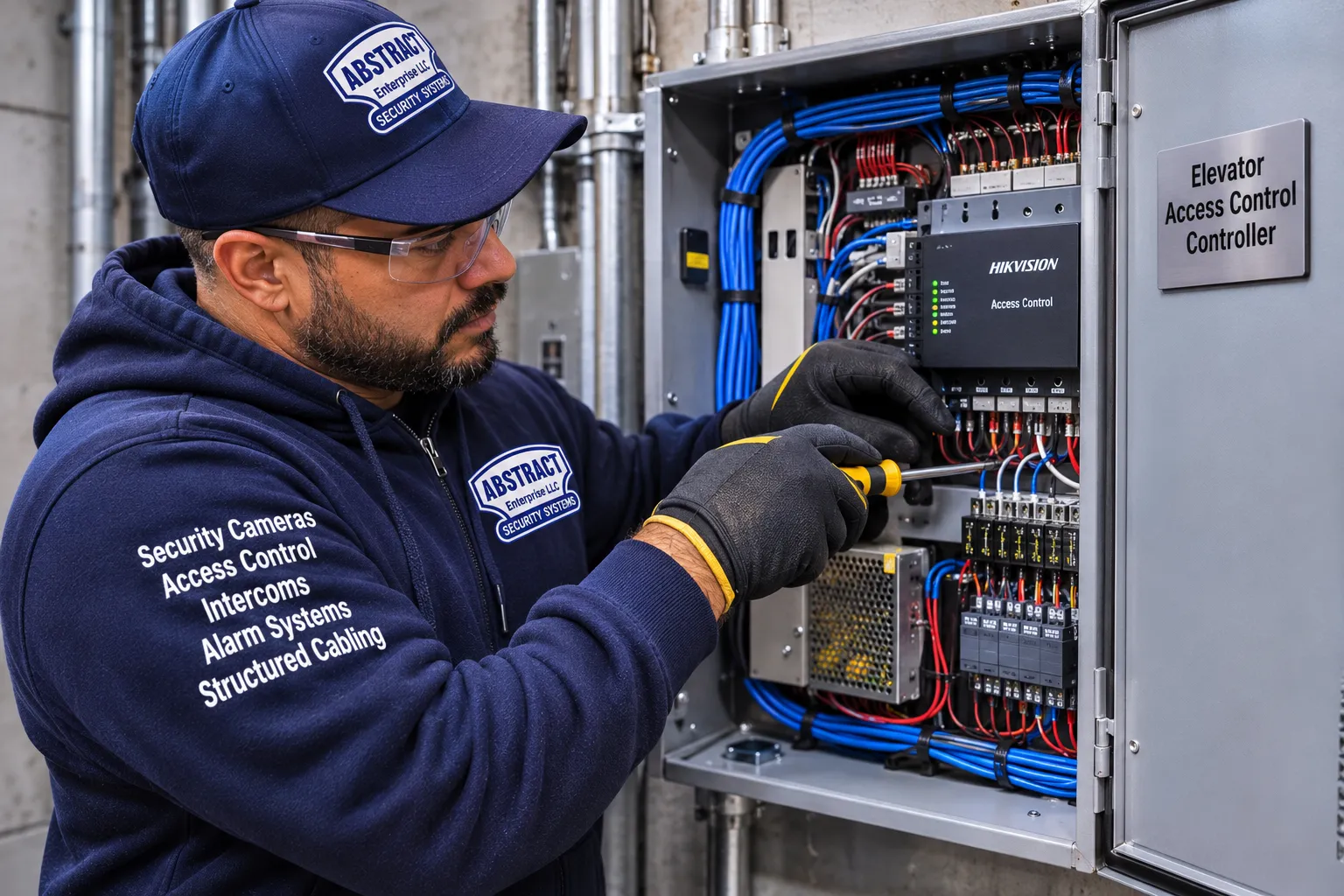
Photo from the Abstract Enterprises Security Systems elevator access control photo library (not taken in Nassau County and not a customer's building): a technician lands wires inside a metal enclosure labeled Elevator Access Control Controller. On the Nassau south shore we place this panel and its battery in the machine room or on an upper floor, never in a cellar that can flood.
Privacy
Privacy Outside the City Line: Fob Logs, Biometrics and Staff Fingerprints in Nassau
An elevator access system keeps a record of every ride: which credential, which car, which floor and when. That audit trail is one of its main benefits, because it lets a manager answer real questions, such as whether a former tenant is still getting in, or whether the roof door alarm at midnight lines up with someone riding up. It is also personal information, and a Nassau board or landlord should treat it that way.
As noted above, New York City's tenant data privacy law does not reach Nassau. New York State has, at the time of writing, no general biometric privacy statute in force for residential buildings. A statewide Biometric Identifier Privacy Act has been introduced in the State Senate as S1422A, but it is a bill, not a law, and we do not describe it as anything else. There is one state rule that does apply today, and it matters for staff rather than residents: New York Labor Law section 201-a bars employers from requiring employees to be fingerprinted as a condition of employment. A management company or building that wants staff to use fingerprint readers in the elevator should make enrollment voluntary and offer a card or fob alternative. This is general information, not legal advice; your building's attorney should review any biometric program.
Beyond the legal minimum, these are the practices we recommend for every Nassau elevator system, whether or not anyone requires them:
Tell residents and tenants in writing what the system records, who can see it and how long it is kept.
Keep logs only as long as you need them for security, and delete the records of people who have moved out.
Give each staff member their own administrator login so changes can be traced, and remove logins when people leave.
For face or fingerprint readers, store templates rather than photos where the platform allows it, and offer a non-biometric option to anyone who asks.
Never use elevator logs to monitor residents for reasons unrelated to building security.
Credentials
Fobs, Cards, Codes, Phones and Faces: Choosing Credentials for Nassau Riders
The credential is the part of the system people touch every day, so it deserves more thought than the brand of the panel. The right choice depends on who rides your elevator.
Key fobs. Small, durable, cheap to replace and familiar. Most Nassau co-ops start here, often using the same fob already issued for the front door. Their weakness is that they are easy to lend and easy to copy if the building uses an old, unencrypted format.
Cards. Better for offices and medical buildings, where staff already carry badges and photos can be printed on them. Many readers accept several card formats, which matters in multi-tenant buildings.
Codes. A keypad or combination reader lets a resident who forgot a fob still ride, and lets a home aide or a contractor use a temporary code that expires. Codes can be shared, so they work best alongside fobs rather than instead of them.
Phones. Elevator access control with smartphone credentials is increasingly popular in station rentals, where residents expect to manage everything in an app and management wants to issue and revoke access without handing out plastic. Phones run out of battery, so we keep a fob or code as a backup.
Video stations. A video keypad station in the car or at the garage landing can combine a code, a card reader and a camera, and some can call the management office. They suit buildings that want a person to be able to help a rider remotely.
Biometrics. Face, fingerprint and iris readers end the problem of lent and lost fobs, and they suit buildings with high turnover or strict staff areas. They cost more, they carry the privacy considerations described above, and they need good lighting and placement to work well in a car.
If your building already uses fobs or cards at the entry doors, the first question we answer at the survey is whether the elevator readers can read the same ones. If they can, residents carry one credential for everything. If the existing format is old and insecure, a building may use the elevator project as the moment to re-badge everyone onto a modern encrypted credential, which we can phase in over a few weeks so nobody is locked out.
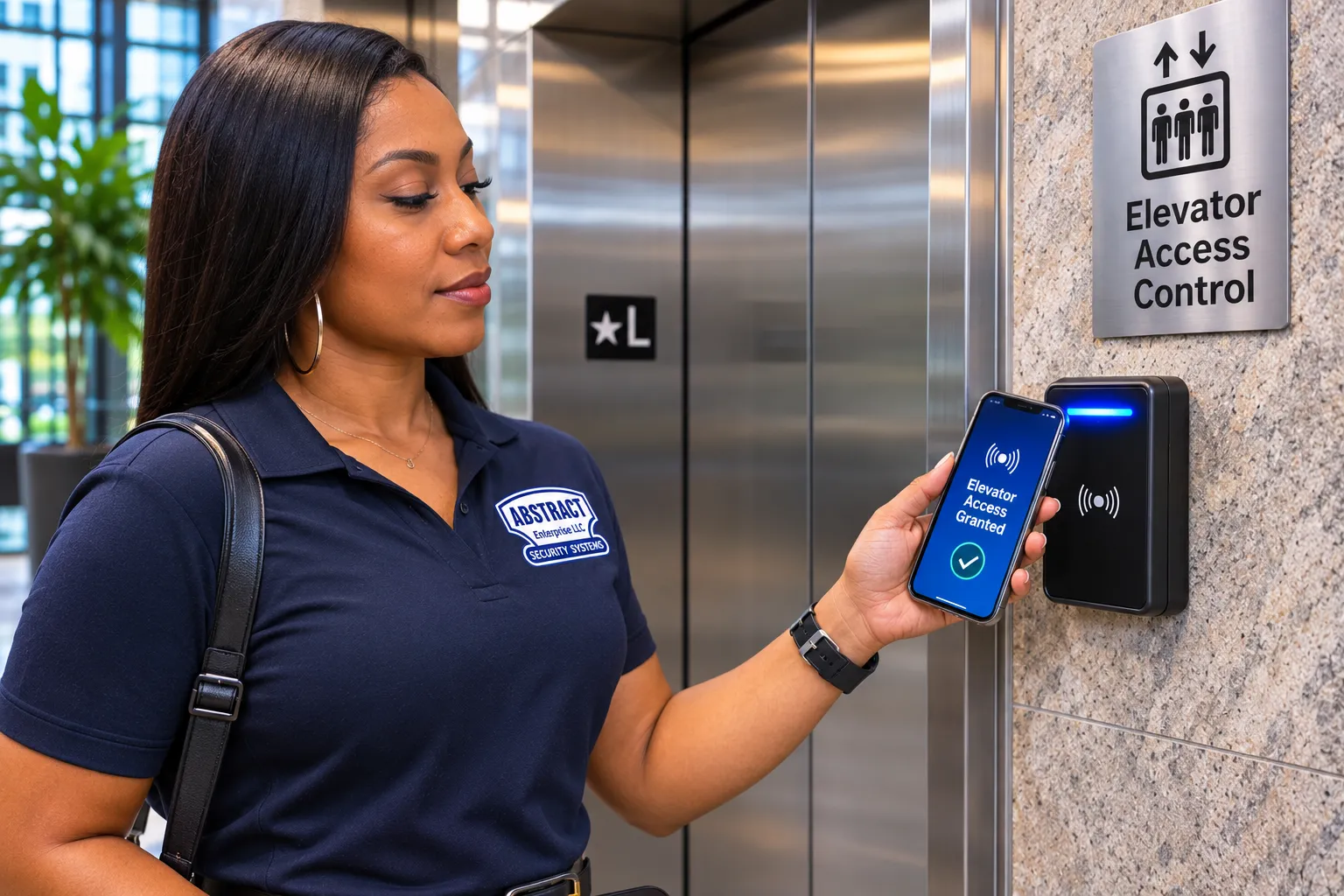
Photo from the Abstract Enterprises Security Systems elevator access control photo library (not taken in Nassau County and not a customer's building): a woman holds a phone displaying Elevator Access Granted up to a reader beside an elevator. Phone credentials are common in new Nassau station-area rentals, usually with a fob or code kept as a backup.
People
Visitors, Home Aides, Package Carriers and Garage Arrivals in Nassau Buildings
Residents are the easy part. Every elevator system succeeds or fails on how it treats everyone else, and Nassau buildings have a particular mix of non-residents who need a rule before the system goes live.
Guests who drive in. In much of Nassau, visitors arrive by car and walk in from a lot or a garage rather than through the front lobby. If the intercom is at the front door and the guest is in the garage, someone has to decide how they get up. The usual answers are a garage intercom that can release the elevator to the resident's floor, or a guest code the resident issues for the visit.
Home health aides and caregivers. Many older Nassau buildings have residents who rely on daily visits from aides. A schedule-limited code or credential, issued by the resident or the office and expiring automatically, keeps them moving without handing out permanent fobs.
Package and food deliveries. Most buildings now want carriers to reach the package room and no further. A delivery code that works only for the lobby or the package-room floor, or a package room on the ground floor so carriers never need the elevator, is the cleanest design.
Summer and seasonal visitors. Oceanfront buildings in Long Beach and along the south shore see guests and seasonal renters who stay a week or a month. Time-limited credentials that end on the checkout date are far better than fobs that walk away.
Contractors and movers. A move or a renovation can need the elevator for days. A credential tied to one floor and one week, plus the key switch override for the moving pads, keeps the job going without leaving the system wide open.
Emergency responders. Police and EMS need a way in that does not depend on someone finding a fob. The fire service override covers firefighters; for other responders most buildings use a lock box or an arrangement with the local police and fire department, which the board should confirm.
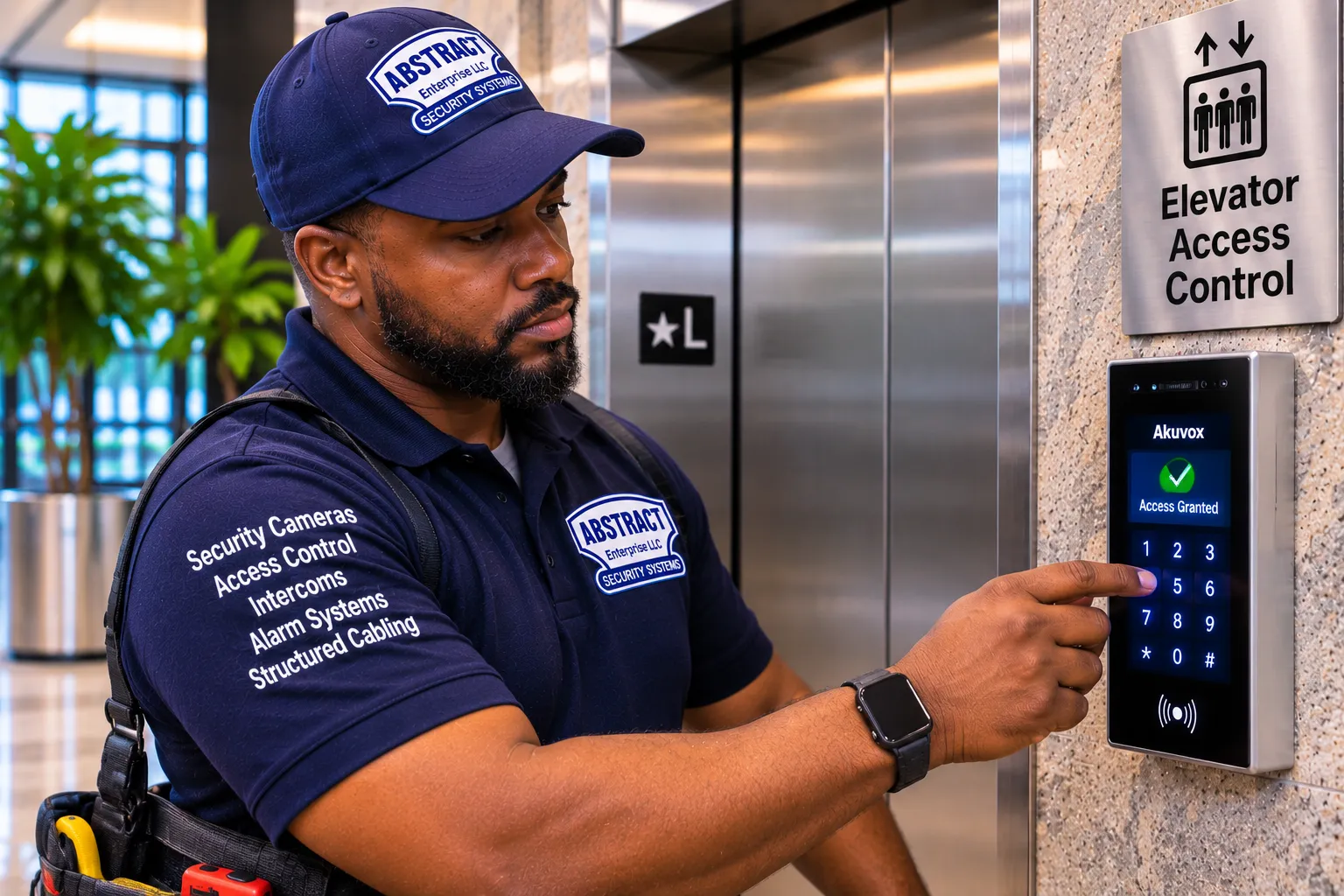
Photo from the Abstract Enterprises Security Systems elevator access control photo library (not taken in Nassau County and not a customer's building): a technician presses a code on an Akuvox keypad and reader that shows Access Granted next to an elevator. A keypad gives Nassau senior buildings a way for home aides to ride with a temporary code instead of a permanent fob.
Each of these rules is written into the programming worksheet with a name next to it, so the super, the managing agent and the board all know who issues guest codes, who can extend a contractor's access and who gets the phone call when something does not work.
Process
Our Installation Process in a Nassau Elevator Building, Step by Step
This is the sequence we follow on every elevator access control job in Nassau, from a single reader in a four-story mixed-use building in a village downtown to floor-by-floor control in a station rental with a garage. The elevator contractor appears at steps four and seven by design, and the building is told in advance which days the cars will be out of service.
Request and booking. You call (516) 346-5778 or send the form. We book a survey within 2 hours of your request and give you a 2-hour arrival window for the visit itself. We do not promise same-day surveys or installations.
Survey. We ride every car, look at every landing that needs control, inspect the lobby and garage doors, open the machine room with your super, and note the controller make, the traveling cable, the available power and the network path. We photograph the car panels so the reader can be placed where it looks and works best.
Design and written proposal. We set out the level for each car, the readers and where each one mounts, the panel and relay count, the credential platform, how visitors get up, the fire service and power-failure behavior, and a price for every line. The elevator contractor's scope is listed separately so the building can order it directly.
Elevator contractor coordination. The building sends our interface sheet to its elevator maintenance company. Their technician confirms the spare conductors and controller inputs, or tells us what is needed, and we agree on dates.
Rough-in. We install the panel, power supply, battery and relay boards, run cable from the machine room to the hoistway and to any landing readers, and mount the readers. Most of this happens with the cars in service.
Programming. We load your residents, tenants and staff from the list you provide, set up floors, schedules, credential groups and visitor rules, and connect the system to the management software or app.
Controller connection and testing. On the agreed day the elevator technician makes the connection inside the controller. Together we test every car and every controlled floor with valid and invalid credentials, test the override, and witness the fire service bypass.
Go-live and training. We switch the system on, hand out or activate credentials, and train the person who will run it. You receive a written record of the programming, the device locations and the test results.
Follow-up. We check in after the first weeks of use to adjust timers, schedules and any reader placements residents find awkward.
How long it takes
For a Level 1 job in a building with one or two cars and spare conductors, our on-site work is typically a day or two, and each car is out of service only while the elevator technician makes the connection and we test it. Floor-by-floor control in a larger building takes longer, and the elevator contractor's schedule is usually what sets the calendar. We tell you the expected dates in the proposal and confirm them once the elevator company has committed.
What the building has at the end
At handover you have working readers, a documented panel, a credential list that matches your rent roll or shareholder list, a programming worksheet anyone can read, administrator logins for the people you name, and a tested record that the elevators ignore the access system in fire service. Those documents matter if your board changes, your managing agent changes, or another company ever has to work on the system.
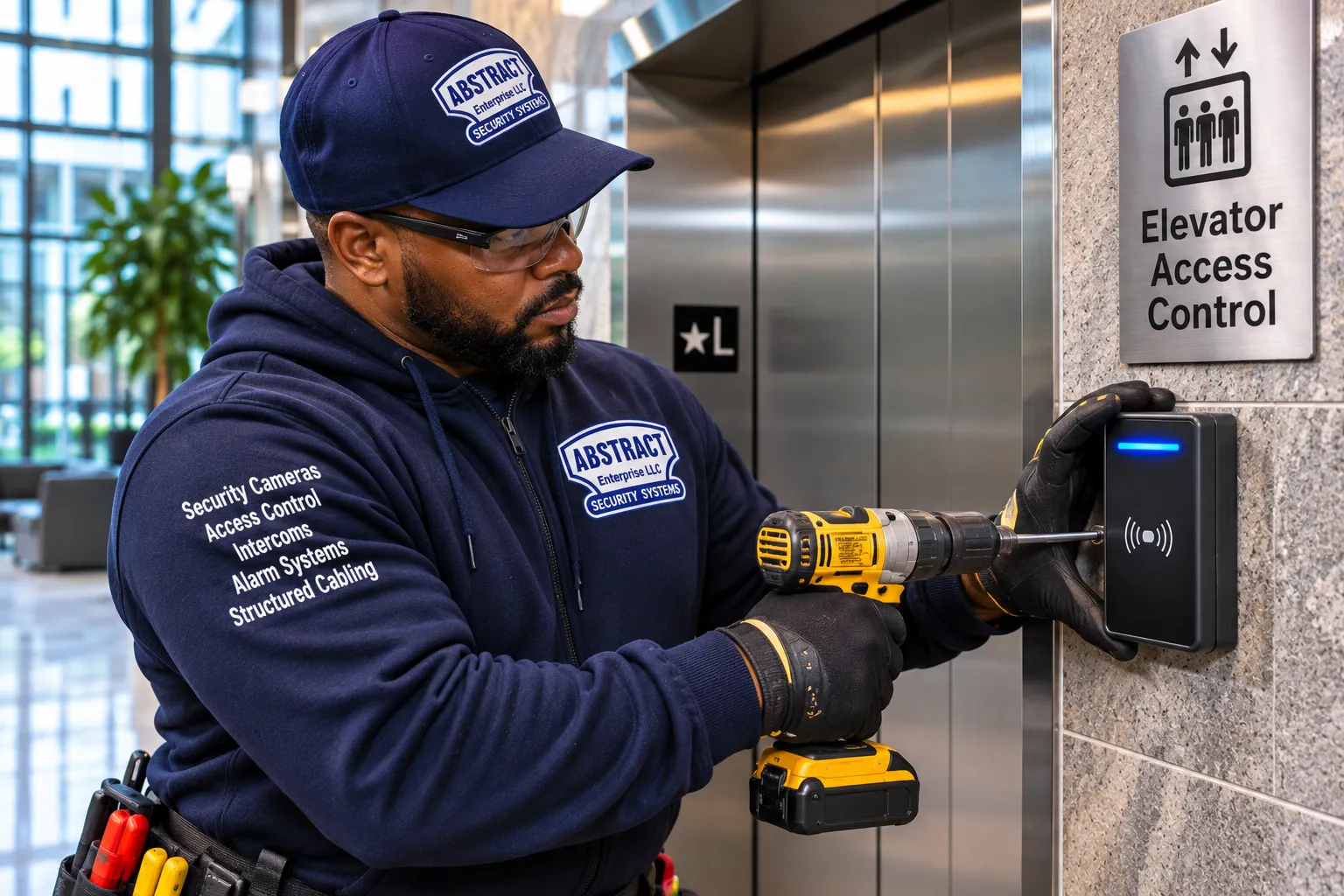
Photo from the Abstract Enterprises Security Systems elevator access control photo library (not taken in Nassau County and not a customer's building): a technician uses a cordless drill to fasten a black reader to a granite wall beside an elevator. Stone and tile lobbies in older Nassau co-ops call for careful anchoring and a clean cable path so the finish is not damaged.
Pricing
Elevator Access Control Cost in Nassau County, Level by Level
Elevator access control from Abstract Enterprises Security Systems is priced per elevator car in three levels, at the Nassau County rate. Level 1 puts a reader inside the car, whether a card, fob, code or phone reader, or a video or keypad station such as Akuvox; once a rider is approved they can choose any floor the car serves. Level 2 uses face recognition, fingerprint or iris readers in the car. Level 3 covers floor-by-floor restriction, readers at landing call stations such as the garage, time schedules, intercom floor release and destination dispatch links, and it is quoted per building after the survey because it depends on how many floors, cars and landings are controlled.
Level
What it covers
Nassau County starting price
Level 1
Card, fob, code, phone or video station reader in the car; approved riders choose any floor
from $1,725 per car
Level 2
Face recognition, fingerprint or iris reader in the car
Two costs sit outside our price, and we say so on every proposal. The elevator contractor's work at the controller, and any new traveling cable, is ordered and paid by the building directly with its elevator company. And if a car needs a network connection or a new cable path so it can be managed remotely, that run is quoted after the survey because it depends on the building.
Worked examples for typical Nassau buildings
Seven-story Long Beach co-op, two cars in one bank. Level 1 readers in both cars on the existing door fobs: from $3,450, because each car has its own reader and connection, plus the elevator contractor's work billed to the building.
Same building with a staff-only roof and a controlled garage landing. Level 1 in both cars plus a Level 3 addition for the roof stop and the garage call station, quoted after the survey.
Five-story senior residence, one car. Level 1 in the car with fobs and codes for aides: from $1,725 for the car.
Medical building on Franklin Avenue with practices on separate floors. Level 3 floor-by-floor control with office-hour schedules and a cleaning-crew group, quoted after the survey.
New eight-story rental across from a station, two cars and a garage. Level 3 throughout with phone credentials, amenity-floor hours and intercom floor release, quoted after the survey, ideally before the controller is ordered.
Board that wants face readers in a single-car co-op. Level 2 in the car: from $2,875, with a fob or code fallback for anyone who does not enroll.
What moves a Level 3 quote: the number of controlled floors and cars, landing readers, the controller type and whether spare conductors exist, the credential platform, intercom and camera links, and the cable path. A clean riser and a modern controller make for a quicker job; a 1920s hoistway with no spare conductors takes more planning.
Every quote is written per building after the survey, lists each item on its own line and shows the elevator contractor's portion separately. Visits are booked in 2-hour arrival windows.
Full terms — including 50% deposit, one-year parts-only warranty on Abstract Enterprises Security Systems-supplied products, and the late-fee schedule — are set out in the service agreement.
Compare
Level 1, Level 2 and Level 3 Side by Side for a Nassau Property
Level 1: reader in the car
Level 2: biometrics
Level 3: floor-by-floor and more
Stops
Anyone without a credential from riding
Same, and ends lent or shared fobs
Riders reaching floors that are not theirs
Typical Nassau building
Long Beach and North Shore co-ops, senior buildings, mixed-use downtowns
Buildings with high staff turnover or chronic fob sharing
Station rentals, multi-tenant medical and office buildings
Relays per car
Usually one
Usually one
One per controlled floor, plus landings
Elevator contractor work
One input per car
One input per car
Several inputs per car, sometimes a new cable
Starting price in Nassau
from $1,725 per car
from $2,875 per car
Quoted per building
Can grow later
Yes, to Level 3 with the same panel and credentials
Yes
Already the full system
Most buildings do not need to choose once and for all. A co-op that installs Level 1 this year can add a controlled garage landing next year and floor restriction for the roof after that, without replacing the readers or re-issuing credentials, as long as the first installation was designed with room to grow. We design every Level 1 job that way.
Existing Systems
Taking Over, Repairing or Upgrading an Existing Elevator Access System in Nassau
Many Nassau buildings already have some form of elevator access control, installed years ago by a company that has since merged, retired or stopped answering the phone. The symptoms we hear about are consistent: fobs that open the front door but do nothing in the car; one car that works and one that does not; a reader whose light is dead; a system nobody can log into because the only password belonged to a former super; schedules that still follow a tenant list from years ago; or a car that suddenly stopped requiring a fob at all, which usually means someone bypassed it and never put it back.
Our elevator access control repair and maintenance work starts with a diagnostic visit. We identify the panel and the readers, check power, batteries and communications, read the event log if we can reach it, and find out from the elevator contractor how the system is connected at the controller. From there the options are usually clear:
Repair. Replace a failed reader, power supply or battery, reprogram the panel and restore the connection. Often the cheapest fix.
Take over. Recover or reset the administration, document what exists and put the building back in control of its own system.
Upgrade. Keep the cable and controller interface but move to a current panel and readers, so the building gets remote management, encrypted credentials and a supported platform.
Replace. Where the existing system is obsolete or unsafe, design a new one, often reusing the conductors and the controller inputs the elevator contractor already set up.
We will tell you plainly which of these makes sense. An elevator access control system replacement and upgrade is not always the right answer; sometimes a single inexpensive part and an afternoon of programming put a perfectly good system back to work.
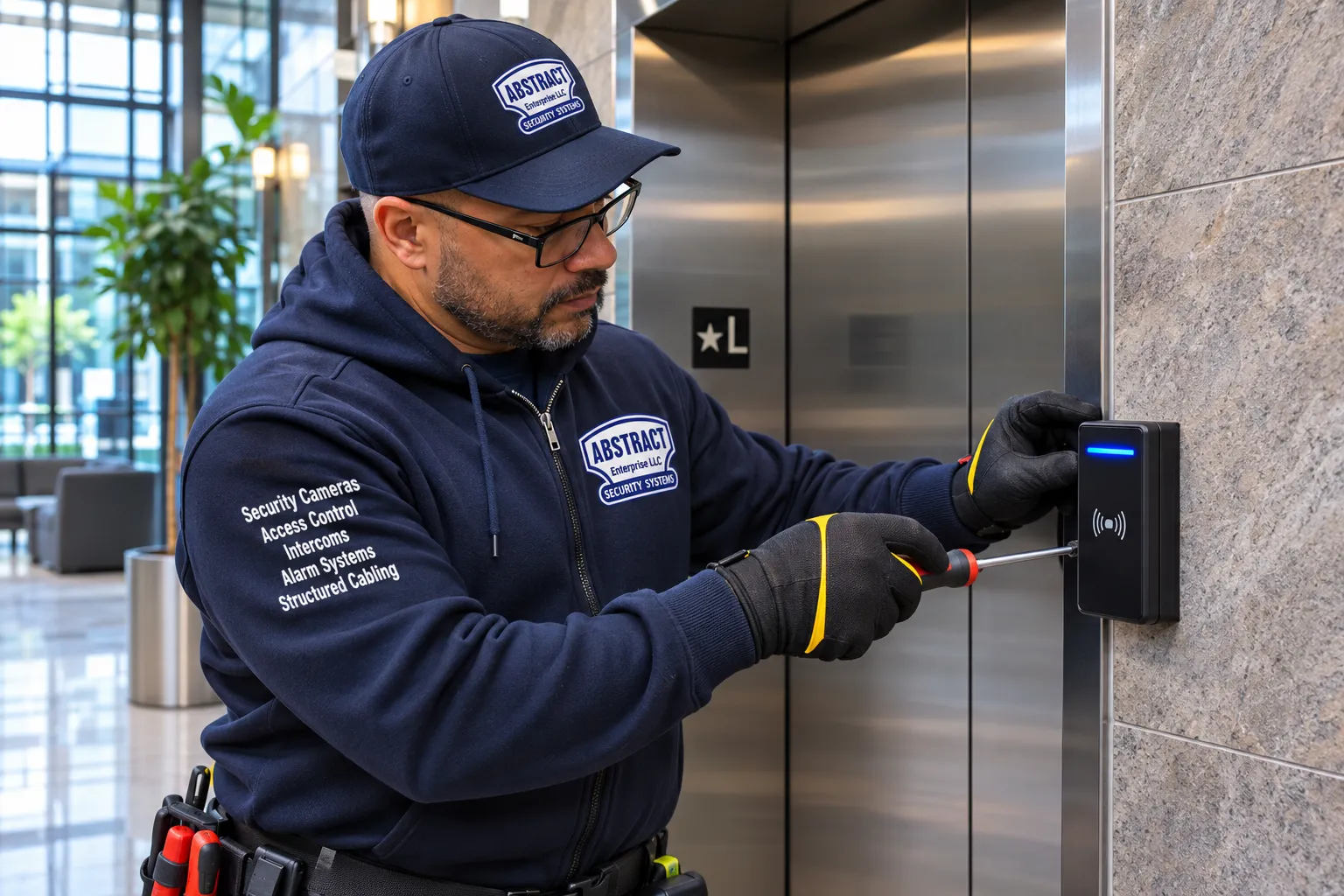
Photo from the Abstract Enterprises Security Systems elevator access control photo library (not taken in Nassau County and not a customer's building): a technician in glasses tightens a screw on a black card reader mounted beside stainless elevator doors. Many Nassau repair calls end with exactly this: a loose or failed reader replaced and the existing system brought back under the building's control.
Platforms
Elevator Access Control Platforms We Install and Integrate in Nassau
We install, integrate and service a range of access control platforms in Nassau elevators. We are not a certified dealer or partner of these manufacturers unless we say so in writing for a specific product, and we do not represent ourselves that way. What matters to a building is whether we can make the platform it already has, or the one it chooses, work properly in the elevator.
Intercom-led platforms such as Akuvox, ButterflyMX and 2N, where the video station at the door also issues credentials and can release the elevator for a visitor.
Cloud access platforms such as Brivo and Kisi, popular with managers who run several buildings and want everything in one app.
Enterprise platforms such as LenelS2, Genetec, Gallagher and ICT, common in office and medical buildings with corporate security standards.
Reader and controller hardware from HID, Suprema, ZKTeco, Paxton and Axis, including multi-format card readers and biometric readers.
The platform decision is usually made by the entry doors, not the elevator. If your building runs one system at the lobby, we normally extend that same system into the elevators so residents carry one credential and the manager uses one screen. If the building is choosing a platform for the first time, we walk through the trade-offs for your size and staffing rather than steering you to a favorite brand.
Myths
Common Misconceptions About Elevator Security in Nassau County
Search results and AI summaries about elevator access control are mostly written for Manhattan office towers. Applied to Nassau buildings, several of the most repeated claims are wrong or incomplete.
"Elevator access control means replacing the elevator." It does not. The elevator keeps its motor, controller, doors and safety systems. Our equipment is added beside it and connected through a small number of inputs.
"Any security company can wire a reader into the car." Not in New York State. The connection inside the elevator controller is elevator work under Article 33 of the Labor Law and belongs to a licensed elevator contractor. A security company that offers to do it alone is offering to do something it should not.
"The readers will trap people during a fire." A correctly installed system is bypassed the instant the elevator enters firefighters' service, which is a requirement of the elevator safety code. That is why the fire service test is part of every handover.
"New York City's tenant privacy law applies to every New York building." Local Law 63 is a New York City law. Nassau buildings are not covered by it, though sensible privacy practices are still worth following.
"Floor restriction is always better." Floor restriction is stronger, but for many Nassau co-ops a car reader alone solves the actual problem with a fraction of the equipment and inconvenience.
"One permit covers the county." Nassau has two cities, three towns and dozens of villages with their own building departments. The right office depends on the address.
"Phones have made fobs obsolete." Phones are convenient, but residents' batteries die and some residents do not want an app. Most buildings run phones and fobs side by side.
Coverage
Nassau Towns and Cities We Cover for Elevator Access Control
We provide elevator access control installation across all of Nassau County, booked in advance with 2-hour arrival windows. In practice our work concentrates where the elevator buildings are:
City of Long Beach, along Shore Road, the boardwalk blocks and the downtown around the station, where the county's tallest residential towers stand.
Town of North Hempstead, including Great Neck Plaza and the Great Neck villages, Westbury, Mineola, Garden City Park, Port Washington, Manhasset and the Lake Success office buildings.
Town of Hempstead, including Garden City, the Village of Hempstead, Rockville Centre, Freeport, Oceanside, Valley Stream and Lynbrook, where downtown rentals, senior housing and medical buildings are growing.
Town of Oyster Bay, including the Hicksville and Syosset station areas and the office parks along the expressway corridors.
City of Glen Cove, including the Garvies Point waterfront and the downtown.
Mineola, for example, is an incorporated village that sits partly in the Town of Hempstead and partly in North Hempstead, which is another reminder that in Nassau the municipality matters more than the hamlet name on your mail. Wherever your building is, the direct line for Nassau elevator work is (516) 346-5778. If your property is farther east, our Suffolk County elevator access control page covers that county, and buildings across the city line are covered by our borough pages, all linked at the bottom of this page.
Hiring
Questions to Ask Before You Hire an Elevator Access Control Contractor in Nassau
Whether you hire us or someone else, these questions separate a contractor who has done elevator work from one who has only done doors.
Who will make the connection inside the elevator controller, and is that person working for a licensed elevator contractor?
Will you meet or speak with our elevator maintenance company before you quote, and will their scope be listed separately?
How will the system behave in firefighters' service, during a power failure and if the panel loses its network connection, and will the fire service bypass be tested in front of us?
Where will the panel and power supply go, and why there? In a flood-exposed building, what happens if the ground floor floods?
Can the elevator readers use the credentials we already have at the front door?
How many relays and controller inputs does your design need, and what happens if the traveling cable has no spare conductors?
Who will own the administrator account at the end, and what documentation will we receive?
What is your low-voltage license number, and are you insured for work in an occupied building?
What is the warranty on the equipment you supply, and who do we call when something stops working?
Can the system grow from a car reader to floor restriction later without replacing what we buy now?
A contractor who answers all ten clearly, in writing, is a contractor you can work with. Our answers are in the proposal we leave after the survey.
Why Us
Why Nassau Properties Choose Abstract Enterprises Security Systems for Elevator Access
Abstract Enterprises Security Systems has been owner-operated since 2002, and we have completed thousands of jobs for residential and commercial buildings across New York City, Long Island and the Hudson Valley. We hold New York State low-voltage license #12000287431 and carry a 4.7-star rating across 201 Google reviews. For Nassau elevator work, what we bring is specific:
Two-contractor planning from day one. We write proposals that show your elevator company's part separately and coordinate dates with them, so the board is not left to referee.
Designs that start small and grow. We recommend the simplest system that solves your building's problem and build it so floor restriction or biometrics can be added later.
Attention to the worst day. Fire service bypass tested and documented, panels placed above flood risk on the south shore, and a power-failure policy agreed in writing.
Plain-English documentation. A programming worksheet, device map and test record that your next board or managing agent can understand.
Predictable scheduling. Surveys booked within 2 hours of your request, visits in 2-hour arrival windows, and installation days agreed in advance.
We also install and service the systems around the elevator, including entry doors, intercoms and cameras, so a Nassau building can have one contractor responsible for how people get in and how they get up.
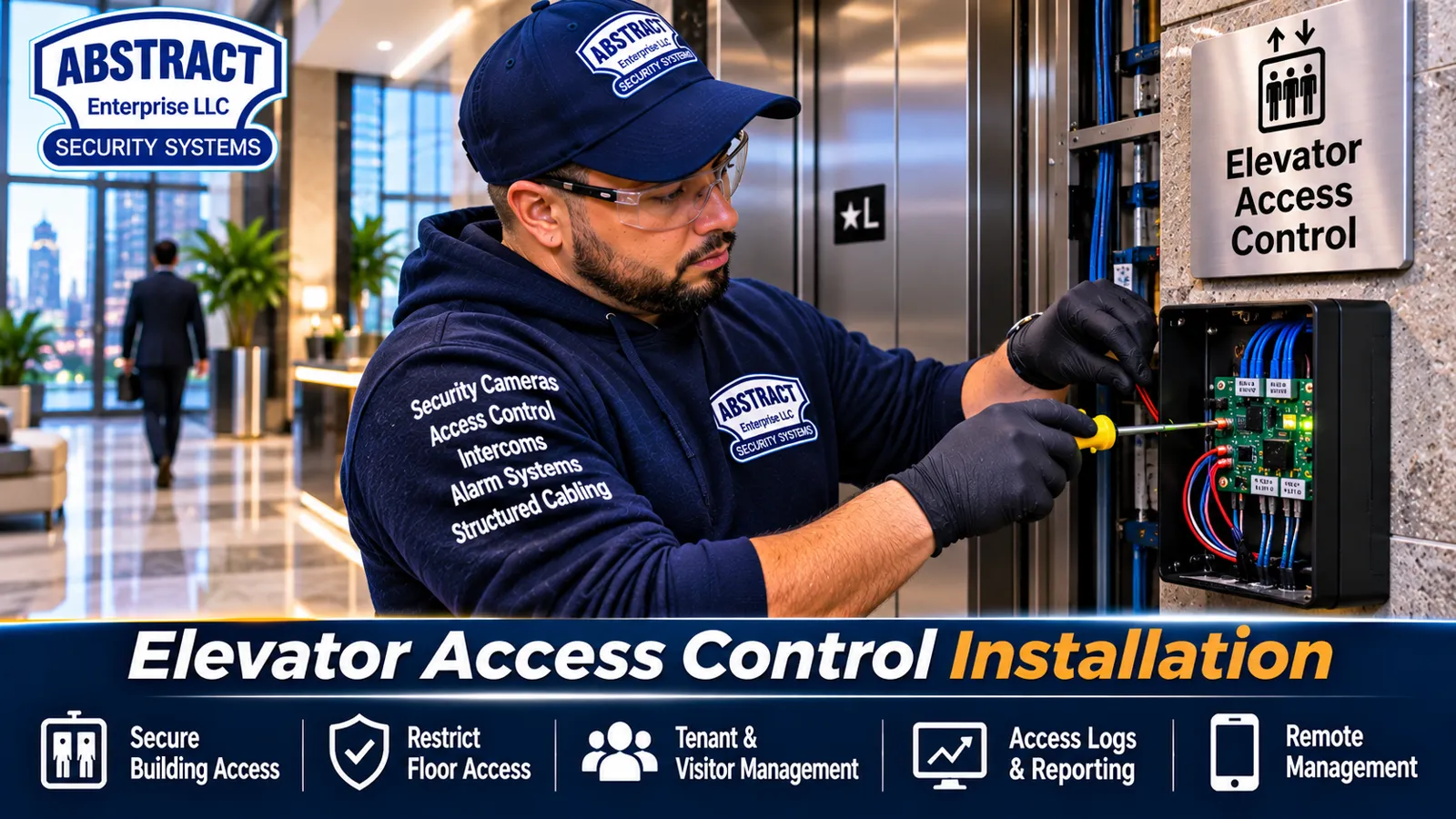
Photo from the Abstract Enterprises Security Systems elevator access control photo library (not taken in Nassau County and not a customer's building): a technician in safety glasses wires an open reader enclosure next to a stainless steel elevator, with a text banner across the image. Every reader we install in a Nassau building is wired so the elevator ignores it the moment firefighters' service begins.
Aftercare
Keeping the System Healthy After Go-Live in a Nassau Building
A well-installed elevator access system needs very little attention, but it does need some, and most problems we see in older systems come from neglect rather than failure. These habits keep a Nassau system working for years:
Keep the credential list current. When a unit sells or a lease ends, remove the old credentials the same week. In co-ops, tie this to the closing checklist so it happens automatically.
Review the log once a month. Ten minutes looking at refused credentials and after-hours rides will tell a manager more about the building than any report.
Test the batteries. Panel batteries wear out; we recommend checking them at least once a year and before hurricane season on the south shore.
Coordinate with the elevator company's inspections. When the elevator contractor performs periodic tests, the access system may need to be bypassed briefly. A short note in the elevator company's file about the access interface avoids confusion.
Keep two administrators. A system run by one person is a system that stops being managed when that person leaves.
Call early. A reader that works intermittently or a car that has started ignoring fobs is easier and cheaper to fix in its first week than its third month.
If you want us to look after the system after installation, we can schedule periodic checks and handle credential changes remotely where the platform allows it. If your own staff will run it, we train them until they are comfortable and stay available for questions.
FAQ
Nassau County Elevator Access Control Installation FAQ
What does elevator access control actually change for residents of a Nassau County co-op?
+
Day to day, very little. Residents tap the same fob they use at the front door, or a fob added for the elevator, and press their floor as usual. What changes is that someone without an approved credential can no longer ride the car to the upper hallways or the roof. The elevator itself, its doors and its safety systems are not replaced; our reader and panel sit beside it and your elevator contractor makes the connection.
Can a Long Beach oceanfront building keep its elevator access panel safe from another storm surge?
+
Yes, and it should be planned that way from the start. We put the access panel, power supply and battery in the machine room or on an upper floor rather than a cellar or ground-floor closet, and route lobby and garage reader cable so that a flooded ground floor means swapping a reader rather than rebuilding the system. Buildings on the barrier island saw lobbies and boiler rooms flooded in 2012, so we treat flood height as a design input.
Do we need a permit from our village to add elevator readers in Nassau?
+
It depends on the municipality, because Nassau building permits are issued by the city, town or village where the building sits, and many of the 64 villages run their own building departments. The elevator contractor handles whatever its controller work requires. For the low-voltage side, we or your managing agent confirm with the local building department before installation days are booked, and we never assume the answer.
Who is allowed to wire our readers into the elevator controller in Nassau County?
+
A licensed elevator contractor. New York State licenses the businesses and workers who install, maintain and repair elevators, and the connection inside the controller is elevator work. Abstract Enterprises Security Systems installs the readers, panel, relays, cable and programming under NYS low-voltage license #12000287431, and coordinates the controller connection with your elevator maintenance company.
How many relays does a two-car station rental in Mineola or Westbury typically need for floor restriction?
+
Roughly one output for every controlled floor in every car, plus one for each controlled landing call station such as the garage. Two cars serving a garage, a lobby and eight residential floors with every upper floor controlled can need twenty or more outputs. That is why floor-by-floor control is quoted per building after a survey rather than per car, and why it is best designed before the controller is ordered.
Does New York City's Local Law 63 apply to a Garden City or Great Neck building that adds elevator fobs?
+
No. Local Law 63 is a New York City law and covers buildings in the five boroughs. A Nassau building is not bound by it, and New York State has no general biometric privacy law in force for residential buildings at the time of writing. We still recommend telling residents what the system records, keeping logs only as long as needed and deleting records of people who move out. This is general information, not legal advice.
Can staff in a Nassau medical or office building be required to use fingerprint readers in the elevator?
+
Employers in New York State may not require employees to be fingerprinted as a condition of employment under Labor Law section 201-a, so fingerprint enrollment for staff should be voluntary, with a card, fob or phone credential offered as the alternative. Face recognition and other biometrics raise similar questions, so we recommend having the building's attorney review any biometric program before enrollment begins.
How do home health aides get up in a Nassau senior building once the elevator needs a credential?
+
The usual answer is a personal code or a credential with a schedule, issued by the office or the resident and set to expire automatically. Aides ride during their visiting hours without anyone handing out permanent fobs, and the log shows when each visit happened. Large readers, wristband credentials and keypad codes also make the system easier for residents themselves.
What would a seven-story Nassau co-op with two cars pay to start with fob readers in both?
+
Level 1 in Nassau starts at $1,725 per car, so two cars start at $3,450 for our part, with the elevator contractor's controller work ordered and paid by the building directly. Extras such as a staff-only roof stop or a controlled garage landing are Level 3 additions and are quoted after the survey.
Should a Nassau building under construction decide on elevator access before the elevators are ordered?
+
Yes. When elevator access is specified early, the elevator contractor can order the controller with the right security inputs and the traveling cable with the conductors the readers need. Deciding late usually means adding inputs or cable after the fact, which costs more and takes the cars out of service longer. For new rentals near Nassau stations we recommend bringing us in during design.
Can a reader at our garage call button stop people walking down the ramp and calling the elevator?
+
Yes. A landing reader at the garage call station means the car will not answer a call from that level until someone presents a credential. In many Nassau buildings with open gates or busy garages, that single reader does more for security than readers in every car, and it can be combined with car readers later.
Will our Nassau building's elevator readers still let the fire department take the cars?
+
Yes. When the elevator enters firefighters' emergency operation, whether recalled by a smoke detector or by a firefighter's key, the access system is bypassed and the elevator responds only to fire service controls. Your elevator contractor wires the interface that way, and we test it together before go-live and put the result in writing.
Our fobs work at the front door but not in the elevator since our old installer stopped answering. Can you help in Nassau?
+
Yes. We start with a diagnostic visit to identify the panel and readers, check power and batteries, read the event log if we can reach it and learn from your elevator contractor how the system connects at the controller. Often the fix is a reader, a power supply or reprogramming; sometimes it is taking over administration or upgrading the panel. We tell you plainly which makes sense.
How soon can someone come out to survey an elevator in Nassau County?
+
We book the survey within 2 hours of your request and arrive inside a 2-hour arrival window on the agreed day. Surveys and installations are scheduled in advance rather than promised the same day, because the elevator contractor's schedule usually sets the installation dates. Call (516) 346-5778 or use the form on this page.
Elevator Access Control Installation in the rest of our service area
Request a Free Elevator Access Control Quote for Your Nassau County Building
Send the address and village or town, the number of floors and elevator cars, whether there is a garage, beach-level or basement stop, the door or intercom system you use now, and who should be able to reach which floors. A photo of the car's button panel and the name of your elevator maintenance company help us plan the survey. Prefer to talk? Call (516) 346-5778 or our toll-free line (800) 486-0943.
✅
Request Sent!
Thank you. We will be in touch to book your Nassau County elevator access survey, usually within 2 hours of your request.