Loading docks off I-84, outlet and mall storefronts, Newburgh row houses, black dirt farms: book a CCTV survey anywhere in Orange County, New York at (845) 640-3835
Warehouses & Truck Courts · Retail Corridors · City Blocks · Farms · Orange County, NY · Licensed Low-Voltage
CCTV Installation in Orange County, NY
DVR & NVR Recorder Systems · Wired IP / PoE · HD-Analog Upgrades · Dock, Gate & Lot Coverage
CCTV installation in Orange County, NY starts at $1,199 for a house-brand 4-camera system with the recorder, the wiring, the installation and two weeks of recording, and a 4- to 8-camera home system typically lands between $1,340 and $2,500. Abstract Enterprises Security Systems designs and wires closed circuit television systems for the county where I-84 meets the Thruway: distribution buildings in Montgomery and Wallkill, shops along Route 300 and Route 211, row houses in the City of Newburgh, Victorian blocks in Middletown, and farm buildings out on the black dirt. Every camera is cabled to a recorder you own, with $0 monthly fees.
Updated November 2026 by Abstract Enterprises Security Systems, NYS license #12000287431 · Sources: NYS Division of Criminal Justice Services, Index Crimes by County and Agency, 2024 (data.ny.gov); JLL news release, February 25, 2025; HGAR Real Estate In-Depth, July 16, 2026; Orange & Rockland Utilities storm update, December 20, 2025; City of Newburgh Code, Chapter 300, Article VI
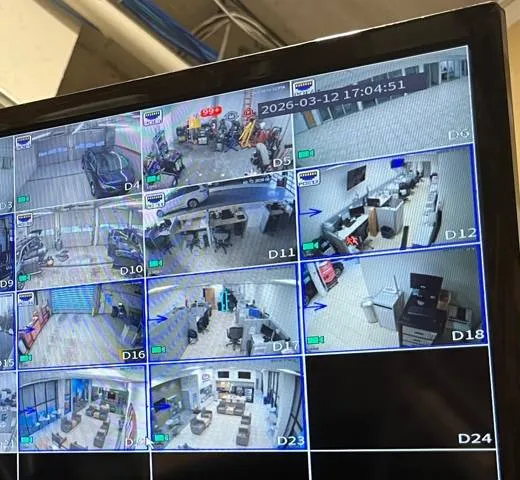
From one of our CCTV jobs (Rockland County car dealership): part of the recorder's live view, with tiles for the service area, the offices and the lot, the date and time across the top, and an open channel tile on the right waiting for another camera.
Orange County CCTV Request
Town or city, type of property, and roughly how many doors, docks or gates need a camera
✅
Request Sent!
Thanks. We will call or text to set up your Orange County CCTV visit, usually within 2 hours of your request.
25+
Years Experience
2 Hr
Booking
100%
Licensed & Insured
4.7★
201 Google Reviews
Owner-operated since 2002 · Thousands of jobs completed · Booked within 2 hours
Quick answer: a professionally installed 4-camera CCTV system in Orange County, New York costs from $1,199 with the recorder, cable, mounting and two weeks of recording included; bigger homes with 4 to 8 cameras run $1,340 to $2,500, and business, warehouse and multi-building systems run $1,500 to $5,000+. There is no monthly fee because the footage lives on your own DVR or NVR. Docks, gates, light-pole mounts, long runs across a truck court and concealed wiring are priced per camera after we confirm the layout. We book within 2 hours of your request and schedule 7 days a week with early-day visits, first come first served once the deposit is paid.
Wired IP (PoE) cameras on an NVR, or HD-analog cameras on a DVR that reuses sound coax
Designed around what each camera has to prove: a face at a door, a plate at a gate, a trailer at a dock
One licensed crew from survey to handover, NYS low-voltage license #12000287431
Why Orange County Properties Need CCTV Planned Around the Crossroads
Orange County is where two of the busiest freight routes in the Northeast cross. Interstate 84 runs east to west from the Newburgh-Beacon Bridge to Port Jervis, the Thruway runs north to south past Harriman and Newburgh, and Route 17 (the future I-86) cuts diagonally through Monroe, Goshen and Middletown. That geography explains most of the camera work we do here. Trucks, shoppers and commuters all pass through the same handful of interchanges, and the properties that sit beside those interchanges, from distribution buildings to outlet stores to the hotels and gas stations that serve them, have very different problems from a farmhouse in Pine Island or a brick row house in Newburgh's East End.
So the first question on every Orange County CCTV job is not "how many cameras?" It is "what kind of loss are we trying to stop, and where does it happen?" A warehouse loses money to freight that leaves the wrong door or arrives damaged, with no footage to settle the claim. A store at an outlet center loses it to shoplifting. A city landlord loses it to break-ins through rear doors and to vehicles damaged or taken from a back lot. A farm loses fuel, tools and equipment from fields nobody watches overnight. A good closed circuit television system for each of those looks different, even when the cameras in the box are the same.
Theft and burglary, sorted by the department that took the report
The New York State Division of Criminal Justice Services publishes index crimes for every police agency in the state. The county-wide total for Orange in 2024 was 3,430 larcenies, 300 burglaries and 145 motor vehicle thefts. The county total hides the real pattern, though. When you break it down by the department that took the report, a few agencies along the shopping corridors account for most of the theft, while the City of Newburgh carries a share of the burglaries far larger than its size.
Police agency (2024)
Larcenies
Burglaries
Vehicle thefts
What it means for camera design
Newburgh Town PD
670
62
17
Route 300, Route 17K and Route 32 retail: register, exit-door and lot cameras
Woodbury Town PD
560
11
1
Outlet and highway retail: 560 of the town's 578 index crimes were larcenies
Newburgh City PD
378
108
52
Row houses, storefronts and back lots: rear doors, side alleys and parked vehicles
Middletown City PD
333
32
18
Downtown storefronts and multi-family blocks
Wallkill Town PD
328
17
4
Route 211 and Route 17M shopping centers, I-84 industrial
New Windsor Town PD
217
13
4
Route 32 and Route 9W businesses, the airport area
Port Jervis City PD
120
12
4
Older downtown and residential blocks near the river
Two figures stand out. Four agencies whose territory covers the big retail strips (Newburgh Town, Woodbury, Middletown City and Wallkill) logged 1,891 larcenies between them, about 55% of the county's total. And the City of Newburgh, a small city of a few square miles, took 108 of the county's 300 burglary reports and 52 of its 145 vehicle thefts, more than a third of each. Those numbers do not tell you whether your own block is safe. They do tell you where the camera effort belongs: on exits, registers and parking rows in the retail towns, and on rear doors, alleys and parked cars in the older city neighborhoods.
The warehouse belt along I-84
The fastest-growing building type in the county is the distribution center. In February 2025, JLL announced the start of the 146,075-square-foot I-84 Orange County Logistics Center in Montgomery, with 36-foot clear ceilings, 31 dock doors, two drive-in doors and 16 trailer parking spaces, and listed Amazon, FedEx, UPS, Staples, Medline and XPO Logistics among its neighbors. In July 2026, HGAR reported that Walmart had filed plans with the Town of Wallkill for a distribution center of about 1.5 million square feet on roughly 200 acres near Route 17K and I-84, still in early planning board review.
“Montgomery offers a prime logistics location that has seen significant growth thanks to its deep talent pool and business friendly programs.” Scott Shalek of Ridgecut Road, developer of the I-84 Orange County Logistics Center, in a JLL news release, February 25, 2025
Buildings like that are a different scale of CCTV system from anything residential. Thirty-one dock doors means at least thirty-one places where freight changes hands, plus a truck court, a trailer yard, a guard booth, the employee lot and a warehouse floor with racking aisles under a ceiling more than three stories up. The cameras have to read trailer numbers in the yard, show which pallet went onto which truck, and keep the footage long enough to answer a freight claim weeks later. We cover how we wire that in the commercial section below.
Two power companies, one county
Orange County is split between two electric utilities, and a recorder that loses power loses footage no matter whose lines failed. Orange & Rockland Utilities lists Middletown, Wallkill, Goshen, Chester, Monroe, Woodbury, Warwick, Deerpark, Port Jervis and most of the southern and western towns among the New York communities it serves. Central Hudson covers the northeast corner, including the Newburgh and Montgomery areas. Both report storm outages by town, and both have long outages on their record. In O&R's December 20, 2025 storm update, 238 Orange County customers were still without power the morning after the storm, including 70 in Chester, 50 in Deerpark and 32 in Warwick.
For a home that is an inconvenience. For a warehouse or a store, the hours after a storm are exactly when doors are propped open, alarms are offline and freight sits waiting, so the recorder and the PoE switch go on a battery backup on every commercial job we do here, and a generator circuit where the building has one.
Three cities, many villages, a lot of farmland
Outside the highway corridors, Orange County is three small cities, two dozen villages and a great deal of open land. Newburgh has blocks of 19th-century brick row houses and storefronts, many inside the East End Historic District. Middletown has a downtown of brick commercial buildings along North Street and Victorian houses on the hills around it. Port Jervis sits where New York meets New Jersey and Pennsylvania along the Delaware. Villages such as Goshen, Warwick, Monroe, Chester, Walden and Washingtonville have Main Street storefronts with apartments above. And from Florida and Pine Island west toward the New Jersey line, the black dirt region grows onions and other vegetables on dark, flat, drained farmland, with packing sheds, equipment barns and fuel tanks scattered across fields that can be a long way from the farmhouse.
The cities each bring their own wrinkle. In Newburgh, the useful camera on a row house is usually at the back, because the alleys and rear lots behind Broadway and Liberty Street are where cars sit overnight and where a forced door is out of sight of the street. In Middletown, many big old houses have been split into apartments, so one building may have three entrances, a shared driveway and a detached garage, and the owner wants all of it on one recorder while each tenant's own door stays private. In Port Jervis, downtown buildings near the rail yard and the river are older and often damp at the foundation, which decides where a recorder can safely live.
The suburban towns are a different job again. Developments in Monroe, Chester, Blooming Grove, Montgomery and the Town of Wallkill are mostly sided houses with attached garages, and many of their owners commute to New York City or northern New Jersey. For them the question is usually remote viewing and sensible alerts during the work day: a driveway camera that tells them when a delivery arrives, a back door camera that stays quiet unless a person steps onto the deck, and a recorder that keeps going when the power flickers.
Each of those calls for its own approach to CCTV installation, and the rest of this page goes through them one at a time.
What We Install
CCTV Installation Services Across Orange County, New York
Our CCTV installers handle the whole system on every Orange County job: the survey, the cable, the mounts, the recorder, the network settings and the app on your phone. You deal with one licensed company from the first call to the last walk-through. This page is about wired closed circuit television, the recorder behind it and the jobs that need more than a few cameras. If what you want is a doorbell camera or a quick wireless add-on, our security camera installation page for Orange County homes and businesses covers those options and the full model list.
📹
Complete CCTV system installation
Cameras, DVR or NVR, surveillance hard drive, PoE switch, cable, mounts and monitor installed as one system and tested channel by channel before we leave.
🚛
Dock, yard and gate coverage
Cameras over each dock door, along the trailer rows and at the truck gate, with lenses and shutter settings chosen to read trailer numbers and plates.
🛍️
Retail and restaurant systems
Registers, exits, high-value displays, stockrooms and the parking rows outside, set up so a manager can find and export a clip in minutes.
🏘️
Residential CCTV installation
Front and back doors, the driveway, the garage and the yard on raised ranches, colonials, row houses and farmhouses, with the wiring kept out of sight where the house allows.
Grainy analog cameras swapped out, good coax kept for HD-analog, or a full analog to IP CCTV upgrade where new cable makes more sense. Our DVR upgrade service in Orange County explains the paths.
📱
Remote viewing and alerts
The app on every phone that needs it, person and vehicle alerts set to the hours that matter, and the admin login in your name.
Bought a kit online or at a store in Middletown or Newburgh? Our crew mounts and connects it for a labor price, quoted over the phone or by text and booked once the deposit is in.
Most Orange County jobs combine two or three of those. A typical house in Monroe or Washingtonville gets a 4- to 8-camera system with the doors, the driveway and the back yard, the recorder in a closet or the basement, and the app on two or three phones. A typical store on Route 211 or in a village gets cameras at the register, the door, the stockroom and the lot. A distribution building gets a much larger recorder, cameras at every dock door and along the yard, and a battery backup. The method is the same each time: decide what each camera has to prove, then choose the lens, the height and the cable route that make it possible.
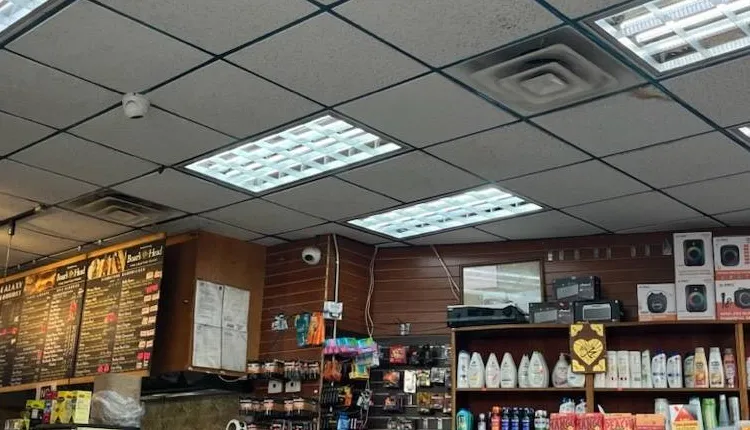
From one of our CCTV jobs (Manhattan corner deli): two small dome cameras on the drop ceiling between light fixtures, one over the menu boards and one over the shelving, so the counter and the aisle are both on the recorder.
Building Specialists
CCTV Installation for Orange County's Row Houses, Raised Ranches and Farm Buildings
The county's housing runs from 1850s brick in Newburgh to subdivisions finished last year in Chester and Montgomery. These are the building types we see most, and how residential CCTV installation and property CCTV installation change from one to the next.
🧱
Newburgh and Port Jervis row houses
Attached brick houses with narrow fronts, deep rear yards and an alley or back lot. The rear door and the yard gate matter as much as the front stoop.
🏚️
Middletown Victorians and two-families
Wood-frame houses on the hills around downtown, often split into two or three apartments, with porches, side driveways and detached garages.
🏠
Raised ranches and colonials
The suburban core of Monroe, Chester, Washingtonville, Cornwall and New Windsor: siding, an attached garage, and a basement or attic where cable can travel.
🆕
New subdivisions and townhouses
Fresh construction around Montgomery, Chester and Wallkill. The cheapest time to hide CCTV wiring is before the drywall goes up.
🏢
Garden apartments and complexes
Two- and three-story buildings around shared parking along Route 17M, Route 211 and Route 300, with mail areas, laundry rooms and dumpster enclosures.
🌱
Black dirt farms and packing sheds
Flat fields around Pine Island, Florida and Warwick with steel equipment barns, packing houses, fuel tanks and long farm lanes.
🏪
Village Main Street buildings
Storefronts with apartments above in Goshen, Warwick, Walden, Montgomery and Washingtonville, where shared walls and a landlord's approval shape the job.
🌲
Lake and mountain houses
Greenwood Lake, Tuxedo and the Shawangunk ridge near Otisville: steep lots, wooded driveways and owners who are often somewhere else.
How the work changes by building
Brick row houses. Old brick is soft and the mortar is softer. We anchor into mortar joints rather than the face of the brick wherever the mount allows, use a junction box so the camera sits flat on an uneven wall, and bring the cable through one sealed hole straight into the house behind the mount. On a row house the most useful cameras are often at the back: one on the rear door, one on the yard or the alley gate, and one aimed down the back lot where cars park. If the house is inside a City of Newburgh historic district, see the note on facade approval in the questions below before anything is fixed to the front.
Victorians and two-families. Balloon framing in older wood houses can actually help: open stud bays run from the basement to the attic, so a cable can often be dropped inside a wall with no visible run. Porches complicate camera angles, because a camera under a deep porch roof sees the porch but not the walk. We usually put one camera on the porch ceiling for faces at the door and another on the corner of the house for the walk and the driveway. In a two-family, the owner decides who sees which camera, and the tenant's unit stays off camera entirely.
Raised ranches and colonials. Vinyl siding over sheathing is the most common exterior we mount on. The camera goes on a mounting block so the siding can still expand and contract, the hole goes through the block, and the cable runs through the basement rim joist or the attic. A raised ranch has its front door half a level above the driveway, which changes the mounting height for a face camera; we test the angle with the camera in hand before we drill.
New construction. In a house that is still open studs, we run Cat6 from each camera position to a central closet before insulation and drywall, label both ends and leave a coil at each location. The cameras can go up on move-in day or a year later. This is the cleanest way to get CCTV installation with concealed wiring, and it costs far less than fishing cable through finished walls afterward.
Garden apartment complexes. The cameras are spread across several buildings and a parking lot, but the recorder should be in one locked room. We use the buildings' own walls and soffits for mounts, run cable through common basements or attics, and link separate buildings with outdoor-rated cable in conduit, fiber or a short wireless bridge. Owners and managers can read more on our apartment building security camera page for Orange County, which covers resident privacy and common-area rules in more depth.
Farm buildings. Steel pole barns and packing sheds are dusty, damp and full of machinery. Cameras go on framing, high enough to stay clear of loaders and tractors, in housings rated for dust and water. Where a barn has its own electric service, the run from the house to the barn is where we use fiber or a bridge rather than long copper, because the two buildings sit on different grounds and a storm surge can travel down a long cable.
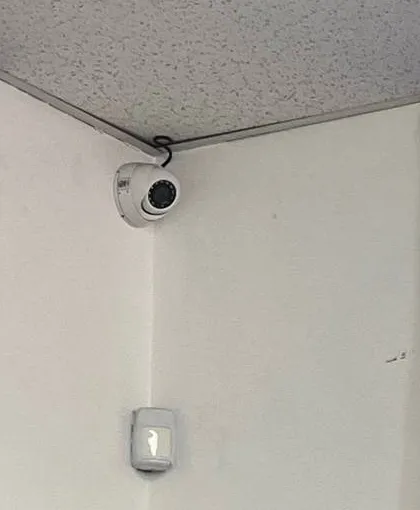
From one of our CCTV jobs (Nassau County window and door showroom): a white eyeball-style dome fixed right at the corner where the ceiling meets the wall, with the alarm system's wall sensor below it, so the camera and the sensor do not block each other.
Commercial CCTV Installation
Business CCTV Installation in Orange County, NY
Commercial CCTV installation in Orange County follows the interchanges. These are the corridors where most of our business work happens, and what the businesses on each one usually need.
Route 300 and Route 17K in the Town of Newburgh. Big-box stores, shopping plazas, restaurants, car dealers and hotels around the I-84 and Thruway interchanges. The 670 larcenies that Newburgh Town police logged in 2024 were the most of any agency in the county.
Route 32 and Route 9W through New Windsor and Vails Gate. Auto service, contractors, restaurants and the businesses that ring New York Stewart International Airport.
Route 211 and Route 17M in Wallkill and Middletown. The Galleria at Crystal Run area, strip centers, medical offices and the industrial parks near the I-84 and Route 17 interchange.
Route 17 and Route 32 in Woodbury, Central Valley and Harriman. Woodbury Common Premium Outlets, which lists more than 245 stores, plus the hotels, gas stations and restaurants that serve its visitors.
The I-84 logistics belt. Distribution buildings, truck terminals and contractor yards in Montgomery, the Town of Newburgh, Wallkill and Wawayanda. Our warehouse security camera installation page for Orange County covers that sector in more detail.
Village and city downtowns. Broadway and Liberty Street in Newburgh, North Street in Middletown, Front Street in Port Jervis, and the Main Streets of Goshen, Warwick and Walden: independent shops, bars, salons and restaurants in older buildings.
Whatever the corridor, a business system here earns its cost in three ways: nobody reaches a door, a cash point or a loading area without passing a lens, the drive still holds the day in question when someone finally asks for it, and the person on shift can pull the clip without calling the owner. Commercial systems in Orange County run $1,500 to $5,000+ depending on the number of cameras, the building and the cabling, and each one is quoted in writing after we confirm the layout. Owners who also want access control or an intercom tied in can start with our commercial security camera installation page for Orange County.
Warehouse and distribution center CCTV installation
A distribution building is really four camera jobs on one recorder. The first is the gate: a camera aimed at the truck entrance with a narrow lens and a fast shutter, so the cab, the plate and the trailer number are all readable as the rig rolls through, day or night. The second is the dock face: one camera per door or per pair of doors, mounted inside above the door so it sees the trailer's open end, the dock plate and the first few pallets going on or coming off. The third is the yard: wide cameras along the trailer rows and the fence line, high on the building or on light poles, with smart detection that ignores trucks moving on schedule and flags a person walking the fence at 2 a.m. The fourth is the floor: cameras down the main aisles, at the cage where high-value product is kept, at the shipping and receiving desks, and at the employee entrance.
The cable work is what separates a warehouse job from a store job. Ceilings of 36 feet or more mean the crew works from a lift, cables ride in the building's cable tray or on J-hooks along the steel, and runs from the far end of a 500-foot building back to one recorder can pass the 100-meter limit of copper Ethernet. On larger buildings we place a network switch in an intermediate closet, fed by fiber from the main recorder room, and keep every camera run under the limit. Every camera is labeled at both ends and on the recorder by dock number, so when a driver disputes a load, the manager pulls up "Door 14" instead of "Camera 37".
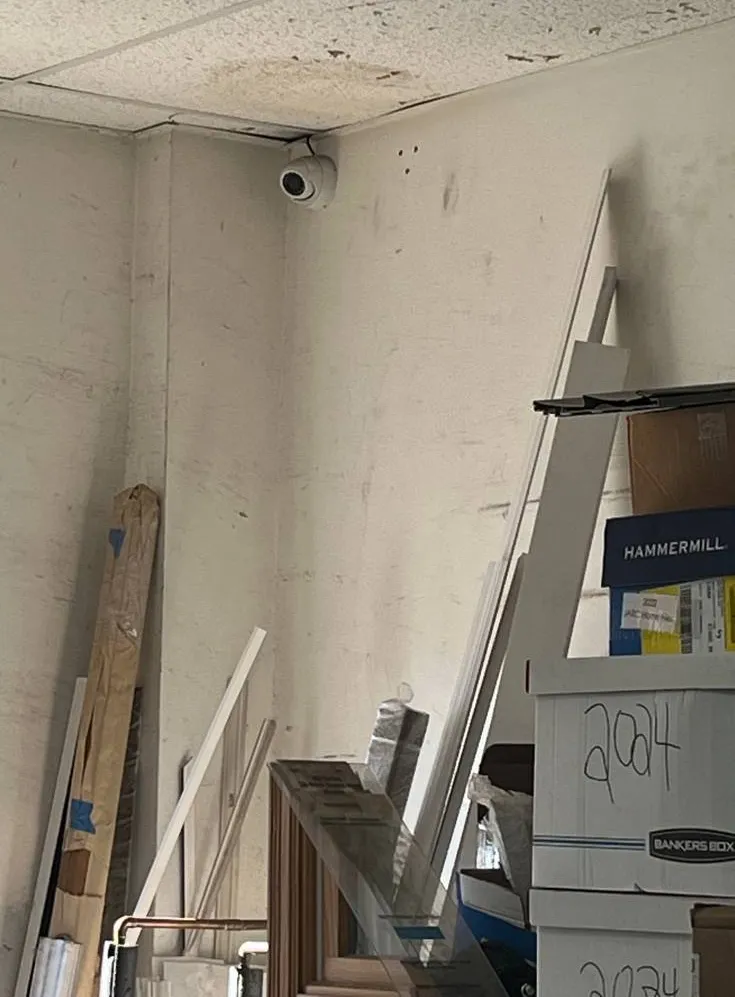
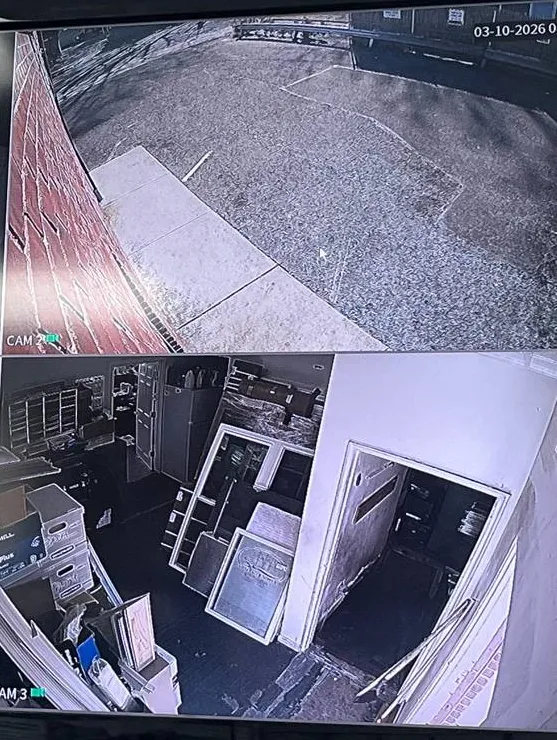
From one of our CCTV jobs (Nassau County window and door showroom): a dome camera tucked into the top corner of the stockroom, above lumber, boxes and a ladder, where it sees the whole room and nobody brushes it with stock.From one of our CCTV jobs (Nassau County window and door showroom): two of the four recorder tiles, one camera looking down the paved side lot along the brick wall and one covering the back storage room and its door.
Outlet, mall and shopping center stores
The Woodbury police numbers make the point: almost every index crime in that town is a larceny. For a store, retail CCTV installation is about the moments theft happens. A camera at the entrance at face height catches everyone coming in, framed tight enough to identify them. Cameras over the high-value tables and racks show hands, not just bodies. A camera at the register sees the cash drawer, the screen and the customer. A camera on the back door and the stockroom covers the losses that happen after the doors close, which in many stores are larger than shoplifting. In a mall or outlet center, the common areas and the parking lot usually belong to the landlord's own system, so a tenant's cameras stay inside the leased space and at its own entrances.
Holiday shopping season is when gaps show. Woodbury Common and the Route 300 and Route 211 stores see their heaviest traffic from Black Friday through Christmas, so we try to finish store jobs by early November and spend the last visit tuning recording quality at the registers and doors before the rush.
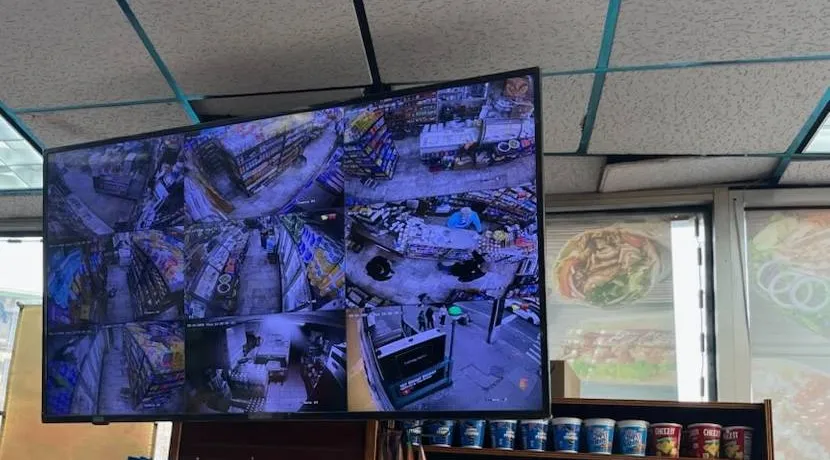
From one of our CCTV jobs (Manhattan corner deli): a monitor hung from the drop ceiling near the front window shows the store's cameras in a split view, so customers can see the aisles are recorded and staff can glance at every view from the counter.
Hotels, gas stations and the traffic in between
The interchanges also fill with businesses that serve travelers: hotels near the Thruway and the airport, gas stations and convenience stores at every exit, fast-food restaurants with drive-throughs. Hotel CCTV installation covers the front desk, the lobby doors, every exterior door, the parking lot and the corridors, never the guest rooms. Gas station CCTV installation covers each pump island, the store's register and door, the air and vacuum area and the lot entrances, with cameras that can tell which car was at which pump. Both run around the clock, so we use recorders and drives rated for constant writing and plan installs around the quietest hours.
Other businesses we wire across the county
Restaurants and bars. Restaurant CCTV installation covers the register, the bar, the back door, the walk-in and the dumpster area, with cameras kept away from the grease of the hood line. Bars want the door and the bar top on camera from opening to last call.
Medical and dental offices. The entrance, the waiting room, reception and the medication or supply room, never an exam or treatment room. The recorder goes in a locked closet and access is limited to the office manager.
Car dealerships and auto repair shops. The lot rows, the service drive, the key box and the parts room. Dealer lots along Route 17K, Route 300 and Route 211 need tall mounts and long lenses to see the far rows at night.
Construction sites. The warehouse boom means new buildings going up all the time, with copper, tools and machinery left out overnight. CCTV installation for construction sites usually means pole or trailer-mounted cameras on temporary power that record locally and alert on people after hours; see our construction site camera page for Orange County.
Parking lots. A lot camera is only as good as its mounting height and the light around it, and plate capture is a separate job from general coverage. Our parking lot camera installation service in Orange County covers entrances, rows and lighting in more depth.
New York rules every Orange County business should know
These are the state rules that come up most often on business jobs. This is general information, not legal advice; your attorney should confirm what applies to you.
Some rooms in a workplace never get a camera. A warehouse or store can record its floor, docks and counters, but New York Labor Law §203-c forbids an employer from video recording toilets, locker rooms or rooms for changing clothes unless a court has ordered it.
Microphones raise a separate question. New York is a one-party consent state, and Penal Law §250.05 makes it eavesdropping to record a conversation none of whose participants agreed. A camera's built-in mic at a sales counter can cross that line, so ours ship to businesses with audio switched off.
No recording where people undress or expect privacy.Penal Law §250.45 makes secret recording in such places unlawful surveillance.
Historic districts in the City of Newburgh. City Code Chapter 300, Article VI requires a certificate of appropriateness from the Architectural Review Commission for exterior alterations to designated properties; a facade-mounted camera with conduit can fall under it.
Your Questions Answered
Orange County CCTV Installation: Questions Answered
These are the questions Orange County owners and managers ask us most, grouped the way the calls come in: freight and warehouses first, then stores and lots, then homes, farms and the older cities.
Freight, docks and distribution buildings
How long should a warehouse keep dock footage to answer a freight damage or shortage claim?
Longer than most people set it. A recorder left on factory settings often keeps one or two weeks, while freight claims arrive much later. Under the federal Carmack rules for interstate motor carriers, 49 U.S.C. §14706, a carrier may not give a shipper less than nine months to file a loss or damage claim. By the time a customer reports that pallets arrived crushed or short, the footage of them leaving your door may already be overwritten.
We ask each warehouse how far back its claims usually reach and size the storage to match: 30, 60 or 90 days on the dock and yard cameras, and less on quieter interior views. Dock cameras do not need to record at full frame rate all night; recording on motion with a short pre-event buffer stretches the same drive much further. When a claim does come in, managers export the clip for that door and that time right away, so it is kept no matter how long the recorder holds the rest.
How many cameras does a mid-size distribution building need, and how big a recorder?
Count from the building, not from a box. A useful starting rule is one camera per dock door or per pair of doors, one or two at the truck gate, two to four along each side of the trailer yard, one at every personnel door, one or two at the shipping and receiving desks, one per main aisle and one at any high-value cage. On a building of around 150,000 square feet with 30 dock doors, that easily reaches 40 to 60 cameras.
The recorder follows the count and the retention. A 64-channel NVR with several large surveillance drives is common at that size, and we leave spare channels for the doors and yard lights added later. Very large buildings are often split across two recorders, one for the dock and yard and one for the interior, so a single failure never blinds the whole site. Every camera is quoted after we confirm the layout, since a dock camera inside the door and a pole camera at the far end of the yard are very different runs.
How do cameras stay readable when truck headlights or a low winter sun shine into the lens?
Two settings and one decision about placement. Wide dynamic range, usually labeled WDR on the spec sheet, lets a camera hold detail in the bright and dark parts of the same picture, so a driver's face stays visible against open dock doors or the glare of a headlight. A faster shutter keeps a moving cab or a plate from smearing at night. Most fixed cameras default to a slow shutter in the dark to brighten the picture, which is the right choice for a hallway and the wrong one for a gate.
Placement does the rest. We avoid aiming a camera straight down a lane where every truck's headlights hit the lens, and set the gate camera at an angle to the approach instead. On east- or west-facing docks, where the morning or evening sun sits right in the frame for part of the year, we shift the camera a few feet or use a hood. We check every outdoor camera after dark before the job is closed.
Can CCTV show which forklift hit a rack, a door or a pallet?
Yes, if the cameras are placed for it. Forklift damage happens at the ends of aisles, at the dock plates and at the overhead doors, so a camera at each end of a main aisle, looking down its length, catches most rack strikes, and the dock cameras catch doors and plates. Many forklifts carry a unit number on the mast or the counterweight; a camera at a sensible height and distance can read it.
The footage is only half of it. The recorder's clock has to be right so a supervisor can match the time against shift logs, which is why we set every recorder to sync its time automatically. And because the point is to find what happened, not to watch people all day, most managers set these cameras to record continuously and only review them when something is damaged.
How long does a CCTV installation take in a large warehouse that keeps working during the job?
Usually several days to a couple of weeks, staged so the building never stops. On a working warehouse we pull cable and mount cameras section by section, working from a lift in aisles the manager closes for us, and save the dock face for the slowest hours or a weekend. The recorder and network gear go in early, so cameras come online as each section is finished rather than all at the end.
A small store or a house is a different scale: a 4- to 8-camera residential job is often finished in a day, and a typical shop in a day or two. Every quote includes a realistic schedule. We book within 2 hours of your request and schedule 7 days a week, first come first served once the deposit is paid, but we never promise same-day installation on a building of this size.
Can cameras under a 36-foot ceiling be cleaned and re-aimed later without closing an aisle?
That is something we plan for at the install, because a camera nobody can reach does not get maintained. Where we can, we mount high-bay cameras on columns or walls at a height a standard lift can reach from the main aisle, rather than in the middle of a rack row. Varifocal lenses that can be zoomed and refocused from the recorder let us adjust a view from the ground without touching the camera.
For cleaning, the dusty spots are the dock doors and anywhere near propane forklift exhaust or a battery charging area. We note on the camera list which cameras need a lift and which are reachable from a ladder, so a maintenance visit can be scheduled for a quiet shift and finished quickly.
What should cameras cover at a bus depot, fleet yard or truck terminal where vehicles park overnight?
The entrance first, then the fuel island, the maintenance bay doors and the parking rows. The entrance camera should show every vehicle in and out with its number or plate. The fuel island needs a camera that sees the pump and the vehicle together, because fuel theft is the most common loss at yards like these. Catalytic converters, batteries and tools are the other targets, so cameras along the parking rows should be low enough to see under and between vehicles, not just over their roofs.
Yards are dark and big, so we lean on pole-mounted cameras with color night vision where the lot lights allow it and infrared where they do not, and on smart detection that alerts on a person walking among parked vehicles after hours while ignoring the drivers on the morning schedule.
Stores, lots and the highway strips
Can a camera on my building read the plates of cars going by on Route 17K or Route 300?
Not reliably, and it is the wrong goal. A plate at highway speed, at an angle, in headlight glare at night, crosses the frame in a fraction of a second. Even a dedicated license plate recognition camera is built to work where vehicles slow down and pass through a known spot, such as your own lot entrance, a gate or a drive-through lane.
So we put LPR camera installation where it works: at your entrance and exit, aimed along the lane at a shallow angle, with a narrow lens and a fast shutter. That catches the plate of every vehicle that actually comes onto your property, which is what you need after an incident. A separate wide camera shows the car's color, make and direction, which helps when a plate is covered or missing.
What camera layout helps a store prove a group shoplifting incident, not just one person?
Overlapping views. When several people work together, one distracts staff while others fill bags in another aisle, and a single camera rarely shows the whole thing. The layout that holds up is an entrance camera that identifies each person coming in, cameras over the high-value areas that show hands and merchandise, and a wide view of the sales floor that shows how the group moved together, all on one recorder with matching time stamps.
The exit camera closes the loop: the same people leaving with the merchandise. Exported together, those clips tell the story from arrival to departure, which is what police and loss prevention teams ask for. We name every camera on the recorder by location, so a manager can export "Entrance", "Fragrance table" and "Exit" for the same five minutes without guessing.
Should a closed business use cameras with a speaker or siren to warn people off the lot?
Often it is worth it. Active deterrence cameras switch on a light, a siren or a recorded warning when a person enters a zone you set, such as the lot after closing or the area behind the building. Some models also let you speak through the camera from your phone. On a dealer lot, a contractor yard or the back of a store, that is often enough to send someone on their way before anything happens.
The trick is the zone and the schedule. A deterrent that fires every time a customer walks past at 7 p.m. annoys everyone, so we set the zone tightly and arm it only after hours. Our F and D Series house-brand systems include active deterrent cameras with siren and lights, and we can add them to other systems too.
Homes, farms and the older cities
Does a camera on a historic Newburgh facade need approval from the city?
It can. The City of Newburgh's Code, Chapter 300, Article VI, has the Architectural Review Commission approve exterior alterations to designated properties and properties in the city's historic districts, including the East End Historic District, through a certificate of appropriateness. The city's own guidance on its land use process notes that a certificate is needed for material changes in appearance, including light fixtures. A camera with visible conduit on the front of a designated building is the kind of change to ask about first.
In practice we avoid the question where we can. Most of the useful cameras on a row house go at the back, in the alley and on the side, out of view from the street. Where a front camera is needed, we choose a small, dark camera that matches the trim, mount it in a mortar joint or under a cornice, and run the cable inside rather than up the face of the building. If you are unsure whether your property is designated, call the city's planning office before we drill. This is general information, not legal advice.
What should cameras watch on a black dirt farm with fuel tanks and equipment parked in open fields?
Start where things are taken: the fuel tank, the equipment barn, the packing shed doors and the lane in from the road. A camera on the fuel tank should see the nozzle and the vehicle filling up. A camera on the barn should see the doors and the yard in front of them. A camera at the end of the farm lane, where the property meets the road, records every vehicle that comes in, which on open flat land is the only way in.
Fields are the hard part, because there is nothing to mount on and no power. Where equipment sits out in a field for weeks, a camera on a pole with a solar panel and a cellular connection is the practical choice, with the understanding that it records clips rather than the round-the-clock video a wired camera gives. Everything near the buildings stays wired to the recorder in the house or the office, with fiber or a wireless bridge to the far barns.
Can alerts run only on a schedule, such as after closing or while we are at work?
Yes. The recorder can keep recording around the clock while sending phone alerts only during the hours you choose. A store can get alerts for people near the back door from closing to opening. A family that commutes from Monroe, Middletown or Harriman can get driveway and door alerts during the work day and turn them off in the evening. Each camera, and each type of detection, can have its own schedule.
The recording itself never pauses. If something happens at 6 p.m. on a camera whose alerts are off, it is still on the drive. We set the schedules with you at handover and adjust them after the first week, when you can see which alerts are useful and which are just noise.
Is a CCTV system the same as a monitored alarm, and do we need both?
They do different jobs. A monitored alarm detects a break-in with door contacts and motion sensors, and a central station calls you and the police. A CCTV system records what happens and lets you see it live and afterward. An alarm tells you someone is inside; cameras show you who and what they did. Our CCTV systems have $0 monthly fees because they record locally and you watch them yourself.
Many businesses and some homes have both, and they work well side by side. Cameras let you check whether an alarm is real before you drive over at 3 a.m., and the footage gives the police and the insurer something to work with. If you want an alarm too, our alarm installation service in Orange County covers it.
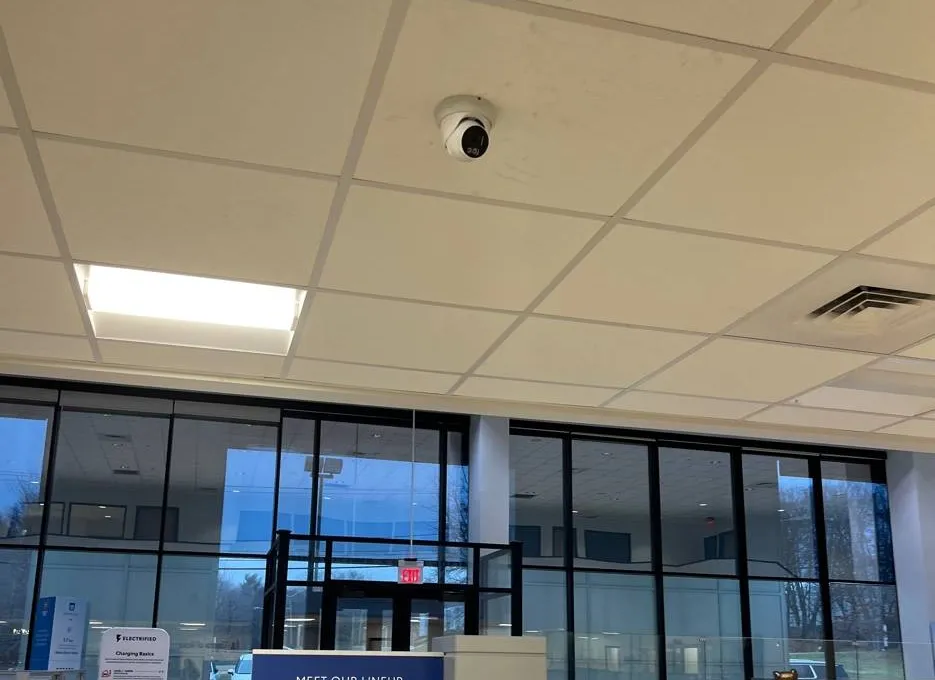
Photo from our own work at a car dealership in Rockland County, not Orange County: the turret sits a few feet back from the glass wall so it watches people coming through the doors from the inside, while the lot and the tree line show through the windows behind.
Equipment
The CCTV Cameras and Recorders We Put In Across Orange County
Unless you ask for something else, the quote is written around our house-brand cameras and recorders: we have seen how they hold up under dock canopies in January, and we can still get parts and firmware for them years from now. We are an authorized partner for Lorex, Luminys and Reolink, and we install, integrate and service other brands, including Hikvision, Dahua, Uniview, Hanwha, Axis and UniFi Protect, when a building already runs them or the owner prefers them.
🔭
Varifocal bullet cameras
Bullet camera installation for gates, yards, lot rows and long aisles, with a zoom lens set from the recorder so one camera can frame a gate 150 feet away.
⚪
Turret and dome cameras
Turret camera installation and dome camera installation inside stores, offices and apartment halls, and over registers, where the lens is within arm's reach and a low, rounded housing is harder to swat aside.
🔢
License plate cameras
LPR camera installation at lot entrances and truck gates, with a narrow lens, a fast shutter and infrared tuned to reflective plates.
🌐
Panoramic and multi-sensor cameras
Panoramic camera installation and multi-sensor camera installation for truck courts and big lots, where one mount on the building replaces three or four ordinary cameras.
🔄
PTZ cameras
PTZ camera installation where someone watches live, such as a yard office or a guard booth, so an operator can follow a vehicle across the site.
🌗
Color night vision and infrared
Color night vision camera installation where lot or dock lights give some light, and infrared camera installation for dark yards, fields and back alleys.
🚨
Active deterrence cameras
Cameras with a built-in light, siren and speaker that switch on for people in a set zone after hours, on dealer lots, contractor yards and the backs of stores.
🖥️
DVRs, NVRs and hybrids
Digital video recorder installation for HD-analog coax, network video recorder installation for IP cameras, and hybrid recorders that take both.
🔌
Switches, fiber, racks and UPS
CCTV PoE switch installation, fiber between buildings, CCTV rack installation in the recorder room, and CCTV UPS installation so outages do not stop recording.
Which system fits which Orange County property
System
How it connects
Where it fits here
Limits to know
DVR with HD-analog cameras (TVI, CVI or AHD)
Existing or new coax per camera, powered from a siamese pair or a supply nearby
Older stores and multi-family buildings in Newburgh, Middletown and Port Jervis that already have coax
Fewer smart features; the coax has to test good
IP cameras on a PoE NVR
One Cat6 cable carries video and power
New homes, offices, stores and every warehouse interior
100 meters per run before a switch, extender or fiber
IP with fiber backbone
Fiber from the recorder room to switches in far closets or buildings
Distribution buildings, multi-building complexes, farms with outbuildings
Each far closet or building has to supply power for its switch
Wireless bridge to wired cameras
A pair of point-to-point radios; the cameras past them are cabled normally
Across a parking lot, a road or a field where trenching is not possible
The radios must see each other, and both ends need power
Wi-Fi or battery cameras
Joins the router's Wi-Fi and streams to a phone app
A single spot with no cable route
Drops through brick and steel; battery models miss the first seconds
Details that decide whether a system lasts
Cable and pathways. We run Cat6 for IP cameras and Cat6A where runs are long or the cameras draw more power, outdoor-rated or direct-burial cable outside, and fiber between buildings or closets. In warehouses, cable rides in tray or on J-hooks hung from the structure, never lying on ceiling tiles or ductwork. CCTV conduit installation goes where cable is exposed to damage, such as on dock walls within reach of forklifts and on exterior walls at ground level.
Lens selection and field of view. CCTV camera lens selection decides what a camera can prove. A 2.8 mm lens sees a whole room but shows a face across the room as a few pixels. A 6 mm or 12 mm lens sees a narrow strip but identifies a person or a plate at a distance. We match the lens to the job: wide where you need to know what happened, narrow where you need to know who.
Bandwidth and storage. CCTV bandwidth requirements add up fast on a 50-camera site. H.265 compression, smart codecs, sensible frame rates and substreams for live viewing keep the network calm and the drives lasting. CCTV H.264 vs H.265 is not just a spec line: on the same drive, H.265 typically keeps far more days of the same scene.
PoE power budget. Every switch has a total wattage it can supply across its ports, separate from the per-port limit. Cameras with heaters for winter, infrared at night, PTZ motors and deterrent lights all draw more than a basic camera, so we add up the worst case and leave headroom.
Network security. On business systems, cameras go on their own VLAN or a separate switch, default passwords are changed, unused services are turned off, and remote viewing runs through the maker's secure app or a properly configured VPN, never by opening the recorder straight to the internet. That is CCTV camera cybersecurity at its simplest, and it stops most of the problems we see on older systems.
Shot on a Rockland County dealership job of ours, not in Orange County: the bullet sits on bare painted wall a full story above the ceiling grid, an angle that takes in the whole floor below and puts the camera beyond anyone's reach.
Dock doors, a store front or a back alley to cover?
Send the address or the town, a few phone photos or a site plan, and the spots that matter most. We will tell you which cameras go where, how they connect and what the house-brand starting price covers.
Ask a chatbot, or read the cost guides on Angi, HomeAdvisor and Fixr, and you get advice built for one imaginary house. That house is not a 31-door warehouse in Montgomery, an outlet store in Central Valley or an 1870s row house on a Newburgh side street. Seven common claims, and how they hold up here.
“A CCTV system is a CCTV system, whatever the building”
The summaries describe cameras, a recorder and an app, as if the building does not matter. In Orange County the building is most of the job. A distribution center needs lift work, cable tray and a fiber backbone; a row house needs mortar-joint anchors and a cable route through a 19th-century wall; a farm needs surge protection and a long link to the barn.
Quotes that ignore the building end up with cameras that are in the wrong place, cable that fails in the first winter, or change orders on install day.
We start every quote with the building: what it is made of, where cable can travel, where the recorder can live safely and where power comes from. The cameras are chosen after that.
“Two weeks of footage is plenty”
For a house, two weeks usually is enough, and every system we sell includes it. For a warehouse, it often is not. Freight claims, carrier disputes and insurance questions arrive weeks or months after the load left.
For stores, shrink is often found at inventory, long after the fact. By then a two-week recorder has written over the evidence many times.
We set retention per camera and per business: longer on docks, gates and registers, shorter on quiet hallways. That is how a larger site keeps the footage that matters without buying a wall of drives.
“Higher resolution solves everything”
A 4K camera looking across a 400-foot truck court still shows a person at the far end as a small figure. Resolution helps, but the lens, the mounting position and the distance decide whether a face or a trailer number is readable.
Higher resolution also costs storage and bandwidth on every camera, all day, which matters a great deal on a system with 50 cameras.
We use 4K where it earns its keep, such as wide views of large areas, and narrow lenses at chokepoints such as gates, doors and registers, where a modest resolution identifies more than a 4K wide shot ever will.
“Put the cameras on the outside of the building and you are covered”
Outdoor cameras are essential, but in a store or a warehouse much of the loss happens inside: at the register, in the stockroom, at the dock, in the cage. A building with ten cameras on the outside and none inside can show a truck arriving and leaving without ever showing what went onto it.
The reverse is true on row houses and farms, where the outside is everything and the inside is private.
We split coverage by where the loss happens for that building, which is why the police agency numbers earlier on this page matter: larceny towns get more inside and register coverage, burglary-heavy blocks get more doors and alleys.
“Cloud cameras are simpler than a recorder”
For one camera on a front door, maybe. For a building, cloud-only cameras mean a monthly fee per camera, an upload stream for every camera running all day, and no recording when the internet drops, which is exactly what happens in a storm or when someone cuts the line.
A local recorder keeps recording through an internet outage, and with a battery backup it keeps going through a short power outage too.
Our systems record locally with $0 monthly fees. If you want a copy of important events off site, we add it on top of local recording, not instead of it.
“Motion alerts will tell you about every intruder”
Basic motion detection reacts to anything: trucks moving on schedule, headlights on the road, rain, snow and the shadows of a flag. A warehouse yard or a busy lot set to plain motion produces hundreds of alerts a day, and people stop looking.
Smart detection that recognizes people and vehicles, with zones drawn around the fence line, the back door or the fuel tank, and schedules that switch alerts on only after hours, cuts that to the handful that matter.
We tune detection during the first week and adjust zones once we see what the site actually does at night.
“Any handyman can put up a camera kit”
Anyone can screw a camera to a wall. The parts that fail are the ones nobody sees: an outdoor run with indoor cable that cracks in a year, a long run past the Ethernet limit that drops on cold nights, a recorder on a shelf with no battery, a system left on the default password, a camera with the sun in its lens every afternoon.
Professional CCTV installation is worth it when the footage has to hold up for an insurer, a carrier, a court or the police.
We are a licensed New York State low-voltage contractor, and every system we hand over comes with a camera list, the cable map and the admin login in your name.
Field Notes
Field Notes: Planning Cameras the Way a Warehouse Manager Searches for Them
The photos on this page come from our CCTV jobs at a car dealership in Rockland County, a window and door showroom in Nassau County and a corner deli in Manhattan, not from Orange County, and we label them that way. What they show applies directly to the work we do here. The recorder screen at the top of the page, with a time stamp across the top and an open tile on the right, is a reminder that the most important thing a system does is let someone find the right minute fast. On the dealership job, each tile is labeled by location, and nine channels sit open for cameras added later.
We plan Orange County warehouse jobs from that end. Before we hang a single camera, we ask the manager what they search for most: a door number, a trailer, a shift, a pallet. Then the cameras get named for that, the recorder gets the retention to match, and the search screen is set up so a supervisor with no training can export the right clip. A system that records everything but takes an hour to search is a system nobody uses.
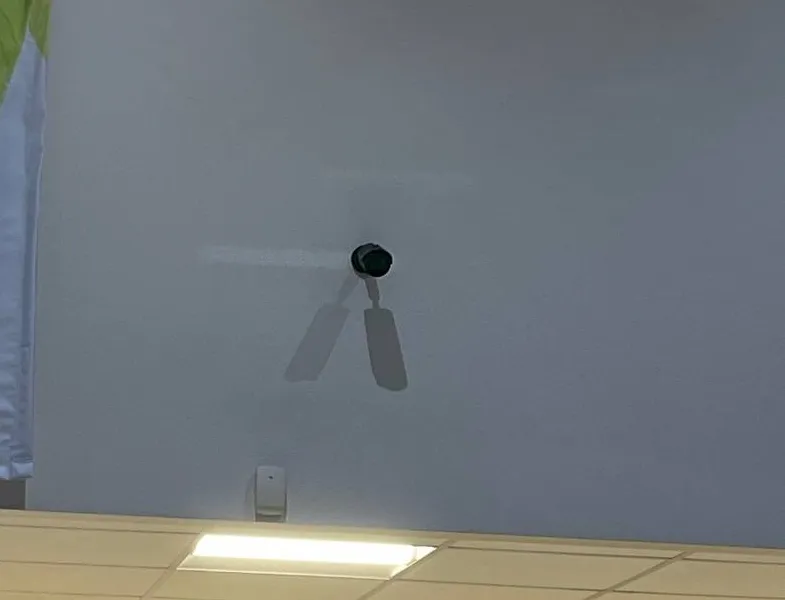
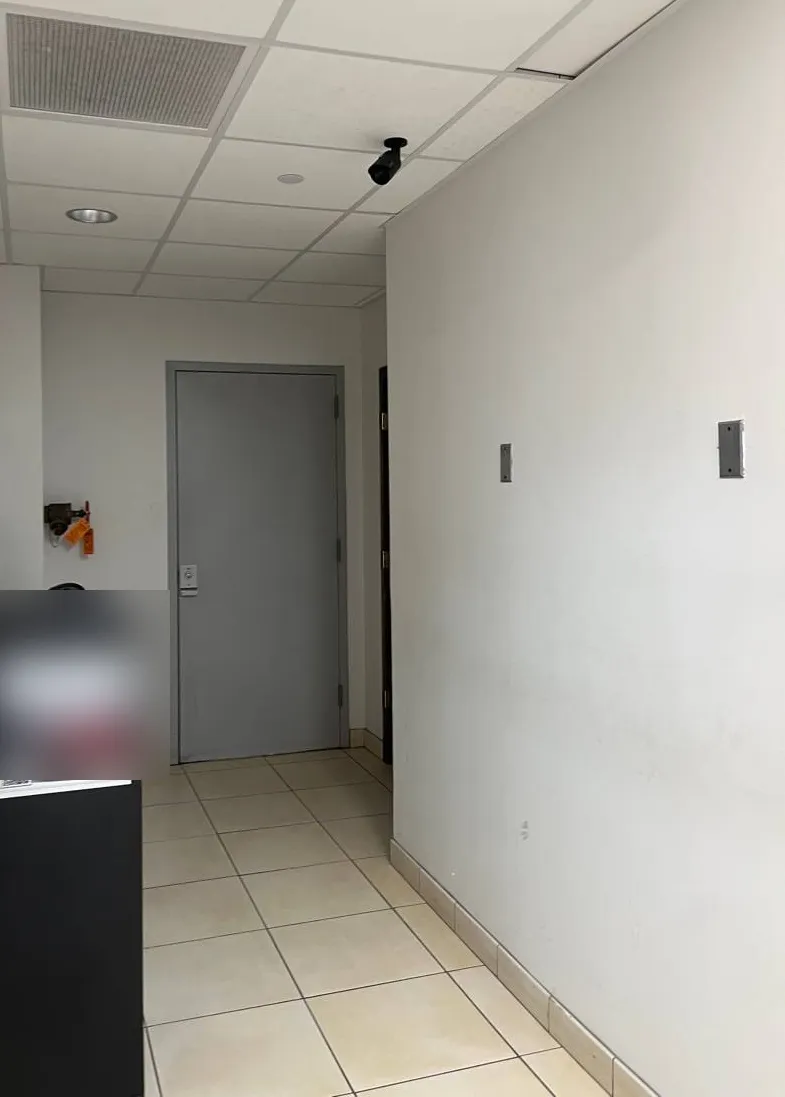
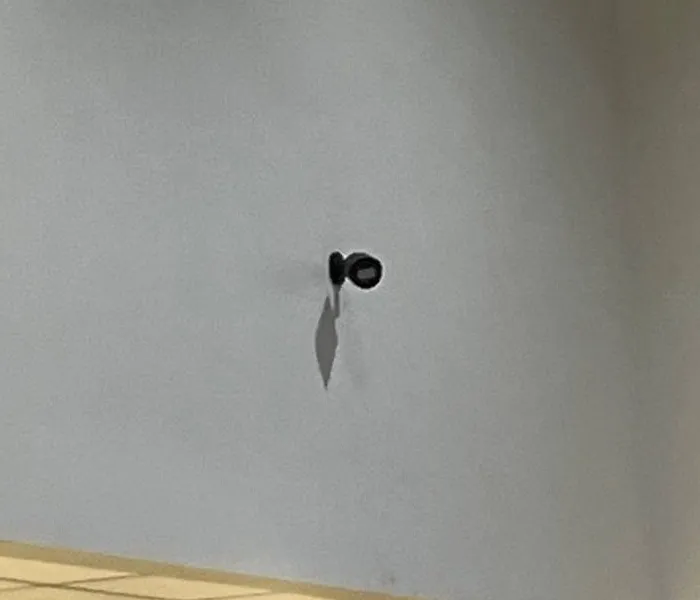
From one of our CCTV jobs (Rockland County car dealership): a ceiling-mounted camera looking straight down a tiled corridor at a grey steel door, so everyone who uses that door walks toward the lens.From one of our CCTV jobs (Rockland County car dealership): a mini bullet on a short arm fixed to a plain white wall above the edge of the drop ceiling, with the cable going straight into the wall behind the mount.
Two habits from those jobs carry over to every Orange County site. A camera at the end of a corridor, aimed back at a door, is one of the best-value cameras on any building, because people walk straight toward it. And a cable that disappears into the wall right behind the mount, with nothing exposed, is what keeps a camera working and looking tidy for years.
Before You Hire
Questions to Ask Any Orange County CCTV Installer
Comparing quotes is easier when every installer answers the same questions. These are the ones that separate an experienced CCTV installation company from a crew that mounts cameras and leaves.
Will you put the camera list in writing? Each camera, where it goes, what it is meant to show and which lens it uses.
Exactly how far back will the recorder reach? A real installer gives a day count for your cameras and settings; “a few weeks” is not an answer.
What happens in a power or internet outage? The right answer is a battery backup and local recording.
How does cable reach the far cameras? Runs past 100 meters need a switch, an extender or fiber, named in the quote.
Who owns the admin login? You should, in your name, not the installer.
Which New York license do you hold? Get the number on the quote and look it up yourself; ask for proof of liability insurance too.
What do I get at handover? A walk-through of playback and export, the camera list, the cable map and the passwords.
Each of those answers is printed on our quotes. Customers' own words are on Google, where we hold a 4.7★ rating across 201 reviews; we point people there rather than to a list of references.
When Owners Call Us
The Moments That Bring Orange County Owners to CCTV
A new lease on a warehouse or flex building. Tenants moving into new space along I-84 want cameras running before the first trucks arrive. We work from the site plan, coordinate with the landlord and the fit-out contractor, and schedule the lift work before the racking goes in, when the ceiling is easiest to reach.
A new store or restaurant opening. A grand opening on Route 211, Route 300 or a village Main Street wants cameras recording on day one. We go in after the ceilings close and before the shelves are stocked.
Before the holiday rush. Retailers in Woodbury, Newburgh and Wallkill call in September and October to be ready for Black Friday and Christmas, when traffic and theft both peak.
The morning after a break-in. Calls for CCTV installation after a break in or after vandalism come with a list of what went wrong: the door that was forced, the lot where the car was hit. Those spots get cameras first, and the new recorder goes somewhere the next intruder will not think to look.
Harvest and packing season. Farms on the black dirt want fuel tanks, barns and packing sheds covered before the busiest weeks, when the most equipment and product sit out.
A vacant building or a renovation. An empty storefront, a house between owners or a building under renovation needs cameras that record locally and alert on people, often on temporary power.
Get In Touch
Request a Free Orange County CCTV Quote
Tell us the town or city, what kind of building it is, and the places you want on camera: doors, docks, registers, lot rows, a gate or a barn. A few phone photos of the outside, the ceiling where cameras would go and any old recorder help us quote faster, and a site plan helps on warehouses. Rather talk? Call (845) 640-3835.
✅
Request Sent!
Thanks. We will call or text to set up your Orange County CCTV visit, usually within 2 hours of your request.
How It Works
How an Orange County CCTV Installation Runs
The same six steps apply to a raised ranch in Washingtonville and a distribution building in Montgomery; only the size of each step changes.
1
Tell us about the site
Town, building type, the doors, docks or areas to cover, photos or a site plan, and any existing recorder. We book within 2 hours of your request.
2
Confirm the layout
From photos and a call for simple homes; on site for stores, warehouses and farms, where we measure cable routes, check ceiling heights and pick the recorder room.
3
Get a written quote
One line per camera with its lens, then the cable, switches, drives, battery and labor, so you can compare it with any other bid. Half down reserves the install date, in the order deposits arrive.
4
Cable and mount
Hidden routes where the building allows, tray or J-hooks in warehouses, conduit where cable could be hit, sealed holes on every exterior wall.
5
Set up the recorder
Recorder, drives, switches and UPS installed; cameras named by location; retention, detection zones, schedules and passwords set; every channel tested day and night.
6
Hand over and tune
We show whoever will use it how to search a time, pull a clip and share it, leave the paperwork and passwords, and look at the alerts and drive usage again once a week of real footage exists.
Coverage Area
CCTV Installation Near Orange County's Landmarks
We install CCTV across the whole county, from the Hudson to the Delaware. These are the places our crews pass most.
New York Stewart International Airport, New Windsor
The airport off I-84 and Route 207, ringed by hangars, freight buildings, hotels and the business parks along Route 17K.
Woodbury Common Premium Outlets, Central Valley
More than 245 outlet stores beside Route 32 and the Thruway, at the center of a busy strip of hotels, restaurants and gas stations.
Galleria at Crystal Run, Middletown
The mall on Route 211 in the Town of Wallkill, with strip centers, medical offices and dealerships along the roads around it.
Newburgh waterfront and East End
Restaurants along the river below Washington's Headquarters, and the brick row houses and storefronts of the historic East End above them.
Harness racing and the Goshen courthouse square
The county seat, with the Goshen Historic Track, the county government buildings and a village Main Street of shops and offices.
The black dirt around Pine Island
Flat, dark farmland in Warwick and Goshen near the New Jersey line, with packing houses, barns and farm stands along the county roads.
We also serve Montgomery, Maybrook, Walden, Washingtonville, Cornwall, Highland Falls, Monroe, Harriman, Chester, Florida, Warwick, Greenwood Lake, Tuxedo, Port Jervis, Deerpark, Otisville, Mount Hope, Wawayanda, Crawford, Pine Bush and Blooming Grove, and the roads in between.
Pricing
CCTV Installation Cost in Orange County
Every number below is copied from our published Orange County camera price list, nothing new or special for this page. A series price buys four cameras, a recorder, cable, mounting and setup by our crew, and a drive sized for two weeks.
System
What it is
Starting price
A Series
2MP HD 1080P cameras, 4-camera package with DVR
from $1,199
F Series
5MP DVR 2K HD cameras, active deterrent with siren and lights
from $1,247
E Series
4-5MP IP 2K HD cameras on a 4K NVR, smart detection
from $1,406
C Series
8MP 4K Ultra HD DVR, eyeball and long-range cameras
from $1,641
D Series (top tier)
8MP 4K Ultra HD IP, active deterrent, two-way talk
from $1,641
Residential, 4–8 cameras
Four to eight cameras on one recorder, wired with PoE by our crew
$1,340 – $2,500
Commercial
Stores, offices, restaurants, warehouses and sites with more than one building
$1,500 – $5,000+
Monthly fees
Local recording, no subscription
$0
What moves the price on an Orange County job
The series price covers a standard 4-camera installation. Extra cameras, long runs, lift work under high ceilings, fiber between closets or buildings, wireless bridges, pole and light-pole mounts, conduit on dock walls, concealed wiring through finished walls, larger drives for longer retention and a battery backup are each priced per camera or per item after we confirm the layout. That is why CCTV installation cost per camera varies so much here: a camera above a store's back door and a camera on a pole at the far end of a truck court are different amounts of work.
Three common layouts show how it plays out. A raised ranch in Monroe usually fits the 4-camera package as it is, wired through the attic and the basement. A row house in Newburgh often adds a camera or two for the rear yard and the alley. A store on Route 211 usually falls in the commercial range, and a distribution building is quoted as its own project once we have walked the docks and the yard.
If the hardware is already sitting in boxes in your garage, the CCTV installation labor only price comes by phone or text once we have the model numbers and a sketch of where each camera goes, and the deposit holds the date. Financing is available on our systems; ask when you call. We do not run fake sale prices: the series prices above are the prices.
Installation workmanship carries our 30-day warranty, and extended coverage of one year or longer is available as a paid add-on. Full terms — including 50% deposit, one-year parts-only warranty on Abstract Enterprises Security Systems-supplied products, and the late-fee schedule — are set out in the service agreement.
Shop Our Systems
CCTV Installation Packages for Orange County Homes and Businesses
Pick the series by three questions: how far does the farthest camera need to see, do you want person and vehicle alerts or a siren that talks back, and is there coax in the walls worth keeping? All five start as four cameras with a recorder, installation and two weeks of storage.
A
A Series · from $1,199
2MP HD 1080P cameras on a DVR. Night vision 60-100 ft, motion detection, smart AI, full-color night vision, audio, remote access. Models A1, A2, A3. A solid start for a townhouse, a raised ranch or a small office.
F
F Series · from $1,247
5MP DVR 2K HD cameras in eyeball, bullet and dome styles. Night vision 90-100 ft, active deterrent with siren and lights, 20" monitor. Models F1 to F6. A good fit for a city building with sound coax and a back lot to protect.
E
E Series · from $1,406
4-5MP IP 2K HD cameras on a 4K NVR. Night vision 90-100 ft, IP67, smart detection, audio, full color, 20" monitor, remote access. Models E1, E2, E3. Our usual pick for new homes and stores that want clean person and vehicle alerts.
C
C Series · from $1,641
8MP 4K Ultra HD DVR with eyeball and long-range cameras. Night vision 100-120 ft, IP66, audio, full color, monitor included. Models C1, C2, C3. For a long frontage or a farm lane where 4K over coax makes sense.
D
D Series · top tier · from $1,641
8MP 4K Ultra HD IP in eyeball and bullet styles. Night vision 90-120 ft, IP67, audio, full color, active deterrent, two-way talk, 20" monitor. Models D1 to D5. For lots, yards and businesses that want every feature.
Bring your own cameras: labor-only CCTV
CCTV installation for customer supplied cameras works like this: you send the brand and model of each camera and the recorder, the count and a rough plan, we text or call back a labor price, and the deposit books it. There is no site walk-through for owner-bought gear, and with owner-bought wireless cameras the Wi-Fi signal and the hardware stay the owner's responsibility. If a kit is the wrong choice for the spot, for example a battery camera meant for a dock door, we will say so before you book.
Want a named brand instead? As an authorized partner we install Lorex, Luminys and Reolink systems; see our Lorex camera installation page for Orange County for that brand's models and prices.
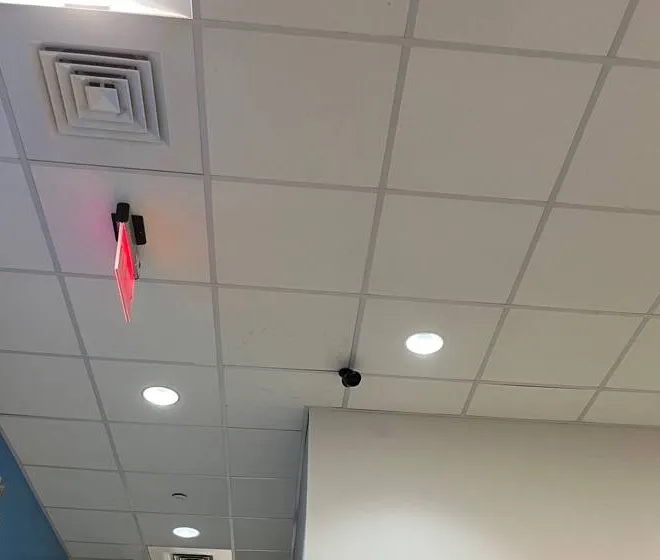
From one of our CCTV jobs (Rockland County car dealership): a compact deterrent camera with its red light showing, high on the wall below a ceiling vent, and a second small camera on the ceiling edge near the recessed lights.
Complete Services
Every CCTV-Related Service We Offer in Orange County
Cameras are only part of what our Orange County crews wire. Related services, each with its own page:
Do your crews really travel to Port Jervis, Deerpark and the western edge of Orange County?
+
Yes. We install CCTV across the whole county, from Newburgh and Cornwall on the Hudson to Port Jervis, Deerpark and Otisville on the western side, and south to Warwick, Greenwood Lake and Tuxedo. Distance changes the schedule, not the service: western Orange County jobs are booked the same way, within 2 hours of your request, through our direct line at (845) 640-3835.
What happens if a camera fails a few months after the installation?
+
Call us and we diagnose it. Workmanship on the installation is covered for 30 days, products we supply carry a one-year parts-only warranty, and longer coverage is available as a paid add-on. If a supplied camera has failed within its parts warranty, the part is covered; the visit itself, and damage from storms, impacts or changes by others, is billed as a service call under the service agreement.
Do you sell the cameras, or only install them?
+
Both. Most customers buy a complete system from us, usually our house brand, or Lorex, Luminys or Reolink as an authorized partner, so the cameras, recorder, cable and installation come from one company with one quote. If you already own the equipment, we install it for a labor-only price instead.
When is the rest of the bill due after the deposit?
+
A 50% deposit books your installation date. The balance is due when the job is finished and the system has been handed over to you, with the cameras recording and the app working on your phone. The full payment terms, including the late-fee schedule, are in the service agreement you sign before we start.
Can you mount cameras on the light poles in our parking lot?
+
Usually, yes, if the poles are yours or your landlord agrees. Light poles give height and a view down the lot rows, and they often carry power. We mount with brackets made for poles, bring the cable in through the pole base or in conduit, and add surge protection. Poles owned by the town or a utility are not ours to use, so cameras for those areas go on your building or on a pole of your own.
Can I put cameras on the warehouse floor or in the break room to watch employees?
+
Work areas such as the warehouse floor, the docks, the shipping desk and the cash office can be covered, and many employers tell staff in writing where cameras are. New York Labor Law §203-c bars employers from video recording in restrooms, locker rooms and rooms set aside for changing clothes, and we leave audio off in workplaces unless the owner decides otherwise. This is general information, not legal advice.
Will wired cameras interfere with the Wi-Fi our scanners and forklift tablets use?
+
No. Wired cameras send their video over Cat6 or fiber, not over the air, so they do not take up the radio space your handheld scanners and tablets depend on. We also keep the cameras on their own network or VLAN, so heavy video traffic does not slow down the warehouse system or the office computers.
Do you install CCTV on single-family houses, or only on businesses?
+
Both. Residential CCTV installation is a large share of our Orange County work, from townhouses in Chester to row houses in Newburgh and farmhouses near Warwick. A typical home system covers the front and back doors, the driveway and the yard with 4 to 8 cameras, and our 4-camera house-brand packages start at $1,199.
Can I keep a copy of the footage off site in case the recorder is stolen?
+
Yes. The main protection is hiding or locking the recorder in a spot a burglar will not reach. On top of that, the recorder can send event clips to your phone as they happen, and many systems can push important clips to a cloud account or a second recorder in another building. Local recording stays the main copy, so nothing stops if the internet drops.
Is a 4-camera package enough for a small shop or office?
+
Often it is a good start. Four cameras usually cover the front door, the register or reception, the main floor and the back door of a small space. A shop with a stockroom, a side entrance or its own parking usually needs six to eight. We quote the cameras your space needs after we see the layout, and pick a recorder with room to add more later.
All Areas Served
CCTV Installation in Orange County and the Wider Hudson Valley
This page covers Orange County, New York. For the rest of the region, start at our Hudson Valley CCTV installation hub, which links to every county we serve.
Newburgh, Middletown, Port Jervis and every Orange County town in between: one direct line, (845) 640-3835. Office of record: Abstract Enterprises Security Systems, 460 E Fordham Rd, Bronx, NY 10458. Licensed (NYS low-voltage #12000287431) and insured; 4.7★ / 201 Google Reviews; content checked November 2026.